
Showing 27 items matching "little canada"
-
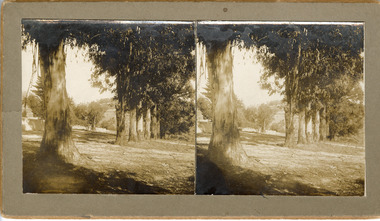 The Beechworth Burke Museum
Photograph - Stereoscopic Photograph
... ...Little Canada...The section photographed was known as 'Little Canada', and an isolation ward was added there in 1890. ...Reverse: 1997.2687/A02687/Trees in Hospital Grounds/(Little Canada)/Beechworth Note: Trees in the O+D hospital grounds/(Little Canada)/A02687/1997.2687...The section photographed was known as 'Little Canada', and an isolation ward was added there in 1890. ...This stereoscopic photograph depicts the grounds and mature trees of the Former Ovens District Hospital. Started in 1857, it was Beechworth's first hospital and the only hospital between Melbourne and New South Wales. It was a philanthropic institution catering to the poor. In 1874, the sweeping gardens were laid out by Dr. Jenkyns and featured over 200 species of trees including fruit trees, shrubs and vegetable and flower gardens. Patients could enjoy the view from a rotunda. The section photographed was known as 'Little Canada', and an isolation ward was added there in 1890. Since the hospital's closure in 1940, only the front facade and gardens remain. The gardens are now known as Centennial Park and retain many of the original mature trees.This stereoscopic photograph has aesthetic significance as it beautifully captures the sanitorium-like restorative atmosphere of the hospital gardens. It also has historical significance as it depicts the grounds of the Ovens District Hospital and the nature of hospital gardens in the nineteenth and early twentieth century.Sepia square stereoscopic photograph printed on matte photographic paper mounted on card.Reverse: 1997.2687/A02687/Trees in Hospital Grounds/(Little Canada)/Beechworth Note: Trees in the O+D hospital grounds/(Little Canada)/A02687/1997.2687former ovens district hospital, ovens district hospital, little canada, hospital garden, jenkyns, centennial park -
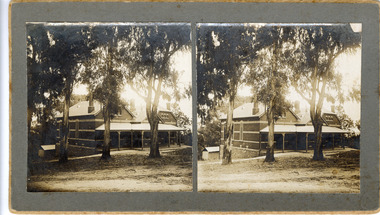 The Beechworth Burke Museum
Photograph - Stereoscopic Photograph
... Words 6 & 7 Little Canada...Isolation Ward Beechworth hospital history Beechworth Ovens District Hospital Former Ovens District Hospital Old Hospital Ruins Words 6 & 7 Little Canada A rectangular sepia stereoscopic photograph printed on matte photographic paper, mounted on board. ...Believed to have been taken in the late 19th - early 20th century, this photograph depicts the former Ovens District Hospital or now referred to as the Old Hospital Ruins in Beechworth. The photograph highlights the isolation ward, or ward 6 and 7 as it was otherwise known, which was built by D Fiddes in 1890 . The former Ovens and District Hospital was closed and demolished in 1940.This photograph documents the structure of the former Ovens District Hospital before it was demolished in 1940. The Ovens District Hospital is considered a historically significant archaeological site within Victoria, therefore this photograph holds significance in its documentation of a stage of the history of this historic site. A rectangular sepia stereoscopic photograph printed on matte photographic paper, mounted on board.Words 6 & 7 Little Canadaisolation ward, beechworth hospital history, beechworth, ovens district hospital, former ovens district hospital, old hospital ruins -
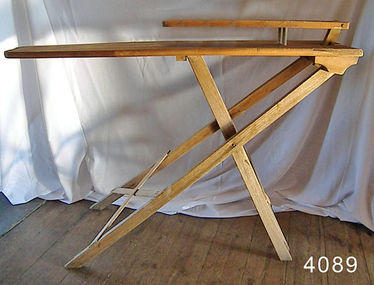 Flagstaff Hill Maritime Museum and Village
Furniture - Ironing board, 1910-1930
... little or no ironing. Permanent press clothing was developed to reduce the ironing necessary by combining Wrinkle resistant polymers with cotton. The first known use of the iron for removing wrinkles in clothes is known to have occurred in China, and the electric iron was invented in 1882, by Henry W. Seeley. Seeley patented his "electric flat iron" on June 6, 1882 (U.S. Patent no. 259,054). On 15 February 1858 W. Vandenburg and J. Harvey patented an ironing table that facilitated pressing sleeves and pants legs. A truly portable folding ironing board was first patented in Canada...little or no ironing. Permanent press clothing was developed to reduce the ironing necessary by combining Wrinkle resistant polymers with cotton. The first known use of the iron for removing wrinkles in clothes is known to have occurred in China, and the electric iron was invented in 1882, by Henry W. Seeley. Seeley patented his "electric flat iron" on June 6, 1882 (U.S. Patent no. 259,054). On 15 February 1858 W. Vandenburg and J. Harvey patented an ironing table that facilitated pressing sleeves and pants legs. A truly portable folding ironing board was first patented in Canada ...Ironing is the use of a machine, usually a heated tool (an iron), to remove wrinkles from fabric. The heating is around 180–220 °Celsius, depending on the fabric type. Ironing works by loosening the bonds between the long-chain polymer molecules in the fibres of the material. While the molecules are hot, the fibres are straightened by the weight of the iron, and they hold their new shape as they cool. Some fabrics, such as cotton, require the addition of water to loosen the intermolecular bonds. Many modern fabrics developed in or after the mid-twentieth century require little or no ironing. Permanent press clothing was developed to reduce the ironing necessary by combining Wrinkle resistant polymers with cotton. The first known use of the iron for removing wrinkles in clothes is known to have occurred in China, and the electric iron was invented in 1882, by Henry W. Seeley. Seeley patented his "electric flat iron" on June 6, 1882 (U.S. Patent no. 259,054). On 15 February 1858 W. Vandenburg and J. Harvey patented an ironing table that facilitated pressing sleeves and pants legs. A truly portable folding ironing board was first patented in Canada in 1875 by John B. Porter. The invention also included a removable press board used for sleeves. In 1892 Sarah Boone obtained a patent in the United States for improvements to the ironing board, allowing for better quality ironing of shirt sleeves.A domestic item with an interesting history of development, significant as it shows the progress and the evolution of a domestic item designed to make housework more efficient.Wooden Ironing board with press board for sleeves, board is folding.Noneflagstaff hill, warrnambool, shipwrecked-coast, flagstaff-hill-maritime-museum, flagstaff-hill-maritime-village, domestic item, ironing board, ironing, clothes, wrinkles in clothes, henry w. seeley, w. vandenburg and j. harvey -
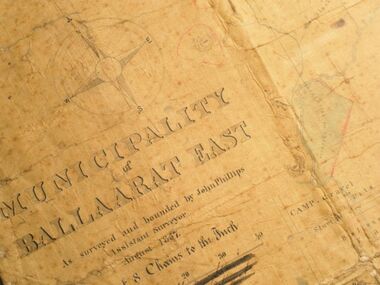 Federation University Historical Collection
Map, Municipality of Ballarat East, 1857
... The map has read and blue highlights, and identifies areas such as Mount Pleasant, Golden Point, White Flat, Nightingale, Malekoff, Old Post Office Hill, Red streak, Gumtree Flat, Old Gravelpits, Bakery Hill, Ballaarat Flat, The Camp, Specimen Gully, Pennyweight Hill, Warrenheip Gully, Gays Gully, Pennyweight Flat, Eureka, Black Hill, Pinchgut, Crocodile, Hit or Miss, Little Bendigo, Brown Hill, Mopoke, Cricket Reserve, Canadian Hotel, Ballarat East...In 2007 this map was listed on the inaugural Ballarat Treasure's Register. mount pleasant golden point white flat nightingale malekoff old post office hill red streak gumtree flat old gravelpits bakery hill ballaarat flat the camp specimen gully pennyweight hill warrenheip gully gays gully pennyweight flat eureka black hill pinchgut crocodile hit or miss little bendigo brown hill mopoke cricket reserve canadian hotel ballarat eastm phillips john phillips field draughtsman ballarat east ballarat east map Large map backed onto linen. ...Gold was discovered in Ballarat in 1851. This plan was created six years later and names some of the great gold locations of Ballarat East. It also shows the locality of the Eureka Stockade (1854) and the walking tracks and roads on the Ballarat East Goldfield.In 2007 this map was listed on the inaugural Ballarat Treasure's Register.Large map backed onto linen. The map has read and blue highlights, and identifies areas such as Mount Pleasant, Golden Point, White Flat, Nightingale, Malekoff, Old Post Office Hill, Red streak, Gumtree Flat, Old Gravelpits, Bakery Hill, Ballaarat Flat, The Camp, Specimen Gully, Pennyweight Hill, Warrenheip Gully, Gays Gully, Pennyweight Flat, Eureka, Black Hill, Pinchgut, Crocodile, Hit or Miss, Little Bendigo, Brown Hill, Mopoke, Cricket Reserve, Canadian Hotel, Ballarat Eastmount pleasant, golden point, white flat, nightingale, malekoff, old post office hill, red streak, gumtree flat, old gravelpits, bakery hill, ballaarat flat, the camp, specimen gully, pennyweight hill, warrenheip gully, gays gully, pennyweight flat, eureka, black hill, pinchgut, crocodile, hit or miss, little bendigo, brown hill, mopoke, cricket reserve, canadian hotel, ballarat eastm phillips, john phillips, field draughtsman, ballarat east, ballarat east map -
 Federation University Historical Collection
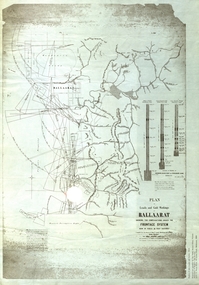
Plan, Plan of Leads and Gold Workings at Baallarat Showing the Complications Under the Frontage System, 1863, 1863
... Facsimile of a plan held by the Public Record Office Victoria. ballarat mining inkermann lead golden point lead robert davidson terrible lead white horse lead frenchman's lead little magpie lead milkmaid's lead woolshed lead nuggety lead blackman's lead canadian lead sailor's gully lad nightingale lead malakoff lead black hill gully pennyweight flat black hill winter's pre-emptive right nelson company great extended great republic lead cgt Facsimile of a plan of Ballarat showing leads, gold workings an dthe frontage system. ...Facsimile of a plan held by the Public Record Office Victoria. Facsimile of a plan of Ballarat showing leads, gold workings an dthe frontage system.ballarat, mining, inkermann lead, golden point lead, robert davidson, terrible lead, white horse lead, frenchman's lead, little magpie lead, milkmaid's lead, woolshed lead, nuggety lead, blackman's lead, canadian lead, sailor's gully lad, nightingale lead, malakoff lead, black hill gully, pennyweight flat, black hill, winter's pre-emptive right, nelson company, great extended, great republic lead, cgt -
 Federation University Historical Collection
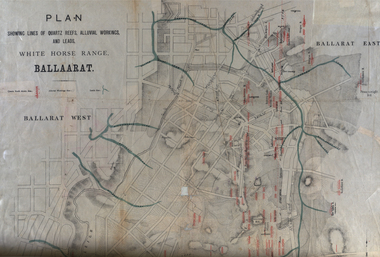
Plan, White Horse Range Ballarat, 1885, 06/1885
... Leads include: Navy jacks, Gays, Canadian, Prince Regent, Sailors Gully, White Horse, Little White Horse, Milkmans, Nightingale, Golden Point, Gravel Pits. ...Leads include: Navy jacks, Gays, Canadian, Prince Regent, Sailors Gully, White Horse, Little White Horse, Milkmans, Nightingale, Golden Point, Gravel Pits. ...Two plans .1) Plan of the Ballarat Goldfields showing leads, rivers, streets and topography. Quartz reefs include: Yorkshire, Try Again, Promised Land, Western Slates, Norwegian, Robert's Lode, Finn's, Band and albion, Rothschild, Old Post Office, Queen Lode. Leads include: Navy jacks, Gays, Canadian, Prince Regent, Sailors Gully, White Horse, Little White Horse, Milkmans, Nightingale, Golden Point, Gravel Pits. Scale is 8 Chains to 1 inch .2) Plan showing lines of quartz reefs, alluvial workings and leads, White Horse Range, Ballarat. Leads include White Horse LEad, Little White Horse Lead, One Eye Gully, Terrible Lead, Sailor's Gully, Canadian Lead, Prince Regent Gully, Canadian Lead, Cavs Lead, Navy jacks Lead, Eureka Lead, Old Gravel Pits Lead, Gravel Pits Lead, Nightingale Lead, Malakoff Lead, Milkmans Lead, Redan Lead, Woolshed Lead, Jacksons Lead, Winters Lead, SCtochman's Lead, Canadian Lead. Reefs include: Promised Land, Daniash, Sir Garnet Wolsley, Norwegian, Rothschile, Band and Albion, Finns, Llanberis, Roberts Lode, Tynworths and Black Hill, Oregan, Yorkshire, Try Again, Yorkshire, Post Office, Clarke's, Western Slates, Black Slate, Danks Slates, Eastern Slates, Queen's Lode, Fire Brigade. Mines include Red Streak, New Chum, Tinworths, Woah Hawp, Normanby, Speedwell, Llanberris Extended, Llanberis, Last Chance, Major, Countess, Pioneer and a number of batteries along Main Road Hills include: Mount Clear, Pennyweight Hill, Sovereign Hillballarat, plan, white horse range, white horse, goldfields, mines, reefs, indicators, leigh river, cgt, tinworth, mining -
 The Beechworth Burke Museum
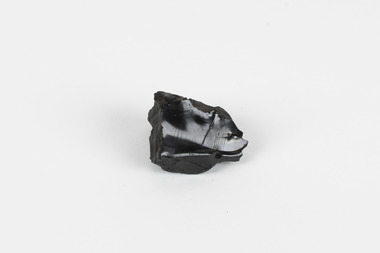
Geological specimen - Anthracite crystal, Unknown
... Canada, and other countries. This specimen was recovered from Tasmania and is 85-95% carbon. Anthracite is the mineral name for hard coal and is the least plentiful of all coal types. It is clean to the touch and, when polished, is used for decorative purposes. Before natural gas and electricity, anthracite was used for domestic heating as it produces little ...Anthracite typically occurs in geologically deformed areas due to extreme heating – with temperatures ranging from 170 to 250 °C – caused by igneous intrusions or high geothermal gradients. It is most commonly found in northeastern Pennsylvania in the United States; however, smaller amounts are also found in Australia, China, eastern Ukraine, South Africa, western Canada, and other countries. This specimen was recovered from Tasmania and is 85-95% carbon.Anthracite is the mineral name for hard coal and is the least plentiful of all coal types. It is clean to the touch and, when polished, is used for decorative purposes. Before natural gas and electricity, anthracite was used for domestic heating as it produces little dust, burns slowly, and gives off a minor amount of smoke. However, it is also limited in abundance and expensive. This specimen is part of a larger collection of geological and mineral specimens collected from around Australia (and some parts of the world) and donated to the Burke Museum between 1868-1880. A large percentage of these specimens were collected in Victoria as part of the Geological Survey of Victoria that begun in 1852 (in response to the Gold Rush) to study and map the geology of Victoria. Collecting geological specimens was an important part of mapping and understanding the scientific makeup of the earth. Many of these specimens were sent to research and collecting organisations across Australia, including the Burke Museum, to educate and encourage further study.A hand-sized highly metamorphosed coal mineral with a black/steel-grey shiny metallic lustre.geological specimen, geology, geology collection, burke museum, beechworth, indigo shire, geological, mineralogy, victoria, alfred selwyn, anthracite -
 Federation University Historical Collection
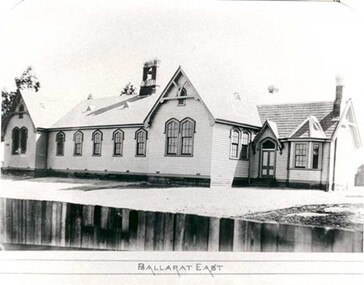
Photograph - Photograph - black and white, Ballarat East State School (No 1071)
... According to 'Visions and Realisations' The Eureka gold lead opened in August 1852, running from Little Bendigo, south beneath Yarrowee Creek into Pennyweight flat, where it was joined 100 yards or so from the intersection of main and Eureka Streets by the Canadian Lead. ...According to 'Visions and Realisations' The Eureka gold lead opened in August 1852, running from Little Bendigo, south beneath Yarrowee Creek into Pennyweight flat, where it was joined 100 yards or so from the intersection of main and Eureka Streets by the Canadian Lead. ...The weatherboard Ballarat East State School SS 1071 was formerly known as Specimen Hill. According to 'Visions and Realisations' The Eureka gold lead opened in August 1852, running from Little Bendigo, south beneath Yarrowee Creek into Pennyweight flat, where it was joined 100 yards or so from the intersection of main and Eureka Streets by the Canadian Lead. State School 1071 was formerly known as Ballarat Common School No. 71, and was founded by the Free Presbyterian Church on Specimen Hill in Eureka Street, Ballarat on 01 January 1854. On 20 May 1869 the trustees of the Presbyterian School, Specimen Hill, Ballarat, consented to the transfer of the site to the Board of Education. On 01 September 1870, Specimen Hill, Ballarat, was vested in the Board and then became known as SS 1071. On 01 March 1879 the Minister, The Hon. William Collard Smith, and William Dobbie, Inspector of School Buildings, visited Ballarat to report on the buildings with a view to extensions and renovations. The minister issued instructions for the old wooden part of the school to be demolished, and brick additions to be erected, so that the whole premises would accommodate 350 students. (''Visions and Realisations: A Century of State Education in Victoria, Vol. 2'', Education Department of Victoria, 1973, p 729-730.)Black and white photograph of a weatherboard school with shingle roof known as Ballarat East (SS1071). The building has a brick chimney and bell tower. This school has Castlemaine flagging in the passages.ballarat east state school, education, st paul's school, specimen hill state school -
 Federation University Historical Collection
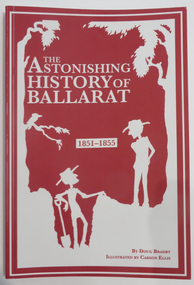
Book - Booklet, Seriously History Press et al, The Astonishing History of Ballarat: 1851-1855, 2018
... port phillip california ballarat thomas chapman john kelly strath loddon louis michel william habberlin james esmond george bruhn thomas hiscock john dunlop james regan james oddie herbert swindell tom toddleton buninyong tom brown squatters alfred clarke paul gooch john hall eureka stockade harrie wood william akehurst monster nuggets john evans daniel evans thomas george gough william john gough sarah sands john lees william green canadian nugget bob fee henry gunn michael welsh benjamin robertson thomas carroll white horse ranges little bendigo red hill john vinvent brewer george noble w.h. ferrier john alloo peter lalor john basson humffray raffaello carboni james rice john yates thomas bath gum-tree flat Book with red and white cover. ...Book with red and white cover.port phillip, california, ballarat, thomas chapman, john kelly, strath loddon, louis michel, william habberlin, james esmond, george bruhn, thomas hiscock, john dunlop, james regan, james oddie, herbert swindell, tom toddleton, buninyong, tom brown, squatters, alfred clarke, paul gooch, john hall, eureka stockade, harrie wood, william akehurst, monster nuggets, john evans, daniel evans, thomas george gough, william john gough, sarah sands, john lees, william green, canadian nugget, bob fee, henry gunn, michael welsh, benjamin robertson, thomas carroll, white horse ranges, little bendigo, red hill, john vinvent brewer, george noble, w.h. ferrier, john alloo, peter lalor, john basson humffray, raffaello carboni, james rice, john yates, thomas bath, gum-tree flat -
 Federation University Historical Collection
Booklet, J.A. Hoskin & Son, Ballarat School of Mines Students' Magazine, 1954, 1954
... Editorial, Principal's Page, Prominent Personalities, Eureka Stockade, Two ex-students tell of their work and conditions in East Africa and Canada, The Art School, Literary Society, Boys Sport, Football, Cricket, Baseball, Athletics, Tennis, Chris Sanos - another ex-student describes his recent trip to Greece, Junior School, Ballarat wins Final - Football Premiers 1954, Some Impressions of London, House Notes, School Council. Members of Staff, Roll Call Diploma Students, Junior Technical School Boys' and Girls' Students Listing ballarat school of mines magazine j. collier john skuja janice wilton murray gillan neil andrews ellen freemantle alan johnson graeme willey diana mainwaring b. v. mcdougall margaret little lance matthews philip davis john barnes cliff restarick philip kempe barry jones harold everett j. jenkin r. howard d. lavery j. williams j. barnes j. murray j. wolfe j. clelland t. gallagher w. maxwell n. andrews b. bellingham f. shearer n. spears i. schunke d. schmidt g. willey r. furlong g. rasdell b. tozer l. matthews w. saggers b. taylor j. watts a. johnson b. matthews r. dunlop b. mclennan g. ditchfield m. gillin j. cleelland b. singleton d. overall g. crawford chris sanos nancy rimmington janice tonkin herbert "andy" andrews leonard (a.p.c) doull harold m. everett murray "gilligan" gillin alan "johno" johnson khoo teng seong douglas "myxo" lockhead lancelot "willey" matthews bruce "frugal" mcdougall "aal" pitzen john "cheesy" skuja brian francis "tailspin" taylor john "tucks" watts lola andrich j. spencer r. cutter p. collier g. paddle n. richards i. pike b. cushion b. knight g. van berkel d. stevens n. stevens b. stevens l. major l. copeman k. norman n. hodder l. johns l. curtis h. hay l. furlong g. new j. hamilton r. day a. clarke b. parker p. agrums l. dean w. swan r. carlson t. white m. walsh r. gilbert w. edmends b. vurlow d. wakeling a. haywood d. sarah k. rogers l. cook j. mcleod p. hatton p. fisher r. lambert j. vincent t. lugg g. matthews w. etty n. twaits m. o'brien w. davidson i. lightfoot p. cahill n. slocum d. martin j. leckie marjorie garner r. hall i. beaumont barbara o'connell b. duthie l. boyd i. kinnane d. baldock p. nunn j. strickland d. robertson n. everett b. whittle w. widdop j. richards b. tresize k. buchanan m wunhym j. caddy g. kerr j. collins r. sansom i. gitsham k. weightman g. gilmer e. waller r. mcbride j. jardine lynette reynolds marion ritchie p. mchenry h. cromb c. veal j. van buerghel g. templeton k. page e. tozer b. wilson g. minehan g. smith j. bennett n. pike l. reynolds m. ritchie m. wunhym l. willis m. nolan j. rogers e. kinnane g. cody j. mills j. cunningham m. eggleton n. rimmington m. marshall n. gay e. hosking v. jolly j. mchenry rosalie hall brian duthie m. lesins l. hotchin g. hill e. richards l. jardine m. roberts i. siver d. mclennon k. warhurst r. rowse e. snowball g. jill n. bromley Gray soft covered magazine with red and brown titles Ballarat School of Mines Students' Magazine, 1954. ...Editorial, Principal's Page, Prominent Personalities, Eureka Stockade, Two ex-students tell of their work and conditions in East Africa and Canada, The Art School, Literary Society, Boys Sport, Football, Cricket, Baseball, Athletics, Tennis, Chris Sanos - another ex-student describes his recent trip to Greece, Junior School, Ballarat wins Final - Football Premiers 1954, Some Impressions of London, House Notes, School Council. Members of Staff, Roll Call Diploma Students, Junior Technical School Boys' and Girls' Students ListingGray soft covered magazine with red and brown titlesballarat school of mines, magazine, j. collier, john skuja, janice wilton, murray gillan, neil andrews, ellen freemantle, alan johnson, graeme willey, diana mainwaring, b. v. mcdougall, margaret little, lance matthews, philip davis, john barnes, cliff restarick, philip kempe, barry jones, harold everett, j. jenkin, r. howard, d. lavery, j. williams, j. barnes, j. murray, j. wolfe, j. clelland, t. gallagher, w. maxwell, n. andrews, b. bellingham, f. shearer, n. spears, i. schunke, d. schmidt, g. willey, r. furlong, g. rasdell, b. tozer, l. matthews, w. saggers, b. taylor, j. watts, a. johnson, b. matthews, r. dunlop, b. mclennan, g. ditchfield, m. gillin, j. cleelland, b. singleton, d. overall, g. crawford, chris sanos, nancy rimmington, janice tonkin, herbert "andy" andrews, leonard (a.p.c) doull, harold m. everett, murray "gilligan" gillin, alan "johno" johnson, khoo teng seong, douglas "myxo" lockhead, lancelot "willey" matthews, bruce "frugal" mcdougall, "aal" pitzen, john "cheesy" skuja, brian francis "tailspin" taylor, john "tucks" watts, lola andrich, j. spencer, r. cutter, p. collier, g. paddle, n. richards, i. pike, b. cushion, b. knight, g. van berkel, d. stevens, n. stevens, b. stevens, l. major, l. copeman, k. norman, n. hodder, l. johns, l. curtis, h. hay, l. furlong, g. new, j. hamilton, r. day, a. clarke, b. parker, p. agrums, l. dean, w. swan, r. carlson, t. white, m. walsh, r. gilbert, w. edmends, b. vurlow, d. wakeling, a. haywood, d. sarah, k. rogers, l. cook, j. mcleod, p. hatton, p. fisher, r. lambert, j. vincent, t. lugg, g. matthews, w. etty, n. twaits, m. o'brien, w. davidson, i. lightfoot, p. cahill, n. slocum, d. martin, j. leckie, marjorie garner, r. hall, i. beaumont, barbara o'connell, b. duthie, l. boyd, i. kinnane, d. baldock, p. nunn, j. strickland, d. robertson, n. everett, b. whittle, w. widdop, j. richards, b. tresize, k. buchanan, m wunhym, j. caddy, g. kerr, j. collins, r. sansom, i. gitsham, k. weightman, g. gilmer, e. waller, r. mcbride, j. jardine, lynette reynolds, marion ritchie, p. mchenry, h. cromb, c. veal, j. van buerghel, g. templeton, k. page, e. tozer, b. wilson, g. minehan, g. smith, j. bennett, n. pike, l. reynolds, m. ritchie, m. wunhym, l. willis, m. nolan, j. rogers, e. kinnane, g. cody, j. mills, j. cunningham, m. eggleton, n. rimmington, m. marshall, n. gay, e. hosking, v. jolly, j. mchenry, rosalie hall, brian duthie, m. lesins, l. hotchin, g. hill, e. richards, l. jardine, m. roberts, i. siver, d. mclennon, k. warhurst, r. rowse, e. snowball, g. jill, n. bromley -
 Eltham District Historical Society Inc
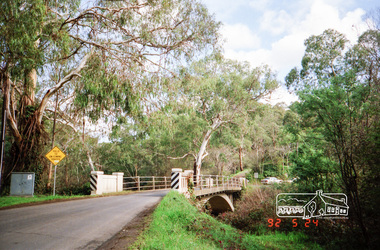
Photograph, Monash Bridge, Arthurs Creek Road, Hurstbridge, Eltham Heritage Tour, 24 May 1992, 24/05/1992
... little park with a mud-brick and timber shelter, to the Hurst family graveyard. There are two marked graves, one, Henry who was shot by Burke the bushranger and a cairn has a plaque listing others buried here from 1866 onwards. Burke was captured and tied to the wheel of a dray under the eucalypt near the waterhose/standpipe. Close by the kindergarten, at this place are three trees on the National Trust Register, a Canary Island pine, a Canadian...little park with a mud-brick and timber shelter, to the Hurst family graveyard. There are two marked graves, one, Henry who was shot by Burke the bushranger and a cairn has a plaque listing others buried here from 1866 onwards. Burke was captured and tied to the wheel of a dray under the eucalypt near the waterhose/standpipe. Close by the kindergarten, at this place are three trees on the National Trust Register, a Canary Island pine, a Canadian ...ELTHAM HERITAGE TOUR The Society excursion on 24th May 1992 was arranged by David Bick, leader of the team carrying out the Shire's heritage study. David selected a number of sites or buildings identified in the study, some of them lesser known components of the Shire's heritage. The tour commenced at the Eltham Shire Office at 10.00 am. Travel was by private car and mini-bus with stops at about twelve locations for commentary by David.It included a short walk in Hurstbridge and lunch at Kinglake. Highlights of the tour included: - 10 am Leave from Shire Offices - 3 Important Trees - A Physical Link to Eltham's First Settlers - Toorak Mansion Gates - A Surviving Farm House - An Intact Circa 1900 Main Street - First Settlers - Gold Miners, and Timber-getters - An Early Hotel - A Pioneering Homestead - Changing Eltham Shire - 20th Century - 4 pm Afternoon Tea and Finish Tour Extract from ELTHAM CULTURAL HERITAGE TOUR (Newsletter No. 85, July 1992, by Bettina Woodburn) "On the Arthurs Creek Road is a bridge designed by Monash, which we admired before walking across the little park with a mud-brick and timber shelter, to the Hurst family graveyard. There are two marked graves, one, Henry who was shot by Burke the bushranger and a cairn has a plaque listing others buried here from 1866 onwards. Burke was captured and tied to the wheel of a dray under the eucalypt near the waterhose/standpipe. Close by the kindergarten, at this place are three trees on the National Trust Register, a Canary Island pine, a Canadian cedar and probably a spruce. Radiata pines and a thick bolled peppercorn surround the little cemetery. Continuing along Main Street we notice elm trees planted as a war memorial, then on the left a 1930 timber house, a 1910 store and residence, resplendent with wrought iron trim, a double fronted Hardware Store and cypresses on the back alignment of a new vacant block. On the right side of the street is a less interesting attempt at an 'in character' shop. Further on are more early homes, one tucked away at the rear with two tall palms by the front steps. Another curiosity is a rounded veranda corner and there are more galvanised iron sheds or garages, before a mud-brick Dentist's Surgery. Beyond the round-a-about is St Peters Church, of mud-brick construction shared by Catholic and Anglican parishioners, overlooking the river flood plain. Leaving Hurstbridge on the Kinglake Road, we ate our picnic lunch beside the communication tower and enjoyed views of Melbourne, Yan Yean Reservoir and the distant Dandenongs beyond the spreading suburbs. Next we drove to the North West boundary of the Shire at Masons Falls Road towards Whittlesea. On the way to the North East Boundary we passed St Peters, a yellow wooden Church with a Tudor Archway; built in the early 1920's in the style of the 1860's. From the Healesville-Kinglake road the rolling hills had European aspects, the hedged fields and chestnut trees. Then it was back down the Hurstbridge Road through 'Aussie' bush of towering gums, with bracken and scrubby understorey, the Kinglake National Park, before more open country with deciduous trees planted in line, and a creek lined with willows."Record of the Society's history and activities and highlighting various aspects of the Heritage Study undertaken by David Bick used to create the future heritage overlay for the Shire of Eltham and later Nillumbik Shire.Roll of 35mm colour negative film, 4 stripsKodak Gold 100 5095shire of eltham historical society, activities, heritage tour, hurstbridge, monash bridge, arthurs creek road -
Bendigo Historical Society Inc.
Document - Empire Youth Sunday, 1953
... While it has a certain official status, Commonwealth Day is not a public holiday in most Commonwealth countries, and there is little public awareness of it. It is marked as a holiday in Gibraltar, but not in March. In Canada "Victoria Day" is celebrated on the Monday closest to 24 May (Queen Victoria's birthday)....While it has a certain official status, Commonwealth Day is not a public holiday in most Commonwealth countries, and there is little public awareness of it. It is marked as a holiday in Gibraltar, but not in March. In Canada "Victoria Day" is celebrated on the Monday closest to 24 May (Queen Victoria's birthday). history bendigo empire youth sunday empire day commonwealth day Empire Youth Sunday - A Dedication Service - 3rd May 1953 - hymns, prayers and the meanings of the coronation symbols, six pages. ...Commonwealth Day (formerly Empire Day) is the annual celebration of the Commonwealth of Nations, since 1977 often held on the second Monday in March. It is marked by an Anglican service in Westminster Abbey, normally attended by the monarch as Head of the Commonwealth along with the Commonwealth Secretary-General and Commonwealth High Commissioners in London. The monarch delivers a broadcast address to the Commonwealth. While it has a certain official status, Commonwealth Day is not a public holiday in most Commonwealth countries, and there is little public awareness of it. It is marked as a holiday in Gibraltar, but not in March. In Canada "Victoria Day" is celebrated on the Monday closest to 24 May (Queen Victoria's birthday).Empire Youth Sunday - A Dedication Service - 3rd May 1953 - hymns, prayers and the meanings of the coronation symbols, six pages.history, bendigo, empire youth sunday, empire day, commonwealth day -
 Bendigo Historical Society Inc.
Book - MINING IN BENDIGO COLLECTION: BOOK - GOLD NUGGETS OF AUSTRALIA
... The names of the large nuggets are: Welcome Stranger, Welcome, Bullock's Tongue, Curtis, Lady Bowen, Kerr's Hundredweight, Brennan, King of Water Worn, Blanch Barklay, Precious, Canadian, Lady Hotham, Sarah Sands, Viscount Canterbury, Little Hero, Big Ben, Joker, Monarch, Bobby Dazzler, General Gordon, Coolgardie, Friendly Creek, Daisy and Golden Eagle....The names of the large nuggets are: Welcome Stranger, Welcome, Bullock's Tongue, Curtis, Lady Bowen, Kerr's Hundredweight, Brennan, King of Water Worn, Blanch Barklay, Precious, Canadian, Lady Hotham, Sarah Sands, Viscount Canterbury, Little Hero, Big Ben, Joker, Monarch, Bobby Dazzler, General Gordon, Coolgardie, Friendly Creek, Daisy and Golden Eagle. ...Yellow covered booklet titled 'Gold Nuggets of Australia'. Information obtained from every Mines Department in the Commonwealth of Australia. Information includes the name of the nugget, who found it and where. Also included is the weight of the nugget in ounces. Book compiled and written by Harry Ware and printed by Williams Boardley Print Kalgoorlie. The names of the large nuggets are: Welcome Stranger, Welcome, Bullock's Tongue, Curtis, Lady Bowen, Kerr's Hundredweight, Brennan, King of Water Worn, Blanch Barklay, Precious, Canadian, Lady Hotham, Sarah Sands, Viscount Canterbury, Little Hero, Big Ben, Joker, Monarch, Bobby Dazzler, General Gordon, Coolgardie, Friendly Creek, Daisy and Golden Eagle.book, book, gold nuggets of australia, harry ware, williams boardley print kalgoorlie, hargreaves, lister, tom, hotermann, byers, star of hope gold mine, mcginty & party, griffen & party, mcintyre, johnson, ah loy, geo curtis, dr kerr, guiness book of records, richard oates, john deason, red hill mining co., hall, slattery, yilgarn goldfield, arthur bayley, william ford, a villars, doyle & party, peterkin, mcpherson, perriman, pearce, dawson, john dunne, williams & party, anderson, p martin, summons, hart, millar, byrne, dawson, rampling, cole & party, woodall, dawkin, grant, roche, corry, sheehan, thompson, d mcintosh, hurstj, muir, a clive, w mcphee, h mcphee, j simmonds, w eddy, moran, s dighton, w abbott, sam wood, hogan, o'connor, c woods, s willcocks, gessner, huffa, w j murphy, jack legge, micky larkin, jack hehir, paddy hehir, joe matheson, dan browne, jim browne, mcwhinney & party, james larcombe jnr, james larcombe, zuegg & party, f h leach, newman bros -
 Ballarat Tramway Museum
Album - Photo Album, Wal Jack, USA and Canada, 1940s
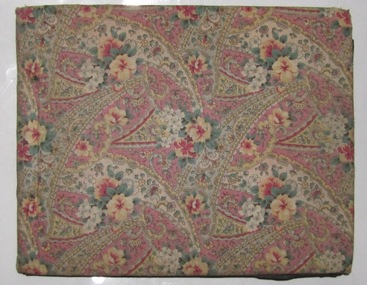
... Has photos of various locations and lines within USA and Canada, Chicago, Vancouver, Le High Valley, Montreal, Los Angeles, Cincinnati, San Francisco, Connecticut, Lake Shore, New York, Brooklyn, San Diego, Pittsburgh, South Bend, Sacramento & Northern, Little Rock, Buffalo, Philadelphia, Jamestown, Monongahela, Atlantic City, Boston, Cleveland, Detroit, Milwaukee, Gary and North Shore. ...Has photos of various locations and lines within USA and Canada, Chicago, Vancouver, Le High Valley, Montreal, Los Angeles, Cincinnati, San Francisco, Connecticut, Lake Shore, New York, Brooklyn, San Diego, Pittsburgh, South Bend, Sacramento & Northern, Little Rock, Buffalo, Philadelphia, Jamestown, Monongahela, Atlantic City, Boston, Cleveland, Detroit, Milwaukee, Gary and North Shore. ...Has photos of various locations and lines within USA and Canada, Chicago, Vancouver, Le High Valley, Montreal, Los Angeles, Cincinnati, San Francisco, Connecticut, Lake Shore, New York, Brooklyn, San Diego, Pittsburgh, South Bend, Sacramento & Northern, Little Rock, Buffalo, Philadelphia, Jamestown, Monongahela, Atlantic City, Boston, Cleveland, Detroit, Milwaukee, Gary and North Shore. Includes images of cable cars in Chicago, San Francisco. PCC car 7022 of Baltimore image includedHas a strong association with Wal Jack and his collecting of tramway history / developments until 1964.Floor pattern covered album with black paper inside covers holding some 21 sheets of card on which photos have been mounted using photo corners of various types, captions in white ink. Has punched holes on the left hand side but was not bound with cord at the time of acquisition. Parts of the album originally started as a the Melbourne album and remnants of photos hinges and notes left on the sheets. Has some 142 black and white photographs. Has some loose photographs.trams, tramways, usa, canade -
 Melbourne Legacy
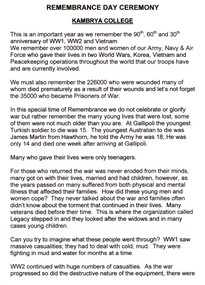
Document, Remembrance Day Ceremony - Kambrya College, 2006
... Canadian, Terry Kelly. The first verses were: "They fought and some died for their homeland They fought and some died now it's our land Look at his little child there's no fear in her eyes Could he not show respect for other dads that have died Take two minutes would you mind It's a pittance of time For the boys and the girls who went over In peace may they rest may we never forget why they died It's a pittance of time" Document was from a folder of documents donated to the archive by Legatee Bill Rogers that related to his time as President (March 2006 - March 2008). ...Canadian, Terry Kelly. The first verses were: "They fought and some died for their homeland They fought and some died now it's our land Look at his little child there's no fear in her eyes Could he not show respect for other dads that have died Take two minutes would you mind It's a pittance of time For the boys and the girls who went over In peace may they rest may we never forget why they died It's a pittance of time" Document was from a folder of documents donated to the archive by Legatee Bill Rogers that related to his time as President (March 2006 - March 2008). ...A copy of a speech given by President Bill Rogers to the students at Kambrya College. He mentions the hardships of war, the high number of casualties, and troops in peace keeping operations. He mentions a poem called 'Pittance of Time' - it was written and sung by a Canadian, Terry Kelly. The first verses were: "They fought and some died for their homeland They fought and some died now it's our land Look at his little child there's no fear in her eyes Could he not show respect for other dads that have died Take two minutes would you mind It's a pittance of time For the boys and the girls who went over In peace may they rest may we never forget why they died It's a pittance of time" Document was from a folder of documents donated to the archive by Legatee Bill Rogers that related to his time as President (March 2006 - March 2008). The date is not mentioned but was likely to be 11 November 2006 or 2007.A record of a speech given to students.Print out x 3 pages of a speech given by President Bill Rogers to students at Kambrya College on Remembrance Day.remembrance day, schools, speeches -
 Ballarat Heritage Services
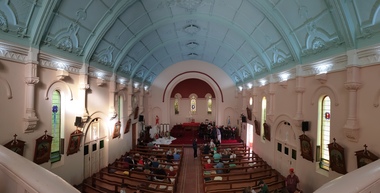
Photograph - Digital photographs, L.J. Gervasoni, Interior of St Brigid's Crossley, 2018
... little left of the true Church of God. It seemed hard to emigrate to distant lands, but the result had been the new magnificent church in the United States, the flourishing churches in Canada and South Africa. ...little left of the true Church of God. It seemed hard to emigrate to distant lands, but the result had been the new magnificent church in the United States, the flourishing churches in Canada and South Africa. ..."LARGE GATHERINGNG AT - CROSSLEY DEDICATION AND OPENING SERVICES. SERMON BY DR. MANNIX. Yesterday was an important and historic day for the Roman Catholic community of Crossley and Koroit, in as much as it will be always associated in the memories of all con cerned with the opening of the new St. Brigid's Church, Crossley. This building is far above the average standard of sacred edifices in country towns, and is certainly superior to any ercted in this district outside the churches in the two larger centres - Warrnambool and Koroit. The style of architecture chosen is a free treatment of the Romanesque, which is something quite original in the Western District. This noble style, from which, with its near re lative the Byzantine, spring the great Gothic school of architecture, is characterised by a special charm of its own, one of its chief features being graceful and sweeping circular curves in roof, window heads and in the ar rangenent of the ground plan. The building is of brick finished off with true Romanesqiue pillared pinnacles in concrete and plaster, the brick and concrete producing a pleasing contrast. The main characteristic of the front is a large rose window filled with Romlanesque circular tracery, and below a bold porch and entrance. The two sides are pierced with long circular-headed windows between graceful buttresses and the wall line is pleasingly broken by the projecting bays of the confessionals and also by the vestries. The main building is 80 feet by 30 feet' and the Sanctuary is spacious and semi-circular in shape, and lighted by three windows. The interior of the church is most artistic. The ceiling is semi-circular and of fibrous plaster in ornate designs. All the windows are lead lighted, throwing a rich and mellow harmony of' color throughout the interior and the white wails, mouldings, architraves and other fibrous plaster decorations: are further relieved by the rich coloring: in the stations of.the Cross arrranged around the nave. The central window of the Sanctuary contains a splendidly executed stained glass representation of St. Brigid. At.the western end is a room gallery. The altar is a choice piece of Gothic woodwork, in light, soft coloring, and there are two altars on either side of the Sanctuary in oak, and above whlch are very fine colored figures of Christ; and the Madonna. On either side of the altar are life-size figures of angels holding high brass candalabra. The whole of the furnishings of the church are on a sumptuous scale, and the edifice reflects credit on all concerned. The church can seat nearly 500 people. The architect was Mr. A. A. Fritsch. of Melbourne, and the contractors Messrs F. and E. Deagne, of North Fitzroy. The contract price for the building was £5,500. THE OPENING SERVICE. After the cereimony of solemnly blesssing the church was performed by His Lordship the Bishop of the Diocese, Dr. Higgins, assisted by His Grace the Coadjutor Archbishop of Melbourne. Dr. Mannix, the great gatheiring from all parts of the district entered the church, which was soon completely filled. The members of the H.A.C.B.S. attended wearing their green and gold regalia, and acted as a 'guard of honor' to the Co-adjlutor Arclhbishop and Bishop. Mass was celebrated by the Rev. Father Phelan, of Koroit, and a feature of the solemn service was the singing of a choir which consisted of picked voices from St. Carthage's choir, with friends from Warrnam bool and assisted by some of the mem bers of the Koroit choir, with Miss Logan as organist and Mr. Arthur H. Renwick as conductor. They rendered the music in splendid style throghonut. The "Kyrie," "Gloria." "Agnus Dei' and Dona Nobis" were from Farmer's Mass in B flat, and the "Credo" and "Sanctus" from Webbe's Mass in G. The soloists in the Mass were Mrs. Ryan, the Misses McEntee. Miss Katie O'Brien. and Messrs. J. M. Crowley, W. J. Callaghan; B. McEntee and W. Mahony. The chorus sang with great precision, special attention being paid to at tack. At the offertory Mrs. Dan Ryan gave a beautiful rendering of Gounod's "Ava Maria." After the Elevation that fine duet "Tantum Ergo." by Rossi, was sung by Messrs. Crowley and Renwick in an artistic manner, their fine voices blending splendidly. During the collection, Mr. Renwick sang with much feeling that devotional solo, "Lead Thou Me On,", after which Mr Crowley gave .an ex cellent rendering of Weissi's "0 Salu taris Hostia;" and the choir sang several hymns." It might here be mentioned that at the request of Fa ther Kerin, the same choir will repeat the music.at the Koroit Church on Sunday next, on the occasion of the ceremnly of laying the foundation stone of the cormpletion of the church. Dr. Mannix preachled the sermon for the occasion, taking his text from St. Luke first 11 verses. He re viewed the Gospel story of Christ preaching to the multitude from a boat on Lake Gennesaret and the miraculous draught of fish. The obedi ence of the poor fishermen in casting their nets at Christ's bidding was richly rewarded, and the miraculous occurrence was a striking example of what was to happen when Christ established His Church and built it up on those twelve apostles. When they came to think of it, nothing so re markable and marvellous had happened before or since in the history of mankind. The world at that time was for the most part a Pagan world steeped in iniquity and sin. The chosen people of God had God's re velation, but they worshipped with their lips and not with their hearts. When Christ was to establish His Church upon earth and leave an or gantisation that would continue His work, did He select learned men, powerful men, rich men, or a time that would seem propituous? No. He selected twelve poor, igorant simple fishermen, without money, power, learning or anything calculated to enable them to do anything striking in the world's history. The success of the first morning after pentecost was not confined to those first days when the plentitude of the Holy Ghost sat upon the .Apostles, but it continued age after age until the whole world was brought within the sphere of ac tion of the Church. Greece, Rome Europe Asia and America, and now Australia had been brought into the net. This must be a consolation to them all as well as it was to him (the preacher), when they remembered that they came from a land which of all others had been faithful to the Gospel of Jesus Christ. It was a consolation to them that in that great work that had been accomplished in bringing men into the meshes of the Church, and bringing them to God the nation to which they belontged had taken so great a part. Their religion flourished in England, Scotland, America and Australia. Surely it was due to the sons of St. Patrick, the sons and daughters of Ireland to find consolation in these great facts might It might seem hard that so many had to leave their native-land for England, Scotland, America and Australia. But if hard it was the means of keeping the Catholic faith living in England and Scotland. If to-day the Irish Catholics and Catholics of Irish de scent were taken out of the English and Scotch population there would be little left of the true Church of God. It seemed hard to emigrate to distant lands, but the result had been the new magnificent church in the United States, the flourishing churches in Canada and South Africa. Those Irish emigrants were a cornparatively small band. Perhaps they had not the learning of other nations. Certainly they had not the wealth and it did not fall to their lot to have the power of the sword, but God was with them, and the faith they took from Ireland flourished in those distant lands. In this fair land of Australia they had a glorious herit age handed down from the pioneer Irish Catholics, who came to this fair Austral land. There was a time when those who were opposed to God and God's Church,thought that Australia should be a wholly Protestant land. They had lived to see whether God or His enemies were the stronger. They had lived to see that those who in distant days would have stamped out the Catholic religion in Australia, had not prevailed. Their names had been forgotten because of their persecution of the Catholic Church, and they had lived - to see the glorious success that now, in every part of the Common wealth, rested upon the Catholic Church in Australia. Might God bless that Church and those Irish people, and the people of Irish descent, who had built it up. In that locality, and there was no place in.the Common wealth where the Catholic Church was held in higher esteem, the people would always be faithful to God and His Church. That beautiful building, and all it signified in loyalty and faithfulness, was a credit and a consolation to the Bishop and people of the diocese, to the architect who had done his work so artistically and skil fully. to the priests and the zealous administration of the parish. There was surely hope and inspiration in that day's celebration, that as time went on the Catholic faith would sink deeper and deeper into ther coming generation, and that the Catholic progress of the past 50 years would be small in comparison to the great progress of the future. He congratulated the Bishop priests and people who had raised that temple. He congratulated the people of Crossley; upon their generosity and self-sacrifice, and he prayed that God's blessing and the blessing of St. Brigid would rest upon them; their children and children's children. And when those who had received the sacraments and had been instructed in that Church were called before the Judgment Seat he pray ed that not one would be missing, and St. Peter aind St. Brigid would be able to count them all into the en joyment .of Eternal bliss. THE CELEBRATION The Rev. Father Kerin, Adninistra tor of the Parish, after the collection, read a lengthy list of the principal donations, headed by the Bishop, Dr. Higgins, with £250. All the furnish ings of the Church were also donations, and the Coadjutor-Archbishop added £5 to the list. The Rev. Father Kerin stated that the total to hand was £1245/10/7, which was an other proof of the generosity of the Crossley and district people. The amount previously received in donations was £1077/3. They started buildiing with a credit balance of £262 10/5 and ther now had a debit balance of £2,728/18/5. The total cost of the Church was £6,250, so that they would see the greater part of the indebtedness had already been wiped out. The Bishop (Dr. Higgins) delivered a brief address, in the course of which he congratulated the priests and people upon the completion of their magnificent Church. He congratulated the people on their magnificent generosity. He expressed his of deep indebtedness to the Coadjutor Archbishop of Melbourne for the services he had rendered to them. He had attended at considerable sacrifice to himself, and they were extremely grateful for the presence of so distinguished a champion who had shown such zeal and interest in their Church in this new land. He (the Bishop) trusted that his splendid talents would long be devoted to the defence of the Church." (Warrnambul Standard, 02 July 1914)Digital panoramic image of the interior of St Brigid's Crossley.st brigid's crossley, st brigid's, catholic church, catholic, church, community, ceiling, stations of the cross, confessional, statues, windows -
 Ballarat Heritage Services
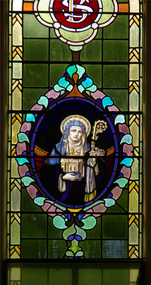
Photograph, Lisa Gervasoni, St Brigid Stained Glass Window, Crossley, 18/08/2013
... little left of the true Church of God. It seemed hard to emigrate to distant lands, but the result had been the new magnificent church in the United States, the flourishing churches in Canada and South Africa. ...little left of the true Church of God. It seemed hard to emigrate to distant lands, but the result had been the new magnificent church in the United States, the flourishing churches in Canada and South Africa. ..."LARGE GATHERINGNG AT - CROSSLEY DEDICATION AND OPENING SERVICES. SERMON BY DR. MANNIX. Yesterday was an important and historic day for the Roman Catholic community of Crossley and Koroit, in as much as it will be always associated in the memories of all con cerned with the opening of the new St. Brigid's Church, Crossley. This building is far above the average standard of sacred edifices in country towns, and is certainly superior to any ercted in this district outside the churches in the two larger centres - Warrnambool and Koroit. The style of architecture chosen is a free treatment of the Romanesque, which is something quite original in the Western District. This noble style, from which, with its near re lative the Byzantine, spring the great Gothic school of architecture, is characterised by a special charm of its own, one of its chief features being graceful and sweeping circular curves in roof, window heads and in the ar rangenent of the ground plan. The building is of brick finished off with true Romanesqiue pillared pinnacles in concrete and plaster, the brick and concrete producing a pleasing contrast. The main characteristic of the front is a large rose window filled with Romlanesque circular tracery, and below a bold porch and entrance. The two sides are pierced with long circular-headed windows between graceful buttresses and the wall line is pleasingly broken by the projecting bays of the confessionals and also by the vestries. The main building is 80 feet by 30 feet' and the Sanctuary is spacious and semi-circular in shape, and lighted by three windows. The interior of the church is most artistic. The ceiling is semi-circular and of fibrous plaster in ornate designs. All the windows are lead lighted, throwing a rich and mellow harmony of' color throughout the interior and the white wails, mouldings, architraves and other fibrous plaster decorations: are further relieved by the rich coloring: in the stations of.the Cross arrranged around the nave. The central window of the Sanctuary contains a splendidly executed stained glass representation of St. Brigid. At.the western end is a room gallery. The altar is a choice piece of Gothic woodwork, in light, soft coloring, and there are two altars on either side of the Sanctuary in oak, and above whlch are very fine colored figures of Christ; and the Madonna. On either side of the altar are life-size figures of angels holding high brass candalabra. The whole of the furnishings of the church are on a sumptuous scale, and the edifice reflects credit on all concerned. The church can seat nearly 500 people. The architect was Mr. A. A. Fritsch. of Melbourne, and the contractors Messrs F. and E. Deagne, of North Fitzroy. The contract price for the building was £5,500. THE OPENING SERVICE. After the cereimony of solemnly blesssing the church was performed by His Lordship the Bishop of the Diocese, Dr. Higgins, assisted by His Grace the Coadjutor Archbishop of Melbourne. Dr. Mannix, the great gatheiring from all parts of the district entered the church, which was soon completely filled. The members of the H.A.C.B.S. attended wearing their green and gold regalia, and acted as a 'guard of honor' to the Co-adjlutor Arclhbishop and Bishop. Mass was celebrated by the Rev. Father Phelan, of Koroit, and a feature of the solemn service was the singing of a choir which consisted of picked voices from St. Carthage's choir, with friends from Warrnam bool and assisted by some of the mem bers of the Koroit choir, with Miss Logan as organist and Mr. Arthur H. Renwick as conductor. They rendered the music in splendid style throghonut. The "Kyrie," "Gloria." "Agnus Dei' and Dona Nobis" were from Farmer's Mass in B flat, and the "Credo" and "Sanctus" from Webbe's Mass in G. The soloists in the Mass were Mrs. Ryan, the Misses McEntee. Miss Katie O'Brien. and Messrs. J. M. Crowley, W. J. Callaghan; B. McEntee and W. Mahony. The chorus sang with great precision, special attention being paid to at tack. At the offertory Mrs. Dan Ryan gave a beautiful rendering of Gounod's "Ava Maria." After the Elevation that fine duet "Tantum Ergo." by Rossi, was sung by Messrs. Crowley and Renwick in an artistic manner, their fine voices blending splendidly. During the collection, Mr. Renwick sang with much feeling that devotional solo, "Lead Thou Me On,", after which Mr Crowley gave .an ex cellent rendering of Weissi's "0 Salu taris Hostia;" and the choir sang several hymns." It might here be mentioned that at the request of Fa ther Kerin, the same choir will repeat the music.at the Koroit Church on Sunday next, on the occasion of the ceremnly of laying the foundation stone of the cormpletion of the church. Dr. Mannix preachled the sermon for the occasion, taking his text from St. Luke first 11 verses. He re viewed the Gospel story of Christ preaching to the multitude from a boat on Lake Gennesaret and the miraculous draught of fish. The obedi ence of the poor fishermen in casting their nets at Christ's bidding was richly rewarded, and the miraculous occurrence was a striking example of what was to happen when Christ established His Church and built it up on those twelve apostles. When they came to think of it, nothing so re markable and marvellous had happened before or since in the history of mankind. The world at that time was for the most part a Pagan world steeped in iniquity and sin. The chosen people of God had God's re velation, but they worshipped with their lips and not with their hearts. When Christ was to establish His Church upon earth and leave an or gantisation that would continue His work, did He select learned men, powerful men, rich men, or a time that would seem propituous? No. He selected twelve poor, igorant simple fishermen, without money, power, learning or anything calculated to enable them to do anything striking in the world's history. The success of the first morning after pentecost was not confined to those first days when the plentitude of the Holy Ghost sat upon the .Apostles, but it continued age after age until the whole world was brought within the sphere of ac tion of the Church. Greece, Rome Europe Asia and America, and now Australia had been brought into the net. This must be a consolation to them all as well as it was to him (the preacher), when they remembered that they came from a land which of all others had been faithful to the Gospel of Jesus Christ. It was a consolation to them that in that great work that had been accomplished in bringing men into the meshes of the Church, and bringing them to God the nation to which they belontged had taken so great a part. Their religion flourished in England, Scotland, America and Australia. Surely it was due to the sons of St. Patrick, the sons and daughters of Ireland to find consolation in these great facts might It might seem hard that so many had to leave their native-land for England, Scotland, America and Australia. But if hard it was the means of keeping the Catholic faith living in England and Scotland. If to-day the Irish Catholics and Catholics of Irish descent were taken out of the English and Scotch population there would be little left of the true Church of God. It seemed hard to emigrate to distant lands, but the result had been the new magnificent church in the United States, the flourishing churches in Canada and South Africa. Those Irish emigrants were a cornparatively small band. Perhaps they had not the learning of other nations. Certainly they had not the wealth and it did not fall to their lot to have the power of the sword, but God was with them, and the faith they took from Ireland flourished in those distant lands. In this fair land of Australia they had a glorious herit age handed down from the pioneer Irish Catholics, who came to this fair Austral land. There was a time when those who were opposed to God and God's Church,thought that Australia should be a wholly Protestant land. They had lived to see whether God or His enemies were the stronger. They had lived to see that those who in distant days would have stamped out the Catholic religion in Australia, had not prevailed. Their names had been forgotten because of their persecution of the Catholic Church, and they had lived - to see the glorious success that now, in every part of the Common wealth, rested upon the Catholic Church in Australia. Might God bless that Church and those Irish people, and the people of Irish descent, who had built it up. In that locality, and there was no place in.the Common wealth where the Catholic Church was held in higher esteem, the people would always be faithful to God and His Church. That beautiful building, and all it signified in loyalty and faithfulness, was a credit and a consolation to the Bishop and people of the diocese, to the architect who had done his work so artistically and skil fully. to the priests and the zealous administration of the parish. There was surely hope and inspiration in that day's celebration, that as time went on the Catholic faith would sink deeper and deeper into ther coming generation, and that the Catholic progress of the past 50 years would be small in comparison to the great progress of the future. He congratulated the Bishop priests and people who had raised that temple. He congratulated the people of Crossley; upon their generosity and self-sacrifice, and he prayed that God's blessing and the blessing of St. Brigid would rest upon them; their children and children's children. And when those who had received the sacraments and had been instructed in that Church were called before the Judgment Seat he prayed that not one would be missing, and St. Peter aind St. Brigid would be able to count them all into the enjoyment of Eternal bliss. THE CELEBRATION The Rev. Father Kerin, Adninistra tor of the Parish, after the collection, read a lengthy list of the principal donations, headed by the Bishop, Dr. Higgins, with £250. All the furnishings of the Church were also donations, and the Coadjutor-Archbishop added £5 to the list. The Rev. Father Kerin stated that the total to hand was £1245/10/7, which was an other proof of the generosity of the Crossley and district people. The amount previously received in donations was £1077/3. They started building with a credit balance of £262 10/5 and they now had a debit balance of £2,728/18/5. The total cost of the Church was £6,250, so that they would see the greater part of the indebtedness had already been wiped out. The Bishop (Dr. Higgins) delivered a brief address, in the course of which he congratulated the priests and people upon the completion of their magnificent Church. He congratulated the people on their magnificent generosity. He expressed his of deep indebtedness to the Coadjutor Archbishop of Melbourne for the services he had rendered to them. He had attended at considerable sacrifice to himself, and they were extremely grateful for the presence of so distinguished a champion who had shown such zeal and interest in their Church in this new land. He (the Bishop) trusted that his splendid talents would long be devoted to the defence of the Church." (Warrnambul Standard, 02 July 1914)Colour photograph of a portrait of St Brigid in stained glass. The depiction of St Brigid is located at St Brigid's former Catholic Church, Crossley. The stained glass window of St. Brigid in St. Brigid's Church, Crossley, Victoria, is a significant feature of the church, which was built by the local community in 1914. The church itself is notable for its "sumptuous scale" and the community's efforts to preserve it as a cultural heritage center. The central window in the sanctuary is a "splendidly executed stained glass representation of St. Brigid". st brigid, stained glass, st brigid's crossley -
 Ballarat Heritage Services
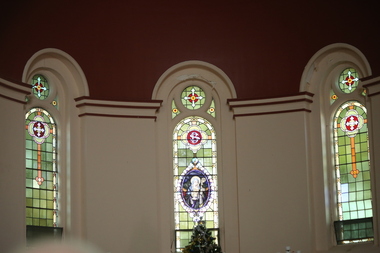
Photograph - Digital photographs, L.J. Gervasoni, St Brigid's Crossley - stained glass window, 2016
... little left of the true Church of God. It seemed hard to emigrate to distant lands, but the result had been the new magnificent church in the United States, the flourishing churches in Canada and South Africa. ...little left of the true Church of God. It seemed hard to emigrate to distant lands, but the result had been the new magnificent church in the United States, the flourishing churches in Canada and South Africa. ..."LARGE GATHERINGNG AT - CROSSLEY DEDICATION AND OPENING SERVICES. SERMON BY DR. MANNIX. Yesterday was an important and historic day for the Roman Catholic community of Crossley and Koroit, in as much as it will be always associated in the memories of all con cerned with the opening of the new St. Brigid's Church, Crossley. This building is far above the average standard of sacred edifices in country towns, and is certainly superior to any ercted in this district outside the churches in the two larger centres - Warrnambool and Koroit. The style of architecture chosen is a free treatment of the Romanesque, which is something quite original in the Western District. This noble style, from which, with its near re lative the Byzantine, spring the great Gothic school of architecture, is characterised by a special charm of its own, one of its chief features being graceful and sweeping circular curves in roof, window heads and in the ar rangenent of the ground plan. The building is of brick finished off with true Romanesqiue pillared pinnacles in concrete and plaster, the brick and concrete producing a pleasing contrast. The main characteristic of the front is a large rose window filled with Romlanesque circular tracery, and below a bold porch and entrance. The two sides are pierced with long circular-headed windows between graceful buttresses and the wall line is pleasingly broken by the projecting bays of the confessionals and also by the vestries. The main building is 80 feet by 30 feet' and the Sanctuary is spacious and semi-circular in shape, and lighted by three windows. The interior of the church is most artistic. The ceiling is semi-circular and of fibrous plaster in ornate designs. All the windows are lead lighted, throwing a rich and mellow harmony of' color throughout the interior and the white wails, mouldings, architraves and other fibrous plaster decorations: are further relieved by the rich coloring: in the stations of.the Cross arrranged around the nave. The central window of the Sanctuary contains a splendidly executed stained glass representation of St. Brigid. At.the western end is a room gallery. The altar is a choice piece of Gothic woodwork, in light, soft coloring, and there are two altars on either side of the Sanctuary in oak, and above whlch are very fine colored figures of Christ; and the Madonna. On either side of the altar are life-size figures of angels holding high brass candalabra. The whole of the furnishings of the church are on a sumptuous scale, and the edifice reflects credit on all concerned. The church can seat nearly 500 people. The architect was Mr. A. A. Fritsch. of Melbourne, and the contractors Messrs F. and E. Deagne, of North Fitzroy. The contract price for the building was £5,500. THE OPENING SERVICE. After the cereimony of solemnly blesssing the church was performed by His Lordship the Bishop of the Diocese, Dr. Higgins, assisted by His Grace the Coadjutor Archbishop of Melbourne. Dr. Mannix, the great gatheiring from all parts of the district entered the church, which was soon completely filled. The members of the H.A.C.B.S. attended wearing their green and gold regalia, and acted as a 'guard of honor' to the Co-adjlutor Arclhbishop and Bishop. Mass was celebrated by the Rev. Father Phelan, of Koroit, and a feature of the solemn service was the singing of a choir which consisted of picked voices from St. Carthage's choir, with friends from Warrnam bool and assisted by some of the mem bers of the Koroit choir, with Miss Logan as organist and Mr. Arthur H. Renwick as conductor. They rendered the music in splendid style throghonut. The "Kyrie," "Gloria." "Agnus Dei' and Dona Nobis" were from Farmer's Mass in B flat, and the "Credo" and "Sanctus" from Webbe's Mass in G. The soloists in the Mass were Mrs. Ryan, the Misses McEntee. Miss Katie O'Brien. and Messrs. J. M. Crowley, W. J. Callaghan; B. McEntee and W. Mahony. The chorus sang with great precision, special attention being paid to at tack. At the offertory Mrs. Dan Ryan gave a beautiful rendering of Gounod's "Ava Maria." After the Elevation that fine duet "Tantum Ergo." by Rossi, was sung by Messrs. Crowley and Renwick in an artistic manner, their fine voices blending splendidly. During the collection, Mr. Renwick sang with much feeling that devotional solo, "Lead Thou Me On,", after which Mr Crowley gave .an ex cellent rendering of Weissi's "0 Salu taris Hostia;" and the choir sang several hymns." It might here be mentioned that at the request of Fa ther Kerin, the same choir will repeat the music.at the Koroit Church on Sunday next, on the occasion of the ceremnly of laying the foundation stone of the cormpletion of the church. Dr. Mannix preachled the sermon for the occasion, taking his text from St. Luke first 11 verses. He re viewed the Gospel story of Christ preaching to the multitude from a boat on Lake Gennesaret and the miraculous draught of fish. The obedi ence of the poor fishermen in casting their nets at Christ's bidding was richly rewarded, and the miraculous occurrence was a striking example of what was to happen when Christ established His Church and built it up on those twelve apostles. When they came to think of it, nothing so re markable and marvellous had happened before or since in the history of mankind. The world at that time was for the most part a Pagan world steeped in iniquity and sin. The chosen people of God had God's re velation, but they worshipped with their lips and not with their hearts. When Christ was to establish His Church upon earth and leave an or gantisation that would continue His work, did He select learned men, powerful men, rich men, or a time that would seem propituous? No. He selected twelve poor, igorant simple fishermen, without money, power, learning or anything calculated to enable them to do anything striking in the world's history. The success of the first morning after pentecost was not confined to those first days when the plentitude of the Holy Ghost sat upon the .Apostles, but it continued age after age until the whole world was brought within the sphere of ac tion of the Church. Greece, Rome Europe Asia and America, and now Australia had been brought into the net. This must be a consolation to them all as well as it was to him (the preacher), when they remembered that they came from a land which of all others had been faithful to the Gospel of Jesus Christ. It was a consolation to them that in that great work that had been accomplished in bringing men into the meshes of the Church, and bringing them to God the nation to which they belontged had taken so great a part. Their religion flourished in England, Scotland, America and Australia. Surely it was due to the sons of St. Patrick, the sons and daughters of Ireland to find consolation in these great facts might It might seem hard that so many had to leave their native-land for England, Scotland, America and Australia. But if hard it was the means of keeping the Catholic faith living in England and Scotland. If to-day the Irish Catholics and Catholics of Irish de scent were taken out of the English and Scotch population there would be little left of the true Church of God. It seemed hard to emigrate to distant lands, but the result had been the new magnificent church in the United States, the flourishing churches in Canada and South Africa. Those Irish emigrants were a cornparatively small band. Perhaps they had not the learning of other nations. Certainly they had not the wealth and it did not fall to their lot to have the power of the sword, but God was with them, and the faith they took from Ireland flourished in those distant lands. In this fair land of Australia they had a glorious herit age handed down from the pioneer Irish Catholics, who came to this fair Austral land. There was a time when those who were opposed to God and God's Church,thought that Australia should be a wholly Protestant land. They had lived to see whether God or His enemies were the stronger. They had lived to see that those who in distant days would have stamped out the Catholic religion in Australia, had not prevailed. Their names had been forgotten because of their persecution of the Catholic Church, and they had lived - to see the glorious success that now, in every part of the Common wealth, rested upon the Catholic Church in Australia. Might God bless that Church and those Irish people, and the people of Irish descent, who had built it up. In that locality, and there was no place in.the Common wealth where the Catholic Church was held in higher esteem, the people would always be faithful to God and His Church. That beautiful building, and all it signified in loyalty and faithfulness, was a credit and a consolation to the Bishop and people of the diocese, to the architect who had done his work so artistically and skil fully. to the priests and the zealous administration of the parish. There was surely hope and inspiration in that day's celebration, that as time went on the Catholic faith would sink deeper and deeper into ther coming generation, and that the Catholic progress of the past 50 years would be small in comparison to the great progress of the future. He congratulated the Bishop priests and people who had raised that temple. He congratulated the people of Crossley; upon their generosity and self-sacrifice, and he prayed that God's blessing and the blessing of St. Brigid would rest upon them; their children and children's children. And when those who had received the sacraments and had been instructed in that Church were called before the Judgment Seat he pray ed that not one would be missing, and St. Peter aind St. Brigid would be able to count them all into the en joyment .of Eternal bliss. THE CELEBRATION The Rev. Father Kerin, Adninistra tor of the Parish, after the collection, read a lengthy list of the principal donations, headed by the Bishop, Dr. Higgins, with £250. All the furnish ings of the Church were also donations, and the Coadjutor-Archbishop added £5 to the list. The Rev. Father Kerin stated that the total to hand was £1245/10/7, which was an other proof of the generosity of the Crossley and district people. The amount previously received in donations was £1077/3. They started buildiing with a credit balance of £262 10/5 and ther now had a debit balance of £2,728/18/5. The total cost of the Church was £6,250, so that they would see the greater part of the indebtedness had already been wiped out. The Bishop (Dr. Higgins) delivered a brief address, in the course of which he congratulated the priests and people upon the completion of their magnificent Church. He congratulated the people on their magnificent generosity. He expressed his of deep indebtedness to the Coadjutor Archbishop of Melbourne for the services he had rendered to them. He had attended at considerable sacrifice to himself, and they were extremely grateful for the presence of so distinguished a champion who had shown such zeal and interest in their Church in this new land. He (the Bishop) trusted that his splendid talents would long be devoted to the defence of the Church." (Warrnambul Standard, 02 July 1914)Digital images of the stained glass windows at St Brigid's, Crossley.victoria, crossley, st brigid's crossley, st brigid's, catholic church, catholic, church, religion, stained glass, window -
 Ballarat Heritage Services
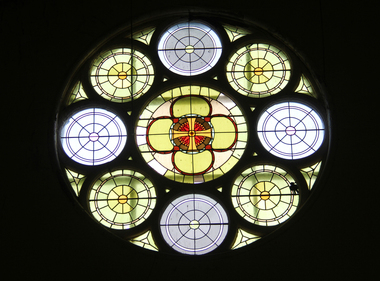
Photograph - Digital photographs, St Brigid's Crossley stained glass windows, last weekend June 2014
... little left of the true Church of God. It seemed hard to emigrate to distant lands, but the result had been the new magnificent church in the United States, the flourishing churches in Canada and South Africa. ...little left of the true Church of God. It seemed hard to emigrate to distant lands, but the result had been the new magnificent church in the United States, the flourishing churches in Canada and South Africa. ..."LARGE GATHERINGNG AT - CROSSLEY DEDICATION AND OPENING SERVICES. SERMON BY DR. MANNIX. Yesterday was an important and historic day for the Roman Catholic community of Crossley and Koroit, in as much as it will be always associated in the memories of all con cerned with the opening of the new St. Brigid's Church, Crossley. This building is far above the average standard of sacred edifices in country towns, and is certainly superior to any ercted in this district outside the churches in the two larger centres - Warrnambool and Koroit. The style of architecture chosen is a free treatment of the Romanesque, which is something quite original in the Western District. This noble style, from which, with its near re lative the Byzantine, spring the great Gothic school of architecture, is characterised by a special charm of its own, one of its chief features being graceful and sweeping circular curves in roof, window heads and in the ar rangenent of the ground plan. The building is of brick finished off with true Romanesqiue pillared pinnacles in concrete and plaster, the brick and concrete producing a pleasing contrast. The main characteristic of the front is a large rose window filled with Romlanesque circular tracery, and below a bold porch and entrance. The two sides are pierced with long circular-headed windows between graceful buttresses and the wall line is pleasingly broken by the projecting bays of the confessionals and also by the vestries. The main building is 80 feet by 30 feet' and the Sanctuary is spacious and semi-circular in shape, and lighted by three windows. The interior of the church is most artistic. The ceiling is semi-circular and of fibrous plaster in ornate designs. All the windows are lead lighted, throwing a rich and mellow harmony of' color throughout the interior and the white wails, mouldings, architraves and other fibrous plaster decorations: are further relieved by the rich coloring: in the stations of.the Cross arrranged around the nave. The central window of the Sanctuary contains a splendidly executed stained glass representation of St. Brigid. At.the western end is a room gallery. The altar is a choice piece of Gothic woodwork, in light, soft coloring, and there are two altars on either side of the Sanctuary in oak, and above whlch are very fine colored figures of Christ; and the Madonna. On either side of the altar are life-size figures of angels holding high brass candalabra. The whole of the furnishings of the church are on a sumptuous scale, and the edifice reflects credit on all concerned. The church can seat nearly 500 people. The architect was Mr. A. A. Fritsch. of Melbourne, and the contractors Messrs F. and E. Deagne, of North Fitzroy. The contract price for the building was £5,500. THE OPENING SERVICE. After the cereimony of solemnly blesssing the church was performed by His Lordship the Bishop of the Diocese, Dr. Higgins, assisted by His Grace the Coadjutor Archbishop of Melbourne. Dr. Mannix, the great gatheiring from all parts of the district entered the church, which was soon completely filled. The members of the H.A.C.B.S. attended wearing their green and gold regalia, and acted as a 'guard of honor' to the Co-adjlutor Arclhbishop and Bishop. Mass was celebrated by the Rev. Father Phelan, of Koroit, and a feature of the solemn service was the singing of a choir which consisted of picked voices from St. Carthage's choir, with friends from Warrnam bool and assisted by some of the mem bers of the Koroit choir, with Miss Logan as organist and Mr. Arthur H. Renwick as conductor. They rendered the music in splendid style throghonut. The "Kyrie," "Gloria." "Agnus Dei' and Dona Nobis" were from Farmer's Mass in B flat, and the "Credo" and "Sanctus" from Webbe's Mass in G. The soloists in the Mass were Mrs. Ryan, the Misses McEntee. Miss Katie O'Brien. and Messrs. J. M. Crowley, W. J. Callaghan; B. McEntee and W. Mahony. The chorus sang with great precision, special attention being paid to at tack. At the offertory Mrs. Dan Ryan gave a beautiful rendering of Gounod's "Ava Maria." After the Elevation that fine duet "Tantum Ergo." by Rossi, was sung by Messrs. Crowley and Renwick in an artistic manner, their fine voices blending splendidly. During the collection, Mr. Renwick sang with much feeling that devotional solo, "Lead Thou Me On,", after which Mr Crowley gave .an ex cellent rendering of Weissi's "0 Salu taris Hostia;" and the choir sang several hymns." It might here be mentioned that at the request of Fa ther Kerin, the same choir will repeat the music.at the Koroit Church on Sunday next, on the occasion of the ceremnly of laying the foundation stone of the cormpletion of the church. Dr. Mannix preachled the sermon for the occasion, taking his text from St. Luke first 11 verses. He re viewed the Gospel story of Christ preaching to the multitude from a boat on Lake Gennesaret and the miraculous draught of fish. The obedi ence of the poor fishermen in casting their nets at Christ's bidding was richly rewarded, and the miraculous occurrence was a striking example of what was to happen when Christ established His Church and built it up on those twelve apostles. When they came to think of it, nothing so re markable and marvellous had happened before or since in the history of mankind. The world at that time was for the most part a Pagan world steeped in iniquity and sin. The chosen people of God had God's re velation, but they worshipped with their lips and not with their hearts. When Christ was to establish His Church upon earth and leave an or gantisation that would continue His work, did He select learned men, powerful men, rich men, or a time that would seem propituous? No. He selected twelve poor, igorant simple fishermen, without money, power, learning or anything calculated to enable them to do anything striking in the world's history. The success of the first morning after pentecost was not confined to those first days when the plentitude of the Holy Ghost sat upon the .Apostles, but it continued age after age until the whole world was brought within the sphere of ac tion of the Church. Greece, Rome Europe Asia and America, and now Australia had been brought into the net. This must be a consolation to them all as well as it was to him (the preacher), when they remembered that they came from a land which of all others had been faithful to the Gospel of Jesus Christ. It was a consolation to them that in that great work that had been accomplished in bringing men into the meshes of the Church, and bringing them to God the nation to which they belontged had taken so great a part. Their religion flourished in England, Scotland, America and Australia. Surely it was due to the sons of St. Patrick, the sons and daughters of Ireland to find consolation in these great facts might It might seem hard that so many had to leave their native-land for England, Scotland, America and Australia. But if hard it was the means of keeping the Catholic faith living in England and Scotland. If to-day the Irish Catholics and Catholics of Irish de scent were taken out of the English and Scotch population there would be little left of the true Church of God. It seemed hard to emigrate to distant lands, but the result had been the new magnificent church in the United States, the flourishing churches in Canada and South Africa. Those Irish emigrants were a cornparatively small band. Perhaps they had not the learning of other nations. Certainly they had not the wealth and it did not fall to their lot to have the power of the sword, but God was with them, and the faith they took from Ireland flourished in those distant lands. In this fair land of Australia they had a glorious herit age handed down from the pioneer Irish Catholics, who came to this fair Austral land. There was a time when those who were opposed to God and God's Church,thought that Australia should be a wholly Protestant land. They had lived to see whether God or His enemies were the stronger. They had lived to see that those who in distant days would have stamped out the Catholic religion in Australia, had not prevailed. Their names had been forgotten because of their persecution of the Catholic Church, and they had lived - to see the glorious success that now, in every part of the Common wealth, rested upon the Catholic Church in Australia. Might God bless that Church and those Irish people, and the people of Irish descent, who had built it up. In that locality, and there was no place in.the Common wealth where the Catholic Church was held in higher esteem, the people would always be faithful to God and His Church. That beautiful building, and all it signified in loyalty and faithfulness, was a credit and a consolation to the Bishop and people of the diocese, to the architect who had done his work so artistically and skil fully. to the priests and the zealous administration of the parish. There was surely hope and inspiration in that day's celebration, that as time went on the Catholic faith would sink deeper and deeper into ther coming generation, and that the Catholic progress of the past 50 years would be small in comparison to the great progress of the future. He congratulated the Bishop priests and people who had raised that temple. He congratulated the people of Crossley; upon their generosity and self-sacrifice, and he prayed that God's blessing and the blessing of St. Brigid would rest upon them; their children and children's children. And when those who had received the sacraments and had been instructed in that Church were called before the Judgment Seat he pray ed that not one would be missing, and St. Peter aind St. Brigid would be able to count them all into the en joyment .of Eternal bliss. THE CELEBRATION The Rev. Father Kerin, Adninistra tor of the Parish, after the collection, read a lengthy list of the principal donations, headed by the Bishop, Dr. Higgins, with £250. All the furnish ings of the Church were also donations, and the Coadjutor-Archbishop added £5 to the list. The Rev. Father Kerin stated that the total to hand was £1245/10/7, which was an other proof of the generosity of the Crossley and district people. The amount previously received in donations was £1077/3. They started buildiing with a credit balance of £262 10/5 and ther now had a debit balance of £2,728/18/5. The total cost of the Church was £6,250, so that they would see the greater part of the indebtedness had already been wiped out. The Bishop (Dr. Higgins) delivered a brief address, in the course of which he congratulated the priests and people upon the completion of their magnificent Church. He congratulated the people on their magnificent generosity. He expressed his of deep indebtedness to the Coadjutor Archbishop of Melbourne for the services he had rendered to them. He had attended at considerable sacrifice to himself, and they were extremely grateful for the presence of so distinguished a champion who had shown such zeal and interest in their Church in this new land. He (the Bishop) trusted that his splendid talents would long be devoted to the defence of the Church." (Warrnambul Standard, 02 July 1914)Digital images of the stained glass windows at St Brigid's Crossleyst brigid's crossley, st brigid's, catholic church, catholic, church, religion, centenary, celebrations, 100, anniversary, commemoration, stained glass, windows -
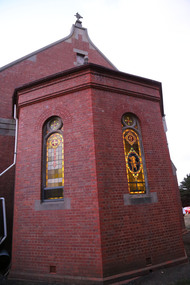 Ballarat Heritage Services
Digital photographs, L.J. Gervasoni, St Brigid's Crossley - Christmas Carols - stained glass windows night, 12/2016
... In the United States and Canada many had made a home for themselves, and were always found faithful to God and to the true church. If to-day the Irish Catholics and Catholics of Irish des cent were taken out of the English and Scotch population there would be little left of the true Church of God. ...In the United States and Canada many had made a home for themselves, and were always found faithful to God and to the true church. If to-day the Irish Catholics and Catholics of Irish des cent were taken out of the English and Scotch population there would be little left of the true Church of God. ..."NEW CROSSLEY CHURCH. BLESSING AND OPENING CEREMONY. A lasting testimony to the faithful generosity of the Catholic community at Crossley was vouchsafed on Sunday last, when the beautiful new church of St. Brigid was formally blessed and opened, in the presence of a particularly large congregation of adherents of the Roman Catholic faith, and many supporters of the doctrines of other churches. The function was further enhanced by the presence of two noted Catholics in Dr. Higgins (Bishop of Ballarat) and Dr. Mannix (Coadjutor Archbishop of Melbourne.) Upon arrival at the church the prelates were received by a guard of honor formed by the members of the H.A.C.B. Society, and were introduced to the members of the local committee. Then his Lordship the Bishop formally blessed the exterior and interior of the building. The building is handsome and commo dious, and one that should suffice for the population of the Crossley district for many years to come. Standing upon the highest point in the vicinity it occupies a commanding position and is a prominent landmark for many miles around. At first it was intended to pull down the old church and erect the new one upon the space occupied by it, but subsequently the land adjoining was purchased, and the sacred edifice built upon it. The style of architecture is a free treatment of the Romanesque. In a short space of time the grounds and walks were transformed by working bees and made to conform to the beauty of the building. The interior is most artistic, and would be difficult to improve upon in elegance of design, while the furnishings are most appropriate, and harmonise excellently with the general scheme of decoration. It seats 400 people and in addition there is a choir gallery with a seating capacity of 60. The church is lighted with leaded Cathedral glass windows, and the front presents a pleasing appearance, the entrance porch being surmounted with a semi-Gothic window. The floor is tiled throughout. The ceilings are semi-circular in form, with beautiful designs worked in fibrous plaster. The brickwork of the structure is faced with cement, and it has a slate roof. It is undoubtedly an addition to the ecclesiastical buildings of the district, and was universally admired. The architect was Mr. A. A. Fritsch, of Melbourne, and the contractors Messrs F. and E. Deague, of North Fitzroy. On the doors being thrown open for the admission of the congregation, the seating accommodation was immediately fully taxed, and the lengthy service and sermon were listened to with the greatest interest and attention. Missa Cantata was sung, the Rev. Father Phelan, Koroit, being the celebrant. The musical arrangements were in the capable hands of Mr. Renwick, of Warrnambool, while Miss Logan presided at the organ. Mrs. Dan. Ryan was the soprano soloist, and sang Gounod's Ave Maria at the offertory very sweetly and expressively. At the consecration Rossi's Tantum Ergo was sung by Messrs Crowley and Renwick; Farmer's Kyrie Gloria and Agnus Dei and Webb's Credo were rendered during mass, and while the collection was being taken additional numbers were sung. The occasional sermon was preached by the Coadjutor Archbishop (Dr. Mannix), who based his remarks upon the Gospel for the day, St. Luke V., verses I to II, dealing with the miraculous draught of fish. On His return from Galilee Christ found that the fishermen had been toiling all night, and had caught nothing. He entered one of the ships, and addressed the multitude on shore. It was a beautiful picture, and no doubt he spoke to them about the kingdom to be established on earth. When He had finished speaking He told the fishermen to launch out into the deep. Peter said " Master, we have fished all night, and have found nothing." Still, they obeyed His command, and the nets were filled almost to breaking point. Having brought their ships to land they left everything and followed Him. In that lesson they had a symbol of God's dealing with men through the church He has established on earth. Their confidence was richly rewarded, and Christ founded His church upon those twelve Apostles. At that time the world was mostly pagan, steeped in iniquity and sin. The chosen people of God worshipped with their lips, but their hearts were far from it. When Christ wanted to estab lish His church on earth, and leave an organisation to carry on the work, did He select the most intellectual, or the most rich or powerful men? Neither did the time seem propitious. He selected twelve men who from a human point of view were quite incapable of accomplishing anything. What happened when the Jews put Him to death? The chosen twelve left Him at the critical hour, and when He came to die on the cross they were not there, but hid themselves from the hate and fury of the Jews. When the Holy Ghost came down upon them and strengthened them they became courageous and went forth at the bidding of their Master to teach all nations. Their success was not confined to the first meet ing after Pentecost, at which they made 5000 converts, but continued until the whole world had been brought into the net. It was surely a consolation to them as well as to him (the preacher), that they came from a land which of all others had been faithful to the teaching of Jesus Christ. The sons and daughters of St. Patrick had taken a great part in bringing men into the meshes of the church. It was due to the nation they belonged to that the church flourished not only in Ireland, but in England, Scotland, Ame rica, and Australia. It may have seemed hard that in the providence of God so many had to leave their homes and find a home in other lands. They had emi grated to the towns of England and Scotland, and had been the means of keeping the Catholic faith living in those places. In the United States and Canada many had made a home for themselves, and were always found faithful to God and to the true church. If to-day the Irish Catholics and Catholics of Irish des cent were taken out of the English and Scotch population there would be little left of the true Church of God. Perhaps they had not the learning of other nations. Certainly they had not the wealth of other nations, and not the power of the sword, but God was with them, and the faith they took from the old land nourished in the distant places. There was a time in Aus tralia when those opposed to God and God's Church thought they could rule Providence and make Australia a Pro testant land. They had lived to see whe ther God or His enemies are the more powerful, and the names of those who tried to stamp out the Catholic religion were forgotten, or only remembered be cause of their persecution. They had lived to see the glorious success which rested upon the Catholic Church in Aus-tralia, which the Irish people had built up stone by stone. Nowhere was it held in higher esteem than in these islands, and the people would always be faithful to God and His church. It was an inspira tion to go into the glorious church opened that day. It stood for loyalty and faith fulness and was a credit and a consola tion to the Bishop and people of the diocese, to the architect, and to the priests and the honest and zealous administrator of the parish. There was hope and an inspiration in that day's celebrations, and surely the Catholic faith would sink deeper and deeper into the people as time went on, and the progress of the last fifty years would be small as compared to the progress of the future. He congratulated the Bishop and priests who had raised that temple, and the people of Crossley upon their generosity and self-sacrifice. He prayed that the blessing of God and St. Brigid would rest upon them, their children, and their children's children. He hoped that not one of those who had received the sacrament at that church would be missing when called before the Judgment Seat, and that all would be counted into the enjoyment of eternal bliss. The Rev. Father Kerin then made a statement of the position of the finances, after which a special col lection was made towards the cost of the building. A list of subscribers of £l and upwards was read, to which Bishop Higgins contributed £250, Rev. Father Kerin £20, and the Coadjutor Archbishop £5. The amount totalled £1245 10s 7d. Pre vious donations totalled £1077 3s, and His Lordship gave an additional £250. An indebtedness of £3974 had been reduced by £1245, leaving a debit balance of £2728. The cost ot the church completed was £6250. They had broken the back of the debt, and were not frightened of it. It was also announced that the beautiful Stations of the Cross, which adorn the walls, had been donated by the following: Mr and Mrs. P. Crowe, Mr. and Mrs. T. Bushell, Mr. and Mrs. P. Gorman, Miss M. Dunne, Mr. Mugavin and Miss Mugavin, Mr. and Mrs. C. Conway, Misses A. and F. Broderick, Mr. and Mrs. Michael Hennessy, Miss K. A. M'Carthy, Mr. and Mrs. Wm. Dalton, Mrs. M. J. Greene, Mrs. and Miss K. Dwyer, Mr. and Mrs. John Mugavin, and the Rev. J. J. Manning. The new Estey organ was contributed by the school children, as the result of an enter tainment. Other donors of furnishings, etc., were Mrs. Brown, senr., (Kirkstall), and Mrs. James Maloney (Killarney), and Mrs. and Miss O'Donohue. The vestments were the gifts of Mr. and Mrs. M. Foley, of Killarney. The furnishings, carpeting, etc., of the sanctuary have been carried out by the Crossley Altar Society, of which Mrs. Jno. O'Brien is president, and Miss Mary Ryan secretary. In the course of a brief address Dr. Higgins expressed his deep indebtedness to the Coadjutor Archbishop for coming amongst them at a great sacrifice to assist in the ceremonies. He heartily thanked the people for their unbounded generosity, and congratulated priests and people upon the magnificent results of their efforts. They had an able champion in Dr. Mannix, who since coming amongst them had distinguished himself by his zeal for the church in this new land. He hoped he would be spared for many years to come to use his splendid talents in the service of the church. (Koroit Sentinel and Tower Hill Advocate, Saturday 4 July 1914, page 2)Digital images of the cathedral leadlight windowns in St Brigid's catholic Church, Crossley. st brigid's crossley, st brigid's, catholic church, catholic, church, religion, celebrations, christmas, christmas carols, carols, stained glass, window -
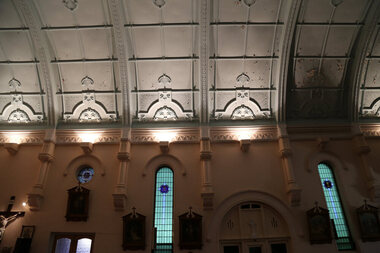 Ballarat Heritage Services
Digital photographs, St Brigid's Crossley - Christmas Carols, 2016, Christmas 2016
... little left of the true Church of God. It seemed hard to emigrate to distant lands, but the result had been the new magnificent church in the United States, the flourishing churches in Canada and South Africa. ...little left of the true Church of God. It seemed hard to emigrate to distant lands, but the result had been the new magnificent church in the United States, the flourishing churches in Canada and South Africa. ..."LARGE GATHERINGNG AT - CROSSLEY DEDICATION AND OPENING SERVICES. SERMON BY DR. MANNIX. Yesterday was an important and historic day for the Roman Catholic community of Crossley and Koroit, in as much as it will be always associated in the memories of all con cerned with the opening of the new St. Brigid's Church, Crossley. This building is far above the average standard of sacred edifices in country towns, and is certainly superior to any ercted in this district outside the churches in the two larger centres - Warrnambool and Koroit. The style of architecture chosen is a free treatment of the Romanesque, which is something quite original in the Western District. This noble style, from which, with its near re lative the Byzantine, spring the great Gothic school of architecture, is characterised by a special charm of its own, one of its chief features being graceful and sweeping circular curves in roof, window heads and in the ar rangenent of the ground plan. The building is of brick finished off with true Romanesqiue pillared pinnacles in concrete and plaster, the brick and concrete producing a pleasing contrast. The main characteristic of the front is a large rose window filled with Romlanesque circular tracery, and below a bold porch and entrance. The two sides are pierced with long circular-headed windows between graceful buttresses and the wall line is pleasingly broken by the projecting bays of the confessionals and also by the vestries. The main building is 80 feet by 30 feet' and the Sanctuary is spacious and semi-circular in shape, and lighted by three windows. The interior of the church is most artistic. The ceiling is semi-circular and of fibrous plaster in ornate designs. All the windows are lead lighted, throwing a rich and mellow harmony of' color throughout the interior and the white wails, mouldings, architraves and other fibrous plaster decorations: are further relieved by the rich coloring: in the stations of.the Cross arrranged around the nave. The central window of the Sanctuary contains a splendidly executed stained glass representation of St. Brigid. At.the western end is a room gallery. The altar is a choice piece of Gothic woodwork, in light, soft coloring, and there are two altars on either side of the Sanctuary in oak, and above whlch are very fine colored figures of Christ; and the Madonna. On either side of the altar are life-size figures of angels holding high brass candalabra. The whole of the furnishings of the church are on a sumptuous scale, and the edifice reflects credit on all concerned. The church can seat nearly 500 people. The architect was Mr. A. A. Fritsch. of Melbourne, and the contractors Messrs F. and E. Deagne, of North Fitzroy. The contract price for the building was £5,500. THE OPENING SERVICE. After the cereimony of solemnly blesssing the church was performed by His Lordship the Bishop of the Diocese, Dr. Higgins, assisted by His Grace the Coadjutor Archbishop of Melbourne. Dr. Mannix, the great gatheiring from all parts of the district entered the church, which was soon completely filled. The members of the H.A.C.B.S. attended wearing their green and gold regalia, and acted as a 'guard of honor' to the Co-adjlutor Arclhbishop and Bishop. Mass was celebrated by the Rev. Father Phelan, of Koroit, and a feature of the solemn service was the singing of a choir which consisted of picked voices from St. Carthage's choir, with friends from Warrnam bool and assisted by some of the mem bers of the Koroit choir, with Miss Logan as organist and Mr. Arthur H. Renwick as conductor. They rendered the music in splendid style throghonut. The "Kyrie," "Gloria." "Agnus Dei' and Dona Nobis" were from Farmer's Mass in B flat, and the "Credo" and "Sanctus" from Webbe's Mass in G. The soloists in the Mass were Mrs. Ryan, the Misses McEntee. Miss Katie O'Brien. and Messrs. J. M. Crowley, W. J. Callaghan; B. McEntee and W. Mahony. The chorus sang with great precision, special attention being paid to at tack. At the offertory Mrs. Dan Ryan gave a beautiful rendering of Gounod's "Ava Maria." After the Elevation that fine duet "Tantum Ergo." by Rossi, was sung by Messrs. Crowley and Renwick in an artistic manner, their fine voices blending splendidly. During the collection, Mr. Renwick sang with much feeling that devotional solo, "Lead Thou Me On,", after which Mr Crowley gave .an ex cellent rendering of Weissi's "0 Salu taris Hostia;" and the choir sang several hymns." It might here be mentioned that at the request of Fa ther Kerin, the same choir will repeat the music.at the Koroit Church on Sunday next, on the occasion of the ceremnly of laying the foundation stone of the cormpletion of the church. Dr. Mannix preachled the sermon for the occasion, taking his text from St. Luke first 11 verses. He re viewed the Gospel story of Christ preaching to the multitude from a boat on Lake Gennesaret and the miraculous draught of fish. The obedi ence of the poor fishermen in casting their nets at Christ's bidding was richly rewarded, and the miraculous occurrence was a striking example of what was to happen when Christ established His Church and built it up on those twelve apostles. When they came to think of it, nothing so re markable and marvellous had happened before or since in the history of mankind. The world at that time was for the most part a Pagan world steeped in iniquity and sin. The chosen people of God had God's re velation, but they worshipped with their lips and not with their hearts. When Christ was to establish His Church upon earth and leave an or gantisation that would continue His work, did He select learned men, powerful men, rich men, or a time that would seem propituous? No. He selected twelve poor, igorant simple fishermen, without money, power, learning or anything calculated to enable them to do anything striking in the world's history. The success of the first morning after pentecost was not confined to those first days when the plentitude of the Holy Ghost sat upon the .Apostles, but it continued age after age until the whole world was brought within the sphere of ac tion of the Church. Greece, Rome Europe Asia and America, and now Australia had been brought into the net. This must be a consolation to them all as well as it was to him (the preacher), when they remembered that they came from a land which of all others had been faithful to the Gospel of Jesus Christ. It was a consolation to them that in that great work that had been accomplished in bringing men into the meshes of the Church, and bringing them to God the nation to which they belontged had taken so great a part. Their religion flourished in England, Scotland, America and Australia. Surely it was due to the sons of St. Patrick, the sons and daughters of Ireland to find consolation in these great facts might It might seem hard that so many had to leave their native-land for England, Scotland, America and Australia. But if hard it was the means of keeping the Catholic faith living in England and Scotland. If to-day the Irish Catholics and Catholics of Irish de scent were taken out of the English and Scotch population there would be little left of the true Church of God. It seemed hard to emigrate to distant lands, but the result had been the new magnificent church in the United States, the flourishing churches in Canada and South Africa. Those Irish emigrants were a cornparatively small band. Perhaps they had not the learning of other nations. Certainly they had not the wealth and it did not fall to their lot to have the power of the sword, but God was with them, and the faith they took from Ireland flourished in those distant lands. In this fair land of Australia they had a glorious herit age handed down from the pioneer Irish Catholics, who came to this fair Austral land. There was a time when those who were opposed to God and God's Church,thought that Australia should be a wholly Protestant land. They had lived to see whether God or His enemies were the stronger. They had lived to see that those who in distant days would have stamped out the Catholic religion in Australia, had not prevailed. Their names had been forgotten because of their persecution of the Catholic Church, and they had lived - to see the glorious success that now, in every part of the Common wealth, rested upon the Catholic Church in Australia. Might God bless that Church and those Irish people, and the people of Irish descent, who had built it up. In that locality, and there was no place in.the Common wealth where the Catholic Church was held in higher esteem, the people would always be faithful to God and His Church. That beautiful building, and all it signified in loyalty and faithfulness, was a credit and a consolation to the Bishop and people of the diocese, to the architect who had done his work so artistically and skil fully. to the priests and the zealous administration of the parish. There was surely hope and inspiration in that day's celebration, that as time went on the Catholic faith would sink deeper and deeper into ther coming generation, and that the Catholic progress of the past 50 years would be small in comparison to the great progress of the future. He congratulated the Bishop priests and people who had raised that temple. He congratulated the people of Crossley; upon their generosity and self-sacrifice, and he prayed that God's blessing and the blessing of St. Brigid would rest upon them; their children and children's children. And when those who had received the sacraments and had been instructed in that Church were called before the Judgment Seat he pray ed that not one would be missing, and St. Peter aind St. Brigid would be able to count them all into the en joyment .of Eternal bliss. THE CELEBRATION The Rev. Father Kerin, Adninistra tor of the Parish, after the collection, read a lengthy list of the principal donations, headed by the Bishop, Dr. Higgins, with £250. All the furnish ings of the Church were also donations, and the Coadjutor-Archbishop added £5 to the list. The Rev. Father Kerin stated that the total to hand was £1245/10/7, which was an other proof of the generosity of the Crossley and district people. The amount previously received in donations was £1077/3. They started buildiing with a credit balance of £262 10/5 and ther now had a debit balance of £2,728/18/5. The total cost of the Church was £6,250, so that they would see the greater part of the indebtedness had already been wiped out. The Bishop (Dr. Higgins) delivered a brief address, in the course of which he congratulated the priests and people upon the completion of their magnificent Church. He congratulated the people on their magnificent generosity. He expressed his of deep indebtedness to the Coadjutor Archbishop of Melbourne for the services he had rendered to them. He had attended at considerable sacrifice to himself, and they were extremely grateful for the presence of so distinguished a champion who had shown such zeal and interest in their Church in this new land. He (the Bishop) trusted that his splendid talents would long be devoted to the defence of the Church." (Warrnambul Standard, 02 July 1914)Digital images of the interior of St Brigid's, Crossley.st brigid's crossley, st brigid's, catholic church, catholic, church, religion, celebrations, christmas, christmas carols, carols, stained glass, window -
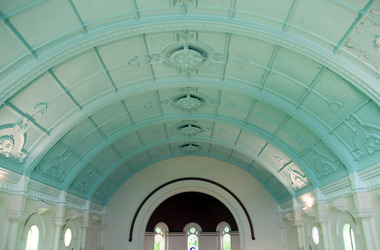 Ballarat Heritage Services
Photograph - Digital photographs, L.J. Gervasoni, Interior of St Brigid's Crossley, C2016
... little left of the true Church of God. It seemed hard to emigrate to distant lands, but the result had been the new magnificent church in the United States, the flourishing churches in Canada and South Africa. ...little left of the true Church of God. It seemed hard to emigrate to distant lands, but the result had been the new magnificent church in the United States, the flourishing churches in Canada and South Africa. ..."LARGE GATHERINGNG AT - CROSSLEY DEDICATION AND OPENING SERVICES. SERMON BY DR. MANNIX. Yesterday was an important and historic day for the Roman Catholic community of Crossley and Koroit, in as much as it will be always associated in the memories of all con cerned with the opening of the new St. Brigid's Church, Crossley. This building is far above the average standard of sacred edifices in country towns, and is certainly superior to any ercted in this district outside the churches in the two larger centres - Warrnambool and Koroit. The style of architecture chosen is a free treatment of the Romanesque, which is something quite original in the Western District. This noble style, from which, with its near re lative the Byzantine, spring the great Gothic school of architecture, is characterised by a special charm of its own, one of its chief features being graceful and sweeping circular curves in roof, window heads and in the ar rangenent of the ground plan. The building is of brick finished off with true Romanesqiue pillared pinnacles in concrete and plaster, the brick and concrete producing a pleasing contrast. The main characteristic of the front is a large rose window filled with Romlanesque circular tracery, and below a bold porch and entrance. The two sides are pierced with long circular-headed windows between graceful buttresses and the wall line is pleasingly broken by the projecting bays of the confessionals and also by the vestries. The main building is 80 feet by 30 feet' and the Sanctuary is spacious and semi-circular in shape, and lighted by three windows. The interior of the church is most artistic. The ceiling is semi-circular and of fibrous plaster in ornate designs. All the windows are lead lighted, throwing a rich and mellow harmony of' color throughout the interior and the white wails, mouldings, architraves and other fibrous plaster decorations: are further relieved by the rich coloring: in the stations of.the Cross arrranged around the nave. The central window of the Sanctuary contains a splendidly executed stained glass representation of St. Brigid. At.the western end is a room gallery. The altar is a choice piece of Gothic woodwork, in light, soft coloring, and there are two altars on either side of the Sanctuary in oak, and above whlch are very fine colored figures of Christ; and the Madonna. On either side of the altar are life-size figures of angels holding high brass candalabra. The whole of the furnishings of the church are on a sumptuous scale, and the edifice reflects credit on all concerned. The church can seat nearly 500 people. The architect was Mr. A. A. Fritsch. of Melbourne, and the contractors Messrs F. and E. Deagne, of North Fitzroy. The contract price for the building was £5,500. THE OPENING SERVICE. After the cereimony of solemnly blesssing the church was performed by His Lordship the Bishop of the Diocese, Dr. Higgins, assisted by His Grace the Coadjutor Archbishop of Melbourne. Dr. Mannix, the great gatheiring from all parts of the district entered the church, which was soon completely filled. The members of the H.A.C.B.S. attended wearing their green and gold regalia, and acted as a 'guard of honor' to the Co-adjlutor Arclhbishop and Bishop. Mass was celebrated by the Rev. Father Phelan, of Koroit, and a feature of the solemn service was the singing of a choir which consisted of picked voices from St. Carthage's choir, with friends from Warrnam bool and assisted by some of the mem bers of the Koroit choir, with Miss Logan as organist and Mr. Arthur H. Renwick as conductor. They rendered the music in splendid style throghonut. The "Kyrie," "Gloria." "Agnus Dei' and Dona Nobis" were from Farmer's Mass in B flat, and the "Credo" and "Sanctus" from Webbe's Mass in G. The soloists in the Mass were Mrs. Ryan, the Misses McEntee. Miss Katie O'Brien. and Messrs. J. M. Crowley, W. J. Callaghan; B. McEntee and W. Mahony. The chorus sang with great precision, special attention being paid to at tack. At the offertory Mrs. Dan Ryan gave a beautiful rendering of Gounod's "Ava Maria." After the Elevation that fine duet "Tantum Ergo." by Rossi, was sung by Messrs. Crowley and Renwick in an artistic manner, their fine voices blending splendidly. During the collection, Mr. Renwick sang with much feeling that devotional solo, "Lead Thou Me On,", after which Mr Crowley gave .an ex cellent rendering of Weissi's "0 Salu taris Hostia;" and the choir sang several hymns." It might here be mentioned that at the request of Fa ther Kerin, the same choir will repeat the music.at the Koroit Church on Sunday next, on the occasion of the ceremnly of laying the foundation stone of the cormpletion of the church. Dr. Mannix preachled the sermon for the occasion, taking his text from St. Luke first 11 verses. He re viewed the Gospel story of Christ preaching to the multitude from a boat on Lake Gennesaret and the miraculous draught of fish. The obedi ence of the poor fishermen in casting their nets at Christ's bidding was richly rewarded, and the miraculous occurrence was a striking example of what was to happen when Christ established His Church and built it up on those twelve apostles. When they came to think of it, nothing so re markable and marvellous had happened before or since in the history of mankind. The world at that time was for the most part a Pagan world steeped in iniquity and sin. The chosen people of God had God's re velation, but they worshipped with their lips and not with their hearts. When Christ was to establish His Church upon earth and leave an or gantisation that would continue His work, did He select learned men, powerful men, rich men, or a time that would seem propituous? No. He selected twelve poor, igorant simple fishermen, without money, power, learning or anything calculated to enable them to do anything striking in the world's history. The success of the first morning after pentecost was not confined to those first days when the plentitude of the Holy Ghost sat upon the .Apostles, but it continued age after age until the whole world was brought within the sphere of ac tion of the Church. Greece, Rome Europe Asia and America, and now Australia had been brought into the net. This must be a consolation to them all as well as it was to him (the preacher), when they remembered that they came from a land which of all others had been faithful to the Gospel of Jesus Christ. It was a consolation to them that in that great work that had been accomplished in bringing men into the meshes of the Church, and bringing them to God the nation to which they belontged had taken so great a part. Their religion flourished in England, Scotland, America and Australia. Surely it was due to the sons of St. Patrick, the sons and daughters of Ireland to find consolation in these great facts might It might seem hard that so many had to leave their native-land for England, Scotland, America and Australia. But if hard it was the means of keeping the Catholic faith living in England and Scotland. If to-day the Irish Catholics and Catholics of Irish de scent were taken out of the English and Scotch population there would be little left of the true Church of God. It seemed hard to emigrate to distant lands, but the result had been the new magnificent church in the United States, the flourishing churches in Canada and South Africa. Those Irish emigrants were a cornparatively small band. Perhaps they had not the learning of other nations. Certainly they had not the wealth and it did not fall to their lot to have the power of the sword, but God was with them, and the faith they took from Ireland flourished in those distant lands. In this fair land of Australia they had a glorious herit age handed down from the pioneer Irish Catholics, who came to this fair Austral land. There was a time when those who were opposed to God and God's Church,thought that Australia should be a wholly Protestant land. They had lived to see whether God or His enemies were the stronger. They had lived to see that those who in distant days would have stamped out the Catholic religion in Australia, had not prevailed. Their names had been forgotten because of their persecution of the Catholic Church, and they had lived - to see the glorious success that now, in every part of the Common wealth, rested upon the Catholic Church in Australia. Might God bless that Church and those Irish people, and the people of Irish descent, who had built it up. In that locality, and there was no place in.the Common wealth where the Catholic Church was held in higher esteem, the people would always be faithful to God and His Church. That beautiful building, and all it signified in loyalty and faithfulness, was a credit and a consolation to the Bishop and people of the diocese, to the architect who had done his work so artistically and skil fully. to the priests and the zealous administration of the parish. There was surely hope and inspiration in that day's celebration, that as time went on the Catholic faith would sink deeper and deeper into ther coming generation, and that the Catholic progress of the past 50 years would be small in comparison to the great progress of the future. He congratulated the Bishop priests and people who had raised that temple. He congratulated the people of Crossley; upon their generosity and self-sacrifice, and he prayed that God's blessing and the blessing of St. Brigid would rest upon them; their children and children's children. And when those who had received the sacraments and had been instructed in that Church were called before the Judgment Seat he pray ed that not one would be missing, and St. Peter aind St. Brigid would be able to count them all into the en joyment .of Eternal bliss. THE CELEBRATION The Rev. Father Kerin, Adninistra tor of the Parish, after the collection, read a lengthy list of the principal donations, headed by the Bishop, Dr. Higgins, with £250. All the furnish ings of the Church were also donations, and the Coadjutor-Archbishop added £5 to the list. The Rev. Father Kerin stated that the total to hand was £1245/10/7, which was an other proof of the generosity of the Crossley and district people. The amount previously received in donations was £1077/3. They started buildiing with a credit balance of £262 10/5 and ther now had a debit balance of £2,728/18/5. The total cost of the Church was £6,250, so that they would see the greater part of the indebtedness had already been wiped out. The Bishop (Dr. Higgins) delivered a brief address, in the course of which he congratulated the priests and people upon the completion of their magnificent Church. He congratulated the people on their magnificent generosity. He expressed his of deep indebtedness to the Coadjutor Archbishop of Melbourne for the services he had rendered to them. He had attended at considerable sacrifice to himself, and they were extremely grateful for the presence of so distinguished a champion who had shown such zeal and interest in their Church in this new land. He (the Bishop) trusted that his splendid talents would long be devoted to the defence of the Church." (Warrnambul Standard, 02 July 1914)Digital images of the in..terior of St Brigid's Crossleyst brigid's crossley, st brigid's, catholic church, catholic, church, community, ceiling, stations of the cross, confessional, statues, windows -
 Surrey Hills Historical Society Collection
Book, Joan and Betty Rayner: Strolling Players, 1972
... They travelled not only around Australia and New Zealand but around Europe, the British Isles and Canada in a caravan performing songs, dances and tales they collected. Often there was little scenery. ...They travelled not only around Australia and New Zealand but around Europe, the British Isles and Canada in a caravan performing songs, dances and tales they collected. Often there was little scenery. ...The sisters were born in New Zealand. They travelled not only around Australia and New Zealand but around Europe, the British Isles and Canada in a caravan performing songs, dances and tales they collected. Often there was little scenery. They established a Theatre of Youth (T.O.Y.) near Circular Quay in Sydney and later founded the Australian Children's Theatre. Mavis Thorpe Clark (1909-1999) began her writing career as a schoolgirl. She was educated at Methodist Ladies College in Hawthorn. Her first story for children was published as a serial in The Australasian newspaper when she was 14 years old. Her first book was written when she was 18 and published in 1930. She was a prolific writer. She wrote mainly for children and teenagers, but also authored several biographies, a number of non-fiction titles, and many articles, short stories and scripts for newspaper, magazine and radio. During the 1960s, 1970s and 1980s she travelled extensively in South Australia and Western Australia gathering material for her stories. In 1967 she won the Children's Book Council of the Year award for The Min-Min which was set in outback South Australia.164p illus. This history details the careers of the New Zealand born sisters, Joan and Betty Rayner.(ms) joan rayner, (ms) betty rayner, australian children's theatre, children's play, (ms) mavis thorpe clark, theatre of youth (t.o.y.) -
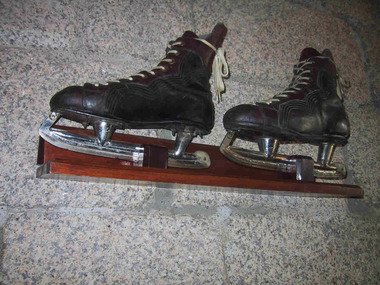 Parks Victoria - Mount Buffalo Chalet
Skates
... little material culture relating to its practice other than images and film. The few pairs of ice skates in the Chalet collection, which are in good condition, are important for their rarity as well as for illustrating the popularity of skating on Lake Catani prior to WW2.' On skate blade, "Made in Canada ...Ice skates used to skate on Lake Catani. Ice skating was a popular activity for guest and visitors to Mt Buffalo. Ice skates were provided for hire by the the first Lessee of the Chalet, John Newton and also Norwegian born Hilda Samsing, who took over from him in 1919 and did much to pioneer and promote winter sports in the Victorian Alpine region . Ice cover on the Lake has not been sufficient for safe skating for many decades. 'After its initial popularity, skating at Mount Buffalo dwindled in the post-war years. According to Museum Victoria curator, Michelle Stevenson, few collections hold historic ice-skates, so any early examples identified in the Chalet collection will be important for their rarity." (Pg 94. Historica) 'Ice-skating was a popular recreational activity in the later nineteenth and early twentieth centuries...According to Michelle Stevenson, Australian Collections hold little material culture relating to its practice other than images and film. The few pairs of ice skates in the Chalet collection, which are in good condition, are important for their rarity as well as for illustrating the popularity of skating on Lake Catani prior to WW2.' Pair of black leather ice scates, mounted on wall. Skates feature white laces, metal blades and brown leather reinforcing area around laces and ankles.Boots are stffed with 1993 newsprint.On skate blade, "Made in Canada 11 1/3 CCM / Senior A" On boot sole , "Made by J Molony " plus worn name label. -
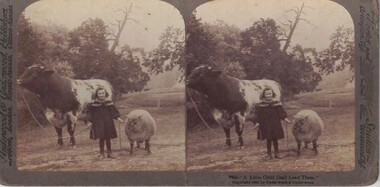 Linton and District Historical Society Inc
Stereograph, Underwood & Underwood Publishers, New York, London, Toronto Canada, Ottawa Kansas, A Little Child Shall Lead Them, Copyright 1901
... A Little Child Shall Lead Them Stereograph Underwood & Underwood Publishers, New York, London, Toronto Canada, Ottawa Kansas ...One of two sets of stereographs donated by the O'Beirne family along with a stereoscope for viewing (Stereoscope is Registration no. 2014-51).Stereograph of two black and white images. Images show a young girl standing in between a cow and a sheep.8854- "A Little Child Shall Lead Them"stereographs -
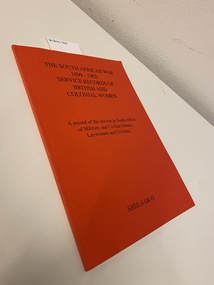 Returned Nurses RSL Sub-branch
Book, Sheila Gray, The South African war 1899 - 1902 : Service records of British and colonial women, 1993
... Represents a period that has little information about Australian Nurses in warfare South African War Boer war UK Nurses Australian Nurses Canadian Nurses New Zealand Nurses 'A record of the service in South Africa of Military and Civilian Nurses, Laywomen and Civilians' [text on front cover & title page] Contents: Army Nursing Service [UK] Army Nursing Service Reserve [UK] Nurses engaged locally Civil hospital nursing staff Private field hospital nursing staff Natal volunteer medical corps nurses Australian nurses Canadian nurses New Zealand nurses Maidservants to nurses, wardmaids and cooks Civilian support personnel 'With best wishes - / Sheila Gray' [towards the bottom of title page] Red A4 thin book with black type on front cover and no text on spine or back cover The South African war 1899 - 1902 : Service records of British and colonial women Book Sheila Gray ...'A record of the service in South Africa of Military and Civilian Nurses, Laywomen and Civilians' [text on front cover & title page] Contents: Army Nursing Service [UK] Army Nursing Service Reserve [UK] Nurses engaged locally Civil hospital nursing staff Private field hospital nursing staff Natal volunteer medical corps nurses Australian nurses Canadian nurses New Zealand nurses Maidservants to nurses, wardmaids and cooks Civilian support personnelRed A4 thin book with black type on front cover and no text on spine or back covernon-fiction'A record of the service in South Africa of Military and Civilian Nurses, Laywomen and Civilians' [text on front cover & title page] Contents: Army Nursing Service [UK] Army Nursing Service Reserve [UK] Nurses engaged locally Civil hospital nursing staff Private field hospital nursing staff Natal volunteer medical corps nurses Australian nurses Canadian nurses New Zealand nurses Maidservants to nurses, wardmaids and cooks Civilian support personnelsouth african war, boer war, uk nurses, australian nurses, canadian nurses, new zealand nurses -
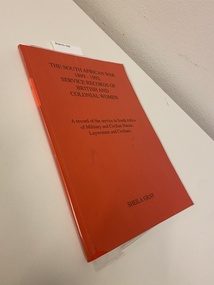 Returned Nurses RSL Sub-branch
Book, Sheila Gray, The South African war 1899 - 1902 : Service records of British and colonial women, 1993
... Represents a period that has little information about Australian Nurses in warfare South African War Boer war UK Nurses Australian Nurses Canadian Nurses New Zealand Nurses 'A record of the service in South Africa of Military and Civilian Nurses, Laywomen and Civilians' [text on front cover & title page] Contents: Army Nursing Service [UK] Army Nursing Service Reserve [UK] Nurses engaged locally Civil hospital nursing staff Private field hospital nursing staff Natal volunteer medical corps nurses Australian nurses Canadian nurses New Zealand nurses Maidservants to nurses, wardmaids and cooks Civilian support personnel 'Royal Australian Army Nursing / Corps Association / Victorian Branch' [top left of title page] 'Mrs Phyllis Wilson's / property' [towards the top right of title page] 'With best wishes - / Sheila Gray' [towards the bottom of title page] Red A4 thin book with black type on front cover and no text on spine or back cover. ...'A record of the service in South Africa of Military and Civilian Nurses, Laywomen and Civilians' [text on front cover & title page] Contents: Army Nursing Service [UK] Army Nursing Service Reserve [UK] Nurses engaged locally Civil hospital nursing staff Private field hospital nursing staff Natal volunteer medical corps nurses Australian nurses Canadian nurses New Zealand nurses Maidservants to nurses, wardmaids and cooks Civilian support personnelRed A4 thin book with black type on front cover and no text on spine or back cover. Has a plastic slip cover. Piece of paper sticky taped to the inside of the front cover.non-fiction'A record of the service in South Africa of Military and Civilian Nurses, Laywomen and Civilians' [text on front cover & title page] Contents: Army Nursing Service [UK] Army Nursing Service Reserve [UK] Nurses engaged locally Civil hospital nursing staff Private field hospital nursing staff Natal volunteer medical corps nurses Australian nurses Canadian nurses New Zealand nurses Maidservants to nurses, wardmaids and cooks Civilian support personnelsouth african war, boer war, uk nurses, australian nurses, canadian nurses, new zealand nurses
