
Showing 61 items matching "local legend"
-
 Sunshine and District Historical Society Incorporated
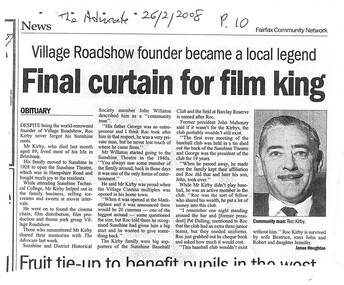
Article - Village Roadshow Founder Became A Local Legend - Final Curtain For Film King Roc Kirby, Fairfax Community Network, 26/02/2008 12:00:00 AM
... Village Roadshow Founder Became A Local Legend - Final Curtain For Film King Roc Kirby...Village Roadshow Roscoe "Roc" Hubert Kirby Obituary of Roc Kirby founder of Village Roadshow Article Village Roadshow Founder Became A Local Legend - Final Curtain For Film King Roc Kirby Fairfax Community Network ...village roadshow, roscoe "roc" hubert kirby -
 Ballarat Heritage Services
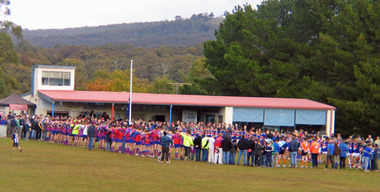
Digital photographs, L.J. Gervasoni, Laurie Sullivan Guard of Honour at Laurie Sullivan Oval, c2006, c2006
... ...local legend...hepburn laurie sullivan laurie sullivan reserve hepburn burras commemoration guard of honour footy local legend Hepburn Football club Photographs of a group of people, many wearing the Hepburn Football Team colours, on th eLauire Sullivan Oval. ...Photographs of a group of people, many wearing the Hepburn Football Team colours, on th eLauire Sullivan Oval.hepburn, laurie sullivan, laurie sullivan reserve, hepburn burras, commemoration, guard of honour, footy, local legend, hepburn football club -
 Hume City Civic Collection
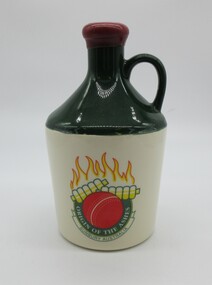
Container - Flagon - wine, Origins of the Ashes
... A cricket match took place at Rupertswood in 1882, a ball was burnt and the ashes placed in an urn (according to local legend). The flagon is number 56 of a limited edition of 2000....A cricket match took place at Rupertswood in 1882, a ball was burnt and the ashes placed in an urn (according to local legend). The flagon is number 56 of a limited edition of 2000. ...The flagon of port was released for the commemorative cricket match Australia versus England to celebrate the "origin of the Ashes" at Rupertswood in Sunbury on the 18 January 1995. A cricket match took place at Rupertswood in 1882, a ball was burnt and the ashes placed in an urn (according to local legend). The flagon is number 56 of a limited edition of 2000.These flagons were produced for the re-enactment of the original social cricket match held at Rupertswood in 1882. The commemorative cricket match was held in January 1995 with Allan Border captain for Australia and David Gower captain for England A cream and green glazed flagon with sloping sides. The lower half of the flagon is cream with a red, green and yellow insignia to commemorate the "origin of the ashes" cricket match and a brief history of the game. The upper half and neck is green. There is a red seal over the cork although it has a crack across top is unbroken and the port is still in the flagon.(insignia) ORIGIN OF THE ASHES / SUNBURY AUSTRALIA /origin of the ashes committee, rupertswood, border, allan, gower, david, cricket, wines, bottles, george evans collection, flagons -
 Eltham District Historical Society Inc
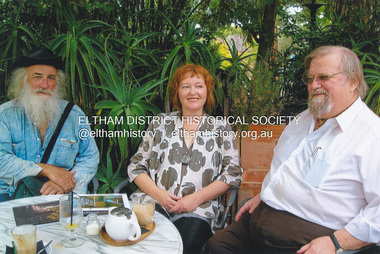
Photograph, Fay Bridge, Book launch of Laughing Waters Road by Jane Woollard at Montsalvat, Eltham, 30 January 2016
... Jane declared in her preface that the book “has been formed by attending to the connection between rivulets of memories, creeks of hearsay, rivers of tales, the meanders of local legend and the deep, still pools of the archive.” ...Jane declared in her preface that the book “has been formed by attending to the connection between rivulets of memories, creeks of hearsay, rivers of tales, the meanders of local legend and the deep, still pools of the archive.” ...Laughing Waters Road , the book was launched at Montsalvat in Eltham. On Saturday, January 30, 2016, Nillumbik Council launched this book. The weather was cool; just as well, considering over 500 people attended this very pleasant event where food and drink were plentiful. The Australian Government and Nillumbik Shire Council funded the book and it was designed by Wayne Rankin of North Warrandyte. The dedication page is to our very own Ranger Campbell Beardsell OAM of Parks Vic who taught Jane to be “passionate about the environment of this special place” (p260). FOWSP members Val Polley, Linda Rogan and Ken Crook contributed to the content and photos. David Wandin, Wurundjeri Elder, gave a Welcome to Country and officially launched the book after the Mayor of Nillumbik, Cr Hattam, made introductions. Jane Woollard followed with a brief outline of how she came to write the book (her very first) and read out loud the last paragraph which focuses on reconciliation and shared culture. Jane declared in her preface that the book “has been formed by attending to the connection between rivulets of memories, creeks of hearsay, rivers of tales, the meanders of local legend and the deep, still pools of the archive.” Very poetic! - Lynda Gilbert Newsletter; Friends of Warrandyte State Park March 2016, Volume 34 Number 2 Laughing Waters Road , the book was launched at Montsalvat in Eltham ON SATURDAY 30 JANUARY Nillumbik Council launched this book. The weather was cool; just as well, considering over 500 people attended this very pleasant event where food and drink were plentiful. The Australian Government and Nillumbik Shire Council funded the book and it was designed by Wayne Rankin of North Warrandyte. The dedication page is to our very own Ranger Campbell Beardsell OAM of Parks Vic who taught Jane to be “passionate about the environment of this special place” (p260). FOWSP members Val Polley, Linda Rogan and Ken Crook contributed to the content and photos. David Wandin, Wurundjeri Elder, gave a Welcome to Country and officially launched the book after the Mayor of Nillumbik, Cr Hattam, made introductions. Jane Woollard followed with a brief outline of how she came to write the book (her very first) and read out loud the last paragraph which focuses on reconciliation and shared culture. Jane declared in her preface that the book “has been formed by attending to the connection between rivulets of memories, creeks of hearsay, rivers of tales, the meanders of local legend and the deep, still pools of the archive.” Very poetic! - Lynda Gilbert Newsletter; Friends of Warrandyte State Park March 2016, Volume 34 Number 2 https://fowsp.org.au/docs/News_2016/34_02_March.pdffay bridge collection, 2016-01-30, book launch, bronnie hattam, jane woollard, laughing waters road, montsalvat, sigmund jorgensen, harry gilham, maurice hurry -
 Eltham District Historical Society Inc
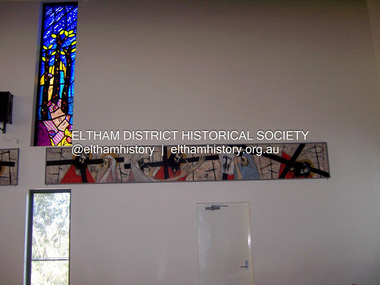
Photograph - Digital Photograph, Marguerite Marshall, Stations of the Cross, Clifton Pugh (1961); Our Lady Help of Christian's Church, Henry Street, Eltham, 11 October 2006
... Before 1864, according to local legend, a visiting priest administered sacraments in the parlour of former convict-turned-respected citizen Thomas Sweeney at Sweeneys Lane, Eltham.1 The first church was blessed in September, 1865, by the Archbishop of Melbourne, Dr Goold. ...Before 1864, according to local legend, a visiting priest administered sacraments in the parlour of former convict-turned-respected citizen Thomas Sweeney at Sweeneys Lane, Eltham.1 The first church was blessed in September, 1865, by the Archbishop of Melbourne, Dr Goold. ...Stations of the Cross by Clifton Pugh is a contempooray art piece in four sections making up 11 stations of the cross. It was commissioned by the Catholic parish in Eltham (Our Lady Help of Christians) in 1961 Published: Nillumbik Now and Then / Marguerite Marshall 2008; photographs Alan King with Marguerite Marshall.; p81 Art is an important means of nurturing faith at Our Lady Help of Christians Church, Henry Street, Eltham. The Stations of the Cross by Clifton Pugh and The Crucifix with the Ascending Jesus by sculptor Charles Rocco are two of the fine works that enhance the parishioners’ worship. These two inspiring works of art were added in 2001 – long after Roman Catholics began worshipping in Eltham around 1864. This beautiful worship centre was built following hardship and change – for parishioners have endured their church being destroyed by fire and have built four churches since they first worshipped together. Before 1864, according to local legend, a visiting priest administered sacraments in the parlour of former convict-turned-respected citizen Thomas Sweeney at Sweeneys Lane, Eltham.1 The first church was blessed in September, 1865, by the Archbishop of Melbourne, Dr Goold. It stood on an acre (0.4ha) of land in Little Eltham as that area was known then, near the present Fordhams and Main Roads and was part of the Heidelberg Church Parish. In 1912 the church was relocated to a new building on the present primary school site at 1 Henry Street. This was closer to the town centre, which had moved from Little Eltham after the railway line was extended to Eltham in 1902.2 In 1958 the church split from the Sacred Heart parish, Diamond Creek, to become a parish in its own right, with Father Tom Curran as inaugural priest. Not long after in 1961, a fire destroyed the church and huge working bees under the prominent Catholic builders, the Sibbel brothers, rebuilt and extended it, using the original altar from the first church. It was then that builder and parishioner Herman Sibbel asked his friend, artist Clifton Pugh, to paint the Stations of the Cross for the church. But the priest, Father Curran, neither approved of Pugh’s bohemian reputation nor liked the paintings, so they were hung in the corridor of Our Lady’s Primary School instead. The parishioners almost sold the paintings in 1989 to pay for major school renovations. However the paintings remained there for about 40 years, until 2001, when the church was extensively renovated by Father Barry Caldwell. Another change awaited the church, as it outgrew its building, later to be used as the school hall. So, in 1976, the present church was built across the road. Three beautiful stained-glass windows depicting the Passion, Death, Resurrection and the presence of Christ’s Spirit, link these with the church’s experiences. The first depicts a bushfire in Eltham, referring to their church damaged by fire. Another represents the Resurrection of Christ with new growth on a blackened stump and the Holy Spirit is represented by the Southern Cross. A window depicting Our Lady Help of Christians by parishioner Bill Peperkamp, was donated by parishioners to commemorate the Silver Jubilee of Father Desmond G Jenkins’ ordination to the priesthood on July 27, 1977. This, with the statue of Mary, creates a Marian shrine. In the 14 Stations of the Cross painted on four masonite panels Pugh captures the pathos of the suffering Christ and his disciples.3 The figures are stylised, except intriguingly, that of Pontias Pilate, who looks like Clifton Pugh. Charles Rocco’s sculpture is an extraordinary Jesus figure being raised from the Cross. The delicate stainless steel mesh of the figure creates a sense of the power of God over death. The organ, built in 1868 by George Fincham and Sons, was first installed in the All Saints’ Anglican Church, East St Kilda, then in the St Andrews Church, Clifton Hill. It was rebuilt into a modern instrument with a donation from parishioner Jim Murray, in memory of his wife Gwendolene Mary.4 Church members created their own work of art in front of the entrance, by painting designs and messages on 700 tiles. This work indicates the strong church family and faith expressed in art, that awaits the worshipper inside.This collection of almost 130 photos about places and people within the Shire of Nillumbik, an urban and rural municipality in Melbourne's north, contributes to an understanding of the history of the Shire. Published in 2008 immediately prior to the Black Saturday bushfires of February 7, 2009, it documents sites that were impacted, and in some cases destroyed by the fires. It includes photographs taken especially for the publication, creating a unique time capsule representing the Shire in the early 21st century. It remains the most recent comprehenesive publication devoted to the Shire's history connecting local residents to the past. nillumbik now and then (marshall-king) collection, art, clifton pugh, stations of the cross, our lady help of christans, installation -
 Narre Warren and District Family History Group
Book, Narre Warren & District Family History Group Inc, Casey Cardinia Collection - Pakenham Information File - Volume 2, 2021
... The date the articles were published, and title of articles are listed below. 23 Aug 2018 Proud Publishing History - Star News Group 26 Sep 2018 The Grange - A Heritage Classic 25 Oct 2017 Decades of Service - Lyn Stephenson 25 Oct 2017 Heather’s Favourite Things - Heather Arnold 21 Sep 2016 Still Keeping the Faith - Father John Readman 19 Sep 2018 Tributes for a Local Legend - Barry Cunningham 19 Sep 2018 Death & Funeral Notices - Barry Cunningham 21 Jun 2017 In the Footsteps of Kokoda - Harold Bould Kokoda Award 14 Nov 2007 Community Remembers Mates Lost and Found 26 Apr 2017 Next Generation of Lions’ Pride Steps up in the Netball Stakes 13 Oct 2016 St Patrick’s 150th Celebrations 27 Jan 2016 Looking Back 1 Feb 2017 Plaque is a Legacy - Pakenham Secondary College 23 Aug 2017 Death & Funeral Notices - Alan Stone Aug 2017 Death & Funeral Notices - Drew Morphett Aug 2017 Death & Funeral Notices - Paul Garvey 2018 50 Years - Andrew Facey 18 Oct 2017 “Disgusting and Beastly State” - Fraser’s Hotel 13 Apr 2016 Big Festival Milestone Yakkerboo 13 Apr 2016 Community 40 Years on - Yakkerboo 13 Apr 2016 Feeling Like a Princess - Yakkerboo 15 Feb 2017 Reserve Seats of Honour - Pakenham Upper Recreation Reserve UNKNOWN Looking Back 13 Oct 2021 Rivals Face a Great Divide 13 Oct 2021 Football’s Ultimate Warrior - Lincoln Withers 25 Feb 2009 Iron Horse Does it Again - Telopia 3 Nov 2021 Brett was Born to Serve - Brett Owen 29 Jun 2016 Historic Day for Racing 14 Nov 2007 Help for Historical Collection 16 Feb 2011 Calling All Show Girls 17 Nov 2021 Bugle Sounds for Sacrifice 1 Dec 2021 A Box Full of Honour - Dot Wade 10 Sep 2009 Thomas Empire Built on Paper 15 Dec 2021 End of a Retail Era - Graham Treloar 16 Feb 2011 Might as Well Jump - Commando Skydivers 13 Apr 2010 Farewell to “Saint” - Ranald Webster 7 Dec 2009 Farewell to a Good Sport - Leslie Hilton Vagg 8 Jun 2022 Digger Attends Coronation- Larry Moon 25 May 2022 Giving Back in Tim’s DNA - Tim Ahern 7 Sep 2022 Vale Clive Fielder 28 Sep 2022 Morgan Makes History - Natalie Morgan 9 Mar 2022 Old Pakenham on Show 27 Oct 2021 Farewell to Glenmac 27 Oct 2021 One of the Four-tunate Few - Dan O’Loughlin 18 May 2022 Locals Lament for Lilypond - Henty Lily Pond 8 Jun 2022 Dutch Perspective on War - Boer War 26 Oct 2022 Marion’s Amazing Journey 15 Nov 2017 Quiet Life in a Simple Town - Neil Lucas 11 Nov 2020 A Family’s Greek Tragedy - Mann family 20 Apr 2022 Blackwood Boys in Battle - Arch & Andy Blackwood 20 Apr 2022 Off With Mum’s Blessing - Andy Blackwood 16 Aug 2023 Bonds Built Through War - Vietnam 30 Aug 2023 Awards Celebrate Achievements of Two Agriculture Icons 1 Mar 2023 Your Say - Local Women who Deserve to be Recognised 14 Nov 2018 Diggers Still Remembered More Than A Century On 24 Oct 2018 Not Short on Character - Kath Short 30 Aug 2023 Scanlons’ Racing Journey - Tom Scanlon 29 Nov 2023 35 Years of Care - Malcolm McCowan 17 Jan 2024 A Trip Down Main Street’s Memory Lane 14 Feb 2024 Verna’s Life of Dedication - Verna Thewlis 31 Oct 2012 Words Come Easy to Joan - Joan Burke 21 Dec 2005 Green is Go for Golfers - Pakenham Golf Course 13 Aug 2008 Old Wood to Polished Art - Alan Cherry 23 Feb 2011 Come Rain, Hail or Shine Mr Pakenham’s on the Job 3 Aug 2022 Tributes Flow for Community Leader Jeff - Jeff Lempriere 11 June 2008 Honour Humbles Charlie - Charlie Rossetti 31 Jan 2007 Jason Keeps it in the Family - Jason Ronald 4 July 2007 A Chapter Closes - Heather Ronald 4 July 2012 Heart of a Lion - Pakenham Football Club 4 July 2012 Marshalling Championship Troops 5 June 2019 Pat’s Brush with Fame - Pat Lalor 9 Oct 2019 A Generous, Popular Soul - Ray Paynter 9 Oct 2019 Small Town Success - Michael Cormick 21 Aug 2019 Still Country at Heart UNKNOWN Four Decades of Caring - David W Bull 19 July 2023 Plaque Marks Flynn Link 20 Dec 2023 Aunty Norma’s Century - Norma Jackson 8 Feb 2023 70 Years in Pakenham - Knaap family 24 Oct 2018 Honour a School Pioneer - Maria Frederika Hagens 6 Nov 2019 From Matron to a Media Trailblazer - Mary Gannon UNKNOWN Of Courage and Sacrifice - Wilfred Rendall 7 Nov 2018 Tracking War’s Tragedy 6 Nov 2019 A Life Tragically Cut Shot - Robert Begg 24 Oct 2018 Restore Dignity - Harry Worship...The date the articles were published, and title of articles are listed below. 23 Aug 2018 Proud Publishing History - Star News Group 26 Sep 2018 The Grange - A Heritage Classic 25 Oct 2017 Decades of Service - Lyn Stephenson 25 Oct 2017 Heather’s Favourite Things - Heather Arnold 21 Sep 2016 Still Keeping the Faith - Father John Readman 19 Sep 2018 Tributes for a Local Legend - Barry Cunningham 19 Sep 2018 Death & Funeral Notices - Barry Cunningham 21 Jun 2017 In the Footsteps of Kokoda - Harold Bould Kokoda Award 14 Nov 2007 Community Remembers Mates Lost and Found 26 Apr 2017 Next Generation of Lions’ Pride Steps up in the Netball Stakes 13 Oct 2016 St Patrick’s 150th Celebrations 27 Jan 2016 Looking Back 1 Feb 2017 Plaque is a Legacy - Pakenham Secondary College 23 Aug 2017 Death & Funeral Notices - Alan Stone Aug 2017 Death & Funeral Notices - Drew Morphett Aug 2017 Death & Funeral Notices - Paul Garvey 2018 50 Years - Andrew Facey 18 Oct 2017 “Disgusting and Beastly State” - Fraser’s Hotel 13 Apr 2016 Big Festival Milestone Yakkerboo 13 Apr 2016 Community 40 Years on - Yakkerboo 13 Apr 2016 Feeling Like a Princess - Yakkerboo 15 Feb 2017 Reserve Seats of Honour - Pakenham Upper Recreation Reserve UNKNOWN Looking Back 13 Oct 2021 Rivals Face a Great Divide 13 Oct 2021 Football’s Ultimate Warrior - Lincoln Withers 25 Feb 2009 Iron Horse Does it Again - Telopia 3 Nov 2021 Brett was Born to Serve - Brett Owen 29 Jun 2016 Historic Day for Racing 14 Nov 2007 Help for Historical Collection 16 Feb 2011 Calling All Show Girls 17 Nov 2021 Bugle Sounds for Sacrifice 1 Dec 2021 A Box Full of Honour - Dot Wade 10 Sep 2009 Thomas Empire Built on Paper 15 Dec 2021 End of a Retail Era - Graham Treloar 16 Feb 2011 Might as Well Jump - Commando Skydivers 13 Apr 2010 Farewell to “Saint” - Ranald Webster 7 Dec 2009 Farewell to a Good Sport - Leslie Hilton Vagg 8 Jun 2022 Digger Attends Coronation- Larry Moon 25 May 2022 Giving Back in Tim’s DNA - Tim Ahern 7 Sep 2022 Vale Clive Fielder 28 Sep 2022 Morgan Makes History - Natalie Morgan 9 Mar 2022 Old Pakenham on Show 27 Oct 2021 Farewell to Glenmac 27 Oct 2021 One of the Four-tunate Few - Dan O’Loughlin 18 May 2022 Locals Lament for Lilypond - Henty Lily Pond 8 Jun 2022 Dutch Perspective on War - Boer War 26 Oct 2022 Marion’s Amazing Journey 15 Nov 2017 Quiet Life in a Simple Town - Neil Lucas 11 Nov 2020 A Family’s Greek Tragedy - Mann family 20 Apr 2022 Blackwood Boys in Battle - Arch & Andy Blackwood 20 Apr 2022 Off With Mum’s Blessing - Andy Blackwood 16 Aug 2023 Bonds Built Through War - Vietnam 30 Aug 2023 Awards Celebrate Achievements of Two Agriculture Icons 1 Mar 2023 Your Say - Local Women who Deserve to be Recognised 14 Nov 2018 Diggers Still Remembered More Than A Century On 24 Oct 2018 Not Short on Character - Kath Short 30 Aug 2023 Scanlons’ Racing Journey - Tom Scanlon 29 Nov 2023 35 Years of Care - Malcolm McCowan 17 Jan 2024 A Trip Down Main Street’s Memory Lane 14 Feb 2024 Verna’s Life of Dedication - Verna Thewlis 31 Oct 2012 Words Come Easy to Joan - Joan Burke 21 Dec 2005 Green is Go for Golfers - Pakenham Golf Course 13 Aug 2008 Old Wood to Polished Art - Alan Cherry 23 Feb 2011 Come Rain, Hail or Shine Mr Pakenham’s on the Job 3 Aug 2022 Tributes Flow for Community Leader Jeff - Jeff Lempriere 11 June 2008 Honour Humbles Charlie - Charlie Rossetti 31 Jan 2007 Jason Keeps it in the Family - Jason Ronald 4 July 2007 A Chapter Closes - Heather Ronald 4 July 2012 Heart of a Lion - Pakenham Football Club 4 July 2012 Marshalling Championship Troops 5 June 2019 Pat’s Brush with Fame - Pat Lalor 9 Oct 2019 A Generous, Popular Soul - Ray Paynter 9 Oct 2019 Small Town Success - Michael Cormick 21 Aug 2019 Still Country at Heart UNKNOWN Four Decades of Caring - David W Bull 19 July 2023 Plaque Marks Flynn Link 20 Dec 2023 Aunty Norma’s Century - Norma Jackson 8 Feb 2023 70 Years in Pakenham - Knaap family 24 Oct 2018 Honour a School Pioneer - Maria Frederika Hagens 6 Nov 2019 From Matron to a Media Trailblazer - Mary Gannon UNKNOWN Of Courage and Sacrifice - Wilfred Rendall 7 Nov 2018 Tracking War’s Tragedy 6 Nov 2019 A Life Tragically Cut Shot - Robert Begg 24 Oct 2018 Restore Dignity - Harry Worship Casey Cardinia Collection - Pakenham Information File - Volume 2 Book Narre Warren & District Family History Group Inc. ...Folder containing a table of contents and various newspaper clippings and other information pertaining to the Pakenham area Volume 2. The date the articles were published, and title of articles are listed below. 23 Aug 2018 Proud Publishing History - Star News Group 26 Sep 2018 The Grange - A Heritage Classic 25 Oct 2017 Decades of Service - Lyn Stephenson 25 Oct 2017 Heather’s Favourite Things - Heather Arnold 21 Sep 2016 Still Keeping the Faith - Father John Readman 19 Sep 2018 Tributes for a Local Legend - Barry Cunningham 19 Sep 2018 Death & Funeral Notices - Barry Cunningham 21 Jun 2017 In the Footsteps of Kokoda - Harold Bould Kokoda Award 14 Nov 2007 Community Remembers Mates Lost and Found 26 Apr 2017 Next Generation of Lions’ Pride Steps up in the Netball Stakes 13 Oct 2016 St Patrick’s 150th Celebrations 27 Jan 2016 Looking Back 1 Feb 2017 Plaque is a Legacy - Pakenham Secondary College 23 Aug 2017 Death & Funeral Notices - Alan Stone Aug 2017 Death & Funeral Notices - Drew Morphett Aug 2017 Death & Funeral Notices - Paul Garvey 2018 50 Years - Andrew Facey 18 Oct 2017 “Disgusting and Beastly State” - Fraser’s Hotel 13 Apr 2016 Big Festival Milestone Yakkerboo 13 Apr 2016 Community 40 Years on - Yakkerboo 13 Apr 2016 Feeling Like a Princess - Yakkerboo 15 Feb 2017 Reserve Seats of Honour - Pakenham Upper Recreation Reserve UNKNOWN Looking Back 13 Oct 2021 Rivals Face a Great Divide 13 Oct 2021 Football’s Ultimate Warrior - Lincoln Withers 25 Feb 2009 Iron Horse Does it Again - Telopia 3 Nov 2021 Brett was Born to Serve - Brett Owen 29 Jun 2016 Historic Day for Racing 14 Nov 2007 Help for Historical Collection 16 Feb 2011 Calling All Show Girls 17 Nov 2021 Bugle Sounds for Sacrifice 1 Dec 2021 A Box Full of Honour - Dot Wade 10 Sep 2009 Thomas Empire Built on Paper 15 Dec 2021 End of a Retail Era - Graham Treloar 16 Feb 2011 Might as Well Jump - Commando Skydivers 13 Apr 2010 Farewell to “Saint” - Ranald Webster 7 Dec 2009 Farewell to a Good Sport - Leslie Hilton Vagg 8 Jun 2022 Digger Attends Coronation- Larry Moon 25 May 2022 Giving Back in Tim’s DNA - Tim Ahern 7 Sep 2022 Vale Clive Fielder 28 Sep 2022 Morgan Makes History - Natalie Morgan 9 Mar 2022 Old Pakenham on Show 27 Oct 2021 Farewell to Glenmac 27 Oct 2021 One of the Four-tunate Few - Dan O’Loughlin 18 May 2022 Locals Lament for Lilypond - Henty Lily Pond 8 Jun 2022 Dutch Perspective on War - Boer War 26 Oct 2022 Marion’s Amazing Journey 15 Nov 2017 Quiet Life in a Simple Town - Neil Lucas 11 Nov 2020 A Family’s Greek Tragedy - Mann family 20 Apr 2022 Blackwood Boys in Battle - Arch & Andy Blackwood 20 Apr 2022 Off With Mum’s Blessing - Andy Blackwood 16 Aug 2023 Bonds Built Through War - Vietnam 30 Aug 2023 Awards Celebrate Achievements of Two Agriculture Icons 1 Mar 2023 Your Say - Local Women who Deserve to be Recognised 14 Nov 2018 Diggers Still Remembered More Than A Century On 24 Oct 2018 Not Short on Character - Kath Short 30 Aug 2023 Scanlons’ Racing Journey - Tom Scanlon 29 Nov 2023 35 Years of Care - Malcolm McCowan 17 Jan 2024 A Trip Down Main Street’s Memory Lane 14 Feb 2024 Verna’s Life of Dedication - Verna Thewlis 31 Oct 2012 Words Come Easy to Joan - Joan Burke 21 Dec 2005 Green is Go for Golfers - Pakenham Golf Course 13 Aug 2008 Old Wood to Polished Art - Alan Cherry 23 Feb 2011 Come Rain, Hail or Shine Mr Pakenham’s on the Job 3 Aug 2022 Tributes Flow for Community Leader Jeff - Jeff Lempriere 11 June 2008 Honour Humbles Charlie - Charlie Rossetti 31 Jan 2007 Jason Keeps it in the Family - Jason Ronald 4 July 2007 A Chapter Closes - Heather Ronald 4 July 2012 Heart of a Lion - Pakenham Football Club 4 July 2012 Marshalling Championship Troops 5 June 2019 Pat’s Brush with Fame - Pat Lalor 9 Oct 2019 A Generous, Popular Soul - Ray Paynter 9 Oct 2019 Small Town Success - Michael Cormick 21 Aug 2019 Still Country at Heart UNKNOWN Four Decades of Caring - David W Bull 19 July 2023 Plaque Marks Flynn Link 20 Dec 2023 Aunty Norma’s Century - Norma Jackson 8 Feb 2023 70 Years in Pakenham - Knaap family 24 Oct 2018 Honour a School Pioneer - Maria Frederika Hagens 6 Nov 2019 From Matron to a Media Trailblazer - Mary Gannon UNKNOWN Of Courage and Sacrifice - Wilfred Rendall 7 Nov 2018 Tracking War’s Tragedy 6 Nov 2019 A Life Tragically Cut Shot - Robert Begg 24 Oct 2018 Restore Dignity - Harry Worshipnon-fictionpakenham (vic.) -
 Narre Warren and District Family History Group
Book, Narre Warren & District Family History Group Inc, Casey Cardinia Collection - Pakenham Information File - Volume 3, 2024
... - Pakenham Golf Course 17 Sep 2025 80 Years of Pottery - Robert Gordon Pottery 9 Jul 2025 Farewell to a True Pioneer - Douglas Wyatt 9 Jul 2025 New Bid Starts Swinging 9 Jul 2025 Golf Land was Hailed as a Groundbreaker 4 Feb 2026 Farewell After a Full Life - Ray Cross 7 May 2025 Local Legend Remembered - David W Bull 15 Oct 2025 Remembering a Legend - Robbie MacGregor 19 Nov 2025 On Your Mark, Tunnel Set, Go - Mark Godden 28 May 2025 Surprise Honour for Geoff - Geoff Young 11 Jun 2025 Survivor’s Amazing Journey - Colin Tidball 11 Feb 2026 Yakkerboo Toasts 50 Years 17 Sep 2025 Final Bell for Buildings 9 Apr 2025 Fourth Generation Members Keep Family History Rolling On 16 Apr 2025 End of an Era at Pakenham as Jumps Racing Comes to a Close 11 Feb 2026 Council Refuse Demolition 15 Oct 2025 Army Home People in Focus 11 Sep 2025 History Shake Up...- Pakenham Golf Course 17 Sep 2025 80 Years of Pottery - Robert Gordon Pottery 9 Jul 2025 Farewell to a True Pioneer - Douglas Wyatt 9 Jul 2025 New Bid Starts Swinging 9 Jul 2025 Golf Land was Hailed as a Groundbreaker 4 Feb 2026 Farewell After a Full Life - Ray Cross 7 May 2025 Local Legend Remembered - David W Bull 15 Oct 2025 Remembering a Legend - Robbie MacGregor 19 Nov 2025 On Your Mark, Tunnel Set, Go - Mark Godden 28 May 2025 Surprise Honour for Geoff - Geoff Young 11 Jun 2025 Survivor’s Amazing Journey - Colin Tidball 11 Feb 2026 Yakkerboo Toasts 50 Years 17 Sep 2025 Final Bell for Buildings 9 Apr 2025 Fourth Generation Members Keep Family History Rolling On 16 Apr 2025 End of an Era at Pakenham as Jumps Racing Comes to a Close 11 Feb 2026 Council Refuse Demolition 15 Oct 2025 Army Home People in Focus 11 Sep 2025 History Shake Up Casey Cardinia Collection - Pakenham Information File - Volume 3 Book Narre Warren & District Family History Group Inc. ...Folder containing a table of contents and various newspaper clippings and other information pertaining to the Pakenham area Volume 3. The date the articles were published, and title of articles are listed below. 28 May 2008 Hounds’ Bloodline Runs Way, Way Back 18 Jul 2012 The Only Job for Her - Kerri Bolch 25 Jan 2023 Two Lives are Celebrated - Ian Thomas 19 Jan 2023 My Life in Newspapers - Ian Thomas 18 Jan 2023 An All-Round Good Sport - Ian’s Talents Lie the Other Side of the Boundary Fence - Ian Thomas 18 Jan 2023 Tributes Stream in for Ian - Ian Thomas 18 Jan 2023 Putting Family First, At Last - Ian Thomas 18 Jan 2023 The Editor's Desk - Ian Thomas 19 Jan 2023 Went the Way he Wanted - Ian Thomas 18 Jan 2023 Historic Ties to Society - Ian Thomas 18 Jan 2023 Death and Funeral Notices - Ian Thomas 18 Jan 2023 Tributes Flow - Ian Thomas 18 Jan 2023 Departed with his Boots on - Ian Thomas 7 Nov 2018 War Tragedies Bring High Flying Family Down to Earth 21 Dec 2022 Tree Treasure - David Ferrier 1 May 2019 Pakenham Remembers 24 Apr 2019 Flying the Flag 24 Apr 2019 The Combined Pakenham & District Roll of Honour 1914-1918 24 Apr 2019 Artie Stopped a Few Slugs in his Time - Artie Paternoster 24 Apr 2019 Farmer Took a Bullet - Francis Hornby 24 Apr 2019 Pakenham Butcher Shipwrecked on the Way to War - Andy Webster 24 Apr 2019 Len Serves on Home Soil - Len Cook 24 Apr 2019 A Face of Anzac From Centenary Website - Albert Nye 24 Apr 2019 Bill a Giant of Pakenham - Bill Stone 1 June 2016 Customers Came First - Margaret Pursell 1 June 2016 Ken had a Passion for Life - Kenneth Aldred 1 June 2016 Politics, Education and Industry Were Bob’s Legacy - Bob Charles 30 Oct 2024 Darby Won the Cup - Ray (Darby) Webster 10 Apr 2024 Mural Unveiled for Pakenham Girl Guides Hall 4 Sep 2024 Remembering the Generosity of Carol - Carol Clay 2 Oct 2024 Norma Deeply Loved - Norma Jackson 2 Oct 2024 The Last of her Generation - Margaret Maher 23 Oct 2024 Celebrating a Proud 95 Years - Pakenham CFA 23 Oct 2024 Class of ‘74 Marks 50 Years - Pakenham High School 23 Oct 2024 Commemorating 45 Years of Service - David W Bull Funerals 23 Oct 2024 Riding High at Pakenham 4 Sep 2024 When You Could Buy Cattle and a Car 21 Aug 2024 Honora Fields Name Choice 28 Aug 2024 A Business Pioneer - Oscar Smith 28 Aug 2024 St Pat’s Blessed with Reno 14 Aug 2024 Historic Milking Shed Gone 14 Aug 2024 Frank’s Wooden Wonders - Frank Lindsay 31 July 2024 How the Pioneers Settled on IYU Estate 20 Mar 2024 Life Memberships Awarded - Pakenham Racing Club 27 Mar 2024 Magical Day for the Lions - Lions Netball Club 20 Mar 2024 Tennis Club’s Call to Arms - Pakenham Tennis Club 20 Mar 2024 Timeline of a Tennis Club - Pakenham Tennis Club 17 Jul 2024 Honest and Committed Man - Ian Bell 17 Jul 2024 Pakenham Loses Devoted Supporter Thelma Young 22 May 2024 Our Quiet Achiever - Cheryl Trimmings 17 July 2024 A True Pakenham Pioneer - Meryl Waterhouse 10 Apr 2024 Names for Paky East - When Pakenham Used to be “Pakenham East” 15 May 2024 Stories Behind the Names 28 Aug 2024 The Work Behind the Horse - Jackson Pope 22 May 2024 Farming Pioneer Name Proposed for Pakenham East 10 July 2024 Mystery Surrounds Shield 19 Apr 2017 In Their Footsteps - Lachlan Smith 20 July 2016 24 Hours of Carnage Battle of Fromelles 12 Nov 2025 Hospital is Taking Shape 12 Nov 2025 Back to School, 50 Years On - Pakenham High School 12 Nov 2025 A Century of Loving Life - Emily Joyce Taylor 12 Nov 2025 Much-Loved Local Ngaire - Ngaire Bennett 9 Oct 2025 Spotlight on History for Book Launch 16 Jul 2025 Lyn’s Memory Lives On - Lynette Stephenson 1 Oct 2025 Robbie Was Always En Route - Robbie MacGregor 16 May 2025 Life Full of Love and Humour - Max Jeavons 21 Jan 2026 Decades of Cheese-Making - Interlandi family 21 Jan 2026 Opening a Grand Affair - Pakenham Bush Nursing Hospital 21 Jan 2026 A Century of Medical Care - Pakenham Community Hospital 21 Jan 2026 Mary Travelled Far and Wide to Provide Medical Care 21 May 2025 The Humble Veteran Hero - Matthew Moore 14 Jan 2026 Racing Towards the Future - Pakenham Racing Club 17 Dec 2025 Pakenham Farewells Lefty - Kelvin Rees 17 Dec 2025 Norm Smith, The Bus Driver Who Moved the Community 10 Sep 2025 What Will the Future Hold? - Pakenham Golf Course 17 Sep 2025 80 Years of Pottery - Robert Gordon Pottery 9 Jul 2025 Farewell to a True Pioneer - Douglas Wyatt 9 Jul 2025 New Bid Starts Swinging 9 Jul 2025 Golf Land was Hailed as a Groundbreaker 4 Feb 2026 Farewell After a Full Life - Ray Cross 7 May 2025 Local Legend Remembered - David W Bull 15 Oct 2025 Remembering a Legend - Robbie MacGregor 19 Nov 2025 On Your Mark, Tunnel Set, Go - Mark Godden 28 May 2025 Surprise Honour for Geoff - Geoff Young 11 Jun 2025 Survivor’s Amazing Journey - Colin Tidball 11 Feb 2026 Yakkerboo Toasts 50 Years 17 Sep 2025 Final Bell for Buildings 9 Apr 2025 Fourth Generation Members Keep Family History Rolling On 16 Apr 2025 End of an Era at Pakenham as Jumps Racing Comes to a Close 11 Feb 2026 Council Refuse Demolition 15 Oct 2025 Army Home People in Focus 11 Sep 2025 History Shake Upnon-fictionpakenham (vic.) -
 Narre Warren and District Family History Group
Book, Narre Warren & District Family History Group Inc, Casey Cardinia Collection - Narre Warren North Information File
... Johnson 13 Oct 2004 Red Cross ladies a tight unit 15 Jun 2006 She’s apples for OAM (Montague) 15 May 2000 Keeping spirit of the harvest alive (Baxter) 21 Mar 2001 Reprieve for house – Main Street 29 Jul 1991 Jack Rae receives achievement award 15 Mar 2001 House hangs in balance (Webb home Main Street) 21 Jan 1993 Narre Warren North a connecting link between hills towns…… 13 Mar 1999 Oaks Taps into History 15 Oct 1992 Kangaroo & emu served for dinner (Hillsley) 24 Sep 1992 Narre North Post Office 100 years old 27 Jan 1994 Narre Warren North – one of the earliest settlements 01 Mar 2008 Soldier Settlement Memorial Garden 26 Jan 1999 Stamp honors a ‘local’ art legend (Arthur Boyd) 08 Feb 2006 In Tune for a long life – Hilda Harris 06 Mar 2008 Memorial Gardens a tribute to soldiers 19 May 2004 A life changing adventure – Kooloos family 22 Jun 2006 War memorial set for repairs 11 Feb 1972 Early Days of Narre Warren North - Beaumont 12 Mar 2008 Settlement Gardens Opened 28 Jan 2009 OAM is King - Noelene King 28 Jan 2009 Pioneer Farming Families Beef it Up - King 30 Jun 2021 Nobelius Life on the Land 13 Feb 2013 Coming up Roses - Brad Alden-Brown 10 Nov 2016 Jack Says Show’s in the Blood - Jack Rae UNKNOWN Taderrwen Lodge 22 Sep 2021 Home Still Standing After 140 Years 8 Sep 2021 Growing Hope Lured Fox - Fox family 9 Oct 2014 Red Cross Marks Milestone 28 Jan 2009 Keel Cast Historic Shadow - Bob Street 19 Jul 2017 She’s Apples Mate - Montague 8 Jul 2020 Big Apple to a Palace - Lowry 5 Feb 2018 An Ageless passion - Berwick Show 5 Feb 2018 Berwick’s Nod to Show Jumping History - Berwick Show 3 Nov 2021 Robinsons of Aranmore 21 Nov 2001 Oaks Avenue Saved 4 Jun 1997 Opened in a Weslyan Church 120 Years Ago 4 Jun 1997 Bob Looks Back to Happy Times at School 9 Jun 1993 A Day of Reminiscing at Narre Warren North Uniting Church 28 Mar 1990 Narre North Hall Celebrates 19 Dec 1989 Former Premier at Narre North 3 Mar 1988 They Remembered the Good Old Days 3 Mar 1988 Harry was one of the “Giants” 10 Jun 1981 Couple Return to Plant a Tree at Kurll Park Narre Warren North 12 Oct 1983 50 Years of Scouting Celebrated at Narre Warren Nth 15 Mar ? ...Johnson 13 Oct 2004 Red Cross ladies a tight unit 15 Jun 2006 She’s apples for OAM (Montague) 15 May 2000 Keeping spirit of the harvest alive (Baxter) 21 Mar 2001 Reprieve for house – Main Street 29 Jul 1991 Jack Rae receives achievement award 15 Mar 2001 House hangs in balance (Webb home Main Street) 21 Jan 1993 Narre Warren North a connecting link between hills towns…… 13 Mar 1999 Oaks Taps into History 15 Oct 1992 Kangaroo & emu served for dinner (Hillsley) 24 Sep 1992 Narre North Post Office 100 years old 27 Jan 1994 Narre Warren North – one of the earliest settlements 01 Mar 2008 Soldier Settlement Memorial Garden 26 Jan 1999 Stamp honors a ‘local’ art legend (Arthur Boyd) 08 Feb 2006 In Tune for a long life – Hilda Harris 06 Mar 2008 Memorial Gardens a tribute to soldiers 19 May 2004 A life changing adventure – Kooloos family 22 Jun 2006 War memorial set for repairs 11 Feb 1972 Early Days of Narre Warren North - Beaumont 12 Mar 2008 Settlement Gardens Opened 28 Jan 2009 OAM is King - Noelene King 28 Jan 2009 Pioneer Farming Families Beef it Up - King 30 Jun 2021 Nobelius Life on the Land 13 Feb 2013 Coming up Roses - Brad Alden-Brown 10 Nov 2016 Jack Says Show’s in the Blood - Jack Rae UNKNOWN Taderrwen Lodge 22 Sep 2021 Home Still Standing After 140 Years 8 Sep 2021 Growing Hope Lured Fox - Fox family 9 Oct 2014 Red Cross Marks Milestone 28 Jan 2009 Keel Cast Historic Shadow - Bob Street 19 Jul 2017 She’s Apples Mate - Montague 8 Jul 2020 Big Apple to a Palace - Lowry 5 Feb 2018 An Ageless passion - Berwick Show 5 Feb 2018 Berwick’s Nod to Show Jumping History - Berwick Show 3 Nov 2021 Robinsons of Aranmore 21 Nov 2001 Oaks Avenue Saved 4 Jun 1997 Opened in a Weslyan Church 120 Years Ago 4 Jun 1997 Bob Looks Back to Happy Times at School 9 Jun 1993 A Day of Reminiscing at Narre Warren North Uniting Church 28 Mar 1990 Narre North Hall Celebrates 19 Dec 1989 Former Premier at Narre North 3 Mar 1988 They Remembered the Good Old Days 3 Mar 1988 Harry was one of the “Giants” 10 Jun 1981 Couple Return to Plant a Tree at Kurll Park Narre Warren North 12 Oct 1983 50 Years of Scouting Celebrated at Narre Warren Nth 15 Mar ? ...Folder containing a table of contents and various newspaper clippings and other information pertaining to the Narre Warren North area. The date the articles were published, and title of articles are listed below. 14 Oct 1993 Brother’s tribute to orchardist (Montague) 12 Feb 2003 Future’s rosy for growers (Brundrett) 14 May 1992 Edwards family part of Narre North’s history 13 Jul 2005 Push to honour pioneers 27 May 2004 Herald the opening of the new chapel 12 Apr 2000 Suburb’s friendship comes to the fore 22 Sep 1967 District shocked by the death of Mr. W. Johnson 13 Oct 2004 Red Cross ladies a tight unit 15 Jun 2006 She’s apples for OAM (Montague) 15 May 2000 Keeping spirit of the harvest alive (Baxter) 21 Mar 2001 Reprieve for house – Main Street 29 Jul 1991 Jack Rae receives achievement award 15 Mar 2001 House hangs in balance (Webb home Main Street) 21 Jan 1993 Narre Warren North a connecting link between hills towns…… 13 Mar 1999 Oaks Taps into History 15 Oct 1992 Kangaroo & emu served for dinner (Hillsley) 24 Sep 1992 Narre North Post Office 100 years old 27 Jan 1994 Narre Warren North – one of the earliest settlements 01 Mar 2008 Soldier Settlement Memorial Garden 26 Jan 1999 Stamp honors a ‘local’ art legend (Arthur Boyd) 08 Feb 2006 In Tune for a long life – Hilda Harris 06 Mar 2008 Memorial Gardens a tribute to soldiers 19 May 2004 A life changing adventure – Kooloos family 22 Jun 2006 War memorial set for repairs 11 Feb 1972 Early Days of Narre Warren North - Beaumont 12 Mar 2008 Settlement Gardens Opened 28 Jan 2009 OAM is King - Noelene King 28 Jan 2009 Pioneer Farming Families Beef it Up - King 30 Jun 2021 Nobelius Life on the Land 13 Feb 2013 Coming up Roses - Brad Alden-Brown 10 Nov 2016 Jack Says Show’s in the Blood - Jack Rae UNKNOWN Taderrwen Lodge 22 Sep 2021 Home Still Standing After 140 Years 8 Sep 2021 Growing Hope Lured Fox - Fox family 9 Oct 2014 Red Cross Marks Milestone 28 Jan 2009 Keel Cast Historic Shadow - Bob Street 19 Jul 2017 She’s Apples Mate - Montague 8 Jul 2020 Big Apple to a Palace - Lowry 5 Feb 2018 An Ageless passion - Berwick Show 5 Feb 2018 Berwick’s Nod to Show Jumping History - Berwick Show 3 Nov 2021 Robinsons of Aranmore 21 Nov 2001 Oaks Avenue Saved 4 Jun 1997 Opened in a Weslyan Church 120 Years Ago 4 Jun 1997 Bob Looks Back to Happy Times at School 9 Jun 1993 A Day of Reminiscing at Narre Warren North Uniting Church 28 Mar 1990 Narre North Hall Celebrates 19 Dec 1989 Former Premier at Narre North 3 Mar 1988 They Remembered the Good Old Days 3 Mar 1988 Harry was one of the “Giants” 10 Jun 1981 Couple Return to Plant a Tree at Kurll Park Narre Warren North 12 Oct 1983 50 Years of Scouting Celebrated at Narre Warren Nth 15 Mar ? Life Skills at Narre Warren North UNKNOWN Open Air Chapel for Narre Warren North Guides UNKNOWN The “Cardigan Castle” 22 Aug 1902 Welcome Home - David & William Bailey 2 Jul 1977 Ton up for Town - 100 Years Old 21 Feb 2018 Jack’s an Endless Rae of Sunshine 9 Sep 2020 Jack’s Royal Commitment 30 Nov 2022 In the Name of Roses 16 Nov 2022 Land Donation Led to Park 30 May 2018 Winters Left Their Mark 6 Sep 2020 Hillside Turns Into Quarry 5 Feb 2020 They Are the Rose People UNKNOWN Brigade’s Big Birthday Bash 28 Apr 2004 In Honour of Lost Heroes 22 Apr 2004 Personal Tribute to Fallen Soldiers 29 Apr 2004 Modern Conflicts Add Relevance 21 Feb 2024 Tributes Flow for Montague Orchard Legend 6 Dec 2018 Kevin Ridd’s Outstanding Service to the CFA 7 Feb 2019 Fire Captain Recalls Heat - Shaun Trotter 7 Feb 2019 Remembering the Tragedy of 2009 at Ceremony 6 Feb 2019 Volunteers Gave Their All 19 Oct 2023 Stronger Protection Calls - Casey’s Heritage Strategy 4 Jun 2025 Creating More History 20 Feb 2025 Lifting the Lid on OLd Relicsnon-fictionnarre warren north (vic.) -
 Flagstaff Hill Maritime Museum and Village
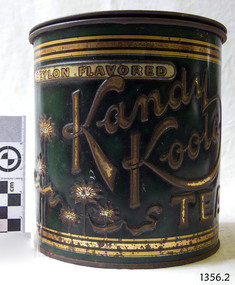
Container - Tin, C. 1910 - 1930
... legend has it, she became a governess at “Injemiara” where her grandfather, Francis Freckleton, once owned land. Henry and Mary’s family of six, some of whom were born at Mailor’s Flat and later children at Wangoom, lived with their parents at Wangoom and Purnim west, where Henry died in 1933 and Mary Jane in 1940. The Giles family collection has social significance at a local ...This Kandy Koola Tea tin dates to the early 20th century and was made and sold in Melbourne, Victoria. It once belonged to the Giles family. About Kandy Koola Kandy Koola ran an advertisement in the West Gippsland Gazette on 2 May 1911 promoting its tea as perfect for a picnic. The text reads “Picnicing. All as hungry as hunters – made a fire of small twigs – put on our billy of fresh spring water – and waited. Soon bubble, bubble, bubble and the billy boiled. In goes the pure Kandy-Koola Tea. Tea! Tea is not the word – it tasted like nectar! One cup, two cups, three cups – then had to make a fresh billy full. Lazed away the rest of the day sipping our Kandy Koola and chatting. How good indeed! “All grocers sell Kandy Koola Tea. It is pure leaf, selected and blended with the greatest care and skill. Ask your grocer for Kandy Koola. Sold in three grades, i.e. red, blue and green packets” About the Giles Family There are many 19th century items of furniture, linen and crockery donated to Flagstaff Hill Maritime Village by Vera and Aurelin Giles. The items are associated with the Giles Family and are known as the “Giles Collection”. These items mostly came from the simple home of Vera’s parents-in-law, Henry Giles and his wife Mary Jane (nee Freckleton), whose photos are in the parlour. They married in 1880. Henry Giles was born at Tower Hill in 1858. He was a labourer on the construction of the Breakwater before leaving in 1895 to build bridges in N.S.W. for about seven years. Mary Jane was born in 1860 at Cooramook. She attended Mailor’s Flat State School where she was also a student teacher before, as family legend has it, she became a governess at “Injemiara” where her grandfather, Francis Freckleton, once owned land. Henry and Mary’s family of six, some of whom were born at Mailor’s Flat and later children at Wangoom, lived with their parents at Wangoom and Purnim west, where Henry died in 1933 and Mary Jane in 1940. The Giles family collection has social significance at a local level, because it illustrates the level of material support the Warrnambool community gave to Flagstaff Hill when the Museum was established. The tin and the tea that was in the container are significant for their association with the Australian and Victorian food industry, being blended and packed by John Connell and Co, Proprietary Limited Melbourne.Container; tin, for Kandy Koola Tea, part of the Giles Collection. Round tin, green background, gold band on top and bottom, printed on gold background. Ceylon flavoured tea. Also five gold flowers of various sizes with scalloped band, large golden inscription “Kandy Koola Tea” and “Ceylon Flavoured” and “Blended and packed by John Connell & Co Pty Ltd Melbourne” “Kandy Koola Tea” and “Ceylon Flavoured”and and “Blended and packed by John Connell & Co Pty Ltd Melbourne”. Printed on lower band “MADE AND PRINTED BY WILSON BROS. NORTH MELB.” “1LBS NETT”flagstaff hill, warrnambool, shipwrecked-coast, flagstaff-hill, flagstaff-hill-maritime-museum, maritime-museum, shipwreck-coast, flagstaff-hill-maritime-village, giles family, 19th century domestic items, tea, tea merchant, tea tin, food and beverages, giles collection, henry giles, tower hill, warrnambool breakwater, mailor’s flat, wangoom, 19th century household goods, metalcraft, tinware, kandy koola tea -
 Flagstaff Hill Maritime Museum and Village
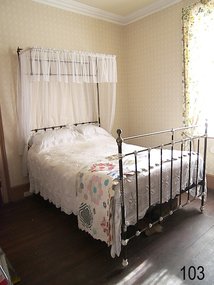
Furniture - Double Bed, Late 19th to early 20th centuries
... legend has it, she became a governess at “Injemiara” where her grandfather, Francis Freckleton, once owned land. Henry and Mary’s family of six, some of whom were born at Mailor’s Flat and later children at Wangoom, lived with their parents at Wangoom and Purnim west, where Henry died in 1933 and Mary Jane in 1940. The Giles family collection has social significance at a local ...There are many 19th century items of furniture, linen and crockery donated to Flagstaff Hill Maritime Village by Vera and Aurelin Giles. The items are associated with the Giles Family and are known as the “Giles Collection”. These items mostly came from the simple home of Vera’s parents-in-law, Henry Giles and his wife Mary Jane (nee Freckleton), whose photos are in the parlour. They married in 1880. Henry Giles was born at Tower Hill in 1858. He was a labourer on the construction of the Breakwater before leaving in 1895 to build bridges in N.S.W. for about seven years. Mary Jane was born in 1860 at Cooramook. She attended Mailor’s Flat State School where she was also a student teacher before, as family legend has it, she became a governess at “Injemiara” where her grandfather, Francis Freckleton, once owned land. Henry and Mary’s family of six, some of whom were born at Mailor’s Flat and later children at Wangoom, lived with their parents at Wangoom and Purnim west, where Henry died in 1933 and Mary Jane in 1940. The Giles family collection has social significance at a local level, because it illustrates the level of material support the Warrnambool community gave to Flagstaff Hill when the Museum was established.Double Bed metal frame with design on posts and chrome knobs at bed end. Head has canopy that hangs from tall frame. Wood, wire sprung mattress base sits on metal frame.Noneflagstaff hill, warrnambool, shipwrecked coast, flagstaff hill maritime museum, great ocean road, double bed, canopy bed, metal frame bed, giles collection, henry giles, cooramook, mailor’s flat, wangoom, 19th century household goods -
 Flagstaff Hill Maritime Museum and Village
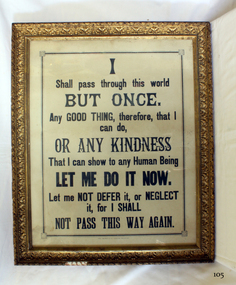
Decorative object - Wall Decoration, Late 19th to early 20th centuries
... legend has it, she became a governess at “Injemiara” where her grandfather, Francis Freckleton, once owned land. Henry and Mary’s family of six, some of whom were born at Mailor’s Flat and later children at Wangoom, lived with their parents at Wangoom and Purnim west, where Henry died in 1933 and Mary Jane in 1940. The Giles family collection has social significance at a local ...There are many 19th century items of furniture, linen and crockery donated to Flagstaff Hill Maritime Village by Vera and Aurelin Giles. The items are associated with the Giles Family and are known as the “Giles Collection”. These items mostly came from the simple home of Vera’s parents-in-law, Henry Giles and his wife Mary Jane (nee Freckleton), whose photos are in the parlour. They married in 1880. Henry Giles was born at Tower Hill in 1858. He was a labourer on the construction of the Breakwater before leaving in 1895 to build bridges in N.S.W. for about seven years. Mary Jane was born in 1860 at Cooramook. She attended Mailor’s Flat State School where she was also a student teacher before, as family legend has it, she became a governess at “Injemiara” where her grandfather, Francis Freckleton, once owned land. Henry and Mary’s family of six, some of whom were born at Mailor’s Flat and later children at Wangoom, lived with their parents at Wangoom and Purnim west, where Henry died in 1933 and Mary Jane in 1940. The Giles family collection has social significance at a local level, because it illustrates the level of material support the Warrnambool community gave to Flagstaff Hill when the Museum was established.Wall decoration gilded gold ornate frame under glassPrinted proverb+ with Varied type face each line.warrnambool, shipwrecked coast, flagstaff hill maritime museum, wall decoration, print of proverb, scripture decoration, giles collection, henry giles, tower hill, cooramook, warrnambool breakwater, mailor’s flat, wangoom, 19th century household goods -
 Flagstaff Hill Maritime Museum and Village
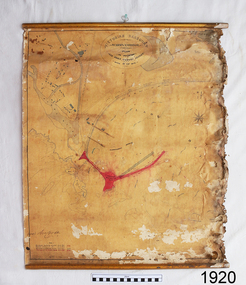
Document - Plan, Victorian Harbours Warrnambool, Victorian Harbours, Warrnambool, Plan to Accompany Sir John Coode's Report, 28-02-1879
... local history of Warrnambool, in particular the Breakwater and its impact on Warrnambool's maritime and trade history. The plan shows the existing jetties at the Port of Warrnambool, plus the partially erected Breakwater and proposed works to the Breakwater by both the Borough of Warrnambool Surveyor and Sir John Coode. The plan was signed 28th February 1879 by Sir John Coode. The legend...local history of Warrnambool, in particular the Breakwater and its impact on Warrnambool's maritime and trade history. The plan shows the existing jetties at the Port of Warrnambool, plus the partially erected Breakwater and proposed works to the Breakwater by both the Borough of Warrnambool Surveyor and Sir John Coode. The plan was signed 28th February 1879 by Sir John Coode. The legend ...This plan is of great significance to the local history of Warrnambool, in particular the Breakwater and its impact on Warrnambool's maritime and trade history. The plan shows the existing jetties at the Port of Warrnambool, plus the partially erected Breakwater and proposed works to the Breakwater by both the Borough of Warrnambool Surveyor and Sir John Coode. The plan was signed 28th February 1879 by Sir John Coode. The legend at the bottom left describes the existing works and the proposed works. The Warrnambool Breakwater Sir John Coode was a British harbour engineer. He was brought to Melbourne by the Melbourne Harbour Trust to advise on works to improve the Port of Melbourne. The Victorian Government commissioned him to present a plan to complete the Warrnambool Breakwater. His original plan was too expensive so he prepared a revised plan for a shorter structure. The work was completed in 1890. The construction proved to be too short to protect adequately from the weather and didn't allow enough depth for larger vessels to come into port. The decreasing trade was further affected by siltation in the bay due to the breakwater, and the completion of the railway line. The situation of the harbour became a real problem that, by 1910, required continuous dredging. In 1914 the Breakwater was extended but proved to be a failure because the work began to subside and by 1920 about two thirds of the harbour was silted up. Alterations made in the 1920's increased the silting problem and by the 1940's the harbour was no longer used. More alterations were made in the 1950's and 1960's. The Warrnambool Breakwater is registered as a place of significance on the Victorian Heritage Database. This plan of the proposed works for the existing Warrnambool Breakwater is of great significance to the local history of Warrnambool, in particular the Breakwater and its impact on Warrnambool's maritime and trade history. The Warrnambool Breakwater is registered as a place of significance on the Victorian Heritage Database (VHR H2024). It is historically significant to Victoria as one of the most important maritime engineering projects in Victoria in the late 19th century. The Warrnambool Breakwater is of historical significance as one of the most important maritime engineering projects in Victoria in the late nineteenth century. It is evidence of Victoria's nineteenth century investment in regional port infrastructure and the development of Victorian coastal shipping. It is of significance for its association with the English civil engineer Sir John Coode, the most distinguished harbour engineer of the nineteenth century, who was brought to Victoria to advise on works to improve the Port of Melbourne, but was retained by the Government to advise on improvements to the harbours at Portland, Geelong, Port Fairy, and Lakes Entrance, as well as Warrnambool. His projects for Melbourne, Lakes Entrance and Warrnambool were major engineering projects of the nineteenth century. The breakwater is historically significant as a reminder of Warrnambool's early maritime history as a Western District port, and as one of Victoria's major 'outer ports'. While the Warrnambool Breakwater is a demonstration of the engineering skills of the nineteenth century, it also demonstrates the limitations of knowledge relating to sedimentology at the time and the confidence apparent in a number of nineteenth century plans which assumed that natural forces could be overcome or contained by engineering.Plan of Warrnambool Harbour, Port of Warrnambool, dated 28 Feb 1879. Plan shows existing Breakwater and work proposed by both Warrnambool Borough Surveyor and Sir John Coode. Plan has gold coloured quarter-dowel rods top and bottom and a metal ring at the top. Stamped with title. Signed by Sir John Coode.Stamped "VICTORIAN HARBOURS / WARRNAMBOOL / PLAN / to accompany / SIR JOHN GOODE'S REPORT / DATED 28 FEB 1879" Signature "John Coode"flagstaff hill, warrnambool, maritime museum, shipwreck coast, great ocean road, sir john coode, borough of warrnambool surveyor, plan of warrnambool, victorian harbours, warrnambool harbour, warrnambool breakwater, port of warrnambool, vhd vhr h2024, flagstaff hill maritime museum & village, maritime village, map, chart, plan, lady bay, breakwater, jetty, pier, vhr h2024, proposed works, 1879 -
 Flagstaff Hill Maritime Museum and Village
Book - Referance Book, The Discovery of Australia
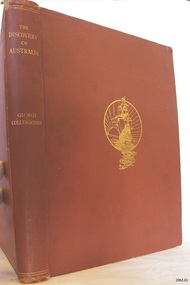
... local historical books. Collingridge’s (1847-1929) book ‘The Discovery of Australia’ was a work which supported the ‘legend’ of a Portuguese voyage of exploration, which led to the loss of one of its ships in 1522, believed to be the Mahogany Ship, on the coast south of Tower Hill. ...local historical books. Collingridge’s (1847-1929) book ‘The Discovery of Australia’ was a work which supported the ‘legend’ of a Portuguese voyage of exploration, which led to the loss of one of its ships in 1522, believed to be the Mahogany Ship, on the coast south of Tower Hill. ...The Osburne Group was was three people, headed by Warrnambool Lawyer Dan Madden, who in the 1980’s republished a few local historical books. Collingridge’s (1847-1929) book ‘The Discovery of Australia’ was a work which supported the ‘legend’ of a Portuguese voyage of exploration, which led to the loss of one of its ships in 1522, believed to be the Mahogany Ship, on the coast south of Tower Hill. Hence European charting of the east coast of Australia centuries before Captain Cook, which the British historians viewed almost as heresy. TheOsburne Group acquired copies of Collingridge from the publisher, and saw that they were made available as a historical record supporting the research of Ken McIntyre, who in 1981 published separately a book called ‘The Secret Discovery of Australia’. The first book by the Osburne Group was republished in facsimile. It was the ‘History of Warrnambool’, collated and printed by Richard Osburne in 1887 after he had sold his newspaper the Warrnambool Examiner to Fairfax, which took up the name of Warrnambool Standard. Hence the name Osburne. Other books reproduced in facsimile form include ‘By These We Flourish’ by C.E.Sayers, and ‘Warrnambool Past and Present by Edward Vidler.The Discovery of Australia Author: George Collongridge Publisher: Kayes Brothers Date 1895 Has a sticker on front loose end page stating " Presented to Flagstaff Hill by Osburne Group"flagstaff hill, warrnambool, shipwrecked-coast, flagstaff-hill, flagstaff-hill-maritime-museum, maritime-museum, shipwreck-coast, flagstaff-hill-maritime-village, the discovery of australia, book, george collingridge, osburne group -
 The Beechworth Burke Museum
Photograph, 1916-17
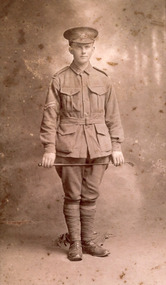
... The photograph is of social as well as historic significance for the Beechworth community, because it provides a direct link between local, national and international histories in relation to Australia' s participation in one of WWI's best-known battles. The record has strong research potential given the ongoing public and scholarly interest in war, history, and especially the ANZAC legend, which is commemorated annually on 25 April, known as ANZAC Day. ...Portrait of William Edward Peach in First World War military uniform, holding a crop in front of his thighs with military kit on the ground behind him. A Beechworth postal employee who enlisted in 1915, this photograph is probably taken in 1917, as he is a corporal in the photo and was promoted to this rank in May 1917. This photograph is of historic significance as it depicts William Edward Peach, a Beechworth postal assistant who enlisted in the Australian Imperial Force (AIF) on his nineteenth birthday, 5 August 1915, which required his parents' permission. He was decorated with the military medal for his courage in battle 4/5 October 1917 at the Battle of Broodseinde Ridge near Ypres, the most successful allied attack of the Third Battle of Ypres (31 July to 10 November 1917), also known as the Battle of Paschendale, which saw the greatest loss of human life during World War One, with almost half a million lives were lost on all sides. According to the recommendation for his military medal, Peach 'displayed conspicuous courage and initiative', taking charge after his platoon commander became a casualty, handling the men 'under heavy fire with great skill'. He also assisted the Company Commander in reorganising their military objectives. The photograph is of social as well as historic significance for the Beechworth community, because it provides a direct link between local, national and international histories in relation to Australia' s participation in one of WWI's best-known battles. The record has strong research potential given the ongoing public and scholarly interest in war, history, and especially the ANZAC legend, which is commemorated annually on 25 April, known as ANZAC Day. Peach is also one of the diarists of WWI, including of this significant period of Australian military history, from 1916 to 18, which can be accessed via the Australian War Memorial. Sepia rectangular photograph printed on gloss Kodak photographic paper mounted on board. Reverse: BMM 8779 item catalogue number pencilled in right-hand bottom corner.military medal, defending australia and victoria, military service, hmat a64 demosthenes, wipers, anzac, burke museum, beechworth, ypres, australian military services, beechworth post office, first world war, wartime, our boys, belgium, flanders fields, ww1, british war medal, victory medal, broodseinde, third battle of ypres -
 Flagstaff Hill Maritime Museum and Village
Book - Fictional Story/Legend, Sinbad the Soldier, c. early 20th-century
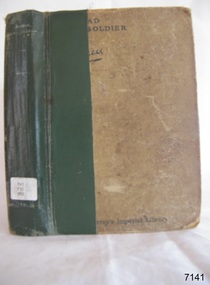
... The Warrnambool Mechanics' Institute’s publication collection is of both local and state significance. warrnambool shipwrecked-coast flagstaff-hill flagstaff-hill-maritime-museum maritime-museum shipwreck-coast flagstaff-hill-maritime-village shipwrecked-artefact book sinbad the soldier percival christopher wren Label on spine with typed text "PAT / FIC / WRE" Sinbad the Soldier Novel by Percival Christopher Wren Sinbad the Soldier Book Fictional Story/Legend ...Pattison Collection This item is from the ‘Pattison Collection’, a collection of books and records that was originally owned by the Warrnambool Mechanics’ Institute, which was founded in Warrnambool in 1853. By 1886 the Warrnambool Mechanics’ Institute (WMI) had grown to have a Library, Museum and Fine Arts Gallery, with a collection of “… choice productions of art, and valuable specimens in almost every branch and many wonderful national curiosities are now to be seen there, including historic relics of the town and district.” It later included a School of Design. Although it was very well patronised, the lack of financial support led the WMI in 1911 to ask the City Council to take it over. In 1935 Ralph Pattison was appointed as City Librarian to establish and organise the Warrnambool Library as it was then called. When the WMI building was pulled down in 1963 a new civic building was erected on the site and the new Warrnambool Library, on behalf of the City Council, took over all the holdings of the WMI. At this time some of the items were separated and identified as the ‘Pattison Collection’, named after Ralph Pattison. Eventually the components of the WMI were distributed from the Warrnambool Library to various places, including the Art Gallery, Historical Society and Flagstaff Hill. Later some were even distributed to other regional branches of Corangamite Regional Library and passed to and fro. It is difficult now to trace just where all of the items have ended up. The books at Flagstaff Hill Maritime Village generally display stamps and markings from Pattison as well as a variety of other institutions including the Mechanics’ Institute itself. RALPH ERIC PATTISON Ralph Eric Pattison was born in Rockhampton, Queensland, in 1891. He married Maude Swan from Warrnambool in 1920 and they set up home in Warrnambool. In 1935 Pattison accepted a position as City Librarian for the Warrnambool City Council. His huge challenge was to make a functional library within two rooms of the Mechanics’ Institute. He tirelessly cleaned, cleared and sorted a disarrayed collection of old books, jars of preserved specimens and other items reserved for exhibition in the city’s museum. He developed and updated the library with a wide variety of books for all tastes, including reference books for students; a difficult task to fulfil during the years following the Depression. He converted all of the lower area of the building into a library, reference room and reading room for members and the public. The books were sorted and stored using a cataloguing and card index system that he had developed himself. He also prepared the upper floor of the building and established the Art Gallery and later the Museum, a place to exhibit the many old relics that had been stored for years for this purpose. One of the treasures he found was a beautiful ancient clock, which he repaired, restored and enjoyed using in his office during the years of his service there. Ralph Pattison was described as “a meticulous gentleman whose punctuality, floorless courtesy and distinctive neat dress were hallmarks of his character, and ‘his’ clock controlled his daily routine, and his opening and closing of the library’s large heavy doors to the minute.” Pattison took leave during 1942 to 1942 to serve in the Royal Australian Navy, Volunteer Reserve as Lieutenant. A few years later he converted one of the Museum’s rooms into a Children’s Library, stocking it with suitable books for the younger generation. This was an instant success. In the 1950’s he had the honour of being appointed to the Victorian Library Board and received more inspiration from the monthly conferences in Melbourne. He was sadly retired in 1959 after over 23 years of service, due to the fact that he had gone over the working age of council officers. However he continued to take a very keen interest in the continual development of the Library until his death in 1969. The Pattison Collection, along with other items at Flagstaff Hill Maritime Village, was originally part of the Warrnambool Mechanics' Institute’s collection. The Warrnambool Mechanics’ Institute Collection is primarily significant in its totality, rather than for the individual objects it contains. Its contents are highly representative of the development of Mechanics' Institute libraries across Australia, particularly Victoria. A diversity of publications and themes has been amassed, and these provide clues to our understanding of the nature of and changes in the reading habits of Victorians from the 1850s to the middle of the 20th century. The collection also highlights the Warrnambool community’s commitment to the Mechanics’ Institute, reading, literacy and learning in the regions, and proves that access to knowledge was not impeded by distance. These items help to provide a more complete picture of our community’s ideals and aspirations. The Warrnambool Mechanics Institute book collection has historical and social significance for its strong association with the Mechanics Institute movement and the important role it played in the intellectual, cultural and social development of people throughout the latter part of the nineteenth century and the early twentieth century. The collection of books is a rare example of an early lending library and its significance is enhanced by the survival of an original collection of many volumes. The Warrnambool Mechanics' Institute’s publication collection is of both local and state significance. Sinbad the Soldier Novel by Percival Christopher Wren Label on spine with typed text "PAT / FIC / WRE" warrnambool, shipwrecked-coast, flagstaff-hill, flagstaff-hill-maritime-museum, maritime-museum, shipwreck-coast, flagstaff-hill-maritime-village, shipwrecked-artefact, book, sinbad the soldier, percival christopher wren -
 Flagstaff Hill Maritime Museum and Village
Book, The Ingoldsby Legends
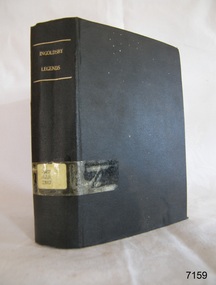
... The Warrnambool Mechanics' Institute’s publication collection is of both local and state significance. warrnambool shipwrecked-coast flagstaff-hill flagstaff-hill-maritime-museum maritime-museum shipwreck-coast flagstaff-hill-maritime-village shipwrecked-artefact book the ingoldsby legends thomas ingoldsby The label on spine with typed text PAT 828 ING Pastedown front endpaper has a sticker from Warrnambool Public Library covered by a sticker from Corangamite Regional Library Service Front loose endpaper has a stamp from Corangamite Regional Library Service The Ingoldsby Legends Author: Thomas Ingoldsby Publisher: Richard Bentleigh Date: 1881 First Printed in 1837 The Ingoldsby Legends Book ...Pattison Collection This item is from the ‘Pattison Collection’, a collection of books and records that was originally owned by the Warrnambool Mechanics’ Institute, which was founded in Warrnambool in 1853. By 1886 the Warrnambool Mechanics’ Institute (WMI) had grown to have a Library, Museum and Fine Arts Gallery, with a collection of “… choice productions of art, and valuable specimens in almost every branch and many wonderful national curiosities are now to be seen there, including historic relics of the town and district.” It later included a School of Design. Although it was very well patronised, the lack of financial support led the WMI in 1911 to ask the City Council to take it over. In 1935 Ralph Pattison was appointed as City Librarian to establish and organise the Warrnambool Library as it was then called. When the WMI building was pulled down in 1963 a new civic building was erected on the site and the new Warrnambool Library, on behalf of the City Council, took over all the holdings of the WMI. At this time some of the items were separated and identified as the ‘Pattison Collection’, named after Ralph Pattison. Eventually the components of the WMI were distributed from the Warrnambool Library to various places, including the Art Gallery, Historical Society and Flagstaff Hill. Later some were even distributed to other regional branches of Corangamite Regional Library and passed to and fro. It is difficult now to trace just where all of the items have ended up. The books at Flagstaff Hill Maritime Village generally display stamps and markings from Pattison as well as a variety of other institutions including the Mechanics’ Institute itself. RALPH ERIC PATTISON Ralph Eric Pattison was born in Rockhampton, Queensland, in 1891. He married Maude Swan from Warrnambool in 1920 and they set up home in Warrnambool. In 1935 Pattison accepted a position as City Librarian for the Warrnambool City Council. His huge challenge was to make a functional library within two rooms of the Mechanics’ Institute. He tirelessly cleaned, cleared and sorted a disarrayed collection of old books, jars of preserved specimens and other items reserved for exhibition in the city’s museum. He developed and updated the library with a wide variety of books for all tastes, including reference books for students; a difficult task to fulfil during the years following the Depression. He converted all of the lower area of the building into a library, reference room and reading room for members and the public. The books were sorted and stored using a cataloguing and card index system that he had developed himself. He also prepared the upper floor of the building and established the Art Gallery and later the Museum, a place to exhibit the many old relics that had been stored for years for this purpose. One of the treasures he found was a beautiful ancient clock, which he repaired, restored and enjoyed using in his office during the years of his service there. Ralph Pattison was described as “a meticulous gentleman whose punctuality, floorless courtesy and distinctive neat dress were hallmarks of his character, and ‘his’ clock controlled his daily routine, and his opening and closing of the library’s large heavy doors to the minute.” Pattison took leave during 1942 to 1942 to serve in the Royal Australian Navy, Volunteer Reserve as Lieutenant. A few years later he converted one of the Museum’s rooms into a Children’s Library, stocking it with suitable books for the younger generation. This was an instant success. In the 1950’s he had the honour of being appointed to the Victorian Library Board and received more inspiration from the monthly conferences in Melbourne. He was sadly retired in 1959 after over 23 years of service, due to the fact that he had gone over the working age of council officers. However he continued to take a very keen interest in the continual development of the Library until his death in 1969. WARRNAMBOOL PUBLIC LIBRARY The Warrnambool Mechanics’ Institute (WMI) was formed by a voluntary community group in 1863, within six years of Warrnambool’s beginnings, and its Reading Room opened in 1854. The WMI operated until 1963, at which time it was one of the oldest Mechanics’ Institutes in Victoria. Mechanics’ Institutes offered important services to the public including libraries, reading rooms and places to display and store collections of all sorts such as curiosities and local historical relics. In 1886 a Museum and Fine Arts Gallery were added to the WMI and by the beginning of the 20th century, there was also a billiards room and a School of Art. By this time all Mechanics’ Institutes in country Victoria had museums attached. Over the years the Warrnambool Mechanics’ Institute Library was also known as the Warrnambool Public Library the Warrnambool Library and the Free Library. Early funding from the government was for the “Free Library”. The inscription in a book “Science of Man” was for the “Warrnambool Public Library”, donated by Joseph Archibald in 1899. Another inscription in the book “Catalogue of Plants Under Cultivation in the Melbourne Botanic Gardens 1 & 2, 1883” was presented to the “Warrnambool Library” and signed by the author W.R. Guilfoyle. In 1903 the Warrnambool Public Library decided to add a Juvenile Department to library and stock it with hundreds of books suitable for youth. In 1905 the Public Library committee decided to update the collection of books and added 100 new novels plus arrangements for the latest novels to be included as soon as they were available in Victoria. In July 1911 the Warrnambool Council took over the management of the Public Library, Art Gallery, Museum and Mechanics’ Institute and planned to double the size of the then-current building. In 1953, when Mr R. Pattison was Public Librarian, the Warrnambool Public Library’s senior section 10,000 of the 13,000 books were fiction. The children’s section offered an additional 3,400 books. The library had the equivalent of one book per head of population and served around 33 per cent of the reading population. The collection of books was made up of around 60 per cent reference and 40 per cent fiction. The library was lending 400 books per day. In 1963 the Warrnambool City Council allocated the site of the Mechanics’ Institute building, which included the Public Library, Museum and Art Gallery, for the new Municipal Offices and the Collections were dispersed until 1971. The Warrnambool Library took over the Mechanics’ Institute Library’s holdings on behalf of the Warrnambool City Council. Since the closure of the Warrnambool Mechanics’ Institute the exact location and composition of the original WMI books and items have become unclear. Other materials have been added to the collection, including items from Terang MI, Warrnambool Court House and Customs House. Many of the books have been identified as the Pattison Collection, named after the Librarian who catalogued and numbered the books during his time as Warrnambool Public Librarian in the time before the Mechanics’ Institute closed. It seems that when Warrnambool became part of the Corangamite Regional Library some of the books and materials went to its head office in Colac and then back to Warrnambool where they were stored at the Art Gallery for quite some time. Some then went to the Warrnambool Historical Society, some stayed at the Art Gallery and some were moved to Flagstaff Hill Maritime Village. The various stamps and labels on the books held at Flagstaff Hill show the variety of the collection’s distribution and origin. The books in the collection at Flagstaff Hill Maritime Village date from the 1850s to the late 1950s and include rare and valuable volumes. Many of the books are part of the “Pattison Collection” after the Warrnambool’s Public Librarian, Mr R. Pattison. The Pattison Collection, along with other items at Flagstaff Hill Maritime Village, was originally part of the Warrnambool Mechanics' Institute’s collection. The Warrnambool Mechanics’ Institute Collection is primarily significant in its totality, rather than for the individual objects it contains. Its contents are highly representative of the development of Mechanics' Institute libraries across Australia, particularly Victoria. A diversity of publications and themes has been amassed, and these provide clues to our understanding of the nature of and changes in the reading habits of Victorians from the 1850s to the middle of the 20th century. The collection also highlights the Warrnambool community’s commitment to the Mechanics’ Institute, reading, literacy and learning in the regions, and proves that access to knowledge was not impeded by distance. These items help to provide a more complete picture of our community’s ideals and aspirations. The Warrnambool Mechanics Institute book collection has historical and social significance for its strong association with the Mechanics Institute movement and the important role it played in the intellectual, cultural and social development of people throughout the latter part of the nineteenth century and the early twentieth century. The collection of books is a rare example of an early lending library and its significance is enhanced by the survival of an original collection of many volumes. The Warrnambool Mechanics' Institute’s publication collection is of both local and state significance. The Ingoldsby Legends Author: Thomas Ingoldsby Publisher: Richard Bentleigh Date: 1881 First Printed in 1837 The label on spine with typed text PAT 828 ING Pastedown front endpaper has a sticker from Warrnambool Public Library covered by a sticker from Corangamite Regional Library Service Front loose endpaper has a stamp from Corangamite Regional Library Service warrnambool, shipwrecked-coast, flagstaff-hill, flagstaff-hill-maritime-museum, maritime-museum, shipwreck-coast, flagstaff-hill-maritime-village, shipwrecked-artefact, book, the ingoldsby legends, thomas ingoldsby -
 Flagstaff Hill Maritime Museum and Village
Textile - Tablecloth, late 19th century
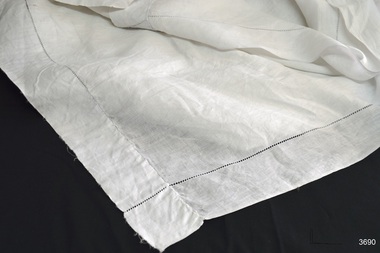
... legend has it) she became a governess at “Injemira” where her grandfather, Francis Freckleton, owned the land. The Giles family of six, some of whom were born at Mailor’s Flat and the younger at Purnim West, lived at “The Maam”, Wangoom before moving to New South Wales in 1895, where Henry built bridges for about 7 years. Henry died in 1933 and Mary Jane died in 1940. The Giles family collection has social significance at a local ...The linen tablecloth has been hand worked using satin stitch embroidery and drawn thread work. This tablecloth is one of many 19th century items of furniture, linen and crockery donated to Flagstaff Hill Maritime Village by, Vera and Aurelin Giles. The items are associated with the Giles Family and are known as the “Giles Collection”. Most of the items in this Collection are in the Lighthouse Keeper’s Cottage at Flagstaff Hill. The majority came from the simple home of Vera’s Giles’ parents, Henry Giles and his wife Mary Jane (nee Freckleton), whose photographs are in the parlour. They married in 1880. Henry Giles was born at Tower Hill, Victoria in 1858 and worked as a labourer on the construction of the Warrnambool Breakwater. His wife, Mary Jane, was born in 1860 at Cooramook. She attended Mailor’s Flat State School, and later worked there as a student teacher, before (as family legend has it) she became a governess at “Injemira” where her grandfather, Francis Freckleton, owned the land. The Giles family of six, some of whom were born at Mailor’s Flat and the younger at Purnim West, lived at “The Maam”, Wangoom before moving to New South Wales in 1895, where Henry built bridges for about 7 years. Henry died in 1933 and Mary Jane died in 1940. The Giles family collection has social significance at a local level, because it illustrates the level of material support the Warrnambool community gave to Flagstaff Hill when the Museum was established.Tablecloth, white linen, part of the Giles Collection. Large white rectangular tablecloth, hand embroidered using white thread. Floral design in satin stitch and drawn threadwork. Cloth has additional white cloth iron-on label.Iron-on label, hand written in black pen "LHK B22". flagstaff hill, warrnambool, shipwrecked coast, flagstaff hill maritime museum, maritime museum, shipwreck coast, flagstaff hill maritime village, great ocean road, giles family, cooramook, 19th century linen, 19th century household goods, 19th century handcraft, 19th century manchester, 19th century table linen, 19th century tablecloth, giles family collection, 19th century household linen, warrnambool breakwater construction -
 Flagstaff Hill Maritime Museum and Village
Decorative object - Wall Decoration, 1850 to 1901
... legend has it, she became a governess at “Injemiara” where her grandfather, Francis Freckleton, once owned land. Henry and Mary’s family of six, some of whom were born at Mailor’s Flat and later children at Wangoom, lived with their parents at Wangoom and Purnim west, where Henry died in 1933 and Mary Jane in 1940. The Giles family collection has social significance at a local ...This item is part of the Giles Collection, dating back to the late Victorian era, from the 1880s to the early 1900s, in which Queen Victoria ruled England. The queen’s influence was felt throughout the world, including in the United States and Australia where Victorian values shaped society and style, especially in home décor. This period’s distinct style presents an eclectic mix of highly ornamented furniture, wallpaper, and knick-knacks. Particularly in terms of furniture, and the characteristic floral patterns and rich, contrasting colours, wall hangings that enjoyed the height of their popularity during the Victorian era were of the spiritual type with either embroidered or punched paper religious motto or bible quote. Mottoes were commonly hung high up on the wall or in an area of prominence, to remind the viewer of their important message, such as “He Leadeth Me” and “Honesty, Industry, and Sobriety.” Short and pithy, they embodied the ideals of Victorian society. Technological advances contributed to the boom of religious mottoes whereas before the Industrial Revolution home décor of this sort was handmade and therefore minimal, now consumers could purchase and fill their homes with all sorts of mass-produced ephemera goods similar to the subject item. Many of these mass-produced period pieces still exist today, often in their original frames, ceramic, enamelled or paper formats. Flagstaff maritime museum has many examples of mottoes on display that serve to reflect the period in which values of home, faith, and Christianity were very prominent in everyday Victorian society. The Giles Family There are many 19th century items of furniture, linen and crockery donated to Flagstaff Hill Maritime Village by Vera and Aurelin Giles. The items are associated with the Giles Family and are known as the “Giles Collection”. These items mostly came from the simple home of Vera’s parents-in-law, Henry Giles and his wife Mary Jane (nee Freckleton), whose photos are in the parlour. They married in 1880. Henry Giles was born at Tower Hill in 1858. He was a labourer on the construction of the Breakwater before leaving in 1895 to build bridges in N.S.W. for about seven years. Mary Jane was born in 1860 at Cooramook. She attended Mailor’s Flat State School where she was also a student teacher before, as a family legend has it, she became a governess at “Injemiara” where her grandfather, Francis Freckleton, once owned land. Henry and Mary’s family of six, some of whom were born at Mailor’s Flat and later children at Wangoom, lived with their parents at Wangoom and Purnim west, where Henry died in 1933 and Mary Jane in 1940.The Giles family collection has social significance at a local level, because it illustrates the level of material support the Warrnambool community gave to Flagstaff Hill when the Museum was established. This wall decoration reflects the social values and attitudes of the late Victorian era that was used to promote good Christian and moral values in many households. These items of decoration were very popular at this time and the subject item is significant as it gives a snapshot into the social norms of past generations. Printed card wall hanging with floral design. Religious text on the sign is embossed onto the card and highlighted in silver print. There is a handwritten ink inscription, and a pencil inscription, on the back. A string is attached to two holes on top of the card. Embossed"THE BLESSING / OF THE LORD/ BE UPON YOU." "PS 129.8." In pencil "H/S" In ink "To dear Granny with lots of love / from Dorothy. X X."flagstaff hill, warrnambool, shipwrecked coast, flagstaff hill maritime museum, shipwreck coast, great ocean road, paper wall decoration, religious, home decoration, societal values, victorian moral values, wall hanging, wall decoration, spiritual decoration, bible verse, giles collection -
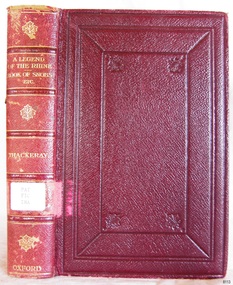 Flagstaff Hill Maritime Museum and Village
Book, A Legend of the Rhine
... The Warrnambool Mechanics' Institute’s publication collection is of both local and state significance. warrnambool shipwrecked-coast flagstaff-hill flagstaff-hill-maritime-museum maritime-museum shipwreck-coast flagstaff-hill-maritime-village shipwrecked-artefact book pattison collection warrnambool library warrnambool mechanics’ institute ralph eric pattison corangamite regional library service warrnambool city librarian mechanics’ institute library victorian library board warrnambool books and records warrnambool children’s library great ocean road a legend of the rhine w m thackeray george saintsbury Label on spine cover with typed text PAT FIC THA Pastedown front endpaper has sticker from Warrnambool Mechanics Institute and Free Library Front loose endpaper has a sticker from Corangamite Regional Library Service A Legend of the Rhine Notes of a Journey from Cornhill to Grand Cairo and The Book of Snobs Author: W M Thackeray Edited by George Saintsbury Publisher: Henry Frowde, Oxford University Press Date: 1864 A Legend of the Rhine Book ...This item is from the ‘Pattison Collection’, a collection of books and records that was originally owned by the Warrnambool Mechanics’ Institute, which was founded in Warrnambool in 1853. By 1886 the Warrnambool Mechanics’ Institute (WMI) had grown to have a Library, Museum and Fine Arts Gallery, with a collection of “… choice productions of art, and valuable specimens in almost every branch and many wonderful national curiosities are now to be seen there, including historic relics of the town and district.” It later included a School of Design. Although it was very well patronised, the lack of financial support led the WMI in 1911 to ask the City Council to take it over. In 1935 Ralph Pattison was appointed as City Librarian to establish and organise the Warrnambool Library as it was then called. When the WMI building was pulled down in 1963 a new civic building was erected on the site and the new Warrnambool Library, on behalf of the City Council, took over all the holdings of the WMI. At this time some of the items were separated and identified as the ‘Pattison Collection’, named after Ralph Pattison. Eventually the components of the WMI were distributed from the Warrnambool Library to various places, including the Art Gallery, Historical Society and Flagstaff Hill. Later some were even distributed to other regional branches of Corangamite Regional Library and passed to and fro. It is difficult now to trace just where all of the items have ended up. The books at Flagstaff Hill Maritime Village generally display stamps and markings from Pattison as well as a variety of other institutions including the Mechanics’ Institute itself. RALPH ERIC PATTISON Ralph Eric Pattison was born in Rockhampton, Queensland, in 1891. He married Maude Swan from Warrnambool in 1920 and they set up home in Warrnambool. In 1935 Pattison accepted a position as City Librarian for the Warrnambool City Council. His huge challenge was to make a functional library within two rooms of the Mechanics’ Institute. He tirelessly cleaned, cleared and sorted a disarrayed collection of old books, jars of preserved specimens and other items reserved for exhibition in the city’s museum. He developed and updated the library with a wide variety of books for all tastes, including reference books for students; a difficult task to fulfil during the years following the Depression. He converted all of the lower area of the building into a library, reference room and reading room for members and the public. The books were sorted and stored using a cataloguing and card index system that he had developed himself. He also prepared the upper floor of the building and established the Art Gallery and later the Museum, a place to exhibit the many old relics that had been stored for years for this purpose. One of the treasures he found was a beautiful ancient clock, which he repaired, restored and enjoyed using in his office during the years of his service there. Ralph Pattison was described as “a meticulous gentleman whose punctuality, floorless courtesy and distinctive neat dress were hallmarks of his character, and ‘his’ clock controlled his daily routine, and his opening and closing of the library’s large heavy doors to the minute.” Pattison took leave during 1942 to 1945 to serve in the Royal Australian Navy, Volunteer Reserve as Lieutenant. A few years later he converted one of the Museum’s rooms into a Children’s Library, stocking it with suitable books for the younger generation. This was an instant success. In the 1950’s he had the honour of being appointed to the Victorian Library Board and received more inspiration from the monthly conferences in Melbourne. He was sadly retired in 1959 after over 23 years of service, due to the fact that he had gone over the working age of council officers. However he continued to take a very keen interest in the continual development of the Library until his death in 1969. WARRNAMBOOL'S MECHANICS' INSTITUTE Warrnambool's Mechanics' Institute (or Institution as it was sometimes called) was one of the earliest in Victoria. On 17th October 1853 a meeting was held where it was resolved to request the Lieutenant Governor of the Colony to grant land for the erection of a Mechanics' Institutes building. A committee was formed at the meeting and Richard Osburne chaired the first meeting of this committee. The land on the North West corner of Banyan and Merri Streets was granted but there were no funds to erect the building. The Formal Rights of the Warrnambool Mechanics' Institute's encompassed its aims and these were officially adopted in1859; "This Institution has for its object the diffusion of literary, scientific, and other useful knowledge amongst its members, excluding all controversial subjects, religious or political. These objects are sought to be obtained by means of a circulating library, a reading room, the establishment of classes, debates, and the occasional delivery of lectures on natural and experimental philosophy, mechanics, astronomy, chemistry, natural history, literature, and the useful and ornamental arts, particularly those which have a more immediate reference to the colony." The Warrnambool Mechanics' Institute opened its first reading room in November1884 in the National School building at the corner of Banyan and Timor Streets. The Institute was funded by member subscription, payable on a quarterly, half yearly or yearly basis. Samuel Hannaford, the Manager of the Warrnambool Bank of Australasia, was the first Honorary Secretary of the Mechanics' Institutes, and an early President and Vice-President. He also gave several of the early lectures in the Reading Room. Another early Secretary, Librarian and lecturer was Marmaduke Fisher, the teacher at the National School. Lecture topics included The Poets and Poetry of Ireland', 'The Birth and Development of the Earth', 'The Vertebrae - with Remarks on the pleasures resulting from the study of Natural History' and 'Architecture'. In 1856 the Reading Room was moved to James Hider's shop in Timor Street, and by 1864 it was located in the bookshop of Davies and Read. In the 1860's the Mechanics' Institute struggled as membership waned but in 1866, after a series of fund raising efforts, the committee was able to purchase land in Liebig Street, on a site then called Market Square, between the weighbridge and the fire station. A Mechanics' Institute building was opened at this site in August 1871. The following year four more rooms were added to the main Reading Room and in 1873 the Artisan School of Design was incorporated into the Institute. The same year Joseph Archibald established a Museum; however it deteriorated when he was transferred to Bendigo in 1877. In 1880, with Archibald's return to Warrnambool, the Museum was re-established, and in 1885 a new building was built at the back of the Institute to accommodate the re-created School of Design, the Art Gallery and the Museum. In 1887 the Museum section was moved to the former court house in Timor Street (for some time the walls of the building formed part of the TAFE cafeteria but all is now demolished)). In 1911 the Museum was transferred back to the original building and the management of the Mechanics' Institute was handed over to the Warrnambool City Council. The Museum and Art Gallery became one and housed many fine works of art, and the Library continued to grow. The building was well patronised, with records showing that at the beginning of the 20th century there were between 500 and 800 visitors. During World War One the monthly figures were in the thousands, with 3,400 people visiting in January 1915. The Museum was a much loved Institution in Warrnambool until the contents of the Museum and Art Gallery were removed to make room for the Warrnambool City Council Engineers' Department. The contents were stored but many of the items were scattered or lost. When the original building was demolished the site became occupied by the Civic Centre, which included the new City Library. (The library was temporarily located in the old Palais building in Koroit Street.) In the process of reorganisation the Collection was distributed amongst the community groups: -The new City Library took some of the historic books and some important documents, historic photographs and newspapers. -The Art Gallery kept the 19th Century art collection and some of the artefacts from the museum. -The Historic Society has some items -The State Museum has some items -Some items were destroyed -Flagstaff Hill Maritime Village has old newspapers, Government Gazettes, most of the Mechanics' Institute Library, ledgers and documents connected to the Mechanics' Institute Library, some framed and unframed art works and some photographs. The Warrnambool Mechanics' Institute Library book collection is deemed to be of great importance because it is one of the few collections in an almost intact state, and many of the books are now very rare and of great value. The Pattison Collection, along with other items at Flagstaff Hill Maritime Village, was originally part of the Warrnambool Mechanics' Institute’s collection. The Warrnambool Mechanics’ Institute Collection is primarily significant in its totality, rather than for the individual objects it contains. Its contents are highly representative of the development of Mechanics' Institute libraries across Australia, particularly Victoria. A diversity of publications and themes has been amassed, and these provide clues to our understanding of the nature of and changes in the reading habits of Victorians from the 1850s to the middle of the 20th century. The collection also highlights the Warrnambool community’s commitment to the Mechanics’ Institute, reading, literacy and learning in the regions, and proves that access to knowledge was not impeded by distance. These items help to provide a more complete picture of our community’s ideals and aspirations. The Warrnambool Mechanics Institute book collection has historical and social significance for its strong association with the Mechanics Institute movement and the important role it played in the intellectual, cultural and social development of people throughout the latter part of the nineteenth century and the early twentieth century. The collection of books is a rare example of an early lending library and its significance is enhanced by the survival of an original collection of many volumes. The Warrnambool Mechanics' Institute’s publication collection is of both local and state significance. A Legend of the Rhine Notes of a Journey from Cornhill to Grand Cairo and The Book of Snobs Author: W M Thackeray Edited by George Saintsbury Publisher: Henry Frowde, Oxford University Press Date: 1864Label on spine cover with typed text PAT FIC THA Pastedown front endpaper has sticker from Warrnambool Mechanics Institute and Free Library Front loose endpaper has a sticker from Corangamite Regional Library Servicewarrnambool, shipwrecked-coast, flagstaff-hill, flagstaff-hill-maritime-museum, maritime-museum, shipwreck-coast, flagstaff-hill-maritime-village, shipwrecked-artefact, book, pattison collection, warrnambool library, warrnambool mechanics’ institute, ralph eric pattison, corangamite regional library service, warrnambool city librarian, mechanics’ institute library, victorian library board, warrnambool books and records, warrnambool children’s library, great ocean road, a legend of the rhine, w m thackeray, george saintsbury -
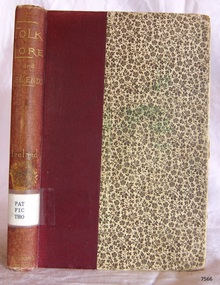 Flagstaff Hill Maritime Museum and Village
Book, Folk-Lore and Legends Ireland
... local and state significance. Warrnambool Shipwrecked-coast Flagstaff-Hill Flagstaff-Hill-Maritime-Museum Maritime-Museum Shipwreck-coast Flagstaff-Hill-Maritime-Village Shipwrecked-artefact Book Warrnambool Mechanics’ Institute Pattison Collection Warrnambool Library Ralph Eric Pattison Warrnambool City Librarian Mechanics’ Institute Library Victorian Library Board Warrnambool books and records Warrnambool Children’s Library Folk-Lore and Legends Ireland Label on spine has typed text PAT FIC THO Pastedown front endpaper has sticker from Warrnambool Mechanics Institute and Free Library covered by a sticker from Corangamite Regional Library Service Front loose endpaper has a stamp from Corangamite Regional Library Service Folk-Lore and Legends Ireland Author: CJT Publisher: W W Gibbings Date: 1889 Folk-Lore and Legends Ireland Book ...This item is from the ‘Pattison Collection’, a collection of books and records that was originally owned by the Warrnambool Mechanics’ Institute, which was founded in Warrnambool in 1853. By 1886 the Warrnambool Mechanics’ Institute (WMI) had grown to have a Library, Museum and Fine Arts Gallery, with a collection of “… choice productions of art, and valuable specimens in almost every branch and many wonderful national curiosities are now to be seen there, including historic relics of the town and district.” It later included a School of Design. Although it was very well patronised, the lack of financial support led the WMI in 1911 to ask the City Council to take it over. In 1935 Ralph Pattison was appointed as City Librarian to establish and organise the Warrnambool Library as it was then called. When the WMI building was pulled down in 1963 a new civic building was erected on the site and the new Warrnambool Library, on behalf of the City Council, took over all the holdings of the WMI. At this time some of the items were separated and identified as the ‘Pattison Collection’, named after Ralph Pattison. Eventually the components of the WMI were distributed from the Warrnambool Library to various places, including the Art Gallery, Historical Society and Flagstaff Hill. Later some were even distributed to other regional branches of Corangamite Regional Library and passed to and fro. It is difficult now to trace just where all of the items have ended up. The books at Flagstaff Hill Maritime Village generally display stamps and markings from Pattison as well as a variety of other institutions including the Mechanics’ Institute itself. RALPH ERIC PATTISON Ralph Eric Pattison was born in Rockhampton, Queensland, in 1891. He married Maude Swan from Warrnambool in 1920 and they set up home in Warrnambool. In 1935 Pattison accepted a position as City Librarian for the Warrnambool City Council. His huge challenge was to make a functional library within two rooms of the Mechanics’ Institute. He tirelessly cleaned, cleared and sorted a disarrayed collection of old books, jars of preserved specimens and other items reserved for exhibition in the city’s museum. He developed and updated the library with a wide variety of books for all tastes, including reference books for students; a difficult task to fulfil during the years following the Depression. He converted all of the lower area of the building into a library, reference room and reading room for members and the public. The books were sorted and stored using a cataloguing and card index system that he had developed himself. He also prepared the upper floor of the building and established the Art Gallery and later the Museum, a place to exhibit the many old relics that had been stored for years for this purpose. One of the treasures he found was a beautiful ancient clock, which he repaired, restored and enjoyed using in his office during the years of his service there. Ralph Pattison was described as “a meticulous gentleman whose punctuality, floorless courtesy and distinctive neat dress were hallmarks of his character, and ‘his’ clock controlled his daily routine, and his opening and closing of the library’s large heavy doors to the minute.” Pattison took leave during 1942 to 1942 to serve in the Royal Australian Navy, Volunteer Reserve as Lieutenant. A few years later he converted one of the Museum’s rooms into a Children’s Library, stocking it with suitable books for the younger generation. This was an instant success. In the 1950’s he had the honour of being appointed to the Victorian Library Board and received more inspiration from the monthly conferences in Melbourne. He was sadly retired in 1959 after over 23 years of service, due to the fact that he had gone over the working age of council officers. However he continued to take a very keen interest in the continual development of the Library until his death in 1969. The Pattison Collection, along with other items at Flagstaff Hill Maritime Village, was originally part of the Warrnambool Mechanics' Institute’s collection. The Warrnambool Mechanics’ Institute Collection is primarily significant in its totality, rather than for the individual objects it contains. Its contents are highly representative of the development of Mechanics' Institute libraries across Australia, particularly Victoria. A diversity of publications and themes has been amassed, and these provide clues to our understanding of the nature of and changes in the reading habits of Victorians from the 1850s to the middle of the 20th century. The collection also highlights the Warrnambool community’s commitment to the Mechanics’ Institute, reading, literacy and learning in the regions, and proves that access to knowledge was not impeded by distance. These items help to provide a more complete picture of our community’s ideals and aspirations. The Warrnambool Mechanics Institute book collection has historical and social significance for its strong association with the Mechanics Institute movement and the important role it played in the intellectual, cultural and social development of people throughout the latter part of the nineteenth century and the early twentieth century. The collection of books is a rare example of an early lending library and its significance is enhanced by the survival of an original collection of many volumes. The Warrnambool Mechanics' Institute’s publication collection is of both local and state significance. Folk-Lore and Legends Ireland Author: CJT Publisher: W W Gibbings Date: 1889Label on spine has typed text PAT FIC THO Pastedown front endpaper has sticker from Warrnambool Mechanics Institute and Free Library covered by a sticker from Corangamite Regional Library Service Front loose endpaper has a stamp from Corangamite Regional Library Service warrnambool, shipwrecked-coast, flagstaff-hill, flagstaff-hill-maritime-museum, maritime-museum, shipwreck-coast, flagstaff-hill-maritime-village, shipwrecked-artefact, book, warrnambool mechanics’ institute, pattison collection, warrnambool library, ralph eric pattison, warrnambool city librarian, mechanics’ institute library, victorian library board, warrnambool books and records, warrnambool children’s library, folk-lore and legends ireland -
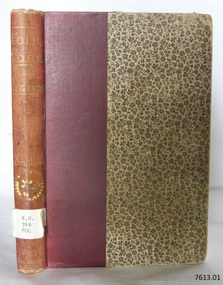 Flagstaff Hill Maritime Museum and Village
Book, Folk-Lore and Legends Scotland
... local and state significance. Warrnambool Shipwrecked-coast Flagstaff-Hill Flagstaff-Hill-Maritime-Museum Maritime-Museum Shipwreck-coast Flagstaff-Hill-Maritime-Village Shipwrecked-artefact Book Pattison Collection Warrnambool Library Warrnambool Mechanics’ Institute Ralph Eric Pattison Corangamite Regional Library Service Warrnambool City Librarian Mechanics’ Institute Library Victorian Library Board Warrnambool books and records Warrnambool Children’s Library Great Ocean Road Folk-Lore and Legends Scotland Label on spine cover with typed text R.H. 398 FOL Pastedown front endpaper has sticker from Warrnambool Mechanics Institute and Free Library coveered by a sticker from Corangamite Regional Library Service Front loose endpaper has a stamp from Corangamite Regional Library Service Folk-Lore and Legends Scotland Publisher: W W Gibbings Date: 1889 Folk-Lore and Legends Scotland Book ...This item is from the ‘Pattison Collection’, a collection of books and records that was originally owned by the Warrnambool Mechanics’ Institute, which was founded in Warrnambool in 1853. By 1886 the Warrnambool Mechanics’ Institute (WMI) had grown to have a Library, Museum and Fine Arts Gallery, with a collection of “… choice productions of art, and valuable specimens in almost every branch and many wonderful national curiosities are now to be seen there, including historic relics of the town and district.” It later included a School of Design. Although it was very well patronised, the lack of financial support led the WMI in 1911 to ask the City Council to take it over. In 1935 Ralph Pattison was appointed as City Librarian to establish and organise the Warrnambool Library as it was then called. When the WMI building was pulled down in 1963 a new civic building was erected on the site and the new Warrnambool Library, on behalf of the City Council, took over all the holdings of the WMI. At this time some of the items were separated and identified as the ‘Pattison Collection’, named after Ralph Pattison. Eventually the components of the WMI were distributed from the Warrnambool Library to various places, including the Art Gallery, Historical Society and Flagstaff Hill. Later some were even distributed to other regional branches of Corangamite Regional Library and passed to and fro. It is difficult now to trace just where all of the items have ended up. The books at Flagstaff Hill Maritime Village generally display stamps and markings from Pattison as well as a variety of other institutions including the Mechanics’ Institute itself. RALPH ERIC PATTISON Ralph Eric Pattison was born in Rockhampton, Queensland, in 1891. He married Maude Swan from Warrnambool in 1920 and they set up home in Warrnambool. In 1935 Pattison accepted a position as City Librarian for the Warrnambool City Council. His huge challenge was to make a functional library within two rooms of the Mechanics’ Institute. He tirelessly cleaned, cleared and sorted a disarrayed collection of old books, jars of preserved specimens and other items reserved for exhibition in the city’s museum. He developed and updated the library with a wide variety of books for all tastes, including reference books for students; a difficult task to fulfil during the years following the Depression. He converted all of the lower area of the building into a library, reference room and reading room for members and the public. The books were sorted and stored using a cataloguing and card index system that he had developed himself. He also prepared the upper floor of the building and established the Art Gallery and later the Museum, a place to exhibit the many old relics that had been stored for years for this purpose. One of the treasures he found was a beautiful ancient clock, which he repaired, restored and enjoyed using in his office during the years of his service there. Ralph Pattison was described as “a meticulous gentleman whose punctuality, floorless courtesy and distinctive neat dress were hallmarks of his character, and ‘his’ clock controlled his daily routine, and his opening and closing of the library’s large heavy doors to the minute.” Pattison took leave during 1942 to 1945 to serve in the Royal Australian Navy, Volunteer Reserve as Lieutenant. A few years later he converted one of the Museum’s rooms into a Children’s Library, stocking it with suitable books for the younger generation. This was an instant success. In the 1950’s he had the honour of being appointed to the Victorian Library Board and received more inspiration from the monthly conferences in Melbourne. He was sadly retired in 1959 after over 23 years of service, due to the fact that he had gone over the working age of council officers. However he continued to take a very keen interest in the continual development of the Library until his death in 1969. The Pattison Collection, along with other items at Flagstaff Hill Maritime Village, was originally part of the Warrnambool Mechanics' Institute’s collection. The Warrnambool Mechanics’ Institute Collection is primarily significant in its totality, rather than for the individual objects it contains. Its contents are highly representative of the development of Mechanics' Institute libraries across Australia, particularly Victoria. A diversity of publications and themes has been amassed, and these provide clues to our understanding of the nature of and changes in the reading habits of Victorians from the 1850s to the middle of the 20th century. The collection also highlights the Warrnambool community’s commitment to the Mechanics’ Institute, reading, literacy and learning in the regions, and proves that access to knowledge was not impeded by distance. These items help to provide a more complete picture of our community’s ideals and aspirations. The Warrnambool Mechanics Institute book collection has historical and social significance for its strong association with the Mechanics Institute movement and the important role it played in the intellectual, cultural and social development of people throughout the latter part of the nineteenth century and the early twentieth century. The collection of books is a rare example of an early lending library and its significance is enhanced by the survival of an original collection of many volumes. The Warrnambool Mechanics' Institute’s publication collection is of both local and state significance. Folk-Lore and Legends Scotland Publisher: W W Gibbings Date: 1889Label on spine cover with typed text R.H. 398 FOL Pastedown front endpaper has sticker from Warrnambool Mechanics Institute and Free Library coveered by a sticker from Corangamite Regional Library Service Front loose endpaper has a stamp from Corangamite Regional Library Servicewarrnambool, shipwrecked-coast, flagstaff-hill, flagstaff-hill-maritime-museum, maritime-museum, shipwreck-coast, flagstaff-hill-maritime-village, shipwrecked-artefact, book, pattison collection, warrnambool library, warrnambool mechanics’ institute, ralph eric pattison, corangamite regional library service, warrnambool city librarian, mechanics’ institute library, victorian library board, warrnambool books and records, warrnambool children’s library, great ocean road, folk-lore and legends scotland -
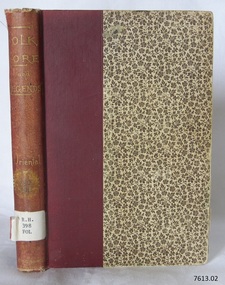 Flagstaff Hill Maritime Museum and Village
Book, Folk-Lore and Legends Oriental
... local and state significance. Warrnambool Shipwrecked-coast Flagstaff-Hill Flagstaff-Hill-Maritime-Museum Maritime-Museum Shipwreck-coast Flagstaff-Hill-Maritime-Village Shipwrecked-artefact Book Pattison Collection Warrnambool Library Warrnambool Mechanics’ Institute Ralph Eric Pattison Corangamite Regional Library Service Warrnambool City Librarian Mechanics’ Institute Library Victorian Library Board Warrnambool books and records Warrnambool Children’s Library Great Ocean Road Folk-Lore and Legends Oriental Label on spine cover with typed text R.H. 398 FOL Pastedown front endpaper has sticker from Warrnambool Mechanics Institute and Free Library covered by a sticker from Corangamite Regional Library Service Front loose endpaper has a stamp from Corangamite Regional Library Service Folk-Lore and Legends Oriental Publisher: W W Gibbings Date: 1889 Folk-Lore and Legends Oriental Book ...This item is from the ‘Pattison Collection’, a collection of books and records that was originally owned by the Warrnambool Mechanics’ Institute, which was founded in Warrnambool in 1853. By 1886 the Warrnambool Mechanics’ Institute (WMI) had grown to have a Library, Museum and Fine Arts Gallery, with a collection of “… choice productions of art, and valuable specimens in almost every branch and many wonderful national curiosities are now to be seen there, including historic relics of the town and district.” It later included a School of Design. Although it was very well patronised, the lack of financial support led the WMI in 1911 to ask the City Council to take it over. In 1935 Ralph Pattison was appointed as City Librarian to establish and organise the Warrnambool Library as it was then called. When the WMI building was pulled down in 1963 a new civic building was erected on the site and the new Warrnambool Library, on behalf of the City Council, took over all the holdings of the WMI. At this time some of the items were separated and identified as the ‘Pattison Collection’, named after Ralph Pattison. Eventually the components of the WMI were distributed from the Warrnambool Library to various places, including the Art Gallery, Historical Society and Flagstaff Hill. Later some were even distributed to other regional branches of Corangamite Regional Library and passed to and fro. It is difficult now to trace just where all of the items have ended up. The books at Flagstaff Hill Maritime Village generally display stamps and markings from Pattison as well as a variety of other institutions including the Mechanics’ Institute itself. RALPH ERIC PATTISON Ralph Eric Pattison was born in Rockhampton, Queensland, in 1891. He married Maude Swan from Warrnambool in 1920 and they set up home in Warrnambool. In 1935 Pattison accepted a position as City Librarian for the Warrnambool City Council. His huge challenge was to make a functional library within two rooms of the Mechanics’ Institute. He tirelessly cleaned, cleared and sorted a disarrayed collection of old books, jars of preserved specimens and other items reserved for exhibition in the city’s museum. He developed and updated the library with a wide variety of books for all tastes, including reference books for students; a difficult task to fulfil during the years following the Depression. He converted all of the lower area of the building into a library, reference room and reading room for members and the public. The books were sorted and stored using a cataloguing and card index system that he had developed himself. He also prepared the upper floor of the building and established the Art Gallery and later the Museum, a place to exhibit the many old relics that had been stored for years for this purpose. One of the treasures he found was a beautiful ancient clock, which he repaired, restored and enjoyed using in his office during the years of his service there. Ralph Pattison was described as “a meticulous gentleman whose punctuality, floorless courtesy and distinctive neat dress were hallmarks of his character, and ‘his’ clock controlled his daily routine, and his opening and closing of the library’s large heavy doors to the minute.” Pattison took leave during 1942 to 1945 to serve in the Royal Australian Navy, Volunteer Reserve as Lieutenant. A few years later he converted one of the Museum’s rooms into a Children’s Library, stocking it with suitable books for the younger generation. This was an instant success. In the 1950’s he had the honour of being appointed to the Victorian Library Board and received more inspiration from the monthly conferences in Melbourne. He was sadly retired in 1959 after over 23 years of service, due to the fact that he had gone over the working age of council officers. However he continued to take a very keen interest in the continual development of the Library until his death in 1969. The Pattison Collection, along with other items at Flagstaff Hill Maritime Village, was originally part of the Warrnambool Mechanics' Institute’s collection. The Warrnambool Mechanics’ Institute Collection is primarily significant in its totality, rather than for the individual objects it contains. Its contents are highly representative of the development of Mechanics' Institute libraries across Australia, particularly Victoria. A diversity of publications and themes has been amassed, and these provide clues to our understanding of the nature of and changes in the reading habits of Victorians from the 1850s to the middle of the 20th century. The collection also highlights the Warrnambool community’s commitment to the Mechanics’ Institute, reading, literacy and learning in the regions, and proves that access to knowledge was not impeded by distance. These items help to provide a more complete picture of our community’s ideals and aspirations. The Warrnambool Mechanics Institute book collection has historical and social significance for its strong association with the Mechanics Institute movement and the important role it played in the intellectual, cultural and social development of people throughout the latter part of the nineteenth century and the early twentieth century. The collection of books is a rare example of an early lending library and its significance is enhanced by the survival of an original collection of many volumes. The Warrnambool Mechanics' Institute’s publication collection is of both local and state significance. Folk-Lore and Legends Oriental Publisher: W W Gibbings Date: 1889Label on spine cover with typed text R.H. 398 FOL Pastedown front endpaper has sticker from Warrnambool Mechanics Institute and Free Library covered by a sticker from Corangamite Regional Library Service Front loose endpaper has a stamp from Corangamite Regional Library Service warrnambool, shipwrecked-coast, flagstaff-hill, flagstaff-hill-maritime-museum, maritime-museum, shipwreck-coast, flagstaff-hill-maritime-village, shipwrecked-artefact, book, pattison collection, warrnambool library, warrnambool mechanics’ institute, ralph eric pattison, corangamite regional library service, warrnambool city librarian, mechanics’ institute library, victorian library board, warrnambool books and records, warrnambool children’s library, great ocean road, folk-lore and legends oriental -
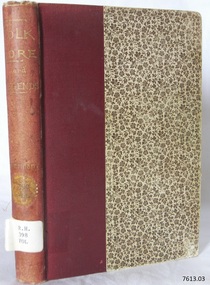 Flagstaff Hill Maritime Museum and Village
Book, Folk-Lore and Legends Germany
... local and state significance. Warrnambool Shipwrecked-coast Flagstaff-Hill Flagstaff-Hill-Maritime-Museum Maritime-Museum Shipwreck-coast Flagstaff-Hill-Maritime-Village Shipwrecked-artefact Book Pattison Collection Warrnambool Library Warrnambool Mechanics’ Institute Ralph Eric Pattison Corangamite Regional Library Service Warrnambool City Librarian Mechanics’ Institute Library Victorian Library Board Warrnambool books and records Warrnambool Children’s Library Great Ocean Road Folk-Lore and Legends Germany Label on spine cover with typed text R.H. 398 FOL Pastedown front endpaper has sticker from Warrnambool Mechanics Institute and Free Library covered by a sticker from Corangamite Regional Library Service Front loose endpaper has a stamp from Corangamite Regional Library Service Folk-Lore and Legends Germany Publisher: W W Gibbings Date: 1889 Folk-Lore and Legends Germany Book ...This item is from the ‘Pattison Collection’, a collection of books and records that was originally owned by the Warrnambool Mechanics’ Institute, which was founded in Warrnambool in 1853. By 1886 the Warrnambool Mechanics’ Institute (WMI) had grown to have a Library, Museum and Fine Arts Gallery, with a collection of “… choice productions of art, and valuable specimens in almost every branch and many wonderful national curiosities are now to be seen there, including historic relics of the town and district.” It later included a School of Design. Although it was very well patronised, the lack of financial support led the WMI in 1911 to ask the City Council to take it over. In 1935 Ralph Pattison was appointed as City Librarian to establish and organise the Warrnambool Library as it was then called. When the WMI building was pulled down in 1963 a new civic building was erected on the site and the new Warrnambool Library, on behalf of the City Council, took over all the holdings of the WMI. At this time some of the items were separated and identified as the ‘Pattison Collection’, named after Ralph Pattison. Eventually the components of the WMI were distributed from the Warrnambool Library to various places, including the Art Gallery, Historical Society and Flagstaff Hill. Later some were even distributed to other regional branches of Corangamite Regional Library and passed to and fro. It is difficult now to trace just where all of the items have ended up. The books at Flagstaff Hill Maritime Village generally display stamps and markings from Pattison as well as a variety of other institutions including the Mechanics’ Institute itself. RALPH ERIC PATTISON Ralph Eric Pattison was born in Rockhampton, Queensland, in 1891. He married Maude Swan from Warrnambool in 1920 and they set up home in Warrnambool. In 1935 Pattison accepted a position as City Librarian for the Warrnambool City Council. His huge challenge was to make a functional library within two rooms of the Mechanics’ Institute. He tirelessly cleaned, cleared and sorted a disarrayed collection of old books, jars of preserved specimens and other items reserved for exhibition in the city’s museum. He developed and updated the library with a wide variety of books for all tastes, including reference books for students; a difficult task to fulfil during the years following the Depression. He converted all of the lower area of the building into a library, reference room and reading room for members and the public. The books were sorted and stored using a cataloguing and card index system that he had developed himself. He also prepared the upper floor of the building and established the Art Gallery and later the Museum, a place to exhibit the many old relics that had been stored for years for this purpose. One of the treasures he found was a beautiful ancient clock, which he repaired, restored and enjoyed using in his office during the years of his service there. Ralph Pattison was described as “a meticulous gentleman whose punctuality, floorless courtesy and distinctive neat dress were hallmarks of his character, and ‘his’ clock controlled his daily routine, and his opening and closing of the library’s large heavy doors to the minute.” Pattison took leave during 1942 to 1945 to serve in the Royal Australian Navy, Volunteer Reserve as Lieutenant. A few years later he converted one of the Museum’s rooms into a Children’s Library, stocking it with suitable books for the younger generation. This was an instant success. In the 1950’s he had the honour of being appointed to the Victorian Library Board and received more inspiration from the monthly conferences in Melbourne. He was sadly retired in 1959 after over 23 years of service, due to the fact that he had gone over the working age of council officers. However he continued to take a very keen interest in the continual development of the Library until his death in 1969. The Pattison Collection, along with other items at Flagstaff Hill Maritime Village, was originally part of the Warrnambool Mechanics' Institute’s collection. The Warrnambool Mechanics’ Institute Collection is primarily significant in its totality, rather than for the individual objects it contains. Its contents are highly representative of the development of Mechanics' Institute libraries across Australia, particularly Victoria. A diversity of publications and themes has been amassed, and these provide clues to our understanding of the nature of and changes in the reading habits of Victorians from the 1850s to the middle of the 20th century. The collection also highlights the Warrnambool community’s commitment to the Mechanics’ Institute, reading, literacy and learning in the regions, and proves that access to knowledge was not impeded by distance. These items help to provide a more complete picture of our community’s ideals and aspirations. The Warrnambool Mechanics Institute book collection has historical and social significance for its strong association with the Mechanics Institute movement and the important role it played in the intellectual, cultural and social development of people throughout the latter part of the nineteenth century and the early twentieth century. The collection of books is a rare example of an early lending library and its significance is enhanced by the survival of an original collection of many volumes. The Warrnambool Mechanics' Institute’s publication collection is of both local and state significance. Folk-Lore and Legends Germany Publisher: W W Gibbings Date: 1889Label on spine cover with typed text R.H. 398 FOL Pastedown front endpaper has sticker from Warrnambool Mechanics Institute and Free Library covered by a sticker from Corangamite Regional Library Service Front loose endpaper has a stamp from Corangamite Regional Library Service warrnambool, shipwrecked-coast, flagstaff-hill, flagstaff-hill-maritime-museum, maritime-museum, shipwreck-coast, flagstaff-hill-maritime-village, shipwrecked-artefact, book, pattison collection, warrnambool library, warrnambool mechanics’ institute, ralph eric pattison, corangamite regional library service, warrnambool city librarian, mechanics’ institute library, victorian library board, warrnambool books and records, warrnambool children’s library, great ocean road, folk-lore and legends germany -
 Flagstaff Hill Maritime Museum and Village
Textile - Bedspread, Vera and Aurelia Giles, 1880+
... legend has it, she became a governess at “Injemiara” where her grandfather, Francis Freckleton, once owned land. Henry and Mary’s family of six, some of whom were born at Mailor’s Flat and later children at Wangoom, lived with their parents at Wangoom and Purnim west, where Henry died in 1933 and Mary Jane in 1940. The Giles family collection has social significance at a local ...There are many 19th century items of furniture, linen and crockery donated to Flagstaff Hill Maritime Village by Vera and Aurelin Giles. The items are associated with the Giles Family and are known as the “Giles Collection”. These items mostly came from the simple home of Vera’s parents-in-law, Henry Giles and his wife Mary Jane (nee Freckleton), whose photos are in the parlour. They married in 1880. Henry Giles was born at Tower Hill in 1858. He was a labourer on the construction of the Breakwater before leaving in 1895 to build bridges in N.S.W. for about seven years. Mary Jane was born in 1860 at Cooramook. She attended Mailor’s Flat State School where she was also a student teacher before, as family legend has it, she became a governess at “Injemiara” where her grandfather, Francis Freckleton, once owned land. Henry and Mary’s family of six, some of whom were born at Mailor’s Flat and later children at Wangoom, lived with their parents at Wangoom and Purnim west, where Henry died in 1933 and Mary Jane in 1940. The Giles family collection has social significance at a local level, because it illustrates the level of material support the Warrnambool community gave to Flagstaff Hill when the Museum was established.Bedspread, double bed size, white self-embossed floral pattern.warrnambool, flagstaff-hill-maritime-museum, giles collection, henry giles, tower hill, cooramook, mailor’s flat, vera & aurelin giles, bedspread, double bed bedspread, bed linen, quilt, embossed cotton -
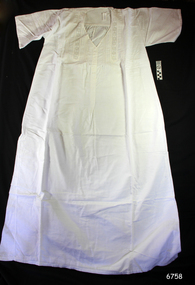 Flagstaff Hill Maritime Museum and Village
Clothing - Nightgown, Vera and Aurelia Giles, 1880-1920
... legend has it, she became a governess at “Injemiara” where her grandfather, Francis Freckleton, once owned land. Henry and Mary’s family of six, some of whom were born at Mailor’s Flat and later children at Wangoom, lived with their parents at Wangoom and Purnim west, where Henry died in 1933 and Mary Jane in 1940. The Giles family collection has social significance at a local ...There are many 19th century items of furniture, linen and crockery donated to Flagstaff Hill Maritime Village by Vera and Aurelin Giles. The items are associated with the Giles Family and are known as the “Giles Collection”. These items mostly came from the simple home of Vera’s parents-in-law, Henry Giles and his wife Mary Jane (nee Freckleton), whose photos are in the parlour. They married in 1880. Henry Giles was born at Tower Hill in 1858. He was a labourer on the construction of the Breakwater before leaving in 1895 to build bridges in N.S.W. for about seven years. Mary Jane was born in 1860 at Cooramook. She attended Mailor’s Flat State School where she was also a student teacher before, as family legend has it, she became a governess at “Injemiara” where her grandfather, Francis Freckleton, once owned land. Henry and Mary’s family of six, some of whom were born at Mailor’s Flat and later children at Wangoom, lived with their parents at Wangoom and Purnim west, where Henry died in 1933 and Mary Jane in 1940. The Giles family collection has social significance at a local level, because it illustrates the level of material support the Warrnambool community gave to Flagstaff Hill when the Museum was established.Nightgown, white cotton with Broderie Anglaise yoke. Nonewarrnambool, shipwrecked-coast, flagstaff-hill, flagstaff-hill-maritime-museum, shipwreck-coast, nightie, giles collection, henry giles, tower hill, cooramook, warrnambool breakwater, mailor’s flat, wangoom, 19th century household goods, sleep wear, nightgown, nightdress, night dress, nightwear, sleepwear, clothing, fashion, 19th century, handmade clothing -
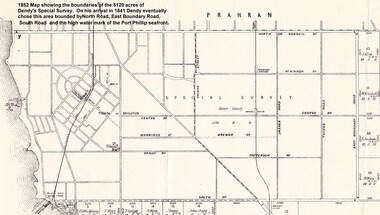 City of Moorabbin Historical Society (Operating the Box Cottage Museum)
Photograph - Map of Dendy's Special Survey, 1852 Map of Henry Dendy's Special Survey of 1841, 19th Century
... By 1845 J.B Were and Company had bought almost half of Dendy's land and Were built himself "Moorabbin House" in Were St Brighton made from stone, quarried from local cliffs. It was still standing in 1924. Legend records Moorabbin is named after the Aboriginal word for ' Mother's Milk ' The soil is very fertile and well supplied with water especially in the area called 'East Brighton' - now known as Bentleigh and East Bentleigh - By 1850 the area had developed with numerous market gardens, dairy farms, fruit gardens and vineyards supplying food for the growing population of Melbourne....By 1845 J.B Were and Company had bought almost half of Dendy's land and Were built himself "Moorabbin House" in Were St Brighton made from stone, quarried from local cliffs. It was still standing in 1924. Legend records Moorabbin is named after the Aboriginal word for ' Mother's Milk ' The soil is very fertile and well supplied with water especially in the area called 'East Brighton' - now known as Bentleigh and East Bentleigh - By 1850 the area had developed with numerous market gardens, dairy farms, fruit gardens and vineyards supplying food for the growing population of Melbourne. ...A Map drawn in 1852 that shows the 5,120 acres that formed Dendy's Special Survey of 1841. In 1840 Henry Dendy, a farmer in Surrey, England acquired a "Special Survey" from the Commissioners for Land and Emigration which gave Dendy the right to choose land in Port Phillip for the "bargain basement" price of only £1 per acre for 5120 acres, (an area of 8 square miles). The Special Survey also included the right to "the shipment of a worker for every £20 spent on land, whose free passage was paid by the Crown, equalling a total of 100 workers ". Accordingly Dendy sold his English holdings and paid the required £5120 and arrived in Melbourne in February 1841. However by this time land in the new colony was selling for £5 - £40 per acre. Because Henry Dendy possessed the order from the Colonial Office in London he was able to successfully oppose Governor LaTrobe's attempts to alter the price of the land. Dendy appointed Jonathan Were, (an entrepreneur, who had arrived in 1839), as his Manager and who later became a partner. Together, Dendy and Were decided on an area 5 miles south from Melbourne, bounded by North Road, East Boundary Road, South Road and to the west by Port Phillip Bay. Were and Dendy pitched their tents in the area now known as ' Park St, Brighton' and sank a well near the corner of 'St Andrew's St and Wells St'. By 1845 J.B Were and Company had bought almost half of Dendy's land and Were built himself "Moorabbin House" in Were St Brighton made from stone, quarried from local cliffs. It was still standing in 1924. Legend records Moorabbin is named after the Aboriginal word for ' Mother's Milk ' The soil is very fertile and well supplied with water especially in the area called 'East Brighton' - now known as Bentleigh and East Bentleigh - By 1850 the area had developed with numerous market gardens, dairy farms, fruit gardens and vineyards supplying food for the growing population of Melbourne.This Map shows the birth of the Brighton and Moorabbin area. On 18th January1859 Brighton was proclaimed a Municipality and a Borough by October 1863. Meanwhile, following a Petition, the area of East and South Brighton, incorporating Mordialloc, Cheltenham, Mentone, Sandringham and Oakleigh separated from Brighton to form the Moorabbin District Roads Board becoming the first Local Government Authority. Col. William Mair was elected as the first Chairman of the Moorabbin Roads Board. Moorabbin Shire 1871 developed further and was declared a City in1934. The City of Moorabbin was the largest Municipality in Melbourne before the Amalgamation of Councils in 1994 when it was divided in the south to City of Kingston and in the north to City of Glen Eira A Photo-lithographed 1852 Map showing the 5,120 acres that formed Dendy's Special Survey of 1841. Henry Dendy & Jonathan Were chose an area 5 miles south from Melbourne, bounded by North Road, East Boundary Road, South Road and to the west by Port Phillip Bay. Moorabbin County of Bourke / Photo-Lithographed at the department of Lands and Survey. /Melbourne. / Price 1/- brighton, moorabbin, bentleigh, cheltenham, dendy henry, bent thomas, were jonathan, special survey -
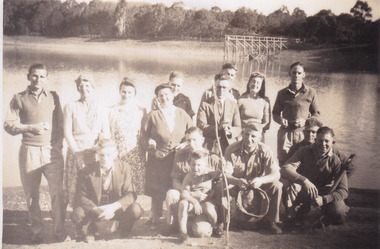 The Beechworth Burke Museum
Photograph, 1944
... legend, and the continuing existence of the RA Sigs. The historic context of this record can provide insight into Australia's history, military, technological innovation and advancements, as well as national economic, defence and foreign policies after 1945. military album army album lake kerford army signal detachment unit royal australian corps of signals military war wwii world war ii beechworth victoria sydney melbourne Reverse: BMM5095.5 / Relaxing with some of / the Stanley locals / David Pittard (back row Rt.) / next to Dorrie Elliot / I can't recall the others / Lake Sambell, I think / Kerferd / Sepia rectangular photograph printed on matte photographic paper. ...Taken in 1944, depicted are members of the Army Signal Detachment Unit with local residents at at Lake Kerferd. David Pittard (back row, right) is standing beside Dorrie Elliot. The other people are unidentified. A secret experimental micro-wave radio station was established and tested at this site by the Army Signal Detachment Unit during World War II. It was part of an experimental Ultra High Frequency (UHF) link between Melbourne and Sydney. At the time, it was highly classified. It intended to enquire into the hitherto unexplored transmission of micro-waves; that is, a radio signal which could only be transmitted by line of sight, and thus required hill-top to hill-top location.The photograph is historically significant as it pertains to World War II; the largest global conflict in history. This significance is enhanced by Australia's prominent involvement in campaigns across the Pacific, particularly on land in New Guinea and across the Huon Peninsula. It was also the first time that the Australian mainland came under direct attack by the Axis, with Japanese forces targeting north-west Australia and Sydney Harbour. These battles became Australia's largest and most complex offensives during the war. The record is also historically significant as it relates to the Royal Australian Corps of Signals, or "RA Sigs". This significance is strengthened by Australia's unique distinction of having the first established signal unit under the British Empire. This unit provides electronic warfare. They enable commanders to implement highly dynamic battle control against opposing forces by using a number of methods including radio, fibre optic, micro-wave, information systems and satellite links. The record has strong research potential. This is due to the ongoing scholarly and public interest in war, military history, the ANZAC legend, and the continuing existence of the RA Sigs. The historic context of this record can provide insight into Australia's history, military, technological innovation and advancements, as well as national economic, defence and foreign policies after 1945.Sepia rectangular photograph printed on matte photographic paper.Reverse: BMM5095.5 / Relaxing with some of / the Stanley locals / David Pittard (back row Rt.) / next to Dorrie Elliot / I can't recall the others / Lake Sambell, I think / Kerferd /military album, army album, lake kerford, army signal detachment unit, royal australian corps of signals, military, war, wwii, world war ii, beechworth, victoria, sydney, melbourne -
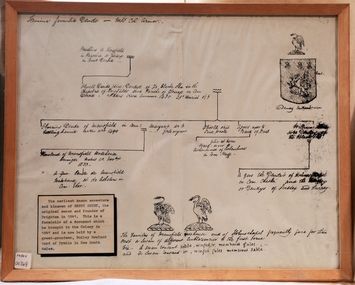 City of Moorabbin Historical Society (Operating the Box Cottage Museum)
Document - Genealogy Chart Henry Dendy (Photocopy), 19 thC
... By 1845 J.B Were and Company had bought almost half of Dendy's land and Were built himself "Moorabbin House" in Were St Brighton made from stone, quarried from local cliffs. It was still standing in 1924. Legend records Moorabbin is named after the Aboriginal word for ' Mother's Milk ' The soil is very fertile and well supplied with water especially in the area called 'East Brighton' - now known as Bentleigh and East Bentleigh - By 1850 the area had developed with numerous market gardens, dairy farms, fruit gardens and vineyards supplying food for the growing population of Melbourne....By 1845 J.B Were and Company had bought almost half of Dendy's land and Were built himself "Moorabbin House" in Were St Brighton made from stone, quarried from local cliffs. It was still standing in 1924. Legend records Moorabbin is named after the Aboriginal word for ' Mother's Milk ' The soil is very fertile and well supplied with water especially in the area called 'East Brighton' - now known as Bentleigh and East Bentleigh - By 1850 the area had developed with numerous market gardens, dairy farms, fruit gardens and vineyards supplying food for the growing population of Melbourne. ...In 1840 Henry Dendy, a farmer in Surrey, England acquired a "Special Survey" from the Commissioners for Land and Emigration which gave Dendy the right to choose land in Port Phillip for the "bargain basement" price of only £1 per acre for 5120 acres, (an area of 8 square miles). The Special Survey also included the right to "the shipment of a worker for every £20 spent on land, whose free passage was paid by the Crown, equalling a total of 100 workers ". Accordingly Dendy sold his English holdings and paid the required £5120 and arrived in Melbourne in February 1841. However by this time land in the new colony was selling for £5 - £40 per acre. Because Henry Dendy possessed the order from the Colonial Office in London he was able to successfully oppose Super-intendant LaTrobe's attempts to alter the price of the land. Dendy appointed Jonathan Were, (an entrepreneur, who had arrived in 1839), as his Manager and who later became a partner. Together, Dendy and Were decided on an area 5 miles south from Melbourne, bounded by North Road, East Boundary Road, South Road and to the west by Port Phillip Bay. Were and Dendy pitched their tents in the area now known as ' Park St, Brighton' and sank a well near the corner of 'St Andrew's St and Wells St'. By 1845 J.B Were and Company had bought almost half of Dendy's land and Were built himself "Moorabbin House" in Were St Brighton made from stone, quarried from local cliffs. It was still standing in 1924. Legend records Moorabbin is named after the Aboriginal word for ' Mother's Milk ' The soil is very fertile and well supplied with water especially in the area called 'East Brighton' - now known as Bentleigh and East Bentleigh - By 1850 the area had developed with numerous market gardens, dairy farms, fruit gardens and vineyards supplying food for the growing population of Melbourne.In 1840 Henry Dendy, a farmer in Surrey, England acquired a "Special Survey" from the Commissioners for Land and Emigration which gave Dendy the right to choose land in Port Phillip for the price of only £1 per acre for 5120 acres. This land was called Brighton in the Parish of Moorabbin, County of Bourke and emigrants developed the land establishing market gardens , dairy and poultry farms that provided the food for the growing population of Melbourne. A photocopy of the Genealogy Chart of the Dendy Family that Henry Dendy brought with him when he emigrated to Melbourne 1841Genealogy signs and descriptionsdendy henry, dendy's special survey brighton 1841, governor gipps, captain lonsdale, super-intendant latrobe, port phillip, melbourne, new south wales, squatters, emmigrants, county of bourke, parish of moorabbin, early settlers, pioneers, market gardeners, dairy farmers, fruit farms, moorabbin, bentleigh, brighton, cheltenham, were jonathan binn, -
 City of Moorabbin Historical Society (Operating the Box Cottage Museum)
Document, Henry Dendy family Shield
... By 1845 J.B Were and Company had bought almost half of Dendy's land and Were built himself "Moorabbin House" in Were St Brighton made from stone, quarried from local cliffs. It was still standing in 1924. Legend records Moorabbin is named after the Aboriginal word for ' Mother's Milk ' The soil is very fertile and well supplied with water especially in the area called 'East Brighton' - now known as Bentleigh and East Bentleigh - By 1850 the area had developed with numerous market gardens, dairy farms, fruit gardens and vineyards supplying food for the growing population of Melbourne. ...By 1845 J.B Were and Company had bought almost half of Dendy's land and Were built himself "Moorabbin House" in Were St Brighton made from stone, quarried from local cliffs. It was still standing in 1924. Legend records Moorabbin is named after the Aboriginal word for ' Mother's Milk ' The soil is very fertile and well supplied with water especially in the area called 'East Brighton' - now known as Bentleigh and East Bentleigh - By 1850 the area had developed with numerous market gardens, dairy farms, fruit gardens and vineyards supplying food for the growing population of Melbourne. dendy henry, dendy's special survey brighton 1841, governor gipps, captain lonsdale, super-intendant latrobe, port phillip, melbourne, new south wales, squatters, emmigrants, county of bourke, parish of moorabbin, early settlers, pioneers, market gardeners, dairy farmers, fruit farms, moorabbin, bentleigh, brighton, cheltenham, were jonathan binn, Document, Henry Dendy family Shield ...In 1840 Henry Dendy, a farmer in Surrey, England acquired a "Special Survey" from the Commissioners for Land and Emigration which gave Dendy the right to choose land in Port Phillip for the "bargain basement" price of only £1 per acre for 5120 acres, (an area of 8 square miles). The Special Survey also included the right to "the shipment of a worker for every £20 spent on land, whose free passage was paid by the Crown, equalling a total of 100 workers ". Accordingly Dendy sold his English holdings and paid the required £5120 and arrived in Melbourne in February 1841. However by this time land in the new colony was selling for £5 - £40 per acre. Because Henry Dendy possessed the order from the Colonial Office in London he was able to successfully oppose Super-intendant LaTrobe's attempts to alter the price of the land. Dendy appointed Jonathan Were, (an entrepreneur, who had arrived in 1839), as his Manager and who later became a partner. Together, Dendy and Were decided on an area 5 miles south from Melbourne, bounded by North Road, East Boundary Road, South Road and to the west by Port Phillip Bay. Were and Dendy pitched their tents in the area now known as ' Park St, Brighton' and sank a well near the corner of 'St Andrew's St and Wells St'. By 1845 J.B Were and Company had bought almost half of Dendy's land and Were built himself "Moorabbin House" in Were St Brighton made from stone, quarried from local cliffs. It was still standing in 1924. Legend records Moorabbin is named after the Aboriginal word for ' Mother's Milk ' The soil is very fertile and well supplied with water especially in the area called 'East Brighton' - now known as Bentleigh and East Bentleigh - By 1850 the area had developed with numerous market gardens, dairy farms, fruit gardens and vineyards supplying food for the growing population of Melbourne. dendy henry, dendy's special survey brighton 1841, governor gipps, captain lonsdale, super-intendant latrobe, port phillip, melbourne, new south wales, squatters, emmigrants, county of bourke, parish of moorabbin, early settlers, pioneers, market gardeners, dairy farmers, fruit farms, moorabbin, bentleigh, brighton, cheltenham, were jonathan binn, -
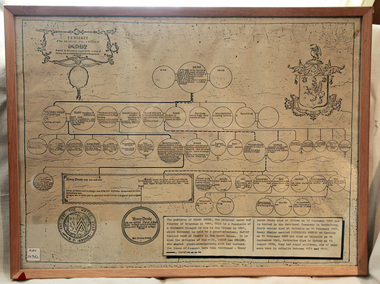 City of Moorabbin Historical Society (Operating the Box Cottage Museum)
Document - Pedigree of Henry Dendy, c1840 Original ; Copy 1985
... By 1845 J.B Were and Company had bought almost half of Dendy's land and Were built himself "Moorabbin House" in Were St Brighton made from stone, quarried from local cliffs. It was still standing in 1924. Legend records Moorabbin is named after the Aboriginal word for ' Mother's Milk ' The soil is very fertile and well supplied with water especially in the area called 'East Brighton' - now known as Bentleigh and East Bentleigh - By 1850 the area had developed with numerous market gardens, dairy farms, fruit gardens and vineyards supplying food for the growing population of Melbourne. ...By 1845 J.B Were and Company had bought almost half of Dendy's land and Were built himself "Moorabbin House" in Were St Brighton made from stone, quarried from local cliffs. It was still standing in 1924. Legend records Moorabbin is named after the Aboriginal word for ' Mother's Milk ' The soil is very fertile and well supplied with water especially in the area called 'East Brighton' - now known as Bentleigh and East Bentleigh - By 1850 the area had developed with numerous market gardens, dairy farms, fruit gardens and vineyards supplying food for the growing population of Melbourne. moorabbin brighton henry dend special survey 1841 y early settlers pioneers market gardeners Pedigree / of the branch of the family / DENDY A copy of a paper chart of the Pedigree of Henry Dendy in a wooden frame with glass Document Pedigree of Henry Dendy Unrecorded Genealogist ...This is a copy of the document brought by Henry Dendy to the Colony in 1841. In 1840 Henry Dendy, a farmer in Surrey, England acquired a "Special Survey" from the Commissioners for Land and Emigration which gave Dendy the right to choose land in Port Phillip for the "bargain basement" price of only £1 per acre for 5120 acres, (an area of 8 square miles). The Special Survey also included the right to "the shipment of a worker for every £20 spent on land, whose free passage was paid by the Crown, equalling a total of 100 workers ". Accordingly Dendy sold his English holdings and paid the required £5120 and arrived in Melbourne in February 1841. However by this time land in the new colony was selling for £5 - £40 per acre. Because Henry Dendy possessed the order from the Colonial Office in London he was able to successfully oppose Super-intendant LaTrobe's attempts to alter the price of the land. Dendy appointed Jonathan Were, (an entrepreneur, who had arrived in 1839), as his Manager and who later became a partner. Together, Dendy and Were decided on an area 5 miles south from Melbourne, bounded by North Road, East Boundary Road, South Road and to the west by Port Phillip Bay. Were and Dendy pitched their tents in the area now known as ' Park St, Brighton' and sank a well near the corner of 'St Andrew's St and Wells St'. By 1845 J.B Were and Company had bought almost half of Dendy's land and Were built himself "Moorabbin House" in Were St Brighton made from stone, quarried from local cliffs. It was still standing in 1924. Legend records Moorabbin is named after the Aboriginal word for ' Mother's Milk ' The soil is very fertile and well supplied with water especially in the area called 'East Brighton' - now known as Bentleigh and East Bentleigh - By 1850 the area had developed with numerous market gardens, dairy farms, fruit gardens and vineyards supplying food for the growing population of Melbourne. A copy of a paper chart of the Pedigree of Henry Dendy in a wooden frame with glassPedigree / of the branch of the family / DENDY moorabbin, brighton, henry dend special survey 1841 y, early settlers, pioneers, market gardeners
