
Showing 154 items matching "lord street"
-
 Bacchus Marsh & District Historical Society
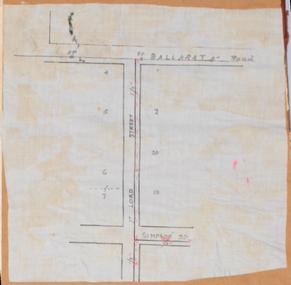
Map, Lord Street, Bacchus Marsh. Undated
... Lord Street, Bacchus Marsh. Undated......Lord Street Bacchus Marsh Maps...A small single page map showing the line of Lord Street Bacchus Marsh between Ballarat Road (Main Street) and Simpson Street. ...Bacchus Marsh Victoria Maps Lord Street Bacchus Marsh Maps A small single page map showing the line of Lord Street Bacchus Marsh between Ballarat Road (Main Street) and Simpson Street. ...A small single page map showing the line of Lord Street Bacchus Marsh between Ballarat Road (Main Street) and Simpson Street. Part of a set of maps which are pasted into a bound volume containing 76 maps or plans in total. High resolution digital image stored on BMDHS computer network. bacchus marsh victoria maps, lord street bacchus marsh maps -
 Yarra City Council
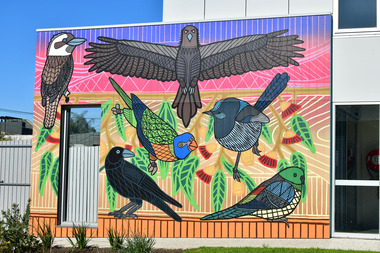
Artwork, other - Mural, Rebecca Atkinson, Queep Queep, 2023
... 'Queep-Queep' is a site-specific artwork commissioned for the new Richmond Kindergarten, Lord Street, Richmond, 2023....92/104 Lord Street , Richmond , Melbourne , VIC, Australia...'Queep-Queep' is a site-specific artwork commissioned for the new Richmond Kindergarten, Lord Street, Richmond, 2023. birds Bunjil Country kulin nation environment public art accompanying plaque Two aluminium birds (a wedge-tailed eagle and a raven) at the entrance to the building, and a large, colourful mural of Australian native birds painted in a graphic style on the other side of the wall facing into the playground. ...'Queep-Queep’ means ‘birds’ in Woi-wurrung language—the language of the Wurundjeri people—the Traditional Owners of the land on which the building is standing. Referencing what lived and flourished in this area prior to European invasion, the artwork acknowledges the important Aboriginal history of the area now known as the City of Yarra. The six native birds depicted in the artwork can all be found living within the City of Yarra: the male red-rumped parrot, kookaburra, superb fairy wren, rainbow lorikeet, raven, and wedge-tailed eagle. Many south-eastern Aboriginal people recognise the wedge-tailed eagle as Bunjil—the creator spirit. Bunjil is the head of the Kulin Nation and is very powerful. Bunjil created the land, waterways, animals, plants and even the people. He is watching over the land to ensure that we are caring for Country—reminding us to respect ourselves, respect others and respect the environment.'Queep-Queep' is a site-specific artwork commissioned for the new Richmond Kindergarten, Lord Street, Richmond, 2023.Two aluminium birds (a wedge-tailed eagle and a raven) at the entrance to the building, and a large, colourful mural of Australian native birds painted in a graphic style on the other side of the wall facing into the playground.accompanying plaquebirds, bunjil, country, kulin nation, environment, public art -
 City of Moorabbin Historical Society (Operating the Box Cottage Museum)
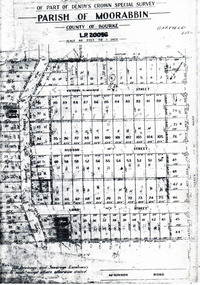
Flyer - Garfield Estate, Ormond
... ...Lord Street...Example of the progress of the Municipality of Moorabbin Draper Street Lord Street Hudson Street Blackshaw Street Tucker Road Ormond McKinnon Real Estate Part f Dendy's Crown Special Survey - parish of Moorabbin - County of Bourke - Garfield Estate Photocopy of the plan of the Garfield Estate, Ormond Flyer Garfield Estate, Ormond ...At the end of World War One, there was a renewed interest in residential land and a number of estates opened up in the Municipality of Moorabbin.Example of the progress of the Municipality of MoorabbinPhotocopy of the plan of the Garfield Estate, OrmondPart f Dendy's Crown Special Survey - parish of Moorabbin - County of Bourke - Garfield Estatedraper street, lord street, hudson street, blackshaw street, tucker road, ormond, mckinnon, real estate -
 Glen Eira Historical Society
Document - Racing Stables In Caulfield
... ... Lord Street...Caulfield Caulfield North Caulfield South Carnegie Glen Huntly Glenhuntly Eskdale Road Balaclava Road Bambra Road Glen Eira Road Heywood Street Hudson Street Hawthorn Road Kambrook Road Kooyong Road Tudor Court Lloyds Paddock Payne Street Park Crescent Service Street Slaney’s Paddock Station Street Booran Road ‘Moidart’ Cadby Court Glen Huntly Road Glenhuntly Road Neerim Road ‘Cintra’ Stephen Street Uranda Line Grove Willgra Road Epsom Street Lloyds Street Lord Street Queens Avenue St Vincents Street Roseberry Grove Manchester Grove Safeway Supermarket Hesop G. ...This file contains 3 items. 1/ Document provided by Veterinarian Dr G. G. Heslop about racing stables in the Caulfield area adjacent to the Caulfield Race Course, in both typed and handwritten form. 2/ A letter of request from a Sydney based sports writer Geoff Armstrong for information about the attempted shooting for Phar Lap. 3/ A letter to the Editor in the Glen Eira/Port Phillip Leader dated 02/04/2013 about the proposal to ban horse training from the Caulfield Racecourse.clubs and associations, victorian amateur turf club, racecourses, caulfield race course, racecourse trainers, stables, racehorses, schools, secondary school, caulfield high school, hotels, caulfield club hotel, wattle tree hotel, petrol stations, veterinarian clinic, norman myers veterinarian hospital, baker norma, bence j., bird j., cadby lou, conaghan basil, cameron ron, couseng harry, cox cecil, creighton norman, delaney g., eules darce, farmer h. (dick), fraser mick, foulsham fred, fryer j., gatell harry, garton a. (rod), garland f., godby cecil, godby frank, goodfellow claude, guinane p., hayes t. j., hilton h., hodgkinson george, james jack, jenkins e. j., jennings reg, judd des, jury jack, king frank, mcgregor j. n., mcnamara dave, mcphee sonny, mclaughlin, mulcahy j., murphy geoff, muskett j., parkinson j., phillipson mr., quinlan pat, ralph stan, reid stanley, robinson f., rolfe w. j., sanderson chris, telford w., tie jerry, torr harry, bernborough, black caviar, garryowen, phar lap, purser, revenue, spearfelt, surround, arthur jr., murrel violet, farmer violet, kemball w. r., mcdonald leslie, brockhoff mr., carslake mr., gullifer h., heywood j. g., llord mr., davies mr., palfreman mr., caulfield, caulfield north, caulfield south, carnegie, glen huntly, glenhuntly, eskdale road, balaclava road, bambra road, glen eira road, heywood street, hudson street, hawthorn road, kambrook road, kooyong road, tudor court, lloyds paddock, payne street, park crescent, service street, slaney’s paddock, station street, booran road, ‘moidart’, cadby court, glen huntly road, glenhuntly road, neerim road, ‘cintra’, stephen street, uranda line grove, willgra road, epsom street, lloyds street, lord street, queens avenue, st vincents street, roseberry grove, manchester grove, safeway supermarket, hesop g. g. dr veterinary surgeon -
Glen Eira Historical Society
Article - CRIME
... ... Lord Street...The article itself has been outlined in pencil by hand. Caulfield Lord Street Crime Social problems Police Article CRIME ...This file contains one item. 1/A short article from the Sun News Pictorial dated 23011933 about an attempted criminal assault on a young woman in Caulfield. The article itself has been outlined in pencil by hand.caulfield, lord street, crime, social problems, police -
Glen Eira Historical Society
Book - Carnegie Primary School No. 2897
... ... Lord Street...Wood Malcolm Wood Forest Wood Joe Roxburgh Miss Grange Road Clifton Street Lord Street Wood Frederick Geo Egan Miss dressmakers Whitlam Fred Whitlam Christine Whitlam George Whitlam Gough Whitlam Freda Whitfield Mr. ...Carnegie Primary School centenary book (96 pages x 2 copies) ‘The First Hundred Years NO2897. Carnegie Primary School 1888-1988’ compiled and edited by Isabel Couper and Deidre Lynch. A detailed history of the school’s beginnings. Many informative memories and recollections from school’s first students and teachers; includes social history of area and people, football teams, debutante sets and school. Also a reprinted newspaper article from school’s Golden Anniversary and photo of school band; and a couple of social history photographs.anderson james, murrumbeena, glen huntly railway station, carnegie state school, wesleyan hall, neerim road, railway stations, carnegie primary school, rosstown, toolambool road, lynch deidre, mcvey claire, ross william murray, findlay francis, couper isabel, brown wesley, rosstown state school, brisbane w, carnegie uniting church, liddelow m.h., evans thomas, selboskar phyl, centenaries, margaret street, caulfield, brewster mr., taylor mr., draper mrs., mcfarlane mr., rule thomas, teachers, campbell ada, ‘ava’, campbell aubrey, campbell vera, matthews ben, hewitts road, matthews funeral service, funeral parlours, leo amy, leo alfie, rudge family, rudge mr., transport, phillips store, general store, phillips corner, emily street, hamlya family, pitt family, sheppard family, pemberton mr., pemberton mrs., dunlop misses, preschools, whitlam family, whitlam gordon, woods family, woods lorna, swaggie, swagman, liddelow amy, anderson mr., anderson archie, dunlop bill, phillips linda, hansen alice, lodge laura, fox arthur , hamlyn eric, hansen dagmar, cooper lina , woods lorna, waite family, cove family, johansen family, koornang road, market gardens, sheppard ernie, wood a.m., ‘nisava’, wood family, wood bill, evans rachel, evans thomas, wood millicent, whitfield mr., griffiths mr., wood malcolm, wood forest, wood joe, roxburgh miss, grange road, clifton street, lord street, wood frederick geo, egan miss dressmakers, whitlam fred, whitlam christine, whitlam george, whitlam gough, whitlam freda, whitfield mr., patterson road, graceburn avenue, griffiths r.h., koornang road, scales mr., reid athol, lording dr., mernda ave, farmstead, lord reserve, leman’s swamp, koornang park, cobby harry, larkin aircraft company, dawson howard, rosedale avenue, spencer reg, turner ruth, turner jack, turner noreen, turner marie, morton alan, morton barney, gardiner martin, frogmore estate, oakleigh road, frogmore road, koornang park, hunt club kennels, raeke miss, morgan miss, pitt winnie, jiggins mr., smith mr., blundy violet, ryall ray, mimosa road, wolseley mr., wolseley family, wolseley ted, brunstein madge, murrumbeena cricket club, sinclair alan, sincliar tinny, thomas ted, walker alec, bone bob, footballers, middleton colin, farquahson mrs., eddy family, eddy rose, wolseley jack, buswell stan, buswell doug, buswell. stan jnr., irving nell, brims ethel, bailey bruce, eason sisters, hands hilda, windlow isabel, madden road, glenhuntly road, griffiths rita, jackson jean, scott mr., ward ‘cap’, caulfield grammar school, kokaribb road, carnegie traders, cricket teams, carnegie south, ward marjory, ryan mr., phillips tony, phillips bessie, buckley street, phillips harriet, phillips marion, phillips ernest, phillips hilda, phillips david, phillips florence, phillips linda, lihou miss, jersey parade, meake family, skewe family, mansfield family, fraser jean, collister alma, sturges millie, retallick girls, lillywhite family, mason nellie, johns nancy, bowsfield family, jenner family, chisholm emma, chisholm doris, chisholm ivy, chisholm netta, chisholm beryl, chisholm eileen, wadsworth ethel, luke mr., plummer t.w., raecke miss, sargent ron, sarkie family, reid family, meake violet, collett reg, mcneil miss, scales mr., carmody thomas william, steele miss, young mac, young margaret, cooper cyril, cooper bill, whiteside d., broadbent neil, broadbent mr., carnegie theatre, theatres, morton family, clarke family, quickand neals grocery store, grocers, billy guyatt’s, shops, spencer the removalist, removalists, collister harold, collister bill, caulfield band, bands, carthews the drapers, drapers, mccarrons alec blacksmiths, skewes keith, oliver frank, pitt ‘squeaker’, knevitt ‘skeeter’ harry, jockeys, britter jack, stanistreet family, gear rita, culleen billy, tailors, sherwoods butchers, butchers, jersey parade, riley didlo, verne harry, cooper horace, cooper linda, cooper martin, cooper claude, cooper reginald, cooper stanley, cooper gladys, cooper muriel, cooper percival, cooper cyril, beaumont w.a., whittfield joe, beaumont eileen, major mary anne sister, major myrtle, major bessie, major alma, stagholl walter, stagholl margaret, stagholl eric, robertson bessie, robertson fred, robertson norman, robertson donald, robertson alma, robertson alan, baird neil, baird john, baird rosemary, dunn helen, baird ian, baird heather, baird dianne, petrie stuart, petrie richard, bailey ron, gaunt mabel, reading harold, reading marge, irwin joyce, dickson margaret, dickson jennifer, dickson peter, wood malcolm, wood millicent, wood forest, wood joe, sinclair ‘trinny’, roberts ‘fly’, footballers, malcolm mr., henderson reg, henderson alice, brew l., rule mr., philbrick mr., wood mr., trembath mr., keogh mr., plummer tom, lane a., fox ernest, souters, market gardeners, fox belle, fox bella, fox vern, couper margaret, couper sandra, couper peter, couper narelle, couper clare, couper jarrod, scott mr., doughty will, doughty tom, lloyd miss, islingworth master, adams joyce, hogan mr., markus jean, cosgrove joan, cosgrove mrs., cosgrove mr., marshall jim, kellow fred, fretwell elizabeth, fretwell betty, shepparson ave, singers, edmonson miss, butters shirley, harwood vera, bracher lloyd, dewhurst irene, dewhurst jack, boyle mr., gow jack, welch len, stanistreet harry, stanistreet jack, stanistreet kathleen, stanistreet frank, stanistreet kingsley, ‘ray sullivan’s harmony boys’, carnegie memorial hall, st. anthony’s hall, welch len, gibbons norm, ashley sylvia, crosswell edna, marks peggy, worth phyllis, cleal jean, tabner edith, jenkins elva, mcintosh gladys, worth reg, waters cyril, downard rex, wild mavis, wild darby, hill roland, eason jean, tyers noel, tyers clive, witten hope, strickland doris, chisholm beryl, harwood family, battershill sid, battershill walter, dixon mavis, boyle mr., ford hilda, forsythe miss, edmonsen miss, ryan mr., grimsley mr., allaway mrs., grant mrs., bone bob, bone bruce, w. bone & son nursery men, bone norman, bone jack, bone william, railway road, green kevin, paris marjorie, mimosa road, green joan, allaway winnie, elliot miss, mcburney mr., purdy mrs., allaway suzanne, barron shirley, hogan mr., rutherford mrs., curtin mr., mckee’s, stores, whelan’s, coles, koornang road, gardiner marty, grange road dairy, dairies, mcwhinney’s tuck shop, shops, williams dorothy, kennedy irene regina, rigby miss, grimsley steve, grimsley muriel, grimsley jack, grimsley margaret, grimsley aimee, grimsley bill, blinkinsop steve, blinkinsop jeannie, mathers max, howie rex, major mr., flatmans paddock, crossover, reid eric, reid athol, lowe margaret, lowe dorothy, lowe ian, poliomyelitis epidemic diseases, forsythe miss, cuddihy miss, dougall keith, grace miss, hattam’s, stores, driver wally, perry max, perry don, perry jack, meagher j., ‘hostile’, racehorses, edney jack, carthews the drapers, fretwell elizabeth, kellow fred, muddyman bill, graceburn ave, caulfield junior citizens band, bands, luke mr., luke percy, luke maise, luke nessie, luke geoff, luke ross, luke jan, luke lynette, bolton douglas, anderson mrs., mcburney mr., hogan mr., scott mr., tyers s., ross j., ryan j., irvine j., muirhead mrs., muirhead j., mcnab m., buller l., emmanuel p., buller m., paton v., moor j., condron a., bibby d., matthews n., holman l., cotterell m., whelan j., jennion g., walker b., taylor e., green a., turner r., matthews e., smith joan, gardiner marty, dairies, hanson family, cove family, gallop family, barrett family, barrett w.a., bolch family, bolch b., burke w., burke bill, burke s., mobbs h., young g., young c., burke m., ward c., hopwood g., gordon mr., milk bars, cooper cr., phillips t., swindell mr., grogan mr., wadsworth mrs., bourke mrs., lewis mrs., worsley mrs., quickenstead mrs., brown wesley, musicians, purdy h., curtain les, jenner’s dairy, riley’s wood yard, occupations, jenner vic, jenner les, grant noel, parker george, connolly keith, purdy mr., glen huntly picture theatre, picture theatres, irvine jack, law christie, hatter bob, joppick les, driver geoff, curtin mrs., frederick street, ormond, waters ron, carnegie junior citizens band, carnegie salvation army band – bands, whelan evan, irwin ray, balgleish jack, cowen laurie, smyth wally, lambeth margaret, kind lorraine, bondini joy, tredennick miss, linton miss, heath graham, shiell bill, shiell myrtle, archard bess, bull joan, craig ida, collins dorrie, collins doreen, diggans jess, cornthwaite h., cripps e., dougall n., dixon joyce, francis d., evans mrs., glass peg, greene jess, grace merle, hocking freda, jillings mrs., price mrs., day kitty, kerr may, mason marge, kind sylvia, muirhead d, mcconchie netta, needham nancy, nickless w, o’connor linda, pilven mrs., ryall h., strother ivy, singleton mrs., kelly phyl, waters von, usher mrs., trotter maude, watson mrs., williams mabel, withers olive, aarsmann norma, shiell norma, close peter, ‘wild cherry’ cake shop, rudi miss, anderson miss, eddy mr., hunter jean, nelson vera, fisher john, hunter ron, read jean, smith brian, newsreaders, nelson miss, singleton billy, quon miss, mchutchison george, valma smith, millar royal r., donoghue nora, lester mr., roberts tom, andreisen colin, miles alec, hine mr., baker mr., clements george, bracher lloyd, dimick miss, muir judy, dunn margaret, sant richard, myring miss, ryan mr., armstrong margaret, share wally, howie rex, barclay bob, rockman udo, hoult david, eisfelder kevin, jacques mr., smith mr., magee mr., stehle belinda, wallace mr., james mrs., main mr., wood miss, verso mr., mcpherson mrs., felotico miss, stehle john, howards mrs., collard mrs., webster vivian, stehle siggy, truong le sen, mcpherson barbara, mitchell eva, moutsos mark, chan benjamin, wilson del, jewell christopher, mitchell keith, grant marilyn, caskie alastair, dixon dennis, armstrong john, lucas edward, clark deanne, coutts natalie, flood zivanja, derham peter, momandwall shaper, couper jarrod, heslop joanne, breeze ginaya, caskie fiona, filippone nadya, mcmahon nina, hedges nigel, williams shae, grimm karen, mcgregor clare, vagenes john, gallagher glenn, mcalister rob, varga marilyn, hunter debbie, courtney cathy, booth carol, mcmahon mary, brown danielle, burska maciej, campbell jason, chryssis aris, d’arcy michael, delaney matthew, doukas vivian, dower samantha, fournarakis andrew, genoli amanda, grammatos jimmy, harrington melanie, karamoshos john, karim sadruddin, kennedy russel, lalani zahra, lightfoot kylie, looby mark, louange veronica, park sung mi, perera dennis, pozvek julie, scurry kate, sievers sarah, smith matthew, svarnas dennis, vassiliou denise, wright tracey, zouzounis spirros, adahall jojie, agar jude, anderson lynette, black renae, bobrowski ursula, caskie catherine, devon hayley, diakoumis maria, duljas kristie, evans lindsay, faucett ebony, filippone annette, fournarakis jimmy, francese sean, gibson jay, gordon michelle, guslitser dora, king jane, lianos villi, lorkin christopher, macleod cheryl, maggs amberley, mitchell keith, mucic renae, o’brien jessica, park matthew, pozvek richard, psarras nancy, rhodes suzanne, simons emma, smith christopher, spokes melanie, tia michael, timewell amanda, vavoudis peter, abbott kristi, allender daniel, bobrowski jacob, carey rebecca, carter daimein, catramados john, christou eugenia, couper jarrod, healey michael, kalaitzakis nick, kennedy rebecca, macleod suzanne, mavridis angelo, morosini amanda, mowforth dustin, okolicsanyi george, park sung chul, pemberton michael, reisman elizabeth, richards kylie, savrone leah, tia charlie, tran paul, wiseman derek, wright dean, wyatt marilyn, andre ryan, breeze ginaya, brown james, campbell chad, charles benjamin, devon john, diakmoumis stacey, diamantis chris, duljas michael, grammatos harry, hill bradd, karim salim, lindsay amanda, lynch jennifer, marrello sol, momandwall shaker, moutsos ireni, oram scott, o’sughrue kristy, panevin david, park catherine, pozvek louise, stratton alisa, timewell rebecca, tsigos stam, yeow sook ling, anderson peter, batson tracey, black craig, brain jason, breeze benjamin, brown kylie, carrington harata, caskie fiona, catramados hercule, chan daphne, christou chris, clarke simone, diamantis anthony, faucett sara, flood natalia, holmes gavin, kotrotsos tony, kuk robin, mitchell david, okolicsanyi steve, pemberton samuel, soos melinda, stephenson gabrielle, tran pauline, vassiliou evan, agar natalia, bennett tracey, buhmann wayne, couper clare, faucett sean, filippone nadya, filippone marie, gallagher glenn, gelman roman, grant shawn, hill tania, jewel chris, kaliappa danny, kiss robert, liacopoulos aris, louey david, macleod mike, malamas voula, oram michelle, scurry ivan, wardley amanda, zouzounis sam, anderson robert, antoniou nick, carey tamara, derham peter, diep dianne, filippone danielle, flood zivanja, frangos katina, handley scott, harrison robin, heath cheryl, hedges megan, hedges nigel, hudson raelene, jacovou daniel, katrotsos george, kuk maggie, leung tracy, lightfoot wendy, mcmahon nina, taylor stephen, vassiliou litsa, liddelow e., anderson james h., boardman thomas h., rule thomas, whitfield j.p., griffiths r.h., scales e., boyle j.b., ryan owen w., eddy h.m., millar royal r., lester russel a., donoghue r., bracher a. lloyd (acting principle), o’brien john d., moller henry r., monahan t.v., barclay robert l., somerville albert v., magee frank c. (acting principle), wallis keith, laing allan i., verso ron (acting principle), wood moira (acting principle), tonkin ernest, share wallace (acting principle), howie rex, harding malcolm (acting principle), crowe brian, schmidt david (acting principle), lynch deidre (acting principle), o’keeffe leo, brierley bob, brierley marjorie, couper isabel, couper peter, lindsay janine, lynch deidre, selboskar phyl, stehle siggy, webster jennifer -
 Bendigo Historical Society Inc.
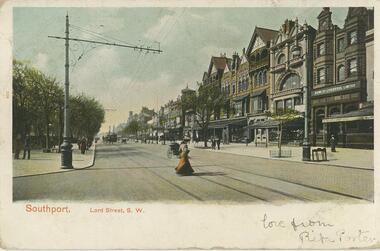
Postcard - Alice McGregor Postcard Collection, 1900 - 1920
... See 1400 Colour photo of Lord Street, Southport, S.W. A wide street with tram tracks. ...See 1400 Colour photo of Lord Street, Southport, S.W. A wide street with tram tracks. ...Alice McGREGOR Born: 1908; unknown parents. Possibly adopted by the Salter family? Electoral Roll 1936: Highland Terrace Kangaroo Flat. Alice Mary Salter and William Robert Salter living together; presumed to be sister and brother. William Robert Salter was killed in a MVA in Bendigo in 1937 aged 26. In Victoria in 1938, Alice Mary Salter married James Thomas McGregor (born Victoria 1917, died Victoria 1983, buried Fawkner Cemetery) Lived: 1968; 22 Wade Street Golden Square Alice McGregor Died: 1999 aged 91 at Anne Caudle Centre, Bendigo Buried: Kangaroo Flat Cemetery See additional research. Postcard Album of Alice McGregor contained 86 post cards.Postcard Album of Alice McGregor containing 86 postcards. See 1400 Colour photo of Lord Street, Southport, S.W. A wide street with tram tracks. Tram in the distance. Shops on the right and trees on left. Lady crossing the street in the foreground. Addressed to Miss A Rawson, "Smedley", Te Hernui, New Plymouth, New Zealand Sender - Rita Porter Date stamp Oct 18 1905 postcard, collector, alice mcgregor -
 Federation University Historical Collection
Photograph - Photograph - Black and White, Ballarat Teachers' College Staff Members, 1947, 1947
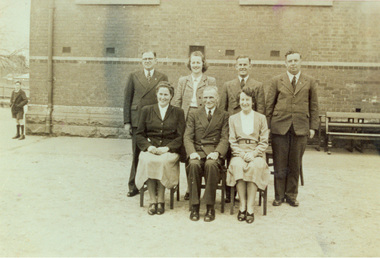
... lord...dana street...Street Primary School. Standing Left to right: Carl Bryan, Trudy Kentish, Mephan McEwin, Alan Sonsee. Sitting left to right: Beth Hughes, W.F. (Frank) Lord...In 1947 classes at the Ballarat Teachers' College were held in the bluestone building at the Dana Street Primary School. ballarat teachers' college ballarat monica miller sonsee bryan kentish mcewin hughes lord dana street dana street primary school Frank Lord Alan Sonsee University Women Seven staffmembers of the Ballarat Teachers' College pose in front of a building in the grounds of the Dana Street Primary School. ...In 1947 classes at the Ballarat Teachers' College were held in the bluestone building at the Dana Street Primary School.Seven staffmembers of the Ballarat Teachers' College pose in front of a building in the grounds of the Dana Street Primary School. Standing Left to right: Carl Bryan, Trudy Kentish, Mephan McEwin, Alan Sonsee. Sitting left to right: Beth Hughes, W.F. (Frank) Lord, Monica Millerballarat teachers' college, ballarat, monica miller, sonsee, bryan, kentish, mcewin, hughes, lord, dana street, dana street primary school, frank lord, alan sonsee, university women -
 Glen Eira Historical Society
Photograph - CARNEGIE
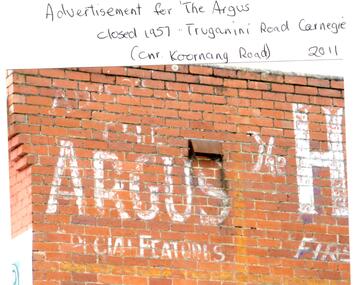
... Street... Carnegie Library... Carnegie Post Office... McAllister B.... Glen Huntly... Glenhuntly... Phone boxes... Memorial Hall... Bamfield M.... Tranmere Avenue... Carnegie Railway Station... Stations... Libraries... Post Offices... Memorial Hall Carnegie... Progress Hall... Carnegie Community Singing... Social clubs... Chadstone progress... Newspapers... Temminghoff Robert... Carnegie Chamber of Commerce... Caulfield City Council... Rob’s Chocolate Box... Rosstown... Ross William Murray... Rosstown Railway... Elsternwick... Oakleigh... City of Caulfield... Glen Huntly Road... Glenhuntly Road... Grange Road... Carnegie Primary School... Primary schools... Murrumbeena... Neerim Road... Dandenong Road... Koornang Park... Lord...Street Carnegie Library Carnegie Post Office McAllister B. Glen Huntly Glenhuntly Phone boxes Memorial Hall Bamfield M. Tranmere Avenue Carnegie Railway Station Stations Libraries Post Offices Memorial Hall Carnegie Progress Hall Carnegie Community Singing Social clubs Chadstone progress Newspapers Temminghoff Robert Carnegie Chamber of Commerce Caulfield City Council Rob’s Chocolate Box Rosstown Ross William Murray Rosstown Railway Elsternwick Oakleigh City of Caulfield Glen Huntly Road Glenhuntly Road Grange Road Carnegie Primary School Primary schools Murrumbeena Neerim Road Dandenong Road Koornang Park Lord Reserve Rosanna Street Reserve Packer Oval Reserve Caulfield Swim Centre Holywood Grove Mile End Road McPherson Avenue Munster Avenue Rosstown Hotel Leila Road Methodist Church Toolambool Street Carnegie Theatre Carnegie Estate Agency – Sims and Broadbent Woorayl Street Estate agents Cowie J. ...24 photographs relating to Carnegie plus 1 slide: 1/Two photographs, one of Koornang Road c.1920’s and one of flower shop rear of library, date unknown. 2/One photograph of Carnegie Post Office c. undated. 3/Two photographs Koornang Road, Carnegie and phone boxes, Carnegie, dated 1914. 4/Two photographs (the same) of an RSL Ball dated 15/08/1937. 5/17 black and white negative photos – reprinted, date unknown, of Carnegie Library, shop front opening Koornang Road. 6/Slide showing Koornang Road, Carnegie looking South. 7/6 photocopied postcards from Valentines Real Photo Series, in album owned by Mrs. Zoe Mason, collected and returned to Pam Speedy (daughter) 12 Wattle Grove, East Malvern, 15/03/1999. Photocopied pages from 1923 Sands and McDougalls included with some prints to give an idea of architecture and other retail trade. 8/Two photocopied prints of Carnegie Flood. 1946 – Koornang Road, shows shopkeepers in street at that time. 9/Two photographs of brick wall advertising the "Argus" newpaper, which closed in 1957. Photos taken in 2011 when building was exposed prior to rebuilding on site.koornang road, rosstown road, carnegie, shepparson street, carnegie library, carnegie post office, mcallister b., glen huntly, glenhuntly, phone boxes, memorial hall, bamfield m., tranmere avenue, carnegie railway station, stations, libraries, post offices, memorial hall carnegie, progress hall, carnegie community singing, social clubs, chadstone progress, newspapers, temminghoff robert, carnegie chamber of commerce, caulfield city council, rob’s chocolate box, rosstown, ross william murray, rosstown railway, elsternwick, oakleigh, city of caulfield, glen huntly road, glenhuntly road, grange road, carnegie primary school, primary schools, murrumbeena, neerim road, dandenong road, koornang park, lord reserve, rosanna street reserve, packer oval reserve, caulfield swim centre, holywood grove, mile end road, mcpherson avenue, munster avenue, rosstown hotel, leila road, methodist church, toolambool street, carnegie theatre, carnegie estate agency – sims and broadbent, woorayl street, estate agents, cowie j. mrs., confectioner, woodhouse e., stationer, mckay jno. a., mckay jonathon, small goods, perry w. b., chemists, kinsman e. h., newsagents, jones a. w., mckee wm., furniture stores, neil geo. m., grocer, truganini road, brick -
Glen Eira Historical Society
Book - CAULFIELD CENTENARY 1957
... Street... Koornang Road... Lord...Elections Political processes Local government Springthorpe Reserve Greenmeadows Gardens Business and finance Roads and streets Caulfield Racecourse East Caulfield Reserve Mackinnon Reserve Hawthorn Road Balaclava Road Murrumbeena Road Lempriere Avenue Victoria Street Koornang Road Lord Reserve Lyons Street Murrumbeena Reserve Kangaroo Road Ormond Park Beatty Crescent Foch Street Packer Reserve Oakleigh Road Leila Road Prices Park Bambra Road Riley Reserve Playgrounds Town Hall Maternal and child health centres Truganini Road Grange Road Senior Citizens centre Barkley Sir Henry Moore David Handasyde Gilbert Caulfield School Room Harris G.W. ...This file contains four items 1/Two copies of a twenty-four page booklet titled CITY OF CAULFIELD CENTENARY 1857-1957, created by the Caulfield City Council and printed by Peter Isaacson Pty Limited, Melbourne. The booklet details important aspects of Caulfield’s history including council procedures, the Caulfield Road District Proclamation, the first election and a summary of 100 years of local government with a description of the present Caulfield in 1957. The booklet also includes several pictures of various Caulfield landmarks and people including one of Caulfield City Councillors (11 men and 1 woman). Also one photocopied version of this booklet. 2/Eleven pages of typed notes for the City of Caulfield Centenary booklet. All notes are undated and incomplete. Two pages titled NOTES on THE HISTORY and PROGRESS OF THE CITY OF CAULFIELD, author unknown. Three and a half pages titled THE STRUCTURE OF LOCAL GOVERNMENT IN VICTORIA, author unknown. Five pages titled 100 YEARS OF LOCAL GOVERNMENT – EARLY CAULFIELD, by Mrs A. P. Bell. 3/A typed letter to Miss V. Webb-Langdon from the Town Clerk H.G. Nelson, acknowledging her contribution to historical details for the Caulfield Council’s Centenary booklet, dated 24/12/1957. 4/A handwritten letter and a handwritten note regarding the acquisition of notes for the Caulfield Centenary booklet. The letter is dated 03/08/2006 and the note is dated 09/02/2007.city of caulfield centenary, caulfield road district, sinclair a.j.g., city hall, war memorials, gamble h.a., machin l.r., bunny f.c.d., caulfield park, koornang reserve, parton e.m., sims h.e., thomson w.r., gunn e.e., yorston j.s., wallace g.e. mrs, green w.c., jenner e.r., ward boundaries, dandenong road, queens avenue, normanby road, station street, bond street, glen eira road, orrong road, poath road, north road, booran road, nepean highway, glen huntly road, glenhuntly road, inkerman road, hotham street, nelson h.g., fullard w.r., mackley g.j., ellis k.i, crosbie m.r., nutting b.i., body j.h., pritchard r.j., guildford l.t.g., lund l.m., street h.c., reynolds a.w., elections , political processes, local government, springthorpe reserve, greenmeadows gardens, business and finance, roads and streets, caulfield racecourse, east caulfield reserve, mackinnon reserve, hawthorn road, balaclava road, murrumbeena road, lempriere avenue, victoria street, koornang road, lord reserve, lyons street, murrumbeena reserve, kangaroo road, ormond park, beatty crescent, foch street, packer reserve, oakleigh road, leila road, prices park, bambra road, riley reserve, playgrounds, town hall, maternal and child health centres, truganini road, grange road, senior citizens centre, barkley sir henry, moore david, handasyde gilbert, caulfield school room, harris g.w., semple john, dempsey william, brooks w.a., wilson thomas, lyall william, murrum murrumbeen lifestyle, ‘greenmeadows’ house, lempriere family, aboriginal culture, ‘rippon lea’ house, caulfield john, ‘slaney’s’ home, alma road, paddy’s swamp, racecourse hotel, caulfield technical college, bevan mr., ‘grosmont’, hart john, railways, mansions, ‘rosecraddock’, langdon h. j., caulfield cup, ‘crotonhurst’, webb judge, ‘kilwinning’, service james, ricketson henry, ‘glen eira’, house names, garden vale, ross william murray, ‘ross’s folly’, outer circle railway, caulfield grammar school, davies j. henry, lagdon william, grimwade f.s., loyd charles du plan, hope george, ‘airdrie’, kooyong hill, market gardens, dairies, lady talbot milk supply, jenner family, o’niell college, presentation sisters, glenferrie road, grimwade frederick sheppard, grimwade alice, ‘harlston’, grimwade house, ‘saint aubin’s’, ‘st. aubin’s’, ‘caulfield hall’, caulfield john p.t., st georges road, caulfield military hospital, nursing homes, health establishments, dover street, sports and recreations, rosanna street, ‘cantala’, health services, parks and reserves, community services, town planning, local government finance, local officials and employees -
 Glen Eira Historical Society
Article - GLEN HUNTLY (HISTORY OF)
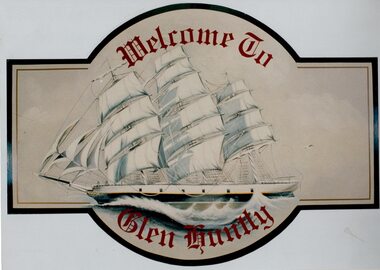
... Street... Neerim Road... organs... Peace Memorial Organ... railways... Marara Road... Curraweena Road... Booran Road... Bambra Road... Rosstown railway... Murray-Ross William... Leila Road... Murray-Ross Leila... ‘The Grange’... North Road... Wild Cherry Road... ‘Rosstown’... picture theatres... Manchester Grove... aerodrome... Lord...‘Glen Huntly’ Buchanan Captain fever ship emigrants Cummins Ann St Kilda Cemetery Bowman Mrs Caulfield Craig John Cameron Miss McGonagle Mrs Elsternwick Armstrong George Mathers James The Glen Huntly Pioneers Memorial Jones Alfred Ramsey St David’s Uniting Church (Grange Road) Glen Huntly Glen Huntly Road Lake Street Glen Huntly State School Glen Huntly Presbyterian Church South Caulfield Mernda Avenue Garden Avenue Grange Road Jenkin (Boss) William Wattle Avenue Chinese joss-house Smith A.W Glen Huntly Post Office foundation stones King F.L Methodist Church Trinity Congregational Church Greek Orthodox Church Salvation Army Temple Wanalta Road St Anthony’s Roman Catholic Church St Agnes’ Anglican Church Booran Road St David’s Uniting Church El Nido Grove Manses Royal Avenue Munster Avenue James Street Rothschild Street Neerim Road organs Peace Memorial Organ railways Marara Road Curraweena Road Booran Road Bambra Road Rosstown railway Murray-Ross William Leila Road Murray-Ross Leila ‘The Grange’ North Road Wild Cherry Road ‘Rosstown’ picture theatres Manchester Grove aerodrome Lord Reserve Neville Street Lyons Street Morgan Street Rosedale Avenue rifle clubs Glen Huntly Infant Welfare Centre Watson Grove Rowlands Drapery drapers Bones Plant Nursery nurseries Elsternwick railway station railway stations Kooyong Road Glen Eira Road Truganini Road Rosstown Sugar Works Ross Murray street names typhoid diseases death and dying Article GLEN HUNTLY (HISTORY OF) ...This file contains 10 items about the history of Glen Huntly: 1/6 photocopied pages from ‘The History of St Kilda’ which relates to the place name Glen Huntly, and the Quarantine graves, date unknown. 2/2 photocopied pages from the ‘Sun Pictorial’ dated 13/4/1928 and 12/4/1928; relating to the state of the graves at Point Ormond and their re-internment to St Kilda Cemetery. 3/1 pen and ink sketch of graves at Point Ormond from the State Library Victoria. 4/3 pages taken from a website on the re-internment of graves and some social history as to the reason that the new emigrants were coming to Australia. The Article also has 7 photographs. 5/2 newspaper articles on the ‘Glen Huntly’ descendants forthcoming reunion being held on 21&22/4/1990. 6/1 article reprinted from newsletter no. 22 October 1983 on the barque ‘Glen Huntly’. Also details of passengers who died and the burial of 3 at Point Ormond. 7/1 handwritten document (unattributed) taken from ‘Migrant ships for South Australia 1836-1850’ by Ronald Parsons. 8/1 pamphlet commemorating the 150th anniversary of the ‘Glen Huntly’ arriving in Melbourne. It gives information about the ship, passengers, memorial in St Kilda Cemetery and upcoming descendants’ reunion. 9/1 program of commemoration events 21&22/4/1990. 10/1 piece of art work for a ‘Welcome to Glen Huntly’ sign, featuring a ship. Undated, unattributed and source unknown.‘glen huntly’, buchanan captain, fever ship, emigrants, cummins ann, st kilda cemetery, bowman mrs, caulfield, craig john, cameron miss, mcgonagle mrs, elsternwick, armstrong george, mathers james, the glen huntly pioneers memorial, jones alfred ramsey, st david’s uniting church (grange road), glen huntly, glen huntly road, lake street, glen huntly state school, glen huntly presbyterian church, south caulfield, mernda avenue, garden avenue, grange road, jenkin (boss) william, wattle avenue, chinese joss-house, smith a.w, glen huntly post office, foundation stones, king f.l, methodist church, trinity congregational church, greek orthodox church, salvation army temple, wanalta road, st anthony’s roman catholic church, st agnes’ anglican church, booran road, st david’s uniting church, el nido grove, manses, royal avenue, munster avenue, james street, rothschild street, neerim road, organs, peace memorial organ, railways, marara road, curraweena road, booran road, bambra road, rosstown railway, murray-ross william, leila road, murray-ross leila, ‘the grange’, north road, wild cherry road, ‘rosstown’, picture theatres, manchester grove, aerodrome, lord reserve, neville street, lyons street, morgan street, rosedale avenue, rifle clubs, glen huntly infant welfare centre, watson grove, rowlands drapery, drapers, bones plant nursery, nurseries, elsternwick railway station, railway stations, kooyong road, glen eira road, truganini road, rosstown sugar works, ross murray, street names, typhoid, diseases, death and dying -
 Port Melbourne Historical & Preservation Society
Photograph - Raglan Street, Port Melbourne, David Thompson, c2007
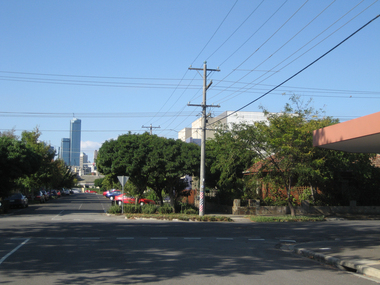
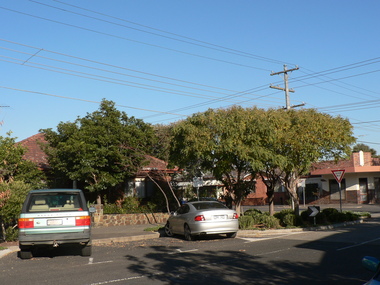
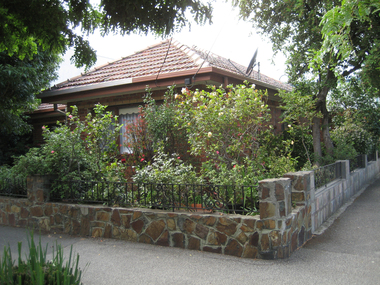
... ...Nott Street...Lord...The Lord Raglan hotel was established in 1864 on the corner of Raglan and Nott Streets. ...Digital colour photograph of Raglan Street looking towards the Rialto Building in Melbourne. The former site of the Lord Raglan Hotel is on the right at 94 Raglan Street....Sometime later it was replaced by a single-storey brick house Business and Traders - Hotels Raglan Street Built Environment - Domestic Nott Street Lord Raglan Hotel Digital colour photograph of Raglan Street looking towards the Rialto Building in Melbourne. ...The Lord Raglan hotel was established in 1864 on the corner of Raglan and Nott Streets. It was closed in 1909. Sometime later it was replaced by a single-storey brick houseDigital colour photograph of Raglan Street looking towards the Rialto Building in Melbourne. The former site of the Lord Raglan Hotel is on the right at 94 Raglan Street.business and traders - hotels, raglan street, built environment - domestic, nott street, lord raglan hotel -
 Port Melbourne Historical & Preservation Society
Photograph - 94 Raglan Street, Port Melbourne, David Thompson, c2007
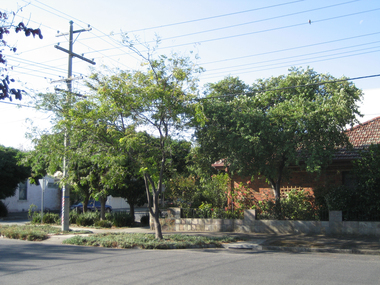
... ...Nott Street...Lord...The Lord Raglan hotel was established in 1864 on the corner of Raglan and Nott Streets. ...Digital colour photograph of the house at 94 Raglan Street on the corner of Nott Street, the former site of the Lord Raglan Hotel. Viewed from across Nott Street....Sometime later it was replaced by a single-storey brick house Business and Traders - Hotels Raglan Street Built Environment - Domestic Nott Street Lord Raglan Hotel Digital colour photograph of the house at 94 Raglan Street on the corner of Nott Street, the former site of the Lord Raglan Hotel. ...The Lord Raglan hotel was established in 1864 on the corner of Raglan and Nott Streets. It was closed in 1909. Sometime later it was replaced by a single-storey brick houseDigital colour photograph of the house at 94 Raglan Street on the corner of Nott Street, the former site of the Lord Raglan Hotel. Viewed from across Nott Street.business and traders - hotels, raglan street, built environment - domestic, nott street, lord raglan hotel -
 Port Melbourne Historical & Preservation Society
Photograph - 94 Raglan Street, Port Melbourne, David Thompson, c2007
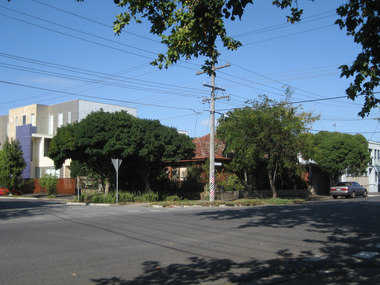
... ...Nott Street...Lord...The Lord Raglan hotel was established in 1864 on the corner of Raglan and Nott Streets. ...Digital colour photograph of the house at 94 Raglan Street on the corner of Nott Street, the former site of the Lord Raglan Hotel. Viewed from across Raglan Street....Sometime later it was replaced by a single-storey brick house Business and Traders - Hotels Raglan Street Built Environment - Domestic Nott Street Lord Raglan Hotel Digital colour photograph of the house at 94 Raglan Street on the corner of Nott Street, the former site of the Lord Raglan Hotel. ...The Lord Raglan hotel was established in 1864 on the corner of Raglan and Nott Streets. It was closed in 1909. Sometime later it was replaced by a single-storey brick houseDigital colour photograph of the house at 94 Raglan Street on the corner of Nott Street, the former site of the Lord Raglan Hotel. Viewed from across Raglan Street.business and traders - hotels, raglan street, built environment - domestic, nott street, lord raglan hotel -
 Port Melbourne Historical & Preservation Society
Photograph - 94 Raglan Street, Port Melbourne, David Thompson, c2007
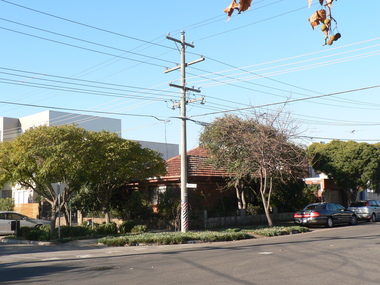
... ...Nott Street...Lord...The Lord Raglan hotel was established in 1864 on the corner of Raglan and Nott Streets. ...Digital colour photograph of the house at 94 Raglan Street on the corner of Nott Street, the former site of the Lord Raglan Hotel....Sometime later it was replaced by a single-storey brick house Business and Traders - Hotels Raglan Street Built Environment - Domestic Nott Street Lord Raglan Hotel Digital colour photograph of the house at 94 Raglan Street on the corner of Nott Street, the former site of the Lord Raglan Hotel. ...The Lord Raglan hotel was established in 1864 on the corner of Raglan and Nott Streets. It was closed in 1909. Sometime later it was replaced by a single-storey brick houseDigital colour photograph of the house at 94 Raglan Street on the corner of Nott Street, the former site of the Lord Raglan Hotel.business and traders - hotels, raglan street, built environment - domestic, nott street, lord raglan hotel -
 Port Melbourne Historical & Preservation Society
Photograph - 94 Raglan Street, Port Melbourne, David Thompson, c2007
... ...Nott Street...Lord...The Lord Raglan hotel was established in 1864 on the corner of Raglan and Nott Streets. ...Digital colour photograph of the house at 94 Raglan Street on the corner of Nott Street, the former site of the Lord Raglan Hotel....Sometime later it was replaced by a single-storey brick house Business and Traders - Hotels Raglan Street Built Environment - Domestic Nott Street Lord Raglan Hotel Digital colour photograph of the house at 94 Raglan Street on the corner of Nott Street, the former site of the Lord Raglan Hotel. ...The Lord Raglan hotel was established in 1864 on the corner of Raglan and Nott Streets. It was closed in 1909. Sometime later it was replaced by a single-storey brick houseDigital colour photograph of the house at 94 Raglan Street on the corner of Nott Street, the former site of the Lord Raglan Hotel.business and traders - hotels, raglan street, built environment - domestic, nott street, lord raglan hotel -
 Port Melbourne Historical & Preservation Society
Photograph - 94 Raglan Street, Port Melbourne, David Thompson, c2007
... ...Nott Street...Lord...The Lord Raglan hotel was established in 1864 on the corner of Raglan and Nott Streets. ...Digital colour photograph of the house at 94 Raglan Street on the corner of Nott Street, the former site of the Lord Raglan Hotel....Sometime later it was replaced by a single-storey brick house Business and Traders - Hotels Raglan Street Built Environment - Domestic Nott Street Lord Raglan Hotel Digital colour photograph of the house at 94 Raglan Street on the corner of Nott Street, the former site of the Lord Raglan Hotel. ...The Lord Raglan hotel was established in 1864 on the corner of Raglan and Nott Streets. It was closed in 1909. Sometime later it was replaced by a single-storey brick houseDigital colour photograph of the house at 94 Raglan Street on the corner of Nott Street, the former site of the Lord Raglan Hotel.business and traders - hotels, raglan street, built environment - domestic, nott street, lord raglan hotel -
 Bacchus Marsh & District Historical Society
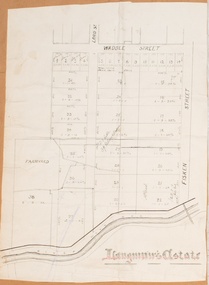
Map, Langmann's Estate Bacchus Marsh
... The area is bounded by the Werribee River, Fisken Street, Waddle Street(sic.) (Waddell) and Lord Street. The map is pasted into a bound volume containing 76 maps or plans in total. ...The area is bounded by the Werribee River, Fisken Street, Waddle Street(sic.) (Waddell) and Lord Street. The map is pasted into a bound volume containing 76 maps or plans in total. ...The date of this map has not been determined. It bears the signature of D.A. Little upon of a portion of the map. Little was Bacchus Marsh Shire Secretary and Engineer between 1886 and 1914 which dates the map to some time between 1886 and 1914.A single page paper map showing a portions of land in part of Bacchus Marsh.The area shown is described as Langmann's Estate. The area is bounded by the Werribee River, Fisken Street, Waddle Street(sic.) (Waddell) and Lord Street. The map is pasted into a bound volume containing 76 maps or plans in total. High resolution digital image stored on BMDHS computer network. bacchus marsh victoria maps -
 Flagstaff Hill Maritime Museum and Village
Equipment - Ship's Telegraph section, Chadburn & Sons, 1875-1898
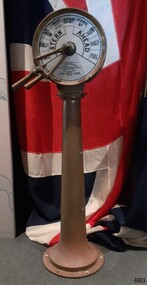
... By 1875, Chadburn & Son was producing the brass Engine Order Telegraph in its plant at 71 Lord Street, Liverpool. In 1911, the ship, RMS Titanic, was launched, fitted with Chadburn & Sons E.O.T. ...By 1875, Chadburn & Son was producing the brass Engine Order Telegraph in its plant at 71 Lord Street, Liverpool. In 1911, the ship, RMS Titanic, was launched, fitted with Chadburn & Sons E.O.T. ...The ship’s telegraph section was once part of the navigational equipment of the famous paddle steamer, PS Hygeia, and was later installed on Flagstaff Hill’s exhibit, the steamer Rowitta. This is the Bridge Section of a ship’s telegraph, a Duplex Gong model, made by Chadburn & Son of Liverpool. The gong sounded two signals whenever the navigational commands to change the speed or direction were given by the ship’s pilot. Communication between the ship’s pilot and the engine room in the late 19th to the mid-20th centuries was made with a system called an Engine Order Telegraph (E.O.T.) or ship’s telegraph. The equipment has two parts, the Bridge Section and the Engine Room Section. The Bridge Section was usually mounted onto a pedestal, and the Engine Room Section was attached to a vertical surface. The standard marine commands were printed or stamped around the face of the dial and indicated by a pointer or arrow that was usually moved by a rotating brass section or handle. The ship’s pilot stationed on the Bridge of a vessel sends his Orders for speed and direction to the Engine Room with the E.O.T. He moves the lever or levers, depending on the number of engines the ship has, to change the indicator on the Bridge Section’s dial to point in the new direction and speed of travel. This change causes the Orders to be duplicated on the Engine Room Section’s dial and a bell or bells to signal the change at the same time. The engineer then adjusts the ship’s engines and steering equipment to follow the pilot’s Order. CHADBURN & SON, Liverpool- Chadburn Brothers, William and C.H., were joint inventors and well-established makers of optical and scientific instruments and marine gauges. The firm was granted the Prince Albert Royal Warrant in the late 19th century. In 1870, William Chadburn applied for a patent for his navigational communication device for use on ships. By 1875, Chadburn & Son was producing the brass Engine Order Telegraph in its plant at 71 Lord Street, Liverpool. In 1911, the ship, RMS Titanic, was launched, fitted with Chadburn & Sons E.O.T. The Chadburn Ship Telegraph Company Limited was registered in 1898 to take over Chadburn & Sons. In 1903, a large factory at Bootle, near Liverpool, and its products were being sold overseas. In 1920, electric-powered telegraphs were developed. In 1944, the name changed to Chadburn’s (Liverpool) Limited. In 1968, the company became Chadburn Bloctube Ltd. In 2000, the company, now Bloctube Marine Limited, was still manufacturing ship telegraphs. The P.S. HYGEIA 1890-1932: - This ship’s telegraph was installed on the new paddle steamer, PS Hygeia, one of three iconic pleasure steamers famous for providing regular services in Port Phillip Bay, Victoria, to thousands of passengers between the ports of Queenscliff, Sorrento, Portsea, Dromana, Rosebud, Rye, and Mornington. It joined the Ozone and the Weeroona, all three described as being glamorous, powerful and fast. Its ticket office was on the pier itself. The P.S. Hygeia was built in Yorker, Scotland, in 1890, by Napier, Sharks & Bell. It was registered in Melbourne, Australia, by Hubbart, Parker & Co. in 1891. The steel ship was 92 metres long, able to travel at 22 knots, and licensed to carry over 1600 passengers in luxury, with even a barber shop on board. The regular service between the ports in Port Phillip Bay, Victoria, continued for over 40 years. With the decline in passenger demand, the service wound down. The Hygeia was sold to H.M. Morris in 1931 for demolition and breaking up. Equipment, fittings, and even lifebuoys were sold, with many items purchased by people who had some connection to the Hygeia. On August 25th, 1931, what was left of the vessel departed Port Melbourne and eventually, in June 1932, it was laid to rest at the ships’ graveyard outside Port Phillip Heads. The SS ROWITTA 1909-2015: - The ship’s telegraph was originally installed on the PS Hygeia. It was purchased when the Hygeia was broken up in 1931 and later installed, in 1975, on Flagstaff Hill’s SS Rowitta, an exhibit greatly enjoyed by the public until it was demolished in 2015. The ferry “SS Rowitta” was built in 1909 in Hobart, Tasmania. The timber steam ferry was built using planks of Huon and Karri wood. It was a favourite with sightseeing passengers steaming along Tasmania’s Tamar and Derwent rivers for 30 years. Rowitta was also known as Tarkarri and Sorrento and had worked as a coastal trading vessel between Devonport and Melbourne, and Melbourne, Queenscliff and Sorrento. The vessel had given over 100 years of service and pleasure. This Bridge section of a ship’s Engine Order Telegraph, used with an Engine Room section, represents late-19th-century change and progress in communication and navigation at sea. This type of equipment was still in use in the mid-20th century. It is significant for its association with its maker, Chadburn & Son, of Liverpool, a well-known marine instrument maker whose work was recognised by English Royalty, and whose products were selected to supply similar equipment for use on the RMS Titanic. The ship’s telegraph is also significant for its association with the paddle steamer PS Hygeia, one of three iconic steamers that transported thousands of passengers from port to port within Port Phillip Bay, Victoria, for over 40 years from the 1890s to the 1930s. Queenscliff Borough remembers the Hygeia by naming a road near the pier Hygeia Drive. The Hygeia is registered on the Victorian Heritage Database as a vessel of significance, VHR S329. In 1901, Hygeia had the privilege of carrying their Royal Highnesses, the Duke and Duchess of York, from Mornington to St Kilda Pier, Melbourne, during their Royal visit celebrating the Federation of Australia. The ship’s telegraph is also important for its connection with the Rowitta, a large exhibit on display at Flagstaff Hill Maritime Village, aiding maritime education for over 40 years. It represented the importance of coastal traders to transport, trade and communication along the coast of Victoria, and before the availability of rail and motor vehicles, serving many roles. Bridge section of a Ship’s Telegraph or Engine Order Telegraph (E.O.T.). The round, double-sided, painted glass dial is inside a brass case behind glass. It is fitted onto an outward tapering brass pedestal with a round base. The brass indicator arrows between the handles point simultaneously to both sides of the dial when moved. An oval brass maker’s plate is attached to the top of the case. The dial’s faces have inscriptions that indicate speed and direction, and the front face and plate include the maker’s details. A serial number is stamped on the collar where the dial is fitted to the pedestal. The ship’s telegraph is a Duplex Gong model, made by Chadburn & Son of Liverpool. It was originally part of the navigational fittings on the paddle steamer, PS Hygeia.Dial, maker’s details: “PATENT “DUPLEX GONG” TELEGRAPH / CHADBURN & SON / TELEGRAPH WORKS / PATENTEES & MANUFACTURERS / 11 WATERLOO ROAD / LIVERPOOL” LONDON / 105 FENCHURCH STREET” “NEWCASTLE / 85 QUAY + SIDE” “GLASGOW / 69 ANDERSON QUAY” “PATENT” Dial instructions: “FULL / HALF/ SLOW / FINISHED WITH ENGINES / STOP STAND BY / SLOW / HALF / FULL / ASTERN / AHEAD” Maker’s plate: “CHADBURN / & SON / PATENT / LIVERPOOL” Serial number: “22073”flagstaff hill, warrnambool, maritime village, maritime museum, shipwreck coast, great ocean road, engine order telegraph, e.o.t., navigational instrument, communication device, ship’s telegraph, engine room section, bridge section, rms titanic, chadburn & son, chadburn brothers, william chadburn, chadburn ship telegraph company, chadburns, duplex gong, liverpool, ss rowitta, navigation, marine technology, pilot’s orders, steam power, hobart, tasmania, devonport, tasmanian-built, ferry, steam ferry, steamer, 1909, early 20th century vessel, passenger vessel, tamar trading company, launceston, george town, sorrento, tarkarri, speculant, peter mcgennan, p j mcgennan & co. port phillip ferries pty ltd, melbourne, coastal trader, timber steamer, huon, karri, freighter, supply ship, charter ferry, floating restaurant, prawn boat, lakes entrance, ps hygeia, paddle steamer, pleasure steamer, port phillip bay, queenscliff, portsea, dromana, rosebud, rye, mornington, hubbart parker & co, 1890, 1903, h.m. morris, hygeia -
 Surrey Hills Historical Society Collection
Work on paper - Photograph, Interior of Surrey Theatre at 140-148 Union Road, post 1939, 1939
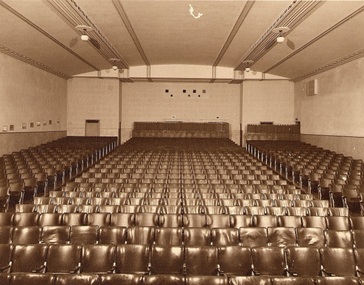
... The photo was donated to Ray Hudson Real Estate by David Lord, 9 Maude Street, Box Hill North, 3129. David Lord is son of Clive H Lord, FRAIA, Dip Arch Design who was the architect of the building. ...The photo was donated to Ray Hudson Real Estate by David Lord, 9 Maude Street, Box Hill North, 3129. David Lord is son of Clive H Lord, FRAIA, Dip Arch Design who was the architect of the building. ...The photo was donated to Ray Hudson Real Estate by David Lord, 9 Maude Street, Box Hill North, 3129. David Lord is son of Clive H Lord, FRAIA, Dip Arch Design who was the architect of the building. Clive Harmsworth Lord (1905-1979) was admitted as a registered architect by the Architect's Registration Board in April 1931 (REF: TROVE - The Argus, 17 April 1931). Electoral roll gives Clive Harmsworth Lord at 196 Union Road in 1954 and 1963 and in 1968 at 5 Streetham Court, Mont Albert. He died at Mont Albert; cremated Springvale. Date is approximate. Roy Dimmick of Dimmick and Long, Len Rossiter and Robert Mitchell (+ and one of the other principals of Dimmick and Long) had the theatre built; Len Rossiter was the builder; Clive H Lord was the architect. The theatre was opened by the local member and prime minister, Robert Menzies on 3rd September 1939. Dimmick & Long operated a real estate agency from the corner of the building. Owned / operated by Surrey Theatres Pty Ltd (L Rossiter and Robert Mitchell) from 3/9/1939-1/1/1952 Owned / operated by Victoria Theatres Pty Ltd from 1/11/1950 to 22/10/1960 Owned / operated by Consolidated Theatres Pty Ltd from 1/3/1958 to 22/10/1960 The theatre became a squash court in the (?) 1960s. SHNN: April-May 1986: Plans are afoot to revamp the squash courts with existing shops to remain but with the interior to be converted to office showroom space. 40-2286 is a black and white photocopy made by Jocelyn Hall. SLV have other photos including ones of the foyer.Sepia image of the interior of the Surrey Theatre at 140-148 Union Road, Surrey Hills. It is taken from the stage (screen) back towards the projection box. The two entrances can just be seen behind the curtained area behind the back row. The ceiling has typical 1930s decorative treatment.Original: Commercial Photographic Co Pty Ltd on lower RH edge. Stamp on back: Commercial Photographic Coy. / Pty. Ltd. / 217 Queensberry St., Melbourne, N3. / (Details re ordering prints) / Telephone F5266entertainment, businesses, theatres, surrey theatre, union road shops, cinemas, dimmick and long real estate agency, surrey theatres pty ltd, victoria theatres pty ltd, consolidated theatres pty ltd, clive lord, (sir) robert menzies, roy dimmick, len rossiter, surrey squash court -
 Surrey Hills Historical Society Collection
Photograph, Exterior of Surrey Theatre at 140-148 Union Road, post 1939, 1939
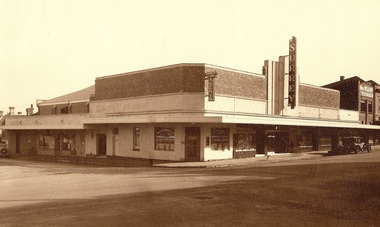
... The photo was donated to Ray Hudson Real Estate by David Lord, 9 Maude Street, Box Hill North, 3129. David Lord is son of Clive H Lord, FRAIA, Dip Arch Design - architect of the building. ...The photo was donated to Ray Hudson Real Estate by David Lord, 9 Maude Street, Box Hill North, 3129. David Lord is son of Clive H Lord, FRAIA, Dip Arch Design - architect of the building. ...The photo was donated to Ray Hudson Real Estate by David Lord, 9 Maude Street, Box Hill North, 3129. David Lord is son of Clive H Lord, FRAIA, Dip Arch Design - architect of the building. Clive Harmsworth Lord (1905-1979) was admitted as a registered architect by the Architect's Registration Board in April 1931 (REF: TROVE - The Argus, 17 April 1931). Electoral roll gives Clive Harmsworth Lord at 196 Union Road in 1954 and 1963 and in 1968 at 5 Streetham Court, Mont Albert. He died at Mont Albert; cremated Springvale. Roy Dimmick of Dimmick and Long, Len Rossiter and Robert Mitchell (+ and one of the other principals of Dimmick and Long) had the theatre built; Len Rossiter was the builder; Clive H Lord was the architect. The theatre was opened by the local member and prime minister, Robert Menzies on 3rd September 1939. Dimmick & Long operated a real estate agency from the corner of the building. Owned / operated by Surrey Theatres Pty Ltd (L Rossiter and Robert Mitchell) from 3/9/1939-1/1/1952 Owned / operated by Victoria Theatres Pty Ltd from 1/11/1950 to 22/10/1960 Owned / operated by Consolidated Theatres Pty Ltd from 1/3/1958 to 22/10/1960 The theatre became a squash court in the (?) 1960s. SHNN: April-May 1986: Plans are afoot to revamp the squash courts with existing shops to remain but with the interior to be converted to office showroom space. 40-2286 is a black and white photocopy made by Jocelyn Hall; removed from its mount board on 15/3/2013. SLV have other photos including ones of the foyer.Sepia digital image of the Surrey Theatre at 140-148 Union Road, Surrey Hills taken from across the road from the corner of Bedford Avenue and Union Road. It shows the theatre entrance and the other businesses occupying the site, both facing Union Road and Croydon Road and 2 buildings to the north of the site in Union Road. These include Miss Williams Dressmaker; Dimmick and Long, Estate Agents and Royal Insurance Company Ltd. There are 2 cars parked, one in Union Road and one in Croydon Road. DImmick and Long occupies the corner site in the building.Original: Commercial Photographic Co Pty Ltd on lower RH edge. Stamp on back: Commercial Photographic Coy. / Pty. Ltd. / 217 Queensberry St., Melbourne, N3. / (Details re ordering prints) / Telephone F5266surrey theatre, entertainment, businesses, clive lord, david lord, union road shops, (sir) robert menzies, surrey squash courts, consolidated theatres pty ltd, victoria theatres pty ltd, len rossiter, robert mitchell, roy dimmick, dimmick and long -
 Flagstaff Hill Maritime Museum and Village
Print - Lithograph, sea rescue, R.N. Duffield, Australian cruiser “MELBOURNE” (Tons 5600) rescuing crew of sinking four-masted schooner “HELEN B. STERLING” of Halifax NS Canada, Tons 1343 in a gale in the Pacific Ocean, 19-11-1924
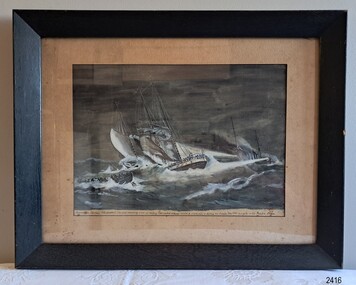
... Lord Mayor Cr. Swanston heroes cigarette case Painted on the ship’s bow: “HELEN B. STERLING / HALIFAX N S” [Nova Scotia, Canada] Handwritten below the print: “AUSTRALIAN CRUISER “MEMBOURNE” (Tons 5600) rescuing crew of sinking four-masted schooner “HELEN B. STERLING” of Halifax NS Canada, Tons 1343 in a gale in the Pacific Ocean.” Handwritten on lower right: “R.N. DUFFIELD / Nov. 19. 1924” (underlined) On paper label: “Phone: / Footscray 398 [some of the text has torn off] / “A. FRITH / PICTURE FRAMER / Manufacturer / 17 Paisley Street ...This framed lithograph print in watercolour and gouache was produced on November 19th, 1924, by 20th-century marine artist, Mr R.N. Duffield. It depicts the event of a sea rescue that took place two years earlier. The framer was A.L. Frith of Footscray, Melbourne, who actively advertised from 1933 to 1935. The now disbanded Shiplovers' Society of Victoria (1930-2018) donated the print, and it seems likely that this print was framed for that organisation. This graphic image shows the conditions in which the rescue from the wrecked Helen B. Sterling happened. Captain George Harris was master of the American-owned, four-masted windjammer. His wife Edith and their ten-year-old son Leslie were on board, along with a crew of fifteen seamen. The ship set off from Newcastle, NSW, on January 5th, 1922, loaded with a cargo of coal to deliver to the Society Islands and on to San Francisco. Young Leslie later wrote a lively school composition for his teacher about his experiences on board the Helen B Sterling. He tells of a fire that broke out the day after they departed and burned a hole in a beam. Then another troublesome time on the 9th, when a strong gale blew a sail off the ship. Finally, he tells of the highlight of his voyage when, on the 18th January, the ship was right in the path of a strong cyclone, which broke the mainmast. Huge waves crashed over both sides of the deck, meeting in the middle, and the ship began to sink. The rescue from the wreck was an exciting time for the young boy, and even more so when one of his cats survived after being carefully wrapped in a pillowcase and thrown down from the ship for the boy. Reporters later wrote about Leslie’s comments, “... what had grieved him most was the thought that he might never see his two little sisters again”. Captain Harris said in a published statement, “… the gale was the worst he had met in his 12 years’ experience at sea. All went well for the first week. We then encountered a strong blow from the south-east. We tried the gasoline pump, but the engine broke down, and we had to do the pumping by hand. We at once shortened sail, but the sea increased in fury to such an extent that men were washed from the pumps. I was below at 5:30 on Sunday morning [January 22nd, 1922] when the main mast went over the side, … I at once sent out SOS signals, and got word that HMAS Melbourne was coming to our assistance. I had made a mistake with regard to our position, but did not know it until 11:30 o’clock, when I sent out the correct location. This was picked up by the Melbourne and I received the following reply: “We will reach you about 2 am. Keep a good heart. The Melbourne will do all she can.” Our ship was practically awash when we were taken off.” (Ref: the ‘Helen B. Sterling Disaster’, Maitland Weekly Mercury, NSW, 4-2-1922.) Officers from the Royal Australian Navy, Captain Henry J Feakes (later Rear-Admiral) and Commander Wilfrid Ward Hunt, were on board the light cruiser, HMAS Melbourne (1913-1928), when it left Sydney for New Zealand. After the SOS was received, the ship sped at full steam towards the sinking Helen B. Sterling. They found the vessel at about midnight and shone bright search lights on the distressed ship to illuminate the desperate scene. The Melbourne was unable to move close to the schooner, so sixteen seamen, including Commander Hunt, volunteered to man the Melbourne’s lifesaving 12-oared cutter. They rowed the sea boat with great urgency towards the victims of the sinking ship, keen to save lives no matter what the conditions. When the cutter was close to the Sterling, a line was secured between the Sterling and the cutter. The weary, waterlogged and anxious men on board could be rescued, one at a time, in the breeches buoy equipment, which looked like canvas shorts with a lifesaving ring in the waistband. The victims were hauled along the line and pulled aboard by many willing hands. All eighteen crew and passengers were saved, including Captain Harris and his family. The seamen of the Melbourne received a heroes’ welcome when they arrived in New Zealand. The grateful survivors were taken to Auckland, where they received the care and comfort they needed. Melbourne’s Lord Mayor, Cr. Swanston, on behalf of the citizens of Melbourne, formally recognised the heroic rescue efforts of the seamen of the HMAS Melbourne on March 2nd, 1922, at a special presentation. Two large flags, a White Ensign and an Australian “Jack" Flag, were presented to the Captain of HMAS Melbourne, and souvenirs were awarded to the sea boat’s crew and its Commander, Wilfred Ward Hunt. Commander Hunt was also presented with an original watercolour depicting the heroic rescue from the wreck of the Helen B. Sterling, painted just after the event by renowned marine artist Arthur V Gregory (1867-1957), and he received a silver cigarette case bearing the City’s coat of arms and the inscription, "To Commander Ward Hunt from the Citizens of Melbourne as a memento of the rescue of the crew of Helen B. Stirling by H.M.A.S. Melbourne, on 23.1.22". Both the painting and the cigarette case are now treasured items inherited by his grandson; a reminder of “… a very fine naval gentleman who believed in leading by example." R.N. DUFFIELD: - The Lithograph print in our collection by 20th-century English artist R.N. Duffield is dated Nov. 19, 1924. It is very similar to, and possibly created from, the original A V Gregory watercolour presented to Commander Hunt and dated 1922. Mr R.N. Duffield has art works in the Yarmouth Museums, Norfolk Museums Collection; “Orient Liner Otranto …,” and "Convoy of six ships at sea", both painted in watercolour and gouache during the 1940s. Some of his other works, also painted in watercolour and gouache, have been advertised for sale on Internet sites. Some details differ between the original A.V. Gregory and this Lithograph Print: - -the words on the bow on the original watercolour are “Helen B. Sterling, Blain”, which is in Washington, USA, where the Sterling Shipping Company was registered from around 1919; the words on the print are “Helen B. Sterling, Halifax, N S”, for Nova Scotia, Canada, which is the hometown of Sterling Shipping Company founder’s wife, Helen B Sterling. -The watercolour is coloured and has fine details; the print is monochrome - The A V Gregory signed the watercolour in 1922, on the lower left; the print is signed with the Lithographer’s name on the lower right; “R N Duffield, Nov. 19. 1924” ARTHUR VICTOR GREGORY (1867-1957): - A.V. Gregory is a renowned marine artist who worked in watercolour and gouache. He painted actively between 1899 and 1932, creating over 3o0 works. South Melbourne, Victoria, was where he lived and worked. This Lithograph print is significant in that it depicts the rescuing of the passengers and crew of the schooner “Helen B Stirling”. At the time this was a significant event that made most Australian and New Zealand papers because of the involvement of the Australian cruiser “Melbourne”. The image demonstrates the perilous conditions experienced by seafarers. It includes an example of the line and breeches buoy method used to save lives at sea from the 1860s and into the 20th century. It reflects a time in our history when sail and steam ships cruised the world’s seas together, the former trading with a cargo of coal from Newcastle, the latter defending our country in World War I. The print is part of Flagstaff Hill Maritime Museum’s Collection of maritime artworks that depict famous events, vessels and locations, showing the evolution of sea craft, and aiding the interpretation of our maritime history. The Lithograph print is behind glass in a black painted timber frame and mounted under a cream matte. The vivid image depicts a sea rescue in progress. The night scene is illuminated by a light beaming from a steamship, the Cruiser HMAS Melbourne. It reveals figures on the deck of a sinking sailing ship, the schooner Helen B. Sterling, as foaming waves roll across it. The stricken ship has a broken main mast, and a sail has been detached. A small figure is floating in the choppy sea, secured in a breeches buoy that is attached to a rescue line between a lifesaving cutter and the sailing ship. The crewmen in the cutter are ready to haul the shipwrecked victim aboard, while the figures on the foundering ‘Sterling’ watch them. The print’s paper-covered wooden backboard is attached to the frame with small tacks. A metal hanging wire is secured to two dissimilar eyelet screws. Inscriptions include text on the bow of the sinking vessel, a handwritten title below the picture, and a handwritten name in the print’s lower right corner. On the reverse are two oval, black ink stamps and a round cream label with printed text. The hand-painted print was reproduced from a lithograph, signed in the lower right, by R.N. Duffield of England, on November 19th, 1924. A Frith of Footscray, Melbourne framed it. Painted on the ship’s bow: “HELEN B. STERLING / HALIFAX N S” [Nova Scotia, Canada] Handwritten below the print: “AUSTRALIAN CRUISER “MEMBOURNE” (Tons 5600) rescuing crew of sinking four-masted schooner “HELEN B. STERLING” of Halifax NS Canada, Tons 1343 in a gale in the Pacific Ocean.” Handwritten on lower right: “R.N. DUFFIELD / Nov. 19. 1924” (underlined) On paper label: “Phone: / Footscray 398 [some of the text has torn off] / “A. FRITH / PICTURE FRAMER / Manufacturer / 17 Paisley Street / Footscray.“ On both oval stamps: “SHIPLOVERS SOCIETY OF VICTORIA / LIBRARY” flagstaff hill, flagstaff hill maritime museum and village, warrnambool, maritime museum, maritime village, great ocean road, shipwreck coast, lithograph, lithograph print, reproduction print, helen b. sterling, the sterling, american owned schooner, halifax, halifax n s, halifax nova scotia, nova scotia, halifax n s canada, schooner, windjammer, sailing ship, four-masted ship, captain george harris, george harris, edith harris, leslie harris, sterling shipping line, hmas melbourne, hmas melbourne (1), cruiser hmas melbourne, the melbourne, australian cruiser, captain henry j feakes, commander wilfred ward hunt, sinking ship, shipwreck, sea rescue, gale, cyclone, 1922 rescue, shipwreck rescue, breeches buoy, line rescue, rescue line, lifesaving, cutter, cutter melbourne, sea boat, lifesaving crew, 12-oar cutter, shipwreck victim, r.n. duffield, marine artist, nov. 19. 1924, 20th century artist, a frith, footscray picture framer, shiplovers’ society of victoria, shiplovers’ society library, watercolour, a v gregory, arthur victor gregory, melbourne artist, newcastle coal, newcastle nsw, society islands, san fracisco, aukland new zealand, school composition, ship’s cat, sos signal, lord mayor cr. swanston, heroes, cigarette case -
 Flagstaff Hill Maritime Museum and Village
Instrument - Sextant, Late 20th Century
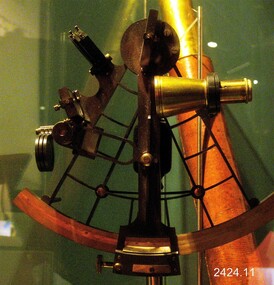
... Street, Glasgow. At these premises, the company continued to make the compass Thomson had designed during the 1870s and to supply it in some quantity, especially to the Admiralty. At the same time, the firm became increasingly involved in the design, production and sale of electrical apparatus. In 1899, Lord...Street, Glasgow. At these premises, the company continued to make the compass Thomson had designed during the 1870s and to supply it in some quantity, especially to the Admiralty. At the same time, the firm became increasingly involved in the design, production and sale of electrical apparatus. In 1899, Lord ...In 1941, the scientific instrument manufacturing firms of Henry Hughes & Son Ltd, London, England, and Kelvin Bottomley & Baird Ltd, Glasgow, Scotland, came together to form Kelvin & Hughes Ltd. Kelvin Company History: The origins of the company lie in the highly successful and strictly informal relationship between William Thomson (1824-1907), Professor of Natural Philosophy at Glasgow University from 1846-1899 and James White, a Glasgow optical maker. James White (1824-1884) founded the firm of James White, an optical instrument maker in Glasgow in 1850 and was involved in supplying and mending apparatus for Thomson university laboratory and working with him on experimental constructions. White was declared bankrupt in August 1861 and released several months later. In 1870, White was largely responsible for equipping William Thomson laboratory in the new University premises at Gilmore hill. From 1876, he was producing accurate compasses for metal ships to Thomson design during this period and this became an important part of his business in the last years of his life. He was also involved in the production of sophisticated-sounding machinery that Thomson had designed to address problems encountered laying cables at sea, helping to make possible the first transatlantic cable connection. At the same time, he continued to make a whole range of more conventional instruments such as telescopes, microscopes and surveying equipment. White's association with Thomson continued until he died. After his death, his business continued under the same name, being administered by Matthew Edwards (until 1891 when he left to set up his own company. Thomson who became Sir William Thomson and then Baron Kelvin of Largs in 1892, continued to maintain his interest in the business after James White's death. In 1884 raising most of the capital needed to construct and equip new workshops in Cambridge Street, Glasgow. At these premises, the company continued to make the compass Thomson had designed during the 1870s and to supply it in some quantity, especially to the Admiralty. At the same time, the firm became increasingly involved in the design, production and sale of electrical apparatus. In 1899, Lord Kelvin resigned from his University chair and became, in 1900, a director in the newly formed limited liability company Kelvin & James White Ltd which had acquired the business of James White. At the same time Kelvin's nephew, James Thomson Bottomley (1845-1926), joined the firm. In 1904, a London branch office was opened which by 1915 had become known as Kelvin, White & Hutton Ltd. Kelvin & James White Ltd underwent a further change of name in 1913, becoming Kelvin Bottomley & Baird Ltd. Hughes Company History: Henry Hughes & Sons were founded in 1838 in London as a maker of chronographic and scientific instruments. The firm was incorporated as “Henry Hughes & Sons Ltd” in 1903. In 1923, the company produced its first recording echo sounder and in 1935 a controlling interest in the company was acquired by S Smith & Son Ltd resulting in the development and production of marine and aircraft instruments. Following the London office's destruction in the Blitz of 1941, a collaboration was entered into with Kelvin, Bottomley & Baird Ltd resulting in the establishing “Marine Instruments Ltd”. Following the formal amalgamation of Kelvin, Bottomley & Baird Ltd and Henry Hughes & Sons Ltd in 1947 to form Kelvin & Hughes Ltd. Marine Instruments Ltd then acted as regional agents in the UK for Kelvin & Hughes Ltd who were essentially now a part of Smith's Industries Ltd founded in 1944 and the successors of S. Smith & Son Ltd. Kelvin & Hughes Ltd went on to develop various marine radar and echo sounders supplying the Ministry of Transport, and later the Ministry of Defence. The firm was liquidated in 1966 but the name was continued as Kelvin Hughes, a division of the Smiths Group. In 2002, Kelvin Hughes continues to produce and develop marine instruments for commercial and military. G. Falconer Company History: G Falconer (Hong Kong Ltd) appear to have had a retail presence in Hong Kong since 1885, according to the company website, and currently have a shop in the Peninsula Hotel. G Falconer was the Hong Kong selling agent for several British companies. Ross Ltd of 111 New Bond St London was one and the other was Kelvins Nautical Instruments. Falconers were primarily watchmakers, jewellers and diamond merchants.They were also agents for Admiralty Charts, Ross binoculars and telescopes, and sold English Silverware and High Class English Jewellery. In 1928 the company was operating from the Union Building opposite the Hong Kong general post office. It is unclear if the item is an original Sextant made by Kelvin prior to his amalgamation with Henry Hughes & Sons in 1941 as Kelvin appears to have only made compasses up to this date. If the Sextant can be established that it was made by Kelvin then it is very significant and a rare item made for and distributed through their Hong Kong selling agents G Falconer Ltd. There are many Sextants advertised for sale stating "Kelvin & Hughes 1917 model sextant". These can be regarded as replicas as the company was not formed until 1941 and production of marine instruments was not fully under way until after the war in 1947. Further investigation needs to be undertaken to accurately determine the provenance of this item. As the writer currently has the impression that the subject object was possibly made by Kelvin and Hughes in the mid to late 20th century or is a replica made by an unknown maker in the late 1970s. Purchased as an exhibition of marine navigational instruments for the Flagstaff Hill museum. The Sextant is a brass apparatus with filters and telescope lens, and comes with a wooden felt lined storage box. It is a doubly reflecting navigation instrument that measures the angular distance between two visible objects. The primary use of a sextant is to measure the angle between an astronomical object and the horizon for the purposes of celestial navigation.G Falconer and Co. Hong Kong (retailers of nautical equipmentflagstaff hill, warrnambool, shipwrecked-coast, flagstaff-hill, flagstaff-hill-maritime-museum, maritime-museum, shipwreck-coast, flagstaff-hill-maritime-village, sextant, kelvin & hughes ltd, hong kong, navigational instrument, g falconer, mariner's quadrants -
 Flagstaff Hill Maritime Museum and Village
Instrument - Optical, Telescope, 1869
... Street, Spitalfields in 1750 and in 1752 moved the business to the Strand London. The Dollonds seem to have made both types of telescopes (reflecting and refracting), possessing the technology to produce significant numbers of lenses free of chromatic aberration for refracting telescopes. A Dollond telescope sailed with Captain Cook in 1769 on his voyage to observe the Transit of Venus. Thomas Jefferson and Admiral Lord...Street, Spitalfields in 1750 and in 1752 moved the business to the Strand London. The Dollonds seem to have made both types of telescopes (reflecting and refracting), possessing the technology to produce significant numbers of lenses free of chromatic aberration for refracting telescopes. A Dollond telescope sailed with Captain Cook in 1769 on his voyage to observe the Transit of Venus. Thomas Jefferson and Admiral Lord ...The discovery of the first telescope in 1608 can be attributed to Hans Lippershey of the Netherlands when he discovers that holding two lenses up some distance apart bring objects closer. He applies for a patent on his invention and this becomes the first documented creation of a telescope. Then in 1668, Newton produces the first successful reflecting telescope using a two-inch diameter concave spherical mirror. This opened the door to magnifying objects millions of times far beyond what could ever be obtained with a lens. It wasn’t until 1729 that Chester Moor Hall develops an achromatic lens (two pieces of glass with different indices of light refraction combined produce a lens that can focus colours to almost an exact point resulting in much sharper images but still with some distortion around the edges of the image. Then in 1729 Scottish instrument maker James Short invents the first parabolic and elliptic, distortion-less mirror ideal for reflecting telescopes. We now come to John Dollond who improves upon the achromatic objective lens by placing a concave flint glass lens between two convex crown glass lenses. This had the effect of improving the image considerably. Makers Information: John Dollond (1707-1761) London England he was a maker of optical and astronomical instruments who developed an achromatic (non-colour distorting) refracting telescope and practical heliometer. A telescope that used a divided lens to measure the Sun’s diameter and the angles between celestial bodies. The son of a Huguenot refugees Dollond learned the family trade of silk weaving. He became proficient in optics and astronomy and in 1752 his eldest son, Peter joined his father in an optical business, in 1753 he introduced the heliometer. In the same year, he also took out a patent on his new lenses. He was elected a fellow of the Royal Society in May 1761 but died suddenly in November and his share in the patent passed to his son Peter. In subsequent squabbles between Peter and the many London opticians who challenged his patent, Peter’s consistent position was that, whatever precedents there may have been to his achromatic lenses, his father had independently reached his practical technique on the basis of his theoretical command of Newtonian optics. As a result of maintaining his fathers patent, Dollond s became the leading manufacturer of optical instruments. For a time in the eighteenth and nineteenth century the word 'Dollond' was almost a generic term for telescope rather like 'Hoover; is to vacuum cleaner. Genuine Dollond telescopes were considered to be amongst the best. Peter Dollond (1731-1820) was the business brain behind the company which he founded in Vine Street, Spitalfields in 1750 and in 1752 moved the business to the Strand London. The Dollonds seem to have made both types of telescopes (reflecting and refracting), possessing the technology to produce significant numbers of lenses free of chromatic aberration for refracting telescopes. A Dollond telescope sailed with Captain Cook in 1769 on his voyage to observe the Transit of Venus. Thomas Jefferson and Admiral Lord Nelson were also customers of the Dollonds. Dollond & Co merged with Aitchison & Co in 1927 to form Dollond & Aitchison, the well-known high street chain of opticians, now fully part of Boots Opticians. They no longer manufacture but are exclusively a retail operation. John Dollond's experiments in optics and how different combinations of lenses refract light and colour gave a better understanding of the divergent properties of lenses. That went on to inform and pave the way for the improvement of our understanding of optics that are represented today. Dollond was referred to in his time as the "Father of practical optics" as a leader in his field he received many prestigious awards. The telescope in the collection is a good example of one of Dollonds early library telescopes and its connection with one of England's 18th-century pioneers in optical development is in itself a significant and an important item to have within the collection. Telescope: one tube ships Day and Night telescope, with a brass inner tube and a timber main tube covered in leather. Made in 1869 by Dolland, London."Dolland London" "Day or Night" "Royal National Life Boat Institution" "1869"flagstaff hill, shipwreck coast, warrnambool, maritime museum, maritime village, telescope, dolland, night and day, royal national life boat instution -
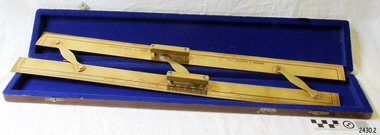 Flagstaff Hill Maritime Museum and Village
Parallel Rule, 1947-1950
... Street, Glasgow. At these premises, the company continued to make the compass Thomson had designed during the 1870s and to supply it in some quantity, especially to the Admiralty. At the same time, the firm became increasingly involved in the design, production and sale of electrical apparatus. In 1899, Lord...Street, Glasgow. At these premises, the company continued to make the compass Thomson had designed during the 1870s and to supply it in some quantity, especially to the Admiralty. At the same time, the firm became increasingly involved in the design, production and sale of electrical apparatus. In 1899, Lord ...Navigators use parallel rule with maps and charts for plotting a specific course on a chart. One long edge is used with the compass rose on the chart, aligning the centre of the rose with the desired direction around the edge of the rose. The compass bars are then ‘walked’ in and out across the map to the desired location so that lines can be plotted to represent the direction to be travelled. Kelvin Company History: The origins of the company lie in the highly successful and strictly informal relationship between William Thomson (1824-1907), Professor of Natural Philosophy at Glasgow University from 1846-1899 and James White, a Glasgow optical maker. James White (1824-1884) founded the firm of James White, an optical instrument maker in Glasgow in 1850 and was involved in supplying and mending apparatus for Thomson university laboratory and working with him on experimental constructions. White was declared bankrupt in August 1861 and released several months later. In 1870, White was largely responsible for equipping William Thomson laboratory in the new University premises at Gilmore hill. From 1876, he was producing accurate compasses for metal ships to Thomson design during this period and this became an important part of his business in the last years of his life. He was also involved in the production of sophisticated sounding machinery that Thomson had designed to address problems encountered laying cables at sea, helping to make possible the first transatlantic cable connection. At the same time, he continued to make a whole range of more conventional instruments such as telescopes, microscopes and surveying equipment. White's association with Thomson continued until he died. After his death, his business continued under the same name, being administered by Matthew Edwards until 1891 when he left to set up his own company. Thomson who became Sir William Thomson and then Baron Kelvin of Largs in 1892, continued to maintain his interest in the business after James White's death in 1884, raising most of the capital needed to construct and equip new workshops in Cambridge Street, Glasgow. At these premises, the company continued to make the compass Thomson had designed during the 1870s and to supply it in some quantity, especially to the Admiralty. At the same time, the firm became increasingly involved in the design, production and sale of electrical apparatus. In 1899, Lord Kelvin resigned from his University chair and became, in 1900, a director in the newly formed limited liability company Kelvin & James White Ltd which had acquired the business of James White. At the same time Kelvin's nephew, James Thomson Bottomley (1845-1926), joined the firm. In 1904, a London branch office was opened which by 1915 had become known as Kelvin, White & Hutton Ltd. Kelvin & James White Ltd underwent a further change of name in 1913, becoming Kelvin Bottomley & Baird Ltd. Hughes Company History: Henry Hughes & Sons were founded in 1838 in London as a maker of chronographic and scientific instruments. The firm was incorporated as “Henry Hughes & Sons Ltd” in 1903. In 1923, the company produced its first recording echo sounder and in 1935 a controlling interest in the company was acquired by S Smith & Son Ltd resulting in the development and production of marine and aircraft instruments. Following the London office's destruction in the Blitz of 1941, a collaboration was entered into with Kelvin, Bottomley & Baird Ltd resulting in the establishing “Marine Instruments Ltd”. Following the formal amalgamation of Kelvin, Bottomley & Baird Ltd and Henry Hughes & Sons Ltd in 1947 to form Kelvin & Hughes Ltd. Marine Instruments Ltd then acted as regional agents in the UK for Kelvin & Hughes Ltd who were essentially now a part of Smith's Industries Ltd founded in 1944 and the successors of S Smith & Son Ltd. Kelvin & Hughes Ltd went on to develop various marine radar and echo sounders supplying the Ministry of Transport, and later the Ministry of Defence. The firm was liquidated in 1966 but the name was continued as Kelvin Hughes, a division of the Smiths Group. In 2002, Kelvin Hughes continues to produce and develop marine instruments for commercial and military. This model parallel map ruler is a good example of the commercial diversity of navigational instruments made by Kelvin & Hughes after World War II. It was made in numbers for use by shipping after the second world war and is not particularly rare or significant for it's type. Also it was made no earlier than 1947 as the firms of Kelvin, Bottomley & Baird Ltd and Henry Hughes & Sons Ltd who took over from Smith & Sons were not amalgamated until 1947. It can therefor be assumed that this ruler was made during the company's transitional period to Kelvin & Hughes from Smith Industries Ltd.Brass parallel rule in wooden box with blue felt lining.Rule inscribed on front "Kelvin & Hughes Ltd" " Made in Great Britain"flagstaff hill, warrnambool, shipwrecked-coast, flagstaff-hill, flagstaff-hill-maritime-museum, maritime-museum, shipwreck-coast, flagstaff-hill-maritime-village, parallel rule, kelvin & hughes ltd, map ruler, plot direction, navigation, maps, echo sounder, kelvin & james white, lord kelvin, baron kelvin of largs, scientific instrument -
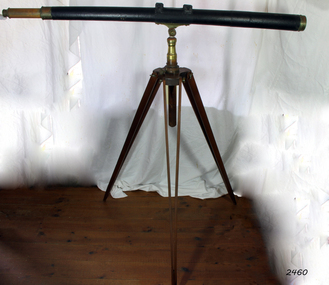 Flagstaff Hill Maritime Museum and Village
Instrument - Telescope, Mid-18th Century
... Lord Nelson. In 1781, Peter Dollond made bifocal spectacles. In 1804, young John Dollond passed away. The following year, Peter Dollond went into partnership with his nephew, George Huggins, and Huggins legally changed his surname to Dollond, and the firm remained P and J Dollond. In the early 20th century, the company sold film cameras. The firm remained in the hands of Dollond family members until 1927, when Dollond & Co. merged with James Aitchison & Co. to form Dollond & Aitchison, the well-known high street...Lord Nelson. In 1781, Peter Dollond made bifocal spectacles. In 1804, young John Dollond passed away. The following year, Peter Dollond went into partnership with his nephew, George Huggins, and Huggins legally changed his surname to Dollond, and the firm remained P and J Dollond. In the early 20th century, the company sold film cameras. The firm remained in the hands of Dollond family members until 1927, when Dollond & Co. merged with James Aitchison & Co. to form Dollond & Aitchison, the well-known high street ...This Day or Night telescope, made by John Dollond, was designed for use in a range of lighting conditions, as its name suggests. Telescopes are optical instruments that make distant objects appear larger and closer, thereby extending the range of what the human eye can observe. The development of the telescope was gradual, shaped by a series of important advances in optical science. In 1608, the Dutch spectacle-maker Hans Lippershey discovered that when two lenses were held apart in a particular way, distant objects appeared closer. He applied for a patent for this invention, creating the first documented telescope. In 1668, Isaac Newton produced the first successful reflecting telescope, using a two-inch concave spherical mirror. This marked a major step forward, demonstrating that mirrors could overcome some of the limitations of lenses and greatly improve magnification. Further progress followed in the eighteenth century. In 1729, Chester Moor Hall developed the achromatic lens by combining two types of glass with different refractive properties. This reduced colour distortion and produced a sharper image, although some edge distortion remained. That same year, the Scottish instrument maker James Short developed parabolic and elliptical mirrors that were better suited to reflecting telescopes because they reduced optical distortion. Building on these advances, John Dollond improved the achromatic objective lens by placing a concave flint-glass lens between two convex crown-glass lenses, considerably enhancing image quality. Maker’s information. John Dollond (1707–1761), of London, was a maker of optical, scientific and astronomical instruments best known for developing the achromatic refracting telescope. He also introduced a practical heliometer, a telescope fitted with a divided lens that could be used to measure the Sun’s diameter and the angular distance between celestial bodies. The son of Huguenot refugees, Dollond first learned the family trade of silk weaving before turning his attention to optics and astronomy, in which he became highly skilled. In 1753, Dollond patented his improved lenses, the same year he had introduced the heliometer. In 1761, John Dollond was appointed as optician to George III and the Duke of York. He was also elected a Fellow of the Royal Society in May 1761, but died suddenly later that year in November. His share of the patent then passed to his eldest son, Peter. In later disputes between Peter Dollond and rival London opticians who challenged the patent, Peter consistently argued that, whatever earlier precedents may have existed, his father had independently developed a practical method for producing achromatic lenses through his command of Newtonian optics. By successfully defending the patent, the Dollond firm became one of the leading manufacturers of optical instruments. During the eighteenth and nineteenth centuries, the name ‘Dollond’ was at times used almost generically to mean ‘telescope,’ reflecting the firm’s reputation. Genuine Dollond telescopes were regarded as among the finest available. Peter Dollond (1731–1820) was the driving force behind the family business. He had founded a small optical business in 1750 on Vine Street, Halton Garden, with his father's guidance. The success of the business led to his father joining him in partnership in 1752. In 1959, J Dollond and Son opened a shop on The Strand, London. Dollonds appear to have produced both reflecting and refracting telescopes, and they possessed the technical skill to manufacture significant numbers of lenses largely free from chromatic aberration. In 1766, Peter went into partnership with his younger brother, John, and they traded under the name P and J Dollond. They supplied optical instruments for Captain Cook and George Hadley, an English lawyer and Meteorologist. In 1769, Captain Cook travelled with a Dollond telescope on the voyage to observe the Transit of Venus. Other notable customers included Thomas Jefferson and Admiral Lord Nelson. In 1781, Peter Dollond made bifocal spectacles. In 1804, young John Dollond passed away. The following year, Peter Dollond went into partnership with his nephew, George Huggins, and Huggins legally changed his surname to Dollond, and the firm remained P and J Dollond. In the early 20th century, the company sold film cameras. The firm remained in the hands of Dollond family members until 1927, when Dollond & Co. merged with James Aitchison & Co. to form Dollond & Aitchison, the well-known high street chain of opticians, which continued making and selling prescription spectacles. Now fully part of Boots Opticians, the company no longer manufactures instruments and operates exclusively as a retail business. The telescope in the collection is an excellent example of one of Dollond’s early library telescopes. Its association with one of eighteenth-century England’s leading innovators in optical development gives it considerable historical significance and makes it an important object within the collection. John Dollond’s experiments in optics advanced the understanding of the divergent properties of lenses and made a lasting contribution to the development of practical optical science. His work helped lay the foundation for major improvements in the design and performance of optical instruments. In his own time, Dollond was celebrated as the “Father of practical optics” and received widespread recognition for his achievements in the field. Dollond telescopes were associated with the renowned mariners, Captain James Cook and Admiral Lord Nelson Telescope: Dollond's Telescope, Day or Night model navigational instrument. Telescope is mounted on wooden tripod stand that has folding legs. Brass telescope with leather sheath over barrel, adjustable angle fitting with brass wing nuts that join the legs to the top frame, which is then joined to the telescope pole by an adjustable screw fitting. Manufactured by Dollond, London. Inscription reads "Dollond London, Day or Night" and "DOLLOND LONDON"flagstaff hill maritime museum and village, maritime museum, maritime village, great ocean road, warrnambool, optical instrument, achromatic telescope, heliometer, light refraction, instrument maker, lens, transit of venus, astronomical telescope, concave lens, scientific instrument, navigation, navigational instrument, astronomy, dollond, dollond london, john dollond, peter dollond, dollond telescope, day or night telescope, floor-standing telescope, library telescope, hans lippershey, isaac newton, chester moor hall, james short, captain cook, thomas jefferson, admiral lord nelson, dollond & co, aitchison & co, dollond & aitchison, boots opticians, george iii, duke of york, george huggins, george dollond, p and j dollond, j dollond and son, spectacles, cameras -
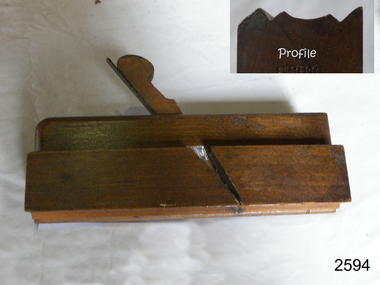 Flagstaff Hill Maritime Museum and Village
Tool - Wood moulding Plane, Christopher Gabriel, 18th Century
... Street and 1793 purchased the house next door. At the time of his death in 1808, he owned twenty-seven houses and commercial building. Christopher Gabriel s descendants became quite prominent in England and his grandson, Sir Thomas Gabriel became the Sheriff of London and Middlesex in 1859 and the Lord Mayor of London 1866 and 1867. ...Street and 1793 purchased the house next door. At the time of his death in 1808, he owned twenty-seven houses and commercial building. Christopher Gabriel s descendants became quite prominent in England and his grandson, Sir Thomas Gabriel became the Sheriff of London and Middlesex in 1859 and the Lord Mayor of London 1866 and 1867. ...The story of Christopher Gabriel born on April 2, 1746, in Falmouth England is a tale of a poor boy who made good. Shortly before he turned thirteen years of age in 1759 he was apprenticed to a local master carpenter, recorded as a Mr Barnicot the master trained his apprentice well as we can assume by Christopher's later successes. The apprenticeship ended in 1766 after seven years when Christopher reached twenty. Then in 1768, he relocated to London walking the two hundred miles from Falmouth carrying his possessions in a sack. He no sooner arrived in London when he met Alice Trowell who became his wife in March 1769. They set up house on Albermarie Street Clerkenwell and by the first of 1770, Gabriel had begun his business of plane making. It has been speculated that Gabriel took over the shop of John Cogdell aided with an investment from his in-laws of 131 pounds. He went on to prosper as a plane maker and lumber merchant over the next forty years. His business did well and in 1774 Gabriel moved to a house in Golden Lane, London and 1779 moved again to a home in Ould Street London. By now Gabriel was making a name for himself and his business at this time was located at 32 Banner Street Golden Lane, the following year he purchased another home in Banner Street and 1793 purchased the house next door. At the time of his death in 1808, he owned twenty-seven houses and commercial building. Christopher Gabriel s descendants became quite prominent in England and his grandson, Sir Thomas Gabriel became the Sheriff of London and Middlesex in 1859 and the Lord Mayor of London 1866 and 1867. Gabriel was an extremely prolific plane maker with a lot of examples made in the 18th century can still be found today. He made good quality tools and was an innovator of several new plane designs. A vintage tool made by a well-known plane maker, this item was made commercially for firms and individuals that worked in wood and needed a tool that could give a decorative finish to timber. These planes came in various shapes and sizes to achieve a finish to timber surfaces and came in many sizes. A significant Christopher Gabriel plane from the mid to late 18th century that after 200 years can still be used today. Planes made by Gabriel are eagerly sought after by collectors. The tool gives us a snapshot of how furniture and other finishes were created on timber by the use of cutting edged hand tools. Tools that were themselves hand made shows the craftsmanship used during this time not only to make a tool such as the subject item but also the craftsmanship needed to produce a decorative or even finish that was needed for the finishing of timber items. Plane Moulding Reverse Ogee with two squares type Maker stamped Gabriel also stamped JB & No 9flagstaff hill, warrnambool, shipwrecked-coast, flagstaff-hill, flagstaff-hill-maritime-museum, maritime-museum, shipwreck-coast, flagstaff-hill-maritime-village -
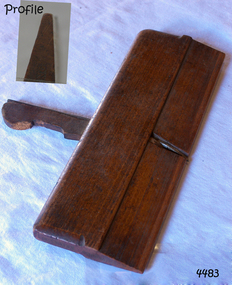 Flagstaff Hill Maritime Museum and Village
Tool - Moulding Plane, 1770-1809
... Street and 1793 purchased the house next door. At the time of his death in 1808, he owned twenty-seven houses and commercial building. Christopher Gabriel s descendants became quite prominent in England and his grandson, Sir Thomas Gabriel became the Sheriff of London and Middlesex in 1859 and the Lord Mayor of London 1866 and 1867. ...Street and 1793 purchased the house next door. At the time of his death in 1808, he owned twenty-seven houses and commercial building. Christopher Gabriel s descendants became quite prominent in England and his grandson, Sir Thomas Gabriel became the Sheriff of London and Middlesex in 1859 and the Lord Mayor of London 1866 and 1867. ...The story of Christopher Gabriel born on April 2, 1746, in Falmouth England is a tale of a poor boy who made good. Shortly before he turned thirteen years of age in 1759 he was apprenticed to a local master carpenter, recorded as a Mr Barnicot the master trained his apprentice well as we can assume by Christopher's later successes. The apprenticeship ended in 1766 after seven years when Christopher reached twenty. Then in 1768, he relocated to London walking the two hundred miles from Falmouth carrying his possessions in a sack. He no sooner arrived in London when he met Alice Trowell who became his wife in March 1769. They set up house on Albermarie Street Clerkenwell and by the first of 1770, Gabriel had begun his business of plane making. It has been speculated that Gabriel took over the shop of John Cogdell aided with an investment from his in-laws of 131 pounds. He went on to prosper as a plane-maker and lumber merchant over the next forty years. His business did well and in 1774 Gabriel moved to a house in Golden Lane, London and 1779 moved again to a home in Ould Street London. By now Gabriel was making a name for himself and his business at this time was located at 32 Banner Street Golden Lane, the following year he purchased another home in Banner Street and 1793 purchased the house next door. At the time of his death in 1808, he owned twenty-seven houses and commercial building. Christopher Gabriel s descendants became quite prominent in England and his grandson, Sir Thomas Gabriel became the Sheriff of London and Middlesex in 1859 and the Lord Mayor of London 1866 and 1867. Gabriel was an extremely prolific plane-maker with a lot of examples made in the 18th century can still be found today. He made good quality tools and was an innovator of several new plane designs. A vintage tool made by a well-known plane-maker, this item was made commercially for firms and individuals that worked in wood and needed a tool that could give a decorative finish to timber. These planes came in various shapes and sizes to achieve a finish to timber surfaces and came in many sizes. A significant Christopher Gabriel plane from the mid to late 18th century that after 200 years can still be used today. Planes made by Gabriel are eagerly sought after by collectors. The tool gives us a snapshot of how furniture and other finishes were created on timber by the use of cutting edged hand tools. Tools that were themselves hand made shows the craftsmanship used during this time not only to make a tool such as the subject item but also the craftsmanship needed to produce a decorative or even finish that was needed for the finishing of timber items. Side Rabbet Plane Stamped Maker Gabriel (owner M Hobling).flagstaff hill, warrnambool, shipwrecked-coast, flagstaff-hill, flagstaff-hill-maritime-museum, maritime-museum, shipwreck-coast, flagstaff-hill-maritime-village, side rabbet plane, gabriel m hobling -
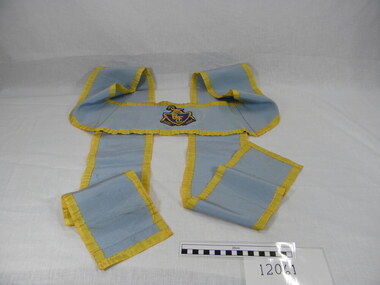 Federation University Historical Collection
Ballarat Teachers' College Ceremonial Collar, Unknown
... The college re-commenced at SS Dana Street, under the guidance of Mr W.F. Lord, M.C., M.M., B.A., Dip. ...The college re-commenced at SS Dana Street, under the guidance of Mr W.F. Lord, M.C., M.M., B.A., Dip. ...Worn by the principal of Ballarat Teachers' College over black academic gown at formal assemblies. Ellwood was the Principal of the Ballarat Teachers' College. Ballarat Teachers’ College was opened on 04 May 1926, at S.S. 33 Dana Street, with an enrolment of 61 students. Its original staff consisted of the Principal, Mr W.H. Ellwood, M.A., M.Ed. (Chairman of the Teachers’ Tribunal from its inception in 1946 until 1954), Miss A. Bouchier, B.A., and Mr A.B. Jones, BA., (lecturers). In 1927 Miss P.A. Hamano joined the staff. In 1927 the college moved to the old Ballarat East Town Hall (remodelled for their use) in Barkly Street. During 1927 the numbers in the College were augmented by 26 Manual Arts students, who had formerly received their training at Ballarat High School. Manual Art students continued till 1930 when, on grounds of economy, their training was concentrated at Melbourne Teachers’ College. During the four succeeding years, approximately 60 students annually entered the primary course. Inclusive of Manual Arts students, and private fee-paying students, exactly 400 trainees passed through the College in its brief span of life (1926-1931). Five per cent of each year’s students were granted an extension of their studentship to enable them to proceed to Melbourne Teachers’ College, and to take the first year’s course for a University degree. With the advent of the economic depression of the ‘thirties, Ballarat Teachers' College closed its doors in December, 1931. Fourteen years were to pass before the College opened again on February 2nd, 1946. The college re-commenced at SS Dana Street, under the guidance of Mr W.F. Lord, M.C., M.M., B.A., Dip. Ed., (acting, later Principal 1946-1950) and a staff consisting of Miss E.B. Hughes, B.A., Dip. Ed., Mr C.B. Bryan, B.A., B. Com., Dip. Ed., Miss Monica H. Miller, L.Mus.A., and Miss G. Kentish, Dip. Phys. Ed. The opening ceremony was performed by the Minister of Education at that time, the Hon. F. Field, M.L.A., accompanied by the Hon. T.T. Hollway, M.L.A., and the then Director of Education, Mr J.A. Seitz. It was originally intended to cater for women students only but, at the last moment, men resident in Ballarat were also accepted. A co-educational college was thus set up instead, and it has continued as such. 1951 saw the introduction of the two-year course, successful students being presented with the Trained Primary Teacher’s Certificate at the final College Assembly each year. In December 1955, College held its first Graduation Ceremony, with its own Graduation Hymn, the words of which were written by Miss C.M. (Mavis) Canty of the staff. Lord remained as principal until 1951 when he transferred to establish a teachers' college at Toorak. Tom William Turner was Lord's successor. A highlight of his term was the construction of new college buildings at Gillies Street with the students commencing their lessons there in February 1958. Turner retired in 1970, having overseen a period of substantial growth in the institution. In that year alone more than one hundred and forty students completed their primary teaching qualification to meet a severe shortage of teachers. Doug Watson commenced as principal in 1971. In 1973 Ballarat Teachers' College became the State College of Victoria at Ballarat. Three years later Ballarat College of Advanced Education was formed and the teacher education students moved to the Mount Helen Campus. In 1990 Ballarat College of Advanced Education became Ballarat University College, an affiliated college with the University of Melbourne. The University of Ballarat was formed in January 1994.Light blue grosgrain sash, bound in yellow taffeta, sewn by machine. Two mitred seams, one at each shoulder, hand sewn and two seams machine stitched on straight part of sash. A BTC insignia is placed in the centre back. The insignia is stitched in yellow, royal blue and dark blue cotton. This sash is hand sewn at the end of one side length, in order to shorten it. Extra Muros (Beyond the Wall) on insignia BTC (Ballarat Teachers' college)education, teaching, assembly, btc, ballarat teachers college, university of ballarat, regalia, ceremony, graduation, stoll, balalrat teachers' college -
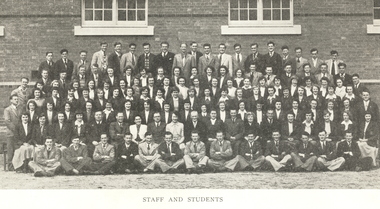 Federation University Historical Collection
Book, Extra Muros, 1950, 1950
... 1946 Ballarat Teachers’ College reopened at Dana Street State School (no. 33) offering a one year course. The principal was W.F. Lord, and the staff consisted of Miss E.B. ...1946 Ballarat Teachers’ College reopened at Dana Street State School (no. 33) offering a one year course. The principal was W.F. Lord, and the staff consisted of Miss E.B. ...1946 Ballarat Teachers’ College reopened at Dana Street State School (no. 33) offering a one year course. The principal was W.F. Lord, and the staff consisted of Miss E.B. Hughes, Mr C.B. Bryan, Miss Monica H. Millar (music), Miss G. Kentish (physical education) Charcoal blue cover with gold titles. Magazine of the Ballarat Teachers' College. The magazine includes the events of the year and advertisements, Principa Frank Lord's Foreword " A good way to relieve the monotony of any job is to think of ways of improving it"; Sport; The Australian Soldier; Hockey Team, Basketball Team; Football Team The magazine included many photographs, including a whole College photograph; Student Representative Council and Group Leaders; Sport Committee Names reading from right to left. Back Row: J.R. Stuchberry, M.F. Ross, L.H.T. Melgaard, G.J.A. Walker, R.J. Lane, T.P. Newton, J.I. Fielding, I.T. Bicknell, R.W. Bayly, J.W. Allan, J.D.J. Rochford, D.A. Farquhar, M.J. Binder, J.G. Segrave, A.T.G. Jennings. David van Leeuwen, E.J. Campbell, J. Woods, N.J. Walker. Second row: V.G. Telushkin, Noel G. Tresize, A.V. Ainge, K.R.B. Skeen, R.G. Hucker, W.A> Poole, M.I. McKenzie, M.M. Molan, P.A. Davey, M.D. Oppy, B.F. Collins, Y.M. Mittchell, A.W. Frith, M.T. O'Brien, P.M. Hanrahan, B.J. Dunsmore, C. Judd, Val G. Pyers, B.L. Shirley. Third row: G.M. Wise, E.M. Rowe, M.M. Napier, A.C. Swanton, B.J. Young, F.M. Stacpoole, P.M. Kelly, S.F. Gardenr, G.M. McCarthy, D. Flanagan, M.J. [Joyce] Murphy, P.M. McIntyre, M.M. green, N.Y. Chappell, J. Kemp, N.B. Forrest, L.J. Scholfield, M.M. Cross, M.J. Burchell, M.A. Leask, A.P. Cunningham, R. Hodgens Fourth Row: S.T. Downs, E.R. Quick, M.J. Krick, D.F. Nicholson, L.O. Quick, C.E. Douglass, F.E. Miller, G. McKenzie, J.N. Lindsay, J.J. Powling, M.V. Langdon, S.R. Wimdmill, G.M. Walton, J.A. Walker, P. Jaensch, G.M. Hoare, B.M. Sweeney, G.J. Monk, D. Keiller, D.M. Ross, B.S. Alderson, O.M. Ball, B.K. Macdonald. Fifth Row: E.W. Munn, H.E. Oxley, M.T. Ryan, M.M. Magee, V.O. Dick, F.K. Curtain, E.A. O'Brien, M.D. MacDonald, M.R. Rafferty, E.V. Bowles, W.D. Batten, E.M. Lawlor, A.Y. Callaway, L.B. Flanders, D.M. McLean, M.J. Whitelock, C.A. Tonzing, B. Nolan. Sixth Row: N.M. Young, W.E. Ramsey, A.P. Maloney, R.E. Botsman, B.M. Barr, Mr McEwin, Miss Aldred, Mr Turner, Miss Hughes, Mr Lord, Monica Miller, Mr Bryan, Miss Hayes, Mr Cumming, Alan Sonsee, V.D. Trainor, M.P. Dwyer, M.D. Chisholm, E. Hodge. Seated: B.S. Murphy, N.G. Schulz, A.W. Gunn, A.W. Thompson, K.J. Tobin, R.W. Chalmers, D.C. Halladay, C.J. R Fellows, J.L. Sheehan, G.E. Mann, L.A. Erdman, G.F. Brown, H.D. Graham. Absent: Y. McLeod, T.G. Philpottbtc, ballarat teachers college, g walker, n walker, e hughes, l erdman, l melgaard, b young, s winmill, v pyers, f stacpoole, r botsman, r fellows, b macdonald, b thompson, i bicknell, j sheehan, r hodgens, m cross, b sweeny, p jaensch, d keiller, s windmill, d flanagan, van leeuwed, joyce murphy, monica miller, v. pyers, val pyers, frank lord, graham turner, norman schulz, richard bayly, mardi chisholm, ron lane, george telushkin, betty roberts, bob newman, jack hickson, nancy lees
