
Showing 580 items matching "made in japan"
-
 Warrnambool and District Historical Society Inc.
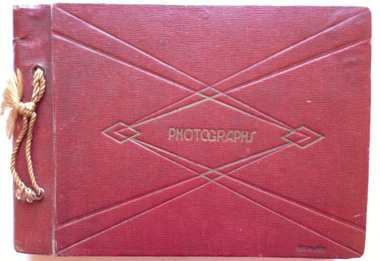
Album - McGennan photograph album, Made in Japan
... Made in Japan...Some photographs removed Album McGennan photograph album Made in Japan ...Warrnambool people and places. Small. medium and 1 large photographShow people and places in and around Warrnambool. WW11Maroon leatherette cover with linear embossing. 22 black thick paper pages laced and tied on front cover with two cords. Loose and photographs arranged on pages with photo corners. Some photographs removedEmbossed with gold printing and line decorationphotographs, album, photos, warrnambool photographs, warrnambool -
 Ballarat Tramway Museum
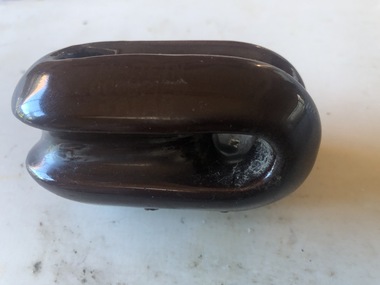
Functional Object - Insulator for tramway overhead - made in Japan, c1950
... Insulator for tramway overhead - made in Japan...Marked in a very light almost clear finish on one side "Made in Occupied Japan" See item 8534 for another example - a larger size. ...The tags, labels, marks were placed on the items in Japan, before they were exported to other countries. " Functional Object Insulator for tramway overhead - made in Japan ...Its manufacture demonstrates from an industrial aspect a period of history following the occupation of Japan by the USA after the second world war and has a strong association with this event.Insulator - known as an egg type - ceramic - fired clay (porcelain) finished with a brown colour with two holes for span wire with the holes offset to each other. Marked in a very light almost clear finish on one side "Made in Occupied Japan" See item 8534 for another example - a larger size. https://www.gotheborg.com/glossary/occupiedjapan.shtml - accessed 15/4/20201 gives some background: "For the period from the end of World War II in 1945 through April 28, 1952, the United States and its Allies occupied Japan. The Occupation involved approximately 130,000 Americans (both military and civilian) and about 35,000 British Troops based in Japan. SCAP (Supreme Commander for the Allied Powers), led by General MacArthur, wrote a new constitution for Japan. As Japan needed to rebuild their economy after the war, part of the agreement to allow them to export goods out of their country was that they had to mark 50% of all items with "Occupied Japan" or "Made in Occupied Japan." This could be done with a paper label, cloth label (as on scarves, doilies, clothing), engraved, handwritten or stamped. Thus, you may come across things, such as a salt and pepper set, where only one of the pair is marked OJ and the other will just have "Japan" on it. The tags, labels, marks were placed on the items in Japan, before they were exported to other countries. "trams, tramways, overhead, trolley wire, insulation, electrical equipment -
 Flagstaff Hill Maritime Museum and Village
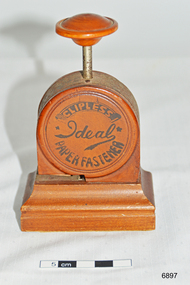
Functional object - Paper Fastener, 1919-1923
... ideal paper fastener made in japan...It was manufactured and sold in Japan but also exported to England. The case is made of stained wood with the fastening mechanism made of polished steel. ...Branded Ideal Clipless Paper Fastener, made in Japan. Push down action on wooden handle, metal cutting mechanism cuts and folds the cut flap to join two pieces of paper. ...Printed on sides “IDEAL CLIPLESS PAPER FASTENER” and “TRADE MARK (K with a C through it) PATENT NO. 45105 46743” and stamped into base "MADE IN JAPAN"...Branded Ideal Clipless Paper Fastener, made in Japan. Push down action on wooden handle, metal cutting mechanism cuts and folds the cut flap to join two pieces of paper. ...The Ideal Clipless Paper Fastener is what is known as a stapleless stapler. It uses the Bump fastening method which was patented in the U.S. in 1911. The Ideal measures 4.75″ H x 3.125″ W x 1.875″ L and weighs 6.5 ounces. It was manufactured and sold in Japan but also exported to England. The case is made of stained wood with the fastening mechanism made of polished steel. From unsubstantiated sources I understand the wood is Japanese Boxwood, but I cannot verify that at this time. The markings on the front and reverse are done in black paint. The two patents listed on the reverse side of the fastener are Japanese patents. They were granted in March and September 1918 respectively. The patents were granted to two different men. The letters CK on the reverse of the fastener seem to be the initials of the two patent holders. If the design of a C superimposed over the K is a trademark as indicated, it would imply that the two patent holders went into business together to manufacture the Ideal Fastener. I’ve been unable to determine fully the names of the patent holders, but the K seems to refer to a Mr. Kuroda who was the author of the later patent. The Ideal fastener was sold alongside the Clipless Stand Machine (available 1911-1923) and Bump Fasteners in Japan. The latest patent number on the Ideal is from September 1918. Furthermore, there was also an all-steel model of the Ideal Clipless Paper Fastener being sold in 1922. While the available evidence is both sparse and largely circumstantial, I believe the Ideal Clipless Paper Fastener would have been sold from 1919 until about 1923. Furthermore, with the availability of an all-steel model in 1922, it is likely that this newer model would have been introduced as the replacement for the wooden-cased version giving me further reason to believe that this would not have been sold after 1923. The fastener was donated to Flagstaff Hill Maritime Village by the family of Doctor William Roy Angus, Surgeon and Oculist. It is part of the “W.R. Angus Collection” includes historical medical equipment, surgical instruments and material once belonging to Dr Edward Ryan and Dr Thomas Francis Ryan, (both of Nhill, Victoria) as well as Dr Angus’ own belongings. The Collection’s history spans the medical practices of the two Doctors Ryan, from 1885-1926 plus that of Dr Angus, up until 1969. Dr. Angus was in England in the 1920’s and could very well have purchased the Ideal Clipless Paper Fastener during his study time there. It was donated to Flagstaff Hill Maritime Village by the family of Doctor William Roy Angus, Surgeon and Oculist. It is part of the “W.R. Angus Collection” and includes historical medical equipment, surgical instruments and material once belonging to Dr Edward Ryan and Dr Thomas Francis Ryan, (both of Nhill, Victoria) as well as Dr Angus’ own belongings. The Collection’s history spans the medical practices of the two Doctors Ryan, from 1885-1926 plus that of Dr Angus, up until 1969. ABOUT THE “W.R.ANGUS COLLECTION” Doctor William Roy Angus M.B., B.S., Adel., 1923, F.R.C.S. Edin.,1928 (also known as Dr Roy Angus) was born in Murrumbeena, Victoria in 1901 and lived until 1970. He qualified as a doctor in 1923 at University of Adelaide, was Resident Medical Officer at the Royal Adelaide Hospital in 1924 and for a period was house surgeon to Sir (then Mr.) Henry Simpson Newland. Dr Angus was briefly an Assistant to Dr Riddell of Kapunda, then commenced private practice at Curramulka, Yorke Peninsula, SA, where he was physician, surgeon and chemist. In 1926, he was appointed as new Medical Assistant to Dr Thomas Francis Ryan (T.F. Ryan, or Tom), in Nhill, Victoria, where his experiences included radiology and pharmacy. In 1927 he was Acting House Surgeon in Dr Tom Ryan’s absence. Dr Angus had become engaged to Gladys Forsyth and they decided he further his studies overseas in the UK in 1927. He studied at London University College Hospital and at Edinburgh Royal Infirmary and in 1928, was awarded FRCS (Fellow from the Royal College of Surgeons), Edinburgh. He worked his passage back to Australia as a Ship’s Surgeon on the on the Australian Commonwealth Line’s T.S.S. Largs Bay. Dr Angus married Gladys in 1929, in Ballarat. (They went on to have one son (Graham 1932, born in SA) and two daughters (Helen (died 12/07/1996) and Berenice (Berry), both born at Mira, Nhill ) According to Berry, her mother Gladys made a lot of their clothes. She was very talented and did some lovely embroidery including lingerie for her trousseau and beautifully handmade baby clothes. Dr Angus was a ‘flying doctor’ for the A.I.M. (Australian Inland Ministry) Aerial Medical Service in 1928 . Its first station was in the remote town of Oodnadatta, where Dr Angus was stationed. He was locum tenens there on North-South Railway at 21 Mile Camp. He took up this ‘flying doctor’ position in response to a call from Dr John Flynn; the organisation was later known as the Flying Doctor Service, then the Royal Flying Doctor Service. A lot of his work during this time involved dental surgery also. Between 1928-1932 he was surgeon at the Curramulka Hospital, Yorke Peninsula, South Australia. In 1933 Dr Angus returned to Nhill and purchased a share of the Nelson Street practice and Mira hospital (a 2 bed ward at the Nelson Street Practice) from Dr Les Middleton one of the Middleton Brothers, the current owners of what previously once Dr Tom Ryan’s practice. Dr Tom and his brother had worked as surgeons included eye surgery. Dr Tom Ryan performed many of his operations in the Mira private hospital on his premises. He had been House Surgeon at the Nhill Hospital 1902-1926. Dr Tom Ryan had one of the only two pieces of radiology equipment in Victoria during his practicing years – The Royal Melbourne Hospital had the other one. Over the years Dr Tom Ryan had gradually set up what was effectively a training school for country general-practitioner-surgeons. Each patient was carefully examined, including using the X-ray machine, and any surgery was discussed and planned with Dr Ryan’s assistants several days in advance. Dr Angus gained experience in using the X-ray machine there during his time as assistant to Dr Ryan. When Dr Angus bought into the Nelson Street premises in Nhill he was also appointed as the Nhill Hospital’s Honorary House Surgeon 1933-1938. His practitioner’s plate from his Nhill surgery is now mounted on the doorway to the Port Medical Office at Flagstaff Hill Maritime Village, Warrnambool. When Dr Angus took up practice in the Dr Edward and Dr Tom Ryan’s old premises he obtained their extensive collection of historical medical equipment and materials spanning 1884-1926. A large part of this collection is now on display at the Port Medical Office at Flagstaff Hill Maritime Village in Warrnambool. In 1939 Dr Angus and his family moved to Warrnambool where he purchased “Birchwood,” the 1852 home and medical practice of Dr John Hunter Henderson, at 214 Koroit Street. (This property was sold in1965 to the State Government and is now the site of the Warrnambool Police Station. and an ALDI sore is on the land that was once their tennis court). The Angus family was able to afford gardeners, cooks and maids; their home was a popular place for visiting dignitaries to stay whilst visiting Warrnambool. Dr Angus had his own silk worm farm at home in a Mulberry tree. His young daughter used his centrifuge for spinning the silk. Dr Angus was appointed on a part-time basis as Port Medical Officer (Health Officer) in Warrnambool and held this position until the 1940’s when the government no longer required the service of a Port Medical Officer in Warrnambool; he was thus Warrnambool’s last serving Port Medical Officer. (Masters of immigrant ships arriving in port reported incidents of diseases, illness and death and the Port Medical Officer made a decision on whether the ship required Quarantine and for how long, in this way preventing contagious illness from spreading from new immigrants to the residents already in the colony.) Dr Angus was a member of the Australian Medical Association, for 35 years and surgeon at the Warrnambool Base Hospital 1939-1942, He served with the Australian Department of Defence as a Surgeon Captain during WWII 1942-45, in Ballarat, Victoria, and in Bonegilla, N.S.W., completing his service just before the end of the war due to suffering from a heart attack. During his convalescence he carved an intricate and ‘most artistic’ chess set from the material that dentures were made from. He then studied ophthalmology at the Royal Melbourne Eye and Ear Hospital and created cosmetically superior artificial eyes by pioneering using the intrascleral cartilage. Angus received accolades from the Ophthalmological Society of Australasia for this work. He returned to Warrnambool to commence practice as an ophthalmologist, pioneering in artificial eye improvements. He was Honorary Consultant Ophthalmologist to Warrnambool Base Hospital for 31 years. He made monthly visits to Portland as a visiting surgeon, to perform eye surgery. He represented the Victorian South-West subdivision of the Australian Medical Association as its secretary between 1949 and 1956 and as chairman from 1956 to 1958. In 1968 Dr Angus was elected member of Spain’s Barraquer Institute of Barcelona after his research work in Intrasclearal cartilage grafting, becoming one of the few Australian ophthalmologists to receive this honour, and in the following year presented his final paper on Living Intrasclearal Cartilage Implants at the Inaugural Meeting of the Australian College of Ophthalmologists in Melbourne In his personal life Dr Angus was a Presbyterian and treated Sunday as a Sabbath, a day of rest. He would visit 3 or 4 country patients on a Sunday, taking his children along ‘for the ride’ and to visit with him. Sunday evenings he would play the pianola and sing Scottish songs to his family. One of Dr Angus’ patients was Margaret MacKenzie, author of a book on local shipwrecks that she’d seen as an eye witness from the late 1880’s in Peterborough, Victoria. In the early 1950’s Dr Angus, painted a picture of a shipwreck for the cover jacket of Margaret’s book, Shipwrecks and More Shipwrecks. She was blind in later life and her daughter wrote the actual book for her. Dr Angus and his wife Gladys were very involved in Warrnambool’s society with a strong interest in civic affairs. He had an interest in people and the community They were both involved in the creation of Flagstaff Hill, including the layout of the gardens. After his death (28th March 1970) his family requested his practitioner’s plate, medical instruments and some personal belongings be displayed in the Port Medical Office surgery at Flagstaff Hill Maritime Village, and be called the “W. R. Angus Collection”. [References; Ideal Clipless Paper Fastener, Antique Outings http://antiqueoutings.com/ideal-clipless-paper-fastener/ ; Australian College of Ophthalmologists, Vol 11, 1970.; Medical Directory of Australia listing, alphabetical says 1929, Royal College of Surgeons Edinburgh says 1928; Documents re Dr Angus from daughter Berry McDade, received at Flagstaff Hill Maritime; Portland Examiner, June 13, 1969; The Advertiser (Adelaide) 14th Nov, 1910 - Blind restored to sight – Dr Edward Ryan, Melbourne; The Hamilton Spectator, Wed 15th April 1914 – Ararat man with eye affliction attended to by Drs E & T Ryan; The Nhill Hospital, first 100 years, 1885-1985, by Jan Doust; The Horsham Times, Tuesday 6th January 1885 – Dr Edward Ryan appointed to Nhill Hospital; People who passed this way – Warrnambool and District Historical Society; Warrnambool Base Hospital Report 1969-1970 The Standard, 22/6/1990; The Argus, 1970; Letter to Mrs G Angus from John Lindsay, Flagstaff Hill, 8/5/1973; ] This Ideal Clipless Paper Fastener is significant as a rare example of a clipless paper fastener used as office stationery of the 1920’s. This Ideal Clipless Paper Fastener is significant for its association with the W.R. Angus Collection, which is significant for still being located at the site it is connected with, Doctor Angus being the last Port Medical Officer in Warrnambool. The collection of medical instruments and other equipment is culturally significant, being an historical example of medicine from late 19th to mid-20th century. Dr Angus assisted Dr Tom Ryan, a pioneer in the use of X-rays and in ocular surgery. Paper fastener, clipless or stapleless. Part of the W.R. Angus Collection. Branded Ideal Clipless Paper Fastener, made in Japan. Push down action on wooden handle, metal cutting mechanism cuts and folds the cut flap to join two pieces of paper. Stained wood base, sides and handle, floral fabric under base. Inscriptions on sides and base are in black paint print. Early to mid 1900’sPrinted on sides “IDEAL CLIPLESS PAPER FASTENER” and “TRADE MARK (K with a C through it) PATENT NO. 45105 46743” and stamped into base "MADE IN JAPAN"flagstaff hill, warrnambool, shipwrecked coast, flagstaff hill maritime museum, maritime museum, shipwreck coast, flagstaff hill maritime village, great ocean road, dr w r angus, dr ryan, surgical instrument, t.s.s. largs bay, warrnambool base hospital, nhill base hospital, mira hospital, flying doctor, ideal stapleless stapler, ideal clipless paper fastener, ideal paper fastener made in japan, paper fastener, office stationery, patent 45105 46743, ideal clipless paper fastener ck, logo ck c over k -
 Anglesea and District Historical Society
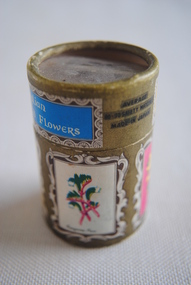
Safety Matches
... matches (made in japan)...Cardboard cylinder with 80-90 safety matches made in Japan. Pictures of four wildflowers in various coloures are spaced around the cylinder - Waratah, Sturt Pea, Kangaroo Paw, Wattle . ...matches (made in japan) Australian Wildflowers (white on blue and yellow background) . ...Cardboard cylinder with 80-90 safety matches made in Japan. Pictures of four wildflowers in various coloures are spaced around the cylinder - Waratah, Sturt Pea, Kangaroo Paw, Wattle . The top of the cylinder is see-through plastic while the bottom has the striker. Australian Wildflowers (white on blue and yellow background) . Pictures of flowers - Waratah, Sturt Pea, Kangaroo Paw, Wattle. Striker on bottom.matches (made in japan) -
 National Wool Museum
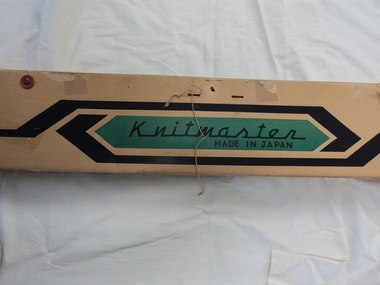
Knitting machine and instructions
... Large rectangle cardboard box (original) containing knitting machine. Made in Japan...One hour guide to instant knitting. Knitmaster. Made in Japan...Made in Japan Knitting machine and instructions ...Orange instruction booklet. Large rectangle cardboard box (original) containing knitting machine. Made in JapanOne hour guide to instant knitting. Knitmaster. Made in Japan -
 Flagstaff Hill Maritime Museum and Village
Ceramic - Vase, 1921-1932
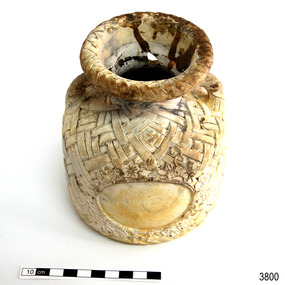
... The base of the vase is stamped ‘MADE IN JAPAN’ , which dates its probable manufacture to circa 1921-1932. ...Inscription stamped onto base. Made in Japan. ...Stamped onto base in black ink "MADE IN / JAPAN"...The base of the vase is stamped ‘MADE IN JAPAN’ , which dates its probable manufacture to circa 1921-1932. ...This Japanese ceramic vase was recovered from the wreck of the S.S. Casino (1882 – 1932) between the late 1960s to early 1970s. It is one of the shipwreck artefacts in the John Chance Collection. The design is an example of vintage basket weave pottery. The base of the vase is stamped ‘MADE IN JAPAN’ , which dates its probable manufacture to circa 1921-1932. The vase has side seams indicating that it was made by joining two moulded sides of the vase together, then adding the round base. The coastal trader SS Casino (1882–1932) had a run of almost 50 years along the coast of Western Victoria. She traded goods and food as well as carrying passengers from port to port on her many voyages. This vase may have been included in her cargo or could have been amongst the personal luggage of the people on board. The ceramic vase is an example of ceramic pottery in Victoria the 1930s. The vase is also significant as it was recovered by John Chance, a diver from the wreck of the Loch Ard in the 1960s-70s. Items that come from several wrecks along Victoria's coast have since been donated to the Flagstaff Hill Maritime Village’s museum collection by his family, illustrating this item’s level of historical value. The vase is also significant as it is associated with the S.S. Casino, which played an historical role in Western Victoria, providing transport, communication and trade along the coast between Melbourne and Portland in the late 19th and the early 20th century, visiting the ports at Apollo Bay, Warrnambool and Belfast (Port Fairy). The S.S. Casino was the only regular trader with normal passenger accommodation along the West Coast and the only Western District steamship that was in service between 1854 and 1939, and to be represented in the Victorian Heritage Shipwreck register, and to have been wrecked in the Western District, and to have the wreck located, and to be accessible to divers. The wreck of the S.S. Casino, and its associated relics, is considered an important part of Victorian and Australian cultural heritage and is now protected as a Historic Shipwreck under State and Commonwealth Law in the Commonwealth Historic Shipwrecks Act (1976). Vase, round, cream coloured, unglazed ceramic, basket weave design. Wide mouth, short neck that tapers out to wide shoulders and straight down to round base. Seams on each side, mouth to base. Small handle on each side of vase between mouth and shoulder. Front and back of vase have a plain oval space bordered by a floral design. Inscription stamped onto base. Made in Japan. Stamped onto base in black ink "MADE IN / JAPAN"flagstaff hill, warrnambool, flagstaff hill maritime museum, maritime museum, shipwreck coast, flagstaff hill maritime village, great ocean road, vase, japanese vase, s.s. casino, john chance, vintage pottery, newcastle and hunter river steam navigation company, belfast and koroit steam navigation company, west coast trader, apollo bay, captain middleton, basket weave, ceramic -
 Falls Creek Historical Society
Functional object - Peacock Hand Warmers
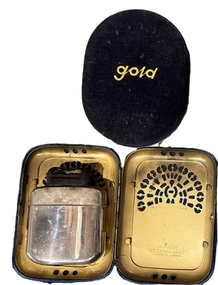
... The pocket warmer is a small, relatively flat device with a tank at the bottom and a burner mechanism a t the top. "PEACOCK/MADE IN JAPAN" is engraved near the burner. The warmer fits into a metal case which features a series of ventilation holes in the shape of a peacock's tail. ...JAPANESE PAT. 237413.483177 MADE IN JAPAN..."PEACOCK/MADE IN JAPAN" is engraved near the burner. The warmer fits into a metal case which features a series of ventilation holes in the shape of a peacock's tail. ...These mid-1960s Peacock and Gold brand lighter fuel hand warmers were used in Falls Creek to keep out the cold. The concept behind the hand warmer is that through combustion (ignition) of lighter fluid (light petrol distillate) it becomes a catalytic heater, relying on a catalysed chemical reaction to break down molecules and create heat. The devices could get quite hot, not hot enough to set paper on fire, but hot enough to give a nasty burn if sustained contact against your skin occurred. The construction of the device is very simple. There is very fine rolled wire mesh which fits on top of the reservoir body. After you fill the reservoir with lighter fluid, vapor pressure builds up. The device ignites by heating the grill with a match or lighter until it glows red. There is no open flame. The hand warmer also had a velvet bag to place it in after igniting to prevent direct skin contact. They were able to generate heat for up to a whole day. The Japanese company Yamato Shokai Ltd was founded in 1923 in the city of Osaka. Destroyed during air raids in 1945, the factory was rebuilt in 1946. They manufactured the Peacock brand pocket-warmer and sold it internationally.These items are significant because they were commonly used at Falls Creek.The pocket warmer is a small, relatively flat device with a tank at the bottom and a burner mechanism a t the top. "PEACOCK/MADE IN JAPAN" is engraved near the burner. The warmer fits into a metal case which features a series of ventilation holes in the shape of a peacock's tail. JAPANESE PAT. 237413.483177 MADE IN JAPANhand warmers, ski equipment 1960s -
 Bendigo Historical Society Inc.
Souvenir - Copper Tray: Souvenir of Bendigo, Unknown
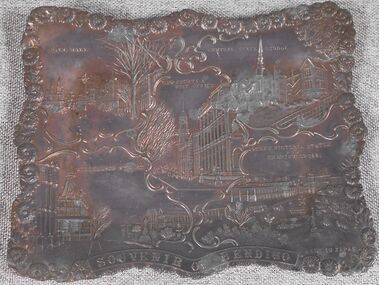
... ...Made in Japan...Bendigo Souvenir Copper Made in Japan Inscriptions identify various attractions in the central Bendigo area. ...Mass produced souvenir of Bendigo showing various scenes of parts of central Bendigo.Copper tray with various scenes of the centre of Bendigo including Pall Mall, Charing Cross, Law Courts and State School. Manufactured in Japan.Inscriptions identify various attractions in the central Bendigo area. 'Pall Mall'; 'Law Courts & Post Office'; Queen Vctoria Statue and Charing Cross'; 'Williamson Street'bendigo, souvenir, copper, made in japan -
 Bendigo Historical Society Inc.
Domestic Object - CHINA PLATES
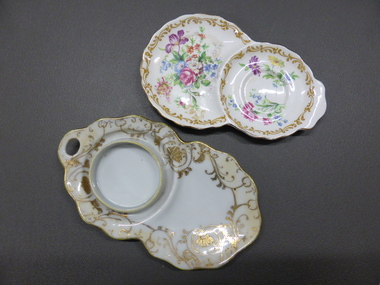
... White with gilded motifs. Hand painted made in Japan...Nosegay Crown Royal Albert Bone China England Peg No 839142 & Hand painted made in Japan...White with gilded motifs. Hand painted made in Japan Domestic Object CHINA PLATES ...Two china plates/saucers from Tennis sets. 1. White with floral motifs in various colours with gold decoration and gilding on edges. Nosegay Royal Albert Bone China England PEG No 39142 2. White with gilded motifs. Hand painted made in JapanNosegay Crown Royal Albert Bone China England Peg No 839142 & Hand painted made in Japandomestic equipment, table setting, plate -
 Warrnambool and District Historical Society Inc.
Cameras (2), Canon Co. Inc, Late 20th century
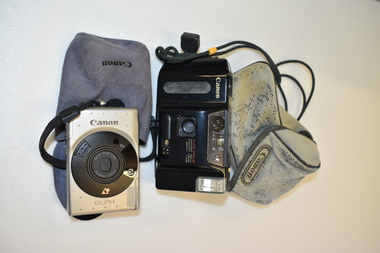
... These cameras were made in Japan by the Canon Company which dates from the 1930s. ....1 Canon Elph Canon Inc. Made in Japan 3104104 .2 Canon Sprint Approved JC11 ...These cameras were made in Japan by the Canon Company which dates from the 1930s. ...These cameras were made in Japan by the Canon Company which dates from the 1930s. Canon cameras were, and still are very popular as they are compact and have a simple ‘point and shot’ mechanism. The taking of family photographs has been a hobby for over 100 years.These cameras have no known local provenance but are retained for display purposes. .1 This is a Canon Elph Camera. It is rectangular in shape and mainly silver-coloured with a black lens. A black cord for holding the camera is attached. The camera is in a grey cloth bag. .2 This is a Canon Sprint camera. It is rectangular in shape and has a black body. A black cord for holding the camera is attached. The camera is in a buff-coloured cloth bag. This is slightly scuffed. .1 Canon Elph Canon Inc. Made in Japan 3104104 .2 Canon Sprint Approved JC11 canon cameras, history of warrnambool -
 Warrnambool and District Historical Society Inc.
Domestic object - Teapot, Mid 20th Century
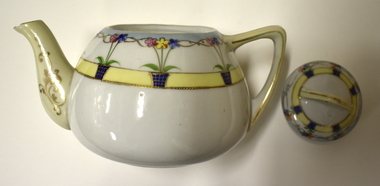
... Made in Japan ...Tea pot Vintage domestic item Tea making in Australia Made in Japan This is a white china teapot with a lid which contains a steam hole and a handle. ...Tea has always been a common drink in Australia and before the introduction of tea bags a teapot such as this was used to infuse the tea leaves. This item is a decorative piece and would have been used for special occasions. The use of tea bags in both teapots and cups became widespread in the 1960s in Australia. Tea bags are the popular choice today for tea drinkers.This item has no known local provenance but is retained as a fine example of a vintage tea pot. This is a white china teapot with a lid which contains a steam hole and a handle. The spout has gold patterning. The handle is painted yellow with a gold strip. The lid has a yellow and blue decorative band and is decorated with flowers and gold pattern. The body of the teapot has the same decoration as the lid. The name of the country of origin and a number are on the base. Made in Japan tea pot, vintage domestic item, tea making in australia -
 Bendigo Historical Society Inc.
Domestic Object - JAPANESE SAKI CUPS
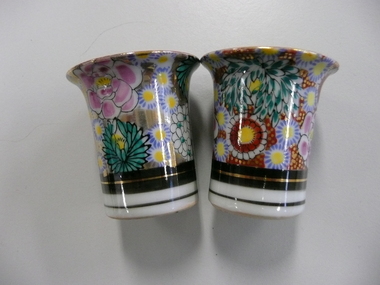
... Made in Japan...DOMESTIC EQUIPMENT Food consumption cups Made in Japan 2 small china Japanese Saki cups with floral design, black & gold banding and gilding inside. ...2 small china Japanese Saki cups with floral design, black & gold banding and gilding inside.Made in Japandomestic equipment, food consumption, cups -
 Bendigo Historical Society Inc.
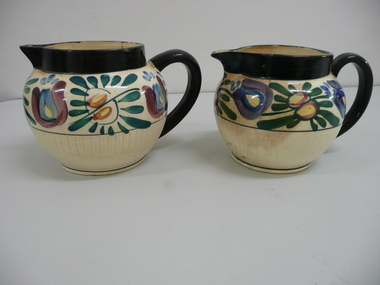
Functional object - PAIR CERAMIC JUGS
... Made in Japan...DOMESTIC EQUIPMENT Food consumption jugs K144.1 K144.2 Made in Japan Pair of cream china jugs with black rims and handles, floral decorations in tones of green, purple & blue. ...Pair of cream china jugs with black rims and handles, floral decorations in tones of green, purple & blue.Made in Japandomestic equipment, food consumption, jugs, k144.1 k144.2 -
 Bendigo Historical Society Inc.
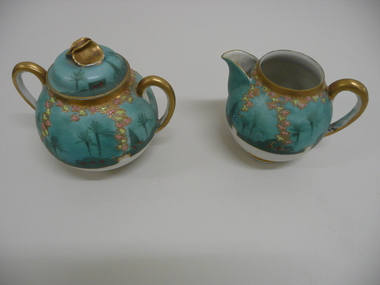
Functional object - CHINA JUG & SUGAR BOWL
... Made in Japan...DOMESTIC EQUIPMENT Table setting jug Made in Japan Japanese china milk jug & sugar bowl with lid, acqua colour with gold trim, decorated with palm trees & pink and gold enamel. ...Japanese china milk jug & sugar bowl with lid, acqua colour with gold trim, decorated with palm trees & pink and gold enamel.Made in Japandomestic equipment, table setting, jug -
 Bendigo Historical Society Inc.
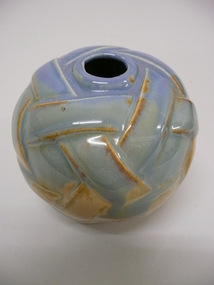
Functional object - CERAMIC VASE
... Made in Japan...ORNAMENTS Ceramic vase Made in Japan Small blue and cream vase with basket weave pattern and small opening in top. ...Small blue and cream vase with basket weave pattern and small opening in top.Made in Japanornaments, ceramic, vase -
 Bendigo Historical Society Inc.
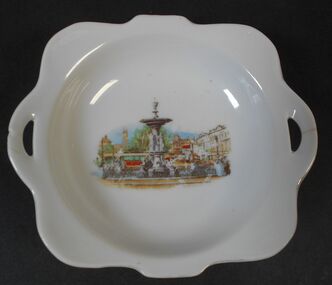
Memorabilia - Alexandra Fountain Souvenir Plate
... Made in Japan...Alexandra Fountain Bendigo Landmarks Made in Japan White shallow bowl with transfer of Alexandra Fountain in centre Memorabilia Alexandra Fountain Souvenir Plate ...Alexandra Fountain is a fountain in the Australian city of Bendigo, Victoria. It is regarded as one of the city's most prominent landmarks and monuments The fountain is located in Bendigo's Charing Cross area at the intersection of View Street and Pall Mall. Charing Cross effectively stands at the centre of the city and is one of Bendigo's busiest and most prominent intersections. The fountain stands opposite the main entrance of Rosalind Park. Alexandra Fountain was funded from the proceeds of the Bendigo Juvenile Industrial Exhibition (1879), a £500 gift from George Lansell and a further £700 from the Sandhurst City Council (now the City of Greater Bendigo). The fountain was designed by William Vahland (1828–1915), a local architect responsible for some of the city's most prominent buildings. The fountain was named in honour of Alexandra, Princess of Wales. Its grand opening on 5 July 1881 was attended by her sons Prince Albert and Prince George.White shallow bowl with transfer of Alexandra Fountain in centreMade in Japanalexandra fountain, bendigo landmarks -
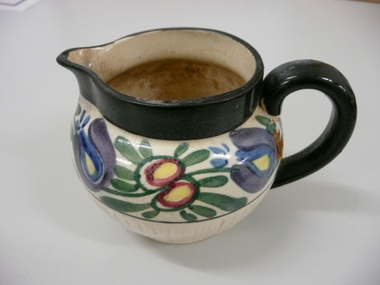 Bendigo Historical Society Inc.
Domestic Object - SMALL CERAMIC JUG
... Made in Japan...DOMESTIC EQUIPMENT Food consumption jugs Made in Japan Small ceramic jug with black handle and rim and floral decoration in tones of green, red, yellow & blue. ...Small ceramic jug with black handle and rim and floral decoration in tones of green, red, yellow & blue.Made in Japandomestic equipment, food consumption, jugs -
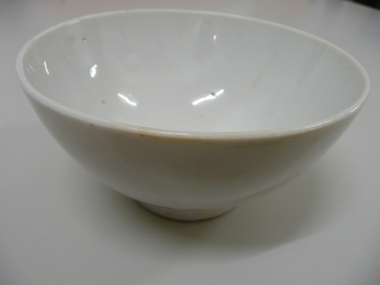 Bendigo Historical Society Inc.
Domestic Object - WHITE BOWL
... Made in Japan...DOMESTIC EQUIPMENT Food consumption bowls Made in Japan White glazed ceramic rice bowl with small foot. ...White glazed ceramic rice bowl with small foot.Made in Japandomestic equipment, food consumption, bowls -
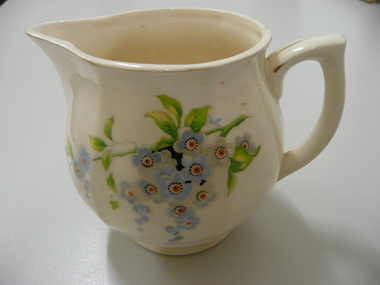 Bendigo Historical Society Inc.
Domestic Object - SMALL CHINA JUG
... Made in Japan...DOMESTIC EQUIPMENT Food consumption jugs Made in Japan Small white china jug decorated with floral design in shades of blue, green, black, orange and gold around rim and base & on handle. ...Small white china jug decorated with floral design in shades of blue, green, black, orange and gold around rim and base & on handle.Made in Japandomestic equipment, food consumption, jugs -
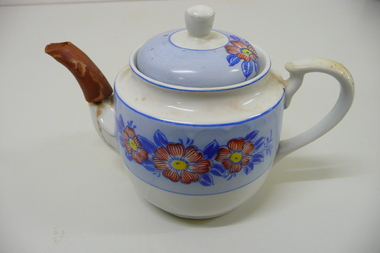 Bendigo Historical Society Inc.
Domestic Object - CHINA TEAPOT
... Made in Japan...DOMESTIC EQUIPMENT Food consumption teapot Made in Japan White china teapot with lid and rubber drip free spout end, decorated with blue banding and flowers of red, yellow and blue. ...White china teapot with lid and rubber drip free spout end, decorated with blue banding and flowers of red, yellow and blue.Made in Japandomestic equipment, food consumption, teapot -
 Coal Creek Community Park & Museum
Tool - Flower Frog
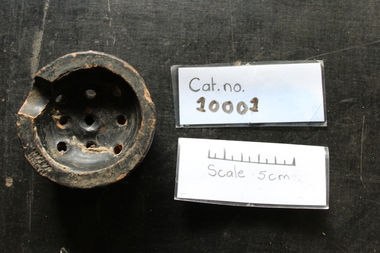
... Made in Japan...Made in Japan Flower frog, circa 1920s. Made of Clay, has 9 holes Small Chip in the Side Is Painted Black Rounded/Dome shape Tool Flower Frog ...Flower frog, circa 1920s. Made of Clay, has 9 holes Small Chip in the Side Is Painted Black Rounded/Dome shapeMade in Japan -
 Coal Creek Community Park & Museum
Domestic object - Tea Pot
... Made in Japan...Made in Japan Dark brown teapot with gold rims. ...Dark brown teapot with gold rims. Gold, orange and white picture on front and back. Lid missing.Made in Japan -
Coal Creek Community Park & Museum
Domestic object - Egg cup
... Made in Japan...Made in Japan White with gold rim ands trims, with neck and base. ...White with gold rim ands trims, with neck and base.Made in Japan -
 Brighton Historical Society
Jacket, Kimono, c.1960s
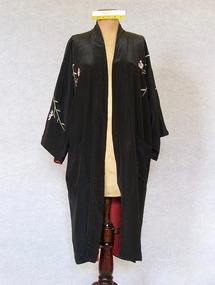
... "Made in Japan"...During her visit she met Alison, who autographed her book, and purchased this kimono jacket from the store. hooti couture alligators, old mink and new money kimono alison houtte vintage clothing di reidie 1960s "Made in Japan" Pure silk black kimono with red silk lining. ...This item is part of the Di Reidie collection. Diane Reidie was a much loved volunteer and President of Brighton Historical Society from 1999 until 2016. Originally from New Zealand, Di and her family lived in Male Street, Brighton for many years. A vibrant and energetic person with a zest for life and a gift for bringing people together, Di was a friend to many in the Bayside community and active in local community organisations. Her tireless work as President of BHS saw her named Bayside Citizen of the Year in 2008. As a seller and collector of vintage clothing, she was passionate about fashion history; one of her many enduring contributions to BHS was her extensive work in preserving, developing and promoting the Society's costume collection. In 2018-19, Di donated more than one hundred items from her personal vintage clothing collection to the Society. The collection, which includes clothing, hats, handbags and shoes from local and international designers, is representative of Di's wide-ranging interests, colourful personality, creativity, humour and love of fashion and travel. In 2006, as Di prepared for a trip to New York City, fellow BHS volunteer Liz Gay gifted her a copy of the book “Alligators, Old Mink and New Money” by vintage clothing dealer and former fashion model Alison Houtte. Between 1995 and 2015, ran the vintage and second hand clothing store Hooti Couture at 321 Flatbush Avenue, Brooklyn, and after reading the book Di was inspired to seek out the shop. During her visit she met Alison, who autographed her book, and purchased this kimono jacket from the store.Pure silk black kimono with red silk lining. The kimono features floral and leaf motif machine embroidery in pale pink and green."Made in Japan"hooti couture, alligators, old mink and new money, kimono, alison houtte, vintage clothing, di reidie, 1960s -
 Whitehorse Historical Society Inc.
Functional object - Crumb Brush, not known
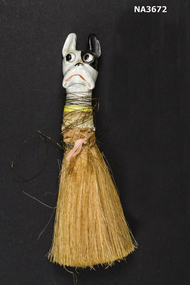
... Made in Japan....Brush is part of the collection of Lorna Broad DOMESTIC ITEMS Cleaning Made in Japan. Yellow horse hair bristles attached to china ornament in the shape of a dog's head. ...Brush is part of the collection of Lorna BroadYellow horse hair bristles attached to china ornament in the shape of a dog's head. Brush has been glued to head and bound with pink ribbon and gold metallic thread which was part of the ornament on the back.Made in Japan.domestic items, cleaning -
 Whitehorse Historical Society Inc.
Functional object - Pocket magnifier
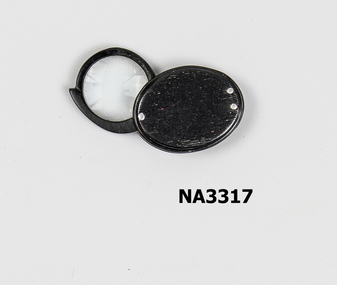
... Made in Japan...personal effects seeing aids Made in Japan A black oval plastic container with black plastic-edged magnifying glass that pivots on a metal hinge in and out of container Functional object Pocket magnifier ...A black oval plastic container with black plastic-edged magnifying glass that pivots on a metal hinge in and out of containerMade in Japanpersonal effects, seeing aids -
 Whitehorse Historical Society Inc.
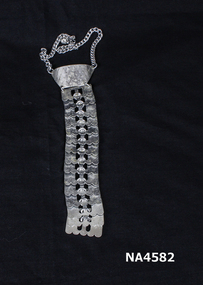
Accessory - Pearl Collar, 1950s
... Made in Japan...Bought at South Melbourne market in 1950s. costume accessories jewellery Made in Japan Pearl Collar. Intricate pattern made of small and large cream coloured pearls. ...Bought at South Melbourne market in 1950s.Pearl Collar. Intricate pattern made of small and large cream coloured pearls. Backing is made of satin. There is a metal hook and eye to fasten collar.Made in Japancostume accessories, jewellery -
 Whitehorse Historical Society Inc.
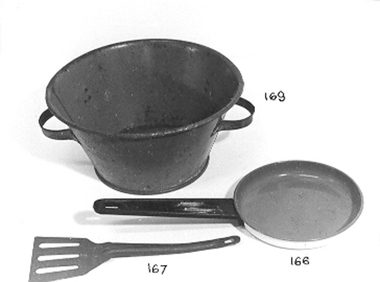
Leisure object - Toy Frypan
... Made in Japan...toys general Made in Japan Toy metal frypan - red painted top, white bottom with black handle. ...Toy metal frypan - red painted top, white bottom with black handle.Made in Japantoys, general -
 Whitehorse Historical Society Inc.
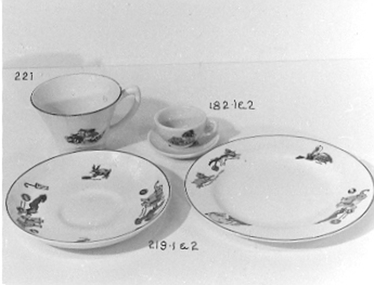
Leisure object - Toy Cup and Saucer
... Made in Japan....toys general Made in Japan. White porcelain toy cup and saucer. ...White porcelain toy cup and saucer. Motif of child painting dog house with dog beside her on both items.Made in Japan.toys, general -
 Mont De Lancey
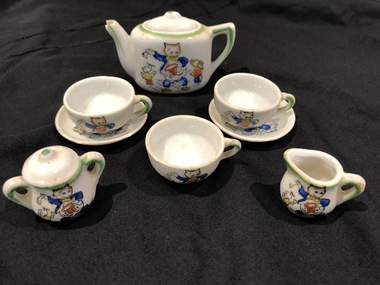
Tea Set
... Made in Japan...Tea sets Toy Tea Sets Made in Japan 10 piece child's miniature tea set. ...10 piece child's miniature tea set. White china with cat in blue suit, white waistcoat and top hat, and a mouse with a yellow jacket. The teapot also has yellow rabbit in orange jacket. Green trim on handle and rim. 10 pieces comprise:- 1 teapot with lid; 1 sugar bowl with lid; 1 milk jug; 3 cups and 2 saucers.Made in Japantea sets, toy tea sets
