
Showing 86 items matching "managers residence"
-
 Tatura Irrigation & Wartime Camps Museum
Photograph - copy, Dean Clark, copy 1989
... ...managers residence...Managers residence occupied by Mr and Mrs J. Lowry....Black and white photograph of north view of managers residence, Dhurringile Mansion in distance....On back: Nth view managers residence, Dhurringile Mansion...Managers residence occupied by Mr and Mrs J. Lowry. dhurringile mansion managers residence lowry On back: Nth view managers residence, Dhurringile Mansion Black and white photograph of north view of managers residence, Dhurringile Mansion in distance. ...Managers residence occupied by Mr and Mrs J. Lowry.Black and white photograph of north view of managers residence, Dhurringile Mansion in distance.On back: Nth view managers residence, Dhurringile Mansiondhurringile mansion, managers residence, lowry -
Tatura Irrigation & Wartime Camps Museum
Photograph - copy, Dhurringile Mansion Stables North Wing, 1977
... Dhurringile Mansion managers residence...Copy of original photograph, one many taken by J. Lowry of managers residence and surrounds, Dhurringile Mansion...Copy of original photograph, one many taken by J. Lowry of managers residence and surrounds, Dhurringile Mansion Jack Lowry Dhurringile Mansion managers residence West view of Dhurringile Mansion stables - north wing. ...Copy of original photograph, one many taken by J. Lowry of managers residence and surrounds, Dhurringile MansionBlack and white photograph of Dhurringile Mansion stables north wingWest view of Dhurringile Mansion stables - north wing. The residence of Mr and Mrs J. Lowry between 1938 - 1977jack lowry, dhurringile mansion managers residence -
Tatura Irrigation & Wartime Camps Museum
Photograph - copy, Dhurringile Mansion Stables, 1977
... dhurringile mansion managers residence...Copy of original photograph, one many taken by J. Lowry of managers residence and surrounds, Dhurringile Mansion...Copy of original photograph, one many taken by J. Lowry of managers residence and surrounds, Dhurringile Mansion jack lowry dhurringile mansion managers residence West view of Dhurringile Mansion stables. ...Copy of original photograph, one many taken by J. Lowry of managers residence and surrounds, Dhurringile MansionBlack and white photograph of Dhurringile Mansion stables north wingWest view of Dhurringile Mansion stables. The residence of Mr and Mrs J. Lowry between 1938 - 1977jack lowry, dhurringile mansion managers residence -
Tatura Irrigation & Wartime Camps Museum
Photograph - copy, Dhurringile Mansion Stables, 1977
... Dhurringile Mansion managers residence...North wing converted to home by Mr and Mrs Jack Lowry who lived there between 1938 and 1976. jack lowry dhurringile stables Dhurringile Mansion managers residence Black and white photograph of brick stables complex for Dhurringile Mansion. ...Copy of original photograph. Brick stables, storerooms, pay office for the original Dhurringile Mansion. North wing converted to home by Mr and Mrs Jack Lowry who lived there between 1938 and 1976.Black and white photograph of brick stables complex for Dhurringile Mansion.jack lowry, dhurringile stables, dhurringile mansion managers residence -
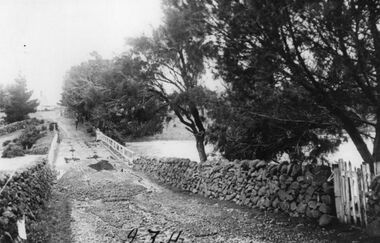 Sunshine and District Historical Society Incorporated
Photograph - Nobels bridge over Kororoit Creek 1911, 1911
... Bridge over Kororoit Creek to original entrance of Nobles factory later became ICI ANZ on Ballarat Road Deer Park House was the managers residence...ICI Nobels Kororoit Creek Dry Stone Wall Bridge over Kororoit Creek to original entrance of Nobles factory later became ICI ANZ on Ballarat Road Deer Park House was the managers residence Nobels bridge over Kororoit Creek 1911 Photograph Nobels bridge over Kororoit Creek 1911 ...Bridge over Kororoit Creek to original entrance of Nobles factory later became ICI ANZ on Ballarat Road Deer Park House was the managers residenceici, nobels, kororoit creek, dry stone wall -
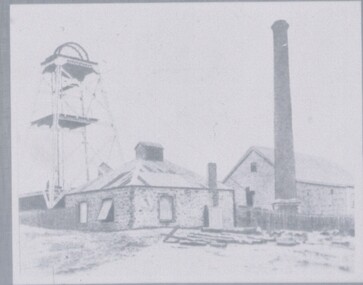 Bendigo Historical Society Inc.
Negative - TOM PATULLO COLLECTION: GOLD MINE, POPPET HEAD, CHIMNEY
... Goldmine,brick chimney, poppet legs, wheelhouse, Manager's residence. Phil Wilkin 12/6/12 'Victoria Quartz mine, Victoria Hill'....Goldmine,brick chimney, poppet legs, wheelhouse, Manager's residence. Phil Wilkin 12/6/12 'Victoria Quartz mine, Victoria Hill'. ...Negative Print. Goldmine,brick chimney, poppet legs, wheelhouse, Manager's residence. Phil Wilkin 12/6/12 'Victoria Quartz mine, Victoria Hill'.cottage, miners, goldmine., goldmine. -
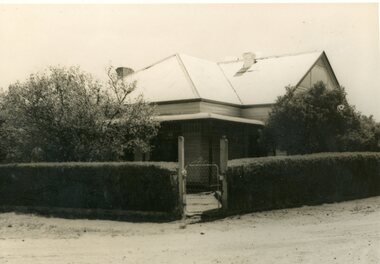 Stawell Historical Society Inc
Photograph, Stawell Gas Company Manager's Residence on the Skene Lane and Clemes Street Corner
... Gas Company – Stawell - Managers Residence...Gas Company – Stawell - Managers Residence stawell 8 Clemes Street, Stawell Stawell Gas Company Manager's Residence on the Skene Lane and Clemes Street Corner Photograph ...Gas Company – Stawell - Managers Residence8 Clemes Street, Stawellstawell -
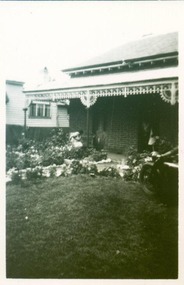 City of Ballarat Libraries
Photograph, 523 Ripon Street South, Ballarat circa 1920s
... 523 Ripon Street South was once a mine manager's residence....523 Ripon Street South was once a mine manager's residence. ripon street south ballarat house housing 523 Ripon Street South, Ballarat circa 1920s. ...523 Ripon Street South was once a mine manager's residence.ripon street south, ballarat, house, housing -
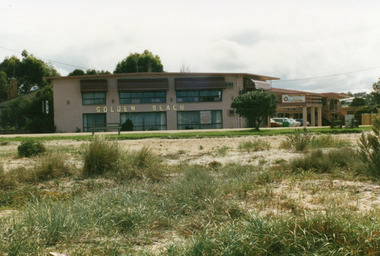 Lakes Entrance Historical Society
Photograph - Golden Beach Motel Lakes Entrance 1980, Fish Marie
... Colour photograph of the Golden Beach Motel, showing a fawn coloured double storey building comprising managers residence, office and motel units. External steps to upper units. ...|Also three other colour photographs similar views Accommodation Tourism Colour photograph of the Golden Beach Motel, showing a fawn coloured double storey building comprising managers residence, office and motel units. External steps to upper units. ...Motel built on site of home of Misses Phillips. Home was transported, half to 15 Coates Road, half to Lakes Tyers Beach Road, 1965c. Motel built by Terry Ledwith, managed by family until sold.|Also three other colour photographs similar viewsColour photograph of the Golden Beach Motel, showing a fawn coloured double storey building comprising managers residence, office and motel units. External steps to upper units. Lake front in foreground is undeveloped, on 607 Esplanade Lakes Entrance Victoriaaccommodation, tourism -
Tatura Irrigation & Wartime Camps Museum
Photograph - original, Dhurringile Stables 1990, 1990
... Photograph of buildings now used as annex of Dhurringile prison farm, formerly managers residence and stables....Photograph of buildings now used as annex of Dhurringile prison farm, formerly managers residence and stables. Dhurringile stables on back: stables Dhurringile 1990 Colour photograph of buildings at rear of Dhurringile Prison 1990. ...Photograph of buildings now used as annex of Dhurringile prison farm, formerly managers residence and stables.Colour photograph of buildings at rear of Dhurringile Prison 1990. Also shed, horse, paddocks, hot house used for vegetable growing.on back: stables Dhurringile 1990dhurringile stables -
Tatura Irrigation & Wartime Camps Museum
Photograph - original, Dhurringile Stables 1990, 1990
... Photograph of buildings now used as annex of Dhurringile prison farm, formerly managers residence and stables....Photograph of buildings now used as annex of Dhurringile prison farm, formerly managers residence and stables. dhurringile stables on back: stables Dhurringile 1990 Colour photograph o Dhurringile Prison former stables in background.1990. ...Photograph of buildings now used as annex of Dhurringile prison farm, formerly managers residence and stables.Colour photograph o Dhurringile Prison former stables in background.1990. on back: stables Dhurringile 1990dhurringile stables -
Tatura Irrigation & Wartime Camps Museum
Photograph - copy, Dhurringile Mansion Stables, 1977
... Photograph, one of many taken by J. Lowry, of managers residence and surrounds, Dhurringile Mansion....Photograph, one of many taken by J. Lowry, of managers residence and surrounds, Dhurringile Mansion. ...Copy of original. Photograph, one of many taken by J. Lowry, of managers residence and surrounds, Dhurringile Mansion.Copy of Black and white photograph of Dhurringile Mansion stable and office block.Dhurringile Mansion stables and office block, courtyard showing butchers block and dome of underground tank. Nth wing residence of Jack and Knowla Lowry 1938-1977.dhurringile mansion stables, dhurringile mansion butchers block, dhurringile mansion, knowla lowry, jack lowry -
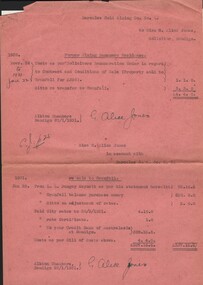 Bendigo Historical Society Inc.
Document - MISS G ALICE JONES COLLECTION: ACCOUNT
... Re former Mining Managers Residence. Pink paper dated Nov 24, 1930, to Jan 22, 1931. ...Re former Mining Managers Residence. Pink paper dated Nov 24, 1930, to Jan 22, 1931. ...Hercules Gold Mining Co. N.L. to Miss G. Alice Jones. Re former Mining Managers Residence. Pink paper dated Nov 24, 1930, to Jan 22, 1931. Details of Contract and Conditions of Sale of Property sold to Grenfell for £350. Cost £4.4.0. Also, re sale to Grenfell dated Jan 22, 1931. Details of expenses for sale to Grenfell. Total cost £337.16.6.miss g. alice jones collection - account, hercules gold mining co n l, grenfell, l l dungey, bank of australasia -
Linton and District Historical Society Inc
Land purchase document, Special Lands Purchase, 1861, Section 1, Allotment 1, Township of Linton
... The Bank built a banking chamber and manager's residence on this site in the early 1860s. ...The Bank built a banking chamber and manager's residence on this site in the early 1860s. ...Similar to a deed of Title, this document records the purchase in 1861 by the Bank of New South Wales of a block of land in what is now Sussex Street, Linton. The Bank built a banking chamber and manager's residence on this site in the early 1860s. The building has had several additions and renovations since it was first built and is now a private residence known as Traquair House.Approximately A3-size sheet of parchment which has been folded twice across. The front of the folded document is printed "GRANT / BY PURCHASE / SPECIAL LANDS", and has sections for recording the sale number, date, area of land sold, and Parish, Section and Allotment numbers. It records Sale no. 197, on 15th April 1861, to the Bank of New South Wales, of a block of land 29 + 2/10ths of a perch in size, which was Allotment 1, Section 1, Parish of Argyle. The sale is recorded in greater detail on one side of the unfolded document. The unfolded document has a pencil sketch of the allotment in the top left corner, and a wax and paper seal in the lower left corner. It is signed by [Sir] Henry Barkly, who was Governor-in-chief of the Colony of Victoria in 1861. The document was lodged with the Registrar of the Supreme Court of the Colony of Victoria on 22nd May, 1861.bank of new south wales, documents and records, special lands sale linton 1861, allotment 1 section 1 township of linton, sale document, linton township history -
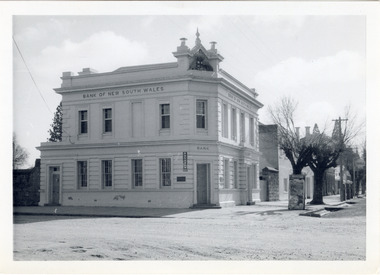 The Beechworth Burke Museum
Photograph
... Beechworth Honey currently offers tourist accommodation in the Hive Apartment located in the former Bank of New South Wales Managers residence....Beechworth Honey currently offers tourist accommodation in the Hive Apartment located in the former Bank of New South Wales Managers residence. The Bank of New South Wales building in Beechworth is significant for its location in one of Australia's most prominent goldfield towns. ...The old Bank of New South Wales building is located on the corner of Camp and Ford streets in Beechworth, Victoria. It was constructed between 1856 and 1857 from local honey coloured granite. It was designed by architects Robertson & Hale and is a two-storey rendered brick building and the original coat of arms is still visible. The coat of arms is distinctive and consists of a kangaroo, emu, lion, and rising sun. The rear of the building was surrounded by high granite walls for security as it was the original home for the local gold office. Beechworth Honey currently offers tourist accommodation in the Hive Apartment located in the former Bank of New South Wales Managers residence.The Bank of New South Wales building in Beechworth is significant for its location in one of Australia's most prominent goldfield towns. Of particular interest is the use of distinctive local Beechworth honey coloured granite in its construction. The building’s architecture is a simple, conservative classical style known as Renaissance Revival. It is one of the few known surviving works of the architects Robertson and Hale. The decorative composition above the main entrance and the counter in the banking chamber are of special interest.Black and white rectangular photograph printed on cardAHold bank of new south wales, bank of new south wales building, beechworth bank of new south wales, bank of nsw, beechworth 1850s, robertson and hale, architects robertson and hale, rendered brick, coat of arms, granite walls, local honey coloured granite, gold office, 1856, 1857, beechworth, beechworth honey, hive apartment, manager's residence, renaissance revival -
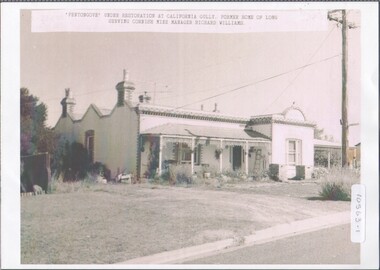 Bendigo Historical Society Inc.
Photograph - Fentongove, California Gully
... 10563.1a Fentongove, California Gully, former home of long serving Cornish Mine Manager Richard Williams. Residence under restoration (date unknown). 10563.1b photocopy of Mr. ...searchTerm=richard%20williams Richard Williams Mine Manager Fentongrove California Gully Mary Williams 10563.1a Fentongove, California Gully, former home of long serving Cornish Mine Manager Richard Williams. Residence under restoration (date unknown). 10563.1b photocopy of Mr. ..."Fentongove" is situated at 3 Staley Street, California Gully. The home was built in 1867 for Mr Richard Williams who was the mine manager for the Johnsons Reef Mining Company for 36 years. Richard first worked for George Lansell, where he was the manager of a number of mines. He then went to Johnson's Reef Gold Mines as General Mine Manager, where he worked for 36 years. Richard was born in Cornwall in 1831 and died in Bendigo in September, 1903. See obituary: https://trove.nla.gov.au/newspaper/article/89606122?searchTerm=richard%20williams10563.1a Fentongove, California Gully, former home of long serving Cornish Mine Manager Richard Williams. Residence under restoration (date unknown). 10563.1b photocopy of Mr. Richard Williams, former mine manager and owner of Fentongove, California Gullyrichard williams, mine manager, fentongrove, california gully, mary williams -
 Mortlake and District Historical Society
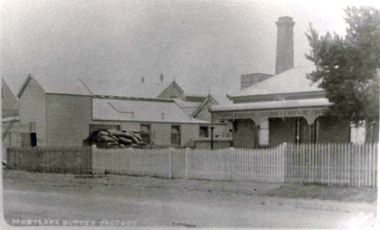
Mortlake Butter Factory Co. Ltd, Photograph
... But in 1936 the factory was sold to Glenormiston Cheese & Butter Factory who ceased operations. The manager's residence still remains in 2011 as does the remnants of the small timber butter factory (charcoal lined) and the double brick cheese room but the bluestone chimney has long gone. ...But in 1936 the factory was sold to Glenormiston Cheese & Butter Factory who ceased operations. The manager's residence still remains in 2011 as does the remnants of the small timber butter factory (charcoal lined) and the double brick cheese room but the bluestone chimney has long gone. ...This local factory was typical of small butter factories in the 1890's in Western Victoria. It was established in 1894 when farmers brought their milk to the factory on horse drawn drays and carts and waited for their cream to be separated. The skimmed milk was mostly used by farmers to feed calves and pigs and the separated cream was manufactured into butter, some of which was exported to England. By 1910 this butter factory had an electricity generating plant called Mortlake Electricity which supplied both the factory and the township with power and this took precedence over the butter production which continued until 1926 when it was sold to the Electricity Commission. By 1930 the Butter Factory had a yearly turnover of 24,000 pounds sterling and in1935 it was producing 6 tons of butter weekly. But in 1936 the factory was sold to Glenormiston Cheese & Butter Factory who ceased operations. The manager's residence still remains in 2011 as does the remnants of the small timber butter factory (charcoal lined) and the double brick cheese room but the bluestone chimney has long gone. This complex is listed by Heritage Victoria Black and White Photograph Nonecheese factory, mortlake, butter factory -
 Tarnagulla History Archive
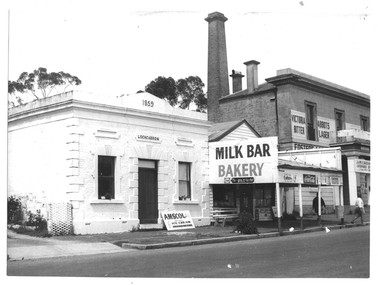
Photograph of milk bar and general store, Tarnagulla, Milk bar and general store, Tarnagulla, circa 1960s-70s
... The milk bar section was constructed in the 1920s in an area at the front of what had once been the Bank’s manager’s residence. The Two-story bank building On the right was constructed and used by the Colonial Bank of Australasia (from 1866 to 1888) and, following bank amalgamation, by the Union Bank (from 1888 until closure in 1942). ...The milk bar section was constructed in the 1920s in an area at the front of what had once been the Bank’s manager’s residence. The Two-story bank building On the right was constructed and used by the Colonial Bank of Australasia (from 1866 to 1888) and, following bank amalgamation, by the Union Bank (from 1888 until closure in 1942). ...Murray Comrie Collection. This image depicts stores in the main street of Tarnagulla, including the two-storey bank building being used as a licensed general store. The building on the left was also a bank, originally constructed by the Union Bank in 1859, and Is probably the first brick and stone building at Tarnagulla. It was used by the bank until 1888 at which time the Union and Colonial banks amalgamated. After this, the building was used for a variety of purposes. The milk bar section was constructed in the 1920s in an area at the front of what had once been the Bank’s manager’s residence. The Two-story bank building On the right was constructed and used by the Colonial Bank of Australasia (from 1866 to 1888) and, following bank amalgamation, by the Union Bank (from 1888 until closure in 1942). The original site had been occupied by Joseph Foo's store, a large wooden building with attached theatre. While the bank was being built, the Colonial Bank operated from the former Company's Hotel (soon after to become the Borough of Tarnagulla Council Chambers, then the Mechanics’ Institute, and finally, prior to final demolition in 1980, Burstall Hall) The new double-storey building was used by the Colonial Bank from 1866 until 21st February, 1888. The premises were sold to the Union Bank for £2500. The Union Bank moved in and commenced operations on 6th June 1888, continuing until 1942. The building was later used as a general store until the 1990s. It is a now private residence. This is a reasonable copy of an older original. Copy probably made by Murray Comrie in the 1970s. Monochrome photograph depicting a section of Commercial Road, Tarnagulla near the intersection with Poverty Street, including two stores - one a bakery/milk-bar and the other a general store operating in the former Colonial/Union Bank building. Photograph taken from north of milk-bar. Two people walking away from photographer on footpath/curb between the two stores. The building on the left was the Union Bank premises, constructed in 1859 and Tarnagulla's oldest surviving brick building. The Union Bank absorbed the Colonial Bank in 1888, and the Union Bank moved operations next door into the much larger former Colonial Bank premises which had been constructed in 1865/66. After amalgamation, the old Union Bank premises was then used for a variety of purposes from visiting doctor's rooms to cafe, etc. The Union Bank continued to operate at Tarnagulla until closure in 1942, at which time business had fallen away and Tarnagulla Branch had already been downgraded to sub-branch status. tarnagulla, banks, banking, commerce, stores, shopping, shops, food, groceries, buildings, commercial road -
 El Dorado Museum Association Inc.
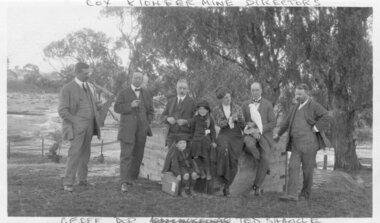
Photograph (item) - Digital Image
... Taken at Sherwood - the mine manager's residence. (1914) Cocks Pioneer Electric Gold & Tin Mine Company was formed in 1899. ...Taken at Sherwood - the mine manager's residence. (1914) Cocks Pioneer Electric Gold & Tin Mine Company was formed in 1899. ...Image of Cocks Pioneer Gold & Tin Mines NL directors with Mrs Molly Moline and children, Dorothy and Geoff. Taken at Sherwood - the mine manager's residence. (1914) Cocks Pioneer Electric Gold & Tin Mine Company was formed in 1899. The company's first power station, located at the eastern end of the valley began operating with its 340 Kilowatt steam-powered generator. By 1909, from 2,500,000 cubic yards worked, reported recovery was 17,284 ounces of gold and 224 tons of tin ore. By 1909, Cocks Pioneer’s power plant had become inadequate and uneconomical. The barge was floated downstream about a mile, but lost time caused the operations to cease. Following testing, a new mine was established by diverting Reid's Creek at a cost of £25 000. Settling dams were built, one of which held 1,935,900 cubic feet. Sold earth banks, built against a wall of stringy bark saplings constructed and laced with vertical props, were built. In 1914, the company was reformed as Cock’s Pioneer Gold and Tin Mines NL, another power station was constructed at the western end of the township, near the junction of Clear and Reid's Creeks. From 6,800,000 cubic yards of material processed, the returns were 64,397 ounces of gold and 855 ton of tin. Cocks Pioneer mine then moved the barge downs stream and continued sluicing. In 1929 Cocks Pioneer Electric Gold and Tin Mining Company ceased operations due to a drop in values. Cock’s Pioneer Gold and Tin Mines NL carried on large-scale hydraulic sluicing operations until 1941. "COX PIONEER MINE DIRECTORS" top "GEOFF DOR (unclear) TED SHACKLE" bottommine, gold, tin, gold mining, tin mining, cockatoos, sluicing, men, women, children, cocks pioneer, el dorado, eldorado -
 Wodonga & District Historical Society Inc
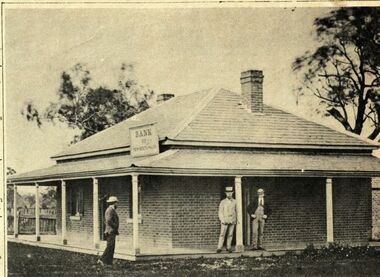
Photograph - Bank of New South Wales, Wodonga
... The original house was eventually demolished to make way for a new bank and manager’s residence in Sydney Road in 1906. That building was again remodelled in 1969. ...The original house was eventually demolished to make way for a new bank and manager’s residence in Sydney Road in 1906. That building was again remodelled in 1969. ...The first Bank of New South Wales building in Wodonga was located in a small cottage. The branch opened on 7 May 1872. At first it was conducted as an agency of the Beechworth branch. In October 1872 premises in Sydney road were purchased from Mr P. L. M. S. Chauncy for £650. When the bank commenced in the cottage the first account was opened in the name of Hillerman & Co, storekeepers, Wodonga. Another early account was in the name of William Huon, squatter of de Kerilleau, Wodonga. On 9 July 1873, the agency was converted into full branch under the management of Mr. Joseph Belcher. Other early accounts included Cronin & Callaghan, storekeepers; John Bassett Jnr, shoemaker; John Jennings, contractor; Ah Soon, tobacco grower, Kergunyah; John de Corney Ireland, collector of customs; Andrew Kyle, fellmonger; Rowan Lockhead, accountant; Alexander McKay, publican; George Pollard, farmer; Thomas Street, farmer; and Edmund Uren, gentleman, Buninyong. Organisations banking at the branch included Wodonga Building Society, 1873; Wodonga Mechanics Institute 1875; Wodonga Band Fund 1882; Talgarno Athenaeum, 1888; Talgarno Butter & Cheese Factory 1892; Wodonga Federation League 1893; Wodonga Brass Band 1895; Wodonga Benevolent Society 1895; Wodonga Fire Brigade 1897; Wodonga Rifle Club and Wodonga Racing Club in 1899 and Kiewa Polo Club in 1900. There were also numerous lodge and church accounts. The cottage was later renovated with a porch added in 1889 and an extension to the residence in 1898. The original house was eventually demolished to make way for a new bank and manager’s residence in Sydney Road in 1906. That building was again remodelled in 1969. It became a branch of the WESTPAC bank when the Bank of NSW and CBA Bank joined to become the Westpac Banking Corporation in 1982. After the building ceased operation as a bank, it has been the home to several businesses including a video store, a travel agency and a clothing store.These images have local significance as they record changes to a building which filled an important role in the commercial life of Wodonga.A series of photos both black and white and coloured which document changes in the former Bank of New South Wales building in Wodonga over time.Photo 1: On sign above verandah "BANK of NEW SOUTH WALES" Photo 2: On sides of building and above door: "BANK OF NEW SOUTH WALES" Photo 3: Above door: "HIRE/ VIDEO MADNESS/ SALES" Photo 4: Above door: "WODONGA TRAVEL"wodonga businesses, banking wodonga, bank nsw wodonga, businesses high street wodonga -
 Bendigo Historical Society Inc.
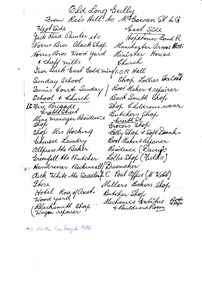
Document - LONG GULLY HISTORY GROUP COLLECTION: OLD LONG GULLY FROM RAE'S HILL TO MCGOWAN ST
... West Side - Jack Read Painter etc, Norris Bros Black Shop, Norris Bros Wood Yard & Chaff Mills, Iron Bark East Gold Mine, Sunday School, Tennis Courts Sunday School & Church, LG Fire Brigade, Creeth Street, Mine Managers Residence, Shop, Shop Mrs Hocking, Chinese Laundry, Allpress the Baker, Greenfell the Butcher, Hairdresser Beckinsall was the Fire Brigade Hotel, Dick White the Saddler, Store, Hotel Rose of Australia, Woodyard, Blacksmith Shop Wagon Repairer, Hotel Kocks (Pioneer Hotel), 2 China Shops owned by Chinese, Hotel Silver mines Hotel, Police Station, Grocers Shop (per? ...West Side - Jack Read Painter etc, Norris Bros Black Shop, Norris Bros Wood Yard & Chaff Mills, Iron Bark East Gold Mine, Sunday School, Tennis Courts Sunday School & Church, LG Fire Brigade, Creeth Street, Mine Managers Residence, Shop, Shop Mrs Hocking, Chinese Laundry, Allpress the Baker, Greenfell the Butcher, Hairdresser Beckinsall was the Fire Brigade Hotel, Dick White the Saddler, Store, Hotel Rose of Australia, Woodyard, Blacksmith Shop Wagon Repairer, Hotel Kocks (Pioneer Hotel), 2 China Shops owned by Chinese, Hotel Silver mines Hotel, Police Station, Grocers Shop (per? ...Titled Old Long Gully From Rae's Hill to McGowan St. LG. West Side - Jack Read Painter etc, Norris Bros Black Shop, Norris Bros Wood Yard & Chaff Mills, Iron Bark East Gold Mine, Sunday School, Tennis Courts Sunday School & Church, LG Fire Brigade, Creeth Street, Mine Managers Residence, Shop, Shop Mrs Hocking, Chinese Laundry, Allpress the Baker, Greenfell the Butcher, Hairdresser Beckinsall was the Fire Brigade Hotel, Dick White the Saddler, Store, Hotel Rose of Australia, Woodyard, Blacksmith Shop Wagon Repairer, Hotel Kocks (Pioneer Hotel), 2 China Shops owned by Chinese, Hotel Silver mines Hotel, Police Station, Grocers Shop (per? Reef Mine Hotel) E Bryant, Mine Windmill, Church Residence, Minister. East Side - Hopetoun Band R, Manchester Arms Hotel, Minister House, Church, IOR Hall, Shop Lollies Icecream, Boot Maker & Repairer, Back Smith Shop, Shop Childrens Wear, Butchers Shop, Creeth Street, Grocers Shop, Lolly Shop & Soft Drinks, Boot Maker & Repairer, Residence (Davey's), Lollie Shop (Fields), Dressmaker, LG Post Office (M Webb), Millars Bakers Shop, Butcher Shop, Mechanics Institute Books & Paper & Billiard Room, Connell the Baker, Dr SElby, Pentreath Organ Builder & Tuner, Blacksmith Shop, Hexagon Toilet, Kocks Machine Shop, Kocks Mine Office, Kocks Material Shop, Police Station, Dyson's Dam Warm waer, Air Station, Mine Battery stone crusher 80 head approx, Kocks Mine, Needle Mine. Some notes written at the end - Norm Shotples used to have Barber Shop - he has gone to Queensland, Violet Street started off as the German School, Wells Street used to run through Victorian Consol ? the other side, Comet Hill would like a visit. Contact Helen Gorlay at Violet Street would line to some video. Alan has good info on the Long Gully School. Betty has book. Views of Bendigo. Frank Cusack - Bendigo Trust. Bendigo School Hisking? School, Violet Street. Older levels lo?ing at Architecture.bendigo, history, long gully history group, the long gully history group - old long gully from rae's hill to mcgowan st, jack read, norris bros, iron bark east gold mine, long gully fire brigade, mrs hicking, allpress, greenfell, beckinsall, dick white, rose of australia, hopetoun band r, manchester arms hotel, ior hall, davey's, fields, m webb, millars, mechanics institute & billiard room, kocks pioneer hoel, silver mines hotel, e bryant, windmill mine, pere? reef mine hotel, connell, dr selby, pentreath, kocks machine shop, kocks mine office, kocks material shop, dyson's dam, kocks mine, needle mine, norm shotples, german school, victoria consols, helen gorlay, long gully school, frank cusack, bendigo trust -
 Flagstaff Hill Maritime Museum and Village
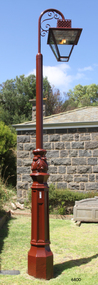
Functional object - Lamp Light, late 19th - early-20th century
... The first managers of the Gas Company lived in a substantial stone house on site, but later the managers lived in a residence in Henna Street between Merri and Timor Streets. ...The first managers of the Gas Company lived in a substantial stone house on site, but later the managers lived in a residence in Henna Street between Merri and Timor Streets. ...This gas lamp light and stand came from the original manufacturer in Melbourne. Gas street lights such as this one were used in Melbourne from the mid-19th century. The lights enabled safer after-dark travel for pedestrians and vehicles and were a deterrent to crime. A lamp lighter was employed to keep the lamps lit, sometimes with little success due to weather conditions and the pranks of youths. WARRNAMBOOL Gasworks In Warrnambool prior to 1874 there were about twenty rare, individually lit street lights in Warrnambool, each with its own supply of kerosene. These lamps were in the central business area of Timor, Koroit and Liebig Streets. The Warrnambool Gas Company Ltd. was registered as an incorporated company in 1873. It was a private, locally owned business. It was located at 209-215 Merri Street, Warrnambool, on the land, which is just west of the later-built railway station. The first managers of the Gas Company lived in a substantial stone house on site, but later the managers lived in a residence in Henna Street between Merri and Timor Streets. The original home, which still stands, became a residence for the Railway Station Master from about 1890. In August 1874 the construction of the gasworks was complete and at the end of that month gas was supplied to all of the existing lamps in Warrnambool for the first time. The Warrnambool Gas Company wound up in 1880-1881 and was purchased by the Warrnambool Borough Council with money raised by a loan – the Borough’s first ‘loan transaction’. The Council established a piped network to supply gas to other street connections. The gasworks were privatised and upgraded in 1952. In 1972 the town supply was converted to liquid petroleum gas and by the early 1980s the gasworks were closed down. In 1986 Warrnambool was supplied with natural gas from a site near Port Campbell. The Warrnambool gasworks supplied all street and shop lighting and most domestic lighting until 1923 when electricity was available for lighting. Bromfield Street in Warrnambool was named after the director of the gasworks, James Astley Bromfield (1823-1903). He arrived in Warrnambool from Worcestershire, England, in 1852 and was very active in the local council and community. Cockman Street was named after the first secretary of the gasworks in 1874, Walter Cockman (c.1821-1892). He was a Mayor and businessman. The second Manager, Luther Rodgers, worked for the gas company for about twenty years and both Rodger Place and Rodgers Road in Warrnambool have been named after him. LAMP LIGHTS IN MELBOURNE In the 1820s Melbourne's innkeepers were legally required to have a lamp light outside their premises from sunset to sunrise. This was the first instance of street lamps being used in Melbourne. In 1847 the first oil lamp was used in the city. In 1849 a gas lamp was installed on the Swanston Street Bridge and much of the city had oil lamps installed by then. In August 1857 the installation of street gas lamps began in Melbourne. They were welcomed for the much brighter illumination they gave. By 1860 there were 414 lamp pillars. The phrase was quoted often - "A light was as good as a policeman". The first gas burners used for street lighting were called 'fishtail' gas burners. These were replaced in the early 1900s by gas mantles. The City of Melbourne Gas Coke Company was formed in 1850 but due to the Gold Rush the manufacture and distribution of the gas supply was delayed until January 1856. By the 1890s the gas supplying the lights was supplied by three companies in Melbourne. In 1879 a football match was played at the MCG under electric lighting and gradually electric arc lights were installed inside and outside buildings in the city. Lamp lights such as the one in Flagstaff Hill’s collection were no longer needed. (References: John Lindsay re Lamp Light history 2019-01-29, Former Warrnambool Gas Company Limited, Victorian Heritage Database Report, Heritage Number 149746 https://vhd.heritagecouncil.vic.gov.au/places/149746/download-report ) The lamp light is representative of the lamps used in Melbourne from the mid-nineteenth century to light the streets at night and make Melbourne a safer city. The lamp is also representative of the gas street lighting in Warrnambool from the mid-1870s-1920s.Lamp light or gas light. Street light, one of the last gas street lights removed from Melbourne. (Reconditioned by Friends of Flagstaff Hill, 2013)flagstaff hill, warrnambool, shipwrecked coast, flagstaff hill maritime museum, maritime museum, shipwreck coast, flagstaff hill maritime village, great ocean road, lamp light, gas light, gas lamp, street lamp, street light, gas street light, melbourne street lighting, warrnambool street lighting, melbourne gas street light, warrnambool gas company, warrnambool gasworks, james bromfield, walter cockman, luther rodgers, city of melbourne gas coke company -
Federation University Historical Collection
Booklet - Annual Report, Ballarat School of Mines, Ballarat School of Mines Annual Report, 1969, 1969
... Manager. J.A. Wilson was the computer operator, and R. Kopke, E. Dykstra and V. Gay were Card Punch Operators. Preliminary work on the new Brewing and Malting course was continuing, and plans were being made for the commencement of courses in Librarianship and General Studies. A Halls of Residence...Manager. J.A. Wilson was the computer operator, and R. Kopke, E. Dykstra and V. Gay were Card Punch Operators. Preliminary work on the new Brewing and Malting course was continuing, and plans were being made for the commencement of courses in Librarianship and General Studies. A Halls of Residence ...This annual report was one year before the opening of the new tertiary division at Mt Helen. Council decided to retain the overall title "The School of Mines and Industries, Ballarat" for the foreseeable future, but to separately name the three divisions as follows: 1. Diploma School - The Ballarat Institute of Advanced Education (A division of the School of Mines and Industries, Ballarat) 2. Trades School - The Ballarat School of Industries (A division of the School of Mines and Industries, Ballarat) 3. Secondary School - The Ballarat Technical School (A division of the School of Mines and Industries, Ballarat). The annual report also foreshadowed the Centenary of the School (and technical education in Australia) in 1970. Speaker at the trade Prize Night and Apprenticeship Week was W.J. Anderson, and Craftsmen Certificates were presented by the Ballarat City Council. A number of quarto pages with stapled inside a brown card cover. The report was for the year ended 30 June 1969, and was delivered by Ballarat School of Mines President M.B. John. Page 5 lists the Diplomas awarded. Page 6 lists the scholarships, prizes and awards, including the Josephine Brelaz Scholarship, Martha Pinkerton Scholarship, Frank Pinkerton Scholarship, Mica Smith/Serjeant/Ironworkers Scholarship, Ballaarat Has Comapny Scholarship, Ballaarat City Council Scholarship, R.W. Richards Medal. Page 8 covers buildings and accommodation. Conditions were cramped at Lydiard Street , with conditions hoped to be improved when the Stage I buildings at Mount Helen were completed in the following year. Mount Helen Master Plan was undertaken by Joint site planners G.J. Harrison, staff architect at the Flinders University of South Australia. and messrs L.H. Vernon and associates, of Ballarat. The following staff members retired: A.L.H. Aldersey; J.V. Crotty; M. Page; J.Ralston; P.J. Smith, P.B. Todd; Derek Wooley; Mr Goldfinch. TRADE DIVISION: F.D. Hamilton, J. Moran, D.Drake The following new lecturing appointments were made during the year: G.I. Boyd; E.W. Butters; D.R. Dowling; P.D. Kelly; G.J. medwell; R.E. Northey; C.A. Pogliani; R.H. Pyke; Roy Schrieke; B.J. Shearer, D.J. Stabb, T.W. Sweatman; A.C. Turner; D.G. Williams; C.M. McGarry. The Computer centre was enlarged when Arch MacKinnon was transferred as Mathematics lecturer to Computer Manager. J.A. Wilson was the computer operator, and R. Kopke, E. Dykstra and V. Gay were Card Punch Operators. Preliminary work on the new Brewing and Malting course was continuing, and plans were being made for the commencement of courses in Librarianship and General Studies. A Halls of Residence Committee had held meetings to explore the type of student accommodation required. ballarat school of mines, library, m.b. john, stohr, robertson, beanland, graeme beanland, arthur nicholson, m.j. brown, anderson, rex hollioake, w.j.c. north, patterson, smail, w.g. smith. sutton, e.j. tippett, webb, white, yandell, mount helen, scholarship, martha pinkerton, josephine brelaz, graham beanland -
 Flagstaff Hill Maritime Museum and Village
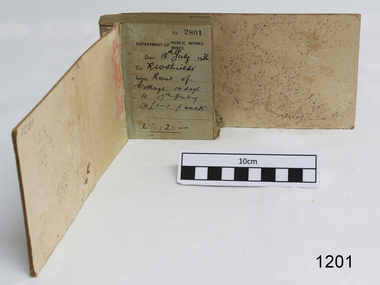
Financial record - Receipt Book, Department of Works and Mines Victoria, July 1936 (first record)
... residence licences, mining leases, mineral and other prospecting licences 2. Superintendence of the activities of mining surveyors, registrars, wardens and Mining Boards. 3. Investigation of the state's geological structure, mineral wealth and underground water resources 4. Development of the mining industry 5. Supervision of the safe working of mines, machinery and quarries including checking the credential of mine managers...residence licences, mining leases, mineral and other prospecting licences 2. Superintendence of the activities of mining surveyors, registrars, wardens and Mining Boards. 3. Investigation of the state's geological structure, mineral wealth and underground water resources 4. Development of the mining industry 5. Supervision of the safe working of mines, machinery and quarries including checking the credential of mine managers ...Establishment and Functions Prior to 1860, the Chief Secretary's Department had been responsible for the administration of the gold fields and associated mining activities. In November 1860 a Commissioner of Mines was appointed and a Department was established under his administration. For the period November 1861 to June 1863, the Postmaster General was responsible for the Mining Department. A Minister of Mines was again appointed in 1863. Responsibilities of the Department of Mines were: 1. Regulation of mining and related public works activities through the issue of miners rights, business and residence licences, mining leases, mineral and other prospecting licences 2. Superintendence of the activities of mining surveyors, registrars, wardens and Mining Boards. 3. Investigation of the state's geological structure, mineral wealth and underground water resources 4. Development of the mining industry 5. Supervision of the safe working of mines, machinery and quarries including checking the credential of mine managers, inspectors and operators 6. Regulation of the disposal of sludge and other waste products 7. Administration of the Victorian Mining Accident Relief Fund. Arising from its initial responsibility for the supply of water on the gold fields, the Department became responsible for rural water supply from the mid 1860s. Statutory responsibility for rural water works during this period rested with the Board of Land and Works. In 1865 the Waterworks Act gave the Board power to construct waterworks, purchase land, levy charges and lease or sell works, while the Public Loans Act 1865 empowered it to provide loans to local water trusts for waterworks. The actual administration of these statutory provisions was undertaken by the Victorian Water Supply Department which operated from 1865 to 1889 as a sub-department of the Department of Mines, from 1889 as a department in its own right, and from 1895 to 1909 as a sub-department of the Department of Mines and Water Supply. For a brief period from 1891 to 1893 the Department of Mines was also responsible for forests and, until 1880, for the Schools of Mines subsequently transferred to the Education Department. In 1895 the Department of Mines and the Victorian Water Supply Department were amalgamated to form the Department of Mines and Water Supply. A snapshot into social history around the 1930s when the Department of works and the Mines Departments were still linkedReceipt Book for the Department of Works; Mines. Receipt No 2801 - 3000. 1st receipt Number 2801, "18th July 1936, for Rent of Cottage: 14 days for 2 pounds, 2 shillings. The inscription on the back is signed by J F Condau in 13-3-33Printed on spine "GENERAL RECEIPTS / 15 / 2801 / TO 3000" Printed on each receipt 'DEPARTMENT OF / PUBLIC WORKS. / MINES." Fill in using ink pen "(DATE) 18th July 1936 / (TO) - - - shields' / BEING) Rent of / Cottage: 14 days / (TO) 17th July / @ (symbol for pound) 1-1. p. week / . (symbol for pound) 2:2:-"Inside cover there is some red pencil writing, words and figures unreadable. Handwritten on back cover "Numbers checked / and found corredt / J S Coudou (?) / 13-3-33" One some receipts "Wharfage / S.S. Koonara"flagstaff hill, warrnambool, shipwrecked coast, flagstaff hill maritime museum, maritime museum, shipwreck coast, flagstaff hill maritime village, great ocean road, department of works: mines, receipt book, rent 1936, imperial currency, living costs 1936, department of works, department of mines, j f condou, 1933, 13-3-33 -
Federation University Historical Collection
Document - Document - Letter, VIOSH: Letters between Derek Woolley and Peter Ryan re Student Residences
... managers, senior advisors and experienced OHS professionals. They come from all over Australia and industry. Students are taught active research and enquiry; rather than textbook learning and a one-size fits all approach. VIOSH accepts people into the Graduate Diploma of Occupational Hazard Management who have no undergraduate degree - on the basis of extensive work experience and knowledge. viosh derek woolley peter ryan Two type written letters - A4 sheets VIOSH: Letters between Derek Woolley and Peter Ryan re Student Residences Document Document - Letter ...Victorian Institute of Occupational Safety and Health (VIOSH) Australia is the Asia-Pacific centre for teaching and research in occupational health and safety (OHS) and is known as one of Australia's leaders on the field. VIOSH has a global reputation for its innovative approach within the field of OHS management. VIOSH had its first intake of students in 1979. At that time the Institution was known as the Ballarat College of Advanced Education. In 1990 it became known as Ballarat University College, then in 1994 as University of Ballarat. It was 2014 that it became Federation University. VIOSH Australia students are safety managers, senior advisors and experienced OHS professionals. They come from all over Australia and industry. Students are taught active research and enquiry; rather than textbook learning and a one-size fits all approach. VIOSH accepts people into the Graduate Diploma of Occupational Hazard Management who have no undergraduate degree - on the basis of extensive work experience and knowledge.Two type written letters - A4 sheetsviosh, derek woolley, peter ryan -
 Federation University Historical Collection
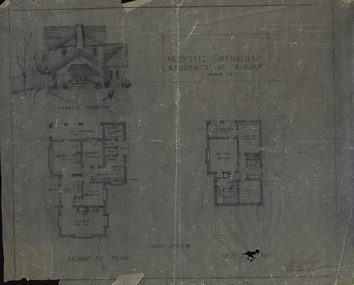
Plan, Proposed Manager's Residence at Albury
... albury architectural plans Two plans showing front elevation and layout plans. Proposed Manager's Residence at Albury Plan Plan ...Two plans showing front elevation and layout plans.albury, architectural plans -
 Ringwood and District Historical Society
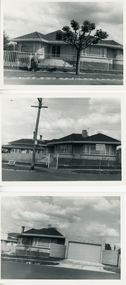
Photograph, Archie and Ruby Harker 's residence 16B Churchill St, Mont Albert Built in 1961 - Collection of black and white and colour photographs including interior
... Archie did well in the printung company he worked for and was a Manager. 6 Black and white photos of the Harker house and garden and 38 coloured photos of rooms and particularly the chandeliers and ceilings. (Scanned as groups of 3 or 4 photos due to the number) Archie and Ruby Harker 's residence 16B Churchill St, Mont Albert Built in 1961 - Collection of black and white and colour photographs including interior Photograph ...Archie and Ruby Harker were connected to the Wieland Family through Ruby's sister Thelma who married Stan Wieland. Archie did well in the printung company he worked for and was a Manager.6 Black and white photos of the Harker house and garden and 38 coloured photos of rooms and particularly the chandeliers and ceilings. (Scanned as groups of 3 or 4 photos due to the number) -
 Ringwood and District Historical Society
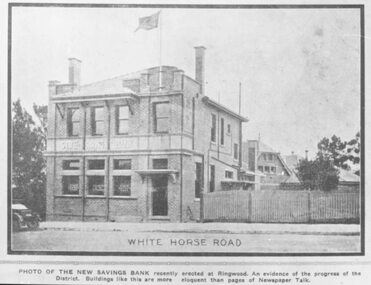
Photograph, Maroondah Highway Central, Ringwood. Land sale brochure image of the State Savings Bank of Victoria branch and manager's residence, 1923
... Land sale brochure image of the State Savings Bank of Victoria branch and manager's residence, 1923. Photograph ...Black and white copy of photographTyped below photograph: "White Horse Road" and statement underneath reads, "Photo of the new Savings Bank recently erected at Ringwood. An evidence of the progress of the District. Buildings like this are more eloquent than pages of Newspaper Talk." -
 Eltham District Historical Society Inc
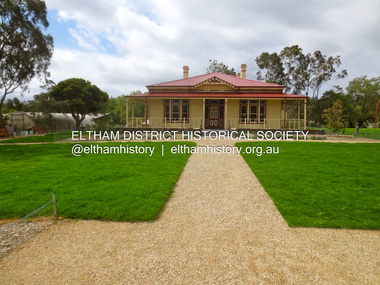
Photograph - Digital Photograph, Jim Connor, Edendale Farm Homestead, 11 December 2014
... In 1896 Thomas Cool, Club Manager of the Victoria Coffee Palace in Melbourne purchased 7 acres of the original Stooke land and built the house now known as Edendale. Cool did not farm the land, instead using it as a gentleman’s residence, retiring to Eltham at weekends. ...In 1896 Thomas Cool, Club Manager of the Victoria Coffee Palace in Melbourne purchased 7 acres of the original Stooke land and built the house now known as Edendale. Cool did not farm the land, instead using it as a gentleman’s residence, retiring to Eltham at weekends. ...Edendale Farm is Nillumbik Shire Council's environment centre situated in Gastons Road, Eltham between the railway and the Diamond Creek. The homestead on the property was built in 1896 and is of historical significance, being the subject of a Heritage Overlay under the Nillumbik Planning Scheme. The Edendale property was originally part of an extensive land purchase in 1852 from the Crown by pioneer Eltham farmer Henry Stooke. He initially purchased 51 acres and later expanded his holdings by purchasing another three adjacent Crown allotments extending northerly from Josiah Holloway's Little Eltham subdivision. Despite clearing the land, Stooke did not build on this property, choosing to live on his property "Rosehill" at Lower Plenty. In 1896 Thomas Cool, Club Manager of the Victoria Coffee Palace in Melbourne purchased 7 acres of the original Stooke land and built the house now known as Edendale. Cool did not farm the land, instead using it as a gentleman’s residence, retiring to Eltham at weekends. In 1918 he purchased an additional 7 acres but in 1919 he sold the property. Later owners included J.W. Cox, the Gaston family and D. Mummery. In the 1980s the Eltham Shire Council purchased the site for use as a Council depot, but this use did not proceed. Subsequently, it was used as the Council pound. The Edendale Farm Pet Education and Retention Centre was established in the summer of 1988/1989 and was set up to replace the existing dog kennels with a high standard pet retention centre. The design style of the building was established to compliment the features of the existing house. It was equipped with 10 retention pens, a veterinary room and a pet education area where school children and other interested parties learnt about pet care procedures. It was later developed into a community farm and was run by an advisory committee and in 2000 it became an Environment Centre. In early 2006 an advisory committee was established for the development of a master plan for future development at Edendale Farm. The committee included Russell Yeoman, a former long-time shire planner and founding member of the Eltham District Historical Society. At the time of filming the Master Plan and future for Edendale was about continuing to develop Edendale as a centre of environment learning and looking at expanding displays and school program, running a lot more of life-long learning and workshops around sustainable living.jim connor collection, edendale community farm, edendale farm, eltham, gastons road -
 Eltham District Historical Society Inc
Film - Video (DVD), Nillumbik Shire Council, Edendale Farm Community Environment Centre: History, c.2009
... In 1896 Thomas Cool, Club Manager of the Victoria Coffee Palace in Melbourne purchased 7 acres of the original Stooke land and built the house now known as Edendale. Cool did not farm the land, instead using it as a gentleman’s residence, retiring to Eltham at weekends. ...In 1896 Thomas Cool, Club Manager of the Victoria Coffee Palace in Melbourne purchased 7 acres of the original Stooke land and built the house now known as Edendale. Cool did not farm the land, instead using it as a gentleman’s residence, retiring to Eltham at weekends. ...EDENDALE FARM Edendale Farm is Nillumbik Shire Council's environment centre situated in Gastons Road, Eltham between the railway and the Diamond Creek. The homestead on the property was built in 1896 and is of historical significance, being the subject of a Heritage Overlay under the Nillumbik Planning Scheme. The Edendale property was originally part of an extensive land purchase in 1852 from the Crown by pioneer Eltham farmer Henry Stooke. He initially purchased 51 acres and later expanded his holdings by purchasing another three adjacent Crown allotments extending northerly from Josiah Holloway's Little Eltham subdivision. Despite clearing the land, Stooke did not build on this property, choosing to live on his property "Rosehill" at Lower Plenty. In 1896 Thomas Cool, Club Manager of the Victoria Coffee Palace in Melbourne purchased 7 acres of the original Stooke land and built the house now known as Edendale. Cool did not farm the land, instead using it as a gentleman’s residence, retiring to Eltham at weekends. In 1918 he purchased an additional 7 acres but in 1919 he sold the property. Later owners included J.W. Cox, the Gaston family and D. Mummery. In the 1980s the Eltham Shire Council purchased the site for use as a Council depot, but this use did not proceed. Subsequently, it was used as the Council pound. The Edendale Farm Pet Education and Retention Centre was established in the summer of 1988/1989 and was set up to replace the existing dog kennels with a high standard pet retention centre. The design style of the building was established to compliment the features of the existing house. It was equipped with 10 retention pens, a veterinary room and a pet education area where school children and other interested parties learnt about pet care procedures. It was later developed into a community farm and was run by an advisory committee and in 2000 it became an Environment Centre. In early 2006 an advisory committee was established for the development of a master plan for future development at Edendale Farm. The committee included Russell Yeoman, a former long-time shire planner and founding member of the Eltham District Historical Society. At the time of filming the Master Plan and future for Edendale was about continuing to develop Edendale as a centre of environment learning and looking at expanding displays and school program, running a lot more of life-long learning and workshops around sustainable living.edendale community farm, eltham, gastons homestead, gastons road, shire of nillumbik, video recording
