
Showing 26 items matching "margaret lord"
-
 Warrnambool and District Historical Society Inc.
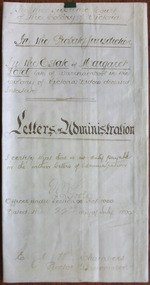
Document - Margaret Lord Letters of Administration 1890, 1896
... Margaret Lord Letters of Administration 1890...margaret lord... This is an 1896 document containing the Letters of Administration following the death of Margaret Lord, a widow from Warrnambool. She died intestate in April 1896 and left real estate to the value of £15 and personal estate to the value of £250. ...‘In the Supreme Court of the Colony of Victoria, In the Probate Jurisdiction in the Estate of Margaret Lord, Late of Warrnambool in the Colony of Victoria, Widow, deceased, intestate, Letters of Administration. ...The writing is somewhat faded but still legible. Document Margaret Lord Letters of Administration 1890 ...This is an 1896 document containing the Letters of Administration following the death of Margaret Lord, a widow from Warrnambool. She died intestate in April 1896 and left real estate to the value of £15 and personal estate to the value of £250. The estate was to be administered by her son, John Lord, a draper from Warrnambool. Tait collection: item 13 of 62This document is of interest because it concerns a local Warrnambool woman, Margaret Lord and a local lawyer, Ernest Chambers The latter had offices in Warrnambool with the known dates 1896 to 1910, with other offices in Koroit and Port Fairy during the same period. His manager in Warrnambool was Thomas Goodall and this document with others was passed to lawyers occupying the same premises in Kepler Street and it was found in the buildings previously occupied by the legal firm Mackay Taylor.This is a piece of parchment paper folded in two with writing in brown-coloured ink on the back and front of the document. It has a seal of the Supreme Court of the Colony of Victoria and one red stamp of the Master in Equity of the Supreme Court. The writing is somewhat faded but still legible.‘In the Supreme Court of the Colony of Victoria, In the Probate Jurisdiction in the Estate of Margaret Lord, Late of Warrnambool in the Colony of Victoria, Widow, deceased, intestate, Letters of Administration. I certify that there is no duty payable on the within Letters of Administration, J. Poole, Officer Under Section 96 Act 1060, Dated the 22nd day of July 1896. E.J.W. Chambers, Proctor, Warrnambool’ margaret lord, ernest chambers, warrnambool -
 Warrnambool and District Historical Society Inc.
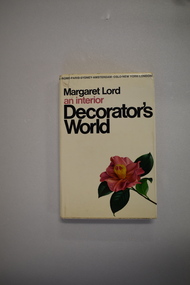
Book, An Interior Decorator’s World, 1969
... margaret lord...This book is the autobiography of Margaret Lord, a noted Australian interior designer, journalist, colour consultant and author. ...This book is the autobiography of Margaret Lord, a noted Australian interior designer, journalist, colour consultant and author. ...This book is the autobiography of Margaret Lord, a noted Australian interior designer, journalist, colour consultant and author.This is a hard cover book of 215 pages. The hard cover is white with silver-coloured printing on the spine and the dust cover has a cream background with black and pink printing and the image of a pink rose. The pages contain an introduction, a preface, ten chapters of text and an appendix. non-fictionThis book is the autobiography of Margaret Lord, a noted Australian interior designer, journalist, colour consultant and author.margaret lord, interior designer, history of warrnambool, australian society of interior designers -
 Bendigo Historical Society Inc.
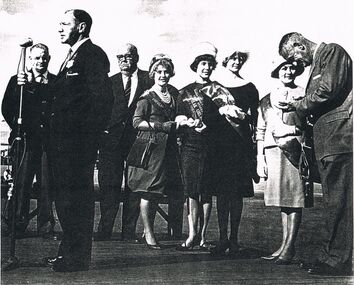
Photograph - BENDIGO EASTER FAIR COLLECTION: POPULAR GIRL COMPETITIONS
... On back photocopy of 1964 Popular Girls, image shows Annette martin, Merrilynne Payne, Alec Craig ( Mayor) Margaret Collins, Helen Lord....On back photocopy of 1964 Popular Girls, image shows Annette martin, Merrilynne Payne, Alec Craig ( Mayor) Margaret Collins, Helen Lord. Photograph BENDIGO EASTER FAIR COLLECTION: POPULAR GIRL COMPETITIONS ...Photocopy of group of men and women. Women wearing sashes, popular girl. Written on pencil 1962 popular girls ?? On back photocopy of 1964 Popular Girls, image shows Annette martin, Merrilynne Payne, Alec Craig ( Mayor) Margaret Collins, Helen Lord.bendigo, bendigo easter fair, popular girls competition -
 Federation University Historical Collection
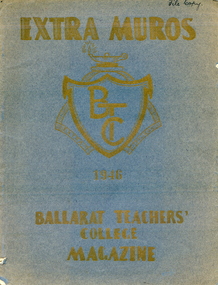
Book, Ballarat Teachers' College, Ballarat Teachers College Extra Muros, 1946, 1946
... lord...g kentish...don johnson...neville bunning...henry yeo...irene handley...betty smith...heather fraser...ron schneider...alma sunderland...pauline griffin...betty redford...robert eastcott...kathleen tobin...margaret...For those pupils who do not come withing the scope of Repatriation, teachers might secure the required help from the Teachers; R.S.L. sub-branch, the Carry-on Club, for from Government Scholarships. ballarat teachers college monica miller m fogarty james parkinson beatrix basterfield patricia rea nola stanway valmai sprigg valda sharp queenscliffe lonsdale thea rowe student hostel student residence wf lord g kentish don johnson neville bunning henry yeo irene handley betty smith heather fraser ron schneider alma sunderland pauline griffin betty redford robert eastcott kathleen tobin margaret mcintyre jean somerville ken andrews frank lord Cover 'File Copy' inside front cover (possibly by Monica Miller) 'With Compliments Ballarat Teachers' College. ...Principal Frank Lord gave an ANZAC Day address called "Live Every Day as an Anzac Day". The address started with "Our opportunity is with the children. If we failed i nthe past, lest us begin again now. You are young, and let it be your resolve to live every day as an Anzac Day, and achieve some of the things for which the men of two wars have laid down their lives. Living your days with an air of kindness and decency, you will set an example to the children, and when a country's children are made happier and finer, it will follow that the county will be a happier and finer place." Mt Lord referred to theseven and a half months' occupation of Gallipoli, and the tenacious clinging by Anzac troops to their square mile of territory. Illness, disease and death came to the confined area, but there also came a spirit of self-sacrifice and charity, and a courage whoich scorrned death and won for the Australian troops world renown. Strong men broke under the conditions, but their comrades carried them on, and the prevailing spirit among men was that the had dedicated ther lives to ensuring a decent society at home, free of tyranny. For the achievement of this, they were prepared to die. It became characteristic that when things were at their worst, men were at their best. Discipline did not come from above on Gallipoli, for the men stuck their own standards of discipline, and stuck to them. ... After the 1914-18 war, it was surprising to find head teachers who did not know children of deceased and disabled soldiers in their schools. All teachers should acquaint themselves with this knowledge, and seek assistance from children who are eligible for help from the Repatriation Department. For those pupils who do not come withing the scope of Repatriation, teachers might secure the required help from the Teachers; R.S.L. sub-branch, the Carry-on Club, for from Government Scholarships. Blue soft covered magazine. Contents include: *Principal Frank Lord's Foreward * Rupert Brooke * Hostel Jottings * Looking Back * College photograph Images include: * Queenscliff Camp * Sport * ClubsCover 'File Copy' inside front cover (possibly by Monica Miller) 'With Compliments Ballarat Teachers' College. Xmas 1946'ballarat teachers college, monica miller, m fogarty, james parkinson, beatrix basterfield, patricia rea, nola stanway, valmai sprigg, valda sharp, queenscliffe, lonsdale, thea rowe, student hostel, student residence, wf lord, g kentish, don johnson, neville bunning, henry yeo, irene handley, betty smith, heather fraser, ron schneider, alma sunderland, pauline griffin, betty redford, robert eastcott, kathleen tobin, margaret mcintyre, jean somerville, ken andrews, frank lord -
 Federation University Historical Collection
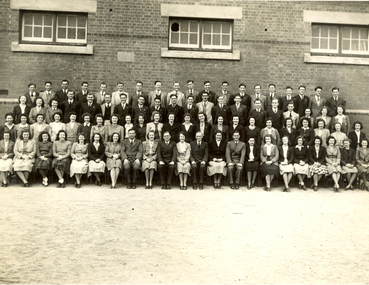
Photograph - Black and White, Ballarat Teachers' College, 1947, 1947
... Margaret Palmer; Marie Faulds; Thelma Ritchie. Fourth Row: Pat Lewin; Mavis Poland; Lorna Welsh; Lynette Lynch; Nancy Alexander; Betty Williams, Val Gorrie; Alan Sonsee; Trudy Kentish; Carl Bryan; Monica Miller; W.F. Lord...Margaret Palmer; Marie Faulds; Thelma Ritchie. Fourth Row: Pat Lewin; Mavis Poland; Lorna Welsh; Lynette Lynch; Nancy Alexander; Betty Williams, Val Gorrie; Alan Sonsee; Trudy Kentish; Carl Bryan; Monica Miller; W.F. Lord ...Ballarat Teachers' College was opened on may 4th, 1926, at S.S. 33, Dana Street, with an enrollment of sixty-one students, its original staff consisted of the Principal, Mr W. H. Ellwood, M.A., m.Ed. (Chairman of the Teachers' tribunal from its inception in 1946 until 1954), Miss A. Bouchier, B.A., and Mr A.B. Jones, B.A. (Lecturers). In 1927 Miss P.A. Hamano joined the staff. Teaching practice and special rural school work were carried on in schools in or near Ballarat - drawing, crafts and singing were taught by local teachers. In 1927 the college moved to the old Ballarat East Town Hall (remodelled for their use) in Barkly Street. During 1927 the numbers in the College were augmented by twenty-six Manual arts students who had formerly received their training at Ballarat High School. Manual Arts students continued till 1930, when, on grounds of economy, their training was concentrated at Melbourne Teachers' College.\During the four succeeding years approximately sixty students annually entered the primary course. Inclusive of Manual Arts students, and private fee-paying students, exactly 400 trainees passed through the college in its brief span of life (1926-1931) Fourteen years were to pass before they were again opened to students on February 2nd, 1946. The college was re-commenced at S.S. Dana Street under the guidance of Mr W.F. Lord, M.C., M.M., B.A., Dip.Ed., (Acting Principal 1946-1950), and a staff consisting of Miss E.B. Hughes, B.A., Dip. Ed., Mr C.B. Bryan, B.A., V.Com., Dip.Ed., Miss M.H. Miller, L.Mus.A., and Miss G. Kentish, Dip.Phys.Ed. The opening ceremony was performed by the Minister for education at that time, the Hon. F. Field, M.L.A., accompanied by the Hon. T.T. Hollway, M.L.A., and the then Director of Education, Mr J.A. Seitz. It was originally intended to cater for women students only (for whom 130 Victoria Street was purchased as a hostel) but, at the last moment, men were also accepted. A co-educational college was thus set up instead, and has continued as such. The original Staff has been considerable augmented, and the number of Students has been more than trebled. 1951 saw the introduction of the two-year course, successful students being presented with the Trained Primary Teachers' Certificate at the final College assembly each year. In December, 1855, College held its first Graduation Ceremony, with its own Graduation hymn, the words of which were written by Miss C.M. Canty of the staff. Mr Ellwood, former Principal,delivered the occasional address and presented the Ellwood Prize to the outstading student of the year (Mr C.P. Handreck). Students who had successfully completed the course received their certificates from Mr E.B. Pederick, Chief Inspector of Primary Schools. College accomodation having been strained for several years, it was pleasant news when tenders were called in July, 1956, for the building of the first section of the new Ballarat Teachers' College in Gillies Street, near the Botanical Gardens. At the beginning of 1958 the new College was occupied, and staff and students have appreciated greatly the appointments and cacilities of the new buildign. In 1968 the three-year Diploma Course began, co-existent with the other courses which will continue during the transitional period. Successful students in the course receive the Diploma of Teaching (Primary).Black and white photograph of students and staff of the Ballarat Teachers' College. The people are in four rows, and they stand in front of the Dana Street Primary School. Back Row: Jim Howlett; Milton Rice; Keith McLean; Jim Williams; George Nield, David Cooper, Ray Terrill, William Gleeson; Tom Pascoe; Lindsay Harley; Ron Carless; Robert Giddings; Colin Connelly; Alex Magill; Eddie Blake; William Punshon; Athol Aisbett; Kevin Collins; John O'Shannessy. Second Row: Beth Leslie; Faye Dreher; Gwen Pamphilon; Arthur Lelean; Howard Pattenden; Jack Tyers; Hugh Fraser; William Henderson; Jack Mallett; Alan Martin; Keith Boyd; John Ellifson; John Collins; Tom Hill; Wal Henning; Burns Roddis; Fred Marshman; Dawn Doney; Pat Watts; Ann McKinnon. Third Row: Ethel Esmore; Joy Love; Pat Luxford; Jean Elliott; Josie Bunny; Phyllis Borley; Joyce Matheson; Val Witney; Ruth Tozer; Nancy Kerr; K.ath Tobin; Muriel Morrish; Jean Clode; Peg Purdue; Joyce Kennedy; Margaret Palmer; Marie Faulds; Thelma Ritchie. Fourth Row: Pat Lewin; Mavis Poland; Lorna Welsh; Lynette Lynch; Nancy Alexander; Betty Williams, Val Gorrie; Alan Sonsee; Trudy Kentish; Carl Bryan; Monica Miller; W.F. Lord; Beth Hughes; Mephan McMcEwin; Mattie Hayes; Neila Vallance; Pat Robinson; Elva Surman; Joan Gunning; Norma Dally; Beatrice Freeman; Kath Crossett.ballarat teachers' college, education, dana street primary school, 1947 -
 Federation University Historical Collection
Scrapbook, Ballarat Teachers' College Jubilee Book 50th Anniversary, 1949-1999, 1999
... margaret reynolds bennett...harry cumming...peg aloreo harris...verna lees kaye...lesley latch frank...gladys white hogg...lindsay campbell...joan cool read...maureen godfrey fithall...grahame fithall...david collins...ron edmonds...a gladness found...graham bartle...frank lord...ballarat teachers' college william ellwood dana street primary school monica miller reunions anniversary meph mcewan joe scarlett john hogan gervasoni john gervasoni jack gervasoni margaret bennett queen elizabeth ii buckingham palace letterhead forty-niner rose mattee hayes peter fryar tom turner cynthia silver lewin margaret reynolds bennett harry cumming peg aloreo harris verna lees kaye lesley latch frank gladys white hogg lindsay campbell joan cool read maureen godfrey fithall grahame fithall david collins ron edmonds a gladness found graham bartle frank lord allan sonsee cecil allan sonsee john neville stewart obituary john hogan gervasoni obituary richard stowell obituary rita butt campbell obituary john blackie obituary jack dridan obituary wilma gardy byrne obituary joan johnson binns obituary lesley latch frank obituary mattee hayes ilton obituary margaret panther leask obituary moyra ahern smith obituary margaret blaby gledhill obituary dana street primary school letterhead Black folder of clippings, photos, newsletters, Extra Muros, history, relating the the Ballarat Teachers' College class of 1949. ...Black folder of clippings, photos, newsletters, Extra Muros, history, relating the the Ballarat Teachers' College class of 1949. It includes a short biography on Frank Lord: Teacher and Soldier by Wal Wallballarat teachers' college, william ellwood, dana street primary school, monica miller, reunions, anniversary, meph mcewan, joe scarlett, john hogan gervasoni, john gervasoni, jack gervasoni, margaret bennett, queen elizabeth ii, buckingham palace letterhead, forty-niner rose, mattee hayes, peter fryar, tom turner, cynthia silver lewin, margaret reynolds bennett, harry cumming, peg aloreo harris, verna lees kaye, lesley latch frank, gladys white hogg, lindsay campbell, joan cool read, maureen godfrey fithall, grahame fithall, david collins, ron edmonds, a gladness found, graham bartle, frank lord, allan sonsee, cecil allan sonsee, john neville stewart obituary, john hogan gervasoni obituary, richard stowell obituary, rita butt campbell obituary, john blackie obituary, jack dridan obituary, wilma gardy byrne obituary, joan johnson binns obituary, lesley latch frank obituary, mattee hayes ilton obituary, margaret panther leask obituary, moyra ahern smith obituary, margaret blaby gledhill obituary, dana street primary school letterhead -
 Federation University Historical Collection
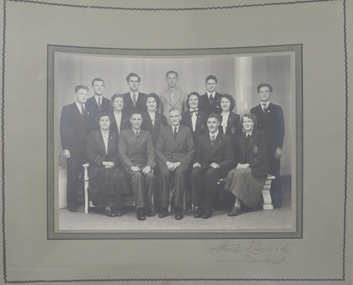
Photograph - Photograph - Black and White, Thorton Richards, Ballarat Teachers' College Student Council, 1949, 1949
... lord...len mccrae...margaret...Ballarat Teachers College 1949 Is of significance to the history of the Ballarat Teachers College, Ballarat ballarat teachers' college btc school council gladys white tom turner w.f. lord len mccrae margaret collins joan addinsall margaret reynolds margaret bennett pam hudson val kelly peter fryer don evans k.b. richardson wallace wall p.j. baker Thorton Richarrds & Co, Ballarat Black and white photograph on grey card board frame, has dark straight lines around photogragh and decoration on outer edge Ballarat Teachers' College Student Council, 1949 Photograph Photograph - Black and White Thorton Richards ...Ballarat Teachers College 1949Is of significance to the history of the Ballarat Teachers College, BallaratBlack and white photograph on grey card board frame, has dark straight lines around photogragh and decoration on outer edgeThorton Richarrds & Co, Ballaratballarat teachers' college, btc school council, gladys white, tom turner, w.f. lord, len mccrae, margaret collins, joan addinsall, margaret reynolds, margaret bennett, pam hudson, val kelly, peter fryer, don evans, k.b. richardson, wallace wall, p.j. baker -
 Federation University Historical Collection
Booklet - Magazine, J.A. Hoskin & Son, Extra Muros: Ballarat Teachers' College Magazine, 1948, 1948
... Margaret Hanrahan...Denis Bryans...Hans Fumberger...Frank Lord...lord C.P. ROdoni Helen Veitch Galipolli address tom turner Patrick Rodoni Ala Sonsee Cornelius Barbetti Margaret Bradshaw Margaret Burke joan coad Irene Ellwood Margaret Hanrahan Denis Bryans Hans Fumberger Frank Lord Tom Aurita PErry Japanese Nobility Inside front cover "Monica Miller" Blue soft covered magazine of the Ballarat Teachers' College. ...Blue soft covered magazine of the Ballarat Teachers' College. Contents include: * Foreward by Principal Frank Lord "Ich Dien" * Highlights of the College Year * Review of Teacher-Training System Photographic reproductions include: * 1948 staff and students * Magazine Committee * Group Leaders and Student Council * Sports Committee * Social Committee * Exies ^ War Time Schools in Britain * Mallee Lands * Review of Teacher Training Systemnon-fictionm. smale, j. cleland, j. groves, r. lockhart, a. mclachlan, j. coad, c. mansfield, b. thomas, h. frank, r. osborne, m. eichler, n. raggart, r. boatman, g. groutasch, j. forrest, g. golder, m. raisbeck, l. guest, l. morrison, j. pell, d. hunt, p. fuller, m. schier, m. klein, g. denning, w. e. denning, al witney, joyce kennedy, keith mclean, trudy kentish, jack mallett, bill henderson, beth leslie, john o'shannessy, gwen clucas, monica miller, p. hamano, aurita rowland, w.f. lord, c.p. rodoni, helen veitch, galipolli address, tom turner, patrick rodoni, ala sonsee, cornelius barbetti, margaret bradshaw, margaret burke, joan coad, irene ellwood, margaret hanrahan, denis bryans, hans fumberger, frank lord, tom, aurita perry, japanese nobility -
 Federation University Historical Collection
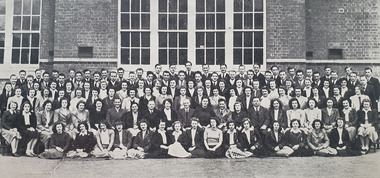
Booklet - Magazine, Extra Muros: Ballarat Teachers' College Magazine, 1948, 1948
... Margaret Hanrahan...Denis Bryans...Hans Fumberger...Frank Lord...lord C.P. ROdoni Helen Veitch Galipolli address tom turner Patrick Rodoni Ala Sonsee Cornelius Barbetti Margaret Bradshaw Margaret Burke joan coad Irene Ellwood Margaret Hanrahan Denis Bryans Hans Fumberger Frank Lord Tom Inside front cover "Monica Miller" Blue soft covered magazine of the Ballarat Teachers' College. ...Blue soft covered magazine of the Ballarat Teachers' College. Contents include: * Foreward by Principal Frank Lord "Ich Dien" * Highlights of the College Year * Review of Teacher-Training System Photographic reproductions include: * 1948 staff and students * Magazine Committee * Group Leaders and Student Council * Sports Committee * Social Committee * Exiesnon-fictionm. smale, j. cleland, j. groves, r. lockhart, a. mclachlan, j. coad, c. mansfield, b. thomas, h. frank, r. osborne, m. eichler, n. raggart, r. boatman, g. groutasch, j. forrest, g. golder, m. raisbeck, l. guest, l. morrison, j. pell, d. hunt, p. fuller, m. schier, m. klein, g. denning, w. e. denning, al witney, joyce kennedy, keith mclean, trudy kentish, jack mallett, bill henderson, beth leslie, john o'shannessy, gwen clucas, monica miller, p. hamano, aurita rowland, w.f. lord, c.p. rodoni, helen veitch, galipolli address, tom turner, patrick rodoni, ala sonsee, cornelius barbetti, margaret bradshaw, margaret burke, joan coad, irene ellwood, margaret hanrahan, denis bryans, hans fumberger, frank lord, tom -
 Federation University Historical Collection
Magazine, Extra Muros: Ballarat Teachers' College Magazine, 1949, 1948
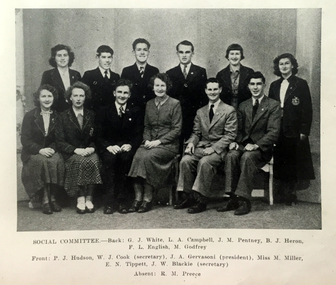
... lord...david j. collins...john h. gervasoni...maureen godfrey...margaret...We also must pay particular care to children of the men who fought and died in the two Great Wars through which our country has passed." ballarat teachers' college frank lord david j. collins john h. gervasoni maureen godfrey margaret collins peter fryar wal wall j.w. blackie monical miller e.n. tippett g.j. white d.h. evans p.j. hudson m.l. collins m. godfrey gallipoli physical education i. ellwood m. smale j. cleland j. groves r. lockhart a. mclachlan turner j. coad lord c. mansfield john hogan Gervasoni Inside front cover "Monica Miller" Blue soft covered magazine of the Ballarat Teachers' College. ...During 1948 Principal Frank Lord, a Gallipoli veteran, gave an inspiring address reminding students of the great sacrifice made by the Anzacs at Gallipoli. "These men set a high standard which has been followed by men of the second World War. We as teachers can help set standards amongst the children we are privileged to teach, and this we have an important task to do. We also must pay particular care to children of the men who fought and died in the two Great Wars through which our country has passed."Blue soft covered magazine of the Ballarat Teachers' College. Contents include: * Foreword by Principal Frank Lord "A teacher affects eternity, he can never tell where his influence stops" Photographic reproductions include: * 1949 staff and students * Hostels * Clubs * Sports * Lapses into Literature Images include: * S.R.C. and Group Leaders * Social Committee * Sports Committee * Magazine Committee * Hockey * Basketball * Football Inside front cover "Monica Miller"ballarat teachers' college, frank lord, david j. collins, john h. gervasoni, maureen godfrey, margaret collins, peter fryar, wal wall, j.w. blackie, monical miller, e.n. tippett, g.j. white, d.h. evans, p.j. hudson, m.l. collins, m. godfrey, gallipoli, physical education, i. ellwood, m. smale, j. cleland, j. groves, r. lockhart, a. mclachlan, turner, j. coad, lord, c. mansfield, john hogan gervasoni -
 Eltham District Historical Society Inc
Photograph, The Anglican Church of the Transfiguration of our Lord
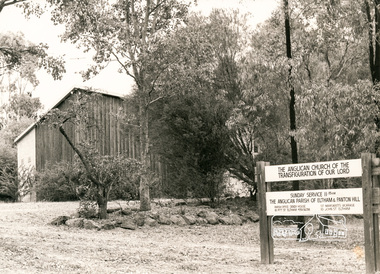
... Digital scan of photograph - Original Source Copy: St Margaret's Parish Archives. The Anglican Church of the Transfiguration of our Lord Photograph ...Digital scan of photograph - Original Source Copy: St Margaret's Parish Archives. church of england, churches, eltham, st margarets church, church of the transfiguration, research (vic.) -
 Bendigo Historical Society Inc.
Document - LA TROBE UNIVERSITY BENDIGO COLLECTION: BENDIGO TEACHERS' COLLEGE GRADUATION CEREMONY 1962
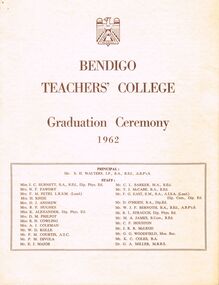
... They are Glenys Faye Barrett, Marlene Isabella Bemrose, Beth Adora Bodinnar, Margaret Isobel Brown, Doris Lillian Chambers, Marie Ann Crawford, Margaret Carol Donne, Kaye Beverley Exell, Jannette Joyce Hughes, Margaret Christina Jenkins, Kathryn Margaret Lackmann, Susan Anne Lewer, Barbara June Lord, Jennifer Beris Matheson, Joy Lynette Messer, Geraldine Mary, Moylan, Patricia Joan O'Bree, Helen Jeanette Rodda, Lesley Scott, Heather Dawn Shenfield, Nola May Steele, Jennifer Margaret Weston and Alicia Yvonne Young. ...They are Glenys Faye Barrett, Marlene Isabella Bemrose, Beth Adora Bodinnar, Margaret Isobel Brown, Doris Lillian Chambers, Marie Ann Crawford, Margaret Carol Donne, Kaye Beverley Exell, Jannette Joyce Hughes, Margaret Christina Jenkins, Kathryn Margaret Lackmann, Susan Anne Lewer, Barbara June Lord, Jennifer Beris Matheson, Joy Lynette Messer, Geraldine Mary, Moylan, Patricia Joan O'Bree, Helen Jeanette Rodda, Lesley Scott, Heather Dawn Shenfield, Nola May Steele, Jennifer Margaret Weston and Alicia Yvonne Young. ...Two copies of the Bendigo Teachers' College Graduation Ceremony 1962 program. On the front page is a list of the staff working at the college - Mr. S. H. Walters (Principal), Miss J. C. Burnett, Mrs. N. F. Fawdry, Mrs. F. M. Petri, Mrs. H. Knox, Mrs. D. J. Andrew, Mrs. B. F. Hughes, Miss K. Alexander, Mrs. D. M. Philpot, Miss B. H. Cowling, Mrs. A. J. Coleman, Mr. W. D. Kolle, Mr. F. M. Courtis, Mr. P. M. Divola, Mr. E. J. Major, Mr. C. L. Barker, Mr. T. J. McCabe, Mr. F. G. East, Mr. D. O'Brien, Mr. W. J. F. Bernoth, Mr. R. L. Strauch, Mr. M. A. James, Mr. C. F. Houston, M. J. R. R. McLeod, Mr. G. G. Woodfield, Mr. K. C. Coles and Dr. G. A. Miller. On the inside cover is the "Significance of the Ceremony" and the "Order of the Ceremony". Mr. F. M. Courtis welcomed the visitors and the Principal read the College Charge. The 'Graduation Book' was presented to Mr. W. F. R. Budge by Miss J. C. Burnett. Mr. C. L. Barker presented the T.P.T.C. graduating students to the Principal and Mrs. N. F. Fawdry presented the T.I.T.C. graduating students to the Principal. Congratulations were offered by the Mayor of Bendigo Cr. R. A. Rae, J.P., the President of Strathfieldsaye Shire Cr. K. Houlahan, J. P. and Mr. E. P. Seymour, Head Teacher, Violet Street State School. The Occasional Address was given by Mr. L. J. Pryor Superintendent of Teacher Education. The following page contains a list of the "Students of 1960 - 1962 Trained Infant Teacher's Certificate". They are Glenys Faye Barrett, Marlene Isabella Bemrose, Beth Adora Bodinnar, Margaret Isobel Brown, Doris Lillian Chambers, Marie Ann Crawford, Margaret Carol Donne, Kaye Beverley Exell, Jannette Joyce Hughes, Margaret Christina Jenkins, Kathryn Margaret Lackmann, Susan Anne Lewer, Barbara June Lord, Jennifer Beris Matheson, Joy Lynette Messer, Geraldine Mary, Moylan, Patricia Joan O'Bree, Helen Jeanette Rodda, Lesley Scott, Heather Dawn Shenfield, Nola May Steele, Jennifer Margaret Weston and Alicia Yvonne Young. It also contains a paragraph describing "The Perfect Teacher". The back cover of the booklet has a list of "Students of 1961 - 1962 Trained Primary Teacher's Certificate". John Walter Angel, Elisabeth Ann Arkinstall, Mary Christina Backway, Helen Elizabeth Barclay, Bruce Maxwell Bouch, Pamela Mary Braden, Howard Francis Briggs, Clare Antoinette Brown, Alan John Bruce, Peter John Burns, Valerie Jean Caldwell, Marie Lynette Chambers, Margaret Jeannette Christie, Alison Ruth Clement, Marie Elaine Collins, Gladys Helena Cooke, Lindsay Charles Coster, David John Cowan, Peter John Cronin, Berenice Margaret Cronk, Edeline May Crouch, Theodore Robert Dare, Lynette Joan Davis, Ian David Dawson, Mary DeAraugo, Kenneth Ross Erbs, Francis Elaine Mary Fallon, Margaret Fawcett, Janet Frances Filbey, Francesco Gargiulo, Ian John Glenister, Barbara Faye Gotch, Lynette Ellen Graham, Colin Athol Hayes, Marlene Grace Hazen, Desmond Brian Hearn, Brentford Graeme Heath, Carmel Jean Heslop, Pamela Joy Higgie, Lynette Rosemary Cecelia Hoare, Erica Fay Holloway, Marie Jean Jardine, Kenneth Neil Johnson, Laurel Robyn Jones, Glenys Lorraine Judd, Diane Elizabeth Kear, Ann Elizabeth Keenan, Monica Cecelia Kelly, Margaret Elizabeth Landini, Patricia Joy Langdon, Dorothy Margaret Leitch, Donald Alan Leslie, Mary Carmel McCormack, Helen Mary McCutcheon, Birgitt Marx, Claire Agnes Mullins, Lucille Anne Newcombe, Glenice Vivienne Orr, Judith Joyce Ozanne, Wilma Beverley Pape, Virginia Elizabeth Parke, Robin Parker, Dorothy Joan Peterson, Robin Joan Phillips, Cherril Margaret Probyn, Norma Lesley Rantall, Nola Read, Margaret Elaine Ridley, Thomas Charles Rilen, Marie Therese Sharkey, Judith Margaret Spackman, Desmond Thomas Stephens, Nancy Rae Telfer, Bernard James Trevaskis, Marjorie Ellen Warden, Laurice Helen Warwick, Judith Maree Weir, Maxwell John White, Norman Leslie Williams, Pamela Williams and Lloyd Reginald Wishart. Within this document is a loose page showing the seating arrangements for the graduation. Staff seating arrangements are as follows - Walters, Barker, Seymour, Fawdry, McCabe, Woodfield, Alexander, Hughes, Divola, Major, Strauch, Pryor, Budge, Burnett, East, Houston, Petri, Andrew, Coles, McLeod, James, O'Brien.bendigo, education, bendigo teachers' college graduatio, la trobe university bendigo collection, collection, bendigo teachers' college, bendigo, education, teaching, teachers, students, staff, bendigo teachers' college students, bendigo teachers' college staff, history, graduation, graduation ceremony, book, tertiary education, graduands, graduates -
 Bendigo Historical Society Inc.
Document - BENDIGO SYMPHONY ORCHESTRA CONCERT, BENDIGO CITY HALL, 1 December, 1984
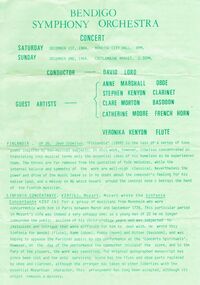
... Lord. Guest Artists: Anne Marshall (oboe)... Stephen Kenyon (Clarinet)... Clare Morton (Bassoon)... Catherine Moore (French Horn)... Veronika Kenyon (Flute). Program. Members of the Orchestra. Violins: Ellis Ormerod... Sister Cecilia... Jean Boulton... Ruth Weldon... Natasha Anderson... Daniel Herbst... Sally Tidwell. 2nds: Graeme Balaam... Thelma Harvey... Edna Osborne... Myrtle Robbins... Jean Wilson... Margaret...Lord. Guest Artists: Anne Marshall (oboe), Stephen Kenyon (Clarinet), Clare Morton (Bassoon), Catherine Moore (French Horn), Veronika Kenyon (Flute). Program. Members of the Orchestra. Violins: Ellis Ormerod, Sister Cecilia, Jean Boulton, Ruth Weldon, Natasha Anderson, Daniel Herbst, Sally Tidwell. 2nds: Graeme Balaam, Thelma Harvey, Edna Osborne, Myrtle Robbins, Jean Wilson, Margaret Cowder, John Gault, Elizabeth Grounds. ...Lord. Guest Artists: Anne Marshall (oboe) Stephen Kenyon (Clarinet) Clare Morton (Bassoon) Catherine Moore (French Horn) Veronika Kenyon (Flute). Program. Members of the Orchestra. Violins: Ellis Ormerod Sister Cecilia Jean Boulton Ruth Weldon Natasha Anderson Daniel Herbst Sally Tidwell. 2nds: Graeme Balaam Thelma Harvey Edna Osborne Myrtle Robbins Jean Wilson Margaret Cowder John Gault Elizabeth Grounds. ...Bendigo Symphony Orchestra Concert, Bendigo City Hall. Saturday December 1st, 1984, 8pm. Conductor: David Lord. Guest Artists: Anne Marshall (oboe), Stephen Kenyon (Clarinet), Clare Morton (Bassoon), Catherine Moore (French Horn), Veronika Kenyon (Flute). Program. Members of the Orchestra. Violins: Ellis Ormerod, Sister Cecilia, Jean Boulton, Ruth Weldon, Natasha Anderson, Daniel Herbst, Sally Tidwell. 2nds: Graeme Balaam, Thelma Harvey, Edna Osborne, Myrtle Robbins, Jean Wilson, Margaret Cowder, John Gault, Elizabeth Grounds. Cellos: Diane Chapman, Marge Bubb, Chris Wilson. Bass: Neville King. Flutes: Colin Bubb, Sally Pell, Nigel McGuckian, Karen Hansen. Oboes: David Tunley, Rob Boxshall. Clarinets: Jane Davies, Craig Spenceley, Trevor Quirk. Bassoons: Stuart Anderson, Michael Grounds. Horns: Giles Lean, Gaye Cooper, Allan Davies, Anthony van Emmerick. Tuba: Brian Brewer. Trombones: Stephen Vine, Neil Newman. Cornet: Paul Cooper. Trumpet: Neville Pearce. Percussion: Lloyd George, Nola McIver, Jim Merritt. Acknowledgements: The Orchestra wishes to acknowledge the support given by the Victorian Ministry for the Arts, & the Bendigo & Castlemaine Arts Councils.program, music, bendigo symphony orchestra, bendigo symphony orchestra concert, bendigo city hall. december 1st, 1984, . conductor: david lord. guest artists: anne marshall (oboe), stephen kenyon (clarinet), clare morton (bassoon), catherine moore (french horn), veronika kenyon (flute). program. members of the orchestra. violins: ellis ormerod, sister cecilia, jean boulton, ruth weldon, natasha anderson, daniel herbst, sally tidwell. 2nds: graeme balaam, thelma harvey, edna osborne, myrtle robbins, jean wilson, margaret cowder, john gault, elizabeth grounds. cellos: diane chapman, marge bubb, chris wilson. bass: neville king. flutes: colin bubb, sally pell, nigel mcguckian, karen hansen. oboes: david tunley, rob boxshall. clarinets: jane davies, craig spenceley, trevor quirk. bassoons: stuart anderson, michael grounds. horns: giles lean, gaye cooper, allan davies, anthony van emmerick. tuba: brian brewer. trombones: stephen vine, neil newman. cornet: paul cooper. trumpet: neville pearce. percussion: lloyd george, nola mciver, jim merritt. acknowledgements: victorian ministry for the arts, bendigo & castlemaine arts councils. -
 Bendigo Historical Society Inc.
Document - OUR STREETS - ORIGIN OF NAMES
... Margaret Brennan... Samuel Pepys... Commissioner McCrae... Edwin Hargraves... Commissioner Dowling... Commissioner Bernal... Advertiser... Richard Larritt... Sergeant Drought... Senior Constable Stout... Golden Square... Palmeston Square... Wattle Square... Market Square... Brassey Square... Andrew Square... Charles Dickens... Lord...DOCUMENT Our Streets - Origin of Names Surveyor Urquhart Miss Margaret Brennan Samuel Pepys Commissioner McCrae Edwin Hargraves Commissioner Dowling Commissioner Bernal Advertiser Richard Larritt Sergeant Drought Senior Constable Stout Golden Square Palmeston Square Wattle Square Market Square Brassey Square Andrew Square Charles Dickens Lord Palmerston Viscount Brassey Cosmopolitan Mine David Andrew Sun Ack Goons Hong Yick Wes Harry Five pages of hand written notes on the origins of our Bendigo streets and the six squares - Golden, Palmerston, Wattle, Market, Brassey and Andrew. ...Five pages of hand written notes on the origins of our Bendigo streets and the six squares - Golden, Palmerston, Wattle, Market, Brassey and Andrew. The notes give the origin of the names. Notes written by Wes Harry.document, our streets - origin of names, surveyor urquhart, miss margaret brennan, samuel pepys, commissioner mccrae, edwin hargraves, commissioner dowling, commissioner bernal, advertiser, richard larritt, sergeant drought, senior constable stout, golden square, palmeston square, wattle square, market square, brassey square, andrew square, charles dickens, lord palmerston, viscount brassey, cosmopolitan mine, david andrew, sun ack goons, hong yick, wes harry -
 Narre Warren and District Family History Group
Book, Narre Warren & District Family History Group Inc, Casey Cardinia Collection - Berwick Information File - Volume 2, 2021
... Lord & Lady Casey 21 May 2015 Happy Couple’s Life of “Bliss and Hiss” - Val & John Evans 15 Jun 2016 Last Orders? Not for Carl - Carl Strachan 20 Oct 2021 Settling the Soldiers - Soldiers Road 28 Jan 2009 Secrets Behind the Show - Berwick Show 24 Jan 2018 Club in a Gesture for Jim - Jim Allan 21 Feb 2018 Shipwreck Lovers Settle in Berwick, Despite Cannibals 14 Aug 2013 Association Members Celebrate Their 80th - Red Cross 24 Feb 2021 Cheese Factory’s Rich Past 10 Jun 2020 Kempson Left His Mark - Henry Kempson 10 Mar 2021 School Began on Holidays - St Margarets 25 Aug 2021 The Sweet Side of Savory - Gil Savory 25 Jul 2018 Firing up the Old Brigade - 11 Jul 2018 Tribute to the Good Doctor - Percy Langmore 25 Apr 2018 A Brush with History 25 Apr 2018 Looking Back 9 Feb 2009 A Place in History - Living Memories DVD 25 Oct 2017 Founding Family Continues Show’s Style - Dandenong Show 19 Mar 2015 United by News - Bill Rogers 1 Feb 2017 Ruth in Heritage Honour - Ruth Crofts 23 Aug 2017 Athlete was a Gentleman - Edwin Flack 23 Aug 2017 Historic News in Brief UNKNOWN Playing the Part - World Wars Re-enactment 9 Jul 2014 Building on Some Historic Foundations - National Trust 26 Apr 2018 Big Crowd for First Dawn 16 Apr 2007 Life and Legacy Remembered - Peter Canobio 25 Jun 2008 Walking Tour Unearths “Jewels” - Hands on History Tour CD 12 Dec 2007 Old Cheese Factory was Built by Sir William Clarke in 1875 31 Mar 2021 Cemetery Extension Open - Berwick Cemetery 31 Mar 2021 End of an Era: Don Retiring from Trust After 40 Years - Don Moyes 7 Feb 2018 A Healthy History in Berwick - St John of God Hospital 18 Apr 2018 Hollywood in Berwick - On the Beach 30 Apr 2014 More Than a Token Effort - Cyril Molyneux 25 Apr 2018 Dedicated to Their Valour - Victoria Cross 13 Apr 2016 After 49 Years, the Final Snip - Les Jones 12 Nov 2007 A Proud History Building a Strong Future - St John of God 8 Nov 2017 Army Medic Takes the Highest Road - Samantha Bradbury 8 Nov 2017 War Memorial Set in Stone 27 Jun 2016 Farewell and Thanks - Berwick Leader May 2008 Attracting Some Flack - National Sports Museum 21 Sep 2016 150 Years of Worship - Berwick Church of Christ 27 Apr 2016 Major is Guest Speaker 17 Nov 2021 Iconic Berwick Sale - Burr Hill 17 Nov 2021 A Legendary Contributor to Local Sport - Arch Brown 15 Dec 2021 Fascinating Family History - Kirkham family 16 Feb 2011 50 Years of Love - Vincent & Carmel Taranto 16 Feb 2011 Life Members on Show UNKNOWN Good Doctor Laid a Medical Foundation 27 Sep 2000 Citizen of the Century 25 Nov 2015 It’s the End of a CWA Era 21 Jan 2015 Rotunda Opens Up 23 Feb 2022 Avard and Sunnyside 9 Mar 2022 Dedicated Farming Family 16 Feb 2022 Heritage Protector Passes 10 Nov 2021 VC Hero’s Story Revealed 2 Nov 2022 Captain Chose the Name 7 Dec 2022 Battin for the People 21 Mar 2018 Marking Scanlan Street 7 Mar 2018 Funston a Fine Figure 22 Dec 2020 The Park Jack Helped Build 25 Nov 2020 Park Honours Pioneers 14 Oct 2020 Colourful Characters - McKay Family 2 Sep 2020 Mayor’s Prussian Heritage - Kirsty Lottkowitz 19 Aug 2020 A Generous Patriot 22 Jul 2020 The Grice Family Legacy 13 May 2020 Tea Baron’s Life on Clover 1 Apr 2020 Well Played Warnes 4 Mar 2020 Right Royal Name Change - Gloucester Avenue 22 Jan 2020 Four Generations Strong - Ward family 8 Aug 2018 Buchanans Make A Mark 27 Jun 2018 Integral to Berwick Life 2 May 2018 Storekeeper’s New Digs 13 Jul 2022 A Walk in the Park in 1992 19 Oct 2022 From Ireland to Berwick 7 Sep 2022 One for the History Books 12 Jul 2018 Berwick Set For Big 150th 13 Jul 2022 Lex’s Fascinating Legacy - Wilson Botanic Gardens 13 Jul 2022 From a Quarry to Gardens - Wilson Botanic Gardens 20 July 2022 WGCA Mourning the Loss of Wallace - Jeff Wallace 27 Apr 2022 First Female in 104 Years - Berwick RSL 29 Apr 2020 Fritzlaffs Strike Gold 27 Apr 2022 Marching for the Anzacs...Lord & Lady Casey 21 May 2015 Happy Couple’s Life of “Bliss and Hiss” - Val & John Evans 15 Jun 2016 Last Orders? Not for Carl - Carl Strachan 20 Oct 2021 Settling the Soldiers - Soldiers Road 28 Jan 2009 Secrets Behind the Show - Berwick Show 24 Jan 2018 Club in a Gesture for Jim - Jim Allan 21 Feb 2018 Shipwreck Lovers Settle in Berwick, Despite Cannibals 14 Aug 2013 Association Members Celebrate Their 80th - Red Cross 24 Feb 2021 Cheese Factory’s Rich Past 10 Jun 2020 Kempson Left His Mark - Henry Kempson 10 Mar 2021 School Began on Holidays - St Margarets 25 Aug 2021 The Sweet Side of Savory - Gil Savory 25 Jul 2018 Firing up the Old Brigade - 11 Jul 2018 Tribute to the Good Doctor - Percy Langmore 25 Apr 2018 A Brush with History 25 Apr 2018 Looking Back 9 Feb 2009 A Place in History - Living Memories DVD 25 Oct 2017 Founding Family Continues Show’s Style - Dandenong Show 19 Mar 2015 United by News - Bill Rogers 1 Feb 2017 Ruth in Heritage Honour - Ruth Crofts 23 Aug 2017 Athlete was a Gentleman - Edwin Flack 23 Aug 2017 Historic News in Brief UNKNOWN Playing the Part - World Wars Re-enactment 9 Jul 2014 Building on Some Historic Foundations - National Trust 26 Apr 2018 Big Crowd for First Dawn 16 Apr 2007 Life and Legacy Remembered - Peter Canobio 25 Jun 2008 Walking Tour Unearths “Jewels” - Hands on History Tour CD 12 Dec 2007 Old Cheese Factory was Built by Sir William Clarke in 1875 31 Mar 2021 Cemetery Extension Open - Berwick Cemetery 31 Mar 2021 End of an Era: Don Retiring from Trust After 40 Years - Don Moyes 7 Feb 2018 A Healthy History in Berwick - St John of God Hospital 18 Apr 2018 Hollywood in Berwick - On the Beach 30 Apr 2014 More Than a Token Effort - Cyril Molyneux 25 Apr 2018 Dedicated to Their Valour - Victoria Cross 13 Apr 2016 After 49 Years, the Final Snip - Les Jones 12 Nov 2007 A Proud History Building a Strong Future - St John of God 8 Nov 2017 Army Medic Takes the Highest Road - Samantha Bradbury 8 Nov 2017 War Memorial Set in Stone 27 Jun 2016 Farewell and Thanks - Berwick Leader May 2008 Attracting Some Flack - National Sports Museum 21 Sep 2016 150 Years of Worship - Berwick Church of Christ 27 Apr 2016 Major is Guest Speaker 17 Nov 2021 Iconic Berwick Sale - Burr Hill 17 Nov 2021 A Legendary Contributor to Local Sport - Arch Brown 15 Dec 2021 Fascinating Family History - Kirkham family 16 Feb 2011 50 Years of Love - Vincent & Carmel Taranto 16 Feb 2011 Life Members on Show UNKNOWN Good Doctor Laid a Medical Foundation 27 Sep 2000 Citizen of the Century 25 Nov 2015 It’s the End of a CWA Era 21 Jan 2015 Rotunda Opens Up 23 Feb 2022 Avard and Sunnyside 9 Mar 2022 Dedicated Farming Family 16 Feb 2022 Heritage Protector Passes 10 Nov 2021 VC Hero’s Story Revealed 2 Nov 2022 Captain Chose the Name 7 Dec 2022 Battin for the People 21 Mar 2018 Marking Scanlan Street 7 Mar 2018 Funston a Fine Figure 22 Dec 2020 The Park Jack Helped Build 25 Nov 2020 Park Honours Pioneers 14 Oct 2020 Colourful Characters - McKay Family 2 Sep 2020 Mayor’s Prussian Heritage - Kirsty Lottkowitz 19 Aug 2020 A Generous Patriot 22 Jul 2020 The Grice Family Legacy 13 May 2020 Tea Baron’s Life on Clover 1 Apr 2020 Well Played Warnes 4 Mar 2020 Right Royal Name Change - Gloucester Avenue 22 Jan 2020 Four Generations Strong - Ward family 8 Aug 2018 Buchanans Make A Mark 27 Jun 2018 Integral to Berwick Life 2 May 2018 Storekeeper’s New Digs 13 Jul 2022 A Walk in the Park in 1992 19 Oct 2022 From Ireland to Berwick 7 Sep 2022 One for the History Books 12 Jul 2018 Berwick Set For Big 150th 13 Jul 2022 Lex’s Fascinating Legacy - Wilson Botanic Gardens 13 Jul 2022 From a Quarry to Gardens - Wilson Botanic Gardens 20 July 2022 WGCA Mourning the Loss of Wallace - Jeff Wallace 27 Apr 2022 First Female in 104 Years - Berwick RSL 29 Apr 2020 Fritzlaffs Strike Gold 27 Apr 2022 Marching for the Anzacs Casey Cardinia Collection - Berwick Information File - Volume 2 Book Narre Warren & District Family History Group Inc. ...Folder containing a table of contents and various newspaper clippings and other information pertaining to the Berwick area Volume 2. The date the articles were published, and title of articles are listed below. 25 Sep 2000 History Dying for Lack of Museum 22 Oct 1992 Berwick’s Churches Took Pride of Place 13 May 2009 Lex Loves the Groundwork - Wilson Botanic Park 28 Mar 2012 To Hell and Back - Julie Cini 12 Oct 2016 Church Pillar Jim - Jim Allan 27 May 2015 Pillar of College - John Waterhouse 2 Dec 2015 Dressed for Success - Rosalie Ham & Sue Maslin 9 Nov 2016 A Man Who Remembered - Cyril Molyneux 21 Sep 2011 Honour for History Sisters - Sonia Beaumont & Louise Reeve 11 Oct 2017 Berwick’s Back to its Roots UNKNOWN City’s Volunteers Entertained 16 Apr 2008 Cooking up Memories - Olive Foy 16 Sep 2013 Historic Site Faces Carve-up - Kilkirean 16 Sep 2021 Appropriate Residence for Such Prominent Residents - Wilsons 27 May 1993 Edrington, Home of Lord and Lady Casey UNKNOWN Burnbank UNKNOWN Beaumont Road Property UNKNOWN Edrington Park - pamphlet UNKNOWN Edrington Park - plan, trees & past owners 12 Oct 2016 Final Course at Clover - Clover Cottage UNKNOWN Burr Hill - sale 27 Oct 2003 People Power Acts for Posterity - Old Berwick Primary School 11 Oct 2000 School is Historic Site - Old Berwick Primary School 6 Nov 2003 Community Icon Will be Missed - George Wilson 1 Nov 2000 Plea on School Site - Old Berwick Primary School 8 Nov 2000 College to Push for Site - Old Berwick Primary School 27 Sep 2000 Stand up for Berwick - Old Berwick Primary School 27 Sep 2000 Village People - Old Berwick Primary School 11 Nov 2003 Park Feedback Quest - Old Berwick Primary School 5 Nov 2003 Berwick Village Town Park Concept UNKNOWN Berwick Mechanics Institute and Free Library - pamphlet 23 Jul 1993 Where to Build the New City’s Civic Centre? UNKNOWN Berwick map 12 Mar 2008 The Other Millers’ Tale - John & Brenda Miller 11 Jun 2008 Breeding a Class of Their Own - Allan & Jill Furborough 13 Jan 2010 Dawn’s Work Will Go On - Dawn Dorning 5 Aug 2009 Members Remember - Red Cross 17 Jun 2009 Diamond Couple are the Best of Friends - Hugh & Dorothy Hodson 25 Nov 2009 Century of Community Care - St John of God Hospital 7 Sep 2016 Farewell to a Dynamic Lady - Jan Bateman 13 May 2009 Diamond Couple - Bill & Joyce Minns 11 Jul 2013 Short Memory - Proposed site for Cultural Centre 21 Apr 2021 Memories of Afghanistan - Chris May 16 Jun 2021 Survivor is a Guiding Light - Kay Rankin 25 Aug 2021 Mixing with the Famous - Lord & Lady Casey 21 May 2015 Happy Couple’s Life of “Bliss and Hiss” - Val & John Evans 15 Jun 2016 Last Orders? Not for Carl - Carl Strachan 20 Oct 2021 Settling the Soldiers - Soldiers Road 28 Jan 2009 Secrets Behind the Show - Berwick Show 24 Jan 2018 Club in a Gesture for Jim - Jim Allan 21 Feb 2018 Shipwreck Lovers Settle in Berwick, Despite Cannibals 14 Aug 2013 Association Members Celebrate Their 80th - Red Cross 24 Feb 2021 Cheese Factory’s Rich Past 10 Jun 2020 Kempson Left His Mark - Henry Kempson 10 Mar 2021 School Began on Holidays - St Margarets 25 Aug 2021 The Sweet Side of Savory - Gil Savory 25 Jul 2018 Firing up the Old Brigade - 11 Jul 2018 Tribute to the Good Doctor - Percy Langmore 25 Apr 2018 A Brush with History 25 Apr 2018 Looking Back 9 Feb 2009 A Place in History - Living Memories DVD 25 Oct 2017 Founding Family Continues Show’s Style - Dandenong Show 19 Mar 2015 United by News - Bill Rogers 1 Feb 2017 Ruth in Heritage Honour - Ruth Crofts 23 Aug 2017 Athlete was a Gentleman - Edwin Flack 23 Aug 2017 Historic News in Brief UNKNOWN Playing the Part - World Wars Re-enactment 9 Jul 2014 Building on Some Historic Foundations - National Trust 26 Apr 2018 Big Crowd for First Dawn 16 Apr 2007 Life and Legacy Remembered - Peter Canobio 25 Jun 2008 Walking Tour Unearths “Jewels” - Hands on History Tour CD 12 Dec 2007 Old Cheese Factory was Built by Sir William Clarke in 1875 31 Mar 2021 Cemetery Extension Open - Berwick Cemetery 31 Mar 2021 End of an Era: Don Retiring from Trust After 40 Years - Don Moyes 7 Feb 2018 A Healthy History in Berwick - St John of God Hospital 18 Apr 2018 Hollywood in Berwick - On the Beach 30 Apr 2014 More Than a Token Effort - Cyril Molyneux 25 Apr 2018 Dedicated to Their Valour - Victoria Cross 13 Apr 2016 After 49 Years, the Final Snip - Les Jones 12 Nov 2007 A Proud History Building a Strong Future - St John of God 8 Nov 2017 Army Medic Takes the Highest Road - Samantha Bradbury 8 Nov 2017 War Memorial Set in Stone 27 Jun 2016 Farewell and Thanks - Berwick Leader May 2008 Attracting Some Flack - National Sports Museum 21 Sep 2016 150 Years of Worship - Berwick Church of Christ 27 Apr 2016 Major is Guest Speaker 17 Nov 2021 Iconic Berwick Sale - Burr Hill 17 Nov 2021 A Legendary Contributor to Local Sport - Arch Brown 15 Dec 2021 Fascinating Family History - Kirkham family 16 Feb 2011 50 Years of Love - Vincent & Carmel Taranto 16 Feb 2011 Life Members on Show UNKNOWN Good Doctor Laid a Medical Foundation 27 Sep 2000 Citizen of the Century 25 Nov 2015 It’s the End of a CWA Era 21 Jan 2015 Rotunda Opens Up 23 Feb 2022 Avard and Sunnyside 9 Mar 2022 Dedicated Farming Family 16 Feb 2022 Heritage Protector Passes 10 Nov 2021 VC Hero’s Story Revealed 2 Nov 2022 Captain Chose the Name 7 Dec 2022 Battin for the People 21 Mar 2018 Marking Scanlan Street 7 Mar 2018 Funston a Fine Figure 22 Dec 2020 The Park Jack Helped Build 25 Nov 2020 Park Honours Pioneers 14 Oct 2020 Colourful Characters - McKay Family 2 Sep 2020 Mayor’s Prussian Heritage - Kirsty Lottkowitz 19 Aug 2020 A Generous Patriot 22 Jul 2020 The Grice Family Legacy 13 May 2020 Tea Baron’s Life on Clover 1 Apr 2020 Well Played Warnes 4 Mar 2020 Right Royal Name Change - Gloucester Avenue 22 Jan 2020 Four Generations Strong - Ward family 8 Aug 2018 Buchanans Make A Mark 27 Jun 2018 Integral to Berwick Life 2 May 2018 Storekeeper’s New Digs 13 Jul 2022 A Walk in the Park in 1992 19 Oct 2022 From Ireland to Berwick 7 Sep 2022 One for the History Books 12 Jul 2018 Berwick Set For Big 150th 13 Jul 2022 Lex’s Fascinating Legacy - Wilson Botanic Gardens 13 Jul 2022 From a Quarry to Gardens - Wilson Botanic Gardens 20 July 2022 WGCA Mourning the Loss of Wallace - Jeff Wallace 27 Apr 2022 First Female in 104 Years - Berwick RSL 29 Apr 2020 Fritzlaffs Strike Gold 27 Apr 2022 Marching for the Anzacsnon-fictionberwick (vic.) -
 Alfred Hospital Nurses League - Nursing History Collection
Book - Illustrated book, Cecil Woodham-Smith 1896-1977, Florence Nightingale 1820-1910, 1950
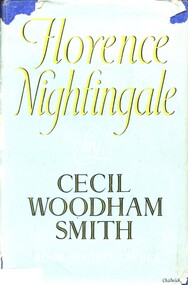
... Margaret Webber, Bookseller, Melbourne. Hardcover book with white dust jacket. Cover page has title 'Florence Nightingale' in (yellow ink) 'by' Cecil Woodham Smith (white ink) author's name (black ink) and publisher's name (white ink) are also printed on the spine of the dustjacket. There is also a white rectangular sticker, on which the previous catalogue number is printed, on the dustjacket spine. On the back of the dustjacket is printed Lord ...Biography of Florence NightingaleHardcover book with white dust jacket. Cover page has title 'Florence Nightingale' in (yellow ink) 'by' Cecil Woodham Smith (white ink) author's name (black ink) and publisher's name (white ink) are also printed on the spine of the dustjacket. There is also a white rectangular sticker, on which the previous catalogue number is printed, on the dustjacket spine. On the back of the dustjacket is printed Lord Ellesmere's tribute to Florence Nightingale, House of Lords, May 5, 1856. non-fictionBiography of Florence Nightingaleflorence nightingale, crimena war, nurses-great britain-history, nursing-history -
 Sunshine and District Historical Society Incorporated
Book - I Remember Footscray, Footscray Historical Society et al, Circa 1980
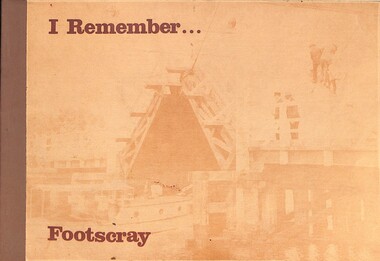
... Lord and Lady Somers 1930. This is a nostalgic look at the history of Footscray. Footscray History Maribyrnong River Entertainment Brass Bands of Footscray Transport St John Ambulance This is a nostalgic look at the history of Footscray. Front Cover - I Remember Footscray First Page - I Remember Footscray by Pat Brearley, Kitty Cochran, Harold Cochran, Doreen Condon, Jess Gascoigne, Janet Grant, Helen Heath, Margaret Huxtable, Elizabeth Lynch, Edna O'Brian, Ron Pickett & Loris Samson. ...This book details residents' memories of living in Footscray in the twenties and thirties and includes pictures of: Canoeing on the Maribyrnong River at Riverview Tea Gardens, The Riverview Tea Gardens, The Footscray Swing Bridge, Hyde St Central School Boys Band 1950, Nicholson St Railway Gates, Australian Six Motor Car, Footscray's first tram leaving the tram sheds in Buckley St 6/9/1921, St. John Ambulance Footscray Division 1930, St. John Ambulance Divisions on parade before Lord and Lady Somers 1930.This is a nostalgic look at the history of Footscray.Front Cover - I Remember Footscray First Page - I Remember Footscray by Pat Brearley, Kitty Cochran, Harold Cochran, Doreen Condon, Jess Gascoigne, Janet Grant, Helen Heath, Margaret Huxtable, Elizabeth Lynch, Edna O'Brian, Ron Pickett & Loris Samson. Tutor Sue Noy. footscray, history, maribyrnong river, entertainment, brass bands of footscray, transport, st john ambulance -
 Vision Australia
Administrative record - Text, Royal Victorian Institute for the Blind annual report 1927, 1927
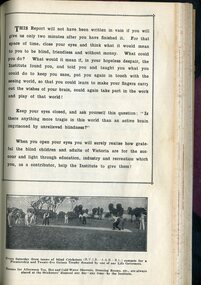
... Lord Somers...Lady Somers...G Dent...J Tanswell...George Findlay...Donald Forbes...Baldwin Spencer...National Museum of Victoria...Cricket...Rowing...H Foster...Auxiliaries...Wirths Brothers Circus...Raleigh Street Hostel...Margaret...Foster (foreman of the Mat department) again played Father Xmas at the children's Christmas party, the Orchestra and Concert Party gave their annual free concert to the Tramways Board and employees in appreciation for the free passes for the blind, formation of a Central Auxiliary with representatives from each municipality to help bring the work of the Institute more predominantly to the general public across Victoria, and the passing of workers Margaret Cates, Tom Ginniff and Peter Stevens. Royal Victorian Institute for the Blind Annual Report Lord Somers Lady Somers G Dent J Tanswell George Findlay Donald Forbes Baldwin Spencer National Museum of Victoria Cricket Rowing H Foster Auxiliaries Wirths Brothers Circus Raleigh Street Hostel Margaret Cates Tom Ginniff Peter Stevens Buildings 1 volume bound with illustrations. ...Articles in this annual report include: 60th anniversary, approximately 1000 blind people in Victoria, hope that Government will increase it's support which has not varied for over 30 years and comparison of costs compared to the 50th anniversary, visits by Lady Stonehaven and Lord and Lady Somers, resignation of G. Dent and appointment of J. Tanswell as head teacher, George Findlay is entering the final year of his degree and Donald Forbes is in his second year, thanks to Sir Baldwin Spencer for allowing the children to visit the National Museum and touch various items as he spoke about the various exhibits, George Findlay won the 3LO Exhibition for Pianoforte, the success of the Concert Party and the difficulty in securing halls large enough to hold concerts, placement of safety zones by the City of Melbourne and South Melbourne councils opposite the Institute, official opening of the hostel in Raleigh Street by the Lord Mayor, activities providing support for those not working at the Institute include teaching of home trades who manufactured goods will be purchased by the RVIB for sale in their shop, a wholesale tobacco and grocery store, use of the Pipe Organ, musical instruments, wireless set, study, writing, games, typewriting, showers and baths and dressing rooms for on-site use, a brief outline of the blind cricket playing ground and the boat house, the decision to provide free Wireless Sets to those who cannot afford them, H. Foster (foreman of the Mat department) again played Father Xmas at the children's Christmas party, the Orchestra and Concert Party gave their annual free concert to the Tramways Board and employees in appreciation for the free passes for the blind, formation of a Central Auxiliary with representatives from each municipality to help bring the work of the Institute more predominantly to the general public across Victoria, and the passing of workers Margaret Cates, Tom Ginniff and Peter Stevens.1 volume bound with illustrations.royal victorian institute for the blind, annual report, lord somers, lady somers, g dent, j tanswell, george findlay, donald forbes, baldwin spencer, national museum of victoria, cricket, rowing, h foster, auxiliaries, wirths brothers circus, raleigh street hostel, margaret cates, tom ginniff, peter stevens, buildings -
 Vision Australia
Photograph - Image, 2002 RVIB 201 High Street staff photos, 2002
... Lord...Alan Kelly...Alan Fowler...Andrea Cook...Andrew White...Anita Sun...Barbara Cameron...Brett Shelton...Brian Gear...Bruce Loring...Chris Edwards...Christine Harvie...Dale Moore...David Horsfall...Elisa Moralis...Faye Baxter...Glen Hobby...Glen Morrow...Jeremy Childs...Jeremy King...Kate Stephens...Kathryn Cooke...Katy Shuttleworth...Ken Baker...Lloyd Smith...Margaret...Royal Victorian Institute for the Blind Steve Beashel Daryl Barnett Phil Boyd Geoff Crawford Adrian Smith Alan Berginc Annie Cooper Anton Rich Chris Maskell David Weatley Don Hoy Ernie dos Santos Frank Bauer Gena Kacowicz Geoff Paterson Geoff Ralph Glen Petrie Greg Slorach Greg Washington Jim Doherty Jimmy Nason John Martin John Nettelbeck Karen Hope Keith Weller Ken McDonald Lisa Watson Martin Stewart Jim Pipczak Mary Pipczak Michael Royals Norm Richards Norm Shepherdson Peter Krnel Ray Dunn Ray Xhaferi Richard Pryztula Robert Toseland Roger Poulter Terry Lord Alan Kelly Alan Fowler Andrea Cook Andrew White Anita Sun Barbara Cameron Brett Shelton Brian Gear Bruce Loring Chris Edwards Christine Harvie Dale Moore David Horsfall Elisa Moralis Faye Baxter Glen Hobby Glen Morrow Jeremy Childs Jeremy King Kate Stephens Kathryn Cooke Katy Shuttleworth Ken Baker Lloyd Smith Margaret Kelly Michael Williams Michael Doherty Natasha Brake Neil Gillies Neil Mathieson Nick Allan Ranmali Ratnachandra Rhonda Patman Rob Glenowski Robyn McKenzie Rod Stewart Sean Tyrell Steve Lock Stewart Hose Terri Cameron Thavee Lees Thong Nguyen Damien McCormack Elaine Brock Vince September 114 digital images of staff at RVIB Burwood, mostly in low resolution 2002 RVIB 201 High Street staff photos Photograph Image ...Pictures taken at RVIB 201 High Street building of Assist, RVIB Enterprises and Training and Technology staff members for their badge identification.114 digital images of staff at RVIB Burwood, mostly in low resolutionroyal victorian institute for the blind, steve beashel, daryl barnett, phil boyd, geoff crawford, adrian smith, alan berginc, annie cooper, anton rich, chris maskell, david weatley, don hoy, ernie dos santos, frank bauer, gena kacowicz, geoff paterson, geoff ralph, glen petrie, greg slorach, greg washington, jim doherty, jimmy nason, john martin, john nettelbeck, karen hope, keith weller, ken mcdonald, lisa watson, martin stewart, jim pipczak, mary pipczak, michael royals, norm richards, norm shepherdson, peter krnel, ray dunn, ray xhaferi, richard pryztula, robert toseland, roger poulter, terry lord, alan kelly, alan fowler, andrea cook, andrew white, anita sun, barbara cameron, brett shelton, brian gear, bruce loring, chris edwards, christine harvie, dale moore, david horsfall, elisa moralis, faye baxter, glen hobby, glen morrow, jeremy childs, jeremy king, kate stephens, kathryn cooke, katy shuttleworth, ken baker, lloyd smith, margaret kelly, michael williams, michael doherty, natasha brake, neil gillies, neil mathieson, nick allan, ranmali ratnachandra, rhonda patman, rob glenowski, robyn mckenzie, rod stewart, sean tyrell, steve lock, stewart hose, terri cameron, thavee lees, thong nguyen, damien mccormack, elaine brock, vince september -
 Kew Historical Society Inc
Clothing - Evening Coat, 1920–1930
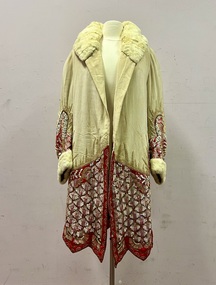
... Margaret Frances, nee MacKay. Maurice Nathan was born in Kew in 1914 and died in East Melbourne in 1982. He was a student of Trinity Grammar School, Kew. He was Lord...Margaret Frances, nee MacKay. Maurice Nathan was born in Kew in 1914 and died in East Melbourne in 1982. He was a student of Trinity Grammar School, Kew. He was Lord ...The donor, whose parents owned an antique shop believed that the evening coat was owned by the family of Cr Morris Nathan and his wife Margaret Frances, nee MacKay. Maurice Nathan was born in Kew in 1914 and died in East Melbourne in 1982. He was a student of Trinity Grammar School, Kew. He was Lord Mayor, and his wife Lady Mayoress, of the City of Melbourne for two terms between 1961 and 1963. The age of the coat, created in a design typical of the 1920s would suggest that it is of an earlier vintage, almost certainly dating from the 1920s, but perhaps earlier. The opulence of the sequinned and beaded embroidery have led to the supposition that it may be an opera coat inherited from an earlier generation.Three quarter length, red and cream silk, padded evening coat highlighted on the cuffs and hem with iridescent sequins, beading and pearls of different shapes and sizes. These decorative features are arranged in a formal design, particularly at centre back. Above the beaded sections are sunbursts outlined in gold beads.Trimmed rabbit fur at collar and cuffs. The sleeves are shaped above the embroidered sections while the hem features a zig-zag profile. MEASUREMENTS - Neck to hem front 93cm; Neck to hem back 100cm; Circumference 126cm; Shoulder to cuff 72cm; Shoulder width 36cm.Traditionally, pre acquisition, stored in brown suitcase embossed in gilt with the name R. NATHANevening jackets, opera coats, fashion -- 1920s -
 City of Melbourne Libraries
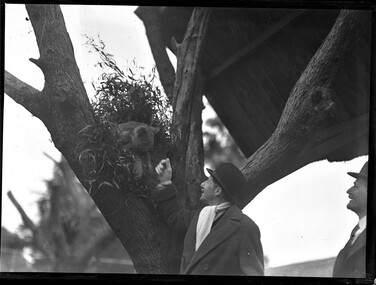
Photograph, Bull, Hugh Jones, 1897-1993, Vice-regal visit to zoo: Governor (Lord Huntingfield) and koala
... He was patron of the Royal Zoological and Acclimatisation Society of Victoria and was acting Governor-General for six months during the absence of Lord Gowie in 1938. Lady Huntingfield (née Margaret Eleanor Crosby) 1884-1943, his American-born wife showed great interest in social welfare and the advancement of women and children. ...He was patron of the Royal Zoological and Acclimatisation Society of Victoria and was acting Governor-General for six months during the absence of Lord Gowie in 1938. Lady Huntingfield (née Margaret Eleanor Crosby) 1884-1943, his American-born wife showed great interest in social welfare and the advancement of women and children. ...Published: (1934, June 26). The Age (Melbourne, Vic. : 1854 - 1954), p. 11. Published title: VICE-ROYALTY GREETS THE KING OF THE BEASTS AT THE ZOO. Published caption: Lord Huntingfield experienced a pleasant “induction ceremony” as Patron of the Royal Zoological and Acclimatisation Society yesterday, when he made a tour of the Zoological Gardens. The picture shows the Governor, accompanied by Lady Huntingfield, inspecting the King of Beasts, who is submitting to a little playful treatment from the Director of the Gardens, Mr. Wilkie, while the Director whispers in his ear that a distinguished visitor has come to see him. (Inset), is a picture of Lord Huntingfield greeting one of the Koalas. Trove article identifier: http://nla.gov.au/nla.news-article204818472 Description: A man wearing a hat, scarf and overcoat reaches up to pat a koala in a tree watched by a man in a hat and suit. Research by project volunteer, Fiona Collyer: In 1932, the Zoo built an Australian native animal enclosure which visitors could enter and closely view koalas, wallabies, kookaburras and magpies all placed together. The branches of the trees in the enclosure were cut so that visitors could easily see and feed the koalas sitting in them. The cost to feed each koala fresh gum leaves was fifteen shillings per week. By 1924, Queensland was the last stronghold in Australia for the koala. They were functionally extinct in South Australia, only a few hundred in NSW, and an estimated population of 1000 animals remained in Victoria. There had been a six-month open season on koalas in Queensland in 1919 where over a million had been slaughtered, however with its vast, dense forests it was impossible to accurately know their numbers. Koala fur is tough, warm and waterproof and was in high demand from consumers in Canada, Britain and the US to make hats and gloves and for lining greatcoats. In 1927, with Queensland suffering a crippling drought and high unemployment, the cash-strapped McCormack Labor Government declared an “Open Season” on koalas and “opossums” for their skins, for the month of August. (Possums were often called “opossums” at this time but they are actually possums). There were widespread protests from many groups including the Nature Lovers League, Wild Life Preservation Society of Australia, Queensland Museum, C.W.A. Royal Australian Ornithologist Union, Boy Scouts, religious and women’s groups. There were letters to newspapers from ordinary people, editorials and pleas to women to refuse to wear or purchase koala fur. People questioned the masculinity of koala hunters as it was felt that no proper bushman or sportsman would kill such a defenceless creature. The Brisbane Courier newspaper led the campaign, devoting six columns a day to “Spare the Bear”. Author Vance Palmer sent an impassioned letter to the editor of the The Brisbane Courier, 19 July 1927: “Sir- It is be hoped that the disgust which all humane people have felt at the declaration of an open season for native bears in August will not be allowed to fade away until some protest... so overwhelming and effective that the question will never be raised again. For the shooting of our harmless and loveable native bear is nothing less than barbarous. His case is entirely different from that of other furred animals. No one has ever accused him of spoiling the farmers’ wheat, eating the squatters’ grass or even spreading the prickly pear. There is not a social vice that can be put down to his account. In addition, he is comparatively defenceless. He affords no sport to the gunman, and can be trusted to present a sitting target to the creature mean enough to aim at him. For this reason he has been almost blotted out already from some areas, in days when our fauna and flora were held in such little regard that the settlers’ first instinct was to shoot every strange animal and to sink his axe into every unfamiliar tree.” The Anglican Archbishop of Brisbane, Gerald Sharp, had his letter published in The Brisbane Courier on 16 July 1927: “Sir... The extermination of fauna so distinctive of our country, especially of such harmless and pretty creatures as our native bears, seems to me a shameful thing, and this is likely to mean their extermination.” But it was all to no avail. Known as “Black August”, the government was unmoved by the public’s outrage. 10,000 licences were issued to hunters and “the slaughter of the innocents” went ahead. The newspapers were full of stories of dreadful cruelty against the helpless, benign creatures by the heartless hunters who not only used guns and spotlights but wire snares and cyanide baits so that pelts wouldn’t be damaged. Infant koalas were left orphaned and unlikely to survive without their mothers. Top quality pelts were sold at an average price of 56 shillings and 9 pence per dozen, poor quality skins for as little as 2 1/2 pence each. In December 1927, the Minister for Agriculture and Stock, Mr W. Forgan Smith told the Parliament that during the August open season 597,985 koala pelts worth £139,595 had netted the state’s coffers £6000. 952,194 “opossum” pelts were sold and £9000 made for the State. The backlash that followed helped topple the Queensland Labor Government in 1929. The Wild Life Preservation Society of Australia lobbied the Prime Minister Mr Stanley Bruce to refuse to issue exportation permits for koala pelts and from 10 November 1927 the Commonwealth Government suspended the issuing of permits. In 1930, the Society made a direct appeal to USA President Herbert Hoover and he signed an order prohibiting the importation of koala and wombat fur to USA, eliminating a major market. Koala pelts were often deliberately mislabelled “wombat” to get around restrictions. The ban most likely saved the koala from probable extinction. Three years later the Australian Federal Government banned the export of koala products. This movement against koala killing was really the first conservation campaign in Australia. It raised awareness of the vulnerability of a beloved animal and eventually brought about national parks and national laws for their protection. By 1936, community opposition to possum open seasons was beginning. The koala was made a Protected Species in all states in 1937, meaning no one is allowed to harm a koala, however the laws protecting the gum trees they rely on for food and shelter are weak. The Australian Government estimates the wild koala population in Australia is between 225,000 and 500,000 in 2024. The Australian Koala Foundation estimates the national population at less than 60,000 in 2021 with a 30% decline in three years. Habitat loss from land clearing, dog attacks, road deaths, chlamydia, bushfires and drought exacerbated by climate change, continues to cause their decline. Over eight million koalas were killed for their pelts between 1888 and 1927. Any one of the annual harvests killed more koalas than are alive now. At this time, children were also being taught to appreciate Australian native animals. In 1933, “Blinky Bill: The Quaint Little Australian” book for children was published by Angus and Robertson. It was written and illustrated by New Zealand-born author Dorothy Wall and “Dedicated to my son Peter and all other Peters and Johns and Bobs and Toms and Marys and Bettys and Joans and Pats and all kind children.” The book tells the story of Blinky Bill - a mischievous, patched knickerbocker-wearing koala and his mother and father. The story has messages of conservation and instances of human unkindness and cruelty. Mr. and Mrs. Koala and young Blinky lead a mostly idyllic family life amongst a variety of other animals in the forest. However it all changes in chapter two, when Blinky Bill’s father is distressingly shot by a hunter. There is a harrowing description of Mr. Koala’s shooting and eventual death. “The Koala family lived so happily; never thinking of harm, or that anything could happen to disturb their little home, as all they asked for were plenty of fresh gum-leaves and the warm sun. They had no idea such things as guns were in the world or that a human being had a heart so cruel that he would take a pleasure in seeing a poor little body riddled with bullets hanging helplessly from the tree-top... That same being might just as well take his gun and shoot baby kookaburras, so helpless were they all and so trusting.” “Poor Mr. Koala one day was curled up asleep in his favourite corner, when the terrible thing happened. Bang! He opened his eyes in wonder. What was that? Did the limb of the tree snap where that young cub of his was skylarking? ... bang! again. This time he felt a stinging pain in his leg... Peering over the bough of the tree he saw a man on the ground with something long and black in his arms... Another bang and his ear began to hurt. Bang! again and now his little body was stinging all over. He grunted loudly and slowly climbed up the tree, calling Mrs. Koala and Blinky as he went. He managed to reach the topmost branch... Tears were pouring down his poor little face. He brushed them away with his front paws and cried just like a baby. Fortunately Mrs. Koala and Blinky Bill were hiding in the leaves quite motionless, and the shadows of the tree made them appear as part of it. The man with the gun stood and waited a long time, then walked away, whistling as he went - the only sound to be heard in the bush except the cries of the little bear far up in the tree.” Blinky and his mother quietly and fearfully wait for Mr. Koala to wake. In the morning, grunting and crying, they feel his lifeless body with their paws. Eventually Mrs. Koala realises that her husband is dead and that they need to move to a safe place. After travelling deeper into the forest, Mrs. Koala and Blinky meet koalas Mrs. Grunty and her son Snubby and she describes how she was captured as a baby by koala fur trappers to be a pet for a little girl. The trapper forgot to bring gum leaves for the koala so they try to feed her cake, milk and bananas, making her sick. The little girl’s father relays something he read in the paper: “During the year 1920 to 1921, two hundred and five thousand six hundred and seventy-nine koalas were killed and their skins sold to the fur market, under the name of wombat.” They place the koala in a box with a teddy bear for company. The baby koala’s health deteriorates and the alarmed trapper returns her to the bush. Mrs. Grunty tells Mrs. Koala that she and Blinky are the only bears that she has seen for ten years: “I remember well the little girl’s father telling her... that not so many years ago the bush was alive with us bears, from Queensland to the south of Victoria. Now, we are so rare that we have become a curiosity, something to put in zoos, for children to see; and actually in museums. I believe our grandparents sit there in glass cases, stuffed with something inside to make them appear alive, and, oh dear, glass eyes. In New South Wales, I think we could wander for miles from one corner to another and never meet a bear. I don’t know why we were all killed. As you know, we don’t eat the farmers’ crop or ruin their orchards. All we asked for were our own gum-trees.” At the end of the book, Dorothy tells her readers - “The kindest action of all would be to leave the koala baby in his own bushland, among his own playmates, with the sun, the sky, the birds, and the gum-trees, where he will grow to manhood and live for many years - happy as he should be.” In 1934, a “Wild Zoo”, the Sir Colin Mackenzie Sanctuary, opened on 32 hectares of land, formerly part of Coranderrk Aboriginal Reserve in the Yarra Valley, exclusively displaying Australian native animals, birds and reptiles. It was later renamed Healesville Sanctuary and is now managed by Melbourne Zoo and home to over 200 species of Australian native fauna. The Sanctuary is committed to rescuing, breeding, researching and raising awareness of the vulnerability of Australian animals. Andrew Arthur Wellesley Wilkie, 1853-1948, was Director of the Melbourne Zoo from 1923 to 1936 and was associated with the zoo for 70 years. He first worked as a horticultural assistant to Government botanist Baron Ferdinand von Mueller at the Botanical Gardens at the age of 13, along with his older brother David. One of Andrew’s jobs was to capture moths for the National Herbarium. In 1857, a group of prominent Melburnians assembled at St. Patrick’s Hall to form the Zoological Society of Victoria, with the aim of introducing animals and plants from overseas. It was conceived, “For the purposes of science and for that of affording the public the advantages of studying the habits of the animal creation in properly arranged zoological gardens.” The Victorian Government granted 32 acres (13 hectares) of land to the Zoological Society at the southern end of Richmond Paddock on the opposite bank to the Botanical Gardens. (This is where AAMI Stadium and Collingwood Football Club now stand.) In 1861, the Zoological Society of Victoria was renamed The Acclimatisation Society of Victoria. Unfortunately the Yarra River frontage was damp, swampy and subject to flooding, so the animals were briefly housed at the Botanical Gardens until in 1862, the City of Melbourne donated 55 acres (22 hectares) of land at Royal Park for the fledgling zoo. Baron von Mueller secured employment at Royal Park for Andrew and David and they helped to lay out the gardens, plant trees and take care of a collection of deer, pheasants, hares and partridges. Initially the zoo was used for the acclimatisation of animals recovering from the long voyage to Australia and for breeding them for sport. In 1872, the zoo bought two lions, a leopard and a cheetah that had been seized from circus showmen Keith and Phillips when they were unable to pay the bill of butcher Mr T K Bennet of Bourke Street. The first zoo director, Mr. Albert Le Souef, negotiated with captains of ships to buy animals at overseas ports they visited and soon a multitude of exotic species arrived, including a ten-year-old Indian elephant in 1878. In 1923, after being head keeper for some years, Andrew was appointed director of the zoo. By 1933, the zoo had 110 different species of animals, 200 species of birds and 72 species of reptiles under Andrew’s care. He had personally planted all but six trees and laid out the garden beds. As director he lobbied authorities for funds to build more humane enclosures for the animals. In June 1928, Table Talk magazine wrote of Andrew Wilkie: “Up at the Zoo there is a humble gentleman who is a lion among the lions, who knows the proper specific to employ when the boa constrictor has chilblains, and who is a friend and confidant of Queenie the elephant. His fount of zoological lore has never been plumbed. It is bottomless, like his good fellowship and geniality. Every day he may be seen somewhere in the grounds of that growing sanctuary for the strange and arresting fauna and creeping things of the world, and I assure you as one who is privy to his passion that that area and its inhabitants are rarely out of his thoughts.” Andrew retired from the zoo in 1936 at the age of 83 and in 1948 died at his home in Brunswick aged 94. He and his wife Josephine had six children. The Victorian Acclimatisation Society was founded in 1861 by Edward Wilson, 1813-1878, then owner and editor of The Argus newspaper. He said that Australian indigenous animals were practically useless, providing only “a little sport and an occasional meal”. The Society believed that Australia’s plants and animals were vastly inferior to those in Europe. They wanted to introduce and acclimatise to Victoria “all innoxious animals, birds, fishes, insects and vegetables, whether useful or ornamental” for sport and for the table, and to spread indigenous animals and plants from the colony around the world. Their motto was “if it lives, we want it”. The Society was primarily responsible for introducing sparrows, starlings, sambar and hog deer, ostriches, brown trout, blackberries, and carp to the Murray River. They released the European songbirds, thrush and blackbird to quell the homesickness of British settlers. The Society also sent Australian animals like platypus, echidnas, kangaroos and koalas to Europe for scientific and novelty purposes. Thomas Austin, a wealthy sheep farmer of Barwon Park, Winchelsea (property now owned by the National Trust) was a member and in 1859 he introduced hares, blackbirds, thrushes and partridges onto his property. He is probably best known for introducing 24 breeding rabbits onto his estate as game for shooting parties. Thomas quipped, “The introduction of a few rabbits could do little harm and might provide a touch of home, in addition to a spot of hunting." In 2022, genomic data confirmed that Australia’s feral rabbit population is entirely descended from these rabbits. Biological control has brought the rabbit population down from an estimated high of 10 billion rabbits in the 1920s to approximately 200 million today, inhabiting 70% of Australian landmass (5.3 million square kilometres). In 1872, the Acclimatisation Society was renamed The Zoological and Acclimatisation Society of Victoria and they focused on importing exotic animals for display purposes to the zoo. In 1937, the Royal Acclimatisation Society of Victoria was recreated as the Zoological Board of Victoria with a focus on research of native animals threatened with extinction. In an editorial for The Argus newspaper, 16 March 1856, Edward Wilson lamented: "...this country has been shamelessly stolen from the blacks. Had they been like the New Zealanders or the North American Indians, we should have bought their land, and supplied them with the means of living when we took it... In less than twenty years we have nearly swept them off the face of the earth. We have shot them down like dogs. In the guise of friendship we have issued corrosion sublimate in their damper, and consigned whole tribes to the agonies of an excruciating death. We have made them drunkards, and infected them with disease which has rotted the bones of their adults, and made such few children as are born amongst them a sorrow and a torture from the very instant of their birth. We have made them outcasts on their own land, and are rapidly consigning them to entire annihilation. There are but a few of them left, comparatively. This is what we would do for that few. We would feed and clothe every one of them.” [Note: this last sentence is italicized in the original newspaper article text]. Lord Huntingfield, (William Charles Arcedeckne Vanneck) 1883-1969, Governor of Victoria 1934-1939, was a British Conservative Party politician and the first ever Australian-born Governor of an Australian state (although he was always considered British). He was patron of the Royal Zoological and Acclimatisation Society of Victoria and was acting Governor-General for six months during the absence of Lord Gowie in 1938. Lady Huntingfield (née Margaret Eleanor Crosby) 1884-1943, his American-born wife showed great interest in social welfare and the advancement of women and children. She was president of the City Newsboys Society and Patroness of the Girls Friendly Society. In 1937, rose breeder Alister Clark named a yellow hybrid tea rose for her. In 1940, the City of Melbourne opened the Lady Huntingfield Free Kindergarten in North Melbourne, now the Lady Huntingfield Early Learning and Family Services Centre. Lady Huntingfield died in London in 1943 after her house was bombed during a German airstrike. The Lady Huntingfield Memorial Scholarship was established after the City of Melbourne raised £1000 in a public appeal conducted in her memory for students undertaking a Social Work degree at the University of Melbourne. It is awarded annually to this day. The Queen Victoria Hospital named a bed in her honour. References: VICE-ROYALTY GREETS THE KING OF BEASTS AT THE ZOO. (1934, June 26). The Age (Melbourne, Vic. : 1854 - 1954), p. 11. Retrieved August 23, 2024, from http://nla.gov.au/nla.news-article204818472 Prominent Personalities ANDREW WILKIE (1928, June 7). Table Talk (Melbourne, Vic. : 1885 - 1939), p. 15. Retrieved August 29, 2024, from http://nla.gov.au/nla.news-article146562949 'Edward Wilson (journalist)', Wikipedia, https://en.wikipedia.org/wiki/Edward_Wilson_(journalist) 'Thomas Austin (pastoralist)', Wikipedia, https://en.wikipedia.org/wiki/Thomas_Austin_(pastoralist) 'The Acclimatisation Society was driven by misguided ideals about 'fixing nature' in Australia', ABC News, https://www.abc.net.au/news/2022-11-04/acclimatisation-society-introduced-species-history-listen/101588262?utm_campaign=abc_news_web&utm_content=link&utm_medium=content_shared&utm_source=abc_news_web Blinky Bill: the quaint little Australian (eBook); by Dorothy Wall, 1933, 2023, Project Gutenberg Australia, https://gutenberg.net.au/ebooks04/0400571h.html "Black August": Queensland's Open Season on koalas in 1927 (thesis); Glenn Fowler, 1993, Australian National University, https://www.savethekoala.com/wp-content/uploads/2018/11/Black-August.pdf Unfair game: Queensland's Open Season on koalas in 1927; Jacqui Donegan, 2000, University of Queensland, https://mesto-ku.narod.ru/koalas.pdf OPEN SEASON CONDEMNED. (1927, July 19). The Brisbane Courier (Qld. : 1864 - 1933), p. 15. Retrieved September 5, 2024, from http://nla.gov.au/nla.news-article21863465 COUNTRY WOMEN'S ASSOCIATION. (1927, July 30). The Brisbane Courier (Qld. : 1864 - 1933), p. 25. Retrieved September 20, 2024, from http://nla.gov.au/nla.news-article21866965 AUSTRALIA: Barnardo's children at Melbourne Park Zoo (1929), British Pathé, YouTube, https://www.youtube.com/watch?v=_Wcrbo_cHpI 'Kodak Cinegraph Compilation No 8', ACMI Collection, https://www.youtube.com/watch?v=MCrBng5RwFI KOALA SKINS. EXPORT BAN SOUGHT. (1927, August 4). The Brisbane Courier (Qld. : 1864 - 1933), p. 10. Retrieved September 15, 2024, from http://nla.gov.au/nla.news-article21868746 THE ABORIGINES. (1856, March 16). The Argus (Melbourne, Vic. : 1848 - 1957), p. 5. Retrieved September 28, 2024, from http://nla.gov.au/nla.news-article4833244 Koala Bears (1937), British Pathé, YouTube, https://www.youtube.com/watch?v=XbqgMtyuzwE Australian Koala Bear (Earliest Archive Footage: 1929), Pond5, https://www.pond5.com/stock-footage/item/152767491-australian-koala-bear-earliest-archive-footage-1929Photographer notations on slide: "Vice Regal visit to zoo B42".1930-1939, zoos, governors, koalas, conservation, possums, botanic gardens -
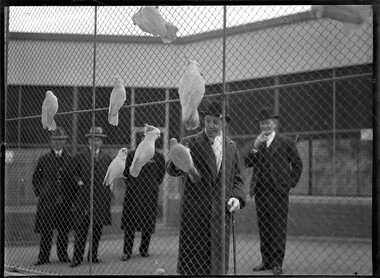 City of Melbourne Libraries
Photograph, Bull, Hugh Jones, 1897-1993, Vice-regal visit to zoo: Governor (Lord Huntingfield) meets the cockatoos
... He was patron of the Royal Zoological and Acclimatisation Society of Victoria and was acting Governor-General for six months during the absence of Lord Gowie in 1938. Lady Huntingfield (née Margaret Eleanor Crosby) 1884-1943, his American-born wife showed great interest in social welfare and the advancement of women and children. ...He was patron of the Royal Zoological and Acclimatisation Society of Victoria and was acting Governor-General for six months during the absence of Lord Gowie in 1938. Lady Huntingfield (née Margaret Eleanor Crosby) 1884-1943, his American-born wife showed great interest in social welfare and the advancement of women and children. ...A group of five men dressed in hats and overcoats look at caged cockatoos. Research by project volunteer, Fiona Collyer: On 25 June 1934, new Victorian Governor, His Excellency Lord Huntingfield and his wife Lady Huntingfield made an official visit to the Melbourne Zoological Gardens in order to grant his patronage to the Royal Zoological and Acclimatisation Society. The zoo director, Mr. Andrew Wilkie, introduced them to the cockatoos in the flight aviary. The Argus newspaper reported the visit in the following morning’s issue: "Birds' Greeting To Governor. Visit to Zoological Gardens. "A Very Important Society." "Cheery shouts of "Hullo!" and requests for drinks greeted His Excellency the Governor (Lord Huntingfield) on one of his official visits yesterday morning. Lady Huntingfield, who accompanied him, was asked loudly for a kiss. They were inspecting the huge cockatoo aviary at the Zoological Gardens after Lord Huntingfield had granted his patronage to the Royal Zoological and Acclimatisation Society. Both obviously enjoyed the democratic experience. It was explained to them that most of the cockatoos had been presented by residents of flats, whose neighbours objected to the noise of the birds, while others were protected birds which had been surrendered. Lord Huntingfield recalled that he had taken two Australian cockatoos to England when he left Australia in his youth. One, a galah, had lived in England for many years." In 1929, the Zoo built a commodious new flight aviary at the cost of several thousand pounds and Zoo director, Mr Andrew Wilkie, sent out an appeal published in newspapers Australia-wide for donations of parrots from all states. Many of the parrot species he wanted were protected and a special permit needed for their capture, however Mr Wilkie guaranteed he would obtain authority from the Fisheries and Game Department and that the cost of transit would be borne by the Zoo. The wanted birds were "Parrots - Black-tailed, Rock Pebbler, King, Superb, Grass (all kinds), Swamp or Ground, Mallee or Ringneck" and "Cockatoo[s] - Black, Pink or Major Mitchell, Gang-Gang". The Zoo asked that the birds be sent in boxes large enough to prevent overcrowding, contain food and water and the Zoo notified on the type and number of birds in transit. All boxes were to be addressed to 'The Zoo, Melbourne'. A letter from a reader appeared in the Weekly Times newspaper's popular "Camp-fire Circle" page for "Young Australians", 11 May 1929: "Dear Pal, I am much interested in your page, especially the nature notes. I have a pet parrot, but I don’t like to see it shut up in a cage, so I am giving it to the Melbourne Zoo. It can whistle 'Pretty Joey' and 'What's the Matter with Father' and is just learning to whistle for the dog... Wishing you and the Camp-fire Circle success." - Murray Holmes (Gorae, Vic.) The fate of this talented parrot is unknown, however in 1932, this young naturist, T Murray Holmes, 1912-1947, collected for the first time a type specimen, blue star sun orchid from Gorae (near Portland, Victoria), and it was named in his honour, Thelymitra holmesii. Murray was described by orchid collector W H Nicholls as "a youthful and energetic orchidologist, who added much to our knowledge of the orchids of south-western Victoria." Murray Holmes enlisted in the army in 1941 and fought in the Middle East before being sent to Java. In 1942 he was captured by the Japanese and became a prisoner of war for three years, working on the notorious Thai-Burma railway. Murray's health was undermined though ill treatment and starvation and he returned to Australia after the war, broken and sick. He died aged 35 in 1947. He was intensely interested in the flora and fauna of the Gorae area to the end. Murray's parents received over 200 tributes of respect for their son - too many to answer personally so they put a notice in the Portland Guardian thanking "all kind friends and relatives for letters, cards, floral tributes and personal expressions of sympathy received in their recent sad bereavement - the lamented death of their loved son, Murray." Andrew Arthur Wellesley Wilkie, 1853-1948, was Director of the Melbourne Zoo from 1923 to 1936 and was associated with the zoo for 70 years. He first worked as a horticultural assistant to Government botanist Baron Ferdinand von Mueller at the Botanical Gardens at the age of 13, along with his older brother David. One of Andrew’s jobs was to capture moths for the National Herbarium. In 1857, a group of prominent Melburnians assembled at St. Patrick’s Hall to form the Zoological Society of Victoria, with the aim of introducing animals and plants from overseas. It was conceived, “For the purposes of science and for that of affording the public the advantages of studying the habits of the animal creation in properly arranged zoological gardens.” The Victorian Government granted 32 acres (13 hectares) of land to the Zoological Society at the southern end of Richmond Paddock on the opposite bank to the Botanical Gardens. (This is where AAMI Stadium and Collingwood Football Club now stand.) In 1861, the Zoological Society of Victoria was renamed The Acclimatisation Society of Victoria. Unfortunately the Yarra River frontage was damp, swampy and subject to flooding, so the animals were briefly housed at the Botanical Gardens until in 1862, the City of Melbourne donated 55 acres (22 hectares) of land at Royal Park for the fledgling zoo. Baron von Mueller secured employment at Royal Park for Andrew and David and they helped to lay out the gardens, plant trees and take care of a collection of deer, pheasants, hares and partridges. Initially the zoo was used for the acclimatisation of animals recovering from the long voyage to Australia and for breeding them for sport. In 1872, the zoo bought two lions, a leopard and a cheetah that had been seized from circus showmen Keith and Phillips when they were unable to pay the bill of butcher Mr T K Bennet of Bourke Street. The first zoo director, Mr. Albert Le Souef, negotiated with captains of ships to buy animals at overseas ports they visited and soon a multitude of exotic species arrived, including a ten-year-old Indian elephant in 1878. In 1923, after being head keeper for some years, Andrew was appointed director of the zoo. By 1933, the zoo had 110 different species of animals, 200 species of birds and 72 species of reptiles under Andrew’s care. He had personally planted all but six trees and laid out the garden beds. As director he lobbied authorities for funds to build more humane enclosures for the animals. In June 1928, Table Talk magazine wrote of Andrew Wilkie: “Up at the Zoo there is a humble gentleman who is a lion among the lions, who knows the proper specific to employ when the boa constrictor has chilblains, and who is a friend and confidant of Queenie the elephant. His fount of zoological lore has never been plumbed. It is bottomless, like his good fellowship and geniality. Every day he may be seen somewhere in the grounds of that growing sanctuary for the strange and arresting fauna and creeping things of the world, and I assure you as one who is privy to his passion that that area and its inhabitants are rarely out of his thoughts.” Andrew retired from the zoo in 1936 at the age of 83 and in 1948 died at his home in Brunswick aged 94. He and his wife Josephine had six children. The Victorian Acclimatisation Society was founded in 1861 by Edward Wilson, 1813-1878, then owner and editor of The Argus newspaper. He said that Australian indigenous animals were practically useless, providing only “a little sport and an occasional meal”. The Society believed that Australia’s plants and animals were vastly inferior to those in Europe. They wanted to introduce and acclimatise to Victoria “all innoxious animals, birds, fishes, insects and vegetables, whether useful or ornamental” for sport and for the table, and to spread indigenous animals and plants from the colony around the world. Their motto was “if it lives, we want it”. The Society was primarily responsible for introducing sparrows, starlings, sambar and hog deer, ostriches, brown trout, blackberries, and carp to the Murray River. They released the European songbirds, thrush and blackbird to quell the homesickness of British settlers. The Society also sent Australian animals like platypus, echidnas, kangaroos and koalas to Europe for scientific and novelty purposes. Thomas Austin, a wealthy sheep farmer of Barwon Park, Winchelsea (property now owned by the National Trust) was a member and in 1859 he introduced hares, blackbirds, thrushes and partridges onto his property. He is probably best known for introducing 24 breeding rabbits onto his estate as game for shooting parties. Thomas quipped, “The introduction of a few rabbits could do little harm and might provide a touch of home, in addition to a spot of hunting." In 2022, genomic data confirmed that Australia’s feral rabbit population is entirely descended from these rabbits. Biological control has brought the rabbit population down from an estimated high of 10 billion rabbits in the 1920s to approximately 200 million today, inhabiting 70% of Australian landmass (5.3 million square kilometres). In 1872, the Acclimatisation Society was renamed The Zoological and Acclimatisation Society of Victoria and they focused on importing exotic animals for display purposes to the zoo. In 1937, the Royal Acclimatisation Society of Victoria was recreated as the Zoological Board of Victoria with a focus on research of native animals threatened with extinction. In an editorial for The Argus newspaper, 16 March 1856, Edward Wilson lamented: "...this country has been shamelessly stolen from the blacks. Had they been like the New Zealanders or the North American Indians, we should have bought their land, and supplied them with the means of living when we took it... In less than twenty years we have nearly swept them off the face of the earth. We have shot them down like dogs. In the guise of friendship we have issued corrosion sublimate in their damper, and consigned whole tribes to the agonies of an excruciating death. We have made them drunkards, and infected them with disease which has rotted the bones of their adults, and made such few children as are born amongst them a sorrow and a torture from the very instant of their birth. We have made them outcasts on their own land, and are rapidly consigning them to entire annihilation. There are but a few of them left, comparatively. This is what we would do for that few. We would feed and clothe every one of them.” [Note: this last sentence is italicized in the original newspaper article text]. Lord Huntingfield, (William Charles Arcedeckne Vanneck) 1883-1969, Governor of Victoria 1934-1939, was a British Conservative Party politician and the first ever Australian-born Governor of an Australian state (although he was always considered British). He was patron of the Royal Zoological and Acclimatisation Society of Victoria and was acting Governor-General for six months during the absence of Lord Gowie in 1938. Lady Huntingfield (née Margaret Eleanor Crosby) 1884-1943, his American-born wife showed great interest in social welfare and the advancement of women and children. She was president of the City Newsboys Society and Patroness of the Girls Friendly Society. In 1937, rose breeder Alister Clark named a yellow hybrid tea rose for her. In 1940, the City of Melbourne opened the Lady Huntingfield Free Kindergarten in North Melbourne, now the Lady Huntingfield Early Learning and Family Services Centre. Lady Huntingfield died in London in 1943 after her house was bombed during a German airstrike. The Lady Huntingfield Memorial Scholarship was established after the City of Melbourne raised £1000 in a public appeal conducted in her memory for students undertaking a Social Work degree at the University of Melbourne. It is awarded annually to this day. The Queen Victoria Hospital named a bed in her honour. References: Prominent Personalities ANDREW WILKIE (1928, June 7). Table Talk (Melbourne, Vic. : 1885 - 1939), p. 15. Retrieved August 29, 2024, from http://nla.gov.au/nla.news-article146562949 BIRDS' GREETING TO GOVERNOR (1934, June 26). The Argus (Melbourne, Vic. : 1848 - 1957), p. 6. Retrieved August 19, 2024, from http://nla.gov.au/nla.news-article10950051 Zoo Appealing For Parrots And Cockatoos To Fill Aviary For Children’s Instruction (1929, April 11). The Sun News-Pictorial (Melbourne, Vic. : 1922 - 1954; 1956), p. 31. Retrieved August 23, 2024, from http://nla.gov.au/nla.news-article275757361 LETTERS FROM READERS (1929, May 11). Weekly Times (Melbourne, Vic. : 1869 - 1954), p. 50. Retrieved October 6, 2024, from http://nla.gov.au/nla.news-article223183144 Correspondence. (1929, April 18). Corryong Courier (Vic. : 1894 - 1945), p. 6. Retrieved August 30, 2024, from http://nla.gov.au/nla.news-article269039262 'Edward Wilson (journalist)', Wikipedia, https://en.wikipedia.org/wiki/Edward_Wilson_(journalist) 'Thomas Austin (pastoralist)', Wikipedia, https://en.wikipedia.org/wiki/Thomas_Austin_(pastoralist) 'The Acclimatisation Society was driven by misguided ideals about 'fixing nature' in Australia', ABC News, https://www.abc.net.au/news/2022-11-04/acclimatisation-society-introduced-species-history-listen/101588262? utm_source=abc_news_app&utm_medium=content_shared&utm_campaign=abc_news_app&utm_content=safari Touching Canine Devotion. (1942, September 21). Portland Guardian (Vic. : 1876 - 1953), p. 1 (EVENING). Retrieved October 6, 2024, from http://nla.gov.au/nla.news-article64381989 OBITUARY (1947, August 11). Portland Guardian (Vic. : 1876 - 1953), p. 2 (EVENING). Retrieved August 26, 2024, from http://nla.gov.au/nla.news-article64412155 Family Notices (1947, September 11). Portland Guardian (Vic. : 1876 - 1953), p. 2 (EVENING). Retrieved October 10, 2024, from http://nla.gov.au/nla.news-article64412476 'Thelymitra holmesii', Wikipedia, https://en.wikipedia.org/wiki/Thelymitra_holmesii THE ABORIGINES. (1856, March 16). The Argus (Melbourne, Vic. : 1848 - 1957), p. 4. Retrieved September 28, 2024, from http://nla.gov.au/nla.news-article4833244Photographer notations on slide: "Vice Regal visit to zoo B42".zoos, governors, 1930-1939, cockatoos -
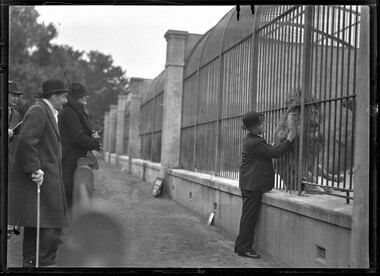 City of Melbourne Libraries
Photograph, Bull, Hugh Jones, 1897-1993, Vice-regal visit to Zoo: Lord Huntingfield greets the King of the Beasts
... He was patron of the Royal Zoological and Acclimatisation Society of Victoria and was acting Governor-General for six months during the absence of Lord Gowie in 1938. Lady Huntingfield (née Margaret Eleanor Crosby) 1884-1943, his American-born wife showed great interest in social welfare and the advancement of women and children. ...He was patron of the Royal Zoological and Acclimatisation Society of Victoria and was acting Governor-General for six months during the absence of Lord Gowie in 1938. Lady Huntingfield (née Margaret Eleanor Crosby) 1884-1943, his American-born wife showed great interest in social welfare and the advancement of women and children. ...Photographer notations on slide: "Vice Regal visit to zoo B42" Published: The Age, Tuesday 26 June 1934, page 11. Published title: VICE-ROYALTY GREETS THE KING OF THE BEASTS AT THE ZOO. Published caption: “Lord Huntingfield experienced a pleasant “induction ceremony” as Patron of the Royal Zoological and Acclimatisation Society yesterday, when he made a tour of the Zoological Gardens. The picture shows the Governor, accompanied by Lady Huntingfield, inspecting the King of the Beasts, who is submitting to a little playful treatment from the Director of the Gardens, Mr. Wilkie, while the Director whispers in his ear that a distinguished visitor has come to see him.” Trove article identifier: http://nla.gov.au/nla.news-article204818472 Description: A man wearing a hat and suit strokes a caged lion, observed by a man in a hat, scarf and overcoat who is leaning on a walking stick, and a woman in a hat and coat, holding a handbag. They stand behind a protective rail. Research by project volunteer, Fiona Collyer: Andrew Arthur Wellesley Wilkie, 1853-1948, was Director of the Melbourne Zoo from 1923 to 1936 and was associated with the zoo for 70 years. He first worked as a horticultural assistant to Government botanist Baron Ferdinand von Mueller at the Botanical Gardens at the age of 13, along with his older brother David. One of Andrew’s jobs was to capture moths for the National Herbarium. In 1857, a group of prominent Melburnians assembled at St. Patrick’s Hall to form the Zoological Society of Victoria, with the aim of introducing animals and plants from overseas. It was conceived, “For the purposes of science and for that of affording the public the advantages of studying the habits of the animal creation in properly arranged zoological gardens.” The Victorian Government granted 32 acres (13 hectares) of land to the Zoological Society at the southern end of Richmond Paddock on the opposite bank to the Botanical Gardens. (This is where AAMI Stadium and Collingwood Football Club now stand.) In 1861, the Zoological Society of Victoria was renamed The Acclimatisation Society of Victoria. Unfortunately the Yarra River frontage was damp, swampy and subject to flooding, so the animals were briefly housed at the Botanical Gardens until in 1862, the City of Melbourne donated 55 acres (22 hectares) of land at Royal Park for the fledgling zoo. Baron von Mueller secured employment at Royal Park for Andrew and David and they helped to lay out the gardens, plant trees and take care of a collection of deer, pheasants, hares and partridges. Initially the zoo was used for the acclimatisation of animals recovering from the long voyage to Australia and for breeding them for sport. In 1872, the zoo bought two lions, a leopard and a cheetah that had been seized from circus showmen Keith and Phillips when they were unable to pay the bill of butcher Mr T K Bennet of Bourke Street. The first zoo director, Mr. Albert Le Souef, negotiated with captains of ships to buy animals at overseas ports they visited and soon a multitude of exotic species arrived, including a ten-year-old Indian elephant in 1878. In 1923, after being head keeper for some years, Andrew was appointed director of the zoo. By 1933, the zoo had 110 different species of animals, 200 species of birds and 72 species of reptiles under Andrew’s care. He had personally planted all but six trees and laid out the garden beds. As director he lobbied authorities for funds to build more humane enclosures for the animals. In June 1928, Table Talk magazine wrote of Andrew Wilkie: “Up at the Zoo there is a humble gentleman who is a lion among the lions, who knows the proper specific to employ when the boa constrictor has chilblains, and who is a friend and confidant of Queenie the elephant. His fount of zoological lore has never been plumbed. It is bottomless, like his good fellowship and geniality. Every day he may be seen somewhere in the grounds of that growing sanctuary for the strange and arresting fauna and creeping things of the world, and I assure you as one who is privy to his passion that that area and its inhabitants are rarely out of his thoughts.” Andrew retired from the zoo in 1936 at the age of 83 and in 1948 died at his home in Brunswick aged 94. He and his wife Josephine had six children. Roy, aged 28 in 1934, was a former Wirth’s circus lion who had been left at the zoo at 10 years of age. Andrew visited Roy every day on his rounds and the pair formed a close and affectionate bond. Wireless Weekly magazine in February 1933 reported, “Roy was delighted to see Mr Wilkie, and in a docile manner, approached the bars of his cage and had his head vigorously rubbed by the director, who daily carries out this act of kindness.” As reported in The Herald on 27 October 1936, “Mr Wilkie has also found the old lion docile. He has not shown the animal any particular favouritism, but the lion has shown him a faithfulness that none of the keepers can claim. When Mr Wilkie approaches the bars the lion rolls over and lets the director stroke him and pull his tail. He gets very excited if Mr Wilkie passes without climbing over the protecting rail for a little game.” A 1930 newsreel film shows Andrew stroking Roy’s mane through the bars and the blissed out big cat lying on his back while lifting his chin for a rub. Another newsreel film from the time shows Andrew stroking a lioness and playfully pulling her tail. The Victorian Acclimatisation Society was founded in 1861 by Edward Wilson, 1813-1878, then owner and editor of The Argus newspaper. He said that Australian indigenous animals were practically useless, providing only “a little sport and an occasional meal”. The Society believed that Australia’s plants and animals were vastly inferior to those in Europe. They wanted to introduce and acclimatise to Victoria “all innoxious animals, birds, fishes, insects and vegetables, whether useful or ornamental” for sport and for the table, and to spread indigenous animals and plants from the colony around the world. Their motto was “if it lives, we want it”. The Society was primarily responsible for introducing sparrows, starlings, sambar and hog deer, ostriches, brown trout, blackberries, and carp to the Murray River. They released the European songbirds, thrush and blackbird to quell the homesickness of British settlers. The Society also sent Australian animals like platypus, echidnas, kangaroos and koalas to Europe for scientific and novelty purposes. Thomas Austin, a wealthy sheep farmer of Barwon Park, Winchelsea (property now owned by the National Trust) was a member and in 1859 he introduced hares, blackbirds, thrushes and partridges onto his property. He is probably best known for introducing 24 breeding rabbits onto his estate as game for shooting parties. Thomas quipped, “The introduction of a few rabbits could do little harm and might provide a touch of home, in addition to a spot of hunting." In 2022, genomic data confirmed that Australia’s feral rabbit population is entirely descended from these rabbits. Biological control has brought the rabbit population down from an estimated high of 10 billion rabbits in the 1920s to approximately 200 million today, inhabiting 70% of Australian landmass (5.3 million square kilometres). In 1872, the Acclimatisation Society was renamed The Zoological and Acclimatisation Society of Victoria and they focused on importing exotic animals for display purposes to the zoo. In 1937, the Royal Acclimatisation Society of Victoria was recreated as the Zoological Board of Victoria with a focus on research of native animals threatened with extinction. In an editorial for The Argus newspaper, 16 March 1856, Edward Wilson lamented: "…this country has been shamelessly stolen from the blacks. Had they been like the New Zealanders or the North American Indians, we should have bought their land, and supplied them with the means of living when we took it... In less than twenty years we have nearly swept them off the face of the earth. We have shot them down like dogs. In the guise of friendship we have issued corrosion sublimate in their damper, and consigned whole tribes to the agonies of an excruciating death. We have made them drunkards, and infected them with disease which has rotted the bones of their adults, and made such few children as are born amongst them a sorrow and a torture from the very instant of their birth. We have made them outcasts on their own land, and are rapidly consigning them to entire annihilation. There are but a few of them left, comparatively. This is what we would do for that few. We would feed and clothe every one of them.” [Note: this last sentence is italicized in the original newspaper article text]. Lord Huntingfield, (William Charles Arcedeckne Vanneck) 1883-1969, Governor of Victoria 1934-1939, was a British Conservative Party politician and the first ever Australian-born Governor of an Australian state (although he was always considered British). He was patron of the Royal Zoological and Acclimatisation Society of Victoria and was acting Governor-General for six months during the absence of Lord Gowie in 1938. Lady Huntingfield (née Margaret Eleanor Crosby) 1884-1943, his American-born wife showed great interest in social welfare and the advancement of women and children. She was president of the City Newsboys Society and Patroness of the Girls Friendly Society. In 1937, rose breeder Alister Clark named a yellow hybrid tea rose for her. In 1940, the City of Melbourne opened the Lady Huntingfield Free Kindergarten in North Melbourne, now the Lady Huntingfield Early Learning and Family Services Centre. Lady Huntingfield died in London in 1943 after her house was bombed during a German airstrike. The Lady Huntingfield Memorial Scholarship was established after the City of Melbourne raised £1000 in a public appeal conducted in her memory for students undertaking a Social Work degree at the University of Melbourne. It is awarded annually to this day. The Queen Victoria Hospital named a bed in her honour. References: VICE-ROYALTY GREETS THE KING OF BEASTS AT THE ZOO. (1934, June 26). The Age (Melbourne, Vic. : 1854 - 1954), p. 11. Retrieved August 18, 2024, from http://nla.gov.au/nla.news-article204818472 Prominent Personalities ANDREW WILKIE (1928, June 7). Table Talk (Melbourne, Vic. : 1885 - 1939), p. 15. Retrieved August 29, 2024, from http://nla.gov.au/nla.news-article146562949 'Thomas Austin (pastoralist)', Wikipedia, https://en.wikipedia.org/wiki/Thomas_Austin_(pastoralist) 'Edward Wilson (journalist)', Wikipedia, https://en.wikipedia.org/wiki/Edward_Wilson_(journalist) THE WOMAN'S WORLD (1934, June 26). The Herald (Melbourne, Vic. : 1861 - 1954), p. 14. Retrieved August 19, 2024, from http://nla.gov.au/nla.news-article243164806 MR. WILKIE CAN PULL THE OLD LION'S TAIL (1936, October 27). The Herald (Melbourne, Vic. : 1861 - 1954), p. 4. Retrieved August 18, 2024, from http://nla.gov.au/nla.news-article248551307 Director Of Zoo Will Retire Tomorrow--With White Kitten (1936, December 30). The Herald (Melbourne, Vic. : 1861 - 1954), p. 8. Retrieved August 18, 2024, from http://nla.gov.au/nla.news-article244655203 LIGHT CAR CLUB IN CARICATURE (1931, August 25). The Sun News-Pictorial (Melbourne, Vic. : 1922 - 1954; 1956), p. 24. Retrieved August 19, 2024, from http://nla.gov.au/nla.news-article276250310 'The Acclimatisation Society was driven by misguided ideals about 'fixing nature' in Australia', ABC News, https://www.abc.net.au/news/2022-11-04/acclimatisation-society-introduced-species-history-listen/101588262?utm_source=abc_news_app&utm_medium=content_shared&utm_campaign=abc_news_app&utm_content=safari 'Dr Andrew Wilkie Director Of Melbourne Zoo, With Lion (1930) Video', Pond5 Inc., https://www.pond5.com/stock-footage/item/155691351-dr-andrew-wilkie-director-melbourne-zoo-lion-1930 'Kodak Cinegraph Compilation No 12', ACMI Collection, YouTube.com [Zoo footage at 8.33 minutes, Mr Wilkie at 11.04 minutes], https://www.youtube.com/watch?v=OZZqgSNsP0k THE ABORIGINES. (1856, March 16). The Argus (Melbourne, Vic. : 1848 - 1957), p. 4. Retrieved September 28, 2024, from http://nla.gov.au/nla.news-article4833244Photographer notations on slide: "Vice Regal visit to zoo B42".1930-1939, melbourne zoo, animals, hunting, wildlife, royal park, gardens -
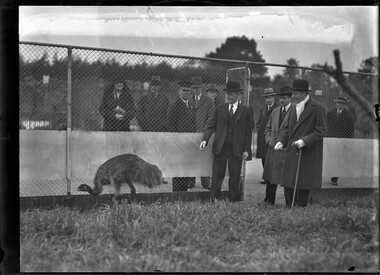 City of Melbourne Libraries
Photograph, Bull, Hugh Jones, 1897-1993, Vice-regal visit to zoo: Lord Huntingfield meets an emu
... He was patron of the Royal Zoological and Acclimatisation Society of Victoria and was acting Governor-General for six months during the absence of Lord Gowie in 1938. Lady Huntingfield (née Margaret Eleanor Crosby) 1884-1943, his American-born wife showed great interest in social welfare and the advancement of women and children. ...He was patron of the Royal Zoological and Acclimatisation Society of Victoria and was acting Governor-General for six months during the absence of Lord Gowie in 1938. Lady Huntingfield (née Margaret Eleanor Crosby) 1884-1943, his American-born wife showed great interest in social welfare and the advancement of women and children. ...Photographer notations on slide: "Vice Regal visit to Zoo B42" Not published. Description: A group of men and one woman all dressed in hats and overcoats stand by a wire fence while watching an emu. Research by project volunteer, Fiona Collyer: On 25 June 1934, new Victorian Governor, His Excellency Lord Huntingfield and his wife Lady Huntingfield made an official visit to the Melbourne Zoological Gardens in order to grant his patronage to the Royal Zoological and Acclimatisation Society. During the visit, zoo director Mr. Andrew Wilkie introduced them to some of the zoo’s inhabitants, including an emu. After the First World War, many returned soldiers took up the Government’s offer of land in the Soldier Settlement Scheme. Most of the veterans had little or no farming experience and much of the land offered was of poor quality, with blocks often too small to be viable. Many of the settlers had ongoing physical and mental injuries from the war. The Western Australian government allocated land to 5000 former soldiers but by 1929, one quarter of the men had already abandoned their land, unable to make a living. Not only was the world economy struggling with the Great Depression, but the settlers also had to contend with plummeting wheat and wool prices, crippling drought and rabbit infestation. The Scullin Government (Oct 1929-Jan 1932) had promised subsidies to the Western Australian farmers if they increased their wheat crops but were unable to pass the legislation in the Senate. The new Lyons Government (Jan 1932-April 1939) abandoned the legislation and the subsidies were never paid, bringing calls from Western Australia of secession from Australia. In October 1932, a deputation of soldier settlers from the Campion wheatbelt region in Western Australia, petitioned Commonwealth Minister for Defence, Western Australian Senator Sir George Pearce, for assistance. A mob of 20,000 emus were migrating to the coast after breeding and were gathering along the eastern side of the Number 1 Rabbit Proof Fence, attracted to the ripening crops and the dams the farmers had built. They were heading towards Campion, 303 kilometres east of Perth, eating and trampling the wheat, destroying the fences and letting the rabbits in. Having witnessed firsthand the effectiveness of machine guns in killing people in war, the former soldiers thought the guns would be ideal for killing emus. Sir George, wanting to demonstrate that his government was sympathetic to the settlers and hoping to quell Western Australian succession talk, agreed. However, he stipulated that no expense would be incurred by the Commonwealth Government and only active military personnel could use the machine guns. The farmers had to pay for the ammunition, food and accommodation for the military for the length of the operation. The cost for the ammunition was £50 for 10,000 rounds. Sir George also felt the operation would provide excellent target practice for the soldiers! The operation was headed by Major Gwynydd Purves Wynn-Aubrey Meredith, 1887-1975, of the Seventh Heavy Battery of the Royal Australian Artillery, and assisted by Sergeant S. McMurray and Gunner J. O'Halloran. They were equipped with two American-designed Lewis light machine guns and 10,000 rounds. Each magazine held 47 rounds of ammunition and the gun was capable of firing 500 to 600 rounds per minute with effective firing range of 800 metres. A cinematographer from British Movietone News accompanied the soldiers in order to record what was expected to be not only an easy victory but also useful propaganda for both the military and the Lyons Government. Emu (Dromaius novaehollandiae, meaning New Holland Racer) is a species of long-necked flightless bird endemic to Australia. The Tasmanian and the dwarf King and Kangaroo Island subspecies were hunted to extinction after the European settlement of Australia. It is the second largest bird in the world after the ostrich, standing up to 1.9 metres tall and weighing up to 50 kilograms. The Emu has long, powerful legs with three forward facing toes and is the only bird with calf muscles. It is able to jump 2.1 metres into the air and run 50 kilometres per hour. It communicates by drumming and booming through an inflatable neck sac which can be heard up to two kilometres away. Along with its tough hide and a body more feathers than flesh, the emu can be a tricky target. Emus had been a protected native species until 1922, when the government changed their status to “vermin” in response to the emus breaking down fences and destroying crops. Major Meredith told the press that Colonel Oswald V. Hoad of the 1st Cavalry Division NSW had especially requested he send 100 emu skins to replenish the plumage on his Light Horsemen’s hat tops. On the first day of the Emu War, 2 November 1932, Major Meredith spotted a mob of emus out of range of the guns, so he asked the farmers to use their vehicles to drive the emus towards the fence and the guns. The panicked birds split into small groups, kicking up the dust and scattering every which way. Only six were killed, though some were wounded. After that, the emus became very wary of humans. On 4 November, Major Meredith staged a dawn ambush at a dam. As 1000 emus approached to drink, the soldiers opened fire, killing 12 emus. After reloading, the gun jammed and the emus dispersed in all directions, and were not sighted again that day. The West Australian newspaper reported on 4 November 1932 that, “The emus have proved that they are not so stupid as they are usually considered to be. Each mob has its leader, always an enormous black-plumed bird standing fully six-feet high, who keeps watch while his fellows busy themselves with the wheat. At the first suspicious sign, he gives the signal, and dozens of heads stretch up out of the crop. A few birds will take fright, starting a headlong stampede for the scrub, the leader always remaining until his followers have reached safety.” In a later attempt, they mounted a gun onto the bed of a truck in order to chase and mow down the birds. However the truck couldn’t drive fast enough over the rough terrain and it was too bumpy to fire the gun accurately. The birds easily outran the truck except for one hapless emu who faltered while being chased and fell under the truck, its body wedging in the steering gear, causing the driver to crash the truck, and bringing down half a chain of the rabbit proof fence. RSPCA inspector Mr. Arthur Austin arrived with a rifle and knife in order to finish the work of the Lewis guns and dispatch injured emus. He said that while his society was sympathetic to the stricken settlers, he was anxious that wounded birds should not be left to suffer. Major Meredith told the inspector, “What speed can you run? You have to be better than Peter Pan if you want to catch wounded emus that make for the scrub.” (Racehorse “Peter Pan” had won the 1932 Melbourne Cup a few weeks earlier.) The commentator of the British Movietime newsreel uses a jocular tone to optimistically proclaim, “The scouts [emus] of the advancing army have keen eyesight, and in order to get close to the main body, our lads have to do some real stalking, with the enemy watching events through their periscopes raised up over the heads of corn... Instead of the birds ruining the farmers, tables are turned, there will be no more damage down here for many a day to come once the enemy is eliminated.” Emus proved tougher adversaries than expected, barely breaking stride even when badly injured from machine gun bullets, and the suspicious emus soon learnt to stay out of range of the men and their guns. Meanwhile, in the eastern states concern was being expressed about the cruelty of machine-gunning the native birds. Senator James Guthrie UAP of Victoria suggested that there must be “more humane, if less spectacular methods” of coping with the pests. People wrote letters to the newspapers to express their dismay at the inhumane methods used. R.F. Bellchambers from Humbug Scrub, 25 November 1932, lamented that, “At the present rate of extinctions, it will shortly be necessary to go to the Museum to see the remains of our fauna.” The Murchison Times published a letter on 16 November 1932 from “Clay Pan Joe”: “War on Emus. Slaughter of innocent birds would be more appropriate... The birds may be a nuisance and it may be necessary to destroy them, but why cause so much suffering amongst these innocent birds.” E.S. Playford of Norton’s Summit wrote to The Advertiser, 22 November 1932, that “...habitation on the earth would be impossible without bird life. Therefore, it is unwise to say that any bird is useless. Is sentiment dying? Are we so keen on personal gain that our lovely and unique birds have to be ruthlessly slaughtered in thousands and their bodies left rotting in the sun?” In Sydney, picture palace patrons expressed “considerable concern” after viewing the Movietone News newsreel of emus fleeing from the barrage of machine-guns, and wounded emus in the fields in Campion. The press had a field day, dubbing it the “The Emu War” and joking that the “Chicago method” was being used against the feathered foe. The Daily News newspaper published a cartoon depicting the emus outrunning and outsmarting the soldiers. In Parliament NSW Senator James Dunn called Sir George the “Minister for the Emu War”. Labor member Mr. Rosevear, midst great laughter, asked if the minister would consider declaring an armistice and withdrawing his troops from the Western Front. Prime Minister Joe Lyons was asked if medals would be struck for those taking part in the war. Labor parliamentarian Mr. A.E. Green declared any medals should go to the emus who had “won every round so far”. With the embarrassing press coverage and poor results, Sir George ordered a stop to the project on 9 November, and Major Meredith and the soldiers departed for Perth. The WA Premier Sir James Mitchell and the Campion farmers demanded they return, citing the continued destruction of crops and fences by the emus. Major Meredith and his two gunners were allowed to return on 13 November and seemingly having learnt from their previous experiences, had slightly more success this time killing emus. The operation finally finished on 10 December with Major Meredith reporting “definite kills” of 986 emus for 9860 rounds of ammunition, coincidentally and conveniently exactly 10% of the number of rounds used. A further 2500 birds were said to have died from their injuries and although this is a disputed figure, even if accurate, the ratio of rounds expended to emu casualties was thought too high to justify continuing. The operation barely caused a dint in the marauding mob of 20,000 emus. “There’s only one way to kill an emu”, one of the party bitterly remarked: “Shoot him through the back of the head when his mouth is closed or through the front of his mouth when his mouth is open. That’s how hard it is.” Australian ornithologist Dominic L. Serventy noted that “The machine-gunners’ dreams of point blank fire into serried masses of Emus were soon dissipated. The Emu command had evidently ordered guerrilla tactics, and its unwieldy army soon split up into innumerable small units that made use of the military equipment uneconomic. A crestfallen field force therefore withdrew from the combat area after about a month.” Major Meredith expressed the greatest of respect for the enemy. He said, “If we had a military division with the bullet-carrying capacity of these birds, it would face any army in the world. They could face machine guns with the invulnerability of tanks. They are like Zulus, whom even dum dum bullets would not stop." The Major’s official report stated that there were no human casualties in “The Emu War.” Emus are considered the victors of “The Great Emu War.” Western Australian farmers requested military assistance in 1934, 1943 and 1948, including using bombs, but the government refused. The bounty system instigated in 1923 continued, with farmers using rifles against their fleet-footed foe, with 57,034 bounties for dead emus claimed in six months in 1934 in Western Australia alone. 284,704 emus were killed in Western Australia between 1945 and 1960. The other most effective defence against the emus was the construction of a robust, vermin proof fence spanning over a long distance. Emus were formally protected in 1999 by the Environment Protection and Biodiversity Conservation Act. It’s estimated there are between 625,000 to 725,000 wild emus in Australia in 2024. An emu and a kangaroo feature on Australia’s coat of arms, holding up a shield illustrated with symbols of the six states. The animals symbolise the nation moving forward as neither animal can walk backwards. Campion is now a ghost town. A book about the operation, “Letters from the Emu War” by J.A. Bryden was published in 2023 by Playtime Books. In 2024, an Australian film called “The Emu War” was released, starring Damian Callinan and Luke McGregor. Andrew Arthur Wellesley Wilkie, 1853-1948, was Director of the Melbourne Zoo from 1923 to 1936 and was associated with the zoo for 70 years. He first worked as a horticultural assistant to Government botanist Baron Ferdinand von Mueller at the Botanical Gardens at the age of 13, along with his older brother David. One of Andrew’s jobs was to capture moths for the National Herbarium. In 1857, a group of prominent Melburnians assembled at St. Patrick’s Hall to form the Zoological Society of Victoria, with the aim of introducing animals and plants from overseas. It was conceived, “For the purposes of science and for that of affording the public the advantages of studying the habits of the animal creation in properly arranged zoological gardens.” The Victorian Government granted 32 acres (13 hectares) of land to the Zoological Society at the southern end of Richmond Paddock on the opposite bank to the Botanical Gardens. (This is where AAMI Stadium and Collingwood Football Club now stand.) In 1861, the Zoological Society of Victoria was renamed The Acclimatisation Society of Victoria. Unfortunately the Yarra River frontage was damp, swampy and subject to flooding, so the animals were briefly housed at the Botanical Gardens until in 1862, the City of Melbourne donated 55 acres (22 hectares) of land at Royal Park for the fledgling zoo. Baron von Mueller secured employment at Royal Park for Andrew and David and they helped to lay out the gardens, plant trees and take care of a collection of deer, pheasants, hares and partridges. Initially the zoo was used for the acclimatisation of animals recovering from the long voyage to Australia and for breeding them for sport. In 1872, the zoo bought two lions, a leopard and a cheetah that had been seized from circus showmen Keith and Phillips when they were unable to pay the bill of butcher Mr T K Bennet of Bourke Street. The first zoo director, Mr. Albert Le Souef, negotiated with captains of ships to buy animals at overseas ports they visited and soon a multitude of exotic species arrived, including a ten-year-old Indian elephant in 1878. In 1923, after being head keeper for some years, Andrew was appointed director of the zoo. By 1933, the zoo had 110 different species of animals, 200 species of birds and 72 species of reptiles under Andrew’s care. He had personally planted all but six trees and laid out the garden beds. As director he lobbied authorities for funds to build more humane enclosures for the animals. In June 1928, Table Talk magazine wrote of Andrew Wilkie: “Up at the Zoo there is a humble gentleman who is a lion among the lions, who knows the proper specific to employ when the boa constrictor has chilblains, and who is a friend and confidant of Queenie the elephant. His fount of zoological lore has never been plumbed. It is bottomless, like his good fellowship and geniality. Every day he may be seen somewhere in the grounds of that growing sanctuary for the strange and arresting fauna and creeping things of the world, and I assure you as one who is privy to his passion that that area and its inhabitants are rarely out of his thoughts.” Andrew retired from the zoo in 1936 at the age of 83 and in 1948 died at his home in Brunswick aged 94. He and his wife Josephine had six children. The Victorian Acclimatisation Society was founded in 1861 by Edward Wilson, 1813-1878, then owner and editor of The Argus newspaper. He said that Australian indigenous animals were practically useless, providing only “a little sport and an occasional meal”. The Society believed that Australia’s plants and animals were vastly inferior to those in Europe. They wanted to introduce and acclimatise to Victoria “all innoxious animals, birds, fishes, insects and vegetables, whether useful or ornamental” for sport and for the table, and to spread indigenous animals and plants from the colony around the world. Their motto was “if it lives, we want it”. The Society was primarily responsible for introducing sparrows, starlings, sambar and hog deer, ostriches, brown trout, blackberries, and carp to the Murray River. They released the European songbirds, thrush and blackbird to quell the homesickness of British settlers. The Society also sent Australian animals like platypus, echidnas, kangaroos and koalas to Europe for scientific and novelty purposes. Thomas Austin, a wealthy sheep farmer of Barwon Park, Winchelsea (property now owned by the National Trust) was a member and in 1859 he introduced hares, blackbirds, thrushes and partridges onto his property. He is probably best known for introducing 24 breeding rabbits onto his estate as game for shooting parties. Thomas quipped, “The introduction of a few rabbits could do little harm and might provide a touch of home, in addition to a spot of hunting." In 2022, genomic data confirmed that Australia’s feral rabbit population is entirely descended from these rabbits. Biological control has brought the rabbit population down from an estimated high of 10 billion rabbits in the 1920s to approximately 200 million today, inhabiting 70% of Australian landmass (5.3 million square kilometres). In 1872, the Acclimatisation Society was renamed The Zoological and Acclimatisation Society of Victoria and they focused on importing exotic animals for display purposes to the zoo. In 1937, the Royal Acclimatisation Society of Victoria was recreated as the Zoological Board of Victoria with a focus on research of native animals threatened with extinction. In an editorial for The Argus newspaper, 16 March 1856, Edward Wilson lamented: "...this country has been shamelessly stolen from the blacks. Had they been like the New Zealanders or the North American Indians, we should have bought their land, and supplied them with the means of living when we took it... In less than twenty years we have nearly swept them off the face of the earth. We have shot them down like dogs. In the guise of friendship we have issued corrosion sublimate in their damper, and consigned whole tribes to the agonies of an excruciating death. We have made them drunkards, and infected them with disease which has rotted the bones of their adults, and made such few children as are born amongst them a sorrow and a torture from the very instant of their birth. We have made them outcasts on their own land, and are rapidly consigning them to entire annihilation. There are but a few of them left, comparatively. This is what we would do for that few. We would feed and clothe every one of them.” [Note: this last sentence is italicized in the original newspaper article text]. Lord Huntingfield, (William Charles Arcedeckne Vanneck) 1883-1969, Governor of Victoria 1934-1939, was a British Conservative Party politician and the first ever Australian-born Governor of an Australian state (although he was always considered British). He was patron of the Royal Zoological and Acclimatisation Society of Victoria and was acting Governor-General for six months during the absence of Lord Gowie in 1938. Lady Huntingfield (née Margaret Eleanor Crosby) 1884-1943, his American-born wife showed great interest in social welfare and the advancement of women and children. She was president of the City Newsboys Society and Patroness of the Girls Friendly Society. In 1937, rose breeder Alister Clark named a yellow hybrid tea rose for her. In 1940, the City of Melbourne opened the Lady Huntingfield Free Kindergarten in North Melbourne, now the Lady Huntingfield Early Learning and Family Services Centre. Lady Huntingfield died in London in 1943 after her house was bombed during a German airstrike. The Lady Huntingfield Memorial Scholarship was established after the City of Melbourne raised £1000 in a public appeal conducted in her memory for students undertaking a Social Work degree at the University of Melbourne. It is awarded annually to this day. The Queen Victoria Hospital named a bed in her honour. References: VICE-ROYALTY GREETS THE KING OF BEASTS AT THE ZOO. (1934, June 26). The Age (Melbourne, Vic. : 1854 - 1954), p. 11. Retrieved August 23, 2024, from http://nla.gov.au/nla.news-article204818472 Prominent Personalities ANDREW WILKIE (1928, June 7). Table Talk (Melbourne, Vic. : 1885 - 1939), p. 15. Retrieved August 29, 2024, from http://nla.gov.au/nla.news-article146562949 'Edward Wilson (journalist)', Wikipedia, https://en.wikipedia.org/wiki/Edward_Wilson_(journalist) 'Thomas Austin (pastoralist)', Wikipedia, https://en.wikipedia.org/wiki/Thomas_Austin_(pastoralist) 'The Acclimatisation Society was driven by misguided ideals about 'fixing nature' in Australia', ABC News, https://www.abc.net.au/news/2022-11-04/acclimatisation-society-introduced-species-history-listen/101588262?utm_campaign=abc_news_web&utm_content=link&utm_medium=content_shared&utm_source=abc_news_web THE ABORIGINES. (1856, March 16). The Argus (Melbourne, Vic. : 1848 - 1957), p. 5. Retrieved September 28, 2024, from http://nla.gov.au/nla.news-article4833244 WAR ON EMUS. (1932, November 4). The West Australian (Perth, WA : 1879 - 1954), p. 12. Retrieved September 29, 2024, from http://nla.gov.au/nla.news-article32588972 'The Great Emu War: how it started and who won', ABC Australia, https://www.youtube.com/watch?v=Y1wA0PKeJqc Advertising (1932, November 25). The West Australian (Perth, WA : 1879 - 1954), p. 2. Retrieved October 26, 2024, from http://nla.gov.au/nla.news-article32584578 Emu Chasers Must Outstrip Peter Pan (1932, November 9). The Labor Daily (Sydney, NSW : 1924 - 1938), p. 5. Retrieved October 10, 2024, from http://nla.gov.au/nla.news-article237042749 WAR ON EMUS (1932, November 22). The Advertiser (Adelaide, SA : 1931 - 1954), p. 18. Retrieved October 15, 2024, from http://nla.gov.au/nla.news-article73997254 WAR ON EMUS. (1932, October 28). The Labor Daily (Sydney, NSW : 1924 - 1938), p. 6. Retrieved October 24, 2024, from http://nla.gov.au/nla.news-article237046601 EMU WAR (1932, December 3). Mirror (Perth, WA : 1921 - 1956), p. 7. Retrieved October 24, 2024, from http://nla.gov.au/nla.news-article75626301 Machine Gun Offensive Against Emus. (1932, November 10). Western Mail (Perth, WA : 1885 - 1954), p. 3 (PICTORIAL SECTION). Retrieved October 24, 2024, from http://nla.gov.au/nla.news-article37766670 A THOUSAND BIRDS IN LUCK. (1932, November 10). Western Mail (Perth, WA : 1885 - 1954), p. 28. Retrieved October 11, 2024, from http://nla.gov.au/nla.news-article37766849 New Strategy In A War On The Emu (1953, July 5). The Sunday Herald (Sydney, NSW : 1949 - 1953), p. 13. Retrieved October 11, 2024, from http://nla.gov.au/nla.news-article18516559 This is a nice emu-that was! (1932, November 5). The Daily News (Perth, WA : 1882 - 1955), p. 9 (HOME EDITION). Retrieved September 30, 2024, from http://nla.gov.au/nla.news-article82878309 LOCAL AND GENERAL (1932, November 16). The Murchison Times (Cue, WA : 1924 - 1937), p. 2. Retrieved October 14, 2024, from http://nla.gov.au/nla.news-article257500260 Taking Him for a Ride! (1932, October 13). The Daily News (Perth, WA : 1882 - 1955), p. 6 (HOME EDITION). Retrieved September 30, 2024, from http://nla.gov.au/nla.news-article83717338 'The Emu War', History Nuggets, https://historynuggets.squarespace.com/nuggets/2018/4/21/the-emu-war New Strategy In A War On The Emu (1953, July 5). The Sunday Herald (Sydney, NSW : 1949 - 1953), p. 13. Retrieved October 23, 2024, from http://nla.gov.au/nla.news-article18516559 'This is the story of how Australia went to war with emus and lost', First Dog on the Moon, https://www.theguardian.com/commentisfree/2018/jul/26/this-is-the-story-of-how-australia-went-to-war-with-emus-and-lost Photographer notations on slide: "Vice Regal visit to Zoo B42"emu wars, governors, melbourne zoo, city of melbourne, 1930-1939, hunting, lord huntingfield, lady huntingfield, royal park, animals, wildlife -
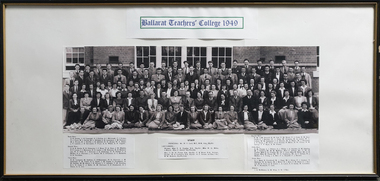 Federation University Historical Collection
Photograph - black and whote photorgaphed, Ballarat Teachers' College 1949
... The Ballarat Teachers' College is a preecessor institution of Federation University Australia ballarat teachers' college john hogan gervasoni peter fryar w.f. lord monica miller t.w.h. turner alan sonsee Framed photographic photograph of the class photo for the Ballarat Teachers' College Class of 1949 Ballarat Teachers' College 1949 Photograph black and whote photorgaphed Margaret Bennett ...The Ballarat Teachers' College is a preecessor institution of Federation University AustraliaFramed photographic photograph of the class photo for the Ballarat Teachers' College Class of 1949ballarat teachers' college, john hogan gervasoni, peter fryar, w.f. lord, monica miller, t.w.h. turner, alan sonsee -
 Narre Warren and District Family History Group
Booklet, Narre Warren & District Family History Group Inc, Casey Cardinia Collection - Beaconsfield Information File
... The dates the articles were published, and the titles of the articles are listed below: 2/02/2004 Dedicated to the job 17/08/2005 Memorial to shine again 29/08/2007 Obituary – Mona Treasure dies, aged 80 4/04/2007 Developer’s bid demolished – the old Coach House 23/08/2007 Kellbrae circa 1923 Undated Beaconsfield Roll of Honor 11/04/2007 Death shocks town – Tony Rushton 12/04/2006 Cenotaph History Revisited 10/06/2009 Hauntingly Beautiful and now Preserved - Nature Reserve 15/09/2021 Mr Methven’s Lasting Legacy - Gary Methven 8/09/2021 New Era at Beacy Primary - Heidi Ingis 8/09/2021 Drizabones and Beards - a Farewell to Mr Methven 16/06/2021 Scout Life Member on the Honour List - Margaret Turner 13/03/2013 Beaconsfield Avenue of Honour - Official Opening 17/06/2015 Modest, But Solid Foundation - Beaconsfield Primary School 9/07/2014 Kay’s at the Wheel - Kay Rankin 18/02/2009 Little Berwick Grows an Identity 13/02/2013 Beacy Loses a Favorite Son From the Field - Alex Robson 7/09/2016 Fine Innings Comes to an End - Len Maddocks 18/04/2007 Grief Takes Its Toll - Tony Rushton UNKNOWN Shipwatchers’ Memorial to be Unveiled Nov 18 23/11/2022 Locals Against Demolition - Railway House 14/02/2024 Fiery Passion to Protect - Mick Ott 1/03/2023 Battle on Over Rail House 24/10/2018 History on a Plate 24/10/2018 Golfing Milestone Marked 21/12/2022 Stories Behind the Names 10/07/2024 Beaconsfield’s Very Best - Beaconsfield Football Club 16/10/2024 Reservoir Issue Ignored - Beaconsfield Reservoir 31/10/2024 Roots Run Deep as Beaconsfield Mitre 10 Celebrates 40 Years 22/04/2020 The Battle of the Creek 11/06/2025 OAM Honour for Couple - Graeme and Ann Taylor 9/07/2025 Beaconsfield’s Best On Show 19/03/2025 Scouting Doyen Mourned - Margaret Turner UNKNOWN A Slice of Beaconsfield - Corner Post Cafe 1/12/2025 Gwen & Audrey - Two Precious Ladies 1/12/2025 Beaconsfield Hall Relevant names relating to the articles in the folder are: Gary Ablett, Jack Adamson, James Adamson, Jim Adamson, John Adamson, Robert Sym Adamson, John Airdrie, Kane Airdrie, Alex Robson Perpetual Shield, Peter Allen, Alma Treloar Reserve, Linda Amos, Tim Anderson, Vic Anderson, Ken Archer, Joan Armitage, John Bailey, Daniel Battaglin, Cr Tania Baxter, Lord Beaconsfield, Beaconsfield Home Timber & Hardware, Beaconsfield Mitre 10, Beaconsfield Timber & Hardware, Bears Lagoon, Paul Beck, Peter Benazic, Mr E Bennett-North, Thomas Bent, Cley Bertoncello, Ned Bertoncello, Katherine Lucy Beswick, Cr George Blenkhorn, Sue Blenkhorn, Bonette Reserve, Mick Boraston, Emily Brightwell, Kelly Brooks-MacMillan, Bob Bysouth, Darren Bysouth, Josie Bysouth, Gordon Cameron, Kerry Canning, Laura Canning, Lawrie Canning, Carson Simpson Pty Ltd, Eris Cashman, Rick Cashman, Troy Cashman, Eric Chaplin, Mavis Cleary, Frank (Rocky) Clifford, Leigh Clifford, Paul Cohen, Frank Conn, Cooinda Road, Corangamite Light Horse Association, Norman Crawley, Margaret Cromb, Rik Crook, Adrian Crowe, Beverley Crowe, Pat Darcy, Geoff Davidson, Stephanie Davies, Pat Dean, Todd Devine, Amirthalingam Dhileepan, Laura Dixon, Tony Dodemaide, Audrey Dodson, Cliff Donegan, Andrew Downey, Bunny Drake, Drouin Home Timber & Hardware, Drouin Mitre 10, Edwin Flack Reserve, Warren Ellam, Gary Elliott, Kim Ellis, Clint Evans, Peter Evans, Corey Everitt, Keith Ewensen, Max Excell, Marc Fahkry, Marcell Fahkry, Ray Field, Michael Fisher, PM Andrew Fisher, Bill Flight, Joan Florence, Glenn Gambetta, John Gardiner, Jayden Gee, Bill Gehling, Tim Gerbes, Ken Goodes, Wayne Goodes, Kerrie Graham, Peter (Bonga) Graham, George Thomas Grant, Gwen Neve Garden, H J Heinz Co, Bluey Hampshire, Alf Harbour, William Harbour, Claud Harris, Joseph Harris, John Harrison, Royce Hart, Neil Harvey, Lois Hateley, Haunted Gully Olives, Fran Healy, Ray Heathcote, Anthony Hester, Paul Higgott, Scotty Hilton, Lindsay Hobson, Brad Hollick, Holm Park Reserve, Bob Hook, Loorain Hope, Pauline Hopkins, Jim Hower, Heidi Inglis, Iris Lewis Writing Competition, Craig Jackson, Ross Jackson, Harry Jensen, Damien Johnston, Tom Jok, Craig Jolliffe, Josie Bysouth Reserve, Kalora Park Cricket Club, Kellbrae, Kenilworth Villa Estate, Matt Kenny, Ben Kerrigan, Miss Joan Keys, Mrs George Keys, Kia Ora Nurseries, Graham Kneen, Afraa Kori, Graeme Legge, Cr Kate Lempriere, Light Horse & Field Artillery Museum, Little Berwick, Tammy Lobato, Di Lockwood, Patrick Lohan, Neil Lucas, Edmund Thomas Luke, Monty Luke, Una Luke, Sarah Maclagan, Len Maddocks, Ron Malhotra, Mick Malthouse, Elizabeth Markham, Alec Leslie May, Aleck May, Albert Maye, Bridgette McCallum, Anne McCormick, Troy McDermott, Neil McDonald, Maria McEwan, Fraser McGill, Ben McGowan, Don McKenzie, Jim McNamara, Cynthia Merrill, Gary Methven, Jann Methven, Scott Meyer, Frank Monyitte, Joseph Morgan, Cr Mick Morland, Kay Morland, Rebecca Mouy, MP Daniel Mulino, Ken Murphy, David Nagel, Gwen Neve, Ken Newitt, June Nicholas, Darryl Nisbet, Harry Nixon, Henry Nixon, Archie Nobelius, Carl Axel Nobelius, Carl Oscar Nobelius, Clifford Nobelius, Emily Nobelius, Florence Nobelius, Hilda Nobelius, Jack Nobelius, Percy Nobelius, Ron Nobelius, Ruby Nobelius, Rupert Nobelius, Stella Nobelius, Sylvia Nobelius, Charles Nott, Catherine Oldenburger, Paul Olsson, Jim Osborne, Oscar Nobelius Honey, Mick Ott, Cr Brett Owen, Ian Owen, Graeme Pateman, Bill Pearson, Perc Allison Oval, Thomas John Pettit, Arthur Pollard, Shaun Pollard, Samantha-Jane Potter, Scott Poulton, Yvonne Ramp, James Randle, Anne Read, Jamie Read, Jim Read, Les Reader, Jack Reid, Jason Reynolds, Rik Crook Cup, Rodney Robbie, Herman (Mac) Roberts, Katherine Lucy (Kath) Roberts, Les Roberts, Mary Roberts, Patricia Roberts, Haydn Robins, Troy Robinson, Alex Robson, Meagan Rogers, Gary Runge, Dulcie Rushton, Simone Rushton, Tony Rushton, Lou Russell, Miss Ryland, Margaret Sansom, Stuart Saw, Carolyn Schroen, Evelyn Seath, Darryl (Shags) Sheehan, Matthew Sims, Gary Sissons, L L Harold Smith, Noel Smith, St John of God Hospital, Stan Henwood Award, Cr Amanda Stapledon, Alan Stephenson, Lyn Studham, Hans Sumberg, Joan Szalman, Ann Taylor, Graeme Taylor, Taylor & Sangster Nursery, Casey Thomsen, Dick Tonks, Tooradin-Dalmore Football Club, Russell Trait, Gaylene June Treasure, Gerald Treasure, Merrilyn Joy Treasure, Mona Treasure, Rohan James Treasure, Rosalie Dawn Treasure, Alma Treloar, Betty Treloar, Margaret Treloar, Trevor Treloar, Trethowan, J H Tucker, Jessie Turner, Margaret Turner, Ted Turner, David Van Lambaart, Michael Vandenberghe, Russell Vincent, Phil Walton, Tom Watson, William Alexander Watt, Graham Watts, Charlie West, Thomas Clair Whiteside, Ted Whitten, Christine Wickes, Frederick John Williams, Rupert Ernest Williams, Bill Williamson, Cr Leticia Wilmot, Kerry Wilson, Windrush, MP Jason Wood, Rod Woodfine, Bill Zeldenryk, Dean Ziesler....The dates the articles were published, and the titles of the articles are listed below: 2/02/2004 Dedicated to the job 17/08/2005 Memorial to shine again 29/08/2007 Obituary – Mona Treasure dies, aged 80 4/04/2007 Developer’s bid demolished – the old Coach House 23/08/2007 Kellbrae circa 1923 Undated Beaconsfield Roll of Honor 11/04/2007 Death shocks town – Tony Rushton 12/04/2006 Cenotaph History Revisited 10/06/2009 Hauntingly Beautiful and now Preserved - Nature Reserve 15/09/2021 Mr Methven’s Lasting Legacy - Gary Methven 8/09/2021 New Era at Beacy Primary - Heidi Ingis 8/09/2021 Drizabones and Beards - a Farewell to Mr Methven 16/06/2021 Scout Life Member on the Honour List - Margaret Turner 13/03/2013 Beaconsfield Avenue of Honour - Official Opening 17/06/2015 Modest, But Solid Foundation - Beaconsfield Primary School 9/07/2014 Kay’s at the Wheel - Kay Rankin 18/02/2009 Little Berwick Grows an Identity 13/02/2013 Beacy Loses a Favorite Son From the Field - Alex Robson 7/09/2016 Fine Innings Comes to an End - Len Maddocks 18/04/2007 Grief Takes Its Toll - Tony Rushton UNKNOWN Shipwatchers’ Memorial to be Unveiled Nov 18 23/11/2022 Locals Against Demolition - Railway House 14/02/2024 Fiery Passion to Protect - Mick Ott 1/03/2023 Battle on Over Rail House 24/10/2018 History on a Plate 24/10/2018 Golfing Milestone Marked 21/12/2022 Stories Behind the Names 10/07/2024 Beaconsfield’s Very Best - Beaconsfield Football Club 16/10/2024 Reservoir Issue Ignored - Beaconsfield Reservoir 31/10/2024 Roots Run Deep as Beaconsfield Mitre 10 Celebrates 40 Years 22/04/2020 The Battle of the Creek 11/06/2025 OAM Honour for Couple - Graeme and Ann Taylor 9/07/2025 Beaconsfield’s Best On Show 19/03/2025 Scouting Doyen Mourned - Margaret Turner UNKNOWN A Slice of Beaconsfield - Corner Post Cafe 1/12/2025 Gwen & Audrey - Two Precious Ladies 1/12/2025 Beaconsfield Hall Relevant names relating to the articles in the folder are: Gary Ablett, Jack Adamson, James Adamson, Jim Adamson, John Adamson, Robert Sym Adamson, John Airdrie, Kane Airdrie, Alex Robson Perpetual Shield, Peter Allen, Alma Treloar Reserve, Linda Amos, Tim Anderson, Vic Anderson, Ken Archer, Joan Armitage, John Bailey, Daniel Battaglin, Cr Tania Baxter, Lord Beaconsfield, Beaconsfield Home Timber & Hardware, Beaconsfield Mitre 10, Beaconsfield Timber & Hardware, Bears Lagoon, Paul Beck, Peter Benazic, Mr E Bennett-North, Thomas Bent, Cley Bertoncello, Ned Bertoncello, Katherine Lucy Beswick, Cr George Blenkhorn, Sue Blenkhorn, Bonette Reserve, Mick Boraston, Emily Brightwell, Kelly Brooks-MacMillan, Bob Bysouth, Darren Bysouth, Josie Bysouth, Gordon Cameron, Kerry Canning, Laura Canning, Lawrie Canning, Carson Simpson Pty Ltd, Eris Cashman, Rick Cashman, Troy Cashman, Eric Chaplin, Mavis Cleary, Frank (Rocky) Clifford, Leigh Clifford, Paul Cohen, Frank Conn, Cooinda Road, Corangamite Light Horse Association, Norman Crawley, Margaret Cromb, Rik Crook, Adrian Crowe, Beverley Crowe, Pat Darcy, Geoff Davidson, Stephanie Davies, Pat Dean, Todd Devine, Amirthalingam Dhileepan, Laura Dixon, Tony Dodemaide, Audrey Dodson, Cliff Donegan, Andrew Downey, Bunny Drake, Drouin Home Timber & Hardware, Drouin Mitre 10, Edwin Flack Reserve, Warren Ellam, Gary Elliott, Kim Ellis, Clint Evans, Peter Evans, Corey Everitt, Keith Ewensen, Max Excell, Marc Fahkry, Marcell Fahkry, Ray Field, Michael Fisher, PM Andrew Fisher, Bill Flight, Joan Florence, Glenn Gambetta, John Gardiner, Jayden Gee, Bill Gehling, Tim Gerbes, Ken Goodes, Wayne Goodes, Kerrie Graham, Peter (Bonga) Graham, George Thomas Grant, Gwen Neve Garden, H J Heinz Co, Bluey Hampshire, Alf Harbour, William Harbour, Claud Harris, Joseph Harris, John Harrison, Royce Hart, Neil Harvey, Lois Hateley, Haunted Gully Olives, Fran Healy, Ray Heathcote, Anthony Hester, Paul Higgott, Scotty Hilton, Lindsay Hobson, Brad Hollick, Holm Park Reserve, Bob Hook, Loorain Hope, Pauline Hopkins, Jim Hower, Heidi Inglis, Iris Lewis Writing Competition, Craig Jackson, Ross Jackson, Harry Jensen, Damien Johnston, Tom Jok, Craig Jolliffe, Josie Bysouth Reserve, Kalora Park Cricket Club, Kellbrae, Kenilworth Villa Estate, Matt Kenny, Ben Kerrigan, Miss Joan Keys, Mrs George Keys, Kia Ora Nurseries, Graham Kneen, Afraa Kori, Graeme Legge, Cr Kate Lempriere, Light Horse & Field Artillery Museum, Little Berwick, Tammy Lobato, Di Lockwood, Patrick Lohan, Neil Lucas, Edmund Thomas Luke, Monty Luke, Una Luke, Sarah Maclagan, Len Maddocks, Ron Malhotra, Mick Malthouse, Elizabeth Markham, Alec Leslie May, Aleck May, Albert Maye, Bridgette McCallum, Anne McCormick, Troy McDermott, Neil McDonald, Maria McEwan, Fraser McGill, Ben McGowan, Don McKenzie, Jim McNamara, Cynthia Merrill, Gary Methven, Jann Methven, Scott Meyer, Frank Monyitte, Joseph Morgan, Cr Mick Morland, Kay Morland, Rebecca Mouy, MP Daniel Mulino, Ken Murphy, David Nagel, Gwen Neve, Ken Newitt, June Nicholas, Darryl Nisbet, Harry Nixon, Henry Nixon, Archie Nobelius, Carl Axel Nobelius, Carl Oscar Nobelius, Clifford Nobelius, Emily Nobelius, Florence Nobelius, Hilda Nobelius, Jack Nobelius, Percy Nobelius, Ron Nobelius, Ruby Nobelius, Rupert Nobelius, Stella Nobelius, Sylvia Nobelius, Charles Nott, Catherine Oldenburger, Paul Olsson, Jim Osborne, Oscar Nobelius Honey, Mick Ott, Cr Brett Owen, Ian Owen, Graeme Pateman, Bill Pearson, Perc Allison Oval, Thomas John Pettit, Arthur Pollard, Shaun Pollard, Samantha-Jane Potter, Scott Poulton, Yvonne Ramp, James Randle, Anne Read, Jamie Read, Jim Read, Les Reader, Jack Reid, Jason Reynolds, Rik Crook Cup, Rodney Robbie, Herman (Mac) Roberts, Katherine Lucy (Kath) Roberts, Les Roberts, Mary Roberts, Patricia Roberts, Haydn Robins, Troy Robinson, Alex Robson, Meagan Rogers, Gary Runge, Dulcie Rushton, Simone Rushton, Tony Rushton, Lou Russell, Miss Ryland, Margaret Sansom, Stuart Saw, Carolyn Schroen, Evelyn Seath, Darryl (Shags) Sheehan, Matthew Sims, Gary Sissons, L L Harold Smith, Noel Smith, St John of God Hospital, Stan Henwood Award, Cr Amanda Stapledon, Alan Stephenson, Lyn Studham, Hans Sumberg, Joan Szalman, Ann Taylor, Graeme Taylor, Taylor & Sangster Nursery, Casey Thomsen, Dick Tonks, Tooradin-Dalmore Football Club, Russell Trait, Gaylene June Treasure, Gerald Treasure, Merrilyn Joy Treasure, Mona Treasure, Rohan James Treasure, Rosalie Dawn Treasure, Alma Treloar, Betty Treloar, Margaret Treloar, Trevor Treloar, Trethowan, J H Tucker, Jessie Turner, Margaret Turner, Ted Turner, David Van Lambaart, Michael Vandenberghe, Russell Vincent, Phil Walton, Tom Watson, William Alexander Watt, Graham Watts, Charlie West, Thomas Clair Whiteside, Ted Whitten, Christine Wickes, Frederick John Williams, Rupert Ernest Williams, Bill Williamson, Cr Leticia Wilmot, Kerry Wilson, Windrush, MP Jason Wood, Rod Woodfine, Bill Zeldenryk, Dean Ziesler. ...Folder containing various newspaper clippings and other informative articles about the Beaconsfield area. There is a table of contents at the start of the folder listing the publication dates and titles of each article. The dates the articles were published, and the titles of the articles are listed below: 2/02/2004 Dedicated to the job 17/08/2005 Memorial to shine again 29/08/2007 Obituary – Mona Treasure dies, aged 80 4/04/2007 Developer’s bid demolished – the old Coach House 23/08/2007 Kellbrae circa 1923 Undated Beaconsfield Roll of Honor 11/04/2007 Death shocks town – Tony Rushton 12/04/2006 Cenotaph History Revisited 10/06/2009 Hauntingly Beautiful and now Preserved - Nature Reserve 15/09/2021 Mr Methven’s Lasting Legacy - Gary Methven 8/09/2021 New Era at Beacy Primary - Heidi Ingis 8/09/2021 Drizabones and Beards - a Farewell to Mr Methven 16/06/2021 Scout Life Member on the Honour List - Margaret Turner 13/03/2013 Beaconsfield Avenue of Honour - Official Opening 17/06/2015 Modest, But Solid Foundation - Beaconsfield Primary School 9/07/2014 Kay’s at the Wheel - Kay Rankin 18/02/2009 Little Berwick Grows an Identity 13/02/2013 Beacy Loses a Favorite Son From the Field - Alex Robson 7/09/2016 Fine Innings Comes to an End - Len Maddocks 18/04/2007 Grief Takes Its Toll - Tony Rushton UNKNOWN Shipwatchers’ Memorial to be Unveiled Nov 18 23/11/2022 Locals Against Demolition - Railway House 14/02/2024 Fiery Passion to Protect - Mick Ott 1/03/2023 Battle on Over Rail House 24/10/2018 History on a Plate 24/10/2018 Golfing Milestone Marked 21/12/2022 Stories Behind the Names 10/07/2024 Beaconsfield’s Very Best - Beaconsfield Football Club 16/10/2024 Reservoir Issue Ignored - Beaconsfield Reservoir 31/10/2024 Roots Run Deep as Beaconsfield Mitre 10 Celebrates 40 Years 22/04/2020 The Battle of the Creek 11/06/2025 OAM Honour for Couple - Graeme and Ann Taylor 9/07/2025 Beaconsfield’s Best On Show 19/03/2025 Scouting Doyen Mourned - Margaret Turner UNKNOWN A Slice of Beaconsfield - Corner Post Cafe 1/12/2025 Gwen & Audrey - Two Precious Ladies 1/12/2025 Beaconsfield Hall Relevant names relating to the articles in the folder are: Gary Ablett, Jack Adamson, James Adamson, Jim Adamson, John Adamson, Robert Sym Adamson, John Airdrie, Kane Airdrie, Alex Robson Perpetual Shield, Peter Allen, Alma Treloar Reserve, Linda Amos, Tim Anderson, Vic Anderson, Ken Archer, Joan Armitage, John Bailey, Daniel Battaglin, Cr Tania Baxter, Lord Beaconsfield, Beaconsfield Home Timber & Hardware, Beaconsfield Mitre 10, Beaconsfield Timber & Hardware, Bears Lagoon, Paul Beck, Peter Benazic, Mr E Bennett-North, Thomas Bent, Cley Bertoncello, Ned Bertoncello, Katherine Lucy Beswick, Cr George Blenkhorn, Sue Blenkhorn, Bonette Reserve, Mick Boraston, Emily Brightwell, Kelly Brooks-MacMillan, Bob Bysouth, Darren Bysouth, Josie Bysouth, Gordon Cameron, Kerry Canning, Laura Canning, Lawrie Canning, Carson Simpson Pty Ltd, Eris Cashman, Rick Cashman, Troy Cashman, Eric Chaplin, Mavis Cleary, Frank (Rocky) Clifford, Leigh Clifford, Paul Cohen, Frank Conn, Cooinda Road, Corangamite Light Horse Association, Norman Crawley, Margaret Cromb, Rik Crook, Adrian Crowe, Beverley Crowe, Pat Darcy, Geoff Davidson, Stephanie Davies, Pat Dean, Todd Devine, Amirthalingam Dhileepan, Laura Dixon, Tony Dodemaide, Audrey Dodson, Cliff Donegan, Andrew Downey, Bunny Drake, Drouin Home Timber & Hardware, Drouin Mitre 10, Edwin Flack Reserve, Warren Ellam, Gary Elliott, Kim Ellis, Clint Evans, Peter Evans, Corey Everitt, Keith Ewensen, Max Excell, Marc Fahkry, Marcell Fahkry, Ray Field, Michael Fisher, PM Andrew Fisher, Bill Flight, Joan Florence, Glenn Gambetta, John Gardiner, Jayden Gee, Bill Gehling, Tim Gerbes, Ken Goodes, Wayne Goodes, Kerrie Graham, Peter (Bonga) Graham, George Thomas Grant, Gwen Neve Garden, H J Heinz Co, Bluey Hampshire, Alf Harbour, William Harbour, Claud Harris, Joseph Harris, John Harrison, Royce Hart, Neil Harvey, Lois Hateley, Haunted Gully Olives, Fran Healy, Ray Heathcote, Anthony Hester, Paul Higgott, Scotty Hilton, Lindsay Hobson, Brad Hollick, Holm Park Reserve, Bob Hook, Loorain Hope, Pauline Hopkins, Jim Hower, Heidi Inglis, Iris Lewis Writing Competition, Craig Jackson, Ross Jackson, Harry Jensen, Damien Johnston, Tom Jok, Craig Jolliffe, Josie Bysouth Reserve, Kalora Park Cricket Club, Kellbrae, Kenilworth Villa Estate, Matt Kenny, Ben Kerrigan, Miss Joan Keys, Mrs George Keys, Kia Ora Nurseries, Graham Kneen, Afraa Kori, Graeme Legge, Cr Kate Lempriere, Light Horse & Field Artillery Museum, Little Berwick, Tammy Lobato, Di Lockwood, Patrick Lohan, Neil Lucas, Edmund Thomas Luke, Monty Luke, Una Luke, Sarah Maclagan, Len Maddocks, Ron Malhotra, Mick Malthouse, Elizabeth Markham, Alec Leslie May, Aleck May, Albert Maye, Bridgette McCallum, Anne McCormick, Troy McDermott, Neil McDonald, Maria McEwan, Fraser McGill, Ben McGowan, Don McKenzie, Jim McNamara, Cynthia Merrill, Gary Methven, Jann Methven, Scott Meyer, Frank Monyitte, Joseph Morgan, Cr Mick Morland, Kay Morland, Rebecca Mouy, MP Daniel Mulino, Ken Murphy, David Nagel, Gwen Neve, Ken Newitt, June Nicholas, Darryl Nisbet, Harry Nixon, Henry Nixon, Archie Nobelius, Carl Axel Nobelius, Carl Oscar Nobelius, Clifford Nobelius, Emily Nobelius, Florence Nobelius, Hilda Nobelius, Jack Nobelius, Percy Nobelius, Ron Nobelius, Ruby Nobelius, Rupert Nobelius, Stella Nobelius, Sylvia Nobelius, Charles Nott, Catherine Oldenburger, Paul Olsson, Jim Osborne, Oscar Nobelius Honey, Mick Ott, Cr Brett Owen, Ian Owen, Graeme Pateman, Bill Pearson, Perc Allison Oval, Thomas John Pettit, Arthur Pollard, Shaun Pollard, Samantha-Jane Potter, Scott Poulton, Yvonne Ramp, James Randle, Anne Read, Jamie Read, Jim Read, Les Reader, Jack Reid, Jason Reynolds, Rik Crook Cup, Rodney Robbie, Herman (Mac) Roberts, Katherine Lucy (Kath) Roberts, Les Roberts, Mary Roberts, Patricia Roberts, Haydn Robins, Troy Robinson, Alex Robson, Meagan Rogers, Gary Runge, Dulcie Rushton, Simone Rushton, Tony Rushton, Lou Russell, Miss Ryland, Margaret Sansom, Stuart Saw, Carolyn Schroen, Evelyn Seath, Darryl (Shags) Sheehan, Matthew Sims, Gary Sissons, L L Harold Smith, Noel Smith, St John of God Hospital, Stan Henwood Award, Cr Amanda Stapledon, Alan Stephenson, Lyn Studham, Hans Sumberg, Joan Szalman, Ann Taylor, Graeme Taylor, Taylor & Sangster Nursery, Casey Thomsen, Dick Tonks, Tooradin-Dalmore Football Club, Russell Trait, Gaylene June Treasure, Gerald Treasure, Merrilyn Joy Treasure, Mona Treasure, Rohan James Treasure, Rosalie Dawn Treasure, Alma Treloar, Betty Treloar, Margaret Treloar, Trevor Treloar, Trethowan, J H Tucker, Jessie Turner, Margaret Turner, Ted Turner, David Van Lambaart, Michael Vandenberghe, Russell Vincent, Phil Walton, Tom Watson, William Alexander Watt, Graham Watts, Charlie West, Thomas Clair Whiteside, Ted Whitten, Christine Wickes, Frederick John Williams, Rupert Ernest Williams, Bill Williamson, Cr Leticia Wilmot, Kerry Wilson, Windrush, MP Jason Wood, Rod Woodfine, Bill Zeldenryk, Dean Ziesler.non-fictionupper beaconsfield (vic.), beaconsfield (vic.)
