
Showing 53 items matching "mark wheeler"
-
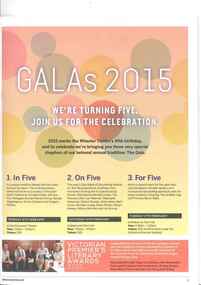 Melbourne Athenaeum Archives
Theatre Program, GALAs 2015: In Five. A Gala Debate on 2020 (debate) held at Athenaeum Theatre on 9 February 2015 to mark the Wheeler Centre's fifth birthday
... A Gala Debate on 2020 (debate) held at Athenaeum Theatre on 9 February 2015 to mark the Wheeler Centre's fifth birthday...A Gala Debate on 2020 (debate) held at Athenaeum Theatre on 9 February 2015 to mark the Wheeler Centre's fifth birthday Theatre Program ... -
 Federation University Historical Collection
Booklet, Education Department Victoria Technical Schools Register for Classes in Carpentry, 1981, 1981
... ...mark wheeler...Barker Library (top floor) Mount Helen goldfields ballarat school of mines trades g.b. pyke neil clements Peter nestor peter nolan david Shreenan andrew sliwa mark wheeler geoff braszell peter Broadhead james houlihan timothy gaunt geoff baulch robert warren jeff white Blue hard covered book with green tape. ...Blue hard covered book with green tape. The instructor was G.B. Pyke.ballarat school of mines, trades, g.b. pyke, neil clements, peter nestor, peter nolan, david shreenan, andrew sliwa, mark wheeler, geoff braszell, peter broadhead, james houlihan, timothy gaunt, geoff baulch, robert warren, jeff white -
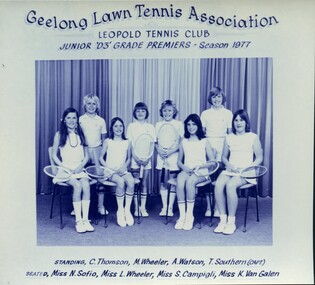 Leopold Tennis Club
Photograph, Robert Pockley Studios, Geelong Lawn Tennis Association Leopold Tennis Club Junior D3 Grade Premiers - Season 1977, 1977
... ...Mark Wheeler...Leopold Tennis Club Geelong Lawn Tennis Association C Thomson A Watson T Southern L Wheeler S Campigli K Van Galen Nicole Sofio Mark Wheeler Standing: C. Thomson, M. Wheeler, A. ...Image taken of the Geelong Lawn Tennis Association Junior D3 Grade Premiers for Season 1977.1 photograph of Premiership tennis teamStanding: C. Thomson, M. Wheeler, A. Watson, T. Southern (Capt.) Seated: Miss N. Sofio, Miss L. Wheeler, Miss S. Campigli, Miss K. Van Galenleopold tennis club, geelong lawn tennis association, c thomson, a watson, t southern, l wheeler, s campigli, k van galen, nicole sofio, mark wheeler -
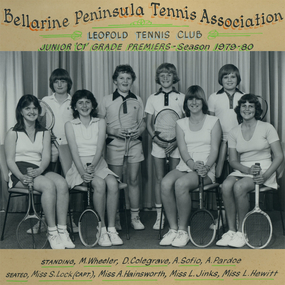 Leopold Tennis Club
Photograph, Robert Pockley Studios, Bellarine Peninsula Tennis Association Leopold Tennis Club Junior C1 Grade Premiers - Season 1979-80, 1980
... ...Mark Wheeler...Leopold Tennis Club Bellarine Peninsula Tennis Association A Sofio A Pardoe L Jinks L Hewitt Dean Colegrave Anne Hainsworth Sharon Lock Mark Wheeler Standing, M. Wheeler, D. Colegrave, A. ...Image taken of the Bellarine Peninsula Tennis Association Junior C1 Grade Premiers for Season 1979-80.1 photograph of Premiership tennis teamStanding, M. Wheeler, D. Colegrave, A. Sofio, A. Pardoe Seated, Miss S. Lock (Capt.), Miss A. Hainsworth, Miss L. Jinks, Miss L. Hewittleopold tennis club, bellarine peninsula tennis association, a sofio, a pardoe, l jinks, l hewitt, dean colegrave, anne hainsworth, sharon lock, mark wheeler -
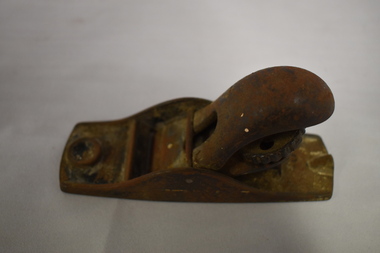 Warrnambool and District Historical Society Inc.
Woodwork, Wood plane, Early 20th century
... This wheel can be turned to adjust the blade, keep it in place or remove it for replacement. The plane is much rusted (it may have been painted black) and no manufacturer’s marks are visibl...This wheel can be turned to adjust the blade, keep it in place or remove it for replacement. The plane is much rusted (it may have been painted black) and no manufacturer’s marks are visibl Wood plane Woodwork ...This hand tool would have been used either in the home for making small items of furniture or small building projects or it could have been used by a tradesman working on small jobs in the building industry – window sills, doors, cupboards etc. Planes are still used today to whittle down wood. This tool has no known local provenance but it is a good example of hand tools of the past and will be useful for display. This is a metal plane used for shaving wood. It has a rectangular base curved at the ends and the end of a steel blade is visible near one end of the base. The handle is dome-shaped and attached to the handle by a screw is a ridged metal wheel that rests on the blade which has been inserted on an angle. This wheel can be turned to adjust the blade, keep it in place or remove it for replacement. The plane is much rusted (it may have been painted black) and no manufacturer’s marks are visiblhousehold tools, wood plane -
 Warrnambool and District Historical Society Inc.
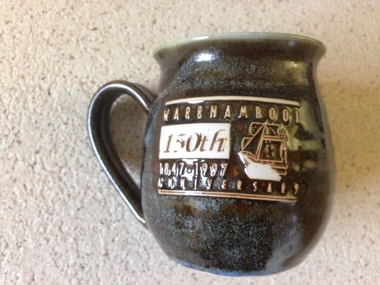
Souvenir, 150th anniversary mug, 1997
... It was made by Ian Sadler at the Potter’s Wheel which operated from 74 Liebig Street Warrnambool from around the 1970’s to around 2010. This item is significant in that it is an item which marks the celebration of the 150th anniversary of the settlement of Warrnambool. ...This mug is one of a number of items which were made to celebrate the 150th anniversary of the settlement of Warrnambool. It was made by Ian Sadler at the Potter’s Wheel which operated from 74 Liebig Street Warrnambool from around the 1970’s to around 2010. This item is significant in that it is an item which marks the celebration of the 150th anniversary of the settlement of Warrnambool. It also is a locally made item by The potter’s wheel which was one of few artisan businesses which operated successfully in the latter part of the 20th century.Pottery mug, glazed blue black on the outside grey on the inside .Four indentations in surface of the mug. 150th Anniversary details on front with picture of sailing shipWarrnambool 150th 1847-1997 Anniversary on side of mug. Sadler 97 469/500 Warrnambool written on base.potter's wheel warrnambool, ian sadler potter, warrnambool p[ottery 1997, 150th anniversay warrnambool -
 Bendigo Military Museum
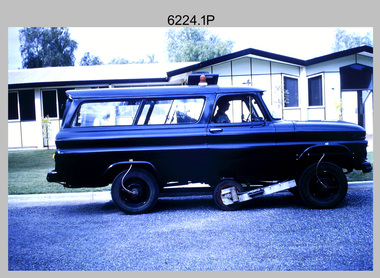
Photograph - Johnson Ground Elevation Meter (JGEM) Survey Vehicle - Army Survey Regiment, Fortuna, Bendigo, c1960s
... The difference in height from the bench mark and the road surface alongside the JGEM’s fifth wheel was measured with a level and staff. ...The difference in height from the bench mark and the road surface alongside the JGEM’s fifth wheel was measured with a level and staff. ...This is a set of 16 photograph of the Royal Australian Survey Corps’ Johnson Ground Elevation Meter (JGEM) Survey Vehicle taken at the Army Survey Regiment, Fortuna, Bendigo. The JGEM vehicle was extensively used by RA Svy within Australia from the late 1960s. A limited number of Ground Elevation Meter (GEM) station wagon type vehicles were manufactured by General Motors Corporation (GMC) in the USA for the United States Geological Survey, Canada’s mapping agencies, RA Svy and National Mapping (Natmap). The GEM was a four-wheel drive, four-wheel steer vehicle. Four-wheel steering was necessary to avoid systematic errors caused by non-tracking of front and rear wheels on conventionally steered vehicles. The manufacturer substituted the rear axle with a front axle and connected them to form the four-wheel steering mechanism. The two Australian GEM vehicles, referred to as Johnson GEMs (JGEMs) were converted into right-hand drive. After delivery in 1964, acceptance Natmap and RA Svy testing and operator training was undertaken at the Army's School of Military Survey located at Balcombe, Victoria. A small fifth wheel was mounted on a cantilever arm suspension midway between the front and rear wheels on the right side of the vehicle. It was lowered to and raised from its operating position by use of a constant pressure air cylinder. A telescopic bar, suspended between the front and rear axles, provided the reference datum for the angle measurement. The wheel provided the velocity or distance signal through a pulse generator system. A sensitive pendulum mounted on this bar provided the angle measurement for each minute distance traversed. The JGEM contained electromechanical instruments used to determine relative elevations, by trigonometric principles, along a traversed path. These relative elevations were obtained through apparatus which measures the instantaneous angle of inclination of the road and the instantaneous velocity of the meter along such a path. Road routes over which the JGEM operated were planned so that each started and ended as near as practicable to an existing point of known elevation (formally referred to as a level traverse bench mark). The difference in height from the bench mark and the road surface alongside the JGEM’s fifth wheel was measured with a level and staff. Along each route, mapping control photo reference points where new elevation values were required were identified on aerial photographs. Under favourable conditions it was possible to survey as much as 160km in an ordinary working day. The first of RA Svy’s JGEM operations was undertaken in 1:250,000 scale map areas of Queensland. CPL John Hook was the JGEM’s main operator in the early 1970s undertaking operations covering 1:250,000 scale map blocks over northern Victoria and central NSW, each requiring 36 points (9 runs of photography and 4 points across. SPR Lyn Thompson and SPR Bob McDonagh teamed with CPL Hook on some of these JGEM operations. When RA Svy was integrated into the Royal Australian Engineers in 1996, the JGEM vehicle with the Survey Corps collection was donated to its museum. It is believed to be the last of the original manufactured fleet in existence. The JGEM has undergone extensive refurbishment to achieve roadworthiness and is currently housed at The Australian Army Museum of Military Engineering, Hoslworthy Barracks, NSW. It can be viewed by making an appointment with the museum’s curator.This is a set of 16 photograph of the Royal Australian Survey Corps’ Johnson Ground Elevation Meter (JGEM) Survey Vehicle taken at the Army Survey Regiment, Fortuna, Bendigo. The photographs were on 35mm slide film and were scanned at 96 dpi. They are part of the Army Survey Regiment’s Collection. .1) - Photo, colour, c1960s, Johnson Ground Elevation Meter (JGEM) Survey Vehicle .2) - Photo, colour, c1960s, JGEM instrumentation, on-board computer. .3) - Photo, colour, c1960s, JGEM instrumentation. .4) - Photo, colour, c1960s, JGEM instrumentation, on-board computer. .5) - Photo, colour, c1960s, JGEM tyre pressure controller .6) - Photo, colour, c1960s, JGEM rear doors, SGT Geoff Briggs. .7) - Photo, colour, c1960s, JGEM 5th wheel distance/angle measurement device in lowered position, SGT Geoff Briggs. .8) - Photo, colour, c1960s, JGEM 5th wheel distance/angle measurement device in lowered position. .9) & .10) - Photo, colour, c1960s, JGEM tyre pressure system, SGT Geoff Briggs. .11) - Photo, colour, c1960s, JGEM tyre pressure system. SGT Geoff Briggs. .12) - Photo, colour, c1960s, JGEM levelling scope, levelling staff, unidentified technicians. .13) & .14) - Photo, colour, c1960s, JGEM levelling scope, unidentified technician. .15) & .16) - Photo, colour, c1960s, probably survey operation adjusted height plotted on block base sheet. .1P to .16P - Some of the equipment is annotated on the frame of the 35mm slides.royal australian survey corps, rasvy, army survey regiment, army svy regt, fortuna, asr, surveying -
 Kiewa Valley Historical Society
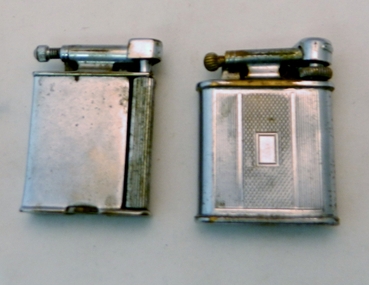
Lighter Lift Arm, circa early 1900s
... MARK". To the right of the "filler", "THE ROLLER BEACON MADE IN ENGLAND" This Roller Beacon lift arm cigarette/pipe lighter has a chrome plated brass shell and is fueled by petrol. To operate this lighter you lift the "snuffer" arm(long roller lift arm) exposing the horizontal external flint tube, then scrape the flint wheel to create a spark (to light the wick) from the adjacent flint(resting on the brass ignition wheel). ...This cigarette or pipe lighter was in use in the mid 1900's when the majority of users were men. Ladies did smoke but mainly not in "public" The activity was still regarded as a male activity. Middle to Upper "Class" of women nearly always had a gentleman "at hand" that would "light up" her cigarette. This was seen as a "social" activity only but later in the mid 1900's onward it was quite acceptable for both sexes to "smoke" at anytime.This type of lighter was male orientated due to the degree of lighting the flint with the horizontal movement required a strong thumb action across the lighting wheel. It is significant to rural areas such as the Kiewa Valley as the majority of men (especially during and after World War II) regarded smoking as a way to ease off the "tension" of hard work. The socio-economics of the Australian work place changed after the emancipation of women in the "workforce" after the World War II depleted the male workforce for the duration of the War and changed the Australian ethics of women in all aspects of both city and rural working "so called" male only occupations.This Roller Beacon lift arm cigarette/pipe lighter has a chrome plated brass shell and is fueled by petrol. To operate this lighter you lift the "snuffer" arm(long roller lift arm) exposing the horizontal external flint tube, then scrape the flint wheel to create a spark (to light the wick) from the adjacent flint(resting on the brass ignition wheel).At the base to the left of the "filler" screw "PATENT No. 485037, 818155" underneath "REG. DES. N" on the filler screw "ROLLER REG" underneath "TRADE MARK". To the right of the "filler", "THE ROLLER BEACON MADE IN ENGLAND"early hand lighters, smoking in the 1930's, cigarette lighter, cigarette, tobacco -
 Orbost & District Historical Society
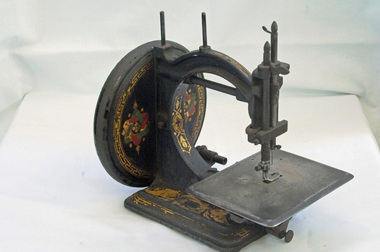
sewing machine, late 1860's - 1870's
... marks. A small black hand-cranked lockstitch sewing machine. It has a backwards C-shaped body. The wheel ...The early settlers of Orbost had to be self sufficient making their own clothes, tableware, bed coverings, furnishings and equipment. Many women were skilled dressmakers and craft workers. This item reflects that time.A small black hand-cranked lockstitch sewing machine. It has a backwards C-shaped body. The wheel and base are decorated with a gold pattern. On the end above the needle assembly is a brass plate The balance wheel has a handle. The pattern on the wheel is a gold border with two gold, red and green stars formed by interwoven triangles. On the cloth plate is stamped "Patent March 1867 Heron Gresham" with some indecipherable marks.sewing-machine needlework -
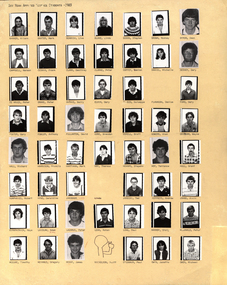 Federation University Historical Collection
Photographs - black and white, Ballarat College of Advanced Education: 1st Year Applied Science Students, 1983, 1983
... e/f guiseppe flanagan, denise ford, gary foster, gary fowler, anthony fullarton, david gore, brendan gorell, brett gowers, alan grinham, wayne hall, richard harrison, francis hartmann, mark hay, theresa hovard,stephen hoy, terrance hull, grant humphries, robert hynd,geraldine jakubans, linda jarecki, ted jeffreys, andrew johns, alvin kirkpatrick, kaye laidlaw, gary lazarus, peter lean, rohan long, paul markby, craig mcdonald, peter mceuna, timothy mcinnes, gregory mckay, james nicholson, scott o'connor, paul owen, janette owen, michael pear, zlatko picorrillo, john pilkington, john potter, steven prendergast, maurice roberts, barry ryan, marie schwarz, peter seeary, adrian shiells, jane stevenson, michael tan, simon taylor, catherine turkuile, marianne thomas, rosemarie twyford, keith vorstenbosch, mark walker, paul ward, jennifer warner, gary wheeler, stuart winter, anthony wood, mark yee, arthur zentgraf, mark bowie, ? ...Individual images of students in 1st Year Applied Science Course. The names of the student is written under the photo - in alphabetical order. Some spaces have no photo. Some names have been crossed out. In total there are 91 names (55 on one and 36 on the other). Of this number there are only 16 girls in the course for this year.Two beige cards with small black and white photographs - photographer's proofsName of student under photo - alphabetical orderapplied science, 1st year, barker, alison, baxter, mark, beamish, lisa, blake, linda, bodon, stephen, brown, rodney, byron, dean, campbell, noreen, cesnik, frank, clark, geoffrey, clarke, peter, coffey, damien, daniel, michelle, desnoy,gary, de vries, peter, drake, peter, duthie, barry, elkin, gary, ? e/f guiseppe, flanagan, denise, ford, gary, foster, gary, fowler, anthony, fullarton, david, gore, brendan, gorell, brett, gowers, alan, grinham, wayne, hall, richard, harrison, francis, hartmann, mark, hay, theresa, hovard,stephen, hoy, terrance, hull, grant, humphries, robert, hynd,geraldine, jakubans, linda, jarecki, ted, jeffreys, andrew, johns, alvin, kirkpatrick, kaye, laidlaw, gary, lazarus, peter, lean, rohan, long, paul, markby, craig, mcdonald, peter, mceuna, timothy, mcinnes, gregory, mckay, james, nicholson, scott, o'connor, paul, owen, janette, owen, michael, pear, zlatko, picorrillo, john, pilkington, john, potter, steven, prendergast, maurice, roberts, barry, ryan, marie, schwarz, peter, seeary, adrian, shiells, jane, stevenson, michael, tan, simon, taylor, catherine, turkuile, marianne, thomas, rosemarie, twyford, keith, vorstenbosch, mark, walker, paul, ward, jennifer, warner, gary, wheeler, stuart, winter, anthony, wood, mark, yee, arthur, zentgraf, mark, bowie, ?, davies, ronald, mckay, ?, maclean, andrew, cramer, geoff, page, stuart, firth, barry, fry, b, hennesy, tom, hoell, nicholas, evans, michael -
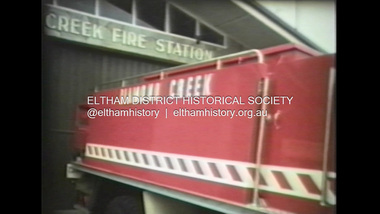 Eltham District Historical Society Inc
Film - Video (VHS), Diamond Creek Fire Brigade, c.1955-1987
... Wadeson Ian Douglas International tanker J.L Ryan Jack Marks Jack Sinclair January 1969 Jaws of Life Jean Ryan Jim Bates and Hugh Bar Jim Cox Joe Hislop John Bennett Kangaroo Ground kangaroo ground tower Keith Bradbury Kyneton Fire Brigade Lambert Street main hurstbridge road Mangarook Oval Maypole dancing Mel Stone Mildura 1986 Mrs Bradbury MXE754 Vic Registration Neil Marshall Nel Stone orchard district Oxy Viva resuscitator Pauline Dick Pauline Toner MP Pisy home Plenty Fire Brigade Road Rescue unit pony rides radio control room Reverend Jock Ryan Ron Kirkbride Rudy Libel Shell Service Station Shire of Eltham War Memorial Shire President Wayne Phillips spinning wheel Stan Redpath State Championships Swan Hill 1981 TCM418 Vic Registration Torchlight Procession Toyota 4WD trophies Vic Cohn Victorian Bushfires - 1969 VL3JZ On label: "Donation - August 2000 Diamond Creek Unit Old films made up from Fire Brigade shows at competitions - also Kangaroo Ground Tower being used" BASF Standard Quality SQ E-180 VHS dubbing (poor quality) of three films Converted to MP4 file format 0:34:38, 1.85GB Diamond Creek Fire Brigade Film Video (VHS) ...Combination of three movie films. Movie One (1950s): 00:00 – 13:14 Black and white footage of Diamond Creek firemen practising in Diamond Street in the 1950s for forthcoming demonstrations of abilities. Mentions of Gordon Brandy and Joe Hislop Running out hoses from old hose reels along Diamond Street, Diamond Creek Displays from various brigades running out and connecting hoses. Also scenes from the 1950s of Diamond Creek Fire Brigade competing in various locations around Victoria and Tasmania. Mentions of Brigade members Dave Kidd, Bruce Hackett, Ron Kirkbride, Jack Marks, Graham Upton who are prominent in these events. Members of Kyneton Fire Brigade also present. Members competing in running out hose reels, connecting hoses togethers and to hydrants then climbing towers to direct water from hose or at a target hanging above the road. Diamond Creek members identified wearing a diamond on their chest and back. Includes scenes of Scottish pipe bands at the events and significant crowds of spectators. Footage of Mel Stone and Beryl Marks, Stan Redpath and Ron Kirkbride, then Ron Kirkbride and Eric Holt viewing flower displays. Film changes to colour at Diamond Creek oval for practice with fire engine entering oval. Members depicted include Bill May, Jack Sinclair, Jim Cox, Bob Beale, Dave Kidd, Bruce Hackett and Captain Clarrie Stone. Reverts to black and white in the 1950s where the Brigade joins forces with the Diamond Valley Community Hospital for a Gala Day on the Diamond Creek Oval. Changes to colour again, possibly same event and scenes of children on bikes and scooters or with prams and carts racing around the oval. Mention of young lad Brian Laurie who has his own fire truck. Dart throwing, pony rides. Scenes with Dr Don Cordner, Gus Lyons, Vic Cohn (?) and spinning wheel and Diamond Creek School children entertain a large crowd with Maypole dancing. Movie Two (1950s): 13:25 – 19:00 This black and white film was taken by a TV film crew in the 1950s depicts a typical call out for the Diamond Creek Fire Brigade. In this case the careless action of a member of the public throwing a lighted match from a car, which can cause extensive damage. Footage features the Shire of Eltham War Memorial tower at Kangaroo Ground before it was modified with a fire spotter’s cabin. Discusses fire spotting operations from the tower. Shows a fire spotter walking around the top of the tower. A fire is detected, and the information is relayed to the nearest fire station, in this case, Diamond Creek. The telephone call is received, and the alarm sounded. Captain Clarrie Stone and firemen May and Shaw leave their workplaces and prepare for action. Scenes of running across the Main Hurstbridge road showing the shops (Shell service station and Chemist prominent). Scenes entering the fire station which has a pictorial warning covering the entire door “Only you can prevent forest fires – If you’re careless – we’re homeless!” Eric Holt pinpoints the location of the fire while Captain Clarrie Stone and Fireman Shaw take note. The advance vehicle (an FE Holden ute, rego GTE-696) leaves to assess the extent of the fire. Having assessed the fire, Fireman Shaw communicates with base showing radio with call sign VL3JZ. Eric Holt takes the call. In the meantime, Captain Clarrie Stone and Fireman Shaw undertake some limited action to address the fire. Firemen Bill May, Jim Bates and Hugh Bar (?) man the tanker. A photo portrait of Queen Elizabeth is visible hanging on the wall. They are later joined by Firemen Jim Cox, Eric DeBuse (?) and Jack Marks. The tanker is seen departing the station and diverging off before the bridge. Captain Clarrie Stone and Fireman Shaw are seen pumping water on the flames with hand pumps when the tanker arrives. The hose is unreeled, and water turned on the flames. Jack Sinclair joins the action. Jim Cox directs water to the high stuff. The fire put out, Jack Marks and Eric DeBuse wind in the hoses and the team head back to town. It’s peaceful again at the memorial tower. Movie Three (1969-1987): 19:14 – 34:34 Colour film “Fired with Dedication”, Country Fire Authority Victoria, produced by I.L. Wadeson, Commentary by A.M. Hem. Credits with CFA Victoria emblem and then placed over a view of an old-style ladder engine. Opens with the scene of a fire engine outside the Diamond Creek Fire Station then various trophies reflecting the competition success of the brigade in various track and disciplined events. Two trophies shown of particular pride to the brigade were for first place in the Torchlight Procession at the State Championships in Mildura in 1986 and also at Swan Hill in 1981. Still photo scenes of ex Captain Clarrie Stone, Brigade Captain for 21 years; ex Captain Jack Marks, 10 years; ex Captain Ian Douglas, 10 years. Cuts to scene of radio control room, January 1969, and news of a fire on the northern side of the township of Diamond Creek. With scenes of flames in bush, the narration explains that until the early 1960s the area was an orchard district which protected the town against the savagery of bushfires. But due to competition from other areas more suitable for orcharding and easier transport to Melbourne the district could no longer remain competitive, and orchards were replaced by grassed areas, which together with the bush areas were a feeding ground for fire. On 8th January 1969, high temperatures and strong north winds, were, with the carelessness of some individual all that was necessary to produce the worst fire the district had seen. Cuts to scene of blackened fields and cattle - Hundreds of hectares of grass land were blackened, and cattle had to be transported to other areas for agistment. Scene of destroyed buildings in the township – 13 houses and the public hall in the town were destroyed as was the theatre equipment which was owned by the fire brigade. The Church of England Hall and bell tower were badly damaged. The whole town could have been burnt out but for the determination, skill, and courage of the Diamond Creek Fire Brigade. Scenes of all that was left of the home on the hill on the west side of the Church of England. Also, the remains of the old Pisy (?) home on the top of the same hill near Lambert Street, and the ruined Crocker home. Cuts to a scene in the mid-1970s to mid-1980s of a house fire in Haley Street attended by the Diamond Creek Fire Brigade. Although the house was severely damaged, it was saved. Mentions that whilst assistance is appreciated, in some circumstances, those doing so are not properly dressed for fighting fires. Breathing apparatus is a must in structure fire attack. Next scene (either on Mangarook or Coventry oval) showing off four Diamond Creek Fire Brigade efficient and very expensive firefighting units. Features a forward control vehicle Toyota 4WD used for conveying task force personnel to the required areas; a Hino Model 3.2 tanker, diesel powered and carries 3,000 litres of water and has a 16 HP petrol driven pump which delivers 900 litres of water per minute; an International tanker (registration TCM-418) which carries 3,000 litres of water with pumping capacity of 600 litres per minute. The Ford diesel powered pumper (registration MXE-754) is a well-equipped vehicle with a water capacity of 1,000 litres and capable of pumping 1,900 litres of water per minute from the main pump, has many lockers which hose equipment such as breathing apparatus and various types of hose nozzles and foam making equipment. The vehicle carries 360m of 64mm diameter hose which can be laid out from the rear lockers and a portable lighting plant, an Oxy Viva resuscitator to revive smoke inhalation victims and forcible entry tools to gain access to structure fires. Views of the main pump and control panel on the vehicle. As well as the main pump, the vehicle is equipped with an auxiliary pump which allows the facility to pump whilst moving. Fire fighters must undergo constant training and hone their skills, Scenes of a training exercise using the pumper to pump from static water. First, the short lengths of suction hose are coupled, a strainer fitted to ensure debris does not foul the pump. Gauges must be constantly monitored to ensure manageable water pressures are maintained. Pressures are normally controlled to allow two fire fighters to work at each nozzle outlet. Two nozzles are tested, one adjustable jet fog type which is used on flammable gasses or within a structure fire to absorb heat. A straight jet nozzle to project water long distances to protect exposed surfaces close to a fire radiated heat. The pumper is quite a versatile vehicle in handling structure fires, but it also carries specialist equipment needed in containing hazardous chemical incidents. Cuts to scene of parade – the Diamond Creek Fire Brigade has with other neighbouring brigades participated in most town fairs and earns the respect of the watching public. It can be seen why this brigade has been so successful at disciplined contests. Views of Plenty Fire Brigade Road Rescue unit which is equipped with the “Jaws of Life” Scenes of athletic competitions – many neighbouring brigades indulge in friendly but keen competition at the Diamond Creek Town Fair. The young are also encouraged to participate in all aspects of Junior Fire Brigade activities and become tomorrow’s generation of volunteer fire fighters. Scene of the 1986 Diamond Creek Town Fair which was the last time veteran Captain Clarrie Stone BEM marched with the brigade. Clarrie was awarded the British Empire Medal for his service to the Country Fire Authority. Also, scenes of vehicles in the parade. Cuts to scene of brigade members in drill formation for inspection by Acting Chief Harry Rothsay (?) on the occasion of the opening of the new fire station extensions on August 29, 1987. Rudy Libel (?) Captain at the time. Scenes of crowds including many dignitaries of neighbouring brigades present including Lieutenant Gordon Grandy (who came down from Queensland for the occasion) and ex-Secretary David Kidd and wife Betty, also ex Captain Clarrie Stone and Mrs Nel Stone, a life member of the Ladies Auxiliary, the Reverend Jock Ryan, son of J.L Ryan, founder of the Diamond Creek Fire Brigade, Foundation Captain of the fire brigade, Keith Bradbury and Mrs Bradbury. Pauline Dick accepts a community service award for services to the CFA. Recognising over 47 and a half years of service, a presentation is made by Mr Neil Marshall, Acting Chairman of the CFA to ex Captain Clarrie Stone with response by Clarrie. Other members of the official party include Cr. Martin Wright, Shire President Wayne Phillips and local Member of Parliament, Mrs Pauline Toner. Ex foreman John Bennett is presented with a life member’s awards by Captain Rudy Libel. The camera also catches Gwen Cox, Jean Ryan and Bessie Layton (?) Provides historic footage of people, places and equipment and a record of the worst fires expoerienced in Diamond Creek in 1969BASF Standard Quality SQ E-180 VHS dubbing (poor quality) of three films Converted to MP4 file format 0:34:38, 1.85GBOn label: "Donation - August 2000 Diamond Creek Unit Old films made up from Fire Brigade shows at competitions - also Kangaroo Ground Tower being used"video recording, diamond creek fire brigade, 1986 diamond creek town fair, a.m. hem, acting chief harry rothsay, athletic competitions, beryl marks, bessie layton, betty kidd, bill may, bob beale, brian laurie, bruce hackett, captain clarrie stone, chemist, church of england hall, clarrie stone, clarrie stone bem, country fire authority victoria, coventry oval, cr. martin wright, crocker home, dart throwing, dave kidd, david kidd, diamond creek, diamond creek fire station, diamond creek oval, diamond creek school, diamond creek town fair, diamond street, diamond valley community hospital, dr don cordner, eric debuse, eric holt, fe holden ute, fire damage – buildings, fire spotter, fire spotter’s cabin, fire station extension, fired with dedication (film), firefighting units, fireman shaw, firemen jim cox, ford pumper, foundation captain, gala day, gordon brandy, gordon grandy, graham upton, gus lyons, gwen cox, haley street, hino model 3.2 tanker, house fire, i.l. wadeson, ian douglas, international tanker, j.l ryan, jack marks, jack sinclair, january 1969, jaws of life, jean ryan, jim bates and hugh bar, jim cox, joe hislop, john bennett, kangaroo ground, kangaroo ground tower, keith bradbury, kyneton fire brigade, lambert street, main hurstbridge road, mangarook oval, maypole dancing, mel stone, mildura 1986, mrs bradbury, mxe754 vic registration, neil marshall, nel stone, orchard district, oxy viva resuscitator, pauline dick, pauline toner mp, pisy home, plenty fire brigade road rescue unit, pony rides, radio control room, reverend jock ryan, ron kirkbride, rudy libel, shell service station, shire of eltham war memorial, shire president wayne phillips, spinning wheel, stan redpath, state championships, swan hill 1981, tcm418 vic registration, torchlight procession, toyota 4wd, trophies, vic cohn, victorian bushfires - 1969, vl3jz -
Glen Eira Historical Society
Document - ROTARY CLUB OF CAULFIELD
... Mark... Awards... Wembley Wheel of Friendship...Contains a list of extant staff, the menu, the programme, a description of the history of the ‘Wembley Wheel of Friendship’, a list of charter members, and an account of the etymology of the name ‘Rosstown’. 5/Two copies of a page featuring four items of relevance to the Rotary Club of Caulfield. The first is an article (titled ‘Rotary scholar makes it’, author unspecified, source unspecified, undated) about Club scion Mark Collard receiving an MBA from Clarkson University. ...Dunlop Howie Fillmore Wally Ford John Ford Peter Forshaw Ken Gales Brian Green Myer Hind Jim Humphreys John Hunter Ian Lewis Ray Melville Jack Oscar Geoff Penaluna Harry Perlen Louis Rampling Ross Ronaldson Keith Sherlock Max Sicklemore Graham Smith Barry Stapleton Ted Summers Ron Tovey David Rotary Club of Caulfield-Rosstown Knight Ian Tudor Court Kooyong Road Bellmaine Mark Langfelder Kurt Morris Rob Rome Graeme Alma Club Wilks Street Wills David Blankfield Mark Awards Wembley Wheel of Friendship Bellmaine Loretta Cunningham David Cunningham Jean Davis Pam Davis Rex Davis Judith Forshaw Hannah Graham Jeremy Graham Kara Hassing Andre Hassing Arlette Jacobs Frank Jacobs June Langfelder Judy Morris Robert Morris Angela Nettlebeck Rosalie Oscar Enid Rattray John Rattray Diana Rome Lorraine Sarah Ted Sarah Denise Sherlock Helen Smith Suzanne Stapleton Jackie Turner Brook Turner Vicki Tuhiwai Tamati Tuhiwai Ravina Will Arnold Will Claire Rosstown Ross William Murray Rosstown Sugar Works Collard Mark Rotary Foundation Keller Chuck Campbell Felicitie Mrs. ...This file contains 13 official documents pertaining to the Rotary Club of Caulfield: 1/A typewritten copy of the constitution of the Rotary Club of Caulfield (undated). Said document is essentially an instruction manual detailing how the Club is to be administered and the duties of officials. 2/A page (unclear if intended for use as a poster or letter) announcing a Business Persons Breakfast to be held at St. Anthony’s Parish Hall on 19/11/1986, wherein Jeff Kennett, M.L.A., Leader of the Opposition of the Parliament of Victoria, will deliver a speech titled ‘Responsibility Before Rights’. 3/A booklet announcing the 25th anniversary celebration of the Rotary Club of Caulfield, to be held at Tudor Court on 24/02/1987. Contains the menu, national anthem, programme, and two lists – one of the founding members of the Club and one of the extant members of the Club. 4/Two copies of a booklet announcing a dinner, to be held at Tudor Court on 10/11/1987, wherein charter will be presented to the Rotary Club of Caulfield-Rosstown by District Governor Ian Knight. Contains a list of extant staff, the menu, the programme, a description of the history of the ‘Wembley Wheel of Friendship’, a list of charter members, and an account of the etymology of the name ‘Rosstown’. 5/Two copies of a page featuring four items of relevance to the Rotary Club of Caulfield. The first is an article (titled ‘Rotary scholar makes it’, author unspecified, source unspecified, undated) about Club scion Mark Collard receiving an MBA from Clarkson University. The second is an article (titled ‘New Caulfield Rotary’, author unspecified, source unspecified, undated) about the presentation dinner to which item 7 pertains. (This article is not present in its entirety, trailing off at the end.) The third is an announcement of a ‘progressive dinner’ to be held on 28/11/1987, also containing an announcement of a bicentennial conference to be held on 19/03/1988. The fourth is an announcement of what appears to be the initiation of some sort of historical re-enactment, the proceeds of which will fund the Rotary Club’s ‘Polio Plus’ project. A title (‘A Long Haul Through Caulfield’) suggests this item may be the header section of an article about said event, but if so, the remainder is not present. Contains three black-and-white photographs; one of Collard with an unidentified woman (presumably his wife), one of Club President Howie Dunlop congratulating Charter President Geoff Oscar, and one of some men riding on a horse-drawn cart. 6/Two copies of a booklet announcing a President Changeover Dinner, to be held on 28/06/1988. Contains the menu, programme, and a list of extant members. 7/Two copies of the weekly bulletin of the Rotary Club of Caulfield, dated 28/06/1988. Contains lists of faculty, notification of the Club’s decision to admit women, notification of upcoming events, a biography of guest speaker Fred Epstein, and a list of the times and places of alternative meetings. 8/Two photocopied statements of the receipts and expenditure of the Rotary Club of Caulfield, one for the period 01/10/1989 – 30/06/1990, and one for the period 01/07/1990 – 27/08/1990. 9/The photocopied minutes of a New Members Committee Meeting of the Rotary Club of Caulfield, dated 02/08/1990. Objects of discussion include fundraising methods and application of funds. 10/A booklet announcing Change Over Night, dated 21/06/1994. Contains the programme, menu, national anthem, and a list of extant faculty. 11/4 unbound pages announcing the winners of the Rotary Youth Photographic Awards, dated 1995 (a more specific date than this is not given). (Pages contain no photographs.) 12/A small note announcing the Murrumbeena Community Market, to be held on 04/12/2010, of which the Rotary Club of Caulfield is one of the sponsors. 13/A booklet announcing a dinner to celebrate the 50th anniversary of the Rotary Club of Caulfield, to be held on 23/02/2012. Contains the programme, menu, a list of past presidents, a description of the history of the Gifu Vase (a trophy in the Club’s possession), and a list of some of the charity projects the Club has been engaged in.rotary club of caulfield, clubs and associations, charitable organisations, kennett jeff m.l.a., st. anthony’s parish hall, grange road, neerim road, glenhuntly, festivals and celebrations, tudor court, gray robin, baird jack, lord john, king john, crittenden doug, gelme anthony, hunkin ed. rev., fryer roy, quine john, bedford f., bell jim, bunny d., cripps e., don john, epstein fred, hattam j., howard w., kerry g., kumnick j., kurrie s., lord l., morrison charles, nelson h., parton willis, perry bruce, pollard r., price f., skuse e., stillwell g., tilley norman, tomlinson charles, watson don, webster j., wilson duncan, fincher roy, wheller john, allen selwyn, christopher don, cohen godfrey, davis keith, davis lloyd, dornbierer w., dunlop howie, fillmore wally, ford john, ford peter, forshaw ken, gales brian, green myer, hind jim, humphreys john, hunter ian, lewis ray, melville jack, oscar geoff, penaluna harry, perlen louis, rampling ross, ronaldson keith, sherlock max, sicklemore graham, smith barry, stapleton ted, summers ron, tovey david, rotary club of caulfield-rosstown, knight ian, tudor court, kooyong road, bellmaine mark, langfelder kurt, morris rob, rome graeme, alma club, wilks street, wills david, blankfield mark, awards, wembley wheel of friendship, bellmaine loretta, cunningham david, cunningham jean, davis pam, davis rex, davis judith, forshaw hannah, graham jeremy, graham kara, hassing andre, hassing arlette, jacobs frank, jacobs june, langfelder judy, morris robert, morris angela, nettlebeck rosalie, oscar enid, rattray john, rattray diana, rome lorraine, sarah ted, sarah denise, sherlock helen, smith suzanne, stapleton jackie, turner brook, turner vicki, tuhiwai tamati, tuhiwai ravina, will arnold, will claire, rosstown, ross william murray, rosstown sugar works, collard mark, rotary foundation, keller chuck, campbell felicitie mrs., campbell jack cr., knight genny, albury civic centre, green tess, tantram avenue, quine gwen, beaver street, rosalind ray, rosalind lweis, devon street, little company of mary hospital, polio plus, smith ian, jackson adrian, miller peter, spence bert, wheller denise, coffey bill, financial documents, receipts, gilmartin e., moran d., kaan a., fillmore wal, coleman peter, coleman moyrha, wesley college elsternwick big band, puddy mark, fradkin barry, fitzgerald gerald, renton robert, herschberg gedeon, kinston david, montgomery peter, dawes shane, silberberg henry, zazryn ben, cohen michael, rotary youth photographic awards, photographic competitions, photography, terry ted mr., terry e. a. mr., eldridge hannah, cottral anne, abdullahi khalid, gostin cassie, podlabeniouk lena, diyab ahmed, draca julijana, pevkoski danilla, wooster heath, lesar dion, sansoni rachel, leatham chelsea, townsend jessie, barker megan, fitzgerald megan, maokhamphiou anthony, smith naomi, fraser sue-ellen, white tanya, murrumbeena community market, koornang uniting church, murrumbeena road, welsh heather, robinson david, kesselschmidt sima, potasz sophie, southwick david, cheyne gordon, ryall keith, arianti listy, westbrook natasha, pollard bob, hancock irey, lovett jack, cooper alby, rundle john, patkin nehama, mcmullen adele, douglas jennie, preston mark, resubal loreto, gifu vase, aoki seiichi, operation firewood, alfred hospital, bus of knowledge, australia day breakfast, bethlehem hospital, caulfield hospital -
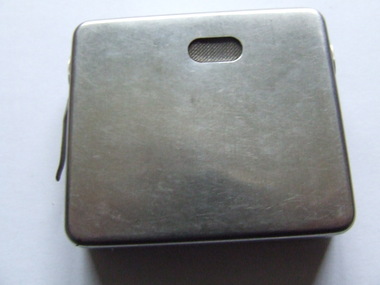 Waverley RSL Sub Branch
Calaid Hearing aid, ¬1955
... Steel square case with a white plastic thumb wheel with volume marks on the side and two holes for the insertion of the earpiece plug, front contains a small (10mm x 5mm) microphone covered by a wire grill.There is a small retaining clip on each side to clip the unit into a shirt pocket...The were also used for the large number of children who had impaired hearing due to the Rubella epidemic in Australia during WWII. http://www.acoustics.asn.au/journal/2000/2000_28_3_Upfold_Piesse.pdf Issued to Henry Claude Roussac a veteran of both WWI and WWII calaid hearing aid australian acoustic laboratories roussac gallipoli repatriation department cal C of A CALAID D11849 Steel square case with a white plastic thumb wheel with volume marks on the side and two holes for the insertion of the earpiece plug, front contains a small (10mm x 5mm) microphone covered by a wire grill.There is a small retaining clip on each side to clip the unit into a shirt pocket Calaid Hearing aid ...Made by Commonwealth of Australia (Commonwealth Acoustic laboratories) to address the problem of providing hearing aids to ex-service men with impaired hearing due to war related events. They were issued by the then Repatriation Department a cheaper alternative to imported more expensive but lower quality units. The were also used for the large number of children who had impaired hearing due to the Rubella epidemic in Australia during WWII. http://www.acoustics.asn.au/journal/2000/2000_28_3_Upfold_Piesse.pdfIssued to Henry Claude Roussac a veteran of both WWI and WWIISteel square case with a white plastic thumb wheel with volume marks on the side and two holes for the insertion of the earpiece plug, front contains a small (10mm x 5mm) microphone covered by a wire grill.There is a small retaining clip on each side to clip the unit into a shirt pocketC of A CALAID D11849calaid, hearing aid, australian acoustic laboratories, roussac, gallipoli, repatriation department, cal -
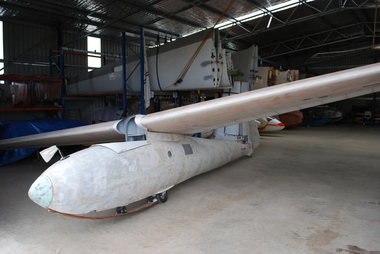 Australian Gliding Museum
Machine - Glider – Sailplane
... The Australian Gliding Museum’s Olympia is a Mark 2 (actually 2B according to the logbook) which can be distinguished by the built in main wheel and blown Perspex canopy. ...The Australian Gliding Museum’s Olympia is a Mark 2 (actually 2B according to the logbook) which can be distinguished by the built in main wheel and blown Perspex canopy. ...Prior to World War II an international competition was held for design of a standard sailplane for use in Olympic competition in 1940 in Finland. The design chosen was the “Meise” from DFS in Germany and its designer Hans Jacob. The 1940 Olympics were cancelled due to the outbreak of war and post war international gliding competition has been organized as World Championships, not as an Olympic event. After the war the Meise was manufactured by firms in Europe and a few were built by amateurs from plans. In 1945, a United Kingdom firm, Chilton Aircraft Limited, revised the plans for the DFS Meise Olympia keeping its aerodynamic shape and prepared new technical drawings for the production of the Chilton Olympia. It engaged Elliotts of Newbury (a firm with aircraft production experience during the war) to built a set of wings for its prototype. The wings were made by Elliotts but it apparently refused to let Chiltons have the jigs required to build more wings. The matter was resolved by Chiltons transferring its production rights and equipment to Elliotts. Elliotts produced several batches of Olympias (the “EON Olympia”) – probably about 150 in total from 1947 including Marks 1, 2 and 3 versions (featuring some structural changes and design improvements). The Australian Gliding Museum’s Olympia is a Mark 2 (actually 2B according to the logbook) which can be distinguished by the built in main wheel and blown Perspex canopy. It was designated as serial number EON/O/34 by Elliotts. It was damaged badly at Bristol, UK, in 1949. The wreckage was acquired by a Melbourne based syndicate including Dave Darbyshire, and imported into Australia. Additional damage occurred in shipping due to the need to shorten the wings to fit them into a crate. The syndicate rebuilt the glider and re-launched it in 1956 (registration number VH-GHR). It was flown by the syndicate and several gliding clubs in Victoria and South Australia until about 1972. A potentially airworthy example of a now rare sailplane of historical importanceSingle seat wooden sailplane, partly restored.australian gliding, glider, sailplane, dfs, hans jacob, meise, olympics, eon olympia, chilton aircraft, elliotts of newbury, dave darbyshire, great eastern gliding club, barossa valley gliding club, murray bridge gliding club -
 Flagstaff Hill Maritime Museum and Village
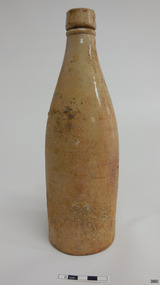
Ceramic - Stoneware Bottle, Late 1800s to early 1900s
... wheel or in moulds such as a plaster mould, which gave the bottles uniformity in size and shape. The bottle would then be fired and glazed in a hot kiln. Makers often identified their bottles with the impression of a small symbol or adding a colour to the mouth. The manufacturer usually stamped their bottles with their name and logo, and sometimes a message that the bottle remained their property and should be returned to them. The bottles could then be cleaned and refilled. However, this bottle has no identification marks...wheel or in moulds such as a plaster mould, which gave the bottles uniformity in size and shape. The bottle would then be fired and glazed in a hot kiln. Makers often identified their bottles with the impression of a small symbol or adding a colour to the mouth. The manufacturer usually stamped their bottles with their name and logo, and sometimes a message that the bottle remained their property and should be returned to them. The bottles could then be cleaned and refilled. However, this bottle has no identification marks ...This bottle was made in Scotland and recovered decades later from a shipwreck along the coast of Victoria. It may have been amongst the ship's cargo, its provisions or amongst a passenger's personal luggage. It is now part of the John Chance collection. Stoneware bottles similar to this one were in common use during the mid-to-late 19th century. They were used to store and transport. The bottles were handmade using either a potter's wheel or in moulds such as a plaster mould, which gave the bottles uniformity in size and shape. The bottle would then be fired and glazed in a hot kiln. Makers often identified their bottles with the impression of a small symbol or adding a colour to the mouth. The manufacturer usually stamped their bottles with their name and logo, and sometimes a message that the bottle remained their property and should be returned to them. The bottles could then be cleaned and refilled. However, this bottle has no identification marks. This stoneware bottle is historically significant for its manufacture and use in the late 19th to the early 20th century. The bottle is also significant as it was recovered by John Chance, a diver, from a wreck on the coast of Victoria in the 1960s-70s. Items that come from several wrecks along Victoria's coast have since been donated to the Flagstaff Hill Maritime Village’s museum collection by his family, illustrating this item’s level of historical value.Bottle, salt glazed stoneware, beigeNoneflagstaff hill, warrnambool, flagstaff hill maritime museum, maritime museum, shipwreck coast, flagstaff hill maritime village, great ocean road, john chance, shipwreck artefact, stoneware, ironstone, pottery, bottle, antique bottle -
 Flagstaff Hill Maritime Museum and Village
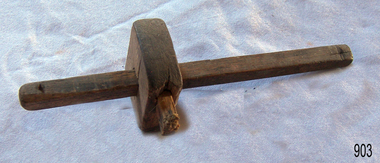
Tool - Marking Gauge, Believed to be homemade around the 1940s given no makers marks and the naivety of its construction
... mark out lines for cutting or other operations. The purpose of the gauge is to scribe a line parallel to a reference edge or surface. It is used in joinery and sheet metal work operations. The gauge consists of a beam, a headstock, and a scribing or marking implement, typically a pin, knife, pen or wheel. ...mark out lines for cutting or other operations. The purpose of the gauge is to scribe a line parallel to a reference edge or surface. It is used in joinery and sheet metal work operations. The gauge consists of a beam, a headstock, and a scribing or marking implement, typically a pin, knife, pen or wheel. ...A marking gauge, also known as a scratch gauge, is used in woodworking and metalworking to mark out lines for cutting or other operations. The purpose of the gauge is to scribe a line parallel to a reference edge or surface. It is used in joinery and sheet metal work operations. The gauge consists of a beam, a headstock, and a scribing or marking implement, typically a pin, knife, pen or wheel. The headstock slides along the beam and is locked in place by various means: a locking screw, cam lever, or a wedge. The marking implement is fixed to one end of the beam. These types of gauges have been in use for many centuries and have not changed much in their design.An item that has not changed in use since its inception many hundreds of years ago. These types of marking gauges used by cabinet and joinery makers to mark or scribe their work for cutting are still produced and used today in many sizes by professional cabinet makers and individuals.Cabinet makers marking gauge, wooden, adjustable staff secured be a wedge through the block. Noneflagstaff hill, warrnambool, shipwrecked-coast, flagstaff-hill, flagstaff-hill-maritime-museum, maritime-museum, shipwreck-coast, flagstaff-hill-maritime-village, cabinet makers tools, woodworking tool, marking gauge, mortise gauge -
 City of Moorabbin Historical Society (Operating the Box Cottage Museum)
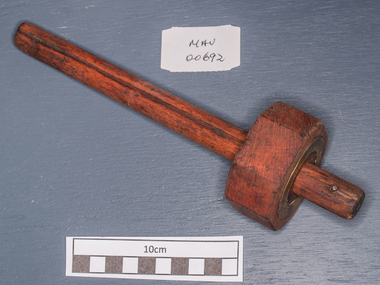
Tools, marker wooden gauge, c1900
... mark out lines for cutting or other operations. The purpose of the gauge is to scribe a line parallel to a reference edge or surface. It is used in joinery and sheet metal operations.The gauge consists of a beam, a headstock, and a scribing or marking implement, typically a pin, knife, pen or wheel. ...mark out lines for cutting or other operations. The purpose of the gauge is to scribe a line parallel to a reference edge or surface. It is used in joinery and sheet metal operations.The gauge consists of a beam, a headstock, and a scribing or marking implement, typically a pin, knife, pen or wheel. ...A marking gauge, also known as a scratch gauge, is used in woodworking and metal working to mark out lines for cutting or other operations. The purpose of the gauge is to scribe a line parallel to a reference edge or surface. It is used in joinery and sheet metal operations.The gauge consists of a beam, a headstock, and a scribing or marking implement, typically a pin, knife, pen or wheel. The headstock slides along the beam, and is locked in place by various means: a locking screw, cam lever, or a wedge. The marking implement is fixed to one end of the beam.Early settlers in Moorabbin Shire had to be self reliant and made their own clothes and tools as they established homes and farms for their familiesc1900 A hand made wooden marker gaugeearly settlers, pioneers, market gardeners, moorabbin, bentleigh, brighton, cheltenham, tools -
 City of Moorabbin Historical Society (Operating the Box Cottage Museum)
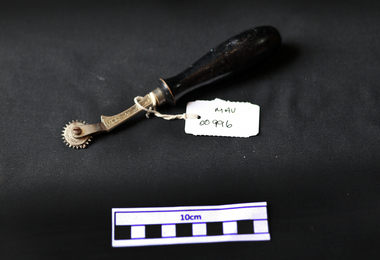
Craftwork, leatherwork marking tool, c1900
... mark the spacing of stitches for smooth, even results. Early settlers and pioneers had to be self reliant and made and repaired their own equipment eg Saddles, reins, as well as wallets, pouches and bags. craftwork pioneers early settlers moorabbin bentleigh cheltenham leather, tools, saddles, wallets, personal effects, horses, drays, A leather working marking tool with a steel wheel and shaft and a carved wooden handle. ...This leather marking tool is rolled along leather to mark the spacing of stitches for smooth, even results. Early settlers and pioneers had to be self reliant and made and repaired their own equipment eg Saddles, reins, as well as wallets, pouches and bags. A leather working marking tool with a steel wheel and shaft and a carved wooden handle. craftwork, pioneers, early settlers, moorabbin, bentleigh, cheltenham, leather, tools, saddles, wallets, personal effects, horses, drays, -
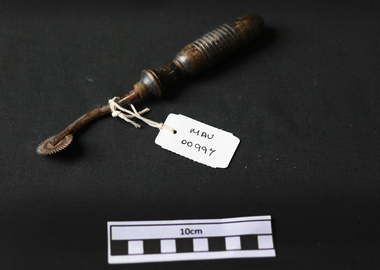 City of Moorabbin Historical Society (Operating the Box Cottage Museum)
Craftwork, leatherwork marking tool, c1900
... mark the spacing of stitches for smooth, even results. Early settlers and pioneers had to be self reliant and made and repaired their own equipment eg Saddles, reins, as well as wallets, pouches and bags. craftwork cheltenham moorabbin early settlers pioneers leather, tools, saddles, wallets, personal effects, horses, drays, A leather working tool marker with steel wheel and shaft and a carved wooden handle Craftwork, leatherwork marking tool ...This leather marking tool is rolled along leather to mark the spacing of stitches for smooth, even results. Early settlers and pioneers had to be self reliant and made and repaired their own equipment eg Saddles, reins, as well as wallets, pouches and bags. A leather working tool marker with steel wheel and shaft and a carved wooden handlecraftwork, cheltenham, moorabbin, early settlers, pioneers, leather, tools, saddles, wallets, personal effects, horses, drays, -
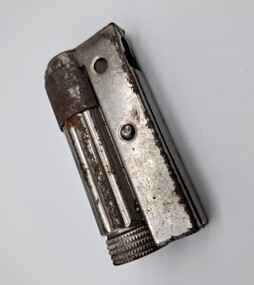 Glenelg Shire Council Cultural Collection
Functional object - Cigarette Lighter, Imco Triplex, mid 1900s
... The spark wheel is at the same end as the rusted metal band. The base of the lighter has a maker's mark attributing it to Imco Triplex....The spark wheel is at the same end as the rusted metal band. The base of the lighter has a maker's mark attributing it to Imco Triplex. ...Silver coloured metal lighter. It has a cylinder to one side which has vertical line markings. The cylinder also has a rusted metal band around it. The top of the cylinder has 5 lines of little dot markings which go round the circumference of the top. Attached to the cylinder is a rectangular piece of metal. This has the spark wheel in it. The spark wheel is at the same end as the rusted metal band. The base of the lighter has a maker's mark attributing it to Imco Triplex.IMCO TRIPLEX / Patent Austria -
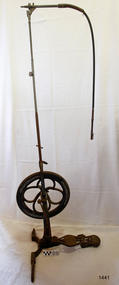 Flagstaff Hill Maritime Museum and Village
Equipment - Dentist Drill, Late 19th century
... wheel's circumference. Similar decoration is along the sides of the frame. The foot pedal has decorative cutout patterns in the centre of the foot and at the toe. On the long foot of the stand is some lettering with a fine, light coloured border around it. The lettering is hard to read, being a dark colour and flaking off. There are also remnants of fine, light coloured flourishes. The foot pedal has lettering of the maker’s trade mark...mark cast into it that looks like a combination of ‘C’ , ‘S’ , ‘A’, ‘R’. This treadle-powered dentist drill, or dentist engine, is made of iron and steel and provides power for a mechanical dental hand-piece that would be fitted with a dental tool. The drill has a three footed cast iron base, one foot being longer than the other two. A vertical C shaped frame is joined into the centre of the base, holding an axle that has a driving-wheel ...The design of this and other similar treadle powered dental engine (or dentist drill) was in common use by dentists from the 1870’s into the 1920's. When electricity became accessible to most communities the electrically powered dental engines began to take over from the treadle power. Over the ages teeth were extracted using picks and scissors and other gouging instruments. Bow drills, hand drills and even a "bur thimble" drill were later used to prepare cavities for filling. Some drills were made bendable by attaching flexible shanks between the metal bur and the handle, giving access to the teeth at the back of the mouth. Other mechanical devices were introduced along the way, such as clockwork drills, but they were hard to handle and inefficient. Over the centuries “dentistry has been performed by priests, monks and other healers. This was followed by barbers; the barber’s chair may well have been the precursor to the dental chair. “(SA Medical Heritage Society Inc.) In 1871 James Morrison patented the first commercially manufactured 'foot treadle dental engine', the first practica dental engine although others had been introduced as early as 1790 (by John Greenwood). Handmade steel burs or drills were introduced for dental handpieces, taking advantage of the significant increase in the speed of the drill. In 1891 the first machine-made steel burs were in use. The treadle drill reduced the time to prepare a cavity from hours to less than ten minutes. In 1876 the Samuel S. White Catalogue of Dentist Instruments listed a 12 ½ inch wheel diameter dental engine, with 14 bright steel parts, for sale at US $55 In today’s market, this is the equivalent to US $1200 approx. The specifications of that dental engine are very similar to the this one in our Flagstaff Hill Maritime Village’s collection. It is interesting to note that workings of a similar treadle dentist drill were used and modified to power a treadle spinning wheel of one of the volunteer spinners at Flagstaff Hill Maritime Village. The foot treadle dental engine was a milestone in dental history. “Historic importance of treadle powered machines; they made use of human power in an optimal way” (Lowtech Magazine “Short history of early pedal powered machines”) The invention of a machine to speed up the process of excavation of a tooth lead to the invention of new burs and drills for the handpieces, improving speed and the surgical process of dentistry. They were the fore-runner of today’s electrically powered dental engines. This treadle-powered dentist drill, or dentist engine, is made of iron and steel and provides power for a mechanical dental hand-piece that would be fitted with a dental tool. The drill has a three footed cast iron base, one foot being longer than the other two. A vertical C shaped frame is joined into the centre of the base, holding an axle that has a driving-wheel (or flywheel) and connecting to a crank. A slender, shoulder height post, made from telescoping pipes, joins into the top of this frame and is height adjusted by a hand tightened screw with a round knob. On the post just above the frame is a short metal, horizontal bar (to hold the hand-piece when it is not in use). A narrow tubular arm is attached to the top of the stand at a right angle and can move up and down. At the end of the arm is a firmly fixed, flexible rubber hose protected for a short distance by a sheath of thin metal. At the end of the hose there is a fitting where the drill’s hand-piece would be attached; a small, silver coloured alligator clip is also at the end. A treadle, or foot pedal, is hinged to the heel to the long foot of the base, and joined at the toe to the crank that turns the driving-wheel. There is a spring under the toe of the treadle. The metal driving-wheel has a wide rim. Touching the inside of the rim are four tubular rings that bulge towards the outside of the driving-wheel, away from the pole, and all meet at the hub of the axle. The axle is bulbous between the inside of the driving-wheel and the frame then passes through the frame and is attached on the other side. The driving-wheel has a groove around which a belt would sit. The belt would also fit around a pulley on the arm, at the top of the post. The pulley is joined to a rod inside the arm and this spins the drill's hand-piece and dental tool holder. The two shorter feet of the base are made from a long metal bar that has been curved outwards, and its centre is bolted to the base of the pole. Under the ends of the curved legs of the base are wedge shaped feet. The driving-wheel is decorated in light coloured paint on both sides, each side having three sets of floral decals evenly spaced around them, and each about a sixth of the wheel's circumference. Similar decoration is along the sides of the frame. The foot pedal has decorative cutout patterns in the centre of the foot and at the toe. On the long foot of the stand is some lettering with a fine, light coloured border around it. The lettering is hard to read, being a dark colour and flaking off. There are also remnants of fine, light coloured flourishes. The foot pedal has lettering of the maker’s trade mark cast into the metal at the ball of the foot. Lettering on the base is peeling and difficult to read. The foot pedal has a trade mark cast into it that looks like a combination of ‘C’ , ‘S’ , ‘A’, ‘R’. flagstaff hill, warrnambool, shipwrecked coast, flagstaff hill maritime museum, maritime museum, shipwreck coast, flagstaff hill maritime village, great ocean road, dentist, teeth, dental drill, dental engine, treadle drill, foot powered drill, treadle engine, orthodontics, dental surgery, james morrison -
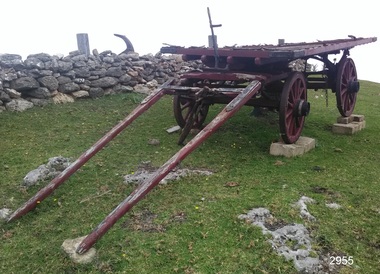 Flagstaff Hill Maritime Museum and Village
Wagon, circa 1850s
... This flat-topped, horse driven, four-wheeled Wagon was used for cartage by the business of Manifold & Bostock, Warrnambool. The original sign writing of the wagon is obscured or painted over. There is a feint mark...This flat-topped, horse driven, four-wheeled Wagon was used for cartage by the business of Manifold & Bostock, Warrnambool. The original sign writing of the wagon is obscured or painted over. There is a feint mark ...Bostock & Manifold were all from pioneering families in the Western District of Victoria almost from the time of settlement. Family history: The Bostock family were prominent in Warrnambool from the 1850s to the 1880s. Patriarch Robert Bostock had in 1813 been transported to Sydney from Sierra Leone for having 'felonious traded in slaves' and sentenced to 14 years transportation. He moved to Tasmania in 1821 where he died in 1847. A number of his children came to Port Phillip. Edward Robert Bostock held the Jellabad run from 1849 to 1853. George Bostock (1826-1858) was a Warrnambool Shire Councillor in 1856. Thomas Edward Bostock (1828-1874) was a Shire Councillor in the late 1860s. Augustus Bostock (1833-1920) lived in Warrnambool. Augustus Bostock was the 9th child of Robert and Rachael Bostock of Vaucluse Epping Forest, Van Diemen's Land. He was only 4 years old when his mother died. He was inspired by his father to seek his fortune in the Western District of Victoria. He arrived around 1850. He married Margaret Aitkin in July 1865. Augustus owned several properties in the district and leased others. He sat on the court of Warrnambool, Mortlake or Hexham as required. He resided at Marramook in Hawkesdale and later moved to Vaucluse in Hopetoun Road Warrnambool, where he died in 1920 at the age of 87. The Wagon is significant locally and state wide for its association with Augustus Bostock who was involved in many aspects of life in the Western District of Victoria, racing, cricket, and social activities to name a few. Bostock & Manifold were all from pioneering families in the Western District of Victoria almost from the time of settlement. The wagon is significant for its historical and economic association with the local Warrnambool business of Manifold & Bostock. These men had leased and owned vast tracts of land and operated businesses around the district together at various times often associated with the farming industry. One example is the Manifold & Bostock store and flour mill from which the wagon dray is believed to have been associated with for the delivery of goods. Their flour mill began operation in 1850 in 7-17 Stanley St South Warrnambool and was known as “Jetty Mills” Manifold and Bostock in 1858 purchased the Mill from John and G Elliot (brothers) with half an acre of ground and a cottage for £1600. It appears addresses of the company changed over the years as the town grew. These are listed in “Jones, Lewis & Peggy flour mills of Victoria” showing the company operating from, Fairy Street and later at the Merri River near the cutting, known as Banyan and Merri Streets. The company ceased trading in 1870. The Wagon Dray is also an example of agricultural freight and general transportation during the 1800 and 1900 century.A four-wheeled wooden horse-drawn wagon with flat top described as a Wagon Dray in historical writings. Painted brown and black. The wagon has rear brakes, wooden, operated from a metal handle at the front of the Wagon. Front wheels are attached to a turnstile to allow easy turning of the wagon. This flat-topped, horse driven, four-wheeled Wagon was used for cartage by the business of Manifold & Bostock, Warrnambool. The original sign writing of the wagon is obscured or painted over. There is a feint mark of lettering to the sides and back edges of the cart Manifold & Bostock. "Manifold and Bostock" very feintflagstaff hill, warrnambool, shipwrecked-coast, flagstaff-hill, flagstaff-hill-maritime-museum, maritime-museum, flagstaff-hill-maritime-village, cartage, manifold and bostock of warrnambool, manifold family of western victoria, bostock family of western victoria, four wheeled wagon, wagon, horse drawn wagon, farm wagon, aitkin, aitkin bostock manifold, dray, aitkin family, cart, aitken, flour mill -
 Flagstaff Hill Maritime Museum and Village
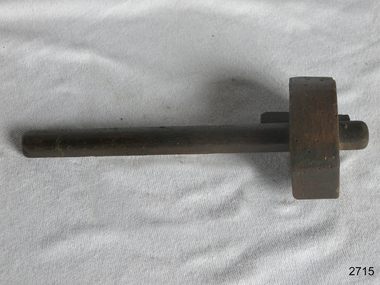
Tool - Marking Gauge, Prior to 1950
... mark out lines for cutting or other operations. The purpose of the gauge is to scribe a line parallel to a reference edge or surface. It is used in joinery and sheet metal operations. The gauge consists of a beam, a headstock, and a scribing or marking implement, typically a pin, knife, pen or wheel. ...mark out lines for cutting or other operations. The purpose of the gauge is to scribe a line parallel to a reference edge or surface. It is used in joinery and sheet metal operations. The gauge consists of a beam, a headstock, and a scribing or marking implement, typically a pin, knife, pen or wheel. ...A marking gauge, also known as a scratch gauge, and] is used in woodworking and metalworking to mark out lines for cutting or other operations. The purpose of the gauge is to scribe a line parallel to a reference edge or surface. It is used in joinery and sheet metal operations. The gauge consists of a beam, a headstock, and a scribing or marking implement, typically a pin, knife, pen or wheel. The headstock slides along the beam, and is locked in place by various means: a locking screw, cam lever, or a wedge. The marking implement is fixed to one end of the beam.A tool that has been in use since woodworking began for hundreds if not thousands of years without much change to the design or how the tool is used. Its use to scribe a line in various material as a cutting guide and is still in use today by many trades. Wooden marking Gauge, smallNonewarrnambool, flagstaff-hill, flagstaff-hill-maritime-museum, maritime-museum, shipwreck-coast, flagstaff-hill-maritime-village, marking gauge, woodworking, carpenters tools, tool -
 Flagstaff Hill Maritime Museum and Village
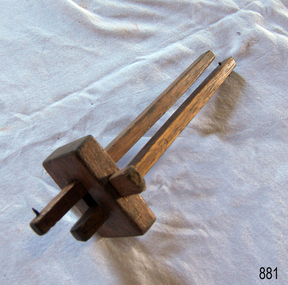
Tool - Marking Gauge, Believed to be homemade between 1900 to 1940s given no makers marks and the naivety of its construction
... mark out lines for cutting or other operations. The purpose of the gauge is to scribe a line parallel to a reference edge or surface. It is used in joinery and sheet metal work operations. The gauge consists of a beam, a headstock, and a scribing or marking implement, typically a pin, knife, pen or wheel. ...mark out lines for cutting or other operations. The purpose of the gauge is to scribe a line parallel to a reference edge or surface. It is used in joinery and sheet metal work operations. The gauge consists of a beam, a headstock, and a scribing or marking implement, typically a pin, knife, pen or wheel. ...A marking gauge, also known as a scratch gauge, is used in woodworking and metalworking to mark out lines for cutting or other operations. The purpose of the gauge is to scribe a line parallel to a reference edge or surface. It is used in joinery and sheet metal work operations. The gauge consists of a beam, a headstock, and a scribing or marking implement, typically a pin, knife, pen or wheel. The headstock slides along the beam and is locked in place by various means: a locking screw, cam lever, or a wedge. The marking implement is fixed to one end of the beam. These types of gauges have been in use for many centuries and have not changed much in their design.An item that has not changed in use since its inception many hundreds of years ago. These types of marking gauges used by cabinet and joinery makers to mark or scribe their work for cutting are still produced and used today in many sizes by professional cabinet makers and individuals.Cabinet makers marking gauge, wooden, two adjustable staffs secured be a wedge through the block. Each staff has a metal nail in the end.Noneflagstaff hill, warrnambool, shipwrecked-coast, flagstaff-hill, flagstaff-hill-maritime-museum, maritime-museum, shipwreck-coast, flagstaff-hill-maritime-village -
 Bendigo Historical Society Inc.
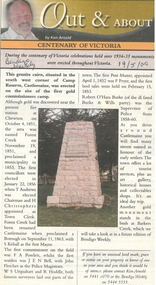
Newspaper - Newspaper articles by Ken Arnold, Out &About, 2000 - 2003
... Cairn Marks Gold Route 6.10.00 18. Volcanic Rock Cairn. Woodstock 13.10.00 19. Garfield Water Wheel 20.10.00 20. ...Cairn Marks Gold Route 6.10.00 18. Volcanic Rock Cairn. Woodstock 13.10.00 19. Garfield Water Wheel 20.10.00 20. ...Ken Arnold is a Bendigo author and publisher.A series of one hundred and thirty-five articles written by Ken Arnold and published in the Bendigo Weekly between 2000 and 2003. Each article has a topic or theme and includes historical information and details. Each article includes a photograph. The articles are stored in a red vinyl covered two ring A5 folder. Index below. Number Article Name Date 1. Centenary of Victoria 19.5.00 2. Storm Water Drain 26.5.00 3. Granite Rollers 2.6.00 4. Poverty Mine 9.6.00 5. Golden Monument. St Arnaud 16.6.00 6. Turner Statue 7.7.00 7. Gold Monument. High St Golden Square 30.6.00 8. Gold Monument. Howard Square Bendigo 14.7.00 9. Lansell Statue 21.7.00 10. Shelbourne West School 18.8.00 11. Mologa’s State Schools 25.8.00 12. Salinity Stone. Pyramid Hill 1.9.00 13. Cairn. Carisbrook 8.9.00 14. Commemorative Markers. Taradale 15.9.00 15. Burke Monument. Castlemaine 22.9.00 16. Cairn. Harcourt area 29.9.00 17. Cairn Marks Gold Route 6.10.00 18. Volcanic Rock Cairn. Woodstock 13.10.00 19. Garfield Water Wheel 20.10.00 20. Anticline. Castlemaine 27.10.00 21. Lawson Bridge 10.11.00 22. Plaque. Sutton Grange area 17.11.00 23. Memorial Cairn. Maryborough 1.12.00 24. Lonely Grave 8.12.00 25. Moonlight Flat Church 5.1.01 26. Historic Church. Near Tullaroop reservoir 12.1.01 27. Granite Statue. Castlemaine 19.1.01 28. Marker. Near Tullaroop reservoir 25.1.01 29. Church Site. Mologa 2.2.01 30. Church Site. Mologa 9.2.01 31. Plaque. Mologa 16.2.01 32. Mincha School 23.2.01 33. Historic Marker. Mincha 2.3.01 34. Expedition Marker. Pyramid Hill 9.3.01 35. Irrigation Marker. Tragowel 16.3.01 36. Mologa School Sites 23.3.01 37. Cairn. Pyramid Hill 30.3.01 38. Plaque. Pyramid Hill 6.4.01 39. Bristol Hill Lookout Tower. Maryborough 12.4.01 40. Eppalock Reservoir 20.4.01 41. Colbinabbin Cairn 27.4.01 42. Mount Macedon Cross 4.5.01 43. Memorial Gateway. Macedon 11.5.01 44. Cairn. Daylesford 18.5.01 45. Grave. Carlsruhe 25.5.01 46. Water Tower. Elmore 1.6.01 47. State School Site. Glenalbyn 8.6.01 48. Cairn. Kanya 15.6.01 49. Lonely Grave. Wedderburn 22.6.01 50. Church Cairn. Glenalbyn 29.6.01 51. Kamarooka School 6.7.01 52. Granite Marker. Moyston 13.7.01 53. Memorial Park. Kerang 20.7.01 54. Water Plaque. Bears Lagoon 27.7.01 55. Cemetery. Bears Lagoon 3.8.01 56. Race Monument 10.8.01 57. Cairn. Pyalong 17.8.01 58. Cairn. In memory of Edward Parker 24.8.01 59. Mt Macedon 31.8.01 60. Mt Macedon Cairn 7.9.01 61. Expedition Pass. Chewton 14.9.01 62. Granite Archway. St Arnaud 21.9.01 63. Stuart Mill School Site 28.9.01 64. School Site. Beazley’s Bridge 5.10.01 65. Fosterville 12.10.01 66. Barnadown 19.10.01 67. Salisbury School Site 26.10.01 68. Cricket History at Wattle Flat 2.11.01 69. School Site. Waterloo Plains 9.11.01 70. Carapooee School Site 11.01 71. Turkish Gun. Maldon 11.01 72. Kooreh 30.11.01 73. Marnoo East School 7.12.01 74. Bulgana Site 14.12.01 75. Emu School 21.12.01 76. Kooroocheang 4.1.02 77. Church Site. Gre Gre North 11.1.02 78. Carmens Tunnel. Maldon 18.1.02 79. Monument. Maldon 25.1.02 80. Woodfull Plaques. Maldon 1.2.02 81. Carapooee. St Peters Anglican Church 8.2.02 82. Cairn. Kingower 15.2.02 83. Cob & Co Stopover. Rheola 22.2.02 84. Flynn Monument 1.3.02 85. The Welcome Stranger. Moliagul 8.3.02 86. Campbell’s Creek Reserve 15.3.02 87. Mine. Fryerstown 22.3.02 88. Escott Grave. Near Chewton 28.3.02 89. School No 808. Kurting area 5.4.02 90. Graves. Bendigo Creek 10.5.02 91. School. Fish Point, Benjeroop North 17.5.02 92. Old Township. Diggora 24.5.02 93. Diggora West (1) 31.5.02 94. Diggora West (2) 7.6.02 95. School No 2735. Gower East 14.6.02 96. Pannoomilloo 21.6.02 97. Kamarooka Settlement 28.6.02 98. Mincha West State School No 1931 5.7.02 99. Bridges. Arnold 12.7.02 100. Woodvale 19.7.02 101. A Famous Son of Raywood. Jack Donaldson 26.7.02 102. Tandarra Area Schools 2.8.02 103. Dingee 9.8.02 104. Avonmore 30.8.02 105. Myola East School 6.9.02 106. Colbinabbin West 13.9.02 107. Colbinabbin West School 20.9.02 108. Runnymede area 27.9.02 109. Wanalta 4.10.02 110. School Sites. Between Wanalta and Carop 11.10.02 111. Burramboot 18.10.02 112. Kangaroo Chair. 25.10.02 113. Mincha South 1.11.02 114. Woodlands Church 8.11.02 115. School site. Sylvaterre 15.11.02 116. Terrick Terrick 22.11.02 117. Leitchville 29.11.02 118. Pennyweight Cemetery. Castlemaine 6.12.02 119. Mincha Area 13.12.02 120. Musk School 20.12.02 121. Dowie Park. Carisbrook 3.1.03 122. Neereman School Site 10.1.03 123. Bald Rock 17.1.03 124. Sylvaterre School Site 24.1.02 125. Carlsruhe 31.1.02 126. Athenaeum. Maldon 7.2.03 127. School. Mincha West 14.2.03 128. Yarraberb 21.2.03 129. Settlement Marker. Ravenswood Estate 28.2.03 130. Comini Reserve. Ravenswood 7.3.03 131. Ironbark and Gold Track. Whroo 14.3.03 132. Burke and Wills Obelisk. Castlemaine 21.3.03 133. James Cook Statue. Myers St Bendigo 28.3.03 134. St Marys Church. Axedale 4 .4.03 135. Butter Factory Site. Warragamba 11.4.03 events, monuments, historical sites, landmarks -
 Ballarat Tramway Museum
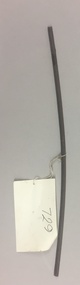
Functional Object - Trolley Wire Sample, BTM - Wendouree Parade
... marks at one end from being inside a wire joiner. Heavily worn over the years with groove only one side of wire. Top of wire green (oxidised) and dark grey on underside where not contacted by wheel. ...marks at one end from being inside a wire joiner. Heavily worn over the years with groove only one side of wire. Top of wire green (oxidised) and dark grey on underside where not contacted by wheel. ...Piece of heavily worn trolley wire taken from south bound ear, just before ear 41B. Wire in area (on the joiner side) had failed about two months prior to replacement. Sample taken 8 December 1997 during replacement operations. Was on a curve. Two screw marks at one end from being inside a wire joiner. Heavily worn over the years with groove only one side of wire. Top of wire green (oxidised) and dark grey on underside where not contacted by wheel. Has been cut at both ends. Wire curved after taking down naturally. See item Reg No. item 514 for original wire size details. Images added 3-12-2016 See Reg. Item No. 514 ballarat, overhead, trolley wire -
 Ballarat Tramway Museum
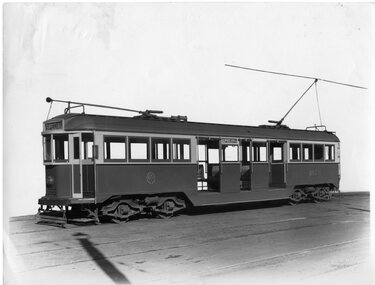
Photograph - Black & White Photograph/s, Sutcliffe Pty Ltd, c1931
... On rear in pencil "W3 wide entrance 33" wheel with motor car springing", "Change Transportation wed A.M.", "return to Shennan" with arrow pointing to "Gordon & Gotch (Aus/Asia) Ltd Sydney" and an arrow between cropping marks with notation "6" wide between marks only" and "1HT D/E 120s/c D/E as layout attached" - indicating used in a printed paper or magazine....Ballarat Tramway Museum South Gardens Reserve Wendouree Parade Ballarat Ballarat goldfields trams tramways MMTB W3 class tram 655 On rear in pencil "W3 wide entrance 33" wheel with motor car springing", "Change Transportation wed A.M.", "return to Shennan" with arrow pointing to "Gordon & Gotch (Aus/Asia) Ltd Sydney" and an arrow between cropping marks with notation "6" wide between marks only" and "1HT D/E 120s/c D/E as layout attached" - indicating used in a printed paper or magazine. ...Black and white photograph of W3 655 - 3/4 side on view - background has been taken out. Tram fitted with windshield instead of driver's doors on both sides of drivers cabin but no route number boxes. Showing "SPECIAL". Probably taken soon after built in 1931. Photo taken by Sutcliffe Pty Ltd. Photo has "Sutcliffe PHONE MELBOURNE" embossed into the photograph in the bottom right hand corner.On rear in pencil "W3 wide entrance 33" wheel with motor car springing", "Change Transportation wed A.M.", "return to Shennan" with arrow pointing to "Gordon & Gotch (Aus/Asia) Ltd Sydney" and an arrow between cropping marks with notation "6" wide between marks only" and "1HT D/E 120s/c D/E as layout attached" - indicating used in a printed paper or magazine.trams, tramways, mmtb, w3 class, tram 655 -
 Ballarat Tramway Museum
Document - Folder with papers, State Electricity Commission of Victoria (SECV), 1960's
... marks from “grease” on bottom half of rear cover. Contains 46 drawings which have been individually catalogued and numbered on the rear of each drawing within the folder. Some of the drawings have been folded. Reg Item Micro Film No. Old BTPS No. SEC Drawing No Title 4807 42/4 1 VB4/8103C Westinghouse T1F Controller Main Cylinder Segments. 4867 47/2 2 BA-T8-8128 Westinghouse 225N Motor Case Bolt 4830 22/3 B 3 BA-T7-7666 Half Ball Brake Hanger Link, Driving Wheel, Brill Maximum Traction Truck 22E 4868 44/3A 4 BA-T8-8113 Split Suspension Bearing for Type W225 Motor (Westinghouse) 4869 52/2 5 BA-T8-8158 Contact Tips for G.E. ...marks from “grease” on bottom half of rear cover. Contains 46 drawings which have been individually catalogued and numbered on the rear of each drawing within the folder. Some of the drawings have been folded. Reg Item Micro Film No. Old BTPS No. SEC Drawing No Title 4807 42/4 1 VB4/8103C Westinghouse T1F Controller Main Cylinder Segments. 4867 47/2 2 BA-T8-8128 Westinghouse 225N Motor Case Bolt 4830 22/3 B 3 BA-T7-7666 Half Ball Brake Hanger Link, Driving Wheel, Brill Maximum Traction Truck 22E 4868 44/3A 4 BA-T8-8113 Split Suspension Bearing for Type W225 Motor (Westinghouse) 4869 52/2 5 BA-T8-8158 Contact Tips for G.E. ...Yields information about the drawings that were used by the depot or workshop staff as reference drawings. Has a strong association with the depot workshop staff. Yields information about equipment on Ballarat tramcars and Signalling.Folder containing 46 blueprints or Dyeline prints of SEC tram equipment drawings. Front of folder made from a cloth back sheet of paper extended to secure to a thick cardboard runner. Rear of folder made from an old tram advertising panel or cardboard sheet, cut to size and secured to a thick cardboard runner with a cloth backing on both sides. Sheets secured with three brass screwed clips. Front cover damaged in bottom right hand corner. Rear cover breaking apart on outside around cloth binding. Heavy dirt marks from “grease” on bottom half of rear cover. Contains 46 drawings which have been individually catalogued and numbered on the rear of each drawing within the folder. Some of the drawings have been folded. Reg Item Micro Film No. Old BTPS No. SEC Drawing No Title 4807 42/4 1 VB4/8103C Westinghouse T1F Controller Main Cylinder Segments. 4867 47/2 2 BA-T8-8128 Westinghouse 225N Motor Case Bolt 4830 22/3 B 3 BA-T7-7666 Half Ball Brake Hanger Link, Driving Wheel, Brill Maximum Traction Truck 22E 4868 44/3A 4 BA-T8-8113 Split Suspension Bearing for Type W225 Motor (Westinghouse) 4869 52/2 5 BA-T8-8158 Contact Tips for G.E. Compressor Controller 4818 52/3 6 BA-T8-8159 GE B-23 Contact Finger Tips for G.E. Type ‘B’ Main Cylinder 4870 6/1 7A BA-T3-6734 Brass Nut for Switch Mechanism 4829 6/2 7B BA-T3-6735 Tongue Clip Link for Switch Mechanism 4871 6/3 7C BA-T3-6736 Fulcrum for Switch Mechanism 4872 6/4 7D BA-T3-6737 Plunger for Switch Mechanism 4832 7/6 8 BA-T3-6754 Pivot for Switch Mechanism No numbers 9 or 10 4873 17/5 11 BA-T7-7639 Detail of Motor Pinion for Brill Cars 4831.2 21/4 B 12 BA-T7-7661A Half Ball Hanger Links – single bogie trucks 4874 21/6 13A BA-T7-7663 Axle Box Inner Spring Driving Wheels Maximum Traction Truck 22E 4875 22/1 13B BA-T7-7664 Axle Box Outer Spring Driving Wheels Maximum Traction Truck 22E 4876 22/2 14 BA-T7-7665 Body Spring Brill Maximum Traction Truck 22E 4830.2 22/3B 15 BA-T7-7666A Half Ball Brake Hanger Link Driving Wheel Brill Maximum Traction Truck 22E 4877 22/4 16 BA-T7-7667 Body Spring, Brush Maximum Traction Truck 22E 4820.2 22/6 A 17 BA-T7-7669 Wear cups for Half Ball Brake Hanger Links, Single & Double Bogie Trucks 4878 50/5 18 BA-T8-8149 Connections of Line Breaker and Ratchet Switch for use with Drum Controller 4879 74/6 19 BA-T13-8757/9 Signal boxes, Back of Panel Wiring and External Connections 4880 45/1 20 BA-T8-8116 Trolley Harp 4806 15/3 21 BA-T7-7625 Equalizing Lever, Fulcrum, Brill 21 E truck 4881 15/5 22 BA-T7-7626A Brake Beam Fulcrum Brill 21E truck 4808 16/1 23 BA-T7-7628 Pinion Remover, GE 201G and GE 202 motors 4882 16/3 24 BA-T7-7630 Spring Posts, Brill 21E Truck 4883 21/3 25 BA-T7-7660 Brake Shoe Holder, Driving Wheel, Maximum Traction Truck Brill 22E 4884 21/5 26 BA-T7-7662 Brake Rod Guide, Single Bogie Trucks 4885 22/5 27 BA-T7-7668 Brake Shoe Holder, Pony Wheel, Maximum Traction Truck Brill 22E 4809 42/2 B 28 BA-T8-8101 Trolley Wheel and Axle 4815 42/1 B 29 BA-T8-8102A Motor Suspension Bearing, GE 202 Motor 4796.2 42/5 30 BA-T8-8104 Connection Diagram WH 225N Motor 4886 42/6 B 31 BA-T8-8105B Motor Suspension Bearing, GE 201 Motor 4797.2 48/6 32 BA-T8-8137 WH T1F Controllers 4816 49/2 33 BA-T8-8138 Connection Diagram GE 202 Motor 4887 49/3 34 BA-T8-8139 Connection Diagram K-36-J Controller 4888 50/3 35 BA-T8-8146 GE K-36-JR Controllers, with line breaker (Connection diagram) 4889 50/6 36 BA-T8-8150 Commutator for Westinghouse 225N Motor 4846 51/1 37 BA-T8-8151A Armature Bearing Lining, Commutator End, Type GE 201G Motor 4813 51/2 38 BA-T8-8152 Armature Winding Diagram Westinghouse 225 Motor 4840.2 51/40 39 BA-T8-8154A Armature Bearing Lining, Pinion End, Type GE201G Motor 4890 51/6 40 BA-T8-8156 Armature Bearing Lining, Pinion End, Type GE202A Motor 4891 52/1 41 BA-T8-8157A Armature Bearing Lining, Commutator End, Type GE202A Motor 4892 64/5 42A BA-T9-8392A Step Hangers, Single and Double Bogie Trucks, Hinged Type 4785.2 64/6B 42B BA-T9-8392/1A Step Hangers, Single and Maximum Traction Trucks, Fixed Type 4812.2 43/1 43 BA-T8-8106B GE K36J Controller, Main Cylinder Segments 4893 50/2 44 BA-T8-8145A GE B23E Controller, Main Cylinder Segments 4816 65/2 45 BA-T9-8394B Door Lock for Motorman’ Cabin Maximum Traction Trucks. 4810 73/3 46 BA-T13-8757 Ballarat Electric Tramways Signalling System, Arrangements & Details of Box.On front cover of folder, "1 - 46"trams, tramways, drawings, ballarat, sec, depot, workshops -
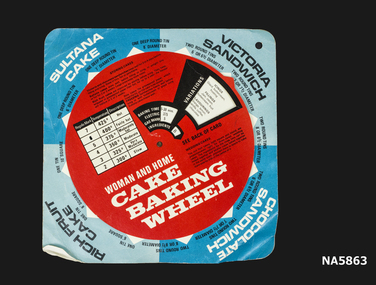 Whitehorse Historical Society Inc.
Domestic object - Cake Baking Wheel, Woman and Home Magazine, Circa 1960's
... Instructions on cake/sponge making Revolving wheel giving time - Regulo Mark to be used - ingredients...Cake Baking Wheel - revolving - red Produced by Woman and Home Red wheel shows Cooking Mark (Regulo) Temperature Variations - baking time- ingredients Types of cake/sponge Reverse side - ingredients/measurements...Instructions on cake/sponge making Revolving wheel giving time - Regulo Mark to be used - ingredients Home baking guide for cakes and sponge Woman and Home Cake Baking Wheel Cake Baking Wheel - revolving - red Produced by Woman and Home Red wheel shows Cooking Mark (Regulo) Temperature Variations - baking time- ingredients Types of cake/sponge Reverse side - ingredients/measurements Domestic object Cake Baking Wheel Woman and Home Magazine ...Instructions on cake/sponge making Revolving wheel giving time - Regulo Mark to be used - ingredientsCake Baking Wheel - revolving - red Produced by Woman and Home Red wheel shows Cooking Mark (Regulo) Temperature Variations - baking time- ingredients Types of cake/sponge Reverse side - ingredients/measurementsWoman and Home Cake Baking Wheelhome baking guide for cakes and sponge -
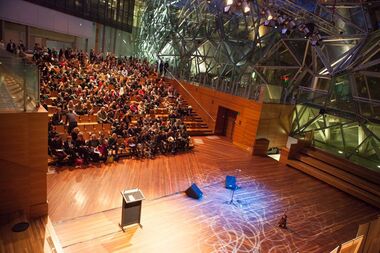 Emerging Writers' Festival
2013 Festival Photographs
... Program highlights include the Writers' Town Hall Conference, the late night literary programming at new Festival Hub 1000 £ Bend and the health and well-being focused Writers' Retreat at Abbotsford Convent. 10th Emerging Writers' Festival Sam Twyford-Moore 2013 program The Wheeler Centre Emerging Writers' literary anniversary literary festival Melbourne Abbotsford Convent A collection of digital photographs associated with the 2013 Emerging Writers' Festival. All photographed within this sample were taken by photographer mark ...The 2013 Emerging Writers' Festival ran from May 23rd until June 2nd, 2013. The festival was held in Melbourne and offered 68 events across 11 days. Program highlights include the Writers' Town Hall Conference, the late night literary programming at new Festival Hub 1000 £ Bend and the health and well-being focused Writers' Retreat at Abbotsford Convent.A collection of digital photographs associated with the 2013 Emerging Writers' Festival. All photographed within this sample were taken by photographer mark Gambino.10th emerging writers' festival, sam twyford-moore, 2013, program, the wheeler centre, emerging writers', literary, anniversary, literary festival, melbourne, abbotsford convent,
