
Showing 37 items matching "mark-doner"
-
 Ballarat Clarendon College
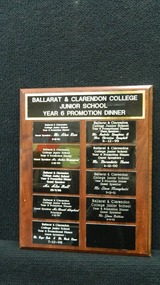
Honour board, Ballarat & Clarendon College Junior School Year 6 Promotion Dinner
... ...Mark-Doner...Year-6 Promotion-dinner Alan-Ross Arthur-Drummond Alex Ball David-Shepherd Roger-Bade Mark-Doner Andrew-Houghton Christine-Campbell Bernadette-Nunn Steve-Moneghetti Glenn-Robbins Plaques inscribed: Ballarat & Clarendon / College Junior School / Year 6 Promotion Dinner / Guest speaker:...... / Date Solid wood board with 10 plaques attached to front and title plaque at top. ...Honour board records the guest speakers from 1994 - 2002 who addressed the Ballarat & Clarendon College Junior School Year 6 Promotion Dinner. Solid wood board with 10 plaques attached to front and title plaque at top. Plaques inscribed: Ballarat & Clarendon / College Junior School / Year 6 Promotion Dinner / Guest speaker:...... / Date year-6, promotion-dinner, alan-ross, arthur-drummond, alex ball, david-shepherd, roger-bade, mark-doner, andrew-houghton, christine-campbell, bernadette-nunn, steve-moneghetti, glenn-robbins, -
 University of Melbourne, Burnley Campus Archives
Book - Student Records, Leaving Agricultural Science Prac Work, 1956-1967
... Handwritten records for Practical Work with student names, work done and marks from 1956-1967. From E.B. Littlejohn files....practical work students marks e.b. littlejohn Handwritten records for Practical Work with student names, work done and marks from 1956-1967. ...Handwritten records for Practical Work with student names, work done and marks from 1956-1967. From E.B. Littlejohn files. practical work, students, marks, e.b. littlejohn -
 Flagstaff Hill Maritime Museum and Village
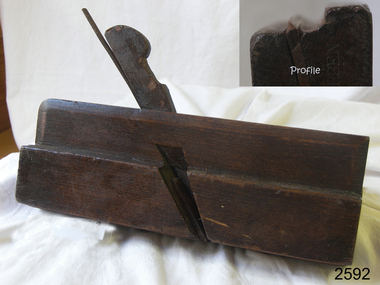
Tool - Moulding Plane, Charles Nurse, 1860-1900
... The majority of their plane making was done in London but there are Sheffield and Brighton marks on their tools as well. ...The majority of their plane making was done in London but there are Sheffield and Brighton marks on their tools as well. ...The original Nurse family business began in 1841 in Maidstone Kent until 1861 where they were plane makers, moving to London in 1887 the company became C Nurse & Co. And continued until 1937 under that name at the (Invicta works). The majority of their plane making was done in London but there are Sheffield and Brighton marks on their tools as well. The company was not only wood plane makers but tool makers in general with the Charles Nurse & Co catalogue having 350 pages of tools for sale of varying types for different building trades and over 138 pages dedicated to woodworking tools. Records show that the company was at 182 Walworth Road London from 1887-1949. However, they had several retail outlets before this time and records indicate before 1887 Charles Nurse was at 32 Mill St Maidstone Kent, from 1844 -1860 but were in business before then. Also in Brighton at 135 Queens Road from 1865 -1871 and at 3 Mill Street Maidstone, again from 1872 - 1889 listed on records of the time as “plane and tool makers.” A vintage item made by a significant tool maker and retailer from the middle of the nineteenth century and into the first half of the twentieth century. These items were made commercially for firms and individuals that worked in wood and needed a tool that could produce an ornamental finish to timber. The tool was used before electric or mechanical routers or spindle moulders came into use. They were used by craftsmen to produce decorative mouldings by hand. These profiled planes came in various shapes and sizes. A significant tool that today is quite rare and sought after by collectors. It gives us a snapshot of how furniture and other decorative finishes were created on timber by the use of hand tools only. Moulding plane Side Bead - Single Box Size 5/16 Maker Charles and Co 1863 Stamped W. Burden (previous owner) flagstaff hill, warrnambool, shipwrecked-coast, flagstaff-hill, flagstaff-hill-maritime-museum, maritime-museum, shipwreck-coast, flagstaff-hill-maritime-village -
 Federation University Historical Collection
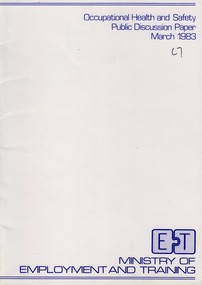
Document - Document - Course Outline, VIOSH: Ministry of Employment and Training; Occupational Health and Safety Public Discussion Paper, March 1983
... Responses from Tom Norwood of Ballarat College of Advanced Education and Mark Hennessy from Lincoln Institute of Health Sciences indicate what is already being done in courses available at Ballarat, Lincoln and Deakin. ...Responses from Tom Norwood of Ballarat College of Advanced Education and Mark Hennessy from Lincoln Institute of Health Sciences indicate what is already being done in courses available at Ballarat, Lincoln and Deakin. ...Victorian Institute of Occupational Safety and Health (VIOSH) Australia is the Asia-Pacific centre for teaching and research in occupational health and safety (OHS) and is known as one of Australia's leaders on the field. VIOSH has a global reputation for its innovative approach within the field of OHS management. VIOSH had its first intake of students in 1979. At that time the Institution was known as the Ballarat College of Advanced Education. In 1990 it became known as Ballarat University College, then in 1994 as University of Ballarat. It was 2014 that it became Federation University. VIOSH Australia students are safety managers, senior advisors and experienced OHS professionals. They come from all over Australia and industry. Students are taught active research and enquiry; rather than textbook learning and a one-size fits all approach. VIOSH accepts people into the Graduate Diploma of Occupational Hazard Management who have no undergraduate degree - on the basis of extensive work experience and knowledge. The booklet sets out in detail the proposals for the implementation of Government policy on occupational health and safety. The objective is to improve standards of health and safety in Victoria. The Government intends involving workers and employers directly in developing new standards and practices. Submissions to be forwarded to the Ministry of Employment and Training by 20 May 1983. Responses from Tom Norwood of Ballarat College of Advanced Education and Mark Hennessy from Lincoln Institute of Health Sciences indicate what is already being done in courses available at Ballarat, Lincoln and Deakin. Mark Hennessy comments that "a united approach might ensure rational decisions by government, beneficial to our mutually complimentary courses." . Booklet - outlining proposals. Nine A4 pages - typed Emblem of Ministry on cover. Signature of Jim Simmonds, Minister; Mark Hennessy, Lincoln Institute of Health Sciences; Tom Norwood, Ballarat College of Advanced Education. Letterhead Ballarat BCAE and Lincoln Institute viosh, victorian institute of occupational safety and health, ministry of employment and training, public discussion paper, tom norwood, mark hennessy, jim simmonds, workers, employers, ballarat college of advanced education, lincoln institute of health sciences, deakin university -
 Flagstaff Hill Maritime Museum and Village
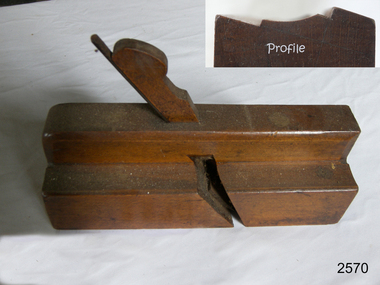
Tool - Moulding Plane, Charles Nurse, 1860-1900
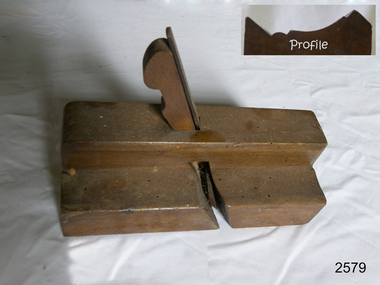
... The majority of their plane making was done in London but there are Sheffield and Brighton marks on their tools as well. ...The majority of their plane making was done in London but there are Sheffield and Brighton marks on their tools as well. ...The original Nurse family business began in 1841 in Maidstone Kent until 1861 where they were plane makers, moving to London in 1887 the company became C Nurse & Co. And continued until 1937 under that name at the (Invicta works). The majority of their plane making was done in London but there are Sheffield and Brighton marks on their tools as well. The company was not only wood plane makers but tool makers in general with the Charles Nurse & Co catalogue having 350 pages of tools for sale of varying types for different building trades and over 138 pages dedicated to woodworking tools. Records show that the company was at 182 Walworth Road London from 1887-1949. However, they had several retail outlets before this time and records indicate before 1887 Charles Nurse was at 32 Mill St Maidstone Kent, from 1844 -1860 but were in business before then. Also in Brighton at 135 Queens Road from 1865 -1871 and at 3 Mill Street Maidstone, again from 1872 - 1889 listed on records of the time as “plane and tool makers.” A vintage item made by a significant tool maker and retailer from the middle of the nineteenth century and into the first half of the twentieth century. These items were made commercially for firms and individuals that worked in wood and needed a tool that could produce an ornamental finish to timber. The tool was used before electric or mechanical routers or spindle moulders came into use. They were used by craftsmen to produce decorative mouldings by hand. These profiled planes came in various shapes and sizes. A significant tool that today is quite rare and sought after by collectors. It gives us a snapshot of how furniture and other decorative finishes were created on timber by the use of hand tools only. Moulding Plane a Casing Moulding Plane with two Scotia profiles Maker C Nurse and Co London. Owner A. E. Nunn Maker C Nurse & Co & A E Nunn (previous owner) flagstaff hill, warrnambool, shipwrecked-coast, flagstaff-hill, flagstaff-hill-maritime-museum, maritime-museum, shipwreck-coast, flagstaff-hill-maritime-village -
 Flagstaff Hill Maritime Museum and Village
Tool - Moulding Plane, Charles Nurse, 1860-1900
... The majority of their plane making was done in London but there are Sheffield and Brighton marks on their tools as well. ...The majority of their plane making was done in London but there are Sheffield and Brighton marks on their tools as well. ...The original Nurse family business began in 1841 in Maidstone Kent until 1861 where they were plane makers, moving to London in 1887 the company became C Nurse & Co. And continued until 1937 under that name at the (Invicta works). The majority of their plane making was done in London but there are Sheffield and Brighton marks on their tools as well. The company was not only wood plane makers but tool makers in general with the Charles Nurse & Co catalogue having 350 pages of tools for sale of varying types for different building trades and over 138 pages dedicated to woodworking tools. Records show that the company was at 182 Walworth Road London from 1887-1949. However, they had several retail outlets before this time and records indicate before 1887 Charles Nurse was at 32 Mill St Maidstone Kent, from 1844 -1860 but were in business before then. Also in Brighton at 135 Queens Road from 1865 -1871 and at 3 Mill Street Maidstone, again from 1872 - 1889 listed on records of the time as “plane and tool makers.” A vintage item made by a significant tool maker and retailer from the middle of the nineteenth century and into the first half of the twentieth century. These items were made commercially for firms and individuals that worked in wood and needed a tool that could produce an ornamental finish to timber. The tool was used before electric or mechanical routers or spindle moulders came into use. They were used by craftsmen to produce decorative mouldings by hand. These profiled planes came in various shapes and sizes. A significant tool that today is quite rare and sought after by collectors. It gives us a snapshot of how furniture and other decorative finishes were created on timber by the use of hand tools only. Cornice Moulding plane type Maker C Nurse and Co. Has A E Nunn stamped on end (Owner) flagstaff hill, warrnambool, shipwrecked-coast, flagstaff-hill, flagstaff-hill-maritime-museum, maritime-museum, shipwreck-coast, flagstaff-hill-maritime-village -
 City of Moorabbin Historical Society (Operating the Box Cottage Museum)
Personal Effects, cut-throat razor “Kings Crown’, 20thC
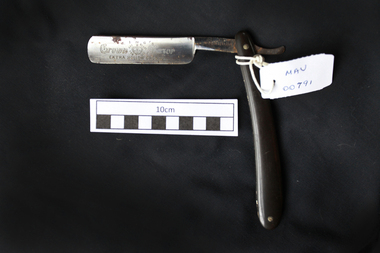
... Weyersberg™ family business.continue to place our mark on each and every product sold as we have done since first being able to register it in 1774. ...Weyersberg™ family business.continue to place our mark on each and every product sold as we have done since first being able to register it in 1774. ...KING RAZOR MFG. CO.Pittsburgh, Pennsylvania; moved to Indiana, Pennsylvania in 1911.ca. 1904 - 1919 Marked "Made in Germany", although the company's offices were located at 118 E. 28th Street, New York City. ca. 1934-1943 Used the "THE KING OF RAZORS REGISTERED TRADEMARK" trademark. 47-1/2 and Trademark: Crown and Wolf. For 500 years the Weyersberg family has been producing the finest blades in the world. For centuries the King’s Crown™ mark has been synonymous with exacting precision, hand-craftsmanship and quality. For the first few hundred years the blades, made in Solingen, Germany (the “City of Blades”), were for swords. As times changed, the Weyersberg family transitioned into making cut throat razors. The Greb. Weyersberg™ family business.continue to place our mark on each and every product sold as we have done since first being able to register it in 1774. For over a 100 years, the straight razors continue to be produced in Solingen (Germany). King's Crown™ A folding cut-throat razor on blade ; KING'S / CROWN 'a crown trademark' RAZOR / EXTRA HOLLOW GROUND around 'trademark' ; SET READY FOR USE on steel handle; MADE IN GERMANY cut-throat razors, straight razors, shaving equipment, steel blades, swords, weyersberg family, king crown pty ltd., solingen, germany, early settlers, market gardeners, moorabbin, bentleigh, cheltenham, -
 Mission to Seafarers Victoria
Photograph - Photograph, Black and white, Allan Charles Quinn, Refinishing the Propellor, 18 May 1949
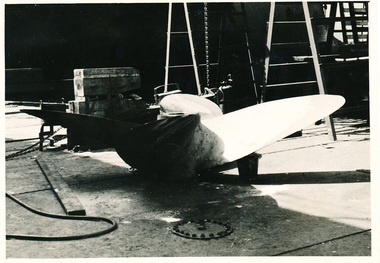
... done on one of the ship's propellers. This is a photograph from the Allan Charles Quinn collection which is a collection of letters and photograph depicting aspects of life at sea for a young man in the era immediately following World War II. allan-quinn photograph fenris dry-dock sweden stockholm 1949 Reverse: STOCKHOLM / 18-5-49 handwritten in blue ink. Below this is an indecipherable mark ...The photograph is part of a series of six, depicting the Fenris in dry docks in at Finn Boda ship yards, in Stockholm, Sweden, between the 4th and the 27th of May, 1948. This photograph shows refinishing being done on one of the ship's propellers. This is a photograph from the Allan Charles Quinn collection which is a collection of letters and photograph depicting aspects of life at sea for a young man in the era immediately following World War II. A black and white photograph of one of the propellers from the M/S Fenris in dry dock, in Stockholm. Reverse: STOCKHOLM / 18-5-49 handwritten in blue ink. Below this is an indecipherable mark in pencil. allan-quinn, photograph, fenris, dry-dock, sweden, stockholm, 1949 -
 Australian National Surfing Museum
VHS Movie, MAD WAX, 1986 (estimated)
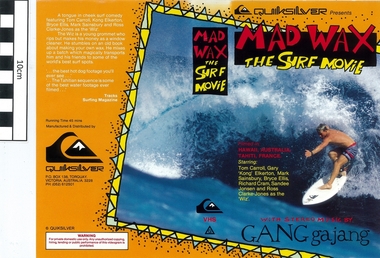
... The film features Mark Sainsbury a popular professional surfer from New South Wales who suddenly died of a brain anueryism on 6th AUgust 1992. The poster and cover art for the VHS case were done by noted Quiksilver designer/artist Peter Webb. ...A comedy surf film featuring Tom Carroll, Kong Elkerton, Bryce Ellis, Mark Sainsbury, and Ross Clarke-Jones as the Wiz. The Wiz stumbles on an old book about making your own wax and mixes a batch which magically transports him and his friends to some of the world's best surf spots. Music by popular Australian band GANGgajang MAD WAX had a national theatrical release in 1987. The film was shown at surf clubs, pubs and other surf film related venues during this period. The film is significant for the surfers who appear in the film (2 time World Champion Tom Carroll) and the 'loose' narrative thread which was common place in many surf films during the eighties. The film features Mark Sainsbury a popular professional surfer from New South Wales who suddenly died of a brain anueryism on 6th AUgust 1992. The poster and cover art for the VHS case were done by noted Quiksilver designer/artist Peter Webb. MAD WAX had its World Premier at the Enmore Theatre, Enmore, New South Wales on Saturday 28th February, 1987. The screening was accompanied by a live performance by GANGgajang whose music appears on the film soundtrack. VHS Surf film released by Quiksilver in February 1987. Colour cover art featuring a colour photograph of Gary Elkerton, one of the stars of the film. QUIKSILVER Presents. Cover art by Peter Webb (Quiksilver) Quiksilver logo. surf, quiksilver, wax, gangajang -
 Eltham District Historical Society Inc
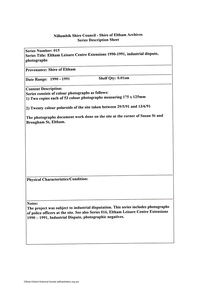
Document - Series Listing, Fraser Faithfull et al, Series 15: Eltham Leisure Centre Extensions 1990-1991, industrial dispute, photographs, 2000
... Series consists of colour photographs as follows: I) Two copies each of53 colour photographs measuring 175 x 125mm 2) Twenty colour polaroids of the site taken between 29/5/91 and 13/6/91 The photographs document work done on the site at the corner of Susan St and Brougham St, Eltham. shire of eltham archives series listing A4 printout Series 15: Eltham Leisure Centre Extensions 1990-1991, industrial dispute, photographs Document Series Listing Fraser Faithfull Chris Marks ...Series consists of colour photographs as follows: I) Two copies each of53 colour photographs measuring 175 x 125mm 2) Twenty colour polaroids of the site taken between 29/5/91 and 13/6/91 The photographs document work done on the site at the corner of Susan St and Brougham St, Eltham. shire of eltham archives, series listing -
 Queenscliffe Maritime Museum
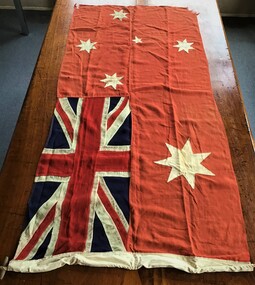
Flag - Australian Red Ensign
... Time was a land mark vessel in Queenscliff and surrounding areas from August 23rd, 1949, when it was wrecked on Corsair Rock in the entrance of Port Philip Bay until the early 60s when it broke up in a storm. flag red ensign S.S.Time Corsair Rock Rip Port Phillip SS Time hand written on calico edge of flag Australian Red Ensign from the salvage done on the wreck of the S.S.Time Flag Australian Red Ensign ...On August 23rd, 1949, S. S. TIME was on voyage from Sydney to Melbourne with a cargo of sugar (3,000 tons), timber, general cargo and coal, when she was wrecked on Corsair Rock, entrance of Port Philip Bay. The Australian Red Ensign is the official flag to be flown at sea by Australian registered merchant ships. The S.S. Time was a land mark vessel in Queenscliff and surrounding areas from August 23rd, 1949, when it was wrecked on Corsair Rock in the entrance of Port Philip Bay until the early 60s when it broke up in a storm. Australian Red Ensign from the salvage done on the wreck of the S.S.Time SS Time hand written on calico edge of flag flag, red ensign, s.s.time, corsair rock, rip, port phillip -
 Eltham District Historical Society Inc
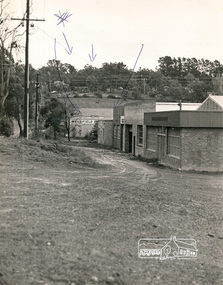
Photograph, N. J. Tillings Timber Factory, 15 June, 1975, 15/06/1975
... done about it." industrial estate brougham street eltham Inscribed on back: "Weekend photograph of factories in Brougham Street surrounded by by residential zone. On weekdays cars surround premises - these have been built approx. two years - where is the landscaping? * Undeveloped light industrial land. Careful planning needed for future. Being on high elevations backs of future buildings will be seen from Main Road Eltham and future Art Centre complex. Also Bolton Street becoming heavily used arterial road. Off street parking facilities most important." . The front of the photo has pen marks ...N. J. Tillings Timber Factory was part of the Brougham Street, Light industrial area, Eltham. Brick bulidings includes signage: Wakefield Pr... (printer?) No 17 Building C. This is one of 7 B/W 8x10 inch photos with notes on obverse by Dick Crichton. Accompanying letter from Florence Chrichton 2013 : "Originally sent to Shire of Eltham Engineer, Mr. McDonald. [These photographs were part of their campaign to the Shire of Eltham in 1975] claiming that the zoning regulations were being breached by the occupants of various factories in the nearby light industrial zone [Brougham Street, Eltham] - to the detriment of those living in adjoining residential zones, and that, despite .. earlier objections and complaints, nothing was done about it." 1 black and white photograph printed with white border Inscribed on back: "Weekend photograph of factories in Brougham Street surrounded by by residential zone. On weekdays cars surround premises - these have been built approx. two years - where is the landscaping? * Undeveloped light industrial land. Careful planning needed for future. Being on high elevations backs of future buildings will be seen from Main Road Eltham and future Art Centre complex. Also Bolton Street becoming heavily used arterial road. Off street parking facilities most important." . The front of the photo has pen marks indicating points of interest. industrial estate, brougham street, eltham -
 Warrnambool and District Historical Society Inc.
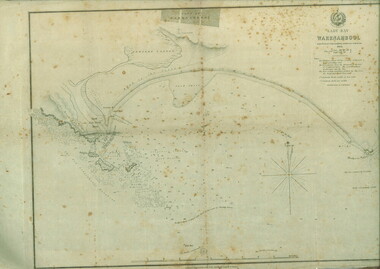
Document, Map: Lady Bay 1853, 1853
... Being done in 1853, it shows the depths of the bay area marked in fathoms, currents and directions and areas of rocks around mouth of the Merri and the Western side of the bay as well as a large sand spit to the middle right of the beach region.. It also marks...Being done in 1853, it shows the depths of the bay area marked in fathoms, currents and directions and areas of rocks around mouth of the Merri and the Western side of the bay as well as a large sand spit to the middle right of the beach region.. It also marks ...This is one of the earliest surveys and maps of Warrnambool harbor, Lady Bay. Being done in 1853, it shows the depths of the bay area marked in fathoms, currents and directions and areas of rocks around mouth of the Merri and the Western side of the bay as well as a large sand spit to the middle right of the beach region.. It also marks the large areas of seaweed and fuci in the outer bay area. It has the area of Pertobe Lagoon marked and shows the early tracks to the town. The engraving work was done by Tulloch and Brown, with Tulloch being one of the earliest engravers and lithographers in the state of Victoria. He arrived in Melbourne in 1849 and set up business with James Davie Brown in 1853 with Brown being a map engraver. They were awarded bronze and silver medals for their work at the Victorian Industrial Exhibition. He also worked in the vignettes on the Proeschel Map of Victoria. This map is of high historical and comparitive significance as it shows the Lady Bay area prior to the changes that have occurred in the last 160 years with the building of the breakwater. The issue regarding access to Lady Bay remains a current one. The engraver D Tulloch engraved some of the earliest scenes of the goldfields in Ballarat and as such has left a record of a very early and important era in Australian history. Rectangular cream paper with black text. Map area is outlined by fine black lined border. Key in top right hand corner and scale at bottom middle of map. Map is labelled Town of Warrnambool printed at top of map. Small logo at top right corner which has “Hydrographic Department” in circle around an anchor. Lady Bay Warrnambool Surveyed by John Barrow assistant surveyor Engraved by Tulloch & Brown in bottom right corner. Melbourne engraved by order of the legislative Council of Victoria in middle bottom. map, warrnambool, town of warrnambool map 1853, tulloch & brown map 1853, lady bay warrnambool,, warrnambool harbour, warrnambool breakwater, warrnambool beach -
 Eltham District Historical Society Inc
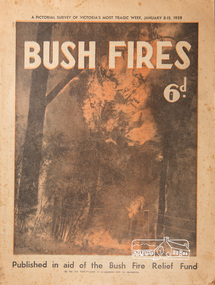
Magazine, Sun News-Pictorial, Bush Fires: A pictorial survey of Victoria's most tragic week, January 8-15, 1939, 1939
... done to the seedlings which were to have been the forests of the future. Water conservation will be seriously affected by the silting-up of reservoirs and streams from which protective timber has been taken by the all-engulfing flames. More than a thousand houses have been destroyed, and these, with 40 mills, and schools, post-offices, churches, and other buildings, represent a loss of at least half a million. At least 1500 are homeless. For their aid, money raised in appeals has now passed the £50,000 mark...done to the seedlings which were to have been the forests of the future. Water conservation will be seriously affected by the silting-up of reservoirs and streams from which protective timber has been taken by the all-engulfing flames. More than a thousand houses have been destroyed, and these, with 40 mills, and schools, post-offices, churches, and other buildings, represent a loss of at least half a million. At least 1500 are homeless. For their aid, money raised in appeals has now passed the £50,000 mark ...THE WEEK REVIEWED (Article; Bush Fires: A pictorial survey of Victoria's most tragic week, January 8-15, 1939. Published in aid of the Bush Fire Relief Fund by the Sun News-Pictorial in co-operation with its newsagents, pp2-3) THE fiercest bush fires Australia has known since its discovery are quiescent at the moment, and Victoria, in the comparative coolness of the change which came with rain on Sunday night, has begun·to count its losses. In the fiery eight days, from Sunday to Sunday, at least sixty-six men, women and children have lost their lives in forest fires, or have succumbed to burns and shock; many others have died from heat; and several serious cases of burns are being treated in hospitals. Two babies in Narrandera district have died, and ten others are in hospital, because of milk soured by the record temperatures of those eight days. Forest damage totals at least a million pounds, and incalculable damage has been done to the seedlings which were to have been the forests of the future. Water conservation will be seriously affected by the silting-up of reservoirs and streams from which protective timber has been taken by the all-engulfing flames. More than a thousand houses have been destroyed, and these, with 40 mills, and schools, post-offices, churches, and other buildings, represent a loss of at least half a million. At least 1500 are homeless. For their aid, money raised in appeals has now passed the £50,000 mark, and the biggest relief organisation ever set up in peace time has swung into operation. The First Hint Victoria's first hint of what was to come appeared on Sunday, January 8, when most parts of the State awoke to find a blistering day awaiting. At 12.20 p.m., when the thermometer reached its highest for the day, 109.6 degrees, the first fire victims were at that moment going to their death on a bush track five feet wide off the main road to Narbethong. They were the forestry officers Charles Isaac Demby and John Hartley Barling, who went to warn Demby of his danger when he parted from his companions, and was himself surrounded by the treacherous fire. It was not until 8 o'clock next morning that the tragic news was flashed throughout the State. Searchers found the two charred bodies close together, one seeking protection in the nook of two logs. Barling's watch had stopped at 1.20. In the meantime, tragedy was spreading its cloak. By Monday, big fires were raging at Toolangi, Erica, Yallourn, Monbulk, Frankston, Dromana, Drouin South, Glenburn, and Blackwood, with smaller outbreaks at many other centres. In the ensuing week, while women and children were evacuated as fast as the flames would permit, Erica-scene of the 1926 fire disaster-thrice escaped doom by a change of wind. Indeed, those who have been in the fire country these past days say that the numbers of times a change of wind has saved towns from destruction is amazing. In the towns they speak of miracles. Monday's Miracles The escapes from Monett's Mill at Erica and from the Hardwood Company's Mill at Murrindindi, near where Demby and Barling went to their death, were Monday's miracles. Twenty came out alive from each mill. At the first a 60ft. dugout provided an oven-like refuge; at the second, 12 women and children survived in the smoke-filled gloom of a three-roomed cottage while their eight men, their clothes sometimes afire, poured water on the wooden walls. Three houses out of ten remained when the fire had passed. Record Temperatures Sunday had been the hottest Melbourne day for 33 years; Monday dropped to a 76.1 degree maximum; but Tuesday dawned hotter than ever, the mercury reaching 112.5. By now rumor was racing ahead of fact; whole towns were being reported lost; the alarm was raised for scores of missing persons. But fact soon overtook rumor, and within a few days the staggering toll began to mount to a figure beyond the wildest imaginings of the panic-stricken. Six died from heat on this torrid Tuesday, and the fires spread in a wide swathe from south-west to north-east across the State. Fish died in shallow streams. A curtain of smoke hid the sky from all Victoria, and hung far out to sea. It alarmed passengers on ships. On the Ormonde, on the voyage to Sydney from Burnie, women ran on deck, believing fire had broken out in the hold. Days later the smoke reached New Zealand. In Melbourne thousands of fire-volunteers were leaving in cars: vans, motor-buses-anything reliable on wheels-to aid the country in its grim fight. In the fires at Rubicon and. Narbethong, seventeen were facing death this day. But not till Wednesday, when Melbourne breathed again in a cool change, while the country still sweltered in temperatures up to 117 degrees, did the news come through the tree blocked roads. A woman and her little daughter, trapped on the road, were among those who died. Their bodies, and those of menfolk with them, were found strewn out at intervals along the road, where the furnace of the surrounding fire had dropped them in their tracks as they ran. Twelve died at a Rubicon mill, five on the road at Narbethong. At Alexandra, not far distant, a baby was born while the fires raged, and stretcher-bearers brought in the injured. On Thursday the State Government voted £5000 for the relief of fire victims. The Governor (Lord Huntingfield) and the Lord Mayor (Cr. Coles) visited some of the stricken areas, and dipped into their pockets personally. Later, the City Council, too, voted £5000. Friday, The 13th Friday, the Thirteenth, justified its evil name. A blistering northerly came early in the morning, presaging destruction, and forcing the mercury to a new record of 114 degrees. Racing fires killed at least ten in those terrible 12 hours. Four children were engulfed in the furnace at Colac. Panic drove them, uncontrollable, into the smoke-filled road when the fire raced down behind their home. They choked to death. In other parts fires were joining to make fronts of scores of miles. Kinglake was being menaced on two fronts, £60,000 worth of timber was going up in smoke in Ballarat district. Warburton was surrounded. Residents at Lorne, favoured resort, were being driven to the sea-front by a fire which destroyed at least 20 homes. Healewille. with flames visible from the town at one stage, was in a trough between two fires which burned four guest-houses, seven homes and left its surrounding beauty-spots wastes of bowed-over, blackened tree-fern fronds; with its famous Sanctuary, however, intact. Most of Omeo was destroyed this black day: Noojee. while 200 residents crouched in the river, was being reduced to a waste of buckled iron and smoking timber; Erica was once again saved by a change of wind. Beneath a pall of smoke, the Rubicon victims were buried at Alexandra. Friday night and the early hours of Saturday saw the streets of beleagured towns strewn with exhausted fire-fighters. Their flails beside them, ready for the next call, they lay where exhaustion overtook them-on footpaths, beside lamp-posts, in gutters, in cars, under trucks. Saturday's dawn brought clear skies and lower temperatures in many parts, and from the burnt-out areas came a great rush of tragic reports. The death-roll rushed past the fifty mark with incredible speed. Some had been trapped on roads, others at mills; some, after burying their treasures, had clung too long to the places they had made their homes for many years. Four men lost their lives because one went back for his dog. By Sunday, when the first of the saving rain came, nearly another score of names had been added to the list. Newspaper magazine, 48 pages (incl. covers). Fully digitised and searchable PDF Published in aid of the Bush Fire Relief Fund by the Sun News-Pictorial in co-operation with its newsagents. bushfires, 1939 bushfires, black friday, warrandyte -
 Conservation Volunteers
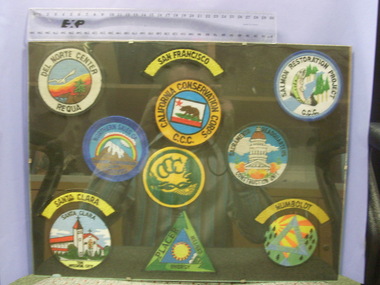
Visiting US Conservation Corps Sleeve Patch collections, US Conservation Corps Sleeve Patch collections
... The first ATCV exchange group to California in 1987 National Director, Tim Cox and Team Leader, David Clark (group leader, in Australian military hat) Right: Members of the first CCC exchange team to Australia at the US Embassy, Canberra in 1988: from left - Merrold, Vicci and Bobby with Mark Dwyer (centre) and David Clark (ATCV, right). Exchanges have continued annually since 1988 and, in addition to environmental work done, many friendships have been made and maintained over the years. ...The first ATCV exchange group to California in 1987 National Director, Tim Cox and Team Leader, David Clark (group leader, in Australian military hat) Right: Members of the first CCC exchange team to Australia at the US Embassy, Canberra in 1988: from left - Merrold, Vicci and Bobby with Mark Dwyer (centre) and David Clark (ATCV, right). Exchanges have continued annually since 1988 and, in addition to environmental work done, many friendships have been made and maintained over the years. ...Initially named the Conservation Corps, the British Trust for Conservation Volunteers (BTCV) was founded in 1959 by the Council for Nature. Today BTCV is the “largest practical conservation charity in the United Kingdom”, and celebrated its fiftieth birthday in February 2009. Its original name had been adapted from that of the Civilian Conservation Corps launched by President Roosevelt in Depression-era USA: - "I propose to create a Civilian Conservation Corps to be used in simple work, not interfering with normal employment, and confining itself to forestry, the prevention of soil erosion, flood control and similar projects. More important, however, than the material gains, will be the moral and spiritual value of such work. Roosevelt’s idea had been revived by Governor Jerry Brown of California in 1976 and exchange of ideas and personnel between the California Conservation Corps (CCC) and other US conservation corps) has flourished since. Mark Dwyer (later to play an important role in Green Corps) was leader of the first California Conservation Corps three-month exchange program to Australia in 1988. The first ATCV exchange group to California in 1987 National Director, Tim Cox and Team Leader, David Clark (group leader, in Australian military hat) Right: Members of the first CCC exchange team to Australia at the US Embassy, Canberra in 1988: from left - Merrold, Vicci and Bobby with Mark Dwyer (centre) and David Clark (ATCV, right). Exchanges have continued annually since 1988 and, in addition to environmental work done, many friendships have been made and maintained over the years. This sleeve patch symbolises strong international links in place since ATCV/CVA was founded. This cloth sleeve patch is an example of those sewn onto the uniforms of staff and volunteers of the California Conservation Corps. It is round with an orange rim with black lettering naming ther organisation and inside the rime there is a light blue circle inset with the State flag of California. This sleeve patch is part of CVA's collection of 34 sleeve patches from many States of the USA. corps, david, conservation, mark, dwyer, california, clark, sleeve, patches -
 Bendigo Historical Society Inc.
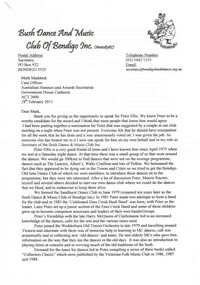
Document - PETER ELLIS COLLECTION: LETTER BUSH DANCE AND MUSIC CLUB BENDIGO, 28th February 2011
... Mark, Thank you for giving us the opportunity to speak for Peter Ellis. We know Peter to be a worthy candidate for the award and I think that most people that know him would agree. I had been putting together a nomination for Peter that was suggested by a couple at our club meeting on a night when Peter was not present. Everyone felt that he should have recognition for all the work that he has done...Mark, Thank you for giving us the opportunity to speak for Peter Ellis. We know Peter to be a worthy candidate for the award and I think that most people that know him would agree. I had been putting together a nomination for Peter that was suggested by a couple at our club meeting on a night when Peter was not present. Everyone felt that he should have recognition for all the work that he has done ...3 Page Letter printed on A4 printer paper. Bearing the letterhead of the Bush Dance and Music Club of Bendigo Inc. Postal Address Secretary PO Box 922 Bendigo 3552 Telephone number (03) 5442 1153 email [email protected] Mark Maddock Case Officer Australian Honours and Awards Secretariat Government house Canberra ACT 2600 28th February 2011. Dear Mark, Thank you for giving us the opportunity to speak for Peter Ellis. We know Peter to be a worthy candidate for the award and I think that most people that know him would agree. I had been putting together a nomination for Peter that was suggested by a couple at our club meeting on a night when Peter was not present. Everyone felt that he should have recognition for all the work that he has done and it was unanimously voted on. I was given the job. As someone else has beaten me to it I now can speak for him on my own behalf and in my role as secretary of the Bush Dance & Music Club Inc. Peter Ellis is a very good friend of mine and I have known him since April 1975 when we met at a Saturday night dance. At that time there was a small group of us that went around the dances. We would go 100kms to find dances that were not on the average programme, dances such as The Lancers, Albert's, Waltz Cotillion and lots of Polkas. We bemoaned the fact that they appeared to be dying out in the Towns and Cities so we tried to get the Bendigo Old Time Dance Club of which we were members, to introduce these dances on to the programme, but they were not interested. After a lot of discussion Peter, Maurie Rayner, myself and several others decided to start our own dance club where we could do the dances that we liked, and to endeavour to keep them alive. We formed the Sandhurst Dance Club in June 1979 (renamed ten years later as the Bush Dance & Music Club of Bendigo Inc.) In 1981 Peter made two attempts to form a band for the club and in 1983 the 'Celebrated Emu Creek Bush Band' was born, with Peter as the leader. Later Peter set up a junior section of the Emu Creek Band and some of these children grew up to become competent musicians and leaders of their own bands/Groups. Peter's friendship with the late Harry McQueen of Castlemaine led to and increased knowledge of the dances, calls for the sets and the various tunes used. Peter joined the Wedderburn Old Timers Orchestra in late 1979 and travelling around Victoria and interstate with them was of immense help in learning to MC dances, call sets acoustically and in collecting new 'old dances' and tunes. He met elderly MC's who gave him information on the way that they ran the dances in the old days. It was also an introduction to playing items at concerts and in reviving much of the old traditions of the bush. Demand for the tunes for dances led to Peter compiling a series of three books called 'Collectors Choice' which were published by the Victorian Folk Music Club in 1986, 1987 and 1988. 1988 was a very busy year for Peter and The Emu Creek Bush Band as they recorded two double music tapes for the club 'The Merry Country Dance' and 'The Waltz the Polka and all Kinds of Dancing' which were in much demand at the time. Also in 1988 he collaborated with the late Shirley Andrews and they co-authored the book 'Two Hundred Dancing Years and how to celebrate them with a Colonial Ball' for the Bicentennial of 1988. this publication, was instigated by the Government backed Bicentenary Committee, and distributed free to every municipality in Australia. In 1996 The Emu Creek Bush Band and Peter recorded and produced a single CD called a Friday night at 'The Spring Valley Hop'. In 1998 The Bush Dance & Music Club again happily agreed to financially back Peter to produce a series of CDs. The first thing he did was to revive and update the 1988 music tapes for CD. The first of the Qadrille Mania series of double CDs with companion call books was launched in 1999 then in 2000 and 2001. then the triple CD called The Waltz Polka & all kinds of Dances in 2002 followed by the Merry Country Dance CDs in 2005, 2006 and 2007. There were six double CDs and one triple CD produced which was a major undertaking that went on for eight years. The CDs have a great many tunes that Peter collected over the years mixed in with well known tunes and there are very few repeats. During this time we applied for a Grant from the Victorian Government to publish a book on the social History of country dances and dance instructions with Peter as the author. We were successful and published it in 2005. Our CDs and book have all been lodged with the National Library of Canberra as has all Peter's sheet music, boxes of it, as well as everything he has produced. At the 2005 Canberra National Folk Festival, at a meeting of collectors, it was stated that Peter has the largest collection of dance related material in the National Library. Peter compiled and produced his own project a triple CD called 'Take Me Back to Bendigo' in 2002. 2006 Peter and Emu Creek Bush Band produced another single CD 'Bush Concert Vol one Back to Goornong'. 2008 A pet project of Peter's was compiling and producing a double CD for the Wedderburn Old Timers it was of all the recorded material performed by them at concerts and taped by friends and fans. It was funded by Gavan Holt a son of the late Lindsay Holt an original 'Old Timer'. Recent publications are a book mainly music 'Music Makes Me Smile' a tribute to Con Klippel and the music of the Nariel Valley near Corryong Victoria. Peter Ellis & Harry Gardner 1998. The Waltz, The Polka & All Kinds of Dancing' a sheet music book for musicians supported by the Folk Song & Dance Society of Victoria. 2007-8 not sure of year. Peter has been involved over the years in collecting music and dance by himself and also with Rob Willis and the late John Meredith for the National Library in Canberra. He is continually asked for information and to write articles for people and to verify points re dance and music. He corresponds with like minded people overseas and frequently goes off to Folk Festivals all over the country, usually running dance classes, musician's workshops or just playing for dances. He is an excellent musician and plays Piano, Button Accordion, Concertina, Mouth Organ, Tin Whistle, Ukulele, Spoons and the Bones. He is regarded as one of Australia's foremost collectors and presenters of Australian traditional dance tunes, dances and some musical instruments. Over the years I have heard him referred to as the Guru of folk dance and music. Peter lives and breathes for this passion of his and always has several irons in the fire. He is a life member of The Bush Dance & Music Club of Bendigo Inc. The Victorian Folk Music Club, and The Bendigo Field Naturalists Club. He was a recipient of the David Squance Award in 1994 presented by the Folk Song & Dance Society of Victoria. Over the last twelve months for the folk magazine 'Trad & Now' he has written articles on the old dances and music and this is an ongoing project. This has led to our clubs present project which is the filming of the dances to be shown on UTube as it is referred to in the magazine. This involves members in hours and hours of practising the dances then filming them, and all with Peter's expert teaching and watchful eye on everyone. The Bush Dance & Music Club are and always have been behind Peter wholeheartedly in everything that he does and we are extremely proud of what he has achieved. His drive and enthusiasm for the preservation of music and dance is catching. People like Peter are absolutely necessary in finding and preserving our Australian Heritage, without them it would be lost forever and Australia would be a great deal poorer for it. The Bush Dance and Music Club of Bendigo Inc. and I fully support this nomination for an award as he is truly deserving of it. Yours sincerely Mary E Smith. Secretary of the Bush Dance & Music Club Inc. Peter's Timeline. 1979 A Foundation Member of the Bush Dance & Music Club of Bendigo Inc. 1979 Joined the Wedderburn Old Timers Orchestra. 1983 The Celebrated Emu Creek Bush Band was formed. 1986 Collectors Choice. Volume one. 1987 Collectors Choice. Volume Two. 1988 Collectors Choice. Volume Three. 1988 Recorded Tapes - The Merry Country Dance & The Waltz Polka & all Kinds of Dances. 1988 A book with the late Shirley Andrews called Two Hundred years of Dancing. 1991 Across to Perth collecting for National Library with the Late John Meredith. 1996 Single CD A Friday Night at the Spring Gully Hop. 1998 Music Makes Me Smile. A tribute to Con Klippel 7 music of the Nariel Valley. 1999 Double CD Quadrille Mania 1&2 2000 Double CD Quadrille Mania 3&4 2001 Double CD Quadrille Mania 5&6 2002 His own project triple CD Take Me Back To Bendigo. (Goldrush to Federation and Beyond). 2002 Triple CD The Waltz The Polka & All kinds of Dances. 2005 Double CD The Merry Country Dance 1 & 2. 2002 Book, The Merry Country Dance. 2006 Single CD with Emu Creek 'Bush Concert Vol 1 Back to Goornong' 2006 Double CD The Merry Country Dance 3&4 2007 Double CD The Merry Country Dance 5&6 2007-8-? A book of music, The Waltz, The Polka & All Kinds of Dances. 2008 Double CD The Wedderburn Old Timers in Concert. person, individual, peter ellis oam -
 Bendigo Historical Society Inc.
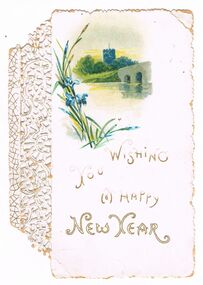
Ephemera - HAPPY NEW YEAR GREETING CARD
... On the back is the Artistic Series Trade Mark of an easel with RTS on it and below is a paint board with six paint brushes with Artistic Series printed on the board all done in gold ink. ...On the back is the Artistic Series Trade Mark of an easel with RTS on it and below is a paint board with six paint brushes with Artistic Series printed on the board all done in gold ink. ...Happy New Year Greeting Card: Embossed Greeting card with Castle a scene and three blue Iris's with the words 'Wishing You A Happy New Year'. On the back is the Artistic Series Trade Mark of an easel with RTS on it and below is a paint board with six paint brushes with Artistic Series printed on the board all done in gold ink. At the bottom is 'By Special appointment' Publishers to Her Majesty the Queen. Hand written is 'George from Dav' Box 625 Raphael Tuck & Sons, London ,Paris, New York. Designed at the Studios in England and Printed at the Fine Art Works in Saxony. Copyright. ephemera, mementoes, celebrations, happy new year greeting card -
 Bendigo Historical Society Inc.
Document - MARKS COLLECTION: ARCHITECTS AND CIVIL ENGINEERS CONDITIONS OF CONTRACT
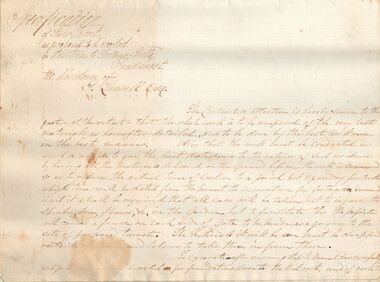
... done by the best workmen in the best manner'. Issues covered in the specification include excavation, removal of earth, schedule price for digging and stonework, pressed bricks, pugged mortar, joints, neck, dome roof (diagram of roof included) . Document MARKS ...2 blue printed pages outlining regulations of the VICTORIAN Institute of Architects plus 4 handwritten pages of specifications of stairs = turret as proposed to be erected in addition to Fortuna Villa Sandhurst, the residence of G. Lansell. Introductory comments in the specification state: 'The Contractors attention is hereby drawn to the fact - at the outset - that the whole work is to be composed of the very best materials as hereafter detailed, and to be done by the best workmen in the best manner'. Issues covered in the specification include excavation, removal of earth, schedule price for digging and stonework, pressed bricks, pugged mortar, joints, neck, dome roof (diagram of roof included) . bendigo, buildings, fortuna villa -
 Bendigo Historical Society Inc.
Document - RE-DEDICATION OF THE BENDIGO TEMPLE, VIEW STREET, BENDIGO, 19 October 1974
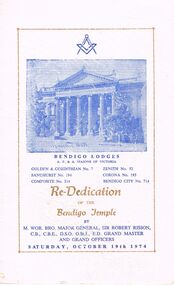
... Mark Master Masons, No. 12. Royal Golden Chapter, No. 3. The Bendigo Royal Ark Mariner Lodge, No. 12. The Bendigo Conclave, No. 143. Bendigo Masonic Lodge of Instruction, No. 14. Bendigo Sovereign Council, No. 16. Bendigo Sovereign Chapter No. 32. The National Trust of Australia has done...Mark Master Masons, No. 12. Royal Golden Chapter, No. 3. The Bendigo Royal Ark Mariner Lodge, No. 12. The Bendigo Conclave, No. 143. Bendigo Masonic Lodge of Instruction, No. 14. Bendigo Sovereign Council, No. 16. Bendigo Sovereign Chapter No. 32. The National Trust of Australia has done ...a/ Re-Dedication of the Bendigo Temple, View Street, Bendigo. By M. Wor. Bro. Major General, Sir Robert Risson, C.B.E., D.S.O. O.St.J., E.D. Grand Master and Grand Officers. Saturday, October 19th 1974. Bendigo Lodges A. F. & A. Masons of Victoria. Golden & Corinthian No. 7, Zenith No. 52, Sandhurst No. 194, Corona No. 195, Composite No. 314, Bendigo City No. 714. Re-Dedication Team Presiding Officer: M.W.Bro. Sir. Robert Risson, G.M. Deputy Grand Master R.W.Bro. C. R. B. James, D.G.M. Grand Master of Ceremonies V.W.Bro. L. Retchford, G.D.C. Senior Grand Warden R.W.Bro. L. G. Grant, S.G.W. Junior Grand Warden R.W.Bro. A. J. L. W. Greenwood, J.G.W.Grand Chaplain V.W.Bro. Rev. J.R. Lawton, G.Chap. Grand Supt. Of Works V.W.Bro. F. C. Galbraith, G I.Wkgs. Grand Secretary R.W.Bro. G. W. Jackson, P.D.G.M., G.Sec. Grand Deacons for Dedication Wor.Bro. B. A. McMillian, S.G.D. and Wor.Bro. D. E. Plaisted, J.G.D. Grand Sword Bearer Wor.Bro. J. R. Evans, G.Swd.B. Gand Organist Wor.Bro. J. N. Cowan, G.Org. Grand Pursuivant Wor.Bro. A. A. Eagle, A.G.Purs. Grand Herald Wor. Bro. P. J. Grenfell, P.G.Std.B., G.Her. Censer Stewards Wor. Bro. H. J. Blunden, G.Stwd. And Wor.Bro. B. D. Cross, G.Stwd. Historical, Brief History on Bendigo Masonic Temple, View Street, Bendigo, 1874-1974. Local historian, Bro. J. N. Macartney, in his book had this to say:- ''The Masonic Hall is by far the grandest building in Sandhurst (Bendigo), and a fitting and right noble home for such an Order to place their ark in. The building is one on the pure Corinthian order, lofty without, and spacious within; therein is the finest Assembly Hall out of Melbourne Town Hall. What an imposing façade, with its tapering columns rearing the graceful acanthus-leaf capitals 40 feet. . . . With the growth of Freemasonry in Bendigo, new Craft Lodges were established, as were lodges of higher degrees. At present the following lodges use the Temple and hall facilities:- Golden & Corinthian Lodge No. 7. Zenith Lodge, No. 52. Sanhurst Lodge, No. 194. Corona Lodge No. 195. The Lodge Composite, No. 314. Bendigo City Lodge, No. 714. The Bendigo Lodge of Mark Master Masons, No. 12. Royal Golden Chapter, No. 3. The Bendigo Royal Ark Mariner Lodge, No. 12. The Bendigo Conclave, No. 143. Bendigo Masonic Lodge of Instruction, No. 14. Bendigo Sovereign Council, No. 16. Bendigo Sovereign Chapter No. 32. The National Trust of Australia has done much to preserve our heritage for the succeeding generations. In 1972 the Masonic Temple and Hall Received their ''D'' Classification. . . Program. Toasts and Harmony. Bro. C. Phillips. Wor. Bro. D. L. Killian, P.J.G.D. Bro. R. D. McPherson. b/ (letter) 3 Brodie St. Bendigo 3550. 28.10.1974. The Secretary, Bendigo Branch, RHSV, Bendigo. Dear Miss Parry, Bendigo Masonic Hall, The enclosed programme contains a short history of the above, and comes to your Society with the compliments of the Board of Management of the Bendigo Masonic Hall. Yours sincerely, Alex M Stone. a/ re-dedication of the bendigo temple, view street, bendigo. by m. wor. bro. major general, sir robert risson, c.b.e., d.s.o. o.st.j., e.d. grand master and grand officers. saturday, october 19th 1974. bendigo lodges a. f. & a. masons of victoria. golden & corinthian no. 7, zenith no. 52, sandhurst no. 194, corona no. 195, composite no. 314, bendigo city no. 714. re-dedication team presiding officer: m.w.bro. sir. robert risson, g.m. deputy grand master r.w.bro. c. r. b. james, d.g.m. grand master of ceremonies v.w.bro. l. retchford, g.d.c. senior grand warden r.w.bro. l. g. grant, s.g.w. junior grand warden r.w.bro. a. j. l. w. greenwood, j.g.w.grand chaplain v.w.bro. rev. j.r. lawton, g.chap. grand supt. of works v.w.bro. f. c. galbraith, g i.wkgs. grand secretary r.w.bro. g. w. jackson, p.d.g.m., g.sec. grand deacons for dedication wor.bro. b. a. mcmillian, s.g.d. and wor.bro. d. e. plaisted, j.g.d. grand sword bearer wor.bro. j. r. evans, g.swd.b. gand organist wor.bro. j. n. cowan, g.org. grand pursuivant wor.bro. a. a. eagle, a.g.purs. grand herald wor. bro. p. j. grenfell, p.g.std.b., g.her. censer stewards wor. bro. h. j. blunden, g.stwd. and wor.bro. b. d. cross, g.stwd. historical, brief history on bendigo masonic temple, view street, bendigo, 1874-1974. local historian, bro. j. n. macartney, ''the masonic hall the grandest building in sandhurst (bendigo), corinthian order, finest assembly hall. golden & corinthian lodge no. 7. zenith lodge, no. 52. sanhurst lodge, no. 194. corona lodge no. 195. the lodge composite, no. 314. bendigo city lodge, no. 714. the bendigo lodge of mark master masons, no. 12. royal golden chapter, no. 3. the bendigo royal ark mariner lodge, no. 12. the bendigo conclave, no. 143. bendigo masonic lodge of instruction, no. 14. bendigo sovereign council, no. 16. bendigo sovereign chapter no. 32. national trust of australia preserve our heritage. in 1972 received their ''d'' classification. . . program. toasts and harmony. bro. c. phillips. wor. bro. d. l. killian, p.j.g.d. bro. r. d. mcpherson. b/ (letter) 3 brodie st. bendigo 3550. 1974. bendigo branch, rhsv, bendigo. miss parry, programme short history board of management of the bendigo masonic hall., alex m stone. -
 Alfred Hospital Nurses League - Nursing History Collection
Ceramic - Stoneware bottle, Doulton Lambeth, Baked clay jar unearthed during demolition of the Edward Wilson Wing 1999, ca.1870 - 1890
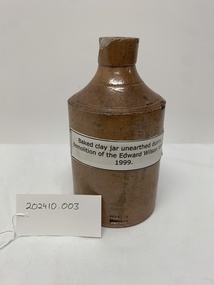
... done through artistic stoneware's made in Lambeth, but in 1882 the firm bought a Burslem factory, which was mainly intended for making bone china table wares and decorative items. An early utilitarian stoneware item made by a well-known company that specialised in making salt-glazed items that later earned a reputation for making stoneware art objects. AHNL Edward Wilson Wing Alfred Hospital baked clay jar Doulton Lambeth stamp base of front - makers mark ...The business was specialised in making salt-glazed stoneware articles, including utilitarian or decorative bottles, jugs and jars, much of it intended for inns and pubs. The backbone of the business was a wide range of utilitarian wares, mostly stone wares, including storage jars, tankards and the like, and later extending to pipes for drains, lavatories and other bathroom ceramics. From 1853 to 1902 its wares were marked Doulton & Co., then from 1902, when a royal warrant was given, Royal Doulton. The company always made some more decorative items, initially still mostly stoneware, and from the 1860s the firm made considerable efforts to get a reputation for design, in which it was largely successful, as one of the first British makers of art pottery. Initially, this was done through artistic stoneware's made in Lambeth, but in 1882 the firm bought a Burslem factory, which was mainly intended for making bone china table wares and decorative items. An early utilitarian stoneware item made by a well-known company that specialised in making salt-glazed items that later earned a reputation for making stoneware art objects. brown glazed earthenware bottle, circular grooves at throat of bottle x 3, cylindrical shape, narrow neck, makers stamp on side, large chip at opening, multiple small chips on sides. no stopper. paper label taped to front -Baked clay jar unearthed during demolition of the Edward Wilson Wing 1999 Doulton Lambeth stamp base of front - makers mark. label -paper label taped to front -Baked clay jar unearthed during demolition of the Edward Wilson Wing 1999 ahnl, edward wilson wing alfred hospital, baked clay jar -
 Uniting Church Archives - Synod of Victoria
BW photo, Undated
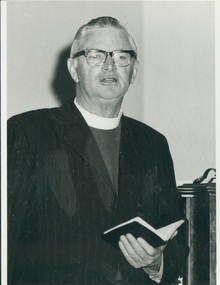
... He had left a mark for God on three great continents and his death left sad but thankful hearts in them all. It was the close of a life in which he had felt that he could never do enough for God who had done so much for him. ...He had left a mark for God on three great continents and his death left sad but thankful hearts in them all. It was the close of a life in which he had felt that he could never do enough for God who had done so much for him. ...STANWAY, ALFRED (b. 9 Sept 1908; d. Melbourne, Vic, 27 June 1989). Anglican bishop, missionary. Stanway grew up in the Wimmera district of western Victoria, and left school when 14 years old. He found work in Melbourne, trained as an accountant, and at the age of 20, held a responsible position with a publishing company. This background, allied with an uncommon flair for figures and finance, was to stand him in good stead throughout his life. But he had little knowledge and no experience of the grace of God until 29 July 1928. At the Evening Service in the parish church of Fairfield on 29 July, he heard the Rev C H Nash (q.v.) preach a sermon which led to his conversion. Within two years he made up his mind to become a missionary and began night studies in order to matriculate. He entered Ridley College in March 1932 to prepare for ordination undertaking week-end duties as a catechist at Deer Park and St Albans. He joined the CMS League of Youth, became chairman, and gathered a fine band of young people many of whom were to become missionaries. He was closely involved with the Belgrave Heights Convention (then at Upwey) and established a League of Youth camp on the site. All his energies were thrown into the task of building up its members in personal holiness and vigorous evangelism. Stanway was ordained in St Paul's Cathedral, Melbourne on St Thomas Day 1934 and was placed in charge of the Old Mission Church of St James and St John, Melbourne. The duties were light enough to allow him to enrol in the Melbourne Teachers College and to complete the Diploma in Teaching. On 26 January 1937, he sailed for Africa to become a missionary in the Anglican Diocese of Mombasa, which at that time embraced the whole of Kenya. He was sent to the hot coastal town of Kaloleni as principal of a Secondary Boys School. Before he left Melbourne, he had become engaged to Marjory Harrison: she followed him to Africa and their marriage took place in Mombasa Cathedral in June 1939. He remained at Kaloleni until 1944 when he was transferred to the inland station of Maseno where all his gifts were to be deployed as rural dean of Nyanza. His oversight of some 500 village churches as well as a widespread primary school system was so efficient that in 1948 he was appointed archdeacon of Kenya with his home and office in Nairobi. As secretary of the African Church Council and of the African Education Board, he was responsible for all African work in the diocese. His contacts with government ministers and public servants were of first class significance at the time when the cry of Uhuru and the demand for independence was travelling throughout the colonial world. On 2 Feb 1951, Alfred Stanway was consecrated in Westminster Abbey as the third Anglican Bp of Central Tanganyika. This Diocese was the special sphere of the CMS Australia, and he already knew most of the missionary personnel. He brought with him the understanding and experience of one who had fully shared the lot and problems of a district missionary, but he came to the diocese at a time when it had yet to recover from its losses in personnel and finance as a result of the war. His immediate task was to provide the impetus of fresh leadership and a long-term overall policy. His aim from-the outset was to build up a strong autonomous church with its own indigenous pastorate. With the whole-hearted confidence of the home base, he was able to enlist the service of new missionaries. He saw a great increase in the number of African clergy and he encouraged village evangelists to open new fields of work. Simple structures were built as new churches at the rate of two a week, week in and week out, year by year. He worked hard to meet the need for Christian literature, bookshops, adult literacy and theological training. He opened Bible schools for village evangelists and sent suitable clergy overseas for further studies. He encouraged initiative in others, helped them to find and use their talents, and gave them his unstinted confidence and support. Fresh finance was required for new ventures. This led him to travel widely in Germany and America, where he raised large funds for these projects. Mackay House was built in Dodoma as the central administrative base for the diocese, hospitals such as those at Mvumi and Hombolo were modernised or established, schools were built and upgraded. In keeping with his vision for ultimate leadership by African personnel, he consecrated Yohana Omari in 1955 as his assistant, he was the first national to become a bp in East Africa. Bp Stanway then set on foot the long and complicated process for the division of his sprawling diocese. In 1963, the diocese of Victoria Nyanza came into being; in 1965, that of Morogoro; in 1966, that of Western Tanganyika. Yet in 1971, his own diocese of Central Tanganyika, though greatly reduced in size, had more churches and more clergy than in its undivided state in 195 l. Stanway then played a leading part in the formation of the Province of Tanzania in 1970, with an African abp as metropolitan. A year later, after 35 years in East Africa and 20 years as bishop of Central Tanganyika, he resigned. His leadership and achievements throughout those years had placed him in the front rank as a great missionary statesman. Stanway had returned to Melbourne at the time when his resignation took effect in August 1971. His early love for Ridley College reasserted itself and he went into residence as deputy principal under the Rev Dr Leon Morris. He was put in charge of chapel worship and the pastoral oversight of the students. All his gifts and experience were called into play as he sought to guide and encourage those who were on the threshold of their ministry. The whole bent of his heart was to foster the spiritual life and missionary calling of those whose hearts the Lord had touched. It was during those years that his life-long zeal for the spread of the gospel through Christian literature had its ultimate flowering. It had begun in his Nairobi days with a small church bookstall, this had developed into a major book-shop in the heart of the city. Then in Dodoma he had established the Central Tanganyika Press in order to promote the publication and distribution of Christian literature at all levels. He had marked out Kevin Engel, trained him, and launched him on the international scene. Hence it was natural that in Melbourne he and Kevin Engel should found the Australian Christian Literature Society. But his time at Ridley College was not to last. Unknown to him, the Rev J R W Stott had put his name forward as that of a person who could head a new school of theology in the United States to provide a sound training for evangelical ordinands. Such a task would have been formidable enough for a younger man who had grown up in America. How could an Australian who had spent half his life in Africa hope to succeed in a venture of that kind in America? How could one who had been a missionary, not a theologian, found a new school to train men for ordination? Nevertheless he rose to the challenge. In Sept 1975, he and Mrs Stanway left Melbourne for Sewickly, an outer suburb of Pittsburg, with the promise of three years' service. He had to start from scratch. He found a house to live in, but there was no land for the school, no funds in hand, no staff yet appointed, no students, and no buildings. His drive, his infections enthusiasm, and his flair for practical enterprise carried the day. One by one, obstacles were overcome and support grew in volume and strength. Twelve months after his arrival, in Sept 1976, the Trinity Episcopal School for Ministry was opened with three staff members, seventeen students, and the goodwill of the whole American Episcopal Church to win. During the next two years, the school took shape and was firmly established. Bp Stanway left an indelible stamp on every aspect of its life and work, its spiritual tone and ideals, its financial and administrative principles. He had inspired widespread support among evangelical episcopalians and had imparted a strong sense of divine guidance and purpose. The council would gladly have extended his term in office beyond three years, but at 75 years of age he knew that his health had begun to fail. When he finally relinquished his office in Nov 1978, he could look back on those three years as the crown of his ministry. It is not too much to say that his name was even more highly honoured and revered in the Trinity School of Ministry than in his own dearly loved Africa. His return to Melbourne led to quiet retirement at Mount Waverley where he settled down to a long battle with the ever worsening effects of Parkinson's Disease. The slow loss of physical capacity and the ultimate failure in powers of speech were a great trial, but he never complained. His faith was summed up in his brief reply when he was asked why he had not prayed for healing: 'What God allows, I accept'. That acceptance was without reserve; his testimony was never brighter. His mental powers were undiminished and his spiritual concerns were as wide as ever. He kept in touch with CMS, he went to church, he met with missionaries, he led Bible studies in his home as long as he was able. Africa was always in his heart, news from Sewickly always gave him great pleasure. He had left a mark for God on three great continents and his death left sad but thankful hearts in them all. It was the close of a life in which he had felt that he could never do enough for God who had done so much for him. One of Bp Stanway's sayings was 'when the Holy Spirit takes hold of you, anything can happen'. So it was in his case. He was very human, with his full share of human foibles and frailties. He had a great zest for life and an endless fund of stories drawn from his own experience. He was himself the subject of many stories, some true, others legendary. His vibrant personality always seemed to fill the house where he was, his presence could not be overlooked. His own home was one in which Mrs Stanway had a paramount influence. She was a trained teacher, a skilled artist, a born hostess and a first-class linguist. They had no children of their own, but were devoted Godparents and always deeply interested in the children of missionaries. Home life allowed him to relax in a serene and contented atmosphere and to exercise his gifts for friendship and hospitality. He was always on the watch for souls, a person-to-person evangelist par excellence. He was a man of faith and prayer who dared to believe in the God of the impossible. His love for Africa, his total dedication as a missionary; his gifts as a soulwinner; his genius for finance; his shrewd practical initiatives, and his statesmanlike vision were outstanding characteristics. But great or small, all his gifts were laid out in the service of the gospel, and that service marked him out as one of the most remarkable Australian missionaries of his generation. M L Loane, Men to Remember (Sydney, 1987) Rev. Alfred Stanway is standing with open book in hand, dressed in clerical garb. Bishop Alfred Stanway bishop alfred stanway -
 Ballarat Tramway Museum
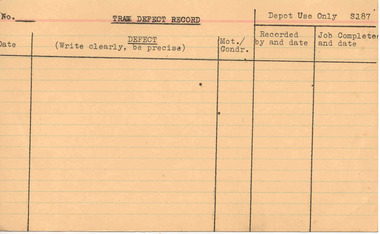
Document - Form/s, State Electricity Commission of Victoria (SECV), "Tram Defect Record", c1970
... Has space for tram No., data, description of defect, motorman or conductor initials, Recorded by and done and job completed and date. Index card is double sided. Marks of wet ink imprinted onto rear of card....Has space for tram No., data, description of defect, motorman or conductor initials, Recorded by and done and job completed and date. Index card is double sided. Marks of wet ink imprinted onto rear of card. ...SECV tram defect record card, form S187, duplicated onto manila, lined index card. Has space for tram No., data, description of defect, motorman or conductor initials, Recorded by and done and job completed and date. Index card is double sided. Marks of wet ink imprinted onto rear of card. trams, tramways, tramcars, maintenance, secv, depot -
 Ballarat Tramway Museum
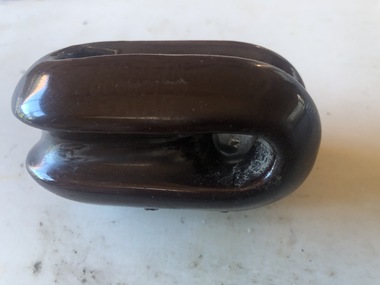
Functional Object - Insulator for tramway overhead - made in Japan, c1950
... As Japan needed to rebuild their economy after the war, part of the agreement to allow them to export goods out of their country was that they had to mark 50% of all items with "Occupied Japan" or "Made in Occupied Japan." This could be done with a paper label, cloth label (as on scarves, doilies, clothing), engraved, handwritten or stamped. ...As Japan needed to rebuild their economy after the war, part of the agreement to allow them to export goods out of their country was that they had to mark 50% of all items with "Occupied Japan" or "Made in Occupied Japan." This could be done with a paper label, cloth label (as on scarves, doilies, clothing), engraved, handwritten or stamped. ...Its manufacture demonstrates from an industrial aspect a period of history following the occupation of Japan by the USA after the second world war and has a strong association with this event. Insulator - known as an egg type - ceramic - fired clay (porcelain) finished with a brown colour with two holes for span wire with the holes offset to each other. Marked in a very light almost clear finish on one side "Made in Occupied Japan" See item 8534 for another example - a larger size. https://www.gotheborg.com/glossary/occupiedjapan.shtml - accessed 15/4/20201 gives some background: "For the period from the end of World War II in 1945 through April 28, 1952, the United States and its Allies occupied Japan. The Occupation involved approximately 130,000 Americans (both military and civilian) and about 35,000 British Troops based in Japan. SCAP (Supreme Commander for the Allied Powers), led by General MacArthur, wrote a new constitution for Japan. As Japan needed to rebuild their economy after the war, part of the agreement to allow them to export goods out of their country was that they had to mark 50% of all items with "Occupied Japan" or "Made in Occupied Japan." This could be done with a paper label, cloth label (as on scarves, doilies, clothing), engraved, handwritten or stamped. Thus, you may come across things, such as a salt and pepper set, where only one of the pair is marked OJ and the other will just have "Japan" on it. The tags, labels, marks were placed on the items in Japan, before they were exported to other countries. " trams, tramways, overhead, trolley wire, insulation, electrical equipment -
 Ballarat Tramway Museum
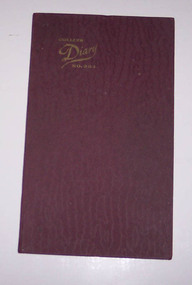
Administrative record - Log book, Diary, Collins Bros, 1963
... Marks Smith Bartlett W. Gladman R. J. Gladman Loose contents 1. 27/12/64 - Handwritten notes (2) re work to be done and leave 2. - Memoranda - handwritten note on rear of weekly time sheet - note re materials and leave times for gang. 3 - Inside rear cover - Note from the Accounts department dated 9/8/1963 re account numbers to used by the truck driver - note re D. ...Marks Smith Bartlett W. Gladman R. J. Gladman Loose contents 1. 27/12/64 - Handwritten notes (2) re work to be done and leave 2. - Memoranda - handwritten note on rear of weekly time sheet - note re materials and leave times for gang. 3 - Inside rear cover - Note from the Accounts department dated 9/8/1963 re account numbers to used by the truck driver - note re D. ...Yields information about the track maintenance activities of the track gang in Ballarat, the work they did, notes, names and other information. Collins Australian Diary, No. 324 printed by Collins Bros, dark red card covers, sewn sections with ruled sheets providing a diary for 1964, one week per double page. Has "useful information" sheets at from the diary. Used by the SEC Ballarat track gang to record their daily work, leave, welding, track cleaning, truck driver etc In the Memoranda section (page 3 and 4), list of names and addresses of track gang and notes on materials used, costs, scrubber use and hours, and length of track. Lancaster Wiseman Lakey Edwards Fish Dowie Marks Smith Bartlett W. Gladman R. J. Gladman Loose contents 1. 27/12/64 - Handwritten notes (2) re work to be done and leave 2. - Memoranda - handwritten note on rear of weekly time sheet - note re materials and leave times for gang. 3 - Inside rear cover - Note from the Accounts department dated 9/8/1963 re account numbers to used by the truck driver - note re D. Wiseman - Long Service leave - workshop requisition and note - re work at B power station - repairs to road - workshop requisition to dig trenches in Main St - note re work on the back of a letter from the Shell Sou'wester service station re the availability of touring maps. tram, trams, sec, ballarat, depot, trackwork, rails, scrubber tram -
 Sunshine and District Historical Society Incorporated
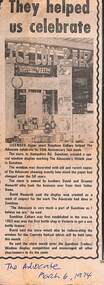
Article - Sunshine Cellars Hampshire Road Sunshine, The Advocate, 6/3/1974
... The display was created as mark of respect for the work The Advocate has done in Sunshine over the years. ...The display was created as mark of respect for the work The Advocate has done in Sunshine over the years. ...In 1974, Sunshine Cellars helped The Advocate Newspaper to celebrate its 50th anniversary. The store created a special window display marking the fiftieth year of the newspaper in Sunshine. The display was created as mark of respect for the work The Advocate has done in Sunshine over the years. The Adovcate was originally called The Sunshine Advocate. Sunshine Cellars was established in 1953 and was the first bottle shop in Victoria to get a one bottle licence. They helped us celebrate sunshine cellars, hampshire road, sunshine, the advocate -
 Melbourne Legacy
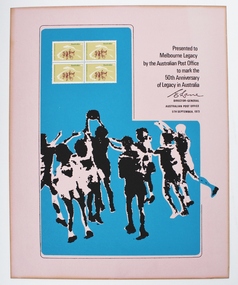
Certificate, Legacy Stamp, 1973
... done by George Hamori, an Australian graphic design artist (born 1918). The stamp was a reminder to all the people of Australia of the helping hand of kindness of Legacy, and the generosity of the people of Australia who have donated to fund the work that Legacy does. legacy promotion golden jubilee Presented to / Melbourne Legacy / by the Australian Post Office / to mark the / 50th Anniversary / of Legacy in Australia Director-General / Australian Post Office / 5th September, 1973 Pink and blue cardboard certificate with four 7c stamps affixed in top left corner. ...A certificate presented as an anniversary gift to Melbourne Legacy, recognising 50 years as commemorated on a postage stamp. Australia Post issued this postage stamp in 1973, on the 50th anniversary of the founding of Melbourne Legacy, September 1923. The stamp was produced in recognition of the outstanding work that Legacy has done in helping war widows and their families. The design of children playing within the silhouette of a hand, was done by George Hamori, an Australian graphic design artist (born 1918). The stamp was a reminder to all the people of Australia of the helping hand of kindness of Legacy, and the generosity of the people of Australia who have donated to fund the work that Legacy does. Pink and blue cardboard certificate with four 7c stamps affixed in top left corner. Each stamp bears an image of 8 children playing football over a ghosted hand. The image of the chilren also appears in a larger format in the central region of the card. Presented to / Melbourne Legacy / by the Australian Post Office / to mark the / 50th Anniversary / of Legacy in Australia Director-General / Australian Post Office / 5th September, 1973 legacy promotion, golden jubilee -
 Melbourne Legacy
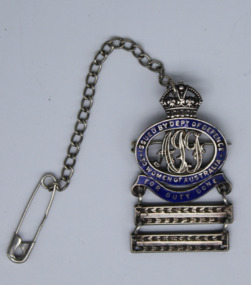
Badge, A.I.F. Female Relative's Badge, c 1914-1918
... mark "WM Mclean & Co / Melb / STG SIL" Silver badge with blue enamel and safety chain. A.I.F. in cutout script in the centre of an oval. Oval has blue enamel with silver text "Issued by the Dept of Defence to Women of Australia". An enamelled scroll beneath this contains the word "For Duty Done ...The Female Relative's Badge was issued to the wife and/or mother, or to the nearest female relative of soldiers, nurses and masseurs who had left Australia for active service abroad during the First World War. The service number of the relative is inscribed on the back of the badge. A bar(s) suspended below the badge was issued for each additional relative, son or daughter serving. (taken from awm.gov.au). The provenance of this badge is unknown. A search on the defence force numbers has been unsuccessful to ascertain the owner of the badge. More research would be required. Shows the importance placed on having relatives serving in the Defence Forces. Silver badge with blue enamel and safety chain. A.I.F. in cutout script in the centre of an oval. Oval has blue enamel with silver text "Issued by the Dept of Defence to Women of Australia". An enamelled scroll beneath this contains the word "For Duty Done". The badge is surmounted by a King's Crown. A brooch fastening and a safety chain are attached to the back, the original safety pin is missing. Two bars are suspended from the bottom of the badge indicating a total of 3 relatives serving overseas. Defence force numbers 33370, 20232 and 20233 inscribed on back. Manufacturer mark "WM Mclean & Co / Melb / STG SIL" female relative's badge, world war one -
 Beechworth RSL Sub-Branch
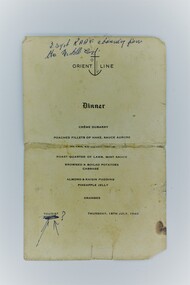
Orient Line Dinner Menu, Orient Line Dinner Menu Thursday, 18th July, 1940, 1940
... done regarding the men it relates to. The item is therefore of historic and social significance and has good interpretive capacity. dinner menu orient line raaf royal australian air force ken williams r w sterrett m r campbell j h mckinnon f finch j h christie 3 Squadron On the front, top: 3 Sqn RAAF boarding for the Middle East. On the front, lower left there are markings under and to the right of the printed word 'tourist'. The is a thick line under the word, two arrows pointing to it from beneath and a question mark ...This menu would have been printed to distribute to guests attending dinner on the Orient Line, which embarked for the Middle East in 1940. The dinner was held on Thursday 18th July of the same year. Signatures on the reverse of this document were signed by Ken Williams, RW Sterrett, MR Campbell, J.H. Christie, JH McKinnon and F Finch. This item relates closely to a photograph of the 3rd Squadron, in RAAF uniform, boarding the Orient Line. This menu is an item of ephemera dating to the World War Two era. Items such as this are ordinarily lost over the passage of time. As the item contains signatures it is possible that further research and interpretation could be done regarding the men it relates to. The item is therefore of historic and social significance and has good interpretive capacity. Card with printed lettering centrally spaced and folded along horizontal centreline. There are hand written inscription on the front and reverse in pen ink. On the front, top: 3 Sqn RAAF boarding for the Middle East. On the front, lower left there are markings under and to the right of the printed word 'tourist'. The is a thick line under the word, two arrows pointing to it from beneath and a question mark to the right. On the reverse, upper left corner: Ken Williams, RW Sterrett MR Campbell JH Christie JH McKinnon F Finch dinner menu, orient line, raaf, royal australian air force, ken williams, r w sterrett, m r campbell, j h mckinnon, f finch, j h christie, 3 squadron -
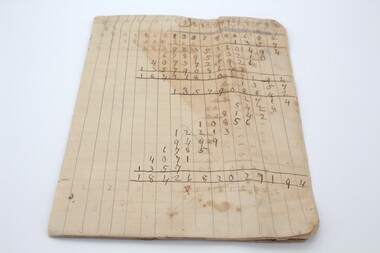 Friends of Westgarthtown
Book - Book, exercise
... Used by Alfred Ziebell at the Thomastown State School books school/educational arithmetic exercise maths arthur ziebell exercises done in lead pencil, 'Alfred Ziebell' on inside page paper exercise book, lined into squares. Pencil arithmetic exercises completed on all pages, some with red pencil marks. 8 leaves. ...Used by Alfred Ziebell at the Thomastown State School paper exercise book, lined into squares. Pencil arithmetic exercises completed on all pages, some with red pencil marks. 8 leaves. exercises done in lead pencil, 'Alfred Ziebell' on inside page books, school/educational, arithmetic, exercise, maths, arthur ziebell -
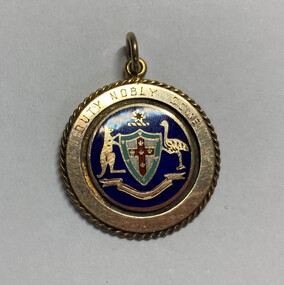 Melbourne Legacy
Medal - Medallion, For Service In Great War 1914/18, c1918
... Done, Front, Coat of Arms, gold star top centre underlined. Shield outlined in light blue bordered by gold colour, red cross outlined in gold colour highlighted by 4 gold coloured stars. Shield is flanked by a kangaroo and an emu. Gold coloured banner underneath shield, kangaroo and emu.. Rear inscription, "Pres to D. Colquhuon for service in Great War 1914 18. by residents of of Nth Carrum". Three unidentified marks...Done, Front, Coat of Arms, gold star top centre underlined. Shield outlined in light blue bordered by gold colour, red cross outlined in gold colour highlighted by 4 gold coloured stars. Shield is flanked by a kangaroo and an emu. Gold coloured banner underneath shield, kangaroo and emu.. Rear inscription, "Pres to D. Colquhuon for service in Great War 1914 18. by residents of of Nth Carrum". Three unidentified marks ...Many towns/cities presented medallions to their citizens for service during WW1. These medallions were not necessarily presented for military service. The inscription says it was presented to D. Colquhuon for service in World War 1 by residents of of Nth Carrum. The link to Legacy is not known though presumably D Colquhuon was a Legatee. An example that medallions were a means of honouring local citizens for their work during WW1. Many civilians made a huge, unpaid contibution to the war effort. The medallion does not indicate whether or not that the recognition is for military or civil service. Medallion, circular, metal, front gold colour on outer circumference, blue colour on inner circumference, coat of arms inner circumference. Chain, link, gold colour. Front, Duty Nobly Done, Front, Coat of Arms, gold star top centre underlined. Shield outlined in light blue bordered by gold colour, red cross outlined in gold colour highlighted by 4 gold coloured stars. Shield is flanked by a kangaroo and an emu. Gold coloured banner underneath shield, kangaroo and emu.. Rear inscription, "Pres to D. Colquhuon for service in Great War 1914 18. by residents of of Nth Carrum". Three unidentified marks underneath the words "of Nth Carrum" which could be halmarks "?, 15, W". world war one, medallion
