
Showing 51 items matching "melbourne scots"
-
 The 5th/6th Battalion Royal Victoria Regiment Historical Collection
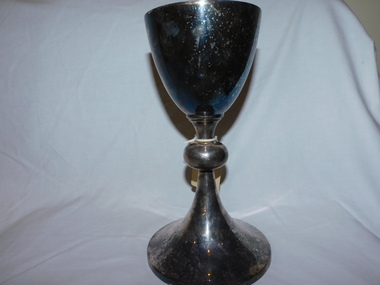
Award - Trophy, Melbourne Scots Cup
... Melbourne Scots Cup......melbourne scots...5/6 rvr pipes and drums victorian scottish melbourne scots trophy 5/6 rvr bhq Melbourne Scots Cup Award Trophy ...5/6 rvr pipes and drums, victorian scottish, melbourne scots, trophy, 5/6 rvr bhq -
 The 5th/6th Battalion Royal Victoria Regiment Historical Collection
Award - Trophy
... Presented to 5th BN ROYAL VICTORIA REGIMENT BY THE MELBOURNE SCOTS IN APPRECIATION OF THIER CLOSE ASSOCIATION AND THE SERVICES RENDERED BY THE PIPES AND DRUMS OVER MANY YEARS ...presented to 5RVR 5/6 RVR 5RVR PIPES AND DRUMS Presented to 5th BN ROYAL VICTORIA REGIMENT BY THE MELBOURNE SCOTS IN APPRECIATION OF THIER CLOSE ASSOCIATION AND THE SERVICES RENDERED BY THE PIPES AND DRUMS OVER MANY YEARS Silver Chalais shaped trophy enscribed on base, inside of cup appears gold in colour Award Trophy ...presented to 5RVRSilver Chalais shaped trophy enscribed on base, inside of cup appears gold in colour Presented to 5th BN ROYAL VICTORIA REGIMENT BY THE MELBOURNE SCOTS IN APPRECIATION OF THIER CLOSE ASSOCIATION AND THE SERVICES RENDERED BY THE PIPES AND DRUMS OVER MANY YEARS 5/6 rvr, 5rvr, pipes and drums -
 Melbourne Legacy
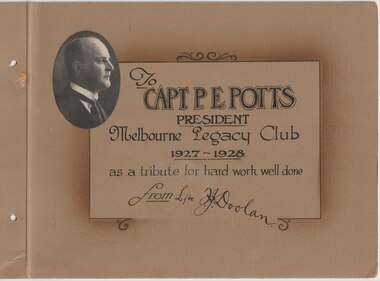
Album - Photo album, One Week's Legacy Club Publicity. Tribute to Capt P E Potts, 1928
... He also was president of the Melbourne 'Highland Pipe Band, a councillor of the Melbourne Scots and English Speaking Union, and a member of the Rotary Club. ...He also was president of the Melbourne 'Highland Pipe Band, a councillor of the Melbourne Scots and English Speaking Union, and a member of the Rotary Club. ...An album of newspaper clippings and photos compiled to thank Legatee Philip E Potts when he was leaving Melbourne in 1928. L/ Potts was president of Legacy in 1927-28. The album was compiled by Legatee Frank Doolan. The articles included the first annual demonstration being held on 28 March 1928 with 300 junior legatees performing. Legatee Aaron Beattie was in charge with help from Mrs Gillies and Jim Tierney. Also articles about the proposed building of the Shrine of Remembrance and the appeal for funds. One page shows pictures of a social event held on the Burns Philp ship 'Marella'. Another photo of Marella is in the collection. Legatee Potts was manager of the old-established shipping firm Burns, Philip and Co Ltd. He also was president of the Melbourne 'Highland Pipe Band, a councillor of the Melbourne Scots and English Speaking Union, and a member of the Rotary Club. A record of a tribute to a past president and outlines significant events in 1928.Brown cardboard album x 13 pages of newspaper clippings and photos from 1928 held together by brown string.shrine of remembrance, philip e potts, past presidents -
 Melbourne Tram Museum
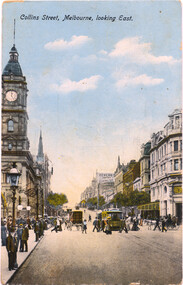
Postcard - R.E.M. Series Postcard, Collins Street, 1913, C.1913
... The postcard shows a view just west of the intersection of Collins & Swanston St., looking east. The Melbourne Town Hall, Scots’ Church, and the Victorian Government Tourist Bureau are all visible. ...The postcard shows a view just west of the intersection of Collins & Swanston St., looking east. The Melbourne Town Hall, Scots’ Church, and the Victorian Government Tourist Bureau are all visible. ...The postcard shows a view just west of the intersection of Collins & Swanston St., looking east. The Melbourne Town Hall, Scots’ Church, and the Victorian Government Tourist Bureau are all visible. A cable tram is visible at the intersection.Depicts cityscape of the 1910s in the City of Melbourne, including cable trams and key landmarks.Colour Postcard“POST CARD,” “R.E.M. Series.,” and “Printed in Saxony.” on reverse. 1913 Australian Postage 1-penny stamp, ink stamp with “-3SE13 2.0P” on reverse.cable trams, collins st, swanston st, melbourne town hall, tramways -
 Uniting Church Archives - Synod of Victoria
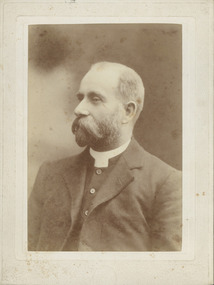
Photograph, Rev. Thomas Watt Leggatt
... B. 1859 Glasgow; Glasgow University; 1886 ordained in Scots Church Melbourne; to New Hebrides Mission, Aulua, Malekula; 1907 Dunolly; 1910 Sunbury; 1919 Convener of Board of Missions; editor "Record"; 1923 Abbotsford; 1929 Glen Iris; 1931 Moderator, Victoria; 1944 died 23 August. ...B. 1859 Glasgow; Glasgow University; 1886 ordained in Scots Church Melbourne; to New Hebrides Mission, Aulua, Malekula; 1907 Dunolly; 1910 Sunbury; 1919 Convener of Board of Missions; editor "Record"; 1923 Abbotsford; 1929 Glen Iris; 1931 Moderator, Victoria; 1944 died 23 August. ...B. 1859 Glasgow; Glasgow University; 1886 ordained in Scots Church Melbourne; to New Hebrides Mission, Aulua, Malekula; 1907 Dunolly; 1910 Sunbury; 1919 Convener of Board of Missions; editor "Record"; 1923 Abbotsford; 1929 Glen Iris; 1931 Moderator, Victoria; 1944 died 23 August. Son, William Watt Leggatt was a politician in the Bolte Government in Victoria.Sepia photo of Leggatt posed facing his right; dressed in 19th century clerical suit, collar and waistcoat."Thomas Watt Leggatt - Aulua, New Hebrides - minister Sunbury, Abbotsford. Father of Sir William (Bill) Watt Leggatt, Ormond Law Agent for (?) in London - Deaconess Dorothy Leggatt."leggatt, thomas watt, new hebrides -
 Whitehorse Historical Society Inc.
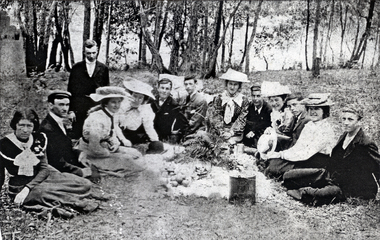
Photograph, Blackburn Lake, 1901
... Henry Press was a member (perhaps an office-bearer) of Scots Church, Melbourne and Eunice attended there with him. ...Henry Press was a member (perhaps an office-bearer) of Scots Church, Melbourne and Eunice attended there with him. ...Photocopy of a group, thought to be the Augustine Congregational Church, Auburn, at a picnic at Blackburn Lake in 1901 Inscription. For dear Gert. Eunice AULT, 6th from viewer's right (probably with members of St Augustine Congregational Church, Burwood Road, Hawthorn.Eunice Olive Ault later Mrs Henry E Press. Henry Press was a member (perhaps an office-bearer) of Scots Church, Melbourne and Eunice attended there with him. She lived with him at 8 Dean Ave, Hawthorn and after his death resumed her association with Augustine Church. Blackburn 11 Nov 1901.clothing & dress, blackburn lake -
 Surrey Hills Historical Society Collection
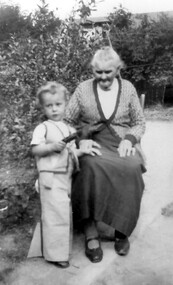
Photograph, Mary Selina Simpson, c1940
... In 1875 Mary married Charles Simpson, stepson of James Staig in Scots Church, Melbourne. They had 3 boys and 3 girls. ...In 1875 Mary married Charles Simpson, stepson of James Staig in Scots Church, Melbourne. They had 3 boys and 3 girls. ...Mary Selina Inglefinger was born in 1856 in Kings Plain, NSW and was the eldest daughter of Joseph Inglefinger and his wife Maria Viktoria Bertel (Barthl), both of whom were born in Germany; they applied to come to Australia in 1854. They had 10 children, the first 8 born in Kings Plain. In 1879, Joseph Inglefinger bought James Staig's farm in Boundary (Warrigal) Road, near the corner of Bona Vista Avenue, Surrey Hills. The 1903 and 1905 electoral rolls list them in Boundary Road. In 1875 Mary married Charles Simpson, stepson of James Staig in Scots Church, Melbourne. They had 3 boys and 3 girls. This photograph was taken with her great-grandson in 1940.A black and white photograph of a lady sitting on a chair with a young toddler standing beside her.On back of photo: Mary Selina Simpson / (nee Inglefinger) / c.1940 / (born Mary Maghlina) / born c. 1857(miss) mary inglefinger, (mr) joseph inglefinger, (mr) james staig, warrigal road, surrey hills, bona vista avenue, (mrs) mary simpson, boundary road, (miss) mary maghlina inglefinger -
 City of Kingston
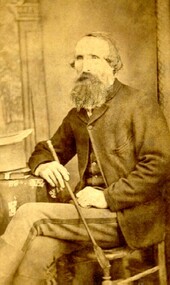
Photograph - Digital image, Sepia
... Melbourne where he joined his brother on a sheep run. He also became involved with his brother in conducting the Travellers’ Rest a stopping place for travellers at the Mordialloc Creek. Alexander married Isabella Munroe at Scots...Melbourne where he joined his brother on a sheep run. He also became involved with his brother in conducting the Travellers’ Rest a stopping place for travellers at the Mordialloc Creek. Alexander married Isabella Munroe at Scots ...Born in 1817 to Murdo Macdonald and Flora Morrision at Bracadale near Sleat on the Isle of Skye in Scotland, Alexander Macdonald sailed on the Earl Durham to Sydney where he arrived on 2 January 1839. He was 21 years of age. After only a few months in the new country he set out overland for Melbourne where he joined his brother on a sheep run. He also became involved with his brother in conducting the Travellers’ Rest a stopping place for travellers at the Mordialloc Creek. Alexander married Isabella Munroe at Scots Church, Melbourne on 17 February 1841. After their marriage they started the sheep run named Stringy Bark, on the Yarra, near where Kew is today. Together, they had ten children. On the morning of 20 December 1881, Alexander’s hat was found floating in Mordialloc Creek. He had last been seen crossing the bridge the previous evening at ten o’clock. A few days later the body was later found only yards from the Bridge Hotel. A magisterial enquiry conducted by Thomas Attenborough concluded Alexander Macdonald’s death was an accidental drowning.Sepia toned image of Alexander Vause Macdonald (1817-1881). -
Federation University Historical Collection
Document, Dianne Campbell, Ballarat Lawyers 1853-1895 Research Folders, c2000-2021
... Folders of research notes on Ballarat Lawyers, including newspaper clippings, website information, etc. .1) Ballarat Lawyers - A (Australian Law Firm histories, Jamaican in Australia, History of the Court System, University of Melbourne Law Students c1870s, Melanie Senior, Cinque Oakley Senior Lawyers, 19th Century Castlemaine Police Courts, New Victorian County Court, Scots and the Law in Scotland, Solicitor online encyclopedia, Alfred Akehurst, Artur Akehurst, J.T. ...Ballarat Lawyers Ballarat Dianne Campbell Goldfields Lawyers Collection Folders of research notes on Ballarat Lawyers, including newspaper clippings, website information, etc. .1) Ballarat Lawyers - A (Australian Law Firm histories, Jamaican in Australia, History of the Court System, University of Melbourne Law Students c1870s, Melanie Senior, Cinque Oakley Senior Lawyers, 19th Century Castlemaine Police Courts, New Victorian County Court, Scots and the Law in Scotland, Solicitor online encyclopedia, Alfred Akehurst, Artur Akehurst, J.T. ...Folders of research notes on Ballarat Lawyers, including newspaper clippings, website information, etc. .1) Ballarat Lawyers - A (Australian Law Firm histories, Jamaican in Australia, History of the Court System, University of Melbourne Law Students c1870s, Melanie Senior, Cinque Oakley Senior Lawyers, 19th Century Castlemaine Police Courts, New Victorian County Court, Scots and the Law in Scotland, Solicitor online encyclopedia, Alfred Akehurst, Artur Akehurst, J.T. Ansdell, Butler Cole Aspinall, Alfred James Bailey, Henry Stephen Bailey, Matthew Baird, Hugh Sutherland Barrett, William Field Barrett, Redmond Barry, George Elliott Barton, George Frederick Bartrop, John Bell, Thomas Bellas, George Booker) .2) Ballarat Lawyers B (Hugh Sunderland Barrett, Peter Beckford, William Beckford, John T.F. Bowker, William Box, George Boyd, William Boykett, B. Browne, Richard Archer Burton, Alfred Butler) .3) Ballarat Lawyers C-E (Thomas B.S. Carwithen, J.B. Cathcart, John Alfred Chalk, David Clarke, John Collins, Matthew Combe, Thomas Spemcer Cope, Richard. Crouch, Charles Curwan-Walker, Frank H. Cole, John Rowland Davies, Charles J. Dawson, Christopher John Dease, J.E. Dixon, Robert Willian Dobson, Roy Dobson, Edward Doward, Charles R. Doward, Edgar R. Doward,) .4) Ballarat Lawyers F-G (Charles B. Finlayson, Peter T. Finn, John Findlay, John Fitzgerald, John Olsen Foss, Alexander Fraser, J.A. Doane, Andrew Garran, George Garrard, David Gaunson, William Gaunt, MAry Gaunt, F.T. Gell) .5) Ballarat Lawyers H-J: (Frederick Ham, Jeremy Harper, John H. Harris, solicitors, Amelia Harris, J. Henry Harris, Peter Blake, Henry Plomer, Arthur Plomer, Ballarat Chamber of Commerce, Freemasons, White Flat Drainage and Mining Company, Henry R. Nicholls, Francis Ham, Richard T. Harvey, Edward Heady, Peter Heinz, T.t. Hollway. Thomas tuke hollway, William Higgins, James V.M. Hitchins, frederick Hitchins, James Hitchins, Edward Hockley, Robert W. Holmes, Catherine Kain, JOhn Ireland, Richard D. Ireland, Peter Jacobs) .6) T.C. Williams, John Kidahl, Arthur W. King, Pendrell family, M.A. Lazarus, Edward Lewis, W.H. McCormick, Soho Foundry, Henry S, Ochiltree, James V. McCormick, McDonnell, Townsend MacDermott, Morgan McDOnnell, Percy McDonnell, Cyprian McDonnell, John McFarland, Samuel W, McGowan, Bill McGregor, David Madden, Charles Holthouse, J. Madden, Samuel Mann, Samuel F. Mann, Tobias Furneaux, Samuel Mann, Agar Wynne, thomas Mann, Henry MacDermott, Archibald Midnie, Arthur Nevett, Arthur H. Nevett, Alfred Mitchell, William Mitchell, H.W. Morrow, William Mitchell, Norman P. Must, George F. Oakley.) .7) Ballarat Lawyer Q-R (Henry S. Ochiltree, W.B. Ochiltree, Edward G. Ochiltree, J.J.P. O'Dee, Bernard O'Dowd, John Ogier, Cornish Lawyers in Central Victoria Q-R, John Bateman Paynter, J.B. Pearson, Mondle Emmanuel Phillips, Robert King Piers, Robert King Piers, Pinkerton, Frank Pinkerton, Martha Pinkerton, Charles Purcell, R.H. Ramsay, Henry Randall, James Randall, Thomas Randall, John Warrington Rogers, John M. S. Rodd, George Rutler) .8) Lawyers in Central Victoria S-W (Charles Salter, H. Holmes, George Staveley, Charles Salter, George T. Boyd, Edward Sandford, Henry G. Shaw, Thomas W. Snape, Thomas S. Standish, Charles Snape, Frederick C. Standish, Edith Snape, James Snape, Thomas Snape, Philip Snape, George Staveley, John G. Stoker, William Stone, Henry Sturt, Matthew W. Taylor, Bread and Cheese Club, R.D. Thompson, Roger D. Thompson, R.H. Ramsay, R.G. Turner, F.H. Tuthill, W.M.K. Vale, William Vale, May Vale, William L. Vardy, Gordon Vardy, William S. Vardy, Charles Von Ende) .9) Lawyers in Central Victoria W-Z (Henry Walker, Andrew Wallace, John Wellesley, Brereton Watson, C.G.M. Watson, James Watson, George Armytage, Thomas Watson, Patricius Welsh, John Westmore, Theodore Whipham, Arthur Whipham, Thomas H. Whipham, Frances Whipham, Thomas Bellas, James L. Willoughby, John Noble Williams, James Wisewould, Horace Wright, H.M. Wright, William Wright, Henry J. Wrixon, Agar Wynne, Samuel Young) . ballarat lawyers, ballarat, dianne campbell goldfields lawyers collection -
Eltham District Historical Society Inc
Document - Folder, Sutherland, Selina M
... Jean Sutherland Alexander Sutherland Selina Sutherland nee Murray John Murray George McDonald Anne McDonald Margaret Sutherland Margaret Grand nee Sutherland Robert Grant Alfredton propert of Rutherfords T W Hickson Masterton hospital New Zealand Wellington Public Hospital Maria Lloyd Armour "The Villa" cottage Little Collins Street Alfred Hospital Melbourne Women's Hospital Melbourne Scot's Church Neglected Children's Society Melbourne District Nursing Society Presbyterian Church of Victoria Rev Dr Bevan Rev Alex Stewart Alfred Deakin Alex Peacock George Maxwell Samuel Leon QC The Victorian Neglected Children's Aid Society 68 Latrobe Street Melbourne Janet Lady Clarke Ellen Sanderson Melbourne Hospital Sutherland Home for Neglected Children Victorian Neglected Children's Aid Society william Keogh Miss Meglin of Greensborough Josiah Thomas M H R Dr Will Maloney M H R John Leillillon M L A John Lemmon Ada Wenborn Leslie M Perrott and Partners L J Owen and Sons Lady Angliss Lady Warner G Rodd J C Jessop D M Finlay J Williamson E L Mead E Smythe Newspaper clippings, A4 photocopies, etc Sutherland, Selina M Document Folder ...Selina Murray McDonald Sutherland was born in 1839 in Scotland, went to New Zealand, and became active in nursing. After an injury, she took a round tour by steamer, one stop being Melbourne where Sutherland stayed. She was involved in working in, or founding, various charities, importantly the Sutherland Homes for Neglected Children which, later, was donated land at Greensborough by Miss Meglin on which cottages were built. Contents Photocopy of booklet: "Selina M Sutherland: her life story and work" by J C Jessop, 3 June 1958.Newspaper clippings, A4 photocopies, etcjean sutherland, alexander sutherland, selina sutherland nee murray, john murray, george mcdonald, anne mcdonald, margaret sutherland, margaret grand nee sutherland, robert grant, alfredton propert of rutherfords, t w hickson, masterton hospital new zealand, wellington public hospital, maria lloyd armour, "the villa" cottage little collins street, alfred hospital melbourne, women's hospital melbourne, scot's church neglected children's society, melbourne district nursing society, presbyterian church of victoria, rev dr bevan, rev alex stewart, alfred deakin, alex peacock, george maxwell, samuel leon qc, the victorian neglected children's aid society, 68 latrobe street melbourne, janet lady clarke, ellen sanderson, melbourne hospital, sutherland home for neglected children, victorian neglected children's aid society, william keogh, miss meglin of greensborough, josiah thomas m h r, dr will maloney m h r, john leillillon m l a, john lemmon, ada wenborn, leslie m perrott and partners, l j owen and sons, lady angliss, lady warner, g rodd, j c jessop, d m finlay, j williamson, e l mead, e smythe -
 Eltham District Historical Society Inc
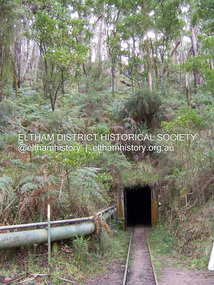
Photograph - Digital Photograph, Marguerite Marshall, One Tree Hill Mine, Smiths Gully, 8 June 2006
... Scots, began around Market Square (now Smiths Gully) and included Queenstown (St Andrews), Kingstown (Panton Hill) and Diamond Creek. There were also poorer bearing fields in Kangaroo Ground and Swipers Gully (now Research). * None of these compared in riches to the Ballarat and Bendigo fields5, but the Caledonia Diggings continued intermittently for close to 100 years. Gold was discovered in Victoria following a bid to stem the disappearance of much needed workmen to the New South Wales diggings. Several businessmen offered a reward of £200, for the discovery of gold within 200 miles (322 km) of Melbourne...Scots, began around Market Square (now Smiths Gully) and included Queenstown (St Andrews), Kingstown (Panton Hill) and Diamond Creek. There were also poorer bearing fields in Kangaroo Ground and Swipers Gully (now Research). * None of these compared in riches to the Ballarat and Bendigo fields5, but the Caledonia Diggings continued intermittently for close to 100 years. Gold was discovered in Victoria following a bid to stem the disappearance of much needed workmen to the New South Wales diggings. Several businessmen offered a reward of £200, for the discovery of gold within 200 miles (322 km) of Melbourne ...Gold was discovered on One Tree Hill in 1854. The site has been worked intermittently until fairly recent times. Published: Nillumbik Now and Then / Marguerite Marshall 2008; photographs Alan King with Marguerite Marshall.; p53 Though still a working mine, One Tree Hill Mine at Smiths Gully, now stands in a tranquil reserve surrounded by bush and native animals - in contrast to its heyday. In the mid 19th century, when the mine was part of the Caledonia Goldfields, hundreds of men in search of their fortune worked the alluvial gold in the Yarra River, its tributaries and the reefs that made up the goldfields. Miner Stan Bone, assisted by Wilfred Haywood, is the last of the independent gold miners in the area and still uses the quartz crushing battery as miners did when gold was first discovered in the area in 1851.1 Stan, who is the last of six generations of miners in his family, was aged 17 when he began mining on his father Alex’ mine, The Golden Crown in Yarrambat. These days, after blasting the gold-bearing rock in Mystery Reef, one of the four reefs at One Tree Hill, Stan transports it around five kilometres by tip truck to the Black Cameron Mine for crushing. There he uses water from the waterlogged mine, (which still contains gold), as the Happy Valley Creek at One Tree Hill is usually dry.2 The One Tree Hill Mine has been worked for close to a century since it opened around the late 1850s.3 The Swedish Reef was its most productive reef and one of the largest in the area. Around 1859, extractions included 204 ounces (5.8kg) of gold, won from 57 pounds (26kg) of stone.4 Then during World War Two, Stan’s uncle, Bill Wallace, and Alex Bone, closed the mine. In 1973, Stan, with his Uncle Bill, reopened the Black Cameron Mine and worked there until 1988. Stan resumed mining One Tree Hill in 1998. As late as the 1920s gold was picked up by chance! When crossing a gully on his way to vote at the St Andrews Primary School, Bill Joyce picked up some quartz containing gold. This site was to become the Black Cameron Mine. The Caledonia Diggings, named after Scotland’s ancient name by local Scots, began around Market Square (now Smiths Gully) and included Queenstown (St Andrews), Kingstown (Panton Hill) and Diamond Creek. There were also poorer bearing fields in Kangaroo Ground and Swipers Gully (now Research). * None of these compared in riches to the Ballarat and Bendigo fields5, but the Caledonia Diggings continued intermittently for close to 100 years. Gold was discovered in Victoria following a bid to stem the disappearance of much needed workmen to the New South Wales diggings. Several businessmen offered a reward of £200, for the discovery of gold within 200 miles (322 km) of Melbourne. Late in June 1851, gold was first discovered at Andersons Creek, Warrandyte. Then in 1854, George Boston and two other men discovered gold at Smiths Gully. Gold transformed the quiet districts, with a constant flow of families and vehicles on the dirt tracks en route to the Caledonia Diggings. Three thousand people worked the gullies in Market Square, including about 1000 Chinese miners. The square established its own police, mining warden, gold battery, school, shops and cemetery and grog flowed. Market Square flourished until the middle 1860s. Bullocks transported quartz from the Caledonia Goldfields to the crushing machinery at the Queenstown/St Andrews Battery, near Smiths Gully Cemetery. It was destroyed by bushfire in 1962. By the late 1850s, most early alluvial fields were in decline, but minor rushes continued until around 1900 and some until the early 1940s. Some miners did well, although most earned little from their hard labour in the harsh and primitive conditions.6 But according to historian, Mick Woiwod, the gold fields helped to democratise society, as individuals from all walks of life were forced to share experiences, and the ability to succeed, depended less on inherited wealth or social rank.This collection of almost 130 photos about places and people within the Shire of Nillumbik, an urban and rural municipality in Melbourne's north, contributes to an understanding of the history of the Shire. Published in 2008 immediately prior to the Black Saturday bushfires of February 7, 2009, it documents sites that were impacted, and in some cases destroyed by the fires. It includes photographs taken especially for the publication, creating a unique time capsule representing the Shire in the early 21st century. It remains the most recent comprehenesive publication devoted to the Shire's history connecting local residents to the past. nillumbik now and then (marshall-king) collection, gold mining, one tree hill mine, smiths gully -
 Warrnambool and District Historical Society Inc.
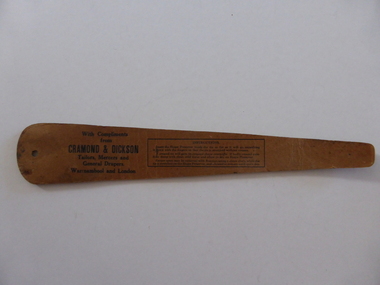
Artefact, Cardboard tie preserver. Cramond & Dickson, Circa 1930's
... Scots and both came separately to Australia in 1852. Cramond initially came for gold but soon opened a store in St Kilda with a post Office attached and he was the first post master there. Dickson was a farmer’s son but became a draper and while he was unsuccessful on the Bendigo diggings and then returned to Melbourne where he met Cramond and soon after they opened a store on Lonsdale Street. ...Scots and both came separately to Australia in 1852. Cramond initially came for gold but soon opened a store in St Kilda with a post Office attached and he was the first post master there. Dickson was a farmer’s son but became a draper and while he was unsuccessful on the Bendigo diggings and then returned to Melbourne where he met Cramond and soon after they opened a store on Lonsdale Street. ...John Glass Cramond 1829 and James Dickson 1831-1910 were founders of a large drapery store. Both were Scots and both came separately to Australia in 1852. Cramond initially came for gold but soon opened a store in St Kilda with a post Office attached and he was the first post master there. Dickson was a farmer’s son but became a draper and while he was unsuccessful on the Bendigo diggings and then returned to Melbourne where he met Cramond and soon after they opened a store on Lonsdale Street. They opened their business in Warrnambool in 1855 as a general store with groceries, drapery and ironmongery. Both partners were involved with the community and James Dickson was an original director of the Warrnambool Woollen Mill 1909 and the Warrnambool Cheese and Butter Factory. He also served on the committee of management of Warrnambool Base Hospital. The business in the late 1970's. This shape preserver would have been an item given to customers to maintain their tie in good condition. The shape would indicate that it would have been used around mid 20th century.A common object from one of Warrnambool's longest established businesses.Brown cardboard in the shape of a gentleman's tie with a hanging hole on one end and black text with company details and instructions for use. front surface is smooth while the back is coarse.With Compliments from Cramond & Dickson Tailors, Mercers and general Drapers. Warrnambool and London. warrnambool, cramond & dickson -
 Warrnambool and District Historical Society Inc.
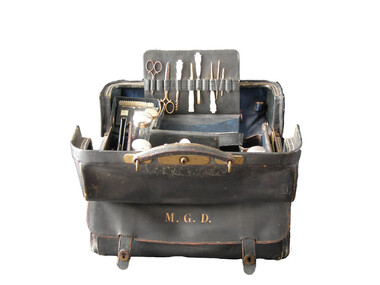
Domestic object - Dressing bag, Mary Glass Dickson, Circa1885
... Scots and both came separately to Australia in 1852. Cramond initially came for gold but soon opened a store in St Kilda with a post Office attached and he was the first post master there. Dickson was a farmer’s son but became a draper and while he was unsuccessful on the Bendigo diggings and then returned to Melbourne where he met Cramond and soon after they opened a store on Lonsdale Street. ...Scots and both came separately to Australia in 1852. Cramond initially came for gold but soon opened a store in St Kilda with a post Office attached and he was the first post master there. Dickson was a farmer’s son but became a draper and while he was unsuccessful on the Bendigo diggings and then returned to Melbourne where he met Cramond and soon after they opened a store on Lonsdale Street. ...John Glass Cramond 1829 and James Dickson 1831-1910 were founders of a large drapery store. Both were Scots and both came separately to Australia in 1852. Cramond initially came for gold but soon opened a store in St Kilda with a post Office attached and he was the first post master there. Dickson was a farmer’s son but became a draper and while he was unsuccessful on the Bendigo diggings and then returned to Melbourne where he met Cramond and soon after they opened a store on Lonsdale Street. They opened their business in Warrnambool in 1855 as a general store with groceries, drapery and ironmongery. Both partners were involved with the community and James Dickson was an original director of the Warrnambool Woollen Mill 1909 and the Warrnambool Cheese and butter factory. He also served on the committee of management of Warrnambool Base Hospital. This case was a wedding gift from James Dickson Jnr to his wife Mary Glass Cramond on the occasion of their wedding. This item has significance on a number of levels. It belonged to a member of one of Warrnambool’s earliest pioneering families and it marks the occasion when the two families of Cramond and Dickson were linked through the marriage of James Dickson jnr and Mary Glass Cramond. The firm played a significant part in the development of the city and traded for nearly 150 years. It therefore has social significance to Warrnambool. The item is well provenance with the case initialed and items within the case monogrammed. The case and its items are aesthetically quite beautiful as well as being typical of travelling or dressing cases of the more well to do, of the time. Mappin & Webb were manufacturers of some standing with the Mappin name appearing in manufacturing as early as 1775.The company has held a royal warrant as silversmiths since 1897 to the present day and as crown jeweler since 2012. Throughout this time, they have manufactured quality items for the luxury market. It provides an insight into the way ladies travelled and the items which they considered essential. This consists of a black leather with leather handle attached with brass fittings. Middle opening with side pocket on one side with metal catches. Inside has removable sections for holding the numerous containers and items belonging to the case. Interior of the case is dark blue satin. The items contained within the case are as follows: 321.1 Luggage case 321.2 Glass bottle rectangular, silver monogrammed lid, empty. 321.3 Tall round glass bottle, silver monogrammed lid, empty. 321.4 Small glass bottle with pink powder, silver monogrammed lid. 321.5 Small multi sided bottle with stopper and brass hinged lid. 321.6 Tall round bottle with silver monogrammed lid. 321.7 Tall thin multi sided bottle with brass lid. 321.8 Cream coloured monogrammed jar cotton wool inside. 321.9 Clothes brush rectangular cream back. 321.10.1Glove stretcher bone coloured .10.2 Case black leather. 321.11.1 hair comb cream with silver edge .11.2 Case black leather 321.12 Hair brush cream handle 321.13Spatula cream monogrammed 321.14 Mirror, silver round with handle. 321.15 Writing compendium .1 Case black leather .2 Pen with nib .3 Lead pencil .4 Navy satin covered blotting book 321.16 Inkwell glass bottle in small black leather case. 321.17 Match striker in leather case. 321.18 Mirror in black leather case rectangular 321.19 Small case for visiting cards. 321.20Sewing kit rectangular, contains threads and needles pkts x 3 321.21Container, small, hinged tortoise shell patterned. 321.22.1 Manicure set .2 Scissors small .3 Scissors large .4Corkscrew with Mother of pearl handle .5 Pocket knife with Mother of pearl handle .6Tweezers with Mother of pearl handle .7 File with Mother of pearl handle .8 Fine hook Mother of pearl handle .9 Bodkin .10 Bodkin 321.23 Hairbrush oval silver backed 321.24 Mirror silver handled hand mirror. 321.25 Hairbrush wooden handled with Mother of pearl inlay. 321.26 Cylinder, silver with removable lid and small phial of iodine labelled Felton’s pocket iodine. 321.27 Phial small glass with gold decorations. 321.28 Inhaler with insert 321.29 Thimble, metal. 321.30 Silver backed hair brush 321.31 silver backed clothes brushEngraved on side pocket: M.G.D. Mappin and Webb Sheffield and London. Some of the items are monogrammed as per the list above. A number of the glass bottles have lids hallmarked Mappin & Webb London and Sheffield makers stamped inside lid with hall marks history of warrnambool, cramond and dickson, mary glass cramond, dressing bag, woman's toiletry bag 1880, mappin and webb -
 Warrnambool and District Historical Society Inc.
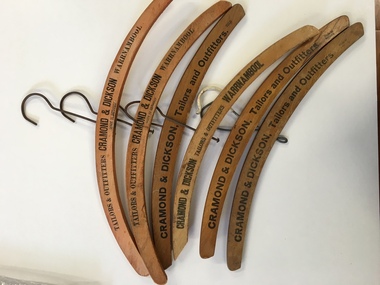
Coat Hanger, Cramond & Dickson Coat Hangers
... Scots and both came separately to Australia in 1852. Cramond initially came for gold but soon opened a store in St Kilda with a post Office attached and he was the first post master there. Dickson was a farmer’s son but became a draper and while he was unsuccessful on the Bendigo diggings and then returned to Melbourne where he met Cramond and soon after they opened a store on Lonsdale Street. ...Scots and both came separately to Australia in 1852. Cramond initially came for gold but soon opened a store in St Kilda with a post Office attached and he was the first post master there. Dickson was a farmer’s son but became a draper and while he was unsuccessful on the Bendigo diggings and then returned to Melbourne where he met Cramond and soon after they opened a store on Lonsdale Street. ...John Glass Cramond 1829 and James Dickson 1831-1910 were founders of a large drapery store. Both were Scots and both came separately to Australia in 1852. Cramond initially came for gold but soon opened a store in St Kilda with a post Office attached and he was the first post master there. Dickson was a farmer’s son but became a draper and while he was unsuccessful on the Bendigo diggings and then returned to Melbourne where he met Cramond and soon after they opened a store on Lonsdale Street. They opened their business in Warrnambool in 1855 as a general store with groceries, drapery and ironmongery. Both partners were involved with the community and James Dickson was an original director of the Warrnambool Woollen Mill 1909 and the Warrnambool Cheese and butter factory. He also served on the committee of management of Warrnambool Base Hospital. These coathangers were an everyday item from their store. A common item which provides a link to one of Warrnambool’s largest and longest running businesses.Wooden hangers with rounded corners and metal hooks, one plastic coated. Printed names engraved and painted in black with business name.Cramond & Dickson Tailors & Outfitters Warrnambool. 2 made on America and 3 made in Germany. 1 unmarkedcramond and dickson store, warrnambool -
 Warrnambool and District Historical Society Inc.
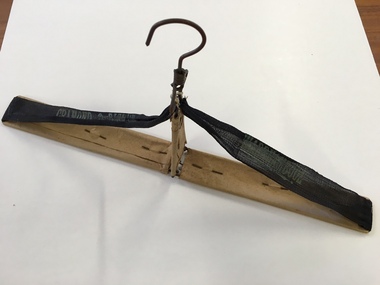
Coat Hanger, Cramond & Dickson Folding
... Scots and both came separately to Australia in 1852. Cramond initially came for gold but soon opened a store in St Kilda with a post Office attached and he was the first post master there. Dickson was a farmer’s son but became a draper and while he was unsuccessful on the Bendigo diggings and then returned to Melbourne where he met Cramond and soon after they opened a store on Lonsdale Street. ...Scots and both came separately to Australia in 1852. Cramond initially came for gold but soon opened a store in St Kilda with a post Office attached and he was the first post master there. Dickson was a farmer’s son but became a draper and while he was unsuccessful on the Bendigo diggings and then returned to Melbourne where he met Cramond and soon after they opened a store on Lonsdale Street. ...John Glass Cramond 1829 and James Dickson 1831-1910 were founders of a large drapery store. Both were Scots and both came separately to Australia in 1852. Cramond initially came for gold but soon opened a store in St Kilda with a post Office attached and he was the first post master there. Dickson was a farmer’s son but became a draper and while he was unsuccessful on the Bendigo diggings and then returned to Melbourne where he met Cramond and soon after they opened a store on Lonsdale Street. They opened their business in Warrnambool in 1855 as a general store with groceries, drapery and ironmongery. Both partners were involved with the community and James Dickson was an original director of the Warrnambool Woollen Mill 1909 and the Warrnambool Cheese and butter factory. He also served on the committee of management of Warrnambool Base Hospital. This coathanger would have been used in their store. An everyday item linked to one of Warrnambool’s earliest and longest running businesses.Folding coathanger with metal frame covered in brown paper with black cotton tape. Cramond & Dickson Warrnambool stamped on the cotton tape.cramond and dickson, warrnambool -
 Warrnambool and District Historical Society Inc.
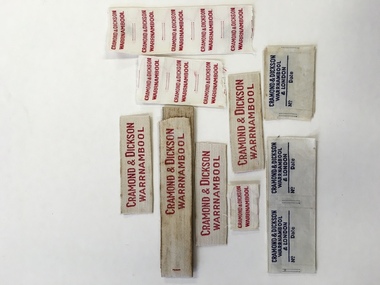
Label, Name labels Cramond & Dickson
... Scots and both came separately to Australia in 1852. Cramond initially came for gold but soon opened a store in St Kilda with a post Office attached and he was the first post master there. Dickson was a farmer’s son but became a draper and while he was unsuccessful on the Bendigo diggings and then returned to Melbourne where he met Cramond and soon after they opened a store on Lonsdale Street. ...Scots and both came separately to Australia in 1852. Cramond initially came for gold but soon opened a store in St Kilda with a post Office attached and he was the first post master there. Dickson was a farmer’s son but became a draper and while he was unsuccessful on the Bendigo diggings and then returned to Melbourne where he met Cramond and soon after they opened a store on Lonsdale Street. ...John Glass Cramond 1829 and James Dickson 1831-1910 were founders of a large drapery store. Both were Scots and both came separately to Australia in 1852. Cramond initially came for gold but soon opened a store in St Kilda with a post Office attached and he was the first post master there. Dickson was a farmer’s son but became a draper and while he was unsuccessful on the Bendigo diggings and then returned to Melbourne where he met Cramond and soon after they opened a store on Lonsdale Street. They opened their business in Warrnambool in 1855 as a general store with groceries, drapery and ironmongery. Both partners were involved with the community and James Dickson was an original director of the Warrnambool Woollen Mill 1909 and the Warrnambool Cheese and butter factory. He also served on the committee of management of Warrnambool Base Hospital. These labels would have been used to sew to garments sold by Cramond & Dickson. A common item for many decades with which many people would identify.Eleven cloth name tag labels. White cotton fabric. Some are embroidered in navy blue and others in red.Those embroidered in red state Cramond & Dickson Warrnambool and the ones embroidered in navy blue state Cramond & Dickson Warrnambool & London.cramond & dickson, john glass cramond, warrnambool, james dickson -
Bendigo Historical Society Inc.
Book - THE AUSTRALIAN BOY SCOUT DIARY 1933, 1933
... Jock the Scot Alice Grant Rosemary. Bernard Shaw Frank Harris. Exchange Press Pty Ltd., Melbourne The Australian Boy Scout Diary 1933. ...The Australian Boy Scout Diary 1933. Inside front cover is an intimate picture of Chief & his family. With specially written notes and Sketches for Cubs, Scouts, Rovers and Scouters. Obtainable at all State Headquaters in Australia. Prepared and Published by the Victorian Section in conjuntion with the Federal Scout Council of Australia. Printed by Exchange Press Pty Ltd, 310 Spencer Street, Melbourne. Index: Boy Scouts. Bush Fires. Calendars 1933, 1934. 1934 Calendar. Conventional Signs and Maps. Fires. First Aid. Headquaters Address. Holidays. Knots, Bends and Hitches. List of Badges. Local Fixtures. Morse. Our Flag. Personal Memoranda. Pioneering. Plan of Camp. Rover Scouts. Scout Uniform. Scout Signs and Salutes. Sea Scouts. Sea Scouting - Notes on Boat Handling. Semaphore. South by the Stars. Swimming. Torch. Treatment of Snakebite. Troop Camps. Weights and Measures. Wolf Cubs. Wood Badge. Uses of Scout Staff. Inside rear cover is a sepia photo of the site of the 1933 Jamboree at Godollo, Hungary. Book is very detailed giving information on all aspects of Scout life, with sketches for knots, maps, etc. Inscriptions are on page 58: Troup or Pack - 1st Epsom Pack. Watch No. 4133033. Season Ticket No. Commonwealth acc 957. Savings No. 4729. Size in Hats: 7. Size of Boots: 5. Size of Collar 14 1/2. Size of Gloves 6 1/4. Iinscription on page 60: Books Read: In Search of Wales, Morton. Faraway, Priestly. Jock the Scot, Alice Grant Rosemary. Bernard Shaw, Frank Harris.Exchange Press Pty Ltd., Melbournebook, bendigo, scouts, the australian boy scout diary 1933. photo of chief & his family. notes and sketches for cubs, scouts, rovers and scouters. obtainable at all state headquarters in australia. published by the victorian section in conjunction with the federal scout council of australia. exchange press pty ltd, melbourne. index: boy scouts. bush fires. calendars 1933, 1934. 1934 calendar. conventional signs and maps. fires. first aid. headquarters address. holidays. knots, bends and hitches. list of badges. local fixtures. morse. our flag. personal memoranda. pioneering. plan of camp. rover scouts. scout uniform. scout signs and salutes. sea scouts. sea scouting - notes on boat handling. semaphore. south by the stars. swimming. torch. treatment of snakebite. troop camps. weights and measures. wolf cubs. wood badge. uses of scout staff. sepia photo of the site of the 1933 jamboree at godollo, hungary. information on all aspects of scout life, with sketches for knots, maps, etc. inscriptions page 58: troup or pack - 1st epsom pack. watch no. 4133033. season ticket no. commonwealth acc 957. savings no. 4729. size in hats: 7. size of boots: 5. size of collar 14 1/2. size of gloves 6 1/4. page 60: books read: in search of wales, morton. faraway, priestly. jock the scot, alice grant rosemary. bernard shaw, frank harris. -
 Uniting Church Archives - Synod of Victoria
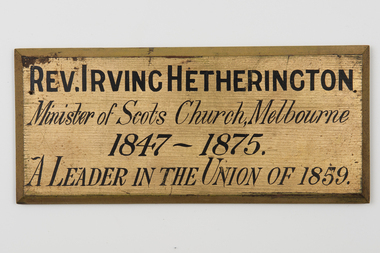
Plaque, c1875
... scots' church melbourne...Minister of Scots Church, Melbourne 1847-1875. A LEADER IN THE UNION OF 1859"...scots' church melbourne "REV. IRVING HETHERINGTON. Minister of Scots Church, Melbourne 1847-1875. ...Gold painted wooden plaque with black lettering."REV. IRVING HETHERINGTON. Minister of Scots Church, Melbourne 1847-1875. A LEADER IN THE UNION OF 1859"scots' church melbourne -
 Uniting Church Archives - Synod of Victoria
Colour photo, 1986
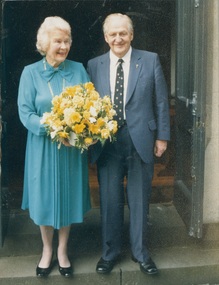
... Melbourne. It was a time of bitter debates over church union with the Methodists and Congregationalists. Gordon was in favour, but Scots ultimately voted to stay out and remain Presbyterian. ...Melbourne. It was a time of bitter debates over church union with the Methodists and Congregationalists. Gordon was in favour, but Scots ultimately voted to stay out and remain Presbyterian. ...1911–2005: Gordon George Powell, who has died at 94, was for many years the highly influential minister at St Stephen's Presbyterian Church in Sydney and a popular radio broadcaster and author. He began Wednesday services at St Stephen's in Macquarie Street soon after arriving in Sydney from Melbourne in 1952. They grew to become the biggest regular lunch-hour services in the world, with up to 1300 people crowding the church and the hall below. In 1953, with the help of Vernon Turner of the Christian Broadcasting Association, services were broadcast on radio. The broadcasts continued even when Gordon moved back to Melbourne, so for 30 years he maintained a successful weekly radio ministry. While at St Stephen's, he was also involved in the 1959 Billy Graham Crusade in Sydney, attended by 980,000 people over two weeks. Gordon was born in Warrnambool, Victoria, the son of a dentist, George Powell, and his wife, Louisa (nee Clarke). He went to school at Scotch College. He gave up plans to become an electrical engineer after hearing a call to the ministry and studied arts and then theology at the University of Melbourne, where he formed a close friendship with Edward (Weary) Dunlop. Gordon rowed in the Ormond crew, winning the university's inter-college trophy five times. He was a passionate sports lover all his life. He was awarded a scholarship to Trinity College, Glasgow University, in 1935, and for three months stayed with the great Scottish churchman George (later Lord) MacLeod. While on a cycling trip around Scotland, he stopped by the shores of Loch Ness and saw a long neck appear. The monster swam about 300 metres at great speed; Gordon counted three or four humps. Later, when he saw a skeleton of a plesiosaurus at the Victoria and Albert Museum, he recognised it as Nessie. For the rest of his life, he retained an avid interest in the Loch Ness Monster and its attendant scientific debate. While in Scotland, Gordon wrote a weekly article for The Messenger, the official journal of the Presbyterian Church of Victoria. This led to a life as an author of articles and books. He also wrote long letters home to his mother, a habit that later led to his weekly "Dad's Diaries", which were distributed to the wider family. Failing eyesight put an end to his reading and writing two years ago. On returning to Australia in late 1936, he became assistant minister at Toorak, the second-biggest Presbyterian church in Melbourne. There, at last, Gordon married Gwen Gilchrist, whom he had courted for nine years. They moved from the wealthiest church to one of the poorest, at Port Adelaide, which was still in the grip of the Depression. There, he was finally ordained, in May 1938, and the first two of their four children, Rosemary and David, were born. In 1941, Gordon became assistant minister to Scots Church in Melbourne and the following year, after the birth of his third child, Mardi, he reluctantly volunteered as an RAAF chaplain. He was a pacifist but felt bad at not being in uniform. For the following three years, he was stationed in New Guinea and Australia. His war reminiscences were published as Two Steps to Tokyo and sold 6000 copies in 1945 alone. At 34, by then the father of four children, he was invited to be minister of the Collins Street Independent Church in the heart of Melbourne, now St Michael's Uniting Church Before being inducted, he undertook a lecture tour of the US, speaking to Rotary clubs in 48 centres, from Michigan to Maryland. He met, and was impressed by, the liberal theologian Harry Emerson Fosdick, and the US religious leader and author Norman Vincent Peale, who became a close friend and mentor. Back in Australia, Gordon founded and fostered the first Alcoholics Anonymous group in Melbourne. In 1952, he took up what was to become his happiest ministry, at St Stephen's in Sydney. When Queen Elizabeth and Prince Philip toured two years later, Gordon and Gwen were not only invited to lunch with them, but sat beside them. This was a highlight for Gordon, an ardent monarchist. In 1960, Gordon and Gwen embarked on a world tour that included the US, where he was invited to give the opening prayer in the Senate, with vice-president Richard Nixon presiding. After another five years at St Stephen's, Gordon returned to Scots Church in Melbourne. It was a time of bitter debates over church union with the Methodists and Congregationalists. Gordon was in favour, but Scots ultimately voted to stay out and remain Presbyterian. By then in his mid-60s, he and Gwen moved to New York, where Peale was his neighbour. They had six happy years there before retiring to Melbourne. Gordon is survived by Gwen, and children David, Mardi and Jenny (daughter Rosemary died in 1992), 13 grandchildren and 10 great-grandchildren. [From the obituary in the Sydney Morning Herald, 2005, written by Jenny (Powell)] Gwen and Gordon Powell coming out of the Toorak Uniting Church 50 years after they were married there. Gwen and Gordon Powell coming out of the Toorak Uniting Church 50 years after they were married there.gordon powell; gwen powell; port adelaide; toorak presbyterian church; st stephen's presbyterian church sydney; presbyterian minister -
 Uniting Church Archives - Synod of Victoria
Photograph, Undated
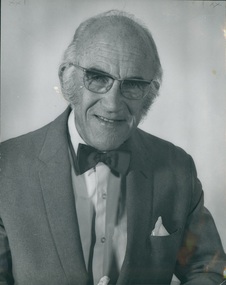
... In 1933 Ordained Presbyterian Church in England, Moved to Ipoh Malay, in 1942 Scots Church Sydney, 1943 Director of Audio Visual Education, Minister at StAidans North Balwyn 1951-1955, Director of Stewardship and Promotion 1956-1962, Managing Director Australian Religious Films Society, 1969-1977 Editor of Out Reach. Passed Away Nov 3 1983 St Andrew's Hospital Melbourne...In 1933 Ordained Presbyterian Church in England, Moved to Ipoh Malay, in 1942 Scots Church Sydney, 1943 Director of Audio Visual Education, Minister at StAidans North Balwyn 1951-1955, Director of Stewardship and Promotion 1956-1962, Managing Director Australian Religious Films Society, 1969-1977 Editor of Out Reach. Passed Away Nov 3 1983 St Andrew's Hospital Melbourne ...B1904 in Surrey UK, Married Dr Margaret Trowell. In 1933 Ordained Presbyterian Church in England, Moved to Ipoh Malay, in 1942 Scots Church Sydney, 1943 Director of Audio Visual Education, Minister at StAidans North Balwyn 1951-1955, Director of Stewardship and Promotion 1956-1962, Managing Director Australian Religious Films Society, 1969-1977 Editor of Out Reach. Passed Away Nov 3 1983 St Andrew's Hospital Melbourne.B&W gloss waist length studio portrait of Rev. Hamilton Aiken. He is wearing his trademark bowtie, jacket and white shirt.rev. hamilton aiken; presbyterian minister; director stewardship and promotion; photography; australian religious film society; outreach journal -
 Uniting Church Archives - Synod of Victoria
Photograph
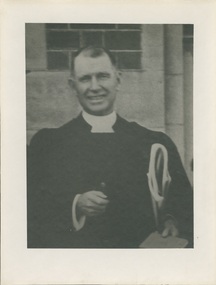
... James Legge was born of Scots parentage at Dunolly, Victoria on 2 July 1873. He was educated at Scotch College Melbourne, and at the University of Melbourne. ...James Legge was born of Scots parentage at Dunolly, Victoria on 2 July 1873. He was educated at Scotch College Melbourne, and at the University of Melbourne. ...James Legge was born of Scots parentage at Dunolly, Victoria on 2 July 1873. He was educated at Scotch College Melbourne, and at the University of Melbourne. He worked as a teacher before starting the Theological course at Ormond College. He completed his theological training in 1902, and was appointed by the Home Mission Committee to the parish of Boort, where at Durham Ox he was ordained and inducted in May 1903. He married Susan Ison at the Collins St. Independent Church on 11 September 1907. Legge was called to Clunes (1907), Preston (1917), Mildura (1920), Dandenong (1924), and Kew (1926). Demitted 1942. Home Mission appointment Mitcham 1946. Died October 21 1951B & W waist length photo enlargement of Rev James Legge B.A. printed on buff card.Rev. James Legge, B.A. 1926 - 1942james legge, presbyterian, minister, scotch college, university of melbourne, ormond college, kew -
 Ballarat Tramway Museum
Photograph - Illustration/s, W2 417 Collins St. Melbourne
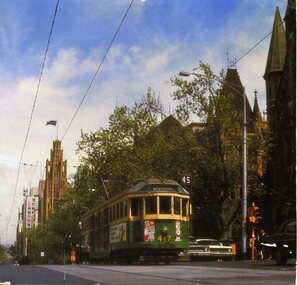
... Melbourne at the intersection of Russell St. with the Scots Church in the background. ...Melbourne at the intersection of Russell St. with the Scots Church in the background. ...Colour illustration of M&MTB tram W2 417 on a route 45, Deepdene service in Collins St. Melbourne at the intersection of Russell St. with the Scots Church in the background. Points of interest in the photograph are the lack of white lines along the tracks, safety zone equipment, "Hail Cars Here" tram stop sign on a steel pole by a traffic light and the style of traffic light. Two advertising panels on the front of the tram advertise "Jex Soap Pads" and the musical "Hair" at the Metro Theatre Bourke St. Two Fords are alongside the tramcar. Musical "Hair" in Melbourne 1971 - Wikipedia - https://en.wikipedia.org/wiki/Hair_%28musical%29 accessed 6-4-2016 trams, tramways, collins st., melbourne, mmtb -
 Sunshine and District Historical Society Incorporated
Article - The Age - Churches With A History Series, 1965 - 1966
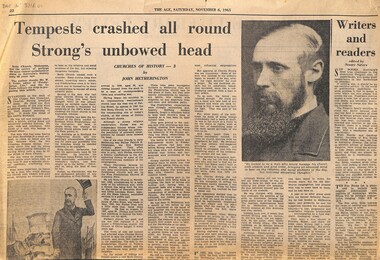
... 3816.01 - The Age - Churches Of History - Scots Church Melbourne 3816.02 - The Age - Churches Of History - St. ...Church Churches 3816.01 - The Age - Churches Of History - Scots Church Melbourne 3816.02 - The Age - Churches Of History - St. ...3816.01 - The Age - Churches Of History - Scots Church Melbourne 3816.02 - The Age - Churches Of History - St. Marys Castlemaine 3816.03 - The Age - Churches Of History - Scots Church Campbellfield 3816.04 - The Age - Churches Of History - St. Johns Church Of England Heidelbergchurch, churches -
 Melbourne Athenaeum Archives
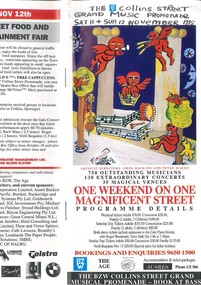
postcard Flyer, The BZW Collins Street Grand Music Promenade (Musical Variety Concert) commencing Sunday November 6th 1994
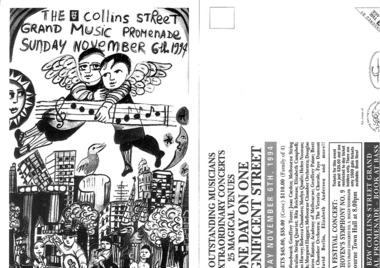
... Scot's Church, 161 Collins Street, the gold vaults of the Old Treasury Building. Note: It was recorded in the secretary's diary that concerts associated with the Collins Street Grand Music Promenade were held at the Melbourne Athenaeum Theatre all day on Sunday the 6th of November. ...Scot's Church, 161 Collins Street, the gold vaults of the Old Treasury Building. Note: It was recorded in the secretary's diary that concerts associated with the Collins Street Grand Music Promenade were held at the Melbourne Athenaeum Theatre all day on Sunday the 6th of November. ...Concerts were held at ten venues in Collins street grand music promenade venues:Baptist Church, St Michaels, ANZ Cathedral Room, 101 Collins Street, Kay Craddock bookshop, Georges Dining Room, Scot's Church, 161 Collins Street, the gold vaults of the Old Treasury Building. Note: It was recorded in the secretary's diary that concerts associated with the Collins Street Grand Music Promenade were held at the Melbourne Athenaeum Theatre all day on Sunday the 6th of November. This festival was organised by Greg Hocking and Peter Marks.Black and white postcard flyer Folder also contains a newspaper article, a venue program, folded poster and various letters of correspondence. One day on a magnificent street with: Roger Woodward, Geoffrey Tozer, Joan Carden, Melbourne String Quartet, Rita Reichman, Australian String Quartet, Elizabeth Campbell, Micheal Kieran Harvey,Rebecca Chambers, Merlyn Quaife, Helen Noonan, Jeannie Marsh, Margaret Haggart, Melbourne Chamber Orchestra, Douglas Lawrence, Spiros Rantos, Academy of Melbourne, Geofrey Paine, Brett Kelly, Haydn Chamber Orchestra, The Victorian Chorale, Faye Dumont Singers, David Berlin, Elizabeth Anderson and more ...the collins street grand music promenade, melbourne athenaem theatre -
 Melbourne Athenaeum Archives
Flyer/ brochure, The BZW Collins Street Grand Musical Promenade(music variety)by BZW Saturday 11 of November 1995
... 750 outstanding musicians 130 extraordinary concerts 35 magical venues including: Melbourne town hall assembly hall athenauem theatre 1 athenauem theatre 2 Basement discs baptist church Cathedral room-ANZ Gothic Bank the melbourne club rauquet courts melbourne town hall council chambers miettas lounge gold vaults old treasury building 101 collins Street Scots Church 333 collins street capitol cinema city square kay croddocks antiquarian book shop gallery 101 melbourne town hall reception area mitre tavern novetel on collins micheals brasssere JJclark room 120 collins street reserve bank foyer ...the bzw colins street grand music promenade athenaeum theatre one the australian art orchestra athenaeum theater two the aspern papers that geoffrey tozer piano roger woodward piano nathan waks cello stephen mcinytre piano rita reichman piano 750 outstanding musicians 130 extraordinary concerts 35 magical venues including: Melbourne town hall assembly hall athenauem theatre 1 athenauem theatre 2 Basement discs baptist church Cathedral room-ANZ Gothic Bank the melbourne club rauquet courts melbourne town hall council chambers miettas lounge gold vaults old treasury building 101 collins Street Scots Church 333 collins street capitol cinema city square kay croddocks antiquarian book shop gallery 101 melbourne town hall reception area mitre tavern novetel on collins micheals brasssere JJclark room 120 collins street reserve bank foyer coloured brochures The BZW Collins Street Grand Musical Promenade(music variety)by BZW Saturday 11 of November 1995 Flyer/ brochure ...coloured brochures 750 outstanding musicians 130 extraordinary concerts 35 magical venues including: Melbourne town hall assembly hall athenauem theatre 1 athenauem theatre 2 Basement discs baptist church Cathedral room-ANZ Gothic Bank the melbourne club rauquet courts melbourne town hall council chambers miettas lounge gold vaults old treasury building 101 collins Street Scots Church 333 collins street capitol cinema city square kay croddocks antiquarian book shop gallery 101 melbourne town hall reception area mitre tavern novetel on collins micheals brasssere JJclark room 120 collins street reserve bank foyer the bzw colins street grand music promenade, athenaeum theatre one, the australian art orchestra, athenaeum theater two, the aspern papers, that, geoffrey tozer piano, roger woodward piano, nathan waks cello, stephen mcinytre piano, rita reichman piano -
 Melbourne Tram Museum
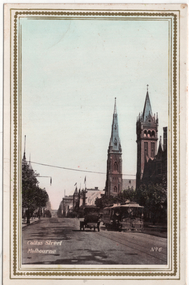
Postcard, H&B, "Collins Street Melbourne No. 6", c1910
... Colour postcard, H&B series, No. 6 of Collins St Melbourne looking west from near Exhibition St Has the Independent Church, Scots Church and Georges in the view along with the Town Hall. ...Colour postcard, H&B series, No. 6 of Collins St Melbourne looking west from near Exhibition St Has the Independent Church, Scots Church and Georges in the view along with the Town Hall. ...Colour postcard, H&B series, No. 6 of Collins St Melbourne looking west from near Exhibition St Has the Independent Church, Scots Church and Georges in the view along with the Town Hall. Tram has the destination of Spring St. Photo c1910Yields information about the view along Collins St from near Exhibition St.Postcard - colour with divided backIn pencil on rear "28/5/1987"trams, tramways, cable trams, collins st, scots church, independent church -
 Melbourne Legacy
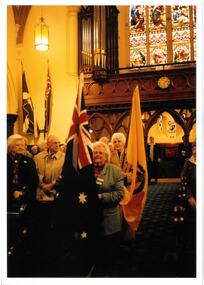
Photograph, Widows' Sunday Scots' Church Service 2003, 2003
... A church service for Legacy widows at Scot's Church in Collins St, Melbourne. This is an annual event for Legacy widows at the start of Legacy Week, which is the first week in September. ...A church service for Legacy widows at Scot's Church in Collins St, Melbourne. This is an annual event for Legacy widows at the start of Legacy Week, which is the first week in September. ...A church service for Legacy widows at Scot's Church in Collins St, Melbourne. This is an annual event for Legacy widows at the start of Legacy Week, which is the first week in September. The church used for the service varies, The Scots' Church was the first Presbyterian Church to be built in Victoria. The photos shows the interior of the church with the congregation listening to service. Same roll of film as the photos with President David Ford in 2003 so the event is assumed to be in that year. The event is referred to as Widows' Sunday, Legacy Sunday and pilgrimage to the Shrine.A record of a church service for Legacy widows in 2003.Colour photo x 6 of the church service at Scots Church.Printed on the back widows, widows' sunday, pilgrimage -
 Melbourne Legacy
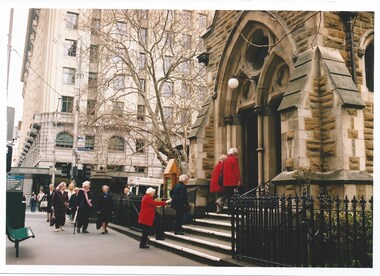
Photograph, Widows' Sunday Scots' Church Service 2004, 2004
... A church service for Legacy widows at Scot's Church in Collins St, Melbourne. This is an annual event for Legacy widows at the start of Legacy Week, which is the first week in September. ...A church service for Legacy widows at Scot's Church in Collins St, Melbourne. This is an annual event for Legacy widows at the start of Legacy Week, which is the first week in September. ...A church service for Legacy widows at Scot's Church in Collins St, Melbourne. This is an annual event for Legacy widows at the start of Legacy Week, which is the first week in September. The church used for the service varies, The Scots' Church was the first Presbyterian Church to be built in Victoria. The same roll of film as 00695.A record of a church service for Legacy Widows in 2004.Colour photo x 3 of widows arriving at a church.Printed on the back widows, widows' sunday -
 Melbourne Legacy
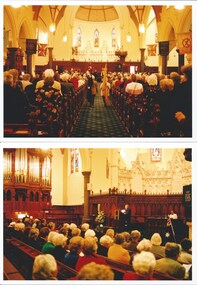
Photograph, Widows' Sunday Scots' Church Service 2004, 2004
... A church service for Legacy widows at Scot's Church in Collins St, Melbourne. This is an annual event for Legacy widows at the start of Legacy Week, which is the first week in September. ...A church service for Legacy widows at Scot's Church in Collins St, Melbourne. This is an annual event for Legacy widows at the start of Legacy Week, which is the first week in September. ...A church service for Legacy widows at Scot's Church in Collins St, Melbourne. This is an annual event for Legacy widows at the start of Legacy Week, which is the first week in September. The church used for the service varies. Then the widows attend a ceremony at the Shrine and then have a lunch. The Scots' Church was the first Presbyterian Church to be built in Victoria. The same roll of film as other photos of 2004 (00696).A record of a church service for Legacy Widows in 2004.Colour photo x 4 of a church service.Printed on the back widows, widows' sunday, pilgrimage -
 Melbourne Legacy
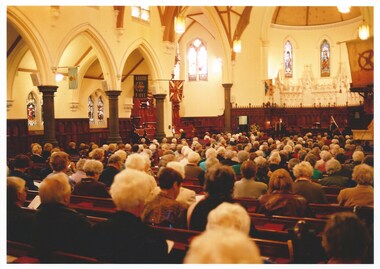
Photograph, Widows' Sunday Scots' Church Service 2005, 2005
... A church service for Legacy widows at Scot's Church in Collins St, Melbourne. This is an annual event for Legacy widows at the start of Legacy Week, which is the first week in September. ...A church service for Legacy widows at Scot's Church in Collins St, Melbourne. This is an annual event for Legacy widows at the start of Legacy Week, which is the first week in September. ...A church service for Legacy widows at Scot's Church in Collins St, Melbourne. This is an annual event for Legacy widows at the start of Legacy Week, which is the first week in September. The church used for the service varies. Then the widows attend a ceremony at the Shrine and then have a lunch. The Scots' Church was the first Presbyterian Church to be built in Victoria. Events of the day are also at 00707, 00708, 00709A record of a church service for Legacy Widows in 2005.Colour photo x 2 of a church service.Printed on the back widows, widows' sunday, pilgrimage
