
Showing 27 items matching "metal working trade"
-
 Flagstaff Hill Maritime Museum and Village
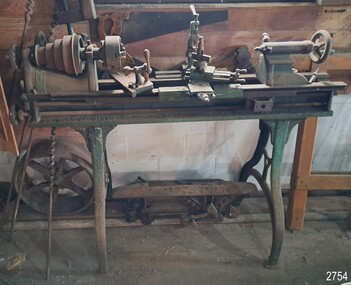
Machine - Lathe, W F & John Barnes, early 1900s
... ...metal working trade...Flagstaff Hill Flagstaff Hill Maritime Museum and Village Warrnambool Maritime Museum Maritime Village Great Ocean Road Shipwreck Coast Lathe steam-operated lathe steam-operated pulley steam power steam engine machine steam operated machine metal work foundry work metal working trade tool pulley driven metalworking woodworking Barnes lathe Briggs Marine belt driven wordworking lathe free standing lathe bench lathe steam powered vintage lathe woodturning lathe W. ...This woodworking lathe, connected to both a pulley and a flywheel, demonstrates its historical operation with a steam engine. Such a configuration reflects manufacturing practices from the late 1800s and early 1900s, when steam power was the predominant source for driving workshop and factory machinery. Large machine shops often utilised a single power source, distributing power via roof-mounted belts and pulleys to operate several machines simultaneously. Over time, petrol-driven motors were introduced, and eventually, electricity became the standard power source. Conversion kits were made available in the late 19th and early 20th centuries to adapt older lathes to these newer, cleaner fuels. Manufacturer's History: W.F. & J. Barnes was a renowned maker of hand- and foot-powered treadle woodworking and metalworking machinery, established in 1869. The partnership between William F. Barnes and John Barnes was formalised in 1872, and the firm was incorporated in 1884. Their machines were used for both ‘farm’ applications and professional engineering. By 1881, the company began producing electrically powered machinery. By 1937, W.F. & J. Barnes expanded into manufacturing machinery for automotive assembly. The business closed in 1983, and in 1998, LeBlond Ltd. of Ohio acquired the firm. The lathe was donated by Briggs Marine, Melbourne: In Flagstaff Hill’s formative years, 1972-1975, Briggs Marine, Melbourne (Briggs Brass Foundry), donated equipment and objects used or made at their premises. The foundry was established in 1912 by Herbert Harrison Briggs. In 1965, the firm was owned by partners Cyril Briggs and Frank Lee: Cyril died in 1967, and Frank died in 1971, so the foundry was then run by his son and daughter-in-law, Les and Eva Lee. Briggs Marine’s Warrnambool Branch closed in 1972 after the death of Frank Lee in 1971. Flagstaff Hill’s founding director, John Lindsay, recalled that Briggs Marine’s family members gave personal assistance in setting up the displays in the original village shops, particularly the ‘Brass Foundry’ building, around the time the Maritime Museum opened in 1975. Briggs Marine still exists today, but the Briggs family is no longer involved. This early 1900s lathe marks a significant stage in the evolution of machinery, positioned between the era of hand-operated machines and the advent of electrically powered equipment. Its presence exemplifies the progression of industrial technology and craftsmanship during this period. The lathe is particularly notable for its association with the Briggs Brass Foundry. The foundry was known for developing a specialised brass alloy composed of non-ferrous metals, a formulation that resulted in durable products built to withstand the demanding conditions of marine environments. This focus on resilience and longevity made Briggs Brass Foundry’s goods highly sought after within the maritime sector. Briggs Maine, a long-established business, utilised the foundry’s capabilities to create cast goods tailored to the needs of the marine industry. The facility was equipped to deliver both custom-designed and mass-produced items, ensuring versatility in meeting various requirements. Many of Briggs Foundry’s products found their place on sailing and steam vessels throughout Victoria’s coastline, including in the port town of Warrnambool, where there was once a brancy of Briggs Marine. In addition to general marine fittings, Briggs Marine earned recognition for its expertise in bell-founding. The foundry’s reputation is closely linked to the restoration of the Schomberg Bell at Flagstaff Hill, a small but historically significant bell from a luxury migrant vessel dating back to the mid-19th century. The successful restoration of the Schomberg Bell demonstrates Briggs Brass Foundry’s commitment to preserving craftsmanship and maritime heritage.The lathe is a green, bench-type, steam-powered woodworking machine. Its bench is supported by decorative posts at each end, with each post dividing into arched legs. The lathe is mechanically connected to both a pulley and a flywheel, designed to be operated in conjunction with a steam engine. Included with the lathe is a range of accessories. Across the front of the machine, an inscription is cast, and a stamped, metal lathe pulley guide is attached to the drive mechanism. The lathe was manufactured by W. F. and J. Barnes, Rockford, Illinois, USA, during the 1900s.“W F and J Barnes, Rockford, USA” "1820" "1887"flagstaff hill, flagstaff hill maritime museum and village, warrnambool, maritime museum, maritime village, great ocean road, shipwreck coast, lathe, steam-operated lathe, steam-operated pulley, steam power, steam engine, machine, steam operated machine, metal work, foundry work, metal working trade, tool, pulley driven, metalworking, woodworking, barnes lathe, briggs marine, belt driven, wordworking lathe, free standing lathe, bench lathe, steam powered, vintage lathe, woodturning lathe, w. f. and j. barnes, illanois, early 20th century, briggs, briggs brass foundry, briggs marine foundry, briggs marine products, herbert harrison briggs, george edward briggs, cyril falkiner mckinnon briggs, collingwood, moorabbin, frank lee, les lee, eva lee, briggs marine warrnambool, non-ferrous founders, bell specialists, ship bell specialists, sand cast, marine equipment, marine fittings, foundry, brass foundry, founders -
 Flagstaff Hill Maritime Museum and Village
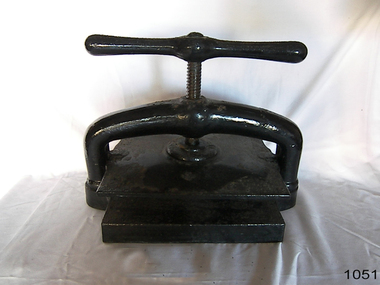
Equipment - Book binding press
... trade. This item is significant as it is an early example of items used in book gilding and binding. flagstaff hill warrnambool shipwrecked-coast flagstaff-hill flagstaff-hill-maritime-museum maritime-museum shipwreck-coast flagstaff-hill-maritime-village None Book binding press metal with square pressing surface driven by worm wheel thread and turning handle in working order. ...Item used to repair books after their dust jackets, covers, flyleaves or pages had been damaged. These damaged items on a book were replaced and glued. The press allowed the glue to set under pressure until the repair was complete a press is also used for the gilding of books. The first book press has been documented in India around 100 BCE with various types and designs being used though the ages and are still in use today by craftsman to repair antique books.Over the centuries many materials from ivory to glass, have been used to bind books. Gilding has also long been a popular decorative treatment for book bindings and a book press is used in this operation. Since the 1800s, rare book conservationists have worked to perfect the methods used by their predecessors, and modern book binders are true craftsman with this press as an example of the equipment used in their trade. This item is significant as it is an early example of items used in book gilding and binding.Book binding press metal with square pressing surface driven by worm wheel thread and turning handle in working order. Noneflagstaff hill, warrnambool, shipwrecked-coast, flagstaff-hill, flagstaff-hill-maritime-museum, maritime-museum, shipwreck-coast, flagstaff-hill-maritime-village -
 Flagstaff Hill Maritime Museum and Village
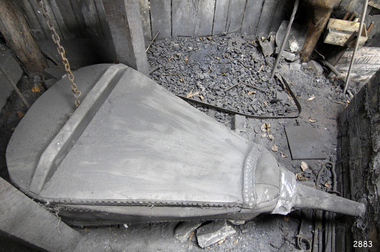
Functional object - Bellows, 1862-1875
... metal working smiths. The bellows is technologically significant as it shows the progress from simple bellows to the double-action bellows, a time saving and efficient improvement. The manufacturer John C. Onions is historically significant as a family business that began in the 1600s and continued up until the 1980s. flagstaff hill warrnambool shipwrecked-coast flagstaff-hill flagstaff-hill-maritime-museum maritime-museum shipwreck-coast flagstaff-hill-maritime-village john collingwood onions john c onions allday and onions bellows smith’s bellows 19th century bellows double-action bellows double-acting bellows double lung bellows double chamber bellows blacksmith tools blacksmith trade blacksmith craft blacksmith equipment forging equipment john c onions patented double-action bellows brian chapman warrnambool racecourse blacksmith shipsmith iron smith mechanical bellows Text impressed in the wooden upper paddle of the bellows has been assumed to read “JOHN C. ...This bellows was used at the Warrnambool Racecourse by Master Farrier, Brian Chapman (1931-2017), during the 1970s but its history before then is still being investigated. The bellows have continued to be used from 1978 at Flagstaff Hill's blacksmith's workshop. Even today, in 2021, this same bellows are used by a volunteer blacksmith as he demonstrate the skills and tells of the importance of the blacksmith trade to colonial Australia. This 1860s double-action bellows is a typical form of blacksmith's or shipsmith's bellows. The end is forge-fitted with an iron nozzle or tube, called a tuyere or Tue iron, which concentrates the air to fan the fire or furnace. Tuyeres were traditionally made of cow horn. The double-action design of this bellows efficiently moves air both in and out of the chambers in the one movement of the long handle. The bellows was manufactured by John C. Onions of Birmingham, England, between 1862 and 1875. The stamp with the text, Gold Medal 1862, was also used on the business’ advertising. In 1875 the company was registered and began using the name John C. Onions Limited. JOHN C. ONIONS - John C. (Collingwood) Onions (1841-1904) was the son of a bellows maker of the same name. Onions (born 1841) and his wife Helen married in 1867 and they named one of their children John Collingwood Onions (1868-1913), as was the family tradition. He was well known as a Birmingham manufacturer of patented bellows and other forge-related equipment. He sold to the wholesale and retail markets for both local and overseas customers, including the British colonies. An 1862 advertisement points out that John C. Onions was a “Bellows manufacturer and contractor to Her Majesty’s Honourable Board of Ordinance” and His Imperial Majesty the Emperor of the French [Napoleon Bonaparte]”. The advertisement includes a sketched portrait of the Emperor Napoleon III, and an Imperial Autograph Letter dated May 23, 1854, from Napoleon, Palace of the Tulleries to Mr J C Onions of Bradford Street, Birmingham. In 1863 the company registered a patent on portable forges. In 1871 there were eight employees. John C. Onions Limited became a registered company in 1875. In 1876 an advertisements included that the company were smiths for hearths and tools in general and showed a row of six medallions including one with “Napoleon III, Emperor” and his portrait, and another “ _ _ _ 1862 MEDAL”. Their advertising motto was “For Excellence of Quality”. In 1885 the company merged with William Allday and Sons to become Allday and Onions. This mid-19th century bellows has local historical significance as it were once used by blacksmiths at the Warrnambool Racecourse in the annual racing event that continues today. This bellows is significant as a working example of equipment used in the 1800 and 1900s in the trace of blacksmiths and other metal working smiths. The bellows is technologically significant as it shows the progress from simple bellows to the double-action bellows, a time saving and efficient improvement. The manufacturer John C. Onions is historically significant as a family business that began in the 1600s and continued up until the 1980s.Bellows; large, oval, mechanical double-action smith’s bellows, manually operated, in working condition. The paddles of wood that form the top, middle sections and base of the bellows have flexible leather pieces attached firmly between them, forming airtight double lungs. Cut-outs in the panels allow the bellows to fill with air then force it out. A long handle is connected to pump the bellows and control the quantity and force of the air. The blasts of air are forced through the metal nozzle or tuyere at the end of the bellows and into the forge’s fire. Inscriptions are impressed into the wood on the upper paddle or board of the bellows. There are three circular stamps containing text. Text impressed in the wooden upper paddle of the bellows has been assumed to read “JOHN C. ONIONS, PATENTEES & MANUFACTURERS, BIRMINGHAM””?” “EXTRA” “AWARDED FOR EXCELLENCE OF QUALITY”, made from the following readable text :- “JOHN C ONIONS“ “PATENT - - - & MAN - - - - - - - - -“, “BIR - - - - HAM“, “ _ ERA - - - - “- XTRA-“, “- - - - - - - FOR EXCELL-“ “OF - - - - ITY” Text in the stamp “ - - ECE - - “, “ - - - - - / 1862 / MEDAL”, “- ITY” flagstaff hill, warrnambool, shipwrecked-coast, flagstaff-hill, flagstaff-hill-maritime-museum, maritime-museum, shipwreck-coast, flagstaff-hill-maritime-village, john collingwood onions, john c onions, allday and onions, bellows, smith’s bellows, 19th century bellows, double-action bellows, double-acting bellows, double lung bellows, double chamber bellows, blacksmith tools, blacksmith trade, blacksmith craft, blacksmith equipment, forging equipment, john c onions patented double-action bellows, brian chapman, warrnambool racecourse, blacksmith, shipsmith, iron smith, mechanical bellows -
 Flagstaff Hill Maritime Museum and Village
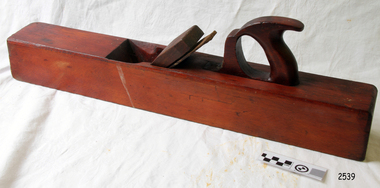
Tool - Plane, 19th century
... trade from the 19th century to the present day. Flagstaff Hill Flagstaff Hill Maritime Museum and Village Warrnambool Maritime Museum Maritime Village Great Ocean Road Shipwreck Coast Wood Working wood working plane wood working tool Jack Plane plane wood plane general purpose plane tool Builders Tool carpenter's tool ship builder's tool Maritime trade Jack Plane; a large oblong shape with an aperture at one end, a long wooden guard that protects the sharp metal blade, and a saw like handle at other end. ...This Jack plane is used for general purposes such as shaving off surplus wood to bring a piece of work down to size and plane the edges of a door to smooth them off. This plane is an example of the tools used by ship builders in the maritime trade from the 19th century to the present day.Jack Plane; a large oblong shape with an aperture at one end, a long wooden guard that protects the sharp metal blade, and a saw like handle at other end. It is stained a red-brown colour.flagstaff hill, flagstaff hill maritime museum and village, warrnambool, maritime museum, maritime village, great ocean road, shipwreck coast, wood working, wood working plane, wood working tool, jack plane, plane, wood plane, general purpose plane, tool, builders tool, carpenter's tool, ship builder's tool, maritime trade -
 Flagstaff Hill Maritime Museum and Village
Drill Press, early to mid-20th century
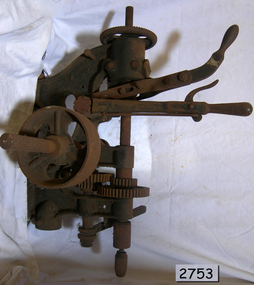
... metal working tool...post drill...steam powered drill...trade...It is an example of the tools of the blacksmiths’ trade in Victoria in the early to mid-20th century. flagstaff hill warrnambool shipwrecked-coast flagstaff-hill flagstaff-hill-maritime-museum maritime-museum shipwreck-coast flagstaff-hill-maritime-village blacksmiths blacksmith’s drill blacksmith tools dawn drill model no. 611 dawn drill code no. 9157 dawn manufacturing coy melbourne dawn manufacturing coy coburg dawn post drill drilling machine drill with gear driven flywheel forging tool metal working tool post drill steam powered drill trade tool warrnambool district 1900s "DAWN MFG COY”, “MELB. ...This post drill press has been made by Melbourne business, Dawn Manufacturing Company. It can be operated manually or by a pulley driven flywheel, with the aid of an engine connected to a power supply. In the late 1800s early 1900s a drill press like this would have been driven by steam from a boiler, the main power source for manufacturer’s power at that time. Dawn’s Golden Anniversary 1917-1967 Catalogue describes this model 611 drill as … “Ruggedly constructed with accurately reamed bearings. The coupling between the main spindle and feed screw engages the full circumference of the spindle, and embraces a ball-bearing thrust race. The pillar, as in all “Dawn Drilling Machines” is a solid bright steel bar, in place of the usual light tubing. Adjustable automatic feed.” And “F. & l. Pulleys extra, if required”. DAWN MANUFACTURING CO. The Dawn Manufacturing Co. was founded in Coburg, Melbourne, in 1917 by the four Blake brothers, who were all engineers. After World War I Dawn was supplying drills Australia wide and the company was growing at a healthy rate. During the depression they remained busy, with employees working 60-80 hour weeks. Dawn was contracted to supply vices and clamps to the Australian Defence Department and munitions factory during the World War II. - 1959 the company was taken over by G.N. Raymond Group. - 1967 the Dawn Manufacturing Co. had distributors in Australia and overseas, including USA, Canada, New Zealand, Asia and the Middle East. - 1973 the Siddons Ramset Limited acquired Dawn. - December 1991, Dawn became a unit of the United States owned Stanley Works Pty. Ltd. - November 1998 Dawn became 100 per cent Australian owned. The drill is a typical tool of a blacksmith, cart wright, wheelwright and garage business. It is an example of the tools of the blacksmiths’ trade in Victoria in the early to mid-20th century.Post type drill press machine with gear driven flywheel. Drill press is attached to a post and is fitted with a pulley belt and will run at a speed of maxim 200 r.p.m. The machine can also be manually operated. It has an aperture in the centre, a chuck, for the drill bit and has two metal handles at the centre, on the right hand side. Gear ratio 2:1 main drive, 6" diam, 3:1 reduction gear. Made by Dawn of Melbourne, Australia. Model No. 611, Code No. 9157"DAWN MFG COY”, “MELB. AUSTRALIA", " 611"flagstaff hill, warrnambool, shipwrecked-coast, flagstaff-hill, flagstaff-hill-maritime-museum, maritime-museum, shipwreck-coast, flagstaff-hill-maritime-village, blacksmiths, blacksmith’s drill, blacksmith tools, dawn drill model no. 611, dawn drill code no. 9157, dawn manufacturing coy melbourne, dawn manufacturing coy coburg, dawn post drill, drilling machine, drill with gear driven flywheel, forging tool, metal working tool, post drill, steam powered drill, trade tool, warrnambool district 1900s -
 Flagstaff Hill Maritime Museum and Village
Manual - Ironmongers Diary, Edward, Gwyn, and Penry Vaughan Morgan, The Ironmonger Diary 1894, circa 1894
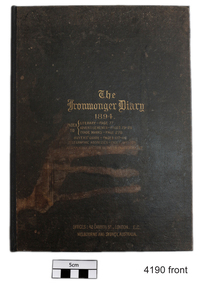
... trade directory. It was engineered to be the ultimate daily companion for anyone buying, selling, or working with metal goods. ...The 1894 edition of The Ironmonger Diary is not a personal, handwritten journal, but rather a highly specialized, annual commercial trade publication and desk reference book. It was published by The Ironmonger, the premier British trade journal for the hardware, metallurgical, and tool-making industries during the Victorian era. It served a dual purpose: part practical office desk calendar and part comprehensive trade directory. It was engineered to be the ultimate daily companion for anyone buying, selling, or working with metal goods.The Ironmonger Diary 1894 is a hard covered book bound book with gold lettering on the front cover and spine. The front cover includes an index to the information inside. It is titled on top of the inner pages "The Ironmonger Diary and Text Book". The inner pages contain blank diary pages, two weeks to an opening, with a light weight, blank pink page between the weeks. There are also Cash Book pages. The front and back sections of the diary contain product advertisements for ironmonger's wares, hardware, household goods, farm machinery, bicycles and even some clothing. There are Tables of measurements, a green-aged section called Classified List of Trade Marks and Brands, The Buyer's Guide and a list of Hallmarks on Plate (such as gold) identifying the years of manufacture.non-fictionThe 1894 edition of The Ironmonger Diary is not a personal, handwritten journal, but rather a highly specialized, annual commercial trade publication and desk reference book. It was published by The Ironmonger, the premier British trade journal for the hardware, metallurgical, and tool-making industries during the Victorian era. It served a dual purpose: part practical office desk calendar and part comprehensive trade directory. It was engineered to be the ultimate daily companion for anyone buying, selling, or working with metal goods.flagstaff hill, warrnambool, shipwrecked-coast, flagstaff-hill, flagstaff-hill-maritime-museum, maritime-museum, shipwreck-coast, flagstaff-hill-maritime-village, ironmonger diary, 1894, hardware catalogue, hardware diary -
 Federation University Historical Collection
Booklet, Berry Anderson & Co, The School of Mines and Industries, Calendar, 1914, 1913
... Metal Working School of Mines and Industries William Poole Professor A. Mica Smith Daniel Walker Hubert R. Murphy A. E. C. Kerr E. J. A. McConnon John M. Sutherland Ralph Williams E. Gutheil T. Wlliams Herbert H. Smith A. M. Lilburne M. C. Young H. J. Hall D. T. Johnson E. J. Cannon G. Clegg C. E. Campbell W. J. Hall W. H. Steane J. Wright S. H. Hodder W. J. Patterson H. W. Malin R. V. Maddison Science Department Associate Courses Certificate Courses Technical Art and Craft Department Associated Trade ...Contents of the Booklet: Associateship, Calendar, Certificate Courses - Science, Certificate Courses - Art, Draughtsman's Courses, Discipline, Discipline Board, Examination Results, Fees, Full Certificates Issued, General Regulations, Introduction, Junior Technical School, Railway Fares, Teaching Staff, Technical Art and Craft School, Subjects of Instruction - Department of Chemistry and Metallurgy, Geological Department, Engineering Department, Electrical and Electrical Engineering Department, Department of Mathematics, Department of Physics, Electrical Wiring, Electrical Engineering for Post Office Mechanics, Turning, Fitting and Blacksmithing, Telegraphy, Art and Applied Art Subjects, Architecture and Building Construction, Engineering Drawing, Carpentry and Manual Training, Dressmaking and Dresscutting, House Decoration and Signwriting, Photography, Plumbing, Sheet Metal Working Blue covered 176 page booklet relating to the School of Mines and Industries in the year 1914. school of mines and industries, william poole, professor a. mica smith, daniel walker, hubert r. murphy, a. e. c. kerr, e. j. a. mcconnon, john m. sutherland, ralph williams, e. gutheil, t. wlliams, herbert h. smith, a. m. lilburne, m. c. young, h. j. hall, d. t. johnson, e. j. cannon, g. clegg, c. e. campbell, w. j. hall, w. h. steane, j. wright, s. h. hodder, w. j. patterson, h. w. malin, r. v. maddison, science department, associate courses, certificate courses, technical art and craft department, associated trade classes, sir redmond barry, judge rogers, r m. serjeant, thomas bath, e. ballhausen, dr stewart, james oddie, associateship and final certificates, mining engineering course, metallurgy course, applied chemistry course, irrigation engineering course, certificate courses, geology course, electrical engineering course, municipal and hydraulic engineering course, chemistry, agricultural chemistry, technical chemistry, engineering chemistry, physical chemistry, metallurgy, assaying, minerology, petrology, engineering and mining department, turning and fitting, mining, electricity, electrical technology, graphical algebra and analytical geometry, physics, mechanics and heat, sound and light, technical, art, craft and trade schools, teachers' certificates, drawing, modelling, ballarat junior technical school, full certificates issued, examination results - 1910, 1911, 1912 -
 Flagstaff Hill Maritime Museum and Village
Tool - Mitre Saw Set, 1930-1955's
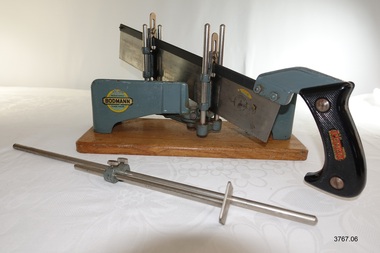
... The Sovereign of the Seas was a historic 17th century English war ship with important maritime heritage. flagstaff hill warrnambool flagstaff hill maritime museum maritime museum shipwreck coast flagstaff hill maritime village great ocean road jim williams james bernard williams ship model hobby ship model tools ship model making equipment ship model making accessories wood working tool model making tool mitre box set mitre saw bodmann and co Reinscheid, germany ulna ott of of Swabian Alb, germany ANKE of Swabian Alb, Germany Sovereign of the sea Ship model Hobby Ship model tool mitre saw set On mitre saw- 2x logos "REGISTERED / BODMANN / TRADE MARK" and embedded stamp “348”. On saw - Remnant of logo on blade “ULMIA Schutz OTT Marke” with image of a church-like tall building, and 2x , "BEST QUALITY / BODMANN / MADE IN GERMANY” Bodmann Mitre Saw set model 348, comprising metal ...This Bodmann mitre saw set was used in the making of components for the ship model Sovereign of the Seas. It is part of a collection of objects used by Jim Williams, maker of fine ship models from about 1930-1955. Most of the components for the models, as well as many of the tools, were handmade by Jim Williams. Jim’s family has donated the ship model “Sovereign of the Seas” and many tools, accessories and documents used in the making of this and other ship models have been donated to Flagstaff Hill Maritime Village. ABOUT the BRAND NAME ON THE SAW - BODMANN and CO, Germany In 1927 the Brisbane Courier Mail described Bodmann and Co of Reinscheid, Germany as "manufacturers of guaranteed tools and hardware. It appears that at least the saw has been re-badges and sold by Bodmann because (1) there are remnants of a label on the saw blade similar in shape to the Bodmann label on the mitre set (2) the removed label reveals the name and logo of "ULMIA Schutz OTT Marke" (3) one of the "Bodmann" labels on the saw handle has been applied in a crooked manner, almost leaving off the last "N". ULMIA is a German manufacturer of high quality woodworking tools. A drawing of a very similar mitre bset with saw can be seen on the ULMIA website. In 2002 the long established company ANKE of Swabian Alb, Germany (makers of cut timber, workbenches and countertops) bought out the name and trademark rights of ULMIA. HISTORY OF SOVEREIGN OF THE SEA (brief) Ship model of HMS Sovereign of the Seas, scale model of 17th Century English war ship, was handmade and carved from plans, enclosed in airtight glass case. All components of that model, including even the smallest pulleys, were hand crafted using tools designed and made by Jim. Outstanding details include functional rigging and moving cannons. Please see our record 3732 of the mode Sovereign of the Seas for further details of the ship and the Jim Williams. This mitre saw set is connected with the hobby and skill of ship model making that has been crafted as a leisure activity for many generations. The hobby is often chosen by serving and retired mariners who appreciate the connection with maritime history. This mitre saw set was used by local Warrnambool man, Jim Williams, who was employed at Cramond and Dickson clothing store, and then at Fletcher Jones menswear for 27 years. It was used in making components for the model of the historic ship, the Sovereign of the Seas. The Sovereign of the Seas was a historic 17th century English war ship with important maritime heritage. Bodmann Mitre Saw set model 348, comprising metal, adjustable mitre saw on timber stand, and metal hand saw with Bakelite handle. The mitre saw is labelled with the trademark of Bodmann, Germany, and stamped with the model number 348. The saw has Bodmann trademark badges on each side of the handle; the text on one of these badges is not quite aligned. The saw blade has remnants of a label under which the stamped logo of ULMIA Schutz OTT Marke is clearly visible. Saw is fitted with two metal guides that slide onto vertical posts on the mitre saw. Metal measuring guide holds the wood job to the correct length. Saw has a protective brown paper wrapper. This mitre saw set is part of a collection of tools and accessories once used by Jim Williams, maker of a series of ship models 1930-1955 including “HMS Sovereign of the Seas”.On mitre saw- 2x logos "REGISTERED / BODMANN / TRADE MARK" and embedded stamp “348”. On saw - Remnant of logo on blade “ULMIA Schutz OTT Marke” with image of a church-like tall building, and 2x , "BEST QUALITY / BODMANN / MADE IN GERMANY” flagstaff hill, warrnambool, flagstaff hill maritime museum, maritime museum, shipwreck coast, flagstaff hill maritime village, great ocean road, jim williams, james bernard williams, ship model hobby, ship model tools, ship model making equipment, ship model making accessories, wood working tool, model making tool, mitre box set, mitre saw, bodmann and co reinscheid, germany, ulna ott of of swabian alb, germany, anke of swabian alb, germany, sovereign of the sea, ship model, hobby, ship model tool, mitre saw set -
 Eltham District Historical Society Inc
Photograph, Peter Pidgeon, Brinkkotter family graves, Eltham Cemetery, Victoria, 5 April 2021
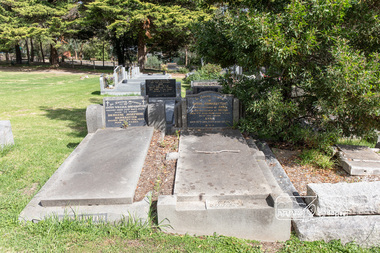
... metal-worker by trade, migrated to Australia in 1880. His initial job was to supervise the installation of ornamental ceilings in the Melbourne Exhibition Building. He moved to Research in about 1900, working...metal-worker by trade, migrated to Australia in 1880. His initial job was to supervise the installation of ornamental ceilings in the Melbourne Exhibition Building. He moved to Research in about 1900, working ...German-born Anton Brinkkotter, a skilled metal-worker by trade, migrated to Australia in 1880. His initial job was to supervise the installation of ornamental ceilings in the Melbourne Exhibition Building. He moved to Research in about 1900, working first as a plumber and tank-maker. But he is best known for having established a poultry farm (on Main Road between Research Primary School and the Maroondah Aqueduct) in 1906, which steadily grew to become one of the largest in Victoria, supplying customers all over Australia. By 1935 it was a thriving business, with buildings housing 6,000 birds and incubators capable of hatching 8,000 eggs. He died suddenly from a heart attack in 1938 and is buried with his wife Anna in Eltham Cemetery. The business was carried on by his son Anton William Brinkkotter. When electricity came to Research in 1940, the Brinkkotter Poultry Farm was the very first customer, enabling further expansion and modernisation. Two electric incubators were installed with a capacity of 10,000 eggs each. Anton William Brinkkotter became active in public affairs, a trustee of the Eltham Public Hall in Henry Street and was an Eltham Shire Councillor between 1941 and 1961 serving three years as Shire President. The Brinkkotter house in Dudley Street was used to house the Eltham Library prior to a dedicated Library being completed with the southern wing of the Shire offices in 1971. He died in 1970 and is buried with his wife Bridgene in Eltham Cemetery, alongside his parents. In Loving Memory Of Anton William Brinkkotter Passed away 29th Sept. 1970 Aged 72 years Bridgene Josephine Brinkkotter Passed away 5th Feb. 1995 Aged 90 years R.I.P. and In Loving memory Of Anton Brinkkotter Loved husband of Anna & loving father of Anton Died 7th June 1938 aged 71 yrs. Also the above Anna Died 12th Jan. 1954 aged 80 yrs. R.I.P.Born Digitaleltham cemetery, gravestones, anna brinkkotter, anton brinkkotter, anton william brinkkotter, bridgene josephine brinkkotter -
 NMIT (Northern Melbourne Institute of TAFE)
Plumbing tools: CTS and PTS 1920s onwards, Plumbing tools and texts used in teaching 1920s
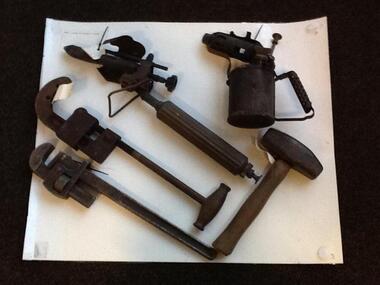
... Includes: Kerosene blow torch X 2 (1930s-); Stillson Grips; Pipe Cutter; Mash hammer; Adjustable spanner X 3 different sizes; Caulking tool; 5 way tee, 2X3 way tee, 4 way tee (1930s-); Old Handmade lead traps (student work) X 2; Metal tool tray holding; Offset adjustable spud spanner; Pear shaped lead working mallet; Bossing tool for lead work (1880s-1920s); Soldering iron (1920s-); Set square; Large screwdriver; Also Plumbing texts: • Problems for elementary physics, new rev. edn., by Thomas Tasker and Alexander Boden, Science Press, Sydney, 1966. • Gasfitting. Printed and published by McCarron Bird Pty. Ltd. [Melbourne] • Trade...Includes: Kerosene blow torch X 2 (1930s-); Stillson Grips; Pipe Cutter; Mash hammer; Adjustable spanner X 3 different sizes; Caulking tool; 5 way tee, 2X3 way tee, 4 way tee (1930s-); Old Handmade lead traps (student work) X 2; Metal tool tray holding; Offset adjustable spud spanner; Pear shaped lead working mallet; Bossing tool for lead work (1880s-1920s); Soldering iron (1920s-); Set square; Large screwdriver; Also Plumbing texts: • Problems for elementary physics, new rev. edn., by Thomas Tasker and Alexander Boden, Science Press, Sydney, 1966. • Gasfitting. Printed and published by McCarron Bird Pty. Ltd. [Melbourne] • Trade ...A number of Plumbing tools dating from 1880s-1970s and used in teaching at Collingwood Technical School then also at Preston Technical School and at Northern Metropolitan College of TAFE's Heidelberg campus. Includes: Kerosene blow torch X 2 (1930s-); Stillson Grips; Pipe Cutter; Mash hammer; Adjustable spanner X 3 different sizes; Caulking tool; 5 way tee, 2X3 way tee, 4 way tee (1930s-); Old Handmade lead traps (student work) X 2; Metal tool tray holding; Offset adjustable spud spanner; Pear shaped lead working mallet; Bossing tool for lead work (1880s-1920s); Soldering iron (1920s-); Set square; Large screwdriver; Also Plumbing texts: • Problems for elementary physics, new rev. edn., by Thomas Tasker and Alexander Boden, Science Press, Sydney, 1966. • Gasfitting. Printed and published by McCarron Bird Pty. Ltd. [Melbourne] • Trade science for plumbing apprentices, Education Dept. Victoria, 1954 • Sanitary Plumbing and water supply, Dept. of Labour • Gasfitting, produced by members of the Colonial Gas Association Limited, Gas and Fuel Corporation of Victoria, and the Technical Division of the Education Department of Victoria. Rev metric edn. 1976 • Mechanical world year book 1953, Manchester Emmott & Co., 1953 collingwood technical school, preston technical school, northern metropolitan college of tafe, plumbing tools, plumbing texts, nmit -
 Bendigo Historical Society Inc.
Document - IAN DYETT COLLECTION: AUCTION CATALOGUE - PARKS VICTORIA
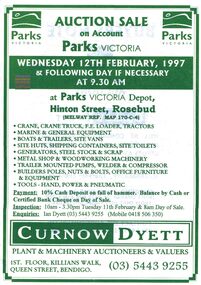
... metal and wood working machinery, steel and scrap, office furniture and equipment and various tools. Announcement printed in the front of catalogue mentions that J. H. Curnow & Son Pty. Ltd. Are combining their name with the Dyett family and trading...metal and wood working machinery, steel and scrap, office furniture and equipment and various tools. Announcement printed in the front of catalogue mentions that J. H. Curnow & Son Pty. Ltd. Are combining their name with the Dyett family and trading ...White paper catalogue with green printing for a sale on account of Parks Victoria, on 12th February 1997 at Rosebud. For sale were vehicles, marine equipment, boats & trailers, metal and wood working machinery, steel and scrap, office furniture and equipment and various tools. Announcement printed in the front of catalogue mentions that J. H. Curnow & Son Pty. Ltd. Are combining their name with the Dyett family and trading as Curnow Dyett, Real Estate Agents, Auctioneers and Qualified Valuers.business, auctioneers, curnow dyett, ian dyett collection - auction catalogue - parks victoria, ian dyett, curnow dyett, j h curnow & son pty ltd, occupational health and safety act 1985, noel dyett, ian dyett, fred dyett -
 Bendigo Historical Society Inc.
Document - IAN DYETT COLLECTION: AUCTION CATALOGUE - PARKS VICTORIA - AH PLANT & OTHERS
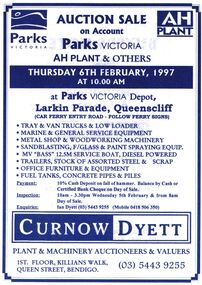
... For sale were vehicles, marine equipment, boat, metal and wood working machinery, trailers, steel and scrap, office furniture and equipment, fuel tanks, concrete pipes and piles. Announcement printed in the front of catalogue mentions that J. H. Curnow & Son Pty. Ltd. Are combining their name with the Dyett family and trading...For sale were vehicles, marine equipment, boat, metal and wood working machinery, trailers, steel and scrap, office furniture and equipment, fuel tanks, concrete pipes and piles. Announcement printed in the front of catalogue mentions that J. H. Curnow & Son Pty. Ltd. Are combining their name with the Dyett family and trading ...White paper catalogue with blue printing for a sale on account of Parks Victoria, AH Plant & Others on 6th February 1997 at Queenscliff. For sale were vehicles, marine equipment, boat, metal and wood working machinery, trailers, steel and scrap, office furniture and equipment, fuel tanks, concrete pipes and piles. Announcement printed in the front of catalogue mentions that J. H. Curnow & Son Pty. Ltd. Are combining their name with the Dyett family and trading as Curnow Dyett, Real Estate Agents, Auctioneers and Qualified Valuers.business, auctioneers, curnow dyett, ian dyett collection - auction catalogue - parks victoria - ah plant & others, j h curnow & son pty ltd, curnow, dyett, curnow dyett, noel dyett, ian dyett, fred dyett, occupational health and safety act 1985 -
 Eltham District Historical Society Inc
Photograph, Lester Neil Ingram with his Morris Ten Series II delivery van, c.1942
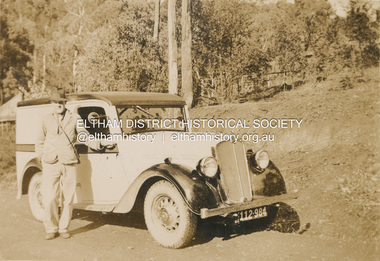
... A sheet metal worker by trade, Lester had run the bakery business for 14 years, his father retired, and was working as a baker at Anglesea when he enlisted in the R.A.A.F. on 5 December 1941 at Melbourne. ...A sheet metal worker by trade, Lester had run the bakery business for 14 years, his father retired, and was working as a baker at Anglesea when he enlisted in the R.A.A.F. on 5 December 1941 at Melbourne. ...The van is a Morris Ten Series II which was manufactured 1935-1937. The numeral only Victorian Registration plate 112-984 was part of the sequence of numeral only plates issued 1910-1939. Lester Neil Ingram was born at Kew, 8 November 1911, the son of John and Ada (Key) Ingram of Research. According to Electoral Roll records, in 1903, John Ingram was a farmer at Lancefield, his wife Ada, a milliner. By 1906, John Ingram was a baker at Research and from about 1912, an orchardist. The family moved to Anglesea River sometime between 1937 and 1942. A sheet metal worker by trade, Lester had run the bakery business for 14 years, his father retired, and was working as a baker at Anglesea when he enlisted in the R.A.A.F. on 5 December 1941 at Melbourne. Previously he had worked as a baker at Research (1937). He undertook training as Aircrew at No. 4 Initial Training School at Victor Harbour, South Australia, followed by No. 1 Wireless Air Gunners School at Ballarat, Victoria, and No. 3 Bombing and Gunnery School, West Sale, Victoria. On October 15, 1942 Lester qualified as an Air Gunner, promoted to Sergeant, and was posted to 1 Embarkation Depot at Ascot Vale, Victoria, and attached to R.A.F. UK. Lester embarked from Australia December 2, 1942 and arrived at 11 Personnel Despatch and Reception Depot on January 13, 1943. On March 9 he was transferred to 10 Operational Training Unit, Group No. 91, Bomber Command, R.A.F. Lester’s service file reveals that on the evening of 22 April 1943, Lester was a member of the aircrew of Whitley V bomber, N.1374. The airframe had run 1,127 hours. A full moon was just rising. The flight was non-operational, its purpose a dual conversion on type mission flown by a student pilot with almost two hours completed at night on similar flights. They had just changed aircraft as their previous aircraft had become unserviceable. The pilot had accepted the aircraft, which was technically unserviceable as the NCO in charge of flight had not completed the inspection paperwork correctly. The aircraft had undergone a major engine repair the day before. The aircraft took off at 2348 hours from R.A.F. Abington. It was reported that the aircraft take-off was quite normal and after climbing to 800 feet it passed out of view of the ground observers. A few seconds later the aircraft crashed, and it was reported that the sound of the engines seemed to become desynchronised. The crash occurred one and a half miles northwest of Longworth, Berkshire and the aircraft destroyed by fire. It carried a crew of five. Lester is commemorated on the Eltham Roll of Honour Board, which was commissioned by the Eltham War Memorial Trust to be hung in the Eltham Infant Welfare Centre, part of complex of buildings that form the Eltham War Memorial. The Honour Roll is presently (2023) hanging in the Eltham Library Community Gallery space. Lester was remembered with the following notices published in The Argus newspaper, Saturday 22 April 1944, p2: INGRAM. —In treasured memories you are with me still. Sgt. Lester Neil Ingram, killed, aircraft accident, England, April 22, 1943. (Mother and father.) INGRAM. —In proud and ever loving memory of Lester, 410236, Sgt. L. N. Ingram, R.A.A.F., air crash England, April 22, 1943. —Per ardua ad astra. (Ellen Peake and family.) [“Per ardua ad astra” is a Latin phrase meaning “through adversity to the stars” or “through struggle to the stars” which was the motto of the Royal Air Force and other Commonwealth air forces such as the Royal Australian Air Force.] And from his fiancé Ellen, in The Argus, Wednesday, 5 May 1943, p2: INGRAM. —On April 22 (result of aircraft accident near Lodgeworth Village, Berks, England), Sgt. Lester Neil Ingram, R.A.A.F., fiance of Ellen. -Treasured memories till we meet again. Lester is buried at Brookwood Military Cemetery, Surrey, United Kingdom, Grave 4. 1. 11. INGRAM, Flt. Sgt. LESTER NEIL, 410236. R.A.A.F. 22nd April 1943. Age 31. Son of John and Ada Ingram, of Anglesea, Victoria, Australia. He gave his life For freedom’s cause ◊ ◊ ◊ LEST WE FORGET “They shall grow not old, as we that are left grow old; Age shall not weary them, nor the years condemn. At the going down of the sun and in the morning We will remember them.”On reverse "Lester Ingram"112-984 (victorian registration), lester neil ingram, morris ten series ii, bakery, delivery van, pam thoonen (nee ingram) collection -
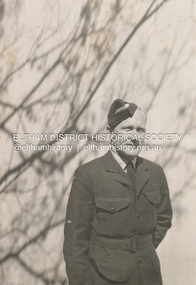 Eltham District Historical Society Inc
Photograph, Leading Aircraftsman, Lester Neil Ingram, RAAF, c.1943
... A sheet metal worker by trade, Lester had run the bakery business for 14 years, his father retired, and was working as a baker at Anglesea when he enlisted in the R.A.A.F. on 5 December 1941 at Melbourne. ...A sheet metal worker by trade, Lester had run the bakery business for 14 years, his father retired, and was working as a baker at Anglesea when he enlisted in the R.A.A.F. on 5 December 1941 at Melbourne. ...Lester Neil Ingram was born at Kew, 8 November 1911, the son of John and Ada (Key) Ingram of Research. According to Electoral Roll records, in 1903, John Ingram was a farmer at Lancefield, his wife Ada, a milliner. By 1906, John Ingram was a baker at Research and from about 1912, an orchardist. The family moved to Anglesea River sometime between 1943 and 1949. A sheet metal worker by trade, Lester had run the bakery business for 14 years, his father retired, and was working as a baker at Anglesea when he enlisted in the R.A.A.F. on 5 December 1941 at Melbourne. Previously he had worked as a baker at Research (1937). He undertook training as Aircrew at No. 4 Initial Training School at Victor Harbour, South Australia, followed by No. 1 Wireless Air Gunners School at Ballarat, Victoria, and No. 3 Bombing and Gunnery School, West Sale, Victoria. On October 15, 1942 Lester qualified as an Air Gunner, promoted to Sergeant, and was posted to 1 Embarkation Depot at Ascot Vale, Victoria, and attached to R.A.F. UK. Lester embarked from Australia December 2, 1942 and arrived at 11 Personnel Despatch and Reception Depot on January 13, 1943. On March 9 he was transferred to 10 Operational Training Unit, Group No. 91, Bomber Command, R.A.F. Lester’s service file reveals that on the evening of 22 April 1943, Lester was a member of the aircrew of Whitley V bomber, N.1374. The airframe had run 1,127 hours. A full moon was just rising. The flight was non-operational, its purpose a dual conversion on type mission flown by a student pilot with almost two hours completed at night on similar flights. They had just changed aircraft as their previous aircraft had become unserviceable. The pilot had accepted the aircraft, which was technically unserviceable as the NCO in charge of flight had not completed the inspection paperwork correctly. The aircraft had undergone a major engine repair the day before. The aircraft took off at 2348 hours from R.A.F. Abington. It was reported that the aircraft take-off was quite normal and after climbing to 800 feet it passed out of view of the ground observers. A few seconds later the aircraft crashed, and it was reported that the sound of the engines seemed to become desynchronised. The crash occurred one and a half miles northwest of Longworth, Berkshire and the aircraft destroyed by fire. It carried a crew of five. Lester is commemorated on the Eltham Roll of Honour Board, which was commissioned by the Eltham War Memorial Trust to be hung in the Eltham Infant Welfare Centre, part of complex of buildings that form the Eltham War Memorial. The Honour Roll is presently (2023) hanging in the Eltham Library Community Gallery space. Lester was remembered with the following notices published in The Argus newspaper, Saturday 22 April 1944, p2: INGRAM. —In treasured memories you are with me still. Sgt. Lester Neil Ingram, killed, aircraft accident, England, April 22, 1943. (Mother and father.) INGRAM. —In proud and ever loving memory of Lester, 410236, Sgt. L. N. Ingram, R.A.A.F., air crash England, April 22, 1943. —Per ardua ad astra. (Ellen Peake and family.) [“Per ardua ad astra” is a Latin phrase meaning “through adversity to the stars” or “through struggle to the stars” which was the motto of the Royal Air Force and other Commonwealth air forces such as the Royal Australian Air Force.] And from his fiancé Ellen, in The Argus, Wednesday, 5 May 1943, p2: INGRAM. —On April 22 (result of aircraft accident near Lodgeworth Village, Berks, England), Sgt. Lester Neil Ingram, R.A.A.F., fiance of Ellen. -Treasured memories till we meet again. Lester is buried at Brookwood Military Cemetery, Surrey, United Kingdom, Grave 4. 1. 11. INGRAM, Flt. Sgt. LESTER NEIL, 410236. R.A.A.F. 22nd April 1943. Age 31. Son of John and Ada Ingram, of Anglesea, Victoria, Australia. He gave his life For freedom’s cause ◊ ◊ ◊ LEST WE FORGET “They shall grow not old, as we that are left grow old; Age shall not weary them, nor the years condemn. At the going down of the sun and in the morning We will remember them.”On reverse "Lester Ingram"lester neil ingram, baker, eltham, honour board, raaf, research (vic.), roll of honour, pam thoonen (nee ingram) collection -
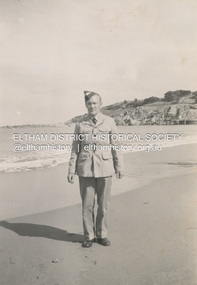 Eltham District Historical Society Inc
Photograph, Leading Aircraftsman, Lester Neil Ingram, RAAF, c.1943
... A sheet metal worker by trade, Lester had run the bakery business for 14 years, his father retired, and was working as a baker at Anglesea when he enlisted in the R.A.A.F. on 5 December 1941 at Melbourne. ...A sheet metal worker by trade, Lester had run the bakery business for 14 years, his father retired, and was working as a baker at Anglesea when he enlisted in the R.A.A.F. on 5 December 1941 at Melbourne. ...Lester Neil Ingram was born at Kew, 8 November 1911, the son of John and Ada (Key) Ingram of Research. According to Electoral Roll records, in 1903, John Ingram was a farmer at Lancefield, his wife Ada, a milliner. By 1906, John Ingram was a baker at Research and from about 1912, an orchardist. The family moved to Anglesea River sometime between 1943 and 1949. A sheet metal worker by trade, Lester had run the bakery business for 14 years, his father retired, and was working as a baker at Anglesea when he enlisted in the R.A.A.F. on 5 December 1941 at Melbourne. Previously he had worked as a baker at Research (1937). He undertook training as Aircrew at No. 4 Initial Training School at Victor Harbour, South Australia, followed by No. 1 Wireless Air Gunners School at Ballarat, Victoria, and No. 3 Bombing and Gunnery School, West Sale, Victoria. On October 15, 1942 Lester qualified as an Air Gunner, promoted to Sergeant, and was posted to 1 Embarkation Depot at Ascot Vale, Victoria, and attached to R.A.F. UK. Lester embarked from Australia December 2, 1942 and arrived at 11 Personnel Despatch and Reception Depot on January 13, 1943. On March 9 he was transferred to 10 Operational Training Unit, Group No. 91, Bomber Command, R.A.F. Lester’s service file reveals that on the evening of 22 April 1943, Lester was a member of the aircrew of Whitley V bomber, N.1374. The airframe had run 1,127 hours. A full moon was just rising. The flight was non-operational, its purpose a dual conversion on type mission flown by a student pilot with almost two hours completed at night on similar flights. They had just changed aircraft as their previous aircraft had become unserviceable. The pilot had accepted the aircraft, which was technically unserviceable as the NCO in charge of flight had not completed the inspection paperwork correctly. The aircraft had undergone a major engine repair the day before. The aircraft took off at 2348 hours from R.A.F. Abington. It was reported that the aircraft take-off was quite normal and after climbing to 800 feet it passed out of view of the ground observers. A few seconds later the aircraft crashed, and it was reported that the sound of the engines seemed to become desynchronised. The crash occurred one and a half miles northwest of Longworth, Berkshire and the aircraft destroyed by fire. It carried a crew of five. Lester is commemorated on the Eltham Roll of Honour Board, which was commissioned by the Eltham War Memorial Trust to be hung in the Eltham Infant Welfare Centre, part of complex of buildings that form the Eltham War Memorial. The Honour Roll is presently (2023) hanging in the Eltham Library Community Gallery space. Lester was remembered with the following notices published in The Argus newspaper, Saturday 22 April 1944, p2: INGRAM. —In treasured memories you are with me still. Sgt. Lester Neil Ingram, killed, aircraft accident, England, April 22, 1943. (Mother and father.) INGRAM. —In proud and ever loving memory of Lester, 410236, Sgt. L. N. Ingram, R.A.A.F., air crash England, April 22, 1943. —Per ardua ad astra. (Ellen Peake and family.) [“Per ardua ad astra” is a Latin phrase meaning “through adversity to the stars” or “through struggle to the stars” which was the motto of the Royal Air Force and other Commonwealth air forces such as the Royal Australian Air Force.] And from his fiancé Ellen, in The Argus, Wednesday, 5 May 1943, p2: INGRAM. —On April 22 (result of aircraft accident near Lodgeworth Village, Berks, England), Sgt. Lester Neil Ingram, R.A.A.F., fiance of Ellen. -Treasured memories till we meet again. Lester is buried at Brookwood Military Cemetery, Surrey, United Kingdom, Grave 4. 1. 11. INGRAM, Flt. Sgt. LESTER NEIL, 410236. R.A.A.F. 22nd April 1943. Age 31. Son of John and Ada Ingram, of Anglesea, Victoria, Australia. He gave his life For freedom’s cause ◊ ◊ ◊ LEST WE FORGET “They shall grow not old, as we that are left grow old; Age shall not weary them, nor the years condemn. At the going down of the sun and in the morning We will remember them.”On reverse "Lester Ingram"lester neil ingram, baker, eltham, honour board, raaf, research (vic.), roll of honour, pam thoonen (nee ingram) collection -
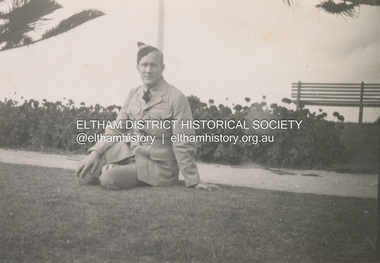 Eltham District Historical Society Inc
Photograph, Leading Aircraftsman, Lester Neil Ingram, RAAF, c.1943
... A sheet metal worker by trade, Lester had run the bakery business for 14 years, his father retired, and was working as a baker at Anglesea when he enlisted in the R.A.A.F. on 5 December 1941 at Melbourne. ...A sheet metal worker by trade, Lester had run the bakery business for 14 years, his father retired, and was working as a baker at Anglesea when he enlisted in the R.A.A.F. on 5 December 1941 at Melbourne. ...Lester Neil Ingram was born at Kew, 8 November 1911, the son of John and Ada (Key) Ingram of Research. According to Electoral Roll records, in 1903, John Ingram was a farmer at Lancefield, his wife Ada, a milliner. By 1906, John Ingram was a baker at Research and from about 1912, an orchardist. The family moved to Anglesea River sometime between 1943 and 1949. A sheet metal worker by trade, Lester had run the bakery business for 14 years, his father retired, and was working as a baker at Anglesea when he enlisted in the R.A.A.F. on 5 December 1941 at Melbourne. Previously he had worked as a baker at Research (1937). He undertook training as Aircrew at No. 4 Initial Training School at Victor Harbour, South Australia, followed by No. 1 Wireless Air Gunners School at Ballarat, Victoria, and No. 3 Bombing and Gunnery School, West Sale, Victoria. On October 15, 1942 Lester qualified as an Air Gunner, promoted to Sergeant, and was posted to 1 Embarkation Depot at Ascot Vale, Victoria, and attached to R.A.F. UK. Lester embarked from Australia December 2, 1942 and arrived at 11 Personnel Despatch and Reception Depot on January 13, 1943. On March 9 he was transferred to 10 Operational Training Unit, Group No. 91, Bomber Command, R.A.F. Lester’s service file reveals that on the evening of 22 April 1943, Lester was a member of the aircrew of Whitley V bomber, N.1374. The airframe had run 1,127 hours. A full moon was just rising. The flight was non-operational, its purpose a dual conversion on type mission flown by a student pilot with almost two hours completed at night on similar flights. They had just changed aircraft as their previous aircraft had become unserviceable. The pilot had accepted the aircraft, which was technically unserviceable as the NCO in charge of flight had not completed the inspection paperwork correctly. The aircraft had undergone a major engine repair the day before. The aircraft took off at 2348 hours from R.A.F. Abington. It was reported that the aircraft take-off was quite normal and after climbing to 800 feet it passed out of view of the ground observers. A few seconds later the aircraft crashed, and it was reported that the sound of the engines seemed to become desynchronised. The crash occurred one and a half miles northwest of Longworth, Berkshire and the aircraft destroyed by fire. It carried a crew of five. Lester is commemorated on the Eltham Roll of Honour Board, which was commissioned by the Eltham War Memorial Trust to be hung in the Eltham Infant Welfare Centre, part of complex of buildings that form the Eltham War Memorial. The Honour Roll is presently (2023) hanging in the Eltham Library Community Gallery space. Lester was remembered with the following notices published in The Argus newspaper, Saturday 22 April 1944, p2: INGRAM. —In treasured memories you are with me still. Sgt. Lester Neil Ingram, killed, aircraft accident, England, April 22, 1943. (Mother and father.) INGRAM. —In proud and ever loving memory of Lester, 410236, Sgt. L. N. Ingram, R.A.A.F., air crash England, April 22, 1943. —Per ardua ad astra. (Ellen Peake and family.) [“Per ardua ad astra” is a Latin phrase meaning “through adversity to the stars” or “through struggle to the stars” which was the motto of the Royal Air Force and other Commonwealth air forces such as the Royal Australian Air Force.] And from his fiancé Ellen, in The Argus, Wednesday, 5 May 1943, p2: INGRAM. —On April 22 (result of aircraft accident near Lodgeworth Village, Berks, England), Sgt. Lester Neil Ingram, R.A.A.F., fiance of Ellen. -Treasured memories till we meet again. Lester is buried at Brookwood Military Cemetery, Surrey, United Kingdom, Grave 4. 1. 11. INGRAM, Flt. Sgt. LESTER NEIL, 410236. R.A.A.F. 22nd April 1943. Age 31. Son of John and Ada Ingram, of Anglesea, Victoria, Australia. He gave his life For freedom’s cause ◊ ◊ ◊ LEST WE FORGET “They shall grow not old, as we that are left grow old; Age shall not weary them, nor the years condemn. At the going down of the sun and in the morning We will remember them.”On reverse "Lester Ingram"lester neil ingram, baker, eltham, honour board, raaf, research (vic.), roll of honour, pam thoonen (nee ingram) collection -
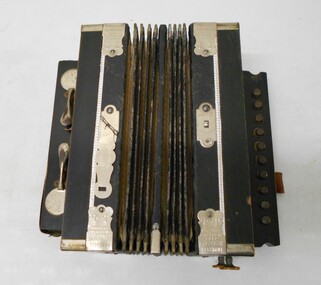 Bendigo Historical Society Inc.
Instrument - MALONE COLLECTION: KALBE'S IMPERIAL BUTTON ACCORDION
... metal keys for bass chords and one key for the bellows. Case of black polished wood, bellows has nine folds. Nickel plated markings on corners of bellows read "Imperial Accordion, made in Germany, trade mark" with images of two fouled anchors. The accordion is in working...metal keys for bass chords and one key for the bellows. Case of black polished wood, bellows has nine folds. Nickel plated markings on corners of bellows read "Imperial Accordion, made in Germany, trade mark" with images of two fouled anchors. The accordion is in working ...Kalbe’s Imperial Accordion Made in Germany. Ten metal keys on right hand side; on left hand side two metal keys for bass chords and one key for the bellows. Case of black polished wood, bellows has nine folds. Nickel plated markings on corners of bellows read "Imperial Accordion, made in Germany, trade mark" with images of two fouled anchors. The accordion is in working condition. A cleaning brush is included.musical instruments, keyboard, button accordion -
 Port of Echuca
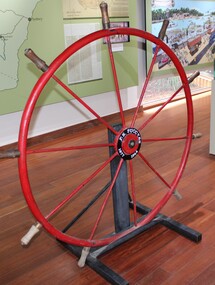
Instrument - Steering Wheel, PS Success, 1877
... trade in the 1870s. She had a long, colourful history towing barges on the Murray River and in particular in the Mildura, Wentworth and Ned's Corner regions. Importantly, the Success was the last paddlesteamer to be working on the river system right up until the 1956 floods rescuing sheep and wool. The steering wheel is an important original element of the PS Success and her hopes for restoration one day. Red metal ...This steering wheel is from the PS Success. The PS Success was built in Moama in 1877 by GB Air for Westwood & Air. The Success towed barges of sawn red gum, wool & other cargo along the Darling and Murray Rivers as well as running as a passenger boat from Swan Hill to Mildura during 1915-16. The Success ended her working life in 1957 and was put up on the bank at Neds Corner, 80kms west of Mildura. The PS Success was donated to the Riverboat Historical and Preservation Society of Mildura with plans for full restoration but with funds becoming extremely difficult to secure, the Shire of Campaspe was approached to take ownership in 2009 to enable further restoration when possible. The Riverboat Preservation Society also donated this original steering wheel.The PS Success was an important vessel built in the Echuca area during the height of the Riverboat trade in the 1870s. She had a long, colourful history towing barges on the Murray River and in particular in the Mildura, Wentworth and Ned's Corner regions. Importantly, the Success was the last paddlesteamer to be working on the river system right up until the 1956 floods rescuing sheep and wool. The steering wheel is an important original element of the PS Success and her hopes for restoration one day. Red metal steering wheel with 10 spokes sitting on a heavy iron wheel stand. -
![Royal Australian Nursing Federation campaign badge, [1986?]](/media/collectors/5bb42dc221eaf31100db1d3b/items/5c4668dc21ea670150f8e407/item-media/5c46691f21ea670150f94202/item-fit-380x285.jpg?cb=6) Australian Nursing & Midwifery Federation
Australian Nursing & Midwifery FederationRoyal Australian Nursing Federation campaign badge, [1986?]
... working conditions in the 1980s, possibly during the historic 1986 Victorian 50-day nurses strike. The Royal Australian Nursing Federation (RANF) became the Australian Nursing Federation in 1989, suggesting that this button is from the late 1980s. Similar to the badges worn in this photo [https://stories.anmfvic.asn.au/86strike/media/2560-1440-landscape-sec2-contentb-hr_logwf7a.jpg] from 1986 (see individual on the far right). nursing industrial action strike action unionism badges nurses buttons pins campaigning trade unions labour history Circular white and blue plastic button. Silver metal ...Distributed to nurses during campaigning for improved wages and working conditions in the 1980s, possibly during the historic 1986 Victorian 50-day nurses strike. The Royal Australian Nursing Federation (RANF) became the Australian Nursing Federation in 1989, suggesting that this button is from the late 1980s. Similar to the badges worn in this photo [https://stories.anmfvic.asn.au/86strike/media/2560-1440-landscape-sec2-contentb-hr_logwf7a.jpg] from 1986 (see individual on the far right).Circular white and blue plastic button. Silver metal, plastic-coated, with safety pin fastener adhered to back. Button printed with 'KEEP NURSES NURSING - Improve Nurses' Conditions' and 'R.A.N.F. [Royal Australian Nursing Federation] Vic. [Victorian] Branch'.nursing, industrial action, strike action, unionism, badges, nurses, buttons, pins, campaigning, trade unions, labour history -
![Midwives Action Group/Royal Australian Nursing Federation campaign badge, [1980s]](/media/collectors/5bb42dc221eaf31100db1d3b/items/5c469b7521ea690150fc8414/item-media/5c469b7d21ea690150fc96c2/item-fit-380x285.jpg?cb=6) Australian Nursing & Midwifery Federation
Australian Nursing & Midwifery FederationMidwives Action Group/Royal Australian Nursing Federation campaign badge, [1980s]
... working conditions and wages that the Royal Australian Nursing Federation was campaigning to improve. The Royal Australian Nursing Federation (RANF) became the Australian Nursing Federation in 1989, suggesting that this badge is from the late 1980s. midwives midwifery nurses nursing midwives action group royal australian nursing federation trade unions unionism labour history Circular blue and white plastic badge. Silver metal ...Created and distributed by the Midwives Action Group, a Special Interest Group of the Royal Australian Nursing Federation (now the Australian Nursing and Midwifery Federation). The phrase on the badge, 'midwives make it a labour of love' is drawing attention to the inadequate working conditions and wages that the Royal Australian Nursing Federation was campaigning to improve. The Royal Australian Nursing Federation (RANF) became the Australian Nursing Federation in 1989, suggesting that this badge is from the late 1980s.Circular blue and white plastic badge. Silver metal, plastic-coated, with safety pin fastener adhered to back. Badge printed with 'MIDWIVES ACTION GROUP', 'MIDWIVES MAKE IT A LABOUR OF LOVE' and 'R.A.N.F. [Royal Australian Nursing Federation] Vic. [Victorian] Branch'.midwives, midwifery, nurses, nursing, midwives action group, royal australian nursing federation, trade unions, unionism, labour history -
![Royal Australian Nursing Federation campaign badge, [1980s?]](/media/collectors/5bb42dc221eaf31100db1d3b/items/5c46a55421ea69015009151d/item-media/5c46a55e21ea690150092e74/item-fit-380x285.jpg?cb=6) Australian Nursing & Midwifery Federation
Australian Nursing & Midwifery FederationRoyal Australian Nursing Federation campaign badge, [1980s?]
... working conditions in the 1980s. The Royal Australian Nursing Federation (RANF) became the Australian Nursing Federation in 1989, suggesting that this button is from the late 1980s. nursing nurses unionism royal australian nursing federation badges buttons pins campaigning lobbying trade unions labour history Circular black and white plastic badge. Silver metal ...Distributed to nurses during campaigning for improved wages and working conditions in the 1980s. The Royal Australian Nursing Federation (RANF) became the Australian Nursing Federation in 1989, suggesting that this button is from the late 1980s.Circular black and white plastic badge. Silver metal, plastic-coated, with safety pin fastener adhered to back. Badge printed with an illustration of patients, a triangle design and with the words 'PROFESSIONAL', 'PRACTICE', 'STANDARDS', 'CARE' and 'R.A.N.F. [Royal Australian Nursing Federation]'.nursing, nurses, unionism, royal australian nursing federation, badges, buttons, pins, campaigning, lobbying, trade unions, labour history -
![Royal Australian Nursing Federation campaign badge, [1986?]](/media/collectors/5bb42dc221eaf31100db1d3b/items/5c4928d121ea731428168726/item-media/5c4928da21ea731428169161/item-fit-380x285.jpg?cb=6) Australian Nursing & Midwifery Federation
Australian Nursing & Midwifery FederationRoyal Australian Nursing Federation campaign badge, [1986?]
... working conditions. The Royal Australian Nursing Federation (RANF) became the Australian Nursing Federation in 1989, suggesting that this button is from the late 1980s. Similar to the badges worn in this photo [https://stories.anmfvic.asn.au/86strike/media/2560-1440-landscape-sec2-contentb-hr_logwf7a.jpg] from 1986 (see individual on the far right). nursing nurses industrial action strike action unionism trade unions badges buttons pins campaigning 1986 victorian nurses strike labour history royal australian nursing federation victoria australia Circular white and blue plastic badge. Silver metal ...Distributed to nurses during campaigning for improved wages and working conditions in the 1980s, possibly during the historic 1986 Victorian 50-day nurses strike. 'Charge Nurse' refers to a Nurse Manager, and is less commonly used in Australia presently (it is still widely used in North America). The badge's message aims to inform the public that highly experienced and skilled nurses are leaving the profession due to inadequate wages and poor working conditions. The Royal Australian Nursing Federation (RANF) became the Australian Nursing Federation in 1989, suggesting that this button is from the late 1980s. Similar to the badges worn in this photo [https://stories.anmfvic.asn.au/86strike/media/2560-1440-landscape-sec2-contentb-hr_logwf7a.jpg] from 1986 (see individual on the far right).Circular white and blue plastic badge. Silver metal, plastic-coated, with safety pin fastener adhered to back. Badge printed with 'I used to be a Charge Nurse' and 'R.A.N.F. [Royal Australian Nursing Federation] Vic. [Victorian] Branch'.nursing, nurses, industrial action, strike action, unionism, trade unions, badges, buttons, pins, campaigning, 1986 victorian nurses strike, labour history, royal australian nursing federation, victoria, australia -
![Royal Australian Nursing Federation campaign badge, [1986?]](/media/collectors/5bb42dc221eaf31100db1d3b/items/5c4949a821ea731428437a84/item-media/5c4949c621ea73142843a678/item-fit-380x285.jpg?cb=6) Australian Nursing & Midwifery Federation
Australian Nursing & Midwifery FederationRoyal Australian Nursing Federation campaign badge, [1986?]
... This struggle was made particularly visible through the 1986 Victorian nurses' strike, which had great impact on the way Australian society viewed nurses and working women (Bessant, 1992). nursing nurses industrial action strike action unionism trade unions badges buttons pins campaigning 1986 victorian nurses strike labour history royal australian nursing federation victoria australia Circular white and red plastic badge. Silver metal ...Distributed to nurses during campaigning for improved wages and working conditions in the 1980s, possibly during the historic 1986 Victorian 50-day nurses strike. In October 1986, Victorian nurses began their longest strike after the failure of repeated talks with the health minister David White who was committed to reducing the classification and pay of almost half of Victoria’s nurses. Skeleton staff were left in the wards while picket lines, tents and caravans were set up outside hospitals in both metropolitan and regional Victoria. After 50 days of industrial action, Victorian nurses voted to return to work on 20 December 1986. The Royal Australian Nursing Federation (RANF) became the Australian Nursing Federation in 1989, suggesting that this button is from the late 1980s. Similar to the badges worn in this photo [https://stories.anmfvic.asn.au/86strike/media/2560-1440-landscape-sec2-contentb-hr_logwf7a.jpg] from 1986 (see individual on the far right).This badge is of historic significance as it represents nurses' struggle for industrial and professional status. This struggle was made particularly visible through the 1986 Victorian nurses' strike, which had great impact on the way Australian society viewed nurses and working women (Bessant, 1992).Circular white and red plastic badge. Silver metal, plastic-coated, with safety pin fastener adhered to back. Badge printed with 'Nurses DO dare to Struggle' and 'R.A.N.F. [Royal Australian Nursing Federation] Vic. [Victorian] Branch'.nursing, nurses, industrial action, strike action, unionism, trade unions, badges, buttons, pins, campaigning, 1986 victorian nurses strike, labour history, royal australian nursing federation, victoria, australia -
![Australian Nursing Federation Victorian Branch campaign badge, [1990s-2000s?]](/media/collectors/5bb42dc221eaf31100db1d3b/items/5c526e6121ea6910d85a4fb4/item-media/5c526e6b21ea6910d85a702b/item-fit-380x285.jpg?cb=6) Australian Nursing & Midwifery Federation
Australian Nursing & Midwifery FederationAustralian Nursing Federation Victorian Branch campaign badge, [1990s-2000s?]
... working in emergency departments. The Royal Australian Nursing Federation became the Australian Nursing Federation (ANF) in 1989, and then became the Australian Nursing and Midwifery Federation in 2013, suggesting this badge is from the 1990s or early 2000s. nursing emergency department hospital accident and emergency nurses emergency nurses badges buttons pins trade unions labour history patient care australian nursing federation victoria Circular green and red plastic badge. Silver metal ...Button distributed to and worn by Australian Nursing Federation (ANF) members working in emergency departments. The Royal Australian Nursing Federation became the Australian Nursing Federation (ANF) in 1989, and then became the Australian Nursing and Midwifery Federation in 2013, suggesting this badge is from the 1990s or early 2000s.Circular green and red plastic badge. Silver metal, plastic-coated, with safety pin fastener adhered to back. Badge printed with 'EMERGENCY NURSES', 'Fighting For Your Life' and 'Australian Nursing Federation Victorian Branch'.nursing, emergency department, hospital, accident and emergency, nurses, emergency nurses, badges, buttons, pins, trade unions, labour history, patient care, australian nursing federation, victoria -
![Australian Nursing Federation Victorian Branch campaign badge, [1990s-2000s?]](/media/collectors/5bb42dc221eaf31100db1d3b/items/5c64c60721ea671300c05dc7/item-media/5c64c61d21ea671300c08a2b/item-fit-380x285.jpg?cb=6) Australian Nursing & Midwifery Federation
Australian Nursing & Midwifery FederationAustralian Nursing Federation Victorian Branch campaign badge, [1990s-2000s?]
... working in Catholic and independent schools. The Royal Australian Nursing Federation became the Australian Nursing Federation (ANF) in 1989, and then became the Australian Nursing and Midwifery Federation in 2013, suggesting this badge is from the 1990s or early 2000s. nursing school nurses school nursing victorian school nurses nurses badges buttons pins trade unions professional associations australian nursing federation victoria Circular red, black and white plastic badge. Silver metal ...Button distributed to and worn by Australian Nursing Federation (ANF) members working as school nurses, and possibly distributed to members of the public. The ANF Victorian Branch bargains on behalf of nurses working in primary and secondary schools, particularly those employed by the Victorian Department of Education and Training, as well as those working in Catholic and independent schools. The Royal Australian Nursing Federation became the Australian Nursing Federation (ANF) in 1989, and then became the Australian Nursing and Midwifery Federation in 2013, suggesting this badge is from the 1990s or early 2000s.Circular red, black and white plastic badge. Silver metal, plastic-coated, with safety pin fastener adhered to back. Badge printed with 'Save Our School Nurse' and ANF [Australian Nursing Federation] logo. The first characters of 'Save Our School' are italicised to highlight the acronym 'SOS'.nursing, school nurses, school nursing, victorian school nurses, nurses, badges, buttons, pins, trade unions, professional associations, australian nursing federation, victoria -
 Australian Nursing & Midwifery Federation
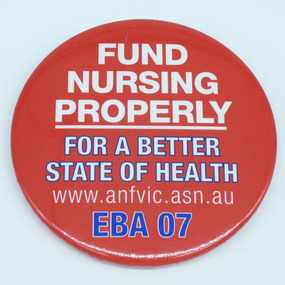
Australian Nursing Federation campaign badge, 2007
... The 2007 campaign focused on improved workloads and skill mix and a minimum 18 per cent wage increase to address the wage disparity between Victorian nurses and nurses working in other Australian states. nursing nurses unionism trade unions enterprise bargaining badges buttons pins staffing wages workforce labour history australian nursing federation victoria campaigning Circular red, white and blue plastic badge. Silver metal ...Button distributed to and worn by Australian Nursing Federation (ANF) members during the bargaining process for Victorian nurses' wages and conditions in 2007. Enterprise bargaining is the process of negotiation generally between the employer and employees (often represented by a trade union, professional association or other bargaining representative) with the goal of making an enterprise agreement stipulating the wages and conditions of work. The 2007 public sector campaign entitled 'Fund nursing properly for a better state of health' involved the ANF bargaining for members employed in the public acute and aged care sector, public psychiatric services, the Australian Red Cross Blood Service and the Royal District Nursing Service. The 2007 campaign focused on improved workloads and skill mix and a minimum 18 per cent wage increase to address the wage disparity between Victorian nurses and nurses working in other Australian states.Circular red, white and blue plastic badge. Silver metal, plastic-coated, with safety pin fastener adhered to back. Badge printed with 'FUND NURSING PROPERLY FOR A BETTER STATE OF HEALTH', 'EBA 07' [enterprise bargaining agreement 2007] and the ANF [Australian Nursing Federation] website address of the time (www.anfvic.asn.au).nursing, nurses, unionism, trade unions, enterprise bargaining, badges, buttons, pins, staffing, wages, workforce, labour history, australian nursing federation, victoria, campaigning -
![Australian Nursing Federation campaign badge, [1990s-2000s?]](/media/collectors/5bb42dc221eaf31100db1d3b/items/5c89dc6021ea7112844dadc6/item-media/5c89dc7b21ea7112844ddabc/item-fit-380x285.jpg?cb=6) Australian Nursing & Midwifery Federation
Australian Nursing & Midwifery FederationAustralian Nursing Federation campaign badge, [1990s-2000s?]
... The Royal Australian Nursing Federation became the Australian Nursing Federation (ANF) in 1989, and then became the Australian Nursing and Midwifery Federation in 2013, suggesting this badge is from the 1990s or early 2000s. nurses nursing unionism badges buttons pins trade unions labour history australian nursing federation wages working conditions employment Circular white and blue plastic badge. Silver metal ...Button distributed to and worn by Australian Nursing Federation members campaigning against changes to nurses awards. The minimum wages and conditions an employee is entitled to are set out in awards (also known as modern awards). Awards don’t apply when an employer has an enterprise agreement or other registered agreement and the employee is covered by it. The Royal Australian Nursing Federation became the Australian Nursing Federation (ANF) in 1989, and then became the Australian Nursing and Midwifery Federation in 2013, suggesting this badge is from the 1990s or early 2000s.Circular white and blue plastic badge. Silver metal, plastic-coated, with safety pin fastener adhered to back. Badge printed with 'hands off nurses' awards!' and 'AUSTRALIAN NURSING FEDERATION'.nurses, nursing, unionism, badges, buttons, pins, trade unions, labour history, australian nursing federation, wages, working conditions, employment
