
Showing 181 items matching "midwifery training"
-
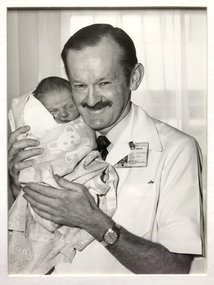 Ballarat Base Hospital Trained Nurses League
Stuart Williamson, Charge Nurse, with baby - Midwifery Training 1984 to 1985, first male midwife, Ballarat Base Hospital
... Stuart Williamson, Charge Nurse, with baby - Midwifery Training 1984 to 1985, first male midwife, Ballarat Base Hospital...Stuart Williamson, Charge Nurse, with baby - Midwifery Training 1984 to 1985, first male midwife, Ballarat Base Hospital...Stuart Williamson, Charge Nurse, with baby - Midwifery Training 1984 to 1985, first male midwife, Ballarat Base Hospital williamson midwifery baby charge nurse ballarat base hospital 1984 male midwife Stuart Williamson, Charge Nurse, with baby - Midwifery Training 1984 to 1985, first male midwife, Ballarat Base Hospital ...Stuart Williamson, Charge Nurse, with baby - Midwifery Training 1984 to 1985, first male midwife, Ballarat Base Hospitalwilliamson, midwifery, baby, charge nurse, ballarat base hospital, 1984, male midwife -
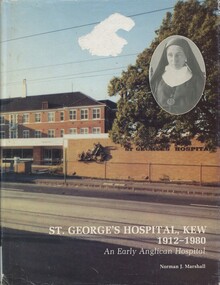 Surrey Hills Historical Society Collection
Book, St George's Hospital Kew; an early Anglican hospital, 1981
... ...midwifery training school...In 1925 a maternity wing was added and the hospital was registered as a Midwifery Training School. After WWII the Church of England decided to sell it. ...In 1925 a maternity wing was added and the hospital was registered as a Midwifery Training School. After WWII the Church of England decided to sell it. ...In 1925 a maternity wing was added and the hospital was registered as a Midwifery Training School. After WWII the Church of England decided to sell it. ...St. George's Hospital, Kew was founded in 1912 by the Church of England. In 1925 a maternity wing was added and the hospital was registered as a Midwifery Training School. After WWII the Church of England decided to sell it. The book deals with its development up until 1980.St. George's Hospital, Kew was founded in 1912 by the Church of England. In 1925 a maternity wing was added and the hospital was registered as a Midwifery Training School. After WWII the Church of England decided to sell it. The book deals with its development up until 1980.st. george's hospital, kew, 1912, hospitals, medical services, nurses, health establishments, ellerslie, church of england, midwifery training school, world war, 1939-1945, health professionals -
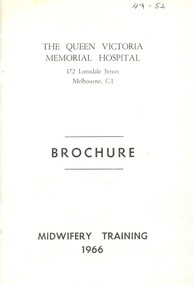 Alfred Hospital Nurses League - Nursing History Collection
Booklet, Queen Victoria memorial Hospital, The Queen Victoria Hospital brochure - midwifery training 1966, 1966
... The Queen Victoria Hospital brochure - midwifery training 1966...Of significance to the AHNL as many Alfred graduates completed midwifery training at the Queen Victoria Memorial Hospital Melbourne. nursing education midwifery Queen Victoria Hospital (Melbourne) Information about midwifery training at the Queen Victoria Memorial Hospital, Melbourne in the 1960's. previous catalogue number written in black ink at top right of front cover. ...Information about midwifery training at the Queen Victoria Memorial Hospital, Melbourne in the 1960's.Booklet with black print. Title on front cover.non-fictionInformation about midwifery training at the Queen Victoria Memorial Hospital, Melbourne in the 1960's.nursing education, midwifery, queen victoria hospital (melbourne) -
 St Vincent's Hospital Melbourne Archives
Work on paper - Nurses Board Victoria Midwives Act: Case Book for Pupil Midwives
... ...Midwifery training...Following registration as a trained nurse At St Vincent's Hospital in 1952, Vivienne Pearce began her Midwifery training at the adjacent maternity hospital in 1953. ...Following registration as a trained nurse At St Vincent's Hospital in 1952, Vivienne Pearce began her Midwifery training at the adjacent maternity hospital in 1953. ...Following registration as a trained nurse At St Vincent's Hospital in 1952, Vivienne Pearce began her Midwifery training at the adjacent maternity hospital in 1953. The nurses board case book set comprehensive regulation observations of the patient and her baby, for the pupil- nurses' curriculum for educators and supervisors to oversee. The course at that time was 12 months. Hand written entries in blue fountain pen.vivienne pearce, st vincent's maternity hospital melbourne, nurses board of victoria midwives act, case book for pupil midwives, midwifery training -
St Vincent's Hospital Melbourne Archives
Certificate - The Midwives Acts Certificate of Registration awarded to Katherine Olive Cass by Nurses Board Victoria, 1945
... ...Midwifery Nursing Training...Katherine Olive Cass completed her general nurse training at St Vincents Hospital Melbourne in 1943 and then her midwifery training at St Vincent's Maternity Hospital Melbourne in 1945....Katherine Olive Cass completed her general nurse training at St Vincents Hospital Melbourne in 1943 and then her midwifery training at St Vincent's Maternity Hospital Melbourne in 1945. ...The Nurses Board of Victoria became responsible for the registration of midwives in 1929 following the passing of the Midwives Act 1928. Katherine Olive Cass completed her general nurse training at St Vincents Hospital Melbourne in 1943 and then her midwifery training at St Vincent's Maternity Hospital Melbourne in 1945.Typed Certificate.katherine olive cass, st vincents hospital melbourne, midwifery nursing training, nurses board of victoria midwives act -
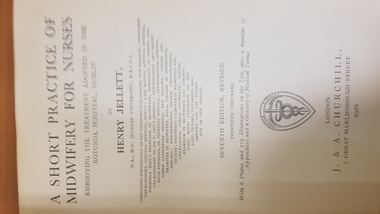 Numurkah & District Historical Society
Midwifery Book
... Hospital, midwifery, book, nursing, education, training...Midwifery Training Book: "A Short Practice of Midwifery for Nurses" by Henry Jellet. ...Hospital, midwifery, book, nursing, education, training Midwifery Training Book: "A Short Practice of Midwifery for Nurses" by Henry Jellet. ...Midwifery Training Book: "A Short Practice of Midwifery for Nurses" by Henry Jellet. Published in 1926. Used by Elizabeth McRae Romseyhospital, midwifery, book, nursing, education, training -
 Alfred Hospital Nurses League - Nursing History Collection
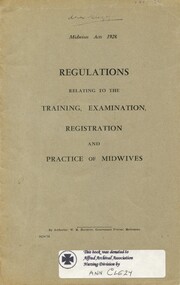
Document - Booklet, Nurses Board of Victoria, Midwives Acts 1928: Regulations relating to the training, examination, registation and practice of midwives, 1956
... ...midwifery training...Based on the midwives act (Victoria) 1928, cited as the Midwives regulations 1951, repealing the midwives regulations 1941, and includes changes made up until March 1955 Of significance to AHNL as many Alfred hospital graduates undertook midwifery training and would have had to abide by theses regulations Midwifery midwifery training midwifery regulations - victoria nursing Regulations relating to the training, examination, registation and practice of midwives in Victoria At the base of the front cover there is a printed black and white donation sticker: black Maltese cross in circle, "This book was donated to Alfred Archival Association Nursing Division by ' Ann Clezy (handwritten in ink). ...Regulations relating to the training, examination, registation and practice of midwives in VictoriaStapled booklet with faded,grey discoloured cover and black print. Title and printer's name on front cover.non-fictionRegulations relating to the training, examination, registation and practice of midwives in Victoriamidwifery, midwifery training, midwifery regulations - victoria, nursing -
 Alfred Hospital Nurses League - Nursing History Collection
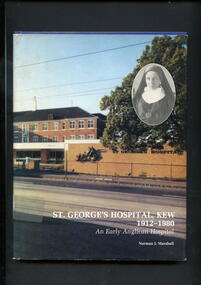
Book - Illustrated book, Norman J. Marshall, St.George's Hospital, Kew 1912-1980: an early Anglican Hospital, 1981
... ...Midwifery Training...St George's Hospital Kew Hospitals-Victoria Midwifery Training Medical trainining Church of England Ellerslie A history of St George's hospital, Kew. ...A history of St George's hospital, Kew. Hospital was founded by the Church of England in 1912 and administered by the Sisters of the Community of the Holy Name until 1949. In 1925 a midwifery wing had been added, and the hospital was registered as a Midwifery Training School. The hospital was sold to the Victorian Hospitals and Charities Commission in 1949.Illustrated hardcover book with dustjacket. Book has a mid-blue cover, with abbreviated title and authors surname printed in gilt on spine. The dustjacket has a coloured photograph of the front of the hospital as background. An oval black and white photograph of Sister Esther (Mother Foundress of the Community of the Holy Name) is superimposed at the top right front corner. Full title and author's name is printed in white at bottom of front. Abbreviated title and author's name printed in white on spine.non-fictionA history of St George's hospital, Kew. Hospital was founded by the Church of England in 1912 and administered by the Sisters of the Community of the Holy Name until 1949. In 1925 a midwifery wing had been added, and the hospital was registered as a Midwifery Training School. The hospital was sold to the Victorian Hospitals and Charities Commission in 1949.st george's hospital, kew, hospitals-victoria, midwifery training, medical trainining, church of england, ellerslie -
 Alfred Hospital Nurses League - Nursing History Collection
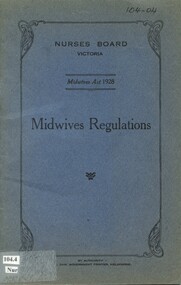
Booklet, Nurses Board Victoria, Nurses Board Victoria Midwives Act 1928 Midwives Regulations, 1942
... ...Midwifery Training...These regulations were still current in 1942 (regulations updated in 1941) Of significance to the AHNL as many AH graduates went on to complete their midwifery training Midwifery Midwifery-study and teaching Midwifery Training Midwives-Australia-History Regulations relating to thr training, examination and practice of midwives in Victoria based on the 1928 Nurses Act Previous catalogue numer hand written in black ink at top right of front cover, and printed on a square white sticker along with the letters Nur, taped to the bottom left of the front cover. ...Regulations relating to thr training, examination and practice of midwives in Victoria based on the 1928 Nurses ActBooklet with faded blue cover and black print. The tile is printed on the front cover within a decorative border. Printers details are printed at he base of the front covernon-fictionRegulations relating to thr training, examination and practice of midwives in Victoria based on the 1928 Nurses Actmidwifery, midwifery-study and teaching, midwifery training, midwives-australia-history -
St Vincent's Hospital Melbourne Archives
Certificate - St Vincent's Maternity Hospital Melbourne Midwifery Certificate awarded to Katherine Olive Cass in 1944
... ...Midwifery training...Following her general nurse training at St Vincent's Hospital Melbourne, Nurse Katherine Olive Cass received instruction in the special work of the midwifery department for a period of nine months. ...Katherine Olive Cass Midwifery training St Vincent's Maternity Hospital Melbourne. ...Following her general nurse training at St Vincent's Hospital Melbourne, Nurse Katherine Olive Cass received instruction in the special work of the midwifery department for a period of nine months. After examination Katherine was found competent to discharge the duties of an obstetrical nurse.The certificate is signed by Mother Rectress Mary Devine, lecturers, secretary and nurse K. Olive Cass. katherine olive cass, midwifery training, st vincent's maternity hospital melbourne., mary devine -
St Vincent's Hospital Melbourne Archives
Certificate - St Vincent's Maternity Hospital Melbourne Midwifery Certificate awarded to Margaret Rosengren in 1949
... ...Midwifery Nursing Training...Margaret Rosengren St Vincent's Maternity Hospital Melbourne. Midwifery Nursing Training Blue printed certificate with St Vincent's Hospital Crest and bold darker blue border. ...Margaret Rosengren's instruction and specialist course was for a period of nine months and after examination was found competent to practice as an Obstetrical Nurse.margaret rosengren, st vincent's maternity hospital melbourne., midwifery nursing training -
St Vincent's Hospital Melbourne Archives
Book - The Midwife's Text-Book of the Principles and Practice of Midwifery by R.W.Johnstone of Scotland, circa 1947
... ...Midwifery Nursing Training...Margaret Slattery R.W.Johnstone St Vincents Hospital Melbourne The Royal Women's Hospital Melbourne Midwifery Nursing Training In an indented circle on the hardcover is "Blacks Medical Series: " with the image of the Rod Of Asclepius, the symbol of medicine featuring the single serpent wrapped around a simple staff. ...Text reference book for midwives with illustrations and photographs.In an indented circle on the hardcover is "Blacks Medical Series: " with the image of the Rod Of Asclepius, the symbol of medicine featuring the single serpent wrapped around a simple staff. Margaret Slattery's name is hand written in ink on the inner cover. margaret slattery, r.w.johnstone, st vincents hospital melbourne, the royal women's hospital melbourne, midwifery nursing training -
St Vincent's Hospital Melbourne Archives
Certificate - The Midwives Acts Certificate of Registration awarded to Agnes McLean by Nurses Board Victoria, 1929
... Agnes Mclean completed her general nurse training at St Vincents Hospital Melbourne in 1928 and then her midwifery training at The Women's Hospital in 1929. ...Agnes Mclean completed her general nurse training at St Vincents Hospital Melbourne in 1928 and then her midwifery training at The Women's Hospital in 1929. ...The Nurses Board of Victoria became responsible for the registration of midwives in 1929 following the passing of the Midwives Act 1928. Agnes Mclean completed her general nurse training at St Vincents Hospital Melbourne in 1928 and then her midwifery training at The Women's Hospital in 1929. agnes mclean, nurses board of victoria, midwives act, st vincents hospital melbourne, nurse training, the women's hospital melbourne -
St Vincent's Hospital Melbourne Archives
Certificate - The Midwives Acts Certificate of Registration awarded to Margaret Rosengren in 1946
... Margaret Rosengren completed her general nurse training at St Vincents Hospital Melbourne in 1943 and then her midwifery training at St Vincent's Maternity Hospital in 1946....Margaret Rosengren completed her general nurse training at St Vincents Hospital Melbourne in 1943 and then her midwifery training at St Vincent's Maternity Hospital in 1946. ...The Nurses Board of Victoria became responsible for the registration of midwives in 1929 following the passing of the Midwives Act 1928. Margaret Rosengren completed her general nurse training at St Vincents Hospital Melbourne in 1943 and then her midwifery training at St Vincent's Maternity Hospital in 1946.st vincent's hospital melbourne, margaret rosengren, st vincent's maternity hospital melbourne., nurses board of victoria, nurses acts victoria -
St Vincent's Hospital Melbourne Archives
Photograph - Photographs of Midwife Margaret Slattery during her nursing overseas experience and exchange program in America, circa 1955
... Following her General Nurse Training at St Vincent's Hospital Melbourne, Sister Margaret Slattery completed her Midwifery Training at Royal Women's Hospital Melbourne, travelled overseas to England, Canada and then an exchange program in America. ...Following her General Nurse Training at St Vincent's Hospital Melbourne, Sister Margaret Slattery completed her Midwifery Training at Royal Women's Hospital Melbourne, travelled overseas to England, Canada and then an exchange program in America. ...Following her General Nurse Training at St Vincent's Hospital Melbourne, Sister Margaret Slattery completed her Midwifery Training at Royal Women's Hospital Melbourne, travelled overseas to England, Canada and then an exchange program in America. One of the photographs shows the elaborate bassinet covers that were in use in hospital baby nurseries circa 1955 in America.Inscription reads Toronto Western Hospital Canada, November 1955 - "Baby Cart,- 8 of 'em!". Another reads: "The Doorway of Dickens house. We did not enter the threshold-we didn't have the bob!"margaret slattery, st vincent's hospital melbourne, royal women's hospital., midwifery nursing -
St Vincent's Hospital Melbourne Archives
Certificate - The General Nursing Council for England and Wales Certificate and Correspondence for Nurse Margaret Slattery in 1956
... Margaret Slattery completed her general nurse training at St Vincent's Hospital Melbourne in 1947 and her midwifery training at Royal Women's Hospital circa 1950. ...Margaret Slattery completed her general nurse training at St Vincent's Hospital Melbourne in 1947 and her midwifery training at Royal Women's Hospital circa 1950. ...Margaret Slattery completed her general nurse training at St Vincent's Hospital Melbourne in 1947 and her midwifery training at Royal Women's Hospital circa 1950. Following that she travelled and nursed in the UK and then began a nurse exchange program through the International Nursing Council, The Australian Nurses Federation and the American Trained Nurses Association Exchange Program in 1955.The England and Wales nursing certificate booklet has an indented seal mark, the receipt has a brown two pence postage stamp of Queen Elizabeth at the cost of four pounds, four pence. margaret slattery -
![Front of postcard 'Give Generoursly' , Queen Victoria Womens Centre [ca.2000]](/media/collectors/50187a8f023fd7201471f198/items/6a5b112875095107b5cd3695/item-media/6a5b11b475095107b5cd424f/item-fit-380x285.jpg?cb=6) Alfred Hospital Nurses League - Nursing History Collection
Alfred Hospital Nurses League - Nursing History CollectionPostcard - Set of black and white postcards, Queen Victroria Womens Centre, Postcards featuring the Queen Victoria Hospital, Melbourne, [ca.2000]
... Amongst its services the hospital provided midwifery training. These postcards were created from historical photographs and sold at the Queen Victoria Women's centre, they include images of nurses...Amongst its services the hospital provided midwifery training. These postcards were created from historical photographs and sold at the Queen Victoria Women's centre, they include images of nurses Collection of historic photographs of a Victorian Hospital Queen Victoria Hospital (Melbourne) Hospitals - Victoria - History Postcards created from black and white photographs. ...The Queen Victoria Hospital was a historic, women-led medical facility in Melbourne founded in 1896 by Dr. Constance Stone. It relocated to Clayton in 1987, becoming part of Monash Health.The sole remaining heritage tower of the former hospital at 210 Lonsdale Street now houses the Queen Victoria Women's Centre. Amongst its services the hospital provided midwifery training. These postcards were created from historical photographs and sold at the Queen Victoria Women's centre, they include images of nursesCollection of historic photographs of a Victorian HospitalPostcards created from black and white photographs. On hthe reverse of each are a description of the image, the words "Queen Victoria Women's Centre" and acknowledgement 'photo courtesy of Souther Health Monash Medical Centre Historiical Collectionqueen victoria hospital (melbourne), hospitals - victoria - history -
 Alfred Hospital Nurses League - Nursing History Collection
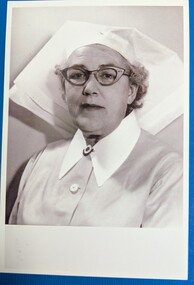
Photograph - Unframed black and white photograph, Alfred Hospital, Miss Eileen Emms, 1960's
... Eileen Emms graduated from the Alfred Hospital in 1935, after midwifery training she returned to the Alfred in 1936 as charge sister of Ward 3, a position she held until April 1942 when she resigned to join the Royal Austrailian Naval Nursing Service, serving until August 1947. in July 1950 Eileen retuned to the Alfred as an Administrative Sister, and in September 1952 was appointed assistant matron. ...Eileen Emms graduated from the Alfred Hospital in 1935, after midwifery training she returned to the Alfred in 1936 as charge sister of Ward 3, a position she held until April 1942 when she resigned to join the Royal Austrailian Naval Nursing Service, serving until August 1947. in July 1950 Eileen retuned to the Alfred as an Administrative Sister, and in September 1952 was appointed assistant matron. ...photograph of Eileen Emms in Alfred hospital Nursing Administartion Uniform. Eileen Emms graduated from the Alfred Hospital in 1935, after midwifery training she returned to the Alfred in 1936 as charge sister of Ward 3, a position she held until April 1942 when she resigned to join the Royal Austrailian Naval Nursing Service, serving until August 1947. in July 1950 Eileen retuned to the Alfred as an Administrative Sister, and in September 1952 was appointed assistant matron. In Octocber 1962 Eileen was appointed Acting Deputy Lady Superintendant, a position she held until her retirement in 1964Found with other information about Eileen Emms in prominent nurse folderBlack and photograph of a grey haired woman wearing glasses, a nurses veil and white collared uniform.there is a badge fixed between the points of the collareileen emms, nurses, alfred hospital -
 Federation University Historical Collection
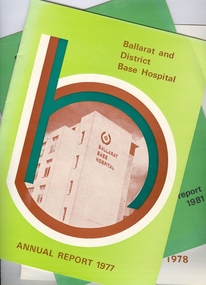
Booklet - Annual Report, Ballarat and District Base Hospital, Ballarat and District Base Hospital Annual Reports (1977, 1978, 1981), 1977 - 1981
... In 1978 the hospital not only caters for general nursing and midwifery training, but also provides under graduate training for medical students."...In 1978 the hospital not only caters for general nursing and midwifery training, but also provides under graduate training for medical students." edgar bartrop ballarat college of advanced education nursing nurse bcae ballarat base hospital shirley falkinder shirley ogden school of nursing nurse educaiton pathology radiology m stevens winsome menedue trained nurses league contributers 3 booklets, each of about 20 pages. 1977 is light green covered, 1978 white with brown text, and 1981 mid green covered. ...Before the training of nurses at the Ballarat College of Advanced Education (now University of Ballarat) Ballarat nurses trained at the Ballarat Base Hospital. The 1978 Annual report gives the following hospital background: 'The foundation stone for the original 42 bed hospital was laid on the existing site on 25th December, 1855. Ballarat at that time had a population of between 40,000 and 50,000 people, with the demands on the hospital services being mainly for medical care resulting from mining accidents. Medical, Nursing and General care were provided by the resident Surgeon, matron and wardsmen. Financial support depended on donations from churches masonic lodges, the public and bequests. The hospital today provides centralized health services and specialist medical, surgical and ancillart assistance to the communities in the Central Highlands Region. The trend in hospital financing today has changed and is based to a large extent on State and Commonwealth Grants. Contribution from the public remain important particulalry in the purchase of equipement and ultimately the services provided by the hospital. Since 1887 the Ballarat Base Hospital has been an important training centre for nurses. In 1978 the hospital not only caters for general nursing and midwifery training, but also provides under graduate training for medical students."3 booklets, each of about 20 pages. 1977 is light green covered, 1978 white with brown text, and 1981 mid green covered.edgar bartrop, ballarat college of advanced education, nursing, nurse, bcae, ballarat base hospital, shirley falkinder, shirley ogden, school of nursing, nurse educaiton, pathology, radiology, m stevens, winsome menedue, trained nurses league, contributers -
Northern District School of Nursing. Managed by Bendigo Historical Society Inc.
Document - Northern District School of Nursing Graduates Association - Citation for Nancy Winifred Long, March 1986
... Completed general nursing training at Ballarat Base Hospital in 1930 and midwifery training in 1931. Gained the Infant Welfare Certificate at Tweddle Babies' Home.Became Sister-in-Charge of the Children's Ward at Ballarat Hospital. ...Completed general nursing training at Ballarat Base Hospital in 1930 and midwifery training in 1931. Gained the Infant Welfare Certificate at Tweddle Babies' Home.Became Sister-in-Charge of the Children's Ward at Ballarat Hospital. ...The Northern District School of Nursing in Victoria, Australia Graduates Association: This document outlines the life and career of Nancy Winifred Long, highlighting her significant contributions to nursing education and hospital administration in Australia. Born in Talbot, Victoria, in 1910.Left school at fourteen due to family circumstances and worked in domestic employment before entering nursing. Completed general nursing training at Ballarat Base Hospital in 1930 and midwifery training in 1931. Gained the Infant Welfare Certificate at Tweddle Babies' Home.Became Sister-in-Charge of the Children's Ward at Ballarat Hospital. Awarded the Florence Nightingale Scholarship, becoming its first recipient. Studied in the UK, earning a Diploma with distinction in Nursing Administration from the University of London in 1947.Undertook further study and hospital visits in the UK, Scandinavia, the United States, and Canada. Joined the Alfred Hospital in Melbourne as a tutor-sister. Appointed the first Dean of the Northern District School of Nursing in 1950, pioneering a college-based nursing education model. Despite financial and institutional challenges, she was instrumental in sustaining and advocating for the program. Served on various committees, including the Victorian Nurses Board Education Committee and the Course Development Committee of the Victoria Institute of Colleges.Active in the Matrons' Association, Nurse Educators Section, and the Royal Victorian College of Nursing, where she was a Fellow for 23 years. Recognized for her tireless dedication and pioneering efforts in nursing education, especially in post-war Australia. Continued as Dean until health issues forced her resignation in 1974.Remembered for her leadership, resilience, and the positive impact she had on nursing education and the lives of her colleagues and students. Passed away peacefully, 02 March 1986, leaving a legacy of service and innovation in Australian nursing.Northern District School of Nursing Graduates Association - Citation for Nancy Winifred Long who died on 02 March 1986 - 4 pages typed This item contains the following documents: 3792.6a Citation for Nancy Winifred Long who died on 02 March 1986 - 4 pages typed 3792.6b Copy of abovenurse training, lister house, history, nancy winifred long -
Northern District School of Nursing. Managed by Bendigo Historical Society Inc.
Memorabilia - Northern District School of Nursing Graduates Association - The life of Dawn Mary Buffham (nee Harris), 03 April 1928 to 18 Mar 2016
... Midwifery, Infant Welfare).Diploma courses available in administration, teaching, and specialized nursing fields. Bursaries are available for advanced study.Career Prospects: Graduates can pursue roles in administration, teaching, ward and departmental leadership, district and visiting nursing, industrial and school nursing, and more. Opportunities existed both within hospitals and in community or specialized settings.FAQs and Practical Details. Minimal training...Trained at Bendigo Base Hospital (1945-1947), then worked at Elmore and Rochester. Completed midwifery training at St. Vincent's Hospital, Melbourne, and further training in Infant Welfare at Berry Street. ...Trained at Bendigo Base Hospital (1945-1947), then worked at Elmore and Rochester. Completed midwifery training at St. Vincent's Hospital, Melbourne, and further training in Infant Welfare at Berry Street. ...The Northern District School of Nursing in Victoria, Australia Graduates Association: History of the School Managed by a committee including hospital administrators, medical professionals, and nursing leaders from several regional hospitals. Associated with major hospitals in the Northern District, including Bendigo Base, Mildura Base, Castlemaine, Echuca, Swan Hill, St. Arnaud, and Kyneton District Hospitals. Provide high-quality theoretical and practical nursing training. Raise the standard of nursing education in the region. Maintain the highest principles of nursing practice. Applicants must be at least 17 years old and hold a Proficiency Certificate or higher educational qualification. Application involves submitting forms, certificates, an interview, an aptitude test, and a medical examination. A three-month probationary period follows initial acceptance. Preliminary Training School: Four-week introductory course covering basic nursing, anatomy, hygiene, and practical skills. Practical experience in various hospital departments, guided by senior staff. Study Block Plan: Includes several blocks of theoretical and practical instruction throughout the three-year program. Regular school exams and two state exams (First Professional and Final State) are required for progression and graduation. Nurses work a 40-hour week with at least one or two days off per week and three weeks of annual leave. Accommodation is provided in comfortable hostels with good facilities. Uniforms are supplied free; nurses provide their own shoes and stockings. Salaries and allowances are regulated, with deductions for board and free medical care. Additional Information Post-Graduate Opportunities. Senior positions require further experience and additional certificates (e.g., Midwifery, Infant Welfare).Diploma courses available in administration, teaching, and specialized nursing fields. Bursaries are available for advanced study.Career Prospects: Graduates can pursue roles in administration, teaching, ward and departmental leadership, district and visiting nursing, industrial and school nursing, and more. Opportunities existed both within hospitals and in community or specialized settings.FAQs and Practical Details. Minimal training costs (mainly exam fees and personal items).Living out allowances and travel expenses are covered. Four training intakes per year; waiting periods are short if qualifications are met.Northern District School of Nursing Graduates Association - The life of Dawn Mary Buffham (nee Harris) 03 April 1928 to 18 Mar 2016 This item contains the following documents: 3792.27a The life of Dawn Mary Buffham (nee Harris) 03 April 1928 to 18 Mar 2016 3792.27b Copy of above The biography of Dawn Mary Buffham:Early. Born in 1928 in the Cohuna District, youngest of five sisters. Attended school locally and worked at the State Savings Bank before entering nursing. Trained at Bendigo Base Hospital (1945-1947), then worked at Elmore and Rochester. Completed midwifery training at St. Vincent's Hospital, Melbourne, and further training in Infant Welfare at Berry Street. Served as Acting Matron at Lister House, responsible for all aspects of nursing, including midwifery. Remembered as an immaculate and reassuring tutor, known as 'Sister Harris.' Gained experience in remote areas with the Royal Flying Doctor Service and School Medical Service in Darwin. Worked in Canada as charge sister and supervisor of a paediatric hospital, helping set up a government paediatrics program. Returned to Australia to set up the Queen Victoria Baby & Paediatric Unit in 1970. Met and married Fred Buffham in 1972 after a brief courtship. Settled in Goroke, Wimmera, and became active in parish and community projects, including the Goroke Community Health Centre, swimming pool, and golf club development. Continued nursing, especially in geriatric care, and was instrumental in expanding local health services. After moving to Bendigo in 1991, was deeply involved in St. Therese's Parish, Lions Club, hospital volunteering, and social groups.Interests and Legacy. Enjoyed travel, especially to Asia and New Zealand, and valued arts, culture, and family.Remembered for her energy, goodwill, loving nature, and dedication to community and family.nurse training, lister house, dawn mary buffham (nee harris) -
 The Royal Women's Hospital
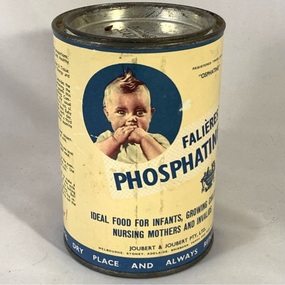
Tool - Packaging, Faliere's Phosphatine container
... Green was a graduate of the Women’s Hospital’s midwifery nurse training scheme in 1914. She lived at Hawthorn. ...Green was a graduate of the Women’s Hospital’s midwifery nurse training scheme in 1914. She lived at Hawthorn. ...Phosphatine Falieres was invented by pharmacist Émile Falières in the 1880s and marketed as a fortifying cereal or "farine" [flour] for infants, enriched with calcium. Said to be easily mixed and easily digestible, the cereal was added to an infant’s milk. It was made in Australia and distributed by a number of pharmaceutical companies, in the 1950s by Joubert & Joubert. The Phosphatine Falieres company advertised extensively, marketing to doctors, nurses, and mothers always using pictures of rosy-cheeked children. Falières created charming three-dimensional chromolithography pop-up/pop-out/moveable images many of which had a little tab. When the tab was pulled, these colourful sales props showed happy and healthy children opening a tureen of food that was fortified with Falieres cereal. The collection of Nurse Florence Green RWHA_2018_069 contains one such item of ephemera. Green was a graduate of the Women’s Hospital’s midwifery nurse training scheme in 1914. She lived at Hawthorn. The container is a cardboard cylinder with a printed label (stained) covering the entire surface. It has a metal (rusted) lid. The word "BORAX" has been written on the side. -
 Royal Australian and New Zealand College of Obstetricians & Gynaecologists (RANZCOG)
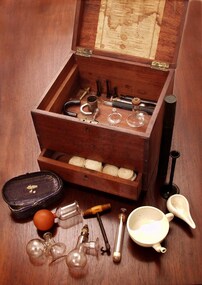
Midwifery box used by midwife Mary Howlett, c. 1866 - 1920
... training at the Melbourne Lying-In Hospital. She was known by many as 'Auntie', and her career spanned more than 50 years. Mrs Howlett's midwifery...training at the Melbourne Lying-In Hospital. She was known by many as 'Auntie', and her career spanned more than 50 years. Mrs Howlett's midwifery ...Mary Howlett (1840-1922) began practising as a country midwife in 1866 in the western district of Victoria. She qualified as a 'ladies monthly nurse' in 1887 and continued to practise as a nurse and midwife until 1920.She began her six months training at the Melbourne Lying-In Hospital. She was known by many as 'Auntie', and her career spanned more than 50 years. Mrs Howlett's midwifery box and contents were given to Dr Frank Forster, and he donated them to the museum collection in 1993. The contents of this box are consistent with use by a midwife, but such a box would have been cumbersome and heavy to carry around. It is possible that Mary Howlett would also have had a bag for her midwifery requirements.This midwifery box is highly significant as it includes close to the original contents of one midwife's 'professional kit' up to 1920. The contents reveal something of the professional practice of a midwife in country Victoria at that time.A wooden box with hinged lift-up lid, one drawer, and an inner wooden tray. Rests at each side inside box indicate another tray may have originally sat across the top. Pasted inside the lid is a product list from Robert McDonald (chemist and druggist). There are locks for both the main chest section and the drawer. A circular section is cut out of the bottom of the drawer. The contents of the box include, enema syringe, a red rubber douche, glass breast pump, nipple shields, a thermometer in travel case. Also includes cotton bandages, a tooth extractor, and fetal stethoscope.midwifery -
 Royal Australian and New Zealand College of Obstetricians & Gynaecologists (RANZCOG)
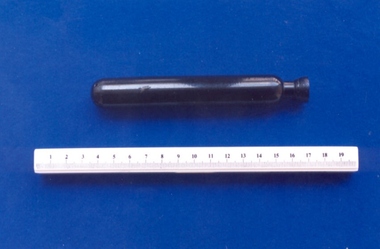
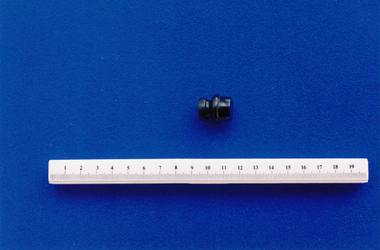
Rectal or vaginal irrigator associated with midwife Mary Howlett, c. 1866 - 1920
... training at the Melbourne Lying-In Hospital. She was known by many as 'Auntie', and her career spanned more than 50 years. Mrs Howlett's midwifery ...Artefact may have been used for enema or vaginal irrigation. Mary Howlett (1840-1922) began practising as a country midwife in 1866 in the western district of Victoria. She qualified as a 'ladies monthly nurse' in 1887 and continued to practise as a nurse and midwife until 1920.She began her six months training at the Melbourne Lying-In Hospital. She was known by many as 'Auntie', and her career spanned more than 50 years. Mrs Howlett's midwifery box and contents were given to Dr Frank Forster, and he donated them to the museum collection in 1993.Black bakelite irrigator, resembling a test tube in shape. The irrigator has four entries, a connecting bridge and serrated edged flange. Stopcock attachment and tubing are missing.irrigation, midwifery -
 Royal Australian and New Zealand College of Obstetricians & Gynaecologists (RANZCOG)
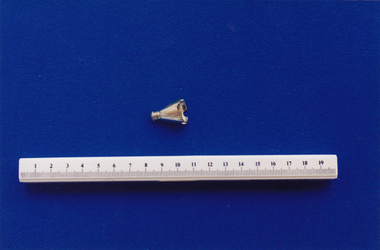
Tool - Irrigation nozzle associated with midwife Mary Howlett, c. 1866 - 1920
... training at the Melbourne Lying-In Hospital. She was known by many as 'Auntie', and her career spanned more than 50 years. Mrs Howlett's midwifery...training at the Melbourne Lying-In Hospital. She was known by many as 'Auntie', and her career spanned more than 50 years. Mrs Howlett's midwifery ...Mary Howlett (1840-1922) began practising as a country midwife in 1866 in the western district of Victoria. She qualified as a 'ladies monthly nurse' in 1887 and continued to practise as a nurse and midwife until 1920.She began her six months training at the Melbourne Lying-In Hospital. She was known by many as 'Auntie', and her career spanned more than 50 years. Mrs Howlett's midwifery box and contents were given to Dr Frank Forster, and he donated them to the museum collection in 1993.Small black bakelite irrigator nozzle. There are 7 entries in the nozzle head. Small ridge around neck of nozzle.irrigation, midwifery -
 Royal Australian and New Zealand College of Obstetricians & Gynaecologists (RANZCOG)
Syringe attachment associated with midwife Mary Howlett, c. 1866 to 1920, 1880 (approximate)
... training at the Melbourne Lying-In Hospital. She was known by many as 'Auntie', and her career spanned more than 50 years. Mrs Howlett's midwifery...training at the Melbourne Lying-In Hospital. She was known by many as 'Auntie', and her career spanned more than 50 years. Mrs Howlett's midwifery ...Mary Howlett (1840-1922) began practising as a country midwife in 1866 in the western district of Victoria. She qualified as a 'ladies monthly nurse' in 1887 and continued to practise as a nurse and midwife until 1920.She began her six months training at the Melbourne Lying-In Hospital. She was known by many as 'Auntie', and her career spanned more than 50 years. Mrs Howlett's midwifery box and contents were given to Dr Frank Forster, and he donated them to the museum collection in 1993. Syringe attachment with 4 depressions of equal size around the base. Inside is a shallow rim. The inside is hollow and wider at the base rim than the top. It tapers to half the circumference size at the outlet.intravenous device, midwifery -
 Royal Australian and New Zealand College of Obstetricians & Gynaecologists (RANZCOG)
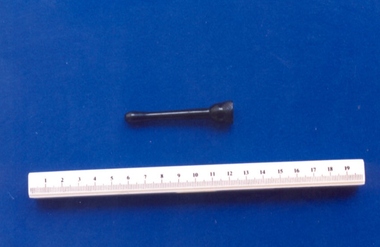
Rectal or vaginal irrigator nozzle associated with midwife Mary Howlett, c. 1866 - 1920
... training at the Melbourne Lying-In Hospital. She was known by many as 'Auntie', and her career spanned more than 50 years. Mrs Howlett's midwifery...training at the Melbourne Lying-In Hospital. She was known by many as 'Auntie', and her career spanned more than 50 years. Mrs Howlett's midwifery ...This item may have been used for enema or vaginal irrigation. Mary Howlett (1840-1922) began practising as a country midwife in 1866 in the western district of Victoria. She qualified as a 'ladies monthly nurse' in 1887 and continued to practise as a nurse and midwife until 1920.She began her six months training at the Melbourne Lying-In Hospital. She was known by many as 'Auntie', and her career spanned more than 50 years. Mrs Howlett's midwifery box and contents were given to Dr Frank Forster, and he donated them to the museum collection in 1993.Black bakelite nozzle with one entry. irrigation, midwifery -
 Royal Australian and New Zealand College of Obstetricians & Gynaecologists (RANZCOG)
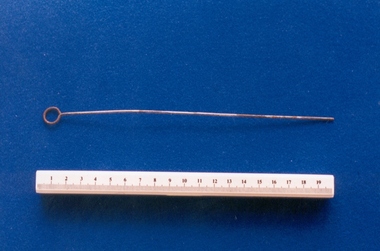
Introducer associated with midwife Mary Howlett, c. 1866 to 1920, c1880s
... training at the Melbourne Lying-In Hospital. She was known by many as 'Auntie', and her career spanned more than 50 years. Mrs Howlett's midwifery...training at the Melbourne Lying-In Hospital. She was known by many as 'Auntie', and her career spanned more than 50 years. Mrs Howlett's midwifery ...This item can be used for cleaning rubber tubing or to assist with the introduction of rubber catheters and tubing. Mary Howlett (1840-1922) began practising as a country midwife in 1866 in the western district of Victoria. She qualified as a 'ladies monthly nurse' in 1887 and continued to practise as a nurse and midwife until 1920.She began her six months training at the Melbourne Lying-In Hospital. She was known by many as 'Auntie', and her career spanned more than 50 years. Mrs Howlett's midwifery box and contents were given to Dr Frank Forster, and he donated them to the museum collection in 1993.Device made of metal wire with a rounded point at one end and an eye hook the other end.surgery, midwifery -
 Royal Australian and New Zealand College of Obstetricians & Gynaecologists (RANZCOG)
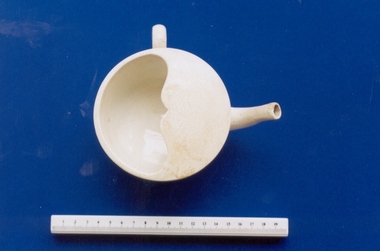
Ceramic feeding cup associated with midwife Mary Howlett, c.1866-1920
... training at the Melbourne Lying-In Hospital. She was known by many as 'Auntie', and her career spanned more than 50 years. Mrs Howlett's midwifery ...This type of cup was designed for use by an adult and was in common usage from the early 1900s to the 1930s. Feeding cups were used both in the home and in hospitals, and were also often made of white enamel. Mary Howlett (1840-1922) began practising as a country midwife in 1866 in the western district of Victoria. She qualified as a 'ladies monthly nurse' in 1887 and continued to practise as a nurse and midwife until 1920. She began her six months training at the Melbourne Lying-In Hospital. She was known by many as 'Auntie', and her career spanned more than 50 years. Mrs Howlett's midwifery box and contents were given to Dr Frank Forster, and he donated them the museum collection in 1993. Feeding cup made out of white china, now discoloured. The cup has a curved spout (similar to a teapot spout) with a handle. There are four small holes inserted inside the cup diagonally at the proximate end of the spout. midwifery -
 Royal Australian and New Zealand College of Obstetricians & Gynaecologists (RANZCOG)
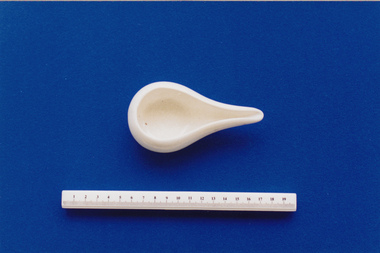
Pap boat associated with midwife Mary Howlett, c. 1866-1920, 1880 (approximate)
... training at the Melbourne Lying-In Hospital. She was known by many as 'Auntie', and her career spanned more than 50 years. Mrs Howlett's midwifery ...Pap boats date from approximately 1710 and were in extensive use until the end of the nineteenth century. They were used to feed pap to infants or invalids. Pap was a mixture of breadcrumbs, flour, rice or barley mixed with fluids such as broth, milk (if the infant was lucky), water, wine and even beer, to aid the digestion of pap it was often pre-chewed by the nurse or nanny. Pap was a popular form of infant nutrition for almost 300 years and used in many well to do homes. For unwanted or illegitimate infants in foundling homes it was often the only form of sustenance, however, and as a result the mortality rate was appallingly high. Despite a growing number of experts advising against the use of pap, it nevertheless persisted as a major source of infant nutrition in many nurseries until the late 1800’s, largely due to the ignorance of nannies and nurses who took great delight in disregarding the advice of physicians, who they believed were usurping their position in the household. ‘Nanny knows best’.(Amgueddfa Cymru - National Museum Wales, 'Pap Boat')Mary Howlett (1840-1922) began practising as a country midwife in 1866 in the western district of Victoria. She qualified as a 'ladies monthly nurse' in 1887 and continued to practise as a nurse and midwife until 1920. She began her six months training at the Melbourne Lying-In Hospital. She was known by many as 'Auntie', and her career spanned more than 50 years. Mrs Howlett's midwifery box and contents were given to Dr Frank Forster, and he donated them to the museum collection in 1993. Small round white china container with an extended slim lip. Fluid capacity approximately 30-90ml. The boat has been made from two moulded sections. infant care, infant feeding, midwifery
