
Showing 214 items matching "military ships"
-
 Mission to Seafarers Victoria
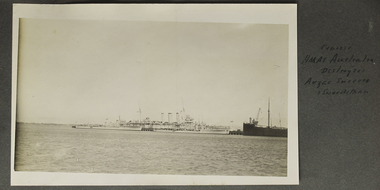
Photograph - Photograph, Sepia, Cruiser HMAS Australia - Destroyers: Anzac, Success and Swordsman, 1928
... Photograph with white border depicting military ships berthed in a port; photograph glued in album....In 1919, Anzac, along with five S class destroyers, Tattoo, Swordsman, Success, Stalwart and Tasmania, was gifted to the RAN by the British Government. hmas australia destroyers fan album cruisers anzac swordsman Photograph with white border depicting military ships berthed in a port; photograph glued in album. ...In 1919, Anzac, along with five S class destroyers, Tattoo, Swordsman, Success, Stalwart and Tasmania, was gifted to the RAN by the British Government. Photograph with white border depicting military ships berthed in a port; photograph glued in album.hmas australia, destroyers, fan album, cruisers, anzac, swordsman -
 Returned Nurses RSL Sub-branch
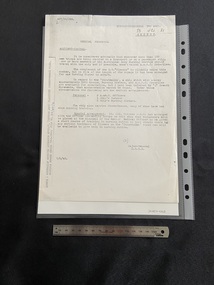
Document - Photocopy of (Defence Army) classified correspondence file, Australian Army, Medical personnel correspondence, 1940
... ...Military ships...ships that carry more than 150 troops. It goes on to detail the arrangements if there are less than 150 troops or if accomodation is not available, such as the case with the S.S."Ulysses" and the "Strathallan". WWII WW2 World War II Military ...Correspondence between the Adjutant General and Major General outlining the requirements of having one of more members of the Australian Army Nursing Service travel with transport or passenger ships that carry more than 150 troops. It goes on to detail the arrangements if there are less than 150 troops or if accomodation is not available, such as the case with the S.S."Ulysses" and the "Strathallan".Photocopy of a typed A4 correspondence document from the Defence Army with information of the source on the left side edge.wwii, ww2, world war ii, military nursing aboard ships, nurses, arrangements for medical staff wwii, military ships -
 Mission to Seafarers Victoria
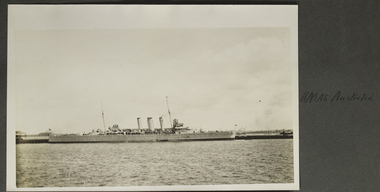
Photograph - Photograph, Sepia, HMAS Australia
... Black and white photograph with white border depicting a military ship berthed in port; glued in album on page 5...hmas australia fan album cruisers Black and white photograph with white border depicting a military ship berthed in port; glued in album on page 5 HMAS Australia Photograph Photograph, Sepia ...Black and white photograph with white border depicting a military ship berthed in port; glued in album on page 5hmas australia, fan album, cruisers -
 Warrnambool RSL Sub Branch
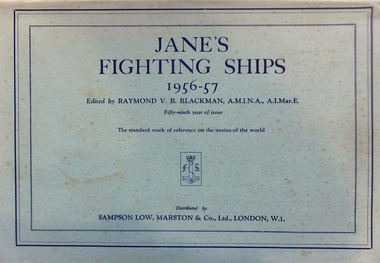
Book, JANE'S FIGHTING SHIPS 1956-57
... military ships. world navies....The standard work of reference on the navies of the World military ships. world navies. Compiled & edited by Raymond V.B. ...The standard work of reference on the navies of the WorldHard Cover, with Dust Cover Compiled & edited by Raymond V.B. BLACKMAN, A.M.I.N.A., A. E. Mar. The Standard work of reference on the navies of the World Distributed by SAMPSON LOW, MARSTON & Co., Ltd., LONDON, W.1. military ships. world navies. -
 Warrnambool RSL Sub Branch
Book, JANE'S FIGHTING SHIPS 1958-59
... military ships. world navies....The standard work of reference on the navies of the World military ships. world navies. Compiled & edited by Raymond V.B. ...The standard work of reference on the navies of the WorldHard Cover, No Dust Cover Compiled & edited by Raymond V.B. BLACKMAN, A.M.I.N.A., A. E. Mar. The Standard work of reference on the navies of the World Distributed by SAMPSON LOW, MARSTON & Co., Ltd., LONDON, W.1. military ships. world navies. -
 Warrnambool RSL Sub Branch
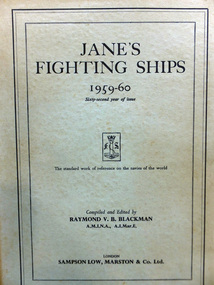
Book, JANE'S FIGHTING SHIPS 1959-60
... military ships. world navies....The standard work of reference on the navies of the World military ships. world navies. Compiled & edited by Raymond V.B. ...The standard work of reference on the navies of the WorldHard Cover, with Dust Cover Compiled & edited by Raymond V.B. BLACKMAN, A.M.I.N.A., A. E. Mar. The Standard work of reference on the navies of the World Distributed by SAMPSON LOW, MARSTON & Co., Ltd., LONDON, W.1. military ships. world navies. -
 Warrnambool RSL Sub Branch
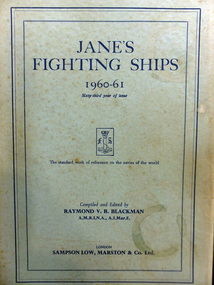
Book, JANE'S FIGHTING SHIPS 1960-61
... military ships. world navies....The standard work of reference on the navies of the World military ships. world navies. Compiled & edited by Raymond V.B. ...The standard work of reference on the navies of the WorldHard Cover, with Dust Cover Compiled & edited by Raymond V.B. BLACKMAN, A.M.I.N.A., A. E. Mar. The Standard work of reference on the navies of the World Distributed by SAMPSON LOW, MARSTON & Co., Ltd., LONDON, W.1. military ships. world navies. -
 Warrnambool RSL Sub Branch
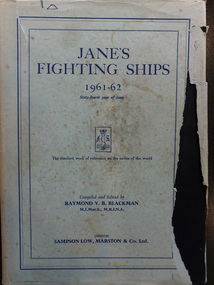
Book, JANE'S FIGHTING SHIPS 1961-62
... military ships. world navies....The standard work of reference on the navies of the World military ships. world navies. Compiled & edited by Raymond V.B. ...The standard work of reference on the navies of the WorldHard Cover, with torn Dust Cover Compiled & edited by Raymond V.B. BLACKMAN, A.M.I.N.A., A. E. Mar. The Standard work of reference on the navies of the World Distributed by SAMPSON LOW, MARSTON & Co., Ltd., LONDON, W.1. military ships. world navies. -
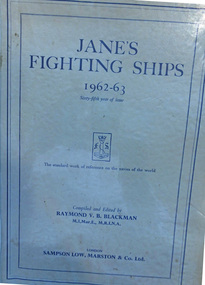 Warrnambool RSL Sub Branch
Book, JANE'S FIGHTING SHIPS 1962-63
... military ships. world navies....The standard work of reference on the navies of the World military ships. world navies. Compiled & edited by Raymond V.B. ...The standard work of reference on the navies of the WorldHard Cover, with Dust Cover plastic covered Compiled & edited by Raymond V.B. BLACKMAN, A.M.I.N.A., A. E. Mar. The Standard work of reference on the navies of the World Distributed by SAMPSON LOW, MARSTON & Co., Ltd., LONDON, W.1. military ships. world navies. -
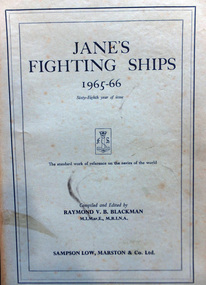 Warrnambool RSL Sub Branch
Book, JANE'S FIGHTING SHIPS 1965-66
... military ships. world navies....The standard work of reference on the navies of the World military ships. world navies. Compiled & edited by Raymond V.B. ...The standard work of reference on the navies of the WorldHard Cover, with Dust Cover Compiled & edited by Raymond V.B. BLACKMAN, A.M.I.N.A., A. E. Mar. The Standard work of reference on the navies of the World Distributed by SAMPSON LOW, MARSTON & Co., Ltd., LONDON, W.1. military ships. world navies. -
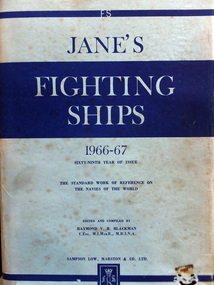 Warrnambool RSL Sub Branch
Book, JANE'S FIGHTING SHIPS 1966-67
... military ships. world navies....The standard work of reference on the navies of the World military ships. world navies. Compiled & edited by Raymond V.B. ...The standard work of reference on the navies of the WorldHard Cover, with Dust Cover Compiled & edited by Raymond V.B. BLACKMAN, A.M.I.N.A., A. E. Mar. The Standard work of reference on the navies of the World Distributed by SAMPSON LOW, MARSTON & Co., Ltd., LONDON, W.1. military ships. world navies. -
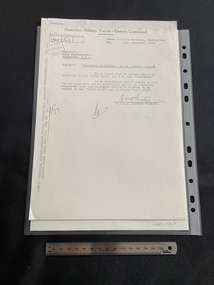 Returned Nurses RSL Sub-branch
Document - Photocopy of (Defence Army) classified correspondence file, Australian Defence Force, Allotment of nurses, 03/12/1940
... ...military ships...Correspondence of the Australian Defence Force regarding the medical arrangements on board the 'Queen Mary' and the 'Aquitania' ships in the convoy to the Middle East. military nurses Australian Defence Force military ships Photocopy on A4 paper of typed correspondence. ...Correspondence of the Australian Defence Force regarding the medical arrangements on board the 'Queen Mary' and the 'Aquitania' ships in the convoy to the Middle East.Photocopy on A4 paper of typed correspondence. The source is typed along the left side edge. military nurses, australian defence force, military ships -
 Returned Nurses RSL Sub-branch
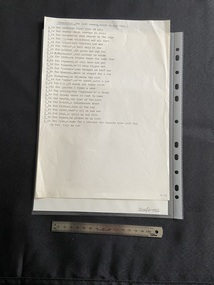
Document - Typed poem, "Homewards", the lost convoy, March to May 1942, unknown
... An acrostic poem about the experience of being aboard a military ship in a convoy, on the difficult journey back to Australia in 1942...An acrostic poem about the experience of being aboard a military ship in a convoy, on the difficult journey back to Australia in 1942 World War II 1942 Military convoy War poetry WW2 WWII 'H89' [Handwritten in pencil in the bottom right corner] A4 paper with a typed poem in black ink. ...An acrostic poem about the experience of being aboard a military ship in a convoy, on the difficult journey back to Australia in 1942A4 paper with a typed poem in black ink.'H89' [Handwritten in pencil in the bottom right corner]world war ii, 1942, military convoy, war poetry, ww2, wwii -
 Bendigo Military Museum
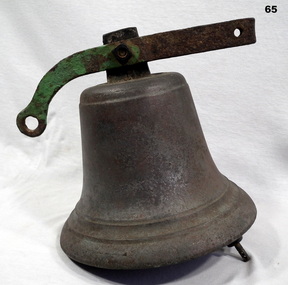
Tool - SHIPS BELL, c.1900
... ...ship relics...military...The Freighter had been torpedoed by a German Submarine in WW1. maritime technology ship relics military history - navy ships fittings souvenirs Ship's bell, rough cast bronze? ...This bell was apparently salvaged from a Freighter by Syd Storrie a Merchany Navy Sailor. The Freighter had been torpedoed by a German Submarine in WW1.Ship's bell, rough cast bronze? Clapper is rough cast steel. There is an old steel mounting bracket at the top, painted green. maritime technology, ship relics, military history - navy, ships fittings, souvenirs -
 Glen Eira Historical Society
Article - DAVIS, GERTRUDE
... ... Military hospitals... Hospital ships...Royal Red Cross (1st Class) Kaisar-I-Hind Davis Gertrude Matron Elsternwick Caulfield Hospital Australian Army Nursing Service Lemnos Victorian Women’s Army Auxiliary Corps (WAAC) Medals Insignia Awards Hospitals Nursing Nursing homes Medical services Nurses World War 1914-1918 Wars Military history Military hospitals Hospital ships Article DAVIS, GERTRUDE ...This file contains 1 item: A print out of an article in the Western Mail dated 07/02/1919 entitled ‘A Woman’s Melbourne Letter, Melbourne, Jan 24’. It describes a society gathering of which one of the guests is Matron Gertrude Davis. It goes on to describe her distinguished career in the Australian Army Nursing Service both overseas (serving during World War 1); and her plus other nurses working at Caulfield Hospital.royal red cross (1st class), kaisar-i-hind, davis gertrude matron, elsternwick, caulfield hospital, australian army nursing service lemnos, victorian women’s army auxiliary corps (waac), medals, insignia, awards, hospitals, nursing, nursing homes, medical services, nurses, world war 1914-1918, wars, military history, military hospitals, hospital ships -
Warrnambool RSL Sub Branch
Photograph - HMAS Warrnambool J202 photograh
... HMAS Warrnambool J202 photograh of Military on board ship appearing to set sail...HMAS Warrnambool J202 photograh of Military on board ship appearing to set sail HMAS Warrnambool J202 photograh Photograph HMAS Warrnambool J202 photograh ...HMAS Warrnambool J202 photograh of Military on board ship appearing to set sail -
 Mission to Seafarers Victoria
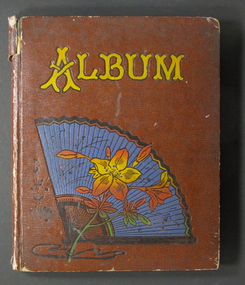
Album (item) - Photographic Album, 1928
... From page 15 the rest of the album is empty however 3 photographs (2 of those seem to be related to the topic of football and military ship visit) and 4 articles were also stored between pages without relation to the album. ...From page 15 the rest of the album is empty however 3 photographs (2 of those seem to be related to the topic of football and military ship visit) and 4 articles were also stored between pages without relation to the album. ...This album containing 50 photographs depicts a year at the Mission in 1928: Wedding of the Dora Walker with Harry Simpson on 14 February. Picnic at Riversdale Hawthorn, 1 January 1928 Ships in Port Melbourne in November: HMAS Australia, HMAS Brisbane, and destroyers Anzac, Success, Swordsman Wharfs, Victoria Dock, Stevedores Picnic in Finhaven, Kew, the Buchan's Property for Cup Day (6 November) Views of Port Melbourne from 1888 building Monday 29 October: return of Archbishop of Melbourne (Dr. Harrington Lees), who had spent a 10-month holiday in England with his wife. Arrival on the RMS Maloja Two photographs are missing.Pre Great Depression, 1928 was a difficult year in Melbourne and also for the Mission. Ships were rare on the wharfs meaning seamen were also rare in the missions. However they started the fundraising for the extension of the 1888 Port Melbourne building which was becoming too small. At the end of the year, Reverend Weller announced he was appointed assistant in London. He and his wife Alexina left in January 1929 after five years. They sailed on the Osterley on the 22 January 1929.Embossed yellow font on cover reads: ALBUMfan, strikes, police, reverend john reginald weller (1880-1969), alexina weller (nee caley), freda oxley, hmas australia, hmas brisbane, great depression, unemployment, port melbourne, station pier, sugar cane, queensland, dora simpson nee walker, weddings, cup day, finhaven, kew, the ducketts, mrs john buchan, flinders street extension, gasworks, wharfs, victoria dock, motorboat, southern cross, success, destroyers, football, sports, rms maloja, lhlg, fan album, anzac, swordsman, freda kathleen oxley 1882-1969, annie alexandrina caley (known as alexina) 1885-1934 -
 Geelong RSL Sub Branch
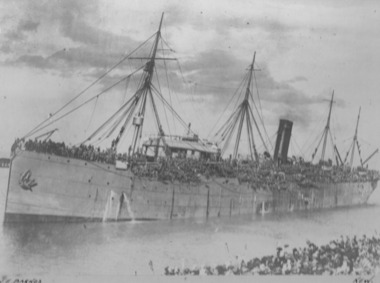
Photograph - HMAT Runic, Early 20th Century
... A fleet of transport ships was leased by the Commonwealth Government for the purpose of transporting various AIF formations to their respective overseas destinations. When not committed to military...A fleet of transport ships was leased by the Commonwealth Government for the purpose of transporting various AIF formations to their respective overseas destinations. When not committed to military ...A fleet of transport ships was leased by the Commonwealth Government for the purpose of transporting various AIF formations to their respective overseas destinations. When not committed to military transport the ships were used for other duties. HMAT A54e Runic was one of these ships.The HMAT Runic weighed 12,480 tons and was owned by the Oceanic SN Co Ltd. Liverpool. The HMAT Runic was leased by the Commonwealth Government until 27 November 1917. She carried AIF Personnel to overseas destinations during WW1.Photograph HMAT Runic on a cardboard backing.HMAT Runic 20-06-16. J E Barnes, Photo, Kew.hmat runic, ww1, aif, commonwealth government, leased -
 Geelong RSL Sub Branch
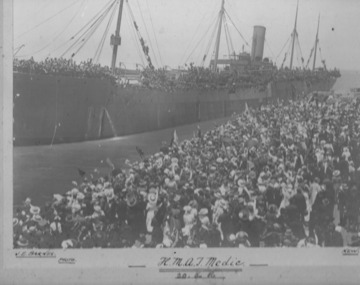
Photograph - HMAT Medic, Early 20th Century
... A fleet of Transport Ships was leased by the Commonwealth Government for the specific purpose of transporting various AIF formations to the respective overseas destinations. When not committed to military...A fleet of Transport Ships was leased by the Commonwealth Government for the specific purpose of transporting various AIF formations to the respective overseas destinations. When not committed to military ...A fleet of Transport Ships was leased by the Commonwealth Government for the specific purpose of transporting various AIF formations to the respective overseas destinations. When not committed to military transport the ships were employed on other duties. The fleet was made up of British Ships and captured German Ships. The HMAT Medic weighed 12,032 tons and was owned by the Oceanic SN Co Ltd Liverpool, she was leased by the Commonwealth Government until 26 October 1917.This photograph is of HMAT Medic leaving Australian Shores 20-05-16. The Medic was also used as a troopship for Australia during the Boer War.Photograph of the ship on a cardboard backing.HMAT Medic 20-5-16. J E Barnes Photo. Kew.hmat medic troopship, .commonwealth government, ww1, boer war -
 Flagstaff Hill Maritime Museum and Village
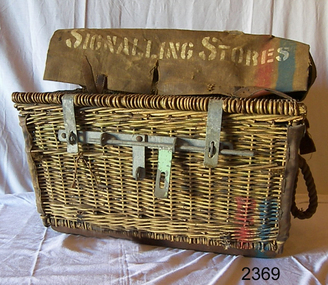
Equipment - Wicker Basket
... Signalling flares have been in use by all branches of the military services since the 1920s also by the maritime services to signal other ships or for distress purposes. ...Signalling flares have been in use by all branches of the military services since the 1920s also by the maritime services to signal other ships or for distress purposes. ...A flare, also sometimes called a fusee, is a type of pyrotechnic that produces a bright light or intense heat without an explosion. Flares are used for distress signalling, illumination, communication or defensive countermeasures in civilian and military applications. Flares may be ground pyrotechnics, projectile pyrotechnics, or parachute-suspended to provide maximum illumination time over a large area. Projectile pyrotechnics may be dropped from aircraft, fired from rocket or artillery, or deployed by flare guns or hand held percussive tubes. Signalling flares have been in use by all branches of the military services since the 1920s also by the maritime services to signal other ships or for distress purposes. The earliest recorded use of gunpowder for signalling purposes was the 'signal bomb' used by the Chinese Song Dynasty as the Mongol-led Yuan Dynasty besieged Yangzhou in 1276. These soft-shelled bombs, timed to explode in mid-air, were used to send messages to a detachment of troops far in the distance. Another mention of the signal bomb appears in a text dating from 1293 requesting their collection from those still stored in Zhejiang. A signal gun appears in Korea by 1600. The (Wu I Thu Phu Thung Chih or Illustrated Military Encyclopedia) written in 1791 depicts a signal gun in an illustration. The item was used to carry and store flares for signalling use as the inscription on the canvas cover suggests. Given the method of storing flares is in a wicker basket that is non conducting of an electrical charge that may accidentally set of explosive materials. The writer assumes the basket was used from the early 20th century and most likely by maritime or military services to store it's flares.Basket cane square with metal locks & rope handles each end. Canvas reinforced on vertical sides with a canvas cover on top. Canvas cover has leather straps. Stencilled on canvas in white paint "SIGNALLING STORES" flagstaff hill, warrnambool, shipwrecked-coast, flagstaff-hill, flagstaff-hill-maritime-museum, maritime-museum, shipwreck-coast, flagstaff-hill-maritime-village, basket, cane basket, signalling stores -
 Flagstaff Hill Maritime Museum and Village
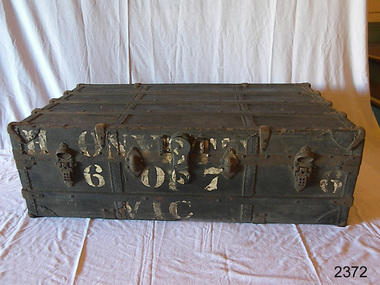
Functional object - Travel Trunk, 1890-1920
... ships. Travel then was so different with people having to pack a very large wardrobe of clothes to last for some time possibly for months overseas. The subject item looks like it was of military ...Steamer trunks (named after their location of storage in the cabin of a steamship, or "steamer") which are sometimes referred to as flat-tops, first appeared in the late 1870s, although the greater bulk of them date from the 1880–1920 period. They are distinguished by either their flat or slightly curved tops and were usually covered in canvas, leather or patterned paper and about (36 cm) tall to accommodate steamship luggage regulations. Steamer trunks were originally called a cabin trunk. An orthodox name for this type of trunk would be a "packer" trunk, but since it has been widely called a steamer for so long, it is now a hallmark of the style. A trunk, also known as a travel trunk, is a large cuboid container designed to hold clothes and other personal belongings. They are most commonly used for extended periods away from home. Trunks are differentiated from chests by their more rugged construction due to their intended use as luggage, instead of storage. Among the many styles of trunks, there are Jenny Lind, Saratoga, monitor, steamer or Cabin, barrel-staves, octagon or bevel-top, wardrobe, dome-top, barrel-top, wall trunks, and even full dresser trunks. These differing styles often only lasted for a decade or two and along with the hardware can be extremely helpful in dating an unmarked trunk. Although trunks have been around for thousands of years in China and elsewhere, the most common styles seen and referred to today date from the late 18th century to the early 20th century when they were supplanted in the market by the cost-effective and lighter suitcase. There were hundreds of trunk manufacturers in the United States and a few of the larger and well-known companies were Rhino Trunk & Case, C.A. Taylor, Haskell Brothers, Martin Maier, Romadka Bros, Goldsmith & Son, Crouch & Fitzgerald, M. M. Secor, Winship, Hartmann, Belber, Oshkosh, Seward, and Leatheroid. One of the largest American manufacturers of trunks at one point the Seward Trunk Co. of Petersburg, Virginia still makes them for school and camp, and another company Shwayder Trunk Company of Denver, Colorado would eventually become Samsonite. Another is the English luxury goods manufacturer H.J. Cave trading since 1839. Their Osilite trunk was used by such famous customers as T.E. Lawrence and Ruth Vincent Some of the better known French trunk makers were Louis Vuitton, Goyard, Moynat, and Au Départ. Only a few remain with the most prominent US company being Rhino Trunk and Case, Inc who probably manufacture more trunks than any company in the world.A snapshot into our social history regards how travel was undertaken over a hundred years ago and how people travelled so differently than today as they often packed for extended travel on ships. Travel then was so different with people having to pack a very large wardrobe of clothes to last for some time possibly for months overseas. The subject item looks like it was of military issue and was used for travel during the first world war by a military man from Victoria and was one of six similar trunks. This assessment is based on the type of locks used the trunk itself could have been made in America or Britain as the locks used in both countries came from American lock makers.Trunk wooden large covered with leather wood cleats and brass locks, also unreadable tableIn white paint "H Onvett, 6 of 7 and bottom right of front the number 6 (Owner)flagstaff hill, warrnambool, shipwrecked-coast, flagstaff-hill, flagstaff-hill-maritime-museum, maritime-museum, shipwreck-coast, flagstaff-hill-maritime-village, trunk -
 Flagstaff Hill Maritime Museum and Village
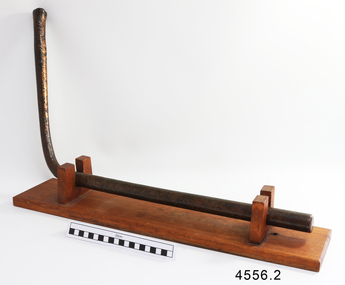
Nail, circa 1810
... ship built in Deptford, England, in 1810. On 14th December 1834 she left Woolwich, England, bound for Hobart Town, Van Diemen’s Land (Tasmania), under Captain William Hall Moxey. She was carrying 220 male convicts plus crew, guards and their families, totalling 294 persons (another 2 were during the voyage). Amongst the cargo were military...ship built in Deptford, England, in 1810. On 14th December 1834 she left Woolwich, England, bound for Hobart Town, Van Diemen’s Land (Tasmania), under Captain William Hall Moxey. She was carrying 220 male convicts plus crew, guards and their families, totalling 294 persons (another 2 were during the voyage). Amongst the cargo were military ...This copper nail, sometimes known as a ‘Dumpy Bolt’ or spike, was salvaged from the hull of the wreck of the “George III”. It dates back to at least 1810. It was found by an abalone diver on the south east coast of Tasmania. The nail would have been used to hold the layers of the ship’s keel frame and the planking together. The nail has been passed from the abalone diver to an interested business man on a trip to the south of Hobart, on again to the business man’s close friend who then donated it to Flagstaff Hill Maritime Village. The metal of nails such as this one, after being in the sea for a long time, become affected by the natural reaction of the sea water, causing it to degenerate and thin, and the stress from the force of the sea over the years alters its shape. Iron nails had been used on ships previously, but they quickly corroded in the salt; ships needed regular, costly and time-consuming maintenance to replace the iron nails. Towards the end of the 18th century the British Navy trialled the use of copper nails, finding them to be very successful. Merchant ships began to adopt this process in the early 19th century, although it made ship building very expensive and was more often used for ships such as the “George III” that sailed on long voyages. The three masted sailing ship “George III” was a convict transport ship built in Deptford, England, in 1810. On 14th December 1834 she left Woolwich, England, bound for Hobart Town, Van Diemen’s Land (Tasmania), under Captain William Hall Moxey. She was carrying 220 male convicts plus crew, guards and their families, totalling 294 persons (another 2 were during the voyage). Amongst the cargo were military stores including several copper drums of gun powder. On 27th January 1835 the “George III” was near the Equator, about half way into her journey. A fire broke out and the gun powder was in danger of explosion, threatening the whole ship. Two convicts braved the heat and smoke, entered the store and seized the gun powder drums, suffering burns for their efforts but saving a probable disaster. The fire destroyed some of the provisions and food was scarce. Many became ill with scurvy and some died during the journey. Nearing the end of their journey on 10th April 1835 the “George III” was headed through the D'Entrecasteaux Channel, south east Tasmania, between the mainland and Bruny Island. She was sailing in the moonlit night to hasten her arrival in port due to the great number of sick on board. She struck uncharted rocks, known only to the local whalers, between Actaeon Reef and Southport Lagoon and within hours began to break up. The ship’s boats were used to first rescue the women and children. Firearms were used to help quell the panic of the convicts below decks and some were killed by the shots. Many convicts, including the sick, were drowned. In all, 133 lives were lost including 5 of the crew, guards and their families. It was the third worst shipping disaster in Tasmanian waters. A monument in honour of the prisoners who perished in the “George III” has been erected, noting the date of the wreck as “Friday 10th April 1835.” (NOTE: there are a few differences between sources regarding dates of the shipwreck, some saying March and others April 1835. There are also differences in the figures of those on board and the number of lives lost.) The copper nail is significant as an example of sailing ship construction; fasteners used in the early 19th century on ships carrying convicts to Australia. The nail is also significant for its association with the ship “George III”. The “George III” is registered on the Australian National Shipwreck Database, ID 7195 as an Historic Shipwreck. She is the third worst shipwreck in Tasmanian waters. She is also associated with Early Australian History and the transportation of convicts to Australia. The incident of the fire on board and the bravery of the convicts in making the gun powder safe is an example of the social character of the people in early Tasmanian colonisation. Copper nail (also called a Dumpy bolt or spike) from the convict ship George III, wrecked in 1835. Nail is long, bent in an ‘L’ shape about 3/5ths along, tapering from both ends to the bend. Both ends are flat and do not taper to a point, nor have a thread. The shorter end has been polished, showing bright copper. There is pitting along the nail and virdigris is evident on the longer, unpolished end. The nail is displayed with the longer section resting on a wooden board between two ‘U’ shaped uprights, the shorter section upright. flagstaff hill, warrnambool, shipwrecked coast, flagstaff hill maritime museum, maritime museum, shipwreck coast, flagstaff hill maritime village, great ocean road, george iii, ship construction, ship nail, 1835 shipwreck, 19th century shipwreck, william moxey, d'entrecasteaux channel, convict transportation, copper nail, dumpy bolt, spike, keel nail -
 Federation University Historical Collection
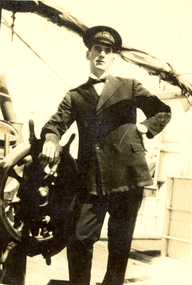
Photograph - Black and White, Frank Wright stands beside a ships wheel
... Military Band Scoring and conducted at the Guildhall of Music and Drama. Frank was often invited to adjudicate Brass Band Championships around Europe, in Australia, including South Street and in New Zealand. The Frank Wright Medal at the Royal South Street competition is awarded to an individual recognized as making an outstanding contribution to brass music in Australia. frank wright A black and white photo of a man in a suit, cap and bow tie leaning on a ship's wheel. ...Frank Wright was a renown resident of Smeaton, where he was born. He lived at Laura Villa, and attended Smeaton State School. His father William was a gold miner and his mother's name was Sarah. Their family won many singing and instrumental awards. Frank was tutored by Percy Code and was awarded a gold medal for the highest marks in the ALCM examinations in the British Colonies at the age of seventeen years. He became the Australian Open Cornet Champion by the age of eighteen. A year later, Frank conducted the City of Ballarat Band, and later the Ballarat Soldiers’ Memorial Band. He formed the Frank Wright Frisco Band and Frank Wright and his Coliseum Orchestra. These bands won many South Street awards, and Frank as conductor won many awards in the Australian Band Championship contest. In 1933 Frank Wright sailed to England to conduct the famous St Hilda’s Band and was later appointed Musical Director of the London County Council, where he organized many amazing concerts in parks, in and around the London district. He was made Professor of Brass and Military Band Scoring and conducted at the Guildhall of Music and Drama. Frank was often invited to adjudicate Brass Band Championships around Europe, in Australia, including South Street and in New Zealand. The Frank Wright Medal at the Royal South Street competition is awarded to an individual recognized as making an outstanding contribution to brass music in Australia.A black and white photo of a man in a suit, cap and bow tie leaning on a ship's wheel. The man is Frank Wright.frank wright -
 Federation University Historical Collection
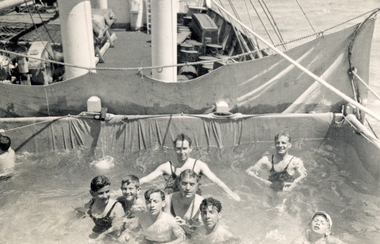
Photograph - Black and White, Swimming Bath on 'Remo', Red Sea, 1940, Jan 1940
... Military Band Scoring and conducted at the Guildhall of Music and Drama. Frank was often invited to adjudicate Brass Band Championships around Europe, in Australia, including South Street and in New Zealand. The Frank Wright Medal at the Royal South Street competition is awarded to an individual recognized as making an outstanding contribution to brass music in Australia. frank wright ship named remo red sea swimming bath swimming pool conductor Written in pencil on the back - Swimming bath on 'Remo' Red Sea, Jan 1940, F.W. in centre Black and white photograph of a group of people swimming in a canvas pool on board a ship. ...Frank Wright was a renown resident of Smeaton, where he was born. He lived at Laura Villa, and attended Smeaton State School. His father William was a gold miner and his mother's name was Sarah. Their family won many singing and instrumental awards. Frank was tutored by Percy Code and was awarded a gold medal for the highest marks in the ALCM examinations in the British Colonies at the age of seventeen years. He became the Australian Open Cornet Champion by the age of eighteen. A year later, Frank conducted the City of Ballarat Band, and later the Ballarat Soldiers’ Memorial Band. He formed the Frank Wright Frisco Band and Frank Wright and his Coliseum Orchestra. These bands won many South Street awards, and Frank as conductor won many awards in the Australian Band Championship contest. In 1933 Frank Wright sailed to England to conduct the famous St Hilda’s Band and was later appointed Musical Director of the London County Council, where he organized many amazing concerts in parks, in and around the London district. He was made Professor of Brass and Military Band Scoring and conducted at the Guildhall of Music and Drama. Frank was often invited to adjudicate Brass Band Championships around Europe, in Australia, including South Street and in New Zealand. The Frank Wright Medal at the Royal South Street competition is awarded to an individual recognized as making an outstanding contribution to brass music in Australia.Black and white photograph of a group of people swimming in a canvas pool on board a ship. Behind the pool can be seen part of the ship and water to the right. The ship is the Remo, the place is the Red Sea and the man in the middle of the group is Frank Wright.Written in pencil on the back - Swimming bath on 'Remo' Red Sea, Jan 1940, F.W. in centrefrank wright, ship named remo, red sea, swimming bath, swimming pool, conductor -
 Flagstaff Hill Maritime Museum and Village
Instrument - Fob Watch, ca 1878
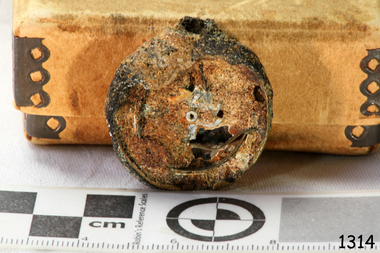
... ship’s manifest includes ‘clocks and watches £25’. . Considering the dates of the letter and the envelope, did the finder of the ‘souvenir’ watch take it to Europe? Was it used for good luck during service in the military...ship’s manifest includes ‘clocks and watches £25’. . Considering the dates of the letter and the envelope, did the finder of the ‘souvenir’ watch take it to Europe? Was it used for good luck during service in the military ...The story of this gold fob watch is intriguing. The letter is dated March 6, 1905, 27 years after the Loch Ard was wrecked. It appears to be a quick personal note from a relative or friend who briefly writes the history of the enclosed ‘souvenir’ watch, found in Loch Ard Gorge at Port Campbell. Although the finder is not named, it is likely the letter’s author. The writer mentions that the letter and watch would be sent once photographs of the area where the watch was found had been added. The fancy, lined envelope’s date stamp is October 12th, 1917 (12.10.17), almost 12 years after the letter was written. It has a postmark from Florence (Firenze), Italy. The handwriting on the envelope differs from that of the letter, and there is no further mention of photographs being included. The condition of the watch certainly shows the effects of time in the sea. Some inner workings can be seen through broken encrustations and missing sections of its case. The winding knob on the top is recognisable even though it is covered by sand and other adhesions from the sea. Its dainty size and gold case suggest that it was made for a well-to-do female. The watch, envelope and letter were donated along with a 1971 newspaper cutting, all neatly folded and tucked with the watch into a small, strong cardboard box with metal reinforcing on the corners and a fitted lid. The newspaper article gives context to the watch, telling the story of the Loch Ard shipwreck tragedy and the two survivors, but does not refer to the watch. Perhaps one of the 17 passengers sailing on the Loch Ard, including members of the Carmichael family, owned the watch, or maybe it was amongst the cargo, as the ship’s manifest includes ‘clocks and watches £25’. . Considering the dates of the letter and the envelope, did the finder of the ‘souvenir’ watch take it to Europe? Was it used for good luck during service in the military? . Comparing the different writing on the letter and the envelope, does it suggest that the watch’s finder was overseas and asked someone to send the envelope to the intended recipient, with postage from Italy? ABOUT the address, “Glencove”: The details on the envelope are faint and obscured by stiff creases in the paper. The address appears to be “Mrs J. Mortton, Glencove, Portsea, Victoria, Australia”; though the family at that address had the surname “Morton”. Mrs J. Morton, formerly Elizabeth Ford, married her second husband, James Morton, in 1904, the year before the date of the letter. The couple lived at the Nepean Hotel before they were at “Glencove”. Although they never owned that property, it was their home when James died in 1937. Elizabeth’s nephew, Alfred Sandle Ford (1894-1981), and a nephew-in-law were overseas during World War I. Alfred Ford had moved to Melbourne as a young boy with his father. He entered service as Second Lieutenant in 1915, naming his father, Alfred Sandle Ford, as his next of kin. He served in Egypt, France and Belgium with the Australian Imperial Forces as a member of the Field Artillery Brigades. He returned to Melbourne in 1919 and worked in Richmond and Box Hill. He later married Frances Whyburn. Previously, in 1872, Elizabeth Ford’s sister, Julia Ford, acquired the 1-acre property with a 3-room house that became known as “Glencove”, Portsea. The building was originally the first school in the area, established before Crown Land sales. In the Parish of Nepean, it was first assessed for rates in 1871. Julia Ford (1843-1912) and Elizabeth Ford (1859-1957) were daughters of James Sandle Ford (1811-1890), a well-known pioneer of Portsea, formerly a convict limeburner. James Ford acquired several Crown allotments in Portsea. In 1872, he converted his old hotel into the large residential establishment known as the Nepean Hotel, which his family largely ran until it was demolished in 1971. During those years, different family members lived at the Nepean Hotel or Glencove. In 1877, Julia Ford married a significant landowner, John Cain, a limeburner from Rye. They had five daughters, four of whom were never married; Kathleen (1880-1949), Mabel (1881-1973), who was the last family member to own the house until her death, Hilda (1884-1974) and Julia Ethel (1888-1949). Some of the newspaper records refer to “Glencove”, Portsea, inform that: 1927 - Dr. and Mrs. J. E. Shilliday are staying with Mrs. R. B. Sanderson at Glencove. (Australasian) 1937 - James Morton died at his property, Glencove, Portsea, aged 83 years (Argus) 1949 - Julia Ethel Cain died at Glencove, Portsea. (Argus) 1949 - Probate application by sisters of Julia Ethel Cain, deceased, formerly of Nepean Hotel, Portsea, but late of Glencove, Nepean Highway, Portsea. The connection of the watch with the sands of Loch Ard Gorge and to the ship Loch Ard contributes to our knowledge of personal items brought to Australia in 1878, whether as the belongings of a passenger or as cargo; a gold watch would be intended for a wealthy buyer. The little artefact helps us understand the survival of artefacts in the powerful sea, over a quarter of a century after the wreck of the ship. Although many people would have visited the shipwreck site, the length of time before it was found helps us understand the effects of the sea on shipwreck artefacts. The survival of the carefully packaged watch and related documents shows the respectful understanding of preservation of historic artefacts, even from almost 150 years ago at the time of writing (2025). Ladies' fob watch, thought to be gold. It is now covered in encrustation. A bump on the edge would be the winding mechanism for the watch. A small section of the back of the case has broken away, and an engraved surface can be seen. Face and hands are missing, revealing the spring workings inside. Donated with the watch were two documents and a newspaper cutting about the story of the shipwreck of the Loch Ard. They are all in a strong cardboard box with reinforced corners on the base and lid. Found at Loch Ard Gorge and said to have been from the Loch Ard. The three donated documents are: - 1. A rectangular envelope made of cream waxy paper lined with black and white diagonally striped paper. The top right corner, usually meant for a postage stamp, has been torn off, partly exposing text on a rectangular printed logo. A round black postmark stamp near the top centre shows the post office location and date. The address on the front is handwritten in black ink. The creases on the envelope suggest it has been folded three times. 2. A letter on cream rectangular paper features clear, handwritten script in black ink. The unevenly cut bottom edge has two short black vertical lines, possibly the tops of tall written letters. There are creases where the page has been folded three times. 3. A newspaper clipping featuring text, an illustration, and handwritten details of the newspaper’s source.1. Envelope: - Address: ”Australia (per Postage) / [looks like “Mrs J. Mortton”] / Glencove, (Portsea) / Victoria” Postmark: “FIRENZE” 12 10 17” “ - - - -PORTEN – (illegible)” Logo inside envelope: “BUSTA BRE--- / Earliera Lialia” [Italian; Busta = envelope, Earliera == earlier] 2. Letter: - “I am sending you a ‘souvenir’ from the wreck of the Loch Ard 28 years ago at Port Campbell. It is the remains of a lady’s gold watch found in the gorge where Miss Carmichael & Tom Pearce (the only two saved) were washed up. This souvenir was lying there ever since. I went down into the awful gorge & saw the cave where these two unfortunates (or fortunate perhaps, as they were saved) lived until rescued. I also saw the graves of those who were washed up from the wreck. One grave contains Dr and Mrs Carmichael & six of their children. Later on, when I can get some good views of that wild coast I will send them to you. 6/3/05.” 3. Newspaper cutting: - History of the Lochard. Refer to the Sydney Morning Herald, Nov. 28th, 1971: “Loch Ard: the wreck that became a legend” flagstaff hill, warrnambool, shipwreck coast, flagstaff hill maritime museum, maritime museum, flagstaff hill maritime village, great ocean road, loch ard, eva carmichael, tom pearce, loch ard gorge, loch ard souvenir, port campbell, miss carmichael, mrs carmichael, dr carmichael, 1878, loch ard: the wreck that became a legend, ladies fob watch, gold watch, fob watch, pocket watch, horology, accessory, time keeping, scientific instrument, ladies' watch, ladies' pocket watch, lady's watch, souvenir watch, survivor, clocks and watches, diagonally striped envelope lining, firenze, busta, earliera, florence, italy, glencove, portsea, victoria, 1905, 1917, nepean hotel, moreton, morton, elizabeth morton, mrs j. morton, james morton, elizabeth ford, julia ford, alfred sandle ford, frances whyburn, james sandle ford, john cain, kathleen cain, mabel cain, hilda cain, julia ethel cain, australian imperial forces, field artillery brigades, limeburner -
 Flagstaff Hill Maritime Museum and Village
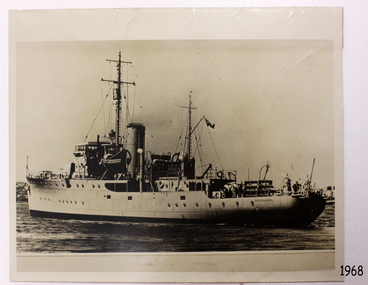
Photograph - Vessel, Steam Ship, HMAS Warrnambool J202, Between 1941-1947
... - National significance, being present in Timor at the Japanese surrender - National significance, shown by the significance of the ship’s bell being curated as Military Heritage and Technology at the Australian War Memorial. - National significance as part of Australia’s defence force history, being one of only four Bathurst class corvettes lost while in Australian service, the only Bathurst class corvette lost after World War II, the only RAN vessel to be sunk by a mine, and associated with the last four Navy deaths of WWII flagstaff hill Maritime Village maritime museum Warrnambool Shipwreck coast Mort's Dock & Engineering Co Ltd H.M.A.S. ...The photograph shows the vessel HMAS Warrnambool J202, which was commissioned by the Royal Australian Navy for use as a minesweeper during World War II. The Bathurst Class Corvette, fitted out with a range of armaments, was launched in Sydney 1941. The ship began service in Bass Strait in 1941. At the end of the year it called into its namesake city, Warrnambool, where the crew paraded for the public marching eastwards along Timor Street. A gift of books for the ship’s personnel and a plaque bearing the City of Warrnambool’s Coat of Arms were presented to the ship. The ship was involved in evacuating a family of nine from the Dutch East Indies that was later successful in its challenge of Australia’s Immigration Restriction Act (White Australia Polity). The ship had many other appointments around Australia. On 13th September 1947 HMAS Warrnambool was leading a flotilla of minesweepers in northern Queensland’s coastal waters, clearing mines previously laid to defend Australia. The ship hit a mine, which exploded and very quickly sunk the ship. Boats from the nearby ships rescued most of the seamen although one was killed at the time. The survivors were taken by the HMAS Swan II to Darwin, and they went from there to hospitals in Brisbane and Sydney. Three of these men later died from their injuries. A number of items were recovered by Navy divers in 1948 including the ship’s bell and a plaque with Warrnambool’s Coat of Arms. In 1972-75 the wreck was sold and other items were salvaged. In 1995 a memorial plaque was erected in Warrnambool near the RSL. NOTE: The RAN built a second HMAS Warrnambool FCPB204, launched in 1981 and decommissioned in 2005. There was also a steam ship SS Warrnambool built in London 1892 and broken up in 1926. [A more detailed history can be found in our Collection Record 3477.] This photograph of HMAS Warrnambool is significant for its association with Royal Australian Navy and its vessel, HMAS Warrnambool (J202). The HMAS Warrnambool played a nationally significant role in overturning Australia’s Immigration Restriction Act 1901 (colloquially known as the White Australia policy). The ship rescued, and brought to Australia, Samuel and Annie Jacob and their family after they evacuated Dutch East India. The family was threatened with deportation and made the first successful appeal to High Court regarding that Act. The HMAS Warrnambool has - Local significance for being the namesake of the City of Warrnambool - Local significance, having docked in Warrnambool Harbour - Local significance, the crew having paraded in Timor Street, Warrnambool - State significance for its first patrol being in Bass Strait. - National significance, being present in Timor at the Japanese surrender - National significance, shown by the significance of the ship’s bell being curated as Military Heritage and Technology at the Australian War Memorial. - National significance as part of Australia’s defence force history, being one of only four Bathurst class corvettes lost while in Australian service, the only Bathurst class corvette lost after World War II, the only RAN vessel to be sunk by a mine, and associated with the last four Navy deaths of WWIIPhotograph of HMAS Warrnambool near land. Black and white photograph shows a steam and sail vessel in calm water beside land. Figures are standing on board. A flag flies on a mast. The ship's name is on the stern. The light coloured funnel has emitted a small amount of smoke.On side of ship "WARRNAMBOOL"flagstaff hill, maritime village, maritime museum, warrnambool, shipwreck coast, mort's dock & engineering co ltd, h.m.a.s. warrnambool, hmas warrnambool, hmas warrnambool i, hmas warrnambool j202, hmas swan ii, j202, world war ii, bathurst class corvette, royal australian navy, ran, sydney built ship, bass strait patrol, sea mine patrol, mine sweeper, mine clearance, navy divers, great barrier reef, cockburn reef, southern cross diving and salvage, warrnambool city council, cr j r astbury, mayor j r astbury, warrnambool patriotic fund, seal, coat of arms, dedicatory plaque, hmas warrnambool 1941, shipwreck by sea mine 1947, sinking ship, sunk ship, minesweeper -
 Flagstaff Hill Maritime Museum and Village
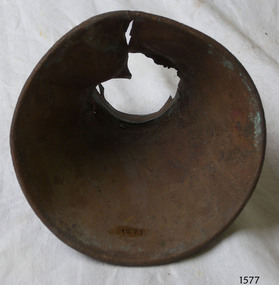
Equipment - Speaking Tube, Morts Dock & Engineering Co. Ltd, circa 1941
... - National significance, being present in Timor at the Japanese surrender - National significance, shown by the significance of the ship’s bell being curated as Military Heritage and Technology at the Australian War Memorial. - National significance as part of Australia’s defence force history, being one of only four Bathurst class corvettes lost while in Australian service, the only Bathurst class corvette lost after World War II, the only RAN vessel to be sunk by a mine, and associated with the last four Navy deaths of WWII flagstaff hill Maritime Village maritime museum Warrnambool Shipwreck coast Mort's Dock & Engineering Co Ltd H.M.A.S. ...This brass speaking tube or voice pipe was used by the crew to communicate within the ship. It was recovered from the wreck of the Royal Australian Navy vessel, HMAS Warrnambool in 1948. The HMAS Warrnambool J202 was commissioned by the Royal Australian Navy for use as a minesweeper during World War II. The Bathurst Class Corvette, fitted out with a range of armaments, was launched in Sydney 1941 and was. The ship began service in Bass Strait in 1941. At the end of the year it called into its namesake city, Warrnambool, where the crew paraded for the public marching eastwards along Timor Street. A gift of books for the ship’s personnel and a plaque bearing the City of Warrnambool’s Coat of Arms were presented to the ship. The ship was involved in evacuating a family of nine from the Dutch East Indies that was later successful in its challenge of Australia’s Immigration Restriction Act (White Australia Polity). The ship had many other appointments around Australia. On 13th September 1947 HMAS Warrnambool was leading a flotilla of minesweepers in northern Queensland’s coastal waters, clearing mines previously laid to defend Australia. The ship hit a mine, which exploded and very quickly sunk the ship. Boats from the nearby ships rescued most of the seamen although one was killed at the time. The survivors were taken by the HMAS Swan II to Darwin, and they went from there to hospitals in Brisbane and Sydney. Three of these men later died from their injuries. A number of items were recovered by Navy divers in 1948 including the ship’s bell and a plaque with Warrnambool’s Coat of Arms. In 1972-75 the wreck was sold and other items were salvaged. In 1995 a memorial plaque was erected in Warrnambool near the RSL. NOTE: The RAN built a second HMAS Warrnambool FCPB204, launched in 1981 and decommissioned in 2005. There was also a steam ship SS Warrnambool built in London 1892 and broken up in 1926. [A more detailed history can be found in our Collection Record 3477.] This speaking tube is an example of communication used in the mid-1900s on board a vessel. It is significant is significant for its association with Royal Australian Navy and its vessel, HMAS Warrnambool (J202). The HMAS Warrnambool played a nationally significant role in overturning Australia’s Immigration Restriction Act 1901 (colloquially known as the White Australia policy). The ship rescued, and brought to Australia, Samuel and Annie Jacob and their family after they evacuated Dutch East India. The family was threatened with deportation and made the first successful appeal to High Court regarding that Act. The HMAS Warrnambool has - Local significance for being the namesake of the City of Warrnambool - Local significance, having docked in Warrnambool Harbour - Local significance, the crew having paraded in Timor Street, Warrnambool - State significance for its first patrol being in Bass Strait. - National significance, being present in Timor at the Japanese surrender - National significance, shown by the significance of the ship’s bell being curated as Military Heritage and Technology at the Australian War Memorial. - National significance as part of Australia’s defence force history, being one of only four Bathurst class corvettes lost while in Australian service, the only Bathurst class corvette lost after World War II, the only RAN vessel to be sunk by a mine, and associated with the last four Navy deaths of WWIISpeaking tube or voice pipe, brass, conical shape, broken off at base. Wide end has a rolled edge. Recovered from HMAS Warrnambool, sunk on 13-09-1947.flagstaff hill, maritime village, maritime museum, warrnambool, shipwreck coast, mort's dock & engineering co ltd, h.m.a.s. warrnambool, hmas warrnambool, hmas warrnambool i, hmas warrnambool j202, hmas swan ii, j202, world war ii, bathurst class corvette, royal australian navy, ran, sydney built ship, bass strait patrol, sea mine patrol, mine sweeper, mine clearance, navy divers, great barrier reef, cockburn reef, southern cross diving and salvage, warrnambool city council, cr j r astbury, mayor j r astbury, warrnambool patriotic fund, seal, coat of arms, ship’s bell, hmas warrnambool 1941, shipwreck by sea mine 1947, sinking ship, sunk ship, sea rescue, life saving, lifesaving, speaking tube, voice pipe, communication on ship, marine technology, marine equipment, minesweeper -
 Flagstaff Hill Maritime Museum and Village
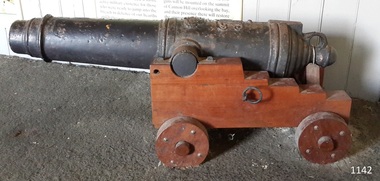
Weapon - Carronade
... The small bore replica carronade and carriage is part of a collection of nineteenth Century Flagstaff Hill Guns and cannons, and is a representation of carronades used from the early 18th up to the 1850s on merchant and military ships particularly the British Royal Navy until 1850. ...This deck cannon is believed to be a replica Carronade as it has no foundry mark, year of manufacture, proof marks or weight of carronade on it. However, its design matches the design of Carronades used in the early to mid 19th century. History: The carronade was designed as a short-range naval weapon with a low muzzle velocity for merchant ships, but it also found a niche role on warships. It was produced by the Carron iron works and was at first sold as a complete system with the gun, mounting, and shot altogether. Carronades initially became popular on British merchant ships during the American Revolutionary War. A lightweight gun that needed only a small gun crew and was devastating at short range was well suited to defending merchant ships against French and American privateers. Its invention is variously attributed to Lieutenant General Robert Melville in 1759, or to Charles Gascoigne, manager of the Carron Company from 1769 to 1779. In its early years, the weapon was sometimes called a "mellvinade" or a "gasconade". The carronade can be seen as the culmination of a development of naval guns reducing the barrel length and thereby the gunpowder charge. The Carron Company was already selling a "new light-constructed" gun, two-thirds of the weight of the standard naval gun and charged with one-sixth of the weight of the ball in powder before it introduced the carronade, which further halved the gunpowder charge. The theory of its design was to use less powder and had other advantages that were advertised in the company's sales pamphlet of the time, state. The smaller gunpowder charge reduced the barrel heating in action, also reduced the recoil. The mounting, attached to the side of the ship on a pivot, took the recoil on a slider, without altering the alignment of the gun. The pamphlet advocated the use of woolen cartridges, which eliminated the need for wadding and worming, although they were more expensive. Carronades also simplified gunnery for comparatively untrained merchant seamen in both aiming and reloading that was part of the rationale for adopting the gun. Other advantages promoted by the company were. The replacement of trunnions by a bolt underneath, to connect the gun to the mounting, reduced the width of the carriage that enhanced the wide angle of fire. A merchant ship would almost always be running away from an enemy, so a wide-angle of fire was much more important than on a warship. A carronade weighed a quarter as much as a standard cannon and used a quarter to a third of the gunpowder charge. This reduced charge allowed Carronades to have a shorter length and much lighter weight than long guns. Increasing the size of the bore and ball reduces the required length of the barrel. The force acting on the ball is proportional to the square of the diameter, while the mass of the ball rises by the cube, so acceleration is slower; thus, the barrel can be shorter and therefore lighter. Long guns were also much heavier than Carronades because they were over-specified to be capable of being double-shotted,(to load cannons with twice the shot, for increased damage at the expense of range). Whereas it was dangerous to do this in a carronade. A ship could carry more carronades, or carronades of a larger caliber, than long guns, and carronades could be mounted on the upper decks, where heavy long guns could cause the ship to be top-heavy and unstable. Carronades also required a smaller gun crew, which was very important for merchant ships, and they were faster to reload. Additional notes: Cannon cast in England, Wales and Scotland had their imperial weight chiselled or engraved in the format of 4-2-0 on the bottom of the cascabel, indicating the weight of the cannon as 4 hundredweight, 2 quarters and 0 pounds. Since a hundredweight equals 112 pounds and a quarter weight is 28 pounds the total weight is 504 pounds or about 228 kilograms. The small bore replica carronade and carriage is part of a collection of nineteenth Century Flagstaff Hill Guns and cannons, and is a representation of carronades used from the early 18th up to the 1850s on merchant and military ships particularly the British Royal Navy until 1850. This example is not significant in the historic sense but demonstrates the type of artillery used aboard vessels of the time for protection & offensive military actions. Cannon, cast iron, small smooth bore cannon on the stepped wooden carriage with wooden wheels. It appears to fire a 12-pound cannonball. The Cannon barrel can have its elevation adjusted via a sliding sloped block at the rear of the cannon. Gun carriage has loops for locating and holding the carriage in position with the use of ropes. It is believed this carronade is a replica of a mid-to-late 19th-century Carronade cannon.Cast into metal; [Royal emblem of Queen Victoria (VR "Victoria Regina")]warrnambool, flagstaff-hill, flagstaff-hill-maritime-museum, maritime-museum, shipwreck-coast, flagstaff-hill-maritime-village, cannon, naval cannon, cannon on carriage, 19th century cannon, fortifications, smooth bore cannon, 12 pounder, carronade, artillery, replica, deck cannon, cannon in carriage, ship cannon -
 Flagstaff Hill Maritime Museum and Village
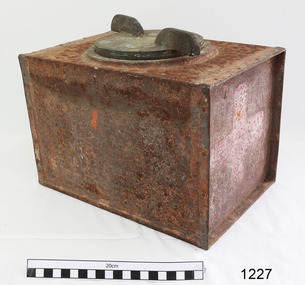
Equipment - Survival Kit, c. 1943
... military supplies emergency kit survival kit. White painted label on pouch 'MIRROR". Paper instructions on back of mirror headed "_ _ FSON SUN-FLASH DISTRESS, SIGNAL DEVICE". Printed on waterproof cover "ADVICE BOOKS". Survival kit, 1973. Rectangular metal box with round screw top lid that has wing handles with a red cross on both ends of box (one end is heavily rusted). Contents of box includes booklet 1943 "Advice to Those in Lifeboats and Rafts of Merchant Ships ...Emergency survival kit made safe and watertightThe kit represents equipment used around the time of World War II to aid the safety and survival of seafarers.Survival kit, 1973. Rectangular metal box with round screw top lid that has wing handles with a red cross on both ends of box (one end is heavily rusted). Contents of box includes booklet 1943 "Advice to Those in Lifeboats and Rafts of Merchant Ships" and one rectangular piece of water resistant paper with "Advice-books" written on it (separated from booklet), cylindrical stainless steel container with wire handle, cotton bandage. Also inside, one Sun-flash Distress Signal Mirror (instructions adhered to back) with padded pouch, labelled "MIRROR" in white paint, and a card inside pouch, adhering to insides. Metal is corroding.White painted label on pouch 'MIRROR". Paper instructions on back of mirror headed "_ _ FSON SUN-FLASH DISTRESS, SIGNAL DEVICE". Printed on waterproof cover "ADVICE BOOKS". warrnambool, flagstaff-hill, flagstaff-hill-maritime-museum, shipwreck-coast, survival kit, commonwealth of australia, sun-flash distress signal mirror, survival advice book, military supplies, emergency kit, survival kit. -
 Mission to Seafarers Victoria
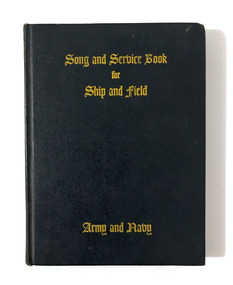
Book - Prayer Book, Ivan Loveridge Bennett, Song and Service Book for Ship and Field - Army and Navy, 1942
... The Song and Service Book for Ship and Field, Army and Navy, edited by Ivan Loveridge Bennett, features prayers, hymns, and patriotic songs used in various military ceremonies and religious services....The Song and Service Book for Ship and Field, Army and Navy, edited by Ivan Loveridge Bennett, features prayers, hymns, and patriotic songs used in various military ceremonies and religious services. ...Small book with black cover; 195 pagesnon-fictionanne rennie collection, wal harbord, merchant navy, seamen, seafarers, ww2, battle of the atlantic, walter harbord, navigation, prayers, army, navy, soldiers, balikpapan, borneo, indonesia, battle of balikpapan, lt d. bacon
