
Showing 175 items matching "military weapon"
-
 4th/19th Prince of Wales's Light Horse Regiment Unit History Room
Booklet, A H Pettifer Actg Government Printer, Royal Armoured Corps Weapon Training Military Training Pam No 34 Part 4 Tank Fire Tactics 1944, 1944
... Royal Armoured Corps Weapon Training Military Training Pam No 34 Part 4 Tank Fire Tactics 1944...Tank training world war 2 Proof Copy Soft covered booklet Royal Armoured Corps Weapon Training Military Training Pam No 34 Part 4 Tank Fire Tactics 1944 Booklet A H Pettifer Actg Government Printer ...Soft covered bookletProof Copytank training, world war 2 -
 Bayside Gallery - Bayside City Council Art & Heritage Collection
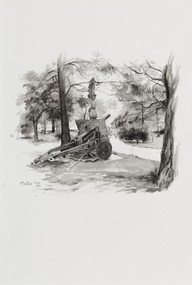
Work on paper - ink and watercolour, Annette Meikle, Beaumaris RSL, 1977
... ...Military weapon...The Beaumaris RSL Club closed its doors on Balcombe Road in 2016 after the property was sold in 2013. annette meikle sandringham sketchbook elizabeth waters Beaumaris RSL 25-pounder Field gun Military weapon Langford-Jack Blamey House Balcombe Road Beaumaris Beaumaris RSL Work on paper ink and watercolour Annette Meikle ...In 1977, artist Annette Meikle undertook a commission to illustrate a book recording stories of places and people in the Bayside area. It was published in 1978 as Sandringham Sketchbook, with text by Elizabeth Waters. The sketches were intended to record remaining examples of Bayside’s early architecture and environment, as well as reflect newer architectural changes. Meikle went on to donate 22 of these sketches to Bayside City Council in 2003. This gun stood in the grounds of the Beaumaris RSL, located on the highest hill in Beaumaris – more than 300 metres above sea level. The ‘25-pounder’ was one of the best field guns of its day and was used by British and Commonwealth armies during the Second World War. The original ten-acre property, which was the former holiday home of wealthy Toorak resident Langford-Jack, was sold to the Legacy Club in 1942 and operated as a holiday home for Legacy children. Renamed Blamey House in honour of Field-Marshall Sir Thomas Blamey, it was purchased by the RSL in 1955. The Beaumaris RSL Club closed its doors on Balcombe Road in 2016 after the property was sold in 2013.Annette Meikle, Beaumaris RSL 1977, ink and watercolour, 33.8 x 23.5 cm. Bayside City Council Art and Heritage Collection. Donated by the artist, 2003annette meikle, sandringham sketchbook, elizabeth waters, beaumaris rsl, 25-pounder, field gun, military weapon, langford-jack, blamey house, balcombe road, beaumaris -
 8th/13th Victorian Mounted Rifles Regimental Collection
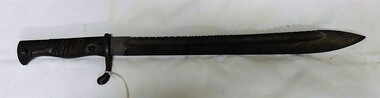
Weapon - Bayonet
... military...weapon...Part of a collection of edged weapons gathered by the regimental collection. military weapon german On scabbard and blade - " WAFFENFABRIK MAUSER AG OBERMDORF " German bayonet with wooden handgrip in metal scabbard; 365mm blade with saw-toothed back . ...German bayonet commonly brought back by returning servicemen as a souvenir and passed to a regimental collection in later years.Part of a collection of edged weapons gathered by the regimental collection.German bayonet with wooden handgrip in metal scabbard; 365mm blade with saw-toothed back .On scabbard and blade - " WAFFENFABRIK MAUSER AG OBERMDORF "military, weapon, german -
 8th/13th Victorian Mounted Rifles Regimental Collection
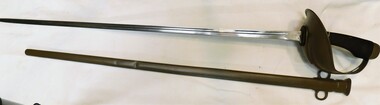
Weapon - Sword
... ...military...weapon...Display potential and occasional ceremonial use. sword sabre cavalry light horse military weapon On handguard 2 RMA MBY 340 British Model 1908 cavalry sword steel blade 890mm long, composition handle with steel hand-guard painted khaki green. ...Swords were issued to Australian Light Horse in 1918. They were part of the equipment of Light Horse ln period 1920 -1940. Carried by 8/13 VMR Heritage Troop during 1980s.Display potential and occasional ceremonial use.British Model 1908 cavalry sword steel blade 890mm long, composition handle with steel hand-guard painted khaki green. Steel scabbard with 2 fixed rings painted khaki green.On handguard 2 RMA MBY 340sword, sabre, cavalry, light horse, military, weapon -
 8th/13th Victorian Mounted Rifles Regimental Collection
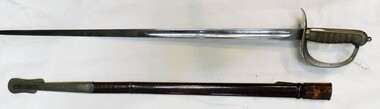
Weapon - Sword
... military...weapon...General display potential military weapon infantry officer On blade scroll work with Crown and Coat of Arms. ...General display potentialBritish pattern 1897 Infantry officers sword, chromeplated and leather scabbard with steel endOn blade scroll work with Crown and Coat of Arms. Handguard Scroll with " GR "military, weapon, infantry, officer -
 Orbost & District Historical Society
magazines, Banks & Company, Peter Dawson Distiller, 1907
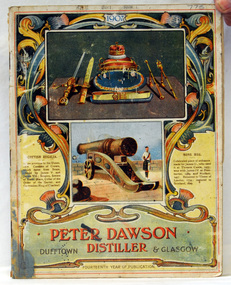
... A magazine / catalogue with a cover showing coloured illustrations of military weapons and ordinance. At the bottom is "Peter Dawson Distiller Dufftown & Glasgow" in red and black print inside an ornate gold frame....This item is associated with William Hunter. hunter-william dawson-peter-distiller magazine-weapons-ordinance "William Hunter" A magazine / catalogue with a cover showing coloured illustrations of military weapons and ordinance. At the bottom is "Peter Dawson Distiller Dufftown & Glasgow" in red and black print inside an ornate gold frame. ...This is the 14th edition of the magazine. This magazine belonged to William Hunter (1893-1971), a resident of Tatura and Mallacoota. He was a soldier, surveyor and amateur naturalist. Peter Dawson was a Distiller and Whisky Merchantat 99 Maxwell Street, Glasgow. By 1891 Dawson had already made a name for himself in the United Kingdom as a blender of whisky and practical distiller. This item is associated with William Hunter.A magazine / catalogue with a cover showing coloured illustrations of military weapons and ordinance. At the bottom is "Peter Dawson Distiller Dufftown & Glasgow" in red and black print inside an ornate gold frame."William Hunter"hunter-william dawson-peter-distiller magazine-weapons-ordinance -
Moorabbin Air Museum
Booklet - Military aircraft weaponry, Aircraft Weaponization Subsystem Photographs and Description September 1970
... Military Aircraft Weapons...Military Aircraft Weapons Photographs and specifications of aircraft weapons & assoiated systems circa 1970 Aircraft Weaponization Subsystem Photographs and Description September 1970 Booklet Military aircraft weaponry ...Photographs and specifications of aircraft weapons & assoiated systems circa 1970Photographs and specifications of aircraft weapons & assoiated systems circa 1970 -
 Bendigo Military Museum
Book, HERRON BOOK DISTRIBUTORS PTY LTD, Australia at War, 2016
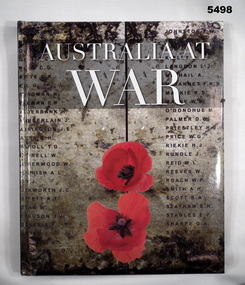
... Back illustration- close up colour photograph of a hand held military weapon....Back illustration- close up colour photograph of a hand held military weapon. Australia at War Book BOOK HERRON BOOK DISTRIBUTORS PTY LTD Complied by Lorri LYNN and Peter MURRAY ...‘AUSTRALIA AT WAR’ The military history of Australia Hard cover book Hard cover- cardboard, with glossy coloured paper finish, white print on front, spine and back. Front illustration section of a honour roll with two red poppies. Back illustration- close up colour photograph of a hand held military weapon.book, war memorials, military history -
 Bendigo Military Museum
Weapon - KNIFE, CLASP, 1960's
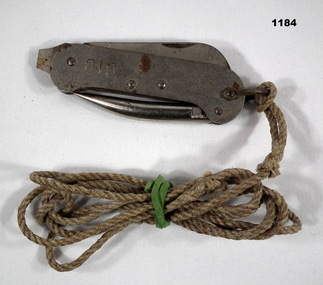
... ...military history...Weapon...Refer 638P for his service history. personal effects - pocket knives military history Weapon Clasp knife D^D"- Sterling, Made in Australia Metal Clasp knife with 2 blades and a pointed piece with a rope cord attached. ...Issued to Geoff Murray No 3411521, Vietnam 3 CAV Regt 27.11.67 to 22.10.68, Survey Corp 15.10.69 to 15.10.70. Refer 638P for his service history.Metal Clasp knife with 2 blades and a pointed piece with a rope cord attached.D^D"- Sterling, Made in Australiapersonal effects - pocket knives, military history, weapon, clasp knife -
 Bendigo Military Museum
Weapon - ARTILLERY FUSE, C.WW2
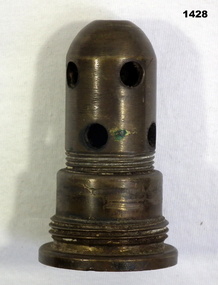
... ...military history...weapon...arms - ammunition military history weapon accessories Artillery fuse Base markings NO II ME 4/11 16 VF 8/40 Brass Artillery shell fuse that has been fired. ...Brass Artillery shell fuse that has been fired.Base markings NO II ME 4/11 16 VF 8/40arms - ammunition, military history, weapon accessories, artillery fuse -
 Flagstaff Hill Maritime Museum and Village
Weapon - Cannon Ball, Victorian era
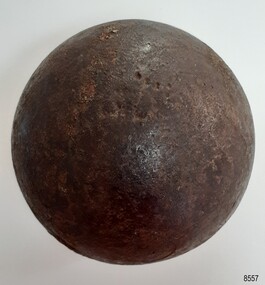
... ...Military Equipment...firearm...weapon...Flagstaff Hill Flagstaff Hill Maritime Museum and Village Warrnambool Maritime Museum Maritime Village Great Ocean Road Shipwreck Coast cannon ball ammunition cannon fortifications Military Equipment firearm weapon two-piece mould seam line four-pounder 4-pounder field gun field ammunition gun carriage cast cannon ball Remnants of an indecipherable stamp and / or red text. ...This small cannon ball was found by the donor around 1975 to 1977 when he was digging a trench to install underground cables at the Warrnambool Surfside Caravan Park' Its location is just below both Cannon Hill and the 19th century Fortifications at Flagstaff Hill Maritime Museum and Village. The ball is made of iron. Cannon balls were used as ammunition for a cannon gun and fired at a target. This cannon ball is only 8 cm round, or 4.15 inches, and is likely to have been called a 4-pounder (4-pdr). The ball was made from molten iron was poured into the small opening of a two-piece mould. The seam between the moulds sometimes left a raised ring mark on the ball, as can be seen on this ball. The ridge would have been filed to make the join smooth, sometimes leaving a slightly flat area. Six 4-powder cannons were recovered from Endeavour Reef, Queensland, in 1969. They were from Captain Cook's HMS Endeavour, thrown overboard when the ship struck a reef there in 1770. They are likely to have been mounted on deck cannon carriages on the ship. Similar 4-pounder cannons were mounted on gun carriages and used as field guns. Cannons with cannon balls as ammunition were installed at Warrnambool for protection from possible invasion in the mid-to-late 19th century and early 20th century.Cannon ball, iron, black with a pitted shiny surface. It has three flat areas and evidence of a seam around the circumference. There are remnants of a possible inscription stamped into the iron. The cannon ball is a four-pounder ball. Imperial weight is 71 oz (201.3 gms or 4.44 pounds).Remnants of an indecipherable stamp and / or red text.flagstaff hill, flagstaff hill maritime museum and village, warrnambool, maritime museum, maritime village, great ocean road, shipwreck coast, cannon ball, ammunition, cannon, fortifications, military equipment, firearm, weapon, two-piece mould, seam line, four-pounder, 4-pounder, field gun, field ammunition, gun carriage, cast cannon ball -
 Kiewa Valley Historical Society
Gaiters, Estimated 1914; Early 20th Century
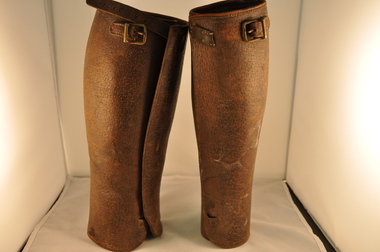
... Towards the end of WWI many of the light horse regiments combined with each other as their numbers became less and eventually with the advancement of military weapons the use of horses in war battles become less and were not needed in consequent world wars. ...Towards the end of WWI many of the light horse regiments combined with each other as their numbers became less and eventually with the advancement of military weapons the use of horses in war battles become less and were not needed in consequent world wars. ...These type of gaiters were used by soldiers who would have been attached to the Light Horse Regiments. No other men other than soldiers in the Light Horse Regiments wore these gaiters as they were part of their uniform and added protection of their lower legs when riding their horses. All levels for AIF people wore these gaiter from Privates to Officers. There seems to be several types of gaiters which were lace ups or had straps over the outside of the gaiters or some were just done up with the buckles at the top. It is unknown it the ones we have would have had straps on the outside or if this was a choice of the wearer. Towards the end of WWI many of the light horse regiments combined with each other as their numbers became less and eventually with the advancement of military weapons the use of horses in war battles become less and were not needed in consequent world wars. These gaiters are historical significant to world war one and the light horse regiments especially the 4th and 13th Regiments. Men from the the Kiewa Valley went off to war and fought with the these regiments. Henry Higginson fought with both the 4th and 13th LHR in France. Sydney Stewart fought with the 4th LHR in France and was killed in France aged 20 years of age. A few of the young men that left from Tawonga in the Kiewa Valley went into the Light Horse Regiments as they were farmers that had experience with horse. Even though the AIF said they just did not automatically put country men into the LHR . Despite not having provenance of these gaiters the fact that men from Tawonga were in the light horse regiments, and only men from the LHR wore these gaiters it would be safe to say they would have been from some one in the local area that fought in WWI who owned these. Therefore they are representative of gaiters from the LHR and have excellent interpretive capacity as KVHS have a photo of Henry Higginson wearing his uniform which clearly shows his gaiters similar to these ones.One pair of brown leather gaiters with buckle at top. Seam at ankel. Left gaiter has strap missingmilitary, army, horse, gaiters -
4th/19th Prince of Wales's Light Horse Regiment Unit History Room
Booklet, The Enemy 1970 Part 1 & 2 with Amendment List No 1
... Hard cover loose leaf folder type booklet providing sufficient detail on both conventional and insurgent Asian military forces organisations, characteristics, weapons and tactics to be portrayed realistically in training....The Enemy Musorian Armed Forces Hard cover loose leaf folder type booklet providing sufficient detail on both conventional and insurgent Asian military forces organisations, characteristics, weapons and tactics to be portrayed realistically in training. ...Hard cover loose leaf folder type booklet providing sufficient detail on both conventional and insurgent Asian military forces organisations, characteristics, weapons and tactics to be portrayed realistically in training.the enemy, musorian armed forces -
 Flagstaff Hill Maritime Museum and Village
Weapon - Historic Rifles, Royal Small Arms Factory, 1877-1900
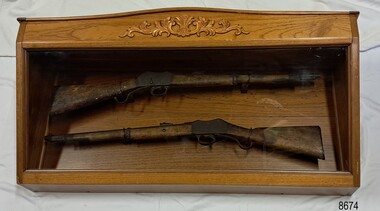
... The rifles are an identical pair of the famous British-made Martini Henry, a .500 inch calibre military weapon widely used by British Colonial troops. ...The rifles are an identical pair of the famous British-made Martini Henry, a .500 inch calibre military weapon widely used by British Colonial troops. ...Martini-Henry Artillery Carbin rifles were made by the Royal Small Arms Factory at Enfield, Britain, from 1877 until 1900. Many were distributed to the British Colonies, including this pair, which was allocated to the Woodford Police, Victoria Police District of Warrnambool, Southwest Victoria. The Carbine model rifles were shorter than the standard rifles and more suited to mounted police and troopers. It is likely that in the early 20th century, Victoria Police replaced the two carbines with more modern firearms, and the outdated guns were stored in the stables. The rifles were left there and likely forgotten about due to changes in police staff. In 1915, police authorities announced that they would be replacing patrol horses with bicycles and would also close some smaller police stations. This affected Woodford Police Station, which closed in 1917. The forgotten firearms remained in the stables and were noticed by schoolboy Robert Jellie in 1940 and seen again in 1946. In 1995, the property was sold by the Education Department to a private owner. The Woodford Community donated the pair of Martini-Henry Carbines to the Victoria Police Museum in the late 1990s for mounting and display, which was funded by the Victoria Police Historical Society Inc. The decorative wood and glass display case and frame were designed to preserve the significant history of the guns. On November 1st 1999, the display was presented to Warrnambool Police and the local community due to the historical significance of the Woodford Police Station. In 2025, these items were formally deaccessioned by the Victoria Police Museum, and ownership was transferred to the Warrnambool Police Station. On March 10th, 2025, the display was transferred to Flagstaff Hill Maritime Museum and Village, where the historical story of the Martini-Henry Carbines could continue to be preserved and accessed by local families, the community, visitors to the area, and online visitors. WOODFORD POLICE: - The small settlement at Woodford was established in the 1840s around the Merri River where there was a ford across the water and a bridge from 1848 to 1851. The area was settled very early in Victoria’s history, and the river crossing provided travellers with access to the early route between Port Fairy (named Belfast at that time), Warrnambool and Melbourne. Occasionally, a Warrnambool police trooper would ride through Woodford and the district. In December 1854, Woodford Police barracks and stables were built on the hill by the Merri River on Bridge Road east, where Jubilee Park now stands. A local mounted trooper kept law and order in the area. In 1856, a lock-up was installed, and the first Woodford Police Station was in action in 1857. By 1871, the police station had been moved from the hill to land across the Merri River bridge, on the southern side of Bridge Road west, near Mill Street. In 1890, the police residence there was replaced by a stone Edwardian-style building with the stables and lock-up behind it and the old police station at the rear. The police continued to have a presence in Woodford until it was closed by the Police Commissioner in July 1917 for economic reasons. The residence was used for government housing until 1923, when it was taken over by the Education Department for the school teacher’s home. In 1995, it became privately owned. THE MARTINI-HENRY ARTILLERY CARBINE: - The Martini-Henry rifles were made in Britain from 1871 at the Royal Small Arms factory at Enfield and were stamped with the symbol of the Royal Cipher (Crown over VR) over ENFIELD to identify their origin. They were named after two of several people who helped design this method: Swiss Friederich von Martini and Scotsman Alexander Henry. The design was breech-loaded, and the inner barrel was rifled. A thumb rest was incorporated into the top right of the bullet receiver’s chamber. The small teardrop lever on the right side of the rifle showed whether the rifle was ready to be shot. In 1877, the shorter, lighter-weight Carbine version of the firearm was produced for mounted troops and artillery. Its official name was “Carbine, B.L., Rifled, Martini-Henry.” The bullets were slightly lighter in weight than those used for the longer rifle. The sight position was adjusted for the shorter gun, and wings were added to the sight on the tip, making it easier to slide the rifle back into a saddle bag. Some of the later Carbines also had leather sight covers screwed to the stock to prevent them from catching on the saddle bags. The Carbines had accessories available, such as barrel extensions with bayonets and swivels for adding slings. The Martini-Henry Carbine designs were later modified to fire the British .303 ammunition. Eventually, by 1900, the Martini-Henry Carbines were replaced by the Lee Enfield gun design. The pair of Martini-Henry Carbine firearms represents policing in the early pre-1900 days of colonial settlement; Woodford was one of the first townships settled in Victoria, and it had a police presence from 1854 until 1917. The rifles and display provide a historic connection between the location of Woodford and relatives and associates. The carbine rifles show a stage in the evolution of weapon design, adapted to suit mounted troops, and adding features to streamline use and storage. The ammunition was also improved during this progression. The carbines are important for their connection to policing law and order in a remote area. They are significant for their association with the township of Woodford, which was important to travel in the southwest Victoria district, providing access across a river for a road between Port Fairy and Melbourne, and later Warrnambool, and supplying food, goods and accommodation for the travellers. A pair of mounted rifles is mounted behind glass in a timer case, accompanied by a framed display of two photographs and an account of the rifles’ history. The case and display each have a horizontal board with a gently curved edge and carved decorations added. The identical firearms are British-made Martini Henry Carbine breach-loaded rifled guns, supplied by Britain to its Colonial troops from around 1877. The rifles are lever-action, single-shot .500 calibre weapons. They have a teardrop lever on their right side. They were used by Victoria Police mounted troops at the Woodford Police Station, Victoria. The black and white photographs were taken in 1946. The left photograph has a circled area; the right photograph is an enlarged view of the circled area, showing the Woodford Police Station in detail. The printed text is on textured paper with the Victoria Police watermark. It gives a summary of the rifle’s history. There is an inscription on the left photograph. Left photograph, handwritten in white pen: “WOODFORD” Document’s print: “During the late 1840s the small town of Woodford grew around the crossing of the Merri River on the Melbourne/Port Fairy Rad. Woodford was proclaimed a township in 1854 and a police quarters was established there in 1857. The police station remained until 1917 when it was closed and police service from then on was provided from Warrnambool. The building was then used as a school residence and is now privately owned. In !940 Robert JELLIE, then a schoolboy, observed two rifles mounted on the wall of the disused stable at the rear of the old police building. Following the devastating flood of 1946 (see photograph above) the rifles were again seen in the room next to the stable but were not seen again until the building was sold by the Education Department many years later. It was a recognition of the historical value of the rifles which led to their donation to the Warrnambool Police Complex. The rifles have been authenticated by the Victoria Police Armoury as being Victoria Police issue some time before 1900. The rifles are an identical pair of the famous British-made Martini Henry, a .500 inch calibre military weapon widely used by British Colonial troops. Victoria Police and the wider community of Warrnambool are indebted to the members of the Woodford community for their fine gesture in donating the rifles for mounting so that their historical importance can be preserved and they can be displayed for generations to come. This display was funded by the Victoria Police Historical Society Incorporated, and presented on the first day of November, 1999.”flagstaff hill maritime museum and village, great ocean road, shipwreck coast, martini henry, victoria police, woodford police station, rifle, carbine, display case, british, martini henry carbine, breech-loaded, rifled, colonial, single-shot, .500 calibre, weapon, gun, 1877, troops, mounted troops, merri river, victoria police woodford, victoria police warrnambool, victoria police melbourne, police quarters, robert jellie, school residence, stable, 1946 flood, victoria police armoury, identical pair, british colonial troops, victoria police historical society incorporated, woodford, bicycles, found by a schoolboy, edwardian-style building, victoria police museum, warrnambool police station -
 Bendigo Historical Society Inc.
Document - BENDIGO EASTER FAIR 1985, 5 April 1985
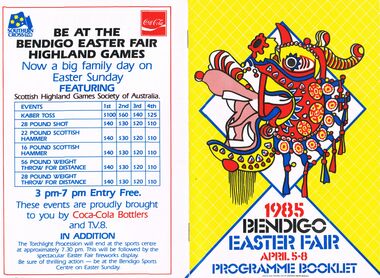
... Sunday: Horse Spectacular, Model Railroaders, Rotary Art Show, Handcraft Bazaar, Antique & Historical Display of Arms Weapons & Military, Antique Fair, Torchlight Procession, Awakening of Dragon, Exhibition of Dolls, Dudley House, Trams, Central Deborah, Book Bazaar, Mardi-Gras Street Carnival, Hargreaves Mall, Motorcycle Show, Photographic Exhibition, Family Activities, Cinema 180, Art Gallery, Embroiderers Guild. ...Sunday: Horse Spectacular Model Railroaders Rotary Art Show Handcraft Bazaar Antique & Historical Display of Arms Weapons & Military Antique Fair Torchlight Procession Awakening of Dragon Exhibition of Dolls Dudley House Trams Central Deborah Book Bazaar Mardi-Gras Street Carnival Hargreaves Mall Motorcycle Show Photographic Exhibition Family Activities Cinema 180 Art Gallery Embroiderers Guild. ...Bendigo Easter Fair 1985, April 5-8. Programme Booklet. Friday: Sun Loon Display, Easter Bowling Carnival, Rotary Easter Art Show, Book Bazaar, Model Railroaders Exhibition, Dudley House, Exhibition of Dolls, Embroiderers Guild, Art Gallery. Saturday: Mardi-Gras Street Carnival, Busking, Outdoor Theatre, Arts & Music, Bendigo Theatre Company, Cynthia Holland & Bendigo Talent Club Sun Loong Display, Rotary Art Show, Handcraft Bazaar, Motorcycle Show-Sandhurst Historic Vehicle Club Trams, Central Deborah, Dudley House, Exhibition Dolls, Antique Fair, Model Railroaders, Fire Brigades' Carnival for Children, Horse & Harness Parade, Book Bazaar, Bowling Carnival, Football, Photographic Exhibition, Family Activities, Cinema 180, Exhibition of Paintings silver furniture & porcelain, Embroiders Guild. Sunday: Horse Spectacular, Model Railroaders, Rotary Art Show, Handcraft Bazaar, Antique & Historical Display of Arms Weapons & Military, Antique Fair, Torchlight Procession, Awakening of Dragon, Exhibition of Dolls, Dudley House, Trams, Central Deborah, Book Bazaar, Mardi-Gras Street Carnival, Hargreaves Mall, Motorcycle Show, Photographic Exhibition, Family Activities, Cinema 180, Art Gallery, Embroiderers Guild. Monday: Philatelic Society Exhibition, Rotary Art Show, Handcraft Bazaar, Antique Fair, Model Railroaders, Bendigo District Bowling Assn. Easter Bowling Carnival, Exhibition of Dolls, Dudley House Bendigo Branch Royal Historical Society, Trams, Central Deborah, Motorcycle Show, Antique and Historical Display of Arms Weapons & Militaria, Mardi-Gras Street Carnival, Hargreaves Mall, Gala Street Procession, Carnival For Children, Sun Loong on Display, Photographic Exhibition, Fusion, Cinema 180, Art Gallery, Embroiders Guild. Church Services in Bendigo City Area During Easter (listings for Thursday, Good Friday, Eater Saturday, Easter Day). The Bendigo & District Tourism Association Welcomes you to Victoria's Premier Town. Listing of events over Easter with map to guide all around. Bendigo Easter Fair Incorporated Phone: (054) 43 9191Bendigo Easter Fair Inc. would like to thank the Ministry for the Arts for its continued assistance over the past 11 years. 3 1/2 pages of information on the Bendigo Easter Fair and its rich history dating back to 1871. The first Fair was held to aid 2 charities: Bendigo Base Hospital and the Home and Hospital for the Aged (Benevolent Asylum). Gone are the days of the Fancy Bazaar, Fat Baby Contest and the greasy Pig Chase, many tradition remain the same. Links to the Chinese community date back to when the first settlers arrived seeking gold. This gives the Fair its unique quality and Brings visitors in their thousands each Easter. The Monday Procession has always been the most famous as many old photographs show. Some photos taken before the turn of the century. Many made the journey to Bendigo from Melbourne and outlying districts. Visitors line the route to see floats, bands, and the once a year appearance of the Chinese Dragon, ''Sun Loong'' or ''New Dragon''. The longest Imperial Dragon in the World; 300ft plus in length. His predecessor, ''Long'', is acclaimed as the worlds oldest Imperial Dragon. Easter Saturday Procession has taken form of a Horse and Harness Parade, attracting and immense variety of entrants. The torchlight Procession on Sunday evening includes fireworks, Fire Brigades, Fire Trucks, firemen, marching girls and illuminated floats. The Army has helped with the procession since around the time of Federation. 15th Transport Squadron (15 Tpt. Sqdn.), processions are assembled & dispatched with Army efficiency. Marshalling the Monday Procession this year will be done by the Army as well as our own Easter Fair marshalls with a new communications system.1930 the Popular Girl contest was introduced. The four main streets of Bendigo, Pall Mall, Mitchell Street, Hargreaves Street and Williamson Street (formerly View Street), sponsored their particular girl by means of raffles, street stalls and a variety of fund raising. The winner was the one that raised the most money, and was announced from the balcony of the Shamrock Hotel, by the Mayor of Bendigo on Easter Saturday Night. The Popular girl contest is still held with a lot of the fund raising now done by service clubs and voluntary organizations. 1984 fund raising efforts, in excess of $50,000 was distributed to charities in our area. The combined Bendigo Brigades' record support for the Easter Fair goes back of many years in a variety of ways. Bendigo people are known for their love of sport and the choice in the city is very wide. There will be no Easter Sports Carnival this year but Easter Fair will still be holding functions at the Bendigo Sports Centre in Park Road. Bendigo city centre will be alive with stalls, raffles and rides of every description over the three days of sports, Sat-Sun. Hargreaves Mall will be the focus of relaxation, buskers, community theatre, arts with craft activity & musical entertainment. The Rotary Club of Bendigo and the Easter Fair Society had had independent Arts Shows but in 1981amalgamate their shows. 1981 Rotary Club of Bendigo added the Antique Fair to the Easter Program, held in the RSL Memorial Hall, Pall Mall. Last year some event were cancelled, but last year's Fair was quite a success. With many outdoor activities, the weather plays a vital role. It has been necessary to alter some venues in the past years, with Easter being a week early in April this year we are looking forward to fine conditions. The Chinese and Bendigo Easter Fair, The First Chinese arrived on the goldfields in mid 1850's in teams or groups to work the rich alluvial gold fields of Dai Gum San (Big Gold Mountain). Most were of poorer class from the district of See Yup, an area of four villages near the provincial capital Canton (Kwangchow). By far the largest group came from the village of Toi Shan. The alluvial gold quickly petered out so by the time of the first Bendigo Easter Fair in 1871 most Chinese had either left for richer fields or turned to other pursuits such as stores, market gardens, laundries, herbalists etc.. Many of course had died on the fields from the rigors of mining of diseases not encountered in their homeland. The Benevolent Asylum (Home & Hospital for the age) and Bendigo Base Hospital had become places of rest, help and haven for old, sick and lonely Chinese. SO when the idea was mooted to hold a charity fair to raise money for these worthy establishments, the Chinese were only too happy to join with the Easter Fair Society in this charitable work. It has for over 113 years. Chinese showed their costumes, scenery, and weapons of warfare, but it was not until 1892, that the first of the 5 loongs (dragons) appeared.. . The pageant was marshalled by Mr T Chapman and headed by Mr Moody, attired in habiliments of a most gorgeous character on a gaily caparisoned horse, and his get up as a Chinese grandee was perfect. . . Tom toms , bagpipes. . Wind instrument resembling a clarinet. . Bagpipes,.. The Weekly Advertiser, Friday, April 22,1892. . . Today the Chinese Association, made up of descendants and families of the early Chinese and associate members, carries on the charitable works of their predecessors. A Little Of Dragons, We have all heard of St. George Bendigo dragons (loongs) have none of these characteristics, in fact they have only brought good to Bendigo. There are 3 chief species of Chinese Dragons of which ''The Lung'' (Loong) is the most powerful. It is also the spiritual dragon which produces wind and rain. It has 9 resemblances, the head of a camel, horns of a deer, eyes of a rabbit ears of a cow, neck of a snake, belly of a frog, scales of a carp, claws of a hawk and palm of a tiger. Loong is a vegetarian, favourite food pomelo (ooluk), the father of our modern grapefruit. The abode, according to legend is the sky or water. He is also deaf, thus requiring loud noises to awaken him and to keep him awake. . . Number of claws they have represent rank. Dragons have 2, 3, 4 or 5 claws, the latter being reserved for the Emperor. Loong and Sun Loong have both five claw dragons. Bendigo has had 5 or 6 dragons, the number being confused by the fact each dragon was called 'Loong'. Today Three dragons remain in Bendigo, Loong, Sun Loong, and Yar Loong. Loong is the oldest Imperial Dragon in the world. He continued his walk through the streets of Bendigo til his retirement in 1970. He was created in Fat Shan in the Peoples Republic of China. Built of. . . Sun Loong replaced Loong after the 2 dragon procession of 1970. Created by Mr Law On, . . Yar Loong is a night dragon, came in 1930's. . . Long history of dragons. . The Birth Of A Dragon. . . To awaken A Dragon. . . The Easter Monday Chinese Procession. . . Procession divided into 6 sections,.. The Easter Monday Procession comprises,… over 350 people. Conclusion It is hoped that in the near future a museum can be built to house the priceless regalia gathered together over the last century and a half by the Bendigo Chinese Association. Advertisements; Historic Bendigo Pottery, Mim's Restaurant, Antique Fair (Rotary), The Copper Pot, Sandhurst Town (Develop Victoria Council Tourism Award 1983-1985), Bendigo Motor Co. (Mazda), Diggers, Chaplin's, Bendigo's Dunny Diner, Arakoon, Quin's Bluebird, Allara Motor Lodge, Lakeview Motor Inn, The Armoured Car Company, Gillies, Mardi Gras Street Carnival, Handcraft Bazaar, Art Show (Rotary) Bendigo Model Railroaders (Easter Exhibition), Bendigo Easter Fair Highland Games brought to you by TV8 and Coca-Cola Bottlers. Design and Finished Art By Graphics Group, Bendigo.Graphics Group Bendigoevent, easter fair, bendigo easter fair incorporated, bendigo easter fair 1985, april 5-8. programme. friday: sun loon display, easter bowling carnival, rotary easter art show, book bazaar, model railroaders exhibition, dudley house, exhibition of dolls, embroiderers guild, art gallery. saturday: mardi-gras street carnival, busking, outdoor theatre, arts & music, bendigo theatre company, cynthia holland & bendigo talent club sun loong display, rotary art show, handcraft bazaar, motorcycle show-sandhurst historic vehicle club trams, central deborah, dudley house, exhibition dolls, antique fair, model railroaders, fire brigades' carnival for children, horse & harness parade, book bazaar, bowling carnival, football, photographic exhibition, family activities, cinema 180, exhibition of paintings silver furniture & porcelain, embroiders guild. sunday: horse spectacular, model railroaders, rotary art show, handcraft bazaar, antique & historical display of arms weapons & military, antique fair, torchlight procession, awakening of dragon, exhibition of dolls, dudley house, trams, central deborah, book bazaar, mardi-gras street carnival, hargreaves mall, motorcycle show, photographic exhibition, family activities, cinema 180, art gallery, embroiderers guild. monday: philatelic society exhibition, rotary art show, handcraft bazaar, antique fair, model railroaders, bendigo district bowling assn. easter bowling carnival, exhibition of dolls, dudley house bendigo branch royal historical society, trams, central deborah, motorcycle show, antique and historical display of arms weapons & militaria, mardi-gras street carnival, hargreaves mall, gala street procession, carnival for children, sun loong on display, photographic exhibition, fusion, cinema 180, art gallery, embroiders guild. church services bendigo city easter , eater saturday bendigo & district tourism association victoria's premier town. bendigo easter fair incorporated bendigo easter fair rich history 1871. base hospital and the home and hospital for the aged (benevolent asylum). fancy bazaar, fat baby contest greasy pig chase, many old photographs floats, bands, chinese dragon, ''sun loong'' or ''new dragon''. the longest imperial dragon in the world; 300ft plus in length easter saturday procession horse harness parade. torchlight procession on sunday evening includes fireworks, fire brigades, fire trucks, firemen, marching girls and illuminated floats. army helped federation. 15th transport squadron (15 tpt. sqdn). monday procession by the army 1930 popular girl contest introduced. four main streets, pall mall, mitchell street, hargreaves street williamson street. winner announced shamrock hotel, easter saturday night. popular girl contest fund raising service clubs voluntary organizations. 1984 fund raising efforts, in excess $50, 000 distributed to charities. combined bendigo brigades'. no easter sports carnival holding functions bendigo sports centre in park road. stalls, raffles three days sports, sat-sun. relaxation, buskers, community theatre, arts with craft activity & musical rotary club of bendigo easter fair society independent arts shows in 1981amalgamate antique fair, held last year some event cancelled. with many outdoor activities, weather plays vital role. alter some venues in the past, easter being a week early first chinese arrived goldfields in mid 1850's dai gum san (big gold mountain). see yup, canton (kwangchow). toi shan. first easter fair in 1871 for richer fields other pursuits stores, market gardens, laundries, herbalists etc. benevolent asylum (home & hospital for the age) bendigo base hospital had become places of rest, help and haven for old, chinese. charity fair to raise money, chinese join easter fair society in this charitable work. costumes, scenery, weapons of warfare, 1892, the first of the 5 loongs. marshalled by mr t chapman by mr moody, caparisoned horse, chinese grandee. tom toms, wind instrument. bagpipes, advertiser, april 22, 1892. chinese association, descendants chinese and associate charitable works. st. george ''the lung'' most powerful. spiritual dragon wind rain. 9 resemblances, camel, deer, rabbit cow, snake, frog, carp, hawk tiger. a vegetarian, pomelo (ooluk), the abode, legend is the sky or water. deaf loud noises to keep him awake. claws represent rank. 2, 3, 4 or 5 claws, reserved for emperor. had 5 or 6 dragons called 'loong'. three dragons loong, sun loong, yar loong. loong oldest imperial dragon in the world. retirement 1970. created in fat shan peoples republic of china. built of. sun loong, loong 2 dragon procession 1970. created mr law on, yar loong a night dragon1930's.history dragons. birth of a dragon. awaken a dragon. easter monday chinese procession divided 6 sections 350 people. priceless regalia last century bendigo chinese association. advertisements; historic bendigo pottery, mim's restaurant, antique fair (rotary), the copper pot, sandhurst town (develop victoria council tourism award 1983-1985), bendigo motor co. (mazda), diggers, chaplin's, bendigo's dunny diner, arakoon, quin's bluebird, allara motor lodge, lakeview motor inn, armoured car company, gillies, mardi gras street carnival, handcraft bazaar, art show model railroaders highland games tv8 coca-cola. art by graphics group -
 Flagstaff Hill Maritime Museum and Village
Weapon - Gun, ISAAC HOLLIS & SONS, Mid 19th Century
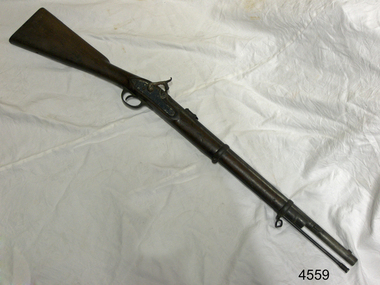
... This firearm serves as an exemplary representation of the type of weapon distributed to the colony’s military forces in 1861. It was specifically manufactured by Isaac Hollis & Sons, a prominent gunmaker of the period, to meet the requirements of military use. ...The Hollis Brothers were first recorded as operating from 11 Weaman Row in 1840, although evidence suggests that the business may have commenced prior to this date. Over time, the firm evolved and became known as Isaac Hollis & Sons, with claims of its establishment dating back to 1814. This earlier date is supported by records of Richard and William Hollis trading in Bath Street, Birmingham, between 1814 and 1818, which raises the possibility that Isaac and Frederick Hollis were their descendants. The principal brothers involved in the business were Isaac Hollis, born in 1815, and Frederick Hollis, whose birth date remains unknown. Frederick’s life was cut short when he died on 20 December 1839. According to the 1841 census, Isaac Hollis resided in Weaman Row and was listed as a 25-year-old gun and pistol maker. He was married to Emma, who was born in 1821, and together they had two children: Isaac, born in 1837, and Henry, born in 1839. Following Frederick’s death, Isaac continued to operate under the name Hollis Brothers until 1845, after which he renamed the business Hollis Brothers & Co. This entity remained active up to 1848. In 1844, Isaac Hollis entered a brief partnership with William Tranter at 10 & 11 Weaman Row, likely to fulfil a specific contract or to supply particular parts. This partnership continued until 1849. In 1848, Isaac Hollis formed a partnership with Isaac Brentnall Sheath, establishing the firm of Hollis & Sheath and expanding their operations into 10 Weaman Row. The partnership saw Hollis & Sheath become licensed manufacturers of percussion breech-loading guns, positioning the company as a notable presence in the industry. In 1861, Sheath left the partnership and emigrated to New Zealand, where he conducted several enterprises and was elected as a provincial councillor. He died in Christchurch on 19th May 1897. Following the departure of Isaac Sheath in 1861, the business underwent a name change to Isaac Hollis & Sons. By approximately 1870, Isaac Hollis and Henry Hollis had assumed responsibility for the daily management of the firm, with Isaac overseeing the overall management and marketing of the company's products, while Henry managed the manufacturing processes. During this period, the company became known for producing large volumes of affordable trade guns and sporting guns, catering to customers in South Africa and the British colonies. In 1870, Isaac Hollis & Sons opened a retail location at 44a Cannon Street in London, subsequently relocating to 83 Cheapside in 1871. Isaac Hollis Jnr passed away in October 1875 in Birmingham at the age of 37, having never married. In 1876/1877, Henry Hollis registered a limited liability company under the name Isaac Hollis & Sons Ltd. However, by 1879, trading resumed under the name Isaac Hollis & Sons, and the London shop moved to 6 Great Winchester Street. From 1932 to 1933, the business operated in London as Hollis, Bentley & Playfair. The final closure of Hollis, Bentley & Playfair occurred in Birmingham in 1953. This firearm serves as an exemplary representation of the type of weapon distributed to the colony’s military forces in 1861. It was specifically manufactured by Isaac Hollis & Sons, a prominent gunmaker of the period, to meet the requirements of military use. Distribution was facilitated through Hebbert & Sons, an established military supplier based in London. Before it arrived in Tasmania, Australia, around 1861, the firearm was likely issued from the Hythe Armoury, which functioned as a British military training facility. Probably, the gun was originally allocated to British troops or police before being transferred for use in the colony. Gun: Percussion Carbine, .577 Cal. Colonial Tasmanian issue Artillery carbine, Pattern 1861. Muzzle-loading "Cap and Ball" musket. Wood stock and ramrod. Inscriptions are on the stock and breech. Gun was made for Herbert & Co., London, by Isaac Hollis & Sons, Birmingham.Stamped on stock "SOLD 95", " ISAAC HOLLIS & SONS" "GUN & PISTOL MANUFACTURES" "BIRMINGHAM" "J ASTON ARMOURER HYTHE" "MANUFACTURED EXPRESSLY FOR HEBBERT & CO LONDON". Stamped on breech "25", and "25C ---05"flagstaff hill, maritime museum, maritime village, warrnambool, great ocean road, shipwreck coast, firearm, gun, percussion, carbine, .577 cal, colonial tasmanian issue, artillery carbine, military gun, pattern 1861, muzzle-loading, muzzle-loading musket, cap and ball, musket, wood stock, 1861, percussion breech-loading guns, richard and william hillis, herbert & co., herbert & co. london, hollis & sons, isaac hollis & sons, isaac hillis & sons ltd., hollis bentley & playfair., isaac hollis, frederick hollis, isaac brentnall sheath, isaac sheath, william tranter, gun manufacturer, pistol manufacturer, gun and pistol maker, birmingham, j aston armourer, hythe, hythe armoury, military supplies -
 Flagstaff Hill Maritime Museum and Village
Weapon - Cannon Ball, Victorian era
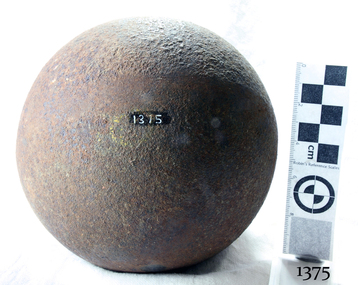
... Flagstaff Hill Flagstaff Hill Maritime Museum and Village Warrnambool Maritime Museum Maritime Village Great Ocean Road Shipwreck Coast cannon ball ammunition cannon fortifications Military Equipment firearm Originally marked "16" Cannon ball, iron, painted black. Weapon Cannon Ball ...A cannon ball, made of iron, is used as ammunition for a cannon and fired at a target.Cannons with cannon balls as ammunition were installed at Warrnambool for protection from possible invasion in the mid-to-late 19th century and early 20th century.Cannon ball, iron, painted black. Originally marked "16"flagstaff hill, flagstaff hill maritime museum and village, warrnambool, maritime museum, maritime village, great ocean road, shipwreck coast, cannon ball, ammunition, cannon, fortifications, military equipment, firearm -
 Lakes Entrance RSL Sub Branch
Bayonet, 1880
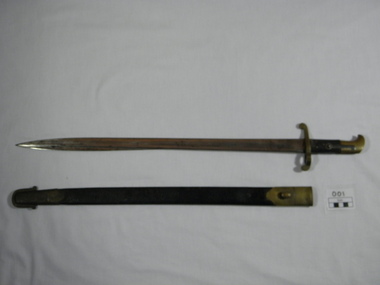
... military...army...steel...soldiers...brass...weapon...The Lancaster bayonet was also issued as a side arm in New South Wales in the 1880;s to the Medical Corps. military army steel soldiers brass weapon bayonet crimea war armaments leather rifle Volunteer Lancaster Sword Bayonet-A2. ...The Lancaster bayonet was also issued as a side arm in New South Wales in the 1880;s to the Medical Corps.Volunteer Lancaster Sword Bayonet-A2. Australian bayonet 1880. Bayonet made of steel with brass hilt and pommel and leather handle. Scabbard leather with brass locket and chape.military, army, steel, soldiers, brass, weapon, bayonet, crimea war, armaments, leather, rifle -
 Lara RSL Sub Branch
booklet Infantry Training, Infantry Training, 1967
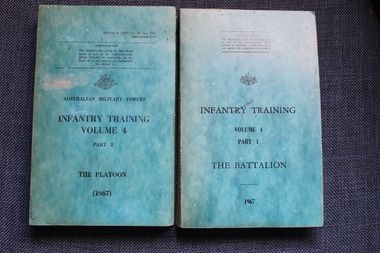
... military forces infantry training volume 1 none 1. Infantry Training Volume 4 Part 1 The Battalion (1967) 2. Infantry Training Volume 4 Part 2 The Platoon (1967) 3. Elementary Field Defences All Arms (1969) Three copies 4. Infantry Training Volume 1 Fieldcraft and Target Detection (All Arms) 1967 5. Infantry Training Volume 1 Infantry Platoon Weapons ...Australian Military Forces - infantry Training - The Platoon Australian Military Forces - infantry Training - The BattalionPrinted in 1967 Restricted 1. Infantry Training Volume 4 Part 1 The Battalion (1967) 2. Infantry Training Volume 4 Part 2 The Platoon (1967) 3. Elementary Field Defences All Arms (1969) Three copies 4. Infantry Training Volume 1 Fieldcraft and Target Detection (All Arms) 1967 5. Infantry Training Volume 1 Infantry Platoon Weapons Pamphlet 3C The Automatic Rifle - M16 (1966) Two Copies 6. Infantry Training Volume 1 Infantry Platoon Weapons Pamphlet 7 Grenades and Pyrotechnics (All Arms) 1970 7. Infantry Training Volume 1 Infantry Platoon Weapons Pamphlet 12 Theory of Small Arms Fire & Training the Battle shot (All Arms) 1967 Two Copies. 8. Infantry Training Volume 1 Infantry Platoon Weapons Pamphlet 13 Gun, Anti-Tank, 84 mm, L14A1 (1966)noneaustralian military forces, infantry training volume 1 -
 Lara RSL Sub Branch
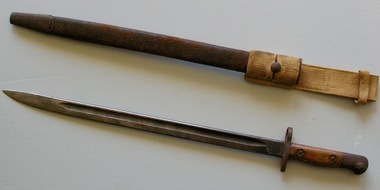
Bayonet, 1917
... Bayonet and Scabbard with Frog - 1907 for Short Lee Enfield Rifle Bayonet ?Maker of Military Weapons ...This Bayonet was made in Lithgow in 1917 and would have been carried/used by a member of the Australian Imperial Forces.This bayonet would have been carried by a member of the AIF during conflicts. This is an original Bayonet as made by an Armory in Lithgow, New South Wales, in 1917.Bayonet and Scabbard with Frog - 1907 for Short Lee Enfield Rifle1917, Lithgow, arrow x arrow, arrow in a shield, across the guard, 2nd MD 65633. -
 Flagstaff Hill Maritime Museum and Village
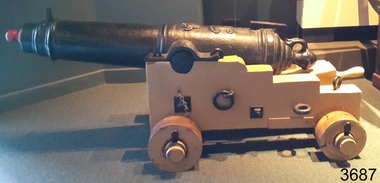
Weapon - Carronade, 1840
... military use. Carronade firing a 6 lb cast iron ball, with a smooth bore barrel 6.5 cm in dia the item is mounted on stepped wooden carriage with wooden wheels. Cannon barrel can have its elevation adjusted via a wooden wedge. Gun carriage has loops for locating and holding in position to a deck by ropes. Carriage is a replica made 1982 Weapon ...The carronade was designed as a short-range naval weapon with a low muzzle velocity for merchant ships, but it also found a niche role on warships. It was produced by the Carron Iron Works and was at first sold as a complete system with the gun, mounting, and shot altogether. Carronades initially became popular on British merchant ships during the American Revolutionary War. A lightweight gun that needed only a small gun crew and was devastating at short range was well suited to defending merchant ships against French and American privateers. The invention of the cannon is variously attributed to Lieutenant General Robert Melville in 1759, or to Charles Gascoigne, manager of the Carron Company from 1769 to 1779. In its early years, the weapon was sometimes called a "mellvinade" or a "gasconade". The carronade can be seen as the culmination of a development of naval guns reducing the barrel length and thereby the gunpowder charge. The Carron Company was already selling a "new light-constructed" gun, two-thirds of the weight of the standard naval gun and charged with one-sixth of the weight of the ball in powder before it introduced the carronade, which further halved the gunpowder charge. The theory of its design was to use less powder and had other advantages that were advertised in the company's sales pamphlet of the time, state. The smaller gunpowder charge reduced the barrel heating in action, also reduced the recoil. The mounting, attached to the side of the ship on a pivot, took the recoil on a slider, without altering the alignment of the gun. The pamphlet advocated the use of woollen cartridges, which eliminated the need for wadding and worming, although they were more expensive. Carronades also simplified gunnery for comparatively untrained merchant seamen in both aiming and reloading that was part of the rationale for adopting the gun. Other advantages promoted by the company were. The replacement of trunnions by a bolt underneath, to connect the gun to the mounting, reduced the width of the carriage that enhanced the wide angle of fire. A merchant ship would almost always be running away from an enemy, so a wide-angle of fire was much more important than on a warship. A carronade weighed a quarter as much as a standard cannon and used a quarter to a third of the gunpowder charge. This reduced charge allowed Carronades to have a shorter length and much lighter weight than long guns. Increasing the size of the bore and ball reduces the required length of the barrel. The force acting on the ball is proportional to the square of the diameter, while the mass of the ball rises by the cube, so acceleration is slower; thus, the barrel can be shorter and therefore lighter. Long guns were also much heavier than Carronades because they were over-specified to be capable of being double-shotted, (to load cannons with twice the shot, for increased damage at the expense of range), whereas it was dangerous to do this in a carronade. A ship could carry more carronades, or carronades of a larger calibre, than long guns, and carronades could be mounted on the upper decks, where heavy long guns could cause the ship to be top-heavy and unstable. Carronades also required a smaller gun crew, which was very important for merchant ships, and they were faster to reload. The small bore carronade and carriage is part of a collection of nineteenth Century Flagstaff Hill Guns and Cannon, which is classified as being of significance and was made a few years after the beginning of Queen Victoria's reign in 1837 and fires a 6 lb pound cannon ball. This nineteenth century artillery piece is a rare and representative item of artillery of this era, used predominately on ships, both military and merchant. The artillery piece, individually and as part of the collection, is highly significant for its historical, scientific and aesthetic reasons at the state, national and world level. This carronade represents the methods of artillery technology, its advancement and its modifications to suit dangerous situations that sailors encountered from attacks from free booters (pirates, living from plunder) or others at the time. Carronade firing a 6 lb cast iron ball, with a smooth bore barrel 6.5 cm in dia the item is mounted on stepped wooden carriage with wooden wheels. Cannon barrel can have its elevation adjusted via a wooden wedge. Gun carriage has loops for locating and holding in position to a deck by ropes. Carriage is a replica made 1982Cast into the barrel is the royal emblem of Queen Victoria (VR "Victoria Regina") indicating the carronade was cast during Queen Victoria's reign / 1840 & 4-2-0 denoting the weight of the barrel. Right hand trunnion has a serial number “8708”. Also on top of the barrel is the British "Board of Ordinance" identifying mark a broad arrow indicating the carronade was in military use. flagstaff hill, warrnambool, shipwrecked coast, flagstaff hill maritime museum, maritime museum, shipwreck coast, flagstaff hill maritime village, great ocean road, colonial defences, victoria’s coastal defences, warrnambool fortification, warrnambool garrison battery, warrnambool volunteer corps, ordinance, armaments, garrison gun, smooth bore cannon, carronade, black powder, 12 pounder, 1840, artillery, lieutenant general robert melville, charles gascoigne, carron company, mellvinade, gasconade -
 Flagstaff Hill Maritime Museum and Village
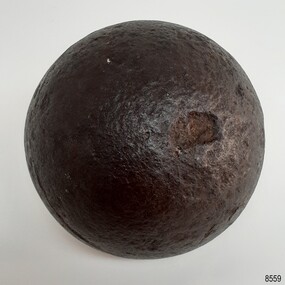
Weapon - Cannon Ball, Late 18th to 19th centuries
... military...cannon...gun...iron ball...moulded ball...naval gun...deck gun...navy...Carronade...war...maritime weapon...Flagstaff Hill Maritime Museum and Village Warrnambool Great Ocean Road Shipwreck Coast artillery ammunition cannon ball shot 24-pounder 24 pdr deck cannon ship cannon military cannon gun iron ball moulded ball naval gun deck gun navy Carronade war maritime weapon cast iron mould Cannon ball; a heavy black iron ball with a casting seam around its circumference. ...This cannon ball could have been made as ammunition to be shot from a 24-pounder gun, perhaps a deck cannon or Carronade on a sailing ship. It is similar to those used by both British and French navies from the late 18th and 19th centuries. The iron cannon ball shows the casting mark around its circumference made by the mould during the casting process. The cannon ball is an example of ammunition used during naval conflicts in the late 18th and 19th centuries. It was made for cannon or Carronade similar to those in the collection of cannon at Flagstaff Hill Maritime Museum.Cannon ball; a heavy black iron ball with a casting seam around its circumference. The surface is shiny with many pits and has slight corrosion. There are several chips including one large deep chip and a small, crescent shaped chip. The cannon ball’s size is similar to a cast iron 24-pounder shot.flagstaff hill maritime museum and village, warrnambool, great ocean road, shipwreck coast, artillery, ammunition, cannon ball, shot, 24-pounder, 24 pdr, deck cannon, ship cannon, military, cannon, gun, iron ball, moulded ball, naval gun, deck gun, navy, carronade, war, maritime weapon, cast iron, mould -
Glenelg Shire Council Cultural Collection
Document - Military Submission, John Ferres, Government Printer, Defences of the Colony, 1864
... Submissions from various military personnel from Victoria including Major Scratchley, Commodore Wiseman and the Governor, asking for various weapons and ordinance including cannon, ammunition, guns etc to protect the colony from the Russians. ...Submissions from various military personnel from Victoria including Major Scratchley, Commodore Wiseman and the Governor, asking for various weapons and ordinance including cannon, ammunition, guns etc to protect the colony from the Russians. ...1864 group of 4 submissions bound in to one document. Heavy paper sewn together with twine, black print on white.portland battery, military, major scratchley, commodore wiseman, governor, john ferres -
 City of Moorabbin Historical Society (Operating the Box Cottage Museum)
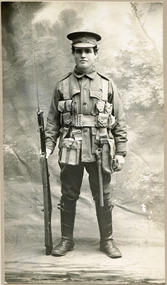
Photograph, 1916 William Henry Thomas in WW1 Uniform, 1916 William Henry Thomas in WW1 Uniform, 1916
... William Henry Thomas is standing straight and tall in the centre of the photograph, looking directly at the photographer while holding a weapon in his right hand. He is in his military uniform (WW1) ....William Henry Thomas is standing straight and tall in the centre of the photograph, looking directly at the photographer while holding a weapon in his right hand. He is in his military uniform (WW1) . 1916 William Henry Thomas in WW1 Uniform Photograph, 1916 William Henry Thomas in WW1 Uniform Ainor Studio ...1916 William Henry Thomas of Keys Road , South Brighton (now Moorabbin ) in WW 1 1914 -1918 1st AIF uniform. William was born in 1894 , Christened at the Wesleyan Church. (Methodist), Wickham Road, South Brighton and attended Moorabbin State School. . Private Thomas was a market gardener in Moorabbin prior to his enlistment in the Australian Imperial Force on 19 July 1915. Both his parents wrote separate letters giving their consent for their son to serve overseas due to " the pressing request of my son William Henry, also the urgent need of recruits do give my consent that he shall go to the front." September 29th 1915 he left Australia with the 5th Reinforcements of the 24th Battalion for Egypt. March 1916 he was hospitalised with Mumps and shortly after left Alexandria to join the British Expeditionary Force for France where he transferred to the 6th Australian Machine Gun Company.. Whilst on leave in England he received medical attention before returning to France and 13 November 1918 he spent a week in the care of the 7rh Field Ambulance suffering with influenza . Private Thomas returned to Australia on the hospital transport Castalia 13 April 1919 and his enlistment was terminated 26 September 1919Private William Henry Thomas and his family are examples of the patriotism exhibited by the market gardeners, and indeed throughout Australia, during the World War 1 1914-1918. Photograph is black and white. William Henry Thomas is standing straight and tall in the centre of the photograph, looking directly at the photographer while holding a weapon in his right hand. He is in his military uniform (WW1) .Front of Mount : Ainor Studio Auburn Back of Mount : William Henry Thomas / 1st World War 1916 / Keys Rd., Moorabbin / Born 1894 / Christened at Wesleyan ( Methodist ) Church / Wickham Rd., / South Brighton / now Uniting Church unsigned undatedwilliam henry thomas, 1916, 1894, first ww, world war one, uniform, wickham road, south brighton, moorabbin, world war 1 1914- 1918, thomas street,early settlers, pioneers, market gardeners, australian infantry force, soldiers, key's cup, victorian war memorials, cheltenham, mckinnon,, keys road moorabbin, ss castalia, british expeditionary force ww1 1914- 1918, 24th battalion 1st aif, 6th australian machine gun company 1st aif, influenza epidemic 1919, alexandria egypt, methodist church, -
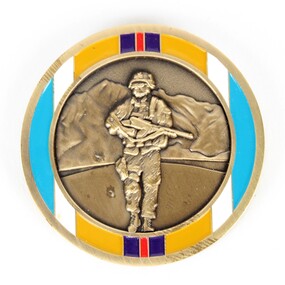 Montmorency–Eltham RSL Sub Branch
Medal - Commemorative Medallion
... weapon. The image is in relief. The reverse features a number of service personnel pictured in front of a vehicle, encircled by the motif of the Australian national flag. Medal Commemorative Medallion Military ...In November 2001 Australian SAS troops joined the war in Afghanistan under the operation name "Operation Slipper." Australia's military contribution to the International Security Assistance Force mission in Afghanistan ended in 2014, making Operation Slipper Australia's longest running operation. According to the Department of Defence, "the ribbon is khaki representing the dominant ground colour of the terrain, edged with light blue and white stripes representing the sky above the mountains and the snow on the mountain peaks with central stripes of purple and red representing the ADF and the conflict in Afghanistan." This commemorative medallion features the Afghanistan Medal ribbon colours encircling the figure of an ADF member holding a weapon. The image is in relief. The reverse features a number of service personnel pictured in front of a vehicle, encircled by the motif of the Australian national flag.commemoration, operation slipper, afghanistan, australian army, middle east, international security assistance force -
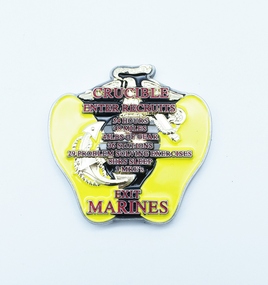 Montmorency–Eltham RSL Sub Branch
Souvenir - Commemorative Medallion, Quartermasters sales and service inc
... the military mint military medal Crucible Enter recruits 54 hours 48 miles 49 lbs of gear 36 stations 29 problem solving exercises 8 hrs sleep 3 MRE’s Exit Marines One mind any weapon An irregular cloissonne medallion Yellow with gold illustrations and red and gold writing on one side and silver gun, bayonet and fist on a black background with red and silver writing Souvenir Commemorative Medallion Quartermasters sales and service inc ...An irregular cloissonne medallion Yellow with gold illustrations and red and gold writing on one side and silver gun, bayonet and fist on a black background with red and silver writing Crucible Enter recruits 54 hours 48 miles 49 lbs of gear 36 stations 29 problem solving exercises 8 hrs sleep 3 MRE’s Exit Marines One mind any weapon the military mint, military medal -
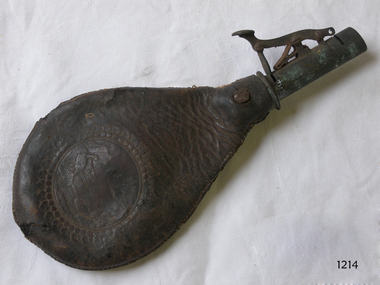 Flagstaff Hill Maritime Museum and Village
Weapon - Gunpowder Pouch, Early-to-mid 19th Century
... Flagstaff Hill Flagstaff Hill Maritime Museum and Village Warrnambool Maritime Museum Maritime Village Great Ocean Road Shipwreck Coast firearms musket gunpowder flask gunpowder pouch flask pouch arms militaria leather flask gunpowder bag ammunition accessory weaponry shot pouch hunting military gunpowder gun powder hinting shot flask Gunpowder pouch or shot pouch, the two sides of the rounded leather body are hand-stitched together apart from a small opening for the fitted brass spout, which has a spring-operated mechanism. Both sides have a decorative centre medallion with a finely tooled design depicting a landscape behind two birds. The adjustable charger mechanism releases a measured amount of gunpowder or shot for rifles or muskets. Weapon ...This type of gunpowder pouch was used in the first half of the 19th century. It stores gunpowder or gunshot for loading or charging firearms such as rifles and muskets. This one has a decorative design featuring birds, which may indicate that it was made for hunting rather than for military use.The shot pouch is an example of weaponry accessories in the early-to-mid 19th century for hunting and military purposes. It is a step in the evolution of firearms and weaponry.Gunpowder pouch or shot pouch, the two sides of the rounded leather body are hand-stitched together apart from a small opening for the fitted brass spout, which has a spring-operated mechanism. Both sides have a decorative centre medallion with a finely tooled design depicting a landscape behind two birds. The adjustable charger mechanism releases a measured amount of gunpowder or shot for rifles or muskets. flagstaff hill, flagstaff hill maritime museum and village, warrnambool, maritime museum, maritime village, great ocean road, shipwreck coast, firearms, musket, gunpowder flask, gunpowder pouch, flask pouch, arms, militaria, leather flask, gunpowder bag, ammunition accessory, weaponry, shot pouch, hunting, military, gunpowder, gun powder, hinting, shot flask -
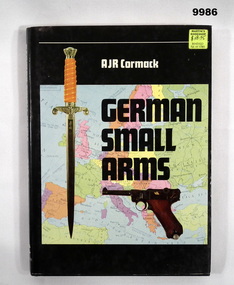 Bendigo Military Museum
Book - MILITARY, WEAPONS, A. J. R. Cormack, "German Small Arms", 1979
... "German Small Arms". Book MILITARY, WEAPONS A. J. R. Cormack Profile Publications Ltd R. ...Hardcover book with dust cover; Hardcover - cardboard with black colour buckram. gold colour print on spine. Dust cover - paper, white and black print on front and spine. Illustrated - Front - in colour, sword and handgun superimposed on a map of Europe. Back - three black and white photographs of German Soldiers with weapons. 159 pages - cut, plain, white colour paper. Illustrated in colour, black and white photographs of weapons.publication, book, military history, weapons, german -
 Bendigo Military Museum
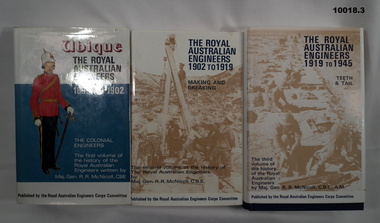
Book - MILITARY HISTORY, ENGINEERS, Ronald McNicoll, "THE ROYAL AUSTRALIAN ENGINEERS" [1] 1835 TO 1902. [2] 1902 TO 1919. [3] 1919 TO 1945.", [1] 1977, [2] 1979, [3] 1982
... Military History Royal Australian Engineers Three volumes, hard covers books with dust covers. 1.2.& 3. Hardcover - cardboard, dark blue colour buckram with gold print on spine. Dust covers - paper, black, white, dark blue print on front and spine. Illustrated. 1. Blue and white colour background with soldier in red and navy colour uniform standing with sword in right hand. 2. Cream and sepia colour background with sepia photograph of Watson's Pier, ANZAC Cove June 1915. 3. Cream and sepia colour background, with sepia photograph of sappers disarming weapons ...Three volumes, hard covers books with dust covers. 1.2.& 3. Hardcover - cardboard, dark blue colour buckram with gold print on spine. Dust covers - paper, black, white, dark blue print on front and spine. Illustrated. 1. Blue and white colour background with soldier in red and navy colour uniform standing with sword in right hand. 2. Cream and sepia colour background with sepia photograph of Watson's Pier, ANZAC Cove June 1915. 3. Cream and sepia colour background, with sepia photograph of sappers disarming weapons. 203, 232, 432 pages - cut, plain off white colour paper. Illustrated - black and white photographs and maps. Endpapers - illustrated 1. Drawing in blue colour. 2. & 3. Maps - black and white colour. publications, books, military history, royal australian engineers -
 Bendigo Military Museum
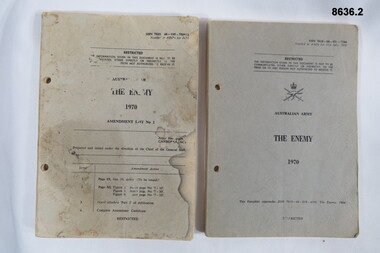
Manual - THE ENEMY, Australian Army, 1970
... Medium size grey Manual providing information about typical Asian Communist Military Forces detailing their organisations characteristics, weapons and tactics. 2. ...Medium size grey Manual providing information about typical Asian Communist Military Forces detailing their organisations characteristics, weapons and tactics. 2. ...1. Medium size grey Manual providing information about typical Asian Communist Military Forces detailing their organisations characteristics, weapons and tactics. 2. Amendment list No. 1 The Enemy, updating the information to the manual described in 1.passchendaele barracks trust, manuals, booklets,
