
Showing 94 items matching "moore family"
-
 Bendigo Historical Society Inc.
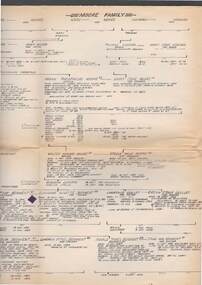
Document - RANDALL COLLECTION: THE MOORE FAMILY TREE - WIFE OF 7782.92 BEAMENT
... RANDALL COLLECTION: THE MOORE FAMILY TREE - WIFE OF 7782.92 BEAMENT......Family...moore...Document, The Moore Family Tree, marriage partner of 7782.92, which includes :- Noyes,Howard, Ashmore, Potter, Hockey. ...GENEALOGY Family moore Document, The Moore Family Tree, marriage partner of 7782.92, which includes :- Noyes,Howard, Ashmore, Potter, Hockey. ...Document, The Moore Family Tree, marriage partner of 7782.92, which includes :- Noyes,Howard, Ashmore, Potter, Hockey. Asmore Family Tree:- Lord, Baradell, Provost, Wells, Baker, Bannister, Smith. Provost Family Tree:- Atkins, Bartlett, Elliot. Henry Ashmore of Chillwell, Geelong, Brother to William, Family Tree:- Lord, Marsh.Henry Ashmore of Jan Juc ( Relationship to William & Henry unknown). Noble, Duffield, Follet.genealogy, family, moore -
 Merbein District Historical Society
Photograph, Lane, Isaac, Bennett, Moore family picnic, unknown
... Lane, Isaac, Bennett, Moore family picnic...Alf Moore Walter Isaacs Mr Bennett Mrs Bennett Leitha Moore Ken Moore Mrs Moore Lane, Isaac, Bennett, Moore family picnic Photograph ...alf moore, walter isaacs, mr bennett, mrs bennett, leitha moore, ken moore, mrs moore -
 Bendigo Historical Society Inc.
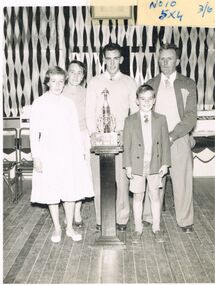
Photograph - BERT GRAHAM COLLECTION: GROUP PHOTO, 57-58
... Black & white photograph, Bert Graham Collection, the Moore Family, standing around a pedistal with a trophy on top.On the back is named Moore Family and 57-58. ...BENDIGO Clubs bendigo east swimming club Black & white photograph, Bert Graham Collection, the Moore Family, standing around a pedistal with a trophy on top.On the back is named Moore Family and 57-58. ...Black & white photograph, Bert Graham Collection, the Moore Family, standing around a pedistal with a trophy on top.On the back is named Moore Family and 57-58. On front top right corner held wth tape , No 10 5x4 3/6.bendigo, clubs, bendigo east swimming club -
 Numurkah & District Historical Society
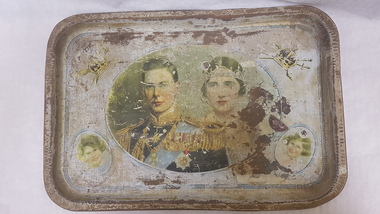
Commemorative ServingTray (Willow)
... Moore family, commemorativ tray, royal family, Duke and Duchess of York, visit to Melbourne...Souvenir tray, 1927, Duke and Duchess of York from Betty Bennett's family (Betty Moore). Both Betty and Don Moore were taken to see the parade along St Kilda Road, at age 7 years. ...Don also rode on the last cable car to Northcote when he was in the services (WW2) Moore family, commemorativ tray, royal family, Duke and Duchess of York, visit to Melbourne Willow Production Steel Tray with faded pictures of the Duke & Duchess of York and Princess Elizabeth & Princess Margaret Commemorative ServingTray (Willow) ...Souvenir tray, 1927, Duke and Duchess of York from Betty Bennett's family (Betty Moore). Both Betty and Don Moore were taken to see the parade along St Kilda Road, at age 7 years. Don was hoisted onto his father's shoulders and all he could see were flags waving. They travelled down High St by cable car. Don also rode on the last cable car to Northcote when he was in the services (WW2)Steel Tray with faded pictures of the Duke & Duchess of York and Princess Elizabeth & Princess MargaretWillow Productionmoore family, commemorativ tray, royal family, duke and duchess of york, visit to melbourne -
Whitehorse Historical Society Inc.
Document, Brain Family, 2001
... ...Moore Family...Brain Family Brain Reginald N Brain George Brain Donald Nielson Moore Family Foster Family Harrison Family Documents relating to the family history of the Brain family of Blackburn. ...Documents relating to the family history of the Brain family of Blackburn.Documents relating to the family history of the Brain family of Blackburn. Includes register reports, photos, certificates and articles.Documents relating to the family history of the Brain family of Blackburn. brain family, brain, reginald n, brain, george, brain, donald nielson, moore family, foster family, harrison family -
 Bendigo Historical Society Inc.
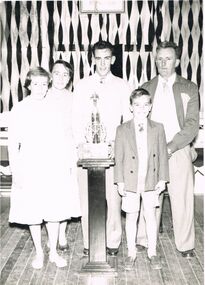
Photograph - BERT GRAHAM COLLECTION: GROUP PHOTO, 1957-58
... Black & white photograph, Bert Graham Collection, The Moore Family . Mrs. Moore, Graeme Moore, Mr. Moore, ? ...BENDIGO Clubs bendigo east swimming club Black & white photograph, Bert Graham Collection, The Moore Family . Mrs. Moore, Graeme Moore, Mr. Moore, ? ...Black & white photograph, Bert Graham Collection, The Moore Family . Mrs. Moore, Graeme Moore, Mr. Moore, ? , Phillip Moore. With the trophy that was presented to them. Names on back and in red ink 57-58 Graham.bendigo, clubs, bendigo east swimming club -
 Whitehorse Historical Society Inc.
Photograph, Casella Street, Mitcham 1993
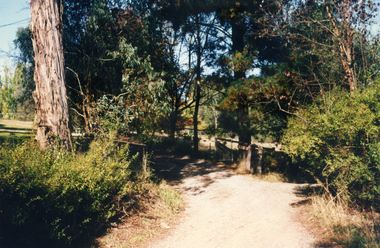
... The property was owned by the Moore family...The property was owned by the Moore family casella street mitcham Set of 3 coloured photographs of Casella Street, Mitcham, taken in 1993 before the area was subdivided for housing Casella Street, Mitcham 1993 Photograph Photograph ...Photos show the last small rural property in Mitcham before subdivision. The property was owned by the Moore familySet of 3 coloured photographs of Casella Street, Mitcham, taken in 1993 before the area was subdivided for housingcasella street, mitcham -
 Peterborough History Group
Book, Andrew Lemon, Success!: The Charles Moore Story, Published 1996
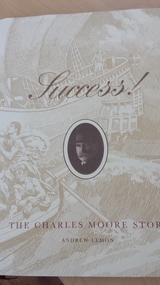
... moore...peterborough family history...peterborough 3270 charles moore peterborough family history Inscribed ' Limited Edition. 64/200' Signed by the author. 93 page book with index Success! ...93 page book with indexInscribed ' Limited Edition. 64/200' Signed by the author.peterborough 3270, charles moore, peterborough family history -
Whitehorse Historical Society Inc.
Document, Moore Property, 1/12/1997
... ...Omerod Family...Moore...Casella Street Mitcham No 15 Omerod Family Moore Margaret Moorakyne Place Mitcham Moore Geoff The Moore Property, Casella Street, Mitcham The Moore Property, Casella Street, Mitcham ; researched and prepared by Frances Warren, December 1997. ...The Moore Property, Casella Street, MitchamThe Moore Property, Casella Street, Mitcham ; researched and prepared by Frances Warren, December 1997.The Moore Property, Casella Street, Mitchamcasella street, mitcham, no 15, omerod family, moore, margaret, moorakyne place, mitcham, moore, geoff -
 Bendigo Historical Society Inc.
Document - RANDALL COLLECTION: THE BEAMENT FAMILY TREE
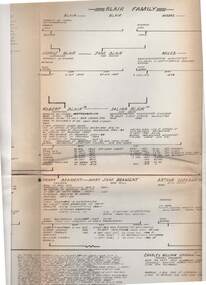
... Blair Family :- Moore, Mills, Hill, Graham, Stanley. Beament of Linton:- Bremner, Howes,Briggs, Carr, Barnes, Gillis, Gallagher, Corfield....Blair Family :- Moore, Mills, Hill, Graham, Stanley. Beament of Linton:- Bremner, Howes,Briggs, Carr, Barnes, Gillis, Gallagher, Corfield. ...Document, The Beament Family Tree, which names includes:- Ede, Riddle, Hinton, Burnet, McNab, Anderson,Gibb, Findley, Blair, Moore, Hockey, Potter. Blair Family :- Moore, Mills, Hill, Graham, Stanley. Beament of Linton:- Bremner, Howes,Briggs, Carr, Barnes, Gillis, Gallagher, Corfield.genealogy, family, beament -
 Eltham District Historical Society Inc
Photograph, Peter Bassett-Smith, Eltham Mud Brick Heritage Excursion, 4 October 1998, 04/10/1998
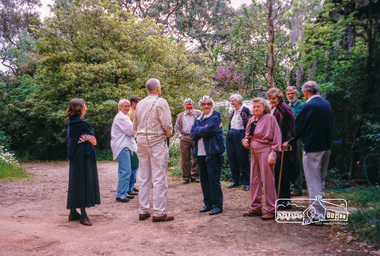
... This pise house was built by the Moore family in the early 1950's. In the afternoon we visited the home of artist Jenni Mitchell in Fordhams Road, one of the last examples of the work of Alistair Knox. ...This pise house was built by the Moore family in the early 1950's. In the afternoon we visited the home of artist Jenni Mitchell in Fordhams Road, one of the last examples of the work of Alistair Knox. ...[article in EDHS Newsletter No. 123, November 1998:] MUD BRICK HERITAGE EXCURSION AND THE FUTURE. A small group of members attended the excursion on 4th October. We visited a number of earth houses listed by the Eltham Heritage Study in a very pleasant day's outing. The first visit was to the home of Jenny and Brian Ellis in York Street, formerly the home of Jenny's father Professor William McMahon Ball. We were made very welcome with inspection of the inside and outside showing the various stages of construction. We then walked through the grounds of "Kinloch", the Jelbart property in Arthur Street where we saw their large mud brick house and barn. Lunch was at Marion and Russell Yeoman's house in Peter Street. This pise house was built by the Moore family in the early 1950's. In the afternoon we visited the home of artist Jenni Mitchell in Fordhams Road, one of the last examples of the work of Alistair Knox. Then we travelled to Laughing Waters Road where we saw two interesting houses owned and built by well known landscape gardener Gordon Ford. Along the way we stopped to view a number of other properties from the street.Colour photographactivities, eltham, heritage excursion, mud brick, kinloch, jelbart -
 Eltham District Historical Society Inc
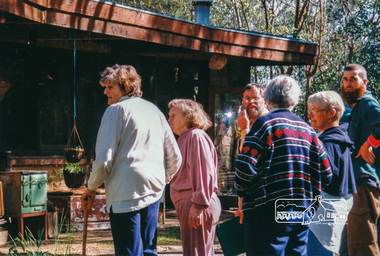
Photograph, Peter Bassett-Smith, Boomerang House, Laughing Waters Road, Eltham; Eltham Mud Brick Heritage Excursion, 4 October 1998, 04/10/1998
... This pise house was built by the Moore family in the early 1950's. In the afternoon we visited the home of artist Jenni Mitchell in Fordhams Road, one of the last examples of the work of Alistair Knox. ...This pise house was built by the Moore family in the early 1950's. In the afternoon we visited the home of artist Jenni Mitchell in Fordhams Road, one of the last examples of the work of Alistair Knox. ...[article in EDHS Newsletter No. 123, November 1998:] MUD BRICK HERITAGE EXCURSION AND THE FUTURE. A small group of members attended the excursion on 4th October. We visited a number of earth houses listed by the Eltham Heritage Study in a very pleasant day's outing. The first visit was to the home of Jenny and Brian Ellis in York Street, formerly the home of Jenny's father Professor William McMahon Ball. We were made very welcome with inspection of the inside and outside showing the various stages of construction. We then walked through the grounds of "Kinloch", the Jelbart property in Arthur Street where we saw their large mud brick house and barn. Lunch was at Marion and Russell Yeoman's house in Peter Street. This pise house was built by the Moore family in the early 1950's. In the afternoon we visited the home of artist Jenni Mitchell in Fordhams Road, one of the last examples of the work of Alistair Knox. Then we travelled to Laughing Waters Road where we saw two interesting houses owned and built by well known landscape gardener Gordon Ford. Along the way we stopped to view a number of other properties from the street.Colour photographactivities, eltham, heritage excursion, mud brick, boomerang house, laughing waters road -
 Eltham District Historical Society Inc
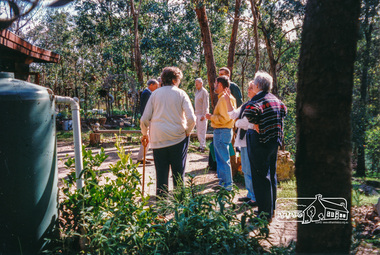
Photograph, Peter Bassett-Smith, Boomerang House, Laughing Waters Road, Eltham; Eltham Mud Brick Heritage Excursion, 4 October 1998, 04/10/1998
... This pise house was built by the Moore family in the early 1950's. In the afternoon we visited the home of artist Jenni Mitchell in Fordhams Road, one of the last examples of the work of Alistair Knox. ...This pise house was built by the Moore family in the early 1950's. In the afternoon we visited the home of artist Jenni Mitchell in Fordhams Road, one of the last examples of the work of Alistair Knox. ...[article in EDHS Newsletter No. 123, November 1998:] MUD BRICK HERITAGE EXCURSION AND THE FUTURE. A small group of members attended the excursion on 4th October. We visited a number of earth houses listed by the Eltham Heritage Study in a very pleasant day's outing. The first visit was to the home of Jenny and Brian Ellis in York Street, formerly the home of Jenny's father Professor William McMahon Ball. We were made very welcome with inspection of the inside and outside showing the various stages of construction. We then walked through the grounds of "Kinloch", the Jelbart property in Arthur Street where we saw their large mud brick house and barn. Lunch was at Marion and Russell Yeoman's house in Peter Street. This pise house was built by the Moore family in the early 1950's. In the afternoon we visited the home of artist Jenni Mitchell in Fordhams Road, one of the last examples of the work of Alistair Knox. Then we travelled to Laughing Waters Road where we saw two interesting houses owned and built by well known landscape gardener Gordon Ford. Along the way we stopped to view a number of other properties from the street.Colour photographactivities, eltham, heritage excursion, mud brick, boomerang house, laughing waters road -
 Eltham District Historical Society Inc
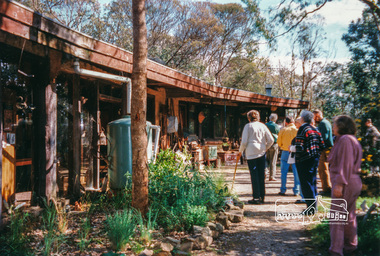
Photograph, Peter Bassett-Smith, Boomerang House, Laughing Waters Road, Eltham; Eltham Mud Brick Heritage Excursion, 4 October 1998, 04/10/1998
... This pise house was built by the Moore family in the early 1950's. In the afternoon we visited the home of artist Jenni Mitchell in Fordhams Road, one of the last examples of the work of Alistair Knox. ...This pise house was built by the Moore family in the early 1950's. In the afternoon we visited the home of artist Jenni Mitchell in Fordhams Road, one of the last examples of the work of Alistair Knox. ...[article in EDHS Newsletter No. 123, November 1998:] MUD BRICK HERITAGE EXCURSION AND THE FUTURE. A small group of members attended the excursion on 4th October. We visited a number of earth houses listed by the Eltham Heritage Study in a very pleasant day's outing. The first visit was to the home of Jenny and Brian Ellis in York Street, formerly the home of Jenny's father Professor William McMahon Ball. We were made very welcome with inspection of the inside and outside showing the various stages of construction. We then walked through the grounds of "Kinloch", the Jelbart property in Arthur Street where we saw their large mud brick house and barn. Lunch was at Marion and Russell Yeoman's house in Peter Street. This pise house was built by the Moore family in the early 1950's. In the afternoon we visited the home of artist Jenni Mitchell in Fordhams Road, one of the last examples of the work of Alistair Knox. Then we travelled to Laughing Waters Road where we saw two interesting houses owned and built by well known landscape gardener Gordon Ford. Along the way we stopped to view a number of other properties from the street.Colour photographactivities, eltham, heritage excursion, mud brick, boomerang house, laughing waters road -
 Eltham District Historical Society Inc
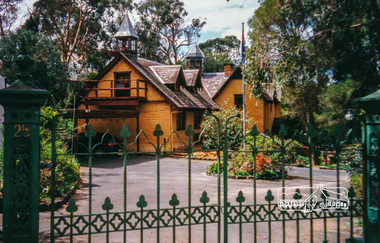
Photograph, Peter Bassett-Smith, Rocknall, 25 Diamond Street, Eltham; Eltham Mud Brick Heritage Excursion, 4 October 1998, 04/10/1998
... This pise house was built by the Moore family in the early 1950's. In the afternoon we visited the home of artist Jenni Mitchell in Fordhams Road, one of the last examples of the work of Alistair Knox. ...This pise house was built by the Moore family in the early 1950's. In the afternoon we visited the home of artist Jenni Mitchell in Fordhams Road, one of the last examples of the work of Alistair Knox. ...[article in EDHS Newsletter No. 123, November 1998:] MUD BRICK HERITAGE EXCURSION AND THE FUTURE. A small group of members attended the excursion on 4th October. We visited a number of earth houses listed by the Eltham Heritage Study in a very pleasant day's outing. The first visit was to the home of Jenny and Brian Ellis in York Street, formerly the home of Jenny's father Professor William McMahon Ball. We were made very welcome with inspection of the inside and outside showing the various stages of construction. We then walked through the grounds of "Kinloch", the Jelbart property in Arthur Street where we saw their large mud brick house and barn. Lunch was at Marion and Russell Yeoman's house in Peter Street. This pise house was built by the Moore family in the early 1950's. In the afternoon we visited the home of artist Jenni Mitchell in Fordhams Road, one of the last examples of the work of Alistair Knox. Then we travelled to Laughing Waters Road where we saw two interesting houses owned and built by well known landscape gardener Gordon Ford. Along the way we stopped to view a number of other properties from the street.Colour photographactivities, eltham, heritage excursion, mud brick, diamond street, rocknall -
 Eltham District Historical Society Inc
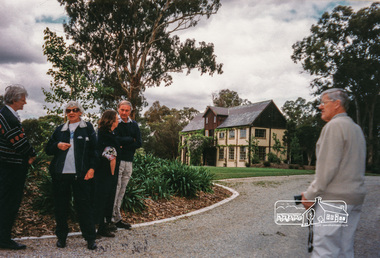
Photograph, Peter Bassett-Smith, Jelbart property, Arthur Street, Eltham Mud Brick Heritage Excursion, 4 October 1998, 04/10/1998
... This pise house was built by the Moore family in the early 1950's. In the afternoon we visited the home of artist Jenni Mitchell in Fordhams Road, one of the last examples of the work of Alistair Knox. ...This pise house was built by the Moore family in the early 1950's. In the afternoon we visited the home of artist Jenni Mitchell in Fordhams Road, one of the last examples of the work of Alistair Knox. ...[article in EDHS Newsletter No. 123, November 1998:] MUD BRICK HERITAGE EXCURSION AND THE FUTURE. A small group of members attended the excursion on 4th October. We visited a number of earth houses listed by the Eltham Heritage Study in a very pleasant day's outing. The first visit was to the home of Jenny and Brian Ellis in York Street, formerly the home of Jenny's father Professor William McMahon Ball. We were made very welcome with inspection of the inside and outside showing the various stages of construction. We then walked through the grounds of "Kinloch", the Jelbart property in Arthur Street where we saw their large mud brick house and barn. Lunch was at Marion and Russell Yeoman's house in Peter Street. This pise house was built by the Moore family in the early 1950's. In the afternoon we visited the home of artist Jenni Mitchell in Fordhams Road, one of the last examples of the work of Alistair Knox. Then we travelled to Laughing Waters Road where we saw two interesting houses owned and built by well known landscape gardener Gordon Ford. Along the way we stopped to view a number of other properties from the street.Colour photographactivities, eltham, heritage excursion, mud brick, arthur street, jelbart property -
 Eltham District Historical Society Inc
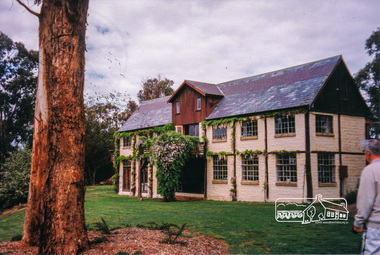
Photograph, Peter Bassett-Smith, Jelbart property, Arthur Street, Eltham Mud Brick Heritage Excursion, 4 October 1998, 04/10/1998
... This pise house was built by the Moore family in the early 1950's. In the afternoon we visited the home of artist Jenni Mitchell in Fordhams Road, one of the last examples of the work of Alistair Knox. ...This pise house was built by the Moore family in the early 1950's. In the afternoon we visited the home of artist Jenni Mitchell in Fordhams Road, one of the last examples of the work of Alistair Knox. ...[article in EDHS Newsletter No. 123, November 1998:] MUD BRICK HERITAGE EXCURSION AND THE FUTURE. A small group of members attended the excursion on 4th October. We visited a number of earth houses listed by the Eltham Heritage Study in a very pleasant day's outing. The first visit was to the home of Jenny and Brian Ellis in York Street, formerly the home of Jenny's father Professor William McMahon Ball. We were made very welcome with inspection of the inside and outside showing the various stages of construction. We then walked through the grounds of "Kinloch", the Jelbart property in Arthur Street where we saw their large mud brick house and barn. Lunch was at Marion and Russell Yeoman's house in Peter Street. This pise house was built by the Moore family in the early 1950's. In the afternoon we visited the home of artist Jenni Mitchell in Fordhams Road, one of the last examples of the work of Alistair Knox. Then we travelled to Laughing Waters Road where we saw two interesting houses owned and built by well known landscape gardener Gordon Ford. Along the way we stopped to view a number of other properties from the street.Colour photographactivities, eltham, heritage excursion, mud brick, arthur street, jelbart property -
 Eltham District Historical Society Inc
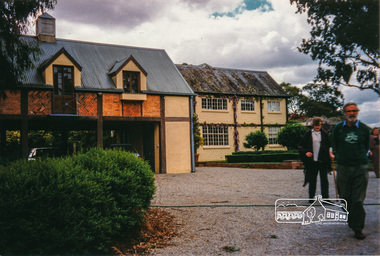
Photograph, Peter Bassett-Smith, Jelbart property, Arthur Street, Eltham Mud Brick Heritage Excursion, 4 October 1998, 04/10/1998
... This pise house was built by the Moore family in the early 1950's. In the afternoon we visited the home of artist Jenni Mitchell in Fordhams Road, one of the last examples of the work of Alistair Knox. ...This pise house was built by the Moore family in the early 1950's. In the afternoon we visited the home of artist Jenni Mitchell in Fordhams Road, one of the last examples of the work of Alistair Knox. ...[article in EDHS Newsletter No. 123, November 1998:] MUD BRICK HERITAGE EXCURSION AND THE FUTURE. A small group of members attended the excursion on 4th October. We visited a number of earth houses listed by the Eltham Heritage Study in a very pleasant day's outing. The first visit was to the home of Jenny and Brian Ellis in York Street, formerly the home of Jenny's father Professor William McMahon Ball. We were made very welcome with inspection of the inside and outside showing the various stages of construction. We then walked through the grounds of "Kinloch", the Jelbart property in Arthur Street where we saw their large mud brick house and barn. Lunch was at Marion and Russell Yeoman's house in Peter Street. This pise house was built by the Moore family in the early 1950's. In the afternoon we visited the home of artist Jenni Mitchell in Fordhams Road, one of the last examples of the work of Alistair Knox. Then we travelled to Laughing Waters Road where we saw two interesting houses owned and built by well known landscape gardener Gordon Ford. Along the way we stopped to view a number of other properties from the street.Colour photographactivities, eltham, heritage excursion, mud brick, arthur street, jelbart property -
 Eltham District Historical Society Inc
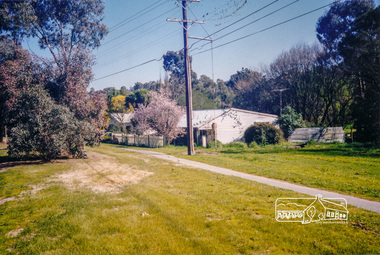
Photograph, Peter Bassett-Smith, Cottage, Main Road, Eltham, Eltham Mud Brick Heritage Excursion, 4 October 1998, 04/10/1998
... This pise house was built by the Moore family in the early 1950's. In the afternoon we visited the home of artist Jenni Mitchell in Fordhams Road, one of the last examples of the work of Alistair Knox. ...This pise house was built by the Moore family in the early 1950's. In the afternoon we visited the home of artist Jenni Mitchell in Fordhams Road, one of the last examples of the work of Alistair Knox. ...[article in EDHS Newsletter No. 123, November 1998:] MUD BRICK HERITAGE EXCURSION AND THE FUTURE. A small group of members attended the excursion on 4th October. We visited a number of earth houses listed by the Eltham Heritage Study in a very pleasant day's outing. The first visit was to the home of Jenny and Brian Ellis in York Street, formerly the home of Jenny's father Professor William McMahon Ball. We were made very welcome with inspection of the inside and outside showing the various stages of construction. We then walked through the grounds of "Kinloch", the Jelbart property in Arthur Street where we saw their large mud brick house and barn. Lunch was at Marion and Russell Yeoman's house in Peter Street. This pise house was built by the Moore family in the early 1950's. In the afternoon we visited the home of artist Jenni Mitchell in Fordhams Road, one of the last examples of the work of Alistair Knox. Then we travelled to Laughing Waters Road where we saw two interesting houses owned and built by well known landscape gardener Gordon Ford. Along the way we stopped to view a number of other properties from the street.Colour photographactivities, eltham, heritage excursion, mud brick, main road -
 Brighton Historical Society
Clothing - Dress, Day dress, 1878-1882
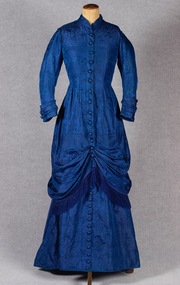
... BHS holds a small collection of items belonging to the Moore family. This dress was donated by Georgiana's niece, Jeannette Fraser, along with two nightgowns: a c. 1880 night dress believed to have been worn by Elizabeth and a c. 1910 night dress believed to have been worn by Georgiana's sister Amelia Henrietta Fraser (née Moore) while boarding at Merton Hall (this nightdress does also show a laundry mark of G.E. ...BHS holds a small collection of items belonging to the Moore family. This dress was donated by Georgiana's niece, Jeannette Fraser, along with two nightgowns: a c. 1880 night dress believed to have been worn by Elizabeth and a c. 1910 night dress believed to have been worn by Georgiana's sister Amelia Henrietta Fraser (née Moore) while boarding at Merton Hall (this nightdress does also show a laundry mark of G.E. ...The donation records indicate that this dress was worn by Georgiana Elizabeth Moore (1899-1974), who lived for most of her life in Brighton at 38 and later 40 Cochrane Street. Since the dress is of an earlier date, It is likely that it belonged to Georgiana's mother, Elizabeth Moore (1860-1950). Georgiana was born to Richard and Elizabeth Moore in Brighton in 1899. She was named after Richard's first wife, Georgiana Leake Moore (nee Paul), who had died in 1893 aged only 38. Georgiana is recorded as having been "tall with red hair". The family moved to Diamond Creek for several years, but returned to Brighton after Richard's death in 1922. Georgiana and her mother settled in Cochrane Street, where they lived for the rest of their lives. We know very little about Georgiana herself. Newspaper records indicate that she was a talented musician, graduating from the University of Melbourne with a diploma in music in 1927. BHS holds a small collection of items belonging to the Moore family. This dress was donated by Georgiana's niece, Jeannette Fraser, along with two nightgowns: a c. 1880 night dress believed to have been worn by Elizabeth and a c. 1910 night dress believed to have been worn by Georgiana's sister Amelia Henrietta Fraser (née Moore) while boarding at Merton Hall (this nightdress does also show a laundry mark of G.E. Moore and so may have been worn by both women). Georgiana herself donated a number of items to the Society in 1972, including a 1920s black and white geometric loom-beaded handbag.A good example of a princess line dress of this period in good condition and with provenance.A one-piece princess line dress, circa 1878-1882 of deep royal blue silk featuring Chinese-inspired self pattern. The neckline features a standing collar and is secured through the centre front from neck to floor with self covered buttons. At the front knee the fabric has been gathered and drawn to the back into a tiered fish-tail swag and trimmed with a matching blue knotted fringe. The swagging is created by interior tapes. The dress is backed with cream cotton.georgiana elizabeth moore, elizabeth moore, amelia henrietta fraser, brighton -
 Surrey Hills Historical Society Collection
Photograph, 'Glenisla', 18 Chestnut Street, Surrey Hills, c 1920, 1920
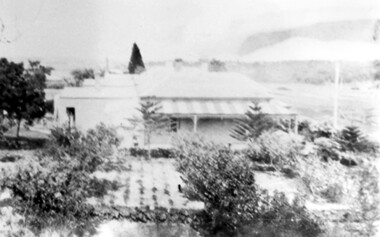
... Ref: History of original property - Age newspaper article: 'The Best - Glenisla: historic Grampians property', 7 January 1994. Moore family details: Robert Moore born 1857 on Isle of Man; died Surrey Hills 1940 Isabella Bateson born 1869; died Surrey Hills 1938 Married in 1894 in Miram, 10 km north-east of Kaniva in the northern Wimmera. ...Ref: History of original property - Age newspaper article: 'The Best - Glenisla: historic Grampians property', 7 January 1994. Moore family details: Robert Moore born 1857 on Isle of Man; died Surrey Hills 1940 Isabella Bateson born 1869; died Surrey Hills 1938 Married in 1894 in Miram, 10 km north-east of Kaniva in the northern Wimmera. ...Date is approximate. In 1920 this became the home of Mr and Mrs Robert Moore, whose daughter Mabel Annie married Norman Brodley Carter of Mont Albert. The house was named after 'Glenisla', a western District grazing property located between Hamilton and Horsham on the Henty Highway and on the edge of the Grampians National Park. This was established as a super-fine wool stud in 1860 and was passed down the family until it was sold in 1922. The family transferred from this property to Melbourne. Robert is listed as a grazier in the 1924 electoral roll at Chestnut Street. With him are Victor Cecil listed as a carpenter; Isabella, Mabel Annie and Edgar Gilbert listed as an orchardist. In 2003 the house was extant minus the verandas. This photo may have been taken from the rear of the property. Ref: History of original property - Age newspaper article: 'The Best - Glenisla: historic Grampians property', 7 January 1994. Moore family details: Robert Moore born 1857 on Isle of Man; died Surrey Hills 1940 Isabella Bateson born 1869; died Surrey Hills 1938 Married in 1894 in Miram, 10 km north-east of Kaniva in the northern Wimmera. All the children were born in Kaniva. Children: Lena Florence (1895-1980) Victor Cecil (1896-1984) - a builder Edgar Gilbert (1897-1976); died Surrey Hills; married Myrtle Emary, daughter of Henry John Emary of Surrey Hills Ernest Alan (1900-1900) Mabel Annie (1901-1957); died Surrey Hills married Norman Brodley Carter (1899-1984) Clarence Arthur (1904-2004). Norman Carter took many photos in the Surrey Hills and Mont Albert are from the 1920s; many is connection with Church of England events and activities. Robert and Isabella Moore are buried in Box Hill Cemetery. Black and white photo of a Victorian home with a veranda with a corrugated iron roof and lacework on 2 sides. It appears to have a later extension at the rear. It is surrounded by mature gardens with ornamental trees (cypresses) and an area with plants in rows, which may be a vegetable garden. There appears to be significant areas of open space around the house.glenisla, homes, victorian style, gardens, norman carter, robert moore, miss isabella bateson, mrs isabella moore, victor cecil moore, edgar gilbert moore, miss mabel annie moore, box hill cemetery -
 Flagstaff Hill Maritime Museum and Village
Vehicle - Wagon, Circa 1909
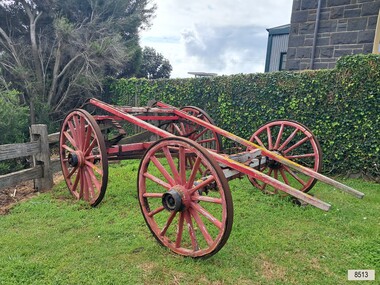
... The wagon remained with the Moore family and was occasionally used as a cubby house. ...The wagon remained with the Moore family and was occasionally used as a cubby house. ...This wagon was used in towns across south-west Victoria during the first half of the twentieth century by Pooran Singh, an Indian-born immigrant. Singh arrived in Australia alone in 1899 at the age of 30. The following year, at the Colac Licensing Court in western Victoria, he was one of 78 hawkers granted a Hawker’s Licence. According to the Colac Herald, all but two of the applicants appeared to be Asian. While some hawkers registered horse-drawn carts, Singh was one of nineteen licensed to trade on foot, selling door to door. Applicants were encouraged to contribute to a collection for the Colac Hospital. Over time, Pooran Singh came to own his own wagon—a top-of-the-range light delivery vehicle—and a horse named Prince. His work often took him along rough country roads, and for a period, he worked in the Corryong district of north-eastern Victoria, an area popular with hawkers. In September 1909, near Thowgla, he was thrown from his wagon while attempting to navigate a deep rut and was run over by one of its wheels. Although he suffered bruising to his chest, his injuries were not serious. The following year, he was granted a Hawker’s Licence in Corryong. By 1916, Singh was living and working at Garvoc in western Victoria, where that year, he lost his paper licence on Cooramook Road, and he placed a notice in The Standard. In 1918, at the Warrnambool Petty Sessions Court, he was one of four applicants granted renewal of their hawkers’ licences, and each donated ten shillings to Warrnambool Hospital. Throughout these years, Singh became well known to farmers and their families as he travelled across Victoria’s Western District, living and working from his covered wagon. In his later years, Pooran Singh formed a close friendship with John Jandes Moore and his wife, Vera, of Russells Creek, Warrnambool. They offered him the use of their property as a base for his travels and cared for him during his final illness. John Moore was later appointed one of the two executors of Singh’s will. Pooran Singh died in Warrnambool on 8 June 1947, aged 77. His final wish was to be cremated and for his ashes to be returned to India for immersion in the Ganges. The cremation was arranged by Guyett’s Funerals in Warrnambool. Having never married, Singh left his estate to his four nephews, enabling them to buy land and build homes; one later installed a memorial plaque in his honour. In the late 1980s, Guyett’s Funerals placed his ashes in the niche wall at Warrnambool Cemetery as a memorial, while continuing to hope that family instructions might eventually arrive. Nearly 63 years after his death, renewed enquiries brought public attention to the long and respectful care given to his ashes. As a result, the renowned Indian cricketer Kapil Dev travelled to Warrnambool to collect them and escort them to India, helping to fulfil Singh’s final wish. He was joined by one of Singh’s grand-nephews, Harmel Uppal, who had travelled from England. At a formal ceremony on 25 July 2010 commemorating Singh’s life, the ashes were handed to Dev and Uppal, and local resident Avis Quarrell, who had known Singh as a child, read a poem she had written in his memory. She still owned a shell necklace that Singh had made for her mother. Some Warrnambool locals who had been closely involved also travelled to India, where they joined Uppal’s family from the village of Uppal Bhopa, near Jalandhar. On 31 July 2010, Pooran Singh’s ashes were immersed in the Ganges, fulfilling the wish he had expressed more than six decades earlier. After Pooran Singh’s death, his horse and wagon remained on John Moore’s property. When Prince died, he was buried on the beach at Warrnambool. The wagon remained with the Moore family and was occasionally used as a cubby house. In about 1997, John Moore, the son of John Jandes Moore, donated it to Flagstaff Hill. After restoration, the wagon became an attraction in the village, where volunteer Pat and his Clydesdale horse, Duke, offered visitors rides around Flagstaff Hill’s lake. This wagon is significant for its association with an Indian emigrant who used it to earn an income in Australia. It also reflects the vital role of hawkers, who travelled through rural and regional communities in the late nineteenth and early twentieth centuries, supplying food, goods and news. The wagon is also historically significant as a former Flagstaff Hill attraction, offering visitors the experience of horse-drawn rides around the lake.Wagon: a light delivery vehicle once used as a hawker's wagon. It is a four-wheel, horse-drawn vehicle with iron tyres, brakes, spoked wheels painted red with decorative yellow strips on the hubs, a timber shaft, and springs on the undercarriage. It was once a covered wagon, fitted with green, wooden sideboards, a front seat with leather-padded backrest and mounting steps. The late-19th to early-20th-century wagon was once owned by Pooran Singh, a local Indian hawker. flagstaff hill, warrnambool, maritime village, maritime museum, flagstaff hill maritime museum and village, shipwreck coast, great ocean road, southwest victoria, northwest victoria, western district, colac, colac hospital, colac licensing court, thowgla, corryong, garvoc, cooramook road, warrnambool petty sessions court, warrnambool hospital, russells creek road, ganges, warrnambool cemetery, uppal bhopa, jalandhar, hawker’s licence, covered wagon, wagon, hawker's wagon, horse-drawn cart, hawker's cart, light delivery vehicle, hawker, travelling salesman, travelling hawker, door-to-door sales, rural salesman, rural commerce, prince, duke, clydesdale horse, 1997, pooran singh, indian immigrant, pat, john james moore, vera moore, john and vera moore, john moore, guyatt’s funerals, kapil dev, harmel uppal, avis quarrell -
 Blacksmith's Cottage and Forge
Cookery Book, Jewry-Mary, "Warne's Model Cookery & Housekeeping Book", Mid 20th. century
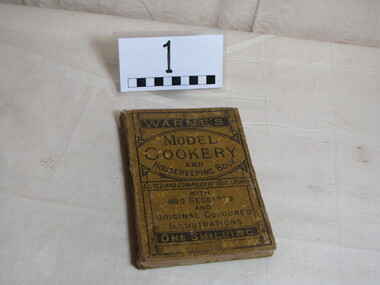
... They were a farming family whose land included The Masons Lane Recreation Reserve. the book was used between 1900 and 1930. Local history book domestic kitchen cookery gwen moore recipes Warne's Model Cookery and Housekeeping Book Book, hardcover, black lettering on spine "Warne's Model Cookery & Housekeeping Book" Cookery Book Jewry-Mary Frederick Warne and co. ...This cookery book belonged to Gwen Moores' family. They were a farming family whose land included The Masons Lane Recreation Reserve. the book was used between 1900 and 1930.Local historyBook, hardcover, black lettering on spineWarne's Model Cookery and Housekeeping Bookbook, domestic, kitchen, cookery, gwen moore, recipes -
 Flagstaff Hill Maritime Museum and Village
Clothing - Evening Outfit, before April 1874
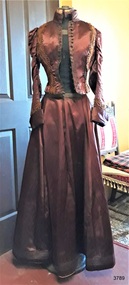
... moore...isabella mitchell...bella mitchell...bella russell...isabella russell...ralph russell...ian mccusker...ruby akers...fredrick william akers...ruby mclauchlan...margaret jane mclaughlan nee mitchell...margaret jane mclaughlan centenarian...william mclaughlan...robert russell...elizabeth russell nee mitchell...irish immigrants...warrnambool volunteer defence corps 1938-1945...antique satin outfit...warrnambool wedding 1874...congregational church warrnambool...reverend uriah coombs...dennington farmer...yarpturk farmer...purnim district farmer...camperdown resident 1905...dennington bridge...indigenous corroboree in dennington...corroboree in warrnambool...1880s corroboree in warrnambool...lubra and baby...indigenous corroboree in warrnambool...McCullagh family...They were from farming families in Northern Ireland, where they raised their seven children before migrating to Australia in the early colonial days, around 1857. Their graves are in the Tower Hill Cemetery. Alexander’s wife, Eliza (nee Moore...They were from farming families in Northern Ireland, where they raised their seven children before migrating to Australia in the early colonial days, around 1857. Their graves are in the Tower Hill Cemetery. Alexander’s wife, Eliza (nee Moore ...This amber satin evening outfit was worn by Mrs Isabella Mitchell (nee Russell, 1840 – 1929) at the wedding of her brother Alexander (c.1846–1938) and Eliza (nee Moore, c.1854–1939). The jacket and skirt attach at the waist by joining the metal rings around the base of the jacket, and the metal hooks on the waistband of the skirt. The outfit was donated with its own mannequin and fits it perfectly. In the colonial days, outer clothing was rarely, if ever, washed, due to the expense of fabrics and the difficulty in careful laundering. Clever methods were employed to reduce the occurrence of soiling. The mannequin included with the donation would also help keep the outfit in good shape and ensure a flattering fit. FAMILIES’ HISTORY The families connected with this wedding, where the outfit was worn, are from Warrnambool’s colonial days. Isabella and Alexander’s parents, Robert Russell and Elizabeth (nee Mitchell), were born in 1808 and married about 1830. They were from farming families in Northern Ireland, where they raised their seven children before migrating to Australia in the early colonial days, around 1857. Their graves are in the Tower Hill Cemetery. Alexander’s wife, Eliza (nee Moore, born in 1854), was also from Northern Ireland and migrated to Australia in 1858 with her parents, Thomas and Nancy Moore, in the last voyage of the sailing ship “Chance”. Isabella (Bella) talked with her granddaughter Ruby Akers about her memories of Alexander and Eliza’s wedding and other events in her life. Ruby recorded these memories in a letter. She says, “They were married in the Warrnambool Congregational Church by a pioneer minister, the Reverend Uriah Coombs. The bride wore a pale blue silk wedding gown, which she made herself. Bella was Matron of Honora, and Ian McCasker was best man. In those days, the transport to the church was usually a carriage – similar to a cab – and a pair of white ponies. They would have the reception at home, go for a drive afterwards, and at night there would be a dance. They did all the catering themselves … Eliza carried on farming in the Dennington, Yarpturk and Purnim districts until they moved to Camperdown around 1905…” Ruby’s letter later mentions “[Isabella] could recall seeing a blackfellows’ corroboree being performed near where the Dennington Bridge now stands. It was rather a terrifying experience; they seemed to be in a warlike mood, and one never knew what they would do next. One lubra came running to Granny, crying, Hide me, bad man kill me. She was bleeding from a wound in the head: probably the result of a blow from a waddy. My mother [Margaret Jane McLaughlan nee Mitchell], coming home from school in the 1800s, often met blackfellows walking ahead with spears and boomerang, the two lubras – they usually had two – following in the rear, carrying the children or any burdens they had.“ Margaret was probably in primary school at the time she saw these things. Alexander and Eliza had ten children. One of their daughters, Margaret Jane, was born in Warrnambool in 1879. She married William McCullagh, and they had eleven children. Margaret made headlines in the Warrnambool newspapers for celebrating her 100th birthday. She had lived in the district for 60 years before moving to Melbourne. Alexander passed away at the age of 92, and Eliza passed away six months later, aged 85. Their graves are in the Colac cemetery. Isabella married Ralph Mitchell, and their daughter Margaret Jane married John McLauchlan in 1891. Margaret and John’s daughter, Ruby Elizabeth Jane, married Fredrick Akers in 1938. Fredrick, born in England, was a Boer War veteran and served in the British Army. He migrated to Queensland, Australia, in 1913, and joined the Australian Army to fight in World War I. In 1935, he moved to Warrnambool, where he served in the Volunteer Defence Corps from 1938 to 1945. Both Ruby and Fredrick are buried in the Tower Hill Cemetery.The evening outfit and its accompanying mannequin serve as notable examples of female fashion from the mid to late 1900s. These items reflect the styles and trends that were prevalent during this period, offering insight into the clothing choices and cultural influences that shaped women's attire. Beyond their representation of period fashion, the outfit and mannequin are significant due to their association with colonial pioneer families from Australia, specifically Victoria and Warrnambool. These families played an important role in the development and history of the region, and the items are linked to their legacy. The evening outfit and mannequin are also notable for their connection to a wedding that united two colonial families originating from Northern Ireland. These families immigrated to Australia in the mid-1850s and became influential figures within the Warrnambool district. The wedding marked a significant event, symbolising the merging of two prominent family lineages. Furthermore, the significance of the evening outfit and mannequin extends to their connection with the colonial families’ contact with the indigenous culture of the district. These items represent a period of interaction between the native and European peoples, highlighting the cultural exchanges that occurred within the region. This lady’s evening outfit is made from amber coloured satin fabric. It comprises a short-waisted, long-sleeved jacket and a long skirt, and it has its own neck-to-floor wooden mannequin on a pedestal. The outfit was worn by Mrs Isabella Mitchell (nee Russell) as the Matron of Honour at the wedding of her brother Alexander Russell and his fiancée Eliza Moore in Warrnambool, 29th April 1874.flagstaff hill, warrnambool, shipwrecked coast, flagstaff hill maritime museum, maritime museum, shipwreck coast, flagstaff hill maritime village, great ocean road, evening outfit, wedding outfit, bridesmaid’ outfit, matron of honour outfit, clothing female, clothing late 19th century, clothing wedding late 19th century, clothing bridesmaid late 19th century, clothing antique, clothing ladies, women’s clothing, women’s fashion, alexander russell, eliza russell, eliza moore, isabella mitchell, bella mitchell, bella russell, isabella russell, ralph russell, ian mccusker, ruby akers, fredrick william akers, ruby mclauchlan, margaret jane mclaughlan nee mitchell, margaret jane mclaughlan centenarian, william mclaughlan, robert russell, elizabeth russell nee mitchell, irish immigrants, warrnambool volunteer defence corps 1938-1945, antique satin outfit, warrnambool wedding 1874, congregational church warrnambool, reverend uriah coombs, dennington farmer, yarpturk farmer, purnim district farmer, camperdown resident 1905, dennington bridge, indigenous corroboree in dennington, corroboree in warrnambool, 1880s corroboree in warrnambool, lubra and baby, indigenous corroboree in warrnambool, mccullagh family -
 Flagstaff Hill Maritime Museum and Village
Photograph - Vessel, Steam tug, circa 1920's
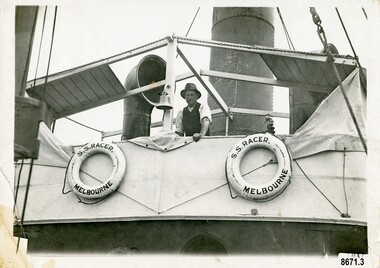
... Moore" and was engaged in salvaging the Union Steamship vessel "Karkariki" near Gellibrand Pile Light at the entrance to Hobsons Bay. George Cunningham died in 1978. This photograph was one of ten photographs donated to Flagstaff Hill Maritime Museum and Village by Fred Trewartha. Frederick John Fox Trewartha (Fred) was a well-known Warrnambool businessman. He was born in Beeac near Geelong in 1920 and came to Warrnambool with his family...Moore" and was engaged in salvaging the Union Steamship vessel "Karkariki" near Gellibrand Pile Light at the entrance to Hobsons Bay. George Cunningham died in 1978. This photograph was one of ten photographs donated to Flagstaff Hill Maritime Museum and Village by Fred Trewartha. Frederick John Fox Trewartha (Fred) was a well-known Warrnambool businessman. He was born in Beeac near Geelong in 1920 and came to Warrnambool with his family ...The ocean Steamtug "Racer" was built in 1886 in Sunderland by "Boolds, Sharer and Company" for the "Queenstown Tug and Shipping Company". It is mentioned in several newspapers that soon afterwards it sank in Queenstown Harbour, Ireland and remained submerged for six months before being raised. It was a steel screw boat with a sluice keel, was 185 tons and 420 feet long. It was purchased around 1889 by the "Melbourne Coal, Shipping and Engineering Company Ltd" as it had sufficient power to work with the huge iron clippers that the company were dealing with. It survived several dangerous incidents on its voyage out to Melbourne. On May 28th in the middle of the night in a heavy gale, the tug was swamped by heavy seas and then several hours later was almost run down by a very large ship (the clipper Loch Vennachar) in full sail. The "Racer" (later owned by the "Melbourne Steamship Company") became one of the fastest and best-known tugs in the Port of Melbourne - working in the port until 1935. The "Racer" was involved in many rescues and dangerous incidents during its 45 years including the attempted rescue of the "Craigburn" near Cape Schanck, the rescue of the "Edina" from a reef near Williamstown and the rescue of the "Netherby" from heavy seas near Inverloch. In March 1930 she was caught by a strong wind when turning in the Yarra River and crashed into the Spencer Street Bridge - resulting in some damage to the scaffolding on the bridge and slight damage to the tug. In 1906 the "Racer" created a record for the fastest tow when it towed the 900-ton barque "Elizabeth Graham" from Sydney to Melbourne in 73 hours. In 1934 it was withdrawn from commission with plans for it to be broken up for scrap metal but was bought by a Melbourne businessman to be converted into a three masted schooner trading between Tasmania and Melbourne. George (Joe) Cunningham was born in 1892 in Geelong. His father, Alexander Cunningham was a ship builder and carpenter. George worked on oceangoing ships as a young man but after his marriage, had a twenty-six year career on Tugboats. He worked as a deckhand on the "Racer" and then worked his way up as a mate and then master on the "Maitland" and "Tooronga". Later he was in charge of two larger boats - the "Alvina" and "Helen Moore" and was engaged in salvaging the Union Steamship vessel "Karkariki" near Gellibrand Pile Light at the entrance to Hobsons Bay. George Cunningham died in 1978. This photograph was one of ten photographs donated to Flagstaff Hill Maritime Museum and Village by Fred Trewartha. Frederick John Fox Trewartha (Fred) was a well-known Warrnambool businessman. He was born in Beeac near Geelong in 1920 and came to Warrnambool with his family as a very young child. He was apprenticed to his father John, as a saddler and later opened his own shop on Raglan Parade. He then moved into working with tarpaulins and canvases for the trucking industry. Fred was keenly interested in photography (and was a member of the Warrnambool Cine Club), yachting and boat building. He kept his yacht moored at Port Fairy for many years and participated in sailing events locally and interstate. He also built boats with his sons. He had the opportunity to meet many older sailors and it's thought this photo (and others in the set) may have been given to him by one of these men. Fred Trewartha died in 2016 in Warrnambool.This item is significant as a reminder of the important role tugboats and their crews played in the maritime history of Melbourne and the surrounding seas. This is a close-up view of a tugboat showing a man leaning against the upper deck. Two lifebuoys (with the words S. S. Racer Melbourne) are attached to the side of the deck and a funnel and an airvent are in the background. A handwritten note in pencil saying "Geo Cunningham on board Racer "is on the back of the photograph.Back - "Geo Cunningham on board Racer" Front (on lifebuoys) - "S. S. RACER MELBOURNE"flagstaff hill maritime museum and village, great ocean road, tugboats, steamtug boats, racer, george cunningham, port of melbourne, melbourne steamship company, rescues, craigburn, steamtug, edina, elizabeth graham, netherby, yarra river, ships, historic maritime photographs, boolds sharer and company, queenstown tug and shipping company, melbourne coal shipping and engineering company limited -
 Flagstaff Hill Maritime Museum and Village
Document - Solicitor's receipt, E L Ardlie, Solicitor, 10-08-1890
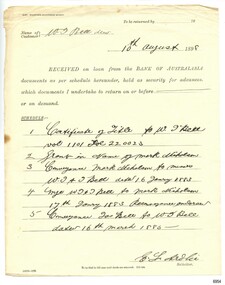
... Staff at the Bank of Australasia in Warrnambool included the following men but others were also involved: Samuel Hannaford, Teller then Manager from 1855-1856; W H Palmer, Manager from January 1857 until November 1869 when the Teller Basil Spence was promoted to Manager; H B Chomley, Manager from April 1873 and still there in 1886; A Butt, Manager in 1895-1904; J R McCleary Accountant and Acting Manager for 12 months, until 1900; A Kirk, Manager 1904; J Moore, staff until his transfer to Bendigo in December 1908; J S Bath was Manager until 1915; C C Cox, Manager until April 1923; Richard C Stanley, Manager 1923 to April 1928. The Receipt from E L Ardlie documents names of local families ...This document is a receipt detailing the transfer of five documents from the Bank of Australasia Warrnambool to the security of the Solicitor E L Ardile (and W M Ardlie) of Kepler Street Warrnambool. The documents include a Title and are concerned with the bank's customer, W J Bell, deceased. They refer to Jas Bell and Mark Nicholson. The dates mentioned are from 1883 to 1885 and the receipt is dated 10 August 1890. The Bank of Australasia was incorporated by the Royal Charter of England in March 1834. The bank began in Australia on 14th December 1835, opening in Sydney. The Acting Superintendent of the bank at that time was David Charters McArthur. He was Superintendent from 1867-to 1876. The Melbourne branch opened on 28th August 1838 in a two-roomed brick cottage on the north side of Little Collins Street, where two huge mastiff dogs were used at night to guard the bank. The government also provided an armed military sentinel. Due to the bank's rapid growth, a new building for the Melbourne branch was opened in 1840 at 75 Collins Street West. By 1879 the bank had been upgraded to a magnificent two-storey building on the corners of Collins and Queens Streets, with the entry on Collins Street. In 1951 the Bank of Australasia amalgamated with the Union Bank to form Australia and New Zealand Bank, now known as the ANZ. Then in 1970, the ANZ merged with both the ES&A and the London Bank of Australia to form the ANZ Banking Group Limited. The ANZ Banking Group Ltd kindly donated a variety of historic items from the Bank of Australasia. BANK of AUSTRALASIA, WARRNAMBOOL – In 1854 Warrnambool had two banks, the Union Bank and the Bank of Australasia. Later, completely different bank businesses opened; in 1867 the National Bank of Australasia, then in 1875 the Colonial Bank of Australasia. The original Warrnambool branch of the Bank of Australasia was established in July 1854, and operated from a leased cottage on Merri Street, close to Liebig Street. The bank later bought a stone building previously erected by drapers Cramond & Dickson on the corner of Timor and Gibson Streets. Samuel Hannaford was a teller and then Manager at the Warrnambool branch from 1855 to 1856 and the Warrnambool Council chose that bank for its dealings during 1856-57. In 1859 Roberts & Co. was awarded the contract to build the new Bank of Australasia branch for the sum of £3,000. The land was on a sand hill on the northeast corner of Timor and Kepler Streets and had been bought in 1855 from investor James Cust. The new building opened on May 21, 1860. The bank continued to operate there until 1951 when it merged with the Union Bank to form the ANZ Bank, which continued operating from its Liebig Street building. Warrnambool City Council purchased the former Bank of Australasia building in 1971 and renovated it, then on 3rd December 1973 it was officially opened as the Art Gallery by Cr. Harold Stephenson and Gallery Director John Welsh. The Gallery transferred to the purpose-built building in Liebig Street in 1986 and the old bank building is now the Gallery club. Staff at the Bank of Australasia in Warrnambool included the following men but others were also involved: Samuel Hannaford, Teller then Manager from 1855-1856; W H Palmer, Manager from January 1857 until November 1869 when the Teller Basil Spence was promoted to Manager; H B Chomley, Manager from April 1873 and still there in 1886; A Butt, Manager in 1895-1904; J R McCleary Accountant and Acting Manager for 12 months, until 1900; A Kirk, Manager 1904; J Moore, staff until his transfer to Bendigo in December 1908; J S Bath was Manager until 1915; C C Cox, Manager until April 1923; Richard C Stanley, Manager 1923 to April 1928. The Receipt from E L Ardlie documents names of local families and are of historical significance. The movement of the documents from the Bank of Australasia, to the security of the Solicitor, shows that the bank was relied on for more than just financial services. The document is significant for its association with the Bank of Australasia in Warrnambool, the first bank in Warrnambool, established in 1854. The bank continued to operate until its merger in 1951 when it became the ANZ Bank, which is still in operation today. The Bank was an integral part of the establishment and growth of commerce in Colonial Warrnambool and throughout Australia.Receipt, printed on pale yellow paper, an official form titled Solicitor's Accountable Receipt, with handwritten details. DATE 10th August 1898 FROM E L Ardlie, Solicitor, TO Bank of Australasia Warrnambool FOR CUSTOMER W J Bell decd. DOCUMENTS five (5) on loan, held for security.DATE: "10 August 1898" SOLICITOR: "E L Ardlie" CUSTOMER: "W J Bell, decd." TEXT: "... RECEIVED on loan from the BANK OF AUSTRALASIA ...documents held in security ... " DOCUMENTS: "Certificate of title to W J Bell" " Grant ... Mark Nicholson" "Conveyance .. Mark Nicholson to ... W J and J Bell dated 16th January 1883" " W J and J Bell to Mark Nicholson 17 January 1883 ..." "Conveyance Jas Bell to W J Bell dated 16 March 1885"flagstaff hill, warrnambool, flagstaff hill maritime museum, maritime museum, commerce, banking, bank of australasia, david charters mcarthur, e l ardlie, solicitor, convenancer, w j bell, jas bell, mark nicholson, document security -
 Flagstaff Hill Maritime Museum and Village
Domestic object - Ice Chest, 1927
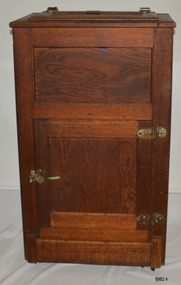
... The family relocated to Warrnambool in 1939 and brought the ice chest with them. An ice chest, also called an icebox or refrigerator, was invented by Thomas Moore in 1802 and had become a common home appliance from the mid-1800s until around the 1930s, when electric refrigerators became affordable and safe. ...The family relocated to Warrnambool in 1939 and brought the ice chest with them. An ice chest, also called an icebox or refrigerator, was invented by Thomas Moore in 1802 and had become a common home appliance from the mid-1800s until around the 1930s, when electric refrigerators became affordable and safe. ...This particular small ice chest was once part of the domestic furniture of Dr W.R. Angus and his young family in 1927 when they lived in the Nhill and Ballarat districts. The family relocated to Warrnambool in 1939 and brought the ice chest with them. An ice chest, also called an icebox or refrigerator, was invented by Thomas Moore in 1802 and had become a common home appliance from the mid-1800s until around the 1930s, when electric refrigerators became affordable and safe. The non-mechanical ice chest allowed perishable food to be kept fresh for longer than the food-safe or ‘Coolgardie’ used in colonial days in Australia. It required the use of ice blocks, which were delivered to households by the ‘iceman' and his horse and cart. The ice man would use an ice pick to cut the blocks into the right size for the buyer’s ice chest. The ice came from an ‘ice house’, a factory where the ice was made. The ice chest required a block of ice to be placed into the insulated top section on top of the corrugated iron stand. The ice would cool the air and the cool air would flow downwards through the oval hole under the stand and into the refrigerator compartment below. The water from the melted ice would drain from the sloping floor of the top compartment and into the hooded pipe. The pipe went through the refrigerator and ended below its floor, where the drained water would be collected in the metal bowl placed there for that purpose. The lip on the bowl allowed it to be easily removed and emptied at regular intervals before it overflowed. W.R. Angus Collection- The W R Angus Collection spans from 1885 to the mid-1900s and includes historical medical and surgical equipment and instruments from the doctors Edward and Thomas Ryan of Nhill, Victoria. Dr Angus married Gladys in 1927 at Ballarat, the nearest big city to Nhill where he began as a Medical Assistant. He was also Acting House surgeon at the Nhill hospital where their two daughters were born. He and his family moved to Warrnambool in 1939, where Dr Angus operated his own medical practice. He later added the part-time Port Medical Officer responsibility and was the last person appointed to that position. Dr Angus and his wife were very involved in the local community, including the early planning stages of the new Flagstaff Hill, where they contributed to the layout of the gardens. Dr Angus passed away in March 1970.This ice chest is significant for representing a method of refrigeration and food preservation used in the 19th to mid-20th centuries when people were beginning to afford powered domestic refrigerators. After the second world war, most households replaced their food storage cupboards and ice chests with refrigerator appliances. The ice chest is also significant for its connection with the domestic furniture of Dr W.R. Angus and his family, and its inclusion in the W.R. Angus Collection.Ice chest; single front wooden cabinet with two doors and a flap, and three accessories. The top door is a lid with a metal handle at the front and two metal hinges along the back. The front door has two metal hinges on the right-hand side and has a metal lever catch. A hinged flap fits between the front legs at bottom of the ice chest and swings upwards. The front legs have wheels. The insulated top compartment has a metal lining and its floor slopes towards the centre of the back wall. In the floor are a formed oval air-flow hole and the open end of a pipe that has a hood partly covering it. The front compartment is an insulated metal-lined cupboard with a vertical pipe down the centre of the back wall and horizontal rails in the centre of each side wall. The accessories are a rectangular corrugated iron stand, a rectangular wire grid shelf and a round aluminium bowl with a lip and two sides pushed in. The ice chest was made circa 1927 and is part of the W.R. Angus Collection.flagstaff hill, warrnambool, maritime village, maritime museum, shipwreck coast, great ocean road, dr w r angus, dr roy angus, dr ryan, doctor angus, dr angus, ice chest, ice box, antique, food preservation, refrigeration, domestic equipment, kitchen appliance, refrigerator, non-electric refrigerator, non-mechanical refrigerator, w.r. angus collection -
 City of Moorabbin Historical Society (Operating the Box Cottage Museum)
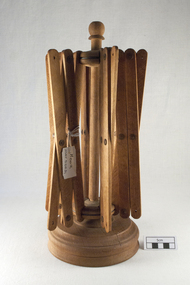
Craft - Craft equipment, wool winder, c1860
... families. Phillip Jones migrated from Ireland c1852 and his son, James Jones 1857 – 1940 was born in East Brighton , married Mary Ann Moore and raised his family in Bentleigh, as the area became known. brighton moorabbin pioneers bentleigh market gardeners wool craft work early settlers knitting craft equipment jones mary ann jones james jones phillip herron john A wooden wool winder, with extending arms for winding hanks of wool into balls prior to knitting. ...Pioneers migrating to Moorabbin Shire brought items they thought would assist them in the new Country. They had to be self reliant and made their own clothing and utensils while establishing their market gardens and farms. A wooden wool winder, with extending arms for winding hanks of wool into balls prior to knitting. For ease of use the winder also rotates. Circa 1860s this winder was made in Ireland.The pioneer settlers and market gardeners of Moorabbin Shire had to be self reliant and made their own clothing and utensils. This is one of many items used to exhibit the skill and craftsmanship of the women in these families. Phillip Jones migrated from Ireland c1852 and his son, James Jones 1857 – 1940 was born in East Brighton , married Mary Ann Moore and raised his family in Bentleigh, as the area became known. A wooden wool winder, with extending arms for winding hanks of wool into balls prior to knitting. For ease of use the winder also rotates. Circa 1860s this winder was made in Ireland.brighton, moorabbin, pioneers, bentleigh, market gardeners, wool, craft work, early settlers, knitting, craft equipment, jones mary ann, jones james, jones phillip, herron john -
 City of Moorabbin Historical Society (Operating the Box Cottage Museum)
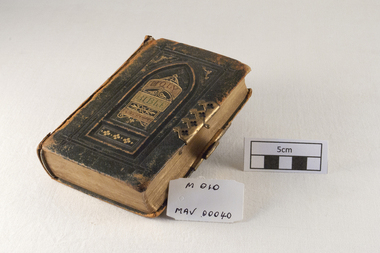
Book - Rites, Bible 1874, THE HOLY BIBLE, 1874
... Mary Ann Moore was the daughter of Thomas Moore, a Gardener, and Sarah Harris who also settled in Brighton c1852. James and Mary Ann Jones settled and raised their family in East Brighton now Bentleigh. ...A Bible used by Mr James Jones, an early settler in Moorabbin Shire, from 1880 - 1940James Jones was the son of Philip Jones, a Chairmaker, and Ann Jones who settled in East Brighton after the sale of land c1852 in the area of the Henry Dendy Special Survey of 1841. Mary Ann Moore was the daughter of Thomas Moore, a Gardener, and Sarah Harris who also settled in Brighton c1852. James and Mary Ann Jones settled and raised their family in East Brighton now Bentleigh. Mr John Herron resided at 4 Vickery St Bentleigh until 1989.A Bible of Mr James Jones 1874Front cover THE HOLY BIBLE inside page THE/ HOLY BIBLE/ CONTAINING THE / OLD AND NEW TESTAMENTS/ APPOINTED TO BE READ IN CHURCHES/ herron john, jones james. early settlers, pioneers, collins william, printers, publishers, bibles, church of england, prayer books, moorabbin, brighton, melbourne, glasgow, scotland -
 City of Moorabbin Historical Society (Operating the Box Cottage Museum)
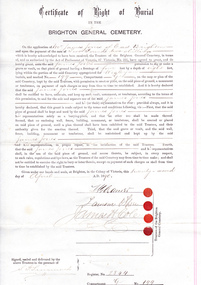
Certificate - Document, Certificate of Burial 1890, c1880
... Mary Ann Moore was the daughter of Thomas Moore, a Gardener, and Sarah Harris who also settled in Brighton c1852. James and Mary Ann Jones settled and raised their family in East Brighton now Bentleigh. ...Mary Ann Moore was the daughter of Thomas Moore, a Gardener, and Sarah Harris who also settled in Brighton c1852. James and Mary Ann Jones settled and raised their family in East Brighton now Bentleigh. ...James Jones was the son of Philip Jones, a Chairmaker, and Ann Jones who settled in East Brighton after the sale of land c1852 in the area of the Henry Dendy Special Survey of 1841. Mary Ann Moore was the daughter of Thomas Moore, a Gardener, and Sarah Harris who also settled in Brighton c1852. James and Mary Ann Jones settled and raised their family in East Brighton now Bentleigh. Mr John Herron resided at 4 Vickery St Bentleigh until 1989. Sadly Martha Jones born 1888 died in 1890 and James Jones had to purchase this plot at Brighton General Cemetery for her burial. A further 2 children were interred in 1893 and 1900 then Mary Ann in 1903 and James in 1940 James Jones and Mary Ann Moore were born in Brighton c1857 and c 1859 into pioneer market gardener families in the area of the Dendy Special Survey of 1841. They married in 1883 and raised their family in East Brighton, now Bentleigh. Sadly infectious diseases took the lives of many infants throughout the Colony of Victoria due to the poor state of water supply and sewerage disposal and locally the swamps of the Elster Creek were a constant breeding ground.An original paper Certificate of Right of Burial in The Brighton General Cemetery signed and dated by the Trustees of the Cemetery upon the application of James Jones of East Brighton, Victoria, 22nd April 1890. A plot , Register No. 2844, of 4 feet in width and 8 feet in depth in the Wesleyan Section, No. 199, compartment G in the Brighton General Cemetery. would be supplied upon payment of Two Pounds two shillings and receipt of same is acknowledged. Certificate of Right of Burial / IN THE / BRIGHTON GENERAL CEMETERY. Application of Mr James Jones of East Brighton for a plot to be supplied upon payment of Two Pounds and 2 Shillings and receipt of same acknowledged. Signed by the Trustees of the Cemetery, (4 signatures) in presence of S. Simmonds, dated twenty- second April 1890 Reverse side Dated 22nd April 1890 / Certificate of Right of Burial / IN THE / BRIGHTON GENERAL CEMETERY/ Mr James Jones ( hand written) / DENOMINATION Wesleyan / Compartment G / No. 199 Hand written on right side 3454 (signed) S Simmonds / 4797 (signed) S Simmonds / 36897 20/ 11 / 40 melbourne, brighton, moorabbin, water supply, pioneers, bentleigh, dendy henry, market gardeners, early settlers, jones mary ann, wesleyan church, jones james, vaccination, typhoid, dendys special survey 1841, infectious diseases, elster creek, jones martha, brighton general cemetery
