
Showing 30 items matching "national trust of australia (vic)"
-
 Friends of Ballarat Botanical Gardens History Group
Work on paper - National Trust of Australia (Vic), Register of Significant Trees. Ballarat Botanical Gardens. c1983, Unknown
... National Trust of Australia (Vic)......National Trust of Australia (Vic)...Ballarat Botanical Gardens. c1983 Work on paper National Trust of Australia (Vic) ...This National Trust Register of Significant Trees in the Ballarat Botanical Gardens is an important part of Ballarat's history. Unfortunately, since 1983, some of the trees listed have died or been removed.The Ballarat Botanical Gardens has a unique collection of trees which testify to the knowledge and enthusiasm of the Curators, City fathers and Gardeners in their development of the Gardens in earlier years, especially in the nineteenth century.1 sheet of paper with three lists of the trees and the number of them in the Gardens. (1 copy)Draft printed in red under main heading. In black biro, written on the first entry, "no on map". 10th entry (Sierra Redwood) number scribbled over and "outside gate" written. 14th entry (Horizontal Elm) "3 on list, 1dead". 15th entry (Horizontal Elm) "W of 17". ballarat botanical gardens, national trust of australia (vic), register of significant trees, trees, john garner collection, gardens, ballarat -
Friends of Ballarat Botanical Gardens History Group
Work on paper - National Trust of Australia (Vic), Tour of the Ballarat Botanical Gardens 1992-93, 1992-1993
... National Trust of Australia (Vic)......National Trust of Australia (Vic)...Tour of the Ballarat Botanical Gardens 1992-93 Work on paper National Trust of Australia (Vic) ...This listing of trees at this time is important in terms of the subsequent millennial drought and in giving details of where each tree is situated in the Gardens and the condition of each tree.The Ballarat Botanical Gardens has a notable collection of trees, which are important in the history of Ballarat and for citizens and visitors to this City.4 pages printed on both sides, faint though legible grey print. 3 and 1/4 printed pages.Nonejohn garner, doctor, john garner collection, ballarat botanical gardens, trees in the ballarat botanical gardens, national trust of australia (vic), trees in 1992-93, location of trees, condition of trees, botanic names of trees., friends of ballarat botanical gardens, gardens, ballarat -
 Greensborough Historical Society
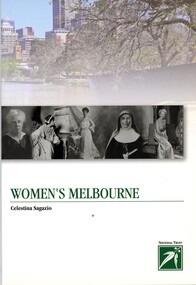
Book, Celestina Sagazio, Women's Melbourne by Celestina Sagazio, 2010
... ...National Trust of Australia (Vic.)...Women's Melbourne by Celestina Sagazio Book Book Celestina Sagazio National Trust of Australia (Vic.) ...This book contains maps and walking tours of Melbourne with a focus on places that are important to the development of women's rights over the years.96 p., paperback, illus. (some col.), maps.melbourne, women, women's rights, walking tours -
 Narre Warren and District Family History Group
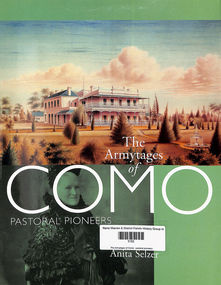
Book, Anita Selzer, The Armytages of Como : pastoral pioneers, 2003
... Halstead Press in association with ; The National Trust of Australia (Vic.)....; 29 cm The Armytages of Como : pastoral pioneers Book Anita Selzer Halstead Press in association with ; The National Trust of Australia (Vic.) ...The Armytages of Como : pastoral pioneers143 p.; 29 cmnon-fictionThe Armytages of Como : pastoral pioneersarmytage family, como -
Kew Historical Society Inc
Archive (Sub-series) - Subject File, Kew Historical Society, Handicrafts (Victorian), 1958
... national trust of australia (vic)...Typically files will contain primary and secondary sources. national trust of australia (vic) victoria - 19th century - arts and culture Single item archive file containing a National Trust of Victoria exhibition catalogue - Hearth and Home: Handicrafts and Pastimes of the Victorian Era (TOY, Ann [Asst. ...Various partiesReference, Research, InformationSecondary Values (KHS Imposed Order)Single item subject file containing a National Trust of Victoria exhibition catalogue - Hearth and Home: Handicrafts and Pastimes of the Victorian Era (TOY, Ann [Asst. Curator, Extension Galleries], NTV, 1980)national trust of australia (vic), victoria - 19th century - arts and culturenational trust of australia (vic), victoria - 19th century - arts and culture -
Emerald Museum & Nobelius Heritage Park
Document - Heritage Report - Emerald Bakery, Graeme Butler & Associates, 2001
... ...National Trust of Australia (Vic)...Moffatt Robert McLean National Trust of Australia (Vic) Graeme Butler & Associates 11 page unbound report, printed single-sided with black and white photographs Document Heritage Report - Emerald Bakery. ...Detailed assessment of the significance of the old Emerald Bakery, located at the rear of the Commonwealth Bank, Kilvington Drive, Emerald. The assessment was made by Graeme Butler & Associates at the request of Cardinia Shire Council, at the time relocation of the bakery was being considered in the event of closure o0f the Commonwealth Bank. The recommendation was not to relocate. The bakery was originally operated by W. Moffat and subsequently by Robert McLean.11 page unbound report, printed single-sided with black and white photographsemerald, victoria, australia, bakeries, historic buildings, emerald bakery, w. moffatt, robert mclean, national trust of australia (vic), graeme butler & associates -
 Bendigo Historical Society Inc.
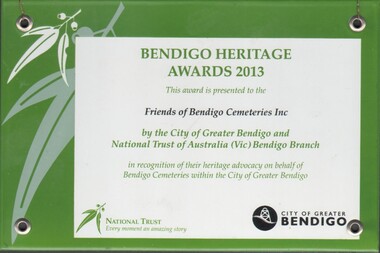
Award - BENDIGO HERITAGE AWARDS 2013 PRESENTED TO THE FRIENDS OF THE BENDIGO CEMETRIES INC
... Bendigo Heritage Awards 2013 presented to the Friends of the Bendigo Cemetries Inc, by the City of Greater Bendigo and the National Trust of Australia (Vic) Bendigo Branch; in recognition of their advocacy on behalf of Bendigo Cemetries with the City of Greater Bendigo...Bendigo Heritage Friends of Bendigo Cemeteries National Trust of Australia Victorian Branch Bendigo Heritage Awards 2013 presented to the Friends of the Bendigo Cemetries Inc, by the City of Greater Bendigo and the National Trust of Australia (Vic) Bendigo Branch; in recognition of their advocacy on behalf of Bendigo Cemetries with the City of Greater Bendigo Award BENDIGO HERITAGE AWARDS 2013 PRESENTED TO THE FRIENDS OF THE BENDIGO CEMETRIES INC ...Bendigo Heritage Awards 2013 presented to the Friends of the Bendigo Cemetries Inc, by the City of Greater Bendigo and the National Trust of Australia (Vic) Bendigo Branch; in recognition of their advocacy on behalf of Bendigo Cemetries with the City of Greater Bendigobendigo heritage, friends of bendigo cemeteries, national trust of australia victorian branch -
 Bendigo Historical Society Inc.
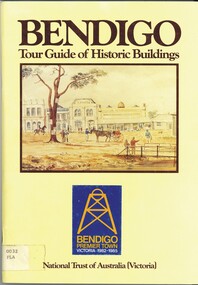
Book - BENDIGO TOUR GUIDE OF HISTORIC BUILDINGS, c1982
... Publisher National Trust of Australia. ISBN: 0 909710 34 1. Publisher; National Trust of Australia (Vic.). ...BOOK Bendigo buildings historic National Trust of Australia G Flanders & M Butcher Bendigo Tour Guide of Historic Buildings. Publisher National Trust of Australia. ISBN: 0 909710 34 1. Publisher; National Trust of Australia (Vic ...Bendigo Tour Guide of Historic Buildings. Publisher National Trust of Australia. ISBN: 0 909710 34 1. Publisher; National Trust of Australia (Vic.). Photographs, illustrations and maps. 86 pages. Sticker on spine and BHS, Bendigo Premier Town Victoria 1982-1985 and stamp on page 1.G Flanders & M Butcherbook, bendigo, buildings, historic, national trust of australia -
 Bendigo Historical Society Inc.
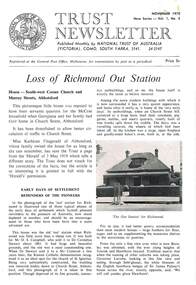
Book - HARRY BIGGS COLLECTION: TRUST NEWSLETTER, Nov. 1970
... By the National Trust of Australia Vic. Branch. Nov. 1970 Vol 1, No 5. ...National Trust Newsletter Book. Harry Biggs Collection. Trust Newsletter published. By the National Trust of Australia Vic. ...Book. Harry Biggs Collection. Trust Newsletter published. By the National Trust of Australia Vic. Branch. Nov. 1970 Vol 1, No 5. Covers historical items of interest in Vic. - includes a paragraph 'Change of address' Log Lock-up, Eaglehawk. Moved from High Street Eaglehawk to a site adjacent to Eaglehawk Court House, Sailors Gully Road, Eaglehawk. (P11)National Trust Newsletterorganisation, union, community, harry biggs collection, log lock-up, eaglehawk -
 Bendigo Historical Society Inc.
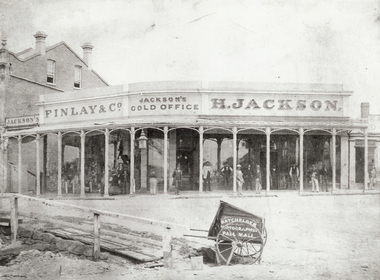
Photograph - JACKSON'S GOLD OFFICE, VIEW POINT, BENDIGO - 1861?, 1860's ?
... Also details of Henry Jackson's store in Bendigo Historic Buildings by Mike Butcher and Gill Flanders. National Trust of Australia (Vic). Central Victorian Branch. 1987. ...Also details of Henry Jackson's store in Bendigo Historic Buildings by Mike Butcher and Gill Flanders. National Trust of Australia (Vic). Central Victorian Branch. 1987. ...black and white ( copy ) H. Jackson's Gold Office, View Point, Bendigo. Men standing otuside office under verandah. Batchelder, Photographer, Pall Mall. Also Finlay & Co. See also Mosaic items 2400.160 and 2400.101. All details in Mike Butcher and Yolande Collis's book, An American on the Goldfields : the Bendigo Photographs of Benjamin Pierce Batchelder.' Also details of Henry Jackson's store in Bendigo Historic Buildings by Mike Butcher and Gill Flanders. National Trust of Australia (Vic). Central Victorian Branch. 1987. See Research Field for further information.Batchelder, Photographer, Pall Mallorganization, business, h. jackson's gold office, jackson, henry. finlay & co. view point, bendigo. jackson's corner. jackson's gold office. -
 Bendigo Historical Society Inc.
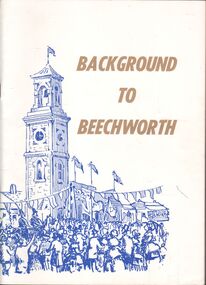
Booklet - Griffith Collection: 'BACKGROUND TO BEECHWORTH' THIRD EDITION, 1967
... Front cover: 'BACKGROUND TO BEECHWORTH' Back Cover: 'BEECHWORTH, VIC (FIRST SETTLED IN 1852)' '27 HISTORIC BUILDINGS' 'CLASSIFIED BY THE NATIONAL TRUST OF AUSTRALIA (VIC)' Title Page: 'Background to Beechworth From 1852' 'THIRD EDITION' 'Compiled by Rot C. ...Beechworth gold Progress Association History Front cover: 'BACKGROUND TO BEECHWORTH' Back Cover: 'BEECHWORTH, VIC (FIRST SETTLED IN 1852)' '27 HISTORIC BUILDINGS' 'CLASSIFIED BY THE NATIONAL TRUST OF AUSTRALIA (VIC)' Title Page: 'Background to Beechworth From 1852' 'THIRD EDITION' 'Compiled by Rot C. ...The area around the town of Beechworth was settled by Europeans in the 1830s with much of the area being sheep runs. Gold was discovered in Spring Creek in 1852 and went on to become one of the richest goldfields in the area. The area known as May Day Hills goldfield area was surveyed, and the township of Beechworth was declared in 1853. The town was named by George Smythe after his birthplace of Beechworth, Leicestershire in England.Booklet with light cardboard cover white coloured with brown and blue printing. Front cover has picture of town of Beechworth. Cream coloured pages inside with black printing.Front cover: 'BACKGROUND TO BEECHWORTH' Back Cover: 'BEECHWORTH, VIC (FIRST SETTLED IN 1852)' '27 HISTORIC BUILDINGS' 'CLASSIFIED BY THE NATIONAL TRUST OF AUSTRALIA (VIC)' Title Page: 'Background to Beechworth From 1852' 'THIRD EDITION' 'Compiled by Rot C. Harvey, Beechworth' 'First Published in March 1952; Reprinted June, 1964 for the Beechworth Centenary Publicity Committee' 'Printed by THE BORDER MORNING MAIL (Vic) Pty. Limited' 'Published by Beechworth Progress Association, September, 1967'beechworth, gold, progress association, history -
 Bendigo Historical Society Inc.
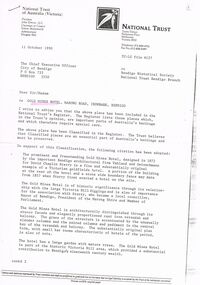
Document - DOCUMENTS: RELATING TO ADDITION TO GOLD MINES HOTEL 1990, 11/10/1990
... Letter from National Trust of Australia (Vic) to CEO City of Bendigo advising that the Gold Mines Hotel has been included in the National Trust's Register - with citation; b. ...Letter from National Trust of Australia (Vic) to CEO City of Bendigo advising that the Gold Mines Hotel has been included in the National Trust's Register - with citation; b. ...Documents relating to addition to Gold Mines Hotel 1990 of a bottle shop and possible units at rear. A. Letter from National Trust of Australia (Vic) to CEO City of Bendigo advising that the Gold Mines Hotel has been included in the National Trust's Register - with citation; b. National Trust 'Classification Report' recommending Classification; c. Bendigo Heritage Advisory Service report on proposed Bottle Shop and Lounge for the Gold Mines Hotel - 19th April 1990 - includes photos (poor photocopies) and plan drawings; d. Report date 9/5/90 by David Martin re Bottle Shop proposal and ''low profile motel units to the rear of the gardens''; e. Notice of Special Meeting of the Bendigo Heritage Advisory Service 10th May 1990 - in part to discuss proposed bottle shop; f. Agenda and Minutes of the 57th and 56th meetings of the Bendigo Heritage Advisory Service - with references to the Gold Mines Hotel.buildings, hotel, gold mines hotel -
 Bendigo Historical Society Inc.
Document - JAMES LERK COLLECTION: SAVE THE CITY HALL ENVIRONMENT, 1971
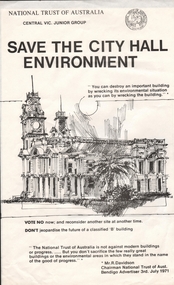
... Flyer from the National Trust of Australia Centtal Vic. Junior Group. "Save the City Hall Environment" ...You can destroy an important building by wrecking its environmental situation as you can by wrecking the building... ...NATIONAL TRUST Properties Save the city hall environment Flyer from the National Trust of Australia Centtal Vic. ...Flyer from the National Trust of Australia Centtal Vic. Junior Group. "Save the City Hall Environment" ...You can destroy an important building by wrecking its environmental situation as you can by wrecking the building... In the middle of the page a drawing of the City Hall. Vote NO now; and reconsider another site at another time. Don't jeopardise the future of a classified "B" building. The flyer is signed by Mr R. Davidson, Chairman National Trust of Aust. Bendigo Advertiser 3rd July, 1971. Plus six small sign "save our city hall" in blue and one "saver our city square vote no on the library issue".national trust, properties, save the city hall environment -
Eltham District Historical Society Inc
Document - Folder, Smith, Samuel
... Photocopy of page from magazine National Trust Australia (Vic), no date (possibly 1993). ...Photocopy of page from magazine National Trust Australia (Vic), no date (possibly 1993). ...Samuel Smith came to Australia about 1849 with his wife and family, settling at Queenstown and, with the gold rush, established an abattoir. A descendant, Marjorie Smith Motschall wrote about the family in 'Wild WoodDays at Panton Hill'. Many descendants have lived in and around Eltham. The family had four generations of butchers, including Keith, who had a shop in Kew. Contents Photocopy of handwritten notes: Samuel Smith biography. Typed version of handwritten notes: Samuel Smith biography. Letter L Adam to Eltham Shire, 6 March 1884. Seeking information about the Smith family in Yarra Glen: Samuel Smith and Eliza Hurst. Photocopy of page from magazine National Trust Australia (Vic), no date (possibly 1993). Keith Smith closed his butcher shop, Kew, and donated equipment to National Trust, possibly to go to Gulf Station. Newspaper article: "Smith family's fortunes yielded to modern technology - in 1850", Diamond Valley News, 10 March 1987. Newspaper clippings, A4 photocopies, etcsamuel smith, eliza hurst, keith smith, gulf station yarra glen, james smith, queenstown, st andrews, sarah smith, richard smith, mary smith, edwin smith, thomas smith, john smith, ralph smith, marjorie smith motshall, wild wood days at panton hill book, louisa purcell, st andrews church queenstown, cherry tree road panton hill, beaumont house panton hill, edwin james samuel smith, violet bartlett, ethel may smith, mary louise smith, violet smtih, fred smith, alan smith, cemetery smiths gully road st andrews, russell smith, joan smith, joyce smith, ethel smith, grand hotel yarra glen -
 City of Moorabbin Historical Society (Operating the Box Cottage Museum)
Photograph, Colour 'Reconstruction Box Cottage' Flag Presentation 1985, 1985
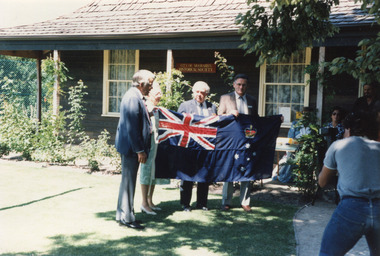
... national trust, connard geoff mlc, lawson geoff mlc, kinsey mrs cwa, country womens association, como house south yarra, Written on back of photo a) Flag presentation / Cr. Fox Mr Connard / Mrs Fox Mr Lawson / 24th Feb 1985 b) Mrs Kinsey Pres. CWA Bentleigh / Presenting our Pres. Cr. Fox / with hand made quilt / copy of one now in Como / 24th Feb. Sunday 1985 c) Presentation of Vic. State Flag by / Mr G Connard MLC to our Pres. / Cr Fox / with Mr Lawson MLC 2 x colour photographs of the Australian ...The original small, pioneer cottage was built in the late 1840s to early1850s, by an unknown pioneer. It was located on part of a 30 Acre allotment that was originally part of Dendy’s Special Survey granted in 1841. The doors and window sashes, (made of red deal joinery timber), as well as the brass locks and fittings, are from the original cottage, and were imported from England. The fire-place bricks are from the original cottage, and are sun-dried, (not kiln fired), and are hand-made. Convict marks can be seen on two bricks. There is a small display of external cladding shingles from the original pioneer cottage. These shingles were hand-split, and most likely made from locally collected timber The nails included in this display were used to fasten the shingles on the original cottage, and are also hand-made. The cottage was occupied by William Box and family from 1865 until 1914 when it was sold to William Reitman who resided there until 1950. The enamel nameplate, “Colonial”, on the wall of the cottage, was the name chosen for the original pioneer cottage by Mr William Reitman, when he purchased the property in around 1915, for 1200 Pounds approximately. In 1974 Mr Lewis, a timber specialist, found the dilapidated building on property he had recently purchased in Jasper Rd and suggested it be reconstructed and relocated. Moorabbin Council agreed and the cottage was rebuilt just about 250 metres from its original site. The cost of the rebuild was met by 'Victoria's 150th Committee, plus a small grant from the City of Moorabbin, and Mr Laurie Lewis donated much of the timber for the reconstruction. The re-constructed cottage plan has followed faithfully the original dimensions, and plan of the original pioneer cottage, and as many original items from that cottage’s long occupation have been incorporated. The photographs in Album 1 record the progress of the reconstruction from February 1984 to the First Public Open Day November 18th 1984 and this Flag Raising Celebration in February 1985.These 3 photographs taken at the 'Reconstructed Box Cottage' on Sunday 24th February 1985 show the Presentation of the Australian Flag and the Victorian State Flag by Mr Geoff Connard MLC to CMHS President and Moorabbin City Council Cr. Max Fox and CMHS members. Mrs Kinsey, President, Country Womens' Association Bentleigh presented a hand made Quilt, that is a copy of the one exhibited at Como House, South Yarra, to CMHS President Cr. Max Fox . Mr Geoff Lawson MLC and CMHS member was also present.. Mrs H. Deam and Mr A. Smith, CMHS members, took these photographs to record the progress of the ‘Reconstruction’ from February 1984 to November 1984 and this Celebration in 1985. Although 'Box Cottage' is a re-construction, it is an unique museum that, being located in the midst of a modern community in Ormond Victoria, can educate and demonstrate many aspects of the early settler’s way of life in Victoria. As such, it is an invaluable resource for students and all kinds of visitors. 2 x colour photographs of the Australian Flag and the Victorian State Flag presentation at Box Cottage in Joyce Park February 24th 1985 1 x colour photograph of the presentation of a Quilt by the Country Womens' Association Bentleigh at Box Cottage in Joyce Park February 24th 1985 Written on back of photo a) Flag presentation / Cr. Fox Mr Connard / Mrs Fox Mr Lawson / 24th Feb 1985 b) Mrs Kinsey Pres. CWA Bentleigh / Presenting our Pres. Cr. Fox / with hand made quilt / copy of one now in Como / 24th Feb. Sunday 1985 c) Presentation of Vic. State Flag by / Mr G Connard MLC to our Pres. / Cr Fox / with Mr Lawson MLCbrighton, moorabbin, highett, ormond, mckinnon, cottages, pioneers, colonial, dendy henry, box william, box elizabeth, reitman william, convicts lewis timber co. ltd., deam h, smith arthur, museums, box alonzo, moody & smith builders highett, the moorabbin standard newspaper, the leader newspaper pty ltd., fox max , lewis laurie, moorabbin city council, national trust, connard geoff mlc, lawson geoff mlc, kinsey mrs cwa, country womens association, como house south yarra, -
 The Beechworth Burke Museum
Drawing, Ernest Marcuse, Beechworth – Old Court House, 1972
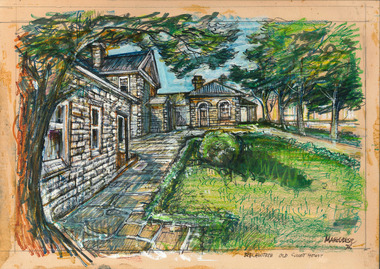
... © 2020 Art by Marcuse https://www.artbymarcuse.com.au/about ernest marcuse marcuse art artbymarcuse beechworth burke museum indigo shire landscape illustration drawing pen and pencil australian army war events illustrator the age the sun the argus germany refugee industrial drawing architectual drawing figure drawing berliner morgenpost grosse deutsche rundfunaustellung berlin’s reiman school of art. cultural gifts program Obverse: Marcuse / Beechworth Old Courthouse / Reverse: B4 / BEECHWORTH OLD COURTHOUSE / BW - 09 (on masking tape) COURTHOUSE / BEECHWORTH / VICTORIA / NATIONAL TRUST / CLASS (A) ERNEST MARCUSE / 17 CADDOCK AVE / CAUFIELD / VIC / 53-7374 001 (pencil) Pen and coloured pencil landscape drawing on paper. ...Ernest Heinrich Marcuse was born on the 1st of December 1900 to Hedwig and Siegmund Marcuse in Berlin Germany. While Marcuse's artistic talent was apparent from a younger age, his earliest existing artwork was from when he was approximately 20 years old. Ernest's formal art training commenced in 1918 with a three year course at the Berlin school of Interior design. After completion he found work until 1924 when Germany's Great Depression took effect. To broaden his career opportunities he undertook a further 12 months study of fashion, drawing and advertising at Berlin's Reiman school of art. From 1925 to 1934 Ernest was primarily a freelance press artist specialising in industrial, architectural and figurative drawing. Prominent newspaper The Berliner Morgenpost was his largest client along with Gross Deutsche Rundfunaustellung (Germany's organisation for major trade shows). During this period he would create many significant works. Two months after Hitler and the Nazi part came to power in 1933, Ernest received a life changing letter stating that being Jewish he could no longer continue employment in Germany. Up until 1938 he would only be able to undertake private commissions and occasional unofficial work as a book illustrator and games designer. This was by arrangement with non Jewish artists who claimed his work as their own, they would then share the income with Ernest. With increasing unrest in Germany during late 1938 Ernest decided to move to London and there he married his girlfriend Lotte. In late 1939 Ernest and Lotte Marcuse embarked on an eight week journey to their new home in Australia where they had been accepted as refugees. Shortly after arriving in Australia Ernest presented his portfolio to an editor at the Argus newspaper and gained employment as a war events illustrator. He soon became well respected and known in particular for his detailed illustrations and cross sections of ships , artillery and aircrafts. His detailed depictions of battles were displayed on the front pages of The Argus newspaper on a number of occasions. In May 1940 as the war intensified Ernest was dismissed from The Argus newspaper due to his Australian government classification of 'stateless person of enemy origin' and was considered a potential security risk. The editor of the time commented "don't blame us, blame Hitler". Marcuse then began to establish himself as a commercial artist. Ernest was de-classified as a 'stateless person of enemy origin' and in early 1942. The Australian army heard of Ernest's artistic abilities and began to utilize his designs for visual training aids and posters. Ernest became Private E.H Marcuse V377746, his first army posting was as staff artist at The infantry officer's training school at Bonegilla. When off duty he was inspired by the beauty of the surrounding area creating the works in North east Victoria 'Kiewa river bridge', 'Hume weir', ' Dried up river bed' and 'Hawksview gold reef mine' from his 1942-1943 period at Bonegilla Victoria. Ernest returned to the area to create drawings and paintings from 1948 to 1983 in locations including Bright, Wandilligong, Bogong High plains and Wallace's Hut, Mt Buffalo, Beechworth, Pretty valley, Kiewa Hydro, Yackandandah and Bontherambo homestead. These sketches were often completed on location, photographs were also taken onsite to assist the works back at the studio. Occasionally Marcuse also painted in the field. Ernest's preferred choice of medium was pencil and ink. Up until 1952 he would often incorporate watercolour into his work. Later into his career he began introducing pastels, acrylic and mixed media. In earlier years Ernest Marcuse often signed his work Mar, later on the signing of works ranged from Marcuse, E.Marcuse, Ernest Marcuse, EHM or simply EM . If a work was considered incomplete or Marcuse did not like the work it would remain unsigned. From Bonegilla Marcuse was transferred to Woodside South Australia before his final posting in Melbourne until the end of 1945. Ernest's work from within his army posting 'Troop Train at Night' from his 1945 exhibition Australia at War are part of the permanent collection at Canberra's War Museum. Between 1946 and 1969 Ernest largely worked from home and concentrated on a career as a freelance commercial artist and graphic designer. During that time he created work for well known household names including CRA/Conzinc, Vacuum oil (Caltex), Cottee's Brand (Schweppes and Heinz), Home Beautiful magazine Fulton garden supplies, International Iveco trucks, Ego pharmaceuticals, QV and Sunsense. After retirement Ernest concentrated on his true love of fine art and focused on painting images of personal interest both across Australia and Internationally. Earnest never drove a car. He would often walk or use public transport or enlist in the help of family or artist friends to drive him. Throughout his career Ernest Marcuse's artworks were purchase by private collectors these included ACTU, Melbourne City council, Holland Constructions, Melbourne Metropolitan Tramways Board, GJ Coles and Australian Resources Bank. Ernest Marcuse permanent collections can be viewed at The National Gallery of Victoria , Sydney Jewish Museum, Jewish Holocaust Centre Melbourne, Canberra's War Museum, City of Melbourne, Shire of Yarra ranges and now the Burke Museum. © 2020 Art by Marcuse https://www.artbymarcuse.com.au/aboutDonated to the Burke Museum through the Australian Government's Cultural Gifts Program by Peter and Evelyn MarcusePen and coloured pencil landscape drawing on paper.Obverse: Marcuse / Beechworth Old Courthouse / Reverse: B4 / BEECHWORTH OLD COURTHOUSE / BW - 09 (on masking tape) COURTHOUSE / BEECHWORTH / VICTORIA / NATIONAL TRUST / CLASS (A) ERNEST MARCUSE / 17 CADDOCK AVE / CAUFIELD / VIC / 53-7374 001 (pencil) ernest marcuse, marcuse, art, artbymarcuse, beechworth, burke museum, indigo shire, landscape, illustration, drawing, pen and pencil, australian army, war events illustrator, the age, the sun, the argus, germany, refugee, industrial drawing, architectual drawing, figure drawing, berliner morgenpost, grosse deutsche rundfunaustellung, berlin’s reiman school of art., cultural gifts program -
 Bendigo Military Museum
Award - MEDALS, MINIATURE, Unknown
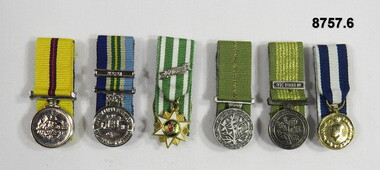
... Trust PBT303to308 Bob English Collection Medals Miniature Medals, all original, court mounted. 1. Original - Australian Iraq Medal. 2. Original - Australian Service Medal 1945-1975 with Japan Clasp. 3. Original - South Vietnam Campaign Medal with 1960 clasp. 4. Original - Humanitarian Overseas Service Medal. 5. Original - Australian National Emergency Medal with Vic ...Miniature Medals, all original, court mounted. 1. Original - Australian Iraq Medal. 2. Original - Australian Service Medal 1945-1975 with Japan Clasp. 3. Original - South Vietnam Campaign Medal with 1960 clasp. 4. Original - Humanitarian Overseas Service Medal. 5. Original - Australian National Emergency Medal with Vic Fires 09 Clasp. 6. Original - Greek War Medal 1947-1983.passchendaele barracks trust, pbt303to308, bob english collection, medals -
 Eltham District Historical Society Inc
Folder, Eltham's new library opened 1994; local issues involved
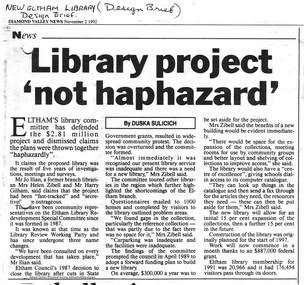
... Gilham 4 Independent planning assessment for Appeal 1992/39742 by Tract Consultants, 13 pp including appendices, Jan 1993. 5 Letter from three ratepayers protesting against the siting of the proposed new library, 21 Jan 1993. 6 Statement of protest against library site by Claire Fitzpatrick, undated. 7 Impact study of proposed new library building by D.V.Bick, conservation architect, 2 October 1992. 8 assessment of impact of new library on historic significance of Shillinglaw Cottage, by National Trust of Australia, 22 October 1992. 9 Newspaper clipping, The Age, 2 Aug 1992, Scramble to revive capital works plans. 10 Newspaper clipping, DV News, 24 May 1988, New Angle to library funding 11 Newspaper clipping, DV News, 24 May 1988, Committee wants library views 12 Newspaper clipping, DV News, 24 May 1988, Library services in cash struggle 13 Library survey by Vic Ministry for the Arts, 14 December 1992 14 Newspaper clipping, DV News, 3 Aug 1992, Libraries in crisis 15 Newspaper clipping, DV News, 3 Aug 1992, Library funding editorial 16 Newspaper clipping, DV News, 7 Sept 1992, Library windfall 17 Newspaper clipping, DV News, 10 Aug 1992, Letters, Shire relies on rates to provide services, Cr J. ...Gilham 4 Independent planning assessment for Appeal 1992/39742 by Tract Consultants, 13 pp including appendices, Jan 1993. 5 Letter from three ratepayers protesting against the siting of the proposed new library, 21 Jan 1993. 6 Statement of protest against library site by Claire Fitzpatrick, undated. 7 Impact study of proposed new library building by D.V.Bick, conservation architect, 2 October 1992. 8 assessment of impact of new library on historic significance of Shillinglaw Cottage, by National Trust of Australia, 22 October 1992. 9 Newspaper clipping, The Age, 2 Aug 1992, Scramble to revive capital works plans. 10 Newspaper clipping, DV News, 24 May 1988, New Angle to library funding 11 Newspaper clipping, DV News, 24 May 1988, Committee wants library views 12 Newspaper clipping, DV News, 24 May 1988, Library services in cash struggle 13 Library survey by Vic Ministry for the Arts, 14 December 1992 14 Newspaper clipping, DV News, 3 Aug 1992, Libraries in crisis 15 Newspaper clipping, DV News, 3 Aug 1992, Library funding editorial 16 Newspaper clipping, DV News, 7 Sept 1992, Library windfall 17 Newspaper clipping, DV News, 10 Aug 1992, Letters, Shire relies on rates to provide services, Cr J. ...Contents 1 Hand written note on cost of planning appeal 2 Determination re Appeal 1992/39742 by Rosalind Harris, Sigmund Jorgensen and Claire Fitzpatrick against granting of permit E92/481, 6 pages, 27 Jan 1993 3 Submission to the Appeal 1992/39742 by H. Gilham 4 Independent planning assessment for Appeal 1992/39742 by Tract Consultants, 13 pp including appendices, Jan 1993. 5 Letter from three ratepayers protesting against the siting of the proposed new library, 21 Jan 1993. 6 Statement of protest against library site by Claire Fitzpatrick, undated. 7 Impact study of proposed new library building by D.V.Bick, conservation architect, 2 October 1992. 8 assessment of impact of new library on historic significance of Shillinglaw Cottage, by National Trust of Australia, 22 October 1992. 9 Newspaper clipping, The Age, 2 Aug 1992, Scramble to revive capital works plans. 10 Newspaper clipping, DV News, 24 May 1988, New Angle to library funding 11 Newspaper clipping, DV News, 24 May 1988, Committee wants library views 12 Newspaper clipping, DV News, 24 May 1988, Library services in cash struggle 13 Library survey by Vic Ministry for the Arts, 14 December 1992 14 Newspaper clipping, DV News, 3 Aug 1992, Libraries in crisis 15 Newspaper clipping, DV News, 3 Aug 1992, Library funding editorial 16 Newspaper clipping, DV News, 7 Sept 1992, Library windfall 17 Newspaper clipping, DV News, 10 Aug 1992, Letters, Shire relies on rates to provide services, Cr J. Cohen 18 Newspaper clipping, DV News, 26 Oct 1992, Shire defends library plans. 19 Newspaper clipping, DV News, 26 Oct 1992, Letters, Library benefits whole community, J.Ilian, H. Gilham, R Harris 20 Letter to DV News by H. Gilham 20 October 1992, re library 21 Newspaper clipping, DV News, 19 October 1992, Letters, T. Malseed, Funds for region's jobless hijacked. 22 Newspaper clipping, DV News, 19 October 1992, Funds approved to build new library. 23 Newspaper clipping, DV News, 12 October 1992, Letters, Does Eltahm need a new mausoleum, M. Walker. 24 Newspaper clipping, DV News, 2 Nov 1992, Library project not haphazard. 25 Newspaper clipping, DV News, 9 Nov 1992, Letters, Library chose best architect for new project, Cr J. Cohen 26 Newspaper clipping, DV News, 16 Nov 1992, AAT to deal with library objections 27 Newspaper clipping, DV News, 30 Nov 1992, Public Notice, Registration for building trades 28 Newspaper clipping, DV News, 7 Dec 1992, Public Notice, Registration for building trades 29 Newspaper clipping, DV News, 7 Dec 1992, Letters, Find better site for library, S. Jorgensen, G.Verall 30 Newspaper clipping, DV News, 8 Feb 1993, Library given AAT aproval, and Extra funds should help make new facility more versatile 31 Newspaper clipping, DV News, 25 Jan 1993, Public Notice, Quotations invited for worls associated with new library 32 Newspaper clipping, DV News, 3 Feb 1993, Public Notice, Registration for building trades 33 Newspaper clipping, DV News, 4 January 1993, Letters, Bemused over library, C Fitzpatrick, R Henry 34 Newsletter Yarra Plenty RLS, Vol1, No 1, Your Public LibraryFolder/Booklet of various documents, mainly A4 size photocopiesHG Booklet 2administrative appeals tribunal, appeal, appeal 1992/39742, application e92/481, c. fitzpatrick, d. bick, diamond valley news, eltham library, eltham shire, g. verall, h. mccorkell, harry gilham, harry gilham collection, j. ilian, john cohen, m. walker, national trust (i. wight), r. harris, r. henry, s. jorgensen, shillinglaw cottage, parkland, rosalind harris, sigmund jorgensen, claire fitzpatrick -
 Eltham District Historical Society Inc
Photograph - Digital Photograph, Marguerite Marshall, Parish Hall, St John's Anglican Church, Diamond Creek, 7 September 2008
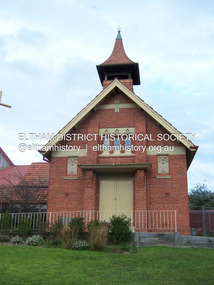
... National Estate Ntionl Trust of Australia (Victoria) Local significance Published: Nillumbik Now and Then / Marguerite Marshall 2008; photographs Alan King with Marguerite Marshall.; p85 References: St Johns Anglican Church complex, Sunday School and Parish Hall 61 Main Street DIAMOND CREEK, NILLUMBIK SHIRE. (2023, June 7). Retrieved from https://vhd.heritagecouncil.vic.gov.au/places/64023 Diamond Creek, VIC...National Estate Ntionl Trust of Australia (Victoria) Local significance Published: Nillumbik Now and Then / Marguerite Marshall 2008; photographs Alan King with Marguerite Marshall.; p85 References: St Johns Anglican Church complex, Sunday School and Parish Hall 61 Main Street DIAMOND CREEK, NILLUMBIK SHIRE. (2023, June 7). Retrieved from https://vhd.heritagecouncil.vic.gov.au/places/64023 Diamond Creek, VIC ...The building was designed by Charles Maplestone of Heidelberg, son-in-law to Anthony Beale of St Helena. Maplestone was a prominent architect who came out to Australia with his family in 1852. The foundation stone was laid by Mrs Isabella Maplestone on 11th November 1867. The bricklayers for the church were George Stebbing, H Limmer, H Spicer and a Mr Timm while Thomas Day was the stonemason. Another three years were to pass before sufficient money could be raised for its completion. It was opened by Bishop Perry on 1st November, 1870. The church bell which hung under a tree for 50 years until it was incorporated in the parish hall was brought out from England and presented by Charles Orme. In 1916, the estate of George Martin Pizzey left sufficient money to build the red brick hall, which still stands today (2023) though in January 1969 the hall and bell tower were badly damaged by bushfire. Coincidentally the former home of benefactor, George Pizzey was destroyed in the same fire. Of particular significance are the interior and exterior of the church, the Sunday school and hall with emphasis on pre-World War I fabric (excluding the 1990s additions) and the three coloured glass windows currently suspended in the 1990s entry foyer. In 2011 further alterations were made to the front of the Church. The church is historically significant because it was the oldest public building in the former Diamond Valley Shire, is amongst the oldest buildings in the Shire of Nillumbik and is associated with the early settlement of the Diamond Creek district. The church is historically, socially and spiritually significant because it has been a place of worship for over 150 years and continues to be, an important meeting place in the Shire. The church is aesthetically significant for the three stained glass windows executed by the noted stained glass manufacturers, Ferguson & Urie, as well as the supporting coloured glass windows in the church. The Sunday school & parish hall is architecturally significant because the hall is a well executed and preserved example of the work of noted church architects, North & Williams. It is historically significant because it is connected with local parishioner and Melbourne industrialist, George Pizzey, who bequeathed funds for its construction. Covered under Heritage Overlay, Nillumbik Planning Scheme. National Estate Ntionl Trust of Australia (Victoria) Local significance Published: Nillumbik Now and Then / Marguerite Marshall 2008; photographs Alan King with Marguerite Marshall.; p85 References: St Johns Anglican Church complex, Sunday School and Parish Hall 61 Main Street DIAMOND CREEK, NILLUMBIK SHIRE. (2023, June 7). Retrieved from https://vhd.heritagecouncil.vic.gov.au/places/64023 Diamond Creek, VIC. – St John’s Anglican (2023, June 7). Retrieved from https://www.churchhistories.net.au/church-catalog/diamond-creek-vic-st-johns-anglican This collection of almost 130 photos about places and people within the Shire of Nillumbik, an urban and rural municipality in Melbourne's north, contributes to an understanding of the history of the Shire. Published in 2008 immediately prior to the Black Saturday bushfires of February 7, 2009, it documents sites that were impacted, and in some cases destroyed by the fires. It includes photographs taken especially for the publication, creating a unique time capsule representing the Shire in the early 21st century. It remains the most recent comprehenesive publication devoted to the Shire's history connecting local residents to the past. nillumbik now and then (marshall-king) collection, st john's anglican church, diamond creek, parish hall -
 Bendigo Historical Society Inc.
Document - NATIONAL TRUST COLLECTION: CHINESE MASONIC HALL, 1968-1974
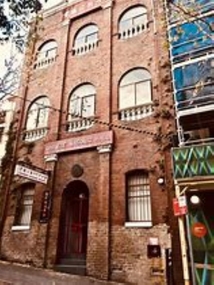
... National Trustr of Australia (Vic) from W. Sou San re that the building is not a Joss house but is a Masonic Formerly a Chineese Grocery Store Three Letters from the National Trust to Mrs R.R. ...National Trustr of Australia (Vic) from W. Sou San re that the building is not a Joss house but is a Masonic Formerly a Chineese Grocery Store Three Letters from the National Trust to Mrs R.R. ...Chinese Masonic Hall Data Form Letter to the Survey Identification Committee, National Trustr of Australia (Vic) from W. Sou San re that the building is not a Joss house but is a Masonic Formerly a Chineese Grocery Store Three Letters from the National Trust to Mrs R.R. Adams re the building Letter from the National Trust to Mr Denis O'Hoy Various letters between the Bendigo Town Clerk and the National Trustbendigo, buildings, chinese -
 Glen Eira Historical Society
Album - Album page, Lynedoch Avenue, Circa 1972
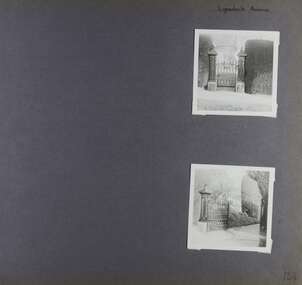
... National Trust of Australia (Victoria) and Caulfield City Council to identify historic buildings within the City of Caulfield that warranted the protection of a National Trust Classification. Principal photographer thought to be Trevor Hart, member of Caulfield Historical Society. Most photographs were taken between 1966-1972 with a small number of photographs being older and from unknown sources. All photographs are black and white except where stated, with 386 photographs over 198 pages. National Trust - 9 Lynedoch Avenue, CAULFIELD NORTH VIC...National Trust of Australia (Victoria) and Caulfield City Council to identify historic buildings within the City of Caulfield that warranted the protection of a National Trust Classification. Principal photographer thought to be Trevor Hart, member of Caulfield Historical Society. Most photographs were taken between 1966-1972 with a small number of photographs being older and from unknown sources. All photographs are black and white except where stated, with 386 photographs over 198 pages. National Trust - 9 Lynedoch Avenue, CAULFIELD NORTH VIC ...This photograph is part of the Caulfield Historical Album 1972. This album was created in approximately 1972 as part of a project by the Caulfield Historical Society to assist in identifying buildings worthy of preservation. The album is related to a Survey the Caulfield Historical Society developed in collaboration with the National Trust of Australia (Victoria) and Caulfield City Council to identify historic buildings within the City of Caulfield that warranted the protection of a National Trust Classification. Principal photographer thought to be Trevor Hart, member of Caulfield Historical Society. Most photographs were taken between 1966-1972 with a small number of photographs being older and from unknown sources. All photographs are black and white except where stated, with 386 photographs over 198 pages. National Trust - 9 Lynedoch Avenue, CAULFIELD NORTH VIC 3161 - Property No B3310 https://vhd.heritagecouncil.vic.gov.au/places/65663 - this record is just one photo with no text; the photo is almost identical to the photograph of the smaller gate on this album page. Page 124 of Photograph Album with two square photographs of gates.Handwritten: Lynedoch Avenue [top right] / 124 [bottom right]trevor hart, gates, cast iron gate, caulfield north, gate, hedge, cast iron spears, stone plinths, masonry column, masonry pillar, lynedoch avenue, st kilda east -
 Glen Eira Historical Society
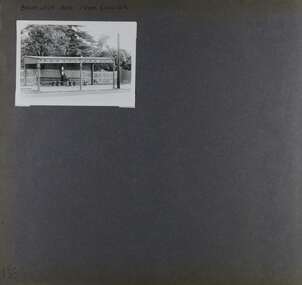
Album - Album page, Balaclava Road Tram Shelter, Circa 1972
... National Trust of Australia (Victoria) and Caulfield City Council to identify historic buildings within the City of Caulfield that warranted the protection of a National Trust Classification. Principal photographer thought to be Trevor Hart, member of Caulfield Historical Society. Most photographs were taken between 1966-1972 with a small number of photographs being older and from unknown sources. All photographs are black and white except where stated, with 386 photographs over 198 pages. From Victorian Heritage Database citation H0174 TRAM VERANDAH SHELTER CORNER BALACLAVA AND ORRONG ROADS CAULFIELD NORTH - Vic...National Trust of Australia (Victoria) and Caulfield City Council to identify historic buildings within the City of Caulfield that warranted the protection of a National Trust Classification. Principal photographer thought to be Trevor Hart, member of Caulfield Historical Society. Most photographs were taken between 1966-1972 with a small number of photographs being older and from unknown sources. All photographs are black and white except where stated, with 386 photographs over 198 pages. From Victorian Heritage Database citation H0174 TRAM VERANDAH SHELTER CORNER BALACLAVA AND ORRONG ROADS CAULFIELD NORTH - Vic ...This photograph is part of the Caulfield Historical Album 1972. This album was created in approximately 1972 as part of a project by the Caulfield Historical Society to assist in identifying buildings worthy of preservation. The album is related to a Survey the Caulfield Historical Society developed in collaboration with the National Trust of Australia (Victoria) and Caulfield City Council to identify historic buildings within the City of Caulfield that warranted the protection of a National Trust Classification. Principal photographer thought to be Trevor Hart, member of Caulfield Historical Society. Most photographs were taken between 1966-1972 with a small number of photographs being older and from unknown sources. All photographs are black and white except where stated, with 386 photographs over 198 pages. From Victorian Heritage Database citation H0174 TRAM VERANDAH SHELTER CORNER BALACLAVA AND ORRONG ROADS CAULFIELD NORTH - Vic Heritage Register https://vhd.heritagecouncil.vic.gov.au/places/2721 (as at 28/10/2020) The waiting shelter at the corner of Balaclava Road and Orrong Road, Caulfield was constructed in 1916/17 for the Prahran and Malvern Tramways Trust and is one of only three remaining tram shelters in Melbourne designed in the form of a verandah. The shelter has a corrugated iron roof fixed to an angle iron roof frame. The roof, which extends in the form of a skillion over the pavement, is supported on three squared, chamfered timber posts at the rear and three cast iron reeded columns with round bases and Corinthian capitals at the front. (The columns are hollow and function as downpipes, with rainwater discharging from the verandah roof, through the columns and under the ground). The shelter has a rinceau pattern frieze along the road frontage with centrally placed shield motif (which does not contain a coat of arms). The side and rear panels are lined with ripple iron and the upper panel at the rear is lattice work. The shelter has two timber slatted bench seats.From Victorian Heritage Database citation for H0174 TRAM VERANDAH SHELTER CORNER BALACLAVA AND ORRONG ROADS CAULFIELD NORTH - Vic Heritage Register https://vhd.heritagecouncil.vic.gov.au/places/2721 (as at 28/10/2020) How is it significant? The waiting shelter at the corner of Balaclava Road and Orrong Road, Caulfield is of historical and architectural significance to the State of Victoria. Why is it significant? The waiting shelter is of historical significance for its association with the development of the suburban (electric) tram network which assisted the expansion of Melbourne as a suburban metropolis. It is also of historical significance for its connection with the Prahran & Malvern Tramways Trust. The Prahran & Malvern Tramways Trust (1907-1920) was the first municipal electric tramway in Melbourne, becoming the largest and most successful of all the municipal tramway trusts. Its services played a key role in facilitating suburban expansion and the development of the southern and eastern suburbs. The growth of tramways was one of the greatest municipal developments in Victoria during the first decade of the twentieth century. The waiting shelter is an important remnant of this period of Melbourne's transport history and a tangible reminder of the Prahran & Malvern Tramways Trust. The shelter indicates the extent of the Prahran & Malvern tram network. The waiting shelter at corner of Balaclava Road and Orrong Road, Caulfield is one of only three remaining tram shelters in Melbourne designed in the form of a verandah. The waiting shelter is of architectural significance for the distinctive design and construction which is unique to the Prahran & Malvern Tramway Trust tram network. The shelter was designed by notable Melbourne architect Leonard J. Flannagan (1864-1946). Flannagan was responsible for a number of buildings for the Prahran and Malvern Tramways Trust including the early waiting shelter at the junction of Dandenong Road and Hawthorn Road, Caulfield, and sections of the tram depot at Malvern, and also designed a depot for the Hawthorn Tramways Trust. The waiting shelter, a conservative design influenced by Victorian architecture, is based on the Melbourne City Council late 19th century standard cast iron verandah. It is of significance as an intact example of the cast iron type shelter and for its detail, including Corinthian columns and a 'rinceau' pattern cast-iron frieze. The shelter is largely in keeping with the original design and retains its integrity. The cast iron waiting shelter is also of significance as an unusual example of early twentieth century street architecture. Page 155 of Photograph Album with one landscape photograph of a tram shelter on Balaclava Road.Handwritten: BALACLAVA ROAD TRAM SHELTER [top] / 155 [bottom left]trevor hart, verandah, garden, grimwade house, grimwade, orrong road, balaclava road, melbourne grammar, melbourne grammar junior school, mgs, m.g.s, school, tram shelter, waiting shelter, prahran & malvern tramway trust, leonard j. flannagan, cast iron verandah, cast iron type shelter, corinthian columns, 'rinceau' pattern cast-iron frieze, rinceau, cast iron frieze, victorian style, caulfield north, leonard flanagan, cast iron work, prahran and malvern tramways trust, trams -
 Narre Warren and District Family History Group
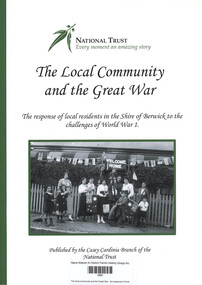
Book, Ian Good, The local community and the Great War : the response of local residents in the Shire of Berwick to the challenges of World War 1, 2016
... Vic.) The response of local residents in the Shire of Berwick to the challenges of World War 1 The local community and the Great War : the response of local residents in the Shire of Berwick to the challenges of World War 1 Book Ian Good National Trust of Australia (Victoria). ...The response of local residents in the Shire of Berwick to the challenges of World War 1non-fictionThe response of local residents in the Shire of Berwick to the challenges of World War 1world war 1914-1918, berwick (vic.) -
Koorie Heritage Trust
Book, Alberts, Trish et al, Making a Difference / First Australians : Plenty Stories, 2010
... Australian society by giving a voice to the histories and viewpoints of Aboriginal and Torres Strait Islander peoples. Contents: Understanding each other; Koorie Heritage Trust; Bangarra Dance Theatre; The Aboriginal Baldja Network; Reconciliation Australia and the Stolen Generations Alliance; Working together for change; Glossary; Index. 32 p. : ill., col. maps, ports. (some col.) ; 24 cm. Making a Difference / First Australians : Plenty Stories Book Alberts, Trish Port Melbourne,Vic. : Pearson Rigby, 2010 32 p. : ill., col. maps, ports. (some col.) ; 24 cm. National ...This book shares inspiring stories aabout how individuals and organisations have made a difference in Australian society by giving a voice to the histories and viewpoints of Aboriginal and Torres Strait Islander peoples. Contents: Understanding each other; Koorie Heritage Trust; Bangarra Dance Theatre; The Aboriginal Baldja Network; Reconciliation Australia and the Stolen Generations Alliance; Working together for change; Glossary; Index.32 p. : ill., col. maps, ports. (some col.) ; 24 cm.This book shares inspiring stories aabout how individuals and organisations have made a difference in Australian society by giving a voice to the histories and viewpoints of Aboriginal and Torres Strait Islander peoples. Contents: Understanding each other; Koorie Heritage Trust; Bangarra Dance Theatre; The Aboriginal Baldja Network; Reconciliation Australia and the Stolen Generations Alliance; Working together for change; Glossary; Index.aboriginal australians. | torres strait islanders. | australian -
![Register of Historic Buildings [at 31st December, 1973]](/media/collectors/550653872162f11fb04854aa/items/5ebc8a3fa9d32b09e4a3cdc5/item-media/5ebc8ad4a9d32b09e4a3db4a/item-fit-380x285.jpg?cb=6) Kew Historical Society Inc
Kew Historical Society IncBooklet, National Trust of Australia (Victoria), Register of Historic Buildings [at 31st December], 1973
... vic.)...national trust of australia (victoria)...heritage - (vic.) historic buildings - (vic.) national trust of australia (victoria) The Heritage Act 2017 replaced the Heritage Act 1995, which established a legislative framework for heritage protection in Victoria that replaced the Historic Buildings Act 1981, the Historic Shipwrecks Act 1981 and part of the Archaeological and Aboriginal Relics Preservation Act 1971. ...The Heritage Act 2017 replaced the Heritage Act 1995, which established a legislative framework for heritage protection in Victoria that replaced the Historic Buildings Act 1981, the Historic Shipwrecks Act 1981 and part of the Archaeological and Aboriginal Relics Preservation Act 1971. Before Statewide legislation, heritage assessments were conducted and published by The National Trust of Australia (Victoria).Register of Historic Buildings in Victoria published by the National Trust of Victoria in 1973.non-fictionThe Heritage Act 2017 replaced the Heritage Act 1995, which established a legislative framework for heritage protection in Victoria that replaced the Historic Buildings Act 1981, the Historic Shipwrecks Act 1981 and part of the Archaeological and Aboriginal Relics Preservation Act 1971. Before Statewide legislation, heritage assessments were conducted and published by The National Trust of Australia (Victoria).heritage - (vic.), historic buildings - (vic.), national trust of australia (victoria) -
Kew Historical Society Inc
Archive (Sub-series) - Subject File, D'Estaville (Barry Street), 1958
... vic) Sir William Stawell built the house, D’Estaville, in what is now Barry Street, Kew. The archive file about the house includes sundry items including real estate brochures, newspaper articles/clippings, copies of Australian Heritage and the Victorian Historical Journal (2006) in which there are articles on Stawell and the Victorian Constitution, correspondence between the Society and the national Trust and the Historic Buildings Council relating to the vacant land in Sir William Street (1980) and to D’Estaville itself. ...Various partiesReference, Research, InformationSecondary Values (KHS Imposed Order)Sir William Stawell built the house, D’Estaville, in what is now Barry Street, Kew. The subject file about the house includes sundry items including real estate brochures, newspaper articles/clippings, copies of Australian Heritage and the Victorian Historical Journal (2006) in which there are articles on Stawell and the Victorian Constitution, correspondence between the Society and the national Trust and the Historic Buildings Council relating to the vacant land in Sir William Street (1980) and to D’Estaville itself.d'estaville - barry street - kew (vic), sir william stawell, alma figuerola, historic houses - kew (vic)d'estaville - barry street - kew (vic), sir william stawell, alma figuerola, historic houses - kew (vic) -
Kew Historical Society Inc
Journal, Kew Historical Society, Newsletter No.7, March, 1979
... vic.) -- journals President’s Letter to Members/ Winifred Hall. Resignation Hon. Secretary [Joy Stewart] pp1-2. Street Stall. Family Treasures. Future Role Local Historical Society / Mavis Rolley. Tribute Mr G. O. S. Greer. Eastern Historical Societies Conference 1979 p3. Bus Tour Williamstown. Tour Echuca and Emu Bottom. Donations [archives]. New Member p4. Subscriptions. Junior National Trust Tour Kew. Programme. Visit Ross House. Donation [Kew Recreation Council]. News About Members p5. Published quarterly since 1977, the newsletters of the Kew Historical Society contain significant research by members exploring relevant aspects of the Victorian and Australian ...President’s Letter to Members/ Winifred Hall. Resignation Hon. Secretary [Joy Stewart] pp1-2. Street Stall. Family Treasures. Future Role Local Historical Society / Mavis Rolley. Tribute Mr G. O. S. Greer. Eastern Historical Societies Conference 1979 p3. Bus Tour Williamstown. Tour Echuca and Emu Bottom. Donations [archives]. New Member p4. Subscriptions. Junior National Trust Tour Kew. Programme. Visit Ross House. Donation [Kew Recreation Council]. News About Members p5.Published quarterly since 1977, the newsletters of the Kew Historical Society contain significant research by members exploring relevant aspects of the Victorian and Australian Framework of Historical Themes. Frequently, articles on people, places and artefacts are the only source of information about an aspect of Kew, and Melbourne’s history.President’s Letter to Members/ Winifred Hall. Resignation Hon. Secretary [Joy Stewart] pp1-2. Street Stall. Family Treasures. Future Role Local Historical Society / Mavis Rolley. Tribute Mr G. O. S. Greer. Eastern Historical Societies Conference 1979 p3. Bus Tour Williamstown. Tour Echuca and Emu Bottom. Donations [archives]. New Member p4. Subscriptions. Junior National Trust Tour Kew. Programme. Visit Ross House. Donation [Kew Recreation Council]. News About Members p5. kew historical society (vic.) -- periodicals., kew historical society (vic.) -- newsletters, kew historical society (vic.) -- journals -
 Ballarat Heritage Services
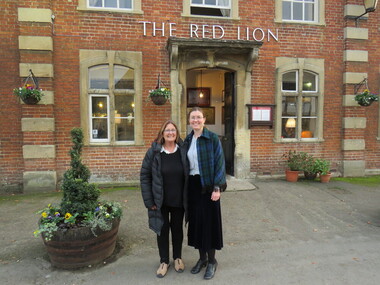
Photograph - Digital photograph, Wayne Phillipson, Peta Knott and Dorothy Wickham at Lacock National Trust Village, United Kingdom, 30/1072016
... Dorothy Wickham and Peta Knott, formerly of Museums Australia (Vic) currently working as a marine archaeologist in England. Taken at Lacock National Trust Village, United Kingdom...National Trust village, except the motor car. It has been run by the National Trust since 1944 and residents are on a lease. The oldest house in the village is King John's Hunting Lodge, parts of which date back to the 13th century. In this village there are buildings from every century since right up until the 18th century. The abbey was founded in 1229 by Ela, Countess of Salisbury. Lacock village and abbey were used as the set in the Harry Potter films. Dorothy Wickham Peta Knott Lacock national trust village Dorothy Wickham and Peta Knott, formerly of Museums Australia (Vic ...Lacock was on the main London to Bristol road until the road was re-routed through Chippenham. There are no obvious signs of the 21st century in this National Trust village, except the motor car. It has been run by the National Trust since 1944 and residents are on a lease. The oldest house in the village is King John's Hunting Lodge, parts of which date back to the 13th century. In this village there are buildings from every century since right up until the 18th century. The abbey was founded in 1229 by Ela, Countess of Salisbury. Lacock village and abbey were used as the set in the Harry Potter films.Dorothy Wickham and Peta Knott, formerly of Museums Australia (Vic) currently working as a marine archaeologist in England. Taken at Lacock National Trust Village, United Kingdomdorothy wickham, peta knott, lacock national trust village -
 Kew Historical Society Inc
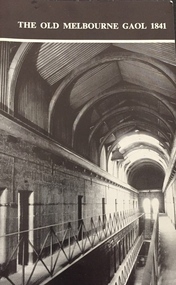
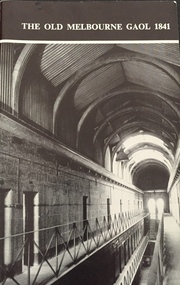
Booklet, National Trust of Australia (Victoria), The Old Melbourne Gaol 1841, c.1971
... Vic.) "No. 04498" 20-page booklet published by the National Trust (Victoria) on penal establishments in Victoria with specific reference to the Old Melbourne Gaol. The Old Melbourne Gaol 1841 Booklet Booklet National Trust of Australia ...This work forms part of the collection assembled by the historian Dorothy Rogers, that was donated to the Kew Historical Society by her son John Rogers in 2015. The manuscripts, photographs, maps, and documents were sourced by her from both family and local collections or produced as references for her print publications. Many were directly used by Rogers in writing ‘Lovely Old Homes of Kew’ (1961) and 'A History of Kew' (1973), or the numerous articles on local history that she produced for suburban newspapers. Most of the photographs in the collection include detailed annotations in her hand. The Rogers Collection provides a comprehensive insight into the working habits of a historian in the 1960s and 1970s. Together it forms the largest privately-donated collection within the archives of the Kew Historical Society.20-page booklet published by the National Trust (Victoria) on penal establishments in Victoria with specific reference to the Old Melbourne Gaol. "No. 04498"old melbourne gaol, heritage site -- melbourne (vic.) -
 Kew Historical Society Inc
Booklet, National Trust of Australia (Victoria), The Old Melbourne Gaol 1841, c.1971
... Vic.) "No. 04498" 20-page booklet published by the National Trust (Victoria) on penal establishments in Victoria with specific reference to the Old Melbourne Gaol. The Old Melbourne Gaol 1841 Booklet Booklet National Trust of Australia ...This work forms part of the collection assembled by the historian Dorothy Rogers, that was donated to the Kew Historical Society by her son John Rogers in 2015. The manuscripts, photographs, maps, and documents were sourced by her from both family and local collections or produced as references for her print publications. Many were directly used by Rogers in writing ‘Lovely Old Homes of Kew’ (1961) and 'A History of Kew' (1973), or the numerous articles on local history that she produced for suburban newspapers. Most of the photographs in the collection include detailed annotations in her hand. The Rogers Collection provides a comprehensive insight into the working habits of a historian in the 1960s and 1970s. Together it forms the largest privately-donated collection within the archives of the Kew Historical Society.20-page booklet published by the National Trust (Victoria) on penal establishments in Victoria with specific reference to the Old Melbourne Gaol. "No. 04498"old melbourne gaol, tourist guides -- melbourne (vic.)
