
Showing 75 items matching "native american"
-
 Victorian Aboriginal Corporation for Languages
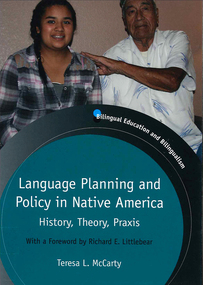
Book, Teresa L McCarty, Language planning and policy in Native America : history, theory and praxis, 2013
... Language planning and policy in Native America : history, theory and praxis......Native American languages...Contextualizing Native American LPP: legal-political, demographic and sociolinguistic foundations; conceptualizing Native American LPP: critical sociocultural foundations; Native American languages 1492-2012; Indigenous literacies, bilingual education and community empowerment: Navajo case study; language regenesis in practice; language in the lives of Indigenous youth; planning language for the Seventh Generation...Language planning language policy Native American languages language standardisation language restriction Maps, b&w illustrations, b&w photographs, colour photographs Contextualizing Native American LPP: legal-political, demographic and sociolinguistic foundations; conceptualizing Native American LPP: critical sociocultural foundations; Native American languages 1492-2012; Indigenous literacies, bilingual education and community empowerment: Navajo case study; language regenesis in practice; language in the lives of Indigenous youth; planning language for the Seventh Generation Language planning and policy in Native America : history, theory and praxis Book Teresa L McCarty ...Contextualizing Native American LPP: legal-political, demographic and sociolinguistic foundations; conceptualizing Native American LPP: critical sociocultural foundations; Native American languages 1492-2012; Indigenous literacies, bilingual education and community empowerment: Navajo case study; language regenesis in practice; language in the lives of Indigenous youth; planning language for the Seventh GenerationMaps, b&w illustrations, b&w photographs, colour photographslanguage planning, language policy, native american languages, language standardisation, language restriction -
 Emerald Museum & Nobelius Heritage Park
Decorative object - Ornamental saucer, Beryl Collett, 1990s - 2000s
... ...Native American...Small decorative saucer embossed with the head of a Native American in profile in the centre. Possibly made of pewter. ...Beryl Collett Kallista Victoria Australia decorative saucer Native American artist Country Womens Association None Small decorative saucer embossed with the head of a Native American in profile in the centre. ...This saucer was made by Kallista woman, Beryl Collett (1925-2018) and forms part of a large and varied body of work by Beryl which are held by the Museum.The Dandenongs have been the chosen home of many creative people who, like Beryl, have found inspiration in the natural beauty of the area. Much of this work was created by Beryl following her retirement from her accountancy job in 1980 and so epitomises the potential of the retirement phase of people's lives.Small decorative saucer embossed with the head of a Native American in profile in the centre. Possibly made of pewter. Made by Beryl Collett.Noneberyl collett, kallista victoria australia, decorative saucer, native american, artist, country womens association -
 Melbourne Legacy
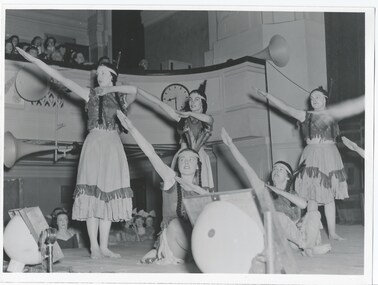
Photograph, Annual Demonstration, 195
... The girls were dressed as native American girls. The date is unknown but similar to photos from 1953. ...Black and white photo of junior legatees dressed as native Americans on stage at an Annual Demonstration....The girls were dressed as native American girls. The date is unknown but similar to photos from 1953. ...A photo of senior girls in a scene from an annual demonstration. The girls were dressed as native American girls. The date is unknown but similar to photos from 1953. The costumes were reused over many years. Throughout the year Melbourne Legacy provided classes for Junior Legatees such as dancing, gymnastics and Eurythmics. The Demonstration was an annual event to showcase their skills. Melbourne Legacy conducted Annual Demonstrations / Parades from 1928 through to the 1980's, usually held at Melbourne Town Hall or Olympic Pool Stadium. The beautiful costumes were made by members of the Junior Legacy Mothers' Club and the Melbourne Legacy Wives' Association. A record of the set and costumes used at the Annual Demonstrations. Also that Legacy provided classes for junior legatees and the skills learned were displayed in the Annual Demonstration.Black and white photo of junior legatees dressed as native Americans on stage at an Annual Demonstration.annual demonstration, junior legatee, costume -
 Melbourne Legacy
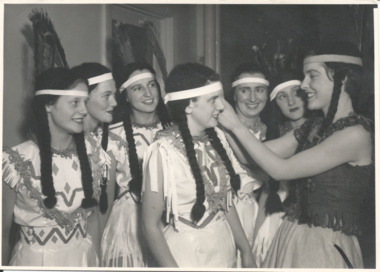
Photograph - Photo, Annual Demonstration 1952, 1952
... The girls are dressed as native American girls. A similar photo was featured in the Age Newspaper on 20 October 1952. ...Black and white photo of performers in Native American costumes for the 1952 Demonstration....The girls are dressed as native American girls. A similar photo was featured in the Age Newspaper on 20 October 1952. ...This photo provides an example of the beautiful costumes worn by Junior Legacy girls for Legacy's Annual Demonstrations at the Melbourne Town Hall. The girls are dressed as native American girls. A similar photo was featured in the Age Newspaper on 20 October 1952. The caption read 'These girls of the Legacy Club could pass for Indian lasses as they wait their turn to perform in the Totem Tom Tom at Melbourne Town Hall, They were among those who participated in Legacy's annual demonstration of physical culture, dancing and allied activities.' Throughout the year Melbourne Legacy provided classes for Junior Legatees such as dancing, gymnastics and eurythmics, the Demonstration was an annual event to showcase their skills. Melbourne Legacy conducted Annual Demonstrations / Parades from 1928 through to the late 1970's, usually held at Melbourne Town Hall or Olympic Pool Stadium. The beautiful costumes were made by members of the Junior Legacy Mothers' Club and the Melbourne Legacy Wives' Association. The photo was featured in an article in the Legacy Newsletter in December 1952.A record of a Junior Legacy annual demonstration. This photo serves as photographic evidence of the effort put into the annual demonstrations.Black and white photo of performers in Native American costumes for the 1952 Demonstration.Stamped on the back of the photo, Copyright of Herald Sun Feature Service, in purple inkjunior legatee, annual demonstration, costumes -
 Melbourne Legacy
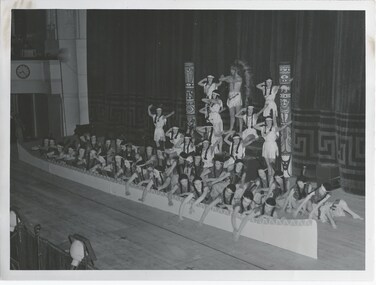
Photograph, Annual Demonstration 1953, 1953
... The girls were dressed as native American girls, some are in a kayak and others stand near totem poles. ...Black and white photo of junior legatees in native American costume in a mock kayak on stage at an Annual Demonstration. ...The girls were dressed as native American girls, some are in a kayak and others stand near totem poles. ...A photo of senior girls in a scene from an annual demonstration. The girls were dressed as native American girls, some are in a kayak and others stand near totem poles. One of these two photos was used in the July 1954 newsletter to highlight the work of the girls classes. Throughout the year Melbourne Legacy provided classes for Junior Legatees such as dancing, gymnastics and Eurythmics. The Demonstration was an annual event to showcase their skills. Melbourne Legacy conducted Annual Demonstrations / Parades from 1928 through to the 1980's, usually held at Melbourne Town Hall or Olympic Pool Stadium. The beautiful costumes were made by members of the Junior Legacy Mothers' Club and the Melbourne Legacy Wives' Association. Miss Enez Domec-Carre was the supervisor of girls classes and instrumental in the Annual Demonstration for many years. She joined Melbourne Legacy in 1932 and became the chief instructor of girls' physical education until she retired aged 65 in 1970.A record of the set and costumes used at the Annual Demonstrations. Also that Legacy provided classes for junior legatees and the skills learned were displayed in the Annual Demonstration.Black and white photo of junior legatees in native American costume in a mock kayak on stage at an Annual Demonstration. There are two copies of different sizes.annual demonstration, junior legatee, costume, totem pole -
National Vietnam Veterans Museum (NVVM)
Photograph, Eagle Soul
... UnPhotograph of Eagle and Native American in colour. Printed on paper (A4) and Illustrated by Joe MacKechnie...Photograph Eagle Joe MacKechnie Copyright 2009 by Sam Summerwolfe UnPhotograph of Eagle and Native American in colour. Printed on paper (A4) and Illustrated by Joe MacKechnie Eagle Soul Photograph Photograph ...UnPhotograph of Eagle and Native American in colour. Printed on paper (A4) and Illustrated by Joe MacKechnieCopyright 2009 by Sam Summerwolfephotograph, eagle, joe mackechnie -
 Melbourne Legacy
Photograph, Annual Demonstration
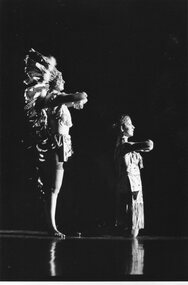
... Black and white photo of two people upon a stage dressed in traditional Native American attire..... / MINISTRY OF TOURISM / GOVERNMENT OF VICTORIA / PLEASE ACKNOWLEDGE / PHOTO: MICHAEL CHESHIRE" Black and white photo of two people upon a stage dressed in traditional Native American attire. Annual Demonstration Photograph Michael Cheshire ...This photo provides just one example of the beautiful costumes worn by Junior Legacy girls for Legacy's Annual Demonstrations at the Melbourne Town Hall. Throughout the year Melbourne Legacy provided classes for Junior Legatees such as dancing, gymnastics and eurythmics, the Demonstration was an annual event to showcase their skills. Melbourne Legacy conducted Annual Demonstrations / Parades from 1928 through to the late 1980's, usually held at Melbourne Town Hall or Olympic Pool Stadium. The beautiful costumes were made by members of the Junior Legacy Mothers' Club and the Melbourne Legacy Wives' Association. Whilst the cost to Legacy was very small, the quality of the work produced was truly professional.A record of a Junior Legacy Demonstration. This photograph serves as photographic evidence of the work that the Legacy Wives' Association and Junior Legacy Mothers' Club produced over the years.Black and white photo of two people upon a stage dressed in traditional Native American attire.Stamped on the back of the photo: "This photograph is with / The Compliments of The... / MINISTRY OF TOURISM / GOVERNMENT OF VICTORIA / PLEASE ACKNOWLEDGE / PHOTO: MICHAEL CHESHIRE"junior legatee, annual demonstration, costumes -
Emerald Museum & Nobelius Heritage Park
Souvenir - Various souvenir dolls in costume, Unknown maker, mid-20th century
... ...Native American...People might collect souvenir dolls on their overseas travels as a reminder of the interesting and 'exotic' places they have been to. dolls souvenir national costume Germany North Africa Joyce Wescombe Emerald Primary School Spain Dutch British Empire Swiss Native American 7 small dolls dressed in traditional costumes from North American, North African and European countries, estimated from the mid-20th century. ...These dolls are a part of a collection sold as souvenirs of those countries. It is believed they belonged to a former teacher of Emerald Primary School who taught there in the 1950s. These dolls seem to date from the mid-20th century. People might collect souvenir dolls on their overseas travels as a reminder of the interesting and 'exotic' places they have been to.7 small dolls dressed in traditional costumes from North American, North African and European countries, estimated from the mid-20th century.dolls, souvenir, national costume, germany, north africa, joyce wescombe, emerald primary school, spain, dutch, british empire, swiss, native american -
 Port Melbourne Historical & Preservation Society
Card - Navajo Hair Design Business Card, c.2000
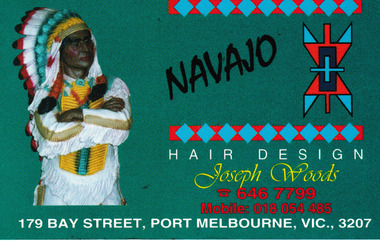
... The card has an image of a Native American on left hand side....The card has an image of a Native American on left hand side. Card Navajo Hair Design Business Card ...Business card advertising Navajo Hair design and Joseph WOODS at 179 Bay Street, Port Melbourne.Brightly coloured business card/appointment card for Navano Hair Design. The card has an image of a Native American on left hand side.Thursday 12 on reversebusiness and traders - hairdressing, navajo hair design, joseph woods, bay street -
Victorian Aboriginal Corporation for Languages
Conference proceedings, Jon Reyhner, Learn in beauty : Indigenous education for a new century, 2000
... The focus is on education for Native Americans....The focus is on education for Native Americans. Learn in beauty : Indigenous education for a new century Conference proceedings Jon Reyhner Joseph Martin ...Series of papers indicating some of the new directions that Indigenous education is taking at the beginning of the twenty-first century. The focus is on education for Native Americans.b&w illustrations, graphs, tablesbilingual education, indigenous language teaching, american indian education, navajo immersion project -
![Book - Novel, Ellis, Edward S, The three arrows by Edward S. Ellis, with a colour frontispiece and four black-and-white illustrations, [n.d.] [1915?]](/media/collectors/641920217f0478323d8a47a8/items/670ed98c685dc78963b94918/item-media/6716cf1cba05366ddbf8116e/item-fit-380x285.jpg?cb=6) Linton Mechanics Institute and Free Library Collection
Linton Mechanics Institute and Free Library CollectionBook - Novel, Ellis, Edward S, The three arrows by Edward S. Ellis, with a colour frontispiece and four black-and-white illustrations, [n.d.] [1915?]
... ; pale blue cover, images of native Americans holding guns on front cover, frontiersman holding gun on spine..... ; pale blue cover, images of native Americans holding guns on front cover, frontiersman holding gun on spine. ...Adventure story for boys set in the American frontier.317 p. : ill. ; pale blue cover, images of native Americans holding guns on front cover, frontiersman holding gun on spine.fictionAdventure story for boys set in the American frontier.children's fiction, westerns, american frontier -
 Tennis Australia
Racquet, Circa 1912
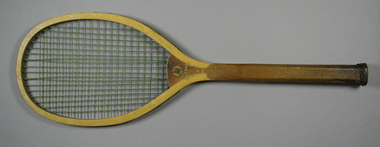
... Decal of model name, with Native American emblem, feature across throat on obverse. ...Decal of model name, with Native American emblem, feature across throat on obverse. ...A Spalding 'Leader' tennis racquet, featuring: laminated convex throat; and, handle with fine-grooved faces and deep-grooved sides. Decal of model name, with Native American emblem, feature across throat on obverse. 'A.G. Spalding & Bros. Made in U.S.A.' logo encircling ball trademark features on throat on reverse. Materials: Wood, Lacquer, Glue, Metal, Ink, Gut, Leathertennis -
 Eltham District Historical Society Inc
Print - Photograph, Matcham Skipper working at his Montsalvat workshop, ca 1970
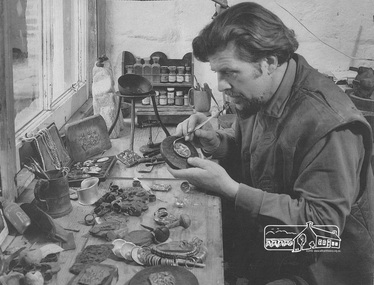
... The second image is a 'mandella' style decorative metal work inspired by a Native American traditional ceremonial shield....The second image is a 'mandella' style decorative metal work inspired by a Native American traditional ceremonial shield. montsalvat jeweller workshop studio silversmith sculpting medallion mandela metalwork wall-art matcham skipper Black and white print with two images Matcham Skipper working at his Montsalvat workshop Print Photograph ...Sculptor and jeweller Matcham Skipper at work in his studio working on a medallion. The second image is a 'mandella' style decorative metal work inspired by a Native American traditional ceremonial shield.Black and white print with two imagesmontsalvat, jeweller, workshop, studio, silversmith, sculpting, medallion, mandela, metalwork, wall-art, matcham skipper -
Bialik College
Photograph (Item) - Unknown 1990s primary school performance
... Many students are dressed as pirates, native americans, lightening bolts and knights. No further contextual detail available. ...Many students are dressed as pirates, native americans, lightening bolts and knights. No further contextual detail available. ...In c1990s Bialik primary school students held a performance. Many students are dressed as pirates, native americans, lightening bolts and knights. No further contextual detail available. For inquiries or access contact [email protected], drama, visual and performing arts, primary school, jewish school -
 Melbourne Legacy
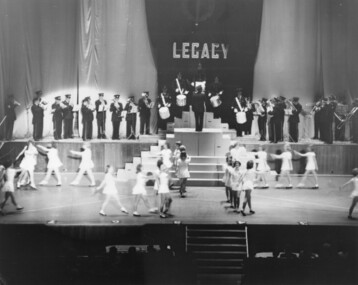
Photograph, Annual Demonstration 1963, 1963
... They include a scene of a canoe with junior legatees dressed as Native Americans. There are ballerinas dancing, and children marching and making formations. ...They include a scene of a canoe with junior legatees dressed as Native Americans. There are ballerinas dancing, and children marching and making formations. ...Photos of the Melbourne Junior Legacy Annual Demonstration at the Melbourne Town Hall in September 1963. They include a scene of a canoe with junior legatees dressed as Native Americans. There are ballerinas dancing, and children marching and making formations. Also gymnastics demonstrations. Throughout the year Melbourne Legacy provided classes for Junior Legatees such as dancing, gymnastics and eurythmics, the Demonstration was an annual event to showcase their skills. Melbourne Legacy conducted Annual Demonstrations / Parades from 1928 through to the late 1970's, usually held at Melbourne Town Hall or Olympic Pool Stadium. The beautiful costumes were made by members of the Junior Legacy Mothers' Club and the Melbourne Legacy Wives' Association. A record of a Junior Legacy Demonstration.Black and white photo x 33 of the Annual Demonstration in 1963.junior legatee, annual demonstration, costumes, ballerinas -
 Orbost & District Historical Society
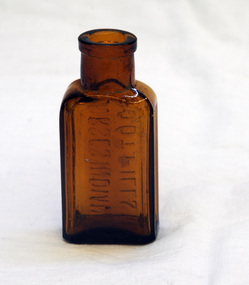
bottle, c. 1930s-1940s
... Indian root is likely Wahoo (Euonymus atropurpureus), a common herb in Native American medicine used as a laxative. One of the most popular patent medicines, Dr. ...Indian root is likely Wahoo (Euonymus atropurpureus), a common herb in Native American medicine used as a laxative. One of the most popular patent medicines, Dr. ...This bottle was found in the pine plantation in Orbost. Comstock’s Morses Indian Root Pills were first manufactured by the American firm in the mid-1850’s but their popularity peaked in Australia in the 1920’s. Indian root is likely Wahoo (Euonymus atropurpureus), a common herb in Native American medicine used as a laxative. One of the most popular patent medicines, Dr. Morse’s Indian Root Pills was almost identical to the hundreds of other cure-alls, or at least claimed to cure the most common ailments of the day. It was advertised as a specific cure for most blood, stomach and liver diseases. The manufacturers claimed that the pills would "absolutely remove all dyspepsia, giddiness, headache, and are most useful in female disorders." (ref. Hagley Museum)This item is an example of a commonly used 'over-the-counter" medicine.A rectangular, brown glass bottle with neck for cork sealing.Morses Indian Root Pills Dose 2 to 4. W. H. Comstockmorses -indian-root-pills bottle medicine health -
 Melbourne Legacy
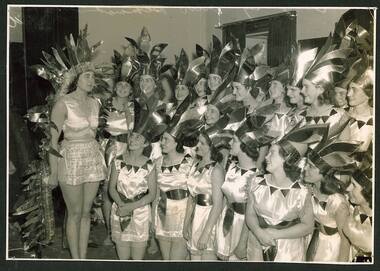
Photograph, Annual Demonstration, 195
... They appear to be for the native American scene called 'Totem Tom Tom'. That routine was done several times with different costumes but this one matches the photo of a kayak on stage in 02314. ...They appear to be for the native American scene called 'Totem Tom Tom'. That routine was done several times with different costumes but this one matches the photo of a kayak on stage in 02314. ...Black and white photo of a group of girls in elaborate costumes with headdresses in the backstage area of Melbourne Town Hall for an Annual Demonstration. They appear to be for the native American scene called 'Totem Tom Tom'. That routine was done several times with different costumes but this one matches the photo of a kayak on stage in 02314. The year is not known but it is in the 1940s or 1950s as the album was a collection of press photos taken during dress rehearsals from that time. Throughout the year Melbourne Legacy provided classes for Junior Legatees such as dancing, gymnastics and Eurythmics. The Demonstration was an annual event to showcase their skills. Melbourne Legacy conducted Annual Demonstrations / Parades from 1928 through to1979, usually held at Melbourne Town Hall. The beautiful costumes were made by members of the Junior Legacy Mothers' Club and the Melbourne Legacy Wives' Association.A record of the displays at the Annual Demonstrations. Also that Legacy provided classes for junior legatees and the skills learned were displayed in the Annual Demonstration.Black and white photo in an album of a group of girls in elaborate headresses backstage.junior legatees, demonstration, annual demonstration, girls classes, costumes -
 Melbourne Legacy
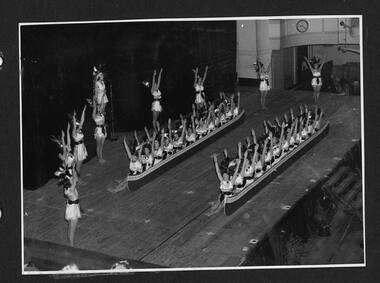
Photograph, Annual Demonstration, 195
... They appear to be for the native American scene called 'Totem Tom Tom'. That routine was performed several times over the years with different costumes, but this one matches the photo of the girls backstage in Item 02313. ...They appear to be for the native American scene called 'Totem Tom Tom'. That routine was performed several times over the years with different costumes, but this one matches the photo of the girls backstage in Item 02313. ...Black and white photo of a group of girls in elaborate costumes on the stage of the Melbourne Town Hall for an Annual Demonstration. They appear to be for the native American scene called 'Totem Tom Tom'. That routine was performed several times over the years with different costumes, but this one matches the photo of the girls backstage in Item 02313. The year is not known but it is in the 1940s or 1950s as the album was a collection of press photos taken during dress rehearsals from that time. Throughout the year Melbourne Legacy provided classes for Junior Legatees such as dancing, gymnastics and Eurythmics. The Demonstration was an annual event to showcase their skills. Melbourne Legacy conducted Annual Demonstrations / Parades from 1928 through to 1979, usually held at Melbourne Town Hall. The beautiful costumes were made by members of the Junior Legacy Mothers' Club and the Melbourne Legacy Wives' Association.A record of the displays at the Annual Demonstrations. Also that Legacy provided classes for junior legatees and the skills learned were displayed in the Annual Demonstration.Black and white photo in an album of girls on stage with two kayaks.junior legatees, demonstration, annual demonstration, girls classes, costumes -
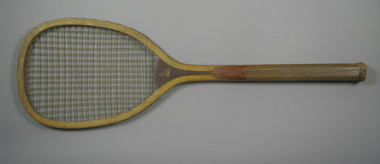 Tennis Australia
Racquet, Circa 1906
... Decal profile bust image across throat on obverse is of a male North American native. Inscription across right side of stem is largely lost, but originally read: THE BRIDGEPORT GUN IMPLEMENT CO....Decal profile bust image across throat on obverse is of a male North American native. Inscription across right side of stem is largely lost, but originally read: THE BRIDGEPORT GUN IMPLEMENT CO. ...A wooden, transitional flat-top racquet with a laminated convex throat. Decal profile bust image across throat on obverse is of a male North American native. Inscription across right side of stem is largely lost, but originally read: THE BRIDGEPORT GUN IMPLEMENT CO./NEW YORK, U.S.A. Materials: Wood, Gut, String, Leather, Metal, Ink, Glue, Lacquertennis -
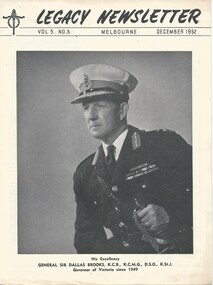 Melbourne Legacy
Magazine - Newsletter, Melbourne Legacy, Legacy Newsletter December 1952, 1952
... Other items included 'Totem Tom Tom' with the senior girls dress as native American maidens. They also performed 'Good Queen Bess' in elaborate costumes with Linda Bulllivant playing the lead. ...Other items included 'Totem Tom Tom' with the senior girls dress as native American maidens. They also performed 'Good Queen Bess' in elaborate costumes with Linda Bulllivant playing the lead. ...The newsletter from December 1952. It featured the Governor of Victoria Sir Dallas Brookes on the cover. There was an article about the 1952 Demonstration including 4 photos. There had been a scene with Father Christmas called 'Toymaker's dream' with toy soldiers, dancing dolls, Chinese dolls with shiny hats and golliwogs. Other items included 'Totem Tom Tom' with the senior girls dress as native American maidens. They also performed 'Good Queen Bess' in elaborate costumes with Linda Bulllivant playing the lead. Also the fantasy on the Grieg Concerto, which was a graceful ballet. Juniors and intermediates provided 'Anchors aweigh' with 'mopping the decks,' and 'flag dance' with each girl holding two Union Jacks. With figure marching and Sailors' Hornpipe as well. There was an article about a career in the police force. Also news from the boys' groups and Intermediate Legacy (ILC). A newsletter published by Legacy in this format for many years from 1942. It mentions "Issued from time to time for Private Circulation among the Sons and Daughters of Deceased Service men and Merchant Seamen who served their Country during the War of 1914-18, or the present War". Many articles on the work of Legacy, including features on boys classes, girls classes, camps, the residences and where their past residents ended up. There are some suggestion for careers and some general interest articles. Some very interesting photos.Newsletter outlining news of Junior Legatee activities.Black and white printed newsletter x 8 pages from December 1952. Volume 5 Number 3.boys classes, activities, girls classes, ilc, demonstration, costumes -
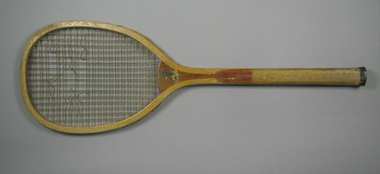 Tennis Australia
Racquet, Circa 1906
... Decal profile bust image across throat on obverse is of a male North American native. Inscription across right side of stem is largely lost, but originally read: THE BRIDGEPORT GUN IMPLEMENT CO....Decal profile bust image across throat on obverse is of a male North American native. Inscription across right side of stem is largely lost, but originally read: THE BRIDGEPORT GUN IMPLEMENT CO. ...A wooden, transitional flat-top racquet with a laminated convex throat. Decal profile bust image across throat on obverse is of a male North American native. Inscription across right side of stem is largely lost, but originally read: THE BRIDGEPORT GUN IMPLEMENT CO./NEW YORK, U.S.A. Hand carved name along stem on obverse: LOLA DEVALE. Decal inscription across crown on obverse is illegible. Materials: Wood, Gut, String, Leather, Metal, Ink, Glue, Lacquertennis -
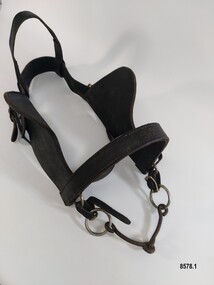 Flagstaff Hill Maritime Museum and Village
Equipment - Horse Harness, Glenn's Leather Goods, Early to mid-20th century
... Variations of different horse harnesses were also found in Native American and Middle Eastern cultures. Horse Harnesses usually have four basic components which include - 1. ...Variations of different horse harnesses were also found in Native American and Middle Eastern cultures. Horse Harnesses usually have four basic components which include - 1. ...The early settlers of Victoria depended on horse drawn vehicles to farm, make roads and railways, deliver produce and transport people. Horse harnesses were an important requisite for all drivers and could be found wherever there were working horses. Horse Harnesses have played an essential role in different cultures throughout history. Simple, utilitarian horse harnesses made of leather straps and iron rings were being used in early China before AD 500 as well as ancient Greece and Rome allowing horses to pull chariots and ploughs. The Greeks and Romans were the first to use a "horse collar" which distributed the weight of the harness evenly across the horse's chest rather than relying on a "throat harness" that could damage a horse's throat or choke them. During the medieval period, European horse harnesses became more elaborate and decorative. Variations of different horse harnesses were also found in Native American and Middle Eastern cultures. Horse Harnesses usually have four basic components which include - 1. Communication - the bridle, bit and reins allows the driver to communicate instructions and commands to the horse, guiding its movement and direction. 2. Draft - the collar, hame straps, hames, traces and chains enables the horse to draw and pull the load efficiently by distributing the weight and transferring the pulling force to the vehicle. 3. Stopping - the breeching band, pole straps and breast strap helps to control or stabilise the horse and vehicle when moving downhill or stopping. 4. Support - the back pad, backband, belly band and back saddle keep the harness in the correct position and proper alignment. This dray harness is a plain, basic harness and reflects its working class origins. It was used by Mr. Oswald (Jack) Bourke with his horse and dray to firstly deliver drygoods from Sunbury to Melbourne in the 1930's and later (through the 1940's and 1950's up to 1961) when he worked on the garbage round for the Springvale City Council. This horse harness is a significant example of the equipment that was needed wherever horses were being used - particularly in the early years of Victoria's settlement by white settlers. Harnesses such as this example were used with drays, farming equipment, delivery carts and personal transportation.A leather and metal horse harness used with a horse and dray circa 1930's to the early 1960's. It is made up of a number of components. 1. A leather bridle with metal buckles and rings, blinkers and a metal single jointed, snaffle bit that has the initials M B stamped onto the leather. 2. A leather bridle with metal buckles and rings and a metal "straight bar" Eggbut snaffle bit. It has an elongated X design (with 4 dots) stamped onto the leather strap holders near each buckle. 3. A blue and white vinyl halter with one leather patched strap. The nose band and a chin strap are covered with woollen padding. 4. A pair of leather shaft protectors. They have lacing holes along each edge and a repeating design of small shapes (flowers, wings, crosses and arrowheads) which run along the front of each protector. 5. A leather strap with a stainless steel chain and catch and a maker's mark for "Glenn's Leather Goods, Pearcedale Victoria" stamped onto the end. 6. A wide leather strap covered with a webbing sleeve. It has two large metal rings and each end and one ring has a rope attached. 7. A leather strap comprised of three separate sections (two shorter and one longer) joined with two metal rings. The longer section has notches along its length and the shorter section at the other end has a buckle. It also had a maker's mark stamped on it but the mark is very worn and the writing is difficult to read. 8. An adjustable leather horse collar with two buckles and straps at the top opening and two "B's" stamped into the leather. The top of the collar is made from treated leather pieces stitched together and the underneath of the collar is untreated leather. It has a padded indentation running all the way around the collar for the hames to sit in. 9. Two pairs of long leather traces - each having a buckle and notched section at one end and each one is made with three lengths of leather spliced together. 10. A leather strap (with one spliced join) belonging to a horse harness with two shorter straps (each ending with a metal clip) attached to a steel D ring at one end. 11. Three assorted short leather straps - the top one has clips at each end and a buckle (for adjusting the length) in the centre, the middle strap has notches and a buckle and the bottom strap is white with notches and a buckle.Bridle with blinkers - "M B" Bridle - design showing an elongated X with a dot in each section stamped onto strap holder Shaft Protectors - stamped design of flowers, wings, crosses and arrowheads Strap with chain - "Glenn's leather goods / Pearcedale / Victoria" Leather Strap (with two metal rings) - Maker's stamp - "name indecipherable / SADDLER / ...OURNE" Collar - "B / B" Leather strap - flagstaff hill maritime museum and village, warrnambool, great ocean road, sunbury, springvale, dray, delivery dray, harness, horse harness, horse drawn vehicles, working horse, oswald (jack) bourke, bridle, horse collar, hames, shaft protectors -
 Flagstaff Hill Maritime Museum and Village
Equipment - Show Harness, R. Mitchell, Saddler, Early to mid-20th century
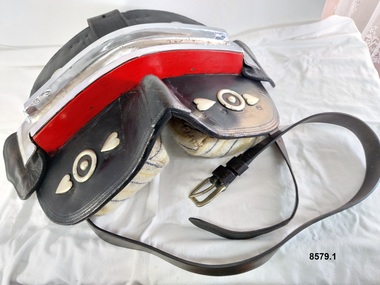
... Variations of different horse harnesses were also found in Native American and Middle Eastern cultures. Horse Harnesses usually have four basic components which include - 1. ...Variations of different horse harnesses were also found in Native American and Middle Eastern cultures. Horse Harnesses usually have four basic components which include - 1. ...The early settlers of Victoria depended on horse drawn vehicles to farm, make roads and railways, deliver produce and transport people. Horse harnesses were an important requisite for all drivers and could be found wherever there were working horses. Horse Harnesses have played an essential role in different cultures throughout history. Simple, utilitarian horse harnesses made of leather straps and iron rings were being used in early China before AD 500 as well as ancient Greece and Rome, allowing horses to pull chariots and ploughs. The Greeks and Romans were the first to use a "horse collar" which distributed the weight of the harness evenly across the horse's chest rather than relying on a "throat harness" that could damage a horse's throat or choke them. During the medieval period, European horse harnesses became more elaborate and decorative. Variations of different horse harnesses were also found in Native American and Middle Eastern cultures. Horse Harnesses usually have four basic components which include - 1. Communication - the bridle, bit and reins allows the driver to communicate instructions and commands to the horse, guiding its movement and direction. 2. Draft - the collar, hame straps, hames, traces and chains enables the horse to draw and pull the load efficiently by distributing the weight and transferring the pulling force to the vehicle. 3. Stopping - the breeching band, pole straps and breast strap helps to control or stabilise the horse and vehicle when moving downhill or stopping. 4. Support - the back pad, backband, belly band and back saddle keep the harness in the correct position and proper alignment. This show harness was used by Mr. Andy Bourke when showing his Clydesdales at shows or demonstrations. Although a more modern example with decorative embellishments, it still has many essential components traditionally found in an everyday working horse harness. The original purpose of the "housen" for example, was to run rain or drizzle off the horse's neck when they had to work in wet conditions - it was laid flat for this purpose on the top of the collar. Nowadays it is purely for show and is often used to advertise a business or stud. Horse brasses and fly terrets were fastened to various parts of a horse's harness. In the early days they probably began as amulets to ward off evil and to bring good luck and continued to be used as a festive decoration. The heyday of horse brasses was between the years 1851 and 1900. Horse brasses are fastened to various parts of the harness with many of their designs being symbolic. The ornamentation on this harness (although not authentic horse brasses) are based on the horse brasses that were popular in the 19th century. This horse harness is a significant example of the equipment that was needed wherever heavy horses were being used - particularly in the early years of Victoria's settlement by white settlers. Harnesses such as this example were used with stage coaches, drays, farming equipment, delivery carts and personal transportation.A leather and metal horse harness used when showing a Clydesdale (or other breed of heavy horse). It is made up of a number of components. 1. Decorative leather cart saddle with two large cloth pads underneath (which have a scalloped leather and stud border), a raised leather pommel and a silver and red coloured metal back strap holder across the top. It has two symmetrical sets of ornamentation (silver hearts and circles) in the front and a wide strap or girth (with a maker's stamp reading "R. Mitchell Saddler") and buckle which attaches the saddle to the horse. 2. Pair of steel hames which are gently curved (to fit on a horse collar) and are topped with steel knobs. They have several steel rings and lugs (to hold straps and chains) and a "Made in England Warranted Steel" stamp. 3. Breeching harness which consists of a number of leather straps, chains and metal rings including a wide padded leather strap with a scalloped edge that sits on the back of the horse and a thick leather strap that goes around the hind quarters of a horse which is joined to the back strap with four shorter vertical straps and buckles. These straps feature silver and red patent leather trim and silver heart shaped ornamentation. The strap also features the maker's stamp of "R. Mitchell". 4. Decorative leather bridle with blinkers featuring the same silver and red patent leather trim on the cheek piece, brow band and throatlatch. It has a stainless steel "Liverpool Driving Bit" with a curb chain, a variety of decorative silver ornaments (rosettes, diamonds plus a heart and two circles) on each end of the forehead band, dropper and strap as well as a silver metal bell (sometimes known as a "fly terret" or "swinger") that sits on the headpiece of the bridle. 5. Leather "violin shaped" dropper (or hanger) with two silver rosette shaped ornaments and a stainless steel clip on the top 6. Stainless steel "Liverpool Driving Bit" with a straight mouthpiece which is ribbed on one side. It has three rein spots (spaces) and a curb chain. 7. Leather arch shaped "Housen" covered in black and red patent leather and decorated with silver studs (some spelling out F H) and bordered with a red fringe. It has a leather strap at the back and two leather loops on the front. 8. Leather padded backband (Australian style "Stallion Draught Roller") decorated with two groups of nine metal "horse brasses" or harness ornaments displaying horseshoe, starburst and horse head designs on blue, red and white striped webbing. The backband has three notched straps at each end, a buckle near the centre and the initial B stamped in two places underneath. 9. Bellyband made of leather and red, white and blue striped webbing. It has a set of three buckles at each end (which correspond with the notched straps of the backband). 10. Wide, thick leather strap which has a buckle and notches at each end. It also has the maker's stamp of "R. Mitchell Saddler". 11.One pair of long leather traces - each with a buckle and notched loop at one end, decorated with a small silver diamond shaped harness ornament. 12. Length of stainless steel heavy duty chain with two swivel connectors.Saddle - "R.MITCHELL / SADDLER" Hames - "MADE IN ENGLAND / WARRANTED / STEEL" "MADE IN ENGLAND / WARRANTED / unclear" Breeching Straps - "R. MITCHELL / MAKER / R. MITCHELL MAKER" Housen - "F H" Backband "B / B' Wide leather strap - "R. MITCHELL / SADDLER"flagstaff hill maritime museum and village, warrnambool, great ocean road, shipwreck coast, harness, horse harness, show harness, clydesdale horses, andy bourke, horse drawn cart, housen, bridle, hames, breeching straps, dropper, bit, liverpool bit, backband, harness ornamentation, bellyband, back saddle, fly terret -
 The Beechworth Burke Museum
Animal specimen - Californian Quail, Trustees of the Australian Museum, 1860-1880
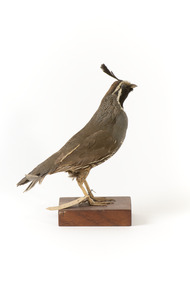
... They are native to western America but have been introduced to areas outside this location including King Island. ...They are native to western America but have been introduced to areas outside this location including King Island. ...About the specimen: The Californian Quail is a highly sociable bird commonly seen in small flocks. They have a distinctive appearance with the black plume on top of their head and white markings on the head and torso. This species reside in open woodland, bushy grassland, roadsides and fringes of urban areas. They are native to western America but have been introduced to areas outside this location including King Island. This species was established as the state bird of California in 1932. Explain how it should look: Copy and paste: This specimen is part of a collection of almost 200 animal specimens that were originally acquired as skins from various institutions across Australia, including the Australian Museum in Sydney and the National Museum of Victoria (known as Museums Victoria since 1983), as well as individuals such as amateur anthropologist Reynell Eveleigh Johns between 1860-1880. These skins were then mounted by members of the Burke Museum Committee and put-on display in the formal space of the Museum’s original exhibition hall where they continue to be on display. This display of taxidermy mounts initially served to instruct visitors to the Burke Museum of the natural world around them, today it serves as an insight into the collecting habits of the 19th century.Copy and paste this section: This specimen is part of a significant and rare taxidermy mount collection in the Burke Museum. This collection is scientifically and culturally important for reminding us of how science continues to shape our understanding of the modern world. They demonstrate a capacity to hold evidence of how Australia’s fauna history existed in the past and are potentially important for future environmental research. This collection continues to be on display in the Museum and has become a key part to interpreting the collecting habits of the 19th century.This male Californian Quail has a black forward drooping plume on the top of its head. It has a dark brown/black coloured cap on its head and a black face with distinct white markings on the sides of its face and neck. The back of the bird is brown.The belly is a lighter brown colour and the chest and back of the neck is a blue-grey. This specimen stands upon a wooden platform and has an identification tag tied around its leg.Swing-tag: 46 / (b)? Californian Scrub Quail / Catalogue Page, 30. / Metal tag: 4341 / taxidermy mount, taxidermy, animalia, burke museum, beechworth, australian museum, skin, reynell eveleigh johns, bird, californian quail, california, american birds, quail, californain sub wren, wren -
 Victorian Aboriginal Corporation for Languages
Book, Leanne Hinton, The green book of Language revitalization in practice, 2008
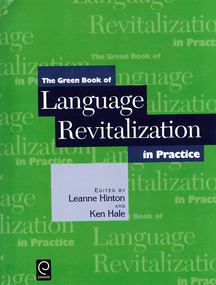
... To Help Assure the Survival and Continuing Vitality of Native American Languages" /? Robert D. Arnold 5. ...To Help Assure the Survival and Continuing Vitality of Native American Languages" /? Robert D. Arnold 5. ...1. Language Revitalization: An Overview /? Leanne Hinton 2. Diversity in Local Language Maintenance and Restoration: A Reason For Optimism /? Anna Ash, Jessie Little Doe Fermino and Ken Hale 3. Federal Language Policy and Indigenous Languages in the United States /? Leanne Hinton 4. "... To Help Assure the Survival and Continuing Vitality of Native American Languages" /? Robert D. Arnold 5. Language Planning /? Leanne Hinton Introduction to the Pueblo Languages /? Leanne Hinton 6. Native Language Planning: A Pilot Process in the Acoma Pueblo Community /? Christine P. Sims 7. The Key To Cultural Survival: Language Planning and Revitalization in the Pueblo de Cochiti /? Regis Pecos and Rebecca Blum-Martinez The Navajo Language: I /? Ken Hale 8. Navajo Head Start Language Study /? Paul R. Platero 9. Introduction to Revitalization of National Indigenous Languages /? Leanne Hinton Introduction to the Welsh Language /? Leanne Hinton 10. Welsh: A European Case of Language Maintenance /? Gerald Morgan Introduction to the Maori Language /? Ken Hale 11. Te Kohanga Reo: Maori Language Revitalization /? Jeanette King An Introduction to the Hawaiian Language /? Leanne Hinton 12. The Movement to Revitalize Hawaiian Language and Culture /? Sam L. No'Eau Warner 13. "Mai Loko Mai O Ka 'I'ini: Proceeding from a Dream": The 'Aha Punana Leo Connection in Hawaiian Language Revitalization /? William H. Wilson and Kauanoe Kamana 14. Teaching Methods /? Leanne Hinton The Karuk Language /? Leanne Hinton 15. Teaching Well, Learning Quickly: Communication-Based Language Instruction /? Terry Supahan and Sarah E. Supahan The Navajo Language: II /? Ken Hale 16. Tsehootsooidi Olta'gi Dine Bizaad Bihoo'aah: A Navajo Immersion Program at Fort Defiance, Arizona /? Marie Arviso and Wayne Holm 17. The Master-Apprentice Language Learning Program /? Leanne Hinton 18. Linguistic Aspects of Language Teaching and Learning in Immersion Contexts /? Ken Hale 19. New Writing Systems /? Leanne Hinton An Introduction to Paiute /? Leanne Hinton and Ken Hale 20. Language Revitalization in the San Juan Paiute Community and the Role of a Paiute Constitution /? Pamela Bunte and Robert Franklin 21. Audio-Video Documentation /? Leanne Hinton Australian Languages /? Ken Hale 22. Strict Locality in Local Language Media: An Australian Example /? Ken Hale The Arapaho Language /? Ken Hale 23. Reflections on the Arapaho Language Project, or When Bambi Spoke Arapaho and Other Tales of Arapaho Language Revitalization Efforts /? Stephen Greymorning Irish /? Ken Hale 24. Continuity and Vitality: Expanding Domains through Irish-Language Radio /? Colleen Cotter The Mono Language /? Ken Hale 25. On Using Multimedia in Language Renewal: Observations from Making the CD-ROM Taitaduhaan /? Paul V. Kroskrity and Jennifer F. Reynolds 26. Can the Web Help Save My Language? /? Laura Buszard-Welcher 27. Training People to Teach Their Language /? Leanne Hinton Inuttut and Innu-aimun /? Ken Hale 28. The Role of the University in the Training of Native Language Teachers: Labrador /? Alana Johns and Irene Mazurkewich Languages of Arizona, Southern California, and Oklahoma /? Leanne Hinton 29. Indigenous Educators as Change Agents: Case Studies of Two Language Institutes /? Teresa L. McCarty, Lucille J. Watahomigie and Akira Y. Yamamoto /? [et al.] The Navajo Language: III /? Ken Hale 30. Promoting Advanced Navajo Language Scholarship /? Clay Slate 31. Sleeping Languages: Can They Be Awakened? /? Leanne Hinton 32. The Use of Linguistic Archives in Language Revitalization: The Native California Language Restoration Workshop /? Leanne Hinton The Ohlone Languages /? Leanne Hinton 33. New Life for a Lost Language /? Linda Yamane.Maps, b&w photographs, tables, word listslanguage policy, language planning, language maintenance, language revitalization, language immersion, language literacy, media and technology, language education and training, sleeping languages, navajo, arapaho -
Victorian Aboriginal Corporation for Languages
Conference proceedings, Joan Argenter, Endangered languages and linguistic rights on the margins of nations : proceedings of the Eighth FEL Conference : Barcelona (Catalonia) Spain 1-3 October 2004, 2005
... Section 1: Grass-roots Efforts and Top-down Institutions Keynote Address: Leanne Hinton The Death and Rebirth of Native American Languages Patrick Marlow Bilingual Education, Legislative Intent, and Language Maintenance in Alaska Galina Dyrkheeva New Language Policy and Small Languages in Russia: the Buryat Example Zelealem Leyew The Fate of Endangered Languages in Ethiopia Gregory Hankoni Kamwendo Language Planning from Below: Chitumbuka as a Marginalised Language in Malawi John Hobson Learning to Speak Again: Towards the Provision of Appropriate Training for the Revitalization of Australian Languages in New South Wales Shelley Tulloch Grassroots Desires for Language Planning in Nunavut Amandina C�rdenas Demay Hacia la definici�n de una pol�tica del lenguaje & Alejandra Arellano Mart�nez expl�cita en M�xico Elena Benedicto, G. ...NSW endangered languages linguistic rights maps, tables, graphs Section 1: Grass-roots Efforts and Top-down Institutions Keynote Address: Leanne Hinton The Death and Rebirth of Native American Languages Patrick Marlow Bilingual Education, Legislative Intent, and Language Maintenance in Alaska Galina Dyrkheeva New Language Policy and Small Languages in Russia: the Buryat Example Zelealem Leyew The Fate of Endangered Languages in Ethiopia Gregory Hankoni Kamwendo Language Planning from Below: Chitumbuka as a Marginalised Language in Malawi John Hobson Learning to Speak Again: Towards the Provision of Appropriate Training for the Revitalization of Australian Languages in New South Wales Shelley Tulloch Grassroots Desires for Language Planning in Nunavut Amandina C�rdenas Demay Hacia la definici�n de una pol�tica del lenguaje & Alejandra Arellano Mart�nez expl�cita en M�xico Elena Benedicto, G. ...Section 1: Grass-roots Efforts and Top-down Institutions Keynote Address: Leanne Hinton The Death and Rebirth of Native American Languages Patrick Marlow Bilingual Education, Legislative Intent, and Language Maintenance in Alaska Galina Dyrkheeva New Language Policy and Small Languages in Russia: the Buryat Example Zelealem Leyew The Fate of Endangered Languages in Ethiopia Gregory Hankoni Kamwendo Language Planning from Below: Chitumbuka as a Marginalised Language in Malawi John Hobson Learning to Speak Again: Towards the Provision of Appropriate Training for the Revitalization of Australian Languages in New South Wales Shelley Tulloch Grassroots Desires for Language Planning in Nunavut Amandina C�rdenas Demay Hacia la definici�n de una pol�tica del lenguaje & Alejandra Arellano Mart�nez expl�cita en M�xico Elena Benedicto, G. McLean, Linguistic Rights in the Nicaraguan Atlantic Coast: Grupo de Ling�istas Ind�genas Mayangna Actions on the Ground within the Legislative Framework of the Estatuto de Autonom�a Bartomeu Meli� Las lenguas ind�genas en el Paraguay. Una visi�n desde el Censo 2002 Monica Ward Building from the Bottom-up: Linguistic Rights for Extremely Endangered Languages Marta Moskal Language Policy and Protection of Endangered Languages in Poland Sue Wright What is a language? Some difficulties inherent in language rights Joan Ramon Sol� Obstacles in the Way of the Recovery of Catalan Section 2: The Global vs. the Local in Linguistic Rights Keynote Address: Patxi Goenaga Fronteras que dividen y fronteras que separan. Una mirada a Europa desde el Euskara Yun-Hsuan Kuo Languages, Identity, and Linguistic Rights in Taiwan Estibaliz Amorrortu, Andoni Barre�a, What Do Linguistic Communities Think about the Esti Izagirre, Itziar Idiazabal, Bel�n Uranga Official Recognition of their Languages? Alok Kumar Das Linguistic Practices and Not Just Linguistic Rights: Endangered Languages in New Europe Section 3: Languages crossing the Borders Keynote Address: Tjeerd de Graaf The Status of Endangered Languages in the Border Areas of Japan and Russia Mariana Bara Arm�n endangered language Ver�nica Grondona Language Policy, Linguistic Rights and Language Maintenance in Argentina Grup d?Estudi de Lleng�es Amena�ades Linguistic diversity in Catalonia: towards a model of linguistic revitalization Nataliya Belitser Endangered Languages in Crimea/Ukraine: The Cases of Crimean Tatar, Karait, and Krymchak Ivelina Kazakova & Maria Miteva The Future of Bulgarian: The Road to Extinction or Paradise Regained Luke O?Callaghan War of Words: Language Policy in Post Independence Kazakhstan Eden Naby From Lingua Franca to Endangered Language: The Legal Aspects of the Preservation of Aramaic in Iraq Poster presentations Akim Elnazarov Endangered languages and Education. A Case of Badakhshan Province of Tajikistan Arnfinn Muruvik Vonen & Oddvar Hjulstad Linguistic Rights Paving the Way Towards Language Endangerment? The Case of Norwegian Sign Language Eva Savelsberg Kurdish (Kurmanc�) as Minority Language in the Federal Republic of Germany Jos� Antonio Flores Farf�n Cultural and Linguistic Revitalization, Maintenance and Development in Mexico Mary Jane Norris Assessing the Status, Use and Accessibility of Canada?s Aboriginal Languages within Communities and Cities: Some Proposed Indicators Michael Prosser van der Riet Promotion of Minority Language Scripts in Southwest China. A Relative Success or Complete Failure? Mikael Grut The Endangered Celtic Languages: A Wake-up Call Nariyo Kono Developing Partnerships Between Universities and Language Communities: Top-down and Bottom-up Integration Richard J. Hawkins Probit Modeling Language Attrition Rudy Osiel Camposeco El idioma maya Popti? y la Declaraci�n Universal de los Derechos Ling��sticos Victorio N. Sugbo The literary Response: Claiming Rights in Three Philippin Languages Ya-ling Chang Language Policies in an Aboriginal Primary School in Taiwanmaps, tables, graphsnsw, endangered languages, linguistic rights -
 Flagstaff Hill Maritime Museum and Village
Book - Anthropological Travelogue/Fictional, Captain Mayne Reid, Odd People being A Popular Description of Singular Races of Man, 1860
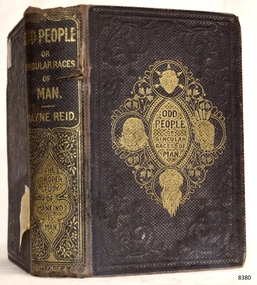
... He also worked as a schoolmaster in Nashville, lived among Native American tribes, and accompanied fur trappers on trading expeditions—experiences that heavily inspired his later writing. ...He also worked as a schoolmaster in Nashville, lived among Native American tribes, and accompanied fur trappers on trading expeditions—experiences that heavily inspired his later writing. ...Odd People: Being a Popular Description of Singular Races of Man (1860) is an interesting piece of 19th-century literature. The book was written by Captain Thomas Mayne Reid (1818–1883), a Scots-Irish American novelist and adventurer. He was immensely popular in the mid-to-late 19th century for his boys' adventure novels, tales of the American West, and travelogues. The true first edition was published in London by Routledge, Warne & Routledge in 1860. In the United States, it was published around the same time (1860/1861) by Ticknor and Fields in Boston, and later editions were retitled The Man-Eaters and Other Odd People. The book is an early work of popular ethnology and anthropology, written for a general audience and heavily marketed toward young readers and armchair travelers of the Victorian era.Book, brown covers, embossed with borders and patterns and gilt decoration and titles. The book includes illustrations. Handwritten inscription on the front paste-down page. The opposite page has a stamped and a handwritten inscription. The book was presented as a prize to a Latin student at the National School, Warrnambool in 1861. Title: Odd People being a Popular Description of Singular Races of Man. Alternate title: Odd People or Singular Races of Man Author: Captain Mayne Reid Publisher: Routledge Warne & Routledge, London Date: 1860 Further information: additional text on the spine reads 'A Proper Study of Mankind is Man'fictionOdd People: Being a Popular Description of Singular Races of Man (1860) is an interesting piece of 19th-century literature. The book was written by Captain Thomas Mayne Reid (1818–1883), a Scots-Irish American novelist and adventurer. He was immensely popular in the mid-to-late 19th century for his boys' adventure novels, tales of the American West, and travelogues. The true first edition was published in London by Routledge, Warne & Routledge in 1860. In the United States, it was published around the same time (1860/1861) by Ticknor and Fields in Boston, and later editions were retitled The Man-Eaters and Other Odd People. The book is an early work of popular ethnology and anthropology, written for a general audience and heavily marketed toward young readers and armchair travelers of the Victorian era.shipwrecked-coast, flagstaff-hill, flagstaff-hill-maritime-museum, warrnambool, maritime-museum, shipwreck-coast, flagstaff-hill-maritime-village, shipwrecked-artefact, book, odd people, captain mayne reid, national school warrnambool., daniel b sellers, classic fiction, the proper study of mankind is man, singular races of man, , routledge warne and routledge, latin student -
 The Beechworth Burke Museum
Animal specimen - Red-Winged Blackbird, Trustees of the Australian Museum, 1860-1880
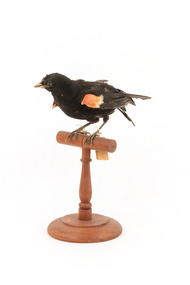
... The red-winged blackbird is native to North America. They live in a verity of places from southern Alaska at its northern most point, to the Yucatan peninsula in the south and covers the greater part of the continent reaching from the Pacific coast of California and Canada to the eastern seaboard. ...The red-winged blackbird is native to North America. They live in a verity of places from southern Alaska at its northern most point, to the Yucatan peninsula in the south and covers the greater part of the continent reaching from the Pacific coast of California and Canada to the eastern seaboard. ...The red-winged blackbird is native to North America. They live in a verity of places from southern Alaska at its northern most point, to the Yucatan peninsula in the south and covers the greater part of the continent reaching from the Pacific coast of California and Canada to the eastern seaboard. Populations that are most northerly migrate south after the mating season, but some of the populations in the central and western United States, Central America and the Gulf Coast are resident year-round. In the breeding season, Red-winged blackbirds are found in a range of fresh and saltwater environments, including in small trees and bushes along marshes and watercourses, in agricultural areas and dry meadows. During migration, they can be found in, pastures, prairies and cultivated fields. They are polygamous. The Red-winged blackbirds are known for their scarlet and yellow shoulder patches but on this specimen are rather dull and the feathers are not as glossy black as they are in other images. It is mounted accurately but the feathers appear to be ruffled. This specimen is part of a collection of almost 200 animal specimens that were originally acquired as skins from various institutions across Australia, including the Australian Museum in Sydney and the National Museum of Victoria (known as Museums Victoria since 1983), as well as individuals such as amateur anthropologist Reynell Eveleigh Johns between 1860-1880. These skins were then mounted by members of the Burke Museum Committee and put-on display in the formal space of the Museum’s original exhibition hall where they continue to be on display. This display of taxidermy mounts initially served to instruct visitors to the Burke Museum of the natural world around them, today it serves as an insight into the collecting habits of the 19th century.This specimen is part of a significant and rare taxidermy mount collection in the Burke Museum. This collection is scientifically and culturally important for reminding us of how science continues to shape our understanding of the modern world. They demonstrate a capacity to hold evidence of how Australia’s fauna history existed in the past and are potentially important for future environmental research. This collection continues to be on display in the Museum and has become a key part to interpreting the collecting habits of the 19th century.The Red-Winged Blackbird is one of the most common birds in North America and is the most boldly coloured one. The males are glossy-black with shoulder patches of scarlet and yellow which they are able to puff up or hide according to their level of confidence. Females look like a big, dark sparrow, being a subdued, streaky brown. The colouring of this particular specimen identifies it as male.[torn] page 58 / Tag: A. 4423taxidermy mount, taxidermy, animalia, burke museum, beechworth, australian museum, skin, reynell eveleigh johns, bird, american birds, north america, red-winged blackbird, red-winged starling, migratory, alaska, canada, saltwater -
 The Beechworth Burke Museum
Animal specimen - Red-Winged Blackbird, Trustees of the Australian Museum, 1860-1880
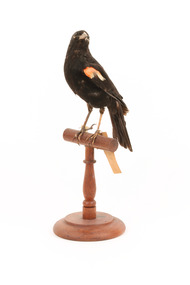
... The red-winged blackbird is native to North America. They live in a verity of places from southern Alaska at its northern most point, to the Yucatan peninsula in the south and covers the greater part of the continent reaching from the Pacific coast of California and Canada to the eastern seaboard. ...The red-winged blackbird is native to North America. They live in a verity of places from southern Alaska at its northern most point, to the Yucatan peninsula in the south and covers the greater part of the continent reaching from the Pacific coast of California and Canada to the eastern seaboard. ...The red-winged blackbird is native to North America. They live in a verity of places from southern Alaska at its northern most point, to the Yucatan peninsula in the south and covers the greater part of the continent reaching from the Pacific coast of California and Canada to the eastern seaboard. Populations that are most northerly migrate south after the mating season, but some of the populations in the central and western United States, Central America and the Gulf Coast are resident year-round. In the breeding season, Red-winged blackbirds are found in a range of fresh and saltwater environments, including in small trees and bushes along marshes and watercourses, in agricultural areas and dry meadows. During migration, they can be found in, pastures, prairies and cultivated fields. They are polygamous. In the north, the early arrival and tumbling song of these birds are welcome indications of spring's return. The Red-winged blackbirds are known for their scarlet and yellow shoulder patches on this specimen are rather dull and the feathers are not as glossy black as they are in other images. This specimen is part of a collection of almost 200 animal specimens that were originally acquired as skins from various institutions across Australia, including the Australian Museum in Sydney and the National Museum of Victoria (known as Museums Victoria since 1983), as well as individuals such as amateur anthropologist Reynell Eveleigh Johns between 1860-1880. These skins were then mounted by members of the Burke Museum Committee and put-on display in the formal space of the Museum’s original exhibition hall where they continue to be on display. This display of taxidermy mounts initially served to instruct visitors to the Burke Museum of the natural world around them, today it serves as an insight into the collecting habits of the 19th century.This specimen is part of a significant and rare taxidermy mount collection in the Burke Museum. This collection is scientifically and culturally important for reminding us of how science continues to shape our understanding of the modern world. They demonstrate a capacity to hold evidence of how Australia’s fauna history existed in the past and are potentially important for future environmental research. This collection continues to be on display in the Museum and has become a key part to interpreting the collecting habits of the 19th century.This is one of the most common birds in North America and is the most boldly coloured one. The males are glossy-black with shoulder patches of scarlet and yellow which they are able to puff up or hide according to their level of confidence. Females look like a big, dark sparrow, being a subdued, streaky brown. This specimen has the colouring of the male Red-Winged Blackbird which helps to identify it as such.Swing-Tag: 137a. / Red-winged Starling / Catalogue page, 58 / Tag: A. 4429taxidermy mount, taxidermy, animalia, burke museum, beechworth, australian museum, skin, reynell eveleigh johns, bird, american birds, north america, red-winged blackbird, red-winged starling, migratory, alaska, canada, saltwater -
 Flagstaff Hill Maritime Museum and Village
Domestic object - Wooden Rolling Pin, First half of 20th Century
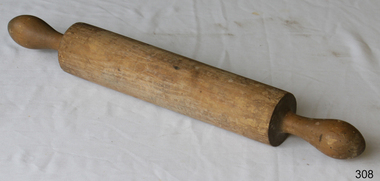
... They also used rolling pins to make bread (which they called puls) from the large number of grains they grew. Natives of the Americas used more primitive bread-making tools that are favoured and unchanged in many villages. ...They also used rolling pins to make bread (which they called puls) from the large number of grains they grew. Natives of the Americas used more primitive bread-making tools that are favoured and unchanged in many villages. ...A rolling pin is a simple tool used to flatten dough. The first civilisation known to have used the rolling pin was the Etruscans. Their advanced farming ability, along with a tendency to cultivate many plants and animals never before used as food and turn them into sophisticated recipes, were passed to invading Greeks, Romans, and Western Europeans. Thanks to the Etruscans, these cultures are associated with gourmet cooking. To prepare their inventive foods, the Etruscans also developed a wide range of cooking tools, including the rolling pin. Although written recipes did not exist until the fourth century B.C., the Etruscans documented their love of food and its preparation in murals, on vases, and on the walls of their tombs. Cooking wares are displayed with pride; rolling pins appear to have been used first to thin-roll pasta that was shaped with cutting wheels. They also used rolling pins to make bread (which they called puls) from the large number of grains they grew. Natives of the Americas used more primitive bread-making tools that are favoured and unchanged in many villages. Chefs who try to use genuine methods to preserve recipes are also interested in both materials and tools. Hands are used as "rolling pins" for flattening dough against a surface, but also for tossing soft dough between the cook's two hands until it enlarges and thins by handling and gravity. Tortillas are probably the most familiar bread made this way. Over the centuries, rolling pins have been made of many different materials, including long cylinders of baked clay, smooth branches with the bark removed, and glass bottles. As the development of breads and pastries spread from Southern to Western and Northern Europe, wood from local forests was cut and finished for use as rolling pins. The French perfected the solid hardwood pin with tapered ends to roll pastry that is thick in the middle; its weight makes rolling easier. The French also use marble rolling pins for buttery dough worked on a marble slab. Glass is still popular; in Italy, full wine bottles that have been chilled make ideal rolling pins because they are heavy and cool the dough. Countries known for their ceramics make porcelain rolling pins with beautiful decorations painted on the rolling surface; their hollow centres can be filled with cold water (the same principle as the wine bottle), and cork or plastic stoppers cap the ends. Designs for most rolling pins follow long-established practices, although some unusual styles and materials are made and used. Within the family of wooden rolling pins, long and short versions are made as well as those that are solid cylinders (one-piece rolling pins) instead of the familiar style with handles. Very short pins called mini rolling pins make use of short lengths of wood and are useful for one-handed rolling and popular with children and collectors. Mini pins ranging from 5 to 7 in (12.7-17.8 cm) in length are called texturing tools and are produced to create steam holes and decorations in pastry and pie crusts; crafters also use them to imprint clay for art projects. These mini pins are made of hardwoods (usually maple) or plastic. Wood handles are supplied for both wood and plastic tools, however. Blown glass rolling pins are made with straight walls and are solid or hollow. Ceramic rolling pins are also produced in hollow form, and glass and ceramic models can be filled with water and plugged with stoppers. Tapered glass rolling pins with stoppers were made for many centuries when salt imports and exports were prohibited or heavily taxed. The rolling pin containers disguised the true contents. The straight-sided cylinder is a more recent development, although tapered glass pins are still common craft projects made by cutting two wine bottles in half and sealing the two ends together so that the necks serve as handles at each end.Tiny rolling pins are also twisted into shape using formed wire. The pins will not flatten and smooth pastry, and the handles do not turn. The metal pins are popular as kitchen decorations and also to hang pots, pans, and potholders. https://www.encyclopedia.com/sports-and-everyday-life/food-and-drink/food-and-cooking/rolling-pinThe use of the rolling pin to make thin pastry or pasta.Wooden rolling pin with some damage on cylinder section.None.flagstaff hill, warrnambool, shipwrecked-coast, flagstaff-hill, flagstaff-hill-maritime-museum, maritime-museum, shipwreck-coast, flagstaff-hill-maritime-village, rolling pin, cooking, pastry
