
Showing 37 items matching "ned kelly glenrowan"
-
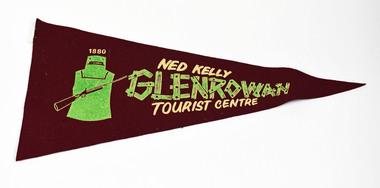 National Wool Museum
Pennant
... NED KELLY GLENROWAN TOURIST CENTRE 1880...Glenrowan Victoria NED KELLY GLENROWAN TOURIST CENTRE 1880 Pennant ...NED KELLY GLENROWAN TOURIST CENTRE 1880glenrowan, victoria -
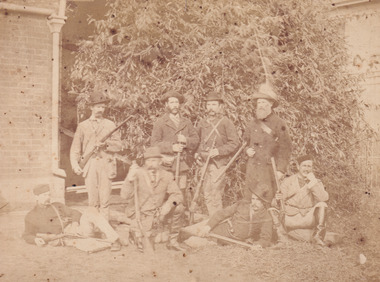 The Beechworth Burke Museum
Photograph
... ned kelly...ned kelly glenrowan...Kelly gang at Glenrowan. This photograph has the capacity to provide important information about the police who took part in Glenrowan 1880 and depicts key figures like Sergeant Steele. kelly album glenrowan police wangaratta police ned kelly ned kelly glenrowan william barnes photography 1880 australian history police photograph sargent steele sergeant steele W.E.Barnes / photographer / Wangaratta / BMM8085 Police responsible / for Kelly's capture / (D.S. not there) Sepia photograph taken by professional photographer William Edward Barnes (1941-1916) in June of 1880. ...According to the Victorian Patents Office Copyright Collection (VPOCC) index, Barnes' image was first published on July 3, 1880. Many of the photographs taken by William Barnes concerned with the Kelly Gang were registered with the VPOCC which has ensured their survival in the State Library of Victoria today. Thus image includes the depiction of Sergeant Arthur Loftus Maule Steele (kneeling in front row) surrounded by seven other men. These men are identified as belonging to the Wangaratta police who played a key part in the destruction of the Kelly Gang at Glenrowan. These men could include Constables Causey, Montiford, Patrick Healey, Walsh, William Moore, Dixon and James Dwyer. It is also suggested that the individual standing back right (in the dark coat) is Constable Hugh Bracken, a key figure in the Glenrowan Siege. The police in this image display their firearms in a manner which reflects photographs of hunters, an element which was typical for this period. This photograph is part of the Burke Museum "Kelly album" which includes a significant collection of photographs and artefacts connected to Ned Kelly and the Kelly Gang. Ned Kelly and his gang have become ingrained in Australian popular culture and thus many museums, art galleries and private collections house material connected to the Kelly story which allows the events and people to be researched and interpreted. Artefacts and photographs pertaining to the Kelly gang are particularly valuable for Australian museums. This particular photograph is significant for its connection to Wangaratta photographer William Barnes who is responsible for having taken and registered many images depicting members of the Kelly gang. The photograph is also of artistic significance as an example of a photograph dating to 1880. This image depicts members of the Wangaratta police shortly after the defeat of the Kelly gang at Glenrowan. This photograph has the capacity to provide important information about the police who took part in Glenrowan 1880 and depicts key figures like Sergeant Steele.Sepia photograph taken by professional photographer William Edward Barnes (1941-1916) in June of 1880. The photo depicts a contingent of Wangaratta police who were at the capture of the Kelly gang at Glenrowan on the 28th of June 1880. This group of eight men are photographed standing in front of foliage and between the sides of two brick structures. Four men stand upright behind four other men who are depicted in either a sitting, semi-lying or kneeling position.W.E.Barnes / photographer / Wangaratta / BMM8085 Police responsible / for Kelly's capture / (D.S. not there)kelly album, glenrowan, police, wangaratta police, ned kelly, ned kelly glenrowan, william barnes, photography, 1880, australian history, police photograph, sargent steele, sergeant steele -
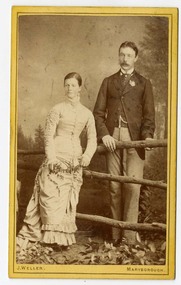 Victoria Police Museum
Carte de Visite (Patrick and Mary Gascoigne), J. Weller, 1875-1880
... ...Ned Kelly...Glenrowan...Kelly Gang Edward Kelly Ned Kelly Glenrowan Constable Gascoigne Patrick Charles Gascoigne Mary Ann Gascoigne Mary Ann Radford Police Murders Mr & Mrs P.C. ...Photograph of Patrick Charles Gascoigne and his wife Mary Ann (nee Radford). He is dressed in a suit (top button closed only) and his wife in a long white or light coloured dress, possibly a wedding dress.Mr & Mrs P.C. Gascoigne (blue pen on rear)kelly gang, edward kelly, ned kelly, glenrowan, constable gascoigne, patrick charles gascoigne, mary ann gascoigne, mary ann radford, police murders -
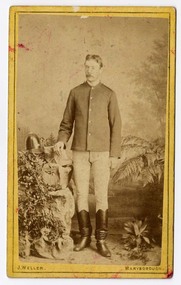 Victoria Police Museum
Carte de Visite (Patrick Gascoigne), J. Weller, 1875-1880
... ...Ned Kelly...Glenrowan...Kelly Gang Edward Kelly Ned Kelly Glenrowan Constable Gascoigne Patrick Charles Gascoigne Police Murders Mtd Const. ...Photographic image of Patrick Charles Gascoigne in his mounted constable uniform. Photograph is taken in a studio with his hat and right hand resting on a mock wall. Bushland setting created behind.Mtd Const. P.C. Gascoigne (blue pen on rear)kelly gang, edward kelly, ned kelly, glenrowan, constable gascoigne, patrick charles gascoigne, police murders -
 Victoria Police Museum
Envelope, Australia Post, 1980
... Ned Kelly...Glenrowan...Ned Kelly Glenrowan Bushrangers Kelly Gang Australia Post Souvenir postage paid envelope commemorating the 100th anniversary of the Glenrowan siege Envelope Australia Post ...Souvenir postage paid envelope commemorating the 100th anniversary of the Glenrowan siegeAustralia Postned kelly, glenrowan, bushrangers, kelly gang -
Victoria Police Museum
Pamphlet (Kelly Gang), The Kelly Legend
... Ned Kelly...Glenrowan...Ned Kelly Glenrowan Bushrangers Kelly Gang Kelly Myth Sidney Nolan Printed folded cardboard pamphlet. ...Printed folded cardboard pamphlet. Ned Kelly image on front cover in black and white. Inside large colour reprint of Sidney Nolan painting (right side) with Australian Sketcher and two other images (left side)ned kelly, glenrowan, bushrangers, kelly gang, kelly myth, sidney nolan -
 The Beechworth Burke Museum
Photograph - Carte de Visite
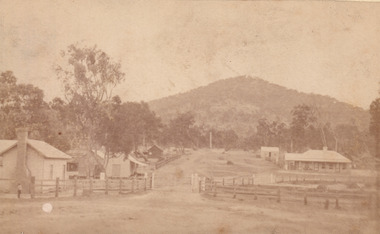
... ...ned kelly...glenrowan...This Carte-de-viste (CdV) previously belonged to the donor's grandfather, Daniel Mullins who was a Police Officer stationed at Glenrowan soon after the Kelly gang siege. Today, the siege has become an important part of Australian culture and Ned Kelly and the Kelly Gang (comprising of Ned Kelly, Dan Kelly, Steve Hart and Joe Byrne) has become ingrained in Australian history and mythology. ... Kelly and the Kelly gang's last stand. kelly album ned kelly glenrowan police history police australian architecture streetscape glenrowan 1883 1883 dan kelly steve hart joe byrne carte-de-viste james bray daniel mullins william e barnes colonial australia police station photograph Glenrowan / taken 1.4.83 ... / BMM 8086 This photograph is a sepia image of the Glenrowan streetscape depicting several buildings. ...In July of 1880, Ann Jones' successful hotel in Glenrowan burnt to the ground during the Kelly siege. She had opened her business in the year prior having been unsuccessful in her attempt to run a tea-room business in Wangaratta. The first building on this particular site was the home Ann Jones had built for herself and her family. Two years later she converted the home and added the hotel to the rear of the structure. One year later it was burnt to the ground. This image depicts the streetscape of Glenrowan in 1883, three years after the siege. Importantly, it reveals the appearance of several buildings which can reveal information for how Glenrowan (as a small town) might have stood during the siege. These buildings are of typical Australian colonial "miner's cottage" style. On what would have been the site of Ann Jones' hotel, to the far left of the photograph, a police station stands. This police station was built before April 1883. This image was captured by an unknown photographer. This Carte-de-viste (CdV) previously belonged to the donor's grandfather, Daniel Mullins who was a Police Officer stationed at Glenrowan soon after the Kelly gang siege. Today, the siege has become an important part of Australian culture and Ned Kelly and the Kelly Gang (comprising of Ned Kelly, Dan Kelly, Steve Hart and Joe Byrne) has become ingrained in Australian history and mythology. A CdV is a sepia toned photograph mounted on card and is generally of a small size. This particular style was first patented by Andre Adolphe Eugene Disdéri (1819-1889) in 1854. In 1857, the CdV was introduced to England and after photographs of Queen Victoria, Prince Albert and their family were taken using CdV in 1860 the popularity of this method reached a peak.This photograph is part of the Burke Museum "Kelly album" which includes a significant collection of photographs and artefacts connected to Ned Kelly and the Kelly Gang. Ned Kelly and his gang have become ingrained in Australian popular culture and thus many museums, art galleries and private collections house material connected to the Kelly story which allows the events and people to be researched and interpreted. Artefacts and photographs pertaining to the Kelly gang are particularly valuable for Australian museums. This particular photograph is significant for its connection to the Glenrowan Siege and Ann Jones' Hotel which burnt down during the siege in June 1880. Taken in 1883, this photograph (taken by an unidentified photographer) has the opportunity to provide information about the townscape of Glenrowan shortly after the siege. It also provides important insight into the architecture and layout of the town. To the far right of the image, the photograph depicts the police station which was built on the site of Ann Jones' Hotel which can provide important information for the Kelly story and how the town evolved following 1880. It is also interesting to emphasise that the police station was built on the site of Ned Kelly and the Kelly gang's last stand.This photograph is a sepia image of the Glenrowan streetscape depicting several buildings. The newly built police station (in 1883) stands on the far right of the image on the site of the former Ann Jones Hotel. On the left are several buildings built in typical 'miner's cottage' Australian colonial style. This includes the gable roof with the skillion at rear. An unidentifiable individual stands next to the chimney of the front left building. Numerous paddocks appear in the image, particularly in the front right and the rear of the houses contain many trees. To the rear of the image, there is a mountain. A street runs through the centre of the photograph.Glenrowan / taken 1.4.83 ... / BMM 8086kelly album, ned kelly, glenrowan, police history, police, australian architecture, streetscape, glenrowan 1883, 1883, dan kelly, steve hart, joe byrne, carte-de-viste, james bray, daniel mullins, william e barnes, colonial australia, police station, photograph -
 Victoria Police Museum
Carte de Visite (Glenrowan Station)
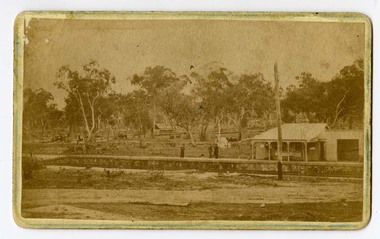
... Ned Kelly...Edward Kelly...Glenrowan...Kelly Gang Ned Kelly Edward Kelly Glenrowan Murders Police Murders Glenrowan Station (written in ink on rear) Black and white carte de visite showing Glenrowan Station showing three men standing on the station Carte de Visite (Glenrowan Station) ...Black and white carte de visite showing Glenrowan Station showing three men standing on the stationGlenrowan Station (written in ink on rear)kelly gang, ned kelly, edward kelly, glenrowan, murders, police murders -
 Victoria Police Museum
Sketch (Broken train rails)
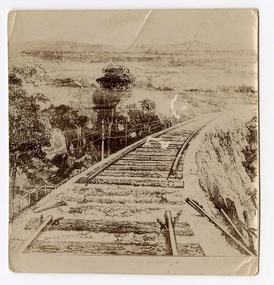
... ned kelly...edward kelly...glenrowan...kelly gang ned kelly edward kelly glenrowan police murders Scene where the train was to be wreaked. ...Black and white photograph of an illustration showing broken train railsScene where the train was to be wreaked. Australian I. Newskelly gang, ned kelly, edward kelly, glenrowan, police murders -
 Victoria Police Museum
Sketch (Ned Kelly on trial)
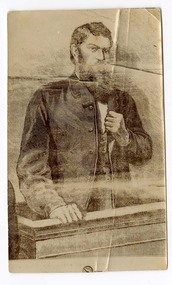
... ned kelly...edward kelly...glenrowan...kelly gang ned kelly edward kelly glenrowan police murders trial of ned kelly Ned Kelly in the Dock. ...Black and white photograph of an illustration showing Ned Kelly on trialNed Kelly in the Dock. The best likeness that I can show of him. Taken from the 'Australian News'.kelly gang, ned kelly, edward kelly, glenrowan, police murders, trial of ned kelly -
 Emerald Museum & Nobelius Heritage Park
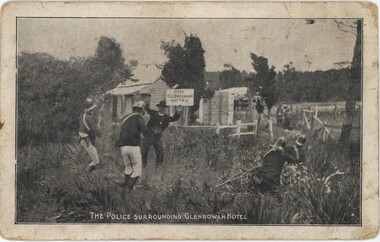
Postcard - The Police surrounding Glenrowan Hotel postcard, c. 1906
... A postcard depicting the siege of outlaw Ned Kelly at the Glenrowan Hotel....Ned Kelly postcards were found in an album of diverse postcards dating mainly from the late 19th and early 20th centuries. The movie, 'The Story of the Kelly Gang', of which this postcard is a still, marked the starting point of the development of narrative feature films which continue to be popular today. postcard photography 1900s Ned Kelly "Green Postcard Album" Front, bottom of image: 'The Police surrounding Glenrowan Hotel' Front, part of image: 'THE / GLENROWAN / HOTEL' Back, top: 'POST CARD' A postcard depicting the siege of outlaw Ned Kelly at the Glenrowan Hotel. ...This postcard is one of a set of five stills from 'The Story of the Kelly Gang' a movie which premiered in Melbourne on Boxing Day 1906 and was the first multi-reel, feature-length film ever produced in the world. It was extremely popular with audiences but because it portrayed the Kelly Gang as heroes and the police as villains, the Victorian Government eventually banned it from being screened in 1912. These Ned Kelly postcards were found in an album of diverse postcards dating mainly from the late 19th and early 20th centuries.The movie, 'The Story of the Kelly Gang', of which this postcard is a still, marked the starting point of the development of narrative feature films which continue to be popular today.A postcard depicting the siege of outlaw Ned Kelly at the Glenrowan Hotel.Front, bottom of image: 'The Police surrounding Glenrowan Hotel' Front, part of image: 'THE / GLENROWAN / HOTEL' Back, top: 'POST CARD'postcard, photography, 1900s, ned kelly, "green postcard album" -
 Eltham District Historical Society Inc
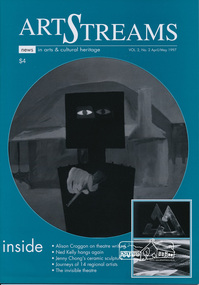
Journal, Peter Doughtery, ArtStreams: News in arts and cultural heritage; Vol. 2, No. 2, Apr-May 1997, 1997
... ...Ned Kelly at Glenrowan...." - Eltham District Historical Society Newsletter No. 161, March 2005 art streams food for all seasons Sidney Nolan Ned Kelly at Glenrowan Jenny Chong Manningham Artspace Alison Croggan Steve Vai Daniel Chable Recherche Speciality Picture Framing Harriet Dance Eva Gaitatzis Manningham Artspace Rick Amor Jenny Chong Geoffrey Gordon Dance Ernest Fries Isabel Davies lindsay edward Kazuko Eguichi Deborah Halperin Inge King Grahame King Kevin Lincoln David Moore akira takizawa tony trembath Carolyn Pickett Melbourne Writers' Theartre Faces Coffee House Eastern Metropolitan Opera Justin McMahon Albert Tucker Archimede Fusillo Slickers Whilefood delights Eltham School of Ballet Eltham Little Theatre Peter Chapple Alan Marshall Short Story Award Janet Drake Jon Weaving Barry Dickens do lunch at the library licensed cafe Ken Strong Wingrove Cottage Community Clinic helen o'grady children's drama academy Eltham High School Symphonic Band James Morrison Eltham Wiregrass Gallery & Cafe Colour front and back cover with feature articles and literary pieces with photographs and advertisements printed in black and white. 36 pages, 30 cm. ...Vol. 2, No. 2, Apr-May 1997 CONTENTS DRAWING ON NATURE Jenny Chong discusses the long transition from pottery to sculpture 3 THE WRITER IN THE THEATRE Alison Croggon talks about the pains and joys of writing for the theatre 6 A MUSICIAN'S MUSICIAN Daniel Chable on Steve Vai 9 JOURNEYS OF THE MIND The pathway of 14 regional artists 10 THE INVISIBLE THEATRE The contribution of the Melbourne writers' theatre 13 PHOTOGRAPHY Justin McMahon's camera turns the night sky into 'light paintings' 16 NOLAN AT MUSEUM OF MODERN ART Why the Ned Kelly series is the exhibition we had to have 18 THE VOICE IN BETWEEN Short story by Archimede Fusillo 21 THEATRE AND CD REVIEW A play that puts an Aboriginal and Torres Strait Islander point of view 26 THEATRE AND CD REVIEW 27 ALAN MARSHALL AWARDS 28 SOUL OF SOCIETY Ken Strong tackles some questions of creativity 30 "Peter Dougherty has been involved in the local art scene for many years. As publisher and editor of the arts magazine Artstreams, his comments on the various branches of the arts are widely respected. His "The Arts" column in the Diamond Valley Leader presents a brief summary for a much wider cross section of the local community. Peter also operates his own gallery and the Artstreams Cafe at the St Andrews market. Peter has a wealth of knowledge about present day and historical aspects of local art and artists." - Eltham District Historical Society Newsletter No. 161, March 2005Colour front and back cover with feature articles and literary pieces with photographs and advertisements printed in black and white. 36 pages, 30 cm. Vol. 1, no. 1 (Nov. 1996) - Vol. 10, no. 5 (summer ed. 2005/06) art streams, food for all seasons, sidney nolan, ned kelly at glenrowan, jenny chong, manningham artspace, alison croggan, steve vai, daniel chable, recherche speciality picture framing, harriet dance, eva gaitatzis, manningham artspace, rick amor, jenny chong, geoffrey gordon dance, ernest fries, isabel davies, lindsay edward, kazuko eguichi, deborah halperin, inge king, grahame king, kevin lincoln, david moore, akira takizawa, tony trembath, carolyn pickett, melbourne writers' theartre, faces coffee house, eastern metropolitan opera, justin mcmahon, albert tucker, archimede fusillo, slickers, whilefood delights, eltham school of ballet, eltham little theatre, peter chapple, alan marshall short story award, janet drake, jon weaving, barry dickens, do lunch at the library licensed cafe, ken strong, wingrove cottage community clinic, helen o'grady children's drama academy, eltham high school symphonic band, james morrison, eltham wiregrass gallery & cafe -
 Victoria Police Museum
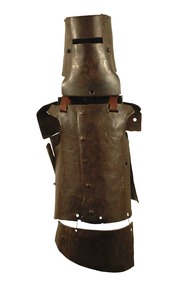
Armour (Dan Kelly), 1880
... Armour worn by Dan Kelly, Kelly Gang member and brother to Ned Kelly, during the Glenrowan Siege, August 1880....Armour worn by Dan Kelly, Kelly Gang member and brother to Ned Kelly, during the Glenrowan Siege, August 1880. ned kelly bushranger kelly gang dan kelly glenrowan victoria police Painted on inside of armour : 'Dan Kelly', 'Police Exhibition', 'E. ...Armour worn by Dan Kelly, Kelly Gang member and brother to Ned Kelly, during the Glenrowan Siege, August 1880.Armour worn by bushranger Dan Kelly including helmet (VPM1799.1); chest plate (VPM1799.2); back plate (VPM1799.3) and groin plate (1799.4). Armour constructed from heavy metal plough plates, bolted and welded together.Painted on inside of armour : 'Dan Kelly', 'Police Exhibition', 'E. Kelly' Impressed on plough VPM1799.3 'Huntly Crucible Cast'ned kelly, bushranger, kelly gang, dan kelly, glenrowan, victoria police -
 Whitehorse Historical Society Inc.
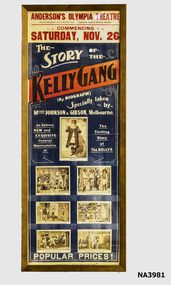
Poster, 21 - 11 10
... Seven photos: captioned 1. Ned Kelly, 2. Glenrowan Hotel the Kelly's at bay, 3. ...Seven photos: captioned 1. Ned Kelly, 2. Glenrowan Hotel the Kelly's at bay, 3. ...Louise Blake purchased this for our collection because of the connection of this area with the filming location.Framed and under glass reproduction of the original poster of the film 'The Story of the Kelly Gang' (by biograph) at Anderson's Olympia Theatre cnr Cambell & Elizabeth Streets, opposite Central Railway Station (Sydney) commencing Saturday, Nov 26. Specially taken by Messrs Johnson & Gibson, Melbourne. An entirely new and exquisite pictorial representation of the Thrilling Story of the Kelleys'. Seven photos: captioned 1. Ned Kelly, 2. Glenrowan Hotel the Kelly's at bay, 3. The notorious Kelly Gang, 4. Police locked up at Jerilderie at their own , 5. Don Kelly & Steve Hart shoot each other, 6. The bank robbery at Euroa and 7. Dan Kelly shoots Sherrit the spy. Popular prices. JJ Miller Print Co off Post Office Place, Melbourne 21 11 10.illustrations, reproductions -
 The Beechworth Burke Museum
Photograph
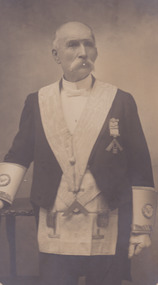
... Steele is well known in Victorian history for a variety of reasons, the most famous being the role he played in capturing Edward “Ned” Kelly at Glenrowan on the 28th June 1880. He also arrested Frank Neville (for the murder of a local resident Mr Nicholls) and Patrick Sheehan (first person to be executed in the Beechworth Gaol 1865 for the murder of James Kennedy at Rowdy Flat Yackandandah). ...Steele is well known in Victorian history for a variety of reasons, the most famous being the role he played in capturing Edward “Ned” Kelly at Glenrowan on the 28th June 1880. He also arrested Frank Neville (for the murder of a local resident Mr Nicholls) and Patrick Sheehan (first person to be executed in the Beechworth Gaol 1865 for the murder of James Kennedy at Rowdy Flat Yackandandah). ...This photograph, taken by Courtney’s Thelma Studios in Wangaratta, depicts Sergeant Arthur Loftus Maule Steele standing in the regalia of the Masonic Lodge. Before his death, Steele was a long term member of the St John’s Lodge of Masons where he was a Past Master and held office of treasurer for over thirty years. He was also a dedicated member of the Church of England and was an Electoral Inspector for Wangaratta. Steele was Sergeant of Police in Wangaratta for much of his life. He was one of 17 children born to Captain Robert Ball Steele and Mary Babington in Tours, France, in 1839. His parents were travelling at the time and soon after settled in Donegal, Ireland. At the age of 12, Steele was sent to the Military Academy of Dublin where he passed his examinations and prepared to enter the British Army. Steele met a bother of Robert O’Hara Burke and was advised to travel to Australia and join as a police cadet. Steele took the advice and travelled to Australia, arriving in Melbourne at the age of 17. He spend some time in a variety of employment including working as a clerk for the White Star Line. He entered the Victorian Police force in 1856. By 1864, Steele married Ruth Ingram Ballinger at Snowy Creek and worked at Omeo until being promoted to the mining centre of Beechworth, taking charge of the Yackandandah Station. Steele and Ballinger had ten children. Steele is well known in Victorian history for a variety of reasons, the most famous being the role he played in capturing Edward “Ned” Kelly at Glenrowan on the 28th June 1880. He also arrested Frank Neville (for the murder of a local resident Mr Nicholls) and Patrick Sheehan (first person to be executed in the Beechworth Gaol 1865 for the murder of James Kennedy at Rowdy Flat Yackandandah). He later worked on the case of Bridget Mepham (charged with the murder of her sister) at Wangaratta and retired from the Police force on the 1st of August 1896. In this retirement, Steele was a keen horticulturalist who enjoyed observing the habits and growth of new varieties cared for in his conservatory. Steele passed away in February 1914. This image has the potential to support current research on Sergeant Steele, the Masonic Lodge and photography during the c.1890s. Sergeant Steele is a well-researched member of the Victorian Police force and is known primarily for his involvement with the Kelly Gang. Therefore, depictions of Steele through photography can help to provide essential information about Steele outside of the Police force. This image has the capacity to inform about Steele’s involvement with the Masonic Lodge in Wangaratta. Therefore, it is important for what it can reveal regarding historic and social aspects. The Burke Museum is home to a large collection of Kelly centred photographs. The study of these photographs in connection to those in other museums have the ability to further current understanding on important figures and events in this historic occasion.Black and White rectangular photograph printed on matte photographic paper and mounted on an oval boardObverse: Courtney's Thelma Studios/ Wangaratta Reverse: 2747portrait, ned kelly, uniform, policeman, wangarratta, sergeant, steele, 1880, photograph, oval, black and white, sergeant steele, arthur loftus maule steele, arthur steele, wangaratta, beechworth -
 Victoria Police Museum
Carte de Visite (Ned Kelly), Carte de visite Edward
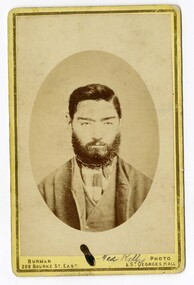
... The back was often a showy piece of lithographic printing with the photographer's name decorated with culicues. stringybark creek edward kelly ned kelly kelly gang police murders bushrangers glenrowan carte de visite michael kennedy police murders "Burman Photo 209 Bourke Street. ...Carte-de-visite is a small black and white photograph stuck to a card. It was invented by French photographer Andre Disderi in 1854 as a method for producing multiple images on a single glass plate, a format for mounting the resulting images on cards. The card on which the photograph was mounted displayed the name of the photographer on the front and back. The back was often a showy piece of lithographic printing with the photographer's name decorated with culicues.Sepia toned photograph of Edward "Ned" Kelly on cardboard in an oval shape."Burman Photo 209 Bourke Street. East & St Georges Hall" (front of carte de visite)stringybark creek, edward kelly, ned kelly, kelly gang, police murders, bushrangers, glenrowan, carte de visite, michael kennedy, police murders -
 Victoria Police Museum
Carte de Visite (Glenrowan Inn), James E Bray, 1878
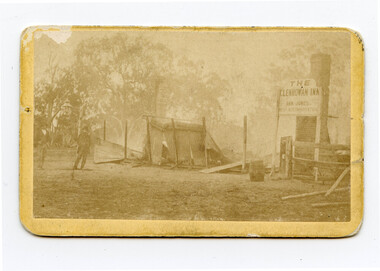
... Kelly Gang Ned Kelly Edward Kelly Police Murders Glenrowan Glenrowan Inn Small photograph of the Glenrowan Inn Carte de Visite (Glenrowan Inn) James E Bray ...Small photograph of the Glenrowan Innkelly gang, ned kelly, edward kelly, police murders, glenrowan, glenrowan inn -
 Victoria Police Museum
Carte de Visite (man in Kelly armour), Burman, Melbourne, 1878
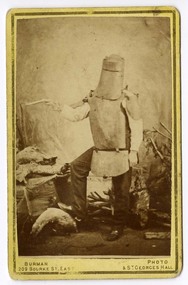
... Ned Kelly...Edward Kelly...Bushrangers...Glenrowan...Police Murders Kelly Gang Ned Kelly Edward Kelly Bushrangers Glenrowan Small black and white photograph of a man dressed in a suit of Kelly armour pointing a pistol Carte de Visite (man in Kelly armour) Burman, Melbourne ...Small black and white photograph of a man dressed in a suit of Kelly armour pointing a pistolpolice murders, kelly gang, ned kelly, edward kelly, bushrangers, glenrowan -
 Victoria Police Museum
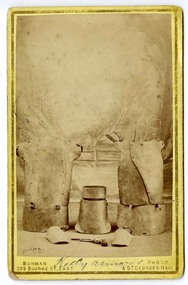
Carte de Visite (Kelly armour), Burman, Melbourne, 1880
... Ned Kelly...Edward Kelly...Bushrangers...Glenrowan...Police Murders Kelly Gang Ned Kelly Edward Kelly Bushrangers Glenrowan Kelly Armour (under photograph in ink) Small black and white photograph of Kelly Armour set out with torso sections separated. ...Small black and white photograph of Kelly Armour set out with torso sections separated. Helmet is in the middle with pistol in the foregroundKelly Armour (under photograph in ink)police murders, kelly gang, ned kelly, edward kelly, bushrangers, glenrowan -
 Victoria Police Museum
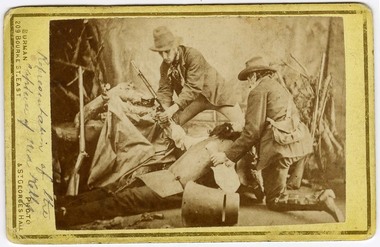
Carte de Visite (re-enactment of Ned Kelly's capture), Burman, Melbourne, 1880
... Glenrowan Siege Kelly Gang Ned Kelly Edward Kelly Bushrangers Small black and white photograph of a re-enactment of Ned Kelly's capture Carte de Visite (re-enactment of Ned Kelly's capture) Burman, Melbourne ...Small black and white photograph of a re-enactment of Ned Kelly's captureglenrowan siege, kelly gang, ned kelly, edward kelly, bushrangers -
 Victoria Police Museum
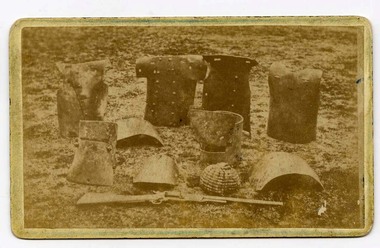
Carte de Visite (Kelly armour)
... Kelly Gang Glenrowan Edward Kelly Ned Kelly Kelly Armour Police Murders Small sepia coloured photograph of Kelly Gang armour laid out on the ground. ...Small sepia coloured photograph of Kelly Gang armour laid out on the ground. Rifle and scull cap can be seen. kelly gang, glenrowan, edward kelly, ned kelly, kelly armour, police murders -
 Victoria Police Museum
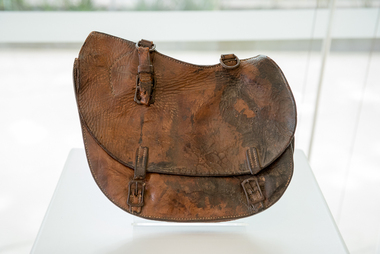
Cartridge bag (Ned Kelly)
... This cartridge bag was taken from Ned Kelly by Sergeant Steele, when he was finally apprehended in the famous shootout with police at Glenrowan, some two years after the Stringybark Creek murders. ...Sergeant Steele stated that the dark stain on the bag is Ned Kelly's blood: "That is Ned Kelly's cartridge bag. That is the one he was wearing at Glenrowan. ...This cartridge bag was taken from Ned Kelly by Sergeant Steele, when he was finally apprehended in the famous shootout with police at Glenrowan, some two years after the Stringybark Creek murders. Sergeant Steele stated that the dark stain on the bag is Ned Kelly's blood: "That is Ned Kelly's cartridge bag. That is the one he was wearing at Glenrowan. I took it off him, with the other things, when he fell. And that stain is his blood. He was wounded in several places, and bled a good deal. Yes it is a grim relic - not at all pretty". (Sergeant Steel) Cartridge bags such as these were worn slung over the shoulder (the strap for this one is missing). They were used to carry ammunition.Bag, saddle, leather with flap and two metal buckles with straps broken. Metal loop and larger metal buckle attached at top. edward kelly, ned kelly, kelly gang, arthur steele, glenrowan -
Victoria Police Museum
Report (Kelly Gang), December 1880
... ...glenrowan...ned kelly...kelly gang glenrowan ned kelly edward kelly reward thomas hewitt kirkham charles gascoigne james murdoch arthur daniel barry william canny john kelly john phillips Seven page hand written document written by Senior Constable Kelly regarding their claims to the Kelly Gang Reward Board Report (Kelly Gang) ...Seven page hand written document written by Senior Constable Kelly regarding their claims to the Kelly Gang Reward Boardkelly gang, glenrowan, ned kelly, edward kelly, reward, thomas hewitt kirkham, charles gascoigne, james murdoch arthur, daniel barry, william canny, john kelly, john phillips -
 City of Greater Bendigo - Civic Collection
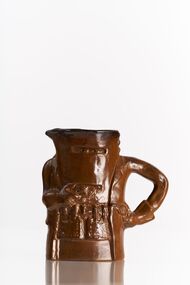
Artwork, other - Bendigo Pottery Toby Jug, Bendigo Pottery, Ned Kelly, c 1977
... Kelly died aged 25 at Melbourne Goal after being captured by Police in Glenrowan and sentenced to death. (Source Wikipedia). City of Greater Bendigo Tourism Bendigo Pottery Verso; NED KELLY / Bendigo Pottery Epsom (stamp) Underside; Bendigo Pottery / Limited / Edition Series / 879 / 3000 / Australia Brown glazed slip cast jug. ...Established by George Guthrie in 1857 (about 5km north of its current site) and then again seven years later in 1864 after it initially closed, Bendigo Pottery remains one of the most influential and longest running Pottery’s in Australia. Over the years the Pottery has contributed to the growth and development of the district through both its products including building products, table ware and decorative and commemorative war as well as artistically, being responsible for training and supporting many potters locally. The City of Greater Bendigo has had a long history of partnering with Bendigo Pottery and the Civic Collection holds a number of important items within its collection. Ned Kelly is one of Australia's most iconic outlaws. Kelly was born and raised in rural Victoria, the third of eight children to Irish parents. His father, a transported convict, died in 1866, leaving Kelly, then aged 12, as the eldest male of the household. The Kelly's were a poor selector family who saw themselves as downtrodden by the squattocracy and as victims of persecution by the Victoria Police. While a teenager, Kelly was arrested for associating with bushranger Harry Power and served two prison terms for a variety of offences, the longest stretch being from 1871 to 1874. He later joined the "Greta Mob", a group of bush larrikins known for stock theft. A violent confrontation with a policeman occurred at the Kelly family's home in 1878, and Kelly was indicted for his attempted murder. Fleeing to the bush, Kelly vowed to avenge his mother, who was imprisoned for her role in the incident. After he, his brother Dan, and associates Joe Byrne and Steve Hart shot dead three policemen, the government of Victoria proclaimed them outlaws. Kelly died aged 25 at Melbourne Goal after being captured by Police in Glenrowan and sentenced to death. (Source Wikipedia).Brown glazed slip cast jug. Includes details which are iconic to the image of Ned Kelly including face and body armour pistol and gloves. Ned's left arm forms the handle.Verso; NED KELLY / Bendigo Pottery Epsom (stamp) Underside; Bendigo Pottery / Limited / Edition Series / 879 / 3000 / Australiacity of greater bendigo tourism, bendigo pottery -
 The Beechworth Burke Museum
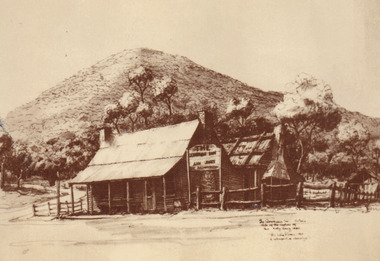
Postcard
... Glenrowan Inn owned by Ann Jones. / It was this Inn in which the Kelly Gang imprisoned / 62 people, while waiting for the special train / carrying the police to arrive from Benalla. On 28th / June 1880, following a seige which lasted over 12 / hours, Ned...Kelly story and the events of the Glenrowan Siege. Additionally, they can reveal information into the life of a female business owner during the 1870-1880 period. Archaeological research has been conducted at this site by LaTrobe University and a study of these images alongside the analysis of the material culture found at this location can help to build more comprehensive understanding into life in Australia during this period and Ann Jones herself. kelly album postcard glenrowan inn kelly siege australia yesteryear card cobb & co publisher ned kelly capture jones ann dan kelly joe byrne steve hart fire train police benalla 28 june 1880 Obverse: [Illegible] Reverse: G4/ 3276/ Australian / Yesteryear / cards/ correspondence / address / Published by Cobb & Co (03) 5766 2409 / The Glenrowan Inn owned by Ann Jones. / It was this Inn in which the Kelly Gang imprisoned / 62 people, while waiting for the special train / carrying the police to arrive from Benalla. ...This Australian yesteryear postcard was published by Cobb & Co in circa 1990. It is a sepia toned artwork of the Ann Jones Inn in Glenrowan which was taken prior to 1880. The building at rear in this photograph was the private residence of Ann Jones, a migrant from Tipperary, Ireland. Two years after building her private residence, in 1878/1879, Ann Jones added the Inn to the front of the building which is depicted in the postcard. In 1880 the Inn was burned to the ground during the Kelly Gang siege. After the siege, Ann Jones and her children continued to live on the same location in a makeshift hut. This hut was later replaced with a dwelling using compensation money provided to Ann from the government for the loss of her property and goods; however, she was denied a new trading licence which did not enable her to re-establish her previously successful business. The reverse of this postcard provides a snippet of information into the Glenrowan siege, for which this site is most well-known. It outlines the role and demise of the members of the Kelly Gang but what it does not include is how Ann Jones, owner of the Inn depicted on the postcard, was impacted. Ann’s son of 13 years, Johnny was killed during the siege, and a bullet grazed the forehead of her daughter, Jane Jones. Jane would die two years after this event from tuberculosis, but it was believed by Ann that the cause was grief for the death of her brother and distress at having witnessed the siege. Ann was provided with 100 pounds in compensation money for the loss of her children. Her husband, Owen Jones passed away late 1880 and in 1891 Ann Jones remarried. She died at the age of 80 in 1910. The “last stand” of the Kelly Gang at this location is estimated by Dr Stuart Dawson of Monash University to have taken less than 10 minutes in duration. During and following this time, the life of Ann Jones was turned upside down and everything she had worked for in the preceding years was now in ruins. This postcard has the capacity to reveal information about the popularity of the Kelly story in Australia. It was created in approximately the 1990s which perhaps reveals a resurgence in interest into the Kelly Gang and Australian history when card was made. This image, and others depicting the Ann Jone’s Inn, have the ability to shed light on the Kelly story and the events of the Glenrowan Siege. Additionally, they can reveal information into the life of a female business owner during the 1870-1880 period. Archaeological research has been conducted at this site by LaTrobe University and a study of these images alongside the analysis of the material culture found at this location can help to build more comprehensive understanding into life in Australia during this period and Ann Jones herself.Sepia rectangular postcard printed on cardObverse: [Illegible] Reverse: G4/ 3276/ Australian / Yesteryear / cards/ correspondence / address / Published by Cobb & Co (03) 5766 2409 / The Glenrowan Inn owned by Ann Jones. / It was this Inn in which the Kelly Gang imprisoned / 62 people, while waiting for the special train / carrying the police to arrive from Benalla. On 28th / June 1880, following a seige which lasted over 12 / hours, Ned Kelly was captured. Joe Byrne was shot, / and the Inn was set on fire in an attempt to flush out / the two remaining outlaws, Dan Kelly and Steve / Hart. However, some time prior, the two boys, it / was believed, had committed suicide, as a result, / their bodies were incinerated beyond recognition. / A sepia tone facsimile of / an early Australian photograph. /kelly album, postcard, glenrowan inn, kelly siege, australia yesteryear card, cobb & co publisher, ned kelly capture, jones ann, dan kelly, joe byrne, steve hart, fire, train, police, benalla, 28 june 1880 -
 The Beechworth Burke Museum
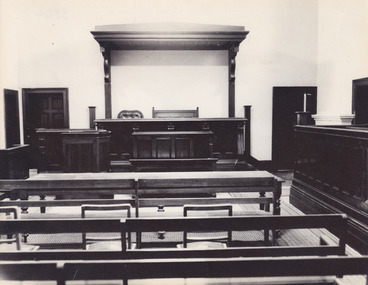
Photograph - Photograph - Reproduction
... The Beechworth Courthouse was the location of more than 40 trials and hearings for the Kelly Gang and their sympathisers, and was the site of Ned Kelly's committal hearing after his arrest at Glenrowan in 1880....The Beechworth Courthouse was the location of more than 40 trials and hearings for the Kelly Gang and their sympathisers, and was the site of Ned Kelly's committal hearing after his arrest at Glenrowan in 1880. The Beechworth Courthouse was built in 1858 and has been in continuous service for 131 years, retaining its original furniture and fittings. ...Interior view of the Beechworth Courthouse. The Beechworth Courthouse was the location of more than 40 trials and hearings for the Kelly Gang and their sympathisers, and was the site of Ned Kelly's committal hearing after his arrest at Glenrowan in 1880.The Beechworth Courthouse was built in 1858 and has been in continuous service for 131 years, retaining its original furniture and fittings. The Beechworth Historic Courthouse is one of Beechworth's most visited attractions. The courthouse was the location of more than 40 trails and hearings of the Kelly Gang and their sympathisers between 1878 and 1880.Black and white rectangular reproduced photograph printed on paperReverse: 3544kelly album, beechworth courthouse, kelly trials, ned kelly, kelly gang, beechworth historic precinct -
 The Beechworth Burke Museum
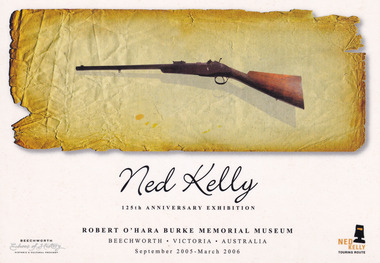
Postcard, 2005
... NED / KELLY / TOURING ROUTE / REVERSE: Ned Kelly / 125th ANNIVERSARY EXHIBITION / ROBERT O'HARA BURKE MEMORIAL MUSEUM BEECHWORTH . VICTORIA . AUSTRALIA / September 2005-2006 / AFFIX STAMP HERE / 7250 / This is the rifle that was taken from Henry Dudley by Ned Kelly. It became Ned's favourite / rifle, which he called 'Betty'. Note the 'K' carved into the wood of the fore-end. / Interestingly, there is at least one other rifle owned by Ned Kelly that also has a 'K' engraved / into it by Ned- the Colt revolving carbine used by Ned at Glenrowan...NED / KELLY / TOURING ROUTE / REVERSE: Ned Kelly / 125th ANNIVERSARY EXHIBITION / ROBERT O'HARA BURKE MEMORIAL MUSEUM BEECHWORTH . VICTORIA . AUSTRALIA / September 2005-2006 / AFFIX STAMP HERE / 7250 / This is the rifle that was taken from Henry Dudley by Ned Kelly. It became Ned's favourite / rifle, which he called 'Betty'. Note the 'K' carved into the wood of the fore-end. / Interestingly, there is at least one other rifle owned by Ned Kelly that also has a 'K' engraved / into it by Ned- the Colt revolving carbine used by Ned at Glenrowan ...To commemorate the 125th anniversary of Edward “Ned” Kelly’s committal trial in the Beechworth Historic Courthouse, the Robert O’Hara Burke Memorial Museum (henceforth Burke Museum) commissioned this postcard to coincide with their exhibition dating September 2005 to March 2006 and titled the Ned Kelly 125th Anniversary Exhibition. The postcard depicts a Snider-Enfield of .577 calibre which was reputedly favoured by the Bushranger. The firearm is of typical 1870s hunting design and was displayed as a focal point within this exhibition. The firearm, which was named “Betty” was reportedly taken by Kelly from Henry Dudley. The weapon has the letter ‘K’ engraved into the wood of the fore end. Other items also displayed in this exhibition include the Burke’s Kelly death mask, a replica of the Kelly Gang armour and photographs from the Burke Museum’s Kelly album. This postcard advertises an exhibition held at the Beechworth Burke Museum to commemorate the 125th anniversary of Kelly’s committal trial, which took place in Beechworth's historic courthouse. The selection and interpretation of items like the gun called 'Betty' are significant for understanding the changing nature of Kelly scholarship, treatment and curation, in particular, the popular and iconic myth of the Australian bushranger. The item can be compared with other Kelly photographs in Burke Museum's collection.Rectangular colour printed postcard celebrating Ned Kelly 125th Anniversary Exhibition at Burke Museum, Beechworth. Inset image of Ned Kelly's rifle. Obverse: Ned Kelly / 125th ANNIVERSARY EXHIBITION / ROBERT O'HARA BURKE MEMORIAL MUSEUM BEECHWORTH . VICTORIA . AUSTRALIA / September 2005-2006 / BEECHWORTH / Echoes of History / HISTORIC & CULTURAL PRECINCT / NED / KELLY / TOURING ROUTE / REVERSE: Ned Kelly / 125th ANNIVERSARY EXHIBITION / ROBERT O'HARA BURKE MEMORIAL MUSEUM BEECHWORTH . VICTORIA . AUSTRALIA / September 2005-2006 / AFFIX STAMP HERE / 7250 / This is the rifle that was taken from Henry Dudley by Ned Kelly. It became Ned's favourite / rifle, which he called 'Betty'. Note the 'K' carved into the wood of the fore-end. / Interestingly, there is at least one other rifle owned by Ned Kelly that also has a 'K' engraved / into it by Ned- the Colt revolving carbine used by Ned at Glenrowan /kelly album, ned kelly exhibition, ned kelly's rifle, betty, snider-enfield, .557 caliber, rifle, revolver, exhibition, beechworth, burke museum, 125th anniversary, firearm -
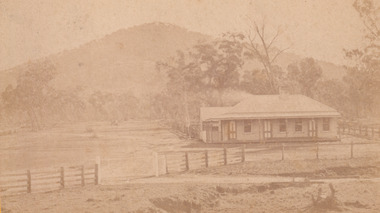 The Beechworth Burke Museum
Photograph - Carte de Visite, William E Barnes
... This Carte-de-viste (CdV) taken by renowned Wangaratta based photographer William Edward Barnes previously belonged to the donor's grandfather, Daniel Mullins who was a Police Officer stationed at Glenrowan soon after the Kelly gang siege. Today, the siege has become an important part of Australian culture and Ned Kelly and the Kelly Gang (comprising of Ned Kelly, Dan Kelly, Steve Hart and Joe Byrne) has become ingrained in Australian history and mythology. ...Ned Kelly and the Kelly Gang. Ned Kelly and his gang have become ingrained in Australian popular culture and thus many museums, art galleries and private collections house material connected to the Kelly story which allows the events and people to be researched and interpreted. Artefacts and photographs pertaining to the Kelly gang are particularly valuable for Australian museums. This particular photograph is significant for its connection to Wangaratta based photographer William Edward Barnes and to the Glenrowan ...In July of 1880, Ann Jones' successful hotel in Glenrowan burnt to the ground during the Kelly siege. She had opened her business in the year prior having been unsuccessful in her attempt to run a tea-room business in Wangaratta. The first building on this particular site was the home Ann Jones had built for herself and her family. Two years later she converted the home and added the hotel to the rear of the structure. One year later it was burnt to the ground. This image depicts the streetscape of Glenrowan in 1883, three years after the siege. Importantly, it reveals the appearance of several buildings which can reveal information for how Glenrowan (as a small town) might have stood during the siege. These buildings are of typical Australian colonial "miner's cottage" style. On what would have been the site of Ann Jones' hotel, to the far left of the photograph, a police station stands. This police station was built before April 1883. This Carte-de-viste (CdV) taken by renowned Wangaratta based photographer William Edward Barnes previously belonged to the donor's grandfather, Daniel Mullins who was a Police Officer stationed at Glenrowan soon after the Kelly gang siege. Today, the siege has become an important part of Australian culture and Ned Kelly and the Kelly Gang (comprising of Ned Kelly, Dan Kelly, Steve Hart and Joe Byrne) has become ingrained in Australian history and mythology. A CdV is a sepia toned photograph mounted on card and is generally of a small size. This particular style was first patented by Andre Adolphe Eugene Disdéri (1819-1889) in 1854. In 1857, the CdV was introduced to England and after photographs of Queen Victoria, Prince Albert and their family were taken using CdV in 1860 the popularity of this method reached a peak.This photograph is part of the Burke Museum "Kelly album" which includes a significant collection of photographs and artefacts connected to Ned Kelly and the Kelly Gang. Ned Kelly and his gang have become ingrained in Australian popular culture and thus many museums, art galleries and private collections house material connected to the Kelly story which allows the events and people to be researched and interpreted. Artefacts and photographs pertaining to the Kelly gang are particularly valuable for Australian museums. This particular photograph is significant for its connection to Wangaratta based photographer William Edward Barnes and to the Glenrowan Siege and Ann Jones' Hotel which burnt down during the siege in June 1880. Taken in 1883, this photograph has the opportunity to provide information about the townscape of Glenrowan shortly after the siege. It also provides important insight into the architecture and layout of the town. To the far right of the image, the photograph depicts the police station which was built on the site of Ann Jones' Hotel which can provide important information for the Kelly story and how the town evolved following 1880. It is also interesting to emphasise that the police station was built on the site of Ned Kelly and the Kelly gang's last stand.This photograph is a sepia image mounted on yellow card which depicts the newly built police station (in 1882) which stands on the far right of the image on the site of the former Ann Jones Hotel. A fence appears through the lower front of the image and an open paddock is to the left. In the rear centre of the image, there is a mountain. In front of the mountain are many trees, most of them gum. The police station is a one storey structure with a veranda and there are three doorways visible in the image. The image depicts four windows on the front of the station.W.E.Barnes / photographer / Wangaratta / ...1882 / BMM8087kelly album, william barnes, wangaratta photographer, carte-de-viste, glenrowan, 1882, police station, ann jones inn, ann jones hotel, kelly siege, glenrowan siege, colonial australia -
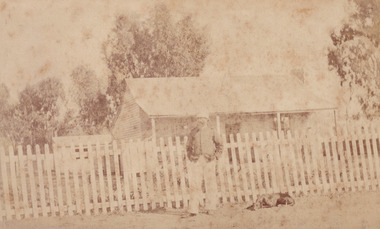 The Beechworth Burke Museum
Photograph - Carte de Visite
... Glenrowan soon after the Kelly gang siege. It is unclear; however, whether or not the man depicted in the photograph is Daniel Mullins or a different police officer. The Police Station at Glenrowan depicted in this CdV stood during the events of the Kelly gang's siege. Today, the siege has become an important part of Australian culture and Ned...Ned Kelly and the Kelly Gang. Ned Kelly and his gang have become ingrained in Australian popular culture and thus many museums, art galleries and private collections house material connected to the Kelly story which allows the events and people to be researched and interpreted. Items pertaining to the Kelly gang, including photographs like this one which depicts a police officer standing outside of the Glenrowan ...This Carte-de-viste (CdV) previously belonged to the donor's grandfather, Daniel Mullins who was a Police Officer stationed at Glenrowan soon after the Kelly gang siege. It is unclear; however, whether or not the man depicted in the photograph is Daniel Mullins or a different police officer. The Police Station at Glenrowan depicted in this CdV stood during the events of the Kelly gang's siege. Today, the siege has become an important part of Australian culture and Ned Kelly and the Kelly Gang (comprising of Ned Kelly, Dan Kelly, Steve Hart and Joe Byrne) has become ingrained in Australian history and mythology. A CdV is a sepia toned photograph mounted on card and is generally of a small size. This particular style was first patented by Andre Adolphe Eugene Disdéri (1819-1889) in 1854. In 1857, the CdV was introduced to England and after photographs of Queen Victoria, Prince Albert and their family were taken using CdV in 1860 the popularity of this method reached a peak. This photograph is part of the Burke Museum "Kelly album" which includes a significant collection of photographs and artefacts connected to Ned Kelly and the Kelly Gang. Ned Kelly and his gang have become ingrained in Australian popular culture and thus many museums, art galleries and private collections house material connected to the Kelly story which allows the events and people to be researched and interpreted. Items pertaining to the Kelly gang, including photographs like this one which depicts a police officer standing outside of the Glenrowan Police Station, are of great historical significance. Photographs like this can provide valuable information on the architecture, lifestyle and dress of colonial Australia. When studied, photographs have the ability to shed more light on the events of the Kelly gang and colonial Australia. This photograph is also of artistic significance because of the popularity of the CdV during the nineteenth century.A sepia toned photograph mounted on grey card with rounded corners. The image has been captured by an unknown photographer and depicts the outside the Glenrowan Police Station. In front of the Station stands an unidentified policeman and lying on the ground behind the policeman is a medium sized dog with dark colouring. The Police Station depicted in this photograph is a classic example of Australian country colonial architecture typically seen dating to the nineteenth century. It has the typical features of an Australian colonial 'miners' cottage' with the gable roof and a skillion at rear. A white picket fence is stands between the Station and the policeman. A small building is located at the rear of the Station which may have served as a lockup.BMM 8083kelly album, glenrowan, police, police station, photograph, ned kelly, australia, colonial australia, victoria, james bray, william e barnes, daniel mullins -
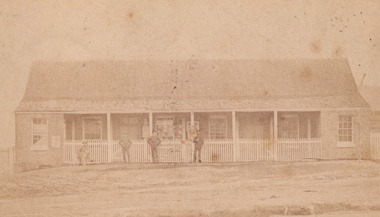 The Beechworth Burke Museum
Photograph - Carte de Visite, William E Barnes
... This Carte-de-viste (CdV) taken by renowned Wangaratta based photographer William Edward Barnes previously belonged to the donor's grandfather, Daniel Mullins who was a Police Officer stationed at Glenrowan soon after the Kelly gang siege. Today, the siege has become an important part of Australian culture and Ned Kelly and the Kelly Gang (comprising of Ned Kelly, Dan Kelly, Steve Hart and Joe Byrne) has become ingrained in Australian history and mythology. ... Kelly and the Kelly gang's last stand. kelly album william barnes wangaratta photographer carte-de-viste glenrowan 1882 police station ann jones inn ann jones hotel kelly siege glenrowan siege colonial australia ned kelly steve hart joe byrne william e barnes Obverse: 1. 2. 3. 4. ...In July of 1880, Ann Jones' successful hotel in Glenrowan burnt to the ground during the Kelly siege. She had opened her business in the year prior having been unsuccessful in her attempt to run a tea-room business in Wangaratta. The first building on this particular site was the home Ann Jones had built for herself and her family. Two years later she converted the home and added the hotel to the rear of the structure. One year later it was burnt to the ground. This image depicts the police station in 1882 on what would have been the site of Ann Jones' hotel. This Carte-de-viste (CdV) taken by renowned Wangaratta based photographer William Edward Barnes previously belonged to the donor's grandfather, Daniel Mullins who was a Police Officer stationed at Glenrowan soon after the Kelly gang siege. Today, the siege has become an important part of Australian culture and Ned Kelly and the Kelly Gang (comprising of Ned Kelly, Dan Kelly, Steve Hart and Joe Byrne) has become ingrained in Australian history and mythology. A CdV is a sepia toned photograph mounted on card and is generally of a small size. This particular style was first patented by Andre Adolphe Eugene Disdéri (1819-1889) in 1854. In 1857, the CdV was introduced to England and after photographs of Queen Victoria, Prince Albert and their family were taken using CdV in 1860 the popularity of this method reached a peak.This photograph is part of the Burke Museum "Kelly album" which includes a significant collection of photographs and artefacts connected to Ned Kelly and the Kelly Gang. Ned Kelly and his gang have become ingrained in Australian popular culture and thus many museums, art galleries and private collections house material connected to the Kelly story which allows the events and people to be researched and interpreted. Artefacts and photographs pertaining to the Kelly gang are particularly valuable for Australian museums. This particular photograph is significant for its connection to Wangaratta based photographer William Edward Barnes and to the Glenrowan Siege and Ann Jones' Hotel which burnt down during the siege in June 1880. Taken in 1882, this photograph has the opportunity to provide information about the townscape of Glenrowan shortly after the siege. It also provides important insight into the architecture and layout of the town. To the far right of the image, the photograph depicts the police station which was built on the site of Ann Jones' Hotel which can provide important information for the Kelly story and how the town evolved following 1880. It is also interesting to emphasise that the police station was built on the site of Ned Kelly and the Kelly gang's last stand.Sepia coloured photograph with a faded appearance. Image depicts four policemen with three standing and one sitting on a chair outside the Glenrowan police station. The station takes up the majority of the image and is placed in the centre of the photo. The four men are positioned on the left side of the station. The station is a large building with a gabled roof and extensions built into the veranda on either side. In between these extensions, the property has a white picket fence which runs from the extensions directly beneath the veranda enclosing the front of the structure. The letters 1, 2, 3, 4 are written on the yellow paper on which the image is situated and relate to the images in the photo. The reverse of the photo provides the names of each policeman and reveals the image as being from the collection of William E Barnes a Wangaratta based photographer.Obverse: 1. 2. 3. 4. Reverse: No. 1. is Mullins, D. G. / 2. Lord, Edward. / 3. Millar, Allex. / 4. Hedberg, O. G. / All Comrades / Glenrowan Police Station / 1 August 1882 / W. E. Barnes / Photographer / Wangaratta /kelly album, william barnes, wangaratta photographer, carte-de-viste, glenrowan, 1882, police station, ann jones inn, ann jones hotel, kelly siege, glenrowan siege, colonial australia, ned kelly, steve hart, joe byrne, william e barnes
