
Showing 464 items matching "new edges"
-
 University of Melbourne, Burnley Campus Archives
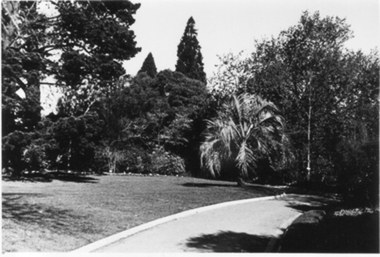
Photograph - Black and white photograph, E.M. Gibson, Garden View, September 1942
... ...new edges...garden view path new edges trees lawn Black and white photograph of the new path leading to the Orchard. ...garden view, path, new edges, trees, lawn -
 Mont De Lancey
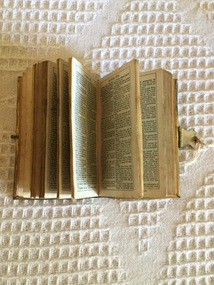
Book, Oxford University Press, The New Testament, 1857
... Miniature leather bound New Testament metal edged with metal clasp. Has Gilt edging. ...Donated by Norma Barnes.. bibles new testament Bowderry Miniature leather bound New Testament metal edged with metal clasp. Has Gilt edging. ...Used in 1859. Donated by Norma Barnes..Miniature leather bound New Testament metal edged with metal clasp. Has Gilt edging. Bowderrybibles, new testament -
 Bendigo Military Museum
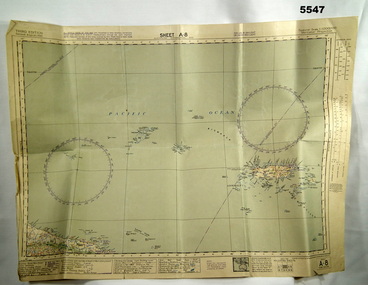
Map - EASTER NEW GUINEA NAVIGATION CHART, RAAF, Aug 1943
... Side 2 - Scale 1:1,000,000 - this shows Manus Island on right side, top of New Guinea at bottom edge (Wewak) and some other little islands. ...Side 2 - Scale 1:1,000,000 - this shows Manus Island on right side, top of New Guinea at bottom edge (Wewak) and some other little islands. ...From the collection of "Maxwell Lennox Matheson" No.418447 RAAF. Enlisted 22/5/1942 Aged 19. Discharged 19/2/1948 - Rank FLTLT.This map is in colour. It is made of a stiff paper and has a map printed on both sides. Side1 - scale 1:2,315,000. 31.72 Nautical miles = 1 inch. It shows Eastern half of New Guinea. It also shows New Britain and New Ireland. Manus Island is at the top. Side 2 - Scale 1:1,000,000 - this shows Manus Island on right side, top of New Guinea at bottom edge (Wewak) and some other little islands. The map on side 1 has numerous navigation tracks and calculations in pencil. i.e. LAE, KOKODA, PORT MORESBY.ww2, raaf, new guinea -
 Melbourne Tram Museum
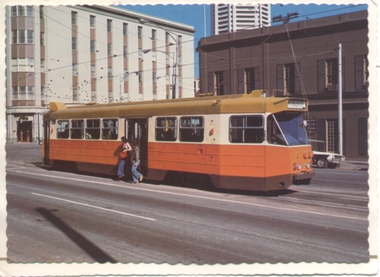
Postcard, Nu-color-Vue, tramcar Z2, c1975
... Colour postcard with serrated edges of new tramcar Z2, at the corner of Bourke and Spring Streets, c1975, mounted onto a sheet of paper with a window cut in to show the postcard title "Melbourne's new Z class Tram Number 2" Would appear to be have been produced by Nucolorvue Productions for the TMSV, as has the same style printing as Reg Item 72. ...Trams tramways MMTB Bourke St Spring St Z class tram 2 Colour postcard with serrated edges of new tramcar Z2, at the corner of Bourke and Spring Streets, c1975, mounted onto a sheet of paper with a window cut in to show the postcard title "Melbourne's new Z class Tram Number 2" Would appear to be have been produced by Nucolorvue Productions for the TMSV, as has the same style printing as Reg Item 72. ...Colour postcard with serrated edges of new tramcar Z2, at the corner of Bourke and Spring Streets, c1975, mounted onto a sheet of paper with a window cut in to show the postcard title "Melbourne's new Z class Tram Number 2" Would appear to be have been produced by Nucolorvue Productions for the TMSV, as has the same style printing as Reg Item 72. Other details not known. In the background are the Windsor Hotel and The Imperial Hotel. Two copies held.trams, tramways, mmtb, bourke st, spring st, z class, tram 2 -
 Flagstaff Hill Maritime Museum and Village
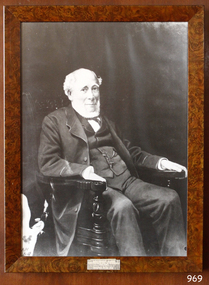
Photograph - Portrait, David Charles McArthur, Superintendent, Bank of Australasia 1867-1876
... New Zealand Bank ANZ Bank David Charters McArthur D C McArthur Lower left corner "A-H 1-9". Engraved on plaque "DAVID CHARTERS MCARTHUR \ SUPERINTENDENT \ BANK OF AUSTRALASIA \ 1867-1876" Photograph; portrait of David Charteris McArthur. Heavily retouched black and white print in plain brown varnished frame, behind glass, with plaque on lower edge ...The subject of this photograph, David Charteris McArthur, was the founding manager of the Bank of Australasia in Port Phillip (Melbourne). McArthur was born in 1808 in Gloucester, England, and educated in Scotland. He worked for an insurance firm in Edinburgh, where in 1835 he married Caroline, nee Wright. McArthur and his family party sailed from the U.K. to arrive in Sydney in October 1835, where he joined the Bank of Australasia when it opened in Sydney in December. McArthur sailed to Melbourne in August 1838 with 3000 pounds in coins, protected by armed guards and two bulldogs, to open the Melbourne branch of the Bank of Australasia. The branch grew quickly, servicing both private and government customers. He opened many branches in the goldfields during the 1850s. In 1862, he was appointed as general inspector of branches. He spent time with the bank in New Zealand. On his return to Melbourne, at age 57, he was put in charge of the entire bank. McArthur lived in the hills of Heidelberg, Melbourne. He was the first chairman of Associated Banks and was an advisor to politicians and merchants. He was retired in October 1876 by the London directors and given a free trip to London, an annuity and a seat on the bank’s Advisory Board. McArthur was active in the community, being a member of the Mechanics’ Institute, on the committee that advised Governor Hotham on the Colony’s finances, chairman of the Heidelberg Road Board, one of the original trustees of the Library of Victoria in 1853 and president of the trustees of the Public Library, Museums and National Gallery of Victoria in 1880-83. He was also on many other community organisations. He died in his home “Charterisville” in East Ivanhoe in 1887. He and Caroline had no children. The Melbourne branch of Australia and New Zealand Bank has a portrait of McArthur in its boardroom. St John's Church, Heidelberg, commemorates him with a stained-glass window entitled 'King David'. The McArthur Gallery in the National Gallery of Victoria is also named after him. (David's brother, Donald, moved from Sydney to Melbourne in 1836 with the first government survey team.) ABOUT THE BANK OF AUSTRALASIA In 1836 the Bank of Australasia was established in London by Royal Charter. In 1951 the bank merged with the Union Bank of Australia, to form ANZ Bank Limited. In 1970 it merged with the English, Scottish and Australian Bank to become Australia and New Zealand Banking Group Limited. Since that time the ANZ has acquired other banks and introduced Internet banking and mobile banking. BANK OF AUSTRALASIA IN WARRNAMBOOL The Bank of Australasia first opened in Warrnambool in July 1854 in a building on Merri Street. The manager was Mr Samuel Hannaford. The bank then purchased and moved to a stone building on the corner of Timor and Gibson Streets, previously owned by Cramond and Dickson and almost opposite the Examiner’s office. In January 1957 Mr W.H. Palmer became the new manager and was there until November 1869. The bank then built its own building on the corner of Timor and Kepler Streets in 1859. Mr Basil Spence, the teller, was appointed acting manager in 1869 and Mr H.B. Chomley was the next appointed manager, in April 1873 and was still manager in 1886. The municipality of Warrnambool first banked with the Bank of Australasia from 1856 to April 1857. David Charteris McArthur served as the founding manager of the Bank of Australasia. His leadership marked a significant chapter in Warrnambool's early commercial development. The municipality of Warrnambool relied on the Bank of Australasia as its official bank from 1856 until April 1857. This period is symbolised by a photograph of McArthur, which represents the origins of Warrnambool's commercial history and its early financial infrastructure.Photograph; portrait of David Charteris McArthur. Heavily retouched black and white print in plain brown varnished frame, behind glass, with plaque on lower edge and inscription lower left corner.Lower left corner "A-H 1-9". Engraved on plaque "DAVID CHARTERS MCARTHUR \ SUPERINTENDENT \ BANK OF AUSTRALASIA \ 1867-1876"flagstaff hill, warrnambool, shipwrecked-coast, flagstaff-hill, flagstaff-hill-maritime-museum, maritime-museum, shipwreck-coast, flagstaff-hill-maritime-village, bank of australasia, david charteris mcarthur, superintendent bank of australasia, colonial commerce, manager bank of australasia melbourne, colonial bank, warrnambool bank of australasia, shipwrecked coast, flagstaff hill maritime museum, maritime museum, shipwreck coast, flagstaff hill maritime village, great ocean road, boa, union bank, australia & new zealand bank, anz bank, david charters mcarthur, d c mcarthur -
 Flagstaff Hill Maritime Museum and Village
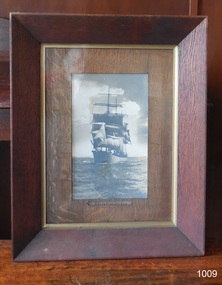
Photograph - Ship, Monkbarns, ca. 1924
... New South Wales hulk Front: "MONKBARNS" Reverse handwritten in pen: "PRESENTED TO A.F. WATSON / FOR S.S.V. BY / CAPT. F.K. BAXTER / 74 VERDON ST/ WILLIAMSTOWN " Reverse: "STEEL SHIP MONKBARNS / 1771 TONS REGISTER / 267 x 40' X 27'2" Draft / Build 1895 by McMillan, Dumbarton, Scotland / Converted to a hulk in /Spain 1927. / Photo taken in - Converted from NEWCASTLE N.S.W. about 1924" Photograph, black and white, of the ship "Monkbarns" , a steel hulled sailing ship under sail, bow facing viewer. Rectangular wooden frame has an inner gilt frame around a wide, natural bark matte. The lover edge ...This photograph was taken in about 1924 as it approached Newcastle, New South Wales before the sailing ship Monkbarns was converted for use as a hulk. The steel-hulled, 3-masted fully rigged ship was built in 1895 by Archibald McMillan & Son at Dumbarton in Scotland. It was 267 feet long, 40.1 feet wide and 23.5 feet deep. In 1914 John Stewart & Co. owned ten sailing vessels, one of which was the Monkbarns, but by the end of the first World War, the fleet had only four vessels survived the war, including the Monkbarns. The Monkbarns traded across the world. Some of the destinations included Port Adelaide, Table Bay in South Africa, Liverpool, Sydney, London and New York. Her last commercial voyage was in 1926. Overall, the ship traded for 32 years before it was converted in Spain in 1927 for use as a hulk for carrying coal. There were several owners of the ship over its lifetime. They were - 1895, first owner, Charles Webster Corsar, Liverpool - 1902, the owner was D. Corsar & Son, Liverpool - 1909, owned by John Hardie & Sons, Glasgow - 1911, John Stewart & Co., Liverpool - by1915, James A. Young, London - 1926, L.H. Wilson, Liverpool - 1927, Ballener Espando (Brunn & van Lippe, Tonsberg).Photograph, black and white, of the ship "Monkbarns" , a steel hulled sailing ship under sail, bow facing viewer. Rectangular wooden frame has an inner gilt frame around a wide, natural bark matte. The lover edge of the matte has a decorative rectangular cut-out surrounding an inscription with the ship's name. On the back is a handwritten inscription about the ship and the presentation of the photograph..Front: "MONKBARNS" Reverse handwritten in pen: "PRESENTED TO A.F. WATSON / FOR S.S.V. BY / CAPT. F.K. BAXTER / 74 VERDON ST/ WILLIAMSTOWN " Reverse: "STEEL SHIP MONKBARNS / 1771 TONS REGISTER / 267 x 40' X 27'2" Draft / Build 1895 by McMillan, Dumbarton, Scotland / Converted to a hulk in /Spain 1927. / Photo taken in - Converted from NEWCASTLE N.S.W. about 1924"flagstaff hill, warrnambool, maritime village, maritime museum, flagstaff hill maritime museum & village, shipwreck coast, great ocean road, monkbarns, sailing ship, newccastle, new south wales, hulk -
 Flagstaff Hill Maritime Museum and Village
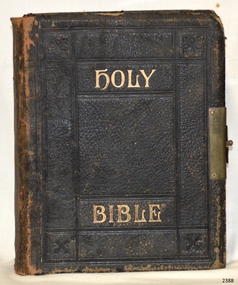
Book - Religious, University Press, The Holy Bible, Ca. 1850s
... edges of two pages . The Bible is the King James Version, named after James Charles Stuart (1556-1625) who was King James VI of Scotland from 24 July 1567, and who was crowned King James I of England, France and Ireland from 24 March 1603 until his death in 1625. The Hampton Court Conference of 1604 commissioned a new...edges of two pages . The Bible is the King James Version, named after James Charles Stuart (1556-1625) who was King James VI of Scotland from 24 July 1567, and who was crowned King James I of England, France and Ireland from 24 March 1603 until his death in 1625. The Hampton Court Conference of 1604 commissioned a new ...This Bible belonged to the Bell family. Joseph Bell was born on May 9th 1829. He married Elizabeth, who was born on October 22nd, 1833. Their marriage was conducted on September 12th, 1854, at St Pauls, Bristol, England. On the front pages of the bible there used to be a list of their ten children and their birthdates but there are only remnants of a heavy weight paper; the opposite Fly page with publication details is also missing, along with the Family Records section, which no longer has pages for Births and Marriages, only precise edges of two pages . The Bible is the King James Version, named after James Charles Stuart (1556-1625) who was King James VI of Scotland from 24 July 1567, and who was crowned King James I of England, France and Ireland from 24 March 1603 until his death in 1625. The Hampton Court Conference of 1604 commissioned a new and more accurate version of the Holy Bible that was translated from the original Sacred Scriptures and that included only the approved books. This task was undertaken be a group of learned scholars who worked in teams and compared notes, working to ensure a true and accurate version. It was completed in 1611 and became widely known as the King James Version (KJV) of the Bible and is still widely used and greatly respected for its poetic language. The first printed page of this Bible is the Translators Speech at the completed work which was handed over to King James I in 1611.This Bible was published after 1611, and likely to have been purchased at the time of the marriage of the previous owners, Joseph and Elizabeth Bell, in 1854, so it is possibly a century and a half old. The decorative cover and metal clasp are a sign that the Bible was a book to be treasured,. Indeed, our Collection included several Bibles brought to Australia by immigrants, even though luggage was tightly restricted. This Bible was once used as a family record, similar to Bibles printed in modern times, with lined blank pages in the centre for the owners to record their own, their ancestors' and their descendants' life events. Sadly, these pages are no longer within the Bible.Book, black textured leather front and back covers, gold leaf page edges, metal clasp on centre edge of front and back covers holds them together. The title is inscribed in gold embossing on the front cover. The Bible has coloured illustrations, cross references and maps. The front inside cover has remnants of a previous stuck-down page, the Fly page, and the Family Records pages for Births and Marriages has been cut out of the book. TITLE: The Holy Bible. PRINTER: University Press, London, England PREVIOUS OWNERS; Joseph and Elizabeth Bell, married in Bristol, England in 1854.Embossed in gold on cover: "HOLY BIBLE"warrnambool, shipwreck coast, flagstaff hill, flagstaff hill maritime museum, flagstaff hill maritime village, religious book, bible, holy bible, king james bible, king james vi, king james i, 1611, kjv, joseph bell, elizabeth bell, st paul's church bristol, 1829, 1833, 1854, authorised king james version, authorised version, av, sacred scriptures -
 Flagstaff Hill Maritime Museum and Village
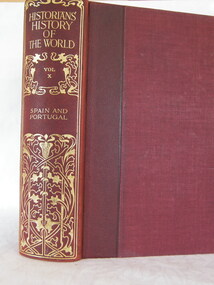
Book - Reference Book/History, Henry Smith Williams, The Historians History of the World Vol 10 set 1 - Edited by Henry Smith Williams L.L.D. Published by “The Times” 1908, 1908
... There was a great missionary impulse at this time that carried this theme to the “New World” where conquest is justified through the lens of spreading the faith. In affect a “Dual-Edged Sword”. ...There was a great missionary impulse at this time that carried this theme to the “New World” where conquest is justified through the lens of spreading the faith. In affect a “Dual-Edged Sword”. ...The 1908 edition of The Historians' History of the World is a monumental work of Edwardian scholarship, representing a specific era of "universal history" where the goal was to synthesise all human knowledge into a single narrative. Volume 10 specifically focuses on the Late “Middle Ages” and the “Renaissance period”, particularly in Italy and Spain. Starting with the clash of civilisations, Islam vs. Christianity.The Book is part of a 25 volume set with red cloth bindings and gold filigree design to rib.non-fictionThe 1908 edition of The Historians' History of the World is a monumental work of Edwardian scholarship, representing a specific era of "universal history" where the goal was to synthesise all human knowledge into a single narrative. Volume 10 specifically focuses on the Late “Middle Ages” and the “Renaissance period”, particularly in Italy and Spain. Starting with the clash of civilisations, Islam vs. Christianity. flagstaff hill, warrnambool, shipwrecked-coast, flagstaff-hill, flagstaff-hill-maritime-museum, maritime-museum, shipwreck-coast, flagstaff-hill-maritime-village, the historians history of the world vol 10 set 1, book -
 Flagstaff Hill Maritime Museum and Village
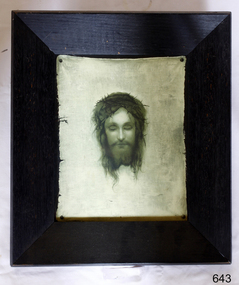
Print - Religious Print, Reinthal & Newman, Jesus Chrisus, ca 1906 - 1960s
... Print on paper; black and grey drawing on beige canvas-look background with image of fixing pins in each corner, edges look like torn fabric. Published by Reinthal & Newman, New York. Print is behind glass, mounted in a heavy wooden frame that is painted dark brown. ...Print on paper; black and grey drawing on beige canvas-look background with image of fixing pins in each corner, edges look like torn fabric. Published by Reinthal & Newman, New York. Print is behind glass, mounted in a heavy wooden frame that is painted dark brown. ...Print of an original oil painting created in 1874 (these numbers are in the top left corner) by artist Gabriel Max ("Gab Max" is in the top right corner) and reproduced by Kodak. The reproduction was likely made for the Mission to Seamen from the early 1906 to the 1960s to hang in its chapel. The publisher Reinthal & Newman, New York, was in business between 1906 and 1928. The company originally published postcards, but from 1920, it published prints of art from original works of famous and not-so-well-known artists. The published items were distributed by the House of Art, NY, which continued into the 1950s. The print was donated by the Williamstown Lightkeepers' Auxiliary to become part of the original furnishings of St Nicholas Seamen's Church, Williamstown, Victoria. The church was operated by the Mission to Seamen organisation. THE MISSIONS TO SEAMEN (Brief History): - The Missions to Seamen was an Anglican charity in Great Britain that has served the world's seafarers since 1856. Its symbol is a Flying Angel, inspired by a Bible verse. Today, there are centres in over 200 ports worldwide where seamen of all backgrounds are offered a warm welcome and provided with a wide range of facilities. In Victoria, the organisation began in Williamstown in 1857 as a Sailors’ Church, also known as ‘Bethel’ or the ‘Floating Church’ in an old hulk floating in Hobson’s Bay, Port of Melbourne. It soon became part of the Missions to Seamen, Victoria. In 2000, the organisation, now named Mission to Seafarers, still operated locally in Melbourne, Portland, Geelong and Hastings. The Ladies’ Harbour Lights Guild was formed in 1906 to support the Missions to Seamen in Melbourne and other centres, such as Williamstown. Two of the most significant ladies of the Guild were founder Ethel Augusta Godfrey and foundation member Alice Sibthorpe Tracy (who established a branch of the Guild in Warrnambool in 1920). The Guild continued its work until the 1960s. In 1943, a former Williamstown bank was purchased for the Missions to Seamen Club. The chapel was named St Nicholas’ Seamen’s Church and was supported by the Ladies’ Harbour Lights Guild, the Williamstown Lightkeepers’ Auxiliary and the League of Soldiers’ and Sailors’ Friends. It ceased operation in 1966. A Missions to Seamen Chapel and Recreation Room was a significant feature of ports during the late 1800s and 1900s. It seemed appropriate for Flagstaff Hill to include such a representation within the new Maritime Village, and the Melbourne Board of Management of Missions to Seamen Victoria gave its permission on 21st May 1979 for the entire furnishings of the Williamstown chapel to be transferred to Flagstaff Hill. The St Nicholas Seamen’s Church was officially opened on October 11, 1981, and resembles the Williamstown chapel. The print is significant because of its association with the Mission to Seamen in Williamstown, Victoria, and the Williamstown Lightkeepers' Auxiliary. This organisation had strong connections to the colonisation of Victoria by people travelling and arriving by sea. The picture is also significant as a representation of 19th-century religious art by Gabriel Cornelius von Max.Print of an oil painting representing Jesus Christ, closed eyes, tear on cheek, with a crown of thorns, titled “Jesus Christus”, produced in 1874 by 19th-century artist Gabriel Cornelius von Max (GAB MAX). Print on paper; black and grey drawing on beige canvas-look background with image of fixing pins in each corner, edges look like torn fabric. Published by Reinthal & Newman, New York. Print is behind glass, mounted in a heavy wooden frame that is painted dark brown. The reverse has numbers on a small white label. The base of the reverse has two small holes, each with indentations from something round. The backing board has indentations from nails no longer there. There are remnants of the original hanging wire, but this has been replaced. Part of the St Nicholas Seamen's Church Collection.FRONT: Top left :1874” Top right “GAB MAX” [Gabriel Cornelius von Max] Handwritten script under the picture “Jesus Christus”. Printed bottom left on front “A33 © REINTHAL & NEWMAN PUBS. N.Y.” REVERSE: “162” written in black felt pen on white label. Pencilled on reverse "11 3/8 x 9 1/4" and "Kodak" and other indecipherable markings.flagstaff hill, warrnambool, shipwrecked-coast, flagstaff-hill, flagstaff-hill-maritime-museum, maritime-museum, shipwreck-coast, flagstaff-hill-maritime-village, christian art, picture of jesus christ, jesus christus, photographic print of jesus christ, missions to seamen victoria, mission to seafarers, flying angel’s club, religious worship, reinthal & newman new york, jesus christ with crown of thorns, religion, religious service, sailors rest, bethel sailors’ church, bethel floating church, ladies harbour light guild, harbor lights guild, joy club for fighters, ladies lightkeepers’ auxiliary, st nicholas mission to seamen church williamstown, mission to seamen williamstown, st nicholas seamen’s church flagstaff hill, 139 nelson place williamstown, print, religious print, jesus christ, 1874, 19th century artist, gabriel cornelius von max, gab max, gabriel max, reinthal & newman, oil painting, st nicholas seamen's church, a33 © reinthal & newman pubs. n.y., kodak, house of art, williamstown lighthouse keepers' auxiliary, flagstaff hill maritime museum and village, maritime museum, maritime village, shipwreck coast, great ocean road, worship service, st nicholas seamen’s church, williamstown, st nicholas missions to seamen’s church williamstown, missions to seamen, st nicholas missions to seamen’s church flagstaff hill, anglican church, church furnishings, religious furnishings -
 Flagstaff Hill Maritime Museum and Village
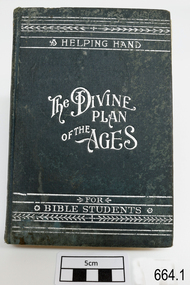
Book - Reference Religious Ideology, Charles Taze Russell, Millennial Dawn Vol 1 The Plan of the Ages, 1905
... New Testament prophecies. No Library label on the spine and no other stickers of markings noticeable Millennial Dawn Vol 1 (The Plan of The Ages) Author: Charles Taze Russell Publisher: Watch Tower Bible & Tract Society. Allegheny, PA USA 1905 Date: 1905 Further Information: Blue hard cover book with white text to lettering and front board edge ...Millennial Dawn, Vol. 1 (The Plan of the Ages) was published in 1905 by the Watch Tower Bible & Tract Society and is a central text in the history of modern American millenarianism. The subject book was originally published in 1886 under the title The Plan of the Ages, and later re-titled The Divine Plan of the Ages as part of the Studies in the Scriptures series. Volume 1 lays out the foundational theological framework of Charles Taze Russell's religious movement. The book argues that God operates through distinct chronological "dispensations" or ages, such as the Patriarchal Age, the Jewish Age, and the Gospel Age, leading up to the "Millennial Age". Its primary themes include the harmonising of the scriptures while attempting to systematically reconcile Old and New Testament prophecies.Millennial Dawn Vol 1 (The Plan of The Ages) Author: Charles Taze Russell Publisher: Watch Tower Bible & Tract Society. Allegheny, PA USA 1905 Date: 1905 Further Information: Blue hard cover book with white text to lettering and front board edge pattern designnon-fictionMillennial Dawn, Vol. 1 (The Plan of the Ages) was published in 1905 by the Watch Tower Bible & Tract Society and is a central text in the history of modern American millenarianism. The subject book was originally published in 1886 under the title The Plan of the Ages, and later re-titled The Divine Plan of the Ages as part of the Studies in the Scriptures series. Volume 1 lays out the foundational theological framework of Charles Taze Russell's religious movement. The book argues that God operates through distinct chronological "dispensations" or ages, such as the Patriarchal Age, the Jewish Age, and the Gospel Age, leading up to the "Millennial Age". Its primary themes include the harmonising of the scriptures while attempting to systematically reconcile Old and New Testament prophecies.flagstaff hill, warrnambool, shipwrecked-coast, flagstaff-hill, flagstaff-hill-maritime-museum, maritime-museum, shipwreck-coast, millennial dawn vol 1 the plan of the ages, book, religious works, watch tower bible & tract society, charles taze russell, jehova witness, bible studies -
 Flagstaff Hill Maritime Museum and Village
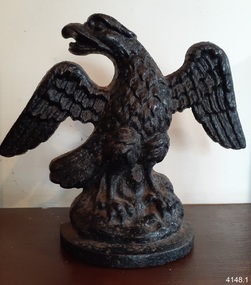
Decorative object - Bookends
... Williams ANZ Bank Australia and New Zealand Bank Union Bank of australia Bookends; two (2) black metal eagles, standing, beaks open, tail to the side, wings spread, claws open. The black figures are cast metal and the backs are hollow, with flat even edges. ...The individual eagles in this pair of Napoleonic Eagle bookends are made so that each eagle faces the opposite direction to the other, one left and one right. The Napoleonic Eagle is the name given to the eagle symbol used by Napoleon Bonaparte 1799-1815 and the French Regiments, mounted on a standard to represent the honour and pride of fighting French men. It is believed that the Napoleonic Eagle was chosen as a symbol for the Tamar Bank in Launceston, Tasmania, established in 1834. The bank was formed after the separation of one of the branches of the Bank of Van Diemen’s Land. The Managing Director in 1834 was Lewis Gilles, previously a naval officer. Other directors were T. Williams, M. Connolly, F. D. Wickham, and P. Oakden. The bank was dissolved in 1838 and became the basis of the Launceston branch of the British-founded Union Bank of Australia Limited, established in 1837 and had its own emblem. The Union Bank of Australia merged with the Bank of Australasia in 1951 and went on to eventually become part of the Australia and New Zealand (ANZ) Banking Group. The Bank of Australasia was incorporated by Royal Charter of England in March 1834. It had its Australian beginning on 14th December 1835, opening in Sydney. The Acting Superintendent of the bank at that time was David Charters McArthur. He was Superintendent from 1867 to 1876. The Melbourne branch opened on 28th August 1838 in a two-roomed brick cottage on the north side of Little Collins Street. By 1879 the bank had been upgraded to a magnificent two-storey building on the corners of Collins and Queens Streets, with the entry on Collins Street. In 1951 the Bank of Australasia amalgamated with the Union Bank to form the Australia and New Zealand Bank, now known as the ANZ. Then in 1970, the ANZ merged with the ES&A and the London Bank of Australia to form the ANZ Banking Group Limited. The ANZ Banking Group Ltd kindly donated to Flagstaff Hill various historic items from the Bank of Australasia. BANK of AUSTRALASIA, WARRNAMBOOL – In 1854 Warrnambool had two banks, the Union Bank and the Bank of Australasia. Later, completely different bank businesses opened; in 1867 the National Bank of Australasia, then in 1875 the Colonial Bank of Australasia. The original Warrnambool branch of the Bank of Australasia was established in July 1854, and operated from a leased cottage on Merri Street, close to Liebig Street. The bank next bought a stone building previously erected by drapers Cramond & Dickson on the corner of Timor and Gibson Streets. Samuel Hannaford was a teller and then Manager at the Warrnambool branch from 1855 to 1856 and the Warrnambool Council chose that bank for its dealings during 1856-57. In 1859 Roberts & Co. was awarded the contract to build the new Bank of Australasia branch for the sum of £3,000; the firm built the Warrnambool Post Office in 1856 and purchased land in Timor Street in 1858. The land was on a sand hill on the northeast corner of Timor and Kepler Streets and had been bought in 1855 by investor James Cust. The new building opened on May 21, 1860. The bank continued to operate there until 1951 when it merged with the Union Bank to form the ANZ Bank, which continued operating from its Liebig Street building. Warrnambool City Council purchased the former Bank of Australasia building in 1971 and renovated it, then on 3rd December 1973 it was officially opened as the Art Gallery by Cr. Harold Stephenson and Gallery Director John Welsh. The Gallery transferred to the purpose-built building on Liebig Street in 1986 and the old bank building is now the Gallery Club. Staff at the Bank of Australasia in Warrnambool included the following men but others were also involved: Samuel Hannaford, Teller then Manager from 1855-1856; Hawkins, Manager in 1856, W H Palmer, Manager from January 1857 until November 1869 when the Teller Basil Spence was promoted to Manager; H B Chomley, Manager from April 1873 and still there in 1886; A Butt, Manager in 1895-1904; J R McCleary Accountant and Acting Manager for 12 months, until 1900; A Kirk, Manager 1904; J Moore, staff until his transfer to Bendigo in December 1908; J S Bath was Manager until 1915; C C Cox, Manager until April 1923; Richard C Stanley, Manager 1923 to April 1928. This pair of Napoleonic Eagle bookends represents the type of ornaments appropriate for 19th and 20th-century business associated with finance and commerce. They symbolise strength, reliability and power. It is believed that the Napoleonic Eagle was the seal of the Tamar Bank, established in 1834 in Launceston, Tasmania. The Tamar bank was taken over by the Australia-wide Union Bank in 1838, which later merged with the Bank of Australasia, which had a branch in Warrnambool. In 1851 it became the Australia and New Zealand Bank, which is still active in Warrnambool in 2023. Bookends; two (2) black metal eagles, standing, beaks open, tail to the side, wings spread, claws open. The black figures are cast metal and the backs are hollow, with flat even edges. The front is textured and shiny. The eagles are facing opposite directions; one left, one right. The figures are commonly known as Napoleonic eagles.flagstaff hill maritime museum and village, warrnambool, great ocean road, shipwreck coast, bookends, eagle bookends, napoleonic eagles, tamar bank, launceston bank, bank of australasia, eagle symbol, 1834-1838, commerce, financial institution, colonial bank, lewis gilles, m. connolly, f. d. wickham, and p. oakden., t. williams, anz bank, australia and new zealand bank, union bank of australia -
 Federation University Historical Collection
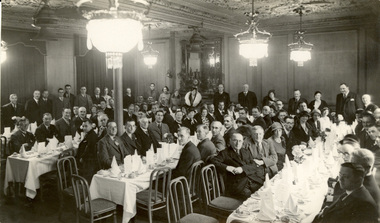
Photograph - Photograph - black and white, Press & Publicity, Photographic Co, Florence Restaurant, Piccadilly, London, 1933, 1933
... New Zealand. The Frank Wright Medal at the Royal South Street competition is awarded to an individual recognized as making an outstanding contribution to brass music in Australia. frank wright florence restaurant piccadilly london Written in pencil on the back - 'Dinner at Florence Restaurant Piccadilly London after Crystal Palace 1933' Black and white photograph of a large ornate room with men and women seated at four long tables, set with flatware, silverware and ornately folded napkins. Other men and women are standing around the edges ...This photograph was one of Frank Wright's collection. Frank Wright was a renown resident of Smeaton, where he was born. He lived at Laura Villa, and attended Smeaton State School. His father William was a gold miner and his mother's name was Sarah. Their family won many singing and instrumental awards. Frank was tutored by Percy Code and became the Australian Open Cornet Champion by the age of eighteen. A year later, Frank conducted the City of Ballarat Band, and later the Ballarat Soldiers’ Memorial Band. He formed the Frank Wright Frisco Band and Frank Wright and his Coliseum Orchestra. These bands won many South Street awards, and Frank as conductor won many awards in the Australian Band Championship contest. In 1933 Frank Wright sailed to England to conduct the famous St Hilda’s Band and was later appointed Musical Director of the London County Council, where he organized many amazing concerts in parks, in and around the London district. He was made Professor of Brass and Military Band Scoring and conducted at the Guildhall of Music and Drama. Frank was often invited to adjudicate Brass Band Championships around Europe, in Australia, including South Street and in New Zealand. The Frank Wright Medal at the Royal South Street competition is awarded to an individual recognized as making an outstanding contribution to brass music in Australia.Black and white photograph of a large ornate room with men and women seated at four long tables, set with flatware, silverware and ornately folded napkins. Other men and women are standing around the edges of the room. They are all formally dressed. The room has ornate cornice, ceilings and light fixtures and a large mirror on the back wall. The place is the Florence Restaurant, Piccadilly London.Written in pencil on the back - 'Dinner at Florence Restaurant Piccadilly London after Crystal Palace 1933'frank wright, florence restaurant piccadilly london -
 Federation University Historical Collection
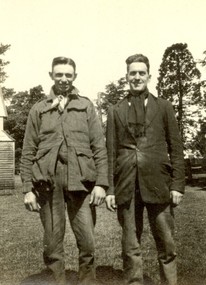
Photograph - Black and White, Brit Archibald, Frank Wright and Roy Archibald, 1922, 23/11/1922
... New Zealand. The Frank Wright Medal at the Royal South Street competition is awarded to an individual recognized as making an outstanding contribution to brass music in Australia. frank wright cornet conductor ballarat roy archibald brit archibald newlyn Written in pen on back - Roy Archibald 21, Frank Wright 21, Taken, while on a couple of days visit to Newlyn, by Brit Archibald, 23/11/22 Black and white photograph of two men standing on a grassed area at Newlyn, with trees in the background and the edge of a building on the left side. ...Frank Wright was a renown resident of Smeaton, where he was born. He lived at Laura Villa, and attended Smeaton State School. His father William was a gold miner and his mother's name was Sarah. Their family won many singing and instrumental awards. Frank was tutored by Percy Code and was awarded a gold medal for the highest marks in the ALCM examinations in the British Colonies at the age of seventeen years. He became the Australian Open Cornet Champion by the age of eighteen. A year later, Frank conducted the City of Ballarat Band, and later the Ballarat Soldiers’ Memorial Band. He formed the Frank Wright Frisco Band and Frank Wright and his Coliseum Orchestra. These bands won many South Street awards, and Frank as conductor won many awards in the Australian Band Championship contest. In 1933 Frank Wright sailed to England to conduct the famous St Hilda’s Band and was later appointed Musical Director of the London County Council, where he organized many amazing concerts in parks, in and around the London district. He was made Professor of Brass and Military Band Scoring and conducted at the Guildhall of Music and Drama. Frank was often invited to adjudicate Brass Band Championships around Europe, in Australia, including South Street and in New Zealand. The Frank Wright Medal at the Royal South Street competition is awarded to an individual recognized as making an outstanding contribution to brass music in Australia.Black and white photograph of two men standing on a grassed area at Newlyn, with trees in the background and the edge of a building on the left side. They are both dressed in long pants, jackets and scarves. The men are Roy Archibald and Frank WrightWritten in pen on back - Roy Archibald 21, Frank Wright 21, Taken, while on a couple of days visit to Newlyn, by Brit Archibald, 23/11/22frank wright, cornet, conductor, ballarat, roy archibald, brit archibald, newlyn -
 Federation University Historical Collection
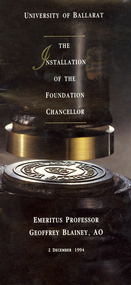
Photograph - Documents, Installation of Emeritus Professor Geoffrey Blainey as the Foundation Chancellor of the University of Ballarat, 1994
... new university and its Ballarat ancestry. Academic gowns distinguish between the university's senior office holders, The design of the Chancellor's gown at the University of Ballarat is based on an Oxford and Cambridge tradition for university Chancellors' robes. It is made after the style of an English Queen's Counsel gown, with appropriate traditional adornment (chevrons) on the sleeves and edges...new university and its Ballarat ancestry. Academic gowns distinguish between the university's senior office holders, The design of the Chancellor's gown at the University of Ballarat is based on an Oxford and Cambridge tradition for university Chancellors' robes. It is made after the style of an English Queen's Counsel gown, with appropriate traditional adornment (chevrons) on the sleeves and edges ...The Chancellor is the head of the university and presides over meetings of Council. The Chancellor is also an ex officio member of all other bodies of the University. As well as being the traditional colour of embellishment on a Chancellor's gown, gold also provides a tangible link between the new university and its Ballarat ancestry. Academic gowns distinguish between the university's senior office holders, The design of the Chancellor's gown at the University of Ballarat is based on an Oxford and Cambridge tradition for university Chancellors' robes. It is made after the style of an English Queen's Counsel gown, with appropriate traditional adornment (chevrons) on the sleeves and edges. The decorative braiding is in gold oak-leaf braid. The velvet trencher with gold tassel is the traditional headwear for a Chancellor. Black and white 16 page booklet with a primarily black cover. The booklet is the programme for the installation of Emeritus Professor Geoffrey Blainey as the foundation Chancellor of the University of Ballarat. The contents include an order of proceedings, history, Geoffrey Blainey, the role of Chancellor, the chancellor's regalia, University of Ballarat logo.university of ballarat, chancellor, geoffrey blainey, blainey, governor of victoria, richard mcgarvie, bill pryor, nina valentine, david james, vern robson, lee francis, david fitzgerald, redmond barry, ballarat school of mines -
 Federation University Historical Collection
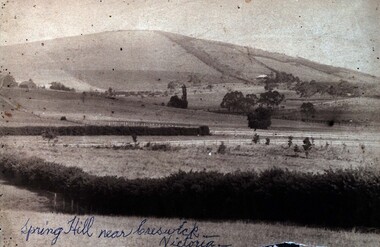
Photograph (Black & White), Spring Hill Near Creswick
... new allotment - 10 children born there - William, Robert, Samuel, Elizabeth, Ellen, Emily, Mary (died 2 months old mother also died). J.G.M. moved to Ballarat - attended Dawson Street Baptist Church. Here he married a widow with 2 sons, Mrs ____. Her 2 sons were born, George and Charles (was in USA) . Children all attended School of Mines, Ballarat .2) On yellow sticky label with photo - "Family home Subiace Rd Subiac WA. Builtby Statford Campbell, Elly's fayher. Now Coppin St. .1) A black and white image of Spring Hill near Creswick, glued into a thick card with a gold gilt edge ...Both images are associated with Ellie Campbell. James and Bridget Martin were early settlers at Spring Hill. All their children attended the Ballarat School of Mines..1) A black and white image of Spring Hill near Creswick, glued into a thick card with a gold gilt edge. .2) Martin family house at Subiaco Hill, Western Australia. Brick house built by Corby Statford Cambell, Elly Campbell's father. .1) Written in blue pen on front of photograph 'Spring Hill near Creswick - Victoria' Taped onto back 'Farmland allotted to James George Martin in c1849. He took his bride, Bridget Hyde (19 years old) by bullock dray from St James Church, Elizabeth Street, Melbourne to this new allotment - 10 children born there - William, Robert, Samuel, Elizabeth, Ellen, Emily, Mary (died 2 months old mother also died). J.G.M. moved to Ballarat - attended Dawson Street Baptist Church. Here he married a widow with 2 sons, Mrs ____. Her 2 sons were born, George and Charles (was in USA) . Children all attended School of Mines, Ballarat .2) On yellow sticky label with photo - "Family home Subiace Rd Subiac WA. Builtby Statford Campbell, Elly's fayher. Now Coppin St.ballarat school of mines, william martin, james martin, bridget martin, bridget hyde, samuel martin, elizabeth martin, ellen martin, mary martin, george martin, charles martin -
 Federation University Historical Collection
Booklet, Report on the Activities of the Maryborough & District Hospital, 1954
... edge gm randle jd mckenzie ken parker Green covered booklet relating to Maryborough Hospital. Includes a list of office bearers for 1953-4, annual report, carnival committee activities, list of donors to all funds images of 1st year nurse trainees, sections of the new nurses' home Report on the Activities of the Maryborough & District Hospital Booklet ...Green covered booklet relating to Maryborough Hospital. Includes a list of office bearers for 1953-4, annual report, carnival committee activities, list of donors to all funds images of 1st year nurse trainees, sections of the new nurses' homehealth, hospital, ambulance, maryborough, margaret walters, nancy wilson, joyce stevens, evelyn read, valma stevens, valarie rowe, vivian rickard, isobel barker, beverley bucknall, alma pettifer, er dubourg, el edge, gm randle, jd mckenzie, ken parker -
 Federation University Historical Collection
Photograph - Black and White, H. Perkins, Frank Wright on Cleveland Pier, Queensland, 1923
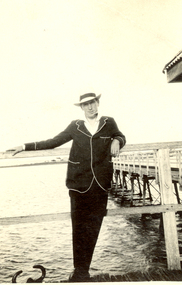
... New Zealand. The Frank Wright Medal at the Royal South Street competition is awarded to an individual recognized as making an outstanding contribution to brass music in Australia. frank wright cleveland pier h perkins Written in pen on the back - Frank Wright (21) on Cleveland pier near Brisbane, Q, Easter 1923, Taken by H Perkins Black and white photograph of a man wearing a hat and a dark suit with white piping around the edges of the jacket. ...Frank Wright was a renown resident of Smeaton, where he was born on 2 August 1901. He lived at Laura Villa, and attended Smeaton State School. His father William was a gold miner and his mother's name was Sarah. Their family won many singing and instrumental awards. Frank was tutored by Percy Code and was awarded a gold medal for the highest marks in the ALCM examinations in the British Colonies at the age of seventeen years. He became the Australian Open Cornet Champion by the age of eighteen. A year later, Frank conducted the City of Ballarat Band, and later the Ballarat Soldiers’ Memorial Band. He formed the Frank Wright Frisco Band and Frank Wright and his Coliseum Orchestra. These bands won many South Street awards, and Frank as conductor won many awards in the Australian Band Championship contest. In 1933 Frank Wright sailed to England to conduct the famous St Hilda’s Band and was later appointed Musical Director of the London County Council, where he organized many amazing concerts in parks, in and around the London district. He was made Professor of Brass and Military Band Scoring and conducted at the Guildhall of Music and Drama. Frank was often invited to adjudicate Brass Band Championships around Europe, in Australia, including South Street and in New Zealand. The Frank Wright Medal at the Royal South Street competition is awarded to an individual recognized as making an outstanding contribution to brass music in Australia.Black and white photograph of a man wearing a hat and a dark suit with white piping around the edges of the jacket. He is leaning against the post and rail fence of a pier. The man is Frank Wright and the place is Cleveland on the bay near Brisbane.Written in pen on the back - Frank Wright (21) on Cleveland pier near Brisbane, Q, Easter 1923, Taken by H Perkinsfrank wright, cleveland pier, h perkins -
 Flagstaff Hill Maritime Museum and Village
Audio - Phonograph, Thomas A. Edison, Edison Laboratory, c.1909
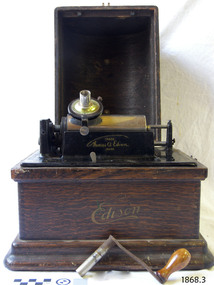
... edge “4 MINUTES 2 Phonograph; Edison Fireside Phonograph, Combination Type, Model A. It is in a wooden case with a domed lid, metal catches on each side and a folding wooden handle. It has a metal drum and a reproducer mechanism. The metal and wood crank handle starts the machine’s motor. A sliding lever at the front selects the speed for four- or two-minute cylinders. The inscribed plate has the maker, serial number, patents and other information. The reproducer also has an inscription. It has a curved metal open horn attachment. Made in Orange, New ...The Edison Fireside Phonograph Combination Type A model phonograph was an open horn model. This machine was produced around 1909, just after the introduction of 4-minute record cylinders in 1908.; the selection lever on the front was either 4 or 2-minute choice. This Fireside model has a fluted octagonal horn that attaches to the reproducer on the machine and is suspended by on ring by a horn crane attachment. The phonograph machine is powered purely by mechanical means, winding the crank handle on the side of the machine to start the belt-driven, spring-loaded motor inside. The sound comes from a pre-recorded, vertical cut record cylinder, which slides over the Mandle, a smooth rotating drum. The reproducer, an all-in-one needle, amplifier and speaker, is lowered onto the cylinder, the needle picks up the sound and plays it on the speaker and the attached horn amplifies the sound. The phonograph machine was invented by Thomas Alva Edison in the late 19th century. Edison adopted the idea from the technology of the telegraph machine. He patented the phonograph in early 1878. It was able to record sound and play it back. This amazing invention opened up a whole new world of entertainment, where wax cylinders of pre-recorded sound could be purchased with a wide variety of music and played over and over. The first wax cylinders were white and used a combination of bees' wax and animal fax or tallow. By 1892 Edison was using 'brown wax' cylinders that ranged from cream through to dark brown. The Edison Phonograph Company was formed in 1887 to produce these machines. He sold the company in 1855 to the North American Phonograph Company but bought that company in 1890. He then started the Edison Spring Motor factory in 1895, and the National Phonograph Company in 1896. In 1910 the company became Thomas A. Edison Inc. In 1898 Edison produced the Edison Standard Phonograph, the first phonograph to carry his own trade mark. He began mass producing duplicate copies of his wax cylinders in 1901 using moulds instead of engraving the cylinders. The wax was black and harder than the brown wax. The ends of the cylinders were bevelled so that the title's label could be added. The last phonograph machine to use an external open horn was produced in 1912 due to the much more robust round records being invented. In 1913 Edison started producing the Edison Disc Phonograph. The company stopped trading in 1929.This Edison Fireside Phonograph model is significant for being one of the last models to have an external horn. It is also significant for its connection with the invention of the phonograph, which made music and sound available for domestic enjoyment. It was used for entertainment and education, even teaching languages. It signalled a new era of music that could be reproduced and played anywhere. It is also significant for its short time span of popularity, just a few decades, due to the growing use of records, which gave a much higher quality sound and were more robust.Phonograph; Edison Fireside Phonograph, Combination Type, Model A. It is in a wooden case with a domed lid, metal catches on each side and a folding wooden handle. It has a metal drum and a reproducer mechanism. The metal and wood crank handle starts the machine’s motor. A sliding lever at the front selects the speed for four- or two-minute cylinders. The inscribed plate has the maker, serial number, patents and other information. The reproducer also has an inscription. It has a curved metal open horn attachment. Made in Orange, New Jersey in c.1909. NOTE: the fluted octagonal horn is catalogued separately.Case front, in script, Edison’s early ‘banner’ decal “Edison” On the front of the machine “Thomas A Edison TRADE MARK” On the maker’s plate; "Edison Fireside Phonograph Combination Type" Serial number “14718” Around sound outlet; “C 4076” “REPRODUCER LICENCED FOR USE ONLY ON EDISON PHOTOGRAPHS SOLD BYT.A. EDISON INC.” At the front edge “4 MINUTES 2flagstaff hill, maritime museum, maritime village, warrnambool, great ocean road, shipwreck coast, gramophone, phonograph, music player, entertainment, audio equipment, edison, thomas a edison, horn, phonograph horn, amplifier, audio, sound recording, sound playback, phonograph machine, phonograph cylinder, external horn, edison phonograph company, wax cylinders, sound reproduction, edison spring motor factory, national phonograph company, thomas a. edison inc, crank-operated motor, open horn phonograph, 4 speed, 2 speed -
 Flagstaff Hill Maritime Museum and Village
Functional object - Step Tread Protector, Russell & Co, 1886
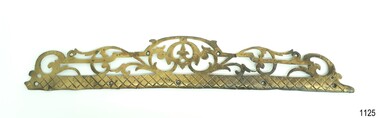
... edge of a tread to minimise wearing of the wooden tread. This item was recovered from the wreck of the Falls of Halladale. The Falls of Halladale was an iron-hulled, four-masted barque, used as a bulk carrier of general cargo. She left New...edge of a tread to minimise wearing of the wooden tread. This item was recovered from the wreck of the Falls of Halladale. The Falls of Halladale was an iron-hulled, four-masted barque, used as a bulk carrier of general cargo. She left New ...The ornate brass step protector was used to protect stair treads and was fitted to the front edge of a tread to minimise wearing of the wooden tread. This item was recovered from the wreck of the Falls of Halladale. The Falls of Halladale was an iron-hulled, four-masted barque, used as a bulk carrier of general cargo. She left New York in August 1908 bound for Melbourne and Sydney. In her hold was general cargo consisting of roofing tiles, barbed wire, stoves, oil, and benzene as well as many other manufactured items. After three months at sea and close to her destination, a navigational error caused the Falls of Halladale to be wrecked on a reef off the Peterborough headland on the 15th of November, 1908. The captain and 29 crew members survived, but her cargo was largely lost, despite two salvage attempts in 1908-09 and 1910. The Court of Marine Inquiry in Melbourne ruled that the foundering of the ship was entirely due to Captain David Wood Thomson's navigational error, not too technical failure of the Clyde-built ship. The Falls of Halladale was built in1886 by Russell & Co., at Greenock shipyards on the River Clyde, Scotland for Wright, Breakenridge & Co of Glasgow. She was one of several designs of Falls Line of ships named after waterfalls in Scotland. The company had been founded between 1870- 1873 as a partnership between Joseph Russell, Anderson Rodger, and William Todd Lithgow. During the period 1882-92 Russell & Co. standardised designs, which sped up their building process so much that they were able to build 271 ships during that time. The Falls of Halladale had a sturdy construction built to carry maximum cargo and was able to maintain full sail in heavy gales, one of the last of the 'windjammers' that sailed the Trade Route. She and her sister ship, the Falls of Garry, were the first ships in the world to include fore and aft lifting bridges. Previous to this, heavily loaded vessels could have heavy seas break along the full length of the deck, causing serious injury or even death to those on deck. The new, raised catwalk-type decking allowed the crew to move above the deck in stormy conditions. The Falls of Halladale shipwreck is listed on the Victorian Heritage (No. S255). She was one of the last ships to sail the Trade Routes from Europe and the Americas. Also of significance is that the vessel was one of the first ships to have fore and aft lifting bridges as a significant safety feature still in use on modern vessels today. The subject model is an example of an International Cargo Ship used during the 19th and early 20th centuries to transport goods around the world and representing aspects of Victoria’s shipping industry. Step tread protector; brass with fancy cutouts. Lower section has screw holes drilled through. Recovered from the wreck of the Falls of Halladale. flagstaff hill, warrnambool, maritime museum, maritime village, great ocean road, shipwreck coast, shipwreck artefact, step tread protector, ship fitting, falls of halladale -
 Mission to Seafarers Victoria
Photograph - Photograph, Black and white, Knox Studios, New York September 1948, September 1948
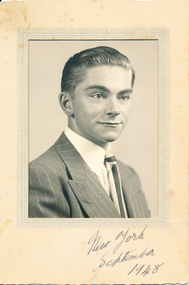
... of the cardboard has been roughly cut, and the bottom edge has been cut with a wave design. New York September 1948 Photograph Photograph, Black and white Knox Studios ...This is a portrait of Allan Quinn, taken during a visit to New York, U.S.A, in September of 1948, when he was 20 years old. This is one of the few portraits of Allan, professional or otherwise, in the collection.This is a photograph from the Allan Charles Quinn collection which is a collection of letters and photograph depicting aspects of life at sea for a young man in the era immediately following World War II.A black and white portrait photograph of Allan Quinn as a young man. It is mounted on a cream cardboard frame, with a pale blue ornate border around the image. The photograph is held in place with clear and coloured tape. The top edge of the cardboard has been roughly cut, and the bottom edge has been cut with a wave design.Front, right hand bottom corner: NEW YORK / SEPTEMBER / 1948 handwritten in faded blue/black ink. On the reverse is tape printed with the Knox Studio logo.allan-quinn, photograph, portrait, new-york, 1948 -
 Mission to Seafarers Victoria
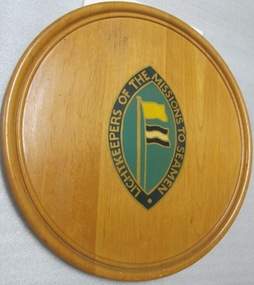
Plaque - Wall Plaque, Lightkeepers of the Mission to Seamen, c.1950
... The Lightkeepers Auxiliary was also active with the Mission in Williamstown where they helped raised the funds to set up the new mission in the E,S & A Bank in 1943 which was furnished thanks to the High Commission of Canada. wooden platter mission flags nora o'connor lightkeepers' auxiliary lightkeeper overseas missions vancouver canada british columbia mission to seamen indigo ink stamp : hand painted (1st word almost indecipherable) Circular , varnished wooden tray or plaque with beaded edge froming 'lip". ...Original owner Nora O’Connor the donor’s adopted aunt, migrated to Canada during WW2 and also worked as volunteer at the Vancouver Mission to Seamen where she met her husband Edward O’Connor who later migrated to Australia. NB Lightkeeper membership category across many of the Missions globally, was usually reserved for women busy as home-makers with children and also as a Junior membership category for children.The platter was accompanied by other materials from the Vancouver club of Senior Light keepers and together the material provides a parallel insight and reference to this group. It also provides a historical link within the worldwide network that is now recognised as the Mission to Seafarers. The Lightkeepers Auxiliary was also active with the Mission in Williamstown where they helped raised the funds to set up the new mission in the E,S & A Bank in 1943 which was furnished thanks to the High Commission of Canada.Circular , varnished wooden tray or plaque with beaded edge froming 'lip". Oval hand painted design of two flags on flag pole, one yellow hoist above blue flag with horizontal white stripe across centre, on a ground of turquoise green. U.C. Lettering in gilt around edge of design (see title). On verso, ink stamp plus an old hanging metal wire.indigo ink stamp : hand painted (1st word almost indecipherable)wooden platter, mission flags, nora o'connor, lightkeepers' auxiliary, lightkeeper, overseas missions, vancouver, canada, british columbia, mission to seamen -
 Mission to Seafarers Victoria
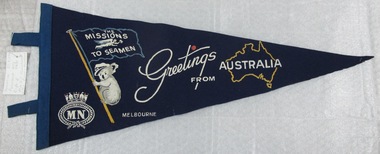
Flag - Pennant, The Missions to Seamen - Greetings From Australia, 1940-1949
... Similar flags were made in other countries depicting an animal (kiwi bird in New Zealand, springbox in South Africa) and other Australian towns. pennant flags koala flying angel club merchant navy d. june muirhead marketing caretaker cottage bert richardson june muirhead nee richardson edna richardson ww2 The printed inscription reads: Greetings from Australia. A triangular felted, dark blue pennant with printed cursive inscription and motifs including: the Mission to Seamen Flying Angel flag, an outline of Australia; a Koala wearing a captain's hat; an insignia emblem for the Merchant Navy. A looped cotton binding along left edge ...This pennant was donated to the Mission by June Muirhead (nee Richardson) who visited the Mission on two occasions: on the 13 November 2014 and then in 2016. She lived from age 3 to 8, with her parents, Cuthbert (Bert) Richardson and Jane (Jenny) Richardson, and her sister, Edna, in the Cottage at 717 Flinders Street. Her father, was the caretaker of the Flinders Street building between 1943-1949. . In 1943 her father was hired to work at the Mission as a caretaker. The family moved from Wonthaggi. When she lived in the Mission, she would sometimes sneak into the club to look at books and pictures. Some seafarers would give her badges, tokens. One of them gave her this felt pennant. In 1949, the family moved back to Wonthaggi and June started year 5 over there.A number of souvenir gifts and small boxes were apparently available through the Mission To Seamen in the 1940s. This acquisition adds to the small collection of items from the period which could be used to form the core of an informative exhibition. Similar flags were made in other countries depicting an animal (kiwi bird in New Zealand, springbox in South Africa) and other Australian towns.A triangular felted, dark blue pennant with printed cursive inscription and motifs including: the Mission to Seamen Flying Angel flag, an outline of Australia; a Koala wearing a captain's hat; an insignia emblem for the Merchant Navy. A looped cotton binding along left edge of the triangle to thread the flag on a stick or cord support. The printed inscription reads: Greetings from Australia.pennant, flags, koala, flying angel club, merchant navy, d. june muirhead, marketing, caretaker, cottage, bert richardson, june muirhead nee richardson, edna richardson, ww2 -
 Mission to Seafarers Victoria
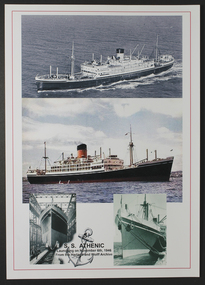
Flyer - Souvenir, late 20th Century
... new table at the MTSV acknowledges his bequest and the material donated. Collectively the G W Duncan material includes: photographs, professional data memorabilia and written and commercially printed resources. The memorabilia relates to his career at sea and in particular the role of an engineer, including a handwritten manual of notes and references relating to the mechanical and engineering aspects and areas of responsibility for maintenance. shaw savill line ss athenic harland and wolff george winfield duncan (1922-2017) ship engineer 1946 At lower right edge on one side: " SS Athenic launching on November 6th, 1946 / From the Harland & Wolff Archive" Double sided colour flyer with 'collaged' arrangement of various reproduced photographs of SS Athenic Flyer Souvenir ...The SS Athenic was one of 2 vessels of the Shaw Savill Line. One became a whale factory ship and the second a passenger ship built and launched by Harland and Wolff in1944 and had maiden voyage 1947 between London and New Zealand. Donor of this document Mr GW Duncan sailed on the maiden voyage and has also gifted sample menus from that trip.Mariner Duncan had a particular regard for the Mission to Seafarers. A plate for display on a commissioned new table at the MTSV acknowledges his bequest and the material donated. Collectively the G W Duncan material includes: photographs, professional data memorabilia and written and commercially printed resources. The memorabilia relates to his career at sea and in particular the role of an engineer, including a handwritten manual of notes and references relating to the mechanical and engineering aspects and areas of responsibility for maintenance. Double sided colour flyer with 'collaged' arrangement of various reproduced photographs of SS AthenicAt lower right edge on one side: " SS Athenic launching on November 6th, 1946 / From the Harland & Wolff Archive"shaw savill line, ss athenic, harland and wolff, george winfield duncan (1922-2017), ship engineer, 1946 -
 Mission to Seafarers Victoria
Letter - Correspondence, 1/12/1949
... Two page letter written on two sheets of buff coloured paper (0833.a1-0833.a2) headed New York and dated 1/12/49. Pale blue envelope (0833.b) is edged with alternating red and blue stripes. ...Two page letter written on two sheets of buff coloured paper (0833.a1-0833.a2) headed New York and dated 1/12/49. Pale blue envelope (0833.b) is edged with alternating red and blue stripes. ...Quinn CollectionTwo page letter written on two sheets of buff coloured paper (0833.a1-0833.a2) headed New York and dated 1/12/49. Pale blue envelope (0833.b) is edged with alternating red and blue stripes. Letter commences 'Dear Friend!' and concludes '..So Long! Your friend Peer...'. The envelope has been re-addressed from C/- Scandinavian Shipping Office, Transport Building, Embarcadero at Mission Street, San Francisco to M/S Mongabarra, Gen. S.S .Corp. Ltd, 432 California Street, San Francisco California. Post-mark on the front is New York and the red stamp is franked Bronx General Station. letters-from-abroad, quinn, 1949 -
Mission to Seafarers Victoria
Letter - Correspondence, 28/03/1950
... The airmail envelope (0835.b) addressed in green ink to Randwick, New South Wales, Australia has been re-addressed in black ink to M S Mongabarra, C/-Transatlantic Shipping Company, Gothenburg, Sweden Envelope is edged with alternating red and blue stripes. ...The airmail envelope (0835.b) addressed in green ink to Randwick, New South Wales, Australia has been re-addressed in black ink to M S Mongabarra, C/-Transatlantic Shipping Company, Gothenburg, Sweden Envelope is edged with alternating red and blue stripes. ...Quinn CollectionA one and a half page letter (0835.a) written in pencil on one page of pale cream unlined paper dated 28/03/50 and headed New York. The airmail envelope (0835.b) addressed in green ink to Randwick, New South Wales, Australia has been re-addressed in black ink to M S Mongabarra, C/-Transatlantic Shipping Company, Gothenburg, Sweden Envelope is edged with alternating red and blue stripes. There is a large tear in the upper right-hand corner where the United States of America stamp would have been. The post mark is New York, N.Y. The upper left hand corner bears a one and sixpence Australian stamp; the franking is indistinct. The letter is addressed to Allan. The writer refers to mutual friends and to the ship 'Fenris'. The signature is a Non-Anglo signature and indecipherable. The return address, written on the bottom of the back of the envelope, is to F. S?.....,119 East 127 Street, New York 35 N.Y. letters-from-abroad, quinn -
 Federation University Historical Collection
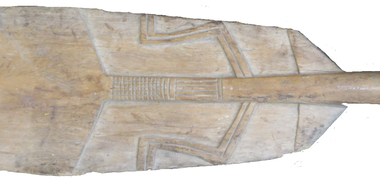
Weapon - Ethnographic Material, Two native weapons, probably South Pacific in origin
... edges of the club, which varied in length from under three to four feet. At least some of these clubs served a largely ceremonial function, particularly those rare examples with shell inlay. Malaitans war clubs are usually made of tooa, a reddish hardwood. Most finished clubs are submerged in mud (saltwater or fresh) for about a month, during which time they acquire a glossy black finish. ballarat school of mines ballarat school of mines museum ethnographic paddle club ethnographic material new number Solomon Island Alafolo Malaita weapons New Guinea Two native weapons, probably South Pacific in origin. .1) light coloured timber paddle with carving. ...These items were in the Ballarat School of Mines Museum, and when the museum was closed they were saved from the tip, and returned decades later. The Alafolo or afui are anthropomorphic clubs found across the island of Malaita. As war clubs, blows were struck with the edges of the club, which varied in length from under three to four feet. At least some of these clubs served a largely ceremonial function, particularly those rare examples with shell inlay. Malaitans war clubs are usually made of tooa, a reddish hardwood. Most finished clubs are submerged in mud (saltwater or fresh) for about a month, during which time they acquire a glossy black finish.Two native weapons, probably South Pacific in origin. .1) light coloured timber paddle with carving. Possibly Solomon Islands. .2) A dark coloured Alafolo made with heavy ironwood, with geometric designs from the Solomon Islands with stylized face, carved geometric design at top end; two carved rings with geometric design between them toward bottom end.ballarat school of mines, ballarat school of mines museum, ethnographic, paddle, club, ethnographic material, new number, solomon island, alafolo, malaita, weapons, new guinea -
Frankston RSL Sub Branch
Medallion
... New Guinea", "Egypt", "Gallipoli", "France", "Palestine", "Salonika" and "Mesopotamia" within an olive wreath. The obverse side of the medallion has an embossed image of the head and shoulders of an Australian soldier wearing a slouch hat and carrying a rifle at the high port position. The edge...New Guinea", "Egypt", "Gallipoli", "France", "Palestine", "Salonika" and "Mesopotamia" within an olive wreath. The obverse side of the medallion has an embossed image of the head and shoulders of an Australian soldier wearing a slouch hat and carrying a rifle at the high port position. The edge...New Guinea", "Egypt", "Gallipoli", "France", "Palestine", "Salonika" and "Mesopotamia" within an olive wreath. The obverse side of the medallion has an embossed image of the head and shoulders of an Australian soldier wearing a slouch hat and carrying a rifle at the high port position. The edge ...The medal was created for sale to the public to raise funds for the provision of troop comforts material.Medallion distributed during World War 1 by the South Australia Division of the Australian Comforts Fund. This medallion was apparently used for fund raising by the ACF to support the welfare of Australian service personnel. The medallion is 52mm diameter by 5mm thick and is made from copper. The medallion has a swivel and a loop at the top for attaching a chain or ribbon. Mintage total not known. The Reverse side of the medallion is embossed with the words "New Guinea", "Egypt", "Gallipoli", "France", "Palestine", "Salonika" and "Mesopotamia" within an olive wreath. The obverse side of the medallion has an embossed image of the head and shoulders of an Australian soldier wearing a slouch hat and carrying a rifle at the high port position. The edge of the medallion is stamped "Australian Comforts Fund SA Division". Medallion has suffered edge damage and has been cleaned extensivelyThe reverse side of the medallion is embossed with the words "New Guinea", "Egypt", "Gallipoli", "France", "Palestine", "Salonika" and "Mesopotamia" within an olive wreath. The obverse side of the medallion has an embossed image of the head and shoulders of an Australian soldier wearing a slouch hat and carrying a rifle at the high port position. The edge of the medallion is stamped "Australian Comforts Fund SA Division". Stokes & Sonsww1, medallion, south australia, acf, australian comforts fund -
 The Beechworth Burke Museum
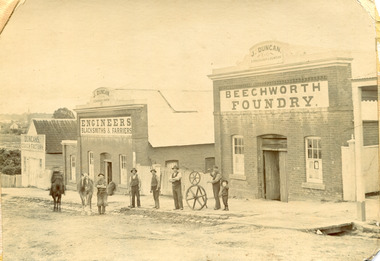
Photograph, c1900
... The foundry was reopened by W H Phillips in 1905 and taken over by H Delora in 1906 This image is significant as it shows some of the many buildings of the Beechworth Foundry, which was a fundamental business to the running of the town and surrounding district, and supplied many of the tools and machines required for the mining and agricultural industries, as well as other aspects of life between the 1850s and early 1900s Duncan John Duncan J Duncan M Straughair Straughair Foundry Beechworth Foundry industry factory Newtown New Ford Street Foundry A Roger Roger W H Phillips Phillips W Phillips H Delora Delora Metalwork Farming and agriculture Tools Mining workmen Reverse 97.2321 / BMM A03115 Sepia rectangular photograph printed on paper. It has rough, torn-looking edges ...The Beechworth Foundry was vital to the industry of the town and surrounding district in the early years of the town’s development. Originally opened as the New Ford Street Foundry by A. Roger in 1858, J Duncan and M Straughair amalgamated and established the Beechworth Foundry in 1867. The business was extensive and operated out of many buildings, each with their own specialisation. All of the buildings pictured in this image are part of the larger Beechworth Foundry. In the late 1860s it employed 16 men. The foundry was fundamental to the running of the town and surrounding district, as it manufactured all manner of items, including tools and machinery for the mining and agricultural industries. The foundry business collapsed in 1896 after the death of it’s founder, John Duncan, the same year (Straughair had died in 1882). The foundry was reopened by W H Phillips in 1905 and taken over by H Delora in 1906 This image is significant as it shows some of the many buildings of the Beechworth Foundry, which was a fundamental business to the running of the town and surrounding district, and supplied many of the tools and machines required for the mining and agricultural industries, as well as other aspects of life between the 1850s and early 1900sSepia rectangular photograph printed on paper. It has rough, torn-looking edgesReverse 97.2321 / BMM A03115duncan, john duncan, j duncan, m straughair, straughair, foundry, beechworth foundry, industry, factory, newtown, new ford street foundry, a roger, roger, w h phillips, phillips, w phillips, h delora, delora, metalwork, farming and agriculture, tools, mining, workmen -
 The Beechworth Burke Museum
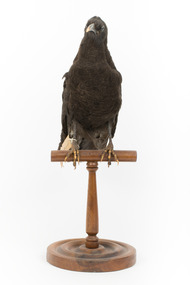
Animal specimen - American Crow, Trustees of the Australian Museum, 1860-1880
... new glossy black feathers. The specimen has two black glass eyes, a dark bill and dark legs with talons. Both the edges...new glossy black feathers. The specimen has two black glass eyes, a dark bill and dark legs with talons. Both the edges ...The American Crow is common throughout North America. They reside in areas with open view and trees but can often frequent city parks, suburbs of large cities and along the seashore. The Crow is a robber and therefore, find living in locations which they can raid for food perfect. These birds are sociable animals and are often found in small groups made up of family members. All their lives they reside in the one location; however, they do migrate south during the autumn. They usually find their food by walking along the ground and eat both plant and animal foods. This includes worms, larvae, insects and fruits and nuts. Crows are also known to feed on small rabbits, frogs and mice. They are also identified as nest predators because they feed on eggs. In areas occupied by humans, the Crow will find their food source from trash and also road kill. The American Crow is not considered to be an endangered species and list them on the IUCN Red List as Least Concern. However, large amounts of crows are killed for sporting and during campaigns (having a desire to reduce the population of the Crow in America). This specimen is part of a collection of almost 200 animal specimens that were originally acquired as skins from various institutions across Australia, including the Australian Museum in Sydney and the National Museum of Victoria (known as Museums Victoria since 1983), as well as individuals such as amateur anthropologist Reynell Eveleigh Johns between 1860-1880. These skins were then mounted by members of the Burke Museum Committee and put-on display in the formal space of the Museum’s original exhibition hall where they continue to be on display. This display of taxidermy mounts initially served to instruct visitors to the Burke Museum of the natural world around them, today it serves as an insight into the collecting habits of the 19th century.This specimen is part of a significant and rare taxidermy mount collection in the Burke Museum. This collection is scientifically and culturally important for reminding us of how science continues to shape our understanding of the modern world. They demonstrate a capacity to hold evidence of how Australia’s fauna history existed in the past and are potentially important for future environmental research. This collection continues to be on display in the Museum and has become a key part to interpreting the collecting habits of the 19th century.This American Crow has black plumage which has slightly faded in colour. This colour fading could also indicate that the bird was molting because the feathers of the American Crow appear brownish when the are about to molt and these feathers give way to new glossy black feathers. The specimen has two black glass eyes, a dark bill and dark legs with talons. Both the edges of the bill and the talons are faded into a pale buff colour. It is likely that the legs and talons were painted a dark black by the taxidermist and the paint has either worn off or faded over the years. The bird is standing tall on a wooden mount and looking forwards. It has a paper identification tag attached to the right leg. The tail is short and the feathers are rounded at the ends.153a. / See catalogue page 61taxidermy mount, taxidermy, animalia, burke museum, beechworth, australian museum, skin, reynell eveleigh johns, bird, america, crow, american crow -
 Marysville & District Historical Society
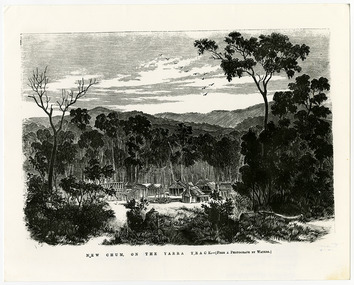
Work on paper (item) - Print of wood engraving, Frederick Grosse et al, New Chum on the Yarra Track, 27-09-1866
... A copy of an early wood engraving taken from a photograph of the deserted township of New Chum, near Healesville, on the Yarra Track in Victoria. The title of the wood engraving is along the lower edge of the image....The Yarra Track is the former name of the gold fields road from Healesville to the Woods Point and Jordan Goldfields in Victoria. new chum healesville yarra track victoria frederick grosse albert charles cooke thomas waters wood engraving A copy of an early wood engraving taken from a photograph of the deserted township of New Chum, near Healesville, on the Yarra Track in Victoria. The title of the wood engraving is along the lower edge of the image. ...A copy of an early wood engraving taken from a photograph of the deserted township of New Chum, near Healesville, on the Yarra Track in Victoria.A copy of an early wood engraving taken from a photograph of the deserted township of New Chum, near Healesville, on the Yarra Track in Victoria. The Yarra Track is the former name of the gold fields road from Healesville to the Woods Point and Jordan Goldfields in Victoria.new chum, healesville, yarra track, victoria, frederick grosse, albert charles cooke, thomas waters, wood engraving
