
Showing 115 items matching "no attached car"
-
 Melbourne Tram Museum
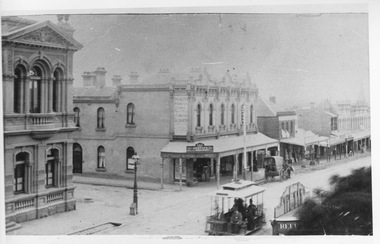
Photograph - Cable dummy in service without car attached, c1895
... ...no attached car...Photograph shows a cable dummy with passengers but no attached saloon car in service on a main commercial street with double storey buildings, verandahs and a horse drawn cart....Photograph Cable dummy in service without car attached ...Photograph shows a cable dummy with passengers but no attached saloon car in service on a main commercial street with double storey buildings, verandahs and a horse drawn cart.Yields information about cable tram use without an saloon car Black and white photograph with note on rear. On rear in pencil: "c1895"cable dummy, no attached car -
 Greensborough Historical Society
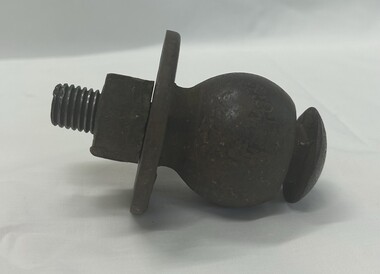
Functional object - Tow Ball, Tow Ball - 2 1/4 inch
... Old Style Tow Ball used to attach to car for towing. Used by the Petts family of Greenhills....Old Style Tow Ball used to attach to car for towing. Used by the Petts family of Greenhills. tow ball motor vehicle accessory petts family Cast Iron tow ball with nut Tow Ball - 2 1/4 inch Functional object Tow Ball ...Old Style Tow Ball used to attach to car for towing. Used by the Petts family of Greenhills.Cast Iron tow ball with nuttow ball, motor vehicle accessory, petts family -
 Greensborough Historical Society
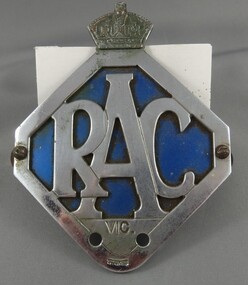
Badge, Stokes, RACV car badge, 1960_
... RACV members' badge; designed to be attached to owner's car. ...RACV members' badge; designed to be attached to owner's car. Issued to members of the RACV over a long period of the twentieth century royal automobile club of victoria racv car badges RACV Vic Chromed RACV emblem with blue background, with two screws for attachment to car RACV car badge Badge Badge Stokes ...RACV members' badge; designed to be attached to owner's car. Issued to members of the RACV over a long period of the twentieth centuryChromed RACV emblem with blue background, with two screws for attachment to carRACV Vicroyal automobile club of victoria, racv, car badges -
 Victoria Police Museum
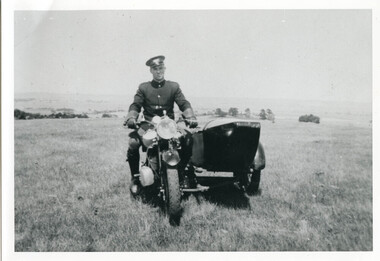
Photograph (police motorcycle)
... Brough Superior, with side car attached, being ridden in a paddock. Circa 1935...police vehicles; wireless patrol; motor transport branch; motor transport section; motor cycle patrol; brough superior motorcycle; police motorcycles Brough Superior, with side car attached, being ridden in a paddock. Circa 1935 Photograph (police motorcycle) ...Brough Superior, with side car attached, being ridden in a paddock. Circa 1935police vehicles; wireless patrol; motor transport branch; motor transport section; motor cycle patrol; brough superior motorcycle; police motorcycles -
 Warrnambool and District Historical Society Inc.
Functional object - Portable lamp, Lucas Industries, c 1900
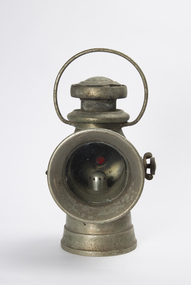
... It could have domestic use or be attached to cars or bicycles early in the 20th Century to provide light at night. ...It could have domestic use or be attached to cars or bicycles early in the 20th Century to provide light at night. ...This portable lamp was manufactured by the Lucas Industries, a company in Birmingham, England that first produced lamps after 1875. It could have domestic use or be attached to cars or bicycles early in the 20th Century to provide light at night. The lighting fluid was oil. This object is an interesting example of lighting for cars and bicycles and in the home in the late 19th and early 20th Centuries.This is a brass lantern with a circular glass piece in the middle front, and a top metal mechanism with a handle. Inside the circular opening is a domed jet with holes for lighting the lamp. On the sides there are various mechanisms for turning the light up and down, opening the front glass and opening the bottom to allow filling of the lighting fluid. The item is corroded on the exterior. The top has air vents to permit the vapours to escape. On the side is the maker's name LUCAS No. 722 KING OF THE ROAD JOS. LUCAS LTD. vintage lighting, lucas industries -
 Stawell Historical Society Inc
Photograph, Apex Rest Stop Caravan
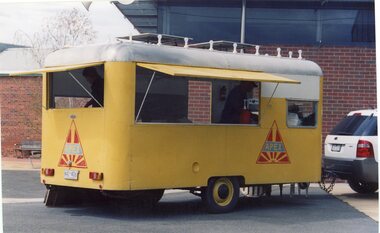
... Windows and doors are open, and it is attached to a car....Windows and doors are open, and it is attached to a car. Apex Rest Stop Caravan Photograph ...Colour photograph of a yellow caravan with white roof, with Apex Logos on the side and rear. Windows and doors are open, and it is attached to a car. -
 Northern District School of Nursing. Managed by Bendigo Historical Society Inc.
Photograph - Lister House
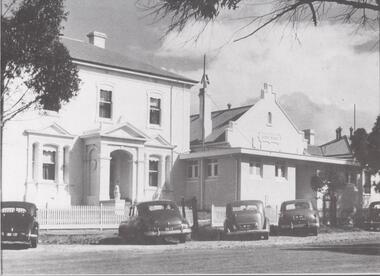
... Black and white photograph of Lister house, three attached buildings with four cars parked in front. ...NDSN Lister House Lister house 1950 on back Black and white photograph of Lister house, three attached buildings with four cars parked in front. Photograph Lister House ...The Northern District School of Nursing opened in 1950 in to address the issues around nurse recruitment, training and education that had previously been hospital based. The residential school was to provide theoretical and in-house education and practical training over three years. The students would also receive practical hands-on training in the wards of associated hospitals. The Northern District School of Nursing operated from Lister House, Rowan Street, Bendigo. It was the first independent school of nursing in Victoria and continued until it closed in 1989.Black and white photograph of Lister house, three attached buildings with four cars parked in front. Lister house 1950 on backndsn, lister house -
 Whitehorse Historical Society Inc.
Artwork, other - Ink Line Drawing, Margaret Picken, 2 Silverleaf Crt., Forest Hill, 1996
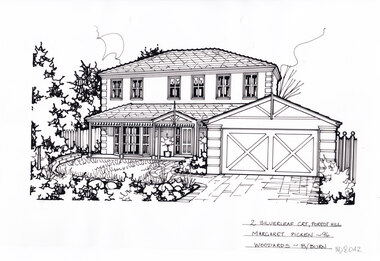
... A black ink line drawing on drafters film by Margaret Picken, of 2 Silverleaf Crt., Forest Hill, of a two story rendered house setback from a landscaped front garden, with a attached two car garage. There are two hole punch holes near the centre of the upper edge....Whitehorse Historical Society Schwerkolt Cottage Housing Architecture Margaret Picken House Garden Forest Hill Real Estate 2 Silverleaf Crt., Forest Hill Picken - 96 Woodards - B/burn A black ink line drawing on drafters film by Margaret Picken, of 2 Silverleaf Crt., Forest Hill, of a two story rendered house setback from a landscaped front garden, with a attached two car garage. There are two hole punch holes near the centre of the upper edge. 2 Silverleaf Crt., Forest Hill Artwork, other Ink Line Drawing Margaret Picken Fletchers real estate ...A property illustration by Margaret Picken Commissioned by the real estate agency Woodards Real Estate Blackburn for the purpose of advertising 2 Silverleaf Crt., Forest Hill. Made by using Rotring ‘Rapidigraph’ drafting pens with Rotring ink on Rapidigraph polyester drafting film, double matte. Trained as a cartographic draftsman within the mining industry, Margaret Picken is an artist who worked producing property illustrations for real estate agencies in eastern suburbs of Victoria from 1983-2005. Retiring from the industry as technological changes favored coloured photography over illustrations, and commissioning companies over sole contractors.This artwork is of Historical Significance as a record of local domestic architecture.A black ink line drawing on drafters film by Margaret Picken, of 2 Silverleaf Crt., Forest Hill, of a two story rendered house setback from a landscaped front garden, with a attached two car garage. There are two hole punch holes near the centre of the upper edge.2 Silverleaf Crt., Forest Hill Picken - 96 Woodards - B/burnwhitehorse historical society, schwerkolt cottage, housing, architecture, margaret picken, house, garden, forest hill, real estate -
 Millewa Community Pioneer Forest & Historical Society
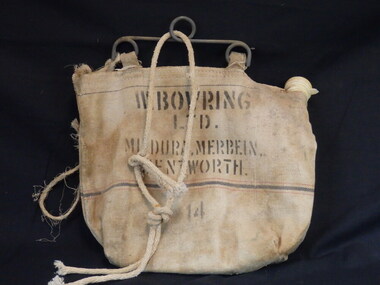
Water Bottle, W Bowring Ltd, ?
... Used commonly used by horsemen farmers, etc They were also used by car travelers attached to the front of a vehicle to keep it cool....Used commonly used by horsemen farmers, etc They were also used by car travelers attached to the front of a vehicle to keep it cool. ...Water carrier, used to transport water in the Malley. Used commonly used by horsemen farmers, etc They were also used by car travelers attached to the front of a vehicle to keep it cool.Commonly used in the region but now rarely used or found.Canvas Bag type water carrier,W Bowring Ltd Manufacturer Merbein, Mildura, Wentworth. Beneath a Black line around the middle No 14 Back is Plain , has a metal hanger thrue 2 canvas tabs, water, carrier, milewa, bowring, canvas -
 Ballarat Tramway Museum
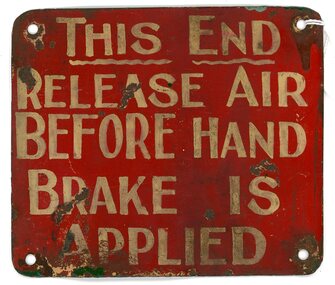
Sign - "THIS END RELEASE AIR BEFORE HAND BRAKE IS APPLIED"
... The corners of the sign have been rounded, with a hole made in each corner for attaching to the tram car. The reverse has the number 33 printed in small black lettering. ...The corners of the sign have been rounded, with a hole made in each corner for attaching to the tram car. The reverse has the number 33 printed in small black lettering. ...Demonstrates how the SEC used painted metal signs to advise and remind staff of procedures for operating equipment.A metal sign painted in red. Hand painted lettering reads "THIS END RELEASE AIR BEFORE HAND BRAKE IS APPLIED" painted in off white. The corners of the sign have been rounded, with a hole made in each corner for attaching to the tram car. The reverse has the number 33 printed in small black lettering. The back of the sign has not been painted and has a rusted surface finish. The plate is slightly buckled.The number 33 is written in black on the reverse.tramways sign, painted signage for trams -
 Ballarat Tramway Museum
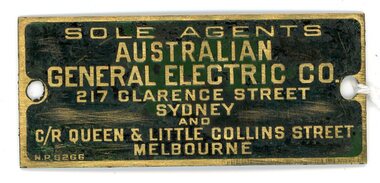
Sign - "SOLE AGENTS AUSTRALIAN GENERAL ELECTRIC CO 217 CLARENCE STREET SYDNEY AND C/R QUEEN AND LITTLE COLLINS STREET MELBOURNE HP9266"
... Two holes have been positioned on the sides to allow attaching to the tram car....Two holes have been positioned on the sides to allow attaching to the tram car. Sign "SOLE AGENTS AUSTRALIAN GENERAL ELECTRIC CO 217 CLARENCE STREET SYDNEY AND C/R QUEEN AND LITTLE COLLINS STREET MELBOURNE HP9266" ...Demonstrates how the SEC used etched signs to provide information for their staff.A small, etched brass metal plate reading "SOLE AGENTS AUSTRALIAN GENERAL ELECTRIC CO. 217 CLARENCE STREET SYDNEY AND C/R QUEEN AND LITTLE COLLINS STREET MELBOURNE H.R.9266". The etched lettering background has been painted black, with the lettering proud in brass. Although the reverse was originally painted, much of the paint has worn off. Two holes have been positioned on the sides to allow attaching to the tram car.tramways sign, makers plate for general electric co. -
 Eltham District Historical Society Inc
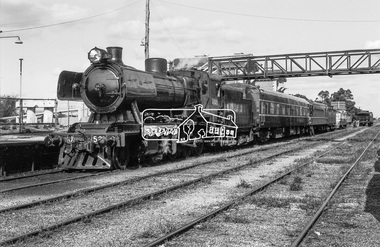
Photograph, Steam locomotive J-521 with the Royal Train at Echuca Railway Station during a visit by the new Governor of Victoria, His Excellency Sir Rohan Delacombe, c.May 1963
... In this picture can be seen steam locomotive J-521 and tender to which is attached State Car No. 5. It is believed that the other support carriages have been de-attached and the train has pulled up at the front of the platform allowing room for other trains to pull in. ...In this picture can be seen steam locomotive J-521 and tender to which is attached State Car No. 5. It is believed that the other support carriages have been de-attached and the train has pulled up at the front of the platform allowing room for other trains to pull in. ...In this picture can be seen steam locomotive J-521 and tender to which is attached State Car No. 5. It is believed that the other support carriages have been de-attached and the train has pulled up at the front of the platform allowing room for other trains to pull in. Immediately behind on the same track at the platform is a Diesel Electric Rail Motor (DERM) and C-class bogey (luggage) then a small (articulated) rail car (articulated) then a cattle van. On the adjacent track is State Car No. 2 (Melville) and a C-van. State Car No. 2 (Melville) was used a power generation car for special trains and the Train of Knowledge. State Car No. 5 is in the design of the Spirit of Progress. George Coop advised that the occasion is the visit of the Governor of Victoria, Sir Rohan Delacombe to Echuca in 1963. Delacombe had replaced Sir Dallas Brooks in May 1963 who had departed for England on the liner Iberia,11 April 1963 (1963 'SIR DALLAS ON WAY TO U.K.', The Canberra Times (ACT : 1926 - 1995), 9 April, p. 9. , viewed 27 Jan 2020, http://nla.gov.au/nla.news-article104249252) George believes the Governor was doing a considerable formal train ride around the State and Echuca was on the schedule. The ‘platform’ was a special creation for such purposes, located on the wharf spur line that ran behind the Echuca Civic Centre. The large notice board commemorates the Queen’s visit on March 5th, 1954 for which the platform was initially built. From time to time it would get spruced up with pot plants, fresh paint and repaired hand rails for formal functions. George attended the Civic Reception held for the Governor. A picture of His Excellency Sir Rohan Delacombe, Governor of Victoria, and Lady Delacombe about to entrain at Spencer Street for a visit to western Victoria is available on page 4 of VICTORIAN RAILWAYS REPORT OF THE VICTORIAN RAILWAYS COMMISSIONERS FOR THE YEAR ENDED 30th JUNE, 1963. (http://www.victorianrailways.net/vr%20history/annual_reports/vrar1963.pdf) More information about the Victorian Railways Royal Train https://en.wikipedia.org/wiki/Victorian_Railways_Royal_Train State Car No. 5 https://www.pjv101.net/cd/pages/c160v06.htm State Car No. 2 (Melville) https://www.pjv101.net/cd/pages/c160v03.htmDigital TIFF file Scan of 35mm Ilford FP3 black and white negative transparencycattle van, c-van, diesel electric rail motor (derm), echuca, echuca rail yard, echuca railway station, george coop collection, governor of victoria, j-521, rail car, royal train, power car, sir rohan delacombe, state car no. 2 (melville), state car no. 5, train of knowledge, victorian railways -
 Ballarat Tramway Museum
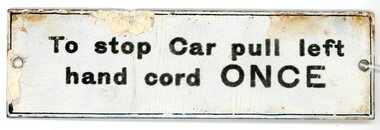
Sign - "To stop car pull left hand cord ONCE"
... Car pull left hand cord ONCE". Where the enamel has been chipped, an attempt to disguise the damage has been made with paint. The reverse has been enameled in a mixture of black and white, but this shows signs of chipping and rust damage. Two holes have been drilled in the centre of the LH and RH edges to enable the sign to be attached...Car pull left hand cord ONCE". Where the enamel has been chipped, an attempt to disguise the damage has been made with paint. The reverse has been enameled in a mixture of black and white, but this shows signs of chipping and rust damage. Two holes have been drilled in the centre of the LH and RH edges to enable the sign to be attached ...Demonstrates how the SEC used enameled signs to convey instructions to passengers and confirm the advice of the conductor.An enamel sign with black lettering and border line on an off white background. The enameling is stained due to rust. The sign reads "To stop Car pull left hand cord ONCE". Where the enamel has been chipped, an attempt to disguise the damage has been made with paint. The reverse has been enameled in a mixture of black and white, but this shows signs of chipping and rust damage. Two holes have been drilled in the centre of the LH and RH edges to enable the sign to be attached to the tram car. The reverse shows signs that the enamel has been marked prior to firing as the sign rested on a framework which removed the enamel surface, allowing lines of rust to form.tram signs, tam car signage -
 Eltham District Historical Society Inc
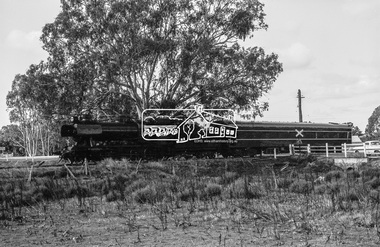
Photograph, Steam locomotive J-521 with the Royal Train on the Wharf Spur line during a visit to Echuca by the new Governor of Victoria, His Excellency Sir Rohan Delacombe, c.May 1963
... The train has been shortened comprising steam locomotive J-521 and tender to which is attached the State car. The State car is in the design of the Spirit of Progress. ...The train has been shortened comprising steam locomotive J-521 and tender to which is attached the State car. The State car is in the design of the Spirit of Progress. ...In this picture The Royal Train is passing through a railway crossing along the Wharf Spur line. The train has been shortened comprising steam locomotive J-521 and tender to which is attached the State car. The State car is in the design of the Spirit of Progress. George Coop advised that the occasion is the visit of the Governor of Victoria, Sir Rohan Delacombe to Echuca in 1963. Delacombe had replaced Sir Dallas Brooks in May 1963 who had departed for England on the liner Iberia,11 April 1963 (1963 'SIR DALLAS ON WAY TO U.K.', The Canberra Times (ACT : 1926 - 1995), 9 April, p. 9. , viewed 27 Jan 2020, http://nla.gov.au/nla.news-article104249252) George believes the Governor was doing a considerable formal train ride around the State and Echuca was on the schedule. The ‘platform’ was a special creation for such purposes, located on the wharf spur line that ran behind the Echuca Civic Centre. The large notice board commemorates the Queen’s visit on March 5th, 1954 for which the platform was initially built. From time to time it would get spruced up with pot plants, fresh paint and repaired hand rails for formal functions. George attended the Civic Reception held for the Governor. A picture of His Excellency Sir Rohan Delacombe, Governor of Victoria, and Lady Delacombe about to entrain at Spencer Street for a visit to western Victoria is available on page 4 of VICTORIAN RAILWAYS REPORT OF THE VICTORIAN RAILWAYS COMMISSIONERS FOR THE YEAR ENDED 30th JUNE, 1963. (http://www.victorianrailways.net/vr%20history/annual_reports/vrar1963.pdf) More information about the Victorian Railways Royal Train https://en.wikipedia.org/wiki/Victorian_Railways_Royal_Train State Car No. 5 https://www.pjv101.net/cd/pages/c160v06.htm Digital TIFF file Scan of 35mm Ilford FP3 black and white negative transparencyechuca, george coop collection, governor of victoria, j-521, railway crossing, royal train, sir rohan delacombe, state car no. 5, victorian railways, wharf spur line -
 Eltham District Historical Society Inc
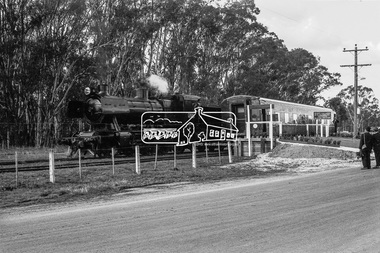
Photograph, Steam locomotive J-521 with the Royal Train on the Wharf Spur line during a visit to Echuca by the new Governor of Victoria, His Excellency Sir Rohan Delacombe, c.May 1963
... In this picture the Royal Train is pulled up with the State Car at the commemorative platform on the Wharf Spur line. The train has been shortened comprising steam locomotive J-521 and tender to which is attached the State car. ...In this picture the Royal Train is pulled up with the State Car at the commemorative platform on the Wharf Spur line. The train has been shortened comprising steam locomotive J-521 and tender to which is attached the State car. ...In this picture the Royal Train is pulled up with the State Car at the commemorative platform on the Wharf Spur line. The train has been shortened comprising steam locomotive J-521 and tender to which is attached the State car. The State car is in the design of the Spirit of Progress. The platform is lined with plants in planter boxes. Two men in suits standing to the right, one with a large camera – either press or official photographer. The sign on the platform commemortaes the visit of Her Majesty Queen Elizabeth and His Royal Highness Phillip Duke of Edinburg on March 5th, 1954. George Coop advised that the occasion is the visit of the Governor of Victoria, Sir Rohan Delacombe to Echuca in 1963. Delacombe had replaced Sir Dallas Brooks in May 1963 who had departed for England on the liner Iberia,11 April 1963 (1963 'SIR DALLAS ON WAY TO U.K.', The Canberra Times (ACT : 1926 - 1995), 9 April, p. 9. , viewed 27 Jan 2020, http://nla.gov.au/nla.news-article104249252) George believes the Governor was doing a considerable formal train ride around the State and Echuca was on the schedule. The ‘platform’ was a special creation for such purposes, located on the wharf spur line that ran behind the Echuca Civic Centre. The large notice board commemorates the Queen’s visit on March 5th, 1954 for which the platform was initially built. From time to time it would get spruced up with pot plants, fresh paint and repaired hand rails for formal functions. A picture of His Excellency Sir Rohan Delacombe, Governor of Victoria, and Lady Delacombe about to entrain at Spencer Street for a visit to western Victoria is available on page 4 of VICTORIAN RAILWAYS REPORT OF THE VICTORIAN RAILWAYS COMMISSIONERS FOR THE YEAR ENDED 30th JUNE, 1963. (http://www.victorianrailways.net/vr%20history/annual_reports/vrar1963.pdf) More information about the Victorian Railways Royal Train https://en.wikipedia.org/wiki/Victorian_Railways_Royal_Train State Car No. 5 https://www.pjv101.net/cd/pages/c160v06.htmDigital TIFF file Scan of 35mm Ilford FP3 black and white negative transparencyechuca, george coop collection, governor of victoria, j-521, royal train, sir rohan delacombe, state car no. 5, victorian railways, wharf spur line -
 Royal District Nursing Service (now known as Bolton Clarke)
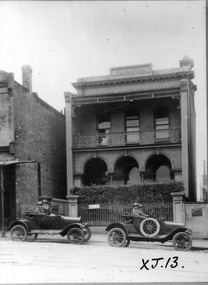
Photograph - Photograph, sepia, c.1920
... Each car has four spoked wheels. A frame where a spare wheel is attached can be seen attached to the rear car's running board. ...Each car has four spoked wheels. A frame where a spare wheel is attached can be seen attached to the rear car's running board. ...A public appeal was made to raise funds for Melbourne District Nursing Society (MDNS) so motor cars could be purchased to assist their Trained nurses, known as 'Nurse' in those days, with their visits during the Spanish Influenza epidemic of 1919. With donations from businesses and individuals four cars were available within a month, and this photograph shows two of them In 1919 parked outside 'Floraston', 39 Victoria Parade, Collingwood, which was the first MDNS Headquarters and Nursing Home purchased by the Society. The MDNS uniform was a grey cotton frock with white collar, a grey coat with lapels, and a grey brimmed hat with a red Maltese cross in the centre of the hatband. From its founding in 1885 until 1891 the Trained nurses, known as 'Nurse' in those days, of the Melbourne District Nursing Society (MDNS) worked from their own homes which were located in the vicinity of their areas (districts). In November 1891 MDNS was able to rent a two story terraced house at 66 Cardigan Street, Carlton, at £65 a year, which contained accommodation for three Nurses and one pupil nurse as well as being used as their Headquarters. They left from their Nurses Home each morning and returned at the end of their shift to write up their book work before retiring for the day. Three years later they moved into a larger terraced house at 49 Drummond Street Carlton which was rented at ‘a very moderate rental’. There was a Board room, apartments for the Nurses and pupil nurse, a large dispensary which patients could attend each evening to have prescriptions signed and bottles refilled with ‘homely remedies’ and elixirs, which were administered to for e.g. Consumptive cases. Doctor’s prescriptions were filled at the Pharmacy. Cupboards containing donated blankets and bedclothes for needy patients were kept in this room, and it was here where the Nurses kept their nursing bags which were refilled at the end of each shift ready for any emergency and for the next day. A list of Doctors the Nurses could call was kept by the telephone. The home also had a kitchen where nourishing soup was made and distributed twice a week to the needy. Milk was also distributed when needed. In 1902 they moved into rented premises at 188 Leicester Street, Carlton and two years later, in 1904, to premises at 5 Royal Terrace, Nicholson Street, Fitzroy. They remained there for ten years. In June 1914 at last the Society had sufficient funding to purchase their own terraced premises, ‘Floraston’ 39 Victoria Parade, Collingwood which was their Headquarters and Nurses Home. In 1926 the After-Care Home for recovering patients, (later called After-Care Hospital) was built by the Society next door, running from 41-47 Victoria Parade (became No. 45); the District nurses continued to live at No. 39. District Nursing has had various modes of transport over the last 130 plus years. At first, from 1885 as Melbourne District Nursing Society (MDNS), the Nurses walked the streets and lane ways amid the slums of central Melbourne. As the Society expanded public transport was used, and bicycles were bought by the Society in 1903 and used in inner areas until 1945. During the Spanish flu epidemic, in 1919, MDNS appealed for assistance to procure Motor vehicles so the Nurses could visit an influx of cases. Through trusts, grants and donations four 'Ford 'T Model' cars were procured which enabled the Nurses to triple their visits. Through constant use the cars were in such a poor state they were sold in 1927. A Motor Auxiliary was formed in 1929 to take Trained nurses, now called 'Sisters' to patients, and some Sisters used their own cars; even a motorcycle was used by one Sister in 1933. All these forms of transport were intermingled until MDNS and, having received Royal patronage, the now named Royal District Nursing Service (RDNS) had its own full fleet of vehicles.Sepia photograph on grey mounting board depicting four Melbourne District Nursing Society (MDNS) Trained nurses (Nurses) sitting in two motor vehicles in front of Melbourne District Nursing Society Headquarters and Nurses Home. In the foreground are the two Ford Model T vehicles with their soft hoods open. Each car has four spoked wheels. A frame where a spare wheel is attached can be seen attached to the rear car's running board. A spare wheel, with white tyre, can be seen standing up resting against the middle of the front car; the lower section of the tyre is sitting on the running board. The steering wheel can be seen on the right hand side of both cars with a Nurse sitting behind it with her hands resting on the wheel. The upper part seen of the two MDNS Nurses in each car shows they are wearing grey uniform coats over their frocks, the white collars of which can be seen. They are all looking at the camera, and are wearing grey hats with a central Maltese cross on the white hatband. Behind the cars the footpath and the metal spiked fence, with a square concrete columns at either end can be seen. '39' is near the top of the left hand column and a white oblong name plate is attached to the fence. On the far right of the photograph a wooden gate runs from the column. A dark name plate is attached with the words 'Patient Entrance' / - 'Melbourne District Nursing Society -/ For Nursing the Sick Poor'. Behind this are a row of shrubs forming a hedge and behind this the two storey terrace building with its three arched arcade veranda on the ground floor and three long widows on the top floor with a veranda with a metal scrolled safety rail. The building has a flat roof with a central raised section with 'Floraston', written in capital letters on it. XJ. 13. is written in black ink on the bottom right corner of the photographPhotographer's stamp on mounting boardmelbourne district nursing society, mdns, transport, nurses home, rdns, royal district nursing service -
 Federation University Historical Collection
Tool - Object, Oil Can
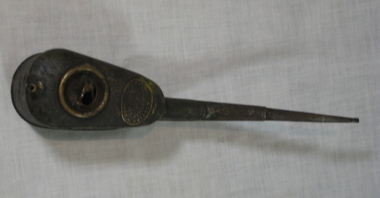
... Fisher and Ludlow was a British car body manufacturing company based in Castle Bromwich, Birmingham. oil tools ballarat school of mines whites motor mechanics Fisher and Ludlow Two oil cans (or brass oil feeders) with flat base and long neck. (a) Miniature cylindrical body with flat base, and long narrow spout. Head of flow adjuster is missing. Made by Fisher & Ludlow, Birmingham. (b) Has a miniature plug with chain attached ...Probably used at the Ballarat School of Mines. Fisher and Ludlow was a British car body manufacturing company based in Castle Bromwich, Birmingham.Two oil cans (or brass oil feeders) with flat base and long neck. (a) Miniature cylindrical body with flat base, and long narrow spout. Head of flow adjuster is missing. Made by Fisher & Ludlow, Birmingham. (b) Has a miniature plug with chain attached, and a decorative scrolled handle. Made by Whites. oil, tools, ballarat school of mines, whites, motor mechanics, fisher and ludlow -
 Ballarat Clarendon College
Postcard
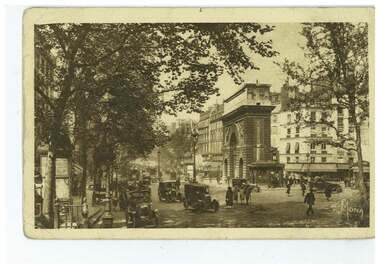
... cars make a dreadful noice - far greater noise than in London. Though traffic is just as great - We are having lovely weather to see this beautiful city. We are all well. Hope you are. Daddy is visiting hospital. Love from us all - Your loving mother, Bernice A Sloss. Black and white illustrated postcard; photograph of Paris scene on front; hand-written letter on back and 90p stamp attached ...Postcard sent to Ballarat College boarder, William L Sloss, by his mother Bernice A Sloss during a visit to Paris with his father in 1929.Its slightly formal phrasing gives insight into parent-child relations of the era. Black and white illustrated postcard; photograph of Paris scene on front; hand-written letter on back and 90p stamp attached;Address: Master Bill Sloss / Ballarat College / Ballarat - Victoria / Australia Letter: 21/3/29 / This is just a tiny corner of Paris. It is a very busy city and the taxis and cars make a dreadful noice - far greater noise than in London. Though traffic is just as great - We are having lovely weather to see this beautiful city. We are all well. Hope you are. Daddy is visiting hospital. Love from us all - Your loving mother, Bernice A Sloss.bernice-a-sloss, ballarat college, boarding, 1929, bill-sloss, william-l-sloss-1934, postcard -
 City of Moorabbin Historical Society (Operating the Box Cottage Museum)
Photograph, Black & White, J.L.Smith Hay & Grain Store c1916 Bentleigh, 1916
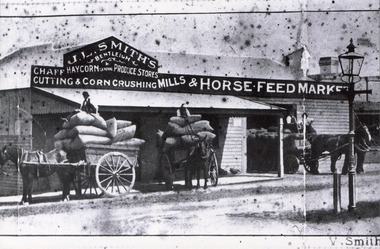
... cars 1900, steam engines, early settlers, bentleigh, parish of moorabbin, city of moorabbin, county of bourke, moorabbin roads board, shire of moorabbin, henry dendy's special survey 1841, were j.b.; bent thomas, o'shannassy john, king richard, charman s, highett william, ormond francis, maynard dennis, market gardeners, vineyards, orchards V. Smith Black & White photograph of J L Smith Hay & Grain Store and Crushing Mill Jasper Rd / Centre Rd Bentleigh 1916. A veranda has been added to the store, new signage attached ...John Logan Smith 1860-1932 , the son of Irish immigrants James and Marianne Smith was born at their home near the 'Toll Gates' on Point Nepean Road and Dendy Street. East Brighton. At that time the area had many orchards that were later replaced by market gardens. J.L.Smith at first rented a cottage 'Law Muir Den' & Shed from Mr Box and commenced business as a wood merchant - sawing logs into shorter pieces using one horse to power the saw. He purchased the property, added to the buildings , began trading in fuel and fodder as well and installed a chaff cutting mill powered by 10hp steam engine. The business prospered 1909 following the death of Tommy Bent, J/L Smith was nominated for Councillor of the Shire of Moorabbin. WW1 1914 - 18 both John and Mary Ann supported local War Relief Auxiliaries and their son Vic served as a Signaler in AIF. As Motor transport was increasing 1926 J L Smith built a small Garage on the opposite corner (Woolworths Supermarket 2005) , employed a good mechanic ( Reg Hunt ) and developed another successful business. The Grain Store was managed by family until 1930. In 1932 JL Smith assisted a man whose car had broken down, pushing it to the garage and sadly suffered a heart attack and died. He is buried in Cheltenham Cemetery J.L.Smith was an early settler in East Brighton now Bentleigh and established successful Wood cutting, Grain & Chaff cutting and Motor garage businesses in Centre Road . He was elected Councillor of the Shire of Moorabbin and, with Mary Ann, his family were involved with local Church, Red Cross, and other community organizations.Black & White photograph of J L Smith Hay & Grain Store and Crushing Mill Jasper Rd / Centre Rd Bentleigh 1916. A veranda has been added to the store, new signage attached and a Gas light and hitching post are in foreground. 3 Horse drawn carts loaded with grain bags and drivers sitting on top of loadV. Smithgas street light, hitching posts, smith vic, photography, smith j l; smith mary ann, stanley helen, smith vic, smith harry redvers, chaff cutter, horse drawn carts, toll gates brighton, motor cars 1900, steam engines, early settlers, bentleigh, parish of moorabbin, city of moorabbin, county of bourke, moorabbin roads board, shire of moorabbin, henry dendy's special survey 1841, were j.b.; bent thomas, o'shannassy john, king richard, charman s, highett william, ormond francis, maynard dennis, market gardeners, vineyards, orchards -
 Glenelg Shire Council Cultural Collection
Painting - Oil Painting, Kenneth Jack, Captain Blair's House, n.d
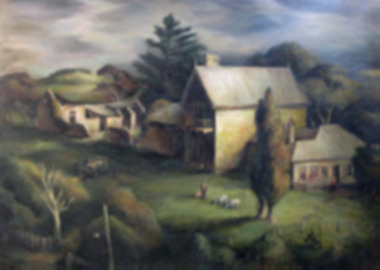
... car with three people surrounding it. The weather looks dark, dark clouds. A large Norfolk Pine behind the building. The middle building is two storey with an outhouse attached. ...car with three people surrounding it. The weather looks dark, dark clouds. A large Norfolk Pine behind the building. The middle building is two storey with an outhouse attached. ...Image showing three stone buildings in a country scene. In the foreground there is man and child and two goats. There is a car with three people surrounding it. The weather looks dark, dark clouds. A large Norfolk Pine behind the building. The middle building is two storey with an outhouse attached. A chimney and two spires at each end of the house. The building to the right of the main building is weatherboard with a fence. To the left of the main building is a ruined stone building with the roof fallen in. Trees and hills surround. Gold painted frame.Bottom right - Kenneth Jack - July 1952 -
 Glenelg Shire Council Cultural Collection
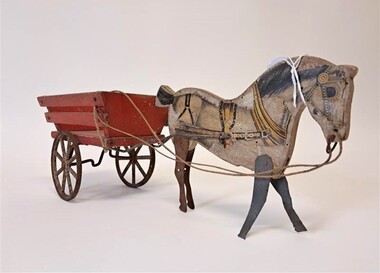
Leisure object - Gibbs horse-drawn cart pull toy, Gibbs Manufacturing Company, Pacing Bob, 1908
... Toys, childhhod, pre-car toy childhood mechianical toy play farming Glenelg Shire Council Cultural Collection Wooden horse and cart, painted red, slat sides, metal axle, moveable wheels, attached to horse by metal rods. ...Gibbs Manufacturing Co initially made ploughs and other farming equipment. Eventually they branched out into toys. Gibbs Manufacturing Company Canton, Ohio 1884-2002 Gibbs Manufacturing originally was in the market of producing plows. In 1896, the company added toys, specializing in lithographed paper-on-wood, metal, wagons, spinning tops, and advertising toys. The company痴 first toy was a political spinning top for William McKinley to be given away as part of his campaign. Gibbs success prompted competitors to make similar products in the same town. Schoenhut started to make similar toys. Click the Schoehnut chapter to view. Gibbs Manufacturing Company declared bankruptcy in 2001. In March 2002 their buildings and equipment were auctioned. Gibbs toys are an unique combination of metal and wood, most designed to moved when pushed. B. Gropper toys are often confused by the public as Gibbs Toy.Toys, childhhod, pre-carWooden horse and cart, painted red, slat sides, metal axle, moveable wheels, attached to horse by metal rods. Horse originally covered with lithographed with horse's features and accoutrements. Most of the paper is missing. Horse has tin legs, which can be moved manually, leather reins. The wagon is a two wheeled hay wagon.toy, childhood, mechianical toy, play, farming, glenelg shire council cultural collection -
 Glenelg Shire Council Cultural Collection
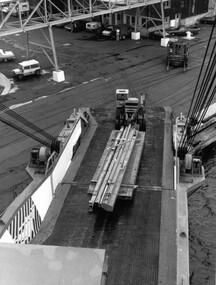
Photograph, Ro Ro vessel at Alcoa berth, n.d
... A forklift truck and several cars are in background, parked under a first floor walkway attached to a building....A forklift truck and several cars are in background, parked under a first floor walkway attached to a building. ...Port of Portland Authority archives.Front: (no inscriptions) Back: 19 x 26 (lower left) (pencil-crossed out) P.11. (G) (lower left, pencil). 19 cm wide x 26 cm (lower centre) (pencil) (drawn crop marks on back edges, pencil).port of portland -
 Glenelg Shire Council Cultural Collection
Photograph - Photograph - Main Breakwater Construction, n.d
... Several site huts, cars on right & left of B'water. Pile driver attached to largest crane. ...Several site huts, cars on right & left of B'water. Pile driver attached to largest crane. ...Port of Portland Authority Archivesport of portland archives, portland harbour -
 Orbost & District Historical Society
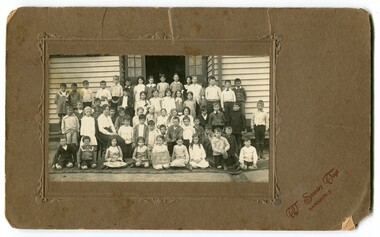
black and white photograph, Vogt. W.S, early 20th century
... attached. As the population increased so did the needs of the school. This was reflected in the provision of a larger classroom in 1898. This item is associated with the history of education in Orbost. orbost-state-school education-primary-schools on front - "W. Stanley Vogt Bairnsdale" A black / white photograph mounted on brown car ...This is the annual photograph of Grades 111 and 1V for pupils of the Orbost State School. The 19th of March 1886 proved an important day in the lives of many early settlers in the Orbost area, because on this day the Orbost State School opened. The fact that the school had first operated temporarily in a leased building, and on a half-time basis with SS2745 Jarrahmond, did not dampen the enthusiasm of the local inhabitants as they saw their offspring commence their education under the guidance of Head Teacher Campbell Mackay. However he remained in charge only until 12th of May 1886. The second Head Teacher, John Rowe, served until 1908. On 30th of June 1887, a portable room was provided; it being brought to the area by schooner. The school now had accommodation for 30 pupils; the teacher's welfare was considered because quarters of two rooms were attached. As the population increased so did the needs of the school. This was reflected in the provision of a larger classroom in 1898. This item is associated with the history of education in Orbost.A black / white photograph mounted on brown car. There are five rows of school children standing outside a wooden building. Some are sitting and others standing. A female teacher is seated on a chair in the second front row. A girl in the front row is holding a card - "Grades 111 & 1V Orbost".on front - "W. Stanley Vogt Bairnsdale"orbost-state-school education-primary-schools -
 Orbost & District Historical Society
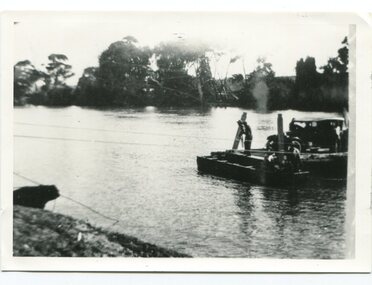
Photograph - photo of river punt after flood, 1930s
... The punt is near a bank of the river and is attached to the river bank by several lines of cable or rope. The vehicle on the punt is c.1920s model car. ...The punt is near a bank of the river and is attached to the river bank by several lines of cable or rope. The vehicle on the punt is c.1920s model car. ...This photograph depicts the operation of a punt across the Snowy River following a flood. Most likely, this relates to the effects of the 1934 flood which did significant damage to the road bridge across the Snowy River. This resulted in the installation of a punt which carried people, vehicles and stock across the River until the bridge could be repaired. Refer also to photograph 2737. This photograph is significant because it shows the operation of a punt across the Snowy River following a flood in the 1930s. It is an excellent record of this event. A b/w photograph showing a large expanse of river water, with a punt carrying several men and a vehicle. The punt is near a bank of the river and is attached to the river bank by several lines of cable or rope. The vehicle on the punt is c.1920s model car. nonesnowy river, flood, orbost, punt -
 Orbost & District Historical Society
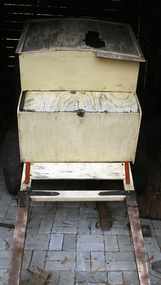
display cart, 1990's
... The shafts are the wrong size and shape, It has had car tyres, wheels and axle attached....The shafts are the wrong size and shape, It has had car tyres, wheels and axle attached. display cart ...This cart came from Sederlan's Bakery - Newmerella and Orbost. It had been used outside the premises as advertising. The original chassis had been added to extensively with shafts, wheels and tyres added. This axle appears to have part of the cart - either a baker's or butcher's cart. The original cart may have been a butcher's or baker's cart.A wooden two-wheeled cart painted cream. It has a wooden ply top and is fully enclosed. The chassis seems to be original with the rest having been re-constructed from non-original materials. The shafts are the wrong size and shape, It has had car tyres, wheels and axle attached.advertising cart sederlan's-bakery -
 Orbost & District Historical Society
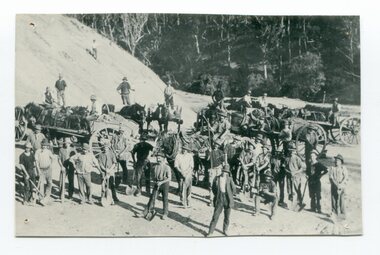
black and white photograph, C1914
... Fragments of his body and garments were recovered from the surrounding bush, and the main portion of the trunk, with leg attached, was hurled a distance of 200 yards. Peter Car roll was terribly- injured, and he died before medical aid arrived...Fragments of his body and garments were recovered from the surrounding bush, and the main portion of the trunk, with leg attached, was hurled a distance of 200 yards. Peter Car roll was terribly- injured, and he died before medical aid arrived. ' This is a pictorial record of construction workers associated with the Orbost - Bairnsdale railway. ...This photograph shows men working in the gravel pit at Newmerella just outside Orbost. Not long after this photograph was taken an accidental explosion killed three workers. In the newspaper, The Hobart Mercury on Saturday March 1914, There was this report: "EXPLOSION OF BLASTING CHARGE. THREE MEN KILLED. MELBOURNE, March 13 A fatal accident occurred this after- noon on the railway construction works at Hagen's Cutting, about two miles from Orbost, three men being killed. The victims were John Carroll, contractor, his son, Peter Carroll, and John Sullivan, a navvy. The gang had just finished work, and the three stayed behind to draw a blasting charge, which had missed fire yesterday. J. Carroll was using a pick, and it is presumed that the tool struck a percussion cap, and fired the charge. He and Sullivan were killed instantly, Carroll being literally blown to pieces. Fragments of his body and garments were recovered from the surrounding bush, and the main portion of the trunk, with leg attached, was hurled a distance of 200 yards. Peter Car roll was terribly- injured, and he died before medical aid arrived. ' This is a pictorial record of construction workers associated with the Orbost - Bairnsdale railway. This item is associated with the history of the Orbost-Bairnsdale railway line and therefore reflects the role that the rail line played in the social and economic history of Orbost. The Bairnsdale-Orbost railway was opened in 1916 to serve the agricultural and timber industry. Because of the decline in traffic and heavy operating costs, the line was finally closed in August, 1987. A black / white photograph of a large group of men with horses and wagons. Most are holding tools - picks, spades and shovels. Some of the wagons are loaded with soil.railway-construction east-gippsland-railway orbost-railway quarry-gravel-newmerella -
 Ringwood and District Historical Society
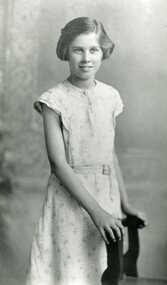
Photograph, Ringwood State School- Doris Aird, Dux of the School: 1935
... attached to photograph" Doris Aird. Dux of the School: 1935. Prize- Complimentary Sitting and Photograph taken by T.R.G.Williams who owned a hardware store and photographic studio in the Main Street. ( Where Eastland car park is now located)....attached to photograph" Doris Aird. Dux of the School: 1935. Prize- Complimentary Sitting and Photograph taken by T.R.G.Williams who owned a hardware store and photographic studio in the Main Street. ( Where Eastland car park is now located). ...Black and White photograph."Notes attached to photograph" Doris Aird. Dux of the School: 1935. Prize- Complimentary Sitting and Photograph taken by T.R.G.Williams who owned a hardware store and photographic studio in the Main Street. ( Where Eastland car park is now located). -
 Phillip Island and District Historical Society Inc.
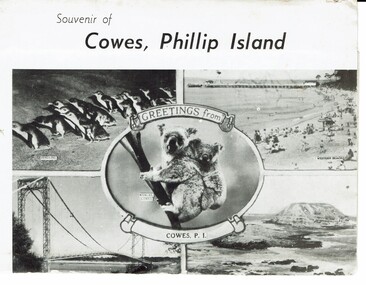
Postcard, Souvenir of Cowes, Phillip Island
... Historical Postcards Lillian Atkinson Phillip Island Car Racing motor car racing Cowes West beach Cowes Jan. 1959 Picture postcard set. 10 black & white postcards of Island attractions on fold out sheet in attached envelope. ...Typical tourist souvenir and photographs of the 1950s. Collected by Lillian Atkinson on holiday in 1959.HistoricalPicture postcard set. 10 black & white postcards of Island attractions on fold out sheet in attached envelope. Contains a brief explanation of tourist attractions on Phillip Island. Produced by Rose Stereograph Co., Armadale, Victoria. Several postcards have writing in blue pen under them. Cowes Jan. 1959postcards, lillian atkinson, phillip island car racing, motor car racing, cowes west beach -
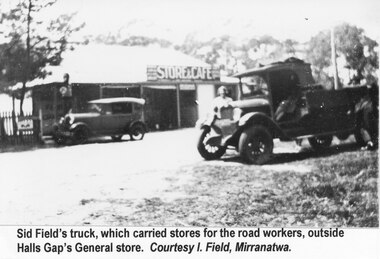 Halls Gap & Grampians Historical Society
Photograph - B/W, C 1930s
... attached so that it shows beneath the photo. The photo shows a small truck with a man standing beside it. In the background is the Halls Gap Store with a car parked in front of it. ...Sid Field's truck outside Halls Gap General Store on his trip to pick up stores for the road workers.The photo shows a small truck with a man standing beside it. In the background is the Halls Gap Store with a car parked in front of it."Sid Field's truck, which carried stores for the road workers, outside Halls Gap General store. Courtesy I. Field, Mirranatwa." Typed on a sheet of paper and attached so that it shows beneath the photo.buildings, shops, transport, trucks
