
Showing 18 items matching "nobelius station"
-
 Emerald Museum & Nobelius Heritage Park
Decorative object - Metal swan, Date unknown
... Nobelius Station...This handmade metal swan was observed to be nailed to a tree next to Nobelius Station on the Puffing Billy line for some years. ...This handmade metal swan was observed to be nailed to a tree next to Nobelius Station on the Puffing Billy line for some years. ...This handmade metal swan was observed to be nailed to a tree next to Nobelius Station on the Puffing Billy line for some years. Recently, the donor found it in the bushes near the station. This was presumably made by a local and fixed to the tree so that it would be visible for travellers on the Puffing Billy lineSwan shape outline, cut from flat metal sheet, painted white with minimal orange painted detail for beak and eye.nobelius station, puffing billy -
 Emerald Museum & Nobelius Heritage Park
Accessory - Eye glasses, W. Watson & Sons, 1920s-1940s
... Emerald Pty Ltd purchased 600 acres and with it developed the Emerald Country Club, including a golf course and properties. The Nobelius Station Estate purchased 300 acres, which includes sites of the current Nobelius Heritage Park and Emerald Lake Park. ...Emerald Pty Ltd purchased 600 acres and with it developed the Emerald Country Club, including a golf course and properties. The Nobelius Station Estate purchased 300 acres, which includes sites of the current Nobelius Heritage Park and Emerald Lake Park. ...These magnifying eyeglasses belonged to Dr William Bottomley. Dr Bottomley received his Bachelor of Surgery from the University of Melbourne in 1906 and had a medical practice on Collins St, Melbourne. He built a log cabin in Emerald which he would use on weekends.Dr Bottomley was a member of two syndicates who purchased land from Carl Axel Nobelius nursery property. Emerald Pty Ltd purchased 600 acres and with it developed the Emerald Country Club, including a golf course and properties. The Nobelius Station Estate purchased 300 acres, which includes sites of the current Nobelius Heritage Park and Emerald Lake Park. Bottomley Drive in Emerald is named after Dr Bottomley.This object is of historic significance as it provides insight into an early design of a late-nineteenth/early-twentieth century piece of medical equipment. (Early designs of magnifying eyeglasses date back to 1876 - Kwitko et al., 1998.) It is also of social significance as they belonged to Dr William Bottomley, who was instrumental in the establishment of the Emerald Country Club.Small pair of magnifying eyeglasses made of silver-coloured metal. Lenses are thick and unframed.eyeglasses, magnifying glasses, doctors (medical), medical equipment -
Emerald Museum & Nobelius Heritage Park
Container - Eyeglasses case, W. Watson & Sons, 1920s-1940s
... Emerald Pty Ltd purchased 600 acres and with it developed the Emerald Country Club, including a golf course and properties. The Nobelius Station Estate purchased 300 acres, which includes sites of the current Nobelius Heritage Park and Emerald Lake Park. ...Emerald Pty Ltd purchased 600 acres and with it developed the Emerald Country Club, including a golf course and properties. The Nobelius Station Estate purchased 300 acres, which includes sites of the current Nobelius Heritage Park and Emerald Lake Park. ...These magnifying eyeglasses belonged to Dr William Bottomley. Dr Bottomley received his Bachelor of Surgery from the University of Melbourne in 1906 and had a medical practice on Collins St, Melbourne. He built a log cabin in Emerald which he would use on weekends. He was a member of two syndicates who purchased land from Carl Axel Nobelius nursery property. Emerald Pty Ltd purchased 600 acres and with it developed the Emerald Country Club, including a golf course and properties. The Nobelius Station Estate purchased 300 acres, which includes sites of the current Nobelius Heritage Park and Emerald Lake Park. Bottomley Drive in Emerald is named after Dr Bottomley.This object is of historic significance as it provides insight into an early design of a late-nineteenth/early-twentieth century piece of medical equipment. The object is also of social significance as they belonged to Dr William Bottomley, who was instrumental in the establishment of the Emerald Country Club.Burgundy-coloured, cylindrical eyeglasses case. Lid closes with a snap fastener. The inside of the lid has the maker's label and the outside has the model of glasses printed in gold lettering. Early designs of magnifying eyeglasses date back to 1876 (Kwitko et al., 1998).Exterior of lid: "SPEERA" / MAGNIFIERS. / Interior of lid: OPTICIANS TO / H.M. GOVERNMENT. / W. WATSON & SONS / ESTABLISHED 1837 TD / 313 / HIGH HOLBORN / LONDON / -
Emerald Museum & Nobelius Heritage Park
Photograph - Photographic Portrait of Dr Bottomley, Dorothy Welding, 1930s
... These can be found by a 'Bottomley' search of the catalogue. The Nobelius Station Estate purchased 300 acres, which includes sites of the current Nobelius Heritage Park and Emerald Lake Park. ...These can be found by a 'Bottomley' search of the catalogue. The Nobelius Station Estate purchased 300 acres, which includes sites of the current Nobelius Heritage Park and Emerald Lake Park. ...Dr William Bottomley was a well-known specialist, humanist and social advocate in Melbourne in the first few decades of the 20th century. He also became a member of two syndicates who purchased land from Carl Axel Nobelius nursery property. Emerald Pty Ltd purchased 600 acres and with it developed the Emerald Country Club, including a golf course and properties. Dr Bottomley retired to Emerald. TheEmerald Museum has a number of objects (including medical instruments) and documents relating to Dr Bottomley. These can be found by a 'Bottomley' search of the catalogue. The Nobelius Station Estate purchased 300 acres, which includes sites of the current Nobelius Heritage Park and Emerald Lake Park. Bottomley Drive in Emerald is named after Dr Bottomley.This portrait is of historic significance because Dr Bottomley was instrumental in the establishment of the iconic Emerald Country Club.Framed photographic portrait in color of Collins St specialist, Dr Bottomley, by Dorothy Welding, Sydney, 1930s.dr bottomley, photographic portrait, doctors (medical), dorothy welding, 1930s, photographer, emerald country club -
Emerald Museum & Nobelius Heritage Park
Photograph - Packing Shed, Gembrook Nurseries, Unknown maker, 1900-1920
... Railway developments in 1900 included the creation of a siding and Packing Shed, known as Nobelius Station, which is featured in this photograph. ...Railway developments in 1900 included the creation of a siding and Packing Shed, known as Nobelius Station, which is featured in this photograph. ...The Gembrook Nurseries, informally known as the Nobelius Nurseries after the founder Carl Axel Nobelius, began with the purchase of sixty-three acres in 1886 and boomed in the 1890s due to opportunities provided by employment-promoting schemes to develop public parks and gardens and street shade by local and State Governments around Australia. Trees were sold to more than forty councils and Government organisations in the 1890s, including the Department of Agriculture, Lands Department and Victorian Railways. The need to transport nursery products by train via Ferntree Gully rather than by bullock dray to Narre Warren was a factor in the successful petition to develop what is now known as the Puffing Billy Railway. Railway developments in 1900 included the creation of a siding and Packing Shed, known as Nobelius Station, which is featured in this photograph. The Packing Shed was able to handle 250,000 cases of fruit each year. Gembrook Nurseries had an indirect influence on the development of other farms and industries in the region. As a wholesale nursery with high sales volumes it was an important employer of local people. Peak season for employees was during the cooler months, during most farmers' off-season. This provided local farmers with a source of income while their own farms were becoming established.The photograph is significant because it depicts personnel and infrastructure associated with the Gembrook or Nobelius Nurseries, a business which was instrumental to the development of Emerald as a settlement in the 19th and 20th Centuries and also influenced the development of public and private gardens and the farming of several species in Australia and internationally. The Nobelius Nursery is listed on the Victorian Heritage Register.Black and white rectangular photograph printed on print media paper. The image is captioned 'Lunch Hour at the Packing Shed, Gembrook Nurseries.' It depicts thirty-one men (including one adolescent) and one woman posing for a group photograph behind approximately five large product bales resting in a rectangular metal rail cargo carriage. One of the men has a bandage across one eye. The people depicted are wearing clothing indicating the image may have been taken in the early 20th century. The Packing Shed building (built in 1900) and several stacked wooden storage crates are visible behind the group.Obverse: 59 NOR (?) 10 (?) + / LUNCH HOUR AT THE PACKING SHED, GEMBROOK NURSERIES. /1900s, gembrook nurseries, nobelius nurseries, carl axel nobelius, packing shed, railway, puffing billy railway, nursery employees, farming, agriculture, government initiatives -
Emerald Museum & Nobelius Heritage Park
Photograph - Nobelius Packing Shed, Unknown photographer, 2000s
... Railway developments in 1900 included the creation of a siding and Packing Shed, known as Nobelius Station, which is featured in this photograph. ...Railway developments in 1900 included the creation of a siding and Packing Shed, known as Nobelius Station, which is featured in this photograph. ...The Gembrook Nurseries, informally known as the Nobelius Nurseries after the founder Carl Axel Nobelius, began with the purchase of sixty-three acres in 1886 and boomed in the 1890s due to opportunities provided by employment-promoting schemes to develop public parks and gardens and street shade by local and State Governments around Australia. Trees were sold to more than forty councils and Government organisations in the 1890s, including the Department of Agriculture, Lands Department and Victorian Railways. The need to transport nursery products by train via Ferntree Gully rather than by bullock dray to Narre Warren was a factor in the successful petition to develop what is now known as the Puffing Billy Railway. Railway developments in 1900 included the creation of a siding and Packing Shed, known as Nobelius Station, which is featured in this photograph. The Packing Shed was able to handle 250,000 cases of fruit each year at the height of the nurseries' activities. The image shows the Packing Shed with boarded-up windows, suggesting it was taken prior to the purchase of the facility for use in the Puffing Billy Railway service. Gembrook Nurseries had an indirect influence on the development of other farms and industries in the region. As a wholesale nursery with high sales volumes it was an important employer of local people. Peak season for employees was during the cooler months, during most farmers' off-season. This provided local farmers with a source of income while their own farms were becoming established.The photograph is significant because it depicts infrastructure associated with the Gembrook or Nobelius Nurseries, a business which was instrumental to the development of Emerald as a settlement in the 19th and 20th Centuries and also influenced the development of public and private gardens and the farming of several species in Australia and internationally. The Nobelius Nursery is listed on the Victorian Heritage Register.A coloured rectangular photograph of the Nobelius Nurseries Packing Shed. The photograph was taken in the grounds looking up towards the packing shed. There are various trees and vegetation throughout the grounds and surrounding the packing shed. The Nobelius Nurseries Packing Shed was used to sort and pack trees to be sent overseas during the 1900s-1940s.No inscriptions/marksnobelius nursery, packing shed, 2000s, puffing billy railway, nobelius heritage park -
Emerald Museum & Nobelius Heritage Park
Photograph - Nobelius Nursery Packing Shed, Unknown photographer, 1970s
... Railway developments in 1900 included the creation of a siding and Packing Shed, known as Nobelius Station, which is featured in this photograph. ...Railway developments in 1900 included the creation of a siding and Packing Shed, known as Nobelius Station, which is featured in this photograph. ...The Gembrook Nurseries, informally known as the Nobelius Nurseries after the founder Carl Axel Nobelius, began with the purchase of sixty-three acres in 1886 and boomed in the 1890s due to opportunities provided by employment-promoting schemes to develop public parks and gardens and street shade by local and State Governments around Australia. Trees were sold to more than forty councils and Government organisations in the 1890s, including the Department of Agriculture, Lands Department and Victorian Railways. The need to transport nursery products by train via Ferntree Gully rather than by bullock dray to Narre Warren was a factor in the successful petition to develop what is now known as the Puffing Billy Railway. Railway developments in 1900 included the creation of a siding and Packing Shed, known as Nobelius Station, which is featured in this photograph. The Packing Shed was able to handle 250,000 cases of fruit each year at the height of the nurseries' activities. The image shows the Packing Shed with boarded-up windows, suggesting it was taken prior to the purchase of the facility for use in the Puffing Billy Railway service. Gembrook Nurseries had an indirect influence on the development of other farms and industries in the region. As a wholesale nursery with high sales volumes it was an important employer of local people. Peak season for employees was during the cooler months, during most farmers' off-season. This provided local farmers with a source of income while their own farms were becoming established.The photograph is significant because it depicts infrastructure associated with the Gembrook or Nobelius Nurseries, a business which was instrumental to the development of Emerald as a settlement in the 19th and 20th Centuries and also influenced the development of public and private gardens and the farming of several species in Australia and internationally. The Nobelius Nursery is listed on the Victorian Heritage Register. The image appears to show the Packing Shed building prior to its restoration as a tourist facility.Black and white rectangular photograph printed on print media paper. The image depicts the Gembrook Nurseries Packing Shed building with boarded up windows.Obverse: NOBELIUS NURSERIES / . WEEKEND TRADING . /1970s, gembrook nurseries, puffing billy railway, carl axel nobelius, packing shed, railway stations, farming, agriculture -
Emerald Museum & Nobelius Heritage Park
Photograph - Nobelius Packing Shed, Unknown photographer
... Railway developments in 1900 included the creation of a siding and Packing Shed, known as Nobelius Station, which is featured in this photograph. ...Railway developments in 1900 included the creation of a siding and Packing Shed, known as Nobelius Station, which is featured in this photograph. ...The Gembrook Nurseries, informally known as the Nobelius Nurseries after the founder Carl Axel Nobelius, began with the purchase of sixty-three acres in 1886 and boomed in the 1890s due to opportunities provided by employment-promoting schemes to develop public parks and gardens and street shade by local and State Governments around Australia. Trees were sold to more than forty councils and Government organisations in the 1890s, including the Department of Agriculture, Lands Department and Victorian Railways. The need to transport nursery products by train via Ferntree Gully rather than by bullock dray to Narre Warren was a factor in the successful petition to develop what is now known as the Puffing Billy Railway. Railway developments in 1900 included the creation of a siding and Packing Shed, known as Nobelius Station, which is featured in this photograph. The Packing Shed was able to handle 250,000 cases of fruit each year at the height of the nurseries' activities. The image shows the Packing Shed prior to the purchase of the facility for use in the Puffing Billy Railway service. Gembrook Nurseries had an indirect influence on the development of other farms and industries in the region. As a wholesale nursery with high sales volumes it was an important employer of local people. Peak season for employees was during the cooler months, during most farmers' off-season. This provided local farmers with a source of income while their own farms were becoming established.The photograph is significant because it depicts infrastructure associated with the Gembrook or Nobelius Nurseries, a business which was instrumental to the development of Emerald as a settlement in the 19th and 20th Centuries and also influenced the development of public and private gardens and the farming of several species in Australia and internationally. The Nobelius Nursery is listed on the Victorian Heritage Register. The image appears to show the Packing Shed building prior to its restoration as a tourist facility.Black and white rectangular photograph printed on print media paper. The image depicts the Gembrook Nurseries Packing Shed building. The building is made from weatherboard and features a brick chimney. There is also a tall tree standing next to the chimney.Obverse: IUS NURSERIES / TRADING ... /gembrook nurseries, puffing billy railway, carl axel nobelius, packing shed, railway stations, farming, agriculture -
 Narre Warren and District Family History Group
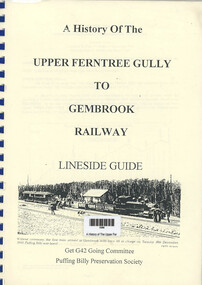
Book, Peter Medlin, A History of the Upper Ferntree Gully to Gembrook Railway, 1998
... Lakeside and Paradise Valley stations Nobelius Siding Lineside Guide showing where all the lines were put in Puffing Billy railway line A History of the Upper Ferntree Gully to Gembrook Railway Book Peter Medlin Get G42 Going Committee Puffing Billy Preservation Society ...Lineside Guide showing where all the lines were put in Puffing Billy railway linenon-fictionLineside Guide showing where all the lines were put in Puffing Billy railway linelakeside and paradise valley stations, nobelius siding -
 Narre Warren and District Family History Group
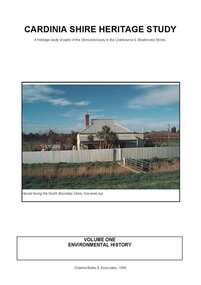
Book, Graeme Butler & Associates, Cardinia Shire Heritage Study : a heritage study of parts of the Shire previously in the Cranbourne & Sherbrooke Shires. Vol 1 : Key Findings and Recommendations Vol 2 : Heritage Place and Precinct Citations, 1998
... Cardinia Shire (Vic.) heritage studies Tivoli Berry Farm (Clematis) Carramar (Emerald) Nobelius Heritage Park Dalmore Public Hall Horace Hardy Farm Complex Emerald Lake Park The Grange (Koo Wee Rup) Glen Afton (Yannathan) Myrtlewood (Yannathan) Vay View Farm (Lang Lang) Emerald Railway Station Timber Bridges (Yallock Creek) Emerald County Clud Oak Lee (Emerald) Sycamore Lodge (Emerald) Cambden Wollybutt Row (Emerald) Silver Birches (Emerald) Lang Lang Cemetery Old Monomeith Homestead sites Monomeith Park (Monomeith) Dustings Garage (Koo Wee Rup) Koo Wee Rup Public Hall Koo Wee Rup Lockup Wattle Theatre (Koo Wee Rup) Harewood (Koo Wee Rup) Warook Homestead (Monomeith) Old Yallock St John's Roman Catholic Church (Koo Wee Rup) Royal Hotel (Koo Wee Rup) Budgeree (Yannathan) Cascades Guest House (Clematis) Rutter Farm (Tooradin) Koo Wee Rup Swamp Drains Upper Ferntree Gully to Gembrook Railway Great Southern Railway Misson's Butchers Shop & Residence (Lang Lang) English Scottish & Australian Bank (Lang Lang) Clematis Park Row Houses (Lang Lang) This Environmental History of the Cardinia Shire incorporates the Environmental History of the former Shire of Pakenham, compiled by Carlotta Kellaway for Graeme Butler & Associates and the Environmental History of those areas of the Shire formerly in the Shires of Cranbourne and Sherbrooke, compiled by Jill Barnard for Graeme Butler and Associates. ...This Environmental History of the Cardinia Shire incorporates the Environmental History of the former Shire of Pakenham, compiled by Carlotta Kellaway for Graeme Butler & Associates and the Environmental History of those areas of the Shire formerly in the Shires of Cranbourne and Sherbrooke, compiled by Jill Barnard for Graeme Butler and Associates. An environmental history, which is meant as a guide to the identification of sites of significance within a shire, cannot be a complete social history of that shire. Rather, it is meant to be a summary of the various ways in which people have used and reacted to the natural environment, altering it so as to create economic, social, cultural and educational uses for themselves and their neighbours. [from the introduction]non-fictionThis Environmental History of the Cardinia Shire incorporates the Environmental History of the former Shire of Pakenham, compiled by Carlotta Kellaway for Graeme Butler & Associates and the Environmental History of those areas of the Shire formerly in the Shires of Cranbourne and Sherbrooke, compiled by Jill Barnard for Graeme Butler and Associates. An environmental history, which is meant as a guide to the identification of sites of significance within a shire, cannot be a complete social history of that shire. Rather, it is meant to be a summary of the various ways in which people have used and reacted to the natural environment, altering it so as to create economic, social, cultural and educational uses for themselves and their neighbours. [from the introduction] cardinia shire (vic.), heritage studies, tivoli berry farm (clematis), carramar (emerald), nobelius heritage park, dalmore public hall, horace hardy farm complex, emerald lake park, the grange (koo wee rup), glen afton (yannathan), myrtlewood (yannathan), vay view farm (lang lang), emerald railway station, timber bridges (yallock creek), emerald county clud, oak lee (emerald), sycamore lodge (emerald), cambden wollybutt row (emerald), silver birches (emerald), lang lang cemetery, old monomeith homestead sites, monomeith park (monomeith), dustings garage (koo wee rup), koo wee rup public hall, koo wee rup lockup, wattle theatre (koo wee rup), harewood (koo wee rup), warook homestead (monomeith), old yallock, st john's roman catholic church (koo wee rup), royal hotel (koo wee rup), budgeree (yannathan), cascades guest house (clematis), rutter farm (tooradin), koo wee rup swamp drains, upper ferntree gully to gembrook railway, great southern railway, misson's butchers shop & residence (lang lang), english scottish & australian bank (lang lang), clematis park, row houses (lang lang) -
Emerald Museum & Nobelius Heritage Park
Booklet - Fire Safety Information Booklet, Emerald Rural Fire Brigade, unknown
... Emerald Victoria Australia fire prevention firefighters Businesses Emerald Rural Fire Brigade Lockyer's Emerald Nobelius & Co. Webber's Self Service Elto Service Station Emerald Electrics Peter Searle emerald motors H.A. ...Booklet compiled by the Emerald Rural Fire Brigade 'in the interests of public safety' detailing fire prevention measures for domestic properties. Date unkown but would have been before construction of Cardinia Dam in the early 1970s and when Emerald Telephone Exchange was still in use. Advertisements contain useful historical information with names and phone numbers of various businesses in the town. The card is a list of phone numbers to ring in case of fire, with names and addresses of members of the brigade, local doctor (I. S. Murphy) and police.12 page typewritten and roneod booklet with centre staple, pink cover with illustration; includes diagrams and advertisements -white card printed in red with list of phone numbers - some damage to edges of paper; some rusting from stapleemerald, victoria, australia, fire prevention, firefighters, businesses, emerald rural fire brigade, lockyer's, emerald, nobelius & co., webber's self service, elto service station, emerald electrics, peter searle, emerald motors, h.a. sherriff, bill stephens, emerald co-operative society -
 Emerald Museum & Nobelius Heritage Park
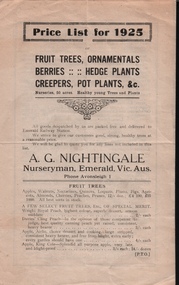
Pamphlet, Price List for 1925, A.G. Nightingale, Nurseryman, Emerald, Vic, About 1925
... Nobelius Nurseries. Nightingale Nursery sold fruit and ornamental trees and delivered to Emerald Railway Station. ...Nobelius Nurseries. Nightingale Nursery sold fruit and ornamental trees and delivered to Emerald Railway Station. ...Nursery owned by Alfred George Nightingale, who originally worked for Nobelius Nurseries. Nightingale Nursery sold fruit and ornamental trees and delivered to Emerald Railway Station. The nurseries covered an area of 50 acres.Part of the horticultural history of Emerald and the surrounding district.Four page, cream coloured pamphlet with black printing. Contains price lists for fruit trees, ornamentals, berries, hedge plants, creepers and pot plants.a.g.nightingale, emerald -
Emerald Museum & Nobelius Heritage Park
Photograph - Shell Service Station, Unknown photographer, 1990s
... Closely associated with the history of Emerald is the history of the Gembrook or Nobelius Nurseries, which transported trees and other plants to parks and private gardens in Melbourne, in other Australian locations and in many other countries. Impassable roads to transport goods in Winter, and the difficulty of transporting goods by bullock team or horse and cart over a route that at that time went via the railway station at Narre Warren led to Carl Axel Nobelius and other local business owners successfully lobbying the Victorian Government to build the narrow gauge railway to the Ferntree Gully line that is now operated as the tourist attraction 'Puffing Billy.' ...Closely associated with the history of Emerald is the history of the Gembrook or Nobelius Nurseries, which transported trees and other plants to parks and private gardens in Melbourne, in other Australian locations and in many other countries. Impassable roads to transport goods in Winter, and the difficulty of transporting goods by bullock team or horse and cart over a route that at that time went via the railway station at Narre Warren led to Carl Axel Nobelius and other local business owners successfully lobbying the Victorian Government to build the narrow gauge railway to the Ferntree Gully line that is now operated as the tourist attraction 'Puffing Billy.' ...The township of Emerald was settled after gold was discovered in the area in 1858. Emerald's 'square mile' was established and roads between the township, other towns in the region and Melbourne were established (with alterations to the original layout in the intervening years). From these first years of the settlement roads and services to support the transport of goods (from businesses making and repairing carts and drays to mechanics' workshops to service cars and industrial vehicles) were integral to the economic survival and development of the township. Closely associated with the history of Emerald is the history of the Gembrook or Nobelius Nurseries, which transported trees and other plants to parks and private gardens in Melbourne, in other Australian locations and in many other countries. Impassable roads to transport goods in Winter, and the difficulty of transporting goods by bullock team or horse and cart over a route that at that time went via the railway station at Narre Warren led to Carl Axel Nobelius and other local business owners successfully lobbying the Victorian Government to build the narrow gauge railway to the Ferntree Gully line that is now operated as the tourist attraction 'Puffing Billy.' Puffing Billy was primarily a goods transport service, but did transport passengers in both directions of travel for both everyday needs and recreational purposes. The Puffing Billy service did not remove the need for local families and businesses to provide their own transport options, however, whenever they needed to move smaller loads or to access places not served by the railway lines or stations. In the late Nineteenth and early Twentieth Centuries transport options included carts of various sizes pulled by horses, oxen or bullocks. In the 1920s and 1930s cars (which had existed in Australia in early forms from approximately 1896) began to replace horses as the primary mode of transportation across Australia. By the end of the Second World War cars dominated transport options in rural areas as well as urban. Correspondingly, businesses to service vehicles shifted from focusing on repairs and maintenance of harnesses and cart structures to the repair and servicing of cars and other vehicles. Museum records indicate that the image was taken in the Shell Service Station in Emerald in approximately 1990. There is still a Shell Service Station in Emerald, located at 336-338 Belgrave-Gembrook Road, though it is now part of the Coles Express network.This image is significant because it provides insights into the development of automotive and engineering workshop businesses in the region, part of the progression from wheelwright and cartwright businesses in the days of oxen drays to businesses servicing cars and other vehicles. As part of this, it also provides insight into the equipment available at the time the photograph was taken, which is speculated to be the late 1980s or early 1990s. Identification of the two men pictured may also help ascertain the significance of the image.Black and white rectangular photograph printed on print media paper. The image depicts two men standing in front of a piece of mechanic's workshop equipment on which a Bridgestone tyre has been loaded. One of the men is wearing long-sleeved overalls, the other is wearing dark trousers and a polo-neck T-shirt. Museum records indicate the photograph may have been taken at the Shell Service Station.Obverse: BRIDGESTONE / SF-340 EAGER /emerald, victoria, australia, transport, automotive services, shell service station, cars, motor vehicles, puffing billy, businesses, local business -
 Emerald Museum & Nobelius Heritage Park
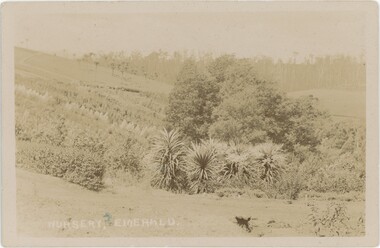
Postcard, Nursery, Emerald, c. 1909
... Emerald Nobelius Nursery Agriculture 1900s Address: "ADDRESS / Miss h [illegible] / Beaconsfield / Railway Station / Vic" Message: "CORRESPONDENCE / Dear Mary / From Aunt [illegible] / Best wishes for / a merry xmas & / a bright happy / new year / J & M.J. ...Based on the 1901-issued stamp, this postcard most likely originates from the 1900s. The featuring of the nursery - almost certainly Carl Axel Nobelius' nursery - in a postcard indicates its importance to the identity of Emerald in this time, becoming a recognisable major feature of the town. Dates written on the postcard suggest it could have been sent on the 27th of February, 1909, but given its message is wishing the recipient a merry Christmas this may not be accurate unless it was sent from Emerald in 1908 and then sent on from Beaconsfield in 1909.This postcard captures a view of Nobelius' nursery in full operation, taken from a perspective of tourist appeal as a symbol of the town.This item is a faded sepia postcard depicting a view from a hill over a sprawling orchard in the valley. Tall natural trees grow in the background, behind the extensive landscape of ordered fruit trees. There is a patch of bare earth and small plants in the foreground. On the reverse, there is a handwritten Christmas and New Years message.Address: "ADDRESS / Miss h [illegible] / Beaconsfield / Railway Station / Vic" Message: "CORRESPONDENCE / Dear Mary / From Aunt [illegible] / Best wishes for / a merry xmas & / a bright happy / new year / J & M.J. Craig[?] / Emerald" Caption: "NURSERY, EMERALD"emerald, nobelius nursery, agriculture, 1900s -
 Emerald Museum & Nobelius Heritage Park
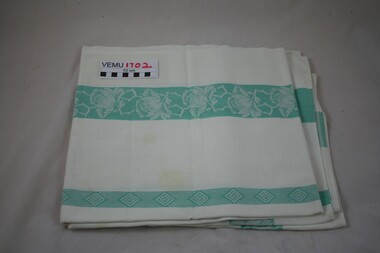
Domestic object - Tablecloth, Unknown maker, 1940s-1950s
... Station Street, Emerald. It was used in the home of Elaine and Doug Morris from the 1950s-2016. (Elaine is the granddaughter of the founder of the Gembrook Nurseries, Carl Axel Nobelius.) ...Station Street, Emerald. It was used in the home of Elaine and Doug Morris from the 1950s-2016. (Elaine is the granddaughter of the founder of the Gembrook Nurseries, Carl Axel Nobelius.) ...This was purchased in the 1950s at the Emerald Market, which was held in Station Street, Emerald. It was used in the home of Elaine and Doug Morris from the 1950s-2016. (Elaine is the granddaughter of the founder of the Gembrook Nurseries, Carl Axel Nobelius.) This tablecloth was used in the home for 60 years. Its excellent condition suggests it was either used only as a decoration or for 'good' occasions.This 'good' tablecloth gives an insight into household arrangements at the time. White with blue-green lines. table cloth, 1950s, elaine morris -
 Emerald Museum & Nobelius Heritage Park
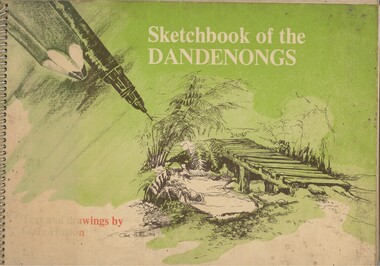
Book - Sketchbook, Clare Hutson, Sketchbook of the Dandenongs, 1970s
... Book consists of sketches of scenic sites in the Dandenongs and the Yarra Valley including the Emerald Country Club, a farmhouse in Cockatoo, an original Nobelius house in Carramar Court, the Emerald Railway Station, a sculpture by Hans Knorr and places and people in Gembrook. ...Book consists of sketches of scenic sites in the Dandenongs and the Yarra Valley including the Emerald Country Club, a farmhouse in Cockatoo, an original Nobelius house in Carramar Court, the Emerald Railway Station, a sculpture by Hans Knorr and places and people in Gembrook. ...Book consists of sketches of scenic sites in the Dandenongs and the Yarra Valley including the Emerald Country Club, a farmhouse in Cockatoo, an original Nobelius house in Carramar Court, the Emerald Railway Station, a sculpture by Hans Knorr and places and people in Gembrook. Text and Drawings by Clare Hutson. Published in 1978.These are sketches of the local area c1970s.Spiral bound book of sketches of scenic sites in the Dandenongs in black and white and in sepia. 52 pages.On cover: 'Sketchbook of the / DANDENONGS / Text and drawings by / Clare Hutson'clare hutson, sketches, 1978 -
 Emerald Museum & Nobelius Heritage Park
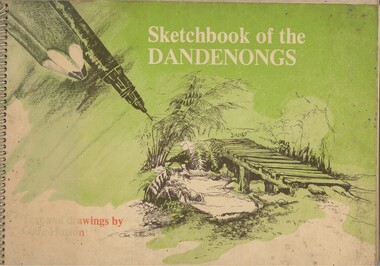
Book - Pictorial Book, Hutson, Clare et al, Sketchbook of the Dandenongs, 1978
... Book consists of sketches of scenic sites in the Dandenongs and the Yarra Valley including the Emerald Country Club, a farmhouse in Cockatoo, an original Nobelius house in Carramar Court, the Emerald Railway Station, a sculpture by Hans Knorr and places and people in Gembrook. ...Book consists of sketches of scenic sites in the Dandenongs and the Yarra Valley including the Emerald Country Club, a farmhouse in Cockatoo, an original Nobelius house in Carramar Court, the Emerald Railway Station, a sculpture by Hans Knorr and places and people in Gembrook. ...Book consists of sketches of scenic sites in the Dandenongs and the Yarra Valley including the Emerald Country Club, a farmhouse in Cockatoo, an original Nobelius house in Carramar Court, the Emerald Railway Station, a sculpture by Hans Knorr and places and people in Gembrook. Text and Drawings by Clare Hutson. Published in 1978.Spiral bound paperback [54] p. in landscape format; chiefly ill.; ISBN 0959631704 (2 parts)best wishes, Clare Hutsondandenong ranges, emerald, victoria, buildings, art, clare hutson, emerald country club, emerald railway station -
 Emerald Museum & Nobelius Heritage Park
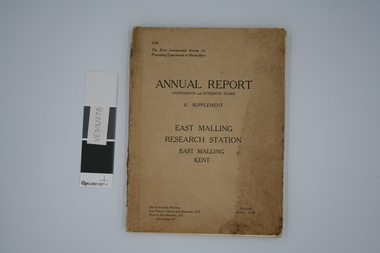
Book - Report, The Kent Incorporated Society for Promoting Experiments in Horticulture, The Kent Incorporated Society for Promoting Experiments in Horticulture. Annual Report (fourteenth and fifteenth years). II Supplement, 1928
... This book produced by the East Maling Research Station. East Maling, Kent was owned by Nobelius Nursery. The Nursery imported plants from East Maling Research Station....This book produced by the East Maling Research Station. East Maling, Kent was owned by Nobelius Nursery. The Nursery imported plants from East Maling Research Station. ...This book produced by the East Maling Research Station. East Maling, Kent was owned by Nobelius Nursery. The Nursery imported plants from East Maling Research Station.171 page paper annual report containing black and white photographs. Undecorated recto (front) and verso (back) with text printed on recto, verso is plain. Damage to spine. Protected in plastic sleeve.Include with Nobelius Nursery (note inside)emerald, victoria, australia, nurseries (plants), horticulture, gembrook nurseries, nobelius nursery, east maling research station, annual report, nobelius nursery collection
