
Showing 142 items matching "nursing conditions"
-
 Returned Nurses RSL Sub-branch
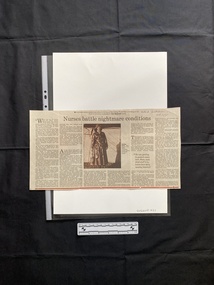
Newspaper - Newspaper clipping, [Weekend Australian], Nurses battle nightmare conditions, [November 1993]
... ...Nursing conditions...WWI WW1 World War One Nursing conditions Uniform Personal histories Evelyn (Tevie) Davies Minnie (Mimie) Farquharson Proctor Elsie May Tranter 'Weekend. ...Article by author & historian Jan Bassett giving details of conditions faced by nurses during World War One with a focus on story excerpts from Evelyn (Tevie) Davies, Mimie [Minnie Farquharson] Proctor & Elsie [May] Tranter.A large newspaper clipping consisting of a title, six columns of text and a black and white photo of a woman in the winter nurse's uniform of the Australian Imperial Forces (AIF).'Weekend. Australian. / Nov. 1993' [blue ink, top right]wwi, ww1, world war one, nursing conditions, uniform, personal histories, evelyn (tevie) davies, minnie (mimie) farquharson proctor, elsie may tranter -
 Returned Nurses RSL Sub-branch
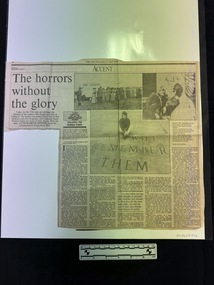
Newspaper - Newspaper clipping, Elizabeth Minter, The horrors without the glory, 19900425
... ...Nursing conditions...Nurses mentioned in the article: Elsie [May] Tranter Nellie [Constance] Maurice [sic] [Morrice] Evelyn Davies Laura Grubb C E Harries Lydia [Kate] King Alice [Elizabeth Barrett] Kitchen [Florence Narrelle] Narelle [sic] [Jessie] Hobbes World War one WWI WW1 Nursing in warfare Nursing conditions A large black and white newspaper clipping of a single article with three inset images, two photographs and one illustration. ...Article interview with historian Katie Holmes about the harsh experiences of WWI nurses she is finding in her reading of journals and diaries belonging to these nurses. Nurses mentioned in the article: Elsie [May] Tranter Nellie [Constance] Maurice [sic] [Morrice] Evelyn Davies Laura Grubb C E Harries Lydia [Kate] King Alice [Elizabeth Barrett] Kitchen [Florence Narrelle] Narelle [sic] [Jessie] Hobbes A large black and white newspaper clipping of a single article with three inset images, two photographs and one illustration. Article has five columns of text with a large headline and brief intro paragraph. The clipping has minor tears and folds and is not cut straight.world war one, wwi, ww1, nursing in warfare, nursing conditions -
![Australian Nursing Federation bumper sticker, [1990s]](/media/collectors/5bb42dc221eaf31100db1d3b/items/5dfabea421ea6710d0d5693c/item-media/5dfabed721ea6710d0d57ca0/item-fit-380x285.jpg?cb=6) Australian Nursing & Midwifery Federation
Australian Nursing & Midwifery FederationAustralian Nursing Federation bumper sticker, [1990s]
... conditions to nurses. This sticker is one of many pieces of campaign materials and merchandise produced by the Australian Nursing Federation....Sticker printed with 'KEEP NURSES NURSING - IMPROVE NURSES' CONDITIONS' in large blue font....Sticker printed with 'KEEP NURSES NURSING - IMPROVE NURSES' CONDITIONS' in large blue font. Australian Nursing Federation bumper sticker ...Bumper sticker campaigning for improvements to the wages and conditions to nurses. This sticker is one of many pieces of campaign materials and merchandise produced by the Australian Nursing Federation.Rectangular white and blue bumper sticker. Sticker printed with 'KEEP NURSES NURSING - IMPROVE NURSES' CONDITIONS' in large blue font.nursing, nurses, 1990s, stickers, bumper stickers, trade unions, labour history, australia, australian nursing federation, anf -
 Northern District School of Nursing. Managed by Bendigo Historical Society Inc.
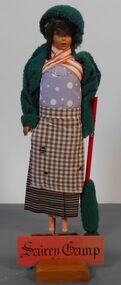
Education kit - Sairey Gamp Miniature Doll, Nursing Through the Ages
... Charles Dickens satirized nursing conditions with the character of Sairey Gamp. ...Charles Dickens satirized nursing conditions with the character of Sairey Gamp. ...Mrs Sairey Gamp - English Monasteries declined in 1405 the Chruch was said to have one third of English's wealth. Henry VIII dissolved the Monasteries despite their record of charitable and medical work and took over most of their property. This left large numbers of helpless sick and poor to die. For the next 300 years there was no nursing class "hospitals" were overcrowded (sometimes 6 people to a bed) and were dirty. Nursing was carried out by women of low character and morals. Charles Dickens satirized nursing conditions with the character of Sairey Gamp. Nursing had sunk to the lowest level.30cm Miniature Doll -Checked Apron over stripped skirt. Purple spotted top with orange and white scarf. Wool type cardigan and hat. Holding mop or duster in hand.Name Tagnursing history, nursing uniforms, nursing education equipment, northern district school of nursing -
![Royal Australian Nursing Federation campaign badge, [1986?]](/media/collectors/5bb42dc221eaf31100db1d3b/items/5c4668dc21ea670150f8e407/item-media/5c46691f21ea670150f94202/item-fit-380x285.jpg?cb=6) Australian Nursing & Midwifery Federation
Australian Nursing & Midwifery FederationRoyal Australian Nursing Federation campaign badge, [1986?]
... Distributed to nurses during campaigning for improved wages and working conditions in the 1980s, possibly during the historic 1986 Victorian 50-day nurses strike. The Royal Australian Nursing Federation (RANF) became the Australian Nursing Federation in 1989, suggesting that this button is from the late 1980s. ...Button printed with 'KEEP NURSES NURSING - Improve Nurses' Conditions' and 'R.A.N.F. [Royal Australian Nursing Federation] Vic. ...Button printed with 'KEEP NURSES NURSING - Improve Nurses' Conditions' and 'R.A.N.F. [Royal Australian Nursing Federation] Vic. ...Distributed to nurses during campaigning for improved wages and working conditions in the 1980s, possibly during the historic 1986 Victorian 50-day nurses strike. The Royal Australian Nursing Federation (RANF) became the Australian Nursing Federation in 1989, suggesting that this button is from the late 1980s. Similar to the badges worn in this photo [https://stories.anmfvic.asn.au/86strike/media/2560-1440-landscape-sec2-contentb-hr_logwf7a.jpg] from 1986 (see individual on the far right).Circular white and blue plastic button. Silver metal, plastic-coated, with safety pin fastener adhered to back. Button printed with 'KEEP NURSES NURSING - Improve Nurses' Conditions' and 'R.A.N.F. [Royal Australian Nursing Federation] Vic. [Victorian] Branch'.nursing, industrial action, strike action, unionism, badges, nurses, buttons, pins, campaigning, trade unions, labour history -
 Alfred Hospital Nurses League - Nursing History Collection
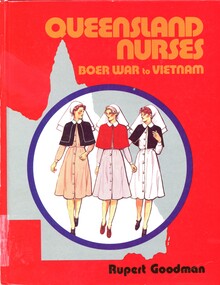
Book - Illustrated book, Rupert Goodwin 1915, Queensland nurses: Boer War to Vietnam, 1985
... The author served as a nursing orderly with the 2/4 Australian General Hospital during World War Two, where he became acquainted with the problems and conditions of nursing....The author served as a nursing orderly with the 2/4 Australian General Hospital during World War Two, where he became acquainted with the problems and conditions of nursing. ...A history of the development and practice of military nursing by Queensland nurses from the Boer War to Vietnam. Includes casualty list and list of decorations awarded to Queensland nurses.Illustrated book with red cover. The front cover has an outline of Queensland on which is printed an illustration of three women in the uniforms of the three military nursing services within a blue circle. Also on the front cover is the title printed in orange and authors name printed in black. Title in orange, author's surname and publishers mark in black are also printed on the spine. On the back cover in black print on a yellow rectangle the AANS pledge of service. Above this is an illustration of the Australian Commonwealth Military Forces badge, and below is the badge of the Royal Australian Army Nursing Corps.non-fictionA history of the development and practice of military nursing by Queensland nurses from the Boer War to Vietnam. Includes casualty list and list of decorations awarded to Queensland nurses.royal australian army nursing corps-history, military nursing-queensland-history, nurses-queensland-history, medicine-military-history-australia -
 Northern District School of Nursing. Managed by Bendigo Historical Society Inc.
Administrative record - Northern District School of Nursing Graduates Association - Examinations and Guides, 1984
... Northern District School of Nursing Graduates Association - Examinations and Guides 1984 This item contains the following documents: 3795.10a This document is a registration examination paper for general nurses, focusing on surgical nursing. 3795.10b This document is a nursing examination paper focused on surgical and medical nursing care, assessing knowledge and practical skills in patient management, complications, and first aid. 3795.10c This document is a nursing examination paper covering essential clinical management topics in surgical, medical, and pediatric nursing. 3795.10d This document is a surgical nursing examination paper covering key scenarios and management principles for nurses. 3795.10e This document is an examiner's guide for the Victorian Nursing Council's surgical nursing registration exam, outlining essential answers and procedures for key surgical nursing scenarios. 3795.10f This document provides guidance for examiners on expected answers for nursing examinations under the Victoria Nursing Council, focusing on key medical conditions and nursing practices....Nurse Training Lister House examinations Northern District School of Nursing Graduates Association - Examinations and Guides 1984 This item contains the following documents: 3795.10a This document is a registration examination paper for general nurses, focusing on surgical nursing. 3795.10b This document is a nursing examination paper focused on surgical and medical nursing care, assessing knowledge and practical skills in patient management, complications, and first aid. 3795.10c This document is a nursing examination paper covering essential clinical management topics in surgical, medical, and pediatric nursing. 3795.10d This document is a surgical nursing examination paper covering key scenarios and management principles for nurses. 3795.10e This document is an examiner's guide for the Victorian Nursing Council's surgical nursing registration exam, outlining essential answers and procedures for key surgical nursing scenarios. 3795.10f This document provides guidance for examiners on expected answers for nursing examinations under the Victoria Nursing Council, focusing on key medical conditions and nursing practices. ...The Northern District School of Nursing in Victoria, Australia Graduates Association: History of the School Managed by a committee including hospital administrators, medical professionals, and nursing leaders from several regional hospitals. Associated with major hospitals in the Northern District, including Bendigo Base, Mildura Base, Castlemaine, Echuca, Swan Hill, St. Arnaud, and Kyneton District Hospitals. Provide high-quality theoretical and practical nursing training. Raise the standard of nursing education in the region. Maintain the highest principles of nursing practice. Applicants must be at least 17 years old and hold a Proficiency Certificate or higher educational qualification. Application involves submitting forms, certificates, an interview, an aptitude test, and a medical examination. A three-month probationary period follows initial acceptance. Preliminary Training School: Four-week introductory course covering basic nursing, anatomy, hygiene, and practical skills. Practical experience in various hospital departments, guided by senior staff. Study Block Plan: Includes several blocks of theoretical and practical instruction throughout the three-year program. Regular school exams and two state exams (First Professional and Final State) are required for progression and graduation. Nurses work a 40-hour week with at least one or two days off per week and three weeks of annual leave. Accommodation is provided in comfortable hostels with good facilities. Uniforms are supplied free; nurses provide their own shoes and stockings. Salaries and allowances are regulated, with deductions for board and free medical care. Additional Information Post-Graduate Opportunities. Senior positions require further experience and additional certificates (e.g., Midwifery, Infant Welfare).Diploma courses available in administration, teaching, and specialized nursing fields. Bursaries are available for advanced study.Career Prospects: Graduates can pursue roles in administration, teaching, ward and departmental leadership, district and visiting nursing, industrial and school nursing, and more. Opportunities existed both within hospitals and in community or specialized settings.FAQs and Practical Details. Minimal training costs (mainly exam fees and personal items).Living out allowances and travel expenses are covered. Four training intakes per year; waiting periods are short if qualifications are met.Northern District School of Nursing Graduates Association - Examinations and Guides 1984 This item contains the following documents: 3795.10a This document is a registration examination paper for general nurses, focusing on surgical nursing. 3795.10b This document is a nursing examination paper focused on surgical and medical nursing care, assessing knowledge and practical skills in patient management, complications, and first aid. 3795.10c This document is a nursing examination paper covering essential clinical management topics in surgical, medical, and pediatric nursing. 3795.10d This document is a surgical nursing examination paper covering key scenarios and management principles for nurses. 3795.10e This document is an examiner's guide for the Victorian Nursing Council's surgical nursing registration exam, outlining essential answers and procedures for key surgical nursing scenarios. 3795.10f This document provides guidance for examiners on expected answers for nursing examinations under the Victoria Nursing Council, focusing on key medical conditions and nursing practices.nurse training, lister house, examinations -
 Flagstaff Hill Maritime Museum and Village
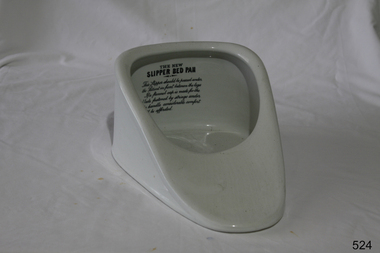
Equipment - Bed Pan
... conditions in both military and civilian hospitals, including the addition of bedpans in order to reduce infection exposure from urine or faeces. https://www.wikiwand.com/en/Bedpan The use of bedpans is significant, as it allows a patient who cannot move much, to remain in bed and perform toilet functions. Flagstaff Hill Warrnambool Shipwrecked-coast Flagstaff-Hill Flagstaff-Hill-Maritime-Museum Maritime-Museum Shipwreck-coast Flagstaff-Hill-Maritime-Village Nursing ...The Bedpan Toilet device is a special tool designed for people who are unable to get out of bed to use the bathroom. It helps them go to the toilet comfortably and conveniently without having to leave their bed. The device is placed under the person's bottom, and it has a container that collects urine or stool. It is easy to clean and can be emptied into a toilet or sink. The Bedpan Toilet device allows individuals who are confined to bed due to illness or injury to maintain their dignity and independence by providing them with a practical solution for using the bathroom while staying in bed. The word bedpan was first seen in the literature of John Higgins in 1572, and one of the oldest known bedpans is on display in the Science Museum of London. It is a green, glazed earthenware bedpan that has been dated to the 16th or 17th century. At that time, bedpans were made from materials including pewter, brass, pottery, glass, and porcelain. Bedpans were not a commonplace item in hospitals until the late 1800s. Florence Nightingale, who worked as a nurse in the United Kingdom from the mid to late 1800s, recorded death rates and causes for soldiers in military hospitals during the Crimean War and then correlated them to corresponding sanitisation procedures. As a result, Nightingale proposed several methods to improve the sanitary conditions in both military and civilian hospitals, including the addition of bedpans in order to reduce infection exposure from urine or faeces. https://www.wikiwand.com/en/Bedpan The use of bedpans is significant, as it allows a patient who cannot move much, to remain in bed and perform toilet functions.Bed pan ceramic white glaze with handle. Labelled "The New Slipper Bed Pan". Has specific instructions for use under the maker's label.‘THE NEW SLIPPER BED PAN. This slipper should be passed under the patient in front between the legs. If a flannel cap is made for the blade fastened by strings under the handle considerable comfort will be afforded.’ flagstaff hill, warrnambool, shipwrecked-coast, flagstaff-hill, flagstaff-hill-maritime-museum, maritime-museum, shipwreck-coast, flagstaff-hill-maritime-village, nursing, bedpans, hygiene -
 The Beechworth Burke Museum
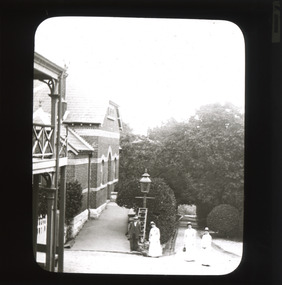
Photograph - Lantern Slide, c1900
... nursing in Beechworth. Three medical or social welfare facilities opened in the mid-1800s as part of a push by the township to become a regional centre for Government services. These were the Ovens District Hospital (opened in 1857), the Ovens Benevolent Asylum (opened in 1863), and the Beechworth Mental Hospital (opened in 1867 and renamed Mayday Hills Hospital at Centenary celebrations in 1967). It was recognised that the unsettled living conditions...nursing in Beechworth. Three medical or social welfare facilities opened in the mid-1800s as part of a push by the township to become a regional centre for Government services. These were the Ovens District Hospital (opened in 1857), the Ovens Benevolent Asylum (opened in 1863), and the Beechworth Mental Hospital (opened in 1867 and renamed Mayday Hills Hospital at Centenary celebrations in 1967). It was recognised that the unsettled living conditions ...This image appears to show nurses at what is now the Mayday Hills Mental Asylum arriving for work in approximately 1900. These individuals are part of a long history of nursing in Beechworth. Three medical or social welfare facilities opened in the mid-1800s as part of a push by the township to become a regional centre for Government services. These were the Ovens District Hospital (opened in 1857), the Ovens Benevolent Asylum (opened in 1863), and the Beechworth Mental Hospital (opened in 1867 and renamed Mayday Hills Hospital at Centenary celebrations in 1967). It was recognised that the unsettled living conditions, poverty and relative isolation of the Goldfields environment could produce 'mental disturbances' which required local treatment facilities as services in Melbourne were too far away. Carole Woods' publication 'A Titan's Field' describes activities undertaken by patients at Beechworth Mental Hospital as including monthly balls and occasional concerts as well as work to make the facility self-supporting such as farm work and making clothes. She mentions a report in 1870 that the approximately 300 patients were clean and neat with 'no-one in restraint or seclusion' but that by 1905 the organisation had 623 patients which placed strain on building infrastructure such as heating and water supplies, leading to high turnover of nurses and other issues. A program of building works to extend and improve facilities followed over subsequent decades. Lantern slides, sometimes called 'magic lantern' slides, are glass plates on which an image has been secured for the purpose of projection. Glass slides were etched or hand-painted for this purpose from the Eighteenth Century but the process became more popular and accessible to the public with the development of photographic-emulsion slides used with a 'Magic Lantern' device in the mid-Nineteenth Century. Photographic lantern slides comprise a double-negative emulsion layer (forming a positive image) between thin glass plates that are bound together. A number of processes existed to form and bind the emulsion layer to the base plate, including the albumen, wet plate collodion, gelatine dry plate and Woodburytype techniques. Lantern slides and magic lantern technologies are seen as foundational precursors to the development of modern photography and film-making techniques This glass slide is significant because it provides insight into Beechworth's social and medical amenities in the early Twentieth Century, around the time of Australia's Federation into one nation. It is also an example of an early photographic and film-making technology in use in regional Victoria in the time period.Thin translucent sheet of glass with a rectangular image printed on the front and framed in a black backing. It is held together by metals strips to secure the edges of the slide.Obverse: i /burke museum, beechworth, lantern slide, slide, glass slide, plate, burke museum collection, photograph, monochrome, magic lantern, indigo shire, north-east victoria, nineteenth century, 1900s, twentieth century, emulsion slides, nursing, nurses, mental hospitals, lunatic asylums, asylums, social services, social welfare, insane asylums, mental health, infrastructure -
 The Beechworth Burke Museum
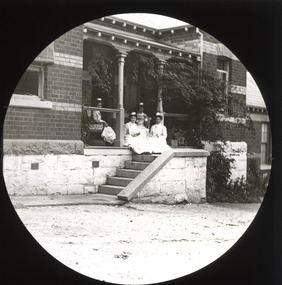
Photograph - Lantern Slide, c1900
... nursing in Beechworth. Three medical or social welfare facilities opened in the mid-1800s as part of a push by the township to become a regional centre for Government services. These were the Ovens District Hospital (opened in 1857), the Ovens Benevolent Asylum (opened in 1863), and the Beechworth Mental Hospital (opened in 1867 and renamed Mayday Hills Hospital at Centenary celebrations in 1967). It was recognised that the unsettled living conditions...nursing in Beechworth. Three medical or social welfare facilities opened in the mid-1800s as part of a push by the township to become a regional centre for Government services. These were the Ovens District Hospital (opened in 1857), the Ovens Benevolent Asylum (opened in 1863), and the Beechworth Mental Hospital (opened in 1867 and renamed Mayday Hills Hospital at Centenary celebrations in 1967). It was recognised that the unsettled living conditions ...This image appears to show nurses at what is now the Mayday Hills Mental Asylum in approximately 1900. These individuals are part of a long history of nursing in Beechworth. Three medical or social welfare facilities opened in the mid-1800s as part of a push by the township to become a regional centre for Government services. These were the Ovens District Hospital (opened in 1857), the Ovens Benevolent Asylum (opened in 1863), and the Beechworth Mental Hospital (opened in 1867 and renamed Mayday Hills Hospital at Centenary celebrations in 1967). It was recognised that the unsettled living conditions, poverty and relative isolation of the Goldfields environment could produce 'mental disturbances' which required local treatment facilities as services in Melbourne were too far away. Carole Woods' publication 'A Titan's Field' describes activities undertaken by patients at Beechworth Mental Hospital as including monthly balls and occasional concerts as well as work to make the facility self-supporting such as farm work and making clothes. She mentions a report in 1870 that the approximately 300 patients were clean and neat with 'no-one in restraint or seclusion' but that by 1905 the organisation had 623 patients which placed strain on building infrastructure such as heating and water supplies, leading to high turnover of nurses and other issues. A program of building works to extend and improve facilities followed over subsequent decades. Lantern slides, sometimes called 'magic lantern' slides, are glass plates on which an image has been secured for the purpose of projection. Glass slides were etched or hand-painted for this purpose from the Eighteenth Century but the process became more popular and accessible to the public with the development of photographic-emulsion slides used with a 'Magic Lantern' device in the mid-Nineteenth Century. Photographic lantern slides comprise a double-negative emulsion layer (forming a positive image) between thin glass plates that are bound together. A number of processes existed to form and bind the emulsion layer to the base plate, including the albumen, wet plate collodion, gelatine dry plate and Woodburytype techniques. Lantern slides and magic lantern technologies are seen as foundational precursors to the development of modern photography and film-making techniques.This glass slide is significant because it provides insight into Beechworth's social and medical amenities in the early Twentieth Century, around the time of Australia's Federation into one nation. It is also an example of an early photographic and film-making technology in use in regional Victoria in the time period.Thin translucent sheet of glass with a circular image printed on the front and framed in a black backing. It is held together by metals strips to secure the edges of the slide.burke museum, beechworth, lantern slide, slide, glass slide, plate, burke museum collection, photograph, monochrome, magic lantern, indigo shire, north-east victoria, nineteenth century, 1900s, twentieth century, emulsion slides, nursing, nurses, mental hospitals, lunatic asylums, asylums, social services, social welfare, insane asylums, mental health, infrastructure -
 Lara RSL Sub Branch
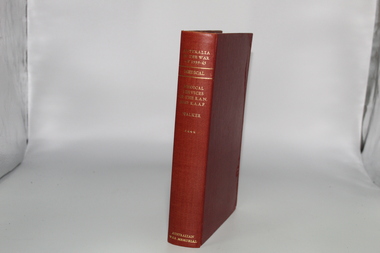
Book, Australia in the War of 1939-1945 MEDICAL SERVICES of the RAN and RAAF Author Allan.S. Walker MD. Ch.M F.R.A.C.P, First published in 1961
... conditions in ships...prisoners of war...burns...infectious diseases...diseases of the skin...affections of the ear, nose and throat...dental branch...medical units in base areas and in the field...milne bay to noemfoor...morotai to philippines and borneo...aviation medical...medical aspects of survival...raaf nursing...Women in the Medical Services ran raaf medical building the naval medical service medical stores and eqipment living conditions in ships prisoners of war burns infectious diseases diseases of the skin affections of the ear, nose and throat dental branch medical units in base areas and in the field milne bay to noemfoor morotai to philippines and borneo aviation medical medical aspects of survival raaf nursing service physiotherapists occupational therapists the australian army medical women's service Australian War Memorial Australia in the War of 1939-1945 - Medical Services of the RAN and RAAF Australia in the War of 1939-1945 MEDICAL SERVICES of the RAN and RAAF Author Allan.S. ...Part One - Medical services of the RAN Part 2 - Medical Services of the RAAF. Part 3 - Women in the Army Medical Services.Women in the Medical ServicesAustralia in the War of 1939-1945 - Medical Services of the RAN and RAAFAustralian War Memorialran raaf medical, building the naval medical service, medical stores and eqipment, living conditions in ships, prisoners of war, burns, infectious diseases, diseases of the skin, affections of the ear, nose and throat, dental branch, medical units in base areas and in the field, milne bay to noemfoor, morotai to philippines and borneo, aviation medical, medical aspects of survival, raaf nursing service, physiotherapists, occupational therapists, the australian army medical women's service -
 City of Moorabbin Historical Society (Operating the Box Cottage Museum)
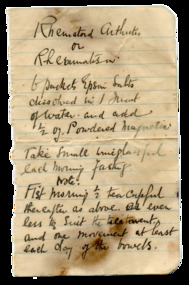
Document - Medical prescriptions, Cure ailments or medical conditions
... Prescription and medication notes that were inside the Gladstone bag that belonged to Nurse Emma Warburton. 1) a recipe and instructions for rheumatoid arthritis 2) medication for corns 3) a prescription from the Moorabbin Pharmacy, John Wilson, Cheltenham dated 22 October 1917. nursing midwife emma warburton cheltenham moorabbin city of moorabbin mentone child birth Rheumatoid arthritis prescription Moorabbin pharmacy silk corn cure Documents Cure ailments or medical conditions Document Medical prescriptions ...Prescription and medication notes that were inside the Gladstone bag that belonged to Nurse Emma Warburton. 1) a recipe and instructions for rheumatoid arthritis 2) medication for corns 3) a prescription from the Moorabbin Pharmacy, John Wilson, Cheltenham dated 22 October 1917.Documentsnursing, midwife, emma warburton, cheltenham, moorabbin, city of moorabbin, mentone, child birth, rheumatoid arthritis, prescription, moorabbin pharmacy, silk corn cure -
 Montmorency–Eltham RSL Sub Branch
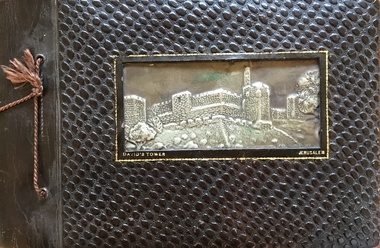
Album - Nicholson Photo Album
... Nursing Duties in the 2/7 Australian General Hospital. His overseas postings included travels through India to the Middle East, Egypt and Greece. While fulfilling these duties, he was an interested photographer, keeping records of the sights he saw in many of the places he visited, as well as photos of the military living conditions and the people he worked with on a day-to-day basis. ...Nursing Duties in the 2/7 Australian General Hospital. His overseas postings included travels through India to the Middle East, Egypt and Greece. While fulfilling these duties, he was an interested photographer, keeping records of the sights he saw in many of the places he visited, as well as photos of the military living conditions and the people he worked with on a day-to-day basis. ...Photographic record of overseas places visited by local resident who was a member of armed service during WW2. Des Nicholson was born in Northcote in 1909. He enlisted in the military in mid 1940, having already served 2 years in the Citizens’ Forces. Before he signed up, he lived in Kew with his mother, Isabella. His enlistment documents indicate that he was employed as a transport driver, although his discharge papers state that he was a hairdresser. His photo album shows pictures of him demonstrating skills in that area in various deployments overseas; his enlistment documents refer to his unit being the 8th Division Petrol Company, while for much of his service he was assigned to Nursing Duties in the 2/7 Australian General Hospital. His overseas postings included travels through India to the Middle East, Egypt and Greece. While fulfilling these duties, he was an interested photographer, keeping records of the sights he saw in many of the places he visited, as well as photos of the military living conditions and the people he worked with on a day-to-day basis. The ‘tourist’ photos Des took would be of particular interest as a current-day comparison for those folk who might be familiar with the locations he passed through. After the war, Des again lived with his mother but eventually, in 1953, he married Kathleen Watson who lived in Eltham. The wider Watson family was well-known in the area, and the sisters Kathleen and Ruby were residents in the Glen Park area in Eltham North. After Des and Kath married they continued to live in Kath and Ruby’s house near where the current soccer and cricket sporting complex is now located. Ruby never married and they evidently stayed in the same place until, one by one, they each died in the early 2000s. Photos taken by a resident of Eltham while on active service overseasPhoto AlbumOn Front Cover: DAVID'S TOWER JERUSALEMphotographs, ww2, overseas, india, middle east -
 Kiewa Valley Historical Society
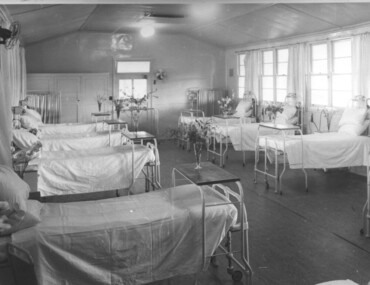
Photograph Tawonga Hospital, A ward at Tawonga Hospital, 1949/50
... nursing staff and carried all work necessary to make the building operational as a hospital. Up until this time the nearest hospital was at Yackandandah. The hospital remained on this site until 1961 when a larger, more suitable building was purchased in Mt. Beauty from the S.E.C. A photographic record of a typical open plan style ward in that era. There were no private rooms. There are portable screens stored at the end of the room to provide "privacy" at the bedside when needed. There is a fan on the wall for cooling. Depicts the rather primitive conditions ...This photo is of a ward - probably the female ward, as there a many floral arrangements - of the original hospital at Tawonga. This was situated at the corner of Ryders Lane and Kiewa Valley Highway. The building was transported from Bonegilla where it was originally a part of the Bonegilla Military Hospital. The hospital was opened on 24th September, 1949 with a capacity of 12 beds, but was later increased to 35 beds by enclosing the verandahs on 3 sides of the building. 'Add ons' provided theatre, offices, stores and a nurses home. Construction was commenced by the Hospital and Charities Commission with considerable input from the S.E.C., providing the removal and re-erection of the building, the accommodation for nursing staff and carried all work necessary to make the building operational as a hospital. Up until this time the nearest hospital was at Yackandandah. The hospital remained on this site until 1961 when a larger, more suitable building was purchased in Mt. Beauty from the S.E.C.A photographic record of a typical open plan style ward in that era. There were no private rooms. There are portable screens stored at the end of the room to provide "privacy" at the bedside when needed. There is a fan on the wall for cooling. Depicts the rather primitive conditions of that era when compared with todays standards.Black and white photograph of a ward in the Tawonga District Hospitalhospital, ward, tawonga -
 Kiewa Valley Historical Society
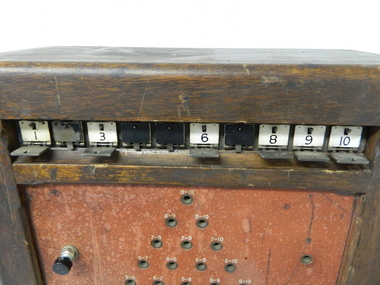
Console Telephone 10 shutter, circa early 1900s
... nursing station. Identification of the patient needing help is crucial for swift action from the available medical staff. Similarly in large construction sites such as the Kiewa Hydro Scheme, successful instant communications was also essential. This switchboard required a 50 volt supply to successfully operate and was in use when both telecommunications and postal were under the one Federal Government carrier i.e. The Post Master General. A benefit with a line communication system (such as the one that fed this console was that interference from atmospheric conditions ...This manual telephone exchange console is an important piece of equipment which provided the most efficient method of long distance communications in the 1950's to the 1980's. Communications were critical, not only for the regional Hospital, but also for large construction sites i.e. the Kiewa Hydro Scheme, especially if they are in dense rugged mountainous regions. The degree of Occupation Health and Welfare on industrial sites were at a bare minimum compared to the work scene after the 1980's.This telephone exchange console is highly significant to both the Kiewa Valley and Mount Beauty region because it was so important in the communications field relating to operational safety and work related controls. The success of any large undertaken relies heavily upon good communications. In the hospital this method of communications is still used i.e. patient to ward station. This flag system link a patient's room to the controlling nursing station. Identification of the patient needing help is crucial for swift action from the available medical staff. Similarly in large construction sites such as the Kiewa Hydro Scheme, successful instant communications was also essential. This switchboard required a 50 volt supply to successfully operate and was in use when both telecommunications and postal were under the one Federal Government carrier i.e. The Post Master General. A benefit with a line communication system (such as the one that fed this console was that interference from atmospheric conditions did not impede the connection.This console telephone switchboard (manual) unit has a shutter operation (precursor to the light indicator) to identify the caller to the telephone switchboard operator. This switchboard has a ten point indication shutter system allowing the operator to clearly identify where the caller is located. The console has a 44 connection point holes with their configurations in a triangular shape. The shutters are held closed by a small lever at the top which is opened by a small electrical charge from the incoming call. The operator uses a wind up handle to power a magneto connector(handle on the console's right side). The telephone hand set is located on the left side of the console. sec vic kiewa hydro scheme, alternate energy supplies, alpine population growth and communications -
Bendigo Historical Society Inc.
Document - Notes of public talk given to Bendigo Historical Society by Jenny Trewartha on 7th March, 2025 relating to NDSN, 7th March, 2025
... nursing numbers were dwindling. Post World War II was a critical period with soldiers returning with wounds and conditions not seen before and needing special treatment. ...nursing numbers were dwindling. Post World War II was a critical period with soldiers returning with wounds and conditions not seen before and needing special treatment. ...Speech given by Jenny Trewartha to the Bendigo Historical Society on 7th March, 2025 at the la Trobe Art Institute, View Street, Bendigo. Jenny was a graduate of the NDSN at the end of 1972. The Northern District School of Nursing opened at Bendigo in 1950 and was the only regional independent School of Nursing of its kind in the southern hemisphere. There was a huge need for trained nurses in hospitals across the region as the nursing numbers were dwindling. Post World War II was a critical period with soldiers returning with wounds and conditions not seen before and needing special treatment. Medicine and medical treatments were entering a new age, and this new age needed nurses with new skills. There was a need to improve the status and prospects for nurses. Improved working and living conditions were needed; adequate remuneration and a career path to attract a better class of trainees, and a uniform training by means of a circular or block system. This was the basis of the establishment of the Northern District School of Nursing which oversaw nurse training in hospitals across the northwest of Victoria, including Bendigo, Castlemaine, Kyneton, Maryborough, Mildura, Ouyen, St Arnaud, Swan Hill, Dunolly, Inglewood and Echuca. The Northern District School of Nursing opened in 1950 and closed its doors in 1989 having overseen the training of more than 3000 nurses who are now scattered across Australia and the world.Ten pages of typed notes pertaining to training as a nurse at the Northern District School of Nursing from 1950 to 1989, and the Northern District School of Nursing Graduates Association. Document discusses different aspects of life as a trainee nurse - including financial, social and where students came from.northern district school of nursing, nursing, student -
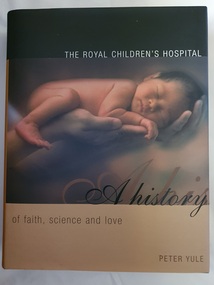 Alfred Hospital Nurses League - Nursing History Collection
Book - Illustrated book, Peter Yule, The Royal Children's Hospital: a history of faith science and love, 1999
... nursing training Also a former matron of RCH, Grace Wilson, was later a matron of the Alfred Hospital. Royal Children's Hospital (Melbourne) Paediatrics-Victoria-history An insight into the origins and development of the Royal Children's Hospital, Melbourne. Opening in 1870 with six rooms as "the Melbourne Free Hospital for Sick Children, it has grown into a major paediatric institution. As well as the hospitals history, the book provides insight into the social and economic conditions ...An insight into the origins and development of the Royal Children's Hospital, Melbourne. Opening in 1870 with six rooms as "the Melbourne Free Hospital for Sick Children, it has grown into a major paediatric institution. As well as the hospitals history, the book provides insight into the social and economic conditions in Victoria in the late 19th and early 20th century.Illustrated book with dust jacket. Book is bound in dark green material, with title authors name and publishers mark print ed in gilt on spine. Dust jacket is black and gold in colour, with a coloured photo of newborn baby lying on adult hand on front cover. Title and author's name on front cover, also on spine with the addition of the publisher's mark. On the back cover is the RCH coat of arms.non-fictionAn insight into the origins and development of the Royal Children's Hospital, Melbourne. Opening in 1870 with six rooms as "the Melbourne Free Hospital for Sick Children, it has grown into a major paediatric institution. As well as the hospitals history, the book provides insight into the social and economic conditions in Victoria in the late 19th and early 20th century.royal children's hospital (melbourne), paediatrics-victoria-history -
![Hardcover illustrated book. Dust jacket has orange toned front cover with historic images (Melbourne Hospital laundry [ca.1917] and a theatre nurse), a black and white photo of entrance to hospital, Lonsdale St site and a coloured photo of hospital at current site {ca.1997].
Contains a history of the Royal Melbourne Hospital, the first public hospital in Victoria, from its opening in 1848 in Lonsdale St up to 1998, contains over 100 historical photographs and illustrations.](/media/collectors/50187a8f023fd7201471f198/items/67639f847a79e07be7f8b278/item-media/6763a5eb7a79e07be7f8dda8/item-fit-380x285.jpg?cb=6) Alfred Hospital Nurses League - Nursing History Collection
Alfred Hospital Nurses League - Nursing History CollectionBook - Illustrated book, Alan Gregory, The ever open door: a history of the Royal Melbourne Hospital 1848-1998, 1998
... Of significance to the AHNL as it is the history of another Victorian hospital, including nursing training and working conditions, similar to those of the Alfred hospital. ...History of the Royal Melbourne Hospital, the first public hospital in Victoria, from its opening in 1848 in Lonsdale St up to 1998, contains over 100 historical photographs and illustrations.Illustrated book with dustjacket. Book is bound in dark blue fabric with hospital crest on front in gilt. title and publisher's mark printed in gilt on spinenon-fictionHistory of the Royal Melbourne Hospital, the first public hospital in Victoria, from its opening in 1848 in Lonsdale St up to 1998, contains over 100 historical photographs and illustrations.royal melbourne hospital-history, hospitals-victoria-history -
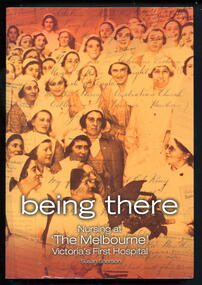 Alfred Hospital Nurses League - Nursing History Collection
Book - Illustrated book, Susan Sherson, being there: Nursing at "The Melbourne" Victoria's First Hospital, 2005
... Of significance to the AHNL as it is the history of another Victorian hospital, including nursing training and working conditions, similar to those of the Alfred hospital. ...The story starts in the 1840's when Melbourne was a small settlement, and funds were raised to care for the sick and poor and interweaves the theme of nursing with the history of Melbourne and Victoria over more than 150 years. It also includes an appendix of all nurses who graduated (RMH and MSN - Melbourne School of Nursing) in the formal training years of 1890-1993.Illustrated book with orange toned photograph of Miss Jane Bell (Lady Superintendent 1910-1934) with her nursing staff on retirement in 1934, with handwriting overlay on cover. Title and author's name appear in white print on front cover and spine. Hospital crest on base of spine.non-fictionThe story starts in the 1840's when Melbourne was a small settlement, and funds were raised to care for the sick and poor and interweaves the theme of nursing with the history of Melbourne and Victoria over more than 150 years. It also includes an appendix of all nurses who graduated (RMH and MSN - Melbourne School of Nursing) in the formal training years of 1890-1993.royal melbourne hospital-history, royal melbourne hospital-nursing-history, nursing-victoria-history, hospitals-victoria -history, melbourne school of nursing-history -
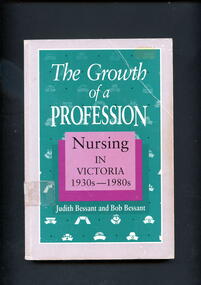 Alfred Hospital Nurses League - Nursing History Collection
Book - Illustrated book, Judith Bessant et al, The Growth of a Profession: Nursing in Victoria 1930s-1980s, 1991
... It traces the difficult steps that the nursing profession has made towards forging its identity within medicine, improving wages and conditions and the transferring of nurse education into the tertiary sector. ...This book is about nurses and nursing in Victoria from the 1930s until the 1980's. It traces the difficult steps that the nursing profession has made towards forging its identity within medicine, improving wages and conditions and the transferring of nurse education into the tertiary sector. The book culminates with the nurses' strike of 1986.Illustrated book. Front cover, within a light grey border, has part of title and authors names printed in white on a green background, also on this background are illustrations of nurses' caps in graduating colour shades of green to white. Between the title and authors names is a light pink square offset on a larger dark pink rectangle. On this square the rest of the title is printed in black ink. Abbreviated title, authors and publishers name are printed in black ink on a grey background. On the back cover are printed a synopsis of the book, authors details and publishers name on a grey rectangular background, with a green border.non-fictionThis book is about nurses and nursing in Victoria from the 1930s until the 1980's. It traces the difficult steps that the nursing profession has made towards forging its identity within medicine, improving wages and conditions and the transferring of nurse education into the tertiary sector. The book culminates with the nurses' strike of 1986.nurses - victoria-history, nursing-victoria-history, royal victorian college of nursing, royal australian nursing federation-victorian branch-history -
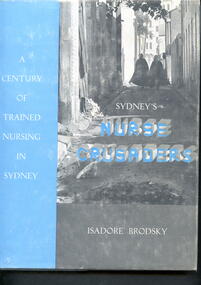 Alfred Hospital Nurses League - Nursing History Collection
Book - Illustrated book, Isadore Brodsky, Sydney's Nurse Crusaders, 1968
... Nursing-Australia-History Lucy Osburn Nursing-NSW-History This book is a tribute to Lucy Osburn and five Nightingale Sisters (including Haldane Turriff) who arrived in Sydney on March 5, 1868, to improve nurse training, working conditions, recognition and status in the community. ...This book is a tribute to Lucy Osburn and five Nightingale Sisters (including Haldane Turriff) who arrived in Sydney on March 5, 1868, to improve nurse training, working conditions, recognition and status in the community. The book also draws attention to ongoing the plight of nurses wanting similar improvement.Illustrated book with dustjacket and covered with clear protective film. Dust jacket is light blue in colour, with a black and white photo of rear view of two caped figures walking down a lane way. Title and author's name are printed in blue and white ink on this photo. Title and authors name are also printed in white ink on the spine. On the back cover is an illustration of a lamp.non-fictionThis book is a tribute to Lucy Osburn and five Nightingale Sisters (including Haldane Turriff) who arrived in Sydney on March 5, 1868, to improve nurse training, working conditions, recognition and status in the community. The book also draws attention to ongoing the plight of nurses wanting similar improvement.nursing-australia-history, lucy osburn, nursing-nsw-history -
 Alfred Hospital Nurses League - Nursing History Collection
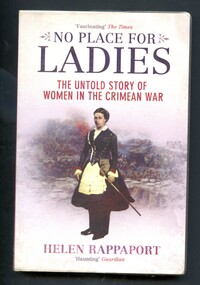
Book - Illustrated book, Helen Rappaport 1947, No place for ladies: the untold story of women in the Crimean War, 2008
... Of significance to the AHNL as gives insight into the working conditions of nurses in the Crimean War Crimean War Mary Seacole nurses nursing women in war Florence Nightingale The pioneering work of Florence Nightingale has become legendary, but in this book the author also champions the contribution of the women whose stories have largely gone untold-the nurses, cantinieres and army wives who played a vital, but often overlooked role in the theatre of war. ...The pioneering work of Florence Nightingale has become legendary, but in this book the author also champions the contribution of the women whose stories have largely gone untold-the nurses, cantinieres and army wives who played a vital, but often overlooked role in the theatre of war. Mary Seacole's establishment of "The British Hotel' near Balaclava supplied fatigued soldiers with much needed comfort and medical attention, earning her the respect of many men, but no official recognitionIllustrated book, front and back cover have coloured illustrations of Crimean War conflicts on a pale grey background. The front cover also has a coloured illustration of a woman in quasi military dress. This last illustration also appears at the top of the spine. The book's title is printed in dark and light brown ink at the top of the front cover and the author's name is printed in light brown ink at the bottom of the front cover. The spine has a light brown background, with title printed in white and light blue, author's name printed in black, and publishers name printed in white. The back cover also has a summary of the booknon-fictionThe pioneering work of Florence Nightingale has become legendary, but in this book the author also champions the contribution of the women whose stories have largely gone untold-the nurses, cantinieres and army wives who played a vital, but often overlooked role in the theatre of war. Mary Seacole's establishment of "The British Hotel' near Balaclava supplied fatigued soldiers with much needed comfort and medical attention, earning her the respect of many men, but no official recognitioncrimean war, mary seacole, nurses, nursing, women in war, florence nightingale -
 Alfred Hospital Nurses League - Nursing History Collection
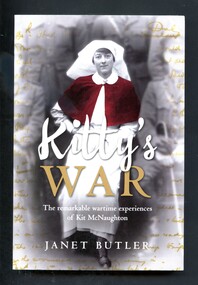
Book - Illustrated book, Janet Butler, Kitty's War: the remarkable wartime experiences of Kit McNaughton, 2013
... Kit Mcnaughton trained at the Geelong Hospital Kit Mcnaughton is the nurse portrayed in the ABC miniseries "The war that changed us" Of significance to the AHNL as it gives insight into the working conditions of nurses during World War I World War 1914-1918 Nurses Nursing This book is based upon the previously unpublished diaries of army nurse Kit Mcnaughton, who embarked on the troopship Orsova in 1915, tracing her journey through the war from Egypt (where she nursed Gallipoli veterans), Lemnos Island and then to France and the Somme. ...This book is based upon the previously unpublished diaries of army nurse Kit Mcnaughton, who embarked on the troopship Orsova in 1915, tracing her journey through the war from Egypt (where she nursed Gallipoli veterans), Lemnos Island and then to France and the Somme. Kit finished active service as Australia's first plastic surgery nurse, assisting medical pioneers in this field as they repaired the shattered faces of Australian soldiersIllustrated book. Front cover has a coloured black and white photograph of Kit McNaughton in nurse's uniform seated alongside soldiers. Book title is printed in golden-brown and white ink on the front cover along with the authors name (white ink) Spine and back cover have a golden-brown background. Abbreviated title printed in white and black ink on spine, along with the authors name in white ink. Same coloured photo of Kit McNaughton is printed at top of spine. Publishers mark is printed in white ink on a black background at base of spine. The back cover has a summary of the book along with three black and white photographs: Kit McNaughton and another nurse standing behind two soldiers in hospital beds, the photograph from which the image on the front cover was taken, and a photograph of Kit McNaughton aged 16non-fictionThis book is based upon the previously unpublished diaries of army nurse Kit Mcnaughton, who embarked on the troopship Orsova in 1915, tracing her journey through the war from Egypt (where she nursed Gallipoli veterans), Lemnos Island and then to France and the Somme. Kit finished active service as Australia's first plastic surgery nurse, assisting medical pioneers in this field as they repaired the shattered faces of Australian soldiersworld war 1914-1918, nurses, nursing -
 Alfred Hospital Nurses League - Nursing History Collection
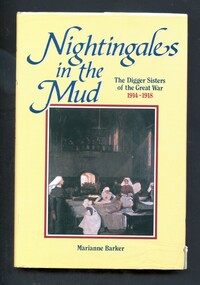
Book - Illustrated book, Marianne Baker 1944, Nightingales in the mud: the digger sisters of the Great War 1914-1918, 1989
... Appendix includes list of Australian Nurses who served in World War One Of significance to the AHNL, as Alfred graduates were among those who served World War 1914-1918 - Medical Care Military Nursing Nurses Australian nurses This book draws on many first-hand and previously unpublished accounts of the work of Australian nurses in World War one, to tell the story of courage and companionship under conditions of great hardship - in the mud of Flanders, among the cholera cases in India, on the hospital ships during the Gallipoli campaign, on the Afghanistan border, in Vladivostok, in mosquito infested Macedonia and in the Sinai Desert. ...This book draws on many first-hand and previously unpublished accounts of the work of Australian nurses in World War one, to tell the story of courage and companionship under conditions of great hardship - in the mud of Flanders, among the cholera cases in India, on the hospital ships during the Gallipoli campaign, on the Afghanistan border, in Vladivostok, in mosquito infested Macedonia and in the Sinai Desert.Illustrated book with dust jacket. Book has a dark blue cover, abbreviated title, author's surname and publisher's name embossed in gold on spine. Front of dust jacket has a reproduction of the painting "Arrival of first Australian wounded from Gallipoli at Wandsworth Hospital, London" by George Coates, in a red/brown and white border. Rest of dustjacket is yellow brown in colour. Full title is printed in blue and red /brown above painting, author's full name is printed in blue below painting. Abbreviated title, author's surname and publishers name are printed in blue on the spinenon-fictionThis book draws on many first-hand and previously unpublished accounts of the work of Australian nurses in World War one, to tell the story of courage and companionship under conditions of great hardship - in the mud of Flanders, among the cholera cases in India, on the hospital ships during the Gallipoli campaign, on the Afghanistan border, in Vladivostok, in mosquito infested Macedonia and in the Sinai Desert.world war 1914-1918 - medical care, military nursing, nurses, australian nurses -
 Alfred Hospital Nurses League - Nursing History Collection
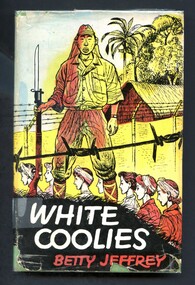
Book - Illustrated Book, Betty Jeffrey 1908-2000 et al, White Coolies, 1954
... nursing sisters was evacuated from Malaya aboard the Vyner Brooke, a few days before the fall of Singapore. Two days later their ship was bombed and sunk by the Japanese. Of the fifty-three survivors who scrambled ashore, twenty-one were murdered and the remaining thirty-two were taken prisoner. The book is the engrossing record kept by one of the sisters, Betty Jeffrey, during the three grueling years of imprisonment that followed. It is an amazing story of survival and deprivation in the harshest of conditions ...In 1942 a group of sixty-five Australian Army nursing sisters was evacuated from Malaya aboard the Vyner Brooke, a few days before the fall of Singapore. Two days later their ship was bombed and sunk by the Japanese. Of the fifty-three survivors who scrambled ashore, twenty-one were murdered and the remaining thirty-two were taken prisoner. The book is the engrossing record kept by one of the sisters, Betty Jeffrey, during the three grueling years of imprisonment that followed. It is an amazing story of survival and deprivation in the harshest of conditions.Illustrated book with dustjacket. Book has a light green cover, with an image of a compass embossed in gold. on the front. The tile author's surname and publisher's name are embossed in gold on the spine. Dust jacket has multicoloured illustration by J.P.L Kickhefer on front and spine: group of women, some with head scarves walking behind a ?prison guard, barbed wire topped fence in front of and behind group. In the background is a hut and tropical plants. Title (white print) and authors name (red print) appear on a black background at base of front of dustjacket. Title, author's and publisher's names are printed in black on spinenon-fictionIn 1942 a group of sixty-five Australian Army nursing sisters was evacuated from Malaya aboard the Vyner Brooke, a few days before the fall of Singapore. Two days later their ship was bombed and sunk by the Japanese. Of the fifty-three survivors who scrambled ashore, twenty-one were murdered and the remaining thirty-two were taken prisoner. The book is the engrossing record kept by one of the sisters, Betty Jeffrey, during the three grueling years of imprisonment that followed. It is an amazing story of survival and deprivation in the harshest of conditions.world war 1939-1945 prisoners of war, betty jeffrey -
 Alfred Hospital Nurses League - Nursing History Collection
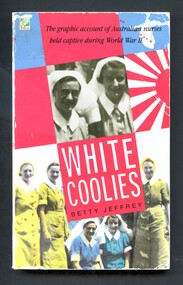
Book, Betty Jeffrey 1908-2000, White Coolies, 1988
... nursing sisters was evacuated from Malaya aboard the Vyner Brooke, a few days before the fall of Singapore. Two days later their ship was bombed and sunk by the Japanese. Of the fifty-three survivors who scrambled ashore, twenty-one were murdered and the remaining thirty-two were taken prisoner. The book is the engrossing record kept by one of the sisters, Betty Jeffrey, during the three grueling years of imprisonment that followed. It is an amazing story of survival and deprivation in the harshest of conditions ...n 1942 a group of sixty-five Australian Army nursing sisters was evacuated from Malaya aboard the Vyner Brooke, a few days before the fall of Singapore. Two days later their ship was bombed and sunk by the Japanese. Of the fifty-three survivors who scrambled ashore, twenty-one were murdered and the remaining thirty-two were taken prisoner. The book is the engrossing record kept by one of the sisters, Betty Jeffrey, during the three grueling years of imprisonment that followed. It is an amazing story of survival and deprivation in the harshest of conditions.Book has a red white and Malaya 1941, Nursing Sisters of cover, tile printed in white and author's name printed in black on front cover. On the front cover is a coloured black and white photograph "Malaya 1941, Nursing Sisters of 2/4 Clearing Station, 8 Division. Title and author's name also printed in white on spine. The back cover has a summary of the booknon-fictionn 1942 a group of sixty-five Australian Army nursing sisters was evacuated from Malaya aboard the Vyner Brooke, a few days before the fall of Singapore. Two days later their ship was bombed and sunk by the Japanese. Of the fifty-three survivors who scrambled ashore, twenty-one were murdered and the remaining thirty-two were taken prisoner. The book is the engrossing record kept by one of the sisters, Betty Jeffrey, during the three grueling years of imprisonment that followed. It is an amazing story of survival and deprivation in the harshest of conditions.world war 1939-1945 prisoners of war, nurses -
 Alfred Hospital Nurses League - Nursing History Collection
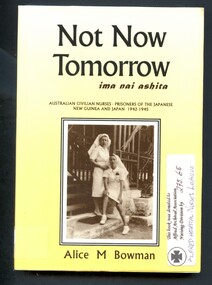
Book - Illustrated Book, Alice M. (Alice Mary) Bowman 1912-2000, Not now tomorrow=ima nai ashita, 1996
... Of significance to the AHNL as it is an important record of the conditions nurses endured ad prisoners of war World War 1939-1945 Prisoners of War-Papua New Guinea Prisoners of War-Japan nurses A true story of a civilian nurse from the Government Hospital in Rabaul, who was held prisoner in New Britain (six months) and Japan (3 years) following the Japanese attack of Rabaul in 1942 On the front of the dustjacket is a printed black and white donation sticker: black Maltese cross in circle, "This book was donated to Alfred Archival Association Nursing Division by" Alfred Hospital Nurses League (handwritten in black ink) Also previous catalogue number handwritten in black ink on this label Illustrated book with dust jacket. ...A true story of a civilian nurse from the Government Hospital in Rabaul, who was held prisoner in New Britain (six months) and Japan (3 years) following the Japanese attack of Rabaul in 1942Illustrated book with dust jacket. Book has a yellow cover with title and author's name printed in white on front and spine. Dust jacket has a pale-yellow background, title and author's name printed in brown on front and spine. The front of the dustjacket also has a black and white photograph of the author (Alice Bowman) (seated) and Joyce McGahan (standing) they are wearing Sisters uniforms; a building of the Namanalu Hospital, Rabaul is behind them (1939). On the back cover is another black and white photograph: Rabaul panorama, and a summary of the book in brown print. non-fictionA true story of a civilian nurse from the Government Hospital in Rabaul, who was held prisoner in New Britain (six months) and Japan (3 years) following the Japanese attack of Rabaul in 1942world war 1939-1945, prisoners of war-papua new guinea, prisoners of war-japan, nurses -
 Alfred Hospital Nurses League - Nursing History Collection
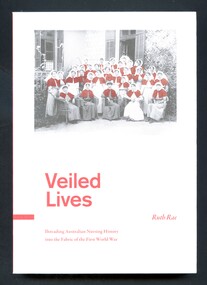
Book - Illustrated Book, Ruth Rae 1957, Veiled Lives: threading Australian nursing history into the fabric of the First World War, 2015
... Of significance to the AHNL as it gives insight into past working conditions and experiences. World War 1914-1918 Military nursing-Australia Australia Army-Nurses nurses In this book the author considers the family and social lives, civilian nurse training, military nursing experiences and premature deaths of qualified Australian nurse who endured the horrors of the 1914-1918 War. ...In this book the author considers the family and social lives, civilian nurse training, military nursing experiences and premature deaths of qualified Australian nurse who endured the horrors of the 1914-1918 War. Veiled Lives also uncovers the impact of their absence on the nurses' families, friends, colleagues, communities and their profession.illustrated book with white front and back covers and red spine. The front cover has a red, black and white photograph of a group of nurses: group portrait if the matron and nursing staff of the 1st AGH with Matron Nellie Miles-Walker (centre front). Title and author's name are printed in red below this photo. Abbreviated title and author's name printed in white on the spine. Back cover has abbreviated title printed in red and a summary of the book printed in black.non-fictionIn this book the author considers the family and social lives, civilian nurse training, military nursing experiences and premature deaths of qualified Australian nurse who endured the horrors of the 1914-1918 War. Veiled Lives also uncovers the impact of their absence on the nurses' families, friends, colleagues, communities and their profession.world war 1914-1918, military nursing-australia, australia army-nurses, nurses -
 Alfred Hospital Nurses League - Nursing History Collection
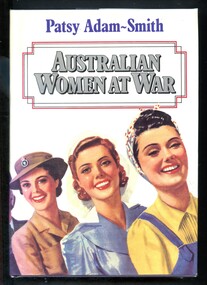
Book - Illustrated book, Thomas Nelson (Australia) Ltd, Australian women at war, 1984
... World War 1914-1918 World War 1939-1945 Women and war-Australia Women-Australia-social conditions women-employment-Australia-History-20th centuary A history of how Australian women have responded to war, from 1900 when the first nurses sailed to the Boer War, to 1945 and its aftermath. At the bottom right of the front end-page is a printed black and white donation sticker: black Maltese cross in circle, "This book was donated to Alfred Archival Association Nursing Division by" Alfred Hospital Nurses League (handwritten in black ink) Also previous catalogue number handwritten in black ink on this sticker Illustrated book with dustjacket. ...A history of how Australian women have responded to war, from 1900 when the first nurses sailed to the Boer War, to 1945 and its aftermath.Illustrated book with dustjacket. Book has a purple cover with the title and author's name embossed in silver on the spine. The dust jacket has the title printed in silver within a decorative border. Authors name is printed in black above this. Also on the front cover and extending across the spine and back cover is a coloured illustration of non-fictionA history of how Australian women have responded to war, from 1900 when the first nurses sailed to the Boer War, to 1945 and its aftermath.world war 1914-1918, world war 1939-1945, women and war-australia, women-australia-social conditions, women-employment-australia-history-20th centuary -
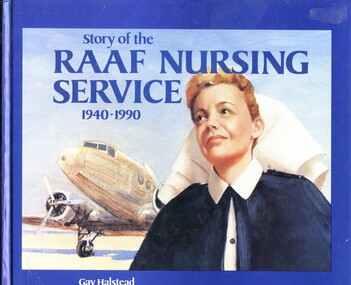 Alfred Hospital Nurses League - Nursing History Collection
Book - Illustrated book, Gay Halstead 1929, Story of the RAAF Nursing Service 1940-1990, 1994
... Celebrates the first fifty years of the RAAFNS Of significance to the AHNL as it records another career path for nurses Royal Australian Air Force Nursing Service-History World War 1939-1945-Medical Care-Australia Military Nursing-Australia Nurses Nursing Established in July 1914, the Royal Australian Airforce Nursing Service (RAAFNS) personnel expanded from 45 in December 1940 to 616 in December 1945. Miss Margaret Irene Lang was appointed Matron-in -Chief and her staff's conditions in service were similar to those of the Australian Army Nursing Service. ...Established in July 1914, the Royal Australian Airforce Nursing Service (RAAFNS) personnel expanded from 45 in December 1940 to 616 in December 1945. Miss Margaret Irene Lang was appointed Matron-in -Chief and her staff's conditions in service were similar to those of the Australian Army Nursing Service. The nurses were originally attached to RAAF bases in Australia but later served in New Guinea and the Pacific Islands. With the Medical Air Evacuation Transport Unit (MAETU), established in 1944, nurses helped with aerial evacuation of casualties and were involved with the liberation of Prisoners of War from Singapore and other areas. The service was disbanded at the end of World War Two, but in 1948 a peace-time service was formed, and the RAAF nurses have served in the Korean War, the Malayan Emergency and the Vietnam War. They continue to care for the sick and injured at RAAF hospitals. Includes honours, awards and the nominal roll of RAAFNS 1940-1952.Illustrated book with blue cover. Front cover has a coloured illustration by Vivian and Marjorie Mare of a nurse in uniform standing in front of a plane, the title is printed in blue and the author's name printed in white. Title and author's name are also printed in white on the spine. The back cover has a collage of black and white photographs of RAAF personnel including nurses. Limited edition of 1000 copies.non-fictionEstablished in July 1914, the Royal Australian Airforce Nursing Service (RAAFNS) personnel expanded from 45 in December 1940 to 616 in December 1945. Miss Margaret Irene Lang was appointed Matron-in -Chief and her staff's conditions in service were similar to those of the Australian Army Nursing Service. The nurses were originally attached to RAAF bases in Australia but later served in New Guinea and the Pacific Islands. With the Medical Air Evacuation Transport Unit (MAETU), established in 1944, nurses helped with aerial evacuation of casualties and were involved with the liberation of Prisoners of War from Singapore and other areas. The service was disbanded at the end of World War Two, but in 1948 a peace-time service was formed, and the RAAF nurses have served in the Korean War, the Malayan Emergency and the Vietnam War. They continue to care for the sick and injured at RAAF hospitals. Includes honours, awards and the nominal roll of RAAFNS 1940-1952.royal australian air force nursing service-history, world war 1939-1945-medical care-australia, military nursing-australia, nurses, nursing
