
Showing 95 items matching "oak hill"
-
 Phillip Island and District Historical Society Inc.
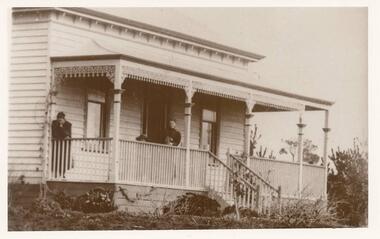
Photograph, Early 1900's
... oak hill san remo...Property named "Oak Hill" owned by the Bonwick Family, San Remo...On back: "Oak Hill"...Donated by Jessie Smith oak hill san remo jessie smith On back: "Oak Hill" Black & White photograph of a double fronted weatherboard house with wrought iron frieze on verandah. ...Donated by Jessie SmithBlack & White photograph of a double fronted weatherboard house with wrought iron frieze on verandah. Two ladies standing on verandah. Property named "Oak Hill" owned by the Bonwick Family, San RemoOn back: "Oak Hill"oak hill san remo, jessie smith -
 Phillip Island and District Historical Society Inc.
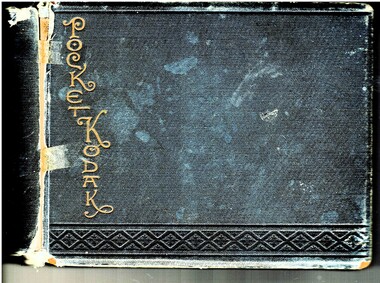
Album, Photo album, 1870s
... ...Oak Hill...Jessie Smith was the daughter of the Small family. Oak Hill was the Bonwick family home and the Hoddinott property was at Anderson. ...Jessie Smith was the daughter of the Small family. Oak Hill was the Bonwick family home and the Hoddinott property was at Anderson. ...Shetland Heights was the Small family property. It was later purchased by the Maclellans and is now Shetland Heights Road area. Jessie Smith was the daughter of the Small family. Oak Hill was the Bonwick family home and the Hoddinott property was at Anderson. The Jos Hoddinott in the photo was probably the father of William Hoddinott, who married Mary Bonwick.HistoricalSmall dark green leather covered photo album containing small [5.5x4cm] black and white photos. Multiple photos on each page. Also 2 large photos at front and back.Pocket Kodak. Lent Mrs Weir, R. Miller 1875 "above Rubies" & Charles X11, Hugh Andersonphotographs, small family, bonwick family, maclellan family, jessie smith, hoddinott family, shetland heights, oak hill, jean tabbart, bert grayden, sunday school picnic, coal pier, bergins hotel, san remo history, anderson -
 Sunbury Family History and Heritage Society Inc.
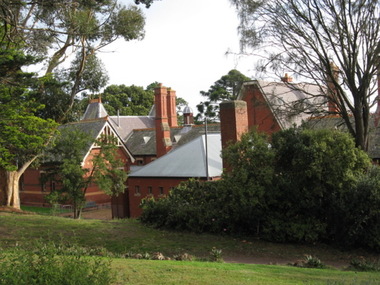
Photograph, Sarah Dunn, c2000
... The buildings are part of the former Sunbury Asylum complex that was built on Jacksons Hill ( She oak Hill). They have been built between the garden area and the Ha Ha Wall, which was built in 1895 - 96....The buildings are part of the former Sunbury Asylum complex that was built on Jacksons Hill ( She oak Hill). They have been built between the garden area and the Ha Ha Wall, which was built in 1895 - 96. ...The buildings are part of the former Sunbury Asylum complex that was built on Jacksons Hill ( She oak Hill). They have been built between the garden area and the Ha Ha Wall, which was built in 1895 - 96.The gardens at the former Sunbury. Asylum were very beautiful and well-maintained by staff and some of the inmates.A coloured photograph with a white border of red brick Federation style buildings surrounded by a garden of trees and lawn.sunbury asylum, gardens, ha ha wall, sunbury -
 Sunbury Family History and Heritage Society Inc.
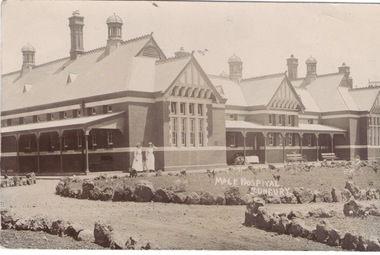
Photograph, Male Hospital Sunbury
... The Male Hospital in Sunbury was one of the buildings that was within the grounds of the Sunbury Mental Hospital, later known as the Sunbury Asylum, that opened on 1st December 1879 on She-oak Hill ( Jacksons Hill). Patients and staff from the Ballarat Asylum were transferred there. ...The Male Hospital in Sunbury was one of the buildings that was within the grounds of the Sunbury Mental Hospital, later known as the Sunbury Asylum, that opened on 1st December 1879 on She-oak Hill ( Jacksons Hill). Patients and staff from the Ballarat Asylum were transferred there. ...The Male Hospital in Sunbury was one of the buildings that was within the grounds of the Sunbury Mental Hospital, later known as the Sunbury Asylum, that opened on 1st December 1879 on She-oak Hill ( Jacksons Hill). Patients and staff from the Ballarat Asylum were transferred there. Prior to the establishment of the Asylum, the Sunbury Industrial School occupied the site from 1865. The Sunbury Asylum, later known as Caloola, continued to operate until the 1992.The Sunbury Mental Hospital was an important institution and was the main source of employment for Sunbury residents for 120 years. It was also one of a number of similar institutions that were established around Melbourne's outer rural centres.A sepia non- digital photo in post card format of a hospital building with verandahs along a section of the front and down the side. Two nurses are standing in front. There are circular garden beds in from of the building. A message dated 23/11.09 from Gregor to Cookie has been written on the back of the card.MALE HOSPITAL/SUNBURYsunbury mental hospital, sunbury asylum, caloola, the hill -
 Bendigo Historical Society Inc.
Document - ANCIENT ORDER OF FORESTERS NO. 3770 COLLECTION: CORRESPONDENCE
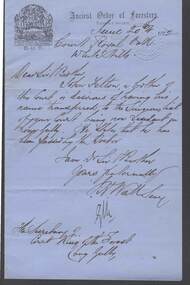
... John Felton, a brother of the Court Royal Oak, White Hills, would like his name transferred to the Surgeons list of Court King of the Forest, Long Gully. ...John Felton, a brother of the Court Royal Oak, White Hills, would like his name transferred to the Surgeons list of Court King of the Forest, Long Gully. ...Letter written on blue, watermarked paper with Ancient Order of Foresters heading and emblem. Dated June 20th 1872. John Felton, a brother of the Court Royal Oak, White Hills, would like his name transferred to the Surgeons list of Court King of the Forest, Long Gully. Court Royal Oak A.O.F.3197 White Hills Impression stamp at the top of page.societies, aof, correspondence, ancient order of foresters no. 3770 collection - correspondence, court royal oak 3197, john felton, j wall, court king of the forest -
 Bendigo Historical Society Inc.
Document - ANCIENT ORDER OF FORESTERS NO. 3770 COLLECTION: CORRESPONDENCE
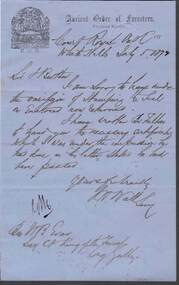
... Also Court Royal Oak A.O.F.3197 White Hills impression stamp....Also Court Royal Oak A.O.F.3197 White Hills impression stamp. Document ANCIENT ORDER OF FORESTERS NO. 3770 COLLECTION: CORRESPONDENCE ...Letter written on blue watermarked paper and dated July 5 1872. Letter from J Wall apologising for returns. He had written Felton and now hands Court King of the Forest the necessary certificate which he was under the impression he had done as his letter states he had been passed. Signed J Wall. Letter has Ancient Order of Foresters Friendly Society heading and emblem. Also Court Royal Oak A.O.F.3197 White Hills impression stamp.societies, aof, correspondence, ancient order of foresters no. 3770 collection - correspondence, court royal oak, felton, j wall, w b evan -
 Bendigo Historical Society Inc.
Document - LA TROBE UNIVERSITY BENDIGO COLLECTION: GRADUATE DIPLOMA IN EDUCATION 2004
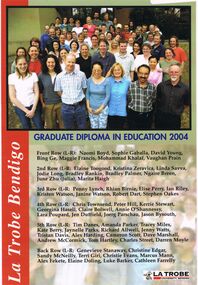
... It displays a photo and the names of the recipients - Naomi Boyd, Sophie Gaballa, David Young, Bing Ge, Maggie Francis, Mohammad Khalaf, Vaughan Prain, Elaine Toogood, Kristina Zeravica, Linda Savva, Jodie Long, Bradley Rankin, Bradley Palmer, Ngaire Breen, June Zhu (Julia), Marita Haigh, Penny Lynch, Rhian Birnie, Elise Perry, Ian Riley, Kristen Watson, Janine Watson, Robert Dart, Stephen Oakes, Chris Townsend, Peter Hill, Kerrie Stewart, Ceorgina Hasell, Claire Bolwell, Annie O'Shannessy, Lara Poupard, Jen Duffield, Joerg Parschau, Jason Bysouth, Tim Danes, Amanda Parker, Tracey Miles, Kate Berry, Jaynelle Parks, Richard Allwell, Jenny Watts, Tristan Davis, Alex Harding, Cameron Scott, Dave Marshall, Andrew McCormick, Tom Hartley, Charles Street, Darren Moyle, Genevieve Stanaway, Christine Edgar, Sandy McNeilly, Terri Giri, Christine Evans, Marcus Mann, Alex Fekete, Elaine Doling, Luke Barker and Cathleen Farrelly....It displays a photo and the names of the recipients - Naomi Boyd, Sophie Gaballa, David Young, Bing Ge, Maggie Francis, Mohammad Khalaf, Vaughan Prain, Elaine Toogood, Kristina Zeravica, Linda Savva, Jodie Long, Bradley Rankin, Bradley Palmer, Ngaire Breen, June Zhu (Julia), Marita Haigh, Penny Lynch, Rhian Birnie, Elise Perry, Ian Riley, Kristen Watson, Janine Watson, Robert Dart, Stephen Oakes, Chris Townsend, Peter Hill, Kerrie Stewart, Ceorgina Hasell, Claire Bolwell, Annie O'Shannessy, Lara Poupard, Jen Duffield, Joerg Parschau, Jason Bysouth, Tim Danes, Amanda Parker, Tracey Miles, Kate Berry, Jaynelle Parks, Richard Allwell, Jenny Watts, Tristan Davis, Alex Harding, Cameron Scott, Dave Marshall, Andrew McCormick, Tom Hartley, Charles Street, Darren Moyle, Genevieve Stanaway, Christine Edgar, Sandy McNeilly, Terri Giri, Christine Evans, Marcus Mann, Alex Fekete, Elaine Doling, Luke Barker and Cathleen Farrelly. ...A laminated copy of the "Graduate Diploma in Education 2004". It displays a photo and the names of the recipients - Naomi Boyd, Sophie Gaballa, David Young, Bing Ge, Maggie Francis, Mohammad Khalaf, Vaughan Prain, Elaine Toogood, Kristina Zeravica, Linda Savva, Jodie Long, Bradley Rankin, Bradley Palmer, Ngaire Breen, June Zhu (Julia), Marita Haigh, Penny Lynch, Rhian Birnie, Elise Perry, Ian Riley, Kristen Watson, Janine Watson, Robert Dart, Stephen Oakes, Chris Townsend, Peter Hill, Kerrie Stewart, Ceorgina Hasell, Claire Bolwell, Annie O'Shannessy, Lara Poupard, Jen Duffield, Joerg Parschau, Jason Bysouth, Tim Danes, Amanda Parker, Tracey Miles, Kate Berry, Jaynelle Parks, Richard Allwell, Jenny Watts, Tristan Davis, Alex Harding, Cameron Scott, Dave Marshall, Andrew McCormick, Tom Hartley, Charles Street, Darren Moyle, Genevieve Stanaway, Christine Edgar, Sandy McNeilly, Terri Giri, Christine Evans, Marcus Mann, Alex Fekete, Elaine Doling, Luke Barker and Cathleen Farrelly.bendigo, education, la trobe university bendigo, la trobe university bendigo collection, collection, bendigo, education, teaching, teachers, students, diploma, graduate diploma, tertiary education -
 Flagstaff Hill Maritime Museum and Village
Ceremonial object - Font, 1940s
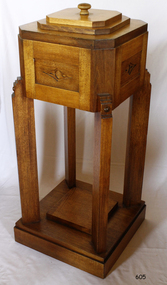
... Kerr Johnston, a Church of England clergyman, and operated from a hulk moored in Hobson’s Bay; later, the Mission occupied buildings in Williamstown and Port Melbourne. flagstaff hill warrnambool shipwrecked-coast flagstaff-hill flagstaff-hill-maritime-museum maritime-museum shipwreck-coast flagstaff-hill-maritime-village font baptisimal font church furniture religious ceremony copper ewet religious furniture christening font religion religious service sailors rest bethel sailors’ church bethel floating church ladies harbour light guild missions to seamen victoria mission to seafarers st nicholas seaman’s church williamstown st nicholas mission to seamen church williamstown mission to seamen williamstown st nicholas seamen’s church flagstaff hill 139 nelson place williamstown anglican church flying angel club copper ewer copper bowl Flagstaff Hill Maritime Museum and Village Maritime Museum Maritime Village Shipwreck Coast Great Ocean Road religious worship worship service St Nicholas Seamen’s Church Williamstown St Nicholas Missions to Seamen’s Church Williamstown Missions to Seamen St Nicholas Missions to Seamen’s Church Flagstaff Hill baptism christening ceremony tradition hand-beaten copper ewer Baptismal font: four-legged, varnished oak wood pedestal supporting a wooden box with a hand-beaten, rolled edge, copper ewer, bowl or basin insert. ...This font is a piece of church furniture used in a baptism or christening service. It was originally installed in the St Nicholas Seamen's Church at 139 Nelson Place, Williamstown, Victoria. The church was a branch of the Victoria Missions to Seamen. THE MISSIONS TO SEAMEN (Brief History): - The Missions to Seamen was an Anglican charity that has served seafarers of the world since 1856 in Great Britain. Its symbol is a Flying Angel, inspired by a Bible verse. Today, there are centres in over 200 ports worldwide where seamen of all backgrounds are offered a warm welcome and provided with a wide range of facilities. In Victoria, the organisation began in Williamstown in 1857 as a Sailors’ Church, also known as ‘Bethel’ or the ‘Floating Church’ in an old hulk floating in Hobson’s Bay, Port of Melbourne. It soon became part of the Missions to Seamen, Victoria. In the year 2000, the organisation, now named Mission to Seafarers, still operated locally in Melbourne, Portland, Geelong and Hastings. The Ladies’ Harbour Lights Guild was formed in 1906 to support the Missions to Seamen in Melbourne and other centres, such as Williamstown. Two of the most significant ladies of the Guild were founder Ethel Augusta Godfrey and foundation member Alice Sibthorpe Tracy (who established a branch of the Guild in Warrnambool in 1920). The Guild continued its work until the 1960s. In 1943, a former Williamstown bank was purchased for the Missions to Seaman Club. The chapel was named St Nicholas’ Seamen’s Church and was supported by the Ladies’ Harbour Lights Guild, the Williamstown Lightkeepers’ Auxiliary and the League of Soldiers’ and Sailors’ Friends. It ceased operation in 1966. A Missions to Seamen Chapel and Recreation Room was a significant feature of ports during the late 1800s and into the 1900s. It seemed appropriate for Flagstaff Hill to include such a representation within the new Maritime Village, so the Melbourne Board of Management of Missions to Seamen Victoria gave its permission on 21st May 1979 for the entire furnishings of the Williamstown chapel to be transferred to Flagstaff Hill. The St Nicholas Seamen’s Church was officially opened on October 11, 1981, and closely resembles the Williamstown chapel. This font is significant through its association with the St Nicholas' Mission to Seamen Church in Williamstown, Melbourne, established in 1857. The collection of items from the Missions to Seamen in Williamstown, Victoria, has historical and social significance. They show that people of the 1800s and 1900s cared about the seafarers’ religious, moral, and social welfare, no matter what their religion, social status or nationality. It had its origins in Bristol, England, when a Seamen's Mission was formed in 1837. The first Australian branch was started in 1856 by the Rev. Kerr Johnston, a Church of England clergyman, and operated from a hulk moored in Hobson’s Bay; later, the Mission occupied buildings in Williamstown and Port Melbourne. Baptismal font: four-legged, varnished oak wood pedestal supporting a wooden box with a hand-beaten, rolled edge, copper ewer, bowl or basin insert. The box has a removable cover that has a round wooden knob. The sides of the box section have a decorative, diamond-shaped motif. The box and lid are octagonal, with four short sides and four long sides. The tops of the legs have an ornamental design. This is one of the original items in our St Nicholas Seamen's Church Williamstown Collection.flagstaff hill, warrnambool, shipwrecked-coast, flagstaff-hill, flagstaff-hill-maritime-museum, maritime-museum, shipwreck-coast, flagstaff-hill-maritime-village, font, baptisimal font, church furniture, religious ceremony, copper ewet, religious furniture, christening font, religion, religious service, sailors rest, bethel sailors’ church, bethel floating church, ladies harbour light guild, missions to seamen victoria, mission to seafarers, st nicholas seaman’s church williamstown, st nicholas mission to seamen church williamstown, mission to seamen williamstown, st nicholas seamen’s church flagstaff hill, 139 nelson place williamstown, anglican church, flying angel club, copper ewer, copper bowl, flagstaff hill maritime museum and village, maritime museum, maritime village, shipwreck coast, great ocean road, religious worship, worship service, st nicholas seamen’s church, williamstown, st nicholas missions to seamen’s church williamstown, missions to seamen, st nicholas missions to seamen’s church flagstaff hill, baptism, christening, ceremony, tradition, hand-beaten copper ewer -
 Flagstaff Hill Maritime Museum and Village
Furniture - Credence Table, c. 1944
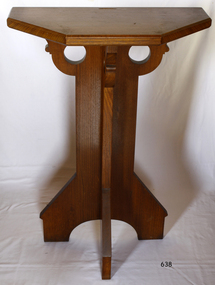
... It is also significant for its connection with the church Eucharist service still being performed in the Anglican church as part of its traditional worship. flagstaff hill warrnambool religious service missions to seamen victoria church furniture religious worship pedestal book rest book stand bible rest church service Shipwrecked coast Flagstaff Hill Maritime Museum Maritime Museum Shipwreck coast Flagstaff Hill Maritime Village Great Ocean Road credence table pentagonal table half-table Eucarist Holy Communion Anglican church Communion Service tradition ritual worship Mrs F Clark ecclesiastical furniture side table small table Credence table; traditional design in timber. The solid oak ...Mrs F Clark donated this Credence Table to the original St Nicholas Seamen's Church, Williamstown, Victoria, operated by the Missions to Seamen organisation. The oak table is decorated with Gothic trefoils and shaped to fit against the Sanctuary wall. Its purpose is to hold the Eucarist plate and chalice for the Holy Communion service of the Anglican Church. THE MISSIONS TO SEAMEN (Brief History): - The Missions to Seamen was an Anglican charity in Great Britain that has served the world's seafarers since 1856. Its symbol is a Flying Angel, inspired by a Bible verse. Today, there are centres in over 200 ports worldwide where seamen of all backgrounds are offered a warm welcome and provided with a wide range of facilities. In Victoria, the organisation began in Williamstown in 1857 as a Sailors’ Church, also known as ‘Bethel’ or the ‘Floating Church’ in an old hulk floating in Hobson’s Bay, Port of Melbourne. It soon became part of the Missions to Seamen, Victoria. In the year 2000, the organisation, now named Mission to Seafarers, still operated locally in Melbourne, Portland, Geelong and Hastings. The Ladies’ Harbour Lights Guild was formed in 1906 to support the Missions to Seamen in Melbourne and other centres, such as Williamstown. Two of the most significant ladies of the Guild were founder Ethel Augusta Godfrey and foundation member Alice Sibthorpe Tracy (who established a branch of the Guild in Warrnambool in 1920). The Guild continued its work until the 1960s. In 1943, a former Williamstown bank was purchased for the Missions to Seaman Club. The chapel was named St Nicholas’ Seamen’s Church and was supported by the Ladies’ Harbour Lights Guild, the Williamstown Lightkeepers’ Auxiliary and the League of Soldiers’ and Sailors’ Friends. It ceased operation in 1966. A Missions to Seamen Chapel and Recreation Room was a significant feature of ports during the late 1800s and into the 1900s. It seemed appropriate for Flagstaff Hill to include such a representation within the new Maritime Village, so the Melbourne Board of Management of Missions to Seamen Victoria gave its permission on 21st May 1979 for the entire furnishings of the Williamstown chapel to be transferred to Flagstaff Hill. The St Nicholas Seamen’s Church was officially opened on October 11, 1981, and closely resembles the Williamstown chapel. This Chrdence table is historically significant for its origin in the St Nicholas Mission to Seamen's Church in Williamstown, established in 1857 to cater for seafarers’ physical, social, and spiritual needs. The organisation originated in Bristol, England, when a Seamen's Mission was formed in 1837. It is also significant for its connection with the church Eucharist service still being performed in the Anglican church as part of its traditional worship.Credence table; traditional design in timber. The solid oak pedestal is shaped like half an octagon with the long side fitting against a flat, vertical surface. The column support has decorative Gothic trefoil cut-away holes. This item is part of the St. Nicholas Seamen's Church Collection. flagstaff hill, warrnambool, religious service, missions to seamen victoria, church furniture, religious worship, pedestal, book rest, book stand, bible rest, church service, shipwrecked coast, flagstaff hill maritime museum, maritime museum, shipwreck coast, flagstaff hill maritime village, great ocean road, credence table, pentagonal table, half-table, eucarist, holy communion, anglican church, communion service, tradition, ritual, worship, mrs f clark, ecclesiastical furniture, side table, small table -
 Flagstaff Hill Maritime Museum and Village
Furniture - Chair, ca. 1890s
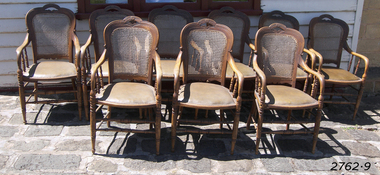
... These oak and rattan high-backed armchairs were previously the old Warrnambool Council's furniture. The group of chairs was later held by the Warrnambool Art Gallery, then transferred to Flagstaff Hill Maritime Museum and Village in 1976, soon after it opened. ...These oak and rattan high-backed armchairs were previously the old Warrnambool Council's furniture. The group of chairs was later held by the Warrnambool Art Gallery, then transferred to Flagstaff Hill Maritime Museum and Village in 1976, soon after it opened. ...These oak and rattan high-backed armchairs were previously the old Warrnambool Council's furniture. The group of chairs was later held by the Warrnambool Art Gallery, then transferred to Flagstaff Hill Maritime Museum and Village in 1976, soon after it opened. Warrnambool became a municipality in 1855, with a population of 1500. In 1863, it became a borough, and the Shire of Warrnambool was constituted in the same year. In 1883, Warrnambool was proclaimed a Town, and in 1918, it became the City of Warrnambool. In 1994, the City of Warrnambool and part of the Shire of Warrnambool amalgamated, becoming the Warrnambool City Council. Chairs are significant to local history as they were originally purchased for use in the Warrnambool Council. The chairs were part of the social and cultural history of Warrnambool.Chair, oak wood arm chair (set of 9), cureved back with decorated wooden edges, shield carved into top and protective metal plates on top at rear. Padded leather seat studded at edge, over rattan cane seat. Rattan cane is stitched onto wooden frame through drilled holes. Front and side legs each have two spindles between them. back legs have one. Legs are turned and slightly cambriol. Some chairs have written on back leg "1486". Made in England, c. 1896Some of the chairs have hand written black pen on back leg "1486"flagstaff hill, flagstaff hill maritime museum and village, warrnambool, maritime museum, maritime village, great ocean road, shipwreck coast, chair, armchair, rattan chair, warrnambool museum, warrnambool art gallery, 1890s chair, 19th century furniture, domestic furniture, warrnambool council, council chairs -
 Flagstaff Hill Maritime Museum and Village
Furniture - Chair, ca. 1900
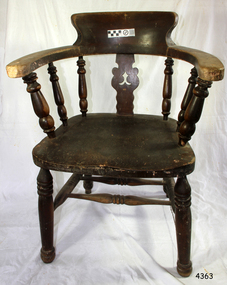
... Flagstaff Hill Flagstaff Hill Maritime Museum and Village Warrnambool Maritime Museum Maritime Village Great Ocean Road Shipwreck Coast wooden chair captain's chair armchair 19th century furniture nautical furniture seating Captain's chair; an oak armchair with a low curved back that forms the armrests. ...The timber on this captain's chair has been worn smooth across the backrest. It is of solid construction. A captain's chair is typically a wooden armchair with a back that curves around to form the armrests. The style of chair was used in the 19th century and was a statement of status aboard a ship. This captain's chair is an example of the type of furniture used onboard a ship in the 19th and early 20th centuries.Captain's chair; an oak armchair with a low curved back that forms the armrests. It has six turned spindles, a fretted back, a solid saddle seat and is supported on four turned legs. The timber backrest feels smooth and well-worn. Circa 1900.flagstaff hill, flagstaff hill maritime museum and village, warrnambool, maritime museum, maritime village, great ocean road, shipwreck coast, wooden chair, captain's chair, armchair, 19th century furniture, nautical furniture, seating -
 Flagstaff Hill Maritime Museum and Village
Desk
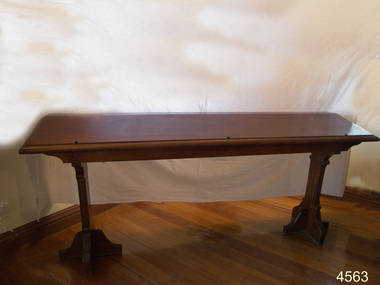
... Flagstaff Hill Warrnambool Shipwrecked-coast Flagstaff-Hill Flagstaff-Hill-Maritime-Museum Maritime-Museum Shipwreck-coast Flagstaff-Hill-Maritime-Village Desk wooden Oak reading with sloping top. ...Desk wooden Oak reading with sloping top. Has three stoppers along base of sloping top 1980mm x 840mm x 500mm. Height of top at base of slope 720mmflagstaff hill, warrnambool, shipwrecked-coast, flagstaff-hill, flagstaff-hill-maritime-museum, maritime-museum, shipwreck-coast, flagstaff-hill-maritime-village -
 Flagstaff Hill Maritime Museum and Village
Wood Samples, 1891
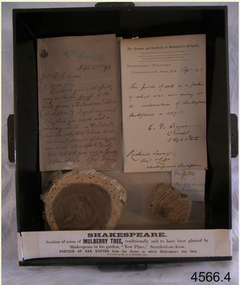
... hill maritime village...great ocean road...shakespeare display case...wood samples...oak...None the less, all the pieces have very good provenance, with Richard Savage's certificate of authenticity for the oak, and the mulberry sample with the letter to Mr Harris from Mr CF Loggin having also been the donor of the scion of mulberry in 1862 to the Shakespeare Birthplace Trust. This scion was then established at Shakespeare's garden at "New Home" that had been demolished by Rev Francis Gastrell in 1759. flagstaff hill warrnambool shipwrecked coast flagstaff hill maritime museum maritime museum shipwreck coast flagstaff hill maritime village great ocean road shakespeare display case wood samples oak from shakespeare's birthplace mulberry from shakespeare's home "new place" stratford-upon-avon shakespeare's birthplace the trustees and guardians of shakespeare's birthplace &c. shakespeare trust shakespeare birthday committee r.s. harris, brunswick, victoria richard s harris, brunswick, victoria c.f. loggins, chemist, 3 high street stratford-on-avon richard savage warrnambool museum and art gallery thomas court pt barnum charles dickins anne hathaway black mulberry tree reverend francis gastrell Cardboard label inside the glass case “Shakespeare Section of Mulberry Tree, traditionally said to have been planted by Shakespeare in his garden, “New Place,” Stratford-on-Avon. ...The timber display case was presented to Mr Richard Standcombe Harris of Warrnambool (1831-1923). He was a councillor (1875-1891) and predominant businessman. Mr C F Loggin had met Mr Harris while on a trip to Stratford upon Avon in the United Kingdom. Upon his return to Warrnambool, Mr Harris donated the item to the Warrnambool Museum and Art Gallery, (established 1886) where Joseph Archibald was Curator: he catalogued the case in 1894. THE LETTERS IN THE CASE The two letters contained within the display case confirm the authenticity of the oak wood sample. The first letter in the case includes the text; "[Stamped Header on banner] High Street, Stratford on Avon [Hand written] Sept. 22nd / 91. Mr. R. S. Harris, Dear Sir, Enclosed you will find [underlined next 3 words] every authentic proof of the Oak from Shakespeare's House (Birth place). I regret very much Sir, that you made a short-day at S. on A. I should have been delighted to have had the honour, & pleasure, of showing you around our Beautiful Country. You did not give [next 3 words underlined] me or yourself a fair chance. But however I hope that we may again some day have more time to go quietly around. With kind regards, and wishing you, Sir, a pleasant voyage, I remain, Dear Sir, Yours very truly, C.F. Loggin. P.S. A paper will be always acceptable to be as how you Jolly Warrnamboolites are desporting yourselves. “ The second letter includes text; “[Printed Letterhead with stamped impression] The Trustees and Guardians of Shakespeare’s Birthplace Incorporated by Act of 54 and 55, Vict. 1891 Secretary and Librarian - Richard Savage Shakespeare’s Birthplace Stratford-upon-Avon [handwritten] 22 Sept 1891 This piece of oak is a portion of what was cut away at at the restoration of Shakespeare’s Birthplace in 1857-58. C. F. Loggins Chemist 3 High Street Richard Savage Sec. – Shakespeare’s Birthplace Mr C F Loggin was connected with the Shakespeare Trust as the person who had originally donated a scion of Shakespeare's mulberry tree to the "Shakespearean Birthday Committee" in 1842. (The scion that was given to the Shakespearean Birthday Committee, from which the Mulberry sample is derived, still grows today in "New Place" garden.) Mr Richard Savage was the Secretary and Liberian of the then renamed “Trustees and Guardians of Shakespeare’s Birthplace when the display case was given to Mr Harris in 1891 by Mr Loggin. WILLIAM SHAKESPEARE Shakespeare was born in 1564 in Stratford-upon-Avon, where he also grew up. He married at 18 years and he and his wife, Anne Hathaway, had three children: They moved to London where he became successful as an actor, writer, and part-owner of a playing company. He later returned to Stratford and purchased his last home, which he called "New Place" in 1602 where he later died in 1616. For the next 150 years, it was known that there existed a black mulberry tree in the garden. At the time there was a fashion for planting mulberry trees. It was the early 17th century after King James had come to the throne, and he imported tens of thousands of saplings in an attempt to get landowners to start a silk industry in England. Unfortunately for posterity, Shakespeare's mulberry was felled around 1756, by the then owner of “New Place" the Reverend Francis Gastrell, who was apparently tired of continual visits by pilgrims asking to see the tree, so he chopped it down. Gastrell had applied for local permission to extend the garden but the application was rejected and his tax was increased. Gastrell retaliated by demolishing the house in 1759, this greatly outraged the local inhabitants. Gastrell was eventually forced to leave town having provoked the wrath of Stratford residents for committing such an act. Today only the garden remains where “New House" used to stand with a scion from the original mulberry tree still growing there. The wood from the felled mulberry tree at “New House" was purchased by an enterprising local clock-maker Thomas Sharp and he spent the next 40 years or so years making souvenirs from the wood. These became early tourist souvenirs and subsequently developed into a profitable sideline for various other makers, including George Cooper and John Marshall. These objects range from relatively small domestic wooden objects, such as snuff boxes and weight scales to large tea caddies and even tables. C. F. Loggin donated a scion or cutting from Shakespeare's mulberry tree to the Shakespeare Birthplace Trust in 1862, he was a chemist who lived and worked in Stratford. There is a note on the frame of the donation that the mulberry sample is from this scion, research shows that from Richard Savage's diary notes that there must have been a lot of wood taken from that scion over the years which was planted in the garden of “New Place” and is still growing there today. The "Trustees and Guardians of Shakespeare’s Birthplace" (1847 -1964) was formed after the house where Shakespeare is believed to have been born fell into disrepair. Subsequently in 1846 after the death of Thomas Court's widow the last owner. Interest in the house was revived when PT Barnum, the American showman, wanted to buy it and ship the house back to America. In response to this, the Shakespeare Birthday Committee was established (by a private Act of Parliament) with the help of such luminaries as Charles Dickens, the Committee of Trustees raised the necessary £3,000 and purchased the house the following year. Once the Committee had acquired the building, restoration work began. Originally the Birthplace formed part of a terrace with later houses built either side. The first stage in its conservation was their destruction. At the time it was thought necessary to avoid the risk of fire spreading to Shakespeare's birthplace. Reconstruction was carried out by the Shakespeare Trust between 1857 and 1864 that restored the outside of the building to its original 16th-century state. It is from this restoration that the donated piece of oak is derived, originally from a beam that was in the house. Communication from The Shakespeare Birthplace Trust, dated April 11th, 2019, confirms that the pieces displayed in this case have good provenance. The wood samples are significant for their association with the history of William Shakespeare. The display case and its content is significant to Warrnambool local history for its association with the establishment in 1886 of the Warrnambool Museum and Art Gallery. However, it should be noted that the letters of authentication that accompany the wood samples are only applicable to the oak sample. None the less, all the pieces have very good provenance, with Richard Savage's certificate of authenticity for the oak, and the mulberry sample with the letter to Mr Harris from Mr CF Loggin having also been the donor of the scion of mulberry in 1862 to the Shakespeare Birthplace Trust. This scion was then established at Shakespeare's garden at "New Home" that had been demolished by Rev Francis Gastrell in 1759. Two wood samples associated with William Shakespeare, presented in a hanging, timber and glass display case with metal trim around the frame. The case also contains two letters and a label printed on a card that refers to the contents, their origins and the donor. A card label with a printed number and a round adhesive label are attached on the back of the case. The left round section of wood is from a donated scion (or shoot) derived from the original mulberry tree planted by William Shakespeare at his last home "New Place", Stratford-upon-Avon. The outer section is light brown coloured while the centre is dark grain. The right wood sample in the case is a section of oak rafter from the house where Shakespeare was born in 1564. The wood is mid brown with a distinct grain. The included letters, each dated 22/9/1891, refer to only the oak sample. - The letter on the left comprises two handwritten pages from Mr CF Loggin to Mr Richard Standcombe Harris. The paper has the printed letterhead address of High Street, Stratford on Avon. - The letter on the right is a handwritten certificate of authenticity signed by Mr CF Loggin and counter signed by Mr Richard Savage, Secretary and Liberian of the Shakespeare Trust. It is on the printed letterhead of The Trustees and Guardians of Shakespeare’s Birthplace Cardboard label inside the glass case “Shakespeare Section of Mulberry Tree, traditionally said to have been planted by Shakespeare in his garden, “New Place,” Stratford-on-Avon. PORTION OF OAK RAFTER from the house in which Shakespeare was born. (Presented by R S Harris 1891.) Printed label on the back of the case “3 2 “ The handwritten adhesive label “0566” flagstaff hill, warrnambool, shipwrecked coast, flagstaff hill maritime museum, maritime museum, shipwreck coast, flagstaff hill maritime village, great ocean road, shakespeare display case, wood samples, oak from shakespeare's birthplace, mulberry from shakespeare's home "new place", stratford-upon-avon, shakespeare's birthplace, the trustees and guardians of shakespeare's birthplace &c., shakespeare trust, shakespeare birthday committee, r.s. harris, brunswick, victoria, richard s harris, brunswick, victoria, c.f. loggins, chemist, 3 high street stratford-on-avon, richard savage, warrnambool museum and art gallery, thomas court, pt barnum, charles dickins, anne hathaway, black mulberry tree, reverend francis gastrell -
 Flagstaff Hill Maritime Museum and Village
Desk
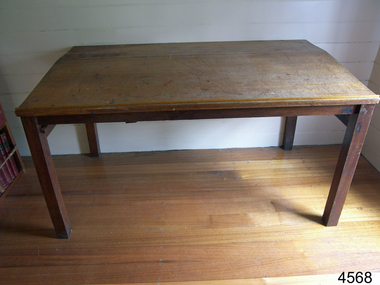
... Flagstaff Hill Warrnambool Shipwrecked-coast Flagstaff-Hill Flagstaff-Hill-Maritime-Museum Maritime-Museum Shipwreck-coast Flagstaff-Hill-Maritime-Village Desk wooden Oak reading with sloping top. ...Desk wooden Oak reading with sloping top. Has wooden stopper along base of sloping top 1540mm x 895mm x 830mm. Height of top at base of slope 765mmflagstaff hill, warrnambool, shipwrecked-coast, flagstaff-hill, flagstaff-hill-maritime-museum, maritime-museum, shipwreck-coast, flagstaff-hill-maritime-village -
 Flagstaff Hill Maritime Museum and Village
Equipment - Ship's Wheel, 1880s
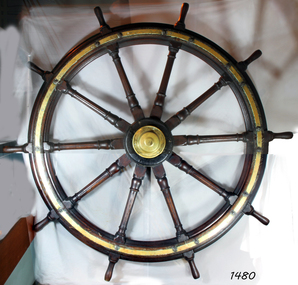
... Hill Maritime Museum and Village...Maritime Museum...Maritime Village...Great Ocean Road...Shipwreck Coast...ship's wheel...10-spoked ship's wheel...wooden ship's wheel...navigation...ship's steering...ship's steering wheel...maring technology...ship's fitting...navigational equipment...Sailing ship's wheel...handcraft...shipwright...large ship's wheel...19th century...1880s...oak...oak wood and brass by a shipwright. This large, heavy wooden ship's wheel is an example of a late 19th-century, handcrafted wheel used at the helm to steer large sailing ships. The design continues to be used on sailing vessels today. This wheel has been on display for decades to demonstrate the perspective of the size of equipment on a sailing ship. Flagstaff Hill ...This large, ten-spoked wheel is an example of a ca. 1880s ship's wheel used to steer a large sailing ship. It was made in England from oak wood and brass by a shipwright.This large, heavy wooden ship's wheel is an example of a late 19th-century, handcrafted wheel used at the helm to steer large sailing ships. The design continues to be used on sailing vessels today. This wheel has been on display for decades to demonstrate the perspective of the size of equipment on a sailing ship.Ship's wheel: a large ship's wheel made of oak wood and brass. It has ten turned, grooved spokes with rounded handles; some are bolted through the centre to the wheel. The hub and inlaid outer reinforcing ring are made of brass. The heavy hub has a metal backing and shaft. The ship's wheel was made in England ca. 1880s.flagstaff hill maritime museum and village, maritime museum, maritime village, great ocean road, shipwreck coast, ship's wheel, 10-spoked ship's wheel, wooden ship's wheel, navigation, ship's steering, ship's steering wheel, maring technology, ship's fitting, navigational equipment, sailing ship's wheel, handcraft, shipwright, large ship's wheel, 19th century, 1880s, oak -
 Flagstaff Hill Maritime Museum and Village
Print - Picture
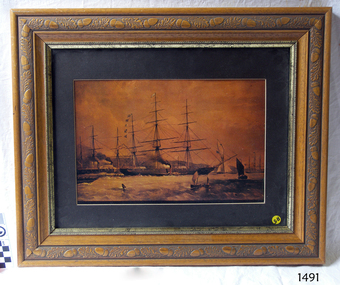
... Hill Warrnambool Yellow sticker "A5". White sticker "67" Print of a ship in the late 1800s set against a background of other ships (one of a steam paddle) and a reddish sky. Wooden decorative frame, with carved oak ...Print of a ship in the late 1800s set against a background of other ships (one of a steam paddle) and a reddish sky. Wooden decorative frame, with carved oak leaves and acorns and gold edging to print. Handwritten inscriptions on a round yellow sticker on the front and a white rectangular sticker on the back.Yellow sticker "A5". White sticker "67"flagstaff hill, warrnambool -
 Flagstaff Hill Maritime Museum and Village
Plant specimen - Wood Sample, Herbst, 1759-1765
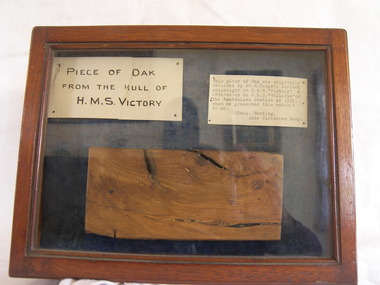
... flagstaff-hill-maritime-village...oak...oak from H.M.S. Victory was donated by his son, Reg Harding, to Mr Murphy in 1962. The display case has since become a treasured item at Flagstaff Hill. ...oak from H.M.S. Victory was donated by his son, Reg Harding, to Mr Murphy in 1962. The display case has since become a treasured item at Flagstaff Hill. ...The piece of oak wood sample inside the case was obtained from Mr H. Cooper during the time he served as a shipwright for the British Royal Navy on Nelson’s flagship, HMS Victory, in 1891. By that time, the H.M.S. Victory was around 100 years old, having been built in 1765 and was currently in dry dock undergoing restoration. Cooper’s skills as a shipwright would have been well employed during this period. HMS Victory was, and still is, undergoing continuous restoration to preserve her for display as a museum ship, due to the vessel's significant naval history. It was during that early restoration period that Cooper obtained the piece of Oak from HMS Victory, believed to be from the ship's hull. Cooper was in Australia in September 1891 serving on the HMS Wallaroo, a British Auxiliary Squadron commissioned as part of the British Royal Navy contingent, to serve and operate in Australian waters. The photograph included with the donation of the wood sample is a portrait of Mr H Cooper taken in 1895 in Sydney. The inscription on the photograph describes him as a skilled shipwright from H.M.S. Wallaroo, depicting Cooper as a young man in Royal Navy uniform, with the emblem of a petty officer third class. While Cooper was stationed on the H.M.S. Wallaroo in Sydney, he presented the display case, containing the wood sample from H.M.S. Victory, as well as the exhibit labels, to Charles Harding ("Chas"), late of the Royal Australian Navy. Harding had been based at the H M Naval Torpedo Depot at Williamstown, Victoria. Although not mentioned, it is believed the two men met whilst serving together in Australia in their respective assignments. It could have been a retirement gift from Cooper to Harding, with the photograph of Cooper likely included with the case, and gifted to Harding in 1895, as the date on the photograph indicates. One of the exhibit's labels indicates that Harding had the item on display whilst serving at the Naval Torpedo Depot in Williamstown. The label indicates: "This piece of Oak is part of the hull of H.M.S. 'Victory', Lord Nelson’s renowned flagship, which took such a prominent part in the Battle of Trafalgar. 21st October 1805. Exhibited by Charles Harding, H.M.V. Naval Torpedo Depot, Williamstown.” After Charles Harding died in 1931, the case containing the sample of oak from H.M.S. Victory was donated by his son, Reg Harding, to Mr Murphy in 1962. The display case has since become a treasured item at Flagstaff Hill. A newspaper article dated 1905 included with the donation mentions that the city of Hamilton in Victoria was shortly expecting a mounted piece of the H.M.S. Victory to be included in the city’s commemoration of the centenary of the "Battle of Trafalgar". Battle of Trafalgar: On October 21, 1805, twenty-seven British ships of the line led by Admiral Lord Nelson aboard HMS Victory defeated thirty-three French and Spanish ships of the line under French Admiral Villeneuve. The battle took place in the Atlantic Ocean off the southwest coast of Spain, just west of Cape Trafalgar, near the town of Los Caños de Meca. The victory confirmed the naval supremacy Britain had established during the course of the eighteenth century, and it was achieved in part through Nelson's departure from the prevailing naval tactical orthodoxy of the day. Conventional practice at the time was for opposing fleets to engage each other in single parallel lines, to facilitate signalling and disengagement, and to maximise fields of fire and target areas. Nelson instead arranged his ships into two columns to sail perpendicularly into the enemy fleet's line. During the battle, Nelson was shot by a French musketeer, and he died shortly before the battle ended. Villeneuve was captured, along with his ship Bucentaure. He later attended Nelson's funeral while a captive on parole in Britain. Admiral Federico Gravina, the senior Spanish flag officer, escaped with the remnant of the fleet. He died five months later from wounds sustained during the battle. It was before this battle that Nelson had issued his now-famous final orders to his ships in 12 separate flag-hoists: “England expects that every man will do his duty”. This wood sample is historically significant for its association with Admiral Lord Nelson and the Battle of Trafalgar. Through Nelson’s leadership and unorthodox battle tactics, he secured not only a victory against the French and Spanish but also reaffirmed Britain's naval supremacy, opening the way for Britain to continue the policy of colonisation of many countries, including Australia.Wood sample adhered to the base of a hinged wood and glass display case. Wood is a sample of oak taken from the hull of Vice-Admiral Lord Nelson's flagship, the HMS Victory, built in 1765. The case also contain two exhibit labels pinned above the wood sample. Other items donated with the display case, and relating to the wood sample: an 1895 photograph, a 1905 newspaper clipping, a 1962 donor's letter (two pages), and a handwritten exhibit label with a border of red lines. Photograph Front: printed- "Herbst" "28 Oxford Street, Hyde Park, Sydney", handwritten - "Mr Cooper", "see back". Back: handwritten - "Mr H Cooper, skilled shipwright, H.M.S. Wallaroo 1895" Exhibit labels still in the case: Left: handwritten- “PIECE OF OAK FROM THE HULL OF H.M.S. VICTORY”, Right: typewritten- “This piece of Oak was originally obtained by Mr. H. Cooper, skilled shipwright on H.M.S. “Victory” & afterwards on H.M.S. “Wallaroo” on the Australian Station in 1895, when he presented this exhibit to me. Chas. Harding, Late Victorian Navy.”flagstaff hill, warrnambool, shipwrecked-coast, flagstaff-hill, flagstaff-hill-maritime-museum, maritime-museum, shipwreck-coast, flagstaff-hill-maritime-village, oak, hms victory, vice-admiral lord nelson, horatio nelson, lord nelson, oak piece, piece of oaknelson, battle of trafalgar, maritime technology, ship relics, 18th century warship, british royal navy, h cooper shipwright, hms wallaroo, herbst hyde park sydney, charles harding, hmv naval orpedo depot williamstown, sir home popham’s telegraphic code, admiralty official day signal book -
 Flagstaff Hill Maritime Museum and Village
Equipment - Rowing Oar
... hill-maritime-village...oar...oars...gull oars and paddles...new zealand oars and paddles...jas edwards and sons melbourne...rowing equipment...New Zealand oak...Their shape is still similar to early oars and continues to serve the same purpose, to steer and propel a boat. warrnambool flagstaff-hill flagstaff-hill-maritime-museum maritime-museum shipwreck-coast flagstaff-hill-maritime-village oar oars gull oars and paddles new zealand oars and paddles jas edwards and sons melbourne rowing equipment New Zealand oak paddle James Edwards and Sons Melbourne James Edwards Tasman Fir Gull superior oars marine equipment marine technology ship fitting boat fitting rowing oar boat oar "GULL Superior Oars and Paddles, Pelco, Palmerston North NZ" "JAS. ...The family-owned timber manufacturing business Pelco was started by Cecil Victor Woodfield in 1937. The joinery company Pelco began by making wooden ladders and was registered as the Palmerston Extension Ladder Company. C V Woodfield, who lived from 1884 -1959, arrived in Palmerston North from Canterbury NZ in the aftermath of the Great Depression to work in construction. The company got its first step up when Woodfield was asked by a commercial painter to make a ladder, and the founder set up shop in a garage on Ruahine St. According to the company website, Pelco made its name in New Zealand with its Oregon Extension Ladders, and up until its closure, manufactured non-conductive Lamilite Ladders for the electrical supply and service industry worldwide. The company was incorporated as a joinery business in 1946 and continued making high-end cabinetry for seven decades. Under director Geoff Woodfield, in the 1950s, the company embarked on the production of Fleetcraft plywood boats. Another water-related enterprise followed, with the manufacture of oars and paddles. Its branded Gull Superior Oars and Paddles business began exporting in 1972 to Australia and subsequently to the United States, UK and Japan. The company ceased trading in April 2018 and was placed into receivership.This pair of lightweight oars represents the maritime tradition of handmade oar making, which has evolved over the centuries. Their shape is still similar to early oars and continues to serve the same purpose, to steer and propel a boat. Pair of blonde varnished Tasman Fir oars with a flattened paddle at one end. Made by Gull of New Zealand, sold by James Edwards & Sons of Melbourne. Inscriptions on printed labels on the oars."GULL Superior Oars and Paddles, Pelco, Palmerston North NZ" "JAS. EDWARDS & SONS, Boat Builders, Oar and Skull Makers, & Importers, PRINCES BRIDGE MELBOURNE"warrnambool, flagstaff-hill, flagstaff-hill-maritime-museum, maritime-museum, shipwreck-coast, flagstaff-hill-maritime-village, oar, oars, gull oars and paddles, new zealand oars and paddles, jas edwards and sons melbourne, rowing equipment, new zealand oak, paddle, james edwards and sons melbourne, james edwards, tasman fir, gull superior oars, marine equipment, marine technology, ship fitting, boat fitting, rowing oar, boat oar -
 Marysville & District Historical Society
Document (Item) - Report, John F. Waghorn, Yarra Track, Unknown
... If an ancestor was a postmaster in a Victorian town, he may have been able to reveal the person's occupation, income and working conditions. yarra track john waghorn victoria's postal services wood's point sydney road longwood merton mansfield postmasters bonnie doon melville merton mansfield eltham healesville marysville walhalla melbourne-warburton-wood's point line loose bags heidelberg post office eltham post office kangaroo ground post office yarra glen post office marysville post office healesville post office mansfield post office jamieson post office gaffney's creek post office wood's point post office postal department george rieck stockman jones beecher stockman's reward big river mary mcdonald upper yarra river donovan's creek cornelius donovan bridget buggy matlock alexandra william farrell jordan diggings new chum watts river black spur narbethong granton acheron river mount strickland paradise plains mount grant mount arnold jordan goldfields william robley robley's spur big river crossing great dividing range cumberland valley james mcguigan w elliot christopher harrison james marsh cobb and co box hill lilydale fehrings koehlers shaws bear creek cairnsville cumberland creek walkers golden bower mine collins' mountain home hotel walsh's creek post office rosa mcveigh frank barton hitchins matthew kennedy william morris e r nichols t woods tom burchell peter kerr henry kuyper william podlech george koehler henry brockmann henry petty thomas smith jacob butchart john perry slingsby davis royal mail hotel walter gray john summers travellers rest hotel lockington the oaks the springs st clair thomas crawford springvale hotel john sinclair saint clair hotel gould mathews willie we have missed you hotel germany johan fehring adelaide linton ballarat gunbower murray river anna katerina fehring 1890s depression land boom fehring place fred baker alf sparke fehring's hotel mcveigh's hotel wood's point mountaineer l cox victorian country directories letson cox coburg maria hayes setson fitzroy richmond john cox jordan river jericho e. norris le poidevin newell o'brien alhambra sinclair parker ellis tripp quin vernon thompson charsley james fahie george locke william chester chesterville kirwan cumberland reserve blue spruce e.s. and a bank selby joyce selby charles joy selby joseph joyce A report on the history of the Yarra Track by John Waghorn, a local amateur historian. ...A report on the history of the Yarra Track by John Waghorn, a local amateur historian.A report on the history of the Yarra Track by John Waghorn, a local amateur historian. John Waghorn was an amateur historian, an authority on the history of Victoria's postal services. He could tell you how mail was delivered in the high country in the 1880s, where the town of Gobur was, or when the overland Melbourne-Sydney mail service began. He admitted that his hobby has got a little out of hand. He had 30 filing cabinets, and indexes of more than 70,000 postal workers over the past 160 years crammed into three rooms at his home. If an ancestor was a postmaster in a Victorian town, he may have been able to reveal the person's occupation, income and working conditions.yarra track, john waghorn, victoria's postal services, wood's point, sydney road, longwood, merton, mansfield, postmasters, bonnie doon, melville merton mansfield, eltham, healesville, marysville, walhalla, melbourne-warburton-wood's point line, loose bags, heidelberg post office, eltham post office, kangaroo ground post office, yarra glen post office, marysville post office, healesville post office, mansfield post office, jamieson post office, gaffney's creek post office, wood's point post office, postal department, george rieck, stockman, jones, beecher, stockman's reward, big river, mary mcdonald, upper yarra river, donovan's creek, cornelius donovan, bridget buggy, matlock, alexandra, william farrell, jordan diggings, new chum, watts river, black spur, narbethong, granton, acheron river, mount strickland, paradise plains, mount grant, mount arnold, jordan goldfields, william robley, robley's spur, big river crossing, great dividing range, cumberland valley, james mcguigan, w elliot, christopher harrison, james marsh, cobb and co, box hill, lilydale, fehrings, koehlers, shaws, bear creek, cairnsville, cumberland creek, walkers, golden bower mine, collins' mountain home hotel, walsh's creek post office, rosa mcveigh, frank barton, hitchins, matthew kennedy, william morris, e r nichols, t woods, tom burchell, peter kerr, henry kuyper, william podlech, george koehler, henry brockmann, henry petty, thomas smith, jacob butchart, john perry, slingsby davis, royal mail hotel, walter gray, john summers, travellers rest hotel, lockington, the oaks, the springs, st clair, thomas crawford, springvale hotel, john sinclair, saint clair hotel, gould, mathews, willie we have missed you hotel, germany, johan fehring, adelaide, linton, ballarat, gunbower, murray river, anna katerina fehring, 1890s depression, land boom, fehring place, fred baker, alf sparke, fehring's hotel, mcveigh's hotel, wood's point mountaineer, l cox, victorian country directories, letson cox, coburg, maria hayes, setson, fitzroy, richmond, john cox, jordan river, jericho, e. norris, le poidevin, newell, o'brien, alhambra, sinclair, parker, ellis, tripp, quin, vernon, thompson, charsley, james fahie, george locke, william chester, chesterville, kirwan, cumberland reserve, blue spruce, e.s. and a bank, selby joyce, selby charles joy, selby joseph joyce -
Federation University Historical Collection
Report, Cultural Landscapes Study of Creswick Goldfields Area for Australian Hertiage Commission
... hill...creswick railway station...creswick school of forestry...sawpit gully...oak...goldfields of victoria goldfields tourism marketing tourism creswick creswick goldfields allendale broomfield rocklyn bullengarook mollongghip dean scrub hill clarkes hill creswick railway station creswick school of forestry sawpit gully oak gully creswick cemetery kingston creswick avenue of honour kerrins bridge berry deep leads mine system australasian mine site creswick alluvial workings calembeen park ascot anderson's mill smeaton hepburn lagoon White bound report with clear cover Cultural Landscapes Study of Creswick Goldfields Area for Australian Hertiage Commission Report Chris McConville Chris Olver ...White bound report with clear covergoldfields of victoria, goldfields tourism, marketing, tourism, creswick, creswick goldfields, allendale, broomfield, rocklyn, bullengarook, mollongghip, dean, scrub hill, clarkes hill, creswick railway station, creswick school of forestry, sawpit gully, oak gully, creswick cemetery, kingston, creswick avenue of honour, kerrins bridge, berry deep leads mine system, australasian mine site, creswick alluvial workings, calembeen park, ascot, anderson's mill, smeaton, hepburn lagoon -
 Flagstaff Hill Maritime Museum and Village
Functional object - Wood sample
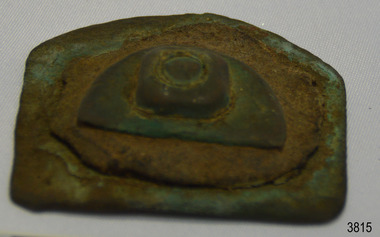
... hill maritime village...great ocean road...west coast trader...apollo bay...mid-19th century shipwreck...the grange...scottish barque...little henty reef...captain a alexander...underwater explorers club of victoria...1840s carronade...vhr 5297...coastal trader...wooden shipwreck...john chance...wood sample...wooden ship...oak...The Grange is an example of a mid-19th century vessel that carried a weapon of defence onboard. flagstaff hill warrnambool flagstaff hill maritime museum maritime museum shipwreck coast flagstaff hill maritime village great ocean road west coast trader apollo bay mid-19th century shipwreck the grange scottish barque little henty reef captain a alexander underwater explorers club of victoria 1840s carronade vhr 5297 coastal trader wooden shipwreck john chance wood sample wooden ship oak timber ship fitting Wood sample, oak wood fixed between plates and secured by a washer and bolt. ...This oak wood sample is part of the wooden barque, the Grange, built in 1840. The wood sample was recovered from the shipwreck of the Grange in around 1968, 110 years after the Grange was wrecked (see below for further details on the Grange). It is part of the John Chance Collection. THE GRANGE, 1840-1858- The wooden barque ’Grange’ was a three-masted ship built in Scotland in 1840 for international and coastal trade. On March 22, 1858, the Grange set sail from Melbourne under Captain A. Alexander, carrying a cargo of ballast. The barque had left the Heads of Phillip Bay and was heading west along the Victorian coast towards Cape Otway. The ship struck Little Haley’s Reef at Apollo Bay due to a navigational error and was stuck on the rocks. The crew left the ship carrying whatever they could onto the beach. Eventually, the remains of the hull, sails and fittings were salvaged before the wreck of the Grange broke up about a month later. About 110 years later, in 1968, the wreck of the Grange was found by divers from the Underwater Explorers Club of Victoria. They were amazed to find a unique, six to nine pound carronade (type of small cannon) and a cannonball on the site. There have been no other similar carronades recorded. In that same year the anchor of the Grange was recovered by diver John Chance and Mal Brown. The wood sample is significant historically as an example of hardware used when building wooden ships in the early to mid-19th century. The sample is historically significant as an example of the work and trade of blacksmith. The sample is also has significant as it was recovered by John Chance, a diver from the wreck of the Grange in the 1968. Items that come from several wrecks along Victoria's coast have since been donated to the Flagstaff Hill Maritime Village’s museum collection by his family, illustrating this item’s level of historical value. The sample is historically significant for its association with the 1840s wooden barque, the Grange. The Grange is an historical example of a Scottish built vessel used for international and coastal trader of both cargo and passengers in the mid-19th century. The Grange is an example of an early ship, designed with a wooden hull. It is significant as a ship still available to divers along the south coast of Victoria, for research and education purposes. The Grange is an example of a mid-19th century vessel that carried a weapon of defence onboard. Wood sample, oak wood fixed between plates and secured by a washer and bolt. There are five layers, each decreasing in size from base to the top. The bottom is a five-sided copper plate, above it is the oak sample that is crumbling and fragile, then a half-disc metal plate, then a square metal washer, then a round metal bolt head. The metal plate has unequal sides, the longest is parallel to the strait side of the half disc. flagstaff hill, warrnambool, flagstaff hill maritime museum, maritime museum, shipwreck coast, flagstaff hill maritime village, great ocean road, west coast trader, apollo bay, mid-19th century shipwreck, the grange, scottish barque, little henty reef, captain a alexander, underwater explorers club of victoria, 1840s carronade, vhr 5297, coastal trader, wooden shipwreck, john chance, wood sample, wooden ship, oak timber, ship fitting -
 Flagstaff Hill Maritime Museum and Village
Equipment - Rowing Oars
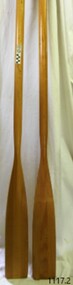
... hill-maritime-village...oar...oars...gull oars and paddles...new zealand oars and paddles...jas edwards and sons melbourne...rowing equipment...New Zealand oak...The oars are associated with a significant family business situated in Palmerston New Zealand that along with making ladders also graduated into making wooden boats and oars. warrnambool flagstaff-hill flagstaff-hill-maritime-museum maritime-museum shipwreck-coast flagstaff-hill-maritime-village oar oars gull oars and paddles new zealand oars and paddles jas edwards and sons melbourne rowing equipment New Zealand oak paddle James Edwards and Sons Melbourne James Edwards Tasman Fir Gull superior oars marine equipment marine technology ship fitting boat fitting rowing oar boat oar (1) "GULL Superior Oars and Paddles, Pelco, Palmerston North NZ" (2) "JAS. ...The family-owned timber manufacturing business Pelco was started by Cecil Victor Woodfield in 1937. The joinery company Pelco began by making wooden ladders and was registered as the Palmerston Extension Ladder Company. C V Woodfield, who lived from 1884 -1959, arrived in Palmerston North from Canterbury NZ in the aftermath of the Great Depression to work in construction. The company got its first step up when Woodfield was asked by a commercial painter to make a ladder, and the founder set up shop in a garage on Ruahine St. According to the company website, Pelco made its name in New Zealand with its Oregon Extension Ladders, and up until its closure, manufactured non-conductive Lamilite Ladders for the electrical supply and service industry worldwide. The company was incorporated as a joinery business in 1946, and continued making high-end cabinetry for seven decades. Under director Geoff Woodfield, in the 1950s, the company embarked on the production of Fleetcraft plywood boats. Another water-related enterprise followed, with the manufacture of oars and paddles Its branded Gull Superior Oars and Paddles business began exporting in 1972 to Australia and subsequently to the United States, UK and Japan. The company ceased trading in April 2018 and was placed into receivership.This pair of lightweight oars represents the maritime tradition of handmade oar making, which has evolved over the centuries. Their shape is still similar to early oars and continues to serve the same purpose, to steer and propel a boat. The oars are associated with a significant family business situated in Palmerston New Zealand that along with making ladders also graduated into making wooden boats and oars.Pair of blonde varnished Tasman Fir oars with a flattened paddle at one end. Made by Gull of New Zealand, sold by James Edwards & Sons of Melbourne. Inscriptions on printed labels on the oars.(1) "GULL Superior Oars and Paddles, Pelco, Palmerston North NZ" (2) "JAS. EDWARDS & SONS, Boat Builders, Oar and Skull Makers, & Importers, PRINCES BRIDGE MELBOURNE"warrnambool, flagstaff-hill, flagstaff-hill-maritime-museum, maritime-museum, shipwreck-coast, flagstaff-hill-maritime-village, oar, oars, gull oars and paddles, new zealand oars and paddles, jas edwards and sons melbourne, rowing equipment, new zealand oak, paddle, james edwards and sons melbourne, james edwards, tasman fir, gull superior oars, marine equipment, marine technology, ship fitting, boat fitting, rowing oar, boat oar -
 Flagstaff Hill Maritime Museum and Village
Furniture - Chair, Haberfield Chair, Michael Bradshaw, Circa 1860s-1890s
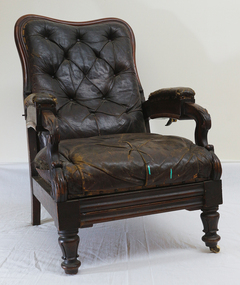
... Oak ( Northern hemisphere) • Repair fill-in piece (fine textured) – Populus sp. – Poplar • Runner wood - Eucalyptus sp – Pale coloured ash group, or messmate The chair is significant for its local origin and history, being connected to generations of the Anderson and Haberfield families. It is also significant for its elaborate and unusual design, the quality of its workmanship and materials. It is a fine example of good quality furniture of the late 19th century. Flagstaff Hill ...This elegant reclining armchair is generously on loan from the local Haberfield family. Mrs Haberfield is a member of the Anderson family from the Tower Hill region, and the chair was handed down to her from them. When it arrived at Flagstaff Hill in 2009, it was at least 100 years old. The maker, Michael Bradshaw, is currently unknown. The origin of the chair's timber has been lost through the generations, but some have named the armchair the 'Mahogany Chair' after the legendary Mahogany Ship. In August 2009, the wood was expertly examined. The structure of the wood specimens was found to be consistent with: • Pale coloured carcass timber - Fagus sylvatica – Beech (European) • Pale coloured frame timber - Agathis sp – NZ Kauri • Dark coloured timber chair legs (solid) - Swietenia sp. – True Mahogany • Dark coloured timber veneer - Swietenia sp. – True Mahogany • Repair fill-in piece – Quercus sp. – White Oak ( Northern hemisphere) • Repair fill-in piece (fine textured) – Populus sp. – Poplar • Runner wood - Eucalyptus sp – Pale coloured ash group, or messmate The chair is significant for its local origin and history, being connected to generations of the Anderson and Haberfield families. It is also significant for its elaborate and unusual design, the quality of its workmanship and materials. It is a fine example of good quality furniture of the late 19th century.The Haberfield Chair is a reclining armchair that includes a footrest and a detachable book rest. The chair features a dark timber frame and dark burgundy (now dark brown), Morocco goat skin leather upholstery. The backrest is finished with button detailing, and its frame is distinguished by gracefully curved corners, lending the chair an elegant appearance. The chair’s padded leather armrests have attractive, crafted carvings at each end. A lever located below the armrest operates the recliner’s ratchet mechanism, which also causes a footrest to slide forward for greater comfort. The turned and carved front legs are equipped with wheels, allowing for easy movement. The removable book rest is mounted on a brass pedestal. Its angle can be conveniently adjusted using a screw to move the ball and socket joint, ensuring personalised reading comfort. There is a handwritten inscription on the underside of the back rail. The chair is kindly on loan from the local Haberfield family. In pen and ink: “Made from Mahogany Ship wrecked near Tower Hill, July 3, 1835: made by Michael Bradshaw 18-2-“ [originally thought to read 1842]flagstaff hill maritime museum and village, great ocean road, shipwreck coast, armchair, reclining armchair, reading board, mahogany chair, haberfield chair, furniture, living room furniture, domestic furniture, 19th century, luxury, morroco leather, book stand, book rest, side table, music stand, reading stand, reading rest, foot rest, reading table -
 Flagstaff Hill Maritime Museum and Village
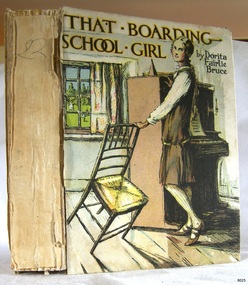
Book - Fiction, Oxford University Press, That Boarding School Girl, 1926
... Hill Maritime Museum and Village...Warrnambool...Maritime Museum...Maritime Village...Great Ocean Road...Shipwreck Coast...book...Warrnambool Library...Warrnambool Mechanics’ Institute...Mechanics’ Institute Library...Victorian Library Board...Warrnambool Books and Records...Warrnambool Children’s Library...Warrnambool Public Library...that boarding school girl...Dorita Fairlie Bruce...Sylvia McCullagh...Sylvia Jean Veronica McCullagh...Sylvia Barr...James McCullagh...Elizabeth Eccles McCullagh...William McCullagh...Margaret Jane Russell McCullagh...Oak...Flagstaff Hill Flagstaff Hill Maritime Museum and Village Warrnambool Maritime Museum Maritime Village Great Ocean Road Shipwreck Coast book Warrnambool Library Warrnambool Mechanics’ Institute Mechanics’ Institute Library Victorian Library Board Warrnambool Books and Records Warrnambool Children’s Library Warrnambool Public Library that boarding school girl Dorita Fairlie Bruce Sylvia McCullagh Sylvia Jean Veronica McCullagh Sylvia Barr James McCullagh Elizabeth Eccles McCullagh William McCullagh Margaret Jane Russell McCullagh Oak Grove Yangery Illowa Dennington Presbyterian Sabbath School Presbyterian Sunday School Dennington Presbyterian Church book award book prize book presentation F. ...Sylvia Jean Veronica McCullagh Barr (1914–1998) was a student at the Presbyterian Sabbath School in Dennington, near Warrnambool. In December 1930, she received a book as an award from F. Jones, the Sabbath School Superintendent, recognising her involvement and achievements at the school. Sylvia was the granddaughter of James McCullagh (1831–1911) and Elizabeth Eccles (1831–1909), a pioneering couple in the region. Married in 1856, James and Elizabeth settled at Oak Grove, Yangery, Illowa from 1859, where they lived until their deaths. One of James and Elizabeth’s sons, William McCullagh (1873–1940), married Margaret Jane Russell (1879–1981). William and Margaret also made their home at Oak Grove and raised eleven children there, including Sylvia.The book, “That Boarding School Girl” by Dorita Fairlie Bruce, represents an example of literature accessible to older girls during the early 20th century. It was specifically selected as an end-of-year award, recognising consistent attendance at Sabbath School. Such choices highlight the role of books in supporting the educational and moral development of young women during this period. The book is important as a connection to the early township of Dennington, a community distinguished by its established school and church. This association reflects the values the community placed on education and religious instruction. The book’s significance is further enhanced by its relationship with colonial pioneer families in Australia, particularly those from Victoria and the Warrnambool district in southwest Victoria. It is a tangible link to the history and legacy of these early settlers, who were instrumental in shaping the regional development. That Boarding School Girl Author: Dorita Fairlie Bruce Publisher: Oxford University Press Date: 1926 The front cover and the page opposite the fly page have drawn and coloured illustrations. The cloth-covered, hardcover book includes black and white illustrations and coloured illustrations on the front cover and frontispiece. The front cover illustration shows a teenage irl in a school tunic, standing beside a piano with one hand on the backrest of a tilted chair. Inscriptions are printed on the front loose endpaper and handwritten on the fly page. The book belonged to Sylvia McCullagh. It was awarded to her as a prize in 1930.Handwritten on the top of the fly page: "Sylvia McCullagh Den" [ Den - abbreviation for Dennington] " Presbyterian Sabbath School, Dennington. Prize Awarded to: Sylvia McCullagh. December 1930." "F. Jones, Superintendent"flagstaff hill, flagstaff hill maritime museum and village, warrnambool, maritime museum, maritime village, great ocean road, shipwreck coast, book, warrnambool library, warrnambool mechanics’ institute, mechanics’ institute library, victorian library board, warrnambool books and records, warrnambool children’s library, warrnambool public library, that boarding school girl, dorita fairlie bruce, sylvia mccullagh, sylvia jean veronica mccullagh, sylvia barr, james mccullagh, elizabeth eccles mccullagh, william mccullagh, margaret jane russell mccullagh, oak grove, yangery, illowa, dennington, presbyterian sabbath school, presbyterian sunday school, dennington presbyterian church, book award, book prize, book presentation, f. jones, sabbath school superintendent, 1930 -
 Flagstaff Hill Maritime Museum and Village
Book, To-Night at 8.30
... hill-maritime-village...shipwrecked-artefact...book...pattison collection...warrnambool library...warrnambool mechanics’ institute...ralph eric pattison...corangamite regional library service...warrnambool city librarian...mechanics’ institute library...victorian library board...warrnambool books and records...warrnambool children’s library...great ocean road...to-night at 830...noel coward...We Were Dancing...The Astonished Heart....Red Peppers...Hands Across the Sea...Fumed Oak...The Warrnambool Mechanics' Institute publication collection is of both local and state significance. warrnambool shipwrecked-coast flagstaff-hill flagstaff-hill-maritime-museum maritime-museum shipwreck-coast flagstaff-hill-maritime-village shipwrecked-artefact book pattison collection warrnambool library warrnambool mechanics’ institute ralph eric pattison corangamite regional library service warrnambool city librarian mechanics’ institute library victorian library board warrnambool books and records warrnambool children’s library great ocean road to-night at 830 noel coward We Were Dancing The Astonished Heart. Red Peppers Hands Across the Sea Fumed Oak ...This item is from the ‘Pattison Collection’, a collection of books and records that was originally owned by the Warrnambool Mechanics’ Institute, which was founded in Warrnambool in 1853. By 1886 the Warrnambool Mechanics’ Institute (WMI) had grown to have a Library, Museum and Fine Arts Gallery, with a collection of “… choice productions of art, and valuable specimens in almost every branch and many wonderful national curiosities are now to be seen there, including historic relics of the town and district.” It later included a School of Design. Although it was very well patronised, the lack of financial support led the WMI in 1911 to ask the City Council to take it over. In 1935 Ralph Pattison was appointed as City Librarian to establish and organise the Warrnambool Library as it was then called. When the WMI building was pulled down in 1963 a new civic building was erected on the site and the new Warrnambool Library, on behalf of the City Council, took over all the holdings of the WMI. At this time some of the items were separated and identified as the ‘Pattison Collection’, named after Ralph Pattison. Eventually the components of the WMI were distributed from the Warrnambool Library to various places, including the Art Gallery, Historical Society and Flagstaff Hill. Later some were even distributed to other regional branches of Corangamite Regional Library and passed to and fro. It is difficult now to trace just where all of the items have ended up. The books at Flagstaff Hill Maritime Village generally display stamps and markings from Pattison as well as a variety of other institutions including the Mechanics’ Institute itself. RALPH ERIC PATTISON Ralph Eric Pattison was born in Rockhampton, Queensland, in 1891. He married Maude Swan from Warrnambool in 1920 and they set up home in Warrnambool. In 1935 Pattison accepted a position as City Librarian for the Warrnambool City Council. His huge challenge was to make a functional library within two rooms of the Mechanics’ Institute. He tirelessly cleaned, cleared and sorted a disarrayed collection of old books, jars of preserved specimens and other items reserved for exhibition in the city’s museum. He developed and updated the library with a wide variety of books for all tastes, including reference books for students; a difficult task to fulfil during the years following the Depression. He converted all of the lower area of the building into a library, reference room and reading room for members and the public. The books were sorted and stored using a cataloguing and card index system that he had developed himself. He also prepared the upper floor of the building and established the Art Gallery and later the Museum, a place to exhibit the many old relics that had been stored for years for this purpose. One of the treasures he found was a beautiful ancient clock, which he repaired, restored and enjoyed using in his office during the years of his service there. Ralph Pattison was described as “a meticulous gentleman whose punctuality, floorless courtesy and distinctive neat dress were hallmarks of his character, and ‘his’ clock controlled his daily routine, and his opening and closing of the library’s large heavy doors to the minute.” Pattison took leave during 1942 to 1945 to serve in the Royal Australian Navy, Volunteer Reserve as Lieutenant. A few years later he converted one of the Museum’s rooms into a Children’s Library, stocking it with suitable books for the younger generation. This was an instant success. In the 1950’s he had the honour of being appointed to the Victorian Library Board and received more inspiration from the monthly conferences in Melbourne. He was sadly retired in 1959 after over 23 years of service, due to the fact that he had gone over the working age of council officers. However he continued to take a very keen interest in the continual development of the Library until his death in 1969. WARRNAMBOOL PUBLIC LIBRARY The Warrnambool Mechanics’ Institute (WMI) was formed by a voluntary community group in 1863, within six years of Warrnambool’s beginnings, and its Reading Room opened in 1854. The WMI operated until 1963, at which time it was one of the oldest Mechanics’ Institutes in Victoria. Mechanics’ Institutes offered important services to the public including libraries, reading rooms and places to display and store collections of all sorts such as curiosities and local historical relics. In 1886 a Museum and Fine Arts Gallery were added to the WMI and by the beginning of the 20th century there was also a billiards room and a School of Art. By this time all Mechanics’ Institutes in country Victoria had museums attached. Over the years the Warrnambool Mechanics’ Institute Library was also known as the Warrnambool Public Library the Warrnambool Library and the Free Library. Early funding from the government was for the “Free Library”. The inscription in a book “Science of Man” was for the “Warrnambool Public Library”, donated by Joseph Archibald in 1899. Another inscription in the book “Catalogue of Plants Under Cultivation in the Melbourne Botanic Gardens 1 & 2, 1883” was presented to the “Warrnambool Library” and signed by the author W.R. Guilfoyle. In 1903 the Warrnambool Public Library decided to add a Juvenile Department to library and stock it with hundreds of books suitable for youth. In 1905 the Public Library committee decided to update the collection of books and added 100 new novels plus arrangements for the latest novels to be included as soon as they were available in Victoria. In July 1911 the Warrnambool Council took over the management of the Public Library, Art Gallery, Museum and Mechanics’ Institute and planned to double the size of the then-current building. In 1953, when Mr. R. Pattison was Public Librarian, the Warrnambool Public Library’s senior section 10,000 of the 13,000 books were fiction. The children’s section offered an additional 3,400 books. The library had the equivalent of one book per head of population and served around 33 percent of the reading population. The collection of books was made up of around 60 percent reference and 40 percent fiction. The library was lending 400 books per day. In 1963 the Warrnambool City Council allocated the site of the Mechanics’ Institute building, which included the Public Library, Museum and Art Gallery, for the new Municipal Offices and the Collections were dispersed until 1971. The Warrnambool Library took over the Mechanics’ Institute Library’s holdings on behalf of the Warrnambool City Council. Since the closure of the Warrnambool Mechanics’ Institute the exact location and composition of the original WMI books and items has become unclear. Other materials have been added to the collection, including items from Terang MI, Warrnambool Court House and Customs House. Many of the books have been identified as the Pattison Collection, named after the Librarian who catalogued and numbered the books during his time as Warrnambool Public Librarian in the time before the Mechanics’ Institute closed. It seems that when Warrnambool became part of the Corangamite Regional Library some of the books and materials went to its head office in Colac and then back to Warrnambool where they were stored at the Art Gallery for quite some time. Some then went to the Warrnambool Historical Society, some stayed at the Art Gallery and some were moved to Flagstaff Hill Maritime Village. The various stamps and labels on the books held at Flagstaff Hill show the variety of the collection’s distribution and origin. The books in the collection at Flagstaff Hill Maritime Village date from the 1850’s to the late 1950’s and include rare and valuable volumes. Many of the books are part of the “Pattison Collection” after the Warrnambool’s Public Librarian, Mr. R. Pattison. WARRNAMBOOL'S MECHANICS' INSTITUTE Warrnambool's Mechanics' Institute (or Institution as it was sometimes called) was one of the earliest in Victoria. On 17th October 1853 a meeting was held where it was resolved to request the Lieutenant Governor of the Colony to grant land for the erection of a Mechanics' Institutes building. A committee was formed at the meeting and Richard Osburne chaired the first meeting of this committee. The land on the North West corner of Banyan and Merri Streets was granted but there were no funds to erect the building. The Formal Rights of the Warrnambool Mechanics' Institute's encompassed its aims and these were officially adopted in1859; "This Institution has for its object the diffusion of literary, scientific, and other useful knowledge amongst its members, excluding all controversial subjects, religious or political. These objects are sought to be obtained by means of a circulating library, a reading room, the establishment of classes, debates, and the occasional delivery of lectures on natural and experimental philosophy, mechanics, astronomy, chemistry, natural history, literature, and the useful and ornamental arts, particularly those which have a more immediate reference to the colony." The Warrnambool Mechanics' Institute opened its first reading room in November1884 in the National School building at the corner of Banyan and Timor Streets. The Institute was funded by member subscription, payable on a quarterly, half yearly or yearly basis. Samuel Hannaford, the Manager of the Warrnambool Bank of Australasia, was the first Honorary Secretary of the Mechanics' Institutes, and an early President and Vice-President. He also gave several of the early lectures in the Reading Room. Another early Secretary, Librarian and lecturer was Marmaduke Fisher, the teacher at the National School. Lecture topics included The Poets and Poetry of Ireland', 'The Birth and Development of the Earth', 'The Vertebrae - with Remarks on the pleasures resulting from the study of Natural History' and 'Architecture'. In 1856 the Reading Room was moved to James Hider's shop in Timor Street, and by 1864 it was located in the bookshop of Davies and Read. In the 1860's the Mechanics' Institute struggled as membership waned but in 1866, after a series of fund raising efforts, the committee was able to purchase land in Liebig Street, on a site then called Market Square, between the weighbridge and the fire station. A Mechanics' Institute building was opened at this site in August 1871. The following year four more rooms were added to the main Reading Room and in 1873 the Artisan School of Design was incorporated into the Institute. The same year Joseph Archibald established a Museum; however it deteriorated when he was transferred to Bendigo in 1877. In 1880, with Archibald's return to Warrnambool, the Museum was re-established, and in 1885 a new building was built at the back of the Institute to accommodate the re-created School of Design, the Art Gallery and the Museum. In 1887 the Museum section was moved to the former court house in Timor Street (for some time the walls of the building formed part of the TAFE cafeteria but all is now demolished)). In 1911 the Museum was transferred back to the original building and the management of the Mechanics' Institute was handed over to the Warrnambool City Council. The Museum and Art Gallery became one and housed many fine works of art, and the Library continued to grow. The building was well patronised, with records showing that at the beginning of the 20th century there were between 500 and 800 visitors. During World War One the monthly figures were in the thousands, with 3,400 people visiting in January 1915. The Museum was a much loved Institution in Warrnambool until the contents of the Museum and Art Gallery were removed to make room for the Warrnambool City Council Engineers' Department. The contents were stored but many of the items were scattered or lost. When the original building was demolished the site became occupied by the Civic Centre, which included the new City Library. (The library was temporarily located in the old Palais building in Koroit Street.) In the process of reorganisation the Collection was distributed amongst the community groups: -The new City Library took some of the historic books and some important documents, historic photographs and newspapers. -The Art Gallery kept the 19th Century art collection and some of the artefacts from the museum. -The Historic Society has some items -The State Museum has some items -Some items were destroyed -Flagstaff Hill Maritime Village has old newspapers, Government Gazettes, most of the Mechanics' Institute Library, ledgers and documents connected to the Mechanics' Institute Library, some framed and unframed art works and some photographs. The Warrnambool Mechanics' Institute Library book collection is deemed to be of great importance because it is one of the few collections in an almost intact state, and many of the books are now very rare and of great value. The Pattison Collection, along with other items at Flagstaff Hill Maritime Village, was originally part of the Warrnambool Mechanics' Institute’s collection. The Warrnambool Mechanics’ Institute Collection is primarily significant in its totality, rather than for the individual objects it contains. Its contents are highly representative of the development of Mechanics' Institute libraries across Australia, particularly Victoria. A diversity of publications and themes has been amassed, and these provide clues to our understanding of the nature of and changes in the reading habits of Victorians from the 1850s to the middle of the 20th century. The collection also highlights the Warrnambool community’s commitment to the Mechanics’ Institute, reading, literacy and learning in the regions, and proves that access to knowledge was not impeded by distance. These items help to provide a more complete picture of our community’s ideals and aspirations. The Warrnambool Mechanics Institute book collection has historical and social significance for its strong association with the Mechanics Institute movement and the important role it played in the intellectual, cultural and social development of people throughout the latter part of the nineteenth century and the early twentieth century. The collection of books is a rare example of an early lending library and its significance is enhanced by the survival of an original collection of many volumes. The Warrnambool Mechanics' Institute’s publication collection is of both local and state significance. SIGNIFICANCE The Warrnambool Mechanics' Institute Collection is primarily significant in its totality, rather than for the individual objects it contains. Its contents are highly representative of the development of Mechanics' Institute libraries across Australia, particularly Victoria. A diversity of publications and themes has been amassed, and these provide clues to our understanding of the nature of and changes in the reading habits of Victorians from the 1850s to the middle of the 20th century. The collection also highlights the Warrnambool community’s commitment to the Mechanics’ Institute, and to reading, literacy and learning in the regions, and proves that access to knowledge was not impeded by distance. These items help to provide a more complete picture of our community’s ideals and aspirations. As with many Mechanics' Institutes in Australia, the one which operated in Warrnambool was established and overseen for many years by key individuals associated with the development of the city itself. The WMI publication collection is historically significant because of its association with local people, places and the key historical themes in the development of Warrnambool of rural development, industry, farming, education, and community. The collection documents and illustrates the changing interests, focus and tastes of Victorians, especially those in regional cities. Generally the individual items in the collection are not particularly rare, as examples of all probably exist in other public collections in Victoria. It is primarily because there are so very few surviving Mechanics' Institute collections in Victoria, which lends this overall collection its significance. Many items in the WMI Collection have the potential to support further research, both as individual objects and through the collection in its entirety. This material is significant for its ability to assist in the interpretation of the history of the area and adds to the general understanding of the development of the township. Many components of the WMI publication collection complement and reinforce the Flagstaff Hill Maritime Museum Collection, the Warrnambool Art Gallery Collection, and that in the Warrnambool Historical Society, and also contribute to a clearer understanding of the original Warrnambool Mechanics' Institute collections. This will greatly enhance the appreciation of the few surviving Mechanics' Institute collections across Victoria, and also in New South Wales. The similarities and differences between the small number of collections that have survived can provide further insights into how the people of Victoria in general, and Warrnambool in particular, constructed a civic culture of adult learning to foster an informed citizenry. The Warrnambool Mechanics' Institute publication collection is of both local and state significance. To-Night at 830 Play Titles 1)We Were Dancing 2) The Astonished Heart 3) "Red Peppers" 4) Hands Across the Sea 5) Fumed Oak 6) Shadow Play 7) Ways and Means 8) Still Life 9) Family Album Author: Noel Coward Publisher: William Heinemann Ltd Date: 1937Label on spine cover with typed text PAT 822 COW Pastedown front endpaper has sticker from Warrnambool Public Library covered by a sticker from Corangamite Regional Library Service Front loose endpaper has a stamp from Corangamite Regional Library Service Fly paper has a stamp from Warrnambool Mechanics Institute warrnambool, shipwrecked-coast, flagstaff-hill, flagstaff-hill-maritime-museum, maritime-museum, shipwreck-coast, flagstaff-hill-maritime-village, shipwrecked-artefact, book, pattison collection, warrnambool library, warrnambool mechanics’ institute, ralph eric pattison, corangamite regional library service, warrnambool city librarian, mechanics’ institute library, victorian library board, warrnambool books and records, warrnambool children’s library, great ocean road, to-night at 830, noel coward, we were dancing, the astonished heart., red peppers, hands across the sea, fumed oak, shadow play, ways and means, still life, family album -
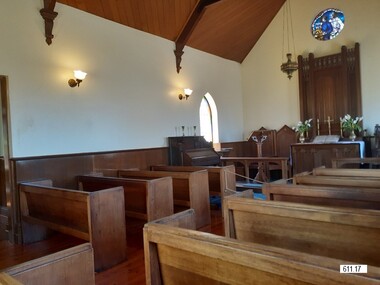 Flagstaff Hill Maritime Museum and Village
Furniture - Set of Pews, c.1944
... The connection of these pews to the Mission to Seamen and to the Williamstown Lightkeepers’ Auxiliary highlights the strong community awareness of the life of people at sea, their dangers and hardships, and their need for physical, financial, spiritual and moral support. flagstaff hill warrnambool shipwrecked coast flagstaff hill maritime museum maritime museum shipwreck coast flagstaff hill maritime village great ocean road religion religious service lightkeepers’ auxiliary mrs musther missions to seamen victoria mission to seafarers flying angel’s club st nicholas seaman’s church williamstown st nicholas mission to seamen church williamstown mission to seamen williamstown st nicholas seamen’s church flagstaff hill 139 nelson place williamstown church furniture church seats church pew religious furniture religious worship anglican church Set of seventeen varnished oak wood church high back pews. ...This set of seventeen church pews was originally used in St. Nicholas Seamen’s Church, 139 Nelson Place, Williamstown, Victoria, during religious services operated by the Missions to Seamen organisation. The pews were donated to the St Nicholas Seamen’s Church by the Williamstown Lightkeepers’ Auxiliary, founded by Ethel Margaret Musther, M.B.E.. THE MISSIONS TO SEAMEN (Brief History): - The Missions to Seamen was an Anglican charity in Great Britain that has served the world's seafarers since 1856. Its symbol is a Flying Angel, inspired by a Bible verse. Today, there are centres in over 200 ports worldwide where seamen of all backgrounds are offered a warm welcome and provided with a wide range of facilities. In Victoria, the organisation began in Williamstown in 1857 as a Sailors’ Church, also known as ‘Bethel’ or the ‘Floating Church’ in an old hulk floating in Hobson’s Bay, Port of Melbourne. It soon became part of the Missions to Seamen, Victoria. In 2000, the organisation, now named Mission to Seafarers, still operated locally in Melbourne, Portland, Geelong and Hastings. The Ladies’ Harbour Lights Guild was formed in 1906 to support the Missions to Seamen in Melbourne and other centres, such as Williamstown. Two of the most significant ladies of the Guild were founder Ethel Augusta Godfrey and foundation member Alice Sibthorpe Tracy (who established a branch of the Guild in Warrnambool in 1920). The Guild continued its work until the 1960s. In 1943, a former Williamstown bank was purchased for the Missions to Seamen Club. The chapel was named St Nicholas’ Seamen’s Church and was supported by the Ladies’ Harbour Lights Guild, the Williamstown Lightkeepers’ Auxiliary and the League of Soldiers’ and Sailors’ Friends. It ceased operation in 1966. A Missions to Seamen Chapel and Recreation Room was a significant feature of ports during the late 1800s and 1900s. It seemed appropriate for Flagstaff Hill to include such a representation within the new Maritime Village, and the Melbourne Board of Management of Missions to Seamen Victoria gave its permission on 21st May 1979 for the entire furnishings of the Williamstown chapel to be transferred to Flagstaff Hill. The St Nicholas Seamen’s Church was officially opened on October 11, 1981, and resembles the Williamstown chapel. The set of pews is significant historically for its origin in the St Nicholas Mission to Seamen's Church in Williamstown, established in 1857 to cater for the physical, social, and spiritual needs of seafarers. It originated in Bristol, England when a Seamen's Mission was formed in 1837. The set of pews id historically significant for their connection to the Ladies Lightkeepers’ Auxiliary, an organisation of women, formed to support seafarers. The connection of these pews to the Mission to Seamen and to the Williamstown Lightkeepers’ Auxiliary highlights the strong community awareness of the life of people at sea, their dangers and hardships, and their need for physical, financial, spiritual and moral support. Set of seventeen varnished oak wood church high back pews. The pews have a shelf fitted behind the backrest. This is a set of original items in our ‘St Nicholas Seamen's Church Williamstown Collection’.flagstaff hill, warrnambool, shipwrecked coast, flagstaff hill maritime museum, maritime museum, shipwreck coast, flagstaff hill maritime village, great ocean road, religion, religious service, lightkeepers’ auxiliary, mrs musther, missions to seamen victoria, mission to seafarers, flying angel’s club, st nicholas seaman’s church williamstown, st nicholas mission to seamen church williamstown, mission to seamen williamstown, st nicholas seamen’s church flagstaff hill, 139 nelson place williamstown, church furniture, church seats, church pew, religious furniture, religious worship, anglican church -
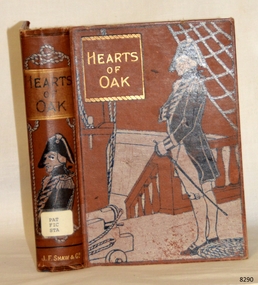 Flagstaff Hill Maritime Museum and Village
Book, Hearts of Oak
... hill maritime village...great ocean road...book...pattison collection...warrnambool library...warrnambool mechanics’ institute...ralph eric pattison...corangamite regional library service...warrnambool city librarian...mechanics’ institute library...victorian library board...warrnambool books and records...warrnambool children’s library...Hearts of Oak...The Warrnambool Mechanics' Institute’s publication collection is of both local and state significance. flagstaff hill warrnambool shipwrecked coast flagstaff hill maritime museum maritime museum shipwreck coast flagstaff hill maritime village great ocean road book pattison collection warrnambool library warrnambool mechanics’ institute ralph eric pattison corangamite regional library service warrnambool city librarian mechanics’ institute library victorian library board warrnambool books and records warrnambool children’s library Hearts of Oak Gordon Stables Nelson The label on the spine cover with typed text PAT FIC STA Pastedown front endpaper has a sticker from Warrnambool Public Library covered by a sticker from Corangamite Regional Library Service Front loose endpaper has a sticker from Warrnambool Public LibraryFront loose endpaper has a stamp from Corangamite Regional Library Service Flyleaf has a stamp from Warrnambool Public Library Hearts of Oak Author: Gordon Stables Publisher: John F Shaw & Co Date: 1930 Further Information: A Story of Nelson and the Navy Hearts of Oak Book Book ...This book was part of a large group of books referred to as the Pattison Collection, which belonged to the Warrnambool Public Library, part of the Warrnambool Mechanics’ Institute. About RALPH ERIC PATTISON and the ‘PATTISON COLLECTION’ The ‘Pattison Collection’ is a collection of books and records that was originally owned by the Warrnambool Mechanics’ Institute, founded in Warrnambool in 1853. By 1886 the Warrnambool Mechanics’ Institute (WMI) had grown to have a Library, Museum and Fine Arts Gallery, with a collection of “… choice productions of art and valuable specimens in almost every branch and many wonderful national curiosities are now to be seen there, including historic relics of the town and district.” It later included a School of Design. Although it was very well patronised, the WMI was led to ask the City Council to take it over in 1911 due to lack of financial support. In 1935 Ralph Pattison was appointed as City Librarian to establish and organise the Warrnambool Public Library as it was then called. Ralph Eric Pattison was born in Rockhampton, Queensland, in 1891. He married Maude Swan from Warrnambool in 1920 and they set up home in Warrnambool. In 1935 when Pattison accepted the position as City Librarian for the Warrnambool City Council his huge challenge was to make a functional library within two rooms of the Mechanics’ Institute. He tirelessly cleaned, cleared and sorted a disarrayed collection of old books, jars of preserved specimens and other items reserved for exhibition in the city’s museum. He developed and updated the library with a wide variety of books for all tastes, including reference books for students; a difficult task to fulfil during the years following the Depression. He converted all of the lower areas of the building into a library, reference room and reading room for members and the public. The books were sorted and stored using a cataloguing and card index system that he had developed himself. He also prepared the upper floor of the building and established the Art Gallery and later the Museum, a place to exhibit the many old relics that had been stored for years for this purpose. One of the treasures he found was a beautiful ancient clock, which he repaired, restored and enjoyed using in his office during the years of his service there. Ralph Pattison was described as “a meticulous gentleman whose punctuality, floorless courtesy and distinctive neat dress were hallmarks of his character, and ‘his’ clock controlled his daily routine and his opening and closing of the library’s large heavy doors to the minute.” Pattison took leave from 1942 to 1945 to serve in the Royal Australian Navy, Volunteer Reserve as Lieutenant. A few years later he converted one of the Museum’s rooms into a Children’s Library, stocking it with suitable books for the younger generation. This was an instant success. In the 1950’s he had the honour of being appointed to the Victorian Library Board and received more inspiration from the monthly conferences in Melbourne. He was sadly retired in 1959 after over 23 years of service, due to the fact that he had gone over the working age of council officers. However, he continued to take a very keen interest in the continual development of the Library until his death in 1969. THE NEW WARRNAMBOOL LIBRARY When the WMI building was pulled down in 1963 a new civic building was erected on the site and the new Warrnambool Library, on behalf of the City Council, took over all the holdings of the WMI. At this time some of the items were separated and identified as the ‘Pattison Collection’, named after Pattison. Eventually, the components of the WMI were distributed from the Warrnambool Library to various places, including the Art Gallery, Historical Society and Flagstaff Hill. Later some were even distributed to other regional branches of Corangamite Regional Library and passed to and fro. It is difficult now to trace just where all of the items have ended up. The books at Flagstaff Hill Maritime Village generally display stamps and markings from Pattison as well as a variety of other institutions including the Mechanics’ Institute itself. WARRNAMBOOL PUBLIC LIBRARY The Warrnambool Mechanics’ Institute (WMI) was formed by a voluntary community group in 1863, within six years of Warrnambool’s beginnings, and its Reading Room opened in 1854. The WMI operated until 1963, at which time it was one of the oldest Mechanics’ Institutes in Victoria. Mechanics’ Institutes offered important services to the public including libraries, reading rooms and places to display and store collections of all sorts such as curiosities and local historical relics. In 1886 a Museum and Fine Arts Gallery were added to the WMI and by the beginning of the 20th century, there was also a billiards room and a School of Art. By this time all Mechanics’ Institutes in country Victoria had museums attached. Over the years the Warrnambool Mechanics’ Institute Library was also known as the Warrnambool Public Library the Warrnambool Library and the Free Library. Early funding from the government was for the “Free Library”. The inscription in a book “Science of Man” was for the “Warrnambool Public Library”, donated by Joseph Archibald in 1899. Another inscription in the book “Catalogue of Plants Under Cultivation in the Melbourne Botanic Gardens 1 & 2, 1883” was presented to the “Warrnambool Library” and signed by the author W.R. Guilfoyle. In 1903 the Warrnambool Public Library decided to add a Juvenile Department to library and stock it with hundreds of books suitable for youth. In 1905 the Public Library committee decided to update the collection of books and added 100 new novels plus arrangements for the latest novels to be included as soon as they were available in Victoria. In July 1911 the Warrnambool Council took over the management of the Public Library, Art Gallery, Museum and Mechanics’ Institute and planned to double the size of the then-current building. In 1953, when Mr R. Pattison was Public Librarian, the Warrnambool Public Library’s senior section 10,000 of the 13,000 books were fiction. The children’s section offered an additional 3,400 books. The library had the equivalent of one book per head of population and served around 33 per cent of the reading population. The collection of books was made up of around 60 per cent reference and 40 per cent fiction. The library was lending 400 books per day. In 1963 the Warrnambool City Council allocated the site of the Mechanics’ Institute building, which included the Public Library, Museum and Art Gallery, for the new Municipal Offices and the Collections were dispersed until 1971. The Warrnambool Library took over the Mechanics’ Institute Library’s holdings on behalf of the Warrnambool City Council. Since the closure of the Warrnambool Mechanics’ Institute the exact location and composition of the original WMI books and items have become unclear. Other materials have been added to the collection, including items from Terang MI, Warrnambool Court House and Customs House. Many of the books have been identified as the Pattison Collection, named after the Librarian who catalogued and numbered the books during his time as Warrnambool Public Librarian in the time before the Mechanics’ Institute closed. It seems that when Warrnambool became part of the Corangamite Regional Library some of the books and materials went to its head office in Colac and then back to Warrnambool where they were stored at the Art Gallery for quite some time. Some then went to the Warrnambool Historical Society, some stayed at the Art Gallery and some were moved to Flagstaff Hill Maritime Village. The various stamps and labels on the books held at Flagstaff Hill show the variety of the collection’s distribution and origin. The books in the collection at Flagstaff Hill Maritime Village date from the 1850s to the late 1950s and include rare and valuable volumes. Many of the books are part of the “Pattison Collection” after the Warrnambool’s Public Librarian, Mr R. Pattison. The Pattison Collection, along with other items at Flagstaff Hill Maritime Village, was originally part of the Warrnambool Mechanics' Institute’s collection. The Warrnambool Mechanics’ Institute Collection is primarily significant in its totality, rather than for the individual objects it contains. Its contents are highly representative of the development of Mechanics' Institute libraries across Australia, particularly Victoria. A diversity of publications and themes has been amassed, and these provide clues to our understanding of the nature of and changes in the reading habits of Victorians from the 1850s to the middle of the 20th century. The collection also highlights the Warrnambool community’s commitment to the Mechanics’ Institute, reading, literacy and learning in the regions, and proves that access to knowledge was not impeded by distance. These items help to provide a more complete picture of our community’s ideals and aspirations. The Warrnambool Mechanics Institute book collection has historical and social significance for its strong association with the Mechanics Institute movement and the important role it played in the intellectual, cultural and social development of people throughout the latter part of the nineteenth century and the early twentieth century. The collection of books is a rare example of an early lending library and its significance is enhanced by the survival of an original collection of many volumes. The Warrnambool Mechanics' Institute’s publication collection is of both local and state significance. Hearts of Oak Author: Gordon Stables Publisher: John F Shaw & Co Date: 1930 Further Information: A Story of Nelson and the NavyThe label on the spine cover with typed text PAT FIC STA Pastedown front endpaper has a sticker from Warrnambool Public Library covered by a sticker from Corangamite Regional Library Service Front loose endpaper has a sticker from Warrnambool Public LibraryFront loose endpaper has a stamp from Corangamite Regional Library Service Flyleaf has a stamp from Warrnambool Public Library flagstaff hill, warrnambool, shipwrecked coast, flagstaff hill maritime museum, maritime museum, shipwreck coast, flagstaff hill maritime village, great ocean road, book, pattison collection, warrnambool library, warrnambool mechanics’ institute, ralph eric pattison, corangamite regional library service, warrnambool city librarian, mechanics’ institute library, victorian library board, warrnambool books and records, warrnambool children’s library, hearts of oak, gordon stables, nelson -
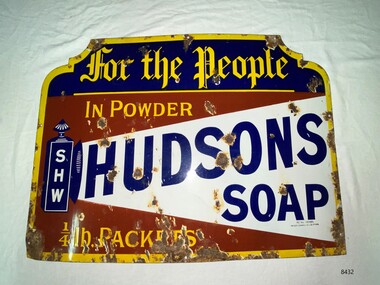 Flagstaff Hill Maritime Museum and Village
Sign - Hudson's Soap Enamel Advertising Sign, Patent Enamel Co Ltd, c. late 19th century- early 20th century
... Hill...Warrnambool...Maritime Museum...Hudson's Soap...Advertising Signage...Patent Enamel Co Ltd...Selly Oak...Flagstaff Hill Warrnambool Maritime Museum Hudson's Soap Advertising Signage Patent Enamel Co Ltd Selly Oak Borough of Birmingham Robert Spear Hudson Enamel advertising sign for Hudson's soap Sign Hudson's Soap Enamel Advertising Sign Patent Enamel Co Ltd ...Hudson's Soap Powder, was the first satisfactory and commercially successful soap powder and was made in Liverpool by Robert Spear Hudson. He was also an innovator in using advertising, commissioning striking images from professional artists and paid for publicity , something which few other businesses did, and as such Hudson's soap became a household name. Horse, steam and electric tramcars, print periodicals and chemist shops carried his advertisements. This sign was manufactured by Patent Enamel Co Ltd was a company built in 1889 at Selly Oak, Borough of Birmingham, West Midlands, England, United Kingdom. The business was the first factory specifically devoted to enameled iron sign making. It had twelve furnaces for fusing the enamel, two scaling furnaces, and a large printing room, plus a huge area for steampipe drying. The company also smelted its own enamels and colour oxides. It is believed that the factory was decommissioned and demolished in the 1960's.the first factory specifically devoted to enameled iron sign making. It had twelve furnaces for fusing the enamel, two scaling furnaces, and a large printing room, plus a huge area for steampipe drying. The company also smelted its own enamels and colour oxides.The factory was decommissioned and demolished in the 1960s.The signage demonstrates the increasing demand for domestic soap products and new forms of advertising. The soap business was apart of the flourishing export trade between Australia and Britain during the height of the British Empire.Enamel advertising sign for Hudson's soapflagstaff hill, warrnambool, maritime museum, hudson's soap, advertising signage, patent enamel co ltd, selly oak, borough of birmingham, robert spear hudson -
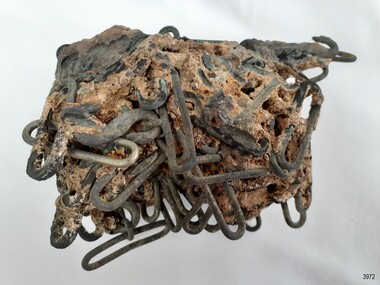 Flagstaff Hill Maritime Museum and Village
Functional object - "S" Hook Buckle, Ca. 1855
... Hill Sub-Aqua Group, Peter Ronald, Barry Lowther and Jeff Bell. ABOUT THE SCHOMBERG (October 6 to December 27, 1855)- When the ship Schomberg was launched in 1855, she was considered the most perfect clipper ship ever to be built. James Baine’s Black Ball Line had commissioned her for their fleet of passenger liners. The Aberdeen builders designed her to sail faster than the clippers designed the three-masted wooden clipper ship to be fast. The timber used for the diagonal planking was British oak...Hill Sub-Aqua Group, Peter Ronald, Barry Lowther and Jeff Bell. ABOUT THE SCHOMBERG (October 6 to December 27, 1855)- When the ship Schomberg was launched in 1855, she was considered the most perfect clipper ship ever to be built. James Baine’s Black Ball Line had commissioned her for their fleet of passenger liners. The Aberdeen builders designed her to sail faster than the clippers designed the three-masted wooden clipper ship to be fast. The timber used for the diagonal planking was British oak ...The "S" hook buckles were grouped together under the sea as part of the cargo of the vessel Schomberg. "S" hook buckles are used for fastening two ends of fabric together such as harness belts, trouser belts and similar items. The buckles were recovered in October 1980 by the Flagstaff Hill Sub-Aqua Group, Peter Ronald, Barry Lowther and Jeff Bell. ABOUT THE SCHOMBERG (October 6 to December 27, 1855)- When the ship Schomberg was launched in 1855, she was considered the most perfect clipper ship ever to be built. James Baine’s Black Ball Line had commissioned her for their fleet of passenger liners. The Aberdeen builders designed her to sail faster than the clippers designed the three-masted wooden clipper ship to be fast. The timber used for the diagonal planking was British oak with layers of Scottish larch. This luxury emigrant vessel was designed for superior comfort. She had ventilation ducts to provide air to the lower decks and a dining saloon, smoking room, library and bathrooms for the first-class passengers. The master for Schomberg’s maiden voyage was Captain ‘Bully’ Forbes. He drunkenly predicted at her launch that he would make the journey between Liverpool and Melbourne in 60 days. Schomberg departed Liverpool on 6 October 1855 with 430 passengers and 3000 tons of cargo including iron rails and equipment intended the build the Geelong Railway and a bridge over the Yarra from Melbourne to Hawthorn. The poor winds slowed Schomberg’s sail across the equator. She was 78 days out of Liverpool when she ran aground on a sand spit near Peterborough, Victoria, on 27 December; the sand spit and currents were not marked on Forbes’s map. The ship’s Chief Officer spotted the coastal steamer SS Queen at dawn and sent a signal. The master of the SS Queen approached the stranded vessel and all of Schomberg’s passengers safely disembarked. In 1975, 120 years after the Schomberg was wrecked, divers from Flagstaff Hill found an ornate communion set at the wreck site along with many other artefacts. In 1978 a diamond ring was discovered under the concretion in the lid of the communion set, which is currently on display. Former Director of Flagstaff Hill, Peter Ronald, had salvaged most of the artefacts from the wreck. This group of "S" hook buckles and conglomeration of buckles is significant as an example of an item in common use in the mid-19th century and the items carried on ship as cargo. The Schomberg collection as a whole is of historical and archaeological significance at a State level. Flagstaff Hill’s collection of artefacts from the Schomberg is also significant for its association with the Victorian Heritage Registered shipwreck (VHR S 612). The collection is of prime significance because of the relationship between the objects salvaged, as together they help us to interpret the story of the Schomberg. The collection as a whole is historically significant for representing aspects of Victoria's maritime history and its potential to interpret social and historical themes. "S" hook buckles; oval silver alloy buckles contained within a conglomeration of materials from the sea. The group was recovered from the wreck of the Schomberg.flagstaff hill, warrnambool, flagstaff hill maritime museum, maritime museum, shipwreck coast, flagstaff hill maritime village, great ocean road, shipwreck artefact, schomberg, horse harness fitting, harness hardware, "s" hook buckle, "s" hook buckles, conglomeration of buckles, belt buckle, fastener, quick release fastener, flagstaff hill sub-aqua group, peter ronald, barry lowther, jeff bell -
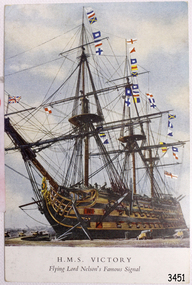 Flagstaff Hill Maritime Museum and Village
Postcard - Vessel, Sailing Ship, after October 1805
... hill-maritime-village...post card...postcard...sailing ship...vice-admiral lord nelson...horatio nelson...lord nelson...oak...Through Nelson’s leadership and unorthodox battle tactics, he secured not only a victory against the French and Spanish but reaffirmed Britain's naval supremacy opening the way for Britain to continuing the policy of colonisation of many countries including Australia. flagstaff hill warrnambool shipwrecked-coast flagstaff-hill flagstaff-hill-maritime-museum maritime-museum shipwreck-coast flagstaff-hill-maritime-village post card postcard sailing ship vice-admiral lord nelson horatio nelson lord nelson oak piece piece of oak nelson battle of trafalgar maritime technology ship relics 18th century warship british royal navy sir home popham’s telegraphic code admiralty official day signal book october 21, 1805 admiral lord nelson french and spanish navies nelson's famous signal england expects that every man will do his duty hms victory nelson collection at lloyd's lloyd’s of london lloyd’s patriotic fund napoleonic battles british naval history 18th century warship 18th century battleship Printed on the front "H.M.S. ...The British Royal Navy’s warship HMS Victory was once Lord Nelson’s flagship. The HMS Victory was built in 1765 and after serving active duty is now, in 2019, still a ship of the Royal Navy, in dry dock undergoing continuous restoration to preserve her for display as a museum ship, due to the vessel’s significant naval history. Battle of Trafalgar: On October 21, 1805, twenty-seven British ships of the line, led by Admiral Lord Nelson aboard HMS Victory, defeated thirty-three French and Spanish ships of the line under French Admiral Villeneuve. The battle took place in the Atlantic Ocean off the southwest coast of Spain, just west of Cape Trafalgar, near the town of Los Caños de Meca. The victory confirmed the naval supremacy Britain had established during the course of the eighteenth century and it was achieved in part through Nelson's departure from the prevailing naval tactical orthodoxy of the day. Conventional practice at the time was for opposing fleets to engage each other in single parallel lines, in order to facilitate signalling and disengagement and to maximise fields of fire and target areas. Nelson instead arranged his ships into two columns to sail perpendicularly into the enemy fleet's line. During the battle, Nelson was shot by a French musketeer and he died shortly before the battle ended. Villeneuve was captured, along with his ship Bucentaure. He later attended Nelson's funeral while a captive on parole in Britain. Admiral Federico Gravina, the senior Spanish flag officer, escaped with the remnant of the fleet. He died five months later from wounds sustained during the battle. It was prior to this battle that Nelson had issued his now-famous final orders to his ships in 12 separate flag-hoists “England expects that every man will do his duty”. This wood sample is historically significant for its association with Admiral Lord Nelson the Battle of Trafalgar. Through Nelson’s leadership and unorthodox battle tactics, he secured not only a victory against the French and Spanish but reaffirmed Britain's naval supremacy opening the way for Britain to continuing the policy of colonisation of many countries including Australia.A coloured postcard of a sailing ship, warship or battleship, deck cannons on the ship and in the foreground, many signal flags flying from the masts. Printed on the front "H.M.S. Victory Flying Lord Nelson Famous Signal". The signal was given by Lord Nelson in 1805.Printed on the front "H.M.S. Victory / Flying Lord Nelson Famous Signal"flagstaff hill, warrnambool, shipwrecked-coast, flagstaff-hill, flagstaff-hill-maritime-museum, maritime-museum, shipwreck-coast, flagstaff-hill-maritime-village, post card, postcard, sailing ship, vice-admiral lord nelson, horatio nelson, lord nelson, oak piece, piece of oak, nelson, battle of trafalgar, maritime technology, ship relics, 18th century warship, british royal navy, sir home popham’s telegraphic code, admiralty official day signal book, october 21, 1805, admiral lord nelson, french and spanish navies, nelson's famous signal, england expects that every man will do his duty, hms victory, nelson collection at lloyd's, lloyd’s of london, lloyd’s patriotic fund, napoleonic battles, british naval history, 18th century warship, 18th century battleship
