
Showing 27 items matching "on borrowed time"
-
 Moorabbin Air Museum
Book - RAF in World War II, Years of Command A Personal Story of The Second War in the Air
... ...On borrowed time...RAF in World War II The faces of reality The slow awakening On borrowed time Base security Fighter command From defence to offence Broadening fronts Increasing pressures At low ebb Test of patience Biography of Sholto Douglas , former Commander in Chief of RAF, circa 1966 Years of Command A Personal Story of The Second War in the Air Book RAF in World War II ...Biography of Sholto Douglas , former Commander in Chief of RAF, circa 1966non-fictionBiography of Sholto Douglas , former Commander in Chief of RAF, circa 1966the faces of reality, the slow awakening, on borrowed time, base security, fighter command, from defence to offence, broadening fronts, increasing pressures, at low ebb, test of patience -
 Vision Australia
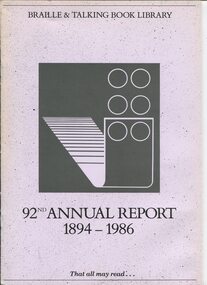
Administrative record - Text, Braille and Talking Book Library 92nd Annual Report 1894-1986: that all may read, 1986
... Items also included are: naming the computer which will store the book catalogue for the library 'Tilly', RVIB declared a public library and Minister for the Arts has determined for services to rationalise with the Chairman and Vice-Chairman meeting their counterparts with meetings ongoing, first time borrowers asked to nominate their choice of winning title for Braille Book of the Year, with the literary panel of Stephen Murray-Smith, Joyce Nicholson and Barrett Reid making a short list from which borrowers voted, first time presentation held in the afternoon (with increased attendence) and inaugural Narrator's Award (The Bathurst in honour of former President Hector Bathurst) to Eirene Pappas, Hector Bathurst to receive OAM, Jan Smark Nilsson appointed to National Advisory Committee on Library Services to People with Disabilities and Australia Post approval to change cassette mailing pouches....Items also included are: naming the computer which will store the book catalogue for the library 'Tilly', RVIB declared a public library and Minister for the Arts has determined for services to rationalise with the Chairman and Vice-Chairman meeting their counterparts with meetings ongoing, first time borrowers asked to nominate their choice of winning title for Braille Book of the Year, with the literary panel of Stephen Murray-Smith, Joyce Nicholson and Barrett Reid making a short list from which borrowers voted, first time presentation held in the afternoon (with increased attendence) and inaugural Narrator's Award (The Bathurst in honour of former President Hector Bathurst) to Eirene Pappas, Hector Bathurst to receive OAM, Jan Smark Nilsson appointed to National Advisory Committee on Library Services to People with Disabilities and Australia Post approval to change cassette mailing pouches. ...Annual report of the Braille & Talking Book Library including Minutes of the AGM, Board of Director's Report, President's report and financial statements. Items also included are: naming the computer which will store the book catalogue for the library 'Tilly', RVIB declared a public library and Minister for the Arts has determined for services to rationalise with the Chairman and Vice-Chairman meeting their counterparts with meetings ongoing, first time borrowers asked to nominate their choice of winning title for Braille Book of the Year, with the literary panel of Stephen Murray-Smith, Joyce Nicholson and Barrett Reid making a short list from which borrowers voted, first time presentation held in the afternoon (with increased attendence) and inaugural Narrator's Award (The Bathurst in honour of former President Hector Bathurst) to Eirene Pappas, Hector Bathurst to receive OAM, Jan Smark Nilsson appointed to National Advisory Committee on Library Services to People with Disabilities and Australia Post approval to change cassette mailing pouches.1 volume of text and illustrationsannual report, braille and talking book library, john cockayne, peter walsh, jan smark, betty roland, book of the year, matcham skipper, stephen murray-smith -
 Vision Australia
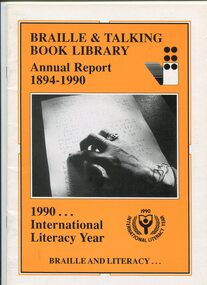
Administrative record - Text, Braille and Talking Book Library Annual Report 1894-1990: 1990 ... International Year of Literacy, Braille and Literacy, 1990
... Items also included are: the continuing financial underfunding by government, Paul Carter joined Literary Panel of Joyce Nicholson and Barrett Reid for Braille Book of the Year shortlist, property purchased opposite library was sold as expected monies did not come through, David Scott appointed and later resigned as Treasurer, Mike Janes has taken appointment, Fred Gaze resigned, Peter Corrigan and Ron McCallum have joined the Board, appointment of Robert de Graauw to audio production, continued fundraising by Benalla Auxiliary, removal of wait list time for borrowers, and only 16 people receiving Clarke & Smith books since movement towards cassette....Items also included are: the continuing financial underfunding by government, Paul Carter joined Literary Panel of Joyce Nicholson and Barrett Reid for Braille Book of the Year shortlist, property purchased opposite library was sold as expected monies did not come through, David Scott appointed and later resigned as Treasurer, Mike Janes has taken appointment, Fred Gaze resigned, Peter Corrigan and Ron McCallum have joined the Board, appointment of Robert de Graauw to audio production, continued fundraising by Benalla Auxiliary, removal of wait list time for borrowers, and only 16 people receiving Clarke & Smith books since movement towards cassette. ...Annual report of the Braille & Talking Book Library including Minutes of the AGM, Board of Director's Report, President's report and financial statements. Items also included are: the continuing financial underfunding by government, Paul Carter joined Literary Panel of Joyce Nicholson and Barrett Reid for Braille Book of the Year shortlist, property purchased opposite library was sold as expected monies did not come through, David Scott appointed and later resigned as Treasurer, Mike Janes has taken appointment, Fred Gaze resigned, Peter Corrigan and Ron McCallum have joined the Board, appointment of Robert de Graauw to audio production, continued fundraising by Benalla Auxiliary, removal of wait list time for borrowers, and only 16 people receiving Clarke & Smith books since movement towards cassette.1 volume of text and illustrationsannual report, braille and talking book library, marion halligan, john cockayne, beverley dunn, jan smark, paul korsten, khai la, helen hall, martha hills, anne reilly, maria cafici, patricia convery, don schauder, naomi orr, vyvette baptist, charmaine chan, david harding, deneille sutton, meike mellars, susan staggard, robert de graauw, mike janes, fred gaze, ron mccallum -
 Federation University Historical Collection
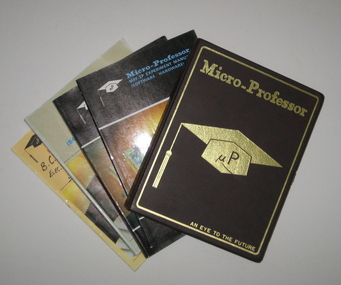
Computer, Mutlitech Industrial Corporation, Micro-Professor MPF-IP and manuals, 1983 (estimated)
... Student were encouraged to borrow the Micro-Professors in order to assist in learning how to use them. Only one was ever not returned on time. ...Student were encouraged to borrow the Micro-Professors in order to assist in learning how to use them. Only one was ever not returned on time. ...The Micro-Professor I Plus (MPF-IP) was a low cost, versatile microcomputer system featuring sophisticated software and hardware capabilities. (MPF-IP) boasted a display panel with the ability to display 20 characters using 16-segment fonts. All 64 standard ASCII characters could be displayed. The operation of the MPF-IP was controlled by an 8k monitor program which resides in the Read Only Memory (ROM). The monitor, aided by 4k Random Access Memory (RAM), enabled the user to enter a comprehensive set of single keystroke commands, making it easier for the user to use the CPU, memory and I/0 devices. This allowed the user to concentrate of microprocessor software development and application design. The system allowed printing at 48 lines per minute, and the ability to permanently record the commands, data, programs, status and other messaged. Each character printed by the printer is in a 5 by 7 dot matrix. Although the prime purpose of the programming was for machine language object code formed as hexadecimal numbers, the Micro-Professor has an embedded Tiny Basic interpreter for which formation of some of the alpha characters using a standard 7 segment display was ingenious. The program memory consisted of non volatile 2 kilobytes electrically programmable ROM whilst the Random Access Memory came with 2 kilobytes of static RAM but could be upgraded to 4 kilobytes by insertion of another chip. The entire memory space of 64 kilobytes was accessible by way of the terminals on the left hand side of the board. Engineering and Science students from the Ballarat School of Mines and the Ballarat College of Advanced Education used a class set (as they were relatively inexpensive at approx. $100 each) during the mid to late 1980s. Student were encouraged to borrow the Micro-Professors in order to assist in learning how to use them. Only one was ever not returned on time. When pressed to return the device the student confessed that his dog had chewed the plastic case. This is still in our collection complete with bite marks! The Micro-Professor used a Zilog Z80 microprocessor. This was the most powerful of the 8 bit microprocessors at the time. Zilog was derived from the Intel 8080 microprocessor. The Z80 had 158 instructions of which the Intel 78 instructions were a subset. The Intel processor continued on through development in the IBM computers as 8086, 80286, 80386, 80486 and later the pentiums. Zilog lost most of its market share when it developed the 16 bit Z8000 microprocessor. Although the microprocessor was excellent, the lack of peripherals caused users to abandon Zilog products. A brown and gold plastic box containing a microcomputer for use in classrooms. Four manuals are titled 'Micro-Professor MPF-IP user's Manual', 'MPF-I Experiment Manual (Software/Hardware)', Micro-professor MPF-IP experiment Manual (Software/Hardware)' and Micro-Professor MPF-I Monitor Program Source Listing.microcomputer, micro computer, micro professor, electronics -
 Warrnambool and District Historical Society Inc.
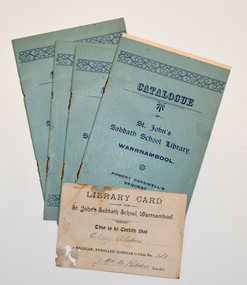
Booklet - Sunday School library catalogue and card, Smith's Printing Works, Warrnambool, early 20th century
... borrow books from the library. No details have been found on Elsie Alston but there were several Alston families in Warrnambool at the time....borrow books from the library. No details have been found on Elsie Alston but there were several Alston families in Warrnambool at the time. ...The booklet is a catalogue of the books in the Warrnambool Presbyterian St. John's Sabbath School Library (Robert Carswell's Bequest) early in the 20th century. The books for boys and girls are listed separately and are mostly fiction, many with some religious content. St John's Presbyterian Church was opened in 1875. The building was destroyed by fire in 1920 and rebuilt in a similar style to the original one. Robert Carswell was a Warrnambool resident who died in 1900 at the age of 77 and it is presumed that the bequest from his will enabled the Sunday (Sabbath) School library to be established. The card is a membership certificate indicating that Elsie Alston was enrolled as a Sunday School member in Class 14 and thus entitled to borrow books from the library. No details have been found on Elsie Alston but there were several Alston families in Warrnambool at the time.These items are of some interest as church Sunday Schools in the past, particularly in the 19th century, were important as they were widely attended and provided a range of educational and recreational activities, often not otherwise available to the children at that time'.1 A booklet of ten pages with a blue cover with blue printing and a decorative border on the front. The pages contain printed material. The booklet was once stapled but the staples have been removed. .2 A white card with black printing and handwritten names.Elsie Alston Mr M. Ritchieelsie alston, robert carswell, st. john's sabbath school warrnambool, sunday schools in warrnambool -
 Eltham District Historical Society Inc
Album - Photograph, J.A. McDonald, Dixons Creek Road, June 1957
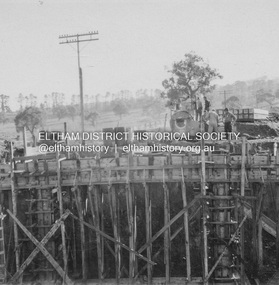
... Moneys borrowed will be repayable by providing out of the Municipal Fund twenty half-yearly instalments of approximately £985/1/6 each, including principal and interest on the first day of October and the first day of April during the currency of the loan. The first Instalment shall be payable on the first day of October 1957. 5. Such moneys shall be repayable at the Commercial Bank of Australia Limited, Melbourne, or at the Council's bankers for the time...Moneys borrowed will be repayable by providing out of the Municipal Fund twenty half-yearly instalments of approximately £985/1/6 each, including principal and interest on the first day of October and the first day of April during the currency of the loan. The first Instalment shall be payable on the first day of October 1957. 5. Such moneys shall be repayable at the Commercial Bank of Australia Limited, Melbourne, or at the Council's bankers for the time ...Bridge over Dixons Creek Job 56FD330 June 1957 Formwork for Dixons Creek pier completed Advertising (1957, January 19). The Argus (Melbourne, Vic. : 1848 - 1957), p. 33 (Col. 9). Retrieved August 24, 2022, from http://nla.gov.au/nla.news-article71777065 SHIRE OF ELTHAM. Loan No. 27.-Notice of Intention to Borrow Sum of £ 15,000 for Permanent Works and Undertakings. - Notice is hereby given, that the Council of the Shire of Eltham proposes to borrow the sum of £15,000 on the credit of the municipal revenues of the president, councillors, and ratepayers for the said shire, such sum to be raised by the Issue of debentures in accordance with the provisions of the Local Government Acts. 1. Maximum rate of interest that may be paid is £5/10/ per cent, per annum. 2. The purposes for which the loan is to be applied are: Construction of Sanitary Conveniences at Shire Office, Council's contribution towards costs of Dixons Creek Bridge, Construction of Mt. Pleasant rd., Construction of Cherry Tree rd. 3. The period of the loan shall be 10 years. 4. Moneys borrowed will be repayable by providing out of the Municipal Fund twenty half-yearly instalments of approximately £985/1/6 each, including principal and interest on the first day of October and the first day of April during the currency of the loan. The first Instalment shall be payable on the first day of October 1957. 5. Such moneys shall be repayable at the Commercial Bank of Australia Limited, Melbourne, or at the Council's bankers for the time being in Melbourne. The plans and specifications and the estimates of the costs of the proposed works and a statement showing the proposed expenditure of the moneys to be borrowed are open for inspection at the Shire Office, Eltham. R. J. HAM. Shire Secretary.Record of various Shire of Eltham infrastructure works undertaken during the period of 1952-1962 involving bridge and road reconstruction projects, sometimes with Eltham Shire Council Project Reference numbers quoted. It was during this period that a number of significant improvements were made to roads and new bridges constructed within the shire that remain in place as of present day (2022). In many situations, the photos provide a tangible visible record of infrastructure that existed throughout the early days of the Shire. The album was put together by or under the direction of the Shire Engineer, J.A. McDonald.infrastructure, road construction, shire of eltham, bridge construction, dixons creek bridge, dixon's creek road, 1957-06 -
 Eltham District Historical Society Inc
Album - Photograph, J.A. McDonald, Dixons Creek Road, June 1957
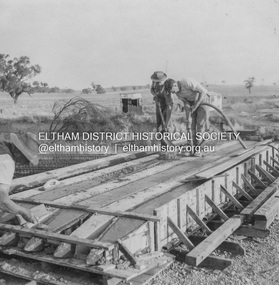
... Moneys borrowed will be repayable by providing out of the Municipal Fund twenty half-yearly instalments of approximately £985/1/6 each, including principal and interest on the first day of October and the first day of April during the currency of the loan. The first Instalment shall be payable on the first day of October 1957. 5. Such moneys shall be repayable at the Commercial Bank of Australia Limited, Melbourne, or at the Council's bankers for the time...Moneys borrowed will be repayable by providing out of the Municipal Fund twenty half-yearly instalments of approximately £985/1/6 each, including principal and interest on the first day of October and the first day of April during the currency of the loan. The first Instalment shall be payable on the first day of October 1957. 5. Such moneys shall be repayable at the Commercial Bank of Australia Limited, Melbourne, or at the Council's bankers for the time ...Piles being cast 1957 P. Morris on vibrator Advertising (1957, January 19). The Argus (Melbourne, Vic. : 1848 - 1957), p. 33 (Col. 9). Retrieved August 24, 2022, from http://nla.gov.au/nla.news-article71777065 SHIRE OF ELTHAM. Loan No. 27.-Notice of Intention to Borrow Sum of £ 15,000 for Permanent Works and Undertakings. - Notice is hereby given, that the Council of the Shire of Eltham proposes to borrow the sum of £15,000 on the credit of the municipal revenues of the president, councillors, and ratepayers for the said shire, such sum to be raised by the Issue of debentures in accordance with the provisions of the Local Government Acts. 1. Maximum rate of interest that may be paid is £5/10/ per cent, per annum. 2. The purposes for which the loan is to be applied are: Construction of Sanitary Conveniences at Shire Office, Council's contribution towards costs of Dixons Creek Bridge, Construction of Mt. Pleasant rd., Construction of Cherry Tree rd. 3. The period of the loan shall be 10 years. 4. Moneys borrowed will be repayable by providing out of the Municipal Fund twenty half-yearly instalments of approximately £985/1/6 each, including principal and interest on the first day of October and the first day of April during the currency of the loan. The first Instalment shall be payable on the first day of October 1957. 5. Such moneys shall be repayable at the Commercial Bank of Australia Limited, Melbourne, or at the Council's bankers for the time being in Melbourne. The plans and specifications and the estimates of the costs of the proposed works and a statement showing the proposed expenditure of the moneys to be borrowed are open for inspection at the Shire Office, Eltham. R. J. HAM. Shire Secretary.Record of various Shire of Eltham infrastructure works undertaken during the period of 1952-1962 involving bridge and road reconstruction projects, sometimes with Eltham Shire Council Project Reference numbers quoted. It was during this period that a number of significant improvements were made to roads and new bridges constructed within the shire that remain in place as of present day (2022). In many situations, the photos provide a tangible visible record of infrastructure that existed throughout the early days of the Shire. The album was put together by or under the direction of the Shire Engineer, J.A. McDonald.infrastructure, road construction, shire of eltham, bridge construction, dixons creek bridge, dixon's creek road, 1957-06, p. morris -
 Eltham District Historical Society Inc
Album - Photograph, J.A. McDonald, Dixons Creek Road, June 1957
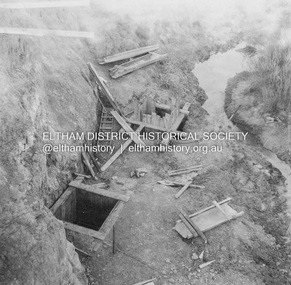
... Moneys borrowed will be repayable by providing out of the Municipal Fund twenty half-yearly instalments of approximately £985/1/6 each, including principal and interest on the first day of October and the first day of April during the currency of the loan. The first Instalment shall be payable on the first day of October 1957. 5. Such moneys shall be repayable at the Commercial Bank of Australia Limited, Melbourne, or at the Council's bankers for the time...Moneys borrowed will be repayable by providing out of the Municipal Fund twenty half-yearly instalments of approximately £985/1/6 each, including principal and interest on the first day of October and the first day of April during the currency of the loan. The first Instalment shall be payable on the first day of October 1957. 5. Such moneys shall be repayable at the Commercial Bank of Australia Limited, Melbourne, or at the Council's bankers for the time ...Dixons Creek Road P. Morris – Contractor Dixons Creek (North) abutment 1957 Advertising (1957, January 19). The Argus (Melbourne, Vic. : 1848 - 1957), p. 33 (Col. 9). Retrieved August 24, 2022, from http://nla.gov.au/nla.news-article71777065 SHIRE OF ELTHAM. Loan No. 27.-Notice of Intention to Borrow Sum of £ 15,000 for Permanent Works and Undertakings. - Notice is hereby given, that the Council of the Shire of Eltham proposes to borrow the sum of £15,000 on the credit of the municipal revenues of the president, councillors, and ratepayers for the said shire, such sum to be raised by the Issue of debentures in accordance with the provisions of the Local Government Acts. 1. Maximum rate of interest that may be paid is £5/10/ per cent, per annum. 2. The purposes for which the loan is to be applied are: Construction of Sanitary Conveniences at Shire Office, Council's contribution towards costs of Dixons Creek Bridge, Construction of Mt. Pleasant rd., Construction of Cherry Tree rd. 3. The period of the loan shall be 10 years. 4. Moneys borrowed will be repayable by providing out of the Municipal Fund twenty half-yearly instalments of approximately £985/1/6 each, including principal and interest on the first day of October and the first day of April during the currency of the loan. The first Instalment shall be payable on the first day of October 1957. 5. Such moneys shall be repayable at the Commercial Bank of Australia Limited, Melbourne, or at the Council's bankers for the time being in Melbourne. The plans and specifications and the estimates of the costs of the proposed works and a statement showing the proposed expenditure of the moneys to be borrowed are open for inspection at the Shire Office, Eltham. R. J. HAM. Shire Secretary.Record of various Shire of Eltham infrastructure works undertaken during the period of 1952-1962 involving bridge and road reconstruction projects, sometimes with Eltham Shire Council Project Reference numbers quoted. It was during this period that a number of significant improvements were made to roads and new bridges constructed within the shire that remain in place as of present day (2022). In many situations, the photos provide a tangible visible record of infrastructure that existed throughout the early days of the Shire. The album was put together by or under the direction of the Shire Engineer, J.A. McDonald.infrastructure, road construction, shire of eltham, bridge construction, dixons creek bridge, dixon's creek road, 1957-06 -
 Eltham District Historical Society Inc
Album - Photograph, J.A. McDonald, Dixons Creek Road, June 1957
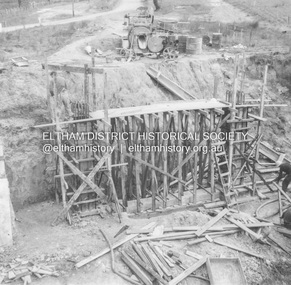
... Moneys borrowed will be repayable by providing out of the Municipal Fund twenty half-yearly instalments of approximately £985/1/6 each, including principal and interest on the first day of October and the first day of April during the currency of the loan. The first Instalment shall be payable on the first day of October 1957. 5. Such moneys shall be repayable at the Commercial Bank of Australia Limited, Melbourne, or at the Council's bankers for the time...Moneys borrowed will be repayable by providing out of the Municipal Fund twenty half-yearly instalments of approximately £985/1/6 each, including principal and interest on the first day of October and the first day of April during the currency of the loan. The first Instalment shall be payable on the first day of October 1957. 5. Such moneys shall be repayable at the Commercial Bank of Australia Limited, Melbourne, or at the Council's bankers for the time ...Dixons Creek Road Bridge over Dixons Creek – 56FD330 June 1957 Dixons Creek pier forming columns and beam Advertising (1957, January 19). The Argus (Melbourne, Vic. : 1848 - 1957), p. 33 (Col. 9). Retrieved August 24, 2022, from http://nla.gov.au/nla.news-article71777065 SHIRE OF ELTHAM. Loan No. 27.-Notice of Intention to Borrow Sum of £ 15,000 for Permanent Works and Undertakings. - Notice is hereby given, that the Council of the Shire of Eltham proposes to borrow the sum of £15,000 on the credit of the municipal revenues of the president, councillors, and ratepayers for the said shire, such sum to be raised by the Issue of debentures in accordance with the provisions of the Local Government Acts. 1. Maximum rate of interest that may be paid is £5/10/ per cent, per annum. 2. The purposes for which the loan is to be applied are: Construction of Sanitary Conveniences at Shire Office, Council's contribution towards costs of Dixons Creek Bridge, Construction of Mt. Pleasant rd., Construction of Cherry Tree rd. 3. The period of the loan shall be 10 years. 4. Moneys borrowed will be repayable by providing out of the Municipal Fund twenty half-yearly instalments of approximately £985/1/6 each, including principal and interest on the first day of October and the first day of April during the currency of the loan. The first Instalment shall be payable on the first day of October 1957. 5. Such moneys shall be repayable at the Commercial Bank of Australia Limited, Melbourne, or at the Council's bankers for the time being in Melbourne. The plans and specifications and the estimates of the costs of the proposed works and a statement showing the proposed expenditure of the moneys to be borrowed are open for inspection at the Shire Office, Eltham. R. J. HAM. Shire Secretary.Record of various Shire of Eltham infrastructure works undertaken during the period of 1952-1962 involving bridge and road reconstruction projects, sometimes with Eltham Shire Council Project Reference numbers quoted. It was during this period that a number of significant improvements were made to roads and new bridges constructed within the shire that remain in place as of present day (2022). In many situations, the photos provide a tangible visible record of infrastructure that existed throughout the early days of the Shire. The album was put together by or under the direction of the Shire Engineer, J.A. McDonald.infrastructure, road construction, shire of eltham, bridge construction, dixons creek bridge, dixon's creek road, 1957-06 -
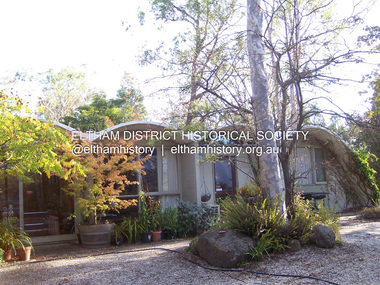 Eltham District Historical Society Inc
Photograph - Digital Photograph, Marguerite Marshall, Rice House, 69 Ryans Road, Eltham, 27 March 2007
... time it had the only council in Melbourne that would allow such an innovative house. Another hurdle was to gain finance for this remarkable house. The State Savings Bank Manager refused finance on the grounds that it was ‘unliveable’ and a ‘disgrace’. Fortunately, through a family connection, the couple borrowed...time it had the only council in Melbourne that would allow such an innovative house. Another hurdle was to gain finance for this remarkable house. The State Savings Bank Manager refused finance on the grounds that it was ‘unliveable’ and a ‘disgrace’. Fortunately, through a family connection, the couple borrowed ...Built in 1953, the Rice House was leading Melbourne architect Kevin Borland's first commssion and was one of two houses of its kind. The design of the shell-like structure was inspired by the Arch of Ctesiphon, built in the second century south of Baghdad. Cement with a waterproofing agent was applied in layers to a form of regularly spaced timber arches covered in hessian. This ctesiphon system was developed in the United Kingdom by engineer J.H. de Waller in 1947. Commissioned in 1951 by Harrie and Lorna Rice, after Harrie, then an art student, met Borland at The Age Small Homes Service. Borland suggested they buy land in Eltham because at that time it was the only council in Melbourne that would grant a permit for such an innovative house. Covered under Victorian Heritage. Inspired by an ancient arch in Iraq, a house stands on top of a hill in a private position, off Ryans Road, Eltham. One of only two houses of its kind, it was leading Melbourne architect Kevin Borland’s first commissioned house, which he built in 1953. The shell-like structure, partially screened by giant trees and cacti, was inspired by the Arch of Ctesiphon south of Baghdad, built in the second century.1 Cement with a waterproofing agent was applied in layers to a form of regularly spaced timber arches tightly covered by hessian. This ctesiphon system was developed in the United Kingdom by engineer J H de Waller in 1947. This house was the first of three such structures built in Victoria, of which only one other remains, although substantially altered.2 It is the Wood House and supermarket, at the corner of Cleveland Road and High Street Road, Ashwood, designed by Robin Boyd in 1952. The Rice House demonstrates Kevin Borland’s innovative and experimental work. It is an outstanding example of the post-war period of experimentation in domestic architecture in Melbourne – by Robin Boyd, Kevin Borland and others – for The Age Small Homes Service from 1947 to 1953. This was partly an expression of late-Modernism and also necessitated by the post-war shortage of building materials. In Eltham, the post-war shortage of building materials largely resulted in mud-brick houses. Examples of Borland’s public work include contributions to the Olympic Swimming Pool in Melbourne and the Preshil Junior School in Kew. After more than 50 years of living in the house, Harrie and Lorna Rice still love it. Facing north-east with large windows overlooking the garden and two courtyards, it is well lit and benefits from a through breeze. The couple commissioned the extraordinary house after Harrie, then an art student, met Borland in 1951 at The Age Small Homes Service. Harrie was so impressed by the recently graduated Borland’s enthusiasm, that he asked him to design them an interesting house for a low budget. The unusual design presented several hurdles for the young couple before they could construct it. Borland suggested that they buy land in Eltham, because at that time it had the only council in Melbourne that would allow such an innovative house. Another hurdle was to gain finance for this remarkable house. The State Savings Bank Manager refused finance on the grounds that it was ‘unliveable’ and a ‘disgrace’. Fortunately, through a family connection, the couple borrowed money from the National Bank. But they discovered years later, that the bank’s evaluation stated the two ‘concrete sheds’ were of no value! The house built in off-white concrete, consists of two sections. The main house has four arches supported by brick and concrete walls that create a series of inter-connected rooms. Inside, the ceiling follows the roofline. Originally this section was only ten square metres, because of building restrictions at the time. But in 1973 Borland added two rooms and a carport. The second structure of two arches was originally a garage and a studio for art teacher Harrie Rice. To accommodate the growing family, in the mid 1950s, Borland converted the second structure into two children’s bedrooms, a kitchenette, a bathroom and a living room. The two structures were originally linked by a covered way of suspended draped-concrete, but this collapsed in the 1980s. The design has several maintenance problems. Cracks developed where two halves of the shells were joined. Then the material sprayed over the cracks became brittle, causing leaks. Fortunately Harrie found another material he could use. The valleys between the arches collect water, requiring annual painting with a waterproof material to prevent leaking. Lorna framed the house with native and exotic plants, which provide privacy and as a bonus, the garden attracted the rare Eltham Copper Butterfly. Published: Nillumbik Now and Then / Marguerite Marshall 2008; photographs Alan King with Marguerite Marshall.; p157 Comments about the Rice House on Lost Eltham page on Facebook June 2018 https://www.facebook.com/Lost-Eltham-1535993463348408/ Kate Borland: My dad designed this house. It is the Rice house and it is being renovated to its original glory as we speak.... Katherine Fox: I remember Harry and Lorna's, there was a secret room...! And the best loo with a view as I recall. Katherine Fox: Love this house! Wish I'd known it was up for sale. Looking forward to seeing progress if possible...If I recall correctly, the concrete swag over the walk-way collapsed at some stage. Marcus Skipper: In our little green Landrover, my dad and Alister Knox drove up dirt roads, a dirt track through the bush and finally to the ridge to check out this joint in about 1960. After the war at some time, they were all together at RMIT studying building design. Alister was the only one to graduate. A situation that resulted, my father would joke, in Alister having a career wherein his qualifications exceeded his talent. World Peace had broken out and all were hip to the ‘People’s’ century. Kevin went with the Modernist’s concrete, Alister went with the peasant’s mudbrick. “If this is the future,” my dad said,”I don’t like it.” And we drove back to medieval Montsalvat.This collection of almost 130 photos about places and people within the Shire of Nillumbik, an urban and rural municipality in Melbourne's north, contributes to an understanding of the history of the Shire. Published in 2008 immediately prior to the Black Saturday bushfires of February 7, 2009, it documents sites that were impacted, and in some cases destroyed by the fires. It includes photographs taken especially for the publication, creating a unique time capsule representing the Shire in the early 21st century. It remains the most recent comprehenesive publication devoted to the Shire's history connecting local residents to the past. nillumbik now and then (marshall-king) collection, eltham, rice house, ryans road, kevin borland -
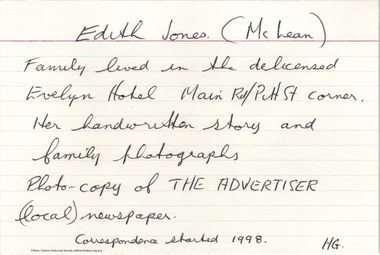 Eltham District Historical Society Inc
Document - Folder, McLean, 1984-1999
... borrowed two tents and the family walked to Warrandyte where they camped beside the river and prospected for gold for several months. They bathed in the river and cooked in the open. Eventually managed to rent a house in Eltham again, Isherwood’s house on Cemetery Road. The Fordhams were behind them and Mrs Bremner would sometimes call on the girls to run errands with homemade ice cream the reward. References to picnics and motor cycle races at Bremner’s Flats (Wingrove Park) and a mention of an old cable tram lodged in the park. All six girls being christened at the same time...borrowed two tents and the family walked to Warrandyte where they camped beside the river and prospected for gold for several months. They bathed in the river and cooked in the open. Eventually managed to rent a house in Eltham again, Isherwood’s house on Cemetery Road. The Fordhams were behind them and Mrs Bremner would sometimes call on the girls to run errands with homemade ice cream the reward. References to picnics and motor cycle races at Bremner’s Flats (Wingrove Park) and a mention of an old cable tram lodged in the park. All six girls being christened at the same time ...References to McLean family, Hector John McLean and Louisa Frances (nee Green) and six daughters who lived in Eltham during the period 1930 to 1934 inclusive. Lived in the former Evelyn Hotel at the time it was destroyed by fire and being part of the Centenary Parade in 1934 where the family won the Group Section for their entry “Pioneers of Eltham” Reminiscences provided by Edith Jones (nee M1934 flood, ballroom, baptism, barber shop, bittern, boy scouts, bremner's flat, burgoyne's shop, cable tram, cemetery road, centenary celebrations, centenary parade, christening, coach house, collis grocery, dalton street, depression, dole, dorothy jean mclean, edith jones (nee mclean), eltham fire brigade, eltham high school, eltham higher elementary school, eltham lower park, eltham railway station, eltham state school no. 209, evelyn hotel, fire damage - buildings, flinders naval depot, fordham, gladys evelyn mclean, gold mining, gwenneth mae mclean, gwladys evelyn mclean, headmistress, hector john mclean, isherwood house and shop, louisa frances mclean (nee green), metery road, methodist church, miss finnin, miss grant cottage, motor bike races, mrs barrett, mrs bremner, mrs hurley, olive isabel mclean, parade, phoebe lillian mclean, picnic, pioneers of eltham, pitt street, research fire brigade, rev. r.g. arthur, shed, shops, st margarets church hall, st margaret's church, stables, state savings bank of victoria, susso books, todaro, vinnie willet, warrandyte bridge, warrandyte, wingrove park, yarra river -
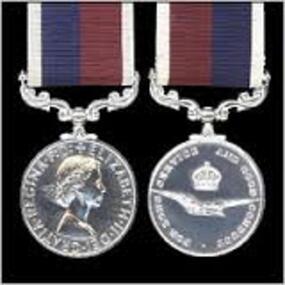 Waverley RSL Sub Branch
R.A.A.F. Long Service Medal
... time dental services to the Army units stationed at Queenscliff. This was seen as an effective reciprocal arrangement, with both units having a Dental Officer in attendance for, in total, around 3-4 weeks a year. Rosenbrock continued to serve as the sole RAAF Dental Officer until the middle of 1933, when the Air Board asked for his service to be terminated following ‘behaviour unbecoming of a RAAF officer'. He had borrowed ...Awarded to Alan Bowers (A236814) who was a R.A.A.F. dental mechanic who serverd during WWII including service in Darwin, and then continued in the R.A.A.F. for some years after the end of WWII The Royal Australian Air Force (and all Commonwealth Air Forces) Long Service and Good Conduct Medal: Awarded to NCOs and ORs of the RAAF (RAF, RCAF etc) for 15 years service. A cupro-nickel plated medal, the obverse features the sovereign's head, the reverse features the crown and eagle emblem of the RAAF (and RAF). Officers are eligible for the award provided they have served a minimum 12 years in the ranks. The riband is dark blue and maroon with white edges. This medal ceased to be awarded in Australia in 1975 when it was replaced by the National Medal (and sbsequently the DFSM and DLSM) in the Australian system of honours and awards. http://www.heritagemedals.com.au/medals-1/service-long-service/air-force-long-service-and-good-conduct-medal.html History of the RAAF Dental Branch It took six years following the formation of the RAAF in 1921 for the first Dental Clinic to be established at Point Cook, Victoria. On 10th June 1927 Flying Officer James Carl Rosenbrock commenced work as an RAAF Dental Officer for the FlyingTraining School at Point Cook. As personnel numbers were still relatively small, Rosenbrock was also responsible for the dental care of all Victorian RAAF units, which involved treating members at 1AD Laverton, as well as Air Force Headquarters at Victoria Barracks in Melbourne. As Army Dental Officers were currently caring for RAAF personnel at Richmond, NSW, the Senior Dental Officer of the 3rd Military District in Victoria (SDO 3MD) requested through the military board that a similar arrangement be established, where that the newly appointed RAAF Dentist provide part time dental services to the Army units stationed at Queenscliff. This was seen as an effective reciprocal arrangement, with both units having a Dental Officer in attendance for, in total, around 3-4 weeks a year. Rosenbrock continued to serve as the sole RAAF Dental Officer until the middle of 1933, when the Air Board asked for his service to be terminated following ‘behaviour unbecoming of a RAAF officer'. He had borrowed several sums of money, of around 40 Pounds or so, from junior ranks on base (as well as from the Regimental Sergeant Major) and had failed to pay the money back. He was replaced by a fellow Victorian, FLGOFF Norman Henry Andrews, on the 18th Sep 1933, who went on to become our first Director of Dental Services, and was instrumental in establishing the organisations and conditions of the Branch that are still present today. Through a fair amount of persistence and hard work on the part of Norman Andrews, the RAAF Dental Branch began to expand from 1937, with the introduction of 2 additional positions, at RAAF station Richmond, and at the FlyingTraining School at Point Cook. This gave the RAAF 3 uniformed Dental Officers, which was expanded to 5 in the months leading up to WW2. 4 of these Dental Officers were based in Victoria and 1 at Richmond, with the other two RAAF units being cared for by the Army (as in the case of Pearce in WA) or by civilians (as in Darwin). With the sudden increase in RAAF personnel required at the outbreak of WW2, the number of RAAF Dental Officers increased dramatically, from 5 in 1939, 28 in 1940, 64 in 1941, 147 in 1942, 193 in 1943, 219 in 1944, and peaking at 227 in 1945. RAAF Dental Officers were required to work in a variety of locations, both in and out of Australia. Between 1940 and 1942 a massive construction programme occurred, with new dental clinics being established around Australia. Priority was given to aircrew training units in order to get these personnel dentally fit for operational deployment, but Dental Officers could equally find themselves posted to recruit depots, fixed stations, medical clearance stations, mobile dental sections, and RAAF and civilian hospitals. RAAF Dental Officers were posted to the large dental centres at Ascot Vale (Vic) and Bradfield Park (NSW) when first appointed, where they received military and clinical training, before being deployed to their needed location. Mobile Dental Units When Japan entered the war in 1941, the rapid deployment of troops to northern operational areas with less than ideal dental fitness was extremely high. As a result, the RAAF deployed a range of mobile dental units, either alone or with medical sections, to support the increasing number of isolated deployed personnel within Australia and overseas. There were three types of mobile unit used: a. Mobile Dental Unit – relied on using either a semi-trailer to get around or by building a surgery directly on to the truck chassis, and installing hydraulic chairs, units, x-rays, and laboratory equipment. They were able to move around between small units, such as RAAF radar stations, where they could plug into the local power supply and work immediately. b. Transportable Dental Units – used for stops of longer duration, where field equipment was carried in panniers from one unit to another by road or rail and housed in whatever accommodation was available at the destination. They were often carried within Australia on Tiger Moths and Dakota aircraft. c. Itinerant Dental Units – in some areas, the dental equipment was installed at the RAAF unit and the Dental Officer and their staff would travel from unit to unit, using the equipment available at each location. RAAF Dental BadgeAs the war developed in Europe, it soon became obvious that the RAF Dental support was not capable of supporting the increasing numbers of RAAF aircrew that were being sent for service with the RAF, with only enough Dental Officers available to provide one to every 2000 men ( instead of the preferred 1 to 600). As a result, the RAAF provided a mobile dental unit, fitted out in a caravan and pulled by a Ford V8 Coupe, to travel around England in support of RAAF personnel at various squadrons. Some degree of tact was needed to ensure that the RAF did not take this as a comment on the treatment they were providing, but it proved successful in maintaining a satisfactory state of dental fitness in RAAF personnel, and a second mobile unit was soon dispatched. They were also set up with a laboratory on board as well as the surgery, which was a major difference between the RAF and RAAF, as the RAF did not provide dentures for their troops (the RAAF would, providing they had served for 6 years). In 1943 the RAF was no longer able to provide Dental support to Australian troops in the Middle East, which resulted in the need for a transportable dental unit to be deployed from Australia. It functioned in a similar manner to the RAF, by moving from one squadron to another. It served in the Middle East and Africa, from Cairo across North Africa, to Italy, and eventually back to England to treat returned prisoners of war. GPCAPT Norman Andrews The growth and development of the RAAF Dental Branch owes a debt to one man in particular, GPCAPT Norman Andrews. As the second RAAF Dental Officer to enlist on 18 Sep 1933, Andrews became the principal architect of the structure and organisation of the RAAF Dental Branch leading up to and during WW2. Until early 1940, the RAAF Dental Branch was administered by the Director of Medical Services (Air), which placed it under the control of the Army Medical staff. The Army would provide their Inspector of Dental Services for advice whenever needed. In April 1940, the RAAF Medical service separated from the Army, resulting in the control of the RAAF Dental Branch shifting back to the RAAF. Andrews became the first Director of Dental Services, when the position was created in 1943 as recognition of the higher profile the Dental Branch was now playing in the RAAF Medical service. Until this time, Andrews's title had been as the Dental Staff Officer to the RAAF Medical Service. Andrews was responsible for the establishment of the war-time structure of the Dental service, establishing new dental centres at all major bases, creating mobile and transportable dental units, ensuring the continual growth of the Branch, maintaining professional development of staff through the establishment of a professional journal, and by organising renowned lecturers to speak at RAAF bases. He also believed in visiting as many dental units as possible to see for himself what conditions were like and to talk first-hand to staff in remote units. His itinerary during the war years, both in and out of Australia, shows a large number of trips in a variety of modes of transport in order to reach remote areas where units were serving. He was promoted to GPCAPT in July 1944, as the numbers of Dental Officers soon peaked at 227 towards the end of the war (1 GPCAPT, 9 WGCDRs, 60 SQNLDRs, and 157 FLTLTs). After the war, with the reduction in RAAF personnel required in uniform, the Dental Branch also reduced its numbers significantly. By 1947 there were only 18 Dental Officers serving (many part-time), with 1 GPCAPT, 1 WGCDR, 10 SQNLDRs, and 6 FLTLTs, and only 13 by 1950. With the decrease in Branch personnel numbers, the ‘powers to be' saw fit to reduce the Director of Dental Service rank to WGCDR, and as a result Norman Andrews found that in order to continue serving in the RAAF he would have to wear a reduced rank. This appears to have been a contributing factor in his decision to discharge at the relatively early age of 43 and accept an administrative job as Director of the Victorian Government's School Dental Service. Norman Andrews holds the proud honour of being the founder of the RAAF Dental Branch, which during the war was instrumental in educating servicemen of the importance of dental health and maintaining the dental fitness of troops in a variety of areas. Dental Orderlies (Assistants) The dental orderly mustering was first introduced in 1937. Until that time, medical orderlies were assigned to assist the Dental officer with their duties. As early as 1931 it had been noted by both RAAF and Army Dental Officers working in Victoria and Richmond that a lot of the troubles they were having would be solved by appointing a permanent Dental Orderly. Often they would find that the medical orderly they were assigned was a different one each day, and as a result the administration and work in general was very inefficient. By 1937, with the increase in Dental Officers to 3, it was realised that a Dental Orderly mustering needed to be created. Dental Mechanics/Technicians Before WW2, dental laboratory work was provided by civilian laboratories, as most RAAF units were stationed around metropolitan areas. At this time, service personnel were still required to pay for their own dentures, unless they had served for six years or had their dentures damaged during performance of their duties. In July 1940, mainly in response to the development of more remote RAAF dental units and the increasing demand for dental prostheses, the Dental Mechanic mustering was established. Unfortunately there was a very limited pool of civilian dental mechanics to recruit from, and as a result the RAAF set up a training school at Laverton (which was later moved to Ascot Vale) in June 1941 which conducted an intensive 6 month course in Dental mechanics. Dental mechanics were quickly in demand. In all fixed and mobile dental units at least 1 Mechanic was supplied for each Dental Officer, and indeed the RAAF supplied Dental Mechanics throughout all its deployments, something the RAF were unwilling, or unable, to do. Two grades of dental mechanic existed: the Senior Mechanic (with the rank of NCO), who was competent in all phases of laboratory work; and the Junior Mechanic, who could only handle routine work and not more advanced denture work. The progression to Senior required a further trade test in techniques including setting up, clasp-forming, casting and backing teeth. During the course of the War, two special courses were held for Mechanics. The first, directed at senior mechanics so that they could instruct others, was in 1942 when Acrylic Resin was first introduced as a denture base material, as an alternative to the current option of vulcanite. Later, towards the end of the War, a ‘refresher' course was provided for those that had served for the greatest period of time in order to allow them retraining in techniques that they had not practised during their service and which were common in civilian life. This included cast base dentures, crowns and bridges, partial dentures, and retainers. Towards the end of the War, a course was held with WAAAF trainees to train them as Mechanics. However, as the War was soon to end they never had the opportunity to progress within the mustering to become Senior Mechanics. The RAAF Dental Branch has survived 75 years of turbulence, with reviews of its viability occurring regularly every few years from as early as 1937. The Branch continues to provide excellent service to the ADF community and, despite reduced manpower, will continue to play an important role in Air Force Health operations. http://www.defence.gov.au/health/about/docs/RAAFDental.pdf40cm cupro-nickel plated medal, the obverse features the sovereign's head, the reverse features the crown and eagle emblem of the RAAF (and RAF). A23814 BOWERS.A. A. F.r.a.a.f long service medal, r.a.a.f good conduct, r.a.a.f. dental service medal -
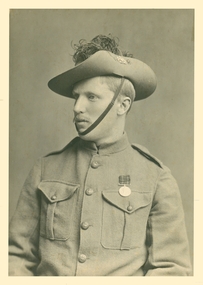 Bendigo Historical Society Inc.
Document - Arthur T. Pattinson, 1962
... time we are considering an interesting facet in Bendigo's history, so any seemingly unimportant incidents could really be useful if we knew about them. Have you any old newspaper cuttings mentioning your name in connection with the memorial? Do you remember any remarks that passed between you and Jack Walker during the long sessions you must have put in on this work? This could be very important. And do you recall where the rifle came from? Did you or Jack Walker borrow...time we are considering an interesting facet in Bendigo's history, so any seemingly unimportant incidents could really be useful if we knew about them. Have you any old newspaper cuttings mentioning your name in connection with the memorial? Do you remember any remarks that passed between you and Jack Walker during the long sessions you must have put in on this work? This could be very important. And do you recall where the rifle came from? Did you or Jack Walker borrow ...10570 South African (Boer) War Memorial Bendigo. The monument commemorates those who died in service or were killed in action while serving in the South African (Boer) War. It is a bronze statue of a soldier on a granite base. Leader (Melbourne), 19 November 1904. “There was a large assemblage on the afternoon of 11th November, when the ceremony of unveiling the soldiers' memorial statue was performed by Brigadier-General Gordon in the presence of a muster of branches of the defence forces. The statue, which is in bronze, is mounted on a massive granite base, on the foot of which is the following inscription: — "Bendigo's tribute to the memory of the Australian soldiers who, in the South African war of 1899 - 1902 gave their lives for Queen and Empire. The statue was modelled by Mr. J. Walker, a young Bendigonian, who has been studying for two or three years under Mr. A. T. Woodward art instructor at the local school of mines.“ Ola Cohn recalled in her autobiography meeting John Walker as a sculpture student at the Bendigo School of Mines and that he had later received the commission for the Boer War Memorial although she neglects to mention its location. John Walker was born in Bendigo and first studied sculpture at the Bendigo School of Art. Walker, then went to England to study at the Royal College of Art London, and in Paris at the Académie Colarossi and Julian Academy. John Walker worked as a sculptor in both Bendigo and West Brunswick before turning to chicken farming in the Bendigo suburb of White Hills. The photo of A. T. Pattinson was taken by George Leake Massingham, a professional photographer, who had seven children, one of whom died at birth. After arriving in Australia from England, he established himself as a travelling photographer, an occupation he continued after his marriage. He travelled throughout country Queensland, Victoria and New South Wales, setting up studios along the way. The family ended up moving with him, travelling to Sydney, Narrandera, Bendigo, Newtown, Geelong and Deniliquin. Correspondence re Boer War Memorial Bendigo Boer War Memorial Bendigo. Letters and photo from and to Mrs Wilson, eldest daughter of Mr Arthur T. Pattinson who was a model for the Boer War sculpture. 10570a A black and white photo of Trooper Arthur T. Pattinson restored by BHS Volunteers. 10570b The original photo as sent by Mrs Wilson to Harold Curnow (Bendigo Historical Society) in 1962. The photo is mounted on heavy brown cardboard and has an old catalogue number of "P680" inscribed on it. The cardboard is torn and held together with sticky tape. On the front in italics is printed G.L. Massingham, Bendigo. 10570c Notes on the rear of the photo from Mrs Wilson state that "the photo is of Arthur T. Pattinson (Rusty), an Australian Light Horse trooper who served in the Boer War. The Boer War Memorial in Pall Mall Bendigo represents a trooper on guard. The sculptor was Jack Walker who used Pattinson as a model, and it is regarded as an excellent likeness." 10570d A letter from Harold Curnow back to Mrs Wilson on Jan 4th, 1963, acknowledging receipt of the photo and a letter received, noting the significance of the historical information. 10570e Handwritten letter 29/11/1962 from Mrs Wilson to Mr Curnow introducing herself as Mr. Pattinson's eldest daughter and answering the letter he wrote to her father. She mentions the bad health of her parents. Arthur modelled for the statue at least two to three times per week in a studio on the top floor of a building in Bull St. He was the original model to the best of her knowledge. Another model possibly Mr P. Handmear may have sat as a model for renovations (*). The rifle was a light horse rifle issued to Pattinson as he was still serving in 1904. Arthur and Handmear were boys together and very close. * Note - the plaster model was repaired prior to casting in metal. 10570f An obituary notice: 18/11/64 "On Nov. 17 at Frankston, Emma, wife of the late A. T. Pattinson (Rusty), late of Bendigo. 10570g Letter Nov. 20th, 1962, from Harold Curnow to Mr Arthur T. Pattinson, Kent St., Mornington, Vic. "Dear Mr Pattinson, Last week your brother, Brit., whom I have known for many years, supplied the Bendigo Advertiser with some interesting information regarding your role as the model for the late Jack Walker when he was making the statue for the Boer War Memorial here. Yesterday however, another claimant to the distinction of being the model was advanced in the Bendigo Advertiser by Mr Richard Marshall, of Moran Street, Bendigo who said that the soldier's model was Phillip Handmear. I understand that your brother has sent the newspaper cuttings on to you. When he called to see me yesterday, he suggested that I write to you for further particulars. Can you recall the discussion you had with Jack Walker when he approached you about acting as the model and do you remember how many times you posed for him, and whether the work was done in the house, in the yard, or in one of the outbuildings at Moran Street? In short, any details at all. At this point in time we are considering an interesting facet in Bendigo's history, so any seemingly unimportant incidents could really be useful if we knew about them. Have you any old newspaper cuttings mentioning your name in connection with the memorial? Do you remember any remarks that passed between you and Jack Walker during the long sessions you must have put in on this work? This could be very important. And do you recall where the rifle came from? Did you or Jack Walker borrow it from the military authorities? Back in 1934 Jack Walker recalled having had to pull the plaster model down and remake it when he discovered it was slightly off-balance and was slowly toppling forward. He told me he had to get his model to pose again. Do you know anything about this? Could it have been that he got Mr. Handmear in for the final stage of the work? That, of course, would apply only if you were not available. Incidentally, I never heard of Mr Handmear until I saw his name in yesterday's "Advertiser". In any case I intended contacting your brother or you to enquire whether any member of your family has an old photograph of you in your Boer War uniform, that is, one taken about the time of or just after the Boer War. I am sure that members of the Bendigo Branch of the Royal Historical Society would be most interested to see it. I hope you will have the time and inclination to consider the many points I have raised in this letter because the subject has aroused a lot of interest in Bendigo. Hoping you are well and quite as active as you wish, I remain, with all good wishes, Yours sincerely, Harold Curnow". john walker, jack walker, boer war memorial bendigo, arthur pattinson, soldiers' memorial bendigo -
 Bendigo Historical Society Inc.
Newspaper - JENNY FOLEY COLLECTION: TIME FOR A BREAK
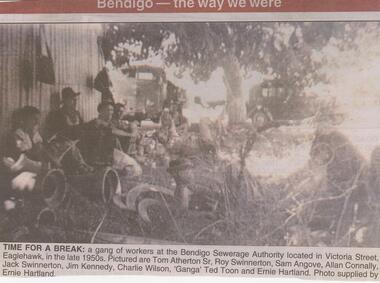
... borrow 5000 pounds for the initial setup including the provision of a sewerage treatment plan. Surveys for the provision of a sewerage system were first undertaken in 1916. NEWSPAPER Bendigo advertiser the way we were Bendigo Advertiser ''The way we were'' from 2002. Time ...The inaugural meeting of the Bendigo Sewerage Authority was held in February 1917. It had government approval to borrow 5000 pounds for the initial setup including the provision of a sewerage treatment plan. Surveys for the provision of a sewerage system were first undertaken in 1916.Bendigo Advertiser ''The way we were'' from 2002. Time for a break: a gang of workers at the Bendigo Sewerage Authority located in Victoria Street, Eaglehawk, in the late 1950s. Pictured are Tom Atherton Sr, Roy Swinnerton, Saqm Angove, Allan Connally, Jack Swinnerton, Jim Kennedy, Charlie Wilson, 'Ganga' Ted Toon and Ernie Hartland. Photo supplied by Ernie Hartland. The clip is in a folder.newspaper, bendigo advertiser, the way we were -
 Warrnambool and District Historical Society Inc.
Certificate - Warrnambool Co-operative Housing Society Limited Certificate of Incorporation, 1951
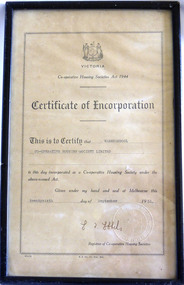
... borrowed. The era of post-World War Two saw a shortage in a number of areas one of which was housing. The co-operative Housing scheme was preferred by many as it avoided the block approach which had been used by the Housing commission. The co-operative housing scheme proved to be of benefit to many families around that time ...Co-operative housing societies were loan societies established in the mid to late 20th century. They were based on the structure of a group of borrowers approximately 40, who lived within a radius of thirty miles joining a co-operative. They had the right to select their own site, plans and amount that they would like to spend. The co-operatives were administered by accounting firms. There were conditions placed on the borrowers in regard to amounts able to be borrowed and size of dwelling and percentage of cost which could be borrowed.The era of post-World War Two saw a shortage in a number of areas one of which was housing. The co-operative Housing scheme was preferred by many as it avoided the block approach which had been used by the Housing commission. The co-operative housing scheme proved to be of benefit to many families around that time.Framed certificate with black text Stylised frame around text. Paper is cream.H.E Daw Gov Print., Melb. Victorian Government seal in bottom Right hand corner. Registrar of Co-operative housing societies, Victoria. warrnambool, co-operative housing society 1951 -
 Eltham District Historical Society Inc
Photograph - Digital Photograph, Marguerite Marshall, Diamond Valley Railway, Eltham Lower Park, 7 September 2008
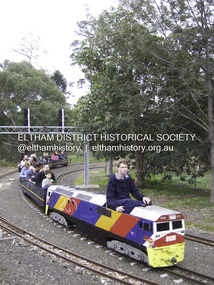
... borrow these, and you are given a pair of socks for the ride! Blue-overalled volunteers check tickets, see you aboard, and drive the train. They are mainly retired men who can at last devote their time to what little boys dream of – playing with trains. ...borrow these, and you are given a pair of socks for the ride! Blue-overalled volunteers check tickets, see you aboard, and drive the train. They are mainly retired men who can at last devote their time to what little boys dream of – playing with trains. ...Kids of all ages enjoy the Miniature Railway. Published: Nillumbik Now and Then / Marguerite Marshall 2008; photographs Alan King with Marguerite Marshall.; p163 On Sundays in Eltham thousands of children, mums, dads and grandparents can be seen travelling around Lower Eltham Park in tiny trains. They are among the two and half million passengers who have travelled on the Diamond Valley Railway since it officially began in 1961. The miniature railway originally operated from the 1940s at Chelsworth Park, Ivanhoe, until flooding caused it to be moved to the Eltham Lower Park in 1959. The railway is modelled on the 1920s era – the heyday of passenger rail travel – and the trains are built on a scale of two inches to the foot (1/6). Although not exact replicas, trains include models of the Spirit of Progress, Puffing Billy, The Overland, Dog Boxes, Vic Rail S class, G class and a NSW 81 Class. The three and a half kilometres of track is set amongst native plants and picnic areas. A friendly hoot or the clang of a bell occasionally punctuates the tranquillity as a train emerges from a treed bend with passengers excitedly waving to onlookers. For $3 the train takes you on a 13-minute two-kilometre ride. Passengers sit in single file in the narrow train, which clatters along tracks built to the scale of the Australian narrow gauge of three feet six inches (1.1m). These are used in Queensland, South Australia, Tasmania and Western Australia. Safety standards are stringently kept. Even before you buy a ticket notices tell you that you must wear closed shoes. You can even borrow these, and you are given a pair of socks for the ride! Blue-overalled volunteers check tickets, see you aboard, and drive the train. They are mainly retired men who can at last devote their time to what little boys dream of – playing with trains. Passengers are instructed in safe behaviour, then the station master waves a white flag and off we go. The guard sits at the back with his whistle and green flag at the ready. The winding track, fringed by native trees and bushes planted by volunteers, stands on crown land managed by Nillumbik Council. The train clatters along the track and crosses a bridge over a drain elevated by name to The Blow Fly Creek. We pass by Meadmore Junction at a speed of three kilometres an hour. Then on through a tunnel, accompanied by squeals of delight, and after a few moments of blackness, light glimmers at the end. On we go, past the original platform, along another route past busy Main Road through Pine Creek Station, over a bridge and through another tunnel with more screams of delight.Then a signal stops us before the ‘all clear’ to return to our original point of departure. The railway services its passengers – the largest number of any miniature railway in Australia – with a fleet including: six diesel locomotives, three steam locomotives, eight sets of passenger cars and one battery electric Dog Box set. Members also privately own 20 locomotives and powered carriage sets as well as four carriage sets.1 All the trains are stored on-site in workshops, sheds and a tunnel. The railway is entirely run by volunteers, so that all ticket money is used for maintenance and extensions, and some goes to local charities. Since 1991, the entire railway has been rebuilt, including an upgraded signalling system. About half of the 120 volunteer members are active with about 35 working each Sunday, and a dozen or so working every Wednesday. Members are trained to positions of station assistant, booking officer, train guard, train driver or signalman. Members construct new carriages and locomotives as well as maintaining track, signalling and rolling stock.This collection of almost 130 photos about places and people within the Shire of Nillumbik, an urban and rural municipality in Melbourne's north, contributes to an understanding of the history of the Shire. Published in 2008 immediately prior to the Black Saturday bushfires of February 7, 2009, it documents sites that were impacted, and in some cases destroyed by the fires. It includes photographs taken especially for the publication, creating a unique time capsule representing the Shire in the early 21st century. It remains the most recent comprehenesive publication devoted to the Shire's history connecting local residents to the past. nillumbik now and then (marshall-king) collection, diamond valley railway, eltham lower park -
 Warrnambool and District Historical Society Inc.
Label, Lending Library, Early 20th century
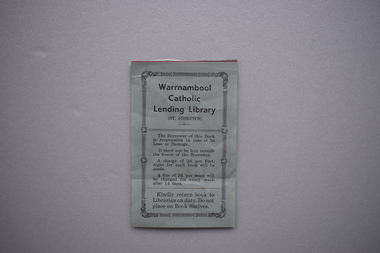
... time in the 20th Century. This library card is retained as an item of interest pertaining to the Catholic Library at St. Joseph's, Warrnambool. st. joseph's parish warrnambool Warrnambool Catholic Lending Library ( ST. JOSEPH'S) The borrower ...This is an example of an amenity for lay people in St. Joseph's Catholic Parish, Warrnambool. It is not known when the library operated but the label dates from some time in the 20th Century.This library card is retained as an item of interest pertaining to the Catholic Library at St. Joseph's, Warrnambool. A pale green rectangular label adhered to a small piece of cardboard at the back. It has black text surrounded by a finely drawn decorative border. There is a cut in one corner and some brown spots on the paper.Warrnambool Catholic Lending Library ( ST. JOSEPH'S) The borrower of this Book is responsible in case of its Loss or Damage. It must not be lent outside the house of the Borrower. A charge of 3d per Fortnight for each book will be made. A fine of 3d per week will be charged for every week after 14 days. Kindly return the book to Librarian on duty. Do not place on Book Shelves. st. joseph's parish warrnambool -
 Stawell Historical Society Inc
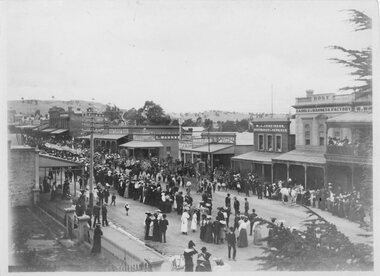
Photograph, Lower Main Street Stawell procession, probably Easter c1900 or 1906 showing a Chinese dragon
... Sop In Trove the only mentions of a Chinese parade at Stawell was for Easter Monday 1906, and this occasion did feature a dragon – the costumes, banners, and dragon appear to have been borrowed from Melbourne, and it is suspected that this was the See Yup Society Dragon, the head of which is still preserved in their South Melbourne temple. At the time...Sop In Trove the only mentions of a Chinese parade at Stawell was for Easter Monday 1906, and this occasion did feature a dragon – the costumes, banners, and dragon appear to have been borrowed from Melbourne, and it is suspected that this was the See Yup Society Dragon, the head of which is still preserved in their South Melbourne temple. At the time ...Main Street Procession c1900 in front of Methodist Church looking East. Constable on Horseback visible. Possibly the Ballarat dragon making the date 1906 or it could be the Chinese See Yup Society Dragon, the head of which is still preserved in their South Melbourne temple. Businesses from left, Carters Boot Shop, Post Office Hotel, G. Mahanke Bakery, J.H. Stabb Stawell Coach Factory, Speedwell Cycles, W.J. Jenkinson Bootmakers, Bone Saddle & Harness Factory, W. Whiteside Taylors. Big Hill is visible in background and possibly the Market Building roof above the G. Mahnke sign. Sop In Trove the only mentions of a Chinese parade at Stawell was for Easter Monday 1906, and this occasion did feature a dragon – the costumes, banners, and dragon appear to have been borrowed from Melbourne, and it is suspected that this was the See Yup Society Dragon, the head of which is still preserved in their South Melbourne temple. At the time that this photo was taken there were only three Chinese communities in Victoria which are now known to have had parade regalia and a dragon – Bendigo, Ballarat, and Melbourne. The Melbourne dragon was the smaller of these, and that seems to match with what you can see in the photo, as does what appears to be a striped horn (frustratingly the pole obscures most of the dragon’s face). All three dragon heads still survive today, as does some of the original parade regalia, but Bendigo’s collection and dragon is the most complete. The remains of the See Yup Society collection have still to be properly studied and conserved. I would also note that if this photo was from Easter Monday 1906 then Bendigo and possibly Ballarat Chinese communities would not have been able to make their dragons available as both would have been preoccupied with their own towns’ Easter festivities. Photo taken from the Town Hall balcony of procession looking towards corner of Wimmera Street stawell businesses streetscape, chinese -
 Sunshine and District Historical Society Incorporated
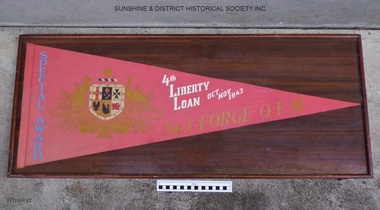
Memorabilia - 4th LIBERTY LOAN (1943) SPECIAL AWARD to No 1 FORGE O.F.M, Probably around Circa 1943-1944
... borrowed money from the public, and from institutions such as the savings banks, friendly societies, and life assurance societies, by running three successfully subscribed Liberty Loans. The institutions had contributed considerably more money to these Liberty Loans than the public, however it can be argued that the public members of these institutions had also contributed some money indirectly. The 4th Liberty Loan which opened on 5 October 1943 and closed on 9 November 1943 was intended to raise £125,000,000, with the government aiming for 750,000 subscribers. Bonds costing £10 each could be bought on a time...borrowed money from the public, and from institutions such as the savings banks, friendly societies, and life assurance societies, by running three successfully subscribed Liberty Loans. The institutions had contributed considerably more money to these Liberty Loans than the public, however it can be argued that the public members of these institutions had also contributed some money indirectly. The 4th Liberty Loan which opened on 5 October 1943 and closed on 9 November 1943 was intended to raise £125,000,000, with the government aiming for 750,000 subscribers. Bonds costing £10 each could be bought on a time ...O.F.M. was the ORDNANCE FACTORY MARIBYRNONG. Up to the end of June 1943 and at a time when the wages were about £5 ($10) to £6 ($12) per week Australia had spent £1,106,000,000 (£156 per head) on the war effort. A lot of the money was spent at home in making war necessities such as armaments, munitions, boots, clothing, and in providing special training. Significant increases in numbers occurred in the personnel employed in the fighting services, and also in the work force involved in the war effort. During the financial year 1942-1943 the war cost Australia £561,743,000 (over a billion dollars), while the Income Tax raised from individuals totalled only 16.5% of this amount. To finance the war the Australian government had previously borrowed money from the public, and from institutions such as the savings banks, friendly societies, and life assurance societies, by running three successfully subscribed Liberty Loans. The institutions had contributed considerably more money to these Liberty Loans than the public, however it can be argued that the public members of these institutions had also contributed some money indirectly. The 4th Liberty Loan which opened on 5 October 1943 and closed on 9 November 1943 was intended to raise £125,000,000, with the government aiming for 750,000 subscribers. Bonds costing £10 each could be bought on a time payment scheme. A total of £126,408,000 was raised at two different interest rates and maturity dates, however the number of subscribers had only reached 567,533. Some newspaper reports of the time indicate that the low number of subscribers was a partial failure of the loan, because spare money in the community could lead to inflation at a time when goods were in short supply. The government set target quotas on how much money should ideally be raised in a particular district, and how many subscribers should ideally take part. Often these quotas proved to be excessive. The Special Red Pennant Award as given to the No 1 FORGE O.F.M. was normally for achieving the highest per capita contribution within each particular group. What is unknown at this stage is what other entities were in the same group, or how large the group was. There were other variations of the awards such as those given to country districts, where a star was placed on the left hand corner of the pennant if the money quota was reached, while two or three stars indicated that the quota was doubled or tripled. A bar was also included on the pennant if the quota of subscribers was achieved, while two bars indicated double the quota of subscribers. The above information was sourced from Trove newspaper articles at: (1) http://nla.gov.au.nla.news-article70439716, (2) http://nla.gov.au/nla.news-article141292541, (3) http://nla.gov.au/nla.news-article11797265, (4) http://nla.gov.au/nla.news-article11788072, and from (5) http://static.awm.gov.au/images/collection/pdf/RCDIG1070158--1-.PDF (see page 580).This framed award has significance in that it serves as a historic reminder that the No 1 Forge O.F.M. and the Ordnance Factory Maribyrnong once existed within the Shire of Braybrook, and later the City of Sunshine, and that it was involved in the manufacture of ordnance for World War 2. It also serves as a historic reminder that it costs a huge amount of money for a country to be involved in a major war, and that a big contribution is required from the public to raise money and to produce goods for the war effort.Permanently sealed brown stained wood frame with a glass face. Enclosed behind the glossy glass is a triangular shaped pennant made of red felt material. The red colour appears to be somewhat faded. The inscriptions and markings on the pennant are in blue, gold, and white coloured inks.The AUSTRALIAN COAT OF ARMS diagram plus the following writing: SPECIAL AWARD / 4th LIBERTY LOAN / Oct.-Nov. 1943 / No 1 FORGE O.F.M.4th liberty loan, special award, ordnance factory maribyrnong, no 1 forge o.f.m., oct - nov 1943, red pennant -
Tatura Irrigation & Wartime Camps Museum
Pamphlets, Photographs, Collection of memorabilia from Hans Blau
... time in 8th. Employment Coy.. photography photograph slides film Material borrowed for scanning. ...All this material borrowed for scanning. Collection of memorabilia from Hans Blau, interned from Singapore and interned in Camp 3, and later in 8th. Employment Coy. All this material was made available for scanning.| Photo 1 & 2. Birthday card to Hans Blau drawn by E. Meilich, and signed on back by others.| Photos 3 & 4. Program for "Laugh & Forget" production by Hans Blau, Camp 3. |Photo 5. "Tatura Melody 1940" produced by Hans Blau. |Photo 6. "Sergeant Snowwhite" production by Hans Blau at Melbourne University Union Theatre, 1943. Hans Blau in civvies. |Photo 7. Hans Blau in camp 3.| Photo 8. Notice of internment in Singapore.| Photo 9. "Loyalty", song presumably written by Hans Blau, |Photo 10 & 11. The Viennese Orchestra program. |Photo 12. "Tatura Melody" program 1940. |Photo 13 & 14. Restriction of Travel Order issued after release.| Photo 15. Poem in German.| Photo 16-18. "Sergeant Snow White" program, 1943.| Photo 19. Sports Carnival Program.| Photo 20-22. Various programs of productions during time in 8th. Employment Coy..Material borrowed for scanning.photography, photograph, slides, film -
 Melbourne Legacy
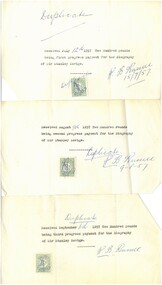
Document, 1957
... borrowed to fund the writing of the biography of Legatee Savige. 00782.2 and 00782.3 are letters to H.G. Brain as one of the donors who financed the publication of the biography of Sir Stanley Savige, enclosing receipts for 200 pounds (00782.1). Of particular interest is the 3d (threepenny) Victorian Stamp Duty stamp stuck to the receipts and overwritten in blue ink to denote they are duplicates, which indicative of government regulations at the time (1957). 00782.4 is a copy of a letter sent to W.B. ...borrowed to fund the writing of the biography of Legatee Savige. 00782.2 and 00782.3 are letters to H.G. Brain as one of the donors who financed the publication of the biography of Sir Stanley Savige, enclosing receipts for 200 pounds (00782.1). Of particular interest is the 3d (threepenny) Victorian Stamp Duty stamp stuck to the receipts and overwritten in blue ink to denote they are duplicates, which indicative of government regulations at the time (1957). 00782.4 is a copy of a letter sent to W.B. ...Correspondence showing the return of money borrowed to fund the writing of the biography of Legatee Savige. 00782.2 and 00782.3 are letters to H.G. Brain as one of the donors who financed the publication of the biography of Sir Stanley Savige, enclosing receipts for 200 pounds (00782.1). Of particular interest is the 3d (threepenny) Victorian Stamp Duty stamp stuck to the receipts and overwritten in blue ink to denote they are duplicates, which indicative of government regulations at the time (1957). 00782.4 is a copy of a letter sent to W.B. Russell (the author) confirming the arrangements for writing and payment of the book.A record of some of the financial arrangements made by the publishing committee in order to get the biography written and published. Receipt copies x 3, with green 3d. Victoria Stamp Duty stamps affixed White typewritten letters x 3.Receipts signed, dated and marked 'Duplicate' in blue ink. 00782.2 signed in blue ink 'W.W. Cooper' and annotated in pencil (writing illegible) 00782.3 signed in blue ink 'W.W. Cooper'savige book, committee -
 Australian Lace Guild - Victorian Branch
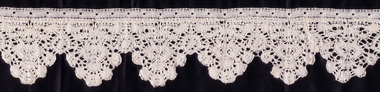
Textile - Flemish Lace, Early 17th century
... At the time it would have been an expensive fashionable lace trimming. This particular piece was borrowed and used as an illustration in Pat Earnshaw's book "The identification of Lace"...At the time it would have been an expensive fashionable lace trimming. This particular piece was borrowed and used as an illustration in Pat Earnshaw's book "The identification of Lace" Flemish lace edging attached to a piece of black fabric. ...This lace is similar in appearance to Genoese collar laces but the thread is much finer and the lace softer. At the time it would have been an expensive fashionable lace trimming. This particular piece was borrowed and used as an illustration in Pat Earnshaw's book "The identification of Lace"Flemish lace edging attached to a piece of black fabric. -
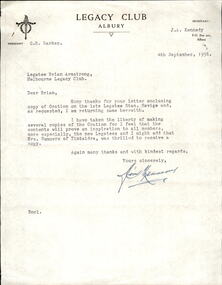 Melbourne Legacy
Letter, Copy of the Oration on the late Legatee Stan Savige, 1956
... borrowed it to make copies for Albury Legatees and other interested people. The speech is an account of Savige's life, his war service and his role in Legacy. Legatee Armstrong was a good friend of Savige. The moving address described General Savige's life and service career, and how he formed Legacy in 1923 at the suggestion of his former Commander, Major General Sir John Gellibrand. He said at the time...borrowed it to make copies for Albury Legatees and other interested people. The speech is an account of Savige's life, his war service and his role in Legacy. Legatee Armstrong was a good friend of Savige. The moving address described General Savige's life and service career, and how he formed Legacy in 1923 at the suggestion of his former Commander, Major General Sir John Gellibrand. He said at the time ...A letter dated 4 September 1956 from Legatee Jim Kennedy of Albury Legacy Club to Legatee Brian Armstrong to return a typed copy of the speech he delivered as the Savige Memorial Oration at the Federal Conference of Legacy Clubs in Canberra on 22 October 1954. Legatee Kennedy had borrowed it to make copies for Albury Legatees and other interested people. The speech is an account of Savige's life, his war service and his role in Legacy. Legatee Armstrong was a good friend of Savige. The moving address described General Savige's life and service career, and how he formed Legacy in 1923 at the suggestion of his former Commander, Major General Sir John Gellibrand. He said at the time of his death the late General had been a member of Legacy for 30 years, and had been chosen to represent Legacy at the Coronation of Queen Elizabeth. Following the Second World War he held many important posts, one of the most notable being Co-ordinator of Demobilisation. Legatee Armstrong told the conference that if a memorial to the founder of Legacy was required, they only had to look around themselves. This is an original typed copy with two other copies in the archive.A record of the life and service of Legatee Stan Savige being shared at other Legacy Clubs after his death in 1954.White quarto letter of Albury Legacy Club with white foolscap paper with black type x 4 pages of a speech about Legatee Savige.Signature in blue ink says Jim Kennedy.stan savige, jim kennedy, albury legacy -
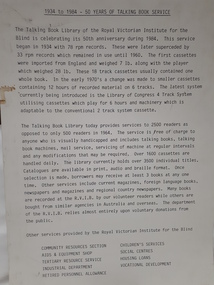 Vision Australia
Document - Image, 1934 - 1954 - 50 Years of Talking Book Service, 1984
... Once selection is made, borrowers may receive at least 3 books at any one time. Other services include current magazines, foreign language books, newspapers and magazines and regional country newspapers. ...Once selection is made, borrowers may receive at least 3 books at any one time. Other services include current magazines, foreign language books, newspapers and magazines and regional country newspapers. ...The Talking Book Library of the Royal Victorian Institute for the Blind is celebrating its 50th anniversary during 1984. This service began in 1934 with 78 rpm records. These were later superceded by 33rpm records which remained in use until 1960. The first cassettes were imported from England and weighed 7 lb. along with the player which weighed 28 lb. These 18 track cassettes usually contained one whole book. In the early 1970's a change was made to smaller cassettes containing 12 hours of recorded material on 6 tracks. The latest system currently being introduced is the Library of Congress 4 Track System utilising cassettes which play for 6 hours and machinery which is adaptable to the conventional 2 track system cassette. The Talking Book Library today provides services to 2500 readers as opposed to only 500 in 1964. The service is free of charge to anyone who is visually handicapped and includes talking books, talking book machines, mail service, servicing of machines at regular intervals and any modifications that may be required. Over 1600 cassettes are handled daily. The library currently holds over 3500 individual titles. Catalogues are available in print, audio and braille format. Once selection is made, borrowers may receive at least 3 books at any one time. Other services include current magazines, foreign language books, newspapers and magazines and regional country newspapers. Many books are recorded at the R.V.I.B. by our volunteer readers while others are bought from similar agencies in Australia and overseas. The department of the R.V.I.B. relies almost entirely on voluntary donations from the public. Other services provided by the Royal Victorian Institute for the Blind Community Resources Section, Aids & Equipment Shop, Tertiary Resource Service, Industrial Department, Retired Personnel Allowance, Children's Services, Social Services, Housing Loans, Vocational Development1 digital image of typewritten pageroyal victorian institute for the blind, talking books -
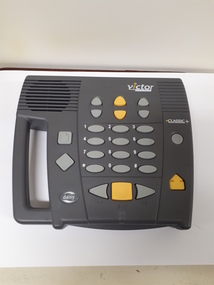 Vision Australia
Equipment - Object, Humanware, Victor Classic DAISY player
... borrowers to have the advantages of 4 track cassettes within a digital medium. The Victor Reader Classic used simple features that made it easy for clients to navigate through a book or magazine. The player played both DAISY and music CDs. The function keys included controls for variable tone, volume, speed and creation of bookmarks, sleep time...borrowers to have the advantages of 4 track cassettes within a digital medium. The Victor Reader Classic used simple features that made it easy for clients to navigate through a book or magazine. The player played both DAISY and music CDs. The function keys included controls for variable tone, volume, speed and creation of bookmarks, sleep time ...With the advent of audio content available through i-phones and other small devices, the demand for a dedicated audio, easily portable player for the blind and vision impaired became louder and louder. Two organisations competed to deliver this and Canadian company Humanware developed the Victor Classic as a table top player that relied on discs. As CDs had been introduced into the library some years before, this allowed borrowers to have the advantages of 4 track cassettes within a digital medium. The Victor Reader Classic used simple features that made it easy for clients to navigate through a book or magazine. The player played both DAISY and music CDs. The function keys included controls for variable tone, volume, speed and creation of bookmarks, sleep time and you could navigate by chapter and page on DAISY books. A carry handle is included for ease of use.Grey square object with buttons for navigational controlsaudio equipment, assistive devices -
Whitehorse Historical Society Inc.
Article, A Time of vision ever consigned to memory, 1/04/1994 12:00:00 AM
... Association for the Blind provided space where blinded ex-servicemen could learn Braille, borrow talking books and hear newspapers read. A plaque now commemorates this service. A Time ...Association for the Blind provided space where blinded ex-servicemen could learn Braille, borrow talking books and hear newspapers read.Association for the Blind provided space where blinded ex-servicemen could learn Braille, borrow talking books and hear newspapers read. A plaque now commemorates this service.Association for the Blind provided space where blinded ex-servicemen could learn Braille, borrow talking books and hear newspapers read. anzac day, fankhauser, claude augustus leopold, braille and talking book library, association for the blind -
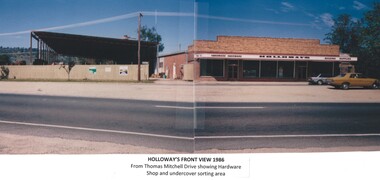 Wodonga & District Historical Society Inc
Photograph - Holloways Building Supplies
... He borrowed fifty pound from an uncle in 1934 to purchase a McCormick Deering tractor and saw bench. He went from farm to farm cutting timber for farmers. For a time...He borrowed fifty pound from an uncle in 1934 to purchase a McCormick Deering tractor and saw bench. He went from farm to farm cutting timber for farmers. For a time ...Eric Holloway began spot milling timber at age of 17. He borrowed fifty pound from an uncle in 1934 to purchase a McCormick Deering tractor and saw bench. He went from farm to farm cutting timber for farmers. For a time, he worked on Shelley Station spot milling with WS Walker and Son. In approximately 1946 Arthur and Eric Holloway established a saw mill at Shelley. Another brother Ernie, a builder and returned soldier, worked with them from time to time. Using timber sawn in the mill he built eight basic houses for the mill workers. The brothers employed many migrants: - Yugoslav, Czechs, Russians, Ukrainians, Serbs as well as other hardworking people. This meant there were families, so Ernie also built and furnished a school at Shelley. Application was made for a teacher from the Education Department. At the Shelley mill the workers used ex-army blitzes, GM trucks (for carting logs) army ducks and a centurion tank for parts. The timber from the mill was trucked to Albury and Wodonga, customers being FA Stowe and Mates Timber. The army was also a big customer with Holloways supplying timber for the army huts that were built at Bandiana. A timber mill that had been built at Tallangatta by State Rivers and Water for the purpose of establishing New Tallangatta, was purchased by Holloway Brothers as an extension of their Shelley operation. In 1954 a new mill was built at Granite Flat on the Omeo Highway and the Shelley operation closed. Ernie Holloway was involved in the building of the mill and accommodation houses in Mitta Mitta. The mill workers travelled from Mitta to work each day. Holloways Building Supplies was established at 49 Tallangatta Rd Wodonga at this time. It was established on four house blocks with a little shed, with more land being acquired as the operation expanded. The brothers realized that it would be more profitable to set up their own timber outlet to supply their customers. Arthur Holloway continued to run the sawmills while Eric Holloway concentrated on the Wodonga business. A hardware store, offices and joinery were built as demand continued for building materials. All the timber arriving in the yard from the mill was hand sorted, providing employment for many. With the milling and timber outlets Holloways provided employment for approximately forty staff. The next generation of the Holloway family became involved. A Hyster forklift was purchased which allowed for bulk handling of the timber. Land was purchased in Sanyo Drive where timber was cleated and dried. Select grade timber, F17 dry framing, builders hardware and tools were sold. Holloways endeavoured to be a one stop shop for framing and fitting out of houses. In 1989 the business was sold to Mt Beauty Timbers who later on sold to Dahlsens. The timber mill was decommissioned. The Holloway family retained the ownership of the premises of 49 Thomas Mitchell Drive leasing to Dahlsens until that operation was moved to Albury in 2013. In 2014 the lease land was sold to two local businesses. Leigh Martin Marine purchased the parcel of land adjoining their business. Lester and Son purchased the remaining block and demolished the premises. A funeral parlour was built on that site.These photos are significant because they document the story of an important Wodonga business.A series of coloured photographs depicting aspects of Holloways Building Supplies business in Wodonga.holloways wodonga, wodonga businesses, timber industry
