
Showing 85 items matching "one-piece dress"
-
 Whitehorse Historical Society Inc.
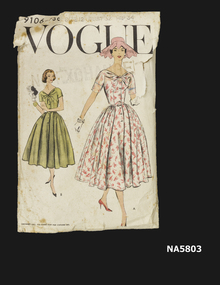
Domestic object - Vogue Pattern No. 9106, Vogue Pattern, C 1957
... ...One-piece dress...Domestic Dressmaking - one piece dress...C1957 Vogue Pattern No. 9106 Size 12 One-piece Dress Above elbow sleeve or short sleeve Large bow at neckline Plain or patterned material...Domestic Dressmaking - one piece dress Domestic dressmaking One-piece dress Vogue pattern C1957 Vogue Pattern No. 9106 Size 12 One-piece Dress Above elbow sleeve or short sleeve Large bow at neckline Plain or patterned material Domestic object Vogue Pattern No. 9106 Vogue Pattern ...Domestic Dressmaking - one piece dressC1957 Vogue Pattern No. 9106 Size 12 One-piece Dress Above elbow sleeve or short sleeve Large bow at neckline Plain or patterned materialVogue patterndomestic dressmaking, one-piece dress -
 Whitehorse Historical Society Inc.
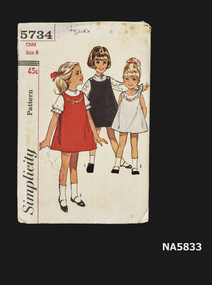
Domestic object - Simplicity Sewing Pattern No 5734, Simplicity Patterns Ltd, C 1960's
... C 1960's - Child's one-piece dress or jumper & blouse - Buttoned shoulder on dress - long or short sleeved blouse...C 1960's - Child's one-piece dress or jumper & blouse - Buttoned shoulder on dress - long or short sleeved blouse Domestic object Simplicity Sewing Pattern No 5734 Simplicity Patterns Ltd ...- Example of 1960's child's fashion - Example of domestically produced clothingC 1960's - Child's one-piece dress or jumper & blouse - Buttoned shoulder on dress - long or short sleeved blouseVarious, some instructions, fabric requirements on reverse.dressmaking, 1960's, children's clothing -
 Whitehorse Historical Society Inc.
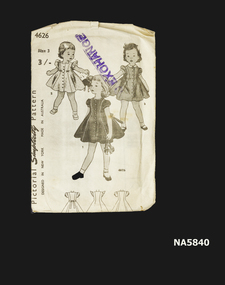
Domestic object - Simplicity Sewing Pattern No 4626, Simplicity Patterns, C 1950's
... C 1050's - Child's one-piece dress - Princess line, front buttoning - View 1 : short gathered cuffed sleeves - View 2 : armhole ruffles - View 3 : scalloped on right front closing edges, short gathered sleves, contrasting collars and cuffs...- Example of C1950's children fashion - Example of domestically produced clothing Dressmaking Children's clothing C 1950's Various, some instructions, fabric requirements on reverse C 1050's - Child's one-piece dress - Princess line, front buttoning - View 1 : short gathered cuffed sleeves - View 2 : armhole ruffles - View 3 : scalloped on right front closing edges, short gathered sleves, contrasting collars and cuffs Domestic object Simplicity Sewing Pattern No 4626 Simplicity Patterns ...- Example of C1950's children fashion - Example of domestically produced clothingC 1050's - Child's one-piece dress - Princess line, front buttoning - View 1 : short gathered cuffed sleeves - View 2 : armhole ruffles - View 3 : scalloped on right front closing edges, short gathered sleves, contrasting collars and cuffsVarious, some instructions, fabric requirements on reversedressmaking, children's clothing, c 1950's -
 Whitehorse Historical Society Inc.
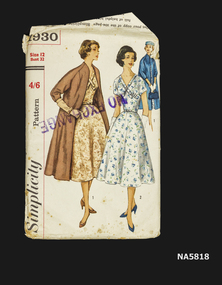
Domestic object - Simplicity Pattern No. 1930, Simplicity Patterns Ltd, 1960
... Simplicity Pattern No. 1930 size 12 Bust 32 Ladies' one-piece dress and coat Short sleeves dress - softly pleated 3/4 sleeved coat - swing back Dress - V-Line neck - flared skirt Coat - softly rounded neckline 15 pieces...Simplicity Pattern No. 1930 - size 12 Bust 32 Ladies short sleeved dress - flared skirt 3/4 sleeved swing back coat Home dressmaking Simplicity Pattern No. 1930 Simplicity Pattern No. 1930 size 12 Bust 32 Ladies' one-piece dress and coat Short sleeves dress - softly pleated 3/4 sleeved coat - swing back Dress - V-Line neck - flared skirt Coat - softly rounded neckline 15 pieces Domestic object Simplicity Pattern No. 1930 Simplicity Patterns Ltd ...Simplicity Pattern No. 1930 - size 12 Bust 32 Ladies short sleeved dress - flared skirt 3/4 sleeved swing back coatSimplicity Pattern No. 1930 size 12 Bust 32 Ladies' one-piece dress and coat Short sleeves dress - softly pleated 3/4 sleeved coat - swing back Dress - V-Line neck - flared skirt Coat - softly rounded neckline 15 piecesSimplicity Pattern No. 1930home dressmaking -
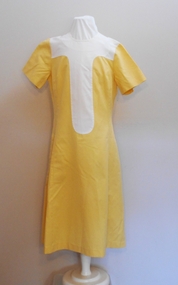 Northern District School of Nursing. Managed by Bendigo Historical Society Inc.
Uniform - Nurse's Trainee Uniform
... Nurse's one piece dress in yellow with yoke and central front chest panel in white. ...'SW' and a female figure in long dress is embroidered in navy blue on the label. Nurse's one piece dress in yellow with yoke and central front chest panel in white. ...Northern District School of Nursing trainee nurse's base uniform from 1972Nurse's one piece dress in yellow with yoke and central front chest panel in white. Dress fastens with full back zip to waist and metal hook and eye. There are two pockets at sides below waist. There is a gusset to each side of back to sleeve. There is a long sleeved, waist length jacket, satin lined, with round neck with five yellow buttons and button holes at front. The fabric is of stretch cotton. Dress has a white label with 'Florgale Uniforms, Permanent Press' and washing instructions printed in red and blue and stitched to left rear neck facing. A trade mark, a ball in red and blue with the word 'Koratron' is also on this label. The jacket has a white label stitched to the lining at base of neck with 'Florgale Uniforms, Melbourne, Sydney" in gold. 'SW' and a female figure in long dress is embroidered in navy blue on the label.nurses uniform, northern district school of nursing, dress, jacket -
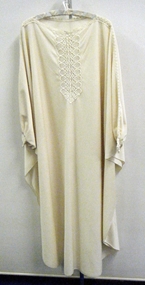 Whitehorse Historical Society Inc.
Clothing - Dress, c1970
... Cream Nylon crepe one piece caftan/dress trimmed with cream cotton lace around neck, cuffs and shoulder seams. 30cm lace trim down front....Originally purchased from Myer in 1970. costume female Cream Nylon crepe one piece caftan/dress trimmed with cream cotton lace around neck, cuffs and shoulder seams. 30cm lace trim down front. ...Originally purchased from Myer in 1970.Cream Nylon crepe one piece caftan/dress trimmed with cream cotton lace around neck, cuffs and shoulder seams. 30cm lace trim down front.costume, female -
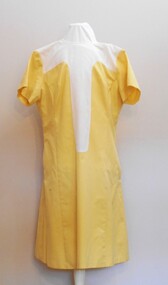 Northern District School of Nursing. Managed by Bendigo Historical Society Inc.
Uniform - Nurse's Trainee Uniform
... Nurse's one piece dress in yellow with yoke and central front chest panel in white. ...'SW' and a female figure in long dress is embroidered in navy blue on the label. Nurse's one piece dress in yellow with yoke and central front chest panel in white. ...Northern District School of Nursing trainee nurse's base uniform from 1972Nurse's one piece dress in yellow with yoke and central front chest panel in white. Dress fastens with full back zip to waist and metal hook and eye. There are two pockets at sides below waist. There is a gusset to each side of back to sleeve. There is a long sleeved, waist length jacket, satin lined, with round neck with five buttons and button holes at front. The fabric is of stretch cotton. There is a metal press stud at the top of the jacketDress has a white label with gold embroidered 'House of King, Melbourne' stitched to left rear neck facing. Stitched to the top of this label is another small white label with the name 'Anne Fitzpatrick' in green embroidery. The jacket has a white label stitched to the lining at base of neck with 'Florgale Uniforms, Melbourne, Sydney" in gold. 'SW' and a female figure in long dress is embroidered in navy blue on the label.nurses uniform, northern district school of nursing, dress, jacket -
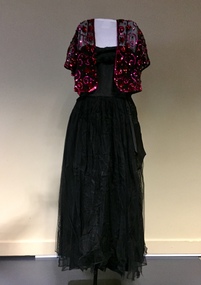 Kew Historical Society Inc
Clothing - Sequinned Evening Dress, Bolero & Cap, 1960s
... Three-piece outfit comprising: three quarter length one-piece black silk cocktail dress with an outer skirt of black tulle; black net bolero embroidered with pink sequins; and black silk circular cap embroidered with pink sequins ...Items in the collection were largely produced for, or purchased by women in Melbourne, and includes examples of outerwear, protective wear, nightwear, underwear and costume accessories. women's clothing evening dresses australian fashion evening ensembles Three-piece outfit comprising: three quarter length one-piece black silk cocktail dress with an outer skirt of black tulle; black net bolero embroidered with pink sequins; and black silk circular cap embroidered with pink sequins Clothing Sequinned Evening Dress, Bolero & Cap ...The Fashion & Design collection of the Kew Historical Society includes examples of women’s, men’s, children’s and infants’ clothing from the 18th, 19th and 20th centuries. Items in the collection were largely produced for, or purchased by women in Melbourne, and includes examples of outerwear, protective wear, nightwear, underwear and costume accessories.Three-piece outfit comprising: three quarter length one-piece black silk cocktail dress with an outer skirt of black tulle; black net bolero embroidered with pink sequins; and black silk circular cap embroidered with pink sequins women's clothing, evening dresses, australian fashion, evening ensembles -
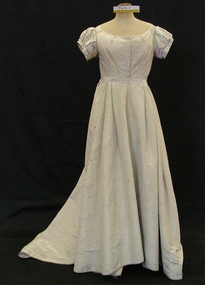 Brighton Historical Society
Clothing - Dress, Wedding dress, 1868
... One piece floor length dress of (originally) lavender, watered (moiré) silk taffeta with short sleeves and train that is controlled by interior tapes to create bustle effect. ...An early example of a wedding dress of the Melbourne Jewish community. julia benjamin abraham smith joseph benjamin hannah soloman melbourne hebrew congregation wedding dress One piece floor length dress of (originally) lavender, watered (moiré) silk taffeta with short sleeves and train that is controlled by interior tapes to create bustle effect. ...This dress was worn by Julia Benjamin (1850-1927) for her marriage to Abraham Smith (of Polish descent) at the Melbourne Hebrew Congregation in Bourke Street, Melbourne on 5 September 1868. Julia was the daughter of Joseph Benjamin and Hannah Soloman. Records suggest it may have been converted into her 'calling' gown for the three month 'bridal' period following her marriage. The gown would have been worn with accompanying accessories of a cape and gloves.An early example of a wedding dress of the Melbourne Jewish community.One piece floor length dress of (originally) lavender, watered (moiré) silk taffeta with short sleeves and train that is controlled by interior tapes to create bustle effect. The bodice fastens down the centre front to the waist where the opening below the waist is concealed by side pleats. The bodice appears to have originally featured a piece of lace at the neckline and a textile ruched belt. The dress is backed with a cream cotton.julia benjamin, abraham smith, joseph benjamin, hannah soloman, melbourne hebrew congregation, wedding dress -
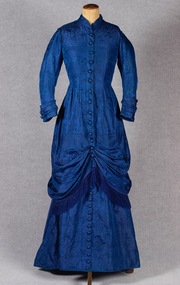 Brighton Historical Society
Clothing - Dress, Day dress, 1878-1882
... A one-piece princess line dress, circa 1878-1882 of deep royal blue silk featuring Chinese-inspired self pattern. ...A good example of a princess line dress of this period in good condition and with provenance. georgiana elizabeth moore elizabeth moore amelia henrietta fraser brighton A one-piece princess line dress, circa 1878-1882 of deep royal blue silk featuring Chinese-inspired self pattern. ...The donation records indicate that this dress was worn by Georgiana Elizabeth Moore (1899-1974), who lived for most of her life in Brighton at 38 and later 40 Cochrane Street. Since the dress is of an earlier date, It is likely that it belonged to Georgiana's mother, Elizabeth Moore (1860-1950). Georgiana was born to Richard and Elizabeth Moore in Brighton in 1899. She was named after Richard's first wife, Georgiana Leake Moore (nee Paul), who had died in 1893 aged only 38. Georgiana is recorded as having been "tall with red hair". The family moved to Diamond Creek for several years, but returned to Brighton after Richard's death in 1922. Georgiana and her mother settled in Cochrane Street, where they lived for the rest of their lives. We know very little about Georgiana herself. Newspaper records indicate that she was a talented musician, graduating from the University of Melbourne with a diploma in music in 1927. BHS holds a small collection of items belonging to the Moore family. This dress was donated by Georgiana's niece, Jeannette Fraser, along with two nightgowns: a c. 1880 night dress believed to have been worn by Elizabeth and a c. 1910 night dress believed to have been worn by Georgiana's sister Amelia Henrietta Fraser (née Moore) while boarding at Merton Hall (this nightdress does also show a laundry mark of G.E. Moore and so may have been worn by both women). Georgiana herself donated a number of items to the Society in 1972, including a 1920s black and white geometric loom-beaded handbag.A good example of a princess line dress of this period in good condition and with provenance.A one-piece princess line dress, circa 1878-1882 of deep royal blue silk featuring Chinese-inspired self pattern. The neckline features a standing collar and is secured through the centre front from neck to floor with self covered buttons. At the front knee the fabric has been gathered and drawn to the back into a tiered fish-tail swag and trimmed with a matching blue knotted fringe. The swagging is created by interior tapes. The dress is backed with cream cotton.georgiana elizabeth moore, elizabeth moore, amelia henrietta fraser, brighton -
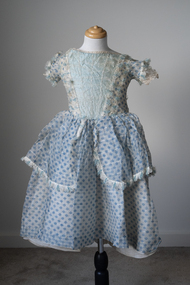 Kew Historical Society Inc
Clothing - Girl's dress, 1858
... Girl's two-tone, one-piece cotton voile dress from the 1850s has a high round neck and short sleeves has a lace insert on the front of the bodice and matching lace at the rear. ...A number of the items in the collection are very rare survivors, and provide researchers with the evidence needed to reconstruct the lives of notable women in the Port Phillip District [later Victoria] during the nineteenth and early twentieth century. fashion -- 1850s children's clothing Alice frances henty Girl's two-tone, one-piece cotton voile dress from the 1850s has a high round neck and short sleeves has a lace insert on the front of the bodice and matching lace at the rear. ...This dress belonged to Alice Frances Henty (1852-1932) the youngest daughter of Francis Henty (1815-89) and his wife Mary Ann Henty [nee Lawrence] (1821-81). It is recorded that Alice wore the dress at the age of six. Alice's father, Francis Henty, was the youngest son of Thomas Henty, who with his family, their retainers and property moved to the Australian colonies between 1829 and 1832. In 1834, Francis’ older brother, Edward, sailed from Launceston in Van Diemen’s Land to what was to become Portland in the western part of Port Phillip District [Victoria]. Francis, together with the first flock of Merino sheep [in Victoria], followed some months later. The first and second generations of the Henty family established vast pastoral properties in the Western part of the Port Phillip District. Francis Henty managed ‘Merino Downs’ near Casterton, while also living in his retirement at ‘Field Place' in Kew. The Henty Collection of nineteenth and twentieth century clothing, including outerwear and underwear, was collected, stored and exhibited over time by female family members descended from Francis and Mary Ann Henty. During the twentieth century, items from the collection were modelled in two fashion parades by various descendants [1937, 1959]. The items in the collection are historically and aesthetically significant, with provenance provided by oral and written tradition within or held by the family. A number of the items in the collection are very rare survivors, and provide researchers with the evidence needed to reconstruct the lives of notable women in the Port Phillip District [later Victoria] during the nineteenth and early twentieth century.Girl's two-tone, one-piece cotton voile dress from the 1850s has a high round neck and short sleeves has a lace insert on the front of the bodice and matching lace at the rear. The layered skirt is bordered with lace. Measurements (mm): Girth - Neck 609.6, Chest 635, Waist 558.8, Cuff 203.2, Hem circumference 2108.2. Vertical - Front neck to hem 685.8, Front waist to hem 508, Back neck to hem 723.9, Back waist to hem 534.4, Sleeve length 63.5. Horizontal - Neck to sleeve head 38.1, Cross back 304.8, Underarm to underarm 406.4.fashion -- 1850s, children's clothing, alice frances henty -
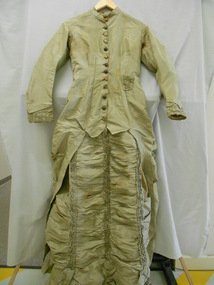 Bendigo Historical Society Inc.
Clothing - SAGE COLOURED SILK LONG SLEEVED DRESS, Silk long Sleeved Dress, 1880-1890's
... Sage coloured silk long sleeved dress. One piece full length dress. Full length side panels from shoulder to hem. ...BHS Collection COSTUME Female sage coloured silk dress Sage coloured silk long sleeved dress. One piece full length dress. Full length side panels from shoulder to hem. ...BHS CollectionSage coloured silk long sleeved dress. One piece full length dress. Full length side panels from shoulder to hem. Front of bodice extends below waist line to form two points on either side of front opening. Front opening is fastened with twelve fabric buttons (1-5cm) and button holes. Small standup collar(3cm) fastened at throat with hook and eye. Bodice shaped with two darts on either side of front opening. Small ruched pocket on LHS of bodice at waist level. Long narrow fitted sleeves shaped at the elbow. Decorative cuffs at wrists of ruched frilling (8cm) with triangularturned flap on top edge at back of cuff. Back of dress has four panels. The two centre panels extend below waist to to two points. The centre skirt panel is attached under the centre two panels and is gathered by five deep pleats to form a bustle effect extending to a long train. Front centre panel has horizontal gathering with ruched frills in centre, and at sides. Side panels overlap front centre panel. Hemline has pleated frill above the hem which is finished with cord. Skirt is lined with an open weave, brown cotton fabric. Bodice is lined with brown polished cotton. Hand stitched and machine stitched.costume, female, sage coloured silk dress -
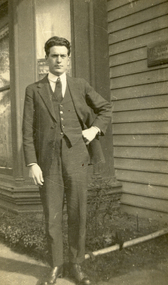 Federation University Historical Collection
Photograph - Black and White, Vernon Holt, Frank Wright outside 118 Doveton Street South, Ballarat, 1921, 23/7/1821
... Black and white photograph of a young man dressed in a dark three piece suit, with one hand resting on his hip. ...South, Ballarat, by Vernon Holt, 23-7-1921 Black and white photograph of a young man dressed in a dark three piece suit, with one hand resting on his hip. ...Frank Wright was a renown resident of Smeaton, where he was born on 2 August 1901. He lived at Laura Villa, and attended Smeaton State School. His father William was a gold miner and his mother's name was Sarah. Their family won many singing and instrumental awards. Frank was tutored by Percy Code and was awarded a gold medal for the highest marks in the ALCM examinations in the British Colonies at the age of seventeen years. He became the Australian Open Cornet Champion by the age of eighteen. A year later, Frank conducted the City of Ballarat Band, and later the Ballarat Soldiers’ Memorial Band. He formed the Frank Wright Frisco Band and Frank Wright and his Coliseum Orchestra. These bands won many South Street awards, and Frank as conductor won many awards in the Australian Band Championship contest. In 1933 Frank Wright sailed to England to conduct the famous St Hilda’s Band and was later appointed Musical Director of the London County Council, where he organized many amazing concerts in parks, in and around the London district. He was made Professor of Brass and Military Band Scoring and conducted at the Guildhall of Music and Drama. Frank was often invited to adjudicate Brass Band Championships around Europe, in Australia, including South Street and in New Zealand. The Frank Wright Medal at the Royal South Street competition is awarded to an individual recognized as making an outstanding contribution to brass music in Australia.Black and white photograph of a young man dressed in a dark three piece suit, with one hand resting on his hip. He is standing outside the bay window of a weatherboard house. The man is Frank Wright and the place is 118 Doveton Street South, Ballarat.Written in pen on the back - Frank Wright, at the age of 19 years, taken at 118 Doveton St. South, Ballarat, by Vernon Holt, 23-7-1921frank wright, vernon holt, 118 doveton st south, ballarat -
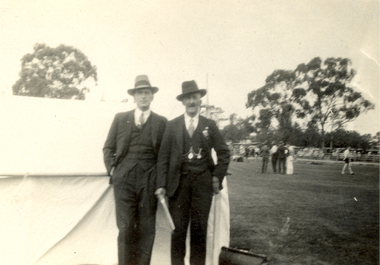 Federation University Historical Collection
Photograph - Black and White, Frank Wright and friend at a sporting event, 1930's?
... Black and white photograph of two men dressed in three piece suits, one with a fob chain and watch and both wearing hats. ...The Frank Wright Medal at the Royal South Street competition is awarded to an individual recognized as making an outstanding contribution to brass music in Australia. frank wright brass band conductor gladstone bag Black and white photograph of two men dressed in three piece suits, one with a fob chain and watch and both wearing hats. ...Frank Wright was a renown resident of Smeaton, where he was born on 2 August 1901. He lived at Laura Villa, and attended Smeaton State School. His father William was a gold miner and his mother's name was Sarah. Their family won many singing and instrumental awards. Frank was tutored by Percy Code and was awarded a gold medal for the highest marks in the ALCM examinations in the British Colonies at the age of seventeen years. He became the Australian Open Cornet Champion by the age of eighteen. A year later, Frank conducted the City of Ballarat Band, and later the Ballarat Soldiers’ Memorial Band. He formed the Frank Wright Frisco Band and Frank Wright and his Coliseum Orchestra. These bands won many South Street awards, and Frank as conductor won many awards in the Australian Band Championship contest. In 1933 Frank Wright sailed to England to conduct the famous St Hilda’s Band and was later appointed Musical Director of the London County Council, where he organized many amazing concerts in parks, in and around the London district. He was made Professor of Brass and Military Band Scoring and conducted at the Guildhall of Music and Drama. Frank was often invited to adjudicate Brass Band Championships around Europe, in Australia, including South Street and in New Zealand. The Frank Wright Medal at the Royal South Street competition is awarded to an individual recognized as making an outstanding contribution to brass music in Australia.Black and white photograph of two men dressed in three piece suits, one with a fob chain and watch and both wearing hats. They are standing in front of a white tent and a Gladstone bag is on the ground beside the older man on the right. In the background, which is a fenced area of grass, a group of men are standing in a group and another man off to the right appears to be a competitor in some sporting event. The younger man to the left is Frank Wright.frank wright, brass band, conductor, gladstone bag -
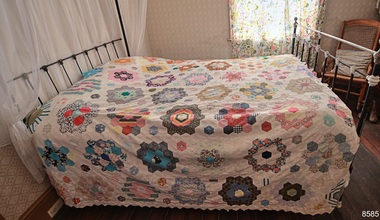 Flagstaff Hill Maritime Museum and Village
Textile - Bedspread, patchwork, 1976
... one edge. The local disability services employees and members cut out octagonal paper batches and used their own fabrics to piece them together. The Branch's first exhibition raised funds for buying fabric and equipment to assemble the patchwork. The quilt was perfectly suited to dress...one edge. The local disability services employees and members cut out octagonal paper batches and used their own fabrics to piece them together. The Branch's first exhibition raised funds for buying fabric and equipment to assemble the patchwork. The quilt was perfectly suited to dress ...This patchwork quilt or bedspread is a modern creation along the lines of the traditional 1800s handmade English paper piecing patchwork quilting craft. It is made from reproduction fabric and quilt designs and represents the bed linen typical of a late 19th-century bedroom. Years ago, patchwork was a form of recycling, where leftover or previously used pieces of fabric were used to create other useful item such as quilts, rugs, cushion covers and jackets. Special projects were sometimes made with fabrics representing special memories, such as pieces from baby clothes, wedding gowns, and school uniforms. The maker would use a cardboard template shaped like a hexagon, place it onto the fabric and trace around it. Often the cardboard was cut from a box such as a cereal box. Women would gather to work on their patchwork while enjoying their social time together. As in the case of this quilt, members of the South Western Branch of the Embroiderers Guild in Warrnambool worked on the project, designing and quilting as a group to achieve their aim, of presenting the quilt to the recently opened Flagstaff Hill Maritime Museum. It was the first Group Project of the Branch which was formed in 1974. In 1975 the members decided to make a Quilt as a project to promote the formation of friendship and togetherness. Under the foundation Treasurer, Rita Williams, members sourced their own fabrics for the 'flowers' which were then stitched into the calico borders. Provision was made for the quilt to be hung for display, with the addition of loops along one edge. The local disability services employees and members cut out octagonal paper batches and used their own fabrics to piece them together. The Branch's first exhibition raised funds for buying fabric and equipment to assemble the patchwork. The quilt was perfectly suited to dress the bed in the Lighthouse Keeper's Cottage. This carefully created and designed, recently made patchwork bedspread typifies bedding and handcraft of the late 19th century. The English paper patchwork technique was used. The quilt was the first community project of the South Western Branch of the Embroiderers' Guild of Victoria, and presented as an addition to the Lighthouse Keeper's Cottage tat Flagstaff Hill. Patchwork quilt or bedspread, double bed size, made from hundreds of hexagonal-shaped fabric of various colours and patterns, carefully stitched onto a white background. It was made using the English paper patchwork technique. One edge of the quilt has loops dispersed at regular intervals. This would allow the quit to be used as a wall hanging. It was handmade by the South Western Branch of The Embroiders Guild, Victoria, and presented to Flagstaff Hill Maritime Museum and Village in 1976. An inscription is embroidered in blue on a patch of the quilt. "Made and Presented by The Embroiderers Guild, Victoria (S.W. Branch) 1976"flagstaff hill, flagstaff hill maritime museum and village, warrnambool, maritime museum, maritime village, great ocean road, shipwreck coast, bedspread, patchwork quilt, quilt, embroiderers guild, bedding, bed linen, 1800's handcraft, quilting, south west branch, warrnambool embroiders guild, recycled fabric, 19th century, household textiles, english paper patchwork, paper patchwork technique -
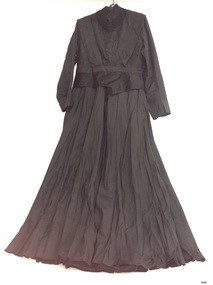 Flagstaff Hill Maritime Museum and Village
Clothing - Mourning Outfit, Late 19th to early-20th centuries
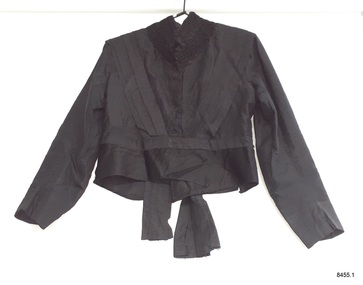
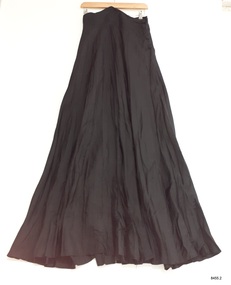
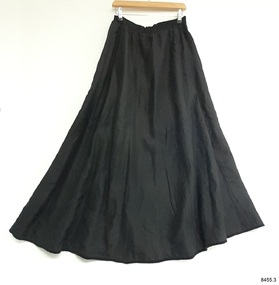
... piece silk Edwardian mourning outfit is significant historically for its connection with rural Victoria and the social and religious customs surrounding the death of a family or community member. The high-quality outfit is also significant for representing the financial management of the times, being tailored by a dressmaker for a person of means and then adjusted to fit at least one different-sized person. Flagstaff Hill Maritime Museum and Village Warrnambool Shipwreck Coast Edwardian era Tailor-made dressmaker mourning outfit handmade garment mourning dress ...This Edwardian-era mourning outfit was worn by a wealthy woman from the rural area of Willaura, southeast of the Grampians. It was inherited by the donor from his mother, who had purchased it from a clearing sale in the 1960s. The jacket has a peplum or flounce below the waistline, a fashion that was seen in the 1860s and is still around in the 1900s. The outfit represents the female mourning fashion and wardrobe from the late 19th to early 20th centuries. Such garments were a necessary inclusion as death often occurred to the young, due to illness, accidents and hard work - it was a regular part of life in rural Victoria. Mourning outfits were part of a person’s wardrobe and often passed from one generation to the next. This particular outfit appears to have been adjusted at some stage to allow for a wider waistline. The original skirt may have been replaced by the one that is now part of this outfit; the skirt is all machine-sewn, unlike the jacket and petticoat. The fabric of the skirt may be silk or it could be a synthetic fibre such as artificial silk or rayon; both were available in the 1800s,but nylon wasn’t invented until the 1930s. This skirt has sunray pleating, which was advertised on skirts for sale in the 1890s, and 1909, and was part of a fashionable bridal gown train in the 1930s. The mourning of death was part of both family and community life, particularly in rural and remote areas. People were bonded through work, religion, disasters, tragedy and social activities, supporting one another. They came together from near and far on such an occasion, giving each other the care that was needed and showing respect for the member who had passed away.This three-piece silk Edwardian mourning outfit is significant historically for its connection with rural Victoria and the social and religious customs surrounding the death of a family or community member. The high-quality outfit is also significant for representing the financial management of the times, being tailored by a dressmaker for a person of means and then adjusted to fit at least one different-sized person. Ladies’ Edwardian mourning outfit; three-piece tailored suit comprising of a black silk long sleeve, short-waist fitted and lined Jacket, a long sunray pleated skirt and long, lined petticoat. Items have been machine-sown and hand-sewn by a dressmaker. The skirt has handmade buttons of the same fabric.Handwritten in ballpoint pen “Jenny” and “Mrs Sheila Handscombe, Wallaura, Jenny”flagstaff hill maritime museum and village, warrnambool, shipwreck coast, edwardian era, tailor-made, dressmaker, mourning outfit, handmade garment, mourning dress, death mourning, sunray pleats, western district victoria -
 Flagstaff Hill Maritime Museum and Village
Clothing - Mourning Outfit, jacket, Late 19th to early-20th centuries
... piece silk Edwardian mourning outfit is significant historically for its connection with rural Victoria and the social and religious customs surrounding the death of a family or community member. The high-quality outfit is also significant for representing the financial management of the times, being tailored by a dressmaker for a person of means and then adjusted to fit at least one different-sized person. Flagstaff Hill Maritime Museum and Village Warrnambool Shipwreck Coast Edwardian era Tailor-made dressmaker mourning outfit handmade garment mourning dress ...This Edwardian era mourning outfit was worn by a wealthy woman from the rural area of Willaura, southeast of the Grampians. It was inherited by the donor from his mother, who had purchased it from a clearing sale in the 1960s. The jacket has a peplum or flounce below the waistline, a fashion that was seen in the 1860s and is still around in the 1900s. The outfit represents the female mourning fashion and wardrobe from the late 19th to early 20th centuries. Such garments were a necessary inclusion as death occurred often to the young, due to illness, accidents and hard work - it was a regular part of life in rural Victoria. Mourning outfits were a part of a person’s wardrobe and often passed from one generation to the next. This particular outfit appears to have been adjusted at some stage to allow for a wider waistline. The original skirt may have been replaced by the one that is now part of this outfit; the skirt is all machine-sewn, unlike the jacket and petticoat. The fabric of the skirt may be silk or it could be a synthetic fibre such as artificial silk or rayon; both were available in the 1800s,but nylon wasn’t invented until the 1930s. This skirt has sunray pleating, which was advertised on skirts for sale in the 1890s, and 1909, and was part of a fashionable bridal gown train in the 1930s. The mourning of death was part of both family and community life, particularly in rural and remote areas. People were bonded through work, religion, disasters, tragedy and social activities, supporting one another. They came together from near and far on such an occasion, giving each other the care that was needed and showing respect for the member who had passed away.This three-piece silk Edwardian mourning outfit is significant historically for its connection with rural Victoria and the social and religious customs surrounding the death of a family or community member. The high-quality outfit is also significant for representing the financial management of the times, being tailored by a dressmaker for a person of means and then adjusted to fit at least one different-sized person. The black silk tailor-made jacket is one of three pieces of a ladies’ Edwardian mourning outfit. It has long sleeves, a stand-up collar trimmed with appliqued black crochet lace, and pleated sashes on the left and right sides from front to back fastened at the shoulder and waist. The jacket has a peplum or flounce below the waistline. The front of the jacket has brass hooks and fabric eye fastenings. The back of the jacket has two tails. The jacket is lined and the shoulders are padded. It has been machine sewn and finished with hand stitching. A white card is tied with a ribbon inside and has an inscription. The poplin skirt on the jacket has been cut up to the waist at the side seams. There is an attached card with an inscription, handwritten in ballpoint pen.“Jenny” and “Mrs Sheila Handscombe, Wallaura, Jenny”flagstaff hill maritime museum and village, warrnambool, shipwreck coast, edwardian era, tailor-made, dressmaker, mourning outfit, handmade garment, mourning dress, death mourning, sunray pleats, sunburst pleats, western district victoria, mourning jacket -
 Flagstaff Hill Maritime Museum and Village
Clothing - Mourning Outfit, skirt, Late 19th to early-20th centuries
... piece silk Edwardian mourning outfit is significant historically for its connection with rural Victoria and the social and religious customs surrounding the death of a family or community member. The high-quality outfit is also significant for representing the financial management of the times, being tailored by a dressmaker for a person of means and then adjusted to fit at least one different-sized person. Flagstaff Hill Maritime Museum and Village Warrnambool Shipwreck Coast Edwardian era Tailor-made dressmaker mourning outfit mourning dress ...This Edwardian-era mourning outfit was worn by a wealthy woman from the rural area of Willaura, southeast of the Grampians. It was inherited by the donor from his mother, who had purchased it from a clearing sale in the 1960s. The jacket has a peplum or flounce below the waistline, a fashion that was seen in the 1860s and is still around in the 1900s. The outfit represents the female mourning fashion and wardrobe from the late 19th to early 20th centuries. Such garments were a necessary inclusion as death often occurred to the young, due to illness, accidents and hard work - it was a regular part of life in rural Victoria. Mourning outfits were part of a person’s wardrobe and often passed from one generation to the next. This particular outfit appears to have been adjusted at some stage to allow for a wider waistline. The original skirt may have been replaced by the one that is now part of this outfit; the skirt is all machine-sewn, unlike the jacket and petticoat. The fabric of the skirt may be silk or it could be a synthetic fibre such as artificial silk or rayon; both were available in the 1800s, but nylon wasn’t invented until the 1930s. This skirt has sunray pleating, which was advertised on skirts for sale in the 1890s, and 1909, and was part of a fashionable bridal gown train in the 1930s. The mourning of death was part of both family and community life, particularly in rural and remote areas. People were bonded through work, religion, disasters, tragedy and social activities, supporting one another. They came together from near and far on such an occasion, giving each other the care that was needed and showing respect for the member who had passed away.This three-piece silk Edwardian mourning outfit is significant historically for its connection with rural Victoria and the social and religious customs surrounding the death of a family or community member. The high-quality outfit is also significant for representing the financial management of the times, being tailored by a dressmaker for a person of means and then adjusted to fit at least one different-sized person. The full-length black silk tailor-made skirt is one of three pieces of a ladies’ Edwardian mourning outfit. The skirt is made from black silky fabric. The garment has only two seams; at the side closure and the centre back. The whole skirt has sunray pleats; narrow pleats at the waist that fan outwards towards the hem. The top of the skirt is finished with a waistband that is shaped as an upward V shape in the centre. The side seam is closed with four self-fabric buttons with silver metal backing. The shirt has been machine sewn.flagstaff hill maritime museum and village, warrnambool, shipwreck coast, edwardian era, tailor-made, dressmaker, mourning outfit, mourning dress, death mourning, sunray pleats, western district victoria, full-length skirt -
 Flagstaff Hill Maritime Museum and Village
Clothing - Mourning Outfit, petticoat, Late 19th to early-20th centuries
... piece silk Edwardian mourning outfit is significant historically for its connection with rural Victoria and the social and religious customs surrounding the death of a family or community member. The high-quality outfit is also significant for representing the financial management of the times, being tailored by a dressmaker for a person of means and then adjusted to fit at least one different-sized person. Flagstaff Hill Maritime Museum and Village Warrnambool Shipwreck Coast Edwardian era Tailor-made dressmaker mourning outfit handmade garment mourning dress ...This Edwardian-era mourning outfit was worn by a wealthy woman from the rural area of Willaura, southeast of the Grampians. It was inherited by the donor from his mother, who had purchased it from a clearing sale in the 1960s. The jacket has a peplum or flounce below the waistline, a fashion that was seen in the 1860s and is still around in the 1900s. The outfit represents the female mourning fashion and wardrobe from the late 19th to early 20th centuries. Such garments were a necessary inclusion as death often occurred to the young, due to illness, accidents and hard work - it was a regular part of life in rural Victoria. Mourning outfits were part of a person’s wardrobe and often passed from one generation to the next. This particular outfit appears to have been adjusted at some stage to allow for a wider waistline. The original skirt may have been replaced by the one that is now part of this outfit; the skirt is all machine-sewn, unlike the jacket and petticoat. The fabric of the skirt may be silk or it could be a synthetic fibre such as artificial silk or rayon; both were available in the 1800s,but nylon wasn’t invented until the 1930s. This skirt has sunray pleating, which was advertised on skirts for sale in the 1890s, and 1909, and was part of a fashionable bridal gown train in the 1930s. The mourning of death was part of both family and community life, particularly in rural and remote areas. People were bonded through work, religion, disasters, tragedy and social activities, supporting one another. They came together from near and far on such an occasion, giving each other the care that was needed and showing respect for the member who had passed away.This three-piece silk Edwardian mourning outfit is significant historically for its connection with rural Victoria and the social and religious customs surrounding the death of a family or community member. The high-quality outfit is also significant for representing the financial management of the times, being tailored by a dressmaker for a person of means and then adjusted to fit at least one different-sized person. The full-length black silk tailor-made petticoat is one of three pieces of a ladies’ Edwardian mourning outfit. The petticoat is made from black silk lined with lightweight cotton. The petticoat and lining are constructed from eight panels each, brought together at the waist and gently gathered into the band. The back seam opening is fastened with brass hooks and fabric eyes. The lining has been reinforced with a heavier-weight hem. The hemline is finished with black velvet ribbon than encloses both the petticoat and lining. flagstaff hill maritime museum and village, warrnambool, shipwreck coast, edwardian era, tailor-made, dressmaker, mourning outfit, handmade garment, mourning dress, death mourning, sunray pleats, western district victoria, petticoat, undergarment, slip -
 Glenelg Shire Council Cultural Collection
Photograph - Photograph - Councillor J.L. Wyatt, J.P, Lockwood Studios, Geelong, c. 1924
... Sepia photograph of a man dressed in a three-piece suit with a pale bow tie and white high-collar shirt. He wears a badge on his left lapel. One..../1914-15-16-17-22-23-24 (plaque, lower centre) Sepia photograph of a man dressed in a three-piece suit with a pale bow tie and white high-collar shirt. He wears a badge on his left lapel. One ...Records of the Borough of PortlandSepia photograph of a man dressed in a three-piece suit with a pale bow tie and white high-collar shirt. He wears a badge on his left lapel. One-third length portrait, with head tilted up and eye-line to upper left of camera. The man has short hair (wavy) parted on the left, and a full moustache. Framed under glass with grey and tan double matt, in a white wooden frame with plaque attached bottom centre. Chain across waiscoat.Front: The Lockwood Studios/-Geelong - (lower right, on photograph) Cr. J. L. Wyatt J.P./1914-15-16-17-22-23-24 (plaque, lower centre)councillor wyatt, jp, official photography, portrait, civic photography -
 Bendigo Military Museum
Uniform - MESS DRESS, OFFICER, unknown
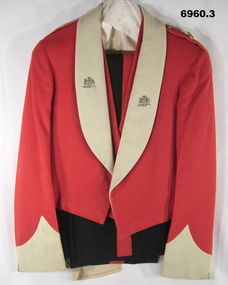
... piece of leather at bottom of trousers at back. Two side pockets. One back pocket on right. Two buttons on each side of fly (for braces) two buttons at back. Uniform MESS DRESS ...1. Red woollen jacket with white facings and white cuffs. On the collars are a 38Bn NVR badge. On epaulettes are - Brass letter "R". Brass Major's badge, small brass button - motif is Australian Military Forces. The jacket is lined with red cotton. 2. Red woollen vest, cotton backing. Two small pockets, Four small brass buttons - motif is Australian Military Forces - vest lined with white cotton. 3. Black trousers, wool with a red wool stripe on outside seam (4cm wide). Button fly (6 buttons) Pockets are white cotton, waistband lining is blue and white striped cotton. Small piece of leather at bottom of trousers at back. Two side pockets. One back pocket on right. Two buttons on each side of fly (for braces) two buttons at back.3. Written on right front pocket in black ink "SULLIVAN C4".post ww2, uniform, officers mess dress, passchendaele barracks trust -
 Warrnambool and District Historical Society Inc.
Postcard - Les Grenades, 1914-1918
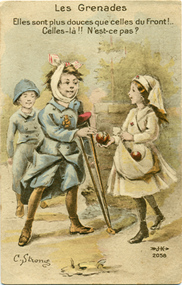
... This card is interesting because of its association with World War One and with two local people: Daisy Vickers and Arthur Anderson. daisy Vickers warrnambool world war one post card postcard WW1 Les Grenades This is a coloured postcard with a sketch of three children dressed in military outfits. The child dressed as a nurse is giving a piece ...This is number 22 of 27 items in the Daisy Vickers collection of World War One memorabilia. These items were sent or given to Daisy Ogier (nee Vickers) during World War One by Corporal Arthur Anderson who enlisted from Warrnambool in 1915 at the age of 21. He served in Egypt and France and returned to Australia in 1919. Daisy Ogier (1907-1987) was a student and then a teacher at Warrnambool Technical School with her early teaching years there from 1925 to 1936 and in 1949. She became the head mistress from 1950 to 1963 and in 1968. She officially retired in 1976. Daisy Vickers was one of the best loved and dedicated teachers that the school ever had. She married the Reverend Fred Ogier and continued her association with the school after her husband's death. This card is interesting because of its association with World War One and with two local people: Daisy Vickers and Arthur Anderson. This is a coloured postcard with a sketch of three children dressed in military outfits. The child dressed as a nurse is giving a piece of fruit to a child dressed as a wounded soldier. On the back it has space for correspondence and an address.Les Grenadesdaisy vickers, warrnambool, world war one post card, postcard ww1 -
4th/19th Prince of Wales's Light Horse Regiment Unit History Room
Coveralls, AFV Crewman, Cotton, Camouflage Pattern, c. 1980's
... protective dress AFV crew One piece cotton camouflage pattern coveralls for AFV crew. ...One piece cotton camouflage pattern coveralls for AFV crew. Size 94Lprotective dress, afv crew -
 Bendigo Historical Society Inc.
Photograph - Creeth Street Studio, 1895
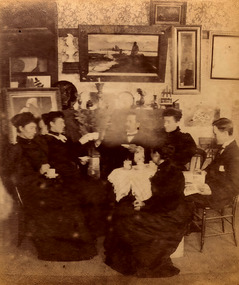
... dresses and two men sitting around a table having tea in front of a mantle-piece. Several paintings are on the wall above. 8679b Four female artists (or students) painting pictures. They are supervised by a man and a woman. Various pieces of art are on the wall and floor around them. A painter's pallet is open on the floor in the foreground. 8679c Three women and one...dresses and two men sitting around a table having tea in front of a mantle-piece. Several paintings are on the wall above. 8679b Four female artists (or students) painting pictures. They are supervised by a man and a woman. Various pieces of art are on the wall and floor around them. A painter's pallet is open on the floor in the foreground. 8679c Three women and one ...Long Gully is a suburb of Bendigo, 3 km north-west of the city's centre. The Long Gully Creek signifies the physical location of the suburb, and the Long Gully reefs ran southwards from Eaglehawk. It was particularly rich, realising yields as high as five ounces of gold to the ton.Four black and white photos of a painter's studio in Creeth Street, Long Gully, Bendigo. The photos were of very low quality and have been restored as much as possible. The photos are of: 8679a Three women in long dresses and two men sitting around a table having tea in front of a mantle-piece. Several paintings are on the wall above. 8679b Four female artists (or students) painting pictures. They are supervised by a man and a woman. Various pieces of art are on the wall and floor around them. A painter's pallet is open on the floor in the foreground. 8679c Three women and one man are viewing pictures in the studio. 8679d Paintings on display in the studio history, bendigo, creeth street long gully, artist studio -
 Bendigo Historical Society Inc.
Photograph - HILDA HILL COLLECTION: BLACK AND WHITE PHOTOS, 1925
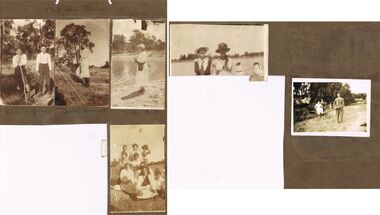
... piece of barb fence wire. 'Babe' Noonan contemplating hatless and wearing a white dress and dark stockings, Bill Hill (lady) by lake wears round top hat with the front brim turned up white dress highlights on the lapels black belt with a black bag attached columbine pattern on her stockings standing on dam bank background is forested area. Family Group 'The Push' made up of 7 young ladies and 4 boys one...piece of barb fence wire. 'Babe' Noonan contemplating hatless and wearing a white dress and dark stockings, Bill Hill (lady) by lake wears round top hat with the front brim turned up white dress highlights on the lapels black belt with a black bag attached columbine pattern on her stockings standing on dam bank background is forested area. Family Group 'The Push' made up of 7 young ladies and 4 boys one ...Hilda Hill Collection.Series of Black & White Photos Hill Family & Friends Total 5 Photos. Clem & Jim out bush, both boys are wearing dark coloured shorts and long socks boy on left has white stripes at top of the socks with braces white shirts bottom right corner shows a piece of barb fence wire. 'Babe' Noonan contemplating hatless and wearing a white dress and dark stockings, Bill Hill (lady) by lake wears round top hat with the front brim turned up white dress highlights on the lapels black belt with a black bag attached columbine pattern on her stockings standing on dam bank background is forested area. Family Group 'The Push' made up of 7 young ladies and 4 boys one of which wears a hat one girl is dressed in black all others are in white on girl is wearing a hat with another on the ground beside her girl front right has a s part black bag hanging around her neck. Hilda Hill on 2 steel wheeled apparatus with long shaft at the front being held by a man dressed in grey suit with white shirt and dark tie another man is standing rear right of the girl also wearing grey suit white shirt and dark tie, Mid left side shows a heavy wheeled cart loaded with full bags at Summer Hill March 8, 1925. rear background has large willow tree, right background shows corner of large shed and haystack Also noted in pencil -At The Pines 1919. There is also a photo of two ladies facing the camera both wearing hats one light and the other dark colours lady on left is wearing dark jacket over a white dress lady on right wearing white dress and long tress forward over her shoulder two other ladies have their backs to the camera both wearing white one has black sash at her waist and head coverings, The venue appears to be a large dam and background shows far shore and bushland.Hilda Hill Personal Collectionaustralia, history, post war life -
 Bendigo Historical Society Inc.
Photograph - PETER ELLIS COLLECTION: PHOTOS, 14th January, 1897
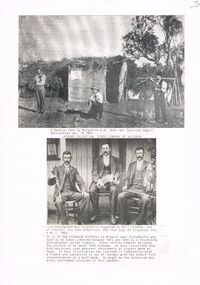
... one with a brass instrument and the third is not very clear. They are in front of a hut with branches on the roof and hessian walls. Beneath the photo is typed on a piece of paper - A Bendigo Camp by Mulgarrie W. A. (Boer War Training Camp? Bendigonian Jan. 14 1897. Latrobe Collection, State Library of Victoria. The second photo is three men, dressed...one with a brass instrument and the third is not very clear. They are in front of a hut with branches on the roof and hessian walls. Beneath the photo is typed on a piece of paper - A Bendigo Camp by Mulgarrie W. A. (Boer War Training Camp? Bendigonian Jan. 14 1897. Latrobe Collection, State Library of Victoria. The second photo is three men, dressed ...Two black and white photos pasted onto a sheet of paper. The top photo is a photo of three men, one playing a fiddle, one with a brass instrument and the third is not very clear. They are in front of a hut with branches on the roof and hessian walls. Beneath the photo is typed on a piece of paper - A Bendigo Camp by Mulgarrie W. A. (Boer War Training Camp? Bendigonian Jan. 14 1897. Latrobe Collection, State Library of Victoria. The second photo is three men, dressed in suits and sitting on chairs in front of a building. One has a clarinet, the middle one has a concertina and the other has a fiddle. The men are the Coleman Brothers. The photo was taken by a travelling photographer called Siebart.photo, group, male, peter ellis collection, mulgarrie w a, boer was training camp?, bendigonian 14/1/1897, latrobe collection, state library of victoria, bill coleman, charles coleman, john robertson, singabout vol 6 no 1 1966, siebart, peter cuffley -
 Stratford and District Historical Society
Photographs, Framed
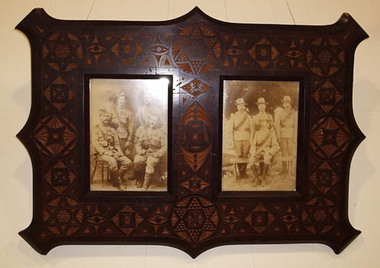
... one bare-headed. They are, standing, Pte Weir, Pte Tweedie, seated Pte Beecher, Pte Cochrane. They known to have been members of the Victorian Mounted Rifles, but the uniform is unusual for that group. They are wearing different leggings, and their belts cross their right shoulder, not the left. They wear a piece of cloth with diagonal stripes across it pinned above their left pocket. In all, it suggests a photograph taken, possibly in South Africa, in their battle dress...one bare-headed. They are, standing, Pte Weir, Pte Tweedie, seated Pte Beecher, Pte Cochrane. They known to have been members of the Victorian Mounted Rifles, but the uniform is unusual for that group. They are wearing different leggings, and their belts cross their right shoulder, not the left. They wear a piece of cloth with diagonal stripes across it pinned above their left pocket. In all, it suggests a photograph taken, possibly in South Africa, in their battle dress ...Original photogaphs have been removed from frame and are catalogued at 1311, 1312. The frame has long been considered to be the work of Vera Mayhew, a well-known exponent of chip carving. The original photographs are catalogued elsewhere as: 01311: An early copy sepia photographic print pasted to cardboard of four men in military uniform, three wearing caps, one bare-headed. They are, standing, Pte Weir, Pte Tweedie, seated Pte Beecher, Pte Cochrane. They known to have been members of the Victorian Mounted Rifles, but the uniform is unusual for that group. They are wearing different leggings, and their belts cross their right shoulder, not the left. They wear a piece of cloth with diagonal stripes across it pinned above their left pocket. In all, it suggests a photograph taken, possibly in South Africa, in their battle dress, and possibly after a team game. William Hamilton Weir was invalided back to Aust, arr. 5 June 1901; James Tweedie 287 Pvt Stratford, prom. to Corporal 20 March 1901, listed in fallen for World War 1; Private J.A. Beecher also had brothers who served (see P00179B). Pte William James Cochrane 309, prom to Lance Corp 10 April 1900, Corp 16 Nov 1900, apparently ret. to Aust, appt. commander No 1 Troop Wangaratta, ret to South Africa in 5th Contingent as Lieutenant, became a member of 6th Batt. Aust Commonwealth Horse, ret. to Aust. 7 Aug 1902. 01312: A first generation sepia photographic print of four men in Boer War Uniform. They are, standing, Pte H. Beecher, Pte A. Beecher, Pte Josh Jones, seated Sgt Pruden. They are all wearing standard Light Horse uniform, with slouch hats. Shoeingsmith Henry Ward Beecher 556 was invalided back to Aust., arr. 9 May 1901; Trooper George Andre Beecher 557; Josh Jones is possibly John Joseph Jones 434 of Stratford. Sgt Pruden was killed in action. These photographs originally hung in the Stratford Mechanics' Institute.A chip-carved wooden frame with reproduction photographs of Stratford men in uniform similar to Boer War uniform.boer war 1899-1902, craft, handcraft -
 Bendigo Historical Society Inc.
Photograph - GOLDEN SQUARE LAUREL STREET P.S. COLLECTION: PHOTOGRAPH - 1983/84 CRICKET TEAM
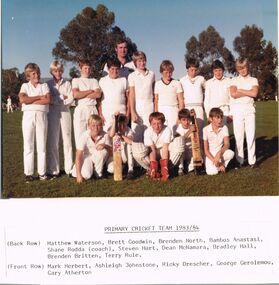
... one is wearing long gloves. They are all dressed in whites. The names of the boys are:- (Back Row) Matthew Waterson, Brett Goodwin, Brenden North, Bambos Anastasi, Shane Rodda (coach), Steven Hart, Dean McNamara, Bradley Hall, Brenden Britten, Terry Rule. (Front Row) Mark Herbert, Ashleigh Johnstone, Ricky Dresher, George Gerolemou and Gary Atherton. Names are typed on paper stuck to a piece...one is wearing long gloves. They are all dressed in whites. The names of the boys are:- (Back Row) Matthew Waterson, Brett Goodwin, Brenden North, Bambos Anastasi, Shane Rodda (coach), Steven Hart, Dean McNamara, Bradley Hall, Brenden Britten, Terry Rule. (Front Row) Mark Herbert, Ashleigh Johnstone, Ricky Dresher, George Gerolemou and Gary Atherton. Names are typed on paper stuck to a piece ...Coloured photograph of Primary Cricket Team 1983/84. Two boys in the front row are holding cricket bats and one is wearing long gloves. They are all dressed in whites. The names of the boys are:- (Back Row) Matthew Waterson, Brett Goodwin, Brenden North, Bambos Anastasi, Shane Rodda (coach), Steven Hart, Dean McNamara, Bradley Hall, Brenden Britten, Terry Rule. (Front Row) Mark Herbert, Ashleigh Johnstone, Ricky Dresher, George Gerolemou and Gary Atherton. Names are typed on paper stuck to a piece of foam core.education, primary, golden square laurel st p.s., golden square laurel street p.s. collection - photograph primary cricket team 1983/84, matthew waterson, brett goodwin, brenden north, bambos anastasi, shane rodda, steven hart, dean mcnamara, bradley hall, brenden britten, terry rule, mark herbert, ashleigh johnstone, ricky dresher, george gerolemou, gary atherton -
 Bendigo Historical Society Inc.
Textile - Swimming trunks
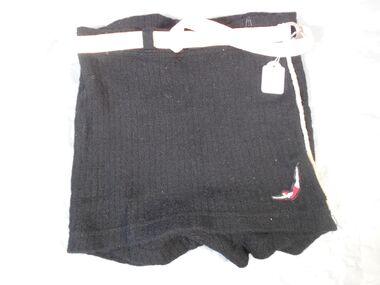
... The brand featured a logo image of a young woman, dressed in a red one-piece swimsuit and bathing hat, assuming a diving posture with outstretched arms and an arched back. ...The brand featured a logo image of a young woman, dressed in a red one-piece swimsuit and bathing hat, assuming a diving posture with outstretched arms and an arched back. ...Jantzen is a brand of swimwear that was established in 1916 and first appeared in the city of Portland, Oregon, United States. The brand name later replaced the name of the parent company that manufactured the branded products. The brand featured a logo image of a young woman, dressed in a red one-piece swimsuit and bathing hat, assuming a diving posture with outstretched arms and an arched back. Known as the Jantzen "Diving Girl", the image in various forms became famous throughout the world during the early twentieth century. (Wikipedia). .Black men's woollen swimming trunks made by Jantzen. Inside label - "Jantzen" (red print), "Made in Australia" (faint green print). The trunks have a bone coloured cotton belt threaded through tabs at the waist. A silver coloured buckle has "Rustless" imprinted. Late 1940s. On the front at lower right is the Jantzen symbol of a costumed female swimmer in a diving position with arms outstretched.swimming trunks, jantzen, diving girl -
 Bendigo Historical Society Inc.
Photograph - BARBARA MAMOUNEY COLLECTION: BENJAMIN AND EMILY WHITE PHOTO
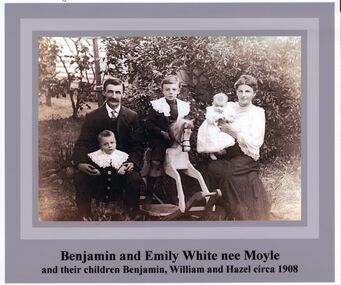
... piece suit, Emily a white high neck top, long sleeves. Children wearing elaborate white lace collars over dark suits, baby in long dress, in mother's arms. One...piece suit, Emily a white high neck top, long sleeves. Children wearing elaborate white lace collars over dark suits, baby in long dress, in mother's arms. One ...Black and white photo of Benjamin and Emily White (nee Moyle) and their children Benjamin, William and Hazel Circa 1908. Benjamin is wearing a three piece suit, Emily a white high neck top, long sleeves. Children wearing elaborate white lace collars over dark suits, baby in long dress, in mother's arms. One boy sitting on wooden horse.barbara mamouney, white family
