
Showing 196 items matching "open night"
-
 NMIT (Northern Melbourne Institute of TAFE)
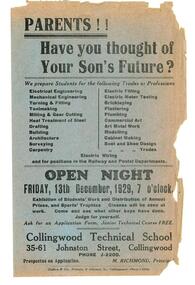
Flyer Open Night CTS 1929, Flyer for Open Night for Collingwood Technical School to be held Friday, 13th December, 1929 at 7 o'clock
... Flyer Open Night CTS 1929...Flyer for Open Night for Collingwood Technical School to be held Friday, 13th December, 1929 at 7 o'clock......Open Night...Faded blue flyer for Open Night for Collingwood Technical School Friday, 13th December, 1929, 7 o'clock...Collingwood Technical School Flyer Open Night NMIT Faded blue flyer for Open Night for Collingwood Technical School Friday, 13th December, 1929, 7 o'clock Flyer for Open Night for Collingwood Technical School to be held Friday, 13th December, 1929 at 7 o'clock Flyer Open Night CTS 1929 ...Faded blue flyer for Open Night for Collingwood Technical School Friday, 13th December, 1929, 7 o'clockcollingwood technical school, flyer, open night, nmit, -
 Federation University Historical Collection
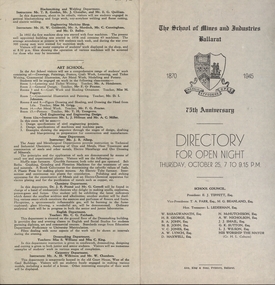
Programme, School of Mines: 75th Anniversary, Directory for Open Night, 1945, 1945
... School of Mines: 75th Anniversary, Directory for Open Night, 1945......open night...To celebrate the 75th Anniversary of the School of Mines and Industries an Open Night was held on Thursday, October 25 (1945) from 7 to 9.15 p.m. ...To celebrate the 75th Anniversary of the School of Mines and Industries an Open Night was held on Thursday, October 25 (1945) from 7 to 9.15 p.m. ...To celebrate the 75th Anniversary of the School of Mines and Industries an Open Night was held on Thursday, October 25 (1945) from 7 to 9.15 p.m. The Principal was Mr A Heseltine and the Registrar was Mr F Ferguson. Members of the School Council included E J Tippett, M G Beanland who have a building or walkway named after them. A map of the buildings shows the various areas and information is given for each department. Though it was an Open Night it would also serve as an Information Night for student enrolling for the following year.Paper folded in half and printed on each of the four sections. Map showing layout of buildings. Information on each department of the school.ballarat school of mines and industries, 75 anniversary, a heseltine, principal, f e ferguson, registrar, e j tippett, m g beanland, open night, information night -
 Federation University Historical Collection
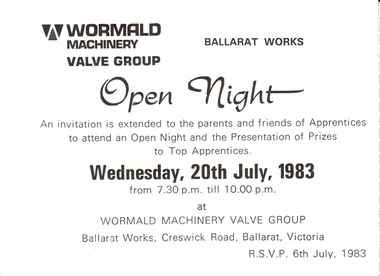
Document - Ticket, Wormald Machinery Valve Group Ballarat Works Open Night, 1983, 1983
... Wormald Machinery Valve Group Ballarat Works Open Night, 1983...Wormald valve Apprentice trades TIcket printed in black ink on white card Wormald Machinery Valve Group Ballarat Works Open Night, 1983 Document Ticket ...TIcket printed in black ink on white cardwormald, valve, apprentice, trades -
 Greensborough Historical Society
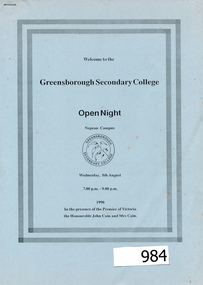
Program, Greensborough Secondary College Open Night 8th August 1990 Gr8750, 08/08/1990
... Greensborough Secondary College Open Night 8th August 1990 Gr8750...Greensborough Secondary College Open Night 8th August 1990 Gr8750 Program Greensborough Secondary College ...1990 marked the amalgamation of Watsonia High School and Watsonia Technical School to form Greensborough Secondary College. This program includes course information and tours of the school. It was attended by the Premier of Victoria John Cain.This marks the first open night at the new Greensborough College Nepean Campus.6 pages, various coloured paper.watsonia high school, watsonia technical school, greensborough college, greensborough secondary college -
 Federation University Historical Collection
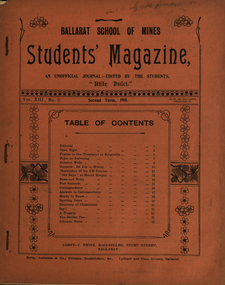
Booklet, Berry, Anderson and Co., Printers, Bookbinders, &c, Ballarat School of Mines, Student Magazine, Second Term, 1910, 1910
... table of contents: editorial, open night, process in ore treatment at kalgoolie, notes on surveying, artesian wells, concrete: its use in mining, description of the i. r. process, "old boys" at mount morgan, news and notes, past students, correspondence, answers to correspondence, handy to know, sporting notes, discovery of chloroform, say!...Table of Contents: Editorial, Open night, Process in ore treatment at Kalgoolie, Notes on surveying, Artesian wells, Concrete: Its use in mining, Description of the I. ...Table of Contents: Editorial, Open night, Process in ore treatment at Kalgoolie, Notes on surveying, Artesian wells, Concrete: Its use in mining, Description of the I. ...Table of Contents: Editorial, Open night, Process in ore treatment at Kalgoolie, Notes on surveying, Artesian wells, Concrete: Its use in mining, Description of the I. R. process, "Old Boys" at Mount Morgan, News and notes, Past students, Correspondence, Answers to correspondence, Handy to know, Sporting notes, Discovery of Chloroform, Say!, A tragedy, The Berdan pan, Editorial notes. Ballarat School of Mines Associates. Images.Booklet of 28 pages.table of contents: editorial, open night, process in ore treatment at kalgoolie, notes on surveying, artesian wells, concrete: its use in mining, description of the i. r. process, "old boys" at mount morgan, news and notes, past students, correspondence, answers to correspondence, handy to know, sporting notes, discovery of chloroform, say!, a tragedy, the berdan pan, editorial notes, images. ballarat school of mines associates., alumni: fred j. martell, m. w. bernewitz, angus a. gibson, r. ingram moore, philpot f. brown, w. avery, e. preddergast, godfrey stephen hart, t. s. hart, l. westcott, a. r. booth, w. t. lakeland, lewis westcott, leo m. seward, w. e. eyres, virgil tucker, h. hawkesworth, h. j. saw, h. meadows, fred g. brinsden, c. stephenson, fred treloar, j. peart, e. m. weston, dick galloway, h. b. bennetts, g. r. curry, h. meadows, will watson, don cameron, eric bieske, cliff garrard, lindsay d. cameron, phil brown, w. p. avery, j. foster, j. bickett, f. h. inglis , g. davenport, l. c. courbould, t. lennon, h. wilkins, g. h. reid, c. hesselmann, e. fraser, reg callister, e. c. hursfield, w. baragwanath, c. c. corrie, r. i. moore, j. l. sampson, h. conran, w. geldard. -
 Melbourne Tram Museum
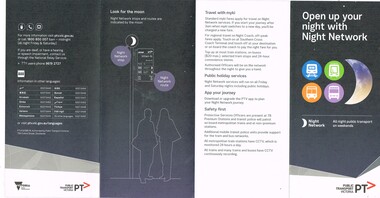
Pamphlet, Public Transport Victoria (PTV), "Open up your night with Night Network", Aug. 2016
... "Open up your night with Night Network"...Pamphlet - 4 fold DL full colour printed on re-cycled paper titled "Open up your night with Night Network", detailing the various routes, train, tram, bus and night coach giving frequencies, where information can be found, stop information and contact details. ...Added 3-1-18. "Open up your night with Night Network" Pamphlet Public Transport Victoria (PTV) ...Pamphlet - 4 fold DL full colour printed on re-cycled paper titled "Open up your night with Night Network", detailing the various routes, train, tram, bus and night coach giving frequencies, where information can be found, stop information and contact details. Published by the Public Transport Victoria August 2016. ditto - 1- fold DL - full colour printed on re-cycled paper - titled "Melbourne's open late and from 1 January 2016 public transport too" - gives details of the one year trial and of services that were to be operated. Added 3-1-18.trams, tramways, night trams, public transport, ptv, buses, railways, all night services -
 Federation University Historical Collection
Book - Book - Scrapbook, Ballarat Institute of Advanced Education: Scrapbook of newspaper cutting. Book 1; December 1968 to August 1969
... ...open night at smb...The cuttings cover the period from 21 December 1968 to 12 August 1969. ballarat institute of advanced education biae metallurgy scholarship awards higher pay for academic staff deep-sea housewife jan watson yendon bluestone for smb building at mt helen hepburn springs camp cricket match government may cut grants quotas a must apex scholarship to christopher dower j m hasker of cement and concrete association concrete course at smb john stevens winner of gold medal master plumbers' association trade students prize night education the answer smb success depends on local support $950000 expasion by smb dr r schrieke barry shearer craftsmen receive awards top swimmers stephen yorke ian ellis apprentices on show open night at smb master builders' awards first equipment at mt helen craftsmanship awards commonwealth must not control education courses in computers motor for trainee mechanics bores under road don skewes invents drill bluestone blocks as terracing at smb boost college intake the lake relay stuart alexander wins award biae commands interest ballarat gas company scholarships smb on eve of new era alan graham r w richards medal art in the sunshine retirements from engineering firm stan sweatman joins biae smb diplomates in many fields $130000 computer at biae learning for living Book with grey cover, front. ...Newspaper cuttings relating to Ballarat Institute of Advanced Education. These are from various newspapers and include The Age, Ballarat Courier, The Australian, The Herald. The cuttings cover the period from 21 December 1968 to 12 August 1969. Book with grey cover, front. Spiral boundballarat institute of advanced education, biae, metallurgy scholarship awards, higher pay for academic staff, deep-sea housewife, jan watson, yendon bluestone for smb, building at mt helen, hepburn springs camp, cricket match, government may cut grants, quotas a must, apex scholarship to christopher dower, j m hasker of cement and concrete association, concrete course at smb, john stevens winner of gold medal, master plumbers' association, trade students prize night, education the answer, smb success depends on local support, $950000 expasion by smb, dr r schrieke, barry shearer, craftsmen receive awards, top swimmers, stephen yorke, ian ellis, apprentices on show, open night at smb, master builders' awards, first equipment at mt helen, craftsmanship awards, commonwealth must not control education, courses in computers, motor for trainee mechanics, bores under road, don skewes invents drill, bluestone blocks as terracing at smb, boost college intake, the lake relay, stuart alexander wins award, biae commands interest, ballarat gas company scholarships, smb on eve of new era, alan graham, r w richards medal, art in the sunshine, retirements from engineering firm, stan sweatman joins biae, smb diplomates in many fields, $130000 computer at biae, learning for living -
Federation University Historical Collection
Magazine, Ballarat School of Mines Students' Magazine, Vol. 12, No. 2., Second Term, 1909, 1909
... ...open night...ballarat school of mines ballarat school of mines students' magazine open night t. adam alfred mica smith h.m. murphy a.e.c. kerr mine ventilation f. howells j.w. gregory search lights on port phillip heads military searchlights ministerial visit a.a. bilson frank tate ponsonby carew-smyth r.t. vale photography albert brun walking engine military traction engine caterpllar no 1. fireless locomotives martin mitchell william geldard nipporium c. corrie william baragwanath a.c. hesselmann Grey soft covered magazine on 17 pages. ...Grey soft covered magazine on 17 pages. Contents include: Mines Ventilation, resistance, photography composition, walking engine, fireless locomotives.ballarat school of mines, ballarat school of mines students' magazine, open night, t. adam, alfred mica smith, h.m. murphy, a.e.c. kerr, mine ventilation, f. howells, j.w. gregory, search lights on port phillip heads, military searchlights, ministerial visit, a.a. bilson, frank tate, ponsonby carew-smyth, r.t. vale, photography, albert brun, walking engine, military traction engine, caterpllar no 1., fireless locomotives, martin mitchell, william geldard, nipporium, c. corrie, william baragwanath, a.c. hesselmann -
 Federation University Historical Collection
Book - Scrapbook, Ballarat School of Mines Scrapbook,1961-1966, 1961-1966
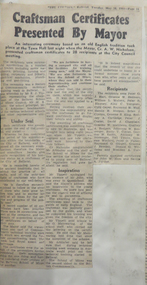
... ballarat school of mines open night...r.w. richards dick richards john gilbert ceramics e.w. doney antarctica city of ballarat craftsmen certificates scrap book ken wach bjts fees register allen bourquin p. collier j. crisp john dulfer fenner, charles gillin, murray gray, thomas j. graham hopwood hunting, f wesley lancaster landells, r. lochhead, j.s. lochhead, james mctaggert, mavis mcvitty henry moritz moritz, henry kathleen rice albert w. steane stevens, don kenneth wach ian g. whitcher noel whitcher a.m (bill) wilkinson harold yates international students asian students richard tan jack tay andrew vu zulkilfie h. abdullah sebastopol technical school foundations charles fenner e. elsbury c. o'toole w. lancaster v. nicholson douglas vendy richards medal william hudson a.j. bethune ballarat school of mines workshops m.y. jamagagni peter agrums thai j. boonsoong h. trudinger kevin whiter brewery chimney murray gillan don stevens bella guerin hester darby retirement rubie lonie cadets f.g. procter retirement albert coates d.e. richardson lydiard st closure geoff brown neville bunning walter reimann robert norton jill norton b. bryan kaspars bitans martin report edith lawn mavis mctaggart retirement richard chong zulkiflie h. abdullah alumni ian whitcher l.f.j. hillman h. elliott hester darby duke of edinburgh philips electrical industries pty ltd lois morris ballarat school of mines banner embroidery craftsman certificate technical training week apprenticeships 3rd university generator j.j. skuja sebastopol technical school pine plantation art students centenary medal bathtub race tippett hall bath tub run metallurgy lydiard street closure honor blazer soil studies rolls royce car engine jon rowe' allan bourquin ruby loney lindsay hillman yates geological centre geoffrey mainwawaring ballarat school of mines renovations ross gray casper bitans apprenticeship training boat race apprenticeship week f.g. proctor mount clear site john jungwirth ballarat school of mines open night wayne johnson j. hanford stevens peter richards r.c. chan mavis mctaggert gladstone procter Newspaper clippings relating to the Ballarat School of Mines and its students. ...Newspaper clippings relating to the Ballarat School of Mines and its students. This also includes the Ballarat Junior Technical School and the Ballarat Girls' Technical School. Selected items * Courier 27 May 1961 - Apprenticeship - Training Today for Tomorrow * Courier 22 February 1922 - Hopes for University Education in 1963 * More Women Graduates Needed * 30 July 1963 - Linking Technical and Liberal Education Streams * Courier 2 November - SMB's New Role in New Syllabus * 23 November 1963 0 New School Diploma courses explained * Courier 31 March 1964 - Artists and art critics: What young people thought of art show. * The Age, 25 March 1965 - Martin Report Urges Extension of High Education * Courier 11 June 1965 - Nuclear Power Won't be Missedr.w. richards, dick richards, john gilbert, ceramics, e.w. doney, antarctica, city of ballarat craftsmen certificates, scrap book, ken wach, bjts fees register, allen bourquin, p. collier, j. crisp, john dulfer, fenner, charles, gillin, murray, gray, thomas, j. graham hopwood, hunting, f, wesley lancaster, landells, r., lochhead, j.s., lochhead, james, mctaggert, mavis, mcvitty, henry moritz, moritz, henry, kathleen rice, albert w. steane, stevens, don, kenneth wach, ian g. whitcher, noel whitcher, a.m (bill) wilkinson, harold yates, international students, asian students, richard tan, jack tay, andrew vu, zulkilfie h. abdullah, sebastopol technical school foundations, charles fenner, e. elsbury, c. o'toole, w. lancaster, v. nicholson, douglas vendy, richards medal, william hudson, a.j. bethune, ballarat school of mines workshops, m.y. jamagagni, peter agrums, thai, j. boonsoong, h. trudinger, kevin whiter, brewery chimney, murray gillan, don stevens, bella guerin, hester darby retirement, rubie lonie, cadets, f.g. procter retirement, albert coates, d.e. richardson, lydiard st closure, geoff brown, neville bunning, walter reimann, robert norton, jill norton, b. bryan, kaspars bitans, martin report, edith lawn, mavis mctaggart retirement, richard chong, zulkiflie h. abdullah, alumni, ian whitcher, l.f.j. hillman, h. elliott, hester darby, duke of edinburgh, philips electrical industries pty ltd, lois morris, ballarat school of mines banner, embroidery, craftsman certificate, technical training week, apprenticeships, 3rd university, generator, j.j. skuja, sebastopol technical school, pine plantation, art students, centenary medal, bathtub race, tippett hall, bath tub run, metallurgy, lydiard street closure, honor blazer, soil studies, rolls royce car engine, jon rowe', allan bourquin, ruby loney, lindsay hillman, yates geological centre, geoffrey mainwawaring, ballarat school of mines renovations, ross gray, casper bitans, apprenticeship training, boat race, apprenticeship week, f.g. proctor, mount clear site, john jungwirth, ballarat school of mines open night, wayne johnson, j. hanford stevens, peter richards, r.c. chan, mavis mctaggert, gladstone procter -
 Federation University Historical Collection
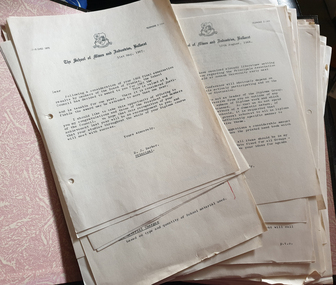
Documents, Ballarat School of Mines General Internal Adminstration, 1966-1967
... ...open night...ballarat school of mines e.j. barker jack barker harold trudinger prize night fees t.g. seymour correspondence graduation ballarat civic hall floor plan e.a. bald royal australian chemical institute open night Correspondence relating to the Ballarat School of Mines. ...Correspondence relating to the Ballarat School of Mines. ballarat school of mines, e.j. barker, jack barker, harold trudinger, prize night, fees, t.g. seymour, correspondence, graduation, ballarat civic hall, floor plan, e.a. bald, royal australian chemical institute, open night -
 Ringwood and District Historical Society
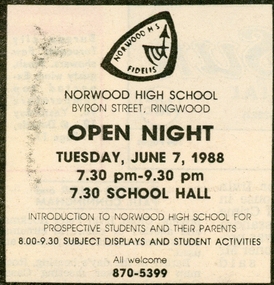
Newspaper - Clipping, Norwood High School, Ringwood, Victoria
... Melbourne Sun newspaper notice of Open Night, Tuesday, June 7, 1988...Melbourne Sun newspaper notice of Open Night, Tuesday, June 7, 1988 Norwood High School, Ringwood, Victoria Newspaper Clipping ...Melbourne Sun newspaper notice of Open Night, Tuesday, June 7, 1988 -
Federation University Historical Collection
Booklet, Ballarat School of Mines, Student Magazine, Second Term, 1910, 1910
... Table of Contents: Editorial, Open Night, Process in Ore Treatment at Kalgoorlie, Notes on Surveying, Artesian Wells, Concrete: Its use in mining, Description of the I. ...Table of Contents: Editorial, Open Night, Process in Ore Treatment at Kalgoorlie, Notes on Surveying, Artesian Wells, Concrete: Its use in mining, Description of the I. ...Table of Contents: Editorial, Open Night, Process in Ore Treatment at Kalgoorlie, Notes on Surveying, Artesian Wells, Concrete: Its use in mining, Description of the I. R. Process, "Old Boys" at Mt Morgan, News and Notes, Past Students, Correspondence, Answers to Correspondents, Handy to Know, Sporting Notes, Discovery of Chloroform, Say!, A Tragedy, The Berdan Pan, Editorial Notes. Orange coloured booklet of 28 pages.ballarat school of mines, students' magazine, king edward vii, m. w. bernewitz, angus a. gibson, r. ingram-moore, philpot f. brown, w. avery, e. prendergast, godfrey stephen hart, t. s. hart, l. westcott, a. r. booth, w. t. lakeland, lewis westcott, leo m. seward, reginald williamson, stanley white, clyde allan, charles laird, w. e. eyres, virgil tucker, h. hawkesworth, h. j. saw, h. meadows, fred g. brinsden, c. stephenson, fred treloar, j. peart, e. m. weston, dick galloway, h. b. bennetts, g. r. curry, will watson, don cameron, eric bieske, cliff garrard, lindsay d. cameron, phil brown, w. p. avery, j. foster, j. bickett, f. h. inglis, g. davenport, l. c. courbould, t. lennon, h. wilkins, g. h. reid, c. hesselmann, e. fraser, e. c. hurdsfield -
Bendigo Historical Society Inc.
Document - YOUNG WOMEN'S CHRISTIAN ASSOCIATION, BENDIGO - WARRIAH CLUB, 1920
... Nov 24-Democracy. Dec 1-Open night. Dec 8-An evening with books. Dec 15-Christmas Party. ...Nov 24-Democracy. Dec 1-Open night. Dec 8-An evening with books. Dec 15-Christmas Party. ...Young Women's Christian Association, Bendigo - Warriah Club. For Girls over 20. Here hath dawned another blue day. Think I wilt thou let it slip useless away? General Secretary: A Louise Burton. Syllabus 1920. June 2-Readings, Members. June 9-Fancywork, Miss Sinclaire. June 16-Lofe in Honolulu, Miss Hunter. June 23-Home Cooking, Miss Leadbeater. June 30-Club 'At Home' to friends. July 7-An evening with Browning, Mrs Finster. July 14-A Cottage Farden, Mr Rumball. June 21-Demonstration of Cookery, Miss Sampson. June 28-How to take care of an invalid. Aug. 4-Personal Beauty. Aug 11-An evening in France, Sister Hunter. Aug 18-How to prepare meals, Miss Wheeler. Aug 25-A Winter Party. Sept 1-Nursing in the Home. Sept 8-How to keep youthful. Sept15-My books. Sept 22-Fancywork,. Sept 29-The teeth, and how to care for them. Oct 6-An evening with the poets. Oct 13-Open night. Oct 20-The Citizen Ideal. Oct 27-Invitation night. Nov 3-Etiquette, Members. Nov-10 China to-day. NovNov 17-How to furnish a home. Nov 24-Democracy. Dec 1-Open night. Dec 8-An evening with books. Dec 15-Christmas Party. The purpose of the Club is to unite girls in; Comradeship, Service, and Self-Development. The Club meets every Wednesday evening at 8pm, and is open to all girls over 20 years who wish to enrol. Presedent: Miss L Johns. Vice President: Miss B Marsh. Secretary: Miss R Sampson. Treasurer: Miss E Robinson.Bolton Bros. Printers. Bendigochurch, ymca warriah club, young women's christian association, bendigo - warriah club -
 Eltham District Historical Society Inc
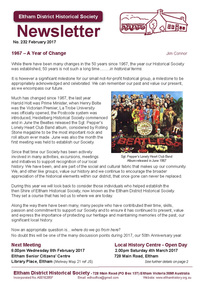
Newsletter, Newsletter, No. 232 February 2017
... Contents: • 1967 - A Year of Change by Jim Connor • Our Next Meeting - Wednesday 8th February (Trivia Night) • Open Day at Our Local History Centre - Saturday 4th March • The Shillinglaw Legacy by Russell Yeoman • Eltham District Historical Society by Jim Connor • Eltham Racecourse by Brian Membrey • The Eltham Report 1856 • 2017 Program • Victorian Collections • ... and also • Contacts for the Eltham District Historical Society ...Contents: • 1967 - A Year of Change by Jim Connor • Our Next Meeting - Wednesday 8th February (Trivia Night) • Open Day at Our Local History Centre - Saturday 4th March • The Shillinglaw Legacy by Russell Yeoman • Eltham District Historical Society by Jim Connor • Eltham Racecourse by Brian Membrey • The Eltham Report 1856 • 2017 Program • Victorian Collections • ... and also • Contacts for the Eltham District Historical Society The Shire of Eltham Historical Society was formed in October 1967. ...Contents: • 1967 - A Year of Change by Jim Connor • Our Next Meeting - Wednesday 8th February (Trivia Night) • Open Day at Our Local History Centre - Saturday 4th March • The Shillinglaw Legacy by Russell Yeoman • Eltham District Historical Society by Jim Connor • Eltham Racecourse by Brian Membrey • The Eltham Report 1856 • 2017 Program • Victorian Collections • ... and also • Contacts for the Eltham District Historical Society The Shire of Eltham Historical Society was formed in October 1967. The first newsletter of the Society was issued May 1978 and has been published continuously ever since on a bi-monthly basis. With the cessation of the Shire of Eltham in late 1994, the Society's name was revised to Eltham District Historical Society and this name first appeared with issue No. 103, July 1995. The collection of the Society's newsletters provides a valuable resource on the history of the Society's activities, office bearers and committee members, guest speakers and subjects of historical interest pertinent to the former Shire of Eltham and the Eltham District.A4 photocopied newsletter distributed to membersnewsletter, eltham district historical society, shire of eltham historical society -
 Ballarat Tramway Museum
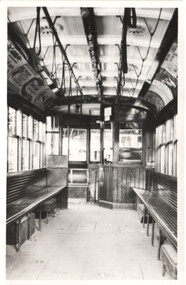
photograph - Black & White - set of 2 - Interior of Birney type trams Bendigo 15 and 29, Keith Kings, 4/1950
... D(i)(4), dated 10/4/1950 2 - Bendigo 29 with tip over seating, the open driver's position and night curtain. Photo - Keith Kings No. ...D(i)(4), dated 10/4/1950 2 - Bendigo 29 with tip over seating, the open driver's position and night curtain. Photo - Keith Kings No. ...Set of two photos of the interiors of two different types of Birney trams in Bendigo. 1 - Bendigo 15, longitudinal seating and the drivers cabin. Also shows the tramway control equipment that was located under the seats. Photo - Keith Kings No. D(i)(4), dated 10/4/1950 2 - Bendigo 29 with tip over seating, the open driver's position and night curtain. Photo - Keith Kings No. D(i)(3), dated 10/4/1950.Yields information about the interior seating arrangments of Birney type tramcars.Set of two black and white photographs of the interior of Bendigo Birney trams.Details the image on the rear of the print in ink.birney tramcars, bendigo, tramcars, interiors, tram 15, tram 29 -
 Kew Historical Society Inc
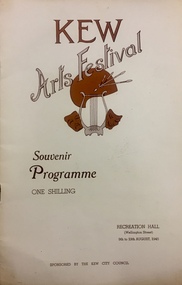
Programme, Kew Arts Festival Committee, Kew Arts Festival, 1945
... The Herald on 10 August described the Festival offerings as: "Varied 10-Day Programme For Kew Arts Festival Opened last night, the Kew Arts Festival in the Recreation Hall, Wellington Street, provides an interesting and varied programme for the next 10 days. ...The Herald on 10 August described the Festival offerings as: "Varied 10-Day Programme For Kew Arts Festival Opened last night, the Kew Arts Festival in the Recreation Hall, Wellington Street, provides an interesting and varied programme for the next 10 days. ...The Herald on 10 August described the Festival offerings as: "Varied 10-Day Programme For Kew Arts Festival Opened last night, the Kew Arts Festival in the Recreation Hall, Wellington Street, provides an interesting and varied programme for the next 10 days. Today at 8.15 p.m. Mr George Bell and Mr Colin Badger will have a public discussion on "What Is Modern Art?" The Vice-chancellor of the Melbourne University of Melbourne (Mr JDG Medley) will preside. Tomorrow at 10.30 a.m. Junior students of the Methodist Ladies College, directed by Dorothy Dwyer. will show how they learn to speak and move on the stage, and will present three short plays. Tomorrow night Elise Steele and Violet Ewart (violin and piano) Beryl Batten (songs) and Edith Parnell (accompanist) will give a concert. Paintings and other works of art will be on show from 2.30 to 5.30 p.m. on Sunday. On Monday night. Mr Colin Badger will speak on "Dead Wood and Green Shoot: Australian Literature Today" and on Tuesday night there will be "Ballet in Story and Action"— the story told by Norman Macgeorge, with Joan Burnett as ballerina and Fred Manners-Sutton at the piano. Wednesday night will have an illustrated lecture "Contemporary Art Education." by John Bechervaise. Remaining nights will be taken up with a performance of Somerset Maugham's "The Circle" presented by the Little Theatre, a youth concert, and another concert with songs and piano. On Saturday morning, August 18, there will be a special concert for young people. The festival will end on Sunday week with a chamber music programme in the afternoon."Important local arts festival initiated during the Second World War and continuing till the early 1950s. The souvenir programmes produced for successive festivals are historically and artistically significant records of visual and performing arts practice in Melbourne during this period.11 page souvenir program for the Kew Arts Festival, held in the Recreation Hall, Wellington Street, Kew from the 9th to the 19th August 1945. The content of the program can be viewed through the image carousel.kew arts festival - 1945, visual arts - kew (vic), performing arts - kew (vic) -
 Flagstaff Hill Maritime Museum and Village
Instrument - Clock
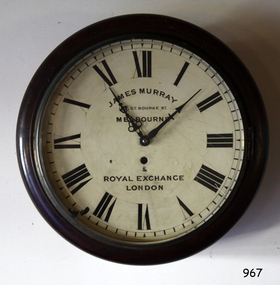
... The Melbourne branch opened on 28th August 1838 in a two-roomed brick cottage on the north side of Little Collins Street, where two huge mastiff dogs were used at night to guard the bank. ...The Melbourne branch opened on 28th August 1838 in a two-roomed brick cottage on the north side of Little Collins Street, where two huge mastiff dogs were used at night to guard the bank. ...This wall clock originated from the Bank of Australasia. The label on the base matches other items from the same donor. It was spring powered by winding the key mechanism with the clock's key through the hole in the clock face. The hinged door on the base of the clock's case allows access to the clock's working mechanism. James Murray (son of James Murray 1780-1847) was a maker of clocks and chronometers. He worked at No. 1, Royal Exchange, London and from 1861 at 107 Great Bourke Street, Melbourne. In 1854 William Kerr ordered a clock from James Murray and erected it on the Albert Street frontage of the National Model & Training School in Spring Street Melbourne. It was Melbourne's first turret clock and remained there for 80 years before it was transferred to the Public Library in Melbourne in 1934 (now Museum Victoria). The Bank of Australasia was incorporated by Royal Charter of England in March 1834. It had its Australian beginning on 14th December 1835, opening in Sydney. The Acting Superintendent of the bank at that time was David Charters McArthur. He was Superintendent from 1867-to 1876. The Melbourne branch opened on 28th August 1838 in a two-roomed brick cottage on the north side of Little Collins Street, where two huge mastiff dogs were used at night to guard the bank. The government also provided an armed military sentinel. Due to the bank's rapid growth, a new building for the Melbourne branch was opened in 1840 at 75 Collins Street West. By 1879 the bank had been upgraded to a magnificent two-storey building on the corners of Collins and Queens Streets, with the entry on Collins Street. In 1951 the Bank of Australasia amalgamated with the Union Bank to form the Australia and New Zealand Bank, now known as the ANZ. Then in 1970, the ANZ merged with both the ES&A and the London Bank of Australia to form the ANZ Banking Group Limited. The ANZ Banking Group Ltd kindly donated a variety of historic items from the Bank of Australasia. BANK of AUSTRALASIA, WARRNAMBOOL – In 1854 Warrnambool had two banks, the Union Bank and the Bank of Australasia. Later, completely different bank businesses opened; in 1867 the National Bank of Australasia, then in 1875 the Colonial Bank of Australasia. The original Warrnambool branch of the Bank of Australasia was established in July 1854, and operated from a leased cottage on Merri Street, close to Liebig Street. The bank next bought a stone building previously erected by drapers Cramond & Dickson on the corner of Timor and Gibson Streets. Samuel Hannaford was a teller and then Manager at the Warrnambool branch from 1855 to 1856 and the Warrnambool Council chose that bank for its dealings during 1856-57. In 1859 Roberts & Co. was awarded the contract to build the new Bank of Australasia branch for the sum of £3,000. The land was on a sand hill on the northeast corner of Timor and Kepler Streets and had been bought in 1855 from investor James Cust. The new building opened on May 21, 1860. The bank continued to operate there until 1951 when it merged with the Union Bank to form the ANZ Bank, which continued operating from its Liebig Street building. Warrnambool City Council purchased the former Bank of Australasia building in 1971 and renovated it, then on 3rd December 1973 it was officially opened as the Art Gallery by Cr. Harold Stephenson and Gallery Director John Welsh. The Gallery transferred to the purpose-built building in Liebig Street in 1986 and the old bank building is now the Gallery club. Staff at the Bank of Australasia in Warrnambool included the following men but others were also involved: Samuel Hannaford, Teller then Manager from 1855-1856; W H Palmer, Manager from January 1857 until November 1869 when the Teller Basil Spence was promoted to Manager; H B Chomley, Manager from April 1873 and still there in 1886; A Butt, Manager in 1895-1904; J R McCleary Accountant and Acting Manager for 12 months, until 1900; A Kirk, Manager 1904; J Moore, staff until his transfer to Bendigo in December 1908; J S Bath was Manager until 1915; C C Cox, Manager until April 1923; Richard C Stanley, Manager 1923 to April 1928. The clock has significance through its association with the Bank of Australasia. The early Australian bank was established in 1834 by Royal Charter and opened in Sydney, Australia, in Sydney in 1835. The bank had many Australian offices in November 1877, particularly on the east and south coasts. Victoria had 45 percent of all Offices. The clock is significant for its connection with the quality clockmaker James Murray, originally from Royal Exchange London with a branch that opened in Melbourne in 1861. James Murray is renown for making the first turret clock to be installed in Melbourne. The clock is locally significant for its association with the Warrnambool Bank of Australasia, which was established in 1854. It was Warrnambool Council’s first bank. The bank continued to operate until the organisation's merger in 1951 when it became the ANZ Bank Group today. The Bank was an integral part of the growth of local commerce and the community.Wall clock with a round face behind glass in a wooden case. The painted brass face has Roman numerals, two decorative hands, divisions for minutes and a keyhole. The curved base of the case has a hinged access door with a keyhole and adhesive label. The back of the clock's case has metal mounting brackets. Inscriptions on the rectangular white label. Made by James Murray, Melbourne.Face: "JAMES MURRAY / - GT. BOURKE ST. / MELBOURNE / & / ROYAL EXCHANGE / LONEON" Label: "A M / 40"flagstaff hill, warrnambool, shipwrecked coast, flagstaff hill maritime museum, maritime museum, shipwreck coast, flagstaff hill maritime village, great ocean road, bank of australasia, boa, union bank, australia & new zealand bank, anz bank, james murray, clock, wall clock, great bourke street melbourne, royal exchange london, william kerr, turret clock, old model school, national model & training school, access door, winding key -
 Flagstaff Hill Maritime Museum and Village
Plaque - Insignia, Bank of Australasia, 16-10-1980
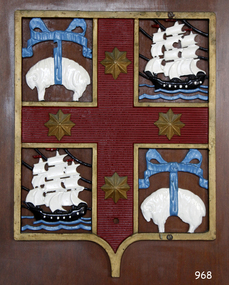
... The Melbourne branch opened on 28th August 1838 in a two-roomed brick cottage on the north side of Little Collins Street, where two huge mastiff dogs were used at night to guard the bank. ...The Melbourne branch opened on 28th August 1838 in a two-roomed brick cottage on the north side of Little Collins Street, where two huge mastiff dogs were used at night to guard the bank. ...This plaque displays the Bank of Australia's Coat of Arms and is significant because is ts the symbol printed on the Bank Notes of the Bank of Australasia. The bank of Australasia was incorporated by Royal Charter of England in March 1834. It had its Australian beginning on 14th December 1835, opening in Sydney. The Acting Superintendent of the bank at that time was David Charters McArthur. He was Superintendent from 1867-to 1876. The Melbourne branch opened on 28th August 1838 in a two-roomed brick cottage on the north side of Little Collins Street, where two huge mastiff dogs were used at night to guard the bank. The government also provided an armed military sentinel. Due to the bank's rapid growth, a new building for the Melbourne branch was opened in 1840 at 75 Collins Street West. By 1879 the bank had been upgraded to a magnificent two-storey building on the corners of Collins and Queens Streets, with the entry on Collins Street. In 1951 the Bank of Australasia amalgamated with the Union Bank to form the Australia and New Zealand Bank, now known as the ANZ. Then in 1970, the ANZ merged with both the ES&A and the London Bank of Australia to form the ANZ Banking Group Limited. The ANZ Banking Group Ltd kindly donated a variety of historic items from the Bank of Australasia. BANK of AUSTRALASIA, WARRNAMBOOL – In 1854 Warrnambool had two banks, the Union Bank and the Bank of Australasia. Later, completely different bank businesses opened; in 1867 the National Bank of Australasia, then in 1875 the Colonial Bank of Australasia. The original Warrnambool branch of the Bank of Australasia was established in July 1854, and operated from a leased cottage on Merri Street, close to Liebig Street. The bank next bought a stone building previously erected by drapers Cramond & Dickson on the corner of Timor and Gibson Streets. Samuel Hannaford was a teller and then Manager at the Warrnambool branch from 1855 to 1856 and the Warrnambool Council chose that bank for its dealings during 1856-57. In 1859 Roberts & Co. was awarded the contract to build the new Bank of Australasia branch for the sum of £3,000; the firm built the Warrnambool Post Office in 1856 and purchased land in Timor Street in 1858. The land was on a sand hill on the northeast corner of Timor and Kepler Streets and had been bought in 1855 from investor James Cust. The new building opened on May 21, 1860. The bank continued to operate there until 1951 when it merged with the Union Bank to form the ANZ Bank, which continued operating from its Liebig Street building. Warrnambool City Council purchased the former Bank of Australasia building in 1971 and renovated it, then on 3rd December 1973 it was officially opened as the Art Gallery by Cr. Harold Stephenson and Gallery Director John Welsh. The Gallery transferred to the purpose-built building in Liebig Street in 1986 and the old bank building is now the Gallery club. Staff at the Bank of Australasia in Warrnambool included the following men but others were also involved: Samuel Hannaford, Teller then Manager from 1855-1856; Hawkins, Manager in 1856, W H Palmer, Manager from January 1857 until November 1869 when the Teller Basil Spence was promoted to Manager; H B Chomley, Manager from April 1873 and still there in 1886; A Butt, Manager in 1895-1904; J R McCleary Accountant and Acting Manager for 12 months, until 1900; A Kirk, Manager 1904; J Moore, staff until his transfer to Bendigo in December 1908; J S Bath was Manager until 1915; C C Cox, Manager until April 1923; Richard C Stanley, Manager 1923 to April 1928. The plaque with the insignia has significance through its association with the Bank of Australasia. The early Australian bank was established in 1834 by Royal Charter and opened in Sydney, Australia, in Sydney in 1835. The bank had many Australian offices in November 1877, particularly on the east and south coasts. Victoria had 45 per cent of all Offices. The plaque is locally significant for its association with the Warrnambool Bank of Australasia, which was established in 1854. It was Warrnambool Council’s first bank. The bank continued to operate until the organisation's merger in 1951 when it became the ANZ Bank Group today. The Bank was an integral part of the growth of local commerce and the community.Insignia of the Bank of Australasia. Cast metal coat of arms within a gold, shield-shaped border, painted gold and red, with blue, black and white details. Decals in each corner; upper left and lower right have a white sheep suspended by a blue ribbon, upper right and lower left have a 3-masted, square-rigged sailing ship with a black hull and red flags flying on each mast, sailing on waves with storm clouds in the sky. Between the emblems are gold stars.Decals; ships, sheep, starsflagstaff hill, warrnambool, shipwrecked coast, flagstaff hill maritime museum, maritime museum, shipwreck coast, flagstaff hill maritime village, great ocean road, bank of australasia, boa, union bank, australia & new zealand bank, anz bank, david charters mcarthur, d c mcarthur, currency, banknote, commerce, banking, heraldic shield, insignia, samuel hannaford -
 Flagstaff Hill Maritime Museum and Village
Plaque - Insignia, Bank of Australasia, 19th Century
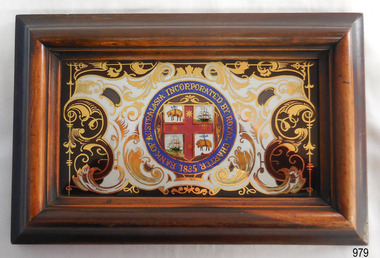
... The Melbourne branch opened on 28th August 1838 in a two-roomed brick cottage on the north side of Little Collins Street, where two huge mastiff dogs were used at night to guard the bank. ...The Melbourne branch opened on 28th August 1838 in a two-roomed brick cottage on the north side of Little Collins Street, where two huge mastiff dogs were used at night to guard the bank. ...This decorative plaque displays the insignia of the Bank of Australasia, which was incorporated by the Royal Charter of England in March 1834. The bank began in Australia on 14th December 1835, opening in Sydney. The Acting Superintendent of the bank at that time was David Charters McArthur. He was Superintendent from 1867-to 1876. The Melbourne branch opened on 28th August 1838 in a two-roomed brick cottage on the north side of Little Collins Street, where two huge mastiff dogs were used at night to guard the bank. The government also provided an armed military sentinel. Due to the bank's rapid growth, a new building for the Melbourne branch was opened in 1840 at 75 Collins Street West. By 1879 the bank had been upgraded to a magnificent two-storey building on the corners of Collins and Queens Streets, with the entry on Collins Street. In 1951 the Bank of Australasia amalgamated with the Union Bank to form the Australia and New Zealand Bank, now known as the ANZ. Then in 1970, the ANZ merged with both the ES&A and the London Bank of Australia to form the ANZ Banking Group Limited. The ANZ Banking Group Ltd kindly donated a variety of historic items from the Bank of Australasia. BANK of AUSTRALASIA, WARRNAMBOOL – In 1854 Warrnambool had two banks, the Union Bank and the Bank of Australasia. Later, completely different bank businesses opened; in 1867 the National Bank of Australasia, then in 1875 the Colonial Bank of Australasia. The original Warrnambool branch of the Bank of Australasia was established in July 1854, and operated from a leased cottage on Merri Street, close to Liebig Street. The bank later bought a stone building previously erected by drapers Cramond & Dickson on the corner of Timor and Gibson Streets. Samuel Hannaford was a teller and then Manager at the Warrnambool branch from 1855 to 1856 and the Warrnambool Council chose that bank for its dealings during 1856-57. In 1859 Roberts & Co. was awarded the contract to build the new Bank of Australasia branch for the sum of £3,000. The land was on a sand hill on the northeast corner of Timor and Kepler Streets and had been bought in 1855 from investor James Cust. The new building opened on May 21, 1860. The bank continued to operate there until 1951 when it merged with the Union Bank to form the ANZ Bank, which continued operating from its Liebig Street building. Warrnambool City Council purchased the former Bank of Australasia building in 1971 and renovated it, then on 3rd December 1973 it was officially opened as the Art Gallery by Cr. Harold Stephenson and Gallery Director John Welsh. The Gallery transferred to the purpose-built building in Liebig Street in 1986 and the old bank building is now the Gallery club. Staff at the Bank of Australasia in Warrnambool included the following men but others were also involved: Samuel Hannaford, Teller then Manager from 1855-1856; W H Palmer, Manager from January 1857 until November 1869 when the Teller Basil Spence was promoted to Manager; H B Chomley, Manager from April 1873 and still there in 1886; A Butt, Manager in 1895-1904; J R McCleary Accountant and Acting Manager for 12 months, until 1900; A Kirk, Manager 1904; J Moore, staff until his transfer to Bendigo in December 1908; J S Bath was Manager until 1915; C C Cox, Manager until April 1923; Richard C Stanley, Manager 1923 to April 1928. The plaque has historical significance as it belonged to the Bank of Australasia which was established in Australia in 1835 by Royal Charter. The plaque is significant for its association with the Bank of Australasia in Warrnambool, the first bank in Warrnambool, established in 1854. The bank continued to operate until its merger in 1951 when it became the ANZ Bank, which is still in operation today. The Bank was an integral part of the establishment and growth of commerce in Colonial Warrnambool and throughout Australia.Plaque with insignia on glass in a rectangular varnished wooden frame. Insignia of the Bank of Australasia has been painted onto the glass in a mirror-like fashion. Insignia depicts a heraldic shield with sheep hung up by their waists and ships in full sail. Inscription on insignia. Stamp and handwritten inscription on the rectangular label with a blue border on the reverse.Insignia: "BANK OF AUSTRALASIA INCORPORATED BY ROYAL CHARTER 1835" Label's red oval stamp with "AUSTRALIA AND NEW ZEALAND BANK UNITED ARCHIVES" Label's handwritten black letters "AM1" flagstaff hill, warrnambool, shipwrecked coast, flagstaff hill maritime museum, maritime museum, shipwreck coast, flagstaff hill maritime village, great ocean road, commerce, banking, plaque, insignia, bank of australasia, insignia on glass, union bank, australia & new zealand bank, anz bank, david charters mcarthur, d c mcarthur, sydney, new south wales, currency, banknote, legal tender -
 Flagstaff Hill Maritime Museum and Village
Currency - Bank exchange note, Perkins, Bacon and Perch, 14-10--1847
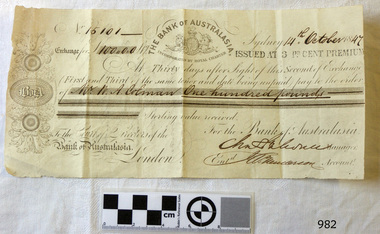
... The Melbourne branch opened on 28th August 1838 in a two-roomed brick cottage on the north side of Little Collins Street, where two huge mastiff dogs were used at night to guard the bank. ...The Melbourne branch opened on 28th August 1838 in a two-roomed brick cottage on the north side of Little Collins Street, where two huge mastiff dogs were used at night to guard the bank. ...This exchange note was issued by the Bank of Australasia to Mr N A Coleman for one hundred pounds paid n 14th October 1847 at the Sydney branch. The interest rate was three per cent. This exchange note displays the insignia of the Bank of Australasia, which was incorporated by Royal Charter of England in March 1834. The bank began in Australia on 14th December 1835, opening in Sydney. The Acting Superintendent of the bank at that time was David Charters McArthur. He was Superintendent from 1867-to 1876. The Melbourne branch opened on 28th August 1838 in a two-roomed brick cottage on the north side of Little Collins Street, where two huge mastiff dogs were used at night to guard the bank. The government also provided an armed military sentinel. Due to the bank's rapid growth, a new building for the Melbourne branch was opened in 1840 at 75 Collins Street West. By 1879 the bank had been upgraded to a magnificent two-storey building on the corners of Collins and Queens Streets, with the entry on Collins Street. In 1951 the Bank of Australasia amalgamated with the Union Bank to form the Australia and New Zealand Bank, now known as the ANZ. Then in 1970, the ANZ merged with both the ES&A and the London Bank of Australia to form the ANZ Banking Group Limited. The ANZ Banking Group Ltd kindly donated a variety of historic items from the Bank of Australasia. BANK of AUSTRALASIA, WARRNAMBOOL – In 1854 Warrnambool had two banks, the Union Bank and the Bank of Australasia. Later, completely different bank businesses opened; in 1867 the National Bank of Australasia, then in 1875 the Colonial Bank of Australasia. The original Warrnambool branch of the Bank of Australasia was established in July 1854, and operated from a leased cottage on Merri Street, close to Liebig Street. The bank next bought a stone building previously erected by drapers Cramond & Dickson on the corner of Timor and Gibson Streets. Samuel Hannaford was a teller and then Manager at the Warrnambool branch from 1855 to 1856 and the Warrnambool Council chose that bank for its dealings during 1856-57. In 1859 Roberts & Co. was awarded the contract to build the new Bank of Australasia branch for the sum of £3,000. The land was on a sand hill on the northeast corner of Timor and Kepler Streets and had been bought in 1855 from investor James Cust. The new building opened on May 21, 1860. The bank continued to operate there until 1951 when it merged with the Union Bank to form the ANZ Bank, which continued operating from its Liebig Street building. Warrnambool City Council purchased the former Bank of Australasia building in 1971 and renovated it, then on 3rd December 1973 it was officially opened as the Art Gallery by Cr. Harold Stephenson and Gallery Director John Welsh. The Gallery transferred to the purpose-built building in Liebig Street in 1986 and the old bank building is now the Gallery club. Staff at the Bank of Australasia in Warrnambool included the following men but others were also involved: Samuel Hannaford, Teller then Manager from 1855-1856; W H Palmer, Manager from January 1857 until November 1869 when the Teller Basil Spence was promoted to Manager; H B Chomley, Manager from April 1873 and still there in 1886; A Butt, Manager in 1895-1904; J R McCleary Accountant and Acting Manager for 12 months, until 1900; A Kirk, Manager 1904; J Moore, staff until his transfer to Bendigo in December 1908; J S Bath was Manager until 1915; C C Cox, Manager until April 1923; Richard C Stanley, Manager 1923 to April 1928. The bank exchange note has significance through its association with the Bank of Australasia. The early Australian bank was established in 1834 by Royal Charter and opened in Sydney, Australia, in Sydney in 1835. The bank had many Australian offices in November 1877, particularly on the east and south coasts. Victoria had 45 percent of all Offices. The object is locally significant for its association with the Warrnambool Bank of Australasia, which was established in 1854. It was Warrnambool Council’s first bank. The bank continued to operate until the organisation's merger in 1951 when it became the ANZ Bank Group today. The Bank was an integral part of the growth of local commerce and the community.Bank exchange note for the Bank of Australasia, Sydney, manufactured by Perkins, Bacon and Perch, printed in brown. Insignia depicts a heraldic shield with a lion and unicorn on either side and another insignia with "B of A". Exchange note paid on 14th October 1847. Issued for one hundred pounds and paid to Mr N A Coleman.. Inscriptions include the document number, the date, the amount paid, the receiving person, signatures and a stamp with the interest rate.Handwritten number "15101" "One hundred pounds" "14th October [18] 47" "Mr N A Coleman" Black stamp "ISSUED AT 3 PR CENT PREMIUM" Signatures of [Manager] and [Accountant].flagstaff hill, warrnambool, shipwrecked-coast, flagstaff-hill, flagstaff-hill-maritime-museum, maritime-museum, shipwreck-coast, flagstaff-hill-maritime-village, banknote, currency, exchange note, commerce, banking, finances, bank of australasia, n a coleman, 1847, shipwrecked coast, flagstaff hill maritime museum, maritime museum, shipwreck coast, flagstaff hill maritime village, great ocean road, boa, union bank, australia & new zealand bank, anz bank, david charters mcarthur, d c mcarthur, sydney, new south wales, legal tender -
 Flagstaff Hill Maritime Museum and Village
Financial record - Passbook, Bank of Australasia, 1880
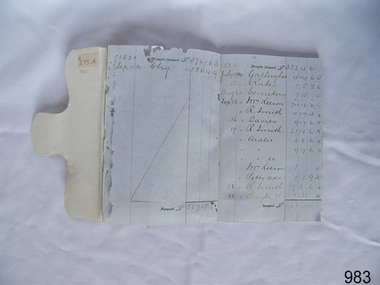
... The Melbourne branch opened on 28th August 1838 in a two-roomed brick cottage on the north side of Little Collins Street, where two huge mastiff dogs were used at night to guard the bank. ...The Melbourne branch opened on 28th August 1838 in a two-roomed brick cottage on the north side of Little Collins Street, where two huge mastiff dogs were used at night to guard the bank. ...This bank passbook originated from the Warrnambool branch of the Bank of Australasia with handwritten entries dating from 1880. Names written in the passbook are likely to be people local to Warrnambool. The book belonged to Thomas Smith and was handed over to his Executors. Thomas Smith operated his Gas Printers Works from Koroit Street, Warrnambool, and was a member of the Odd Fellows. In 1878, his son, aged about 12 years old, was carried across a tightrope forward and backwards, on the shoulders of the "Australian Blondon" Mr. L' Estrange, at a performance in Warrnambool. Royal Charter of England incorporated the Bank of Australasia in March 1834. It had its Australian beginning on 14th December 1835, opening in Sydney. The Acting Superintendent of the bank at that time was David Charters McArthur. He was Superintendent from 1867 to 1876. The Melbourne branch opened on 28th August 1838 in a two-roomed brick cottage on the north side of Little Collins Street, where two huge mastiff dogs were used at night to guard the bank. The government also provided an armed military sentinel. Due to the bank's rapid growth, a new building for the Melbourne branch was opened in 1840 at 75 Collins Street West. By 1879, the bank had been upgraded to a magnificent two-storey building on the corners of Collins and Queens Streets, with the entry on Collins Street. In 1951, the Bank of Australasia amalgamated with the Union Bank to form the Australia and New Zealand Bank, now known as the ANZ. Then in 1970, the ANZ merged with both the ES&A and the London Bank of Australia to form the ANZ Banking Group Limited. The ANZ Banking Group Ltd kindly donated a variety of historic items from the Bank of Australasia. BANK of AUSTRALASIA, WARRNAMBOOL – In 1854, Warrnambool had two banks, the Union Bank and the Bank of Australasia. Later, completely different bank businesses opened; in 1867, the National Bank of Australasia, and then in 1875, the Colonial Bank of Australasia. The original Warrnambool branch of the Bank of Australasia was established in July 1854 and operated from a leased cottage on Merri Street, close to Liebig Street. The bank next bought a stone building previously erected by drapers Cramond & Dickson on the corner of Timor and Gibson Streets. Samuel Hannaford was a teller and then Manager at the Warrnambool branch from 1855 to 1856, and the Warrnambool Council chose that bank for its dealings during 1856-57. In 1859, Roberts & Co. was awarded the contract to build the new Bank of Australasia branch for the sum of £3,000; the firm built the Warrnambool Post Office in 1856 and purchased land in Timor Street in 1858. The land was on a sand hill on the northeast corner of Timor and Kepler Streets and had been bought in 1855 from investor James Cust. The new building opened on May 21, 1860. The bank continued to operate there until 1951, when it merged with the Union Bank to form the ANZ Bank, which continued operating from its Liebig Street building. Warrnambool City Council purchased the former Bank of Australasia building in 1971 and renovated it, then on 3rd December 1973, it was officially opened as the Art Gallery by Cr. Harold Stephenson and Gallery Director John Welsh. The Gallery transferred to the purpose-built building in Liebig Street in 1986, and the old bank building is now the Gallery club. Staff at the Bank of Australasia in Warrnambool included the following men but others were also involved: Samuel Hannaford, Teller then Manager from 1855-1856; Hawkins, Manager in 1856, W H Palmer, Manager from January 1857 until November 1869 when the Teller Basil Spence was promoted to Manager; H B Chomley, Manager from April 1873 and still there in 1886; A Butt, Manager in 1895-1904; J R McCleary Accountant and Acting Manager for 12 months, until 1900; A Kirk, Manager 1904; J Moore, staff until his transfer to Bendigo in December 1908; J S Bath was Manager until 1915; C C Cox, Manager until April 1923; Richard C Stanley, Manager 1923 to April 1928. The bank passbook has significance through its association with the Bank of Australasia. The early Australian bank was established in 1834 by Royal Charter and opened in Sydney, Australia, in Sydney in 1835. The bank had many Australian offices in November 1877, particularly on the east and south coasts. Victoria had 45 per cent of all Offices. The passbook is locally significant for its association with the Warrnambool Bank of Australasia, which was established in 1854. It was Warrnambool Council’s first bank. The bank continued to operate until the organisation's merger in 1951 when it became the ANZ Bank Group today. The Bank was an integral part of the growth of local commerce and the community. It has local significance for its association with commercial Warrnambool in 1880, belonging to Thomas Smith, a prominent businessman with a printing works whose son of about 12 years age crossed a tightrope with the 'Australian Blondin', L' Estrange. Bank passbook, Bank of Australasia, Warrnambool branch. Bound with waxed, cream-coloured cardboard cover and tab closure. Pages have blue horizontal lines and red vertical lines. Black ink handwritten entries, with Date, Name and amount. Inscription was written inside and on a sticker inside the front cover. Passbook is dated 1880 and belonged to Thomas Smith.Marked "The Executors of the late Thomas Smith" "Stamped inside "Bank of Australasia, Warrnambool" Handwritten on sticker " R. 273 A" Sample of handwritten entries include "1880" Callaghan" "Rates" A Linch" "Davies" Bottom of page, balance "529 10 21" [529 pounds 10 shillings 21 pence]flagstaff hill, warrnambool, shipwrecked coast, flagstaff hill maritime museum, maritime museum, shipwreck coast, flagstaff hill maritime village, great ocean road, bank of australasia, boa, union bank, australia & new zealand bank, anz bank, david charters mcarthur, d c mcarthur, bank book, pass book, financial record, commerce, thomas smith, thos. smith, gas printing works, australian blondin, thomas smith's son, tightrope walker, odd fellows, l' estrange, passbook, bank passbook -
 Flagstaff Hill Maritime Museum and Village
Currency - Bank cheque, Sands & McDougall Limited, 03-12-1885
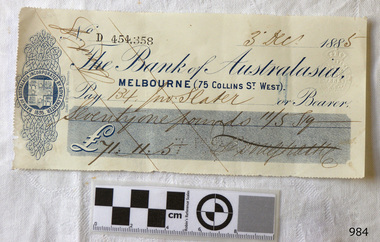
... The Melbourne branch opened on 28th August 1838 in a two-roomed brick cottage on the north side of Little Collins Street, where two huge mastiff dogs were used at night to guard the bank. ...The Melbourne branch opened on 28th August 1838 in a two-roomed brick cottage on the north side of Little Collins Street, where two huge mastiff dogs were used at night to guard the bank. ...This bank cheque originated from the Bank of Australasia, Melbourne branch. It was issued on 3rd December 1885 to a person surnamed Slater for £71.11.5 (seventy-one pounds, eleven shillings and five pence). The parallel lines are called Cheque Crossed and mean that only Slater and no one else could receive the payment and that it would have been paid into Slater's bank account, not exchanged for cash. The embossed dots signify that the cheque amount was also paid to be the bearer of the cheque. Slater would have visited the bank to deposit the money into his or her own account. The cheque was printed by Sands & McDougall, a long-standing Melbourne printing and stationery company. It was then Stamped at the bank with its own unique number before it was issued to the customer. From its previously perforated edges, it is presumed that the cheque was part of a page of cheques, likely to be contained within a book of similar cheques ready for use. The Bank of Australia was incorporated by Royal Charter of England in March 1834. It had its Australian beginnings on 14th December 1835, opening in Sydney. The Acting Superintendent of the bank at that time was David Charters McArthur. He was Superintendent from 1867-to 1876. The Melbourne branch opened on 28th August 1838 in a two-roomed brick cottage on the north side of Little Collins Street, where two huge mastiff dogs were used at night to guard the bank. The government also provided an armed military sentinel. Due to the bank's rapid growth, a new building for the Melbourne branch was opened in 1840 at 75 Collins Street West. By 1879 the bank had been upgraded to a magnificent two-storey building on the corners of Collins and Queens Streets, with the entry on Collins Street. In 1951 the Bank of Australasia amalgamated with the Union Bank to form the Australia and New Zealand Bank, now known as the ANZ. Then in 1970, the ANZ merged with both the ES&A and the London Bank of Australia to form the ANZ Banking Group Limited. The ANZ Banking Group Ltd kindly donated a variety of historic items from the Bank of Australasia. BANK of AUSTRALASIA, WARRNAMBOOL – In 1854 Warrnambool had two banks, the Union Bank and the Bank of Australasia. Later, completely different bank businesses opened; in 1867 the National Bank of Australasia, then in 1875 the Colonial Bank of Australasia. The original Warrnambool branch of the Bank of Australasia was established in July 1854, and operated from a leased cottage on Merri Street, close to Liebig Street. The bank next bought a stone building previously erected by drapers Cramond & Dickson on the corner of Timor and Gibson Streets. Samuel Hannaford was a teller and then Manager at the Warrnambool branch from 1855 to 1856 and the Warrnambool Council chose that bank for its dealings during 1856-57. In 1859 Roberts & Co. was awarded the contract to build the new Bank of Australasia branch for the sum of £3,000. The land was on a sand hill on the northeast corner of Timor and Kepler Streets and had been bought in 1855 from investor James Cust. The new building opened on May 21, 1860. The bank continued to operate there until 1951 when it merged with the Union Bank to form the ANZ Bank, which continued operating from its Liebig Street building. Warrnambool City Council purchased the former Bank of Australasia building in 1971 and renovated it, then on 3rd December 1973 it was officially opened as the Art Gallery by Cr. Harold Stephenson and Gallery Director John Welsh. The Gallery transferred to the purpose-built building in Liebig Street in 1986 and the old bank building is now the Gallery club. Staff at the Bank of Australasia in Warrnambool included the following men but others were also involved: Samuel Hannaford, Teller then Manager from 1855-1856; W H Palmer, Manager from January 1857 until November 1869 when the Teller Basil Spence was promoted to Manager; H B Chomley, Manager from April 1873 and still there in 1886; A Butt, Manager in 1895-1904; J R McCleary Accountant and Acting Manager for 12 months, until 1900; A Kirk, Manager 1904; J Moore, staff until his transfer to Bendigo in December 1908; J S Bath was Manager until 1915; C C Cox, Manager until April 1923; Richard C Stanley, Manager 1923 to April 1928. The bank cheque has significance through its association with the Bank of Australasia. The early Australian bank was established in 1834 by Royal Charter and opened in Sydney, Australia, in Sydney in 1835. The bank had many Australian offices in November 1877, particularly on the east and south coasts. Victoria had 45 percent of all Offices. The bank cheque is significant as an early example of financial management of money and money exchange or transfer.Bank cheque of the Bank of Australasia, Melbourne branch. The rectangular paper has three sides that have been perforated. It is printed in blue with bank's Insignia of a heraldic shield of sheep hung by their waists and ships in full sail. Embossed Stamp Duty mark. Embossed dots. Handwritten black ink details Dated 3rd Dec 1885. Printed in Melbourne by Sands & McDougall. Diagonal parallel lines are across the cheque. Printed: "Bank of Australasia, MELBOURNE (75 COLLINS ST. WEST)." "454,358" "Sands & McDougall, Melbourne" Embossed stamp: Symbol of Crown above double oval lines " - STAMP DUTY" "ONE PENNY" Embossed dots forming test "7 PAID T2" Handwritten: "3rd Dec. [188] 5" "134 - Slater" "Seventy one pounds 11/S 5p" "£71.11.5" Signature: (undecipherable) flagstaff hill, warrnambool, shipwrecked-coast, flagstaff-hill, flagstaff-hill-maritime-museum, maritime-museum, shipwreck-coast, flagstaff-hill-maritime-village, bank cheque, shipwrecked coast, flagstaff hill maritime museum, maritime museum, shipwreck coast, flagstaff hill maritime village, great ocean road, bank of australasia, boa, union bank, australia & new zealand bank, anz bank, bank note, melbourne, slater, sands & mcdougall, chrssed cheque, embossed dots, paid cheque, banknote -
 Flagstaff Hill Maritime Museum and Village
Document - Bank notice, List of Offices, ca Nov. 1877
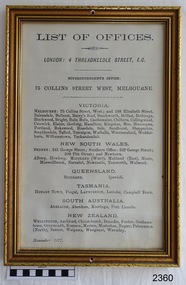
... The Melbourne branch of the Bank of Australasia opened on 28th August 1838 in a two-roomed brick cottage on the north side of Little Collins Street. Two huge mastiff dogs were kept in the backyard and let loose at night to guard the bank. ...The Melbourne branch of the Bank of Australasia opened on 28th August 1838 in a two-roomed brick cottage on the north side of Little Collins Street. Two huge mastiff dogs were kept in the backyard and let loose at night to guard the bank. ...The addresses given on the List for the London and Melbourne offices have connected the document to the Bank of Australasia. The List is dated November 1877 and shows the number and the location of all of the branches of the Bank at that point in time., a total of 77. - Victoria 35, New South Wales 14, Queensland 2, Tasmania 5, South Australia 5, New Zealand 16 Copies of the notice would have been displayed in all branches of the bank in both Australia and New Zealand to inform customers and perhaps impress them too with a large number of locations and the reference to the bank's connection with London. This document gives information on all bank offices throughout Australia and New Zealand. It refers to the Superintendent's Office address at 75 Collins Street West, Melbourne and is dated November 1877. This places the document at the time just before the new Melbourne office opened on the corner of Collins Street and Queen's Street in 1879. The Bank of Australasia was incorporated by Royal Charter of England in March 1834. It came to Australia on 14th December 1835, opening in Sydney. The Acting Superintendent of the Bank of Australasia in Sydney at that time was David Charters McArthur. He was Superintendent from 1867-to 1876. The Melbourne branch of the Bank of Australasia opened on 28th August 1838 in a two-roomed brick cottage on the north side of Little Collins Street. Two huge mastiff dogs were kept in the backyard and let loose at night to guard the bank. The government also provided an armed military sentinel. Due to the bank's rapid growth, a new building for the Melbourne branch was opened in 1840 at 75 Collins Street West. By 1879 the bank had been upgraded to a magnificent two-storey building on the corners of Collins and Queens Streets, with the entry on Collins Street. In 1951 the Bank of Australasia amalgamated with the Union Bank to form the Australia and New Zealand Bank, now known as the ANZ. Then in 1970, the ANZ merged with both the ES&A and the London Bank of Australia to form the ANZ Banking Group Limited. The ANZ Banking Group Ltd kindly donated a variety of historic items from the Bank of Australasia. BANK of AUSTRALASIA, WARRNAMBOOL – In 1854 Warrnambool had two banks, the Union Back and the Bank of Australasia. Later, completely different bank businesses opened; in 1867 the National Bank of Australasia, then in 1875 the Colonial Bank of Australasia. The original Bank of Australasia was established in Warrnambool in July 1854, and operated from a leased cottage on Merri Street, close to Liebig Street. The bank bought a stone building previously erected by drapers Cramond & Dickson on the corner of Timor and Gibson Streets. Samuel Hannaford was a teller and then Manager at the Warrnambool branch from 1855 to 1856. Warrnambool’s Council chose the Bank of Australasia as its bank 1856-57. In 1859 Roberts & Co. was awarded the contract to build the new Bank of Australasia branch for the sum of £3,000. The land was on a sand hill on the northeast corner of Timor and Kepler Streets and had been bought in 1855 from investor James Cust. The new building opened on May 21, 1860. The bank continued to operate there until 1951 when it merged with the Union Bank to form the ANZ Bank, which continued operating from its Liebig Street building. Warrnambool City Council purchased the former Bank of Australasia building in 1971 and renovated it, then on 3rd December 1973 it was officially opened as the Art Gallery by Cr. Harold Stephenson and Gallery Director John Welsh. The Gallery transferred to the purpose-built building in Liebig Street in 1986 and the old bank building is now the Gallery club. The List of Offices of the Bank of Australasia has early Australian historical significance through its association with the Bank, which was established in 1834 by Royal Charter and opened in Sydney, Australia, in Sydney in 1835. The List is significant for showing the number and location of all of the Offices of the Bank of Australia in November 1877. This shows that Victoria had 45 percent of all Offices. The framed document is locally significant for its association with the Bank of Australasia, Warrnambool's first bank, established in 1854. The bank continued to operate until the organisation's merger in 1951. It became the ANZ Bank, which is still in operation today. The Bank was an integral part of the establishment and growth of commerce in Colonial Warrnambool and throughout Australia.Document in a decorative gilt frame. Titled List of Bank Offices and dated November 1877, facsimile. Offices include London, and a variety of offices in Victoria, New South Wales, Queensland, Tasmania, South Australia and New Zealand. Round holes in the centre top and bottom of the frame. Text includes: "LONDON: 4 THREADNEEDLE STREET, E.C." "SUPERINTENDENT'S OFFICE: / 75 COLLINS STREET WEST, MELBOURNE" "Warrnambool" " November 1877" flagstaff hill, warrnambool, bank of australasia 1877, branches of bank of australasia 1877, banks in australia 1877, commerce 1877, shipwreck-coast, document, bank document, flagstaff hill maritime museum & village, bank of australasia, 1877, branches in australia, bank of london, offices in australia, offices in new zealand, commerce, banking, finance, shipwrecked coast, flagstaff hill maritime museum, maritime museum, shipwreck coast, flagstaff hill maritime village, great ocean road, boa, union bank, australia & new zealand bank, anz bank, david charters mcarthur, d c mcarthur, sydney, new south wales, currency, banknote, legal tender, list of bank offices -
 Federation University Historical Collection
Booklet, Collingwood Technical School Prospectus, 1913, 1913
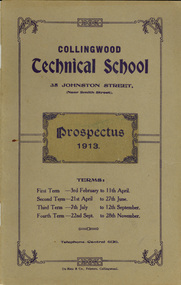
... opened in the modified bluestone buildings at 35 Johnston St, originally built in 1853 as the Collingwood Town Hall and Court House. Within three weeks, there were 57 boys enrolled - studying preliminary carpentry and pattern-making, plumbing, engineering, sheet iron work and bricklaying. They attended two hours a night...opened in the modified bluestone buildings at 35 Johnston St, originally built in 1853 as the Collingwood Town Hall and Court House. Within three weeks, there were 57 boys enrolled - studying preliminary carpentry and pattern-making, plumbing, engineering, sheet iron work and bricklaying. They attended two hours a night ...In the early years of the 20th century adequate technical education was lacking and became a focus in the Victorian Parliament. After much debate and discussion among politicians and educationalists, the 1910 Education Act No 2301 was passed, making possible the establishment of new technical schools to address the dearth of skilled trades people. In July 1912 Collingwood Technical School opened in the modified bluestone buildings at 35 Johnston St, originally built in 1853 as the Collingwood Town Hall and Court House. Within three weeks, there were 57 boys enrolled - studying preliminary carpentry and pattern-making, plumbing, engineering, sheet iron work and bricklaying. They attended two hours a night on three evenings a week. In 1913, the school opened its doors to juniors and took residence in new permanent buildings erected on the site. It was classified as a trades school by the State Education Department. Two years later courses in electrical wiring and electrical and mechanical engineering were introduced. In 1988 Preston College of TAFE and Collingwood College of TAFE merged to become Northern Metropolitan Institute of TAFE (NMIT). (http://victoriancollections.net.au/organisations/northern-melbourne-institute-of-tafe)Brown soft covered booklet of 40 pages. The contents include information relating to the Collingwood Technical School on 1913, including: Council members, constitution, standing orders, aim of the school, scholarships, advice to parents, Railway Fares, tram fares, General Rules to Students, Syllabus, English, Geography, Civics, Mathematics, Elementary Science, Woodwork, |Sheetmetalwork, evening course, carpentry, plumbing, joinery, and a list of students for 1912 Evening courses. collingwood technical school, collingwood, tafe, nmit, northern metropolitan institute of tafe -
 Federation University Historical Collection
Booklet, Collingwood Technical School Prospectus, 1914, 1914
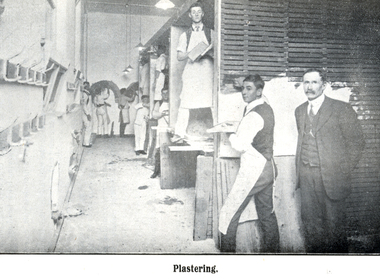
... opened in the modified bluestone buildings at 35 Johnston St, originally built in 1853 as the Collingwood Town Hall and Court House. Within three weeks, there were 57 boys enrolled - studying preliminary carpentry and pattern-making, plumbing, engineering, sheet iron work and bricklaying. They attended two hours a night...opened in the modified bluestone buildings at 35 Johnston St, originally built in 1853 as the Collingwood Town Hall and Court House. Within three weeks, there were 57 boys enrolled - studying preliminary carpentry and pattern-making, plumbing, engineering, sheet iron work and bricklaying. They attended two hours a night ...In the early years of the 20th century adequate technical education was lacking and became a focus in the Victorian Parliament. After much debate and discussion among politicians and educationalists, the 1910 Education Act No 2301 was passed, making possible the establishment of new technical schools to address the dearth of skilled trades people. In July 1912 Collingwood Technical School opened in the modified bluestone buildings at 35 Johnston St, originally built in 1853 as the Collingwood Town Hall and Court House. Within three weeks, there were 57 boys enrolled - studying preliminary carpentry and pattern-making, plumbing, engineering, sheet iron work and bricklaying. They attended two hours a night on three evenings a week. In 1913, the school opened its doors to juniors and took residence in new permanent buildings erected on the site. It was classified as a trades school by the State Education Department. Two years later courses in electrical wiring and electrical and mechanical engineering were introduced. In 1988 Preston College of TAFE and Collingwood College of TAFE merged to become Northern Metropolitan Institute of TAFE (NMIT). (http://victoriancollections.net.au/organisations/northern-melbourne-institute-of-tafe)Red soft covered book of 60 pages. Contents include: List of President, Council and staff, constitution, aim of the school, scholarships, evening classes, advice to parents, Railway fares, tram fares, free travel, general rules for students. syllabus of work, evening work. Images include carpentry class, Bricklaying, plastering and Turning & Fitting classcollingwood technical school, collingwood, tafe, nmit, northern metropolitan institute of tafe, carpentry, bricklaying, plastering, turning and fitting -
 Mission to Seafarers Victoria
Decorative object - Finial, c. 1920
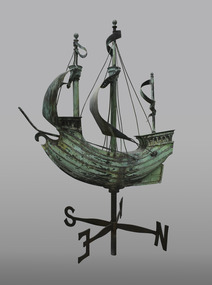
... night of the 6-7 March 2022. Copper price surge sparks rise in theft in Victoria in 2021-22 so it's likely the vane was stolen to be melted This sculpture is closely associated with the 1917 building and described in clippings and annual reports when the building was first newly opened. ...Appearances to the contrary, the item is not a weathervane but a finial. It was the gift of Mr John Sanderson (Jottings Easter 1920), from John Sanderson & Co., wool merchants, stock and station agents, commission and shipping agents before he leaves for England to become senior partner in Sanderson Murray & Elder, London, import and export agents. It was designed by Walter & Richard Butler Architects. (sketch published in Building : the magazine for the architect, builder, property owner and merchant vol.33, no 193, 12 Sept. 1923). The finial was already drawn on the sketch of the Central Institute made by Walter Butler. The maker of the finial, was Henry Alfred George Arnold Saw (born June 1881 in Hotham, Victoria was the son of Edward Saw (1854-1926) a tinsmith and Catherine Barton (1863-1907). He worked as a metal artificer for a metal-working business located opposite the Trades Hall in Lygon Street and was given the job of making the copper ship finial. Henry married Florence Charlotte Reeder and they had four children. Also known as Harry Saw according to his grandson Brian, he died on 9th February 1960. Henry and Florence both died within two months of each other in 1960. It is not clear when the ship was actually installed on the roof, the earliest photograph dating from 1927. The windvane fell or moved several times because of gale forces: - In 1995 : After the funds were raised to repair it, it was treated by sculptor David Hope, and reinstalled in the 1998 (Ship to Shore #3 Sept 1998). - In 2017: Carmela Lonetti from the Grimwade Centre for Cultural Materials Conservation (Ship to Shore Autumn 2017) - In 2019: a generous passerby donated the necessary funds for the conservation. It was sent to Grimwade Centre for Cultural Materials Conservation (Ship to Shore 2019), treated by Evan Tindal (City of Melbourne Magainze Oct. 2020). It was reinstalled over the Summer of 2019-2020 (Ship to Shore Summer 2020). The weathervane was stolen during the night of the 6-7 March 2022. Copper price surge sparks rise in theft in Victoria in 2021-22 so it's likely the vane was stolen to be melted This sculpture is closely associated with the 1917 building and described in clippings and annual reports when the building was first newly opened. It can be seen in some of the earliest photographs of the new building and in the artist/architect Butler's impressions. The galleon is often a decorative design of Mission to Seafarers wind vane (London, Adelaide).Bronze and copper sculpture fashioned as a Wind Vane in the form of a Galleon style sailing ship with 2 pennants flying and two sails rigged atop with lower cross piece with wind directions N S E W . There is a decorative ornamental pierced scrollwork ferrule / finial with reinforcing chrome steel piping armature at base of main support which attaches to the roof or a base support. See also comments below weather vane, wind vane, sculpture, galleon, sailing ship, finial, henry alfred saw, david hope, windvane, weathervane, walter richmond butler (1864–1949), richard butler, john sanderson -
 Blacksmith's Cottage and Forge
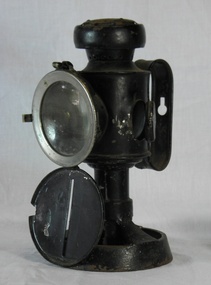
Lamp, 1900 (estimated)
... night. Further research has suggested that this item may have been attached to bicycles for illuminating the way in the blackout. This item is considered rare and important. It is historically and technically siginficant at a national level. world war one military candle artillery europe lamp black artillery siege lamp artillery units candle power aiming lamp wwi 1900 australian war memorial bike light bike bicycle bicycle lamp blackout Painted black metal(tin) candle power, hand held or placed on flat area, open base so candle can be inserted and 'screwed' in, side door for lighting, fron magnifying glass, metal lens cover with vertical slit. ...This item type was used during the First World War throughout Europe. This item is an artillery siege lamp. It was used by artillery units. The lamps were powered by a single candle, the light being magnified by a lens. A shutter closes over the lens to give an illuminated vertical line. They were used originally in fortified siege artillery posititions as a general purpose lamp. They were also used as aiming lamps when they were placed in front of artillery posititions and used as a guide in aiming at night. Further research has suggested that this item may have been attached to bicycles for illuminating the way in the blackout.This item is considered rare and important. It is historically and technically siginficant at a national level. Painted black metal(tin) candle power, hand held or placed on flat area, open base so candle can be inserted and 'screwed' in, side door for lighting, fron magnifying glass, metal lens cover with vertical slit. There is considerable damage to the black paint in the external regions of the lamp.world war one, military, candle, artillery, europe, lamp, black, artillery siege lamp, artillery units, candle power, aiming lamp, wwi, 1900, australian war memorial, bike light, bike, bicycle, bicycle lamp, blackout -
Blacksmith's Cottage and Forge
Bottle, castor oil, Felton Grimwade & Co Pty Ltd
... open. Local. castor oil home remedies constipation purgative laxative friday night routine A.G.M stamped on bottom of bottle. ...Castor oil formed an essential part of the family's medicine chest. It was used principally as a laxative. It was routinely given to children to keep their bowels open.Local.Moulded glass bottle with cork, filled with castor oil. In good condition. Intact.A.G.M stamped on bottom of bottle. Paper label reads 'Castor Oil. Felton Grimwade & Co Pty Ltd. Castor net wt. 8 oz. This packet is charged and will be refunded in full if returned with this label.castor oil home remedies constipation purgative laxative friday night routine -
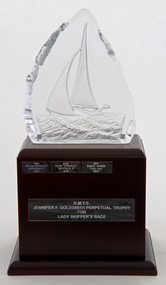 Royal Melbourne Yacht Squadron
Award - Jennifer Goldsmith Perpetual Trophy
... open to any yacht on the RMYS Register. It was first contested on Sunday 17th February 2005, when won by Helen Crossley skippering Mystique II and who retained it the following year. The Perpetual Trophy to be engraved with the Y. V. Performance Handicap winner’s name and presented at the RMYS Presentation Night...open to any yacht on the RMYS Register. It was first contested on Sunday 17th February 2005, when won by Helen Crossley skippering Mystique II and who retained it the following year. The Perpetual Trophy to be engraved with the Y. V. Performance Handicap winner’s name and presented at the RMYS Presentation Night ...A Lady Skippers Event was introduced in the year 2004, the first such event for over forty years. Following the donation of a trophy along with prizes from Swarovski Jewellers for Line Honours Winner and 1st, 2nd and 3rd place getters in the combined Y.V Performance Handicap Divisions, presented annually by the Goldsmith family in memory of Jennifer Goldsmith. The event became known as the Jennifer F. Goldsmith Perpetual and is open to any yacht on the RMYS Register. It was first contested on Sunday 17th February 2005, when won by Helen Crossley skippering Mystique II and who retained it the following year. The Perpetual Trophy to be engraved with the Y. V. Performance Handicap winner’s name and presented at the RMYS Presentation Night. Proceeds from the event are donated by RMYS to melanoma research.A crystal shard 160 mm high with engraved yacht and wave images, mounted on an 140 mm high oblong rosewood block and base bearing winners’ inscription plaques around.RMYS JENNIFER. F. GOLDSMITH PERPETUAL TROPHY FOR LADY SKIPPERS RACEjennifer goldsmith, trophy, perpetual -
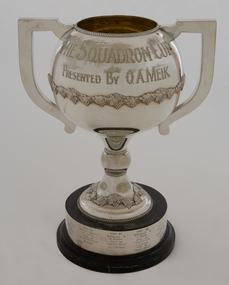 Royal Melbourne Yacht Squadron
Award - The Squadron Cup
... In 2007 the Squadron Cup was confirmed as the prize for the overall winner of YV PH Division 1, 2 and 3, open to all clubs for a long race (70nm plus) with a night component. ...In 2007 the Squadron Cup was confirmed as the prize for the overall winner of YV PH Division 1, 2 and 3, open to all clubs for a long race (70nm plus) with a night component. ...Presented by Commodore Otto A. Meik, September 27, 1971 for a Combined Clubs Round the Bay Race. It was first sailed in the Season 1972 -73 and won by Ricky Laycock in Aquila. Traditionally, this trophy was awarded for the Squadron overnight race held in November each year. In the early 1980’s a decline in the entrants for overnight races forced the shift of the race to a long all- day Around the Bay Race. In November 1990, the race was reinstituted as a Combined Divisions Race, using V.Y.C. handicap system and was won by Ninda – Roger Townley. Prizes are also awarded for winner in C.H.S. and I.M.S. handicaps. In 2007 the Squadron Cup was confirmed as the prize for the overall winner of YV PH Division 1, 2 and 3, open to all clubs for a long race (70nm plus) with a night component. The race was decided on the results from the Big Bay Challenge race from 2007 onwards, won in 2007 by San Miguel – Russell Walton.Spherical shaped bowl 345 mm high to lip edge, with raised grape and leaf decorations around mid-section, flaring down to thick shaped stem, thence out to shaped footing also with raised grape and leaf decorations. Has solid rectangular handles. Shaped lid with raised grape and leaf decorations around edge, surmounted with solid, shaped dome with overall height 100 mm. Bowl stands on 80 mm high, round black base with shaped footing, silver winners inscription band around diameter.THE SQUADRON CUP PRESENTED BY O.A. MEIKsquadron cup, trophy
