
Showing 22 items matching "out-patients department"
-
 St Vincent's Hospital Melbourne Archives
Card - St Vincent's Hospital Out-Patients Department appointment card circa 1950's
... St Vincent's Hospital Out-Patients Department appointment card circa 1950's.......Out-Patients Department...Card St Vincent's Hospital Out-Patients Department appointment card circa 1950's. ...An example of the hospital outpatient's appointment card with the specialist's name and time and the instruction that the card must always be brought with you and must be kept clean. The card specifies the specialist doctor in black capital letters.st vincent's hospital melbourne, out-patients department, vivienne pearce, mr frank morgan -
St Vincent's Hospital Melbourne Archives
Document - Reference for Agnes McLean from surgeon Dr Charles Gordon Shaw regarding her qualities as a nurse in 1928
... Reference regarding Agnes McLeans' significant nursing practice in Wards and Out-Patients Department at St Vincent's Hospital Melbourne. ...Reference regarding Agnes McLeans' significant nursing practice in Wards and Out-Patients Department at St Vincent's Hospital Melbourne. ...Reference regarding Agnes McLeans' significant nursing practice in Wards and Out-Patients Department at St Vincent's Hospital Melbourne. Agnes' long nursing career continued in Melbourne and then in Ballarat. agnes mclean, st vincent's hospital melbourne, dr charles gordon shaw. -
 The Beechworth Burke Museum
Photograph - Lantern Slide, c1900
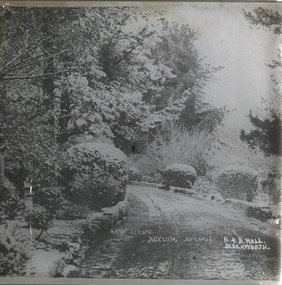
... Department (PWD). The decommissioned Asylum was one of the largest psychiatric hospitals in Victoria and consisted of sixty-seven buildings, one thousand two hundred patients and five hundred staff members. The Asylum was predominately inhabited by long-stay patients but there were active out...Department (PWD). The decommissioned Asylum was one of the largest psychiatric hospitals in Victoria and consisted of sixty-seven buildings, one thousand two hundred patients and five hundred staff members. The Asylum was predominately inhabited by long-stay patients but there were active out ...This glass slide captures the driveway into Mayday Hills Mental Asylum formally known as the Beechworth Lunatic Asylum circa 1900. The slide depicts the driveway lined with an elevated landscape featuring tall trees, shrubbery of different varieties and well shaped bushes. The Mayday Hills Mental Asylum was constructed between 1864 and 1867 to the designs by the Public Works Department (PWD). The decommissioned Asylum was one of the largest psychiatric hospitals in Victoria and consisted of sixty-seven buildings, one thousand two hundred patients and five hundred staff members. The Asylum was predominately inhabited by long-stay patients but there were active out-patients. The Asylum was one of the first asylums to focus on treatment and rehabilitation instead of institutional confinement. At the Asylum, active work was considered imperative and workshops were located near the male accommodations and laundries and drying yards near the female accommodation. The Asylum closed in 1995 and was sold to La Trobe University before being closed and sold again in 2011 to a private owner.This glass slide captures social and historical significance as it represents a one small part of a much larger and pivotal location within Beechworth history. This lantern slide stands testament to a special place in Beechworth’s history and its significance continues to be remembered today.Thin translucent sheet of glass with a square image printed on the front and framed. It is held together by metals strips to secure the edges of the slide.NOW SCENE / ASYLUM AVENUE/ R.P.B. HALL/ BEECHWORTH.burke museum, beechworth, lantern slide, slide, glass slide, plate, burke museum collection, photograph, monochrome, mayday hills -
 Alfred Hospital Nurses League - Nursing History Collection
Functional object - Medical Equipment - proctoscope, unknown
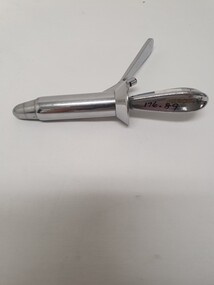
... department for examination of the anus and rectum Of significance to the AHNL as nurses were involved in the preparation of equipment and patient. Medical equipment Proctoscope Medical Procedures made in England stamped on one side of handle of speculum at base, previous catalogue number written in black ink. ward 12 No 6. engraved on other side of handle.' On one face of obturator handle Alfred Hospital is engraved. on second face Wd22/23 is engraved, on third face a letter T is engraved, on the fourth face is a scratched out ...A proctoscope was used in wards/outpatient or emergency department for examination of the anus and rectum Of significance to the AHNL as nurses were involved in the preparation of equipment and patient.Consist of two parts, both made of siler coloured metal. Part one is the speculum, flared at one end and has an angled handle, with a small inlet that connects to the body of the proctoscope. Part two is the obturator, which has an olivary tip, and handle (four sided) connected by narrow rodmade in England stamped on one side of handle of speculum at base, previous catalogue number written in black ink. ward 12 No 6. engraved on other side of handle.' On one face of obturator handle Alfred Hospital is engraved. on second face Wd22/23 is engraved, on third face a letter T is engraved, on the fourth face is a scratched out engraving and the letter T. The old catalogue number is written in permanent black in on this fourth face. medical equipment, proctoscope, medical procedures -
Clunes Museum
Ephemera - TICKET
... MEDICAL TREATMENT HOSPITAL OUTPATIENT PROCEDURE No 8155 Clunes District Hospital ' Outpatients Ticket Available on Tuesday and Friday From 10 to 12 am Out Patients are required to pay not less than (sixpence - crossed out) One shilling at each attendance and to provide their own bottles. This card must be carefully kept and brought each visit. Off white card issued to Outpatients to be used each time they attended the.Outpatient Department ...USED FOR VISITS TO OUTPATIENTS AT ORIGINAL CLUNES HOSPITAL.Off white card issued to Outpatients to be used each time they attended the.Outpatient Department, Printing done in Black. No 8155 Clunes District Hospital ' Outpatients Ticket Available on Tuesday and Friday From 10 to 12 am Out Patients are required to pay not less than (sixpence - crossed out) One shilling at each attendance and to provide their own bottles. This card must be carefully kept and brought each visit.medical treatment, hospital outpatient procedure -
 Royal District Nursing Service (now known as Bolton Clarke)
Photograph - Photograph, black and white, Barry Sutton, 25.03.1974
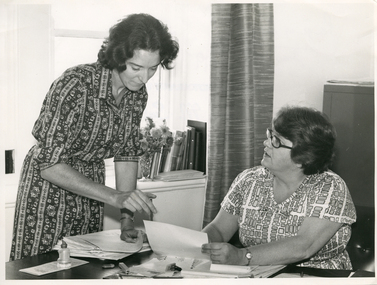
... out a great deal of work with the Society’s Midwifery patients. In 1935 she resigned as she felt the amount of work required needed more than one person. The Society were unable to obtain a replacement due to the shortage of trained Almoners so a Social Service Department was set up and a Social Service Officer, Sister Tupper, was employed at the After-Care Home; she successfully gained better housing from the Housing Commission for families living under unsuitable conditions. ...Ms. J. Caeli is the RDNS Medical Records Librarian and is visiting Ms.Val Douglas, the RDNS Social Worker, in her Office at RDNS Headquarters, 452 St. Kilda Road,Melbourne. Ms. Caeli is giving instruction to Ms. Douglas regarding statistics for Social Work. The Melbourne District Nursing Society (MDNS) were the first in Melbourne, in early 1928, to recognize some patients leaving the MDNS After-Care Home, and many at home, needed further social care. They set up ‘Almoners’ from their Committee to visit these patients and be intermediaries in getting them social assistance. It was late the following year before the first training of Almoners took place in Melbourne. In 1930 the Society employed a full time kindergarten teacher to visit poor children in their homes. In December 1934 the first full-time trained district Almoner, Miss Una Riall, was employed and carried out a great deal of work with the Society’s Midwifery patients. In 1935 she resigned as she felt the amount of work required needed more than one person. The Society were unable to obtain a replacement due to the shortage of trained Almoners so a Social Service Department was set up and a Social Service Officer, Sister Tupper, was employed at the After-Care Home; she successfully gained better housing from the Housing Commission for families living under unsuitable conditions. By 1941 conditions had improved with full employment of breadwinners and Sr. Tupper was appointed the Matron of the District Nursing Division of MDNS. In 1974, now as Royal District Nursing Service (RDNS), it was recognized the Service needed allied health workers and Ms. Val Douglas was employed as the RDNS first Social Worker.On the left of this black and white photograph is Royal District Nursing Service (RDNS), Ms. J. Caeli, who has collar length dark curled hair and is wearing a light and dark patterned and striped shirt style frock. She is standing with her left hand resting on a desk, and looking down at a pen in her right hand which is poised over a sheet of white paper held by Ms Val Douglas who is sitting to her right behind her desk. Ms Douglas is wearing dark rimmed glasses; has short wavy dark hair and is wearing a white with small grey oblong patterned dress. She is looking up at Ms. Caeli and is holding the piece of paper with her left hand. There is a large blotter, sheets of folded papers, a stapler and a small bottle of glue on the desk. In the left background is a low white cupboard with a vase of flowers and books, standing upright, on it. Behind this is white framed window.and an open long dark curtain. In the rear far right is part of a dark grey filing cabinet.Barry Sutton LY 64rdns, royal district nursing service, rdns medical records, rdns librarian, rdns social worker, mdns, melbourne district nursing society, ms j. caeli, ms val douglas -
 Royal District Nursing Service (now known as Bolton Clarke)
Photograph - Photograph, black and white, Barry Sutton, 25.03.1974
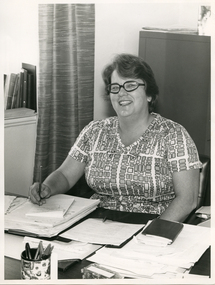
... out a great deal of work with the Society’s Midwifery patients. In 1935 she resigned as she felt the amount of work required needed more than one person. The Society were unable to obtain a replacement due to the shortage of trained Almoners so a Social Service Department was set up and a Social Service Officer, Sister Tupper, was employed at the After-Care Home; she successfully gained better housing from the Housing Commission for families living under unsuitable conditions. ...In 1974 Ms. Val Douglas was appointed as the first Social Worker at RDNS. This photograph is taken in her Office at RDNS Headquarters, 452 St. Kilda Road, Melbourne. Ms Douglas graduated with her Degree of Social Work from the Columbia University in USAThe Melbourne District Nursing Society (MDNS) were the first in Melbourne, in early 1928, to recognize some patients leaving the MDNS After-Care Home, and many at home, needed further social care. They set up ‘Almoners’ from their Committee to visit these patients and be intermediaries in getting them social assistance. It was late the following year before the first training of Almoners took place in Melbourne. In 1930 the Society employed a full time kindergarten teacher to visit poor children in their homes. In December 1934 the first full-time trained district Almoner, Miss Una Riall, was employed and carried out a great deal of work with the Society’s Midwifery patients. In 1935 she resigned as she felt the amount of work required needed more than one person. The Society were unable to obtain a replacement due to the shortage of trained Almoners so a Social Service Department was set up and a Social Service Officer, Sister Tupper, was employed at the After-Care Home; she successfully gained better housing from the Housing Commission for families living under unsuitable conditions. By 1941 conditions had improved with full employment of breadwinners and Sr. Tupper was appointed the Matron of the District Nursing Division of MDNS. In 1974, now as Royal District Nursing Service (RDNS), it was recognized the Service needed allied health workers and Ms. Val Douglas was employed as the RDNS first Social Worker.This black and white photograph shows Royal District Nursing Service (RDNS) Social Worker, Ms. Val Douglas, sitting behind her desk. She has short wavy dark hair; is wearing dark rimmed glasses, and is wearing a V neck, short sleeve, white, which is patterned with small grey oblongs, dress. She is smiling as she looks at the camera. She has a pencil in her right hand which is poised over a quarto sheet of paper which contains writing. A large blotter, clipboard and larger notepad are under this, and other sheets of paper, a notebook, and a receptacle holding several pens also sit on the dark wooden desk. Only a small section of the padded black chair she is sitting on is seen. On the right behind this, is a tall dark grey filing cabinet. On the left is a white shelf with a few books standing vertically on it and behind this part of a window is seen. To its right an open long dark curtain is seen.Barry Sutton LY 65 nameroyal district nursing service, rdns, rdns social worker, ms val douglas -
 Royal District Nursing Service (now known as Bolton Clarke)
Photograph - Photograph, black and white, Barry Sutton, 01.05.1974
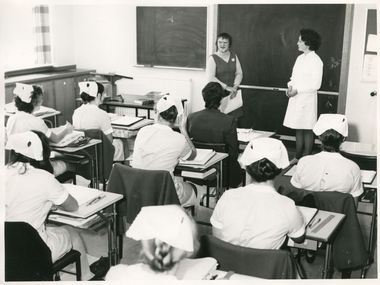
... Department at Western General Hospital. Sr, Nan Deakin is a Nurse Educator with RDNS and is giving a lecture about District Nursing to hospital student nurses before each nurse goes to RDNS Centres. This lecture prepares each nurse before she goes out for a week with an RDNS Sister to visit patients...Department at Western General Hospital. Sr, Nan Deakin is a Nurse Educator with RDNS and is giving a lecture about District Nursing to hospital student nurses before each nurse goes to RDNS Centres. This lecture prepares each nurse before she goes out for a week with an RDNS Sister to visit patients ...This black and white photograph is taken in the Education Department at Western General Hospital. Sr, Nan Deakin is a Nurse Educator with RDNS and is giving a lecture about District Nursing to hospital student nurses before each nurse goes to RDNS Centres. This lecture prepares each nurse before she goes out for a week with an RDNS Sister to visit patients who are receiving nursing care in their home.During their training, Student nurses from several hospitals either attended the Royal District Nursing Service (RDNS), Education Department, or, a RDNS Nurse Educator travelled to the appropriate hospital’s Education Department to educate the Trainees on District nursing through the RDNS Community Nursing Program. Following the lectures Students went to a RDNS Centre and each student accompanied a Trained nurse (Sister) for a week observing and gaining knowledge of all facets of nursing care in the home. This gave them an insight into the home conditions and situations patients faced after discharge from hospital. During 1971 there were 584 Student nurses who received District field experience with RDNS.This black and white photograph shows the back view of three rows of hospital student nurses in their white uniforms and caps, sitting at small tables facing toward, on the left, Royal District Nursing Service (RDNS), Nurse Educator, Sister Nan Deakin, and their hospital Tutor Sister who is wearing her white uniform. The Sisters are standing in front of a large blackboard at the rear of the photograph facing the group. A smaller blackboard is attached to the wall to the left. On the right, the Tutor Sister has short dark curly hair and is standing side-on turned toward Sr. Deakin who is to her left. Sr. Deakin has short dark straight hair; is wearing glasses; and is wearing her RDNS uniform of a light grey skivvie under a darker V neck tunic style frock. She has her hands crossed and is holding sheets of paper in her right hand. There is a dark table to her left with a book and a short collapsible lectern on it. To the left of that is a row of short wooden cupboards and above that an open window with a horizontal striped curtain on the far end. The metal framed tables in front of the nurses have white wooden tops and have books, papers, pens and rulers on them.Barry Sutton MA 75royal district nursing service, rdns, rdns education, western general hospital students, sister nan deakin -
Northern District School of Nursing. Managed by Bendigo Historical Society Inc.
Administrative record - Northern District School of Nursing Graduates Association - Examination Papers, Mar 1976
... departmental leadership, district and visiting nursing, industrial and school nursing, and more. Opportunities existed both within hospitals and in community or specialized settings.FAQs and Practical Details. Minimal training costs (mainly exam fees and personal items).Living out allowances and travel expenses are covered. Four training intakes per year; waiting periods are short if qualifications are met. Nurse Training Lister House examinations Northern District School of Nursing Graduates Association - Examination Papers March 1976 This item contains the following documents: 3794.6a This document is a set of surgical nursing examination questions designed to assess knowledge and practical skills in patient ...The Northern District School of Nursing in Victoria, Australia Graduates Association: History of the School Managed by a committee including hospital administrators, medical professionals, and nursing leaders from several regional hospitals. Associated with major hospitals in the Northern District, including Bendigo Base, Mildura Base, Castlemaine, Echuca, Swan Hill, St. Arnaud, and Kyneton District Hospitals. Provide high-quality theoretical and practical nursing training. Raise the standard of nursing education in the region. Maintain the highest principles of nursing practice. Applicants must be at least 17 years old and hold a Proficiency Certificate or higher educational qualification. Application involves submitting forms, certificates, an interview, an aptitude test, and a medical examination. A three-month probationary period follows initial acceptance. Preliminary Training School: Four-week introductory course covering basic nursing, anatomy, hygiene, and practical skills. Practical experience in various hospital departments, guided by senior staff. Study Block Plan: Includes several blocks of theoretical and practical instruction throughout the three-year program. Regular school exams and two state exams (First Professional and Final State) are required for progression and graduation. Nurses work a 40-hour week with at least one or two days off per week and three weeks of annual leave. Accommodation is provided in comfortable hostels with good facilities. Uniforms are supplied free; nurses provide their own shoes and stockings. Salaries and allowances are regulated, with deductions for board and free medical care. Additional Information Post-Graduate Opportunities. Senior positions require further experience and additional certificates (e.g., Midwifery, Infant Welfare).Diploma courses available in administration, teaching, and specialized nursing fields. Bursaries are available for advanced study.Career Prospects: Graduates can pursue roles in administration, teaching, ward and departmental leadership, district and visiting nursing, industrial and school nursing, and more. Opportunities existed both within hospitals and in community or specialized settings.FAQs and Practical Details. Minimal training costs (mainly exam fees and personal items).Living out allowances and travel expenses are covered. Four training intakes per year; waiting periods are short if qualifications are met.Northern District School of Nursing Graduates Association - Examination Papers March 1976 This item contains the following documents: 3794.6a This document is a set of surgical nursing examination questions designed to assess knowledge and practical skills in patient care, treatment, and management across various clinical scenarios 3794.6b This nursing examination paper covers essential topics in medical nursing, focusing on assessment, diagnosis, and management of key conditions.nurse training, lister house, examinations -
Northern District School of Nursing. Managed by Bendigo Historical Society Inc.
Administrative record - Northern District School of Nursing Graduates Association - Examinations and Instruction Guides, June 1977
... departmental leadership, district and visiting nursing, industrial and school nursing, and more. Opportunities existed both within hospitals and in community or specialized settings.FAQs and Practical Details. Minimal training costs (mainly exam fees and personal items).Living out allowances and travel expenses are covered. Four training intakes per year; waiting periods are short if qualifications are met. Nurse Training Lister House examinations Northern District School of Nursing Graduates Association - Examinations and Instruction Guides June 1977 This item contains the following documents: 3794.13a This document is a surgical nursing examination paper covering essential topics in patient ...The Northern District School of Nursing in Victoria, Australia Graduates Association: History of the School Managed by a committee including hospital administrators, medical professionals, and nursing leaders from several regional hospitals. Associated with major hospitals in the Northern District, including Bendigo Base, Mildura Base, Castlemaine, Echuca, Swan Hill, St. Arnaud, and Kyneton District Hospitals. Provide high-quality theoretical and practical nursing training. Raise the standard of nursing education in the region. Maintain the highest principles of nursing practice. Applicants must be at least 17 years old and hold a Proficiency Certificate or higher educational qualification. Application involves submitting forms, certificates, an interview, an aptitude test, and a medical examination. A three-month probationary period follows initial acceptance. Preliminary Training School: Four-week introductory course covering basic nursing, anatomy, hygiene, and practical skills. Practical experience in various hospital departments, guided by senior staff. Study Block Plan: Includes several blocks of theoretical and practical instruction throughout the three-year program. Regular school exams and two state exams (First Professional and Final State) are required for progression and graduation. Nurses work a 40-hour week with at least one or two days off per week and three weeks of annual leave. Accommodation is provided in comfortable hostels with good facilities. Uniforms are supplied free; nurses provide their own shoes and stockings. Salaries and allowances are regulated, with deductions for board and free medical care. Additional Information Post-Graduate Opportunities. Senior positions require further experience and additional certificates (e.g., Midwifery, Infant Welfare).Diploma courses available in administration, teaching, and specialized nursing fields. Bursaries are available for advanced study.Career Prospects: Graduates can pursue roles in administration, teaching, ward and departmental leadership, district and visiting nursing, industrial and school nursing, and more. Opportunities existed both within hospitals and in community or specialized settings.FAQs and Practical Details. Minimal training costs (mainly exam fees and personal items).Living out allowances and travel expenses are covered. Four training intakes per year; waiting periods are short if qualifications are met.Northern District School of Nursing Graduates Association - Examinations and Instruction Guides June 1977 This item contains the following documents: 3794.13a This document is a surgical nursing examination paper covering essential topics in patient care, surgical procedures, and nursing responsibilities. 3794.13b Copy of Above 3794.13c This examiner's report provides feedback on nurses' performance in their final surgical nursing examination, highlighting strengths and areas needing improvementnurse training, lister house, examinations -
Northern District School of Nursing. Managed by Bendigo Historical Society Inc.
Administrative record - Northern District School of Nursing Graduates Association - Examinations and Guides, 1982
... departmental leadership, district and visiting nursing, industrial and school nursing, and more. Opportunities existed both within hospitals and in community or specialized settings.FAQs and Practical Details. Minimal training costs (mainly exam fees and personal items).Living out allowances and travel expenses are covered. Four training intakes per year; waiting periods are short if qualifications are met. Nurse Training Lister House examinations Northern District School of Nursing Graduates Association - Examinations and Guides 1982 This item contains the following documents: 3795.8a This document is a surgical nursing examination paper for general nurses, focusing on essential knowledge and practical skills required for patient ...The Northern District School of Nursing in Victoria, Australia Graduates Association: History of the School Managed by a committee including hospital administrators, medical professionals, and nursing leaders from several regional hospitals. Associated with major hospitals in the Northern District, including Bendigo Base, Mildura Base, Castlemaine, Echuca, Swan Hill, St. Arnaud, and Kyneton District Hospitals. Provide high-quality theoretical and practical nursing training. Raise the standard of nursing education in the region. Maintain the highest principles of nursing practice. Applicants must be at least 17 years old and hold a Proficiency Certificate or higher educational qualification. Application involves submitting forms, certificates, an interview, an aptitude test, and a medical examination. A three-month probationary period follows initial acceptance. Preliminary Training School: Four-week introductory course covering basic nursing, anatomy, hygiene, and practical skills. Practical experience in various hospital departments, guided by senior staff. Study Block Plan: Includes several blocks of theoretical and practical instruction throughout the three-year program. Regular school exams and two state exams (First Professional and Final State) are required for progression and graduation. Nurses work a 40-hour week with at least one or two days off per week and three weeks of annual leave. Accommodation is provided in comfortable hostels with good facilities. Uniforms are supplied free; nurses provide their own shoes and stockings. Salaries and allowances are regulated, with deductions for board and free medical care. Additional Information Post-Graduate Opportunities. Senior positions require further experience and additional certificates (e.g., Midwifery, Infant Welfare).Diploma courses available in administration, teaching, and specialized nursing fields. Bursaries are available for advanced study.Career Prospects: Graduates can pursue roles in administration, teaching, ward and departmental leadership, district and visiting nursing, industrial and school nursing, and more. Opportunities existed both within hospitals and in community or specialized settings.FAQs and Practical Details. Minimal training costs (mainly exam fees and personal items).Living out allowances and travel expenses are covered. Four training intakes per year; waiting periods are short if qualifications are met.Northern District School of Nursing Graduates Association - Examinations and Guides 1982 This item contains the following documents: 3795.8a This document is a surgical nursing examination paper for general nurses, focusing on essential knowledge and practical skills required for patient care in surgical settings. 3795.8b This document is a registration examination paper for general nurses, focusing on medical nursing topics. 3795.8c This document is an examiner's guide for the Victorian Nursing Council's registration examination, outlining essential knowledge and procedures for general nurses in medical and surgical nursing. 3795.8d This document is a Victorian Nursing Council registration examination paper from December 1982, focused on surgical nursing. 3795.8e This document is a surgical nursing examination paper for general nurses, focusing on key areas of patient care, complications, and procedures related to surgery and postoperative management.nurse training, lister house, examinations -
Northern District School of Nursing. Managed by Bendigo Historical Society Inc.
Administrative record - Northern District School of Nursing Graduates Association - Examinations and Guides, 1988
... departmental leadership, district and visiting nursing, industrial and school nursing, and more. Opportunities existed both within hospitals and in community or specialized settings.FAQs and Practical Details. Minimal training costs (mainly exam fees and personal items).Living out allowances and travel expenses are covered. Four training intakes per year; waiting periods are short if qualifications are met. Nurse Training Lister House examinations Northern District School of Nursing Graduates Association - Examinations and Guides 1988 This item contains the following documents: 3795.13a This document is a surgical nursing examination paper covering essential topics in patient ...The Northern District School of Nursing in Victoria, Australia Graduates Association: History of the School Managed by a committee including hospital administrators, medical professionals, and nursing leaders from several regional hospitals. Associated with major hospitals in the Northern District, including Bendigo Base, Mildura Base, Castlemaine, Echuca, Swan Hill, St. Arnaud, and Kyneton District Hospitals. Provide high-quality theoretical and practical nursing training. Raise the standard of nursing education in the region. Maintain the highest principles of nursing practice. Applicants must be at least 17 years old and hold a Proficiency Certificate or higher educational qualification. Application involves submitting forms, certificates, an interview, an aptitude test, and a medical examination. A three-month probationary period follows initial acceptance. Preliminary Training School: Four-week introductory course covering basic nursing, anatomy, hygiene, and practical skills. Practical experience in various hospital departments, guided by senior staff. Study Block Plan: Includes several blocks of theoretical and practical instruction throughout the three-year program. Regular school exams and two state exams (First Professional and Final State) are required for progression and graduation. Nurses work a 40-hour week with at least one or two days off per week and three weeks of annual leave. Accommodation is provided in comfortable hostels with good facilities. Uniforms are supplied free; nurses provide their own shoes and stockings. Salaries and allowances are regulated, with deductions for board and free medical care. Additional Information Post-Graduate Opportunities. Senior positions require further experience and additional certificates (e.g., Midwifery, Infant Welfare).Diploma courses available in administration, teaching, and specialized nursing fields. Bursaries are available for advanced study.Career Prospects: Graduates can pursue roles in administration, teaching, ward and departmental leadership, district and visiting nursing, industrial and school nursing, and more. Opportunities existed both within hospitals and in community or specialized settings.FAQs and Practical Details. Minimal training costs (mainly exam fees and personal items).Living out allowances and travel expenses are covered. Four training intakes per year; waiting periods are short if qualifications are met.Northern District School of Nursing Graduates Association - Examinations and Guides 1988 This item contains the following documents: 3795.13a This document is a surgical nursing examination paper covering essential topics in patient care and postoperative management. 3795.13b This document is a set of surgical nursing examination questions covering key topics relevant to nursing practice. nurse training, lister house, examinations -
 Royal District Nursing Service (now known as Bolton Clarke)
Photograph - Photograph, black and white:, 1952
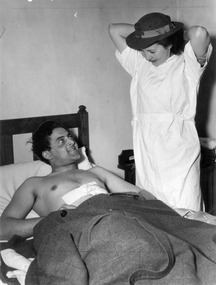
... department developed programs, such as the Wound Specialist program, and the Leg Ulcer Management Program, to provide their Trained nurses (Sisters) with methods of best quality care. The Sisters liaised with the patient’s Doctors and hospitals to provide information on the progress of patient’s wounds and to receive any change of wound care from the Doctors. When RDNS introduced Wound Care Specialists they carried out ...The photograph is taken in Mr. Spartel's home in St. Kilda. The MDNS uniform worn under her white gown was a dark grey cotton frock with a belt. The grey stiffened and brimmed felt hat had a light grey hatband with a red Maltese cross attached in the centre. Sister J. Faust is about to redress a wound on Mr. Spartel's abdomen. The photograph is a record of wound care being given by MDNS trained nurses in a patients home during the 1950s. This photograph appeared along with an article in The Sun newspaper Oct 17 1952.The Trained nurses (Nurses) of the Melbourne District Nursing Society (MDNS), from its inception in 1885, provided wound care to their patients, who ranged in age from the very young to the elderly. As research developed better products and dressing materials, the methods and medication applied to wounds changed. MDNS received Royal patronage in 1966 and as Royal District Nursing Service (RDNS), the Education department developed programs, such as the Wound Specialist program, and the Leg Ulcer Management Program, to provide their Trained nurses (Sisters) with methods of best quality care. The Sisters liaised with the patient’s Doctors and hospitals to provide information on the progress of patient’s wounds and to receive any change of wound care from the Doctors. When RDNS introduced Wound Care Specialists they carried out assessments and provided advice and support to the District Sisters working in the field. On the left of the black and white photograph is Mr. George Spartel, who has dark short curly hair and is lying on his bed. His shoulders and head are resting on the white pillow with his head against the wooden slatted backrest of his bed. His torso is bare and part of a white wound dressing can be seen on his upper abdominal area. A dark grey covering is over the lower portion of his body. He is smiling and looking up at Sister J. Faust from Melbourne District Nursing Society (MDNS) who is standing to the right of his bed.Sister Faust, who has dark curled hair, has her arms raised behind her neck as she reaches the ties on the white gown she is wearing over her uniform. She is wearing her grey brimmed uniform hat. Behind her is a wooden table, with a dark coloured radio on its right, and a jug with a doily over it, on the right.mdns, melbourne district nursing society (1885-1957), nurses, mdns uniforms, rdns, royal district nursing service, rdns wound care, mr george spartel, sister j. faust -
 Royal District Nursing Service (now known as Bolton Clarke)
Photograph - Digital image, 1937
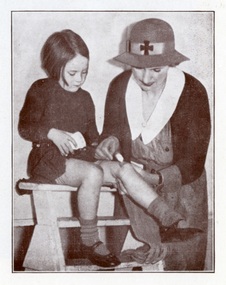
... out by the District Sisters of the Melbourne District Nursing Society (MDNS) in a home in the suburbs of Melbourne. The Trained nurses (Nurses) of the Melbourne District Nursing Society (MDNS), from its inception in 1885, provided wound care to their patients who ranged in age from the very young to the elderly. As research developed better products and dressing materials, the methods and medication applied to wounds changed. MDNS received Royal patronage in 1966 and as Royal District Nursing Service (RDNS), the Education department ...This digital image appeared in the MDNS 1937 Annual Report and depicts one of the aspects of nursing care carried out by the District Sisters of the Melbourne District Nursing Society (MDNS) in a home in the suburbs of Melbourne.The Trained nurses (Nurses) of the Melbourne District Nursing Society (MDNS), from its inception in 1885, provided wound care to their patients who ranged in age from the very young to the elderly. As research developed better products and dressing materials, the methods and medication applied to wounds changed. MDNS received Royal patronage in 1966 and as Royal District Nursing Service (RDNS), the Education department developed wound care programs, such as the Leg Ulcer Management Program to provide their Trained nurses (Sisters) with methods of best quality care. They instructed RDNS Wound Care Specialists who made assessments and provided advice and support to the District Sisters working in the field as needed. The Sisters liaised with the patient’s Doctors and Hospitals to provide information on the progress of patient’s wounds and to receive any change of wound care from the Doctors. On the left of this black and white digital image is a little girl who is sitting on the top step of a wooden stool which is against a light coloured wall. The little girl has short dark straight hair; is wearing a dark jumper and skirt and is holding a light coloured bandage in her right hand. Her long grey socks are pushed down and she is wearing black sandals. Her right leg is bent and her foot is resting on the lower step. Her left leg is extended and she is looking down at a Melbourne District Nursing Society (MDNS) Sister who is on her right, as she is swabbing a wound on the girls left knee. The Sister is wearing her uniform dark cardigan over her grey dress which has a white collar, and her grey brimmed hat, with central Maltese cross on the hatband, is worn over her short hair. She is looking down at the child's wound and in her right hand she has a pair of forceps holding a white swab against the wound on the girl's knee. Her left hand is under, and supporting, the girl's knee.mdns uniform, melbourne district nursing society, rdns, royal district nursing service, mdns wound care -
 Royal District Nursing Service (now known as Bolton Clarke)
Photograph - Photograph, black and white, c.1980
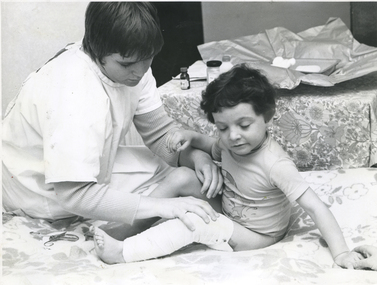
... patients, who ranged in age from the very young to the elderly. As research developed better products and dressing materials the methods and medication applied to wounds changed. MDNS received Royal patronage in 1966 and as Royal District Nursing Service (RDNS), the Education department developed programs, such as Wound Care Programs, to provide their Trained nurses (Sisters)) with methods of best quality care. The Sisters liaised with the patient’s Doctors and hospitals to provide information on the progress of patient’s wounds and to receive any change of wound care from the Doctors. RDNS introduced Wound Care Specialists who carried out ...This photograph shows one of the aspects of nursing care given by Royal District Nursing Service (RDNS), Sisters who worked in the community. The Sister attending had received instructions for care of this toddler's wound from a Doctor. The Sister is using a dressing tray which was sterilized at the RDNS centre. At the time of this photograph many hospitals provided wound dressings for their patients when they returned home. If not attached to a hospital, the family bought their own dressings, though the Sister carried spare dressings in their cases if needed at the time of their visit. The Trained nurses of the Melbourne District Nursing Society (MDNS), from its inception in 1885, provided wound care to their patients, who ranged in age from the very young to the elderly. As research developed better products and dressing materials the methods and medication applied to wounds changed. MDNS received Royal patronage in 1966 and as Royal District Nursing Service (RDNS), the Education department developed programs, such as Wound Care Programs, to provide their Trained nurses (Sisters)) with methods of best quality care. The Sisters liaised with the patient’s Doctors and hospitals to provide information on the progress of patient’s wounds and to receive any change of wound care from the Doctors. RDNS introduced Wound Care Specialists who carried out assessments and provided advice and support to the District Sisters working in the field. Black and white photograph showing a Royal District Nursing Service (RDNS) Sister, who has sort dark hair and is wearing a short sleeved white gown over her uniform; the sleeves of her grey uniform skivvie are seen. She is sitting side-on with her left hand resting on the right leg of a seated dark curly haired toddler; her right hand is on a bandage which is from ankle to thigh on the left leg of the toddler. The toddler is wearing a T-shirt with a pattern on the front, and is sitting on a floral cover in a room in her home. At the rear of the photograph a floral covered table is seen with an open dressing tray on a sterile drape; a small jar and bottle are seen on the table. rdns, royal district nursing service, mdns, melbourne district nursing society, rdns wound care -
 Royal District Nursing Service (now known as Bolton Clarke)
Photograph - Photograph, black and white, c.1980
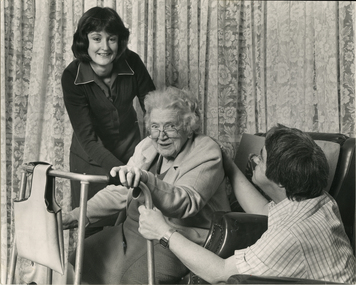
... Following this Pilot study, Home Health Aides were employed by RDNS, and after instruction in the RDNS Education department, joined RDNS Centres and worked under the supervision of the RDNS Trained nurses (Sisters). The Sister assessed each patient, then introduced and supervised the Health Aide in the patient procedure required. The Sister wrote out ...An RDNS Sister had previously visited Mrs. Crook in her home and assessed the nursing care she required. Following the Sister's instructions, the Home Health Aide in this photograph, Robin Brown, is assisting Mrs. Crook from her lounge chair onto her walking frame. Mrs. Crook's son, Robert is also assisting his mother. Home Health Aides were employed and trained by Royal District Nursing Service (RDNS) from 1980. They wore a RDNS royal blue uniform, which has a white trim and RDNS badge applied to the left hand side, and a dark blue cardigan. In 1980, a Home Health Aide ‘Pilot study’, funded by the Federal Government, the Brotherhood of St. Laurence and RDNS, with the program written and taught by RDNS Principal Nurse Educator. Pat (Paddy) Rowley, was evaluated as successful. Following this Pilot study, Home Health Aides were employed by RDNS, and after instruction in the RDNS Education department, joined RDNS Centres and worked under the supervision of the RDNS Trained nurses (Sisters). The Sister assessed each patient, then introduced and supervised the Health Aide in the patient procedure required. The Sister wrote out clear, concise procedural instructions on a work card which the Health Aide followed each visit. If the Health Aide noticed any change in the patient’s condition, this was reported immediately and the Sister visited. The Sister made routine visits to the patient for review at least monthly. On the left of this black and white photograph is Royal District Nursing Service, Home Health Aide, Robin Brown, who has dark shoulder length hair and is wearing a dark cardigan over her dark coloured uniform which has white piping at the edge. To her right is Mrs. Crook who is sitting froward in her lounge chair. A walking frame, which has a material bag hanging from the front bar, is in front of her. Robin Brown has her left hand on Mrs Crook's back and her right hand under her arm. Mrs. Crook has curly white hair; is wearing glasses which are resting partly down her nose, and is wearing a light coloured cardigan over her dark dress. Part of a necklace of pearls can be seen hanging over her dress. She is smiling and looking at the camera. She has her right hand on the upper part of the right wing of the walking frame and her left hand is on the top hand grip section on the left wing of the frame. To her right, her son, Robert, who is squatted down by the chair, has short dark hair and is wearing a checked shirt. He is holding the left wing of the walking frame with his left hand and his right arm is extended with his hand on his mother's back. Closed floral curtains are seen in the rear of the photograph.Photographer's stamprdns, royal district nursing service, home health aide, home health aide uniform, patient care, mrs crook, mr robert crook, home health aide robin brown -
 Royal District Nursing Service (now known as Bolton Clarke)
Photograph - Photograph, black and white, 1982
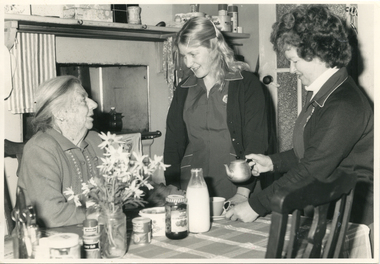
... Following this Pilot study, Home Health Aides were employed by RDNS, and after instruction in the RDNS Education department, joined RDNS Centres and worked under the supervision of the RDNS Registered Nurses, (Sisters). The Sister assessed each patient, then introduced and supervised the Health Aide in the procedure required. The Sister wrote out ...This photograph is taken in Mrs Mann's home in the Melbourne suburb of Surrey Hills. The RDNS uniform worn by the Health Aides was a Royal blue dress with white piping on the collar and pockets worn under a dark blue cardigan. The RDNS Health Aides are visiting Mrs. Mann to administer nursing care which the RDNS Sister who attended Mrs. Mann had assessed and then demonstrated to them. Specific instruction.were written for the Health Aides to follow and the RDNS Sister did regular supervisory visits.In 1980, a Home Health Aide Pilot study, funded by the Federal Government, the Brotherhood of St. Laurence and RDNS, with the program written and taught by RDNS Principal Nurse Educator. Pat (Paddy) Rowley was evaluated as successful. Following this Pilot study, Home Health Aides were employed by RDNS, and after instruction in the RDNS Education department, joined RDNS Centres and worked under the supervision of the RDNS Registered Nurses, (Sisters). The Sister assessed each patient, then introduced and supervised the Health Aide in the procedure required. The Sister wrote out clear, concise procedural instructions on a work card which the Health Aid followed each visit. If the Health Aide noticed any change in the client’s condition, this was reported immediately and the Sister visited. The Sister made routine visits to the client for review at least monthly. This black and white photograph shows, on the left hand side, Mrs. Gertrude Mann sitting at the table in the kitchen of her home. She has her grey hair drawn back and has a string of beads over her grey buttoned cardigan Standing to her right are two Royal District Nursing Service (RDNS), Home Health Aides. The closest is Miss Penny Goodwill who has long blonde hair, and far right,is Mrs Dorothy Byrne who has short curly dark hair. The Health Aides are wearing dark coloured dresses with white piping on the collars and pockets, Part of a white RDNS insignia can be seen beneath their dark coloured cardigans. . A check tablecloth is covering the table, and a bottle of milk, some jars, and a vase of flowers adorn it. The mantelpiece and part of a tiled fireplace containing a stove is in the background. Part of an open door is to the right rear. The top of a wooden slatted chair is seen in the right hand side foreground.Hand written names and information on back of photographroyal district nursing service, rdns, rdns home health aides, rdns education, mrs gertrude mann, home health aide dorothy byrne, home health aide penny goodwill -
 Royal District Nursing Service (now known as Bolton Clarke)
Photograph - Photograph, black and white, 1982
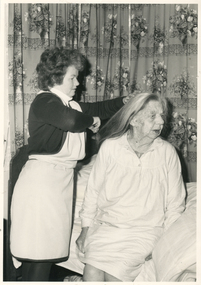
... department, joined RDNS Centres and worked under the supervision of the RDNS Sisters. The Sister assessed each client, then introduced and supervised the Health Aide in the client procedure required. The Sister wrote out clear, concise procedural instructions on a work card which the Health Aid followed each visit. If the Health Aide noticed any change in the patient’s ...RDNS Home Health Aide, Dorothy Byrne, is visiting Mrs. Mann in her home and is assisting her with General care which enables her to remain there independently. Dorothy is wearing an RDNS light blue, with dark blue edging, apron over her RDNS Home Health Aide uniform of a royal blue dress with white piping on the collar and pockets. In 1980, a Home Health Aide ‘Pilot study’, funded by the Federal Government, the Brotherhood of St. Laurence and RDNS, with the program written and taught by RDNS Principal Nurse Educator. Pat (Paddy) Rowley was evaluated as successful. Following this Pilot study, Home Health Aides were employed by RDNS, and after instruction in the RDNS Education department, joined RDNS Centres and worked under the supervision of the RDNS Sisters. The Sister assessed each client, then introduced and supervised the Health Aide in the client procedure required. The Sister wrote out clear, concise procedural instructions on a work card which the Health Aid followed each visit. If the Health Aide noticed any change in the patient’s condition, this was reported immediately and the Sister visited. The Sister made routine visits to the patient for review at least monthly. On the left of the black and white photograph is the side on view of Royal District Nursing Service (RDNS), Home Health Aide, Dorothy Byrne, brushing the long grey hair of Mrs. Gertrude Mann who is on Dorothy's right. Dorothy, who has short curly hair, is wearing a light coloured apron over her RDNS uniform; part of a white skivvie under her dark dress can be seen; she has her left hand on the top section of Mrs. Mann's head. Dorothy's right hand is holding a brush and is at the bottom section of Mrs. Mann's hair. Mrs Mann is wearing a white nightdress and is sitting on the left hand side of her bed with her face turned away from Dorothy.. Long,closed flower patterned curtains can be seen in the background.royal district nursing service, rdns, rdns home health aides, rdns patient care, rdns home health aide dorothy byrne, mrs gertrude mann -
 Musculoskeletal Health Australia (now held by the Glen Eira Historical Society)
Photograph - Portrait, Peter Bruhn, 03/1978
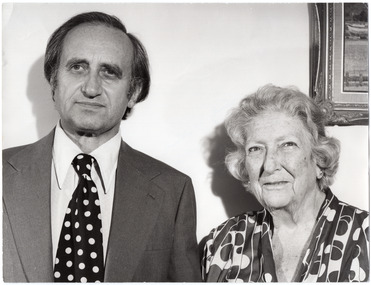
... patients, Mollie Riches (1896-1979). This photo of Dr Koadlow and Mollie Riches appears on page 11 of the Vol. 9, July 1978 edition of RAAV's quarterly newsletter, News Review. It is captioned, "Vision Becomes Reality. Co-founders, Dr Les Koadlow and Mrs Mollie Riches, together again at RAAV's new Action Centre in the grounds of Royal Talbot, where the idea for RAAV was born." The photo accompanies an article titled, "LINCOLN INSTITUTE HELPS OUT". The article states that RAAV approaced the Lincoln Centre's Department...patients, Mollie Riches (1896-1979). This photo of Dr Koadlow and Mollie Riches appears on page 11 of the Vol. 9, July 1978 edition of RAAV's quarterly newsletter, News Review. It is captioned, "Vision Becomes Reality. Co-founders, Dr Les Koadlow and Mrs Mollie Riches, together again at RAAV's new Action Centre in the grounds of Royal Talbot, where the idea for RAAV was born." The photo accompanies an article titled, "LINCOLN INSTITUTE HELPS OUT". The article states that RAAV approaced the Lincoln Centre's Department ...Dr Leslie Koadlow AO (1920-2006), Rheumatologist, was the Medical Director of the Royal Talbot Rehabilitation Hospital. In 1968, he co-founded the Rheumatism and Arthritis Association of Victoria (RAAV) with his secretary, Alice Petty, and one of his patients, Mollie Riches (1896-1979). This photo of Dr Koadlow and Mollie Riches appears on page 11 of the Vol. 9, July 1978 edition of RAAV's quarterly newsletter, News Review. It is captioned, "Vision Becomes Reality. Co-founders, Dr Les Koadlow and Mrs Mollie Riches, together again at RAAV's new Action Centre in the grounds of Royal Talbot, where the idea for RAAV was born." The photo accompanies an article titled, "LINCOLN INSTITUTE HELPS OUT". The article states that RAAV approaced the Lincoln Centre's Department of Educational Resources to enlist the services of their photographers to take a photo of Dr Koadlow for a press release. A cropped version of the photo also appears (with other photos) on the front cover of the Vol 19 Issue 2, Winter 2006 edition of Update. The photos accompany an obituary for Dr Leslie Koadlow AM (1920-2006).B&W portrait of two people standing side by side. The man is wearing a suit and shirt, and a dark tie with polka dots. The woman is wearing a dress or shirt with a bold geometric pattern.[on photo, in pencil] Dr Leslie Koadlow Mollie Riches [on photo, in blue ink] Courtesy of Lincoln Institute 10/5/78dr leslie koadlow, rheumatologist, mollie riches, founders, co-founders, rheumatism and arthritis association of victoria, raav, royal talbot rehabilitation hospital, action house, action centre, news review, lincoln institute, lincoln institute of health sciences, update, 1978 -
 The Beechworth Burke Museum
Photograph, About 1880
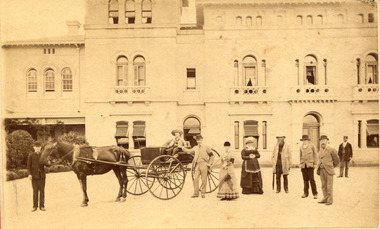
... Department (PWD) is the Beechworth Lunatic Asylum which was renamed Mayday Hills Mental Asylum. The decommissioned asylum was one of the largest psychiatric hospitals in Victoria and consisted of sixty-seven buildings, one thousand two hundred patients and five hundred staff members. The asylum was predominately inhabited by long-stay patients but there were active out...Department (PWD) is the Beechworth Lunatic Asylum which was renamed Mayday Hills Mental Asylum. The decommissioned asylum was one of the largest psychiatric hospitals in Victoria and consisted of sixty-seven buildings, one thousand two hundred patients and five hundred staff members. The asylum was predominately inhabited by long-stay patients but there were active out ...Taken about 1880, this photograph depicts nine people and a horse-drawn carriage in front of the Administration building of Beechworth Mental Asylum. Constructed between 1864 and 1867 to the designs by the Public Works Department (PWD) is the Beechworth Lunatic Asylum which was renamed Mayday Hills Mental Asylum. The decommissioned asylum was one of the largest psychiatric hospitals in Victoria and consisted of sixty-seven buildings, one thousand two hundred patients and five hundred staff members. The asylum was predominately inhabited by long-stay patients but there were active out-patients. The asylum was one of the first asylums to focus on treatment and rehabilitation instead of institutional confinement. At the asylum, active work was considered imperative and workshops were located near the male accommodations and laundries and drying yards near the female accommodation. The asylum closed in 1995 and was sold to La Trobe University before being closed and sold again in 2011 to a private owner. This photograph is historically significant as it shows one of the main buildings of the Beechworth Mental Asylum that was pivotal in changing the approaches to treating the mentally ill.Sepia rectangular photograph printed on matte photographic paper mounted on card.Reverse: 1997.2458/ Front view/ Beechworth/ about 1880/ Lunatic Asylum/ administration building, mayday hills, beechworth, beechworth lunatic asylum, beechworth mental asylum, horse drawn carriage, mayday hills mental hospital, beechworth lunatic asylum administration building, psychiatric hospitals -
 The Beechworth Burke Museum
Photograph, circa 1870
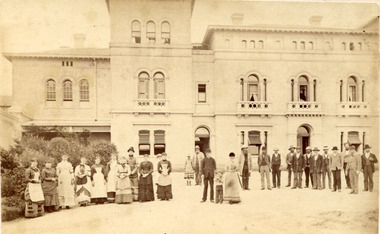
... Department (PWD) is the Beechworth Lunatic Asylum that was renamed Mayday Hills. The decommissioned asylum was one of the largest psychiatric hospitals in Victoria and consisted of sixty-seven buildings, one thousand two hundred patients and five hundred staff members. The asylum was predominately inhabited by long-stay patients but there was active out...Department (PWD) is the Beechworth Lunatic Asylum that was renamed Mayday Hills. The decommissioned asylum was one of the largest psychiatric hospitals in Victoria and consisted of sixty-seven buildings, one thousand two hundred patients and five hundred staff members. The asylum was predominately inhabited by long-stay patients but there was active out ...Taken circa 1870, depicting twenty-eight staff members divided by gender standing in front of the Beechworth mental asylum. Constructed between 1864 and 1867 to the designs by the Public Works Department (PWD) is the Beechworth Lunatic Asylum that was renamed Mayday Hills. The decommissioned asylum was one of the largest psychiatric hospitals in Victoria and consisted of sixty-seven buildings, one thousand two hundred patients and five hundred staff members. The asylum was predominately inhabited by long-stay patients but there was active out-patients. The asylum was one of the first asylums to focus on treatment and rehabilitation instead of institutional confinement. At the asylum active works was considered imperative and workshops were located near the male accommodations and laundries and drying yards near the female accommodation. The asylum closed in 1995 and was sold to La Trobe University before being closed and sold again in 2011 to a private owner. This photograph is historically significant as it provides insight into the importance of Beechworth mental asylum as the asylum demonstrates the changing approaches to the treatment of mental illness in Victoria from confinement to treatment and rehabilitation. Sepia rectangular photograph printed on matte photographic paper mounted on card Reverse: 1997.2489/ Beechworthbeechworth, mental asylum, beechworth mental asylum, mental asylum administration building, mayday hills, mayday hills mental asylum, beechworth lunatic asylum -
 Peter MacCallum Cancer Centre
Archive - Board Report, Report of the Proceedings of the Cancer Institute Board, 1957-1959, 30 June 1959
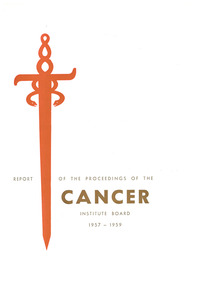
... Housing Out-patients, Medical Physics, Diagnostics X-ray Departments and Ward accommodation. - Doctors Ralston and Edith Paterson visited in November 1957, providing advice for further improvements. - April 1958, Beginning of Post Graduate Training in Radiotherapeutic Nursing. ...Developments since the previous report included: - Acquisition of second 4MeV Linear Accelerator and resulting purchase of the Pervious Ansett ANA building in William St. - Main Kitchen redevelopment. - Forster Block completed June 1959. Housing Out-patients, Medical Physics, Diagnostics X-ray Departments and Ward accommodation. - Doctors Ralston and Edith Paterson visited in November 1957, providing advice for further improvements. - April 1958, Beginning of Post Graduate Training in Radiotherapeutic Nursing.Developments since the previous report included: - Acquisition of second 4MeV Linear Accelerator and resulting purchase of the Pervious Ansett ANA building in William St. - Main Kitchen redevelopment. - Forster Block completed June 1959. Housing Out-patients, Medical Physics, Diagnostics X-ray Departments and Ward accommodation. - Doctors Ralston and Edith Paterson visited in November 1957, providing advice for further improvements. - April 1958, Beginning of Post Graduate Training in Radiotherapeutic Nursing.
