
Showing 255 items matching "period clothing."
-
 Canterbury History Group
Photograph - Maling Road Shopkeepers, 1/10/1984 12:00:00 AM
... Maling Road shopkeepers dressed in period clothing, October 1984 Black and white photograph...Canterbury Maling Road Shopkeepers Vintage Cars Maling Road shopkeepers dressed in period clothing, October 1984 Black and white photograph Photograph Maling Road Shopkeepers ...Maling Road shopkeepers dressed in period clothing, October 1984 Black and white photographcanterbury, maling road, shopkeepers, vintage cars -
 Bendigo Historical Society Inc.
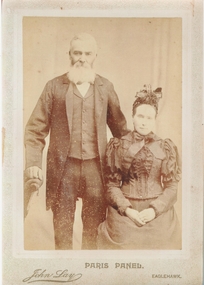
Photograph - Thomas and Eliza Harvey, McKenzie Family Collection, August 2024
... ...period clothing...This was a small cluster of Cornish miners homes in Eaglehawk. history period clothing Photographer's stamp John Lay Eaglehawk, Paris Panel Copy of posed studio photograph of Thomas and Eliza Harvey. ...Thomas Harvey (16/8/1842-30/6/1912) was born in Cornwall. He married Eliza Williams (23/3/1841-12/7/1923) on 6/12/1865. The lived in Clarke Street, Harveyville. This was a small cluster of Cornish miners homes in Eaglehawk.Copy of posed studio photograph of Thomas and Eliza Harvey. Photographer's stamp John Lay Eaglehawk, Paris Panelhistory, period clothing -
 Buninyong & District Historical Society
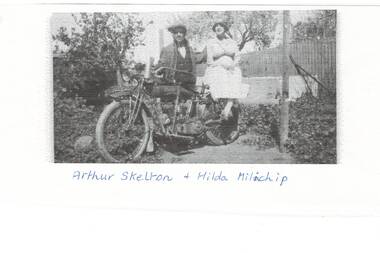
Photograph - Black and white photograph of Arthur Skelton and Hilda Milichip at Scotsburn, circa 1920, Arthur Skelton and Hilda Milichip on a motor bike, circa 1920
... ...Period clothing....Possibly British made V twin. Period clothing. Good for a laser copy. Arthur Skelton and Hilda Milichip on a motor bike, circa 1920. ...Of local interest due to location and people.Good for a laser copy.local identities., 1920's motor bike., possibly british made v twin., period clothing. -
 Buninyong & District Historical Society
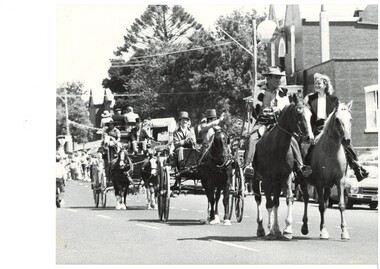
Photograph - Buninyong Festival procession 1983
... Riders and drivers in period clothing....Riders and drivers in period clothing. Warrenheip Street. Good condition for an enlarged black and white print. ...One of a series of photographs taken during the 1983 procession.Good condition for an enlarged black and white print.celebrations, festival procession., horse drawn transport., riders and drivers in period clothing., warrenheip street. -
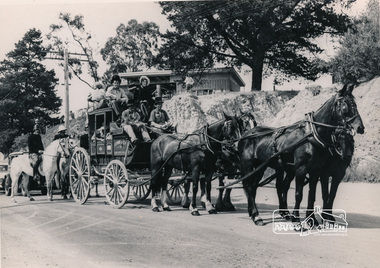 Eltham District Historical Society Inc
Photograph, Cobb and Co. Coach and horses, ERSILAC Parade, c.1960
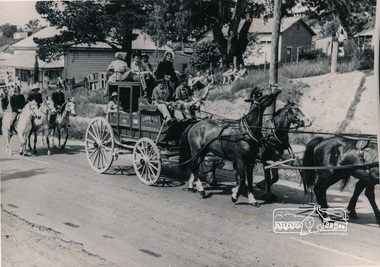
... Black and white photograph featuring a Cobb and Co coach drawn by four horses with a full complement of passengers in period clothing. Taken near the corner of Main Road and Bridge Street. ...Near the corner of Main Road and Bridge Street cobb and co Bridge Street ersilac parade Horse drawn carriage Main Road Black and white photograph featuring a Cobb and Co coach drawn by four horses with a full complement of passengers in period clothing. Taken near the corner of Main Road and Bridge Street. ...Near the corner of Main Road and Bridge StreetBlack and white photograph featuring a Cobb and Co coach drawn by four horses with a full complement of passengers in period clothing. Taken near the corner of Main Road and Bridge Street. Part of a procession/parade.cobb and co, bridge street, ersilac parade, horse drawn carriage, main road -
 Eltham District Historical Society Inc
Photograph, Cobb and Co. Coach and horses, ERSILAC Parade, c.1960
... Black and white photograph featuring a Cobb and Co coach drawn by four horses with a full complement of passengers in period clothing. Taken near the old bakehouse at the corner of Main Road and York Street. ...cobb and co bakery main road york street parade procession ersilac parade Horse drawn carriage Black and white photograph featuring a Cobb and Co coach drawn by four horses with a full complement of passengers in period clothing. Taken near the old bakehouse at the corner of Main Road and York Street. ...Black and white photograph featuring a Cobb and Co coach drawn by four horses with a full complement of passengers in period clothing. Taken near the old bakehouse at the corner of Main Road and York Street. Part of a procession/parade.cobb and co, bakery, main road, york street, parade, procession, ersilac parade, horse drawn carriage -
Clunes Museum
Book, HUTCHINSON & CO. (PUBLISHERS) LTD, WREATH FOR ARABELLA
... BLACK HARDCOVER BOOK, 349 PAGES WITH THE COVER PASSTED ONTO THE BACK OF THE BOOK, BLACK AND WHITE IMAGE OF A LADY DRESSED IN PERIOD CLOTHING, GREEN AND WHITE IMAGE OF A ROSE ON THE LEFT HAND SIDE OF THE COVER AND A GREEN AND WHITE THISTLE ON THE RIGHT HAND SIDE OF THE COVER....BOOK WAS IN WYNETTE LENDING LIBRARY, KEW AND THEN IN LES DAVIS'S CLUNES LIBRARY, WHICH WAS IN A ROOM BEHIND THE BARBER SHOP IN FRASER STREET. books novel books - novel WREATH FOR ARABELLA BIOGRAPHICAL NOVEL IN A STUDY OF LADY ARABELLA STUART, FIRST COUSIN TO JAMES 1, NEAR KINSWOMAN OF QUEEN ELIZABETH INSIDE COVER: RED STAMPED WYNETTE LENDING LIBRARY 106 DENMARK STREET KEW BLACK STAMPED LES DAVIS CLUNES LIBRARY 565 AND 289 BLACK HARDCOVER BOOK, 349 PAGES WITH THE COVER PASSTED ONTO THE BACK OF THE BOOK, BLACK AND WHITE IMAGE OF A LADY DRESSED IN PERIOD CLOTHING, GREEN AND WHITE IMAGE OF A ROSE ON THE LEFT HAND SIDE OF THE COVER AND A GREEN AND WHITE THISTLE ON THE RIGHT HAND SIDE OF THE COVER. ...BIOGRAPHICAL NOVEL IN A STUDY OF LADY ARABELLA STUART, FIRST COUSIN TO JAMES 1, NEAR KINSWOMAN OF QUEEN ELIZABETHBLACK HARDCOVER BOOK, 349 PAGES WITH THE COVER PASSTED ONTO THE BACK OF THE BOOK, BLACK AND WHITE IMAGE OF A LADY DRESSED IN PERIOD CLOTHING, GREEN AND WHITE IMAGE OF A ROSE ON THE LEFT HAND SIDE OF THE COVER AND A GREEN AND WHITE THISTLE ON THE RIGHT HAND SIDE OF THE COVER.non-fictionBIOGRAPHICAL NOVEL IN A STUDY OF LADY ARABELLA STUART, FIRST COUSIN TO JAMES 1, NEAR KINSWOMAN OF QUEEN ELIZABETH books, novel, books - novel, wreath for arabella -
 Bendigo Historical Society Inc.
Photograph - PETER ELLIS COLLECTION: DANCING
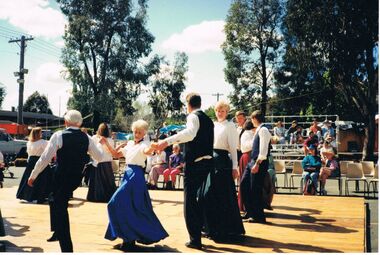
... People dancing on wooden stage. Period style clothing. Back of photo reads:12/1...People dancing on wooden stage. Period style clothing. Back of photo reads:12/1 Photograph PETER ELLIS COLLECTION: DANCING ...Colour photograph. People dancing on wooden stage. Period style clothing. Back of photo reads:12/1entertainment, dance, bush dance -
 Eltham District Historical Society Inc
Photograph, Cobb and Co. Coach and horses, ERSILAC Parade, c.1960
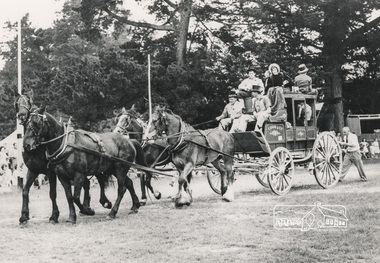
... Featuring a Cobb and Co coach drawn by four horses with a full complement of passengers in period clothing. Taken on a sports oval....Featuring a Cobb and Co coach drawn by four horses with a full complement of passengers in period clothing. Taken on a sports oval. cobb and co bakery main road york street parade horse and cart procession ersilac parade Black and white photograph Cobb and Co. ...Featuring a Cobb and Co coach drawn by four horses with a full complement of passengers in period clothing. Taken on a sports oval.Black and white photographcobb and co, bakery, main road, york street, parade, horse and cart, procession, ersilac parade -
 The Beechworth Burke Museum
Audio - Oral History, Jennifer Williams, Mrs Sheila Parkinson, 3 January 2000
... clothing and bedding. However, as the twentieth century progressed, Sheila recalls how conditions and treatments improved as a result of increased government funding of services and advances in psychiatry and pharmaceutical medicine. Mrs Sheila Parkinson's oral history recording is historically and socially significant for its witness to life in Beechworth in the pre- and post-WWII period. ...Mrs Sheila Parkinson was born in Wagga in 1916 and came to Beechworth as a young woman around 1938. Sheila trained as a psychiatric nurse at Mayday Hills hospital prior to the second World War. At that time, unmarried women were accommodated and received nursing training on-site. Shiela was obliged to cease professional training and employment when she married in 1941, which disrupted completion of her final nursing examinations. Following post-war changes to the law that allowed married women to work, Sheila returned to Mayday Hills. Sheila's husband, Don, returned to Beechworth after four years abroad as a serviceman in the Australian Air Force. Beechworth's institutions were a major source of local employment throughout the twentieth century. As well as providing limited employment opportunities to young women like Shiela, post-war European migrants from Bonegilla Migrant camp found at Mayday Hills, encouraging European migrant settlement in the district. Mayday Hills was renamed several times since its establishment in 1867. At the peak of operations, it comprised sixty-seven buildings housing over twelve hundred patients patients and five hundred staff. The hospital officially closed in 1998. Today, the decommissioned two-storey Italianate style main building stands on eleven hectares of botanical gardens under National Trust protection. The site remains a popular cultural heritage destination for visitors. This oral history recording was part of a project conducted by Jennifer Williams in the year 2000 to capture the everyday life and struggles in Beechworth during the twentieth century. This project involved recording seventy oral histories on cassette tapes of local Beechworth residents which were then published in a book titled: Listen to what they say: voices of twentieth century Beechworth. The cassette tapes were digitised in July 2021 with funds made available by the Friends of the Burke.Employed as a psychiatric nurse at one of Beechworth's large welfare institutions, Mayday Hills, Mrs Sheila Parkinson recalls the conditions faced by staff and patients at the hospital, which cared for chronically ill people from the Ovens region and patients from the Yarra Bend Asylum, Melbourne, which closed in 1925. When Sheila first began her nurse training, Mayday Hills suffered from a lack of resources and rudimentary facilities and patients frequently suffered from the cold due to poor heating and inadequate clothing and bedding. However, as the twentieth century progressed, Sheila recalls how conditions and treatments improved as a result of increased government funding of services and advances in psychiatry and pharmaceutical medicine. Mrs Sheila Parkinson's oral history recording is historically and socially significant for its witness to life in Beechworth in the pre- and post-WWII period. Sheila's story enriches our understanding of processes of modernisation with regard to psychiatric and welfare services, while the course of Sheila's professional training and employment brings attention to systemic and socio-economic barriers faced by women, as well as the valuable contribution women and migrants make in the delivery of care and ancillary services. This oral history account is socially and historically significant as it is a part of a broader collection of interviews conducted by Jennifer Williams which were published in the book 'Listen to what they say: voices of twentieth-century Beechworth.' While the township of Beechworth is known for its history as a gold rush town, these accounts provide a unique insight into the day-to-day life of the town's residents during the twentieth century, many of which would have been lost if they had not been preserved.This is a digital copy of a recording that was originally captured on a cassette tape. The cassette tape is black with a horizontal white strip and is currently stored in a clear flat plastic rectangular container. It holds up 40 minutes of recordings on each side.Mrs Sheila Parkinson /twentieth century beechworth, mayday hills, psychiatric care, benevolent asylums, nursing, wwii, psychiatric treatment, country women, psychiatric hostpital, beechworth's institutions, local employment, government institutions, listen to what they say, oral history, burke museum, sheila parkinson, beechworth lunatic asylum, beechworth mental hospital, beechworth hospital for the insane, the kerferd clinic, bonegilla migrant camp, working women, white australia policy -
 Mission to Seafarers Victoria
Photograph - Photograph, Black and white, McIlwraith & McEwan, Early 20th Century
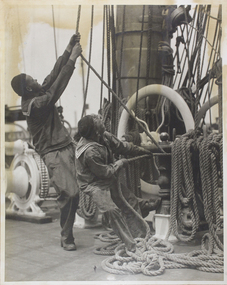
... Also provides a snapshot of seamen's clothing from an early 20th C period. seamen rigging sailing ships crews and ships life on board ropes mcilwraith and mcewan shipping companies Pencil inscription on back of mount : McIlwraith & McEwan / measurements indecipherable/ Thursday Mounted large black and white photographic print; the mount is friable ( see condition report) shows 2 seamen in working uniform hauling on main mast ropes and rigging McIlwraith & McEwan Photograph Photograph, Black and white ...The pencilled inscription at the back of the Mount indicateur the photograph was taken for a newspaper. Likely between 1920-1930, maybe for the Grain Race.An illustrative image demonstrating the effort involved in hauling ship's rigging and mast ropes. Also provides a snapshot of seamen's clothing from an early 20th C period. Mounted large black and white photographic print; the mount is friable ( see condition report) shows 2 seamen in working uniform hauling on main mast ropes and riggingPencil inscription on back of mount : McIlwraith & McEwan / measurements indecipherable/ Thursdayseamen, rigging, sailing ships, crews and ships, life on board, ropes, mcilwraith and mcewan, shipping companies -
 The Beechworth Burke Museum
Photograph, c.1870
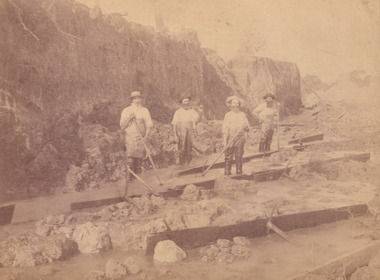
... clothing from becoming too dirty from the mud. Each man is wearing a wide brim hat and hold large wooden tools used for sorting through the sluice. Three of the four men have full beards. The photograph was donated to the Burke Museum by R. Ziegenbein before 2001 but the photographer and the individuals captured in the photo are unknown. The image depicts the landscape of the Three Mile Goldfields during a period...clothing from becoming too dirty from the mud. Each man is wearing a wide brim hat and hold large wooden tools used for sorting through the sluice. Three of the four men have full beards. The photograph was donated to the Burke Museum by R. Ziegenbein before 2001 but the photographer and the individuals captured in the photo are unknown. The image depicts the landscape of the Three Mile Goldfields during a period ...This photograph was taken in approximately 1870 and depicts four male miners standing in mining sluice at the Three Mile Goldfields. These men are wearing typical attire for 1870s gold miners. They wear white shirts, tan coloured pants with water proof shoes and most of the men are wearing an apron to prevent their clothing from becoming too dirty from the mud. Each man is wearing a wide brim hat and hold large wooden tools used for sorting through the sluice. Three of the four men have full beards. The photograph was donated to the Burke Museum by R. Ziegenbein before 2001 but the photographer and the individuals captured in the photo are unknown. The image depicts the landscape of the Three Mile Goldfields during a period when open cut sluicing was undertaken to reach gold. Open cut sluicing is a method used to extract gold and other precious metals from beneath the surface of the earth. This technique involved the use of high-powered hoses which broke down the soil enabling miners to come along and search this soil for gold. After the gold rush of the early 1850s, diggers had to enlist the assistance of heavy machinery and techniques like hydraulic sluicing in order to reach gold because the surface alluvial gold had already been discovered and removed. This heavy machinery was not used until after 1853. The Three Mile Goldfields was a site of rich alluvial gold deposits located about 5 km south of Beechworth in Victoria. Today, the location of this gold deposit is called Baarmutha. It was a popular area for gold mining in the 1850s but became largely abandoned by the following decade. In 1865, a man named John Pund recognized that the area could be potentially rich if a better water supply could be obtained. He secured a 15 year license with three other miners. Within the next five years, these men had constructed 19 km of water race going from Upper Nine Mile Creek to Three Mile Creek. By 1881, these four men had delivered 950,000 gallons to the Three Mile Sluicing area which is depicted in this photograph. Pund was later go into partnership with John Alston Wallace who would become owner of the Star Hotel in Beechworth. The Three Mile sluicing location continued to be operational until 1950. Sluice box workers were a vital part of gold mining regardless of how inefficient they were in the recovery of gold. After using hydraulic sluicing to cut away the earth, miners would use the big wooden boxes depicted in the image to catch the earth which would then be sifted for gold. However, accidents would occur often which would result in the gold washing away and unable to be recovered. It was not a very efficient system because the gold, which was alluvial and thus very fine, would often pass through the sluice box undetected.The search for gold is ingrained into the history of Victoria and therefore, images like this one which portray an open cut sluicing site can reveal important information for society and technology for the date when the photograph was taken. This image is of important historical significance for its ability to convey information about sluicing and the methods used to find gold in the late 1800s and early 1900s. It also shows a location where sluicing was undertook which provides insight into the impact of sluicing on the environment at a time when it was done. Images, like this one, of Australian gold rush history can reveal important information about the social and environmental impact of this period. This image depicts diggers standing in a mining location and therefore, this image has the capacity to reveal or support significant information for researchers studying the fashion and social status of diggers in Australia in approximately 1870. It can also provide information on the landscape of Australia in this period and the impact of mining for gold on both society and the Australian landscape. The Burke Museum is home to a substantial collection of Australian mining photographs which can be used to gain a deeper understanding into life on the gold fields, technology used in mining, the miners themselves and the impact of the gold digging on the environment.Sepia toned rectangular photograph printed on matte photographic paper and mounted on board.[illegible] about 1870 / 97 2514.1 / 2594 30three mile goldfields, goldfields, 1870, 1870 gold, australia, australian landscape, miners, gold miners, diggers, gold diggers, beechworth, victoria, sluice box workers, sluicing, sluice, mining -
 The Beechworth Burke Museum
Photograph
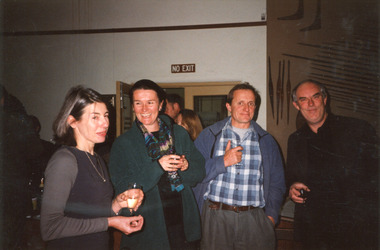
... period and shows fashion trends, social events and interior design trends of the time. The photograph in an interpretive capacity could also assist in further research into the life and development of the Burke Museum, providing a different perspective on early 2000s social events and their development into the social events of today. burke museum beechworth 2000s dinner party function recreation fashion party 2000s clothing community Obverse: No Exit / Reverse: AGFA Watermark / 6511 Coloured rectangular photograph printed on photographic paper. ...Taken in the early 2000s, this photograph depicts two men and two women, all holding wine glasses. Everyone is casually dressed and seem to be attending a dinner party at the Burke Museum. The group of four have been identified as A. Robbins, J. Indian, S. Routledge and A. Box.This photograph is significant because of its insight into the social aspect of life at the Burke Memorial Museum during the 2000s. The photograph is part of a large collection of photos from this time period and shows fashion trends, social events and interior design trends of the time. The photograph in an interpretive capacity could also assist in further research into the life and development of the Burke Museum, providing a different perspective on early 2000s social events and their development into the social events of today.Coloured rectangular photograph printed on photographic paper.Obverse: No Exit / Reverse: AGFA Watermark / 6511burke museum, beechworth, 2000s, dinner party, function, recreation, fashion, party, 2000s clothing, community -
Federation University Historical Collection
Book - Book - Scrapbook, Ballarat School of MInes: Scrapbook of Newspaper Cuttings, Book 14, March 1982 to June 1982
... The papers concerned are The Courier, Ballarat, The Australian, The Age over the period of 13 March 1982 to 12 June 1982. courses available teaching positions advertised training course for clothing machinists in doubt beanland farewelled graham beanland to take up position with tafe board in melbourne turmoil over funding from tafe board smb museum reopened food waiters training program dick richards - a great survivor antarctic expedition john leith employed by smb - aboriginal employment training scheme third time lucky for ballarat (high) school ballarat moving back to more humane style of architecture death of leo shannon - head of plumbing smb peter shiells appointed principal of smb peter manzi top apprentice painter and decorator glenn sobey top metal trades apprentice adam lovett apprentice motor mechanic at smb dorothy jenkins to lead major tafe study supply chief major general powell is from ballarat john francis top apprentice motor mechanic visit by schools commission flaf presented to smb museum ballarat and the art world frank sheehan's first 6 weeks in parliament sheehan's maiden speech national move in business studies sue williams top secretarial student scott barling and greg harris of smb master builders association study proposals for heated swim pool Book with white cover, front, spiral bound. ...Collection of newspaper articles related to Ballarat School Of Mines.They cover activities and advertisements for staff. The papers concerned are The Courier, Ballarat, The Australian, The Age over the period of 13 March 1982 to 12 June 1982.Book with white cover, front, spiral bound. courses available, teaching positions advertised, training course for clothing machinists in doubt, beanland farewelled, graham beanland to take up position with tafe board in melbourne, turmoil over funding from tafe board, smb museum reopened, food waiters training program, dick richards - a great survivor, antarctic expedition, john leith employed by smb - aboriginal employment training scheme, third time lucky for ballarat (high) school, ballarat moving back to more humane style of architecture, death of leo shannon - head of plumbing smb, peter shiells appointed principal of smb, peter manzi top apprentice painter and decorator, glenn sobey top metal trades apprentice, adam lovett apprentice motor mechanic at smb, dorothy jenkins to lead major tafe study, supply chief major general powell is from ballarat, john francis top apprentice motor mechanic, visit by schools commission, flaf presented to smb museum, ballarat and the art world, frank sheehan's first 6 weeks in parliament, sheehan's maiden speech, national move in business studies, sue williams top secretarial student, scott barling and greg harris of smb, master builders association, study proposals for heated swim pool -
Federation University Historical Collection
Book - Book - Scrapbook, Ballarat School of MInes: Scrapbook of Newspaper Cuttings, Book 17, February 1983 to June 1983
... The papers concerned are The Courier, Ballarat, The Australian, The Age over the period of 12 February 1983 to 4 June 1983. courses available teaching positions advertised helping unemployed cope with life jill ewence coordinator of ballarat program women's access program at smb judy mills convenor new clothing firm aims for high quality ballarat teacher's antarctic adventure catering and hospitality course at smb tafe manager peter cutter official opening of smb hairdressing training school at smb 10/03/1983 revising educational aims smb catering course gillian malone pam hekkema fiona cox rod brangrove janine cody joanne filippe bernadette groat sherri lang oddie brings state's first country exchange to ballarat introduction of phone smb starts course for machinists rick van berkel wins tippett award motorcycle riders' training complex - site selected greg mannix fashion and fabric design visit by indonesian education advisors geoff mainwaring artist - work belongs to the nation vocational skills centre opened at smb - 29 April 1983 graduates face great challenges money for smb sports building philiptjerkstra competing in internationalskill olympics in austria mining education returns home bcae gains honor position helping young unemployed john francis top apprentice motor mechanic new breed of secretary industrial training centre Book with white cover, front, spiral bound. ...Collection of newspaper articles related to Ballarat School Of Mines.They cover activities and advertisements for staff. The papers concerned are The Courier, Ballarat, The Australian, The Age over the period of 12 February 1983 to 4 June 1983.Book with white cover, front, spiral bound. courses available, teaching positions advertised, helping unemployed cope with life, jill ewence coordinator of ballarat program, women's access program at smb, judy mills convenor, new clothing firm aims for high quality, ballarat teacher's antarctic adventure, catering and hospitality course at smb, tafe manager peter cutter, official opening of smb hairdressing training school at smb, 10/03/1983, revising educational aims, smb catering course, gillian malone, pam hekkema, fiona cox, rod brangrove, janine cody, joanne filippe, bernadette groat, sherri lang, oddie brings state's first country exchange to ballarat, introduction of phone, smb starts course for machinists, rick van berkel wins tippett award, motorcycle riders' training complex - site selected, greg mannix fashion and fabric design, visit by indonesian education advisors, geoff mainwaring artist - work belongs to the nation, vocational skills centre opened at smb - 29 april 1983, graduates face great challenges, money for smb sports building, philiptjerkstra competing in internationalskill olympics in austria, mining education returns home, bcae gains honor position, helping young unemployed, john francis top apprentice motor mechanic, new breed of secretary, industrial training centre -
Federation University Historical Collection
Book - Book - Scrapbook, Ballarat School of MInes: Scrapbook of Newspaper Cuttings, Book 56, May 1993 to June 1993
... The papers concerned are The Courier, Ballarat, The Australian, The Age over the period of 3 February 1993 to 1 May 1993. teaching positions advertised pre-employment courses courses available enrolment for smb courses garden centre gets go-ahead smb hospitality course winners helen delbridge joanne gilmer director responds to garden centre critics ararat tafe going strong students make friends with enemy fashion parade to aid charity brace plans for the future shiells looks back retailer gives young people a go messer and opie leah wagstaff justinbarker jodie cole matthew larkin clothing swap deborah dewar waiter student debra rienietsoutstanding achievement award kerran bagelhole top apprentice ballarat university college upgrade report adults find reward in study woolclassing changes free clothing for students ceramics at the gallery valerie wilson first aid teacher nina burnett retires course for disabled gets green light tanya white paddle steamer restoration project deportment students graduation Book with green cover, front, spiral bound. ...Collection of newspaper articles related to Ballarat School Of Mines.They cover activities and advertisements for staff. The papers concerned are The Courier, Ballarat, The Australian, The Age over the period of 3 February 1993 to 1 May 1993.Book with green cover, front, spiral bound. teaching positions advertised, pre-employment courses, courses available, enrolment for smb courses, garden centre gets go-ahead, smb hospitality course winners, helen delbridge, joanne gilmer, director responds to garden centre critics, ararat tafe going strong, students make friends with enemy, fashion parade to aid charity, brace plans for the future, shiells looks back, retailer gives young people a go, messer and opie, leah wagstaff, justinbarker, jodie cole, matthew larkin, clothing swap, deborah dewar waiter student, debra rienietsoutstanding achievement award, kerran bagelhole top apprentice, ballarat university college upgrade report, adults find reward in study, woolclassing changes, free clothing for students, ceramics at the gallery, valerie wilson, first aid teacher nina burnett retires, course for disabled gets green light, tanya white, paddle steamer restoration project, deportment students graduation -
 Flagstaff Hill Maritime Museum and Village
Equipment - Mannequin, J. A. Walker, before April 1874
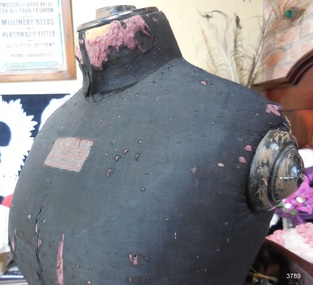
... period, with many people making their own garments. The mannequin is also an example of an item manufactured in Melbourne in colonial times. mannequin wooden mannequin made in melbourne dressmaker’s mannequin 19th century mannequin dress form display mannequin custom made mannequin dressmaker’s dummy andique mannequin clothing display j.a. walker manufacturer melbourne j.a. walker mannequin manufacturer evening outfit Mannequin maker’s fabric label “J.A. ...THE MANNEQUIN The included wooden mannequin made by J.A. Walker of Melbourne has been very well used, as can be seen from the pin marks and split and torn fabric in areas where pins would have been used many times. The painted wood of the bodice is wearing away. The top of the neck is very rough in the centre, indicating that it possibly had a knob, handle or even a head shape on top. The mannequin could have been used for storing and cleaning of the evening outfit and even in the process of making it. It is made to match the measurements of the outfit beautifully and would be close in measurement to Mrs. Isabella Mitchell. Isabella’s sister-in-law Eliza Russell made her own wedding dress and perhaps she or Isabella herself made the evening outfit using the mannequin for fittings. The mannequin is significant as its size gives an image of the shape of the evening outfit’s owner. It is also significant as an example of the process and skills to create garments of fashion during the period, with many people making their own garments. The mannequin is also an example of an item manufactured in Melbourne in colonial times. This wooden display mannequin is from neck to floor length. It has a round pedestal. The mannequin’s bodice has been painted black. It is padded then covered in black fabric. The maker of the mannequin was J.A. Walker of Melbourne. It dates to the mid-late 19th century.Mannequin maker’s fabric label “J.A. WALKER / MANUFACTURER / MELBOURNE”mannequin wooden, mannequin made in melbourne, dressmaker’s mannequin, 19th century mannequin, dress form, display mannequin, custom made mannequin, dressmaker’s dummy, andique mannequin, clothing display, j.a. walker manufacturer melbourne, j.a. walker mannequin manufacturer, evening outfit -
 Flagstaff Hill Maritime Museum and Village
Clothing - Evening Outfit, before April 1874
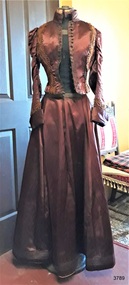
... These items reflect the styles and trends that were prevalent during this period, offering insight into the clothing choices and cultural influences that shaped women's attire. ...This amber satin evening outfit was worn by Mrs Isabella Mitchell (nee Russell, 1840 – 1929) at the wedding of her brother Alexander (c.1846–1938) and Eliza (nee Moore, c.1854–1939). The jacket and skirt attach at the waist by joining the metal rings around the base of the jacket, and the metal hooks on the waistband of the skirt. The outfit was donated with its own mannequin and fits it perfectly. In the colonial days, outer clothing was rarely, if ever, washed, due to the expense of fabrics and the difficulty in careful laundering. Clever methods were employed to reduce the occurrence of soiling. The mannequin included with the donation would also help keep the outfit in good shape and ensure a flattering fit. FAMILIES’ HISTORY The families connected with this wedding, where the outfit was worn, are from Warrnambool’s colonial days. Isabella and Alexander’s parents, Robert Russell and Elizabeth (nee Mitchell), were born in 1808 and married about 1830. They were from farming families in Northern Ireland, where they raised their seven children before migrating to Australia in the early colonial days, around 1857. Their graves are in the Tower Hill Cemetery. Alexander’s wife, Eliza (nee Moore, born in 1854), was also from Northern Ireland and migrated to Australia in 1858 with her parents, Thomas and Nancy Moore, in the last voyage of the sailing ship “Chance”. Isabella (Bella) talked with her granddaughter Ruby Akers about her memories of Alexander and Eliza’s wedding and other events in her life. Ruby recorded these memories in a letter. She says, “They were married in the Warrnambool Congregational Church by a pioneer minister, the Reverend Uriah Coombs. The bride wore a pale blue silk wedding gown, which she made herself. Bella was Matron of Honora, and Ian McCasker was best man. In those days, the transport to the church was usually a carriage – similar to a cab – and a pair of white ponies. They would have the reception at home, go for a drive afterwards, and at night there would be a dance. They did all the catering themselves … Eliza carried on farming in the Dennington, Yarpturk and Purnim districts until they moved to Camperdown around 1905…” Ruby’s letter later mentions “[Isabella] could recall seeing a blackfellows’ corroboree being performed near where the Dennington Bridge now stands. It was rather a terrifying experience; they seemed to be in a warlike mood, and one never knew what they would do next. One lubra came running to Granny, crying, Hide me, bad man kill me. She was bleeding from a wound in the head: probably the result of a blow from a waddy. My mother [Margaret Jane McLaughlan nee Mitchell], coming home from school in the 1800s, often met blackfellows walking ahead with spears and boomerang, the two lubras – they usually had two – following in the rear, carrying the children or any burdens they had.“ Margaret was probably in primary school at the time she saw these things. Alexander and Eliza had ten children. One of their daughters, Margaret Jane, was born in Warrnambool in 1879. She married William McCullagh, and they had eleven children. Margaret made headlines in the Warrnambool newspapers for celebrating her 100th birthday. She had lived in the district for 60 years before moving to Melbourne. Alexander passed away at the age of 92, and Eliza passed away six months later, aged 85. Their graves are in the Colac cemetery. Isabella married Ralph Mitchell, and their daughter Margaret Jane married John McLauchlan in 1891. Margaret and John’s daughter, Ruby Elizabeth Jane, married Fredrick Akers in 1938. Fredrick, born in England, was a Boer War veteran and served in the British Army. He migrated to Queensland, Australia, in 1913, and joined the Australian Army to fight in World War I. In 1935, he moved to Warrnambool, where he served in the Volunteer Defence Corps from 1938 to 1945. Both Ruby and Fredrick are buried in the Tower Hill Cemetery.The evening outfit and its accompanying mannequin serve as notable examples of female fashion from the mid to late 1900s. These items reflect the styles and trends that were prevalent during this period, offering insight into the clothing choices and cultural influences that shaped women's attire. Beyond their representation of period fashion, the outfit and mannequin are significant due to their association with colonial pioneer families from Australia, specifically Victoria and Warrnambool. These families played an important role in the development and history of the region, and the items are linked to their legacy. The evening outfit and mannequin are also notable for their connection to a wedding that united two colonial families originating from Northern Ireland. These families immigrated to Australia in the mid-1850s and became influential figures within the Warrnambool district. The wedding marked a significant event, symbolising the merging of two prominent family lineages. Furthermore, the significance of the evening outfit and mannequin extends to their connection with the colonial families’ contact with the indigenous culture of the district. These items represent a period of interaction between the native and European peoples, highlighting the cultural exchanges that occurred within the region. This lady’s evening outfit is made from amber coloured satin fabric. It comprises a short-waisted, long-sleeved jacket and a long skirt, and it has its own neck-to-floor wooden mannequin on a pedestal. The outfit was worn by Mrs Isabella Mitchell (nee Russell) as the Matron of Honour at the wedding of her brother Alexander Russell and his fiancée Eliza Moore in Warrnambool, 29th April 1874.flagstaff hill, warrnambool, shipwrecked coast, flagstaff hill maritime museum, maritime museum, shipwreck coast, flagstaff hill maritime village, great ocean road, evening outfit, wedding outfit, bridesmaid’ outfit, matron of honour outfit, clothing female, clothing late 19th century, clothing wedding late 19th century, clothing bridesmaid late 19th century, clothing antique, clothing ladies, women’s clothing, women’s fashion, alexander russell, eliza russell, eliza moore, isabella mitchell, bella mitchell, bella russell, isabella russell, ralph russell, ian mccusker, ruby akers, fredrick william akers, ruby mclauchlan, margaret jane mclaughlan nee mitchell, margaret jane mclaughlan centenarian, william mclaughlan, robert russell, elizabeth russell nee mitchell, irish immigrants, warrnambool volunteer defence corps 1938-1945, antique satin outfit, warrnambool wedding 1874, congregational church warrnambool, reverend uriah coombs, dennington farmer, yarpturk farmer, purnim district farmer, camperdown resident 1905, dennington bridge, indigenous corroboree in dennington, corroboree in warrnambool, 1880s corroboree in warrnambool, lubra and baby, indigenous corroboree in warrnambool, mccullagh family -
 Flagstaff Hill Maritime Museum and Village
Animal specimen - Baleen
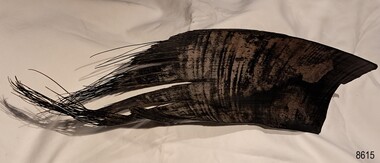
... period when whales were hunted and killed to provide income and products for for the local settlers and for the export industry. Flagstaff Hill Maritime Museum and Village Great Ocean Road Shipwreck Coast baleen whalebone baleen whale keratin 19th century whaling industry women's fashion stays bodice women's figures fashion clothing whale oil baleen colour whale hunting whale products Southern Right Whale Blue Whale Humpback Whale southwest Victoria whalers whale bones Baleen sample from a whale's jaw. ...A baleen whale has hard bristly baleen that hangs from its upper jaw inside its mouth instead of teeth. Baleen is made from a protein called keratin, just like human hair and fingernails, and its colour can vary between species, from black to yellow or white. The whale uses the tough, flexible baleen like a sieve to catch its food, filtering the small sea creatures out of the sea water it releases from its mouth. In the19th Century, whales were hunted for the products that could be made from their bodies, such as oil for lubricating machinery, soap making, lamps, heaters and fuel for the lighthouse lights. The flexible baleen was used for whip handles, carriage springs and umbrella ribs. It was also used for the skirt hoops, hat ribs, and rigid ‘stays’ in tightly fitting bodices to enhance their figures. The Southern Right Whales, as well as Blue Whales and Humpback Whales, are baleen whales. The Southern Rights annually visit the ocean off the southwest coast during the breeding season. In the early 1800s whalers hunted along this coastline in their dangerous pursuit of money for the precious cargoes of whale oil and bones. The population of these large animals dwindled quickly and by the late 1840s the whaling industry dwindled. Whaling recommenced from the 1940s to the 1980s when the whale products were used to make margarine and dog food. The baleen sample has been used to educate people about whaling and about the properties of baleen. The baleen sample is significant for its association with 19th century women's fashion. It helps to understand how garments were supported to shape a woman's figure. The baleen sample represents a period when whales were hunted and killed to provide income and products for for the local settlers and for the export industry.Baleen sample from a whale's jaw. Its black shiny hard yet flexible surface is slightly rippled and textured. One end is fringed and the other and a smooth cut edge. The colour varies in places, with stripy brown colouring. flagstaff hill maritime museum and village, great ocean road, shipwreck coast, baleen, whalebone, baleen whale, keratin, 19th century, whaling industry, women's fashion, stays, bodice, women's figures, fashion, clothing, whale oil, baleen colour, whale hunting, whale products, southern right whale, blue whale, humpback whale, southwest victoria, whalers, whale bones -
 Flagstaff Hill Maritime Museum and Village
Costume - Satin Bodice
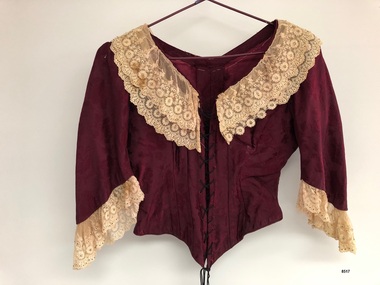
... clothing from that time. Although it appears to have been made at a later time the lace possibly came from an earlier time period. ...clothing from that time. Although it appears to have been made at a later time the lace possibly came from an earlier time period. ...The bodice is of a style from the Victorian Era and so provides a good example of women's clothing from that time. Although it appears to have been made at a later time the lace possibly came from an earlier time period. It is of historic interest as it was amongst the belongings of the donor's Great Aunts who were both dressmakers at the original Terang & District Co-Op which was established in 1908.The item is of significance socially as an example of women's clothing in the Victorian era.A short, waist-length bodice most likely made as a performance costume. It is representative of a Victorian bodice style though the lacing used indicates that it would not have been worn in those times due to its revealing design. Flexible metal stays provide shape to the bodice at the front and back. Sleeves are elbow length and lined with cream fabric. The bodice has a lace collar and the sleeves are trimmed with the same lace. Small gold coloured beads are stitched to the flower centres of the lace pattern. The burgundy coloured satin has an embossed floral pattern. The lace is of interest as it is from an older time period and being beaded would be especially sought after. Machine and hand stitched.flagstaff hill, warrnambool, maritime village, maritime museum, flagstaff hill maritime museum & village, shipwreck coast, great ocean road, satin bodice, beaded lace, victorian era, metal stays, terang & district co-op -
 Geelong RSL Sub Branch
Ration and Clothing Books J A Ollis, circa 1940s
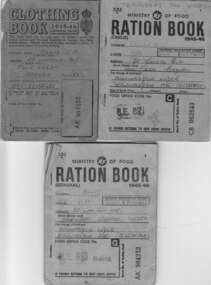
... period 1945/46. These are the original books that were issued to J A Ollis Ration & Clothing Books, J A Ollis, 1945/46 The books have been issued to J A Ollis Bognor, Sussex, and later of Sevenoaks. ...These books were issued to J A Ollis for the period 1945/46.These are the original books that were issued to J A OllisTwo Ration Books and one Clothing Book. The books are oblong, cardboard and paper. One ration book is green one a buff Colour. The Clothing Book is pink.The books have been issued to J A Ollis Bognor, Sussex, and later of Sevenoaks.ration & clothing books, j a ollis, 1945/46 -
 Glenelg Shire Council Cultural Collection
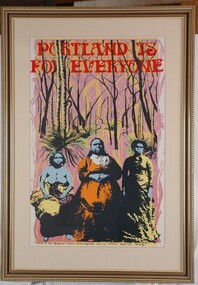
Print, Portland is for Everyone, 1983
... The fgiure on the far left is wearing traditional clothing, and the two figures on the right wear Victorian period dresses. ...The fgiure on the far left is wearing traditional clothing, and the two figures on the right wear Victorian period dresses. ...CEMA Art Collection Part of "A Community View" 150 years in Portland Screenprint Exhibition Part of Angela Gee Residency 1983 and 1984Three indigenous women stand before trees and grass trees. The fgiure on the far left is wearing traditional clothing, and the two figures on the right wear Victorian period dresses. The background depicts abstract patterning. At the top of the print are the words "Portland is for Everyone". The bottom of the image includes the words "Thanks to the Aboriginal Cultural Centre, Heywood, and the Portland Historical Society." Background is mauve and colours include green, blue, yellow, orange and tan. Mounted in dark cream matt in an ornate gold-detailed wooden frame.Front: 41/60 (lower left) Angela Gee '83 (lower right) (pencil) Back: (no inscriptions) -
Glenelg Shire Council Cultural Collection
Clothing - Clothing - Skirt Portland's 150th Celebrations, c. 1984
... Period style made for Portland's 150th celebrations Clothing Clothing - Skirt Portland's 150th Celebrations ...Skirt, long, cotton, blue, grey and white check. gathered at waist, deep frill on bottom. Period style made for Portland's 150th celebrations -
Glenelg Shire Council Cultural Collection
Clothing - Skirt - Portland 150th Anniversary, c. 1984
... Made for Portland's 150th celebrations in a period style Clothing Skirt - Portland 150th Anniversary ...In November 1984 Portland marked the 150th anniversary of European settlement and the foundation of the City of Portland. Various events happened in and around Portland, many community led.Skirt, steel blue in colour, with black vertical stripes, 'shiny' fabric. Long, gathered waist, deep frill at bottom, decorated with black lace. Made for Portland's 150th celebrations in a period styleportland 150th anniversary, costume, womens dress -
Glenelg Shire Council Cultural Collection
Clothing - Apron - Portland 150th Anniversary, c. 1984
... Portland 150th Anniversary costume Portland High School Apron, white cotton, frill around hem, sides and armholes, tie each side of apron, child's period style, made for Portland's 150th celebrations. Clothing Apron - Portland 150th Anniversary ...In November 1984 Portland marked the 150th anniversary of European settlement and the foundation of the City of Portland. Various events happened in and around Portland, many community led.Apron, white cotton, frill around hem, sides and armholes, tie each side of apron, child's period style, made for Portland's 150th celebrations.portland 150th anniversary, costume, portland high school -
Glenelg Shire Council Cultural Collection
Clothing - Sash - Portland's 150th Anniversary Celebrations 1984, c. 1984
... Made for Portland's 150th celebrations in a period style. Clothing Sash - Portland's 150th Anniversary Celebrations 1984 ...In November 1984 Portland marked the 150th anniversary of European settlement and the foundation of the City of Portland. Various events happened in and around Portland, many community led.Sash, same fabric and colour as 9227. Worn with 9227. Made for Portland's 150th celebrations. Period style. 9227 - Skirt, steel blue in colour, with black vertical stripes, 'shiny' fabric. Long, gathered waist, deep frill at bottom, decorated with black lace. Made for Portland's 150th celebrations in a period style. -
 The Beechworth Burke Museum
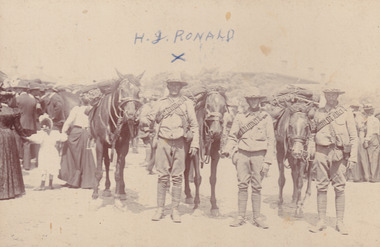
Photograph, c1916
... This photograph is historically significant as it provides insight into the uniforms and clothing worn during the early 20th century and World War 1 period. Military Album Burke Museum Beechworth Beechworth Museum World War One WWI Horses H.J.Ronald Soldiers Soldiers and Horses Observe: H. ...Taken during World War 1, this photo is taken of three soldiers and their horses, featuring families in the background. One of the men featured is H. J. Ronald.This photograph is historically significant as it provides insight into the uniforms and clothing worn during the early 20th century and World War 1 period. Black and white rectangular photograph printed on photograph paper and mounted on a beige card.Observe: H. J. RONALD Reverse: H. J. Ronald / Donated by George Ronald / 49 Jellico Avenue / 5898 (crossed out) / Tallangattamilitary album, burke museum, beechworth, beechworth museum, world war one, wwi, horses, h.j.ronald, soldiers, soldiers and horses -
 Orbost & District Historical Society
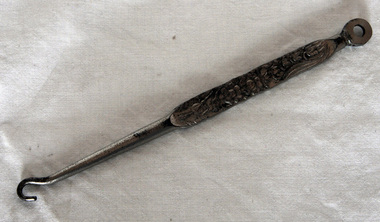
button hook, 1895 – 1905
... period from the 1870s . Buttonhooks were needed to do up the buttons on buttoned boots and were used by poking the metal hook through the buttonhole, grabbing the button and pulling it through the eyelet. This item is an example of a commonly used accessory no longer relevant. clothing ...Button hooks were used to fastens buttons on boots and long gloves. It is a tool used for the closing of shoes, gloves or other apparel that uses buttons as fasteners. The steel hook end is inserted through the buttonhole to capture the button by the shank and draw it through the opening. This hook is most likely to have been used to do up bootsWomen and young girls generally wore boots that were either front laced or side buttoned, particularly in the period from the 1870s . Buttonhooks were needed to do up the buttons on buttoned boots and were used by poking the metal hook through the buttonhole, grabbing the button and pulling it through the eyelet. This item is an example of a commonly used accessory no longer relevant.A button hook made of metal with a beaten silver handle ornately decorated with scrolls and foliate design. At the top is a small ring on the handle end. This could have been for a lady to attach the item to her chatelaine at her belt, or on a necklace. clothing footwear gaiters boots button-hook -
 Orbost & District Historical Society
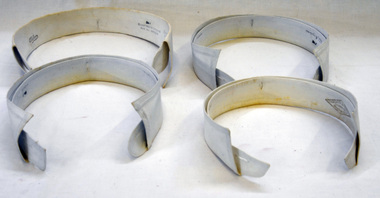
collars, Cremorne Collar Company, c. 1920s-1940s Cremorne Collar Company . The Cremorne Collar Company was first registered in 1923 (info. from Rhyce Winterbourne)
... period, wearer unknown. A detachable collar is a shirt collar separate from the shirt, fastened to it by studs. The collar is usually made of a different fabric from the shirt, in which case it is almost always white, and, being unattached to the shirt, can be specially starched to a hard cardboard-like consistency. The popularity of detachable collars and starched collars in general began to fade in the 1920s and 30s as men’s clothes became more comfortable. These items are examples of men's clothing ...A set of collars, possibly worn during the 1920s-1950s period, wearer unknown. A detachable collar is a shirt collar separate from the shirt, fastened to it by studs. The collar is usually made of a different fabric from the shirt, in which case it is almost always white, and, being unattached to the shirt, can be specially starched to a hard cardboard-like consistency. The popularity of detachable collars and starched collars in general began to fade in the 1920s and 30s as men’s clothes became more comfortable.These items are examples of men's clothing from the first decades of the 20th century when men wore more formal daily attire. A set of four white men's collars of assorted sizes, made from stiffened fabric.Cremorne Collar Company, Melbournemen-collars male-apparel -
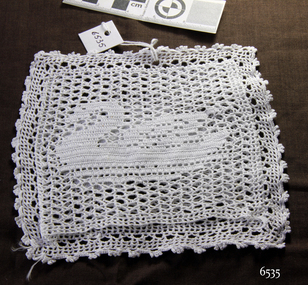 Flagstaff Hill Maritime Museum and Village
Textile - Lavender Bag, ca 1910
... clothing. They were also used to repel insects and help preserve the textile pieces. Fragrant bags were used to freshen the air in rooms and even as a deodorant inside special pockets in ladies' undergarments. In the Words of donor, Betty Stone, … “These crocheted and embroidered articles cover a period...clothing. They were also used to repel insects and help preserve the textile pieces. Fragrant bags were used to freshen the air in rooms and even as a deodorant inside special pockets in ladies' undergarments. In the Words of donor, Betty Stone, … “These crocheted and embroidered articles cover a period ...Small decorative bags containing dried lavender, rose petals and other fragrant flowers and leaves were used to add fragrance to linen and clothing. They were also used to repel insects and help preserve the textile pieces. Fragrant bags were used to freshen the air in rooms and even as a deodorant inside special pockets in ladies' undergarments. In the Words of donor, Betty Stone, … “These crocheted and embroidered articles cover a period of three generations- ie. Sarah (nee Chamberlain) Lees, Ann (nee Lees) Dale, and Daisy Elvena (nee Dale) Welsh. All three were accomplished needlewomen; also, both Sarah Lees (born 1844) and her daughter, Ann (b 1865) crocheted a wide variety of articles for use in their homes. A few examples of these items have survived the years.” It was a tradition for brides to have a 'glory box' containing linen and embroidered articles to take to their new home. Many of the items were made by Daisy, a skilled dressmaker. Daisy began her apprenticeship at two shillings and sixpence per week at Miss A. E. Emery's dressmaking establishment at 150-152 Liebig Street, Warrnambool. Considered to be the leading house of fashion in Warrnambool, Miss Emery employed about eight young women who worked long hours to sew elaborate gowns for clients, including wives of graziers who would attend the race carnivals and social functions in Warrnambool. (NOTE: For additional information please refer to my book Pioneer and Places- A History of Three Warrnambool Pioneering Families ie. Chamberlain, Dale and Lees families)This item is associated with the Warrnambool pioneer families of Chamberlain, Dale and Lees. These families are listed in the Pioneers' Register for Warrnambool Township and Shire, 1835-1900, published by A.I.G.S. Warrnambool Branch. The item is significant for its association with a ‘glory box’ or hope chest’, a tradition of single ladies making and collecting a range of linen and other domestic items in preparation for their future marriage. The item is a fine example of early 20th-century needlework and handmade domestic items.Lavender bag, white crocheted squares, back to back, with a border and a swan design incorporated in crochet. Part of the Chamberlain Dale Lees Collection.flagstaff hill, warrnambool, flagstaff hill maritime museum and village, great ocean road, chamberlain family, dale family, lees family, betty stone, warrnambool pioneer, warrnambool genealogy, wangoom, chamberlain dale lees collection, glory box, handmade, craft, manchester, linen, haberdashery, needlework, crochet, lavender bag, fragrant bag, insect repellant
