
Showing 64 items matching "pouring bottle"
-
 Emerald Museum & Nobelius Heritage Park
Container - Pouring ink bottle, Unknown maker, 1900s
... Pouring ink bottle...pouring bottle...Small brown stoneware pouring ink bottle. Possibly used for pouring ink into small ink wells. ...This pouring bottle was used for pouring ink into smaller ink wells. ...This pouring bottle was used for pouring ink into smaller ink wells. This would have been used in multiple situations where writing with a pen and ink was required. The bottle has obvious imperfections so it may have been hand-made. It has been difficult for the cataloguer to date it or confirm its manufacture.Small brown stoneware pouring ink bottle. Possibly used for pouring ink into small ink wells. Has the words 'Epsom Bendigo' imprinted.At the bottom of the bottle is an oval shape which encloses the words 'Epsom' and on the next line, 'Bendigo'. There is illegible print above the word 'Epsom". Near the top of the bottle is a number '7' - but it is possible this is not a number but a production imperfection.pouring bottle, epsom, bendigo, ink, writing equipment -
 Flagstaff Hill Maritime Museum and Village
Bottle, Late 19th century
... ...ink pouring bottle...This handmade ceramic bottle was made and used for pouring ink to fill ink wells. ...Hand made. Bottle was used for pouring ink. Inscription stamped into base....This handmade ceramic bottle was made and used for pouring ink to fill ink wells. ...This handmade ceramic bottle was made and used for pouring ink to fill ink wells. Businesses such as banks and post offices provided ink and dip pens for their customers' use, along with blotting paper to dry their writing.This bottle is significant for being both and example of handmade bottles and for its association with earlier methods of writing.Bottle, cream coloured, glazed ceramic bottle, cylindrical shape, with spout and flared lip moulded into mouth of bottle. Hand made. Bottle was used for pouring ink. Inscription stamped into base. "82 PRICE" (illegible) Label provided with donation is marked "SLATER AND PALMER works: MARSHGATE MILLS, STRATFORD ESSEX"flagstaff hill, warrnambool, shipwrecked-coast, flagstaff-hill, flagstaff-hill-maritime-museum, maritime-museum, shipwreck-coast, flagstaff-hill-maritime-village, ink and pen writing, ink pouring bottle, bank stationery equipment, writing with pen and ink -
Port Melbourne Historical & Preservation Society
Container - Glass bottle with pouring lip
... Glass bottle with pouring lip...Small oblong glass bottle with a short neck and a pouring lip....Domestic Life - Containers Small oblong glass bottle with a short neck and a pouring lip. Container Glass bottle with pouring lip ...Found at Port Melbourne Primary School.Small oblong glass bottle with a short neck and a pouring lip.domestic life - containers -
 Greensborough Historical Society
Container - Ink Bottle, Stoneware ink bottle, 1900 c
... White stoneware ink bottle, with pourer...Stoneware ink container. ink bottles inkwells White stoneware ink bottle, with pourer Stoneware ink bottle Container Ink Bottle ...Stoneware ink container.White stoneware ink bottle, with pourerink bottles, inkwells -
 Orbost & District Historical Society
bottles, 1858-c. 1910
... 253.1 A dark brown ceramic bottle with pouring lip. 253.2 A cream ceramic bottle without lip. 253,3 A cream ceramic bottle with pouring lip....Smith & Co London 253.3 Bourne Denby 253.1 A dark brown ceramic bottle with pouring lip. 253.2 A cream ceramic bottle without lip. 253,3 A cream ceramic bottle with pouring lip. bottles Doulton ; T. ...Ceramic bottles have been made in a variety of shapes and sizes and can reflect the contemporary society. They also are part of the history of bottle manufacturing.253.1 A dark brown ceramic bottle with pouring lip. 253.2 A cream ceramic bottle without lip. 253,3 A cream ceramic bottle with pouring lip.253.1 Doulton Lambeth 253.2 ? Smith & Co London 253.3 Bourne Denbybottle ceramic stoneware -
 Buninyong Visitor Information Centre
Domestic object - Stoneware bottle
... Dark brown glazed cylindrical bottle with pouring lip. Stopper missing. ...Dark brown glazed cylindrical bottle with pouring lip. Stopper missing. Stoneware bottle Domestic object Stoneware bottle ...Dark brown glazed cylindrical bottle with pouring lip. Stopper missing. No markings.stoneware, ceramics, domestic equipment -
Coal Creek Community Park & Museum
Ink bottle, Simpson's Ink Pty Ltd
... Square glass bottle with pouring spout containing red ink, with a red, blue and cream label....Square glass bottle with pouring spout containing red ink, with a red, blue and cream label. ...Square glass bottle with pouring spout containing red ink, with a red, blue and cream label.20 oz. Established 1894. Simpson's Celebrated Writing Ink. This is made specially to flow freely with all standard makes of fountain pen and with steel nibs. Sole manufacturer Simpson's Ink Pty Ltd. Australia. -
 Federation University Art Collection
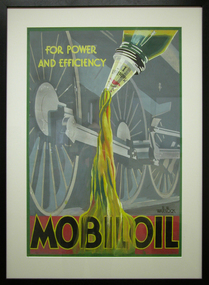
Painting - poster, R.W. Warnock, 'Mobil Oil', c1935
... It shows Oil pouring from a bottle in front of a steam engine. ...It shows Oil pouring from a bottle in front of a steam engine. ...Reginald (Reg) WARNOCK (1915-1991) Reginald William Warnock undertook the Commercial Art course during the 1930s. On completion, he worked as a designer at Paton’s Advertising Service, Melbourne. Commercial art subjects between 1915 and 1939 reflected changing practises and industry requirements, with Ballarat graduates in demand. In the 1936 Ballarat School of Mines Annual Report it was stated: "It is my pleasure to report a most successful year in the Technical Art School. I the Annual Poster Competition for Technical Schools, organised by Wiltshires Pty Limited, 16 prized valued at 33 pounds 8 shillings - out of 23 prizes valued at 56 pounds - were won by our students. R.W. Warnock moved from Ballarat to Moonee Ponds towards the end of March, 1937. This item is part of the Federation University Art Collection. The Art Collection features over 1000 works and was listed as a 'Ballarat Treasure' in 2007.Commercial art Framed original poster completed at the Ballarat Technical Art School by R.W. Warnock. It shows Oil pouring from a bottle in front of a steam engine. Please use the comment link below if you can assist with information about R.W. Warnock."For power and efficiency" "Mobil Oil"art, artwork, warnock, mobil, oil, poster, r.w. warnock, available, alumni, locomotive, steam engine, motor oil, advertisement, reginald warnock -
 Orbost & District Historical Society
advertising material, mid 20th century
... It has two illustrations in red and green of plastic oil bottles with pourer tops. The underside is pink and it is designed for nse as an ink blotter. ...It has two illustrations in red and green of plastic oil bottles with pourer tops. The underside is pink and it is designed for nse as an ink blotter. advertising material Castrol Ltd ...This advertising material used as an ink blotter would have been given freely by salesmen, keen to sign up new buyers for their range of motorcar oils. Businesses had quickly recognized the potential for advertising on blotting paper, and began customizing sheets with company marketing. Ink blotting paper thus became a form of business card.often given away by salesman The Castrol company is headquartered in the UK. Castrol was founded by Charles “Cheers” Wakefield under the name of ‘CC Wakefield & Company’. In 1899. By 1960 it had become Castrol Ltd. This is a pictorial record of an advertising media not commonly used in the 21st century. Ink blotters remained in general use until the advent of the ball point pen, which in the period 1945 to 1960 progressively replaced the steel rib and liquid inks.A rectangular card with green and red print. It has two illustrations in red and green of plastic oil bottles with pourer tops. The underside is pink and it is designed for nse as an ink blotter. advertising-blotter castrol-motor-oils stationery -
 Bendigo Historical Society Inc.
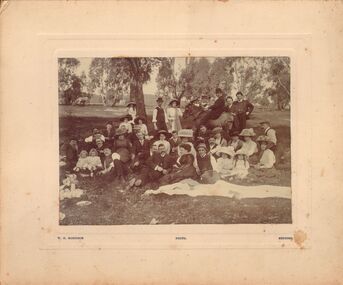
Photograph - GROUP PORTRAIT - PICNICKING IN BUSH
... Man behind horse's head is pouring a bottle into a glass. Circa late 1800's ? ...Man behind horse's head is pouring a bottle into a glass. Circa late 1800's ? ...Black and white image mounted on cream board : image shows large group of men, women and children, sitting, standing and reclining on grass. Eucalyptus trees in background, horse grazing. Man at rear of group is seated on a horse. Man behind horse's head is pouring a bottle into a glass. Circa late 1800's ? Potentially picnic is at Ravenswood. Appears to have Big Hill range in background, road with white posts running across background. On bottom of image on board ' W.H. Robinson, photo, Bendigo'W.H. Robinson, Bendigocottage, miners, bendigo, picnic, family, ravenswood. photographer w. h. robinson, bendigo. -
 Kiewa Valley Historical Society
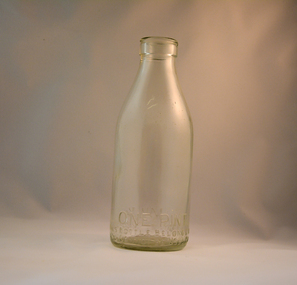
Bottle Milk, early 1900's
... This head has been manufactured to facilitate the movement of the bottled along the milk production line. The method of pouring milk into the bottle has been part of the "production line". ...This head has been manufactured to facilitate the movement of the bottled along the milk production line. The method of pouring milk into the bottle has been part of the "production line". ...This glass milk bottle was manufactured and used mid to late 1900's (1834 Victorian dairy industry was founded) up to the time that a cheaper container was invented(plastic bottles and polyethylene plastic lined cardboard cartons) and produced. In 1909 the supply of pure bottled milk was required for babies to overcome infant mortality due to unhygienic milk sources (unclean containers and unpasteurized milk). Due to the volume of milk being processed and hand milking could not keep up with demand, dairy farms introduced milking machines in the late 1930's. The great increases in dairy herds from the average of 18 cows per heard in 1950's to 142 cows per herd in 1996 required milk tankers to pick up the regions milk supply. This bottle was so constructed to be easily moved within the milk processing plants from the delivery vats/holding tanks to the final corking/sealing of the bottles for eventual distribution. From 1958 the milk bottle slowly became phased out of production. At this point in time Melbourne was drawing 160,000 bottles per week from the two major glass bottle works companies, e.g. Melbourne Glass Bottle Works Co. Victoria was the major state supplier of cows milk in the history of Australian milk production from the early 1800's. The Kiewa Valley and its region was a major contributor to meet that demand. Each bottle was "branded" during manufacturing to show the contents (pasteurized milk) and where it originated from (region and supplier). This method of recycling the bottles back to specific dairy farms was a good control method but an uneconomical "on cost" which was replaced by the "throw away" less costly plastic and cardboard containers. Kiewa Valley dairy herds had marked bottles bearing "90/9", "6/18", "6/33", "6/35" and "6/36" This heavy gauged glass milk bottle has a rim and a distinctive head at the top. This head has been manufactured to facilitate the movement of the bottled along the milk production line. The method of pouring milk into the bottle has been part of the "production line". This bottle has a one pint capacity and is made from "clear" glass. There are other milk bottles that have a "green" tint in them.Around the bottom side of the bottle and blown into the glass "ONE PINT" and on the opposite side "MILK". Below these markings is "This BOTTLE BELONGS TO MILK BOTTLES RECOVERY LTD" below this "AND CANNOT BE USED WITHOUT WRITTEN PERMISSION. On the base of the bottle is molded a big "M". An identification mark of "90" over "9" is beneath the "M". glass bottles, commercial milk containers, domestic milk bottles, pasteurized milk bottles, milk, dairy, farms, kiewa valley -
 Kiewa Valley Historical Society
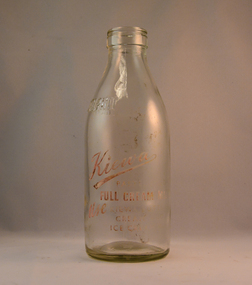
Bottle Milk, Circa mid to late 1900's
... This head has been manufactured to facilitate the movement of the bottled along the milk production line. The method of pouring milk into the bottle has been part of the "production line". ...This head has been manufactured to facilitate the movement of the bottled along the milk production line. The method of pouring milk into the bottle has been part of the "production line". ...This glass milk bottle was manufactured and used mid to late 1900's (1834 Victorian dairy industry was founded) up to the time that a cheaper container was invented(plastic bottles and polyethylene plastic lined cardboard cartons) and produced. In 1909 the supply of pure bottled milk was required for babies to overcome infant mortality due to unhygienic milk sources (unclean containers and unpasteurized milk). Due to the volume of milk being processed and hand milking could not keep up with demand, dairy farms introduced milking machines in the late 1930's. The great increases in dairy herds from the average of 18 cows per heard in 1950's to 142 cows per herd in 1996 required milk tankers to pick up the regions milk supply. This bottle was so constructed to be easily moved within the milk processing plants from the delivery vats/holding tanks to the final corking/sealing of the bottles for eventual distribution. From 1958 the milk bottle slowly became phased out of production. At this point in time Melbourne was drawing 160,000 bottles per week from the two major glass bottle works companies, e.g. Melbourne Glass Bottle Works Co. Victoria was the major state supplier of cows milk in the history of Australian milk production from the early 1800's. The Kiewa Valley and its region was a major contributor to meet that demand. Each bottle was "branded" during manufacturing to show the contents (pasteurized milk) and where it originated from (region and supplier). This method of recycling the bottles back to specific dairy farms was a good control method but an uneconomical "on cost" which was replaced by the "throw away" less costly plastic and cardboard containers. Kiewa Valley dairy herds had marked bottles bearing "90/9", "6/18", "6/33", "6/35" and "6/36" This particular one has "7/14".This heavy gauged glass milk bottle has a rim and a distinctive head at the top. This head has been manufactured to facilitate the movement of the bottled along the milk production line. The method of pouring milk into the bottle has been part of the "production line". This bottle has a one Imperial pint capacity and is made from "clear" glass. There are other milk bottles that have a "green" tint in them. Around the bottom side of the bottle and blown into the glass "ONE IMPERIAL PINT". Below these markings and stenciled is "KIEWA" (in freehand style and underlined) underneath is "PASTEURISED FULL CREAM MILK" underneath this ,in freehand stiyle is "USE" next to this in block style "KIEWA BUTTER, CREAM, AND ICE CREAM MIX" to the left of this ,and barely readable is stenciled "THIS BOTTLE ALWAYS REMAINS/ THE PROPERTY OF/ NORTH EASTERN DAIRY Co. Ltd". On the base of the bottle is molded a big "2". with a smaller "m". An identification mark of "7" over "14" is within a circled boundary. Below this is moulded "RM - 15". glass bottles, commercial milk containers, domestic milk bottles, pasteurized milk bottles -
 Tarnagulla History Archive
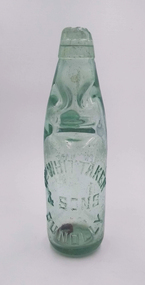
Codd Bottle - Whittaker & Sons, Lemonade, Dunolly
... bottle. This prevents the marble from blocking the neck as the drink is poured. ...bottle. This prevents the marble from blocking the neck as the drink is poured. ...David Gordon Collection. A Codd-neck bottle is a type of bottle used for carbonated drinks. Hiram Codd, an English engineer invented a successful process that he patented as “Codd’s patented globe stopper bottle” in 1872. This type of bottle has a closing design in which a glass marble is held against a rubber seal, which sits within a recess in the lip. The Codd-neck bottle was designed and manufactured with thick glass to withstand internal pressure, and a chamber to enclose a marble and a rubber washer in the neck. The bottles are filled upside down, and pressure of the gas in the bottle forced the marble against the washer, sealing in the carbonation. The bottle is pinched into a special shape to provide a chamber into which the marble is pushed to open the bottle. This prevents the marble from blocking the neck as the drink is poured. The bottles were regularly produced for many decades, but gradually declined in usage. Since children smashed the bottles to retrieve the marbles, vintage bottles are relatively scarce and have become collector items, particularly in the UK. William Whittaker's son Joseph Whittaker operated a cordial factory at Tarnagulla for many years. It was located at the southern end of Commercial Road, and was the last business premises on the eastern side of the road. Joseph Whittaker was a leading citizen at Tarnagulla for many years, and was a leading supporter of sporting activities including cricket and rifle clubs, as well as a strong patron of the fire brigade. He was known by some as Ginger Beer Joe. -
 Orbost & District Historical Society
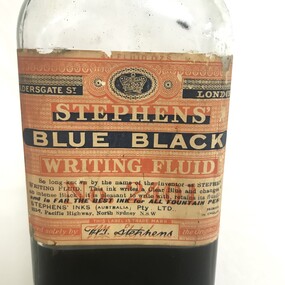
Equipment - bottle of ink, Stephens' Inks (Australia) Pty Ltd, 1900 - 1960s
... The top of the bottle has a small lip for pouring the liquid. This bottle is half-full with blue/black liquid. ...The top of the bottle has a small lip for pouring the liquid. This bottle is half-full with blue/black liquid. ...This ink was used in Australian schools until the 1960s. It contains 40 ozs. of blue/black ink (writing fluid). It was used for dipping pens. At the beginning of each day, an ink monitor (student) had the job of filling the small containers which were inserted into the student desks. This item is significant because of its rarity and because it was such an important part of the equipment used in schools in Australia until c.1960s. A large clear glass bottle, square shape and with a cork stopper. The top of the bottle has a small lip for pouring the liquid. This bottle is half-full with blue/black liquid. The paper label is coloured orange with black and white printing. The bottle top (attached to the cork) is coloured black and appears to be made of plastic. It has the name Stephens' on the bottle top. At the bottom sides of the bottle are the words THIS BOTTLE IS THE PROPERTY OF STEPHENS' INKS (AUST PTY LTD)Label with STEPHENS' BLUE BLACK WRITING FLUID No. 2401 Other words on the label: So long known by the name of the Inventor as STEPHENS' WRITING FLUID. This ink writes a clear Blue and changes to an intense Black. It is pleasant to write with, retains its fluidity and is FAR THE BEST INK for ALL FOUNTAIN PENS. STEPHENS' INKS (Australia) Pty Ltd. 231-7 Pacific Highway, North Sydney NSW Printed in Englandeducation, ink pens -
 Bendigo Historical Society Inc.
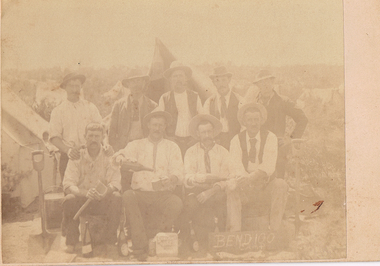
Photograph - GUINEY COLLECTION: PHOTO OF 9 MEN, 1896
... There are mining tools beside them and one man is holding a wine bottle and pouring wine into a glass. There are tents in the background. ...There are mining tools beside them and one man is holding a wine bottle and pouring wine into a glass. There are tents in the background. ...Sepia photograph of nine men. Four men seated in front row. Five men standing hehind. A handwritten sign in front of the men says 'BENDIGO'. There are mining tools beside them and one man is holding a wine bottle and pouring wine into a glass. There are tents in the background. Written on the back in red ink 'To Mackay and the Bendigonian Young Bendigonians in the West Christmas Day 1896 at Rocky Bay A Doughty C Wilkinson D Manners C Cudey S Nestor John Downes A McAllister J Burtonclay R Kuhlkens -
 Kiewa Valley Historical Society
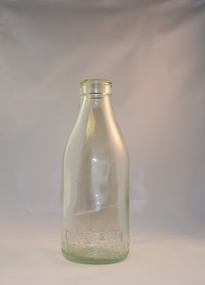
Bottle Milk, mid to late 1900's
... This head has been manufactured to facilitate the movement of the bottled along the milk production line. The method of pouring milk into the bottle has been part of the "production line". ...This head has been manufactured to facilitate the movement of the bottled along the milk production line. The method of pouring milk into the bottle has been part of the "production line". ...This glass milk bottle was manufactured and used mid 1800's (1834 Victorian dairy industry was founded) to the time that a cheaper container was invented(plastic bottles and polyethylene plastic lined cardboard cartons). In 1909 the supply of pure bottled milk was required for babies to overcome infant mortality due to unhygienic milk sources (unclean containers and unpasteurized milk). Due to the large volume of milk being processed and hand milking could not keep up with demand, dairy farms introduced milking machines in the late 1930's. The great increases in dairy herds from the average of 18 cows per heard in 1950's to 142 cows per herd in 1996 required milk tankers to pick up the regions milk supply. This bottle was so constructed to be easily moved within the milk processing plants from the delivery vats/holding tanks to the final corking/sealing of the bottles for eventual distribution. From 1958 the milk bottle slowly became phased out of production. At this point in time Melbourne was drawing 160,000 bottles per week from the two major glass bottle works companies, e.g. Melbourne Glass Bottle Works Co.Victoria was the major state supplier of cows milk in the history of Australian milk production from the early 1800's. The Kiewa Valley and its region was a major contributor to meet that demand. Each bottle was "branded" during manufacturing to show the contents (pasteurized milk) and where it originated from (region and supplier). This method of recycling the bottles back to specific dairy farms was a good control method but an uneconomical "on cost" which was replaced by the "throw away" less costly plastic and cardboard containers. Kiewa Valley dairy herds had marked bottles bearing "90/9", "6/18", "6/33", "6/35" and "6/36"This heavy gauged glass milk bottle has a rim and a distinctive head at the top. This head has been manufactured to facilitate the movement of the bottled along the milk production line. The method of pouring milk into the bottle has been part of the "production line". This bottle has a one pint capacity and is made from "light green" coloured glass(a protection against sunlight penetration). There are other milk bottles that do not have a "green" tint in them. This thick glass bottle to contain milk required its thickness because of the extensive handling before final consumption. Milk was delivered by the "milk man" direct to the homes of consumers. During this period delivery to homes in cities and towns was made initially by horse and cart and later by truck.On the bottom end of this bottle a circle within it 6/33 and next to this "ONE PINT" and under this "THIS BOTTLE BELONGS TO MILK BOTTLE RECOVERY LTD" and below this "AND CANNOT BE USED WITHOUT WRITTEN PERMISSION" on the base "M" underneath this "4"glass bottles, commercial milk containers, domestic milk bottles, pasteurized milk bottles -
 Kiewa Valley Historical Society
Bottle Milk, circa mid to late 1900's
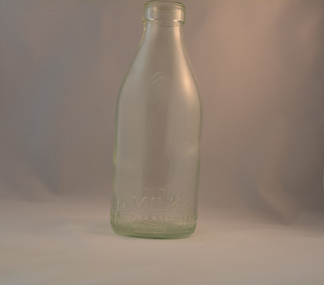
... This head was manufactured to facilitate the movement of the bottled along the milk production line. The method of pouring milk into the bottle has been part of the "production line". ...This head was manufactured to facilitate the movement of the bottled along the milk production line. The method of pouring milk into the bottle has been part of the "production line". ...This glass milk bottle was manufactured and used mid to late 1900's (1834 Victorian dairy industry was founded) up to the time that a cheaper container was invented(plastic bottles and polyethylene plastic lined cardboard cartons). In 1909 the supply of pure bottled milk was required for babies to overcome infant mortality due to unhygienic milk sources (unclean containers and unpasteurized milk). Due to the volume of milk being processed and hand milking could not keep up with demand, dairy farms introduced milking machines in the late 1930's. The great increases in dairy herds from the average of 18 cows per heard in 1950's to 142 cows per herd in 1996 required milk tankers to pick up the regions milk supply. This bottle was so constructed to be easily moved within the milk processing plants from the delivery vats/holding tanks to the final corking/sealing of the bottles for eventual distribution. From 1958 the milk bottle slowly became phased out of production. At this point in time Melbourne was drawing 160,000 bottles per week from the two major glass bottle works companies, e.g. Melbourne Glass Bottle Works Co.Victoria was the major state supplier of cows milk in the history of Australian milk production from the early 1800's. The Kiewa Valley and its region was a major contributor to meet that demand. Each bottle was "branded" during manufacturing to show the contents (pasteurized milk) and where it originated from (region and supplier). This method of recycling the bottles back to specific dairy farms was a good control method but an uneconomical "on cost" which was replaced by the "throw away" less costly plastic and cardboard containers. Kiewa Valley dairy herds had marked bottles bearing "90/9", "6/18", "6/33", "6/35" and "6/36" Found under house at 1 Beauty Ave., Mt Beauty.This heavy gauged glass milk bottle has a rim and a distinctive head at the top. This head was manufactured to facilitate the movement of the bottled along the milk production line. The method of pouring milk into the bottle has been part of the "production line". This bottle has a one pint capacity and is made from "light green" coloured glass(a protection against light penetration). There are other milk bottles that do not have a "green" tint in them. This thick glass bottle which contained milk required its thickness because of the extensive handling before final consumption. Milk was delivered by the "milk man" direct to the homes of consumers. During this period delivery to homes in cities and towns was made initially by horse and cart and later by truck.On the bottom end of this bottle a circle within it "6/18" and next to this "MILK" and opposite "ONE PINT". Below this "THIS BOTTLE BELONGS TO MILK BOTTLE RECOVERY LTD" and below this "AND CANNOT BE USED WITHOUT WRITTEN PERMISSION" on the base "M" underneath this "3"glass bottles, commercial milk containers, domestic milk bottles, pasteurized milk bottles -
 Kiewa Valley Historical Society
Bottle Milk, mid to late 1900's
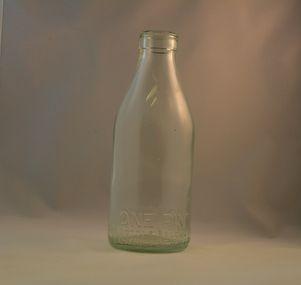
... This head has been manufactured to facilitate the movement of the bottle along the milk production line. The method of pouring milk into the bottle has been part of the "production line". ...This head has been manufactured to facilitate the movement of the bottle along the milk production line. The method of pouring milk into the bottle has been part of the "production line". ...This glass milk bottle was manufactured and used mid to late 1900's (1834 Victorian dairy industry was founded) until the time that a cheaper container was invented(plastic bottles and polyethylene plastic lined cardboard cartons). In 1909 the supply of pure bottled milk was required for babies to overcome infant mortality due to unhygienic milk sources (unclean containers and unpasteurized milk). Due to the volume of milk being processed and hand milking could not keep up with demand, dairy farms introduced milking machines in the late 1930's. The great increases in dairy herds from the average of 18 cows per heard in 1950's to 142 cows per herd in 1996 required milk tankers to pick up the regions milk supply. This bottle was so constructed to be easily moved within the milk processing plants from the delivery vats/holding tanks to the final corking/sealing of the bottles for eventual distribution. From 1958 the milk bottle slowly became phased out of production. At this point in time Melbourne was drawing 160,000 bottles per week from the two major glass bottle works companies, e.g. Melbourne Glass Bottle Works Co.Victoria was the major state supplier of cows milk in the history of Australian milk production from the early 1800's. The Kiewa Valley and its region was a major contributor to meet that demand. Each bottle was "branded" during manufacturing to show the contents (pasteurized milk) and where it originated from (region and supplier). This method of recycling the bottles back to specific dairy farms was a good control method but an uneconomical "on cost" which was replaced by the "throw away" less costly plastic and cardboard containers. Kiewa Valley dairy herds had marked bottles bearing "90/9", "6/18", "6/33", "6/35" and "6/36" Found under house at 1 Beauty Ave., Mt Beauty.This heavy gauged glass milk bottle has a rim and a distinctive head at the top. This head has been manufactured to facilitate the movement of the bottle along the milk production line. The method of pouring milk into the bottle has been part of the "production line". This bottle has a one pint capacity and is made from "light green" coloured glass(a protection against light penetration). There are other milk bottles that do not have a "green" tint in them. This thick glass bottle to contain milk required its thickness because of the extensive handling before final consumption. Milk was delivered by the "milk man" direct to the homes of consumers. During this period delivery to homes in cities and towns was made initially by horse and cart and later by truck.On the bottom end of this bottle a circle within it "6/36" and next to this "MILK" and opposite "ONE PINT". Below this "THIS BOTTLE BELONGS TO MILK BOTTLE RECOVERY LTD" and below this "AND CANNOT BE USED WITHOUT WRITTEN PERMISSION" on the base "M" underneath this "15" glass bottles, commercial milk containers, domestic milk bottles, pasteurized milk bottles -
 Kiewa Valley Historical Society
Bottle Milk, mid to late 1900's
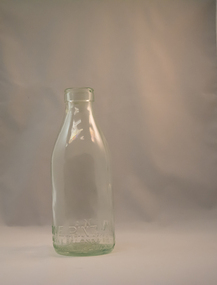
... This head has been manufactured to facilitate the movement of the bottled along the milk production line. The method of pouring milk into the bottle has been part of the "production line". ...This head has been manufactured to facilitate the movement of the bottled along the milk production line. The method of pouring milk into the bottle has been part of the "production line". ...This glass milk bottle was manufactured and used mid to late1900's (1834 Victorian dairy industry was founded) up until the time that a cheaper container was invented(plastic bottles and polyethylene plastic lined cardboard cartons). In 1909 the supply of pure bottled milk was required for babies to overcome infant mortality due to unhygienic milk sources (unclean containers and unpasteurized milk). Due to the volume of milk being processed and hand milking could not keep up with demand, dairy farms introduced milking machines in the late 1930's. The great increases in dairy herds from the average of 18 cows per heard in 1950's to 142 cows per herd in 1996 required milk tankers to pick up the regions milk supply. This bottle was so constructed to be easily moved within the milk processing plants from the delivery vats/holding tanks to the final corking/sealing of the bottles for eventual distribution. From 1958 the milk bottle slowly became phased out of production. At this point in time Melbourne was drawing 160,000 bottles per week from the two major glass bottle works companies, e.g. Melbourne Glass Bottle Works Co.Victoria was the major state supplier of cows milk in the history of Australian milk production from the early 1800's. The Kiewa Valley and its region was a major contributor to meet that demand. Each bottle was "branded" during manufacturing to show the contents (pasteurized milk) and where it originated from (region and supplier). This method of recycling the bottles back to specific dairy farms was a good control method but an uneconomical "on cost" which was replaced by the "throw away" less costly plastic and cardboard containers. Kiewa Valley dairy herds had marked bottles bearing "90/9", "6/18", "6/33", "6/35" and "6/36" Found under the house at 1 Beauty Ave., Mt BeautyThis heavy gauged glass milk bottle has a rim and a distinctive head at the top. This head has been manufactured to facilitate the movement of the bottled along the milk production line. The method of pouring milk into the bottle has been part of the "production line". This bottle has a one pint capacity and is made from "light green" coloured glass(a protection against light penetration). There are other milk bottles that do not have a "green" tint in them. This thick glass bottle to contain milk required its thickness because of the extensive handling before final consumption. Milk was delivered by the "milk man" direct to the homes of consumers. During this period delivery to homes in cities and towns was made initially by horse and cart and later by truck.On the bottom end of this bottle a circle within it "6/18" and next to this "MILK" and opposite "ONE PINT". Below this "THIS BOTTLE BELONGS TO MILK BOTTLE RECOVERY LTD" and below this "AND CANNOT BE USED WITHOUT WRITTEN PERMISSION" on the base "M" underneath this "4"glass bottles, commercial milk containers, domestic milk bottles, pasteurized milk bottles -
 Kiewa Valley Historical Society
Bottle Milk, mid to late 1900's
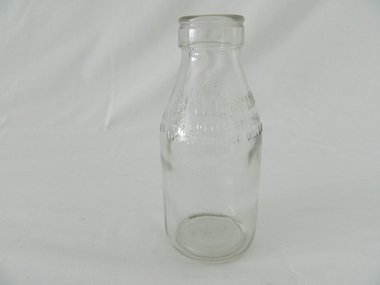
... This head has been manufactured to facilitate the movement of the bottle along the milk production line. The method of pouring milk into the bottle has been part of the "production line". ...This head has been manufactured to facilitate the movement of the bottle along the milk production line. The method of pouring milk into the bottle has been part of the "production line". ...This glass milk bottle was manufactured and used mid to late 1900's (1834 Victorian dairy industry was founded) up until the time that a cheaper container was invented(plastic bottles and polyethylene plastic lined cardboard cartons). In 1909 the supply of pure bottled milk was required for babies to overcome infant mortality due to unhygienic milk sources (unclean containers and unpasteurized milk). Due to the volume of milk being processed and hand milking could not keep up with demand, dairy farms introduced milking machines in the late 1930's. The great increases in dairy herds from the average of 18 cows per heard in 1950's to 142 cows per herd in 1996 required milk tankers to pick up the regions milk supply. This bottle was so constructed to be easily moved within the milk processing plants from the delivery vats/holding tanks to the final corking/sealing of the bottles for eventual distribution. From 1958 the milk bottle slowly became phased out of production. At this point in time Melbourne was drawing 160,000 bottles per week from the two major glass bottle works companies, e.g. Melbourne Glass Bottle Works Co.Victoria was the major state supplier of cows milk in the history of Australian milk production from the early 1800's. The Kiewa Valley and its region was a major contributor to meet that demand. Each bottle was "branded" during manufacturing to show the contents (pasteurized milk) and where it originated from (region and supplier). This method of recycling the bottles back to specific dairy farms was a good control method but an uneconomical "on cost" which was replaced by the "throw away" less costly plastic and cardboard containers. Kiewa Valley dairy herds had marked bottles bearing "90/9", "6/18", "6/33", "6/35" and "6/36" Found under the house at 1 Beauty Ave., Mt BeautyThis heavy gauged glass milk bottle has a rim and a distinctive head at the top. This head has been manufactured to facilitate the movement of the bottle along the milk production line. The method of pouring milk into the bottle has been part of the "production line". This bottle has a half pint capacity and is made from "clear" glass. There are other milk bottles that have a "green" tint in them and this tint was to protect the contents from sun damage. This thick glass bottle to contain milk required its thickness because of the extensive handling before final consumption. Milk was delivered by the "milk man" direct to the homes of consumers. During this period delivery to homes in cities and towns was made initially by horse and cart and later by truck.On the top half of this bottle is "MILK" and opposite "HALF PINT". Below this "THIS BOTTLE BELONGS TO MILK BOTTLE RECOVERY LTD" and below this "AND CANNOT BE USED WITHOUT WRITTEN PERMISSION" on the base is "2 M" underneath this "8/11" and underneath is "ISM -169"glass bottles, commercial milk containers, domestic milk bottles, pasteurized milk bottles -
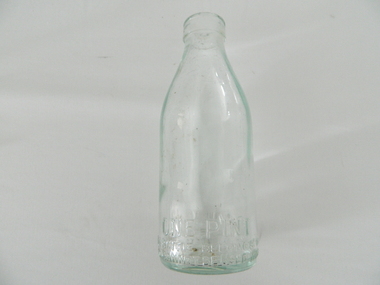 Kiewa Valley Historical Society
Bottle Milk, mid to late 1900's
... This head has been manufactured to facilitate the movement of the bottled along the milk production line. The method of pouring milk into the bottle has been part of the "production line". ...This head has been manufactured to facilitate the movement of the bottled along the milk production line. The method of pouring milk into the bottle has been part of the "production line". ...This glass milk bottle was manufactured and used mid to late 1900's (1834 Victorian dairy industry was founded), until the time that cheaper containers were invented(plastic bottles and polyethylene plastic lined cardboard cartons). In 1909 the supply of pure bottled milk was required for babies to overcome infant mortality due to unhygienic milk sources (unclean containers and unpasteurized milk). Due to the volume of milk being processed and hand milking could not keep up with demand, dairy farms introduced milking machines in the late 1930's. The great increases in dairy herds from the average of 18 cows per heard in 1950's to 142 cows per herd in 1996 required milk tankers to pick up the regions milk supply. This bottle was so constructed to be easily moved within the milk processing plants from the delivery vats/holding tanks to the final corking/sealing of the bottles for eventual distribution. From 1958 the milk bottle slowly became phased out of production. At this point in time Melbourne was drawing 160,000 bottles per week from the two major glass bottle works companies, e.g. Melbourne Glass Bottle Works Co.Victoria was the major state supplier of cows milk in the history of Australian milk production from the early 1800's. The Kiewa Valley and its region was a major contributor to meet that demand. Each bottle was "branded" during manufacturing to show the contents (pasteurized milk) and where it originated from (region and supplier). This method of recycling the bottles back to specific dairy farms was a good control method but an uneconomical "on cost" which was replaced by the "throw away" less costly plastic and cardboard containers. Kiewa Valley dairy herds had marked bottles bearing "90/9", "6/18", "6/33", "6/35" and "6/36" Found under the house at 1 Beauty Ave., Mt BeautyThis heavy gauged glass milk bottle has a rim and a distinctive head at the top. This head has been manufactured to facilitate the movement of the bottled along the milk production line. The method of pouring milk into the bottle has been part of the "production line". This bottle has a one pint capacity and is made from "light green" coloured glass(a protection against light penetration). There are other milk bottles that do not have a "green" tint in them. This thick glass bottle, to contain milk, required its thickness because of the extensive handling (man and machine) before final consumption. Milk was delivered by the "milk man" direct to the homes of consumers. During this period delivery to homes in cities and towns was made initially by horse and cart and later by truck.On the bottom end of this bottle is a circle within it "6/35" and next to this "MILK" and opposite "ONE PINT". Below this "THIS BOTTLE BELONGS TO MILK BOTTLE RECOVERY LTD" and below this "AND CANNOT BE USED WITHOUT WRITTEN PERMISSION" on the base "M" underneath this "20"milk, dairy, glass bottle -
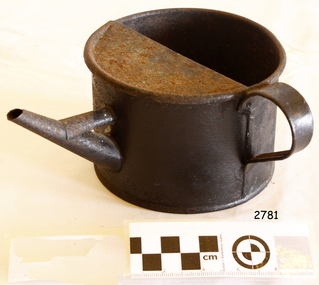 Flagstaff Hill Maritime Museum and Village
Container - Ink Jug, Second half of 19th Century or first half of the 20th Century
... The ink would be supplied to schools in large glass or stoneware bottles, and these would have been too unwieldy and difficult to use to pour ink into the small inkwells. ...The ink would be supplied to schools in large glass or stoneware bottles, and these would have been too unwieldy and difficult to use to pour ink into the small inkwells. ...This metal ink jug or can, was used to dispense portions of ink to individual inkwells contained on the top of each pupil's desk. The jug is not unlike a small indoor watering can. The ink would be supplied to schools in large glass or stoneware bottles, and these would have been too unwieldy and difficult to use to pour ink into the small inkwells. Therefore it was decanted into the metal ink jugs and then poured into the inkwells. After a child was deemed old enough to progress from just using slate and board, he/she would have been supplied with a pen shaft made of wood and with a very basic metal nib. The ink jug would be used to fill up the individual inkwells. This operation would have been conducted by the teacher him/herself, or by an older pupil under the close eye of the teacher.Ink jug, metal, black, with long spout & metal handleNone.flagstaff hill, warrnambool, shipwrecked-coast, flagstaff-hill, flagstaff-hill-maritime-museum, maritime-museum, shipwreck-coast, flagstaff-hill-maritime-village, ink, jug -
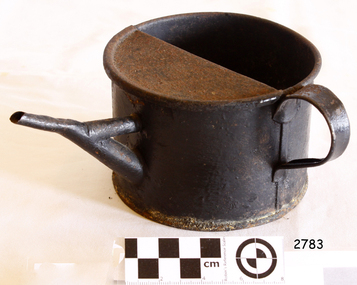 Flagstaff Hill Maritime Museum and Village
Container - Ink Jug, Second half of 19th Century or first half of the 20th Century
... The ink would be supplied to schools in large glass or stoneware bottles, and these would have been too unwieldy and difficult to use to pour ink into the small inkwells. ...The ink would be supplied to schools in large glass or stoneware bottles, and these would have been too unwieldy and difficult to use to pour ink into the small inkwells. ...This metal ink jug or can, was used to dispense portions of ink to individual inkwells contained on the top of each pupil's desk. The jug is not unlike a small indoor watering can. The ink would be supplied to schools in large glass or stoneware bottles, and these would have been too unwieldy and difficult to use to pour ink into the small inkwells. Therefore it was decanted into the metal ink jugs and then poured into the inkwells.After a child was deemed old enough to progress from just using slate and board, he/she would have been supplied with a pen shaft made of wood and with a very basic metal nib. The ink jug would be used to fill up the individual inkwells. This operation would have been conducted by the teacher him/herself, or by an older pupil under the close eye of the teacher.Ink jug metal black with long spout & metal handle.None.flagstaff hill, warrnambool, shipwrecked-coast, flagstaff-hill, flagstaff-hill-maritime-museum, maritime-museum, shipwreck-coast, flagstaff-hill-maritime-village, ink, jug -
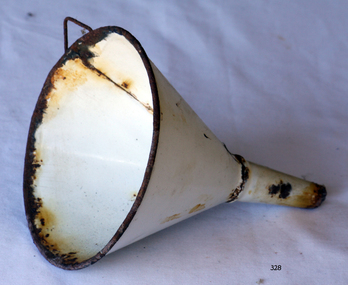 Flagstaff Hill Maritime Museum and Village
Domestic object - Funnel, Late 19th or early 20th Century
... A funnel such as this is used to assist in pouring liquids into a narrow container such as a bottle or jar. An item like this could be commonly used in households for food preparation, cooking and soap making. ...A funnel such as this is used to assist in pouring liquids into a narrow container such as a bottle or jar. An item like this could be commonly used in households for food preparation, cooking and soap making. ...A funnel such as this is used to assist in pouring liquids into a narrow container such as a bottle or jar. An item like this could be commonly used in households for food preparation, cooking and soap making. It could also be used for pouring fuel, and medicinal purposes. Enamelware dates back to 1760 in Germany.This object is significant as an example of a type of item in common use in the 19th Century and that is still in use today.Funnel, white enamel with dark rusty metal rim. It has a triangular shaped hook on the top lip for hanging. The metal has been joined down one side.None.flagstaff hill, flagstaff hill maritime museum and village, warrnambool, maritime museum, maritime village, great ocean road, shipwreck coast, funnel, food preparation, beverage, laundry, fuel, food preservation, medicinal preparation, decanting, pouring -
Blacksmith's Cottage and Forge
Bottle, Pottery
... Straight sided, small light brown pottery bottle with a pouring lip. No cork....Straight sided, small light brown pottery bottle with a pouring lip. No cork. Bottle, Pottery Probably Lovatt Ltd. ...The bottle was proably used to store ink.Straight sided, small light brown pottery bottle with a pouring lip. No cork.Lovatt. Lovatt. Ltd.domestic, pottery, brown, bottle, ink, container, ceramic, stoneware, writing equipment -
Blacksmith's Cottage and Forge
earthenware bottle
... A straight sided, brown pottery bottle with a pouring lip. It has no lid/cork. It has a rough, slightly concave base, a short neck with sloping 'shoulders'...Bourne Denby A straight sided, brown pottery bottle with a pouring lip. It has no lid/cork. It has a rough, slightly concave base, a short neck with sloping 'shoulders' earthenware bottle Bourne ...Used circa 1900 as a storage for ink.A straight sided, brown pottery bottle with a pouring lip. It has no lid/cork. It has a rough, slightly concave base, a short neck with sloping 'shoulders'Bourne Denby -
 Shepparton RSL Sub Branch
Vickers Machine gun Oil tin, 1941
... bottle 11 1941 Bedford? WW2 Vickers Machine gun Oil Tin, 1 Quart size dated 1941, with brass oil filling plug and Brass pouring spout and Brass chain linking both. ...Standard ww2 .303 Vickers Machine gun oil bottleWW2 Vickers Machine gun Oil Tin, 1 Quart size dated 1941, with brass oil filling plug and Brass pouring spout and Brass chain linking both. Domed top and rectangular base.11 1941 Bedford?oil bottle -
 City of Moorabbin Historical Society (Operating the Box Cottage Museum)
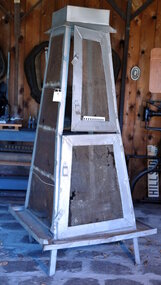
Functional object - Kitchen Equipment, Coolgardie Safe, c1900
... bottle would get colder. What McCormick had discovered was the principle of evaporation: ‘to change any liquid into a gaseous state requires energy. This energy is taken in the form of heat from its surroundings.’ Employing this principle, McCormick made a box for his provisions which he covered with a wet hessian bag. He then placed a tray on top, into which he poured...bottle would get colder. What McCormick had discovered was the principle of evaporation: ‘to change any liquid into a gaseous state requires energy. This energy is taken in the form of heat from its surroundings.’ Employing this principle, McCormick made a box for his provisions which he covered with a wet hessian bag. He then placed a tray on top, into which he poured ...The invention of the Coolgardie Safe is credited to Arthur Patrick McCormick, a contractor in Coolgardie, and later the Mayor of Narrogin. Coolgardie is in the Eastern Goldfields region of Western Australia. Gold was first discovered there in 1892; the townsite became a municipality in 1894, and by 1898 its population of 15,000 made it the third largest town in Western Australia after Perth and Fremantle. In the last decade of the 19th century, Coolgardie was the capital of the West Australian goldfields. Being 180 kilometres from the nearest civilisation, food supplies were initially scarce and expensive. As fresh food was a valuable commodity there was incentive to preserve it, and keep it out of reach of scavengers such as birds, dingos, dogs, ants, and flies. It was in an effort to do this, in the extreme heat of the Australian Interior, that McCormick came up with his design for the Coolgardie Safe. McCormick noticed that a wet bag placed over a bottle cooled its contents. He further noted that if this bottle was placed in a breeze, the bag would dry out more quickly, but the bottle would get colder. What McCormick had discovered was the principle of evaporation: ‘to change any liquid into a gaseous state requires energy. This energy is taken in the form of heat from its surroundings.’ Employing this principle, McCormick made a box for his provisions which he covered with a wet hessian bag. He then placed a tray on top, into which he poured water twice daily. He hung strips of flannel from the tray so that water would drip down onto the hessian bag, keeping it damp. As the water evaporated, the heat dissipated, keeping the food stored inside cool and fresh. The success of McCormick’s invention would not have worked without a steady supply of water. Fresh water was scarce in the eastern goldfields at this time but the demand for water from a steadily growing population encouraged innovation. The solution was to condense salt water. Heating salt water in tanks produced steam that was condensed in tall cylinders, cooled and then collected in catchment trays. By 1898 there were six companies supplying condensed water to the goldfields, the largest company producing 100,000 gallons of water a day. In the early 20th century, Coolgardie Safes were also manufactured commercially. These safes incorporated shelving and a door, had metal or wooden frames and hessian bodies. The feet of the safe were usually placed in a tray of water to keep ants away. (MAV website) The early settlers of Moorabbin Shire depended on this type of Food Safe to protect their food from flies and vermin as they established market gardens in the fertile area around the notorious Elster Creek A metal framed, 4 sided structure standing on 4 legs with 2 hinged doors on one side, a metal tray at base of food safe and a metal cover over top. Ridges on which to rest trays carrying food are inside safe. The Safe is enclosed by fly-wire mesh.'...IN.....GEELONG' A manufacturer's oval metal plate is embossed on one side of Safe but it is illegible.elster creek, moorabbin, brighton, dendy's special survey 1841, market gardens, infant mortality, disease, cemeteries, fruit, vegetables, pioneers, coolgardie safe, mccormick arthur patrick, dendy henry, vaccination, jones martha, jones ethel may -
 City of Moorabbin Historical Society (Operating the Box Cottage Museum)
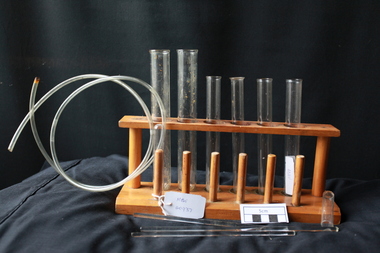
Manufactured GLass, test tubes, mixers, 20thC
... pouring, make them easier to clean, and allow convenient monitoring of the contents. The long, narrow neck slows down the spreading of vapours and gases to the environment. Test tubes are usually held in special-purpose racks, Test tubes for physics and chemistry are usually made of glass for better resistance to heat and corrosive chemicals and longer life. Tubes made from expansion-resistant glasses, such as borosilicate glass, can be placed directly over a Bunsen burner flame. glass manufacturers test tubes culture tubes sample tubes borosilicate glass otto schlott felton grimwade company melbourne glass bottle ...A test tube, also known as a culture tube or sample tube, is a common piece of laboratory glassware consisting of a finger-like length of glass or clear plastic tubing, open at the top, usually with a rounded U-shaped bottom. Test tubes are widely used by pharmacists to hold, mix, or heat small quantities of solid or liquid chemicals, especially for qualitative experiments and assays. Their round bottom and straight sides minimize mass loss when pouring, make them easier to clean, and allow convenient monitoring of the contents. The long, narrow neck slows down the spreading of vapours and gases to the environment. Test tubes are usually held in special-purpose racks, Test tubes for physics and chemistry are usually made of glass for better resistance to heat and corrosive chemicals and longer life. Tubes made from expansion-resistant glasses, such as borosilicate glass, can be placed directly over a Bunsen burner flame.8 clear glass test tubes of varied capacity with 3 glass mixers sitting in a wooden stand. A 1 metre length of clear plastic tubing is with this setglass manufacturers, test tubes, culture tubes, sample tubes, borosilicate glass, otto schlott, felton grimwade company, melbourne glass bottle works, laboratory glass, pharmacy, moorabbin, bentleigh, cheltenham, spotswood melbourne -
 City of Moorabbin Historical Society (Operating the Box Cottage Museum)
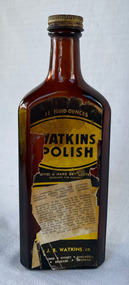
Domestic object - Watkins Polish, J. R. Watkins Co (USA), 20thC
... poured on the damp cloth or on the surface to be polished. In either case rub it all with a dry cloth to obtain a high polish. When dusting, dampen the cloth with Watkins Polish - it keeps down the dust and gives a lustre which is neither greasy not gummy. The J. R. Watkins Co. Melbourne - Sydney - Adelaide - Kogarah EMBOSED ON BOTTLE...poured on the damp cloth or on the surface to be polished. In either case rub it all with a dry cloth to obtain a high polish. When dusting, dampen the cloth with Watkins Polish - it keeps down the dust and gives a lustre which is neither greasy not gummy. The J. R. Watkins Co. Melbourne - Sydney - Adelaide - Kogarah EMBOSED ON BOTTLE ...The J. R. Watkins Co. opened its first overseas branch in Australia in 1935. The J. R. Watkins built a large factory at Highett on a six acres on the east side of Nepean Highway (no. 1123) in 1954. The J. R. Watkins company was founded in 1868 in Plainview, Minnesota USA, moving to Winona in 1885, by J. R. Watkins.Example of industry in the City of Moorabbin.Amber glass bottle with a metal screw on lid. A paper label is on the front of the bottle 'Watkins Polish" printed in yellow, black and white.PRINTED ON LABEL: 11 Fluid ounces - WATKINS POLISH - Gives a hard dry lustre excellent for Dusting For cleaning, dusting and polishing furniture, pianos, woodwork, linoleum, hardwood floors and all polished surfaces. Directions: If the article to be polished is dirty or gummy, clean it by washing with mild soap and warm water. Apply Watkins Polish with a damp, soft cloth (Dampened with water and wrung almost dry). The Polish may be poured on the damp cloth or on the surface to be polished. In either case rub it all with a dry cloth to obtain a high polish. When dusting, dampen the cloth with Watkins Polish - it keeps down the dust and gives a lustre which is neither greasy not gummy. The J. R. Watkins Co. Melbourne - Sydney - Adelaide - Kogarah EMBOSED ON BOTTLE: "The J.R.Watkins co. Made in Australia" the j. r. watkins co, highett, polish
