
Showing 44 items matching "pozieres 1916"
-
 Melbourne Legacy
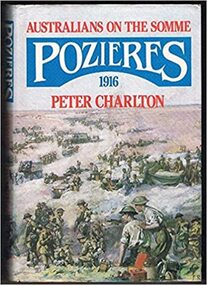
Book, Australians on the Somme. Pozieres 1916, 1986
... Australians on the Somme. Pozieres 1916...A book about the fighting around the French village of Pozieres in 1916. Many of the early legatees fought on the Western Front and some, including founder Stan Savige, fought at Pozieres. ...Australians on the Somme. Pozieres 1916 Book ...A book about the fighting around the French village of Pozieres in 1916. Many of the early legatees fought on the Western Front and some, including founder Stan Savige, fought at Pozieres. There is a photo in the book of Brigadier-General Gellibrand and his staff, including Savige, eating breakfast in a shell hole. Back in Australia after the war Gellibrand inspired Savige to found a club like the Remembrance Club he had founded in Hobart. Thus Savige founded Legacy. Speeches by Legatees Kemsley and Armstrong in later years showed they had also fought in the Pozieres area. Some research has shown: The fighting around Pozières was part of the brave actions of the Australians during the battle of the Somme from July 1916. Between 23 July and 5 August 1916, the Australian 1st and 2nd Divisions captured Pozières village and Pozières heights, a ridge 500 metres east of the village. The 4th Division then continued the attack north along the ridge, the Australians in ten days of continuous action reached Mouquet Farm. The farm resisted capture until 26 September 1916. In less than seven weeks in the fighting at Pozières and Mouquet Farm three Australian divisions suffered 23,000 casualties. Of these, 6,800 men were killed or died of wounds. It was a loss comparable with the casualties sustained by the Australians over eight months at Gallipoli in 1915.A book about a battle that was important to the early legatees.Hardcover book x 318 pages about the Somme battles of World War One.Handwritten 'Melbourne Legacy Library WW1 in black ink on the fly leaf. Also a sticker saying property of Rob Allison on title page.somme, pozieres, battles, aif -
 Bendigo Historical Society Inc.
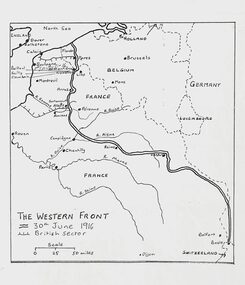
Map - Jack Lockett Collection: Copies of two maps of WW1 Battles
... ...Pozieres 1916...1916 British Sector Scale 1 inch to 50 miles. The Western Front spans from the North Sea to Switzerland. The other side is labeled POZIERES scale 1 inch to 500 yards. ...Jack Lockett Mabel Ingwersen 38th Australian Infantry Battalion W.W.1 Mallee Farming Pozieres 1916 The Western Front 1916 Two photocopies of hand drawn maps on one A4 sheet of paper. ...John Henry Lockett OAM (22 January 1891 – 25 May 2002) was the oldest man ever in Australia when he died aged 111 years, 123 days. As one of the last surviving veterans of World War I, he was acclaimed as a national hero during the last decade of his life. Lockett was born in the small Victorian town of Waanyarra, near Bendigo. He left school aged nine to work on a local farm. Later, he worked for his uncles in the Mallee. On 24 March 1916, he travelled to Mildura to enlist in the Australian Imperial Force. He served in France with the 38th Battalion, earning promotion to sergeant and was discharged on 20 September 1919. https://en.wikipedia.org/wiki/Jack_Lockett The 38th Battalion was formed on 1 March 1916 at a camp established on the Epsom Racecourse at Bendigo in Victoria. After training in both Australia and Britain, the 38th Battalion crossed to France in late November 1916 and moved into the trenches of the Western Front for the first time on 1 December.The 38th fought in its first major battle at Messines, in Belgium, between 7-9 June 1917. It fought in another two major attacks in this sector - the battle of Broodseinde on 4 October, and the battle of Passchendaele on 12 October. Belgium remained the focus of the 38th Battalion's activities for the next five months, until it was rushed south to France in late March 1918 to meet the German Army's Spring Offensive. The 38th participated in its last major action of the war between 29 September and 2 October 1918 as part of the Australian-American operation that breached the formidable defences of the Hindenburg Line along the St Quentin Canal. It was disbanded in April 1919. Source, Australian War Memorial https://www.awm.gov.au/collection/U51478 After the war, Jack returned to The Mallee and selected a 640 acres (260 ha) block of land in Linga, Victoria, deciding to make his living as a farmer. In 1923, he married Maybell Ingwerson and they had four children together. In 1963, the couple retired to Bendigo, leaving the farmland (which now covered more than 130,000 acres (53,000 ha), in the care of their children and grandchildren. Two photocopies of hand drawn maps on one A4 sheet of paper. One side labeled THE WESTERN FRONT 30th June 1916 British Sector Scale 1 inch to 50 miles. The Western Front spans from the North Sea to Switzerland. The other side is labeled POZIERES scale 1 inch to 500 yards. July to September 1916. There are numerous roads and trench lines. jack lockett, mabel ingwersen, 38th australian infantry battalion, w.w.1, mallee farming, pozieres 1916, the western front 1916 -
 Geelong RSL Sub Branch
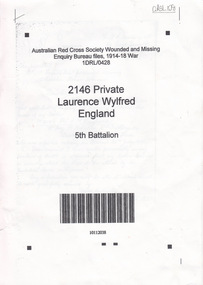
Documents - 2146 Pte L W England, Relating to the Plaque, there are no makers mark, Early 20 Century
... Seven white photocoped foolscap pages relating to 2146 Pte L W England - missing in action/killed in action on 25 July 1916 at Pozieres. A metal plaque....There is also a plaque with the documents - In Loving Memory of our dear son and brother, Killed at Poziere July 1916 aged 19. 'A' Company 5th Battalion, AIF. ...1916 at Posieres. The documents and the plaque relate to 2146 Pte L W England and provide information to his Service and being Killed in Action at Posieres. WW1 Posieres Killed in Aciion 2146 Pte L W England 5th Battalion The pages are relating to enquiries from Pte England's family and the Military. There is also a plaque with the documents - In Loving Memory of our dear son and brother, Killed at Poziere ...2146 Pte L W England was a member of the AIF and served during WW1 with 'A' Coy, 5 Battalion, 2nd Infantry Brigade. He was Lilled in Action of 25 July 1916 at Posieres.The documents and the plaque relate to 2146 Pte L W England and provide information to his Service and being Killed in Action at Posieres.Seven white photocoped foolscap pages relating to 2146 Pte L W England - missing in action/killed in action on 25 July 1916 at Pozieres. A metal plaque.The pages are relating to enquiries from Pte England's family and the Military. There is also a plaque with the documents - In Loving Memory of our dear son and brother, Killed at Poziere July 1916 aged 19. 'A' Company 5th Battalion, AIF. Presented by Mr and Mrs G England and Family.ww1, posieres, killed in aciion, 2146 pte l w england, 5th battalion -
 Bendigo Military Museum
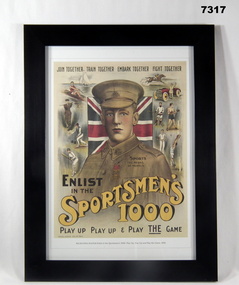
Print - PRINT, FRAMED WW1, Reader's Digest (Australia) Pty Limited, 2015
... He earned Australia's first Victoria Cross at Gallipoli 1915, Military Cross at Pozieres 1916, Bar for action Bullecourt 1917.) ...He earned Australia's first Victoria Cross at Gallipoli 1915, Military Cross at Pozieres 1916, Bar for action Bullecourt 1917.) ...From information book; "Reader's Digest/ Gallipoli/ 25th April 1915 - 9th January 1916/ Centenary Commemorative Prints". Collection of 20 prints. Refer to Cat No. 7300.Framed print. Print - colour print on paper. Copy of an original poster. Illustrated - depicts the head and shoulders of a soldier. (Albert JACKA enlisted in the Australian Imperial Forces in 1914. He earned Australia's first Victoria Cross at Gallipoli 1915, Military Cross at Pozieres 1916, Bar for action Bullecourt 1917.) The soldier is standing in front of the Union Jack flag and surrounded by images of men playing a variety of sports. Frame - Black plastic framing with glass front and MDF board backing with adhered black paper.Details below print - in black ink; "RECRUITING POSTER Enlist in the Sportsmen's 1000: Play Up, Play up and Play the Game 1916". Details on print "JOIN TOGETHER TRAIN TOGETHER EMBARK TOGETHER FIGHT TOGETHER/ ENLIST/ IN THE/ SPORTSMEN'S/ 1000/ PLAY UP PLAY UP & PLAY THE GAME" On soldier's uniform "SPORTS" THE MEDAL OF MEDALS."framed accessories, prints, ww1, gallipoli, centenary -
 Wangaratta RSL Sub Branch
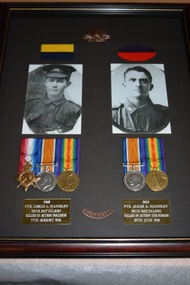
Mixed media - Framed photographs and medals, James and Leslie HANDLEY
... He served with the 14th Battalion and was killed in the field on 7/8/1916. He is buried at Pozieres in an unknown grave. 2813 James Albert HANDLEY was born at Williamstown and enlisted at Wangaratta/Melbourne on 3/10/1916 aged 29 years. ...2458 Pte Leslie L HANDLEY 14th Battalion KILLED IN ACTION POZIERES 7th August 1916 2813 Pte James A. HANDLEY 38th Battalion KILLED IN ACTION THE SOMME 18th July 1918...He served with the 14th Battalion and was killed in the field on 7/8/1916. He is buried at Pozieres in an unknown grave. 2813 James Albert HANDLEY was born at Williamstown and enlisted at Wangaratta/Melbourne on 3/10/1916 aged 29 years. ...Photographs and medals of brothers Leslie and James HANDLEY both killed in action in FRANCE 2458 Leslie Lionel HANDLEY was born at Benalla and enlisted at Wangaratta on 28/5/1915 aged 18 years. He served with the 14th Battalion and was killed in the field on 7/8/1916. He is buried at Pozieres in an unknown grave. 2813 James Albert HANDLEY was born at Williamstown and enlisted at Wangaratta/Melbourne on 3/10/1916 aged 29 years. He served with the 38th Battalion and was killed in the field on 18/7/1918. He is buried at Villiers-Brettoneux. Parents James and Elizabeth resided in various locations including Wangaratta and Laceby West.Timber frame with rising sun badge, two coloured patches, two photographs of soldiers and 5 medals2458 Pte Leslie L HANDLEY 14th Battalion KILLED IN ACTION POZIERES 7th August 1916 2813 Pte James A. HANDLEY 38th Battalion KILLED IN ACTION THE SOMME 18th July 1918killed in action, ww1, leslie lionel handley, james albert handley, 14th battalion, 38th battalion -
 Warrnambool and District Historical Society Inc.
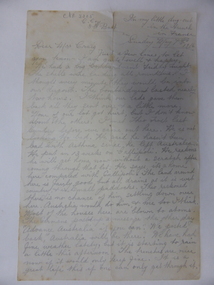
Letter, McDowall - Sunday May 7 1916, 1916
... 1916 by Private George McDowall to a friend Mrs Maggie Craig. Private George Francis Ernest McDowall was a farmer from Nirranda who enlisted in August 1915. He landed in Egypt in1916 and was transferred to the 8th Battalion. He was killed in action at Pozieres...1916 by Private George McDowall to a friend Mrs Maggie Craig. Private George Francis Ernest McDowall was a farmer from Nirranda who enlisted in August 1915. He landed in Egypt in1916 and was transferred to the 8th Battalion. He was killed in action at Pozieres ...This letter was written during World War One from France in 1916 by Private George McDowall to a friend Mrs Maggie Craig. Private George Francis Ernest McDowall was a farmer from Nirranda who enlisted in August 1915. He landed in Egypt in1916 and was transferred to the 8th Battalion. He was killed in action at Pozieres on 25 July 1916 and was buried in France. This letter is an original one and is an important relic from World War One – from a soldier from the Warrnambool area who did not return. The letter is headed ‘From my little dug-out in the trench in France’ and he wrote: ‘It is a great life this if one can only get through it’. He did not survive the war and was killed only two and a half months after this letter was written. This is a letter written from France in 1916 during World War One. It is handwritten in pencil on buff-coloured paper. The paper has been folded and it is a little torn at the top. The page has some staining from age and handling. world war one, private george mcdowall, warrnambool history, world war 1 soldier's letter -
 Frankston RSL Sub Branch
Plaque, Memorial
... First World War Memorial Plaque, bronze, in recognition of Private Sydney Frederick TURNER, from C Company, 9 Battalion who was KIA at Pozieres on 25 July, 1916. it is housed in a wooden surround with pattern embossed in the margins with a liking of the rising sun at the top. ...The name of the serviceman is embossed on the plaque, right of centre, SYDNEY FREDERICK TURNER First World War Memorial Plaque, bronze, in recognition of Private Sydney Frederick TURNER, from C Company, 9 Battalion who was KIA at Pozieres on 25 July, 1916. it is housed in a wooden surround with pattern embossed in the margins with a liking of the rising sun at the top. ...1914-1918 Memorial Plaque In early 1920 it was announced that the next-of-kin of all Australian servicemen and women whose deaths were attributable to the First World War would receive a memorial plaque and scroll "as a solace for bereavement and as a memento". The memorial plaques were not uniquely Australian. In fact they were designed and produced in Britain and issued to commemorate all those who died as a result of war service from within the British Commonwealth. The idea for the plaques was originally conceived mid-way through the war. In 1917 a competition was announced to obtain a suitable design and 800 entries were eventually received. The winner, Mr. E. Carter Preston of Liverpool, England, was chosen in 1918. He was awarded a prize of 250 pounds. Mr Manning Pike directed the manufacture of the memorial plaques at the Memorial Plaque Factory set up at Acton, London. Some later plaques were also made at the Woolwich Arsenal. The cost of manufacturing so many plaques must have been considerable. Each plaque had the name of the soldier commemorated individually embossed (some were engraved) as part of the design. The full name was given without any indication of rank or honours to show the equality of sacrifice of all those who had lost their lives. The scroll designed to accompany the plaques was of thick paper, headed by the royal coat-of-arms, and bore the following message: "He whom this scroll commemorates was numbered among those who, at the call of King and Country, left all that was dear to them, endured hardness, faced danger, and finally passed out of the sight of men by the path of duty and self-sacrifice, giving up their own lives that others might live in freedom. Let those that come after see that his name is not forgotten". Underneath the message the serviceman or woman’s name, rank, honours and unit were written by hand in red ink. Because of the late arrival in Australia of the plaques many scrolls were sent out separately. A message from the King, "I join with my grateful people in sending you this memorial of a brave life given for others in the Great War", was included with the scroll. The first plaques were distributed in Australia in 1922. Each plaque was sent out from Base Records Office at Victoria Barracks in Melbourne by second-class mail. Approximately 60,000 plaques were issued in Australia. Families of deceased members of the Royal Australian Navy and the Australian Army Nursing Service also received plaques and scrolls First World War Memorial Plaque, bronze, in recognition of Private Sydney Frederick TURNER, from C Company, 9 Battalion who was KIA at Pozieres on 25 July, 1916. it is housed in a wooden surround with pattern embossed in the margins with a liking of the rising sun at the top. He is recorded on the Villers-Bretonneux Memorial and is listed with an Australian Red Cross Society Wounded and Missing Enquiry Bureau File, a copy of which is attached.Embossed around the edge of the plaque "HE DIED FOR FREEDOM AND HONOVR". The name of the serviceman is embossed on the plaque, right of centre, SYDNEY FREDERICK TURNER -
 Wangaratta RSL Sub Branch
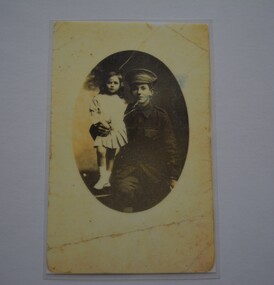
Photograph, c1915
... Four months after his arrival in France he was killed in action on 26/7/1916 at Pozieres. His brother Thomas Kelvie Chesters 53697 also served in WW1 with the 13th Battalion....Four months after his arrival in France he was killed in action on 26/7/1916 at Pozieres. His brother Thomas Kelvie Chesters 53697 also served in WW1 with the 13th Battalion. ...Photograph of John Chesters 3476 WW1 AIF 8th Rein 24th Battalion and 8th Battalion. Born at Lake Rowan, Victoria. He enlisted on 15/7/1915 aged 18 years and 7 months. Four months after his arrival in France he was killed in action on 26/7/1916 at Pozieres. His brother Thomas Kelvie Chesters 53697 also served in WW1 with the 13th Battalion.Laminated rectangle in shape containing oval black and white photograph of soldier sitting with his arm around little girl in white dress.On rear - John Chesters (killed in France) nursing niece Alice. Alice in later life became Mrs Woods. Husband Albertww1, 24th battalion, kia, pozieres -
 Australian Army Museum of Western Australia
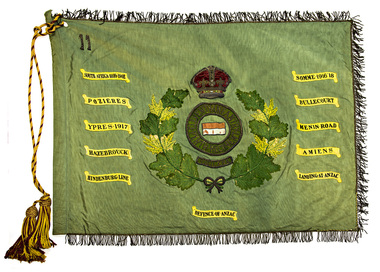
Regimental Colour - 11th Australian Infantry Regiment (Perth Regiment)
... Battle Honours emblazoned on the colour:- SOUTH AFRICA 1899-1902, SOMME 1916-18, POZIERES, BULLECOURT, YPRES 1917, MENIN ROAD, HAZEBROUCK, AMIENS, HINDENBURG LINE, LANDING AT ANZAC, DEFENCE OF ANZAC ...Battle Honours emblazoned on the colour:- SOUTH AFRICA 1899-1902, SOMME 1916-18, POZIERES, BULLECOURT, YPRES 1917, MENIN ROAD, HAZEBROUCK, AMIENS, HINDENBURG LINE, LANDING AT ANZAC, DEFENCE OF ANZAC Regimental Colour - 11th Australian Infantry Regiment (Perth Regiment) ...Presented by the Honourable Lord Mayor JT Franklin, CMG, MLC, JP, at a parade held at Karrakatta Camp on 7 April 1929. Consecrated by the Chaplain General COL Riley, OBE, VD, DD. With the re-activation of the Citizen Military Forces (CMF) following the Second World War, the 11th/44th Infantry Battalion (The City of Perth Regiment) was raised in 1948 as a linked battalion to carry on the identity and traditions of the pre-war 11th and 44th Battalions respectively. The King's and Regimental Colours formerly held by these two battalions were passed on to the new battalion who paraded them in rotation on ceremonial occasions. Under major reorganisation of the CMF in 1960, all individual infantry battalions that existed at the time within each State were amalgamated to form State regiments, taking effect from 1 July 1960. Thus from that date the 11/44th, 16th and 28th Infantry Battalions were amalgamated to form The Royal Western Australia Regiment. In September 1960, at a ceremonial parade held at Northam Camp, the Colours carried by all former battalions were handed over for safe keeping by the new regiment These former colours were subsequently laid up in the undercroft at the State War Memorial, King's Park on 29 November 1964. These were transferred to the Army Museum of WA in 1988 as part of the Bicentenary Colours Project. Dark green with gold fringe. In the centre the battalion colour patch of a brown over blue rectangle within a circle inscribed "ELEVENTH INFANTRY - PERTH REGIMENT". Beneath the circle a scroll inscribed with the regimental motto "VIGILANS". The whole surrounded with a wreath of Australian wattle and surmounted by the Crown. In the upper canton the Arabic numeral "11". Battle Honours emblazoned on the colour:- SOUTH AFRICA 1899-1902, SOMME 1916-18, POZIERES, BULLECOURT, YPRES 1917, MENIN ROAD, HAZEBROUCK, AMIENS, HINDENBURG LINE, LANDING AT ANZAC, DEFENCE OF ANZAC -
 Wangaratta RSL Sub Branch
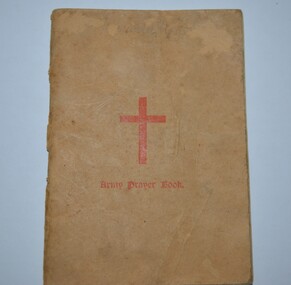
Booklet - Army Prayer Book, Hayman Christy & Lilly Ltd, c1918
... Younger brother of John Chesters 3476 24th Battalion KIA on 26/7/1916 at Pozieres, France....Younger brother of John Chesters 3476 24th Battalion KIA on 26/7/1916 at Pozieres, France. WW1 AIF Prayer Book' 13 Battalion Army Prayer Book Cream colour cardboard cover booklet with red cross on cover containing 80 pages. ...Prayer book issued to Thomas Kelvie Chesters 53697 WW1 AIF 13th Battalion. Born on 5/2/1989 at Benalla. First enlisted on 13/2/1917 however service record stated he did no duty and enlistment cancelled. Reenlisted on 10/10/1917 at Lismore and served with the 13th Battalion He embarked overseas on 19/6/1918 and returned on 24/10/1919 and was discharged on 12/11/1919. Younger brother of John Chesters 3476 24th Battalion KIA on 26/7/1916 at Pozieres, France.Cream colour cardboard cover booklet with red cross on cover containing 80 pages.Army Prayer Bookww1, aif, prayer book', 13 battalion -
 Wangaratta RSL Sub Branch
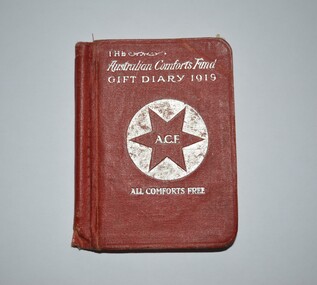
Booklet - ACF Diary 1919, Charles Petts & Co, c1919
... Younger brother of John Chesters 3476 24th Battalion KIA on 26/7/1916 at Pozieres, France....Younger brother of John Chesters 3476 24th Battalion KIA on 26/7/1916 at Pozieres, France. WW1 AIF 13 Battalion ACF Diary 1919 Front Cover - Australian Comforts Fund/Gift Diary 1919/ACF/All Comforts Free Rear Cover - AIF together with rising sun emblem Small red canvas bound booklet with silver writing and symbols on front and back cover with pencil housed in spine. ...Australian Comforts Fund Diary 1919 gifted to Thomas Kelvie Chesters 53697 WW1 AIF 13th Battalion. Born on 5/2/1989 at Benalla. First enlisted on 13/2/1917 however service record stated he did no duty and enlistment cancelled. Reenlisted on 10/10/1917 at Lismore and served with the 13th Battalion He embarked overseas on 19/6/1918 and returned on 24/10/1919 and was discharged on 12/11/1919. Younger brother of John Chesters 3476 24th Battalion KIA on 26/7/1916 at Pozieres, France.Small red canvas bound booklet with silver writing and symbols on front and back cover with pencil housed in spine.Front Cover - Australian Comforts Fund/Gift Diary 1919/ACF/All Comforts Free Rear Cover - AIF together with rising sun emblemww1, aif, 13 battalion, acf diary 1919 -
 Australian Army Museum of Western Australia
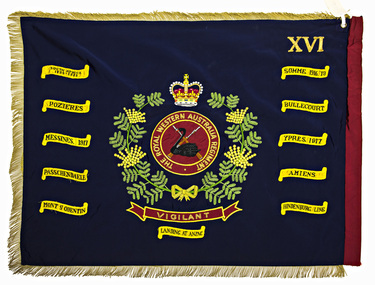
Regimental Colour - 16th Battalion, The Royal Western Australia Regiment
... In the upper canton the Roman numeral "XVI" (Originally this was the numeral "I" - changed to "XVI" in 1966 - see Historical Background details below) Battle honours emblazoned on the colour : SOUTH AFRICA 1899-1902, SOMME 1916-18, POZIERES, BULLECOURT, MESSINES 1917, YPRES 1917, PASSCHENDAELE, AMIENS, MONT ST QUENTIN, HINDENBURG LINE, LANDING AT ANZAC ...In the upper canton the Roman numeral "XVI" (Originally this was the numeral "I" - changed to "XVI" in 1966 - see Historical Background details below) Battle honours emblazoned on the colour : SOUTH AFRICA 1899-1902, SOMME 1916-18, POZIERES, BULLECOURT, MESSINES 1917, YPRES 1917, PASSCHENDAELE, AMIENS, MONT ST QUENTIN, HINDENBURG LINE, LANDING AT ANZAC Regimental Colour - 16th Battalion, The Royal Western Australia Regiment ...Presented to 1st Battalion, The Royal Western Australia Regiment by Field Marshall HRH The Prince Phillip, Duke of Edinburgh at a parade held at the Western Australian Cricket Association Ground, East Perth on 25 November 1962. The Royal Western Australia Regiment was formed on 1 July 1960 from the amalgamation of the following existing infantry battalions in the State at the time :- • 11th/44th Infantry Battalion (The City of Perth Regiment) • 16th Infantry Battalion (The Cameron Highlanders of Western Australia) • 28th Infantry Battalion (The Swan Regiment) At the above presentation of colours to the new battalion, the Colours of the former battalions (four sets of Queen's and Regimental colours) were trooped through the ranks of the battalion and marched off the parade for the last time. These former colours were subsequently laid up in the undercroft at the State War Memorial, King's Park on 29 November 1964. These were transferred to the Army Museum of WA in 1988 as part of the Bicentenary Colours Project. (Refer to Items 4-12 for individual records of these colours) 1st Battalion, The Royal Western Australia Regiment was renumbered 16th Battalion effective from 1st January 1966 as part of a move to reintroduce the old battalion numbers back into the State Regimental system 16th Battalion, The Royal Western Australia Regiment was presented with a new set of Colours on 27 October 2002. The original 1962 Colours were formally handed over for safe keeping to the Army Museum of Western Australia on 3 November 2002. Battle Honours allocated to the State Infantry Regiments created under the CMF reorganisation in July 1960 were promulgated in Australian Army Order 85/1962. These were a consolidation of the battle honours awarded to the various individual battalions that were amalgamated to form the new regiments. Royal blue with gold and red fringes. In the centre the main device from the regimental badge consisting of a black swan upon a pair of crossed rifles on a red background, within a circle inscribed "THE ROYAL WESTERN AUSTRALIA REGIMENT". The whole enclosed within a wreath of Australian wattle and surmounted by the Crown. Across the lower portion of the wreath a scroll inscribed with the regimental motto "VIGILANT". In the upper canton the Roman numeral "XVI" (Originally this was the numeral "I" - changed to "XVI" in 1966 - see Historical Background details below) Battle honours emblazoned on the colour : SOUTH AFRICA 1899-1902, SOMME 1916-18, POZIERES, BULLECOURT, MESSINES 1917, YPRES 1917, PASSCHENDAELE, AMIENS, MONT ST QUENTIN, HINDENBURG LINE, LANDING AT ANZAC -
 Melbourne Legacy
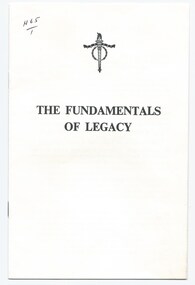
Booklet - Document, brochure, The Fundamentals of Legacy (H65), 1968
... It includes a story of burial after a fierce battle at Pozieres in August 1916 where the writer witnessed a mate pledge to the deceased "don't worry, our friends, we will look after your widows and children". ...It includes a story of burial after a fierce battle at Pozieres in August 1916 where the writer witnessed a mate pledge to the deceased "don't worry, our friends, we will look after your widows and children". ...The Fundamentals of Legacy was a paper offered to the Fortieth Annual Conference of the Legacy Clubs of Australia, held in Ballarat from 7th to 10th November 1968, by the Sydney Legacy Club. It was presented by Legatee Daniel S. Aarons, past president of the Legacy Club of Sydney (1946-47). By resolution of the Conference it was printed by Legacy Co-ordinating Council for distribution upon their request to Legacy Clubs. The first part of the brochure examines birth of Legacy growing from the seeds of comradeship that were sown in war service. Comradeship from the deep friendship forged in war time. The second part examines the personal service that is fundamental to Legacy. It includes a story of burial after a fierce battle at Pozieres in August 1916 where the writer witnessed a mate pledge to the deceased "don't worry, our friends, we will look after your widows and children". The final words of the of the brochure. "Legacy is a magnificent monument whose foundations made from everlasting materials, Mateship, Comradeship, and Friendship. The edifice upon that foundation was erected by the dedicated, personal service of a mere few thousand Legatees of whom it may truly be said, that, Never in the history of social service Has so much been done for so many By so few." The notation H65 in blue pen shows that it was part of the archive project that was trying to capture the history of Legacy. A record of speech at a Legacy Conference being reprinted for distribution among Legacy Clubs.Brochure on white paper with black type x 8 pages about The Fundamentals of Legacy.Handwritten H65/1 in blue pen. history, speech -
 Federation University Historical Collection
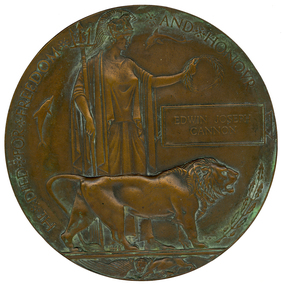
Medal - Numismatics, 'Dead Man's Penny' for Edwin Joseph 'Ted' Cannon, c1919
... During the Battle of Pozieres on the Western Front Ted Cannon worked with the Scout Platoon sketching the enemy's gun emplacements. Ted proved invaluable to the Brigade and brought he came under the attention of the Australian High Command. On 13 September 1916...During the Battle of Pozieres on the Western Front Ted Cannon worked with the Scout Platoon sketching the enemy's gun emplacements. Ted proved invaluable to the Brigade and brought he came under the attention of the Australian High Command. On 13 September 1916 ...The Dead Man’s Penny is a commemorative medallion which was presented to the next-of-kin of the men and women from England and the Empire who died during World War One. The Dead Man’s Penny was accompanied by a letter from King George V, stating ‘I join with my grateful people in sending you this memorial of a brave life given for others in the Great War’.[http://nma.gov.au/blogs/education/2010/11/14/dead-mans-penny/] Popularly known as the "Dead Man’s Penny", because of the similarity in appearance to the somewhat smaller penny coin. 1,355,000 plaques were issued, which used a total of 450 tonnes of bronze, and continued to be issued into the 1930s to commemorate people who died as a consequence of the war. [http://en.wikipedia.org/wiki/Memorial_Plaque_(medallion)] It was decided that the design of the plaque was to be picked from submissions made in a public competition. Over 800 designs were submitted and the competition was won by the sculptor and medallist Edward Carter Preston with his design called Pyramus, receiving a first place prize of £250.[http://en.wikipedia.org/wiki/Memorial_Plaque_(medallion)] They were initially made at the Memorial Plaque Factory, 54/56 Church Road, Acton, W3, London from 1919. Early plaques did not have a number stamped on them but later ones have a number stamped behind the lion's back leg. [http://en.wikipedia.org/wiki/Memorial_Plaque_(medallion)] Ted Cannon's plaquette does not have a stamped number. Ted Cannon was a gifted artist and cartoonist who studied at the Ballarat School of Mines Technical Art School. During the Battle of Pozieres on the Western Front Ted Cannon worked with the Scout Platoon sketching the enemy's gun emplacements. Ted proved invaluable to the Brigade and brought he came under the attention of the Australian High Command. On 13 September 1916 Ted was given a special assignment for General C.B.B. White. Ted was sent out forward of the Old Mill at Verbrandenmolen (in the Ypres Salient) to draw a panorama of the German lines in the area from Hill 60 to The Bluff. It was a hazardous task and Ted was warned to be careful. Tragically he was sniped by an enemy machine-gunner and sustained severe abdominal wounds. Stretcher-bearers rushed him to the 17th Casualty Clearing Station where he was operated on by the doctors at 8.30 that night. With little chance of success, but ever resilient, Ted remained conscious almost to the end. He died early in the morning of the 14 September 1916. His body was buried in the large Military Cemetery at Lijssenthoek. The effects of the late Ted Cannon were returned to his parents. These were an autograph book, three brushes, prayer book, housewife, whistle, book, hymn book, curios. Another listing gives his effects as "identity disc, letters, photos, wallet, 2 books, Mexican Dollar, 1 cent (Ceylon), 3 German Straps, Fountain Pen, Cigarette-holder, Franc Note, 50 centimes Note, devotional book, mirror, rosary, scapula, metal ring, two combs, book of views, nail clippers, badges, tie clip, Egyptian stamp.[http://recordsearch.naa.gov.au/scripts/Imagine.asp?B=3202589] Ted Cannon was an only child. It is not known how the 'Dead Man's Penny' came into the ownership of the donor, but it is thought that it may have been left in a house owned by the donor's mother. Further information on Ted Cannon can be found at http://bih.ballarat.edu.au/index.php/Edwin_J._Cannon and http://www.ballarat.edu.au/about-ub/history/art-and-historical-collection/ub-honour-roll/c/edwin-joseph-ted-cannon-1895-1916Large bronze medallion or plaquette featuring an image of Lady Britannia surrounded by two dolphins (representing Britain’s sea power) and a lion (representing Britain) standing over a defeated eagle (symbolising Germany). Around the outer edge of the medallion are the words ‘He died for freedom and honour’. Next to Lady Britannia is the deceased solider’s name, with no rank provided to show equality in their sacrifice. (http://nma.gov.au/blogs/education/2010/11/14/dead-mans-penny) The plaque was distributed throughout the British Empire, and the first plaques were distributed in Australia in 1922 "Returned home" by W. & O. Mayne, 2013. ted cannon, edwin joseph cannon, cannon, world war 1, world war -
 Federation University Historical Collection
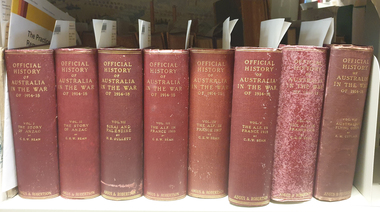
Book, Official History of Australia in the War of 1914-1918, Vol 3, The Australian Imperial Force in France, 1916, 1937
... world war world war one charles bean france bean frommelles messines somme pozieres mouquet farm Red hardcovered book of 1035 pages and 475 illustrations and maps Official History of Australia in the War of 1914-1918, Vol 3, The Australian Imperial Force in France, 1916 Book Book ...Red hardcovered book of 1035 pages and 475 illustrations and mapsworld war, world war one, charles bean, france, bean, frommelles, messines, somme, pozieres, mouquet farm -
 Federation University Historical Collection
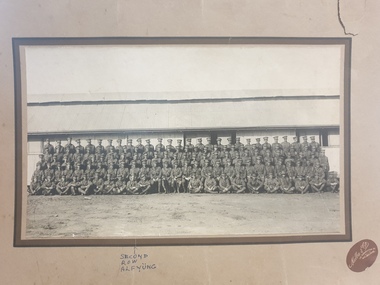
Photograph, Melba & Co, 7th Australian Infantry Training Battalion WW1
... After Pozieres the battalion manned trenches in the Ypres salient in Belgium, before returning to the Somme valley. It saw out the horrendous winter of 1916-1917 rotating between training, working parties and duty in the trenches. ...After Pozieres the battalion manned trenches in the Ypres salient in Belgium, before returning to the Somme valley. It saw out the horrendous winter of 1916-1917 rotating between training, working parties and duty in the trenches. ...George Alfred Yung, known as Alf, pictured in the second row, 10th from the left, enlisted on 25/02/1916; embarked on 19/02/1917; was killed during the battle of Menin Gate at Yrpres, Belgium on 20/09/1917. https://www.awm.gov.au/collection/U51447 The 7th Battalion was among the first infantry units raised for the AIF during the First World War. Like the 5th, 6th and 8th Battalions, it was recruited from Victoria and, together with these battalions, formed the 2nd Brigade. The battalion was raised by Lieutenant Colonel H. E. "Pompey" Elliott within a fortnight of the declaration of war in August 1914 and embarked just two months later. After a brief stop in Albany, Western Australia, the battalion proceeded to Egypt, arriving on 2 December. It later took part in the ANZAC landing on 25 April 1915, as part of the second wave. Ten days after the landing, the 2nd Brigade was transferred from ANZAC to Cape Helles to help in the attack on the village of Krithia. The attack captured little ground but cost the brigade almost a third of its strength. The Victorian battalions returned to ANZAC to help defend the beachhead, and in August the 2nd Brigade fought at the battle of Lone Pine. While holding positions captured by the 1st Brigade, four members of the 7th Battalion, Corporal A. S. Burton, Acting Corporal W. Dunstan, Lieutenant W. Symons and Captain F. H. Tubb, earned the Victoria Cross - Burton posthumously. The battalion served at ANZAC until the evacuation in December. After the withdrawal from Gallipoli in December 1915, the battalion returned to Egypt. In March 1916, it sailed for France and the Western Front and entered the front line trenches for the first time on 3 May. The battalion's first major action in France was at Pozieres in the Somme valley where it fought between 23-27 July and 15-21 August. After Pozieres the battalion manned trenches in the Ypres salient in Belgium, before returning to the Somme valley. It saw out the horrendous winter of 1916-1917 rotating between training, working parties and duty in the trenches. In early 1917, the Germans withdrew to the Hindenburg Line and the 7th Battalion participated in the brief advance that followed and then came to a grinding halt before Bullecourt. The battalion was withdrawn from the front line for training on 9 May 1917 and did not return to action until the Ypres offensive of September and October. It fought major battles at Menin Road on 20 September and Broodseinde on 4 October, and then spent much of ensuing winter in the Ypres mud. In March and April 1918 the 7th helped stop the German spring offensive in northern France and later participated in the Allies' own great offensive of 1918, that began with the battle of Amiens on 8 August. The advance by British and empire troops on 8 August was the greatest success in a single day on the Western Front, one that German General Erich Ludendorff described as, "the black day of the German Army in this war". The battalion continued operations until late September 1918. At 11 am on 11 November 1918, the guns fell silent. The November armistice was followed by the peace treaty of Versailles signed on 28 June 1919. In November 1918 members of the AIF began to return to Australia for demobilisation and discharge. In March, the battalion was so reduced that it and the 6th Battalion were amalgamated to form a composite battalion. In turn, this battalion was merged with another, formed from the 5th and 8th Battalions, to form the 2nd Brigade Battalion. https://www.awm.gov.au/collection/U51447army, soldier, alf yung, 7th australian infantry battalion -
 Lara RSL Sub Branch
Book, The Anzac Book Official History of Australia in theWar of 1914-18 Volume III The AIFin France 1916. Author C.E.W. Bean 6th Edition 1938
... AIF in France 1916 egypt desert line france suez canal camel train ferry post armentieres ypres aif battle of fromelles 5th division pozieres mouquet farm The Anzac Book - Printed 1916 Hardback cardboard Illustrations, maps and diagrams Chronology of 1916 The Anzac Book Official History of Australia in theWar of 1914-18 Volume III The AIFin France 1916. ...The Australian Imperial Force in France 1916Historical chronology including colour patches. AIF in France 1916The Anzac Book - Printed 1916 Hardback cardboard Illustrations, maps and diagrams Chronology of 1916egypt, desert line, france, suez canal, camel train, ferry post, armentieres, ypres, aif, battle of fromelles, 5th division, pozieres, mouquet farm -
 Federation University Historical Collection
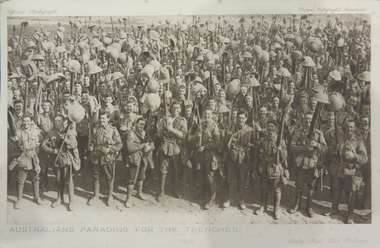
Postcard - colour, Australians Parading For The Trenches, 1916
... On back "These are the men who shortly after midnight on Sunday, July 23, 1916, took Pozieres by a splendidly dashing advance through shrapnel, shell and machine-gun fire....Most probabaly purchased by Harry Holmes. world war one australian soldiers pozieres harry holmes henry smerdon holmes On back "These are the men who shortly after midnight on Sunday, July 23, 1916, took Pozieres by a splendidly dashing advance through shrapnel, shell and machine-gun fire. ...Most probabaly purchased by Harry Holmes.World War One official war postcard showing Australians inUnifrom with guns and helmets. On back "These are the men who shortly after midnight on Sunday, July 23, 1916, took Pozieres by a splendidly dashing advance through shrapnel, shell and machine-gun fire.world war one, australian soldiers, pozieres, harry holmes, henry smerdon holmes -
 Monbulk RSL Sub Branch
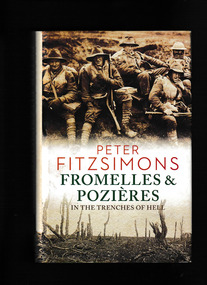
Book, Peter Fitzsimons, Fromelles and Pozières : in the trenches of hell, 2015
... world war 1914-1918 - campaigns - western front world war 1914-1918 - australian participation - fromelles and pozieres In the Trenches of Hell On 19 July 1916, 7000 Australian soldiers - in the first major action of the AIF on the Western Front - attacked entrenched German positions at Fromelles in northern France. ...In the Trenches of Hell On 19 July 1916, 7000 Australian soldiers - in the first major action of the AIF on the Western Front - attacked entrenched German positions at Fromelles in northern France. By the next day, there were over 5500 casualties, including nearly 2000 dead - a bloodbath that the Australian War Memorial describes as 'the worst 24 hours in Australia's entire history. Just days later, three Australian Divisions attacked German positions at nearby Pozi�res, and over the next six weeks they suffered another 23,000 casualties. Of that bitter battle, the great Australian war correspondent Charles Bean would write, 'The field of Pozi�res is more consecrated by Australian fighting and more hallowed by Australian blood than any field which has ever existed . . .' Yet the sad truth is that, nearly a century on from those battles, Australians know only a fraction of what occurred. This book brings the battles back to life and puts the reader in the moment, illustrating both the heroism displayed and the insanity of the British plan. With his extraordinary vigour and commitment to research, Peter FitzSimons shows why this is a story about which all Australians can be proud. And angry.Index, bibliography, notes, ill (maps), p.816.In the Trenches of Hell On 19 July 1916, 7000 Australian soldiers - in the first major action of the AIF on the Western Front - attacked entrenched German positions at Fromelles in northern France. By the next day, there were over 5500 casualties, including nearly 2000 dead - a bloodbath that the Australian War Memorial describes as 'the worst 24 hours in Australia's entire history. Just days later, three Australian Divisions attacked German positions at nearby Pozi�res, and over the next six weeks they suffered another 23,000 casualties. Of that bitter battle, the great Australian war correspondent Charles Bean would write, 'The field of Pozi�res is more consecrated by Australian fighting and more hallowed by Australian blood than any field which has ever existed . . .' Yet the sad truth is that, nearly a century on from those battles, Australians know only a fraction of what occurred. This book brings the battles back to life and puts the reader in the moment, illustrating both the heroism displayed and the insanity of the British plan. With his extraordinary vigour and commitment to research, Peter FitzSimons shows why this is a story about which all Australians can be proud. And angry.world war 1914-1918 - campaigns - western front, world war 1914-1918 - australian participation - fromelles and pozieres -
 Victorian Interpretive Projects Inc.
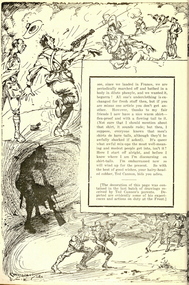
Cartoons, World War One Cartoons by Edwin Cannon
... Pozieres on the Western Front that Ted Cannon came into his own. His work with the Scout Platoon (under the command of Lieutenant Jack Rogers) sketching the enemy's gun emplacements proved invaluable to the Brigade and brought Ted to the attention of the Australian High Command. On 13 September 1916...Pozieres on the Western Front that Ted Cannon came into his own. His work with the Scout Platoon (under the command of Lieutenant Jack Rogers) sketching the enemy's gun emplacements proved invaluable to the Brigade and brought Ted to the attention of the Australian High Command. On 13 September 1916 ...Edwin (Ted) Cannon was born at Ballarat on 30 July 1895, the only son of Edwin and Florence Cannon. He studied art at the Ballarat School of Mines Technical Art School. Ted displayed a talent for industrial design but it was his black and white work that 'drew' most attention. His cartoons and caricatures, heavily influenced by Phil May, were of a particularly high standard. During the Ballarat Exhibition of 1913 Ted's work was singled out for notice and he was awarded First Prize. After completing his art course Ted was employed as an assistant teacher at the Ballarat Technical Art School, before taking a position as cartoonist with the Ballarat Star newspaper at the end of 1914. With the war raging in Europe Ted discovered a darker aspect for his artwork, but, still, he could not resist depicting Turkey as a full-feathered, fez-wearing bird. In 1915 Ted was awarded the prestigious Victorian Education Department Senior Technical School Scholarship. Only months into his scholarship, Ted volunteered for the AIF. A keen member of the local 71st "City of Ballarat" Regiment Ted was already primed for a life in the army. He embarked from Port Melbourne on 23 November 1915 with reinforcements to the 6th Infantry Battalion bound for Egypt. It was during the Battle of Pozieres on the Western Front that Ted Cannon came into his own. His work with the Scout Platoon (under the command of Lieutenant Jack Rogers) sketching the enemy's gun emplacements proved invaluable to the Brigade and brought Ted to the attention of the Australian High Command. On 13 September 1916 Ted was given a special assignment for General C.B.B. White. Ted was sent out forward of the Old Mill at Verbrandenmolen (in the Ypres Salient) to draw a panorama of the German lines in the area from Hill 60 to The Bluff. It was a hazardous task and Ted was warned to be careful. Tragically he was sniped by an enemy machine-gunner and sustained severe abdominal wounds. Stretcher-bearers rushed him to the 17th Casualty Clearing Station where he was operated on by the doctors at 8.30 that night. With little chance of success, but ever resilient, Ted remained conscious almost to the end. He died early in the morning of the 14 September 1916. His body was buried in the large Military Cemetery at Lijssenthoek. See http://www.ballarat.edu.au/about-ub/history/art-and-historical-collection/ub-honour-roll/c/edwin-joseph-ted-cannon-1895-1916 Digital images of a number of cartoons published in the Ballarat School of Mines Students' Magazine, 1916. Ted Cannon sent cartoons home to Ballarat from the World War One front.edwin cannon, ted cannon, cartoons, world war, world war 1 -
 RSL Victoria - Anzac House Reference Library and Memorabilia Collection
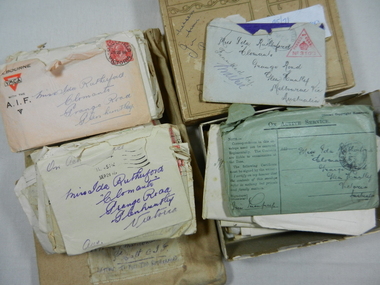
Letters of James McDonald & James William Pumfrey - (Items held by Monash Memorial Defence Library), James Pumfrey and James McDonald, 1915 - 1918
... McDonald embarked on board HMAT Star of Victoria on 10 September 1915 and, after being shot in the stomach at Pozieres, returned to Australia on 7th August 1916....McDonald embarked on board HMAT Star of Victoria on 10 September 1915 and, after being shot in the stomach at Pozieres, returned to Australia on 7th August 1916. ww1 5 battalion james mcdonald james william pumfrey ida rutherford light horse brigade train 3 pozieres Seventy six letters of James McDonald (2872 - 5th Battalion, 9th Reinforcement) and thirty five letters of James William Pumfrey (5175 - Light Horse Brigade Train 3), addressed to Miss Ida Rutherford. ...Pumfrey embarked from Melbourne on board HMAT Chilka on 2nd February 1915 and returned to Australia on 1st July 1919. McDonald embarked on board HMAT Star of Victoria on 10 September 1915 and, after being shot in the stomach at Pozieres, returned to Australia on 7th August 1916.Seventy six letters of James McDonald (2872 - 5th Battalion, 9th Reinforcement) and thirty five letters of James William Pumfrey (5175 - Light Horse Brigade Train 3), addressed to Miss Ida Rutherford. Includes photograph album belonging to Rutherford.ww1, 5 battalion, james mcdonald, james william pumfrey, ida rutherford, light horse brigade train 3, pozieres -
 Bendigo Historical Society Inc.
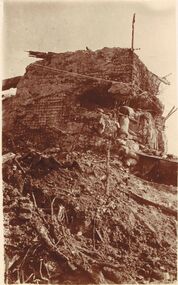
Postcard - ACC LOCK COLLECTION: SEPIA PHOTO OF A DAMAGED STRUCTURE, POSTCARD, 1914-1918
... 'Pozieres - ("Gibraltar") after capture by 1st Australia Division July 1916'...'Pozieres - ("Gibraltar") after capture by 1st Australia Division July 1916' Postcard ACC LOCK COLLECTION: SEPIA PHOTO OF A DAMAGED STRUCTURE, POSTCARD ...Postcard, WW1, sepia photo of a damaged structure that could have been an observation post or a defensive rocky outcrop at Pozieres. Had been given the nickname 'Gibraltar' judging by the handwritten comment on the back. 'Pozieres - ("Gibraltar") after capture by 1st Australia Division July 1916'postcard, postcard, ww1, france, pozieres, 1st australia division -
 Kyneton RSL Sub Branch
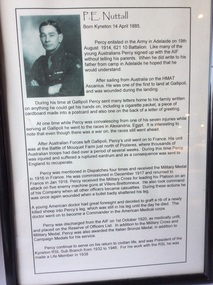
P E Nuttal
... 1916. Nuttal was discharged from the Army in 1920 and in civilian life became President of the Kyneton Returned Services League. P E Nuttal was born Kyneton, April 1885. He returned to Kyneton after the War. ww1 nuttal military cross military medal pozieres ...P E Nuttal enlisted in August 1914. He was with the first landing on Gallipoli. He continued to serve in France, was injured and returned to the front, In 1918 he lead his platoon on an attack which finally saw the liberation of the village of Villers Brettoneux. He was awarded the Military Cross for his actions. He was awarded the Military Medal for action in France in 1916. Nuttal was discharged from the Army in 1920 and in civilian life became President of the Kyneton Returned Services League. P E Nuttal was born Kyneton, April 1885. He returned to Kyneton after the War.Black framed photo and discription of Percy Nuttal’s enlistment and war-service.Original cataloguing information on back. KYNRSL 024Aww1, nuttal, military cross, military medal, pozieres, villers brettoneux -
 Eltham District Historical Society Inc
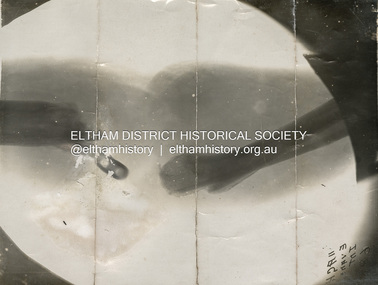
Photograph, X-ray, left arm of C.S.M. Tyrrell George Evans, Sern. 789, 31st Battalion, AIF, 1916
... According to daughter-in-law, Janet Evans, on 19 July 1916, in the battle near Pozieres on the Somme, he was hit by a German high explosive shell and was unconscious and badly wounded. ...According to daughter-in-law, Janet Evans, on 19 July 1916, in the battle near Pozieres on the Somme, he was hit by a German high explosive shell and was unconscious and badly wounded. ...No. 11 AGH X-Ray Department photo of a gun shot wound to left arm suffered July 1916 in France by C.S.M. Tyrrell George Evans, Sern. 789, 31st Battalion, AIF Tyrrell George Granville Evans was born on 17th August 1892 Enlisted (No. 789) 7 July 1915 as a Private and was assigned to the 31st Battalion. Promoted to Sergeant 1 Nov 1915. Disembarked Suez 7 Feb 1916 Admitted to 32nd Stat. Hospital in France 21 July 1916 with a gunshot wound to the left arm. According to daughter-in-law, Janet Evans, on 19 July 1916, in the battle near Pozieres on the Somme, he was hit by a German high explosive shell and was unconscious and badly wounded. His left arm was shattered, and he had a bullet wound on his leg. Embarked at Boulogne on H.S. Cambria for Middlesex War Hospital, England 24 July 1916. Evans returned to Australia and was discharged medically unfit, 7 April 1917. After months in the Caulfield Hospital his arm could not be saved, and it was amputated 18 July 1917. On July 6, 1918, Tyrrell George Granville Evans married Mary Pitt Withers at Eltham, daughter of artist Walter Herbert Withers (deceased) and wife Fanny (nee Flinn). They had three children, Mary Roberta Evans born February 8, 1921, at Balwyn and twins Shirley and Joyce born June 10, 1922. Mary died 17 days later, June 27, 1922, at Balwyn. Tyrrell had to cope with three children under three years old and a missing left arm. He had been lefthanded before his war injuries. He had help from the family, especially his sister. On August 1, 1924, Tyrrell George Granville Evans married Marian Frances Wilcox and they had two children: Barbara Marian, born 27 July 1925 and Tyrrell Granville, born 3 July 1928. The children were all brought up together in Glen Iris. Tyrrell became renowned as a one-armed golfer and tennis player. He was Senior Vice-President of the Lawn Tennis Association of Victoria and was on the committee of the Metropolitan Golf Club. At the time of his retirement, he was General Manager of the Colonial Meat Company. Tyrrell died September 3, 1962 and was succeeded by sixteen grandchildren. Contributed to by Janet Evans (daughter-in-law), 27 May 2024Many items in this collection have suffered from significant water damage and black mouldjohn withers collection, eltham, 1916, gun shot wound, tyrrell george granville evans, x-ray, mary pitt withers -
 Eltham District Historical Society Inc
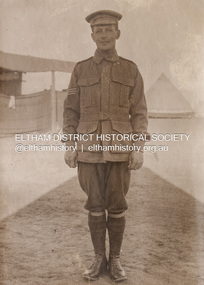
Photograph, Sgt Tyrrell George Evans, Sern. 789, 31st Battalion, c.1916
... According to daughter-in-law, Janet Evans, on 19 July 1916, in the battle near Pozieres on the Somme, he was hit by a German high explosive shell and was unconscious and badly wounded. ...According to daughter-in-law, Janet Evans, on 19 July 1916, in the battle near Pozieres on the Somme, he was hit by a German high explosive shell and was unconscious and badly wounded. ...Tyrrell George Granville Evans was born on 17th August 1892 Enlisted (No. 789) 7 July 1915 as a Private and was assigned to the 31st Battalion. Promoted to Sergeant 1 Nov 1915. Disembarked Suez 7 Feb 1916 Admitted to 32nd Stat. Hospital in France 21 July 1916 with a gunshot wound to the left arm. According to daughter-in-law, Janet Evans, on 19 July 1916, in the battle near Pozieres on the Somme, he was hit by a German high explosive shell and was unconscious and badly wounded. His left arm was shattered, and he had a bullet wound on his leg. Embarked at Boulogne on H.S. Cambria for Middlesex War Hospital, England 24 July 1916. Evans returned to Australia and was discharged medically unfit, 7 April 1917. After months in the Caulfield Hospital his arm could not be saved, and it was amputated 18 July 1917. On July 6, 1918, Tyrrell George Granville Evans married Mary Pitt Withers at Eltham, daughter of artist Walter Herbert Withers (deceased) and wife Fanny (nee Flinn). They had three children, Mary Roberta Evans born February 8, 1921, at Balwyn and twins Shirley and Joyce born June 10, 1922. Mary died 17 days later, June 27, 1922, at Balwyn. Tyrrell had to cope with three children under three years old and a missing left arm. He had been lefthanded before his war injuries. He had help from the family, especially his sister. On August 1, 1924, Tyrrell George Granville Evans married Marian Frances Wilcox and they had two children: Barbara Marian, born 27 July 1925 and Tyrrell Granville, born 3 July 1928. The children were all brought up together in Glen Iris. Tyrrell became renowned as a one-armed golfer and tennis player. He was Senior Vice-President of the Lawn Tennis Association of Victoria and was on the committee of the Metropolitan Golf Club. At the time of his retirement, he was General Manager of the Colonial Meat Company. Tyrrell died September 3, 1962 and was succeeded by sixteen grandchildren. Contributed to by Janet Evans (daughter-in-law), 27 May 2024Many items in this collection have suffered from significant water damage and black mouldjohn withers collection, eltham, 1916, tyrrell george granville evans, x-ray, mary pitt withers -
 Eltham District Historical Society Inc
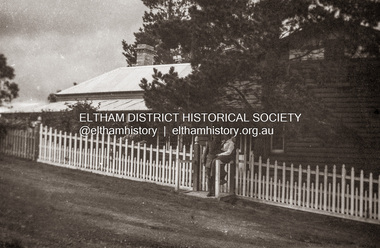
Photograph, Sgt Tyrrell George Evans with fiancee, Mary Pitt Withers outside the Withers family home, Southernwood, Bolton Street, Eltham, c.1917
... According to daughter-in-law, Janet Evans, on 19 July 1916, in the battle near Pozieres on the Somme, he was hit by a German high explosive shell and was unconscious and badly wounded. ...According to daughter-in-law, Janet Evans, on 19 July 1916, in the battle near Pozieres on the Somme, he was hit by a German high explosive shell and was unconscious and badly wounded. ...Present day Google Street View https://goo.gl/maps/PZZMoEdJYUXbgf4a8 Tyrrell George Granville Evans was born on 17th August 1892 Enlisted (No. 789) 7 July 1915 as a Private and was assigned to the 31st Battalion. Promoted to Sergeant 1 Nov 1915. Disembarked Suez 7 Feb 1916 Admitted to 32nd Stat. Hospital in France 21 July 1916 with a gunshot wound to the left arm. According to daughter-in-law, Janet Evans, on 19 July 1916, in the battle near Pozieres on the Somme, he was hit by a German high explosive shell and was unconscious and badly wounded. His left arm was shattered, and he had a bullet wound on his leg. Embarked at Boulogne on H.S. Cambria for Middlesex War Hospital, England 24 July 1916. Evans returned to Australia and was discharged medically unfit, 7 April 1917. After months in the Caulfield Hospital his arm could not be saved, and it was amputated 18 July 1917. On July 6, 1918, Tyrrell George Granville Evans married Mary Pitt Withers at Eltham, daughter of artist Walter Herbert Withers (deceased) and wife Fanny (nee Flinn). They had three children, Mary Roberta Evans born February 8, 1921, at Balwyn and twins Shirley and Joyce born June 10, 1922. Mary died 17 days later, June 27, 1922, at Balwyn. Tyrrell had to cope with three children under three years old and a missing left arm. He had been lefthanded before his war injuries. He had help from the family, especially his sister. On August 1, 1924, Tyrrell George Granville Evans married Marian Frances Wilcox and they had two children: Barbara Marian, born 27 July 1925 and Tyrrell Granville, born 3 July 1928. The children were all brought up together in Glen Iris. Tyrrell became renowned as a one-armed golfer and tennis player. He was Senior Vice-President of the Lawn Tennis Association of Victoria and was on the committee of the Metropolitan Golf Club. At the time of his retirement, he was General Manager of the Colonial Meat Company. Tyrrell died September 3, 1962 and was succeeded by sixteen grandchildren. Contributed to by Janet Evans (daughter-in-law), 27 May 2024Many items in this collection have suffered from significant water damage and black mouldjohn withers collection, eltham, tyrrell george granville evans, mary pitt withers, 1917, bolton steet, scan - 620 format 6x9 negative, southernwood -
 Eltham District Historical Society Inc
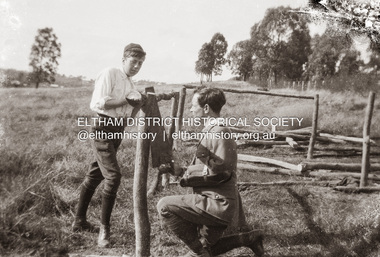
Photograph, Charles Withers (aka Bill) and Sgt Tyrrell George Evans at work on the Withers property, Southernwood, Bolton Street, Eltham, c.1917
... According to daughter-in-law, Janet Evans, on 19 July 1916, in the battle near Pozieres on the Somme, he was hit by a German high explosive shell and was unconscious and badly wounded. ...According to daughter-in-law, Janet Evans, on 19 July 1916, in the battle near Pozieres on the Somme, he was hit by a German high explosive shell and was unconscious and badly wounded. ...Charles Meynell Pitt Withers (aka Bill) was the youngest son of artist Walter Withers and Fanny (nee Flinn). He was born at Eltham 5 February 1902. Tyrrell George Granville Evans was born on 17th August 1892 Enlisted (No. 789) 7 July 1915 as a Private and was assigned to the 31st Battalion. Promoted to Sergeant 1 Nov 1915. Disembarked Suez 7 Feb 1916 Admitted to 32nd Stat. Hospital in France 21 July 1916 with a gunshot wound to the left arm. According to daughter-in-law, Janet Evans, on 19 July 1916, in the battle near Pozieres on the Somme, he was hit by a German high explosive shell and was unconscious and badly wounded. His left arm was shattered, and he had a bullet wound on his leg. Embarked at Boulogne on H.S. Cambria for Middlesex War Hospital, England 24 July 1916. Evans returned to Australia and was discharged medically unfit, 7 April 1917. After months in the Caulfield Hospital his arm could not be saved, and it was amputated 18 July 1917. On July 6, 1918, Tyrrell George Granville Evans married Mary Pitt Withers at Eltham, daughter of artist Walter Herbert Withers (deceased) and wife Fanny (nee Flinn). They had three children, Mary Roberta Evans born February 8, 1921, at Balwyn and twins Shirley and Joyce born June 10, 1922. Mary died 17 days later, June 27, 1922, at Balwyn. Tyrrell had to cope with three children under three years old and a missing left arm. He had been lefthanded before his war injuries. He had help from the family, especially his sister. On August 1, 1924, Tyrrell George Granville Evans married Marian Frances Wilcox and they had two children: Barbara Marian, born 27 July 1925 and Tyrrell Granville, born 3 July 1928. The children were all brought up together in Glen Iris. Tyrrell became renowned as a one-armed golfer and tennis player. He was Senior Vice-President of the Lawn Tennis Association of Victoria and was on the committee of the Metropolitan Golf Club. At the time of his retirement, he was General Manager of the Colonial Meat Company. Tyrrell died September 3, 1962 and was succeeded by sixteen grandchildren. Contributed to by Janet Evans (daughter-in-law), 27 May 2024Many items in this collection have suffered from significant water damage and black mouldjohn withers collection, eltham, tyrrell george granville evans, 1917, bolton steet, scan - 620 format 6x9 negative, southernwood, charles meynell pitt withers -
 Wangaratta RSL Sub Branch
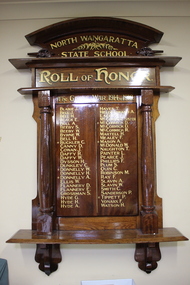
Honour Board, North Wangaratta State School, c1920
... 1916. Pte Buckler was killed in action near Pozieres, France, on 7 August 1916. ...1916. Pte Buckler was killed in action near Pozieres, France, on 7 August 1916. ...North Wangaratta State School 2391 was opened in May 1881 and closed October 26 1969. Today a plaque commemorates the site of the old school in Eldorado Road North Wangaratta. The Honour Board preserves the names of past students who enlisted to serve their country during the First World War and commemorates those who lost their lives. In 1965 after being stored in a woodshed for two years the Honour Board was put on display at The Eldorado Memorial Hall. The Eldorado Memorial Hall Committee became Trustees of the Honour Board and 1992 approved its transfer to the Vine Hotel Museum for public display. In 1996 at a meeting held on February 7, the Wangaratta North State School No 2391 Memorial Committee moved a motion that all memorabilia pertinent to the Wangaratta North State School be displayed at the Vine Hotel Museum under the guardianship of trustees appointed by the Wangaratta North State School Memorial Committee. In 2005 The North Wangaratta State School Trustees donated the Honour Board along with two photographs of WW1 soldiers to the Wangaratta RSL for safe keeping and display to the public. Students who enlisted include:- Private (Shoeing Smith) John BLAIKIE 2341 who was born at Wangaratta. He was a Blacksmith and at the age of 42 enlisted on May 28 1915. He embarked on August 10 1915 and served with the 14th Battalion. He returned to Australia in January 1918 and discharged medically unfit on April 10 1918. 5692 Private William Thomas BYRNE was born on 21/9/1890 at Docker Plains. He was educated at Docker Plains and Wangaratta State schools. A farmer when he enlisted on 13/10/1914. He trained at Broadmeadows and embarked on Hororata on 17/4/1915. He served with the 3rd Light Horse and 12th and/or 27th ASC - Army Service Corps as a Driver. 5347 Private Cyril BUCKLER, 14th Battalion. A postman from Wangaratta, Victoria, prior to enlistment on 16 February 1916 he embarked from Melbourne aboard HMAT Euripides on 4 April 1916 for Egypt. His unit relocated to the Western Front, France, in June 1916. Pte Buckler was killed in action near Pozieres, France, on 7 August 1916. He has no known grave and he is commemorated on the Villers-Bretonneux Memorial 3451A Private Sydney Spencer PLUM 1st Pioneer Battalion A.I.F, Born January 3rd 1894 at Dockers Plains. He was educated at North Wangaratta and Docker's Plains State School. He was a blacksmith when he enlisted June 12th 1915. He was trained at Flemington Racecourse and embarked on SS "Nestor" October 11th 1915. He fought in battles; Peronne, Cambrai, Somme. Being wounded 3 times. He embarked for home per SS "Orontes"; disembarked January 28th 1919 and he was discharged March 16th 1919. He died on July 25 1958. 483 Private Percy Albert TIPPETT served with the 6th Battalion AIF and was wounded on the 25/4/15 during the initial landing at Gallipoli and later died on 28/4/1915. 1981 Private Francis John VONARX Enlisted at Wangaratta on 15/6/1915 aged 33 years and embarked on 26/8/1915. Served with the 23rd Infantry Battalion and 2nd Machine Gun Battalion. Returned to Australia on 8/4/1919 On 13/4/2024 the Honour Board was deaccessioned from the RSL collection for permanent display at North Wangaratta CFA Brigade.Honour Board listing the 52 names of North Wangaratta State School students who enlisted to serve their country during the First World War and commemorates those who lost their lives. Large solid timber Honour Board with two carved minature cannons on top and above side columns."North Wangaratta State School/Roll of Honour/The Great War 1914 to 1919" 52 names in gold paint.north wangaratta state school 2391, honour board ww1 -
 Wangaratta RSL Sub Branch
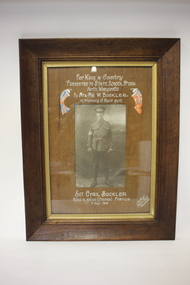
Memorabilia - Framed Photograph, Private Cyril Buckler, c1916
... 1916. Private Buckler was killed in action near Pozieres, France, on 7 August 1916. ...Buckler in memory of their son Sgt Cyril Buckler who was killed in action at Pozieres France 7 Aug 1916 ...1916. Private Buckler was killed in action near Pozieres, France, on 7 August 1916. ...Studio portrait of 5347 Private Cyril Buckler, 14th Battalion, presented in his memory as a past student, by his parents to North Wangaratta State School. Cyril was a postman from Wangaratta Victoria, prior to enlistment on 16 February 1916. He embarked from Melbourne aboard HMAT Euripides on 4 April 1916 for Egypt. His unit relocated to the Western Front, France, in June 1916. Private Buckler was killed in action near Pozieres, France, on 7 August 1916. He has no known grave and is commemorated on the Villers-Bretonneux Memorial. This image of Cyril Buckler in uniform with the rank of Sergeant was probably taken while he was serving in the Senior Cadets or Citizen Forces prior to enlistment in the AIF Framed photograph presented to North Wangaratta State School in memory of a past student killed in action at Pozieres, France on 7 Aug 1916 during the First World War. North Wangaratta State School 2391 opened in May 1881 and closed on October 26 1969. Today a plaque commemorates the old site in Eldorado Road North Wangaratta.Wooden frame with gold insert, wooden mount. Coloured paper Union Jack on top left of mounting, Red Ensign on top right of mounting. Inscriptions in white paint. Glass front. Back has wire hangings. Has paper backing has stitching on three sides, some paper backing is ripped.For King and Country. Presented to North Wangaratta State School No 2391 by Mr & Mrs W. Buckler in memory of their son Sgt Cyril Buckler who was killed in action at Pozieres France 7 Aug 1916 world war 1, france, pozieres, north wangaratta state school, cyril buckler -
 Wangaratta RSL Sub Branch
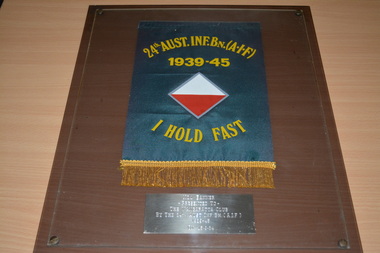
Banner - Framed Banner, 24th Australian Inf Bn. (AIF)
... On September 4, 1915 the Battalion went ashore at Gallipoli and spent the next 16 weeks sharing duty in the Lone Pine trenches with the 23rd Battalion. in March 1916 the Battalion proceeded to France. It took part in its first major offensive around Pozieres and Mouquet Farm in July and August 1917. ...On September 4, 1915 the Battalion went ashore at Gallipoli and spent the next 16 weeks sharing duty in the Lone Pine trenches with the 23rd Battalion. in March 1916 the Battalion proceeded to France. It took part in its first major offensive around Pozieres and Mouquet Farm in July and August 1917. ...The banner depicts the original Unit motto and colour patch - white over red diamond - of the 24th Battalion which was raised in a hurry from a surplus of recruits at Broadmeadows Camp in Victoria. The battalion was formed during the first week of May 1915 ,and sailed from Melbourne at the end of that week. On September 4, 1915 the Battalion went ashore at Gallipoli and spent the next 16 weeks sharing duty in the Lone Pine trenches with the 23rd Battalion. in March 1916 the Battalion proceeded to France. It took part in its first major offensive around Pozieres and Mouquet Farm in July and August 1917. When patrolling no-man's land the men of the 24th adopted a unique form of snow camouflage - large white nighties bought in Amiens. The Battalion left the front line for the last time on 6 October 1918 and disbanded in May 1919. Victoria's 2/24th Infantry Battalion was raised in Wangaratta in July 1940 and were deployed to the middle east. After extensive fighting at Tobruk and El Alamein bettween July and November 1942 the Unit adopted a T shaped colour patch. After formation, the 2/24th battalion was moved to Wangaratta, where it remained until its training facilities were ready in Bonegilla prior to overseas deployment to the middle east. Because of its time in Wangaratta, it became colloquially known as "Wangaratta's Own" and later received the Freedom of the City.Two clear perspex sheets containing green banner with white over red diamond shape, gold coloured writing and fringe below with metal plaque.24th Aust Inf Bn. (AIF) 1939-45 I HOLD FAST Plaque - No 1 Banner Presented to The Wangaratta Club by the 24th Aust Inf Bn (AIF) 1939-45 on 15-9-84 banner, 24th australian infantry battalion, white over red diamond, unit colour patch
