
Showing 25 items matching "projector lamp"
-
 Kiewa Valley Historical Society
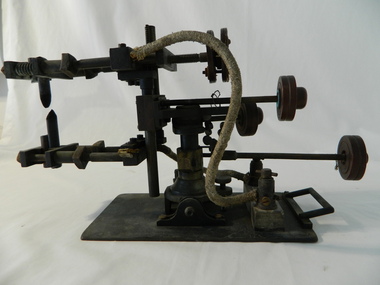
Lamp - Carbon arc projector lamp
... Lamp - Carbon arc projector lamp......projector lamp...Lamp - Carbon arc projector lamp ...The arc lamp provided one of the first commercial uses for electricity, a phenomenon previously confined to experiment, the telegraph, and entertainment. Ref. Wikipedia.An old item and very rare. Owned by a local resident's grandfather who lived in Melbourne.Brass base with handle at front. Horizontal round bakelite handles for adjusting the arc between the electrodes (vertical carbon pencil shapes meeting at point and opposite each other. It has adjustments for direction and height. It is heavy. Unknown source of power - battery?Nilsilent movies, projector lamp, carbon arc projector lamp -
 Federation University Historical Collection
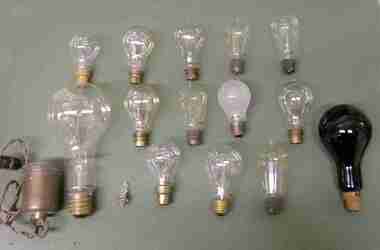
Equipment - Scientific Instument, Globes, 20th Century
... (The disc is loose in 10) .11 a&b) Osram black glass, large standard shaped, 230-240 V 125 W, bayonet light bulb. .12) Philips tubular shaped projector lamp with instruction leaflet. .13) Philips tubular shaped projector lamp with instruction leaflet in original box. .14) EH JA 12 V 55 W small projector lamp. .15) Large special purpose, standard shaped, frosted bayonet light bulb. .16) Siemens, standard shaped, modern Edison screw light bulb. .17) Philips, standard shaped, modern Edison screw, frosted light bulb. .18) Crompton, gas filled 240 V 75 W, standard shaped, bayonet frosted light bulb in original box. .19) Crompton, gas filled 230 V 300 W. standard shaped, large modern Edison screw light bulb. .20) Probably an extension cord with a bayonet fitting at one end connected by a twisted cord of two fabric covered wires to a large socket. ...(The disc is loose in 10) .11 a&b) Osram black glass, large standard shaped, 230-240 V 125 W, bayonet light bulb. .12) Philips tubular shaped projector lamp with instruction leaflet. .13) Philips tubular shaped projector lamp with instruction leaflet in original box. .14) EH JA 12 V 55 W small projector lamp. .15) Large special purpose, standard shaped, frosted bayonet light bulb. .16) Siemens, standard shaped, modern Edison screw light bulb. .17) Philips, standard shaped, modern Edison screw, frosted light bulb. .18) Crompton, gas filled 240 V 75 W, standard shaped, bayonet frosted light bulb in original box. .19) Crompton, gas filled 230 V 300 W. standard shaped, large modern Edison screw light bulb. .20) Probably an extension cord with a bayonet fitting at one end connected by a twisted cord of two fabric covered wires to a large socket. ...Most were used in various capacities at Ballarat School of Mines or University of Ballarat.Assorted lamps including Edison Carbon filament light bulbs and other special purpose lamps, .1-3) Robertson, pear shaped 220 V 16, carbon filament? bayonet light bulb with 'nipple'. .4) Ediswan, standard shaped, 928, carbon filament? bayonet light bulb with 'nipple'. .5) (B in a circle) 280 V 32 oo1A, pear shaped, carbon filament? bayonet light bulb with 'nipple'. .6-7) Crompton? standard shaped, carbon filament? bayonet light bulb. Clear glass with an amber tint. .8) 230-240 V 40 W, pear shaped, wire filament bayonet light bulb. .9-10) Osram standard shaped, heavy spiral and disc electrodes, bayonet light bulb. (The disc is loose in 10) .11 a&b) Osram black glass, large standard shaped, 230-240 V 125 W, bayonet light bulb. .12) Philips tubular shaped projector lamp with instruction leaflet. .13) Philips tubular shaped projector lamp with instruction leaflet in original box. .14) EH JA 12 V 55 W small projector lamp. .15) Large special purpose, standard shaped, frosted bayonet light bulb. .16) Siemens, standard shaped, modern Edison screw light bulb. .17) Philips, standard shaped, modern Edison screw, frosted light bulb. .18) Crompton, gas filled 240 V 75 W, standard shaped, bayonet frosted light bulb in original box. .19) Crompton, gas filled 230 V 300 W. standard shaped, large modern Edison screw light bulb. .20) Probably an extension cord with a bayonet fitting at one end connected by a twisted cord of two fabric covered wires to a large socket. This socket has a copper Edison screw inner, surrounded by a ceramic tube and covered with a copper housing. The housing is cracked in two places.Some have makers brand and voltage and wattage stamped onto the glass.scientific instrument, ballarat school of mines, globes, edison, lamps, light bulbs, bayonet -
 Whitehorse Historical Society Inc.
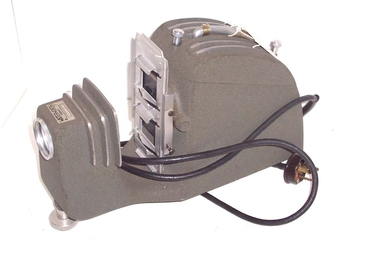
Functional object - Slide/Film Strip Projector, c1960
... It has a carrying handle and a power lead with 3 pin plug which is wired in permanently. The projector lamp is at rear under the carrying handle. ...It has a carrying handle and a power lead with 3 pin plug which is wired in permanently. The projector lamp is at rear under the carrying handle. ...The donor received the projector from a relative. He used it in the City of Whitehorse and surrounding areasWaterworth Slide Film Strip Projector, Model A - 300 watt, without a fan but with ventilating slots on top and an open bottom for air to flow. It has a carrying handle and a power lead with 3 pin plug which is wired in permanently. The projector lamp is at rear under the carrying handle. Image is projected through three stage lens via via the image on the 35mm strip or slide. The front lens is adjustable for focus. A knurled nut enables a height adjustment at front. Slides are inserted through the holder - whilst one slide is shown the other can be loaded ready to be slid in front of the light. The film strip holder is missing. The unit is finished in a grey hammer finish paint used in 1960 t0 1980s. The operating instructions are filed in the supplementary envelope. The projector is stored in a hand made three ply hinged box.Waterworth Hobart 5553Aphotography, projectors -
 Bendigo Historical Society Inc.
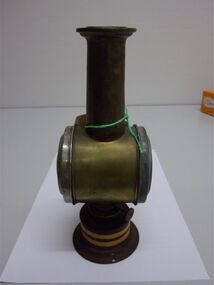
Slide - MAGIC LANTERN COLLECTION: CHILDREN'S SMALL MAGIC LANTERN PROJECTOR
... Magic Lantern Collection -Children's small Magic lantern Projector powered by Kerosene lamp and mounted on a wooden base. ...Magic Lantern Collection -Children's small Magic lantern Projector powered by Kerosene lamp and mounted on a wooden base. ...Object. Magic Lantern Collection -Children's small Magic lantern Projector powered by Kerosene lamp and mounted on a wooden base. Brass fittings. Stored in small wooden box without lid /Brass fittings.Wiener Flachbrennerphotography, projectors - still, magic lantern, wiener flachbrenner -
 Flagstaff Hill Maritime Museum and Village
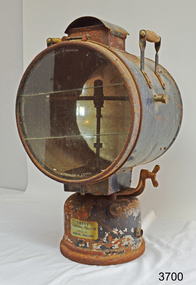
Functional object - Kerosene Searchlight, Circa 1935
... Tilley Searchlight Projector, or search lamp, made in Hendon, England 1935. ...Lamps that were used commercially, domestically and by the armed forces of many countries during the first and second world wars. flagstaff hill warrnambool flagstaff hill maritime museum maritime museum shipwreck coast flagstaff hill maritime village great ocean road Tilley Kerosene Pressure Searchlight Lighting John Tilley pressure lamps signalling light “TILLEY / SEARCHLIGHT PROJECTOR / MADE AT / HENDON, ENGLAND”, “256” handwritten in red on one wooden handle, “9” or “6” hand painted in white on top on light Tilley Searchlight Projector, or search lamp, made in Hendon, England 1935. ...The Tilley lamp derives from John Tilley’s invention of the hydro-pneumatic blowpipe in 1813 in England. W. H. Tilley was manufacturing pressure lamps at their works in Stoke Newington in 1818 and in Shoreditch in the 1830s. The company relocated to Brent Street in Hendon in 1915, during World War I, and began using paraffin (kerosene) as a fuel for its lamps. During World War I, Tilley lamps were used by the British armed forces and became so popular that "Tilley" became a generic name for a kerosene lamp in many parts of the world, much like "Hoover" is used for vacuum cleaners. During the 1920s, the company diversified into domestic lamps and expanded rapidly after orders from railway companies. After World War II, fears about the poisonous effects of paraffin fumes and widely available electricity reduced demand for domestic use. The company moved from Hendon to Ireland in the early 1960s, finally settling in Belfast. The company moved back to England in 2000.A significant item demonstrating the early use of kerosene under pressure as a lighting medium. These types of lamps were made by a company whose products became synonymous with oil lamps generally. Lamps that were used commercially, domestically and by the armed forces of many countries during the first and second world wars.Tilley Searchlight Projector, or search lamp, made in Hendon, England 1935. Metal kerosene pressure search lamp, glass front, fixed mirror at back, wooden carry handles. Mounted on fuel tank with pressure pump. Lamp has 8 airflow holes in the bottom and a covered outlet on the top. Glass is in 3 pieces, fitting together to make flat circle there is a maker’s plate on the pressure tank. “TILLEY / SEARCHLIGHT PROJECTOR / MADE AT / HENDON, ENGLAND”, “256” handwritten in red on one wooden handle, “9” or “6” hand painted in white on top on lightflagstaff hill, warrnambool, flagstaff hill maritime museum, maritime museum, shipwreck coast, flagstaff hill maritime village, great ocean road, tilley kerosene pressure searchlight, lighting, john tilley, pressure lamps, signalling light -
 Plutarch Project
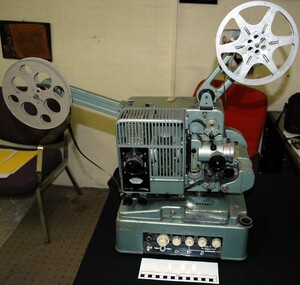
16mm Portable Optical & Magnetic Sound Projector, circa 1950's
... -a- 3 projectors in total -b- 2 tripod stands -c- 1 20 feet x 10 feet screen -d- 6 projector lamps and 2 exider lamps for sound -e- 2 extra lamps per film to be shown -f- 1 film rewinder (see rewinder in same collection)...-a- 3 projectors in total -b- 2 tripod stands -c- 1 20 feet x 10 feet screen -d- 6 projector lamps and 2 exider lamps for sound -e- 2 extra lamps per film to be shown -f- 1 film rewinder (see rewinder in same collection) 16mm Portable Optical & Magnetic Sound Projector Siemens ...One of the three projectors used in every trip was this 16mm Portable Projector, which was used taken to about 60 towns and cities around Australia, as Mr Yiannoudes states. This projector is in working condition serviced by Mr Yiannoudes himself regularly. It is an optical and magnetic sound projector, a rare one of its type.Primary historic significance as well as rarity significanceFrom January 1959 and until 1982, “Cosmopolitan Motion Pictures”, owned by Mr Peter Yannoudes (Παναγιώτης Γιαννούδης) and Mr Stathis Raftopoulos (Στάθης Ραφτόπουλος) travelled around Australia to entertain the Greek, Turkish, Indian and Yugoslav speaking population of Australia and provide a significant cinema culture. They travelled as far as Perth in WA, Adelaide in SA, Tasmania, Darwin in Nt, Canberra in ACT and Sydney and NSW. However they found themselves also in places like Berri and Renmark in NSW, where concentrations of migrants lived and thrived during the period. Initially they were travelling by train, carrying all their equipment by hand and placing them in boxes and suitcases. However after 1962 when they acquired their first automobile, travelling became less of a burden, nevertheless cumbersome and laborious. They carried with them initially two portable projectors (second one as a backup) and at times travelled with a third in order to ensure that technology will not be letting them down at the time of film projection. At times the films were projected onto a white sheet of cloth because there was no proper screen to project it on at the venue they were using. One of the three projectors used in every trip was this 16mm Portable Projector, which was used taken to about 60 towns and cities around Australia, as Mr Yiannoudes states. This projector is in working condition serviced by Mr Yiannoudes himself regularly. It is an optical and magnetic sound projector, a rare one of its type. Apart from this projector these items were taken on each trip. -a- 3 projectors in total -b- 2 tripod stands -c- 1 20 feet x 10 feet screen -d- 6 projector lamps and 2 exider lamps for sound -e- 2 extra lamps per film to be shown -f- 1 film rewinder (see rewinder in same collection)Siemensprojector, film, magnetic, sound, optical, language, greek, siemens, german, γιαννούδης, προβολέας, yiannoudes, plutarch -
 Whitehorse Historical Society Inc.
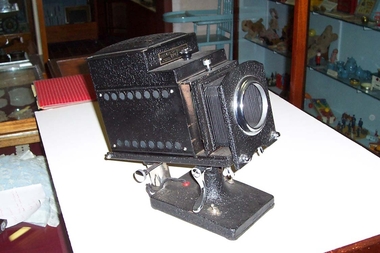
Equipment - Otiscope, Slide Projector
... This lens is endorsed '8 inch (26cm) high focus Aldus UNO Projector Lens'.This lens and a lamp is stored inside the projector. ...This lens is endorsed '8 inch (26cm) high focus Aldus UNO Projector Lens'.This lens and a lamp is stored inside the projector. ...In one place in records Pat Faggetter is credited with the donation of this item. It would appear that Pat picked it up from Mrs Coldrey so I have credited Mrs Coldrey as the donor. See also page 10 of green folder. (Ted Arrowsmith)OTICISCOPE An early slide projector. Large, black square unit with chrome parts. Bellows to assist in focus can be slid up to 26cm. On the end of the bellows is screwed a further adjustable lens (8.5cm diam by 11cm long). The body of the unit can be tilted to focus on the screen. This lens is endorsed '8 inch (26cm) high focus Aldus UNO Projector Lens'.This lens and a lamp is stored inside the projector. The projection lamp is an Osram (balloon shaped) patent registered 260 volt Gas Filled 500 watt 51. Made in England. Screw fitting .Power supply is by early English type two pin plug with a toggle switch on left side.Ensign Optiscope No. 6 - Made in Britain - Ensign Ltd - London.photography, projectors -
 Federation University Historical Collection
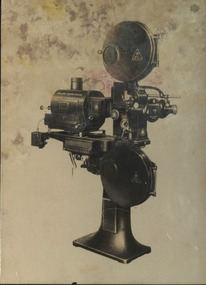
Image, Projector associated with Gem Pictures, c1930, c1930
... Scan of a film projector associated with Gem Pictures, and pages of a catalogue that includes the Hahn-Goerz Theatre Projector with 8 inch standard "Artisol" Mirror lamp on column stand. ...theatre film entertainment gem rash gem pictures edwin rash projector film projector hahn-goerz theatre projector Australasian Films Ltd Scan of a film projector associated with Gem Pictures, and pages of a catalogue that includes the Hahn-Goerz Theatre Projector with 8 inch standard "Artisol" Mirror lamp on column stand. ...Scan of a film projector associated with Gem Pictures, and pages of a catalogue that includes the Hahn-Goerz Theatre Projector with 8 inch standard "Artisol" Mirror lamp on column stand. theatre, film, entertainment, gem, rash, gem pictures, edwin rash, projector, film projector, hahn-goerz theatre projector, australasian films ltd -
 Dunkeld Museum Inc.
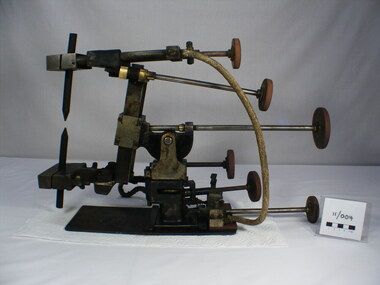
Carbon Arc Lamp, Carbon Arc Lamp out of a Film Projector
... Carbon Arc Lamp out of a Film Projector...This lamp was the light source for the projector which was operated at Dunkeld and the wider district during the 1920's and 30's. ...This arc lamp produced the light for a movie projector....This arc lamp produced the light for a movie projector. Carbon Arc Lamp out of a Film Projector Carbon Arc Lamp ...This lamp was the light source for the projector which was operated at Dunkeld and the wider district during the 1920's and 30's. The company which operated it was called Royal Pictures and showede their films in district halls. Owned by Claude Taylor and Reuben Schache. The projector was hand operated. Films were also shown outside on a large screen outside the Royal Mail Hotel.Metal carbon arc lamp. 6 Adjustor screws to adjust the rods to strike and hold the carbon arc. These rods allow adjustment and totation of the carbon rods which hold the arc. Brass feferrules are used for fine adjustments. Hand wheels are insulated to protect the operator. This arc lamp produced the light for a movie projector.None visibleentertainment, films, carbon lamp -
 Montmorency–Eltham RSL Sub Branch
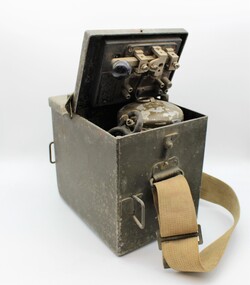
Equipment - Lamp, Signalling Daylight, Short Range, Case MK II, PMG, 1942, Stromberg Carlson, 1942
... Mounted on the lamp is is an oval brass identification plate with the inscription "LAMP SIGNALLING DAYLIGHT SHORT RANG PROJECTOR MK 11 STROMBERG CARLSON 1942" with stamped serial number 26634. ...Mounted on the lamp is is an oval brass identification plate with the inscription "LAMP SIGNALLING DAYLIGHT SHORT RANG PROJECTOR MK 11 STROMBERG CARLSON 1942" with stamped serial number 26634. ...Rectangular olive green metal case. Stored within the case is a round olive green metal lamp. The lamp is attached to the metal case by a two wire copper flex cord. Stored within the case are 3 short metal rods with a spiral thread on one end which screw together to form a stand for the lamp. The interior of the case is divided into 2 sections and is accessed via 2 lids which are hinged on the internal divide, one lid is larger than the other. Mounted to the inside of the larger lid is a Morse key pad. Attached to case is a canvas webbing strap with brass buckles.Mounted on the larger of the lids, is a rectangular brass identification plate with the inscription " LAMP SIGNALLING DAYLIGHT SHORT RANGE CASE MK II, PMG MELB 1942 " and stamped 1176 5. Mounted on the lamp is is an oval brass identification plate with the inscription "LAMP SIGNALLING DAYLIGHT SHORT RANG PROJECTOR MK 11 STROMBERG CARLSON 1942" with stamped serial number 26634. D (up arrow) D is marked on one side of the case. -
 Bendigo Military Museum
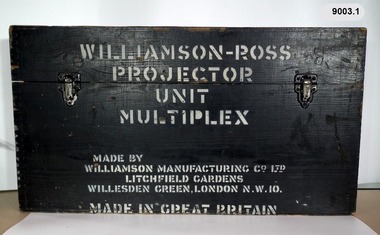
Instrument - Multiplex Unit Projector, Williamson Manufacturing Co, Circa 1950
... A black wooden box containing a Multiplex Unit Projector (incomplete). The Multiplex has a Lamp Head, Barrel Housing, Body of the Projector and a Platen which is missing. .1 Protective wooden box .2 Multiplex Instrument .3 Multiplex Instrument Parts Diagram .4 A bank of Multiplex projectors in operation ...A black wooden box containing a Multiplex Unit Projector (incomplete). The Multiplex has a Lamp Head, Barrel Housing, Body of the Projector and a Platen which is missing. .1 Protective wooden box .2 Multiplex Instrument .3 Multiplex Instrument Parts Diagram .4 A bank of Multiplex projectors in operation Multiplex Unit Projector Instrument Multiplex Unit Projector Williamson Manufacturing Co ...Multiplex mechanical stereoplotting equipment was used at the Army Survey Regiment, Fortuna Bendigo. c1950s. Multiplex equipment was imported from the UK in 1951 and introduced in the following year, to accelerate map production output covering CMF training areas at 1:25,000 map scale. Multiplex plotting was a productive advancement replacing the ‘Arundel’ method of graphical plotting planimetric detail that was expensive and slow, especially in timbered mountainous terrain. Air photos were made into small diapositives and mounted on racks in the exact position relative to when the aerial photos were taken. The technicians operated the Multiplex in a darkened room, with one photo projected with a green filter and the other through a red filter to form a 3D view of the overlapping photos. The 3D model projected onto a platen, which was a small platform that was raised up and down. The technician viewed the 3D image with special glasses fitted with red and green lenses. In the centre of the platen was a small pinhole that served as a floating mark, with a vertical pencil located exactly below the pinhole. This tracing table was moved to follow the topographic feature or contour line and draw it on the paper underneath. The technician raising or lowering the platform’s floating mark to match the height of the 3D terrain. It also replaced the slotted template method of mechanical adjustment of strips of aerial photography, however was restricted to each strip rather than between strips in the block. Although the Multiplex was phased out of production in 1968, it was used in the training of photogrammetry and aero-triangulation at the School of Military Survey located at Bonegilla, Victoria until the early 1990s. The history of the Multiplex is covered in more detail with additional historic photographs, in pages 50 to 51 of Valerie Lovejoy’s book 'Mapmakers of Fortuna – A history of the Army Survey Regiment’ ISBN: 0-646-42120-4. This instrument is only one of the projectors of a set and is unfortunately missing its platen, coloured filters and coloured glasses. A cardboard set of glasses is included as an example. Another Multiplex instrument is in the collection as Item 9039.4A black wooden box containing a Multiplex Unit Projector (incomplete). The Multiplex has a Lamp Head, Barrel Housing, Body of the Projector and a Platen which is missing. .1 Protective wooden box .2 Multiplex Instrument .3 Multiplex Instrument Parts Diagram .4 A bank of Multiplex projectors in operation WILLIAMSON MANUFACTURING CO, PHOTOGRAPHIC ENGINEERS, SERIAL NUMBER 3437, TYPE MPC, LITCHFIELD GARDENS, LONDON AND READING.royal australian survey corps, rasvy, fortuna, army survey regiment, army svy regt -
 Bendigo Military Museum
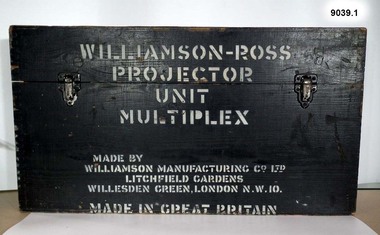
Instrument - Multiplex Unit Projector, Williamson Manufacturing Co, Circa 1950
... A black wooden box containing a Multiplex Unit Projector (incomplete). The Multiplex has a Lamp Head, Barrel Housing, Body of the Projector and a Platen. .1 Protective wooden box .2 Multiplex Instrument .3 Multiplex Instrument Parts Diagram .4 A bank of Multiplex projectors in operation ...A black wooden box containing a Multiplex Unit Projector (incomplete). The Multiplex has a Lamp Head, Barrel Housing, Body of the Projector and a Platen. .1 Protective wooden box .2 Multiplex Instrument .3 Multiplex Instrument Parts Diagram .4 A bank of Multiplex projectors in operation Multiplex Unit Projector Instrument Multiplex Unit Projector Williamson Manufacturing Co ...Multiplex mechanical stereoplotting equipment was used at the Army Survey Regiment, Fortuna Bendigo. c1950s. Multiplex equipment was imported from the UK in 1951 and introduced in the following year, to accelerate map production output covering CMF training areas at 1:25,000 map scale. Multiplex plotting was a productive advancement replacing the ‘Arundel’ method of graphical plotting planimetric detail that was expensive and slow, especially in timbered mountainous terrain. Air photos were made into small diapositives and mounted on racks in the exact position relative to when the aerial photos were taken. The technicians operated the Multiplex in a darkened room, with one photo projected with a green filter and the other through a red filter to form a 3D view of the overlapping photos. The 3D model projected onto a platen, which was a small platform that was raised up and down. The technician viewed the 3D image with special glasses fitted with red and green lenses. In the centre of the platen was a small pinhole that served as a floating mark, with a vertical pencil located exactly below the pinhole. This tracing table was moved to follow the topographic feature or contour line and draw it on the paper underneath. The technician raising or lowering the platform’s floating mark to match the height of the 3D terrain. It also replaced the slotted template method of mechanical adjustment of strips of aerial photography, however was restricted to each strip rather than between strips in the block. Although the Multiplex was phased out of production in 1968, it was used in the training of photogrammetry and aero-triangulation at the School of Military Survey located at Bonegilla, Victoria until the early 1990s. The history of the Multiplex is covered in more detail with additional historic photographs, in pages 50 to 51 of Valerie Lovejoy’s book 'Mapmakers of Fortuna – A history of the Army Survey Regiment’ ISBN: 0-646-42120-4. This instrument is only one of the projectors of a set and is unfortunately missing its coloured filters and coloured glasses. Another instrument is in the collection as Item 9003.4A black wooden box containing a Multiplex Unit Projector (incomplete). The Multiplex has a Lamp Head, Barrel Housing, Body of the Projector and a Platen. .1 Protective wooden box .2 Multiplex Instrument .3 Multiplex Instrument Parts Diagram .4 A bank of Multiplex projectors in operation WILLIAMSON MANUFACTURING CO, PHOTOGRAPHIC ENGINEERS, SERIAL NUMBER 3187, TYPE MPC, LITCHFIELD GARDENS, LONDON AND READING.royal australian survey corps, rasvy, fortuna, army survey regiment, army svy regt -
 Warrnambool and District Historical Society Inc.
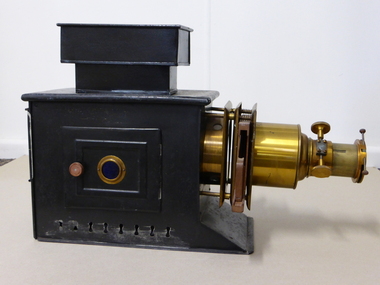
Projector, Glass Slide Projector, Early 20th century
... projector or magic lantern with a rectangular metal lantern body partly open at the back. The back has a top section that is attached with a metal hinge and lifts up and outwards. The lantern base also has a side opening with a metal knob for opening and a metal panel with a blue glass inset. Inside the lantern body is the lamp...projector or magic lantern with a rectangular metal lantern body partly open at the back. The back has a top section that is attached with a metal hinge and lifts up and outwards. The lantern base also has a side opening with a metal knob for opening and a metal panel with a blue glass inset. Inside the lantern body is the lamp ...This magic lantern or slide projector was used to project glass slides on to a screen The magic lantern was the chief visual entertainment for the public before the introduction of the moving picture and consequent cinema entertainment. This one probably dates from about 1915 but its provenance is not known.This magic lantern is an important and interesting object as it shows us the way people in the early 20th century were entertained. The few people who owned this type of projector would give public showings of slides of people and scenes and sometimes raise money for a charitable cause in this way. This is a glass slide projector or magic lantern with a rectangular metal lantern body partly open at the back. The back has a top section that is attached with a metal hinge and lifts up and outwards. The lantern base also has a side opening with a metal knob for opening and a metal panel with a blue glass inset. Inside the lantern body is the lamp and an electric cord (the illuminant system may have originally been fuelled by paraffin or another oil burner). On top of the lantern body is a smaller rectangular metal box in two sections. This can be removed. The illuminant system is brass and slides out. It has two mechanisms for adjusting the focus and a covering over the lens opening which can be pulled up. There is also a wooden slide holder which can be pulled in and out of the projector. ‘W.B. British Made’ social history, history of warrnambool, glass slide projector -
 Bendigo Historical Society Inc.
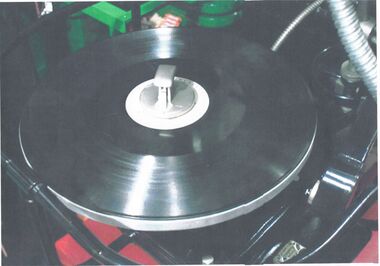
Document - PICTURE THEATRE EQUIPMENT
... Photocopy images of foreign picture theatre equipment 16 inch transcription disc on a turntable fixed to a projector, open air cinema screen middle of picture behind Art gallery & Capital theatre, Golden Drive in carbon arc lamp, carbon arc lamp, sound on disc 16 inch record. ...AUDIO-VISUAL TECHNOLOGY Audio-visual appliances picture theatre Photocopy images of foreign picture theatre equipment 16 inch transcription disc on a turntable fixed to a projector, open air cinema screen middle of picture behind Art gallery & Capital theatre, Golden Drive in carbon arc lamp, carbon arc lamp, sound on disc 16 inch record. ...Photocopy images of foreign picture theatre equipment 16 inch transcription disc on a turntable fixed to a projector, open air cinema screen middle of picture behind Art gallery & Capital theatre, Golden Drive in carbon arc lamp, carbon arc lamp, sound on disc 16 inch record. UK. Thomas Edison's Kinetoscope 1894, hand cranked Pathe projector (Paris).audio-visual technology, audio-visual appliances, picture theatre -
 Bendigo Historical Society Inc.
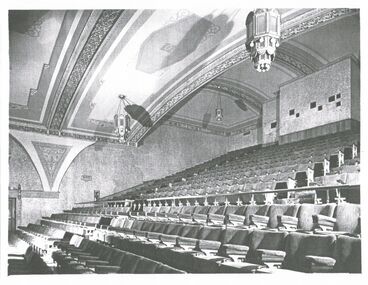
Document - PLAZA THEATRE
... Eleven photocopies of Plaza Theatre Bendigo images including documentation. 1 Plaza Theatre Bendigo upstairs auditorium, 2 Ground floor entrance Plaza Bendigo 1936 and name of film starring Gary Grant Constance Bennett 'Big Brown Eyes', 3 Plaza Theatre Mitchell Street Bendigo 1953 film 'Warpath' Edmund O' Brien Dean jagger forest tucker Harry Carey 'Thunder in the East' Alan Ladd Deborah Kerr Charles Boger Phyllis Calvert nearby residents Hamptons Newsagency Melody Bar Pearse dentist Quins bluebird fruit shop Norris's Menswear Matchetts grocery, 'Port Hole Paradise' My Days as an Assistant Projectionist by Micheal Purdon 6 pages, copy of a glass advertising slide, cinema glass advertising slide late 40's early 50's, Plaza theatre Auditorium 1935, Plaza Bendigo 1967 Projector 2X Cummings & Wilson Western Electric Sound Bases Peerless Magnarc Carbon Arc Lamps....BENDIGO Buildings plaza theatre Eleven photocopies of Plaza Theatre Bendigo images including documentation. 1 Plaza Theatre Bendigo upstairs auditorium, 2 Ground floor entrance Plaza Bendigo 1936 and name of film starring Gary Grant Constance Bennett 'Big Brown Eyes', 3 Plaza Theatre Mitchell Street Bendigo 1953 film 'Warpath' Edmund O' Brien Dean jagger forest tucker Harry Carey 'Thunder in the East' Alan Ladd Deborah Kerr Charles Boger Phyllis Calvert nearby residents Hamptons Newsagency Melody Bar Pearse dentist Quins bluebird fruit shop Norris's Menswear Matchetts grocery, 'Port Hole Paradise' My Days as an Assistant Projectionist by Micheal Purdon 6 pages, copy of a glass advertising slide, cinema glass advertising slide late 40's early 50's, Plaza theatre Auditorium 1935, Plaza Bendigo 1967 Projector 2X Cummings & Wilson Western Electric Sound Bases Peerless Magnarc Carbon Arc Lamps. ...Eleven photocopies of Plaza Theatre Bendigo images including documentation. 1 Plaza Theatre Bendigo upstairs auditorium, 2 Ground floor entrance Plaza Bendigo 1936 and name of film starring Gary Grant Constance Bennett 'Big Brown Eyes', 3 Plaza Theatre Mitchell Street Bendigo 1953 film 'Warpath' Edmund O' Brien Dean jagger forest tucker Harry Carey 'Thunder in the East' Alan Ladd Deborah Kerr Charles Boger Phyllis Calvert nearby residents Hamptons Newsagency Melody Bar Pearse dentist Quins bluebird fruit shop Norris's Menswear Matchetts grocery, 'Port Hole Paradise' My Days as an Assistant Projectionist by Micheal Purdon 6 pages, copy of a glass advertising slide, cinema glass advertising slide late 40's early 50's, Plaza theatre Auditorium 1935, Plaza Bendigo 1967 Projector 2X Cummings & Wilson Western Electric Sound Bases Peerless Magnarc Carbon Arc Lamps.bendigo, buildings, plaza theatre -
 Bendigo Historical Society Inc.
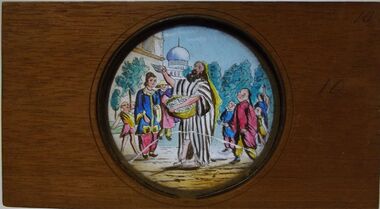
Slide - MAGIC LANTERN COLLECTION: MAGIC LANTERN SLIDE CHINESE SCENE
... Projectors-still Object. MAGIC LANTERN COLLECTION- MAGIC LANTERN SLIDE- Chinese SCENE - lamp seller. ...Object. MAGIC LANTERN COLLECTION- MAGIC LANTERN SLIDE- Chinese SCENE - lamp seller. Magic Lantern slide - rare (19th Century ?) timber mounted hand painted Lantern Slide. Number 10 is written in ink on top right corner/ glass is cracked.photography, projectors-still -
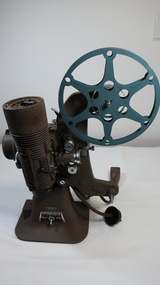 Kiewa Valley Historical Society
Projector
... Bell & Howell / 8 mm projector / Model 606 / 110-250 / volts / 5 Amps A/C/ or D/C/ England London. Above this label is : Lamp 400 Watts Max.. 9039 is printed in silver on the side. ...Bell & Howell / 8 mm projector / Model 606 / 110-250 / volts / 5 Amps A/C/ or D/C/ England London. Above this label is : Lamp 400 Watts Max.. 9039 is printed in silver on the side. ...Possibly early 1950sDark brown box with lid and clip fastener. The lid has a handle at the top.Lid & inside of box lined in red velvet. There is a separate narrow compartment for the reel. There is an electric cord and 3 papers. The reel is dark grey steel. The cord is brown rubber and very long. At the front is an attached plastic label with a switch in the centre. There is a black, red and gold disc with a Bell and Howell guarantee. A Registration card indicating model 606 & Serial no. 9039 and another card with a Safety message in 8 languages.On the base: G.B. Bell & Howell / 8 mm projector / Model 606 / 110-250 / volts / 5 Amps A/C/ or D/C/ England London. Above this label is : Lamp 400 Watts Max.. 9039 is printed in silver on the side. Inside bottom of lid: Cabinet by Raddports Pty. Ltd. / NSW / Leatheretteprojector, g. b. bell & hovell -
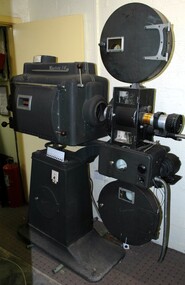 Plutarch Project
35mm Projector, circa 1950's
... Projector film culture language Greek entertainment Γιαννούδης Yiannoudes προβολέας INSCRIPTION 1 (red background) Westrex 14, High Intensity Arc Lamp, Serial Number A.5401018. ...This 35mm Westrex 14 projector was purchased from Waverley Theatre (Cnr Burke Road and Waverley Road in Malvern, in 1962) last used by "Cosmopolitan Motion Pictures" as follows: from 1962 to 1967 - National Theatre, Richmond. from 1967 to 1970 - in a small leatherette on Bridge Road, Richmond. from 1971 to 1985 - Galaxy Theatre Brunswick. After that it was stored at the back of Westgarth Theatre in Northcote. This projector has a primary historic significance as it covers the largest part of the history of film shows by "Cosmopolitan Motion Pictures", and cultural/social significance since it has been used to project a number of other language films (about 10 different languages) by the company. It also carries a secondary significance of rarity being the last used projector by the company at Galaxy Theatre.This metal (most probably steel) projector is part of a number of projectors owned by "Cosmopolitan Motion Pictures". It is in dark blue/grey colour and still operational to project 35mm films if needed. It has two inscriptions detailed below and was last used at Liberty/Galaxy Theatre in Brunswick in 1985 (for more details about the history of Galaxy Theatre follow this link http://technicolouryawn.com/?page_id=2988)INSCRIPTION 1 (red background) Westrex 14, High Intensity Arc Lamp, Serial Number A.5401018. Manufactured for Westrex (Australia) Pty. Limited by G.B.H. Electronic Laboratories - Made in N.S.W. Australia INSCRIPTION 2 (blue background) Westrex R4A Reproducer Made in Australia Western Electric Co. (Aust) Pty. Ltd.projector, film, culture, language, greek, entertainment, γιαννούδης, yiannoudes, προβολέας -
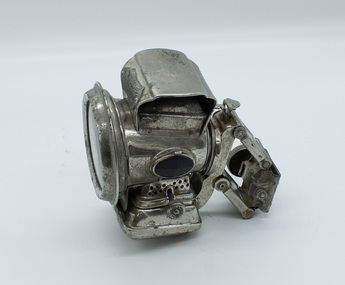 Clunes Museum
Accessory - BICYCLE LAMP, Joseph Lucas Ltd, after1897
... lamp with adjusting knob. Adjustable handle (to fit to bicycle). Oval "onyx" stone on either side of projector...lamp with adjusting knob. Adjustable handle (to fit to bicycle). Oval "onyx" stone on either side of projector Accessory BICYCLE LAMP Joseph Lucas Ltd ...Metal bicycle lamp, kerosene lamp with adjusting knob. Adjustable handle (to fit to bicycle). Oval "onyx" stone on either side of projectorJoseph Lucas Ltd. Birmingham Patented Silver King Has circle with lion inside and torch on top "Lucas" on bottom of circlebicycle lamp, joseph lucas ltd -
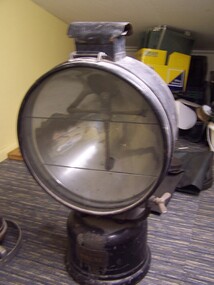 Puffing Billy Railway
Floodlight Projector, Tilley Model FL6, circa 1940's
... Tilley Floodlight Projector - Model FL6 It stands about a metre high, and when lit, turns out about 5,000 candle power from the parabolic mirror in the back of the lamp. manufactured between the mid 1940's and early '50's It runs on kerosene that is pressurized with the integral pump, to provide a light beam from the parabolic mirror in the back of the lamp of approximately 3,000 candle power which can project over 1/4 of a mile. ...Historic - Railways - Tilley Floodlight Projector puffing billy tilley floodlight projector Tilley Floodlight Projector - Model FL6 Tilley Floodlight Projector - Model FL6 made of metal, brass and glass and steel Tilley Model FL6 Floodlight Projector Tilley Lamp Co ...Tilley Floodlight Projector - Model FL6 It stands about a metre high, and when lit, turns out about 5,000 candle power from the parabolic mirror in the back of the lamp. manufactured between the mid 1940's and early '50's It runs on kerosene that is pressurized with the integral pump, to provide a light beam from the parabolic mirror in the back of the lamp of approximately 3,000 candle power which can project over 1/4 of a mile. It features a pressure gauge, armored glass and all steel construction. Historic - Railways - Tilley Floodlight ProjectorTilley Floodlight Projector - Model FL6 made of metal, brass and glass and steelTilley Floodlight Projector - Model FL6puffing billy, tilley floodlight projector -
 Whitehorse Historical Society Inc.
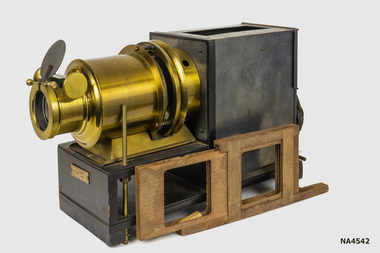
Equipment - Projector, C1920
... Projector, Wood & Brass, Black Metal Box at rear for lamp & electric lead, spare lens inside. ...Projector, Wood & Brass, Black Metal Box at rear for lamp & electric lead, spare lens inside. ...Owned by Newspaper photographer living in Wattle Park c 1960s.Possibly Nepera Brand, Name on Slide Boxes.1.A Wooden Case with a Sliding Rear Door for Projector. 2. Projector, Wood & Brass, Black Metal Box at rear for lamp & electric lead, spare lens inside. Brass lens holder & Focus adjuster at other end. 3. Wooden slide holder holds two slides, and fits between body and lens tube. 4. Spare lens marked 6 In EQUI with sliding collar. 5. 3 packs of glass slides. 4. Grey tin containing slides. Slides stored in .09.13.No 510324 on Lens Adjuster Ron.230577, 7in, Est 1816, Trade mark. London Made. Without name Australasia Pty Limited.photography, photographs / slides / film, projectors -
 Whitehorse Historical Society Inc.
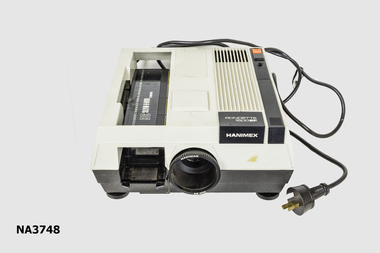
Equipment - Slide Projector, c1960
... projector. Also included is an extractor for removing the lamp. The unit is made of black and white strong plastic the ability to mount both cartridge types. ...projector. Also included is an extractor for removing the lamp. The unit is made of black and white strong plastic the ability to mount both cartridge types. ...Purchased by donor for personal family use.Haminex Rondette 1500EF Slide Projector together with 2 x 120 Slide Rondex magazines and one 36 slide Hanomatic magazine. It has a 85mm lens Hanimar f2.8 lens. All in original cartons and with operating instructions for the projector. Also included is an extractor for removing the lamp. The unit is made of black and white strong plastic the ability to mount both cartridge types. A total of six pieces.Rondette 1500 EF Hanimex.Plasticphotography, projectors -
 Musculoskeletal Health Australia (now held by the Glen Eira Historical Society)
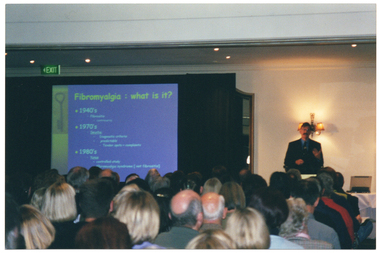
Photograph - Group photo, 2001
... projector screen displaying a slide projection. The text heading on the slide says, "Fibromyalgia : what is it?", followed by dot points (illegible) under the sub-headings "1940's", "1970's", and "1980's". Above the screen, affixed to the ceiling, there is a small green "EXIT" sign. Behind the screen is a large black curtain. On the wall behind him, there is a large wooden-framed mirror on one side (partially obscured by the curtain) and a two-light sconce (wall lamp...projector screen displaying a slide projection. The text heading on the slide says, "Fibromyalgia : what is it?", followed by dot points (illegible) under the sub-headings "1940's", "1970's", and "1980's". Above the screen, affixed to the ceiling, there is a small green "EXIT" sign. Behind the screen is a large black curtain. On the wall behind him, there is a large wooden-framed mirror on one side (partially obscured by the curtain) and a two-light sconce (wall lamp ...In 2001, the Arthritis Foundation of Victoria (AFV), incorporating Osteoporosis Victoria OV), held a Fibromyalgia Syndrome (FMS) forum. The event was held at Nine Darling Street, a reception centre in South Yarra. In this photo, Rheumatologist, Dr Geoffrey Littlejohn, explains how our understanding of fibromyagia has evolved over time.COL photo of a man, wearing a suit, shirt and tie. He is standing at a lectern. To his right, there is a large projector screen displaying a slide projection. The text heading on the slide says, "Fibromyalgia : what is it?", followed by dot points (illegible) under the sub-headings "1940's", "1970's", and "1980's". Above the screen, affixed to the ceiling, there is a small green "EXIT" sign. Behind the screen is a large black curtain. On the wall behind him, there is a large wooden-framed mirror on one side (partially obscured by the curtain) and a two-light sconce (wall lamp) on the other. There is a small table next to him covered with a white tablecloth, on top of which sits a laptop computer. In the foreground, there is a view of the audience from behind.arthritis foundation of victoria, afv, osteoporosis victoria, ov, fibromyalgia syndrome, fms, forum, information, education, pain management, dr geoffrey littlejohn, rheumatologist, presentation, south yarra, 2001 -
 City of Melbourne Libraries
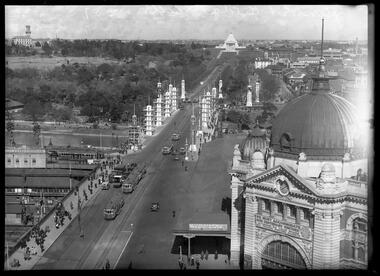
Photograph, Bull, Hugh Jones, 1897-1993, Princes Bridge Centenary pylons under construction
... Panels of glass let into the shaft of each pylon were indirectly lit by 40, 100 watt lamps, and the upper bank of internal lamps were dyed so as to flood the panels with a deep red light. The decorative painted shields and flagpoles/pennants were illuminated by three 200 watt projectors concealed in the roof of each pylon, and were part of an electric night light decoration scheme involving 28 miles of wire to supply more than 20,000 lights. ...Panels of glass let into the shaft of each pylon were indirectly lit by 40, 100 watt lamps, and the upper bank of internal lamps were dyed so as to flood the panels with a deep red light. The decorative painted shields and flagpoles/pennants were illuminated by three 200 watt projectors concealed in the roof of each pylon, and were part of an electric night light decoration scheme involving 28 miles of wire to supply more than 20,000 lights. ...Princes Bridge Centenary pylons under construction Possibly taken from Young and Jacksons Hotel (formerly Princes Bridge Hotel) on the corner of Flinders and Swanston streets, Flinders Street Station’s clocks and main entrance dominate, along with its distinctive copper dome and decorative façade. The time on the main clock is 1.40pm, and the sign underneath, reflecting Melbourne’s upcoming Centenary reads, “We must accommodate our Centenary visitors! Citizens! Do your share by taking paying guests.” At left is the original Princes Bridge Station, today the site of Federation Square. The riverside tram terminus advertises a Café/Tobacconist/Refreshment Room selling cigars & cigarettes, fountain drinks & confectionery, and in smaller text: “Leave your boot repairs here”. Nearly everyone is dressed in dark suits, coats and hats. The footpaths are wide and there are no traffic lights. The roadway stretches towards the Shrine of Remembrance, not yet dedicated but very dominant on the skyline. Government House is clearly visible across the wide parkland that would come to be known as Kings Domain and that is an area of deep importance to the people of the Eastern Kulin. Originally, Birrarung was part of a network of swamps and lagoons linked to the course of the river. From 1896, Public Works Department engineer Carlo Catani, oversaw a new channel to straighten the river and the swamps and lagoons were filled with spoil from the channel works. From the same vantage point today, only the top of the tower of Government House would be visible. The photo captures the pylons along Princes Bridge, mid-construction and being installed to mark Melbourne’s Centenary. The pylons were not without controversy. Both The Argus and The Age bemoaned them for being “made almost entirely of imported softwood timber”, denying work to native hardwood timber workers and sawmillers, and leading visitors to think Australia did not have its own exceptional native hardwoods. The pylons were also variously described in their incomplete state, as unimaginative and resembling an oilfield. Published: The Age 5 September 1934 Featured in "Newsworthy: Melbourne in photographs 1933-1936" exhibition at East Melbourne Library, October to December 2023. Exhibition caption by project volunteer, Louise McKenzie Photographer notations on slide: "Pylons + St Kilda Rd C57" Published: Age (Melbourne, Vic. : 1854 - 1954), Wednesday 5 September 1934, page 11 Published title: DECORATIONS -- THEN AND NOW. Published caption: "Although not completed yet, some impression of the effect of the decorations on Princes-bridge may be obtained from the first picture which shows the majestic sweep of St Kilda road with the Shrine of Remembrance and Government House dominating the horizon. The area to the left of St. Kilda-road and in front of Government House is portion of the area which it is proposed to call the King's Domain, which extends to Domain-road and Anderson-street..." Description: East-facing, elevated view of Flinders Street Station and Princes Bridge, featuring partially completed pylons erected for Melbourne's Centenary celebrations. The Shrine of Remembrance and Government House can be seen in the distance. In the foreground are trams, cars and trucks, pedestrians, Batman Avenue tram terminus and refreshment rooms. Signage on Flinders Street Station encourages citizens to accommodate Centenary visitors. The Melbourne Centenary was held 1934-35 in celebration John Batman's proclamation that Melbourne "the place for a village". Centenary events included a visit by Prince Henry, Duke of Gloucester. A Centenary Cake measuring 50 feet in height and ten tons in weight was cut into 250,000 pieces and sold at 1 shilling per piece for charity. Spectacular floodlighting of city landmarks, the creation of the Pioneer Women's Memorial Garden, and the MacRobertson Air Race from London, were other notable activities. Research by project volunteer, Louise McKenzie: The photo in The Age collage of 5 September 1934 has a slightly cropped foreground. The original photo has been taken from an elevated vantage point, most probably the roof of the Nicholas Building on the corner of Flinders and Swanston streets. The right foreground is dominated by the main “clocks” entrance to Flinders Street Station, showing its distinctive copper dome and decorative façade. The time on the main clock is 1.40 pm. The main sign on the front of the Station reads, "We Must Accommodate our Centenary Visitors! Citizens! Do your share by taking paying guests. Write to The Official Centenary Accommodation Bureau, 436 Collins St. City. Tel M 4671”. Another sign at eye level at the main entrance says: “Cheap Trips on Sundays”. The sign on the end of the roof along the eastern side of the station reads, “The Babies Need Your Help! Support Broadmeadows Foundling Hospital Appeal. July and August”. Run by the Sisters of St Joseph of the Sacred Heart, St Joseph’s Foundling Hospital was a purpose built infants’ home for up to 300 babies, plus accommodation for expectant mothers, mainly single women. In the early 1930s, the department (Victorian Children’s Welfare Department) contracted St Joseph’s Foundling Hospital to care for an additional 60 infant state wards, and up to 175 non wards at any given time. In 1931 it also operated a mothercraft training school. The centre foreground shows the commencement of Princes Bridge. Beneath the left side of the bridge was the site of the original Princes Bridge Station, by this time incorporated into Flinders Street Station, and today the area is the site of Federation Square. It was linked to Flinders Street station by the railway tracks that ran underneath the northern approach to the bridge. This photo shows a tram terminus which has a Café/Tobacconist/Refreshment Room, selling cigars & cigarettes, fountain drinks & confectionary, and a sign: Leave your boot repairs here. In the foreground is a wide roadway running south/north, comprising two vehicle lanes each heading north/south, and a central section containing two sets of tram tracks. There are cars, buses and delivery vans on the roadway. The trams visible are Glen Iris (Route No. 6; tram no. 448), Toorak (Route No. 8, tram no. 333), ? (No. 7), ? (No. 1), and ? (No. 2A). The footpaths are extremely wide. There is a square newspaper/magazine stand on the eastern side footpath. And also a “Ferry” sign. There are no traffic lights, but a policeman is visible on the roadway. There are pedestrians – men, women, children, a porter with trolley, women with prams. Clothing comprises dark suits, coats and hats for nearly everyone. There are double headed “Collins Street” lights along the side of the roadway, and along the northern riverbank. The roadway in the foreground is an extension of Swanston Street, which becomes Princes Bridge, then St Kilda Road, stretching towards the Shrine of Remembrance, and diverting past it. The Shrine had not yet been officially dedicated, and looks very white and dominant on the skyline. On the LHS of St Kilda Road, Government House is clearly visible across the wide parkland to be known as Kings Domain. The Kings Domain area is important to the people of the Eastern Kulin nation, and also has historical importance for its association with the early settlement of Melbourne and the foundation of British colonial administration in Victoria. On the southern side of the Yarra River (Birrarung) an historic rowing boathouse is visible, located adjacent to the Alexandra Gardens. Originally Birrarung was part of a network of swamps and lagoons linked to the course of the river. From 1896, under the guidance of engineer Carlo Catani* a new channel to straighten the river was created and the swamps and lagoons were filled with spoil from the channel works. The gardens were then created and completed in time for a Royal visit by the Duke of York in May 1901. The gardens are named after Alexandra of Denmark, the wife of King Edward VII. Both these areas, plus the Royal Botanic Gardens Victoria, Shrine of Remembrance Reserve, Sidney Myer Music Bowl, Government House, and the Queen Victoria Gardens together form the Domain Parklands. The extent of the subsequent plantings is evident today, where from the same vantage point only the top of the tower of Government House would be visible. *Catani was born in Florence in 1852, but after arriving in Melbourne worked as a civil engineer for the Victorian Government. His last major project was the reclamation of the foreshore of St Kilda, envisaged in the style of a European resort, complete with a split level esplanade, bathing pavilions, dance halls, amusements and a French-Italian style of landscape complete with palms. The gardens at the end of Fitzroy Street, St Kilda, now bear his name. The historic boathouse visible across the Yarra is another glimpse into Melbourne’s past. “Boathouse Row” comprises 7 amateur rowing clubs, the first established in 1859 (Melbourne University Boat Club). Other Clubs were Richmond, Melbourne, Banks, Melbourne Grammar School, Yarra Yarra and Mercantile. South of the river and west of the bridge is an area today developed into the Melbourne arts precinct of Hamer Hall and the Arts Centre. But at this time it was the home of Wirths Olympia Circus, which comprised Wirths Pleasure Park (an amusement park), a 5,000 seat auditorium – Hippodrome, a roller skating rink, a glaciarium, a cinema, and the Green Mill Dance Hall. Dog shows were also held at Olympia. The Green Mill Dance Hall closed in 1950, and the remainder of the Wirth buildings on site were destroyed by fire in December 1953. The feature of the photo is the pylons erected along Princes Bridge to mark Melbourne’s Centenary in 1934. The sixteen plastered pylons were designed by Roy Prentice, the second person to qualify as an architect at The University of Melbourne’s Bachelor of Architecture degree, in 1933, aged 27. Simon Reeves in his article marking the 100th birthday of Roy Prentice on 20 June 2006 reports that the State Electricity Commission sponsored this work, and the Argus reported that “… the pylons were “illuminated from within to give the effect of soft radiance”. Australia Home Beautiful 1 Oct 1934 reports in a very detailed and comprehensive article: The 10 taller pylons, including flagpole, were 48 ft, with a base of 8 ft. Timber-framed and faced with fibrous plaster and galvanised sheet iron, each structure was securely bolted to a concrete foundation three feet in depth. Panels of glass let into the shaft of each pylon were indirectly lit by 40, 100 watt lamps, and the upper bank of internal lamps were dyed so as to flood the panels with a deep red light. The decorative painted shields and flagpoles/pennants were illuminated by three 200 watt projectors concealed in the roof of each pylon, and were part of an electric night light decoration scheme involving 28 miles of wire to supply more than 20,000 lights. An article in the Argus on 18 October 1934 provided minute detail of the lighting erected in Melbourne for the Centenary, converting it “… into a coloured fairyland by night.” The estimated cost of 10 pounds per hour the lights were on. The display included 800 standard light poles 30 feet high which were tiered with electric bulbs concealed in inverted cones, 138 specially designed “Venetian poles” draped in flags trophies and streamers. The streets included in the electric night light decoration scheme were Bourke Street from Spring to William, the entire length of Collins Street, Flinders Street from Elizabeth to Spring, Lonsdale Street from Elizabeth to Swanston, Swanston and Elizabeth Streets from Flinders to Lonsdale, and parts of Springs and Spencer Streets. Together with the Princes Bridge pylons, approximately 28 miles of wire was required to supply power to the more than 20,000 lights. And that is just in the city of Melbourne. It was estimated the same amount of lighting was duplicated among other local councils. The pylons were not without controversy. The Argus on 28 August 1934 in an article headed “Imported Timber in Pylons” reported that the Princes Bridge pylons are “made almost entirely of imported softwood timber”, and have therefore denied work to native hardwood timber workers and sawmillers. The same day the Melbourne Age ran a similar story, bemoaning the fact that foreign oregon had been used which may lead tourists to think Australia did not have its own exceptional native hardwoods. A Camberwell City Councillor described the pylons as unimaginative, and the Herald reported that skeletons of pylons for the Centenary decorations in their present form led the area to resemble an oilfield! The Yarra River and Princes Bridge have long been a focal point of Melbourne life. In the early days of European settlement in Melbourne a rope-hauled punt carried people across the Yarra River. A surge in population and increased shipping traffic created a need for a bridge. There was difficulty in agreeing on a suitable site for the bridge (options were crossing at Elizabeth, Swanston, Queen or Market Streets), but the NSW Government favoured Swanston Street and the Melbourne Town Council decided on a temporary bridge across the Yarra spanning from the foot of Swanston Street. This first bridge was a single span timber toll bridge designed by Scottish born bridge designer David Lennox, and completed in 1845. It was 120 feet long, had a roadway of 17 feet wide, and a footpath on one side of 4 feet. It was leased to the Melbourne Bridge Company in the name of Robert A Balbirnie. The tollhouse was on the north side of the river and the toll keeper, Patrick Doherty, was credited with saving nine lives during the four years he was in charge of the toll station. The second bridge was stone (completed 1850), and named Prince’s Bridge after the HRH Prince of Wales, later Edward VII. It was designed with an elliptical single arc and an exceedingly small rise in proportion to the span. However, this design created an obstacle for flood waters, and together with Melbourne’s increasing population it was quickly apparent that a new bridge was required. At its opening on 15 November 1850 coincided with the imminent declaration of Victoria as a separate colony, it provided a moment of great celebration for Melbournians and “The opening ceremony was described as the grandest processional display witnessed in the colony.” (ToMelbourne.com.au) Princes Bridge in its present form, as depicted in this photograph, was designed by Jenkins, D’Ebro and Grainger, and constructed in 1886-88 by David Munro. John Grainger (father of Australian composer Percy Grainger) did the majority of the design work for the bridge. The structure was to have three arches each 96 feet wide measured across the river, and the banks on both sides were raised to allow more space for floodwater to flow. St Kilda Road was originally many feet below the current level. The bridge is of architectural significance for its substantial size, giant half columns, extensive use of wrought and cast iron, decorative elements (cast-iron lamps) and the skilled stonemasonry in the construction of the abutments and piers. Its main design features are similar to those of Blackfriars Bridge in London (1870). The bluestones were quarried from Footscray, the Malmsbury stones were from quarries at Kyneton, and the granite from Harcourt. The cost was met by the State of Victoria, City of Melbourne, and six out of seven of its municipalities, and their coats of arms feature on the bridge. The building of the bridge reflected the boom period of Melbourne, including the Victorian gold rush 1851- late 1860s, and its contractor, David Munro, was also responsible for the construction of Queens Bridge and Sandridge Railway Bridge. The Centenary pylons are no longer in place, but today this intersection still plays a major part in Melbourne’s daily life: people still meet “under the clocks” at Flinders Street station, and the route in and out of the city along St Kilda Road is often a feature of parades such as Moomba, the Grand Final Parade, and of course the Anzac Day Parade which commences at the Princes Bridge intersection and finishes at the Shrine of Remembrance. There are many tram routes, which cross the Bridge, and it directs pedestrians towards the Arts Precinct, the various components of Domain Park, plus the Southbank restaurant and rowing precincts. Even though this is a street scene, it feels very intimate; the viewer is instantly immersed in the activity of a Melbourne afternoon, looking down St Kilda Road from a viewpoint near today’s Federation Square. References: DECORATIONS -- THEN AND NOW. (1934, September 5). The Age (Melbourne, Vic. : 1854 - 1954), p. 11. Retrieved September 21, 2023, from http://nla.gov.au/nla.news-article205880269 'Flinders Street railway station', Wikipedia, https://en.wikipedia.org/wiki/Flinders_Street_railway_station 'St Joseph’s Foundling Hospital (1901-75)', Finding Records, Department of Health and Human Services, State of Victoria, https://www.findingrecords.dhhs.vic.gov.au/collectionresultspage/St-JosephsFoundling-Hospital-Babies-Home#departmental-administration 'Alexandra Gardens', City of Melbourne, https://www.melbourne.vic.gov.au/community/parks-open-spaces/major-parks-gardens/Pages/alexandra-gardens.aspx 'Wirths Circus', Wikipedia, https://en.wikipedia.org/wiki/Wirth's_Circus 'Roy Prentice: Centenary Architect', Built Heritage Pty Ltd, Simon Reeves, https://www.builtheritage.com.au/downloads/prentice.pdf 'Princes Bridge', Heritage Council Victoria, https://vhd.heritagecouncil.vic.gov.au/places/817 PORT PHILLIP. (1846, April 1). The Sydney Morning Herald (NSW : 1842 - 1954), p. 3. Retrieved September 21, 2023, from http://nla.gov.au/nla.news-article12886251 'Edward VII', Wikipedia, https://en.wikipedia.org/wiki/Edward_VII 'Princes Bridge', ToMelbourne.com, https://tomelbourne.com.au/princes-bridge/ 'Princes Bridge', eMelbourne, https://www.emelbourne.net.au/biogs/EM01189b.htm 'Princes Bridge', Australia for everyone, http://australiaforeveryone.com.au/files/melbourne/princes-bridge.html 'Victorian gold rush', Wikipedia, https://en.wikipedia.org/wiki/Victorian_gold_rush IMPORTED TIMBER IN PYLONS (1934, August 28). The Argus (Melbourne, Vic. : 1848 - 1957), p. 9. Retrieved September 21, 2023, from http://nla.gov.au/nla.news-article10952507 Princes-Bridge Pylons. (1934, August 28). The Age (Melbourne, Vic. : 1854 - 1954), p. 7. Retrieved September 21, 2023, from http://nla.gov.au/nla.news-article205532235 Pylons Appear Near Princes Bridge (1934, August 18). The Herald (Melbourne, Vic. : 1861 - 1954), p. 1. Retrieved September 21, 2023, from http://nla.gov.au/nla.news-article243104375 PRINCES-BRIDGE PYLONS. (1934, September 20). The Age (Melbourne, Vic. : 1854 - 1954), p. 10. Retrieved September 21, 2023, from http://nla.gov.au/nla.news-article205873535 28 Miles of Wire (1934, October 18). The Argus (Melbourne, Vic. : 1848 - 1957), p. 1 (The Junior Argus). Retrieved September 21, 2023, from http://nla.gov.au/nla.news-article10977836 'Historical references for Boathouse Row, Melbourne', http://boathouserowmelbourne.com.au/history/ 'ITALIAN DELEGATION TO HONOUR CARLO CATANI, DESIGNER OF THE ST KILDA FORESHORE, St Kilda Historical Society, 2001, https://web.archive.org/web/20070928061938/http://www.skhs.org.au/~SKHSarticles/articles/Carlo_Catani.html# HISTORY IN LIGHTS (1934, July 12). The Herald (Melbourne, Vic. : 1861 - 1954), p. 16. Retrieved September 21, 2023, from http://nla.gov.au/nla.news-article243172436 'Dressing Melbourne for the Duke', The Australian home beautiful: a journal for the home builder. Vol 12 No. 10 (1 October 1934), page 21, 58. Retrieved September 14, 2023, from http://nla.gov.au/nla.obj-2950922209Photographer notations on slide: "Pylons + St Kilda Rd C57".centenaries, bridges, lighting, flinders street railway station -
![Photograph, Bull, Hugh Jones, 1897-1993, View looking along St Kilda Road [completed Centenary pylons on Princes Bridge]](/media/collectors/68524623ad73480cc6fce59f/items/68f089892b74709eaf6d30e8/item-media/68f089af2b74709eaf6d372a/item-fit-380x285.jpg?cb=6) City of Melbourne Libraries
City of Melbourne LibrariesPhotograph, Bull, Hugh Jones, 1897-1993, View looking along St Kilda Road [completed Centenary pylons on Princes Bridge]
... Panels of glass were indirectly lit by forty 100 watt lamps, and the upper bank of lamps were dyed so as to flood them with a deep red light. The shields and flagpoles were illuminated by three 200 watt concealed projectors, part of an electric night light decoration scheme involving 28 miles of wire to supply more than 20,000 lights. ...Panels of glass were indirectly lit by forty 100 watt lamps, and the upper bank of lamps were dyed so as to flood them with a deep red light. The shields and flagpoles were illuminated by three 200 watt concealed projectors, part of an electric night light decoration scheme involving 28 miles of wire to supply more than 20,000 lights. ...Princes Bridge Centenary pylons complete Even though this is a street scene, it feels very intimate; we are instantly immersed in the activity of a Melbourne afternoon, looking down St Kilda Road from a viewpoint near today’s Federation Square. The focus is on the Centenary Pylons, erected on Princes Bridge to mark Melbourne’s Centenary in 1934. The sixteen plastered pylons were designed by Roy Prentice, the second person to qualify as an architect at the University of Melbourne in 1933, and aged just 27. The State Electricity Commission sponsored the work and The Argus reported that the pylons were “illuminated from within to give the effect of soft radiance”. Australia Home Beautiful reported that the taller pylons were 48 feet high. Timber-framed and faced with fibrous plaster and galvanised sheet iron, each structure was bolted to a concrete foundation three feet in depth. Panels of glass were indirectly lit by forty 100 watt lamps, and the upper bank of lamps were dyed so as to flood them with a deep red light. The shields and flagpoles were illuminated by three 200 watt concealed projectors, part of an electric night light decoration scheme involving 28 miles of wire to supply more than 20,000 lights. Melbourne was converted into “a coloured fairyland by night”. Featured in "Newsworthy: Melbourne in photographs 1933-1936" exhibition at East Melbourne Library, October to December 2023. Exhibition caption by project volunteer, Louise McKenzie Photographer notations on slide: "View looking along St Kilda Road C57" Published: (1934, September 5). The Age (Melbourne, Vic. : 1854 - 1954), p. 11. Published title: DECORATIONS -- THEN AND NOW. Published caption: "The second picture shows one of the Princes-bridge pylons completed..." Trove article identifier: http://nla.gov.au/nla.news-article205880269 Research by project volunteer, Louise McKenzie: Even though this is a street scene, it feels very intimate; we are instantly immersed in the activity of a Melbourne afternoon, looking down St Kilda Road from a viewpoint near today’s Federation Square. The focus is on the Centenary Pylons, erected on Princes Bridge to mark Melbourne’s Centenary in 1934. The sixteen plastered pylons were designed by Roy Prentice, the second person to qualify as an architect at the University of Melbourne in 1933, and aged just 27. The State Electricity Commission sponsored the work and The Argus reported that the pylons were “illuminated from within to give the effect of soft radiance”. Australia Home Beautiful reported that the taller pylons were 48 feet high. Timber-framed and faced with fibrous plaster and galvanised sheet iron, each structure was bolted to a concrete foundation three feet in depth. Panels of glass were indirectly lit by forty 100 watt lamps, and the upper bank of lamps were dyed so as to flood them with a deep red light. The shields and flagpoles were illuminated by three 200 watt concealed projectors, part of an electric night light decoration scheme involving 28 miles of wire to supply more than 20,000 lights. Melbourne was converted into “a coloured fairyland by night”. References: DECORATIONS -- THEN AND NOW. (1934, September 5). The Age (Melbourne, Vic. : 1854 - 1954), p. 11. Retrieved September 21, 2023, from http://nla.gov.au/nla.news-article205880269 'Dressing Melbourne for the Duke', The Australian home beautiful: a journal for the home builder. Vol 12 No. 10 (1 October 1934), page 21, 58. Retrieved September 14, 2023, from http://nla.gov.au/nla.obj-2950922209 28 Miles of Wire (1934, October 18). The Argus (Melbourne, Vic. : 1848 - 1957), p. 1 (The Junior Argus). Retrieved September 21, 2023, from http://nla.gov.au/nla.news-article10977836Photographer notations on slide: "View looking along St Kilda Road C57".centenaries, 1930-1939, bridges
