
Showing 35 items matching "railway stations - new south wales"
-
 Victorian Railway History Library
Book, Sargent, John, Country Railway Stations New South Wales: A photographic profile 1957-1987 Part Six, 2006
... Country Railway Stations New South Wales: A photographic profile 1957-1987 Part Six......Railway stations - New South Wales - history...Railroad stations -- Australia -- History Railway stations - New South Wales - history A photographic profile country railway stations in New South Wales between 1957 & 1987. ill, p.48. ...A photographic profile country railway stations in New South Wales between 1957 & 1987.ill, p.48.non-fictionA photographic profile country railway stations in New South Wales between 1957 & 1987.railroad stations -- australia -- history, railway stations - new south wales - history -
 Victorian Railway History Library
Book, Sargent, John, Country Railway New South Wales: A photographic profile 1950-2000 Part One, 2001
... ...Railway stations - New South Wales - history...Railroad stations -- Australia -- History Railway stations - New South Wales - history A photographic profile country railway stations in New South Wales between 1950 & 2000. ill, p.48. ...A photographic profile country railway stations in New South Wales between 1950 & 2000.ill, p.48.non-fictionA photographic profile country railway stations in New South Wales between 1950 & 2000.railroad stations -- australia -- history, railway stations - new south wales - history -
 Victorian Railway History Library
Book, New South Wales Public Transport Commission, Station Names Public Transport Commission of New South Wales, 1965
... ...Railway stations - New South Wales - history...Railroad stations -- Australia -- History Railway stations - New South Wales - history An alphabetical list of station names on the New South Wales Government railways, with dates of opening, closing and any change of name. p.39. ...An alphabetical list of station names on the New South Wales Government railways, with dates of opening, closing and any change of name.p.39.non-fictionAn alphabetical list of station names on the New South Wales Government railways, with dates of opening, closing and any change of name.railroad stations -- australia -- history, railway stations - new south wales - history -
 Victorian Railway History Library
Book, John H. Forsyth, How & Why of Station Names; meanings and origins, 1982
... ...Railway Stations - New South Wales...Railways New South Wales Railway Stations - New South Wales Details of New South Wales railway Station names ill, bib, p.258. ...Details of New South Wales railway Station namesill, bib, p.258.non-fictionDetails of New South Wales railway Station namesrailways new south wales, railway stations - new south wales -
 Federation University Historical Collection
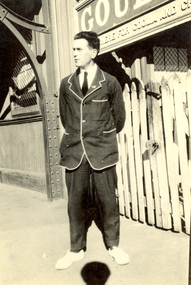
Photograph - Black and White, V. Holt, Frank Wright at Goulbourn Station, New South Wales, 1923
... South Street and in New Zealand. The Frank Wright Medal at the Royal South Street competition is awarded to an individual recognized as making an outstanding contribution to brass music in Australia. frank wright cornet conductor ballarat goulbourne railway station blazer Written in pen on the back - Frank Wright 21, on Goulbourne station N.S.W., Easter 1923 Black and white photograph of a man wearing trousers and a white trimmed blazer. He is standing on the platform at the Goulbourne railway station. The man is Frank Wright. Frank Wright at Goulbourn Station, New South Wales ...Frank Wright was a renown resident of Smeaton, where he was born. He lived at Laura Villa, and attended Smeaton State School. His father William was a gold miner and his mother's name was Sarah. Their family won many singing and instrumental awards. Frank was tutored by Percy Code and was awarded a gold medal for the highest marks in the ALCM examinations in the British Colonies at the age of seventeen years. He became the Australian Open Cornet Champion by the age of eighteen. A year later, Frank conducted the City of Ballarat Band, and later the Ballarat Soldiers’ Memorial Band. He formed the Frank Wright Frisco Band and Frank Wright and his Coliseum Orchestra. These bands won many South Street awards, and Frank as conductor won many awards in the Australian Band Championship contest. In 1933 Frank Wright sailed to England to conduct the famous St Hilda’s Band and was later appointed Musical Director of the London County Council, where he organized many amazing concerts in parks, in and around the London district. He was made Professor of Brass and Military Band Scoring and conducted at the Guildhall of Music and Drama. Frank was often invited to adjudicate Brass Band Championships around Europe, in Australia, including South Street and in New Zealand. The Frank Wright Medal at the Royal South Street competition is awarded to an individual recognized as making an outstanding contribution to brass music in Australia.Black and white photograph of a man wearing trousers and a white trimmed blazer. He is standing on the platform at the Goulbourne railway station. The man is Frank Wright.Written in pen on the back - Frank Wright 21, on Goulbourne station N.S.W., Easter 1923frank wright, cornet, conductor, ballarat, goulbourne railway station, blazer -
Federation University Historical Collection
Booklet - Walking Guide, Ballarat Heritage Walking Guide, c2015
... New South Wales...George Hotel...Old Colonists' hall...Art Gallery of Ballarat...Union Fidelity Hall...Goller's Warehouse...Dunn's Warehouse...Ludbrook House...Reid's Coffe Police...Ballarat Railway Station...Ballarat Walking trail Statues Gold Monument Sturt Street unicorn hotel Ballarat Town hall Sugg light Ballarat Post Office Camp Street Summerscales Building State Offices Police court Huyghue House Pratt's Building YMCA Ballarat Trades Hall ANA Hall maps Lydiard Street Ballarat Gaol Ballarat School of Mines Wesleyan Church Ansonia Lynn's Chambers Craig's Royal Hotel her Majesty's Theatre Union Bank Building Bank of Australasia National Bank Colonial Bank of Australasia Bank of New South Wales George Hotel Old Colonists' hall Art Gallery of Ballarat Union Fidelity Hall Goller's Warehouse Dunn's Warehouse Ludbrook House Reid's Coffe Police Ballarat Railway Station Cenotaph Queen Victoria Fountain Boer War Memorial Burke and Wills Founitain Titanic Memorial Bandstand 35 page booklet with a detail from the Mining Exchange on the front. ...35 page booklet with a detail from the Mining Exchange on the front. ballarat, walking trail, statues, gold monument, sturt street, unicorn hotel, ballarat town hall, sugg light, ballarat post office, camp street, summerscales building, state offices, police court, huyghue house, pratt's building, ymca, ballarat trades hall, ana hall, maps, lydiard street, ballarat gaol, ballarat school of mines, wesleyan church, ansonia, lynn's chambers, craig's royal hotel, her majesty's theatre, union bank building, bank of australasia, national bank, colonial bank of australasia, bank of new south wales, george hotel, old colonists' hall, art gallery of ballarat, union fidelity hall, goller's warehouse, dunn's warehouse, ludbrook house, reid's coffe police, ballarat railway station, cenotaph, queen victoria fountain, boer war memorial, burke and wills founitain, titanic memorial bandstand -
 Bendigo Historical Society Inc.
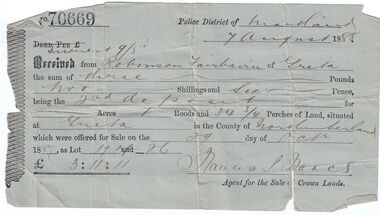
Administrative record - Land purchase records - Maitland NSW, 1888-1889
... New South Wales and is now one of the 141 Cadastral divisions of New South Wales. The Greta area was first colonized by Europeans around Anvil Creek in the 1830s. When the town was surveyed in 1842 it was given the name Greta, possibly after a small river in Cumberland, England. Coal mining was established in the area in 1862 with the development of a railway station...New South Wales and is now one of the 141 Cadastral divisions of New South Wales. The Greta area was first colonized by Europeans around Anvil Creek in the 1830s. When the town was surveyed in 1842 it was given the name Greta, possibly after a small river in Cumberland, England. Coal mining was established in the area in 1862 with the development of a railway station ...Northumberland County was one of the original Nineteen Counties in New South Wales and is now one of the 141 Cadastral divisions of New South Wales. The Greta area was first colonized by Europeans around Anvil Creek in the 1830s. When the town was surveyed in 1842 it was given the name Greta, possibly after a small river in Cumberland, England. Coal mining was established in the area in 1862 with the development of a railway station.Robinson Fairbairn Collection: Two documents. 1. Receipt for payment from Robinson Fairbairn of Greta for purchase of land at Greta, NSW. Dated 7th August 1888. Receipt for £3/11/11 includes Interest noted at top. 2. Invoice to Mr. Robinson Fairburn for land purchase in account with Sparke and Clift, Auctioneers, West Maitland. mining, robinson fairbairn collection, maitland, northumberland, greta nsw, sparke and clift, coal -
 Bendigo Historical Society Inc.
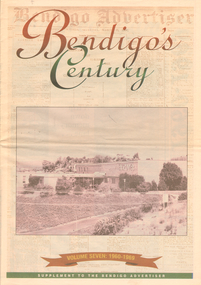
Newspaper - LONG GULLY HISTORY GROUP COLLECTION: BENDIGO'S CENTURY VOLUME SEVEN: 1960 - 1969
... New South Wales... Harp and Shamrock Hotel... The Honorable Leslie William Galvin... Kurmala... Cain Government... Hanro Knitting Mills... Myer Store... Sidney Myer... Davey Brothers Grocery Store... National Trust... Myer Emporium... Myer's Ltd... Cox Bros (Australia) Ltd... Dame Merlyn Myer... Baillieu Myer... Frank Greenaway... Institute of Technology... Gas & Fuel Corporation... Bendigo Railway Station...Dispensary Gillies Famous Pies William Basil Ashman Golden Gate Hotel Grieves Family Bendigo Town Hall Mr R R Anderson Mr E H Brown Cr Neville Oliver Cr Tom Flood Traffic Commission Lansell FAmily ABEV-1 Bendigo Ordnance Factory ACTU Bendigo Trades Hall Council The Ramsay Report Bendigo Benevolent Home Bendigo Home and Hospital for the Aged Princess Theatre Amoco Lake Eppalock Bendigo Training Prison Bendigo Police Station Lock-up Shamrock Hotel Rifle Brigade Hotel Hopetoun Hotel ANZ Bank Marong Shire Offices Sir Rohan Delacombe St Paul's Church Que O'Hoy Waldron Family Windermere Hotel Aids & Appliance Shop Anne Caudle Centre E C Thompson Mayfair Hams Sandhurst Guest House Lyric Theatre Chinese Joss House Ordnance Factory Sir John Jenson Bridge Street Chinese Quarter Bendigo City Hall Cr R F Turner Cr Tom Flood Victorian Inland Meat Authority New Zealand Insurance Co Mrtropolitan Security Service Bendigo Easter Fair Society Golden Square High School Eaglehawk High School Bendigo Technical College Mr Ralph W Birrell Bendigo Fountain Plaza The Bethlehem Home for the Aged Dick Hazeldene Victorian Egg Board Bendigo United Cricket Club South Bendigo United Cricket Club Western Mining Corporation Les Priest Alexandra Fountain Bendigo Advertiser Cr W Cambridge Bendigo Council Eaglehawk Council Strathfieldsaye Shire Huntly Shire Marong Shire David Thomas Senator John Gorton Bendigo's College of Advanced Education Bank of New South Wales Harp and Shamrock Hotel The Honorable Leslie William Galvin Kurmala Cain Government Hanro Knitting Mills Myer Store Sidney Myer Davey Brothers Grocery Store National Trust Myer Emporium Myer's Ltd Cox Bros (Australia) Ltd Dame Merlyn Myer Baillieu Myer Frank Greenaway Institute of Technology Gas & Fuel Corporation Bendigo Railway Station ANZ Bank City Family Hotel TAB Branch Senior Constable Alfred Herbert Wright Senior Constable Allan Raymond Brown Victorian Football League Bendigo Police Barracks Camp Hill State School State Electricity Commission The Country Party The Labor Party Transport Regulation Board Stuart Anderson Grose FAmily Jean Theodore De Ravin Kyneton Shire Sir William McDonald Mines Department The Loddon Hospitals Region group Laundry and Central Linen Service Kevin Wynne Albert Vivian Gray Bradford Cotton Mills Ltd Bradmill Industries Ltd Victoria Hill Bendigo and District Tourist Association Professor Brian Lewis Melbourne University Victorian Chinese Community Loong Sun Loong Stafford Ellinson Coles' Store North Deborah Mining Company NL Noel Beaton MHR Durham Ox Hotel Taylor Family Supplement to the Bendigo Advertiser, December 15, 1999 Volume Seven: 1960-1969 titled Bendigo's Century. ...Supplement to the Bendigo Advertiser, December 15, 1999 Volume Seven: 1960-1969 titled Bendigo's Century. The front has a photo of the BCV 8 Studio. Contains photos and local news, council matters, planning, Who's Who, Weather, Sport and Business and some Advertisements. Photos include Early stages in the construction of the Eppalock tower and bridge pillars, Christine Wiseman, TV8's first news reader Ron Alderton, Dr Albert L Beischer, Advertiser buiding, fire at the Advertiser building, Oscar Flight, Bendigo Town Hall, William Basil Ashman, Lake Eppalock, Premier Henry Bolte, Que O'Hoy, Sandhurst Guest House, The Lyric Theatre, E C Thompson, The elm tree in Market Square, Leslie Galvin, The original Myer Store, The Joss House, Sidney Myer, Bendigo Police Barracks, Bunratty Castle, Albert Vivian Gray, The Victoria Hill site, Architects drawing of the new council administrative offices and Noel Beaton MHR.bendigo, history, long gully history group, the long gully history group - bendigo's century volume seven: 1960 - 1969, bendigo advertiser, bcv 8, eppalock dam, premier henry bolte, the criterion hotel, mccarthy family, teachers training college, bendigo original teachers college, long gully state school, stramit, bendigo university site committee, mrs christine wiseman, bendigo city council, the broadcasting control board, general television pty ltd, bendigo central victoria telecasters pty ltd, mr davidson, bennett's arcade, woolworth's, white hills swimming pool, herb elliott, sailor's guide, toni riley pharmacies, rising sun hotel, ron alderton, dr albert l beischer, channel 8, melbourne herald, 3bo, bendigo advertiser officeslyceum theatre, junior technical school white hills, mount alvernia hospital, most reverend dr b d stewart, sisters of the franciscan missionaries of the divine motherhood, lazarus family, bendigo's tramways, state electricity commission, george pethard, lance pethard, bendigo advertiser fire 29/7/1962, riverine herald, the herald and weekly times, bendigo art gallery, oscar flight, hollands foundry, eaglehawk u.f.s. dispensary, gillies famous pies, william basil ashman, golden gate hotel, grieves family, bendigo town hall, mr r r anderson, mr e h brown, cr neville oliver, cr tom flood, traffic commission, lansell family, abev-1, bendigo ordnance factory, actu, bendigo trades hall council, the ramsay report, bendigo benevolent home, bendigo home and hospital for the aged, princess theatre, amoco, lake eppalock, bendigo training prison, bendigo police station lock-up, shamrock hotel, rifle brigade hotel, hopetoun hotel, anz bank, marong shire offices, sir rohan delacombe, st paul's church, que o'hoy, waldron family, windermere hotel, aids & appliance shop, anne caudle centre, e c thompson, mayfair hams, sandhurst guest house, lyric theatre, chinese joss house, ordnance factory, sir john jenson, bridge street chinese quarter, bendigo city hall, cr r f turner, cr tom flood, victorian inland meat authority, new zealand insurance co, mrtropolitan security service, bendigo easter fair society, golden square high school, eaglehawk high school, bendigo technical college, mr ralph w birrell, bendigo fountain plaza, the bethlehem home for the aged, dick hazeldene, victorian egg board, bendigo united cricket club, south bendigo united cricket club, western mining corporation, les priest, alexandra fountain, bendigo advertiser, cr w cambridge, bendigo council, eaglehawk council, strathfieldsaye shire, huntly shire, marong shire, david thomas, senator john gorton, bendigo's college of advanced education, bank of new south wales, harp and shamrock hotel, the honorable leslie william galvin, kurmala, cain government, hanro knitting mills, myer store, sidney myer, davey brothers grocery store, national trust, myer emporium, myer's ltd, cox bros (australia) ltd, dame merlyn myer, baillieu myer, frank greenaway, institute of technology, gas & fuel corporation, bendigo railway station, anz bank, city family hotel, tab branch, senior constable alfred herbert wright, senior constable allan raymond brown, victorian football league, bendigo police barracks, camp hill state school, state electricity commission, the country party, the labor party, transport regulation board, stuart anderson, grose family, jean theodore de ravin, kyneton shire, sir william mcdonald, mines department, the loddon hospitals region group laundry and central linen service, kevin wynne, albert vivian gray, bradford cotton mills ltd, bradmill industries ltd, victoria hill, bendigo and district tourist association, professor brian lewis, melbourne university, victorian chinese community, loong, sun loong, stafford ellinson, coles' store, north deborah mining company nl, noel beaton mhr, durham ox hotel, taylor family -
 Narre Warren and District Family History Group
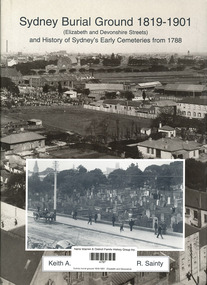
Book, Keith A Johnson et al, Sydney burial ground 1819-1901 : Elizabeth and Devonshire streets and history of Sydney's early cemeteries from 1788, 2001
... New South Wales...Lorraine Taylor Collection...Central Railway Station...New South Wales Lorraine Taylor Collection Central Railway Station Licenses to Bury & Butts Interment Register Monumental Inscriptions at Bunnerong This book is about the Sydney Burial Ground 1819 - 1901 and the history of the early cemeteries from 1788 Sydney burial ground 1819-1901 : Elizabeth and Devonshire streets and history of Sydney's early cemeteries from 1788 Book Keith A Johnson Malcolm R Sainty Library of Australian History ...This book is about the Sydney Burial Ground 1819 - 1901 and the history of the early cemeteries from 1788non-fictionThis book is about the Sydney Burial Ground 1819 - 1901 and the history of the early cemeteries from 1788new south wales, lorraine taylor collection, central railway station, licenses to bury & butts, interment register, monumental inscriptions at bunnerong -
National Wool Museum
Invoice form
... Blank wool invoice forms from the Department of Railways, New South Wales. Found in the ceiling of Exeter Railway Station, some 20km south of Moss Vale (ref Donation letter)....Blank wool invoice forms from the Department of Railways, New South Wales. Found in the ceiling of Exeter Railway Station, some 20km south of Moss Vale (ref Donation letter). ...Blank wool invoice forms from the Department of Railways, New South Wales. Found in the ceiling of Exeter Railway Station, some 20km south of Moss Vale (ref Donation letter).wool - transportation export - wool, nsw; department of railways, wool - transportation, export - wool -
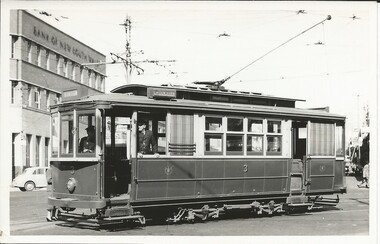 Ballarat Tramway Museum
Photograph - Digital image Set of 2, Doug Colquhoun, c1955
... Set of six digital images of Geelong trams photographed by Doug Colquhoun. .1 - No. 3 with destination of Station turning from Ryrie into Moorabool St with the Bank of New South Wales in the background. The conductor is watching the traffic. .2 - No. 4 - at the Railway Station or Beach terminus? ...Trams tramways Geelong Ryrie St Moorabool St Conductors North Beach Belmont Safety Zone tram 3 tram 4 tram 5 tram 19 tram 23 tram 34 Set of six digital images of Geelong trams photographed by Doug Colquhoun. .1 - No. 3 with destination of Station turning from Ryrie into Moorabool St with the Bank of New South Wales in the background. The conductor is watching the traffic. .2 - No. 4 - at the Railway Station or Beach terminus? ...Set of six digital images of Geelong trams photographed by Doug Colquhoun. .1 - No. 3 with destination of Station turning from Ryrie into Moorabool St with the Bank of New South Wales in the background. The conductor is watching the traffic. .2 - No. 4 - at the Railway Station or Beach terminus? .3 - No. 5 - in Ryrie St? .4 - No. 19 in St. with E. R. Sparrow & Co Auctioneer and Wool Broker building in the background - Moorabool St, tram has the destination of Beach. .5 - No. 23 with the conductor leaning against the bumper bar chatting to a man. Tram has the destination of North. Has a Kodak - E. A. O'Meara Chemist shop in the background. Ryrie and Moorabool Streets Geelong looking south along Moorabool St, along with a Safety Zone sign. .6 - No. 34 with the destination of Belmont.trams, tramways, geelong, ryrie st, moorabool st, conductors, north, beach, belmont, safety zone, tram 3, tram 4, tram 5, tram 19, tram 23, tram 34 -
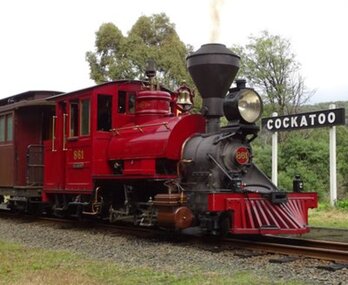 Puffing Billy Railway
861 - John Rees - Decauville Steam Locomotive - formerly John Benn, 1886
... 861 John Benn Locomotive - in active service - Emerald Station Built in 1886 by Société Anonyme Usines Métallurgiques du Hainaut - Locomotives Couillet for the West Melbourne site of the Metropolitan Gas Company, as a four-wheel tank locomotive similar to 986 and named “John Benn”. The West Melbourne gas works sourced its coal from Maitland, New South Wales, and the coal was brought by ship to a wharf adjacent to the West Melbourne gas plant. John Benn and Carbon were used to haul the coal over a 762 mm (2 ft 6 in) gauge railway...861 John Benn Locomotive - in active service - Emerald Station Built in 1886 by Société Anonyme Usines Métallurgiques du Hainaut - Locomotives Couillet for the West Melbourne site of the Metropolitan Gas Company, as a four-wheel tank locomotive similar to 986 and named “John Benn”. The West Melbourne gas works sourced its coal from Maitland, New South Wales, and the coal was brought by ship to a wharf adjacent to the West Melbourne gas plant. John Benn and Carbon were used to haul the coal over a 762 mm (2 ft 6 in) gauge railway ...861 John Benn Locomotive - in active service - Emerald Station Built in 1886 by Société Anonyme Usines Métallurgiques du Hainaut - Locomotives Couillet for the West Melbourne site of the Metropolitan Gas Company, as a four-wheel tank locomotive similar to 986 and named “John Benn”. The West Melbourne gas works sourced its coal from Maitland, New South Wales, and the coal was brought by ship to a wharf adjacent to the West Melbourne gas plant. John Benn and Carbon were used to haul the coal over a 762 mm (2 ft 6 in) gauge railway from the wharf to the gasworks, a distance of about 450 metres (500 yards). It was withdrawn from service in the 1930s and stored until sold privately in 1962. It was rebuilt by its new owners in the style of an American locomotive of the 1880s and was used for some years at Walhalla. It currently has the name “J.C. Rees” and is used in active service for the 861 Footplate Experience. Wheels: 2-4-2ST Builder: Couillet Build Date: 1886 Construction No.: 861 Empty Weight: Unknown Weight on Drivers: Unknown Driver Diameter: Unknown Tractive Effort: Unknown Boiler Pressure: Unknown Cylinders: Unknown Fuel: Coal Gauge: 30 inchesHistoric - Industrial railways - Metropolitan Gas Company Ltd, Melbourne Steam LocomotiveDecauville Steam Locomotive 861 John Reespuffing billy, narrow gauge, industrial narrow gauge railway, metropolitan gas company, decauville 43, steam locomotive, john rees, john benn, 861 locomotive, couillet, 861 -
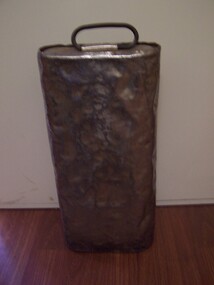 Puffing Billy Railway
Equipment - Victorian Railways Carriage Foot Warmer
... New South Wales from the 1930s with the first trial of carriage air-conditioning in 1936, steam heating from 1948 ad LP gas heating from 1961. By the early 1960s the main services using foot warmers were the overnight mail trains. info from : http://www.powerhousemuseum.com/collection/database/?irn=67564#ixzz4UBNzVf6t Under Creative Commons License: Attribution Non-Commercial There was a whole infrastructure set up at stations for the daily heating of foot warmers in special furnaces. In Victoria alone in 1935 there were 33 heating works. Historic - Victorian Railways ...During prestige, long distance train journeys some carriages had air-conditioning, and the majority of passengers had to brave unheated carriages. To offer some comfort during the winter months, the non-air-conditioned carriages were provided with footwarmers. These were metal containers roughly 100 mm thick and 300 mm wide, and about 750 mm long, which were filled with salt crystals (concentrated crystalline hydrated sodium acetate). The footwarmers were covered by sleeves of thick canvas, and two footwarmers were usually placed in each compartment of non-air-conditioned carriages. To activate the chemicals, the footwarmers were heated almost to boiling point. This was done by removing the canvas sleeves and placing the footwarmers in a large bath of very hot water. After they had been heated, they were removed from the bath and the sleeves refitted. They were then ready to be placed in the carriages. The McLaren patent foot warmer was used on railways in New South Wales, Queensland, Victoria and South Australia as well as South Africa and New Zealand. It was during the 1901 royal visit by the Duke and Duchess of Cornwall that these foot warmers were first used in New Zealand in the royal carriage. Before railway carriage heating was introduced, McLaren patent foot warmers were placed on the floor of New South Wales government railway carriages from 1891 to provide a little passenger comfort. The rectangular steel container worked a bit like a hot water bottle but instead of water contained six and a half kilograms of loosely-packed salt crystals, (concentrated crystalline hydrated sodium acetate). This was permanently sealed inside the container with a soldered cap. After the foot warmer was heated in vat of boiling water for about one and a quarter hours the crystals became a hot liquid. (The melting point for sodium acetate is 58 degrees). There was a whole infrastructure of special furnaces set up at stations for the daily heating of foot warmers. By 1914 the Victorian railways had 4,000 foot warmers in service and by 1935 there were 33 furnaces at principal stations to heat them. After about 10 hours the container was picked up by the handle and given a good vertical shake which helped the cooled liquid reform into a solid mass of hot crystals. Staff or sometimes passengers shook them en route when the foot warmers began to get cold. However, as they were heavy this was only possible by fit and agile passengers. At the end of the journey the containers were boiled again for reuse on the next trip. Sodium acetate railway foot warmers were introduced in Victoria in 1889, Adelaide to Melbourne express in 1899. "Shaking up" on this service took place at Murray Bridge and Stawell on the tip to Melbourne and at Ballarat and Serviceton on the trip to Adelaide. The use of foot warmers began to decline in New South Wales from the 1930s with the first trial of carriage air-conditioning in 1936, steam heating from 1948 ad LP gas heating from 1961. By the early 1960s the main services using foot warmers were the overnight mail trains. info from : http://www.powerhousemuseum.com/collection/database/?irn=67564#ixzz4UBNzVf6t Under Creative Commons License: Attribution Non-Commercial There was a whole infrastructure set up at stations for the daily heating of foot warmers in special furnaces. In Victoria alone in 1935 there were 33 heating works.Historic - Victorian Railways - Carriage Heater - Foot warmerA rectangular-shaped stainless steel casing with a welded seam down the back and welded ends. There is a handle at one end for carrying and shaking. Inside the foot warmer are two baffle plates and three trays to contain the sodium acetate. There was a cast-iron ball in each internal compartment. puffing billy, victorian railways, carriage haeter, foot warmer, passenger comfort, station furnace, railway ephemera, early heating methods -
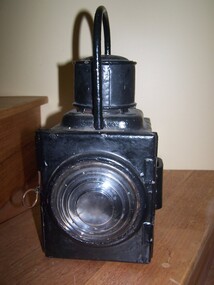 Puffing Billy Railway
NSWTD Railway Marker Oil lamp, No.1 RA
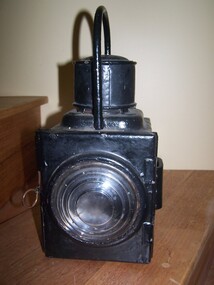
... Railway lighting included not only stations but yards, engines, rolling stock, signals, signal-boxes and crossings. There were a number of different types of lamps used for a variety of railway purposes. Historic - New South Wales ...NSWTD Railway Marker OIl lamp, No.1 RA Oil burning lamps have always been an important part of Australian railway signalling systems and have been used for communication, safety and lighting. It is called a marker lamp and was hung on rolling stock (carriages and wagons) such as the guard’s van to indicate the rear of the train at night. They were also used to indicate the rear of steam locomotive tenders for identification and safety purposes. This type of lamp was introduced to the railways around 1860 and continued to be used for over one hundred years. Oil lamps were phased out on the railways during the late 1960s and early 1970s, when they were replaced by battery lamps. Railway lighting included not only stations but yards, engines, rolling stock, signals, signal-boxes and crossings. There were a number of different types of lamps used for a variety of railway purposes. Historic - New South Wales Transport Department.- Railway Marker Oil Lamp NSWTD Railway Marker lamp, No.1 RA made of metal and Glass Railway lamp, paraffin, metal/glass/fabric, used for attaching to railway rolling stock to mark the end of the train, made by the New South Wales Transport Department, Sydney, New South Wales, Australia, 1870 - 1970 This lamp comprises a hollow cube of metal. One lens at the front transmits light from an interior light source. Fuel was either signal oil or kerosene. The burner inside the lamp used either cotton or felt wicks to create the light source. The lamp has a carry handle for carrying by hand and a bracket with a slot on the back for hanging onto the hook of a locomotive or item of rolling stock. It is marked "NSWTD" which stands for New South Wales Transport Department.NSWTD 1 RApuffing billy railway , pbr, nswtd railway marker oil lamp, no.1 ra -
 Puffing Billy Railway
Four NSWTD Railway marker Oil lamps
... Railway lighting included not only stations but yards, engines, rolling stock, signals, signal-boxes and crossings. There were a number of different types of lamps used for a variety of railway purposes. Historic - New South Wales ...Four NSWTD Railway marker Oil lamps at Nobelius Packing shed Item stamped numbers unknown Oil burning lamps have always been an important part of Australian railway signalling systems and have been used for communication, safety and lighting. It is called a marker lamp and was hung on rolling stock (carriages and wagons) such as the guard’s van to indicate the rear of the train at night. They were also used to indicate the rear of steam locomotive tenders for identification and safety purposes. This type of lamp was introduced to the railways around 1860 and continued to be used for over one hundred years. Oil lamps were phased out on the railways during the late 1960s and early 1970s, when they were replaced by battery lamps. Railway lighting included not only stations but yards, engines, rolling stock, signals, signal-boxes and crossings. There were a number of different types of lamps used for a variety of railway purposes. Historic - New South Wales Transport Department.- Railway Marker Oil LampFour NSWTD Railway marker Oil lamps made of metal and glass Railway lamp, paraffin, metal / glass / fabric, used for attaching to railway rolling stock to mark the end of the train, made by the New South Wales Transport Department, Sydney, New South Wales, Australia, 1870-1970 This lamp comprises a hollow cube of metal. One lens at the front transmits light from an interior light source. Fuel was either signal oil or kerosene. The burner inside the lamp used either cotton or felt wicks to create the light source. The lamp has a carry handle for carrying by hand and a bracket with a slot on the back for hanging onto the hook of a locomotive or item of rolling stock. It is marked "NSWTD" which stands for New South Wales Transport Department.NSWTDpuffing billy railway , pbr, four nswtd railway marker oil lamps -
 Wodonga & District Historical Society Inc
Newsletter - Victorian Railways April 1961
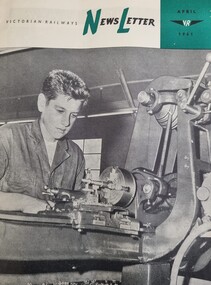
... The article was written to acknowledge the work carried out by the railway at both stations prior to the opening of the standard gauge track. Until this time Victorian trains operated on 4’ 8½” tracks whilst New South Wales were 5’ 3” wide. ...This booklet is one of a series featuring news items from Victorian Railways from the early 1960s until the late 1980s. During this period the corporate name changed to VLine and the newsletter continued to be published as VLine Newsletter. This issue from April 1961 features an article "Wodonga Links the States" which explains the complexity of operations of the railways at Wodonga and Albury due to the break of gauge in gauge between the two railway networks. The article was written to acknowledge the work carried out by the railway at both stations prior to the opening of the standard gauge track. Until this time Victorian trains operated on 4’ 8½” tracks whilst New South Wales were 5’ 3” wide. With an overall stall of 241, Wodonga railmen prepared, serviced and manned 14 "up" and 11 "down" trains as well as specials each day. Special migrant trains to Bonegilla were often a feature at this time as well as transport of heavy equipment to the Snowy Mountain Scheme.A small booklet of 14 pages including articles and images.This booklet is one of a series featuring news items from Victorian Railways from the early 1960s until the late 1980s. During this period the corporate name changed to VLine and the newsletter continued to be published as VLine Newsletter. This issue from April 1961 features an article "Wodonga Links the States" which explains the complexity of operations of the railways at Wodonga and Albury due to the break of gauge in gauge between the two railway networks. The article was written to acknowledge the work carried out by the railway at both stations prior to the opening of the standard gauge track. Until this time Victorian trains operated on 4’ 8½” tracks whilst New South Wales were 5’ 3” wide. With an overall stall of 241, Wodonga railmen prepared, serviced and manned 14 "up" and 11 "down" trains as well as specials each day. Special migrant trains to Bonegilla were often a feature at this time as well as transport of heavy equipment to the Snowy Mountain Scheme.wodonga railways, victorian railways, victorian railways wodonga -
 Wodonga & District Historical Society Inc
Photograph - Wodonga Railway Station, Thomas Bonsema, c1910
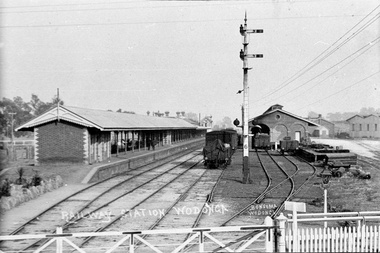
... New South Wales and died in Beecroft, NSW on 14th July 1944. Some of his photographs are held in the Victorian State Library and Mitchell Library Sydney Collections. This image is significant because it is the work of a recognised photographer Thomas Bonsema who was born in Wodonga in 1876. Bonsema Photography Railway Station ...Our Collection includes several photographs signed BONSEMA WODONGA or sometimes simply TBW. Thomas Peter John Bonsema was born in Wodonga in 1876 to Peter John Bonsema and Mary Ann nee Nash. His name first appears on the Electoral Roll for Wodonga in 1909 and on the Electoral Roll in 1912 he is listed as a photographer. His photographs capture many scenes and events around Wodonga and surrounding areas. Thomas Bonsema married Minna Louisa Jones in 1912. By 1914 he had moved to Chiltern, Victoria where he established Bonsema’s Photographic Studio. From this time onward many of his works bore the signature “BONSEMA CHILTERN”. As well as continuing to photograph landscapes and important buildings, Mr Bonsema was often the official photographer at school and community celebrations. He also sold many framed photographs and postcards from his premises at 68 -70 Conness Street, Chiltern. By 1943 Thomas John Bonsema had relocated to New South Wales and died in Beecroft, NSW on 14th July 1944. Some of his photographs are held in the Victorian State Library and Mitchell Library Sydney Collections.This image is significant because it is the work of a recognised photographer Thomas Bonsema who was born in Wodonga in 1876.A black and white image of Wodonga Railway Station including the platform and goods shed.At bottom of the image:- Railway Station Wodonga Bonsema Wodongabonsema photography, railway station wodonga, thomas peter john bonsema -
 Wodonga & District Historical Society Inc
Photograph - Wodonga Railway Station Platform, Thomas Bonsema, c1910
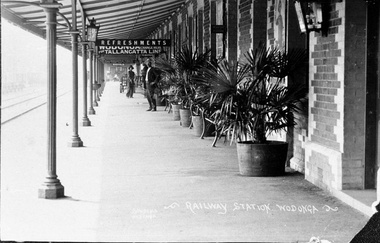
... New South Wales and died in Beecroft, NSW on 14th July 1944. Some of his photographs are held in the Victorian State Library and Mitchell Library Sydney Collections. This image is significant because it is the work of a recognised photographer Thomas Bonsema who was born in Wodonga in 1876. Bonsema Photography Railway Station ...Our Collection includes several photographs signed BONSEMA WODONGA or sometimes simply TBW. Thomas Peter John Bonsema was born in Wodonga in 1876 to Peter John Bonsema and Mary Ann nee Nash. His name first appears on the Electoral Roll for Wodonga in 1909 and on the Electoral Roll in 1912 he is listed as a photographer. His photographs capture many scenes and events around Wodonga and surrounding areas. Thomas Bonsema married Minna Louisa Jones in 1912. By 1914 he had moved to Chiltern, Victoria where he established Bonsema’s Photographic Studio. From this time onward many of his works bore the signature “BONSEMA CHILTERN”. As well as continuing to photograph landscapes and important buildings, Mr Bonsema was often the official photographer at school and community celebrations. He also sold many framed photographs and postcards from his premises at 68 -70 Conness Street, Chiltern. By 1943 Thomas John Bonsema had relocated to New South Wales and died in Beecroft, NSW on 14th July 1944. Some of his photographs are held in the Victorian State Library and Mitchell Library Sydney Collections.This image is significant because it is the work of a recognised photographer Thomas Bonsema who was born in Wodonga in 1876.A black and white image of featuring passengers waiting on the Wodonga Station PlatformAt bottom of the image:- Railway Station Wodonga Bonsema Wodongabonsema photography, railway station wodonga, thomas peter john bonsema -
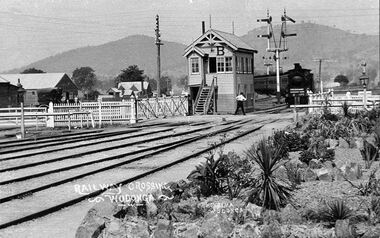 Wodonga & District Historical Society Inc
Photograph - Train approaching Wodonga Crossroads, Thomas Bonsema, c1915
... New South Wales and died in Beecroft, NSW on 14th July 1944. Some of his photographs are held in the Victorian State Library and Mitchell Library Sydney Collections. These images are significant because they are the work of a recognised photographer Thomas Bonsema who was born in Wodonga in 1876. The railway was a critical element in the development of Wodonga. Bonsema Photography Thomas Peter John Bonsema Railways Wodonga RAILWAY CROSSING WODONGA BONSEMA WODONGA A black and white image showing a train approaching the Wodonga Railway Station ...Our Collection includes several photographs signed BONSEMA WODONGA or sometimes simply TBW. Thomas Peter John Bonsema was born in Wodonga in 1876 to Peter John Bonsema and Mary Ann nee Nash. His name first appears on the Electoral Roll for Wodonga in 1909 and on the Electoral Roll in 1912 he is listed as a photographer. His photographs capture many scenes and events around Wodonga and surrounding areas. Thomas Bonsema married Minna Louisa Jones in 1912. By 1914 he had moved to Chiltern, Victoria where he established Bonsema’s Photographic Studio. From this time onward many of his works bore the signature “BONSEMA CHILTERN”. As well as continuing to photograph landscapes and important buildings, Mr Bonsema was often the official photographer at school and community celebrations. He also sold many framed photographs and postcards from his premises at 68 -70 Conness Street, Chiltern. By 1943 Thomas John Bonsema had relocated to New South Wales and died in Beecroft, NSW on 14th July 1944. Some of his photographs are held in the Victorian State Library and Mitchell Library Sydney Collections.These images are significant because they are the work of a recognised photographer Thomas Bonsema who was born in Wodonga in 1876. The railway was a critical element in the development of Wodonga.A black and white image showing a train approaching the Wodonga Railway Station from Albury. horse and buggy are waiting at the gates. Moloney’s house is located left of centre. RAILWAY CROSSING WODONGA BONSEMA WODONGAbonsema photography, thomas peter john bonsema, railways wodonga -
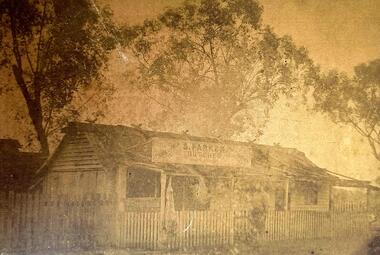 Wodonga & District Historical Society Inc
Photograph - Samuel Skelton Parker's Butchery and Bakery, Barnawartha, Victoria
... station in New South Wales. He was married to Bridget Cusack in 1865 and they had a family of 4 sons and a daughter. After returning to Victoria Samuel Skelton Parker started a butchering business at Barnawartha and in 1881 he combined it with a bakery. This was the first business established in Barnawartha. Samuel had several properties in the township as well as his business premises and private residence. His horse drawn butchers cart made a run to Wodonga three days a week supplying the wayside pubs and Railway...station in New South Wales. He was married to Bridget Cusack in 1865 and they had a family of 4 sons and a daughter. After returning to Victoria Samuel Skelton Parker started a butchering business at Barnawartha and in 1881 he combined it with a bakery. This was the first business established in Barnawartha. Samuel had several properties in the township as well as his business premises and private residence. His horse drawn butchers cart made a run to Wodonga three days a week supplying the wayside pubs and Railway ...Samuel Skelton Parker was a native of Ballymena in the County of Antrim, Ireland and came to Melbourne, Australia in 1854. He was engaged for two years as a storeman. After mining in the Ovens district for five years he next became overseer on a station in New South Wales. He was married to Bridget Cusack in 1865 and they had a family of 4 sons and a daughter. After returning to Victoria Samuel Skelton Parker started a butchering business at Barnawartha and in 1881 he combined it with a bakery. This was the first business established in Barnawartha. Samuel had several properties in the township as well as his business premises and private residence. His horse drawn butchers cart made a run to Wodonga three days a week supplying the wayside pubs and Railway Gate House owners. Bread was sold for five loaves for one shilling, meat was two pennies per pound. In 1890 Skelton decided to give up butchering and baking and moved to Wodonga. He bought a 'Bush Block' of 150 acres on Fergusons Lane, now Parkers Road. Skelton called the property 'Park Hall' after his home in Ireland. On this new property Skelton raised sheep and he also sold chaff around the district. When Skelton died on 14 October 1897 the farm was split up with two sons Sam and Jack continuing the running of the farm, whilst the other two sons William and James joined the Victorian railways. Samuel and Jack continued to successfully manage the farm until 1974 when the Albury Wodonga Development Corporation acquired the land for the planned development of the region. In 2026 this is the location of Park Hall Retirement Village and the Wodonga Golf Club are situated on Parkers Road.This image is significant because it records one of the earliest businesses established in Barnawartha, Victoria.Two black and white images of Samuel Parker's business in Barnawartha, Northeast Victoria.parker family wodonga, early wodonga settlers, barnawartha, samuel skelton parker -
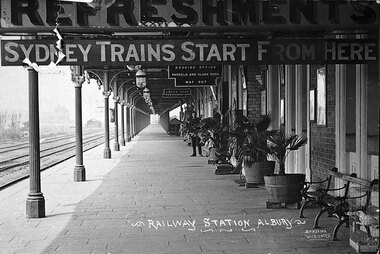 Wodonga & District Historical Society Inc
Photograph - Albury Railway Station, Thomas Bonsema, 1910
... Railway Station was opened on February 26 1882. It was the first large transit stop to be built on the border of Victoria and New South Wales. ...New South Wales and died in Beecroft, NSW on 14th July 1944. Some of his photographs are held in the Victorian State Library and Mitchell Library Sydney Collections. These images are significant because they are the work of a recognised photographer Thomas Bonsema who was born in Wodonga in 1876. The Albury Railway Station ...The Albury Railway Station was opened on February 26 1882. It was the first large transit stop to be built on the border of Victoria and New South Wales. The two states still used different gauge train tracks, so the longest undercover platform in the southern hemisphere at the time was built at Albury, to allow passengers to quickly transition between lines. A new covered platform and new goods shed were added in 1884. Our Collection includes several photographs signed BONSEMA WODONGA or sometimes simply TBW. Later images taken in Chiltern were signed Bonsema Chiltern or TBC. Thomas Peter John Bonsema was born in Wodonga in 1876 to Peter John Bonsema and Mary Ann nee Nash. His name first appears on the Electoral Roll for Wodonga in 1909 and on the Electoral Roll in 1912 he is listed as a photographer. His photographs capture many scenes and events around Wodonga and surrounding areas. Thomas Bonsema married Minna Louisa Jones in 1912. By 1914 he had moved to Chiltern, Victoria where he established Bonsema’s Photographic Studio. From this time onward many of his works bore the signature “BONSEMA CHILTERN”. As well as continuing to photograph landscapes and important buildings, Mr Bonsema was often the official photographer at school and community celebrations. He also sold many framed photographs and postcards from his premises at 68 -70 Conness Street, Chiltern. By 1943 Thomas John Bonsema had relocated to New South Wales and died in Beecroft, NSW on 14th July 1944. Some of his photographs are held in the Victorian State Library and Mitchell Library Sydney Collections.These images are significant because they are the work of a recognised photographer Thomas Bonsema who was born in Wodonga in 1876. The Albury Railway Station was a critical link in transport between Victoria and New South Wales.A black and white image of the platform at Albury StationRailway Station Albury. Bonsema Wodongabonsema photography, thomas peter john bonsema, albury railway station -
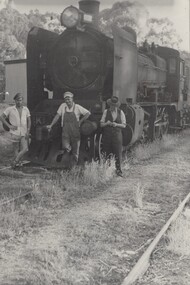 Wodonga & District Historical Society Inc
Photograph - Fred Rochow Railways Collection - Shunting at Shelley Station, 1961
... New South Wales gauge of 4’8.5”, in order to operate the new Southern Aurora between Sydney & Melbourne. As the locomotive grew older it was removed from these duties and was sold to Chicago Freight Car Leasing Australia (CFCLA) in 2004. It is now owned by a private owner and is on loan to the Canberra Railway Museum. Fred Rochow Railways Collection - Shunting at Shelley Station ...The Fred Rochow Railways Collection incorporates photos related to the operation of the Wodonga Railway Station including different types of trains and railways staff C. 1930 – 1990. It was donated to the Wodonga Historical Society by Fred Rochow, a railwayman who spent many years based in Wodonga. He joined the Victorian Railways on 17th June l947 and retired in 1988. For some time, he was a member of the Australian Federated Union of Locomotive Enginemen and served a term as a member of the Trades Hall Council. He had an extensive knowledge of the struggles that took place to achieve better conditions for railway workers. Fred worked for many years as a fireman and then worked his way up the ranks to driver, experiencing many changes from the days of steam locomotives through to diesel trains, locomotives and even the modern XPT train. He worked throughout Victoria at different stages of his career, with his final working years focused on the northeast of Victoria and the Albury to Melbourne line. After his retirement, Fred continued to share his love of steam miniature trains with the community. Shelley Railway Station - Shelley was once Victoria's highest railway station, located 781 metres above sea level. The Shelley Railway Station was opened in 1916 and closed in 1979. The railway was used early in its life to transport farmer’s livestock from the Upper Murray to Wodonga. From the 1950s the railway was used heavily to transport equipment and machinery from Wodonga to the Upper Murray to help build the Snowy Mountains Hydro Electric Scheme. The Snowy Hydro Scheme was completed in 1974 and after several years of low level use, the railway was closed. Some remnants of the Shelley Station passenger platform can still be seen today, along with some information boards. The Shelley Railway Station now forms part of the High Country Rail Trail.This collection has local and statewide significance as it captures images of trains, locomotives and personnel who operated the railway services in Wodonga and throughout Northeast Victoria. The railways played a critical role in opening up Victoria and connecting Australia for trade, business, social communication and transport.Left to Right: Fireman Bert Cadman, Driver Wally Riley, Guard Hugh Fraser. Locomotive S300 - the ‘Matthew Flinders’ The S class diesel locomotives were built by Clyde Engineering in 1957 for the Victorian Railways. Designed as premier express passenger diesels, they assumed the ‘S class’ title from a fleet of steam locomotives. They were also given names of famous Australians. The S300 took the name ‘Matthew Flinders’. In 1962, S300 was converted from the Victorian broad gauge of 5’3” to the New South Wales gauge of 4’8.5”, in order to operate the new Southern Aurora between Sydney & Melbourne. As the locomotive grew older it was removed from these duties and was sold to Chicago Freight Car Leasing Australia (CFCLA) in 2004. It is now owned by a private owner and is on loan to the Canberra Railway Museum.railways wodonga, fred rochow, wodonga railwaymen, s class locomotive -
 Wodonga & District Historical Society Inc
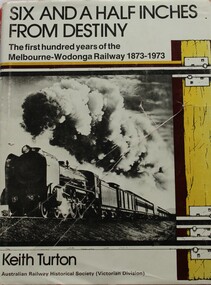
Book - Six and a Half Inches from Destiny: First 100 Years of Melbourne to Wodonga Railway, 1873 - 1973, Keith W. Turton
... railway was extended over the River Murray to meet the New South Wales railhead at Albury. When the two lines finally met a significant fact became apparent - the track gauges of the two systems differed by six and a half inches. For 80 years this difference created havoc until a new railway of uniform gauge was built parallel to the Victorian gauge line from Melbourne to Wodonga. This book deals with the planning, construction and the first 100 years of operation or the railway to Wodonga, together with its locomotives, stations ...Inter-colonial railway communication was established in 1883 when the Melbourne - Wodonga railway was extended over the River Murray to meet the New South Wales railhead at Albury. When the two lines finally met a significant fact became apparent - the track gauges of the two systems differed by six and a half inches. For 80 years this difference created havoc until a new railway of uniform gauge was built parallel to the Victorian gauge line from Melbourne to Wodonga. This book deals with the planning, construction and the first 100 years of operation or the railway to Wodonga, together with its locomotives, stations and trains which travelled its tracks.non-fictionInter-colonial railway communication was established in 1883 when the Melbourne - Wodonga railway was extended over the River Murray to meet the New South Wales railhead at Albury. When the two lines finally met a significant fact became apparent - the track gauges of the two systems differed by six and a half inches. For 80 years this difference created havoc until a new railway of uniform gauge was built parallel to the Victorian gauge line from Melbourne to Wodonga. This book deals with the planning, construction and the first 100 years of operation or the railway to Wodonga, together with its locomotives, stations and trains which travelled its tracks.railways victoria, railway melbourne to wodonga -
 Wodonga & District Historical Society Inc
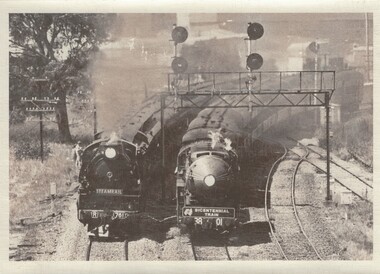
Photograph - Fred Rochow Railways Collection - Locomotive R761 and Bicentennial Train 3801 departing Wodonga, 16 October 1988
... Locomotive 3801 was officially relaunched at Sydney's Central Station on Friday 12 March 2021 by Her Excellency, the Honourable Margaret Beazley AC QC, Governor of New South Wales. Fred Rochow Railways ...The Fred Rochow Railways Collection incorporates photos related to the operation of the Wodonga Railway Station including different types of trains and railways staff C. 1930 – 1990. It was donated to the Wodonga Historical Society by Fred Rochow, a railwayman who spent many years based in Wodonga. He joined the Victorian Railways on 17th June l947 and retired in 1988. For some time, he was a member of the Australian Federated Union of Locomotive Enginemen and served a term as a member of the Trades Hall Council. He had an extensive knowledge of the struggles that took place to achieve better conditions for railway workers. Fred worked for many years as a fireman and then worked his way up the ranks to driver, experiencing many changes from the days of steam locomotives through to diesel trains, locomotives and even the modern XPT train. He worked throughout Victoria at different stages of his career, with his final working years focused on the northeast of Victoria and the Albury to Melbourne line. After his retirement, Fred continued to share his love of steam miniature trains with the community.This collection has local and statewide significance as it captures images of trains, locomotives and personnel who operated the railway services in Wodonga and throughout Northeast Victoria. The railways played a critical role in opening up Victoria and connecting Australia for trade, business, social communication and transport.Locomotive R761 with Driver Norm Depomeroy and Fireman Steve Gibson running in parallel with the Bicentennial Train hauled by Locomotive 3801 with Driver Fred Rochow and Fireman David Brown. Locomotive R761 - The R761 arrived in Victoria on the 28th February 1952 upon the ship ‘Helenus’ and entered service on the 9th April 1952. R761 spent long periods in storage and occasionally saw service until it was withdrawn. In 1970 R761 was overhauled and was made available for use on special trains. It became the final R class to run in VR service on the 5th September 1974, ending 120 years of mainline steam operation in Victoria. After years of debate about its future, on the 30th March 1985 the loco was officially returned to service, hauling special trains to celebrate the years of steam locomotives. Locomotive 3801 was built by Sydney company The Clyde Engineering Co. Ltd., Granville in 1943 as the first of five streamlined (C) 38-class locomotives for the New South Wales Government Railways’ top-link express passenger duties. The delivery of 3801 was much delayed due to wartime labour & material shortages, together with competing wartime construction priorities. After many years of service, 3801 had been scheduled for withdrawal in 1962 due to deteriorating mechanical condition, but rail enthusiasts raised sufficient funds to cover the cost of its overhaul. 3801 joined the collection of the New South Wales Rail Transport Museum (NSWRTM), Enfield on withdrawal from NSWGR service and continued in operation as a tour locomotive. It hauled the “Western Endeavour” on the first crossing of the Australian continent by a standard gauge train from Sydney to Perth and return in August – September 1970. 3801 also stars in the railway film ‘A Steam Train Passes’ made by Film Australia in 1974 By 1976 had been withdrawn from service due to poor boiler condition and placed on static display by the Rail Transport Museum in Thirlmere, NSW. The Locomotive remained in Thirlmere until 1983 when it was decided it should be restored for the Australian Bicentenary in 1988. A new organisation was created specifically for the purpose of operating 3801, and thus 3801 Limited was incorporated on 5th June 1985. Work on the locomotive was completed after three years, with 3801 making its debut at a special Railway Ball hosted in its honour on 29th November 1986. During the Australian Bicentenary celebrations in 1988, it operated an extensive program across Australia visiting every mainland capital accessible by rail including an appearance at AusSteam ’88 in Melbourne in October 1988, stopping over in Wodonga on the way. After the company’s 20-year lease on the locomotive expired in 2006 Railcorp chose not to extend the agreement, and the locomotive returned to the Rail Transport Museum at Thirlmere (now the NSW Rail Museum). 3801 was withdrawn from service in 2007 for major boiler repairs. Locomotive 3801 was officially relaunched at Sydney's Central Station on Friday 12 March 2021 by Her Excellency, the Honourable Margaret Beazley AC QC, Governor of New South Wales.On front of locomotive on the left "STEAMRAIL /R761". On front of locomotive on the right "BICENTENNIAL TRAIN/3801" railways wodonga, fred rochow, locomotive r761, bicentennial train, locomotive 3801 -
 Wodonga & District Historical Society Inc
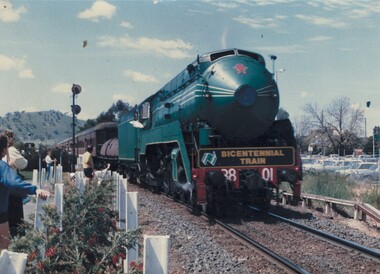
Photograph - Fred Rochow Railways Collection - Bicentennial Train Locomotive 3801, 29 October 1988
... Locomotive 3801 was officially relaunched at Sydney's Central Station on Friday 12 March 2021 by Her Excellency, the Honourable Margaret Beazley AC QC, Governor of New South Wales. Fred Rochow Railways ...The Fred Rochow Railways Collection incorporates photos related to the operation of the Wodonga Railway Station including different types of trains and railways staff C. 1930 – 1990. It was donated to the Wodonga Historical Society by Fred Rochow, a railwayman who spent many years based in Wodonga. He joined the Victorian Railways on 17th June l947 and retired in 1988. For some time, he was a member of the Australian Federated Union of Locomotive Enginemen and served a term as a member of the Trades Hall Council. He had an extensive knowledge of the struggles that took place to achieve better conditions for railway workers. Fred worked for many years as a fireman and then worked his way up the ranks to driver, experiencing many changes from the days of steam locomotives through to diesel trains, locomotives and even the modern XPT train. He worked throughout Victoria at different stages of his career, with his final working years focused on the northeast of Victoria and the Albury to Melbourne line. After his retirement, Fred continued to share his love of steam miniature trains with the community.This collection has local and statewide significance as it captures images of trains, locomotives and personnel who operated the railway services in Wodonga and throughout Northeast Victoria. The railways played a critical role in opening up Victoria and connecting Australia for trade, business, social communication and transport.Bicentennial Train hauled by Locomotive 3801 passing through Wodonga. Locomotive 3801 was built by Sydney company The Clyde Engineering Co. Ltd., Granville in 1943 as the first of five streamlined (C) 38-class locomotives for the New South Wales Government Railways’ top-link express passenger duties. The delivery of 3801 was much delayed due to wartime labour & material shortages, together with competing wartime construction priorities. After many years of service, 3801 had been scheduled for withdrawal in 1962 due to deteriorating mechanical condition, but rail enthusiasts raised sufficient funds to cover the cost of its overhaul. 3801 joined the collection of the New South Wales Rail Transport Museum (NSWRTM), Enfield on withdrawal from NSWGR service and continued in operation as a tour locomotive. It hauled the “Western Endeavour” on the first crossing of the Australian continent by a standard gauge train from Sydney to Perth and return in August – September 1970. 3801 also stars in the railway film ‘A Steam Train Passes’ made by Film Australia in 1974 By 1976 had been withdrawn from service due to poor boiler condition and placed on static display by the Rail Transport Museum in Thirlmere, NSW. The Locomotive remained in Thirlmere until 1983 when it was decided it should be restored for the Australian Bicentenary in 1988. A new organisation was created specifically for the purpose of operating 3801, and thus 3801 Limited was incorporated on 5th June 1985. Work on the locomotive was completed after three years, with 3801 making its debut at a special Railway Ball hosted in its honour on 29th November 1986. During the Australian Bicentenary celebrations in 1988, it operated an extensive program across Australia visiting every mainland capital accessible by rail including an appearance at AusSteam ’88 in Melbourne in October 1988, stopping over in Wodonga on the way. After the company’s 20-year lease on the locomotive expired in 2006 Railcorp chose not to extend the agreement, and the locomotive returned to the Rail Transport Museum at Thirlmere (now the NSW Rail Museum). 3801 was withdrawn from service in 2007 for major boiler repairs. Locomotive 3801 was officially relaunched at Sydney's Central Station on Friday 12 March 2021 by Her Excellency, the Honourable Margaret Beazley AC QC, Governor of New South Wales.On front of locomotive Australia Bicentennial logo and sign "BICENTENNIAL TRAIN/3801" railways wodonga, fred rochow, locomotive r761, bicentennial train, locomotive 3801 -
 Wodonga & District Historical Society Inc
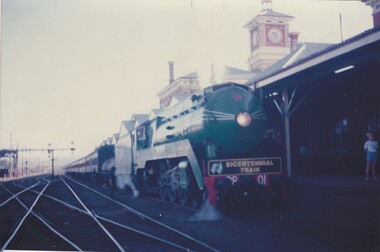
Photograph - Fred Rochow Railways Collection - Bicentennial Train Locomotive 3801 arriving in Albury, 29 October 1988
... Station, Locomotive 3801 was built by Sydney company The Clyde Engineering Co. Ltd., Granville in 1943 as the first of five streamlined (C) 38-class locomotives for the New South Wales Government Railways’ top-link express passenger duties. ...Railways Wodonga Fred Rochow Locomotive R761 Bicentennial Train Locomotive 3801 On front of locomotive Australia Bicentennial logo and sign "BICENTENNIAL TRAIN/3801" Bicentennial Train hauled by Locomotive 3801 arriving at Albury Station, Locomotive 3801 was built by Sydney company The Clyde Engineering Co. Ltd., Granville in 1943 as the first of five streamlined (C) 38-class locomotives for the New South Wales ...The Fred Rochow Railways Collection incorporates photos related to the operation of the Wodonga Railway Station including different types of trains and railways staff C. 1930 – 1990. It was donated to the Wodonga Historical Society by Fred Rochow, a railwayman who spent many years based in Wodonga. He joined the Victorian Railways on 17th June l947 and retired in 1988. For some time, he was a member of the Australian Federated Union of Locomotive Enginemen and served a term as a member of the Trades Hall Council. He had an extensive knowledge of the struggles that took place to achieve better conditions for railway workers. Fred worked for many years as a fireman and then worked his way up the ranks to driver, experiencing many changes from the days of steam locomotives through to diesel trains, locomotives and even the modern XPT train. He worked throughout Victoria at different stages of his career, with his final working years focused on the northeast of Victoria and the Albury to Melbourne line. After his retirement, Fred continued to share his love of steam miniature trains with the community.This collection has local and statewide significance as it captures images of trains, locomotives and personnel who operated the railway services in Wodonga and throughout Northeast Victoria. The railways played a critical role in opening up Victoria and connecting Australia for trade, business, social communication and transport.Bicentennial Train hauled by Locomotive 3801 arriving at Albury Station, Locomotive 3801 was built by Sydney company The Clyde Engineering Co. Ltd., Granville in 1943 as the first of five streamlined (C) 38-class locomotives for the New South Wales Government Railways’ top-link express passenger duties. The delivery of 3801 was much delayed due to wartime labour & material shortages, together with competing wartime construction priorities. After many years of service, 3801 had been scheduled for withdrawal in 1962 due to deteriorating mechanical condition, but rail enthusiasts raised sufficient funds to cover the cost of its overhaul. 3801 joined the collection of the New South Wales Rail Transport Museum (NSWRTM), Enfield on withdrawal from NSWGR service and continued in operation as a tour locomotive. It hauled the “Western Endeavour” on the first crossing of the Australian continent by a standard gauge train from Sydney to Perth and return in August – September 1970. 3801 also stars in the railway film ‘A Steam Train Passes’ made by Film Australia in 1974 By 1976 had been withdrawn from service due to poor boiler condition and placed on static display by the Rail Transport Museum in Thirlmere, NSW. The Locomotive remained in Thirlmere until 1983 when it was decided it should be restored for the Australian Bicentenary in 1988. A new organisation was created specifically for the purpose of operating 3801, and thus 3801 Limited was incorporated on 5th June 1985. Work on the locomotive was completed after three years, with 3801 making its debut at a special Railway Ball hosted in its honour on 29th November 1986. During the Australian Bicentenary celebrations in 1988, it operated an extensive program across Australia visiting every mainland capital accessible by rail including an appearance at AusSteam ’88 in Melbourne in October 1988, stopping over in Wodonga on the way. After the company’s 20-year lease on the locomotive expired in 2006 Railcorp chose not to extend the agreement, and the locomotive returned to the Rail Transport Museum at Thirlmere (now the NSW Rail Museum). 3801 was withdrawn from service in 2007 for major boiler repairs. Locomotive 3801 was officially relaunched at Sydney's Central Station on Friday 12 March 2021 by Her Excellency, the Honourable Margaret Beazley AC QC, Governor of New South Wales.On front of locomotive Australia Bicentennial logo and sign "BICENTENNIAL TRAIN/3801" railways wodonga, fred rochow, locomotive r761, bicentennial train, locomotive 3801 -
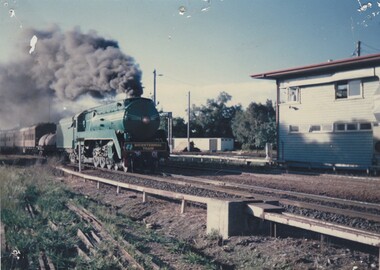 Wodonga & District Historical Society Inc
Photograph - Fred Rochow Railways Collection - Bicentennial Train Locomotive 3801 passing Wodonga Signal box, 29 October 1988
... Locomotive 3801 was officially relaunched at Sydney's Central Station on Friday 12 March 2021 by Her Excellency, the Honourable Margaret Beazley AC QC, Governor of New South Wales. Fred Rochow Railways ...The Fred Rochow Railways Collection incorporates photos related to the operation of the Wodonga Railway Station including different types of trains and railways staff C. 1930 – 1990. It was donated to the Wodonga Historical Society by Fred Rochow, a railwayman who spent many years based in Wodonga. He joined the Victorian Railways on 17th June l947 and retired in 1988. For some time, he was a member of the Australian Federated Union of Locomotive Enginemen and served a term as a member of the Trades Hall Council. He had an extensive knowledge of the struggles that took place to achieve better conditions for railway workers. Fred worked for many years as a fireman and then worked his way up the ranks to driver, experiencing many changes from the days of steam locomotives through to diesel trains, locomotives and even the modern XPT train. He worked throughout Victoria at different stages of his career, with his final working years focused on the northeast of Victoria and the Albury to Melbourne line. After his retirement, Fred continued to share his love of steam miniature trains with the community.This collection has local and statewide significance as it captures images of trains, locomotives and personnel who operated the railway services in Wodonga and throughout Northeast Victoria. The railways played a critical role in opening up Victoria and connecting Australia for trade, business, social communication and transport.Bicentennial Train hauled by Locomotive 3801 passing the Wodonga Signal box. Locomotive 3801 was built by Sydney company The Clyde Engineering Co. Ltd., Granville in 1943 as the first of five streamlined (C) 38-class locomotives for the New South Wales Government Railways’ top-link express passenger duties. The delivery of 3801 was much delayed due to wartime labour & material shortages, together with competing wartime construction priorities. After many years of service, 3801 had been scheduled for withdrawal in 1962 due to deteriorating mechanical condition, but rail enthusiasts raised sufficient funds to cover the cost of its overhaul. 3801 joined the collection of the New South Wales Rail Transport Museum (NSWRTM), Enfield on withdrawal from NSWGR service and continued in operation as a tour locomotive. It hauled the “Western Endeavour” on the first crossing of the Australian continent by a standard gauge train from Sydney to Perth and return in August – September 1970. 3801 also stars in the railway film ‘A Steam Train Passes’ made by Film Australia in 1974 By 1976 had been withdrawn from service due to poor boiler condition and placed on static display by the Rail Transport Museum in Thirlmere, NSW. The Locomotive remained in Thirlmere until 1983 when it was decided it should be restored for the Australian Bicentenary in 1988. A new organisation was created specifically for the purpose of operating 3801, and thus 3801 Limited was incorporated on 5th June 1985. Work on the locomotive was completed after three years, with 3801 making its debut at a special Railway Ball hosted in its honour on 29th November 1986. During the Australian Bicentenary celebrations in 1988, it operated an extensive program across Australia visiting every mainland capital accessible by rail including an appearance at AusSteam ’88 in Melbourne in October 1988, stopping over in Wodonga on the way. After the company’s 20-year lease on the locomotive expired in 2006 Railcorp chose not to extend the agreement, and the locomotive returned to the Rail Transport Museum at Thirlmere (now the NSW Rail Museum). 3801 was withdrawn from service in 2007 for major boiler repairs. Locomotive 3801 was officially relaunched at Sydney's Central Station on Friday 12 March 2021 by Her Excellency, the Honourable Margaret Beazley AC QC, Governor of New South Wales.On front of locomotive Australia Bicentennial logo and sign "BICENTENNIAL TRAIN/3801" railways wodonga, fred rochow, locomotive r761, bicentennial train, locomotive 3801 -
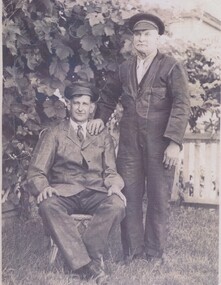 Wodonga & District Historical Society Inc
Photograph - Fred Rochow Railways Collection - George Henry Lynch and Jack Anderson, 24 November 1937
... Railways in Australia, running from Melbourne to the New South Wales border at Albury, and later through to Sydney. From its introduction in November 1937 until April 1962 the train service ran on 1,600 mm (5 ft 3 in) broad gauge line from Melbourne's Spencer Street station to Albury, on the New South Wales / Victorian border, where passengers changed to a New South Wales Government Railways train (the Melbourne Limited Express). ...Railways in Australia, running from Melbourne to the New South Wales border at Albury, and later through to Sydney. From its introduction in November 1937 until April 1962 the train service ran on 1,600 mm (5 ft 3 in) broad gauge line from Melbourne's Spencer Street station to Albury, on the New South Wales / Victorian border, where passengers changed to a New South Wales Government Railways train (the Melbourne Limited Express). ...The Fred Rochow Railways Collection incorporates photos related to the operation of the Wodonga Railway Station including different types of trains and railways staff C. 1930 – 1990. It was donated to the Wodonga Historical Society by Fred Rochow, a railwayman who spent many years based in Wodonga. He joined the Victorian Railways on 17th June l947 and retired in 1988. For some time, he was a member of the Australian Federated Union of Locomotive Enginemen and served a term as a member of the Trades Hall Council. He had an extensive knowledge of the struggles that took place to achieve better conditions for railway workers. Fred worked for many years as a fireman and then worked his way up the ranks to driver, experiencing many changes from the days of steam locomotives through to diesel trains, locomotives and even the modern XPT train. He worked throughout Victoria at different stages of his career, with his final working years focused on the northeast of Victoria and the Albury to Melbourne line. After his retirement, Fred continued to share his love of steam miniature trains with the community.This collection has local and statewide significance as it captures images of trains, locomotives and personnel who operated the railway services in Wodonga and throughout Northeast Victoria. The railways played a critical role in opening up Victoria and connecting Australia for trade, business, social communication and transport.Driver George Henry Lynch (standing) with Fireman Jack Anderson. This photo was taken the day after the first regular run of the "Spirit of Progress". The Spirit of Progress was the premier express passenger train on the Victorian Railways in Australia, running from Melbourne to the New South Wales border at Albury, and later through to Sydney. From its introduction in November 1937 until April 1962 the train service ran on 1,600 mm (5 ft 3 in) broad gauge line from Melbourne's Spencer Street station to Albury, on the New South Wales / Victorian border, where passengers changed to a New South Wales Government Railways train (the Melbourne Limited Express). Following the completion of the standard gauge line between Melbourne and Albury in April 1962 the Spirit of Progress was extended to Sydney. With declining passenger numbers it was decided to combine the Spirit of Progress and Southern Aurora into one train, the Sydney/Melbourne Express. The Spirit of Progress ran for the last time on 2 August 1986. V/Line rostered S301 Sir Thomas Mitchell to haul the last journeys in Victoria.railways wodonga, fred rochow, wodonga railwaymen, george henry lynch, jack anderson, spirit of progress -
 Victorian Railway History Library
Journal - Newsrail December 1974, Unattributed, The NSW fuel shortage. Dunnstown in 1985, 1974
... Railways - History Two articles from the December 1974 issue of Newsrail. Report of the impact of a shortage of locomotive (and other) fuel in New South Wales, train cancellations and alterations. Second - Description of Dunnstown station ...Two articles from the December 1974 issue of Newsrail. Report of the impact of a shortage of locomotive (and other) fuel in New South Wales, train cancellations and alterations. Second - Description of Dunnstown station in 1895 and discussion of some train workings of the time.Ill, p.20.non-fictionTwo articles from the December 1974 issue of Newsrail. Report of the impact of a shortage of locomotive (and other) fuel in New South Wales, train cancellations and alterations. Second - Description of Dunnstown station in 1895 and discussion of some train workings of the time.victorian railways - history -
 Victorian Railway History Library
Book, Fetscher, Mark, The Power Stations of the N.S.W.G.R, 2003
... railroad construction - New South Wales - history Electric trains - New South Wales - history A detailed history of the power stations built by the New South Wales Government Railways to provide electricity for their trains. index, ills, p.166. ...A detailed history of the power stations built by the New South Wales Government Railways to provide electricity for their trains.index, ills, p.166.A detailed history of the power stations built by the New South Wales Government Railways to provide electricity for their trains.railroad construction - new south wales - history, electric trains - new south wales - history
