
Showing 126 items matching "railway trolley"
-
 Otway Districts Historical Society
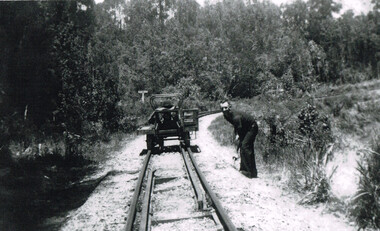
Photograph, R.K. Whitehead, Beechy: Out on the track, c.1940
... Colac; Beech Forest; Crowes; Frank Woosman; gangers' trolley; railway;...A ganger, Frank Woosman, is digging ballast near a railway gangers' trolley....A ganger, Frank Woosman, is digging ballast near a railway gangers' trolley. Colac; Beech Forest; Crowes; Frank Woosman; gangers' trolley; railway; Out on the track. ...A ganger, Frank Woosman, is digging ballast near a railway gangers' trolley.Out on the track. Colac-Beech Forest-Crowes Railway. c.1940colac; beech forest; crowes; frank woosman; gangers' trolley; railway; -
 Ballarat Tramway Museum
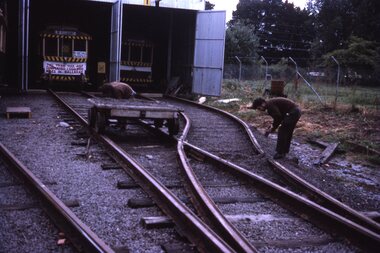
Slide - BTPS Depot - depot fan ballasting, David Frost, 1/1974
... ...Railway Trolley...Photo by David Frost, Jan. 1974 Yields information about the construction of the trackwork at the BTPS Depot. tramways BTPS depot fan trackwork Railway Trolley In ink "laying ballast on the final part of the depot fan" Colour Slide - Kodak cardboard mount. ...Colour slide of BTPS volunteers laying ballast using the trolley to move the ballast. In the background are trams 27 and 14. Photo by David Frost, Jan. 1974Yields information about the construction of the trackwork at the BTPS Depot.Colour Slide - Kodak cardboard mount.In ink "laying ballast on the final part of the depot fan"tramways, btps, depot fan, trackwork, railway trolley -
 Ballarat Tramway Museum
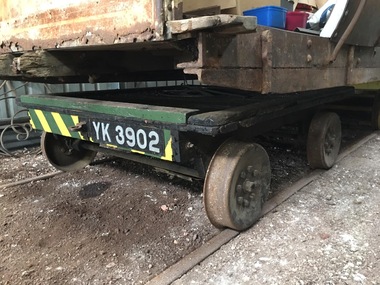
Vehicle - Four Wheel Flat top Trolley, Commonwealth Railways - Port Augusta Workshops (Understood), 1940's?
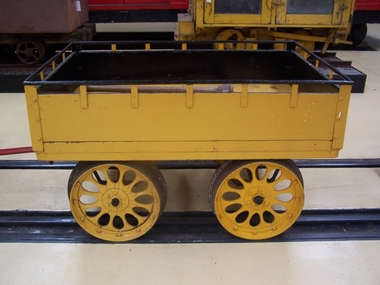
... ... Railway Trolley...Trams tramways Commonwealth Railways Maintenance Equipment Railway Trolley On underside in paint, "To Cargeeg, 50 Pasadena East Bentleigh, Melbourne" Four wheel flat top track trolley- deck wood frame and sides on four fabricated/pressed wheels, with bearings, axles- Used to transport materials- hand pushed or towed. ...Four wheel flat top track trolley- deck wood frame and sides on four fabricated/pressed wheels, with bearings, axles- Used to transport materials- hand pushed or towed. Metal tie rods in front over axles and metal has connecting tow/couplers. Relocated to Bungaree c2015 when 22 moved. Photographed at Bungaree 6-4-2020 by Neville Britton, see image btm18i1.jpg. Record updated 6-4-2020. See detailed information on back of sheet in folder for sketches, timber damaged, notes re a number plate and a note regarding work done 7/97 in replacing underside diagonal bracing supports.On underside in paint, "To Cargeeg, 50 Pasadena East Bentleigh, Melbourne"trams, tramways, commonwealth railways, maintenance equipment, railway trolley -
 Otway Districts Historical Society
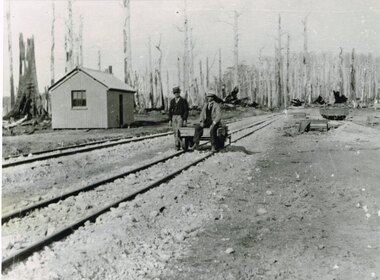
Photograph, Knox Collection, Beech Forest railway terminus, 1902, 1902
... Beech Forest railway terminus showing two inspecting officers upon a railway trolley on No.2 track near a shed.....Beech Forest railway terminus showing two inspecting officers upon a railway trolley on No.2 track near a shed.. Beech Forest railway terminus, 1902 Photograph Knox Collection ...B/W. Beech Forest railway terminus showing two inspecting officers upon a railway trolley on No.2 track near a shed..beech forest; railways; -
 Puffing Billy Railway
Red Trolly, BN Class Trolly
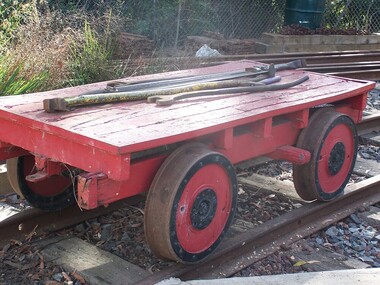
... puffing billy railway, pbr, red - trolley...Red Trolley - BN Class Trolly Class: BN* * Trailers marked (*) are classified as Rail Mounted Tools or Tool Carriers for the purposes of Section 1 of Appendix 1 of the General Instructions. Number: 1, 2 & 3 Name: - Description: Flat top dummy Load Capacity. - Goods : 1 ton (1 tonne) - Persons. --- Puffing Billy Railway - Narrow Gauge Track maintenance Vehicle - BN Class Trolly puffing billy railway, pbr, red - trolley bn class trolley trolley trolly Red Trolley - BN Class Trolly - Flat top dummy made of wood and wrought iron BN Class Trolly Red Trolly Puffing Billy Railway ...Red Trolley - BN Class Trolly Class: BN* * Trailers marked (*) are classified as Rail Mounted Tools or Tool Carriers for the purposes of Section 1 of Appendix 1 of the General Instructions. Number: 1, 2 & 3 Name: - Description: Flat top dummy Load Capacity. - Goods : 1 ton (1 tonne) - Persons. ---Puffing Billy Railway - Narrow Gauge Track maintenance Vehicle - BN Class TrollyRed Trolley - BN Class Trolly - Flat top dummy made of wood and wrought ironpuffing billy railway, pbr, red - trolley, bn class trolley, trolley, trolly -
 Puffing Billy Railway
Hand Tricycle Number 386, Commonwealth Railways 3'6" Gauge Hand Tricycle
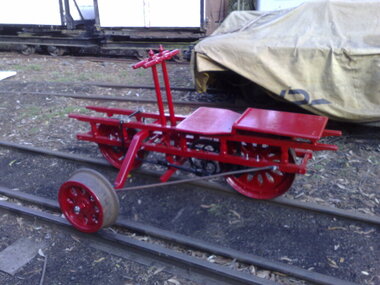
... The trolley entered service for the Commonwealth Railways (later Australian National Railways) as trolley number "386" and was originally built to the gauge of 3"6....The trolley entered service for the Commonwealth Railways (later Australian National Railways) as trolley number "386" and was originally built to the gauge of 3"6. ...The trolley entered service for the Commonwealth Railways (later Australian National Railways) as trolley number "386" and was originally built to the gauge of 3"6.Historic - Commonwealth Railways - Narrow Gauge Railway - Track vehicleThe tricycle is red and has three wheels, two large on one side with a single offset wheel on the other. Timber and steel constructionhand tricycle, commonwealth railways, australian national railways, trolley, puffing billy -
 Flagstaff Hill Maritime Museum and Village
Functional object - Luggage Trolley, Harry Crowther Slingsby, 1930 - 1950
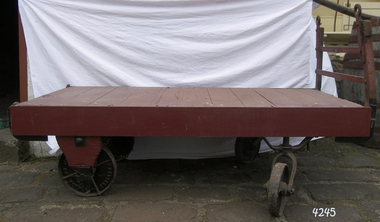
... Different designs were created for different purposes sack trolleys for moving large sacks of flour, sugar and dried fruit around grocery stores; high wheeled flat carts towed by one or two people; trucks fitted with wicker baskets carried fibers around textile mills and railway platform trolley to move luggage. ...Railway platform luggage trolley large metal frame & wood top with 4 black metal cast iron wheels & metal structure at front with holes to put rope/harness through. ...Different designs were created for different purposes sack trolleys for moving large sacks of flour, sugar and dried fruit around grocery stores; high wheeled flat carts towed by one or two people; trucks fitted with wicker baskets carried fibers around textile mills and railway platform trolley to move luggage. ...In 1893 Harry Crowther Slingsby founded the company the family firm was at first wholesale bottlers and had established themselves in Bradford, England, later they had a branch in London. Harry Crowther Slingsby began to look into the invention of labor-saving devices for the company. He had recognised that working practices in the local factories relied heavily on manual hauling and gravity for the movement of raw materials and products from floor to floor. However, this did not solve the problem of moving items horizontally around large buildings. Slingsby then set about creating robust trucks and trolleys to move heavy loads with relative ease. Different designs were created for different purposes sack trolleys for moving large sacks of flour, sugar and dried fruit around grocery stores; high wheeled flat carts towed by one or two people; trucks fitted with wicker baskets carried fibers around textile mills and railway platform trolley to move luggage. The company is still in existence today manufacturing many different types of products.An item from the early to mid 20th century connected with railway memorabilia and a company that had humble beginnings to become today a leading UK manufacture. Railway platform luggage trolley large metal frame & wood top with 4 black metal cast iron wheels & metal structure at front with holes to put rope/harness through. Front 2 wheels swivel. Trolley painted red. Wheels are marked Bradford & Londonflagstaff hill, warrnambool, shipwrecked-coast, flagstaff-hill, flagstaff-hill-maritime-museum, maritime-museum, shipwreck-coast, flagstaff-hill-maritime-village -
 Marysville & District Historical Society
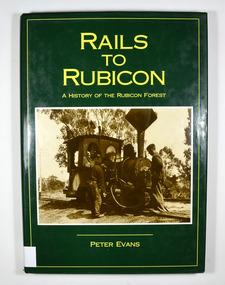
Book - Hardcover book, Peter Evans, Rails to Rubicon-A History of the Rubicon Forest, 1994
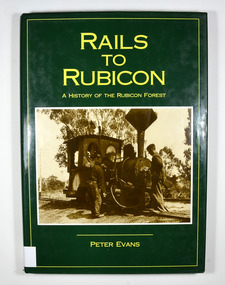
... End papers show a photograph of a man standing besides a timber railway trolley holding onto the brake lever. There is a group of men, some sitting and some standing, on piles of cut timber under a large, open shed in the background. ...End papers show a photograph of a man standing besides a timber railway trolley holding onto the brake lever. There is a group of men, some sitting and some standing, on piles of cut timber under a large, open shed in the background. ...Hardcover. Green dust cover. Front cover photograph is Krauss 0-4-OWT, builder's No. 2459 of 1891, takes water at the western end of Rubicon Lane in 1934. Driver Bob Rees attends to his engine while brakeman Hayden looks on. End papers show a photograph of a man standing besides a timber railway trolley holding onto the brake lever. There is a group of men, some sitting and some standing, on piles of cut timber under a large, open shed in the background. There are also some small, timber, tent like structures standing next to the railway tracks. There is a forest in the far background. Written in white is the line "Mr Clarke & Kidd's Sawmill". non-fictionrubicon, timber, sawmill, railway, tramway, clarke and pearce, evans, peter, marysville, krause, forest, mountain -
 Marysville & District Historical Society
Book - Hardcover book, Rails to Rubicon-A History of the Rubicon Forest, 1994
... End papers show a photograph of a man standing besides a timber railway trolley holding onto the brake lever. There is a group of men, some sitting and some standing, on piles of cut timber under a large, open shed in the background. ...End papers show a photograph of a man standing besides a timber railway trolley holding onto the brake lever. There is a group of men, some sitting and some standing, on piles of cut timber under a large, open shed in the background. ...A history of the Rubicon forestHardcover. Green dust cover. Front cover photograph is Krauss 0-4-OWT, builder's No. 2459 of 1891, takes water at the western end of Rubicon Lane in 1934. Driver Bob Rees attends to his engine while brakeman Hayden looks on. End papers show a photograph of a man standing besides a timber railway trolley holding onto the brake lever. There is a group of men, some sitting and some standing, on piles of cut timber under a large, open shed in the background. There are also some small, timber, tent like structures standing next to the railway tracks. There is a forest in the far background. Written in white is the line "Mr Clarke & Kidd's Sawmill".Stamp of the Marysville & District Historical Society Inc / PO Box 22 / Marysville 3779 Signed by the author, Peter Evansrubicon, timber, sawmill, railway, tramway, clarke and pearce, evans, peter -
 Puffing Billy Railway
STA 1 Corporal Gauge 2'6" Trolly Trailer, 1958
... STA 1 Victorian Railways Corporal Trolley Trailer Gauge 2 foot six inch (762mm) Built in 1958 It was originally known as ST 1 and used by the “Schools Section” during the restoration of the Puffing Billy Railway, between 1958 and 1962, for transporting materials to the work site. ...Vic Collections No. 000035 Historic - Narrow gauge railway - Trolly trailer Track vehicle - used by Puffing Billy Railway trolley trailer sta 1 victorian railways puffing billy corporal trolley trailer trolly Has black stripes painted on its side. ...STA 1 Victorian Railways Corporal Trolley Trailer Gauge 2 foot six inch (762mm) Built in 1958 It was originally known as ST 1 and used by the “Schools Section” during the restoration of the Puffing Billy Railway, between 1958 and 1962, for transporting materials to the work site. It was rebuilt and reclassified “STA 1” in the mid 1960s. During a repaint it was given three stripes and is commonly referred to as “Corporal”. Vic Collections No. 000035 Historic - Narrow gauge railway - Trolly trailer Track vehicle - used by Puffing Billy Railway It is a small rectangular wooden trolley trailer that has three diagonal stripes painted down the side of it.Has black stripes painted on its side.trolley, trailer, sta 1, victorian railways, puffing billy, corporal, trolley trailer, trolly -
 Melbourne Tram Museum
Pamphlet, Market Street Railway Company, San Francisco, “Trolley Festival – The past is present on market street”, 1980s
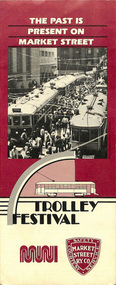
... “Historic Cars of the Trolley Festival”, Melbourne Marathoners (1928-30), former MMTB trams #496 and #648. Tram #648 has since been sold to Sacramento Western Railway museum Trolley Festival ran from 1983 to 1987 due to cable tram track replacement....“Historic Cars of the Trolley Festival”, Melbourne Marathoners (1928-30), former MMTB trams #496 and #648. Tram #648 has since been sold to Sacramento Western Railway museum Trolley Festival ran from 1983 to 1987 due to cable tram track replacement. ...Pamphlet titled: "Trolley Festival – The past is present on market street" Produced by the Market Street Railway Company, San Francisco, features photo of a Melbourne tram owned by them. “Historic Cars of the Trolley Festival”, Melbourne Marathoners (1928-30), former MMTB trams #496 and #648. Tram #648 has since been sold to Sacramento Western Railway museum Trolley Festival ran from 1983 to 1987 due to cable tram track replacement.trams, tramways, usa streetcars, usa trams, usa tramways, w2 class, w5 class, tram 496, tram 648 -
 Puffing Billy Railway
NKS 9, Victorian Railways 2'6" gauge trolly
... NKS Type Gangers Trolly - Victorian Railways 2'6" gauge trolley - a KS series Section Car oftern called the Kasey Jones The narrow gauge version of the broad gauge KS series cars. ...NKS Type Gangers Trolly - Victorian Railways 2'6" gauge trolley - a KS series Section Car oftern called the Kasey Jones The narrow gauge version of the broad gauge KS series cars. ...NKS Type Gangers Trolly - Victorian Railways 2'6" gauge trolley - a KS series Section Car oftern called the Kasey Jones The narrow gauge version of the broad gauge KS series cars. They were classed NKS with two stroke motors. These cars were built by the Spotswood Workshops, with castings coming from the Newport Workshops. KS is lighter car capable of carrying 4 men or sevenhundredweight Trolly 9 was built for the State Electricity Commission of Victoria for use on their metre gauge railway of Yallourn. It was sold to a preservation group at Walhalla and regauged to 2 foot 6 inch. It came to the Puffing Billy Railway in the early 1980s.Historic - Victorian Railways Narrow Gauge - Track Patrol Vehicle used by the State Electricity Commission of Victoria for use on their 900mm gauge railway of Yallourn. And then at Walhalla Railway where it was regauged to 2 foot 6 inchMotorised small rectangular trolly made of wood and wrought iron - currently stored dismantled Engine Type: 1 Cyl. reversible Fuel: 2 stroke Transmission: Belt driveNKS 9puffing billy, puffing billy museum, trolley, narrow gauge, 2'6" gauge, victorian railways, state electricity commission of victoria - yallourn., trolly -
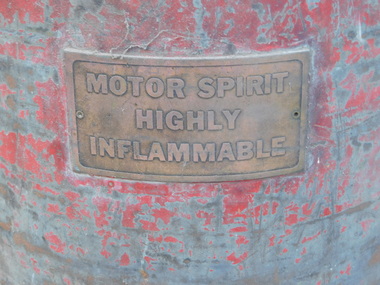 Puffing Billy Railway
Victorian Railways Fuel Can for Trolly
... V.R Fuel Can for Trolley - Victorian Railways Fuel Can for Trolly Motor Spirit Highly Inflammable Transporting Tin Container "Motor Spirit" is just another name for petrol. ...Historic - Victorian Railways - Permanent Way and Works - track equipment - V.R Fuel Can for Trolley puffing billy victorian railways fuel can trolley trolly Motor Spirit Highly Flammable V.R 8 ? ...V.R Fuel Can for Trolley - Victorian Railways Fuel Can for Trolly Motor Spirit Highly Inflammable Transporting Tin Container "Motor Spirit" is just another name for petrol. "K" and the "KS" Kasey Trolleys were two stroke petrol motors Operation, Care and Maintenance of Track Motors Victorian Railways, 1959 http://www.geoffsrailpix.com/Documents/Motors.pdf gives the following : Inspection motor type B, - straight petrol Inspection motor type V, - pre-mixed petrol Motorised tricycle type M.T., - pre-mixed petrol Gang motor type K.S., - pre-mixed petrol Gang motor type K - pre-mixed petrol Motor cars altered for rail uses (Wiki) Petrol Inspection Car This was a small car numbered '1' and named the Inspection Car. It was built in England in 1923, but was not found in the 1936 stocktake. Gang Motor The eight-horsepower Gang Motor held five people, and was built at Arden Street in late 1923. In 1950 the vehicle was removed from the rolling stock register and given to "Way and Works" as a track motor. Motor Car The Motor Car was put into service in mid 1925, after being fitted with rail wheels in lieu of tyres. In 1927 the car was named "Mr Molomby's Inspection Car", and allocated to Seymour. It was scrapped in 1952. Dodge Cars There were seven Dodge cars in rail service. The cars were numbered 1 to 6, with car 7 listed "No 7 Repair". The cars were built by the Dodge Company of Melbourne and assembled at Newport. Construction was in 1925 and they lasted until 1949.Historic - Victorian Railways - Permanent Way and Works - track equipment - V.R Fuel Can for TrolleyV.R Fuel Can for Trolly - Metal Fuel TinMotor Spirit Highly Flammable V.R 8 ?puffing billy, victorian railways, fuel can, trolley, trolly -
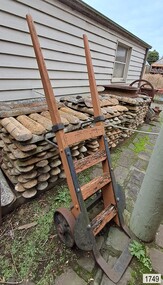 Flagstaff Hill Maritime Museum and Village
Functional object - Hand Trolley, Melbourne Steamship Company (MSS Co), Late 19th to mid-20th century
... Hand trolleys are still used by farmers, railway workers, shipping companies, porters, airports, hospitals, warehouses, logistical firms, furniture removalists, factory labourers and even in private homes when heavy loads need to be moved. ...Hand trolleys are still used by farmers, railway workers, shipping companies, porters, airports, hospitals, warehouses, logistical firms, furniture removalists, factory labourers and even in private homes when heavy loads need to be moved. ...This hand trolley was originally marked M.S.S. Co., and likely to have once belonged to the Melbourne Steamship Company, often referred to by those initials. Flagstaff Hill’s collection has several other objects connected to the M.S.S. Co. The firm was established in 1873 under the name Hugh R. Reid and Company, renamed Melbourne Steamship Company Ltd in 1895, and became Melbourne’s foremost interstate shipping line. Warrnambool was one of the ports of call at least between 1922 and 1956; for example, on September 27 1934, the ship Coolana left Warrnambool on its way to Stanley, Burnie and Devonport, then on to Sydney and Newcastle, while other of its vessels were visiting Fremantle, Port Lincoln, Whyalla, Adelaide, and Melbourne. The firm remained in business until around 1960. A hand trolley can be loaded with heavy and bulky objects such as luggage, and stacks of boxes such as produce, cargo and equipment. It uses the principles of wheels and leverage, like a wheelbarrow, and can easily be wheeled from one place to another. Hand trolleys are still used by farmers, railway workers, shipping companies, porters, airports, hospitals, warehouses, logistical firms, furniture removalists, factory labourers and even in private homes when heavy loads need to be moved. Hand trolleys were first used in the 18th century in industries where children were used to move heavy loads. By using a hand trolley, the young labourers could move the piles of objects with the same efficiency as the adult workers. This hand trolley is significant for its likely connection to the Melbourne Steamship Company, or MSSCo, Melbourne’s foremost shipping line for interstate trade in the late nineteenth and early-to- mid twentieth century, representing many aspects of early trade within maritime Australia; Warrnambool was one of the ports visited by the company’s ships. The design of the hand trolley is an example of equipment used since the 18th century to move heavy loads at docks and shipyards. It is associated with the maritime industries of shipping, transportation, travel, and trade, as well as the colonial primary production sectors of farming, markets, and produce. The design represents an early step in the evolution of the simple hand trolley. More recently, as well as the continued use of this simple style of trolley, the design has been improved to include specialised trolleys that fold, climb stairs, move pianos and even easily turn corners on their spinning, pivoting wheels. Hand trolley: an L-shaped handcart with handles and supporting legs at one end, wheels at the other, and a ledge or platform to hold the load. This hand trolley has orange wooden slats and handles, two metal wheels, and a black metal frame with semi-circular side flanges. An inscription is stamped on one side.Stamped: "M.S.S.CO."warrnambool, flagstaff-hill, flagstaff-hill-maritime-museum, maritime-museum, shipwreck-coast, flagstaff-hill-maritime-village, hand trolley, sack truck, trolley, luggage trolley, hand truck, trundler, sack barrow, bag barrow, leverage, marine technology, cargo handling, docks, wharft, shipping, trade, vintage, antique, hand card, rolling cart, station trolley, dolly, stack truck, box cart, two-wheeler, material handling equipment, shipping trade, mss co, mssc, melbourne steamship company, interstate shipping, hugh r. reid and company -
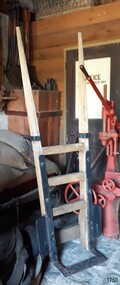 Flagstaff Hill Maritime Museum and Village
Equipment - Hand Trolley
... Hand trolleys are still used by farmers, railway workers, shipping companies, porters, airports, hospitals, warehouses, logistical firms, furniture removalists, factory labourers and even in private homes when heavy loads need to be moved. ...Hand trolleys are still used by farmers, railway workers, shipping companies, porters, airports, hospitals, warehouses, logistical firms, furniture removalists, factory labourers and even in private homes when heavy loads need to be moved. ...A hand trolley can be loaded with heavy and bulky objects such as luggage, and stacks of boxes such as produce, cargo and equipment. It uses the principles of wheels and leverage, like a wheelbarrow, and can easily be wheeled from one place to another. Hand trolleys are still used by farmers, railway workers, shipping companies, porters, airports, hospitals, warehouses, logistical firms, furniture removalists, factory labourers and even in private homes when heavy loads need to be moved. Hand trolleys were first used in the 18th century in industries where children were used to move heavy loads. By using a hand trolley, the young labourers could move the piles of objects with the same efficiency as the adult workers. The design of the hand trolley is an example of equipment used since the 18th century to move heavy loads at the docks and shipyards. It is associated with the maritime industries of shipping, transportation, travel and trade as well as the colonial primary production sectors of farming, markets and produce. The design represents an early step in the evolution of the simple hand trolley. More recently, as well as the continued use of this simple style of trolley, the design has been improved to include specialised trolleys that fold, climb stairs, move pianos and even easily turn corners on their spinning, pivoting wheels. Hand trolley: an L-shaped hand-operated trolley with handles and supporting legs at one end, wheels at the other, and a ledge or platform to hold the load. This hand trolley has orange wooden slats and handles, two metal wheels, and a black metal frame with curved corners on its rectangular side flanges.flagstaff hill, warrnambool, shipwreck coast, maritime museum, flagstaff hill maritime museum and village, vintage, antique, hand trolley, hand card, hand truck, rolling cart, luggage trolley, station trolley, dolly, stack truck, sack truck, trundler, box cart, sack barrow, bag barrow, two-wheeler, leverage, material handling equipment, marine technology, cargo handling, docks, shipping trade -
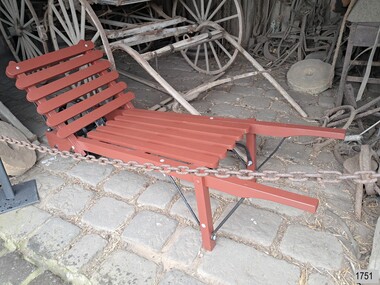 Flagstaff Hill Maritime Museum and Village
Functional object - Luggage Barrow, Late 19th to first half of the 20th century
... The old style luggage barrow or porter's trolley is used at railway stations throughout Australia. ...The old style luggage barrow or porter's trolley is used at railway stations throughout Australia. ...The old style luggage barrow or porter's trolley is used at railway stations throughout Australia. These types of porter trolleys served a vital role in supporting passengers to move their luggage around on a station platform. An everyday item used on stations platforms to move luggage around by a porter it is significant as it is an item not used now but can give us a historical view of social life and snapshot of Australia's main source of transport in the Victorian era the train.Luggage or cargo barrow without sides, made from iron wheel and wooden slats with metal supports. It is used as a trolley to move luggage.Noneflagstaff hill, warrnambool, shipwrecked-coast, flagstaff-hill, flagstaff-hill-maritime-museum, maritime-museum, shipwreck-coast, flagstaff-hill-maritime-village, wheelbarrow, luggage barrow, luggage trolley, porter's trolley -
 Federation University Historical Collection
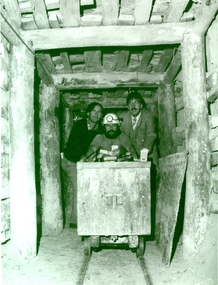
Photograph - Black and White, 1988, Three men standing behind a trolley in a mine tunnel, 06/1988
... trolley...mine truck...mining railway...It was used in the Ballarat School of Mines Review, 1988, page 7. ballarat school of mines mines mining mining trolley mine truck mining railway malcolm vallance mal vallance raymond collins ernie terrill eastern reefs Sovereign hill mining education Black and white image of three men standing behind a trolley in a mine tunnel showing supporting beams (thought to be Sovereign Hill) They are from left to right Ernie Terrill (Ballarat CES), Raymond Collins (Ballarat School of Mines Mining Student) and Malcolm Vallance (Ballarat School of Mines Special Projects Manager). ...This image was taken at the conclusion of a special eight week "Crash course" in mining, requested by Eastern Reefs. It was used in the Ballarat School of Mines Review, 1988, page 7.Black and white image of three men standing behind a trolley in a mine tunnel showing supporting beams (thought to be Sovereign Hill) They are from left to right Ernie Terrill (Ballarat CES), Raymond Collins (Ballarat School of Mines Mining Student) and Malcolm Vallance (Ballarat School of Mines Special Projects Manager).ballarat school of mines, mines, mining, mining trolley, mine truck, mining railway, malcolm vallance, mal vallance, raymond collins, ernie terrill, eastern reefs, sovereign hill, mining education -
 Marysville & District Historical Society
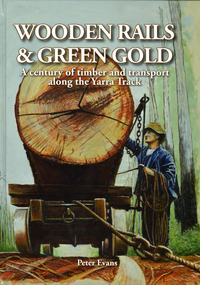
Book - Hardcover book, Peter Evans, Wooden Rails & Green Gold-A century of timber and transport along the Yarra Track, 2022
... trolley along a timber tramway. Wooden Rails & Green Gold-A century of timber and transport along the Yarra Track Book Hardcover book Peter Evans Light Railway Research Society of Australia Inc Ligare Book Printers Box Car Graphics ...A history of the timber mills along the Yarra Track from Narbethong to Matlock.Hardcover. Shows Mick Taylor making last-minute adjustments to the rigging of a large log about to commence its journey down the incline to the Marysville Timber and Seasoning Company No.1 mill. Back cover has a photograph of a rail tractor towing a timber trolley along a timber tramway.non-fictionA history of the timber mills along the Yarra Track from Narbethong to Matlock.timber, timber mills, yarra track, narbethong, matlock, marysville, wood's point, wilks creek, great divide, cathedral range, cumberland, foresters, sawmillers, peter evans -
 Marysville & District Historical Society
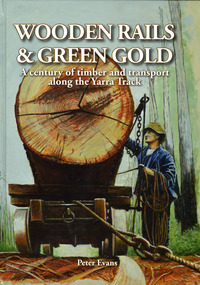
Book - Hardcover book, Peter Evans, Wooden Rails & Green Gold-A century of timber and transport along the Yarra Track, 2022
... trolley along a timber tramway. Wooden Rails & Green Gold-A century of timber and transport along the Yarra Track Book Hardcover book Peter Evans Light Railway Research Society of Australia Inc Ligare Book Printers Box Car Graphics ...A history of the timber mills along the Yarra Track from Narbethong to Matlock.Hardcover. Shows Mick Taylor making last-minute adjustments to the rigging of a large log about to commence its journey down the incline to the Marysville Timber and Seasoning Company No.1 mill. Back cover has a photograph of a rail tractor towing a timber trolley along a timber tramway.non-fictionA history of the timber mills along the Yarra Track from Narbethong to Matlock.timber, timber mills, yarra track, narbethong, matlock, marysville, wood's point, wilks creek, great divide, cathedral range, cumberland, foresters, sawmillers, peter evans -
 Flagstaff Hill Maritime Museum and Village
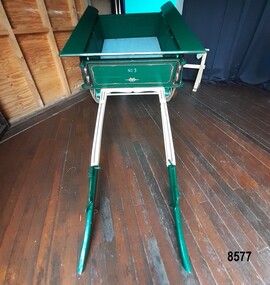
Vehicle - Tip Dray, Prior to 1930s
... railway construction. A photo in the collection of the Lorne Historical Society shows a tipping dray being used during the construction of the Great Ocean Road. They were part of the daily street traffic in towns and cities around Australia from the early days of settlement. In Australia in the early 1900's, carters began to join unions to protect their jobs and pay. N.S.W. had a "Trolley...railway construction. A photo in the collection of the Lorne Historical Society shows a tipping dray being used during the construction of the Great Ocean Road. They were part of the daily street traffic in towns and cities around Australia from the early days of settlement. In Australia in the early 1900's, carters began to join unions to protect their jobs and pay. N.S.W. had a "Trolley ...A Dray is a type of dead axle wagon that was used to transport heavy loads or objects. They had a flat level floor and while some had no sides, others had box bodies and sides. Tip Drays (also known as Tip Carts, Muck Cart, Scotch Cart, Tumbrel or Putt in different parts of England) were smaller than other drays as their loads were heavy and usually only pulled by one horse. Their basic design included two wheels, a tipping body and shafts. The Tip Dray has a unique mechanism that allows the top to tip backwards to tip the load out of the back of the dray. The tipper was activated by a handle at the front allowing the driver to operate it while still having control over the horse. A Tip Dray was an indispensable piece of equipment in the days before tractors and mechanical trucks. They were used by farmers and carters to transport hay, rocks, bricks, gravel and rubbish etc. and because they were useful for dumping loads, they were favoured for use in road and railway construction. A photo in the collection of the Lorne Historical Society shows a tipping dray being used during the construction of the Great Ocean Road. They were part of the daily street traffic in towns and cities around Australia from the early days of settlement. In Australia in the early 1900's, carters began to join unions to protect their jobs and pay. N.S.W. had a "Trolley, Draymen and Carters Union", Queensland had a "Tip Dray Men's Association" and in W. A. the "Top Dray Driver's Union" had a "cessation of work" in 1911 when they were fighting for an increase in their day's wages. In 1910 a meeting of Tip Carters was held in Geelong at the Trades Hall to discuss the formation of a union (The Geelong Tip Dray Carters) which was a success and a schedule of rates for all carting, whether by contract or day labor, was fixed. By 1912 they had "labelled" more than 50 drays and had representatives on the "Trades Hall and Eight Hours Committee". By the mid 1930's and early 1940's, tip drays were being superseded by mechanical trucks and utes. However tip drays continued to be used in some circumstances. They were a practical solution to the problem of petrol rationing during W. W. 2. It was noted in a letter to the editor in the "Sunshine Advocate" in 1938 that a positive argument for continued use of Tip Drays for rubbish collection related to the idea that a horse drawn vehicle involved with lots of stops and starts at different houses (very like a milkman's delivery route) often involved the horse "driving itself" while the driver picked up the rubbish - something a motor truck was unable to do! Another article written in August 1935 and published in the Age in a parliamentary report into the rubber industry noted "tip drays had almost disappeared and in their place, metal was carted in 5 ton motor trucks" but the report went on to say that as a part of the Government relief work (during the Great Depression) the Government had "to some extent reintroduced the tip drays so that a greater number of men would be employed". This particular tip dray was owned by Mr. Oswald (Jack) Bourke. He used it to deliver dry goods from Sunbury to the Queen Victoria Market in Melbourne several times a week in the 1930's and then (between 1945 and 1962) Mr. Bourke used it on the garbage round in Springvale Victoria for the Springvale Council. The Council owned three drays and the "No. 3" painted on this dray is in recognition of its original number. After the death of Mr. Bourke in 1990, one of Mr. Bourke's sons (Andy) found the dray in a shed and restored it. The sign writing on the back and side panels were added during the restoration. This Tipping Dray is a significant example of a horse drawn vehicle that was used by workers from the early days of white settlement through to the 1940's and even into the early 1960's. It was used in a range of "working class" occupations - road construction, railway construction, carting goods, rubbish collection etc. and would have been found in cities, country towns and on farms.A wooden and metal tipping dray with a box body and four sides. It has two iron and wooden wheels (with 14 spokes), two wooden shafts and a metal tipping mechanism. The back panel folds down to allow loads to be dumped out. It is painted in green and cream with sign writing on one of the sides and on the front and back panels. It features decorative painted lines and designs in burgundy, cream and light blue on most of the wooden parts. The tipping mechanism is on the front of the dray's left side and consists of a metal pin secured with a metal ring, and a lever.Front of dray - "No. 3" Side of dray - "A. & M. BOURKE / Contractors / LONGWARRY" Back of dray - "G.T. ANDREWS / QUEEN VICTORIA MARKET - Stand C23 / Phone DANDENONG 225"flagstaff hill maritime museum and village, warrnambool, shipwreck coast, tipping dray, dray, tip dray, tip cart, vehicles, horse drawn vehicle, springvale council, jack bourke, muck cart, scotch cart, tumbrel, putt, box body, oswald bourke, sunbury, queen victoria market, melbourne, no. 3 -
 Bendigo Historical Society Inc.
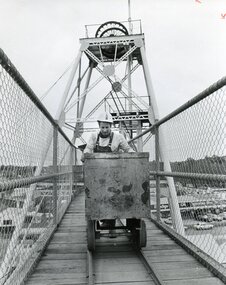
Photograph - AUSTIN COLLECTION:MAN PUSHING TROLLEY
... MINING Business Central Deborah Gold Mine B & W Photo of man wearing hard hat pushing skip along the railway heading away from the poppet head at Central Deborah Central Goldmine,Bendigo Photograph AUSTIN COLLECTION:MAN PUSHING TROLLEY ...B & W Photo of man wearing hard hat pushing skip along the railway heading away from the poppet head at Central Deborah Central Goldmine,Bendigomining, business, central deborah gold mine -
 Bendigo Historical Society Inc.
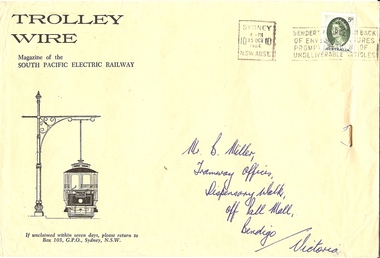
Document - BASIL MILLER COLLECTION: ENVELOLPE - CREAM MANILLA
... Cream manilla pictorial envelope printed as 'Trolley Wire' magazine of the South Pacific Electric Railway PO Box 103 G.P.O. ...PERSON Individual basil miller Cream manilla pictorial envelope printed as 'Trolley Wire' magazine of the South Pacific Electric Railway PO Box 103 G.P.O. ...Cream manilla pictorial envelope printed as 'Trolley Wire' magazine of the South Pacific Electric Railway PO Box 103 G.P.O. Sydney N.S.W. Postage Stamp in green of Queen Elizabeth II, 5d. Postal stamp in black ink 'Sydney 4pm, 15 Oct 1964, N.S.W. Aust. Adressed in ballpoint pen 'Mr B. Miller, Tramway Offices, Dispensary Walk, off Pall Mall, Bendigo, Victoria. Written in biron on back: Basil - Bob Prentice will ring you 4pm today.person, individual, basil miller -
 Bendigo Historical Society Inc.
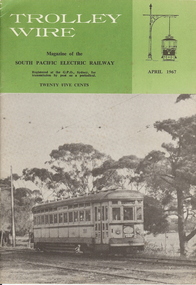
Document - BASIL MILLER COLLECTION: 'TROLLEY WIRE' MAGAZINE, April 1967
... Railway. Vol 8, No. 3 Issue No. 109. Document BASIL MILLER COLLECTION: 'TROLLEY WIRE' MAGAZINE ...Magazine of the South Pacific Electric Railway. Vol 8, No. 3 Issue No. 109.South Pacific Electric Railway Co-operative Society Limited. Box 103, GPO, Sydney. NSWperson, individual, basil miller -
 Bendigo Historical Society Inc.
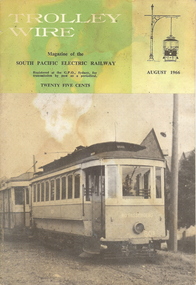
Document - BASIL MILLER COLLECTION: SMALL BOOKLET - STAPLED. JOURNAL 'TROLLEY WIRE' MAGAZINE OF THE SOUTH PACIFIC ELECTRIC RAILWAY
... JOURNAL 'TROLLEY WIRE' MAGAZINE OF THE SOUTH PACIFIC ELECTRIC RAILWAY....RAILWAY. Published August 1966 Volume 7, No 5 issue, No. 105. Document BASIL MILLER COLLECTION: SMALL BOOKLET - STAPLED. JOURNAL 'TROLLEY ...Booklet: MAGAZINE OF THE SOUTH PACIFIC ELECTRIC RAILWAY. Published August 1966 Volume 7, No 5 issue, No. 105.South Pacific Electric Railway Co-operative Society Ltd., Box 103, GPO, Sydney.person, individual, basil miller -
 Otway Districts Historical Society
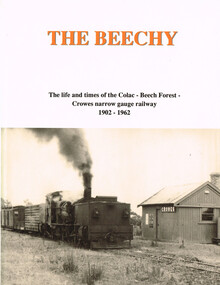
Book, The Beechy, 1992
... The Beechy; Colac; Beech Forest; Crowes; narrow gauge railway; Norman Houghton; Locomotive operations; Traffic; Timber tramways; Otway people; The Garrett; Trolley traffic; Lean 1930s;...The Beechy; Colac; Beech Forest; Crowes; narrow gauge railway; Norman Houghton; Locomotive operations; Traffic; Timber tramways; Otway people; The Garrett; Trolley traffic; Lean 1930s; Printing - McPherson's Printing Group; Typesetting - Mackenzies Typesetting. ...The Beechy. The life and times of the Colac-Beech Forest-Crowes narrow gauge railway, 1902-1962; Norman Houghton; hard cover; viii, 176 p.; illus., maps; ISBN 0909340 28 5Printing - McPherson's Printing Group; Typesetting - Mackenzies Typesetting.the beechy; colac; beech forest; crowes; narrow gauge railway; norman houghton; locomotive operations; traffic; timber tramways; otway people; the garrett; trolley traffic; lean 1930s; -
 Otway Districts Historical Society
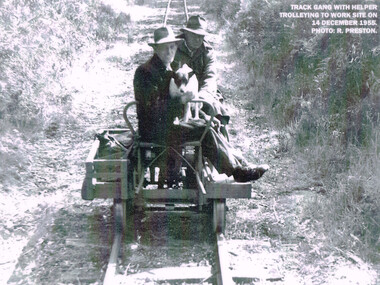
Photograph, R. Preston, Trolleying to work site, 1955, 14 December 1955
... A railway track gang, with helper, trolleying to a work site, on 14 December, 1955....Beech Forest; railways; track gang; A railway track gang, with helper, trolleying to a work site, on 14 December, 1955. ...At its peak the Beech Forest railway employed more than 21 staff between Colac and Crowes. Gangers (men in charge of the track gangs) tended to be promoted into the Otways but many of their subordinate repairers were local recruits. A few of the men who worked in the original construction gangs of 1900-1902 remained and obtained positions in the track gangs along the line. The track was maintained by seven three-man gangs based at Colac, Barongarook, Gellibrand, Banool, Beech Forest (2), and Lavers Hill. However, track gangs lessened as the line shortened. After 1954, the sole surviving track gang, in charge of Paddy Balcombe, stayed until the line closed.A railway track gang, with helper, trolleying to a work site, on 14 December, 1955.beech forest; railways; track gang; -
 Otway Districts Historical Society
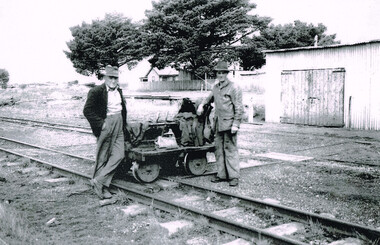
Photograph, Victorian Railway's repairers with their NKS motor trolley, 24 March 1954
... Victorian Railways repairers with their NKS motor trolley outside the gang sheds at Beech Forest, Wednesday, 24 March 1954. ...Beech Forest; Victorian Railways; repairers; motor trolley; gang shed; Victorian Railways repairers with their NKS motor trolley outside the gang sheds at Beech Forest, Wednesday, 24 March 1954. ...Victorian Railways repairers with their NKS motor trolley outside the gang sheds at Beech Forest, Wednesday, 24 March 1954. beech forest; victorian railways; repairers; motor trolley; gang shed; -
 Otway Districts Historical Society
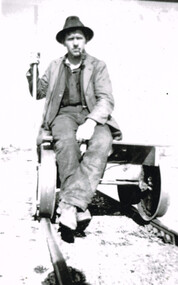
Photograph, Weeaproinah: Tom Woosnan on a trolley, c.1941, c.1941
... weeaproinah; railways; B/W. 281mm x 177mm. Tom Woosnan on a trolley at Weeaproinah in about 1941. ...B/W. 281mm x 177mm. Tom Woosnan on a trolley at Weeaproinah in about 1941.weeaproinah; railways; -
 Otway Districts Historical Society
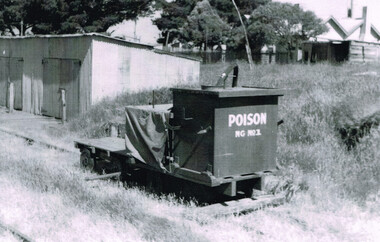
Photograph, R. Preston, Beech Forest: poison trolley, 1958, 8 January 1958
... beech forest; railways; B/W. Poison trolley NG No.1 on the Gang Shed siding at Beech Forest on 8 January 1958. ...B/W. Poison trolley NG No.1 on the Gang Shed siding at Beech Forest on 8 January 1958. The Gang Shed is shown. In the right background the Otway Shire Secretary's house.beech forest; railways; -
 Otway Districts Historical Society
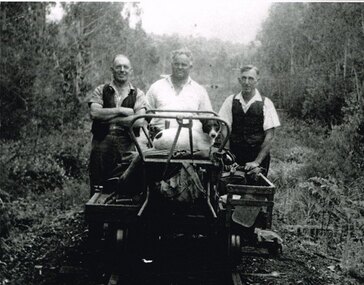
Photograph, Albert Denning, Colac track gang near Kawarren, c.1950
... railways; track gangs; B/W. 201mm x 254mm. In c.1950, the Colac track gang near Kawarren, featuring, from left to right, Bill Jamieson, Albert Denning, and Don Loury on an NKS motor trolley.. ...In 1955 staff numbers were reduced to an absolute minimum with one track gang at Beech Forest and one at Colac, one of whose members resided at Gellibrand. No new sleepers were issued to the track gangs after 1955/56, cut down ones being used instead. Albert Denning, the son of a Gellibrand selector, worked at Driver's planing mill and Hitt's Lardner mill before joining Victorian Railways in 1928 as an engine cleaner at Beech Forest and Crowes, the last one in both places. He later became a track repairer at Gellibrand and worked with this and the Colac track gang until 1962. Bill Jamieson was a track repairer on the Colac-Gellibrand gang from the 1950s until 1962, and witnessed the official policy of minimum maintenance in the last years of the line.B/W. 201mm x 254mm. In c.1950, the Colac track gang near Kawarren, featuring, from left to right, Bill Jamieson, Albert Denning, and Don Loury on an NKS motor trolley..colac; kawarren; railways; track gangs;
