
Showing 24 items matching "rose stock"
-
 Greensborough Historical Society
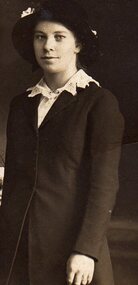
Photograph - Digital image, Rose Stock, 1930c
... Rose Stock......rose stock...Rose Stock. Photographs from the collection of Peter Blackbourn, a descendant of the Chapman Stock family. ...Rose Stock Photograph - Digital image ...Rose Stock. Photographs from the collection of Peter Blackbourn, a descendant of the Chapman Stock family. Annotations to photos by Peter Blackbourn.Digital copy of black and white photograph.peter blackbourn, rose stock -
 Thompson's Foundry Band Inc. (Castlemaine)
Document - Sheet Music for Concert Band, Hal Leonard et al, Blueberry Hill, 1940
... rose...larry stock...The song was first published in 1940 with the music composed by Vincent Rose (1880-1944), and lyrics written by Larry Stock and Al Lewis. ...Blueberry Hill Special Edition Series A Hal Leonard Publication By Al Lewis, Larry Stock and Vincent Rose Arranged by Johnnie Vinson Moderate Rock and Roll Copyright (C) 1940 by Chappell & Co., Inc. ...Rose...Larry Stock...fats domino rock and roll 1950s rhythm and blues blues vincent rose larry stock al lewis hal leonard chappell & co gene autry Blueberry Hill is considered a blues standard, made popular by Fats Domino. ...Blueberry Hill is considered a blues standard, made popular by Fats Domino. The song was first published in 1940 with the music composed by Vincent Rose (1880-1944), and lyrics written by Larry Stock and Al Lewis. This arrangement is by Johnnie Vinson and is a special edition series released by Hal Leonard. The tune was originally written for the 1941 western film "The Singing Hill" where it was first performed by Gene Autry.Blueberry Hill is considered a blues standard, made popular by Fats Domino. The song was first published in 1940 with the music composed by Vincent Rose (1880-1944), and lyrics written by Larry Stock and Al Lewis. This arrangement is by Johnnie Vinson and is a special edition series released by Hal Leonard. The tune was originally written for the 1941 western film "The Singing Hill" where it was first performed by Gene Autry. This arrangement is for Big Band and has 21 parts: 1st Bb Cornet 2nd Bb Cornet 3rd Bb Cornet 1st Eb Horn 2nd Eb Horn C Woodwinds 1st Bb Clarinet 2nd Bb Clarinet 1st Eb Alto Saxophone 2nd Eb Alto Saxophone Bb Tenor Saxophone/Bass Clarinet Eb Baritone Saxophone 1st Trombone 2nd Trombone Basses Percussion I (Snare Drum) Percussion II (Bass, Drum, Cymbal) Electric Bass 1st F Horn 2nd F Horn Baritone B.C. non-fictionBlueberry Hill is considered a blues standard, made popular by Fats Domino. The song was first published in 1940 with the music composed by Vincent Rose (1880-1944), and lyrics written by Larry Stock and Al Lewis. This arrangement is by Johnnie Vinson and is a special edition series released by Hal Leonard. The tune was originally written for the 1941 western film "The Singing Hill" where it was first performed by Gene Autry. fats domino, rock and roll, 1950s, rhythm and blues, blues, vincent rose, larry stock, al lewis, hal leonard, chappell & co, gene autry -
 Greensborough Historical Society
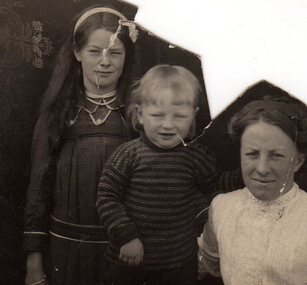
Photograph - Digital image, Stock and Finn children, 1925c
... ...rose stock...Stock and Finn children (left to right) Rose Stock, John Finn, Jane Finn. Photographs from the collection of Peter Blackbourn, a descendant of the Chapman Stock family. ...Stock and Finn children (left to right) Rose Stock, John Finn, Jane Finn. Photographs from the collection of Peter Blackbourn, a descendant of the Chapman Stock family. ...Stock and Finn children (left to right) Rose Stock, John Finn, Jane Finn. Photographs from the collection of Peter Blackbourn, a descendant of the Chapman Stock family. Annotations to photos by Peter Blackbourn.Digital copy of black and white photograph.peter blackbourn, rose stock, john finn, jane finn -
Bendigo Historical Society Inc.
Document - ROYAL PRINCESS THEATRE COLLECTION: PROGRAM OF COMING EVENTS, 1916
... stocked. Oxy Acetylene welding of all metals. Bartlett Bros. Photographers. Bartlett Bros' Studios, (R W Bugg, Proprietor) Williamson St, (opp Hotel Shamrock). Half & Half (Registered) Non-Alcoholic and Invigorating. Manufactured by C J Glover, Ph 343, Chapel Street, Bendigo. R D Ellis, Ladies & Gents Tailor, 241 Mitchell Street, (opposite Morley Johnson's). Nursery (Rose...stocked. Oxy Acetylene welding of all metals. Bartlett Bros. Photographers. Bartlett Bros' Studios, (R W Bugg, Proprietor) Williamson St, (opp Hotel Shamrock). Half & Half (Registered) Non-Alcoholic and Invigorating. Manufactured by C J Glover, Ph 343, Chapel Street, Bendigo. R D Ellis, Ladies & Gents Tailor, 241 Mitchell Street, (opposite Morley Johnson's). Nursery (Rose ...Princess Theatre Bendigo - Program of coming events in c1917. Coming Events: Gonsalez, Italian Grand Opera Company, commencing Monday May 7, for 3 nights' season. The Brilliant and Incomparable Gonzalez, Italian Grand Opera Company. Opening Production_Verdi's Immortal Masterpiece Il Trovatore. Page 3. Monday, May 7, 1917. Il Trovatore. Opera in 4 acts. Music by G Verdi. Cast of Characters: Signorinas: De Revers, Russ, Capelli. Signors: Scamuzzi, Cacialli. Chorus of voices. Overture at 8pm sharp. Director of Orchestra: Giovanni Gonsalez. Leader of Orchestra: Mr S de Tarczynski. Cello Soloist: Mr Laurie Kennedy. Page 9 Farewell Night. Wednesday, May 9, 1917 Faust, Opera in 5 acts. Music by Gounod. Cast of Characters: Signors Balboni, Cacialli, Filippini, Cesaroni. Signorinas: Visoni, Russ, Piccolo. Overture at 7.45pm sharp. Director of Orchestra: Giovanni Gonsalez. Leader of Orchestra: Mr S de Tarczynski. Cello: Mr Laurie Kennedy. Cast members: Signors Balboni, Cacialli, Filippini and Cesaroni. Signorinas: Visoni, Russ and Piccolo. Director of Orchestra: Giovanni Gonzalez. Leader of Orchestra: Mr S de Tarczynski. Cello Soloist: Mr Laurie Kennedy. Page 11, Repertoire of Operas to be produced by the Gonsalez Opera Company to Wednesday, May 9. Monday, May 7, at 8pm. Cavalleia Rusticana, I Pagliacci. Wednesday, May 9 at 7.45pm. Faust. Between the acts. The story of 'Cavalleria Rusticana' is based on truth and reality alone. It is built up on the fact Turridu, a young peasant, has loved and wooed Lola before . . . . . . Of all the many successful productions in which Mme. Petrova, the celebrated Metro star, appeared, 'The Black Butterfly,' in which she appears in this Theatre, on Thursday, Friday and Saturday, next, is considered her greatest, In 'The Black Butterfly . . . The story of 'Rigoletto' is taken from Victor Hugo's drama 'Le roi S'amuse.' In it the Duke of Mantua a wild and unprincipled youth makes love to every . . . Programme Compiled. Wholly Set Up and Printed by The Cambridge Press, Phone 130. Market Sq., Bendigo. Many ads appear throughout the brochure: Allan's, 253 Mitchell Street Bendigo. Ph 244. W Brown, 171 Mitchell Street, 'Centerway' 105 View Street, Bendigo's Leading Pastrycook & Caterer. Hume & Iser: English and Canadian wallpapers. Timber Merchants & Iron Mongers, full range of stoves, Mantlepieces, grates, tiles, bath-heaters, bathroomware, Berger's Paints. Phones: Yard 48, Showroom 470. Cambridge Press: For artistic programmes, menus, concert tickets, At-Home Cards, and Commercial Printing. Ph 130. Delves' Café, Dainty Service. 'Class' Suppers at moderate Cost. Ph 805. Next to Royal Bank (above Hampton's). Bendigo Business College: Evening Commercial Classes, book-keeping, typewriting, shorthand. Applications to James E Holland, F.P.S.A. Pianoforte & Organ Tuning. A B Challen, Qualified Tuner Ph 319, 42 Rowan St., Bendigo. Chatfield Bros. The Motor Experts, High Street, Bendigo. Ph 609. Car repairs, New cars, hire cars, something for your car. Service Station for Ford car parts, Dunlop & Goodyear tyres. Accessories of all kinds stocked. Oxy Acetylene welding of all metals. Bartlett Bros. Photographers. Bartlett Bros' Studios, (R W Bugg, Proprietor) Williamson St, (opp Hotel Shamrock). Half & Half (Registered) Non-Alcoholic and Invigorating. Manufactured by C J Glover, Ph 343, Chapel Street, Bendigo. R D Ellis, Ladies & Gents Tailor, 241 Mitchell Street, (opposite Morley Johnson's). Nursery (Rose) at Epsom, Stock to be Sold at Half Usual Price. Mr S H Hunt, who has 33 prizes & championships, has accepted a position with Brunning's of Bendigo and has sold the of his 10,000 Roses to them. There are . . . Baker & Woods, 313 Hargreaves St, Ph 209. Electric light installed in your home. 'THE BEEHIVE' Bendigo's Famous Store. Blouses of Beauty, Coats of Comfort, Costumes of Character, Dresses of Delight, Skirts of Style, Millinery of Merit are Permantant Features of Bendigo's Famous Store 'The Beehive'. Best by Test, Leggos of Bendigo 'Progress' Tomato Sauce on the table, wether at home or in the restaurant, there should always be Leggos of Bendigo 'Progress' Tomato Sauce. It's the kind of Sauce you enjoy to the last-no bitting acidity-but a Delicious and Delicate Flavor combined with a Smoothness always agreeable to the palate,. Leggo's 'Progress' Sauce is the result of the . . . H M Leggo& Co Manufacturers, Bendigo. Est. 1881.The Cambridge Press, Market Sq. Bendigo Ph 130program, theatre, princess theatre bendigo -
 Greensborough Historical Society
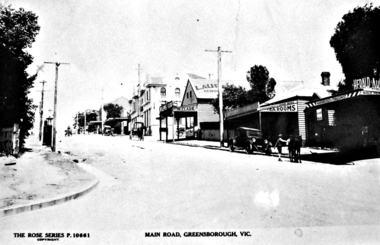
Photograph - Digital image, Main Street Greensborough (Rose Series), 1930c
... Rose Series" postcard no P10661 Main Street Greensborough. The Tobacconist Shop on the front Right cf: Advertiser Hurstbridge 2/1/1925 page 3: W. J. Franklin Authorised News Agent Hair Dresser and Tobacconist. Best Brands of Tobacco, Cigarettes and Cigars. Billiards and Snooker. Two Alcock Tables. Golf Accessories Stocked...Rose Series" postcard no P10661 Main Street Greensborough. The Tobacconist Shop on the front Right cf: Advertiser Hurstbridge 2/1/1925 page 3: W. J. Franklin Authorised News Agent Hair Dresser and Tobacconist. Best Brands of Tobacco, Cigarettes and Cigars. Billiards and Snooker. Two Alcock Tables. Golf Accessories Stocked ..."Rose Series" postcard no P10661 Main Street Greensborough. The Tobacconist Shop on the front Right cf: Advertiser Hurstbridge 2/1/1925 page 3: W. J. Franklin Authorised News Agent Hair Dresser and Tobacconist. Best Brands of Tobacco, Cigarettes and Cigars. Billiards and Snooker. Two Alcock Tables. Golf Accessories Stocked. Main Road, Greensborough.Digital copy of black and white postcard.main street greensborough, rose series postcards -
 Greensborough Historical Society
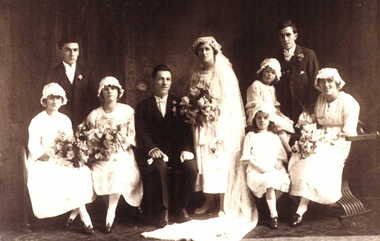
Photograph - Digital image, Barnett family 1921: wedding of Leslie Barnett to Lily Rose, 1921_
... Rose (bride), Kathy Barnett (rear), Jean (front), unknown male and female. Digital copy of black and white studio photograph. Photographs from the collection of Peter Blackbourn, a descendant of the Chapman Stock family. ...Rose (bride), Kathy Barnett (rear), Jean (front), unknown male and female. Digital copy of black and white studio photograph. Photographs from the collection of Peter Blackbourn, a descendant of the Chapman Stock family. ...Barnett family 1921 at the wedding of Leslie Barnett to Lily Rose. Left to right:: Elsie Barnett, Mr Brown, Dorothy Barnett, Leslie Barnett (groom), Lily Rose (bride), Kathy Barnett (rear), Jean (front), unknown male and female. Digital copy of black and white studio photograph. Photographs from the collection of Peter Blackbourn, a descendant of the Chapman Stock family. Annotations to photos by Peter Blackbourn.Digital copy of black and white studio photograph.peter blackbourn, leslie barnett, lily rose, lily barnett -
 Bendigo Historical Society Inc.
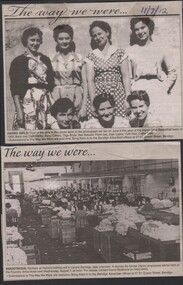
Newspaper - Skidmore Collection: Hanro staff at work newspaper cuttings from Bendigo Advertiser, 1947
... Skidmore Collection: newspaper cuttings of Hanro staff members featured in the Bendigo Advertiser's column "The Way We were" 11109.24a 1955 Back row: Cath Heffer, Beryl Climes, Olga Boyle, Bev Bassett; front row: Joan Lyons, Cath Kerr, Cathy Quin 11109.24b Workers at the Hanro Knitting Mill in Bendigo (date unknown) 11109.24c Five workers at the Hanro Knitting Mill (date unknown) 11109.24d Hanro workers packaging products at the Hanro knitting Mill (date unknown) 11109.24e Five ex-workers meet for a reunion of Hanro Knitting Mill workers (date unknown) 11109.24f A Buck's Party / gathering at the old band rooms on Eaglehawk Road circa 1959, prior to one (not identified) gets married Standing: Don Mannix, Barry Bowater, Russell main, Jim Harding, Lyle Makeham, Ron Runnalls, Geoff Christie, Ken Bruechert, Graham Nielson and Snow Cunningham; Kneeling: Bill Banks, Allan Johnson and Ray Taylor 11109.24g Seven female designers take a break at the Hanro Sales Conference in 1955; Beck Row: Shirley Morgan, Joyce Aldridge, Clarice, Johnson and Lena Johnson; Front Row: Iris Brereton, Shirley Kelly, & Evonne Meldrum 11109.24h Hanro workers relax in the canteen during the early 1950s 11109.24i Win Perrin packs a garment in the Hanro Stock Room (date unknown) 11109.24j B&W photo - Mrs Butler uses a basic pattern made of heavy paper in her design work, She is working on a cardigan No. 340, which won a wool award (date unknown) 11109.24k An undated phot shows materials in readiness for the building of the Hanro Knittiong Mills on Hargreaves Street 11109.24l & M Two B&W photos notes as Designers and Cutters at Hanro knitting Mills (March 1947 or 1949). Rear row: Elsie Treloar, Annette Hogan, Nell Wesley, Iris Mills, Bonnie Enderlin, Norma Treloar & Lena Horston. Front Row: Norma Scott, Norma Treloar, Shirley Mills, Rose...Social history of knitting mills in Bendigo staff reunion Hanro staff at work Skidmore Collection: newspaper cuttings of Hanro staff members featured in the Bendigo Advertiser's column "The Way We were" 11109.24a 1955 Back row: Cath Heffer, Beryl Climes, Olga Boyle, Bev Bassett; front row: Joan Lyons, Cath Kerr, Cathy Quin 11109.24b Workers at the Hanro Knitting Mill in Bendigo (date unknown) 11109.24c Five workers at the Hanro Knitting Mill (date unknown) 11109.24d Hanro workers packaging products at the Hanro knitting Mill (date unknown) 11109.24e Five ex-workers meet for a reunion of Hanro Knitting Mill workers (date unknown) 11109.24f A Buck's Party / gathering at the old band rooms on Eaglehawk Road circa 1959, prior to one (not identified) gets married Standing: Don Mannix, Barry Bowater, Russell main, Jim Harding, Lyle Makeham, Ron Runnalls, Geoff Christie, Ken Bruechert, Graham Nielson and Snow Cunningham; Kneeling: Bill Banks, Allan Johnson and Ray Taylor 11109.24g Seven female designers take a break at the Hanro Sales Conference in 1955; Beck Row: Shirley Morgan, Joyce Aldridge, Clarice, Johnson and Lena Johnson; Front Row: Iris Brereton, Shirley Kelly, & Evonne Meldrum 11109.24h Hanro workers relax in the canteen during the early 1950s 11109.24i Win Perrin packs a garment in the Hanro Stock Room (date unknown) 11109.24j B&W photo - Mrs Butler uses a basic pattern made of heavy paper in her design work, She is working on a cardigan No. 340, which won a wool award (date unknown) 11109.24k An undated phot shows materials in readiness for the building of the Hanro Knittiong Mills on Hargreaves Street 11109.24l & M Two B&W photos notes as Designers and Cutters at Hanro knitting Mills (March 1947 or 1949). Rear row: Elsie Treloar, Annette Hogan, Nell Wesley, Iris Mills, Bonnie Enderlin, Norma Treloar & Lena Horston. Front Row: Norma Scott, Norma Treloar, Shirley Mills, Rose ...Social history of knitting mills in Bendigo Skidmore Collection: newspaper cuttings of Hanro staff members featured in the Bendigo Advertiser's column "The Way We were" 11109.24a 1955 Back row: Cath Heffer, Beryl Climes, Olga Boyle, Bev Bassett; front row: Joan Lyons, Cath Kerr, Cathy Quin 11109.24b Workers at the Hanro Knitting Mill in Bendigo (date unknown) 11109.24c Five workers at the Hanro Knitting Mill (date unknown) 11109.24d Hanro workers packaging products at the Hanro knitting Mill (date unknown) 11109.24e Five ex-workers meet for a reunion of Hanro Knitting Mill workers (date unknown) 11109.24f A Buck's Party / gathering at the old band rooms on Eaglehawk Road circa 1959, prior to one (not identified) gets married Standing: Don Mannix, Barry Bowater, Russell main, Jim Harding, Lyle Makeham, Ron Runnalls, Geoff Christie, Ken Bruechert, Graham Nielson and Snow Cunningham; Kneeling: Bill Banks, Allan Johnson and Ray Taylor 11109.24g Seven female designers take a break at the Hanro Sales Conference in 1955; Beck Row: Shirley Morgan, Joyce Aldridge, Clarice, Johnson and Lena Johnson; Front Row: Iris Brereton, Shirley Kelly, & Evonne Meldrum 11109.24h Hanro workers relax in the canteen during the early 1950s 11109.24i Win Perrin packs a garment in the Hanro Stock Room (date unknown) 11109.24j B&W photo - Mrs Butler uses a basic pattern made of heavy paper in her design work, She is working on a cardigan No. 340, which won a wool award (date unknown) 11109.24k An undated phot shows materials in readiness for the building of the Hanro Knittiong Mills on Hargreaves Street 11109.24l & M Two B&W photos notes as Designers and Cutters at Hanro knitting Mills (March 1947 or 1949). Rear row: Elsie Treloar, Annette Hogan, Nell Wesley, Iris Mills, Bonnie Enderlin, Norma Treloar & Lena Horston. Front Row: Norma Scott, Norma Treloar, Shirley Mills, Rose Mills, & Shirley Kellystaff reunion, hanro staff at work -
 Bendigo Historical Society Inc.
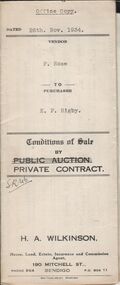
Document - H.A. & S.R. WILKINSON COLLECTION: CONTRACT OF SALE
... Rose (seller) and E.F. Rigby (buyer) of all that fruit and confectionary business situate No. 187 Mitchell Street, Bendigo, comprising all the stock, fittings, counters, show-cases within said shop, together with gas stove in kitchen and everything within the refreshment room with the exception of four pictures, one clock and one piano. ...Rose (seller) and E.F. Rigby (buyer) of all that fruit and confectionary business situate No. 187 Mitchell Street, Bendigo, comprising all the stock, fittings, counters, show-cases within said shop, together with gas stove in kitchen and everything within the refreshment room with the exception of four pictures, one clock and one piano. ...BHS CollectionConditions of sale by private contract dated 26th November, 1934 between F. Rose (seller) and E.F. Rigby (buyer) of all that fruit and confectionary business situate No. 187 Mitchell Street, Bendigo, comprising all the stock, fittings, counters, show-cases within said shop, together with gas stove in kitchen and everything within the refreshment room with the exception of four pictures, one clock and one piano. Price 120 poundsorganization, business, h.a. & s.r wilkinson real estate -
Glen Eira Historical Society
Document - Ormond Amateur Football Club
... Stock Val... Johnston J. R.... Rogers S. W.... Wood R. J.... Cameron Robert... Ladd Kevin J.... Pierce Greg... Ladd Clarrie... Meeking John... Fitts Clive... Doble Alan... Cooper Stephen... McLean Alan... English Graeme... Andrew Graham... Purcell Peter... Rose...Stock Val Johnston J. R. Rogers S. W. Wood R. J. Cameron Robert Ladd Kevin J. Pierce Greg Ladd Clarrie Meeking John Fitts Clive Doble Alan Cooper Stephen McLean Alan English Graeme Andrew Graham Purcell Peter Rose Mark Borland Norm Wood Andrew Farrell E. ...2 articles on Ormond Amateur Football Club, 1933 – 1973: 1/A 12 page document including 3 photocopied photos. Article documents the Premiership coaches for the 1933/34 seasons, a break till 1950 when article then continues to 1973 season. A brief description on the coaches success and mentions successful players who competed in the various team divisions over these years in the document. 2/A pamphlet for season 1935 Ormond Amateur Football Club listing office bearers, patrons, AGM details of business to be discussed, nominations for 1936 and income and expenditure account details.ormond amateur football club, clubs and associations, anthony mick, bentleigh amateur, bols lou, coaches (people), farrell ted, farrell edwin, farrell greg, wood roger, bourne bruce, moran graeme, chisholm andrew, patterson michael, blight bernie, cameron ian m., ferrari brian, kingston jack, foulsham clyde, burdekin e. f., moran graeme f., farrell e. j., graham a., russ jeff, cameron s. m., mcinerney peter j., finlayson brian, grace john, rowse ken, lepage neil, joachim nick, purcell ken, corben bruce f., stock jack, gillespie rob, mcdonald colin, humphries andrew, christie graham, graer david, craig beryl, smith thelma, stock val, johnston j. r., rogers s. w., wood r. j., cameron robert, ladd kevin j., pierce greg, ladd clarrie, meeking john, fitts clive, doble alan, cooper stephen, mclean alan, english graeme, andrew graham, purcell peter, rose mark, borland norm, wood andrew, farrell e. j., logan r. j., morgan peter, faulkner alan, slatter mick, burney cal, stock jack, norris mick/micheal, beecroft barry, crump wayne, humphreys andrew, cameron robert, morris steve, anstee laurie, spence phillip, hand robert, curtis noelene, murphy p. m. peter, foulsham d. a. david, finlayson r. j., roberts r. c., grumpton t. r.-terry, jenkins r. c. ron, mortimer j. i., wood r. j. roger, morgan p. j., graham a. m. alan, curtis r. s., grace j. m., johnston j. r., marshall l. j., logan r. j., jackson d. w., bourne b. k., farrell e. j., sierakowski d. d. peter, dexter p. d., russ j. i., scott d. h., joachim nick, hardham leigh, chapman ray, smith stephen, sterling greg, cramer dean, anstee laurie, barnes ted, barwick john, russell geoff, kozlowski i. a., pearce g. w., roberts r. c., swan g. m., graham a. m., curtis r. s., blight b. f., fitzroy r. m, jackson d. w., farrell e. j., pierce greg, scott david, holman greg, russ steve, mcdonald david, fisher s., o’reilly pat, borland norm, thomas g. t., naylor alan r., lewis m., szylit m., dove s. w., mooney d. j., bevers f. h., gunn e. e., stevens r. a., ellis h., fancett w., grainger v., rermezel y., dawson p., smith r. a., pascoe h., chisholm l. a., jones j. a., juniper p., anderson a. e., ellis r., o’dwyer f., pope a., handcock c., hatton c. h., anthony m., dunbar h., jones w., mckechnie h. j., jennings s., jennings a., porter j. r. dr., hogan j. f., frew g., hassed m. j., ryan rev. father, fethers d. b. dr., hallows bruce, porter j. r., nelson w. t., groves frank, chisholm l. a., vinton j. t., smith w. d., knowling c. h., duus e., evans r. j., smyth l. c., clarke w. j., bishton ja, grant v., tremills f. s., mcfadzean j. d., marley k. j., mckittrick a. e., halkyerd c. s., patience c. e., lynch k., occleshaw f. r., howard r., chapman c. w., jones j. a., evans j. g., ellsworth g., coaches, dunbar h., jones bill, wright bill, mooney mrs., trophies, bishton j. h., manning j., bray h., smyth l., creighton j., wright w., kirchner s., baker n., bevers mrs., gunn mrs., fancett mrs., creighton mrs., stevens mrs., ellis mrs., hatton mrs., mogan mrs., pascoe mrs., frew mrs., phillips mrs., grainger mrs., massed mrs., stillard miss, matt e. g., matt mrs., tremills mrs., cullen l. mrs., parker f. w. mrs., societal events and activities, flags, ormond park trust, sporting clubs, football clubs, football, australian rules football, sports officials, ormond, bentleigh -
 Bendigo Historical Society Inc.
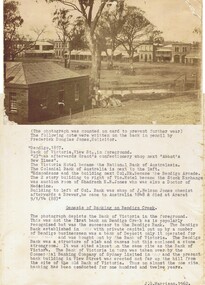
Photograph - M. ROSE COLLECTION: PALL MALL, BENDIGO, 1857
... Stock Exchange as auction room of Shadrach E.R. Jones who was also a Doctor of Medicine. Building to left of the Colonial. Bank was the shop of J. Nelson Jones Chemist afterwards a Brewer, he came to Australia 1848 and died in Ararat 9/1/14 (88). More information in the 'History', general notes. Photograph M. ROSE ...Photograph - black and white. Photograph of Pall Mall, Bendigo, 1857, taken from View Point. The following notes were written on the back in pencil by Frederick Douglas Jones, Solicitor. 'Bendigo, 1857. Bank of Victoria, View St., in foreground. '23' was afterwards Grant's Confectionery shop next 'Abbot's New Times.' The Victoria Hotel became the National Bank of Australasia. The Colonial Bank of Australia is next to the left. 'Edmondson's and the building next Colonial. Bank., became the Bendigo Arcade. The 2 story building to right of the Victoria Hotel became the Stock Exchange as auction room of Shadrach E.R. Jones who was also a Doctor of Medicine. Building to left of the Colonial. Bank was the shop of J. Nelson Jones Chemist afterwards a Brewer, he came to Australia 1848 and died in Ararat 9/1/14 (88). More information in the 'History', general notes.Alex Fox (probably)place, bendigo, pall mall, pall mall bendigo. -
 Otway Districts Historical Society
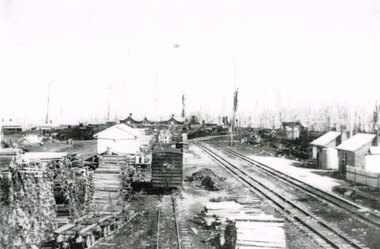
Photograph, Beech Forest Railway Station, 1910, 1910
... Passenger journeys rose steadily, outwards goods traffic rose to a record 12,959 tons (in 1911), and inwards goods traffic was a record 3,359 tons.. The railway station possessed a goods shed, stock race and yards, engine shed, coal stage, crew cabins, a refreshment room, and a four-roomed station building, with the station staff to match. ...Passenger journeys rose steadily, outwards goods traffic rose to a record 12,959 tons (in 1911), and inwards goods traffic was a record 3,359 tons.. The railway station possessed a goods shed, stock race and yards, engine shed, coal stage, crew cabins, a refreshment room, and a four-roomed station building, with the station staff to match. ...By 1910 revenue from the Beech Forest railway was $15,500, working expenditure $12,000, with a net loss (including interest charges) of about $4,000. This and the following year were the lowest net losses ever experienced. Passenger journeys rose steadily, outwards goods traffic rose to a record 12,959 tons (in 1911), and inwards goods traffic was a record 3,359 tons.. The railway station possessed a goods shed, stock race and yards, engine shed, coal stage, crew cabins, a refreshment room, and a four-roomed station building, with the station staff to match. Beech Forest was the principal despatch centre at this stage for split timber. Bill Devitt laid a timber tramway to the Beech Forest railway station to cart the palings for on-shipment..B/W. 177mm x 271mm. A general view from the eastern end of Beech Forest station in 1910. Note the Goods Shed, three tracks with No.3 Road having a NU louvre van and loaded NQR wagons, timber stacks to the left, and Devitt's Tramway with unloaded trolleys at the lower left. To the right, crew cabins with shops and houses in the background.beech forest; railways; timber; tramway; -
 Bendigo Military Museum
Uniform - DRESS UNIFORM, RAAF
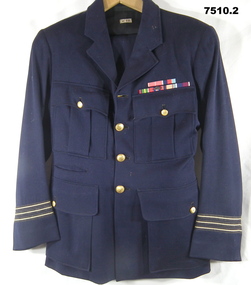
... rose through the ranks to be Wing Commander on 1.7.1951. During WW2 from 1941 he was explosives Inspecting Officer at Northern Area 5 then to Explosive Inspecting Officer for the whole RAAF in the S/W Pacific. This role took him to some 21 places in the North from Townsville - Darwin to across the islands many several times. Leonard was awarded a "Mention in Despatches" on Morotai in 1945. Post WW2 in 1950 Leonard was appointed Chief Inspector of explosives in the RAAF, one of these roles was the supervision of the disposal of large quantities of War Stock...rose through the ranks to be Wing Commander on 1.7.1951. During WW2 from 1941 he was explosives Inspecting Officer at Northern Area 5 then to Explosive Inspecting Officer for the whole RAAF in the S/W Pacific. This role took him to some 21 places in the North from Townsville - Darwin to across the islands many several times. Leonard was awarded a "Mention in Despatches" on Morotai in 1945. Post WW2 in 1950 Leonard was appointed Chief Inspector of explosives in the RAAF, one of these roles was the supervision of the disposal of large quantities of War Stock ...The uniform belonged to Wing Commander "Leonard Bacon", born 11 June 1906. He enlisted in the RAAF on 31 May 1926 No. 03305 with the rank AC.1. In 9 postings in Vic, QLD and WA he rose through 11 ranks to Sgt Maj Class 2 by 1940. He was commissioned as Flying Officer on 1.8.1940. He rose through the ranks to be Wing Commander on 1.7.1951. During WW2 from 1941 he was explosives Inspecting Officer at Northern Area 5 then to Explosive Inspecting Officer for the whole RAAF in the S/W Pacific. This role took him to some 21 places in the North from Townsville - Darwin to across the islands many several times. Leonard was awarded a "Mention in Despatches" on Morotai in 1945. Post WW2 in 1950 Leonard was appointed Chief Inspector of explosives in the RAAF, one of these roles was the supervision of the disposal of large quantities of War Stock. On 13.6.1958 he was recommended for an “OBE” which he received in the 1959 New Years Honors List. Leonard retired from the RAAF on 11.6.1960 after 34 years. This is a very brief record of his service documents.Dark Blue Service Dress Uniform comprising of jacket (.1) Pants (.2) gold buttons with RAAF emblems. Ribbons on the coat are as follows; Left to Right: OBE, 1939-45 Star, Pacific Star, British War Medal with clasp "MID". Australian Service medal, Long Service and Good Conduct medal. Jacket has black inside lining with belt connected to back. Three stripes of Wing Commander rank on the sleeves. Size "M".raaf, uniform, leonard bacon -
 National Wool Museum
Wool Bale
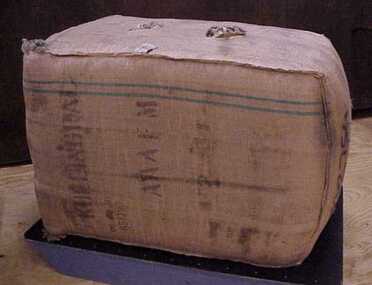
... rose. Unfortunately the stockpiled wool accumulated until the reserve price scheme collapsed in 1991. At its peak the wool stock pile reached 4.7 million bales. ...rose. Unfortunately the stockpiled wool accumulated until the reserve price scheme collapsed in 1991. At its peak the wool stock pile reached 4.7 million bales. ...Wool bale from the last of the wool stockpile. The wool stockpile accumulated when the price of wool fell - growers were protected by a reserve price scheme (first established in 1974) which meant that the former Australian Wool Corporation purchased wool that did not meet the reserve price. The wool was kept until the prices rose. Unfortunately the stockpiled wool accumulated until the reserve price scheme collapsed in 1991. At its peak the wool stock pile reached 4.7 million bales. This particular bale is one of the last from the stockpile which has gradually diminished since 1991. This bale was part of a nine-bale lot from the clip of Richard Froomes (Seaspray, Gippsland) and was purchased by the Australian Wool Corporation from Brian Rodwell and Co. Pty Ltd's (stock and station agents) November 1989 catalogue. It is marked as bale no. 2 and carries Richard Froomes' 'Kullingral' brand, and is classed at AAAFM (best wool) and is 21.1 microns (see AWTA certificate in supp. file). The 'Kullingral' branded bales were from a 3500 head fine wool flock, based on Merryville and The Fringe bloodlines. Richard Froomes moved out of wool production in 1996.TA PACK / BATCH NO T-291 M8754 KULLINGRAL / AAAFM / 2 KULLINGRAL / PI / BI / 651390 / AAAFM / 2 / BR / WIwool sales - reserve price plan wool stockpile textile mills textile mills, wool sales - reserve price plan, wool stockpile, textile mills -
 St Kilda Historical Society
Document - Advertisement, G Brunning & Son St Kilda Nurseries, Pre - 1901 (original)
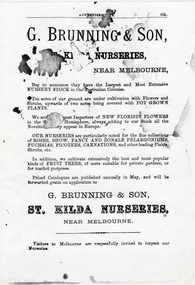
... We are the biggest Importers of new florists flowers in the Southern Hemisphere, always adding to our Stock all the Novelties as they appear in Europe. Our nurseries are particularly noted for the fine collections of roses, show, fancy and zone pelargoniums, fuchsias, picots, carnations, and other leading Plants, Shrubs, etc. ...We are the biggest Importers of new florists flowers in the Southern Hemisphere, always adding to our Stock all the Novelties as they appear in Europe. Our nurseries are particularly noted for the fine collections of roses, show, fancy and zone pelargoniums, fuchsias, picots, carnations, and other leading Plants, Shrubs, etc. ...George Brunning was born in Suffolk, England, on 2 October 1830 and settled in St Kilda in June, 1852. He was a gardener and became part-proprietor and manager of Rule's Nursery in Richmond before establishing the first nursery of his own in 1861. Following his death on 5 June 1893, his sons continued the business. An article published in Punch in 1907 observed 'Nearly all the flowers grown in and around Melbourne, indeed, throughout Victoria, which are not native to Australia, had their origins in the nurseries of George Brunning and Sons. The statement is a large one to make, but it is literally true.'Single page black and white photocopy of advertisement from an unidentified publication for G Brunning & SonG Brunning & Son, St Kilda Nurseries, Near Melbourne, Beg to announce they have the Largest and Most Extensive Nursery Stock in the Australian Colonies. Ten acres of our ground are under cultivation with Flowers and Shrubs, upwards of two acres being covered with pot grown plants. We are the biggest Importers of new florists flowers in the Southern Hemisphere, always adding to our Stock all the Novelties as they appear in Europe. Our nurseries are particularly noted for the fine collections of roses, show, fancy and zone pelargoniums, fuchsias, picots, carnations, and other leading Plants, Shrubs, etc. In addition, we cultivate extensively the best and most popular kinds of fruit trees, of sorts suitable for private gardens, or for market purposes. Priced Catalogues are published annually in May, and will be forwarded gratis on application to G Brunning & Son, St Kilda Nurseries, Near Melbourne. Visitors to Melbourne are respectfully invited to inspect our Nurseries.g brunning and son, plant nurseries victoria, st kilda, 19th century -
 Stawell Historical Society Inc
Photograph, "Moke-Billy" Station in the Grampians owned by Mr. Rose -- Sketch 1844 at National Gallery of Victoria
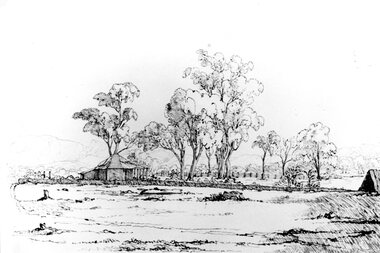
... Rose, Charles Browning Hall early writing suggests Hall was a stock Herder this lead him to the Grampians district. ...Rose, Charles Browning Hall early writing suggests Hall was a stock Herder this lead him to the Grampians district. ...Copy of a sketch of Moke-Billy. Mr. Rose’s Station Grampians 1844 by R.H. Bunbury Previous to Mr. Rose, Charles Browning Hall early writing suggests Hall was a stock Herder this lead him to the Grampians district. Hall held two runs in the Wimmera district La Rose and Moke-Billy (Pille). 1841 - 42 - Hall's Gap is named after him. Phillip Davis Rose - Leased La Rose and Moke-Billy (Pille) 1842-43Original In National Gallery of VictoriaBlack & white photograph of a sketch of a log home and chimney. Lean-to on back, veranda on the front. Bark roof. Log fence. Building surrounded by tall trees with outline of mountains in the background. On the left is what looks like a back shelter. National Gallery of Victoria. Artist or School R. H. Bunbury 1814 - 1857 Title Moke-Billy, Mr. Rose's Station, Grampians. December, 1844. Medium drawing Dimensions 16.6 x 24.6 cm Accession No. Credit Line Presented 1954 To be reproduced only by written permission of National Gallery of Victoria 180 St. Kilda Road Melbourne Vic., Australia 3004. -
 Stawell Historical Society Inc
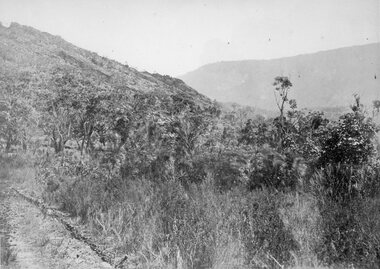
Photograph, Grampians Entrance to Halls Gap 1866
... In his letter to Joseph Latrobe he gives no clue about his early life except that he was a stock herder as early as 1837. He held two runs in the Wimmer district, that of La Rose and Mokebila in the Grampians (1841 to 1842). ...In his letter to Joseph Latrobe he gives no clue about his early life except that he was a stock herder as early as 1837. He held two runs in the Wimmer district, that of La Rose and Mokebila in the Grampians (1841 to 1842). ...Grampians Entrance to Halls Gap. Part of a collection of Photographs by Mr. O.G. Armstrong as commissioned by the Shire of Stawell for the Inter-colonial and Paris Exhibition in Melbourne in 1866. Halls Gap is named after Charles Browning Hall. In his letter to Joseph Latrobe he gives no clue about his early life except that he was a stock herder as early as 1837. He held two runs in the Wimmer district, that of La Rose and Mokebila in the Grampians (1841 to 1842). He then moved to the Clunes area in 1851. He was a member of the Carisbrook Magistrates Bench. stawell -
 Melbourne Tram Museum
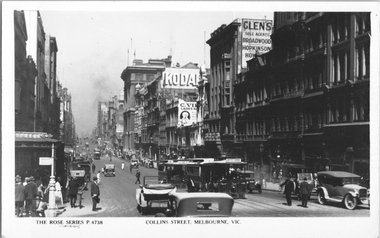
Postcard, Rose Stereograph Co, "Collins Street Melbourne", c1923
... The photo dates from c1923 as both Temple Court and the integration of the Melbourne Stock Exchange building into the ES&A Bank further along Collins Street are in progress. Yields information about Collins St c1923 trams tramways cable trams Collins St Rose Series Has the Ken Magor stamp on the rear. ...Rose Series postcard No. P 4738, titled "Collins Street Melbourne", looking west from Swanston Street. Has several cable trams in the view, the nearest one having a destination of "Victoria Bridge" the second "Spring Street". There are adverts for Kodak on east wall of The Block Arcade; Glen's Piano & Music Warehouse promoting long established English Piano Brands of "Broadwood" and Hopkinson". The company may not have been trading at this location at the time of the photograph. A Tramways employee is standing in the safety zone. The Gas Street Lamp with a ladder leaning against it on the footpath still remains today. The photo dates from c1923 as both Temple Court and the integration of the Melbourne Stock Exchange building into the ES&A Bank further along Collins Street are in progress. Yields information about Collins St c1923Postcard - printed real photograph with Rose Stereograph Co. name on the rear.Has the Ken Magor stamp on the rear.trams, tramways, cable trams, collins st, rose series -
Thompson's Foundry Band Inc. (Castlemaine)
Document - Sheet Music for Brass Band, Chappel & Co Ltd et al, Blueberry Hill, 1940
... rose...alan fernie...1950s...al lewis...larry stock...The song was first published in 1940 with the music composed by Vincent Rose (1880-1944), and lyrics written by Larry Stock and Al Lewis. ...Stock...Vincent Rose...The song was first published in 1940 with the music composed by Vincent Rose (1880-1944), and lyrics written by Larry Stock and Al Lewis. ...Blueberry Hill is considered a blues standard, made popular by Fats Domino. The song was first published in 1940 with the music composed by Vincent Rose (1880-1944), and lyrics written by Larry Stock and Al Lewis. This arrangement is by Alan Fernie and was released by Obrasso Verlag AG. The tune was originally written for the 1941 western film "The Singing Hill" where it was first performed by Gene Autry.Sheet music for cornet printed in black ink on white A4 paper. 20 Parts for Brass band: Soprano Cornet Solo Cornet Repiano Cornet 2nd Cornet 3rd Cornet Flugelhorn Solo Horn 1st Horn 2nd Horn Euphonium 1st Baritone 2nd Baritone 1st Trombone 2nd Trombone Bass Trombone Eb Bass Bb Bass Percussion Drum Kit Timpani & Glock non-fictionBlueberry Hill is considered a blues standard, made popular by Fats Domino. The song was first published in 1940 with the music composed by Vincent Rose (1880-1944), and lyrics written by Larry Stock and Al Lewis. This arrangement is by Alan Fernie and was released by Obrasso Verlag AG. The tune was originally written for the 1941 western film "The Singing Hill" where it was first performed by Gene Autry. obrasso-verlag ag, blueberry hill, fats domino, gene autry, the singing hill, blues, rhythm and blues, rock and roll, vincent rose, alan fernie, 1950s, al lewis, larry stock -
 University of Melbourne, Burnley Campus Archives
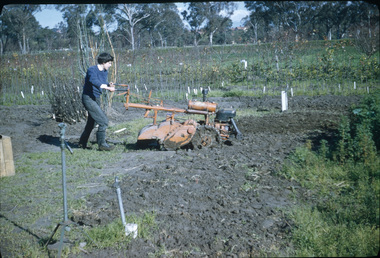
Album - Colour 35mm slides, James (Jim) Pleasance, Miscellaneous Burnley Views, 1975-1988
... students margaret oliver cultivator lupins crops section seed testing lab julie provan lawn ponds native garden blossom fruit trees children planting green manure garden views administration building crack willow peach blossom orchard sunken garden rose garden flowers acacia maidenii vegetables Box of coloured slides, all from different collections. (1) "Students Margaret Oliver," on reverse,"Equipment 2190 Cultivator" (2) "Green manure crops. Field peas lupins." 1975 (3) "B.H.C." on reverse, "Seed beds." (4) "29/4/64 Crops Section." (5) "Seed Testing Lab (1966)." (6) "Julie Provan Peach stock Block." ...Box of coloured slides, all from different collections. (1) "Students Margaret Oliver," on reverse,"Equipment 2190 Cultivator" (2) "Green manure crops. Field peas lupins." 1975 (3) "B.H.C." on reverse, "Seed beds." (4) "29/4/64 Crops Section." (5) "Seed Testing Lab (1966)." (6) "Julie Provan Peach stock Block." Sep (7) View of back of lawn." Aug 1980 (8) View of Ponds." ((0 Constructing Native Garden. (10) Crack Willow in winter. Jul 1978 (11) Crack Willow in summer. Jul 1988 (12) Administration Building. 1985 (13) Blossom. (14) Blossom on fruit trees. Sep (15) Children Planting. Aug 1985. Also others.students, margaret oliver, cultivator, lupins, crops section, seed testing lab, julie provan, lawn, ponds, native garden, blossom, fruit trees, children, planting, green manure, garden views, administration building, crack willow, peach blossom, orchard, sunken garden, rose garden, flowers, acacia maidenii, vegetables -
 University of Melbourne, Burnley Campus Archives
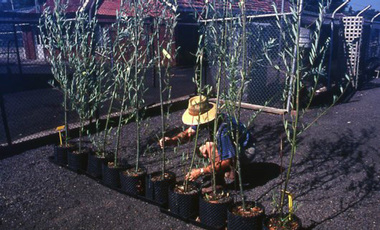
Album - Colour 35mm slides, Glenys Rose, Nursery Demonstration
... Rose Volunteer FOBG Plant Propagation. Found in the Nursery. jeremy wallace nursery manager demonstration roots curling nursery 25 slides, including duplicates. Jeremy Wallace, Nursery Manager, appears in some of them. Demonstrating new method of keeping tree nursery stock ...Donated by Glenys Rose Volunteer FOBG Plant Propagation. Found in the Nursery.25 slides, including duplicates. Jeremy Wallace, Nursery Manager, appears in some of them. Demonstrating new method of keeping tree nursery stock to prevent roots curling. jeremy wallace, nursery manager, demonstration, roots curling, nursery -
 University of Melbourne, Burnley Campus Archives
Photograph - Colour slides, Thomas H. Kneen, Burnley Views, 1956-1969
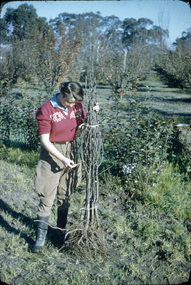
... stock. (2) "Orchard June 1956 No. 1710." 2 men and a tractor.(3) "Camp 1957." Wilson's Promontory. (4) View of Drive No. 1677." C. 1958 (5) "GenView No. 1771." (6) "Burnley Gardens Entrance 4.4.58 N0. 1672." (7) "Wilson's Promontory Lilly Pilly Gully Nov 1960." (8) Dec '62." (9) "Dec '62." Kneen child. (10) Luffmann Ponds "Aut. 1962." (11) Grevillea Sep 1963. (12) Sep 1963.Reflection of Crack Willow in Luffmann Ponds. (13) Sep 1963. Orchard blossom. (14) View of Administration Building at sunset Aug 1964. (15) Rose...Kneen marjorie hall students fruit trees orchard tractor wilson's promontory burnley gardens entrance drive garden view luffmann ponds grevillea rose kneen family sign wintersweet plant science block administration building students working outside principals residence plaque rose pruning demonstrations ginkgo pelargoniums erythryna Box of 47 slides, some labelled. (1) "Marjorie Hall 1st Year Student June '56 No. 1872." Working with fruit tree stock ...Contributor: T.H. KneenBox of 47 slides, some labelled. (1) "Marjorie Hall 1st Year Student June '56 No. 1872." Working with fruit tree stock. (2) "Orchard June 1956 No. 1710." 2 men and a tractor.(3) "Camp 1957." Wilson's Promontory. (4) View of Drive No. 1677." C. 1958 (5) "GenView No. 1771." (6) "Burnley Gardens Entrance 4.4.58 N0. 1672." (7) "Wilson's Promontory Lilly Pilly Gully Nov 1960." (8) Dec '62." (9) "Dec '62." Kneen child. (10) Luffmann Ponds "Aut. 1962." (11) Grevillea Sep 1963. (12) Sep 1963.Reflection of Crack Willow in Luffmann Ponds. (13) Sep 1963. Orchard blossom. (14) View of Administration Building at sunset Aug 1964. (15) Rose 'Heat Wave.' May 1965. (16) Kneen child sitting under a tree May 1966. (17) 'Department of Agriculture Burnley Gardens' sign May 1966. (18) Administration Building May 1966. (19) Plant Science Block May 1966. ((20) Wintersweet August 1966.(Actually appears to be Witch Hazel Hamamelis mollis.) (21) Student on tractor in the Orchard October 1966. (22) Garden view, view of Principal's Residence through blossom trees October 1966. (23) Students walking through the Gardens October 1966. (24) "Leaf Cuttings Rex begonia 2 October 1966. (25) Emily Gibson beds October 1966. (26) Principal's Residence in a garden view October 1966. (27) Garden view looking towards the Principal's Residence and the Shady Garden October 1966. (28) Drive looking towards the Administration Building from the Plant Research Institute. (29) Kneen child (not Burnley?) (30) Unveiling of Burnley Horticultural College plaque commemorating 75 years, 1891-1966 - Eric Littlejohn, ?, T.H. Kneen. Includes key to Pavilion 1969. (31) "Rose Pruning Demo - Canteen." July 1969. (32, 33) "Rose Pruning Demo 1969." July 1969. (34) "Plant Science Block & College." July 1969. (35) Plant Science Block 6/69." July 1969. (36) "Burnley Gardens 6/69." looking towards Dairy and Yarra Boulevard (37) "Pond No. 1717." (38) "Pond 1748." Kneen children playing by the Luffmann Ponds, Oak tree behind.. (39) Ginkgo leaves June 1967. (42) ? (43) Erithyna caffra in flower (removed 2016) December 1966. ((44) Administration Building and Nursery from PRI." (45) Pelargoniums. (46) Azalea mollis (47) Pelargonium foreground, geranium background.marjorie hall, students, fruit trees, orchard, tractor, wilson's promontory, burnley gardens, entrance, drive, garden view, luffmann ponds, grevillea, rose, kneen family, sign, wintersweet, plant science block, administration building, students working outside, principals residence, plaque, rose pruning demonstrations, ginkgo, pelargoniums, erythryna -
 University of Melbourne, Burnley Campus Archives
Album - Black and white and colour slides, Gnome, Burnley Views, 1947-1955
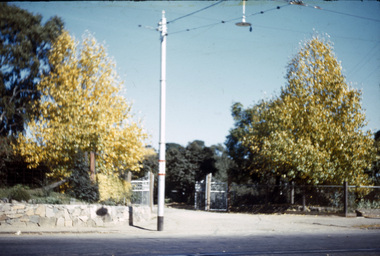
... Coleus) in a glasshouse. (23, 24)Stock Matthiola incana. (25) Blossom in the Orchard c. (26) Orchard c. (27) Picking fruit in the Orchard c. (28) 2 female students holdong large bunches of poppies c. (29) Flowers growing in the Orchard c. (30) House - not Burnley c. (31) Students on an excursion c. (32) Staff member with Gladioli c. (33) Garden view - not Burnley? c. (34) Administration Building c. (35) Roses...Coleus) in a glasshouse. (23, 24)Stock Matthiola incana. (25) Blossom in the Orchard c. (26) Orchard c. (27) Picking fruit in the Orchard c. (28) 2 female students holdong large bunches of poppies c. (29) Flowers growing in the Orchard c. (30) House - not Burnley c. (31) Students on an excursion c. (32) Staff member with Gladioli c. (33) Garden view - not Burnley? c. (34) Administration Building c. (35) Roses ...Contributor: T.H. KneenCardboard box of 108 35mm glass slides in metal frames made by "Gnome." Box labelled "Burnley Gardens Slides." Also 16 unused slides (1) Swan Street entrance c. (2) Orchid? b/w. (3) Nursery b/w. (4) Pasture area with man working b/w. (5) Draught horse working in the Orchard b/w. (6) Crop of corn in the Orchard c. (7) Magnolia c. (Magnolia x soulangeana). (8) Display of orange flowers c. (9) Lemon tree in the Orchard c. (10) Sign advertising 'Fruit Tree Pruning Demonstarion Sat. 2nd July (1949) c. (11) Jersey cow c. (12) Rock Point c. (13) Dahlias in the Orchard c. (14) Foundation Stone '28th August, 1946' c. (15) Felled Cypress tree 1951 b/w. (16) School truck in front of glasshouses and cacti b/w. (17)Administration Building completed but surrounded by rubble C.1949 c. (18) Plant Research Institute c. (19) Inside a glasshouse. c. (20) Administration Building c. (21) Group of female students dressed up for a function c. (22) Solenostemon (Syn. Coleus) in a glasshouse. (23, 24)Stock Matthiola incana. (25) Blossom in the Orchard c. (26) Orchard c. (27) Picking fruit in the Orchard c. (28) 2 female students holdong large bunches of poppies c. (29) Flowers growing in the Orchard c. (30) House - not Burnley c. (31) Students on an excursion c. (32) Staff member with Gladioli c. (33) Garden view - not Burnley? c. (34) Administration Building c. (35) Roses c. (36) Flowers in the Orchard c. (37) Draught horse working in the Orchard c. (38) Staff member amongst flowers in the Orchard c. (39) Garden view c. ((40) Blossom in the Orchard c. (41) Orchard c. (42) Flowers inside glasshouse c. (43) Mesembryanthemums in pots possibly in the nursery c. (44) Tree b/w. (45) Garden bed c. (46) Sign, 'Agrostology Branch, pasture Plant Research Field,' c. (47) Path to Principal's Residence c. (48) Irrigation in the Orchard b/w. (49) Cactus flowers b/w. (50) Garden view with T.H. Kneen children playing c. (51) (52) Cinerarias (now Pericallis x hybrida) in pots c. (53) Temporary building where the Grey Garden is now b/w. (54) Garden view b/w. (55) Unknown building b/w. (56) Person pruning in the Orchard c. (57) Students working in the Orchard c. (58) Swan Street with recently completed rock wall constructed by the Public Works Department b/w. (59) Lagoon paddock b/w. (60,62) Pavilion and new Administration Building before the Pavilion was removed b/w. (61) As (60) but viewed from a different direction c. (63) Plant c. (64) View through a window on the stairs in the Administration Building c. (65) Plant c. (66) Garden view of trees c. (67) Garden View b/w. (68) Blossom tree c. (69 )Garden view along path to Principal's Residence c. (70) Lagoon Paddock c. (71) Lagoon Paddock with cows b/w. (72) Inside a glasshouse b/w. (73) Entrance sign- Department of Agriculture Burnley Gardens, School of Horticulture & Primary Agriculture, Plant Research laboratory, Agrostology Branch, Fruit Preserving Branch c. (74) Plant Research Laboratory b/w. (75) Students on an excursion c. (76) Glasshouses b/w. (77) Garden view b/w. (78) Kniphophia c. (79) Hibiscus c. (80) Garden view c. (81) Dairy, Silo and dog b/w. (82) Irrigation in then Orchard b/w. (83) Garden view with magnolia c. (84) Flower plots in the Orchard c. (85) Pruning demonstration b/w. (86) Administration Building under construction c. (87) Rock Point c. (88) Mrs Kneen and Magnolia c. (89) Glasshouses c. (90) Sequoia sempervirens b/w. (91) Inside Administration Building c. (92) Luffmann Ponds b/w. (93) Sequoia sempervirend, Mrs Kneen and child c. (94) Garden bed in front of Sequoian sempervirens c. (95) Principals Residence b/w. (96) Poultry pens b/w. 1947 (97) Principals Residence b/w. (98) Student picking fruit from netted tree b/w. (99) Rock Point and Long Border c. (100) Administration Building under construction c. (101) Greenhouse b/w. (102) Rock Point c. (103) Flowers in the Orchard c. (104) Waterlilies in the Pond c. (105) Blossom tree c. (106) Hilda Kirkhope Rockery c. (107) Long Border c. (108) Plant Research Institute with flower border along drive c.burnley gardens, flower, nursery, pasture, draught horse, orchard, crops, magnolia, chicken coops, egg laying competition, glass slide -
 Melbourne Tram Museum
Ephemera - Ticket/s, Melbourne & Metropolitan Tramways Board (MMTB), MMTB Transfer ticket, early 1920's
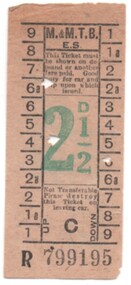
... The transfer is (I think) from the original McCaskey Systems printing for the "great fare revision" of March 1921, when most fares rose by ½d (or 1d on Sundays & Public Holidays), and is on the wider paper stock of those issues. ...The transfer is (I think) from the original McCaskey Systems printing for the "great fare revision" of March 1921, when most fares rose by ½d (or 1d on Sundays & Public Holidays), and is on the wider paper stock of those issues. ...Ticket - 2 1/2d, MMTB black printing on light brown paper with the value in green ink. A transfer ticket matched with Reg Item 5522. Has a "Victoria Bitter" print on the rear. Ticket No. R799195 Advice from Dean Filgate 7/1/2020 for this item and 5522: "very interesting tickets (why can't I find gems like these when I haunt old bookshops ?) and even better - a matched transfer pair ! The transfer is (I think) from the original McCaskey Systems printing for the "great fare revision" of March 1921, when most fares rose by ½d (or 1d on Sundays & Public Holidays), and is on the wider paper stock of those issues. The 2½d is from a later printing on narrower (but still "long") paper stock, but retains the black + coloured (value) ink on white paper scheme. The original issues had McCaskey's imprint and the value repeated on the back. They are a very nice pair. At some stage in the early/mid-1920s coloured paper tickets were again produced alongside the white-paper issues, before totally replacing them. Some of the colours were also altered. Sands & McDougall cornered the ticket-printing market about this time, blitzing all opposition with a press that produced 57 tickets at once - compared to everyone else's 2-at-a-time presses (Geoff Dean has more information on this). The "horizontal" format (similar to Sydney) was trialled in the late 1920s, and deemed a failure. The number of sections, their direction, and the use of Up/Down or In/Out varied over the years - I have put together a 'chronology' in order of issue, but unfortunately cannot assign dates of issue (yet ? ). 2nd email of 10/1/2021 Yes - keep those two tickets paired together (most people don't ); the only other matched transfer pair that I have seen was in Travis Jeffrey's collection. The 2½d ticket is a mid-1920s printing (from Sands & McDougall, so I am led to believe), the design being re-worked from their previous batch that had this value in red. There may have been another slight revision before the next design - of horizontal (Sydney-type) tickets - were issued. It would appear that horizontal format had already been used by the cable trams well before the electric trams, and that this "next horizontal issue" was used for both cable and electric trams. What I neglected to say before, was that this is an Electric System issue - as denoted by the "E.S." at the top: the alternate heading was "CABLE TRAMWAYS". Most enthusiasts mistake those initials to mean "Eastern System": demonstrably it is not, because there were "E.S." tickets issued specifically for use at Coburg and Essendon depots only (mostly return fares, with the destinations marked on the ticket).trams, tramways, tickets, mmtb, transfer tickets -
 City of Melbourne Libraries
Photograph, Bull, Hugh Jones, 1897-1993, Lord Mayor's Dinner, Melbourne Town Hall
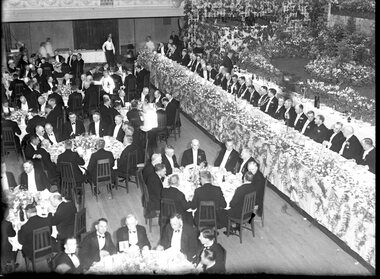
... In the Lower Town Hall great banks of calceolarias and azaleas decked the upper dais, and each supper table was adorned with a different coloured flower with sprays of roses and Japanese maple laid on the snowy cloths. The adjoining supper-rooms were fragrant with the scent of huge bowls of stock in mauve, purple, and pink, while the white walls were covered with palm leaves and flowers. ...In the Lower Town Hall great banks of calceolarias and azaleas decked the upper dais, and each supper table was adorned with a different coloured flower with sprays of roses and Japanese maple laid on the snowy cloths. The adjoining supper-rooms were fragrant with the scent of huge bowls of stock in mauve, purple, and pink, while the white walls were covered with palm leaves and flowers. ...Photographer notations on slide: "General View Of Lord Mayor's Dinner At Town Hall Nov 1936 B112" Published: The Age, Tuesday 10 November 1936, page 13 Published title: LORD MAYOR'S BANQUET Published caption: The brilliant scene inside the Melbourne Town Hall last night during the Lord Mayor’s banquet. Trove article identifier: http://nla.gov.au/nla.news-article205939431 Description: 700 guests (all men) are seated around numerous tables in the Melbourne Town Hall for the Lord Mayor's dinner in November 1936. Before the stage is a top table of 35 men, all dressed smartly in black dinner suits, with either a black or white bow tie. Many are wearing their medals. The Lord Mayor has on his Mayoral chains, and to his right is the Governor of Victoria, Lord Huntingfield. The stage is heavily decorated with fresh flowers. Research by project volunteer, Louise McKenzie: This image takes up one quarter of the photographic space on page 13 of The Age on 10 November 1936, reflecting the importance of the event and also the sheer dramatics of the image: 700 guests (all men), a top table of 35, and all dressed smartly in black dinner suits, with either a black or white bow tie. Many are wearing their medals. The Lord Mayor has on his Mayoral chains, and to his right is the Governor of Victoria, Lord Huntingfield. Further to his right is a man with an impressive sash across his chest. It is a very animated, and rather informal, moment. Banks of fresh flowers smother the stage, which is decorated in the manner of a terrace at an English stately home. Tables are laden with food, drink and decorations, and the wait staff (men and women) are also formally dressed, in the manner of Downton Abbey. It is spectacular, dramatic, and luxurious, and perpetuates the proud descriptor of “Marvellous Melbourne” as conferred by London Journalist George Augustus Sala when he visited the city in 1885. During its 1880s boom, Melbourne was the second-largest city in the British Empire, after London, and reputedly the richest city in the world. At times the expression was used with some irony, but "...in Victoria’s centenary year, 1934, with the city mired in another depression, a publisher bravely entitled a book of souvenir photographs Marvellous Melbourne, claiming that the subject ‘still finds apt expression in the happy one-time sobriquet’.” This photo seems to reflect an ongoing pride in Melbourne and a desire for it to live up to its descriptor and celebrate its post-centenary era in style. So it is no surprise to find that on page 11 of The Age on the same day, a second photo is to be found – a cropped view of one table – along with a very detailed description of the night, its purpose, and a surprise announcement. But, who was the Lord Mayor in whose honour the dinner was held? In 1934, the Lord Mayor of Melbourne was Cr. Alexander George Wales, (born Richmond, 11 October 1885, died Elsterwick, 31 May 1962). His father was a contractor and quarry-owner, but was blinded in an industrial accident in 1899. Consequently Alexander, then aged 14, left Brunswick State School to become a railway labourer working at a quarry, and in 1903 joined the Commonwealth public service as a clerk and began studying at night school, determined to improve himself. In 1907 he was appointed secretary of the Albion Quarrying Co. (in which the family had an interest), then its managing director and chairman. As the Australian Dictionary of Biography notes, he was instrumental in expanding the company’s interests, "...becoming director of the Hardware Co. of Australia Pty Ltd, the Twentieth Century Building and Investment Society, the Albion Sand Co. and the Geelong Brick Co.”. His public career began in 1914 when he was elected to the Brunswick council. He was mayor 1917-18, and in 1925 progressed to the Melbourne City Council where he remained for 29 years, being a member of most council committees. He served three successive terms as lord mayor (1934-37), was Chairman of the council’s decorations committee for Melbourne’s centenary, president of the Metropolitan Fire Brigades Board (1936), and Chairman of the Public Works Committee (1937-39). In 1936 he was elected to the Legislative Council with United Australia Party support, but later resigned over possible State government contract tender irregularities. Wales received "the customary reward” of a knighthood and was invested at Buckingham Palace by King George VI whose coronation he attended in 1937. He was an early director of what is now Ampol, and helped the development of the petroleum industry in Australia after visiting the USA in 1943 and 1946. He was impressed by that country’s wartime shipbuilding efforts and supported closer ties with the USA. “While president (1947-48) of the Melbourne Chamber of Commerce, Wales was a vocal critic of the Federal Labor Government, ...a staunch anti-socialist ... and a focus for conservative opposition to the Curtin and Chifley governments...” He is described as “a natural leader in business and civic politics,... a powerful force in the Melbourne City Council... opposing democratic reforms such as the creation of a Greater Melbourne Council and the abolition of plural voting, but advocat[ing] the redevelopment of city-owned property like the Eastern and Western markets...” So, this Lord Mayor’s dinner marks the third successive term in office for Governor Cr. A G Wales. The room is filled with powerful and influential men, and provided a platform for the Premier of Victoria, Albert Dunstan (1882-1950, United Country party) to announce that if the City Council would bear half the cost the State Government would build a bridge at Punt Road “at once”. He announced that the Government proposed to have the bridge built by the Country Roads Board, and allow the City Council to pay its share on convenient terms, and further, it would investigate the shared provision of more Yarra bridges. The proposal for the Punt Road Bridge was met with applause as the Yarra River constituted a serious traffic barrier. On 12 November 1936, two days after the Lord Mayor’s dinner, The Age published an article, “Building without a Plan”. It questions the appropriateness of the next Yarra bridge being the one at Punt Road, and encourages a “proper procedure” to look at the provision of additional Yarra bridges as a whole. But in fact this topic had been canvassed back in August when Melbourne City Council’s public works committee had recommended the replacement of the footbridge at Punt Road with a bridge, and if the Country Roads Board would declare this portion of Punt Road, including the river crossing, a State Highway, this could give the Board authority to construct the bridge and allocate the cost. Hence the reference at the dinner to a shared expense. Still an integral part of traffic management today, the Hoddle Bridge carries Punt Road over the Yarra River between Richmond and South Yarra in Melbourne. It is a five-lane road bridge with narrow footpaths on either side. It is of continuous reinforced concrete T-beam construction with five segmental arched spans, supported on transverse piers, and linked by concrete cross-beams. “The piers terminate in a series of tapered concrete pillars with Art Deco-styled steamlined decoration. Each pillar supports a Victorian-style lamp. The infill railings are geometric-patterned painted metal. Construction began in late 1937, and it was opened by Premier Albert Dunstan on 22 December 1938. It replaced an earlier footbridge, which in turn had replaced a punt service. The bridge (originally referred to as Punt Road Bridge) was named after Robert Hoddle, who planned central Melbourne’s Hoddle Grid, the grid of streets which form Melbourne’s central business district. Hoddle arrived in Australia from the UK in 1823 and went on to carry out surveys in NSW and Queensland before arriving in Melbourne in 1837. He designed layouts for both Melbourne and Williamstown, and later Geelong and other Victorian country areas. He was keen that major streets be at least 30 metres wide. ”With remarkable foresight he provided for wide boulevards from the city to the suburbs, but the subdivisions of early speculators in inner suburbs created the bottle-necks of today. After the separation of the colony in 1851, he became Victoria’s first surveyor-general... and advocated the provision of three-chain (60 m) roads and the widening of all existing main roads from one (20 m) to three chains." However, he was met with constant opposition and in 1853, was eased out of office. As a small and interesting aside: Hoddle was appointed auctioneer for the first sale of crown land in Melbourne on 1 June 1837. His commission was 57 pounds 12s 7d. and he bought two allotments for himself at a cost of 54 pounds. After he died his second wife married Richard Buckhurst Buxton, a member of the family which in 1860s Melbourne established the Australian property dynasty of Buxton Real Estate, Becton, MAB Corporation etc. Returning to the dinner and The Age article of 10 November 1836: Another topic of the after-dinner speeches was a reference to the upcoming Armistice Day. “The Minister of Customs (Mr White) said the proximity of Armistice day reminded us that eighteen years ago we had high hopes of prolonged peace.” The term “Armistice Day” was coined after WWI: “At 11 am on 11 November 1918, the guns on the Western Front fell silent after more than four years of continuous warfare. The Germans called for an armistice (suspension of fighting) in order to secure a peace settlement. They accepted the allied terms on unconditional surrender. Therefore on the 11th hour of the 11th day of the 11th month, a minute’s silence is observed and dedicated to those soldiers who died fighting to protect the nation. Originally known as Armistice Day, it was renamed Remembrance Day after World War Two to commemorate those who were killed in both World Wars. Today it refers to the loss of Australian lives from all wars and conflicts, accompanied by the words, "We will remember them, Lest we forget"." There was comment at the dinner about the need to remain firm in supporting the “democratic government in the British Empire to avoid a “plunge into savagery”. There was a grave responsibility on the British people to keep democracy alive, and that could not be done without adequate defence forces... Many weak governments in non-British countries had been swept aside by strong-fisted dictators, who now were the real threat to peace”. With the benefit of hindsight these were very pertinent comments and tragically prophetic. The Melbourne Shrine of Remembrance had only been dedicated two years earlier, at a ceremony attended by the Duke of Gloucester, son of King George V. Over 300,000 citizens attended: one third of the population of Melbourne. It became the location for the Anzac Day Dawn Service. Originally the march travelled from the Shrine into the city, however, in 1936, this was reversed, and the Shrine became the termination point for Anzac Day Marches. Also significant in 1936, was the installation of a statue in the west forecourt of the Shrine: “The Man with the Donkey” (aka 'Private John Simpson and his Little Donkey'). The work is said to represent the “valour and compassion of the Australian soldier”. Its full citation, according to the City of Melbourne City Collection is: West Side of Base: "The / Man with his Donkey / Gallipoli, April 25 to May 19 / in Commemoration / of the valour and compassion / of the Australian Soldier" AFTER LANDING AT GALLIPOLI, SIMPSON, WITH HIS LITTLE DONKEY, WORKED ALONE, DAY AND NIGHT TAKING WATER TO THE FRONT LINE AND CARRYING THE WOUNDED BACK TO THE DRESSING STATIONS. HE AND HIS DONKEY WERE KILLED BY A SHRAPNEL SHELL ON THE 19TH MAY, 1915. SIMPSON WAS MENTIONED IN DISPATCHES BY SIR IAN HAMILTON, COMMANDER-IN-CHIEF OF THE MEDITERRANEAN EXPEDITIONARY FORCE. / Erected by Public Subscription under auspices of the / Red Cross Society. East Side of Base: Private John Simpson." Their summary in background states: "A bronze figure of Simpson and his donkey with a wounded man on the donkey's back on a granite pedestal. Private John Simpson Kirkpatrick’s intrepid and short-lived exploits during the Gallipoli campaign have made him a popular figure of World War One. He has been mythologised to represent the lauded values of the digger, and he symbolises all those who went into battle unarmed. Born in England in 1892, he came to Australia in 1910. He enlisted to make his way back to England, but as a member of the 3rd Field Ambulance AIA was sent to Gallipoli. After just three weeks of bearing wounded soldiers across Shrapnel Gully on the back of his donkey, Simpson was killed by shrapnel fire. Simpson’s story became a powerful propaganda tool for enlistment in Australia, but following the war he was quickly forgotten. With the Shrine of Remembrance nearing completion in 1933, the memory of Simpson was rekindled to commemorate all who gave their lives to help others during the war. One plaque reads: ‘The / Man with his donkey / Gallipoli … / In commemoration / of the valour and compassion / of the Australian soldier’. In 1935, Wallace Anderson’s design for the memorial was selected though a competition organised by the Australian Red Cross. Anderson had served during the war and worked at the Australian War Memorial after his return. His Man with the Donkey was cast in Italy, and after some debate was sited near the shrine. Unveiled 20th June, 1936." The sculptor, Victorian-born William Wallace Anderson (1888-1975), served in France during WWI and afterwards produced a number of bronze war memorials and memorial portraits, predominantly in Victoria. “His most famous work is that of Simpson and his Donkey (1935), which he completed after winning a competition conducted by the Victorian Division of the Australian Red Cross. Anderson’s fee was 350 pounds; the cast, made by the Chiurazzi Foundry, Naples, Italy, cost 40 pounds. The work... has become well known as a symbol of the Anzac tradition.” A debate as to the siting of the statue arose from a strong view expressed by General Sir John Monash that no representation of individual members of the Australian Defence Force be located on the Shrine itself. Hence its location off to the northwest of the forecourt, in a garden of rosemary. And finally we return to the photo of the grand Lord Mayor’s dinner! An article in The Argus of 4 November 1936 refers to “Brilliant Scene at Lord Mayor’s Ball – Hall Becomes a Garden”. So now it becomes clear why the Town Hall, location of the Lord Mayor’s Dinner on 10 November 1934, only 6 days later, is so lavishly decorated. The floral decorations from the Ball are still in place - an early example of “recycling”, which is gratifying to note at a time of Depression. The reporter has captured the scene with enthusiasm: “Hundreds of tiny rose lights, hidden among pink roses, transformed the Melbourne Town Hall into a magical garden last night, when the Lord Mayor and Lady Mayoress (Councillor A. C. Wales, M.L.C., and Mrs. Wales) entertained about 3,500 guests at a ball. His Excellency the Governor (Lord Huntingfield) and Lady Huntingfield were present, while Rear-Admiral and Mrs. Lane Poole and officers from the visiting squadron were among the special guests. The balconies all round the hall were hidden by a white trellis, covered with pink blossoms and greenery. Rosy flowers were issued up every pillar, and great golden lamps, hanging from the door, were seated in greenery and trails of sweet peas. The organ gallery was converted into a terrace garden with stone steps leading to banks of pink azaleas, pink pelargoniums, masses of calceolarias, and the lovely deep mauve and blue of cinerarias. Slender Japanese maples and poplar trees grew from the higher slopes amid thickets of hostas, while a fascinating illusion was created by the lofty conservatory windows, which formed the background, and which were tinted cerulean blue to simulate the sky seen through glass. Large fern baskets hung from the conservatory roof, and the whole scene was enclosed in trellises of blossom. In the entrance palm green shrubs stood like sentinels round the passed floor, and flowers bloomed in misty golds. The long corridor upstairs leading to the council chamber was lined with an avenue of poplar trees in tubs. In the Lower Town Hall great banks of calceolarias and azaleas decked the upper dais, and each supper table was adorned with a different coloured flower with sprays of roses and Japanese maple laid on the snowy cloths. The adjoining supper-rooms were fragrant with the scent of huge bowls of stock in mauve, purple, and pink, while the white walls were covered with palm leaves and flowers. The roof garden below the clock tower was enclosed as a buffet with rose wreathed walls, and flowers were arranged attractively in the Lady Mayoress's rooms." References: LORD MAYOR'S BANQUET. CENTURY MAKERS AT THE M.C.G. BEFORE THE CHANGE. (1936, November 10). The Age (Melbourne, Vic. : 1854 - 1954), p. 13. Retrieved September 4, 2024, from http://nla.gov.au/nla.news-article205939431 'Portrait of Sir George Wales (Lord Mayor 1934-1937)', City Collection, City of Melbourne, https://citycollection.melbourne.vic.gov.au/portrait-of-sir-george-wales-lord-mayor-1934-37/ Graeme Davison, 'Marvellous Melbourne', eMelbourne, https://www.emelbourne.net.au/biogs/EM00906b.htm THE LORD MAYOR'S BANQUET. (1936, November 10). The Age (Melbourne, Vic. : 1854 - 1954), p. 11. Retrieved September 26, 2024, from http://nla.gov.au/nla.news-article205939643 BRILLIANT SCENE AT LORD MAYOR'S BALL Hall Becomes a Garden (1936, November 4). The Argus (Melbourne, Vic. : 1848 - 1957), p. 14. Retrieved September 26, 2024, from http://nla.gov.au/nla.news-article11932746 'Hoddle Bridge', Wikipedia, https://en.wikipedia.org/wiki/Hoddle_Bridge 'Hoddle Bridge', Victorian Heritage Database Report, Victorian Heritage Council, https://vhd.heritagecouncil.vic.gov.au/places/195689/download-report David Dunstan, 'Wales, Sir Alexander George (1885–1962)', Australian Dictionary of Biography, National Centre of Biography, Australian National University, https://adb.anu.edu.au/biography/wales-sir-alexander-george-8951/text15737, published first in hardcopy 1990, accessed online 26 September 2024. Marjorie J. Tipping, 'Hoddle, Robert (1794–1881)', Australian Dictionary of Biography, National Centre of Biography, Australian National University, https://adb.anu.edu.au/biography/hoddle-robert-2190/text2823, published first in hardcopy 1966, accessed online 26 September 2024. BUILDING WITHOUT A PLAN. (1936, November 12). The Age (Melbourne, Vic. : 1854 - 1954), p. 8. Retrieved September 26, 2024, from http://nla.gov.au/nla.news-article205949762 NEW BRIDGE AT PUNT ROAD (1936, August 12). The Argus (Melbourne, Vic. : 1848 - 1957), p. 10. Retrieved September 26, 2024, from http://nla.gov.au/nla.news-article11902131 'The Shrine of Remembrance', Beaconsfield’s Soldiers: https://beaconsfield.org.au/digitalmemorial/shrine-introduction/ 'Shrine of Remembrance', Wikipedia, https://en.wikipedia.org/wiki/Shrine_of_Remembrance Ken Scarlett, 'Anderson, William Wallace (1888–1975)', Australian Dictionary of Biography, National Centre of Biography, Australian National University, https://adb.anu.edu.au/biography/anderson-william-wallace-9362/text16441, published first in hardcopy 1993, accessed online 26 September 2024. 'Man with the Donkey', City Collection, City of Melbourne, https://citycollection.melbourne.vic.gov.au/man-with-the-donkey-aka-private-john-simpson-and-his-little-donkey/ 'Remembrance Day', Australian Army, https://www.army.gov.au/about-us/history-and-research/traditions/remembrance-day Photographer notations on slide: "General View Of Lord Mayor's Dinner At Town Hall Nov 1936 B112".melbourne town hall, mayors, lord mayors, centenaries, bridges, dinners, clothing and dress, festive decorations, dances and balls, eating and drinking, shrine of remembrance, governors, monuments and memorials, 1930-1939, plants
