
Showing 61 items matching "royal visit australia 1954"
-
 Sunshine and District Historical Society Incorporated
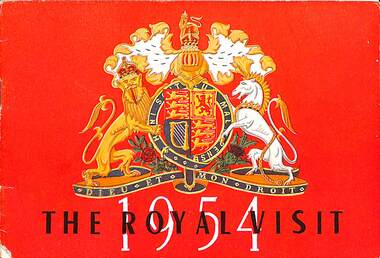
Book - The Royal Visit to Australia 1954, The Commonwealth Government of Australia
... The Royal Visit to Australia 1954...The Royal Visit to Australia 1954...Souvenir booklet of the Royal Visit to Australia in 1954...A 16 page souvenir booklet of the Royal Visit in 1954. It has a legend depicting the Australian Royal Tour Itinerary, map, Royal Transport in to be utilised, The Queen's Representatives and a number of pictures of the Royal family at Buckingham Palace....Souvenir booklet of the Royal Visit to Australia in 1954 The Royal Visit to Australia 1954 Book The Royal Visit to Australia 1954 The Commonwealth Government of Australia ...Souvenir booklet of the Royal Visit to Australia in 1954queen elizabeth -
 Greensborough Historical Society
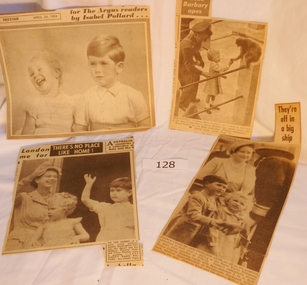
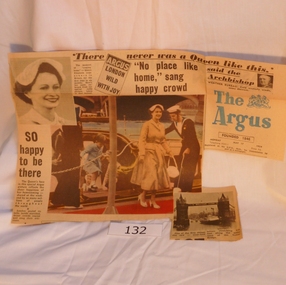
Article - Newspaper clipping, Argus (newspaper), Royal visit to Australia 1954, 24/04/1954
... Royal visit to Australia 1954...Shows the excitement of the Royal Visit in 1954. This was Queen Elizabeth II's first visit to Australia since ascending the throne. ...An example of the interest in the royal family to Australians at this time. royal visit 1954 house of windsor duke of edinburgh prince charles princess anne queen elizabeth II 4 black and white newspaper photographs of the Royal family, including Prince Charles and Princess Anne, on tour in 1954 Royal visit to Australia 1954 Article Newspaper clipping Argus (newspaper) ...Shows the excitement of the Royal Visit in 1954. This was Queen Elizabeth II's first visit to Australia since ascending the throne. In these articles the royal children are joining their parents on tour.An example of the interest in the royal family to Australians at this time.4 black and white newspaper photographs of the Royal family, including Prince Charles and Princess Anne, on tour in 1954royal visit 1954, house of windsor, duke of edinburgh, prince charles, princess anne, queen elizabeth ii -
 Mont De Lancey
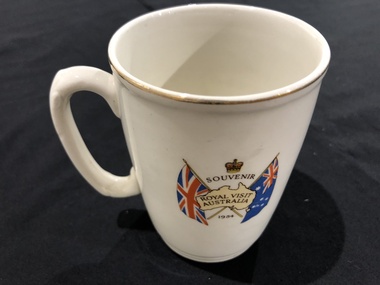
Mug, 1954
... "Souvenir Royal Visit Australia 1954"...Commemorative mugs "Souvenir Royal Visit Australia 1954" White china souvenir mug commemorating the 1954 Royal Visit by Queen Elizabeth 11 and Prince Phillip. ...White china souvenir mug commemorating the 1954 Royal Visit by Queen Elizabeth 11 and Prince Phillip."Souvenir Royal Visit Australia 1954"commemorative mugs -
 Friends of Ballarat Botanical Gardens History Group
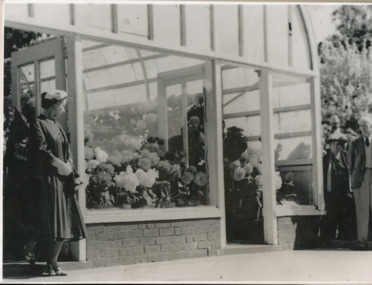
Photograph - Digital image, Queen Elizabeth 11 at Begonia House, 1954
... ...Royal Visit Australia 1954...Queen Elizabeth 11 Royal Visit Australia 1954 Ballarat Botanical Gardens Begonia House 1954 Black and white photograph Queen Elizabeth 11 at Begonia House, 1954 Photograph Digital image ...Black and white photographqueen elizabeth 11, royal visit australia 1954, ballarat botanical gardens, begonia house 1954 -
 Glenelg Shire Council Cultural Collection
Souvenir - Serviette, Royal Visit Souvenir Serviette, 1954
... Commemorating the Royal visit to Australia in 1954....Paper serviette, souvenir of Royal Visit to Australia, 1954. White, border of red lions rampant separated by Union Jacks, Australian flags. ...Commemorating the Royal visit to Australia in 1954. royal visit Queen Elizabeth II Paper serviette, souvenir of Royal Visit to Australia, 1954. ...Commemorating the Royal visit to Australia in 1954.Paper serviette, souvenir of Royal Visit to Australia, 1954. White, border of red lions rampant separated by Union Jacks, Australian flags. Four corners: emu, kangaroo, lion rampant, unicorn, red, white and blue shield shape, yellow border. Also in corners in yellow, 'ROYAL VISIT 1954' above yellow crownroyal visit, queen elizabeth ii -
 Wangaratta RSL Sub Branch
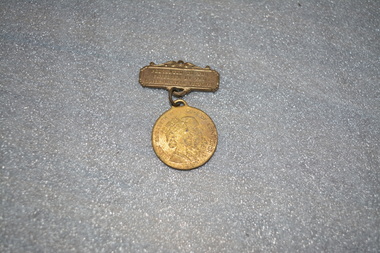
Badge - Gold Badge, C1954
... Royal Visit...1954...Australia...Gift from the Government to the children of Victoria on the occasion of the 1954 Royal Visit This medal was issued for schools to commemorate the visit of the Queen visited to Victoria from 24 February to 9 March 1954. The first reigning monarch to tour Australia...Australia in twenty years. She graciously endured a grueling schedule visiting approximately 70 country towns, all capital cities except Darwin. Medallion Royal Visit 1954 ...Gift from the Government to the children of Victoria on the occasion of the 1954 Royal Visit This medal was issued for schools to commemorate the visit of the Queen visited to Victoria from 24 February to 9 March 1954. The first reigning monarch to tour Australia, she arrived in Sydney with her husband the Duke of Edinburgh on 3 February 1954 and departed the country from Fremantle on 1 April. In 1954 Queen Elizabeth II became the first reigning monarch to tour Australia. She arrived in Sydney with her husband the Duke of Edinburgh on 3 February 1954 and departed the country from Fremantle on 1 April. The visit was tremendously popular. The Queen was the first royal to tour Australia in twenty years. She graciously endured a grueling schedule visiting approximately 70 country towns, all capital cities except Darwin.Round Gold coloured medallion attached to rectangular barBar - Presented to the Children by the Government of Victoria Medallion - ER Royal Visit 1954 Victoriamedallion, royal visit, 1954, australia -
Glenelg Shire Council Cultural Collection
Medal - Medal - Royal Visit 1954, Stokes & Sons, Melbourne (Mint), 1954
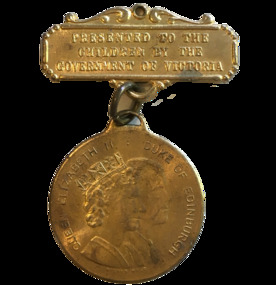
... Medallion - Queen Elizabeth II Duke of Edinburgh (round edge) Back: Obverse - Bar Stokes Melbourne Medallion - Crown EIIR Royal Visit 1954 Australia... visit Queen Elizabeth II Prince Phillip Victoria medal numismatics schools Front: Inverse - Bar - presented to the children by the Government of Victoria. Medallion - Queen Elizabeth II Duke of Edinburgh (round edge) Back: Obverse - Bar Stokes Melbourne Medallion - Crown EIIR Royal Visit 1954 Australia Medal has conjoined busts, Queen crowned, Duke head bare, facing right; around, QUEEN ELIZABETH II DUKE OF EDINBURGH; below in tiny letters the mint name, STOKES MELB. ...This medal was issued to schools in Victoria to commemorate the visit of Queen Elizabeth II and Prince Phillip to Australia. They arrived in Sydney on 3february 1954 and left from Freemantle on 1 April 1954.Significant to the history of the state of VictoriaMedal has conjoined busts, Queen crowned, Duke head bare, facing right; around, QUEEN ELIZABETH II DUKE OF EDINBURGH; below in tiny letters the mint name, STOKES MELB. The medal is attached by a metal loop to a bar with pin for wearing, PRESENTED TO THE / CHILDREN BY THE / GOVERNMENT OF VICTORIA The back of the medal has, below a crown, E II R / ROYAL VISIT / 1954 / VICTORIA The back of the bar contains the mint name in small letters, STOKES MELB.Front: Inverse - Bar - presented to the children by the Government of Victoria. Medallion - Queen Elizabeth II Duke of Edinburgh (round edge) Back: Obverse - Bar Stokes Melbourne Medallion - Crown EIIR Royal Visit 1954 Australiaroyal visit, queen elizabeth ii, prince phillip, victoria, medal numismatics, schools -
 Greensborough Historical Society
Newspaper - Newspaper clipping, Argus (newspaper), Queen returns to London, 17/05/1954
... Shows the excitement of the Queen's return from the Australian Royal Visit in 1954. This was Queen Elizabeth II's first visit to Australia since ascending the throne....Shows the excitement of the Queen's return from the Australian Royal Visit in 1954. This was Queen Elizabeth II's first visit to Australia since ascending the throne. ...Shows the excitement of the Queen's return from the Australian Royal Visit in 1954. This was Queen Elizabeth II's first visit to Australia since ascending the throne.An example of the interest in the royal family to Australians at this time.Front page of The Argus newspaper May 17 1954. Black and white text, coloured photograph of the Queen 'stepping ashore in Britain for the first time in six months'house of windsor, duke of edinburgh, royal tour of australia 1954, queen elizabeth ii, royal family -
Glenelg Shire Council Cultural Collection
Flag - Souvenir Flag - Royal Visit, 1952/54, c. 1952
... Flag, rectangular, fabric, souvenir of Royal visit 1954 (originally 1952, which was cancelled. '1952' has been cut from bottom of flag). Union Jack and Australian flag crossed behind crown....Queen Elizabeth II and her husband, Prince Philip, the Duke of Edinburgh, were to have toured Australia in 1952, but this was postponed following the death of her father, King George VI. The visit happened in 1964 instead and was the first to Australia by a reigning monarch. royal visit 1954 1952 flag Flag, rectangular, fabric, souvenir of Royal visit 1954 (originally 1952, which was cancelled. '1952' has been cut from bottom of flag). ...Queen Elizabeth II and her husband, Prince Philip, the Duke of Edinburgh, were to have toured Australia in 1952, but this was postponed following the death of her father, King George VI. The visit happened in 1964 instead and was the first to Australia by a reigning monarch.Flag, rectangular, fabric, souvenir of Royal visit 1954 (originally 1952, which was cancelled. '1952' has been cut from bottom of flag). Union Jack and Australian flag crossed behind crown.royal visit, 1954, 1952, flag -
 City of Moorabbin Historical Society (Operating the Box Cottage Museum)
Badge - Royal Visit 1954
... visited Victoria from 24 February to 9 March 1954. In 1954 Queen Elizabeth II became the first reigning monarch to tour Australia. She arrived in Sydney with her husband the Duke of Edinburgh on 3 February 1954 and departed the country from Fremantle on 1 April. The visit was tremendously popular. The attractive young Queen was the first royal...visited Victoria from 24 February to 9 March 1954. In 1954 Queen Elizabeth II became the first reigning monarch to tour Australia. She arrived in Sydney with her husband the Duke of Edinburgh on 3 February 1954 and departed the country from Fremantle on 1 April. The visit was tremendously popular. The attractive young Queen was the first royal ...his medal was issued for schools to commemorate the Queen visit. The Queen visited Victoria from 24 February to 9 March 1954. In 1954 Queen Elizabeth II became the first reigning monarch to tour Australia. She arrived in Sydney with her husband the Duke of Edinburgh on 3 February 1954 and departed the country from Fremantle on 1 April. The visit was tremendously popular. The attractive young Queen was the first royal to tour Australia in twenty years. She graciously endured a gruelling schedule of 33 flights, covering 10,000 miles by air, and 207 car trips, covering 2,000 miles by road and taking 130 hours. She visited approximately 70 country towns, all capital cities except Darwin, and made about 100 speeches.Medal BadgeEIIR Royal Visit 1954 Victoriaroyal visit 1954, badge, victoria, children -
Glenelg Shire Council Cultural Collection
Medal - Medal, Royal Visit of Queen Elizabeth II, c. 1954
... Royal Visit by Queen Elizabeth II and the Duke of Edinburgh to Victoria in 1954. The medal was presented to all Victorian school children. It was struck by Stokes & Sons of Melbourne. The Queen and Prince Philip visited Victoria from 24 February to 9 March 1954. The first reigning monarch to tour Australia...Royal Visit by Queen Elizabeth II and the Duke of Edinburgh to Victoria in 1954. The medal was presented to all Victorian school children. It was struck by Stokes & Sons of Melbourne. The Queen and Prince Philip visited Victoria from 24 February to 9 March 1954. The first reigning monarch to tour Australia ...Commemorative medal commissioned by the Victorian state government as a souvenir of the Royal Visit by Queen Elizabeth II and the Duke of Edinburgh to Victoria in 1954. The medal was presented to all Victorian school children. It was struck by Stokes & Sons of Melbourne. The Queen and Prince Philip visited Victoria from 24 February to 9 March 1954. The first reigning monarch to tour Australia, she arrived in Sydney on 3 February 1954 and departed the country from Fremantle on 1 April 1954. The Royal party visited all the capital cities apart from Darwin, and over 70 country towns.Bronze medal, hanging from a rectangular bar. The obverse of the medal features profile portraits of the Queen and Prince Philip. Presented to children of Victoria on Royal Visit, 1954Obverse: bust of Elizabeth II and Duke of Edinburgh Reverse: E II R Royal Visit/ 1954/ Victoriamedal, queen elizabeth ii, 1954, royal visit, victoria, numismatics, celebrations, schools -
Glenelg Shire Council Cultural Collection
Flag - Flag Pennant - Royal Visit to Victoria and S. E. South Australia, n.d
... Triangular pennant, fabric, Royal Visit to Victoria and S. E. South Australia, QEII 1954. Neutral background, red and blue print, Portland coat of arms. ...Triangular pennant, fabric, Royal Visit to Victoria and S. E. South Australia, QEII 1954. Neutral background, red and blue print, Portland coat of arms. ...Triangular pennant, fabric, Royal Visit to Victoria and S. E. South Australia, QEII 1954. Neutral background, red and blue print, Portland coat of arms. Flag originally made for a visit by the, then, Princess Elizabeth, in 1952. That tour cancelled until 1954, when she was queen. Word 'Future' on flag painted over, also '1952' has '1954' superimposed on it. -
 Greensborough Historical Society
Document - Invitation, Invitation to Mrs J. M. Scholes to meet Her Majesty the Queen and His Royal Highness the Duke of Edinburgh, 8th March 1954, 08/03/1954
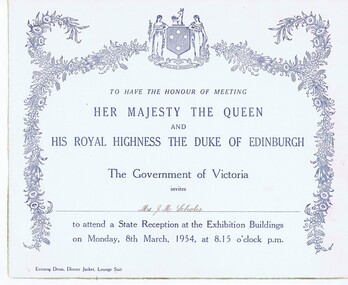
... 1954 visit to Australia. A tribute to a Greensborough identity and her connection with the Philharmonic Choir. jessie may partington jessie angus jessie scholes partington family royal family royal visit 1954 “To have the honour of meeting Her Majesty the Queen and His Royal Highness the Duke of Edinburgh, the Government of Victoria invites Mrs J.M.Scholes to attend a state reception at the Exhibition Buildings on Monday, 8th March 1954, at 8.15 o’clock p.m. ...An invitation for Mrs Jessie May Scholes (nee Partington) to attend one of the state receptions held for Queen Elizabeth II during her 1954 visit to Australia.A tribute to a Greensborough identity and her connection with the Philharmonic Choir.Invitation printed in black on buff card. “To have the honour of meeting Her Majesty the Queen and His Royal Highness the Duke of Edinburgh, the Government of Victoria invites Mrs J.M.Scholes to attend a state reception at the Exhibition Buildings on Monday, 8th March 1954, at 8.15 o’clock p.m. jessie may partington, jessie angus, jessie scholes, partington family, royal family, royal visit 1954 -
 Greensborough Historical Society
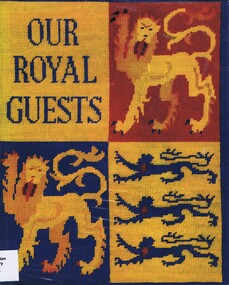
Book, Our Royal Guests, 1952_
... Royal Visit of Princess Elizabeth and the Duke of Edinburgh to Australia. An added note from a member of the public: "Bit of information on the book “Our Royal Guests” 1952. None of these books were sold or distributed as the visit was cancelled due to King's ill health and passing. My father printed them and they were instructed to have them picked up and destroyed. The only ones in circulation would be from workers during this process." Due to the King's death, the anticipated Royal Visit was postponed until 1954 ...Published in 1952, before the death of King George this book tells the family story of the Windsors in anticipation of the first Royal Visit of Princess Elizabeth and the Duke of Edinburgh to Australia. An added note from a member of the public: "Bit of information on the book “Our Royal Guests” 1952. None of these books were sold or distributed as the visit was cancelled due to King's ill health and passing. My father printed them and they were instructed to have them picked up and destroyed. The only ones in circulation would be from workers during this process."Due to the King's death, the anticipated Royal Visit was postponed until 1954.Hard cover, Illus. (some colour).queen elizabeth 2, house of windsor, duke of edinburgh, royal tour of australia 1954 -
 Greensborough Historical Society
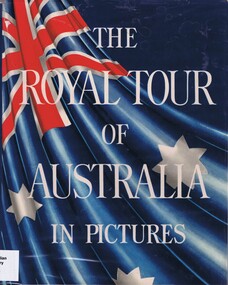
Book, The Royal Tour of Australia and New Zealand in pictures, 1954_
... Australia and New Zealand was postponed until 1954. This book is a photographic story of their travels around Australia, New Zealand and Pacific Islands. A pictorial record of the first visit to Australia by Queen Elizabeth II and the Duke of Edinburgh in 1954 house of windsor duke of edinburgh royal tour of australia 1954 queen elizabeth II Hard cover, Illus. ...Following the death of King George VI, the Queen's trip to Australia and New Zealand was postponed until 1954. This book is a photographic story of their travels around Australia, New Zealand and Pacific Islands.A pictorial record of the first visit to Australia by Queen Elizabeth II and the Duke of Edinburgh in 1954Hard cover, Illus. (some colour). Cover illustration of Australian flag with white writing over.house of windsor, duke of edinburgh, royal tour of australia 1954, queen elizabeth ii -
 Greensborough Historical Society
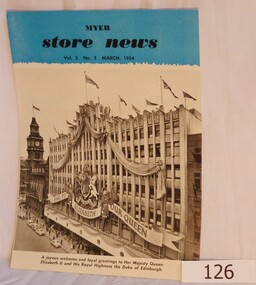
Newsletter - Pamphlet, Myer Store News March 1954, 1954_03
... Myer store in Melbourne staff newsletter shows the Bourke Street store decked out to welcome the Queen and Duke of Edinburgh on their first visit to Melbourne, showing the excitement of the Royal Visit in 1954. This was Queen Elizabeth II's first visit to Australia since ascending the throne....Myer store in Melbourne staff newsletter shows the Bourke Street store decked out to welcome the Queen and Duke of Edinburgh on their first visit to Melbourne, showing the excitement of the Royal Visit in 1954. This was Queen Elizabeth II's first visit to Australia since ascending the throne. ...Myer store in Melbourne staff newsletter shows the Bourke Street store decked out to welcome the Queen and Duke of Edinburgh on their first visit to Melbourne, showing the excitement of the Royal Visit in 1954. This was Queen Elizabeth II's first visit to Australia since ascending the throne.An example of the importance of Royalty to Australians at this time.2 page newsletter from the Myer store in Melbourne. Cover illustration shows the Bourke Street store.house of windsor, duke of edinburgh, royal tour of australia 1954, myer melbourne, queen elizabeth ii -
 Orbost & District Historical Society
book, The Queen in Victoria, 1954
... In June 1953 , Elizabeth II was crowned Queen of the United Kingdom, Canada, Australia, New Zealand, South Africa, Ceylon (now Sri Lanka), and Pakistan, and became the Head of the Commonwealth. Her Majesty Queen Elizabeth the Second and His Royal Highness the Duke of Edinburgh visited Victoria from 24th February to 9th March, 1954. ...1954. A three guinea prize was offered for an essay on the royal visit. This item reflects the interest in the royal family to Australians at this time as well as the general feeling of respect and admiration felt by the rural communities towards the British Royal Family, especially towards Queen Elizabeth II. book-the-queen-in-victoria royalty A hard covered book of 77 pp. ...In June 1953 , Elizabeth II was crowned Queen of the United Kingdom, Canada, Australia, New Zealand, South Africa, Ceylon (now Sri Lanka), and Pakistan, and became the Head of the Commonwealth. Her Majesty Queen Elizabeth the Second and His Royal Highness the Duke of Edinburgh visited Victoria from 24th February to 9th March, 1954. The Argus was a morning daily newspaper, established in 1846 and closing in 1957. On 28 July 1952, The Argus became the first newspaper in the world to publish colour photographs in a daily paper. A large contingent of 160 students in a convoy of six school buses left the Orbost post Office at 6.a.m. to "Join in Acclaiming Our Gracious Queen" in Sale. An estimated 35,000 Gippslanders welcomed the Her Majesty, the Queen and the Duke of Edinburgh. (info. from S.R.M. March 2, 10, 1954. A three guinea prize was offered for an essay on the royal visit. This item reflects the interest in the royal family to Australians at this time as well as the general feeling of respect and admiration felt by the rural communities towards the British Royal Family, especially towards Queen Elizabeth II.A hard covered book of 77 pp. The front cover is black with "E11R" in gold print. It is a pictorial story of Queen Elizabeth 11's visit to Victoria in 1954 - 24 February - 9 March.book-the-queen-in-victoria royalty -
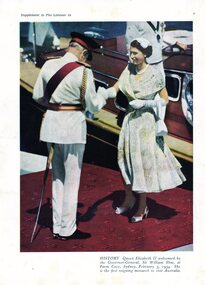 Greensborough Historical Society
Photograph, Listener In, Queen Elizabeth II welcomed by Governor General Sir William Slim during her visit to Australia in 1954, 1954
... Queen Elizabeth II welcomed by Governor General Sir William Slim during her visit to Australia in 1954. royal tour of australia 1954 queen elizabeth II royal family Supplement to the "Listener In" Colour photograph from news magazine Queen Elizabeth II welcomed by Governor General Sir William Slim during her visit to Australia in 1954 Photograph Photograph Listener In ...Queen Elizabeth II welcomed by Governor General Sir William Slim during her visit to Australia in 1954.Colour photograph from news magazinenon-fictionSupplement to the "Listener In"royal tour of australia 1954, queen elizabeth ii, royal family -
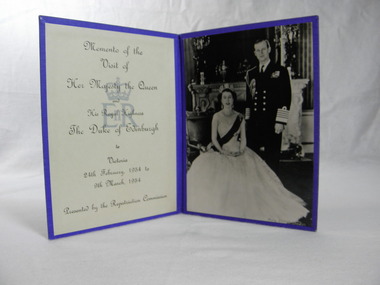 Heidelberg Repatriation Hospital
Memorabilia - Memento, Baron, Royal Visit 1954, Circa 1954
... 1954 royal visit...royal visit australia...visit of her Royal Highness Queen Elizabeth II and Prince Phillip to Victoria in 1954 and in particular the Heidelberg Repatriation Hospital. This brought much excitement to the patients at Heidelberg. Recognises a significant Royal visit to Heidelberg Repatriation Hospital. Acknowleges the role of the Hospital in the treatment of War Veterans to receive such a visit and World War II had ceased in 1945, only nine years earlier. british royalty 1954 1954 royal visit royal visit australia memento australian coat of arms Page 1 shows the Commonwealth Emblem with the words "Royal Visit 1954" inscribed under it. ...Handed out to patients and visitors to commemorate the visit of her Royal Highness Queen Elizabeth II and Prince Phillip to Victoria in 1954 and in particular the Heidelberg Repatriation Hospital. This brought much excitement to the patients at Heidelberg.Recognises a significant Royal visit to Heidelberg Repatriation Hospital. Acknowleges the role of the Hospital in the treatment of War Veterans to receive such a visit and World War II had ceased in 1945, only nine years earlier.Blue cardboard folder of 4 sides, with a single fold containing 1 photo and inscription. Photo is of Queen Elizabeth sitting down and Prince Phillip standing to the left of her in front of a fireplace, with commemorative acknowledgement of the visit.Page 1 shows the Commonwealth Emblem with the words "Royal Visit 1954" inscribed under it. Page 2 has the inscription " Memento of the Visit of Her Majesty and his Royal Highness The Duke of Edinburgh to Victoria 24th February, 1954 to 9th March, 1954 presented by the Repatriation Commission" over a crown and the letters EIIRbritish royalty, 1954, 1954 royal visit, royal visit australia, memento, australian coat of arms -
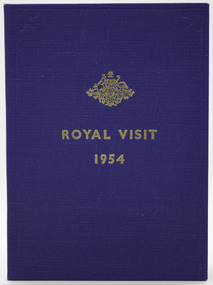 Heidelberg Repatriation Hospital
Memorabilia - Memento, Baron, Royal Visit 1954, Circa 1954
... 1954 royal visit...royal visit australia...visit of her Royal Highness Queen Elizabeth II and Prince Phillip to Victoria in 1954 and in particular the Heidelberg Repatriation Hospital. This brought much excitement to the patients at Heidelberg. Recognises a significant Royal visit to Heidelberg Repatriation Hospital. Acknowleges the role of the Hospital in the treatment of War Veterans to receive such a visit and World War II had ceased in 1945, only nine years earlier. british royalty 1954 1954 royal visit royal visit australia memento australian coat of arms Page 1 shows the Commonwealth Emblem with the words "Royal Visit 1954" inscribed under it. ...Handed out to patients and visitors to commemorate the visit of her Royal Highness Queen Elizabeth II and Prince Phillip to Victoria in 1954 and in particular the Heidelberg Repatriation Hospital. This brought much excitement to the patients at Heidelberg.Recognises a significant Royal visit to Heidelberg Repatriation Hospital. Acknowleges the role of the Hospital in the treatment of War Veterans to receive such a visit and World War II had ceased in 1945, only nine years earlier.Blue cardboard folder of 4 sides, with a single fold containing 1 photo and inscription. Photo is of Queen Elizabeth sitting down and Prince Phillip standing to the left of her in front of a fireplace, with commemorative acknowledgement of the visit.Page 1 shows the Commonwealth Emblem with the words "Royal Visit 1954" inscribed under it. Page 2 has the inscription " Memento of the Visit of Her Majesty and his Royal Highness The Duke of Edinburgh to Victoria 24th February, 1954 to 9th March, 1954 presented by the Repatriation Commission" over a crown and the letters EIIRbritish royalty, 1954, 1954 royal visit, royal visit australia, memento, australian coat of arms -
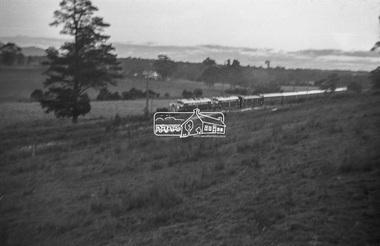 Eltham District Historical Society Inc
Photograph, George Burton Coop, The Royal Train enroute to Lilydale, near Croydon, 6 Mar. 1954
... 1954 at age 27, Queen Elizabeth II was the first reigning British monarch to visit Australia.. She visited Victoria between March 1-10. Where to see the Queen (1954, January 21). Fern Tree Gully and District Times (Boronia, Vic. : 1953-1954), p. 5. Retrieved October 25, 2021, from http://nla.gov.au/nla.news-article264220429 “The Lilydale Shire President, Cr. Burgi, stated that the Royal...1954 at age 27, Queen Elizabeth II was the first reigning British monarch to visit Australia.. She visited Victoria between March 1-10. Where to see the Queen (1954, January 21). Fern Tree Gully and District Times (Boronia, Vic. : 1953-1954), p. 5. Retrieved October 25, 2021, from http://nla.gov.au/nla.news-article264220429 “The Lilydale Shire President, Cr. Burgi, stated that the Royal ...Believed to have been taken bewteen Croydon Railway Station and the Dorset Road bridge. Taken late afternnon by George Coop's father. There is a Landrover parked on the grass with a person standing on it - believed to be Security. George recalls originally being located closer to the fence and being ushered up the hill where it was 'safer' to stand. In 1954 at age 27, Queen Elizabeth II was the first reigning British monarch to visit Australia.. She visited Victoria between March 1-10. Where to see the Queen (1954, January 21). Fern Tree Gully and District Times (Boronia, Vic. : 1953-1954), p. 5. Retrieved October 25, 2021, from http://nla.gov.au/nla.news-article264220429 “The Lilydale Shire President, Cr. Burgi, stated that the Royal train en route for Warburton on Saturday, March 6th, would slow down at Croydon and Lilydale. There was little possibility that it would stop at either of these towns. The train would pass through Lilydale at 5.52 p.m. Council had appointed a sub-committee to arrange matters, and had allocated £400 towards expenses. It was suggested that the train slow down between the railway station and Dorset Rd. bridge at Croydon, and between the Cave Hill Quarry and railway station at Lilydale.” An album of images of the Queen's visit to Victoria is available on the PROV Flickr account at https://www.flickr.com/photos/public-record-office-victoria/7252885616Digital TIFF file Scan of Kopdak 620 black and white negative transparencygeorge coop collection, croydon, royal train -
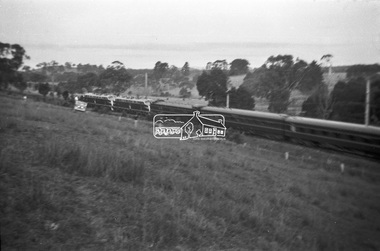 Eltham District Historical Society Inc
Photograph, George Burton Coop, The Royal Train enroute to Lilydale, near Croydon, 6 Mar. 1954
... 1954 at age 27, Queen Elizabeth II was the first reigning British monarch to visit Australia.. She visited Victoria between March 1-10. Where to see the Queen (1954, January 21). Fern Tree Gully and District Times (Boronia, Vic. : 1953-1954), p. 5. Retrieved October 25, 2021, from http://nla.gov.au/nla.news-article264220429 “The Lilydale Shire President, Cr. Burgi, stated that the Royal...1954 at age 27, Queen Elizabeth II was the first reigning British monarch to visit Australia.. She visited Victoria between March 1-10. Where to see the Queen (1954, January 21). Fern Tree Gully and District Times (Boronia, Vic. : 1953-1954), p. 5. Retrieved October 25, 2021, from http://nla.gov.au/nla.news-article264220429 “The Lilydale Shire President, Cr. Burgi, stated that the Royal ...Believed to have been taken bewteen Croydon Railway Station and the Dorset Road bridge. Taken late afternnon by George Coop's father. There is a Landrover parked on the grass with a person standing on it - believed to be Security. George recalls originally being located closer to the fence and being ushered up the hill where it was 'safer' to stand. In 1954 at age 27, Queen Elizabeth II was the first reigning British monarch to visit Australia.. She visited Victoria between March 1-10. Where to see the Queen (1954, January 21). Fern Tree Gully and District Times (Boronia, Vic. : 1953-1954), p. 5. Retrieved October 25, 2021, from http://nla.gov.au/nla.news-article264220429 “The Lilydale Shire President, Cr. Burgi, stated that the Royal train en route for Warburton on Saturday, March 6th, would slow down at Croydon and Lilydale. There was little possibility that it would stop at either of these towns. The train would pass through Lilydale at 5.52 p.m. Council had appointed a sub-committee to arrange matters, and had allocated £400 towards expenses. It was suggested that the train slow down between the railway station and Dorset Rd. bridge at Croydon, and between the Cave Hill Quarry and railway station at Lilydale.” An album of images of the Queen's visit to Victoria is available on the PROV Flickr account at https://www.flickr.com/photos/public-record-office-victoria/7252885616Digital TIFF file Scan of Kopdak 620 black and white negative transparencygeorge coop collection, croydon, royal train -
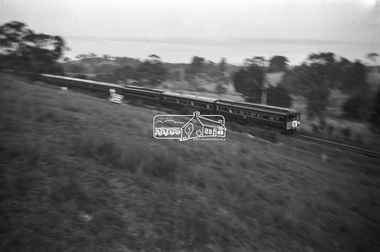 Eltham District Historical Society Inc
Photograph, George Burton Coop, The Royal Train enroute to Lilydale, near Croydon, 6 Mar. 1954
... 1954 at age 27, Queen Elizabeth II was the first reigning British monarch to visit Australia.. She visited Victoria between March 1-10. Where to see the Queen (1954, January 21). Fern Tree Gully and District Times (Boronia, Vic. : 1953-1954), p. 5. Retrieved October 25, 2021, from http://nla.gov.au/nla.news-article264220429 “The Lilydale Shire President, Cr. Burgi, stated that the Royal...1954 at age 27, Queen Elizabeth II was the first reigning British monarch to visit Australia.. She visited Victoria between March 1-10. Where to see the Queen (1954, January 21). Fern Tree Gully and District Times (Boronia, Vic. : 1953-1954), p. 5. Retrieved October 25, 2021, from http://nla.gov.au/nla.news-article264220429 “The Lilydale Shire President, Cr. Burgi, stated that the Royal ...Believed to have been taken bewteen Croydon Railway Station and the Dorset Road bridge. Taken late afternnon by George Coop's father. There is a Landrover parked on the grass with a person standing on it - believed to be Security. George recalls originally being located closer to the fence and being ushered up the hill where it was 'safer' to stand. In 1954 at age 27, Queen Elizabeth II was the first reigning British monarch to visit Australia.. She visited Victoria between March 1-10. Where to see the Queen (1954, January 21). Fern Tree Gully and District Times (Boronia, Vic. : 1953-1954), p. 5. Retrieved October 25, 2021, from http://nla.gov.au/nla.news-article264220429 “The Lilydale Shire President, Cr. Burgi, stated that the Royal train en route for Warburton on Saturday, March 6th, would slow down at Croydon and Lilydale. There was little possibility that it would stop at either of these towns. The train would pass through Lilydale at 5.52 p.m. Council had appointed a sub-committee to arrange matters, and had allocated £400 towards expenses. It was suggested that the train slow down between the railway station and Dorset Rd. bridge at Croydon, and between the Cave Hill Quarry and railway station at Lilydale.” An album of images of the Queen's visit to Victoria is available on the PROV Flickr account at https://www.flickr.com/photos/public-record-office-victoria/7252885616Digital TIFF file Scan of Kopdak 620 black and white negative transparencygeorge coop collection, croydon, royal train -
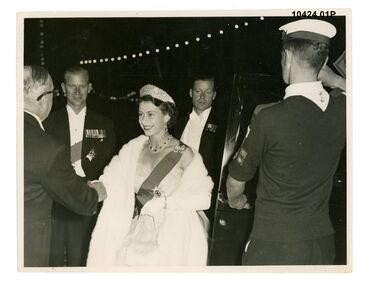 Bendigo Military Museum
Photograph - JAMES LESLIE PELL RAN PHOTOGRAPHIC ALBUM, HRH Queen Elizabeth visit to Australia 1954
... HMAS MELBOURNE HMAS BATAAN Korean War Royal Australian Navy James Leslie Pell Black and white photographs from official government sources. They are part of a collection of over 200 photographs housed within an archive folder. HRH Queen Elizabeth visit to Australia 1954 ...James Leslie Pell RAN No 35213 Stoker mechanic, served on HMAS Bataan, (D9/I91/D191) a Tribal-class destroyer during the Korean War 1951-52. He later served on HMAS Melbourne, a Majestic-class light fleet aircraft carrier later in the 1950's. These photographs are from his personal album, and portray events and place to which he would have been witness. Refer to catalogue item 5455 for his service details. Black and white photographs from official government sources. They are part of a collection of over 200 photographs housed within an archive folder.hmas melbourne, hmas bataan, korean war, royal australian navy, james leslie pell -
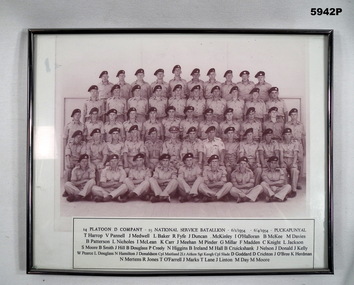 Bendigo Military Museum
Photograph - PHOTOGRAPH, FRAMED, 1954
... visit - 18.2.1970 to 4.3.1970. *RAASC with the rank of Captain - 1974 to 1975. Royal Australian Corps of Transport with the rank of Major. Retired 30.6.1988. photograph National Service Puckapunyal Keving John Herdman Photograph lists: '14 Platoon D Company 15 National Service Battalion, 6/1/1954, 6/4/1954, Puckpunyal' plus names. ...Part of the Kevin John Herdman No. 397661 Collection. Service details: *National Service Training - Puckapunyal 6.1.1954 to 6.4.1954 *CMF - 38th Battalion to the end of 1964. *Vietnam visit - 18.2.1970 to 4.3.1970. *RAASC with the rank of Captain - 1974 to 1975. Royal Australian Corps of Transport with the rank of Major. Retired 30.6.1988.Framed black and white photograph of a group of soldiers in uniform. Soldiers are arranged in five rows. Caption at the bottom lists the names of the soldiers in the photograph, relevant dates and the location where the photograph was taken. Frame is made of metal with a stand attached to the back.Photograph lists: '14 Platoon D Company 15 National Service Battalion, 6/1/1954, 6/4/1954, Puckpunyal' plus names.photograph, national service, puckapunyal, keving john herdman -
 Bendigo Military Museum
Accessory - BADGES & BUTTONS, c. 1939 - 45
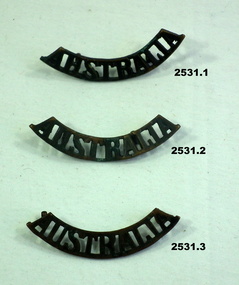
... .1), .2) & .3) Badges, blackened brass, word Australia in a curved shape. .4) & .5) Badges, blackened brass, Rising Sun lapel badges. .6) .7) Badges, pressed metal, gold colour, Kings crown. .8) Button, black plastic, RAAF crown over wings. .9) Button, metal, gold colour, crown over map of Australia wording Australian Artillery. .10) Badge, metal, round Red Cross in white & blue. .11) Badge, metal, gold colour, round section with top clasp. Presented to the children of Victoria for the 1954 Royal Visit. .12) Badge with red ribbon on metal clasp. ...See also 2589 & 2590 numismatics-badges-military metalcraft - brassware costume accessories - clothes accessories .1), .2) & .3) Badges, blackened brass, word Australia in a curved shape. .4) & .5) Badges, blackened brass, Rising Sun lapel badges. .6) .7) Badges, pressed metal, gold colour, Kings crown. .8) Button, black plastic, RAAF crown over wings. .9) Button, metal, gold colour, crown over map of Australia wording Australian Artillery. .10) Badge, metal, round Red Cross in white & blue. .11) Badge, metal, gold colour, round section with top clasp. Presented to the children of Victoria for the 1954 Royal Visit. .12) Badge with red ribbon on metal clasp. ...See also 2589 & 2590.1), .2) & .3) Badges, blackened brass, word Australia in a curved shape. .4) & .5) Badges, blackened brass, Rising Sun lapel badges. .6) .7) Badges, pressed metal, gold colour, Kings crown. .8) Button, black plastic, RAAF crown over wings. .9) Button, metal, gold colour, crown over map of Australia wording Australian Artillery. .10) Badge, metal, round Red Cross in white & blue. .11) Badge, metal, gold colour, round section with top clasp. Presented to the children of Victoria for the 1954 Royal Visit. .12) Badge with red ribbon on metal clasp. Badge is oval shaped, Red Cross in centre with white scrolls, Australian Red Cross Society 20 Years Service. .13) Coin, half penny, dented by ammunition fire. .14) Coin, one penny, 1943 dented by ammunition fire.numismatics-badges-military, metalcraft - brassware, costume accessories - clothes accessories -
 Kiewa Valley Historical Society
Book - Non Fiction History, Australia's Royal Welcome 1954, circa 1954
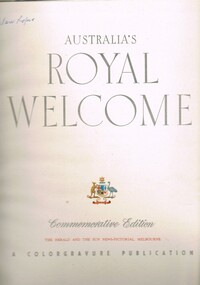
... The Queen (royalty) was the binding force holding the British Empire together which was emphasised with her popularity when touring Australia Queen Elizabeth's visited the MCG twice in 1954 1. to attend an assembly of ex-servicemen and women's organisations 2. to attend a Children's Display. She also visited Government House and visited Country Victoria on the Royal...The Queen (royalty) was the binding force holding the British Empire together which was emphasised with her popularity when touring Australia Queen Elizabeth's visited the MCG twice in 1954 1. to attend an assembly of ex-servicemen and women's organisations 2. to attend a Children's Display. She also visited Government House and visited Country Victoria on the Royal ...This publication covers the mid 1900s and relates to a period where the majority of the Australian population was engrossed with the Queen of Australia, even though her Highness did not reside on this continent. The period covered was before the great immigration insurgence from Europe.The Labour Party's "White Australian" policy was a hinderance and a barrier towards the Asian and African prospective immigrants. The motto Queen and Country was still very ingrained in the rural population. This period in Australian domestic self reliance, brought about the growing strength and very active trade union movement and their staunch support for the Tariff protection against a growing swell of imported goods. This self reliance psyche was essentially a by product of World War II, and the isolation felt by the Australian People. The Queen (royalty) was the binding force holding the British Empire together which was emphasised with her popularity when touring Australia Queen Elizabeth's visited the MCG twice in 1954 1. to attend an assembly of ex-servicemen and women's organisations 2. to attend a Children's Display. She also visited Government House and visited Country Victoria on the Royal train from 24th Feb - 9th March.The Kiewa Valley and all the rural areas in the region were still very much tied to the "mother land" and trade between Britain and Australia was very strong. Trade with Asian manufacturers was minimal and needed the late 1900s to see both the trade and immigration barriers fall. This book was produced during a time when the majority of Australians looked more to England for trade and companionship. The agricultural trade with England and Europe was very high and the motto of the time was "Australia grows on the sheep's back". Late 1900's saw the motto "Australia grows on the miner's back" The Queen was still very popular then which was emphasised by the large crowds which greeted her on tour. Residents of Mt Beauty including Cubs, Brownies, Scouts and Guides travelled to Benalla to see the Queen. Clare Roper was a founding member of the KVHS and attended a garden party at Buckingham Palace representing the local CWA. She has purchased this book and therefore giving this a close historical significance connection, it has good provenance and interpretive capacity. This hard(blue coloured) covered book contains thirty six double sided pages. Both the first and last pages (inside cover included) has the royal crest of Australia (kangaroo and emu) balancing the individual six states crests ,united under the royal crown. The first six double pages, each portraying a coloured free hand sketches of various Australian scenery enclosing the Queen's day by day and State by State itinerary. There are 115 black and white photographs and 25 coloured photographs contained in this book.Third page has free hand penned signature "Clare Roper"1954 royal tour, queen elizabeth ii monarchy, british empire in the 1900s, god save the queen. -
 Kiewa Valley Historical Society
Book - Royal Tour, The Royal Tour of Australia in Pictures, early 1950s
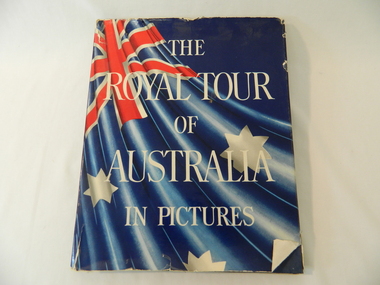
... Royal tour of Australia and New Zealand 1954 . Many people went to see the Queen as there was a lot of interest in the occasion. This was the first time a reigning monarch had toured Australia and Queen Elizabeth being a new young Queen was very popular and attracted very large crowds where ever she went. Mt Beauty residents including Cubs, Brownies, Scouts and Guides travelled to Benalla Railway Station to see the Queen on the Royal Train. Historical: At the time there was a lot of interest in Royalty. Provenance: Clare Roper, a local lady from Tawonga visited ...This book was produced after the Royal tour of Australia and New Zealand 1954 . Many people went to see the Queen as there was a lot of interest in the occasion. This was the first time a reigning monarch had toured Australia and Queen Elizabeth being a new young Queen was very popular and attracted very large crowds where ever she went. Mt Beauty residents including Cubs, Brownies, Scouts and Guides travelled to Benalla Railway Station to see the Queen on the Royal Train. Historical: At the time there was a lot of interest in Royalty. Provenance: Clare Roper, a local lady from Tawonga visited the Queen at Buckingham palace as a representative of CWA and therefore was particularly interested in the Queen's visit. KVHS has the dress that Clare wore, in their collection. Local residents recall travelling in 1954 to Benalla Railway Station to see the Queen on the Royal Train.This book has a blue hard cover with its original shiny paper cover over it. This paper cover is the Australian flag with white writing of the title, some of the stars and the red part in the top left corner. The back of the paper cover is blue with the Southern Cross. On the inside of the hard cover is a full size picture of the Queen meeting a group of early Australians & settlers with a group of soldiers in line saluting and a ship in the background. This picture is repeated on the cover at the back .On cover page in blue ink 'Clare Roper' At back attached with sticky tape to last page - a note: Vanour(?) Books / Mrs C. Roper & Mrs G. Richardson clare roper. queen. royal visit., 1952-1953. cwa. tawonga., queen elizabeth -
 Yendon History Group
School photograph of Queen Elizabeth II, 1954 (estimated)
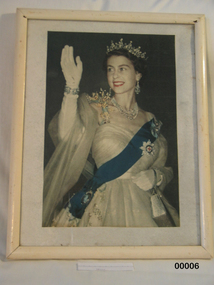
... royal visit 1954 yendon state school yendon public school elizabeth ii photograph of queen none Coloured photograph of QE II, in a white wooden frame, which used to hang in Yendon State School. Photo probably taken in 1954 during her visit to Australia ...Coloured photograph of QE II, in a white wooden frame, which used to hang in Yendon State School. Photo probably taken in 1954 during her visit to Australia. She is wearing a yellow dress (photo now faded), a sheer stole, long white gloves, a sprig of wattle on her right shoulder and a blue sash over her left shoulder. She is waving with her right hand.noneroyal visit 1954, yendon state school, yendon public school, elizabeth ii, photograph of queen -
 Bendigo Historical Society Inc.
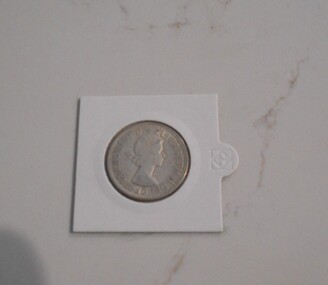
Coin - GRAHAM HOOKEY COLLECTION: 1954 FLORINS
... NUMISMATICS Coins - australian florins Seven 1954 commemorative Florins Queen Elizabeth II Royal visit. ...Seven 1954 commemorative Florins Queen Elizabeth II Royal visit. Composition: 50% silver, 40% copper, 5%zinc, 5% nickel. There were 2 millions coins issued, mintmark M (Melbourne) All in excellent conditions.numismatics, coins - australian, florins
