
Showing 21 items matching "safety belt"
-
 Moorabbin Air Museum
Manual (item) - Cabin safety component spare parts breakdown - Including Parachute procedures & safety belt maintenance 1949<>1953
... Cabin safety component spare parts breakdown - Including Parachute procedures & safety belt maintenance 1949<>1953...Cabin safety component spare parts breakdown - Including Parachute procedures & safety belt maintenance 1949<>1953...Cabin safety component spare parts breakdown - Including Parachute procedures & safety belt maintenance 1949<>1953 Manual Cabin safety component spare parts breakdown - Including Parachute procedures & safety belt maintenance 1949<>1953 ... -
 Bendigo Military Museum
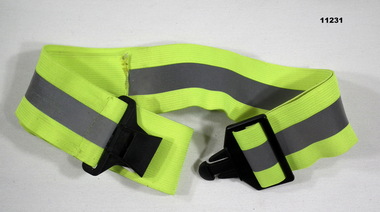
Equipment - SAFETY BELT, REFLEX, Unknown
... SAFETY BELT......Safety Belt...Equipment SAFETY BELT REFLEX ...Part of collection of "Paul Denis Ahearn", No. 331325. Refer Cat No. 11108P for details.Fluorescent green elastic belt with silver reflective stripe down centre and adjustable plastic clips (black).Manufacturing label.ahearn collection, paul denis ahearn, safety belt -
 Royal District Nursing Service (now known as Bolton Clarke)
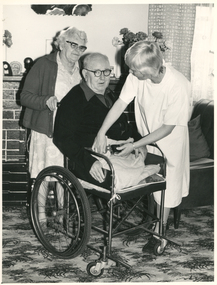
Photograph - Photograph, black and white, Barry Sutton, 17.10.1973
... She is about to fasten the wheelchair safety belt across Mr. Stevenson's lap to ensure he does not fall out of the wheelchair. ...To the right is Sister Clare McHugh of Royal District Nursing Service (RDNS), who is slightly bent as she has her hands on the left and right sides of the safety belt across Mr. Stevenson's lap. The belt is attached to either side of the wheelchair. ...She is about to fasten the wheelchair safety belt across Mr. Stevenson's lap to ensure he does not fall out of the wheelchair. ...RDNS Sr. Clare McHugh is attending Mr. Stevenson in his home to give him nursing care. She is about to fasten the wheelchair safety belt across Mr. Stevenson's lap to ensure he does not fall out of the wheelchair. The Trained nurses (Nurses) of the Melbourne District Nursing Society (MDNS), later known as Royal District Nursing Service (RDNS), visited patients in their home and gave best practice care in many fields of nursing, and to people of many cultures, throughout its 130 years of expansion. Initial visits not only assessed the specific nursing situation but the situation as a whole. The RDNS Trained nurses (Sisters) visited patients from many different cultural backgrounds, and Education was given to their Sisters to assist them when speaking with the patients and giving them care. Their patients ranged in age from babes, children, adults to the elderly and referrals were taken from Hospitals, General Practitioners and allied Health facilities. Some of the care the Sisters provided is as follows: – Post-Natal care given to mother and babe, Wound Care following various types of surgery, accidents, burns, cancer, leg ulcers etc. Supervising and teaching Diabetic Care, including teaching and supervising people with Diabetes to administer their own Insulin, and administering Insulin to those unable to give their own injections. Administering other injections and setting up weekly medication boxes. The Sisters performed Catheterizations on adults suffering from conditions such as Quadriplegia, Paraplegia, Multiple Sclerosis (MS), Motor Neurone Disease (MND) and Guillan-Barre Syndrome, and when required at school on children for e.g. those with Spina Bifida. The Sisters visited those requiring Cystic Fibrosis support and care; those requiring Haemo-Oncology care, including visiting children at school; those requiring Home Enteral Feeding care, and those requiring IV therapy at home and home Dialysis. Palliative Care was given including pain relief with the use of syringe drivers, personal care as needed, and advice and support to both patient and family. The Sisters provided Stoma management to those needing Urostomy, Ileostomy and Colostomy care and those requiring Continence care. HIV/AIDS nursing care was provided; visits to Homeless Persons were made. Personal care was given to patients ranging in age and with varying mobility problems, such as Amputees, those with MS, MND, Guillan-Barre Syndrome, Poliomyelitis, Quadriplegia, Paraplegia, Acquired Brain Injury, to those following a Cerebrovascular Accident (Stroke), those with severe Arthritis and those with a form of Dementia. When necessary the elderly were assisted with personal care and advice given on safety factors with the use of hand rails, bath or shower seats, and hand showers. Rehabilitation with an aim towards independence remained at the forefront of the Sister’s minds and when possible using aids and instruction on safe techniques enabled the person to become fully independent. All care included giving advice and support to the patient and their Carers. The Sisters liaised with the persons Doctor, Hospital and allied Health personal when necessary. In the centre of this black and white photograph is Mr. Stevenson, an elderly gentleman, who has balding light hair; is wearing dark rimmed glasses, and is wearing a black cardigan over a grey shirt. A small amount of his grey trousers can be seen. He is sitting in a wheelchair and is looking at the camera. He has a light coloured small blanket tucked under and over the stumps of his above the knee amputated legs. Standing behind his chair, and slightly to his left, is a lady who is wearing glasses; has wavy light grey hair and is wearing a dark grey cardigan over her light coloured patterned frock. Her right hand is seen holding the handle of the wheelchair, and she is looking down at Mr. Stevenson. To the right is Sister Clare McHugh of Royal District Nursing Service (RDNS), who is slightly bent as she has her hands on the left and right sides of the safety belt across Mr. Stevenson's lap. The belt is attached to either side of the wheelchair. Sr. McHugh has straight blonde hair; only part of her face can be seen as she looks at Mr. Stevenson. She is wearing a white gown over her uniform. In the left background is part of a brick fireplace with wood mantelpiece. A patterned plate and dark items are on the left of the mantelpiece and flowers are seen on the right. Above this, part of a square mirror can be seen. To the right, part of a lounge chair is seen and behind this, an open check curtain and part of a voile curtain is seen. The floor is covered with a light and dark patterned carpet.Barry Sutton LW 6 Namesroyal district nursing service, rdns, rdns nursing care, rdns physiotherapy, sister clare mchugh, mr stevenson -
 Federation University Historical Collection
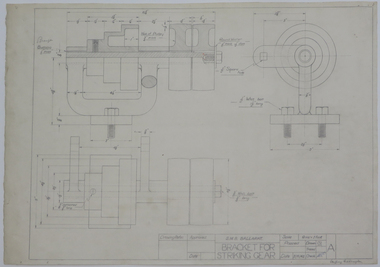
Student's Technical Drawing, Technical drawing, 1942 -44
... pencil on paper student's technical drawings .1) Bracket for striking gear .2) Lever safety valve .3) belt driven hoisting winch, 500 lb capacity ...technical drawing mechanical engineering geoff biddington pencil on paper student's technical drawings .1) Bracket for striking gear .2) Lever safety valve .3) belt driven hoisting winch, 500 lb capacity Technical drawing Student's Technical Drawing ...pencil on paper student's technical drawings .1) Bracket for striking gear .2) Lever safety valve .3) belt driven hoisting winch, 500 lb capacity technical drawing, mechanical engineering, geoff biddington -
 Bendigo Military Museum
Uniform - DRESS COAT, WAIST COAT, RAANC, Commonwealth Government Clothing Factory, c.1971
... Front - four silver colour plastic embossed buttons - Queen's Crown, Map of Australia, with shank and metal safety pins. 3. Belt - red and grey colour woven belt fabric with silver colour metal clasp buckle and waist length adjuster. ...Front - four silver colour plastic embossed buttons - Queen's Crown, Map of Australia, with shank and metal safety pins. 3. Belt - red and grey colour woven belt fabric with silver colour metal clasp buckle and waist length adjuster. ...1. Dress Coat - formal jacket style ending at waist. Collar with shawl lapels, shoulder epaulettes and one button fastening front. Red colour wool fabric with red polyester satin fabric lining. Three silver and red colour metal rank insignia - Captain - on each shoulder epaulette. Two silver colour plastic buttons with nursing emblem and shank. Two silver colour plastic lapel badges - oval shaped surmounted by Queen's Crown, oval embossed with 'ROYAL AUSTRALIAN ARMY NURSING CORPS". Centre of oval is Nightingale oil lamp. Across bottom scroll embossed with "PRO HUMANITATE". 2. Waist Coat - vest with two front concealed pockets, red colour wool fabric front, back and lining red colour polyester satin fabric. Front - four silver colour plastic embossed buttons - Queen's Crown, Map of Australia, with shank and metal safety pins. 3. Belt - red and grey colour woven belt fabric with silver colour metal clasp buckle and waist length adjuster. Buckle - circular centre embossed with "ROYAL AUSTRALIAN ARMY NURSING CORPS", SURROUNDING AN EMBOSSED OVAL BADGE - DESCRIPTION AS PER LAPEL BADGES.. Attached to belt end - white fabric manufacturers label.Manufacturers white fabric label - black ink print. "Hobson/ & sons (Lindon) Ltd ........Large".uniform, royal australian army nursing corps -
 Seaworks Maritime Museum
Weight Belt, Survivair U.S. Divers, February 1974
... Safety Approval No. TC-19C-68/ Issued to Survivairs division. U.S. ... co Santa Anna./ MSHA NISOH approval issued 10/ Survivair's division U.S. Divers co./ February 1974 Black weight belt ...Black weight belt with two stone weights with stainless steel Survivair U.S. Divers/U/Permissable supplied-air respirator/type C/pressure demand class United States Department of Labor/ MSHA U.S Department of Health Education NIOBH/ Mind Safety and Health Administration National Institute of Occupational Health and Safety Approval No. TC-19C-68/ Issued to Survivairs division. U.S. ... co Santa Anna./ MSHA NISOH approval issued 10/ Survivair's division U.S. Divers co./ February 1974 -
 Orbost & District Historical Society
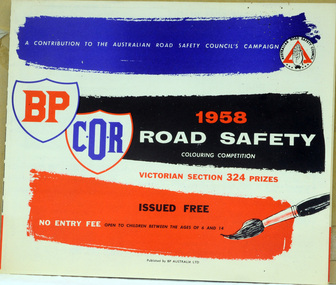
booklet, 1958 Road Safety Colouring Competition, second half 1950's
... Between the 1950s and 1970s, road safety was redefined as a medical and social problem, rather than a moral and legal one. This was a time before seat belts. ...Between the 1950s and 1970s, road safety was redefined as a medical and social problem, rather than a moral and legal one. This was a time before seat belts. ...Between the 1950s and 1970s, road safety was redefined as a medical and social problem, rather than a moral and legal one. This was a time before seat belts. The Road Safety Colouring Competition was a free colouring competition for children, organised by Commonwealth Oil Refineries Ltd., started in August 1954 with the , aims of teaching road safety. There were 1,000 prizes, valued at £1,200. The winner would receive a £100 bursary and a free plane trip with one parent to Canberra to receive the prize from the Federal Minister for Transport, Senator.G. McLeay. This booklet is the one used by the children in Orbost in 1958. This booklet was designed to promote road safety awareness, with messages and activities specifically considered for children. Its aim was to teach road safety in a fun, but educational way. This item was an important educational tool. A booklet of competitions - Road Safety- Victorian Section for Children It was issued by the Australian Road Safety Council. The front cover is blue, red, black and white. It contains crosswords, colouring competitions with entry forms.road-safety competitions-colouring -
 Flagstaff Hill Maritime Museum and Village
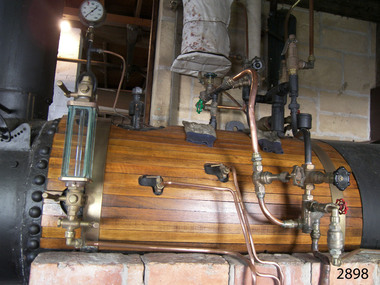
Equipment - Boiler, T & F Johnson, boilermakers, late 19th century
... belts to operate looms and saws. The heat associated with the boiler can be used for preserving food, sterilising, factory manufacturing processes, and steaming wood for shipbuilding. Every boiler has several components fitted for safe operation: - - Safety...belts to operate looms and saws. The heat associated with the boiler can be used for preserving food, sterilising, factory manufacturing processes, and steaming wood for shipbuilding. Every boiler has several components fitted for safe operation: - - Safety ...A steam boiler like this late 18th century boiler, is often called a colonial boiler. Steam boilers were used in factories throughout Australia, mounted over similar designs of brick furnaces. This heat from the fire travels through the tubes in this fire tube boiler and the water heats as it circulates around them. Another kind of boiler is a water tube boiler, in which the water is inside the tubes and the heat of the combustion surrounds the tubes. The boiler in our collection burned wood as fuel but others of this design could also burn coal, coke, gas and liquid fuels. The boiler was made by T & F Johnson, boilermakers. In 1922 their factory was located at Coventry Street, South Melbourne. They were still advertising their 'Colonial, multi, vertical boilers, all sizes' at the same address in 1934. The connected pressure gauge, made in London by Dewrance, measures 0 to 400 pounds per square inch. John Dewrance is renowned as a pioneer of the steam locomotive in the early 19th century. He founded John Dewrance & Co. in South London in 1844. His son Sir John Dewrance took over in 1879. In 1939 the company became a subsidiary of Babcock & Wilcox, and was eventually owned by Emerson. How the boiler works: - A boiler is about two-thirds filled with water and heat is applied, in this case in the form of burning wood. The heat is transferred through the metal of the boiler to the water. When the water boils the steam rises to the top, and as it escapes from the boiler the steam pressure builds up in the steam space to later be released to do work; drive machinery such as ship and train engines, turbines, presses, wheels, and driving belts to operate looms and saws. The heat associated with the boiler can be used for preserving food, sterilising, factory manufacturing processes, and steaming wood for shipbuilding. Every boiler has several components fitted for safe operation: - - Safety valves - Gauge glass - Pressure gauge - Main steam stop valve - Water check valve - Blowdown valve - Manhole doorThe boiler is a significant item that gives us a snapshot of early Melbourne's industrial history. It is an example of the technological advancement during the Industrial Revolution where steam-driven machinery and motors could perform tasks more efficiently than manual labour. The makers were one of many boilermaker businesses in Melbourne during the early late-19th andearly 20th centuries. The maritime trade and skills of boilermaking are still learned and applied today. The Dewrance steam pressure gauge connected to the boiler was made by the London firms foundered by John Dewrance. He was renowned for developing the steam locomotive in the early 19th century.Boiler; a horizontal cylindrical underfired steam boiler. It is a multi-tubular design and is timber plank-clad, with brass fittings and pressure gauges. The boiler has an iron door at one end with a metal chimney above it. It is installed over a brick-enclosed solid fuel furnace. Two large, wood-mounted pressure gauges are connected to the boiler and have inscriptions. An inscription is on a red, cast iron plaque above the boiler door. The boiler's maker is T & F Johnson, South Melbourne. One of the pressure gauges was made by Dewrance, London..Maker's plate: "T & F JOHNSON / BOILERMAKERS / SOUTH MELBOURNE" Pressure gauge: "POUNDS PRESSURE / PER [square] INCH / DEWRANCE LONDON"flagstaff hill, warrnambool, maritime museum, shipwreck coast, flagstaff hill maritime village, great ocean road, boiler, multi tube boiler, steam boiler, steam technology, underfired boiler, horizontal boiler, timber clad boiler, steam power, industrialisation, boilermakers, south melbourne, dewrance, john dewrance, pressure gauge, dewrance pressure gauge, t & f johnson, london, steam engine, steam locomotive, pounds per square inch, 19th century, steam machine, johnson tyne foundry, colonial boiler, fire tube boiler -
 Bendigo Military Museum
Article - NEWSPAPER ARTICLES, WW1
... The presentation talks about the weekly meeting of the White Hills Christian Baptist Society bidding farewell to one of their members Geo Every and presenting him with a Soldiers money belt and a Safety Razor. .2) New Soldiers. This list has 26 names and addresses including Geo Every. ...The presentation talks about the weekly meeting of the White Hills Christian Baptist Society bidding farewell to one of their members Geo Every and presenting him with a Soldiers money belt and a Safety Razor. .2) New Soldiers. This list has 26 names and addresses including Geo Every. ...The presentation talks about the weekly meeting of the White Hills Christian Baptist Society bidding farewell to one of their members Geo Every and presenting him with a Soldiers money belt and a Safety Razor. .2) New Soldiers. This list has 26 names and addresses including Geo Every. The Soldiers are from the Bendigo area and as far as Cohuna, Maryborough, Inglewood and Echuca among others. Geo Every, refer cat No 10760.4P and 10758.2P for his service details. Staley collection, refer Cat No 10758.2P for more details..1) Article, newspaper yellowed re presentation to Volunteers. .2) Article, newspaper yellowed listing new applicants who have joined the AIF..1) "Presentation to Volunteers" .2) "The new Soldiers"tmstaleycollection, volunteers, presentation -
Queenscliffe Maritime Museum
Uniform - Uniform, commando
... safety from a Zodiac inflatable, only to be flung off the end into an angry sea somewhere beyond The Rip. The three dead men were all from Melbourne, all aged around 20. Lifeboat Queenscliff assisted in the search for the lost commandos in February 1960 Webbing Uniform Commandos Rip Disaster Army commando webbing belt and pair of gaiters Uniform Uniform, commando ...Equipment similar to that worn by commandos involved in Rip Disaster. On the evening of February 17, 1960, 74 peacetime commandos in army boats set off on a training exercise from Point Lonsdale to Point Nepean, simulating a raid. Swept out to sea through The Rip as they crossed the bay from Point Lonsdale, George ''Taffy'' Drakopoulos and Eddie Meyer drowned before they could be rescued. Another man, Roger Wood, selflessly helped his fellow commandos up a rope ladder to safety from a Zodiac inflatable, only to be flung off the end into an angry sea somewhere beyond The Rip. The three dead men were all from Melbourne, all aged around 20.Lifeboat Queenscliff assisted in the search for the lost commandos in February 1960Army commando webbing belt and pair of gaiterswebbing, uniform, commandos, rip disaster -
 Bendigo Military Museum
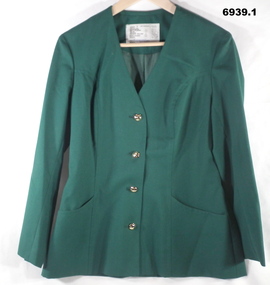
Uniform - SERVICE DRESS, ARMY, Australian Government Clothing Factory, 1981 - 1984
... safety pin. Buttons have raised emblem "Australian Army Psychology Corps". Dark green colour polyester fabric lining. Manufacturer's label at back below neckline. White cotton label. 2. Skirt - Winter Service Dress skirt. A-line skirt, narrow waistband, five belt...safety pin. Buttons have raised emblem "Australian Army Psychology Corps". Dark green colour polyester fabric lining. Manufacturer's label at back below neckline. White cotton label. 2. Skirt - Winter Service Dress skirt. A-line skirt, narrow waistband, five belt ...Uniform items issued to "BROWNE" Service No. F3207137.Garments - dark green colour wool and polyester fabric. 1. Jacket - Winter service dress jacket - collarless, with two curved inset pockets at hip. Four gold colour plastic buttons with shank and metal safety pin. Buttons have raised emblem "Australian Army Psychology Corps". Dark green colour polyester fabric lining. Manufacturer's label at back below neckline. White cotton label. 2. Skirt - Winter Service Dress skirt. A-line skirt, narrow waistband, five belt loops. front of skirt pair of box pleats. Rear at waist, nylon and metal zipper and dark green plastic button. Dark green colour polyester fabric lining. Manufacturers label sewn to waistband lining. 3. Belt - self fabric belt with gold colour plastic buckle. 4. Slacks - Winter Service dress slacks - full length with five belt loops, front nylon and metal zipper fly, dark green colour plastic button at waist, Manufacturer's labels two outside back. 5. Belt - self fabric belt with keeper and metal press stud. 6. Hat - Service dress hat - dark green colour fabric split brim, turned down at front and up at rear with light green colour fabric three panel crown. Light green half hat band with a rising pointed peak at front attached with black elastic. Interior - black velveteen sweatband lining, crown lining dark green polyester fabric. Manufacturer's label sewn rear lining. Manufacturer's labels - black ink print. 1.& 2. "A.G.C.F. ^/VICTORIA 1981/ 8410-66-096-5154/ SIZE 14 AVE HEIGHT/FULL HIP/ 90cm BUST/ 70 cm WAIST 100 cm HIPS/ Wool & polyester/ Garment/ NAME / SERVICE NO" With garment care instructions. Handwritten - blue ink pen "BROWNE/ F3207137" 4. " A.G.C.F. VICTORIA 1984 ^ 1984/ 8410-66-096-5173 SIZE 14 AVE HGT/ AVE HIP Waist 70 cm/ Hip 96 cm/Name/ Service No". With garment care instructions. Outside back - 'THIS TAG IS FOR IDENTIFICATION PURPOSES ONLY/ PLEASE REMOVE BEFORE WEARING" with printed and handwritten information. 6. "EMERCO VIC./ ^/ 8410-66-097-4922/ SIZE 56/ NAME/ SERVICE NO".passchendaele barracks trust, uniform, winter service dress, army, browne -
 Kiewa Valley Historical Society
Payroll Office Machine - S.E.C.V
... Electric motor with belt drive to machine which is situated under the rear left side of the table. Safety metal mesh protects the leather belt and is at the rear of the table. ...Electric motor with belt drive to machine which is situated under the rear left side of the table. Safety metal mesh protects the leather belt and is at the rear of the table. ...This machine was used by the State Electricity Commission of Victoria on the Kiewa Hydro Electric Scheme by office workers who worked in the payroll office.The State Electricity Commission of Victoria used the latest technology available for office equipment on the Kiewa Hydro Electric Scheme. This machine was used in the payroll office.Black metal table with machine on top. Electric motor with belt drive to machine which is situated under the rear left side of the table. Safety metal mesh protects the leather belt and is at the rear of the table. The operator faces the machine which has a tray on the left and is divided longitudinally into two and holds new shiny metal plates on each side. There is a brown bakelite wheel on the left and two printing wheels inside a myriad of moving parts that enable the metal plates to be embossed with payroll information i.e. "Gang No. etc. / Names / Pay No. / Rate type. This has to be checked out each time / Date"ULQ 11 10"state electricity commission of victoria. kiewa hydro electric scheme. payroll office. office work. payroll machine. office equipment -
 Kiewa Valley Historical Society
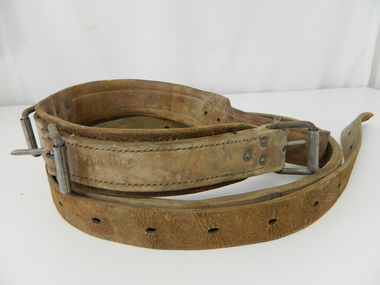
Belt Linesman Pole, circa mid to late 1900's
... A full harness and a secondary fall belt is now mandatory for pole linesmen. The safety of fellow workers could be compromised if they were required to assist or recover the first linesman if needed. ...A full harness and a secondary fall belt is now mandatory for pole linesmen. The safety of fellow workers could be compromised if they were required to assist or recover the first linesman if needed. ...This linesman belt was used under the 1947 Electricity Regulations and before tighter Occupation and Health regulations (late 1990's early 2000's) were introduced that mechanical lifting platforms(wherever possible) replaced the belt up the pole method.The safety concern was that it required that tools needed by the linesman had to be placed in a large canvas bag and attached to the belt (extra weight) then the linesman had to climb the ladder. Ladders had to be at the correct angle and not able to "slip" from their initial footings. A full harness and a secondary fall belt is now mandatory for pole linesmen. The safety of fellow workers could be compromised if they were required to assist or recover the first linesman if needed. In 2006 an additional 269 registered lineworkers were employed. Please note that the terminology of linesman has become unisex. The linesman's belt enabled the linesman to place his feet against the pole adjust the belt (if needed) and lean back securely allowing both hands to be free to work with. This linesman belt is very significant to the Kiewa Valley due to the numerous poles and high voltage overhead power structures that needed maintenance for the extensive "mushroom" installation of electrical power polls(wood and metal). On high poles (steel) climbing pegs were welded on, however in the Alpine areas snow in winter caused an OH&S problem which were hard to overcome. The safety of a linesman when maintenance of electricity line on poles can be highlighted by the New Zealand linesman who survived an 11,000 volt shock when carrying out maintenance. For the record 11,000 volts is four times more powerful than execution by "the electric chair". The maintenance of the linesman's belt was his responsibility (keeping it clean and in "good" condition). Labour laws change this initial responsibility, from the linesman, to the employer. Climbing pegs were installed on higher poles that extended beyond the reach of ladders.This thick leather linesman belt is made from two lengths of heavy lengths of leather straps sewn together to make up 80% of the belt. The remaining 20% is "the belt tonge" which has eleven holes for three (solid steel tang) buckle connections.kiewa hydro electricity scheme, victorian state electricity commission, relays, generators, electrical pole maintenance -
 Warrnambool RSL Sub Branch
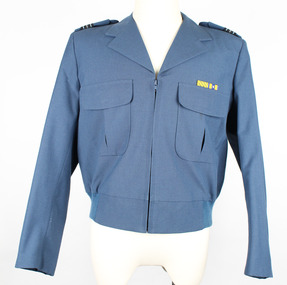
JACKET - WORKING DRESS - RAAF (Blue Grey) Uniform Jacket, Military Uniform, 1990
... safety pin. There are four corresponding button holes sewn into the left front of the tunic to fasten the jacket in the normal closed position when worn. The waist belt...safety pin. There are four corresponding button holes sewn into the left front of the tunic to fasten the jacket in the normal closed position when worn. The waist belt ...This item of military uniform was worn by Squadron Leader (SQNLDR) Bernard Farley during his period of Full Time service in the Royal Australian Air Force (RAAF) between 27 January 1976 and 02 March 1997. Bernard joined the RAAF as an Airmen was trained and employed as a Clerk Supply (CLKSPL) between 1996 - 1977. He undertook officer cadet training at the Army Officer Cadet School in 1978 and was commissioned into the Ground Defence Category on the 09 December 1978, where he served for 18 years and rose to the rank of SQNLDR. Royal Australian Air Force (RAAF) Working Dress (Jacket - Blue Grey). This uniform was in the period 1966 - 2001 as the primary daily uniform in the office environment. Polyester working dress is approved for wear employed in office or business type environments. The short waist length jacket consists of a jacket has a lapel collar and zip front, with two external chest pockets and exposed pocket flaps, There are portlets on each shoulder that are fastened with a black plastic button. This button has a crown over eagle in flight on the front. Rank slides are slid onto these portlets and this jacket has Squadron Leader rank slides on the portlets. is closed with four gold buttons down the front. Each button is inserted through a small round hole sewn into the right side of the tunic front and held in place at the rear with a safety pin. There are four corresponding button holes sewn into the left front of the tunic to fasten the jacket in the normal closed position when worn. The waist belt is part knitted on the sides and cloth on the front and rear. There is also one interior pocket on the right side below the exterior breast pocket. Maker: Australian Defence Industries The Tunic has two military decorations attached above the exterior left chest pocket. The decoration are: 1. Conspicuous Service Medal - Yellow and Green right sloping diagonal strips 2.. Defence Service Medal (with one clasp) - Blue and Gold upright stripes and round metal clasp positioned centrally. The DSM is awarded for 15 years service and a clasp is awarded for each additional 5 years service. -
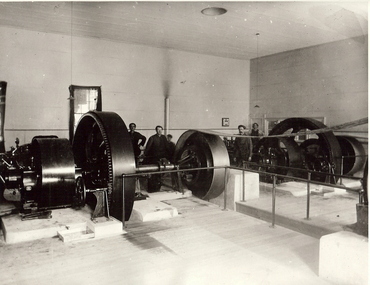 Bendigo Historical Society Inc.
Photograph - MACHINERY INCLUDING LARGE GEARED WHEELS, c.1900
... belts in wooden board lined room. Five males included. Rails along and across part of floor at waist height (safety?) ...belts in wooden board lined room. Five males included. Rails along and across part of floor at waist height (safety?) ...Black and white photograph. Machinery consisting of large gear wheels, driving wheels with belts in wooden board lined room. Five males included. Rails along and across part of floor at waist height (safety?) Two sets of similar gear. Electric motors. Rubber belts driving machinery out of picture. Building clean - new? Electric lights and switches.topic, objects, machine, machinery, workers, males -
 Alfred Hospital Nurses League - Nursing History Collection
Equipment - body restraint wrist cuffs - pair (also used for ankles), 176.087 inn previous cataloguing
... Limb Holders, also known as Limb Restraints, are designed to limit the movement of wrists and/or ankles in patients assessed to be at risk of disrupting life-saving treatment, pulling lines/tubes, exacerbating skin conditions, compromising wound site integrity, or self-injury. patient safety restraints AHNL 176.87 written in black ink on leather section of cuff, also white paper sticker with blue ink 176.87 pair of tan leather wrist straps (can be used for ankles) with cream felted lining, belt strap with buckle for securing in place, machine stitching to edge of leather to attach felted padding in place, silver studs x 2 holding leather belt in place, silver metal buckle and loop on belt. 176.087 inn previous cataloguing Equipment body restraint wrist cuffs - pair (also used for ankles) ...Limb Holders, also known as Limb Restraints, are designed to limit the movement of wrists and/or ankles in patients assessed to be at risk of disrupting life-saving treatment, pulling lines/tubes, exacerbating skin conditions, compromising wound site integrity, or self-injury. In our collective experience, we used these types of restraints to ensure patient safety, to minimise self harm by confused patients (for many reasons - head injury, post op, drug induced) who would otherwise have interfered with treatments (remove intravenous, remove dressing) or fall out of bed.Limb Holders, also known as Limb Restraints, are designed to limit the movement of wrists and/or ankles in patients assessed to be at risk of disrupting life-saving treatment, pulling lines/tubes, exacerbating skin conditions, compromising wound site integrity, or self-injury.pair of tan leather wrist straps (can be used for ankles) with cream felted lining, belt strap with buckle for securing in place, machine stitching to edge of leather to attach felted padding in place, silver studs x 2 holding leather belt in place, silver metal buckle and loop on belt.176.87 written in black ink on leather section of cuff, also white paper sticker with blue ink 176.87patient safety, restraints, ahnl -
 Chiltern Athenaeum Trust
Badge
... The object is a metal-open work badge depicting a stylised lion surrounded by a oval, which appears to resemble a belt, and bears the words Sapere Aude (translation Dare to be Wise). Below the main body of the badge is a short chain attached to a safety pin at the other end. ..."The Golden Plague” Wesley College University of Melbourne Sir Leo Finn Bernard Cussen Supreme Court of Victoria schooling badge medal Obverse: Sapere Aude Reverse: REC 269 The object is a metal-open work badge depicting a stylised lion surrounded by a oval, which appears to resemble a belt, and bears the words Sapere Aude (translation Dare to be Wise). Below the main body of the badge is a short chain attached to a safety pin at the other end. ...This medal/badge was given to Wilfred Clarence Busse, born in Chiltern in 1898, supposedly during his time at Wesley College. The lion on the badge is a perfect match for Wesley College's logo, and the words Sapere Aude are the school's motto. Busse completed his secondary education as Wesley College in the early twentieth century, and went on to study law at the University of Melbourne. As a lawyer, he spent time in the room of Supreme Court Judge Bernard Cussen (1859-1933). Judge Cussen was popular, known for being just and precise and for completing through statutory consolidation in his spare time. As well as working as a lawyer, Busse wrote historical fiction inspired by his life in Chiltern, these included The Blue Beyond; A Romance of the Early Days in South Eastern Australia" and "The Golden Plague: A Romance of the Early Fifties," which won the T.E.Role gold medal for the best historical novel in 1930 and went on to become a best seller. He was a member of the Chiltern Athenaeum until his death in 1960. Wesley College was founded in 1866 in St. Kilda by Rev. James S. Waugh, Dr James Corrigan, Rev. Daniel Draper and businessman Walter Powell. Wesley College was a founding member of the Associated public School of Victoria in 1908. Originally a boys school, coeducation was introduced in the 1970s, and the school continues to function today and has a reputation as one of the best schools in Victoria witth regards to VCE and IB scores. This item is significant for its connect to W.C. Busse and his literary and non-fiction work inspired by Chiltern. The object is a metal-open work badge depicting a stylised lion surrounded by a oval, which appears to resemble a belt, and bears the words Sapere Aude (translation Dare to be Wise). Below the main body of the badge is a short chain attached to a safety pin at the other end. Obverse: Sapere Aude Reverse: REC 269busse, w.c. busse, wilfred clarence busse, chiltern, chiltern athenaeum, "the blue beyond, a romance of the early days in south eastern australia”, "the golden plague: a romance of the early fifties.", "the golden plague”, wesley college, university of melbourne, sir leo finn bernard cussen, supreme court of victoria, schooling, badge, medal -
 Whitehorse Historical Society Inc.
Article, Relentless road safety pioneer, 2003
... Birrell John Henry Winter Road safety Obituary of Blackburn resident Dr John Birrell, former police surgeon responsible for the adoption of seat belt and drink driving legislation. ...Obituary of Blackburn resident Dr John Birrell, former police surgeon responsible for the adoption of seat belt and drink driving legislation.Obituary of Blackburn resident Dr John Birrell, former police surgeon responsible for the adoption of seat belt and drink driving legislation.Obituary of Blackburn resident Dr John Birrell, former police surgeon responsible for the adoption of seat belt and drink driving legislation.birrell, john henry winter, road safety -
The 5th/6th Battalion Royal Victoria Regiment Historical Collection
Souvenir - Trench Art, Belt with badges, 1918
... Badges and buttons are fixed to the belt with split pins, safety pins and wire....Badges and buttons are fixed to the belt with split pins, safety pins and wire. Belt with badges Souvenir Trench Art ...Method of keeping badges collected from other allied soldiers.Tan webbing belt with German "Gott Mit Uns" belt buckle and 36 buttons and badges on it. There is some white staining on the belt from where someone has previously attempted to polish badges with brasso. Badges and buttons are fixed to the belt with split pins, safety pins and wire.regimental property, ww1, souvineer, heraldry, wark vc club -
 Melbourne Tram Museum
Souvenir - Event Materials, Yarra Trams, Beware the Rhino, c2016
... Trams tramways Yarra Trams Safety Rhinos Plastic water bottle yellow, with a metal belt clip, screw on/off white cap, within a clear plastic bag - give away item for an event with Beware the Rhino and associated messages. 2nd copy added 26-3-2019. ...Plastic water bottle yellow, with a metal belt clip, screw on/off white cap, within a clear plastic bag - give away item for an event with Beware the Rhino and associated messages. 2nd copy added 26-3-2019. Item not within the clear plastic bag.trams, tramways, yarra trams, safety, rhinos -
 Department of Energy, Environment and Climate Action
Raindance Aerial Incendiary Machine R2
... Many technological and safety improvements followed including the Raindance machine Forests Commission Victoria (FCV) Planned Burning Bushfire Aviation Bushfire Raindance Systems R2 Aerial Incendiary Machine developed in Western Australia Rather than "ping pong balls" it uses a belt of incendiary "caplets" which are injected inside the machine before being ejected Raindance Aerial Incendiary Machine R2 ...Alan McArthur from the CSIRO began his experimental burning program in the late 1950s near Canberra and published his landmark paper in 1962, “Controlled burning in eucalypt forests”. Leaflet No. 80, as it was known, proved a turning point for forest and fire managers across Australia. It led to the McArthur Forest Fire Danger Meter (FFDM) which first appeared in operational use in 1967 as the Mk 4. The CSIRO had developed its semi-automatic aerial incendiary machine dropping small capsules, with the first trial from a fixed-wing Cessna 337 at Manjimup in December 1965. Many technological and safety improvements followed including the Raindance machineAerial Incendiary Machine developed in Western Australia Rather than "ping pong balls" it uses a belt of incendiary "caplets" which are injected inside the machine before being ejected Raindance Systems R2forests commission victoria (fcv), planned burning, bushfire aviation, bushfire
