
Showing 45 items matching "sailing craft"
-
 Flagstaff Hill Maritime Museum and Village
Craft - Ship model, 28-01-1985
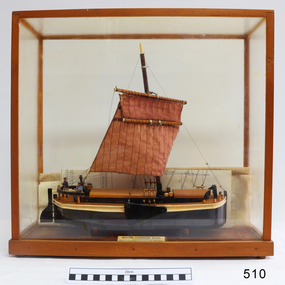
... ...sailing craft...The River Humber Keel design is a typical sailing craft used for the transport of inshore and inland cargo, from Humber and Hill, around Yorkshire, U.K., in the late 19th and early 20th centuries. ...The River Humber Keel design is a typical sailing craft used for the transport of inshore and inland cargo, from Humber and Hill, around Yorkshire, U.K., in the late 19th and early 20th centuries. ...This unnamed ship model was built by a Warrnambool resident, Mr Edward Howard Grainger. The River Humber Keel design is a typical sailing craft used for the transport of inshore and inland cargo, from Humber and Hill, around Yorkshire, U.K., in the late 19th and early 20th centuries. This model is an example of the craft of ship model making, which has been a popular hobby for hundreds of years. Our collection has many ship models, some of which were built by professional model makers, others by naval enthusiasts.Ship model: sailing ship with a single mast, double spar, and a humber keel. Two-tone brown and cream paint, light brown sail. Figures of a man, woman and dog on deck. A type of vessel used on the Yorkshire waterways. Perspex case with wooden frame. Folded plans are inside the case. Nameplate Plaque inside the case describes the ship. Made by Edward Howard Grainger."RIVER HUMBER KEEL/YORKSHIRE/LENGTH 61', BEAM 15'6", DR G CAP 100 TONS/CREW MAN & WIFE, SCALE 1:40/HUON PINE etc. E.H. GRANGER 28.1.1985" on plaque inside caseflagstaff hill, flagstaff hill maritime museum and village, warrnambool, maritime museum, maritime village, great ocean road, shipwreck coast, edward howard grainger, e h grainger, river humber keel, model ship, ship model, hobby, maritime vessel, sailing craft, sailing boat -
 Port Melbourne Historical & Preservation Society
Document, Dugga's Wooden Boat Heaven 2025 calendar, 2025
... The spiral bound calendar, "Dugga's Wooden Boat Heaven" for 1925 features wooden sailing craft manned by Dugga or members of the BEAZLEY family. ...The spiral bound calendar, "Dugga's Wooden Boat Heaven" for 1925 features wooden sailing craft manned by Dugga or members of the BEAZLEY family. ...The spiral bound calendar, "Dugga's Wooden Boat Heaven" for 1925 features wooden sailing craft manned by Dugga or members of the BEAZLEY family. The cover has sunset photograph of Dugga fishing on Port Phillip Bay.leonard george 'dugga' beazley, recreation - sailing, natural environment- port phillip bay. -
Glenelg Shire Council Cultural Collection
Print, View of Early Portland, 1890-1900
... Two steam ships-one berthed at a pier, another in the bay, centre left. Small sailing craft in harbour; people on beach and cliff tops. ...Two steam ships-one berthed at a pier, another in the bay, centre left. Small sailing craft in harbour; people on beach and cliff tops. ...Displayed in window of History House, 1991-2006. Given by Betty Wilson to her husband, Murray J. Wilson.View of a town on a harbour with piers. Two steam ships-one berthed at a pier, another in the bay, centre left. Small sailing craft in harbour; people on beach and cliff tops. Black and white lithograph. Mounted in matt.Front: (no inscriptions) Back: (no inscriptions) Murry J. Wilson/from E. Wilson (cursive handwriting, blue pen. Taken from back of frame and a fixed in Mylar to back of mount) -
 Queenscliffe Maritime Museum
Tool - Fid
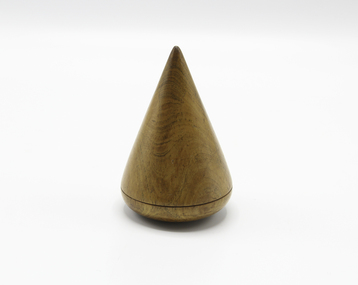
... Sailing...Marine craft...Fid Sailmaking Rope making Sailing Marine craft 101-3N Timber conical shaped fid designed to fit the palm of the hand Tool Fid ...Timber conical shaped fid designed to fit the palm of the hand101-3Nfid, sailmaking, rope making, sailing, marine craft -
 Bendigo Military Museum
Postcard - POSTCARDS, PHOTOGRAPHIC WW1, C.WW1
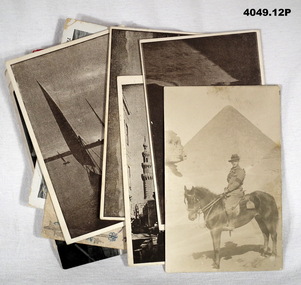
... Brief note on the back in purple. .9) Postcard, sepia, showing a sailing craft on a river being "Felluca on the Nile". .10) Postcard, colour, hand drawn, shown a flag flower arrangement, centre in an arrow through a heart. ...Brief note on the back in purple. .9) Postcard, sepia, showing a sailing craft on a river being "Felluca on the Nile". .10) Postcard, colour, hand drawn, shown a flag flower arrangement, centre in an arrow through a heart. ...The cards revolve around "Hannah FIRTH". See also Cat. No. 4048.10P for more cards. .1) Addressed to "Hannah" from "Clarry (Peanuts)". .2) To "Dear Hannah, April 13th 7.30pm". Not signed off but from same person as .1) & .3). .3) Addressed "Dear" from "Dillon (Clarry)". .4) To "Dear Hannah" from "Yours ERIC". .5) There is no to or from but mentions "ERIC". .6) - .9) all are written on rear in large purple writing with the following: "Love to Hannah x x" "To Hannah with Love x x x" "With the Australian Contingent in Eygpt" "Love to Hannah x x" .10) Addressed to "Mrs H. FIRTH 18 Brunswick St Morley Leeds Yorkshire". The date on card is unclear. .11) On rear in red "No 33 - some of the nurses in their quarters at an Australian Casualty Clearing Station". .12) On rear in fine print "Patriotic Series No. 22" Across both 4048.10P & 4049.12P there is two other addresses for "MISS H. FIRTH". 1. 28 Young St Fitzroy, Melbourne. 2. 2 Turner St Abbotsford, Melbourne.Twelve photograph postcards of different scenes revolving around “Hannah”.1) & .2) Postcards, colour, centre has oval shape with British flag and all around are 11 smaller flags with country name on. In gold speckled writing top & bottom "From A. 10th Field Coy Engineers. On rear in black pen extensive letters. .3) Postcard, colour, centre has horse shoe with Australian & British flags. In same speckled gold writing as .1) & .2). On horseshoe in black pen "Good luck to Hannah & Clarence". .4) Postcard, black & white, showing a ship, at the bottom printed "TROOPSHIP HORORATA". On rear short letter in purple. .5) Postcard, sepia, showing soldier on horseback at the Pyramids & Sphinx. On rear brief letter in pencil. .6) Postcard, sepia, showing a street scene which appears to be a place called "Muski" in Eygpt. Brief note on rear in purple. .7) Postcard, sepia, showing domed building, re the "Blue Mosque". Brief note on back in purple. .8) Postcard, sepia, scene over buildings being "View from the Citadel". Brief note on the back in purple. .9) Postcard, sepia, showing a sailing craft on a river being "Felluca on the Nile". .10) Postcard, colour, hand drawn, shown a flag flower arrangement, centre in an arrow through a heart. Address on rear in black. .11) Postcard, black & white, showing a group of nurses. Card was put out by the "Aust Comforts Fund". .12) Postcard, colour, drawn showing six different nations soldiers carrying flags.photographs, postcards, hannah -
 Flagstaff Hill Maritime Museum and Village
Instrument - Foghorn, Late 19th century
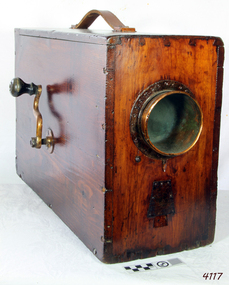
... The example in the Flagstaff collection is an early cased and portable diaphone used on pleasure or sailing craft. By manually turning the crank handle air is produced and fed into valves that direct air across vibrating metal reeds to produce the required sound. in foggy weather, fog horns are used to pinpoint a vessels position and to indicate how the vessel is sailing in foggy conditions. ...The example in the Flagstaff collection is an early cased and portable diaphone used on pleasure or sailing craft. By manually turning the crank handle air is produced and fed into valves that direct air across vibrating metal reeds to produce the required sound. in foggy weather, fog horns are used to pinpoint a vessels position and to indicate how the vessel is sailing in foggy conditions. ...A foghorn is a device that uses sound to warn of navigational hazards like rocky coastlines, or boats of the presence of other vessels, in foggy conditions. The term is most often used with marine transport. When visual navigation aids such as lighthouses are obscured, foghorns provide an audible warning of rocky outcrops, shoals, headlands, or other dangers to shipping. An early form of fog signal was to use a bell, gong, explosive signal or firing a cannon to alert shipping. From the early 20th century an improved device called the diaphone was used in place of these other devices, The diaphone horn was based directly on the organ stop of the same name invented by Robert Hope-Jones, creator of the Wurlitzer organ. Hope-Jones' design was based on a piston that was closed only at its bottom end and had slots, perpendicular to its axis, cut through its sides, the slotted piston moved within a similarly slotted cylinder. Outside of the cylinder was a reservoir of high-pressure air. Initially, this air would be admitted behind the piston, pushing it forward. When the slots of the piston aligned with those of the cylinder, air passed into the piston, making a sound and pushing the piston back to its starting position, whence the cycle would be repeated. This method of producing a low audible sound was further developed as a fog signal by John Northey of Toronto and these diaphones were powered by compressed air produced by an electric motor or other mechanical means that admitted extremely powerful low-frequency notes. The example in the Flagstaff collection is an early cased and portable diaphone used on pleasure or sailing craft. By manually turning the crank handle air is produced and fed into valves that direct air across vibrating metal reeds to produce the required sound. in foggy weather, fog horns are used to pinpoint a vessels position and to indicate how the vessel is sailing in foggy conditions. One blast, when sailing on starboard tack and two blasts, when sailing on a port tack and three dots, when with wind is behind the vessel. Since the automation of lighthouses became common in the 1960s and 1970s, most older foghorn marine installations have been removed to avoid the need to run the complex machinery associated with them, and have been replaced with an electrically powered diaphragm or compressed air horns. The example in the collection is significant as it was used in the early 19th century for sailing vessels was important but these portable crank fog horns have also been superseded by modern electric varieties. Therefore the item has a historical connection with sailing and maritime pursuits from our past.English Rotary Norwegian Pattern nautical foghorn within a boxed pine varnished case with exposed corner dovetailing, original leather carrying strap, brass side crank, and original copper trumped horn. Card accessory with Directions for Use in both English and French.Noneflagstaff hill, warrnambool, shipwrecked coast, flagstaff hill maritime museum, maritime museum, shipwreck coast, flagstaff hill maritime village, great ocean road, foghorn, maritime technology, maritime communication, marine warning signal, portable foghorn, bellows foghorn, crank handle, robert hope-jones, john northey -
 Flagstaff Hill Maritime Museum and Village
Craft - Ship Model, Cutty Sark
... sailing ship...tea clipper...sail training vessel...cadet training ship...commercial trading vessel...cargo sail vessel...Ferreria...1869...tea cargo...tea trade...China tea...wool export...Australian export...Australian wool export...Cornwall...training ship...Greenwich...British Museum...ship model...craft...Flagstaff Hill Warrnambool Flagstaff Hill Maritime Museum Shipwreck Coast Flagstaff Hill Maritime Village Maritime Museum Great Ocean Road Cutty sark historic sailing ship tea clipper sail training vessel cadet training ship commercial trading vessel cargo sail vessel Ferreria 1869 tea cargo tea trade China tea wool export Australian export Australian wool export Cornwall training ship Greenwich British Museum ship model craft hobby ship model Cutty Sark model making "Cutty Sark" Ship model: the clipper ship Cutty Sark in full ship rig with raised poop deck, deck house, three boats on deck (one has fallen). ...THE CUTTY SARK: - The Cutty Sark was built in Britain in 1869 and was one of the last great sailing ships. At first, it carried tea from China. Later, it was used to transport wool from Australia. It became famous for its speed and held the record for the fastest voyage from Australia to Britain for ten years. Later, a Portuguese company bought the ship and renamed it Ferreira. After that, a retired sea captain purchased it to use as a training ship in Cornwall. When the captain died, the ship was given to a training college in Greenwich in 1938. In 1954, it was placed in dry dock at Greenwich, where it remains on display. The Cutty Sark is a special ship because it carried wool from Australia to other parts of the world. Models like this one help us imagine what sea travel was like before steam-powered ships were common, and they show us how trade, travel and migration changed over time. The Cutty Sark is also famous for being very fast. It set a record for the journey from Australia to Britain and kept that title for ten years. Today, people still recognise its importance because it has been carefully preserved and is on display at the British Maritime Museum in Greenwich. Its story has also made it a favorite subject for people who enjoy building ship models. Ship model: the clipper ship Cutty Sark in full ship rig with raised poop deck, deck house, three boats on deck (one has fallen). It has a two-toned black and tan hull and three jibs. The model is set in a diorama of a blue sea, a lighthouse and another small yacht. It is housed in a glass-sided case with a dark grey painted structure. The bow has an inscription."Cutty Sark"flagstaff hill, warrnambool, flagstaff hill maritime museum, shipwreck coast, flagstaff hill maritime village, maritime museum, great ocean road, cutty sark, historic sailing ship, tea clipper, sail training vessel, cadet training ship, commercial trading vessel, cargo sail vessel, ferreria, 1869, tea cargo, tea trade, china tea, wool export, australian export, australian wool export, cornwall, training ship, greenwich, british museum, ship model, craft, hobby, ship model cutty sark, model making -
 Flagstaff Hill Maritime Museum and Village
Tool - Spliceing Tool
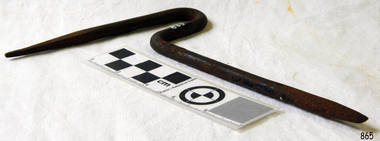
... This homemade, handmade splicer is an example of a tool used to splice a cable or rope, a craft that was in much need onboard a sailing ship. Warrnambool Shipwreck Coast Flagstaff Hill Flagstaff Hill Maritime Museum Flagstaff Hill Maritime Village splicing tool rope work rope strands knot making netting net making sailmaker's tool Splicing tool; a spike on one end and a flat blade on the other, with goose-neck centre for leverage. ...This splicing tool is handmade on a forge. It is used for splicing in fibre and wire rope work to form a semi-permanent joint between two ropes, or parts of the same rope or steel cable. The rope is partly untwisted and then the strands are interwoven. Splices can be used to form a stopper at the end of a line, to form a loop or an eye in a rope, or to join two ropes together. Splices are preferred to knotted rope; a knot typically can reduce the strength by 20–40%, but a splice is capable of attaining a rope's full strength. This homemade, handmade splicer is an example of a tool used to splice a cable or rope, a craft that was in much need onboard a sailing ship. Splicing tool; a spike on one end and a flat blade on the other, with goose-neck centre for leverage. Handmade.warrnambool, shipwreck coast, flagstaff hill, flagstaff hill maritime museum, flagstaff hill maritime village, splicing tool, rope work, rope strands, knot making, netting, net making, sailmaker's tool -
 Flagstaff Hill Maritime Museum and Village
Craft - Ship Model, Mr Edward Howard Grainger (ship model maker), Skylark, circa 1980s
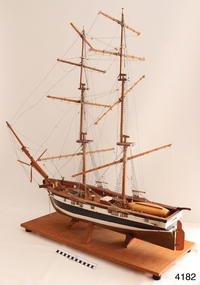
... sailing ship, hull painted, with a white strip on white. Separate wooden lifeboat. "Skylark" on each side of the bow and across the stern. The rudder pivots. Mounted on a timber stand. Model built by Mr E.H. Grainger. Skylark Craft ...This handmade ship model was built and donated by mr E H Grainger in the late 20th century. The warship represents the British Sloop, Seagull Class, HMS Skylark 1806-1812. The brig-rigged, two-masted HMS Skylark was built at William Rowes' Yard on the River Tyne for the Royal Navy of the United Kingdom in 1806. The ship was armed with 14 British 24-pound Carronades and 2 British 6-pounders. It could carry a crew of 95. This model is an example of the craft of ship model making, which has been a popular hobby for hundreds of years. Our collection has many ship models, some of which were built by professional model makers, others by naval enthusiasts. The model is also an example of British warships that predate the colonisation of Australia.Ship model, Skylark. 2-masted sailing ship, hull painted, with a white strip on white. Separate wooden lifeboat. "Skylark" on each side of the bow and across the stern. The rudder pivots. Mounted on a timber stand. Model built by Mr E.H. Grainger."SKYLARK" on both sides of the bow. "SKYLARK HULL" across bowflagstaff hill, flagstaff hill maritime museum and village, warrnambool, maritime museum, maritime village, great ocean road, shipwreck coast, ship model, skylark, two-masted ship, sailing ship, hobby, war ship, hms skylark, british sloop, british brig, carronade, brig of war, 1806 -
 Flagstaff Hill Maritime Museum and Village
Craft - Ship Model, Joseph Conrad
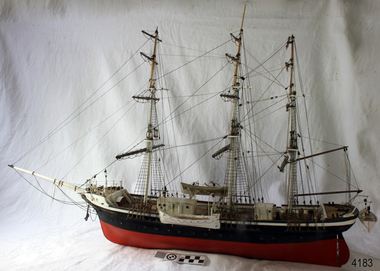
... The ship model of Joseph Conrad represents the craft of ship model-making, which many people have enjoyed over the years. Although the model is made from modern materials, it shows the elements of a sailing ship of a bygone era. ...The ship model of Joseph Conrad represents the craft of ship model-making, which many people have enjoyed over the years. Although the model is made from modern materials, it shows the elements of a sailing ship of a bygone era. ...The ship model of Joseph Conrad represents the craft of ship model-making, which many people have enjoyed over the years. Although the model is made from modern materials, it shows the elements of a sailing ship of a bygone era. About the sailing ship JOSEPH CONRAD: - The vessel Joseph Conrad began as the Danish iron-hulled, wooden sailing ship Georg Stage, launched in 1882. It was used as a training ship for Danish sailors. In 1905, while docked in Copenhagen, the ship was rammed by a larger ship, and 22 boys were killed while sleeping in the hull. The ship was later raised and put on guard during World War I. Alan Villiers was an Australian author of seafaring books as well as a sailor. He bought the George Stage and renamed it Joseph Conrad in honour of the renowned Polish-born maritime fiction author, who briefly captained the barque Otago; it was the only time he was in charge of a ship. In 1934, Villers sailed the ship on a two-year voyage around the world. In 1936, it was sold to an American, who later donated it for use again as a training ship. After World War II, the ship was no longer in use, and in 1947, it was transferred to the Mystic Seaport Museum for training and exhibition purposes. JOSEPH CONRAD (1857-1927): - Joseph Conrad was Polish-born. He became a British subject in 1886. He was known for his marine fiction writing and, for a short time, was a mariner and Captain. As a boy of 13 years old, Joseph Conrad wanted to be a sailor. At 19, he joined the British merchant marines, working in several roles. He eventually qualified as a captain but only served in this role once, from 1888-89, when he commanded the barque Otago, sailing from Sydney to Mauritius. In 1889, he also began writing his first novel, Almayer’s Folly. He retired from life as a mariner in 1894, aged 36. Conrad’s visits to Australia from 1878 to 1982, and his affection for Australia, were later commemorated by a plaque in Circular Quay, Sydney. Conrad continued as an author. It is said that many of the characters in his books were inspired by his maritime experiences and the people he had met. By the end of his life, he had completed many stories and essays, 19 novels, plus one incomplete novel titled ‘Suspense’ that was finished and published posthumously. In 1924, shortly before he died, Conrad was offered a Knighthood by Prime Minister Ramsay MacDonald for his work but declined the offer. The ship model represents the design of sailing ships built in the 1880s and can be used as a reference in understanding the construction of the ships of the Victorian era. The model is important for its connection to the vessel Joseph Conrad which was used as a training ship for seafarers, and even now is used to teach maritime skills, as well as an exhibit, in the maritime museum, Mystic Seaport. The model's name is significant for its association of its name with the famed early 20th-century maritime author, Joseph Conrad.Ship model; three-masted sailing ship named the Joseph Conrad, with cabins on deck, lifeboats, a ladder on the side and a figurehead on the bow. The hull is black at the top and red below. The ship's name is painted on both sides of the bow. JOSEPH CONRADflagstaff hill, flagstaff hill maritime museum and village, warrnambool, maritime museum, maritime village, great ocean road, shipwreck coast, joseph conrad, captain joseph conrad, maritime author, marine author, nautical author, sailor, seafarer, ship model, two-masted ship, iron hull, sailing ship, georg stage, 1882 ship, danish ship, training ship, boys killed, alan villiers, ship joseph conrad, mystic seaport, museum ship, otago -
 Flagstaff Hill Maritime Museum and Village
Craft - Ship Model, Auster
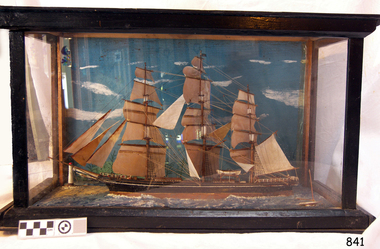
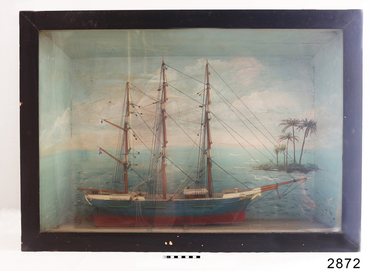
... sailing ship, teal colour. Background of sea and sky, island with palm trees, seagulls. Front wood frame of case painted black, back and sides painted grey. Metal handle on top panel of case. Auster Craft ...Ship model, Auster relief, 3 masted sailing ship, teal colour. Background of sea and sky, island with palm trees, seagulls. Front wood frame of case painted black, back and sides painted grey. Metal handle on top panel of case. "AUSTER" painted on side of bowflagstaff hill, warrnambool, shipwrecked-coast, flagstaff-hill, flagstaff-hill-maritime-museum, maritime-museum, shipwreck-coast, flagstaff-hill-maritime-village, ship mode., auster, sailing ship -
 Flagstaff Hill Maritime Museum and Village
Craft - Ship Model
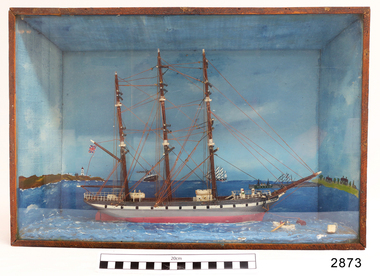
... ...sailing ship model...water craft...flagstaff hill warrnambool shipwrecked-coast flagstaff-hill flagstaff-hill-maritime-museum maritime-museum shipwreck-coast flagstaff-hill-maritime-village ship model sailing ship model water craft Ship model relief of unnamed, three masted sailing ship, painted green. ...Ship model relief of unnamed, three masted sailing ship, painted green. British flag is flying from mast. Other ships and a rowing boat are also in the water and land on both sides has lighthouse and buildings. Wooden case has sloping sides and glass front. flagstaff hill, warrnambool, shipwrecked-coast, flagstaff-hill, flagstaff-hill-maritime-museum, maritime-museum, shipwreck-coast, flagstaff-hill-maritime-village, ship model, sailing ship model, water craft -
 Flagstaff Hill Maritime Museum and Village
Print - Lithograph, sea rescue, R.N. Duffield, Australian cruiser “MELBOURNE” (Tons 5600) rescuing crew of sinking four-masted schooner “HELEN B. STERLING” of Halifax NS Canada, Tons 1343 in a gale in the Pacific Ocean, 19-11-1924
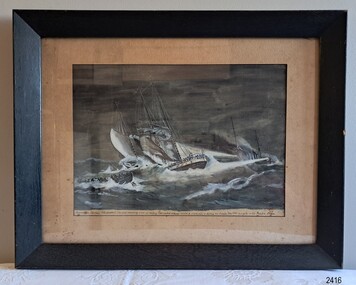
... craft, and aiding the interpretation of our maritime history. Flagstaff Hill Flagstaff Hill Maritime Museum and Village Warrnambool Maritime Museum Maritime Village Great Ocean Road Shipwreck Coast Lithograph Lithograph print reproduction print Helen B. Sterling the Sterling American owned schooner Halifax Halifax N S Halifax Nova Scotia Nova Scotia Halifax N S Canada schooner windjammer sailing ...This framed lithograph print in watercolour and gouache was produced on November 19th, 1924, by 20th-century marine artist, Mr R.N. Duffield. It depicts the event of a sea rescue that took place two years earlier. The framer was A.L. Frith of Footscray, Melbourne, who actively advertised from 1933 to 1935. The now disbanded Shiplovers' Society of Victoria (1930-2018) donated the print, and it seems likely that this print was framed for that organisation. This graphic image shows the conditions in which the rescue from the wrecked Helen B. Sterling happened. Captain George Harris was master of the American-owned, four-masted windjammer. His wife Edith and their ten-year-old son Leslie were on board, along with a crew of fifteen seamen. The ship set off from Newcastle, NSW, on January 5th, 1922, loaded with a cargo of coal to deliver to the Society Islands and on to San Francisco. Young Leslie later wrote a lively school composition for his teacher about his experiences on board the Helen B Sterling. He tells of a fire that broke out the day after they departed and burned a hole in a beam. Then another troublesome time on the 9th, when a strong gale blew a sail off the ship. Finally, he tells of the highlight of his voyage when, on the 18th January, the ship was right in the path of a strong cyclone, which broke the mainmast. Huge waves crashed over both sides of the deck, meeting in the middle, and the ship began to sink. The rescue from the wreck was an exciting time for the young boy, and even more so when one of his cats survived after being carefully wrapped in a pillowcase and thrown down from the ship for the boy. Reporters later wrote about Leslie’s comments, “... what had grieved him most was the thought that he might never see his two little sisters again”. Captain Harris said in a published statement, “… the gale was the worst he had met in his 12 years’ experience at sea. All went well for the first week. We then encountered a strong blow from the south-east. We tried the gasoline pump, but the engine broke down, and we had to do the pumping by hand. We at once shortened sail, but the sea increased in fury to such an extent that men were washed from the pumps. I was below at 5:30 on Sunday morning [January 22nd, 1922] when the main mast went over the side, … I at once sent out SOS signals, and got word that HMAS Melbourne was coming to our assistance. I had made a mistake with regard to our position, but did not know it until 11:30 o’clock, when I sent out the correct location. This was picked up by the Melbourne and I received the following reply: “We will reach you about 2 am. Keep a good heart. The Melbourne will do all she can.” Our ship was practically awash when we were taken off.” (Ref: the ‘Helen B. Sterling Disaster’, Maitland Weekly Mercury, NSW, 4-2-1922.) Officers from the Royal Australian Navy, Captain Henry J Feakes (later Rear-Admiral) and Commander Wilfrid Ward Hunt, were on board the light cruiser, HMAS Melbourne (1913-1928), when it left Sydney for New Zealand. After the SOS was received, the ship sped at full steam towards the sinking Helen B. Sterling. They found the vessel at about midnight and shone bright search lights on the distressed ship to illuminate the desperate scene. The Melbourne was unable to move close to the schooner, so sixteen seamen, including Commander Hunt, volunteered to man the Melbourne’s lifesaving 12-oared cutter. They rowed the sea boat with great urgency towards the victims of the sinking ship, keen to save lives no matter what the conditions. When the cutter was close to the Sterling, a line was secured between the Sterling and the cutter. The weary, waterlogged and anxious men on board could be rescued, one at a time, in the breeches buoy equipment, which looked like canvas shorts with a lifesaving ring in the waistband. The victims were hauled along the line and pulled aboard by many willing hands. All eighteen crew and passengers were saved, including Captain Harris and his family. The seamen of the Melbourne received a heroes’ welcome when they arrived in New Zealand. The grateful survivors were taken to Auckland, where they received the care and comfort they needed. Melbourne’s Lord Mayor, Cr. Swanston, on behalf of the citizens of Melbourne, formally recognised the heroic rescue efforts of the seamen of the HMAS Melbourne on March 2nd, 1922, at a special presentation. Two large flags, a White Ensign and an Australian “Jack" Flag, were presented to the Captain of HMAS Melbourne, and souvenirs were awarded to the sea boat’s crew and its Commander, Wilfred Ward Hunt. Commander Hunt was also presented with an original watercolour depicting the heroic rescue from the wreck of the Helen B. Sterling, painted just after the event by renowned marine artist Arthur V Gregory (1867-1957), and he received a silver cigarette case bearing the City’s coat of arms and the inscription, "To Commander Ward Hunt from the Citizens of Melbourne as a memento of the rescue of the crew of Helen B. Stirling by H.M.A.S. Melbourne, on 23.1.22". Both the painting and the cigarette case are now treasured items inherited by his grandson; a reminder of “… a very fine naval gentleman who believed in leading by example." R.N. DUFFIELD: - The Lithograph print in our collection by 20th-century English artist R.N. Duffield is dated Nov. 19, 1924. It is very similar to, and possibly created from, the original A V Gregory watercolour presented to Commander Hunt and dated 1922. Mr R.N. Duffield has art works in the Yarmouth Museums, Norfolk Museums Collection; “Orient Liner Otranto …,” and "Convoy of six ships at sea", both painted in watercolour and gouache during the 1940s. Some of his other works, also painted in watercolour and gouache, have been advertised for sale on Internet sites. Some details differ between the original A.V. Gregory and this Lithograph Print: - -the words on the bow on the original watercolour are “Helen B. Sterling, Blain”, which is in Washington, USA, where the Sterling Shipping Company was registered from around 1919; the words on the print are “Helen B. Sterling, Halifax, N S”, for Nova Scotia, Canada, which is the hometown of Sterling Shipping Company founder’s wife, Helen B Sterling. -The watercolour is coloured and has fine details; the print is monochrome - The A V Gregory signed the watercolour in 1922, on the lower left; the print is signed with the Lithographer’s name on the lower right; “R N Duffield, Nov. 19. 1924” ARTHUR VICTOR GREGORY (1867-1957): - A.V. Gregory is a renowned marine artist who worked in watercolour and gouache. He painted actively between 1899 and 1932, creating over 3o0 works. South Melbourne, Victoria, was where he lived and worked. This Lithograph print is significant in that it depicts the rescuing of the passengers and crew of the schooner “Helen B Stirling”. At the time this was a significant event that made most Australian and New Zealand papers because of the involvement of the Australian cruiser “Melbourne”. The image demonstrates the perilous conditions experienced by seafarers. It includes an example of the line and breeches buoy method used to save lives at sea from the 1860s and into the 20th century. It reflects a time in our history when sail and steam ships cruised the world’s seas together, the former trading with a cargo of coal from Newcastle, the latter defending our country in World War I. The print is part of Flagstaff Hill Maritime Museum’s Collection of maritime artworks that depict famous events, vessels and locations, showing the evolution of sea craft, and aiding the interpretation of our maritime history. The Lithograph print is behind glass in a black painted timber frame and mounted under a cream matte. The vivid image depicts a sea rescue in progress. The night scene is illuminated by a light beaming from a steamship, the Cruiser HMAS Melbourne. It reveals figures on the deck of a sinking sailing ship, the schooner Helen B. Sterling, as foaming waves roll across it. The stricken ship has a broken main mast, and a sail has been detached. A small figure is floating in the choppy sea, secured in a breeches buoy that is attached to a rescue line between a lifesaving cutter and the sailing ship. The crewmen in the cutter are ready to haul the shipwrecked victim aboard, while the figures on the foundering ‘Sterling’ watch them. The print’s paper-covered wooden backboard is attached to the frame with small tacks. A metal hanging wire is secured to two dissimilar eyelet screws. Inscriptions include text on the bow of the sinking vessel, a handwritten title below the picture, and a handwritten name in the print’s lower right corner. On the reverse are two oval, black ink stamps and a round cream label with printed text. The hand-painted print was reproduced from a lithograph, signed in the lower right, by R.N. Duffield of England, on November 19th, 1924. A Frith of Footscray, Melbourne framed it. Painted on the ship’s bow: “HELEN B. STERLING / HALIFAX N S” [Nova Scotia, Canada] Handwritten below the print: “AUSTRALIAN CRUISER “MEMBOURNE” (Tons 5600) rescuing crew of sinking four-masted schooner “HELEN B. STERLING” of Halifax NS Canada, Tons 1343 in a gale in the Pacific Ocean.” Handwritten on lower right: “R.N. DUFFIELD / Nov. 19. 1924” (underlined) On paper label: “Phone: / Footscray 398 [some of the text has torn off] / “A. FRITH / PICTURE FRAMER / Manufacturer / 17 Paisley Street / Footscray.“ On both oval stamps: “SHIPLOVERS SOCIETY OF VICTORIA / LIBRARY” flagstaff hill, flagstaff hill maritime museum and village, warrnambool, maritime museum, maritime village, great ocean road, shipwreck coast, lithograph, lithograph print, reproduction print, helen b. sterling, the sterling, american owned schooner, halifax, halifax n s, halifax nova scotia, nova scotia, halifax n s canada, schooner, windjammer, sailing ship, four-masted ship, captain george harris, george harris, edith harris, leslie harris, sterling shipping line, hmas melbourne, hmas melbourne (1), cruiser hmas melbourne, the melbourne, australian cruiser, captain henry j feakes, commander wilfred ward hunt, sinking ship, shipwreck, sea rescue, gale, cyclone, 1922 rescue, shipwreck rescue, breeches buoy, line rescue, rescue line, lifesaving, cutter, cutter melbourne, sea boat, lifesaving crew, 12-oar cutter, shipwreck victim, r.n. duffield, marine artist, nov. 19. 1924, 20th century artist, a frith, footscray picture framer, shiplovers’ society of victoria, shiplovers’ society library, watercolour, a v gregory, arthur victor gregory, melbourne artist, newcastle coal, newcastle nsw, society islands, san fracisco, aukland new zealand, school composition, ship’s cat, sos signal, lord mayor cr. swanston, heroes, cigarette case -
 Flagstaff Hill Maritime Museum and Village
Postcard - Vessel, Sailing Ship, B Matthews (photo printer), Cutty Sark, 20t century
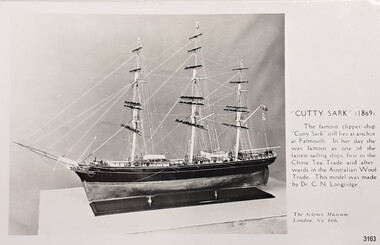
... sailing ship...tea clipper...sail training vessel...cadet training ship...commercial trading vessel...cargo sail vessel...clipper races...Scott and Linton of Dunbarton Scottland...race record...Ferreria...1869...tea cargo...tea trade...China tea...wool export...Australian export...Australian wool export...China tea trade...Cornwall...training ship...Greenwich...British Museum...ship model...craft...Flagstaff Hill Warrnambool Flagstaff Hill Maritime Museum Shipwreck Coast Flagstaff Hill Maritime Village Maritime Museum Great Ocean Road Cutty sark historic sailing ship tea clipper sail training vessel cadet training ship commercial trading vessel cargo sail vessel clipper races Scott and Linton of Dunbarton Scottland race record Ferreria 1869 tea cargo tea trade China tea wool export Australian export Australian wool export China tea trade Cornwall training ship Greenwich British Museum ship model craft hobby ship model Cutty Sark model making postcard C Nelson Longridge Charles Nelson Longridge B Matthews photo printer B Matthews Bradford England B Matthews (photo printer ) Ltd. ...The maker of the ship model on the postcard was Dr C Nelson Longridge (1876–1952), an English surgeon, maritime author, and builder of detailed ship models. Other models include the SS Marioness and the steam yacht Asia. He also wrote the books 'Cutty Sark' and 'The Anatomy of Nelson's Ships'. The postcard was printed by B Matthews, Bradford, England, incorporated in 1970 as B. Matthews (Photo Printers) Limited. Collections of B Matthews' photo prints of famous painted portraits are held at The National Portrait Gallery of London. Copies of B Matthews postcards are today sought after by collectors. THE CUTTY SARK: - The Cutty Sark was built in Britain in 1869 and was one of the last great sailing ships. At first, it carried tea from China. Later, it was used to transport wool from Australia. It became famous for its speed and held the record for the fastest voyage from Australia to Britain for ten years. Later, a Portuguese company bought the ship and renamed it Ferreira. After that, a retired sea captain purchased it to use as a training ship in Cornwall. When the captain died, the ship was given to a training college in Greenwich in 1938. In 1954, it was placed in dry dock at Greenwich, where it remains on display. This postcard features a photograph of a model of the sailing ship Cutty Sark, making it significant because of its connection to this well-known vessel. The famous tea clipper transported wool from Australia to markets around the world. Models such as this one help us understand what sea travel was like before steam-powered ships became widespread, while also illustrating how trade, travel and migration developed over time. Cutty Sark was also celebrated for its speed. It broke records on the voyage from Australia to Britain and held this distinction for ten years. Its importance is still recognised today, as the ship has been carefully preserved and is now displayed at the British Maritime Museum in Greenwich. Its remarkable history has also made it a popular subject for model ship enthusiasts. The postcard is also valuable because it shows a model of Cutty Sark built by the renowned C. N. Longridge, who was not only a respected surgeon but also a skilled model maker and author of detailed maritime works. A further connection is found in the printer, B Matthews, who photographed and printed collections featuring famous people, model ships and maritime scenes, adding another layer of historical interest to the postcard. Postcard, black and white, showing a model of the sailing ship Cutty Sark. Printed details are provided on both the front and back of the postcard. Inscriptions include a brief description of the Cutty Sark, the location and maker of the model, and the printer's contact information. The postcard was printed in Great Britain.FRONT: " "CUTTY SARK" (1869) The famous clipper ship "Cutty Sark" still lies at anchor at Falmouth. In her day, she was famous as one of the fastest sailing ships, first in the China Tea Trade, and afterwards in the Australian Wool Trade. This model was made by Dr C.N. Longridge." "The Science Museum, London. No. 166." REVERSE: "POSTCARD" "COMMUNICATION" "ADDRESS" "Printed by B Matthews, Bradford, England"flagstaff hill, warrnambool, flagstaff hill maritime museum, shipwreck coast, flagstaff hill maritime village, maritime museum, great ocean road, cutty sark, historic sailing ship, tea clipper, sail training vessel, cadet training ship, commercial trading vessel, cargo sail vessel, clipper races, scott and linton of dunbarton scottland, race record, ferreria, 1869, tea cargo, tea trade, china tea, wool export, australian export, australian wool export, china tea trade, cornwall, training ship, greenwich, british museum, ship model, craft, hobby, ship model cutty sark, model making, postcard, c nelson longridge, charles nelson longridge, b matthews, photo printer, b matthews bradford england, b matthews (photo printer ) ltd. -
 Flagstaff Hill Maritime Museum and Village
Craft - Ship Model, Hygeia, Bef. 1983
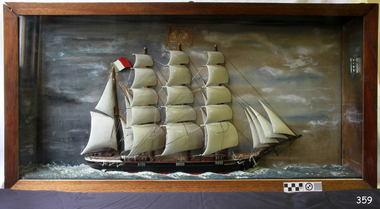
... craft...maritime model...model making...Hygeia...sailing...sailing ship, of the type that carried immigrants to Australia. Flagstaff Hill Maritime Museum and Village Maritime Museum Maritime Village Great Ocean Road Shipwreck Coast ship model ship model hygeia hobby craft maritime model model making Hygeia sailing ship 1863 1877 cargo ship Italian flag square-rigged barque three-masted "HYGEIA" Ship model; diorama with a model of the sailing ship HYGEIA at sea in full sail, in a setting of sky and sea. ...This ship model is a representation of the wooden barque Hygeia, which is also the name of the Greek goddess of health, cleanliness and hygiene. The model flies the Italian flag, which was adopted in 1946 but originated in 1797. The colours stand for freedom, solidarity and equality. The three-masted, wooden barque Hygeia was built in 1863 in the UK by J.M. Reed to carry cargo. It was first registered on July 30th, 1863, at Sunderland, UK, by owners Matthew Cay Jr. & Joseph Crisp. In August 1877, the ship was dispatched from Alexandria, Egypt, destined for Fairmouth with a cargo of beans, but mysteriously went missing. The ship diorama exemplifies the popular, centuries-old hobby of ship model making, with the setting of sea and sky giving it depth and context. The model also shows the configuration of a three-masted, fully rigged sailing ship, of the type that carried immigrants to Australia. Ship model; diorama with a model of the sailing ship HYGEIA at sea in full sail, in a setting of sky and sea. It displays a tricolour flag with three vertical stripes of equal width, which from the hoist side are coloured green, white and red. An inscription has the ship's name, Hygeia."HYGEIA"flagstaff hill maritime museum and village, maritime museum, maritime village, great ocean road, shipwreck coast, ship model, ship model hygeia, hobby, craft, maritime model, model making, hygeia, sailing ship, 1863, 1877, cargo ship, italian flag, square-rigged, barque, three-masted -
 Flagstaff Hill Maritime Museum and Village
Craft - Ship Model, General Gordon
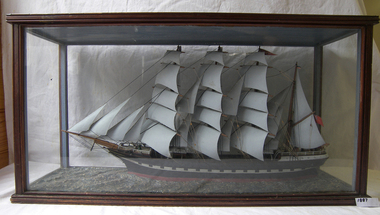
... The model depicts one of many sailing vessels to travel across the world for trade and migration in the 18th to 20th centuries. The craft ...The model depicts one of many sailing vessels to travel across the world for trade and migration in the 18th to 20th centuries. The craft of model making is also represented by this model. There are many craftsmen with a fascination for the sea and objects connected to it.Ship model, the sailing ship "General Gordon", in a glass and timber display case. The model is of a four masted Barque with the royal sails over double top and top gallant sails. Inscriptions are on the model. Marked "General Gordon" on side of ship and on red pennant. Flag with crab on one side and shell on other. Union Jack. Red ensign.flagstaff hill, warrnambool, shipwrecked-coast, flagstaff-hill, flagstaff-hill-maritime-museum, maritime-museum, shipwreck-coast, flagstaff-hill-maritime-village, general gordon, ship model, barque, sailing ship, vessel -
 Flagstaff Hill Maritime Museum and Village
Craft - Ship Model, Heather, before Dec 1983
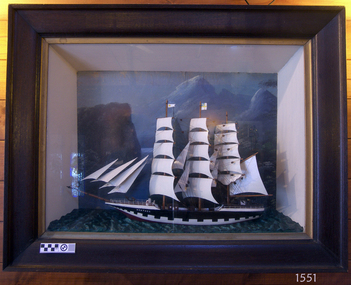
... sailing vessels. Ship is flying two pennants, top one is blue with 'JRE" on it, bottom one is plain white with a red disc and a swallow-tailed end; the rectangular flag is divided by a yellow cross on white, and the top left corner is blue with a yellow anchor symbol on it. Heather Craft ...The blue pennant with the white letters "J R E" flag of the Ellerman Wilson Line Pty. Ltd. of Hull. The letters refer to the founder of the Ellerman Group, John Reeves Ellerman. Ship model of the vessel "Heather", a three masted tall ship. Model is painted black and white with a brown deck. Sails are raised. The name "HEATHER" is painted in white on it black bow. The ship is displayed as a diorama in a glass fronted, wide edged timber frame with deep sides. The back of the frame is painted pale green. The base of the frame depicts textured sea and the back has a seascape with a cliff and other sailing vessels. Ship is flying two pennants, top one is blue with 'JRE" on it, bottom one is plain white with a red disc and a swallow-tailed end; the rectangular flag is divided by a yellow cross on white, and the top left corner is blue with a yellow anchor symbol on it. "HEATHER" on bow. "JRE" on blue pennant.flagstaff hill, warrnambool, shipwrecked-coast, flagstaff-hill, flagstaff-hill-maritime-museum, maritime-museum, shipwreck-coast, flagstaff-hill-maritime-village, ship model, sailing ship heather, tall ship diorama, diorama, sailing vessel, john reeves ellerman., jre, ellerman wilson line pty. ltd -
 Flagstaff Hill Maritime Museum and Village
Craft - Ship Model
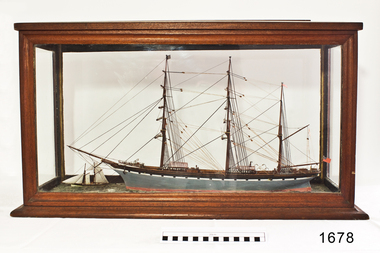
... sailing ship painted black, white and grey and smaller two masted vessels. Flags on top of all masts, rear, mast ketch style and showing no sails. Masts made in three pieces. Moss P?in Carnarvon marked Craft ...Ship model 3 masted sailing ship painted black, white and grey and smaller two masted vessels. Flags on top of all masts, rear, mast ketch style and showing no sails. Masts made in three pieces. Moss P?in Carnarvon markedflagstaff hill, warrnambool, shipwrecked-coast, flagstaff-hill, flagstaff-hill-maritime-museum, maritime-museum, shipwreck-coast, flagstaff-hill-maritime-village -
 Flagstaff Hill Maritime Museum and Village
Craft - Ship Model, Port Jackson Schooner
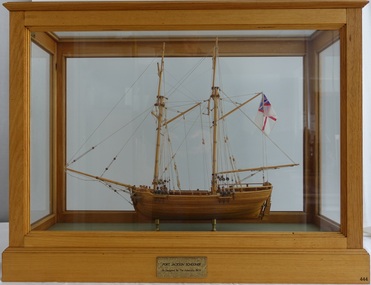
... sailing ship displaying the flag named The British White Ensign. Mode of light coloured stained timberl is mounted on brass legs inside a glass case with timber frame and base. Metal engraved plaque states that the model is as designed by The Admiralty in 1803. Model is a number 2 of 5 in a limited edition, made by Bill Leonard. Port Jackson Schooner Craft ...This ship model is of a Colonial Port Jackson schooner, originally designed by the British Admiralty in 1803 as a response to the request of New South Wales' Governor Arthur Phillip. The drafts for the original plans are in Greenwich, UK, in the National Maritime Museum. The model is a Ledition edition, number 2 of 5, modelled by Bill Leonard. The model is rigged and decked in the manner of David McGregor. The flag on model of Port Jackson schooner is that of the British White Ensign which was used as the flag design of the Royal Australian Navy from 1911 - 1967. In 1785 the First Fleet arrived in the new British colony of Port Jackson (now Sydney Harbour) in New South Wales and Arthur Phillip was appointed as the first Governor. The following year Governor Phillip asked the English Royal Navy to provide drafts and materials for two ships for use in the Port Jackson colony for exploring and surveying rivers. The vessels needed a shallow draught and to be made from local cedar timber. He asked for the frames of the schooners to be provided along with shipwrights to assemble them. Many years later, in 1803, Governor Phillip’s request was fulfilled but he had already resigned from his post. The drafts titled ‘Schooner for Port Jackson’ were despatched by the Royal Navy from England to Australia. The original draft is still in the National Maritime Museum in Greenwich, UK. Meanwhile, the NSW Government had already built various other ships before 1803. In 1797 His Majesty’s Dockyard was opened at Port Jackson for building larger vessels. The Royal Navy’s 1803 design of a ‘Schooner for Port Jackson’ has been recognised on the obverse of Australia’s twenty dollar banknote since 1994. A sketch of the schooner is beside the portrait of Mrs Mary Reibey, who arrived as a convict and rose to become a respected and successful owner of a cargo shipping business. Her fleet included the Mercury, a schooner similar to the 1803 design for the Port Jackson schooner. Although the 1803 plans for a ‘Schooner for Port Jackson’ are commonly believed to be used for the first ship built in Australia, no records have been found of any ships being built according to these plans. However, it can be claimed that the plans were the ‘first Royal Navy plans made for a ship for use at Port Jackson, and to be built at Port Jackson, in Australia’. William (Bill) Leonard passed away on March 1st 1995.This ship model is significant for its representation of an early Australian colonial schooner. The 1803 Royal Navy’s plans for the colonial ‘Schooner for Port Jackson, were for the first ship specifically designed by the Royal Navy to be built and used in Port Jackson, for use in exploration and surveying of Australian ports and rivers. The plans are associated with Australia’s colonial settlement in the late 1700s. This ship model is significant for its association with the emblems of Australia’s history on the twenty dollar banknote. The colonial Port Jackson schooner is considered significant to Australian history, and represented on the 1994 twenty dollar banknote and its new version being rolled out in October 2019.Ship model of a colonial Port Jackson Schooner. Two-masted sailing ship displaying the flag named The British White Ensign. Mode of light coloured stained timberl is mounted on brass legs inside a glass case with timber frame and base. Metal engraved plaque states that the model is as designed by The Admiralty in 1803. Model is a number 2 of 5 in a limited edition, made by Bill Leonard.Engraved on metal plaque "PORT JACKSON SCHOONER / As Designed By The Admiralty. 1803"flagstaff hill, warrnambool, shipwrecked-coast, flagstaff-hill, flagstaff-hill-maritime-museum, maritime-museum, shipwreck-coast, flagstaff-hill-maritime-village, ship model port jackson schooner, sailing ship, limited edition model, model maker bill leonard, david mcgregor design, maritime trade, maritime vessel, colonial port jackson schooner, pacific island trade in early 1800s, sydney cove, governor arthur phillip, governor philip gidley king, a schooner for port jackson, national maritime museum greenwich, australian $20 banknote -
 Flagstaff Hill Maritime Museum and Village
Craft - Ship Model, pre 1963
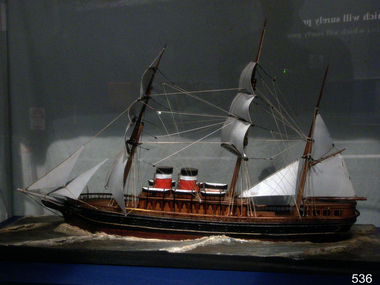
... sailing shipo three-masted ship Ship model; steamship and sail vessel in use around the 1860s. Handcrafted model steamship with twin funnels painted black, white and red and three masts with square-rigged sails. The ship model is mounted on a gold-painted board. The ship was donated with a fitted wooden case. Craft ...The funnel colours on the model indicate the ship it represents was one of the early ships of the Allan shipping Line designated as a Royal Mail Carrier. Funnel colours are used to identify a ship's owners while at sea from a distance by other vessels. The Allan Shipping Line was started in 1819, by Captain Alexander Allan of Saltcoats, Ayrshire, trading and transporting between Scotland and Montreal Canada, a route which quickly became synonymous with the Allan Line. By the 1830s the company had offices in Glasgow, Liverpool and Montreal, with all of Captain Allan's five sons actively involved with the business. But his second son, Sir Hugh Allan, spearheaded the second generation. In 1854, Hugh launched the Montreal Ocean Steamship Company as part of the Allan Line, and two years later ousted Samuel Cunard to take control of the Royal Mail contract between Britain and North America. By the 1880s, the Allan Line was the world's largest privately owned shipping concern. In 1891, the company took over the State Line, founded in 1872, and was often referred to as the Allan & State Line. In 1897, Andrew Allan amalgamated the various branches of the Allan shipping empire under one company, Allan Line Steamship Company Ltd., of Glasgow. The company by then had added offices in Boston and London. In 1917, under Sir Montagu Allan, who represented the third generation of the Allan family, the company was purchased by Canadian Pacific Steamships, and by the following year, the Allan name had disappeared from commercial shipping. The Allan Line fleet had evolved for decades, changing as new ships were added, lost at sea, sold, or scrapped. The model in Flagstaff Hill's collection could be the SS Canadian or Indian; both were early Allan steam packets that had helped the Allan company secure the Royal Mail Atlantic contract in 1856.The model is of a Royal Mail steamship, with the probability the original ship was owned by the Allan Shipping Line in the mid-19th century and primarily used for the Atlantic mail run between England and Canada. Given the funnel colours and ship design, the model could be the SS Canadian or the Indian; both were the first ships for the company. The Allen line became the most successful shipping company of the time used for emigration and the transporting of mail.Ship model; steamship and sail vessel in use around the 1860s. Handcrafted model steamship with twin funnels painted black, white and red and three masts with square-rigged sails. The ship model is mounted on a gold-painted board. The ship was donated with a fitted wooden case.warrnambool, shipwreck coast, flagstaff hill, flagstaff hill maritime museum, flagstaff hill maritime village, ship model, steam and sail vessel, handcrafted ship model, steam vessel, model making, handmade, red with narrow white band below black top., red shite and black funnel, allan shipping line, steam and sail ship, two funnels, wooden sailing shipo, three-masted ship -
 Flagstaff Hill Maritime Museum and Village
Craft - Ship Model, Loch Torridon, Early 20th century
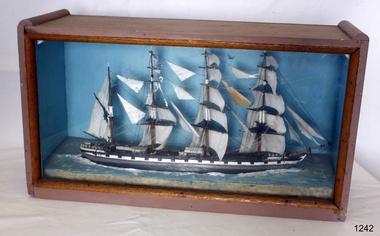
... sailing until 1915 after having been sold to a Russian company two years earlier. Near the end of January 1915, the ship sprang a leak of the west coast of Ireland and was abandoned sinking shortly afterwards. For further information regards possible maker of the model see Provenance sec this document: The item is of significance as an item made possibly by a man who served on the original ship making the item of historical significance given that the original craft was a well-known and respected trade vessel making voyages between England and Australia as well as the near East. flagstaff hill warrnambool shipwrecked-coast flagstaff-hill flagstaff-hill-maritime-museum maritime-museum shipwreck-coast flagstaff-hill-maritime-village None Ship model Loch Torridon 4 masted, hull is black, grey and white. ...The Loch Torridon was built in response to the need for a large cargo-carrying ship in the 1870s becoming famous for being one of the most per4fect four-masted barques ever built. She was built for the Loch Line in 1880 by Messrs. Barclay, Curle, and Co. Her measurements were 287 feet in length and 42 feet in beam, and 24 feet depth of hold. She was well sparred and her sail plan was so perfectly balanced that she was a very handy ship, easy on her helm, which was not a common virtue amongst large four-masted ships of her day. Her sails were interchangeable on all three masts, which was common in the last days of sail for both economical and practical purposes. The Loch Torridon was considered one of the most graceful and elegant ships ever launched from the Glasgow shipyards. The first master was Captain Pinder, the first cargo was bound for Melbourne Australia, after which she went on to Calcutta with a cargo of horses. On August the 22nd 1882 with a cargo of Jute onboard loaded in Calcutta the Loch Torridon ran into a storm. Sailing in heavy seas the captain, the second mate also the man at the wheel, and a boy was washed overboard with the first mate just escaping the same fate. Captain Pinder and the crew members could not be rescued and were never seen again with the first mate having to bring the ship home. The next Captain was Robert Pattman who was regarded as a fine navigator and seaman who sailed the Loch Torridon for the next twenty-six years and nine months. He had made 25 voyages around the world during this time without any serious mishap. In 1909 Captain Pattman resigned his command of the ship to switch to a steam vessel but unfortunately was injured on his first voyage and had to be landed at Falmouth, he dies of his injuries shortly afterwards. The Loch Torridon kept on sailing until 1915 after having been sold to a Russian company two years earlier. Near the end of January 1915, the ship sprang a leak of the west coast of Ireland and was abandoned sinking shortly afterwards. For further information regards possible maker of the model see Provenance sec this document: The item is of significance as an item made possibly by a man who served on the original ship making the item of historical significance given that the original craft was a well-known and respected trade vessel making voyages between England and Australia as well as the near East. Ship model Loch Torridon 4 masted, hull is black, grey and white. Ship in full sail with 4 lifeboats on deck. Ship sits on textured base. Has plain blue background. Noneflagstaff hill, warrnambool, shipwrecked-coast, flagstaff-hill, flagstaff-hill-maritime-museum, maritime-museum, shipwreck-coast, flagstaff-hill-maritime-village -
 Flagstaff Hill Maritime Museum and Village
Craft - Ship Model, Billings Boats Denmark Aps, Cutty Sark, 1980s
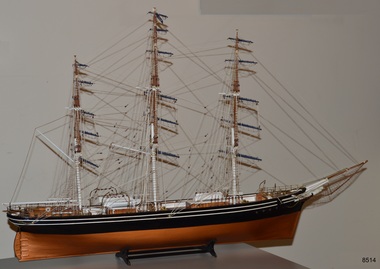
... The craft of ship model building has been popular for centuries, especially with people associated with the sea, such as this model builder, whose career was based around the shipping industry. Flagstaff Hill Warrnambool Shipwrecked coast Flagstaff Hill Maritime Museum Maritime Museum Shipwreck coast Flagstaff Hill Maritime Village Great Ocean Road CUnYSARK Historic sailing ship Tea clipper Sail training vessel Cadet training ship Commercial trading vessel Cargo sail vessel Ship model CUTTY SARK Ship model; clipper ship, the 'Cutty Sark', a three-masted clipper ship, bare rigging, netting below the bowspit, and fine chains hanging from the bowspit. ...This ship model of the Cutty Sark was hand-built in the 1980s from a model kit produced by Billings, Denmark. It was on display in the Olde Maritime Motor Inn in Warrnambool until it was refurbished around 2015. The Cutty Sark was a famous clipper ship, launched in 1869 for the tea trade from China to London. The ship was designed for speed, with the ambition to be the fastest ship. In the late 1800s, it competed in the tea clipper races. It was eventually sold to a Portuguese company, Ferreria, and took on the company's name. It was sold again and renamed Maria do Amparo. Finally, the ship's name was returned to the original 'Cutty Sark' when it was purchased by Captain Dowman for use as a cadet training ship. The ship continued trading and in 1922 it became the last operating clipper ship in the world. The ship is now a museum, preserved in a dry dock at Greenwich, England, as part of the British National Historic Fleet. About Barry Williams: - The maker, Barry Williams, worked for the Australian Shipping Line, Huddart Packard Ltd., until it closed down in 1960. Williams then worked for Shaw Savill & Albion Co. Ltd., a substantial British passenger and liner company. and subsequently Furness Withy Ltd. (SS&A's parent company). In the late 1970s Williams and two friends established their own ship chartering company in Melbourne, the Harwood Shipping Co. During the early 1970s Williams and his wife lived in London, near Greenwich, and often walked along the river where the Cutty Sark Maritime Museum is located. The fascination of the Cutty Sark led Williams to build model ships of the same era. At one stage Williams lost the rigging plan for the Cutty Sark but one of his partners, on a visit to London, photographed the Cutty Sark on the river, and Williams used these to complete the rigging on the model. Williams found the making of the model a very demanding but also pleasurable exercise.The model is significant for showing a visual representation of one of the most famous tea clippers, the vessel Cutty Sark. The three-masted ship was built for speed and traded tea between England and China. In 1922 the Cutty Sark became the last operating tea clipper in the world. The craft of ship model building has been popular for centuries, especially with people associated with the sea, such as this model builder, whose career was based around the shipping industry.Ship model; clipper ship, the 'Cutty Sark', a three-masted clipper ship, bare rigging, netting below the bowspit, and fine chains hanging from the bowspit. Black hull with two parallel horizontal stripes below the rail. Lifeboats on board. The white figurehead is below the bowsprit. The model comes with a cradle stand. The ship's name is not visible on the model.flagstaff hill, warrnambool, shipwrecked coast, flagstaff hill maritime museum, maritime museum, shipwreck coast, flagstaff hill maritime village, great ocean road, cunysark, historic sailing ship, tea clipper, sail training vessel, cadet training ship, commercial trading vessel, cargo sail vessel, ship model cutty sark -
 Flagstaff Hill Maritime Museum and Village
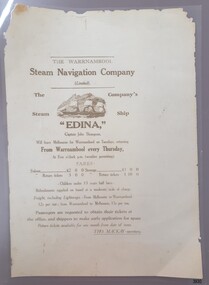
Document - Poster, Warrnambool Steam Navigation Co, ca.1938
... His replication includes a woodcut of the ship, which he skilfully crafted himself. This poster advertises the sailing of the steamer SS Edina and the information has local and State significance for its association with the trading ports of the Edina, and the associated names on the poster; Warrnambool Steam Navigation Company, Captain John Thompson and Thos. ...This poster is typical of posters displayed by steam packet companies of the mid-19th to early 20th centuries. It advertises the passage and freight available on a local coastal trader. The steamships operated between the major ports along the western coast of Victoria between Melbourne and Portland. The traveller was not guaranteed the passage times due to possible weather changes. Discounts were offered for return trips within a month of the ticket's issue. The price of freight included 'lighterage', which was the service of a smaller vessel called a 'lighter' expressly designed to transport goods between ship and shore. This particular poster has been recreated; it advertises the services of the screw steamer SS Edina. The information on the poster applies to the years between 1871 and 1873. During that period the Master of the Edina was Captain John Thompson, the Edina was owned by the Warrnambool Steam Navigation Company and the secretary of the firm was Thos. Mackay. The passenger fares are in line with fares from that period, as seen in a display advertisement published in the Hamilton Spectator on January 17th, 1872. The 1853 Glasgow-built Screw Ship Edina had a long life. The ship served in both the Crimean War and the American Civil War. The Edina also traded in UK and European waters. The Henty family of Portland, Victoria, purchased Edina in 1863 for use as a coastal trader. The Edina had several owners and spent many years of service along the South West Coast of Victoria between Melbourne and Portland. The vessel transported passengers and freight in Port Phillip Bay, between Melbourne and Geelong, between 1880 and 1938. After 84 years of service, the Edina was renamed ‘Dinah’ and was stripped down for use as a lighter. The vessel was broken up in 1957 at Footscray, Melbourne. The remains of Edina’s hull can be found in the Maribyrnong River, Port Phillip Bay. The poster was owned by the donor's grandfather, Bruce Duff (1922-2003) who was an avid sailor and a lover of nautical history. He and his wife Mona (1924-2014) were buried in Portarlington Cemetery, Victoria. Duff would have been about 13 years old when the Edina was finally retired from service in 1938. His interest in the Edina could have come from a trip on the vessel or from watching it in operation in the ports along the coast. Duff has collected this poster as a memento of the Edina and is likely to have preserved it at a much later date when the lamination process was readily available. [Flagstaff Hill's collection includes a photograph of the Edina at the Moorabool Street Wharf, Geelong, which was in Duff's locality. The References for this poster include a link to Museum Victoria's photograph of two boys watching the Edina from a jetty.] Flagstaff Hill's Village has its own 'Examiner' Office where volunteers demonstrate the historic printing press in that building. They use original letter-type to create posters, print labels onto lolly bags and designs on fabrics. One of the volunteer printers has produced a poster closely resembling the donated poster. His replication includes a woodcut of the ship, which he skilfully crafted himself.This poster advertises the sailing of the steamer SS Edina and the information has local and State significance for its association with the trading ports of the Edina, and the associated names on the poster; Warrnambool Steam Navigation Company, Captain John Thompson and Thos. Mackay. This poster's message has a strong connection to the history of the businesses and community of Warrnambool and the people of Port Phillip Bay, where it was a passenger ferry for many years. The poster is an example of advertising used by shipping agents in the mid-19th to early 20th centuries. Its information includes the accurate costs to passengers and freighters and the type of timetable the vessels were likely to follow. The poster's connection with the Screw Steamship Edina is historically significant, as the vessel was the longest serving screw steamer in the world. The ship spent its first nine years overseas then arrived in Melbourne. The vessel's work included running the essential service of transporting cargo and passengers between Melbourne and the western Victoria ports of Warrnambool, Port Fairy and Portland. The Edina is listed on the Victorian Heritage Database VHR S199. Poster, A3 size, brown text on cream paper, laminated. Re-created poster of the Warrnambool Steam Navigation Company (Limited) advertising passage and freight on its Screw Steamship, SS Edina. It states days, times and fees for passage and freight from Warrnambool to Melbourne, and return. It names the ship's Master, Captain John Thompson and the Company's Secretary, Tho. Mackay. It displays a line drawing of a 3-masted ship with full sails.Printed image [side profile of a 3 masted vessel, bow facing left] Printed text includes "The Warrnambool Steam Navigation Company (Limited). The Company's Steam Ship "EDINA", Captain John Thompson, Will leave Melbourne for Warrnambool on Tuesdays, returning from Warrnambool every Thursday, At Five o'clock p.m. (weather permitting). FARES: Saloon £2 0 0 Steerage £1 0 0 Saloon return £3 0 0 Saloon return £1 10 00 - Children under 13 years half fares - Refreshments supplied onboard at a moderate scale of charge. Freight, including lighterage, - From Melbourne to Warrnambool - 12s per ton; from Warrnambool to Melbourne, 15s per ton. Passengers are requested to obtain their tickets at the offers, and shippers to make early application for space. Return tickets available for one month from date of issue. - THO. MACKAY, secretary. "warrnambool, shipwreck coast, flagstaff hill, flagstaff hill maritime museum, maritime museum, fair maid of judea, steam navigation, pleasure steamer, ss edina a, trade 19th century, travel 19th century, warrnambool to melbourne, warrnambool to geelong, warrnambool to port fairy, warrnambool to portland, screw steamer, coastal trader, crimean war, american civil war, gold export, h r h duke of edinburgh, warrnambool steam packet company, stephen henty, captain john thompson, chief engineer john davies, lady bay, lighter edina, port phillip bay steamers, vhr s199, dinah, warrnambool steam navigation company, advertising poster, shipping agent, flier, maritime village, flagstaff hill maritime museum & village, great ocean road, block printing, woodblock printing, relief printing, moorabool st wharf, western steam navigation company, tho. mackay, re-created poster -
 Flagstaff Hill Maritime Museum and Village
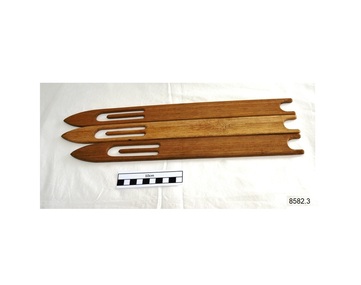
Tool - Netting Shuttle, Early-to-mid 20th century
... sailing vessels. The set of netting shuttles is an example of net-making tools used in the 18th to 20th centuries and continues into modern times to create and repair safety equipment. The shuttles are part of the W.R. Angus Collection, which is significant for still being located at the site it is connected with, Doctor Angus being the last Port Medical Officer in Warrnambool. Warrnambool Shipwreck Coast Flagstaff Hill Flagstaff Hill Maritime Museum Flagstaff Hill Maritime Village net making net mending net shuttle net making tool maritime trade darning shuttle tool 20th century W.R. Angus weaving netting shuttle net craft ...Maritime trades included making and mending nets. Netcraft skills have been taught and applied for centuries and are ongoing. Shuttles, or net needles, are used in the netting process, along with twine or cord, and a sharp knife or scissors. The twine is wound onto the shuttle and dispensed as the shuttle knots and weaves the cord to make the net. These shuttles are lightweight, compact and portable too. Nets were used on sailing ships for the crew's safety, often saving the sailor's lives in stormy seas Examples are the ship mast nets or shrouds that are wide at the base on the deck and taper to a point at the top of the mast, and railing nets that encircle the rails around the deck and prevent people and objects from rolling or falling into the sea. The shuttles were donated to Flagstaff Hill Maritime Village by the family of Doctor William Roy Angus, Surgeon and Oculist. It is part of the “W.R. Angus Collection” that includes historical medical equipment, surgical instruments and material belonging to Dr Edward Ryan and Dr Thomas Francis Ryan, (both of Nhill, Victoria) and Dr Angus’ own belongings. The Collection’s history spans the medical practices of the two Doctors Ryan, from 1885-1926 plus that of Dr Angus, until 1969. Nets were an essential part of the life-saving safety equipment on sailing vessels. The set of netting shuttles is an example of net-making tools used in the 18th to 20th centuries and continues into modern times to create and repair safety equipment. The shuttles are part of the W.R. Angus Collection, which is significant for still being located at the site it is connected with, Doctor Angus being the last Port Medical Officer in Warrnambool. Shuttles, set of three; wooden slats, one end pointed, the other a concave shape. The centre is cut-out, leaving a straight tab in the centre lengthwise. The set is part of the W.R. Angus Collection. warrnambool, shipwreck coast, flagstaff hill, flagstaff hill maritime museum, flagstaff hill maritime village, net making, net mending, net shuttle, net making tool, maritime trade, darning, shuttle, tool, 20th century, w.r. angus, weaving, netting shuttle, net craft, net needles, safety nets, safety equipment -
 Flagstaff Hill Maritime Museum and Village
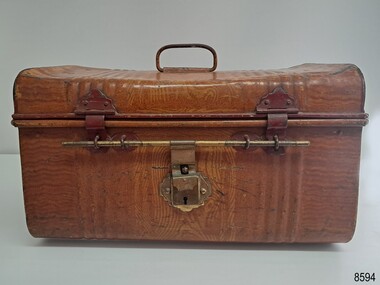
Functional object - Trunk
... crafted metal trunk is an example of high-quality travel luggage owned by newlyweds on their journey to a new life across the world. The well-made trunk is a rare shape. It joins Flagstaff Hill’s collection of artefacts from the Schomberg shipwreck, which is listed on the Victorian Heritage Register (VHR S612). The ship has historical significance as a rare example of a large, fast clipper ship on the England to Australia run, built to carry emigrants at the time of the Victorian gold rush. The ship’s design included the technical advances needed to break sailing ...This metal travelling trunk belonged to David and Alice Ellis, a young couple married in Dublin in 1855. They left for Australia on the Schomberg clipper ship on October 6 that same year, joining the other passengers for the luxury sailing ship’s first voyage, bound for Melbourne, Australia. The Schomberg was grounded on a sand spit near Peterborough. All passengers and crew were safely rescued. They had been allowed to take something small with them when leaving the sinking vessel, and as such, Alice took a small cane basket and coin purse. The metal trunk was also amongst the couple’s possessions, along with a pair of candlesticks and a Bible. Their trunk was later retrieved from the ship’s deck by the crew of a steamer sent from Melbourne. At that time, David was 23 years old (born in Wales, in 1832) and Alice was 26 (born in Ireland, 1829). The couple lived in Tasmania for a short period before settling in the Western Districts of Victoria. David worked as a gardener and, when land in the area was available to purchase, David and Alice claimed a selection on Noorat Road near Terang. They settled there for the remainder of their lives, expanding the property that they named, ‘Allambah’, and had six children. David died in 1911, aged 79, and Alice passed away the following year, aged 83. B, B & B. Brand: - The company was renowned for its strongly constructed and high-quality travel goods. In 1906 the company was sold and renamed Buffalo Trunk Manufacturing Co. Interestingly, the trunk maker’s promise on its printed label is certainly fulfilled: - "B B BRAND. These Goods are manufactured of the best steel sheets, and are guaranteed to give every satisfaction, and will last for years."David and Alice Ellis’s donated possessions have great significance as a group of personal belongings saved from the sinking luxury clipper ship, the Schomberg, in 1855. The strong, well-crafted metal trunk is an example of high-quality travel luggage owned by newlyweds on their journey to a new life across the world. The well-made trunk is a rare shape. It joins Flagstaff Hill’s collection of artefacts from the Schomberg shipwreck, which is listed on the Victorian Heritage Register (VHR S612). The ship has historical significance as a rare example of a large, fast clipper ship on the England to Australia run, built to carry emigrants at the time of the Victorian gold rush. The ship’s design included the technical advances needed to break sailing records between Europe and Australia. The relationship of the objects in Flagstaff Hill’s Schomberg collection allows has potential interpretation of the story of the Schomberg. The collection of objects is archaeologically significant as the remains of an international passenger ship, as it represents aspects of Victoria’s shipping history, in addition to its association with the shipwreck and the ship.Traveller's metal trunk; small brown woodgrain patterned trunk with dark red features and brass lock. This well-made strong and sturdy piece of secure hand luggage has rounded corners and sides, with the ends of the lid slightly bulbous. The lid is reinforced inside across the centre. The lid and sides have dark red metal D-shaped handles that fold down. The two hinges on the lid have their fittings inside the trunk which is hinged across the back. Two dark red painted latches secure the front along with a brass rod and lockable latch in the centre front. The metal is shaped with a group of corrugated ribs on each side of the centre, around the trunk. A white printed and lacquered label is inside the lid and has additional handwritten text. The truck was the luggage of David and Alice Ellis on the sailing ship SCHOMBERG in 1855. Printed on the label: "B B BRAND./ These Goods are manufactured of the best / steel sheets, and are guaranteed to give every / satisfaction, and will last for years." Handwritten on the label: "8/3- 7/-" (possibly meaning Eight shillings and three pence, Seven shillings)flagstaff hill maritime museum and village, great ocean road, shipwreck coast, schomberg, sailing ship, 1855, david and alice ellis, schomberg passengers, b b brand, american made, traveller's trunk, hand luggage, metal trunk, schomberg ship, 1855 shipwreck, peterborough shipwreck, ss queen, david ellis, alice ellis, allambah terang, dublin emigrants, terang presbyterian church, western district victoria, antique trunk, vintage trunk, travel goods, travelling trunk, steel trunk, tin trunk, schomberg trunk, newlyweds, b b & b, boyd boyd & boyd, pittsburgh, rare shape, luggage, vintage luggage, victorian era, travel trunk, three locks, steamer trunk -
 Flagstaff Hill Maritime Museum and Village
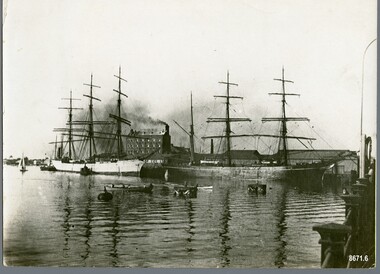
Photograph - Vessels, Sailing Ships, Circa 1910 - 1913
... sailing ships moored at a dock. There are industrial buildings in the background (one has smoke coming from its chimney) and several smaller craft (a rowing boat, two small boats that may be tugs and a little yacht) at the side of the ships. ...sailing ships moored at a dock. There are industrial buildings in the background (one has smoke coming from its chimney) and several smaller craft (a rowing boat, two small boats that may be tugs and a little yacht) at the side of the ships. ...This photograph was one of ten photographs donated to Flagstaff Hill Maritime Museum and Village by Fred Trewartha. Frederick John Fox Trewartha (Fred) was a well-known Warrnambool businessman. He was born in Beeac near Geelong in 1920 and came to Warrnambool with his family as a very young child. He was apprenticed to his father John, as a saddler and later opened his own shop on Raglan Parade. He then moved into working with tarpaulins and canvases for the trucking industry. Fred was keenly interested in photography (and was a member of the Warrnambool Cine Club), yachting and boat building. He kept his yacht moored at Port Fairy for many years and participated in sailing events locally and interstate. He also built boats with his sons. He had the opportunity to meet many older sailors and it's thought this photo (and others in the set) may have been given to him by one of these men. Fred Trewartha died in 2016 in Warrnambool. There is some conflict re the identity of the ship in the foreground of this photograph. It has been identified as the "Dimsdale" by the original owner of this photograph and by the website "Photos of the Past" which have an identical copy of the photo, however the State Library of South Australia (who also have an identical copy of the photograph) have identified the date of the photograph as 1910 and the ship as the "Ainsdale". The "Dimsdale" and the "Lobo" were recorded several times in the local shipping news as being docked at the Port of Adelaide, at the same time, during the years 1912 and 1913, whereas the "Ainsdale" wasn't in Adelaide very often but was recorded as coming in and out of the Port of Adelaide in the years 1915 and 1916. On February 25th 1916, the two ships (the "Ainsdale" and "Lobo") were both in the Port of Adelaide at the same time, but the "Ainsdale" was loading at Outer Harbor and the "Lobo" was discharging timber at Corporation Wharf. The "Ainsdale" was owned by the same firm that had owned the "Dimsdale". The Dimsdale was a three masted steel ship built in 1890 by C. J. Bigger of Londonderry. It became notorious when it struck the Wonga Shoal lighthouse near Port Adelaide on the night of 17th November 1912, destroying the structure and killing two lighthouse keepers. The accident was investigated by the Marine Board, the Coroner, the Police Court, the Admiralty Court and by the Criminal Courts of South Australia where the Captain (John Jones) was charged with manslaughter and found "not guilty". The Dimsdale was sold to a Norwegian firm and its name was changed to "Kwango". It sank in 1915 near the Magdalen Islands in the Gulf of St. Lawrence. The "Lobo" was a well known "windjammer" trading from the Port of Adelaide to other parts of the world. For a number of years it was employed in the New Zealand and Tasmanian services, after which it made several voyages to North America. It was an iron barque of 945 tons, built at Sunderland in 1877 by Osbourne, Graham and Company. On October 18th 1916, the Lobo (owned by Walter and Morris, timber merchants) was on a voyage from Parapato (Mozambique) to New York with a cargo of mango bark and ebony, when it struck rocks and ran aground 30 miles east of the Angoche River in Portuguese East Africa. A detailed account of the incident, written by Mrs Murchison (the Captains wife who was on board with her two year old son) was published in the Adelaide newspaper "The Mail" on Saturday 9th December 1916. She, and several of the crew were put in a boat early in the morning and sent away from the wreck. Several hours later, they were joined by Captain Murchison and the remainder of the crew. They were in their small open boats for several hours before landing on a small uninhabited island where they remained for several days before being picked up by another vessel and taken back to Parapato. The captain was able to obtain a position on a steamer which took him and his wife and child back to England.This photograph is significant as a record of the world wide mercantile trade Australia was engaged in at the end of the nineteenth century and beginning of the twentieth century and as a record of the dangers faced by the crews of these ships.A black and white photograph showing two large sailing ships moored at a dock. There are industrial buildings in the background (one has smoke coming from its chimney) and several smaller craft (a rowing boat, two small boats that may be tugs and a little yacht) at the side of the ships. Pylons can be seen in the water and a metal fence is in the bottom right corner. On the back of the photo the words "Ship Dimsdale" and "Bk Lobo" are written diagonally across the top left corner in pencil. A beige paper label has been attached to the top right corner with the words "Dimsdale at Port Adelaide" and "Port Adelaide Historical Society may be interested" written in black ballpoint pen."Ship Dimsdale" / "Bk Lobo" ""Dimsdale" / at Port Adelaide" "- Port Adelaide Historical /Society may be / interested"warrnambool, dimsdale, lobo, barque lobo, port of adelaide, kwango, wonga shoal lighthouse, fred trewartha, ainsdale, frederick john fox trewartha, captain john jones, windjammer, iron barque, parapato -
Glenelg Shire Council Cultural Collection
Photograph - Photograph - Portland Lifeboat, n.d
... Under the thwarts is a deck with scuppers so that the craft is both buoyant and self draining whenever large waves are taken aboard in rough conditions. The lifeboat was oar-powered with a sailing rig. ...Under the thwarts is a deck with scuppers so that the craft is both buoyant and self draining whenever large waves are taken aboard in rough conditions. The lifeboat was oar-powered with a sailing rig. ...Built in 1858 at the Port and Harbour Master's yard in Williamstown Victoria, the Portland Lifeboat was overseen by Harbour Master Charles Ferguson. It is understood to have been constructed from the same moulds used to build the Port Fairy Lifeboat, designed by William White, in 1857. Both boats are similar to the lifeboats designed in England by James Peake and adopted by the Royal National Lifeboat Institution (RNLI) in the UK. The Portland Lifeboat's 9.14 m (30 ft) long hull is double diagonally planked in New Zealand kauri, and many of the planks run from gunwale to gunwale in one piece under the inner keel section. Eucalyptus and oregon were used elsewhere and the local blacksmith made the iron work. The fastenings are copper. There are two flotation or buoyancy tanks at either end, with prominent whaleback style decking. Under the thwarts is a deck with scuppers so that the craft is both buoyant and self draining whenever large waves are taken aboard in rough conditions. The lifeboat was oar-powered with a sailing rig. The original rig was a lug mainsail, but this was replaced with a lug and headsail rig taken from a fishing boat in 1903. The lifeboat was manned by volunteer crews, mostly local fishermen from Portland. They maintained this service until 1915 when the boat was replaced with a new motorised craft. The lifeboat's most outstanding service was to the steamer ADMELLA in 1859 when the ship grounded on a reef off Cape Banks in South Australia, 150 km to the west of Portland. Survivors clung to the rigging in heavy seas for over a week and 89 people lost their lives in the shipwreck. Taken to the scene by the steamer LADY BIRD, the Portland Lifeboat was unable to assist until eight days after the ADMELLA's grounding when the seas abated enough for the lifeboat to manoeuvre close to the ship and rescue the last 19 survivors. Since its retirement in 1915 the lifeboat has been a memorial to those who manned it and those it rescued. For a long period it was on display in the Portland Gardens, first in the open and then under a canopy. In 2008 it was on display inside the Portland Maritime Discovery Centre, still in original condition complete with the rig from 1915. It is one of the oldest vessels of its type in Australia, and the world.Portland LifeboatPhotograph showing the Portland Lifeboatphotography, portland lifeboat, admella -
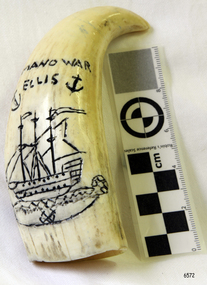 Flagstaff Hill Maritime Museum and Village
Craft - Scrimshaw, Late 20th century
... The subject scrimshaw is a modern reproduction crudely done of a historic vessel and the scene is believed to be engraved onto a synthetic substance. warrnambool flagstaff-hill flagstaff-hill-maritime-museum maritime-museum shipwreck-coast flagstaff-hill-maritime-village scrimshaw ellis esperance clementina elise hms ship man of war leter of marque privateer slave ship slavery ellis bent american war of inderpendance marine art marine artifact whale tooth ivory tooth resin plastic craft engraving carving Engraved "Man o War Ellis" Scrimshaw art crudely carved into non-natural material in the shape of a tooth. The line artwork is an image of a three-masted sailing ship with a poop deck, and anchors, are coloured black. ...The ship “Ellis” started life as the Clementina, launched in America in 1781. The vessel was first listed in Lloyd's Register in 1784 and under this name began serving as a slave ship sailing out of Liverpool. A Lloyd’s database records of slave-trading voyages by vessels from Liverpool makes it clear that Clementina was a slave trader. The next year Captain J. Elworthy sailed her to West Central Africa and St Helena. He transported his slaves to South Carolina. Then in 1785 Elworthy gathered slaves in the Bight of Biafra and the Gulf of Guinea Islands for delivery to Jamaica. In 1786 Bent & Co. purchased the Clementina and renamed her Ellis, presumably after the then owner Ellis Bent. She remained in the slave trade and In 1788 Captain John Ford sailed the now renamed Ellis to the Bight of Biafra and the Gulf of Guinea to gather slaves. He delivered this batch of slaves to the island of Grenada. The next year, 1789 the Ellis was almost completely rebuilt, and from the change in subsequent reports of her cargo loading or (burthen), she was enlarged. In 1791, Captain Joseph Matthews became master and sailed the Ellis to the Gold Coast then delivering his consignment of slaves to the island of St Vincent. During this voyage, some misfortune may have befallen Matthews because records show the Ellis command was transferred to Thomas Given. In 1792, Given sailed to the Bight of Biafra and the Islands in the Gulf of Guinea, again collecting slaves for delivery to Jamaica. There is a parallel record, also for 1793, that the Ellis under the command of Thomas Heart, undertook the same journey and with the same itinerary and cargo. In 1793, Bent & Co. decided to use the Ellis as a privateer with John Levingston as the master. After receiving a letter of "marque” on the 3rd of June 1793, that allowed any armed vessel to commit acts on the high seas which would otherwise have constituted piracy. Thus the Ellis began to operate as a combat ship under the endorsement of the British navy. The Ellis was three times captured first by the French frigate Gracieuse, under the command of Captain Chevillard on 22 July 1793. The French took her into service and renamed her as ”Elise”. Later that summer the Spanish captured her and in November ownership returned to the French who then renamed her the “Esperance”. On the 8th of June 1794, Esperance arrived in Jacmel, Saint-Domingue (present-day Haiti), from France with the official proclamation of the abolition of slavery. Leger-Felicite Sonthonax was one of the Civil Commissioners of Saint-Domingue and he had already unilaterally proclaimed the island for the French colony the year before amid a slave rebellion and attacks from British and Spanish forces. Ironically, Esperance also brought the news to the Civil Commissioners that the National Convention of France had impeached them on 16th July 1793 and ordered them to return promptly to France. On 8 January 1795, HMS Argonaut, under the command of Captain Alexander John Ball, captured Esperance while she was on the North America station. At this time the Esperance was armed with 22 guns (4 and 6-pounders) and had a crew of 130 men. She was under the command of Lieutenant de vaisseau De St. Laurent and had been out at sea for 56 days from Rochfort, bound for the American Chesapeake Bay area. The French ambassador to the United States registered a complaint with the President of the United States that Argonaut, by stating that by entering Lynnhaven bay, either before she captured Esperance or shortly thereafter, had violated a treaty between France and the United States. The French also accused the British of having brought the Esperance into Lynnhaven for refitting for a cruise. The British Consul replied that the capture had taken place some 10 leagues offshore as the bad weather had forced Argonaut and her prize to shelter within the Chesapeake area for some days, but that they had left as soon as practicable. Furthermore, Argonaut had paroled her French prisoners on arrival at Lynnhaven, and if she had entered American territorial waters solely to parole her French prisoners no one would have thought that objectionable. Royal Navy Service: Because the Esperance was captured in good order and sailed well, Rear Admiral George Murray, the British commander in chief of the North American station, put a British crew aboard and sent the Esperance out on patrol with HMS Lynx, under the command of John Poo Beresford, on 31st January. On 1st March the two vessels captured the Cocarde Nationale (or National Cockade), a privateer from Charleston, South Carolina, of 14 guns, six swivel cannons and a crew of 80 men. Esperance and the lynx went on to recaptured the ship Norfolk, of Belfast, and the brig George, of Workington. On 20 July, Esperance, in company with frigates Thetis and Hussar, intercepted the American vessel Cincinnatus, of Wilmington, sailing from Ireland to Wilmington. They pressed many men on board into service, narrowly missing the Irish revolutionary Wolfe Tone, who was on his way to Philadelphia. Esperance was formally commissioned in 1795 into the Royal Navy in August under the Command of Jonas Rose. On 4 May 1796 Esperance was sailing in company with HMS Spencer and Bonetta when they sighted a suspicious vessel. Spencer set off in chase while shortly thereafter Esperance saw two vessels, a schooner and a sloop, and she and Bonetta set off after them. Spencer sailed south by south-east and the other two British vessels sailed south-west by west, with the result that they lost sight of each other. Spencer captured the French gun-brig Volcan, while Bonetta and Esperance captured the French schooner Poisson Volant. The Esperance eventually arrived at Portsmouth on the 3rd of November 1797, the crew was paid off and on 31st May 1798 the Admiralty listed the Esperance for sale and she was sold in June 1798 for £600.The subject scrimshaw is a modern reproduction crudely done of a historic vessel and the scene is believed to be engraved onto a synthetic substance. Scrimshaw art crudely carved into non-natural material in the shape of a tooth. The line artwork is an image of a three-masted sailing ship with a poop deck, and anchors, are coloured black. Inscription is engraved into tooth.Engraved "Man o War Ellis" warrnambool, flagstaff-hill, flagstaff-hill-maritime-museum, maritime-museum, shipwreck-coast, flagstaff-hill-maritime-village, scrimshaw, ellis, esperance, clementina, elise, hms ship, man of war, leter of marque, privateer, slave ship, slavery, ellis bent, american war of inderpendance, marine art, marine artifact, whale tooth, ivory tooth, resin, plastic, craft, engraving, carving -
 Flagstaff Hill Maritime Museum and Village
Domestic object - Hearth Brush, ca 1878
... crafted, likely by a blacksmith. A hearth brush is used to clean away fine ash from brick, iron and stone fireplaces and stoves after the fire has died. The hearth brush section was recovered from the wreck of the sailing...crafted, likely by a blacksmith. A hearth brush is used to clean away fine ash from brick, iron and stone fireplaces and stoves after the fire has died. The hearth brush section was recovered from the wreck of the sailing ...This hearth brush section would have had a handle at the top and bristles protruding from the base. It has been hand-crafted, likely by a blacksmith. A hearth brush is used to clean away fine ash from brick, iron and stone fireplaces and stoves after the fire has died. The hearth brush section was recovered from the wreck of the sailing ship Loch Ard, which was wrecked on June 1st 1878 at Mutton Bird Island near Port Campbell, Victoria. There were 54 people on board and only two survived. The cargo included items for Melbourne's International Exhibition.The hearth brush is an example of domestic cleaning equipment from the late 19th century. The brush is significant for its connection to the Loch Ard sailing ship, which is listed on the Victorian Heritage database. Hearth brush section, copper alloy, bullet-head shaped; bristles and handle are missing. It is covered in verdigris. The metal is hand-beaten. Recovered from the wreck of the Loch Ard. flagstaff hill, warrnambool, shipwrecked-coast, flagstaff-hill, flagstaff-hill-maritime-museum, maritime-museum, shipwreck-coast, flagstaff-hill-maritime-village, hearth brush, loch ard, cleaning, fireplace, domestic fireplace, domestic oven, ash, brush, 19th century, victorian era, 1878 -
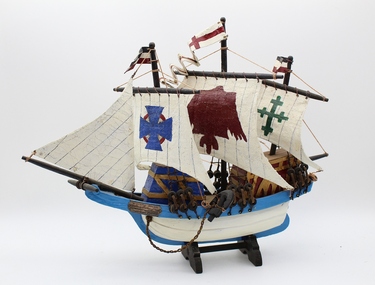 Montmorency–Eltham RSL Sub Branch
Craft - Model Ship, 1945
... This ship model was built by Australian prisoners of war. singapore ships second world war model prisoners To Auntie Helen, many thanks for everything from P.O.W.s Singapore 15.10.45 Model of a Spanish or Portugese 18th Century sailing ship, manufactured from timber, fabric and string. Natural timber colours as well as white, blue, red, green and gold. Craft ...During World War II, over 22,000 Australian became prisoners of war to the Japanese. Most of them were captured at the fall of Singapore in February 1942 and were forced to march to Changi (the major Prisoner of War camp). Later on, the soldiers would be dispersed throughout South East Asia. Upon their return to Australia, very few of them told talked about their experience as prisoners (they often felt ashamed). It took almost 30 years before testimonies, books and documentaries would be published. This ship model was built by Australian prisoners of war.Model of a Spanish or Portugese 18th Century sailing ship, manufactured from timber, fabric and string. Natural timber colours as well as white, blue, red, green and gold.To Auntie Helen, many thanks for everything from P.O.W.s Singapore 15.10.45singapore, ships, second world war, model, prisoners
