
Showing 94 items matching "sandhurst branch"
-
 Bendigo Historical Society Inc.
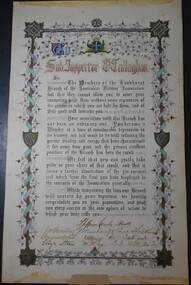
Award - ANA COLLECTION: UNFRAMED ILLUMINATED ADDRESS FROM SANDHURST BRANCH OF ANA IN APPRECIATION OF SUB INSPECTOR O'CALLAGHAN
... ANA COLLECTION: UNFRAMED ILLUMINATED ADDRESS FROM SANDHURST BRANCH OF ANA IN APPRECIATION OF SUB INSPECTOR O'CALLAGHAN......Sandhurst Branch...The ANA was established in Melbourne in 1871 as a mutual friendly society for white men, born in Australia. The Sandhurst Branch was formed in 1874, quickly becoming one of the most powerful and influential hubs of the movement....Unframed illuminated address from Sandhurst Branch of Australian Natives Association (ANA) in appreciation of Sub Inspector O'Callaghan High praise for the recognition of his work for the ANA Sandhurst Branch Hand illuminated document undated, marks indicate it was framed at some time. ...Australian Natives Association Sandhurst Branch Inspector O' Callaghan Unframed illuminated address from Sandhurst Branch of Australian Natives Association (ANA) in appreciation of Sub Inspector O'Callaghan High praise for the recognition of his work for the ANA Sandhurst Branch Hand illuminated document undated, marks indicate it was framed at some time. ...Thomas O'Callaghan served as a Sub-Inspector (and later Commissioner) in the Victoria Police, was the foundation Chief President of the ANA from 1877 to 1878. The ANA was established in Melbourne in 1871 as a mutual friendly society for white men, born in Australia. The Sandhurst Branch was formed in 1874, quickly becoming one of the most powerful and influential hubs of the movement.Unframed illuminated address from Sandhurst Branch of Australian Natives Association (ANA) in appreciation of Sub Inspector O'Callaghan High praise for the recognition of his work for the ANA Sandhurst Branch Hand illuminated document undated, marks indicate it was framed at some time. Sir, The members of the Sandhurst Branch of the Australian Natives Association feel they cannot allow you to sever your connection with them without some expression of the esteem in which you are held by them and of the good will towards you. Your association with this Branch has not been an ordinary one. You became a member at a time of considerable depression in its history and has much to do with its infusing the greater vitality and energy that have characterised it for some time past, and the present excellent position of the Branch has been the result. WE feel that you can justly take pride in the share of that result and that it forms a further illustration of the pre-eminent zeal which from the first you have displayed inn the interests of the Association generally. While recognising the loss the Branch will sustain by yourd departure, we heartily congratulate you on your promotion and wish you every success in the new sphere of action to which you duty calls you. Members' signatures (indecipherable, though includes W (William) Beebe).australian natives association, sandhurst branch, inspector o' callaghan -
 Bendigo Historical Society Inc.
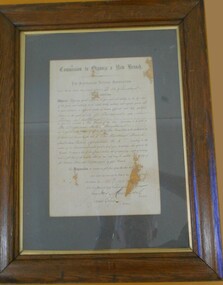
Document - ANA COLLECTION: FRAMED DOCUMENT TO COMMISSION AND ORGANISE A NEW BRANCH OF THE ANA - SANDHURST BRANCH NO 5 DATED 25TH AUGUST 1874
... ANA COLLECTION: FRAMED DOCUMENT TO COMMISSION AND ORGANISE A NEW BRANCH OF THE ANA - SANDHURST BRANCH NO 5 DATED 25TH AUGUST 1874......Sandhurst Branch...A framed document to: Commission and organise a New Branch of the Australian Natives Association by the title of the Sandhurst Branch Australian Natives Association No 5 Signed by President Jas M V Macintosh and Secretary James Colgan, dated 25th August 1874 document is damaged with unusual "gold" staining...Australian Natives Association Sandhurst Branch A framed document to: Commission and organise a New Branch of the Australian Natives Association by the title of the Sandhurst Branch Australian Natives Association No 5 Signed by President Jas M V Macintosh and Secretary James Colgan, dated 25th August 1874 document is damaged with unusual "gold" staining Document ANA COLLECTION: FRAMED DOCUMENT TO COMMISSION AND ORGANISE A NEW BRANCH OF THE ANA - SANDHURST BRANCH NO 5 DATED 25TH AUGUST 1874 ...A framed document to: Commission and organise a New Branch of the Australian Natives Association by the title of the Sandhurst Branch Australian Natives Association No 5 Signed by President Jas M V Macintosh and Secretary James Colgan, dated 25th August 1874 document is damaged with unusual "gold" stainingaustralian natives association, sandhurst branch -
 Bendigo Historical Society Inc.
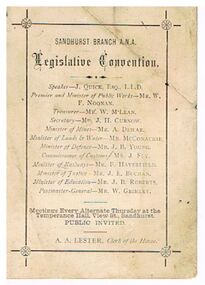
Document - DOCUMENT - SANDHURST BRANCH A. N. A. LEGISLATIVE CONVENTION
... DOCUMENT - SANDHURST BRANCH A. N. A. LEGISLATIVE CONVENTION...... Sandhurst Branch A. N. A....Small, white card, Sandhurst Branch A. N. A. Legislative Convention. ...BENDIGO Clubs ANA Document Sandhurst Branch A. N. A. J Quick W F Noonan W McLean J H Curnow A Dewar Mr McConachie J B Young J Fry F Haverfield J E Buchan J B Roberts W grimley A A Lester Small, white card, Sandhurst Branch A. ...Small, white card, Sandhurst Branch A. N. A. Legislative Convention. Possibly 1889, see newspaper article 22nd August, 1889, Bendigo Advertiser. Named are the Speaker - J. Quick, Esq., L. L. D., Premier and Minister of Public Works - Mr. W. F. Noonan, Treasurer - Mr. W. McLean, Secretary - Mr. J. H. Curnow, Minister of Mines - Mr. A. Dewar, Minister of Lands & Water - Mr. McConachie, Minister of Defence - Mr. J. B. Young, Commissioner of Customs - Mr. J. Fry, Minister of Railways - Mr. F. Haverfield, Minister of Justice - Mr. J. E. Buchan, Minister of Education - Mr. J. B. Roberts, Postmaster-General - Mr. W. Grimley. A. A. Lester, Clerk of the House. ' Meetings every alternate Thursday at the Temperance Hall, View Street, Sandhurst.' Printing surrounded by border with a flower where the corners intersect. On the back is a drawing with a vase of flowers sitting on a raised part which is wider at the bottom. It has a plant engraving and underneath are two doves and a feather pattern fan.bendigo, clubs, ana, document, sandhurst branch a. n. a., j quick, w f noonan, w mclean, j h curnow, a dewar, mr mcconachie, j b young, j fry, f haverfield, j e buchan, j b roberts, w grimley, a a lester -
 Bendigo Historical Society Inc.
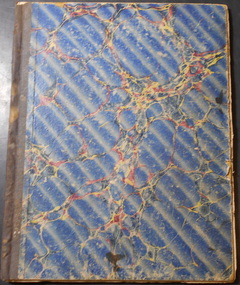
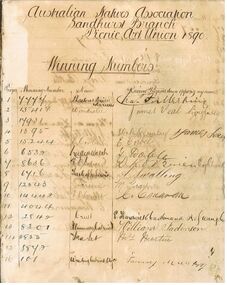
Book - ANA COLLECTION: EXERCISE BOOK - AUSTRALIAN NATIVES ASSOCIATION SANDHURST BRANCH PICNIC ART UNION 1890, 100 WINNING NUMBERS
... ANA COLLECTION: EXERCISE BOOK - AUSTRALIAN NATIVES ASSOCIATION SANDHURST BRANCH PICNIC ART UNION 1890, 100 WINNING NUMBERS......Sandhurst Branch...exercise book in poor condition Australian Natives Association, Sandhurst Branch, Picnic Art Union 1890 Book lists 100 prize winners: columns for Prize (sequenced 1 - 100), Winning Number, Name, "Received prize as set down opposite name" book in poor and damaged condition a exercise book cover (marbled coloured cover) b first page, prize names - 16 c next pages, prize names 17 -62 g next page, prize names 63 - 85 d last prize page, certified Town Hall Sandhurst, 14th day of January 1981, by three names, prize names 86 -100 e last page in book. notes 484 tickets in Art Union from no. 95571 to 96054, signed Mr. ...M Curnow one dinner set being 11th prize in ANA Art Union , signed JH Harris Book ANA COLLECTION: EXERCISE BOOK - AUSTRALIAN NATIVES ASSOCIATION SANDHURST BRANCH PICNIC ART UNION 1890, 100 WINNING NUMBERS ...exercise book in poor condition Australian Natives Association, Sandhurst Branch, Picnic Art Union 1890 Book lists 100 prize winners: columns for Prize (sequenced 1 - 100), Winning Number, Name, "Received prize as set down opposite name" book in poor and damaged condition a exercise book cover (marbled coloured cover) b first page, prize names - 16 c next pages, prize names 17 -62 g next page, prize names 63 - 85 d last prize page, certified Town Hall Sandhurst, 14th day of January 1981, by three names, prize names 86 -100 e last page in book. notes 484 tickets in Art Union from no. 95571 to 96054, signed Mr. Curnow, Sec ANA Sandhurst f paper attachment pasted into book acknowledging "from Mr. M Curnow one dinner set being 11th prize in ANA Art Union , signed JH Harrisaustralian natives association, sandhurst branch -
 Bendigo Historical Society Inc.
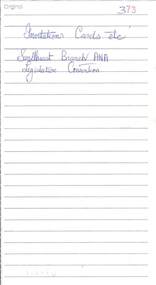
Document - NOTE - INVITATIONS CARDS ETC
... ... Sandhurst Branch ANA Legislative Convention...Page from docket book with Invitations Cards etc. Sandhurst Branch ANA Legislative Convention. Page has red 373 stamped on top corner and before it a blue handwritten 3. ...DOCUMENT Memo contents Note Invitations Cards etc Sandhurst Branch ANA Legislative Convention Page from docket book with Invitations Cards etc. ...Page from docket book with Invitations Cards etc. Sandhurst Branch ANA Legislative Convention. Page has red 373 stamped on top corner and before it a blue handwritten 3. 'Original' printed in top left corner.document, memo, contents, note, invitations cards etc, sandhurst branch ana legislative convention -
 Bendigo Historical Society Inc.
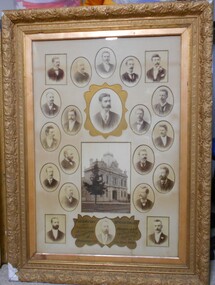
Photograph - ANA Photograph Collage
... Hall in View Street was opened in August 1894. The Sandhurst Branch was started on August 26th, 1874. ...Photo collage of members of the Building Committee of the Sandhurst Branch of the Australian Natives' Association. ...Hall in View Street was opened in August 1894. The Sandhurst Branch was started on August 26th, 1874. ...The A.N.A. Hall in View Street was opened in August 1894. The Sandhurst Branch was started on August 26th, 1874. In July 1874, several gentlemen met together, and when a sufficient number had given in their names and sufficient promises of support had been received, the board of directors were approached with a view to forming a branch of the association in Bendigo. On August 26, 1874, the inception took place. The building was demolished in 1971. Photo collage of members of the Building Committee of the Sandhurst Branch of the Australian Natives' Association. Twenty sepia coloured photos recessed in oval or rectangular shaped opening with gold coloured edging, on backing board. One larger photo is surrounded by gold coloured pattern with scalloped edge. Below this is a photo of the ANA building in View Street. Banner beneath the Photo of the ANA building "Presented to Mr Chas. the Sandhurst Branch ANA in Recognition of His Valuable Service as President in Year 1894". The collage is framed in gold coloured ornate wooden frame. Plaque attached to lower edge of frame lists names of men in the photos. "BUILDING COMMITTEE - 1894" J H CURNOW M J CAHILL Dr J QUICK D A CAMPBELL M J E STAPLETON A DUNSTAN Dr J MURPHY C DALEY (President) A G DUNLOP W CROWLEY A J HAMPSON W BEEBE J HOGAN T GLASS J B YOUNG R H ABBOTT A.N.A. HALL A G DAYMOND D EGAN J DANIEL J BUCHAN S A COCK ana, australian natives' association, sandhurst, photo collage -
 Bendigo Historical Society Inc.
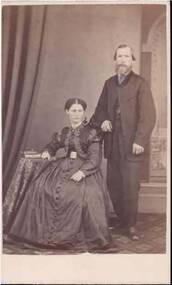
Photograph - PORTRAIT OF A COUPLE
... Chevalier, Pall Mall, Sandhurst. Branch Establishment, High Street. Eaglehawk....History House 11 Mackenzie Street Bendigo goldfields PHOTOGRAPH Portrait couple Portrait of a Couple Chevalier, Pall Mall, Sandhurst. Branch Establishment, High Street. Eaglehawk. ...Small portrait of a couple. The lady is seated on a chair with her right arm resting on a table and the man is standing beside her with his right arm resting on the back of her chair. He is wearing a three piece suit. The jacket only has one button at the neck. There is a small amount of blue at his neck. The lady's dress is long and has embroidery on the bodice. It also has buttons down the front.Chevalier, Pall Mall, Sandhurst. Branch Establishment, High Street. Eaglehawk.photograph, portrait, couple, portrait of a couple -
 Bendigo Historical Society Inc.
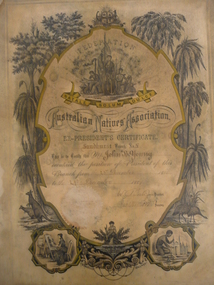
Document - ANA EX-PRESIDENTS CERTIFICATE MR J.B. YOUNG, 1887
... Australian Natives Association Ex-Presidents Certificate Sandhurst Branch No5 Mr.John.B.Young 23rd December 1886 to 29th December 1887...History House 11 Mackenzie Street Bendigo goldfields ORGANIZATION Society australian natives assoc F.W.Niven & Co Ballarat Australian Natives Association Ex-Presidents Certificate Sandhurst Branch No5 Mr.John.B.Young 23rd December 1886 to 29th December 1887 Document ANA EX-PRESIDENTS CERTIFICATE MR J.B. ...Australian Natives Association Ex-Presidents Certificate Sandhurst Branch No5 Mr.John.B.Young 23rd December 1886 to 29th December 1887F.W.Niven & Co Ballaratorganization, society, australian natives assoc -
 Bendigo Historical Society Inc.
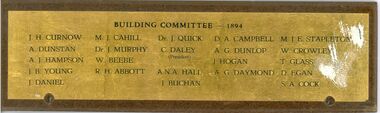
Plaque - Plaque from ANA Photograph Collage
... Hall in View Street was opened in August 1894. The Sandhurst Branch was started on August 26th, 1874. ...Plaque formerly attached to the lower edge of the framed photo collage of the Building Committee of the Sandhurst Branch of the Australian Natives' Association. ...Hall in View Street was opened in August 1894. The Sandhurst Branch was started on August 26th, 1874. ...The A.N.A. Hall in View Street was opened in August 1894. The Sandhurst Branch was started on August 26th, 1874. In July 1874, several gentlemen met together, and when a sufficient number had given in their names and sufficient promises of support had been received, the board of directors were approached with a view to forming a branch of the association in Bendigo. On August 26, 1874, the inception took place. The building was demolished in 1971. Plaque formerly attached to the lower edge of the framed photo collage of the Building Committee of the Sandhurst Branch of the Australian Natives' Association. It lists names of men in the photos. Names printed on gold coloured paper mounted on piece of masonite, matching the position on the collage. "BUILDING COMMITTEE - 1894" J H CURNOW M J CAHILL Dr J QUICK D A CAMPBELL M J E STAPLETON A DUNSTAN Dr J MURPHY C DALEY (President) A G DUNLOP W CROWLEY A J HAMPSON W BEEBE J HOGAN T GLASS J B YOUNG R H ABBOTT A.N.A. HALL A G DAYMOND D EGAN J DANIEL J BUCHAN S A COCK ana, australian natives' association, sandhurst, photo collage -
 Bendigo Historical Society Inc.
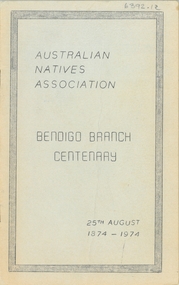
Pamphlet - Australian Natives Association
... "Australian Natives Association - Bendigo Branch Centenary 25th August 1874 - 1974" Originally the Sandhurst Branch. A brief history of the ANA meetings with a list of present (1974) Officers ..."Australian Natives Association - Bendigo Branch Centenary 25th August 1874 - 1974" Originally the Sandhurst Branch. A brief history of the ANA meetings with a list of present (1974) Officers Pamphlet Australian Natives Association ...Australian Natives Association A5 - 8-page pale grey cover stapled pamphlet. "Australian Natives Association - Bendigo Branch Centenary 25th August 1874 - 1974" Originally the Sandhurst Branch. A brief history of the ANA meetings with a list of present (1974) Officers australian natives association, ana bendigo branch -
 Bendigo Historical Society Inc.
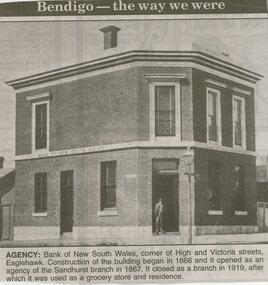
Newspaper - JENNY FOLEY COLLECTION: AGENCY
... Construction of the building began in 1866 and it opened as an agency of the Sandhurst branch in 1867. It closed as a branch in 1919, after which it was used as a grocery store and residence. ...Construction of the building began in 1866 and it opened as an agency of the Sandhurst branch in 1867. It closed as a branch in 1919, after which it was used as a grocery store and residence. ...Bendigo Advertiser ''The way we were'' from 2000. Agency: Bank of New South Wales, corner of High and Victoria Streets, Eaglehawk. Construction of the building began in 1866 and it opened as an agency of the Sandhurst branch in 1867. It closed as a branch in 1919, after which it was used as a grocery store and residence. The clip is in a folder.newspaper, bendigo advertiser, the way we were -
 Bendigo Historical Society Inc.
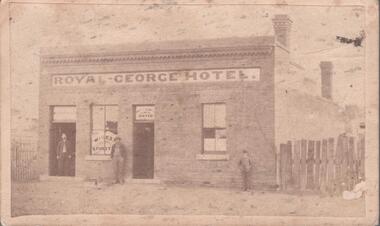
Photograph - ROYAL GEORGE HOTEL
... On the back: photographed by Chevalier, Pall Mall Sandhurst, branch establishment. High Street, Eaglehawk, opposite church of England. ...On the back: photographed by Chevalier, Pall Mall Sandhurst, branch establishment. High Street, Eaglehawk, opposite church of England. ...Small black and white photograph of the Royal George Hotel. Two men and a boy are standing at the front. On the back: photographed by Chevalier, Pall Mall Sandhurst, branch establishment. High Street, Eaglehawk, opposite church of England. The negative plate from which this photograph was printed being retained, similar copies can at any time be obtained.buildings, hotel, royal george -
 Bendigo Historical Society Inc.
Document - KELLY AND ALLSOP COLLECTION: THE BANK OF VICTORIA LIMITED, CHEQUES, 20/12/1890 to 12/09/1893
... [a] Cheque No. 552686, dated 20 Dec 1890. Sandhurst Branch. Four pounds payable to 'Cash' and signed by R.B.Tibby. ...[a] Cheque No. 552686, dated 20 Dec 1890. Sandhurst Branch. Four pounds payable to 'Cash' and signed by R.B.Tibby. ...Document. KELLY & ALLSOP COLLECTION. 2 off cheques drawn on The Bank of Victoria Limited. [a] Cheque No. 552686, dated 20 Dec 1890. Sandhurst Branch. Four pounds payable to 'Cash' and signed by R.B.Tibby. [b] Cheque No. 574047, dated 12 Sept. 1893. Kyneton Branch. Thirteen shillings payable to Mr.Allsop and signed by E.Hugard.Bank of Victoria Ltdbusiness, stockbroker, kelly & allsop, kelly & allsop collection, the bank of victoria ltd, cheque, r.b.tibby, e.hugard -
 Bendigo Historical Society Inc.
Book - AUSTRALIAN NATIVES ASSOCIATION COLLECTION
... Exercise book with blue marbled with white, red and dark blue containing a list of the winning members and member names of the Australian Natives Association Sandhurst branch. Picnic Art Union 1890 and 1891. ...Australian natives Association Mr Curnow Exercise book with blue marbled with white, red and dark blue containing a list of the winning members and member names of the Australian Natives Association Sandhurst branch. Picnic Art Union 1890 and 1891. ...Exercise book with blue marbled with white, red and dark blue containing a list of the winning members and member names of the Australian Natives Association Sandhurst branch. Picnic Art Union 1890 and 1891. Pasted in the back is a receipt from A. N. A. National Fete and Art Union dated January 26th, 1891 to Mr Curnow for 484 Art Union Tickets.book, bendigo, a. n. a., australian natives association, mr curnow -
 Bendigo Historical Society Inc.
Financial record - Arthur Allsop Collection: Account book
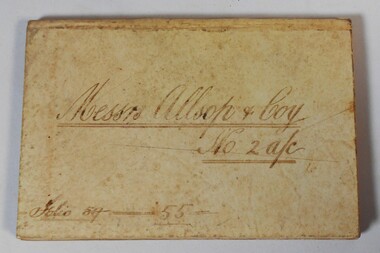
... Printed on the first page The Commercial Bank of Australia Limited Sandhurst Branch in Account Current with A Allsop and Coy Bookmaker. ...Printed on the first page The Commercial Bank of Australia Limited Sandhurst Branch in Account Current with A Allsop and Coy Bookmaker. ...Arthur Allsop went into the business office at Bendigo (Vic.) of the late Mr. Alfred Joseph. He later operated as an independent bookmaker. Arthur Allsop was a partner in the firm of Kelly and Allsop and was involved in mining and speculation in Bendigo. He was elected as a member of the Bendigo Stock Exchange in 1906. He started his athletic career at picnic sports and was a fine athlete winning many foot races. For 15 years he acted as secretary of the Sandhurst City Fire Brigade, he was captain of the Bendigo lacrosse team. He was a fair cricketer, and played against the English and Australian Elevens. He played football, and acted as secretary to the Bendigo Football Club. In later years he played bowls and captained pennant teams. He was a Past District- Grandmaster in the M.U.I.O.O.F. Allsop eventually moved to Melbourne and then Sydney working as a bookmaker. He died in Sydney in 1921. His wife Belle died in Bendigo in 1914 and is buried in the Bendigo Cemetery.Bank account book used by Bookmaker Arthur Allsop. Cream coloured hard cover. Written on the front Messrs. Allsop & Coy. No 2 Account. Printed on the first page The Commercial Bank of Australia Limited Sandhurst Branch in Account Current with A Allsop and Coy Bookmaker. Pages have ruled columns. Records payments and withdrawals from the account. Dated from August 1889 to May 1891. Final balance £6039.9.4bookmaker, arthur allsop, bank account -
 Bendigo Historical Society Inc.
Document - JOHANSON COLLECTION: MORTGAGE PENISTAN TO SIR JOHN QUICK, WILLIAM BEEBE & JOHN YOUNG
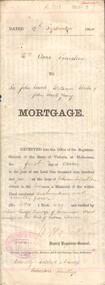
... Document details loan to Anne Penistan, widow, from Sandhurst Branch Number 5 of the Australian Natives Association. ...Document details loan to Anne Penistan, widow, from Sandhurst Branch Number 5 of the Australian Natives Association. ...Legal document. On front dated 19th September 1904. Mrs. Anne Penistan to Sir John Quick, William Beebe & John Beall Young. Document details loan to Anne Penistan, widow, from Sandhurst Branch Number 5 of the Australian Natives Association. Quick, Beebe and Young being ' Trustees for the time being ..) Land located in the (formerly unnamed) County of Bendigo Parish of Sandhurst Allotment 10 of Section 80. 33 perches and 7/10 of a perch. Mortgage for the sum of 150 pounds. Connelly Tatchell & dunlop, solicitors Bendigo on bottom of form. In centre of folded document: 'form of receipt under seal on discharge of a mortgage' Mortgage discharged by Annie Westland Hardman Patterson, formerly of Swan Hill and now of 607 Ligar St Ballarat, Mary McNair formerly Mary Penistan. Dated 17 March 1920. Signed by Quick, Beebe and Young. On back of form dated 17.3.1920 reconveyance details.bendigo, hospital -
 Federation University Historical Collection
Photograph - Photograph - Little Gem tintype, Possibly American Studio, Portrait of a child
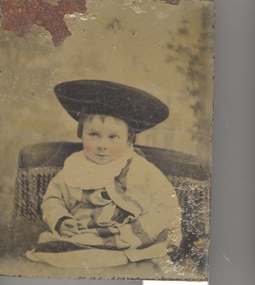
... Others franchises were opened in Melbourne, Ballarat and Sandhurst (Bendigo). The Sandhurst branch closed in 1882 and Adelaide in 1884. ...Others franchises were opened in Melbourne, Ballarat and Sandhurst (Bendigo). The Sandhurst branch closed in 1882 and Adelaide in 1884. ...The tintype (or ferrotype or Melainotype) was produced on metallic sheet (not, actually, tin) instead of glass. The plate was coated with collodion and sensitized just before use. It was introduced by Adolphe Alexandre Martin in 1853. The most common size was about the same as the carte-de-visite, 5.5cm x 9.0cm, but both larger and smaller ferrotypes were made. The smallest were "Little Gem" tintypes, about the size of a postage-stamp, made simultaneously on a single plate in a camera with 12 or 16 lenses. They were often produced by travelling photographers, and were cheaper than Ambrotypes so made photography available to working classes, not just to the more well-to-do. The print would come out laterally reversed (as one sees oneself in a mirror). Being quite rugged, tintypes could be sent by post. Tintypes were eventually superseded by gelatin emulsion dry plates in the 1880s, though street photographers in various parts of the world continued with this process until the 1950s. (Above information abridged from http://www.rleggat.com/photohistory/history/tintype.htm) The firm of Gove and Allen opened in Sydney in 1880 and were responsible for the belated popularizing of the gem tintype in Australia. The firm traded as both The American Gem Studio and The American Studio. Others franchises were opened in Melbourne, Ballarat and Sandhurst (Bendigo). The Sandhurst branch closed in 1882 and Adelaide in 1884. All Gove and Allen studios had ceased trading by 1885. The studio addresses were: 23 King William St, Adelaide; 324 George St, Sydney; 95 Swanston St, Melbourne; Howard Place, Sandhurst; 7 Queen St, Brisbane; The card mounts used in Gove and Allen studios in Australia are identical to those used in America. They were initially made of plain white card with embossing around the oval image opening in the mount while some also had simple geometric and floral printed designs as well. Although Gove and Allen studios produced the majority of gem tintypes in Australia, other studios offered them including: - London, American & Sydney Photo Company, 328 George St, Sydney; - David Edelsten, 55 & 57 Bourke St, Melbourne; - Burman's Portrait Rooms, St. George's Hall, 209 Bourke St, Melbourne; - Bell's Gem Portrait Studio, 57 Bourke St East, Melbourne; - R. H. Kenny, Bridge St, Ballarat; - Marinus W. Bent, Sandhurst (Bendigo); - George Fisher, Victoria; - Anson Brothers, Hobart Town. (Abridged information from http://members.ozemail.com.au/~msafier/photos/tintypes.html) A tintype portrait of a child, attached to a card. little gem, child, hat -
 Federation University Historical Collection
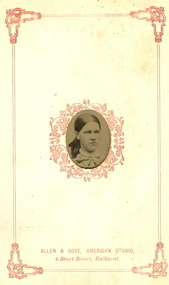
Photograph - Photograph - Little Gem tintype, American Studio, Portrait of a Woman
... Others franchises were opened in Melbourne, 6 Sturt St Ballarat and Sandhurst (Bendigo). The Sandhurst branch closed in 1882 and Adelaide in 1884. ...Others franchises were opened in Melbourne, 6 Sturt St Ballarat and Sandhurst (Bendigo). The Sandhurst branch closed in 1882 and Adelaide in 1884. ...The tintype (or ferrotype or Melainotype) was produced on metallic sheet (not, actually, tin) instead of glass. The plate was coated with collodion and sensitized just before use. It was introduced by Adolphe Alexandre Martin in 1853. The most common size was about the same as the carte-de-visite, 5.5cm x 9.0cm, but both larger and smaller ferrotypes were made. The smallest were "Little Gem" tintypes, about the size of a postage-stamp, made simultaneously on a single plate in a camera with 12 or 16 lenses. They were often produced by travelling photographers, and were cheaper than Ambrotypes so made photography available to working classes, not just to the more well-to-do. The print would come out laterally reversed (as one sees oneself in a mirror). Being quite rugged, tintypes could be sent by post. Tintypes were eventually superseded by gelatin emulsion dry plates in the 1880s, though street photographers in various parts of the world continued with this process until the 1950s. (Above information abridged from http://www.rleggat.com/photohistory/history/tintype.htm) The firm of Gove and Allen opened in Sydney in 1880 and were responsible for the belated popularizing of the gem tintype in Australia. The firm traded as both The American Gem Studio and The American Studio. Others franchises were opened in Melbourne, 6 Sturt St Ballarat and Sandhurst (Bendigo). The Sandhurst branch closed in 1882 and Adelaide in 1884. All Gove and Allen studios had ceased trading by 1885. The studio addresses were: 23 King William St, Adelaide; 324 George St, Sydney; 95 Swanston St, Melbourne; Howard Place, Sandhurst; 7 Queen St, Brisbane; The card mounts used in Gove and Allen studios in Australia are identical to those used in America. They were initially made of plain white card with embossing around the oval image opening in the mount while some also had simple geometric and floral printed designs as well. Although Gove and Allen studios produced the majority of gem tintypes in Australia, other studios offered them including: - London, American & Sydney Photo Company, 328 George St, Sydney; - David Edelsten, 55 & 57 Bourke St, Melbourne; - Burman's Portrait Rooms, St. George's Hall, 209 Bourke St, Melbourne; - Bell's Gem Portrait Studio, 57 Bourke St East, Melbourne; - R. H. Kenny, Bridge St, Ballarat; - Marinus W. Bent, Sandhurst (Bendigo); - George Fisher, Victoria; - Anson Brothers, Hobart Town. (Abridged information from http://members.ozemail.com.au/~msafier/photos/tintypes.html) A tintype portrait of a woman's head, attached to a card. Printed on the lower edge of the card "Allen & Gove, American Studion, 6 Sturt St, Ballarat"ballarat, american studio, little gem, allen gove, tintype, woman, unidentified woman, photography -
 Federation University Historical Collection
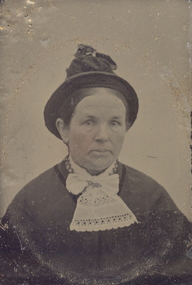
Photograph - Little Gem tintype, Portrait of a Woman in a Hat
... Others franchises were opened in Melbourne, Ballarat and Sandhurst (Bendigo). The Sandhurst branch closed in 1882 and Adelaide in 1884. ...Others franchises were opened in Melbourne, Ballarat and Sandhurst (Bendigo). The Sandhurst branch closed in 1882 and Adelaide in 1884. ...The tintype (or ferrotype or Melainotype) was produced on metallic sheet (not, actually, tin) instead of glass. The plate was coated with collodion and sensitized just before use. It was introduced by Adolphe Alexandre Martin in 1853. The most common size was about the same as the carte-de-visite, 5.5cm x 9.0cm, but both larger and smaller ferrotypes were made. The smallest were "Little Gem" tintypes, about the size of a postage-stamp, made simultaneously on a single plate in a camera with 12 or 16 lenses. They were often produced by travelling photographers, and were cheaper than Ambrotypes so made photography available to working classes, not just to the more well-to-do. The print would come out laterally reversed (as one sees oneself in a mirror). Being quite rugged, tintypes could be sent by post. Tintypes were eventually superseded by gelatin emulsion dry plates in the 1880s, though street photographers in various parts of the world continued with this process until the 1950s. (Above information abridged from http://www.rleggat.com/photohistory/history/tintype.htm) The firm of Gove and Allen opened in Sydney in 1880 and were responsible for the belated popularizing of the gem tintype in Australia. The firm traded as both The American Gem Studio and The American Studio. Others franchises were opened in Melbourne, Ballarat and Sandhurst (Bendigo). The Sandhurst branch closed in 1882 and Adelaide in 1884. All Gove and Allen studios had ceased trading by 1885. The studio addresses were: 23 King William St, Adelaide; 324 George St, Sydney; 95 Swanston St, Melbourne; Howard Place, Sandhurst; 7 Queen St, Brisbane; The card mounts used in Gove and Allen studios in Australia are identical to those used in America. They were initially made of plain white card with embossing around the oval image opening in the mount while some also had simple geometric and floral printed designs as well. Although Gove and Allen studios produced the majority of gem tintypes in Australia, other studios offered them including: - London, American & Sydney Photo Company, 328 George St, Sydney; - David Edelsten, 55 & 57 Bourke St, Melbourne; - Burman's Portrait Rooms, St. George's Hall, 209 Bourke St, Melbourne; - Bell's Gem Portrait Studio, 57 Bourke St East, Melbourne; - R. H. Kenny, Bridge St, 6 Sturt St Ballarat; - Marinus W. Bent, Sandhurst (Bendigo); - George Fisher, Victoria; - Anson Brothers, Hobart Town. (Abridged information from http://members.ozemail.com.au/~msafier/photos/tintypes.html) A tintype portrait of a woman's head and shoulders, attached to a card. The cheeks have been hand coloured.little gem, woman, unidentified woman, women, photography -
 Federation University Historical Collection
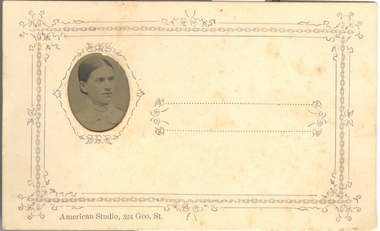
Photograph - Little Gem tintype, American Studio, Portrait of a Woman, (exact)
... Others franchises were opened in Melbourne, Ballarat and Sandhurst (Bendigo). The Sandhurst branch closed in 1882 and Adelaide in 1884. ...Others franchises were opened in Melbourne, Ballarat and Sandhurst (Bendigo). The Sandhurst branch closed in 1882 and Adelaide in 1884. ...The tintype (or ferrotype or Melainotype) was produced on metallic sheet (not, actually, tin) instead of glass. The plate was coated with collodion and sensitized just before use. It was introduced by Adolphe Alexandre Martin in 1853. The most common size was about the same as the carte-de-visite, 5.5cm x 9.0cm, but both larger and smaller ferrotypes were made. The smallest were "Little Gem" tintypes, about the size of a postage-stamp, made simultaneously on a single plate in a camera with 12 or 16 lenses. They were often produced by travelling photographers, and were cheaper than Ambrotypes so made photography available to working classes, not just to the more well-to-do. The print would come out laterally reversed (as one sees oneself in a mirror). Being quite rugged, tintypes could be sent by post. Tintypes were eventually superseded by gelatin emulsion dry plates in the 1880s, though street photographers in various parts of the world continued with this process until the 1950s. (Above information abridged from http://www.rleggat.com/photohistory/history/tintype.htm) The firm of Gove and Allen opened in Sydney in 1880 and were responsible for the belated popularizing of the gem tintype in Australia. The firm traded as both The American Gem Studio and The American Studio. Others franchises were opened in Melbourne, Ballarat and Sandhurst (Bendigo). The Sandhurst branch closed in 1882 and Adelaide in 1884. All Gove and Allen studios had ceased trading by 1885. The studio addresses were: 23 King William St, Adelaide; 324 George St, Sydney; 95 Swanston St, Melbourne; Howard Place, Sandhurst; 7 Queen St, Brisbane; The card mounts used in Gove and Allen studios in Australia are identical to those used in America. They were initially made of plain white card with embossing around the oval image opening in the mount while some also had simple geometric and floral printed designs as well. Although Gove and Allen studios produced the majority of gem tintypes in Australia, other studios offered them including: - London, American & Sydney Photo Company, 328 George St, Sydney; - David Edelsten, 55 & 57 Bourke St, Melbourne; - Burman's Portrait Rooms, St. George's Hall, 209 Bourke St, Melbourne; - Bell's Gem Portrait Studio, 57 Bourke St East, Melbourne; - R. H. Kenny, Bridge St, Ballarat; - Marinus W. Bent, Sandhurst (Bendigo); - George Fisher, Victoria; - Anson Brothers, Hobart Town. (Abridged information from http://members.ozemail.com.au/~msafier/photos/tintypes.html) A tintype portrait of a woman's head, attached to a card.Printed lower left hand side of the card "American Studio, 324 Geo. St."tintype, american studio, woman, unidentified woman, women, photograph -
 Federation University Historical Collection
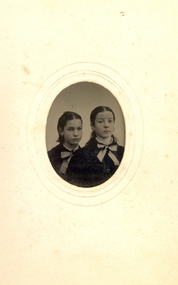
Photograph - Tintype, Portrait of two young girls
... Others franchises were opened in Melbourne, 6 Sturt St Ballarat and Sandhurst (Bendigo). The Sandhurst branch closed in 1882 and Adelaide in 1884. ...Others franchises were opened in Melbourne, 6 Sturt St Ballarat and Sandhurst (Bendigo). The Sandhurst branch closed in 1882 and Adelaide in 1884. ...The tintype (or ferrotype or Melainotype) was produced on metallic sheet (not, actually, tin) instead of glass. The plate was coated with collodion and sensitized just before use. It was introduced by Adolphe Alexandre Martin in 1853. The most common size was about the same as the carte-de-visite, 5.5cm x 9.0cm, but both larger and smaller ferrotypes were made. The smallest were "Little Gem" tintypes, about the size of a postage-stamp, made simultaneously on a single plate in a camera with 12 or 16 lenses. They were often produced by travelling photographers, and were cheaper than Ambrotypes so made photography available to working classes, not just to the more well-to-do. The print would come out laterally reversed (as one sees oneself in a mirror). Being quite rugged, tintypes could be sent by post. Tintypes were eventually superseded by gelatin emulsion dry plates in the 1880s, though street photographers in various parts of the world continued with this process until the 1950s. (Above information abridged from http://www.rleggat.com/photohistory/history/tintype.htm) The firm of Gove and Allen opened in Sydney in 1880 and were responsible for the belated popularizing of the gem tintype in Australia. The firm traded as both The American Gem Studio and The American Studio. Others franchises were opened in Melbourne, 6 Sturt St Ballarat and Sandhurst (Bendigo). The Sandhurst branch closed in 1882 and Adelaide in 1884. All Gove and Allen studios had ceased trading by 1885. The studio addresses were: 23 King William St, Adelaide; 324 George St, Sydney; 95 Swanston St, Melbourne; Howard Place, Sandhurst; 7 Queen St, Brisbane; The card mounts used in Gove and Allen studios in Australia are identical to those used in America. They were initially made of plain white card with embossing around the oval image opening in the mount while some also had simple geometric and floral printed designs as well. Although Gove and Allen studios produced the majority of gem tintypes in Australia, other studios offered them including: - London, American & Sydney Photo Company, 328 George St, Sydney; - David Edelsten, 55 & 57 Bourke St, Melbourne; - Burman's Portrait Rooms, St. George's Hall, 209 Bourke St, Melbourne; - Bell's Gem Portrait Studio, 57 Bourke St East, Melbourne; - R. H. Kenny, Bridge St, Ballarat; - Marinus W. Bent, Sandhurst (Bendigo); - George Fisher, Victoria; - Anson Brothers, Hobart Town. (Abridged information from http://members.ozemail.com.au/~msafier/photos/tintypes.html) .2) A tintype portrait of two girls heads, attached to a card. The girls are wearing a cloak with a large bow at the frontlittle gem, women, children, photography, tintype -
 Federation University Historical Collection
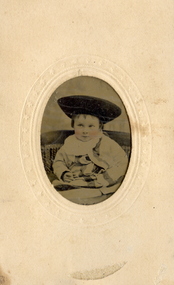
Photograph - Photo - Little Gem tintype, Possibly American Studio, Portrait of a child
... Others franchises were opened in Melbourne, Ballarat and Sandhurst (Bendigo). The Sandhurst branch closed in 1882 and Adelaide in 1884. ...Others franchises were opened in Melbourne, Ballarat and Sandhurst (Bendigo). The Sandhurst branch closed in 1882 and Adelaide in 1884. ...The tintype (or ferrotype or Melainotype) was produced on metallic sheet (not, actually, tin) instead of glass. The plate was coated with collodion and sensitized just before use. It was introduced by Adolphe Alexandre Martin in 1853. The most common size was about the same as the carte-de-visite, 5.5cm x 9.0cm, but both larger and smaller ferrotypes were made. The smallest were "Little Gem" tintypes, about the size of a postage-stamp, made simultaneously on a single plate in a camera with 12 or 16 lenses. They were often produced by travelling photographers, and were cheaper than Ambrotypes so made photography available to working classes, not just to the more well-to-do. The print would come out laterally reversed (as one sees oneself in a mirror). Being quite rugged, tintypes could be sent by post. Tintypes were eventually superseded by gelatin emulsion dry plates in the 1880s, though street photographers in various parts of the world continued with this process until the 1950s. (Above information abridged from http://www.rleggat.com/photohistory/history/tintype.htm) The firm of Gove and Allen opened in Sydney in 1880 and were responsible for the belated popularizing of the gem tintype in Australia. The firm traded as both The American Gem Studio and The American Studio. Others franchises were opened in Melbourne, Ballarat and Sandhurst (Bendigo). The Sandhurst branch closed in 1882 and Adelaide in 1884. All Gove and Allen studios had ceased trading by 1885. The studio addresses were: 23 King William St, Adelaide; 324 George St, Sydney; 95 Swanston St, Melbourne; Howard Place, Sandhurst; 7 Queen St, Brisbane; The card mounts used in Gove and Allen studios in Australia are identical to those used in America. They were initially made of plain white card with embossing around the oval image opening in the mount while some also had simple geometric and floral printed designs as well. Although Gove and Allen studios produced the majority of gem tintypes in Australia, other studios offered them including: - London, American & Sydney Photo Company, 328 George St, Sydney; - David Edelsten, 55 & 57 Bourke St, Melbourne; - Burman's Portrait Rooms, St. George's Hall, 209 Bourke St, Melbourne; - Bell's Gem Portrait Studio, 57 Bourke St East, Melbourne; - R. H. Kenny, Bridge St, Ballarat; - Marinus W. Bent, Sandhurst (Bendigo); - George Fisher, Victoria; - Anson Brothers, Hobart Town. (Abridged information from http://members.ozemail.com.au/~msafier/photos/tintypes.html) .5) A tintype portrait of a child, attached to a card. little gem, photography, child, portrait -
 Federation University Historical Collection
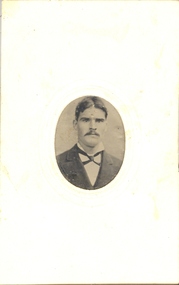
Photograph - Little Gem tintype, Portrait of a Man
... Others franchises were opened in Melbourne, Ballarat and Sandhurst (Bendigo). The Sandhurst branch closed in 1882 and Adelaide in 1884. ...Others franchises were opened in Melbourne, Ballarat and Sandhurst (Bendigo). The Sandhurst branch closed in 1882 and Adelaide in 1884. ...The tintype (or ferrotype or Melainotype) was produced on metallic sheet (not, actually, tin) instead of glass. The plate was coated with collodion and sensitized just before use. It was introduced by Adolphe Alexandre Martin in 1853. The most common size was about the same as the carte-de-visite, 5.5cm x 9.0cm, but both larger and smaller ferrotypes were made. The smallest were "Little Gem" tintypes, about the size of a postage-stamp, made simultaneously on a single plate in a camera with 12 or 16 lenses. They were often produced by travelling photographers, and were cheaper than Ambrotypes so made photography available to working classes, not just to the more well-to-do. The print would come out laterally reversed (as one sees oneself in a mirror). Being quite rugged, tintypes could be sent by post. Tintypes were eventually superseded by gelatin emulsion dry plates in the 1880s, though street photographers in various parts of the world continued with this process until the 1950s. (Above information abridged from http://www.rleggat.com/photohistory/history/tintype.htm) The firm of Gove and Allen opened in Sydney in 1880 and were responsible for the belated popularizing of the gem tintype in Australia. The firm traded as both The American Gem Studio and The American Studio. Others franchises were opened in Melbourne, Ballarat and Sandhurst (Bendigo). The Sandhurst branch closed in 1882 and Adelaide in 1884. All Gove and Allen studios had ceased trading by 1885. The studio addresses were: 23 King William St, Adelaide; 324 George St, Sydney; 95 Swanston St, Melbourne; Howard Place, Sandhurst; 7 Queen St, Brisbane; The card mounts used in Gove and Allen studios in Australia are identical to those used in America. They were initially made of plain white card with embossing around the oval image opening in the mount while some also had simple geometric and floral printed designs as well. Although Gove and Allen studios produced the majority of gem tintypes in Australia, other studios offered them including: - London, American & Sydney Photo Company, 328 George St, Sydney; - David Edelsten, 55 & 57 Bourke St, Melbourne; - Burman's Portrait Rooms, St. George's Hall, 209 Bourke St, Melbourne; - Bell's Gem Portrait Studio, 57 Bourke St East, Melbourne; - R. H. Kenny, Bridge St, Ballarat; - Marinus W. Bent, Sandhurst (Bendigo); - George Fisher, Victoria; - Anson Brothers, Hobart Town. (Abridged information from http://members.ozemail.com.au/~msafier/photos/tintypes.html) .4) A tintype portrait of a man, attached to a card. little gem, tintype, man, unidentified man -
 Federation University Historical Collection
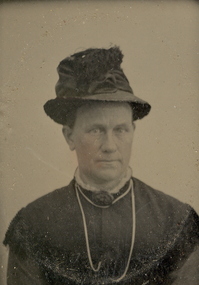
Photograph - Little Gem tintype, Portrait of a Woman in a hat
... Others franchises were opened in Melbourne, Ballarat and Sandhurst (Bendigo). The Sandhurst branch closed in 1882 and Adelaide in 1884. ...Others franchises were opened in Melbourne, Ballarat and Sandhurst (Bendigo). The Sandhurst branch closed in 1882 and Adelaide in 1884. ...The tintype (or ferrotype or Melainotype) was produced on metallic sheet (not, actually, tin) instead of glass. The plate was coated with collodion and sensitized just before use. It was introduced by Adolphe Alexandre Martin in 1853. The most common size was about the same as the carte-de-visite, 5.5cm x 9.0cm, but both larger and smaller ferrotypes were made. The smallest were "Little Gem" tintypes, about the size of a postage-stamp, made simultaneously on a single plate in a camera with 12 or 16 lenses. They were often produced by travelling photographers, and were cheaper than Ambrotypes so made photography available to working classes, not just to the more well-to-do. The print would come out laterally reversed (as one sees oneself in a mirror). Being quite rugged, tintypes could be sent by post. Tintypes were eventually superseded by gelatin emulsion dry plates in the 1880s, though street photographers in various parts of the world continued with this process until the 1950s. (Above information abridged from http://www.rleggat.com/photohistory/history/tintype.htm) The firm of Gove and Allen opened in Sydney in 1880 and were responsible for the belated popularizing of the gem tintype in Australia. The firm traded as both The American Gem Studio and The American Studio. Others franchises were opened in Melbourne, Ballarat and Sandhurst (Bendigo). The Sandhurst branch closed in 1882 and Adelaide in 1884. All Gove and Allen studios had ceased trading by 1885. The studio addresses were: 23 King William St, Adelaide; 324 George St, Sydney; 95 Swanston St, Melbourne; Howard Place, Sandhurst; 7 Queen St, Brisbane; The card mounts used in Gove and Allen studios in Australia are identical to those used in America. They were initially made of plain white card with embossing around the oval image opening in the mount while some also had simple geometric and floral printed designs as well. Although Gove and Allen studios produced the majority of gem tintypes in Australia, other studios offered them including: - London, American & Sydney Photo Company, 328 George St, Sydney; - David Edelsten, 55 & 57 Bourke St, Melbourne; - Burman's Portrait Rooms, St. George's Hall, 209 Bourke St, Melbourne; - Bell's Gem Portrait Studio, 57 Bourke St East, Melbourne; - R. H. Kenny, Bridge St, 6 Sturt St Ballarat; - Marinus W. Bent, Sandhurst (Bendigo); - George Fisher, Victoria; - Anson Brothers, Hobart Town. (Abridged information from http://members.ozemail.com.au/~msafier/photos/tintypes.html) .9) A tintype portrait of a woman's head, attached to a card. The cheeks have been hand coloured.little gem, woman, unidentified woman, women, photography -
 Federation University Historical Collection
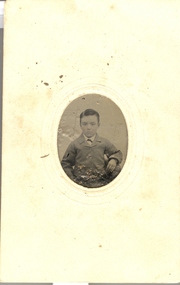
Photograph - Little Gem tintype, Possibly American Studio, Portrait of a Boy
... Others franchises were opened in Melbourne, Ballarat and Sandhurst (Bendigo). The Sandhurst branch closed in 1882 and Adelaide in 1884. ...Others franchises were opened in Melbourne, Ballarat and Sandhurst (Bendigo). The Sandhurst branch closed in 1882 and Adelaide in 1884. ...The tintype (or ferrotype or Melainotype) was produced on metallic sheet (not, actually, tin) instead of glass. The plate was coated with collodion and sensitized just before use. It was introduced by Adolphe Alexandre Martin in 1853. The most common size was about the same as the carte-de-visite, 5.5cm x 9.0cm, but both larger and smaller ferrotypes were made. The smallest were "Little Gem" tintypes, about the size of a postage-stamp, made simultaneously on a single plate in a camera with 12 or 16 lenses. They were often produced by travelling photographers, and were cheaper than Ambrotypes so made photography available to working classes, not just to the more well-to-do. The print would come out laterally reversed (as one sees oneself in a mirror). Being quite rugged, tintypes could be sent by post. Tintypes were eventually superseded by gelatin emulsion dry plates in the 1880s, though street photographers in various parts of the world continued with this process until the 1950s. (Above information abridged from http://www.rleggat.com/photohistory/history/tintype.htm) The firm of Gove and Allen opened in Sydney in 1880 and were responsible for the belated popularizing of the gem tintype in Australia. The firm traded as both The American Gem Studio and The American Studio. Others franchises were opened in Melbourne, Ballarat and Sandhurst (Bendigo). The Sandhurst branch closed in 1882 and Adelaide in 1884. All Gove and Allen studios had ceased trading by 1885. The studio addresses were: 23 King William St, Adelaide; 324 George St, Sydney; 95 Swanston St, Melbourne; Howard Place, Sandhurst; 7 Queen St, Brisbane; The card mounts used in Gove and Allen studios in Australia are identical to those used in America. They were initially made of plain white card with embossing around the oval image opening in the mount while some also had simple geometric and floral printed designs as well. Although Gove and Allen studios produced the majority of gem tintypes in Australia, other studios offered them including: - London, American & Sydney Photo Company, 328 George St, Sydney; - David Edelsten, 55 & 57 Bourke St, Melbourne; - Burman's Portrait Rooms, St. George's Hall, 209 Bourke St, Melbourne; - Bell's Gem Portrait Studio, 57 Bourke St East, Melbourne; - R. H. Kenny, Bridge St, 6 Sturt St Ballarat; - Marinus W. Bent, Sandhurst (Bendigo); - George Fisher, Victoria; - Anson Brothers, Hobart Town. (Abridged information from http://members.ozemail.com.au/~msafier/photos/tintypes.html) .9) A tintype portrait of a child's head and torso, attached to a card. The boy is wearing a suit and the cheeks have been hand coloured.little gem -
 Bendigo Historical Society Inc.
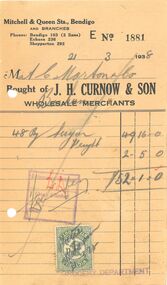
Financial record - INVOICE COLLECTION: J. H. Curnow & Son
... He joined the Sandhurst branch in 1881 and was secretary in 1883-1891. ...He joined the Sandhurst branch in 1881 and was secretary in 1883-1891. ...See below for an article by Jim Evans of the Bendigo Historical Society: From the Bendigo Miner Number 9 - 1 March 2007 Cock-eyed Curnow - James Henry Curnow Cornishman and famous Bendigonian By Jim Evans Five-time Mayor of Bendigo, James Henry Curnow of Eumana , was for fifty years associated with almost every progressive movement in the life of the city. He was born in Ludgvan, Cornwall, in 1861, the son of Sampson Curnow, tin-miner and later mine-manager. His parents brought him to Bendigo when he was two years old and settled at Long Gully. He was educated at the state school and St Andrew s College. In 1883, he married Jane Corbel in the Congregational Church. Curnow joined the Post-Master-General s Department in 1881. Taking leave in 1887, he acted as secretary of the Australian Natives Association (ANA) exhibition at Geelong. He became a clerk with Connelly and Tatchell's, Bendigo solicitors, leaving in 1894 to establish an accountancy and real estate business. Considered shrewd and hard-working, Curnow prospered; he later added an auctioneering section and formed the company J.H. Curnow & Son (now Curnow & Dyett). The ANA provided the grounding for Curnow s public life. He joined the Sandhurst branch in 1881 and was secretary in 1883-1891. He helped form new branches in northern Victoria. With (Sir) John Quick, he set up the first Federation League in the colony in 1893. Curnow was secretary of the League in that year and again in 1898-99. He was elected to the Bendigo City Council in 1901 and, apart from 1906-09 remained a very energetic councillor. He was Mayor in 1902-03, 1903-04, 1912-13, 1919-20 and 1927-28. It was during his second term as Mayor in 1904, that he had William Beebe design a home - Eumana in Flora Hill. (Local historian Betty Jackman informs me that Curnow s house at 75 Wills Street where he lived before moving to Flora Hill, was also called Eumana ). He took a leading role in the installation of sewerage and was later Chairman of the city s Sewerage authority when that body was being subjected to a great deal of criticism. He was an executive member of The Municipal Association of Victoria and president in 1919. Curnow was very interested in politics, but his four attempts to enter parliament failed. He was Justice of the Peace for the states of New South Wales and Victoria, deputy coroner for the city of Bendigo, a guardian of minors and registrar of marriages. Curnow was managing director of the Bendigo Pottery, director of the Bendigo Gas Co. and the Bendigo and Eaglehawk Star Building Society and chairman of directors of the Bendigo Boot and Shoe factory. He was a life member of both the Bendigo Base Hospital and the Benevolent Asylum (Anne Caudle Centre). Curnow s family affairs were marred by tragedy. His father was killed in a mining accident in 1881; his first wife and three of their five children died in the measles epidemic of 1893. His second wife Mary Jordan died in 1909 after spilling carbolic acid on her hip, leaving three young children. He married Amy McLean in 1911and they had one daughter. When the Prince Edward visited Bendigo in 1920, Curnow made a speech, telling his audience: I will now merely ask you to drink his health as the Prince of Wales and also as the Duke of Cornwall. In this district there are a tremendous number of Cornishmen and I need not tell His Royal Highness that it was the Cousin Jacks who made Bendigo, who found the gold and developed the mines. They have added more to the riches of the Commonwealth than any other class of people. When he visits the mines today, he will find that ninety per cent of the miners are Cornishmen and descendants of Cornishmen. His remarks were greeted by loud applause. J.H. Curnow was known locally as Cock-eyed because of an eye defect. He died on Anzac Day 1932 at his then home, The Knoll in Wattle Street. He was 71. He was cremated at the new Fawkner Cemetery and his ashes were buried in the Bendigo Cemetery. His grave is close to that of another famous Cornishman and Bendigonian, Sir John Quick, who died in the same year. The Curnow memorial drinking fountain in Rosalind Park was unveiled in 1938 by Mayor Taylor. The distinguished Bendigo born sculptress Ola Cohn designed the memorial and made the bust and other plaques of terracotta. The plaques were damaged in the 1950s and a restoration program was undertaken, with bronze plaques replacing the original terracotta ones.10934.33a: A small, aged sheet of yellow paper with two clean punch holes on the left side and a perforated edge. The paper is thin, but sturdy. Printed in black ink is the business name and details: Bought of J.H. Curnow & Son Wholesale Merchants. The address: Mitchell & Queen Sts. Bendigo and branches. Phones: Bendigo 103. The receipt is handwritten in grey lead pencil. Dated 21 March 1938. Below the header is neat, ruled lines for listing items with prices listed in British Pounds, totaling 52 pounds 1 shillings. Receipt number 1881. There is also a Victorian 3 pence stamp duty stamp printed in green ink. 10934.33b: A small, aged sheet of yellow paper with two clean punch holes on the left side and a perforated edge. The paper is thin, but sturdy. Printed in black ink is the business name and details: Bought of J.H. Curnow & Son Wholesale Merchants. The address: Mitchell & Queen Sts. Bendigo and branches. Phones: Bendigo 103. The receipt is handwritten in grey lead pencil. Dated 25 May 1938. Below the header is neat, ruled lines for listing items. Receipt number 14291. The Receipt is crossed out in blye pencil. The top left corner is folded and slightly torn. 10934.33c: A small, aged sheet of yellow paper with two clean punch holes on the left side and a perforated edge. The paper is thin, but sturdy. Printed in black ink is the business name and details: Bought of J.H. Curnow & Son Wholesale Merchants. The address: Mitchell & Queen Sts. Bendigo and branches. Phones: Bendigo 103. The receipt is handwritten in grey lead pencil. Dated 27 June 1938. Below the header is neat, ruled lines for listing items with prices listed in British Pounds, totaling 2 pounds. Receipt number 1466. The receipt is crossed out in blue pencil and indicates and credit. 10934.33d: A small, aged sheet of yellow paper with two clean punch holes on the left side and a perforated edge. The paper is thin, but sturdy. Printed in black ink is the business name and details: Bought of J.H. Curnow & Son Wholesale Merchants. The address: Mitchell & Queen Sts. Bendigo and branches. Phones: Bendigo 103. The receipt is handwritten in grey lead pencil. Dated 7 March 1938. Below the header is neat, ruled lines for listing items with prices listed in British Pounds, totaling 34 pounds 14 shillings. Receipt number 1627. There is also a Victorian 3 pence stamp duty stamp printed in green ink.ac morton, jh curnow & son -
Federation University Historical Collection
Document, Zelda Martin, Central Victorian Goldmining towns - Boom Towns or Ghost Towns?, c1996
... Sandhurst (Bendigo) regarding the Gold License Fee. * Extracts from a book "Victoria" re Gold Fields Commission of Enquiry involving mainly Ballarat and Castlemaine and a chapter titled 'A Tour to the Victorian Gold-Fields' *Lists of central Victorian newspapers - listed by date published 1851to 1874; by first date available to State Library. *A list of cities and towns showing County, population in 1861 &1871, and municipal status. [.14] Resource no.7. Black display book. *Reference: Papers presented to Parliament Victoria - 1859-1860 4 volumes - relevant sections copied. Contains information on Branches...Sandhurst (Bendigo) regarding the Gold License Fee. * Extracts from a book "Victoria" re Gold Fields Commission of Enquiry involving mainly Ballarat and Castlemaine and a chapter titled 'A Tour to the Victorian Gold-Fields' *Lists of central Victorian newspapers - listed by date published 1851to 1874; by first date available to State Library. *A list of cities and towns showing County, population in 1861 &1871, and municipal status. [.14] Resource no.7. Black display book. *Reference: Papers presented to Parliament Victoria - 1859-1860 4 volumes - relevant sections copied. Contains information on Branches ...Zelda Martin was a PhD candidate at the University of Melbourne.[.1] 4th item in light blue display book titled Research Approach/Overview of Chapters/Confirmation of Canditure/Chapters1,2,3&4 of proposed thesis. *Twenty-seven page article on Victorian goldfields towns titled: Central Victorian Goldmining Towns - Boom Towns or Ghost Towns. The article was written during the author's PhD study. It outlines the context methodology, and resources and the chapters of the proposed thesis: (1) Central Victorian Goldmining Towns - The Context (2) Contemporary Views of the Factors Necessary for Town Growth (3) Outward Manifestations of Town Growth (4) The Trappings of Government (5-9) The Main Towns and Their Hinterland. [.2] 5th item in Light Blue display book as above item. *Chapter 1 of proposed thesis titled 'Pick, Shovel and Tin Dish Mining.' Covers in Section A: Central Victoria - Pre 1851: Aborigines in Central Victoria, Squatters, and Government. Section B: The years 1851-1854: The Early Gold Rushes, Government Reaction, Township Surveys, Legislation, Town Development, Local Government and Early Settlement. [.3] 6th item in Light Blue display book as above item. *2A of proposed thesis titled 'Contemporary Views of the Factors Necessary for Town Growth'. Similar information to Chapter 1 plus extra re towns and maps. Sections: Introduction, Context of Place - Geographical Towns Listed, The Context of Time - Pre1851 Aborigines, Governance of Port Phillip, The Squatters, The Villages of Central Victorian Highlands, Conclusion, Condensed Version of Chapter2B. [.4] 7th item in Light Blue display book as above item. *Chapter2B of proposed thesis. Sections: Area of Research, Schools, Banks, Newspapers, Progress Association, Town Development - Sandhurst (Bendigo), Ballarat, Castlemaine,, Maryborough, Ararat and Stawell. [.5] 8th item in Light Blue display book as above item. *Chapter 3 of proposed thesis titled 'Outward Manifestations of Town Growth'. Sections: Introduction, Contemporary Writing, Educationalists, The Bankers, The Townsfolk, Current Theory, General Theories of Urban Development, and Conclusion. [.6] 9th item in Light Blue display book as above item. *Chapter 4 of proposed thesis titled 'Trappings of Government' Sections: Introduction, Early Government Attitudes to Mining and Town Development, Law and Order, Township Surveys, Legislation, Local Government, Transport and Communication, The People and Lobbyists. [.7] 10th item in Light Blue display book as above item. *'The Rise and Fall of Central Victorian Goldmining Towns'. Includes a map showing main Goldfields, a table showing towns and villages at two points in time - 1857 and 1871; a Bibliography of Primary and Secondary Sources. [.8] Resource No1. Black display book titled Local Towns 1 : Alma: *Brief history *Directory *Maps Amphitheatre / Mountain Hut: *Brief History Post Office Directory Ararat: *Brief History *Post Office Directory 1869 - Alphabetical Listing by Occupation *Ararat - Prominent Citizens of 1858 *Langi-Morgala Museum Avoca: *Brief History *Excerpts from 'Avoca The Early Years', Margery and Betty Beavis; pg1 - Beginnings; pg11 - The Midas Touch; pg25 - Local Gold Escorts; pg27 - A Town is Born; pg51- The Administration of Justice; pg53 - The Ways of the Law; pg61 - News of the Day; pg65 - A Time to Play; pg72 - Land Ownership *Post Office Directory (Bailliere's) 1869 *Tourism Map and Information of area *Historic Avoca - A 5.5km Tour *Avoca & the Pyrenees Region - information pamphlet Ballarat: *Early History of Ballarat - Ballarat Historical Society, Publication No.1: origin of the name; Ballaarat - the Beginning; Fabulous Yields from the Ballaarat Goldfield; *Streetscape Lydiard Street. *Hand drawn map showing Leigh River, Old Portland Bay Road, plaque on road to Colac; etc. *Newspaper article re 'The Theatre Royal' ( which stood in the vicinity of the current Owen Williams store) - 'The News'15/04/1998 *Article - 'Ballarat's Mechanics' Institute Lives On' Ballarat Courier, 14/09/1985 *Article - Standing the Test of Time' The News 17/11/1993 re The Mechanics Institute & picture of the Reading Room *'Ballarat a Study of a City, Phyllis Reichl, pub. Nelson, 1968; no.3 place, time and people field studies series *Investigator Vol.33 No.2, 1998 Geelong Historical Society. Article on pg75 describes Ballarat in 1861 *Folded poster - 'Ballarat 100' a history of telegraph communication, pub. Telecom. Beaufort (Fiery Creek): *Brief history *Post Office Directory [.9] Resource No.2 Black Folder Titled Towns cont.No2 Bendigo (Sandhurst): *'Family & Local History at the Bendigo Library - 1851-2001 150 years of gold'. *Bendigo Government Camp in 1853 illustration; key to sketch and names of Government officers stationed there *Excerpts from 'Bendigo and Vicinity' Adolph Haman *The Bendigo Goldfield Registry - pgs 1-7 Introduction *Excerpt: 'Breaking the Grip' *Excerpt: The Most Go-Ahead Place *Excerpts from 'History of Bendigo' - anti license agitation; laying out of town; proposed railway; gold calls and dividends; the Sandhurst Municipality; journalism *Bibliography Blackwood: *Excerpts from 'Aspects of Early Blackwood - The Goldfield, the Landmarks, the Pioneers' Alan J Buckingham and Margaret F Hitchcock, JG Publishing,1980 Buninyong: *A Brief History *Investigator Vol1 No.2 Feb 1966 Geelong Historical Society. Pg3 - Article re gold escort route - Mt Alexander to Adelaide - (see a simple monument on the Western Highway a few miles out of Horsham. Pg 15 - Ballarat Excursion - re the finding of gold. *Three articles published by Buninyong and District Historical Society Inc: (Magpie Exploration; Finding Gold In The Green Hills; Magpie Exploration; Burnt Bridge to Cargarie to Mt Mercer) *Copies of newspaper articles/items *Buninyong Street Directory Carisbrook: *In the Beginning There Was Carisbrook *The History of the Carisbrook Racecourse Carngham / Snake Valley: *Brief History *Directory Castlemaine: *Directory 1865-1866 - Alphabetical and Street *Poster - Castlemaine A Contemporary Guide "The Great Centre" 1866 - A Contemporary Guide to the Fascinating Past *Pamphlet - Castlemaine District Community Hospital *Map - Castlemaine, Maldon & Surrounding Districts *Map and Information - The Dry Diggings Track - a 55kl walk among historic goldfields relics ( Castlemaine Fryerstown Vaughan Mt Franklin Hepburn Daylesford) *Postcard - Former Court House *Directory 1867 - Alphabetical, Trade [.10] Resource No.3 Grey folder Titled Towns 3 Creswick to Maryborough Creswick: *Brief History *Booklet - "Creswick Cemetery Walk" *Booklet - The Buried Rivers of Gold Heritage Trail Creswick *Creswick Historical Museum Information Sheet *Chronological History of Creswick *Alphabetical Directory of the Borough of Creswick *Creswick's Creek Directory 1856 *Historic Creswick Walking Tour *A Brief Account of the Schools of Creswick - Past and Present *100 Years of Railway Travel in Creswick *The Berry Deep Leads *The Spence Home at Jackass Gully in the Creswick State Forest ( William Guthrie Spence - Pioneer) *The New Australian Mine and the 1882 Disaster *Creswick District News, Issue 7, July August 1999 *The Creswick Miners Walk - Information and Map *Maps Chewton: *Brief History *Directory Clunes: *Brief History *Clunes Street Directory Daylesford: *Brief History *Notable Bushfires in Daylesford District Over More Than a Century - "Black Thursday" 1851; 1862; 1899; the Disastrous Hepburn Fire of 1906; 1939; 1944; 1969. *Post Office Directory -Daylesford and Hepburn Dunolly / Inkerman: *Brief History *Directory *Pamphlet - Goldfields Historical Museum *Pamphlet - Historic Dunolly - Victoria's Best Kept Secret *Map of Gold Workings at Dunolly Area - showing where the main gold rushes occurred *Brief History - Inglewood *Directory - Inglewood - Name Occupation, Dwelling Kingower: *Brief History *Directory - Name / Ocupation / Dwelling Linton / Happy Valley / Piggoreet: *Brief History *Directory - Lintons McIvor: *"A History of the Shire and the Township of Heathcote" by J.O. Randell Majorca: *Brief History *Official Post Office Directory 1869 - Name / Occupation/ Address Maldon (Tarrangower): *Brief History Part 1 *Brief History Part 2 *Post Office Directory *List - Alphabetical Order by Names plus Business and Trade (Tarrangower Times Oct/1858) *List - Alphabetical Order by Trade plus Name and Business *Directory - Name / Occupation / Dwelling Maryborough: *Worsley Cottage - built by Arthur Worsley, a contractor in stonework in 1894 [.11] Resource No. 4 Blue Display Book titled Towns 4 Moliagul to Stawell Moliagul: *Brief History *Moligul Legislative Assembly (Voting?) List - Names and Occupations *Moliagul Victorian Post Office Directory 1868 - Name / Ocupation / Address / Comments *"The Welcome Stranger" gold nugget *The Sunday School *The Welcome Stranger Discovery Walk - information and map Moonambel (Mountain Creek) Redbank *Brief History *List of names extracted from advertisments of the Pioneer and Mountain Creek Advertiser 16/02/1861. *Bailliere's Directory 1869 - Alphabetical List of Name / Occupation / Place St Arnaud: *Brief History Sebastapol: *Brief History *Directory 1869 - Alphabetical by Name; plus occupation and address. Browns and Scarsdale: *Brief History *Browns Street Directory - Name and Occupation Smythesdale: *Brief Description *Smythesdale Street Directory -Name and Occupation Stawell (Pleasant Creek) *Brief History *Victorian Official Post Office Directory - Name /Occupation / Dwelling *Chronology - 1841-1920 *Production of gold statistics - 1879 - 1900 *Big Hill *Extracts from "The Golden Years of Stawell". Chapt 1 - Stawell's Coming Out. Capt. 2 - The Gold Rush. Caapt.3 - Cradle of Democracy. Chapt.4 - The Reefs Becomes Stawell. Chapt. 5 - Rushing In. Chapt.6 - The Pioneers. Chapt 7 - The Decade of Optimism. [.12] Resource No. 5: Blue Display Book titled 'Towns Steiglitz to the The Golden Triangle. Steiglitz: Brief History Victorian Post Office Directory 1869 *Map of Steiglitz *List of maps relevant to Steiglitz history *Information 6 tables of data from "Reports of Mining Surveyors Talbot (Back Creek) Brief History Taradale: Post office Directory 1869 - Name/Occupation/Street. Also list in alphabetical order by Occupation Taradale *Chronological Reference to Taradale Mines *Water - The Coliban System of Waterworks *Joseph Brady *The Syphon Tarnagulla (Sandy Creek) *Brief History *Tarnagulla Businessmen Cameos to give depth to advertisments in 'The Tarnagulla Courier' various issues 1864-1871 *Directory - Name/Occupation /Address *List - Name/Business/Trade Wedderburn (Koorong) *Brief History *List - Name/Occupation The Golden Triangle: *The Early Rushes - Wedderburn / Moliagul / Sandy Creek - Tarnagulla / Jones Creek - Waanyarra / Kingower / Dunolly - Goldsborough / Inglweood *Census of 1857 - Population / Occupations *1858-1871 - A Time of Consolidation- Wedderburn / Moliagul / Sandy Creek- Tarnagulla / Arnold *Census 1871 - Population *Information gleaned from the census data - Demographics / Population / Occupations / marital / Birthplace / Religion / Literacy/ Occupation and Housing Cameos *Graphs - Birthplace of settlers /Male-Female Ratio / Married males / Children under 15 as Percentage of Population / Religion *Census 1857 - Statistical data *Maps *Bibliography [.13] Resource No. 6 - Black Display Book Information and Research in Central Victoria including: *Banking - Research from ANZ Bank Archives *Institutions - also includes articles listed from the Ballarat Times Newspaper *Australian mining History Association - A.M.H.A. Bibliography *Australia's Mining History * Bibliography - Land Surveys Victoria - *1853 Administration (Statistics and Other) includes: schools / ministers of religion / police / military / local administration / licences for sale of spirits / distances between various Victorian gold fields. * Victoria Government Gazette (Copy) - N0. 116, 12/12/1854 includes: Gold Felds Commission of Enquiry & No. 85, 15/09/1854 - Addresses presented to the Lieutenant Governor (Sir Charles Hotham) during his tour through the Gold Fields of Victoria,1854. Addresses on behalf of : the people of Bendigo; Members of the Church of England, Bendigo; Members of the Wesleyan Church on the Bendigo Gold Fields; Bendigo Gold District General Hospital; the Bendigo Prospecting Association; Committee of the Bendigo Local Exhibition; Bendigo District Medical Association; Coloured Americans Resident at Bendigo; German Inhabitants of Bendigo; Landowners, Inhabitants, and Miners of Castlemaine; Inhabitants of Forest Creek; Inhabitants of Heathcote and Gold Miners of McIvor; Residents and landholders of the District of Bacchus Marsh; Inhabitants of Kilmore and Vicinity. *Gold Fields Correspondence 1853: letter from Lieutenant Colonel Valiant, (Officer commanding the Troops in Victoria) to the Lieutenant Governor re threatened disturbance at Sandhurst (Bendigo) regarding the Gold License Fee. * Extracts from a book "Victoria" re Gold Fields Commission of Enquiry involving mainly Ballarat and Castlemaine and a chapter titled 'A Tour to the Victorian Gold-Fields' *Lists of central Victorian newspapers - listed by date published 1851to 1874; by first date available to State Library. *A list of cities and towns showing County, population in 1861 &1871, and municipal status. [.14] Resource no.7. Black display book. *Reference: Papers presented to Parliament Victoria - 1859-1860 4 volumes - relevant sections copied. Contains information on Branches of Government. General / Finance / Gold / Gazette / Commission and Warrant / Statistic. *Gold Fields Act. In accordance with the Act the gold fields are divided into six districts - Ballaarat, Castlemaine , Sandhurst, Avoca, Ararat, and Beechworth.. Official staff in each gold district consists of a Resident Warden, Wardens, Wardens' Clerks, Bailiffs, Chinese Protectors, Chinese Interpreters, and Mining Surveyors. *Gold Receiver *Gaols *Police magistrates and Clerks of Petty Sessions, etc. *Field Branch *Immigration and Emigration Overland - Chinese - 1859 *Population on the Goldfields *The Geological Survey - The Government Geologist is assisited by staff from four branches - the office Branch; the Publishing Branch; the Field Branch and the Museum Branch. *Commission to Enquire Into Sludge dated 10/02/1859 (Some sections copied) - Report to the Honorable Chief Commissioner of Public Works, Melbourne re the mode of carrying the sludge from the puddling mills in Sandhurst without interfering with the drainage of the town and the roads in the neighbourhood. [.15] Resource No.8: Camel display book titled Resource No. 8. Aborigines *Lists of book titles - +"Readings in Victorian prehistory" +"The Aborigines of Port Phillip" +Aboriginal languages and clans" +"A History of the Port Phillip District" +"Langi Ghiran 1: Aboriginal Rock...." +"Koorie History: sources for aboriginal studies in the State Library of Victoria", ed. Tom Griffiths, Melb. Friends of the State Library, 1989 +"The Public Lands of Australia Felix"; settlement and land appraisal in Victoria1834-91 with special reference to the Western Plains", J.M.Powell, Melb. Oxford University Press 1970 +*Bibliography of the Victorian Aborigines' from the earliest manuscripts to 31st December 1970, Massoa, Aldo, Melb. Hawthorn Press, 1971 +"Aborigines in Colonial Victoria, 1836-1886", M.F. Christie, Sydney University Press, 1979 +"Urban and Industrial Australia: readings in Human Geography" ed J.M. Powell, Melb. Sorrett Pub. 1974 *Extracts: -Processes of Pioneer Settlement - The Squatting Occupation of Victoria, 1834-60. J.M. Powell -Areal Variations in the Class Structure of the Central-Place Hierarchy. P. Scott - Volume1 and Volume 2: Notes Relating to the Habits of the Natives of Other Parts of Australia and Tasmania. Compiled from various sources for the Government of Victoria by R Brough Smyth. John Curry, O'Neil, Melb. 1st pub. Melb. 1876. p31-45 - Numbers and Distribution of the Aborigines in Victoria -Victorian Aborigines 1835-1901 - A Resource Guide to the Holdings of the Public Record Office, Victoria; published by the Government Information Centre 1984. *History of the Aboriginal Artefacts Displayed in the Daylesford Museum. F. G. Powell (4 page pamphlet) *Letter to Zelda Martin from Peter Lovett, Cultural Officer, Ballarat & District Aboriginal Co- Operative, 05/02/1997 *Map: Ian Clarke Victorian Tribunal Boundary Map - Clans of Central Victoria. *Victorian Rock Art and Mythology - Article about Mount Langhi Ghiran and myths of the Tjapwarong people. *Two Aboriginal myths relating to the Grampians - 'The Monster Emu' / 'The Aquisition of Fire', by the Aborigines in the Grampians Areas *Article titled (chapter 8) Ballarat - information re camping sites in the region. Lake Wendouree / Lake Burrumbeet (includes a myth) / Mt Bunninyong / Lal Lal / Pitfield / Mount Elephant / Mount Egerton / Meredith / Lake Goldsmith / Lake Learmonth / Ercildoune *Notes on the Aborigines of the Wider Ballarat Region plus European names=Aboriginal names. John Morris 26/07/1995 *Role of Aborigines in Town Development in Central Victoria. Mentions Native Police Force est. in Port Phillip 1842 and Central Board for Aborigines est. 1860 *The Grave of King Billy. (Frank Wilson) Pamphlet. *Camping Places in Central and Northern Victoria. Article re Lake Burrumbeet site. *Programme for the Unveiling of Memorial Cairn for Edward Stone Parker 1802-1865. Note portrait not accurate. Accurate portrait is available in the book "A Successful Failure A Trilogy The Aborigines and Early Settlers", Edgar Morrison, Graffiti Publications, 2002. * Large envelope addressed to Mr G Netherway containing newspaper cuttings regarding the life of Edward Stone Parker, the unveiling of the Memorial Cairn as mentioned above, articles titled 'Episodes from Our Early Days' (Edgar Morrison, Yandoit)- The Black's School, A School At Last and The Final years. Also a typed page titled 'Historical Background to E.S.Parker's Career. Includes an interesting tale titled 'When the cat lay doggo' re laying power leads for the unveiling ceremony at the memorial site. [.16] green display folder titled 'Research Aids' *List of references to Commissioners' & W'ardens' Reports (formerly held at La Trobe Library Archives, now at Public Records Office [PRO]). Indicates town referred to / date of report / name of camp if different to town. * Archive information re Anglican Records *Movement around the Goldfields - Miners and Storekeepers - usefulness of newspapers in providing information - areas covered - Castlemaine, Maldon, Ararat, Stawell, Tarnagulla, Dunolly. *Port Phillip /Victoria Directories 1839/1867 - Chronological list of Directories included in this series. *"Notes on the History of Local Government in Victoria" A.W. Greig Melb. University Press 1925 - Photo-copied extract p5-p40. (Source - Deakin University Library) - Introduction by W.Harrison Moore. Section 1 - Development in New South Wales Before Separation. Section 2 - Development in Victoria After Its Separation from New South Wales. Hand written notations: 'roads, markets, and local government 1855 on' ;'opportunity of squatters in parliament' and 'opportunities of matters in parliament p33' * Notes on the Establishment of Surveyor General's Department 1851and Commissioner of Crown Lands and Survey. * Newspaper articles from The Argus, 1849, re the discovery of gold in the Pyrenees region. * Excerpt - a report on schools - A.B.Orlebar, Inspector; re the need for permanent school buildings rather than tents. *Excerpt from - 'Approaches to Urban History', Sean Glynn: The Case for Caution * Except from - 'The Urban Sprinkle', Weston Bate: Country Towns and Australian Regional History *Reference- 'The History of Land Tenure in the Colony of Victoria', John Quick. References the Haines Land Bill, land tenure and Land Leagues. [.17] Light blue envelope folder titled 'Birtchnell's Ballarat, etc. Directory 1862 *Contains various directories for Smythesdale, Buninyong, Clunes, Brown's and Creswick. [.18] Red envelope folder no.2 titled Victorian Gazetteer *Selected pages from 1869 Victorian Gazetteer on A4 paper (with a handwritten note questioning if some pages are from 1868 Victorian Gazetteer as appears to be different sizes - A3 pages.) Information includes locations and descriptions of towns, hotels, banks, communications and populations. (Does not include names, residences and occupations) [.19] Red Envelope folder titled Bailliere's Official Post Office Directory 1868 (or1869 or a mixture of both?) *Preface *Contains a selection of pages of towns highlighted in yellow in the the index *Work on this directory was commenced in 1867. *Information includes: Municipalities - mayors and councilors; lists of towns naming male inhabitants and their occupations. [.20]Yellow manila folder titled Post Grad Seminar Presentation 1996 *Gives some background to Zelda Martin's proposed thesis and why she chose the topic Gold Mining Towns Boom or Bust [.21] A3 display book - No. 1A * A list of 'Relevant Newspapers collected: The Tarrangower Times and Maldon Advertiser (first published 1858) Includes dates 1858-1867. The Mount Alexander Mail. Includes dates 1854-1866 The Tarnagulla Courier. Includes dates from1864-1871 Dunolly and Burnt Creek Express. Includes dates from 1862-1871 * Selection of newspaper pages from The Mount Alexander Mail 1854 to 1856, mostly showing advertisements for businesses and services provided to that community. [.22] A3 display book - No. 1B * Selection of newspaper pages from The Mount Alexander Mail 1857 to 1866, mostly showing advertisements for businesses and services provided to that community. [.23] A3 display book -No. 2 * Selection of newspaper pages from The Tarnagulla Courier 1864 to 1871, mostly showing advertisements for businesses and services provided to that community. [.24] A3 display book - No. 3 *Selection of newspaper pages from The Tarrangower Times (and Maldon and Newstead) Advertiser 1858 to1867, mostly showing advertisements for businesses and services provided to that community. [.25] A3 display book - No.4 * Selection of newspaper pages from The Dunolly and Burnt Creek Express; and The Dunolly and Betbetshire Express 1862 to 1871, mostly showing advertisements for businesses and services provided for that community. [.26] A3 display book - No.5 Includes: * Bryce Ross's Diggings Directory. Includes instructions for using this directory. This directory was used by "all persons having connexion or desiring to communicate with 'working parties, private friends, or Stores at the Diggings." As a directory for each area wwas completed it was published in each month's issue of Bonwick's "Digger's Magazine." Years c1852/1853. This Directory commences first at the head of Forest Creek. Includes a directory for Bendigo and Ballarat. Of interest at the end of the Bendigo and Ballarat directory is a list of the number of storekeepers, butchers, doctors, smiths, eating houses, lemonade sellers and chapels. * The Castlemaine Directory and Book of General Information Comprehending Glass's Model Calendar for the Two Years 1862 and1863. "zelda martin, victorian goldfield towns, bendigo, castlemaine, ballarat, maldon, stawell, ararat, maryborough, creswick, avoca, heathcote, banks, bank of australasia, union bank of australia, government camp, sandhurst, water supply, tarnagulla, talbot, back creek, mountain creek, police court, carisbrook, dunolly, thompson's foundry, charles clacy, anthony trollope, robert cecil, mount alexander, urbanisation, national schools, education, govenrment, industry, railway, transport, settlement, land settlement in central victoria, steiglitz, joseph brady, the new australian mine, berry deep leads, william guthrie spence, creswick state forest, arthur worsley, worsley cottage, the welcome stranger, moliagul, moonambel, redbank, st arnaud, sebastapol, brown's, scarsdale, clunes, chewton, daylesford, bushfires, inkerman, inglewood, kingower, lintons, happy valley, piggoreet, mcivor, majorca, tarrangower, taradale, the coliban system, the syphon, sandy creek, wedderburn, koorong, arnold, jones creek, waanyarra, the golden triangle, census 1857, blackwood, buninyong, durham lead, magpie, carngham, snake valley, alma, amherst, daisy hill, amphitheatre, mountain hut, beaufort, fiery creek, counties, population, gold fields commission of enquiry1854, william westgarth, gold license fee, lieutenant colonel valiant, administration of the victorian gold fields, commission to enquire into sludge 1859, e.s. parker, edward stone parker, edgar morrison, mount franklin protectorate, dja dja wurrung, memorial cairn, franklinford, mt franklin memorial cairn, jajowurrong, dja dja wurung, tjaowarong, wothowurong, assistant protectors, daylesford museum, buluk, rock art - grampians, aboriginal mythology - grampians, aborigines, first nations people, mount franklin, aboriginal artifacts, lake burrumbeet, native police force, central board of aborigines, yandoit, commissioners' reports, wardens' reports, port phillip/victoria directories 1839-1867, local government - victoria 1853/1854, surveyor general's department - 1850's, victorian schools 1850's, a.b.orlebar, haines land bill, william charles haines, wilson gray, land tenure, land leagues, victorian gazetteer, the tarrangower times and maldon advertiser - 1858-1867, the mount alexander mail 1854-1866, the tarnagulla courier 1864, dunolly and burnt creek express 1862-1871, bryce rose's diggings directory, the castlemaine directory 1862-1863 -
Bendigo Historical Society Inc.
Photograph - STEREOSCOPE SANDHURST, c. 1860s
... Sepia stereoscope photographs of Sandhurst, looking West from where Gravel Hill School now stands. History of photograph: Printed on reverse 'Royal Historical Society of Victoria, Bendigo Branch' purple circular stamp. ...History House 11 Mackenzie Street Bendigo goldfields PLACE Landscape view sandhurst Sepia stereoscope photographs of Sandhurst, looking West from where Gravel Hill School now stands. History of photograph: Printed on reverse 'Royal Historical Society of Victoria, Bendigo Branch' purple circular stamp. ...Sepia stereoscope photographs of Sandhurst, looking West from where Gravel Hill School now stands. History of photograph: Printed on reverse 'Royal Historical Society of Victoria, Bendigo Branch' purple circular stamp. In blue pen in centre of stamp '1959' and '36'.place, landscape view, sandhurst -
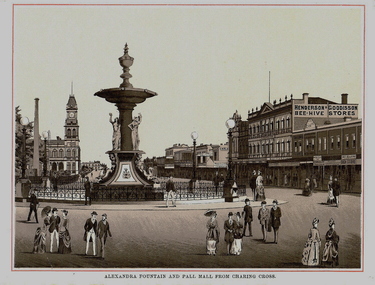 Bendigo Historical Society Inc.
Photograph - CHARING CROSS
... Branch'. History of photograph: From an 'Album of Sandhurst Views, c.1894' (J Lerk 18/02/2004)...Branch'. History of photograph: From an 'Album of Sandhurst Views, c.1894' (J Lerk 18/02/2004) Photograph CHARING CROSS ...Photographic reproduction of a steel engraving 'Alexandra Fountain and Pall Mall from Charing Cross'. Alexandra Fountain, pedestrians, Post Office, Bee-hive Stores, gas lights. Inscriptions - below photo 'Alexandra Fountain and Pall Mall from Charing Cross', within photo 'Henderson & Goddisson, Bee-hive Stores', 'Melbourne Cash Store', written engraving 1 'Abbott New Times', ' H Burridge'. On rear blue stamp 'RHSV, Bendigo Branch'. History of photograph: From an 'Album of Sandhurst Views, c.1894' (J Lerk 18/02/2004)place, streetscape, charing cross -
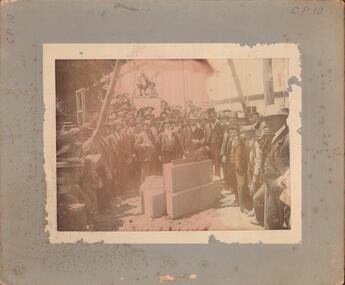 Bendigo Historical Society Inc.
Photograph - LAYING OF FOUNDATION STONE AT MARKET BUILDINGS, 9th January, 1903
... Branch' Circular stamp on rear of photo. Inscription on stone in image 'This stone was laid on 9th day of January 1903 by His Worship the Mayor JH Curnow Esq'. History: Previous Acc. No. GP10. Helen Mainka 20.7.2001 from Annals of Bendigo 1903 'Laying of Foundation Stone at the Market Buildings:. See photo p 13 Bendigo Fire Brigade 100 years by George A Ellis at building in background. Building in R background is very similar to the building in Market Square occupied by the Sandhurst...Branch' Circular stamp on rear of photo. Inscription on stone in image 'This stone was laid on 9th day of January 1903 by His Worship the Mayor JH Curnow Esq'. History: Previous Acc. No. GP10. Helen Mainka 20.7.2001 from Annals of Bendigo 1903 'Laying of Foundation Stone at the Market Buildings:. See photo p 13 Bendigo Fire Brigade 100 years by George A Ellis at building in background. Building in R background is very similar to the building in Market Square occupied by the Sandhurst ...Black and white photograph with large red stain (faded). Photograph of men and small boys at laying of a foundation stone (elevations of building barely visible in framed print at back centre of building). Mounted on grey board. Inscriptions 'GP10' top LH corner. 'Royal Historical Society of Victoria, Bendigo Branch' Circular stamp on rear of photo. Inscription on stone in image 'This stone was laid on 9th day of January 1903 by His Worship the Mayor JH Curnow Esq'. History: Previous Acc. No. GP10. Helen Mainka 20.7.2001 from Annals of Bendigo 1903 'Laying of Foundation Stone at the Market Buildings:. See photo p 13 Bendigo Fire Brigade 100 years by George A Ellis at building in background. Building in R background is very similar to the building in Market Square occupied by the Sandhurst City Brigade.person, group
