
Showing 70 items matching "sewerage scheme"
-
 Bendigo Historical Society Inc.
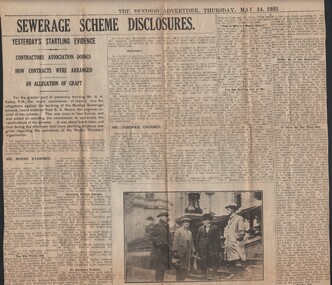
Newspaper - 'SEWERAGE SCHEME DISCLOSURES' 14 MAY 1925, 14 May 1925
... 'SEWERAGE SCHEME DISCLOSURES' 14 MAY 1925......Bendigo Sewerage Scheme...Details the Royal Commission of Inquiry into the allegations against the working of the Bendigo Sewerage Scheme. See enclosed sheets (3) for details. ...NEWSPAPER Bendigo Sewerage Scheme Document. Newspaper article from the Bendigo Advertiser dated Thursday May 14, 1925. ...Document. Newspaper article from the Bendigo Advertiser dated Thursday May 14, 1925. Details the Royal Commission of Inquiry into the allegations against the working of the Bendigo Sewerage Scheme. See enclosed sheets (3) for details. Also contains envelope that the Newspaper cuttings were in.newspaper, bendigo sewerage scheme -
 Bendigo Historical Society Inc.
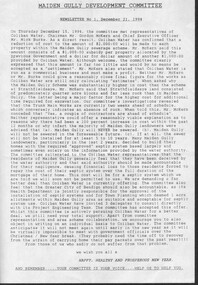
Document - Michele Matthews collection -Re-zoning of Maiden Gully (1993 - 1996), 25/02/2025
... ...sewerage scheme...documents for Maiden Gully Sewerage Scheme...Residents opposed the re-zoning as they had purchased land as "bush blocks" Coliban water Annual report 1993/94 21/12/1994 Maiden Gully Development Committee - newsletter No 1 - cttee met with representatives of Coliban Water Caliban Water information Bulletin January 1995 - Maiden Gully Sewerage Scheme 22/02/1995 Maiden Gully Development Committee - newsletter No 2 - cttee activities re the planned sewerage scheme 27/03/1995 - Coliban Water letter to WR & MS Matthews, owners 3 Clay Gully Court (Lot 56 LP 212245) undated - Maiden Gully Neighborhood Sewerage Schemes - Robin Hill Estate Scheme (cost allocation to property owners 21/04/1995 five-page letter of objection/complaint from WR & MS Matthews, owners 3 Clay Gully Court, re costs allocated against their property (Lot 56 LP 212245) 16/06/1995 five-page response from Coliban Water to WR & MS Matthews, owners 3 Clay Gully Court; regarding the outcome of their objection to the sewerage scheme 22/08/1995 letter from WR & MS Matthews, to resident re the results of their objections (and consequent concessions) from Coliban Water re the Robin Hill Estate Sept 1995 Maiden Gully Structure Plan, prepared by TEA planners & Planning Australia Consultants; provides a structure plan, for the Rural City of Marong, the propose future development of the Maiden Gully area Greater Bendigo Planning Scheme - Amendment L43 - Maiden Gully Township: * undated and author unstated - Maiden Gully questions sheet for residents re the proposed Maiden Gully Structure Plan - seven questions and answers * Fauna species - observed /recorded site 6; Maiden Gully (off Pioneer drive) * Explanatory report, three pages * 1/11/1995 Notice of Amendment to a Planning Scheme * Greater Bendigo Planning Scheme, Chapter 6, Amendment L43 (five pages) December 1995 Coliban Water "In the Pipe line", Maiden Gully Region Community Newsletter No 2 - Halfway mark for Sewerage Scheme March 1996 Coliban Water "In the Pipe line", Maiden Gully Region Community Newsletter No 3 - Home stretch for new sewer scheme May 1996 Coliban Water "In the Pipe line", Maiden Gully Region Community Newsletter No 4 - New sewerage scheme comes in well under budget Undated - Maiden Gully Township - Amendment L43 - Panel Hearing report (31 pages) ...documents for Maiden Gully Sewerage Scheme maiden Gully sewerage scheme Michele Matthews collection - paperwork and reports for re-zoning of Maiden Gully (1993 - 1996). ...documents for Maiden Gully Sewerage SchemeMichele Matthews collection - paperwork and reports for re-zoning of Maiden Gully (1993 - 1996). Residents opposed the re-zoning as they had purchased land as "bush blocks" Coliban water Annual report 1993/94 21/12/1994 Maiden Gully Development Committee - newsletter No 1 - cttee met with representatives of Coliban Water Caliban Water information Bulletin January 1995 - Maiden Gully Sewerage Scheme 22/02/1995 Maiden Gully Development Committee - newsletter No 2 - cttee activities re the planned sewerage scheme 27/03/1995 - Coliban Water letter to WR & MS Matthews, owners 3 Clay Gully Court (Lot 56 LP 212245) undated - Maiden Gully Neighborhood Sewerage Schemes - Robin Hill Estate Scheme (cost allocation to property owners 21/04/1995 five-page letter of objection/complaint from WR & MS Matthews, owners 3 Clay Gully Court, re costs allocated against their property (Lot 56 LP 212245) 16/06/1995 five-page response from Coliban Water to WR & MS Matthews, owners 3 Clay Gully Court; regarding the outcome of their objection to the sewerage scheme 22/08/1995 letter from WR & MS Matthews, to resident re the results of their objections (and consequent concessions) from Coliban Water re the Robin Hill Estate Sept 1995 Maiden Gully Structure Plan, prepared by TEA planners & Planning Australia Consultants; provides a structure plan, for the Rural City of Marong, the propose future development of the Maiden Gully area Greater Bendigo Planning Scheme - Amendment L43 - Maiden Gully Township: * undated and author unstated - Maiden Gully questions sheet for residents re the proposed Maiden Gully Structure Plan - seven questions and answers * Fauna species - observed /recorded site 6; Maiden Gully (off Pioneer drive) * Explanatory report, three pages * 1/11/1995 Notice of Amendment to a Planning Scheme * Greater Bendigo Planning Scheme, Chapter 6, Amendment L43 (five pages) December 1995 Coliban Water "In the Pipe line", Maiden Gully Region Community Newsletter No 2 - Halfway mark for Sewerage Scheme March 1996 Coliban Water "In the Pipe line", Maiden Gully Region Community Newsletter No 3 - Home stretch for new sewer scheme May 1996 Coliban Water "In the Pipe line", Maiden Gully Region Community Newsletter No 4 - New sewerage scheme comes in well under budget Undated - Maiden Gully Township - Amendment L43 - Panel Hearing report (31 pages) maiden gully, sewerage scheme -
 Bendigo Historical Society Inc.
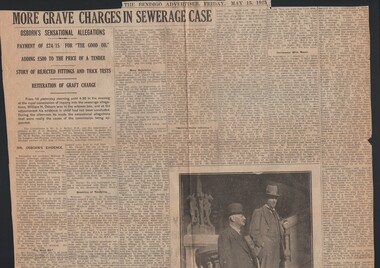
Newspaper - MORE GRAVE CHARGES IN SEWERAGE CASE, 15 May 1925
... ...Bendigo Sewerage Scheme...Details the Royal Commission of Inquiry into the allegations against the working of the Bendigo Sewerage Scheme. William H. Osborn in the witness box. ...COTTAGE Miners Bendigo Sewerage Scheme Royal Commission of Inquiry Newspaper. ...Newspaper. Newspaper article from the Bendigo Advertiser dated May 15, 1925. Details the Royal Commission of Inquiry into the allegations against the working of the Bendigo Sewerage Scheme. William H. Osborn in the witness box. See enclosed sheets for details.cottage, miners, bendigo sewerage scheme, royal commission of inquiry -
 Federation University Historical Collection
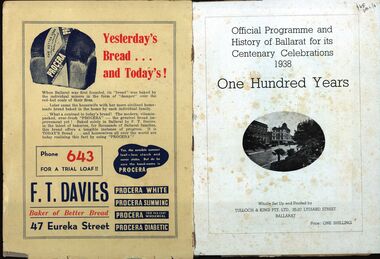
Book, One Hundred Years, Official Programme and History of Ballarat for its Centenary Celebrations, 1938, 1938
... ...Ballarat Sewerage Scheme...Holst Ballarat Gas Company herbert werner frederick de nully Ballarat Timeline Western Plateau Rowlands Band of Hope and Albion Consols Ballarat Water Supply Ballarat Sewerage Scheme Arch of Victory Digital copy of One Hundred Years, Official Programme and History of Ballarat for its Centenary Celebrations, 1938 One Hundred Years, Official Programme and History of Ballarat for its Centenary Celebrations, 1938 Book ...Digital copy of One Hundred Years, Official Programme and History of Ballarat for its Centenary Celebrations, 1938ballarat centenary, victor greenhalgh, ronaldson-tippett, george hotel, f.w. holst, ballarat gas company, herbert werner frederick de nully, ballarat timeline, western plateau, rowlands, band of hope and albion consols, ballarat water supply, ballarat sewerage scheme, arch of victory -
 Federation University Historical Collection
Newspaper, The Standard, Warrnambool, 11 November 1997, 11/11/1997
... ...koroit sewerage scheme public information day...Under the arrangement the TAFE's Professional Writing and editing Diploma and Associate Diploma of Business (Office Administration) would be linked with the University's Bachelor of Arts Degree, warrnambool agreement south west institute of tafe university of ballarat david james patricia varley barrie baker agreement signing flagstaff hill motel proposal koroit sewerage scheme public information day Twenty page newspaper. ...In 1997 South West Institute of TAFE formed an alliance with University of Ballarat in a bid to be more flexible for students. Under the arrangement the TAFE's Professional Writing and editing Diploma and Associate Diploma of Business (Office Administration) would be linked with the University's Bachelor of Arts Degree,Twenty page newspaper. Page 6 reports on the agreement between University of Ballarat and South West TAFE.warrnambool, agreement, south west institute of tafe, university of ballarat, david james, patricia varley, barrie baker, agreement signing, flagstaff hill motel proposal, koroit sewerage scheme public information day -
 Bendigo Historical Society Inc.
Newspaper - BENDIGO SEWERAGE INQUIRY, 1925?
... Newspaper article, presumably from the Bendigo Advertiser, detailing the Royal Commission of Inquiry into the allegations of the working of the Bendigo Sewerage Scheme. Hearing of preliminary evidence. ...Newspaper article, presumably from the Bendigo Advertiser, detailing the Royal Commission of Inquiry into the allegations of the working of the Bendigo Sewerage Scheme. Hearing of preliminary evidence. ...Newspaper. Newspaper article, presumably from the Bendigo Advertiser, detailing the Royal Commission of Inquiry into the allegations of the working of the Bendigo Sewerage Scheme. Hearing of preliminary evidence. Article is undated but presumably from 1925 according to similar articles from this period.cottage, miners, bendigo sewerage inquiry -
 Bendigo Historical Society Inc.
Newspaper - BENDIGO SEWERAGE INQUIRY - NEW SITUATION, 1925
... Details the Royal Commission of Inquiry into the allegations against the working of the Bendigo Sewerage Scheme. William Osborn cross-examined. ...Details the Royal Commission of Inquiry into the allegations against the working of the Bendigo Sewerage Scheme. William Osborn cross-examined. ...Newspaper. Bendigo Sewerage Inquiry. Newspaper article from the Bendigo Advertiser dated Saturday May 16. Details the Royal Commission of Inquiry into the allegations against the working of the Bendigo Sewerage Scheme. William Osborn cross-examined. See enclosed sheets for details.cottage, miners, bendigo sewerage inquiry -
 Port Melbourne Historical & Preservation Society
Photograph - Shaft at corner Pickles and Graham Streets, Port Melbourne, "Melbourne water supply", 1890s
... Three black and white images taken from: "Melbourne water supply - sewerage schemes" Special edition of the "Building, engineering and mining journal" The operations of the Melbourne and Metropolitan Board of Works...engineering - board of works built environment - civic mmbw sewer melbourne and metropolitan board of works Three black and white images taken from: "Melbourne water supply - sewerage schemes" Special edition of the "Building, engineering and mining journal" The operations of the Melbourne and Metropolitan Board of Works ...Three black and white images taken from: "Melbourne water supply - sewerage schemes" Special edition of the "Building, engineering and mining journal" The operations of the Melbourne and Metropolitan Board of Works. (.02) Plate XXIX. Shaft at corner of Pickles and Graham Streets, Port Melbourne, showing method of square timbering adopted and runners for cages.engineering - board of works, built environment - civic, mmbw, sewer, melbourne and metropolitan board of works -
 Bendigo Historical Society Inc.
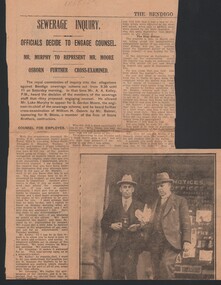
Newspaper - BENDIGO SEWERAGE INQUIRY, 1925
... Details the Royal Commission of Inquiry into the allegations of the working of the Bendigo Sewerage Scheme. Mr Luke Murphy to appear for S Gordon Moore. ...Details the Royal Commission of Inquiry into the allegations of the working of the Bendigo Sewerage Scheme. Mr Luke Murphy to appear for S Gordon Moore. ...Newspaper. Bendigo Sewerage Inquiry - Officials decide to engage Counsel. Newspaper article from the Bendigo Advertiser dated 18 May 1925. Details the Royal Commission of Inquiry into the allegations of the working of the Bendigo Sewerage Scheme. Mr Luke Murphy to appear for S Gordon Moore. William H. Osborn further cross-examined. See enclosed sheets for details.cottage, miners, bendigo sewerage inquiry -
Port Melbourne Historical & Preservation Society
Photograph - Nine inch reticulation pipes at Port Melbourne, "Melbourne water supply", 1890s
... Three black and white images taken from: "Melbourne water supply - sewerage schemes" Special edition of the "Building, engineering and mining journal" The operations of the Melbourne and Metropolitan Board of Works...engineering - board of works built environment - civic mmbw sewer melbourne and metropolitan board of works Three black and white images taken from: "Melbourne water supply - sewerage schemes" Special edition of the "Building, engineering and mining journal" The operations of the Melbourne and Metropolitan Board of Works ...Three black and white images taken from: "Melbourne water supply - sewerage schemes" Special edition of the "Building, engineering and mining journal" The operations of the Melbourne and Metropolitan Board of Works. (.01) Plate XXVIII . Nine inch reticulation pipes at Port Melbourne, showing how the trenches in this sandy soil had to be timbered. Four inch junctions for house connections are also shown.engineering - board of works, built environment - civic, mmbw, sewer, melbourne and metropolitan board of works -
 Bendigo Historical Society Inc.
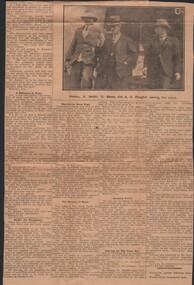
Newspaper - BENDIGO SEWERAGE INQUIRY, 1925
... Details the Royal Commission of Inquiry into the allegations of the working of the Bendigo Sewerage Scheme. William H. Osborn further cross-examined about alleged bribery and why he resigned from the Association....Details the Royal Commission of Inquiry into the allegations of the working of the Bendigo Sewerage Scheme. William H. Osborn further cross-examined about alleged bribery and why he resigned from the Association. ...Newspaper. 'Cleaning up the Town Hall - Osborn queried about alleged bribery', newspaper article dated 19/5/1925. Newspaper article from the Bendigo Advertiser dated 19 May 1925. Details the Royal Commission of Inquiry into the allegations of the working of the Bendigo Sewerage Scheme. William H. Osborn further cross-examined about alleged bribery and why he resigned from the Association.cottage, miners, bendigo sewerage inquiry -
Port Melbourne Historical & Preservation Society
Photograph - Under Port Melbourne Railway, Hobsons Bay Main Sewer, "Melbourne water supply", 1890s
... Three black and white images taken from: "Melbourne water supply - sewerage schemes" Special edition of the "Building, engineering and mining journal" The operations of the Melbourne and Metropolitan Board of Works...engineering - board of works built environment - civic mmbw sewer melbourne and metropolitan board of works Three black and white images taken from: "Melbourne water supply - sewerage schemes" Special edition of the "Building, engineering and mining journal" The operations of the Melbourne and Metropolitan Board of Works ...Three black and white images taken from: "Melbourne water supply - sewerage schemes" Special edition of the "Building, engineering and mining journal" The operations of the Melbourne and Metropolitan Board of Works. (.03) Plate XXXI. Under Port Melbourne Railway, Hobsons Bay Main Sewer, Section No 3. This view was taken in compressed air, and shows shield doors in background with men placing extra htdraulic power in position. This view also shows the method of constructing with concrete blocks and iron centreing on which to build the upper portion of the sewer.engineering - board of works, built environment - civic, mmbw, sewer, melbourne and metropolitan board of works -
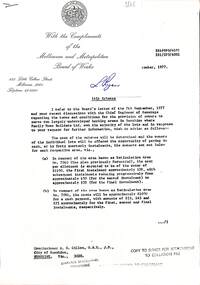 Sunshine and District Historical Society Incorporated
Administrative record - Sewerage reticulation areas Sunshine 1977, 2nd December 1977
... Type written letter to Commissioner Gillon dated 2 December 1977 Re Sewerage Reticulation Areas Nos 7060 and 7061 Sunshine 142A Schemes Type written letter from Melbourne and Metropolitan Board of Works dated 7 September 1977 Re Sewerage Reticulation Areas Nos 7060 and 7061 Sunshine 142A Sewerage Schemes Drawing MMBW Sewerage Division Municipality of Sunshine Sewerage Reticulation area No 7061 Locality Plan...Melbourne Metropolitan Board of Works Sewerag Board of works Type written letter to Commissioner Gillon dated 2 December 1977 Re Sewerage Reticulation Areas Nos 7060 and 7061 Sunshine 142A Schemes Type written letter from Melbourne and Metropolitan Board of Works dated 7 September 1977 Re Sewerage Reticulation Areas Nos 7060 and 7061 Sunshine 142A Sewerage Schemes Drawing MMBW Sewerage Division Municipality of Sunshine Sewerage Reticulation area No 7061 Locality Plan Correspondence and maps of area for sewerage reticulation 1977 Administrative record Sewerage reticulation areas Sunshine 1977 ...Type written letter to Commissioner Gillon dated 2 December 1977 Re Sewerage Reticulation Areas Nos 7060 and 7061 Sunshine 142A Schemes Type written letter from Melbourne and Metropolitan Board of Works dated 7 September 1977 Re Sewerage Reticulation Areas Nos 7060 and 7061 Sunshine 142A Sewerage Schemes Drawing MMBW Sewerage Division Municipality of Sunshine Sewerage Reticulation area No 7061 Locality Planmelbourne metropolitan board of works, sewerag, board of works -
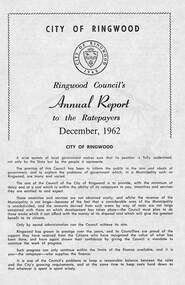 Ringwood and District Historical Society
Pamphlet, F.P. Dwerryhouse, Town Clerk and Treasurer, Ringwood Council's Annual Report To The Ratepayers (December 1962), 1962
... City of Ringwood community information report issued December 1962, including financial summary and sections covering Valuations, Private Street Construction, Other New Works, Sewerage, Planning Scheme, Annual Special Clearance of Refuse, Elderly Citizens' Village, Elderly Citizens' Clubrooms, Fire Hazards, and list of Council Representatives....City of Ringwood community information report issued December 1962, including financial summary and sections covering Valuations, Private Street Construction, Other New Works, Sewerage, Planning Scheme, Annual Special Clearance of Refuse, Elderly Citizens' Village, Elderly Citizens' Clubrooms, Fire Hazards, and list of Council Representatives. ...City of Ringwood community information report issued December 1962, including financial summary and sections covering Valuations, Private Street Construction, Other New Works, Sewerage, Planning Scheme, Annual Special Clearance of Refuse, Elderly Citizens' Village, Elderly Citizens' Clubrooms, Fire Hazards, and list of Council Representatives.Vale - ex-Cr. A.T. Miles, Mr. A.F.B. Long, Mr. F.R. Lucas.rinx -
 Ringwood and District Historical Society
Pamphlet, F.P. Dwerryhouse, Town Clerk and Treasurer, Ringwood Council's Annual Report To The Ratepayers (December 1961), 1961
... City of Ringwood community information report issued December 1961, including financial summary and sections covering Re-Valuation, Sanitary Charge, Garbage Removal Charge, Private Street Construction, New Works, Sewerage, Street Lighting, Planning Scheme, Fire Hazards, Fly Control, Dog Nuisance, and list of Council Representatives....rinx City of Ringwood community information report issued December 1961, including financial summary and sections covering Re-Valuation, Sanitary Charge, Garbage Removal Charge, Private Street Construction, New Works, Sewerage, Street Lighting, Planning Scheme, Fire Hazards, Fly Control, Dog Nuisance, and list of Council Representatives. ...City of Ringwood community information report issued December 1961, including financial summary and sections covering Re-Valuation, Sanitary Charge, Garbage Removal Charge, Private Street Construction, New Works, Sewerage, Street Lighting, Planning Scheme, Fire Hazards, Fly Control, Dog Nuisance, and list of Council Representatives.rinx -
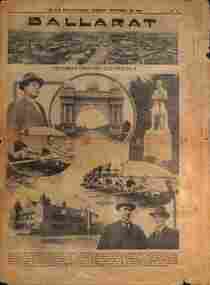 Ballarat Tramway Museum
Newspaper - The Sun News Pictorial Supplement, Herald Sun, "Ballarat", 30/9/1924
... Page 20 - notes on racing, red cross - Mrs James Coghlan, fire brigade, sewerage scheme. Photo of Ballarat Freezing Co meat works with adverts for Craig's Hotel and the Ballarat Trustees Executors & Agency Co. ...Page 20 - notes on racing, red cross - Mrs James Coghlan, fire brigade, sewerage scheme. Photo of Ballarat Freezing Co meat works with adverts for Craig's Hotel and the Ballarat Trustees Executors & Agency Co. ...Newspaper supplement to The Sun News Pictorial, Tuesday 30/9/1924 - "Victoria Country Centres - No. 4". Has extensive notes on Ballarat, its history, civic history, and personalities. or figures. Page 11 - photo from the Town Hall, Avenue of Honour Arch, rowing, Hospital including W J Hoare, R H Ramsey of the Ballarat Cricket Association, Mr Charlie Suffren, J R Jopling, R W Todd. Page 12 - Ballarat and district history, industry, statistics, School of Mines. Has a photo of the Lydiard St Methodist church. Page 13 - Civic Identities - A E Kenny, Frederick Brawn MLC, W R Elsworth, Frank Herman, Alex Bell MLC, notes on Ballarat Power supply ESCo and SECV - Yallourn vs local generation, and an advertisement for Tyler's men's clothing and house furnishings. Page 14 - Ballarat sports, Cr Robert Cooke, South St, Craigs Hotel, photo of Ballarat Woollen Mills, the observatory, and an advert for A M Heath, Booksellers, stationer. Page 15 - Advert for Barlow Motors, Mining exchange building, Buick and Vauxhall motor cars Page 16 - South St competition adverts, schools, Mayor Levy, W J Coghlan, railway and wheat traffic, Myer's woollen mill, J T Walker furniture. Page 17 - advert to T M Burke - real estate - Forest St estate Page 18 - photos of the Executive's office, the Water Board - F Brown, A Farrer, W Brazenor, J C Fletcher, F W Saunders and G M Searle. Football league - A A O'Dea, W R Elsworth, J R Cooke, Cr F Besemeres. Brind's Diestillery of Dunnstown - Frank Brind and Harold Gill. W Ware boxing. Photos of St Andrew's Kirk and live livestock market with Graeme Dowling, Gold diggings. Page 19 - Council officers - G F Morton, A Levy, H Finch, J Pascoe, C J Liddiard, W McIntosh, W P Pryor and E R Marchani. South St Society W W Harris, W H Pearson, W S Sampson, A A King, F J Martell, F S Herman, A A O'Dea. Photos of Woollen mill, Sunshine biscuits, Ballarat Water pipe, Golf Club, Ballarat High School, Bridge St with tram and Golden Point monument. Page 20 - notes on racing, red cross - Mrs James Coghlan, fire brigade, sewerage scheme. Photo of Ballarat Freezing Co meat works with adverts for Craig's Hotel and the Ballarat Trustees Executors & Agency Co. Page 21 - General items re Tylers, city of statues, George Hotel, Barlow's cars, Eva Chemist, Dr W A Spring - racing, with an advert for Millers the Clothiers, Page 22 - Ballarat streets, Adam Lindsay Gordon cottage in grounds of Craig's Hotel, Miller's clothing store, with adverts for the Annual Spring agricultural show, and EVA's pharmacy. Page 23 - Photo of Sturt and Lydiard St with two trams, one possibly 13 in an accident with a motor car, photos of McDonald gates, Loreto Abbey with a racing people - Dave Barry, C L Fox, andHarry McGoldrick. Has adverts for Gribble suits and J T Walker furnishers. Page 24 - notes on real estate, stock agents, with photos of Miss McDonald of Red Cross, Mr and Mrs James Allan, Mr H H Osborne, and an advert for Sunshine Biscuits. Page 25 - Photos of the School of Mines, Orphanage, football crowd and Miss D Balten and Miss K Kennedy tennis with adverts for Macleod and Booth stock and station agents and The George Hotel. Page 26 - advert for Melbourne Sub-division company - Capitol House Melbourne.Yields information about Ballarat, its civic history, and personalities in 1924.Newspaper, 16 printed pages with photographs.ballarat, ballarat history, civic history, tramways, accidents -
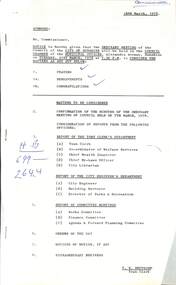 Sunshine and District Historical Society Incorporated
Administrative record - City of Sunshine - Commissioner Mr Alexander Alex George Gillon Collection 1976 - 1982 - Notice of ordinary meeting of the council 21st March 1978, City of Sunshine, 14th March 1978
... Albans Road Land Use Permit Application Sign Corner Hampshire Road & Devonshire Road Cluster Development Rear of 117 Station Road Town Planning Appeal Consolidation of Title Cromer Avenue and McIntyre Road Strata Subdivision 53 Graham Street Contract Gooding Street Private Street Scheme Westerngate Estate Stages 3A, 3B, 4A & 4B Subdivision Furlong Road Estate Stages 1 & 2 Subdivision Albanvale Stages 19 & 20 Subdivision Contract Supply of Vehicles Replacement of Weights & Measures Vehicle Fleet No 41 Sewerage Reticulation Areas No 7060 & 7061 Sunshine 142A Sewerage Scheme Certificate of Completion Bunnett Private Street Scheme Speed Restricted Zones Fitzgerald Road, Tilburn Road, Station Road, & Forrest Street Acquisition of Land for Road Construction Purchase of Land Abutting Kororoit Creek from M.M.B.W. ...Albans Road Land Use Permit Application Sign Corner Hampshire Road & Devonshire Road Cluster Development Rear of 117 Station Road Town Planning Appeal Consolidation of Title Cromer Avenue and McIntyre Road Strata Subdivision 53 Graham Street Contract Gooding Street Private Street Scheme Westerngate Estate Stages 3A, 3B, 4A & 4B Subdivision Furlong Road Estate Stages 1 & 2 Subdivision Albanvale Stages 19 & 20 Subdivision Contract Supply of Vehicles Replacement of Weights & Measures Vehicle Fleet No 41 Sewerage Reticulation Areas No 7060 & 7061 Sunshine 142A Sewerage Scheme Certificate of Completion Bunnett Private Street Scheme Speed Restricted Zones Fitzgerald Road, Tilburn Road, Station Road, & Forrest Street Acquisition of Land for Road Construction Purchase of Land Abutting Kororoit Creek from M.M.B.W. ...Notice of Ordinary Meeting of the Council 21st March 1978 Report of the Town Clerk's Department Report of the Town Clerk Income Tax Sharing Future Role of the Western Region Commission Ground Allocation Winter Season 1978 Holiday Programmes Leases Scout Halls Lowe Crescent, Dempster Park, Errington Reserve, Sassella Park Land Transfer Ardeer for Infant Welfare and Preschool Centre Proposed Tip Site Commonwealth Land Deer Park Land Transfer Dowling Street Re-Subdivision of Municipality Ward Boundaries Supplementary Valuations Meals on Wheels Loan Borrowings Street Construction Agreements Stages 19 & 20 Albanvale Compulsory Acquisition Lots 43 & 44 Northumberland Road Report of the Co-Ordinator Welfare Services Early Childhood Development Complex in the Sunshine / Footscray Area Domiciliary Are Benefit Report on Welfare Rights Working Group Wester Region Committee on the Ageing Report of the Chief Health Inspector Prosecution Proceedings Sunshine Magistrates Court Quarterly Return on Food Samples Removal of Dwelling Outside the Municipality 70 Suffolk Street Maidstone to Lot 1 Daylesford Road Trentham Health Act Amendments (Nuisance) Health Act Amendments (Septic Tanks) Health Act Nuisance Land Adjacent to Highpoint West Shopping Centre and Land Adjacent to Closed Section of Burton Crescent / Duffy Street and Van Ness Avenue Maribyrnong Health Act Registrations Application for Transfer of Proprietorship of Premises under the Health Act Report of the Chief By-Laws Officer ANZAC Commemorative March Disposal of Derelict Vehicles Limited Parking Swimming Pool Report of the City Engineer Land Use Permit Application Cafe Take Away Food Premise Shop 18 Lot 3 St. Albans Road and Lot 4 Princess Street Proposed Amendment No 83 to the Melbourne Metropolitan Planning Scheme Land Use Permit Application Ornamental Garden Display & Sales 553A & 553B Geelong Road Brooklyn Land Use Permit Application Sky Sign 222 Forrest Street Ardeer Land Use Permit Application Flats 26 & 28 Bloomfield Avenue Land Use Permit Application Amenities Block Additions to Existing Rendering Works Pridhams Holdings 21 Evans Street Land Use Permit Application Store Addition to Two Exiting Shops & Dwellings 59 Sydney Street Land Use Permit Application Office 83 Main Road West Land Use Permit Application Consulting Rooms Medical 52 Station Place Land Use Permit Application Furniture & Carpet Sales Warehouse Light Industrial Gift & Electrical Fittings & Office 2 - 4 Burton Crescent Land Use Permit Application Cafe 59 St. Albans Road Land Use Permit Application Sign Corner Hampshire Road & Devonshire Road Cluster Development Rear of 117 Station Road Town Planning Appeal Consolidation of Title Cromer Avenue and McIntyre Road Strata Subdivision 53 Graham Street Contract Gooding Street Private Street Scheme Westerngate Estate Stages 3A, 3B, 4A & 4B Subdivision Furlong Road Estate Stages 1 & 2 Subdivision Albanvale Stages 19 & 20 Subdivision Contract Supply of Vehicles Replacement of Weights & Measures Vehicle Fleet No 41 Sewerage Reticulation Areas No 7060 & 7061 Sunshine 142A Sewerage Scheme Certificate of Completion Bunnett Private Street Scheme Speed Restricted Zones Fitzgerald Road, Tilburn Road, Station Road, & Forrest Street Acquisition of Land for Road Construction Purchase of Land Abutting Kororoit Creek from M.M.B.W. Tenders Vehicles Wheel Washing Unit Hulett Street Sunshine Tip Report of the Building Surveyor Open Garage 32 Union Street Sunshine Outbuilding 32 Killara Street Sunshine West Installation of Underground Tank 88 - 90 Berkshire Road Installation of Underground Tank Ballarat Road South West Corner of Vine Street Braybrook Installation of Underground Tanl 12 Central Avenue Sunshine Air Conditioning Plant Maintenance Central Library Alterations to Grandstand Skinner Reserve Willis Street Pre-School Centre Furlong Road Pre-School Centre Sunshine Indoor Pool Service Street Sunshine Child Care Buildings Highpoint West Welfare Complex Variation Toilet Block Hampshire Road Bon Thomas Reserve Pre-School Building Station Road Pre-School Centre Report of the Director of Parks & Recreation Landscaping Willis Street Pre-School Centre Extensions to Existing Baseball Nets at Barclay Reserve Roof Over Practice Wickets at Lloyd Reserve Replacement of Wire Netting Over Cricket Practice Nets At Scovell Reserve Due To Vandel Damage During 1977 city of sunshine, alexander "alex" george gillon, lowe crescent, sunshine, dempster park, phoenix street, sunshine north, errington reserve, st. albans, sassella park, station road, deer park, downing street, northumberland road, albanvale, suffolk street, maidstone, highpoint west shopping centre, rosamond road, burton crescent, duffy street, van ness avenue, maribyrnong, princess street, geelong road, brooklyn, forrest street, ardeer, bloomfield avenue, pridhams holdings, evans street, sydney street, albion, station place, hampshire road, devonshire road, st. albans road, cromer avenue, mcintyre road, graham street, gooding street, furlong road, bunnett private, fitzgerald road, tilburn road, kororoit creek, hulett street, sunshine tip, union street, killara street, berkshire road, ballarat road, vine street, braybrook, central avenue, skinner reserve, churchill avenue, willis street pre-school centre, willis street, furlong road pre-school centre, sunshine indoor pool, service street, bon thomas reserve, quinn street, station road pre-school centre, barclay reserve, king edward avenue, lloyd reserve, camperdown avenue, scovell reserve, scovell crescent -
 Sunshine and District Historical Society Incorporated
Administrative record - City of Sunshine - Commissioner Mr Alexander Alex George Gillon Collection 1976 - 1982 - Minutes of the ordinary meeting of council held on 21st March 1978, City of Sunshine, 21st March 1978
... Albans Road Land Use Permit Application Sign Corner Hampshire Road & Devonshire Road Cluster Development Rear of 117 Station Road Town Planning Appeal Consolidation of Title Cromer Avenue and McIntyre Road Strata Subdivision 53 Graham Street Contract Gooding Street Private Street Scheme Westerngate Estate Stages 3A, 3B, 4A & 4B Subdivision Furlong Road Estate Stages 1 & 2 Subdivision Albanvale Stages 19 & 20 Subdivision Contract Supply of Vehicles Replacement of Weights & Measures Vehicle Fleet No 41 Sewerage Reticulation Areas No 7060 & 7061 Sunshine 142A Sewerage Scheme Certificate of Completion Bunnett Private Street Scheme Speed Restricted Zones Fitzgerald Road, Tilburn Road, Station Road, & Forrest Street Acquisition of Land for Road Construction Purchase of Land Abutting Kororoit Creek from M.M.B.W. ...Albans Road Land Use Permit Application Sign Corner Hampshire Road & Devonshire Road Cluster Development Rear of 117 Station Road Town Planning Appeal Consolidation of Title Cromer Avenue and McIntyre Road Strata Subdivision 53 Graham Street Contract Gooding Street Private Street Scheme Westerngate Estate Stages 3A, 3B, 4A & 4B Subdivision Furlong Road Estate Stages 1 & 2 Subdivision Albanvale Stages 19 & 20 Subdivision Contract Supply of Vehicles Replacement of Weights & Measures Vehicle Fleet No 41 Sewerage Reticulation Areas No 7060 & 7061 Sunshine 142A Sewerage Scheme Certificate of Completion Bunnett Private Street Scheme Speed Restricted Zones Fitzgerald Road, Tilburn Road, Station Road, & Forrest Street Acquisition of Land for Road Construction Purchase of Land Abutting Kororoit Creek from M.M.B.W. ...Minutes of the ordinary meeting of council held on 21st March 1978 Report of the Town Clerk's Department Report of the Town Clerk Income Tax Sharing Future Role of the Western Region Commission Ground Allocation Winter Season 1978 Holiday Programmes Leases Scout Halls Lowe Crescent, Dempster Park, Errington Reserve, Sassella Park Land Transfer Ardeer for Infant Welfare and Preschool Centre Proposed Tip Site Commonwealth Land Deer Park Land Transfer Dowling Street Re-Subdivision of Municipality Ward Boundaries Supplementary Valuations Meals on Wheels Loan Borrowings Street Construction Agreements Stages 19 & 20 Albanvale Compulsory Acquisition Lots 43 & 44 Northumberland Road Report of the Co-Ordinator Welfare Services Early Childhood Development Complex in the Sunshine / Footscray Area Domiciliary Are Benefit Report on Welfare Rights Working Group Wester Region Committee on the Ageing Report of the Chief Health Inspector Prosecution Proceedings Sunshine Magistrates Court Quarterly Return on Food Samples Removal of Dwelling Outside the Municipality 70 Suffolk Street Maidstone to Lot 1 Daylesford Road Trentham Health Act Amendments (Nuisance) Health Act Amendments (Septic Tanks) Health Act Nuisance Land Adjacent to Highpoint West Shopping Centre and Land Adjacent to Closed Section of Burton Crescent / Duffy Street and Van Ness Avenue Maribyrnong Health Act Registrations Application for Transfer of Proprietorship of Premises under the Health Act Report of the Chief By-Laws Officer ANZAC Commemorative March Disposal of Derelict Vehicles Limited Parking Swimming Pool Report of the City Engineer Land Use Permit Application Cafe Take Away Food Premise Shop 18 Lot 3 St. Albans Road and Lot 4 Princess Street Proposed Amendment No 83 to the Melbourne Metropolitan Planning Scheme Land Use Permit Application Ornamental Garden Display & Sales 553A & 553B Geelong Road Brooklyn Land Use Permit Application Sky Sign 222 Forrest Street Ardeer Land Use Permit Application Flats 26 & 28 Bloomfield Avenue Land Use Permit Application Amenities Block Additions to Existing Rendering Works Pridhams Holdings 21 Evans Street Land Use Permit Application Store Addition to Two Exiting Shops & Dwellings 59 Sydney Street Land Use Permit Application Office 83 Main Road West Land Use Permit Application Consulting Rooms Medical 52 Station Place Land Use Permit Application Furniture & Carpet Sales Warehouse Light Industrial Gift & Electrical Fittings & Office 2 - 4 Burton Crescent Land Use Permit Application Cafe 59 St. Albans Road Land Use Permit Application Sign Corner Hampshire Road & Devonshire Road Cluster Development Rear of 117 Station Road Town Planning Appeal Consolidation of Title Cromer Avenue and McIntyre Road Strata Subdivision 53 Graham Street Contract Gooding Street Private Street Scheme Westerngate Estate Stages 3A, 3B, 4A & 4B Subdivision Furlong Road Estate Stages 1 & 2 Subdivision Albanvale Stages 19 & 20 Subdivision Contract Supply of Vehicles Replacement of Weights & Measures Vehicle Fleet No 41 Sewerage Reticulation Areas No 7060 & 7061 Sunshine 142A Sewerage Scheme Certificate of Completion Bunnett Private Street Scheme Speed Restricted Zones Fitzgerald Road, Tilburn Road, Station Road, & Forrest Street Acquisition of Land for Road Construction Purchase of Land Abutting Kororoit Creek from M.M.B.W. Tenders Vehicles Wheel Washing Unit Hulett Street Sunshine Tip Report of the Building Surveyor Open Garage 32 Union Street Sunshine Outbuilding 32 Killara Street Sunshine West Installation of Underground Tank 88 - 90 Berkshire Road Installation of Underground Tank Ballarat Road South West Corner of Vine Street Braybrook Installation of Underground Tanl 12 Central Avenue Sunshine Air Conditioning Plant Maintenance Central Library Alterations to Grandstand Skinner Reserve Willis Street Pre-School Centre Furlong Road Pre-School Centre Sunshine Indoor Pool Service Street Sunshine Child Care Buildings Highpoint West Welfare Complex Variation Toilet Block Hampshire Road Bon Thomas Reserve Pre-School Building Station Road Pre-School Centre Report of the Director of Parks & Recreation Landscaping Willis Street Pre-School Centre Extensions to Existing Baseball Nets at Barclay Reserve Roof Over Practice Wickets at Lloyd Reserve Replacement of Wire Netting Over Cricket Practice Nets At Scovell Reserve Due To Vandel Damage During 1977 Orders of the Day Accounts Submitted for Payment as at 28th February 1978 Extraordinary Business Land Use Permit Application Transport Depot Somerville Road Land Use Permit Application Flats Lot 88 Chifley Drive Land Use Permit Application Extensions to Existing Building Truck Sales & Service Centre Geelong Road Land Use Permit Application Greyhound Kennels Waranga Crescent St. Albans Land Use Permit Application Non-Flashing Illuminated Sign Ballarat Road Land Use Permit Application Erection of Sign and Replacement of Canopy Ballarat Road Plan of Strata Subdivision 85 - 89 Ballarat Road city of sunshine, alexander "alex" george gillon, lowe crescent, sunshine, dempster park, phoenix street, sunshine north, errington reserve, st. albans, sassella park, station road, deer park, downing street, northumberland road, albanvale, suffolk street, maidstone, highpoint west shopping centre, burton crescent, duffy street, van ness avenue, maribyrnong, st. albans road, princess street, geelong road, brooklyn, forrest street, ardeer, bloomfield avenue, pridhams holdings, evans street, sydney street, albion, main road west, station place, hampshire road, devonshire road, cromer avenue, mcintyre road, graham street, gooding street, furlong road, bunnett private, fitzgerald road, tilburn road, kororoit creek, hulett street, sunshine tip, union street, killara street, sunshine west, berkshire road, ballarat road, vine street, braybrook, central avenue, skinner reserve, churchill avenue, willis street pre-school centre, furlong road pre-school centre, sunshine indoor pool, service street, bon thomas reserve, quinn street, barclay reserve, king edward avenue, lloyd reserve, camperdown avenue, scovell reserve, somerville road, chifley drive, waranga crescent -
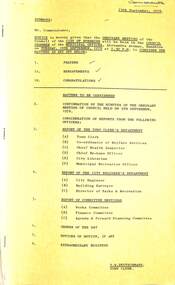 Sunshine and District Historical Society Incorporated
Administrative record - City of Sunshine - Commissioner Mr Alexander "Alex" George Gillon Collection 1976 - 1982 - Notice of the ordinary meeting of the Council of the city of Sunshine on 19th September 1978, City of Sunshine, 13th September 1978
... Albans Road Tenders for Annual Supplies Annual Supply Bituminous Concrete Contract Contract Reconstruction of Sydney Street Contract Cypress Avenue Reinstatement Contract Cumberland Street Private Street Scheme Contract Sheffield Estate Private Street Scheme Finalisation of Cumberland Street Private Street Scheme Finalisation of Sheffield Estate Private Street Scheme Sewerage Facilities M.M.B.W. Statcon Signal Remodel Programme Deferred Payment of Costs Scheme Signal Installation Programme 1978/79 and Reranking of Statewide Listing for Deferred Payment Scheme Station Road Outfall Drain Through Commonwealth Property 9th A.R.R.B. ...Albans Road Tenders for Annual Supplies Annual Supply Bituminous Concrete Contract Contract Reconstruction of Sydney Street Contract Cypress Avenue Reinstatement Contract Cumberland Street Private Street Scheme Contract Sheffield Estate Private Street Scheme Finalisation of Cumberland Street Private Street Scheme Finalisation of Sheffield Estate Private Street Scheme Sewerage Facilities M.M.B.W. Statcon Signal Remodel Programme Deferred Payment of Costs Scheme Signal Installation Programme 1978/79 and Reranking of Statewide Listing for Deferred Payment Scheme Station Road Outfall Drain Through Commonwealth Property 9th A.R.R.B. ...Notice of the ordinary meeting of the Council of the city of Sunshine on 19th September 1978 Report of the Town Clerk's Department Report of the Town Clerk Proposed Western Region Refuse Disposal Group Constitution of Representation on the Melbourne and Metropolitan Board of Works Municipal Clerks Conference Tasmania 13th to 17th November 1978 Home Help and Welfare Officers Subsidies Appointment of Auditor for Year 1978/79 Municipal Association Increase in Annual Subscriptions Federal Budget Effect on Municipal Finances Compulsory Acquisition Lots 43 & 44 Northumberland Road Compensation Report of the Chief Health Inspector Health Act Registrations Applications for Transfer of Proprietorship of Premises under the Health Act Prosecution Proceedings Sunshine Magistrates Court Approval to Use a Septic Tank System at Factory Premises Lot 310 Ayton Street Sunshine North Closure of Albion North Infant Welfare Centre Protean Environment Protection Appeal Application for Approval to Install a Septic Tank Recirculation Sand Filter System at the Stansfield Steel Product Fairbairn Road Sunshine West Application for Permission to Permit a Garage to be Occupied for Human Habitation at 19 Bardsley Street Sunshine West Report of the Medical Officer of Health Report of the Chief By-Laws Officer Court Proceedings Parking Infringements By-Laws Officer Course R.M.I.T. 20th October 1978 Limited Parking Ballarat Road Between Butler Street and Errol Street Braybrook Report of the City Librarian 1978 Library Week Amnesty Report of the City Engineer Planning Permit Flats North West Corner Cornwall Road and Monash Street Town Planning Appeal Planning Permit Flats Lot 9 Mernda Street Planning Permit Application Panel Beating Works & Spray-Painting Lot 219 McIntyre Road Sunshine North Planning Permit Application Sky Sign 556 Ballarat Road Albion Planning Permit Application Advertising Sign Highpoint Shopping Centre Lots 8, 9, 10, 11 & Part 12 Rosamond Road Melbourne Metropolitan Outline Plan for Cities of Keilor and Sunshine Amendment 70 Part 4A to the Melbourne Metropolitan Planning Scheme Planning Permit Application Nursing Home Lots 100 & 101 North Road Ardeer Proposed Shopping Centre Taylors Road St. Albans Planning Permit Application Maintenance Office Churchill Avenue Situated Between Churchill Avenue and Hargraves Crescent Planning Permit Application Place of Assembly for Unemployed Youth Contact Centre 818 Ballarat Road Deer Park Planning Permit Application Nursing Home Thomson Street Maidstone Planning Permit Sky Sign 86 Mitchell Street Planning Permit Application Private Tip Part Lot 35 Reid Street Albion & Advice to Denton Avenue Residents Planning Permit Flats 19 King Edward Avenue Planning Permit Application 21 Factories Lot 2 Burke Street & lot 8 Mullender Road Royal Australian Planning Institute 15th Congress Report Plan of Subdivision Reno Auto Sales Hampshire Road Corner Hampshire Road Plan of Subdivision Stage 8 Nickson's Estate Consolidated of Title Ballarat Road, Alford Street & Victor Street Shell Co of Aust Creation of Easement Lot 382 Newbury Street Consolidated of Title Glengala Road Between Links Street and Evelyn Crescent Consolidated of Title Verdun Street Plan of Transfer and Consolidation S.C.I. Meat & Paper Pty Ltd and Ready Mix Concrete Somerville Road Strata Subdivision 17 St. Albans Road Tenders for Annual Supplies Annual Supply Bituminous Concrete Contract Contract Reconstruction of Sydney Street Contract Cypress Avenue Reinstatement Contract Cumberland Street Private Street Scheme Contract Sheffield Estate Private Street Scheme Finalisation of Cumberland Street Private Street Scheme Finalisation of Sheffield Estate Private Street Scheme Sewerage Facilities M.M.B.W. Statcon Signal Remodel Programme Deferred Payment of Costs Scheme Signal Installation Programme 1978/79 and Reranking of Statewide Listing for Deferred Payment Scheme Station Road Outfall Drain Through Commonwealth Property 9th A.R.R.B. Conference Brisbane Report Establishment of Recycling Depot at Sunshine Tip Bon Thomas Reserve Pre-School Centre Report of the Building Surveyor Australian Wool Corporation Francis Street Brooklyn 60 Allison Street Sunshine West Uniform Buildings Regulations Draft Amendment No 10 Report of the Director of Parks & Recreation Bon Thomas Reserve Development Barclay Reserve Metering od Facilities Orders of the Day Accounts Submitted for Payment as at 31st August 1978 city of sunshine, alexander "alex" george gillon, macedon street, maidstone, fairbairn road pre-school, parsons reserve, stanford street, ralph street, robert bruce reserve, sunshine west, station road, deer park, tallingtyre reserve, kermeen street, bon thomas pre-school, quinn street, diamond avenue pre-school, diamond avenue, albanvale, orama street pre-school, orama street, st. albans, highpoint city pre-school, rosamond road, maribyrnong, errington reserve, main road east, sunshine city band, fairbairn road, ballarat road, thomson street, king edward avenue, albion, cumberland street, sunshine tip, bon thomas reserve pre-school centre -
 Sunshine and District Historical Society Incorporated
Administrative record - City of Sunshine - Commissioner Mr Alexander "Alex" George Gillon Collection 1976 - 1982 - Minutes of the Ordinary Meeting of Council Held on 19th September 1978, City of Sunshine, 19th September 1978
... Albans Road Tenders for Annual Supplies Annual Supply Bituminous Concrete Contract Contract Reconstruction of Sydney Street Contract Cypress Avenue Reinstatement Contract Cumberland Street Private Street Scheme Contract Sheffield Estate Private Street Scheme Finalisation of Cumberland Street Private Street Scheme Finalisation of Sheffield Estate Private Street Scheme Sewerage Facilities M.M.B.W. Statcon Signal Remodel Programme Deferred Payment of Costs Scheme Signal Installation Programme 1978/79 and Reranking of Statewide Listing for Deferred Payment Scheme Station Road Outfall Drain Through Commonwealth Property 9th A.R.R.B. ...Albans Road Tenders for Annual Supplies Annual Supply Bituminous Concrete Contract Contract Reconstruction of Sydney Street Contract Cypress Avenue Reinstatement Contract Cumberland Street Private Street Scheme Contract Sheffield Estate Private Street Scheme Finalisation of Cumberland Street Private Street Scheme Finalisation of Sheffield Estate Private Street Scheme Sewerage Facilities M.M.B.W. Statcon Signal Remodel Programme Deferred Payment of Costs Scheme Signal Installation Programme 1978/79 and Reranking of Statewide Listing for Deferred Payment Scheme Station Road Outfall Drain Through Commonwealth Property 9th A.R.R.B. ...Minutes of the Ordinary Meeting of Council Held on 19th September 1978 Report of the Town Clerk's Department Report of the Town Clerk Proposed Western Region Refuse Disposal Group Constitution of Representation on the Melbourne and Metropolitan Board of Works Municipal Clerks Conference Tasmania 13th to 17th November 1978 Home Help and Welfare Officers Subsidies Appointment of Auditor for Year 1978/79 Municipal Association Increase in Annual Subscriptions Federal Budget Effect on Municipal Finances Compulsory Acquisition Lots 43 & 44 Northumberland Road Compensation Report of the Chief Health Inspector Health Act Registrations Applications for Transfer of Proprietorship of Premises under the Health Act Prosecution Proceedings Sunshine Magistrates Court Approval to Use a Septic Tank System at Factory Premises Lot 310 Ayton Street Sunshine North Closure of Albion North Infant Welfare Centre Protean Environment Protection Appeal Application for Approval to Install a Septic Tank Recirculation Sand Filter System at the Stansfield Steel Product Fairbairn Road Sunshine West Application for Permission to Permit a Garage to be Occupied for Human Habitation at 19 Bardsley Street Sunshine West Report of the Medical Officer of Health Report of the Chief By-Laws Officer Court Proceedings Parking Infringements By-Laws Officer Course R.M.I.T. 20th October 1978 Limited Parking Ballarat Road Between Butler Street and Errol Street Braybrook Report of the City Librarian 1978 Library Week Amnesty Report of the City Engineer Planning Permit Flats North West Corner Cornwall Road and Monash Street Town Planning Appeal Planning Permit Flats Lot 9 Mernda Street Planning Permit Application Panel Beating Works & Spray-Painting Lot 219 McIntyre Road Sunshine North Planning Permit Application Sky Sign 556 Ballarat Road Albion Planning Permit Application Advertising Sign Highpoint Shopping Centre Lots 8, 9, 10, 11 & Part 12 Rosamond Road Melbourne Metropolitan Outline Plan for Cities of Keilor and Sunshine Amendment 70 Part 4A to the Melbourne Metropolitan Planning Scheme Planning Permit Application Nursing Home Lots 100 & 101 North Road Ardeer Proposed Shopping Centre Taylors Road St. Albans Planning Permit Application Maintenance Office Churchill Avenue Situated Between Churchill Avenue and Hargraves Crescent Planning Permit Application Place of Assembly for Unemployed Youth Contact Centre 818 Ballarat Road Deer Park Planning Permit Application Nursing Home Thomson Street Maidstone Planning Permit Sky Sign 86 Mitchell Street Planning Permit Application Private Tip Part Lot 35 Reid Street Albion & Advice to Denton Avenue Residents Planning Permit Flats 19 King Edward Avenue Planning Permit Application 21 Factories Lot 2 Burke Street & Lot 8 Mullenger Road Royal Australian Planning Institute 15th Congress Report Plan of Subdivision Reno Auto Sales Hampshire Road Corner Ballarat Road Plan of Subdivision Stage 8 Nickson's Estate Consolidated of Title Ballarat Road, Alford Street & Victor Street Shell Co of Aust Creation of Easement Lot 382 Newbury Street Consolidated of Title Glengala Road Between Links Street and Evelyn Crescent Consolidated of Title Verdun Street Plan of Transfer and Consolidation S.C.I. Meat & Paper Pty Ltd and Ready Mix Concrete Somerville Road Strata Subdivision 17 St. Albans Road Tenders for Annual Supplies Annual Supply Bituminous Concrete Contract Contract Reconstruction of Sydney Street Contract Cypress Avenue Reinstatement Contract Cumberland Street Private Street Scheme Contract Sheffield Estate Private Street Scheme Finalisation of Cumberland Street Private Street Scheme Finalisation of Sheffield Estate Private Street Scheme Sewerage Facilities M.M.B.W. Statcon Signal Remodel Programme Deferred Payment of Costs Scheme Signal Installation Programme 1978/79 and Reranking of Statewide Listing for Deferred Payment Scheme Station Road Outfall Drain Through Commonwealth Property 9th A.R.R.B. Conference Brisbane Report Establishment of Recycling Depot at Sunshine Tip Bon Thomas Reserve Pre-School Centre Report of the Building Surveyor Australian Wool Corporation Francis Street Brooklyn 60 Allison Street Sunshine West Uniform Buildings Regulations Draft Amendment No 10 Report of the Director of Parks & Recreation Bon Thomas Reserve Development Barclay Reserve Metering od Facilities Orders of the Day Accounts Submitted for Payment as at 31st August 1978 Extraordinary Business Report of the Town Clerk Supplementary Valuations by Approved Report of the City Engineer Planning Permit Application Place of Assembly for Community Youth Support Scheme 20 Barnes Crescent Sunshine West Planning Permit Application Institutional Home Tallintyre Road Sunshine West Planning Permit Application Factory Extension to Existing Industrial Complex Scotland Street, Hillary Street & Rutland Street Braybrook Mines (Amendment) Bill 1978 Federated Municipal and Shire Council Employees Union National Safety Council of Australia city of sunshine, alexander "alex" george gillon, northumberland road, sunshine north, albion north infant welfare centre, stansfield steel product, fairbairn road, sunshine west, bardsley street, ballarat road, butler street, errol street, braybrook, cornwall road, monash street, sunshine, mernda street, mcintyre road, albion, highpoint shopping centre, rosamond road, maribyrnong, north road, ardeer, taylors road, st. albans, churchill avenue, hargraves crescent, deer park, thomson street, maidstone, mitchell street, reid street, denton avenue, king edward avenue, burke street, mullenger road, hampshire road, alford street, victor street, newbury street, links street, glengala road, evelyn crescent, verdun street, consolidation s.c.i. meat & paper pty ltd, somerville road, brooklyn, st. albans road, sydney street, cypress avenue, cumberland street, station road, bon thomas reserve pre-school centre, quinn street, sunshine tip, australian wool corporation, francis street, allison street, barclay reserve, barnes crescent, scotland street, hillary street, rutland street -
 Federation University Historical Collection
Book, Progress in the Shire of Ballarat, 1963
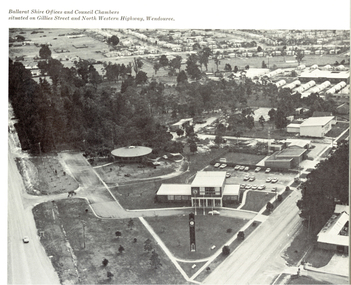
... sewerage teatment works...alfredton recreation and sports centre...wendouree west library...wendouree recreation reserve...wendouree youth club...norton villiers...planning scheme...ballarat shire of ballarat ballarat shire council brown george powell learmonth shire hall cobb & co learmonth ballarat townscape australian timken wendouree west housing estate wendouree west ballarat airport joe white maltings alfredton a.v. wehl industries begonia house walton valenite-modco sec substation ballarat agricultural and pastoral society gong gong wendouree sewerage teatment works alfredton recreation and sports centre wendouree west library wendouree recreation reserve wendouree youth club norton villiers planning scheme lucas textiles immunizaton kelaston linda brown pre-school wendouree pre-school parklands clinic alfredton infant welfare centre darriwell park vitclay pipes t.m. burke estate webbcona estate franklin caravans lake burrumbeet forrest street primary school ballarat high school wendouree west state school coronet industries wendouree primary school learmonth presbyterian church st matthew's wendouree st mary's redemptorist fathers monastery robert ritchie robert ritchie foodstores stan farquhar berklee products ballarat golf course s. j. weir dowling forest racecourse norm doodt hines plaster ballarat aerial view victorian inland meat authority s.k. mcivor j. & g. dart wendouree west aerial view egg and egg pulp marketing board councillors kinnersly giot powell sansom cornell edmonston crick ford mitchell cobb & co j. g. dart rex hollioake mcdonald baird cobb & co j. & g. dart Pink covered book showing the Council Offices of the Shire of Ballarat Progress in the Shire of Ballarat Book Book James Mitchell Waller & Chester ...Pink covered book showing the Council Offices of the Shire of Ballaratballarat, shire of ballarat, ballarat shire council, brown, george powell, learmonth shire hall, cobb & co, learmonth, ballarat townscape, australian timken, wendouree west housing estate, wendouree west, ballarat airport, joe white maltings, alfredton, a.v. wehl industries, begonia house, walton, valenite-modco, sec substation, ballarat agricultural and pastoral society, gong gong, wendouree sewerage teatment works, alfredton recreation and sports centre, wendouree west library, wendouree recreation reserve, wendouree youth club, norton villiers, planning scheme, lucas textiles, immunizaton, kelaston, linda brown pre-school, wendouree pre-school, parklands clinic, alfredton infant welfare centre, darriwell park, vitclay pipes, t.m. burke estate, webbcona estate, franklin caravans, lake burrumbeet, forrest street primary school, ballarat high school, wendouree west state school, coronet industries, wendouree primary school, learmonth presbyterian church, st matthew's wendouree, st mary's redemptorist fathers monastery, robert ritchie, robert ritchie foodstores, stan farquhar, berklee products, ballarat golf course, s. j. weir, dowling forest racecourse, norm doodt, hines plaster, ballarat aerial view, victorian inland meat authority, s.k. mcivor, j. & g. dart, wendouree west aerial view, egg and egg pulp marketing board, councillors, kinnersly, giot, powell, sansom, cornell, edmonston, crick, ford, mitchell, cobb & co, j. g. dart, rex hollioake, mcdonald, baird, cobb & co, j. & g. dart -
 Federation University Historical Collection
Book - Documents, Herbert Henry Smith, Ballarat Technical Art School, 1918-1929, 1918-1929
... Campbell, instructor of Photography. 25 October 1918 - Returned Soldiers Classes in Art Metal and Signwriting. 25 October 1918 - Herald Shield Trophy 28 July 1922 - Ragged Boys Home, Tennis Court 22 August 1924 - Letterhead of the Attorney General Victoria concerning the transfer of the Ballarat Supreme Court to the Ballarat School of Mines. 15 October 1924 and 20 May 1925 - Carvings of 24 panels decorated with Australian birds, animals and flora to form part of the decoratve scheme for the Villers Bretonneux school. 21 April 1926 - White Flat is available for the use of the school. 29 February 1928 - Donation of a linotype machine by The Courier. 27 June 1928 - Internal Sewerage to the Ballarat Technical Art School...Campbell, instructor of Photography. 25 October 1918 - Returned Soldiers Classes in Art Metal and Signwriting. 25 October 1918 - Herald Shield Trophy 28 July 1922 - Ragged Boys Home, Tennis Court 22 August 1924 - Letterhead of the Attorney General Victoria concerning the transfer of the Ballarat Supreme Court to the Ballarat School of Mines. 15 October 1924 and 20 May 1925 - Carvings of 24 panels decorated with Australian birds, animals and flora to form part of the decoratve scheme for the Villers Bretonneux school. 21 April 1926 - White Flat is available for the use of the school. 29 February 1928 - Donation of a linotype machine by The Courier. 27 June 1928 - Internal Sewerage to the Ballarat Technical Art School Ballarat Technical Art School, 1918-1929 Book Documents Herbert Henry Smith Victor Greenhalgh Stokes & Son ...Blue hard covered book with hand written reports from the Art Principal, H.H. Principal. Two letters are pasted into the front, one from Frank Tate of the Victorian Education Department. 26 April 1918 - Proposed pottery industry in Ballarat 31 May 1919 - Erection of pottery kiln, with Selkirk bricks. 28 June 1918 - Daylesford Technical Art School. 30 August 1918 - Resignation of C. Campbell, instructor of Photography. 25 October 1918 - Returned Soldiers Classes in Art Metal and Signwriting. 25 October 1918 - Herald Shield Trophy 28 July 1922 - Ragged Boys Home, Tennis Court 22 August 1924 - Letterhead of the Attorney General Victoria concerning the transfer of the Ballarat Supreme Court to the Ballarat School of Mines. 15 October 1924 and 20 May 1925 - Carvings of 24 panels decorated with Australian birds, animals and flora to form part of the decoratve scheme for the Villers Bretonneux school. 21 April 1926 - White Flat is available for the use of the school. 29 February 1928 - Donation of a linotype machine by The Courier. 27 June 1928 - Internal Sewerage to the Ballarat Technical Art Schoolballarat school of mines, ballarat technical art school, h.h. smith, returned soldier teachers, harold herbert, ponsonby carew-smyth, f.h. hoskin, carpentry workshop, donald i. johnston, herald shield, kenneth moss, hilda wardle, miss bell, margaret bell, millinery, j.y. mcdonald soldiers memorial, john rowell, repatriation building, stained glass classes, dressmaking fees, ballarat supreme court, m. baird, carvings, villers bretonneux school carvings, ethel kift, m.c. young, macrobertson scholarship, elvie ford, edwin robinson, annie hauser, robina mackie, e. quick, tennis court, w.e. gower, colin hunt, white flat, frank hall, effie holmes, mavis beacham, henry harvey, plaster casts, pearl frickie, w.r. dean, marjery henderson, sewerage, laura crouch, ballarat teachers' college, gertie gough, gwen nagle, lynda clark, jack walker, cyril gibbs, repatriation, donald johnston, ceramics, kiln, c. campbell, photography, jean maude, sylvia copperwaite, olga dulfer, may pollock, margaret bailey, stella clarkson, may norrie, nellie nicholls, nancy govan, edith curnow, kathleen windsor, betty johnson, edna pearson, elvie thege, gwen neagle, effie george, gwen tunbridge -
 Ringwood and District Historical Society
Pamphlet, F.P. Dwerryhouse, Town Clerk and Treasurer, City of Ringwood Annual Report To The Ratepayers - 1964, 1964
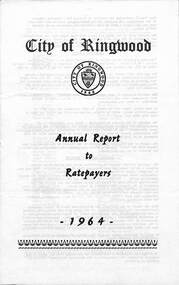
... City of Ringwood community information report for 1964, including sections covering Valuations-Rates, Sanitary Service - Sewerage, Private Street Construction, Loughnan Hill Road Scheme, Other New Works, Planning Scheme, Fire Hazards, Fly Control, Dogs, Annual Special Clearance of Refuse, Garbage Removal, Immunisation, Street Lighting, House Numbers, Home Help, Scholarships, Rubbish Dumping, Vandalism, and list of Council Representatives....rinx City of Ringwood community information report for 1964, including sections covering Valuations-Rates, Sanitary Service - Sewerage, Private Street Construction, Loughnan Hill Road Scheme, Other New Works, Planning Scheme, Fire Hazards, Fly Control, Dogs, Annual Special Clearance of Refuse, Garbage Removal, Immunisation, Street Lighting, House Numbers, Home Help, Scholarships, Rubbish Dumping, Vandalism, and list of Council Representatives. ...City of Ringwood community information report for 1964, including sections covering Valuations-Rates, Sanitary Service - Sewerage, Private Street Construction, Loughnan Hill Road Scheme, Other New Works, Planning Scheme, Fire Hazards, Fly Control, Dogs, Annual Special Clearance of Refuse, Garbage Removal, Immunisation, Street Lighting, House Numbers, Home Help, Scholarships, Rubbish Dumping, Vandalism, and list of Council Representatives.rinx -
 Ringwood and District Historical Society
Pamphlet, Ringwood Council's Annual Report To The Ratepayers - December 1968, 1968
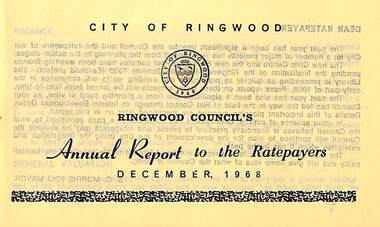
... City of Ringwood community information annual report for 1968, including sections covering Finance, General Valuation and Rater Payments, Property Ownership Changes, Refuse, Sanitary Serviced, Sewerage Connections to MMBW, Dandenong Valley Authority, Residential Flat Control Planning Scheme, Immunisation, Home Help, Elderly Citizens' Clubrooms, Library, Civic Centre, Golf Course, Sale of Council Land, Swimming Centre, Holiday Play Centre, Civic Week, Lake Reserve Improvements, Rubbish Dumping, Street Trees, Vandalism, White Ants, Street Construction, Fire Hazards, Dog Nuisance, House Numbering, Citizens' Advisory Service, Infant Welfare Centres, and a list of departing and current Council Representatives. ...City of Ringwood community information annual report for 1968, including sections covering Finance, General Valuation and Rater Payments, Property Ownership Changes, Refuse, Sanitary Serviced, Sewerage Connections to MMBW, Dandenong Valley Authority, Residential Flat Control Planning Scheme, Immunisation, Home Help, Elderly Citizens' Clubrooms, Library, Civic Centre, Golf Course, Sale of Council Land, Swimming Centre, Holiday Play Centre, Civic Week, Lake Reserve Improvements, Rubbish Dumping, Street Trees, Vandalism, White Ants, Street Construction, Fire Hazards, Dog Nuisance, House Numbering, Citizens' Advisory Service, Infant Welfare Centres, and a list of departing and current Council Representatives. ...City of Ringwood community information annual report for 1968, including sections covering Finance, General Valuation and Rater Payments, Property Ownership Changes, Refuse, Sanitary Serviced, Sewerage Connections to MMBW, Dandenong Valley Authority, Residential Flat Control Planning Scheme, Immunisation, Home Help, Elderly Citizens' Clubrooms, Library, Civic Centre, Golf Course, Sale of Council Land, Swimming Centre, Holiday Play Centre, Civic Week, Lake Reserve Improvements, Rubbish Dumping, Street Trees, Vandalism, White Ants, Street Construction, Fire Hazards, Dog Nuisance, House Numbering, Citizens' Advisory Service, Infant Welfare Centres, and a list of departing and current Council Representatives. Also includes general reminders regarding rat extermination, free firewood for age pensioners, overhanging vegetation, and spouses voting rights.Obituary - Mr. F.P. Dwerryhouse, Town Clerk for the past 9-1/2 years passed away on 6th December after a short illness.rinx -
![Photograph - Colour Print, Harry Gilham [Attrib.], Living and Learning Centre, Main Road, Eltham, Aug 1988](/media/collectors/4f729f7b97f83e03086018a5/items/6a1ccb54e43e4200865b4676/item-media/6a1ccbd3e43e4200865b58ed/item-fit-380x285.jpg?cb=6) Eltham District Historical Society Inc
Eltham District Historical Society IncPhotograph - Colour Print, Harry Gilham [Attrib.], Living and Learning Centre, Main Road, Eltham, Aug 1988
... sewerage was installed and an internal toilet fitted in the house. The former northeast room was divided into bathroom/toilet and passageway with cupboards to access the extension. Kitchen stove and sink was removed (they fell apart) and a slow-combustion stove with hot water heater installed. Basins and hot water were connected to the new bathroom. In the early 1970s Eltham Shire Council, Councillors Frank Maas and Don Maling, were proposing an extended communities activities program be set up and the Commonwealth Grants Commission was approached for financial assistance to such a scheme...sewerage was installed and an internal toilet fitted in the house. The former northeast room was divided into bathroom/toilet and passageway with cupboards to access the extension. Kitchen stove and sink was removed (they fell apart) and a slow-combustion stove with hot water heater installed. Basins and hot water were connected to the new bathroom. In the early 1970s Eltham Shire Council, Councillors Frank Maas and Don Maling, were proposing an extended communities activities program be set up and the Commonwealth Grants Commission was approached for financial assistance to such a scheme ...North face of house viewed from the current (1990) pottery area (now pathed) The kitchen was separate from the house as a safety measure in the late 1800s. A detailed history of the site and early development of the Eltham Living and Learning Centre can be found in EDHS_04870 - Folder, Shire of Eltham Living and Learning Centre, 1996 The original property was part of Josiah Holloways subdivision of Little Eltham. It had a 70 foot frontage to Maria Street and stretched down to the Diamond Creek. John Perason, a Tanner, purchased the property in 1857 for £100 and he built a solid brick house which over the years was modified significantly by various owners and which is the basis of the present-day Living and Learning Centre. Claire Fitzpatrick and her husband Alfred, a retired chemical engineer, bought it in the early 1950's. Claire's interest in farming and animal husbandry and breeding saw her modify and establish buildings on the property to house goats and poultry with a horse stable and storage sheds for the animal food. She also built the coach house with its horse box and tack room and built an adjoining garage for their car. Structural alterations to the house were also carried out during the period of their ownership. Their house renovations removed the four fireplaces and chimneys and added a wider verandah, a fibro cement extension on the north wall requiring a doorway to be made in the brick wall for access. Part of a passage wall was removed to join the northwest room, now the "sitting room". A new jarrah floor was put in as the old one was rotten with borer. The verandahs, front and back, were re-organised in design and the front door had its leadlighting panels removed to allow more light into the house. During this period the water catchment well was filled in. This well had a concrete slab fitted onto a collar around its top. The well is 12 feet deep and 8 feet in diameter. Septic sewerage was installed and an internal toilet fitted in the house. The former northeast room was divided into bathroom/toilet and passageway with cupboards to access the extension. Kitchen stove and sink was removed (they fell apart) and a slow-combustion stove with hot water heater installed. Basins and hot water were connected to the new bathroom. In the early 1970s Eltham Shire Council, Councillors Frank Maas and Don Maling, were proposing an extended communities activities program be set up and the Commonwealth Grants Commission was approached for financial assistance to such a scheme. During 1974 a $50,000 Commonwealth Government grant was received by the Shire Council to acquire the Fitzpatrick property as part of the Shire's planning to establish an "extended community activities program". Council's Committee recommended an annual budget of $26,950 for the program and the project was named the Living and Learning Centre and in charge of the program was the first co-ordinator, Carina Hack. The activities were planned to cover "practical skills for living" and included cooking, preserving, gardening, animal husbandry, home economics, electronics, carpentry, hairdressing, making children's clothes and car maintenance. Hobbies and arts and crafts that would include amongst other future items, winemaking, music spinning and weaving and painting. 739 main road eltham, eltham living and learning centre, living and learning centre, living and learning nillumbik (eltham), main road eltham -
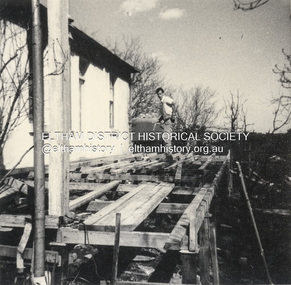 Eltham District Historical Society Inc
Photograph - Black and White Print, Widening of the verandah of 'Rosebank,' now Living and Learning Centre, Main Road, Eltham, c.1965
... sewerage was installed and an internal toilet fitted in the house. The former northeast room was divided into bathroom/toilet and passageway with cupboards to access the extension. Kitchen stove and sink was removed (they fell apart) and a slow-combustion stove with hot water heater installed. Basins and hot water were connected to the new bathroom. In the early 1970s Eltham Shire Council, Councillors Frank Maas and Don Maling, were proposing an extended communities activities program be set up and the Commonwealth Grants Commission was approached for financial assistance to such a scheme...sewerage was installed and an internal toilet fitted in the house. The former northeast room was divided into bathroom/toilet and passageway with cupboards to access the extension. Kitchen stove and sink was removed (they fell apart) and a slow-combustion stove with hot water heater installed. Basins and hot water were connected to the new bathroom. In the early 1970s Eltham Shire Council, Councillors Frank Maas and Don Maling, were proposing an extended communities activities program be set up and the Commonwealth Grants Commission was approached for financial assistance to such a scheme ...Restructure of the front verandah of 'Rosebank' by widening, c.1965. It was glassed in at a later date. The west facing front verandah was widened and enclosed for additional class room use by the Living and Learning Centre. A detailed history of the site and early development of the Eltham Living and Learning Centre can be found in EDHS_04870 - Folder, Shire of Eltham Living and Learning Centre, 1996 The original property was part of Josiah Holloways subdivision of Little Eltham. It had a 70 foot frontage to Maria Street and stretched down to the Diamond Creek. John Perason, a Tanner, purchased the property in 1857 for £100 and he built a solid brick house which over the years was modified significantly by various owners and which is the basis of the present-day Living and Learning Centre. Claire Fitzpatrick and her husband Alfred, a retired chemical engineer, bought it in the early 1950's. Claire's interest in farming and animal husbandry and breeding saw her modify and establish buildings on the property to house goats and poultry with a horse stable and storage sheds for the animal food. She also built the coach house with its horse box and tack room and built an adjoining garage for their car. Structural alterations to the house were also carried out during the period of their ownership. Their house renovations removed the four fireplaces and chimneys and added a wider verandah, a fibro cement extension on the north wall requiring a doorway to be made in the brick wall for access. Part of a passage wall was removed to join the northwest room, now the "sitting room". A new jarrah floor was put in as the old one was rotten with borer. The verandahs, front and back, were re-organised in design and the front door had its leadlighting panels removed to allow more light into the house. During this period the water catchment well was filled in. This well had a concrete slab fitted onto a collar around its top. The well is 12 feet deep and 8 feet in diameter. Septic sewerage was installed and an internal toilet fitted in the house. The former northeast room was divided into bathroom/toilet and passageway with cupboards to access the extension. Kitchen stove and sink was removed (they fell apart) and a slow-combustion stove with hot water heater installed. Basins and hot water were connected to the new bathroom. In the early 1970s Eltham Shire Council, Councillors Frank Maas and Don Maling, were proposing an extended communities activities program be set up and the Commonwealth Grants Commission was approached for financial assistance to such a scheme. During 1974 a $50,000 Commonwealth Government grant was received by the Shire Council to acquire the Fitzpatrick property as part of the Shire's planning to establish an "extended community activities program". Council's Committee recommended an annual budget of $26,950 for the program and the project was named the Living and Learning Centre and in charge of the program was the first co-ordinator, Carina Hack. The activities were planned to cover "practical skills for living" and included cooking, preserving, gardening, animal husbandry, home economics, electronics, carpentry, hairdressing, making children's clothes and car maintenance. Hobbies and arts and crafts that would include amongst other future items, winemaking, music spinning and weaving and painting. 739 main road eltham, eltham living and learning centre, living and learning centre, living and learning nillumbik (eltham), main road eltham -
![Photograph - Colour Print, Harry Gilham [Attrib.], Living and Learning Centre, Main Road, Eltham, c.1988](/media/collectors/4f729f7b97f83e03086018a5/items/6a1cdaf8e43e4200865c849d/item-media/6a1cdb13e43e4200865c85b6/item-fit-380x285.jpg?cb=6) Eltham District Historical Society Inc
Eltham District Historical Society IncPhotograph - Colour Print, Harry Gilham [Attrib.], Living and Learning Centre, Main Road, Eltham, c.1988
... sewerage was installed and an internal toilet fitted in the house. The former northeast room was divided into bathroom/toilet and passageway with cupboards to access the extension. Kitchen stove and sink was removed (they fell apart) and a slow-combustion stove with hot water heater installed. Basins and hot water were connected to the new bathroom. In the early 1970s Eltham Shire Council, Councillors Frank Maas and Don Maling, were proposing an extended communities activities program be set up and the Commonwealth Grants Commission was approached for financial assistance to such a scheme...sewerage was installed and an internal toilet fitted in the house. The former northeast room was divided into bathroom/toilet and passageway with cupboards to access the extension. Kitchen stove and sink was removed (they fell apart) and a slow-combustion stove with hot water heater installed. Basins and hot water were connected to the new bathroom. In the early 1970s Eltham Shire Council, Councillors Frank Maas and Don Maling, were proposing an extended communities activities program be set up and the Commonwealth Grants Commission was approached for financial assistance to such a scheme ...The 'back door' which faced the Main Road entrance to the office, Eltham Living and Learning Centre, herb garden at its peak, late 1980s A detailed history of the site and early development of the Eltham Living and Learning Centre can be found in EDHS_04870 - Folder, Shire of Eltham Living and Learning Centre, 1996 The original property was part of Josiah Holloways subdivision of Little Eltham. It had a 70 foot frontage to Maria Street and stretched down to the Diamond Creek. John Perason, a Tanner, purchased the property in 1857 for £100 and he built a solid brick house which over the years was modified significantly by various owners and which is the basis of the present-day Living and Learning Centre. Claire Fitzpatrick and her husband Alfred, a retired chemical engineer, bought it in the early 1950's. Claire's interest in farming and animal husbandry and breeding saw her modify and establish buildings on the property to house goats and poultry with a horse stable and storage sheds for the animal food. She also built the coach house with its horse box and tack room and built an adjoining garage for their car. Structural alterations to the house were also carried out during the period of their ownership. Their house renovations removed the four fireplaces and chimneys and added a wider verandah, a fibro cement extension on the north wall requiring a doorway to be made in the brick wall for access. Part of a passage wall was removed to join the northwest room, now the "sitting room". A new jarrah floor was put in as the old one was rotten with borer. The verandahs, front and back, were re-organised in design and the front door had its leadlighting panels removed to allow more light into the house. During this period the water catchment well was filled in. This well had a concrete slab fitted onto a collar around its top. The well is 12 feet deep and 8 feet in diameter. Septic sewerage was installed and an internal toilet fitted in the house. The former northeast room was divided into bathroom/toilet and passageway with cupboards to access the extension. Kitchen stove and sink was removed (they fell apart) and a slow-combustion stove with hot water heater installed. Basins and hot water were connected to the new bathroom. In the early 1970s Eltham Shire Council, Councillors Frank Maas and Don Maling, were proposing an extended communities activities program be set up and the Commonwealth Grants Commission was approached for financial assistance to such a scheme. During 1974 a $50,000 Commonwealth Government grant was received by the Shire Council to acquire the Fitzpatrick property as part of the Shire's planning to establish an "extended community activities program". Council's Committee recommended an annual budget of $26,950 for the program and the project was named the Living and Learning Centre and in charge of the program was the first co-ordinator, Carina Hack. The activities were planned to cover "practical skills for living" and included cooking, preserving, gardening, animal husbandry, home economics, electronics, carpentry, hairdressing, making children's clothes and car maintenance. Hobbies and arts and crafts that would include amongst other future items, winemaking, music spinning and weaving and painting. 739 main road eltham, eltham living and learning centre, living and learning centre, living and learning nillumbik (eltham), main road eltham -
![Photograph - Black and White Print, Harry Gilham [Attrib.], Living and Learning Centre, Main Road, Eltham, 1990](/media/collectors/4f729f7b97f83e03086018a5/items/6a1cdbffe43e4200865c95df/item-media/6a1cdc19e43e4200865c975d/item-fit-380x285.jpg?cb=6) Eltham District Historical Society Inc
Eltham District Historical Society IncPhotograph - Black and White Print, Harry Gilham [Attrib.], Living and Learning Centre, Main Road, Eltham, 1990
... sewerage was installed and an internal toilet fitted in the house. The former northeast room was divided into bathroom/toilet and passageway with cupboards to access the extension. Kitchen stove and sink was removed (they fell apart) and a slow-combustion stove with hot water heater installed. Basins and hot water were connected to the new bathroom. In the early 1970s Eltham Shire Council, Councillors Frank Maas and Don Maling, were proposing an extended communities activities program be set up and the Commonwealth Grants Commission was approached for financial assistance to such a scheme...sewerage was installed and an internal toilet fitted in the house. The former northeast room was divided into bathroom/toilet and passageway with cupboards to access the extension. Kitchen stove and sink was removed (they fell apart) and a slow-combustion stove with hot water heater installed. Basins and hot water were connected to the new bathroom. In the early 1970s Eltham Shire Council, Councillors Frank Maas and Don Maling, were proposing an extended communities activities program be set up and the Commonwealth Grants Commission was approached for financial assistance to such a scheme ...The 'back door' which faced the Main Road entrance to the office, Eltham Living and Learning Centre - Shows original sandstone blocks in back verandah floor A detailed history of the site and early development of the Eltham Living and Learning Centre can be found in EDHS_04870 - Folder, Shire of Eltham Living and Learning Centre, 1996 The original property was part of Josiah Holloways subdivision of Little Eltham. It had a 70 foot frontage to Maria Street and stretched down to the Diamond Creek. John Perason, a Tanner, purchased the property in 1857 for £100 and he built a solid brick house which over the years was modified significantly by various owners and which is the basis of the present-day Living and Learning Centre. Claire Fitzpatrick and her husband Alfred, a retired chemical engineer, bought it in the early 1950's. Claire's interest in farming and animal husbandry and breeding saw her modify and establish buildings on the property to house goats and poultry with a horse stable and storage sheds for the animal food. She also built the coach house with its horse box and tack room and built an adjoining garage for their car. Structural alterations to the house were also carried out during the period of their ownership. Their house renovations removed the four fireplaces and chimneys and added a wider verandah, a fibro cement extension on the north wall requiring a doorway to be made in the brick wall for access. Part of a passage wall was removed to join the northwest room, now the "sitting room". A new jarrah floor was put in as the old one was rotten with borer. The verandahs, front and back, were re-organised in design and the front door had its leadlighting panels removed to allow more light into the house. During this period the water catchment well was filled in. This well had a concrete slab fitted onto a collar around its top. The well is 12 feet deep and 8 feet in diameter. Septic sewerage was installed and an internal toilet fitted in the house. The former northeast room was divided into bathroom/toilet and passageway with cupboards to access the extension. Kitchen stove and sink was removed (they fell apart) and a slow-combustion stove with hot water heater installed. Basins and hot water were connected to the new bathroom. In the early 1970s Eltham Shire Council, Councillors Frank Maas and Don Maling, were proposing an extended communities activities program be set up and the Commonwealth Grants Commission was approached for financial assistance to such a scheme. During 1974 a $50,000 Commonwealth Government grant was received by the Shire Council to acquire the Fitzpatrick property as part of the Shire's planning to establish an "extended community activities program". Council's Committee recommended an annual budget of $26,950 for the program and the project was named the Living and Learning Centre and in charge of the program was the first co-ordinator, Carina Hack. The activities were planned to cover "practical skills for living" and included cooking, preserving, gardening, animal husbandry, home economics, electronics, carpentry, hairdressing, making children's clothes and car maintenance. Hobbies and arts and crafts that would include amongst other future items, winemaking, music spinning and weaving and painting. 739 main road eltham, eltham living and learning centre, living and learning centre, living and learning nillumbik (eltham), main road eltham -
![Photograph - Black and White Print, Harry Gilham [Attrib.], Living and Learning Centre, Main Road, Eltham, c.1990](/media/collectors/4f729f7b97f83e03086018a5/items/6a1cddabe43e4200865cee41/item-media/6a1cddbbe43e4200865cf696/item-fit-380x285.jpg?cb=6) Eltham District Historical Society Inc
Eltham District Historical Society IncPhotograph - Black and White Print, Harry Gilham [Attrib.], Living and Learning Centre, Main Road, Eltham, c.1990
... sewerage was installed and an internal toilet fitted in the house. The former northeast room was divided into bathroom/toilet and passageway with cupboards to access the extension. Kitchen stove and sink was removed (they fell apart) and a slow-combustion stove with hot water heater installed. Basins and hot water were connected to the new bathroom. In the early 1970s Eltham Shire Council, Councillors Frank Maas and Don Maling, were proposing an extended communities activities program be set up and the Commonwealth Grants Commission was approached for financial assistance to such a scheme...sewerage was installed and an internal toilet fitted in the house. The former northeast room was divided into bathroom/toilet and passageway with cupboards to access the extension. Kitchen stove and sink was removed (they fell apart) and a slow-combustion stove with hot water heater installed. Basins and hot water were connected to the new bathroom. In the early 1970s Eltham Shire Council, Councillors Frank Maas and Don Maling, were proposing an extended communities activities program be set up and the Commonwealth Grants Commission was approached for financial assistance to such a scheme ...Brick storage shed, south wall entry. This cool room, half set down in the soil still standing at time but with a more modern galvanised tin roof. A detailed history of the site and early development of the Eltham Living and Learning Centre can be found in EDHS_04870 - Folder, Shire of Eltham Living and Learning Centre, 1996 The original property was part of Josiah Holloways subdivision of Little Eltham. It had a 70 foot frontage to Maria Street and stretched down to the Diamond Creek. John Perason, a Tanner, purchased the property in 1857 for £100 and he built a solid brick house which over the years was modified significantly by various owners and which is the basis of the present-day Living and Learning Centre. Claire Fitzpatrick and her husband Alfred, a retired chemical engineer, bought it in the early 1950's. Claire's interest in farming and animal husbandry and breeding saw her modify and establish buildings on the property to house goats and poultry with a horse stable and storage sheds for the animal food. She also built the coach house with its horse box and tack room and built an adjoining garage for their car. Structural alterations to the house were also carried out during the period of their ownership. Their house renovations removed the four fireplaces and chimneys and added a wider verandah, a fibro cement extension on the north wall requiring a doorway to be made in the brick wall for access. Part of a passage wall was removed to join the northwest room, now the "sitting room". A new jarrah floor was put in as the old one was rotten with borer. The verandahs, front and back, were re-organised in design and the front door had its leadlighting panels removed to allow more light into the house. During this period the water catchment well was filled in. This well had a concrete slab fitted onto a collar around its top. The well is 12 feet deep and 8 feet in diameter. Septic sewerage was installed and an internal toilet fitted in the house. The former northeast room was divided into bathroom/toilet and passageway with cupboards to access the extension. Kitchen stove and sink was removed (they fell apart) and a slow-combustion stove with hot water heater installed. Basins and hot water were connected to the new bathroom. In the early 1970s Eltham Shire Council, Councillors Frank Maas and Don Maling, were proposing an extended communities activities program be set up and the Commonwealth Grants Commission was approached for financial assistance to such a scheme. During 1974 a $50,000 Commonwealth Government grant was received by the Shire Council to acquire the Fitzpatrick property as part of the Shire's planning to establish an "extended community activities program". Council's Committee recommended an annual budget of $26,950 for the program and the project was named the Living and Learning Centre and in charge of the program was the first co-ordinator, Carina Hack. The activities were planned to cover "practical skills for living" and included cooking, preserving, gardening, animal husbandry, home economics, electronics, carpentry, hairdressing, making children's clothes and car maintenance. Hobbies and arts and crafts that would include amongst other future items, winemaking, music spinning and weaving and painting. 739 main road eltham, eltham living and learning centre, living and learning centre, living and learning nillumbik (eltham), main road eltham -
![Photograph - Colour Print, Harry Gilham [Attrib.], Living and Learning Centre, Main Road, Eltham, 1995](/media/collectors/4f729f7b97f83e03086018a5/items/6a1cde5de43e4200865d0c81/item-media/6a1cde8be43e4200865d1127/item-fit-380x285.jpg?cb=6) Eltham District Historical Society Inc
Eltham District Historical Society IncPhotograph - Colour Print, Harry Gilham [Attrib.], Living and Learning Centre, Main Road, Eltham, 1995
... sewerage was installed and an internal toilet fitted in the house. The former northeast room was divided into bathroom/toilet and passageway with cupboards to access the extension. Kitchen stove and sink was removed (they fell apart) and a slow-combustion stove with hot water heater installed. Basins and hot water were connected to the new bathroom. In the early 1970s Eltham Shire Council, Councillors Frank Maas and Don Maling, were proposing an extended communities activities program be set up and the Commonwealth Grants Commission was approached for financial assistance to such a scheme...sewerage was installed and an internal toilet fitted in the house. The former northeast room was divided into bathroom/toilet and passageway with cupboards to access the extension. Kitchen stove and sink was removed (they fell apart) and a slow-combustion stove with hot water heater installed. Basins and hot water were connected to the new bathroom. In the early 1970s Eltham Shire Council, Councillors Frank Maas and Don Maling, were proposing an extended communities activities program be set up and the Commonwealth Grants Commission was approached for financial assistance to such a scheme ...New Pavilion at left has plants appearing. Grass area needs a mow - verandah with repainted stool/forms - early spring 1995 A detailed history of the site and early development of the Eltham Living and Learning Centre can be found in EDHS_04870 - Folder, Shire of Eltham Living and Learning Centre, 1996 The original property was part of Josiah Holloways subdivision of Little Eltham. It had a 70 foot frontage to Maria Street and stretched down to the Diamond Creek. John Perason, a Tanner, purchased the property in 1857 for £100 and he built a solid brick house which over the years was modified significantly by various owners and which is the basis of the present-day Living and Learning Centre. Claire Fitzpatrick and her husband Alfred, a retired chemical engineer, bought it in the early 1950's. Claire's interest in farming and animal husbandry and breeding saw her modify and establish buildings on the property to house goats and poultry with a horse stable and storage sheds for the animal food. She also built the coach house with its horse box and tack room and built an adjoining garage for their car. Structural alterations to the house were also carried out during the period of their ownership. Their house renovations removed the four fireplaces and chimneys and added a wider verandah, a fibro cement extension on the north wall requiring a doorway to be made in the brick wall for access. Part of a passage wall was removed to join the northwest room, now the "sitting room". A new jarrah floor was put in as the old one was rotten with borer. The verandahs, front and back, were re-organised in design and the front door had its leadlighting panels removed to allow more light into the house. During this period the water catchment well was filled in. This well had a concrete slab fitted onto a collar around its top. The well is 12 feet deep and 8 feet in diameter. Septic sewerage was installed and an internal toilet fitted in the house. The former northeast room was divided into bathroom/toilet and passageway with cupboards to access the extension. Kitchen stove and sink was removed (they fell apart) and a slow-combustion stove with hot water heater installed. Basins and hot water were connected to the new bathroom. In the early 1970s Eltham Shire Council, Councillors Frank Maas and Don Maling, were proposing an extended communities activities program be set up and the Commonwealth Grants Commission was approached for financial assistance to such a scheme. During 1974 a $50,000 Commonwealth Government grant was received by the Shire Council to acquire the Fitzpatrick property as part of the Shire's planning to establish an "extended community activities program". Council's Committee recommended an annual budget of $26,950 for the program and the project was named the Living and Learning Centre and in charge of the program was the first co-ordinator, Carina Hack. The activities were planned to cover "practical skills for living" and included cooking, preserving, gardening, animal husbandry, home economics, electronics, carpentry, hairdressing, making children's clothes and car maintenance. Hobbies and arts and crafts that would include amongst other future items, winemaking, music spinning and weaving and painting. 739 main road eltham, eltham living and learning centre, living and learning centre, living and learning nillumbik (eltham), main road eltham
