
Showing 62 items matching "share market"
-
 Bendigo Historical Society Inc.
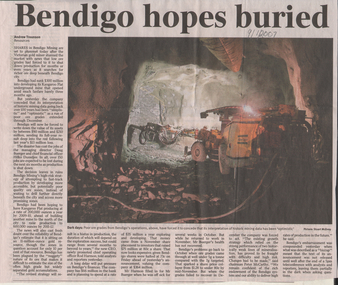
Newspaper - Kangaroo Flat Gold Mine Collection: Bendigo N.L. Mine Closure, Bendigo Advertiser, 9.1. 2007, 10.1.2007
... ...share market...Bendigo mining gold Douglas Buerger Managing Director Julie Rivendell mine closure share market stock market Two newspaper articles: 1. ...Production at the Bendigo Mining N.L. Kangaroo Flat mine site was planned to shut down over a period of six months, during which time 150 jobs were expected to be lost. Almost 60 per cent was wiped off the Company's value on January 9th 2007 trading. Two newspaper articles: 1. 'Bendigo hopes buried', one page article. Image of mining equipment underground in stope. Text underneath image: Poor ore grades from Bendigo's operations, have forced it to concede that its interpretation of historic mining data has been 'optimistic'. Bendigo Advertiser article 9.1.2007 2. On front of page 'Community Upbeat' and 'Many more challenges to overcome' on one page. Cr. Julie Rivendell comments on closure. Bendigo Advertiser article 10.1.2007. On back of page: Investor's worst fears realised'.bendigo mining n.l., bendigo, mining, gold, douglas buerger, managing director, julie rivendell, mine closure, share market, stock market -
 Trafalgar Holden Museum
Vehicle - Chevrolet Adra SUV Concept, 2014
... Production was cancelled due to GM's declining market share in India....Production was cancelled due to GM's declining market share in India. Designed specifically for the Indian market Vehicle SUV Chevrolet Chevrolet badge on both boot lid and grille centre, ADRA on right of boot lid. ...Designed specifically for the Indian market. by GM India Private Ltd. Production was cancelled due to GM's declining market share in India.Designed specifically for the Indian marketGold bodied black painted roof with matt chrome roof racks, alloy wheels, Grille both in bonnet and bumper. 5 doors including rear access.Chevrolet badge on both boot lid and grille centre, ADRA on right of boot lid.vehicle, suv, chevrolet -
 Mont De Lancey
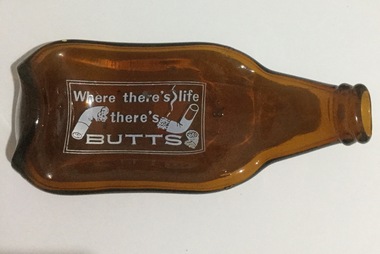
Glass ashtray, Asahi Breweries
... As of January 2014, Asahi, with a 38% market share, was the largest of the four major beer producers in Japan. ...As of January 2014, Asahi, with a 38% market share, was the largest of the four major beer producers in Japan. smoking equipment ashtrays On main part of ashtray:"Where there's life there's butts" together with three cigarette butts, all surrounded by a double lined border, all in white paint. ...Asahi Breweries is one of the main operating companies of Asahi Group Holdings, Ltd. which is a beer and soft drink company based in Tokyo, Japan. As of January 2014, Asahi, with a 38% market share, was the largest of the four major beer producers in Japan. Amber-coloured glass ashtray created from a melted and squashed "stubbie" beer bottle with no cap.On main part of ashtray:"Where there's life there's butts" together with three cigarette butts, all surrounded by a double lined border, all in white paint. Around the base of the neck of the bottle: "Asahi Beer' embossed 4 timessmoking equipment, ashtrays -
 Ruyton Girls' School
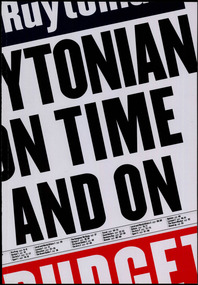
Magazine, Ruyton Girls' School, The Ruytonian, 2009
... Front Cover: Ruyton / YTONIAN / ON TIME / AND ON / er Pre Prep pages 6-9 | Local and World Affairs 1 page 20 | The Company We Keep page 37 | Travel pages 49-51 | Local and World Affairs 2 pages 68, 69 | Opinion page 89 / Review 1 page 10 | Lyceum 1 page 21 | Review 2 pages 38, 39 | Contributors pages 52, 53 | Debate pages 70, 71 | Lyceum 2 pages 90, 91 / The Arts 1 pages 11-17 | Education pages 22-35 | The Green Guide 2 page 40 | Business Day pages 54-59 | The Arts 2 pages 72-75 | The Share Market page 92 / Sports 1 pages 18, 19 | The Green Guide 1 page 36 | The Arts 2 pages 41-48 | Domain pages 60-69 | Sport 2 pages 81-88 | Round up page 93 / BUDGET /...Ruyton Girls' School The Ruytonian Kew Old Ruytonians Association Yearbook School Publication Girls School Junior School Senior School Journal Students Teacher Front Cover: Ruyton / YTONIAN / ON TIME / AND ON / er Pre Prep pages 6-9 | Local and World Affairs 1 page 20 | The Company We Keep page 37 | Travel pages 49-51 | Local and World Affairs 2 pages 68, 69 | Opinion page 89 / Review 1 page 10 | Lyceum 1 page 21 | Review 2 pages 38, 39 | Contributors pages 52, 53 | Debate pages 70, 71 | Lyceum 2 pages 90, 91 / The Arts 1 pages 11-17 | Education pages 22-35 | The Green Guide 2 page 40 | Business Day pages 54-59 | The Arts 2 pages 72-75 | The Share Market page 92 / Sports 1 pages 18, 19 | The Green Guide 1 page 36 | The Arts 2 pages 41-48 | Domain pages 60-69 | Sport 2 pages 81-88 | Round up page 93 / BUDGET / Colour publication printed on white paper. 100 pages. ...In July 1909, a modest 12-page booklet was put together by members of the fledgling Old Ruytonians Association (ORA) and distributed to the Ruyton Girls' School community. It was one of their first projects, and their aim was to nurture continuing interest in the School among former and current students. They named it "The Ruytonian." At first, The Ruytonian was produced twice yearly, and always bore a plain cover with a simple name banner. Initially, it was the work of volunteer editors from the ORA, but in 1913 they handed the publication over to the first student editors, Esther Gibson and Lucy Tickell. Since that time, the style and content of The Ruytonian has continuously evolved. The biggest shifts occurred in 1942 when it transitioned to a yearly publication, and in 1969 when it moved to a larger A4 format with a cover image specifically selected for that year.The record has strong historic significance as it pertains to the fourth oldest girls' school in Victoria, Australia. Ruyton was founded in 1878 in the Bulleen Road, Kew, home of newly widowed Mrs Charlotte Anderson (now High Street South). Thus, the record can be used as a reference example for research into Victorian school history. The record's significance is further enhanced by its exceptionally well-documented provenance, having remained the property of Ruyton Girls' School since its production.Colour publication printed on white paper. 100 pages.Front Cover: Ruyton / YTONIAN / ON TIME / AND ON / er Pre Prep pages 6-9 | Local and World Affairs 1 page 20 | The Company We Keep page 37 | Travel pages 49-51 | Local and World Affairs 2 pages 68, 69 | Opinion page 89 / Review 1 page 10 | Lyceum 1 page 21 | Review 2 pages 38, 39 | Contributors pages 52, 53 | Debate pages 70, 71 | Lyceum 2 pages 90, 91 / The Arts 1 pages 11-17 | Education pages 22-35 | The Green Guide 2 page 40 | Business Day pages 54-59 | The Arts 2 pages 72-75 | The Share Market page 92 / Sports 1 pages 18, 19 | The Green Guide 1 page 36 | The Arts 2 pages 41-48 | Domain pages 60-69 | Sport 2 pages 81-88 | Round up page 93 / BUDGET /ruyton girls' school, the ruytonian, kew, old ruytonians association, yearbook, school, publication, girls school, junior school, senior school, journal, students, teacher -
 City of Moorabbin Historical Society (Operating the Box Cottage Museum)
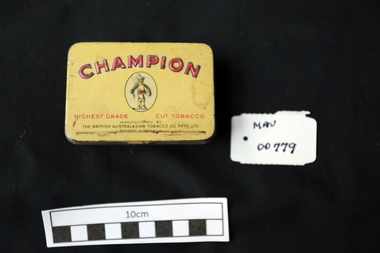
Containers, tin, Tobacco ‘Champion’, c1940
... By 1972, increased competition meant that the company’s market share had slipped to 39%. By the time tobacco advertising was banned on Australian radio and television in 1976, Wills' market share had fallen a further 6%. ...By 1972, increased competition meant that the company’s market share had slipped to 39%. By the time tobacco advertising was banned on Australian radio and television in 1976, Wills' market share had fallen a further 6%. ...W.D & H.O.Wills (Australia) Ltd began manufacturing tobacco products in 1913 at its Raleigh Park factory in Kensington, Sydney. In 1945 an estate of 16 acres was purchased at East Bentleigh, Melbourne, with a further 22 acres purchased later and the Virginia Park manufacturing branch was established. The 1950s were to be one of the most successful decades in the company’s history and it enjoyed a peak of 83 per cent market share in 1954. But this was also a period of increased competition as Phillip Morris and Rothmans entered the Australian tobacco market. By 1972, increased competition meant that the company’s market share had slipped to 39%. By the time tobacco advertising was banned on Australian radio and television in 1976, Wills' market share had fallen a further 6%. In 1985 Wills combined the separate factory operations in Sydney and in Melbourne into one site at Pagewood, Sydney which took on the name Virginia Park. In 1989 W.D & H.O.Wills (Australia) became a subsidiary of the British American Tobacco Industries group of companies. 1999 British American Tobacco merged with global competitor Rothmans International. Rothmans in Australia and Wills merged to form the wholly-owned subsidiary British American Tobacco Australia. The merger left British American Tobacco Australia, Phillip Morris and Imperial Tobacco Australia A tin with a hinged lid for 'Champion' Tobacco flakesCHAMPION / HIGHEST GRADE / CUT TOBACCO / MANUFACTURED BY / THE BRITISH AUSTRALIAN TOBACCO CO.PTY.LTDtobacco, cigarettes, brittish australian tobacco co. pty. ltd., moorabbin, bentleigh, cheltenham, early settlers, , wd &h.o.wills pty. ltd., east bentleigh, kensington , virginia park east bentleigh, champion flake tobacco -
 City of Moorabbin Historical Society (Operating the Box Cottage Museum)
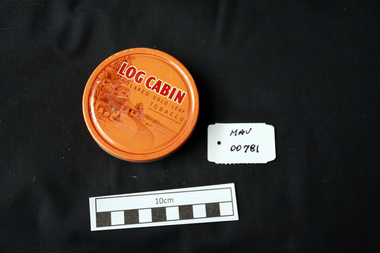
Containers, tin, tobacco 'Log Cabin', 20thC
... By 1972, increased competition meant that the company’s market share had slipped to 39%. By the time tobacco advertising was banned on Australian radio and television in 1976, Wills' market share had fallen a further 6%. ...By 1972, increased competition meant that the company’s market share had slipped to 39%. By the time tobacco advertising was banned on Australian radio and television in 1976, Wills' market share had fallen a further 6%. ...W.D & H.O.Wills (Australia) Ltd began manufacturing tobacco products in 1913 at its Raleigh Park factory in Kensington, Sydney. In 1945 an estate of 16 acres was purchased at East Bentleigh, Melbourne, with a further 22 acres purchased later and the Virginia Park manufacturing branch was established. The 1950s were to be one of the most successful decades in the company’s history and it enjoyed a peak of 83 per cent market share in 1954. But this was also a period of increased competition as Phillip Morris and Rothmans entered the Australian tobacco market. By 1972, increased competition meant that the company’s market share had slipped to 39%. By the time tobacco advertising was banned on Australian radio and television in 1976, Wills' market share had fallen a further 6%. In 1985 Wills combined the separate factory operations in Sydney and in Melbourne into one site at Pagewood, Sydney which took on the name Virginia Park. In 1989 W.D & H.O.Wills (Australia) became a subsidiary of the British American Tobacco Industries group of companies. 1999 British American Tobacco merged with global competitor Rothmans International. Rothmans in Australia and Wills merged to form the wholly-owned subsidiary British American Tobacco Australia. The merger left British American Tobacco Australia, Phillip Morris and Imperial Tobacco Australia Virginia Tobacco, or Flue-cured tobacco, is named after the US state where it was first cultivated. It is also called ‘bright tobacco’ because of the yellow to orange colour it achieves during curing. It grows particularly well in subtropical regions with light rainfall, such as Georgia, Florida and the Carolinas in the USA, Southern Brazil and Zimbabwe. In Australia, blends are predominantly Virginia, for example, Dunhill and Winfield. Virginia blends contain only flue-cured Virginia tobacco W.D & H.O. Wills Pty Ltd - In 1945 an estate of 16 acres was purchased at East Boundary Road, East Bentleigh, Melbourne, with a further 22 acres purchased later and the Virginia Park manufacturing branch was established. The plant was closed 1985 when the firm moved to Pagewood, Sydney New South WalesA circular tin with a lid that is opened by twisting a coin in the rim and closed by screwing the lid down. Instructions written on base of tin. Contained ‘Log Cabin’ tobacco.lid :LOG CABIN / FLAKED GOLD LEAF / TOBACCO / base ; LOG CABIN / SKRU SEAL / To open twist coin / to reseal screw lid / TOBACCOtobacco, cigarettes, smoking pipes, cigarette papers, moorabbin, cheltenham, bentleigh, log cabin tobacco, w d & h o wills pty ltd , british american tobacco ltd, rothmans international ltd, east bentleigh -
 City of Moorabbin Historical Society (Operating the Box Cottage Museum)
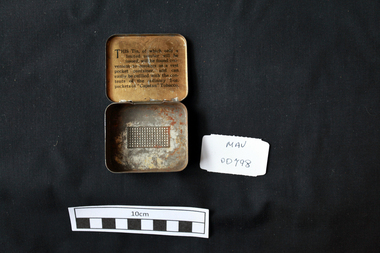
Containers, tin, Tobacco 'Capstan' ‘Navy Cut’, c1940
... By 1972, increased competition meant that the company’s market share had slipped to 39%. By the time tobacco advertising was banned on Australian radio and television in 1976, Wills' market share had fallen a further 6%. ...By 1972, increased competition meant that the company’s market share had slipped to 39%. By the time tobacco advertising was banned on Australian radio and television in 1976, Wills' market share had fallen a further 6%. ...W.D & H.O.Wills (Australia) Ltd began manufacturing tobacco products in 1913 at its Raleigh Park factory in Kensington, Sydney. In 1945 an estate of 16 acres was purchased at East Bentleigh, Melbourne, with a further 22 acres purchased later and the Virginia Park manufacturing branch was established. The 1950s were to be one of the most successful decades in the company’s history and it enjoyed a peak of 83 per cent market share in 1954. But this was also a period of increased competition as Phillip Morris and Rothmans entered the Australian tobacco market. By 1972, increased competition meant that the company’s market share had slipped to 39%. By the time tobacco advertising was banned on Australian radio and television in 1976, Wills' market share had fallen a further 6%. In 1985 Wills combined the separate factory operations in Sydney and in Melbourne into one site at Pagewood, Sydney which took on the name Virginia Park. In 1989 W.D & H.O.Wills (Australia) became a subsidiary of the British American Tobacco Industries group of companies. 1999 British American Tobacco merged with global competitor Rothmans International. Rothmans in Australia and Wills merged to form the wholly-owned subsidiary British American Tobacco Australia. The merger left British American Tobacco Australia, Phillip Morris and Imperial Tobacco Australia. Virginia Tobacco, or Flue-cured tobacco, is named after the US state where it was first cultivated. It is also called ‘bright tobacco’ because of the yellow to orange colour it achieves during curing. It grows particularly well in subtropical regions with light rainfall, such as Georgia, Florida and the Carolinas in the USA, Southern Brazil and Zimbabwe. In Australia, blends are predominantly Virginia, for example, Dunhill and Winfield. Virginia blends contain only flue-cured Virginia tobacco The W.D.&H.O.Wills Ltd manufacturing plant was situated in Boundary Road East Bentleigh 1945 – 85. Virginia Park is still a Commercial Business Area A tin with a hinged lid for 'Capstan' "Navy Cut tobacco Lid: CAPSTAN / NAVY CUT / W.D. & H.O. WILLS LTD inside lid - This tin of which only a / limited number will be / issued will be found convenient / for smokers as a vest / pocket container and can / easily be refilled with the / contents of the ordinary 1oz / packets of 'Capstan Tobacco'tobacco, cigarettes, cheltenham, moorabbin, early settlers, smoking pipes, cigarette papers, bentleigh, navy cut tobacco, w d & h o wills pty ltd , british american tobacco ltd, rothmans international ltd, east bentleigh, capstan tobacco -
 Federation University Historical Collection
Image, Robert Malachy Serjeant
... With his share of the sale he set himself up with the latest mining equipment, as well as beginning a lifelong interest in the share market. He became the Manager of the Chryseis, Isis and Garibaldi claims and then the Manager of the Band and Albion Consol Company. ...With his share of the sale he set himself up with the latest mining equipment, as well as beginning a lifelong interest in the share market. He became the Manager of the Chryseis, Isis and Garibaldi claims and then the Manager of the Band and Albion Consol Company. ...ROBERT MALACHY SERJEANT (1828-1902) Robert Malachy Serjeant was born on 21 December 1828 at Callington, Cornwall. He was the son of Philip Davey Serjeant, a surgeon in the Royal Marines, and Eliza Malachy. Philip Serjeant died in 1834. His mother, Eliza, remarried John Burgh in 1836. He died in 1837. In September 1848 Eliza, Robert and his two sisters, Caroline and Susan, departed Plymouth on the William Moneya for Port Adelaide and arrived in January 1849. Once gold was discovered in Victoria, Serjeant made his way to Forest Creek (near Castlemaine) and he and his mate Mr Victor, were the first party to sink through the basalt in search of a deep lead. In 1854 he moved to Ballarat to work as a miner and enjoyed some success. In 1855 he was with a group that discovered a 500 ounce nugget. With his share of the sale he set himself up with the latest mining equipment, as well as beginning a lifelong interest in the share market. He became the Manager of the Chryseis, Isis and Garibaldi claims and then the Manager of the Band and Albion Consol Company. He held the position for thirty years and only resigned when the company amalgamated with the Sir Henry Loch Mine. Robert Malachy Serjeant became interested in Politics. The first election for Parliament Representatives for Ballarat was in 1855. Robert stood for election for the first time in 1859, representing Ballarat West. He was also elected to represent Ballarat West in 1874 and 1880. Robert Serjeant’s community involvement extended to Education. Years of discussion eventually saw the development of the Ballarat School of Mines, the first school of mines in Australia. The inaugural School Council was formed in 1870 with Sir Redmond Barry, the Chief Justice, as President and Robert Malachy Serjeant as a member of the council. He held a position on the council until illness forced him to retire in 1889. He was elected a Life Governor in 1889. He was also a Life Governor of the Ballarat Hospital. Robert Serjeant showed Prince Albert and Prince George (later King George V) around the Band and Albion Mine. At the age of 42, Robert enrolled as a student at the School of Mines in 1871. He obtained a Certificate of Competency in Assaying (including Metallurgy) in 1875. The first certificate in “Geology as Applied to Mining” was awarded to Robert Serjeant in 1876. Robert Serjeant was an active and generous supporter of the School of Mines. As well as being a financial contributor, he lectured and examined in the Principles and Practice of Mining. He was regarded as an authority on alluvial and quartz mining and was a member of the Ballarat Local Court and mining board. In 1977 Robert, Joseph Flude and Henry Caselli donated the patent rights of a novel Pyrites furnace to the school. The R.M. Serjeant Scholarship at the Ballarat School of Mines resulted after a reward was offered for the first to produce the best method of treating auriferous ores – other than the smelting method. The offer was open for two years but not awarded. The money for this was donated by Robert Serjeant to the amount of 256 Pounds. It was then used to fund the School of Mines Scholarship in Engineering (1889). It was first awarded in 1922. Robert Malachy Serjeant died on 25 October 1902 and was buried at the Ballaarat Old Cemetery. (Sometimes Malachy is incorrectly written as Malachi)Two photographic portraits of mine manager Robert Malachy Serjeant. Both portraits were purchased by the donor from the State Library of Victoria. robert malachy serjeant, r.m. sergeant, robert malachi serjeant, band of hope and albion consols -
Federation University Historical Collection
Photograph - Image, Yarrowee Hall, Redan, c1883
... With his share of the sale he set himself up with the latest mining equipment, as well as beginning a lifelong interest in the share market. He became the Manager of the Chryseis, Isis and Garibaldi claims and then the Manager of the Band and Albion Consol Company. ...With his share of the sale he set himself up with the latest mining equipment, as well as beginning a lifelong interest in the share market. He became the Manager of the Chryseis, Isis and Garibaldi claims and then the Manager of the Band and Albion Consol Company. ...ROBERT MALACHY SERJEANT (1828-1902) Robert Malachy Serjeant was born on 21 December 1828 at Callington, Cornwall. He was the son of Philip Davey Serjeant, a surgeon in the Royal Marines, and Eliza Malachy. Philip Serjeant died in 1834. His mother, Eliza, remarried John Burgh in 1836. He died in 1837. In September 1848 Eliza, Robert and his two sisters, Caroline and Susan, departed Plymouth on the William Moneya for Port Adelaide and arrived in January 1849. Once gold was discovered in Victoria, Serjeant made his way to Forest Creek (near Castlemaine) and he and his mate Mr Victor, were the first party to sink through the basalt in search of a deep lead. In 1854 he moved to Ballarat to work as a miner and enjoyed some success. In 1855 he was with a group that discovered a 500 ounce nugget. With his share of the sale he set himself up with the latest mining equipment, as well as beginning a lifelong interest in the share market. He became the Manager of the Chryseis, Isis and Garibaldi claims and then the Manager of the Band and Albion Consol Company. He held the position for thirty years and only resigned when the company amalgamated with the Sir Henry Loch Mine. Robert Malachy Serjeant became interested in Politics. The first election for Parliament Representatives for Ballarat was in 1855. Robert stood for election for the first time in 1859, representing Ballarat West. He was also elected to represent Ballarat West in 1874 and 1880. Robert Serjeant’s community involvement extended to Education. Years of discussion eventually saw the development of the Ballarat School of Mines, the first school of mines in Australia. The inaugural School Council was formed in 1870 with Sir Redmond Barry, the Chief Justice, as President and Robert Malachy Serjeant as a member of the council. He held a position on the council until illness forced him to retire in 1889. He was elected a Life Governor in 1889. He was also a Life Governor of the Ballarat Hospital. Robert Serjeant showed Prince Albert and Prince George (later King George V) around the Band and Albion Mine. At the age of 42, Robert enrolled as a student at the School of Mines in 1871. He obtained a Certificate of Competency in Assaying (including Metallurgy) in 1875. The first certificate in “Geology as Applied to Mining” was awarded to Robert Serjeant in 1876. Robert Serjeant was an active and generous supporter of the School of Mines. As well as being a financial contributor, he lectured and examined in the Principles and Practice of Mining. He was regarded as an authority on alluvial and quartz mining and was a member of the Ballarat Local Court and mining board. In 1977 Robert, Joseph Flude and Henry Caselli donated the patent rights of a novel Pyrites furnace to the school. The R.M. Serjeant Scholarship at the Ballarat School of Mines resulted after a reward was offered for the first to produce the best method of treating auriferous ores – other than the smelting method. The offer was open for two years but not awarded. The money for this was donated by Robert Serjeant to the amount of 256 Pounds. It was then used to fund the School of Mines Scholarship in Engineering (1889). It was first awarded in 1922. Robert Malachy Serjeant died on 25 October 1902 and was buried at the Ballaarat Old Cemetery. (Sometimes Malachy is incorrectly written as Malachi)An copy of a photo of Yarrowee Hall, the home of of mine manager Robert Malachy Serjeant. robert malachy serjeant, r.m. sergeant, robert malachi serjeant, band of hope and albion consols, yarrowee hall, redan -
 City of Moorabbin Historical Society (Operating the Box Cottage Museum)
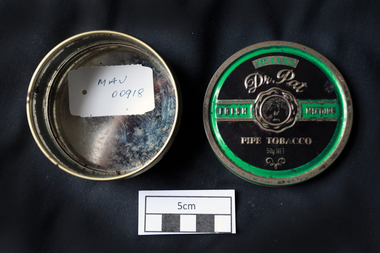
Containers, tin 'Dr Pat' pipe tobacco, 20thC
... The purchase gave Imperial Tobacco Australia an opening market share of 17.1%.27 Imperial Tobacco Australia ranked third in cigarettes sales in 2009, with a volume share of 16.2%. ...The purchase gave Imperial Tobacco Australia an opening market share of 17.1%.27 Imperial Tobacco Australia ranked third in cigarettes sales in 2009, with a volume share of 16.2%. imperial tobacco australia ltd, tobacco, cigarettes, cigars, moorabbin, bentleigh, cheltenham, dr. pat pipe tobacco, cigarette manufacturers Lid : DELUXE / Dr PAT' / IRISH MIXTURE / PIPE TOBACCO / 50g NET A circular tin with screw top contained pipe tobacco 'Dr Pat ' brand Containers, tin 'Dr Pat' pipe tobacco Imperial Tobacco Australia ...Dr.Pat, a brand of both cigarette and pipe tobacco, are produced and sold by Imperial Tobacco Australia. It is an aromatic blend of Irish and other fine cut tobaccos. Dr.Pat is sold only in New Zealand and Australia. Imperial Tobacco Australia Limited is the smallest and most recently formed of the tobacco companies operating within Australia. Imperial Tobacco Australia was established to coincide with the merger of WD & HO Wills Holdings Limited and Rothmans Holdings Limited as British American Tobacco Australia. At the time of the proposed merger, concerns were raised about the likelihood for reduction in competition in the Australian marketplace, thereby potentially causing a breach of Section 50 of the Trade Practices Act 1974. The Australian Competition and Consumer Commission agreed to permit the merger to proceed, on condition that another tobacco company enter the Australian market. The UK-based Imperial Tobacco Group was invited to enter the Australian market and in September 1999, Imperial Tobacco Australia commenced operations.26, 27 As part of the agreement allowing the formation of British American Tobacco Australia, Imperial Tobacco Australia was sold a portfolio of cigarette, roll-your-own tobacco and cigarette paper trademarks previously owned by Rothmans or WD & HO Wills for the sum of $325 million. The purchase gave Imperial Tobacco Australia an opening market share of 17.1%.27 Imperial Tobacco Australia ranked third in cigarettes sales in 2009, with a volume share of 16.2%. A circular tin with screw top contained pipe tobacco 'Dr Pat ' brandLid : DELUXE / Dr PAT' / IRISH MIXTURE / PIPE TOBACCO / 50g NETimperial tobacco australia ltd, tobacco, cigarettes, cigars, moorabbin, bentleigh, cheltenham, dr. pat pipe tobacco, cigarette manufacturers -
 National Wool Museum
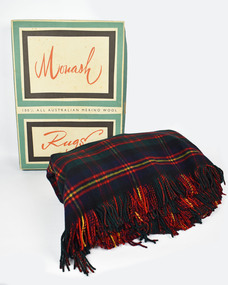
Textile - Rug, Returned Soldiers and Sailors Mill, 1963
... Included in these troubles was the RS&S Mill which saw the number of employees gradually decrease and business declining with cheaper imports beginning to grab an expanding part of the market share. The mill was eventually purchased by Godfrey Hirst in 1973 who tried to continue operations without success and in June 1975 textile production at the site ceased. ...Included in these troubles was the RS&S Mill which saw the number of employees gradually decrease and business declining with cheaper imports beginning to grab an expanding part of the market share. The mill was eventually purchased by Godfrey Hirst in 1973 who tried to continue operations without success and in June 1975 textile production at the site ceased. ...The Returned Soldiers and Sailors Mills was located near the Barwon river on Pakington Street, Geelong, where its building still stands. The mill was established in October 1922 with capital acquired from War Gratuity Bonds. The mill produced fine grade woollen products with its speciality being ‘Retsol’ travelling rugs. The mill first began to run into financial troubles with the ‘Credit Squeeze’ or the ‘Holt Jolt’ of the early 1960s. This saw import restrictions lifted which triggered the start of a minor recession and a rise in unemployment. Included in these troubles was the RS&S Mill which saw the number of employees gradually decrease and business declining with cheaper imports beginning to grab an expanding part of the market share. The mill was eventually purchased by Godfrey Hirst in 1973 who tried to continue operations without success and in June 1975 textile production at the site ceased. Outside of financial considerations contributing to the closure of Woollen Mills in this period was the declining need for heavier fabrics as in-home heating and insulation improved. This need had been replaced for a demand for ever softer, finer and lighter worsted fabrics for more casual clothing. Modern day textile production requires fewer steps in the processing of materials for this use. This meant large factory complexes such as early woollen mills like the RS&S mills were no longer required. Compared to modern textile production which can spin a fine yarn out of synthetic fibre or imported cotton easily, spinning fine yarn from medium quality wool at a textile factory was cumbersome and no longer financially viable to suit new consumer demands. This rug provides context to this statement. It was gifted to Shirley and Gordon Green as a wedding present in November 1963 by one of Gordon's colleagues in the wool industry. Living in areas such as Neutral Bay, the Hornsby area and later in life retiring to the Central Coast, the blanket was too heavy for use in these weather conditions and hence it stayed in its original box for nearly 60 years. Top and bottom of rug has frilled edges. Pattern is titled the 'Clan Cameron' and is repeated in a 7x7 grid. Front of rug has a red background with 4 vertical and horizontal lines. All is surrounded by a yellow boarder. Label is stitched into the bottom right corner. Reverse of rug also has a repeating 7x7 grid. Blue background with thick green horizontal stripe. Yellow and red boarder to the grid with 4 red vertical and horizontal lines making up the interior. Rug measure 1550 x 2040mm, approximately the same size as a queen size mattress.Wording, Bottom right corner. THE GEELONG R.S&S. WOOLEN MILLS/ PURE/ WOOL/ AUSTRALIA/ The John Monash Rug (cursive)/ The Clan Cameron (cursive)rs&s mills, textile manufacture, rug, clan cameron, sydney greasy wool exchange -
 Flagstaff Hill Maritime Museum and Village
Book - Periodical Essays, Dr. Samuel Johnson et al, The Rambler, The Idler, The Adventurer & The Connoisseur, 1876
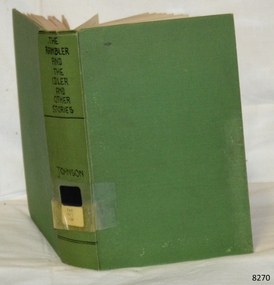
... Nimmo carved out a massive market share by publishing "Standard Libraries" and "Popular Poets" collections. ...Nimmo carved out a massive market share by publishing "Standard Libraries" and "Popular Poets" collections. ...This single 1876 volume combines four of the most influential weekly and semi weekly periodical essay series of the mid-18th century. Despite the phrasing of the era, these are not fiction stories or novels. They are periodical essays brief, single-topic pieces written to critique, educate, and entertain 18th-century readers. The collection covers three themes: morality and human nature, with a focus on reflections relating to the disappointments of life, the inevitability of death, managing one's passions, and the search for true happiness, featuring mainly in The Rambler; social satire and manners, with lighthearted and witty take downs of London high society, modern trends, vanity, and standard eccentric characters of the town; and literary criticism, with essays that analyse contemporary poetry and the theatre, along with the evolving English language.Hard cover book,The Rambler & The Idler Author: Dr. Samuel Johnson, Mr. Town, John Hawkesworth Publisher: William P Nimmo, 14 King William St, The Strand, London. W1. Date: 1876 Further Information: The flyleaf reads The Rambler and the Idler. By Samuel Johnson. The Adventurer. By John Hawkesworth. The Connoisseur. By (Mr. Town Pen Name) Green Cloth hardcover with a green spine and lettering in black texter. The spine has a Library label with an inscription.non-fictionThis single 1876 volume combines four of the most influential weekly and semi weekly periodical essay series of the mid-18th century. Despite the phrasing of the era, these are not fiction stories or novels. They are periodical essays brief, single-topic pieces written to critique, educate, and entertain 18th-century readers. The collection covers three themes: morality and human nature, with a focus on reflections relating to the disappointments of life, the inevitability of death, managing one's passions, and the search for true happiness, featuring mainly in The Rambler; social satire and manners, with lighthearted and witty take downs of London high society, modern trends, vanity, and standard eccentric characters of the town; and literary criticism, with essays that analyse contemporary poetry and the theatre, along with the evolving English language.flagstaff hill, warrnambool, shipwrecked coast, flagstaff hill maritime museum, maritime museum, shipwreck coast, flagstaff hill maritime village, great ocean road, book, pattison collection, warrnambool library, warrnambool mechanics’ institute, ralph eric pattison, corangamite regional library service, warrnambool city librarian, mechanics’ institute library, victorian library board, warrnambool books and records, warrnambool children’s library, the rambler and the idler, john hawkesworth., mr. town, samuel johnson -
 Federation University Historical Collection
Computer, Mutlitech Industrial Corporation, Micro-Professor MPF-IP and manuals, 1983 (estimated)
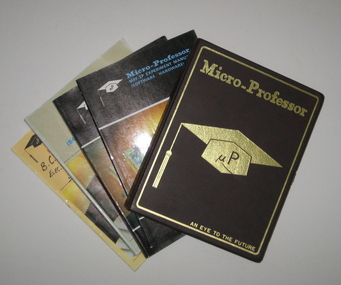
... Zilog lost most of its market share when it developed the 16 bit Z8000 microprocessor. ...Zilog lost most of its market share when it developed the 16 bit Z8000 microprocessor. ...The Micro-Professor I Plus (MPF-IP) was a low cost, versatile microcomputer system featuring sophisticated software and hardware capabilities. (MPF-IP) boasted a display panel with the ability to display 20 characters using 16-segment fonts. All 64 standard ASCII characters could be displayed. The operation of the MPF-IP was controlled by an 8k monitor program which resides in the Read Only Memory (ROM). The monitor, aided by 4k Random Access Memory (RAM), enabled the user to enter a comprehensive set of single keystroke commands, making it easier for the user to use the CPU, memory and I/0 devices. This allowed the user to concentrate of microprocessor software development and application design. The system allowed printing at 48 lines per minute, and the ability to permanently record the commands, data, programs, status and other messaged. Each character printed by the printer is in a 5 by 7 dot matrix. Although the prime purpose of the programming was for machine language object code formed as hexadecimal numbers, the Micro-Professor has an embedded Tiny Basic interpreter for which formation of some of the alpha characters using a standard 7 segment display was ingenious. The program memory consisted of non volatile 2 kilobytes electrically programmable ROM whilst the Random Access Memory came with 2 kilobytes of static RAM but could be upgraded to 4 kilobytes by insertion of another chip. The entire memory space of 64 kilobytes was accessible by way of the terminals on the left hand side of the board. Engineering and Science students from the Ballarat School of Mines and the Ballarat College of Advanced Education used a class set (as they were relatively inexpensive at approx. $100 each) during the mid to late 1980s. Student were encouraged to borrow the Micro-Professors in order to assist in learning how to use them. Only one was ever not returned on time. When pressed to return the device the student confessed that his dog had chewed the plastic case. This is still in our collection complete with bite marks! The Micro-Professor used a Zilog Z80 microprocessor. This was the most powerful of the 8 bit microprocessors at the time. Zilog was derived from the Intel 8080 microprocessor. The Z80 had 158 instructions of which the Intel 78 instructions were a subset. The Intel processor continued on through development in the IBM computers as 8086, 80286, 80386, 80486 and later the pentiums. Zilog lost most of its market share when it developed the 16 bit Z8000 microprocessor. Although the microprocessor was excellent, the lack of peripherals caused users to abandon Zilog products. A brown and gold plastic box containing a microcomputer for use in classrooms. Four manuals are titled 'Micro-Professor MPF-IP user's Manual', 'MPF-I Experiment Manual (Software/Hardware)', Micro-professor MPF-IP experiment Manual (Software/Hardware)' and Micro-Professor MPF-I Monitor Program Source Listing.microcomputer, micro computer, micro professor, electronics -
 Flagstaff Hill Maritime Museum and Village
Container - Ink bottle, MABIE TODD & Co. (Aust.) Pty. Ltd, Second half of 19th Century or first half of the 20th Century
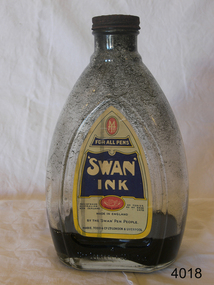
... But at the time they had no plans to enter into the market for the now growing interest in ballpoint pens, the result was the beginning of their slide into obscurity and subsequent demise. They became Biro Swan in 1952 following a large share...But at the time they had no plans to enter into the market for the now growing interest in ballpoint pens, the result was the beginning of their slide into obscurity and subsequent demise. They became Biro Swan in 1952 following a large share ...A Brief History Of Mabie Todd Ltd The company originated in America from the beginnings during the 1860s when a Mr. Todd and a Mr. Mabie began making pencil cases and pen holders in New York. Later they were joined by the Bard Brothers who made Gold nibs and by 1873 the company of Mabie Todd and Bard were established in New York. By 1878 the first patent was filed for the design and manufacture of a fountain pen, achieved under the design leadership of one William Washington Stewart. The first Swan fountain pen followed just 6 years later in 1884 with an over-under feed with ink delivery assisted by a twisted silver wire. This same year an office had been established in the UK with a showroom in Cheapside, London. The UK was being supplied with a steadily increasing supply of pens from New York and by 1905 new, larger showrooms were established in High Holborn. By this time the Swan pen had become synonymous with fountain pens at large. In 1906 the name of Bard was dropped in the US and the UK company subsequently adopted the title Mabie Todd & Co. New York. In 1907 British production began, using imported nibs from New York and whilst the company in the UK flourished, the business in the US started to diminish under stiff competition from new manufacturers.. By 1915 manufacturing was doing well in England from a factory in Weston Street, London and the New York company agreed to sell the rights to all European and Colonial business to Mabie Todd & Company Ltd of England. From then onwards, the development of the range mostly followed, rather than led the interests of the markets they were supplying. Even during the First World War the business continued to flourish. with factories in both London and Liverpool. At the end of 1919 a new expansion plan saw the establishment of a new Headquarters in Oxford Street, London. Throughout this period, some components were continuing to be imported from America, but gradually these diminished and during the 20s and 30s manufacturing facilities were expanded and by the end of the 1930s Mabie Todd were in full production, manufacturing pens in its London factory, gold nibs in Birmingham and ink in Liverpool. Another new headquarters grew out of this period of abundance and market domination. when in 1936 they moved into Sunderland House in Mayfair, London, a highly prized mansion building. Disaster struck early in the Second World War. Its prestigious Sunderland House headquarters was destroyed during the blitz, followed by destruction of its main factory in Harlesden, North London. Some machinery was saved and able to be used at another factory premises in the City, but like many other 'non essential' manufacturing, the main production was centred on wartime components such as rocket fuses and ammunition. After The War, in 1945 they moved out of their City premises to Park Royal and eventually in 1946 proper fountain pen production was resumed. In 1948 the company decided to go public. But at the time they had no plans to enter into the market for the now growing interest in ballpoint pens, the result was the beginning of their slide into obscurity and subsequent demise. They became Biro Swan in 1952 following a large share purchase by Biro Pens. Even though at this time they had just launched their new high profile Calligraph range to join the competition for the new market associated with a craze for italic writing, fountain pen manufacture under the new company was to suffer a lack of real support. The restyled ranges of 1956 failed to ignite market interest and with diminishing quality, the end of the Mabie Todd story was inevitable. After 80 years of Swan pens, the book was closed.This bottle of ink would have been supplied to schools. After a child was deemed old enough to progress from just using slate and board, he/she would have been supplied with a pen shaft made of wood and with a very basic metal nib. The ink bottle would be used to fill up the individual inkwells. This operation would have been conducted by the teacher him/herself, or by an older pupil under the close eye of the teacher.Ink bottle clear glass with 'Swan Ink' paper label. Has rusted screw on top & black ink inside.Label has 'Mabel Todd' manufacturer's logo at top,; 'Swan Ink' name clearly shown; 'Made in England' printed clearly; and 'Mable Todd & Co Ltd, London & Liverpool' printed at base of label.flagstaff hill, warrnambool, shipwrecked-coast, flagstaff-hill, flagstaff-hill-maritime-museum, maritime-museum, shipwreck-coast, flagstaff-hill-maritime-village, ink, bottle, mabie todd ltd -
Marysville & District Historical Society
THE TRIANGLE NEWS-VOL 39 NO 35-SEPTEMBER 14 2012
... marysville victoria australia marysville football awards night marysville & district football & netball club villains what's on when in september intrepid triangle bushwalkers lantern making workshop marysville community market marysville cfa-first aid course level 1 creative triangle kellock lodge alexandra church notices venue change for mav councillor information sessions kidz zone youth impact narbethong-granton residents marysville golf report triangle golf club events myths & legends night friends of the library alexandra buxton primary school triangle shared trails project taggerty community project management advertisements community project pledge for taggerty dalton fiske foundation triangle community dancers alexandra library september events real estate don giovanni opera comes to marysville habitat for humanity public information meeting busy times at marsyville for students marysville primary school councillor comment murrindindi shire council notice of special meeting of council public notice proposed sale of land councils transport connection program linking murrindindi guide to permanent bus service thefts disappointing for castella community castella central park victorian concert orchestra narbethong community hall THE TRIANGLE NEWS-VOL 39 NO 35-SEPTEMBER 14 2012 ...marysville, victoria, australia, marysville football awards night, marysville & district football & netball club, villains, what's on when in september, intrepid triangle bushwalkers, lantern making workshop, marysville community market, marysville cfa-first aid course level 1, creative triangle, kellock lodge alexandra, church notices, venue change for mav councillor information sessions, kidz zone youth impact, narbethong-granton residents, marysville golf report, triangle golf club events, myths & legends night, friends of the library alexandra, buxton primary school, triangle shared trails project, taggerty community project management, advertisements, community project pledge for taggerty, dalton fiske foundation, triangle community dancers, alexandra library september events, real estate, don giovanni opera comes to marysville, habitat for humanity public information meeting, busy times at marsyville for students, marysville primary school, councillor comment, murrindindi shire council, notice of special meeting of council, public notice, proposed sale of land, councils transport connection program, linking murrindindi, guide to permanent bus service, thefts disappointing for castella community, castella central park, victorian concert orchestra, narbethong community hall -
Marysville & District Historical Society
THE TRIANGLE NEWS-VOL 39 NO 36-SEPTEMBER 21 2012
... marysville victoria australia opera in marysville oz opera don giovanni opera comes to marysville bushwalking back in marysville marysville lions club what's on when in september intrepid triangle bushwalkers lantern making workshop marysville community market marysville cfa-first aid course level 1 council lobbies for support payment advertisements marysville golf report church notices fire season-slashing program buxton primary school triangle garden club events marysville golf club murrindindi shire council amnesty period on open aire burning marysville chamber of commerce triangle shared trails project taggerty community project meeting creative triangle position vacant-parks officer dalton fiske foundation triangle community dancers alexandra library september events real estate buxton reserve news narbethong reserve news cfa calls for victorians to register burn offs habitat for humanity public information meeting alexandra & district ambulance support council joins calling for defined super exemptions triangle community dinner mayor's chair marysville sparkling wine festival victorian concert orchestra narbethong community hall narbethong community garage sale THE TRIANGLE NEWS-VOL 39 NO 36-SEPTEMBER 21 2012 ...marysville, victoria, australia, opera in marysville, oz opera, don giovanni opera comes to marysville, bushwalking back in marysville, marysville lions club, what's on when in september, intrepid triangle bushwalkers, lantern making workshop, marysville community market, marysville cfa-first aid course level 1, council lobbies for support payment, advertisements, marysville golf report, church notices, fire season-slashing program, buxton primary school, triangle garden club events, marysville golf club, murrindindi shire council, amnesty period on open aire burning, marysville chamber of commerce, triangle shared trails project, taggerty community project meeting, creative triangle, position vacant-parks officer, dalton fiske foundation, triangle community dancers, alexandra library september events, real estate, buxton reserve news, narbethong reserve news, cfa calls for victorians to register burn offs, habitat for humanity, public information meeting, alexandra & district ambulance support, council joins calling for defined super exemptions, triangle community dinner, mayor's chair, marysville sparkling wine festival, victorian concert orchestra, narbethong community hall, narbethong community garage sale -
Marysville & District Historical Society
THE TRIANGLE NEWS-VOLUME 40 NO 4-FEBRUARY 8 2013
... marysville victoria australia changes at ceaco what's on when in february buxton recreation reserve committee meeting inviting public the committee of management of the gallipoli park precinct marysville brownie guides marysville community market creative triangle mystic mountains tourism general members meeting lions library tool library temporary road closure darwin street marysville lake mountain cycling challenge advertisements church notices world day of prayer lakeside fellowship eildon funded governance training available for community groups marysville community golf & bowls club happy hour triangle shared trails project final taggerty community project meeting murrindindi shire council notice of special meeting of council mayor's chair intrepid triangle bushwalkers works to improve rail trail experience marysville lolly shop councillor comment marysville golf report marysville triangle men's shed working bee volunteers needed community bbq gallipoli park marysville & triangle community foundation ltd marysville world's longest lunch final decision needed for taggerty community project mops sale payment of rates and charges buxton recreation reserve development works update el kanah 2 shows in 1 night sarah jones-ventriloquist dennis coard-comedian marysville cultural community real estate THE TRIANGLE NEWS-VOLUME 40 NO 4-FEBRUARY 8 2013 ...marysville, victoria, australia, changes at ceaco, what's on when in february, buxton recreation reserve, committee meeting inviting public, the committee of management of the gallipoli park precinct, marysville brownie guides, marysville community market, creative triangle, mystic mountains tourism general members meeting, lions library tool library, temporary road closure darwin street, marysville lake mountain cycling challenge, advertisements, church notices, world day of prayer, lakeside fellowship eildon, funded governance training available for community groups, marysville community golf & bowls club, happy hour, triangle shared trails project, final taggerty community project meeting, murrindindi shire council, notice of special meeting of council, mayor's chair, intrepid triangle bushwalkers, works to improve rail trail experience, marysville lolly shop, councillor comment, marysville golf report, marysville triangle men's shed, working bee volunteers needed, community bbq gallipoli park, marysville & triangle community foundation ltd, marysville world's longest lunch, final decision needed for taggerty community project, mops sale, payment of rates and charges, buxton recreation reserve development works update, el kanah 2 shows in 1 night, sarah jones-ventriloquist, dennis coard-comedian, marysville cultural community, real estate -
Marysville & District Historical Society
THE TRIANGLE NEWS-VOL 40 NO 5-FEBRUARY 15 2013
... marysville victoria australia camp marysville opens steel pans band prepare for festival what's on when in february buxton recreation reserve committee meeting for public the committee of management of the gallipoli park precinct marysville primary school creative triangle marysville community market yea wetlands project development state government melbourne water's regional benefits program yea wetlands trust church news mt cathedral community baptist church lakeside fellowship eildon world day of prayer intrepid triangle bushwalkers community happy hour marysville golf & bowls club maryton beer & platter garden modern life music school triangle shared trails project madrats weekend black spur inn bbq gallipoli oval marysville & district kindergarten centre preschool centre preschool director required mayor's chair motorhome weekend thank you community district nurse duck hunting protesters fined advertisements dalton fiske foundation grants awards councillor comment murrindindi shire council library officer wanted alexandra library good results for marysville golfers in the murrindindi masters marysville brownie guides agm marysville triangle youth funded governance training available for community groups marysville & triangle community foundation world's longest lunch marysville council's roadside fire prevention works continue invitation celebrating positive ageing help save marysville trees marysville fire brigade presentation night valentine's dinner maryton el kanah 2 great shows ventriloquist sarah jones comedian dennis coard marysville cultural community real estate THE TRIANGLE NEWS-VOL 40 NO 5-FEBRUARY 15 2013 ...marysville, victoria, australia, camp marysville opens, steel pans band prepare for festival, what's on when in february, buxton recreation reserve, committee meeting for public, the committee of management of the gallipoli park precinct, marysville primary school, creative triangle, marysville community market, yea wetlands project development, state government, melbourne water's regional benefits program, yea wetlands trust, church news, mt cathedral community baptist church, lakeside fellowship eildon, world day of prayer, intrepid triangle bushwalkers, community happy hour, marysville golf & bowls club, maryton beer & platter garden, modern life music school, triangle shared trails project, madrats weekend, black spur inn, bbq gallipoli oval, marysville & district kindergarten centre, preschool centre, preschool director required, mayor's chair, motorhome weekend, thank you community, district nurse duck hunting protesters fined, advertisements, dalton fiske foundation grants awards, councillor comment, murrindindi shire council, library officer wanted, alexandra library, good results for marysville golfers in the murrindindi masters, marysville brownie guides agm, marysville triangle youth, funded governance training available for community groups, marysville & triangle community foundation, world's longest lunch marysville, council's roadside fire prevention works continue, invitation celebrating positive ageing, help save marysville trees, marysville fire brigade presentation night, valentine's dinner maryton, el kanah 2 great shows, ventriloquist sarah jones, comedian dennis coard, marysville cultural community, real estate -
Marysville & District Historical Society
THE TRIANGLE NEWS-VOL 40 NO 26-JULY 12 2013
... marysville victoria australia tumbling waters recreation reserve vicroads murrindindi shire council library services joe dolce singer and poet barry dickins playwright what's on when in july marysville cricket club agm the committee of management of the gallipoli park precinct marysville community market creative triangle one poor quarter costs villains the game marysville football club church notices marysville & district lions club lakeside fellowship eildon intrepid triangle buswalkers councillor comment marysville primary school parents club mayor's chair marysville community centre an invitation australian centre for grief and bereavement 2009 bushfire survivors ugfm presents a taste of tamworth fundraiser concert at alexandra town hall advertisements coming to lake mountain school holiday white christmas marysville & district historical society sharing community stories for historical archives lake mountain alpine resort christmas in july gala dinner real estate triangle arts group 1000 hands project a meaningful art installation for marysville police news cross country ski hire tender right workshop lions triangle tool library department of environment & primary industries fox control marysville branch liberal party christmas in july dinner marysville and surrounds events program funding available eildon and marysville turn for free mulch loading municipal public health and wellbeing plan 2013-2017 buxton recreation reserve notice of agm alexandra tennis club committee of management notice of agm murrindindi shire council community leadership programs clp wood stolen marysville lions club THE TRIANGLE NEWS-VOL 40 NO 26-JULY 12 2013 ...marysville, victoria, australia, tumbling waters recreation reserve, vicroads, murrindindi shire council library services, joe dolce singer and poet, barry dickins playwright, what's on when in july, marysville cricket club agm, the committee of management of the gallipoli park precinct, marysville community market, creative triangle, one poor quarter costs villains the game, marysville football club, church notices, marysville & district lions club, lakeside fellowship eildon, intrepid triangle buswalkers, councillor comment, marysville primary school, parents club, mayor's chair, marysville community centre, an invitation australian centre for grief and bereavement, 2009 bushfire survivors, ugfm presents a taste of tamworth, fundraiser concert at alexandra town hall, advertisements, coming to lake mountain school holiday white christmas, marysville & district historical society, sharing community stories for historical archives, lake mountain alpine resort christmas in july gala dinner, real estate, triangle arts group, 1000 hands project, a meaningful art installation for marysville, police news, cross country ski hire, tender right workshop, lions triangle tool library, department of environment & primary industries, fox control, marysville branch liberal party christmas in july dinner, marysville and surrounds events program funding available, eildon and marysville turn for free mulch loading, municipal public health and wellbeing plan 2013-2017, buxton recreation reserve notice of agm, alexandra tennis club committee of management notice of agm, murrindindi shire council, community leadership programs, clp, wood stolen, marysville lions club -
Marysville & District Historical Society
THE TRIANGLE NEWS-VOL 40 NO 27-JULY 19 2013
... marysville victoria australia 1000 hands 1000 hands a place of reflection hope and comunity spirit marysville gallipoli park what's on when in july intrepid triangle bushwalkers the committee of management of the gallipoli park precinct marysville community market creative triangle planning scheme changes proposed to protect our heritage marysville & district lions club water diving course (scuba) church notices view marysville golf and bowls clubhouse redevelopment plans councillor comment advertisements narbethong community hall free movie night real estate marysville preschool hosts annual fundraiser footy-pie night an invitation australian centre for grief and bereavement marysville community centre new pharmacy opening july stolen wood council will progress some parts of kft plan murrindindi shire council notice of application for planning permit marysville historical society sharing community stories for historical archives black spur inn marysville villains marysville football club reunion premiers 1973 mayor's chair buxton fire brigade marysville and surrounds events program funding available tender right workshop municipal public health and wellbeing plan 2013-2017 buxton recreation reserve notice of agm alexandra tennis club committee of management notice of agm THE TRIANGLE NEWS-VOL 40 NO 27-JULY 19 2013 ...marysville, victoria, australia, 1000 hands, 1000 hands a place of reflection hope and comunity spirit, marysville gallipoli park, what's on when in july, intrepid triangle bushwalkers, the committee of management of the gallipoli park precinct, marysville community market, creative triangle, planning scheme changes proposed to protect our heritage, marysville & district lions club, water diving course (scuba), church notices, view marysville golf and bowls clubhouse redevelopment plans, councillor comment, advertisements, narbethong community hall, free movie night, real estate, marysville preschool hosts annual fundraiser footy-pie night, an invitation australian centre for grief and bereavement, marysville community centre, new pharmacy opening july, stolen wood, council will progress some parts of kft plan, murrindindi shire council, notice of application for planning permit, marysville historical society, sharing community stories for historical archives, black spur inn, marysville villains, marysville football club reunion premiers 1973, mayor's chair, buxton fire brigade, marysville and surrounds events program funding available, tender right workshop, municipal public health and wellbeing plan 2013-2017, buxton recreation reserve notice of agm, alexandra tennis club committee of management notice of agm -
Marysville & District Historical Society
THE TRIANGLE NEWS-VOL 40 NO 28-JULY 26 2013
... marysville victoria australia international delegates look to murrindindi leadership what's on when in august intrepid triangle bushwalkers the committee of management of the gallipoli park precinct creative triangle marysville community market captive bred regent honeyeaters put on a show at chiltern department of environment & primary industries marysville & district lions club water diving course (scuba) church notices new beginnings my hope for australia paster charles & marjorie lazaro from india councillor comment narbethong community hall free movie night marysville preschool hosts annual fundraiser footy-pie night taggerty community dinner pioneer reserve gets a minor makeover stolen wood piece of history to take root in shire murrindindi shire council the hovell tree school crossing safely the marysville historical society sharing community stories for historical archives real estate marysville football club reunion premiers 1973 black spur inn ugfm presents a taste of tamworth snags survey to guide work on victorian rivers mayor's chair australian grief and bereavement centre buxton fire brigade bushdance at buxton hall triangle community dance group lions-wood raffle have your say on new national parks regulations municipal public health and wellbeing plan 2013-2017 buxton recreation reserve notice of agm alexandra tennis club committee of management notice of agm THE TRIANGLE NEWS-VOL 40 NO 28-JULY 26 2013 ...marysville, victoria, australia, international delegates look to murrindindi leadership, what's on when in august, intrepid triangle bushwalkers, the committee of management of the gallipoli park precinct, creative triangle, marysville community market, captive bred regent honeyeaters put on a show at chiltern, department of environment & primary industries, marysville & district lions club, water diving course (scuba), church notices, new beginnings my hope for australia, paster charles & marjorie lazaro from india, councillor comment, narbethong community hall, free movie night, marysville preschool hosts annual fundraiser footy-pie night, taggerty community dinner, pioneer reserve gets a minor makeover, stolen wood, piece of history to take root in shire, murrindindi shire council, the hovell tree, school crossing safely, the marysville historical society, sharing community stories for historical archives, real estate, marysville football club reunion premiers 1973, black spur inn, ugfm presents a taste of tamworth, snags survey to guide work on victorian rivers, mayor's chair, australian grief and bereavement centre, buxton fire brigade, bushdance at buxton hall, triangle community dance group, lions-wood raffle, have your say on new national parks regulations, municipal public health and wellbeing plan 2013-2017, buxton recreation reserve notice of agm, alexandra tennis club committee of management notice of agm -
 City of Moorabbin Historical Society (Operating the Box Cottage Museum)
Manufactured Glass, bottle 'Listerine' with wrapper, 20thC
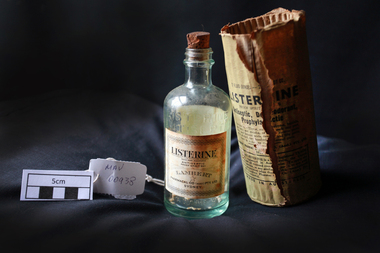
... share to the Lambert Pharmacal Company. Listerine was packaged in a glass bottle inside a corrugated cardboard tube for nearly 80 years before the first revamps were made to the brand. In 1992, Cool Mint Listerine was introduced in addition to the original Listerine Antiseptic formula and, in 1994, both brands were introduced in plastic bottles for the first time. . From 1921 until the mid-1970s, Listerine was also marketed...share to the Lambert Pharmacal Company. Listerine was packaged in a glass bottle inside a corrugated cardboard tube for nearly 80 years before the first revamps were made to the brand. In 1992, Cool Mint Listerine was introduced in addition to the original Listerine Antiseptic formula and, in 1994, both brands were introduced in plastic bottles for the first time. . From 1921 until the mid-1970s, Listerine was also marketed ...Listerine is a brand of antiseptic mouthwash product named after Sir Joseph Lister, Bt. FRS (1827 – 1912), who was a British surgeon and a pioneer of antiseptic surgery. By applying Louis Pasteur's advances in microbiology, he promoted the idea of sterile surgery while working at the Glasgow Royal Infirmary. 1865 Lister successfully introduced carbolic acid (now known as phenol) to sterilise surgical instruments, clean wounds, and for washing surgeons hands before and after operations. These measures led to a reduction in post-operative infections and made surgery safer for patients. “Listerine” was formulated by Dr. Joseph Lawrence and Jordan Wheat Lambert in St. Louis, Missouri, in 1879 as surgical antiseptic, it was given to dentists for oral care in 1895 It was later sold, in distilled form, as both a floor cleaner and a cure for gonorrhoea. But it wasn't a runaway success until the 1920s, when it was advertised as a solution for "chronic halitosis"— a then obscure medical term for bad breath.. In just seven years, the company's revenues rose from $115,000 to more than $8 million.. In 1885, Lawrence sold his share to the Lambert Pharmacal Company. Listerine was packaged in a glass bottle inside a corrugated cardboard tube for nearly 80 years before the first revamps were made to the brand. In 1992, Cool Mint Listerine was introduced in addition to the original Listerine Antiseptic formula and, in 1994, both brands were introduced in plastic bottles for the first time. . From 1921 until the mid-1970s, Listerine was also marketed as a preventive and remedy for colds and sore throats. In 1976, the Federal Trade Commission ruled that these claims were misleading, Originally marketed by the Lambert Pharmacal Company (which later became Warner-Lambert), since 2006 it is manufactured and distributed by Johnson & Johnson In 2009, Johnson and Johnson launched a new alcohol-free version of the product called Listerine Zero. The screw top indicates that the bottle was manufactured post-1920sA clear glass bottle, with a rubber stopper, wrapped in corrugated cardboard containing 'Listerine' mouth rinse .Front Label: LISTERINE / TRADE MARK REGISTERED / ANTISEPTIC / PROOF SPIRIT 50% / LAMBERT / a star / PHARMACAL COMPANY (AUST.) PTY LTD / SYDNEY Back Label : Instructions for use .......... on bottle : LISTERINE ANTISEPTIC / LAMBERT on cardboard wrapper ; 7 FLUID OZ. / LISTERINE / PROOF SPIRIT 50% / ANTISEPTIC, DEODORANT, / PROPHYLACTICpharmacy, listerine, lister joseph, lawrence dr. joseph, lambert jordan wheat, missouri, glasgow royal infirmary, infectious diseases, johnson & johnson ltd., surgery, antiseptics, medicine, pasteur louis, france -
City of Moorabbin Historical Society (Operating the Box Cottage Museum)
Newsletter - CMHS Moorabbin Mirror Vol 6 April 2016, Moorabbin Mirror Vol 6 April 2016, April 2016
... shared light refreshments before welcoming visitors to the BCM Extra Open Day. Unfortunately Lorna Thatcher was unable to attend due to a sudden illness and Committee and members sent Get Well wishes via Frank. The Diary informs members of the Extra Open Days, upcoming publicity events , Meetings and Community Group visits to BCM, Local interest items include Lees Nursery, Market Gardening Heritage, Westall UFO, Joyce Park Playground Solar System., Moorabbin Ten Pin Bowl and the School Amateur Radio Special Event. ...shared light refreshments before welcoming visitors to the BCM Extra Open Day. Unfortunately Lorna Thatcher was unable to attend due to a sudden illness and Committee and members sent Get Well wishes via Frank. The Diary informs members of the Extra Open Days, upcoming publicity events , Meetings and Community Group visits to BCM, Local interest items include Lees Nursery, Market Gardening Heritage, Westall UFO, Joyce Park Playground Solar System., Moorabbin Ten Pin Bowl and the School Amateur Radio Special Event. ...This is Vol. 6 of the Moorabbin Mirror produced by CMHS members Fran & Holger Bader , Valma Sharp April 2016 The Moorabbin Mirror reflects the history and heritage of the former City of Moorabbin — derived from Mooroobin, ‘a resting place’ in the Bunurrung spoken language. In 1994, the City of Moorabbin was integrated into the Cities of Bayside, Glen Eira, Kingston and Monash. This issue of the Moorabbin Mirror is dedicated to all the young, and not so young, men and women from the former City of Moorabbin who served ‘King and Country’ during the Great War. Especially those who never came home including a photo of WW1 Mordialloc Memorial and the 2016 Local Commemorative Services. Valma Sharp CMHS President 'officially opened' the new WC and thanked GECC for this amenity. Members and Guests then shared light refreshments before welcoming visitors to the BCM Extra Open Day. Unfortunately Lorna Thatcher was unable to attend due to a sudden illness and Committee and members sent Get Well wishes via Frank. The Diary informs members of the Extra Open Days, upcoming publicity events , Meetings and Community Group visits to BCM, Local interest items include Lees Nursery, Market Gardening Heritage, Westall UFO, Joyce Park Playground Solar System., Moorabbin Ten Pin Bowl and the School Amateur Radio Special Event. The Committee is very grateful for the help provided by David Hardham GEHS to set up our new CMHS website. An informative article re the 2012 GESAC that replaced the 1964 Olympic Pool. Information is requested for the Roving Curator August Rietman display 2017.This is Vol. 6 of the Moorabbin Mirror, Newsletter of CMHS April 2016A4 x 3 paper folded to A5 x 6pp with colour photographs. Moorabbin / Mirror / April 2016 Vol 6moorabbin mirror, bader fran, bader holger, sharp valma, hardham david, thatcher lorna, anzac memorial mordialloc, anzac, lees nursery thomas st brighton east, gesac, moorabbin ten pin bowling, joyce park playground ormond, bentleigh, moorabbin, mckinnon, roving curator program mav, westall ufo, -
 City of Moorabbin Historical Society (Operating the Box Cottage Museum)
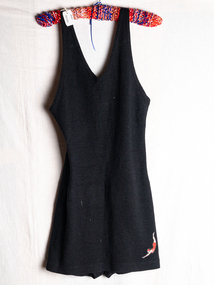
Clothing - Clothing, men's swim costume wool, 'Jantzen', 1930
... National magazines such as Esquire, the Saturday Evening Post, Life, and Colliers published advertisements illustrated by George Petty. 2010 Jantzen has achieved new levels of success this decade through social media, attracting thousands of fans around the world who share their own memories about their favorite Jantzen suits throughout the decades Early settlers and market gardeners established their families in Moorabbin Shire c1900 and after World War 1 soldiers were assisted to purchase land near the railway line. ...National magazines such as Esquire, the Saturday Evening Post, Life, and Colliers published advertisements illustrated by George Petty. 2010 Jantzen has achieved new levels of success this decade through social media, attracting thousands of fans around the world who share their own memories about their favorite Jantzen suits throughout the decades Early settlers and market gardeners established their families in Moorabbin Shire c1900 and after World War 1 soldiers were assisted to purchase land near the railway line. ...In 1910, Portland Knitting Company began in downtown Portland, Oregon, with a few hand-knitting machines above a tiny retail store. Little did founders Carl Jantzen, Roy and John Zehntbauer know that they would achieve both fame and controversy as swimwear pioneers. Producing a wool suit for a rowing team they began offering "bathing suits" in their catalog. Knit on sweater cuff machines, the suits became popular with swimmers. The demand increased for those "Jantzens" and the company name was changed in 1918 to Jantzen Knitting Mills. The suits were made of 100% pure virgin wool. Matching stockings and stocking cap completed the costume of the day. Early advertisements guaranteed the famous rib-stitch "gives that wonderful fit". c1930 Jantzen catalogs featured upcoming movie stars, including Loretta Young, Joan Blondell, Ginger Rogers, and Dick Powell. National magazines such as Esquire, the Saturday Evening Post, Life, and Colliers published advertisements illustrated by George Petty. 2010 Jantzen has achieved new levels of success this decade through social media, attracting thousands of fans around the world who share their own memories about their favorite Jantzen suits throughout the decades Early settlers and market gardeners established their families in Moorabbin Shire c1900 and after World War 1 soldiers were assisted to purchase land near the railway line. By 1930 the population had grown with new families who had other occupations - office workers in Melbourne, tradesmen, teachers, etc - and they raised their families in Bentleigh, McKinnon, Ormond, Moorabbin and Cheltenham.Early settlers and market gardeners established their families in Moorabbin Shire c1900 and after World War 1 soldiers were assisted to purchase land near the railway line. By 1930 the population had grown with new families who had other occupations - office workers in Melbourne, tradesmen, teachers, etc - and they raised their families in Bentleigh, McKinnon, Ormond, Moorabbin and Cheltenham. Clothing, men's swim costume wool, 'Jantzen' c1930 clothing, brighton, moorabbin, pioneers, market gardeners, early settlers, moorabbin shire, bentleigh, mckinnon, dairy farms, fruit orchards, swimwear -
 Orbost & District Historical Society
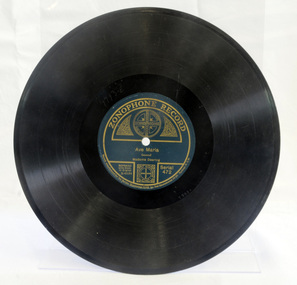
gramophone record, Ave Maria / Ora Pro Nobis, 1930's-1940's
... Records retained the largest market share even when new formats such as compact cassette were mass-marketed.. ...Zonophone was a record label founded in 1899 in Camden, New Jersey, by Frank Seaman. The Zonophone name was not that of the company, but was applied to the records and machines sold by Seaman from 1899–1900 to 1903. In the United Kingdom and the Commonwealth, the Gramophone Company continued to use the Zonophone label until 1931. 'Zonophone' indicates the British label rather than Zon - O- Phone, the earlier American label. Madame Deering was Eleanor Jones-Hudson. Eleanor Jones-Hudson (1874-1946) was a Welsh soprano and wife of the flautist Eli Hudson. She recorded extensively for the Gramophone Company, in excerpts from opera, operetta, oratorio, ballads and songs. She was sometimes credited as Alvena Yarrow and as Madame Deering. The phonograph disc record was the primary medium used for music reproduction until late in the 20th century, replacing the phonograph cylinder record—with which it had co-existed from the late 1880's through to the 1920's. Records retained the largest market share even when new formats such as compact cassette were mass-marketed.. (ref Wikipedia) This item is an example of an item once commonly found in homes. By the late 1980s until 1991, digital media, in the form of the compact disc, gradually replaced the vinyl record.A black gramophone record with a blue and gold label - Zonophone. One side is Ave Maria sung in English by Madame Deering, a soprano, with orchestra and chorus. On the other side is Ora Pro Nobis (Pray For Us). It has the serial no. 472.Pressed onto the Ave Maris side is 7793-e.zonophone gramophone-record madame-deering-eleanor-jones-hudson ave-maria -
 Orbost & District Historical Society
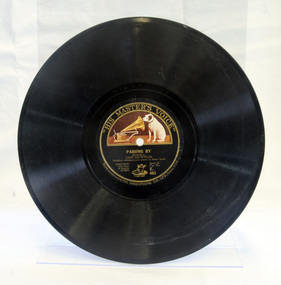
gramophone record, circa 1929
... By the late 1980s, digital media, in the form of the compact disc, had gained a larger market share, and the vinyl record left the mainstream in 1991. ...John Donald Mackenzie Brownlee (7 January 1900 – 10 January 1969) was an Australian operatic baritone. For most of his professional career he was based in Europe and then United States. He married former Countess Donna Carla Oddone di Feletto in Paris on 29 November 1928, and the couple had a daughter and two sons. He died in New York and was buried in Ferncliff cemetery, Hartsdale. (ref. www.operafolks.com)The phonograph disc record was the primary medium used for music reproduction until late in the 20th century, replacing the phonograph cylinder record—with which it had co-existed from the late 1880s through to the 1920s—by the late 1920s. Vinyl records were still the most popular medium even when new formats such as compact cassette were mass-marketed. By the late 1980s, digital media, in the form of the compact disc, had gained a larger market share, and the vinyl record left the mainstream in 1991. This item is an example of the music popular in the the first decades of the 20th century.A black phonograph record - "His Master'sVoice". On the A side is Passing By (melody by Edward Purcell)) sung by John Brownlee, a baritone, accompanied by piano. On the B side is King Charles (music by Maude Valerie White) also sung by John Brownlee,E 483gramophone-record brownlee-john music -
 Orbost & District Historical Society
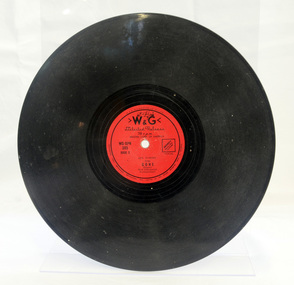
gramophone record, 1950's -1970's
... By the late 1980s, digital media, in the form of the compact disc, had gained a larger market share, and the vinyl record left the mainstream in 1991. gramophone-record music-country WC - XPN Aberbach 395 Aust Pty Ltd A 78 rpm black gramophone record. ...In the late 40s and 50s country music was very popular in Australia. In a relatively short time from the late 50s, rock & roll had supplanted other genres of popular music, dominating the city stages and radio and TV airwaves. Country music remained popular in regional country areas.This item is an example of music popular in the 1940's and 1950's in country Australia. The phonograph disc record was the primary medium used for music reproduction until late in the 20th century, replacing the phonograph cylinder record. Records were still the most popular medium even when new formats such as compact cassette were mass-marketed. By the late 1980s, digital media, in the form of the compact disc, had gained a larger market share, and the vinyl record left the mainstream in 1991.A 78 rpm black gramophone record. On the A side is Ninety-Nine Ways, sung by Johnny Frank and on the b side is Gone by Rex Turner. It is a W. & G. Elected Release from the Aberbach Album Series.WC - XPN Aberbach 395 Aust Pty Ltd gramophone-record music-country -
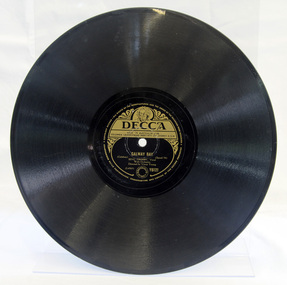 Orbost & District Historical Society
gramophone record, 1949
... By the late 1980s, digital media, in the form of the compact disc, had gained a larger market share, and the vinyl record left the mainstream in 1991. ...Galway Bay was a hit around the world for the American singer Bing Crosby in the late 1940s. Crosby was very popular in Australia and had planned to visit Australia in 1949.The phonograph disc record was the primary medium used for music reproduction until late in the 20th century, replacing the phonograph cylinder record—with which it had co-existed from the late 1880s through to the late 1920s. Records were still the most popular media even when new formats such as compact cassette were mass-marketed. By the late 1980s, digital media, in the form of the compact disc, had gained a larger market share, and the vinyl record left the mainstream in 1991. This item is representative of the music popular in the mid 20th century.Double sided black disc with a single central hole. A side is Galway Bay. B side is My Girl's An Irish Girl. Both are vocal with orchestra by Bing Crosby. On the central label is Y6121 and detailed information of the maker, Columbia Gramophone Company (Aust)., in gold print on black background.Pressed - WL4583T20Aphonogram-record vinyl crosy-bing music-irish -
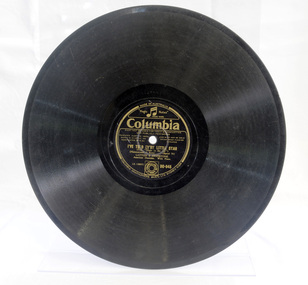 Orbost & District Historical Society
gramophone record, C 1930's
... Records retained the largest market share even when new formats such as compact cassette were mass-marketed. ..."I've Told Every Little Star" was a popular song with music by Jerome Kern and lyrics by Oscar Hammerstein II, published in 1932. The song was introduced in the musical play, Music in the Air. Layton & Johnstone were an American vocal and piano duo in the 1920s and 1930s, consisting of Turner Layton (baritone and piano) and Clarence “Tandy” Johnstone (tenor). The phonograph disc record was the primary medium used for music reproduction until late in the 20th century, replacing the phonograph cylinder record—with which it had co-existed from the late 1880s through to the late 1920s. Records retained the largest market share even when new formats such as compact cassette were mass-marketed. By the late 1980s, digital media, in the form of the compact disc, had gained a larger market share, and the vinyl record left the mainstream in 1991. This item is an example of music popular in the mid 20th century.Double sided black disc with a single central hole. The A side is "I've told Every Little Star" vocal with piano, Layton and Johnstone. The B side is "The Song Is You" sung by Turner Layton. There are details of the producers , Columbia Gramophone (Aust).DO-945gramophone-record music -
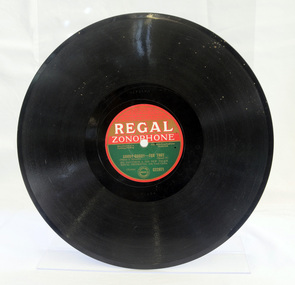 Orbost & District Historical Society
gramophone record, 1930's
... Records retained the largest market share even when new formats such as compact cassette were mass-marketed. ...James Hutchinson (Jim) Davidson (1902-1982), band leader, was born on 6 August 1902 at Balmain, Sydney. Davidson opened the winter season of 1933 at Sydney’s Palais Royal Dance Hall, which drew crowds of 10,000 a week.The phonograph disc record was the primary medium used for music reproduction until late in the 20th century, replacing the phonograph cylinder record—with which it had co-existed from the late 1880s through to the late 1920s. Records retained the largest market share even when new formats such as compact cassette were mass-marketed. By the late 1980s, digital media, in the form of the compact disc, had gained a larger market share, and the vinyl record left the mainstream in 1991. This item is an example of music popular in the 1930's.Double sided black disc with a single central hole. Side A is "Goody-Goody - Fox" and Side B is "I Love To Sing-a-Fox Trot". both are performed by Jim Davidson & His New Palais Royal Orchestra with Vocal Chorus.C22871gramophone-record music davidson-jim dance-music
