
Showing 14 items matching "short term accommodation"
-
 Federation University Historical Collection
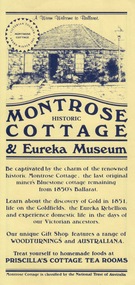
Card - Card - Advertising, ZILLES COLLECTION: Advertising Card for Historic Montrose Cottage and Eureka Museum
... ...short term accommodation...It also provides short term accommodation - self contained apartments....It also provides short term accommodation - self contained apartments. zilles printers montrose cottage john alexander scottish stone mason bluestone hand-made bricks historic buildings register short term accommodation national trust apartments Drawing of cottage and on reverse side map. ...Zilles Printers was begun by Lewis Zilles in the early 1930s. It was in McKenzie Street Ballarat. His son Jeffrey also became a printer - letterpress, offset and screen printer. The business became Zilles Printers/Graphics and was in Armstrong Street and later Bell Street Ballarat. Montrose Cottage was build c1856 by John Alexander, builder. He was a Scottish stone mason. It was built with bluestone and hand-made bricks. It is on the Historic Buildings Register, National Trust (Victoria). It is important as a substantial and very early stone cottage. The house is now open to the public. It also provides short term accommodation - self contained apartments.Yellow card with dark blue printDrawing of cottage and on reverse side map.zilles printers, montrose cottage, john alexander, scottish stone mason, bluestone, hand-made bricks, historic buildings register, short term accommodation, national trust, apartments -
 Federation University Historical Collection
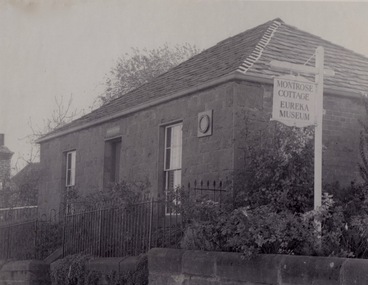
Photograph - Photograph - black and white, ZILLES: Photographs of Montrose Cottage and Eureka Museum
... It also provides short term accommodation - self contained apartments....It also provides short term accommodation - self contained apartments. zilles printers montrose cottage eureka museum ballarat Three black and white photographs ZILLES: Photographs of Montrose Cottage and Eureka Museum Photograph Photograph - black and white ...Zilles Printers was begun by Lewis Zilles in the early 1930s. It was in McKenzie Street Ballarat. His son Jeffrey also became a printer - letterpress, offset and screen printer. The business became Zilles Printers/Graphics and was in Armstrong Street and later Bell Street Ballarat. Montrose Cottage was build c1856 by John Alexander, builder. He was a Scottish stone mason. It was built with bluestone and hand-made bricks. It is on the Historic Buildings Register, National Trust (Victoria). It is important as a substantial and very early stone cottage. The house is now open to the public. It also provides short term accommodation - self contained apartments.Three black and white photographszilles printers, montrose cottage, eureka museum, ballarat -
 Federation University Historical Collection
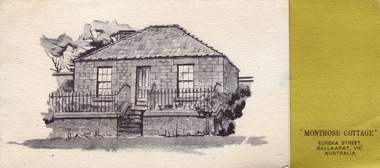
Card - Card - Greetings, ZILLES COLLECTION: Montrose Cottage Christmas Card
... It also provides short term accommodation - self contained apartments. ...It also provides short term accommodation - self contained apartments. ...Zilles Printers was begun by Lewis Zilles in the early 1930s. It was in McKenzie Street Ballarat. His son Jeffrey also became a printer - letterpress, offset and screen printer. The business became Zilles Printers/Graphics and was in Armstrong Street and later Bell Street Ballarat. Montrose Cottage was build c1856 by John Alexander, builder. He was a Scottish stone mason. It was built with bluestone and hand-made bricks. It is on the Historic Buildings Register, National Trust (Victoria). It is important as a substantial and very early stone cottage. The house is now open to the public. It also provides short term accommodation - self contained apartments. Card produced for Christmas. It has a brief history of the Cottage inside.Thick textured paper, folded. Mustard section with black print. Black and white drawing of cottage."Best Wishes for Christmas and the New Year"zilles printers, ballarat, christmas card, montrose cottage -
 Federation University Historical Collection
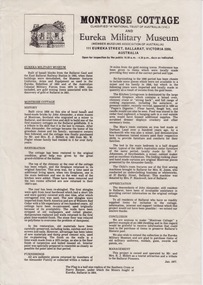
Document - Document - Article, ZILLES COLLECTION: Montrose Cottage and Eureka Military Museum; Historical Information of Restoration, 1977
... It also provides short term accommodation - self contained apartments. ...It also provides short term accommodation - self contained apartments. ...Zilles Printers was begun by Lewis Zilles in the early 1930s. It was in McKenzie Street Ballarat. His son Jeffrey also became a printer - letterpress, offset and screen printer. The business became Zilles Printers/Graphics and was in Armstrong Street and later Bell Street Ballarat. Montrose Cottage was build c1856 by John Alexander, builder. He was a Scottish stone mason. It was built with bluestone and hand-made bricks. It is on the Historic Buildings Register, National Trust (Victoria). It is important as a substantial and very early stone cottage. The house is now open to the public. It also provides short term accommodation - self contained apartments. Printed sheet gives information of the project and restoration of the cottage. Mention given to people who donated item to decorate the rooms.Typed sheet with small drawing in top left of page.Printed Jan. 1977zilles printers, montrose cottage, restoration project, ballarat -
 Federation University Historical Collection
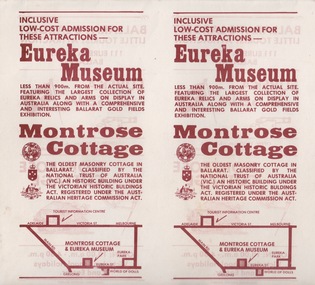
Document - Document - Advertising Cards, ZILLES COLLECTION: Advertising Card for Historic Montrose Cottage and Eureka Museum
... It also provides short term accommodation - self contained apartments. ...It also provides short term accommodation - self contained apartments. ...Zilles Printers was begun by Lewis Zilles in the early 1930s. It was in McKenzie Street Ballarat. His son Jeffrey also became a printer - letterpress, offset and screen printer. The business became Zilles Printers/Graphics and was in Armstrong Street and later Bell Street Ballarat. Montrose Cottage was build c1856 by John Alexander, builder. He was a Scottish stone mason. It was built with bluestone and hand-made bricks. It is on the Historic Buildings Register, National Trust (Victoria). It is important as a substantial and very early stone cottage. The house is now open to the public. It also provides short term accommodation - self contained apartments. Double sided cards advertising Montrose Cottage and Eureka Museum. Printed by Zilles Graphic Industries, Ballarat. White card with russet colour print. Printed on both sides. Each side has Eureka Museum and Montrose CottageEureka Flag and Cannon. Drawing of Montrose Cottage and flag with Lion. Symbol of National Trust Australia. Coat of Arms. Location map.zilles graphic industries, montrose cottage, eureka musuem -
 Federation University Historical Collection
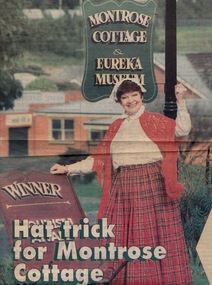
Article - Article: Newspaper item, ZILLES COLLECTION: Newspaper article re Montrose's win fromTourism Victoria for third time, 1996
... It also provides short term accommodation - self contained apartments. ...It also provides short term accommodation - self contained apartments. ...Zilles Printers was begun by Lewis Zilles in the early 1930s. It was in McKenzie Street Ballarat. His son Jeffrey also became a printer - letterpress, offset and screen printer. The business became Zilles Printers/Graphics and was in Armstrong Street and later Bell Street Ballarat. Montrose Cottage was build c1856 by John Alexander, builder. He was a Scottish stone mason. It was built with bluestone and hand-made bricks. It is on the Historic Buildings Register, National Trust (Victoria). It is important as a substantial and very early stone cottage. The house is now open to the public. It also provides short term accommodation - self contained apartments. Montrose Cottage and the Eureka Museum were winners for the third time of the Tourism Victoria Award. Article was published in Ballarat News, July 31, 1996Front page article from Ballarat NewsWednesday july 1996zilles printers, montrose cottage, eureka museum, tourism victoria, award, ballarat news, laurel johnson -
 Melbourne Legacy
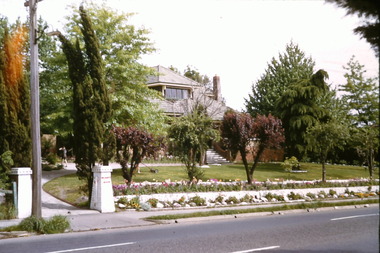
Slide, Blamey House, 1960s
... From 1942-1981 Legacy provided residential accommodation for junior legatees who may have been left orphans, or whose mother may have been unable to care for them herself, or they needed to stay in Melbourne for further education. Short term accommodation for children could be provided, for instance if a widow needed hospital care. ...From 1942-1981 Legacy provided residential accommodation for junior legatees who may have been left orphans, or whose mother may have been unable to care for them herself, or they needed to stay in Melbourne for further education. Short term accommodation for children could be provided, for instance if a widow needed hospital care. ...Blamey House was one of the residences used by Legacy as a home for Junior Legatees. From 1942-1981 Legacy provided residential accommodation for junior legatees who may have been left orphans, or whose mother may have been unable to care for them herself, or they needed to stay in Melbourne for further education. Short term accommodation for children could be provided, for instance if a widow needed hospital care. The property at 1267 Burke Road was known as Holmbush from 1942 until 1956. The name was transferred to this property from another residence in Balcombe Road Beaumaris when it was sold in the mid 1950s. Was with many other slides taken in the 1950s and 1960s. The slides have been photographed to make digital images and moved to archive quality sleeves. In many cases the original images were not well focussed and the digital image the best available.A record of the residence in Burke Road named Blamey House.Colour slide of Blamey House viewed from the road in a red edged Kodachrome cardboard mount.Printed on reverse in red ink 'Kodachrome Transparency / Processed by Kodak'. Handwritten in blue ink 'Blamey House'. Imprinted slide number in black ink '1'.residences, blamey house -
 Melbourne Legacy
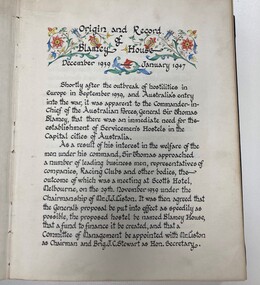
Document, Origin and Record of Blamey House December 1939 - January 1947, 1987
... Blamey House was originally the name of a hostel set up in World War 2 for servicemen that needed short term accommodation and food. It was originally situated in Melbourne CBD on the corner of King and Collins Streets in the Robbs Building (since demolished). ...Blamey House was originally the name of a hostel set up in World War 2 for servicemen that needed short term accommodation and food. It was originally situated in Melbourne CBD on the corner of King and Collins Streets in the Robbs Building (since demolished). ...Copies of correspondence with Mr K Crouch asking for the history of Blamey House. Plus a photocopy of the history pages from the Blamey House roll that is kept in glass display cabinets at Legacy House. Blamey House was one of the residences used by Legacy as a home for Junior Legatees. The first few pages of the book (item 02298) explains the history and significance of the name Blamey House - which was photocopied and sent to Mr Crouch. Blamey House was originally the name of a hostel set up in World War 2 for servicemen that needed short term accommodation and food. It was originally situated in Melbourne CBD on the corner of King and Collins Streets in the Robbs Building (since demolished). When the hostel was no longer required after the war, the trustees of Blamey House donated money - almost 20,000 pounds, to Legacy for a children and toddlers' home which was established in Balcombe Road Beaumaris. The condition of donation was that the name Blamey House be used and when the Balcombe Road property was sold in 1956 the name was transferred to Holmbush, another Legacy residence. When it was sold in 1977 the name transferred to Harelands until Legacy sold it in 1980.A record of the history known about the donation made to Legacy to establish Blamey House in 1947.Black and white A4 photocopy x 12 pages on history of Blamey House, part of it copied from the Blamey House roll and some of correspondence between K Crouch and Legacy.blamey house, blamey, residences, hostel -
 Melbourne Legacy
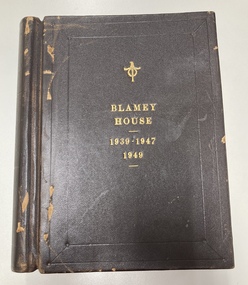
Book, Blamey House 1939-1947 1949, 194
... Blamey House was originally the name of a hostel set up in World War 2 for servicemen that needed short term accommodation and food. It was originally situated in Melbourne CBD on the corner of King and Collins Streets in the Robbs Building (since demolished). ...Blamey House was originally the name of a hostel set up in World War 2 for servicemen that needed short term accommodation and food. It was originally situated in Melbourne CBD on the corner of King and Collins Streets in the Robbs Building (since demolished). ...Blamey House was one of the residences used by Legacy as a home for Junior Legatees. The first few pages of this book explains the history and significance of the name Blamey House. Then it is like an honour roll and has pages to be inscribed with the name of each Junior Legatee that lives in the home plus their fathers name and service. There is a list of approximately 72 children in the book that lived in a Legacy home called Blamey House at some stage. The name Blamey House was transferred to three different homes run by Legacy until 1980. Blamey House was originally the name of a hostel set up in World War 2 for servicemen that needed short term accommodation and food. It was originally situated in Melbourne CBD on the corner of King and Collins Streets in the Robbs Building (since demolished). When the hostel was no longer required after the war, the trustees of Blamey House donated money - almost 20,000 pounds, to Legacy for a children and toddlers' home which was established in Balcombe Road Beaumaris. The condition of donation was that the name Blamey House be used and when the Balcombe Road property was sold in 1956 the name was transferred to Holmbush, another Legacy residence. When it was sold in 1977 the name transferred to Harelands until Legacy sold it in 1980.An ornate record of the home provided by Legacy to children in need and how the money to establish the home was acquired.Dark brown leather book with details of Blamey House.Gold embossed title on cover and spineresidences, blamey house, blamey, hostel, honour roll -
 Department of Health and Human Services
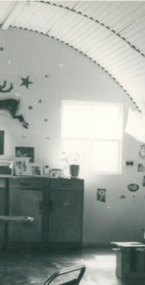
Photograph, Berry Street Kindergarten
... Two flats were also established for short-term family accommodation. The nurses’ home was converted to house the home’s administration function and a social work service. ...Two flats were also established for short-term family accommodation. The nurses’ home was converted to house the home’s administration function and a social work service. ...In 1877 the Victorian Infant Asylum was founded in Kew. In 1881, the asylum relocated to Berry Street in East Melbourne. By 1908, it was called the Foundling Hospital and Infants Home. It was non-denominational and controlled by a committee of management. By 1956, Berry Street consisted of a Mothercraft Training Centre and two main residential units: Berry Street for infants aged zero to 18 months, and Vale Street for toddlers aged zero to two years old. In August 1956, Berry Street was declared an approved category 2 Children's Home. In 1960, Vale Street was converted to an adult nursing home. In 1964, the name was changed to Berry Street Babies Home and Hospital. Berry Street was also an approved adoption agency. By 1968, Berry Street comprised the Training School for Mothercraft Nurses, the adoption agency, an infant life-protection house, a long-stay home for children to three years of age (the toddlers’ wing) and a small house for unmarried mothers. The home's infant life-protection work was seen as a critical agency function, particularly where family illness was putting pressure on mothers and Berry Street was able to provide respite and support. By the late 1960s, 30–40 adoptions annually were being arranged from Berry Street. By 1974 the home's orientation had shifted. Four family group homes had been established (two in Burwood, one in Ashburton and one in St Kilda), the mothercraft training function had been phased out, the toddlers wing converted to day care, and the main building (containing the nursery, administration, kitchen, dining room and single mothers accommodation) was demolished in favour of four home units, which housed 24 children, supervised by cottage parents. Berry Street provided short term, emergency and residential care for 'protection of infant' cases and state wards. Two flats were also established for short-term family accommodation. The nurses’ home was converted to house the home’s administration function and a social work service. The social work service coordinated family aid and family counselling services, and a neighbourhood house. In 1975 Berry Street also provided short-term care for 42 Vietnamese children brought to Australia in the official government-sponsored airlift. In 1976 Berry Street made application to change its category 2 Children's Home classification to category 1, as it was now catering for a wider range of children. It had ceased to be a babies’ home and hospital, and had started providing child and family care, including residential care. In 1977 Berry Street to established a family group home in Richmond to house children affected by the closure of St Cuthbert's Children's Home in Colac. Berry Street changed its name to Berry Street Child and Family Care in 1977. In 1978, the range of services provided by Berry Street Child and Family Care consisted of a social work counselling service, a financial aide, a family aide program using volunteers, two temporary accommodation units each housing eight children, an information and referral service, a neighbourhood house in Richmond, a day care centre for 36 children, and four family group homes. In 1980–81 the family group homes in Burwood were sold and the resources moved to the Richmond area. In 1994, Sutherland Youth and Family Services Inc. amalgamated into Berry Street Inc. During the 1990s, Berry Street combined with the Sutherland Community Resource Centre in Watsonia in Melbourne’s northern region. The agency operates today as Berry Street Victoria and has service centres across metropolitan and country Victoria. https://www.findingrecords.dhhs.vic.gov.au/CollectionResultsPage/BerryStreet -
 Kiewa Valley Historical Society
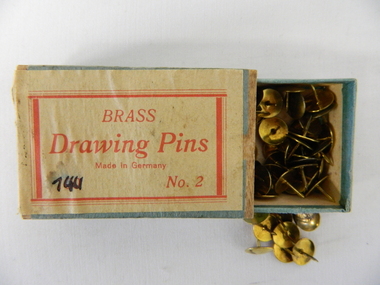
Pin Drawing, Brass tacks, mid to late 1900's
... Drawing pins are still a requirement for leased accommodation (which are usually short term accommodation) for the personalisation of "home" wall decorations and shopper's "notice and information boards" notice and information boards quick temporary fasteners. pins tacts brass tacts domestic decorations On the front and within a red border and red letters "BRASS" and below this in script form "Drawing Pins" and below this in smaller letters "Made In Germany" Below this and on the bottom left side "100" and also on the bottom but to the right "No. 2" This small box, similar to a "match box" (thumb activated slide, top open, cardboard container), holds brass drawing pins. ...This particular box of brass drawing pins would have been used before the introduction of cheaper polished chrome drawing pins manufactured in Asia. The box construction and label would suggest that supply of this boxes contents could have been in the early 1950's. Drawing pins or push pins were first invented in 1900 by Mr Edwin Moore. The need for a secure fastener to accommodate temporary signs and notes for domestic and commercial environments sprang up from the need to cope with an increasing faster method of presenting information on removable surfaces such as temporary notice boards. In the 1950's and later the increase in the pace of "living" brought about many time saving written communication notices. This temporary method of providing fast temporary notices is being surpassed by the computer age and mobile telephone "applications". The information spectrum of the computer age has made many "hands on" (drawing pin) applications go to the "dodo" level. This box of drawing pins is very significant to the Kiewa Valley and its region because it demonstrates that the pace in rural regions especially those that were once semi remote regions has moved at the same pace as the bigger towns and cities. Differences are still noticeable, such as the requirement of drawing pins for temporary signs and mail box commercially important "sales" notifications. The pressures that produce the "rat" syndrome, that is pressure by increased population levels infringing upon the individual's day-to-day existence is still not present in rural areas such as the Kiewa Valley. Drawing pins are still a requirement for leased accommodation (which are usually short term accommodation) for the personalisation of "home" wall decorations and shopper's "notice and information boards"This small box, similar to a "match box" (thumb activated slide, top open, cardboard container), holds brass drawing pins. These brass pins are also known as brass tacks, thumbtacks or push pins. The top of the brass tack has a "domed head" with the manufacturer's logo stamped on it. The number "2" on the bottom right of the label is the "weight" of the drawing pin. On the front and within a red border and red letters "BRASS" and below this in script form "Drawing Pins" and below this in smaller letters "Made In Germany" Below this and on the bottom left side "100" and also on the bottom but to the right "No. 2"notice and information boards, quick temporary fasteners., pins, tacts, brass tacts, domestic, decorations -
 Vision Australia
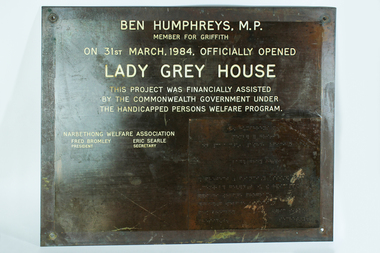
Photograph, Lady Grey House
... accommodation. Application was made for assistance under the Commonwealth Handicapped Welfare program and Lady Grey House was opened in 1984 and was still operating in 1998 providing short-term, low cost accomodation....accommodation. Application was made for assistance under the Commonwealth Handicapped Welfare program and Lady Grey House was opened in 1984 and was still operating in 1998 providing short-term, low cost accomodation. ...Established to help further the welfare of blind people, the Narbethong Welfare Association sought to provide suitable accommodation. Application was made for assistance under the Commonwealth Handicapped Welfare program and Lady Grey House was opened in 1984 and was still operating in 1998 providing short-term, low cost accomodation.Digital image of Lady Grey house nameplateBen Humphreys, M.P. Member for Griffith on 31st March, 1984, officially opened Lady Grey House This project was financially assisted by the Commonwealth Government under the Handicapped Persons Welfare program. Narbethong Welfare Association Fred Bromley, President Eric Searle, Secretaryroyal blind foundation of queensland, nameplates -
 Emerald Museum & Nobelius Heritage Park
Postcard - Silver Springs, Valentine Publishing Co, 1950s-1960s
... Furthermore, the postcard offers some research potential into the commercialisation of housing and its wider socioeconomic impacts on the local community, particularly in our current climate of short-term holiday rentals like AirBnB and Stayz. Emerald Victoria Australia silver springs lodge accommodation Dwelling photography Obverse: Silver Springs Lodge / GUEST / HOUSE / SILVER SPRINGS LODGE, EMERALD / V6 / Reverse: POST Valentine's CARD / SENDING YOU GREETINGS FOR ADDRESS ONLY / Gwen + Son Tom / spent a few days / in early 1960 / (Gwen having a / break from teaching / - THIS IS A REAL PHOTOGRAPH - / VEMUP0964 / Black and white rectangular postcard printed on card. ...Silver Springs Lodge was owned and managed by prominent Emerald residents, William and Olive Hamilton, during the 1940s and 1950s. The guest dwelling occupied stunning real estate along Emerald Lakeside. Guests were offered a variety of entertainment and access to activities including pianola, radio, swimming, tennis, riding, golf, car trips and home cooking. Weekly tariffs ranged from ₤4-10 and ₤4-15. It is believed the postcard was produced by the Valentine Publishing Co., inferred by the company's unique identifier — the letter 'V' followed by numbers — which appear on the obverse, as well as the word "Valentine's" which is printed on the reverse. This inscription is akin to examples of Valentine Publishing Co. postcards in other collections, such as the Kew Historical Society Inc. and Phillip Island and District Historical Society Inc.The record holds very strong historic significance as it speaks to the transformation of the Dandenong foothills into a popular tourist destination in Victoria. Particularly, the Silver Springs Lodge was an early tourist enterprise in region which had previously been dominated by industries of timber, gold and horticulture. The record is particularly significant for how it documents this important metamorphosis of Emerald into a key location for tourism. Furthermore, the postcard offers some research potential into the commercialisation of housing and its wider socioeconomic impacts on the local community, particularly in our current climate of short-term holiday rentals like AirBnB and Stayz.Black and white rectangular postcard printed on card. The postcard depicts the Silver Springs Lodge in Emerald, Victoria. The foreground of the photograph shows a small, open pedestrian gate framed by two brick columns with signage, and leads down a narrow footpath to the front door to the lodge. Two female adults, one who is named Gwen, and three children, one of whom is named Tom, are pictured standing near the front door to the guest lodge. The dwelling is constructed from a mix of bricks and weatherboard panels and is surrounded by trees, plants and shrubs. At the rear of the dwelling appears to be a smaller, detached building; possibly a type of granny flat or second guest house. Also visible is a parked caravan in the left hand side of the photograph.Obverse: Silver Springs Lodge / GUEST / HOUSE / SILVER SPRINGS LODGE, EMERALD / V6 / Reverse: POST Valentine's CARD / SENDING YOU GREETINGS FOR ADDRESS ONLY / Gwen + Son Tom / spent a few days / in early 1960 / (Gwen having a / break from teaching / - THIS IS A REAL PHOTOGRAPH - / VEMUP0964 /emerald, victoria, australia, silver springs lodge, accommodation, dwelling, photography -
Emerald Museum & Nobelius Heritage Park
Postcard - Emerald House, Rose Stereographs Co, 1940s-1950s
... Furthermore, the postcard offers some research potential into the commercialisation of housing and its wider socioeconomic impacts on the local community, particularly in our current climate of short-term holiday rentals like AirBnB and Stayz. rose series postcards postcards Emerald House accommodation guest houses Obverse: 'EMERALD / HOUSE'. / ACCOMMODATION / Afternoon Dinners / (?) ...The Rose Stereograph Co. was established in the year 1880. The firm's founder, George Rose Clune, began developing photographs from his father's shoe shop located in Prahran, Victoria. George would travel to the Dandenong foothills to sell his photographs to picnic parties, thus creating a connection to Emerald and surrounding districts. The Rose Stereograph Co. first began producing stereographs. After this medium lost popularity, George switched to postcards — referred to as the 'P' series, such as this example — in 1913. The firm continued to print postcards until 1967, after which they switched to machine-manufactured coloured postcards provided by an external supplier. The photographs on the postcards were original works by George, who has become reputed as one of the best photographers in Australia during the 19th and 20th centuries.The record holds very strong historic significance as it speaks to the transformation of the Dandenong foothills into a popular tourist destination in Victoria. Particularly, the Emerald House was an early tourist enterprise in region which had previously been dominated by industries of timber, gold and horticulture. The record is particularly significant for how it documents this important metamorphosis of Emerald into a key location for tourism. Furthermore, the postcard offers some research potential into the commercialisation of housing and its wider socioeconomic impacts on the local community, particularly in our current climate of short-term holiday rentals like AirBnB and Stayz.Black and white rectangular postcard printed on card. Depicted is a guest lodge known as Emerald House. There is a stationary vehicle parked in front of the house in the right hand side of the image. The guest lodge is made from weatherboard panels, with a corrugated iron or steel roof, and a brick chimney. Surrounding the house are various trees, plants and shrubs. In the far left hand side of the postcard, there is a sign denoting the accommodation is Emerald House. In the background of the image, there is a round elevated corrugated silo; this is possibly a water tank.Obverse: 'EMERALD / HOUSE'. / ACCOMMODATION / Afternoon Dinners / (?) / THE ROSE SERIES P. 3337 " EMERALD HOUSE," EMERALD, VIC. / COPYRIGHT / Reverse: PD00228b. / Copy / POST CARD / The "Rose" Series A Real Photograph / De Luxe Produced in Australia / Published by the Rose Stereograph Co. / Armadale, Victoria. / VEMUP0965 /rose series postcards, postcards, emerald house, accommodation, guest houses
