
Showing 24 items matching "silk stockings"
-
 Orbost & District Historical Society
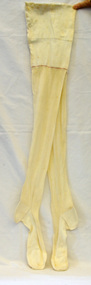
silk stockings, c. 1920s
... silk stockings...silk-stockings female-underwear costumes-1920s wedding-stockings...A pair of cream silk stockings. The toes and tops are reinforced with cotton thread. ...Wedding stockings, c. 1920, worn by Mrs C Reynolds. silk-stockings female-underwear costumes-1920s wedding-stockings A pair of cream silk stockings. ...Wedding stockings, c. 1920, worn by Mrs C Reynolds. A pair of cream silk stockings. The toes and tops are reinforced with cotton thread. silk-stockings female-underwear costumes-1920s wedding-stockings -
 Bendigo Historical Society Inc.
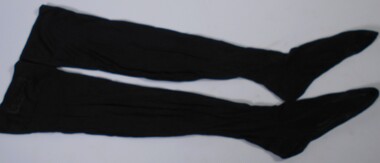
Clothing - Silk Stockings
... Silk Stockings......Silk Stockings...Pair of black silk stockings identified as "La Danseuse" in gold lettering on top band. ...La Danseuse Milanese Silk Made in England Silk Stockings Pair of black silk stockings identified as "La Danseuse" in gold lettering on top band. ...Pair of black silk stockings identified as "La Danseuse" in gold lettering on top band. Faint 6 or 8 as size on inner of top band. Gold lettering on foot "Milanese Silk" Made in England. la danseuse, milanese silk, made in england, silk stockings -
 Whitehorse Historical Society Inc.
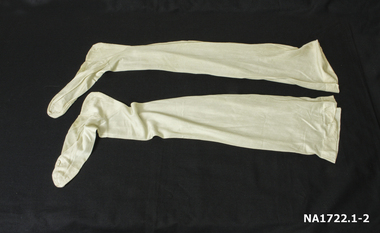
Clothing - Stockings
... Pair cream silk stockings....costume female footwear Pair cream silk stockings. Clothing Stockings ...Pair cream silk stockings.costume, female footwear -
 Whitehorse Historical Society Inc.
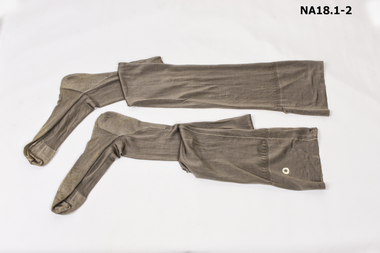
Clothing - Stockings
... A pair of grey silk stockings...The darning of the toes indicates that the items were costly to replace so rather than discard the item they were mended. costume female underwear A pair of grey silk stockings Clothing Stockings ...The darning of the toes indicates that the items were costly to replace so rather than discard the item they were mended. A pair of grey silk stockingscostume, female underwear -
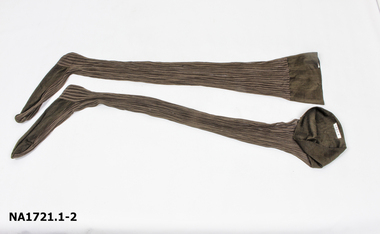 Whitehorse Historical Society Inc.
Clothing - Stockings
... Pair of dark brown silk stockings with ribbed effect....costume female footwear Pair of dark brown silk stockings with ribbed effect. Clothing Stockings ...Pair of dark brown silk stockings with ribbed effect.costume, female footwear -
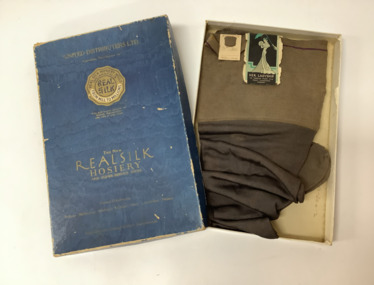 Williamstown Historical Society Inc
Footwear - Stockings, c.1860-1890
... Pair of ladies grey/brown silk stockings, in original box with a blue lid and gold text. ...On box lid: "UNITED DISTRIBUTERS LTD/Australian Distributers for/THE NEW/REAL SILK/HOSIERY/AND SUPER SERVICE SOCKS" On stockings: "HER LADYSHIP/10 THREAD PURE SILK/FULLY FASHIONED/HOSIERY" On stockings: "BURKE & CO/WILLIAMSTOWN/1/3d"...Bought from a local haberdashery shop Stockings Burkes On box lid: "UNITED DISTRIBUTERS LTD/Australian Distributers for/THE NEW/REAL SILK/HOSIERY/AND SUPER SERVICE SOCKS" On stockings: "HER LADYSHIP/10 THREAD PURE SILK/FULLY FASHIONED/HOSIERY" On stockings: "BURKE & CO/WILLIAMSTOWN/1/3d" Pair of ladies grey/brown silk stockings, in original box with a blue lid and gold text. ...These stockings, in their original box, were bought from the iconic Burkes haberdashery shop at the corner of Douglas Parade and Stevedore Street Williamstown. It operated for around 85 years before closing in early 2008, but the building is still in use, and still has the name Burkes on its frontage. Bought from a local haberdashery shopPair of ladies grey/brown silk stockings, in original box with a blue lid and gold text. On box lid: "UNITED DISTRIBUTERS LTD/Australian Distributers for/THE NEW/REAL SILK/HOSIERY/AND SUPER SERVICE SOCKS" On stockings: "HER LADYSHIP/10 THREAD PURE SILK/FULLY FASHIONED/HOSIERY" On stockings: "BURKE & CO/WILLIAMSTOWN/1/3d"stockings, burkes -
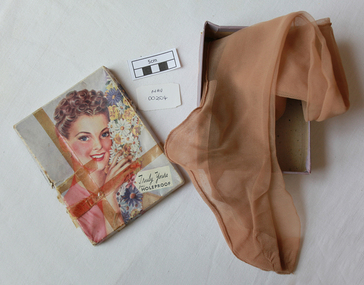 City of Moorabbin Historical Society (Operating the Box Cottage Museum)
Clothing - Clothing, lady's stockings "Holeproof', mid 20thC
... A unused pair of lady's silk stockings in original box. 'Holeproof' 'Truly Yours' Candlelight, size 10...The Australian company is still in business today, owned by Pacific Brands. clothing stockings nylons holeproof hosiery pty ltd lingerie melbourne bentleigh cheltenham moorabbin brunswick milwaukee usa wisconsin Box Cover: Truly Yours / by / Holeproof Side Holeproof 'Candlelight' Size 10 A unused pair of lady's silk stockings in original box. 'Holeproof' 'Truly Yours' Candlelight, size 10 Clothing Clothing, lady's stockings "Holeproof' Holeproof Hosiery Pty Ltd ...Holeproof Hosiery was a Milwaukee, Wisconsin textile firm that was founded in 1901.With extensive advertising the brand name became recognized worldwide. The business produced men's and women's hosiery, underwear, lingerie, and men's pyjamas. Holeproof Hosiery began making nylon hosiery in January 1940, starting production on 8 of its 230 machines. The hose were made of a synthetic yarn composed of derivatives of coal and iron manufactured by Du Pont. In the late 1920s, a successful hosiery manufacturer, Staley & Staley Ltd, started making ladies hosiery under licence from the Holeproof Hosiery Company in Milwaukee, USA. The company went public in 1929 and opened the first Holeproof mill at Brunswick, Victoria in 1930, becoming the first manufacturer to produce and market Australian-made self-supporting socks. During the 1930s, Holeproof revolutionised the Australian market by promoting their products as a sought-after fashion accessory. The Australian company is still in business today, owned by Pacific Brands. A unused pair of lady's silk stockings in original box. 'Holeproof' 'Truly Yours' Candlelight, size 10Box Cover: Truly Yours / by / Holeproof Side Holeproof 'Candlelight' Size 10clothing, stockings, nylons, holeproof hosiery pty ltd, lingerie, melbourne, bentleigh, cheltenham moorabbin, brunswick milwaukee usa, wisconsin -
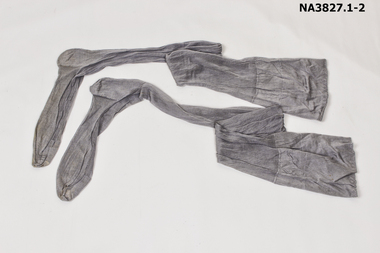 Whitehorse Historical Society Inc.
Clothing - Stockings, 1930's
... Grey silk stockings with seam up back of leg. Design on back of heel,toe and sole are cotton....costume female female underwear Grey silk stockings with seam up back of leg. Design on back of heel,toe and sole are cotton. ...Grey silk stockings with seam up back of leg. Design on back of heel,toe and sole are cotton.costume, female, female underwear -
 Warrnambool and District Historical Society Inc.
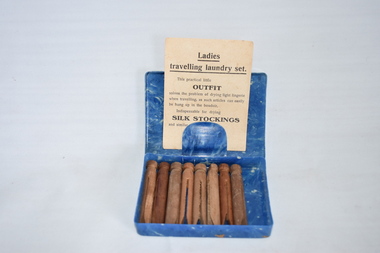
Household, Travelling Peg Set, 1930-1940
... Indispensable for drying silk stockings and similar articles.’ ...Indispensable for drying silk stockings and similar articles.’ This is a mottled blue container made of Bakelite. ...This laundry box would have been used by a woman who was travelling to hang up in a bedroom small items of clothing that had been laundered. Different types of laundry sets have been available for travellers for many years and sets of a more modern nature are in use today. This laundry set is retained as an example of a woman’s laundry set from the past. This is a mottled blue container made of Bakelite. The box contains eight small wooden pegs. This set is incomplete as originally there would have been ten pegs and some string to use as a small clothesline. The box also has a slip of paper with printed material indicating the use and value of the laundry set. The top of the container has had some cloth material pasted on but this is largely worn off. ‘Ladies travelling laundry set. This practical little outfit solves the problem of drying light lingerie when travelling, as such articles can easily be hung up in the boudoir. Indispensable for drying silk stockings and similar articles.’ women’s accessories, history of warrnambool -
 Uniting Church Archives - Synod of Victoria
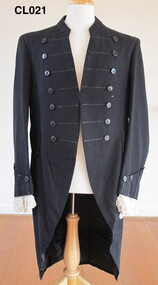
Clothing - Regalia - Coat, Diocesan Book Society, Presbyterian Moderator General
... This coat was part of the Presbyterian moderator's regalia which also consisted of a tri-corn hat, black bib, lace jabot, britches, silk stockings, gaiters and buckled shoes....This coat was part of the Presbyterian moderator's regalia which also consisted of a tri-corn hat, black bib, lace jabot, britches, silk stockings, gaiters and buckled shoes. presbyterian moderator Presbyterian Moderator General of Australia Black wool, lined cutaway coat with a crew neck. ...This coat was part of the Presbyterian moderator's regalia which also consisted of a tri-corn hat, black bib, lace jabot, britches, silk stockings, gaiters and buckled shoes.Black wool, lined cutaway coat with a crew neck. The coat has seven pairs of black buttons and is secured edge to edge with a single hook and eye at the 4th and 5th buttons. It has lace cuffs, braiding and pleats at the back. The black lining is quilted at the top and there is a pocket on the inside right breast. The sleeves of the coat are lined with white fabric and the lace cuffs are secured with six pearl buttons. There are faux pocket flaps on each side of the coat each secured with three buttons.presbyterian moderator, presbyterian moderator general of australia -
 Kew Historical Society Inc
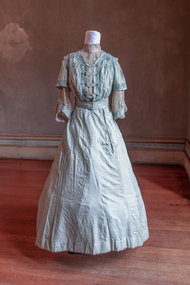
Clothing - Silk and Lace Two Piece Day Dress, 1900s
... As part of the ensemble, there are also pale blue silk stockings, of the period. ...As part of the ensemble, there are also pale blue silk stockings, of the period. Clothing Silk and Lace Two Piece Day Dress ...An item forming part of a collection of costumes, photographs and documents relating to the Weir family who lived in a mansion, originally named Illapa, at 84 Princess Street, Kew, from c.1917 to 1950. This historically significant collection includes items relating to both George Weir (1866-1937), his wife Edith Mary Weir (1867-1948) and their children. George Weir attained national prominence in the mining industry, becoming General Manager of the North Broken Hill Silver Mining Company in 1903 (later renamed North Broken Hill Mining Company 1905-12, and North Broken Hill Ltd 1912-1988), and subsequently President of the Mine Owners Association. He was to remain General Manager of North Broken Hill Ltd until his retirement in 1926.This garment is part of a collection of women’s clothing, owned and worn by Edith Mary Weir (nee Betteridge) - born in Clare, South Australia 1867, died Kew 1948 - and also by her daughter. The garments date from the 1880s to the 1930s. The collection includes day dresses, evening dresses, evening coats, capes, and undergarments. As the wife and daughter of a mine manager, the collection includes representative examples of clothing worn by upper middle class Australian women in domestic circumstances, and at social and civic events. A number of the costumes from the 1920s to the 1930s are of a particularly fine quality, being both rare, representative and intact examples of Australian fashion of the period. The garments in the Weir Collection were donated to the Kew Historical Society by a granddaughter of Edith Weir in 2017.Pale blue shot silk dress, comprised of a separate pale blue silk bodice and a wide flaring skirt of the same fabric. The bodice features silk embroidery in the same colour as the dress and wide bands of brown lace at the neck, on the front of the bodice and on the sleeves. Blue silk fabric tabs extend across the lace at the front with gold buttons at either end. The bodice has an attached blue silk belt. As part of the ensemble, there are also pale blue silk stockings, of the period. edith mary weir (nee betteridge), women's clothing, dresses, fashion -- 1900s, weir collection -
 Flagstaff Hill Maritime Museum and Village
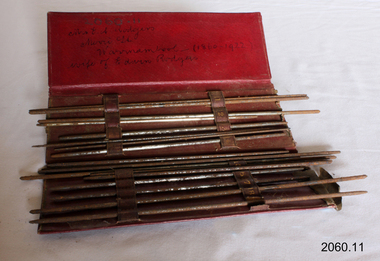
Functional object - Needle Pin Case, 1860 to 1900
... The Tudors wore hand knit caps and King Henry the VIII made hand knit silk stockings, imported from Spain, a fashion staple. ...The Tudors wore hand knit caps and King Henry the VIII made hand knit silk stockings, imported from Spain, a fashion staple. ...Knitting, as a household task, has been traced back to 1100 AD where archaeologists in Egypt found remnants of socks. Evidently socks or stockings became a household necessity and creating them by knitting was the easiest way to get a good fit. The Tudors wore hand knit caps and King Henry the VIII made hand knit silk stockings, imported from Spain, a fashion staple. Meanwhile in Paris in 1525, men formed one of the first worker's unions for hand knitters. Knitting by machine first appeared during this same period and with the spread of fashion of the silk stockings and the basic needs of people to keep warm helped to fuel the popularity of knitting. By the 1850's, knitting machines were common place and apprenticing in such a factory, was considered honourable employment. But the main tool of knitting has always remained the needle, that is said to have it's origins in Arabia. The first needles were made of copper and looked more like hooks than needles. In other locations around the world, knitting needles have been found constructed from wood, ivory, bone, bamboo, amber and iron as well. They are also known as woods, skewers or wires depending where in the world they are found. Context: Edwin Rodgers was born in Lincolnshire England estimated at 1830-1832, records document that he was working as a Miller in Jan 1863 and that he resided in Warrnambool until his death in 1887. The knitting needle case is believed to belong to his wife Ellen Amelia (nee Heywood), daughter of George Heywood and Dinah Turton. She had married Mr Edwin Rodgers on 30 Jan 1863 in Warrnambool, and they had continued to resided in Warrnambool. Ellen Amelia Heywood was born Oct to Dec 1839 in Stockport, Cheshire England & christened on 5 Jul 1840 in St Thomas, Stockport, Cheshire. She died on 8 Dec 1922 in 284 Merri Street, Warrnambool, Victoria 10 and was buried on 11 Dec 1922 in the Warrnambool Cemetery.A significant item that belonged to one of the early families of Warrnambool and as such is regarded by the Warrnambool community as significant because it helps to document Warrnambool's development.Medium sized cardboard foldable maroon knitting pin case with numbered sections to fit relevant sized metal pins 10 in all case called the peacock knitting pin case.On lid of case written in italic Mrs E A Rodgers, Warrnambool 1860-1922, Wife of Edwin Rodgersflagstaff hill, warrnambool, shipwrecked-coast, flagstaff-hill, flagstaff-hill-maritime-museum, maritime-museum, shipwreck-coast, flagstaff-hill-maritime-village -
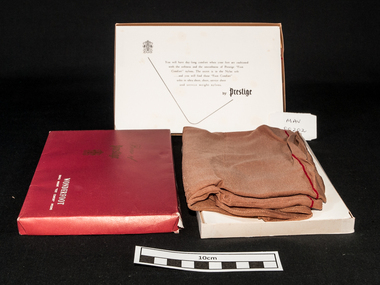 City of Moorabbin Historical Society (Operating the Box Cottage Museum)
Clothing - Clothing, lady's nylon stockings 'Prestige Wonderfoot'', mid 20thC
... About this time the company became the first Australian knitter to make fully-fashioned silk stockings, outselling the best imported brands and giving Prestige dominance of the local hosiery market. ...About this time the company became the first Australian knitter to make fully-fashioned silk stockings, outselling the best imported brands and giving Prestige dominance of the local hosiery market. ...Prestige Limited was formed in 1922 by George Foletta to manufacture fine silken hosiery. The company had acquired the Atlas Knitting and Spinning Mills Pty Ltd which had been established in 1920 and produced "Prestige hosiery" from 1921. Prestige Limited merged with Holeproof Hosiery Company (Australia) Pty Ltd in 1964. Both were taken over by Pacific Dunlop in 1968. The Prestige name was dropped in 1978/79. George Gotardo Foletta (1892-1973), hosiery and knitwear manufacturer, was born on 30 January 1892 at Northcote, Melbourne, eldest son of Victorian-born parents Henry Gotardo Foletta, a stonemason of Swiss extraction, and his wife Gertrude, née Bright. Henry repaired the depression-ravaged fortunes of his family by starting a successful fancy goods commission-agency.....George persuaded the demoralized board to restructure around a quality-first marketing policy. By 1924, when George A. Bond & Co. Ltd ( Sydney) was liquidated, Prestige was back in the black. About this time the company became the first Australian knitter to make fully-fashioned silk stockings, outselling the best imported brands and giving Prestige dominance of the local hosiery market. With the arrival of British-trained Leslie Gough in 1926, Prestige entered its period of greatest expansion. By 1933 it was spinning its own silk yarn, had diversified into lingerie and commenced business in New Zealand; three years later it was spinning imported rayon filament into hosiery yarn.A pair of unworn lady's brown nylon 'service weight' stockings made by 'Prestige' Pty Ltd. in the original boxBox Lid: House of / Prestige / ‘monogram’ / WONDERSOFT / SERVICE WEIGHT “FOOT COMFORT’ NYLONS. Box inside lid : ‘monogram’ / You will have day long comfort when your feet are cushioned / with the softness and the smoothness of ‘Prestige “Foot Comfort” nylons. The secret is in the Nylon soles / …and you will find these “ Foot Comfort” / soles in ultra sheer, sheer, service sheer / and service weight nylons. / by Prestigeclothing, stockings, nylons, prestige hosiery pty ltd, melbourne, bentleigh, cheltenham moorabbin -
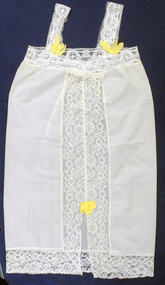 Orbost & District Historical Society
slip, 1950's
... Nylon is a thermoplastic silky material, first used commercially in a nylon-bristled toothbrush (1938), followed more famously by women's stockings ("nylons"; 1940) after being introduced as a fabric at the 1939 New York World's Fair. It was the world's first totally man-made fibre. Nylon fabric became important as a synthetic substitute for silk ...This item was worn by Marjorie Burton. Marjorie Burton ( nee Whiteman), born 12 June, in Birmingham, England came to Orbost in 1995. In England she did office work – typing, shorthand and secretarial work - in accountants’ offices and also trained as a comptometrist with Burroughs in London. She came from a middle-class, working, church-going family. Her mother was a milliner who made manyof Marjorie’s clothes, hats and outfits. Marjorie was married in 1938 to a salesman who later became a mechanic in the R.A.F. during WW11. Nylon is a thermoplastic silky material, first used commercially in a nylon-bristled toothbrush (1938), followed more famously by women's stockings ("nylons"; 1940) after being introduced as a fabric at the 1939 New York World's Fair. It was the world's first totally man-made fibre. Nylon fabric became important as a synthetic substitute for silk in the manufacture of parachutes when silk became scarce during WWII.This item is an example of one of the first pieces of women's clothing to be made commercially using nylon fabric.A white nylon slip with lace trim at the hemline, straps and middle front. It has yellow ribbons wheer straps attach at the front and at the bottom front opening.Label sewn to inside - Made from 100% B NYLON S 1272women's-clothing underwear nylon burton-marjorie -
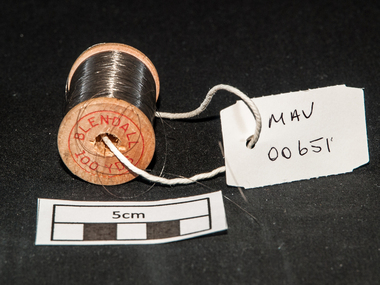 City of Moorabbin Historical Society (Operating the Box Cottage Museum)
Sewing Equipment, reel of nylon thread, c1950
... Nylon is a thermoplastic, silky material, first used commercially in a nylon-bristled toothbrush (1938), followed more famously by women's stockings ("nylons"; 1940) after being introduced as a fabric at the 1939 New York World's Fair. Nylon was intended to be a synthetic replacement for silk and substituted for it in many different products after silk became scarce during World War II. ...Nylon is a thermoplastic, silky material, first used commercially in a nylon-bristled toothbrush (1938), followed more famously by women's stockings ("nylons"; 1940) after being introduced as a fabric at the 1939 New York World's Fair. Nylon was intended to be a synthetic replacement for silk and substituted for it in many different products after silk became scarce during World War II. ...Nylon is a thermoplastic, silky material, first used commercially in a nylon-bristled toothbrush (1938), followed more famously by women's stockings ("nylons"; 1940) after being introduced as a fabric at the 1939 New York World's Fair. Nylon was intended to be a synthetic replacement for silk and substituted for it in many different products after silk became scarce during World War II. It replaced silk in military applications such as parachutes and flak vests, and was used in many types of vehicle tyres. Nylon is clear and colourless, or milky, but is easily dyed. Multi-stranded nylon cord and rope is slippery and tends to unravel. The ends can be melted and fused with a heat source such as a flame or electrode to prevent this.A wooden reel of ' BLONDAL' Nylon sewing thread 100ydsBLONDAL 100ydsmoorabbin, brighton, early settlers, pioneers, cheltenham, dressmaking, craftwork, nylon thread, blondal pty ltd -
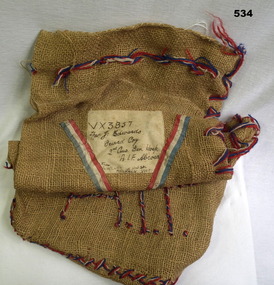 Bendigo Military Museum
Container - STOCKING, 1940 - 43
... stocking made from a Hessian bag. The bag is edged with red, white and blue wool threads. "AIF" is stitched in large large letters same colours. A large red, white and blue possibly silk...stocking made from a Hessian bag. The bag is edged with red, white and blue wool threads. "AIF" is stitched in large large letters same colours. A large red, white and blue possibly silk ...Item received by John EDWARDS VX3857 2nd AIF. Refer Cat No 536 for his service details and Miss McLURE.Christmas stocking made from a Hessian bag. The bag is edged with red, white and blue wool threads. "AIF" is stitched in large large letters same colours. A large red, white and blue possibly silk letter "V" is also stitched in. A piece of white cloth is stitched on with address details hand written. "VX3857 L/Cpl J Edwards Gaurd Coy 2nd Aus Gen Hospital AIF Abroad". "from A McLure 40 York St Prahran Vic".handcrafts- sewing, manchester, fabric/trimming, xmas -
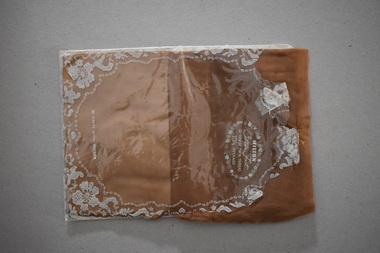 Warrnambool and District Historical Society Inc.
Textile, Hilton Hosiery, Hilton 30 denier stockings, 1960s
... Before the Second World War women’s stockings were made mostly of silk, cotton and wool. Nylon stockings became popular with the introduction of nylon in the 1940s and continued to be used (in conjunction with suspender belts) until the 1960s when the pantihose, a thin nylon form of tights covering the legs up to the waist, was introduced and became the favored leg covering for women. ...Before the Second World War women’s stockings were made mostly of silk, cotton and wool. Nylon stockings became popular with the introduction of nylon in the 1940s and continued to be used (in conjunction with suspender belts) until the 1960s when the pantihose, a thin nylon form of tights covering the legs up to the waist, was introduced and became the favored leg covering for women. ...These nylon stockings are a sample of the type of stockings worn by women between the late 1940s and the early 1960s. Before the Second World War women’s stockings were made mostly of silk, cotton and wool. Nylon stockings became popular with the introduction of nylon in the 1940s and continued to be used (in conjunction with suspender belts) until the 1960s when the pantihose, a thin nylon form of tights covering the legs up to the waist, was introduced and became the favored leg covering for women. Stockings can still be purchased and worn in some circumstances. These stockings are of interest as an example of the items of clothing worn by women in the mid 20th century. They will be useful for displayThis is a pair of beige-coloured nylon stockings. They are folded into a piece of white cardboard and partly enclosed in a clear cellophane wrapping with a decorative pattern on the edges. ‘Hilton Cotton Foot 30 Denier Twin Thread 10½ Average’women’s apparel, warrnambool -
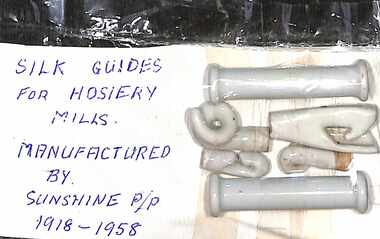 Sunshine and District Historical Society Incorporated
Tool - Sunshine Potteries Silk Hosiery Mill Guides, 1918 - 1958
... Theese silk guides were used by hosiery mills for their knitting machines that made products such as socks, stockings, tights, pantyhose and leggings, etc....Theese silk guides were used by hosiery mills for their knitting machines that made products such as socks, stockings, tights, pantyhose and leggings, etc. ...Theese silk guides were used by hosiery mills for their knitting machines that made products such as socks, stockings, tights, pantyhose and leggings, etc.A collection of 6 clay fired silk hosiery mill guidesSik Guides For Hosiery Mills Manufactured By Sunshine P/P 1918 - 1958sunshine potteries, pottery, potteries, derby road, sunshine -
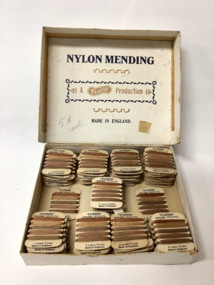 Williamstown Historical Society Inc
Textile - Box of nylon stockings mending thread
... Nylon stockings replaced stockings made of cotton or silk during the 1940s, but were still expensive and were mended rather than discarded when they were damaged. ...Nylon stockings replaced stockings made of cotton or silk during the 1940s, but were still expensive and were mended rather than discarded when they were damaged. ...Nylon stockings replaced stockings made of cotton or silk during the 1940s, but were still expensive and were mended rather than discarded when they were damaged. The mending threads show popular colours during the 1940s and 50s. Vintage stocking mending thread. Lidded cardboard box containing 92 cards of five different coloured nylon mending thread for stockings. On box: "Nylon Mending /A Flosso Production/ Made in England". On inside lid : "Flosso Nylon Mending/5 latest shades/Made in England" On inside lid, in pencil: "5d each" -
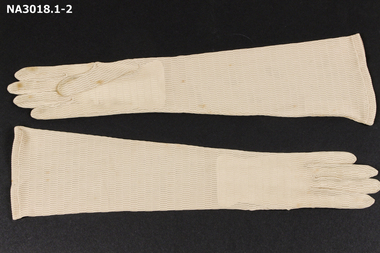 Whitehorse Historical Society Inc.
Clothing - Gloves
... Silk Made in Germany. Elbow length gloves, beige/milky coffee colour, pattern of bands of 8mm stocking stitch offset to each other continuously down the gloves. ...Elbow length gloves, beige/milky coffee colour, pattern of bands of 8mm stocking stitch offset to each other continuously down the gloves.6 Artificial Silk Made in Germany.costume accessories, glove accessories -
 Mont De Lancey
Functional object - Stocking Threads, Creschene, Unknown
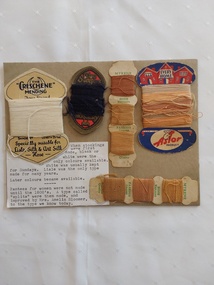
... stocking mending threads wound around branded product cards: white, cream, tan, brown and black. There is a typed explanation piece of paper, see the inscription below. Brands are - 1. The "Creschene" mending Four Strand, Specially made for Lisle, Silk...stocking mending threads wound around branded product cards: white, cream, tan, brown and black. There is a typed explanation piece of paper, see the inscription below. Brands are - 1. The "Creschene" mending Four Strand, Specially made for Lisle, Silk ...'When stockings were first made, black or white were the only colours available. White was usually for Sundays. Lisle was the only type made for many years. Later colours became available'. A brown piece of thick cardboard with five different coloured stocking mending threads wound around branded product cards: white, cream, tan, brown and black. There is a typed explanation piece of paper, see the inscription below. Brands are - 1. The "Creschene" mending Four Strand, Specially made for Lisle, Silk and Art Silk Hose (white thread). 2. Two Steeples Hosiery (black thread). 3. Two samples of Myrene Hose Mending Fashion Shades Superior Quality ( three tan colours). 4. Astor Product Made in Australia, Every Home Super Mercerised Hose Mending. Typed on a piece of white paper, pasted on the card is: 'When stockings were first made, black or white were the only colours available. White was usually for Sundays. Lisle was the only type made for many years. Later colours became available'. As an extra explanation not related to stockings is typed: Pantees for women were not made until the 1800's. A type called "splits" were then made, and improved by Mrs Amelia Bloomer, to the type we know today.'sewing, sewing equipment, stockings, mending -
 Linton Mechanics Institute and Free Library Collection
Book - Novel, Hare, Cyril, When the wind blows, 1949
... When celebrated visiting violinist Lucy Carless is strangled to death with a silk stocking backstage during a concert, everyone in the local orchestra suddenly becomes a suspect 254p. ; crimson cover with original dust jacket cut and pasted on to front cover featuring woman sitting in arm chair with violin in foreground; title and author written on spine When the wind blows Book Novel Hare, Cyril Faber & Faber Purnell and Sons ...The story takes place in the English county of Markshire. When celebrated visiting violinist Lucy Carless is strangled to death with a silk stocking backstage during a concert, everyone in the local orchestra suddenly becomes a suspect254p. ; crimson cover with original dust jacket cut and pasted on to front cover featuring woman sitting in arm chair with violin in foreground; title and author written on spinefictionThe story takes place in the English county of Markshire. When celebrated visiting violinist Lucy Carless is strangled to death with a silk stocking backstage during a concert, everyone in the local orchestra suddenly becomes a suspectfiction, crime, mystery, thriller, cyril hare -
 Embroiderers Guild, Victoria
Functional object - 19 th C Miser's Purse
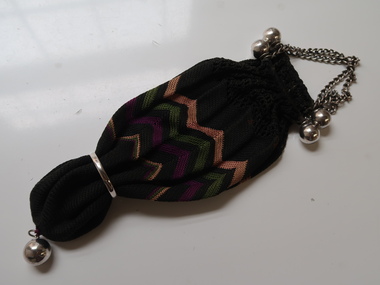
... stocking. A large version—as much as a couple of feet long and perhaps used largely by men during the eighteenth century—gradually became smaller and more refined. The miser’s purse grew in popularity on the continent and in England during the nineteenth century. During the second half of the century, it became one of the most common purses that Victorians carried. Used by both women and men, the typical nineteenth-century miser’s purse was a long tube made of “purse” or “netting” silk...stocking. A large version—as much as a couple of feet long and perhaps used largely by men during the eighteenth century—gradually became smaller and more refined. The miser’s purse grew in popularity on the continent and in England during the nineteenth century. During the second half of the century, it became one of the most common purses that Victorians carried. Used by both women and men, the typical nineteenth-century miser’s purse was a long tube made of “purse” or “netting” silk ...The Miser’s purse originated late in the eighteenth century and was variously called misers, hookers, almoners (or aumonières), and wallets, or long, stocking, ring, and string purses. The shape of the miser’s purse originated from the medieval practice of carrying coins in the toe of a stocking. A large version—as much as a couple of feet long and perhaps used largely by men during the eighteenth century—gradually became smaller and more refined. The miser’s purse grew in popularity on the continent and in England during the nineteenth century. During the second half of the century, it became one of the most common purses that Victorians carried. Used by both women and men, the typical nineteenth-century miser’s purse was a long tube made of “purse” or “netting” silk, often crocheted, netted, or knitted, with or without beads. Narrow in the middle and closed at both ends, miser’s purses ranged in the course of their history from 4 to 36 inches (10.2 to 91.4 cm) long. During the Victorian era, many miser’s purses were from 8 to 10 inches (20.3 to 25.4 cm) long. The “toes” of the purse, which might be of the same or different shapes, often were tasseled or fringed.Crochet tubular reticule in black with cream, maroon and green chevron pattern. Includes steel metal rods with balls attachment , metal chain handle and metal ball at base. -
 Embroiderers Guild, Victoria
Functional object - 19 th C Crochet Misers Purse
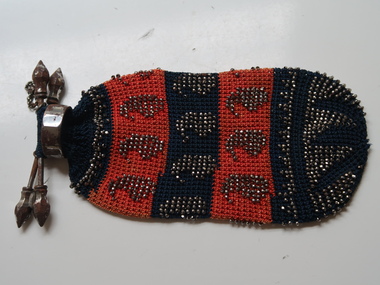
... stocking. A large version—as much as a couple of feet long and perhaps used largely by men during the eighteenth century—gradually became smaller and more refined. The miser’s purse grew in popularity on the continent and in England during the nineteenth century. During the second half of the century, it became one of the most common purses that Victorians carried. Used by both women and men, the typical nineteenth-century miser’s purse was a long tube made of “purse” or “netting” silk...stocking. A large version—as much as a couple of feet long and perhaps used largely by men during the eighteenth century—gradually became smaller and more refined. The miser’s purse grew in popularity on the continent and in England during the nineteenth century. During the second half of the century, it became one of the most common purses that Victorians carried. Used by both women and men, the typical nineteenth-century miser’s purse was a long tube made of “purse” or “netting” silk ...The Miser’s purse originated late in the eighteenth century and was variously called misers, hookers, almoners (or aumonières), and wallets, or long, stocking, ring, and string purses. The shape of the miser’s purse originated from the medieval practice of carrying coins in the toe of a stocking. A large version—as much as a couple of feet long and perhaps used largely by men during the eighteenth century—gradually became smaller and more refined. The miser’s purse grew in popularity on the continent and in England during the nineteenth century. During the second half of the century, it became one of the most common purses that Victorians carried. Used by both women and men, the typical nineteenth-century miser’s purse was a long tube made of “purse” or “netting” silk, often crocheted, netted, or knitted, with or without beads. Narrow in the middle and closed at both ends, miser’s purses ranged in the course of their history from 4 to 36 inches (10.2 to 91.4 cm) long. During the Victorian era, many miser’s purses were from 8 to 10 inches (20.3 to 25.4 cm) long. The “toes” of the purse, which might be of the same or different shapes, often were tasseled or fringed.Tubular purse in crochet with pink and black netting silk. Embellished with metallic steel cut beads. Steel handle with security steel ring.
