
Showing 475 items matching "silver plated spoons"
-
 Bendigo Historical Society Inc.
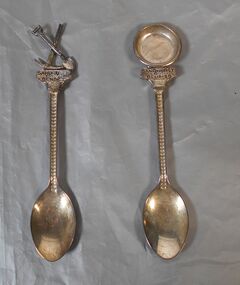
Souvenir - Silver plated decorative spoons
... Silver plated decorative spoons.......Silver plated spoons...Two silver plated spoons with Sandhurst Town Bendigo inscription. ...BHS Collection Collectables Silver plated spoons Sandhurst Sandhurst Town Bendigo Two silver plated spoons with Sandhurst Town Bendigo inscription. ...BHS CollectionTwo silver plated spoons with Sandhurst Town Bendigo inscription. One of the spoons has a gold pan at the top, the other a shovel and pick. Aileen and John Ellison Collection.Sandhurst Town Bendigocollectables, silver plated spoons, sandhurst -
 Flagstaff Hill Maritime Museum and Village
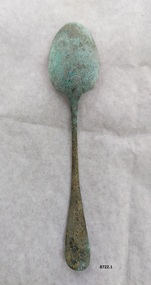
Domestic object - Spoons, William Page & Co, circa 1878
... ...silver plated spoons...The spoons are representative of similar items of silver electro-plated cutlery salvaged from the Loch Ard wreck site, comprising nickel silver electroplated spoons and forks of various sizes but all sharing the same general shape and design. ...Flagstaff Hill Maritime Museum and Village Warrnambool Great Ocean Road Shipwreck Coast Loch Ard Wreck of the Loch Ard Loch Ard artefacts Loch Ard salvage william page and company William Page and Co Birmingham spoons domestic spoons silver plated spoons electroplated spoons electroplated cutlery Makers’ mark “W” & “P” placed within a raised diamond outline, which is in turn contained within a sunken crown shape identifying the manufacturer as William Page & Co of Birmingham plus a "B" and three other unidentified marks. ...These spoons are from the wreck of the Loch Ard, which sailed from Gravesend, London 1878. The manifest listed an array of manufactured goods being exported to the Colony of Victoria. Included in the cargo manifest was a large number of hardware & cutlery items. The spoons are representative of similar items of silver electro-plated cutlery salvaged from the Loch Ard wreck site, comprising nickel silver electroplated spoons and forks of various sizes but all sharing the same general shape and design. Some of the pieces display their makers’ mark of William Page & Co Birmingham UK. Within the Flagstaff Hills cutlery collection donated from the Loch Ard, maker’s marks are often obscured by sedimentary accretion or verdigris after a century of submersion in the ocean. However sufficient detail has survived to indicate that the collection of samples of electroplated cutlery probably originated from the same cargo consignment from the Loch Ard and were made by William Page & Co. Of Birmingham England. William Page was born in 1811 and died in 1885. He was active as a manufacturer of cutlery from 1829 with premises at 74 Belmont Rd, Dales End as a "close plater" (someone who works sheet metal), and he began electroplating in 1855. William Page & Co was also active from 1880 at Cranemore St, Cattle’s Grove also 55 Albion St, Birmingham, and in 1936 the firm became an Ltd company. The firm used the trademarks "Asrista, Bolivian Silver, Silverite, Roman Silver, Romanian Silver, and Trevor Plate. In 1938 William Page was a supplier to the British Government, marking its products with the broad arrow symbol and was also present at Sheffield. Electroplated silver objects are made of a base metal (like copper, nickel or brass) coated with a microscopic layer of silver using an electrical current. If objects like these spoons are submerged for long periods in sea water or air, the surface may become tarnished with different colours - purple tarnish is a natural early-stage of oxidation when the copper alloy reacts with sulfur in the air and is often a precursor to black tarnish, green patina occurs when copper or brass is exposed to air and water over long periods and is generally harmless and acts as a shield against further decay and brown tarnish occurs when copper combines with oxygen. The ship Loch Ard was built on the River Clyde in Scotland in 1873 for the prestigious Loch Line of colonial clipper ships, designed for the Australian run. It sailed from England on 1st March 1878 carrying 37 crew, 17 passengers and a load of cargo. The general cargo reflected the affluence of Melbourne at the time. On board were straw hats, umbrellas, perfumes, clay pipes, pianos, clocks, confectionary, linen and candles, as well as a heavier load of railway irons, cement, lead and copper. There were items included that were intended for display in the Melbourne International Exhibition in 1880 - a diverse general cargo ranging from luxury items to bulk railway iron. On 1 June 1878, emerging from fog and hearing too late the sound of breakers against the tall limestone cliffs, the vessel struck the southern foot of Mutton Bird Island and sank in 23 metres of water. Of the fifty-four people on board only two survived, one young male crewman, Tom Pearce, and one young female passenger, Eva Carmichael. Ten days after the Loch Ard tragedy, salvage rights to the wreck were sold at auction for £2,120. Cargo valued at £3,000 was salvaged and placed on the beach, but most washed back into the sea when another storm developed. The wreck of Loch Ard still lies at the base of Mutton Bird Island. Much of the cargo has now been salvaged and some was washed up into what is now known as Loch Ard Gorge. Cargo and artefacts have also been illegally salvaged over many years before protective legislation was introduced in 1976. One of the most unlikely pieces of cargo to have survived the shipwreck was a Minton porcelain peacock - one of only seven in the world. The peacock was destined for the Melbourne International Exhibition in 1880. It had been well packed, which gave it adequate protection during the violent storm. Today, the Minton peacock can be seen at the Flagstaff Hill Maritime Museum in Warrnambool. From Australia's most dramatic shipwreck it has now become Australia's most valuable shipwreck artefact and is one of very few 'objects' on the Victorian State Heritage Register. Flagstaff Hill’s collection of artefacts from LOCH ARD is significant for being one of the largest collections of artefacts from this shipwreck in Victoria. It is significant for its association with the shipwreck, which is on the Victorian Heritage Register (VHR S417). The collection is significant because of the relationship between the objects, as together they have a high potential to interpret the story of the LOCH ARD. The LOCH ARD collection is archaeologically significant as the remains of a large international passenger and cargo ship. The LOCH ARD collection is historically significant for representing aspects of Victoria’s shipping history and its potential to interpret sub-theme 1.5 of Victoria’s Framework of Historical Themes (living with natural processes). The collection is also historically significant for its association with the LOCH ARD, which was one of the worst and best known shipwrecks in Victoria’s history.This is a collection of six spoons recovered from the wreck of the Loch Ard which sank in 1878. Spoon 8722.1 (a tablespoon) is the largest of the spoons. It has an elongated rounded handle and is extensively covered with green verdigris. Spoon 8722.2 (a teaspoon) is the smallest of the spoons. It also has an elongated rounded handle and has black and green tarnish. There is evidence of markings on the handle but they are difficult to decipher. Spoons 8722.3 - 8722.6 are of similar size and design. They are dessert spoons with a fiddle back handle. Spoon 8722.3 is badly corroded and encrusted with sea debris but there is evidence (which is difficult to read) of markings on the handle. Spoon 8722.4 is also heavily tarnished with green verdigris and the metal is beginning to flake on the handle. It has remnants of masking tape on the inner bowl. Spoon 8722.5 has an extensive covering of vertigris and the metal is very thin and fragile with several tiny holes and a larger hole in the bowl. Spoon 8722.6 has extensive brown (and some green) oxidation and a full set of hall marks on the handle - including the maker's mark for William Page and Co Birmingham - A WP stamp within a square diamond, a letter "B" and three more hallmarks.Makers’ mark “W” & “P” placed within a raised diamond outline, which is in turn contained within a sunken crown shape identifying the manufacturer as William Page & Co of Birmingham plus a "B" and three other unidentified marks.flagstaff hill maritime museum and village, warrnambool, great ocean road, shipwreck coast, loch ard, wreck of the loch ard, loch ard artefacts, loch ard salvage, william page and company, william page and co birmingham, spoons, domestic spoons, silver plated spoons, electroplated spoons, electroplated cutlery -
 Vision Australia
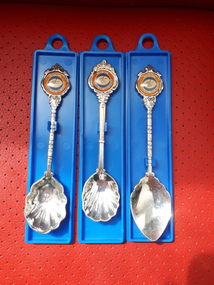
Functional object - Object, Lady Nell Seeing Eye Dog School spoons, 1980s
... 3 silver plated spoons with various bowl and handle shapes...Fundraising Lady Nell Seeing Eye Dog School 3 silver plated spoons with various bowl and handle shapes Lady Nell Seeing Eye Dog School spoons Functional object Object ...Three commemorative, but also usable, spoons with 'Lady Nell' and 'Seeing Eye Dog School' on a beige background, around a blue and beige circle with a dog in harness in the middle. An orange background as the outer rim makes it resemble an eye. The bowl and handles of the three spoons vary in design. Spoon collecting was a popular hobby during the late 1970s and early 1980s amongst souvenir hunters who found it an easily portable way to track their travels and interests. 3 silver plated spoons with various bowl and handle shapesfundraising, lady nell seeing eye dog school -
 Glenelg Shire Council Cultural Collection
Souvenir - Souvenir Teaspoon - Portland, n.d
... Souvenir teaspoon, showing image of the port and coastline, silver plate spoon by 'Stuart', made in Australia....souvenir Portland Portland Harbour Souvenir teaspoon, showing image of the port and coastline, silver plate spoon by 'Stuart', made in Australia. ...Souvenir teaspoon, showing image of the port and coastline, silver plate spoon by 'Stuart', made in Australia.souvenir, portland, portland harbour -
 Mont De Lancey
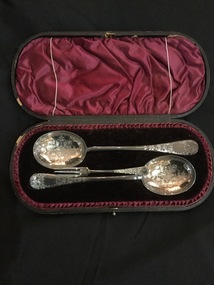
Spoon and fork set, 1884
... A pair of engraved silver plated spoons and small fork in red lined velvet and satin case....Lord spoons forks dessert forks A pair of engraved silver plated spoons and small fork in red lined velvet and satin case. ...Owned by Mrs. R. B. LordA pair of engraved silver plated spoons and small fork in red lined velvet and satin case.spoons, forks, dessert forks -
Tatura Irrigation & Wartime Camps Museum
Dessert Spoon, 1940's
... Silver plated dessert spoon...Used by internees at Camp 3, Tatura spoon hoefer family camp 3 tatura ww2 camp 3 domestic cutlery Plate EPNS A1 Silver plated dessert spoon Dessert Spoon ...Used by internees at Camp 3, TaturaSilver plated dessert spoonPlate EPNS A1spoon, hoefer family, camp 3, tatura, ww2 camp 3, domestic, cutlery -
 Whitehorse Historical Society Inc.
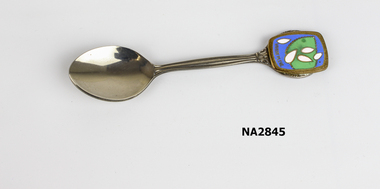
Memorabilia - Spoon Mitcham High School
... Silver plated spoon with school badge. Badge has blue, green and gold background with white leaves and the Mitcham High School school motto engraved in gold....civic mementoes souvenirs Vivere Plene Silver plated spoon with school badge. Badge has blue, green and gold background with white leaves and the Mitcham High School school motto engraved in gold. ...Silver plated spoon with school badge. Badge has blue, green and gold background with white leaves and the Mitcham High School school motto engraved in gold.Vivere Plenecivic mementoes, souvenirs -
 Orbost & District Historical Society
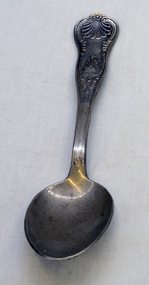
spoon, first half 20th century
... cutlery silver-plate spoon-serving...A large silver plated serving spoon with an ornate handle....This spoon has aesthetic significance as an example of silver plate cutlery used in the early 20th century. cutlery silver-plate spoon-serving A large silver plated serving spoon with an ornate handle. spoon ...This spoon has aesthetic significance as an example of silver plate cutlery used in the early 20th century.A large silver plated serving spoon with an ornate handle.cutlery silver-plate spoon-serving -
 Flagstaff Hill Maritime Museum and Village
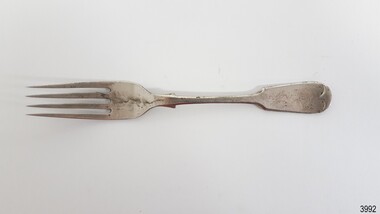
Domestic object - Fork, Prior to 1878
... These spoons are representative of similar items of silver electro-plated cutlery salvaged from the Loch Ard wreck site, comprising nickel silver electroplated spoons and forks of various sizes but all sharing the same general shape and design. ...Fork, nickel silver plated spoon with Fiddle-back design handle, narrow stem with flared collar.Fork has maker's marks. ...These spoons are representative of similar items of silver electro-plated cutlery salvaged from the Loch Ard wreck site, comprising nickel silver electroplated spoons and forks of various sizes but all sharing the same general shape and design. ...This fork was recovered from the wreck of the Loch Ard that sailed from Gravesend, London. The manifest listed an array of manufactured goods being exported to the Colony of Victoria. Included in the cargo manifest was a large number of hardware and cutlery items. These spoons are representative of similar items of silver electro-plated cutlery salvaged from the Loch Ard wreck site, comprising nickel silver electroplated spoons and forks of various sizes but all sharing the same general shape and design. History of the Loch Ard: - The Loch Ard got its name from ”Loch Ard” a loch that lies to the west of Aberfoyle, and the east of Loch Lomond. It means "high lake" in Scottish Gaelic. The vessel belonged to the famous Loch Line which sailed many vessels from England to Australia. The Loch Ard was built in Glasgow by Barclay, Curdle and Co. in 1873, the vessel was a three-masted square-rigged iron sailing ship that measured 79.87 meters in length, 11.58 m in width, and 7 m in depth with a gross tonnage of 1693 tons with a mainmast that measured a massive 45.7 m in height. Loch Ard made three trips to Australia and one trip to Calcutta before its fateful voyage. Loch Ard left England on March 2, 1878, under the command of 29-year-old Captain Gibbs, who was newly married. The ship was bound for Melbourne with a crew of 37, plus 17 passengers. The general cargo reflected the affluence of Melbourne at the time. Onboard were straw hats, umbrellas, perfumes, clay pipes, pianos, clocks, confectionery, linen and candles, as well as a heavier load of railway irons, cement, lead and copper. There were other items included that were intended for display in the Melbourne International Exhibition of 1880. The voyage to Port Phillip was long but uneventful. Then at 3 am on June 1, 1878, Captain Gibbs was expecting to see land. But the Loch Ard was running into a fog which greatly reduced visibility. Captain Gibbs was becoming anxious as there was no sign of land or the Cape Otway lighthouse. At 4 am the fog lifted and a lookout aloft announced that he could see breakers. The sheer cliffs of Victoria's west coast came into view, and Captain Gibbs realised that the ship was much closer to them than expected. He ordered as much sail to be set as time would permit and then attempted to steer the vessel out to sea. On coming head-on into the wind, the ship lost momentum, the sails fell limp and Loch Ard's bow swung back towards land. Gibbs then ordered the anchors to be released in an attempt to hold their position. The anchors sank some 50 fathoms - but did not hold. By this time the ship was among the breakers and the tall cliffs of Mutton Bird Island rose behind. Just half a mile from the coast, the ship's bow was suddenly pulled around by the anchor. The captain tried to tack out to sea, but the ship struck a reef at the base of Mutton Bird Island, near Port Campbell. Waves subsequently broke over the ship and the top deck became loosened from the hull. The masts and rigging came crashing down knocking passengers and crew overboard. When a lifeboat was finally launched, it crashed into the side of Loch Ard and capsized. Tom Pearce, who had launched the boat, managed to cling to its overturned hull and shelter beneath it. He drifted out to sea and then on the flood tide came into what is now known as Loch Ard Gorge. He swam to shore, bruised and dazed, and found a cave in which to shelter. Some of the crew stayed below deck to shelter from the falling rigging but drowned when the ship slipped off the reef into deeper water. Eva Carmichael a passenger had raced onto the deck to find out what was happening only to be confronted by towering cliffs looming above the stricken ship. In all the chaos, Captain Gibbs grabbed Eva and said, "If you are saved Eva, let my dear wife know that I died like a sailor". That was the last Eva Carmichael saw of the captain. She was swept off the ship by a huge wave. Eva saw Tom Pearce on a small rocky beach and yelled to attract his attention. He dived in and swam to the exhausted woman and dragged her to shore. He took her to the cave and broke the open case of brandy which had washed up on the beach. He opened a bottle to revive the unconscious woman. A few hours later Tom scaled a cliff in search of help. He followed hoof prints and came by chance upon two men from nearby Glenample Station three and a half miles away. In a complete state of exhaustion, he told the men of the tragedy. Tom then returned to the gorge while the two men rode back to the station to get help. By the time they reached Loch Ard Gorge, it was cold and dark. The two shipwreck survivors were taken to Glenample Station to recover. Eva stayed at the station for six weeks before returning to Ireland by steamship. In Melbourne, Tom Pearce received a hero's welcome. He was presented with the first gold medal of the Royal Humane Society of Victoria and a £1000 cheque from the Victorian Government. Concerts were performed to honour the young man's bravery and to raise money for those who lost family in the disaster. Of the 54 crew members and passengers on board, only two survived: the apprentice, Tom Pearce and the young woman passenger, Eva Carmichael, who lost her family in the tragedy. Ten days after the Loch Ard tragedy, salvage rights to the wreck were sold at auction for £2,120. Cargo valued at £3,000 was salvaged and placed on the beach, but most washed back into the sea when another storm developed. The wreck of Loch Ard still lies at the base of Mutton Bird Island. Much of the cargo has now been salvaged and some items were washed up into Loch Ard Gorge. Cargo and artefacts have also been illegally salvaged over many years before protective legislation was introduced in March 1982. One of the most unlikely pieces of cargo to have survived the shipwreck was a Minton majolica peacock- one of only nine in the world. The peacock was destined for the Melbourne 1880 International Exhibition. It had been well packed, which gave it adequate protection during the violent storm. Today the Minton peacock can be seen at the Flagstaff Hill Maritime Museum in Warrnambool. From Australia's most dramatic shipwreck, it has now become Australia's most valuable shipwreck artifact and is one of very few 'objects' on the Victorian State Heritage Register.The shipwreck of the Loch Ard is of significance for Victoria and is registered on the Victorian Heritage Register ( S 417). Flagstaff Hill has a varied collection of artefacts from Loch Ard and its collection is significant for being one of the largest accumulation of artefacts from this notable Victorian shipwreck. The collections object is to also give us a snapshot into history so we can interpret the story of this tragic event. The collection is also archaeologically significant as it represents aspects of Victoria's shipping history that allows us to interpret Victoria's social and historical themes of the time. The collections historically significance is that it is associated unfortunately with the worst and best-known shipwreck in Victoria's history. Fork, nickel silver plated spoon with Fiddle-back design handle, narrow stem with flared collar.Fork has maker's marks. It was recovered from the wreck of the Loch Ard.Shapes of Crown, Square with cut corners, 2 circles, diamondflagstaff hill, warrnambool, shipwrecked coast, flagstaff hill maritime museum, maritime museum, shipwreck coast, flagstaff hill maritime village, great ocean road, loch line, loch ard, captain gibbs, eva carmichael, tom pearce, glenample station, mutton bird island, loch ard gorge, silverware, cutlery, dining utensil, fork, dining fork -
 Melbourne Water
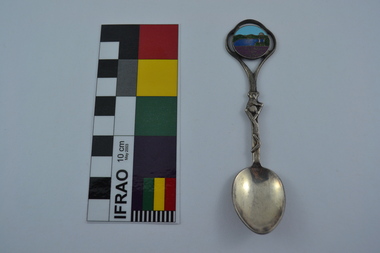
Souvenir Spoon
... Manufactured in Australia, this souvenir silver-plated spoon features an image of Maroondah Dam, Healesville. ...This souvenir spoon has been curated by Melbourne Water as it represents an important historical aspect of the organisation by demonstrating the popularity of its water asset sites as recreational places and tourist attractions, and although these sites are functional parts of the water supply system, they were also designed to be enjoyed by the public both aesthetically and recreationally. mmbw melbourne metropolitan board of works spoon souvenir maroondah healesville melbourne water Manufactured in Australia, this souvenir silver-plated spoon features an image of Maroondah Dam, Healesville. ...The Maroondah System was first and foremost developed as a functional component of Melbourne's Water Supply System. In addition to functionality, the Melbourne and Metropolitan Board of Works (MMBW) envisioned the Maroondah Reserve to be enjoyed aesthetically and recreationally by the public. This souvenir illustrates the realisation of the Maroondah System as a local recreational and tourist attraction in the early 20th century. The Maroondah Reserve gardens were landscaped with English-style ornamental stonework, exotic trees, flower beds and rose gardens. All features of the water supply system became widely celebrated as beauty spots that continue to be very popular to this day with tourists and locals alike. This souvenir is a product of that flourishing tourist trade. These water supply sites continue to enhance Melbourne’s charm and liveability and are now recognised as places of cultural and historic significance.This souvenir spoon has been curated by Melbourne Water as it represents an important historical aspect of the organisation by demonstrating the popularity of its water asset sites as recreational places and tourist attractions, and although these sites are functional parts of the water supply system, they were also designed to be enjoyed by the public both aesthetically and recreationally.Manufactured in Australia, this souvenir silver-plated spoon features an image of Maroondah Dam, Healesville. The spoon features a koala engraving and boomerang on the stem. Engraved on the back of the spoon is “Peninsula Plate”.mmbw, melbourne metropolitan board of works, spoon, souvenir, maroondah, healesville, melbourne water -
 Whitehorse Historical Society Inc.
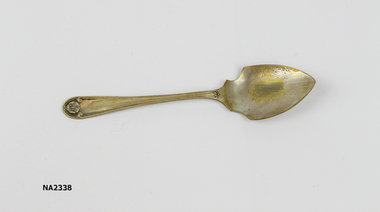
Domestic object - Jam Spoon
... Small silver plated jam spoon with shovel shaped head....domestic items cutlery Small silver plated jam spoon with shovel shaped head. Domestic object Jam Spoon ...Small silver plated jam spoon with shovel shaped head.domestic items, cutlery -
 Flagstaff Hill Maritime Museum and Village
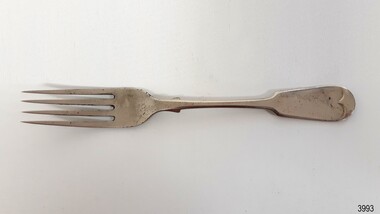
Domestic object - Fork, Prior to 1878
... These spoons are representative of similar items of silver electro-plated cutlery salvaged from the Loch Ard wreck site, comprising nickel silver electroplated spoons and forks of various sizes but all sharing the same general shape and design. ...Fork, nickel silver plated spoon with Fiddle-back design handle, narrow stem with flared collar. ...These spoons are representative of similar items of silver electro-plated cutlery salvaged from the Loch Ard wreck site, comprising nickel silver electroplated spoons and forks of various sizes but all sharing the same general shape and design. ...This fork was recovered from the wreck of the Loch Ard that sailed from Gravesend, London. The manifest listed an array of manufactured goods being exported to the Colony of Victoria. Included in the cargo manifest was a large number of hardware and cutlery items. These spoons are representative of similar items of silver electro-plated cutlery salvaged from the Loch Ard wreck site, comprising nickel silver electroplated spoons and forks of various sizes but all sharing the same general shape and design. History of the Loch Ard: - The Loch Ard got its name from ”Loch Ard” a loch that lies to the west of Aberfoyle, and the east of Loch Lomond. It means "high lake" in Scottish Gaelic. The vessel belonged to the famous Loch Line which sailed many vessels from England to Australia. The Loch Ard was built in Glasgow by Barclay, Curdle and Co. in 1873, the vessel was a three-masted square-rigged iron sailing ship that measured 79.87 meters in length, 11.58 m in width, and 7 m in depth with a gross tonnage of 1693 tons with a mainmast that measured a massive 45.7 m in height. Loch Ard made three trips to Australia and one trip to Calcutta before its fateful voyage. Loch Ard left England on March 2, 1878, under the command of 29-year-old Captain Gibbs, who was newly married. The ship was bound for Melbourne with a crew of 37, plus 17 passengers. The general cargo reflected the affluence of Melbourne at the time. Onboard were straw hats, umbrellas, perfumes, clay pipes, pianos, clocks, confectionery, linen and candles, as well as a heavier load of railway irons, cement, lead and copper. There were other items included that were intended for display in the Melbourne International Exhibition of 1880. The voyage to Port Phillip was long but uneventful. Then at 3 am on June 1, 1878, Captain Gibbs was expecting to see land. But the Loch Ard was running into a fog which greatly reduced visibility. Captain Gibbs was becoming anxious as there was no sign of land or the Cape Otway lighthouse. At 4 am the fog lifted and a lookout aloft announced that he could see breakers. The sheer cliffs of Victoria's west coast came into view, and Captain Gibbs realised that the ship was much closer to them than expected. He ordered as much sail to be set as time would permit and then attempted to steer the vessel out to sea. On coming head-on into the wind, the ship lost momentum, the sails fell limp and Loch Ard's bow swung back towards land. Gibbs then ordered the anchors to be released in an attempt to hold their position. The anchors sank some 50 fathoms - but did not hold. By this time the ship was among the breakers and the tall cliffs of Mutton Bird Island rose behind. Just half a mile from the coast, the ship's bow was suddenly pulled around by the anchor. The captain tried to tack out to sea, but the ship struck a reef at the base of Mutton Bird Island, near Port Campbell. Waves subsequently broke over the ship and the top deck became loosened from the hull. The masts and rigging came crashing down knocking passengers and crew overboard. When a lifeboat was finally launched, it crashed into the side of Loch Ard and capsized. Tom Pearce, who had launched the boat, managed to cling to its overturned hull and shelter beneath it. He drifted out to sea and then on the flood tide came into what is now known as Loch Ard Gorge. He swam to shore, bruised and dazed, and found a cave in which to shelter. Some of the crew stayed below deck to shelter from the falling rigging but drowned when the ship slipped off the reef into deeper water. Eva Carmichael a passenger had raced onto the deck to find out what was happening only to be confronted by towering cliffs looming above the stricken ship. In all the chaos, Captain Gibbs grabbed Eva and said, "If you are saved Eva, let my dear wife know that I died like a sailor". That was the last Eva Carmichael saw of the captain. She was swept off the ship by a huge wave. Eva saw Tom Pearce on a small rocky beach and yelled to attract his attention. He dived in and swam to the exhausted woman and dragged her to shore. He took her to the cave and broke the open case of brandy which had washed up on the beach. He opened a bottle to revive the unconscious woman. A few hours later Tom scaled a cliff in search of help. He followed hoof prints and came by chance upon two men from nearby Glenample Station three and a half miles away. In a complete state of exhaustion, he told the men of the tragedy. Tom then returned to the gorge while the two men rode back to the station to get help. By the time they reached Loch Ard Gorge, it was cold and dark. The two shipwreck survivors were taken to Glenample Station to recover. Eva stayed at the station for six weeks before returning to Ireland by steamship. In Melbourne, Tom Pearce received a hero's welcome. He was presented with the first gold medal of the Royal Humane Society of Victoria and a £1000 cheque from the Victorian Government. Concerts were performed to honour the young man's bravery and to raise money for those who lost family in the disaster. Of the 54 crew members and passengers on board, only two survived: the apprentice, Tom Pearce and the young woman passenger, Eva Carmichael, who lost her family in the tragedy. Ten days after the Loch Ard tragedy, salvage rights to the wreck were sold at auction for £2,120. Cargo valued at £3,000 was salvaged and placed on the beach, but most washed back into the sea when another storm developed. The wreck of Loch Ard still lies at the base of Mutton Bird Island. Much of the cargo has now been salvaged and some items were washed up into Loch Ard Gorge. Cargo and artefacts have also been illegally salvaged over many years before protective legislation was introduced in March 1982. One of the most unlikely pieces of cargo to have survived the shipwreck was a Minton majolica peacock- one of only nine in the world. The peacock was destined for the Melbourne 1880 International Exhibition. It had been well packed, which gave it adequate protection during the violent storm. Today the Minton peacock can be seen at the Flagstaff Hill Maritime Museum in Warrnambool. From Australia's most dramatic shipwreck, it has now become Australia's most valuable shipwreck artifact and is one of very few 'objects' on the Victorian State Heritage Register.The shipwreck of the Loch Ard is of significance for Victoria and is registered on the Victorian Heritage Register ( S 417). Flagstaff Hill has a varied collection of artefacts from Loch Ard and its collection is significant for being one of the largest accumulation of artefacts from this notable Victorian shipwreck. The collections object is to also give us a snapshot into history so we can interpret the story of this tragic event. The collection is also archaeologically significant as it represents aspects of Victoria's shipping history that allows us to interpret Victoria's social and historical themes of the time. The collections historically significance is that it is associated unfortunately with the worst and best-known shipwreck in Victoria's history. Fork, nickel silver plated spoon with Fiddle-back design handle, narrow stem with flared collar. Handle has maker's marks underneath. It was recovered from the wreck of the Loch Ard.Shapes of Drown, Oval, Square, Circle and Diamondflagstaff hill, warrnambool, shipwrecked coast, flagstaff hill maritime museum, maritime museum, shipwreck coast, flagstaff hill maritime village, great ocean road, loch line, loch ard, captain gibbs, eva carmichael, tom pearce, glenample station, mutton bird island, loch ard gorge, silverware, cutlery, dining utensil, fork, dining fork -
Glenelg Shire Council Cultural Collection
Souvenir - Spoon - Portland 150th Anniversary, n.d
... Silver plated spoon, badge with Portland's 150th logo, with 'Portland's' above logo; '1834 1984' either side of logo; '150th ANNIVERSARY VICTORIA'S FIRST PERMANENT SETTLEMENT' beneath logo....souvenir of Portland teaspoon 150th anniversary Back: 'Silverplated' - impressed 'Celest Perfection Plate Pty Ltd Australia' - impressed Silver plated spoon, badge with Portland's 150th logo, with 'Portland's' above logo; '1834 1984' either side of logo; '150th ANNIVERSARY VICTORIA'S FIRST PERMANENT SETTLEMENT' beneath logo. ...Silver plated spoon, badge with Portland's 150th logo, with 'Portland's' above logo; '1834 1984' either side of logo; '150th ANNIVERSARY VICTORIA'S FIRST PERMANENT SETTLEMENT' beneath logo.Back: 'Silverplated' - impressed 'Celest Perfection Plate Pty Ltd Australia' - impressedsouvenir of portland, teaspoon, 150th anniversary -
 Whitehorse Historical Society Inc.
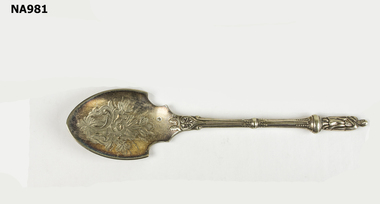
Domestic object - Spoon, c1900
... Silver plated jam spoon - flower decoration with Apostle on end of handle...domestic items cutlery Silver plated jam spoon - flower decoration with Apostle on end of handle Domestic object Spoon ...Silver plated jam spoon - flower decoration with Apostle on end of handledomestic items, cutlery -
 Greensborough Historical Society
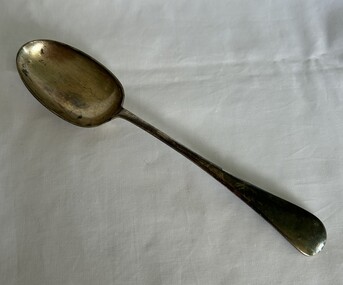
Functional object - Cutlery, Serving spoon, 1950s
... Silver or silver plate serving spoon...Serving spoon, possibly silver or silver plate. No manufacturers marks....Silver or silver plate serving spoon cutlery spoons Serving spoon, possibly silver or silver plate. ...Silver or silver plate serving spoonServing spoon, possibly silver or silver plate. No manufacturers marks.cutlery, spoons -
 Flagstaff Hill Maritime Museum and Village
Domestic object - Spoon, Prior to 1878
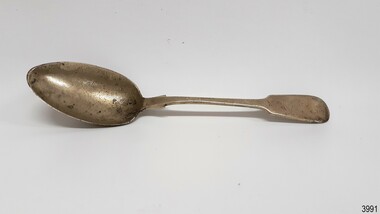
... These spoons are representative of similar items of silver electro-plated cutlery salvaged from the Loch Ard wreck site, comprising nickel silver electroplated spoons and forks of various sizes but all sharing the same general shape and design. ...Spoon, tablespoon; nickel silver plated spoon with fiddle-back design handle, narrow stem with flared collar and elongated bowl. ...These spoons are representative of similar items of silver electro-plated cutlery salvaged from the Loch Ard wreck site, comprising nickel silver electroplated spoons and forks of various sizes but all sharing the same general shape and design. ...This tablespoon was recovered from the wreck of the Loch Ard that sailed from Gravesend, London. The manifest listed an array of manufactured goods being exported to the Colony of Victoria. Included in the cargo manifest was a large number of hardware and cutlery items. These spoons are representative of similar items of silver electro-plated cutlery salvaged from the Loch Ard wreck site, comprising nickel silver electroplated spoons and forks of various sizes but all sharing the same general shape and design. History of the Loch Ard: - The Loch Ard got its name from ”Loch Ard” a loch that lies to the west of Aberfoyle, and the east of Loch Lomond. It means "high lake" in Scottish Gaelic. The vessel belonged to the famous Loch Line which sailed many vessels from England to Australia. The Loch Ard was built in Glasgow by Barclay, Curdle and Co. in 1873, the vessel was a three-masted square-rigged iron sailing ship that measured 79.87 meters in length, 11.58 m in width, and 7 m in depth with a gross tonnage of 1693 tons with a mainmast that measured a massive 45.7 m in height. Loch Ard made three trips to Australia and one trip to Calcutta before its fateful voyage. Loch Ard left England on March 2, 1878, under the command of 29-year-old Captain Gibbs, who was newly married. The ship was bound for Melbourne with a crew of 37, plus 17 passengers. The general cargo reflected the affluence of Melbourne at the time. Onboard were straw hats, umbrellas, perfumes, clay pipes, pianos, clocks, confectionery, linen and candles, as well as a heavier load of railway irons, cement, lead and copper. There were other items included that were intended for display in the Melbourne International Exhibition of 1880. The voyage to Port Phillip was long but uneventful. Then at 3 am on June 1, 1878, Captain Gibbs was expecting to see land. But the Loch Ard was running into a fog which greatly reduced visibility. Captain Gibbs was becoming anxious as there was no sign of land or the Cape Otway lighthouse. At 4 am the fog lifted and a lookout aloft announced that he could see breakers. The sheer cliffs of Victoria's west coast came into view, and Captain Gibbs realised that the ship was much closer to them than expected. He ordered as much sail to be set as time would permit and then attempted to steer the vessel out to sea. On coming head-on into the wind, the ship lost momentum, the sails fell limp and Loch Ard's bow swung back towards land. Gibbs then ordered the anchors to be released in an attempt to hold their position. The anchors sank some 50 fathoms - but did not hold. By this time the ship was among the breakers and the tall cliffs of Mutton Bird Island rose behind. Just half a mile from the coast, the ship's bow was suddenly pulled around by the anchor. The captain tried to tack out to sea, but the ship struck a reef at the base of Mutton Bird Island, near Port Campbell. Waves subsequently broke over the ship and the top deck became loosened from the hull. The masts and rigging came crashing down knocking passengers and crew overboard. When a lifeboat was finally launched, it crashed into the side of Loch Ard and capsized. Tom Pearce, who had launched the boat, managed to cling to its overturned hull and shelter beneath it. He drifted out to sea and then on the flood tide came into what is now known as Loch Ard Gorge. He swam to shore, bruised and dazed, and found a cave in which to shelter. Some of the crew stayed below deck to shelter from the falling rigging but drowned when the ship slipped off the reef into deeper water. Eva Carmichael a passenger had raced onto the deck to find out what was happening only to be confronted by towering cliffs looming above the stricken ship. In all the chaos, Captain Gibbs grabbed Eva and said, "If you are saved Eva, let my dear wife know that I died like a sailor". That was the last Eva Carmichael saw of the captain. She was swept off the ship by a huge wave. Eva saw Tom Pearce on a small rocky beach and yelled to attract his attention. He dived in and swam to the exhausted woman and dragged her to shore. He took her to the cave and broke the open case of brandy which had washed up on the beach. He opened a bottle to revive the unconscious woman. A few hours later Tom scaled a cliff in search of help. He followed hoof prints and came by chance upon two men from nearby Glenample Station three and a half miles away. In a complete state of exhaustion, he told the men of the tragedy. Tom then returned to the gorge while the two men rode back to the station to get help. By the time they reached Loch Ard Gorge, it was cold and dark. The two shipwreck survivors were taken to Glenample Station to recover. Eva stayed at the station for six weeks before returning to Ireland by steamship. In Melbourne, Tom Pearce received a hero's welcome. He was presented with the first gold medal of the Royal Humane Society of Victoria and a £1000 cheque from the Victorian Government. Concerts were performed to honour the young man's bravery and to raise money for those who lost family in the disaster. Of the 54 crew members and passengers on board, only two survived: the apprentice, Tom Pearce and the young woman passenger, Eva Carmichael, who lost her family in the tragedy. Ten days after the Loch Ard tragedy, salvage rights to the wreck were sold at auction for £2,120. Cargo valued at £3,000 was salvaged and placed on the beach, but most washed back into the sea when another storm developed. The wreck of Loch Ard still lies at the base of Mutton Bird Island. Much of the cargo has now been salvaged and some items were washed up into Loch Ard Gorge. Cargo and artefacts have also been illegally salvaged over many years before protective legislation was introduced in March 1982. One of the most unlikely pieces of cargo to have survived the shipwreck was a Minton majolica peacock- one of only nine in the world. The peacock was destined for the Melbourne 1880 International Exhibition. It had been well packed, which gave it adequate protection during the violent storm. Today the Minton peacock can be seen at the Flagstaff Hill Maritime Museum in Warrnambool. From Australia's most dramatic shipwreck, it has now become Australia's most valuable shipwreck artifact and is one of very few 'objects' on the Victorian State Heritage Register.The shipwreck of the Loch Ard is of significance for Victoria and is registered on the Victorian Heritage Register ( S 417). Flagstaff Hill has a varied collection of artefacts from Loch Ard and its collection is significant for being one of the largest accumulation of artefacts from this notable Victorian shipwreck. The collections object is to also give us a snapshot into history so we can interpret the story of this tragic event. The collection is also archaeologically significant as it represents aspects of Victoria's shipping history that allows us to interpret Victoria's social and historical themes of the time. The collections historically significance is that it is associated unfortunately with the worst and best-known shipwreck in Victoria's history. Spoon, tablespoon; nickel silver plated spoon with fiddle-back design handle, narrow stem with flared collar and elongated bowl. Marker's marks are impressed on the back of the handle. It was recovered from the wreck of the Loch Ard.Crown with diamond with W P inside Oval with anchor or key Square with cut corners with fancy cross inside Circle with lion Diamond with "P"flagstaff hill, warrnambool, shipwrecked coast, flagstaff hill maritime museum, maritime museum, shipwreck coast, flagstaff hill maritime village, great ocean road, loch line, loch ard, captain gibbs, eva carmichael, tom pearce, glenample station, mutton bird island, loch ard gorge, dessert spoon, petrified timber, conglomerated cutlery, silverware, dining utensil, spoons, conglomeration of spoons, spoon, tablespoon, cutlery -
Glenelg Shire Council Cultural Collection
Souvenir - Souvenir Teaspoon - Victoria's 150th Anniversary, c. 1984
... Teaspoon - Victorian 150th Aniversary - logo badge at top and hanging State of Victoria, silver plated. Spoon in plastic case, white base, clear top with VIC 150th logo. ...'Charme' on back of badge, ' Silverplated' - top of shaft Teaspoon - Victorian 150th Aniversary - logo badge at top and hanging State of Victoria, silver plated. Spoon in plastic case, white base, clear top with VIC 150th logo. ...Teaspoon - Victorian 150th Aniversary - logo badge at top and hanging State of Victoria, silver plated. Spoon in plastic case, white base, clear top with VIC 150th logo. Spoon sitting on red foam.Back: 'Perfection Plate Australia' on shaft. 'Charme' on back of badge, ' Silverplated' - top of shaftvictorias 150th anniversary, teaspoon, souvenir -
 Flagstaff Hill Maritime Museum and Village
Domestic object - Spoons, Prior to 1878
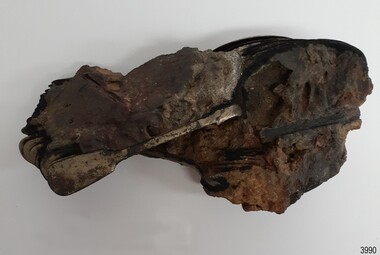
... These spoons are representative of similar items of silver electro-plated cutlery salvaged from the Loch Ard wreck site, comprising nickel silver electroplated spoons and forks of various sizes but all sharing the same general shape and design. ...Large conglomerated group of nickel silver plated spoons with fiddle-back design handle, narrow stem with flared collar and elongated bowl; twenty parts of spoons are visible. ...These spoons are representative of similar items of silver electro-plated cutlery salvaged from the Loch Ard wreck site, comprising nickel silver electroplated spoons and forks of various sizes but all sharing the same general shape and design. ...These desert spoons are from the wreck of the Loch Ard, that sailed from Gravesend, London. The manifest listed an array of manufactured goods being exported to the Colony of Victoria. Included in the cargo manifest was a large number of hardware and cutlery items. These spoons are representative of similar items of silver electro-plated cutlery salvaged from the Loch Ard wreck site, comprising nickel silver electroplated spoons and forks of various sizes but all sharing the same general shape and design. History of the Loch Ard: - The Loch Ard got its name from ”Loch Ard” a loch that lies to the west of Aberfoyle, and the east of Loch Lomond. It means "high lake" in Scottish Gaelic. The vessel belonged to the famous Loch Line which sailed many vessels from England to Australia. The Loch Ard was built in Glasgow by Barclay, Curdle and Co. in 1873, the vessel was a three-masted square-rigged iron sailing ship that measured 79.87 meters in length, 11.58 m in width, and 7 m in depth with a gross tonnage of 1693 tons with a mainmast that measured a massive 45.7 m in height. Loch Ard made three trips to Australia and one trip to Calcutta before its fateful voyage. Loch Ard left England on March 2, 1878, under the command of 29-year-old Captain Gibbs, who was newly married. The ship was bound for Melbourne with a crew of 37, plus 17 passengers. The general cargo reflected the affluence of Melbourne at the time. Onboard were straw hats, umbrellas, perfumes, clay pipes, pianos, clocks, confectionery, linen and candles, as well as a heavier load of railway irons, cement, lead and copper. There were other items included that were intended for display in the Melbourne International Exhibition of 1880. The voyage to Port Phillip was long but uneventful. Then at 3 am on June 1, 1878, Captain Gibbs was expecting to see land. But the Loch Ard was running into a fog which greatly reduced visibility. Captain Gibbs was becoming anxious as there was no sign of land or the Cape Otway lighthouse. At 4 am the fog lifted and a lookout aloft announced that he could see breakers. The sheer cliffs of Victoria's west coast came into view, and Captain Gibbs realised that the ship was much closer to them than expected. He ordered as much sail to be set as time would permit and then attempted to steer the vessel out to sea. On coming head-on into the wind, the ship lost momentum, the sails fell limp and Loch Ard's bow swung back towards land. Gibbs then ordered the anchors to be released in an attempt to hold their position. The anchors sank some 50 fathoms - but did not hold. By this time the ship was among the breakers and the tall cliffs of Mutton Bird Island rose behind. Just half a mile from the coast, the ship's bow was suddenly pulled around by the anchor. The captain tried to tack out to sea, but the ship struck a reef at the base of Mutton Bird Island, near Port Campbell. Waves subsequently broke over the ship and the top deck became loosened from the hull. The masts and rigging came crashing down knocking passengers and crew overboard. When a lifeboat was finally launched, it crashed into the side of Loch Ard and capsized. Tom Pearce, who had launched the boat, managed to cling to its overturned hull and shelter beneath it. He drifted out to sea and then on the flood tide came into what is now known as Loch Ard Gorge. He swam to shore, bruised and dazed, and found a cave in which to shelter. Some of the crew stayed below deck to shelter from the falling rigging but drowned when the ship slipped off the reef into deeper water. Eva Carmichael a passenger had raced onto the deck to find out what was happening only to be confronted by towering cliffs looming above the stricken ship. In all the chaos, Captain Gibbs grabbed Eva and said, "If you are saved Eva, let my dear wife know that I died like a sailor". That was the last Eva Carmichael saw of the captain. She was swept off the ship by a huge wave. Eva saw Tom Pearce on a small rocky beach and yelled to attract his attention. He dived in and swam to the exhausted woman and dragged her to shore. He took her to the cave and broke the open case of brandy which had washed up on the beach. He opened a bottle to revive the unconscious woman. A few hours later Tom scaled a cliff in search of help. He followed hoof prints and came by chance upon two men from nearby Glenample Station three and a half miles away. In a complete state of exhaustion, he told the men of the tragedy. Tom then returned to the gorge while the two men rode back to the station to get help. By the time they reached Loch Ard Gorge, it was cold and dark. The two shipwreck survivors were taken to Glenample Station to recover. Eva stayed at the station for six weeks before returning to Ireland by steamship. In Melbourne, Tom Pearce received a hero's welcome. He was presented with the first gold medal of the Royal Humane Society of Victoria and a £1000 cheque from the Victorian Government. Concerts were performed to honour the young man's bravery and to raise money for those who lost family in the disaster. Of the 54 crew members and passengers on board, only two survived: the apprentice, Tom Pearce and the young woman passenger, Eva Carmichael, who lost her family in the tragedy. Ten days after the Loch Ard tragedy, salvage rights to the wreck were sold at auction for £2,120. Cargo valued at £3,000 was salvaged and placed on the beach, but most washed back into the sea when another storm developed. The wreck of Loch Ard still lies at the base of Mutton Bird Island. Much of the cargo has now been salvaged and some items were washed up into Loch Ard Gorge. Cargo and artefacts have also been illegally salvaged over many years before protective legislation was introduced in March 1982. One of the most unlikely pieces of cargo to have survived the shipwreck was a Minton majolica peacock- one of only nine in the world. The peacock was destined for the Melbourne 1880 International Exhibition. It had been well packed, which gave it adequate protection during the violent storm. Today the Minton peacock can be seen at the Flagstaff Hill Maritime Museum in Warrnambool. From Australia's most dramatic shipwreck, it has now become Australia's most valuable shipwreck artifact and is one of very few 'objects' on the Victorian State Heritage Register.The shipwreck of the Loch Ard is of significance for Victoria and is registered on the Victorian Heritage Register ( S 417). Flagstaff Hill has a varied collection of artefacts from Loch Ard and its collection is significant for being one of the largest accumulation of artefacts from this notable Victorian shipwreck. The collections object is to also give us a snapshot into history so we can interpret the story of this tragic event. The collection is also archaeologically significant as it represents aspects of Victoria's shipping history that allows us to interpret Victoria's social and historical themes of the time. The collections historically significance is that it is associated unfortunately with the worst and best-known shipwreck in Victoria's history. Large conglomerated group of nickel silver plated spoons with fiddle-back design handle, narrow stem with flared collar and elongated bowl; twenty parts of spoons are visible. The spoons were recovered from the wreck of the Loch Ard.flagstaff hill, warrnambool, shipwrecked coast, flagstaff hill maritime museum, maritime museum, shipwreck coast, flagstaff hill maritime village, great ocean road, loch line, loch ard, captain gibbs, eva carmichael, tom pearce, glenample station, mutton bird island, loch ard gorge, dessert spoon, petrified timber, conglomerated cutlery, silverware, dining utensil, spoons, conglomeration of spoons -
Glenelg Shire Council Cultural Collection
Souvenir - Souvenir teaspoon, n.d
... Stuart silver plated scalloped spoon, with enamelled badge at Bridgewater Bay, showing the headland....souvenir of Portland Bridgewater Bay Front: 'Bridgewater Bay Vic' - gold lettering on badge Back: 'STUART Silverplated Made in Australia' Stuart silver plated scalloped spoon, with enamelled badge at Bridgewater Bay, showing the headland. ...Stuart silver plated scalloped spoon, with enamelled badge at Bridgewater Bay, showing the headland.Front: 'Bridgewater Bay Vic' - gold lettering on badge Back: 'STUART Silverplated Made in Australia'souvenir of portland, bridgewater bay -
Glenelg Shire Council Cultural Collection
Souvenir - Spoon - Portland, Victoria, n.d
... Souvenir silver-plated jam spoon with round enamelled badge with Portland Town Council logo...Souvenir silver-plated jam spoon with round enamelled badge with Portland Town Council logo Souvenir Spoon - Portland, Victoria Pitcher Melbourne ...Souvenir silver-plated jam spoon with round enamelled badge with Portland Town Council logo -
 Bendigo Historical Society Inc.
Domestic Object - SILVER PLATE FORK & SPOON
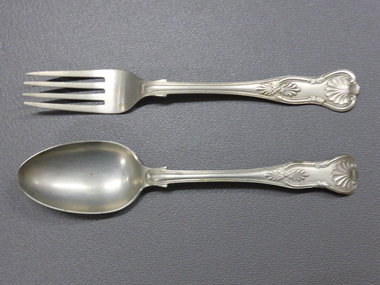
... SILVER PLATE FORK & SPOON...Pair of silver plate for and spoon in Kings pattern....DOMESTIC EQUIPMENT Table setting Cutlery WH & S B F Pair of silver plate for and spoon in Kings pattern. Domestic Object SILVER PLATE FORK & SPOON ...Pair of silver plate for and spoon in Kings pattern.WH & S B Fdomestic equipment, table setting, cutlery -
 South West Healthcare
Nurse Graduation Spoon, 20th Century
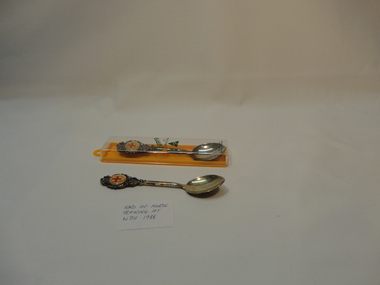
... 2 Silver plated metal spoon with Warrnambool and District Base Hospital badge; 2 plastic cases...."Cameo / SILVERPLATED" "PERFECTION PLATE MADE IN AUSTRALIA" Case marked, "SILVERPLATED / AUSTRALIAN MADE"; "Cameo by PERFECTION" 2 Silver plated metal spoon with Warrnambool and District Base Hospital badge; 2 plastic cases. ...Purchased by Nurses who graduated from the Warrnambool & District Base Hopsital Nurse Training School. End of nurse training at Warrnambool Base Hospital 19882 Silver plated metal spoon with Warrnambool and District Base Hospital badge; 2 plastic cases."WARRNAMBOOL & DISTRICT BASE HOSPITAL 1988" on enamel inscription on handle with red cross in centre. "Cameo / SILVERPLATED" "PERFECTION PLATE MADE IN AUSTRALIA" Case marked, "SILVERPLATED / AUSTRALIAN MADE"; "Cameo by PERFECTION"nursing graduation, souvenirs -
 Wodonga & District Historical Society Inc
Functional object - Two silver jam spoons, c1900
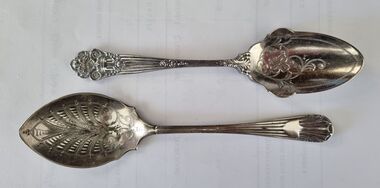
... 2 silver plate jam spoons. The spoons are both electroplated and have clearly discernible hallmarks imprinted on them....Silver spoons Domestic items silver cutlery On spoon 1: W & Co EP in separate shields. On spoon 2: "WM & S 2 silver plate jam spoons. ...Electroplated silver spoons were commonly used in the late 1800s to early 1900. These spoons were owned by Mrs Alice Dinsmore, grandmother of Mrs. Jean Raper of Wodonga. Spoon 1 (at the top of the image) bears the hallmark of George Waterhouse & Co of Sheffield, England. II is labelled EPNS which stands for Electroplated nickel silver. Spoon 2 bears the makers mark WM & S, the mark of William Mammatt & Sons of Sheffield which operated under that name from 1886 until 1906. In 1901 Maxfield & Sons and the associated businesses of J.& J. Maxfield and W. Mammatt & Sons were converted into a single liability company under the style of J. & J. Maxfield Ltd and in 1908 was reformed as Maxfield & Sons (Silversmiths) LtdThis item is from the Raper Collection donated to the Wodonga Historical Society by Mrs. Jean Raper.2 silver plate jam spoons. The spoons are both electroplated and have clearly discernible hallmarks imprinted on them.On spoon 1: W & Co EP in separate shields. On spoon 2: "WM & Ssilver spoons, domestic items, silver cutlery -
 Whitehorse Historical Society Inc.
Memorabilia - Spoon Mitcham P.S. 2904
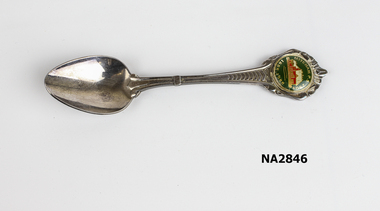
... Silver plated tea spoon with plastic medallion inserted for Mitcham P.S. 2904, 1888 - 1988, Medallion is in green, red and gold....civic mementoes souvenirs Mitcham P.S. 2904 1888-1988 Silver plated tea spoon with plastic medallion inserted for Mitcham P.S. 2904, 1888 - 1988, Medallion is in green, red and gold. ...Silver plated tea spoon with plastic medallion inserted for Mitcham P.S. 2904, 1888 - 1988, Medallion is in green, red and gold.Mitcham P.S. 2904 1888-1988civic mementoes, souvenirs -
 Tatura Irrigation & Wartime Camps Museum
Domestic object - Spoons in display case
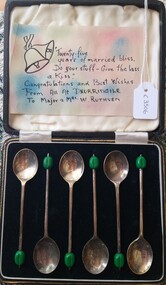
... The base is lined with black velvet. Six silver plated spoons with a green enamel bead on tip sit on the velvet base. ...The base is lined with black velvet. Six silver plated spoons with a green enamel bead on tip sit on the velvet base. ...Given to Major and Mrs Rathven on their 25th wedding anniversary from the people he worked with at Dhurringile Mansion during WW2.Black leather case with gold embossed patterns around top edge of lid. Two brass decorative catches on front. Inside of the top of the case is lined with cream satin. The base is lined with black velvet. Six silver plated spoons with a green enamel bead on tip sit on the velvet base. Handwritten note loose in the top."Twenty five years of married bliss. Do your stuff - give the misses a kiss". Congratulations and best wishes from all at Dhurringile. To Major and Mrs W Rathvenmajor rathven, mrs rathven, 25th wedding anniversary, dhurringile mansion, silver plate spoons -
Glenelg Shire Council Cultural Collection
Souvenir - Spoon, Perfection Plate, n.d
... Spoon, silver plated, enamelled badge with bicentenary logo....Back: 'Stuart 'Pefection Plate Silverplated' - on handle Made in Australia' - impressed Spoon, silver plated, enamelled badge with bicentenary logo. ...Spoon, silver plated, enamelled badge with bicentenary logo.Back: 'Stuart 'Pefection Plate Silverplated' - on handle Made in Australia' - impressed -
 Kiewa Valley Historical Society
Souvenirs - Mt Beauty
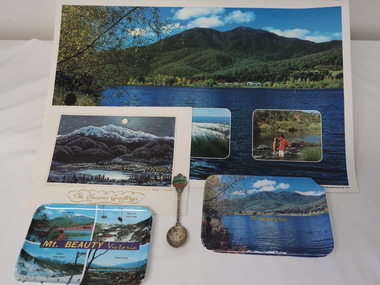
... Plastic coloured trays x3 - Mt Beauty Vic. x2 and Mt Beauty Victoria (4 photos including Mt Bogong, Falls Creek x2, Kiewa Valley.) 4.Silver plated spoon "Mt Beauty Vic." ...Silver plated" 1. Coloured shiny poster with photos of mountains, river and fishing backed on to orange & white pattern. 2. Christmas card "Mt Bogong and Mr Beauty Township" on the back in gold Markdon Prints, Porpunkah ..."" 3. Plastic coloured trays x3 - Mt Beauty Vic. x2 and Mt Beauty Victoria (4 photos including Mt Bogong, Falls Creek x2, Kiewa Valley.) 4.Silver plated spoon "Mt Beauty Vic." ...Originally an SEC town built for workers on the Kiewa Hydro Electric Scheme. It became a tourist centre from the 1960s.Examples made to increase tourism with historical photos, historical items no longer used or sought after. Items such as these are a different way of advertising to on-line methods used today1. Coloured shiny poster with photos of mountains, river and fishing backed on to orange & white pattern. 2. Christmas card "Mt Bogong and Mr Beauty Township" on the back in gold Markdon Prints, Porpunkah ..."" 3. Plastic coloured trays x3 - Mt Beauty Vic. x2 and Mt Beauty Victoria (4 photos including Mt Bogong, Falls Creek x2, Kiewa Valley.) 4.Silver plated spoon "Mt Beauty Vic." 1. Printed bottom left hand corner "Mount Beauty, Victoria" 2.Centre front "The Seasons Greetings" with title written under painting also "From the painting by Marcus L. O'Donnell" 3. On the back of the tray with 4 photos - embossed "A Starlite Product ..." 4. Embossed on back of handle "Stuart / Silver plated"mt beauty tourism -
 Ballarat Clarendon College
Troophy, Under 10 Potato Race
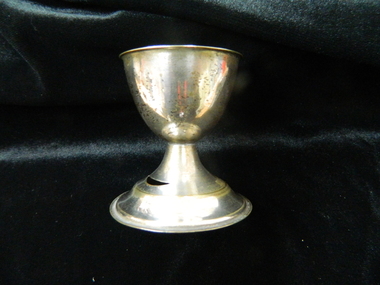
... Silver plated egg cup with spoon slit in base; engraving on base. ...Sports 1926 / Under 10 Potato Race / J.S. Silver plated egg cup with spoon slit in base; engraving on base. ...The Annual Sports Day in the 1920s featured a number of novelty races such as 'Thread the needle, Siamese or, in this case, Potato. The Touchstone 1926 does not include a report for the Annual Sports Day so the 'JS' cannot be confirm but could be Joyce (Sarah) Bathurst (1934) or Jean (Smith) (1934). Silver plated egg cup with spoon slit in base; engraving on base. Engraved on base: C.P.L.C. Sports 1926 / Under 10 Potato Race / J.S. potato-race, sports, clarendon-presbyterian-ladies-college, 1926 -
Clunes Museum
Functional object - CUTLERY
... .1 TABLESPOON, SILVER PLATED - MARKED DIXON -NS-A .2 DESSERT SPOON, SILVER PLATED - MARKED WP-B-(A CROWN) .3 DESERT SPOON, SILVER PLATED - MARKED DALTON PLATE - EPNS...SILVER TABLESPOON DESSERT SPOON DIXON WP .1 TABLESPOON, SILVER PLATED - MARKED DIXON -NS-A .2 DESSERT SPOON, SILVER PLATED - MARKED WP-B-(A CROWN) .3 DESERT SPOON, SILVER PLATED - MARKED DALTON PLATE - EPNS Functional object CUTLERY ....1 TABLESPOON, SILVER PLATED - MARKED DIXON -NS-A .2 DESSERT SPOON, SILVER PLATED - MARKED WP-B-(A CROWN) .3 DESERT SPOON, SILVER PLATED - MARKED DALTON PLATE - EPNSsilver tablespoon, dessert spoon, dixon wp -
 Flagstaff Hill Maritime Museum and Village
Domestic object - Spoons, William Page & Co, Prior to 1878
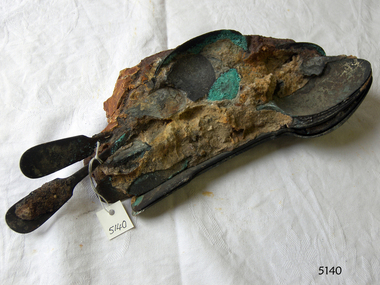
... These spoons are representative of similar items of silver electro-plated cutlery salvaged from the Loch Ard wreck site, comprising nickel silver electroplated spoons and forks of various sizes but all sharing the same general shape and design. ...Large conglomerated group of nickel silver plated dessert spoons with fiddle-back design handle, narrow stem with flared collar and elongated bowl (there are 8-10 spoons in the group). ...These spoons are representative of similar items of silver electro-plated cutlery salvaged from the Loch Ard wreck site, comprising nickel silver electroplated spoons and forks of various sizes but all sharing the same general shape and design. ...These desert spoons are from the wreck of the Loch Ard, that sailed from Gravesend, London. The manifest listed an array of manufactured goods being exported to the Colony of Victoria. Included in the cargo manifest was a large number of hardware and cutlery items. These spoons are representative of similar items of silver electro-plated cutlery salvaged from the Loch Ard wreck site, comprising nickel silver electroplated spoons and forks of various sizes but all sharing the same general shape and design. Some of the pieces display their makers’ mark of William Page & Co Birmingham UK. Within the Flagstaff Hills cutlery collection donated from the Loch Ard, maker’s marks are often obscured by sedimentary accretion or verdigris after a century of submersion in the ocean. However sufficient detail has survived to indicate that the collection of samples of electroplated cutlery probably originated from the same cargo consignment from the Loch Ard and was made by William Page & Co. William Page was born in 1811 and died in 1885. He was active as a manufacturer of cutlery from 1829 with premises at 74 Belmont Rd, Dales End as a "close plater" (someone who works sheet metal), and he began electroplating in 1855. William Page & Co was also active from 1880 at Cranemore St, Cattle’s Grove also 55 Albion St, Birmingham, in 1936 the firm became Ltd. The firm used the trademarks "Asrista, Bolivian Silver, Silverite, Roman Silver, Roumanian Silver and Trevor Plate. In 1938 William Page was a supplier to the British Government, marking its products with the broad arrow symbol and was also present at Sheffield. History of the Loch Ard: The Loch Ard got its name from ”Loch Ard” a loch that lies to the west of Aberfoyle, and the east of Loch Lomond. It means "high lake" in Scottish Gaelic. The vessel belonged to the famous Loch Line which sailed many vessels from England to Australia. The Loch Ard was built in Glasgow by Barclay, Curdle and Co. in 1873, the vessel was a three-masted square-rigged iron sailing ship that measured 79.87 meters in length, 11.58 m in width, and 7 m in depth with a gross tonnage of 1693 tons with a mainmast that measured a massive 45.7 m in height. Loch Ard made three trips to Australia and one trip to Calcutta before its fateful voyage. Loch Ard left England on March 2, 1878, under the command of 29-year-old Captain Gibbs, who was newly married. The ship was bound for Melbourne with a crew of 37, plus 17 passengers. The general cargo reflected the affluence of Melbourne at the time. Onboard were straw hats, umbrellas, perfumes, clay pipes, pianos, clocks, confectionery, linen and candles, as well as a heavier load of railway irons, cement, lead and copper. There were other items included that were intended for display in the Melbourne International Exhibition of 1880. The voyage to Port Phillip was long but uneventful. Then at 3 am on June 1, 1878, Captain Gibbs was expecting to see land. But the Loch Ard was running into a fog which greatly reduced visibility. Captain Gibbs was becoming anxious as there was no sign of land or the Cape Otway lighthouse. At 4 am the fog lifted and a lookout aloft announced that he could see breakers. The sheer cliffs of Victoria's west coast came into view, and Captain Gibbs realised that the ship was much closer to them than expected. He ordered as much sail to be set as time would permit and then attempted to steer the vessel out to sea. On coming head-on into the wind, the ship lost momentum, the sails fell limp and Loch Ard's bow swung back towards land. Gibbs then ordered the anchors to be released in an attempt to hold its position. The anchors sank some 50 fathoms - but did not hold. By this time the ship was among the breakers and the tall cliffs of Mutton Bird Island rose behind. Just half a mile from the coast, the ship's bow was suddenly pulled around by the anchor. The captain tried to tack out to sea, but the ship struck a reef at the base of Mutton Bird Island, near Port Campbell. Waves subsequently broke over the ship and the top deck became loosened from the hull. The masts and rigging came crashing down knocking passengers and crew overboard. When a lifeboat was finally launched, it crashed into the side of Loch Ard and capsized. Tom Pearce, who had launched the boat, managed to cling to its overturned hull and shelter beneath it. He drifted out to sea and then on the flood tide came into what is now known as Loch Ard Gorge. He swam to shore, bruised and dazed, and found a cave in which to shelter. Some of the crew stayed below deck to shelter from the falling rigging but drowned when the ship slipped off the reef into deeper water. Eva Carmichael a passenger had raced onto the deck to find out what was happening only to be confronted by towering cliffs looming above the stricken ship. In all the chaos, Captain Gibbs grabbed Eva and said, "If you are saved Eva, let my dear wife know that I died like a sailor". That was the last Eva Carmichael saw of the captain. She was swept off the ship by a huge wave. Eva saw Tom Pearce on a small rocky beach and yelled to attract his attention. He dived in and swam to the exhausted woman and dragged her to shore. He took her to the cave and broke the open case of brandy which had washed up on the beach. He opened a bottle to revive the unconscious woman. A few hours later Tom scaled a cliff in search of help. He followed hoof prints and came by chance upon two men from nearby Glenample Station three and a half miles away. In a complete state of exhaustion, he told the men of the tragedy. Tom then returned to the gorge while the two men rode back to the station to get help. By the time they reached Loch Ard Gorge, it was cold and dark. The two shipwreck survivors were taken to Glenample Station to recover. Eva stayed at the station for six weeks before returning to Ireland by steamship. In Melbourne, Tom Pearce received a hero's welcome. He was presented with the first gold medal of the Royal Humane Society of Victoria and a £1000 cheque from the Victorian Government. Concerts were performed to honour the young man's bravery and to raise money for those who lost family in the disaster. Of the 54 crew members and passengers on board, only two survived: the apprentice, Tom Pearce and the young woman passenger, Eva Carmichael, who lost her family in the tragedy. Ten days after the Loch Ard tragedy, salvage rights to the wreck were sold at auction for £2,120. Cargo valued at £3,000 was salvaged and placed on the beach, but most washed back into the sea when another storm developed. The wreck of Loch Ard still lies at the base of Mutton Bird Island. Much of the cargo has now been salvaged and some items were washed up into Loch Ard Gorge. Cargo and artefacts have also been illegally salvaged over many years before protective legislation was introduced in March 1982. One of the most unlikely pieces of cargo to have survived the shipwreck was a Minton majolica peacock- one of only nine in the world. The peacock was destined for the Melbourne 1880 International Exhibition in. It had been well packed, which gave it adequate protection during the violent storm. Today the Minton peacock can be seen at the Flagstaff Hill Maritime Museum in Warrnambool. From Australia's most dramatic shipwreck it has now become Australia's most valuable shipwreck artifact and is one of very few 'objects' on the Victorian State Heritage Register.The shipwreck of the Loch Ard is of significance for Victoria and is registered on the Victorian Heritage Register ( S 417). Flagstaff Hill has a varied collection of artefacts from Loch Ard and its collection is significant for being one of the largest accumulation of artefacts from this notable Victorian shipwreck. The collections object is to also give us a snapshot into history so we can interpret the story of this tragic event. The collection is also archaeologically significant as it represents aspects of Victoria's shipping history that allows us to interpret Victoria's social and historical themes of the time. The collections historically significance is that it is associated unfortunately with the worst and best-known shipwreck in Victoria's history. Large conglomerated group of nickel silver plated dessert spoons with fiddle-back design handle, narrow stem with flared collar and elongated bowl (there are 8-10 spoons in the group). Inscriptions on the spoons. Made by William Page & Co, of Birmingham. The spoons were recovered from the wreck of the Loch Ard.Stamped “W” & “P” within a raised diamond outline, which is in turn contained within a sunken crown (The shape identifies the manufacturer as William Page & Co of Birmingham.)flagstaff hill, warrnambool, shipwrecked coast, flagstaff hill maritime museum, maritime museum, shipwreck coast, flagstaff hill maritime village, great ocean road, loch line, loch ard, captain gibbs, eva carmichael, tom pearce, glenample station, mutton bird island, loch ard gorge, dessert spoon, petrified timber, conglomerated cutlery, silverware, dining utensil
