
Showing 35 items matching "sister male"
-
 Returned Nurses RSL Sub-branch
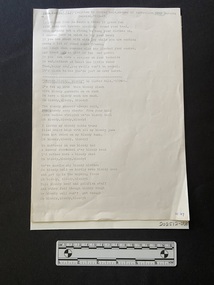
Document - Typed poem, Sister Male, [1939-1945?]
... ...Sister Male...Two poems written by Sister Male, a member of the Australian Army Nursing Service, 1939-1945. ...Sister Male...Two poems written by Sister Male, a member of the Australian Army Nursing Service, 1939-1945. ...Two poems written by Sister Male, a member of the Australian Army Nursing Service, 1939-1945. The poems are about the food and living conditions for Nurses serving in World war II. The first is entitled 'Army Nurses' "IF" ' (an altered version of Rudyard Kipling's famous poem). The second is 'Bloody, bloody, bloody'.Two pages of white paper with black typing. 'H.89' [Handwritten in blue ink at the bottom of both pages]world war 1939-1945, ww2, wwii, war poety, australian army nursing service, sister male, australian army nurses -- living conditions -
 Royal District Nursing Service (now known as Bolton Clarke)
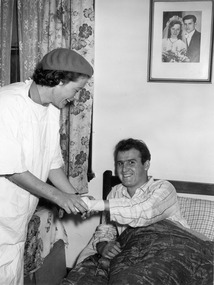
Photograph - Photograph, black and white, c.1958
... This photograph depicts a MDNS Sister visiting a male patient to give him nursing care. ...Sister. She has part of a rolled bandage in her right hand. The male patient, who has short dark hair, is looking at the camera and smiling. ...This photograph depicts a MDNS Sister visiting a male patient to give him nursing care. ...This photograph depicts a MDNS Sister visiting a male patient to give him nursing care. He is lying in bed in his home and the Sister is applying a bandage to his left wrist. Under her white gown the Sister is wearing the MDNS winter uniform of a grey dress with peaked collars and grey wool beret which has a central red Maltese cross attached. The Trained nurses (Nurses) of the Melbourne District Nursing Society (MDNS), from its inception in 1885, provided wound care to their patients who ranged in age from the very young to the elderly. The patients required their wounds to be dressed following various types of surgery, accidents, burns, cancer, leg ulcers etc. As research developed better products and dressing materials, the methods and medication applied to wounds changed. MDNS received Royal patronage in 1966 and as Royal District Nursing Service (RDNS), the Education department developed wound care programs, such as the Leg Ulcer Management Program to provide their Trained nurses (Sister) with methods of best quality care. They ran a program for Wound Care Specialists who made assessments and provided advice and support to the District Sisters working in the field as needed. The Sisters liaised with the patient’s Doctors and hospitals to provide information on the progress of patient’s wounds and to receive any change of wound care from the Doctors. Standing on the left of this photograph is a Melbourne District Nursing Service (MDNS) Sister who is wearing a white gown over her grey uniform, the collar of which can be seen. She is wearing her uniform grey wool beret over her short dark curly hair and is smiling as, with her outstretched left hand, she supports the partly bandaged extended left arm of a gentleman who is sitting up in bed to her right; his right arm is resting on the bed and supporting him as he is partly turned towards the Sister. She has part of a rolled bandage in her right hand. The male patient, who has short dark hair, is looking at the camera and smiling. He is wearing a white and striped pyjama top and his lower body is covered by a patterned bed cover. Part of a pillow with check pillow case sits flat behind him and part of a wooden horizontal slat bedhead is seen. On the wall behind the bed hangs a framed photograph of a couple on their wedding day. Patterned curtains cover the window in the left rear of the photograph.John Gallagher photography. 4 Benares Street, Mitcham Victoria WU 2568 No. 4-4melbourne district nursing service, mdns, mdns wound care, royal district nursing service, rdns -
 Kew Historical Society Inc
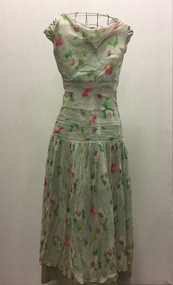
Clothing - Floral Summer Dress, 1930s
... This dress was made for an aunt of the donor, who was the daughter and sister of well-known male Melbourne architects in the Smart family. ...This dress was made for an aunt of the donor, who was the daughter and sister of well-known male Melbourne architects in the Smart family. women's clothing dresses australian fashion - 1930s Long floral green crepe georgette dress. ...The Fashion & Design collection of the Kew Historical Society includes examples of women’s, men’s, children’s and infants’ clothing from the 18th, 19th and 20th centuries. Items in the collection were largely produced for, or purchased by women in Melbourne, and includes examples of outerwear, protective wear, nightwear, underwear and costume accessories. The V&A's history of fashion describes 1930s dresses as characterised by '... a slinky femininity... Parisian couturiers introduced the bias-cut into their designs, which caused the fabric to skim over the body's curves. Long, simple and clinging evening gowns, made of satin were popular. Often the dresses had low scooping backs'. This dress was made for an aunt of the donor, who was the daughter and sister of well-known male Melbourne architects in the Smart family. Long floral green crepe georgette dress.women's clothing, dresses, australian fashion - 1930s -
 Kew Historical Society Inc
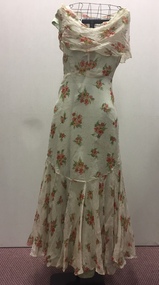
Clothing, Floral Crepe Georgette Summer Dress, 1930s
... This dress was made for an aunt of the donor, who was the daughter and sister of well-known male Melbourne architects in the Smart family....This dress was made for an aunt of the donor, who was the daughter and sister of well-known male Melbourne architects in the Smart family. women's clothing australian fashion - 1930s fashion and textiles collection rosemary smart Long cream and orange floral crepe georgette evening dress Floral Crepe Georgette Summer Dress Clothing Clothing ...The Fashion & Design collection of the Kew Historical Society includes examples of women’s, men’s, children’s and infants’ clothing from the 18th, 19th and 20th centuries. Items in the collection were largely produced for, or purchased by women in Melbourne, and includes examples of outerwear, protective wear, nightwear, underwear and costume accessories.The V&A's history of fashion describes 1930s dresses as characterised by '... a slinky femininity... Parisian couturiers introduced the bias-cut into their designs, which caused the fabric to skim over the body's curves. Long, simple and clinging evening gowns, made of satin were popular. Often the dresses had low scooping backs'. This dress was made for an aunt of the donor, who was the daughter and sister of well-known male Melbourne architects in the Smart family.Long cream and orange floral crepe georgette evening dresswomen's clothing, australian fashion - 1930s, fashion and textiles collection, rosemary smart -
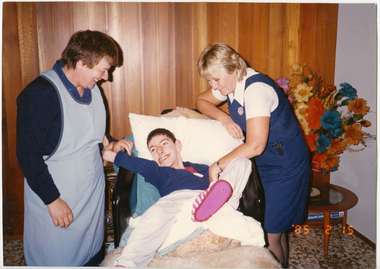 Royal District Nursing Service (now known as Bolton Clarke)
Photograph - Photograph, colour, 15.02.1985
... Two Royal District Nursing Service (RDNS) Sisters are assisting a young male patient who has a movement disorder, to change position in his reclined chair....A coloured photograph showing two Royal District Nursing (RDNS) Sisters with a young male patient who is lying in a reclined chair. ...The Sisters liaised with the persons Doctor, Hospital and allied Health personal when necessary. royal district nursing service rdns rdns uniform rdns patient care A coloured photograph showing two Royal District Nursing (RDNS) Sisters with a young male patient who is lying in a reclined chair. ...Two Royal District Nursing Service (RDNS) Sisters are assisting a young male patient who has a movement disorder, to change position in his reclined chair.The Trained nurses (Nurses) of the Melbourne District Nursing Society (MDNS), later known as Royal District Nursing Service (RDNS), visited patients in their home and gave best practice care in many fields of nursing, and to people of many cultures, throughout its 130 years of expansion. Initial visits not only assessed the specific nursing situation but the situation as a whole. Their patients ranged in age from babes, children, adults to the elderly and referrals were taken from Hospitals, General Practitioners and allied Health facilities. Some of the care the Trained nurse (Sisters) provided is as follows: – Post-Natal care given to mother and babe, Wound Care following various types of surgery, accidents, burns, cancer, leg ulcers etc. Supervising and teaching Diabetic Care, including teaching and supervising people with Diabetes to administer their own Insulin, and administering Insulin to those unable to give their own injections. Administering other injections and setting up weekly medication boxes. The Sisters performed Catheterizations on adults suffering from conditions such as Quadriplegia, Paraplegia, Multiple Sclerosis (MS), Motor Neurone Disease (MND) and Guillan-Barre Syndrome, and when required at school on children for e.g. those with Spina Bifida. The Sisters visited those requiring Cystic Fibrosis support and care; those requiring Haemo-Oncology care, including visiting children at school; those requiring Home Enteral Feeding care, and those requiring IV therapy at home and home Dialysis. Palliative Care was given including pain relief with the use of syringe drivers, personal care as needed, and advice and support to both patient and family. The Sisters provided Stoma management to those needing Urostomy, Ileostomy and Colostomy care and those requiring Continence care. HIV/AIDS nursing care was provided; visits to Homeless Persons were made. Personal care was given to patients ranging in age and with varying mobility problems, such as those with MS, MND, Guillan-Barre Syndrome, Poliomyelitis, Quadriplegia, Paraplegia, Acquired Brain Injury, to those following a Cerebrovascular Accident (Stroke), those with severe Arthritis and those with a form of Dementia. When necessary the elderly were assisted with personal care and advice given on safety factors with the use of hand rails, bath or shower seats, and hand showers. Rehabilitation with an aim towards independence remained at the forefront of the Sister’s minds and when possible using aids and instruction on safe techniques enabled the person to become fully independent. All care included giving advice and support to the patient and their Carers. The Sisters liaised with the persons Doctor, Hospital and allied Health personal when necessary.A coloured photograph showing two Royal District Nursing (RDNS) Sisters with a young male patient who is lying in a reclined chair. The Sister standing on his left is smiling; she has short straight dark hair, and is wearing a RDNS light blue apron over her royal blue dress and darker blue long sleeve cardigan. The Sister on the right hand side of the patient's chair is laughing. She has blonde hair and is slightly bent over the chair as her left hand is supporting his left leg. She is wearing the RDNS summer uniform of the day - a white short sleeve blouse under a royal blue V neck tunic style frock. Her right arm is bent and resting on top of the patient's chair and pillow. The young man has short dark hair and is smiling and looking towards the left of the photograph. He is wearing a dark blue long sleeve top and his right arm is extended toward the Sister on the left hand side of the photograph. His legs are over his coverings with his left leg bent at the knee. He is wearing light coloured pants and has a pink and white striped slipper on his foot. His pillow is white, and coverings seen are blue and white check, white, and a pale pink sheepskin. A wood board wall is in the background. A vase of flowers are standing on the part of a round low table that can be seen in the right hand rear corner. A pale lilac wall can be seen on the right hand side. A small section of a dark patterned carpet can be seen.royal district nursing service, rdns, rdns uniform, rdns patient care -
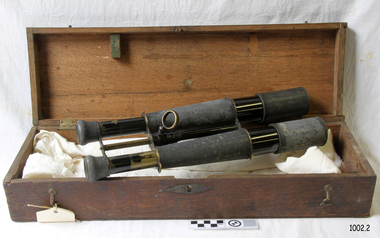 Flagstaff Hill Maritime Museum and Village
Instrument - Optical, Binoculars, 1878 (estimated)
... Tom left the Loch Line in 1883 and the following year married Edith Gurney Strasenbergh, the sister of his friend Robert who had died on the Loch Ard. They had three children, unfortunately, two of the male children were to die at sea. ...Tom left the Loch Line in 1883 and the following year married Edith Gurney Strasenbergh, the sister of his friend Robert who had died on the Loch Ard. They had three children, unfortunately, two of the male children were to die at sea. ...This pair of brass binoculars was presented to Tom Pearce in recognition of his heroic efforts at the wrecking of the Loch Ard and saving Eva Carmichael. They were presented to him by the Lady Mayoress of Sydney on 27th July 1878 on behalf of the colonists of New South Wales "In recognition of his gallant conduct on the occasion of the wreck of the Loch Ard". Tom (Thomas) Pearce was born in Ireland in 1859 and arrived in Melbourne two years later; he considered himself as Australian. Before sailing on the Loch Ard he had been at sea for three years as an apprentice sailor and had already experienced one shipwreck. Tom was on the deck of the Loch Ard with Captain Gibb throughout the night of May 31st 1878. It was mistakenly thought they were 150 miles (240 km) southwest of Cape Otway. By 2:00 am on June 1st, the wind was blowing "pretty fresh" but a thick haze remained and, when it eventually cleared, the land was so close the unsuccessful battle to save the Loch Ard began. After the ship struck Mutton Bird Island Tom and five others were sent to the lifeboats. Conditions were very dangerous as waves broke over the decks and they were all washed away. Tom found himself in the stormy waters and under a lifeboat, which had also been washed into the sea. After being swept into the gorge Tom left the boat and swam into shore; he was alone. Eva Carmichael, a passenger on the ship, had been snatched from her bed just before dawn and into the chaos, confusion and terror of the shipwreck, with rigging and rocks raining down. Thrown into the sea, she afterwards said: "God taught me to swim in my distressful plight, for I never swam before". Clinging to a spar, she was swept into the gorge and saw Tom Pearce walking along the beach. Upon hearing the cries of Eva, Tom swam out and with great difficulty brought her to the shore and placed her safely in a cave where he made a bed of grass and shrubs and gave her brandy to revive her. She sank into exhausted unconsciousness. Tom then scrambled to the top of the high cliff and after walking for some time he stumbled upon workers from Glenample Homestead. They rode back to the homestead for help but Tom insisted on returning to Eva. When Eva awoke she found herself alone, "cold, weak and terrified with the wild waves before me, and caves and cliffs around me" and upon hearing strange noises, which she imagined to be made by the local indigenous people, she hid. The noises were made by the rescue party from Glenample Homestead. After eventually discovering Eva they hauled her up the cliff in the darkness of night, “a work of great difficulty and danger” and took her to Glenample. Sadly, Tom and Eva were the only survivors of the 54 people on board the Loch Ard. Tom’s rewards for his bravery included the Gold Medal of the Humane Society, a gold watch and £1000 from the Victorian Government, a set of nautical instruments, (which included the binoculars) from the people of Sydney and £60 from the people of Warrnambool. He was also presented with a Bible by a “Friend of the Loyal Orange Institution of Victoria, Protestant Hall Melbourne” in August 1878. Coleman Jacobs composed the music "The Young Hero Schottische" and dedicated it, by permission, to Mr Thomas R. (Tom) Pearce. The sheet music was published in 1878 by Mr Roberts, professor of dancing and was on sale for 3/- (3 shillings) in aid of the "Loch Ard" fund. Tom Pearce went on to join the Loch Sunart on her return to England, only to be wrecked again off the Irish coast in January 1879. Tom left the Loch Line in 1883 and the following year married Edith Gurney Strasenbergh, the sister of his friend Robert who had died on the Loch Ard. They had three children, unfortunately, two of the male children were to die at sea. In 1895 Tom obtained his first command as Master of The Larne, a vessel with the Royal Mail Steam Packet Company. He remained with the company until he died in Southampton, England, on 14th December 1908. Tom Pearce never saw Eva Carmichael after he had fare welled her some 30 years before. Eveline Victoria Berta Carmichael was born in 1859 in Mountrath, Queens County, Ireland. After recovering from her ordeal in August 1878 Eva returned to Ireland and in 1884 married Thomas Achilles Townshend, a Civil Engineer. They had three sons, all of whom had successful military careers, and when Eva’s death notice appeared in the Melbourne Argus It read. "Townshend on 8th April 1934 aged 74 at her residence in Bedford, England, Evaline Victoria, widow of the late Thomas Archilles Townshend, C.E. of Co. Cork, Ireland. Mrs Townshend was the Eva Carmichael who, with the late Tom Pearce, were the only two survivors of the ship Loch Ard, which was wrecked near Port Campbell on June 1st 1878." The binoculars are significant for their association with the wreck of the Loch Ard and the only two surviving members of that wreck Tom Pearce and Eva Carmichael. Flagstaff Hill’s collection of artefacts from Loch Ard is significant for being one of the largest. The shipwreck of the Loch Ard is of significance for Victoria and is registered on the Victorian Heritage Register ( S 417). Flagstaff Hill has a varied collection of artefacts from Loch Ard and its collection is significant for being one of the largest accumulation of artefacts from this notable Victorian shipwreck. The collections object is to also give us a snapshot into history so we can interpret the story of this tragic event. The collection is also archaeologically significant as it represents aspects of Victoria's shipping history that allows us to interpret Victoria's social and historical themes of the time. The assemblage of items from the wreck is of historical significance in that they are associated with the worst and best-known shipwreck in Victoria's history. Pair of brass marine binoculars in a wooden box On the left hand eye piece, on the underside, is an engraved inscription and another engraved word. On the right hand eye piece there is another small inscription and on the underside there is a small green mark. The binoculars have a pattern of embossed tiny circles on the outside. Some of the patterning is very shiny due to wear and rubbing, there is a brass ring on the underside of the binoculars for the attachment of a lanyard. The wooden box has a hinged lid and on the front of the box in the centre is a lock, and at either end are two hooks and eyes. The box is split across the top for about 3/4 of the length. Marking on the left underside reads, 'Presented on behalf of the Colonists of New South Wales By the Mayoress of Sydney on 27th. July 1878 to Mr Thomas B Pearce. In recognition of his gallant conduct on the occasion of the wreck of the "Loch Ard"'. Underneath this inscription is engraved 'Sydney'. On the other eye piece is engraved what looks like 'Mac Donnell & Co' binoculars, flagstaff hill, warrnambool, shipwrecked coast, flagstaff hill maritime museum, maritime museum, shipwreck coast, flagstaff hill maritime village, loch ard shipwreck, tom pearce, thomas r pearce, eva carmichael, mutton bird island, loch ard survivor, loch ard hero, coleman jacobs, the young hero schottische, photograph of tom pearce, glenample homestead -
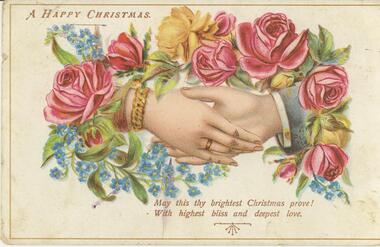 Bendigo Historical Society Inc.
Postcard - Alice McGregor Postcard Collection, 1900 - 1920
... sister and brother. William Robert Salter was killed in a MVA in Bendigo in 1937 aged 26. In Victoria in 1938, Alice Mary Salter married James Thomas McGregor (born Victoria 1917, died Victoria 1983, buried Fawkner Cemetery) Lived: 1968; 22 Wade Street Golden Square Alice McGregor Died: 1999 aged 91 at Anne Caudle Centre, Bendigo Buried: Kangaroo Flat Cemetery See additional research. Postcard Album of Alice McGregor contained 86 post cards. POSTCARD Collector Alice McGregor To Miss Shatford (no address given) from Gwen Dated 1907 & 1908 Postcard Album of Alice McGregor contained 86 post cards. See 1400. Colour painting of male ...Alice McGREGOR Born: 1908; unknown parents. Possibly adopted by the Salter family? Electoral Roll 1936: Highland Terrace Kangaroo Flat. Alice Mary Salter and William Robert Salter living together; presumed to be sister and brother. William Robert Salter was killed in a MVA in Bendigo in 1937 aged 26. In Victoria in 1938, Alice Mary Salter married James Thomas McGregor (born Victoria 1917, died Victoria 1983, buried Fawkner Cemetery) Lived: 1968; 22 Wade Street Golden Square Alice McGregor Died: 1999 aged 91 at Anne Caudle Centre, Bendigo Buried: Kangaroo Flat Cemetery See additional research. Postcard Album of Alice McGregor contained 86 post cards.Postcard Album of Alice McGregor contained 86 post cards. See 1400. Colour painting of male and female hands clasped within a garland of roses and blue flowers. "A Happy Christmas" at top left corner. A 2-line poem below. To Miss Shatford (no address given) from Gwen Dated 1907 & 1908 postcard, collector, alice mcgregor -
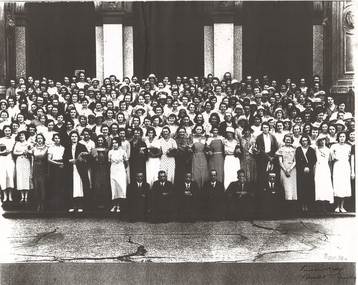 Bendigo Historical Society Inc.
Document - LONG GULLY HISTORY GROUP COLLECTION: PHOTO HANRO STAFF & WORKERS APPROX 1933
... Male R. J Preston, J Mueller, F Harris, T Robertson, R Hiscock and T Lund. Names by Moreen Betts (Marchingo). Two pages are the same and one only has part of a photo on it. Written beside it is: Hanro Mills, Bendigo. Photo of Staff & Employers. Approx 1933 - 34. Picture with Allan Crossley. x On last page is Alans Sister...Male R. J Preston, J Mueller, F Harris, T Robertson, R Hiscock and T Lund. Names by Moreen Betts (Marchingo). Two pages are the same and one only has part of a photo on it. Written beside it is: Hanro Mills, Bendigo. Photo of Staff & Employers. Approx 1933 - 34. Picture with Allan Crossley. x On last page is Alans Sister ...The Hanro company was established in Switzerland in 1884. In 1926 a site in Hargreaves Street Bendigo, behind the School of Mines, was purchased to establish the Bendigo Knitting Mills, a subsidiary of Hanro. The managing director was Charles Handerchin who came from Switzerland. The company was delisted from the Australian Stock Exchange in 1963 when it was taken over by John Brown Industries.Photocopy of a photo by Vincent Kelly of the Hanro Staff and Workers taken on the steps of Bendigo Post Office appros 1933. Names on the back are: Allan Crossley, G Evely,T Hall, M ?sen, M Owens, I Hutchinson, L Ash, C Tyers, L Thornton, R Dixon, I Newson, Phill Ipson, E Kent, L Comte, D Pinnell, M Thomas, C Washington, K Bowman, M Kelly, M Tussup, R Shaw, ? Henson, C Washington, E Rodgers, S Brown, P Pearce, D Thornton, L Rielly, L Truscott, R Brereton, P Taylor, Norris, D Miller, C Enderlin, D Harward, J Lockyer, D Butters, Marc Curnow, B Organ, E Lindsay, L Smart, E Ogilvie, G Crossley, M Newwand, Newmand, Truscott, C Ildae, O Richards, B Richards, C Kingsley, ?, F Mylon, Z Wallen, J Thom, P Trehair, E Crawford, F Chandler, E Hogan, G Blandthorn, J Thom, L Henson, E Stephens, J Gerrand, L Doney, M Williams, C Brauman, R Shaw, L Rushmeyer, R F Wr, L Wright, L - R, A McCormack, S Swalling, I West, J Bolger, L Swalling,B Patterson, T Williams, M Shepherd, J Aitken, A Phillips, M Smith, M Williams, S Ross, J Punch, S Dunne, P Warren, E Keck, J Pinder, W Stock, V Akers, J Neate, M Doyle, M Neate, M Marchingo, C Collard, Iris Dobie, M Irvine, D Nalder, M McPherson, Marg, Alma Rank, D Edwards, Z Excell, M McGuiness, A Christie, ? Beer, Male R. J Preston, J Mueller, F Harris, T Robertson, R Hiscock and T Lund. Names by Moreen Betts (Marchingo). Two pages are the same and one only has part of a photo on it. Written beside it is: Hanro Mills, Bendigo. Photo of Staff & Employers. Approx 1933 - 34. Picture with Allan Crossley. x On last page is Alans Sister.Vincent Kellybendigo, history, long gully history group, the long gully history group - photo hanro staff & workers approx 1933, vincent kelly, hanro mills bendigo, allan crossley, g evely, t hall, m ?sen, m owens, i hutchinson, l ash, c tyers, l thornton, r dixon, i newson, phill ipson, e kent, l comte, d pinnell, m thomas, c washington, k bowman, m kelly, m tussup, r shaw, ? henson, c washington, e rodgers, s brown, p pearce, d thornton, l rielly, l truscott, r brereton, p taylor, norris, d miller, c enderlin, d harward, j lockyer, d butters, marc curnow, b organ, e lindsay, l smart, e ogilvie, g crossley, m newwand, newmand, truscott, c ildae, o richards, b richards, c kingsley, ?, f mylon, z wallen, j thom, p trehair, e crawford, f chandler, e hogan, g blandthorn, j thom, l henson, e stephens, j gerrand, l doney, m williams, c brauman, r shaw, l rushmeyer, r f wr, l wright, l - r, a mccormack, s swalling, i west, j bolger, l swalling, b patterson, t williams, m shepherd, j aitken, a phillips, m smith, m williams, s ross, j punch, s dunne, p warren, e keck, j pinder, w stock, v akers, j neate, m doyle, m neate, m marchingo, c collard, iris dobie, m irvine, d nalder, m mcpherson, marg, alma rank, d edwards, z excell, m mcguiness, a christie, ? beer, male r. j preston, j mueller, f harris, t robertson, r hiscock, t lund, moreen betts (marchingo), bendigo post office -
 Bendigo Historical Society Inc.
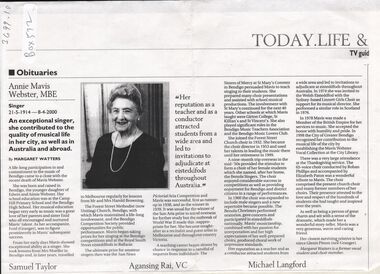
Document - BARBARA MAMOUNEY COLLECTION: IMAGE AND OBITUARY OF ANNIE MAVIS WEBSTER MBE
... Sisters of Mercy at St Mary's Convent, Bendigo where she taught singing. Mavis gained impressive reputation and experience in numerous roles including as chorister (and founder of the all female choir and the Benola singers which she also named, after her home), and later (1960) included male voices; she was also conductor; musical director; and adjudicator at Eisteddfords. ...Sisters of Mercy at St Mary's Convent, Bendigo where she taught singing. Mavis gained impressive reputation and experience in numerous roles including as chorister (and founder of the all female choir and the Benola singers which she also named, after her home), and later (1960) included male voices; she was also conductor; musical director; and adjudicator at Eisteddfords. ...An exceptional singer who contributed greatly to local Bendigo and Australia as well as abroad Bendigo born and raised by Edwin and Annie Webster, Education was at Camp Hill. A life long participation in and commitment to local music and Competition Society provided opportunities for performance. The ultimate prize for amateur singers at the time was the Sun News Pictorial Aria Competition, which Mavis attained as runner up in 1938 and as winner in 1939. Outbreak of WWII curtailed early opportunities for overseas travel but there was much call for her as recitalist, artist and teacher such as at The Sisters of Mercy at St Mary's Convent, Bendigo where she taught singing. Mavis gained impressive reputation and experience in numerous roles including as chorister (and founder of the all female choir and the Benola singers which she also named, after her home), and later (1960) included male voices; she was also conductor; musical director; and adjudicator at Eisteddfords. She laso taught at Girton, St Killian's. During the 1950s Mavis went on a very successful 9 month overseas trip on which she was inspired in many respects including the formation of the choirs. In 1978 Mavis was made a Member of the British Empire for her services to music.City of Greater Bendigo acknowledged Mavis contribution and skills by establishing the Mavis Webster Vocal Collection at the City library.A photocopy of newspaper publication of obituary for Annie Mavis Webster, MBE 21/5/1914 - 8/4/2000 bendigo, history, obituary and biography of annie mavis webster mbe, forest st methodist (now uniting) bendigo, girton, st killian's, herald sun aria, the eisteddford, sisters of mercy at st mary's convent, mavis webster vocal collection, city of greater bendigo, margaret watters. -
 Bendigo Historical Society Inc.
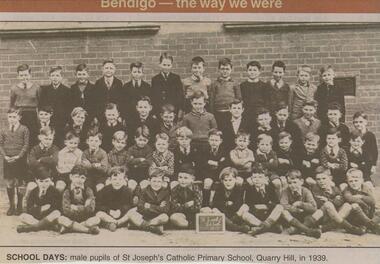
Newspaper - JENNY FOLEY COLLECTION: SCHOOL DAYS
... sisters of Mercy and the first lay principal was appointed in 1985. NEWSPAPER Bendigo advertiser the way we were Bendigo Advertiser ''The way we were'' from 2002. School days: male ...The foundation stone was laid 28/8/1906 and the school opened in 1907. It was initially run by the sisters of Mercy and the first lay principal was appointed in 1985.Bendigo Advertiser ''The way we were'' from 2002. School days: male pupils of St Joseph's Catholic Primary School, Quarry Hill in 1939. The clip is in a folder.newspaper, bendigo advertiser, the way we were -
 Bendigo Historical Society Inc.
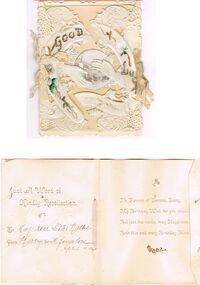
Ephemera - GREETING CARD, 1904
... males hand with the work Luck'. Sides are arttached to the card with cream ribbon. Inside a pricture of a village with a silver border. The card opens 'Just a Word of Kindly Recollection' To: My dear sister Nellie From: Mary with fond love April 15/1904. and poem. ...males hand with the work Luck'. Sides are arttached to the card with cream ribbon. Inside a pricture of a village with a silver border. The card opens 'Just a Word of Kindly Recollection' To: My dear sister Nellie From: Mary with fond love April 15/1904. and poem. ...Greeting Card: Good Luck Birthday Greeting Card with Plastic like material moulded in two sections, left has ladies hand and the word Good, right side males hand with the work Luck'. Sides are arttached to the card with cream ribbon. Inside a pricture of a village with a silver border. The card opens 'Just a Word of Kindly Recollection' To: My dear sister Nellie From: Mary with fond love April 15/1904. and poem. Box 625ephemera, mementoes, celebrations, greeting card. birthday -
 Bendigo Historical Society Inc.
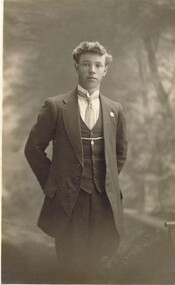
Postcard - HARRIS COLLECTION: BLACK AND WHITE MALE PHOTO IN POSTCARD FORMAT, 1886
... male aged early twenties. H J Howship Benalla impressed on bottom right hand front corner. Dark suit and vest, Albert chain and fob. Reverse captions. Addressed to" Miss T Dowsey, 100 Rowan Street Bendigo". Dear sister...male aged early twenties. H J Howship Benalla impressed on bottom right hand front corner. Dark suit and vest, Albert chain and fob. Reverse captions. Addressed to" Miss T Dowsey, 100 Rowan Street Bendigo". Dear sister ...Black & White photo in postcard format. 3/4 length male aged early twenties. H J Howship Benalla impressed on bottom right hand front corner. Dark suit and vest, Albert chain and fob. Reverse captions. Addressed to" Miss T Dowsey, 100 Rowan Street Bendigo". Dear sister and brother I am sending you a postcard I suppose you know who it is , hoping to find you all well as per last letter and let me know if you receive this foto alright, from your loving brother, H Harding Somerton 86 10 stone 5 lbs.H J Howse, Benallapostcard, photograph, male, dowsey research. -
 Bendigo Historical Society Inc.
Document - TOWN HALL, THE BENDIGO CHORAL SOCIETY
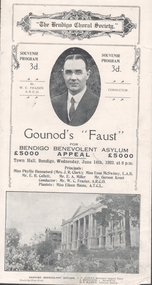
... sister to her faithful lover, Siebel. On his return, covered with glory, and ardent to meet his people again, he hears the story of the flouting of Margarita by Faust. In this part the soldiers are welcomed home by their comrades in the male...sister to her faithful lover, Siebel. On his return, covered with glory, and ardent to meet his people again, he hears the story of the flouting of Margarita by Faust. In this part the soldiers are welcomed home by their comrades in the male ...Town Hall, The Bendigo Choral Society. Souvenir program 3d. With and oval picture of Mr. W C Frazier A.R.C.O.-Conductor on front cover. Gounod's 'Faust'. For Bendigo Benevolent Asylum, 5000 pounds. Town Hall, Bendigo, Wednesday, June 14th, 1992, at 8pm. Principals: Miss Phyllis Hannaford (Mrs. J R Clark); Miss Essa McSwiney, L.A.B. Mr. E H Collett, Mr. E A Miller, Mr. Gerson Krost, Conductor: Mr. W C Frazier, A.R.C.O. Pianiste: Miss Eileen Hains, A.T.C.L. Picture of Benevolent Asylum on front cover. J G Austen, Secretary Appeal Fund. J Hudspeth & Z S Martin Secretaries Choral Society. Concert to commence at 8pm. Artists; Mr. Gerson Krost, Miss Essa McSwiney, Mr. E A Miller, Miss Phyllis Hannaford. Cast; Mrs. J R Clark, Miss Essa McSwiney, Mr. E H Collett, Mr. E A Miller. Choruses, etc. by Choral Society. In the Homeland Mr. Frazier found it the increasing practice to take the great opera masterpieces and give them on the concert platform in more of less liberal excerpts. With characteristic generosity. He purchased the copies and presented them to the Choral Society. Bendigo has thus an opportunity to hear the latest idea. We are sure the musical public will appreciate this, though of course. . .. It is interesting to note that when this great work was first performed in Paris, on March 19th, 1859, it was somewhat coldly received, to the composer's great grief, as he, with the instinct of genius, . . .. The Compact: Introduction: Faust, aged and worn, weary with long pondering over learned treatises, in a pessimistic mood wonder whether the work is worthwhile. Memories of an early love stir strangely in his being, and he, in his doubting mood, questions all things, in despair he would welcome death, and finding no answer from the heavens, he appeals to the powers of ill. To his great surprise, he is at once answered by Mephistopheles and a colloquy then ensues in which the Evil One promises him Gold? Glory? A Kingdom? No! No! It must be 'Youth!' That can be done also. Faust is dubious, but on Mephistopheles bringing a vision of beauteous Margarita at is dubious, but on Mephistopheles be 'Youth!' That can be done also. Faust is dubious, but on Mephistopheles bringing a vision of beauteous Margarita at her wheel he agrees and signs the compact. 'Up Here I am at thy command, Down There thou servest me!' At The Fair: Mephistopheles then asks Faust to the Fair where they mix with the revelry of the students, soldiers and merry maidens. He gets a glimpse of Margarita. The Evil One is again busy putting Suspicious and quarrelsome thoughts into good comrades' minds. . .. The Wooing: Poor Siebel, the ardent, faithful lover of Margarita, finds himself somewhat overshadowed by the young and handsome Faust. Mephistopheles in a mocking mood tells him that every flower that he plucks will perish in his hands. He finds this prediction verified when he plucks the flowers for his lady love, but when in faith he scouts the Evil One, he conquers, and the spell is broken. Faust, filled with an ardent and pure passion, approaches the dwelling of Margarita, with an offering of priceless jewels, provided by the . . .. . The Return of Valentine: Valentine, the soldier brother of Margarita, leaves for the wars, giving the care of his sister to her faithful lover, Siebel. On his return, covered with glory, and ardent to meet his people again, he hears the story of the flouting of Margarita by Faust. In this part the soldiers are welcomed home by their comrades in the male part of the song 'Fold the flag my brothers,' followed by the celebrated chorus (usually known as the 'Soldier's Chorus' Glory and love to the men of old.' It has been set, in this edition, for full choir. Mephistopheles, the evil genius, in a spirit of raillery, and exultant that his plans are working to . . . . The Price: Faust, repentant, desires to do justice to Margarita and again be her lover. Margarita is almost demented at the loss of her brother. Mephistopheles not to be cheated, thwarts the good impulse of Faust and demands his price. He also endeavors to make Margarita despair, but owing to the simple faith of the . . . . The End. A Question You give you name, your time, your pelf To ease your woe: But what do you give of your own self To pay the debt you owe? You open a Home for helpless ones, And you shut them in with care; Of what think you is their share? You talk and you write; you organise; All this, we know, is true; But how do you spread the spark divine, The deep-down soul of you? -A Simkins. Benevolent Asylum Appeal. The Committee of Management directing the works of the Asylum desire to bring before an always generous public the claims of the Instruction for financial support. The Appeal for 5000 pounds has been launched in the full belief that the case is a good one, and in the confident hope that it will be successful. The work carried on by the Asylum covers a big field, extending as it does from Swan Hill in the north and Melbourne in the south. Inmates from all parts of the State are given a comfortable home, and properly cared for in the eventide of their lives. There are at present in the Asylum 164 old men and women. In addition to this work the Committee thoroughly investigate and dispense relief in food to from 150 to 200 adults and from 300 to 400 children each week, and also issues a large number of blankets, boots and clothing garments to necessitous applicants. The recipients of this relief are principally widow and their little ones, and the wives and children who are dependents of miners suffering from the dread Miners' Complaint. The Committee in organizing this branch of its charity work, has, to a great extent, prevented a large amount of waste, through overlapping and duplication of effort. It now appeals to the public for the above amount in order that be may still be able to continue charity work among the poor and necessitous of Bendigo and District. 'Organized Charity is Love with Judgment.'Cambridge Press Printprogram, theatre, town hall, bendigo -
 Ithacan Historical Society
Photograph, Bursary awards, 1992
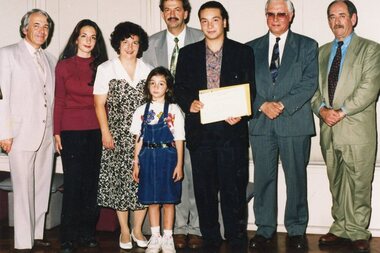
... sisters Anastasia & Ioanna. Tony Drakopoulos, president of the IPS is in the photograph together with Anastasios Tamis (second from right) and George Papadopoulos (far right). Spyridoula became president of the IPS in 2000, the second woman to hold this position. In 1987 Panoyiannis Raftopoulos proposed to the IPS Executive the introduction of Tertiary Bursaries to recognise and encourage academic achievement amongst young people of Ithacan descent. Introduced in 1988, the highest achieving Year 12 students (male ...The photograph was taken at the 1992 IPS Bursary awards. Ioannis Coutsouvelis was a bursary recipient. He is photographed with his parents, George & Spyridoula and sisters Anastasia & Ioanna. Tony Drakopoulos, president of the IPS is in the photograph together with Anastasios Tamis (second from right) and George Papadopoulos (far right). Spyridoula became president of the IPS in 2000, the second woman to hold this position. In 1987 Panoyiannis Raftopoulos proposed to the IPS Executive the introduction of Tertiary Bursaries to recognise and encourage academic achievement amongst young people of Ithacan descent. Introduced in 1988, the highest achieving Year 12 students (male and female) received an award. The awards continue to this day and are now known as the 'Year 12 Awards' and all students who successfully complete 12 are recognised. George Papadopoulos, whose father was a founding member of the Society, was active in many areas of public life and a member of numerous community and welfare organisations, including Chair of the Victorian Ethnic Affairs Commission. In 2013 he was awarded the Order of Australia (AO) for his significant contribution to the multicultural community of Victoria.A coloured photograph of 8 people ( 5 men, 2 females and 1young girl) standing in a room. The youngest man is holding a large envelope in his hands. -
 Sunshine and District Historical Society Incorporated
Photograph - Queen of Sport Competition Photographs, Aristographs Studio, c. 1940
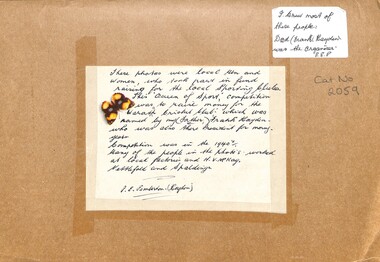
... Photograph Queen Kath Sayers Male attendants John Chalmers Ernie Hocking Tom Calvary Treleor Duncan Alf Stark Lindsey Henderson Dave Clarke Charlers Attendants Annie Clarke nee Wise Isabelle Styles Margaret Picken Kath Sayers Queen Jean Dunkley jessie Dunkley|Black and Wite Photograph of Queen Kath Sayers Male attendants John Chalmers Ernie Hocking Tom Calvary Treleor Duncan Alf Stark Lindsey Henderson Dave Clarke Charlers Attendants Annie Clarke nee Wise Isabelle Styles Margaret Picken Kath Sayers Queen Jean Dunkley jessie Dunkley|Photograph Olive and attendants Maude Annie Queen Laurel Carlton Heiffer Heiffer Wilson Jean Whittingham Stark Norma Gum Val Anderson Honor Ayton|Photograph Oliver Heiffer Egglestone Gold Queen Male attndants John Chalmers Ernie Hocking Tom Calvary Treleor Duncan Alf Stark Lindsey Henderson Dave Clarke Charlers Attendants Anne Heiffer sister Maude sister Laurel Carlton Wilson Jean Whittigham Val Anderson Norma Gum Stark Honor Ayton...Waratah Cricket Club Cricket Photograph Queen Kath Sayers Male attendants John Chalmers Ernie Hocking Tom Calvary Treleor Duncan Alf Stark Lindsey Henderson Dave Clarke Charlers Attendants Annie Clarke nee Wise Isabelle Styles Margaret Picken Kath Sayers Queen Jean Dunkley jessie Dunkley|Black and Wite Photograph of Queen Kath Sayers Male attendants John Chalmers Ernie Hocking Tom Calvary Treleor Duncan Alf Stark Lindsey Henderson Dave Clarke Charlers Attendants Annie Clarke nee Wise Isabelle Styles Margaret Picken Kath Sayers Queen Jean Dunkley jessie Dunkley|Photograph Olive and attendants Maude Annie Queen Laurel Carlton Heiffer Heiffer Wilson Jean Whittingham Stark Norma Gum Val Anderson Honor Ayton|Photograph Oliver Heiffer Egglestone Gold Queen Male attndants John Chalmers Ernie Hocking Tom Calvary Treleor Duncan Alf Stark Lindsey Henderson Dave Clarke Charlers Attendants Anne Heiffer sister Maude sister Laurel Carlton Wilson Jean Whittigham Val Anderson Norma Gum Stark Honor Ayton Queen of Sport Competition Photos Photograph Queen of Sport Competition Photographs Aristographs Studio ...Photograph Queen Kath Sayers Male attendants John Chalmers Ernie Hocking Tom Calvary Treleor Duncan Alf Stark Lindsey Henderson Dave Clarke Charlers Attendants Annie Clarke nee Wise Isabelle Styles Margaret Picken Kath Sayers Queen Jean Dunkley jessie Dunkley|Black and Wite Photograph of Queen Kath Sayers Male attendants John Chalmers Ernie Hocking Tom Calvary Treleor Duncan Alf Stark Lindsey Henderson Dave Clarke Charlers Attendants Annie Clarke nee Wise Isabelle Styles Margaret Picken Kath Sayers Queen Jean Dunkley jessie Dunkley|Photograph Olive and attendants Maude Annie Queen Laurel Carlton Heiffer Heiffer Wilson Jean Whittingham Stark Norma Gum Val Anderson Honor Ayton|Photograph Oliver Heiffer Egglestone Gold Queen Male attndants John Chalmers Ernie Hocking Tom Calvary Treleor Duncan Alf Stark Lindsey Henderson Dave Clarke Charlers Attendants Anne Heiffer sister Maude sister Laurel Carlton Wilson Jean Whittigham Val Anderson Norma Gum Stark Honor Aytonwaratah cricket club, cricket -
 Uniting Church Archives - Synod of Victoria
photograph, 1925
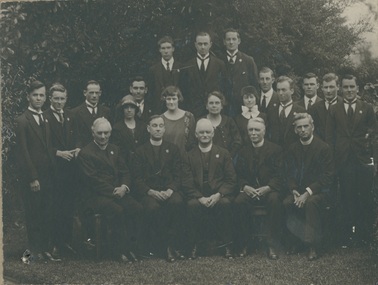
... male and female students and staff members of the Otira Methodist Home Missionary Training College, taken outdoors. The photograph is mounted on brown card. Pictured: Charles Adams, Douglas Brimacombe, Harold Hoare, Reg Williams, Will Bromley, Harold Crothers, Harry Bock, Don Allen, Howard Kettle, Bob Brown, Athol McGregor, Will Broadbent, Sister Gwen Lechte, Marge Holden (Brimacombe), Mrs Holden, Lois Atkins. ...Sister Gwen Lechte, Marge Holden (Brimacombe), Mrs Holden, Lois Atkins. Front row: Rev. Joseph Snell, Rev. Tom Rentoul, Rev. A.T. Holden, Rev. J.R. Harcourt, Rev. R. Ditterich. B & W photograph of a group of 21 male ..."Otira" was built in 1887 for Mr. Henry Berry, owner of a large wholesale grocery business. In 1923, the property was acquired by the Methodist Church for use as a home mission training college. B & W photograph of a group of 21 male and female students and staff members of the Otira Methodist Home Missionary Training College, taken outdoors. The photograph is mounted on brown card. Pictured: Charles Adams, Douglas Brimacombe, Harold Hoare, Reg Williams, Will Bromley, Harold Crothers, Harry Bock, Don Allen, Howard Kettle, Bob Brown, Athol McGregor, Will Broadbent, Sister Gwen Lechte, Marge Holden (Brimacombe), Mrs Holden, Lois Atkins. Front row: Rev. Joseph Snell, Rev. Tom Rentoul, Rev. A.T. Holden, Rev. J.R. Harcourt, Rev. R. Ditterich.otira methodist home missionary training college, charles adams, douglas brimacombe, harold hoare, reg williams, will bromley, harold crothers, harry bock, don allen, howard kettle, bob brown, athol mcgregor, will broadbent, sister gwen lechte, marge holden (brimacombe), mrs holden, lois atkins. front row: rev. joseph snell, rev. tom rentoul, rev. a.t. holden, rev. j.r. harcourt, rev. r. ditterich. -
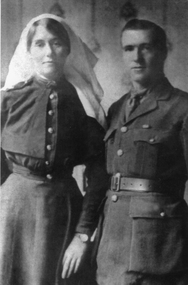 Stawell Historical Society Inc
Photograph, Mr Walter Shelly in Uniform with an unknown Nursing sister in uniform
... The male is Walter Albert Shelley the woman possible his wife. Mr Walter Shelly in Uniform with an unknown Nursing sister in uniform Photograph ...Mr. Walter Shelly and unknown Nursing sister in uniform, maybe his wife. Walter Shelly was the son of Charles Taylor Shelley (died 1931) and Catherine (died 1919). Charles second marriage was to Mrs. Carnall and 5 stepchildren. Photo of a male in uniform & a female in nurses uniform. The male is Walter Albert Shelley the woman possible his wife.stawell ww1 -
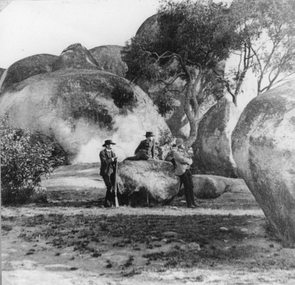 Stawell Historical Society Inc
Photograph, Sister Rocks looking South
... Black & White photograph of Sister Rock's looking South. Thee males in the center of the photo one holding a rifle all looking to the right. c 1890...Black & White photograph of Sister Rock's looking South. Thee males in the center of the photo one holding a rifle all looking to the right. c 1890 Sister Rocks looking South Photograph ...Sister Rocks Stawell Looking South. Two men one with Rifle standing and boy sitting on rock. c 1890Black & White photograph of Sister Rock's looking South. Thee males in the center of the photo one holding a rifle all looking to the right. c 1890"Looking South" this copy was supplied by Mr. Robert. Sleep Scallan St Stawell.stawell scene -
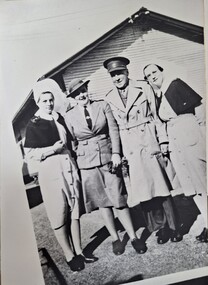 Tatura Irrigation & Wartime Camps Museum
Photograph, Captain Hendy and Nursing Sisters, Original 1942, copy 1989
... Black and white photograph of 2 female nursing sisters in nursing uniform, 1 female nursing sister in dress uniform and a male officer in uniform wearing a great coat. ...Camp Hospitals Captain Hendy Sister Tootell Sister Steed Camp nursing staff Sister Vi Elliott Black and white photograph of 2 female nursing sisters in nursing uniform, 1 female nursing sister in dress uniform and a male officer in uniform wearing a great coat. ...Army staff and nursing staff assigned to the Tatura internment camps during WW2. Captain Hendy (in great coat) with Sisters Tootell and Steed in nursing uniform. Sister Vi Elliot in dress uniform. Army hut in background.Black and white photograph of 2 female nursing sisters in nursing uniform, 1 female nursing sister in dress uniform and a male officer in uniform wearing a great coat. Army hut in background.a.a.n.s., camp hospitals, captain hendy, sister tootell, sister steed, camp nursing staff, sister vi elliott -
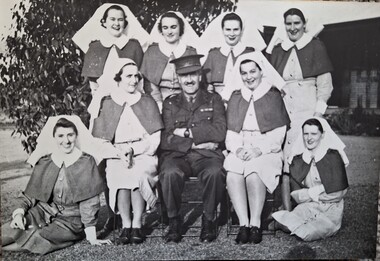 Tatura Irrigation & Wartime Camps Museum
Photograph, No 28 Camp Hospital staff, Original 1942, copy 1989
... Front: Sister M W Trott and Sister K Heaphy. internment camps tatura internment camps internment camp hospitals internment camp hospital staff captain morley sister beatrice moore Waranga Hospital Sister L G W Anderson Sister D A McLeod Sister A I Barden Sister I A Paterson Sister B Moore Major J Morley Sister D J Steed Sister M W Trott Sister K Heaphy Black and white photograph of 4 female nursing staff standing, 2 female nursing staff and male Army officer seated and 2 female nursing staff seated on ground. ...Nursing staff and senior medical officer of No 28 camp hospital (Waranga Hospital) at Tatura 15 June 1943. Back row (l to r): Sister L G W Anderson, Sister D A McLeod, Sister A I Barden, Sister I A Paterson. Middle row (l to r): Sister B Moore, Major J Morlet, Sister D J Steed. Front: Sister M W Trott and Sister K Heaphy. Black and white photograph of 4 female nursing staff standing, 2 female nursing staff and male Army officer seated and 2 female nursing staff seated on ground. Tree directly behind them. Hut nearby to the right.internment camps, tatura internment camps, internment camp hospitals, internment camp hospital staff, captain morley, sister beatrice moore, waranga hospital, sister l g w anderson, sister d a mcleod, sister a i barden, sister i a paterson, sister b moore, major j morley, sister d j steed, sister m w trott, sister k heaphy -
 Royal District Nursing Service (now known as Bolton Clarke)
Photograph - Photograph, black and white, Barry Sutton, 01.05.1974
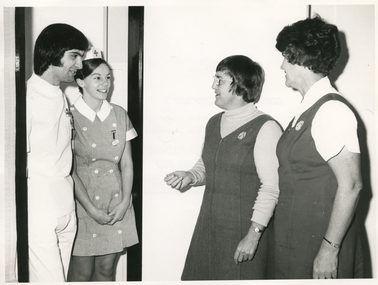
... A map covering the Centre’s Districts was attached to a wall, and its different colour pins identified streets where patients lived who were currently receiving nursing care from the RDNS Trained nurses (Sisters) working in these areas (districts). royal district nursing service rdns rdns education western general hospital students sister nan deakin sister ellen anderson Barry Sutton MA 78 On the far left of this black and white photograph is a male Student nurse, who has collar length, straight dark hair. ...The photograph is taken at Western General Hospital. Royal District Nursing Service (RDNS) Nurse Educator, Sister Nan Deakin, after teaching the RDNS Community Nursing Education program to the Western General's two Student nurses is introducing them to Sister Ellen Anderson, Supervisor of the RDNS Footscray Centre. Sr. Anderson will arrange for the Students to go on District nursing visits with RDNS Trained nurses (Sisters) from Footscray Centre who administer nursing care in the community. Sister Deakin is wearing the RDNS winter uniform of a blue/grey skivvie under a blue/grey V neck tunic style frock made of herringbone winter material. Sister Anderson is wearing the RDNS summer uniform of a white short sleeve blouse under a royal blue V neck tunic style frock. The RDNS logo is seen on the upper left on both uniforms.During their training, Student nurses from several hospitals either attended the Royal District Nursing Service (RDNS), Education Department, or, a RDNS Nurse Educator travelled to the appropriate hospital’s Education Department to educate the Trainees on District nursing through the RDNS Community Nursing Program. Following the lectures Students went to an RDNS Centre and each Student accompanied a Trained nurse (Sister) for a week observing and gaining knowledge of all facets of nursing care in the home. This gave them an insight into the home conditions and situations patients faced after discharge from hospital. During 1971 there were 584 student nurses who received field experience with RDNS. From its inception as Melbourne District Nursing Society (MDNS), in 1885, their Trained nurses (Nurses) worked in specific areas, 'districts'. The first Nurse worked east and west, between Victoria Parade and Flinders Street and, north and south, between Spencer Street and Spring Street. When a second Nurse was employed they divided this area at Elizabeth Street so each Nurse could attend to patients in the same area giving continuity of care. As the Society expanded, becoming Melbourne District Nursing Service, then, with Royal patronage, Royal District Nursing Service (RDNS) many Centres were opened throughout the Melbourne Metropolitan area and outer suburbs. The District nurse's areas (districts) grew and were divided within Shire boundaries for e.g. Knox 1, Knox 2, Knox 3, Knox 4, within the area of the Shire of Knox. A map covering the Centre’s Districts was attached to a wall, and its different colour pins identified streets where patients lived who were currently receiving nursing care from the RDNS Trained nurses (Sisters) working in these areas (districts).On the far left of this black and white photograph is a male Student nurse, who has collar length, straight dark hair. He is wearing his hospital uniform of white trousers and top. To his right, is a Student nurse who is wearing her white nursing cap, with motif in the centre front, over her long drawn back dark hair. and her short sleeve uniform checked frock, with white two breasted buttons down it, and with white collar and cuffs. A nursing watch is attached to its upper left. Both are standing in the dark framed doorway of a room and are looking to the right and smiling at Royal District Nursing Service (RDNS), Nurse Educator, Sister Nan Deakin. She has short dark hair; is wearing glasses, and is wearing her RDNS uniform of a light grey skivvie under a darker V neck tunic style frock. To the right of her, is RDNS Sister Ellen Anderson who has short curly dark hair and is wearing her RDNS uniform of a white short sleeve blouse, under a dark V neck tunic style frock. They are standing side-on facing the Students. Barry Sutton MA 78royal district nursing service, rdns, rdns education, western general hospital students, sister nan deakin, sister ellen anderson -
 Royal District Nursing Service (now known as Bolton Clarke)
Photograph - Photograph, black and white, Barry Sutton, 01.05.1974
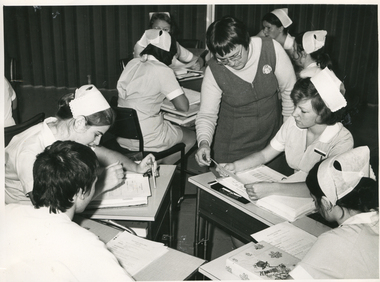
... male Student nurse, sitting randomly in a group about the room; each at a small metal framed, white wooden top table. The tables have books, printed sheets and white sheets of paper on them. The female Student nurses are wearing white nursing caps and checked uniforms with white collars and cuffs. They have a variety of hair styles, some with long hair drawn back. Standing to the right, in the centre of the group, is Royal District Nursing Service (RDNS), Nurse Educator, Sister...During 1971 there were 584 student nurses who received field experience with RDNS. royal district nursing service rdns rdns education western general hospital students sister nan deakin Barry Sutton MA 79 This black and white photograph shows a group of eight female Hospital Student nurses, some partly hidden, and one male Student nurse, sitting randomly in a group about the room; each at a small metal framed, white wooden top table. ...This black and white photograph is taken in the Education Department at the Western General Hospital where the Student nurses are doing their nursing training. Trained nurse (Sister) Nan Deakin, RDNS Nurse Educator, is checking information written by one of the Student nurses following a lecture she gave the students on Community Nursing. Following their time in the Education Department, the Student nurses will go to an RDNS Centre to receive education in the field from an RDNS Sister working in the community. During their training, Student nurses from several hospitals either attended the Royal District Nursing Service (RDNS), Education Department, or, a RDNS Nurse Educator travelled to the appropriate hospital’s Education Department to educate the Trainees on District nursing through the RDNS Community Nursing Program. Following the lectures Students went to a RDNS Centre and each student accompanied a Trained nurse (Sister) for a week observing and gaining knowledge on all facets of nursing care in the home. This gave them an insight into the home conditions and situations patients faced after discharge from hospital. During 1971 there were 584 student nurses who received field experience with RDNS.This black and white photograph shows a group of eight female Hospital Student nurses, some partly hidden, and one male Student nurse, sitting randomly in a group about the room; each at a small metal framed, white wooden top table. The tables have books, printed sheets and white sheets of paper on them. The female Student nurses are wearing white nursing caps and checked uniforms with white collars and cuffs. They have a variety of hair styles, some with long hair drawn back. Standing to the right, in the centre of the group, is Royal District Nursing Service (RDNS), Nurse Educator, Sister Nan Deakin, who has short dark hair and is wearing glasses. She is wearing her RDNS uniform of a light grey skivvie under a dark V neck tunic style dress with the RDNS logo on its upper left. She is looking down at a sheet of paper held by one of the Student nurses, who has short wavy dark hair. The nurse is holding the sheet of paper with both hands and is looking at it. The rear group of four students appear to be in discussion. The others are looking at sheets of paper on their tables. The male Student nurse, in the left foreground, has short dark hair and is wearing a white uniform. Closed dark concertina doors are in the background.Barry Sutton MA 79royal district nursing service, rdns, rdns education, western general hospital students, sister nan deakin -
 Royal District Nursing Service (now known as Bolton Clarke)
Photograph - Photograph, black and white, c.1956
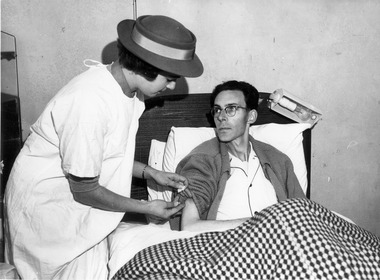
... On the left of this black and white photograph, is a Melbourne District Nursing Society Sister who is standing side-on and leaning slightly forward as she administers an injection into the right upper arm of a gentleman to her right who is sitting up in bed resting against two white covered pillows. The male...The Sisters liaised with the persons Doctor, Hospital and allied Health personal when necessary. melbourne district nursing service mdns royal district nursing service rdns rdns - injection ' Rough Proof' Latrobe Studios Ref No. 59134-8 On the left of this black and white photograph, is a Melbourne District Nursing Society Sister who is standing side-on and leaning slightly forward as she administers an injection into the right upper arm of a gentleman to her right who is sitting up in bed resting against two white covered pillows. The male ...This photograph is taken in the bedroom of the man's home in the suburbs of Melbourne. It depicts one of the types of nursing care given by Melbourne District Nursing Society (MDNS) Sisters in the community. The Sister is visiting the man's home and is administering an injection which has been ordered by a doctor. Glass syringes were used by the Society until the mid 1960s and were re sterilized for future use. After this time plastic disposable syringes were used.The Trained nurses of the Melbourne District Nursing Society (MDNS), later known as Royal District Nursing Service (RDNS), visited patients in their home and gave best practice care in many fields of nursing and to people of many cultures throughout its 130 years of expansion. Initial visits not only assessed the specific nursing situation but the situation as a whole. Their patients ranged in age from babes, children, adults to the elderly and referrals were taken from Hospitals, General Practitioners and allied Health facilities. Some of the care provided was: – Post-Natal care given to mother and babe, Wound Care following various types of surgery, accidents, burns, cancer, leg ulcers etc. Supervising and teaching Diabetic Care, including teaching and supervising people with Diabetes to administer their own Insulin, and administering Insulin to those unable to give their own injections. Administering other injections and setting up weekly medication boxes. The Sisters performed Catheterizations on adults suffering from conditions such as Quadriplegia, Paraplegia, Multiple Sclerosis (MS), Motor Neurone Disease (MND) and Guillan-Barre Syndrome, and when required at school on children for e.g. those with Spina Bifida. The Sisters visited those requiring Cystic Fibrosis support and care; those requiring Haemo-Oncology care, including visiting children at school; those requiring Home Enteral Feeding care, and those requiring IV therapy at home and home Dialysis. Palliative Care was given including pain relief with the use of syringe drivers, personal care as needed, and advice and support to both patient and family. RDNS provided Stoma management to those needing Urostomy, Ileostomy and Colostomy care and those requiring Continence care. HIV/AIDS nursing care was provided; visits to Homeless Persons were made. Personal care was given to patients ranging in age and with varying mobility problems, such as those with MS, MND, Guillan-Barre Syndrome, Quadriplegia, Paraplegia, Acquired Brain Injury, following a Cerebrovascular Accident (Stroke), those with severe Arthritis and those with a form of Dementia. When necessary the elderly were assisted with personal care and advice given on safety factors with the use of hand rails, bath or shower seats, and hand showers. Rehabilitation with an aim towards independence remained at the forefront of the Sister’s minds and when possible using aids and instruction on safe techniques enabled the person to become fully independent. All care included giving advice and support to the patient and their Carers. The Sisters liaised with the persons Doctor, Hospital and allied Health personal when necessary.On the left of this black and white photograph, is a Melbourne District Nursing Society Sister who is standing side-on and leaning slightly forward as she administers an injection into the right upper arm of a gentleman to her right who is sitting up in bed resting against two white covered pillows. The male patient has short dark hair; is wearing glasses, and is looking up at the Sister. He is wearing a thick grey cardigan over a pale colour pyjama top which has dark piping; the lower part of his body is covered by a dark and light coloured check bed cover. The bed has a solid wooden headrest with a bed lamp attached to its upper right. The Sister who is wearing her uniform grey brimmed hat over her dark short hair, is wearing a white gown over her grey uniform, the collar of which is seen. Three fingers of her left hand are holding back the pushed up sleeve of the man's cardigan and she is holding a white swab between her thumb and first finger. She has a glass syringe resting in her right hand with her thumb and forefinger resting against the lower glass and metal section of the syringe; part of the metal needle is seen, the rest is inserted in the mans upper arm. On the far left of the photograph part of a dressing table mirror can be seen.' Rough Proof' Latrobe Studios Ref No. 59134-8melbourne district nursing service, mdns, royal district nursing service, rdns, rdns - injection -
 Ballarat Heritage Services
Document - Newspaper article, Death Reveals Secret, 1880s
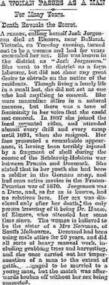
... The woman is believed to be the sister of a Mrs Newman of South Melbourne. Deceased had been using male attire for 20 years, and did all sorts of heavy manual work, including grubbing trees and harvesting and she once ......The woman is believed to be the sister of a Mrs Newman of South Melbourne. Deceased had been using male attire for 20 years, and did all sorts of heavy manual work, including grubbing trees and harvesting and she once ... ...A person calling herself Jack Jorgenson died at Elmore near Ballarat, Victoria on Tuesday evening, turned out to be a woman and had for years concealed her sex. She was known in the district as "Jack Jorgenson". she went to the district as a farm labourer but did not show any great desire to obtrude on the notice of the residents. Though living a lonely life in a small hut, she did not act as one who had anything to conceal. She wore masculine attire in a natural manner, but thee was a tone of femininity in her voice that she could not conceal. In 1887 she joined the local mounted rifles, and attended almost every drill and every camp until 1891, when she resigned. Her face presented a remarkable appearance, it having been terribly injured by a fragment of shell during the course of the Schlewig-Holstein war between Prussia and Denmark. She stated that in her youth she had been a soldier in the german army, and had seen active service in the Franco-Prussian war of 1870. Jorgensen was a Dane and so far as is known had no relative here. Her sex was disclosed only after her death, the only person knowing of it being Dr H..se of Elmore, who attended her some time since. The woman is believed to be the sister of a Mrs Newman of South Melbourne. Deceased had been using male attire for 20 years, and did all sorts of heavy manual work, including grubbing trees and harvesting and she once ...Newspaper clippingjack jorgenson, elmore, dane, cross dressing -
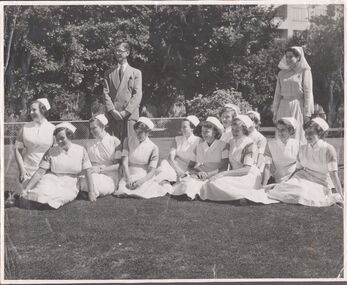 Northern District School of Nursing. Managed by Bendigo Historical Society Inc.
Photograph - 1953 - BBH Students
... One Photo and one paper copy - Black and White - Eleven Nurses seated on the grass - Nursing sister standing at right hand side and Male standing between 3 and fourth nurse. ...Seated C Wilson B Davis J Beautyman L Duggan N Painter A Archibald M Methven M Smith I Smith m Mcgregor M Harley Nurses Uniform Nursing Information Names and photos description on back of photo One Photo and one paper copy - Black and White - Eleven Nurses seated on the grass - Nursing sister standing at right hand side and Male standing between 3 and fourth nurse. ...1953 BBH Nurses on hospital lawn watching nurses tennis tournament. Photo taken for publishing in the August Souvenir Supplement. Right - Miss G. Williams Director of Nursing Left Mr Churry hospital secretary. Seated C Wilson B Davis J Beautyman L Duggan N Painter A Archibald M Methven M Smith I Smith m Mcgregor M HarleyOne Photo and one paper copy - Black and White - Eleven Nurses seated on the grass - Nursing sister standing at right hand side and Male standing between 3 and fourth nurse. Cyclone fence ant back and treesNames and photos description on back of photonurses uniform, nursing information -
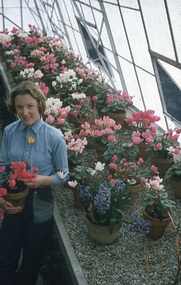 University of Melbourne, Burnley Campus Archives
Photograph, Beverley Hanson (nee Wilson), Bev Hanson's Photographs, C. 1958-1960
... She identified them as L-R Ian McCure, 3 male students, Barry Dangerfield, Cliff Nowell, Jack Plumridge (seated on tractor), George Grumont, Marie Wilson (Bev's sister), Gwyneth Edwards. 3. ...She identified them as L-R Ian McCure, 3 male students, Barry Dangerfield, Cliff Nowell, Jack Plumridge (seated on tractor), George Grumont, Marie Wilson (Bev's sister), Gwyneth Edwards. 3. ...bev hanson, marie wilson, greenhouse, cyclamen, tractor, ian mccure, barry dangerfield, cliff nowell, jack plumridge, george grumont, gwyneth edwards -
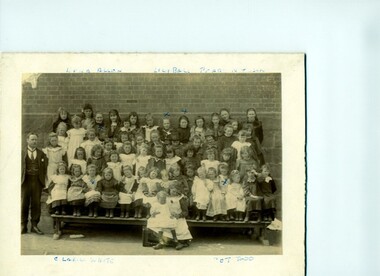 Linton and District Historical Society Inc
Photograph, Linton school pupils, girls c.1904-05, with head teacher Mr Horan
... Reverse: "Dear Mrs Armstrong / This is a very old Linton State School / picture I found / Mr Horan is the Head Master at the time / as it is only girls it gives the idea / of what a big school it was / Mr Horan used to come from Ballarat on Monday morning in a buggy/ horse / & stay at the Hotel until Friday when he left for Ballarat at 4 oclock to / drive to Ballarat for the week end / quite a trip by horse/buggy / my sister is in the picture / she would be / about 13 or 14 years of age/she was / born in 1891 so that would make the / picture about 1904 or 1905 nearly 100 / years old mostly wore white pinafores / hand made collars / Lena Allen in the back row / [Signed] S E Surman". Original sepia photograph of group of school children with male ...Mr A J Horan was Head Teacher at Linton State School from 1895 to 1909. Lena Allan, one of the pupils identified in the photograph, later became a teacher at the school.Original sepia photograph of group of school children with male teacher dressed in suit and tie standing at left hand side. Some of the pupils - Lena Allan, Lily Ball, Pearl Nelson, Clarice White and Pet Todd - are identified (hand writing in biro) on the front of the photograph. On the reverse of the photograph there is a lengthy inscription written by Mrs Stella Surman. The photograph was dated by Mrs Surman.Front: Pupils marked" Lena Allen, Lily Ball, Pearl Nelson, Clarice White, and Pet Todd" . Reverse: "Dear Mrs Armstrong / This is a very old Linton State School / picture I found / Mr Horan is the Head Master at the time / as it is only girls it gives the idea / of what a big school it was / Mr Horan used to come from Ballarat on Monday morning in a buggy/ horse / & stay at the Hotel until Friday when he left for Ballarat at 4 oclock to / drive to Ballarat for the week end / quite a trip by horse/buggy / my sister is in the picture / she would be / about 13 or 14 years of age/she was / born in 1891 so that would make the / picture about 1904 or 1905 nearly 100 / years old mostly wore white pinafores / hand made collars / Lena Allen in the back row / [Signed] S E Surman".linton state school, lena allan, lily ball, pearl nelson, clarice white, pet todd, a. j. horan -
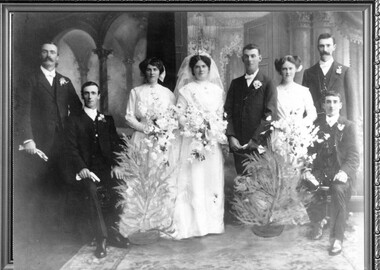 Linton and District Historical Society Inc
Photograph, Mary Hogan and William Stokie, wedding photograph, 1912
... (L-R) John Hogan jnr (bro of Mary), Con Hogan (seated), Jean Stokie (sister of William and James), Mary Hogan (bride),William Stokie (groom), Lily Hogan (niece), Bob Hogan (bro of Mary), James Stokie (seated) (bro of groom)". Copy of original wedding photograph of a bridal couple with four male ...Mary Hogan married William Stokie at St Patrick's Cathedral in Ballarat on 12 April 1912. Mary was a daughter of John and Mary Hogan, née Fraser. L-R: John Hogan Jnr (brother of Mary; Con Hogan (seated, also brother of Mary); Jean Stokie (sister of William); Mary Hogan (bride); William Stokie (groom); Lily Hogan (niece of bride); Bob Hogan (brother of Mary); James Stokie (brother of William).Copy of original wedding photograph of a bridal couple with four male and two women attendants. Bride, groom and attendants are all identified on a card which is with the photograph."Wedding of Mary Hogan, daughter of Mary (Fraser) and John Hogan, Bootmaker, Linton. Celebrated at St Patrick's Cathedral Ballarat 12.4.1912. (L-R) John Hogan jnr (bro of Mary), Con Hogan (seated), Jean Stokie (sister of William and James), Mary Hogan (bride),William Stokie (groom), Lily Hogan (niece), Bob Hogan (bro of Mary), James Stokie (seated) (bro of groom)".weddings, william stokie, mary hogan, jean stokie, james stokie, john hogan jnr., con hogan, lily hogan, bob hogan -
 Royal District Nursing Service (now known as Bolton Clarke)
Photograph - Photograph, black and white:, Barry Sutton, 10.08.1971
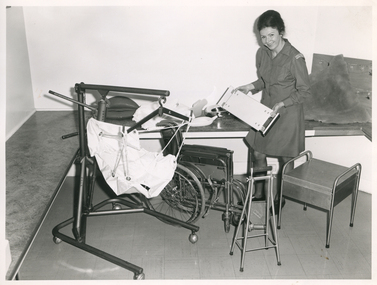
... Black and white digital image portraying Sister Scott, who is smiling and has her dark hair drawn up, checking equipment. She is holding a bath seat in her hands. Behind her on a table, left to right, is an air cushion, draw sheets, male urinal, female urinal, bed pan and a sheepskin which is in front of a wooden board with rows of cup hooks and names under each hook. ...Quote KL 49 Black and white digital image portraying Sister Scott, who is smiling and has her dark hair drawn up, checking equipment. She is holding a bath seat in her hands. Behind her on a table, left to right, is an air cushion, draw sheets, male urinal, female urinal, bed pan and a sheepskin which is in front of a wooden board with rows of cup hooks and names under each hook. ...Sr. Scott is in a room in the Royal District Nursing Service (RDNS) Melbourne Centre. She is wearing the RDNS grey uniform dress which has the insignia "Royal District Nursing Service" written in white on a grey background attached to the upper sleeves. The photograph is showing some of the equipment which is available for temporary loan to RDNS patients.From the founding of the Melbourne District Nursing Society (MDNS), in 1885, known as the Royal District Nursing Service (RDNS) from 1966, equipment was loaned and demonstrated to patients and their family members, to enable them to care for their loved ones in their home. In the 1970s RDNS employed a Physiotherapist who taught RDNS staff the correct transferring techniques, including the use of a hoist when this became available. RDNS staff taught and used these techniques in patient’s homes to undertake safe transfer of the patient and to reduce physical strain on RDNS nursing staff and family members. Each RDNS Centre had a room or shed where equipment for loan was kept. Headquarters also kept additional equipment which could be transported to Centres as required. Black and white digital image portraying Sister Scott, who is smiling and has her dark hair drawn up, checking equipment. She is holding a bath seat in her hands. Behind her on a table, left to right, is an air cushion, draw sheets, male urinal, female urinal, bed pan and a sheepskin which is in front of a wooden board with rows of cup hooks and names under each hook. In the left foreground is a hoist with a white sling hanging from either side of the front hanger. To its right is a closed wheelchair, a 4 pronged walking stick, and a commode to the right of Sr. Scott.Barry Sutton Photographer. Quote KL 49rdns, rdns equipment, rdns uniform, royal district nursing service, sister scott -
 Royal District Nursing Service (now known as Bolton Clarke)
Photograph - Photograph, black and white, c.1990
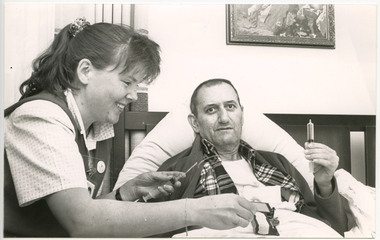
... RDNS Sister Marilyn Harper is giving medication via a syringe and tube to a male client.....Sister Marilyn Harper, who is smiling. She has drawn back long curly hair and is wearing a white patterned short sleeve blouse under a dark V neck tunic style frock. Her right arm is extended onto a piece of equipment resting on top of the bedclothes of a male client who is lying in bed. ...RDNS Sister Marilyn Harper is giving medication via a syringe and tube to a male client.. ...RDNS Sister Marilyn Harper is giving medication via a syringe and tube to a male client..Medications ordered by Doctors in Hospitals was given by Royal District Nursing Service (RDNS) Sisters to patients in their own homes. Specialized treatments were taught to RDNS Sisters by the RDNS Education Department. At times RDNS Sisters visited hospitals to learn special techniques which were to be used to care for the patient after their discharge. The RDNS Education department ran many programs for their staff including: a Post Basic Course, Cardiac Rehabilitation Nursing, Haematology/Oncology Nursing, Palliative Care program, Diabetic Stabilization Program, Leg Ulcer Management Program, HIV/AIDS Nursing Care, Cystic Fibrosis Home Support, Veterans Home Care Program, Breast Cancer Support Program, Continence Management Program, Stomal Therapy Program, In-Home Lactation Support Program and a Community Nursing Education Program extended to student nurses from hospitals and to other nursing organizations. RDNS staff attended several hospitals to observe and learn special care needed to some clients, e.g. to the Austin Hospital to learn the care required for paraplegic and quadriplegic clients at home and to Mount Royal Hospital to observe the care of clients in the rehabilitation ward.On the left of the black and white photograph is the side view of Royal District Nursing (RDNS) Sister Marilyn Harper, who is smiling. She has drawn back long curly hair and is wearing a white patterned short sleeve blouse under a dark V neck tunic style frock. Her right arm is extended onto a piece of equipment resting on top of the bedclothes of a male client who is lying in bed. Her left hand is holding a partly emptied syringe which is attached to a clear coloured tube attached to the man. The male client, whose head and shoulders are resting on a boomerang pillow on his bed, has short dark hair and is wearing a tartan shirt and cardigan over a white T-shirt. He is holding an upright filled syringe in his left hand. In the background you can see part of the wooden bedhead and part of a picture on the pale coloured wall behind it.Courtesy of the 'Western Independent'royal district nursing service, rdns, rdns care - medication, sister marilyn harper
