
Showing 180 items matching "small goods"
-
 City of Ballarat Libraries
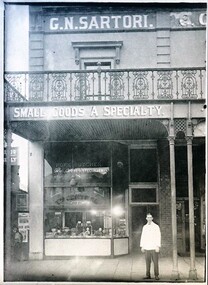
Photograph - Card Box Photographs, G.N. Satori Small Goods, Ballarat circa 1921
... G.N. Satori Small Goods, Ballarat circa 1921....Satori George Satori Building Commerical Manufacturing Sturt Street Shop G.N. Satori Small Goods, Ballarat circa 1921. Photograph Card Box Photographs ...George Satori stands in front of his shop which was located at 711 Sturt Street but is now Ballarat Laundry. Examples of what the building looked like can be seen further along the Sturt Street.g.n. satori, george satori, building, commerical, manufacturing, sturt street, shop -
 Tarnagulla History Archive
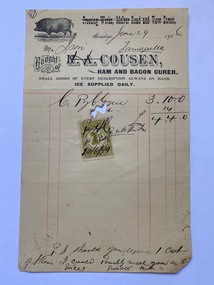
Invoice from K.A. Cousen of Bendigo to Thomas Ison for small goods, 1906
... Cousen of Bendigo to Thomas Ison for small goods, 1906....Cousen of Bendigo to Thomas Ison for small goods, 1906. ... -
 Moorabbin Air Museum
Book - Inflight 1960's vintage passenger information booklet touching on Qantas history and small travel goods available in flight, as well maps of the Kangaroo Route, QANTAS KANGAROO ROUTE FLIGHT GUIDE, Qantas, QANTAS KANGAROO ROUTE FLIGHT GUIDE, Mid 1960's
... Inflight 1960's vintage passenger information booklet touching on Qantas history and small travel goods available in flight, as well maps of the Kangaroo Route, QANTAS KANGAROO ROUTE FLIGHT GUIDE...Inflight 1960's vintage passenger information booklet touching on Qantas history and small travel goods available in flight, as well maps of the Kangaroo Route, QANTAS KANGAROO ROUTE FLIGHT GUIDE...Inflight 1960's vintage passenger information booklet touching on Qantas history and small travel goods available in flight, as well maps of the Kangaroo Route, QANTAS KANGAROO ROUTE FLIGHT GUIDE Inflight 1960's vintage passenger information booklet touching on Qantas history and small travel goods available in flight, as well maps of the Kangaroo Route, QANTAS KANGAROO ROUTE FLIGHT GUIDE Front cover abstract colourful representation presumably ?? ...Inflight 1960's vintage passenger information booklet touching on Qantas history and small travel goods available in flight, as well maps of the Kangaroo Route, QANTAS KANGAROO ROUTE FLIGHT GUIDEFront cover abstract colourful representation presumably ?? of a kangaroo, all on a white backgroundnon-fictionInflight 1960's vintage passenger information booklet touching on Qantas history and small travel goods available in flight, as well maps of the Kangaroo Route, QANTAS KANGAROO ROUTE FLIGHT GUIDE -
 Bendigo Historical Society Inc.
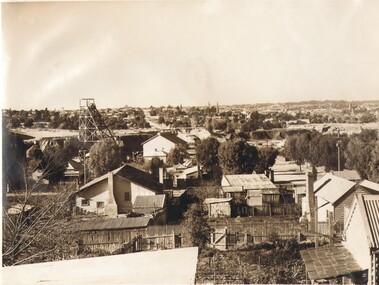
Photograph - FOGGIT JONES, c1930
... ...small goods...ORGANIZATION Business small goods Edwin G Adamson, A>R>P>S Charters House, 165 Collins St, Melbourne, Tel. ...black and white photo : View from Foggitt Jones looking towards Bendigo 1930. Houses in foreground, poppet head left side mullock heap behind, Bendigo valley in background. (Situated in the Wade Street -Maple Street area of Golden Square. EST 1910)Sacred Heart Cathedral and St Paul's Catedral can been seen in the distance. Physical description: unmounted black and white photo.Edwin G Adamson, A>R>P>S Charters House, 165 Collins St, Melbourne, Tel. F 6330organization, business, small goods -
 Glen Eira Historical Society
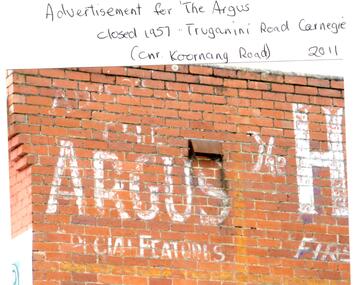
Photograph - CARNEGIE
... ... Small goods...McKay Jonathon Small goods Perry W. B. Chemists Kinsman E. H. ...24 photographs relating to Carnegie plus 1 slide: 1/Two photographs, one of Koornang Road c.1920’s and one of flower shop rear of library, date unknown. 2/One photograph of Carnegie Post Office c. undated. 3/Two photographs Koornang Road, Carnegie and phone boxes, Carnegie, dated 1914. 4/Two photographs (the same) of an RSL Ball dated 15/08/1937. 5/17 black and white negative photos – reprinted, date unknown, of Carnegie Library, shop front opening Koornang Road. 6/Slide showing Koornang Road, Carnegie looking South. 7/6 photocopied postcards from Valentines Real Photo Series, in album owned by Mrs. Zoe Mason, collected and returned to Pam Speedy (daughter) 12 Wattle Grove, East Malvern, 15/03/1999. Photocopied pages from 1923 Sands and McDougalls included with some prints to give an idea of architecture and other retail trade. 8/Two photocopied prints of Carnegie Flood. 1946 – Koornang Road, shows shopkeepers in street at that time. 9/Two photographs of brick wall advertising the "Argus" newpaper, which closed in 1957. Photos taken in 2011 when building was exposed prior to rebuilding on site.koornang road, rosstown road, carnegie, shepparson street, carnegie library, carnegie post office, mcallister b., glen huntly, glenhuntly, phone boxes, memorial hall, bamfield m., tranmere avenue, carnegie railway station, stations, libraries, post offices, memorial hall carnegie, progress hall, carnegie community singing, social clubs, chadstone progress, newspapers, temminghoff robert, carnegie chamber of commerce, caulfield city council, rob’s chocolate box, rosstown, ross william murray, rosstown railway, elsternwick, oakleigh, city of caulfield, glen huntly road, glenhuntly road, grange road, carnegie primary school, primary schools, murrumbeena, neerim road, dandenong road, koornang park, lord reserve, rosanna street reserve, packer oval reserve, caulfield swim centre, holywood grove, mile end road, mcpherson avenue, munster avenue, rosstown hotel, leila road, methodist church, toolambool street, carnegie theatre, carnegie estate agency – sims and broadbent, woorayl street, estate agents, cowie j. mrs., confectioner, woodhouse e., stationer, mckay jno. a., mckay jonathon, small goods, perry w. b., chemists, kinsman e. h., newsagents, jones a. w., mckee wm., furniture stores, neil geo. m., grocer, truganini road, brick -
Stawell Historical Society Inc
Realia - Calender, Stawell News & Pleasant Creek Chronicle Calendar 1947, 1947
... Farmer's Bacon, Hams, Small Goods. The absolute best always. ...Farmer's Bacon, Hams, Small Goods. The absolute best always. Two colour Red and Black print on A2 Newsprint. ...Postal Information in LSD. Phases of the moon, Full Month, Day Date,, Same for new moon. Borough and shire of Stawell, Councilors, Wards, Area, Population, Dwellings, Valuation Rates, etc. Public holidays for 1947Two colour Red and Black print on A2 Newsprint. Has 5 Squares X 3 Months, Days of week, and datesDane Bros. Grocers Advertisement. Est 1865. main Street Stawell Phone 39. Wholesale and Retail wine and spirit merchants. Sole Agents. Grasmere Butter. Farmer's Bacon, Hams, Small Goods. The absolute best always. -
 Ringwood and District Historical Society
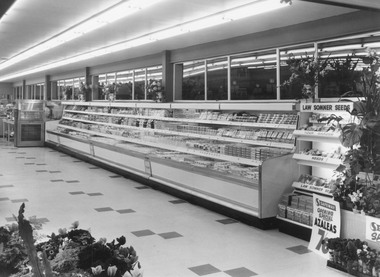
Photograph, Safeway Delicatessen Section. Probably Ringwood. Undated
... Written on back of photograph, "Safeway has two self-service delicatessen and small-goods sections. Both use Tyler cabinets. ...Written on back of photograph, "Safeway has two self-service delicatessen and small-goods sections. Both use Tyler cabinets. ...Written on back of photograph, "Safeway has two self-service delicatessen and small-goods sections. Both use Tyler cabinets. Above is the larger of the two displays." Stamped on photograph, "Please quote No. MA6939 when ordering Laurie Richards 48-1528". -
 Puffing Billy Railway
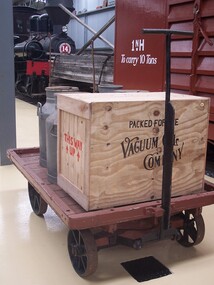
Platform Trolley
... Used on the railway platforms to transform luggage and small goods items between the trains that arrived at the station and the parcels office on the platform. ...Used on the railway platforms to transform luggage and small goods items between the trains that arrived at the station and the parcels office on the platform. ...Used on the railway platforms to transform luggage and small goods items between the trains that arrived at the station and the parcels office on the platform. They were often seen on railway platforms with suitcases, chicken boxes and other small boxes.Historic - railway platform typical of those used on station platformsPlatform Trolley made of Wood and Steel and wrought ironplatform, trolley, transport, luggage, railway, puffing billy -
 Kilmore Historical Society
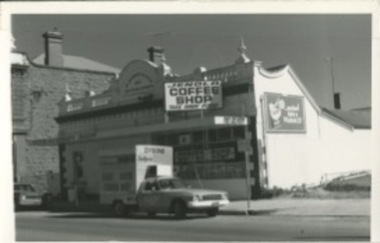
Photograph, 61-63 Sydney Street
... Out the front of the building there is a "Dyons small goods" vehicle parked. There is a cigarette advertisement on the side of the building....Out the front of the building there is a "Dyons small goods" vehicle parked. There is a cigarette advertisement on the side of the building. 61-63 Sydney Street Photograph Photograph ...Was the building of Morrissey Butchers which was established in 1865.13.5cm x 9cm black and white photograph of 61-63 Sydney Street. The building is, at the time of the photo, occupied by a Toy and Craft Shop and "Jenola Coffee Shop" which advertises take away food and free delivery. Out the front of the building there is a "Dyons small goods" vehicle parked. There is a cigarette advertisement on the side of the building.Written on the back: 61-63 021storefronts, shopfronts, retail stores, cafes, coffee shops -
 Surrey Hills Historical Society Collection
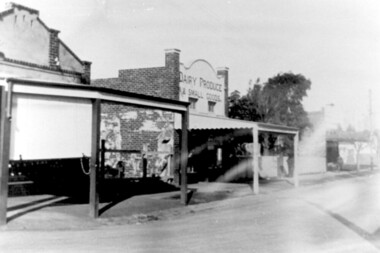
Photograph, Hamilton Street, Mont Albert in 1919, 1919
... One shop sells dairy produce and small goods....One shop sells dairy produce and small goods. Hamilton Street, Mont Albert in 1919 Photograph Norman Carter ...The land occupied by the Hamilton Street shops was subdivided in the 1880s and the first purpose-built shop was 'Pope and Moran, Grocers'. This shop later became Tom Morris' Grocery. By 1930 shops stretched along both sides of Hamilton Street and part way along Churchill Street. The donor the late Norman Carter took many photos documenting Mont Albert and Surrey Hills from the 1920s. His subject matter often related to Church of England events and activities.Black and white photo taken from the centre of the road in Hamilton Street, Mont Albert. Three single storey shops can be seen with vacant blocks of land in between them. They have verandas extending over the pavement to the edge of the road which appears to have bluestone curb and channelling. One shop sells dairy produce and small goods.hamilton street, shops -
 Melbourne Tram Museum
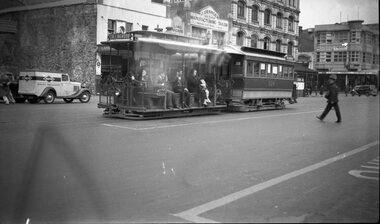
Negative - CAble tram Lonsdale St, Wal Larsen, c1938-1939
... Granger, Manufacturing Tailor and the Popular Dog Bureau and a van for Imperial Small goods. Photographer - possibly Wal Larsen based on negative size and Reg Item 5064 and on the last day of service 14/4/1939....Granger, Manufacturing Tailor and the Popular Dog Bureau and a van for Imperial Small goods. Photographer - possibly Wal Larsen based on negative size and Reg Item 5064 and on the last day of service 14/4/1939. ...Negative of cable trams, trailer 524, at the Lonsdale St terminus, c1938-39, the line closed on 15/4/1939. In the background is Lang Arcade, J. Granger, Manufacturing Tailor and the Popular Dog Bureau and a van for Imperial Small goods. Photographer - possibly Wal Larsen based on negative size and Reg Item 5064 and on the last day of service 14/4/1939.trams, tramways, cable trams, lonsdale st, collingwood, tram 524 -
Port Melbourne Historical & Preservation Society
Book - 1953 Sands & McDougall's Directory of Victoria, Sands & McDougall Pty Ltd, 1953
... Dandy Hams and bacon, Lard and Dandenong Small goods. registered Office Dandenong, Telephone 44, City depot 70 King St telephone MB 4283...Dandy Hams and bacon, Lard and Dandenong Small goods. registered Office Dandenong, Telephone 44, City depot 70 King St telephone MB 4283 Heavy red bound book with advertising imprinted on ends and front of book. ...Heavy red bound book with advertising imprinted on ends and front of book. Sands & McDougall's Directory of Victoria 1953(Bottom end) Alfred Allison, Estab 1854 Funeral Director, Melbourne West and Clifton Hill. telephone FJ4303, FJ 5480. Telephone JW 1709 (Top End) Gippsland Co-operative Bacon Curing Co Ltd. Dandy Hams and bacon, Lard and Dandenong Small goods. registered Office Dandenong, Telephone 44, City depot 70 King St telephone MB 4283business and traders, local government, families, advertising, sands & mcdougall pty ltd, built environment -
 Bendigo Historical Society Inc.
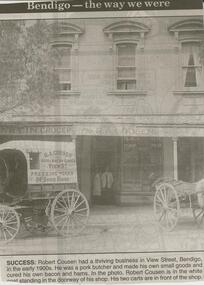
Newspaper - JENNY FOLEY COLLECTION: SUCCESS
... He was a pork butcher and made his own small goods and cured his own bacon and hams. ...He was a pork butcher and made his own small goods and cured his own bacon and hams. ...Bendigo Advertiser ''The way we were'' from 2000. Success: Robert Cousen had a thriving business in View street, Bendigo in the early 1900's. He was a pork butcher and made his own small goods and cured his own bacon and hams. In the photo, Robert Cousen is in the white coat standing in the doorway of his shop. His two carts are in the front of the shop. The clip is in a folder.newspaper, bendigo advertiser, the way we were -
 Puffing Billy Railway
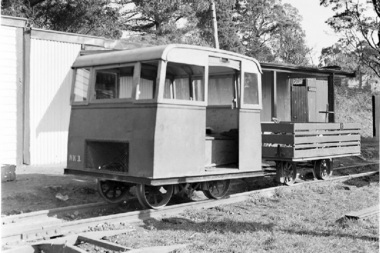
Whitfield, Trolly Trailer
... Built by the Victorian Railways it was originally used on the postal motor service on the Wangaratta to Whitfield narrow gauge line, for the cartage of small goods. it was part of the consist that operated the last service on that line in 1953. ...Built by the Victorian Railways it was originally used on the postal motor service on the Wangaratta to Whitfield narrow gauge line, for the cartage of small goods. it was part of the consist that operated the last service on that line in 1953. ...Built by the Victorian Railways it was originally used on the postal motor service on the Wangaratta to Whitfield narrow gauge line, for the cartage of small goods. it was part of the consist that operated the last service on that line in 1953. In 1960, it was purchased from the Victorian Railways, restored and taken to Belgrave to assist in the restoration of the Puffing Billy Railway. In the mid 1960's it was classified "NGA 1". In the 1970's, it was withdrawn from regular use and dismantled.Historic - Victorian Railways narrow gauge - trolly tralier Wangaratta to Whitfield narrow gauge lineTrolly Trailer Made of metal - frames and wheels only puffing billy, victorian railways, whitfield trolley trailer, narrow gauge rolling stock, postal motor, trolly -
 Puffing Billy Railway
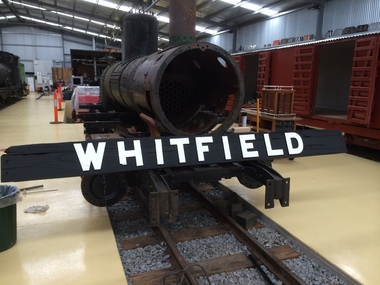
Station Sign, whitfeild Station sign
... Whitfield was the most distant narrow gauge station from Melbourne Opened 1899 Closed 1953 Whitfield was the small terminus for the Whitfield railway line The station had a moderately long passenger platform, small goods yard, goods shed, ticket office and locomotive shed. ...Whitfield was the most distant narrow gauge station from Melbourne Opened 1899 Closed 1953 Whitfield was the small terminus for the Whitfield railway line The station had a moderately long passenger platform, small goods yard, goods shed, ticket office and locomotive shed. ...Historic - Victorian Railways Station sign used at Whitfield Station Whitfield Station The terminus of the line. Whitfield was the most distant narrow gauge station from Melbourne Opened 1899 Closed 1953 Whitfield was the small terminus for the Whitfield railway line The station had a moderately long passenger platform, small goods yard, goods shed, ticket office and locomotive shed. Platforms 1 Tracks 3 Historic - Victorian Railways Station sign used at Whitfield StationStation Sign - Whitfield large black wooden backing board with white letteringWhitfieldpuffing billy, victorian railways, station sign, whitfield -
 Kiewa Valley Historical Society
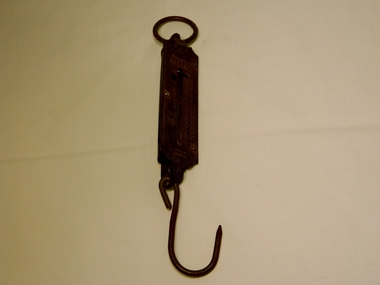
Scales Balance Pocket, Circa 1900
... Historically this item would have been used by gold miners, rabbit shooters, mobile "Rag and Bone" traders and other mobile(in caravans and/or horse drawn cart) traders of various small goods and haberdashery. Although marked as not to be used as trade, the isolation and sometimes difficult terrain rules out using larger and more delicate scales. ...Historically this item would have been used by gold miners, rabbit shooters, mobile "Rag and Bone" traders and other mobile(in caravans and/or horse drawn cart) traders of various small goods and haberdashery. Although marked as not to be used as trade, the isolation and sometimes difficult terrain rules out using larger and more delicate scales. ...Historically this item would have been used by gold miners, rabbit shooters, mobile "Rag and Bone" traders and other mobile(in caravans and/or horse drawn cart) traders of various small goods and haberdashery. Although marked as not to be used as trade, the isolation and sometimes difficult terrain rules out using larger and more delicate scales. In the early 1900s rough roads and severe weather conditions forced traders to be more flexible in trading with weights and measures. The "close enough is good enough" doctrine was the Australian outback rule of thumb. The significance of this item in the Kiewa Valley during this period demonstrates the slower acceptance of accurate trading measure using the country side principle "my hand shake is my bond". In the Kiewa Valley small quantity commercial undertakings e.g. gold mining, fur pelts and rabbit meat trade did not require bulk weight type scales. Commerce in rural production e.g. fruit and vegetables involved more farmers and their staff in a barter and/or "in kind" payments. This was more so in the depression years 1929 to late 1930s. Self sufficiency was to a large extent more attainable in this region than in the city/ large country town environment. The Australian "fair go" ethical approach to life and commerce was very much ingrained in those living in country regions, like Kiewa Valley as is demonstrated by the not so accurate hand balance, spring loaded scales. Portable Pocket Balance with front plate made from brass. Spring mechanism enclosed by black painted medium gauge steel cover( three quarters cylindrical). Front scale face and rear spring casing fastened by three rivets. Spring loaded marker blade is located in the centre of the front plate. See item KVHS 0224 for a similar scales.Front plate marked: at top "Not legal for use in trade", below this in larger print "Pocket Balance", under and to the right in smaller print "lbs" under this graded marks, first marked with a Zero, then every second mark in ascending order up to 25. At the bottom of the front plate is marked "Made in Germany"antique pocket balance, scales, mobile weights, vintage appliances -
 Kiewa Valley Historical Society
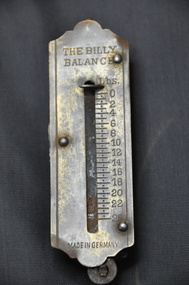
Scales Weighing Pocket, circa early 1900s
... Historically this item would have been used by gold miners, rabbit shooters, mobile "Rag and Bone" traders and other mobile(in caravans and/or horse drawn cart) traders of various small goods and haberdashery. Although marked as not to be used as trade, the isolation and sometimes difficult terrain rules out using larger and more delicate scales. ...Historically this item would have been used by gold miners, rabbit shooters, mobile "Rag and Bone" traders and other mobile(in caravans and/or horse drawn cart) traders of various small goods and haberdashery. Although marked as not to be used as trade, the isolation and sometimes difficult terrain rules out using larger and more delicate scales. ...Historically this item would have been used by gold miners, rabbit shooters, mobile "Rag and Bone" traders and other mobile(in caravans and/or horse drawn cart) traders of various small goods and haberdashery. Although marked as not to be used as trade, the isolation and sometimes difficult terrain rules out using larger and more delicate scales. In the early 1900s rough roads and severe weather conditions forced traders to be more flexible in trading with weights and measures. The "close enough is good enough" doctrine was the Australian outback rule of thumb.The significance of this item in the Kiewa Valley during this period demonstrates the slower acceptance of accurate trading measure using the country side principle "my hand shake is my bond". In the Kiewa Valley small quantity commercial undertakings e.g. gold mining, fur pelts and rabbit meat trade did not require bulk weight type scales. Commerce in rural production e.g. fruit and vegetables involved more farmers and their staff in a barter and/or "in kind" payments. This was more so in the depression years 1929 to late 1930s. Self sufficiency was to a large extent more attainable in this region than in the city/ large country town environment. The Australian "fair go" ethical approach to life and commerce was very much ingrained in those living in country regions, like Kiewa Valley as is demonstrated by the not so accurate hand balance, spring loaded scales.This brass "faced" portable Pocket Balance ( Fish Scales) has front plate made from thin pressed brass. The mild steel spring mechanism enclosed by black painted medium gauge steel cover( three quarters cylindrical). Front scale face and rear spring casing fastened by three rivets. Spring loaded marker blade is located in the centre of the front plate. A steel " finger holder" ring is attached at the top of the scale unit from one of two pre drilled holes. The top is for holding the scale upright and the bottom for a hook to dangle the item to be weighed from the bottom. See item KVHS 0223 for similar scales"THE BILLY BALANCE" and at the bottom "MADE IN GERMANY"antique pocket balance, scales, mobile weights, vintage appliances -
 Otway Districts Historical Society
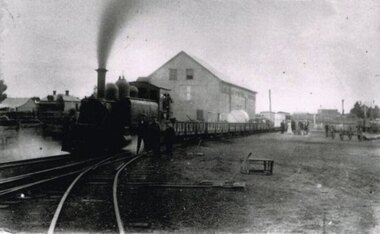
Photograph, Locomotive 8A and its mixed train at Colac Railway Station, c.1920, c.1920
... In 1922 a footbridge was erected over the broad gauge lines, and a passenger shelter and small goods shed were built on the departure track....In 1922 a footbridge was erected over the broad gauge lines, and a passenger shelter and small goods shed were built on the departure track. colac; railway; narrow gauge; na locomotive; B/W. ...Station facilities for the travelling public on the narrow gauge line at Colac Railway Station were non-existent for many years. Tickets were purchased from the broad gauge booking office and the travellers then had to walk with their luggage over the rough, potentially ankle-twisting, stone approaches, through the goods yard and wait in the open amongst the mud holes alongside the narrow gauge departure track. In 1922 a footbridge was erected over the broad gauge lines, and a passenger shelter and small goods shed were built on the departure track.B/W. At Colac Railway Station, an locomotive 8A with five NQR wagons, an NM livestock wagon and a NBDBD combined passenger and brake van destined for Beech Forest, with either the driver or the fireman peering out of the engine, three youths standing at the front of the engine, and a group of people, including a woman, standing near the livestock wagon. A multi-storied shed and two houses are in the background. 179mm x 280mm picture.colac; railway; narrow gauge; na locomotive; -
 Melbourne Tram Museum
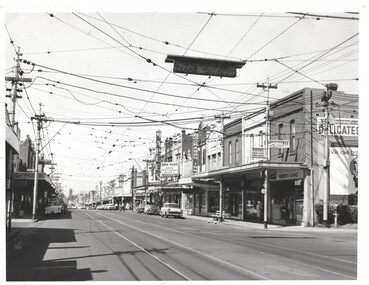
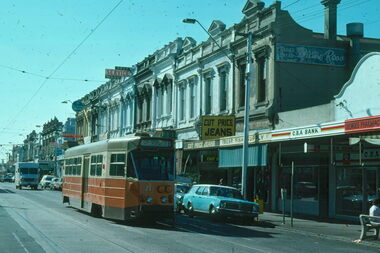
Photograph - Tram Tracks at various locations - set of 3, Melbourne & Metropolitan Tramways Board (MMTB), 1960s
... In the background is Maples electrical store advertising Kelvinator, Dragon Inn, and a Greek small goods store. 2 - West Coburg terminus at Bell St - showing the end of the track arrangements, including a traffic light. ...In the background is Maples electrical store advertising Kelvinator, Dragon Inn, and a Greek small goods store. 2 - West Coburg terminus at Bell St - showing the end of the track arrangements, including a traffic light. ...Set of 3 photos showing tramway tracks and the road environment at various locations 1 - Glenferrie Road, Malvern Depot entrance looking south - Coldblo Road, showing the illuminated overhead "Trams crossing sign". In the background is Maples electrical store advertising Kelvinator, Dragon Inn, and a Greek small goods store. 2 - West Coburg terminus at Bell St - showing the end of the track arrangements, including a traffic light. In the background is a Continental Grocer, Tony's Fish Shop, JJ & TG Leech newsagent, and a Continental Butcher. Adverts for Winfield, Alimentari, Coca Cola, Doug Thorley caravans, The Age, The Sun, Herald, Sporting Globe, Macelleria. Note the newspaper stand by the traffic light. 3 - St Georges Road looking south over Normandy Road Thornbury - shows the tram track layout prior to the separation of the tracks on either side of the Median strip. A Shell Service station is visible on the left side of the photo and Milk bar on the right.Demonstrates the work of the MMTB to show various arrangements of roads and tram tracks.Black and white print with notes on the rearImage 1 - MMTB stamp P250.765 image 3 - MMTB stamp P257.1898tramways, motor traffic, glenferrie road, malvern depot, west coburg, bell st, st georges road -
 Bacchus Marsh & District Historical Society
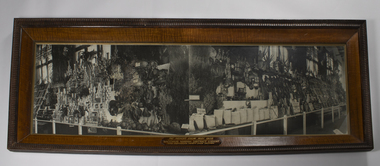
Photograph, The Prince's Show May 1920 Bacchus Marsh District Exhibit
... The display according to a newspaper report in the Bacchus Marsh Express on 5 June 1920 included 33 trays of fresh fruit, preserved fruit, pickles, sauces, bacon and other small goods, vegetables, hay grasses, grain, turned wood, wines and other drinks', &c., aided by pot plants, flags, draping of maroon and gold (official Exhibit colors) made up a color scheme and general effect worthy of the occasion. ...The display according to a newspaper report in the Bacchus Marsh Express on 5 June 1920 included 33 trays of fresh fruit, preserved fruit, pickles, sauces, bacon and other small goods, vegetables, hay grasses, grain, turned wood, wines and other drinks', &c., aided by pot plants, flags, draping of maroon and gold (official Exhibit colors) made up a color scheme and general effect worthy of the occasion. ...During May through to July 1920 Prince Edward, later to become King Edward VIII of England toured Australia to thank the country for its support during World War One and to strengthen ties between Australia and the United Kingdom. He arrived in Victoria on the 26 May 1920 and on the 29 May attended a special agricultural show at the Royal Agricultural Showgrounds at Flemington. Bacchus Marsh district was invited to contribute to a display of agricultural produce and products which was displayed in the Government Pavilion at the Showgrounds. The display according to a newspaper report in the Bacchus Marsh Express on 5 June 1920 included 33 trays of fresh fruit, preserved fruit, pickles, sauces, bacon and other small goods, vegetables, hay grasses, grain, turned wood, wines and other drinks', &c., aided by pot plants, flags, draping of maroon and gold (official Exhibit colors) made up a color scheme and general effect worthy of the occasion. The Prince inspected the exhibit and expressed his admiration of it, his only regret was that he could not give more time to its examination. There was also 'an improvised "pheasant" nestling in one corner, and what "amazing" eyes it had!'. The organiser of the display was F. C. Minns, and the decorator was T. Stewart. This photograph is notable for its size and high quality framing. This signifies the importance the local community placed upon being chosen to participate in a major royal event and the desire to record this in a grand and elaborate way for posterity. Very large framed photograph of the agricultural produce and products from the Bacchus Marsh district displayed as part of a special exhibition for Prince Edward, the heir to the British throne when he visited Melbourne in May 1920. The display comprised a wide variety of produce such as fresh and preserved fruit, meats, vegetables, hay, grasses, grain, turned wood, wines and other drinks. The image is divided in the middle into two different angles of the display.A caption in gold lettering at the foot of the image reads 'The Prince's Show May 1920 Bacchus Marsh District Exhibit Royal Agricultural Society Showgrounds'royal visits, shows and exhibitions -
 Melbourne Tram Museum
Slide - Melbourne tram operations - Z and W classes - set of 12, Warren Doubleday, 28/4/1977
... Tram has adverts for Park Drive, Heinz, and Tolleys brandy 10 - W2 585 ditto - route 5 Burke Road. 11 - W5 744 outbound in Royal Parade, route 19 North Coburg 12 - W2 578 Burwood terminus - route 74. Has a Don small goods van. Has adverts for Fanta, Allan Lewis Dulux paints, Pacific Film Service, and B F Wood supermarket...Tram has adverts for Park Drive, Heinz, and Tolleys brandy 10 - W2 585 ditto - route 5 Burke Road. 11 - W5 744 outbound in Royal Parade, route 19 North Coburg 12 - W2 578 Burwood terminus - route 74. Has a Don small goods van. Has adverts for Fanta, Allan Lewis Dulux paints, Pacific Film Service, and B F Wood supermarket Yields information about the operations of various trams on the Melbourne system April 1977. tramways Z class Smith St tram 21 tram 30 tram 32 tram 60 High St Northcote St Kilda Road W2 class W5 class tram 421 tram 335 tram 382 tram 585 tram 744 tram 578 Burwood Have photographer's reference number written on the slide. ...Set of 13 photographs of Melbourne tram operations during April 1977 1 - Z21 in Smith St, Fitzroy, inbound with a CBC bank and Georges Pharmacy in the background 2 - Z30 - ditto, with the Albion Hotel, in the background 3 - Z32 - inbound descending the High St hill, Northcote, with a Yellow Cab depot and the city skyline 4 - Z60 - inbound route 88 in High St with a church in the background 5 - W2 421, St Kilda Road route 3 with the Shrine of Remembrance in the background 6 - W2 335, St Kilda Road, route 6 with the BP building in the background 7 - W2 270 ditto, outbound with St Paul's and the Gas & Fuel buildings in the background 8 - W2 ditto - route 6 Glen Iris - along with a tram at Princes Bridge terminus, and a Clark Rubber sign 9 - W2 382 - route 6, Glen Iris - ditto. Tram has adverts for Park Drive, Heinz, and Tolleys brandy 10 - W2 585 ditto - route 5 Burke Road. 11 - W5 744 outbound in Royal Parade, route 19 North Coburg 12 - W2 578 Burwood terminus - route 74. Has a Don small goods van. Has adverts for Fanta, Allan Lewis Dulux paints, Pacific Film Service, and B F Wood supermarketYields information about the operations of various trams on the Melbourne system April 1977.Kodak cardboard mount slides - set of 12Have photographer's reference number written on the slide.tramways, z class, smith st, tram 21, tram 30, tram 32, tram 60, high st, northcote, st kilda road, w2 class, w5 class, tram 421, tram 335, tram 382, tram 585, tram 744, tram 578, burwood -
Bendigo Historical Society Inc.
Document - CAROLS BY CANDLELIGHT, ROSALIND PARK, Dec, 1956
... Advertisements for: Hanro Quality Knitwear, Magnet Motors Jaguar & Simca Cars, J Frank Mamouney Carpets, Everys Book Shop, Ashmans' Mens Wear, Bouchers Boys Store clothing, A G Treloar Jeweler, Allan's Walk Delicatessen small goods, Lee Jones & Son grocers, George Miller Manchester House, Mathews Bros. ...Advertisements for: Hanro Quality Knitwear, Magnet Motors Jaguar & Simca Cars, J Frank Mamouney Carpets, Everys Book Shop, Ashmans' Mens Wear, Bouchers Boys Store clothing, A G Treloar Jeweler, Allan's Walk Delicatessen small goods, Lee Jones & Son grocers, George Miller Manchester House, Mathews Bros. ...Carols by Candlelight, Rosalind Park, Bendigo. Christmas Eve, 1956 at 8pm. Proceeds in aid Bendigo Old Folk's Welfare Society. Arranged by Bendigo and Eaglehawk Methodist Young Fellowship. Souvenir Program: 1/-. Compere - Rev. Trevor Byard, Choir - Methodist, Accompanists - 2 Pianos Miss Glenis Granger & Mr Fred Trewarne, Special Choral Items Leon Kinder, Saxophonist Barbara Mamouney, Contralto Coral Sheill, Soprano Clan McLeod Pipe Band. A special Christmas play by the Bendigo Christian Endeavour Union. Proceeds in aid of Bendigo Old Folks' Welfare Society. Advertisements for: Hanro Quality Knitwear, Magnet Motors Jaguar & Simca Cars, J Frank Mamouney Carpets, Everys Book Shop, Ashmans' Mens Wear, Bouchers Boys Store clothing, A G Treloar Jeweler, Allan's Walk Delicatessen small goods, Lee Jones & Son grocers, George Miller Manchester House, Mathews Bros. Clothing Manchester linos curtains, G A Johnson Pty. Ltd., Fletcher's Royle Delicatessen, Forest St. Fellowship, Bendigo & Eaglehawk Methodist Youth Fellowship.Cambridge Press, Bendigoevent, music, carols by candlelight, carols by candlelight, rosalind park, bendigo 1956. arranged by bendigo and eaglehawk methodist young fellowship. souvenir program: 1/-. compere - rev. trevor byard, choir - methodist, accompanists - 2 pianos miss glenis granger & mr fred trewarne, special choral items leon kinder, saxophonist barbara mamouney, contralto coral sheill, soprano clan mcleod pipe band. a special christmas play by the bendigo christian endeavour union. proceeds bendigo old folks' welfare society. advertisements for: hanro, magnet motors, j frank mamouney, everys, ashmans', bouchers, a g treloar, allan's walk delicatessen, lee jones & son, george miller manchester house, mathews bros. clothing manchester, g a johnson pty. ltd., fletcher's royle , forest st. fellowship, bendigo & eaglehawk methodist youth fellowship. -
 Orbost & District Historical Society
Photograph - Boats at Marlo jetty, 1913, 1913
... Until 1915, Marlo acted as a small port for goods coming in to the mouth of the Snowy River from coastal steamers and sailing ships. ...Until 1915, Marlo acted as a small port for goods coming in to the mouth of the Snowy River from coastal steamers and sailing ships. ...Marlo is a small town near the mouth of the Snowy River. This 1913 photograph shows several boats, sailing boats and steamers, at the Marlo jetty. Until 1915, Marlo acted as a small port for goods coming in to the mouth of the Snowy River from coastal steamers and sailing ships. Here, goods and people were transhipped to small vessels to be transported up the Snowy River to Orbost. With the coming of the railway to Orbost in 1916, this transport route by ocean and river was made obsolete. This photo is significant because it shows the functioning of the port of Marlo near the mouth of the Snowy River in 1913. A b/w photo of a number of boats tied up to a wharf/jetty. Two men standing on the jetty. There are tall masts on several of the boats and also a funnel. The boat the foreground is a small launch. Underneath the photo, written in black ink: Marlo 1913: Snowy on left, Stormbird on right.marlo, sailing boats, transport -
 Bendigo Historical Society Inc.
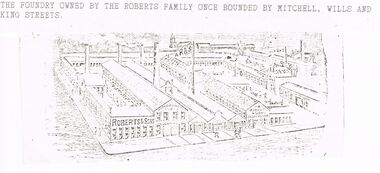
Document - CORNISH COLLECTION: DOCUMENTS RELATED TO VARIOUS CORNISH ENTERPRISES IN BENDIGO
... Photograph of old Robinson photo of Bendigo Stamper Grating Factory, Epsom and five men posed in front of large timber building (badly cut photo with LH edge missing. original photo (9 x 13) of ''Former Bendigo Cornish Fuse Factory'' (handwritten inscription on reverse) taken in recent times (hint - car in driveway); f. copy from un-named book of J Nankervis's Ham and Bacon Curing Factory, Golden Square - drawing of the establishment and a photos of winning display of small goods at the Bendigo Show (no date); g. copy from un-named book of photo of premises of A J Williams, Lily and McKenzie Streets - wooden structure with sign indicating Hardware Merchants and ??...Photograph of old Robinson photo of Bendigo Stamper Grating Factory, Epsom and five men posed in front of large timber building (badly cut photo with LH edge missing. original photo (9 x 13) of ''Former Bendigo Cornish Fuse Factory'' (handwritten inscription on reverse) taken in recent times (hint - car in driveway); f. copy from un-named book of J Nankervis's Ham and Bacon Curing Factory, Golden Square - drawing of the establishment and a photos of winning display of small goods at the Bendigo Show (no date); g. copy from un-named book of photo of premises of A J Williams, Lily and McKenzie Streets - wooden structure with sign indicating Hardware Merchants and ?? ...Documents and copies of photos related to various Cornish enterprises in Bendigo: a. Line drawing (faint) of foundry owned by the Roberts family (Mitchell, Wills and King streets); b. copy of article from unknown source re United Iron Works with details of the firm and Roberts principals - William Roberts, Abraham Roberts and Arthur Roberts - with copies of photographic portraits (Bartlett Bros.) - bad copy with LH side of text partly illegible; c. copy of article titled 'Goyne's Battery Gratings re John Goyne and history of the business (submitted by person living at ''Rosemundy'', Goynes Road, Epsom - Goyne's home then on 20 acres); d. Photograph of old Robinson photo of Bendigo Stamper Grating Factory, Epsom and five men posed in front of large timber building (badly cut photo with LH edge missing. original photo (9 x 13) of ''Former Bendigo Cornish Fuse Factory'' (handwritten inscription on reverse) taken in recent times (hint - car in driveway); f. copy from un-named book of J Nankervis's Ham and Bacon Curing Factory, Golden Square - drawing of the establishment and a photos of winning display of small goods at the Bendigo Show (no date); g. copy from un-named book of photo of premises of A J Williams, Lily and McKenzie Streets - wooden structure with sign indicating Hardware Merchants and ??Mines Furnisher?? , showing three horse-driven small wagons (delivery?); h. copy of photo of Cornish store(1880s) at White Hills - mention of Frederick Stuckenschmidt (married Miss Mary Smith), William Mathews (original owner?) - corner brick building with family posed outside alongside horse and light cart;. reproduction of exhibit in Bendigo Spring Show, 1915 , the ''Made in Bendigo Exhibition'' - first prize awarded to Messrs H M Legg & Co. Progress Jams, preserves, tomato sauce, tomatoes products, candied peels etc. (folded and small tear).bendigo, buildings, early bendigo businesses, bendigo stamper grating factory. epsom. j. nankervic ham and bacon curing establishment. golden square. bendigo cornish fuse factory. cornish stores. messrs h. m. leggo and co. abraham roberts. arthur roberts. william roberts. goyne's battery gratings. -
 Otway Districts Historical Society
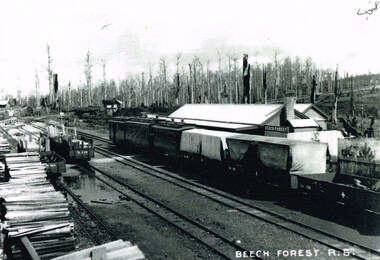
Photograph, Beech Forest railway station, carriages and wagons, c.1915
... Livestock was carried and, while no dedicated passenger service operated "car-goods" ran on Monday, Wednesday and Saturday plus occasional passenger specials. However, despite the high tonnage heavy financial losses were experienced, due partly to the small amount of inbound goods and the high empty wagon mileage. ...Livestock was carried and, while no dedicated passenger service operated "car-goods" ran on Monday, Wednesday and Saturday plus occasional passenger specials. However, despite the high tonnage heavy financial losses were experienced, due partly to the small amount of inbound goods and the high empty wagon mileage. ...The Beech Forest railway carried very heavy loading, mostly consisting of timber, but also potatoes, lime, gravel, chaff and dairy produce. Livestock was carried and, while no dedicated passenger service operated "car-goods" ran on Monday, Wednesday and Saturday plus occasional passenger specials. However, despite the high tonnage heavy financial losses were experienced, due partly to the small amount of inbound goods and the high empty wagon mileage. Annual losses by 1915 were up to L8,000, and these were only exacerbated by increased traffic.B/W. Beech Forest Railway Station, guard's van, carriages and wagons on the right, and wagons loading with timber on the left. c.1915.beech forest; railways; station; -
 Flagstaff Hill Maritime Museum and Village
Container - Barrel, 19th century
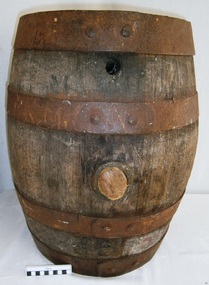
... small barrel looks well used. Unfortunately, the inscription on the barrel is indecipherable so its story is a mystery. However, the bungholes on the side are a clue that it was once used for storing liquid, likely to have been liquor. Barrels have been used over many centuries for transporting and storing a wide range of dry and liquid goods...small barrel looks well used. Unfortunately, the inscription on the barrel is indecipherable so its story is a mystery. However, the bungholes on the side are a clue that it was once used for storing liquid, likely to have been liquor. Barrels have been used over many centuries for transporting and storing a wide range of dry and liquid goods ...This small barrel looks well used. Unfortunately, the inscription on the barrel is indecipherable so its story is a mystery. However, the bungholes on the side are a clue that it was once used for storing liquid, likely to have been liquor. Barrels have been used over many centuries for transporting and storing a wide range of dry and liquid goods. They are made by tradesmen called coopers, who use heat and steam to bend and shape the wood to suit the work in hand. They add metal reinforcing, handles, spouts and suchlike, to complete they process. Their produce also includes buckets, casks and tubs. Ships transported bulk liquor in their cargo, stored in wooden barrels. The barrels' round shape allowed them to be easily moved by rolling them into place. The body's shape gave the barrels added strength and the iron bands helped the wooden sheaves stay in place. The tops and bottoms allowed for easy grip. The bungholes gave access to government representatives, who would sample the contents, measure the alcohol percentage, and charge the appropriate duty or tax; the process was called Ullaging and the instrument they used was a Hydrometer. Hundreds of barrels of cement were imported into Warrnambool in the late 19th century for the construction of the Warrnambool Breakwater. Barrel-shaped concrete blocks are still visible at shipwreck sites such as on the LOCH ARD wreck, which carried cement among its cargo.This small barrel is representative of 19th century containers used for transportation and storage of liquid such as liquor. It is a historic shape that is still used in modern times.Barrel; wooden barrel, cylindrical shape with metal bands or ribs for reinforcement. The side has two bungholes; one has a bung or stopper. Inscription on top (indecipherable). (indecipherable)flagstaff hill, warrnambool, shipwrecked-coast, flagstaff-hill, flagstaff-hill-maritime-museum, maritime-museum, shipwreck-coast, flagstaff-hill-maritime-village, barrel, cask, small barrel, trade, coopering, cooper, casket, transport, storage, bunghole -
 Flagstaff Hill Maritime Museum and Village
Document, 12-01-1882
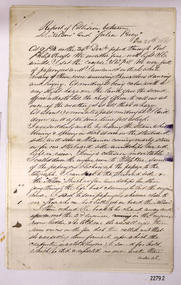
... goods during the period 1840-1890. Regular domestic steamer services commenced in the Warrnambool district in the late 1850’s and by 1870 the passenger trade was booming. Produce was loaded from the jetty into ‘lighters’ (small...goods during the period 1840-1890. Regular domestic steamer services commenced in the Warrnambool district in the late 1850’s and by 1870 the passenger trade was booming. Produce was loaded from the jetty into ‘lighters’ (small ...This hand written letter, in black ink script on blue lined paper, is impressed with the official stamp of the Victoria Steam Navigation Board. The left margin has the reference “S82/12" It is transcribed: "Victoria Steam Navigation Board, Melbourne, January 12th 1882 To Frederick Chapman, Master, S.S. "Julia Percy" You are herewith furnished with a copy of the report of the Official Court which assembled to enquire into the circumstances attending the collision between the steamers "Julia Percy" and "Nelson" off Apollo Bay near Cape Otway on the morning of the 25th December 1881, and you are hereby expected to attend at the Board Room, Custom House, Melbourne, at 2pm, on 13th January instant to show cause why you should not be censured accordingly. [Signature] Secretary" This document refers to the matter of a collision between two steamships, the Julia Percy and the Nelson, on 25th December 1881. The Julia Percy was at that time owned by her first owners, the Warrnambool Steam Packet Company, and she sailed under the command of Captain Chapman. She had left Melbourne the evening of 24th December, with about 150 passengers, sailing in fine weather through Port Phillip Heads around 9pm. She was headed for Warrnambool, Belfast (now named Port Fairy) and Portland. The Julia Percy was off Apollo Bay when Captain Chapman was woken by the ship’s whistle after midnight, the steamer Nelson being on a collision course with the Julia Percy.[See Link.] The Nelson struck Julia Percy midship. Boats were lowered from the ship (apart from a damaged lifeboat) and about 30-40 of the passengers boarded the Nelson. The engine room and the forehold were checked and found clear of water. The company manager, Mr Evans, had been on the Nelson, so he boarded and inspected the Julia Percy and the decision was made to continue on to Warrnambool with the passengers as there appeared to be no immediate danger. However, Captain Thomas Smith said the Nelson was taking on water, so Julia Percy followed her for about an hour towards Melbourne on standby in case of need. Then Julia Percy turned around towards Warrnambool again. Shortly afterwards the Nelson turned to follow her, the ships stopped and passengers were returned to Julia Percy, and three from Julia Percy boarded the Nelson. Both ships proceeded on their way. Julia Percy passed Cape Otway light afterwards, signalling that there had been a collision. It was discovered later that one of the passengers was missing, then thought to have boarded the Nelson but later thought to have fallen into the sea and drowned while trying to jump from Julia Percy to Nelson. There had been 3 tickets purchased under the same name of that passenger “Cutler”; a father, son and friend named Wordsworth, which had caused quite some confusion. No further mishap occurred to either ship and both the Julia Percy and the Nelson reached their destinations safely. An enquiry was instigated by the Victoria Steam Navigation Board regarding the cause of the accident between the two steamships, in connection with the death of Cutler who was supposed to have lost his life by the collision. The enquiry resulted in the following decision: "The Victorian Steam Navigation Board having taken into consideration the points urged by Captain Thos [Thomas] Smith and also by his legal advisers, is of opinion that the charge prepared against him has been sustained, but taking into consideration Captain Smith’s previous good conduct and character, the board suspends his master’s certificate No 227 issued by this board for a period of six calendar months from this date – Robert Fullarton, Chairman. “The Victorian Steam Navigation Board having beard the statement of Captain Frederick Chapman urged in his defense to the charge of dereliction of duty as master of the Julia Percy, in having no standing order on board that vessel to be called in the event of any approaching steamer’s lights being seen, find such charge sustained, and censure him accordingly – Robert Fullarton, Chairman.” ABOUT “JULIA PERCY” The S.S. Julia Percy (later named Leeuwin ) was an iron passenger-cargo steam ship built in 1876. At one point in time the Julia Percy would sail from Warrnambool to Melbourne every Friday and return from Melbourne to Warrnambool every Tuesday. The cost of a return ticket for a Saloon Fare was £1.0.0. She would sail “if practical and weather permitting”. Shipping was the cheapest and most practical means of carrying produce and goods during the period 1840-1890. Regular domestic steamer services commenced in the Warrnambool district in the late 1850’s and by 1870 the passenger trade was booming. Produce was loaded from the jetty into ‘lighters’ (small boats), which took it to the ships at anchorage in the bay. Passengers were taken to the ship’s side then climbed aboard up ladders or gangways. The coming of the railway in October 1889 meant the gradual decline and end of the steam shipping era. The Julia Percy was built in Glasgow by Thomas Wingate & Company, Whiteinch, in 1876 for the Warrnambool Steam Packet Company, which commissioned her for trade in Victoria’s western district. She was first registered in Warrnambool, Victoria in 1876. The Julia Percy changed hands several times. Her next owner was the Western Steam Navigation Co (1887), managed by Mr. T.H. Osborne (the company’s office was on the corner of Timor and Liebig Streets, Its north-western wall is now part of the current Warrnambool Regional Art Gallery. ) The Melbourne Steamship Co became the next owners (1890), followed by William Howard Smith and Sons (1901) for use in Queensland coastal trades, then she was bought by George Turnbull in 1903 and used for local mail contract in Western Australia. The Julia Percy was sold to the Melbourne Steamship Company Ltd. (1906) and re-named the “Leeuwin” but continued in her Western Australian coastal run. She was converted into a coal hulk in Melbourne in 1910 as a result of damaged caused when she was driven against the jetty at Dongara during a gale. The ship was eventually dismantled and scuttled in Bass Strait on 28 December 1934. The document is significant for its association with the wreck of the Leeuwin (Julia Percy), which is on the Victorian Heritage Register, VHR S413. . It is historically significant for being a rare artefact that has potential to interpret aspects of Western Victoria’s 19th century steamship trade and Victorian cultural history. The Leeuwin (Julia Percy) is listed on the Victorian Heritage Register as being historically significant ‘as one of only four wrecks of steamships in Victorian waters associated with the western district of Victoria’s coastal steamship trade. Reports of Victoria Steam Navigation Board about the collision on 25th December 1881 between the steamers " Julia Percy" and "Nelson". Letter from Victoria Steam Navigation Board, Melbourne to Frederick Chapman, Master, S.S. "Julia Percy", dated January 12th 1882. reference on letter in left margin "S82/12"flagstaff hill, flagstaff hill –maritime museum, maritime museum, shipwreck coast, flagstaff hill maritime village, victoria steam navigation board, captain frederick chapman, captain thomas smith, thomas wingate & company, steamer julia percy, steamer leeuwin, steamer nelson, steam ship, warrnambool steam packet company, t. h. ostorne, western steam navigation co., charles cutler -
 Flagstaff Hill Maritime Museum and Village
Machine - Diving Compressor, Siebe Gorman & Co. Ltd, 1880-1890
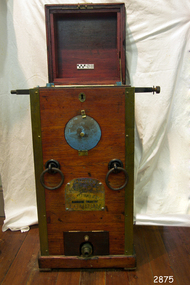
... goods, including paper-making machinery, measuring machinery, water-pumps, refrigeration equipment and diving apparatus. Augustus Siebe specialised in submarine engineering early on, and the company gained a reputation for the manufacture of safe, reliable diving apparatus. Augustus Siebe is best remembered for the development and manufacture of the ‘closed’ Diving Dress based on the ideas of Charles and John Deane, George Edwards and Charles Pasley. Apart from some small...goods, including paper-making machinery, measuring machinery, water-pumps, refrigeration equipment and diving apparatus. Augustus Siebe specialised in submarine engineering early on, and the company gained a reputation for the manufacture of safe, reliable diving apparatus. Augustus Siebe is best remembered for the development and manufacture of the ‘closed’ Diving Dress based on the ideas of Charles and John Deane, George Edwards and Charles Pasley. Apart from some small ...This compressor was part of the E.G. Ward Collection. It is connected to the diving suit and boots, also in our collection. Siebe Gorman & Company Ltd was a British company that developed diving equipment and breathing equipment and worked on commercial diving and marine salvage projects. The company advertised itself as 'Submarine Engineers'. It was founded by Augustus Siebe, a German-born British engineer chiefly known for his contributions to diving equipment. Siebe Gorman traded as an engineering firm for over 180 years, from 1819 to 1999. The early success of the business was due to its founder, the Prussian immigrant Christian 'Augustus' Siebe (1788-1872). For business reasons, he applied for and was granted British citizenship in 1856. He was a gifted engineer who was able to translate theoretical problems into practical, working products. During the industrial Victorian period, the business traded as 'A. Siebe's at 145 High Street, Holborn, London, but in 1828, new premises were acquired at 5 Denmark Street, Soho. The family firm produced a wide range of manufactured goods, including paper-making machinery, measuring machinery, water-pumps, refrigeration equipment and diving apparatus. Augustus Siebe specialised in submarine engineering early on, and the company gained a reputation for the manufacture of safe, reliable diving apparatus. Augustus Siebe is best remembered for the development and manufacture of the ‘closed’ Diving Dress based on the ideas of Charles and John Deane, George Edwards and Charles Pasley. Apart from some small modifications to valves and diver communications, the basic 12 bolt ‘closed’ diving dress remained relatively unchanged after the 1870s. Later company successes were also based on innovation, with new products that could be successfully developed and manufactured to high standards. This was largely attributed to the inventive nature, foresight, engineering and entrepreneurial skills of Robert Henry Davis (1870-1965). In 1882, RH Davis joined the company of 'Siebe & Gorman' as a young 11-year-old office boy, and he was to remain with the company until he died in 1965. Augustus Siebe retired in 1869 and handed over the company to a new partnership of Henry H. Siebe (1830-1885) and William A. O'Gorman (1834-1904). The new firm traded as 'Siebe & Gorman' (1870-1879) from premises in and around Mason Street, Westminster Bridge Road, Lambeth, London. The two partners soon recognised the potential of R.H. Davis, and in 1894, aged 24, he became General Manager of Siebe & Gorman. Davis increasingly ran the company until the surviving partner (W.A. Gorman) died in 1904. The firm was disposed of to the Vickers (armaments) family, and a new company, Siebe Gorman & Co. Ltd. (1905-1998) was formed. Under the chairmanship of Albert Vickers, R.H. Davis was kept on as Managing Director, and the company forged ahead. However, after WW1, the Great Depression caused manufacturing output and share prices to slump. In 1924, Robert Davis made a deal with the Vickers Board and acquired control of the company through majority shares. Under his leadership, the Siebe Gorman Company flourished, and in time, four of his sons also joined the firm. The company gained a worldwide reputation for the manufacture of diving apparatus, decompression and observation chambers, and safety breathing apparatus of all types for use on the land, in the air and under the sea (including mine rescue, tunnelling, aircraft, diving, submarine escape and in other hazardous environments). Close research and development links with the MOD (especially the Admiralty), also provided a lucrative outlet for the company's products. In 1932, Robert Davis was knighted by King George V, principally for his invention of the ‘Davis Submerged Escape Apparatus’ (D.S.E.A.). Siebe Gorman essentially remained a family firm from the beginning (under A Siebe) until it became a public company for the first time in 1952. However, following WW2, British manufacturing stagnated through stifled investment and post-war austerity, and there was little innovation. Siebe Gorman's fortunes began to decline as an ageing Sir Robert Davis failed to invest or change the company's business and management practices. In 1959, Siebe Gorman was acquired by the “Fairy Group” and the ailing Sir Robert was made Life President. Consequently, nothing changed, and the slow decline continued until Sir Robert's death in March 1965. Around 1960, Siebe Gorman acquired the diving apparatus manufacturer C E Heinke, and for a brief period, it manufactured some diving equipment under the combined name of Siebe Heinke. Around 1964, Mr E. 'Barry' Stephens was appointed as the new Managing Director to modernise Siebe Gorman. Changes were made, including a move to a new factory in Wales in 1975. The new company concentrated on firefighting breathing apparatus and escape equipment, and the move coincided with the loss of many of the older, traditional craft skills. Between 1985 and 1998, Siebe expanded through acquisitions, and several other companies were acquired. The Siebe Gorman (diving apparatus) company has therefore traded as A. Siebe (1819-1870); Siebe & Gorman (1870-1879); Siebe Gorman & Co (1880-1904); Siebe Gorman & Co. Ltd (1905-1998).The diving compressor, along with associated equipment in the Flagstaff Hill collection, represents a highly significant snapshot of marine history. These items are particularly important in understanding the evolution of diving equipment, with a special focus on their use in salvage operations before and throughout the Second World War. Manufactured by a company renowned for its inventions, development, and innovation in marine engineering, the equipment demonstrates the progression of technology in deep-sea diving. Early helmets and related items produced by this company remain highly sought after by collectors worldwide, highlighting their historical and technological value. The presence of these items within the Flagstaff Hill Maritime Museum allows for a unique insight into the working conditions and methods employed by divers. It also illustrates the considerable dangers they faced while performing such essential and hazardous work, underscoring the critical role played by these professionals in maritime history.A single cylinder divers' pump by Siebe Gorman & Co Ltd, London, eccentric hand cranked in brass, brass-mounted mahogany case with instructions to the underside of the lid, brass-covered pressure gauge and air outlet, brass maker's plaque to the front, water inlet and outlet to the rear, green-painted lifting rings. Machinery has some blue-painted areas on the metal. This compressor is part of the E.G. Ward Collection.Plate on the back 'WATER SUPPLY" "WATER OVERFLOW" "WATER DRAIN-IN" Pressure gauge dial "BOURDON'S PRESSURE GAUGE" STEBE GORMAN & CO. LONDON", "LBS PRESSURE" "FEET OF SALT WATER" Plate on the front " PATENT, Siebe Gorman & Co Ltd Submarine Engineers" below emblem (Lion, Crown, Horse)flagstaff hill, warrnambool, flagstaff-hill, maritime-museum, diving compressor, london, siebe gorman & co ltd, marine technology, life saving, deep sea diving, maritime museum, maritime village, manine history, maritime history, marine engineers, marine diving, deep-sea diving, e g ward, vintage diving compressor, e. g. ward, e.g. ward, edward ward, ted ward -
 Flagstaff Hill Maritime Museum and Village
Tyre Bender, 1884
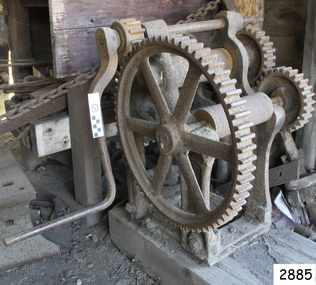
... smaller models which were still being advertised for sale in 1884. The Day Bros foundry, makers of this tyre bender, was operating as the manufacture of wheel right and blacksmith tools and general machinery in the 19th century in the USA and successfully exported their goods all over the world. ...smaller models which were still being advertised for sale in 1884. The Day Bros foundry, makers of this tyre bender, was operating as the manufacture of wheel right and blacksmith tools and general machinery in the 19th century in the USA and successfully exported their goods all over the world. ...A tyre bender is used to bend and shape metal rims for wooden wagon wheels. This tyre bender’s model first appeared in the Day Bros catalogue in 1884 as the “Giant” model. The catalogue of 1883 only showed a lighter duty model called the “Lion”. It can be assumed that this later “Giant” model was a heavy duty improvement over the 1883 "Lion" and other smaller models which were still being advertised for sale in 1884. The Day Bros foundry, makers of this tyre bender, was operating as the manufacture of wheel right and blacksmith tools and general machinery in the 19th century in the USA and successfully exported their goods all over the world. Wagon tyre benders would have been very common circa 1850-1920, so there were probably many makers over the years. Early on, it would have become clear to the blacksmiths about which designs worked best so, eventually, the various makers would have made similar products to each other. This tyre bender was once used by Harry Goodall of H. Goodall & Sons Pty. Ltd. corner of McKinnon and High Streets, Terang. Victoria. Henry Goodall & Sons Henry Goodall (1870-1936) was proprietor of garages as H. Goodall & Sons Pty. Ltd., at both Terang (McKinnon and High Streets) and Mortlake (Dunlop Street). His business was in operation in at least in 1916 and perhaps well before, considering the date of the tyre bender and its use for wagons with wooden wheels. It was still in operation in 1953, chasing up debtors in Mount Gambier Court. Amongst the employees of H. Goodall & Sons Pty. Ltd. was Ernie Entwistle, a blacksmith (a soldier who died in 1916 ) and Alfred Hodgetts, radio expert (killed in a fatal accident in 1943, when he was in his early 30s ). Henry Goodall was involved in the community as a Justice of Peace, a deputy coroner, President of the Mortlake Hospital, trustee of the Soldiers’ Memorial Hall, and as a prominent Freemason. He and his wife had two sons (Charles and John) and one daughter (Mrs. Chas. Newton, of Skipton). The tyre bender is significant as it demonstrates how blacksmiths or wheelwrights could make new metal rims for wagon wheels for carts, wagons, stage coaches and carriages over a 135 years ago. The machine is a part of our social history as it demonstrates part of the process of making wagon wheels, which played an important part in aiding the continuation of daily transport needs that people had at the time, such as farming, personal transport and commercial activities. The machine or tool is locally significant as it was used by a local company in Terang and Mortlake in their blacksmith, wheelwright and garage business. Steel tyre bender mounted on timber base, used for wagon wheel steel rims. Made from cast iron and steel, double geared with four cogs to unite the upper and lower steel rollers. There are adjustable guide collars to keep the iron in line while it is being bent. It can also be used with two cranks for heavy duty work utilising the use to two operators. It is the Giant model, made in 1884 by Day Bros. of Philadelphia. This tyre bender once belonged to Harry Goodall & Sons, blacksmith's of Terang. Victoria. “DAY BROS. PHILAP. PA” cast into the side of machineflagstaff hill, warrnambool, shipwrecked coast, flagstaff hill maritime museum, maritime museum, shipwreck coast, flagstaff hill maritime village, great ocean road, machinery, wagon wheel, wheelwrights, blacksmith, steel rim wheels, tyre bender, tire bender, the giant tyre bender, henry goodall (1870-1936), terang, wheelwright tool, blacksmith trade, blacksmithing equipment and supplies, wagon tyre bender, day bros. philadelphia pennsylvania, h. goodall & sons of terang, terang blacksmith, h. goodall & sons pty ltd, mortlake, ernie entwistle blacksmith, alfred hodgetts radio expert, charles goodall, john goodall, mrs. chas. newton nee goodall -
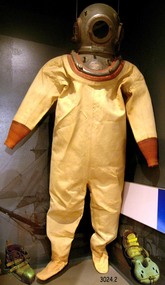 Flagstaff Hill Maritime Museum and Village
Functional object - Diving Suit, boots and weight, Early-to-mid 20th century
... goods including paper-making machinery, measuring machinery, water pumps, refrigeration equipment and diving apparatus. Augustus Siebe specialised in submarine engineering early on and the company gained a reputation for the manufacture of safe, reliable diving apparatus. Augustus Siebe is best remembered for the development and manufacture of the ‘closed’ Diving Dress based on the ideas of Charles and John Deane, George Edwards and Charles Pasley. Apart from some small...goods including paper-making machinery, measuring machinery, water pumps, refrigeration equipment and diving apparatus. Augustus Siebe specialised in submarine engineering early on and the company gained a reputation for the manufacture of safe, reliable diving apparatus. Augustus Siebe is best remembered for the development and manufacture of the ‘closed’ Diving Dress based on the ideas of Charles and John Deane, George Edwards and Charles Pasley. Apart from some small ...This diving suit with helmet, boots and weight is part of the E. G.Ward collection, along with the diving compressor and a photograph of a diver in this equipment. Siebe Gorman & Company Ltd was a British company that developed diving equipment and breathing equipment and worked on commercial diving and marine salvage projects. The company advertised itself as 'Submarine Engineers'. It was founded by Augustus Siebe, a German-born British engineer chiefly known for his contributions to diving equipment. Siebe Gorman traded as an engineering firm for over 180 years from 1819 to 1999. The early success of the business was due to its founder, the Prussian immigrant Christian 'Augustus' Siebe (1788-1872). For business reasons, he applied for and was granted British citizenship in 1856. He was a gifted engineer who was able to translate theoretical problems into practical, working products. During the industrial Victorian period, the business traded as 'A. Siebe' at 145 High Street Holborn London, but in 1828 new premises were acquired at 5 Denmark Street, Soho. The family firm produced a wide range of manufactured goods including paper-making machinery, measuring machinery, water pumps, refrigeration equipment and diving apparatus. Augustus Siebe specialised in submarine engineering early on and the company gained a reputation for the manufacture of safe, reliable diving apparatus. Augustus Siebe is best remembered for the development and manufacture of the ‘closed’ Diving Dress based on the ideas of Charles and John Deane, George Edwards and Charles Pasley. Apart from some small modifications to valves and diver communications, the basic 12-bolt ‘closed’ diving dress remained relatively unchanged after the 1870s. Later company successes were also based on innovation, with new products that could be successfully developed and manufactured to high standards. This was largely attributed to the inventive nature, foresight, engineering and entrepreneurial skills of Robert Henry Davis (1870-1965). In 1882, RH Davis joined the company of 'Siebe & Gorman' as a young 11-year-old office boy and he was to remain with the company until he died in 1965. Augustus Siebe retired in 1869 and handed over the company to a new partnership of Henry H. Siebe (1830-1885) and William A. O'Gorman (1834-1904). The new firm traded as 'Siebe & Gorman' (1870-1879) from premises in and around Mason Street, Westminster Bridge Road, Lambeth, London. The two partners soon recognised the potential of R.H. Davis and in 1894, aged 24, he became General Manager of Siebe & Gorman. Davis increasingly ran the company until the surviving partner (W.A. Gorman) died in 1904. The firm was disposed of to the Vickers (armaments) family and a new company 'Siebe Gorman & Co. Ltd.' (1905-1998) was formed. Under the chairmanship of Albert Vickers, R.H. Davis was kept on as Managing Director, and the company forged ahead. However, after WW1, the Great Depression caused manufacturing output and share prices to slump. In 1924 Robert Davis made a deal with the Vickers Board and acquired control of the company through majority shares. Under his leadership, the Siebe Gorman Company flourished and within time, four of his sons also joined the firm. The company gained a worldwide reputation for the manufacture of diving apparatus, decompression and observation chambers, and safety breathing apparatus of all types for use on the land, in the air and under the sea (including mine rescue, tunnelling, aircraft, diving, submarine escape and in other hazardous environments). Close research and development links with the MOD (especially the Admiralty), also provided a lucrative outlet for the company products. In 1932, Robert Davis was knighted by King George V, principally for his invention of the ‘Davis Submerged Escape Apparatus’ (D.S.E.A.). Siebe Gorman essentially remained a family firm from the beginning (under A.Siebe) until it became a public company for the first time in 1952. However, following WW2, British manufacturing stagnated through stifled investment and post-war austerity, and there was little innovation. Siebe Gorman fortunes began to decline as an ageing Sir Robert Davis failed to invest, or change the company business and management practices. In 1959, Siebe Gorman was acquired by the “Fairy Group” and the ailing Sir Robert was made Life President. Consequently, nothing changed and the slow decline continued until Sir Robert's death in March 1965. Around 1960, Siebe Gorman acquired the diving apparatus manufacturer C E Heinke, and for a brief period, it manufactured some diving equipment under the combined name of Siebe Heinke. Around 1964, Mr E. 'Barry' Stephens was appointed as the new Managing Director to modernise Siebe Gorman. Changes were made, including a move to a new factory in Wales in 1975. The new company concentrated on fire-fighting breathing apparatus and escape equipment, and the move coincided with the loss of many of the older, traditional craft skills. Between 1985 and 1998, Siebe expanded through acquisitions, and several other companies were acquired. The Siebe Gorman (diving apparatus) company has therefore traded as A. Siebe (1819-1870); Siebe & Gorman (1870-1879); Siebe Gorman & Co (1880-1904); Siebe Gorman & Co. Ltd (1905-1998).The diving suit, helmet, boots, and weights, along with associated equipment in the Flagstaff Hill collection, represent a highly significant snapshot of marine history. These items are particularly important in understanding the evolution of diving equipment, with a special focus on their use in salvage operations before and throughout the Second World War. Manufactured by a company renowned for its inventions, development, and innovation in marine engineering, the equipment demonstrates the progression of technology in deep-sea diving. Early helmets and related items produced by this company remain highly sought after by collectors worldwide, highlighting their historical and technological value. The presence of these items within the Flagstaff Hill Maritime Museum allows for a unique insight into the working conditions and methods employed by divers. It also illustrates the considerable dangers they faced while performing such essential and hazardous work, underscoring the critical role played by these professionals in maritime history.Diving suit including helmet, boots and a weight. Diving suit is made of canvas with knitted cuffs. The helmet is metal. The boots have a thick sole and thick leather upper that is held on with leather straps and buckles. The toe of the boot is heavy metal. The weight is worn next to the trunk of the diver and it has an inscription to mark the front. It is worn with straps and buckles holding it in place. Royal Navy Admiralty Pattern 6 bolt No 3 light Siebe Gorman light diving helmet circa 1960, used by the Royal Navy before and after World War 2. This equipment is part of the E. G. Ward Collection."Siebe Gorman & Co Ltd Marine Engineers London. Patent" with "E G Ward" on front and back plate. On weight "FRONT"flagstaff hill, warrnambool, diving suit, siebe gorman and co ltd., siebe gorman and co ltd marine engineers london, marine engineers, diving helmet, diving boots, diving weight, marine diving, maritimemuseum, maritime village, maritime history, marine technology, life saving, deep sea diving, maritime museum, siebe gorman and co ltd., siebe gorman and co ltd, london, deep-sea diving, e. g. ward, e g ward, e.g. ward, edward ward, ted ward
