
Showing 20 items matching "soaring flight"
-
 Moorabbin Air Museum
Book - GLIDING - A HANDBOOK ON SOARING FLIGHT, DEREK PIGGOTT MBE, 1990
... GLIDING - A HANDBOOK ON SOARING FLIGHT...GLIDING - A HANDBOOK ON SOARING FLIGHT...GLIDING - A HANDBOOK ON SOARING FLIGHT Book GLIDING - A HANDBOOK ON SOARING FLIGHT DEREK PIGGOTT MBE A & C BLACK ... -
Moorabbin Air Museum
Booklet - The Institution of Aeronautical Engineers, Minutes of Proceedings No. 8
... ...Soaring flight...Wooden aircraft Three - ply & its uses in aircraft construction Soaring flight 2 reports related to wood in aircraft, circa 1923 Booklet containing 2 technical reports Minutes of Proceedings No. 8 Booklet The Institution of Aeronautical Engineers ...2 reports related to wood in aircraft, circa 1923Booklet containing 2 technical reportsnon-fiction2 reports related to wood in aircraft, circa 1923three - ply & its uses in aircraft construction, soaring flight -
 Australian Gliding Museum
Machine - Glider – Sailplane, 1948
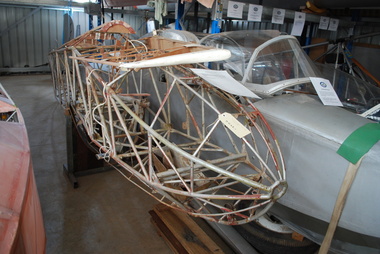
... Soaring Club, was based. Hoinville’s TG-3A performed well at the Hinkler club in 1950-1951. Several altitude records (including a solo flight to 8000 feet by Grace Roberts – a national women’s record) were set and many soaring flight made over Camden. ...Soaring Club, was based. Hoinville’s TG-3A performed well at the Hinkler club in 1950-1951. Several altitude records (including a solo flight to 8000 feet by Grace Roberts – a national women’s record) were set and many soaring flight made over Camden. ...The Schweizer SGS 2-12 or TG-3A as officially certificated is a glider that was designed in 1941-1942 and produced in United States of America from 1942 for training of military glider pilots. It is understood that over 100 TG-As were supplied to the USA military and at the end of the war many were sold off as surplus. Fred Hoinville imported the Museum’s TG-3A into Australia in August 1950. It is understood that it had been built in 1948 and given construction number G15. On arrival in Australia it was assembled at Bankstown aerodrome and delivered by aero-tow behind a DH Tiger Moth to Camden where Hoinville’s club, the Hinkler Soaring Club, was based. Hoinville’s TG-3A performed well at the Hinkler club in 1950-1951. Several altitude records (including a solo flight to 8000 feet by Grace Roberts – a national women’s record) were set and many soaring flight made over Camden. However, it was badly damaged in a crash landing on 15 April 1951. The glider was repaired after the crash at Camden. It is likely that modifications were made to the cockpit canopy at this time. There were three configuration tried at various times: the original dual cockpit canopy as was standard for TG3As; an unusual dual bubble canopy set up; and a single canopy over the forward seating position (in effect converting the glider to a single seater). When the glider was flown by Hoinville at the 1958 Australian Gliding Championships at Benalla, Victoria in January 1959 (refer The Age Newspaper, January 10, 1959 p.21) it had a single canopy. Records show that the glider was entered on the Australian register as VH-GDI on 6 May 1957. And the Logbook commencing in 1959 shows that ownership passed to the Port Augusta Gliding Club in South Australia on 16 August 1959. Inspections were carried out at that club and airworthiness certificates renewed in 1965. The logbook record indicates that VH-GDI had 1191 flights with an aggregate time in the air of 197 hours at the Wilmington Road Airstrip used by the Port Augusta Club. The glider was transferred to the Cooma Gliding Club, New South Wales. Flying at Cooma began in November 1966 and continued until August 1969: the glider was in the air a further 108 hours from 1067 flights. The last recorded technical inspection of the glider was conducted on 28 September 1968. The glider then passed on to Bill Riley on 20 March 1980 who stored the glider until March 2004 when it was collected by the Australian Gliding Museum. It is not clear whether the current poor state of the airframe is due to accident damage or the conditions under which it has been stored over many years or a combination of factors. Although in poor condition, this exhibit is the sole example of a TG3A ex-US military aircraft in Australia. Further the connection with the story of well-known power and glider pilot Fred Hoinville adds to its historical significance. Tubular metal framed fuselage (without covering and fittings), wooden rudder (no covering) and in damaged condition, wooden fuselage component (formers for fuselage top), Parts of control mechanism, Wooden stringers, Wooden wings without fabric covering and in damaged condition, Ailerons, Tailplane /Elevator without fabric covering, Perspex bubble canopies.australian gliding, glider, sailplane, schweizer, tg 3a, hoinville, roberts, hinkler soaring club, port augusta gliding club, cooma gliding club, riley -
 Australian Gliding Museum
Machine - Glider - Sailplane, 1946
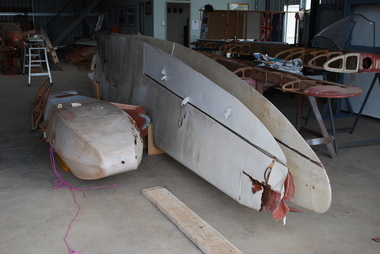
... Piloted by syndicate members and other GCV members the glider performed well in soaring and cross country flights at the various sites used by the GCV in 1947, 1948 and 1949. ...Piloted by syndicate members and other GCV members the glider performed well in soaring and cross country flights at the various sites used by the GCV in 1947, 1948 and 1949. ...This Grunau Baby 2B glider, often referred to as the “Blue Grunau”, was built by Australian Sailplanes in 1946 and acquired by a syndicate consisting of Norm Hyde, Rob Dowling, Leo Dowling, Dick Duckworth and Ted Desmond of the Gliding Club of Victoria. Piloted by syndicate members and other GCV members the glider performed well in soaring and cross country flights at the various sites used by the GCV in 1947, 1948 and 1949. The glider went to Sydney for a while and then returned to be operated by another syndicate at the GCV. Pat Burke and Bob McAliece bought the glider in the 1950s and then sold it to Keith, Jack and Bruce Hearn of Melbourne. In 1957 the Blue Grunau moved to Western Australia and was added to the Glider Register as VH-GLC. Thereafter the glider had a series of owners. The glider has come to the Australian Gliding Museum via the RAAFA (WA) Division. The flying record of the Blue Grunau has been logged for the period of 28 December 1957 to 17 September 1975: Time in air – 559 hours 37 minutes from 1513 flights. Single seat glider /sailplane of wooden construction with plywood and fabric covering.australian gliding, glider, sailplane, grunau, blue grunau, australian sailplanes, hyde, dowling, duckworth, desmond, burke, hearn, gliding club of victoria, gliding club of western australia, narrogin gliding club -
 Australian Gliding Museum
Machine - Glider – Sailplane, 1963
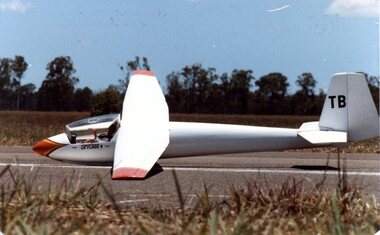
... In 1970 the glider was transferred to the New England Soaring Club. Many flights were made from Armidale and Bellata in Northern New South Wales. ...In 1970 the glider was transferred to the New England Soaring Club. Many flights were made from Armidale and Bellata in Northern New South Wales. ...The Skylark 4, the final in the Slingsby Skylark series, dates from 1961. The design heralded a trend towards the use of plastics in the construction of gliders. Slingsby incorporated GRP (glass reinforced plastic) panels to achieve a streamlined fuselage nose and cockpit area while retaining the more traditional wood techniques for the rest of the aircraft. Another notable feature was the smooth wing surface that was obtained using a Gaboon ply skin across the ribs. Best glide performance of 1:33 was found to be comparable with the early full GRP glider designs. The Museum’s example (VH-GTB – C/N 1382) was built in 1963 and originally owned by Chuck Bentson of the UK. It was brought to Australia in 1967 by Jeremy Picket-Heaps and flown at various places including Benalla, Cooma and Gundaroo. In 1970 the glider was transferred to the New England Soaring Club. Many flights were made from Armidale and Bellata in Northern New South Wales. On one occasion, the glider was kept aloft for 8 hours 45 minutes and on another the pilot took it around a 500 kilometre triangle in nearly 8 hours. In 1980 it was sold to Ralph (“Feathers”) Crompton and was flown extensively in South Australia until 1988. The final owner before the glider was given to the Museum in 2004 was Ross Dutton of Melbourne. The last recorded flight occurred in 1992. The glider at that point had logged over 2000 hours flying time from about 2000 launches. The airframe is currently being restored to flying condition. Technically this aircraft represents the state of the art at the stage that sailplane design was changing from traditional wood construction to composites (GRP) The Slingsby Skylark 4 is high wing single seat sailplane of mainly wooden construction with plywood and fabric covering. However, the cockpit and forward part of the fuselage consists of glass reinforced plastic which was innovative at the time that the type was designed. The cockpit provides for a semi reclining position for the pilot protected with a full Perspex canopy. The wings are made up of a centre section with constant chord and tapered wing tips. The aircraft has a conventional arrangement for the tail stabiliser / control surfaces. The sailplane bears construction number 1382 and is registered in Australia as VH-GTBaustralian gliding, glider, sailplane, skylark, slingsby, bentson, picket-heaps, crompton, new england soaring club, dutton -
 Eltham District Historical Society Inc
Document - Folder, Aerospace Industry, 1958-1961
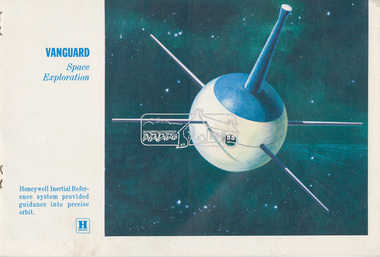
... Soar: Honeywell's experience in guidance and control systems spans the space age and is ready to serve your need; Honeywell 1961 – 8 page colour brochure, double stapled - missing front and back cover; 14 x 21 cm. Details which Honeywell systems are deployed in the following US Space Industry vehicles: Vanguard space exploration satellite, Discoverer defence rocket, Tiros meteorology satellite, Midas defence rocket, X-15 spy plane, Scout space exploration rocket, Echo communications satellite, Mercury manned flight rocket, Centaur space exploration rocket, Advent communications rocket, Mariner space exploration satellite, Dyna Soar manned manoeuvrable space flight. ...Soar: Honeywell's experience in guidance and control systems spans the space age and is ready to serve your need; Honeywell 1961 – 8 page colour brochure, double stapled - missing front and back cover; 14 x 21 cm. Details which Honeywell systems are deployed in the following US Space Industry vehicles: Vanguard space exploration satellite, Discoverer defence rocket, Tiros meteorology satellite, Midas defence rocket, X-15 spy plane, Scout space exploration rocket, Echo communications satellite, Mercury manned flight rocket, Centaur space exploration rocket, Advent communications rocket, Mariner space exploration satellite, Dyna Soar manned manoeuvrable space flight. ...honeywell, scout rocket, echo satellite, mercury rocket, centaur rocket, advent rocket, mariner satellite, dyna soar, x-15, midas rocket, tiros satellite, discoverer rocket, vanguard satellite, aerospace industry, alan gardiner collection, space industry -
 Australian Gliding Museum
Machine - Glider - Sailplane, 2012
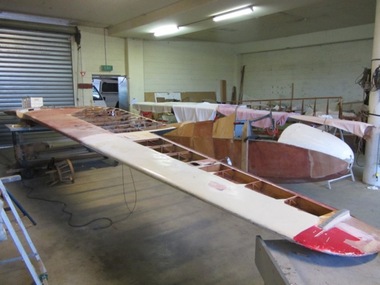
... soaring and cross-country capabilities. A notable feature of the ES52 design was the staggered side-by-side seating arrangement of the cockpit. This made for good in flight...soaring and cross-country capabilities. A notable feature of the ES52 design was the staggered side-by-side seating arrangement of the cockpit. This made for good in flight ...The ES52 Kookaburra is a two seat high wing glider – sailplane of wooden construction designed by Harry Schneider and built Edmund Schneider Pty Ltd. It was first flown on 26 June 1954 and became the glider of choice for training new pilots of many gliding clubs around Australia in the 1950s, 1960s and 1970s. Several found there way to New Zealand. Further two kits were sent to Brazil and at least one of these was finished and flow successfully. The ES52 performed well with a glide ratio of about 22:1 and had soaring and cross-country capabilities. A notable feature of the ES52 design was the staggered side-by-side seating arrangement of the cockpit. This made for good in flight communication between instructor and trainee. Overall, thirty six were built by Edmund Schneider Pty Ltd. A longer wing version (the ES52B) was also introduced that had a better glide ratio (around 25:1). Five examples of this version were built. In Germany a modified ES52 was built incorporating a metal tube fuselage frame and with the addition of a engine driven propeller mounted on top of the wing which enabled the glider to be self launching. This museum collection item consists of the fuselage, tailplane, elevators, fin, rudder from the Mark I, ES 52 Kookaburra, formerly registered as VH-GFF and last owned by the Barcaldine and District Airsports Club of Queensland. The glider was in a damaged condition when it was acquired by the Museum. A decision was made by the Museum to repair the glider for display rather than endeavouring to restore it to an airworthy condition. The reconstruction of the wings is being undertaken by using parts of damaged ES 52 Kookaburra wings (as it happened from later ES 52 Marks). The Log Book for VH-GFF reveals operational life with a succession of gliding clubs around Australia. This exhibit will be of interest to gliding enthusiasts wishing to inspect the popular two seat club trainer of a by-gone era.This is a wood and fabric covered aircraft that is being rebuilt from the components of several aircraft as a non-flying exhibit.Fuselage marked with Edmund Schneider Pty Ltd Serial Number 9 and comes from the glider previously registered as VH-GFF.australian gliding, glider, sailplane, edmund schneider, es 52, kookaburra, barcaldine and district airsports club, victorian motorless flight group, alice springs gliding club, raaf richmond, raaf williamtown, gayndah gliding club, blackwater gliding club, southern downs aero and soaring club, charleville gliding club -
 Australian Gliding Museum
Machine - Glider – Sailplane, 1939
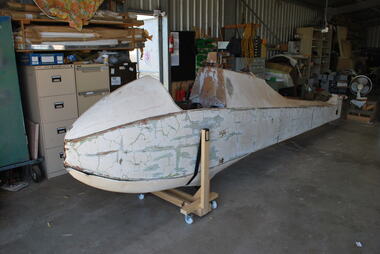
... Soaring Club. It first flew on 26 December 1939 at Lake Pinjar. The first extensive flight was on 7 January 1940 when Ric New managed to stay aloft for 30 minutes and reach a height of 3000 metres. ...Soaring Club. It first flew on 26 December 1939 at Lake Pinjar. The first extensive flight was on 7 January 1940 when Ric New managed to stay aloft for 30 minutes and reach a height of 3000 metres. ...This Dunstable Kestrel glider (which originally was finished in silver paint) was built in 1939 by Ric New and members of the Lake Pinjar Soaring Club. It first flew on 26 December 1939 at Lake Pinjar. The first extensive flight was on 7 January 1940 when Ric New managed to stay aloft for 30 minutes and reach a height of 3000 metres. Unfortunately the Kestrel was badly damaged the same day when another club member Jim Brabazon stalled and spun in. The Kestrel was repaired by June 1940 and flown extensively at Lake Pinjar in 1940 and 1941 until Government authorities intervened and ploughed up Lake Pinjar as a wartime measure to prevent it being used as a landing field by the enemy [Allan Ash, Gliding in Australia, pp 92 – 94]. The Lake Pinjar Soaring club was reformed as the Perth Gliding Club after the end of the war and was joined by Ric New with his Kestrel [Allan Ash, Gliding in Australia, p 103]. The glider was held in storage at the Gliding Club of Western Australia prior to transfer to the Australia Gliding Museum. The Deed of Gift indicates that it was formerly owned by Wally Williams, also from Western Australia. The aircraft is in poor condition and has some non-original elements. It is one of three that currently exist. Nevertheless it is considered to be an important exhibit for relating the history of gliding in Western Australia.Aircraft of wood structure skinned with plywood and fabric – off-white colour scheme – crazed flaking paint on fuselage – nose of fuselage has been modified by addition of streamlining – damage includes impact holes to plywood, especially on starboard side – wings have been stripped of fabric covering and some ribs are missing – tailplane and rudder are in reasonable condition although, like wings, have been stripped of fabric. Overall, while the main elements of this aircraft are present, there are a number of missing fittings and will require extensive works to restore to a static display standard.australian gliding, glider, sailplane, dunstable, kestrel, bill manuel, ric new, lake pinjar soaring club, lake pinjar, gliding club of western australia -
 Australian Gliding Museum
Machine - Glider – Sailplane, 1953
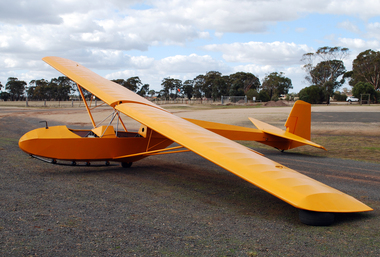
... The log book shows that it later passed to other gliding clubs, namely Millicent Gliding Club, Corangamite Soaring Club, Sydney Technical College Gliding Club. Overall, as at September 1967, the glider had logged over 5000 flights and a total airtime of 388 hours. ...The log book shows that it later passed to other gliding clubs, namely Millicent Gliding Club, Corangamite Soaring Club, Sydney Technical College Gliding Club. Overall, as at September 1967, the glider had logged over 5000 flights and a total airtime of 388 hours. ...The Schneider ES50 Club was built in 1953 and is the only one of its type. It was designed by Schneider to comply with specifications laid down by the Gliding Federation of Australia for a basic two seat training glider*. It was first flown on 10 May 1953 and delivered to the Renmark Gliding Club. The log book shows that it later passed to other gliding clubs, namely Millicent Gliding Club, Corangamite Soaring Club, Sydney Technical College Gliding Club. Overall, as at September 1967, the glider had logged over 5000 flights and a total airtime of 388 hours. The Museum volunteers have partly refurbished the ES50 to static display standard. [*Plans were also prepared for a single seat version which never eventuated] This glider is one of Edmund Schneider Pty Ltd earliest Australian designs. However, it was a later Schneider design, the ES 52 Kookaburra, which was accepted by many Australian gliding clubs for filling their need for a basic two seat training glider in the 1950s and 1960s. This is a two seat high wing aircraft of mainly wood and fabric construction. The cockpit area of the fuselage is fabric over tubular steel framing. Given serial number 3 by manufacturer and registered as VH-GHPaustralian gliding, glider, sailplane, schneider, es50, renmark gliding club, millicent gliding club, corangamite soaring club, sydney technical college gliding club -
 Australian Gliding Museum
Machine - Glider – Sailplane, 1955
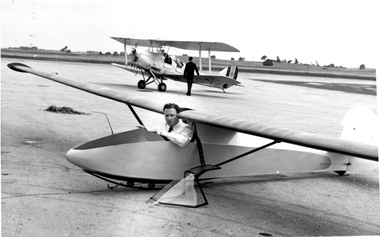
... The glider exhibited good soaring capability and was used for some cross country flights. For instance, in 1956 Ted Pascoe succeeded in a 36 mile goal flight during which he attained a maximum height of 4500 feet. ...The glider exhibited good soaring capability and was used for some cross country flights. For instance, in 1956 Ted Pascoe succeeded in a 36 mile goal flight during which he attained a maximum height of 4500 feet. ...The EP-1 "Spruce Goose" sailplane was designed and built by Ted Pascoe in 1955 as a smaller than average single seat sailplane that could be operated by two or three people. At times it was launched by auto-towing by Ted Pascoe and his wife without the aid of a third person at the wing tip. The glider exhibited good soaring capability and was used for some cross country flights. For instance, in 1956 Ted Pascoe succeeded in a 36 mile goal flight during which he attained a maximum height of 4500 feet. It was flown at the Mt Gambier Gliding Club from 1956 until about 1961. The Log Book shows that it was flown at Everard in 1961 and at Everard, Waikerie, Gawler and Keith in 1962. There is a gap in flying record for this aircraft from 1962 until 1967. From 1967 to 1972 it was flown regularly at various places in South Australia including Whitwarta, Stonefield, Renmark, and Gawler. For many years it was owned and flown by Mervyn Gill of the Balaklava Gliding Club.The EP-1 glider is an example of a successful Australian home built design from the 1950s. It was one of a small number of notable locally designed gliders of less than the usual 15 metre wing span from the 1950s and 1960s.Small, light weight, sailplane of wooden construction with fabric covering on wings (strutted), elevator and rudder. Instruments have been removed and control column is not in place. Serial Number GFA/HB/24 australian gliding, glider, sailplane, spruce goose, ep 1, ted pascoe, mt gambier gliding club, mervyn gill, balaklava gliding club -
 Australian Gliding Museum
Machine - Glider - Sailplane, 1958
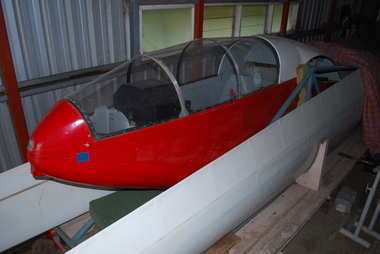
... Flight Group purchased the glider from Ron for the sum of one shilling and named the owners as himself, Doug Vanstan and Ian Patching. It has been stored at Bacchus Marsh airfield since then. The glider is the only 18 metre wing span machine to have been designed and built in Australia. australian gliding glider sailplane adair gurr waghorn vanstan rees patching altair adelaide soaring club gawler geelong gliding club vmfg Zechner The word ‘Altair’ appears on both sides at the top of the fin. ...The Altair was built between January 1956 and November 1958 with first flight on 20 December 1958. After a few flights the cockpit was lengthened and the glider flown by Cliff Gurr and Ron Adair to complete their FAI Gold C badges. Cliff set an unofficial Australian record for an out and return flight (between Gawler and Renmark) of 230 miles (368 km) in 1961. The glider was flown by only Ron and Cliff until Mervyn Waghorn joined Ron to fly it in the National Championships at Waikerie in 1967. For a period of time the glider was left in the care of some members of the Geelong Gliding Club. Doug Vanstan of the Geelong Gliding Club fitted a new canopy and rebuilt the aileron bellcranks to improve their operation. Subsequently the Altair was flown in competitions and at vintage rallies until the mid 1980s. On 31 March 1987 Alan Patching of the Victorian Motorless Flight Group purchased the glider from Ron for the sum of one shilling and named the owners as himself, Doug Vanstan and Ian Patching. It has been stored at Bacchus Marsh airfield since then. The glider is the only 18 metre wing span machine to have been designed and built in Australia.The Altair glider is a single place 18 metre span cantilever wing glider constructed from spruce and aircraft plywood. The laminar flow wing is completely covered in plywood with a ply balsa sandwich for the leading edge and the airbrakes are unique being located in the trailing edge of the wings. All these features were done in an effort to retain laminar flow over the wing and achieve a high performance. The wings, empennage and top of the fuselage are painted white with the rest of the fuselage red. The word ‘Altair’ appears on both sides at the top of the fin.australian gliding, glider, sailplane, adair, gurr, waghorn, vanstan, rees, patching, altair, adelaide soaring club, gawler, geelong gliding club, vmfg, zechner -
 Australian Gliding Museum
Machine - Glider – Sailplane, 1956
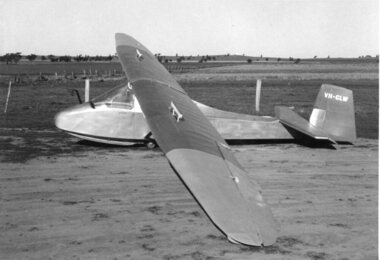
... flight was on 19 May 1956. After about 10 years service with that club it passed through a series of owners, including the Forbes Soaring Club, Beaudesert Gliding Club and private operators. ...flight was on 19 May 1956. After about 10 years service with that club it passed through a series of owners, including the Forbes Soaring Club, Beaudesert Gliding Club and private operators. ...This exhibit is a home built glider of a Grunau Baby 2 design modified by the addition of a fully enclosing Perspex canopy, spoilers, and a landing wheel. It was built by Alex Mackie and was originally owned by the Southern Cross Gliding Club at Camden, New South Wales. The first flight was on 19 May 1956. After about 10 years service with that club it passed through a series of owners, including the Forbes Soaring Club, Beaudesert Gliding Club and private operators. The last major inspection and overhaul of the glider was April 1972. It passed a further airworthy inspection in April 1975. At that time, questions were raised about the weight of the glider (found to be 400 lbs empty). In 1976 it had fallen into a non-airworthy condition and has not flown since. By that time the glider had flown 1161 hrs 11 minutes from 5228 launches. This exhibit is an example of a Grunau Baby 2 type incorporating some improvements as typical of post war built Grunau Baby gliders. Wooden – fabric covered glider – missing canopy perspex, Instrument panel has turn and bank only. Currently the glider features a predominately silver grey colour scheme. australian gliding, grunau, southern cross gliding club, forbes soaring club, beaudesert gliding club -
 Australian Gliding Museum
Machine - Glider – Sailplane, 1963
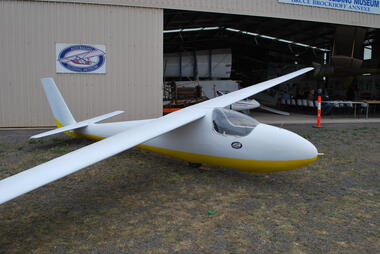
... It was first flown in August 1963 and delivered to the Darling Downs Soaring Club at Toowoomba Queensland. At that Club it had 2603 flights and recorded a total airtime of 1475 hours. ...It was first flown in August 1963 and delivered to the Darling Downs Soaring Club at Toowoomba Queensland. At that Club it had 2603 flights and recorded a total airtime of 1475 hours. ...This aircraft is one of 9 single seat ES 59 advanced club sailplanes manufactured by Edmund Schneider Pty Ltd in the 1960s. It was first flown in August 1963 and delivered to the Darling Downs Soaring Club at Toowoomba Queensland. At that Club it had 2603 flights and recorded a total airtime of 1475 hours. In addition to many local circuits and soaring and cross country flying, it was used at gliding competitions, including Nationals at Benalla in December 1964, State Championships at Oakey in April 1965, at Warwick in April 1966, and at (Inverell?) in March 1967. On at least 15 occasions flight times in excess of 5 hours duration were achieved. On 5 October 1970, the glider had a new life when it was relocated to Wollongong in New South Wales. It recorded 1927 flights with a total airtime of 1179 hours at the club between October 1970 and June 1988. Competition appearances included the State Championships held at Forbes in January 1972. Places away from Wollongong where the glider was launched include Cootamundra, Wagga, Temora, Marulon, Narromine, Leeton, Nowra, Goulburn, Horsham, Greenthorpe. On 15 June 1988 it was transferred to Ron Geake who transported it to Warrego in Northern Territory (flown once at Alice Springs), and then to Gympie in Queensland where it was flown about 20 times by the end of 1995. It was also flown on a small number of occasions at Forbes in New South Wales in 1996 and 1997. During 1998 and 1999 the glider was sparsely used (9 flights) at locations that have not been recorded. From May 1999 until transfer to the Australian Gliding Museum in May 2011 it apparently was not flown. Aggregate airtime hours for the glider stand at 2702 hours 53 minutes. It has been launched 4569 times. A good example of a Schneider ES59 sailplane from the 1960s. This type is of note because it was the first Australian designed and built sailplane to be used in a world gliding competition (Jack Iggulden in Argentina in 1963). This Schneider ES59 Arrow is a single seat wooden sailplane with one piece wing. The instruments are not present except for altimeter. Fin and rudder are of swept back design. Colour scheme is white with lemon yellow fuselage underbelly. The aircraft came to the museum on an open trailer that had been designed to carry the one piece wing. Plate in cockpit with details of manufacturer states; manufactured by E. Schneider Ltd, Adelaide SA; Type ES 59; Serial Number 62; Date August 1963.australian gliding, glider, sailplane, schneider, es59, arrow, darling downs soaring club, wollongong gliding club, ron geake -
 Australian Gliding Museum
Machine - Glider – Sailplane, 1962
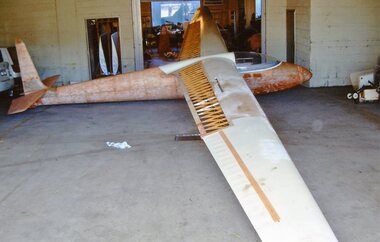
... victorian motorless flight group...soaring...Flight Group which, at the time, was based at Berwick Airfield on the outskirts of Melbourne. On 22 April 1972, the ownership passed to a syndicate of members from the VMFG. It again changed ownership in July 1974. The new owners were another syndicate based at Campbelltown in New South Wales. The glider went to a Tasmania syndicate in June 1976 and finally to the Soaring...This exhibit is an example of the Scheicher Ka6 sailplane type that were built by Edmund Schneider in Australia. australian gliding glider sailplane schneider schleicher ka6 rhonsegler victorian motorless flight group soaring club of tasmania Serial number 55. ...This ES Ka6 sailplane (VH-GRW, serial number 55) was built under licence from Alexander Schleicher in 1962 by Edmund Schneider Limited. It was one of 12 Ka6s, with minor variations from the Schleicher product, built by Schneiders in Australia. It was test flown at Parafield Aerodrome, Adelaide, on 8th September 1962. By way of background, the Schleicher KA 6 series of sailplanes were designed by Rudolf Kaiser in Germany. They were quite successful in the Standard Class in the late 1950s and 1960s. Over 1400 were produced. The first owner of VH-GRW was the Victorian Motorless Flight Group which, at the time, was based at Berwick Airfield on the outskirts of Melbourne. On 22 April 1972, the ownership passed to a syndicate of members from the VMFG. It again changed ownership in July 1974. The new owners were another syndicate based at Campbelltown in New South Wales. The glider went to a Tasmania syndicate in June 1976 and finally to the Soaring Club of Tasmania. In total VH-GRW recorded 3369 hours air time from 4952 launches. It was used very little after 1996. This exhibit is an example of the Scheicher Ka6 sailplane type that were built by Edmund Schneider in Australia.Plywood, spruce and fabric covered high wing single seat sailplane. The airframe has been restored to the point of repainting. Currently the fuselage, rudder and the wings aft of the main spar are coated with pink dope. The tailplane retains the white gloss finish of the glider prior to the restoration work. The cockpit to be refitted (with instruments etc). Serial number 55. The manufacture details are displayed on a metal plate fixed to the main bulkhead. australian gliding, glider, sailplane, schneider, schleicher, ka6, rhonsegler, victorian motorless flight group, soaring club of tasmania -
 Australian Gliding Museum
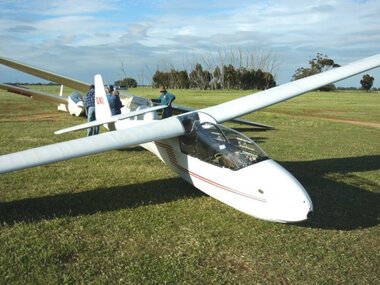
Machine - Glider – Sailplane, March 1964
... Soaring Club. In July 1974, after it had flown for an aggregate 3075 hours from 13919 flights, it was purchased by the Bundaberg Soaring Club. ...Soaring Club. In July 1974, after it had flown for an aggregate 3075 hours from 13919 flights, it was purchased by the Bundaberg Soaring Club. ...The Schleicher K7 is a high wing tandem two-seat sailplane designed in the late 1950s by Rudolf Kaiser for the Alexander Schleicher company in Germany. The fuselage is built using steel tube framing covered with fabric. The swept-forward cantilever wing is of wood and fabric construction with a single spar and a plywood covered leading edge “D” box for strength. The wing is equipped with Schempp-Hirth airbrakes. The K7 first flew in 1959. It is a versatile design that can be used for both basic and more advanced training of pilots. Over 500 were built. VH-GNX was manufactured in Germany and imported into Australia by Edmund Schneider Limited. It was test flown by them at Parafield Aerodrome, Adelaide, South Australia in March 1964. The original owner of VH-GNX was the Adelaide Soaring Club and it was maintained by Edmund Schneider Limited until May 1971. It appears that about this time it was transferred to the Gold Coast Soaring Club. In July 1974, after it had flown for an aggregate 3075 hours from 13919 flights, it was purchased by the Bundaberg Soaring Club. About 10 years later, it was acquired by the Bendigo Gliding Club. At that stage it had recorded over 4600 hours flying time from 21546 launches. When it was retired from service by the Bendigo Gliding Club in June 2006 due to age related defects the hours flown had reached 7259 from 31820 flights. It appears that the airframe has had a relatively trouble free life with only minor damage from storage / ground handling incidents, a heavy landing (January 1987) and a bird strike (January 2002). It was donated to the Museum in April 2007.This exhibit is an example of the Schleicher K7 two seat sailplane type.Two seat high wing glider sailplane finished in white with red detailing.Serial Number 7134, registered as VH-GNX. The registration appears on each side of the Fin / Rudder in red letteringaustralian gliding, glider, sailplane, schleicher, k7, schneider, adelaide soaring club, gold coast soaring club, bundaberg soaring club, bendigo gliding club -
 Australian Gliding Museum
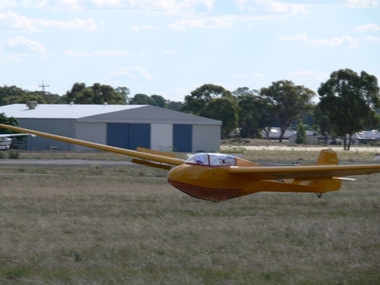
Machine - Glider - Sailplane, 1961
... flights and 1588 hours in the air, the glider was imported into Australia from Germany in June 2004. The glider was registered as VH-GKZ in January 2005 by Thomas Dattler of Millumbindy and flown only a small number of occasions (probably at Byron Soaring Centre). ...flights and 1588 hours in the air, the glider was imported into Australia from Germany in June 2004. The glider was registered as VH-GKZ in January 2005 by Thomas Dattler of Millumbindy and flown only a small number of occasions (probably at Byron Soaring Centre). ...The Scheibe Bergfalke II is a high performance (for its day) and relatively inexpensive two seat sailplane designed by Egon Scheibe. It appeared in 1953 as a derivative of the Scheibe Mu13 Bergfalke and incorporated design changes to resolve and simplify structural issues that affected the Mu13. The Bergfalke II-55 followed in 1955. About 300 of the Bergfalke II and II-55 types were built in Germany and Sweden. This aircraft of the Bergfalke II-55 type was built by Scheibe in 1961 (work number 339). After a long life at Fliegergruppe Leimen e.V. logging 6754 flights and 1588 hours in the air, the glider was imported into Australia from Germany in June 2004. The glider was registered as VH-GKZ in January 2005 by Thomas Dattler of Millumbindy and flown only a small number of occasions (probably at Byron Soaring Centre). The Mangalore Gliding Club appears to have taken an interest in the glider in 2006 and completed routine Form 2 inspections in 2006 and 2009. The amount of usage during this period is unclear as the logbook records held are incomplete. In January 2012 the glider was purchased by the Southern Riverina Gliding Club and flown at Tocumwal until it was damaged in 2013 due to being blown over while at rest on the airfield. The 10 year survey was due in March 2013 and a decision was made by the club to donate the glider to the Australian Gliding Museum instead of completing the necessary repairs for returning it to an airworthy condition. It is estimated that the glider was flown about 300 times and perhaps logged about 140 hours in the air in Australia. If restored this exhibit will be representative of the Scheibe Bergfalke II-55 sailplane type (a rarity in Australia).Tandem two seat sailplane of a wood and tubular steel construction covered with plywood and fabric. It has a fully enclosed cockpit under perspex (which is missing from this airframe). The wings which join the fuselage at shoulder height are swept forward such that the aircraft can be flown solo from the front seat and be properly balanced. The aircraft is in a damaged condition. Registration "GKZ" on sides of fuselage glider, sailplane, australian gliding, scheibe, bergfalke, byron soaring centre, mangalore gliding club, dattler, southern riverina gliding club, tocumwal -
 Australian Gliding Museum
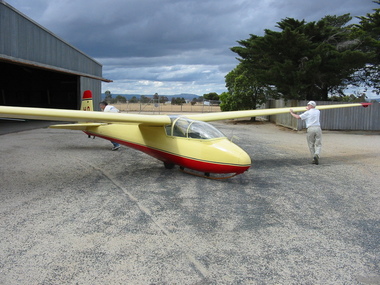
Machine - Glider – Sailplane, Kaiser Ka 2B Rhonschwalbe, 1960
... Soaring Association, a small club of about 20 members, operating at the Moorooduc Airfield. The Ka2b was disposed of to the Stirling Gliding Club in Western Australia in August 1976. Once again it suffered damage in a landing accident in 1978. The damaged glider was put into storage at Northam where it remained for approximately 11 years. It was acquired by Mike Valentine in 1989 and brought back to flying condition at Bacchus Marsh, Victoria. The last entry in the log book is dated January 1997 at which time it had accumulated 1170 hours from 2446 flights...Soaring Association, a small club of about 20 members, operating at the Moorooduc Airfield. The Ka2b was disposed of to the Stirling Gliding Club in Western Australia in August 1976. Once again it suffered damage in a landing accident in 1978. The damaged glider was put into storage at Northam where it remained for approximately 11 years. It was acquired by Mike Valentine in 1989 and brought back to flying condition at Bacchus Marsh, Victoria. The last entry in the log book is dated January 1997 at which time it had accumulated 1170 hours from 2446 flights ...The Ka 2, a tandem two seat training sailplane of 15 metre wing span, was designed by Rudolf Kaiser for Schleicher in 1953. It was a versatile craft due to its good cross country soaring capability. With the Ka 2B, the design was improved in 1955 by lengthening the wing span to 16 metres and increasing the dihedral and tip washout. The fuselage was lengthened slightly as well. Schleicher built 42 Ka2s from 1953 to 1955 and 75 Ka 2Bs from 1955 to 1957. In addition Schleicher supplied kits for construction of the sailplane by independent builders. The Australian Gliding Museum’s example is the single Ka 2b built in Australia from plans and is designated as GFA-HB-47. The club concerned was the Illawarra Soaring Club of Sydney. The glider registered as VH-GHO and first flew in October 1960. However, within a short time it was badly damaged and needed major repairs which took over a year to complete. After about 10 years service at Illawarra Soaring Club it was transferred in February 1972 to W.G. Hingston, Rosebud, Victoria, and flown with the Peninsula Soaring Association, a small club of about 20 members, operating at the Moorooduc Airfield. The Ka2b was disposed of to the Stirling Gliding Club in Western Australia in August 1976. Once again it suffered damage in a landing accident in 1978. The damaged glider was put into storage at Northam where it remained for approximately 11 years. It was acquired by Mike Valentine in 1989 and brought back to flying condition at Bacchus Marsh, Victoria. The last entry in the log book is dated January 1997 at which time it had accumulated 1170 hours from 2446 flights. The last owner prior to transfer to the Australian Gliding Museum was John Ashford of the Geelong Gliding Club. The Museum's Ka 2B sailplane is a potentially airworthy example of this German 1950s sailplane type. It is a rarity in Australia as the only Ka 2b appearing on the Australian register.Tandem two seat sailplane of wood and fabric construction finished in cream and red colour schemeRegistration VH-GHO (with "HO" letters painted on the fin / rudder) Serial number - GFA HB 47 australian gliding, glider, sailplane, schleicher, kaiser, ka 2, illawarra soaring club, stirling gliding club, valentine, ashford, peninsulasoaring association -
 Australian Gliding Museum
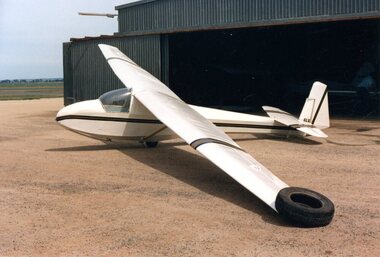
Machine - Glider – Sailplane, 1959
... Soaring Club in 1959 (registered as VH-GLX on 21 October 1959). Another was built by Josef Brabec from a Schneider supplied kit from 1954 to 1956. The log book indicates that the glider recorded 2362 flying hours over approximately 40 years of active service. There are many long flights...Soaring Club in 1959 (registered as VH-GLX on 21 October 1959). Another was built by Josef Brabec from a Schneider supplied kit from 1954 to 1956. The log book indicates that the glider recorded 2362 flying hours over approximately 40 years of active service. There are many long flights ...This aircraft was designed by Edmund Schneider as a single seat medium performance sailplane. Originally designated as the Grunau 3b but later named the Grunau 4. However, it was a new design with fully enclosed cockpit. The main point of difference to earlier Schneider Grunau designs was the tapered wings with the Gottingen 549 aerofoil. This design feature gave the Grunau 4 a better speed range compared to the Grunau Baby 2b or the Grunau 3. The prototype flew on 6 December 1953 and it went to the Waikerie Gliding Club. A second was delivered to the Dubbo Gliding Club in October of the next year and a third (the Australian Gliding Museum’s exhibit) built for the Adelaide Soaring Club in 1959 (registered as VH-GLX on 21 October 1959). Another was built by Josef Brabec from a Schneider supplied kit from 1954 to 1956. The log book indicates that the glider recorded 2362 flying hours over approximately 40 years of active service. There are many long flights recorded. The registration was cancelled on 30 July 2014 as a result of a decision by the Museum to withdraw the glider from service. The exhibit represents the final development of the "Grunau" single seat type by Edmund Schneider Ltd in Australia. Viewed together with the Grunau Baby gliders in the ATO Collection (Two Grunau Baby 2, and a Grunau Baby 3A), the changes to this glider type over a 30 year period can be recognized. Single seat wooden sailplane with fabric covering. Fully enclosed cockpit. The aircraft is white with Linden Green on the wing tips, tailplane and underside of the fuselage and also on the central wing cover. Identification Plate in cockpit showing that glider is serial number 37 built by Edmund Schneider Ltd in 1959 australian gliding, glider, sailplane, grunau, grunau 3a, grunau 3b, grunau 4, schneider, waikerie gliding club, dubbo gliding club, adelaide soaring club, josef brabec -
 Australian Gliding Museum
Machine - Glider - Sailplane
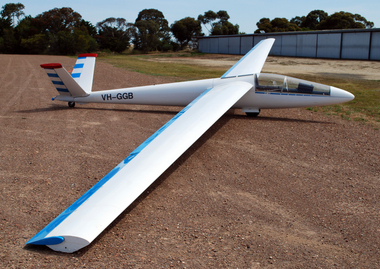
... However, reports from Rickert and O’Sullivan indicate that a good number of cross-country flights of 300km or longer were achieved in this aircraft. A well-engineered metal sailplane from the 1970s with good soaring performance which was designed for amateur construction. australian gliding glider sailplane schreder slingsby bache waikerie gliding club moore lovell rickert o’sullivan canberra gliding club geelong gliding club. ...The Schreder HP 14V is an all metal single seat sailplane designed by Richard Schreder in America. The design is an evolution of Schreder’s metal sailplane designs that date from the late 1950s. Schreder won the United States National Soaring Championship in 1966 in the prototype HP 14. He marketed the glider in kit form in the 1960s and 1970s and allowed Slingsby in the UK to further develop the design for production. Schreder HP14 V, registered as VH-GGB, was built in South Australia by Harry Bache of the Waikerie Gliding Club in the 1970s. Martin Simons, an authority on vintage sailplanes (including Slingsby types), refers to this airframe as “built entirely from scratch”. After Bache, this Schreder HP14V passed on to E.G. Moore and N.L. Lovell at Ararat in Western Victoria, then Graeme Rickert of the Canberra Gliding Club and finally, to Greg O’Sullivan of the Geelong Gliding Club. The glider was first flown on 20 December 1975. It appears to have been flown regularly over its life to 2015 and the cumulative use being 1386 hours flown from 702 launches. The log book does not disclose details of flights except as aggregates of flights and times. Details of notable flights by Bache and Moore et al are not available. However, reports from Rickert and O’Sullivan indicate that a good number of cross-country flights of 300km or longer were achieved in this aircraft. A well-engineered metal sailplane from the 1970s with good soaring performance which was designed for amateur construction. All metal single seat glider sailplane with a distinctive V-tail, finished in a white and blue colour schemeRegistration letters 'GGB' on sides of fuselageaustralian gliding, glider, sailplane, schreder, slingsby, bache, waikerie gliding club, moore, lovell, rickert, o’sullivan, canberra gliding club, geelong gliding club. -
 Australian Gliding Museum
Machine - ES56 Nymph Sailplane
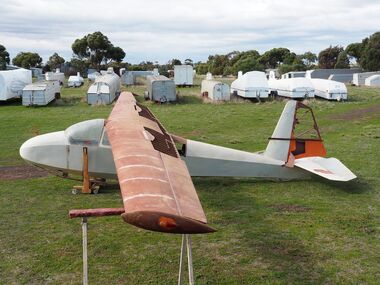
... Flight Group Registered VH-GFE on 5 March 1957 Currently Bacchus Marsh, Victoria Under restoration for display. The Museum’s exhibit is the ES56, serial number 22, registered as VH-GFE. The glider was flown by the VMFG in Victoria until approximately September 1968. GFA records show that it was transferred to Queensland in 1968, and it passed through several owners until the mid-1970s. Information received indicates that it was flown by the Leichardt Soaring...Glider Sailplane Edmund Schneider Harry Schneider ES56 Nymph ES57 Kingfisher Victorian Motorless Flight Group Gliding Club of Victoria RAN Gliding Association Port Pirie Gliding Club Leichardt Soaring Club. ...ES 56 Nymph Following the successful introduction of the ES 52 Kookaburra two-seater in mid-1954, Edmund Schneider Ltd designed a higher performance single seat sailplane of similar construction and with similar handling qualities. It was designated the ES 56 and became known as the ES56 “Nymph”. The ES56 Nymph was a success in that it delivered the anticipated performance and was found to have satisfactory flying characteristics. However, only the prototype (“Nymph -I”) and three production examples (“Nymph-II”) were built. Schneiders made some changes to the design before building the production version. The wing chord at the tip on the prototype measured 650 mm. This was reduced to 500 mm for subsequent builds. The explanation is that provision was made in the original design for the possible lengthening of the tapered wing to 13 metres. However, apparently it was decided to retain the 11.900 metre span which allowed the tip chord to be reduced slightly. Other changes included the installation of scissor type air brakes in the wing instead of simple hinged flap spoilers and the addition of a landing wheel behind the skid on the fuselage. On one of the Nymph-II a dorsal was added on top of the fuselage forward of the vertical fin when repairs were made rectifying damage incurred as a result of an accident at Benalla on 31 March 1963. Even before these ES56 gliders were finished, Edmund Schneider Ltd decided to offer a less expensive single seat design to cater in particular for newly solo pilots, the ES57 Kingfisher. With the Kingfisher, Schneiders reverted to a traditional airfoil (Gott 549) for the wing instead of the laminar flow section that was chosen for the Nymph in the pursuit of performance. As such, the Kingfisher was more appropriately characterised as a single seat version of the Kookaburra in comparison to the Nymph. Schneiders continued for a time to offer the ES56 Nymph as a high-performance sailplane. However, its place in the market was soon overtaken by imported designs with superior performance, such as the Schleicher KA6, which Schneiders also imported and built under license. Nymph-I was test flown in December 1955 and entered by Harry Schneider into the gliding championships held at Waikerie from 5th to 16th of that month. Harry finished 12th in the individual placing out of a field of approximately 24. The capabilities of the Nymph were further demonstrated by Harry Schneider in January 1956 with a Gold C flight of 193 miles from Gawler in South Australia to Walpeup in Victoria. Nymph-I was acquired by the Port Pirie Gliding Club in South Australia. It has been saved and restored and is a regular feature at vintage glider rallies in Victoria and New South Wales. See Museum Newsletter No 35 Winter Edition 2017 pages 3 -6, for that story. The Nymph-II production models were delivered by Edmund Schneider Ltd in October 1956 to the Gliding Club of Victoria, the Victorian Motorless Flight Group and the Royal Australian Navy Gliding Association. The VMFG flew its Nymph in the First National Gliding Championships at Tocumwal, NSW, in December 1956 and all three were flown at the Second National Gliding Championships at Benalla in 29th December 1958 to 8th January 1959, delivering competitive performances based on handicap. Nymph-I Serial Number 17 Original owner – Port Pirie Gliding Club, S.A. Registered VH-GHG on 20 August 1957 Re-registered VH-GHA on 11 October 2016 Currently Raywood, Victoria Believed airworthy Nymph-II Serial Number 20 Original owner – R.A.N. Gliding Association Registered VH-GDX on 20 May 1957 Currently Locksley, Victoria. In storage Nymph-II Serial Number 21 Original owner – Gliding Club of Victoria Registered VH-GHU on 27 August 1957 Currently Bendick Murrell, N.S.W. In storage Nymph-II Serial Number 22 Original owner – Victorian Motorless Flight Group Registered VH-GFE on 5 March 1957 Currently Bacchus Marsh, Victoria Under restoration for display. The Museum’s exhibit is the ES56, serial number 22, registered as VH-GFE. The glider was flown by the VMFG in Victoria until approximately September 1968. GFA records show that it was transferred to Queensland in 1968, and it passed through several owners until the mid-1970s. Information received indicates that it was flown by the Leichardt Soaring Club at Mount Isa in the (late?) 1960s. The history from then is not presently known except to say that it has been kept in dry storage for many years. It is not known when the glider was last flown. What is Significant? The Schneider ES 56 Nymph single seat sailplane, serial number 22, designed and built in 1955-1956, by Edmund Schneider Ltd in Adelaide. It was delivered to its original owner, the Victorian Motorless Flight Group, in October 1956, and registered as VH-GFE on 5 March 1957. How it is Significant? The ES56 Nymph is of historical, aesthetic, scientific and research, and social significance to the Australian gliding community. Why it is Significant? The ES56 is of historical significance as it was designed and built by Edmund and Harry Schneider. The Schneiders immigrated to Australia after the end of the second world war bringing with them considerable expertise in relation to glider design and construction. Over the following decades they maintained a close association with the Gliding Federation of Australia and the gliding clubs and through their glider production made a major contribution to the sport. The ES56 is part of that story. The ES56 in its design and construction exhibits the glider construction technology of the time, which principally consisted of lightweight wooden framework skinned with ply and doped fabric. It exbibits design innovation, notably the use of a laminar flow wing profile in pursuit of better glide performance. Also, considerable attention was given to simplifying the structure in order to keeping cost and the weight low. The ES56 played a useful role at gliding clubs where it was operated, especially the late 1950s and early 1960s and is remembered well by pilots who flew her. The glider is in the course of restoration and provides an insight into the skills and workmanship that were involved in design, building and maintenance of these wooden aircraft. It is of aesthetic and scientific and research significance. Glider airframe of a traditional wood and fabric covered constructionNoneglider, sailplane, edmund schneider, harry schneider, es56, nymph, es57, kingfisher, victorian motorless flight group, gliding club of victoria, ran gliding association, port pirie gliding club, leichardt soaring club.
