
Showing 60 items matching "south africa war 1899-1902"
-
 8th/13th Victorian Mounted Rifles Regimental Collection
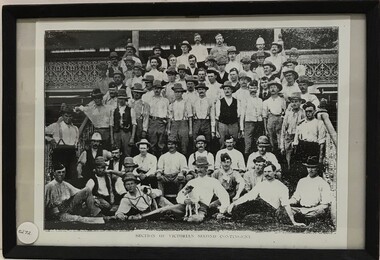
Print - VMR 2nd Contingent
... Framed print showing a section of the Victorian Second Contingent to the South African War 1899-1902....Second Contingent Victorian Mounted Rifles commanded by Colonel Tom Price sailed for South Africa 13 January 1900. military vmr south africa boer war recruits victoria price Framed print showing a section of the Victorian Second Contingent to the South African War 1899-1902. ...Second Contingent Victorian Mounted Rifles commanded by Colonel Tom Price sailed for South Africa 13 January 1900.Framed print showing a section of the Victorian Second Contingent to the South African War 1899-1902.military, vmr, south africa, boer war, recruits, victoria, price -
 Returned Nurses RSL Sub-branch
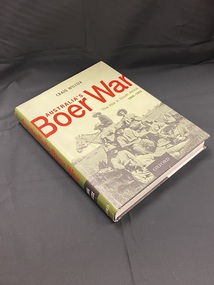
Book - Hardcover illustrated book, Craig Wilcox, Australia's Boer War : the war in South Africa 1899-1902, 2002
... Australia's Boer War : the war in South Africa 1899-1902......South Africa War 1899-1902...Boer War Miltary history South Africa War 1899-1902 Breaker Morant The author has drawn on primary sources from Australia, South Africa and the United Kingdom to produce a book that encompasses not only Australia's experience of the war, but tells the stories of individuals including Breaker Morant, Alexander Krygger, and Arthur Lynch. ...The author has drawn on primary sources from Australia, South Africa and the United Kingdom to produce a book that encompasses not only Australia's experience of the war, but tells the stories of individuals including Breaker Morant, Alexander Krygger, and Arthur Lynch. Over 200 illustrations and maps accompany the text. The great war in South Africa, fought a century ago between the British empire and the Boer republics, was the first war fought by people who called themselves Australians. Encompasses Australia's experiences of the war and also tells the stories of individuals. Commissioned by the Australian War Memorial. - taken from Trove record.Hardcover book with dust-jacket. Army green coloured spine with the title printed in red text and the subtitle below in white. The front cover is a paler green with title in red print across the top. The lower half of the cover shows an image of 8 men (one on horseback), posing for a photo in a field.non-fictionThe author has drawn on primary sources from Australia, South Africa and the United Kingdom to produce a book that encompasses not only Australia's experience of the war, but tells the stories of individuals including Breaker Morant, Alexander Krygger, and Arthur Lynch. Over 200 illustrations and maps accompany the text. The great war in South Africa, fought a century ago between the British empire and the Boer republics, was the first war fought by people who called themselves Australians. Encompasses Australia's experiences of the war and also tells the stories of individuals. Commissioned by the Australian War Memorial. - taken from Trove record. boer war, miltary history, south africa war 1899-1902, breaker morant -
 8th/13th Victorian Mounted Rifles Regimental Collection
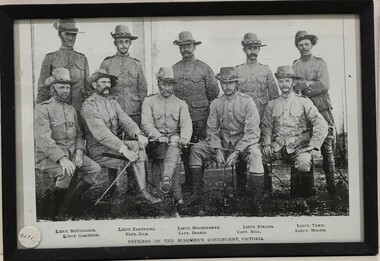
Print - Officers Bushmen contingent
... Framed print of officers of the Victorian Imperial Bushmen Contingent to the South African War 1899-1902. Captains Ham, Dobbins and Hill; Lieutenants McCulloch, Carstairs, Holdsworth, Strong, Trew, Gartside, Moore....Bushmen's Contingent, drawn mainly from Victorian Mounted Rifles, sailed for South Africa 10 march 1900. vmr boer war south africa victoria bushmen uniform Framed print of officers of the Victorian Imperial Bushmen Contingent to the South African War 1899-1902. ...Bushmen's Contingent, drawn mainly from Victorian Mounted Rifles, sailed for South Africa 10 march 1900.Framed print of officers of the Victorian Imperial Bushmen Contingent to the South African War 1899-1902. Captains Ham, Dobbins and Hill; Lieutenants McCulloch, Carstairs, Holdsworth, Strong, Trew, Gartside, Moore.vmr, boer war, south africa, victoria, bushmen, uniform -
 Mrs Aeneas Gunn Memorial Library
Book, M.J. Farrelly, The settlement after the war in South Africa, 1900
... South Africa - Politics and government...South Africa - Boer war 1899-1902...South Africa - Politics and government South Africa - Boer war 1899-1902 An exploration from various standpoints of the settlement of the Boer war. ...An exploration from various standpoints of the settlement of the Boer war.Appendices, p.323.non-fictionAn exploration from various standpoints of the settlement of the Boer war.south africa - politics and government, south africa - boer war 1899-1902 -
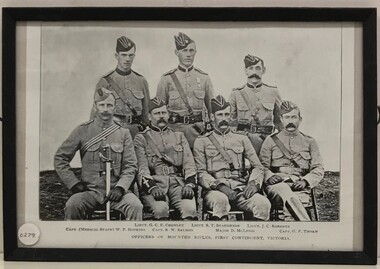 8th/13th Victorian Mounted Rifles Regimental Collection
Print - VMR officers 1st contingent
... Framed print showing seven officers of the First Contingent Victorian Mounted Rifles to the South African War 1899-1902. Officers are Lieutenants G C F Chomley, S T Staughton, J C Roberts, Captain (Medical Staff) W F Hopkins, Captain R W Salmon, Major D McLeish and Captain G F Thorn....First Contingent Victorian Mounted Rifles sailed for South Africa 28 October 1899. military vmr south africa boer war victoria uniform Framed print showing seven officers of the First Contingent Victorian Mounted Rifles to the South African War 1899-1902. ...First Contingent Victorian Mounted Rifles sailed for South Africa 28 October 1899.Framed print showing seven officers of the First Contingent Victorian Mounted Rifles to the South African War 1899-1902. Officers are Lieutenants G C F Chomley, S T Staughton, J C Roberts, Captain (Medical Staff) W F Hopkins, Captain R W Salmon, Major D McLeish and Captain G F Thorn.military, vmr, south africa, boer war, victoria, uniform -
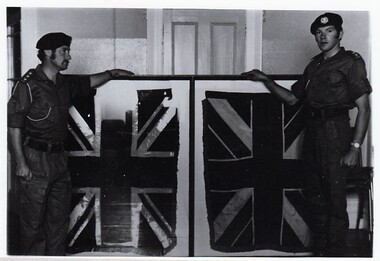 8th/13th Victorian Mounted Rifles Regimental Collection
Photograph - Kings banner display case with officers
... The King's Banners were presented to the 8th Light Horse Regiment in 1904 and 1927 respectively recognizsing service in the South African War (1899-1902) and the Great War (1914-1918)....The King's Banners were presented to the 8th Light Horse Regiment in 1904 and 1927 respectively recognizsing service in the South African War (1899-1902) and the Great War (1914-1918). ...The King's Banners were presented to the 8th Light Horse Regiment in 1904 and 1927 respectively recognizsing service in the South African War (1899-1902) and the Great War (1914-1918).Good photograph marking an important event in the life of the regiment.Black and white photograph of two 8th/13th Victorian Mounted Rifles Officers standing with two flags in a frame at Anglican Church Benalla." Captain Mclean and Lt. Trapnell. Finding of King's Colours. "banner, flag, soldiers, military, heraldry, light horse, mclean, trapnell, benalla -
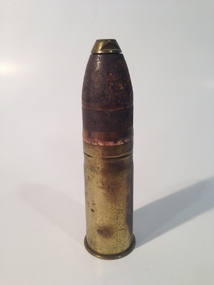 Montmorency–Eltham RSL Sub Branch
Weapon - QF 1 pounder 37mm (Pom-Pom) Round
... It achieved notoriety when used by the Boers in the South African War 1899 - 1902....It achieved notoriety when used by the Boers in the South African War 1899 - 1902. V S & M Brass case and iron pom-pom projectile. ...This round was fired by the QF 1 pounder gun known as the Pom-pom because of its distinctive sound when firing. It was the world's first automatic cannon and was used by many different countries. It achieved notoriety when used by the Boers in the South African War 1899 - 1902.Brass case and iron pom-pom projectile.V S & M -
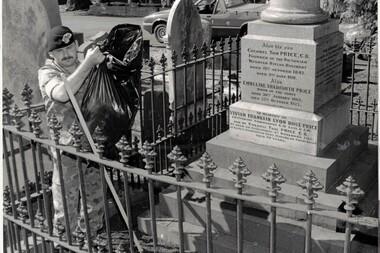 8th/13th Victorian Mounted Rifles Regimental Collection
Photograph - Col Price grave
... Contingents of the VMR served in the South African War 1899-1902. Following Federation, the companies of the VMR became Australian Light Horse regiments. ...Contingents of the VMR served in the South African War 1899-1902. Following Federation, the companies of the VMR became Australian Light Horse regiments. ...Colonel Tom Price, following a distinguished military career in India, was tasked with raising Victoria's military forces in 1885. The mounted arm was the Victorian Mounted Rifles. Contingents of the VMR served in the South African War 1899-1902. Following Federation, the companies of the VMR became Australian Light Horse regiments. For a number of years the 8/13 Victorian Mounted Rifles visited the site of the grave to clean it.Example of service to the memory of the founder of the regiment.Black and white photograph of 8/13 Victorian Mounted Rifles soldier removing leaves and debris from the surrounds of the gravestone of Colonel Tom Price founder of the Victorian Mounted Rifles in Melbourne General Cemetery. price colonel tom, victorian mounted rifles, vmr, cemetery, melbourne -
 8th/13th Victorian Mounted Rifles Regimental Collection
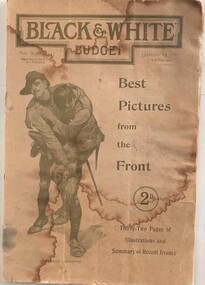
Magazine, Black & White Budget
... The South African (Boer)War 1899-1902 involved troops from the British Empire including Australia. ...The South African (Boer)War 1899-1902 involved troops from the British Empire including Australia. ...The South African (Boer)War 1899-1902 involved troops from the British Empire including Australia. This magazine filled a growing demand for news back home.Tho magazines published in 13 and 27 January 1900, thirty two pages of illustrations and summary of recent events in the South African (Boer) War.boer war, south artica -
 8th/13th Victorian Mounted Rifles Regimental Collection
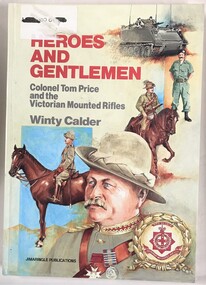
Book, Heroes and Gentlemen
... Contingents of the VMR served in the South African War 1899-1902. Colonel Tom Price commanded the 2nd Victorian contingent, 1900. ...Contingents of the VMR served in the South African War 1899-1902. Colonel Tom Price commanded the 2nd Victorian contingent, 1900. ...Thomas Caradoc Rose Price CB was born in Tasmania 21 October 1842. Following a distinguished military career in India, in 1885 he was tasked with raising Victoria's military forces. The mounted arm was the Victorian Mounted Rifles. Contingents of the VMR served in the South African War 1899-1902. Colonel Tom Price commanded the 2nd Victorian contingent, 1900. Following Federation, the companies of the VMR were reorganised into Australian Light Horse regiments. Colonel Tom Price died in Melbourne 3 July 1911 aged 68 and is buried in Melbourne General Cemetery. It was said of Price that “He made the regiment”, but he insisted “The Regiment made him and made his, a household name.” Hard bound book entitled "Heroes and Gentlemen: Colonel Tom Price and the Victorian Mounted Rifles" by Winty Calder.boer war, victoria, mounted rifles, light horse, price, calder -
 City of Ballarat
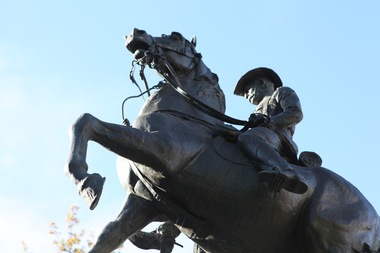
Artwork, other - Public Artwork, Boer War Memorial by James White, 1906
... The Boer War Memorial was created by sculptor James White in honour of Australian Soldiers who fought in the South African War (1899-1902). White used the electrolytic copper deposit method to produce this large statue, which is sometimes mistaken for a cast bronze work. ...The Boer War Memorial was created by sculptor James White in honour of Australian Soldiers who fought in the South African War (1899-1902). White used the electrolytic copper deposit method to produce this large statue, which is sometimes mistaken for a cast bronze work. ...The Boer War Memorial was created by sculptor James White in honour of Australian Soldiers who fought in the South African War (1899-1902). White used the electrolytic copper deposit method to produce this large statue, which is sometimes mistaken for a cast bronze work. The Foundation stone was laid on 18 May 1901 by H.R.H The Duke of York (George V). The sculpture was unveiled on the 1st November 1906 by His Excellency Baron Northcote G.C.I.E., C.B. Governor General of Australia and then Mayor of Ballarat, J. J. Brokenshire. Bravery and mateship are beautifully captured in depiction of a scene taken straight from the battlegrounds. Today the memorial is a much-photographed tribute and exploration of the friendships and struggles of men at war. A proud cavalry horse bears the weight of two men in the chaos of the battlefield. The Boer War in Africa was an early example of the Australian Colonies sacrificing men and equipment for Britain to defend it’s Empire against colonial insurgence. The memorial is of historical and aesthetic significance to the people of Ballarat.Horse and figures, bronze mounted on bluestone base and granite plinth, plaques list the war dead. The artwork depicts two soldiers and a horse. A British soldier is being succoured by an Australian mounted rifleman. In honour of Australian Soldiers who fought in South Africa 1899-1902. Foundation stone laid 18th May 1901 by H.R.H The Duke of York (George V). Unveiled 1st November 1906 by His Excellency Baron Northcote G.C.I.E., C.B. Governor General of Australia. J. H. Barker Chairman. J. J. Brokenshire Mayorboer war, south africa monument -
 Australian Army Museum of Western Australia
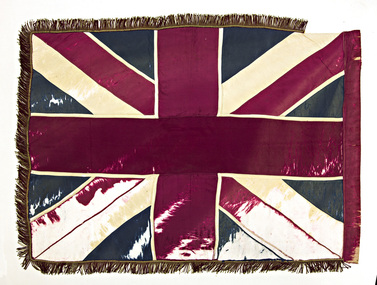
King's Banner - 1st Battalion, 11th Australian Infantry Regiment (Perth Regiment)
... In 1909 His Majesty King Edward VII directed that honorary banners be presented to the Australian Infantry Regiments in commemoration of the services of their members who had volunteered for the South African War 1899-1902. (Promulgated under Military Order 132/1909). ...In 1909 His Majesty King Edward VII directed that honorary banners be presented to the Australian Infantry Regiments in commemoration of the services of their members who had volunteered for the South African War 1899-1902. (Promulgated under Military Order 132/1909). ...In 1909 His Majesty King Edward VII directed that honorary banners be presented to the Australian Infantry Regiments in commemoration of the services of their members who had volunteered for the South African War 1899-1902. (Promulgated under Military Order 132/1909). These would be similar to those presented to Australian Light Horse Regiments, Royal Australian Artillery and Australian Army Medical Corps in 1904. This Banner was presented to 1st Battalion, 11th Australian Infantry Regiment (Perth Regiment) by HE the Governor of WA Sir Gerald Strickland, KCMG, at a parade held on the Esplanade, Perth, 18 February 1911. Consecrated by the Right Reverend COL. Riley, DD, VD, Senior Chaplain of the Australian Commonwealth Military Forces. This banner was subsequently inherited by successor units to the 11th Australian Infantry Regiment (Perth Regiment), including 88th (Perth) Infantry, 11th Battalion (The Perth Regiment) and 11th/16th Battalion. The banner was handed over to the Perth City Council at a special parade of the 11th/16th Battalion held in Forrest Place on 2 June 1930, and was laid up in the Council Chambers in Murray Street. Together with the other historic colours handed over at the time (see Reference items 1 and 3), this banner later went into storage when Council moved premises in the early 1960's. Perth City Council had some restoration work carried out on these colours in 1975 and later had them on display in their display room at Council House, St Georges Terrace. They were subsequently placed in storage again. Following negotiations by the Army Museum of WA Perth City Council passed on these Colours to the Museum in November 1993. Plain Union flag with red and gold fringe. Red and gold chord and tassels. Pike with Royal Crest pike head. A silver plate attached to lower portion of pike inscribed as follows: "Presented by His Most Gracious Majesty The King Emperor to 1st Battalion, 11th Australian Infantry Regiment Perth Regiment formerly 1st and 2nd Battalions Western Australian Infantry in recognition of services rendered to the Empire in South Africa 1899-1902". -
 8th/13th Victorian Mounted Rifles Regimental Collection
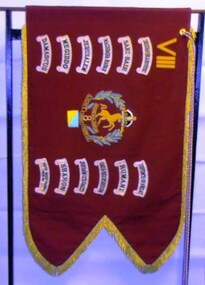
Flag - Guidon 8th LH, 1980 circa
... The guidon carries the battle honours accorded to the regiment for service in the South African War (1899-1902), World War One (!914-1918) and World War Two (1939-1945). ...The guidon carries the battle honours accorded to the regiment for service in the South African War (1899-1902), World War One (!914-1918) and World War Two (1939-1945). ...A guidon is the regimental banner or flag carried by a regiment of light cavalry or light horse. The 8th light Horse (Indi) Regiment was presented with the guidon circa 1927. The actual date is not certain. The guidon carries the battle honours accorded to the regiment for service in the South African War (1899-1902), World War One (!914-1918) and World War Two (1939-1945). The guidon passed into the custody of the 8th/13th Victorian Mounted Rifles Regiment when it was raised on 1 May 1948. At Federation, the Victorian Mounted Rifles companies in North East Victoria were reorganised into the 8th Light Horse Regiment. In 1912 the regiment was renumbered 16th Light Horse. The 8th Light Horse Regiment AIF was raised at Broadmeadows Victoria in September 1914 under the command of Lieutenant Colonel Alexander White and formed part of the 3rd Light Horse Brigade. The regiment served at Gallipoli where in a courageous but ill-fated charge at the Nek on 7 August 1915 it suffered horrendous casualties including Lieutenant Colonel White. Rebuilt in Egypt under the command of Lieutenant Colonel Leslie Maygar VC the regiment went on the serve throughout the Middle East Campaign. Colonel Maygar died of wounds at Beersheba when the regiment was attacked by enemy aircraft while waiting to follow up the successful charge of the 4th LH Brigade on 30 October 1917. The 8th Light Horse AIF was disbanded in 1919, but soon after re-raised as the 8th (Indi) Light Horse in the Citizen Military Forces, superseding 16th (Indi) Light Horse. It had its headquarters at Benalla with sub-units throughout the Upper Murray and Northeast Victoria. In December 1941, the regiment converted from horse to mechanised, initially as 8th Reconnaissance Battalion then in July 1942 it became 8th Cavalry Regiment and served in Northern Territory. As Japanese threat to the mainland declined the regiment was disbanded. In 1948, the 8th Light Horse was linked with 13th and 20th Regiments to form the 8/13 Victorian Mounted Rifles in the Citizen Military Forces. Guidon of the 8th Light Horse Regiment. Maroon corded cotton double thickness fabric with gold metal thread fringe, gold embroidered regimental number in Roman numerals, regimental badge and battle honours; colour patch below badge. Braided corded with tassels.Battle honours: "South Africa 1899-1902, Sari Bair, Maghdaba-Rafah, Jerusalem, Megiddo, Damascus, Defence of ANZAC, Rumani, Gaza-Beersheba, Jordan (Es Salt), Sharon, South West Pacific 1943-1944"guidon, 8th light horse, battle honours -
 8th/13th Victorian Mounted Rifles Regimental Collection
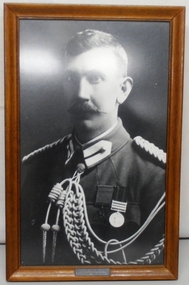
Photograph - Photograph Maygar, 1902 circa
... Lieutenant Leslie Maygar served with the 5th Contingent Victorian Mounted Rifles in south Africa during the Boer War (1899-1902). He was awarded the Victoria cross for heroism . ...Lieutenant Leslie Maygar served with the 5th Contingent Victorian Mounted Rifles in south Africa during the Boer War (1899-1902). He was awarded the Victoria cross for heroism . ...Lieutenant Leslie Maygar served with the 5th Contingent Victorian Mounted Rifles in south Africa during the Boer War (1899-1902). He was awarded the Victoria cross for heroism . Maygar served with the 15th Light Horse (CMF) in the period 1902-1914 and at the outbreak of WWI (1914-1918) he was promoted to Major and appointed as a Squadron Commander with 4th Light Horse (AIF). He served at Gallipoli then was promoted Lieutenant Colonel and appointed Commanding Officer 8th Light Horse. He was serving in this capacity at Beersheba in October 1917 when the regiment was attacked by enemy aircraft. Maygar died of wounds sustained in the attack. Fine photograph of officer of the Victorian Mounted Rifles in the period immediately following the Boer War. Leslie Maygar was a native of the Euroa district and a geographic feature and a winery have been named in his honour.Framed black and white photograph of Lieutenant Leslie Maygar VC in Victorian Mounted Rifles uniform following his return from South Africa 1902. He is wearing his Victoria Cross and Queen's South African medal with three bars: Transvaal, Orange Free State, Cape Colony..Engraved panel at lower centre frame "Lt L C Maygar VC 5VMR / Date of Award 23-11.01"maygar leslie c lieutenant vc, victoria cross, vmr 5th contingent, 8th light horse regiment -
 Flagstaff Hill Maritime Museum and Village
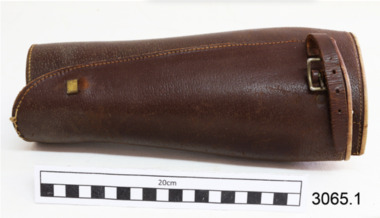
Clothing - Leather Leggings, 1899 to 1920
... The subject leather leggings are associated with mounted troops known as the Australian Light Horse that served in the South African War from 1899 to 1902. After the war, Britain wanted to use fewer mounted troops and restructured its force around a style of combat that needed more infantry. ...The subject leather leggings are associated with mounted troops known as the Australian Light Horse that served in the South African War from 1899 to 1902. After the war, Britain wanted to use fewer mounted troops and restructured its force around a style of combat that needed more infantry. ...The subject leather leggings are associated with mounted troops known as the Australian Light Horse that served in the South African War from 1899 to 1902. After the war, Britain wanted to use fewer mounted troops and restructured its force around a style of combat that needed more infantry. But the defence of Australia still relied upon mounted military units as these were more mobile than infantry and could travel faster over long distances. Light Horse brigades in the Australian Imperial Force (AIF) mostly contained recruits who served in the Light Horse regiments of the Citizen Forces. Many young men from rural areas of Australia volunteered for the Light Horse regiments. They had to pass a riding test to join, this test was easier for men from the bush because horses were still the main method of transport on farms and in country towns. The army did not officially accept First Australians into the AIF until May 1917 when enlistment standards were relaxed to include 'half-castes' with a parent of European origin. Indigenous soldiers served as valuable members of the Light Horse and many possessed excellent horse handling skills and specialist tracking knowledge.The subject items are part of the uniform for the Light Horse Units that served in the Australian army from 1899 until 1918. These leggings were worn by soldiers on horseback and are significant as they represent a noteworthy time in Australia's early military history. It was a time when many young men gave their lives during the South African and First World Wars in the defence of the then British Empire as part of the Imperial Forces that were gathered from many British-controlled Colonial countries.A pair of two Leather Leggings used by Mounted Australian soldiers during the first world war. The leggings are dark tan in colour with stitching to attach buckles and fastener straps. The strap buckles are made of brass and the leather legging straps are of same leather as leggings. Noneflagstaff hill, warrnambool, flagstaff hill maritime museum, shipwreck coast, flagstaff hill maritime village, great ocean road, leggings, leather leggings, protective leggings, protective clothing, australian mounted light horse units, military equipment -
 Flagstaff Hill Maritime Museum and Village
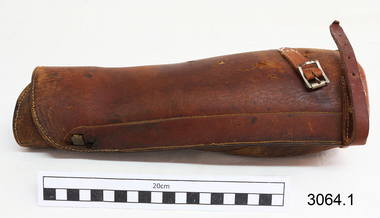
Clothing - Leather Leggings, 1899 to 1918
... The subject leather leggings are associated with mounted troops known as the Australian Light Horse that served in the South African War from 1899 to 1902. After the war, Britain wanted to use fewer mounted troops and restructured its force around a style of combat that needed more infantry. ...The subject leather leggings are associated with mounted troops known as the Australian Light Horse that served in the South African War from 1899 to 1902. After the war, Britain wanted to use fewer mounted troops and restructured its force around a style of combat that needed more infantry. ...The subject leather leggings are associated with mounted troops known as the Australian Light Horse that served in the South African War from 1899 to 1902. After the war, Britain wanted to use fewer mounted troops and restructured its force around a style of combat that needed more infantry. But the defence of Australia still relied upon mounted military units as these were more mobile than infantry and could travel faster over long distances. Light Horse brigades in the Australian Imperial Force (AIF) mostly contained recruits who served in the Light Horse regiments of the Citizen Forces. Many young men from rural areas of Australia volunteered for the Light Horse regiments. They had to pass a riding test to join, this test was easier for men from the bush because horses were still the main method of transport on farms and in country towns. The army did not officially accept First Australians into the AIF until May 1917 when enlistment standards were relaxed to include 'half-castes' with a parent of European origin. Indigenous soldiers served as valuable members of the Light Horse and many possessed excellent horse handling skills and specialist tracking knowledge.The subject items are part of the uniform for the Light Horse Units that served in the Australian army from 1899 until 1918. These leggings were worn by soldiers on horseback and are significant as they represent a noteworthy time in Australia's early military history. It was a time when many young men gave their lives during the South African and First World Wars in the defence of the then British Empire as part of the Imperial Forces that were gathered from many British-controlled Colonial countries.A pair of two Leather Leggings used by Mounted Australian soldiers during the first world war. The leggings are dark tan in colour with stitching to attach buckles and fastener straps. The strap buckles are made of brass and the leather legging straps are of same leather as leggings. Noneflagstaff hill, warrnambool, flagstaff hill maritime museum, shipwreck coast, flagstaff hill maritime village, great ocean road, leggings, leather leggings, protective leggings, protective clothing, australian mounted light horse units, military equipment -
 Bendigo Historical Society Inc.
Document - Arthur T. Pattinson, 1962
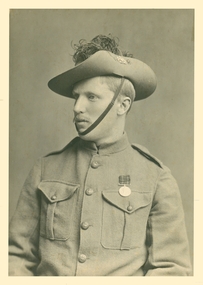
... South African (Boer) War. It is a bronze statue of a soldier on a granite base. Leader (Melbourne), 19 November 1904. “There was a large assemblage on the afternoon of 11th November, when the ceremony of unveiling the soldiers' memorial statue was performed by Brigadier-General Gordon in the presence of a muster of branches of the defence forces. The statue, which is in bronze, is mounted on a massive granite base, on the foot of which is the following inscription: — "Bendigo's tribute to the memory of the Australian soldiers who, in the South African war of 1899 - 1902...South African (Boer) War. It is a bronze statue of a soldier on a granite base. Leader (Melbourne), 19 November 1904. “There was a large assemblage on the afternoon of 11th November, when the ceremony of unveiling the soldiers' memorial statue was performed by Brigadier-General Gordon in the presence of a muster of branches of the defence forces. The statue, which is in bronze, is mounted on a massive granite base, on the foot of which is the following inscription: — "Bendigo's tribute to the memory of the Australian soldiers who, in the South African war of 1899 - 1902 ...10570 South African (Boer) War Memorial Bendigo. The monument commemorates those who died in service or were killed in action while serving in the South African (Boer) War. It is a bronze statue of a soldier on a granite base. Leader (Melbourne), 19 November 1904. “There was a large assemblage on the afternoon of 11th November, when the ceremony of unveiling the soldiers' memorial statue was performed by Brigadier-General Gordon in the presence of a muster of branches of the defence forces. The statue, which is in bronze, is mounted on a massive granite base, on the foot of which is the following inscription: — "Bendigo's tribute to the memory of the Australian soldiers who, in the South African war of 1899 - 1902 gave their lives for Queen and Empire. The statue was modelled by Mr. J. Walker, a young Bendigonian, who has been studying for two or three years under Mr. A. T. Woodward art instructor at the local school of mines.“ Ola Cohn recalled in her autobiography meeting John Walker as a sculpture student at the Bendigo School of Mines and that he had later received the commission for the Boer War Memorial although she neglects to mention its location. John Walker was born in Bendigo and first studied sculpture at the Bendigo School of Art. Walker, then went to England to study at the Royal College of Art London, and in Paris at the Académie Colarossi and Julian Academy. John Walker worked as a sculptor in both Bendigo and West Brunswick before turning to chicken farming in the Bendigo suburb of White Hills. The photo of A. T. Pattinson was taken by George Leake Massingham, a professional photographer, who had seven children, one of whom died at birth. After arriving in Australia from England, he established himself as a travelling photographer, an occupation he continued after his marriage. He travelled throughout country Queensland, Victoria and New South Wales, setting up studios along the way. The family ended up moving with him, travelling to Sydney, Narrandera, Bendigo, Newtown, Geelong and Deniliquin. Correspondence re Boer War Memorial Bendigo Boer War Memorial Bendigo. Letters and photo from and to Mrs Wilson, eldest daughter of Mr Arthur T. Pattinson who was a model for the Boer War sculpture. 10570a A black and white photo of Trooper Arthur T. Pattinson restored by BHS Volunteers. 10570b The original photo as sent by Mrs Wilson to Harold Curnow (Bendigo Historical Society) in 1962. The photo is mounted on heavy brown cardboard and has an old catalogue number of "P680" inscribed on it. The cardboard is torn and held together with sticky tape. On the front in italics is printed G.L. Massingham, Bendigo. 10570c Notes on the rear of the photo from Mrs Wilson state that "the photo is of Arthur T. Pattinson (Rusty), an Australian Light Horse trooper who served in the Boer War. The Boer War Memorial in Pall Mall Bendigo represents a trooper on guard. The sculptor was Jack Walker who used Pattinson as a model, and it is regarded as an excellent likeness." 10570d A letter from Harold Curnow back to Mrs Wilson on Jan 4th, 1963, acknowledging receipt of the photo and a letter received, noting the significance of the historical information. 10570e Handwritten letter 29/11/1962 from Mrs Wilson to Mr Curnow introducing herself as Mr. Pattinson's eldest daughter and answering the letter he wrote to her father. She mentions the bad health of her parents. Arthur modelled for the statue at least two to three times per week in a studio on the top floor of a building in Bull St. He was the original model to the best of her knowledge. Another model possibly Mr P. Handmear may have sat as a model for renovations (*). The rifle was a light horse rifle issued to Pattinson as he was still serving in 1904. Arthur and Handmear were boys together and very close. * Note - the plaster model was repaired prior to casting in metal. 10570f An obituary notice: 18/11/64 "On Nov. 17 at Frankston, Emma, wife of the late A. T. Pattinson (Rusty), late of Bendigo. 10570g Letter Nov. 20th, 1962, from Harold Curnow to Mr Arthur T. Pattinson, Kent St., Mornington, Vic. "Dear Mr Pattinson, Last week your brother, Brit., whom I have known for many years, supplied the Bendigo Advertiser with some interesting information regarding your role as the model for the late Jack Walker when he was making the statue for the Boer War Memorial here. Yesterday however, another claimant to the distinction of being the model was advanced in the Bendigo Advertiser by Mr Richard Marshall, of Moran Street, Bendigo who said that the soldier's model was Phillip Handmear. I understand that your brother has sent the newspaper cuttings on to you. When he called to see me yesterday, he suggested that I write to you for further particulars. Can you recall the discussion you had with Jack Walker when he approached you about acting as the model and do you remember how many times you posed for him, and whether the work was done in the house, in the yard, or in one of the outbuildings at Moran Street? In short, any details at all. At this point in time we are considering an interesting facet in Bendigo's history, so any seemingly unimportant incidents could really be useful if we knew about them. Have you any old newspaper cuttings mentioning your name in connection with the memorial? Do you remember any remarks that passed between you and Jack Walker during the long sessions you must have put in on this work? This could be very important. And do you recall where the rifle came from? Did you or Jack Walker borrow it from the military authorities? Back in 1934 Jack Walker recalled having had to pull the plaster model down and remake it when he discovered it was slightly off-balance and was slowly toppling forward. He told me he had to get his model to pose again. Do you know anything about this? Could it have been that he got Mr. Handmear in for the final stage of the work? That, of course, would apply only if you were not available. Incidentally, I never heard of Mr Handmear until I saw his name in yesterday's "Advertiser". In any case I intended contacting your brother or you to enquire whether any member of your family has an old photograph of you in your Boer War uniform, that is, one taken about the time of or just after the Boer War. I am sure that members of the Bendigo Branch of the Royal Historical Society would be most interested to see it. I hope you will have the time and inclination to consider the many points I have raised in this letter because the subject has aroused a lot of interest in Bendigo. Hoping you are well and quite as active as you wish, I remain, with all good wishes, Yours sincerely, Harold Curnow". john walker, jack walker, boer war memorial bendigo, arthur pattinson, soldiers' memorial bendigo -
 Federation University Historical Collection
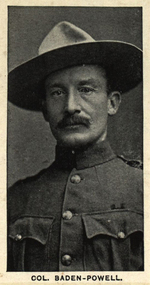
Photograph (black & White), Colonel Baden-Powell - South Africa, c1900
... War Office but no command was given to him. Awards obtained include Ashanti Star (1895), British South Africa Company Medal (1896), Queen's South Africa Medal (1899), King's South Africa Medal (1902), Knight Grand Cross of the Order of St Michael and St George, Knight Grand Cross of the Royal Victorian Order, Knight Commander of the Order of the Bath, plus numerous Scouting Medals. ...War Office but no command was given to him. Awards obtained include Ashanti Star (1895), British South Africa Company Medal (1896), Queen's South Africa Medal (1899), King's South Africa Medal (1902), Knight Grand Cross of the Order of St Michael and St George, Knight Grand Cross of the Royal Victorian Order, Knight Commander of the Order of the Bath, plus numerous Scouting Medals. ...Robert Baden-Powell was born in 1857. After school he joined the British Army as an officer and was posted to India. In the early 1880s he served in the Natal province of South Africa amidst the Zulu He learnt advanced scouting skills during his time in South Africa where knowledge of countryside was vital for gaining information. In 1896 he returned to Africa and served in the Second Matabele War in the expedition to relieve British South Africa Company personnel under siege in Bulawayo. From 1899 to 1900, Baden-Powell commanded the garrison at Mafeking during the Second Boer War. The siege of Mafeking lasted 217 days and the successful defence of the town raised his national profile. In 1900 Baden-Powell was promoted to Major General. In 1901 he was invested as Companion of the Order of Bath by King Edward VII. After some controversies he retired from the Army in 1910. At the beginning of the First World War he put himself at the disposal of the War Office but no command was given to him. Awards obtained include Ashanti Star (1895), British South Africa Company Medal (1896), Queen's South Africa Medal (1899), King's South Africa Medal (1902), Knight Grand Cross of the Order of St Michael and St George, Knight Grand Cross of the Royal Victorian Order, Knight Commander of the Order of the Bath, plus numerous Scouting Medals. Baden-Powell married in 1912 at the age of 55. He and Olave had three children. Baden-Powell died in 1941 and buried in St Peter's Cemetery, Nyeri, Kenya. Olave died in 1977 and her ashes were sent to Kenya to be interred beside her husband.Individual image from photographed poster of tobacco and cigarette cards. See 09350.baden-powell, british army, natal, south africa, zulu, india, officer, scouting, second matabele war, british south africa company, bulawayo, mafeking, second boer war, major general, companion of the order of bath, ashant star, british south africa company medal, queen's south africa medal, king's south africa medal, knight grand cross of the order of st michael and st george, knight grand cross of the royal victorian order, knight commander of the order of the bath -
 Lara RSL Sub Branch
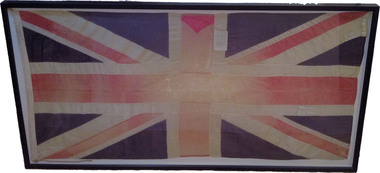
Flag, Australian Flag (Union Jack) 1900
... South Africa by 1229 Trooper Fredrick James Smith. Between 1899 and 1902, around 16,500 Australians served in South Africa during the Boer War. ...South Africa by 1229 Trooper Fredrick James Smith. Between 1899 and 1902, around 16,500 Australians served in South Africa during the Boer War. ...There is a Union Jack brought back from South Africa by 1229 Trooper Fredrick James Smith. Between 1899 and 1902, around 16,500 Australians served in South Africa during the Boer War. This was the largest international deployment of troops from the Australian Colonies before Australian Federation. Of the 16,500 men who served in South Africa, 606 were killed in action or died of diseases. The Australian War Memorial records that the fighting conditions in South Africa extremely hard on men and horses. Australians fighting in South Africa were doing so as part of Colony based Regiments such as the Victorian Mounted Rifles, New South Wales Lancers, Queensland Mounted Infantry as well as units from the other states. Australians were awarded six Victoria Crosses during the campaign along with many other decorations. In May of 1902 the treaty of Vereeniging was signed officially ending the Boer War. The Boer War is commemorated in many Towns and Cities around Australia. The Lara RSL Sub Branch holds some memorabilia from the Boer War. There is a Union Jack brought back from South Africa by 1229 Trooper Fredrick James Smith. He was a resident of Lara and was a member of the 5th Victorian Mounted Rifles. It was reported that he carried this flag into battle. The Lara RSL also holds the flag staff of the China, South African and Old Veterans Association. Both these items are of national significance. Both the flag and flag staff were used in marches in Geelong each year until 1916 when Anzac Day commenced. The flag and flag staff were donated to the Lara RSL sub Branch when he joined in 1928. Fredrick James Smith was born at Lara in 1879, the son of Mr/Mrs Smith from Lara. He was a farm hand from Horton Vale, Anakie when he joined F Company of the 5th Victorian Mounted Rifles at the beginning of February 1901. Two weeks later, he left for South Africa on the 15th February. Before leaving, he purchased the flag from W. Libby & Son Geelong. Frederick Left for South Africa on the 15 February 1901 on the Orient. He saw service between March 1901 - March 1902 in east Transvaal and Natal frontier under the British Major General S. Beatson then Pulteney, including the defeat at Wilmansrust where 18 soldiers were killed and 42 wounded (12th June 1901 - heaviest casualties of any Australian contingent,); and the successful intervention at Onverwacht on the 4th January 1902. The 5th Victorian Mounted Rifles suffered: 36 killed or died of wounds, 13 died of disease of a contingent of 46 Officers, 971 Other Ranks and 1099 horses. They returned to Australia on the 26th April 1902 on the Custodian after sailing from Point Natal in South Africa on the 5th April. On his return, Tropper Smith (Saddler Private) joined the South African Soldiers Association of Victoria – Geelong Branch, and after 1928, he joined the Lara RSL. He was buried in Western Cemetery on the 19th June 1968 at the age of 89. Enrolled February 1901 Departed for South Africa on 15 February 1901 Establishment: 46 Officers, 971 Other Ranks with 1099 horses Mobilised at Pretoria: 24 March -- 4 April 1901 Typical company: 1 Captain, 4 Lieutenants, 1 company sergeant-major, 1 company quartermaster-sergeant, 1 sergeant-farrier, 1 sergeant-saddler, 5 sergeants, 6 corporals, 3 shoeing-smiths, 3 saddlers, 1 bugler, 99 privates. Total in company: 126 with 131 horses. Engagements: Rhenoster Kop, Klippan, Kornfontein, Drivelfontein, Wilmansrust, Kambuladraai, H'Lobane, Luchiel's Nek, Loch's Kraal, Vryheid, Onverwacht, Johnston Hoek Killed in action (or died): six Officers, 48 Other Ranks VC Winner: Lieut. L. C. Maygar News article Leader (Melbourne) Saturday 31st May 1902, page 42 - Dear Cinderella. — This is the second time I have written to you. I was very sorry at not seeing my first letter in "The Leader". But I hope to say, that this one will be in. The last time I wrote to you I told you that my brother (Fredrick Smith) went to the Boer War in South Africa, and that he was supposed to be killed in the Wilmansrust disaster. But this time I am going to tell you about his return, and the grand welcome he got from the residents of Lara. Mother, Father, and my Brother, went down to Melbourne, to meet the boat. You can just imagine how rejoiced we all were to see him back again. The railway station was decorated some thing beautiful with flags of all description all the colours you could think of. He has bought a lot of Boer curios home and some Kaffir bracelets. They are such funny looking things. The residents of Lara, also gave my brother a grand social and ball there were over four hundred people present, They presented him with a hand some gold chain, and locket suitably inscribed, and a pair of gold sleeve links, they were magnificent. The ball was very nice. . I had a few dances. I enjoyed myself grand. I think this is all I can tell you this time. I must conclude with love. I remain yours sincerely - BESSIE SMITH. Age 14-years. This flag is of national significance as it was used in the Boer War by Private Fredrick James Smith (SN:1229) of the 5th Victorian Mounted Rifles, F Company in their deployment to South Africa between 1901 and 1902. The flag was taken into the Wilmansrust engagement in which 19 soldiers died and 41 were wounded. On return to Australia, the flag was used in marches by the South Africa, China Old Veterans Association - Geelong. This flag represents a unique part of Australian history from which the movie, Breaker Morant was taken. It is of spiritual significance as the Boer War was where the first Australian received the Imperial Victoria Cross, and the spirit of Anzac was conceived, giving birth in World War 1. The Flag represents the spirit of Australians who fought and died in South Africa.Cotton Union Jack flag approx 221cm wide by 109cm tall with small repair patches and center section cotton deteriorated.Has the word "Lara" inscribed in black on bottom part of the flag heading. Has the flag makers name "W.Libby & Son" on the top part of the flag heading.boer war, union jack flag, south africa, wilmansrust, 5th victorian mounted rifles, f coy, private fredrick james smith, service number 1229, february 1901, april 1902, south africa china old veterans association -
 Federation University Historical Collection
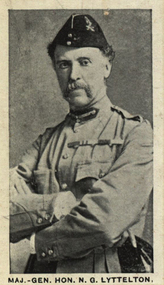
Photograph (black & White), Major-General, Honorable Neville Gerald Lyttelton - South Africa
... War as Commander of the 4th Brigade from 1899. He temporarily became General Officer Commanding the 2nd Division and the commanded the 4th Division. The Division was involved in the Battle of Spion Kop and the Battle of Vaal Krantz, leading to the Relief of Ladysmith 1900. Lord Roberts referred to Lyttelton as an officer "with great coolness under fire, and considerable tactical knowledge and resource........an excellent commander in the field." Following the end of the Boer War in 1902, Lyttelton became Commander-in-Chief of the whole of South Africa...War as Commander of the 4th Brigade from 1899. He temporarily became General Officer Commanding the 2nd Division and the commanded the 4th Division. The Division was involved in the Battle of Spion Kop and the Battle of Vaal Krantz, leading to the Relief of Ladysmith 1900. Lord Roberts referred to Lyttelton as an officer "with great coolness under fire, and considerable tactical knowledge and resource........an excellent commander in the field." Following the end of the Boer War in 1902, Lyttelton became Commander-in-Chief of the whole of South Africa ...Lyttelton served in the Second Boer War as Commander of the 4th Brigade from 1899. He temporarily became General Officer Commanding the 2nd Division and the commanded the 4th Division. The Division was involved in the Battle of Spion Kop and the Battle of Vaal Krantz, leading to the Relief of Ladysmith 1900. Lord Roberts referred to Lyttelton as an officer "with great coolness under fire, and considerable tactical knowledge and resource........an excellent commander in the field." Following the end of the Boer War in 1902, Lyttelton became Commander-in-Chief of the whole of South Africa. He and his wife sought to repair relations with the Boer community. In the South Africa honours of 1902 Lyttelton was knighted as Knight Commander of the Order of the Bath. He retired in 1912 and under insistence by the King was appointed as Governor of the Royal Hospital Chelsea from that time until his death there in 1931. Other awards received were Knight Grand Cross of the Order of the Bath; Knight Grand Cross of the Royal Victorian Order; Order of Osmanieh (Ottoman Empire)Individual image taken from photographed poster of tobacco and cigarette cards.neville gerald lyttelton, second boer war, commander, 4th brigade, battle of spion kop, battle of vaal krantz, relief of ladysmith, lord roberts, commander-in-chief, south africa, knight commander of the order of the bath, royal hospital chelsea, order of osmanieh (ottoman empire), knight grand cross of the royal victorian order -
 Federation University Historical Collection
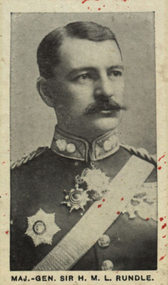
Photograph (black & White), Major General Sir Henry Macleod Lesley Rundle - South Africa
... War started late 1899. Rundle was appointed to be commander of the 8th Division of the South African Field Force and served until 1902. ...War started late 1899. Rundle was appointed to be commander of the 8th Division of the South African Field Force and served until 1902. ...The Second Boer War started late 1899. Rundle was appointed to be commander of the 8th Division of the South African Field Force and served until 1902. His army record and achievements meant he was mentioned in dispatches and therefore awarded with King Grand Cross of the Order of the Bath; Knight Grand Cross of the Order of St Michael and St George; Knight Grand Cross of the Royal Victorian Order; Distinguished Service Order.Individual image from photographed poster of tobacco and cigarette cards.second boer war, major general, sir h m l rundle, commander, 8th division, south african field force, knight grand cross of the order of st michael and st george, knight grand cross of the order of the bath, knight grand cross of the royal victorian order, distinguished service order -
 Geelong RSL Sub Branch
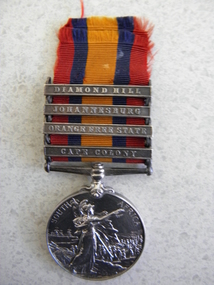
Medal - 4517 R R McDonald, Early 20th Century
... South Africa during the Boer War with Kitchener's Horse. This is the original Medal of 4517 Tpr R R McDonald boer war queen's south africa medal 4517 tpr r r mcdonald 4517 Tpr R R McDonald. Kitchener's Horse There are four bar's on the ribbon - Cape Colony, Orange Free State, Johannesburg, Diamond Hill Queen's South Africa Medal 1899-1902 with ribbon. ...The is the original Medal of 4517 Tpr R R McDonald who Served in South Africa during the Boer War with Kitchener's Horse.This is the original Medal of 4517 Tpr R R McDonaldQueen's South Africa Medal 1899-1902 with ribbon.4517 Tpr R R McDonald. Kitchener's Horse There are four bar's on the ribbon - Cape Colony, Orange Free State, Johannesburg, Diamond Hillboer war, queen's south africa medal, 4517 tpr r r mcdonald -
 Bendigo Military Museum
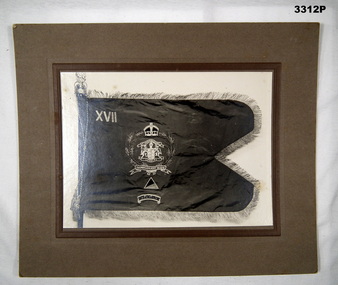
Photograph - PHOTOGRAPH, 17th LH, Early 1900's
... Photographs framed 17th “XVII Bendigo Light Horse 17th Light Horse Regt Loyalty South Africa 1899 - 1902” Black & white photo of Boer War, Bendigo Light Horse Flag mounted on hard brown cardboard. ...Black & white photo of Boer War, Bendigo Light Horse Flag mounted on hard brown cardboard.“XVII Bendigo Light Horse 17th Light Horse Regt Loyalty South Africa 1899 - 1902”photographs, framed, 17th -
 Bendigo Military Museum
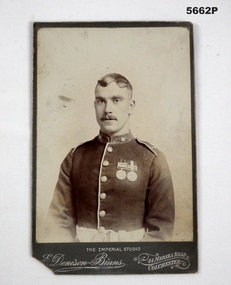
Photograph - PHOTOGRAPH, BRITISH SOLDIER, POST BOER WAR, E. Dennison- Binns, c1899-1903
... South Africa. He was NR 4886 Suffolk Regiment DOB c1878. POB White Chapel, London. Served 1899-1902 Cape Colony, Colesberg, Transvaal - with the Mounted Infantry. WW1 - DOE 11 Dec 15, Middlesex Regiment 5 Bm. (A Reserve Bn). Discharged from Middlesex 19 Apr 1916. M.U. Number 1710 Pte. The British I.W.M. also shows he served in the Royal Field Artillery in WW1. That info is not available. Rank Gunner NR L/10626. Boer War ...Believed to be "George Goulding No. 4886" Britain. The collar badge is that of the Suffolk Regiment. Service of George Frederick Goulding, British Army Boer, South Africa. He was NR 4886 Suffolk Regiment DOB c1878. POB White Chapel, London. Served 1899-1902 Cape Colony, Colesberg, Transvaal - with the Mounted Infantry. WW1 - DOE 11 Dec 15, Middlesex Regiment 5 Bm. (A Reserve Bn). Discharged from Middlesex 19 Apr 1916. M.U. Number 1710 Pte. The British I.W.M. also shows he served in the Royal Field Artillery in WW1. That info is not available. Rank Gunner NR L/10626.This is a black and white portrait of a British soldier waist upwards. He is in uniform, wearing two medals. One medal on the soldier has 3 bars, the other has 2 bars. His belt is probably white. The badges on his collar appear to be a Castle with gate. The soldier is hatless. The photo is glued onto a cardboard surround.The bottom of the cardboard backing has written in white ink "The Imperial Studio - E. Dennison. Binns, 44 Measea Road, Colchester"boer war, south africa, british soldier -
 Bendigo Military Museum
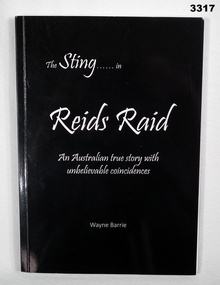
Book - BOOK, BOER WAR, The Sting ........ in Reids Raid, 2018
... It occurred in the 1899 - 1902 Boer War in South Africa....It occurred in the 1899 - 1902 Boer War in South Africa. books-military-history boer war Soft cardboard cover, white print on glossy black background on front, spine & back. 107 pages cut, plain, white, illustrated with black & white & sepia photos, maps & illustrated. ...From the book cover: Reids Raid is a true story with all the qualities of a good Aussie yarn. It occurred in the 1899 - 1902 Boer War in South Africa.Soft cardboard cover, white print on glossy black background on front, spine & back. 107 pages cut, plain, white, illustrated with black & white & sepia photos, maps & illustrated.books-military-history, boer war -
 Bendigo Military Museum
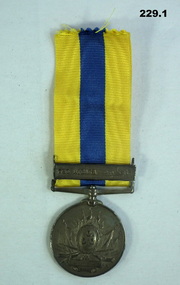
Award - MEDALS VARIOUS, 1896 through to 1908
... "The Atbara." 1896 -1908. .2) Box. .3) USA, 1898-1902 Spanish American War. .4) USA, 1898-1902 Spanish American War. (broken) .5)British, 1899-1902 Queens South Africa Medal - 5514 Pte. ..."The Atbara." 1896 -1908. .2) Box. .3) USA, 1898-1902 Spanish American War. .4) USA, 1898-1902 Spanish American War. (broken) .5)British, 1899-1902 Queens South Africa Medal - 5514 Pte. ....1) Khedive Sudan. Silver with clasp. "The Atbara." 1896 -1908. .2) Box. .3) USA, 1898-1902 Spanish American War. .4) USA, 1898-1902 Spanish American War. (broken) .5)British, 1899-1902 Queens South Africa Medal - 5514 Pte. J. Cross Suffolk Regt. (Boer War) .6)British, 1901-1902 Kings South Africa Medal. Lt. A.C. MacColl. I.L.H. (Boer War)numismatics, medals, military, foreign, ron mills collection -
 Kiewa Valley Historical Society
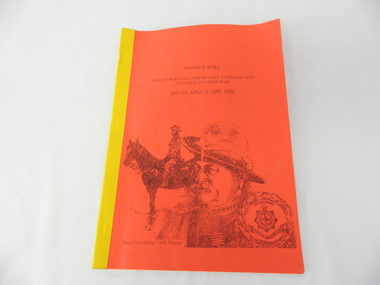
Book - Non Fiction History, Honour Roll - South Africa 1899 - 1902 Albury-Wodonga and District Residents Who Served In The Boer War, reprinted 03/2008
... Honour Roll - South Africa 1899 - 1902 Albury-Wodonga and District Residents Who Served In The Boer War...Historical information of soldiers from the Albury-Wodonga district who fought in the Boer War in South Africa 1899 - 1902. In 1996 the then curator for the 8/13 VMR Museum, the Hon Colonel John Neale, commissioned the author to research a group of returned servicemen and women from the Boer War and had lived within 100 km radius of the Albury/Wodonga townships.The Boer War was the second war in South Africa and was the result of heavy taxes and non voting rights of the local white Boer population. ...Historical information of soldiers from the Albury-Wodonga district who fought in the Boer War in South Africa 1899 - 1902. In 1996 the then curator for the 8/13 VMR Museum, the Hon Colonel John Neale, commissioned the author to research a group of returned servicemen and women from the Boer War and had lived within 100 km radius of the Albury/Wodonga townships.The Boer War was the second war in South Africa and was the result of heavy taxes and non voting rights of the local white Boer population. ...Historical information of soldiers from the Albury-Wodonga district who fought in the Boer War in South Africa 1899 - 1902. In 1996 the then curator for the 8/13 VMR Museum, the Hon Colonel John Neale, commissioned the author to research a group of returned servicemen and women from the Boer War and had lived within 100 km radius of the Albury/Wodonga townships.The Boer War was the second war in South Africa and was the result of heavy taxes and non voting rights of the local white Boer population. Colonial forces including the Australian Light Horse contingent where called upon by England to overthrow the rebellion. This War was the first engagement of Australian troops fighting on foreign soil.This Honour Roll details the pay rates, the battle highlights, weapons used and maps covering the first Australian contingent of soldiers who fought in the Transvaal (Boer War).. Listed are the names of those soldiers who lived within 100klms of Albury and Wodonga.The soldiers are listed by Location, Rank, Initial,Name and Unit. The significance of both the War and those who served in it is two fold. Firstly it demonstrates that the tie between the Colonial outreaches of England's Empire to "the Motherland" were extremely strong at this point in time. This union remained strong up until the middle of World War II when England could not help Australia to defend itself against possible invasion by Japan. The alliance between Australia and the United States of America replaced the British/Australian pact. Secondly the attitude of, and the high degree of horsemanship of those from the Albury and Wodonga area. The degree of adaptability, by these servicemen, to suit the environment in which they fought provided the first real insight into the Australian psyche "of those living and surviving on the harsh Australian outback"This book has a bright red soft cover and is bound with bright yellow tape. There is a drawing of two Australian soldiers on the front, one on horsebackAuthor's complimentary inscription "To Mount Beauty Museum with compliments" signed Ian R Docking history, boer war, ex-servicemen and women, albury and wodonga -
 4th/19th Prince of Wales's Light Horse Regiment Unit History Room
Decorative object - Gift Tin, c.1900
... In 1899, British soldiers and sailors were in South Africa fighting the second Boer War which lasted from 1899 to 1902. ...In 1899, British soldiers and sailors were in South Africa fighting the second Boer War which lasted from 1899 to 1902. ...In 1899, British soldiers and sailors were in South Africa fighting the second Boer War which lasted from 1899 to 1902. Queen Victoria was concerned about the morale of her army and navy and wanted to do something to lift their spirits. She would send chocolate to all of her army and navy serving in South Africa (including Australian contingents) as a Christmas/New Year gift in 1899/1900. The chocolate manufacturer, Cadbury, which since around 1854 had a Royal Warrant to supply Queen Victoria with cocoa and chocolate, was contacted and requested to produce the royal bars of chocolate, each with its own individual tin. This put Richard and George Cadbury in a dilemma because, as Quakers, they were pacifists and did not agree with the war. However they did not want to refuse a request from the Queen. To prevent their confectionery rivals from accusing them of going against their principles, their solution was to invite fellow Quakers, Joseph Fry and Joseph Rowntree to form a temporary three-way partnership to complete the order. Forty thousand tins, designed and made by Fry, were produced in two different sizes. The larger of the tins (15 x 9 cm) has a gold coloured rim around the edge of the lid and contained two layers of chocolate. The slightly smaller or rather thinner tin (16 x 8 cm) has a blue rim around the edge of the lid and contained one layer of chocolate. The design of the lid of both sizes is the same. It was decided by all three companies, that the tins would carry no brand name. However Queen Victoria was not amused by this decision; she wanted her army and navy to know that she was sending them quality British chocolate. As a compromise, the Cadbury name appeared on interior packaging of the chocolate. The tins remained unbranded. The empty tins had a more sombre use for for men killed in action. The tins, containing their few personal belongings, were sent home to the next of kin. The tins were not large and may have contained items such as medals, talismans, coins, jewellery, photos, letters and dog tags.Sheet metal tin with hinged lid. In the middle of the red lid of the tin is a gold-coloured embossed picture of Queen Victoria's head. To the left is Queen Victoria's insignia, and to the right are the words "South Africa 1900" and is inscribed "I wish you a happy New Year" and signed Victoria running along the bottom.gift to defence personnel from queen victoria. gift sent at christmas / new year in 1899/1900, gift sent at christmas / new year 1899/1900 -
 4th/19th Prince of Wales's Light Horse Regiment Unit History Room
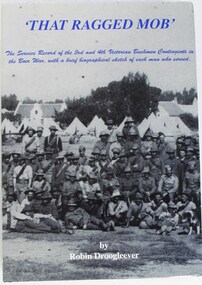
Book, Robin W. F. Droogleever, That Ragged Mob, 2009
... This Battle Honour was awarded to all extant Light Horse units in Australia under Military Order 123 of 1908, in recognition of all states' contribution to the forces who represented Australia against the Boers. boer war victoria army victorian contingent 3rd victoria army victorian contingent 4th south african war 1899 1902 robin drooglever biography boer war victoria army victorian contingent 3rd victoria army victorian contingent 4th south african war 1899 1902 robin drooglever biography Signed by the author: "With the compliments of the author Robin Droogleever 104/10" ISBN 978-0-646-5186-9 Hard covered book. ...The Service Record of the 3rd and 4th Victorian Bushmen Contingents in the Boer War with a brief biographical sketch of each man who served. The modern day 4th/19th Prince of Wales's Light Horse Regiment is the custodian of the theatre Battle Honour "SOUTH AFRICA 1899-1902" awarded to the 9th and 11th Light Horse Regiments. This Battle Honour was awarded to all extant Light Horse units in Australia under Military Order 123 of 1908, in recognition of all states' contribution to the forces who represented Australia against the Boers. Hard covered book.Signed by the author: "With the compliments of the author Robin Droogleever 104/10" ISBN 978-0-646-5186-9boer war, victoria army victorian contingent 3rd, victoria army victorian contingent 4th, south african war 1899 1902, robin drooglever, biography, boer war, victoria army victorian contingent 3rd, victoria army victorian contingent 4th, south african war 1899 1902, robin drooglever, biography -
 4th/19th Prince of Wales's Light Horse Regiment Unit History Room
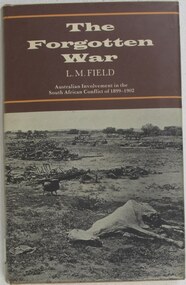
Book, Wilke & Co Ltd, The Forgotten War, Australian Involvement in the South African Conflict of 1899-1902, 1979
... book history boer war book history boer war Stamp of a previous owner, namely Brunswick Public Library Hard covered book of 236 pages, with photos and illustrations The Forgotten War, Australian Involvement in the South African Conflict of 1899-1902 Book Book Wilke & Co Ltd L M Field Melbourne University Press ...Hard covered book of 236 pages, with photos and illustrationsStamp of a previous owner, namely Brunswick Public Librarybook, history, boer war, book, history, boer war
