
Showing 34 items matching "south decline"
-
 Bendigo Historical Society Inc.
Document - Kangaroo Flat Gold Mine Collection: Bendigo Mine, Bendigo Mining NL, Unknown
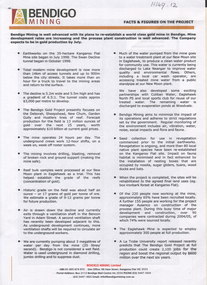
... ...south decline...Bendigo mining gold Kangaroo Flat decline North drive Swan decline south decline New Moon Plant Eaglehawk ventilation shaft drilling blasting ground support One page document, double sided, titled: 'Bendigo Mining, Facts and Figures on the Project'. ...One page document, double sided, titled: 'Bendigo Mining, Facts and Figures on the Project'. Overview of mine project in dot form on page one and map of mine development, superimposed on Google Earth image of Kangaroo Flat area, on page two. On bottom of page 'Bendigo Mining Limited, 66 Ham Street, Kangaroo Flat. Vic 3555.bendigo mining n.l., bendigo, mining, gold, kangaroo flat, decline, north drive, swan decline, south decline, new moon plant eaglehawk, ventilation shaft, drilling, blasting, ground support -
 Bendigo Historical Society Inc.
Document - Kangaroo Flat Gold Mine Collection: Bendigo Gold Project Newsletters, Bendigo Mining NL, November 2001, August 2002, October 2002, July 2005, February 2006 and May 2006
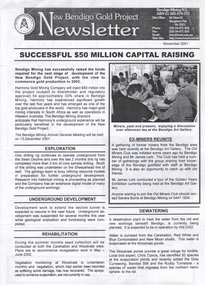
... ...south decline...Bendigo mining gold Kangaroo Flat decline Swan decline south decline New Moon Plant Eaglehawk ventilation shaft drilling blasting ground support Sandra Burns James Lerk underground development rehabilitation Greg Miller Alexandria Reef Six newsletters, "New Bendigo Gold Project", dated November 2001, August 2002, October 2002, July 2005, February 2006 and May 2006. ...New Bendigo Gold Project The Bendigo goldfield is centred on the urban area of Bendigo (population approximately 60 000) in central Victoria, 130 km north west of Melbourne, Australia. Gold was discovered at Bendigo in 1851 and production continued through to 1954. The Bendigo goldfield is the second largest goldfield in total gold produced in Australia, after Kalgoorlie's Golden Mile with a total production of 22 million oz. The geology of the Bendigo Field consists of a series of tightly folded, interbedded sandstone and shale sediments. Within the sediments the gold mineralisation is hosted in quartz reefs or ribbons closely associated with anticline axes and reverse faulting. The gold within the quartz reefs is typically both coarse grained and erratically distributed. Source: https://www.ausimm.com/publications/conference-proceedings/eighth-underground-operators-conference-2002/new-bendigo-gold-project/Six newsletters, "New Bendigo Gold Project", dated November 2001, August 2002, October 2002, July 2005, February 2006 and May 2006. Newsletters highlight development of gold project; a map of the decline development, underground workings and personnel news is featured on most newsletters. bendigo mining n.l., bendigo, mining, gold, kangaroo flat, decline, swan decline, south decline, new moon plant eaglehawk, ventilation shaft, drilling, blasting, ground support, sandra burns, james lerk, underground development, rehabilitation, greg miller, alexandria reef -
 Flagstaff Hill Maritime Museum and Village
Functional object - Hand operated embossing document press, 1910
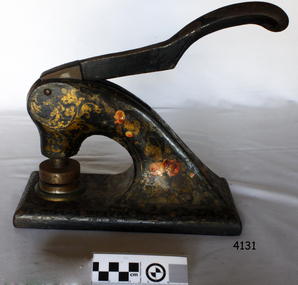
... The Dunlop company bought the mill in 1968, fending off a challenge from Onkaparinga in South Australia, and continued to expand by adding Wendouree Woollen Mill in the same year and Dream-spun Textiles a decade later, in 1979. Soon after that purchase, however, the mill began its slippery slide into decline. ...The Dunlop company bought the mill in 1968, fending off a challenge from Onkaparinga in South Australia, and continued to expand by adding Wendouree Woollen Mill in the same year and Dream-spun Textiles a decade later, in 1979. Soon after that purchase, however, the mill began its slippery slide into decline. ...The woollen mill was a vital part of Warrnambool for all but 22 years of the town’s history since it's the establishment in 1847 when the first land sales were held and white settlement began. In 1869 the Warrnambool Meat Preserving Company began operations on the mill site, in 1875, shareholders of the then defunct Warrnambool Meat Preserving Company happily sold the land and buildings on the Merri river to Warrnambool Woollen Mill Company Ltd for £5,000. The site was sold again in 1876 to grazer Robert Hood of Sherwood, who was chairman of directors of the failed company, which couldn’t raise sufficient capital to keep the works operating. The entrepreneurial Hood then used the existing plant to turn his own wool into tweed cloth. But just as the mill was starting to show a profit, a fire destroyed the building and plant on the night of 25 March 1882. So again, the mill was operational for six short years. Insurers only paid a fraction over 10% of the damage, Hood couldn't raise sufficient capital to rebuild on his own, and so the site lay unused until 1910. In 1908 Marcus Saltau and Peter John McGennan convinced the Warrnambool Chamber of Commerce to invest in a secondary industry with local capital. A public meeting in September 1908 agreed to raise £40,000, electing Saltau chairman of directors, a post he held for 34 years. A year later, using mostly local money, the Warrnambool Woollen Mill Company dispatched its first manager, John E. Bennett, to buy a plant and recruit 20 experienced staff from the Yorkshire woollen industry in December 1909. Another year more, the new mill was officially opened on 14 November 1910 by Marcus Saltau as company chairman and town mayor. Eighteen months on, in May 1912, the mill paid its first half-yearly dividend of 2 ½%. It was now working two shifts, with a year's orders to fill. In 1914 the mill ordered its own generator, providing the town with electricity and effectively doubling its plant size by October 1915, six months after Gallipoli. Thereafter, government orders for cloth and military supplies assured the mill’s success right through the First World War and on until 1923. A plant upgrade in 1922 for machinery to make worsted fabric drained profits, which, with a fall in demand, led to a loss in 1925. Profits were restored by the 1930s, despite the Depression, mostly due to tight management and robust marketing. Production boomed again during the Second World War, but soon foreign competition bit into profits, forcing the company to consolidate operations. The ‘50s and ‘60s were golden years for the mill. Security and growth gave the company confidence to trial Australia’s first electric blanket in 1958 and to install Swiss Sulzer looms in 1965. Over time, the building facades took on the modern look that the mill presented until it closed. The Dunlop company bought the mill in 1968, fending off a challenge from Onkaparinga in South Australia, and continued to expand by adding Wendouree Woollen Mill in the same year and Dream-spun Textiles a decade later, in 1979. Soon after that purchase, however, the mill began its slippery slide into decline. Dunlop sold to its former rival bidder Onkaparinga Woollen Co. Ltd in 1982, which in turn was taken over by Macquarie Worsted's only a year later, in 1983. Operations remained stable for a decade until 1994 when the Macquarie Group signaled that its newly rationalised operations left no room for the Warrnambool investment. The final operator of the mill was The Smith Family charity group, which ran the site by agreement with the Warrnambool City Council and a state government grant in that same year, 1994. The mill became more of a fabric recycler than a manufacturer. The site was sold to private operators in February 2003 and rezoned four months later to allow for the mixed housing development. The embossing press is significant for its association with the Warrnambool Woollen Mills 1910-1968, a major employer in the Warrnambool district. The press is also significant as an example of commercial office equipment used in the 19th and 20th century.Press, metal, for Company seal of Warrnambool Woollen Mill, stamping their brand as Western District Worsted Mills Pty Ltd. Metal is black with red and gold floral markings. Inscription of stamp reads "WESTERN DISTRICT WORSTED MILLS PROPRIETRY LIMITED" flagstaff hill, warrnambool, shipwrecked-coast, flagstaff-hill, flagstaff-hill-maritime-museum, maritime-museum, warrnambool woollen mills, western district worsted mills proprietry limited, worsted fabric, printing press, logo printing press, stamp printing press, shipwreck-coast, flagstaff-hill-maritime-village -
 Federation University Historical Collection
Pamphlet, University of Ballarat Australian Studies Centre, University of Ballarat Conference Pamphlet, 12/1999
... . * Anne Cunningham - Dom bernard Smith's Australian Mission * Mella Cusack - Relations between the Young Irelanders and the Catholic Clergy in Australia * John Daykin - He that is Not With Me is Against Me: The Role of the Irish in the Defeat of conscription, Ballarat 1916-1917 * Dr Frances Devlin Glass - '[T]ouches of nature that make the world kin: Furphy, Race and Anxiety' * Helen Kinloch - Bernard O'Dowd,, and dreams of a Golden age in Australia' * Associate Professor Rederic Lacey - 'Exploring Pathways Towards reconciliation Through Encountering Our Shared Histories' * Dymphna Lonergan - 'Sounds Irish' * Dr David Lucy - ' Remarks on the Decline of Irish Language' * Patrick McCormack - The Irish Factor in the Campaign for Federation in New South Wales * Siobhan McHugh - 'In Search of Soul: One Irishwoman's Journey in Australia' * Ken Mansell * Dr Val Noone - 'the Irish in collingwood 1860-1900: Family Tree Meets historical Record * Ambassador Richard Anthony O'Brien * Terrence O'neill-FitzSimons - "Francis Thomas Cusack-Russell' * Professor Bob Reece - 'The making of the Eureka Film' * Edward O'Reilly - 'John Boyle-O'Reilly: Journeys and Monuments * Dr Chris Watson - 'Around the Boree Log and the identity of Irish Australians' * Dorothy Wickham - 'Saints or Sinners?.... * Anne Cunningham - Dom bernard Smith's Australian Mission * Mella Cusack - Relations between the Young Irelanders and the Catholic Clergy in Australia * John Daykin - He that is Not With Me is Against Me: The Role of the Irish in the Defeat of conscription, Ballarat 1916-1917 * Dr Frances Devlin Glass - '[T]ouches of nature that make the world kin: Furphy, Race and Anxiety' * Helen Kinloch - Bernard O'Dowd,, and dreams of a Golden age in Australia' * Associate Professor Rederic Lacey - 'Exploring Pathways Towards reconciliation Through Encountering Our Shared Histories' * Dymphna Lonergan - 'Sounds Irish' * Dr David Lucy - ' Remarks on the Decline of Irish Language' * Patrick McCormack - The Irish Factor in the Campaign for Federation in New South Wales * Siobhan McHugh - 'In Search of Soul: One Irishwoman's Journey in Australia' * Ken Mansell * Dr Val Noone - 'the Irish in collingwood 1860-1900: Family Tree Meets historical Record * Ambassador Richard Anthony O'Brien * Terrence O'neill-FitzSimons - "Francis Thomas Cusack-Russell' * Professor Bob Reece - 'The making of the Eureka Film' * Edward O'Reilly - 'John Boyle-O'Reilly: Journeys and Monuments * Dr Chris Watson - 'Around the Boree Log and the identity of Irish Australians' * Dorothy Wickham - 'Saints or Sinners? ...A conference in memory of Kevin Livingston to celebrate the role the Irish in Ballarat played in the formation of the nation..1) Light green tri-folded A4 pamphlet .2) Program for the 'Through Irish Eyes' Conference, A conference held in memory of Associate Professor Kevin T. Livinsgston by the University of Ballarat Australian Studies Centre, 3-5 December 1999. Speakers were: * Anne Beggs Sunter - 'irish Republican Echoes at Eureka * Jill Blee - 'Portrait of a Ballarat Irishman/woman * Dianne (Leonard) Cahir - 'The Irishness of Dunnstown * Dianne Campbell - Sir Henry Cuthbert * Dermot Clancy - Colonial Clergy - All Hallows College and the Australian Mission in the 19th Century. * Anne Cunningham - Dom bernard Smith's Australian Mission * Mella Cusack - Relations between the Young Irelanders and the Catholic Clergy in Australia * John Daykin - He that is Not With Me is Against Me: The Role of the Irish in the Defeat of conscription, Ballarat 1916-1917 * Dr Frances Devlin Glass - '[T]ouches of nature that make the world kin: Furphy, Race and Anxiety' * Helen Kinloch - Bernard O'Dowd,, and dreams of a Golden age in Australia' * Associate Professor Rederic Lacey - 'Exploring Pathways Towards reconciliation Through Encountering Our Shared Histories' * Dymphna Lonergan - 'Sounds Irish' * Dr David Lucy - ' Remarks on the Decline of Irish Language' * Patrick McCormack - The Irish Factor in the Campaign for Federation in New South Wales * Siobhan McHugh - 'In Search of Soul: One Irishwoman's Journey in Australia' * Ken Mansell * Dr Val Noone - 'the Irish in collingwood 1860-1900: Family Tree Meets historical Record * Ambassador Richard Anthony O'Brien * Terrence O'neill-FitzSimons - "Francis Thomas Cusack-Russell' * Professor Bob Reece - 'The making of the Eureka Film' * Edward O'Reilly - 'John Boyle-O'Reilly: Journeys and Monuments * Dr Chris Watson - 'Around the Boree Log and the identity of Irish Australians' * Dorothy Wickham - 'Saints or Sinners?: The Influence on Ballarat's Female refuge by Irish Women' * Christine Wright - 'A Stately Landmark: Adam Loftus Lynn .3) newspaper article on the conference from The Courier, 06/12/1999 - 'Irish Celebrate Their Role in City'Black print on light green paperaustralian studies, university of ballarat, kevin livingston, mt helen campus, "through irish eyes", jill blee, david james, rod lacey, val noone, dianne campbell, christine wright, terence o'neill-fitzsimons, helen kinloch, diane cahir, dorothy wickham, edward reilly, mella cusack, anne beggs-sunter, patrick mccormack, anne cunningham, shane carmody, dermot clancy, francis devlin-glass, chris watson, david lucy, dymphna lonergan, richard o'brien, bob reece, peter kennedy, gough whitlam, australian studies, university of ballarat, kevin livingston, mt helen campus, "through irish eyes", jill blee, david james, rod lacey, val noone, dianne campbell, christine wright, terence o'neill-fitzsimons, helen kinloch, diane cahir, dorothy wickham, edward reilly, mella cusack, anne beggs-sunter, patrick mccormack, anne cunningham, shane carmody, dermot clancy, francis devlin-glass, chris watson, david lucy, dymphna lonergan, richard o'brien, bob reece, peter kennedy, gough whitlam, genealogy, family history, irish australians, irish -
 Flagstaff Hill Maritime Museum and Village
Craft - Ship Model, S.S. Nelson, 1877 - 1984
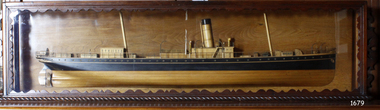
... Once the railway came to Warrnambool in 1889, the steam shipping industry began to decline. flagstaff hill warrnambool shipwrecked-coast flagstaff-hill flagstaff-hill-maritime-museum maritime-museum shipwreck-coast flagstaff-hill-maritime-village s.s. nelson steam ship 1877 screw steamer 1877 vessel ship model s.s. nelson blackwood and gordon port glasgow warrnambool steam packet company western steam navigation company south west coast trader sea transport melbourne to portland victorian steam navigation board s.s. julia percey captain john nicholson captain thomas smith captain s drewet captain john thompson captain carrington huddart, parker and co bass strait crossing 1890 sea transport melbourne to launceston porpoise rock tamar river australian alliance insurance company ship model making vessels victorian coastal trader "NELSON" painted on bow Ship model; relief of the S.S. ...This beautifully made ship model is a side relief of the steam ship “S.S. Nelson”, which was launched in 1877. The model’s case stands out because of its ornately carved internal frame. Relief models of ships, sometimes called half models, were often built by the shipbuilders as an exact scale model of the finished ship. The shipbuilders would use the model to ensure that the design was balanced. They would use the model as a point of reference during building. Also, ship models were used to demonstrate the designs to prospective buyers. It is not known whether this model of the “S.S. Nelson” was made for these purposes. HISTORY of the “S.S. Nelson” During the period 1840-1890 shipping was the cheapest and most practical means of carrying produce and goods to and from coastal towns such as Warrnambool. In the 1850s regular domestic steamer services began and by 1870 the passenger trade was booming. Passengers were taken to the ship’s side in small boats called lighters, which took it to ships at anchorage in Lady Bay, then climbed aboard up ladders or gangways. Their fare covered accommodation Saloon/Cabin section (higher class and more expensive) or the Steerage section (lower class and less expensive, below deck level). Produce included livestock such as pigs and fowls, and dairy products, bales of wool, and potatoes. The goods were loaded from the Warrnambool Jetty into the lighters. The S.S. Nelson was built by Messrs Blackwood and Gordon of Port Glasgow for a cost £25,000 in 1877. She was an iron screw steamer with an overall length of 200 feet, beam 25.5 feet and a depth of hold of 19.4 feet, which gave her a gross measurement of 649 tons. Her engines gave her a best speed of 13 knots and a maintainable speed of 12 knots. She was described as a handsome, star decked, efficient steamship, fitted with accommodating for 75 first class passengers in a saloon, and 40 second class passengers in a cabin. The S.S. Nelson arrived in the colony of Victoria on March 9th, 1877. She was first registered in Warrnambool by the Warrnambool Steam Packet Company under the management of Mr William Evans, and employed in the coastal trade of south west Victoria. She was very popular in 1878, registered under the new ownership of the Western Steamship Navigation Company, trading between Melbourne, Warrnambool and Portland. Captained John Nicholson commanded the S.S. Nelson after the previous captain, Thomas Smith, was suspended in 1882 for six months by the Victorian Steam Navigation Board following the collision between the S.S. Nelson and the S.S. Julia Percy. Other Captains include S Drewet and John Thompson. The S.S. Nelson was sold to Messrs. Huddart, Parker and Co. and re-registered in Melbourne on June 23rd, 1890. The new owners intended to use her for their Bass Strait crossing between Melbourne, Victoria and Launceston, Tasmania. On the night of Friday, June 27th 1890, under the command of Captain Carrington, she was on her way to Launceston on her first crossing for her new owners. She had no passengers and very little cargo and was to return to Melbourne with passengers the following morning. She was only 21 hours out of the dock when she struck Porpoise Rock in the Tamar River. All crew of 25 were saved but the bulkheads gave way and she rapidly filled before keeling over and disappearing in approximately 130 feet of water. The new owners had fully insured the almost 14-year-old S.S. Nelson with the Australian Alliance Insurance Company and she had only been in their possession for four days. This ship model of the S.S. Nelson is significant for its connection with the steam screw ship S.S. Nelson, one of a fleet of vessels owned by the Warrnambool Steam Packet Company. The S.S. Nelson was specifically built and purchased for the Victorian coastal trade business of the late 19th century, when shipping was the cheapest and most practical means of transporting goods and passengers between Victoria’s coastal towns and the major port at Melbourne. Once the railway came to Warrnambool in 1889, the steam shipping industry began to decline.Ship model; relief of the S.S. Nelson, showing deck superstructure, ventilators and single funnel. Ship's name is painted on the bow "NELSON". Wood model, varnished finish over natural wood and black painted areas. Timber case with ornate edging and glass front and sides."NELSON" painted on bowflagstaff hill, warrnambool, shipwrecked-coast, flagstaff-hill, flagstaff-hill-maritime-museum, maritime-museum, shipwreck-coast, flagstaff-hill-maritime-village, s.s. nelson steam ship 1877, screw steamer, 1877 vessel, ship model s.s. nelson, blackwood and gordon port glasgow, warrnambool steam packet company, western steam navigation company, south west coast trader, sea transport melbourne to portland, victorian steam navigation board, s.s. julia percey, captain john nicholson, captain thomas smith, captain s drewet, captain john thompson, captain carrington, huddart, parker and co, bass strait crossing 1890, sea transport melbourne to launceston, porpoise rock tamar river, australian alliance insurance company, ship model making, vessels, victorian coastal trader -
 The Beechworth Burke Museum
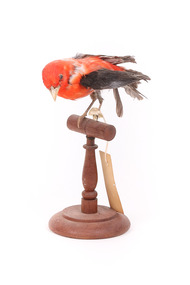
Animal specimen - Scarlet Tanager (male), Trustees of the Australian Museum, 1860-1880
... South America. They can often be found within woodlands that have oaks. On occasion, the Tanager can be seen in suburban areas including parks and gardens. These birds are sociable and often join with other foraging flocks. They are carnivores (insectivores) and feed on insects including wasps, ants, moths, beetles, butterflies and grasshoppers. The numbers of these birds in America are declining...South America. They can often be found within woodlands that have oaks. On occasion, the Tanager can be seen in suburban areas including parks and gardens. These birds are sociable and often join with other foraging flocks. They are carnivores (insectivores) and feed on insects including wasps, ants, moths, beetles, butterflies and grasshoppers. The numbers of these birds in America are declining ...The Scarlet Tanager is an American songbird of medium size with bright coloured plumage. They are commonly located in eastern North America and in northwestern South America. They can often be found within woodlands that have oaks. On occasion, the Tanager can be seen in suburban areas including parks and gardens. These birds are sociable and often join with other foraging flocks. They are carnivores (insectivores) and feed on insects including wasps, ants, moths, beetles, butterflies and grasshoppers. The numbers of these birds in America are declining due to exposure and starvation during the colder months. These birds can also die from collisions with man made objects which includes the TV and radio towers, buildings and cars. They also have high rates of predation and brood parasitism. However, at current the IUCN classifies this species as Least Concern and note that their numbers are stable. This specimen is part of a collection of almost 200 animal specimens that were originally acquired as skins from various institutions across Australia, including the Australian Museum in Sydney and the National Museum of Victoria (known as Museums Victoria since 1983), as well as individuals such as amateur anthropologist Reynell Eveleigh Johns between 1860-1880. These skins were then mounted by members of the Burke Museum Committee and put-on display in the formal space of the Museum’s original exhibition hall where they continue to be on display. This display of taxidermy mounts initially served to instruct visitors to the Burke Museum of the natural world around them, today it serves as an insight into the collecting habits of the 19th century.This specimen is part of a significant and rare taxidermy mount collection in the Burke Museum. This collection is scientifically and culturally important for reminding us of how science continues to shape our understanding of the modern world. They demonstrate a capacity to hold evidence of how Australia’s fauna history existed in the past and are potentially important for future environmental research. This collection continues to be on display in the Museum and has become a key part to interpreting the collecting habits of the 19th century.The Scarlet Tanager specimen stands perched on a wooden platform looking towards the ground. It has bright red/orange feathers on the main body and head with dark black feathers on the tail and wings. Overall, whilst retaining a bright appearance the bird has faded in contrast to it's original colouring This particular specimen has disheveled feathers and is missing one leg. The bill is short and pale and the specimen has been provided with glass eyes made in a dark colour. The specimen has two paper identification tags attached to the damaged leg.Swing tag: 114a / unnamed / catalogue, page 59 Cotton tag: A.4440 /taxidermy mount, taxidermy, animalia, burke museum, beechworth, australian museum, skin, reynell eveleigh johns, bird, australian birds, american, american birds, scarlet tanager, tanager, medium bird, small bird -
 The Beechworth Burke Museum
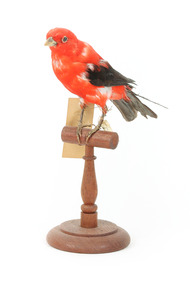
Animal specimen - Scarlet Tanager (male), Trustees of the Australian Museum, 1860-1880
... South America. They can often be found within woodlands that have oaks. On occasion, the Tanager can be seen in suburban areas including parks and gardens. These birds are sociable and often join with other foraging flocks. They are carnivores (insectivores) and feed on insects including wasps, ants, moths, beetles, butterflies and grasshoppers. The numbers of these birds in America are declining...South America. They can often be found within woodlands that have oaks. On occasion, the Tanager can be seen in suburban areas including parks and gardens. These birds are sociable and often join with other foraging flocks. They are carnivores (insectivores) and feed on insects including wasps, ants, moths, beetles, butterflies and grasshoppers. The numbers of these birds in America are declining ...The Scarlet Tanager is an American songbird of medium size with bright coloured plumage. They are commonly located in eastern North America and in northwestern South America. They can often be found within woodlands that have oaks. On occasion, the Tanager can be seen in suburban areas including parks and gardens. These birds are sociable and often join with other foraging flocks. They are carnivores (insectivores) and feed on insects including wasps, ants, moths, beetles, butterflies and grasshoppers. The numbers of these birds in America are declining due to exposure and starvation during the colder months. These birds can also die from collisions with man made objects which includes the TV and radio towers, buildings and cars. They also have high rates of predation and brood parasitism. However, at current the IUCN classifies this species as Least Concern and note that their numbers are stable. This specimen is part of a collection of almost 200 animal specimens that were originally acquired as skins from various institutions across Australia, including the Australian Museum in Sydney and the National Museum of Victoria (known as Museums Victoria since 1983), as well as individuals such as amateur anthropologist Reynell Eveleigh Johns between 1860-1880. These skins were then mounted by members of the Burke Museum Committee and put-on display in the formal space of the Museum’s original exhibition hall where they continue to be on display. This display of taxidermy mounts initially served to instruct visitors to the Burke Museum of the natural world around them, today it serves as an insight into the collecting habits of the 19th century.This specimen is part of a significant and rare taxidermy mount collection in the Burke Museum. This collection is scientifically and culturally important for reminding us of how science continues to shape our understanding of the modern world. They demonstrate a capacity to hold evidence of how Australia’s fauna history existed in the past and are potentially important for future environmental research. This collection continues to be on display in the Museum and has become a key part to interpreting the collecting habits of the 19th century.The Scarlet Tanager specimen stands perched on a wooden platform looking forwards in a raised position. It has bright red/orange feathers on the main body and head with dark black feathers on the tail and wings. Overall, whilst retaining a bright appearance the bird has faded in contrast to it's original colouring. The bill is short and pale and the specimen has been provided with glass eyes made in a dark colour. The specimen has two paper identification tags attached to the right leg.Swing tag: 143a / unnamed / catalogue page 59 Metal tag: A4439 /taxidermy mount, taxidermy, animalia, burke museum, beechworth, australian museum, skin, reynell eveleigh johns, bird, australian birds, american, american birds, scarlet tanager, tanager, medium bird, small bird -
 The Beechworth Burke Museum
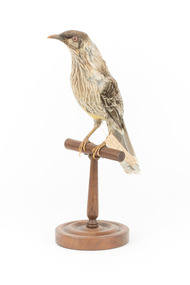
Animal specimen - Red Wattle Bird, Trustees of the Australian Museum, 1860-1880
... South Australia, and southwest Western Australia, inhabiting open forests, woodlands, and urban gardens or parks. Known for its loud and conspicuous presence, the red wattlebird primarily forages in trees, although it occasionally searches for food on the ground. As one of the world's largest nectar-feeding birds, it consumes nectar from a wide variety of flowering plants, supplementing its diet with insects. Territorial and sometimes aggressive, it defends rich nectar sources from other bird species. Breeding occurs throughout its range, with the species constructing cup-shaped nests in trees and raising one or two broods annually. Despite localized declines...South Australia, and southwest Western Australia, inhabiting open forests, woodlands, and urban gardens or parks. Known for its loud and conspicuous presence, the red wattlebird primarily forages in trees, although it occasionally searches for food on the ground. As one of the world's largest nectar-feeding birds, it consumes nectar from a wide variety of flowering plants, supplementing its diet with insects. Territorial and sometimes aggressive, it defends rich nectar sources from other bird species. Breeding occurs throughout its range, with the species constructing cup-shaped nests in trees and raising one or two broods annually. Despite localized declines ...The red wattlebird is a passerine bird native to southern Australia. Measuring 33–37 cm (13–14.5 inches) in length, it ranks as the second-largest species among Australian honeyeaters. The species was first described by John White in 1790, and three subspecies are currently recognised. The red wattlebird is found across southeast Queensland, New South Wales, Victoria, South Australia, and southwest Western Australia, inhabiting open forests, woodlands, and urban gardens or parks. Known for its loud and conspicuous presence, the red wattlebird primarily forages in trees, although it occasionally searches for food on the ground. As one of the world's largest nectar-feeding birds, it consumes nectar from a wide variety of flowering plants, supplementing its diet with insects. Territorial and sometimes aggressive, it defends rich nectar sources from other bird species. Breeding occurs throughout its range, with the species constructing cup-shaped nests in trees and raising one or two broods annually. Despite localized declines due to habitat loss, the red wattlebird is listed as Least Concern on the IUCN Red List. This specimen was falsely identified as a yellow wattlebird in original catalogue records and is part of a collection of almost 200 animal specimens that were originally acquired as skins from various institutions across Australia, including the Australian Museum in Sydney and the National Museum of Victoria (known as Museums Victoria since 1983), as well as individuals such as amateur anthropologist Reynell Eveleigh Johns between 1860-1880. These skins were then mounted by members of the Burke Museum Committee and put-on display in the formal space of the Museum’s original exhibition hall where they continue to be on display. This display of taxidermy mounts initially served to instruct visitors to the Burke Museum of the natural world around them, today it serves as an insight into the collecting habits of the 19th century.This specimen is part of a significant and rare taxidermy mount collection in the Burke Museum. This collection is scientifically and culturally important for reminding us of how science continues to shape our understanding of the modern world. They demonstrate a capacity to hold evidence of how Australia’s fauna history existed in the past and are potentially important for future environmental research. This collection continues to be on display in the Museum and has become a key part to interpreting the collecting habits of the 19th century.The red wattlebird has predominantly grey-brown plumage, featuring red eyes, pale pinkish-red wattles on each side of the neck, white streaking on the chest, and a prominent yellow patch on the lower belly. Swing-tag: 58a. / Wattled - Honeyeater / See catalogue page 18taxidermy mount, taxidermy, animalia, burke museum, beechworth, australian museum, skin, bird, yellow wattlebird, tasmanian wattlebird, anthochaera paradoxa, australian birds, wattlebird, red wattlebird -
 Orbost & District Historical Society
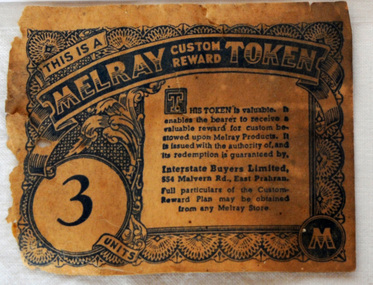
token, mid 20th century
... South Yarra, Melbourne – a site of jam production in Australia for almost 100 years. Many Melray labels were discovered there, when the site was converted to a shopping centre in the 1970s, a period of industry-wide decline." ...South Yarra, Melbourne – a site of jam production in Australia for almost 100 years. Many Melray labels were discovered there, when the site was converted to a shopping centre in the 1970s, a period of industry-wide decline." ..." As well as preserving companies, various grocery chains, buying groups and wholesale co-operatives sold jam under their own brand names. One such company was Melray. Melray, founded in East Prahran, Melbourne, in 1932, was the forerunner of the Foodland chain (1958). It had branches across the country. Their jam labels included special reward tokens for redemption in-store. It is most likely that Melray jam was produced by Henry Jones’ Australasian Jam Company, or at least labelled at the iconic Jam Factory in South Yarra, Melbourne – a site of jam production in Australia for almost 100 years. Many Melray labels were discovered there, when the site was converted to a shopping centre in the 1970s, a period of industry-wide decline." (Information from australiapostcollectables web-site) The Melray Association of Independent Grocers consisted of the leading storekeepers throughout the State of Victoria, with a central headquarters and bulk store in Melbourne.These tokens were issued by Melray Stores as a reward for custom. This item is associated with the period when Australia produced and exported much more of its agricultural produce - including tinned jam.A paper token - Melray Custom Reward Token. This is a reward token issued by Melray for regular custom - 3 units.melray grocery-store custom commerce -
 Orbost & District Historical Society
black and white photograph, late 19th century - early 20th century
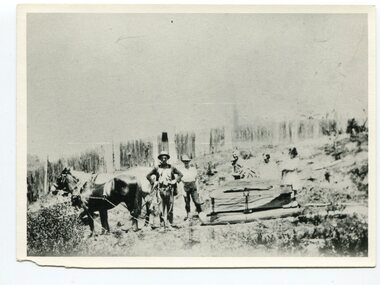
... decline in gold mining. Some miners selected land, which in many cases is still held by descendants. Dairying was common in the early days, supplying a butter factory at the New South Wales border, and a milk factory at Orbost in more recent times. ...decline in gold mining. Some miners selected land, which in many cases is still held by descendants. Dairying was common in the early days, supplying a butter factory at the New South Wales border, and a milk factory at Orbost in more recent times. ...This photograph shows land clearing at Bendoc. From 1845 the Bendoc area was part of pastoral leases. In the 1850s alluvial gold was discovered in the Bendoc River. This was quickly exhausted, and a number of mines began successful reef operations. At the head of the river, the settlement of Clarkville clustered round several other mines. Many miners, including numbers of Chinese, sluiced the rivers. The population of the area was as high as 500 during this period. The township was surveyed in 1869 and the hotel built in 1870. This building was burnt down in the early 1900s and rebuilt. A school was also begun at this time. In the 1870s there was a decline in gold mining. Some miners selected land, which in many cases is still held by descendants. Dairying was common in the early days, supplying a butter factory at the New South Wales border, and a milk factory at Orbost in more recent times. Wheat was grown for the settlers' own use and ground at Bombala. Now beef cattle grazing is the main occupation. (info. from Victorian Places)This is a pictorial history associated with the early settlement of Bendoc in East Gippsland.A badly distorted black / white photograph of a horse drawn wagon, three men and two women clearing land.on back - "Clearing land at Bendoc"bendoc-land-clearing bendoc-early-settlement -
 Orbost & District Historical Society
magazines, Atlas Press Pty Ltd, East Gippsland & Railway Extension, 10 September 1908
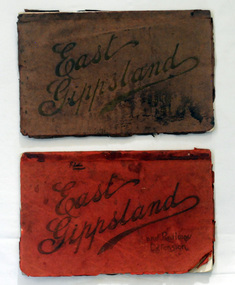
... South Wales border, the first was through Bendoc, another by the Cann River and another which is located between these two. This item is associated with the history of the Orbost-Bairnsdale railway line and therefore reflects the role that the rail line played in the social and economic history of Orbost. The Bairnsdale-Orbost railway was opened in 1916 to serve the agricultural and timber industry. Because of the decline ...Orbost and East Gippsland Railway League had proposed a railway extension through East Gippsland in 1908, which aimed to develop an isolated part of the country. At the time, construction of a railway could be considered a beneficial investment for the country as it could increase the population in the region. The proposed railway length in 1908 was about 140 miles and the cost was estimated £800,000. The line was proposed to proceed from Bairnsdale by way of the Lower Nicholson to Bruthen. “After crossing the Tambo River, it would be carried to near Nowa Nowa; the head of Lake Tyers, forward to Orbost. From Orbost it would proceed in a north-easterly way to the New South Wales border. There were different suggested routes between Orbost and the New South Wales border, the first was through Bendoc, another by the Cann River and another which is located between these two. This item is associated with the history of the Orbost-Bairnsdale railway line and therefore reflects the role that the rail line played in the social and economic history of Orbost. The Bairnsdale-Orbost railway was opened in 1916 to serve the agricultural and timber industry. Because of the decline in traffic and heavy operating costs, the line was finally closed in August, 1987. Two small magazines showing the railway extension through East Gippsland. 678.1 has a dark maroon cover with gold print writing. It contains b/w photographs. 678.2 has a red cover with black print writing. Both are bound. 678.1 - inside front cover - M. Beattie ???????? Newmerella 678.2 - inside front cover - Gordon Fisher Orbosteast-gippsland-railway-league railway -
 Orbost & District Historical Society
railways envelope, C 1980's
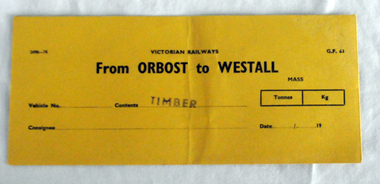
... South, opening on 6 February 1951. Westall station was opened as a workers only platform on 16 October 1954. It was provided for the adjacent Martin & King railway coachbuilding factory. The station was opened to the public on 1 June 1959 when all trains on the line began stopping there. The Bairnsdale-Orbost railway was opened in 1916 to serve the agricultural and timber industry. Because of the decline...South, opening on 6 February 1951. Westall station was opened as a workers only platform on 16 October 1954. It was provided for the adjacent Martin & King railway coachbuilding factory. The station was opened to the public on 1 June 1959 when all trains on the line began stopping there. The Bairnsdale-Orbost railway was opened in 1916 to serve the agricultural and timber industry. Because of the decline ...This item was used by Victorian Railways 1970's/1980's. It was used at Orbost Railway Station for the consignment of timber from Orbost to Westall.. Westall was a major timber-receiving depot near Dandenong, Victoria. Westall railway station is located on the Pakenham and Cranbourne lines in Victoria, Australia. It serves the south-eastern Melbourne suburb of Clayton South, opening on 6 February 1951. Westall station was opened as a workers only platform on 16 October 1954. It was provided for the adjacent Martin & King railway coachbuilding factory. The station was opened to the public on 1 June 1959 when all trains on the line began stopping there. The Bairnsdale-Orbost railway was opened in 1916 to serve the agricultural and timber industry. Because of the decline in traffic and heavy operating costs, the line was finally closed in August, 1987. Orbost Railway Station was opened on Monday 10 April 1916 as the terminus of the Orbost railway line, and closed in 1987. The station was located on the west side of the Snowy River despite the town of Orbost being on the east side of the river, in order to save on the costs of a bridge over the river, which at the time had highly variable levels. This item is associated with the history of the Orbost-Bairnsdale railway line and therefore reflects the role that the rail line played in the social and economic history of Orbost.An unused brown/buff coloured goods/freight consignment envelope used by Victorian Railways, this one for timber from Orbost to Westall. It is DL size.2497-78 VICTORIAN RAILWAYS G.F 63 From ORBOST to WESTALL MASS Tonnes kg Vehicle No Contents TIMBER Consignee Date orbost-bairnsdale-railway westall -
 The Beechworth Burke Museum
Animal specimen - Crimson Rosella, Trustees of the Australian Museum, 1860-1880
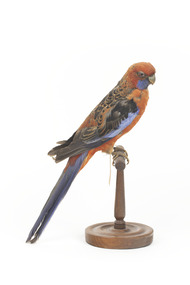
... In southern South Australia they differ again, being roughly intermediate between crimson and yellow, with varying amounts of red and yellow in their plumage. Research featured in the 'State of Australia's Birds 2015' headline and regional reports suggest that the Crimson Rosella may be declining in the East Coast. ...In southern South Australia they differ again, being roughly intermediate between crimson and yellow, with varying amounts of red and yellow in their plumage. Research featured in the 'State of Australia's Birds 2015' headline and regional reports suggest that the Crimson Rosella may be declining in the East Coast. ...This specimen is part of a collection of almost 200 animal specimens that were originally acquired as skins from various institutions across Australia, including the Australian Museum in Sydney and the National Museum of Victoria (known as Museums Victoria since 1983), as well as individuals such as amateur anthropologist Reynell Eveleigh Johns between 1860-1880. These skins were then mounted by members of the Burke Museum Committee and put-on display in the formal space of the Museum’s original exhibition hall where they continue to be on display. This display of taxidermy mounts initially served to instruct visitors to the Burke Museum of the natural world around them, today it serves as an insight into the collecting habits of the 19th century. The Crimson Rosella is relatively easy to see as it forages on the ground or among the leaves of eucalypts, with its spectacular combination of deep-crimson, royal-blue and black plumage. However, not all Crimson Rosellas look the same. Along the Murray River, Crimson Rosellas aren’t crimson at all — they are yellow, black and blue, with the yellow feathering replacing the crimson plumage. In southern South Australia they differ again, being roughly intermediate between crimson and yellow, with varying amounts of red and yellow in their plumage. Research featured in the 'State of Australia's Birds 2015' headline and regional reports suggest that the Crimson Rosella may be declining in the East Coast. There are several populations of the Crimson Rosella. Red (crimson) birds occur in northern Queensland, in southern Queensland to south-eastern South Australia and on Kangaroo Island. Orange birds are restricted to the Flinders Ranges region of South Australia, while yellow ones are found along the Murray, Murrumbidgee and neighbouring rivers (where yellow birds meet red birds they hybridise, producing orange offspring). Red birds have been introduced to Norfolk Island and New Zealand.This specimen is part of a significant and rare taxidermy mount collection in the Burke Museum. This collection is scientifically and culturally important for reminding us of how science continues to shape our understanding of the modern world. They demonstrate a capacity to hold evidence of how Australia’s fauna history existed in the past and are potentially important for future environmental research. This collection continues to be on display in the Museum and has become a key part to interpreting the collecting habits of the 19th century.There are several colour forms of the Crimson Rosella. The form it is named for has mostly crimson (red) plumage and bright blue cheeks. The feathers of the back and wing coverts are black broadly edged with red. The flight feathers of the wings have broad blue edges and the tail is blue above and pale blue below and on the outer feathers. This particular specimen has lost some feathers in its plumage and its colour is not as bright as that of a live specimen.Label: 77a / Pennant's Parakeet / See catalogue, page 22taxidermy, crimson rosella, bird, australian bird, rosella, crimson -
 Orbost & District Historical Society
eggs
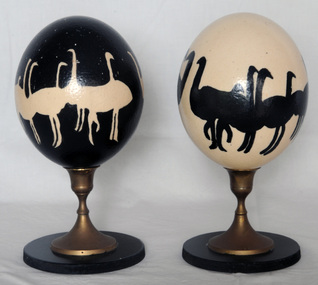
... declined in the 20th century, partly due to the protection of eggs through legislation. This has been overturned in recent years with the development of commercial emu farms. In the period between the two world wars particularly, with the production of other Aboriginal artefacts for an outside market, the carving of emu eggs provided an important source of income for Aboriginal people in many parts of Australia. It was a widespread practice in the south...declined in the 20th century, partly due to the protection of eggs through legislation. This has been overturned in recent years with the development of commercial emu farms. In the period between the two world wars particularly, with the production of other Aboriginal artefacts for an outside market, the carving of emu eggs provided an important source of income for Aboriginal people in many parts of Australia. It was a widespread practice in the south ...These eggs could be ostrich eggs from an ostrich farm which operated just out of Marlo. It is likely that they were donated by Kate and Richard Earle who ran the enterprise. Emu and ostrich eggs are perfect for decorating, painting or carving. Emu egg shells have multiple layers ranging from an inner white layer through to the dark green outer layer. The contents must be removed through a small hole (either tool drilled or poked with a needle). After the yolk has been blown out (scrambling the yolk first by poking with a needle will make it easier to remove), the egg needs to be washed through and left to drain dry. It can then be painted, carved, etched or decorated. Emu decorating is a traditional Aboriginal art. The carving of emu eggs by Indigenous and non-Indigenous people was popular in the late 19th century but production declined in the 20th century, partly due to the protection of eggs through legislation. This has been overturned in recent years with the development of commercial emu farms. In the period between the two world wars particularly, with the production of other Aboriginal artefacts for an outside market, the carving of emu eggs provided an important source of income for Aboriginal people in many parts of Australia. It was a widespread practice in the south-east and it was not unusual for Aboriginal people to decorate their own homes with carved eggs and other items created by themselves or community members, serving to affirm an Indigenous identity within the domestic environment. (ref National Gallery of Australia)This item is significant for its uniqueness and aesthetic appeal.Two painted eggs on stands. 1907.1 is painted black and has white emus or ostriches painted on it. 1907.2 is painted white and has black emus or ostriches painted on it. Both stands are wooden with brass pedestals. The eggs are possibly ostrich eggs.handcraft emu-egg ornament ostrich-egg -
 Orbost & District Historical Society
emu egg
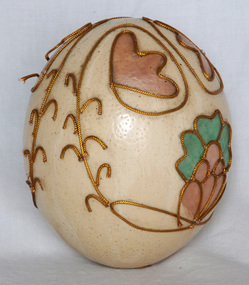
... declined in the 20th century, partly due to the protection of eggs through legislation. This has been overturned in recent years with the development of commercial emu farms. In the period between the two world wars particularly, with the production of other Aboriginal artefacts for an outside market, the carving of emu eggs provided an important source of income for Aboriginal people in many parts of Australia. It was a widespread practice in the south...declined in the 20th century, partly due to the protection of eggs through legislation. This has been overturned in recent years with the development of commercial emu farms. In the period between the two world wars particularly, with the production of other Aboriginal artefacts for an outside market, the carving of emu eggs provided an important source of income for Aboriginal people in many parts of Australia. It was a widespread practice in the south ...Emu eggs are perfect for decorating, painting or carving. Emu egg shells have multiple layers ranging from an inner white layer through to the dark green outer layer. The contents must be removed through a small hole (either tool drilled or poked with a needle). After the yolk has been blown out (scrambling the yolk first by poking with a needle will make it easier to remove), the egg needs to be washed through and left to drain dry. It can then be painted, carved, etched or decorated. Emu decorating is a traditional Aboriginal art. The carving of emu eggs by Indigenous and non-Indigenous people was popular in the late 19th century but production declined in the 20th century, partly due to the protection of eggs through legislation. This has been overturned in recent years with the development of commercial emu farms. In the period between the two world wars particularly, with the production of other Aboriginal artefacts for an outside market, the carving of emu eggs provided an important source of income for Aboriginal people in many parts of Australia. It was a widespread practice in the south-east and it was not unusual for Aboriginal people to decorate their own homes with carved eggs and other items created by themselves or community members, serving to affirm an Indigenous identity within the domestic environment. (ref National Gallery of Australia)This item is significant for its uniqueness and its aesthetic appeal.An emu egg which has been painted white and decorated with glued on cord/thread to make a pattern of flowers and leaves.emu-egg ornament handcraft -
 Eltham District Historical Society Inc
Photograph - Digital Photograph, Alan King, Former St Andrews State School No. 128 building, 23 January 2008
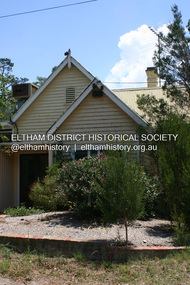
... In 1882, due to declining numbers of pupils at Smiths Gully and increasing numbers in Queenstown the school was moved from a leased building, owned by Head Teacher Robert Harris, into a new larger building on the corner of School and Heidelberg-Kinglake roads which incorporated the original single room school building, which had been moved from Smiths Gully, and included a teacher’s three-roomed residence. In 1887 the school was replaced by the Queenstown State School No. 128. The school and town were renamed St Andrews in 1952. In 1983 a new school was built, 500 metres south...In 1882, due to declining numbers of pupils at Smiths Gully and increasing numbers in Queenstown the school was moved from a leased building, owned by Head Teacher Robert Harris, into a new larger building on the corner of School and Heidelberg-Kinglake roads which incorporated the original single room school building, which had been moved from Smiths Gully, and included a teacher’s three-roomed residence. In 1887 the school was replaced by the Queenstown State School No. 128. The school and town were renamed St Andrews in 1952. In 1983 a new school was built, 500 metres south ...In 1858 the Caledonia Common School No.128 opened at Queenstown, about 1.6km upstream on Diamond Creek from the present site of the old St Andrews school. The school was renamed Queenstown Common School No. 128 in 1867. In 1882, due to declining numbers of pupils at Smiths Gully and increasing numbers in Queenstown the school was moved from a leased building, owned by Head Teacher Robert Harris, into a new larger building on the corner of School and Heidelberg-Kinglake roads which incorporated the original single room school building, which had been moved from Smiths Gully, and included a teacher’s three-roomed residence. In 1887 the school was replaced by the Queenstown State School No. 128. The school and town were renamed St Andrews in 1952. In 1983 a new school was built, 500 metres south of the old school and the old school became the St Andrews Community Centre. Of significance is the c1887 school building (including part of the c1876 Smith's Gully school moved to the site and incorporated into the c1887 school building), the c1911 new room, the c1929 cloakroom, the c1930 renovations, the c1956 new infant room; the c1961 office and storeroom, as well as the c1950 Himalayan Cedar tree and the entire site to the title boundaries. The school building is historically significant for its links with the early settlement of the area and because its use of materials from the former Smith's Gully State school illustrates the common 19th and early 20th century practice of relocating State school buildings based on need. The school building is historically and socially significant because it served the local community, as a school, from 1887 to the late 1970s/early 1980s and because since then it has been used for other community purposes. Covered under Heritage Overlay, Nillumbik Planning Scheme. Published: Nillumbik Now and Then / Marguerite Marshall 2008; photographs Alan King with Marguerite Marshall.; p69This collection of almost 130 photos about places and people within the Shire of Nillumbik, an urban and rural municipality in Melbourne's north, contributes to an understanding of the history of the Shire. Published in 2008 immediately prior to the Black Saturday bushfires of February 7, 2009, it documents sites that were impacted, and in some cases destroyed by the fires. It includes photographs taken especially for the publication, creating a unique time capsule representing the Shire in the early 21st century. It remains the most recent comprehenesive publication devoted to the Shire's history connecting local residents to the past. nillumbik now and then (marshall-king) collection, st andrews, queenstown state school no. 128, smiths gully state school -
 Bendigo Historical Society Inc.
Slide - DIGGERS & MINING. THE CHINESE ON THE GOLD FIELDS, c1850s
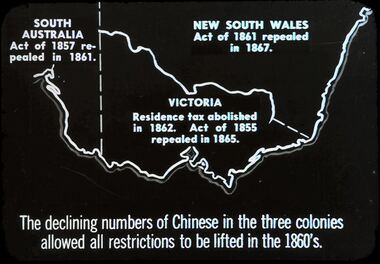
... South Wales Act. Of 1861 repealed I 1867. Victoria Residence tax abolished in 1862. Act. Of 1855 repealed in 1865. The declining...South Wales Act. Of 1861 repealed I 1867. Victoria Residence tax abolished in 1862. Act. Of 1855 repealed in 1865. The declining ...Diggers & Mining. The Chinese on the Gold Fields. Slide: Shows map of Victoria and part of South Australia and New South Wales. South Australia Act. Of 1857 repealed I 1861. New South Wales Act. Of 1861 repealed I 1867. Victoria Residence tax abolished in 1862. Act. Of 1855 repealed in 1865. The declining numbers of Chinese in the three colonies allowed all restrictions to be lifted in the 1860's. Markings: 2 2. Used as a teaching aid.hanimounteducation, tertiary, goldfields -
 Bendigo Historical Society Inc.
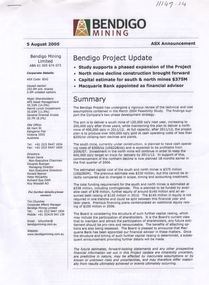
Document - Kangaroo Flat Gold Mine Collection: Bendigo Project Update ASX announcement, Bendigo Mining NL, 5 August 2005
... south mine of 120,000 oz/y next year, increasing to 200,000 oz/y in 2011/12. At full capacity, after 2001/12, the project plan is to produce over 600,000 oz/y gold at cash operating costs of less than $200/0z utilising twin declines and plants'. ...Bendigo mining gold Kangaroo Flat Swan decline Development strategy funding recent expenditures key project details production processing oeprating costs development capital maintenance capital Stock Exchange project update Three page, double sided project update for the Bendigo project. On top of front page 'Bendigo Mining, 5 August 2005, ASX Announcement'. Content includes: summary of the project with the aim defined 'to deliver a south ...New Bendigo Gold Project The Bendigo goldfield is centred on the urban area of Bendigo (population approximately 60 000) in central Victoria, 130 km north west of Melbourne, Australia. Gold was discovered at Bendigo in 1851 and production continued through to 1954. The Bendigo goldfield is the second largest goldfield in total gold produced in Australia, after Kalgoorlie's Golden Mile with a total production of 22 million oz. The geology of the Bendigo Field consists of a series of tightly folded, interbedded sandstone and shale sediments. Within the sediments the gold mineralisation is hosted in quartz reefs or ribbons closely associated with anticline axes and reverse faulting. The gold within the quartz reefs is typically both coarse grained and erratically distributed. Source: https://www.ausimm.com/publications/conference-proceedings/eighth-underground-operators-conference-2002/new-bendigo-gold-project/Three page, double sided project update for the Bendigo project. On top of front page 'Bendigo Mining, 5 August 2005, ASX Announcement'. Content includes: summary of the project with the aim defined 'to deliver a south mine of 120,000 oz/y next year, increasing to 200,000 oz/y in 2011/12. At full capacity, after 2001/12, the project plan is to produce over 600,000 oz/y gold at cash operating costs of less than $200/0z utilising twin declines and plants'. Development strategy, funding, recent expenditures, key project details, production, processing, operating costs, development capital, maintenance capital are discussed in the project update. bendigo mining n.l., bendigo, mining, gold, kangaroo flat, swan decline, development strategy, funding, recent expenditures, key project details, production, processing, oeprating costs, development capital, maintenance capital, stock exchange, project update -
Bendigo Historical Society Inc.
Document - The Victorian Country Volleyball Council (VCVC) Correspondence and Country Championship Reports, 1982
... declining the opportunity to host the event due to the high workload. Similarly, the workload of the volunteer Commissioners also took its toll, with the Commission unable to fill casual vacancies. In 2023, the Commission handed the organisation of the Championships back to VVI, who with paid staff, were better equipped to manage the event. victorian country volleyball council vcvc victorian amateur volleyball association volleyball victoria This item contains Correspondence of the Council in 1982 and reports on the Country Championships for that year; it include. the following documents: 11171.12a South Australia v Victorian Country Volleyball Side Report 11171.12b VCVC representative Sides and entry forms for the Country Championships 11171.12c VAVA Executive Committee 11171.12d Guide for running the Country Championships 11171.12e Goulburn Valley Volleyball report on Country Championships 11171.12f U20 and U15 Championships reports 11171.12g Report by Chief referee on the 1981 U20 Championships at Warrnambool 11171.12h Notice of VCVC two day conference Oct 1982 11171.12i Bendigo YMCA Volleyball Booklet for the 1982 U20 and U15 Country Championships 11171.12j Montmatre Motor Inn St Kilda re two day conference 11171.12k VCVC Secretary report for Oct two day conference 11171.12l Entry fees for the Open Country Championships 11171.12m To Goulburn Valley Volleyball re Constitution and By-laws 11171.12n Notice of AGM of VCVC at Warrnambool 11171.12o Notice of 1982 Datsun State League in South Australia 11171.12p VAVA Survey on U17 Competitions 11171.12q Maffra Sale Association re insurance for players 11171.12r VAVA re Hamilton non affiliation 11171.12s VCVC Report for the months of July and August 1982 11171.12t ERE Embroidery re team flashes 11171.12u Kanyana Volleyball Club Invitation tournament 11171.12v Invitation to Executive Director and U17 State Coach 11171.12w Request from student re information on volleyball 11171.12x Hamilton Volleyball Association Information 11171.12y ERE Embroidery Account 11171.12z VAVA Notice of AGM March 1982 Document The Victorian Country Volleyball Council (VCVC) Correspondence and Country Championship Reports. ...Volleyball has been played in regional Victoria since the early-1960’s. During those early days, most competitions, like the founders of our great sport, were run by, or in conjunction with, the YMCA. Competitions were running at the Ballarat School of Mines and the YMCA’s of Bendigo, Geelong and Warrnambool. In August 1966, an invitation was extended by the Victorian Amateur Volleyball Association to play in the first State-wide event at Monash University. Geelong and Bendigo accepted the invitation with Melbourne represented by Sisu. For Bendigo players at least, this was the first exposure to ‘international rules’, which prevented upward scoops with open hands, introduced an action called a ‘dig’ and seemed to penalise most overhead actions using the fingers as ‘double hits’! Over the next few years, the sport expanded through the YMCA movement with weekly competitions starting up in Ararat, Warrnambool and Latrobe Valley. The Victorian Regional Council of YMCA’s proposed the first Victorian YMCA Championship in Warrnambool on 30th March 1968 with an entry fee of $4.00 per team. The sport continued to grow with additional regional associations affiliating with the Victorian Amateur Volleyball Association (now VVI) who provided the coaching and refereeing assistance needed to raise the standard of play. In 1970, the YMCA Championships started to give way to the Victorian Country Championships with the first ever event held in Bendigo. In 1973, a re-organisation of the VAVA saw the proposal to create separate Victorian Country and Metropolitan Volleyball Councils. The VCVC was established in 1974 and took over the organisation of the Victorian Country Championships. For the next 10-12 years, the Country Championships grew in stature with the inclusion of two divisions for open men and women and junior divisions for boys and girls. Representative teams successfully contested Australian Country Championships between Victoria, South Australia and New South Wales on several occasions. In October 1985, the VCVC voluntarily wound up the Council and handed the responsibility for the Country Championships back to Volleyball Victoria, who by that time had full-time State Executive and Coaching Directors. Since that time, the Long Weekend in June has continued to be the date of the major annual volleyball event for most regional associations, even though in 1986 the Junior Country Championships were wound up in favour of state and national schools events. A number of regional associations have ceased to exist, as have a number of regional tournaments. Regional leagues were created in both the Gippsland and Central, North-West regions, with Gippsland the only one to survive. Some associations have successfully competed in the State League competitions at various times. Following the experience gained by a number of regional administrators working on the Sydney Olympic Games, a proposal to revamp the Victorian Country Championship was put to VVI in early 2002. Later that year, the Volleyball Victoria Country Championships Commission was formed to implement the recommendations of the review and take control of the event into the future. These championships now provide regional players and officials an opportunity to participate in a consistently well-managed event, using many international protocols and a high standard of presentation. Without doubt, this event now ranks as one of the best volleyball events in Australia. Source: 2022 Country Championship regulations The management of the Country Championships by the Victorian Country Championship Commission certainly achieved the objective of raising the standard of presentation, and delivering a consistently high quality event. However, the demands on Host Associations began to take their toll, with several Associations declining the opportunity to host the event due to the high workload. Similarly, the workload of the volunteer Commissioners also took its toll, with the Commission unable to fill casual vacancies. In 2023, the Commission handed the organisation of the Championships back to VVI, who with paid staff, were better equipped to manage the event.This item contains Correspondence of the Council in 1982 and reports on the Country Championships for that year; it include. the following documents: 11171.12a South Australia v Victorian Country Volleyball Side Report 11171.12b VCVC representative Sides and entry forms for the Country Championships 11171.12c VAVA Executive Committee 11171.12d Guide for running the Country Championships 11171.12e Goulburn Valley Volleyball report on Country Championships 11171.12f U20 and U15 Championships reports 11171.12g Report by Chief referee on the 1981 U20 Championships at Warrnambool 11171.12h Notice of VCVC two day conference Oct 1982 11171.12i Bendigo YMCA Volleyball Booklet for the 1982 U20 and U15 Country Championships 11171.12j Montmatre Motor Inn St Kilda re two day conference 11171.12k VCVC Secretary report for Oct two day conference 11171.12l Entry fees for the Open Country Championships 11171.12m To Goulburn Valley Volleyball re Constitution and By-laws 11171.12n Notice of AGM of VCVC at Warrnambool 11171.12o Notice of 1982 Datsun State League in South Australia 11171.12p VAVA Survey on U17 Competitions 11171.12q Maffra Sale Association re insurance for players 11171.12r VAVA re Hamilton non affiliation 11171.12s VCVC Report for the months of July and August 1982 11171.12t ERE Embroidery re team flashes 11171.12u Kanyana Volleyball Club Invitation tournament 11171.12v Invitation to Executive Director and U17 State Coach 11171.12w Request from student re information on volleyball 11171.12x Hamilton Volleyball Association Information 11171.12y ERE Embroidery Account 11171.12z VAVA Notice of AGM March 1982victorian country volleyball council, vcvc, victorian amateur volleyball association, volleyball victoria -
Bendigo Historical Society Inc.
Document - The Victorian Country Volleyball Council (VCVC) Correspondence and Country Championship Reports, 1979
... declining the opportunity to host the event due to the high workload. Similarly, the workload of the volunteer Commissioners also took its toll, with the Commission unable to fill casual vacancies. In 2023, the Commission handed the organisation of the Championships back to VVI, who with paid staff, were better equipped to manage the event. victorian country volleyball council vcvc victorian amateur volleyball association volleyball victoria This item contains Correspondence of the Council in 1979 and reports on the Country Championships for that year; it includes the following documents: 11171.18a Letter to Tomas Santamaria re South Australian Country Match 11171.18b VCVC Letter to all associations re Expo Displays 11171.18c Letter to Hamilton Volleyball Association Re South Australia Match 11171.18d To the VCVC Senior Squad Members re availability to compete 11171.18e Notice of AGM Nov 1979 11171.18f Letter to Port Augusta re possible interstate challenge 11171.18g Letter to Hamilton Volleyball Association re affiliation 11171.18h Letter to Bob Kenter Latrobe Valley re resignation form VCVC Presidency 11171.18i To Latrobe Valley Volleyball Association regarding trophies for the country championships 11171.18j To the South Australian Country Volleyball Council re championships 11171.18k Letter from the South Australian Country Volleyball Council 11171.18l Letter re Country Championsips 1979 at Shepparton 11171.18m VAVA Secretary's Report 1979 11171.18n VAVA Annual Statements Oct 1979 11171.18o VAVA Executive Meeting Minutes Sept 1979 11171.18p VAVA AGM Minutes Dec 1979 11171.18q VCVC AGM Minutes Dec 1979 11171.18r VCVC Minutes Nov 1978 11171.18s VCVC Secretary's Report 1978-79 11171.18t VCVC Minutes of General Meeting Wangaratta April 1979 11171.18u VCVC Record Secretary's Report 1979 11171.18v To all Associations re Chinese Volleyball Team Visit 11171.18w To all associations re Country Championship Bonds 11171.18x From Bendigo Volleyball Association re costs for the country championships 11171.18y To all associations re annual player registration update 11171.18z VCVC Financial statement 1978-79 11171.18aa First Victorian v South Australia country Championships Report Dec 1979 11171.18ab Bendigo YMCA Volleyball Association re AGM in Bendigo on Dec 09 1979 11171.18ac Australain Volleyball Federation re changes to the constitution 11171.18ad Submission for Veterans Open tournament 1980 11171.18ae Letter from Seymour Amateur Volleyball re AGM Attendance Nov 1979 11171.18af Australian Volleyball Federation re Grading of referees 11171.18ag Ballarat Amateur Volleyball Association request for the country championships 1980 11171.18ah Australian Volleyball Federation re Sports Development Program 1978-79 11171.18ai Shire of Nathalia re new stadium 1979 11171.18aj Bendigo YMCA Association re taking part in the Sports Expo 11171.18ak VAVA to all associations - copy of the Australian Rule Book 11171.18al Official interpretation of Rule 21 11171.18am Official interpretation of Rule 21 11171.18an Submission for Veterans Open Tournament 11171.18ao Schedule for the Olympic Village Aug 1979 11171.18ap VAVA Sports Assistance Program grants 1979-80 11171.18aq Olympic Supporters Club of Australia Campaign 11171.18ar Letter re State Squad Representatives form VAVA 11171.18as Latrobe Valley Volleyball Association re monies owed from Geelong and Wangaratta 11171.18at Re visit by the Chinese Team 11171.18au Latrobe Valley Volleyball Association re visit by the Chinese Team 11171.18av From South Australian Country Volleyball Confirmation of interstate games 11171.18aw From Hamilton Volleyball re interest in affiliation 11171.18ax From Goulburn Valley Volleyball Report on the 1979 Open Country Championships 11171.18ay Letter from Hamilton Volleyball with registration fee 11171.18az VAVA re State Director of Coaching and Women's State Coach 11171.18aaa VCVC Country Championships Goulburn Valley Report 11171.18aab Wangaratta Volleyball U17 Country Chamionships Report 11171.18aac From Bob Kenter President - letter of resignation April 1979 Document The Victorian Country Volleyball Council (VCVC) Correspondence and Country Championship Reports. ...Volleyball has been played in regional Victoria since the early-1960’s. During those early days, most competitions, like the founders of our great sport, were run by, or in conjunction with, the YMCA. Competitions were running at the Ballarat School of Mines and the YMCA’s of Bendigo, Geelong and Warrnambool. In August 1966, an invitation was extended by the Victorian Amateur Volleyball Association to play in the first State-wide event at Monash University. Geelong and Bendigo accepted the invitation with Melbourne represented by Sisu. For Bendigo players at least, this was the first exposure to ‘international rules’, which prevented upward scoops with open hands, introduced an action called a ‘dig’ and seemed to penalise most overhead actions using the fingers as ‘double hits’! Over the next few years, the sport expanded through the YMCA movement with weekly competitions starting up in Ararat, Warrnambool and Latrobe Valley. The Victorian Regional Council of YMCA’s proposed the first Victorian YMCA Championship in Warrnambool on 30th March 1968 with an entry fee of $4.00 per team. The sport continued to grow with additional regional associations affiliating with the Victorian Amateur Volleyball Association (now VVI) who provided the coaching and refereeing assistance needed to raise the standard of play. In 1970, the YMCA Championships started to give way to the Victorian Country Championships with the first ever event held in Bendigo. In 1973, a re-organisation of the VAVA saw the proposal to create separate Victorian Country and Metropolitan Volleyball Councils. The VCVC was established in 1974 and took over the organisation of the Victorian Country Championships. For the next 10-12 years, the Country Championships grew in stature with the inclusion of two divisions for open men and women and junior divisions for boys and girls. Representative teams successfully contested Australian Country Championships between Victoria, South Australia and New South Wales on several occasions. In October 1985, the VCVC voluntarily wound up the Council and handed the responsibility for the Country Championships back to Volleyball Victoria, who by that time had full-time State Executive and Coaching Directors. Since that time, the Long Weekend in June has continued to be the date of the major annual volleyball event for most regional associations, even though in 1986 the Junior Country Championships were wound up in favour of state and national schools events. A number of regional associations have ceased to exist, as have a number of regional tournaments. Regional leagues were created in both the Gippsland and Central, North-West regions, with Gippsland the only one to survive. Some associations have successfully competed in the State League competitions at various times. Following the experience gained by a number of regional administrators working on the Sydney Olympic Games, a proposal to revamp the Victorian Country Championship was put to VVI in early 2002. Later that year, the Volleyball Victoria Country Championships Commission was formed to implement the recommendations of the review and take control of the event into the future. These championships now provide regional players and officials an opportunity to participate in a consistently well-managed event, using many international protocols and a high standard of presentation. Without doubt, this event now ranks as one of the best volleyball events in Australia. Source: 2022 Country Championship regulations The management of the Country Championships by the Victorian Country Championship Commission certainly achieved the objective of raising the standard of presentation, and delivering a consistently high quality event. However, the demands on Host Associations began to take their toll, with several Associations declining the opportunity to host the event due to the high workload. Similarly, the workload of the volunteer Commissioners also took its toll, with the Commission unable to fill casual vacancies. In 2023, the Commission handed the organisation of the Championships back to VVI, who with paid staff, were better equipped to manage the event.This item contains Correspondence of the Council in 1979 and reports on the Country Championships for that year; it includes the following documents: 11171.18a Letter to Tomas Santamaria re South Australian Country Match 11171.18b VCVC Letter to all associations re Expo Displays 11171.18c Letter to Hamilton Volleyball Association Re South Australia Match 11171.18d To the VCVC Senior Squad Members re availability to compete 11171.18e Notice of AGM Nov 1979 11171.18f Letter to Port Augusta re possible interstate challenge 11171.18g Letter to Hamilton Volleyball Association re affiliation 11171.18h Letter to Bob Kenter Latrobe Valley re resignation form VCVC Presidency 11171.18i To Latrobe Valley Volleyball Association regarding trophies for the country championships 11171.18j To the South Australian Country Volleyball Council re championships 11171.18k Letter from the South Australian Country Volleyball Council 11171.18l Letter re Country Championsips 1979 at Shepparton 11171.18m VAVA Secretary's Report 1979 11171.18n VAVA Annual Statements Oct 1979 11171.18o VAVA Executive Meeting Minutes Sept 1979 11171.18p VAVA AGM Minutes Dec 1979 11171.18q VCVC AGM Minutes Dec 1979 11171.18r VCVC Minutes Nov 1978 11171.18s VCVC Secretary's Report 1978-79 11171.18t VCVC Minutes of General Meeting Wangaratta April 1979 11171.18u VCVC Record Secretary's Report 1979 11171.18v To all Associations re Chinese Volleyball Team Visit 11171.18w To all associations re Country Championship Bonds 11171.18x From Bendigo Volleyball Association re costs for the country championships 11171.18y To all associations re annual player registration update 11171.18z VCVC Financial statement 1978-79 11171.18aa First Victorian v South Australia country Championships Report Dec 1979 11171.18ab Bendigo YMCA Volleyball Association re AGM in Bendigo on Dec 09 1979 11171.18ac Australain Volleyball Federation re changes to the constitution 11171.18ad Submission for Veterans Open tournament 1980 11171.18ae Letter from Seymour Amateur Volleyball re AGM Attendance Nov 1979 11171.18af Australian Volleyball Federation re Grading of referees 11171.18ag Ballarat Amateur Volleyball Association request for the country championships 1980 11171.18ah Australian Volleyball Federation re Sports Development Program 1978-79 11171.18ai Shire of Nathalia re new stadium 1979 11171.18aj Bendigo YMCA Association re taking part in the Sports Expo 11171.18ak VAVA to all associations - copy of the Australian Rule Book 11171.18al Official interpretation of Rule 21 11171.18am Official interpretation of Rule 21 11171.18an Submission for Veterans Open Tournament 11171.18ao Schedule for the Olympic Village Aug 1979 11171.18ap VAVA Sports Assistance Program grants 1979-80 11171.18aq Olympic Supporters Club of Australia Campaign 11171.18ar Letter re State Squad Representatives form VAVA 11171.18as Latrobe Valley Volleyball Association re monies owed from Geelong and Wangaratta 11171.18at Re visit by the Chinese Team 11171.18au Latrobe Valley Volleyball Association re visit by the Chinese Team 11171.18av From South Australian Country Volleyball Confirmation of interstate games 11171.18aw From Hamilton Volleyball re interest in affiliation 11171.18ax From Goulburn Valley Volleyball Report on the 1979 Open Country Championships 11171.18ay Letter from Hamilton Volleyball with registration fee 11171.18az VAVA re State Director of Coaching and Women's State Coach 11171.18aaa VCVC Country Championships Goulburn Valley Report 11171.18aab Wangaratta Volleyball U17 Country Chamionships Report 11171.18aac From Bob Kenter President - letter of resignation April 1979victorian country volleyball council, vcvc, victorian amateur volleyball association, volleyball victoria -
 Ithacan Historical Society
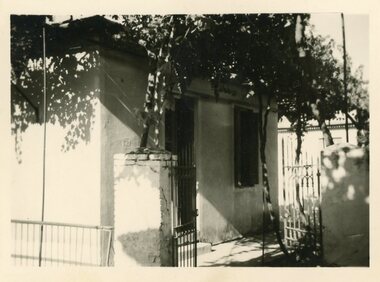
Photograph, Dentist's house in Stavros, c 1940s
... With the decline in population in the surrounding villages of northern Ithaca, services such as the dentist and post office are now only available in the main town of Vathi located in the south end of the island. ...The dwelling belonged to the dentist in the village of Stavros, the main village of the northern Ithaca which services the smaller surrounding villages.With the decline in population in the surrounding villages of northern Ithaca, services such as the dentist and post office are now only available in the main town of Vathi located in the south end of the island. Some services are only provided intermittently by visiting professionals from neighbouring Kefalonia or the mainland.A black and white photograph with a white crinkled border of a house with vines growing across the front. There is a metal gate in front of thew porch. -
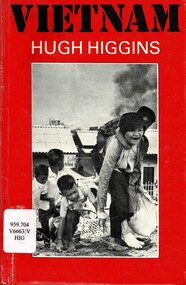 National Vietnam Veterans Museum (NVVM)
Book, Higgins, Hugh, Dasher Wheatley and Australia in Vietnam (Copy 1)
... Three new chapters have been added describing the end of the war, including the decline of American involvement in the conflict and the Great Spring Offensive of 1975; the reunification of North and South and the beginning of reconstruction after the devastation; and the Socialist Republic's worsening relations with Kampuchea and China, which resulted in new wars. ...For this second edition the story has been extended to 1980. Three new chapters have been added describing the end of the war, including the decline of American involvement in the conflict and the Great Spring Offensive of 1975; the reunification of North and South and the beginning of reconstruction after the devastation; and the Socialist Republic's worsening relations with Kampuchea and China, which resulted in new wars.For this second edition the story has been extended to 1980. Three new chapters have been added describing the end of the war, including the decline of American involvement in the conflict and the Great Spring Offensive of 1975; the reunification of North and South and the beginning of reconstruction after the devastation; and the Socialist Republic's worsening relations with Kampuchea and China, which resulted in new wars.vietnam war, 1961-1975 - united states, vietnam - history - 1945-1975, great spring offensive, dasher wheatley, deaths in vietnam -
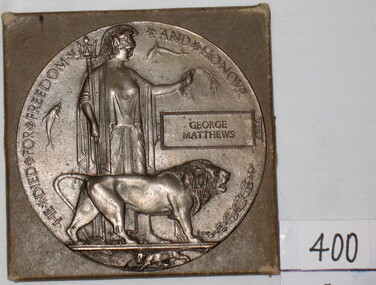 Myrtleford and District Historical Society
Memorial Plaque, Memorial Plaque Factory, "Dead Man's Penny", Circa 1921
... George Matthews' enlistment in New Zealand is an indicator of the migratory nature of men involved in gold mining after the decline of the industry in Victoria and New South Wales in the late 19th century Memorial Plaque Dead Man's Penny George Matthews Name engraved: GEORGE MATTHEWS A World War 1 memorial plaque issued to next-of-kin of all British and Empire service personnel who died as a result of the war. ...The "Dead Man's Penny" of Private George Matthews (24/1744) is a district link to the First World War. George enlisted with the Otago Regiment, New Zealand Expeditionary Force as a rifleman. Born in 1891, he was a former pupil of Myrtleford State School 955 and was one of four first cousins killed in action and recorded in a memorial window and honour board at the Uniting (formerly Methodist) Church, the Soldier's Memorial Square and on the State School Honour Board. George's parents, John and Mary Matthews,received the plaque in a pack, together with a letter and commemorative scroll from King George V. George Matthews is buried at the Caterpillar Valley (N.Z.) Memorial, France, having died on October 1, 1916, aged 25. The memorial plaque links local family tragedy to world conflict. It represents the impact of such events must have had on small town communities. George Matthews' enlistment in New Zealand is an indicator of the migratory nature of men involved in gold mining after the decline of the industry in Victoria and New South Wales in the late 19th centuryA World War 1 memorial plaque issued to next-of-kin of all British and Empire service personnel who died as a result of the war. They were round and cast in bronze, hence their similarity to the much smaller penny coin. The plaque includes an image of Britannia, holding a trident and standing with a lion. Britannia holds an oak leaf above the deceased's name, which is recorded without rank. Two dolphins swim around Britannia, symbolizing sea power, and at the base a second lion is tearing apart the German eagle. Around the picture a legend reads: "He died for freedom and Honour"Name engraved: GEORGE MATTHEWSmemorial plaque dead man's penny george matthews -
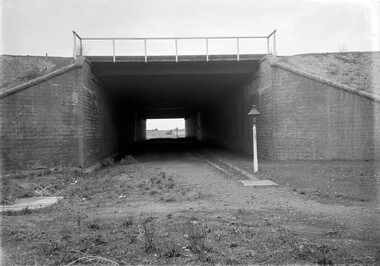 Sunshine and District Historical Society Incorporated
Photograph - Ashley Street Railway Underpass Photographs
... decline in the use of the Tottenham Yard and many sidings were removed, shorten, converted to storage or left unused. Today the yard is used for wagon storage, crew changes, light shunting and providing access to the Tottenham triangle and Sunshine corridor. These photographs were taken shortly after the tunnel was completed. Ashley Street Railway Line Tottenham 5335.01 - Ashley Street Railway Underpass Looking North Photo 01.jpg 5335.02 - Ashley Street Railway Underpass Looking South ...The Tottenham Yard began as a modest goods yard supporting local industries in Braybrook, Tottenham, and West Footscray, the Sunshine industrial belt and the nearby munitions and explosives factories Key features of the early yard included a small number of sidings, a goods shed, a basic loading / unloading facilities and a connection to the Tottenham triangle (Sunshine–Footscray–North Melbourne junction). As the yard expanded with additional siding and larger marshalling areas, there was a requirement to maintain the Ashley Street North – South access route for private and commercial travel. The work involved to solve this problem was to elevate the railway yard and place Ashley Street through a tunnel. This railway underpass for many years was simply known as the Ashley Street Tunnel. By the 1970s, the Tottenham Yard had become one of the largest freight yards in Victoria, second only to Dynon. In the 1982, the level crossing gates at the southern end of tunnel were removed, the tunnel extended southwards and the former Tottenham Railway Station was replaced with an elevated one above the new tunnel extension. During these works the road surface level was lowered to allow for higher trucks to pass through. At this point of time, the reference to tunnel was replaced with underpass. During the 1990’s and 2000’s, there was a decline in the use of the Tottenham Yard and many sidings were removed, shorten, converted to storage or left unused. Today the yard is used for wagon storage, crew changes, light shunting and providing access to the Tottenham triangle and Sunshine corridor.These photographs were taken shortly after the tunnel was completed.5335.01 - Ashley Street Railway Underpass Looking North Photo 01.jpg 5335.02 - Ashley Street Railway Underpass Looking South Photo 02.jpgashley street, railway line, tottenham -
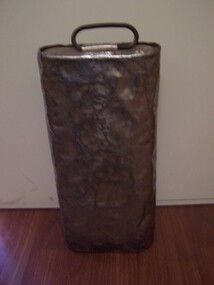 Puffing Billy Railway
Equipment - Victorian Railways Carriage Foot Warmer
... The use of foot warmers began to decline in New South Wales from the 1930s with the first trial of carriage air-conditioning in 1936, steam heating from 1948 ad LP gas heating from 1961. ...The use of foot warmers began to decline in New South Wales from the 1930s with the first trial of carriage air-conditioning in 1936, steam heating from 1948 ad LP gas heating from 1961. ...During prestige, long distance train journeys some carriages had air-conditioning, and the majority of passengers had to brave unheated carriages. To offer some comfort during the winter months, the non-air-conditioned carriages were provided with footwarmers. These were metal containers roughly 100 mm thick and 300 mm wide, and about 750 mm long, which were filled with salt crystals (concentrated crystalline hydrated sodium acetate). The footwarmers were covered by sleeves of thick canvas, and two footwarmers were usually placed in each compartment of non-air-conditioned carriages. To activate the chemicals, the footwarmers were heated almost to boiling point. This was done by removing the canvas sleeves and placing the footwarmers in a large bath of very hot water. After they had been heated, they were removed from the bath and the sleeves refitted. They were then ready to be placed in the carriages. The McLaren patent foot warmer was used on railways in New South Wales, Queensland, Victoria and South Australia as well as South Africa and New Zealand. It was during the 1901 royal visit by the Duke and Duchess of Cornwall that these foot warmers were first used in New Zealand in the royal carriage. Before railway carriage heating was introduced, McLaren patent foot warmers were placed on the floor of New South Wales government railway carriages from 1891 to provide a little passenger comfort. The rectangular steel container worked a bit like a hot water bottle but instead of water contained six and a half kilograms of loosely-packed salt crystals, (concentrated crystalline hydrated sodium acetate). This was permanently sealed inside the container with a soldered cap. After the foot warmer was heated in vat of boiling water for about one and a quarter hours the crystals became a hot liquid. (The melting point for sodium acetate is 58 degrees). There was a whole infrastructure of special furnaces set up at stations for the daily heating of foot warmers. By 1914 the Victorian railways had 4,000 foot warmers in service and by 1935 there were 33 furnaces at principal stations to heat them. After about 10 hours the container was picked up by the handle and given a good vertical shake which helped the cooled liquid reform into a solid mass of hot crystals. Staff or sometimes passengers shook them en route when the foot warmers began to get cold. However, as they were heavy this was only possible by fit and agile passengers. At the end of the journey the containers were boiled again for reuse on the next trip. Sodium acetate railway foot warmers were introduced in Victoria in 1889, Adelaide to Melbourne express in 1899. "Shaking up" on this service took place at Murray Bridge and Stawell on the tip to Melbourne and at Ballarat and Serviceton on the trip to Adelaide. The use of foot warmers began to decline in New South Wales from the 1930s with the first trial of carriage air-conditioning in 1936, steam heating from 1948 ad LP gas heating from 1961. By the early 1960s the main services using foot warmers were the overnight mail trains. info from : http://www.powerhousemuseum.com/collection/database/?irn=67564#ixzz4UBNzVf6t Under Creative Commons License: Attribution Non-Commercial There was a whole infrastructure set up at stations for the daily heating of foot warmers in special furnaces. In Victoria alone in 1935 there were 33 heating works.Historic - Victorian Railways - Carriage Heater - Foot warmerA rectangular-shaped stainless steel casing with a welded seam down the back and welded ends. There is a handle at one end for carrying and shaking. Inside the foot warmer are two baffle plates and three trays to contain the sodium acetate. There was a cast-iron ball in each internal compartment. puffing billy, victorian railways, carriage haeter, foot warmer, passenger comfort, station furnace, railway ephemera, early heating methods -
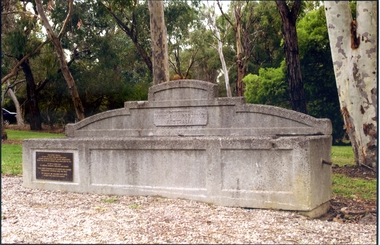 Whitehorse Historical Society Inc.
Photograph, Horse Trough
... As the use of motorised transport increased the use for water troughs declined. horse troughs bills george and annis Coloured photograph of a horse trough located on the corner of Canterbury and Blackburn Roads Blackburn South. ...Water troughs were installed to provide relief for working horses in the first half of the 20th century. As the use of motorised transport increased the use for water troughs declined.Coloured photograph of a horse trough located on the corner of Canterbury and Blackburn Roads Blackburn South. This trough was one of many donated by Annis and George Bills. See ND883 and ND885 for articles in the 'Sun'.horse troughs bills george and annis -
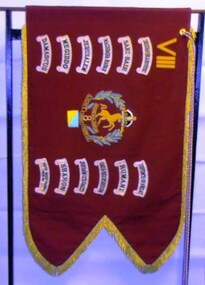 8th/13th Victorian Mounted Rifles Regimental Collection
Flag - Guidon 8th LH, 1980 circa
... declined the regiment was disbanded. In 1948, the 8th Light Horse was linked with 13th and 20th Regiments to form the 8/13 Victorian Mounted Rifles in the Citizen Military Forces. guidon 8th light horse battle honours Battle honours: "South Africa 1899-1902, Sari Bair, Maghdaba-Rafah, Jerusalem, Megiddo, Damascus, Defence of ANZAC, Rumani, Gaza-Beersheba, Jordan (Es Salt), Sharon, South West Pacific 1943-1944" Guidon of the 8th Light Horse Regiment. ...A guidon is the regimental banner or flag carried by a regiment of light cavalry or light horse. The 8th light Horse (Indi) Regiment was presented with the guidon circa 1927. The actual date is not certain. The guidon carries the battle honours accorded to the regiment for service in the South African War (1899-1902), World War One (!914-1918) and World War Two (1939-1945). The guidon passed into the custody of the 8th/13th Victorian Mounted Rifles Regiment when it was raised on 1 May 1948. At Federation, the Victorian Mounted Rifles companies in North East Victoria were reorganised into the 8th Light Horse Regiment. In 1912 the regiment was renumbered 16th Light Horse. The 8th Light Horse Regiment AIF was raised at Broadmeadows Victoria in September 1914 under the command of Lieutenant Colonel Alexander White and formed part of the 3rd Light Horse Brigade. The regiment served at Gallipoli where in a courageous but ill-fated charge at the Nek on 7 August 1915 it suffered horrendous casualties including Lieutenant Colonel White. Rebuilt in Egypt under the command of Lieutenant Colonel Leslie Maygar VC the regiment went on the serve throughout the Middle East Campaign. Colonel Maygar died of wounds at Beersheba when the regiment was attacked by enemy aircraft while waiting to follow up the successful charge of the 4th LH Brigade on 30 October 1917. The 8th Light Horse AIF was disbanded in 1919, but soon after re-raised as the 8th (Indi) Light Horse in the Citizen Military Forces, superseding 16th (Indi) Light Horse. It had its headquarters at Benalla with sub-units throughout the Upper Murray and Northeast Victoria. In December 1941, the regiment converted from horse to mechanised, initially as 8th Reconnaissance Battalion then in July 1942 it became 8th Cavalry Regiment and served in Northern Territory. As Japanese threat to the mainland declined the regiment was disbanded. In 1948, the 8th Light Horse was linked with 13th and 20th Regiments to form the 8/13 Victorian Mounted Rifles in the Citizen Military Forces. Guidon of the 8th Light Horse Regiment. Maroon corded cotton double thickness fabric with gold metal thread fringe, gold embroidered regimental number in Roman numerals, regimental badge and battle honours; colour patch below badge. Braided corded with tassels.Battle honours: "South Africa 1899-1902, Sari Bair, Maghdaba-Rafah, Jerusalem, Megiddo, Damascus, Defence of ANZAC, Rumani, Gaza-Beersheba, Jordan (Es Salt), Sharon, South West Pacific 1943-1944"guidon, 8th light horse, battle honours -
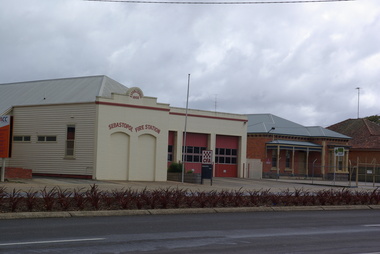 Ballarat Heritage Services
Photograph - Photograph - Colour, Clare Gervasoni, Former Sebastopol Fire Station, Albert Street, Sebastopol, 2012, 09/04/2012
... decline in mining and Sebastopol’s population, the need for a fire brigade diminished and the brigade went into recess in 1875. Sebastopol was then serviced by a ‘satellite’ unit from the Ballarat City Fire Brigade. In 1891, with financial support from the Sebastopol Borough Council, the Sebastopol Fire Brigade re-formed. It had hand-drawn hose reels and hydrants in sheds at the north and south...decline in mining and Sebastopol’s population, the need for a fire brigade diminished and the brigade went into recess in 1875. Sebastopol was then serviced by a ‘satellite’ unit from the Ballarat City Fire Brigade. In 1891, with financial support from the Sebastopol Borough Council, the Sebastopol Fire Brigade re-formed. It had hand-drawn hose reels and hydrants in sheds at the north and south ...The Sebastopol Fire Brigade was establised in 1868. The first fire station in Sebastopol was housed in a shed at the Red Jacket Mine in 1868, where an alarm bell was hung. With the decline in mining and Sebastopol’s population, the need for a fire brigade diminished and the brigade went into recess in 1875. Sebastopol was then serviced by a ‘satellite’ unit from the Ballarat City Fire Brigade. In 1891, with financial support from the Sebastopol Borough Council, the Sebastopol Fire Brigade re-formed. It had hand-drawn hose reels and hydrants in sheds at the north and south ends of Albert St. A shed to be used as a Fire Station was built beside the Town Hall in 1886. In 1929 the Fire Station was physically moved across Albert Street to its current site. It was expanded by the addition of a meeting room/hall and workroom and in the 1990s had the ‘Engine Room’ added to the north side. The first motorised appliance was a 1916 Maxwell hose carriage issued in 1934.Colour photograph of the Sebastopol Fire Brigade.sebastopol, sebastopol fire brigade -
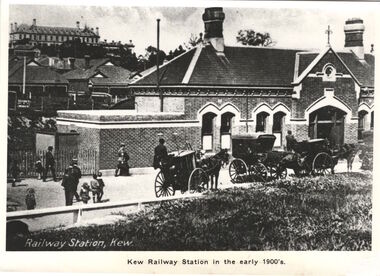 Kew Historical Society Inc
Print, Kew Railway Station in the early 1900s
... south of Wellington Street. The Station opened on 19 December 1887 after a prolonged campaign for a railway by the people of Kew. Due to a decline...south of Wellington Street. The Station opened on 19 December 1887 after a prolonged campaign for a railway by the people of Kew. Due to a decline ...Kew Railway Station (1887-1959). ‘Kew Railway Station’ in Denmark Street was the terminus of the Kew Line, which extended from Hawthorn Station to just south of Wellington Street. The Station opened on 19 December 1887 after a prolonged campaign for a railway by the people of Kew. Due to a decline in patronage, the passenger service ceased operations in August 1952. While a freight service continued for another five years, the line and station were officially closed on 13 May 1957. Subsequently demolished in 1959, the headquarters of VicRoads (formerly Country Roads Board) now stands on the former Station site.This work forms part of the collection assembled by the historian Dorothy Rogers, that was donated to the Kew Historical Society by her son John Rogers in 2015. The manuscripts, photographs, maps, and documents were sourced by her from both family and local collections or produced as references for her print publications. Many were directly used by Rogers in writing ‘Lovely Old Homes of Kew’ (1961) and 'A History of Kew' (1973), or the numerous articles on local history that she produced for suburban newspapers. Most of the photographs in the collection include detailed annotations in her hand. The Rogers Collection provides a comprehensive insight into the working habits of a historian in the 1960s and 1970s. Together it forms the largest privately-donated collection within the archives of the Kew Historical Society.A photographic copy of a book plate from 'Kew's Civic Century' (1960) by W.D. Vaughan. The book plate was itself a copy of an early 20th century postcard depicting the Kew Railway Station."Railway opened 1887 - Then as photo states"kew railway station, dorothy rogers, country roads board, vicroads -
 Tarnagulla History Archive
Photograph: Reef Mining NL opening ceremony, 1995, 28th April, 1995
... A colour photograph depicting Don Clark and Dick Sandner at a ceremony to commence underground decline works for Reef Mining NL, South Poverty Reef, Tarnagulla. ...A colour photograph depicting Don Clark and Dick Sandner at a ceremony to commence underground decline works for Reef Mining NL, South Poverty Reef, Tarnagulla. ...Donald Clark Collection. A colour photograph depicting Don Clark and Dick Sandner at a ceremony to commence underground decline works for Reef Mining NL, South Poverty Reef, Tarnagulla. Original photograph.
