
Showing 26 items matching "southern pacific"
-
 Flagstaff Hill Maritime Museum and Village
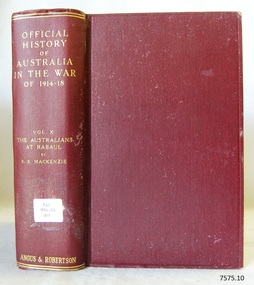
Book, Official History of Australia In The War of 1914-18 Vol 10
... the capture and administration of the german possessions in the southern pacific...The capture and Administration of the German possessions in the Southern Pacific Author: S S Mackenzie Publisher: Angus & Robertson Date: 1938 ...The capture and Administration of the German possessions in the Southern Pacific Author: S S Mackenzie Publisher: Angus & Robertson Date: 1938 Official History of Australia In The War of 1914-18 Vol 10 Book ...This item is from the ‘Pattison Collection’, a collection of books and records that was originally owned by the Warrnambool Mechanics’ Institute, which was founded in Warrnambool in 1853. By 1886 the Warrnambool Mechanics’ Institute (WMI) had grown to have a Library, Museum and Fine Arts Gallery, with a collection of “… choice productions of art, and valuable specimens in almost every branch and many wonderful national curiosities are now to be seen there, including historic relics of the town and district.” It later included a School of Design. Although it was very well patronised, the lack of financial support led the WMI in 1911 to ask the City Council to take it over. In 1935 Ralph Pattison was appointed as City Librarian to establish and organise the Warrnambool Library as it was then called. When the WMI building was pulled down in 1963 a new civic building was erected on the site and the new Warrnambool Library, on behalf of the City Council, took over all the holdings of the WMI. At this time some of the items were separated and identified as the ‘Pattison Collection’, named after Ralph Pattison. Eventually the components of the WMI were distributed from the Warrnambool Library to various places, including the Art Gallery, Historical Society and Flagstaff Hill. Later some were even distributed to other regional branches of Corangamite Regional Library and passed to and fro. It is difficult now to trace just where all of the items have ended up. The books at Flagstaff Hill Maritime Village generally display stamps and markings from Pattison as well as a variety of other institutions including the Mechanics’ Institute itself. RALPH ERIC PATTISON Ralph Eric Pattison was born in Rockhampton, Queensland, in 1891. He married Maude Swan from Warrnambool in 1920 and they set up home in Warrnambool. In 1935 Pattison accepted a position as City Librarian for the Warrnambool City Council. His huge challenge was to make a functional library within two rooms of the Mechanics’ Institute. He tirelessly cleaned, cleared and sorted a disarrayed collection of old books, jars of preserved specimens and other items reserved for exhibition in the city’s museum. He developed and updated the library with a wide variety of books for all tastes, including reference books for students; a difficult task to fulfil during the years following the Depression. He converted all of the lower area of the building into a library, reference room and reading room for members and the public. The books were sorted and stored using a cataloguing and card index system that he had developed himself. He also prepared the upper floor of the building and established the Art Gallery and later the Museum, a place to exhibit the many old relics that had been stored for years for this purpose. One of the treasures he found was a beautiful ancient clock, which he repaired, restored and enjoyed using in his office during the years of his service there. Ralph Pattison was described as “a meticulous gentleman whose punctuality, floorless courtesy and distinctive neat dress were hallmarks of his character, and ‘his’ clock controlled his daily routine, and his opening and closing of the library’s large heavy doors to the minute.” Pattison took leave during 1942 to 1942 to serve in the Royal Australian Navy, Volunteer Reserve as Lieutenant. A few years later he converted one of the Museum’s rooms into a Children’s Library, stocking it with suitable books for the younger generation. This was an instant success. In the 1950’s he had the honour of being appointed to the Victorian Library Board and received more inspiration from the monthly conferences in Melbourne. He was sadly retired in 1959 after over 23 years of service, due to the fact that he had gone over the working age of council officers. However he continued to take a very keen interest in the continual development of the Library until his death in 1969. WARRNAMBOOL PUBLIC LIBRARY The Warrnambool Mechanics’ Institute (WMI) was formed by a voluntary community group in 1863, within six years of Warrnambool’s beginnings, and its Reading Room opened in 1854. The WMI operated until 1963, at which time it was one of the oldest Mechanics’ Institutes in Victoria. Mechanics’ Institutes offered important services to the public including libraries, reading rooms and places to display and store collections of all sorts such as curiosities and local historical relics. In 1886 a Museum and Fine Arts Gallery were added to the WMI and by the beginning of the 20th century there was also a billiards room and a School of Art. By this time all Mechanics’ Institutes in country Victoria had museums attached. Over the years the Warrnambool Mechanics’ Institute Library was also known as the Warrnambool Public Library the Warrnambool Library and the Free Library. Early funding from the government was for the “Free Library”. The inscription in a book “Science of Man” was for the “Warrnambool Public Library”, donated by Joseph Archibald in 1899. Another inscription in the book “Catalogue of Plants Under Cultivation in the Melbourne Botanic Gardens 1 & 2, 1883” was presented to the “Warrnambool Library” and signed by the author W.R. Guilfoyle. In 1903 the Warrnambool Public Library decided to add a Juvenile Department to library and stock it with hundreds of books suitable for youth. In 1905 the Public Library committee decided to update the collection of books and added 100 new novels plus arrangements for the latest novels to be included as soon as they were available in Victoria. In July 1911 the Warrnambool Council took over the management of the Public Library, Art Gallery, Museum and Mechanics’ Institute and planned to double the size of the then-current building. In 1953, when Mr. R. Pattison was Public Librarian, the Warrnambool Public Library’s senior section 10,000 of the 13,000 books were fiction. The children’s section offered an additional 3,400 books. The library had the equivalent of one book per head of population and served around 33 percent of the reading population. The collection of books was made up of around 60 percent reference and 40 percent fiction. The library was lending 400 books per day. In 1963 the Warrnambool City Council allocated the site of the Mechanics’ Institute building, which included the Public Library, Museum and Art Gallery, for the new Municipal Offices and the Collections were dispersed until 1971. The Warrnambool Library took over the Mechanics’ Institute Library’s holdings on behalf of the Warrnambool City Council. Since the closure of the Warrnambool Mechanics’ Institute the exact location and composition of the original WMI books and items has become unclear. Other materials have been added to the collection, including items from Terang MI, Warrnambool Court House and Customs House. Many of the books have been identified as the Pattison Collection, named after the Librarian who catalogued and numbered the books during his time as Warrnambool Public Librarian in the time before the Mechanics’ Institute closed. It seems that when Warrnambool became part of the Corangamite Regional Library some of the books and materials went to its head office in Colac and then back to Warrnambool where they were stored at the Art Gallery for quite some time. Some then went to the Warrnambool Historical Society, some stayed at the Art Gallery and some were moved to Flagstaff Hill Maritime Village. The various stamps and labels on the books held at Flagstaff Hill show the variety of the collection’s distribution and origin. The books in the collection at Flagstaff Hill Maritime Village date from the 1850’s to the late 1950’s and include rare and valuable volumes. Many of the books are part of the “Pattison Collection” after the Warrnambool’s Public Librarian, Mr. R. Pattison. The Pattison Collection, along with other items at Flagstaff Hill Maritime Village, was originally part of the Warrnambool Mechanics' Institute’s collection. The Warrnambool Mechanics’ Institute Collection is primarily significant in its totality, rather than for the individual objects it contains. Its contents are highly representative of the development of Mechanics' Institute libraries across Australia, particularly Victoria. A diversity of publications and themes has been amassed, and these provide clues to our understanding of the nature of and changes in the reading habits of Victorians from the 1850s to the middle of the 20th century. The collection also highlights the Warrnambool community’s commitment to the Mechanics’ Institute, reading, literacy and learning in the regions, and proves that access to knowledge was not impeded by distance. These items help to provide a more complete picture of our community’s ideals and aspirations. The Warrnambool Mechanics Institute book collection has historical and social significance for its strong association with the Mechanics Institute movement and the important role it played in the intellectual, cultural and social development of people throughout the latter part of the nineteenth century and the early twentieth century. The collection of books is a rare example of an early lending library and its significance is enhanced by the survival of an original collection of many volumes. The Warrnambool Mechanics' Institute’s publication collection is of both local and state significance. The Warrnambool Mechanics' Institute Collection is primarily significant in its totality, rather than for the individual objects it contains. Its contents are highly representative of the development of Mechanics' Institute libraries across Australia, particularly Victoria. A diversity of publications and themes has been amassed, and these provide clues to our understanding of the nature of and changes in the reading habits of Victorians from the 1850s to the middle of the 20th century. The collection also highlights the Warrnambool community’s commitment to the Mechanics’ Institute, and to reading, literacy and learning in the regions, and proves that access to knowledge was not impeded by distance. These items help to provide a more complete picture of our community’s ideals and aspirations. As with many Mechanics' Institutes in Australia, the one which operated in Warrnambool was established and overseen for many years by key individuals associated with the development of the city itself. The WMI publication collection is historically significant because of its association with local people, places and the key historical themes in the development of Warrnambool of rural development, industry, farming, education, and community. The collection documents and illustrates the changing interests, focus and tastes of Victorians, especially those in regional cities. Generally the individual items in the collection are not particularly rare, as examples of all probably exist in other public collections in Victoria. It is primarily because there are so very few surviving Mechanics' Institute collections in Victoria, which lends this overall collection its significance. Many items in the WMI Collection have the potential to support further research, both as individual objects and through the collection in its entirety. This material is significant for its ability to assist in the interpretation of the history of the area and adds to the general understanding of the development of the township. Many components of the WMI publication collection complement and reinforce the Flagstaff Hill Maritime Museum Collection, the Warrnambool Art Gallery Collection, and that in the Warrnambool Historical Society, and also contribute to a clearer understanding of the original Warrnambool Mechanics' Institute collections. This will greatly enhance the appreciation of the few surviving Mechanics' Institute collections across Victoria, and also in New South Wales. The similarities and differences between the small number of collections that have survived can provide further insights into how the people of Victoria in general, and Warrnambool in particular, constructed a civic culture of adult learning to foster an informed citizenry. The Warrnambool Mechanics' Institute publication collection is of both local and state significance. (This Statement of Significance is quoted from the Significance Assessment : Warrnambool Mechanics’ Institute Book Collection at Flagstaff Hill Maritime Museum, February 2009, by Annette Welkamp, Cultural Connections, for Delise Oldfied, FHMV) References Juvenile Department in Warrnambool Public Library In August 1903 The Age newspaper reported in its Warrnambool news section that “With the object of discouraging boys from reading literature of the “penny dreadful” class, the committee of the local public library has decided to open a juvenile department and to stock it with hundreds of suitable books attractive to the youthful mind.” 100 new novels added to Warrnambool Public Library Shelves In November 1905 The Argue newspaper’s Warrnambool news section announced “The committee of the Public Library is bringing the collection of books more up to date. It has recently added 100 new novels to the shelves, and arrangements have been made for a supply of the latest novels immediately they arrive in the state.” Warrnambool Town Council takes over Mechanics’ Institute, Art Gallery, Public Library, Museum – and will double the building’s size In 1912 The Age reported in its Warrnambool news section “Considerable improvements are being effected by the town council in the most picturesque part of Liebig Street. Between the fire brigade station and the mechanics’ institute and art gallery a vacant block of land is being transformed a garden for carpet bedding and flowering plants. The council, which recently took over the control of the art gallery, public library, museum and mechanics’ institute, is doubling the size of the substantial stone building containing these institutions. The new building will contain a supper room for use in conjunction with functions in the town hall, adjoining, and a new reading room.” Mr Pattison, Public Librarian, says Library has a book per head of population In 1953 The Age reported an interview with the Public Librarian, Mr. R. Pattison, who said “Warrnambool has an insatiable thirst for reading. And its reading recipe contains a strong dash of fiction – 73 percent of it. Fiction makes up 10,000 of the 13,000 books in the senior section of the public library. That works out at a book per head of population. Warrnambool today is really book minded. This city has an almost insatiable thirst for knowledge as well as fiction. We’re lending 400 books a day. We supply 33 percent of the reading population of Warrnambool.” The reporter goes on to say “Warrnambool Public Library also has an ultra-modern children’s section of 3,400 books, open to every boy and girl attending school in Warrnambool. Mr Pattison hopes to show travel-talk films and install a radiogram in the children’s section “later on”. But it won’t disturb adult reading next door because the junior section is sound proof. “ Mechanics’ Institutes and Museums Mechanics’ Institutes were important sites for collecting in country Victoria … Warrnambool … all had museums attached to Mechanics’ Institutes before the end of the twentieth century” Warrnambool Mechanics’ Institute Ms Tierney said FHMV holds the collection of the Warrnambool Mechanics’ Institute in three different locations on its site. “The Mechanics’ Institute opened in 1871, was demolished in the 1960s and was one of the oldest in Victoria. “FHMV intends to create a new storage area and bring the collection together in one place which will greatly facilitate access and research. “The collection consists of books and archives dating from the 1850s to 1959s. “Some of the books are rare and valuable but it is unclear as to their relevance to the history of Warrnambool or Victoria,” Ms Tierney said. Warrnambool TAFE History South West TAFE has a long and proud history of providing technical and specialist education, with links back to the formation of the Mechanic’s Institute in 1853. Warrnambool Art Gallery’s History The Warrnambool Art Gallery began in 1886 when retired police officer Joseph Archibald opened its doors in a building behind the mechanics institute in Liebig Street. The Gallery began with an eclectic mix of artworks and museum curios. Before long Archibald mobilised public support and paid for a new gallery annex. Loans and grants allowed the Gallery collection to grow with significant early acquisitions by French, German, and Belgian artists, which were less expensive than British works. Despite its enthusiastic start the economic downturn of the 1890s brought the Collection to a halt. In 1910 the Council took control of the Mechanics Institute and ran the Gallery there until 1963 when the building was allocated for municipal offices. The Collection was dispersed on loan to galleries in Shepparton and Hamilton and not reunited until 1971. In 1986 the Gallery’s Centenary year, a permanent home was built next to the ‘Civic Green’ and named in memory of one its champions Sir Fletcher Jones O.B.E. 2016 Warrnibald Entries Joseph Archibald established the Warrnambool Museum and Art Gallery in 1886 while his son Jules Francois Archibald founded the Archibald Prize through his bequest of 1919. His aim was to foster portraiture, as well as support artists, and perpetuate the memory of great Australians. Official History of Australia In The War of 1914-18 Vol 10 The Australians at Rabaul. The capture and Administration of the German possessions in the Southern Pacific Author: S S Mackenzie Publisher: Angus & Robertson Date: 1938 Label on spine cover with typed text PATT 994.04 OFF Front pastedown endpaper has sticker from Warrnambool Public Library Front loose endpaper has a sticker from Corangamite Regional Library Service warrnambool, shipwrecked-coast, flagstaff-hill, flagstaff-hill-maritime-museum, maritime-museum, shipwreck-coast, flagstaff-hill-maritime-village, shipwrecked-artefact, book, warrnambool mechanics’ institute, pattison collection, warrnambool library, ralph eric pattison, warrnambool city librarian, mechanics’ institute library, victorian library board, warrnambool books and records, the australians at rabaul., s s mackenzie, the capture and administration of the german possessions in the southern pacific -
 4th/19th Prince of Wales's Light Horse Regiment Unit History Room
Book, S S Mackenzie, Official History of Australia in the War of 1914-1918 Vol X The Australians at Rabaul, 1934
... ...Southern Pacific...The capture and administration of the German possessions in the Southern Pacific...The capture and administration of the German possessions in the Southern Pacific WW1 Australians Rabaul Southern Pacific German possessions S. ...The capture and administration of the German possessions in the Southern PacificHard covered book of 412 pagesS. S. Mackenzieww1, australians, rabaul, southern pacific, german possessions -
 Lilydale RSL Sub Branch
Book, S.S.Mackenzie, Official History of Australia in the War/ The Australians at Rabaul, 1942
... THE CAPTURE AND ADMINISTRATION OF THE GERMAN POSSESSIONS IN THE SOUTHERN PACIFIC...THE CAPTURE AND ADMINISTRATION OF THE GERMAN POSSESSIONS IN THE SOUTHERN PACIFIC Book Official History of Australia in the War/ The Australians at Rabaul Book Book S.S.Mackenzie Angus and Robertson ...Book -
 Bendigo Historical Society Inc.
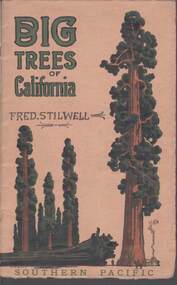
Book - STILWELL COLLECTION: BIG TREES OF CALIFORNIA, 1914
... Published by the Passenger Department, Southern Pacific Company, San Francisco, California....Trees of California Fred Stilwell Published by the Passenger Department, Southern Pacific Company, San Francisco, California. ...Colour front cover, title of book: 'Big Trees of California U.S.A'. This book is inscribed in the following manner: 'Fred Stilwell' on outside front cover; 'Fred Stilwell, Williamson St, Bendigo' on inside of front cover, first page.Published by the Passenger Department, Southern Pacific Company, San Francisco, California.trees of california, fred stilwell -
 Mont De Lancey
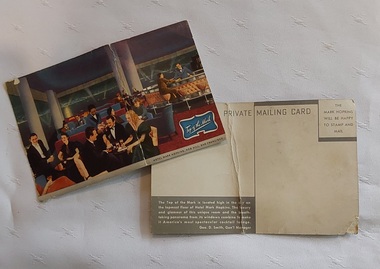
Postcard - Postcards, Hotel Mark Hopkins, early 1900's
... One of San Francisco’s "Big Four," Mark Hopkins was among those who founded what became the great Southern Pacific Railroad. In 1925, mining engineer and hotel investor George D. ...One of San Francisco’s "Big Four," Mark Hopkins was among those who founded what became the great Southern Pacific Railroad. In 1925, mining engineer and hotel investor George D. ...The history of the InterContinental Mark Hopkins San Francisco is rooted in the Gilded Age mansion built by railroad tycoon Mark Hopkins on Nob Hill, which burned down after the 1906 earthquake. The current hotel was constructed in its place and opened in 1926, retaining the opulent spirit of its predecessor through its Renaissance Revival-style architecture and historical features, such as the "Top of the Mark" lounge. One of San Francisco’s "Big Four," Mark Hopkins was among those who founded what became the great Southern Pacific Railroad. In 1925, mining engineer and hotel investor George D. Smith bought the land where the Hopkins estate was built with the desire to build a luxury hotel. San Franciscans declared the new “Mark Hopkins Hotel” to be, "architecturally perfect, flawless in its erection, comprehensive in its accommodations, strikingly representative of the best there is in modern hostelry." The Mark Hopkins Hotel quickly became an immediate part of San Francisco’s rich and colorful history. This famous hotel is still in existence today.Two identical coloured vintage postcards from the Top of the Mark bar at Hotel Mark Hopkins in San Francisco in the early 1900's. Guests are illustrated seated in their fine clothes enjoying drinks together. The curved bar is in the background. The whole scene overlooks the Bay of San Francisco at night through the large glass windows. On the back of the cards is room for writing a message and address, postage information and facts from the General manager.'Top of the Mark' is printed on the front of the cards at the bottom right, as well as Hotel Mark Hopkins, Nob Hill, San Fransisco' 'Private Mailing Card' 'The Mark Hopkins will be happy to stamp and mail' Plus general information about the hotel from the General Manager.postcards, photographic postcards, postal stationery -
 Wangaratta RSL Sub Branch
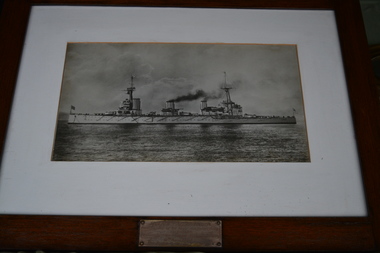
Print - Framed Print, HMAS Australia
... With the outbreak of the First World War, HMAS Australia became the flagship of the naval force that captured the German colonies in the southern Pacific. She led a force which captured Rabaul on 13 September 1914 before proceeding to Samoa. ...With the outbreak of the First World War, HMAS Australia became the flagship of the naval force that captured the German colonies in the southern Pacific. She led a force which captured Rabaul on 13 September 1914 before proceeding to Samoa. ...With the outbreak of the First World War, HMAS Australia became the flagship of the naval force that captured the German colonies in the southern Pacific. She led a force which captured Rabaul on 13 September 1914 before proceeding to Samoa. With no German forces left in the South Pacific, Australia was deployed to the United Kingdom. En route she sank the German ship Eleanore Woermann. On 8 February 1915 she became flagship of the 2nd Battle-cruiser Squadron of the Royal Navy's Grand Fleet. Australia's service with the Grand Fleet consisted of a series of frequent patrols and exercises. She was twice rammed, firstly on 22 April 1916 by HMS New Zealand. This led to her missing the Battle of Jutland which, considering the disastrous losses in the Battle-cruiser Force, may well have been fortunate. She was rammed again by HMS Repulse in December 1917. Australia carried out experimental aircraft operations in 1918 and led the port column of the Grand Fleet at the surrender of the German High Seas Fleet. Returning home in 1919, Australia suffered a mutiny upon reaching Fremantle, Western Australia. Quite obsolete, she became a training vessel in Westernport until scuttled off Sydney Heads on 12 April 1924.The Australian Navy's first flagship, the battle cruiser HMAS Australia (I) was the centrepiece of the 'Fleet Unit', whose acquisition signalled the RAN's arrival as a credible ocean going force. Ordered from John Brown and Company in March 1910, construction began three months later with the total cost of the ship and fittings expected to be some £2 million. The Commonwealth Government decided upon the name Australia, and it proved a popular choice, carefully avoiding any suggestion of favouritism towards any one Australian State. The ship's badge maintained the national theme by featuring the Federation Star overlaid by a naval crown, while the motto 'Endeavour' reflected the ideal of the Australian spirit and recalled Lieutenant James Cook's ship of 1768-71.Timber frame of black and white print of a ship at sea.Imperial War Museum Photograph HMAS AUSTRALIA - RAN FLAGSHIP First flagship of the Royal Austrlian Navy 1913-1920 Sunk under the terms of the Washington Treaty 12th April 1924 This frame is made of teak from her deckhmas australia, ww1 -
 Flagstaff Hill Maritime Museum and Village
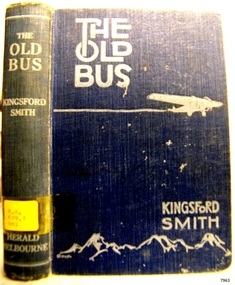
Book, The Old Bus
... Kingsford Smith wrote ‘The Old Bus’ (1932) and he and Ulm were co-authors of ‘Story of 'Southern Cross' Trans-Pacific Flight’ (1928). His also wrote a book about his own life ‘My Flying Life’ which was published after his death in 1937. ...Kingsford Smith wrote ‘The Old Bus’ (1932) and he and Ulm were co-authors of ‘Story of 'Southern Cross' Trans-Pacific Flight’ (1928). His also wrote a book about his own life ‘My Flying Life’ which was published after his death in 1937. and the story of his life was filmed in Australia in 1946. ...Sir Charles Edward Kingsford Smith is a famous Australian, well known in civil aviation history for his courageous endeavours in flight. He broken many flight records for long distance and time travelled and he was also a war hero in World War 1. He has been referred to as being “known to millions of Australians as “Smithy” … he was one of Australia’s true twentieth-century legends”. In honour of his place amongst the world’s famous pioneers his image is featured on Australia’s $20 note, Sydney airport is named after him, there is a memorial to Kingsford Smith, Taylor and Ulm at the Anderson Park, also in Sydney and his plane “Southern Cross” is on view at Brisbane Airport. Kingsford Smith wrote ‘The Old Bus’ (1932) and he and Ulm were co-authors of ‘Story of 'Southern Cross' Trans-Pacific Flight’ (1928). His also wrote a book about his own life ‘My Flying Life’ which was published after his death in 1937. and the story of his life was filmed in Australia in 1946. A BRIEF HISTORY OF SIR CHARLES EDWARD KINGSFORD SMITH (1897 – 1935) … Kingsford Smith was born 9th February 1897 in Brisbane, Queensland, Australia. His parents were William Charles Smith and Catherine Mary, nee Kingsford. His mother’s maiden name of “Kingsford” was added to the family name when they spent time in Canada from around 1903 to 1907, after which they returned to Sydney, Australia. In 1915 Kingsford Smith enlisted in Australian Imperial Force. He served in 4th Signal Troop, 2nd Division Signal Company at Gallipoli Peninsular as a ‘sapper’ or combat engineer and later in Egypt and in France as a dispatch rider. In 1916 Kingsford Smith was transferred to the Australian Flying Corps as a sergeant. He was discharged after training in England and commissioned as a second lieutenant in the Royal Flying Corps. He was appointed fling officer and soon joined the 23rd Squadron in France. He brought down four machines in his first month there and also did invaluable work attacking enemy targets. He was wounded and shot down and later awarded the Military Cross ‘for conspicuous gallantry and devotion to duty’. He was promoted to lieutenant in 1918 and served as a Flying Instructor with the R.F.C. Kingsford Smith was not allowed to participate in the 1919 England to Australia air race because of assumed lack of navigational experience. He and his pilot friend Cyril Maddocks formed a business and flew joy-flights in both England and America. In America he did some stunt flying with a Flying Circus. Kingsford Smith returned to Australia in 1921 and found employment as a pilot. He soon realised the value of air transport in such a vast country. He formed a partnership with pilot Keith Anderson in 1924 and they purchased two Bristol Tourer biplanes. Their business broadened to include Charles Ulm and became the Interstate Flying services in Sydney. Together they performed important ‘demonstration’ flights including a flight around Australia in 10 days and 5 hours using very limited navigational equipment. Kingsford Smith immediately started to search for support to do a trans-Pacific flight. This support came from the New South Wales government, Sidney Myer and G. Allan Hancock, an American oil magnate. On 31st May 1928 Kingsford Smith, Charles Ulm and two American crewmen, Harry Lyan and Jim Warner, took off from Oakland, California and flew to Brisbane via Hawaii and Suva. This historic flight took 83 hours and 38 minutes. Their Fokker plane had three engines and was named the “Southern Cross”. This amazing achievement resulted in huge financial subscriptions. Kingsford Smith was awarded the Air Force Cross and appointed as honorary squadron leader, Royal Australian Air Force. Kingsford Smith flew his Southern Cross plane from Point Cook in Victoria to Perth nonstop. Then in September – October 1928, with Charles Ulm and an Australian crew, he piloted the Southern Cross from Sidney to Christchurch New Zealand. This flight showed that was possible for regular passenger and mail services across the Tasman Sea. Kingsford Smith flew his plane to England to an order for four aircraft, planning to use them for an inter-capital air service in Australia. Sadly on 1st April 1929 he was forced to land, having lost radio contact with the ground and having run into bad weather over north – west Australia. Keith Anderson and Robert Hitchcock both perished before the search party reached them. Once official enquiries were completed the flight to England continued in June and was completed in record time of 12 days and 18 hours. In January 1930 Kingsford Smith piloted the “Southern Cloud”, one of the new Avro Ten planes, on the first flight of his airline, the Australian National Airways, from Sydney to Melbourne. The “Southern Cross” was overhauled in Holland by the Fokker Aircraft Co. and in June 1930 Kingsford Smith achieved an east-west crossing of the Atlantic from Ireland to Newfoundland in 31.5 hours. Kingsford Smith returned to England and took delivery of an Avro Avian biplane that he named the “Southern Cross Junior” and flew solo from England to Darwin, Australia. This record breaking flight took less than 10 days. He beat four other planes that had left England before him and he was 5.5 days faster than Hinkler. Sadly Kingsford Smith’s “Southern Cloud” was lost during a flight from Sydney to Melbourne in 1931 with no surviving crew or passengers; in 1958 the wreckage was discovered in the Snowy Mountains. Later that year Kingsford Smith flew his “Southern Cloud” from Australia to Timor, collecting mail from a damaged Imperial Airways plane in Timor. Other flights followed. Kingsford Smith was knighted in 1932 for his services in Aviation. He returned to selling joy flights then established the Kingsford Smith Air Service, a flying training school in Sydney. In 1933 Kingsford Smith flew the amazing record flight in “Miss Southern Cross” – a Percival Gull - from London to Wyndham in Western Australia in just over ten days. The Australian Commonwealth then gave Kingsford Smith a large grant and he was also appointed as aviation consultant to Vacuum Oil Co. Another flying record was made when Kingsford Smith and Sir P.G. Taylor flow “Lady Southern Cross” from Brisbane to San Francisco in order to sell her there; the west-east-trans-Pacific flight made aviation history. They returned to Australia to make an attempt at the trans-Tasman flight but their attempt failed due to engine failure; they managed to get back to Sydney safely, minus most of their cargo. Kingsford Smith had his unsold “Lady Southern Cross” shipped back to England, from where he and J. T. Pethybridge in the “Lady Southern Cross” attempted another record breaking flight from England The Old Bus Author: Charles Kingsford Smith Publisher: Distibuted by Herald Feature Service Date; 1932Label on spine cover with typed text RA 629.1309 KIN flagstaff hill, warrnambool, shipwrecked coast, flagstaff hill maritime museum, maritime museum, shipwreck coast, flagstaff hill maritime village, great ocean road, the old bus, charles kingsford smith -
 Federation University Historical Collection
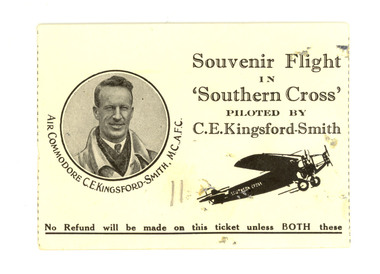
Souvenir - Ticket Stub, Ticket for a souvenir Flight with Charles Kingsford-Smith, c1932
... Pacific flight in 1934. In 1932 was selling joy-flights at ten shillings a trip. Most of his flights, including the joy flights, were made in the three-engine Fokker plane known as the 'Southern Cross', now preserved in a special display area at Brisbane Airport. ...Pacific flight in 1934. In 1932 was selling joy-flights at ten shillings a trip. Most of his flights, including the joy flights, were made in the three-engine Fokker plane known as the 'Southern Cross', now preserved in a special display area at Brisbane Airport. ...Sir Charles Edward Kingsford Smith (1897-1935) is one of Australia's most known Australia’s fliers. Born in 1897 at Hamilton, Qld. He spent his early life in Sydney enlisting in the AIF in 1915. He served at Gallipoli before transferring to the Royal Flying Corps in 1916. He was shot down and wounded in the foot in 1917. In 1929, Kingsford-Smith flew from Australia to England in the record-breaking time of 12 days, 18 hours. The following year he completed an east–west crossing of the Atlantic Ocean in 31 hours, followed by a record-breaking solo flight from England to Darwin in 10 days. He was knighted for services to aviation in 1932. He made the first west–east trans-Pacific flight in 1934. In 1932 was selling joy-flights at ten shillings a trip. Most of his flights, including the joy flights, were made in the three-engine Fokker plane known as the 'Southern Cross', now preserved in a special display area at Brisbane Airport. In late 1935 Kingsford Smith took off on the second leg of a flight from England to Australia with John ‘JT’ Pethybridge. The plane and pilots were never seen again, believed to have crashed into the sea at night somewhere off the coast of Burma. White ticket stub with black ink. It includes a photographic portrait of Charles Kingsford-Smith, and a drawing of the Southern Cross aeroplane. Gift of the Chatham-Holmes family.Printed on ticket 'Souvenir Flight in 'Southern Cross' piloted by C.E. Kingsford-Smith. No refund will be made on this ticket unless BOTH these"chatham, chatham family collection, kingsford-smith, charles kingsford-smith, smithy, southern cross, aeroplane, flight, joy ride, entertainment, airport, charles kingsford smith -
 Mission to Seafarers Victoria
Journal (item) - Periodicals-Annual, Shiplovers' Society of Victoria, The Annual Dog Watch
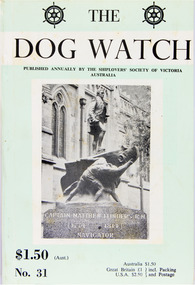
... Contents Foreword - 7 Editorial - 9 Matthew Flinders' Anchors - 11 The Diary of a Matelot in HMAS Perth - 17 Southern Hospitality - 31 With "Pamir" in the Pacific Ocean - 35 Newcastle Memories 1903 - 45 The Very Expensive Sea Serpent - 51 Reflections Around a Swiss Lake - 52 The Pearling Disaster of 1899 - 53 The Purchase of "Fearless" - 59 Total Eclipse - 63 Battle of Savo Island - 67 Shipboard Education - 73 A Freak of Navigation - 75 "Polly Woodside" War Record - 77 Drama at Niagara - 85 Pilot Ship and War Veteran - 87 Captured by Pirate Raiders in the Pacific 1940 - 91 Errata The Editors Regret - 105 Book Reviews - 107 Barkentine "Bear" - 113 Anchors Round the World - 115 Scrap Iron Flotilla - 117 The Man from Timbuctoo - 118 The Loss of the "Posen" - 123...Contributes to our knowledge of the importance of shipping and places on record those stories of the sea which would otherwise be lost. sailing ships steamships shipping seafaring life shiplovers' society of victoria dog watch captain matthew flinders Contents Foreword - 7 Editorial - 9 Matthew Flinders' Anchors - 11 The Diary of a Matelot in HMAS Perth - 17 Southern Hospitality - 31 With "Pamir" in the Pacific Ocean - 35 Newcastle Memories 1903 - 45 The Very Expensive Sea Serpent - 51 Reflections Around a Swiss Lake - 52 The Pearling Disaster of 1899 - 53 The Purchase of "Fearless" - 59 Total Eclipse - 63 Battle of Savo Island - 67 Shipboard Education - 73 A Freak of Navigation - 75 "Polly Woodside" War Record - 77 Drama at Niagara - 85 Pilot Ship and War Veteran - 87 Captured by Pirate Raiders in the Pacific 1940 - 91 Errata The Editors Regret - 105 Book Reviews - 107 Barkentine "Bear" - 113 Anchors Round the World - 115 Scrap Iron Flotilla - 117 The Man from Timbuctoo - 118 The Loss of the "Posen" - 123 The Annual Dog Watch Journal Periodicals-Annual Shiplovers' Society of Victoria ...This journal provides the reader with glimpses of the adventures and hardships of a seaman's life. Many of the stories are of sailing ships.Contributes to our knowledge of the importance of shipping and places on record those stories of the sea which would otherwise be lost.Contents Foreword - 7 Editorial - 9 Matthew Flinders' Anchors - 11 The Diary of a Matelot in HMAS Perth - 17 Southern Hospitality - 31 With "Pamir" in the Pacific Ocean - 35 Newcastle Memories 1903 - 45 The Very Expensive Sea Serpent - 51 Reflections Around a Swiss Lake - 52 The Pearling Disaster of 1899 - 53 The Purchase of "Fearless" - 59 Total Eclipse - 63 Battle of Savo Island - 67 Shipboard Education - 73 A Freak of Navigation - 75 "Polly Woodside" War Record - 77 Drama at Niagara - 85 Pilot Ship and War Veteran - 87 Captured by Pirate Raiders in the Pacific 1940 - 91 Errata The Editors Regret - 105 Book Reviews - 107 Barkentine "Bear" - 113 Anchors Round the World - 115 Scrap Iron Flotilla - 117 The Man from Timbuctoo - 118 The Loss of the "Posen" - 123sailing ships, steamships, shipping, seafaring life, shiplovers' society of victoria, dog watch, captain matthew flinders -
 The Beechworth Burke Museum
Animal specimen - Red-Winged Blackbird, Trustees of the Australian Museum, 1860-1880
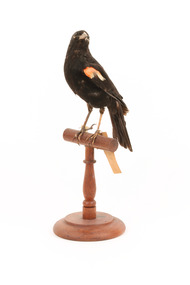
... They live in a verity of places from southern Alaska at its northern most point, to the Yucatan peninsula in the south and covers the greater part of the continent reaching from the Pacific coast of California and Canada to the eastern seaboard. ...They live in a verity of places from southern Alaska at its northern most point, to the Yucatan peninsula in the south and covers the greater part of the continent reaching from the Pacific coast of California and Canada to the eastern seaboard. ...The red-winged blackbird is native to North America. They live in a verity of places from southern Alaska at its northern most point, to the Yucatan peninsula in the south and covers the greater part of the continent reaching from the Pacific coast of California and Canada to the eastern seaboard. Populations that are most northerly migrate south after the mating season, but some of the populations in the central and western United States, Central America and the Gulf Coast are resident year-round. In the breeding season, Red-winged blackbirds are found in a range of fresh and saltwater environments, including in small trees and bushes along marshes and watercourses, in agricultural areas and dry meadows. During migration, they can be found in, pastures, prairies and cultivated fields. They are polygamous. In the north, the early arrival and tumbling song of these birds are welcome indications of spring's return. The Red-winged blackbirds are known for their scarlet and yellow shoulder patches on this specimen are rather dull and the feathers are not as glossy black as they are in other images. This specimen is part of a collection of almost 200 animal specimens that were originally acquired as skins from various institutions across Australia, including the Australian Museum in Sydney and the National Museum of Victoria (known as Museums Victoria since 1983), as well as individuals such as amateur anthropologist Reynell Eveleigh Johns between 1860-1880. These skins were then mounted by members of the Burke Museum Committee and put-on display in the formal space of the Museum’s original exhibition hall where they continue to be on display. This display of taxidermy mounts initially served to instruct visitors to the Burke Museum of the natural world around them, today it serves as an insight into the collecting habits of the 19th century.This specimen is part of a significant and rare taxidermy mount collection in the Burke Museum. This collection is scientifically and culturally important for reminding us of how science continues to shape our understanding of the modern world. They demonstrate a capacity to hold evidence of how Australia’s fauna history existed in the past and are potentially important for future environmental research. This collection continues to be on display in the Museum and has become a key part to interpreting the collecting habits of the 19th century.This is one of the most common birds in North America and is the most boldly coloured one. The males are glossy-black with shoulder patches of scarlet and yellow which they are able to puff up or hide according to their level of confidence. Females look like a big, dark sparrow, being a subdued, streaky brown. This specimen has the colouring of the male Red-Winged Blackbird which helps to identify it as such.Swing-Tag: 137a. / Red-winged Starling / Catalogue page, 58 / Tag: A. 4429taxidermy mount, taxidermy, animalia, burke museum, beechworth, australian museum, skin, reynell eveleigh johns, bird, american birds, north america, red-winged blackbird, red-winged starling, migratory, alaska, canada, saltwater -
 The Beechworth Burke Museum
Animal specimen - Red-Winged Blackbird, Trustees of the Australian Museum, 1860-1880
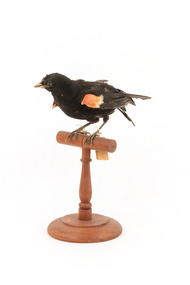
... They live in a verity of places from southern Alaska at its northern most point, to the Yucatan peninsula in the south and covers the greater part of the continent reaching from the Pacific coast of California and Canada to the eastern seaboard. ...They live in a verity of places from southern Alaska at its northern most point, to the Yucatan peninsula in the south and covers the greater part of the continent reaching from the Pacific coast of California and Canada to the eastern seaboard. ...The red-winged blackbird is native to North America. They live in a verity of places from southern Alaska at its northern most point, to the Yucatan peninsula in the south and covers the greater part of the continent reaching from the Pacific coast of California and Canada to the eastern seaboard. Populations that are most northerly migrate south after the mating season, but some of the populations in the central and western United States, Central America and the Gulf Coast are resident year-round. In the breeding season, Red-winged blackbirds are found in a range of fresh and saltwater environments, including in small trees and bushes along marshes and watercourses, in agricultural areas and dry meadows. During migration, they can be found in, pastures, prairies and cultivated fields. They are polygamous. The Red-winged blackbirds are known for their scarlet and yellow shoulder patches but on this specimen are rather dull and the feathers are not as glossy black as they are in other images. It is mounted accurately but the feathers appear to be ruffled. This specimen is part of a collection of almost 200 animal specimens that were originally acquired as skins from various institutions across Australia, including the Australian Museum in Sydney and the National Museum of Victoria (known as Museums Victoria since 1983), as well as individuals such as amateur anthropologist Reynell Eveleigh Johns between 1860-1880. These skins were then mounted by members of the Burke Museum Committee and put-on display in the formal space of the Museum’s original exhibition hall where they continue to be on display. This display of taxidermy mounts initially served to instruct visitors to the Burke Museum of the natural world around them, today it serves as an insight into the collecting habits of the 19th century.This specimen is part of a significant and rare taxidermy mount collection in the Burke Museum. This collection is scientifically and culturally important for reminding us of how science continues to shape our understanding of the modern world. They demonstrate a capacity to hold evidence of how Australia’s fauna history existed in the past and are potentially important for future environmental research. This collection continues to be on display in the Museum and has become a key part to interpreting the collecting habits of the 19th century.The Red-Winged Blackbird is one of the most common birds in North America and is the most boldly coloured one. The males are glossy-black with shoulder patches of scarlet and yellow which they are able to puff up or hide according to their level of confidence. Females look like a big, dark sparrow, being a subdued, streaky brown. The colouring of this particular specimen identifies it as male.[torn] page 58 / Tag: A. 4423taxidermy mount, taxidermy, animalia, burke museum, beechworth, australian museum, skin, reynell eveleigh johns, bird, american birds, north america, red-winged blackbird, red-winged starling, migratory, alaska, canada, saltwater -
 Mission to Seafarers Victoria
Drawing - Artist sketch, Gerry Cummins & Jill Stehn Pty. Ltd, 1980
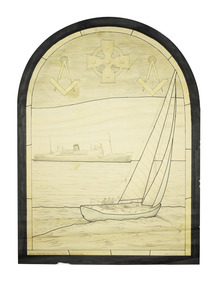
... Southern and Eastern Ports of Australia. In WW2 she was an armed merchant cruiser and served in Indian waters and escorted the 1st convoy out of the Singapore after the Japanese invasion. She later operated in the Pacific...Southern and Eastern Ports of Australia. In WW2 she was an armed merchant cruiser and served in Indian waters and escorted the 1st convoy out of the Singapore after the Japanese invasion. She later operated in the Pacific ...The window in this photograph was commissioned by the Sandringham Yacht Club in conjunction with a Masonic Lodge and work carried out by Gerry Cummins in 1980. In the background is the S.S. 'Kanimbla' built 1935, Belfast for McIlwraith McEacham and was the last large passenger ship built specifically for Australian owners. Designed to carry 400 passengers , she plied her trade around the Southern and Eastern Ports of Australia. In WW2 she was an armed merchant cruiser and served in Indian waters and escorted the 1st convoy out of the Singapore after the Japanese invasion. She later operated in the Pacific after the war and after repatriation duties she was decommissioned and subsequently sold to be renamed 'Oriental Queen' which eventually caught fire and sank. . The small yacht in the foreground refers to the Sandringham YC. Window measurements: 600mm x 900mmShows the link with Freemasonry.Sketch in pencil and ink on cream paper for an arched stained glass window depicting a yacht.Bottom left corner: Proposed Stained Glass Window, Mission to Seamen. (Scale: Full Size) Right Left corner: Gerry Cummingsfreemasons, st peter chapel, flinders street, mission to seafarers, gerry cummins, jill stehn, stained glass window, sandringham yacht club, hearts of oak lodge, yacht, symbols, square, compass, ss kanimbla -
 Phillip Island and District Historical Society Inc.
Book, GILL, Rev. William Wyatt, Life in the southern isles, or, scenes and incidents in the South Pacific and New Guinea, 1876?
... Life in the southern isles, or, scenes and incidents in the South Pacific and New Guinea...Life in the southern isles, or, scenes and incidents in the South Pacific and New Guinea Book GILL, Rev. ...Labelled 'Cowes Free Public Library', 'Phillip Island Historical Society. Cleeland Bequest'. -
 Bendigo Military Museum
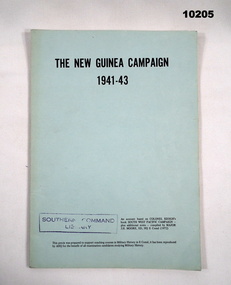
Booklet - NEW GUINEA WW2, Major J.H. Moore, The New Guinea Campaign 1941-43, 1972
... Pacific Campaign" plus additional notes as compiled by Major J. H. More, ED, HC, E Comd. Part of the Kevin John Herdman (No.397661) Collection. See Catalogue No. 5942P for details of his service. Kevin John HERDMAN New Guinea WW2 Booklet Stamped on front cover is purple ink: "SOUTHERN ...An account based on Colonel Keogh's book "South West Pacific Campaign" plus additional notes as compiled by Major J. H. More, ED, HC, E Comd. Part of the Kevin John Herdman (No.397661) Collection. See Catalogue No. 5942P for details of his service.A4 sized soft covered booklet. Cover is green coloured card. Printing on front cover in black type. Back cover blank. 36 pages with cut edges. Text in black type. Pages glued to cover. Includes map and line diagrams on page 11.Stamped on front cover is purple ink: "SOUTHERN COMMAND LIBRARY".kevin john herdman, new guinea, ww2, booklet -
 Bendigo Historical Society Inc.
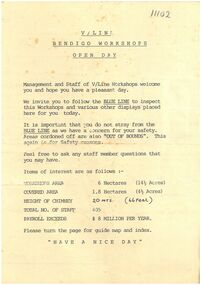
Ephemera - V/Line Bendigo workshops 'Open Day' leaflet
... The Bendigo Rail Workshops at North Bendigo are currently used by Southern Shorthaul Railroad to maintain broad gauge rolling stock for Pacific National, V/Line, Metro Trains Melbourne and CFCLA....The Bendigo Rail Workshops at North Bendigo are currently used by Southern Shorthaul Railroad to maintain broad gauge rolling stock for Pacific National, V/Line, Metro Trains Melbourne and CFCLA. ...The workshops were opened in November 1917 by the Victorian Railways. It opened in response to political pressures from provincial groups for decentralisation, with the Victorian Railways preferring the cheaper option of expanding the existing Newport Workshops in suburban Melbourne. Furthermore, unemployment had risen in both Bendigo and Ballarat due to a decline in mining operations. The main work carried out was repairs and maintenance of existing wagons and locomotives, however during 1919-22 thirteen new steam locomotives were also built - eight DD class (1033 - 1037, 1047 - 1049) and five A2 class (1078 - 1082). From the 1950s onwards, numerous steam locomotives were scrapped at the workshops. During the years immediately following nominal dieselisation in 1968, they were, at times, cutting up locomotives at the rate of one every two to three weeks. The workshops were also the site of the first VR brass foundry, which was transferred to Newport by the 1960s. Also, throughout 1965, VLX louvred vans were constructed at the workshops, at a rate of one a week. Other tasks included spring manufacture, construction of stainless steel footwarmers, and assembly of pantographs for electric trains, with a staff of 720 employed during 1966. By the 1980s, refurbishment work was also being carried out on Melbourne suburban electric multiple units. The 1980s were also a time of restructuring, and on the breakup of the Victorian Railways the workshops passed to the State Transport Authority and then the Public Transport Corporation. With privatisation the workshops were closed, with the loss of 262 jobs. In February 1996, the workshops were taken over by A Goninan & Co. In October 1999 the workshops were purchased by Great Northern Rail Services, with A Goninan & Co remaining as a tenant. In February 2001 A Goninan & Co vacated the site. The workshops were redeveloped in 2002 at a cost of $6.5 million - $4 million from VicTrack, $2 million from the State Government Regional Infrastructure Development Fund and $500,000 by the City of Greater Bendigo. The Bendigo Rail Workshops at North Bendigo are currently used by Southern Shorthaul Railroad to maintain broad gauge rolling stock for Pacific National, V/Line, Metro Trains Melbourne and CFCLA.Typed document. A4 page folded in half. On tan paper. Document pertaining to Bendigo V/Line workshops open day. Map on inside of folded page. Undated document.train, v/line, workshops, open day -
 Australian Queer Archives
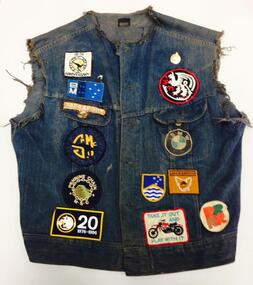
Uniform - Textiles, Mann, Roger, Roger Mann's Griffin Motor Club overlay, c1970s-1980s, 1976-1996
... Additional patches on the back include an Australian flag, and on the front include South Pacific Motor Club (SPMC), SPMC 20th Anniversary, Griffin MC 20th Anniversary, Griffin MC Associate Membership, Jackaroo MC Associate Membership, Southern Cross MC Associate Membership, Jackaroos Tasmania Run 1981, BMW, Australian National University (ANU) and unidentified....Additional patches on the back include an Australian flag, and on the front include South Pacific Motor Club (SPMC), SPMC 20th Anniversary, Griffin MC 20th Anniversary, Griffin MC Associate Membership, Jackaroo MC Associate Membership, Southern Cross MC Associate Membership, Jackaroos Tasmania Run 1981, BMW, Australian National University (ANU) and unidentified. ...Blue denim overlay (sleeveless jacket), with main back patch for the Griffin Motor Club, Canberra. Additional patches on the back include an Australian flag, and on the front include South Pacific Motor Club (SPMC), SPMC 20th Anniversary, Griffin MC 20th Anniversary, Griffin MC Associate Membership, Jackaroo MC Associate Membership, Southern Cross MC Associate Membership, Jackaroos Tasmania Run 1981, BMW, Australian National University (ANU) and unidentified.motorcycle club, gay, canberra -
Glen Eira Historical Society
Article - COANE, JOHN MONTGOMERY
... Pacific Phosphate Co. Ltd of London and to the City of Brighton where he lived. Coane John Montgomery Blacker’s Orchard & Cannery Co. Victorian Institute of Surveyors County Donegal Ireland Mordialloc Ballyshannon Mines Department Sludge Abatement Board Coane Henry Edward Surveyors Engineers Land Surveyors Board Coane Henry James J.M. and H.E. Coane Coane Jane nee Montgomery Coane John Montgomery Junior Victorian Education Department Australian Roads Collas Emma Anna Hunt Books Grant George Hudson Coutie B.M. State Electricity of Victoria Melbourne Epsom Racecourse Racecourses Brighton City of Brighton Brighton Re-adaptation Society Brighton Cemetery Cemeteries Southern ...This file contains one item about Coane and his family: 1/A one page extract from The Australian Dictionary of Biography Vol. 8 page 35 on John Montgomery Coane, Surveyor and Consulting Engineer, his partnership with George Hudson and later when his two sons joined the business. It details many of the projects he designed for rural Victoria and New South Wales and his other areas including Consulting to The Pacific Phosphate Co. Ltd of London and to the City of Brighton where he lived.coane john montgomery, blacker’s orchard & cannery co., victorian institute of surveyors, county donegal, ireland, mordialloc, ballyshannon, mines department sludge abatement board, coane henry edward, surveyors, engineers, land surveyors board, coane henry james, j.m. and h.e. coane, coane jane nee montgomery, coane john montgomery junior, victorian education department, australian roads, collas emma anna hunt, books, grant george hudson, coutie b.m., state electricity of victoria, melbourne, epsom racecourse, racecourses, brighton, city of brighton, brighton re-adaptation society, brighton cemetery, cemeteries, southern roger j, australian dictionary of biography vol. 8, early settlers -
Eltham District Historical Society Inc
Document - Folder, Osborne, William Alexander and Ethel Elizabeth
... Pacific Womens Conference...Everard Drive...War Memorial Warrandyte...War Memorial Tower Kangaroo Ground...Warrandyte Womens Hospital Auxiliary...Catalysts club...The Lyceum...British Ex-service Womens Clubs...Penleigh Boyd...Clara Southern...William Alexander Osborne Clement Byrne Christensen William Longstaff Sir John Longstaff T L Handfield Bishop Reginald Stephen Nin Christensen Ethel Elizabeth Osborne nee Goodson Audrey Osborne Gerard Osborne Yrsa Osborne Charis Osborne "Lowestoft" at Warrandyte "The Hall" at Kangaroo Ground "Woodlands" at Kangaroo Ground P J McMahon Faculty of Medicine University of Melbourne The League of Nations Pan Pacific Womens Conference Everard Drive War Memorial Warrandyte War Memorial Tower Kangaroo Ground Warrandyte Womens Hospital Auxiliary Catalysts club The Lyceum British Ex-service Womens Clubs Penleigh Boyd Clara Southern Jo Sweatman Commonwealth Court of Conciliation and Arbitration St Vincent's Hospital Shool of Dietetics Newspaper clippings, A4 photocopies, etc Osborne, William Alexander and Ethel Elizabeth Document Folder ...William Alexander Osborne married Ethel Elizabeth Osborne in 1903; they came to Australia when he became Professor of Physiology at the University of Melbourne, later Dean, Faculty of Medicine, retiring in 1938. In 1904 they lived in Warrandyte at "Lowestoft", later moving to "The Hall" at Kangaroo Ground. Their children were Audrey, Gerard, Yrsa and Charis. Ethel, born in Leeds U.K., graduated in medicine in the 1920s and was active in social issues.She represented Australia at international conferences of The League of Nations and the Pan Pacific Womens Conference; during World War ; she was appointed by the British Ministry of Munitions on working conditions of women and played a major role in the establishment of The Emily McPherson College of Domestic Economy..Locally she was involved with the construction of Evarard Drive, the War Memorial at Warrandyte, the War Memorial Tower at Kangaroo Ground, and the Warrandyte Womens Hospital Auxiliary. She was a foundation member of the Catalysts, The Lyceum and the British Ex-service Womens Clubs and was interested in the arts, knowing many local artists. Contents Photocopy page of book: Paragraph about Professor William Alexander Osborne.Newspaper clippings, A4 photocopies, etcwilliam alexander osborne, clement byrne christensen, william longstaff, sir john longstaff, t l handfield, bishop reginald stephen, nin christensen, ethel elizabeth osborne nee goodson, audrey osborne, gerard osborne, yrsa osborne, charis osborne, "lowestoft" at warrandyte, "the hall" at kangaroo ground, "woodlands" at kangaroo ground, p j mcmahon, faculty of medicine university of melbourne, the league of nations, pan pacific womens conference, everard drive, war memorial warrandyte, war memorial tower kangaroo ground, warrandyte womens hospital auxiliary, catalysts club, the lyceum, british ex-service womens clubs, penleigh boyd, clara southern, jo sweatman, commonwealth court of conciliation and arbitration, st vincent's hospital shool of dietetics -
Victorian Aboriginal Corporation for Languages
Book, Helen Gardner et al, Southern Anthropology : a History of Fison and Howitt's Kamilaroi and Kurnai, 2015
... Their book revealed the complexity of Aboriginal and Pacific Island societies and changed the course of anthropology in the early years of the discipline. Using archival sources and an innovative approach, Southern Anthropology explores the research, writing and reception of 'Kamilaroi and Kurnai'. ...Their book revealed the complexity of Aboriginal and Pacific Island societies and changed the course of anthropology in the early years of the discipline. Using archival sources and an innovative approach, Southern Anthropology explores the research, writing and reception of 'Kamilaroi and Kurnai'. ...From far-flung sites in Australia and the Pacific Islands, Lorimer Fison and A. W. Howitt produced the landmark study, 'Kamilaroi and Kurnai' (1880). Their book revealed the complexity of Aboriginal and Pacific Island societies and changed the course of anthropology in the early years of the discipline. Using archival sources and an innovative approach, Southern Anthropology explores the research, writing and reception of 'Kamilaroi and Kurnai'. Historical chapters track Fison and Howitt's collection and analysis of anthropological material in the context of raging debates about the evolution of humans. This narrative is interspersed with an introduction to the kinship and social organisation of Aboriginal and Pacific Island people that highlight the enduring value of Fison and Howitt's methods and the resurgence of their questions in contemporary anthropology. Southern Anthropology is designed to be read across disciplinary boundaries. b&w illustrations, b&w photographs, tables, document reproductionshistories, anthropology, howitt, fisson, kamilaroi, kurnai, evolution, archives, australia -
Koorie Heritage Trust
Book, Blake, Barry J, Wathawurrung and the Colac language of southern Victoria, 1998
... Wathawurrung and the Colac language of southern Victoria Book Blake, Barry J. Pacific Linguistics Research School of Pacific and Asian Studies, A.N.U. ...The papers in this volume represent an activity that is becoming increasingly common: putting together scattered sources, mainly from the nineteenth century, on various Australian languages, particularly languages of south-eastern Australia. These languages are no longer spoken in anything like their full, original form and in many communities only a few words are remembered.v-x; 177P.; maps; tables; 25 cm.The papers in this volume represent an activity that is becoming increasingly common: putting together scattered sources, mainly from the nineteenth century, on various Australian languages, particularly languages of south-eastern Australia. These languages are no longer spoken in anything like their full, original form and in many communities only a few words are remembered. aboriginal australians -- victoria -- geelong region -- languages. | aboriginal australians -- victoria -- ballarat region -- languages. | aboriginal australians -- victoria -- colac region -- languages. | aboriginal australians -- victoria -- languages. | wathawurrung dialect. | gulidjan language. | -
Moorabbin Air Museum
Booklet (item) - Crossing the Pacific - The flight of the Southern Cross 1928
... Crossing the Pacific - The flight of the Southern Cross 1928 ...Booklet Crossing the Pacific - The flight of the Southern Cross 1928 ... -
Moorabbin Air Museum
Photograph (item) - Southern Cross Fokker Tri Motor flown by Sir Charles Kingsford Smith
... The Southern Cross is a Fokker F.VIIb/3m trimotor monoplane that was flown by Australian aviator Charles Kingsford Smith, Charles Ulm, Harry Lyon and James Warner in the first-ever trans-Pacific flight to Australia from the mainland United States, a distance of about 11,670 kilometres (7,250 mi), in 1928....The Southern Cross is a Fokker F.VIIb/3m trimotor monoplane that was flown by Australian aviator Charles Kingsford Smith, Charles Ulm, Harry Lyon and James Warner in the first-ever trans-Pacific flight to Australia from the mainland United States, a distance of about 11,670 kilometres (7,250 mi), in 1928. ...The Southern Cross is a Fokker F.VIIb/3m trimotor monoplane that was flown by Australian aviator Charles Kingsford Smith, Charles Ulm, Harry Lyon and James Warner in the first-ever trans-Pacific flight to Australia from the mainland United States, a distance of about 11,670 kilometres (7,250 mi), in 1928. -
Vision Australia
Film - Video recording, Danielle Matthews, 2002 Southern Cross games, 2002
... In 2002, the Southern Cross games was held at Burwood. Students from around Australia as well as the Pacific region, came together to compete and make new friends in a fun environment. ...In 2002, the Southern Cross games was held at Burwood. Students from around Australia as well as the Pacific region, came together to compete and make new friends in a fun environment. ...In 2002, the Southern Cross games was held at Burwood. Students from around Australia as well as the Pacific region, came together to compete and make new friends in a fun environment. This film was created to capture the experience of the games.1 MPG file of the Southern Cross gamesrvib burwood school, recreation -
Highett RSL Sub Branch Inc
Medals and Memrobilia:, Service Medals
... Penant "HMAS Southern Cross" Fighting for Comforts Fund Badge 1939 - 1945 Medal George Wilson 1939- 1945 Australian defence Medal 1939 -1945 Empire Defence Medal Pacific Star 1939 -1945 Star ...PM6378 G W Wilson Penant "HMAS Southern Cross" Fighting for Comforts Fund Badge 1939 - 1945 Medal George Wilson 1939- 1945 Australian defence Medal 1939 -1945 Empire Defence Medal Pacific Star 1939 -1945 Star Service Medals Medals and Memrobilia: ...Penant "HMAS Southern Cross" Fighting for Comforts Fund Badge 1939 - 1945 Medal George Wilson 1939- 1945 Australian defence Medal 1939 -1945 Empire Defence Medal Pacific Star 1939 -1945 Star PM6378 G W Wilson -
 Wodonga & District Historical Society Inc
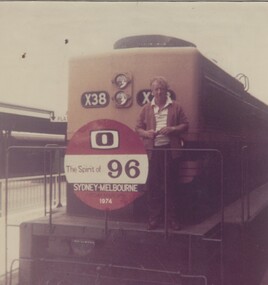
Photograph - Fred Rochow Railways Collection - Driver George Judge, 1974
... X 37 and X 38 were built as replacements for the two S Class locomotives lost in the fatal Southern Aurora crash at Violet Town in 1969. It was later sold to Pacific National and rebuilt as XR550. ...X 37 and X 38 were built as replacements for the two S Class locomotives lost in the fatal Southern Aurora crash at Violet Town in 1969. It was later sold to Pacific National and rebuilt as XR550. ...The Fred Rochow Railways Collection incorporates photos related to the operation of the Wodonga Railway Station including different types of trains and railways staff C. 1930 – 1990. It was donated to the Wodonga Historical Society by Fred Rochow, a railwayman who spent many years based in Wodonga. He joined the Victorian Railways on 17th June l947 and retired in 1988. For some time, he was a member of the Australian Federated Union of Locomotive Enginemen and served a term as a member of the Trades Hall Council. He had an extensive knowledge of the struggles that took place to achieve better conditions for railway workers. Fred worked for many years as a fireman and then worked his way up the ranks to driver, experiencing many changes from the days of steam locomotives through to diesel trains, locomotives and even the modern XPT train. He worked throughout Victoria at different stages of his career, with his final working years focused on the northeast of Victoria and the Albury to Melbourne line. After his retirement, Fred continued to share his love of steam miniature trains with the community.This collection has local and statewide significance as it captures images of trains, locomotives and personnel who operated the railway services in Wodonga and throughout Northeast Victoria. The railways played a critical role in opening up Victoria and connecting Australia for trade, business, social communication and transport.Driver George Judge standing on front of Locomotive X38 special train "Spirit of 96" The X class are a class of mainline diesel locomotives built by Clyde Engineering Victorian Railways between 1966 and 1976. X 38 was part of the second order. It entered service on Friday, 8th May 1970. X 37 and X 38 were built as replacements for the two S Class locomotives lost in the fatal Southern Aurora crash at Violet Town in 1969. It was later sold to Pacific National and rebuilt as XR550. "Spirit of 96" was a passenger train specially designed for cast and crew of the Australian 0-10 Network series “Number 96”. It was used to travel from Sydney to Melbourne for the annual TV Week Logie Awards. It was a silver, multi-carriage train with the Commissioner's carriage hooked up at the rear for VIPs. The 16 and a half-hour overnight journey, left from the centre of Sydney at 4.30 pm with a farewell party, complete with red carpet and jazz band in attendance. It featured whistle stop visits at country sidings and stations. Thousands of people turned out to see their favourite stars, before it arrived at Spencer Street station. The rail service of the time was keen to promote its overnight tourism packages, and for the journey the train was christened as the "Spirit of 96”. On front of locomotive "X38" On red black and white sign attached to the front rail of the locomotive "O/The Spirit of 96/Sydney-Melbourne/1974"railways wodonga, fred rochow, wodonga railwaymen, x class diesel locomotive, george judge, spirit of 96 -
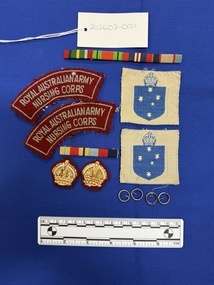 Returned Nurses RSL Sub-branch
Uniform - Ribbon bars, rank badges, battledress flashes, patches, split rings, unknown
... Southern Command formation sign. There are four split rings that would have used for the attachment of buttons or other metal/delicate things that required removal prior to laundering. Present is two ribbon bars of various length, the long one denoting WWII medals: Pacific...Southern Command formation sign. There are four split rings that would have used for the attachment of buttons or other metal/delicate things that required removal prior to laundering. Present is two ribbon bars of various length, the long one denoting WWII medals: Pacific ...Patches, ribbon bars, split rings that were originally used on the uniform of WWII serving nurse Lesla Meddy Blanshard. Two battledress flashes for 'Royal Australian Army Nursing Corps', Two crown patches denoting rank of Lieutenant and two patches with the Southern Command formation sign. There are four split rings that would have used for the attachment of buttons or other metal/delicate things that required removal prior to laundering. Present is two ribbon bars of various length, the long one denoting WWII medals: Pacific Star, Defence Medal, War Medal 1939-45 and Australian Service Medal. The shorter bar denoting the 1939-45 Star and Africa Star.Two sets of ribbon bars with coloured stripes that indicate awards received, three sets of two patches including maroon battledress flashes, blue and white southern command formation sign patches and maroon and gold rank patches, along with four metal split rings.Englishwwii, ww2, world war 2, uniform accessories, uniform, patches
