
Showing 32 items matching "st edward's crown"
-
 Bayside Gallery - Bayside City Council Art & Heritage Collection
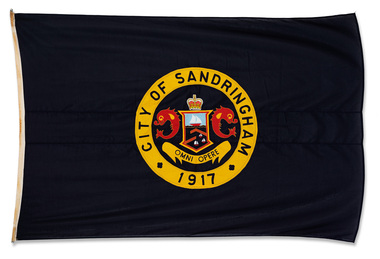
Flag, Gairs, City of Sandringham flag
... ...St Edward's crown...The shield is flanked by two dolphins, with St Edward's crown above, and a banner containing the motto 'OMNI OPERE' beneath. ...The shield is flanked by two dolphins, with St Edward's crown above, and a banner containing the motto 'OMNI OPERE' beneath. ...The Flag contains the Sandringham seal, which was designed by Sans and McDougall, had been selected in 1917 by a special committee and depicted as its main feature the Sandringham pier and breakwater, with a yacht in full sail, as an inset, and supported by two dolphins. The motto selected was Omni Opere ("With all earnestness.").Dark blue flag with circular City of Sandringham seal in the centre with the words CITY OF SANDRINGHAM in yellow border around the outside. The seal contains a central shield depicting a large sailboat in the water at the top, below it an L-shaped pier protruding from the right and below that another pier protruding from the left with two small boats at the bottom. The shield is flanked by two dolphins, with St Edward's crown above, and a banner containing the motto 'OMNI OPERE' beneath. flag, city of sandringham, seal, crest, omni opere, pier, boat, motto, sans and mcdougall, with all earnestness, st edward's crown -
 Bayside Gallery - Bayside City Council Art & Heritage Collection
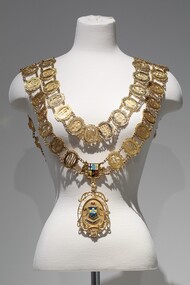
Ceremonial object - Mayoral chain, Blashki, City of Sandringham Mayoral Chain, c. 1954
... ...St Edward's crown...The seal is flanked by two engraved dolphins and above it sits an engraved St Edward's gold crown filled with red enamel. Below the seal, there is a ribbon containing the Latin motto 'OMNI OPERE' which is engraved and filled in dark blue enamel. ...The seal is flanked by two engraved dolphins and above it sits an engraved St Edward's gold crown filled with red enamel. Below the seal, there is a ribbon containing the Latin motto 'OMNI OPERE' which is engraved and filled in dark blue enamel. ...This chain was part of the official regalia worn by the Mayor of the City of Sandringham before the amalgamation into Bayside City Council in 1994. The chain was seen as an outward sign of power, authority, and responsibility and was a formal, full-dress type of regalia that was worn by the mayor over their robes at ceremonial functions. The large central drop medallion features the design of the council sea, and the links of the chains are made of cutwork initials of each Mayor. The Sandringham seal was designed by Sans and McDougal had been selected in 1917, by a special committee and its main features are the Sandringham pier and breakwater, with a yacht in full sail as an inset, supported by two dolphins. The motto reads 'Omni Opere' which translates to ‘With all earnestness.’9 carat yellow gold mayoral chain for the City of Sandringham. Consists of two concentric circles of 57 small oval links, with an Australian Coat of Arms as a centrepiece and a large 'drop' medallion of the City of Sandringham seal below. Each oval link is made up of the cutwork initials of a mayor, the surrounding oval border has an inscription above the initials which gives the mayor's name; an inscription below gives dates of office; the earliest is Cr. B.J. Ferdinando 1917-18, and latest is Cr. S.T. Russell 1993-94. The ovals are surrounded by decorative scrolls and are joined by small curb chains. The outer circle contains 31 links, while the inner contains 26. On both shoulders sit decorative bars, joining the front of the chain to the back. The main medallion has an oval central panel that features the coloured Sandringham seal in enamel depicting two sailboats in the water, a pier protruding from the left, a coastline on the right with two pine trees. Above the scene are decorative triangles in light blue and yellow, above which is another section in dark blue containing a third sailboat. The seal is flanked by two engraved dolphins and above it sits an engraved St Edward's gold crown filled with red enamel. Below the seal, there is a ribbon containing the Latin motto 'OMNI OPERE' which is engraved and filled in dark blue enamel. The pendant is surrounded by cutwork lettering reading 'CITY OF SANDRINGHAM / 1919' and leaf decorations. The medallion is inscribed on the reverse with important dates in Sandringham's history. A fleur-de-lys joins the medallion to the Australian Coat of Arms centrepiece above. The Coat of Arms features a shield, depicting symbols of Australia's six states, in enamel, flanked by an engraved kangaroo on the left and emu on the right. Below it sits a ribbon engraved 'ADVANCE AUSTRALIA'.mayoral chain, ceremonial wear, seal, medallion, mayor, coat of arms, crest, bayside, blashki & sons, city of sandringham, sandringham, omni opere, blashki, mayoral regalia, motto, st edward's crown, sans and mcdougall -
 Moorabbin Air Museum
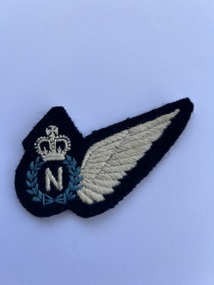
Uniform (Item) - RAAF Navigator's Embroidered Brevet
... RAAF Navigator's Embroidered Brevet, with St Edward's crown....RAAF Navigator's Embroidered Brevet, with St Edward's crown. RAAF Navigator's Embroidered Brevet. ... -
 Beechworth RSL Sub-Branch
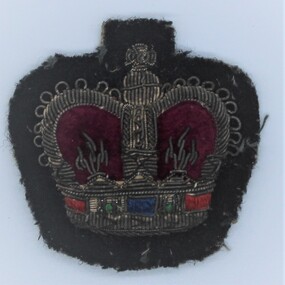
Insignia Rank Major
... Embroidered rank insignia (Major) on black wool; the St Edward's Crown is embroidered on red wool with gold, silver and red cotton thread...Insignia rank - Major embroidered rank insignia Embroidered rank insignia (Major) on black wool; the St Edward's Crown is embroidered on red wool with gold, silver and red cotton thread Insignia Rank Major ...Embroidered rank insignia (Major) on black wool; the St Edward's Crown is embroidered on red wool with gold, silver and red cotton threadinsignia rank - major, embroidered rank insignia -
 Bayside Gallery - Bayside City Council Art & Heritage Collection
Ceremonial object - Seal, Town of Sandringham and City of Sandringham seals
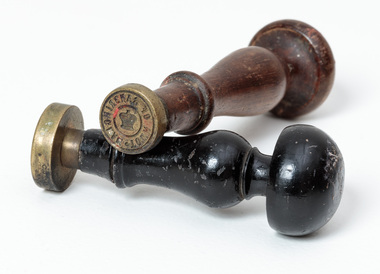
... The longer brown wooden handle seal reads around edge 'TOWN OF SANDRINGHAM' with an illustration of St Edward's crown in centre. The black wooden-handled seal reads around edge 'CITY OF SANDRINGHAM' with an illustration of St Edward's crown in centre. ...The longer brown wooden handle seal reads around edge 'TOWN OF SANDRINGHAM' with an illustration of St Edward's crown in centre. The black wooden-handled seal reads around edge 'CITY OF SANDRINGHAM' with an illustration of St Edward's crown in centre. ...Council's seals were stamped into hot wax to officialise documents. Sandringham was originally part of the Shire of Moorabbin. On 28 February 1917, Sandringham was severed from Moorabbin and incorporated as the Borough of Sandringham. It was proclaimed a Town on 9 April 1919 and a City on 21 March 1923.Two round brass seals on wooden handles. The longer brown wooden handle seal reads around edge 'TOWN OF SANDRINGHAM' with an illustration of St Edward's crown in centre. The black wooden-handled seal reads around edge 'CITY OF SANDRINGHAM' with an illustration of St Edward's crown in centre. Both seals have mushroom-shaped tops and tapered arms.There are remnants of red wax on both seals.seal, common seal, stamp, town of sandringham, city of sandringham, writing accessory, wax seal, bayside -
 The 5th/6th Battalion Royal Victoria Regiment Historical Collection
Uniform - 6th Battalion, the Royal Victoria Regiment Mess Dress Jacket
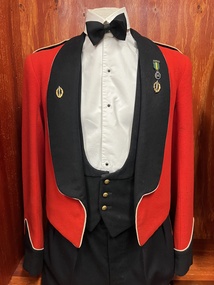
... The staybrite St Edward's Crown rank insignia to each epaulet also indicate use between 1960-1980s. ...The staybrite St Edward's Crown rank insignia to each epaulet also indicate use between 1960-1980s. ...The staybrite St Edward's Crown rank insignia to each epaulet also indicate use between 1960-1980s. ...6th Battalion, the Royal Victoria Regiment Mess Dress Jacket. Traditional Fusiliers pattern mess dress inherited from the 6th Battalion, the Royal Melbourne Regiment (1918-1960) who were given the pattern by their allied regiment, the Royal Fusiliers (City of London Regiment) in 1936 as a token of friendship. The Royal Victoria Regiment (RVR) was a late adopter of miniature RVR badges for collar badges and the Royal Australian Infantry Corps collar badges fitted indicate use after 1960 and likely at least into the 1980s when miniature RVR badges were adopted. The staybrite St Edward's Crown rank insignia to each epaulet also indicate use between 1960-1980s. Red body with white piping to Royal blue facings (to cuffs, epaulets and lapel/collar). Royal blue lapelled waistcoat with brass Australian Commonwealth Military Forces buttons. This mess jacket is significant because Australian Army Infantry units would normally wear the Infantry Corps pattern of mess dress. However, this pattern was worn by the 6th Battalion, the Royal Victoria Regiment (and likely also 5/6 RVR) right up to the late 1980s due to the unique and honoured customs and traditions of the 6th Battalion. It is a traditional Fusiliers pattern mess dress which was inherited from the 6th Battalion, the Royal Melbourne Regiment (1918-1960) who were the forebear to the Royal Victoria Regiment. They were given the pattern by their allied regiment, the Royal Fusiliers (City of London Regiment) in 1936 as a token of friendship. The use after 1960 (when the Royal Melbourne Regiment was amalgamated) is evidenced by unit held photos and by object itself which bears the Royal Australian Infantry Corps collar badges and staybrite St Edward's Crown rank insignia to each epaulet (for rank of Major).6th Battalion, the Royal Victoria Regiment Mess Dress Jacket. Traditional Fusiliers pattern mess dress inherited from the 6th Battalion, the Royal Melbourne Regiment (1918-1960) who were given the pattern by their allied regiment, the Royal Fusiliers (City of London Regiment) in 1936 as a token of friendship. The Royal Victoria Regiment (RVR) was a late adopter of miniature RVR badges for collar badges and the Royal Australian Infantry Corps collar badges fitted indicate use after 1960 and likely at least into the 1980s when miniature RVR badges were adopted. The staybrite St Edward's Crown rank insignia to each epaulet also indicate use between 1960-1980s. Red body with white piping to Royal blue facings (to cuffs, epaulets and lapel/collar). Royal blue lapelled waistcoat with brass Australian Commonwealth Military Forces buttons. 6th battalion, royal melbourne regiment, mess dress jacket, mess dress, mess jacket, australian army, royal australian infantry corps, rainf, rmr, 5th/6th battalion, royal victoria regiment, city of melbourne regiment, rvr, 5/6 rvr -
 Warrnambool RSL Sub Branch
Plaque - Souvenir Fridge Magnets, 4 ADF Fridge Magnets plus 1 'Death Railway' magnet
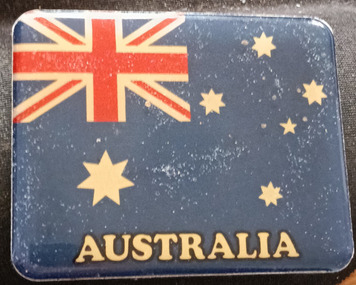
... 'NAVY' + Australian Royal Navy badge with St Edward Crown. 4. 'Lest We Forget' + RSL Badge image. 5. ...'NAVY' + Australian Royal Navy badge with St Edward Crown. 4. 'Lest We Forget' + RSL Badge image. 5. ...commemorative, WW2, ADF, 'Death' RailwayIllustrative of ways of commemorating the ADFRectangular plastic Fridge magnets x 4. 1 photo image on wood1. Australian Flag + 'Australia. 2.Rising Sun Badge 'The Australian Army'. 3. 'NAVY' + Australian Royal Navy badge with St Edward Crown. 4. 'Lest We Forget' + RSL Badge image. 5. 'The Death Railway' 'Kanchanaburi Thailand' + photo image of train. -
 Moorabbin Air Museum
Uniform (item) - Royal Australian Armoured Corps (RAAC) Dress Jacket
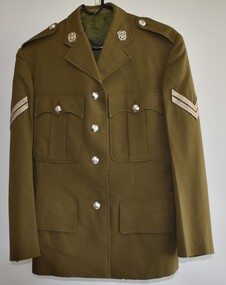
... Topped with St Edward's Crown often referred to as the Queen's Crown. ...Topped with St Edward's Crown often referred to as the Queen's Crown. ...Manufactured by E.W P/Ltd South Australia 1966. Size 35 Regular, Class 8405, 66-019-8460 -
![Photo of Queen Elizabeth II Silver jubilee dish laid upon the dish's matching red felt box. The cool-to-touch silver dish has engravings upon its face including the royal mark of Queen Elizabeth the Second, 'EIIR' under surmounted by St Edward's crown, '1952' on the left of the dish, 'Royal Australian Army Nursing Cross' is embossed within an oval central press, surmounted by St Edwards crown, in the centre of the oval is a Nightingale oil lamp, across the bottom of the central oval is a scroll embossed with the motto 'Pro Humanitate' Latin for 'For Humanity'. Underneath the central embossment and aligned with the royal Elizabeth sigil is an engraving of the dates '1902 - 1977' [seemingly this date was engraved after the making of the dish, it is unknown how long after the presenting of the dish the engraving was added.] Underneath those dates are engravings/marks of silver, nickel and makers quality marks. Upon flipping the dish over, on the slight foot of the dish is an embossing of 'Nickel Silver' and an engraving of the silver quality number '49'. The red felt box lid is also pictured, white satin with soft cushioning to protect the dish when closed. This photograph is taken upon a black background, with a scale card and object number included.](/media/collectors/64a5077bc83bd7b7b94f4211/items/67d1436203274031f6b50116/item-media/67d1462403274031f6b51496/item-fit-380x285.jpg?cb=6) Returned Nurses RSL Sub-branch
Returned Nurses RSL Sub-branchCeremonial object - Queen Elizabeth II Silver Jubilee Dish, Goldsmith's Company Assay Office, c. 1977
... /[surmounted by St Edward's Crown]/'1952'/'Royal Australian Army Nursing Corps'/[surrounding Nightingale oil lamp, surmounted by St Edward's Crown.], 'Pro Humnitate'/[scroll embossing.]/'1902-1977'/'D-M S'[Makers mark]/Lion passant mark [indicates a fineness of 925/1000 sterling silver]/British silver hallmark [Leopard face that indicates the London Assay Office]/'C'[Denotes the date of silver pressing, capital C indicates 1977.].../[surmounted by St Edward's Crown]/'1952'/'Royal Australian Army Nursing Corps'/[surrounding Nightingale oil lamp, surmounted by St Edward's Crown.], 'Pro Humnitate'/[scroll embossing.]/'1902-1977'/'D-M S'[Makers mark]/Lion passant mark [indicates a fineness of 925/1000 sterling silver]/British silver hallmark [Leopard face that indicates the London Assay Office]/'C'[Denotes the date of silver pressing, capital C indicates 1977.] ...The Queen Elizabeth II Silver Jubilee Medal was awarded to citizens in the Commonwealth (Canada, United Kingdom, Australia and New Zealand) for their healthcare/nursing services. This ceremonial dish appears to serve the same or similar purpose to the medal, it is unknown whether the dish was awarded, or whether it was purchased and customised to reflect the respect of service that the medal from the same year served. This dish is peculiar, which in turn increases the significance of the object. Though similar to the Queen Elizabeth II Silver Jubilee Medal in social purpose, it is less historically significant. However, due to the nature of the collection at large, this object is of medium to high significance. Additionally, it may be a crucial object in reflecting thoughts, feelings and social organisation of Australian nurses. Nickel silver dish with several engravings and embossing, small dish foot, shallow dish, including Royal Australian Army Nursing Corps logo upon the centre of dish. 'EIIR' (Royal Elizabeth the Second sigil.)/[surmounted by St Edward's Crown]/'1952'/'Royal Australian Army Nursing Corps'/[surrounding Nightingale oil lamp, surmounted by St Edward's Crown.], 'Pro Humnitate'/[scroll embossing.]/'1902-1977'/'D-M S'[Makers mark]/Lion passant mark [indicates a fineness of 925/1000 sterling silver]/British silver hallmark [Leopard face that indicates the London Assay Office]/'C'[Denotes the date of silver pressing, capital C indicates 1977.]/Portrait of Queen Elizabeth the Second [Duty mark reflecting a tax on precious metals collected between 1784 and 1890 and that the tax had been paid.] On the base of dish: 'Nickel Silver' [material]. / '49'. silver jubilee, queen elizabeth ii, queen elizabeth 2, queen elizabeth the second, royal australian army nursing corps -
 Lara RSL Sub Branch
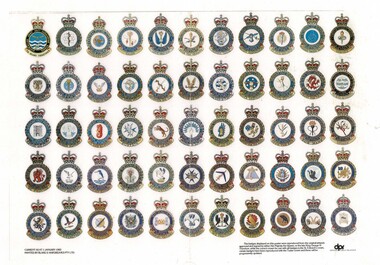
Squadron Insignia / Badges of the Royal Australian Air Force, Badges of the Royal Australian Air Force, Current as at 01January 1983
... Therefore, while the correct crown for use with all badges is the St. Edward's crown, certain badges have been reproduced with the Tudor crown and these will be progressively updated. ...Therefore, while the correct crown for use with all badges is the St. Edward's crown, certain badges have been reproduced with the Tudor crown and these will be progressively updated. ...2 x Laminated colour photocopy of poster of RAAF Squadron Insignia / BadgesThe badges displayed on this poster were produced from the original artwork approved and signed by either Her Majesty the Queen, or the late King George VI. Therefore, while the correct crown for use with all badges is the St. Edward's crown, certain badges have been reproduced with the Tudor crown and these will be progressively updated. Defence Public Relationsraaf badges, squadron badges, badges of the raaf -
 Bayside Gallery - Bayside City Council Art & Heritage Collection
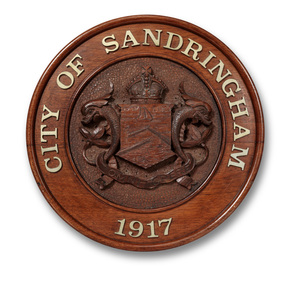
Plaque, City of Sandringham plaque
... The shield is flanked by two dolphins, with St Edward's crown above, and a banner containing the motto 'OMNI OPERE' beneath. ...The shield is flanked by two dolphins, with St Edward's crown above, and a banner containing the motto 'OMNI OPERE' beneath. ...The Sandringham seal, which was designed by Sans and McDougall, had been selected in 1917 by a special committee and depicted as its main feature the Sandringham pier and breakwater, with a yacht in full sail, as an inset, and supported by two dolphins. The motto selected was Omni Opere ("With all earnestness.")Carved wood, with metal cast lettering. Carved relief City of Sandringham seal in the centre of the plaque with lettering 'CITY OF SANDRINGAM 1917' cast in metal around the border. On the central shield is the depiction of a large sailboat in the water at the top, below it an L-shaped pier protruding from the right and below that another pier protruding from the left with two small boats at the bottom. The shield is flanked by two dolphins, with St Edward's crown above, and a banner containing the motto 'OMNI OPERE' beneath. The area around the seal is decorated with a carved circular pattern.plaque, city of sandringham, sandringham coat of arms, seal, omni opere, bayside, coat of arms, crown, crest -
 Returned Nurses RSL Sub-branch
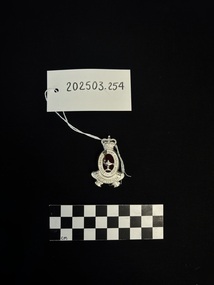
Badge - Collar Badge, Royal Australian Army Nursing Corps (RAANC), unknown
... Oval shaped badge surmounted by St Edward's crown. Around the edge of the oval is embossed 'Royal Australian Army Nursing Corps'. ...Oval shaped badge surmounted by St Edward's crown. Around the edge of the oval is embossed 'Royal Australian Army Nursing Corps'. ...The Royal Australian Army Nursing Corps (RAANC) provides health care and medical assistance to Australian Army personnel in military health facilities. The Royal Australian Army Nursing Corps embraces the values of compassion and service to others, reflecting the care and dedication provided to the wounded and sick. The Australian Army employs registered general nurses as nursing officers in Army hospitals and medical centres. These officers form the Royal Australian Army Nursing Corps. The collar badge would have been worn on the collar of official uniform. This badge is in good condition and provides context and interests in nurse uniform. However, it is hard to guarantee that this is an original badge or a replica. Photograph of Royal Australian Army Nursing Corps collar badge. Oval shaped badge surmounted by St Edward's crown. Around the edge of the oval is embossed 'Royal Australian Army Nursing Corps'. In the centre of the oval is a Nightingale oil lamp on a dull cherry coloured felt background. Across the bottom is a scroll embossed with the Latin motto 'Pro Humanitate', translating to 'for humanity'. The metallic nature of the badge leaves it cool to the touch, with rounded edges and a round collar attachment peg, unlike the sharp attachment pegs like typical badges and pins. 'Royal Australian Army Nursing Corps'/ 'Pro Humanitate'[Latin translating to English as 'for humanity']. raanc, uniform, badge, royal australian army nursing corps -
 Moorabbin Air Museum
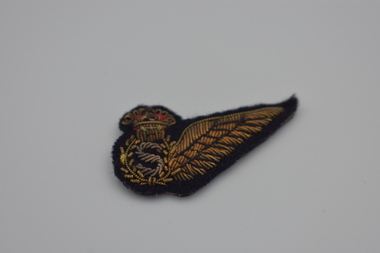
Badge (item) - Military Badge, Royal Australian Air Force (RAAF) Signaller Brevet Dress
... RAAF Signaller's gold wire half-wing on black felt; silver wire "S" surrounded by wreath, St Edward's (Queen's) crown surmounts wreath and "S"....RAAF Signaller's gold wire half-wing on black felt; silver wire "S" surrounded by wreath, St Edward's (Queen's) crown surmounts wreath and "S". ... -
 Woodend RSL
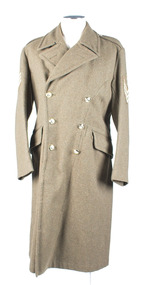
Uniform - Great coat, 1967
... The top patch is an embroided St Edward’s Crown and represents the staff rank. ...The top patch is an embroided St Edward’s Crown and represents the staff rank. ...It is a woolen khaki green great coat, with inter shoulder lining of khaki green canvas. There are back belt loop holes in the interior, lined by the same canvas. The pockets are made of the same canvas and are not sew to the interior of the coat at the bottom. The insides of the sleeves are lined with a more beige khaki green material. There is a split flap that is 500mm long in the middle at the bottom of the coat, which is fixed shut with two brown plastic buttons and a metal hook and eye at the bottom. The construction of the jacket is four panels and has been taken in at the waist for form above both pockets. The jacket has a back pleat from below the triangle stitching below the nape of the neck. The back belt has three metal insignia buttons, and the backside is lined with canvas. On both shoulders, there are epaulettes which have one metal insignia button each. On the front, there are three metal buttons on each on flap, and when the jacket is done up, the left flap goes on top. It has three button holes on the left flap and one button hole on the right flap for a large brown button on the inside of the left flap. There are two outer pockets on either side of the jacket. Beneath the jacket lapels, on either side there are metal buttons, and there are button holes for them in the middle of the bottom lapel. Where the upper and lower lapels are split, there is a hook and eye. There is a brown plastic button on the underside of both the upper lapels, which is where the extra flap of fabric on the inside of the left jacket flap, can be fixed as a face protector. The tag on the inside reads; DAVID KLEIN PTY. LTD. Victoria 1967 An arrow (Department of defence symbol) SIZE 6 CLASS 8405 66.012.0494 REGIMENTAL NO................... NAME......................... The regimantal number section had a number filled in but then scribbled out and another number written above, which is 359282. The name section was filled in with B.R.MIER. The name and regimental numbers were done in black marker pen. All the metal buttons are decorated with the medical corps symbol, which is a serpent-entwined rod (Rod of Asclepius) surrounded by a laurel wreath and above the rod is a crown (St Edward’s Crown). On the outside of the upper sleeves, just below the shoulder, there is two patches that signifies the rank of Staff Sergeant. The top patch is an embroided St Edward’s Crown and represents the staff rank. It is 47mm wide and 45mm. Below this there is a patch depicting the three stripes/ chevorns of the sergeant rank. The chevorn’s points face down, and the sides measure 66mm, while the depth down to the point is 86mm. The bottom lengths is 100mm on both sides and the top lengths are 9mm. coat, trench coat, great coat, medical corps, staff sergeant, b.p. mier, 359282, david klein pty. ltd., 1967 -
 Moorabbin Air Museum
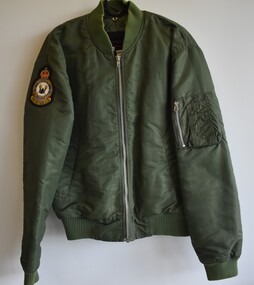
Clothing (item) - Bomber Jacket Fitted With RAAF 455 Squadron Patch
... Motto: The scroll at the bottom displays the squadron's official wartime motto " Strike and Strike Again". Crown: The St Edward's Crown rests at the top signifying royal approval of the official heraldic badge....Motto: The scroll at the bottom displays the squadron's official wartime motto " Strike and Strike Again". Crown: The St Edward's Crown rests at the top signifying royal approval of the official heraldic badge. ... -
 Melbourne Tram Museum
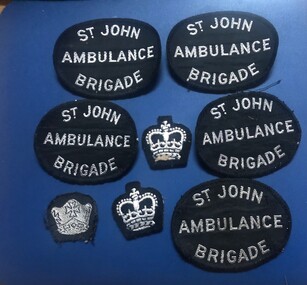
Uniform - Cloth badge, St Johns Ambulance, 1970's to mid 1980's
... St John Ambulance Brigade". Made on black cloth - backing, black stitching on the edge and the words "Conductor Trainer" stitched in white cotton - 54H x 71W. One of the badges has four silver female press studs in the corners. b. - two small badges with a crown (St Edward's...St John Ambulance Brigade". Made on black cloth - backing, black stitching on the edge and the words "Conductor Trainer" stitched in white cotton - 54H x 71W. One of the badges has four silver female press studs in the corners. b. - two small badges with a crown (St Edward's ...Set of uniform items for the "St John Ambulance Brigade" of Victoria used by Frank Kuffer as a member of the Brigade. .1 - Comprises: a. - 5 large uniform name badges with the words "St John Ambulance Brigade". Made on black cloth - backing, black stitching on the edge and the words "Conductor Trainer" stitched in white cotton - 54H x 71W. One of the badges has four silver female press studs in the corners. b. - two small badges with a crown (St Edward's Crown?)sewn in white stitching on a black cloth background - 32H x 31W. c. - one small coronet - 72H x 30W - has loose black threads. .2 - large uniform button - about 28mm diameter - black plastic with brass lug to enable the button to be sewn to a uniform with the organisation symbol and logo. .3 - small uniform button - about 16mm diameter. .trams, tramways, mmtb, ambulances, uniforms, st johns ambulance -
 Wodonga & District Historical Society Inc
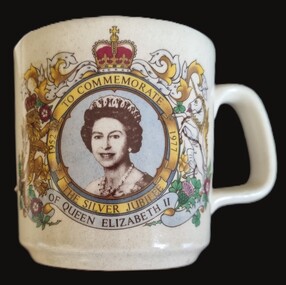
Souvenir - Mug Silver Jubilee of Queen Elizabeth II
... The Royal Australian Mint released a commemorative Silver Jubilee 50c coin, which featured twenty-five representations of St Edward's Crown. Two commemoratives stamps were released by Australia Post to celebrate the Jubilee. ...The Royal Australian Mint released a commemorative Silver Jubilee 50c coin, which featured twenty-five representations of St Edward's Crown. Two commemoratives stamps were released by Australia Post to celebrate the Jubilee. ...Queen Elizabeth II ascended the throne, at the age of 25, on the death of her father King George VI on the 6th February 1952. Elizabeth was crowned as the Queen of the United Kingdom and the other Commonwealth realms on June 2nd 1953 at Westminster Abbey. Her Silver Jubilee was celebrated with large-scale parties and parades throughout the United Kingdom and the Commonwealth throughout 1977, culminating in June with the official "Jubilee Days", held to coincide with the Queen's Official Birthday. In addition Queen Elizabeth and Prince Philip embarked on a tour of Commonwealth nations including Australia. In March 1977, a Silver Jubilee Parade was held in front of Parliament House, Canberra. The Royal Australian Mint released a commemorative Silver Jubilee 50c coin, which featured twenty-five representations of St Edward's Crown. Two commemoratives stamps were released by Australia Post to celebrate the Jubilee. Australian artist Paul Fitzgerald was commissioned to complete the only official portrait of the Queen during the Silver Jubilee year. The Silver Jubilee celebrations culminated in December 1977 with 35,000 serving personnel taking part in parades across Australia.This item is significant because it records an important event in the British Royal Family, a vital part of the hereditary of many Wodonga residents. This item is a vintage ceramic commemorative mug produced to celebrate the 1977 Silver Jubilee of Queen Elizabeth II. It features a portrait of the Queen surrounded by royal iconography, including the crown, crests, and the text "To Commemorate The Silver Jubilee of Queen Elizabeth II". The reverse bears a decorative transfer. The centre features the British Royal Crown. Surrounding the crown are floral emblems representing the United Kingdom: the Tudor Rose (England), the Thistle (Scotland), and Shamrock (Ireland). TO COMMEMORATE THE SILVER JUBILLEE OF QUEEN ELIZABETH II 1952 1977queen elizabeth ii, royal memorabilia -
 Wodonga & District Historical Society Inc
Badge - Royal Agricultural Society of Victoria Member 1985
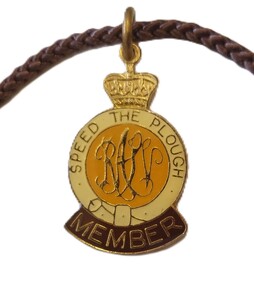
... . • The Crown: The St Edward's Crown sitting at the top signifies the "Royal" status of the society. • The Classification: The scroll at the bottom marks the bearer specifically as a financial Member.... • The Crown: The St Edward's Crown sitting at the top signifies the "Royal" status of the society. • The Classification: The scroll at the bottom marks the bearer specifically as a financial Member ...This badge is a Royal Agricultural Society of Victoria (RASV) Member Badge The RASV (now known as Melbourne Royal) is the organization responsible for hosting major agricultural events in Victoria, Australia, most notably the annual Melbourne Royal Show. Key Features of the Badge: • The Motto: "Speed the Plough" is the traditional motto of the RASV. It dates back centuries in English agricultural tradition and symbolises a wish for success, good harvest, and progressive innovation in farming. • The Monogram: The stylized interlocking letters in the yellow centre spell out RASV (Royal Agricultural Society of Victoria). • The Crown: The St Edward's Crown sitting at the top signifies the "Royal" status of the society. • The Classification: The scroll at the bottom marks the bearer specifically as a financial Member. • The Cord: The braided brown cord allowed the member to wear the badge securely around their neck while visiting the showgrounds or attending society functions. These metal and enamel badges were issued annually or as multi-year passes to financial members and guests, changing color schemes and design layouts depending on the specific year or decade of issue. They are highly popular collector's items today for those interested in Australian agricultural show memorabilia. The number 3302 stamped or engraved on the back is the individual Membership Number of Mr. Donald Pollard of Wodonga. Because these badges served as official admission passes to the Melbourne Royal Show grounds, tracking information was vital to the society. The badge was manufactured by Brim Medallions Pty Ltd located in Mitcham in Melbourne. Melbourne. This badge is significant because it belonged to a highly regarded member of the Wodonga and district community.Small enamelled metal badge showing insignia of Royal Agricultural Society of Victoria (RASV) Member Badge with a crown on top and member on bar below central insignia. It is attached to a brown cord.Around edge of badge "SPEED THE PLOUGH"royal agricultural society of victoria, wodonga councillors -
 Geelong RSL Sub Branch
Flag, Mid 20th Century
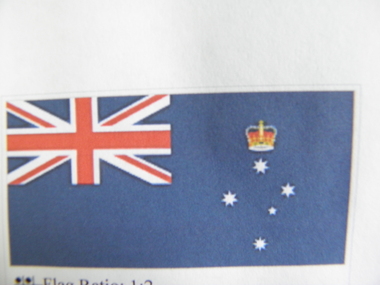
... Flag of Victoria, oblong, Cloth predominantly blue, Union Jack in left top corner. with the crown of St Edward and the stars of the Southern Cross on the right hand side....Australian made by Carroll & Richarsdon Pty Ltd 194-196 Whitehorse Road Blackburn Vic Flag of Victoria, oblong, Cloth predominantly blue, Union Jack in left top corner. with the crown of St Edward and the stars of the Southern Cross on the right hand side. ...The Flag of Victoria dates from 1865 and was first used to distinguish Victorian Ships from British Ships. A flag to denote the State of Victoria, Australia.Flag of Victoria, oblong, Cloth predominantly blue, Union Jack in left top corner. with the crown of St Edward and the stars of the Southern Cross on the right hand side.Australian made by Carroll & Richarsdon Pty Ltd 194-196 Whitehorse Road Blackburn Vicflag, australia, victoria, . -
 Bendigo Historical Society Inc.
Legal record - ELLIS Edward Woodrow Tregenza - Land sale records, Watson, James & Rogers, Rogers Collection, 1907
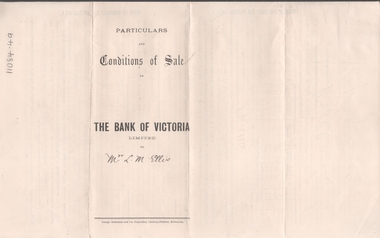
... . * Plan of subdivision of crown allotments 20, 22, 23 Parish of Sandhurst, County of Bendigo * Agreement between Rupert Noyes Putnam of Williamson St. Bendigo and Edward.... * Plan of subdivision of crown allotments 20, 22, 23 Parish of Sandhurst, County of Bendigo * Agreement between Rupert Noyes Putnam of Williamson St. Bendigo and Edward ...In the early 1980s the firm of Watson, James & Rogers merged with the partnership of Every & Every and became the iconic “Rogers & Every” as known today. The firm is still located on Bull Street. https://rogersevery.com.au/about/* Particulars, conditions of sale and contract from bank of Victoria to Louisa Mary Ellis. 1907. * Plan of subdivision of crown allotments 20, 22, 23 Parish of Sandhurst, County of Bendigo * Agreement between Rupert Noyes Putnam of Williamson St. Bendigo and Edward Woodrow Tregenza Ellis of High St Bendigo for Crown allotments 18 and 19, Parish of Sandhurst County of bendigo.Signaturesrupert noyes putnam, land sales -
 National Vietnam Veterans Museum (NVVM)
Medal
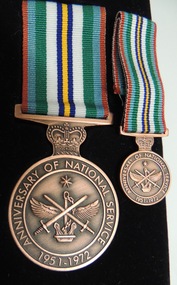
... The Anniversary of National Service 1951-1972 Medal is a bronze medal ensigned with the Crown of St Edward. The obverse depicts an Australian Defence Force emblem with the crossed swords of the Army taking precedence. ...National Service Medal Swainston Collection NE Swainston Anniversary of National Service 1951 - 1972 The Anniversary of National Service 1951-1972 Medal is a bronze medal ensigned with the Crown of St Edward. The obverse depicts an Australian Defence Force emblem with the crossed swords of the Army taking precedence. ...The Anniversary of National Service 1951-1972 Medal was introduced in 2001 to recognise those who completed their obligation under the two National Service schemes that had operated in Australia between 1951 and 1972.The Anniversary of National Service 1951-1972 Medal is a bronze medal ensigned with the Crown of St Edward. The obverse depicts an Australian Defence Force emblem with the crossed swords of the Army taking precedence. The Federation Star surmounts the emblem. Anniversary of National Service 1951 - 1972 national service medal, swainston collection, ne swainston -
 National Vietnam Veterans Museum (NVVM)
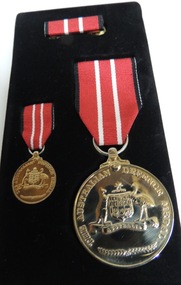
Award - Medal set, Australian Defence Medal, 2006
... Reverse bears "FOR SERVICE' plus Crown of St Edward within a wattle wreath....Reverse bears "FOR SERVICE' plus Crown of St Edward within a wattle wreath. Australian Defence Medal Award Medal set Australian Department of Defence ...From the Swainston Collection, a set of documents and medals from a National Serviceman. The Australian Defence Medal recognises Australian Defence Force personnel who have completed either an enlistment period or four years service after 3 September 1945.This is an example of the Australian Defence Medal for which all Vietnam veterans were eligible.Cupro-nickel Australian Defence Medal plus miniature of same, attached to red and white striped ribbons with black edges to represent the colours of the Flanders poppy, symbol of the Anzac spirit. Three red stripes signify Army, Air Force, Navy. Striped ribbon bar with pins forms part of set. Covering letter addressed to N E Swainston, dated '27 April 2011'. The information card about symbolism of medal and original hard black case complete the set. Front shows Commonwealth Coat of Arms surrounded by the words 'THE AUSTRALIAN DEFENCE MEDAL'. Reverse bears "FOR SERVICE' plus Crown of St Edward within a wattle wreath.'3801127 N E SWAINSTON' engraved around bottom edge of large medal.medal, defence medal, honours -
 Ballarat and District Irish Association
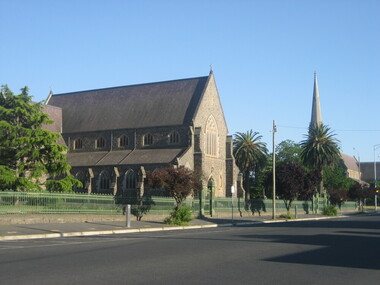
Photograph - Colour, Clare Gervasoni, St Patrick's Cathedral, Ballarat, 2007, 20/11/2007
... St Patrick's Cathedral first conducted services from 1851 onwards, the parish of Ballarat was instituted in 1852.The first Parish Priest was Father Matthew Downing,who selected in 1853 the two acres site for this church which was granted under a crown Grant in 1855. The style of the church is early Gothic from the era of Edward...St Patrick's Cathedral first conducted services from 1851 onwards, the parish of Ballarat was instituted in 1852.The first Parish Priest was Father Matthew Downing,who selected in 1853 the two acres site for this church which was granted under a crown Grant in 1855. The style of the church is early Gothic from the era of Edward ...St Patrick's Cathedral first conducted services from 1851 onwards, the parish of Ballarat was instituted in 1852.The first Parish Priest was Father Matthew Downing,who selected in 1853 the two acres site for this church which was granted under a crown Grant in 1855. The style of the church is early Gothic from the era of Edward the 1st in the 13th Century. (http://www.ballarat.catholic.org.au/parishes/default.cfm?loadref=93, accessed 13 November 2013) Bishop James Alipius Goold OSA (Bishop of Melbourne) celebrated Mass in St Patrick's Ballarat on Sunday November 8th 1863. The Bishop had laid the foundation stone for the Church in 1858 and by November 1863 the Church was sufficiently completed to be used on a regular basis. (http://stpatscathedral.weebly.com/, accessed 13 November 2013) See http://www.ballarat.catholic.org.au/aboutus/default.cfm?loadref=9 A series of coloured digital photographs showing the bluestone church known as St Patrick's Cathedral, Ballarat.ballarat irish, st patrick, st patrick's cathedral, st patrick's cathedral ballarat, church, gothic, bluestone -
 Melbourne Athenaeum Archives
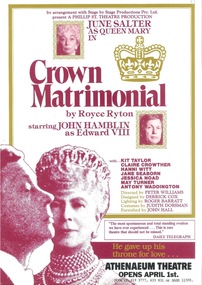
Medium Flyer and newspaper article, Crown Matrimonial (play) by Royce Ryton performed at the Athenaeum Theatre commencing 1 April 1986
... crown matrimonial...athenaeum theatre...phillip st. theatre productions...royce ryton...june salter...edward...based on the abdication of Edward the VII and it's effect on his family June Salter as Queen Mary crown matrimonial athenaeum theatre phillip st. theatre productions royce ryton june salter edward the viii queen mary Crown Matrimonial (play) by Royce Ryton performed at the Athenaeum Theatre commencing 1 April 1986 Medium Flyer and newspaper article ...based on the abdication of Edward the VII and it's effect on his familyJune Salter as Queen Mary crown matrimonial, athenaeum theatre, phillip st. theatre productions, royce ryton, june salter, edward the viii, queen mary -
 Vision Australia
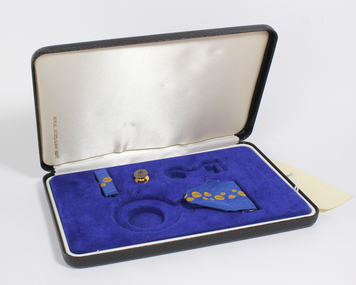
Medal - Object, Order of Australia medal : Member, 1981, 1995
... Above the medallion sits the red Crown of St Edward which hangs from a royal blue band, with gold mimosa blossoms running down the middle. ...Above the medallion sits the red Crown of St Edward which hangs from a royal blue band, with gold mimosa blossoms running down the middle. ...In 1975 the Australian Honours System was established, with the Member of the Order of Australia (AM) created to recognise the contribution for Australian citizens for outstanding service or achievement. It consists of a round medallion with gold-plated silver insignia with the word 'Australia' inscribed and surrounded by two sprigs of mimosa. Above the medallion sits the red Crown of St Edward which hangs from a royal blue band, with gold mimosa blossoms running down the middle. The box contains spaces for the ribbon, medal, a epaulette bar, a pin and a smaller medallion.1 illustrated ribbon, medal, a epaulette bar, a pin and a smaller medallion.Rear of medal is inscribed with recipient's name: John Oswald WICKING HAROLD HUGH JEFFREYmedals, john wicking, hugh jeffrey -
 Dandenong/Cranbourne RSL Sub Branch
Medal - Service Medals
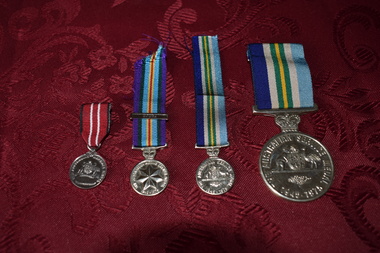
... Obverse Crown of St. Edward over Commonwealth Coat of Arms above a spray of Golden Wattle. ...Obverse Crown of St. Edward over Commonwealth Coat of Arms above a spray of Golden Wattle. ...Four Service Medals ( 1 full size and 3 miniature ). Full size and miniature Australian Service Medal 1945-1975. Miniature Australian Active Service Medal 1945- 1975 with Korea Clasp. Miniature Australian Defence Medal. Including 2 spare ribbons.Obverse Crown of St. Edward over Commonwealth Coat of Arms above a spray of Golden Wattle. Reverse Federation Star and Golden Wattle inscribed VX96932 G.A Rule. Ribbon with central gold stripe, 2 green stripes 2 silver grey stripes and light and dark blue outer stripes. Obverse Crown of St. Edward over Federation Star surrounded by Australian Active Service Medal 1945 - 1975 - medal has Clasp with Korea as theatre of action. Reverse has wreath of Mimosa. Ribbon has centre red stripe,2 grey stripes,2 light blue stripes with 2 purple outer stripes. Obverse stylised Commonwealth Coat of Arms surrounded by Australian Defence Medal above a sprig of wattle. Reverse St. Edwards Crown over For Service surrounded by sprig of wattle. Ribbon is red with black edges divided by two white stripes - three divisions for the three services. -
 Dandenong/Cranbourne RSL Sub Branch
Medal - 4 x Service Medals
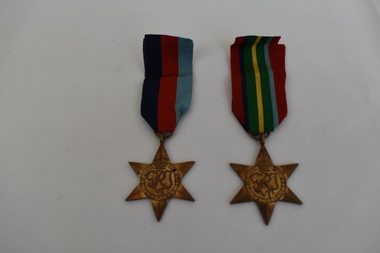
... The Australian Service Medal shows the Crown of St. Edward ,modified Coat of Arms surmounted by the Australian Defense Force Joint Service emblem. ...The Australian Service Medal shows the Crown of St. Edward ,modified Coat of Arms surmounted by the Australian Defense Force Joint Service emblem. ...1 x 1939 -45 Star. 1 x Pacific Star. 1 x 1939 - 1945 Australian Service Medal. 1 x 1939 - 1945 War Medal.The Star Medals are inscribed on the reverse with the name Itzerott A R and service #401750. The Australian Service Medal shows the Crown of St. Edward ,modified Coat of Arms surmounted by the Australian Defense Force Joint Service emblem. Service # 401750 on edge. The 1939 1945 War Medal shows an effigy of King George the V1. The reverse shows a lion standing on a double headed dragon with the dates 1939 - 1945. Service # 401750 on edge. -
 Dandenong/Cranbourne RSL Sub Branch
Medal - 2 x Service Medals
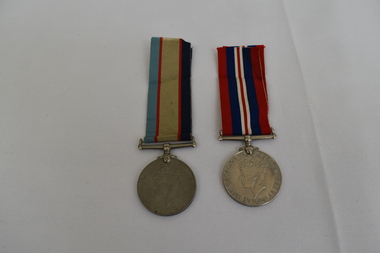
... Australian Service Medal shows the Crown of St. Edward on obverse. Reverse shows Australian Coat of Arms with Australia Service Medal surrounding. ...Australian Service Medal shows the Crown of St. Edward on obverse. Reverse shows Australian Coat of Arms with Australia Service Medal surrounding. ...1 x 1939 - 1945 War Medal. 1 x 1939 - 1945 Australian Service Medal.War Medal shows crowned effigy of King George V1 on obverse. Reverse shows a lion standing on a double headed dragon. The Service # V75911 on edge. Australian Service Medal shows the Crown of St. Edward on obverse. Reverse shows Australian Coat of Arms with Australia Service Medal surrounding. Service # V75911 on edge. William Itzerott. -
 Whitehorse Historical Society Inc.
Certificate - Land Title, McCracken Orchards, 2000
... McCracken John McCracken George Blackburn South Orchard Grove Blackburn South McCracken Avenue Blackburn South Stewart Avenue Blackburn South Lawrence Street Blackburn South Wilton Edward Canterbury Road Blackburn South Barns Street Blackburn South Ralph Street Blackburn South Horkings Street Blackburn South St Ninians Uniting Church Blackburn South Collection of Certificates of Title and lodged plans covering the land used as an orchard by the McCracken Family 1898 - 1962, comprising Cert. of Title vol 2699, Fol 660; Crown Portion 96, 1864 (part), Crown Portion 96, 1996; lodged plans 3681, 19126, 22255, 22256, 33386, with brief history prepared by P. ...Collection of Certificates of Title and lodged plans covering the land used as an orchard by the McCracken Family 1898 - 1962, comprising Cert. of Title vol 2699, Fol 660; Crown Portion 96, 1864 (part), Crown Portion 96, 1996; lodged plans 3681, 19126, 22255, 22256, 33386, with brief history prepared by P. Simmenauer.mccracken, john, mccracken, george, blackburn south, orchard grove, blackburn south, mccracken avenue, blackburn south, stewart avenue, blackburn south, lawrence street, blackburn south, wilton, edward, canterbury road, blackburn south, barns street, blackburn south, ralph street, blackburn south, horkings street, blackburn south, st ninians uniting church, blackburn south -
 Wodonga & District Historical Society Inc
Negative - Haeusler Glass Negatives Collection - Harry Schuster blade shearing
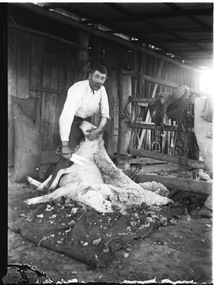
... Crown Land made available under the Victorian Lands Act 1862 (also known as ‘Duffy’s Land Act’) in 1866 in what is now Wodonga West. The Haeusler family were one of several German families to migrate from South Australia to Wodonga in the 1860s. The Schuster family were also of German migrant background. Johannes Edward Schuster was born in Hoyles Plains, South Australia and with his wife Johanna and young family moved to Victoria circa 1882. He took up farming land in Wodonga West. The St...Crown Land made available under the Victorian Lands Act 1862 (also known as ‘Duffy’s Land Act’) in 1866 in what is now Wodonga West. The Haeusler family were one of several German families to migrate from South Australia to Wodonga in the 1860s. The Schuster family were also of German migrant background. Johannes Edward Schuster was born in Hoyles Plains, South Australia and with his wife Johanna and young family moved to Victoria circa 1882. He took up farming land in Wodonga West. The St ...The Wodonga Historical Society Haeusler Collection provides invaluable insight into life in late nineteenth and early twentieth century north east Victoria. The collection comprises manuscripts, personal artefacts used by the Haeusler family on their farm in Wodonga, and a set of glass negatives which offer a unique visual snapshot of the domestic and social lives of the Haeusler family and local Wodonga community. The Haeusler family migrated from Prussia (Germany) to South Australia in the 1840s and 1850s, before purchasing 100 acres of Crown Land made available under the Victorian Lands Act 1862 (also known as ‘Duffy’s Land Act’) in 1866 in what is now Wodonga West. The Haeusler family were one of several German families to migrate from South Australia to Wodonga in the 1860s. The Schuster family were also of German migrant background. Johannes Edward Schuster was born in Hoyles Plains, South Australia and with his wife Johanna and young family moved to Victoria circa 1882. He took up farming land in Wodonga West. The St John’s Lutheran Church Sunday school hall was erected from part of the proceeds of the sale of some 41 acres of land at Wodonga West, which had been bequeathed to the Wodonga congregation by the late Johannes Edward Schuster. This land was the original home site of the Schuster family on arrival from South Australia. Shearing - Although the first mechanised sheep shearing machine was created by James Higham, from Melbourne in 1868, the use of blade shears were more common well into the early 20th century. Pastoralists on smaller holdings continued to either shear their own sheep or employ blade shearers rather than outlay the cost of machines. In large sheds, professional shearers worked as they travelled the country. They would earn around 17 to 20 shillings per day in the early days of the wool industry. However mechanisation continued and by 1915 most sheep shearing sheds in Australia contained sheep shearing machines. The original machines were powered by steam and later combustion engines were used. This digital image was produced from one of the glass negatives that form part of the collection, probably taken by Louis Haeusler (b.1887) with the photographic equipment in the Wodonga Historical Society Haeusler Collection.This item is unique and has well documented provenance and a known owner. It forms part of a significant and representative historical collection which reflects the local history of Wodonga. It contributes to our understanding of domestic and family life in early twentieth century Wodonga, as well as providing interpretative capacity for themes including local history and social history.Digital image created from the Haeusler Glass negative collection. Harry Schuster shearing sheep using blade shears. wodonga pioneers, haeusler family, glass negatives, dry plate photography, blade shearing, schuster family
