
Showing 31 items matching "st. john’s presbyterian church, warrnambool"
-
 Warrnambool and District Historical Society Inc.
Document, Newsletter St John's church Warrnambool, 1895
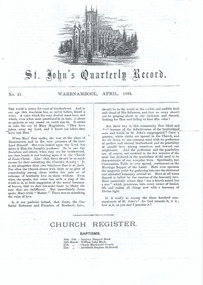
... st. john’s presbyterian church,...warrnambool...St. John’s Presbyterian Church in Warrnambool was opened in 1875 with the Minister in 1895 being the Rev. ...St. John’s Presbyterian Church in Warrnambool was opened in 1875 with the Minister in 1895 being the Rev. ...St. John’s Presbyterian Church in Warrnambool was opened in 1875 with the Minister in 1895 being the Rev. W. Gray Dixon. At this time the Young People’s Society of Christian Endeavour was active and there was great enthusiasm for supporting missionary work in China and India. This newsletter is of considerable importance as it is an original document and describes the activities of the Presbyterian Church in Warrnambool in the 1890s and gives us some idea of the character of the church at the time. It includes information on Fred Newcombe who later died in India while working as a medical missionary and the names of many people who made their mark in our history. This is a white four-page printed newsletter - St. John’s Quarterly Record, No. 21, Warrnambool, April, 1895. The front page contains an image of St. John’s Church. The printed material includes Church Notes, Marriages, Funerals, Church Register and Disjunctions from Membership. The pages are partly torn.st. john’s presbyterian church,, warrnambool presbyterian church 1895 -
 Warrnambool and District Historical Society Inc.
Clothing, Hat Band St Johns Warrnambool, Mid 20th century
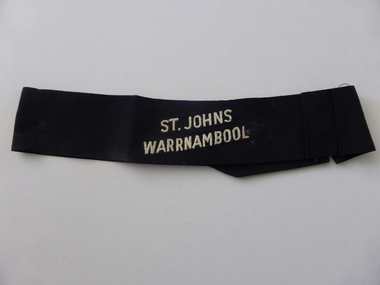
... St. John’s Presbyterian Church, Warrnambool...St. John’s Bowls Club was formed in 1926 as a sporting adjunct to the activities of St. Johns Presbyterian Church in Warrnambool. ...St. John’s Presbyterian Church, Warrnambool History of Warrnambool St. ...St. John’s Bowls Club was formed in 1926 as a sporting adjunct to the activities of St. Johns Presbyterian Church in Warrnambool. In 1956 the club moved to Princess Street in the church grounds. It closed in 2012, the closure caused by dwindling membership and the site being designated by the Presbyterian Church for other purposes. This hat band is of interest as a memento of St. John’s Bowls Club in Warrnambool. This club no longer exists.This is a navy cloth hat band – a strip of material stitched at one end to shorten it and shaped with a ‘V’ at the other end . There is a gold metal clip at the ‘V’ shaped end to join the material to make a continuous circle and to attach the band to the brim of a hat. The name is stitched in white into a piece of white material and attached to the band.‘St. John’s Warrnambool’ st. john’s presbyterian church, warrnambool, history of warrnambool, st. john’s bowls club, warrnambool -
 Warrnambool and District Historical Society Inc.
Book, Advertising book cover, Mid 20th century
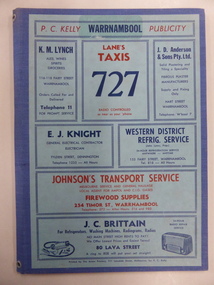
... st. john’s presbyterian church, warrnambool...This folder has been used to hold music sheets at St. John’s Presbyterian Church in Warrnambool. The folder would have been funded by the businesses advertising in the folder. ...This folder has been used to hold music sheets at St. John’s Presbyterian Church in Warrnambool. The folder would have been funded by the businesses advertising in the folder. ...This folder has been used to hold music sheets at St. John’s Presbyterian Church in Warrnambool. The folder would have been funded by the businesses advertising in the folder. St. John’s Presbyterian Church was designed by Andrew Kerr and opened for service in 1875. It was destroyed by fire in 1920 and rebuilt to a similar style. This folder is of interest as a memento of St. John’s Presbyterian Church in the mid 20th century. It also gives us information on some Warrnambool businesses at the time. This is a cardboard folder of four pages to hold music. It has space on the third page to write notes. The other three pages contain 21 advertisements for local Warrnambool businesses pasted on to the folder. The folder is blue and the printed material is in red and dark blue print on a light blue background. There are red and blue borders around each advertisement and some advertisements have illustrated material. The folder has two eyelets with metal edging for attaching the sheet music. st. john’s presbyterian church, warrnambool, history of warrnambool -
 Warrnambool and District Historical Society Inc.
Book - Children's Magazine, Rev. W. Meynell Whittemore, Sunshine for 1886, 1886
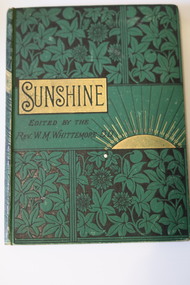
... St. John's Presbyterian Church Warrnambool...St. John's Presbyterian Sabbath (Sunday) School. St. John's Presbyterian Church, Warrnambool was opened in 1874 in Spence Street, burnt down in 1920 and rebuilt in a similar style. ...St. John's Presbyterian Sabbath (Sunday) School. St. John's Presbyterian Church, Warrnambool was opened in 1874 in Spence Street, burnt down in 1920 and rebuilt in a similar style. ...A Children's Annual formed by re-publishing one year's issues of a monthly magazineThis is a book of 190 pages. It has a green cover with embossed floral patterns and a rising sun sketch outlined in gold. The black printing on the cover and spine has a gold patterned background. The pages contain advertisements, printed material and black and white sketches. fictionA Children's Annual formed by re-publishing one year's issues of a monthly magazine matilda logan, st. john's presbyterian church warrnambool, logan's beach -
 Warrnambool and District Historical Society Inc.
Croquet Mallet, 1950's
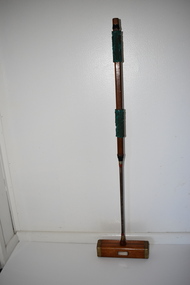
... St John's presbyterian church warrnambool...St. John’s Presbyterian Church Croquet Club in Warrnambool in 1957-8. ...St. John’s Presbyterian Church Croquet Club in Warrnambool in 1957-8. ...St. John’s Presbyterian Church Croquet Club in Warrnambool in 1957-8. ...This croquet mallet was presented to Mrs Huffer when she was the champion player at St. John’s Presbyterian Church Croquet Club in Warrnambool in 1957-8. Croquet has been a sport played particularly by women since the second half of the 19th century. It was popular in Warrnambool and was a competition sport with several clubs from the beginning of the 20th century. St. John’s Club was operative in the 20th century but no longer exists. Mrs W. Huffer was the wife of William Huffer who was an employee and then the manager of the Grasmere Butter and Cheese Factory from 1940 to 1963 when it closed. His father before him had been the manager of the factory from 1918 to 1944. The Huffer family had come to Warrnambool from Gippsland. This croquet mallet has been well used.This mallet is of significance as a memento of St. John’s Croquet Club in Warrnambool and of the Huffer family associated with the local dairying industry for the first half of the 20th century. This croquet mallet was presented to Mrs Huffer when she was the champion player at St. John’s Presbyterian Church Croquet Club in Warrnambool in 1957-8. Croquet has been a sport played particularly by women since the second half of the 19th century. It was popular in Warrnambool and was a competition sport with several clubs from the beginning of the 20th century. St. John’s Club was operative in the 20th century but no longer exists. Mrs W. Huffer was the wife of William Huffer who was an employee and then the manager of the Grasmere Butter and Cheese Factory from 1940 to 1963 when it closed. His father before him had been the manager of the factory from 1918 to 1944. The Huffer family had come to Warrnambool from Gippsland. This croquet mallet has been well used.‘Champion of St, John’s A Grade Mrs W. Huffer 1957-8’ ‘STC Sil’23 croquet mallet, st john's presbyterian church warrnambool, warrnambool, huffer -
 Warrnambool and District Historical Society Inc.
Book, Winnowings of wit & wisdom, C1910
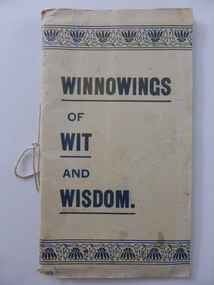
... St. John’s Presbyterian Church, Warrnambool...St. John’s Young Women’s Association (St. John’s Presbyterian Church, Spence Street, Warrnambool) and was printed about 1910. ...St. John’s Young Women’s Association (St. John’s Presbyterian Church, Spence Street, Warrnambool) and was printed about 1910. ...This booklet is a souvenir of St. John’s Young Women’s Association (St. John’s Presbyterian Church, Spence Street, Warrnambool) and was printed about 1910. It contains the favourite sayings or quotations of over 200 people living in the Warrnambool district at the time. A young women’s group commenced at St. John’s in 1892 and church groups for both young men and young men were well-organized and popular in the 20th century. It is presumed that the booklet was sold as a fund raiser for the youth group. The identity of ‘C.McLaren’ is not known. This booklet is significant because it contains not only the names of over 200 people living in the district at the time but also their contributions to the booklet. These contributions give us some small insight into the philosophies of these people when we study the quotations they chose to contribute. The contributors include the well-known names of Younger, Forrester, Tyers, Mainland, Dickson, Davidson, Swinton, Goodall, Battarbee, Salamy, Shaddock, Newcombe and Uebergang This is soft cover booklet of 40 pages (the pages are not numbered). The cream-coloured cover overlaps the printed pages. The front cover has black printing and two black scrolls at the top and bottom of the cover. The book has been bound with one staple and tied with white cord. There are two blue stamps of the Warrnambool & District Historical Society at the front and the back of the booklet and the inscription is handwritten in black ink. The cover is a little stained and slightly torn at the left bottom edge. ‘C. McLaren, Merri St., W’bool’. st. john’s presbyterian church, warrnambool, history of warrnambool, st. john's young women's association -
 Warrnambool and District Historical Society Inc.
Artefact, Model of Church, C1900
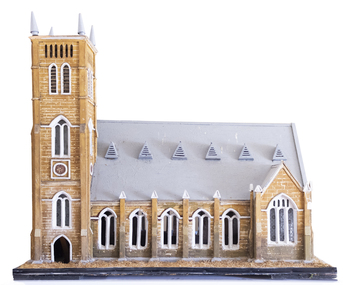
... St. John’s Presbyterian Church, Warrnambool...This model of St. John’s Presbyterian Church in Warrnambool was made by Johan Carl August Landmann (1826-1920). ...This model of St. John’s Presbyterian Church in Warrnambool was made by Johan Carl August Landmann (1826-1920). ...This model of St. John’s Presbyterian Church in Warrnambool was made by Johan Carl August Landmann (1826-1920). August Landmann and his wife, Christina came from Silesia to Australia in 1854. They settled in Warrnambool where August made a living as a carpenter and joiner. At first he rented shops in Timor Street and then built a two-storeyed shop and residence in Henna Street. Landmann built many of the early commercial buildings and residences in Warrnambool and he and his family were associated with the management of the Warrnambool Western Brewery. When he retired in 1900 he built another residence in Mickle Street and it was at that time that it is believed he made the model of the Presbyterian Church and the model of the Ozone Hotel (which is in the Warrnambool Art Gallery today). St. John’s Presbyterian Church, designed by Andrew Kerr, was built in the English Gothic style and opened in 1875. It was destroyed by fire in 1920 but was rebuilt to a similar style. This model is of great significance for two reasons: 1. It was made by a prominent early Warrnambool carpenter and joiner, Johan Carl August Landmann. 2. It is the only known model of the Warrnambool St. John’s Presbyterian Church which was destroyed by fire in 1920.This model is on a wooden stand or base which is painted black with metal screws. The edging of the stand contains straw which is now brown but was originally green to resemble grass or lawn. The church is a wooden structure (hollow inside) with some sections painted to resemble sandstone. The roof is slanted and painted grey and has six dormer windows or ventilation pieces on each side. The main body of the church has a nave with dual arched windows, the west end has dual arched windows and a door with louvre ventilation and the east end has a door and dual arched windows and two conical-shaped finials. The windows, some of which are triangular, have frosted decorated glass. Some of the glass in the windows is missing. The main tower is square-shaped with four conical-shaped finials. The upper part has four sets of louvres and two arched windows. The centre and lower sections have rosette patterns and several sets of dual arched windows with frosted decorated glass panels. The north east corner has a smaller tower.johan carl august landmann, st. john’s presbyterian church, warrnambool, warrnambool history -
 Warrnambool and District Historical Society Inc.
45 R.P.M. Record, A Silver Star, 1975
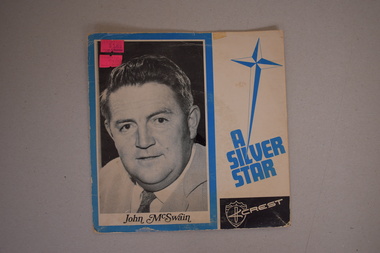
... john mcswain, singer...glorie attrill, songwriter...catherine brymer, musician...st. john’s presbyterian church, warrnambool...John McSwain was the son of an acquaintance in her childhood days. This record is of interest as the one of the songs was written by a local woman, Glorie Attrill and the disc was recorded in Warrnambool in the 1970s. crest records, melbourne john mcswain, singer glorie attrill, songwriter catherine brymer, musician st. john’s presbyterian church, warrnambool history of warrnambool A Silver Star John McSwain Crest This is a circular 45 R.P.M. black disc with silver-coloured printing in the centre. ...This item was made by Crest Records, a Melbourne company established by Marcus Herman that recorded pop, jazz, folk, liturgical and other music from the early 1960s to the mid 1970s. The music and words of ‘A Silver Star’ were by Glorie Attrill nee McLean(1911-1998) who was born in Glenormiston, Victoria. She lived and farmed for some years at The Sisters and in her later years lived at Terang. She wrote several songs, with ‘A Silver Star’ being her best-loved composition. Her two autobiographical booklets are ‘Sunset Serenade’ and ‘At Twilight’. John McSwain was the son of an acquaintance in her childhood days. This record is of interest as the one of the songs was written by a local woman, Glorie Attrill and the disc was recorded in Warrnambool in the 1970s.This is a circular 45 R.P.M. black disc with silver-coloured printing in the centre. The cove has a black and white photograph of the singer on the front with white and blue printing, an image of a star and the logo of the recording company. There are also two pink labels from the retail shop where the record was purchased. The back cover has black and blue printing A Silver Star John McSwain Crest crest records, melbourne, john mcswain, singer, glorie attrill, songwriter, catherine brymer, musician, st. john’s presbyterian church, warrnambool, history of warrnambool -
 Warrnambool and District Historical Society Inc.
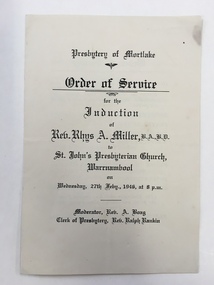
Programme - Induction – Rev. Rhys Miller
... This is a program for the Order of Service for the Induction of the Rev Rhys Miller to St. John’s Presbyterian Church in Warrnambool in 1946. St. John’s Church was officially opened in 1875, burnt down in 1920 and rebuilt around the skeleton structure remaining on the same site. ...Rhys Miller to St. John’s Presbyterian Church, Warrnambool in 1946. It is a small sheet of paper folded in two to make four pages. ...This is a program for the Order of Service for the Induction of the Rev Rhys Miller to St. John’s Presbyterian Church in Warrnambool in 1946. St. John’s Church was officially opened in 1875, burnt down in 1920 and rebuilt around the skeleton structure remaining on the same site. ...This is a program for the Order of Service for the Induction of the Rev Rhys Miller to St. John’s Presbyterian Church in Warrnambool in 1946. St. John’s Church was officially opened in 1875, burnt down in 1920 and rebuilt around the skeleton structure remaining on the same site. The Rev. Rhys Miller had been a R.A.A.F. Chaplain during World War Two before coming to Warrnambool in 1946. He was absent from Warrnambool for most of that first year undertaking post-graduate studies in Scotland. The Rev. Miller was the Minister at St. John’s Church until 1952 when he transferred to a Gardenvale church in Melbourne. The centenary of Presbyterianism in Warrnambool took place in 1949 and Rev. Miller wrote the booklet, ‘100 Years of Worship and Work’. In 1984 he published his autobiography, ‘Calling and Recalling’. This program is of interest because the Rev. Rhys Miller, as a Minister of St. John’s Presbyterian Church on Warrnambool, was a significant person in Warrnambool’s history. This is a program, the Order of Service for the Induction of the Rev. Rhys Miller to St. John’s Presbyterian Church, Warrnambool in 1946. It is a small sheet of paper folded in two to make four pages. The printed material is black on white. There is a small black mark on the back page (spilt ink?). order of service -
 Warrnambool and District Historical Society Inc.
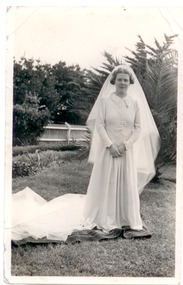
Textile - Wilton Wedding Dress, 1937
... A magnolia silk velvet wedding dress worn by Amy Wilton for her marriage to Ronald Wade (born 30 September 1912) on 19 April 1937 at St John's Presbyterian Church, Spence Street, Warrnambool....(refer catalogue Gorgeous Garb, Buda, Castlemaine p2 and The Australian Aesthetic Wedding Dress 1822 to 2011, Bendigo Art Gallery, p 5,10,12,17) wade wilton wedding dress 1937 A magnolia silk velvet wedding dress worn by Amy Wilton for her marriage to Ronald Wade (born 30 September 1912) on 19 April 1937 at St John's Presbyterian Church, Spence Street, Warrnambool. Textile Wilton Wedding Dress ...The wedding dress was worn by Amy Wilton for her marriage at St John's Presbyterian Church. Photograph (media attached) shows bride wearing the dress.This wedding dress is socially significant because of its historic connection with Warrnambool through local families that still reside in the city and contributes to the understanding of the era. It has artistic and aesthetic merit and is a good example of fashion, style and design of the era. (refer catalogue Gorgeous Garb, Buda, Castlemaine p2 and The Australian Aesthetic Wedding Dress 1822 to 2011, Bendigo Art Gallery, p 5,10,12,17)A magnolia silk velvet wedding dress worn by Amy Wilton for her marriage to Ronald Wade (born 30 September 1912) on 19 April 1937 at St John's Presbyterian Church, Spence Street, Warrnambool.wade, wilton, wedding dress, 1937 -
 Warrnambool and District Historical Society Inc.
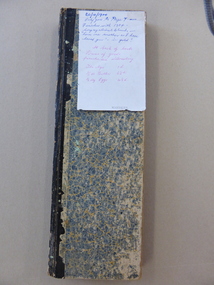
Ledger, Alex Black Painter and Decorator 1900-1904, Circa 1900
... This ledger has entries which relate to work completed at the time including the Kirkstall school, Miss Murray of Waikato, W Fletcher, tender to Fritz Landman and work on St John’s Presbyterian Church, the Warrnambool Race Club and works for J.J Forrester....This ledger has entries which relate to work completed at the time including the Kirkstall school, Miss Murray of Waikato, W Fletcher, tender to Fritz Landman and work on St John’s Presbyterian Church, the Warrnambool Race Club and works for J.J Forrester. ...Alexander Black was a painter and decorator who operated a business in Timor St below Swintons. This ledger has entries which relate to work completed at the time including the Kirkstall school, Miss Murray of Waikato, W Fletcher, tender to Fritz Landman and work on St John’s Presbyterian Church, the Warrnambool Race Club and works for J.J Forrester.This ledger provides a snapshot of daily life in the early 1900’s and documents the type of work completed by tradesman and their associated costs. It lists a number of people and organisations which are of historical interest to Warrnambool and district.Long thin rectangular ledger book. Blue and yellow mottled cardboard cover with black binding. Pink and blue multi-coloured edge of pages. Handwritten entries in front and back pages. Loose envelope addressed to Mr. Alex Black inside front cover. warrnambool,alex black, alexander black , timor st warrnambool, alex black painter and decorator, -
 Warrnambool and District Historical Society Inc.
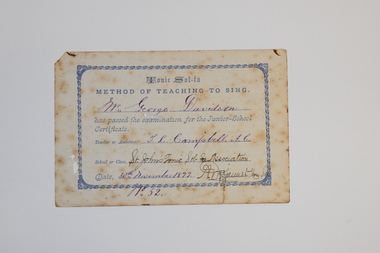
Certificate - Singing certificate, St. John's Tonic Sol-Fa Association, 1877
... St. John's Tonic Sol-Fa Association in 1877. The Tonic Sol-Fa was a technique used for teaching sight singing, invented in the 18th century and further developed, popularised and used extensively by singing teachers in the 19th century. The St. John's Tonic Sol-Fa Association was an extension of the choir of St. John's Presbyterian Church in Warrnambool...St. John's Tonic Sol-Fa Association in 1877. The Tonic Sol-Fa was a technique used for teaching sight singing, invented in the 18th century and further developed, popularised and used extensively by singing teachers in the 19th century. The St. John's Tonic Sol-Fa Association was an extension of the choir of St. John's Presbyterian Church in Warrnambool ...This card was presented to George Davidson when he passed the Junior School examination held by St. John's Tonic Sol-Fa Association in 1877. The Tonic Sol-Fa was a technique used for teaching sight singing, invented in the 18th century and further developed, popularised and used extensively by singing teachers in the 19th century. The St. John's Tonic Sol-Fa Association was an extension of the choir of St. John's Presbyterian Church in Warrnambool and the conductor (and the teacher whose name is on this card) was T. L.Campbell. He was a well-known singing and music teacher in Warrnambool in the second half of the 19th century and specialized in the teaching of the viola, violin and violincello. George Davidson (1860-1941) was the son of John and Isobel Davidson, pioneer settlers in the Warrnambool district.This card is of some interest as a memento of the music scene in Warrnambool in the second half of the 19th century with references to T.L. Campbell, a music teacher, George Davidson, a pupil and a school of music, St. John's Tonic Sol-Fa AssociationThis is a small white card with a blue scroll border and blue printing on one side and printed information on the other side. The card has handwritten details in ink. It is stained, torn at one edge and has signs of silverfish damage.Tonic Sol-Fa Method of Teaching to Sing - Mr George Davidson has passed the examination for the Junior School Certificate. Teacher or Assistant: T.L. Campbell A.C. School or Class: St. John's Tonic Sol-Fa Association. Date: 30th November 1877 No. 52st john's warrnambool tonic sol-fa association, t.l.campbell warrnambool music teacher, george davidson warrnambool -
 Warrnambool and District Historical Society Inc.
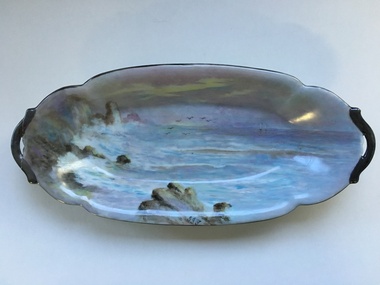
Artefact, China Plate, 1922 (painting)
... John Lamb Forrester and Maria Hexter, was an architect in Warrnambool in the early 20th century. He had an office in Kepler Street (1910) and in Koroit Street (1916). He lived in the house in Liebig Street that was formerly the first Savings Bank and was erected in 1860 (7A Liebig Street today). Forrester was a staunch member of the Presbyterian Church and was the co-architect for the re-building of the interior of St...John Lamb Forrester and Maria Hexter, was an architect in Warrnambool in the early 20th century. He had an office in Kepler Street (1910) and in Koroit Street (1916). He lived in the house in Liebig Street that was formerly the first Savings Bank and was erected in 1860 (7A Liebig Street today). Forrester was a staunch member of the Presbyterian Church and was the co-architect for the re-building of the interior of St ...This plate was painted by J.J. Forrester in 1922. John James Forrester, the son of John Lamb Forrester and Maria Hexter, was an architect in Warrnambool in the early 20th century. He had an office in Kepler Street (1910) and in Koroit Street (1916). He lived in the house in Liebig Street that was formerly the first Savings Bank and was erected in 1860 (7A Liebig Street today). Forrester was a staunch member of the Presbyterian Church and was the co-architect for the re-building of the interior of St. John’s Presbyterian Church in Warrnambool after it was destroyed by fire in 1920. John Forrester was also a noted artist of his time and several of his works of art have survived. A landscape by him is in the possession of the Warrnambool and District Historical Society. This plate is one of two painted by Forrester that survive today.This plate, although damaged, is of interest because it was painted by John James Forrester, a Warrnambool artist from the early 20th century. This is a china plate showing a seascape painted by John James Forrester in 1922. It depicts a coastal scene of rocks, birds and sailing boats. The colours are in mauve/brown/ white tonings and are slightly opalescent. The plate has brown/grey handles with one broken and repaired. The plate is oval-shaped with a slight dip and a stand at the base. Front of plate: ‘J.J.F.’ On base: ‘J.J. Forrester 1922’ john james forrester, history of art in warrnamool, history of architecture in warrnambool, history of warrnambool, china painting -
 Warrnambool and District Historical Society Inc.
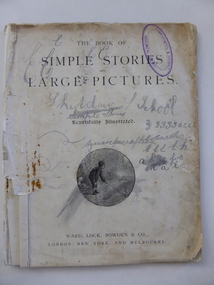
Book, Simple stories & large pictures, Late 19th century
... Warrnambool. For 36 years his wife, Mary, conducted a Sunday School at Skiddaw (from 1882 to 1918). This Sunday School was under the auspices of St. John’s Presbyterian Church...Warrnambool. For 36 years his wife, Mary, conducted a Sunday School at Skiddaw (from 1882 to 1918). This Sunday School was under the auspices of St. John’s Presbyterian Church ...This book was given as a prize to William Giles in the late 19th century. It came from the Skiddaw Sunday (or Sabbath) School. Skiddaw was the home of the Batterbee family and was situated on the old Princes Highway in East Warrnambool near Simpson Street. The corner here was known as ‘Batterbees Corner’ and there is a Skiddaw Street in the locality nearby. George Batterbee had a ham and bacon business in Warrnambool. For 36 years his wife, Mary, conducted a Sunday School at Skiddaw (from 1882 to 1918). This Sunday School was under the auspices of St. John’s Presbyterian Church in Warrnambool. Mrs Batterbee was assisted by her daughter Florinda and other teachers. Florinda and her brother Rex were both artists of note. William Giles and his family lived on the Allansford Road. The Logan family farm was in the vicinity of where Logans Beach is today. This book, though tattered and stained, is most important as the only item we have in our collection that is associated with the Skiddaw Sunday School. Situated in a family home, this Presbyterian-sponsored Sunday School operated for 36 years under the direction of Mary Batterbee. This is a book of 32 pages with the cover and perhaps some of the pages missing. It has been stapled but the staples have been removed. The book has large print and illustrations on all the pages. The illustrations have been coloured in by hand. The first page is loose and scribbled on. The pages are very stained and torn in places. The inscription is handwritten in black ink.‘Skiddaw S. School, Second Prize, Awarded to William Giles for diligence in class, S. Logan, Teacher’. skiddaw, east warrnambool, batterbee family, giles family, logan family, history of warrnambool -
 Warrnambool and District Historical Society Inc.
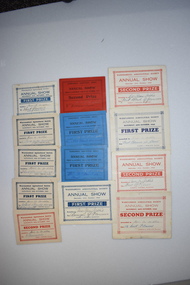
Flower Show Cards, 1940s
... Warrnambool lawyer, William Ardlie and his wife, Mary and the great granddaughters of John and Mary Ardlie, early Warrnambool settlers. The cards were mostly awarded to Agnes Ardlie for prize flowers and pot plants and come from the Warrnambool Agricultural Society Annual Show, St. John’s Warrnambool Presbyterian Church...Warrnambool lawyer, William Ardlie and his wife, Mary and the great granddaughters of John and Mary Ardlie, early Warrnambool settlers. The cards were mostly awarded to Agnes Ardlie for prize flowers and pot plants and come from the Warrnambool Agricultural Society Annual Show, St. John’s Warrnambool Presbyterian Church ...These are cards awarded as prizes in Flower Shows in Warrnambool in the 1940s to the Misses Ardlie. Dorothy Ardlie (1910-1993) and her sister Agnes Ardlie (1915-1993) were the daughters of the Warrnambool law clerk Arthur Ardlie and his wife Ethel, the granddaughters of the prominent Warrnambool lawyer, William Ardlie and his wife, Mary and the great granddaughters of John and Mary Ardlie, early Warrnambool settlers. The cards were mostly awarded to Agnes Ardlie for prize flowers and pot plants and come from the Warrnambool Agricultural Society Annual Show, St. John’s Warrnambool Presbyterian Church Flower Show and St. Joseph’s Warrnambool Catholic Church Fete and Flower Show.These cards are of minor interest as mementoes of Agnes and Dorothy Ardlie, members of a prominent Warrnambool family in the 20th century. These are lightweight cardboard cards, rectangular in shape. They all have printing in various colours and handwriting in ink or pencil. Some cards have been annotated on the back and one card has a newspaper cutting and a photograph of the winning pot plant. ardlie family, history of warrnambool -
 Flagstaff Hill Maritime Museum and Village
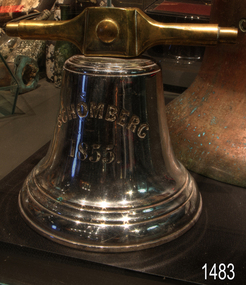
Functional object - Bell, Schomberg 1855, Before 1855
... John Manning, located at Hopkins Point near Warrnambool. Manning took possession of the bells and subsequently presented them to two churches in Warrnambool. The smaller bell went to St Joseph’s Catholic Church, while the larger bell went to St John’s Presbyterian Church. ...John Manning, located at Hopkins Point near Warrnambool. Manning took possession of the bells and subsequently presented them to two churches in Warrnambool. The smaller bell went to St Joseph’s Catholic Church, while the larger bell went to St John’s Presbyterian Church. ...The Rescue and Journey of the Schomberg Bells: This bell was the smaller of two rescued by the crew of the Schomberg following the ship’s wreck in 1855. While the specific purpose of the smaller bell is unknown, it may have served to assemble the crew or signal mealtimes on board. After surviving the shipwreck, the crew carried both bells as they made their way along the coastline. Their journey eventually led them to the home of settler John Manning, located at Hopkins Point near Warrnambool. Manning took possession of the bells and subsequently presented them to two churches in Warrnambool. The smaller bell went to St Joseph’s Catholic Church, while the larger bell went to St John’s Presbyterian Church. After around a year, the small bell at St Joseph’s developed a crack and became unusable. Thomas Manifold imported a replacement bell for the church, and the damaged bell was stored at his farm. Years later, when the property was sold to John Logan, the discarded bell was donated to the old Warrnambool Museum upon its opening in 1886. The Curator, Joseph Archibald, placed the bell on display in the entry. In 1975, it was transferred from the Warrnambool Art Gallery to Flagstaff Hill. The ’Mystery’ of the small bell solved: Despite numerous attempts by the staff at Flagstaff Hill to restore the bell’s lustre, the bell remained dull and tarnished. In October 1986, Director Peter Ronald decided to send the bell for professional advice. The bell was entrusted to Briggs Marine Products, a renowned brass founder established in 1912. Upon examination, the specialists at Briggs discovered the reason behind the bell’s persistent lack of shine: it had originally been silver-plated, but most of the plating had worn away over time. The experts at Briggs then undertook the task of restoring the bell, successfully returning it to a gleaming silver surface. The Sailing Ship Schomberg: Launched in 1855, the Schomberg was regarded as the “Noblest” ship afloat at the time. Owned by the Black Ball Line, it was built for their passenger fleet by Alexander Hall of Aberdeen at a cost of £43,103. The construction featured three skins: one planked fore and aft and two diagonally planked, all fastened with screw-threaded trunnels (wooden rails). The ship’s First Class accommodation was luxurious, boasting velvet pile carpets, large mirrors, rosewood, birds-eye maple and mahogany timbers, satin damask soft furnishings, and an oak-lined library with a piano. Schomberg had a capacity for 1,000 passengers. The ship’s master, Captain James Nicol Forbes—also known as ‘Bully’ Forbes—was only 34 years old at the launch. He had a reputation for setting and breaking speed records on the Black Ball Line’s Marco Polo and Lightning. In 1852, Forbes completed the London to Melbourne journey on the Marco Polo in 68 days, a record at the time, though 53 passengers died during the voyage. In 1854, he sailed the Lightning to Melbourne in 76 days and returned in only 63 days—a record that stood among sailing ships. Forbes was known for driving his ship and crew to their limits, often prioritising speed over passenger comfort. Determined to set new records, he promised to reach Melbourne in sixty days, declaring he would do so “with or without the help of God.” The Maiden Voyage and the Wreck: Schomberg departed Liverpool on 6th October 1855, flying a banner that read “Sixty Days to Melbourne”. The vessel carried 430 passengers and 3,000 tons of cargo, including materials to build the Melbourne to Geelong Railway and a bridge over the Yarra River. Among the cargo were a cow for fresh milk, pens for fowls and pigs, and 90,000 gallons of water for drinking and washing. Additionally, it transported 17,000 letters and 31,800 newspapers. The ship and cargo were insured for $300,000, a considerable sum for the era. Poor winds while crossing the equator delayed Schomberg’s progress. Land was first sighted on Christmas Day at Cape Bridgewater near Portland. Captain Forbes followed the coastline towards Melbourne, but was reportedly playing cards when the third mate, Henry Keen, reported land only three miles away. The ship ran aground on a sand spit near Curdie’s Inlet (approximately 56 km west of Cape Otway) on 26th December 1855, after 78 days at sea. The sand spit and nearby currents were not marked on Forbes’s map. During the night, the crew launched a lifeboat to search for a safe landing spot for the passengers. The scouting party advised Forbes to wait until morning, as rough seas posed a danger to the lifeboats. At dawn, the ship’s Chief Officer spotted the SS Queen and signalled for help. The master of the Queen brought his vessel alongside, and all passengers and crew disembarked safely. The Black Ball Line’s Melbourne agent sent another steamer to collect the passengers’ baggage, and other steamers assisted with cargo salvage until worsening weather forced operations to cease. Notably, a plunderer later recovered a case of Wellington boots, but all were for the left foot. The wreck and its cargo were sold to local merchants Manifold & Bostock, who did not attempt further salvage. They later sold their interest to a Melbourne businessman and two seafarers. In 1864, after two men drowned in their attempt to reach the Schomberg, salvage efforts were abandoned. By 1870, parts of the ship had washed ashore on New Zealand’s South Island. Today, the wreck is about nine metres below the surface. Although most woodwork has disintegrated, the vessel’s shape remains discernible due to the railway irons, girders, and framework. Various goods and materials from the ship are scattered nearby. The bell is particularly significant in that along with other items from the wreck helped in part to having the legislation changed to protect shipwrecks, with far tighter controls being employed to oversee the salvaging of wreck sites. This bell forms part of the Schomberg collection at Flagstaff Hill maritime museum. The collection as a whole is of historical and archaeological significance at a State level. Flagstaff Hill’s collection of artefacts from the Schomberg is also significant for its association with the Victorian Heritage Registered Schomberg shipwreck (VHR S 612). The collection is of additional significance because of the relationship between the objects salvaged, as together they help us to interpret the story of the Schomberg. The collection as a whole is historically significant for representing aspects of Victoria's maritime history and its potential to interpret social and historical themes from society at the time of the wreck. A small ship’s bell. The silver-plated metal bell bears the ship’s name and year of construction on one side and the name and address of the ship’s builders on the other. These details are deeply engraved into the metal and formed in bold, upper-case lettering. The bell has two bell stands: the left and the right. Both stands have an Iron pipe bent into an inverted ‘Y’ shape, with a hole along its length and feet attached to a rectangular metal plate at the other two ends. Feet are bolted to a timber base that has a hole drilled through the centre for mounting. Bell's front; “SCHOMBERG” with “1855” below. Bell's back “HALL & SONS (crack splits letter “N”) / BUILDERS (in italics) / ABERDEEN” (crack splits letter “B”).flagstaff hill, flagstaff hill maritime museum and village, warrnambool, maritime museum, maritime village, great ocean road, shipwreck coast, schomberg, silver plated bell, mess bell, bell stands, captain ‘bully’ forbes, alexander hall and son, james baines and company, liverpool’s black ball line, bell, schomberg bell, ship's bell, small bell, st joseph's church, briggs marine, john manning, john logan, warrnambool museum, briggs foundry, silver bell -
 Flagstaff Hill Maritime Museum and Village
Instrument - Organ and stool, 1897-1901
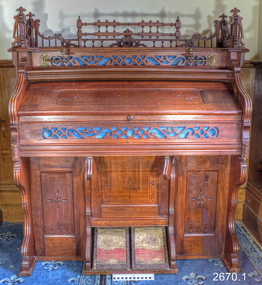
... It was purchased locally from John Broadwood Shepherd & Son of Liebig St, Warrnambool. The donor advised that it was played for many years in the Winslow Presbyterian Church, southwestern Victoria (on Caramut Road, now a private residence). ...john broadwood winslow victoria church music musical instrument john broadwood shepherd and son presbyterian church winslow presbyterian church the great warrnambool exhibition 1896-1897 Words on front panel “Packard Organ / Fort Wayne Ind. U.S.A. / JOHN BORADWOOD SHEPHERD & SON, / LIEBIG STREET, WARRNAMBOOL.” Serial Number "48870" Chapel organ or pump organ (with stool), dated not before 1897 and not after 1901. Medium brown timber with fretwork and turned spindles, Manufactured by Packard, Fort Wayne U.S.A. Organ was purchased from John Broadwood Shepherd & Son, Liebig St ...This chapel organ, or pump organ, was made by the Packard Company of Fort Wayne, USA. It was purchased locally from John Broadwood Shepherd & Son of Liebig St, Warrnambool. The donor advised that it was played for many years in the Winslow Presbyterian Church, southwestern Victoria (on Caramut Road, now a private residence). The serial number of the organ dates to be no older than 1887 and no younger than 1901, according to The Pump Organ Society. The goals of The Packard Company, as quoted from the Fort Wayne Gazette, 6th August 1873 are summarised as such; “In the first place, it was determined to make an organ which should be excelled by none. …. It is interesting to the uninitiated to watch the different processes which literally convert the trees of the forest into the marvellous instruments which sound the praises of God in thousands of churches and Sabbath Schools, or make sweet music in multitudes of homes.” The music store of John Broadwood Shepherd and Son had an “impressive” stand at The Great Warrnambool Exhibition of 1896 – 1897 and received a medal for its exhibit. It was also involved in the community, sponsoring prizes for the Musical and Recital Competition, which was part of the entertainment for the Exhibition. The “Warrnambool Standard” newspaper has reference to John Broadwood Shepherd and Son in a newspaper of 1887 and another dated April 13, 1901. A brief history of the Packard Company: 1850, Isaac T. Packard joined with Nelson J. Foss and Calvin Hatch to form Packard, Foss, & Co., manufacturing reed organs, seraphines, and melodeons 1871 the Fort Wayne Organ Company was formed, and Isaac Packard has 40 shares. 1872 the first organ was completed 5th Sept 1899, “Fort Wayne Organ Company” was officially changed to “The Packard Company” 1908 – 1914 (different dates given) the Packard Company ceased producing organs and specialised in pianos. 1930 company went into receivership 1935 the city of Fort Wayne acquired the former Packard Company property, tore the buildings down and turned it into a park, now known as Packard Park. The organ is significant to local history for being sold by a Warrnambool business and played at a local chape or church. It represents community and religious life in late Victorian times.Chapel organ or pump organ (with stool), dated not before 1897 and not after 1901. Medium brown timber with fretwork and turned spindles, Manufactured by Packard, Fort Wayne U.S.A. Organ was purchased from John Broadwood Shepherd & Son, Liebig St, Warrnambool. Serial number is stamped into the wood, rear of organ. lower right panel. Pedals are covered in carpet and each has the maker's name on the lower part of the pedal frame. The keyboard has five octaves and twelve stoppers.Words on front panel “Packard Organ / Fort Wayne Ind. U.S.A. / JOHN BORADWOOD SHEPHERD & SON, / LIEBIG STREET, WARRNAMBOOL.” Serial Number "48870"flagstaff hill, warrnambool, shipwreck coast, flagstaff hill maritime village, flagstaff hill maritime museum, maritime museum, great ocean road, pump organ, packard organ, fort wayne usa, john broadwood shepherd & son, john broadwood, winslow victoria, church music, musical instrument, john broadwood shepherd and son, presbyterian church, winslow presbyterian church, the great warrnambool exhibition 1896-1897 -
 Warrnambool and District Historical Society Inc.
Book, 1277.1 The Natural History of Selbourne - G White; 1277.2 Democratic Vistas - W Whitman, 1887/1888
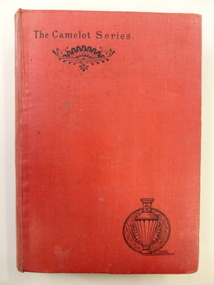
... He was a prominent lawyer in Warrnambool for 30 years and a staunch adherent of the Presbyterian Church. He and his family lived at ‘Glenrye’ at the corner of Ardlie Street and Botanic Road, a site where the St. John ...These two important books are part of a series produced in the 1880s but they have widely-different content. One describes the natural history of the Parish of Selborne in the County of Hampshire in England. It was written by the British naturalist and ornithologist, Gilbert White and first published in 1789. Since that time it has been republished over 300 times right up to the present day. It is notable for its charm and simplicity and for its description of a pre-industrial England. The other is by the American author, Walt Whitman, first published in 1871. It is a major work of comparative politics and expounds on the influence of the Louisiana Purchase and the expansion of the American spirit and character. It also denounces the post-Civil War materialism that had spread at that time in America. These books are of interest because of their antiquarian nature but they are mostly of local Warrnambool interest because of their inscriptions. The books belonged to William Hugh McMahon (1862-1936). William McMahon commenced a legal practice in Warrnambool in 1894, firstly in Liebig Street and later in Kepler Street. He was a prominent lawyer in Warrnambool for 30 years and a staunch adherent of the Presbyterian Church. He and his family lived at ‘Glenrye’ at the corner of Ardlie Street and Botanic Road, a site where the St. John of God Hospital was later established. These two accompanying volumes are in the Camelot Series (1887 and 1888). They are hard cover books with red covers and two ornamental patterns on the front cover (stylized urn and fan shapes). The urn pattern is repeated on the spines. ‘The Natural History of Selborne’ has 366 pages (a Preface and Chapters on the Natural History of Selborne, a Naturalist’s Calendar and Observations on Various Branches of Natural History) and ‘Democratic Vistas’ has 175 pages (a Preface and 12 Chapters). The latter has the remains of a label stuck to the front cover. The handwriting on the inside first pages are in black ink.1277.1: ‘W.H.McMahon, June 24th 1889, Warrnambool’ 1277.2: ‘W.H.McMahon, Sept. 4th 1891, Warrnambool’ gilbert white, english natural history, walt whitman, american politics, william mcmahon, solicitor, warrnambool., warrnambool history -
 Warrnambool and District Historical Society Inc.
Booklet - Sunday School library catalogue and card, Smith's Printing Works, Warrnambool, early 20th century
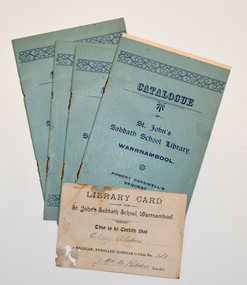
... Warrnambool Presbyterian St. John's Sabbath School Library (Robert Carswell's Bequest) early in the 20th century. The books for boys and girls are listed separately and are mostly fiction, many with some religious content. St John's Presbyterian Church...Warrnambool Presbyterian St. John's Sabbath School Library (Robert Carswell's Bequest) early in the 20th century. The books for boys and girls are listed separately and are mostly fiction, many with some religious content. St John's Presbyterian Church ...The booklet is a catalogue of the books in the Warrnambool Presbyterian St. John's Sabbath School Library (Robert Carswell's Bequest) early in the 20th century. The books for boys and girls are listed separately and are mostly fiction, many with some religious content. St John's Presbyterian Church was opened in 1875. The building was destroyed by fire in 1920 and rebuilt in a similar style to the original one. Robert Carswell was a Warrnambool resident who died in 1900 at the age of 77 and it is presumed that the bequest from his will enabled the Sunday (Sabbath) School library to be established. The card is a membership certificate indicating that Elsie Alston was enrolled as a Sunday School member in Class 14 and thus entitled to borrow books from the library. No details have been found on Elsie Alston but there were several Alston families in Warrnambool at the time.These items are of some interest as church Sunday Schools in the past, particularly in the 19th century, were important as they were widely attended and provided a range of educational and recreational activities, often not otherwise available to the children at that time'.1 A booklet of ten pages with a blue cover with blue printing and a decorative border on the front. The pages contain printed material. The booklet was once stapled but the staples have been removed. .2 A white card with black printing and handwritten names.Elsie Alston Mr M. Ritchieelsie alston, robert carswell, st. john's sabbath school warrnambool, sunday schools in warrnambool -
 Warrnambool and District Historical Society Inc.
Print, Relic from St John’s Fire, Pre 1920
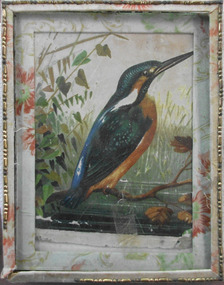
... Church was rebuilt in 1922. The event of this fire remains one of the most significant in the history of Warrnambool. warrnambool st.john's presbyterian church st john's fire warrnambool st john's fire relic On back of picture, ‘ From Grandmother to Nancy on her 5th Birthday, Aug 20th 1920. ...A small card at the back of the picture reads,’ This Picture was a teaching aid used in St. John’s Kinderg S.S and was found in the Church Ruins after the fire in July 1920 by Nancy McC(Absalom). Later framed by Grandma. St. John’s Presbyterian Church was built in 1875 and was burned down July 21st 1920. A volunteer fireman Mr T Spicer discovered the fire and despite the prompt arrival of the fire brigade, after an hour only the walls and tower remained. Some items were salvaged including vestry furnishings and church register. A bible which had been given to the Church in 1895 was rescued by an unknown young man whose identity remained a mystery until1976 when a Mr Stan Williams of Ballarat told his story. The Church was rebuilt in 1922. The event of this fire remains one of the most significant in the history of Warrnambool. Framed print of kookaburra on branch in natural setting. The bird is coloured blue, green and tan. Background is in muted greens. The light wooden frame is covered in fabric in pinks and green. A patterned metal edge sits atop the fabric. On back of picture, ‘ From Grandmother to Nancy on her 5th Birthday, Aug 20th 1920. This is a relic of the burning of St John’s Church July 21st 1920. Picked up by Nancy and framed by E Black.” warrnambool, st.john's presbyterian church, st john's fire warrnambool, st john's fire relic -
 Warrnambool and District Historical Society Inc.
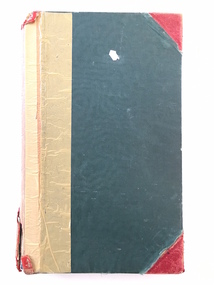
Journal - Ledger, Christ Church Bowls Club 1981-1995, Mid 20th century
... Church Warrnambool Bowls Club from October 1981 to December 1995. The minutes refer to matters in relation to the running of the club, maintenance of the greens, social events and general procedures which are typical of a sporting club. Warrnambool had two church affiliated Bowls clubs, This particular club at Christ Church and another from St John’s Presbyterian...Church Warrnambool Bowls Club from October 1981 to December 1995. The minutes refer to matters in relation to the running of the club, maintenance of the greens, social events and general procedures which are typical of a sporting club. Warrnambool had two church affiliated Bowls clubs, This particular club at Christ Church and another from St John’s Presbyterian ...This book contains the minutes of Christ Church Warrnambool Bowls Club from October 1981 to December 1995. The minutes refer to matters in relation to the running of the club, maintenance of the greens, social events and general procedures which are typical of a sporting club. Warrnambool had two church affiliated Bowls clubs, This particular club at Christ Church and another from St John’s Presbyterian Church. A newspaper cutting undated which is pasted to the inside front cover relates the 50th anniversary of the club.This minutes book contains a large amount of information, activities and names of people associated with the bowls clubs and as such has a strong social history and significance. Green cloth over card cover with red leather points and spine binding which has been covered with plastic tape. Dark blue and white patterned inside front and back covers. 189 pages. warrnambool, christ church bowls club, bowls club warrnambool,, christ church, bowls club, warrnambool -
 Warrnambool and District Historical Society Inc.
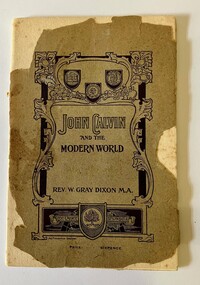
Booklet, John Calvin and The Modern World, 1909
... St. Paul’s Christ church to the General Assembly of the Presbyterian Church of New Zealand. It was published at the request of the General Assembly and the proceeds of the sale of the booklet went into Presbyterian Church funds. The Rev. William Gray Dixon was born in Scotland and was the Presbyterian Minister at St. John’s Warrnambool...St. Paul’s Christ church to the General Assembly of the Presbyterian Church of New Zealand. It was published at the request of the General Assembly and the proceeds of the sale of the booklet went into Presbyterian Church funds. The Rev. William Gray Dixon was born in Scotland and was the Presbyterian Minister at St. John’s Warrnambool ...This booklet contains the address given by the Rev. W. Gray Dixon in 1909 at St. Paul’s Christ church to the General Assembly of the Presbyterian Church of New Zealand. It was published at the request of the General Assembly and the proceeds of the sale of the booklet went into Presbyterian Church funds. The Rev. William Gray Dixon was born in Scotland and was the Presbyterian Minister at St. John’s Warrnambool from 1889 to 1900. In 1900 he went to New Zealand to St. David’s Church, Auckland and later to Dunedin. Rev. Gray Dixon was the author of several publications relating to Presbyterian Church history and activities. This booklet was sent from Auckland by Rev. Gray Dixon to Marcus Saltau, his friend in Warrnambool. Marcus Saltau (1869-1945) followed his father in the produce business in Warrnambool and expanded it to include management of the Warrnambool tramway (which took freight from the town to the port) and a shipping business that had its own vessels and an interstate and international trade. Marcus Saltau was prominent in Warrnambool’s community as a Councillor, Mayor and a politician (Upper House Member for the Western Province 1924-1940). He was a founding member of the Warrnambool Woollen Mill Company, concerned with the establishment of the Nestles Factory at Dennington and a Warrnambool Hospital committee member and Chairman for over 30 years. The Jean Buick Saltau Maternity Ward and Marcus Saltau House at the Warrnambool Hospital survived as important community buildings for many years. This little booklet is of high significance as it is connected to two important Warrnambool people of the past – the Rev. William Gray Dixon and Marcus Saltau. It is one of two Gray Dixon pieces of writing that the Historical Society possesses and it is of double significance when it is noted that Marcus Saltau, the owner of the booklet was a friend of Gray Dixon’s, and was also a most important person in Warrnambool’s history. This is a soft-cover booklet of 22 pages. The cover which is completely detached and very torn is grey-coloured with dark blue and grey ornamental scrolls and shields around the title of the book. The book contains a portrait of John Calvin, three black and white photographs of places in Geneva, the music of a song, ‘The Marseillaise of the Reformation’ and some verse. The book was stapled but the staples have been removed. The pages are made of lightweight parchment paper. The illustrations have been glued in. The text is a publication of an address given by the author, Rev. W. Gray Dixon to the General Assembly of the Presbyterian Church of New Zealand in 1909. Front Cover: ‘John Calvin and the Modern World, Rev. W. Gray Dixon, M.A., Price Sixpence’ Inscription on first page: ‘To Marcus Saltau, Esq. with the esteem & affection of the Author, Auckland, 9th February 1910’ rev. w. gray dixon, marcus saltau, warrnambool, john calvin, john calvin and the modern world -
 Warrnambool and District Historical Society Inc.
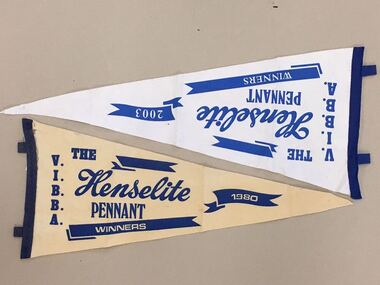
Pennant, Bowles Club St John's, 1980 and 2003
... Warrnambool division) in 1980 and 2003. The winners were presumably the members of the St. John’s Bowls Club (associated with the Presbyterian Church, Warrnambool) as these pennants come from their collection. ...Warrnambool division) in 1980 and 2003. The winners were presumably the members of the St. John’s Bowls Club (associated with the Presbyterian Church, Warrnambool) as these pennants come from their collection. ...These are two pennants awarded to the winners of the Victorian Indoor Bias Bowls Association (perhaps the Warrnambool division) in 1980 and 2003. The winners were presumably the members of the St. John’s Bowls Club (associated with the Presbyterian Church, Warrnambool) as these pennants come from their collection. St. John’s Bowls Club was prominent in Warrnambool in the 20th century but was disbanded in the second decade of the 21st century. The Henselite company that sponsored these trophies is an Australian company that is the biggest manufacturer of lawn bowls world-wide. R.W.Hensell was the first to produce the plastic bowl in 1930 when the company was formed. These two pennants are of interest because they came from the St. John’s Bowls Cub in Warrnambool, a club no longer existing. Bowls is a very popular sport in Australia. These are two pennants from the Victorian Indoor Bias Bowls Association. Both are triangular in shape and made of felt cloth. One is white with a dark blue edging stitched on and dark blue lettering stamped on. The other is a cream colour with dark blue edging stitched on and dark blue lettering stamped on. .1 – ‘V.I.B.B.A. The Henselite Pennant, Winners 2003’ .2 – ‘V.I.B.B.A. The Henselite Pennant Winners 1980’ victorian indoor bias bowls association, henselite australia pty ltd, st. john’s bowls club, warrnambool., warrnambool -
 Warrnambool and District Historical Society Inc.
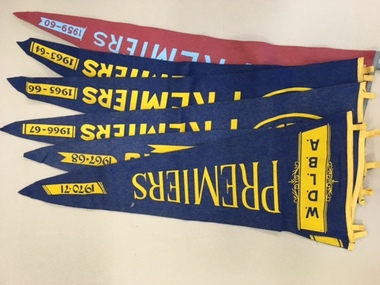
Pennant, St John's Bowles Club, Second half of 20th century
... Warrnambool, Lawn Tennis and City Memorial. As the pennants have come from the now-defunct St. John’s Bowls Club of Warrnambool it is presumed that the St. John’s Club was the recipient of the pennants. St. John’s Club ceased to operate in 2013. It was associated with St. John’s Presbyterian Church...Warrnambool, Lawn Tennis and City Memorial. As the pennants have come from the now-defunct St. John’s Bowls Club of Warrnambool it is presumed that the St. John’s Club was the recipient of the pennants. St. John’s Club ceased to operate in 2013. It was associated with St. John’s Presbyterian Church ...These pennants have all been awarded to the premier bowls team in the Warrnambool district. The Warrnambool District Bowls Association includes the bowls clubs of Dennington, Koroit, Terang, Port Fairy, Timboon, Warrnambool, Lawn Tennis and City Memorial. As the pennants have come from the now-defunct St. John’s Bowls Club of Warrnambool it is presumed that the St. John’s Club was the recipient of the pennants. St. John’s Club ceased to operate in 2013. It was associated with St. John’s Presbyterian Church and was situated in Princess Street. These pennants are of some interest as being mementoes of St. John’s Bowls Club, Warrnambool. This club was a prominent sporting club in Warrnambool for over 80 years. Bowls is a popular sport in Warrnambool.These are 13 triangular-shaped pennants. They are multi-coloured and made of felt cloth. Some are yellow and green, some are dark blue and white, some are yellow and blue and some are yellow and white. They are all pennants awarded for the premier teams in local Warrnambool bowls clubs, ranging in date from 1959 to 1981. The lettering has been glued on and all have cloth tabs at the base of the triangle for attachment to pegs or a pole. They are mostly in good condition though a couple are rubbed and worn. The pennants have the lettering ‘W.D.B.A.’ (Warrnambool District Bowls Association) and the word ‘Premiers’ and the date.st. john’s bowls club warrnambool, warrnambool district bowls association, warrnambool -
 Warrnambool and District Historical Society Inc.
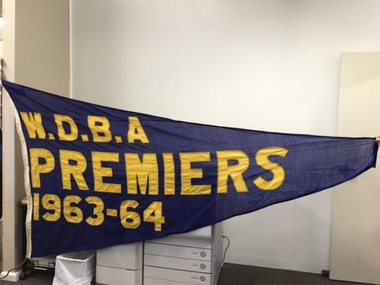
Flag, Bowles Club Western District Bowles Association 1963-64, 1964
... Warrnambool Bowls Clubs. It is presumed that this flag was awarded to St. John’s Bowls Club as it was passed over from that club to the Warrnambool and District Historical Society in 2014. St. John’s Bowls Club in Princess Street, Warrnambool was associated with the Warrnambool Presbyterian Church...Warrnambool Bowls Clubs. It is presumed that this flag was awarded to St. John’s Bowls Club as it was passed over from that club to the Warrnambool and District Historical Society in 2014. St. John’s Bowls Club in Princess Street, Warrnambool was associated with the Warrnambool Presbyterian Church ...This is a flag awarded to the Premiers of the Warrnambool District Bowls Association for 1963-4. The members of the Warrnambool District Bowls Association are Timboon, Dennington, Koroit, Port Fairy, Terang, Lawn Tennis, City Memorial and Warrnambool Bowls Clubs. It is presumed that this flag was awarded to St. John’s Bowls Club as it was passed over from that club to the Warrnambool and District Historical Society in 2014. St. John’s Bowls Club in Princess Street, Warrnambool was associated with the Warrnambool Presbyterian Church. It was formed in the 1930s and ceased to exist in 2013. This flag is of some interest as a memento of St. John’s Bowls Club in Warrnambool. This club was a well-known sporting club in the 20th and early 21st centuries in Warrnambool. Bowling is a popular sport in Warrnambool. This is a triangular-shaped cloth flag or pennant. It is dark blue with yellow lettering stitched on (Warrnambool District Bowls Association Premiers 1963-4). The base of the triangle has a white canvas folded binding in which is enclosed a plaited rope with a metal clip for attachment to a pole. The smallest section of the flag has been stitched over with black cloth. The flag is somewhat grubby with the white binding particularly dirty.‘W.D.B.A. Premiers 1963-64’warrnambool district bowls association, st. john’s bowls club, warrnambool, warrnambool -
 Warrnambool and District Historical Society Inc.
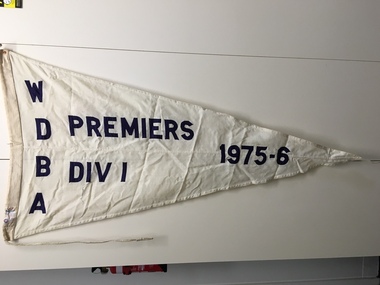
Flag, WarrnamboolDistrict Bowles Club 1975-76, 1976
... This pennant was awarded for the premiers of 1975/76 and, as the pennant came from St.John’s Bowls Club (Presbyterian Church Warrnambool) it is presumed that this club was the winner of this pennant. St. John’s...This pennant was awarded for the premiers of 1975/76 and, as the pennant came from St.John’s Bowls Club (Presbyterian Church Warrnambool) it is presumed that this club was the winner of this pennant. St. John’s ...This is a pennant from the Warrnambool District Bowls Association. This association is a division of the West Coast Bowls Association and the members are the Bowls Clubs of Dennington, Koroit, Lawn Tennis Club, Mortlake, Terang, Port Fairy, Timboon, Warrnambool and City Memorial. This pennant was awarded for the premiers of 1975/76 and, as the pennant came from St.John’s Bowls Club (Presbyterian Church Warrnambool) it is presumed that this club was the winner of this pennant. St. John’s Bowls Club, in Princess Street, Warrnambool, was prominent in the 20th century but has now been disbanded (early 21st century) with the land sold in 2014. The maker of the flag, Evan Evans Pty Ltd, is a well-known Australian flag-making business. It was founded in 1877 and a member of the family was a co-designer of the Australian flag in 1901. This pennant is of some interest as it was awarded by the Warrnambool District Bowls Association to St. John’s Bowls Club in Warrnambool. As the St. John’s Club no longer exists it is an important memento of this Warrnambool sports club. Bowls is a popular sport in Warrnambool. This is a large triangular-shaped pennant from the Warrnambool District Bowls Association (1975-6). It is a white cloth pennant made in two sections with stitched hems on the edges and through the centre. The side holding the cord is made of thicker folded cloth with a white plaited cord inserted. The lettering is made of blue cloth and machine stitched on to the pennant. The material is nylon and wool. There are some dirt smudges and rust marks where the pennant has been attached to a wall. ‘W.D.B.A. Premiers 1975-6’warrnambool district bowls association, st. john’s bowls club, warrnambool, warrnambool -
 Warrnambool and District Historical Society Inc.
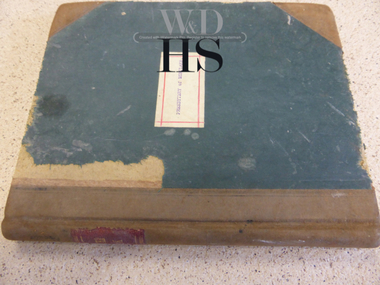
Book, Letter book, Early 20th century
... George Mackay was prominent in Warrnambool civic and community affairs and was Secretary of St. John’s Presbyterian Church for many years. ...George Mackay was prominent in Warrnambool civic and community affairs and was Secretary of St. John’s Presbyterian Church for many years. ...This letter book (1910-1922) was found in the old Mackay Taylor building in Kepler Street. The Secretary of the Presbytery of Mortlake in the early 1900s was George Mackay who established his legal business in 1891 and merged with the business of James Fletcher in 1893 to form Fletcher and Mackay. In the 1920s J. Taylor joined the business which was known from then on as Mackay and Taylor and this firm existed until the 1990s. George Mackay was prominent in Warrnambool civic and community affairs and was Secretary of St. John’s Presbyterian Church for many years. The Presbytery of Mortlake was an administrative district committee established in 1862 and included the Presbyterian churches of Port Fairy, Tower Hill, Wangoom, Allansford, Warrnambool, Woodford, Hexham, Caramut, Mortlake and Terang. The committee consisted of the local ministers, some elders and other church representatives and met monthly or quarterly to discuss church business that affected the region.This letter book is of some significance as it indicates the type of business carried out by a district church council – properties, missions, individual church problems etc. It also shows the community work of George Mackay, a prominent Warrnambool resident at the time, and the book contains his signature many times over. The book will be of interest to researchers. This is a ledger with dark blue binding and binding reinforcements on the spine and corners. The inside covers are lined with thick paper in a mottled blue, black and white coloured pattern. There are 249 pages of copies of letters written, some typed, some handwritten. Front cover: Label with typed title ‘Presbytery of Mortlake’ Spine:’ Letter Book’, ‘Mortlake Presby’. presbytery of mortlake, george mackay, warrnambool -
 Warrnambool and District Historical Society Inc.
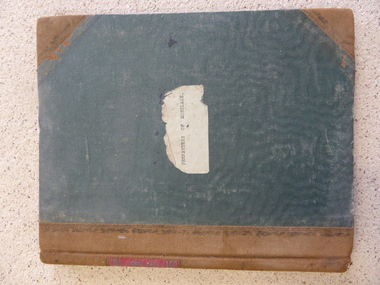
Book, Letter Book Presbytery of Mortlake, Early 20th century
... George Mackay was prominent in Warrnambool civic and community affairs and was Secretary of St. John’s Presbyterian Church for many years. ...George Mackay was prominent in Warrnambool civic and community affairs and was Secretary of St. John’s Presbyterian Church for many years. ...This letter book (1922-6) was found in the old Mackay Taylor building in Kepler Street. The Secretary of the Presbytery of Mortlake in the early 1900s was George Mackay who established his legal business in 1891 and merged with the business of James Fletcher in 1893 to form Fletcher and Mackay. In the 1920s J. Taylor joined the business which was known from then on as Mackay and Taylor and this firm existed until the 1990s. George Mackay was prominent in Warrnambool civic and community affairs and was Secretary of St. John’s Presbyterian Church for many years. The Presbytery of Mortlake was an administrative district committee established in 1862 and included the Presbyterian churches of Port Fairy, Tower Hill, Wangoom, Allansford, Warrnambool, Woodford, Hexham, Caramut, Mortlake and Terang. The committee consisted of the local ministers, some elders and other church representatives and met monthly or quarterly to discuss church business that affected the region. This letter book is of some significance as it indicates the type of business carried out by a district church council – properties, missions, individual church problems etc. It also shows the community work of George Mackay, a prominent Warrnambool resident at the time, and the book contains his signature, many times over. The book will be of interest to researchers. This is a ledger with dark blue binding and binding reinforcements on the spine and corners. The inside covers are lined with thick paper in a mottled blue and black coloured pattern. There are 250 pages with entries up to page 54. The letter copies are typed with an alphabetical listing at the front.Front Cover: Label with typed title ‘Presbytery of Mortlake’ Spine: ‘Letter Book’ presbytery of mortlake, george mackay -
 Warrnambool and District Historical Society Inc.
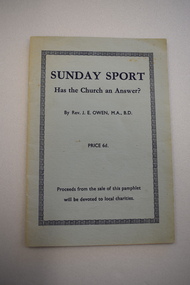
Booklet, Collett & Bain, Printers, Sunday Sport – Has the Church an Answer?, 1960s
... Warrnambool City Council-managed grounds. The article written by the Rev. Owen concluded that there was nothing inherently wrong with the playing of Sunday sport. The Rev. Eric Owen served as the Presbyterian Minister at St. John’s Church...Warrnambool City Council-managed grounds. The article written by the Rev. Owen concluded that there was nothing inherently wrong with the playing of Sunday sport. The Rev. Eric Owen served as the Presbyterian Minister at St. John’s Church ...This booklet was written by the Rev. J. E. (Eric) Owen in response to the campaign regarding the playing of Sunday sport in Warrnambool in the 1960s. The specific point of contention was the playing of football on Warrnambool City Council-managed grounds. The article written by the Rev. Owen concluded that there was nothing inherently wrong with the playing of Sunday sport. The Rev. Eric Owen served as the Presbyterian Minister at St. John’s Church in Warrnambool from December 1960 to 1965, dying in office in the May of 1965. Today Sunday sport, both organized and recreational, is an acceptable and common occurrence. This booklet is of interest as one written by a local Warrnambool person in the 1960s and as a memento of the time when the playing of Sunday sport was a contentious issue. This is a booklet of four pages. It has a pale blue cover with dark blue printing and a decorative edging around the printing. The pages are loose within the cover. rev eric owen, warrnambool presbyterian church, sunday sport -
 Warrnambool and District Historical Society Inc.
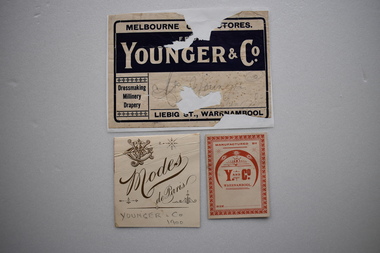
3x Labels, Gaspars Modern Printing Co, Younger & Co, Early 20th century
... Warrnambool from 1888 with the arrival in town of John Younger through to the store closure in 1983. John Younger was the director of the Warrnambool Woollen Mills in1903, the Mayor of Warrnambool in 1910 serving two terms and an elder of the Presbyterian Church. These labels are of importance as the John Younger store was a prominent business in Warrnambool for over ninety years. Younger and Company Warrnambool .1 MELBOURNE ( OBLITERATED) STORES FROM YOUNGER & CO. Dressmaking Millinery Drapery LIEBIG ST ...Originally known as the Melbourne Cash Stores the general merchandise business of Younger and Co. was a dominant one in Liebig Street, Warrnambool from 1888 with the arrival in town of John Younger through to the store closure in 1983. John Younger was the director of the Warrnambool Woollen Mills in1903, the Mayor of Warrnambool in 1910 serving two terms and an elder of the Presbyterian Church. These labels are of importance as the John Younger store was a prominent business in Warrnambool for over ninety years..1 Rectangular cream and dark blue label with text. It is adhered to a piece of white paper. The label is damaged so that some of the text is obliterated. . .2 Rectangular thin card cream label with red text and a decorative border. .3 Cream rectangular label with a symbol of a Y and CO intertwined, other small decorations and text all in gold colour..1 MELBOURNE ( OBLITERATED) STORES FROM YOUNGER & CO. Dressmaking Millinery Drapery LIEBIG ST., WARRNAMBOOL.( In pencil and handwritten) Mrs. J Younger Darling Street .2 MANUFACTURED BY Y AND CO. WARRNAMBOOL SIZE.... .3 Modes de Paris YOUNGER & CO. 1900 ( in pencil ) ..younger and company, warrnambool
